Sara and Moses’ Chicago Five in the 1940s: Becoming US Citizens

As of 1940, the five youngest of the eight surviving children of Sara Rothschild and Moses Adler—Caroline Grete, Malchen, Emmi, Betty Jennie, and David Theodore— were all living in Chicago. The 1940s saw them become US citizens and saw many of their children marry.

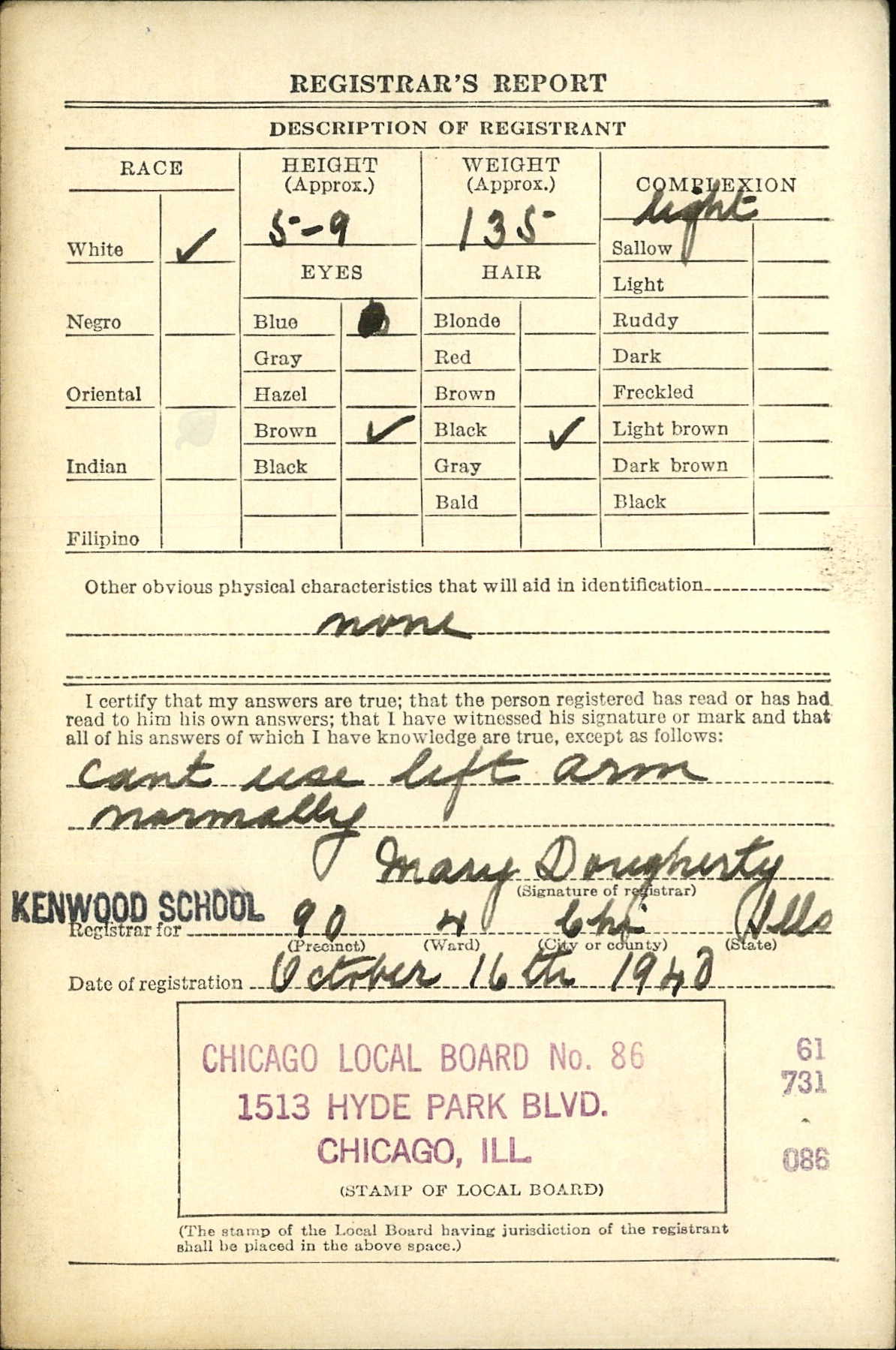
Grete’s son Kurt Mandelstein registered for the US draft on October 16, 1940, before he was even a US citizen. At the time he was working at Stop & Shop. His draft registration included the comment that he was unable to “use his left arm normally.”
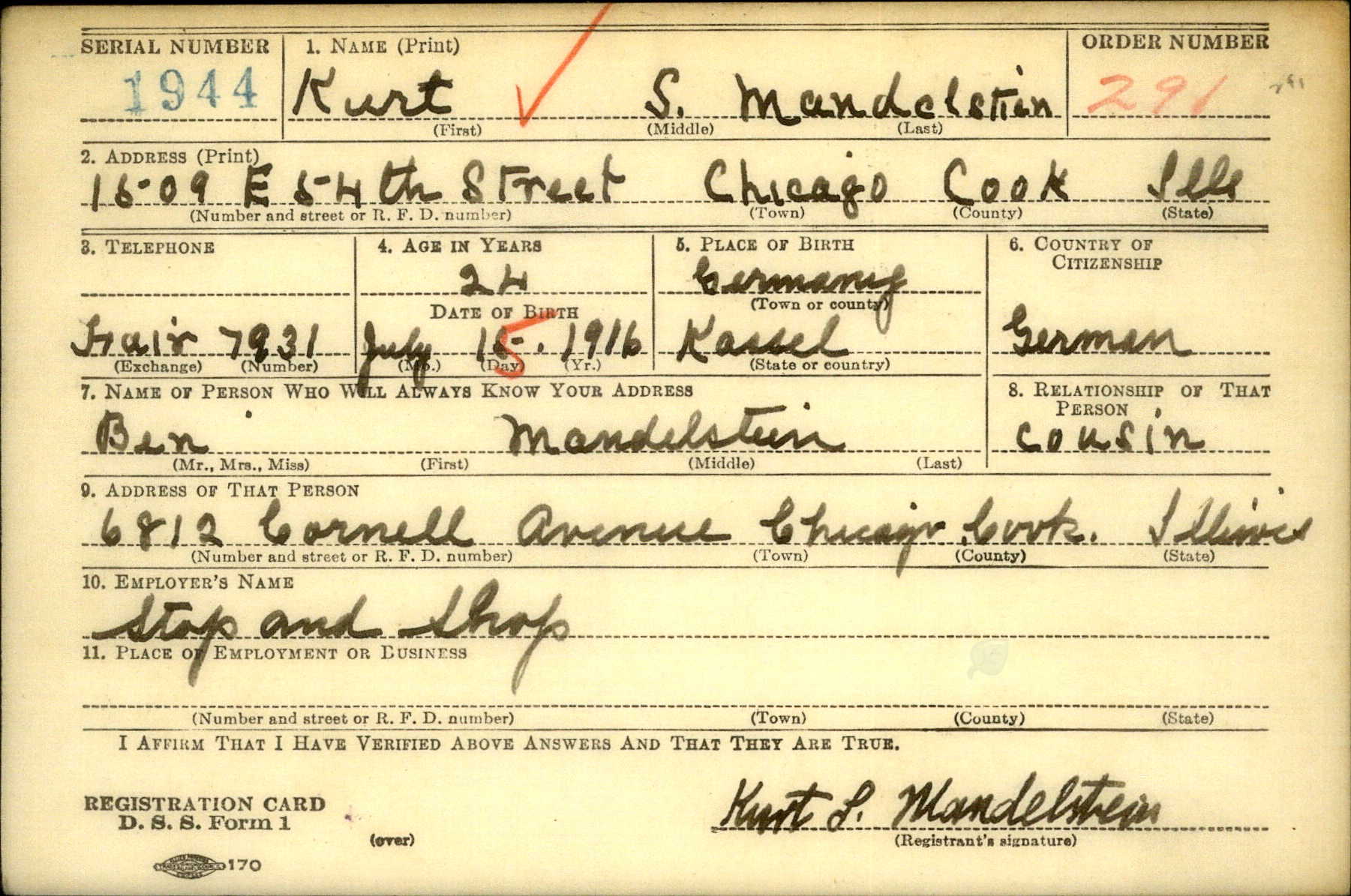
Kurt Mandelstein World War II draft registration, National Archives at St. Louis; St. Louis, Missouri; Wwii Draft Registration Cards For Illinois, 10/16/1940-03/31/1947; Record Group: Records of the Selective Service System, 147; Box: 1117, Ancestry.com. U.S., World War II Draft Cards Young Men, 1940-1947
Kurt became engaged to Lillian Greenberg in May 1942.
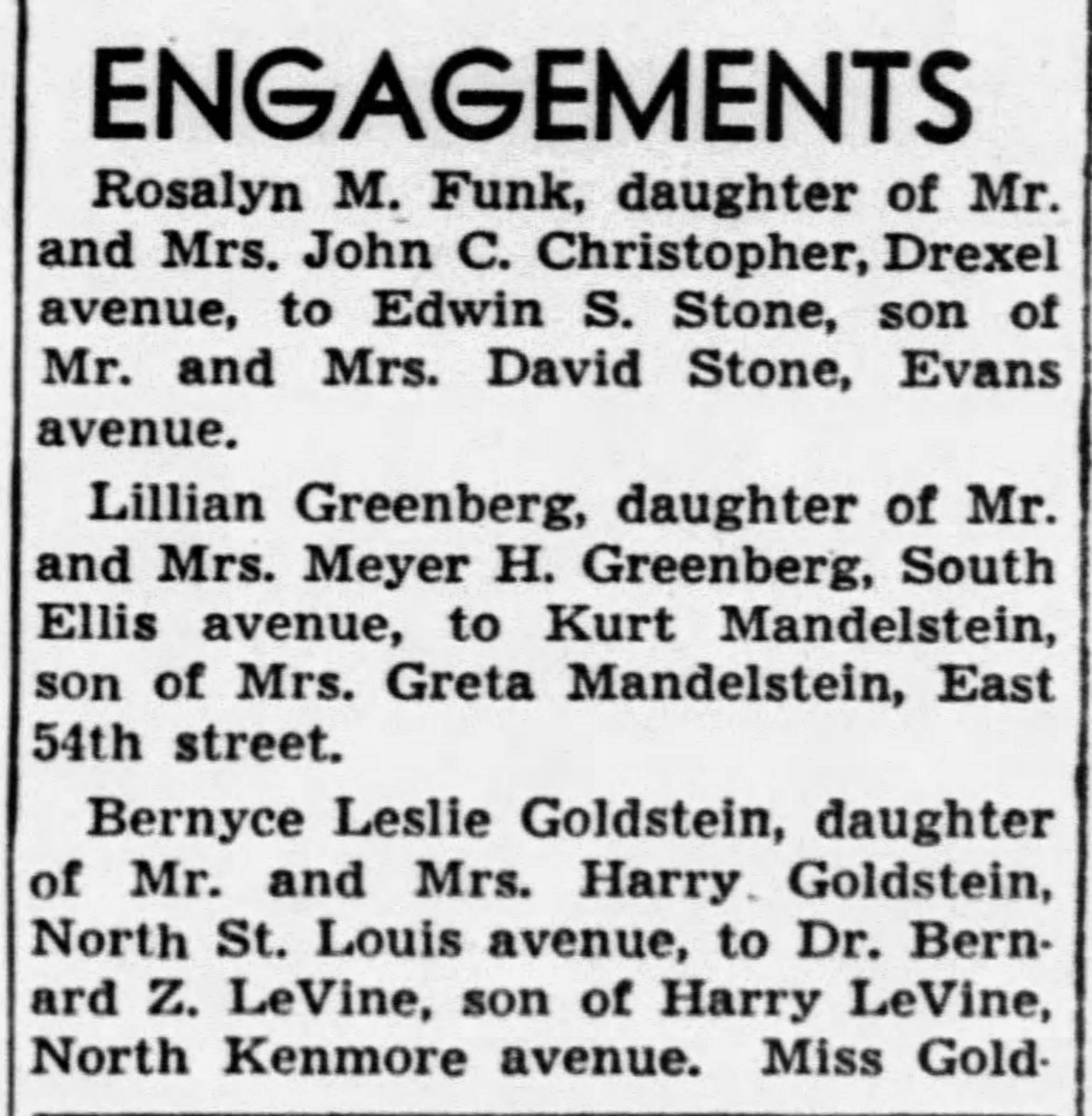
“Engagement,” Chicago Tribune, May 23, 1942, p. 169

They were married on September 22, 1942, in Chicago.1 Lillian was the daughter of Meyer Greenberg and Jeanette Brown and was born November 22, 1924, in Chicago.2 She and Kurt would have two children. Kurt became a US citizen in 1943.3 In 1950 he and his family were living in Chicago where Kurt owned a delicatessen.4

His mother Grete Adler Mandelstein became a US citizen on October 4, 1943.5 In 1950 she was living on her own in Chicago, working as a power sewing machine operator in a garment factory.6

Grete’s sister Malchen Adler Apolant became a US citizen on March 30, 1944;7 her husband Fritz Apolant had become a citizen the same day as Grete, October 4, 1943.8 In 1950 Malchen and her husband Fritz were living in Chicago where Fritz was working as a porter in a “food shop” and Molly was a self-employed private nurse.9

Emmi Adler Speier became a citizen on February 25, 1944.10 In 1950 she and her younger daughter Elsie were living in Chicago, and Emmi was working as a dress jobber doing needlework on children’s clothing. Elsie was a secretary in a mail order house.11

Emmi’s older daughter Senta married Eric Emanuel Ferda on September 6, 1944; he was the son of Otto and Rosa Ferda and was born in Cologne, Germany, on June 14, 1920.12 Eric served in the US Army during World War II.13 Senta and Eric had one child born in the 1940s. In 1950 they were living in Chicago, and Eric was working as a draftsman for a battery manufacturer.14

Emmi’s other daughter Elsie married  on April 28, 1951, in Chicago.15 Her husband may still be living. They had three children.

Betty Jenny Adler Regenstein, the youngest daughter of Sara Rothschild and Moses Adler, became a US citizen on March 14, 1945. She was also using the surname Reagen, according to her petition for naturalization.16 On the 1950 census she is listed as Betty Reagan, living in Chicago and working in assembling for a machine manufacturer.17

Her daughter Lucie had married Ben Sable on October 1, 1940, when Lucie was only seventeen.18 Ben registered for the draft just two weeks later on October 16, 1940, in Chicago; he was working as a florist. Ben was born in Los Angeles, California, on December 2, 1916; he was the son of Louis Sable and Rose Lipman.19 Lucie and Ben had three children in the 1940s. In 1950 they were all living in Chicago where Ben and Lucie were both working in his florist shop.20

Betty’s son Eric, who also changed his surname to Reagen, enlisted in the US Army on April 18, 1944, and served until April 13, 1946.21 He married Ruth Lotte Levisohn on November 27, 1947, in Chicago. She was born in Hamburg, Germany, on February 15, 1928, and was, as far as I can determine, a child who came to England on the Kindertransport in 1939. She immigrated to the US from England after the war, arriving on May 13, 1946.22 In 1950 Eric and Ruth were living in Chicago, and Eric was a trucker for a trucking company and Ruth was a switchboard operator for a candy company. They would have one child in the 1950s.23

Thus, the four daughters of Sara Rothschild and Moses Adler were all settled into life in Chicago during the 1940s, becoming US citizens, working hard at jobs often requiring manual labor, and seeing their children marry and start their own families. Life may have been hard, but they were all safe and alive.

Their brother David Theodore’s story is less uplifting. More on that in the next post.


  1. Kurt S Mandelstein, Marriage Date 22 Sep 1942, Marriage Location Cook, Illinois, USA, Spouse Lillian Greenberg Marriage license 1747023, File Number {0e18ea2e-86a0-4325-B39c-Ae75e71e7d4d}, Cook County Clerk; Chicago, Il; Cook County Genealogy Records (Marriages), Ancestry.com. Cook County, Illinois Marriage Index, 1930-1960 
  2. Lillian Greenberg, Birth Date 22 Nov 1924, Birth Place Cook, Illinois, USA
    File Number 6052650, Cook County Clerk; Cook County, IL; Cook County Genealogy Records (Births), Ancestry.com. Cook County, Illinois Birth Index, 1916-1935 
  3. Kurt Siegfried Mandelstein, Age 27, Birth Year 1916, Naturalization Year 1943
    Naturalization Place Chicago, Cook, Illinois, USA, Ancestry.com. Northern District, Illinois, U.S., Naturalization Index, 1926-1979 
  4. Kurt Mandelstein and family, 1950 US census, National Archives at Washington, DC; Washington, D.C.; Seventeenth Census of the United States, 1950; Year: 1950; Census Place: Chicago, Cook, Illinois; Roll: 3239; Page: 15; Enumeration District: 103-582, Ancestry.com. 1950 United States Federal Census 
  5. Grete Caroline Mandelstein, petition for naturalization, National Archives at Chicago; Chicago, Illinois; ARC Title: Petitions For Naturalization, 1906-1991; NAI Number: M1285; Record Group Title: Records of District Courts of the United States, 1685-2009; Record Group Number: Rg 21, Petitions, V· 1079-1081, No· 268890-269400, 1942, Ancestry.com. Illinois, U.S., Federal Naturalization Records, 1856-1991 
  6. Grete Mandelstein, 1950 US census, National Archives at Washington, DC; Washington, D.C.; Seventeenth Census of the United States, 1950; Year: 1950; Census Place: Chicago, Cook, Illinois; Roll: 3238; Page: 11; Enumeration District: 103-517, Ancestry.com. 1950 United States Federal Census 
  7. Malchen Apolant, petition for naturalization, National Archives at Chicago; Chicago, Illinois; ARC Title: Petitions For Naturalization, 1906-1991; NAI Number: M1285; Record Group Title: Records of District Courts of the United States, 1685-2009; Record Group Number: Rg 21, Petitions, V· 1192-1195, No· 297765-298328, 1943, Ancestry.com. Illinois, U.S., Federal Naturalization Records, 1856-1991 
  8. Fritz David Apolant, petition for naturalization, National Archives at Chicago; Chicago, Illinois; ARC Title: Petitions For Naturalization, 1906-1991; NAI Number: M1285; Record Group Title: Records of District Courts of the United States, 1685-2009; Record Group Number: Rg 21, Petitions, V· 1192-1195, No· 297765-298328, 1943, Ancestry.com. Illinois, U.S., Federal Naturalization Records, 1856-1991 
  9. Fritz and Molly Apolant, 1950 US census, National Archives at Washington, DC; Washington, D.C.; Seventeenth Census of the United States, 1950; Year: 1950; Census Place: Chicago, Cook, Illinois; Roll: 3239; Page: 7; Enumeration District: 103-560, Ancestry.com. 1950 United States Federal Census 
  10. Emmi Adler Speier, petition for naturalization, National Archives at Chicago; Chicago, Illinois; ARC Title: Petitions For Naturalization, 1906-1991; NAI Number: M1285; Record Group Title: Records of District Courts of the United States, 1685-2009; Record Group Number: Rg 21, Petitions, V· 1180-1183, No· 295150-295735, 1943, Ancestry.com. Illinois, U.S., Federal Naturalization Records, 1856-1991 
  11. Emmi Speier, 1950 US census, National Archives at Washington, DC; Washington, D.C.; Seventeenth Census of the United States, 1950; Year: 1950; Census Place: Chicago, Cook, Illinois; Roll: 3239; Page: 74; Enumeration District: 103-554,Ancestry.com. 1950 United States Federal Census 
  12.  Senta Speier, Marriage Date 6 Sep 1944, Marriage Location Cook, Illinois, USA
    Spouse Eric E. Ferda, Marriage license 1826963, File Number {A945cdff-9cae-4d9e-8589-71a339e706e1}, Cook County Clerk; Chicago, Il; Cook County Genealogy Records (Marriages), Ancestry.com. Cook County, Illinois Marriage Index, 1930-1960; Otto Ferda, petition for naturalization, National Archives at Chicago; Chicago, Illinois; ARC Title: Petitions For Naturalization, 1906-1991; NAI Number: M1285; Record Group Title: Records of District Courts of the United States, 1685-2009; Record Group Number: Rg 21, Petitions For Naturalization, V· 1260, No· 313301-313500, Ca· 1944-1945, Ancestry.com. Illinois, U.S., Federal Naturalization Records, 1856-1991 
  13.  Eric E Ferda, Gender Male, Birth Date 14 Jun 1920, Death Date 2 Jun 1985
    SSN 327167843, Enlistment Branch Army, Enlistment Date 16 Jan 1943, Discharge Date 8 Feb 1946, Page number 4, U.S., Department of Veterans Affairs; United States; U.S., Department of Veterans Affairs Birls Death File, 1850-2022; URL: https://www.va.gov/, Ancestry.com. U.S., Department of Veterans Affairs BIRLS Death File, 1850-2020 
  14. Eric Ferda and family, 1950 US census, National Archives at Washington, DC; Washington, D.C.; Seventeenth Census of the United States, 1950; Year: 1950; Census Place: Chicago, Cook, Illinois; Roll: 3239; Page: 4; Enumeration District: 103-560, Ancestry.com. 1950 United States Federal Census 
  15.  Elsie Lee Spere, Marriage Date 28 Apr 1951, Marriage Location Cook, Illinois, USA, Spouse Michael L. Carreon, Marriage license 2179652, File Number {71ad17b5-2c49-48ad-Beca-364cab2f0042}, Cook County Clerk; Chicago, Il; Cook County Genealogy Records (Marriages), Ancestry.com. Cook County, Illinois Marriage Index, 1930-1960 
  16. Betty Jenny Regenstein, petition for naturalization, National Archives at Chicago; Chicago, Illinois; ARC Title: Petitions For Naturalization, 1906-1991; NAI Number: M1285; Record Group Title: Records of District Courts of the United States, 1685-2009; Record Group Number: Rg 21, Description: Petitions, V· 1243-1245, No· 309401-309950, 1944, Ancestry.com. Illinois, U.S., Federal Naturalization Records, 1856-1991 
  17. Betty Reagan, 1950 US census, National Archives at Washington, DC; Washington, D.C.; Seventeenth Census of the United States, 1950; Year: 1950; Census Place: Chicago, Cook, Illinois; Roll: 1910; Page: 5; Enumeration District: 103-4933, Ancestry.com. 1950 United States Federal Census 
  18.  Lucie J Regenstein, Marriage Date 1 Oct 1940, Marriage Location Cook, Illinois, USA, Spouse Benny Sable Marriage license 1657215 File Number {F9dc5d24-C011-4931-9897-5a41ad9780d4}, Cook County Clerk; Chicago, Il; Cook County Genealogy Records (Marriages), Ancestry.com. Cook County, Illinois Marriage Index, 1930-1960 
  19.  Benny Sable, Birth Date 2 Dec 1916, Birth Place Los Angeles, California, USA
    Residence Place Chicago, Cook, Illinois, USA, Registration Date 16 Oct 1940
    Registration Place Illinois, USA, Employer Self Florist, Next of Kin Lucie Sable
    Household Members (Name) Relationship, National Archives at St. Louis; St. Louis, Missouri; Wwii Draft Registration Cards For Illinois, 10/16/1940-03/31/1947; Record Group: Records of the Selective Service System, 147; Box: 1560, Ancestry.com. U.S., World War II Draft Cards Young Men, 1940-1947; Benjamin Sable , Birth Date 2 Dec 1916, Gender Male, Mother’s Maiden Name Lipman, Birth County Los  Angeles, Birthdate: 2 Dec 1916; Birth County: Los Angeles, Ancestry.com. California Birth Index, 1905-1995 
  20. Ben Sable and family, 1950 US census, National Archives at Washington, DC; Washington, D.C.; Seventeenth Census of the United States, 1950; Year: 1950; Census Place: Chicago, Cook, Illinois; Roll: 6251; Enumeration District: 103-4568, Enumeration District: 103-4568; Description: Chicago city – That part of Ward 47 (Tract 43-part) Bounded by W. Lawrence Ave.; N. Washtenaw Ave., W. Giddings, N. Virginia Ave.; W. Wilson Ave.; North Shore Channel (N. Branch of Chicago River). This Enumeration District consists of the following blocks: 7, 9, 18, Ancestry.com. 1950 United States Federal Census 
  21. Eric S Reagen, Gender Male, Birth Date 3 Mar 1927, Death Date 13 May 2010
    SSN 328300003, Enlistment Branch Army, Enlistment Date 18 Apr 1944, Discharge Date 13 Apr 1946, Page number 2, U.S., Department of Veterans Affairs; United States; U.S., Department of Veterans Affairs Birls Death File, 1850-2022; URL: https://www.va.gov/, Ancestry.com. U.S., Department of Veterans Affairs BIRLS Death File, 1850-2020 [database on-line]. Provo, UT, USA: Ancestry.com Operations, Inc., 2011. 
  22. Ruth Reagan, petition for naturalization, National Archives at Chicago; Chicago, Illinois; ARC Title: Petitions For Naturalization, 1906-1991; NAI Number: M1285; Record Group Title: Records of District Courts of the United States, 1685-2009; Record Group Number: Rg 21, Petitions, V· 1336-1338, No· 331235-331716, 1945, n
    Ancestry.com. Illinois, U.S., Federal Naturalization Records, 1856-1991; Ruth Levisohn, Gender Female, Record Type Refugee List, Document Date 30 Jun 1939
    Document Place Berlin, Permit Number 6845,United States Holocaust Memorial Museum; Washington, D.C.; Series: Selected Records Relating to Kindertransports; Record Group: RG-59.075; File Number: mh55-704.00000125; Ancestry.com. UK, Selected Records Relating to Kindertransport, 1938-1939 (USHMM) 
  23. Eric Reagan, 1950 US census, National Archives at Washington, DC; Washington, D.C.; Seventeenth Census of the United States, 1950; Year: 1950; Census Place: Chicago, Cook, Illinois; Roll: 4216; Page: 73; Enumeration District: 103-4474, Ancestry.com. 1950 United States Federal Census 

Max Goldschmidt: A Survivor

As seen in my last few posts, although my cousin Betty Goldschmidt and her husband (and our cousin) Jacob Goldschmidt had eight children, I only have adult records for one of them, their son Berthold. Berthold and his wife Mathilde Freudenstein had seven children, but their son Siegfried Goldschmidt was the only child of the seven to live long enough to marry and have a child of his own; Siegfried and his wife Frieda Fanny Pless had one child, a son Max born November 30, 1924, in Frankfurt, Germany.

Siegfried and his wife were among the six million murdered in the Holocaust, but their young son Max, the last known remaining descendant of Betty and Jacob, survived. Max was only eight years old when Hitler came to power and not yet eighteen when his parents were deported in 1942. How had he survived? At first all I knew was that he had immigrated to the US from Israel in 1948, but thanks  to the generous assistance of Elan Oren of the Tracing the Tribe group on Facebook, I have been able to piece together much of the story of Max’s life.

Elan located Max’s file in the Israeli archives, which revealed that Max had escaped to Switzerland at some point during the Nazi era. After the war, Max sailed on the ship Plus Ultra from Barcelona, Spain, to Haifa, arriving in Haifa on June 19, 1945.

From Max Goldschmidt Israeli immigration file: Ship manifest for the Plus Ultra from Barcelona to Haifa, arriving June 19, 1945. Max is on line 94. http://www.archives.gov.il/en/archives/?fbclid=IwAR1y3d5C1X3pi2R1_jyX0MAbgeHLQoNhL6TM7F5P7ZT7CE4sFJgPPuql11A#/Archive/0b0717068002258e/File/0b071706856dcab1

Max’s file in the Israeli archives did not reveal how or when he got to Switzerland or to Barcelona, but Max’s A-file—his US immigration file—from the US Customs and Immigration Service (USCIS) revealed further details.1 According to a German police certificate included in Max’s application to the US Consul in Palestine for an immigration visa in 1947, Max lived in Warburg, Germany, from April 1927 until September 1936. That is also where his parents were residing during that time, according to records  at Yad Vashem.

On Max’s 1947 US visa application he stated that he’d immigrated to Switzerland in January 1939. He was only fourteen at that time. He lived in Basel, Switzerland, from January, 1939, until May, 1945, when he must then have left for Barcelona and ultimately Palestine. As for how he escaped from Germany in 1939, Elan Oren suggested that a Zionist youth group such as HeHalutz  might have helped him get out of Germany.

After arriving in Haifa, Max was transferred to Atlit, a detention camp built by the British, who were then in control of what was then Palestine. With the help of Elan Oren and his translation of Max’s Israeli naturalization file, I learned that Max left Atlit and first lived in Petach Tikvah and then moved to Tel Aviv to live with the Laks family. (More on them in a bit.)

Document that states that Max moved from Petah Tikvah to Tel Aviv where the Laks family lived. Translated by Elan Oren. http://www.archives.gov.il/en/archives/?fbclid=IwAR1y3d5C1X3pi2R1_jyX0MAbgeHLQoNhL6TM7F5P7ZT7CE4sFJgPPuql11A#/Archive/0b0717068002258e/File/0b071706856dcab1

But Max decided not to settle permanently in Israel. Max left Haifa on January 29, 1948, and arrived in New York on February 14, 1948. The manifest lists Max’s occupation as a gardener, his primary languages as English and Hebrew, his last residence as Tel Aviv, Palestine, and his birthplace as Frankfort [sic], Germany.

Max Goldschmidt passenger manifest, Year: 1948; Arrival: New York, New York; Microfilm Serial: T715, 1897-1957; Microfilm Roll: Roll 7546; Line: 19; Page Number: 197, Ancestry.com. New York, Passenger and Crew Lists (including Castle Garden and Ellis Island), 1820-1957

The second page of the manifest lists a friend named Pinil Laks as the contact person from Max’s prior residence of Tel Aviv and an uncle “Bernh Laks” of Blackwood, New Jersey, as the person he was going to join in the United States.

So who were the Laks? Bernhard Laks, also known as Bernhard Lachs, Berek Laks, and Bernard Laks, was married to Rosa Pless,2 who must have been a sister of Frieda Pless Goldschmidt, Max’s mother, since Max identified Bernard as his uncle and Rosa as his aunt on various documents.  Moreover, Bernard Laks (then spelled Bernhard Lachs) was one of the witnesses on the marriage record for Max’s parents, Siegfried and Frieda.

Bernhard Lachs as witness on the marriage record of Siegfried Goldschmidt and Frieda Fanny Pless. Hessisches Hauptstaatsarchiv; Wiesbaden, Deutschland; Bestand: 903
Ancestry.com. Hesse, Germany, Marriages, 1849-1930

When Max arrived at Ellis Island on February 14, 1948, he was denied admission to the United States because he did not have in his possession the immigration visa that he had been granted by the US consul in Palestine on November 17, 1947. A hearing was held on February 18, 1948 before a Board of Special Inquiry, at which Max testified that he had last seen his visa on the day he embarked from Haifa while at customs, that he had left it with his other papers in his baggage, and that while at sea he’d discovered that the visa was missing.

Max also testified that he had no relatives living outside of the US and no money. He stated that he was coming to the US in order to join his relatives, the Laks family of Blackwood, New Jersey, and that his uncle Bernard Laks had paid for his ticket from Haifa. In addition, Max presented an affidavit from Bernard and Rosa Laks in which they, as “his sole surviving relatives,” promised to “receive and care for [Max] and …not permit him to became a public charge.”

Although the Board of Special Inquiry found that Max had a valid Palestinian passport with a stamp indicating that a visa had been issued to him by the US Consulate in Jerusalem, they concluded that he was not admissible without possession of the actual visa. On February 20, 1948, however, the Commissioner of Immigration and Naturalization (INS) recommended that the decision to deport Max be deferred for ninety days to give him time to locate the visa or to obtain a certified copy.

On March 3, 1948, the ninety day stay was granted, and Max was also granted parole during that period, meaning that on March 4, 1948, he was allowed to enter the country though he was required to report in writing on a monthly basis to the Deportation and Parole Section at Ellis Island. Max had thus been detained for eighteen days at Ellis Island before his parole.

On March 18, 1948, his attorney wrote to INS to notify them that the American Consulate in Jerusalem had confirmed that Max had been granted a visa on November 17, 1947, and that the Visa Division in Washington, DC, had been so notified.  On April 8, 1948, the State Department submitted a certified copy of the visa. However, it was not until four months later on August 11, 1948, that an order was entered to re-open Max’s case. A new hearing was scheduled for September 15, 1948.  Fortunately, Max had better luck at this hearing, and he was granted legal admission into the country on September 15, 1948, more than seven months after arriving at Ellis Island on February 14, 1948. (I assume Max had received extensions of the 90 day parole period initially granted in March, 1948.)

Then began the next chapter of his life and more experiences with the slowly grinding wheels of American bureaucracy. He started the process of becoming a US citizen on October 1, 1948, just two weeks after entering the country officially.  But before Max’s papers could be processed, he was inducted into the US Army on January 1, 1949, the very day the government had scheduled a meeting to discuss his citizenship application. He amended his address to reflect that he was now stationed at Fort Dix in New Jersey as a member of the 9th Infantry Division. He was honorably discharged from the army on November 2, 1951, and on March 11, 1955, a certification of his service was issued to INS. His formal petition for naturalization was filed on October 14, 1955, with Bernard and Rosa Laks attesting to his character.

On January 24, 1956, the government received reports from the army that on January 2, 1951, while serving in the army, Max had “stated in substance … that if the Army is an example of democracy, he would take communism” and that on June 4, 1951 while giving a training lecture to his unit, “he introduced the Crusades as an illustrative example in this history of warfare, and then proceeded to interject his own thoughts on the persecution of Jews by Christians at the time of the Crusades, allegedly making rather strong remarks about the Roman Catholic Church. [Max] has at various times in the past tried to turn a topic of conversation into ‘making a case’ for Zionism.”

I suppose Max took the meaning of the First Amendment more literally than the US Army thought appropriate. Whether this had any impact on his citizenship application is not clear. On a page of examiner’s notes dated November 9, 1956, the examiner gave Max a final rating of “deny,” but then that was crossed out, and on May 17, 1957, his application was granted and he was finally issued a certificate of naturalization; he also changed his name to Goldsmith at that time. Despite his service in the US Army, it had taken almost eight years to complete the process of becoming a citizen.

Two months later in July 1957, Max married Shirley Larve in Trenton, New Jersey.3 Shirley was born in Trenton on May 29, 1923, to Joseph and Anna Larve.4 She was 34 when they married, and Max was 32. They did not have any children.

Shirley died at age 70 on July 24, 1993, in Broward County in Florida.5 Her obituary in the South Florida Sun-Sentinel on August 15, 1993, filled in some of the gaps in their lives between 1957 and 1993.  Here are some excerpts:

…Shirley worked during WWII for the U.S. Army Finance Dept. and later for 25 years for the Department of Motor Vehicles, State of NJ, retired supervisor in 1985. Married Max Goldsmith July, 1957, an immigrant to the U.S.A. They resided at various locations throughout the U.S.A. … Her life was devoted to her husband, being a true companion to him who had lost his family of 68 members during the Nazi era.

She served two terms as President of the Ladys Auxiliary of the Jewish War Veterans of the U.S.A. Post 697 in Levittown, PA. A life member in the American Red Star of David for Israel. In 1989 she received the Lady of the Year award of the Star-Faye Post 672. She was very mild mannered, yet forceful. A lady in her own right. Always unpretending with an inherent sense of justice. She had her golds [goals?] and she never let go until accomplished. She had little patience for people who sat around and complained. Although small in stature yet big in ability and courage.

Shirley and Max thus lived in or near Trenton, New Jersey until 1985 when she retired after 25 years working for the Department of Motor Vehicles. (Levittown, Pennsylvania, is less than eight miles from Trenton.) By 1990, they had moved to Pompano Beach, Florida.6

I am troubled by the reference in her obituary to 68 members of Max’s family being killed in the Holocaust. Who were those 68 people? How were they related to Max? Were they his mother’s relatives? Or were they Goldschmidts I just haven’t found? It haunts me.

Max died in Fort Lauderdale, Florida, eleven years after Shirley on July 2, 2004, at age 80.7  He’d endured a great deal in his life—fleeing from his homeland and his family as a young teenager, the murder of his parents, the move to Palestine and then to the US, and all the hassles he endured to become first a legal resident and then a  citizen of the United States.

But I was very comforted after reading Shirley’s obituary; I assume that Max wrote it himself. It is clear from his words that he loved her very deeply and that he felt loved and taken care of by her.  It is wonderful to know how devoted they were to each other, especially after all he’d been through in the first 32 years of his life.

Max Goldsmith, my third cousin, once removed, was a true survivor.  As best I can tell, he was the only and last surviving descendant of  his great-grandparents, Betty Goldschmidt and Jacob Goldschmidt, two first cousins who married each other, both grandchildren of Jacob Falcke Goldschmidt and Eva Reuben Seligmann, my four-times great-grandparents. By remembering Max, I hope to honor not only him, but all those who came before him.


  1. The references in this post to documents relating to Max’s immigration to the US are all from his A-file from USCIS, copies of which are in my possession. References to his immigration to Palestine and his time there are from the Israeli archives here
  2. On the 1937 passenger manifest for Berek and Rosa Laks, the person they named as their closest relative living in their former residence of Frankfurt was E.Pless, identified as Berek’s mother-in-law and Rosa’s mother. From this I inferred that Rosa’s birth name was Pless and that she was the sister of Frieda Pless Goldschmidt, Max’s mother.  Laks family, passenger manifest, Year: 1937; Arrival: New York, New York;Microfilm Serial: T715, 1897-1957;Microfilm Roll: Roll 6022; Line: 1; Page Number: 127, Ancestry.com. New York, Passenger and Crew Lists (including Castle Garden and Ellis Island), 1820-1957 
  3. Certificate Number: 21705, New Jersey State Archives; Trenton, New Jersey; Marriage Indexes; Index Type: Bride; Year Range: 1957; Surname Range: L – Z, Ancestry.com. New Jersey, Marriage Index, 1901-2016 
  4. Ancestry.com. U.S., Social Security Applications and Claims Index, 1936-2007,SSN: 146160447 
  5. Ancestry.com. U.S., Social Security Applications and Claims Index, 1936-2007,SSN: 146160447 
  6.  Ancestry.com. U.S. Public Records Index, 1950-1993, Volume 1. Original data: Voter Registration Lists, Public Record Filings, Historical Residential Records, and Other Household Database Listings. 
  7.  Ancestry.com. U.S., Social Security Applications and Claims Index, 1936-2007, SSN: 129240166 

Research update: Bad News, Good News, Bad News

As you may recall, on October 31, I sent a request to the USCIS  for the naturalization papers for Max Brotman in the hope that they would reveal where Max and thus the other family members were born in Galicia.  According to the automated message on the USCIS phone, it could take at least 90 days to get a response.  Well, I figured the news wasn’t going to be good when I received a response yesterday only 35 days after making my request.  And it wasn’t—they had no records for a Max Brotman who fit the dates I had submitted.  In fact, all their naturalization records start in 1906, and I should have known that Max was naturalized before 1906 since he was the witness for Abraham in 1904.

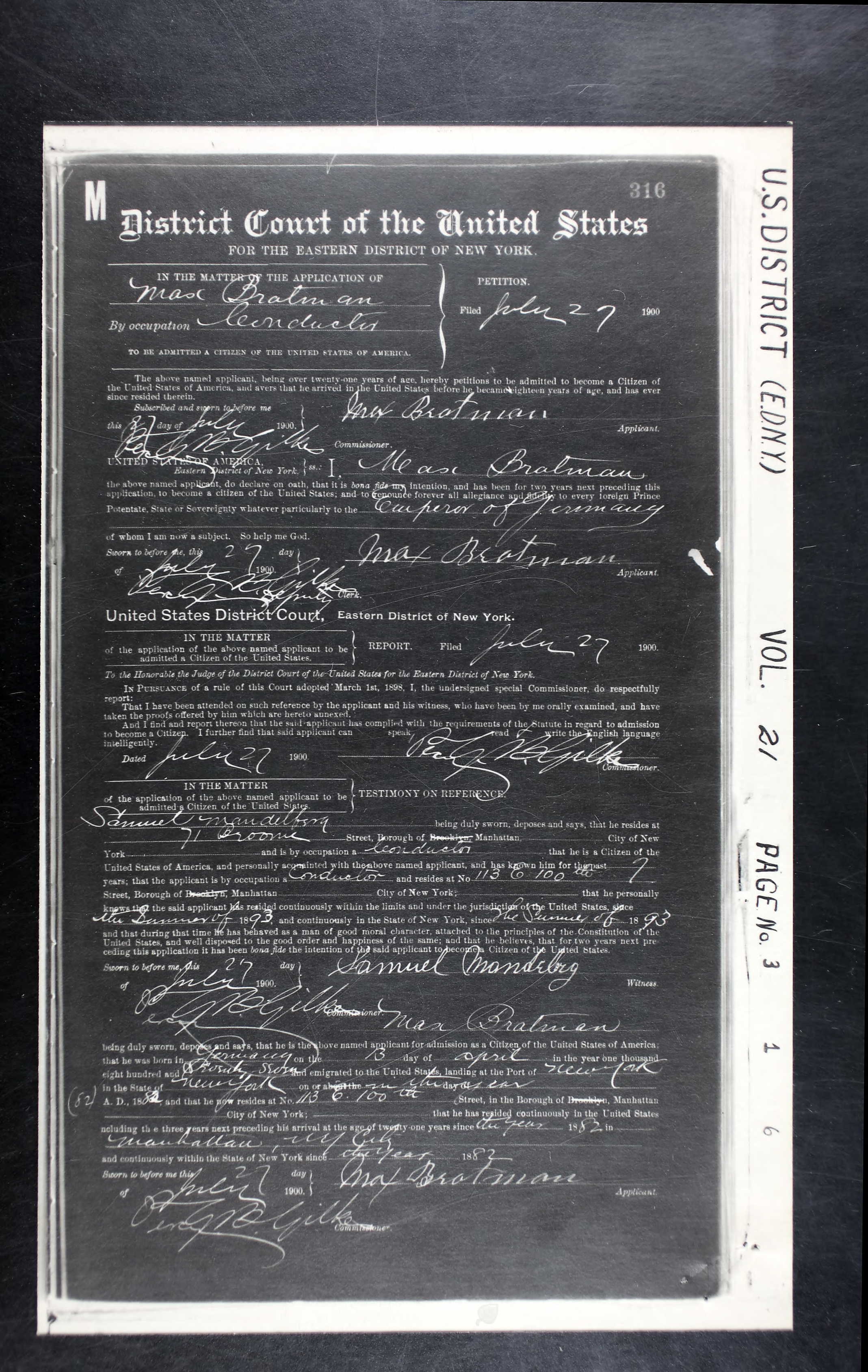
I then went back to ancestry.com and rechecked my search of their naturalization records where I had been able to find records for both Abraham and Hyman.  I checked and rechecked pages and pages of indices, searching for anything that might relate.  I found one for a Max Bratman born in Germany who worked as a conductor for the railroad and emigrated in 1882, but dismissed it because the name, place of birth, and date of immigration seemed wrong.

Max "Bratman" Naturalization Card

Max “Bratman” Naturalization Card

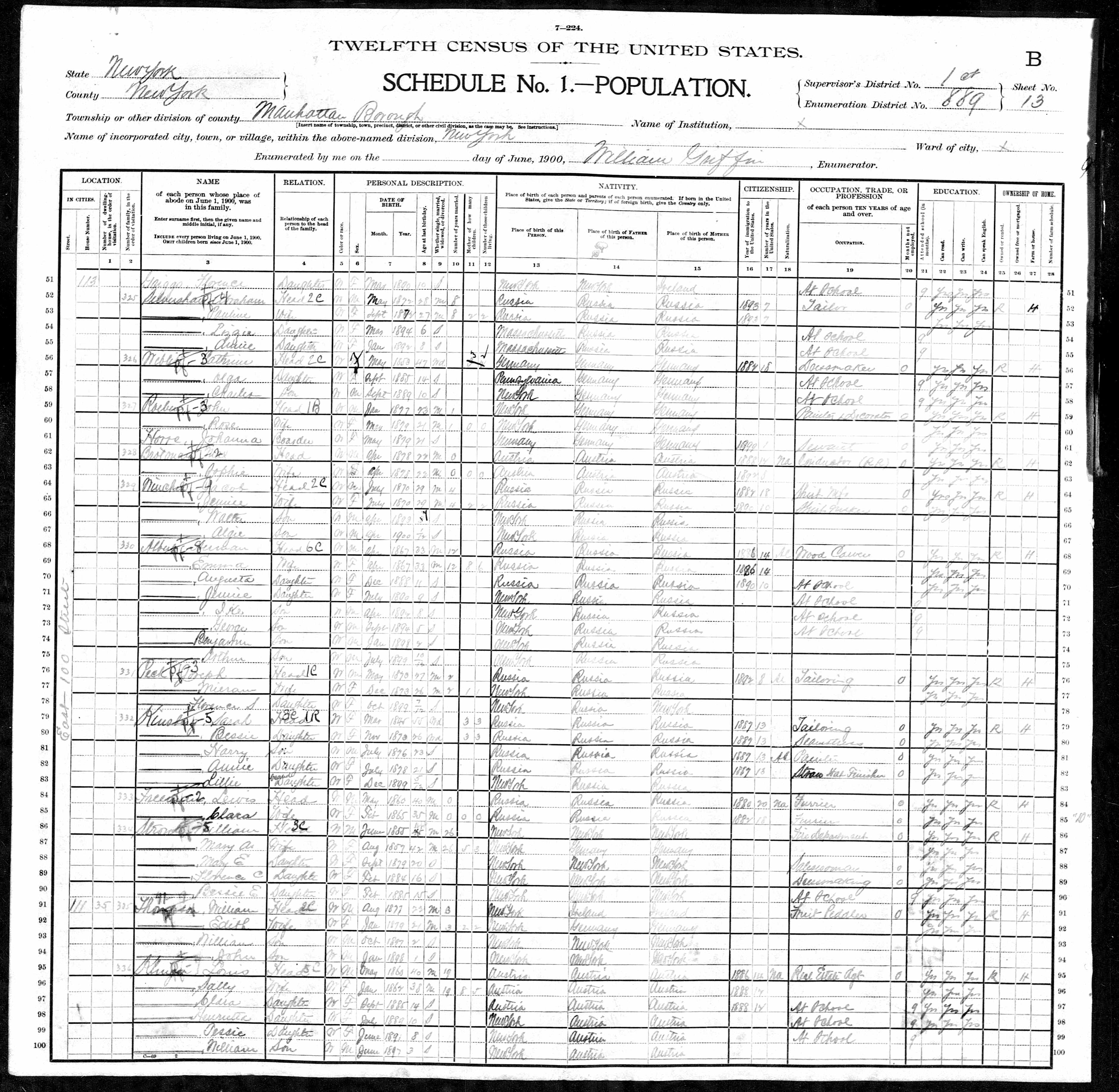
Then I went back to the records I already have for Max, including several census reports, his marriage certificate and his death certificate.  While reading through the 1900 census, I noticed that it said Max was a conductor.  At that time he and Sophie were just married (the census was taken in June; they had married in April) and were living at 113 East 100th Street in Manhattan.  When I saw the entry that he was a conductor, I knew it rang a bell, but at that point I could not remember where else I had seen it.

1900 US Census Report for Max and Sophie Brotman

1900 US Census Report for Max and Sophie Brotman

I began to search through the naturalization records again and could not find any reference to a Max Brotman who was a conductor.  I started thinking that I was losing my mind! Then I remembered that there had been a Max BrAtman and searched for him, and lo and behold, found the naturalization card again for the conductor.  I looked at the address on that form and sure enough, Max Bratman was living at 113 East 100th Street in Manhattan in 1900 when he filed this application.  Obviously this was the same person, our Max, but why did he spell his name wrong? Why did he say he was born in Germany and emigrated in 1882? The birth dates also did not exactly line up, but I am used to the fact that no one ever reported their birthday consistently.

When I looked at the handwritten application, I saw that the signature was definitely Max BrOtman, not BrAtman.

Max Brotman naturalization petition

Max Brotman naturalization petition

My guess is that the clerk who filled out the card just could not decipher the handwriting.  As for the wrong date, I have no guess except that Max was confused, wasn’t clear, or was trying to make it seem he’d been in the US for more than just 12 years.  As for why Germany? I wish I knew.  I know from Joseph Margoshes’ book that secularized, modern Jews were referred to as “German” in Galicia. Perhaps that’s why Max said Germany.  Perhaps the clerk thought he was German because of his name, accent and use of Yiddish and suggested it to him and Max just agreed? I have no clue.

The census form was filled out just a month earlier than the naturalization form.  The census says his place of birth was Austria as does every other document listing Max’s place of birth.  The census says he emigrated in 1888, which is also consistent with almost all the other forms.  It would have made little sense for Max to have emigrated in 1882 when he was only four years old.  So once again, we have evidence that forms are unreliable, that our ancestors were not too reliable, and that much must be left to conjecture and speculation.

So where does that leave us in terms of identifying where our family lived in Galicia? Hanging on the thin thread of Hyman’s own unreliable documents, our best guess is Dzikow near Tarnobrzeg.  I contacted Stanley Diamond who manages the archives of documents for JRI-Poland, and he sent me a list of all the records of all Brotmans and Brots from that area.  They are almost all of people born after 1900, and Stanley said that the records for that area are rather limited.  He said it would probably take a trip to archives in a few cities in Poland to learn if there is anything else and that that is probably a long shot.

And thus, my cousins and friends, I think that for now I have hit a wall. I am still waiting for Tillie’s death certificate and Hyman’s marriage certificate, but I am not putting any hope into finding out more information about their place of birth from those documents. I am in touch with a researcher in Poland, and I am hoping to travel there perhaps in 2015, but for now I guess we have to accept that the best we can do is hang our hopes on Hyman’s references to Jeekief and Giga and assume that Dzikow near Tarnobrzeg is our ancestral home.