The Family of Amalia Hamberg Baer, the Administratrix

Back in May, I wrote about the sad saga of Charles Hamberg and his son Samuel Hamberg.  Charles, my great-grandfather Isidore Schoenthal’s first cousin, had lost two wives—one was murdered, one died quite young.  He had then committed suicide, leaving his nine year old son Samuel an orphan.  Charles’ estate was administered by another cousin, Amalia Hamberg Baer, who at the time was living in western Pennsylvania where my great-grandfather and many other Hamberg relatives were then living.

In fact, Amalia (born Malchen) was a first cousin to Isidore Schoenthal, my great-grandfather:
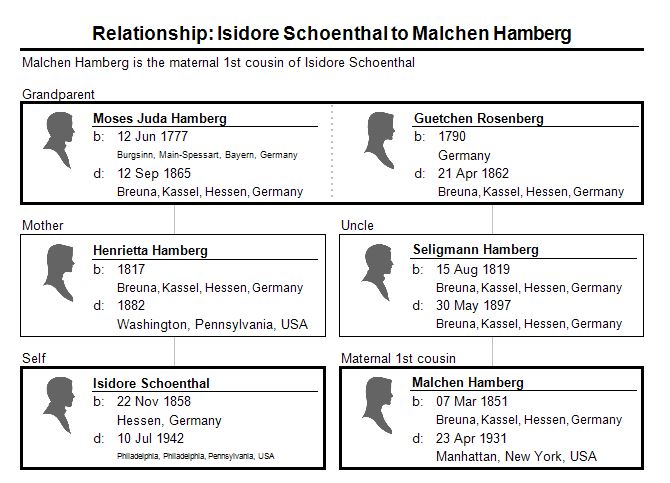
corrected relationship isidore schoenthal to malchen hamberg


She had come to the US from Breuna, Germany, in 1871, and had married Jacob Baer in 1873, according to the 1900 census. (For more on how I linked Amalia Hamberg to Jacob Baer, see my earlier post.)  Jacob was born in the Rhein Pfalz[1] region of Germany in about 1851 and had immigrated to the US in 1867, according to several census records.  From entries in the Pittsburgh city directories, he appears to have settled in the Pittsburgh area.

In 1880, Jacob and Amalia were living in Allegheny, Pennsylvania (now part of Pittsburgh), and Jacob was working as a clerk in a shoe store.  They already had four children: Maurice Jay (1874), Hattie (1876), Josephine (1878), Amanda (1880).
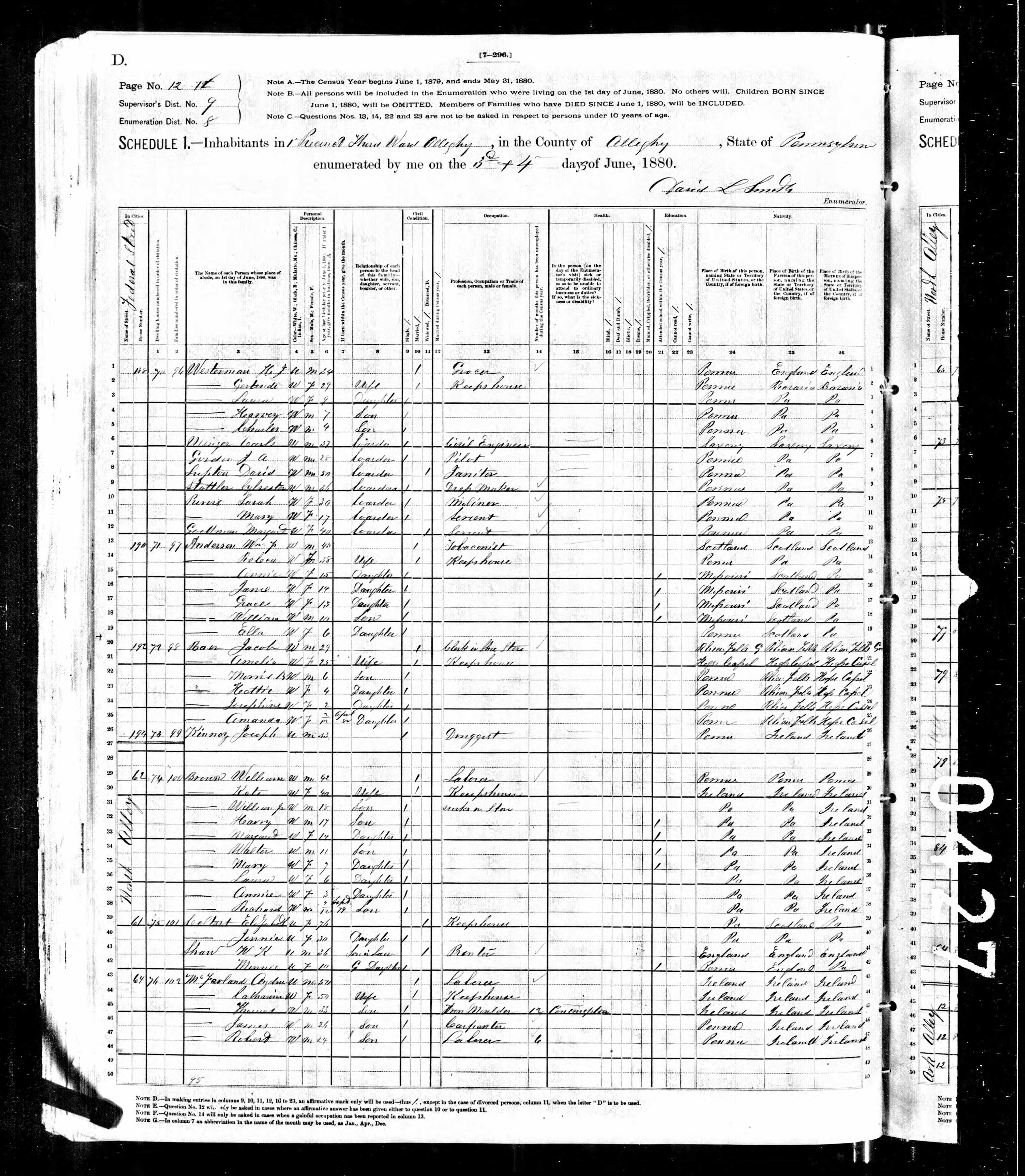
Jacob and Amalia Hamberg Baer 1880 US census Year: 1880; Census Place: Allegheny, Allegheny, Pennsylvania; Roll: 1086; Family History Film: 1255086; Page: 198D; Enumeration District: 008; Image: 0402

Jacob and Amalia Hamberg Baer 1880 US census
Year: 1880; Census Place: Allegheny, Allegheny, Pennsylvania; Roll: 1086; Family History Film: 1255086; Page: 198D; Enumeration District: 008; Image: 0402


Between 1880 and 1891, they would have five more children: Flora (1882), Tilda (1884), Elsie Victoria (1886), Alfred (1889), and Lawrence (1891). (The birth years for the daughters as reported in various records are all over the place as they kept making themselves younger as the years went on, so I am relying on the 1880 and 1900 census records when they were still probably young enough not to lie about their ages.)  During those years, Jacob was listed as a salesman in the Pittsburgh city directories.

In 1900, Jacob and Amalia were still living in Allegheny with all nine of their children.  Jacob continued to work as a salesman, as did their son Maurice (Morris here, now 26).  Hattie (24) and Josephine (Josie here, now 21) were working as stenographers.  The rest of the children were not employed.
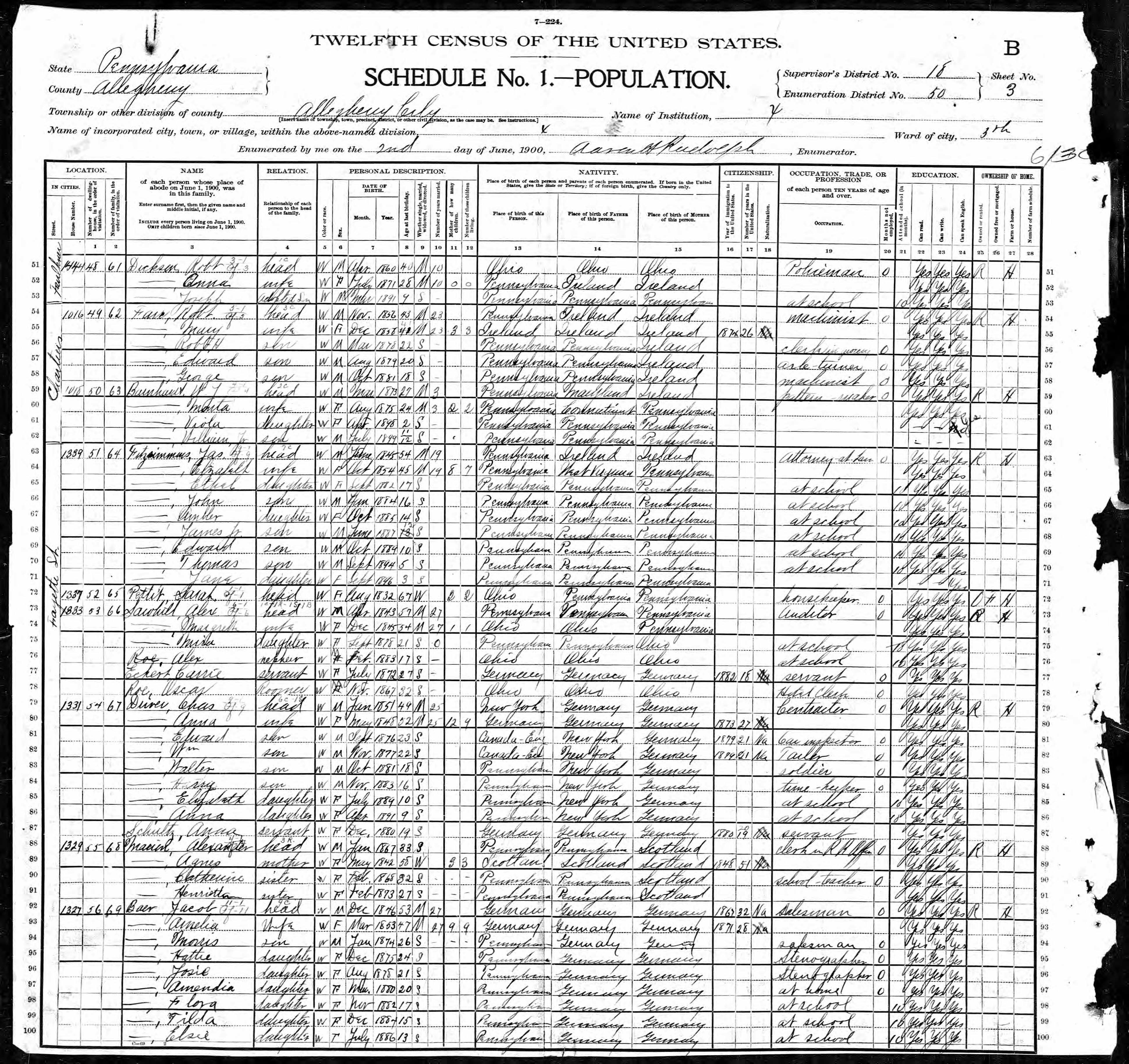
Amalia Baer 1900 census p 1

Jacob and Amalia Hamberg Baer 1900 census Year: 1900; Census Place: Allegheny Ward 5, Allegheny, Pennsylvania; Roll: 1356; Enumeration District: 0050; FHL microfilm: 1241356

Jacob and Amalia Hamberg Baer 1900 census
Year: 1900; Census Place: Allegheny Ward 5, Allegheny, Pennsylvania; Roll: 1356; Enumeration District: 0050; FHL microfilm: 1241356


In the next decade many of the children began to move on to their own lives.  In fact, even before 1900, Maurice, the oldest child, had ventured quite far from Pittsburgh.  As I will write about in a post to follow this one, Maurice moved to Attleboro, Massachusetts,[2] and established a very successful jewelry business in which four of the siblings’ families would be involved, that is, Maurice, Tilda, Elsie, and Lawrence.  This post will focus on the other five siblings—Hattie, Josephine, Flora, Amanda, and Alfred—and their parents, Amalia and Jacob.

On July 17, 1905, Hattie Baer, the second child who was then 29, married Meyer Herman, a clothing salesman living in Philadelphia who was born in Manchester, England.
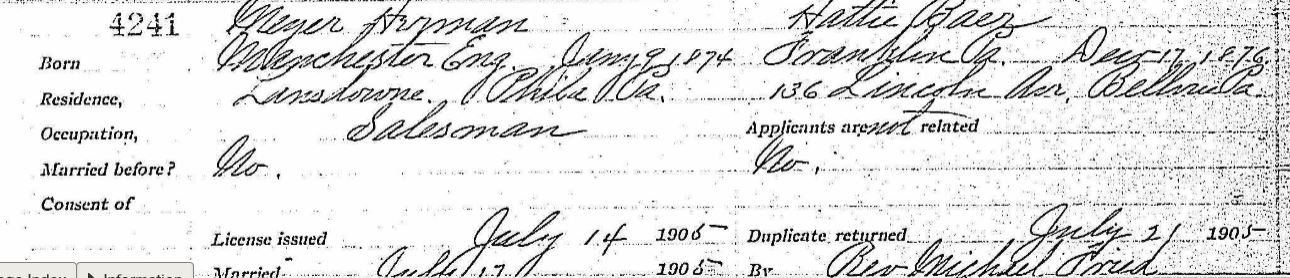
Marriage record of Hattie Baer and Meyer Herman Pennsylvania, County Marriages, 1885-1950," database with images, FamilySearch (https://familysearch.org/pal:/MM9.3.1/TH-1951-21130-27078-9?cc=1589502 : accessed 12 May 2016), 004264779 > image 383 of 454; county courthouses, Pennsylvania.

Marriage record of Hattie Baer and Meyer Herman
Pennsylvania, County Marriages, 1885-1950,” database with images, FamilySearch (https://familysearch.org/pal:/MM9.3.1/TH-1951-21130-27078-9?cc=1589502 : accessed 12 May 2016), 004264779 > image 383 of 454; county courthouses, Pennsylvania.

They settled in Philadelphia, where they had two sons, Justin Baer Herman, born in April, 1907, and Richard B. Herman, born in July, 1910.  Then tragically, Hattie died on October 15, 1910, of a perforated bowel and peritonitis.  She was only 33 years old when she died, and she left behind a three year old toddler and a two and a half month old infant son.

Hattie Baer Herman death certificate Ancestry.com. Pennsylvania, Death Certificates, 1906-1963 [database on-line]. Provo, UT, USA: Ancestry.com Operations, Inc., 2014. Original data: Pennsylvania (State). Death certificates, 1906–1963. Series 11.90 (1,905 cartons). Records of the Pennsylvania Department of Health, Record Group 11. Pennsylvania Historical and Museum Commission, Harrisburg, Pennsylvania.

Hattie Baer Herman death certificate
Ancestry.com. Pennsylvania, Death Certificates, 1906-1963 [database on-line]. Provo, UT, USA: Ancestry.com Operations, Inc., 2014.
Original data: Pennsylvania (State). Death certificates, 1906–1963. Series 11.90 (1,905 cartons). Records of the Pennsylvania Department of Health, Record Group 11. Pennsylvania Historical and Museum Commission, Harrisburg, Pennsylvania.

Five years later in 1915, Hattie’s younger sister Amanda married her brother-in-law Meyer Herman in Philadelphia and took on the responsibility for raising her two nephews, Justin and Richard, then just eight and five years old.  In 1920, Meyer was still a clothing salesman, and the family continued to live in Philadelphia.

Meyer and Amanda Baer Herman 1920 census Year: 1920; Census Place: Philadelphia Ward 22, Philadelphia, Pennsylvania; Roll: T625_1623; Page: 8A; Enumeration District: 591; Image: 961

Meyer and Amanda Baer Herman 1920 census
Year: 1920; Census Place: Philadelphia Ward 22, Philadelphia, Pennsylvania; Roll: T625_1623; Page: 8A; Enumeration District: 591; Image: 961

Ten years later in 1930, Meyer had moved from being a salesman to being the owner of a clothing manufacturing business.  The two sons were also working; Justin, now 23, was a newspaper editor, and Richard, now 19, was selling real estate.  Both were still living at home with Meyer and Amanda in Philadelphia.

Herman and Amanda Baer Herman 1930 census Year: 1930; Census Place: Philadelphia, Philadelphia, Pennsylvania; Roll: 2104; Page: 23A; Enumeration District: 0627; Image: 902.0; FHL microfilm: 2341838

Herman and Amanda Baer Herman 1930 census
Year: 1930; Census Place: Philadelphia, Philadelphia, Pennsylvania; Roll: 2104; Page: 23A; Enumeration District: 0627; Image: 902.0; FHL microfilm: 2341838

Meanwhile, the third child of Amalia and Jacob Baer, Josephine, had married Morris Alon Green on January 2, 1906.  Morris was a Pittsburgh native, born there on February 17, 1875, the son of Abraham Green, an immigrant from Holland, and Jeanette Bloomberg, born in Germany.  In 1900, Morris was living with his parents in Pittsburgh and working as a bookkeeper.

Marriage record of Morris Green and Josephine Baer Pennsylvania, County Marriages, 1885-1950," database with images, FamilySearch (https://familysearch.org/pal:/MM9.3.1/TH-1942-20622-18713-16?cc=1589502 : accessed 10 June 2016), 004811570 > image 334 of 449; county courthouses, Pennsylvania.

Marriage record of Morris Green and Josephine Baer
Pennsylvania, County Marriages, 1885-1950,” database with images, FamilySearch (https://familysearch.org/pal:/MM9.3.1/TH-1942-20622-18713-16?cc=1589502 : accessed 10 June 2016), 004811570 > image 334 of 449; county courthouses, Pennsylvania.

Josephine and Morris settled in Pittsburgh where their son Alan Baer Green was born on October 30, 1906.  In 1910, the Greens were living in Pittsburgh as boarders in the household of another family, and Morris was working as a claims agent.

Morris and Josephine Baer Green on 1910 census Year: 1910; Census Place: Pittsburgh Ward 8, Allegheny, Pennsylvania; Roll: T624_1301; Page: 2A; Enumeration District: 0379; FHL microfilm: 1375314

Morris and Josephine Baer Green on 1910 census
Year: 1910; Census Place: Pittsburgh Ward 8, Allegheny, Pennsylvania; Roll: T624_1301; Page: 2A; Enumeration District: 0379; FHL microfilm: 1375314

The next several years must have been successful ones for Morris because by 1918, he was the general agent and executive of the Crucible Steel Company and by 1920 he and Josephine and their son Alan were living in their own (rented) home with a nurse and servant residing with them.

Morris A Green, World War I draft registration Registration State: Pennsylvania; Registration County: Allegheny; Roll: 1909239; Draft Board: 11

Morris A Green, World War I draft registration
Registration State: Pennsylvania; Registration County: Allegheny; Roll: 1909239; Draft Board: 11

By 1925, Josephine and Morris had left western Pennsylvania for New York City, where they were living at the Hotel Alexander at 150 West 103rd Street.  Their son Alan is not listed as living with them; perhaps he was away at college as he would have been nineteen at that time.  In 1930, Alan was living with his parents in Manhattan, working in advertising.  His father Morris listed his occupation/industry as “financial.”

Morris and Josephine Baer Green and Alan Baer Green, 1930 census Year: 1930; Census Place: Manhattan, New York, New York; Roll: 1556; Page: 19A; Enumeration District: 0443; Image: 762.0; FHL microfilm: 2341291

Morris and Josephine Baer Green and Alan Baer Green, 1930 census
Year: 1930; Census Place: Manhattan, New York, New York; Roll: 1556; Page: 19A; Enumeration District: 0443; Image: 762.0; FHL microfilm: 2341291

The fifth child of Amalia and Jacob was Flora.  In 1907, she is listed in the Pittsburgh city directory as a teacher, residing in Bellevue, a town near Pittsburgh. In 1910, when she was 28 (although listed as 24 on the 1910 census), she was still single and living with her parents and not employed outside the home.

Jacob and Amalia Schoenthal Baer and family 1910 census Year: 1910; Census Place: Pittsburgh Ward 14, Allegheny, Pennsylvania; Roll: T624_1304; Page: 6B; Enumeration District: 0468; FHL microfilm: 1375317

Jacob and Amalia Schoenthal Baer and family 1910 census
Year: 1910; Census Place: Pittsburgh Ward 14, Allegheny, Pennsylvania; Roll: T624_1304; Page: 6B; Enumeration District: 0468; FHL microfilm: 1375317


In 1915, she married Julius Adler.  Julius was the son of Simon Adler, a German immigrant who in 1880 was living in Memphis, Tennessee, working in a shoe store.  Julius’ mother Elizabeth was a native of Missouri; she married Simon in 1881, and they had four children born in Memphis between 1882 and 1887, when their youngest son Julius was born.  By 1900, the family had relocated to Philadelphia.

According to his obituary, Julius graduated from the University of Pennsylvania with a degree in engineering in 1908.  In 1910, he was teaching at the University of Washington in Seattle.  But by 1915 he had returned to Philadelphia, where he married Flora Baer.  In 1917, they were living in Harrisburg, Pennsylvania, where Julius was working as a civil engineer for the state highway department.  They would have three children, Stanley, Jerrold, and Amy, born between 1917 and 1920.

Julius Adler, World War I draft registration Registration State: Pennsylvania; Registration County: Dauphin; Roll: 1893237; Draft Board: 3

Julius Adler, World War I draft registration
Registration State: Pennsylvania; Registration County: Dauphin; Roll: 1893237; Draft Board: 3

In 1920, the family had returned to Philadelphia, where Julius was now employed as a technical engineer for an oil company.  According to his obituary, during the 1920s, Julius was working as the deputy chief of the Philadelphia highway department and was involved in supervising the construction of the Benjamin Franklin Bridge, the bridge that spans the Delaware River connecting Philadelphia to Camden, New Jersey (originally called the Delaware River Bridge).  In 1930, Julius and Flora and their two sons continued to live in Philadelphia, Julius working as a civil engineer.

Benjamin Franklin Bridge linking Camden, NJ wi...

Benjamin Franklin Bridge linking Camden, NJ with Philadelphia, PA – Taken from the 22nd floor of Waterfront Square (Photo credit: Wikipedia)

Alfred, the second youngest child of Amalia and Jacob, was the only other child not involved with the Attleboro jewelry business.  In 1900, he was living with his family in Pittsburgh, but he is not listed with them in 1910, when he would have been 21 years old.  There is an Alfred H. Baer listed in the 1907 Pittsburgh directory, working as a clerk, but I am not sure that that is the same person.  According to his registration for the draft in World War I, Alfred was living in a sanitarium and “mentally incapacitated for work of any kind.”

Alfred Baer ww1 draft reg

Alfred Baer, World War I draft registration Registration State: Pennsylvania; Registration County: Philadelphia; Roll: 1907636; Draft Board: 17

Five years later, at age 34, Alfred died on December 13, 1923.  He was buried where his sister Hattie was buried and where later his parents, his sister Flora, and his brother Maurice would be buried at Mt. Sinai cemetery in Philadelphia. I was unable to locate a death certificate, so I do not know the cause of death.  According to his burial record, he was residing in Stamford, Connecticut, at the time of his death.

Thus, by 1930, Amalia (Hamberg) and Jacob Baer had lost two of their children, Hattie and Alfred. Their other children were doing quite well.  Amanda and Flora had moved to Philadelphia with their husbands and children, and Josephine was living in New York City with her husband and son.  The other four children were also living away from Pittsburgh, as we will see in the next post.

Even Jacob and Amalia had left Pittsburgh by that time.  In fact, sometime between 1918 and 1922, they had moved to Atlantic City.  In 1922, they were listed in the Atlantic City directory, living at The Amsterdam in Atlantic City.  The following year on March 27, 1923, their children honored their parents on the occasion of their 50th wedding anniversary with a dinner at the Esplanade Hotel in New York City.

Jacob and Amalia Baer anniversary party


In 1930 Jacob and Amalia, now 83 and 79 (although the 1930 census says 77), were living at 250 West 103rd Street in New York City, with Jacob listed as the head of household for what appears to be a small hotel; there are 28 guests listed as living with them.  Their daughter Josephine was living not too far away at 666 West End Avenue.

Amalia Baer, born Malchen Hamberg in Breuna, Germany, died on April 23, 1931, in New York City.  She was 80 years old.  She was buried in Mt. Sinai cemetery in Philadelphia where the two children who predeceased her, Hattie and Alfred, were buried.  A year later her husband Jacob died on September 1, 1932.  He was 85 years old, and he was buried with his wife and children in Mt. Sinai cemetery.  His death notice ran in the September 3, 1932 issue of The New York Times:
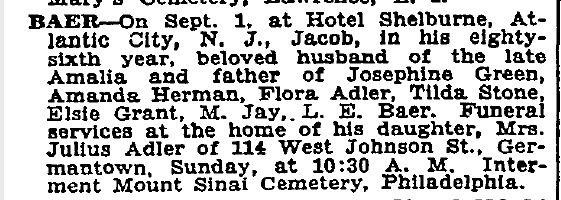
NY Times, September 3, 1932

NY Times, September 3, 1932

In my next post, I will write about the four children of Amalia and Jacob who were involved in the jewelry business in Attleboro, Massachusetts.  Then in a subsequent post I will report on what later happened to the children and the grandchildren of Jacob and Amalia (Hamberg) Baer.


[1] Thank you to Michael Palmer and Cathy Meder-Dempsey of the German Genealogy group on Facebook for helping me decipher Jacob’s birthplace.

[2] I am not sure why Maurice is listed as living in Pittsburgh on the 1900 census as several reports indicate he had established the business in Attleboro before then.  Perhaps he was still traveling back and forth between Pennsylvania and Massachusetts at that time.

From Orphan to Pharmacist and Then?

In two recent posts I shared the sad story of Charles Hamberg and his life in Columbia, South Carolina, which ended with his suicide in 1879.  His son Samuel was only eleven when his father died.  Samuel’s mother Lena had died two years earlier.  Charles’ cousin Amalia Hamberg administered his estate, and then somehow Charles’ son Samuel came to live in western Pennsylvania where he was adopted by his second cousin, my great-grandfather’s brother, Henry Schoenthal.

Henry Schoenthal and family 1880 census Year: 1880; Census Place: Washington, Washington, Pennsylvania; Roll: 1202; Family History Film: 1255202; Page: 596A; Enumeration District: 271

Henry Schoenthal and family 1880 census
Year: 1880; Census Place: Washington, Washington, Pennsylvania; Roll: 1202; Family History Film: 1255202; Page: 596A; Enumeration District: 271


In 1886 when Samuel was then eighteen years old, he was working as a clerk at 5 East Beau Street in Washington and living at the corner of Beau and Lincoln in that town, according to the 1886 directory for Washington, Pennsylvania.  According to that same source, my great-grandfather Isidore Schoenthal, who had arrived in Washington in 1881, was living at 203 East Beau Street that same year; looking at Google Maps, I see that 203 East Beau Street is located at the corner of Lincoln and Beau.

[Thanks to Lara of Lara’s Jewnealogy, I now know how to use Google Maps more effectively.  See her great post here.]

Thus, Samuel Hamberg was probably living with my great-grandfather.  I imagine that they lived and maybe even worked together, my great-grandfather watching over his younger second cousin.  Perhaps Samuel helped my great-grandfather learn English and adjust to American ways.

By 1889, Samuel, now 21 years old, had moved to Philadelphia.  He is listed in the directory for that year as Samuel T. Hamberg, a manager, residing at “134 E. Orthodox, FKD.”  FKD stands for Frankford, a neighborhood in northeast Philadelphia about six miles from the center of the city.  I wondered what had taken him there.

It took me a very long time to find out, but when I finally decided, after exhausting traditional genealogy sources, to Google “Samuel T. Hamberg” as a last ditch effort to learn more, I found these two entries in Google Books:

P.W. Bedford, Pharmaceutical Record and Weekly Market Review, Volume 10, April 21, 1890, p. 163, found here (list of graduates of the Philadelphia College of Pharmacy).

26th Annual Report of the Alumni Association of the Philadelphia College of Pharmacy (1890), found here.

Class of 1890, Philadelphia College of Pharmacy Alumni Association Report, p. 194

Class of 1890, Philadelphia College of Pharmacy
Alumni Association Report, p. 194

Samuel T. Hamberg, the boy who had lost both his parents before his twelfth birthday, had graduated from the four-year program at the Philadelphia College of Pharmacy in 1890 when he was 22 years old. The Philadelphia College of Pharmacy was the first pharmacy school in the United States and still exists today.

Not only had Samuel graduated from this prestigious institution, but a further search into both of the above sources revealed that his middle name was Tilden,[1] that he had written his thesis on nitroglycerin, that he had played the guitar to open the commencement exercises as part of a musical ensemble (perhaps his musical adoptive brother Lionel Schoenthal with whom he’d lived in Washington had given him music lessons), and that he had been selected to be the Class Poet.  The poem he read at the school’s commencement exercises in 1890 is filled with references to professors and specific memories of the school years, but this particular verse seemed a more personal statement:

Sorrows and losses may be borne,

Be baffled and dismayed,

Feel the sharp pang of many a thorn

By our own follies made.

But hope and effort may improve

And help us to thankful be,

It surely did in this case

It helped us—in a degree.

(Samuel Tilden Hamberg, 1890, as published in the Alumni Report, cited above, p.124.)

Samuel Tilden Hamberg certainly had suffered sorrows and losses, though not by his “own follies made.”  But it seems with the love of his family in Washington, Pennsylvania, he had in fact borne those sorrows and losses and succeeded in coming through them as a grateful and successful young man.

Philadelphia College of Pharmacy See page for author [CC BY 4.0 (http://creativecommons.org/licenses/by/4.0)], via Wikimedia Commons

Philadelphia College of Pharmacy
See page for author [CC BY 4.0 (http://creativecommons.org/licenses/by/4.0)%5D, via Wikimedia Commons

Samuel stayed on in Philadelphia after graduating. In the 1892 directory for Philadelphia, Samuel T. Hamberg is listed as a clerk, living now at 6933 Hagerman Avenue.  Two years later in 1894 he lists his occupation as druggist, living at 824 Somerset.  In 1895 and 1896 there are numerous advertisements listing Samuel T. Hamberg as a pharmacist in the Philadelphia Inquirer.

Samuel T. Hamberg married Jane E. Tracey on November 20, 1898, at the Zion Episcopal Church in Philadelphia.  At the time they married, Samuel had been residing in Camden, New Jersey, according to the marriage record.  His wife had been living in Philadelphia where she was born in December, 1869.  Jane, or Jennie as she was generally identified on most records, was the daughter of Edwin Tracey (often spelled Tracy) and Jane Irwin.  Edwin was a Philadelphia native and a shoemaker according to the 1880 census; his wife Jane was born in Ireland.  Jennie was the seventh of nine children.

Marriage record of Samuel Hamberg and Jane Tracey November 20, 1898, Zion Protestant Episcopal Church, Philadelphia Historical Society of Pennsylvania; Philadelphia, Pennsylvania; Collection Name: Historic Pennsylvania Church and Town Records; Reel: 978

Marriage record of Samuel Hamberg and Jane Tracey November 20, 1898, Zion Protestant Episcopal Church, Philadelphia
Historical Society of Pennsylvania; Philadelphia, Pennsylvania; Collection Name: Historic Pennsylvania Church and Town Records; Reel: 978


In 1900, Samuel and Jennie were living in Philadelphia in the household of Jennie’s brother Albert Tracy along with Jennie’s mother Jane and her three sisters.  Samuel was working as a hospital supplies salesman.  I know this is the correct Samuel Hamberg because his birth place is given as South Carolina, his father’s as Germany, his mother’s as South Carolina.  (I found it interesting that Samuel reported the birth places of his birth parents, Charles and Lena, not those of his adoptive parents.)

Samuel Hamberg 1900 census Year: 1900; Census Place: Philadelphia Ward 29, Philadelphia, Pennsylvania; Roll: 1472; Page: 12A; Enumeration District: 0748; FHL microfilm: 1241472

Samuel Hamberg 1900 census
Year: 1900; Census Place: Philadelphia Ward 29, Philadelphia, Pennsylvania; Roll: 1472; Page: 12A; Enumeration District: 0748; FHL microfilm: 1241472


On September 4, 1900, Samuel and Jennie had their first child, a son named Charles, presumably named for Samuel’s father Charles.

The family must have soon thereafter moved to Camden, New Jersey, for Samuel is listed as a salesman in the 1901 Camden directory.  Samuel and Jennie are also listed in the 1902 and 1903 Camden directories at 3010 Westfield Street; Samuel is still listed as a salesman.  A second child was born that year, Frances D. Hamberg, born in January, 1903, in New Jersey.  Samuel and Jennie were still living at the same address in 1904 and in 1905.

Then things start getting a little confusing.  In 1906 Samuel T. Hamberg is listed in the Philadelphia directory as a salesman residing at 27 North 60th Street in that city.  There is no listing for him in the Camden directory for that year.  But the following year Samuel is listed as a salesman in the Camden directory, residing at 126 Dudley Street.  Then in 1908, the listing is only in Jennie’s name—Jennie Hamberg at 126 Dudley Street.

Meanwhile in October 1907, a third child had been born to Samuel and Jennie—Edwin F. Hamberg.  Had Samuel and Jennie separated in 1906, reconciled and had a third child in 1907, and then separated again in 1908? Jennie is again listed alone at 126 Dudley in Camden in 1909, this time with an occupation, dressmaker.

But where was Samuel in 1908 and 1909? He is not listed in the Camden directory.  There are two Samuel Hambergs listed in Philadelphia in 1909, but they are father and son and listed as pawnbrokers, so neither of them seems to be the right Samuel.  There are no Samuel Hambergs listed in the directories for those years for Pittsburgh or Washington, Pennsylvania, or Baltimore.

In 1910, Samuel reappears on the 1910 census in Baltimore, Maryland, living as a boarder and working as a pharmacist in a drugstore.  I know this is my Samuel because he is Samuel T. Hamberg, born in South Carolina, father born in Germany, mother in South Carolina.  But why is he in Baltimore?  He is still listing himself as married, so maybe he went to Baltimore to find work.   Since he had been working as a salesman while living in Camden, maybe he wanted to return to being a regular pharmacist.

Samuel Hamberg 1910 census Year: 1910; Census Place: Baltimore Ward 4, Baltimore (Independent City), Maryland; Roll: T624_553; Page: 3B; Enumeration District: 0036; FHL microfilm: 1374566

Samuel Hamberg 1910 census Line 85
Year: 1910; Census Place: Baltimore Ward 4, Baltimore (Independent City), Maryland; Roll: T624_553; Page: 3B; Enumeration District: 0036; FHL microfilm: 1374566

Jennie and the three children were still living at 126 Dudley in Camden in 1910.  According to the census, they were living with Jennie’s sister Clara Campbell and her mother Jane Tracy.  Like Samuel, Jennie still reported herself as married.  Although Jennie reported no occupation on the 1910 census, the 1910 and 1911 Camden directories list her as a dressmaker.

Jennie Hamberg and children 1910 census Year: 1910; Census Place: Camden Ward 12, Camden, New Jersey; Roll: T624_874; Page: 13A; Enumeration District: 0080; FHL microfilm: 1374887

Jennie Hamberg and children 1910 census
Year: 1910; Census Place: Camden Ward 12, Camden, New Jersey; Roll: T624_874; Page: 13A; Enumeration District: 0080; FHL microfilm: 1374887


Samuel is listed in the 1911 Baltimore directory, but then he again disappears.  I couldn’t find him in any newspaper article or any directory after 1911 during the decade of the 1910s.

Jennie, however, continued to be listed in the Camden directories from 1910 through 1916.  In 1915, she and her children are listed on the New Jersey census, once again living with her sister Clara and her mother Jane; Samuel is not part of their household.

Jennie Tracey Hamberg died from heart disease on March 4, 1917.  She was only 47 years old, and she left behind three children.  Charles was not yet sixteen, Frances not yet fourteen, and Edwin not yet ten years old.  Like their father Samuel, they lost their mother at a young age.

Jennie Tracey Hamberg death certificate

Jennie Hamberg burial record Fernwood Cemetery, Yeardon, PA Historical Society of Pennsylvania; Philadelphia, Pennsylvania; Collection Name: Historic Pennsylvania Church and Town Records

Jennie Hamberg burial record
Fernwood Cemetery, Yeardon, PA
Historical Society of Pennsylvania; Philadelphia, Pennsylvania; Collection Name: Historic Pennsylvania Church and Town Records

So where was their father? I could not find him on the 1920 census or anywhere during the 1920s until I searched for “Samuel T. Hamberg” in Google.  And along with the links noted above relating to his education as a pharmacist, I found several links indicating that in 1920 Samuel was in Pittsburgh working for the state of Pennsylvania as a temporary investigator doing fair price work.  Even knowing this additional information, I could not locate Samuel on the 1920 census or in any directory in the 1920s.

Samuel Hamberg investigator 1920

Herman P. Miller, Snull’s Legislative Handbook and Manual of the State of Pennsylvania, 1920, p. 144, found here.

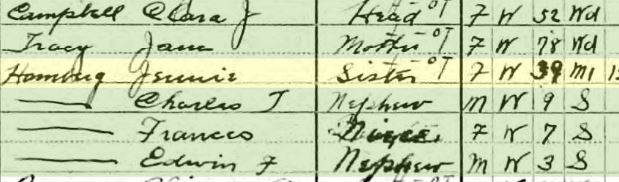
But Samuel T. Hamberg does reappear on the 1930 census.  He is listed as Sam T. Hamberg, 62 years old (the correct age), married at age 30 (the correct age), widowed (Jennie was dead), born in South Carolina, father born in Germany, mother in South Carolina (all correct).  Clearly this is the right person.  He was now living in Philadelphia, working as a novelty salesman, and living with his “sister” Cecelia Link. What had happened to his pharmacy career? His work as a state investigator? And who was Cecelia Link?

Samuel Hamberg 1930 census Year: 1930; Census Place: Philadelphia, Philadelphia, Pennsylvania; Roll: 2125; Page: 14A; Enumeration District: 0777; Image: 969.0; FHL microfilm: 2341859

Samuel Hamberg 1930 census
Year: 1930; Census Place: Philadelphia, Philadelphia, Pennsylvania; Roll: 2125; Page: 14A; Enumeration District: 0777; Image: 969.0; FHL microfilm: 2341859

Samuel did not have any sisters except for his adoptive sister Hilda Schoenthal, the daughter of Henry Schoenthal.  Cecelia was twenty years younger than Samuel, according to the 1930 census, born in Pennsylvania, single, and working as a telephone operator.  Cecelia answered the enumerator’s questions as indicated by the H on the line where her name is. Who was she, and why was she living with Samuel?

I found a Celia Link living with her mother and two sisters (and a brother-in-law) in Pittsburgh on the 1920 census.  Celia was forty years old, single, and working as a telephone operator.  It seemed like an unlikely coincidence that there were two women with just about the same name, both born in Pennsylvania, and both working as telephone operators.  (Remember that Samuel was living in Pittsburgh in 1920.)

So I looked for more about this Celia Link.  The 1916 Pittsburgh directory had her listed as Cecelia Link working as a telephone operator, so now we had the exact same name.  The 1910 census has her again as Celia, living with her parents, working as a telephone operator, and 33 years old.  Going back yet another ten years, the 1900 census lists her as Cecilia, age 22, with a birth date of March 1878, and no occupation.

Then I found her death certificate.  Cecelia Link died of chronic myocarditis on May 6, 1934, at “abt age 48,” according to her sister, the informant.  Assuming that Cecelia was 22 in 1900, she would have been 56 in 1934.  Even in 1920, she reported to be 40, making her 54 in 1934.  She was therefore only about ten years younger than Samuel, not twenty.  Note also that she was born in Washington, Pennsylvania.

Cecilia Link death certificate Ancestry.com. Pennsylvania, Death Certificates, 1906-1963 [database on-line]. Provo, UT, USA: Ancestry.com Operations, Inc., 2014. Original data: Pennsylvania (State). Death certificates, 1906–1963. Series 11.90 (1,905 cartons). Records of the Pennsylvania Department of Health, Record Group 11. Pennsylvania Historical and Museum Commission, Harrisburg, Pennsylvania.

Cecilia Link death certificate
Ancestry.com. Pennsylvania, Death Certificates, 1906-1963 [database on-line]. Provo, UT, USA: Ancestry.com Operations, Inc., 2014.
Original data: Pennsylvania (State). Death certificates, 1906–1963. Series 11.90 (1,905 cartons). Records of the Pennsylvania Department of Health, Record Group 11. Pennsylvania Historical and Museum Commission, Harrisburg, Pennsylvania.

I assume that Samuel met Cecelia when he was working in Pittsburgh as an investigator. And that they were more than “brother and sister.”  I think Cecelia lied both about her age and her relationship to Charles.

But Cecelia died in 1934 back in Pittsburgh.  What happened to Samuel before and after her death? And where were his children?

More questions to answer.


[1] There is no earlier indication that Samuel’s middle name was Tilden.  Did he adopt this middle name himself? In 1868 when Samuel Hamberg was born in Columbia, South Carolina, Samuel Tilden was probably not a nationally known figure.  He was from New York State and a supporter of the Union during the Civil War.  After the war he was active in reforming the Democratic party.  Would Charles Hamberg have known of him and named his son for him? Unlikely.

But Samuel Tilden was the Democratic party’s nominee in the 1876 Presidential election; the results of the election were disputed when several states turned into multiple sets of return.  The Presidency was determined by a partisan commission established by Congress, and Tilden lost to Rutherford B. Hayes, even though he had won the popular vote.  I think it is more likely that Samuel Hamberg adopted Tilden’s name as his middle name sometime as a young adult after Tilden was more of a household name.  Tilden died in 1886, and the first use I’ve seen of the middle initial T by Samuel Hamberg was while he was in pharmacy school in the late 1880s.  For more on Samuel Tilden, see here and here and here.

Another Delightful Conversation: My Cousin Maxine

I love it when a cousin finds me.  Usually I am the one searching for them, hoping they will be interested and open to sharing their family histories with me.  So when a cousin finds my blog, it is a delightful experience—I know they are interested, and there is none of the awkwardness of trying to explain who I am and that I am not a scammer trying to get money from them or steal their identity.

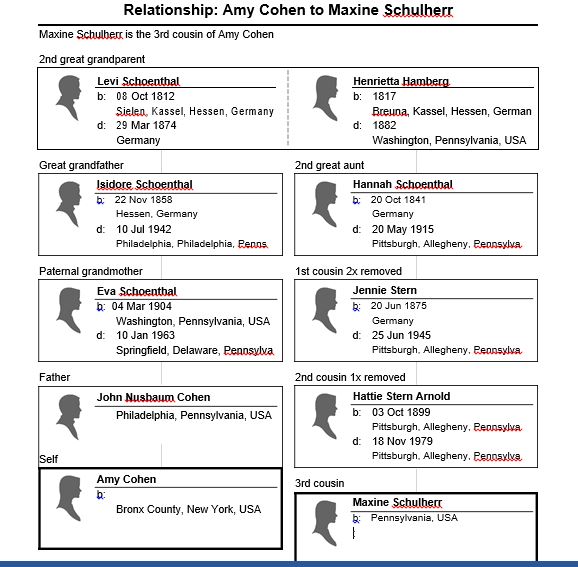
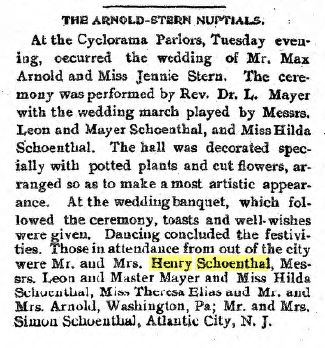
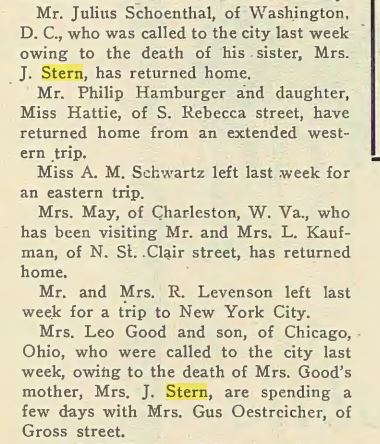
I’ve had that great pleasure again recently when my third cousin Maxine found my blog and left a comment about her connection to me and her family.  Maxine is the daughter of Hattie Arnold and Martin Schulherr, about whom I wrote here.  Maxine’s grandparents were Jennie Stern and Max Arnold, and her great-grandmother was Hannah Schoenthal Stern.  Hannah was my great-grandfather Isidore Schoenthal’s older sister.  Thus, Maxine and I are both the great-great-granddaughters of Levi Schoenthal and Henriette Hamberg.  We are third cousins.

Relationship Amy to Maxine Schulherr


Maxine was born and raised in the Pittsburgh area and has lived there all her life.  We had a wonderful phone conversation and have exchanged many emails since.  Maxine knew many of the cousins about whom I’ve written, including Lee and Meyer Schoenthal, Erna and Werner Haas, and the members of the extended Oestreicher family.  She was able to bring to life many of these people, who thus far had been mostly names and dates and occupations to me.

Her grandmother Jennie lived with Maxine and her parents for a number of years, and Maxine even shared a room with her grandmother during that time.  She knew her well, and so I was hoping that Maxine would have stories about Jennie’s youth.  Jennie came to the United States from Germany in the 1880s with her mother Hannah when she was thirteen years old, and I was interested in hearing any stories about Jennie’s life in Germany or about her experiences as a teenager settling in western Pennsylvania.  But as with so many immigrants, Jennie did not talk about the past.  Maxine said she never heard her grandmother talk about Germany or about her early days in the US.

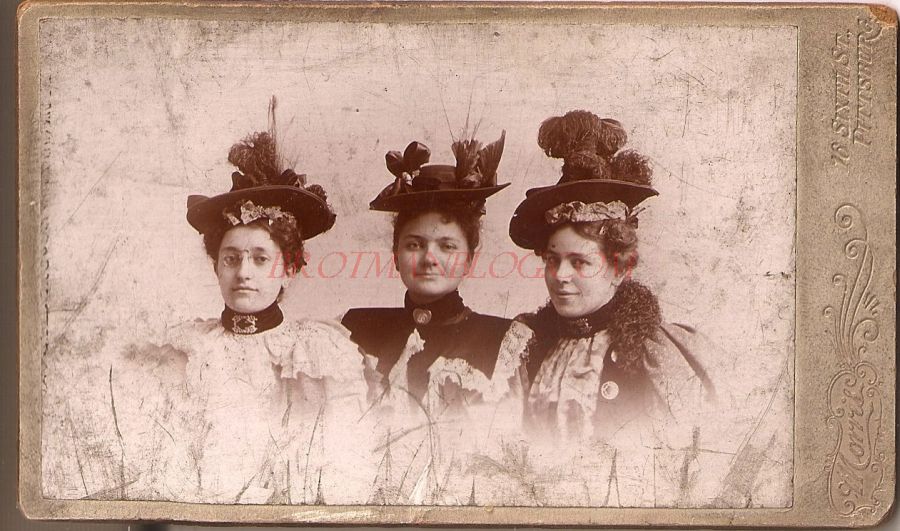
But she did have some old photographs of Jennie with two other women whom we both assume are Jennie’s two sisters, Sarah (on the left) and Edith (on the right). (All photos in this post are courtesy of my cousin Maxine.)

jennie-stern-arnold-and-her-sisters-1

Jennie Stern Arnold, center, and perhaps Sarah Stern Ostreicher on the left and Edith Stern Good on the right

jennie-stern-arnold-and-sisters-2

Stern sisters


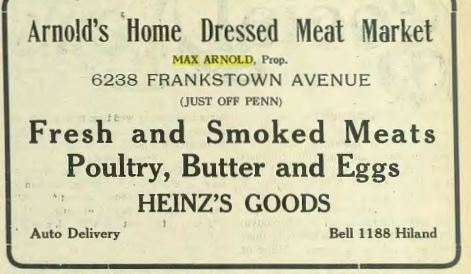
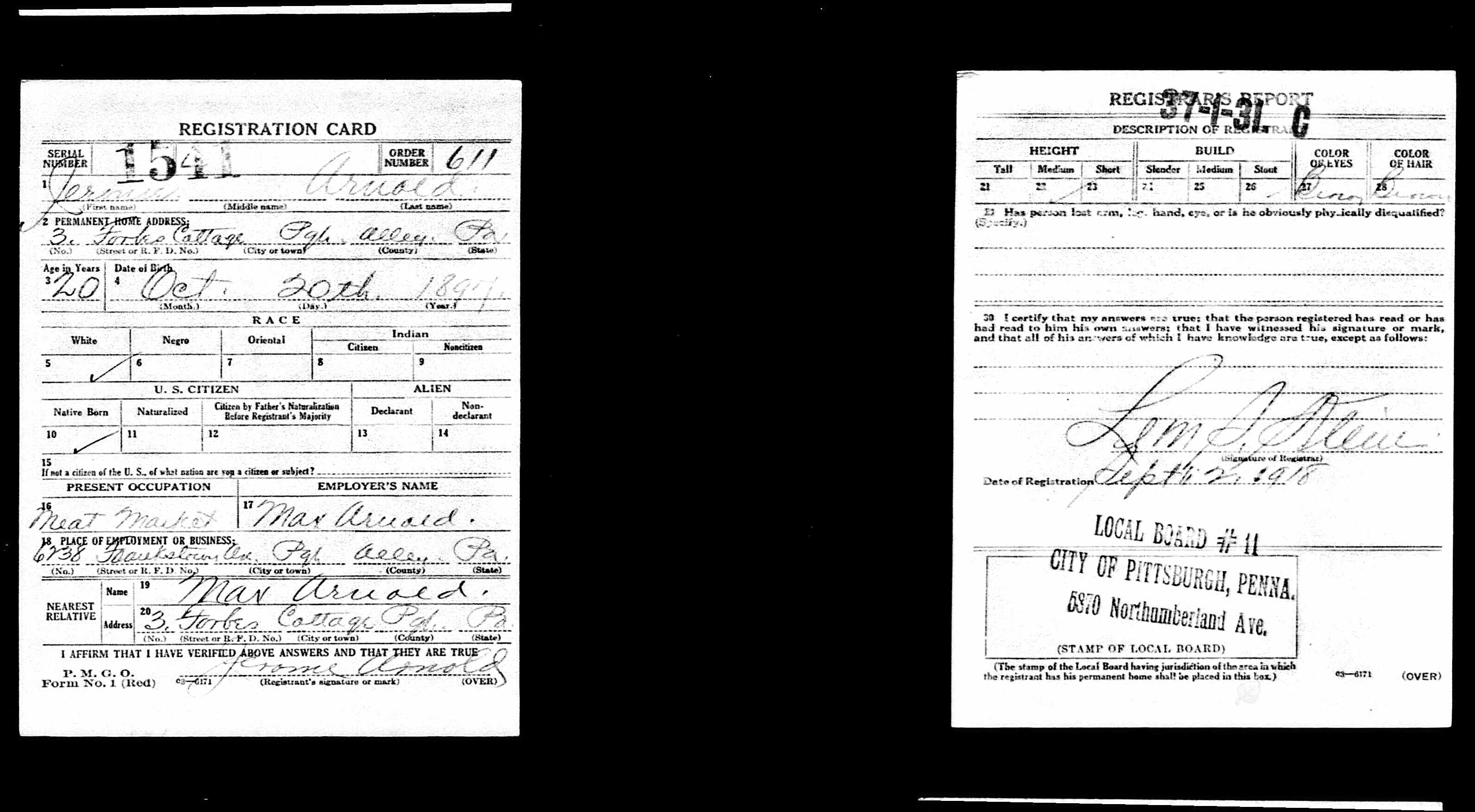
Maxine then told me about her grandmother Jennie’s life as an adult in Pennsylvania.  Jennie married Max Arnold, who had originally owned a dairy called Sweet Home Dairy. (Maxine was named for her grandfather Max.)  It was the first dairy to deliver milk to homes in the Pittsburgh area, according to Maxine.  Max had to close the dairy when he had trouble hiring reliable men to come and milk his cows, and he then went into the meat business, as I wrote about here.   Max eventually he retired and his son Sylvan ran the business when Maxine was a child.  Max, Jr., helped his brother Sylvan doing deliveries, but after having several accidents he moved on to other endeavors.

Sylvan closed the meat market when he enlisted in the army during World War II.  He would not have been drafted, given his age, but according to Maxine, Sylvan was looking to get away as his marriage was failing.  He and his first wife Ada divorced, and Sylvan remarried while in the service and stationed in Arkansas.  Based on Maxine’s information, I found a marriage record for Sylvan Arnold and Gladys Evans dated June 20, 1945, in Saline, Arkansas.  He and his second wife Gladys later moved to California, and the family in Pittsburgh never met her.

Here is a photo of Jennie and Max with their first child, Jerome, who was born in 1897.

jennie-stern-and-max-arnold-with-jerome-c-1897-edited

Jennie Stern Arnold, Jerome Arnold, and Max Arnold, Sr. c. 1897


Jennie and Max had five children, and Maxine had this wonderful picture that she believes is of those five:

hattie-arnold-unknown-jerome-max-bernice-and-sylvan-arnold

Children of Jennie Stern Arnold: Hattie, unknown, top; Jerome, possibly Max, Jr., and Bernice, center row; and Sylvan, foreground at bottom, c. 1913

Maxine’s mother Hattie is the girl in the light dress on top next to an unknown girl.  Her uncle Jerome is on the left and her aunt Bernice on the right in the middle row, and her uncle Sylvan is the boy on the ground in the front.

The little boy on the swing might be Max, Junior, but the age seems off, so I’m not sure. Since Jerome looks to be no more than sixteen here, I think this photo is probably dated no later than 1913.  In 1913, Jerome was 16, Hattie 14, Bernice 12, and Sylvan 10, and that does seem to line up with what I think are the maximum ages of the children in the photograph. I actually think they look even younger than those ages.  What do you all think? Are the children older than that?

So if the photo was taken in 1913, Max, Jr. would have been two years old.  Does the little boy on the swing look to be only two years old?  I think he looks at least three or four.  What you think?

From Maxine, I also learned more about the lives of Maxine’s mother Hattie and Hattie’s four siblings. Hattie was very proud to be one of the first women to learn to drive in Pittsburgh.  She was sixteen, and her father brought home a car that he couldn’t drive, but somehow Hattie and her brother Jerome learned to drive it.

Hattie’s sister Bernice was married twice, first to Julius Averback, whom she later divorced.  Maxine was very fond of Julius and recalled that he had taken her to the circus where he bought her a pet chameleon. Maxine told me, “The circus sold chameleons in little boxes with a string around their necks and a  safety pin at the end of the string so you could pin it on your clothes!!”  Even though he was divorced from Bernice at the time, Julius sent Maxine eighteen roses for her eighteenth birthday. Bernice’s second husband was Abe Sultanov.  Bernice did not have children with either husband.

All three of Hattie’s brothers worked in the meat business initially, but Max, Jr. later branched out into the movie theater business, living in Morgantown, West Virginia for some time before returning to the Pittsburgh area where he owned another theater in Verona and then worked in the furniture business after his brother-in-law Abe, Bernice’s second husband, made some connections for him (Abe was a manufacturer’s representative for a line of furniture).  Later on, Max, Jr. owned a drive-in theater in the Pittsburgh area known as the Maple Drive-In.

According to Maxine, her grandmother Jennie as well as Jennie’s older sister Sarah Stern Oestreicher converted to Christian Science at some point in their adult lives. Maxine recalled going to church services with her grandmother.  But Martin and Hattie remained Jewish, and Maxine was confirmed at Rodef Shalom synagogue in 1944, the same synagogue where her mother had been confirmed about thirty years earlier.

Maxine was married to Alan Stein in August, 1948.  She generously shared with me these pictures from her wedding day:


Hattie Martin Maxine Alan Henrietta Stein Alan's mother

Hattie Arnold Schulherr, Martin Schulherr, Maxine Schulherr Stein, Alan Stein, Henrietta Stein (Alan’s mother)

hattie-max-and-bernice

Hattie Arnold Schulherr, Max Arnold, Jr., and Bernice Arnold Averbach Sultanov

Hattie Martin Ceil RIchard Lou Ann daughter of Jerome and ELlen, Maxine, Max. Bernice and Ellen

Hattie Arnold Schulherr, Martin Schulherr, Richard Arnold (son of Max, Jr.), Cecilia Lefkowitz Arnold, Lou Ann Arnold (daughter of Jerome Arnold), Maxine Schulherr Stein, Max Arnold, Jr., Bernice Arnold Averbach Sultanov, and Ellen Schwabrow Arnold

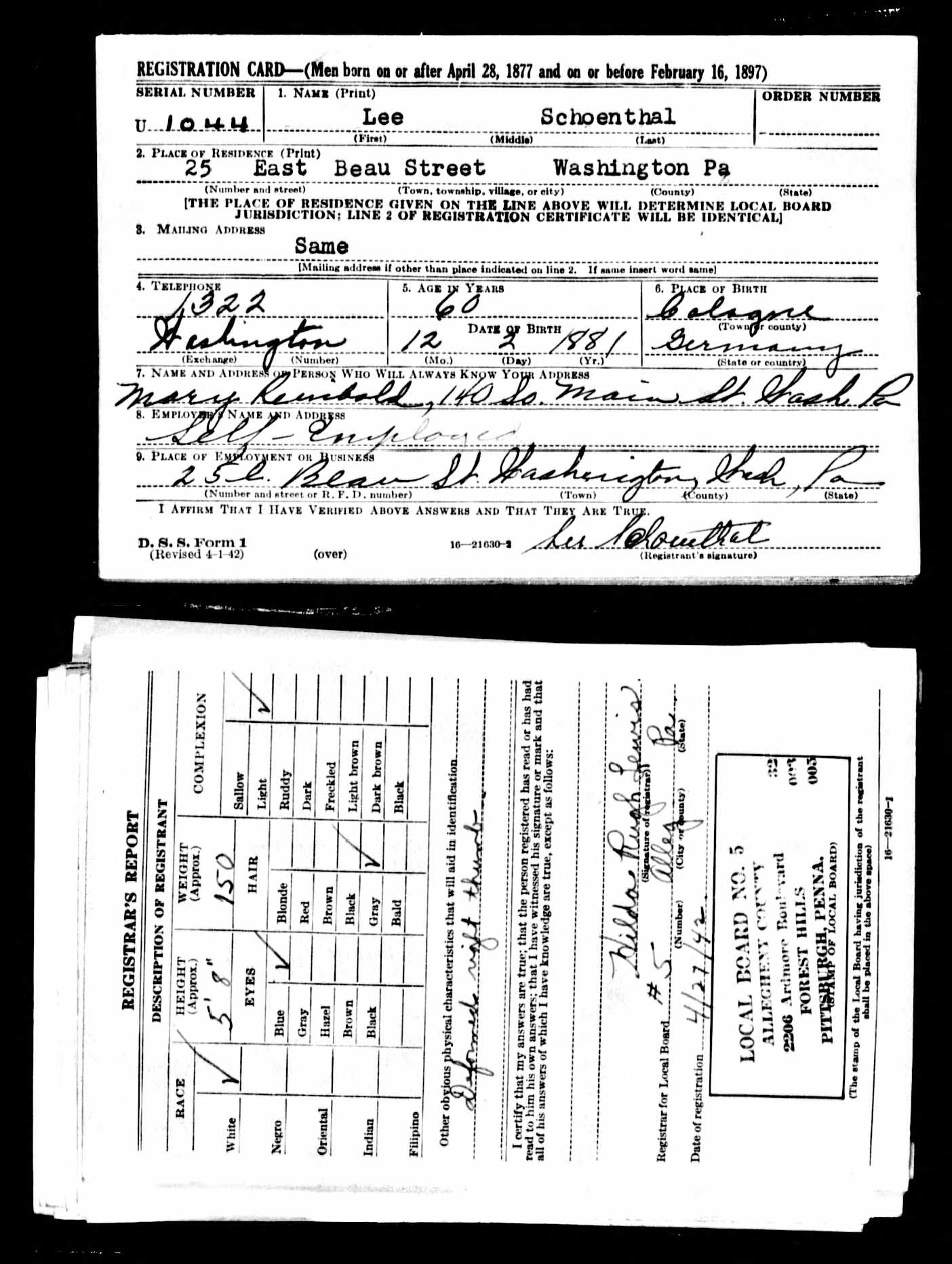
In addition to her grandparents, parents, and aunts and uncles, Maxine also knew our mutual cousins Lee and Meyer Schoenthal quite well, and she was able to answer one of my lingering questions about Lee.  When I wrote about Lee’s draft registration for World War II, I’d been puzzled by the person he’d named as the one who would always know his address, a woman named Mary Reinbold.

Lee Schoenthal World War II draft registration The National Archives at St. Louis; St. Louis, Missouri; World War II draft cards (Fourth Registration) for the State of Pennsylvania; State Headquarters: Pennsylvania; Microfilm Series: M1951; Microfilm Roll: 278

Lee Schoenthal World War II draft registration
The National Archives at St. Louis; St. Louis, Missouri; World War II draft cards (Fourth Registration) for the State of Pennsylvania; State Headquarters: Pennsylvania; Microfilm Series: M1951; Microfilm Roll: 278


Maxine shared with me that Mary Reinbold was Lee’s girlfriend for many years.  They were together a long time but never married because Mary was Catholic and Lee was Jewish.  Maxine recalled that Lee and Mary regularly came to her parents’ home for Sunday dinners.  She remembers them both very fondly.  She said Lee was a successful tailor who sold made-to-order men’s suits; her father Martin owned suits he purchased from Lee.  Lee’s shop was in the basement of building on E. Beau Street in Washington, Pennsylvania.

He must have done quite well, as Maxine told me, “Lee always drove a Lasalle car which in it’s day was in the Cadillac or more expensive class.  And he belonged to a club in  Washington, called the “Arms Club” although he never went hunting.  It was a bar, some tables, slot machines, a dance floor, and other games of chance.” Maxine said that Lee always brought her mother candy that he won at the club.   Her father Martin was also a member of the club, and Maxine visited there as well.  She told me, “I liked to pull the handle on the slot machine and watch the coins come out!!  And Daddy would stand beside me and hand me the quarters.  (I never had to spend my allowance, which then was probably one dollar a week.)”  I just love the images that this anecdote evokes.

Here are some photographs Maxine shared of Lee, Meyer, Mary, her mother Hattie, and herself as a twelve year old, taken in about 1940.

lee-schoenthal-c-1940s

Lee Schoenthal, c. 1940

mary-reinbold-and-lee-schoenthal

Mary Reinbold and Lee Schoenthal, c. 1940

mary-reinbold-meyer-schoenthal-hattie-arnold-schulherr-maxine-schulherr-stein

Mary Reinbold, Meyer Schoenthal, Hattie Arnold Schulherr, and Maxine Schulherr, c. 1940

It’s just wonderful to be able to see the faces that go with the names.

Maxine also remembers Lee and Meyer’s sister Erna Haas and her son Werner, but does not remember Lee and Meyer’s other sister, Johanna, the one who survived the Gurs internment camp in France and came to the US with her husband in 1947.  Since Johanna outlived Lee and Meyer and also lived in Pittsburgh, I was surprised that Maxine had no recollection of meeting her nor any awareness of this fourth sibling.  Perhaps Johanna’s suffering during the war had made her less able to interact with the extended family.

Maxine also knew members of the Oestreicher family, that is, the family of Sarah Stern and Gustav Oestreicher.  Sarah was her grandmother Jennie’s older sister, as discussed here and here.  Maxine knew Sarah’s son Sidney and his children, Gerald, Betty, and Elaine very well.  She said that Elaine had lived with her family for a while in the 1940s when Sidney and his wife Esther moved to New York and Elaine wanted to finish the school year in Pittsburgh.  But Maxine didn’t know what had happened to Elaine or the rest of the family after that and was curious to learn more about her long-lost second cousins.

I told her I would see what else I could find as I also had not yet been able to learn much about the Oestreicher family after about 1940.  With a few clues from Maxine, I was able to find those long-lost Oestreicher cousins.  I will report on what I’ve learned in a later post after I’ve had a chance to speak with my other third cousins, Betty and Elaine.


Passover 2016: The Exodus

In many ways Jewish history is about one exodus after another.  The Jewish story begins when God tells Abra(ha)m, “Lech Lecha,”  or “Go, Go out.”  He instructs him to leave his father’s land and go to a new land where his children would be as numerous as the stars.

There are many journeys throughout the Bible—Noah’s journey, Jacob’s journey, Joseph’s journey, and, of course, the exodus from Egypt led by Moses, which is recalled and re-enacted every year on Passover.

This Friday evening we will once again remember and re-enact that journey.  We will read the story of the Exodus.  We will drink wine, recline like free people, and eat matza to remember that our ancestors had no time to wait for the dough to rise before exiting from Egypt.  We will eat the bitter herbs to remember the bitterness of slavery, and we will eat the charoset—a mixture of apples, nuts, and wine—to embrace the sweetness of freedom from slavery.

English: Passover Seder Table, Jewish holidays...

English: Passover Seder Table, Jewish holidays עברית: שולחן הסדר, Original Image Name:סדר פסח, Location:חיפה (Photo credit: Wikipedia)


But that exodus was not the last journey our people took to freedom.  Over the centuries Jews kept moving from one land to another, either having been expelled or deciding on their own to seek freedom from oppression, violence, and hatred.  They moved to Babylonia, to Spain, to eastern Europe, to Germany, to places all over the globe, including eventually to the Americas.

I have spent much of the year since last Passover studying the journeys of my paternal relatives from Sielen, Germany—my father’s maternal grandfather’s family, the Schoenthals.  Although I still have a few more stories to share about my Schoenthal cousins, now that I have written about all the children of Levi Schoenthal and Henriette Hamberg, I want to spend this Passover looking back over the story of this particular family.

Levi and Henriette Schoenthal had ten children who survived to adulthood, all born in Sielen, Germany.  Of those ten, eight settled permanently in the US, and all but one of those eight started their lives in America in western Pennsylvania—either in Pittsburgh or the town thirty miles away, known as Little Washington.  Henry, the oldest son, arrived first in 1866, and by 1881, eight of the siblings were living in the US.  Henry over the years was a book seller and a china dealer, but underneath was a deeply religious and well-educated man.

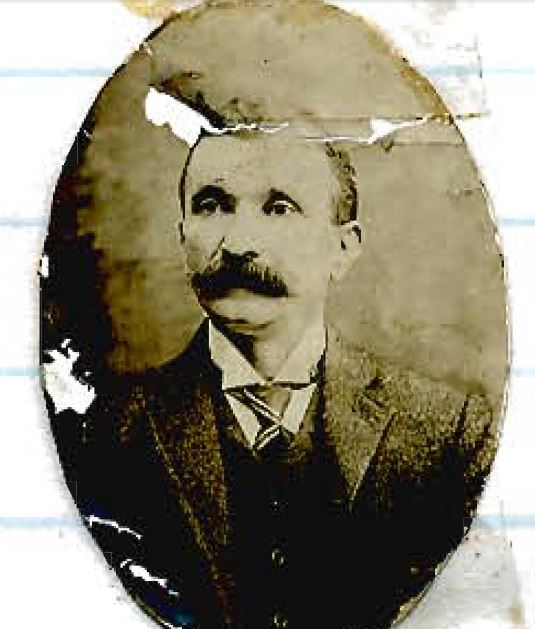
His youngest brother was my great-grandfather Isidore, who arrived in 1881, also settled in Washington, and also worked as a china dealer.

Isidore Schoenthal

Isidore Schoenthal

In between Henry and Isidore were four other brothers in the US plus two sisters.  Over the years almost all of them prospered.  Some moved away from western Pennsylvania.  Simon ended up in Atlantic City, where he and his wife raised nine children, many of whom ended up in the hotel business there; Felix and his wife and two daughters ended up in Boston, where he became successful in the typewriter repair business. Julius lived in Washington, DC, worked as a shoemaker and had four children.  Nathan lived in many different places.  And even Isidore and Henry eventually left Pennsylvania, Isidore for Colorado and Henry for New York.  The two sisters, Hannah and Amalie, stayed in Pittsburgh for most of their lives.  Both were married and had children.

Felix and Margaret Schoenthal from 1919 passport application, National Archives and Records Administration (NARA); Washington D.C.; NARA Series: Passport Applications, January 2, 1906 - March 31, 1925; Roll #: 728; Volume #: Roll 0728 - Certificates: 70500-70749, 19 Mar 1919-20 Mar 1919

Felix and Margaret Schoenthal from 1919 passport application,
National Archives and Records Administration (NARA); Washington D.C.; NARA Series: Passport Applications, January 2, 1906 – March 31, 1925; Roll #: 728; Volume #: Roll 0728 – Certificates: 70500-70749, 19 Mar 1919-20 Mar 1919


Simon Schoenthal, my great-great-uncle

Simon Schoenthal, my great-great-uncle


The next generations wandered even further afield, although many ended up not too far from where their parents had originally settled.  My grandmother, who was born in Washington, PA, and grew up in Denver, spent her whole adult life in Philadelphia and New Jersey.

My Grandma Eva

My Grandmother Eva Schoenthal Cohen

Martin Schoenthal, Gertrude Sch., Hettie Sch Blanche Walter

Walter Schoenthal, Gertrude Schoenthal, Hettie Schoenthal, Blanche Stein and Walter Stein in Arizona


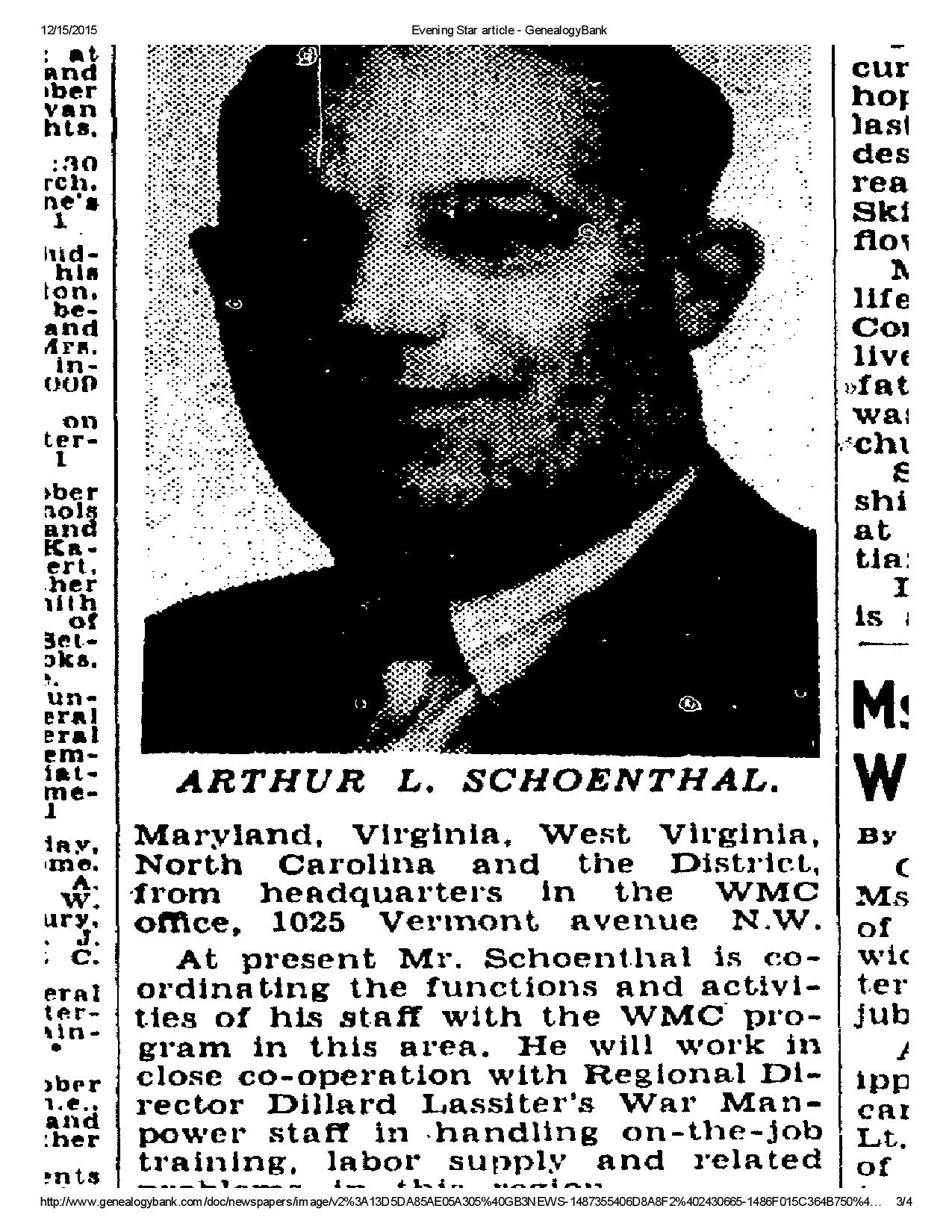
Arthur Schoenthal promoted 1942-page-003


Washington Evening Star, September 14, 1928, p. 9

Washington Evening Star, September 14, 1928, p. 9


Washington Star, December 2, 1928 p. 64

Washington Star, December 2, 1928 p. 64

Washington Evening Star, February 18, 1963, p. 24

Washington Evening Star, February 18, 1963, p. 24


Overall, the Schoenthals in the US prospered; most were successful business owners.  Most of these people appeared to have full and happy lives, although there were some who struggled.  Today there are numerous living descendants of those eight siblings, myself included.

On the other hand, the two siblings who stayed in Germany did not have as happy a legacy.  Jakob died young, and his daughter Henriette was killed in the Holocaust.  His four other children survived and, like their aunts and uncles, ended up in western Pennsylvania. Lee, Meyer, and Erna came before the war.  But Johanna was deported to a camp in Gurs, France, during the war and did not come until 1947.   From these five children, there were just two grandchildren: Helmut Levi, son of Henriette and Julius Levi, and Werner Haas, Erna’s son.  Both grandsons made it to the US before World War II.  Neither had children, however, so there are no living descendants of Jakob Schoenthal and his wife Charlotte Lilienthal.

Jewish Chronicle of Pittsburgh, June 14, 1984, p. 23 ewish+Chronicle+Vol.+23+No.+18 Formed+by+the+union+of:+Jewish+criterion+;++and:+American+Jewish+outlook. http://doi.library.cmu.edu/10.1184/pmc/CHR/CHR_1984_023_018_06141984

Jewish Chronicle of Pittsburgh, June 14, 1984, p. 23
ewish+Chronicle+Vol.+23+No.+18
Formed+by+the+union+of:+Jewish+criterion+;++and:+American+Jewish+outlook.
http://doi.library.cmu.edu/10.1184/pmc/CHR/CHR_1984_023_018_06141984


And finally Rosalie, the youngest child of Levi and Henriette, after living in the US for a few years made the fateful decision to return to Germany to marry Willy Heymann.  They had six children.  Four survived the Holocaust.  The three sons, Lionel, Max, and Walter, settled in Chicago before the war, where Lionel became a well-regarded photographer.   One daughter, Johanna, who was widowed at a young age, followed her stepdaughter Else Mosbach to Sao Paulo, Brazil, to escape the Nazis.

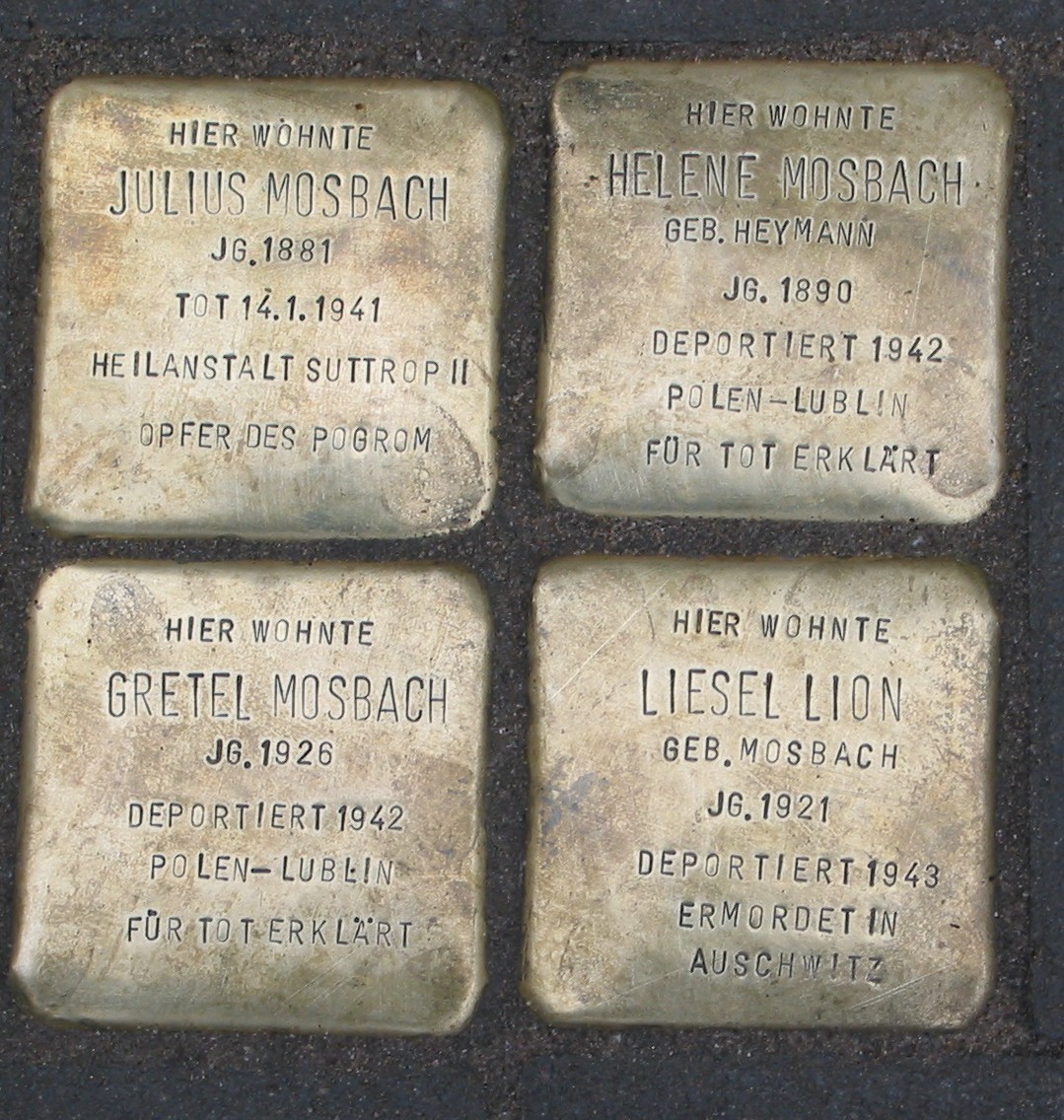
The other two daughters, Helene and Hilda, were murdered in the Holocaust as were Helene’s two daughters, Liesel and Grete.  From Rosalie’s six children, only one grandchild survived, the son of Max Heymann.  I am still hoping to find him.

Stolperstein for Julius Mosbach and family

The Schoenthal story illustrates how one fateful decision can alter the future irrevocably. One decision to take a chance and leave what you know—to listen to the call of Lech Lecha, to venture out to a new land—can make all the difference.  By taking a chance that the sweet charoset of that new land would outweigh the bitterness of leaving a land they knew, my great-grandfather and seven of his siblings changed their own fates and those of their descendants.

What if Jakob and Rosalie had left Germany when their siblings did?

And what if the other eight siblings had never left at all?  This story would have a very different ending.

In fact, it never would have been written.


The Final Chapter for Jakob Schoenthal and His Descendants

As of 1947, the four surviving children and two grandchildren of Jakob Schoenthal and Charlotte Lilienfeld were all settled in western Pennsylvania, living close to each other, Johanna and Erna in Pittsburgh and Lee and Meyer nearby in Washington, Pennsylvania.  Johanna and Erna had survived the Holocaust, as had Erna’s son Werner Haas and the son of their sister Henriette, Helmut Levi.

The next two decades were, however, not kind to the children of Jakob Schoenthal and Charlotte Lilienfeld.  First, on February 7, 1956, Johanna’s husband Heinrich Stern died at age 79; he’d been suffering from arteriosclerosis for years, according to his death certificate, and had been residing in the Jewish Home for the Aged in Pittsburgh.  His doctor had been caring for him since 1953, so Heinrich must have been in poor health for much of his time in the US.


Heinrich Stern death certificate Ancestry.com. Pennsylvania, Death Certificates, 1906-1963 [database on-line]. Provo, UT, USA: Ancestry.com Operations, Inc., 2014. Original data: Pennsylvania (State). Death certificates, 1906–1963. Series 11.90 (1,905 cartons). Records of the Pennsylvania Department of Health, Record Group 11. Pennsylvania Historical and Museum Commission, Harrisburg, Pennsylvania.

Heinrich Stern death certificate
Ancestry.com. Pennsylvania, Death Certificates, 1906-1963 [database on-line]. Provo, UT, USA: Ancestry.com Operations, Inc., 2014.
Original data: Pennsylvania (State). Death certificates, 1906–1963. Series 11.90 (1,905 cartons). Records of the Pennsylvania Department of Health, Record Group 11. Pennsylvania Historical and Museum Commission, Harrisburg, Pennsylvania.

Then the following year, the oldest sibling, Lee Schoenthal, died at age 75 on May 11, 1957.  He also suffered from arteriosclerosis and died from congestive heart failure.  His doctor had been caring for him since 1949, according to the death certificate.  Lee appears to have been the backbone of the family, the one who employed and housed his younger brother Meyer for some years and who also helped his two younger sisters Johanna and Erna as well as his nephew Helmut Levi come to and settle in the US.


Lee Schoenthal death certificate Ancestry.com. Pennsylvania, Death Certificates, 1906-1963 [database on-line]. Provo, UT, USA: Ancestry.com Operations, Inc., 2014. Original data: Pennsylvania (State). Death certificates, 1906–1963. Series 11.90 (1,905 cartons). Records of the Pennsylvania Department of Health, Record Group 11. Pennsylvania Historical and Museum Commission, Harrisburg, Pennsylvania.

Lee Schoenthal death certificate
Ancestry.com. Pennsylvania, Death Certificates, 1906-1963 [database on-line]. Provo, UT, USA: Ancestry.com Operations, Inc., 2014.
Original data: Pennsylvania (State). Death certificates, 1906–1963. Series 11.90 (1,905 cartons). Records of the Pennsylvania Department of Health, Record Group 11. Pennsylvania Historical and Museum Commission, Harrisburg, Pennsylvania.

It was almost three years later that Meyer himself died.  He was 76 years old, and the principal cause of death was a coronary occlusion.  But looking more closely at the death certificate revealed information that might have explained why Meyer had not appeared in any city directories after 1931 and why his sisters and nephew all listed only Lee as the person they knew in the US and not Meyer. It also explains why Lee had not listed Meyer on his World War II draft registration as the person who would always know his address.


Meyer N Schoenthal death certificate Ancestry.com. Pennsylvania, Death Certificates, 1906-1963 [database on-line]. Provo, UT, USA: Ancestry.com Operations, Inc., 2014. Original data: Pennsylvania (State). Death certificates, 1906–1963. Series 11.90 (1,905 cartons). Records of the Pennsylvania Department of Health, Record Group 11. Pennsylvania Historical and Museum Commission, Harrisburg, Pennsylvania.

Meyer N Schoenthal death certificate
Ancestry.com. Pennsylvania, Death Certificates, 1906-1963 [database on-line]. Provo, UT, USA: Ancestry.com Operations, Inc., 2014.
Original data: Pennsylvania (State). Death certificates, 1906–1963. Series 11.90 (1,905 cartons). Records of the Pennsylvania Department of Health, Record Group 11. Pennsylvania Historical and Museum Commission, Harrisburg, Pennsylvania.

Meyer suffered from manic depression (more commonly referred to as bipolar disorder today), which the doctor described as a contributing factor in his death.  Meyer had been living at Torrance State Hospital in Westmoreland, Pennsylvania, for over two and a half years at the time of his death on January 10, 1960.  In other words, he had been hospitalized shortly after his brother Lee’s death in May 1957.  Lee must have been caring for him up to that point.

Lee and Meyer were buried next to each other in Beth Israel cemetery in Washington, Pennsylvania.


The family’s heartbreak continued two years later when young Werner Haas died from Laennec’s cirrhosis of the liver, a form of cirrhosis associated with alcoholism.  According to the death certificate, he had been suffering for months and died after 48 hours in a hepatic coma.  He was only 36 years old.


Werner Haas death certificate Ancestry.com. Pennsylvania, Death Certificates, 1906-1963 [database on-line]. Provo, UT, USA: Ancestry.com Operations, Inc., 2014. Original data: Pennsylvania (State). Death certificates, 1906–1963. Series 11.90 (1,905 cartons). Records of the Pennsylvania Department of Health, Record Group 11. Pennsylvania Historical and Museum Commission, Harrisburg, Pennsylvania.

Werner Haas death certificate
Ancestry.com. Pennsylvania, Death Certificates, 1906-1963 [database on-line]. Provo, UT, USA: Ancestry.com Operations, Inc., 2014.
Original data: Pennsylvania (State). Death certificates, 1906–1963. Series 11.90 (1,905 cartons). Records of the Pennsylvania Department of Health, Record Group 11. Pennsylvania Historical and Museum Commission, Harrisburg, Pennsylvania.

His life had not been an easy one.  He had lost his father before he was five years old, and he had been uprooted from his home in Darmstadt, Germany, and brought to the US.  Then he had served in the US Navy as a fireman, a skilled technician, during World War II.  After the war he had been briefly married to Lillian Angeloff; at the time of his death he was married to Margaret Rusnack, who was more than ten years older than Werner and had a son from a prior marriage.  He had worked as a salesman before and after the war, but in 1950 he had changed occupations and was a driver.  In 1952 he was a construction worker, and then in 1958 and 1959 he was again a driver.  After that he does not appear in the Pittsburgh directories.

It’s hard to imagine what those years between 1953 and 1962 must have been like for the two remaining siblings.  Johanna lost a husband, two brothers, and a nephew, and Erna also lost her brothers, her brother-in-law, and her son.

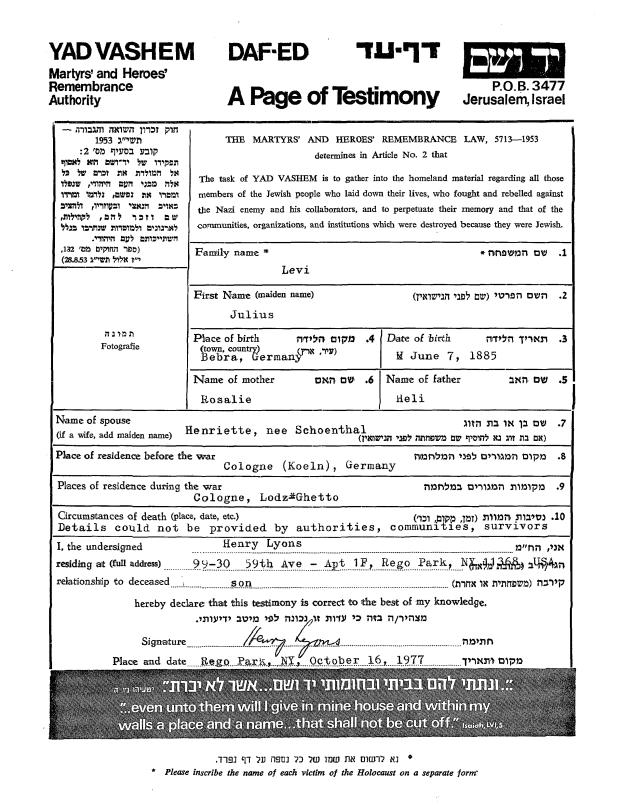
Erna then lost her remaining sibling, Johanna, on February 23, 1967.  The only close relative who was left was her nephew Helmut Levi (who by that time was named Henry Lyons).  Henry and his wife Pauline continued to live at the same address in Rego Park, New York, until Henry’s death on December 18, 1986.  He was only 67 years old when he died.


Aufbau February 13, 1987 p. 41

Aufbau, February 13, 1987 p. 41


Erna Schoenthal Haas, the youngest child of Jakob and Charlotte, had outlived her parents, her husband, her siblings, her nieces and nephews, and even her son.  Despite all the terrible losses she had suffered including being widowed at a very young age, escaping from Nazi Germany, and losing her only child, she had persevered and even maintained a positive outlook, as this June 14, 1984 article from the Jewish Chronicle of Pittsburgh reveals:


Jewish Chronicle of Pittsburgh, June 14, 1984, p. 23 ewish+Chronicle+Vol.+23+No.+18 Formed+by+the+union+of:+Jewish+criterion+;++and:+American+Jewish+outlook. http://doi.library.cmu.edu/10.1184/pmc/CHR/CHR_1984_023_018_06141984

Jewish Chronicle of Pittsburgh, June 14, 1984, p. 23
Jewish+Chronicle+Vol.+23+No.+18
Formed+by+the+union+of:+Jewish+criterion+;++and:+American+Jewish+outlook.
http://doi.library.cmu.edu/10.1184/pmc/CHR/CHR_1984_023_018_06141984


Notice that Erna only mentioned one brother, presumably Lee, and also explained how her family knew Daniel-Henry Kahnweiler, the renowned art dealer and collector.

Erna died on January 17, 1989, the only sibling to make it to eighty years old, let alone ninety.  She is buried not where her brothers or her sister or even her son is buried, but at Chesed Shel Emeth cemetery near Pittsburgh.

Writing about the lives of Jakob Schoenthal and his children provided a stark contrast to the experience I had writing about Simon Schoenthal and his children.  These two brothers, born just a year apart, had such different lives and legacies. Both died too young and also just a year apart, Jakob in 1903, Simon in 1904. But although Simon and his wife Rose had suffered heartbreak when their daughter Ida died at a young age, overall their lives and their legacy were happy ones.  Simon’s nine surviving children almost all lived very long and happy lives filled with adventures, long marriages, children, and close relationships with each other.


The nine surviving children of Simon and Rose (Mansbach) Schoenthal Photo courtesy of the family of Hettie Schoenthal Stein

The nine surviving children of Simon and Rose (Mansbach) Schoenthal
Photo courtesy of the family of Hettie Schoenthal Stein


Jakob’s five children, on the other hand, were not so fortunate.  Henriette was killed in the Holocaust along with her husband.  Johanna was deported from her home to a camp in France and then somehow survived, probably hiding in France.  As far as I know, Johanna never had children.   Lee Schoenthal and Meyer Schoenthal never married or had children, and Meyer spent some part of his life struggling with mental illness.

I know of  only two grandchildren of Jakob and Charlotte Schoenthal.  Erna had one son, Werner, who died from liver disease, presumably caused by alcoholism, when he was only 36.  Henriette had a son Helmut, who married but had no children. Thus, neither of Jakob’s two grandsons had children.  There are no descendants to carry on that particular family’s line.

I can’t help but wonder how things might have turned out differently for Jakob and Charlotte and their children if they, like their siblings, had chosen to come to the US instead of staying in Germany.


The Children of Jakob Schoenthal and Charlotte Lilienfeld, Part III: Lee and Meyer Come to America

As I wrote in my two last posts, after following a rather convoluted research path, I had discovered that  my great-great-uncle Jakob Schoenthal and his wife Charlotte Lilienfeld had had five children born in Cologne, Germany: Johanna, born in 1880; Lee, born in 1881; Meyer, born in 1883; Henriette, born in 1885; and Erna, born in 1898.[1]   Their father Jakob had died in 1903 when Erna in particular was quite young.  Their mother Charlotte died in 1935.

Four of their five children immigrated to the US: the two sons Lee and Meyer arrived in Washington, Pennsylvania, in the early decades of the twentieth century.  Erna arrived in 1938 with her son Werner; she was a young widow when she arrived. (I am still looking for information about her husband Arnold and hope to have an update soon.) Johanna and her husband Heinrich Stern arrived in 1947, having somehow survived the war and last residing in Lyons, France.

Tragically, Jakob and Charlotte’s remaining child, Henriette, had been murdered by the Nazis along with her husband Julius Levi.  Their son Helmut, however, had left in time.  He came to the US in 1939 and eventually changed his name to Henry Lyons.  He and his wife Pauline nee Schwartz lived for many years in Rego Park, Queens, New York.

Rego Park, Queens, NY By Frank Hindimith [GFDL (http://www.gnu.org/copyleft/fdl.html) or CC-BY-SA-3.0 (http://creativecommons.org/licenses/by-sa/3.0/)], via Wikimedia Commons

Rego Park, Queens, NY
By Frank Hindimith [GFDL (http://www.gnu.org/copyleft/fdl.html) or CC-BY-SA-3.0 (http://creativecommons.org/licenses/by-sa/3.0/)%5D, via Wikimedia Commons

In the next few posts I will address these four children, Lee, Meyer, Erna, and Johanna, as well as the two grandsons Werner and Henry. Who were these people? What were their lives like once they got to the US?  I will discuss Lee and Meyer first and their early years in the US and then their sisters and nephews and what happened to them all during and after World War II.

Lee and Meyer were not the easiest to research.  Not only did I have the problem of distinguishing them from their first cousins with the same names, Lee and Meyer, the sons of Henry Schoenthal, I also had a very difficult time finding them on census reports.   Lee only appears on the 1920 census, Meyer only on the 1930 census.  I have no idea how they evaded so many census enumerators.

Figuring out when each of the brothers arrived was also a puzzle. I can’t find an early passenger manifest for either of them. The 1920 census reports that Lee arrived in the US in 1899, when he would have been eighteen years old, but Lee does not appear on the 1900 census nor does he appear in any of the available Washington, Pennsylvania directories until 1909, when he is listed as a tailor working at 12 East Cherry Avenue in Washington.

In 1911, Lee went back to Germany, presumably to visit his family.  On the ship manifest for that trip (line 26), Lee stated that he had been living at 18 East Cherry Avenue, Washington, Pennsylvania, from 1907 through 1911, but I cannot find him on the 1910 census.


1911 ship manifest for Lee Schoenthal page 1

1911 ship manifest for Lee Schoenthal, line 26 Ancestry.com. New York, Passenger Lists, 1820-1957 [database on-line]. Provo, UT, USA: Ancestry.com Operations, Inc., 2010. Original data: Passenger Lists of Vessels Arriving at New York, New York, 1820-1897. Microfilm Publication M237, 675 rolls. NAI: 6256867. Records of the U.S. Customs Service, Record Group 36. National Archives at Washington, D.C.

1911 ship manifest for Lee Schoenthal, line 26
Ancestry.com. New York, Passenger Lists, 1820-1957 [database on-line]. Provo, UT, USA: Ancestry.com Operations, Inc., 2010.
Original data: Passenger Lists of Vessels Arriving at New York, New York, 1820-1897. Microfilm Publication M237, 675 rolls. NAI: 6256867. Records of the U.S. Customs Service, Record Group 36. National Archives at Washington, D.C.

He does, however, appear in the Washington directories throughout the 1910s beginning in 1911, and he registered for the World War I draft in 1918.  Throughout, Lee was working as a tailor.  My best guess is that he had arrived in the US between 1907 and 1909.


Lee Schoenthal World War I draft registration Ancestry.com. U.S., World War I Draft Registration Cards, 1917-1918 [database on-line]. Provo, UT, USA: Ancestry.com Operations Inc, 2005. Original data: United States, Selective Service System. World War I Selective Service System Draft Registration Cards, 1917-1918. Washington, D.C.: National Archives and Records Administration. M1509, 4,582 rolls. Imaged from Family History Library microfilm.

Lee Schoenthal World War I draft registration
Ancestry.com. U.S., World War I Draft Registration Cards, 1917-1918 [database on-line]. Provo, UT, USA: Ancestry.com Operations Inc, 2005.
Original data: United States, Selective Service System. World War I Selective Service System Draft Registration Cards, 1917-1918. Washington, D.C.: National Archives and Records Administration. M1509, 4,582 rolls. Imaged from Family History Library microfilm.

Meyer, on the other hand, appears in the 1903 and 1905 Washington directories, working as a clerk for Rudolph Hanau and residing at 19 Sherman Avenue, as listed in both directories.  Lee does not appear in either of those directories.  Meyer, like Lee, is not on the 1910 census nor the 1920 census, nor does he appear in the 1909 directory or any other available Washington, Pennsylvania, directory between 1906 and 1928.  According to the 1930 census, the one census which includes Meyer, he arrived in the US in 1923.  But then how explain his listings in 1903 and 1905?  Had he left the US and returned to Germany for all those years, not returning until the 1920s?

I have two ship manifests showing Meyer traveling between Germany and the US, once in 1927 and once in 1929.  The 1927 manifest listing for Meyer states that his occupation was a merchant, that he was 44 years old, born in Koln, and last resided in Washington, Pennsylvania.


Meyer N Schoenthal 1927 ship manifest Year: 1927; Arrival: New York, New York; Microfilm Serial: T715, 1897-1957; Microfilm Roll: Roll 4123; Line: 1; Page Number: 134

Meyer N Schoenthal 1927 ship manifest
Year: 1927; Arrival: New York, New York; Microfilm Serial: T715, 1897-1957; Microfilm Roll: Roll 4123; Line: 1; Page Number: 134


The second page states that his contact in Germany was his brother-in-law, Julius Levi, and that his contact in the US was his cousin, the above-mentioned Rudolph Hanau of 26 Sherman Avenue, Washington, Pennsylvania.


Meyer N Schoenthal 1927 ship manifest, page 2 Year: 1927; Arrival: New York, New York; Microfilm Serial: T715, 1897-1957; Microfilm Roll: Roll 4123; Line: 1; Page Number: 134

Meyer N Schoenthal 1927 ship manifest, page 2
Year: 1927; Arrival: New York, New York; Microfilm Serial: T715, 1897-1957; Microfilm Roll: Roll 4123; Line: 1; Page Number: 134


Of course, when I saw that Rudolph Hanau was Meyer’s cousin, I had to figure out the connection.  After a few hours of looking at Ancestry and the Hessen archives online, I learned that Rudolph’s wife was Johanna Levi, daughter of Moses Levi and Rechel Lilienfeld.  Yep, Lilienfeld.  Rechel Lilienfeld was the sister of Helen and Charlotte Lilienfeld.  Thus, Johanna Levi was Meyer’s first cousin (and also, obviously, a first cousin to Lee, Johanna, Henriette, and Erna Schoenthal).

Her husband Rudolph Hanau was, like my great-grandfather Isidore and his brother Henry, a merchant in the china business in Washington, Pennsylvania. He must have known my great-grandfather well.   Thus, there were a number of other members of the extended family living in Little Washington whom I had not located earlier.

The second page of the 1927 manifest for Meyer’s trip to Germany notes that he had previously been in the US from 1911 through 1927.  This would explain why he is not on the 1910 census, but it doesn’t explain his absence from the 1920 census, unless he had been out of town then also.  It also is inconsistent with the fact that he appears in the 1903 and 1905 directories as well with the information on the 1930 census stating he had arrived in 1923.

The 1929 manifest for Meyer is similar in content to the 1927 manifest, but he now lists his mother Charlotte as his contact in Germany and his brother Lee as his contact in Washington.  Here he claims he had previously been in the US only since 1923, consistent with what he later reported on the 1930 census, but inconsistent with both the directory listings in 1903 and 1905 and the passenger manifest from 1927, just two years earlier.  Could the time periods listed on these manifests report times lived at a very specific address in the US, not time periods in the US generally?

Meyer N Schoenthal 1929 ship manifest page 1

Meyer N Schoenthal 1929 ship manifest page 2

Lee Schoenthal 1929 ship manifest Ancestry.com. New York, Passenger Lists, 1820-1957 [database on-line]. Provo, UT, USA: Ancestry.com Operations, Inc., 2010. Original data: Passenger Lists of Vessels Arriving at New York, New York, 1820-1897. Microfilm Publication M237, 675 rolls. NAI: 6256867. Records of the U.S. Customs Service, Record Group 36. National Archives at Washington, D.C.

Thus, both Lee and Meyer likely arrived in the US in the first decade of the 1900s, but may have spent time back in Germany for various periods.  Lee seems to have been permanently settled in the US by the 1910s, Meyer by the 1920s.

The 1929 directory for Washington, Pennsylvania, lists both Lee and Meyer as tailors, living at different addresses, Lee at 321 Burton Avenue, Meyer at 143 North Avenue, but only about a half mile apart.  As reported on the 1930 census, Meyer was living as a lodger in someone’s home.  In 1931, both Lee and Meyer are again listed as tailors in the directory and both residing at the same addresses provided in 1929.  But for some reason, Lee does not appear on the 1930 census.  (Residing at 321 Burton Avenue on the 1930 census was a couple named Jacob and Ruth Weber, owners of a grocery store; Lee is not listed as living with them.)


1931 Washington PS directory Ancestry.com. U.S. City Directories, 1822-1995 [database on-line]. Provo, UT, USA: Ancestry.com Operations, Inc., 2011.

1931 Washington PS directory
Ancestry.com. U.S. City Directories, 1822-1995 [database on-line]. Provo, UT, USA: Ancestry.com Operations, Inc., 2011.

Lee is listed on several Washington directories in the 1930s, but Meyer is not in any directory after the 1931 issue.  Where was Meyer, and why isn’t he included in the directories after 1931? I was puzzled by his absence.  More on that in a later post.

Thus, by the early 1930s, both Lee and Meyer had been settled in the US for quite some time.  Their sisters were all still living in Germany as was their mother.  That, of course, would all change once Hitler came to power.


[1] The thirteen year gap between Henriette and Erna and the fact that Charlotte would have been 43 in 1898 made me somewhat skeptical of Erna’s birth year, but three sources corroborate that as the correct year, so I have to assume it’s correct. Plus there was a gap of twelve years between my mother and her sibling closest in age, so I know it happens.

The Brother Who Stayed Behind: Adventures in Genealogy Research

Born just one year after Simon, the next sibling was Jakob Schoenthal. (I am using the German spelling for two reasons.  First, Jakob stayed in Germany and thus that is how he spelled his name.  Second, it helps to distinguish him from his nephew, Simon’s son Jacob.) Finding Jakob’s story was quite a lesson in genealogy research.  It took some lucky breaks and the help of others, and in the end it led to a story of both tragedy and triumph.


Centro de la ciudad de Koln, Alemania Deutsch:...

Köln Germany, where Jakob Schoenthal lived as an adult (Photo credit: Wikipedia)


First, some background. I’ve already written about eight of the ten children of Levi Schoenthal and Henriette Hamberg, my great-great-grandparents.  They were the eight children who came to America between 1866 and 1881 and settled here permanently, including my great-grandfather Isidore Schoenthal.  All of them lived relatively long and seemingly satisfying lives.  They started in western Pennsylvania, but eventually they and/or their children moved far afield across the United States—to California, Illinois, New Jersey, New York, Massachusetts, and elsewhere.  They thrived in America, and they have many descendants still living in this country.

But there were two siblings who did not end up in America.  One, the youngest child, Rosalie, had in fact immigrated to the US in 1881 with her mother Henriette and her brother Isidore, my great-grandfather.  But Rosalie returned to Germany to marry Willy Heymann in 1884, and that decision was in the end one with devastating consequences for her family.  I will write more about Rosalie in a subsequent post.

The only sibling who never left Germany was the sixth child of Levi and Henriette, Jakob, who was born in Sielen in 1850.  I will always wonder why Jakob stayed when almost all of his siblings had emigrated from Germany by 1874.  Jakob was 24 by then, only a year younger than Simon, who had left in 1867. Why did he stay? I don’t know, but my theory is that Jakob stayed to take care of his mother and youngest siblings. By 1874 when his father Levi died, Jakob was the oldest son still in Germany, and there were still some younger siblings at home, including my great-grandfather.  So perhaps Jakob stayed out of a sense of family obligation. As with his sister Rosalie, that decision to stay had tragic consequences.

On September 1, 1879, Jakob married Charlotte Lilienfeld, the younger half-sister of Helen Lilienfeld, who had married Jakob’s brother Henry in 1872 and moved with him to Washington, Pennsylvania.  Charlotte and Helen were both the daughters of Meyer Lilienfeld of Gudensberg, where Henry Schoenthal had once been a teacher before immigrating to the US.

Marriage record of Jakob Schoenthal and Charlotte Lilienfeld Hessisches Hauptstaatsarchiv, Wiesbaden: Trauregister der Juden von Gudensberg 1825-1900 (HHStAW Abt. 365 Nr. 386) 1825-1900

Marriage record of Jakob Schoenthal and Charlotte Lilienfeld
Hessisches Hauptstaatsarchiv, Wiesbaden: Trauregister der Juden von Gudensberg 1825-1900 (HHStAW Abt. 365 Nr. 386, p.42) 1825-1900


For a long time I could not find much more information about Jakob.  I knew from the 1893 Beers biography of Henry Schoenthal that Jakob had then been living in Cologne, Germany in 1893, but I didn’t know if he and Charlotte had had children or if they had ever left Germany or when they had died.

Then while I was researching Henry Schoenthal and his family, I kept coming across two men living in Washingon, Pennsylvania, with the same names as two of Henry’s sons: Meyer and Lee Schoenthal.  At first I thought they were Henry’s sons, but soon it became clear that there were in fact two Meyers and two Lees.  When I found the death certificates for the Meyer and the Lee who were not the sons of Henry Schoenthal, I saw that their parents were Jakob Schoenthal and Charlotte Lilienfeld.


Lee Schoenthal death certificate Ancestry.com. Pennsylvania, Death Certificates, 1906-1963 [database on-line]. Provo, UT, USA: Ancestry.com Operations, Inc., 2014. Original data: Pennsylvania (State). Death certificates, 1906–1963. Series 11.90 (1,905 cartons). Records of the Pennsylvania Department of Health, Record Group 11. Pennsylvania Historical and Museum Commission, Harrisburg, Pennsylvania.

Lee Schoenthal death certificate
Ancestry.com. Pennsylvania, Death Certificates, 1906-1963 [database on-line]. Provo, UT, USA: Ancestry.com Operations, Inc., 2014.
Original data: Pennsylvania (State). Death certificates, 1906–1963. Series 11.90 (1,905 cartons). Records of the Pennsylvania Department of Health, Record Group 11. Pennsylvania Historical and Museum Commission, Harrisburg, Pennsylvania.

I knew then that Jakob and Charlotte had had at least two sons, both of whom had lived in Washington, Pennsylvania, where their Schoenthal uncles Henry and Isidore as well as their aunt Helen Lilienfeld Schoenthal were living.  And, of course, the identical names made sense.  Both Meyers were named for their maternal grandfather, Meyer Lilienfeld, and both Lees were named for their paternal grandfather, Levi Schoenthal.

And then I was stuck.   What else could I learn about Jakob and Charlotte? I asked in the German Genealogy group on Facebook whether there were records available online for Cologne, or Köln, as it is spelled in German, and I learned that there were in fact archives online with birth, marriage, and death records.  Unfortunately, the archives are divided into geographic areas in and around Köln, and I had no idea where in the city Jakob had lived.  In addition, I had no idea what years to search for births or deaths for his family, and the number of records was too overwhelming to search without some parameters.

But then another member of the Genealogy Group suggested I look in city directories to see if I could narrow down where in Köln Jakob and his family had lived.  I learned that there were city directories online that dated as early as 1797 all the way through to the 1960s.  I started searching year by year, and I eventually found many listings for him, starting with one in 1901 and going as late as 1935, and then he disappeared.  Here are a few examples:


Greven's address book for Cologne subtitle:and environment especially Mühlheim am Rhein and lime Author / Edit .: Ant. Carl Greven Publishing company: Greven's Cologne Address Book Publisher Ant. Carl Greven Vintage: 51 Year: 1905

Greven’s address book for Cologne
Author / Edit .: Ant. Carl Greven
Publishing company: Greven’s Cologne Address Book Publisher Ant. Carl Greven
Vintage: 51
Year: 1905


Grevens Adreßbuch 1915 Cologne and environs

Grevens Adreßbuch 1915 Cologne and environs


Greven's address book for Cologne subtitle:and neighborhood and business directory the circles Cologne-Mülheim country and a. Rh. Publishing company: Greven's Cologne Address Book Publisher Ant. Carl Greven Vintage: 67 Year: 1925

Greven’s address book for Cologne
Publishing company: Greven’s Cologne Address Book Publisher Ant. Carl Greven
Vintage: 67
Year: 1925


So I thought Jakob must have died or moved or emigrated around 1935, but not knowing German had once again proven to be a problem.  I posted the 1935 listing on the German Genealogy Facebook page, and my friend Matthias translated it and pointed out that the listing was not for Jakob, but rather for his widow.  He explained that the abbreviation Ww meant “widow,” and when I went back to look at the earlier directories, I saw that the Ww was included in almost all of the listings I had thought were for Jakob Schoenthal.


Greven's address book of Cologne subtitle:and its environs, as well as the address book of the circles Cologne-country Bensberg, Bergisch Gladbach u. Porz, Volume (→ Second volume ) Publishing company: Greven's Cologne Address Book Publisher Ant. Carl Greven Year: 1935

Greven’s address book of Cologne
Gladbach u. Porz, Volume (→ Second volume )
Publishing company: Greven’s Cologne Address Book Publisher Ant. Carl Greven
Year: 1935


I worked all the way back to 1905, seeing that Ww.  There were no directories on the website for 1902-1904, but in 1901, there was no Ww, so I assumed that meant that Jakob was still alive in 1900.  Thus, it seemed likely that Jakob had died sometime between 1901 and 1905.


Greven's address book for the borough Cologne subtitle:and for the environment especially: Mühlheim am Rhein and lime Author / Edit .: Ant. Carl Greven Publishing company: Greven's Cologne Address Book Publisher Ant. Carl Greven Vintage: 47 Year: 1901

Greven’s address book for the borough Cologne
Author / Edit .: Ant. Carl Greven
Publishing company: Greven’s Cologne Address Book Publisher Ant. Carl Greven
Vintage: 47
Year: 1901


From the address on Breite Strasse in the directories, my friends in the Germany Genealogy group thought that Jakob had lived in the central part of Köln.  Having narrowed down the years and the section of the city where he lived, I now combed through the relevant records until I found a death record for Jakob.  He had died on November 19, 1903.  He was only 53 years old when he died.  He was the first of his siblings to die.


Jakob Schoenthal death certificate Das Digitale Historiche Archiv Koln, Civil registry, civil registry Cologne I, deaths, 1903 1903 Vol 03 p.320

Jakob Schoenthal death certificate
Das Digitale Historiche Archiv Koln, Civil registry, civil registry Cologne I, deaths, 1903 1903 Vol 03 p.320


Since 1935 was the last year Jakob’s widow Charlotte was listed, I assumed that she must have died around 1935.  I wrote to the synagogue in Köln to see if they had information about Jakob and Charlotte, and the secretary there informed me that Jakob and Charlotte were both buried in their cemetery and that Charlotte had died on June 17, 1935.  She also confirmed Jakob’s date of death.  So I now knew when both Jakob and Charlotte had died and where they were buried.

But the 1935 Köln directory listing, along with a number of others, also revealed something else.  Notice that right above Jakob’s widow’s listing it says, “Schonthal & Co, Jul. Levi and Frau Jul. Levi,” and some additional text following, including the same address as that listed for Jakob’s widow.

Greven's address book of Cologne subtitle:and its environs, as well as the address book of the circles Cologne-country Bensberg, Bergisch Gladbach u. Porz, Volume (→ Second volume ) Publishing company: Greven's Cologne Address Book Publisher Ant. Carl Greven Year: 1935

Greven’s address book of Cologne
subtitle: and its environs, as well as the address book of the circles Cologne-country Bensberg, Bergisch Gladbach u. Porz, Volume (→ Second volume )
Publishing company: Greven’s Cologne Address Book Publisher Ant. Carl Greven
Year: 1935

My friends in the German Genealogy group explained that the first listing was for a Julius Levi and his wife, Henny nee Schoenthal.  Obviously Henny was Jakob and Charlotte’s daughter, living at the same address as her parents with her husband Julius Levi.

Julius Levi and Henny nee Schoenthal were listed again in 1936 (without a listing for Charlotte), but after that they disappeared.  By then, of course, Jewish-owned businesses were being restricted or closed by the Nazis.  What had happened to Julius and Henny? Had they left Germany, I hoped? Or had they been killed in the Holocaust?

Greven's address book of the Hanseatic City of Cologne subtitle:the circles Cologne-country, the county town of Bergisch Gladbach and Bensberg communities and Porz, Volume (→ Second volume ) Publishing company: Greven's Cologne Address Book Publisher Ant. Carl Greven Vintage: 78 Year: 1936

Greven’s address book of the Hanseatic City of Cologne
Publishing company: Greven’s Cologne Address Book Publisher Ant. Carl Greven
Vintage: 78
Year: 1936

Unfortunately, a search on Yad Vashem revealed that they were both victims of the Nazi atrocities.

Yad Vashem page of testimony for Henriette Schoenthal Levi Yad Vashem page of testimony for Julius Levi

I learned more details from a researcher in Köln named Barbara Becker, who informed me that Julius and Henriette Levi had been first moved to the ghetto in Köln in 1940 and then were deported to Lodz, Poland, on October 30, 1941.  From there they were sent to the death camp in Chelmno on September 10, 1942, where they were murdered by the Nazis.

Lodz Ghetto Bundesarchiv, Bild 137-051639A / CC-BY-SA 3.0 [CC BY-SA 3.0 de (http://creativecommons.org/licenses/by-sa/3.0/de/deed.en)], via Wikimedia Commons

Lodz Ghetto
Bundesarchiv, Bild 137-051639A / CC-BY-SA 3.0 [CC BY-SA 3.0 de (http://creativecommons.org/licenses/by-sa/3.0/de/deed.en)%5D, via Wikimedia Commons

Chelmno death camp 1942 By SS Unknown [Public domain], via Wikimedia Commons

Chelmno death camp 1942
By SS Unknown [Public domain], via Wikimedia Commons


Two more names to add to the growing list of my relatives who were killed during the Holocaust:  Henriette Schoenthal and her husband Julius Levi.  Henriette was probably named for her grandmother, Jakob’s mother Henriette Hamberg, my great-great-grandmother.   Henriette Schoenthal Levi was my first cousin, twice removed.  She was my grandmother Eva Schoenthal Cohen’s first cousin.

When I looked at the Pages of Testimony filed on behalf of Henriette (Schoenthal) and Julius Levi more closely, I saw that they were filed in 1977 by their son, Henry Lyons.  There was even an address for Henry: 99-30 59th Avenue, Rego Park, New York.  My next step had to be locating Henry Lyons, my father’s second cousin.

To be continued….


Henry Schoenthal: His Final Years and His Legacy

Although I have completed as best I can the stories of five of the children of my great-great-grandparents Levi and Henriette (Hamberg) Schoenthal (Hannah, Amalie, Felix, Julius and Nathan), I still need to complete the stories of Henry, Simon, and, of course, my great-grandfather Isidore.[1]  In addition, there were two siblings living in Germany whose stories I’ve yet to tell, Jakob and Rosalie.  First, I want to return to Henry, the brother who led the way for the others.

As I wrote here, after living for over 40 years in Washington, Pennsylvania, Henry Schoenthal moved with his wife Helen (nee Lilienfeld) to New York City in 1909 to be closer to their son Lionel. Lionel had moved to NYC to work as a china buyer, first working for one enterprise, but eventually working for Gimbels department store.  Lionel was married to Irma (nee Silverman), and they had a daughter Florence, born on March 22, 1905.

In 1910, Henry and Helen’s other son Meyer had married Mary McKinnie, the daughter of a wealthy industrialist from Colorado. Meyer and Mary had met while Mary was a student at a girl’s boarding school, Washington Seminary, in Washington, Pennsylvania.  After marrying, they were living in Los Angeles, and Meyer was working for an investment company.

Hilda Schoenthal, Henry and Helen’s daughter, was working as a stenographer in Washington, DC, in 1911. She was living on the same street as her uncle Julius Schoenthal and cousin Leo Schoenthal, the 900 block of Westminster Avenue.


1911 directory for Washington, DC Ancestry.com. U.S. City Directories, 1822-1995 [database on-line]. Provo, UT, USA: Ancestry.com Operations, Inc., 2011.

1911 directory for Washington, DC
Ancestry.com. U.S. City Directories, 1822-1995 [database on-line]. Provo, UT, USA: Ancestry.com Operations, Inc., 2011.

According to her obituary (see below), Hilda moved to DC to work for a patent attorney.    In 1914, she was working as a bookkeeper for Karl P. McElroy, who appears to have been the patent attorney, as her brother Meyer later worked for him as well, as noted below in his obituary.

1914 directory for Washington, DC Ancestry.com. U.S. City Directories, 1822-1995 [database on-line]. Provo, UT, USA: Ancestry.com Operations, Inc., 2011.

1914 directory for Washington, DC
Ancestry.com. U.S. City Directories, 1822-1995 [database on-line]. Provo, UT, USA: Ancestry.com Operations, Inc., 2011.

In 1915, Henry and Helen were still living with Lionel (called Lee on this census, as he often was in other documents and news articles), Irma, and Florence on Riverside Drive in New York City.  Lee was still working as a buyer, and no one else was employed outside the home.  Lee’s draft registration for World War II shows that in 1918 he was still working for Gimbels, living on Riverside Drive.

Lionel (Lee) Schoenthal World War I draft registration Registration State: New York; Registration County: New York; Roll: 1786675; Draft Board: 141

Lionel (Lee) Schoenthal World War I draft registration
Registration State: New York; Registration County: New York; Roll: 1786675; Draft Board: 141


Thanks to the assistance of the Heinz History Center in Pittsburgh, I was able to obtain a copy of a letter that Henry Schoenthal wrote to his granddaughter Florence in December, 1918, when she was almost fourteen years old:

Henry letter to Florence 1918 1

Henry letter to Florence 1918 2


My darling Florence, I told you yesterday that I was mad at you, but I aint. Beg pardon, I mean I am not. I love you just as much as ever, but I would have been so happy if you had stayed a few days with us.  Of course I will have to send word to President Wilson that you went home and that you could not come to see him.  Maybe after a while when we have a home of our own here you will come and stay with us for quite a while.  We will show you that Washington, for natural beauty, beats any city you saw in the many foreign countries you have visited. Will you write me a little letter? Lovingly yours, Grandpa.

I love the teasing tone of this sweet letter to his granddaughter; it shows yet another facet of this interesting great-great-uncle of mine.  His diaries from his early years in Washington were all very serious, and the speech he gave on a return trip to Washington, PA, in 1912 revealed his spiritual and sentimental side.  Here we get to see some of his sense of humor and the affection he felt for his only grandchild, Florence, who probably like most teenagers was anxious to get home to her friends rather than spend more time with her grandparents.

I was at first a bit confused as to where Henry was living when he wrote this letter.  He refers to the natural beauty of Washington, but it’s not clear whether he is referring to Washington, PA, or Washington, DC.  I concluded, however, that he meant DC because his daughter Hilda was living there and perhaps he and Helen were planning to relocate there.  Also, the reference to seeing President Wilson makes no sense unless he and Helen were in DC.

Not long after the writing of this letter, the Schoenthal family suffered a sad loss. Henry’s son Meyer was living with his wife Mary in Blythe, California, working as a lumber merchant, when he registered for the draft on September 12, 1918.  Just three months later, Mary died on December 24, 1918.  She was only 31 years old.  They had been married for just eight years.  There were no children.


On the 1920 census, Meyer is listed as a widow, living alone, and still working in the lumber business. He had moved from Blythe to Palo Verde, California.

If Henry and Helen Schoenthal did move to DC for a period of time, by 1920 they had returned to NYC and were again living with their son Lee and his family on Riverside Drive, according to the 1920 census record.  Lee was still working as a buyer.  Hilda Schoenthal, their daughter, was still living in Washington DC, but was now working as a law clerk for the patent attorneys, according to the 1920 census.

On October 19, 1921, Meyer L. Schoenthal married for a second time.  His second wife was Caroline S. Holgate (sometimes spelled Carolyn).  By that time Meyer was considered a “prominent lumber dealer” and was president of the Blythe, California, chamber of commerce; his new bride was also “prominent socially” and had been president of the Sunshine Society in Blythe.

Riverside Daily Press article - Meyer Schoenthal 2d marriage 1921-page-001

Riverside Daily Press, October 20, 1921, p. 8


Caroline was also apparently a talented soprano, as I found numerous articles referring to her performances at various social events.  Here’s just one example.

Riverside Daily Press article -Mrs Meyer Schoenthal soprano-page-002

Riverside Daily Press article -Mrs Meyer Schoenthal soprano-page-003

Riverside Daily Press, January 28, 1924, p. 9


Perhaps she also sang at the celebration of the 50th wedding anniversary  of her new in-laws, Henry and Helen Schoenthal, which took place on May 8, 1922, in Atlantic City, New Jersey, although they were not among the guests listed in this news item.

Henry Helen SChoenthal 50th anniversary celebration 1922

Washington DC Evening Star, May 7, 1922, p.31

For that occasion,  Lionel/Lee Schoenthal wrote these very loving lines of verse in honor of his parents:

SchoenthalFamilyScans-page-002

Lionel (Lee) Schoenthal 1922

Lionel (Lee) Schoenthal 1922 passport photograph National Archives and Records Administration (NARA); Washington D.C.; NARA Series: Passport Applications, January 2, 1906 – March 31, 1925; Roll #: 1829; Volume #: Roll 1829 – Certificates: 117226-117599, 09 Feb 1922-10 Feb 1922


(I haven’t transcribed the poem or translated the German lines here, but you can always click and zoom if you want to read it.)

Sadly, three years later, the Schoenthal family lost both Henry and his son Lionel.  Henry died on October 22, 1925, from heart and kidney disease.  He was 82 years old and had lived a good and long life for a man of his generation.  After training as a Jewish teacher and scholar in Germany, he had immigrated from Sielen, Germany, to Washington, Pennsylvania,the first of his siblings to do so .  Later, he had brought his young bride Helen Lilienfeld from Gudensberg, Germany, to Pennsylvania, and they had raised three children together after losing one as a baby.  In Washington, PA, he’d been a successful businessman and respected citizen.  When his son Lionel moved to New York City, Henry and his wife Helen moved there also to be near his son and his only grandchild, Florence.  He had lived there for the last sixteen years of his life, working for some of that time as an insurance salesman, as indicated on his death certificate.  He was buried at Westchester Hills Cemetery in Hastings-on-Hudson, less than fifteen miles from where my parents are living. Perhaps one day I will pay him a visit.

Schoenthal, Henry death page 1


The family must have been in complete shock when Lee Schoenthal died of pneumonia on December 5, 1925,  just six weeks after his father had died; Lee was only 48 years old, and his daughter Florence was only 20 years old when he died.

Schoenthal, Lee death page 1


Here is part of a long and detailed obituary from the December 10, 1925 issue of The Pottery, Glass, and Brass Salesman (p. 153):

SchoenthalFamilyScans-page-003

I will transcribe some of the content:

Lee Schoenthal, supervisor of the china, glassware and allied departments of Gimbel Brothers’ associated stores, passed away at his home in New York City early on Saturday morning, December 5, following an acute illness of two weeks.  [There is then a detailed description of Lee’s poor health, referring to his dedication to his job and overwork as contributing factors to his death.] …

Lee Schoenthal was born in Washington, Pa., April 12, 1877.  His father and mother, who were born in Germany, had come to this country some years before and Henry Schoenthal—Lee’s father—had built up a nice retail business in Washington.  Lee attended the schools of his native town and then his parents, themselves highly cultured, made the effort to give their son a collegiate training, sending him to Washington and Jefferson College, located in Washington.  During his college career he stood well in his classes and was particularly noted for his musical accomplishments, being leader of the college orchestra for several years.  As a matter of fact, it is entirely possible that if he had devoted himself wholeheartedly to music instead of to commerce he might have become a musical celebrity.  …

Some twenty years ago Mr. Schoenthal came to New York to “seek his fortune.” [Then follows a detailed description of Lee’s business career, first with the Siegel-Cooper Company and then with Gimbels.]…

Mr. Schoenthal, for a man of his comparative youth, probably developed more men as successful buyers of china and glassware than anyone else in the country.  He had that rare gift of imparting knowledge and that quality of the really big man of business that he never feared to impart all information he could to those who worked with him.  Modest to a degree, he could not help being conscious of his compelling influence and ability, so the thought never entered his mind that he might be jeopardizing his own position by teaching others all they could absorb from his store of knowledge and wisdom.

[The obituary then describes Lee’s interests outside of work, in particular his love of music, but also art and architecture.] Himself a deeply religious Jew of the modernist type, he could talk more familiarly of the history of the Catholic cathedrals and their adornments than many men of the Christian faith.

[Finally, the obituary described his family life: his happy marriage, his talented daughter, and his devotion to his parents, for whom he had provided a home for many years.]

The obituary thus focused not only on Lee’s distinguished business career, but also on his broad intellectual and cultural interests, his musical talents, and his religious and personal life.  It described him as a “deeply religious Jew of the modernist type” and as a man devoted to his family.  His family must have been very proud of him.

Both deaths were noted in Meyer Schoenthal’s home paper in Riverside, California:

Lionel Schoenthal death re Meyer 1925


Two years later on October 19, 1927, Florence Schoenthal, the grandchild of Henry and Helen Schoenthal and daughter of Lee Schoenthal, married Verner Bickart Callomon in New York City.  Verner Callomon was the son of a German Jewish immigrant, Bernhardt Callomon, who had settled in Pittsburgh and worked for Rodef Shalom synagogue there, the same synagogue to which Henry Schoenthal had once belonged.  Verner was a doctor, and his career was described as follows by the Rauh Jewish Archives at the Heinz History Center in Pittsburgh:

Verner Callomon (1892-1977) graduated with honors from the University of Pennsylvania in 1915 with a degree in medicine. He served as a junior lieutenant in World War I and returned to Pittsburgh to practice internal medicine. He was a pulmonary disease specialist and researcher at Allegheny General Hospital and Montefiore Hospital for nearly 60 years and was the chief of medicine at both institutions at different times during his long career. His research contributed to changes in the treatment of pneumonia. He was known both for his professionalism and for his compassion. In order to visit weather-bound patients, he rowed down Liberty Avenue during the 1936 St. Patrick’s Day flood and secured an Army jeep during the November 1950 snowstorm.

As far as I can tell, Florence and Verner settled in Pittsburgh after they married since that is where Verner is listed in the 1929 directory for Pittsburgh and also were their first child was born in 1929.

(The Rauh website also includes links to several articles about the Callomon family.  Of particular interest to me was the oral history interview with Jane Callomon, one of the children of Florence (Schoenthal) and Verner Callomon, on file at the University of Pittsburgh Library (“Pittsburgh and Beyond: The Experience of the Jewish Community,” National Council of Jewish Women, Pittsburgh Section, Oral History Collection at the University of Pittsburgh).)

In 1927, following her husband’s death, Helen Lilienfeld Schoenthal moved to Washington, DC, from NYC to live with her daughter Hilda.  They were living at 3532 Connecticut Avenue NW in 1927, and Hilda was still working for K.P. McElroy, now as a bookkeeper and notary public.

Meyer Schoenthal continued to prosper in California and was elected a vice-president of the California Association of Commercial Secretaries in 1928 (“Fresno Chosen Next Meeting Place California Commercial Secretaries,” Riverside Daily Press, January 14, 1928, p, 2) ; in 1929 he and his wife Caroline took an eleven-week trip to the East Coast, visiting not only his sister and mother in Washington, DC, but also his birthplace, Washington, PA, and many other locations.

Riverside Daily Press, August 5, 1929, p. 4

Riverside Daily Press, August 5, 1929, p. 4

Riverside Daily Press article - Meyer Schoenthal road trip 1929-page-003

Although Meyer and Caroline were still living in Riverside, California, on April 2, 1930, when the census was taken, by September, 1930, they had moved east permanently:

Riverside Daily Press, September 8, 1930, p. 7

Riverside Daily Press, September 8, 1930, p. 7


Note that Meyer was going to work for the same business that had long employed his sister Hilda, K.P. McElroy.

In 1930, Hilda and her mother were living in the Broadmoor Apartments at 3601 Connecticut Avenue. By 1932, Meyer and his wife had moved in with them, as listed in the 1932 directory for Washington, DC, and he and his wife were still living there with them in 1937.   Both Hilda and Meyer were working for K.P. McElroy, Hilda as his personal secretary, Meyer as the office manager.

Ancestry.com. U.S. City Directories, 1822-1995 [database on-line]. Provo, UT, USA: Ancestry.com Operations, Inc., 2011.

Ancestry.com. U.S. City Directories, 1822-1995 [database on-line]. Provo, UT, USA: Ancestry.com Operations, Inc., 2011.

In April 1930, Florence Schoenthal Callomon appeared in a production of C.B. Fernald’s “The Mask and the Face” at the Y Playhouse in New York City; a noted Shakespearean actor led the cast, B. Iden Payne.  Florence was a woman of many talents, it appears.  She also was an artist who had worked as an advertising illustrator for Gimbels before she married. I cannot find Verner or Florence on the 1930 census in either Pittsburgh or NYC, but regardless of where she was living, I am not sure how she pulled off appearing in this production since she had a one year old child at the time.


On October 10, 1937, the family matriarch Helen Lilienfeld Schoenthal died.  She was almost 89 years old (despite the headline on her obituary, she was one month short of her 90th year).  She was buried with her husband at Westchester Hills Cemetery:

Washington Evening Star, October 11, 1937, p. 12

Washington Evening Star, October 11, 1937, p. 12


Riverside Daily Press, October 18, 1937, p. 3

Riverside Daily Press, October 18, 1937, p. 3

From the second obituary in the Riverside Daily Press, it appears that Meyer and Caroline Schoenthal had by October 1937 moved to their own place at 2700 Rodman Road in DC.

By 1940, Meyer and Caroline were living as lodgers in a home with thirteen other residents at 2700 Quebec Street; Meyer, 56 years old, was still working for the patent firm.  His sister Hilda, now 65, was also still working at the patent firm and still living at 3601 Connecticut Avenue.

Florence Schoenthal Callomon and her husband Verner Callomon were living in Pittsburgh in 1940; Verner was a doctor in private practice.  They now had two children.

Hilda Schoenthal died on June 6, 1962.  She was 87 years old.

Washington Evening Star, June 6, 1962, p. 41

Washington Evening Star, June 6, 1962, p. 41


According to her obituary, sometime after 1940 she had left K.P. McElroy, her longtime employer, to work for Gulf Oil in their patent department.  If times had been different, I have a feeling that Hilda would have become a patent lawyer herself. On the personal side, she seems to have had an active social life with many friends and relatives with whom she traveled and socialized, according to several news items from the society pages of the Washington Evening Star.  Hilda was buried at Westchester Hills Cemetery, where her parents were interred.

Less than a year later, on February  16, 1963, the last remaining child of Henry and Helen Schoenthal,  Meyer Lilienfeld Schoenthal, died.  He was 79.

Washington Evening Star, February 18, 1963, p. 24

Washington Evening Star, February 18, 1963, p. 24


He died from a heart attack; unlike his sister Hilda and his parents, he was buried in Massachusetts, where his wife Carolyn/Caroline was born.  She outlived him by 20 years, dying in January, 1983, when she was 84.

The obituary revealed a few things that I otherwise would not have known about Meyer: that he had helped build a “noted nature trail” in the Southwest and that he was a philatelist (stamp collector).  It is interesting that, like his sister Hilda, he had gone to work at Gulf Oil Corporation after working for many years for K.P. McElroy.

The only surviving descendants of Henry Schoenthal after 1963 were his granddaughter Florence Schoenthal Callomon and her children.  Florence died in 1994 when she was 89 years old.  According to the Rauh Archives, she had been “a member and officer of many Pittsburgh and Pennsylvania organizations, including the Western Pennsylvania Women’s Golf Association, the Women’s Committee of The Carnegie Museum of Art, the Pittsburgh Symphony Association and the Rodef Shalom Sisterhood, among others.” From the oral history interview their daughter Jane referenced above, it is clear that both Florence and Verner were involved in many aspects of the Pittsburgh community.

Thus, Henry and Helen Schoenthal left quite a legacy.  Their three children all were successful in their careers and ventured far beyond little Washington, PA, where they’d been born: Hilda to DC, Lionel/Lee to NYC, and Meyer to California and then to DC.  Things came almost full circle when Florence Schoenthal Callomon, their granddaughter, returned to western Pennsylvania where her German immigrant grandparents had settled and where her father and aunt and uncle had been born and raised.  Pittsburgh is where Florence and her husband Verner raised their children and where those children stayed as even as adults.

I’d imagine that my great-great-uncle Henry would have been very proud of his three children and his granddaughter for all that they accomplished.  Even in 1912 he knew how blessed he had been in his life when he addressed his friends in Washington, PA, and told them:

I gratefully acknowledge that God has been very gracious unto me and that he has blessed me beyond my merits.

I feel very blessed to have been able to learn so much about my great-great-uncle Henry and his family, and I hope someday to be able to connect with his descendants.


[1]   Two of twelve children of Levi Schoenthal and Henriette Hamberg did not survive to adulthood.  Of the other ten, eight immigrated to the United States, including my great-grandfather.  One of the siblings remained in Germany, Jakob, and Rosalie returned to Germany to marry after a few years in the US.

An Adventurous Spirit: Amalie Schoenthal and Her Children

When I read my great-great-uncle Henry Schoenthal’s diary and learned that his little sister Malchen (later, Amalie, then Amelia, but I will call her Amalie throughout) was the first of his siblings to express an interest in following him from Germany to the US, I was intrigued.  She was only twenty years old and not yet married.  Who was this adventurous young woman?

Amalie Schoenthal arrived in Pennsylvania in September, 1867, and in 1870, she was living in Pittsburgh with her aunt Fanny Schoenthal Goldmith and her family and working as a domestic.  In 1872, she married Elias Wolfe, the cattle drover, with whom she had six children between 1873 and 1885: Maurice, Florence (usually referred to as Flora), Lee (named for Amalie’s father Levi), Ira, Henrietta (or Etta, named for Amalie’s mother Henriette), and Herbert.  Although Amalie’s life was likely very traditional for a married woman with six children, some of her children seemed to have inherited her adventurous spirit.  Unlike most of the children and grandchildren of her older sister Hannah who stayed in Pittsburgh and the surrounding area for generations, most of the children of Amalie and Elias Wolfe ventured to places quite distant from Pittsburgh.

In 1899, Flora Wolfe, then 24 years old, was the first of the children of Amalie and Elias to marry.  She married Lehman Goldman on June 1, 1899, as described here:

Flora Wolfe wedding pt 1 Jewish Criterion 6 2 1899

FLora Wolfe wedding pt 2

Flora Wolfe wedding pt 3

Jewish Criterion, June 2, 1899, pp.8-9


From the description of the wedding, it would seem that Elias Wolfe must have been doing quite well in his business as a cattle drover.  A fancy wedding attended by over a hundred people would probably have been considered quite large in those times.  Flora’s maid of honor was her first cousin, Edith Stern, daughter of Hannah Schoenthal Stern.  Among the many guests, the last paragraph lists my great-grandparents, Isidore and Hilda (Katzenstein) Schoenthal, and their sons, my great-uncles Lester and Gerson, who would have been ten and seven years old at the time, respectively.

Flora’s groom, Lehman (sometimes spelled Leman) Goldman, was born in Baltimore in 1876, as was his father, Samuel Goldman, who was working as an insurance agent in 1900, according to the census.  After marrying, Flora and Lehman were living with Lehman’s family in Pittsburgh, and Lehman was working as a traveling salesman in the “furnishing goods” business.  I assume that that is another term for dry goods or clothing.

Flora and Lehman had four children in the first nine years of their marriage: Kenneth LeRoy (1901), Helen (1903), Donald (1905), and Marjorie (1907).

Flora’s sister and four brothers were still living at home with their parents Amalie (now called Amelia) and Elias Wolfe in 1900.  Elias was still a drover.  Maurice, now 27, and Lee, now 22, were clerks in a furnishings store. Ira was nineteen and working as a stenographer.  The two youngest children, Henrietta, seventeen, and Herbert, twelve, were still in school.

Elias Wolfe and family, 1900 census Year: 1900; Census Place: Allegheny Ward 2, Allegheny, Pennsylvania; Roll: 1355; Page: 14B; Enumeration District: 0018; FHL microfilm: 1241355

Elias Wolfe and family, 1900 census
Year: 1900; Census Place: Allegheny Ward 2, Allegheny, Pennsylvania; Roll: 1355; Page: 14B; Enumeration District: 0018; FHL microfilm: 1241355

Lee must have married shortly after 1900 (although I cannot find any record or news story to confirm it) because he and his wife Wilhelmina (Minnie) Heisch had a son named Lloyd on February 25, 1902, and a daughter named Ruth in 1905.  Minnie’s parents, John Heisch and Christine Kress, were born in Germany, and John was a carpenter.  Although I found newspaper announcements of engagements and marriages for Minnie’s siblings, I did not find one for Minnie and Lee nor did I find any mention of the marriage in the Jewish Criterion.  According to the entry in the 1908 Pittsburgh city directory, Lee was in the paper bag business.

His brother Maurice, the oldest son, was living with his parents in 1908 and working as a salesman.  Their sister Etta was working as a bookkeeper and also living at home.

Etta Wolfe 1908 directory

Ancestry.com. U.S. City Directories, 1822-1989 [database on-line]. Provo, UT, USA: Ancestry.com Operations, Inc., 2011.

Ancestry.com. U.S. City Directories, 1822-1989 [database on-line]. Provo, UT, USA: Ancestry.com Operations, Inc., 2011.

By 1910 and perhaps even earlier, Ira Wolfe had left Pennsylvania and moved to San Francisco.  He was 28 years old, working as a cashier for a lamp company, and lodging in someone’s home, according to the 1910 census. Herbert, the youngest child of Amalie and Elias Wolfe had also moved away by 1910; Herbert was 25 and had moved to Detroit where in 1910 he was working as a machinist and in 1911 as a sign writer. Thus, by 1910, the two youngest sons of Amalie and Elias had left for far off places.  I can’t help but wonder what drove them to move away from the place where their extended family was living.  Did they inherit their mother’s adventurous spirit? Or was it something else?

All the other Wolfes were still in Pittsburgh in 1910.  Etta was living with her parents at the time of the census in April, but she married Maximillian Joseph Wise on June 2, 1910.  Max was a German immigrant; although I cannot find him on the 1900 census, there was a Max Wise listed on the 1910 census who was living in Pittsburgh on Mellon Street, the same address given in the marriage announcement in the Pittsburgh Post Gazette.

Etta Wolfe wedding notice


Max Wise was a traveling salesman residing as a lodger in the residence of others at the time of the 1910 census.

I cannot find Maurice Wolfe on the 1910 census, but he is listed as living in Canonsburg in both the 1909 and 1911 directories for Washington, Pennsylvania, selling men’s furnishings.  His brother Lee was still living in Pittsburgh with his wife Minnie and their two children, Lloyd and Ruth; Lee was then a wrapping paper salesman.

As for Flora (Florence, here), at the time of the 1910 census she and her husband Lehman Goldman were also still living in Pittsburgh where Lehman was a clothing merchant.  Their four children were eight, six, four, and just about two years old when the census was taken on April 15, 1910.

Year: 1910; Census Place: Pittsburgh Ward 11, Allegheny, Pennsylvania; Roll: T624_1302; Page: 2A; Enumeration District: 0416; FHL microfilm: 1375315

Year: 1910; Census Place: Pittsburgh Ward 11, Allegheny, Pennsylvania; Roll: T624_1302; Page: 2A; Enumeration District: 0416; FHL microfilm: 1375315

Just five months later the Wolfe/Goldman families suffered a terrible loss.  Flora Wolfe Goldman, only 35 years old, died on September 30, 1910, from puerperal fever, also known as childbed fever.

Flora Wolfe death certificate Ancestry.com. Pennsylvania, Death Certificates, 1906-1963 [database on-line]. Provo, UT, USA: Ancestry.com Operations, Inc., 2014. Original data: Pennsylvania (State). Death certificates, 1906–1963. Series 11.90 (1,905 cartons). Records of the Pennsylvania Department of Health, Record Group 11. Pennsylvania Historical and Museum Commission, Harrisburg, Pennsylvania.

Flora Wolfe death certificate
Ancestry.com. Pennsylvania, Death Certificates, 1906-1963 [database on-line]. Provo, UT, USA: Ancestry.com Operations, Inc., 2014.
Original data: Pennsylvania (State). Death certificates, 1906–1963. Series 11.90 (1,905 cartons). Records of the Pennsylvania Department of Health, Record Group 11. Pennsylvania Historical and Museum Commission, Harrisburg, Pennsylvania.

Pittsburgh Daily Post, October 3, 1910, p. 2

Pittsburgh Daily Post, October 3, 1910, p. 2

According to Medicinenet.com, puerperal fever is:

Fever due to an infection after childbirth, usually of the placental site within the uterus. If the infection involves the bloodstream, it constitutes puerperal sepsis. Childbed fever was once a common cause of death for women of childbearing age, but it is now comparatively rare in the developed world due to improved sanitary practices in midwifery and obstetrics. Also known as childbirth fever and puerperal fever.

Since there is no record of another child born to Flora and Lehman, I assume that either the baby was stillborn or died shortly thereafter or that Flora had miscarried.  Flora left behind her 34 year old husband and four very young children.  Lehman remarried three years later on March 8, 1913; his second wife was Helene Hoffa, and they would have four more children together between 1914 and 1923.

Six months after Flora died, on March 3, 1911, Etta and Max Wise had their first child, a daughter whom they named Florence Emily, undoubtedly for Etta’s sister.  A second child, a boy named Irving, was born the following year on October 12, 1912.  In 1913, Etta and Max Wise relocated to Middletown, Ohio, where he opened a clothing store, as evidenced by the obituary written years later when Max Wise died,  seen below.

I was curious about Middletown, Ohio and what drew Max and Etta to relocate there.  Middletown is located roughly halfway between Cinncinati, Ohio, and Dayton, Ohio, and is about 280 miles west of Pittsburgh.  According to the Middletown Historical Society website, the town, which started as an agricultural community, experienced tremendous growth in the 19th and early 20th century due to industrialization:

During the 1800’s and early 1900s Middletown became this bustling municipality due to the growth of industry.  Many entrepreneurs developed their businesses and with the addition of ARMCO (now AK Steel) founded by George M. Verity, and Sorg Paper Company founded by Paul J. Sorg.

As reported on Wikipedia, the population of Middletown surged in these years, going from about 3,000 people in 1870 to over 9,000 by 1900 and to more than 23,000 by 1920.  Max Wise must have seen it as a place of great opportunity; as they say on the old commercial for Barney’s clothing store in New York City, everyone needs clothes.

But were there Jews there? From the American Jewish Archives website, I found this information about the Jewish community in Middletown when Max and Etta Wise moved there:

In 1903, ten Orthodox Jewish families rented a small room on Clinton Street in which to hold services.  Under the leadership of new Russian immigrant, Mr. Schomer, they rented a single Torah and created a makeshift Ark.  As the Orthodox community grew, the rented shul on Clinton Street became too small for weekly Shabbat services, and in 1915, the community bought a structure on First Avenue, across from the public library.  Rabbi Gilsey assumed the pulpit, and a regular religious school was formed. Three years later, in 1918, the shul was incorporated under the laws of the State of Ohio under the name “Anshe Sholom Yehudah Congregation.”  By 1920 there were approximately thirty-five families in the congregation, all of whom spoke mainly Yiddish.

The tragic death of Flora Wolfe Goldman in 1910 was not the only loss that the Wolfe family would suffer during the decade of the 1910s. On December 27, 1913, Elias Wolfe died at age 74 from heart disease.

Elias Wolfe death certificate Ancestry.com. Pennsylvania, Death Certificates, 1906-1963 [database on-line]. Provo, UT, USA: Ancestry.com Operations, Inc., 2014. Original data: Pennsylvania (State). Death certificates, 1906–1963. Series 11.90 (1,905 cartons). Records of the Pennsylvania Department of Health, Record Group 11. Pennsylvania Historical and Museum Commission, Harrisburg, Pennsylvania.

Elias Wolfe death certificate
Ancestry.com. Pennsylvania, Death Certificates, 1906-1963 [database on-line]. Provo, UT, USA: Ancestry.com Operations, Inc., 2014.
Original data: Pennsylvania (State). Death certificates, 1906–1963. Series 11.90 (1,905 cartons). Records of the Pennsylvania Department of Health, Record Group 11. Pennsylvania Historical and Museum Commission, Harrisburg, Pennsylvania.

Sometime after Elias died, Amalie Schoenthal Wolfe moved to Middletown, Ohio, as she is listed in the Middletown city directory for 1917.  Amalie obviously wanted to be closer to her only surviving daughter and her Ohio grandchildren.

Etta and Max Wise had four more sons after moving to Ohio: Richard Elias (1915), Max, Jr. (1917), Robert (1919), and Warren Harding Wise, born on September 19, 1920.  I guess we know who Max and Etta (if she voted since the 19th amendment had just been ratified on August 19, 1920) voted for in the 1920 Presidential election—the native son candidate from Ohio, Warren Harding.  I wonder how little Warren Harding Wise felt when he learned that his namesake was involved in the Teapot Dome scandal as well as other scandals, which were revealed in the years after Harding’s untimely death in office in 1923.

English: Warren G. Harding, by Harris & Ewing.

English: Warren G. Harding, by Harris & Ewing. (Photo credit: Wikipedia)


Meanwhile, out in California, Ira Wolfe was having his own troubles.  On June 29, 1911, he married Ada Piver in San Francisco. Just over six months later in January, 1912, Ada sued him for divorce, claiming “extreme cruelty,” as detailed in these two news articles.

San Francisco Chronicle, January 18, 1912, p. 16

San Francisco Chronicle, January 18, 1912, p. 16


Ira Wolfe divorce 2

Ira Wolfe broken toys

San Francisco Chronicle, May 15, 1913, p. 10

And if we think that social media and tabloids today have undermined all attempts at maintaining some privacy and dignity, this news article indicates that the public’s taste for gossip has always been a way of selling newspapers:

Ira and Ada Wolfe dine together

Ira Wolfe and Ada dine together

There’s no way of knowing the truth of Ada’s allegations (and I could find no follow-up story describing the court’s ruling in the case).  Assuming there was some truth to her descriptions of Ira’s temper, drinking, and violent nature, perhaps it is not surprising that he had moved so far from his home in Pittsburgh.

Ira’s younger brother Herbert, still living in Detroit, married Elsa Repp on June 24, 1916.  Elsa was a Detroit native, the daughter of John and Amelia Repp, who were also both American-born.  In 1910, John Repp was working as a metal polisher, and Elsa was working as a box maker in a laboratory.

Back in the Pittsburgh area, only two of Amalie and Elias Wolfe’s children remained.  Maurice Wolfe had married by 1917 according to his World War I draft registration.  I’ve not been able to find anything about his wife’s background; all I know is that her first name was May and that she was born around 1880 in New York, according to the 1920 census record.  In 1917, Maurice and May were living in Pittsburgh, and Maurice, who was lame in one leg, was working as an inspector for Westinghouse. As far as I can tell, they did not have any children.

Maurice Wolfe World War I draft registration Registration State: Pennsylvania; Registration County: Allegheny; Roll: 1909278; Draft Board: 18

Maurice Wolfe World War I draft registration
Registration State: Pennsylvania; Registration County: Allegheny; Roll: 1909278; Draft Board: 18

By 1917, Lee Wolfe and his wife Minnie had moved to Dormont, Pennsylvania, a suburb of Pittsburgh about four miles south.  Lee was the local manager of the Interstate Folding Box Company.  On the 1920 census, Lee, Minnie, and their two children, now teenagers, were still living in Dormont, and Lee was still working for a paper company as a commercial salesman.

Lee Wolfe and family, 1920 census Year: 1920; Census Place: Dormont, Allegheny, Pennsylvania; Roll: T625_1511; Page: 1A; Enumeration District: 882; Image: 267

Lee Wolfe and family, 1920 census
Year: 1920; Census Place: Dormont, Allegheny, Pennsylvania; Roll: T625_1511; Page: 1A; Enumeration District: 882; Image: 267

Lee’s brother Maurice was also still in Pittsburgh in 1920, working as a government clerk, but by 1923 he had relocated to Middletown, Ohio, where his mother and his sister Etta were living.  I cannot find Maurice on the 1930 census, but he was listed in the Middletown directory for that year.  On the 1940 census, he was still in Middletown, working as a salesman, and divorced.  Although I can’t be certain, I assume his marriage ended before he left Pittsburgh, but since I have no records for his wife May other than Maurice’s draft registration and the 1920 census, I can’t be sure.

In 1920, Max and Etta and their children continued to live in Middletown where Max was the proprietor of a clothing store.  Herbert Wolfe and his wife Elsa were still living in Detroit where Herbert was now working as an installer for the telephone company according to the 1920 census.

Although Ira Wolfe was listed as a salesman in the 1917 San Francisco directory, I cannot find a World War I draft registration for him nor can I find him on the 1920 census.  The last possible record I have for him is a listing on the Chicago, Illinois marriage index showing an Ira J. Wolfe marrying a woman named Agnes Resa on July 17, 1920.  I did find Agnes on the 1920 census, taken before she married.  She was thirty years old, born in Illinois, and living with her mother and brother in Chicago.  Agnes was working as a comptometer for the railroad.  What is a comptometer, I wondered? Apparently it was not itself an occupation, but a machine—a very early form of what today we would call an adding machine or a calculator.  I assume that Agnes operated a comptometer for the railroad.

English: Comptometer - model E Français : Comp...

English: Comptometer – model E Français : Comptomètre – modèle E (Photo credit: Wikipedia)


Thus, as of 1923, of the five surviving children of Amalie Schoenthal Wolfe, only Lee Wolfe was still living in Pittsburgh.  Maurice and Etta were in Middletown, Ohio; Herbert was in Detroit; Ira was in Chicago.  And Flora Wolfe Goldman’s children were living in Atlantic City, where Lehman and his family had moved by 1920.

Their mother Amalie/Amelia Schoenthal Wolfe was living in Middletown when she died on February 10, 1924.

Amelia Wolfe death notice

Hamilton (Ohio) Evening Journal. February 12, 1924, p. 2

Hamilton (Ohio) Evening Journal. February 12, 1924, p. 2

Just ten days later, her will was filed for probate:

Amelia Wolfe will

I found this very interesting.  I am not surprised that Amalie (or Amelia) left her personal property to her only surviving daughter Etta; after all, she had been living with her for many years.  But I did find it surprising that she named her daughter Etta, not one of her sons, as the one to execute her will, in an era where men primarily took on such roles.

In addition, Amalie left $25 to each of her Goldman granddaughters—including Fay and Celeste, who were not even her blood relatives, but born to Lehman Goldman and his second wife Helen.  Why not any of her grandsons? I understand why she only left the money to the Goldman grandchildren; since she was leaving the remainder of her estate to her surviving children, Flora’s children needed to be taken care of separately.  But why not the boys? I’d like to think that Amalie was protecting the women in the family—making her daughter the executrix and only leaving money to her granddaughters.  Perhaps she thought that the boys would be more able to take care of themselves in a world where women were still very dependent on men for support. I would like to think that Amalie, that adventurous young woman who had been eager to move to America , was somewhat of a feminist, treating her daughter and granddaughters favorably in her will to encourage their own independence.

I also noticed that she did not include her son Ira as one of her five surviving children in her will.  When I saw that, I assumed that Ira had been disowned or had died by the time of Amalie’s death.  Then I found this news article on page 14 of the Daily Register-Gazette of Rockford, Illinois, dated July 24, 1924, five months after Amalie died:

Ira Wolfe death highlights


This is clearly the same Ira J. Wolfe who married Agnes Resa on July 20, 1917, in Chicago.  Can I be certain that this was Ira J. Wolfe, the son of Amalie and Elias Wolfe? According to the 1900 census, their son Ira J. Wolfe was born in June 1880, so he would have been 44, not 42, in July, 1924.  Close enough?  According to this article, he had been a general sales manager for a fuse company in Detroit; my Ira J. Wolfe had been a salesman for Pittsburgh Electric Company in San Francisco, so in the same field of electrical products.  My Ira had a brother, Herbert, living in Detroit and then working for the phone company.  Is this enough circumstantial evidence to support my assumption that the Ira J. Wolfe who married Agnes Resa and died in July, 1924, was the son of Amalie Schoenthal Wolfe?  If so, he was still living when his mother Amalie died and thus was intentionally excluded from her will.

The 1930 census records for the surviving Wolfe siblings show that not much changed between 1920 and 1930.  Lee was still in the paper business in Pittsburgh; his two children were now in their 20s.  Lloyd, 28, was still living at home and working as a gas station attendant.  His sister Ruth, 25, was also living at home and not employed.

Max and Etta were still in Middletown, Ohio, living with all of their children, who now ranged in age from nine to nineteen; Max still owned a clothing store.   Etta’s brother Maurice was also still living in Middletown, as noted above.  Herbert and Elsa continued to live in Detroit, where Herbert was a car salesman now.  They had had a child in 1925.

As for the children of Flora Wolfe Goldman, by 1930 they were adults. Kenneth LeRoy (known as LeRoy K.) Goldman, Flora’s oldest child, was still living with his father and stepmother and half-siblings in 1930, working as a men’s clothing salesman. His sister Helen Goldman had married Bertie Kenneth Paget in 1926 and was living with him and their two year old daughter in Queens, New York, in 1930.  Bertie was in the publishing business.  Donald Goldman was living in Atlantic City in 1930 and was married to Marguerite Simpson; their daughter was born in 1931.  Marjorie Goldman married John Lynn in 1929, and in 1930 they were living in Philadelphia where John was an insurance salesman.  They would have two children in the 1930s.

On November 19, 1934, Max Wise died at age 60:

Obituary for Max J. Wise, The Journal News (Hamilton, Ohio) , November 20, 1934 p 2.

Obituary for Max J. Wise,
The Journal News (Hamilton, Ohio) , November 20, 1934 p 2.

According to the obituary, Max had been in poor health, but died rather suddenly.  He was survived by Etta, who was 50 years old, and his six children, who ranged from fourteen to 23 when they lost their father.

The 1940 census found all the remaining Wolfe siblings in the same locations as 1930: Maurice was in Middletown working as a salesman. Etta was also in Middletown with five of her six children still living with her; they all were now in their 20s, except Warren, who was 19.  Only Irving had moved out; he was married and living in Miamisburg, Ohio, less than fifteen miles from Middletown.  Lee Wolfe was still in Pittsburgh, still selling paper, and living with his wife and his two children, who were now in their 30s. Herbert continued to live with his wife and child in Detroit where he was the sales manager for the Detroit Auto Club.  Thus, although the Wolfe siblings other than Lee had spread quite far from Pittsburgh, once they settled elsewhere, they stayed put.

Maurice Wolfe died in Middletown, Ohio, in 1941.  His brother Herbert died in Detroit in 1951.  Etta Wolfe Wise died in Middletown in 1957.  Lee Wolfe lived to be almost 100 years old, dying in 1975 in the Pittsburgh area where he had lived his entire life.

Today we take for granted that our children will move away from the town where they were raised and that we will have to travel to see them.  I sometimes wish for the “olden days” when children and grandchildren grew up in the same place where they were raised and multiple generations lived close by—whether it was a shtetl in Poland, a small town in Germany, or the Lower East Side of New York.  I am sure I have romanticized the notion far beyond the reality.  Nevertheless, it certainly was the general rule at least until after World War II that in many families, family members tended to stay put.  My Cohen and Nussbaum relatives stayed for the most part in Philadelphia; my Brotman and Goldschlager relatives stayed in the greater NYC area.

The children of Amalie Schoenthal Wolfe seemed to be ahead of their times, moving far from home and from each other.  I don’t know what motivated them all to move apart, but I’d like to think that it was the same spirit of adventure that led their mother Amalie, when she was still Malchen Schoenthal, to be the first sibling to express a desire to leave Sielen, Germany, and move to the United States to join her big brother Henry.


The Pittsburgh Schoenthals, Part I: Hannah Schoenthal and Her Descendants

During the years that my great-grandfather Isidore Schoenthal and his brother Henry were living in Washington, PA, a number of their siblings and cousins were living in Pittsburgh about thirty miles away.  I wrote about these family members and their lives up to 1890 here, but now want to catch up with what they were doing in the years that followed.

I will start with the oldest sibling, Hannah, who was the last sibling to arrive, coming to Pittsburgh in 1888 as a widow with her three children from her marriage to Solomon Stern: Jennie, Edith, and Louis.  (I’ve already written about Hannah’s first born child, Sarah, and her life story here.) When they arrived, Jennie was thirteen, Edith was eleven, and Louis was nine.  I have no idea how Hannah supported herself and three growing children, but there is no occupation listed for her in the several listings included in Pittsburgh directories during the 1890s.  Perhaps her brothers and sisters helped her; perhaps her husband Solomon had left her enough money to support her family.  I don’t know.  But obviously her children were too young to be working, and there is no indication that Hannah was working outside the home.

In 1896, Hannah’s daughter Jennie, then 21, was engaged to marry Max Arnold.

As you can see, it was quite an elaborate affair, and Jennie’s uncles Henry and Simon were there as were her cousins Lionel (Leon here), Meyer (Mayer here) and Hilda.  I wonder why my great-grandparents were not in attendance or at least not mentioned.

Jennie’s husband Max was also a recent immigrant from Germany; according to the 1900 census, he arrived in 1884.  He was ten years older than Jennie.  Within the first two years of their marriage, they had two children: Jerome, born October 20, 1897, and Hattie, born October 3, 1899.  Max was employed as a drover, like his brother-in-law Elias Wolfe.

Hannah was living with her two youngest children, Edith and Louis, in 1900, as well as with her stepson Morris Stern, who must have been Solomon Stern’s son from an earlier marriage; he was 44 years old in 1900.  Perhaps he had been a source of income for Hannah during the 1890s.  Morris was working as an oil merchant, Edith as a saleswoman, and Louis as a bookkeeper.  Interestingly, Hannah reported that she had had seven children, but only four were still living, meaning that sometime before emigrating, she had lost three children.

The first decade of the 20th century was one of growth for Hannah’s adult children.  Jennie (Stern) and Max Arnold had two more children in addition to Jerome and Hattie: Bernice, October 3, 1901 (same birthday as Hattie and third child born in October), and Sylvan, December 25, 1903.

Jennie’s sister Edith married Leo Good on October 24, 1904.

The wedding took place at her sister Sarah’s home, and this time the guest list did include my great-grandparents as well as Henry Schoenthal and his wife and daughter Hilda.

Edith’s husband Leo was four years younger than she and was a recent immigrant from Switzerland.  Their son Bernard was born on November 24, 1907.  Although the wedding article stated that Edith and Leo would be living in Johnstown, Pennsylvania, by 1910 they were living in Pittsburgh.  According to the 1910 census, Leo was a commercial traveler in dry goods, which I interpret to mean a traveling salesman.  Living with Edith, Leo, and their son Bernard in 1910 was Edith’s mother Hannah and Edith’s brother Louis, who was also working as a commercial traveler, but in bronze goods.  Leo’s cousin Sam Jacobs was also living with them.

In 1910 Jennie and Max Arnold and their children were still living in Pittsburgh, and Max continued to work as a cattle dealer.  On April 5, 1911, they would have one more child, Max, Jr., bringing the total number of children in their family to five.

Sometime shortly after the 1910 census, Edith and Leo Good and their son Bernard left Pittsburgh and moved to Chicago.  This article in The Jewish Criterion, dated September 8, 1911, reports that Edith had come to Pittsburgh to visit her sister Sarah (Mrs. Gus Oestreicher) and returned to home in Chicago.  There is also a 1914 article reporting that Hannah Stern, Edith’s mother, had gone to Chicago to visit Edith.


Hannah Schoenthal Stern died the following year in Pittsburgh on May 20, 1915.  She was 73 years old and died from arteriosclerosis and diabetes.  The informant on the death certificate was G. Oestreicher, the husband of Hannah’s first born child, Sarah.

Hannah Schoenthal Stern death certificate Ancestry.com. Pennsylvania, Death Certificates, 1906-1963 [database on-line]. Provo, UT, USA: Ancestry.com Operations, Inc., 2014. Original data: Pennsylvania (State). Death certificates, 1906–1963. Series 11.90 (1,905 cartons). Records of the Pennsylvania Department of Health, Record Group 11. Pennsylvania Historical and Museum Commission, Harrisburg, Pennsylvania

Hannah Schoenthal Stern death certificate
Ancestry.com. Pennsylvania, Death Certificates, 1906-1963 [database on-line]. Provo, UT, USA: Ancestry.com Operations, Inc., 2014.
Original data: Pennsylvania (State). Death certificates, 1906–1963. Series 11.90 (1,905 cartons). Records of the Pennsylvania Department of Health, Record Group 11. Pennsylvania Historical and Museum Commission, Harrisburg, Pennsylvania

Although I could not find an obituary for Hannah, the Jewish Criterion did report that her brother Julius had come from Washington, DC, and her daughter Edith and her family from Chicago when she died.

Hannah’s story is one of resilience.  She had a child out of wedlock when she was quite young; then she married a much older man with whom she had three more children.   When he died in 1888 and those children were still young, Hannah brought them to Pittsburgh where they could grow up near their aunts, uncles, and cousins.   She raised them as a single mother in a new country.  That must have taken a lot of strength and a lot of courage.

Now to follow up with Hannah’s three children with Solomon Stern and their lives after the death of their mother:

Jennie Stern Arnold and Her Children

After losing her mother Hannah in 1915, Jennie would soon suffer another loss, her husband Max.  On the 1920 census, Max listed his occupation as “stock yards,” so he was still in the cattle business. From this ad in the March 12, 1915 Jewish Criterion, it would appear that Max was not only a livestock broker, but also the owner of a meat market:

Their children were all still living at home; Jerome was now 22, Hattie 20, Bernice 18, Sylvan 16, and Max, Jr. was eight years old.  Although the census does not list an occupation for Jerome, according to his World War I draft registration, he was working for his father in the meat market.

Registration State: Pennsylvania; Registration County: Allegheny; Roll: 1909238; Draft Board: 11

Registration State: Pennsylvania; Registration County: Allegheny; Roll: 1909238; Draft Board: 11

Ten months after the census was taken, Max died at age 55 on October 25, 1920, from diabetes.  His death certificate listed his occupation as livestock broker.  Like her mother, Jennie was a young widow, only 45 when Max died, and still housing and supporting four children, including little Max, Jr.

Max Arnold, Sr. death certificate Ancestry.com. Pennsylvania, Death Certificates, 1906-1963 [database on-line]. Provo, UT, USA: Ancestry.com Operations, Inc., 2014. Original data: Pennsylvania (State). Death certificates, 1906–1963. Series 11.90 (1,905 cartons). Records of the Pennsylvania Department of Health, Record Group 11. Pennsylvania Historical and Museum Commission, Harrisburg, Pennsylvania.

Max Arnold, Sr. death certificate
Ancestry.com. Pennsylvania, Death Certificates, 1906-1963 [database on-line]. Provo, UT, USA: Ancestry.com Operations, Inc., 2014.
Original data: Pennsylvania (State). Death certificates, 1906–1963. Series 11.90 (1,905 cartons). Records of the Pennsylvania Department of Health, Record Group 11. Pennsylvania Historical and Museum Commission, Harrisburg, Pennsylvania.

Soon, however, her older children would marry and move on.  Her daughter Hattie married Martin Schulherr, on May 10, 1921.

Martin was a German immigrant who had arrived just ten years before and who had become a naturalized citizen just a month before their marriage, according to his passport application.  On the 1920 census, he had been living with his uncle in Pittsburgh and working as a jewelry salesman.  Martin and Hattie would have one child, a daughter born in 1929.

Martin Schulherr passport application, p 2 National Archives and Records Administration (NARA); Washington D.C.; NARA Series: Passport Applications, January 2, 1906 - March 31, 1925; Roll #: 1582; Volume #: Roll 1582 - Certificates: 24750-25125, 26 Apr 1921-27 Apr 1921

Martin Schulherr passport application, p 2
National Archives and Records Administration (NARA); Washington D.C.; NARA Series: Passport Applications, January 2, 1906 – March 31, 1925; Roll #: 1582; Volume #: Roll 1582 – Certificates: 24750-25125, 26 Apr 1921-27 Apr 1921


Hattie’s older brother Jerome also married in the 1920s.  In May, 1924, he married Ellen Schwabrow, with whom he had his first child in 1925 with two more to follow in the next ten years.  Ellen was born in upstate New York to German immigrant parents and had moved to Pittsburgh by the time she was twelve years old.

Bernice Arnold, Jennie’s second daughter, married Julius Averbach on September 5, 1926, according to this news item:

Pittsburgh Post Gazette August 29, 1926 p. 44

Pittsburgh Post Gazette August 29, 1926 p. 44


Julius was the youngest and only American-born child of Russian immigrants.  His father Meyer was a traveling dry goods salesman, living in Pittsburgh.

In August, 1927, the fourth of Jennie’s five children married.  Sylvan Arnold married Ada Feigenbaum, who was also born and raised in Pittsburgh.  Her father Morris was in the produce business, and Ada was the youngest of their ten children.  Sylvan and Ada would have two children born in 1929 and 1932.

Thus, by 1930 Jennie’s four oldest children were married, and she was living with just nineteen year old Max, Jr., who was working at what had been his father’s butcher shop.  His older brother Jerome was also working in the meat market and living with his wife Ellen, her parents, and their two sons in Pittsburgh.  Sylvan was also working in the family meat business and living with his wife Ada and their son in Pittsburgh.  Obviously Max Arnold, Sr., had established a very successful business that it could support his three sons and their families.

As for Jennie and Max Arnold’s daughters, in 1930, Hattie and her husband Martin Schulherr and their daughter were also living in Pittsburgh, and Martin was a jewelry importer.  The 1930 census reports that Bernice and her husband Julius Averbach were living in Beaver Falls; Julius was in the men’s furnishings business.

On November 24, 1932, Max Arnold, Jr., married Cecilia Lefkowitz, another Pittsburgh native.


Her parents were Hungarian immigrants, and her father Morris was a tailor.  By 1935, Max and Cecilia had moved to Morgantown, West Virginia, where Max was working as the manager of the Morgan Theater.  By 1937, however, Max is no longer listed in the Morgantown directory, and in 1940, he and Cecilia were living back in Pittsburgh where Max was now the owner of a beauty supply equipment business.  Their first child was born later that year. A second child was born in 1947.

In 1940, Jennie and four of her five children were still living in Pittsburgh.  Jennie was living with her daughter Hattie and her husband Martin, who was still in the jewelry business.  Jerome was still working as a butcher in the family grocery business, and two of his children were also working in the store.  Sylvan was also working as a butcher in the business.  Bernice was still married to Julius Averbach and living in Beaver Falls.

Bernice and Julius appear together on the 1930 and 1940 census reports; there are no children listed.  Sometime after 1940, Bernice married a second time.  Her second husband, Abe Sultanov, was a widower with two children, and Bernice is mentioned in various wedding and birth announcement as the grandmother of Abe’s grandchildren.

Jennie Stern Arnold, my first cousin twice removed, died on June 25, 1945.  She was seventy years old and died from coronary occlusion and other heart related ailments.

Jennie Stern Arnold death certificate Ancestry.com. Pennsylvania, Death Certificates, 1906-1963 [database on-line]. Provo, UT, USA: Ancestry.com Operations, Inc., 2014. Original data: Pennsylvania (State). Death certificates, 1906–1963. Series 11.90 (1,905 cartons). Records of the Pennsylvania Department of Health, Record Group 11. Pennsylvania Historical and Museum Commission, Harrisburg, Pennsylvania.

Jennie Stern Arnold death certificate
Ancestry.com. Pennsylvania, Death Certificates, 1906-1963 [database on-line]. Provo, UT, USA: Ancestry.com Operations, Inc., 2014.
Original data: Pennsylvania (State). Death certificates, 1906–1963. Series 11.90 (1,905 cartons). Records of the Pennsylvania Department of Health, Record Group 11. Pennsylvania Historical and Museum Commission, Harrisburg, Pennsylvania.

She had been a widow for 25 years, but was fortunate enough to have all five of her children plus many of her other relatives living close by in Pittsburgh and the surrounding area. Jennie was survived by all five of her children and ten grandchildren.

Edith Stern Good and Her Family

Unlike her sister Jennie, who remained in Pittsburgh her whole life after emigrating from Germany as a child, Edith Stern had left Pittsburgh by 1911 with her husband Leo Good and son Bernard to move to Chicago, where she lived for the rest of her life.  According to several Chicago directories between 1912 and 1920, Leo was a manufacturer’s agent, but I don’t know for which or what type of manufacturer.  I could not find Leo and Edith on the 1920 census, but on the 1930 census Leo described his occupation as a salesman of ladies’ clothing, so perhaps he had been engaged in that field all along.  By 1930 their son Bernard was 22 and working as a stationery salesman.

Leo, Edith, and Bernard Good 1930 census Year: 1930; Census Place: Chicago, Cook, Illinois; Roll: 425; Page: 16B; Enumeration District: 0283; Image: 561.0; FHL microfilm: 2340160

Leo, Edith, and Bernard Good 1930 census
Year: 1930; Census Place: Chicago, Cook, Illinois; Roll: 425; Page: 16B; Enumeration District: 0283; Image: 561.0; FHL microfilm: 2340160

Bernard Good married Fannie Dorothy Herzfeld in Dade County, Florida, in 1935.  Fannie Dorothy was born in Alabama and had been living with her parents in Miami in 1935. By 1939 (if not before) Bernard and Dorothy were living in Chicago where their one child was born that year.  In 1940 Bernard was working in sportswear sales, according to the 1940 census.

In 1940, Leo and Edith (Stern) Good were still living in Chicago, and Leo was a traveling salesman selling ladies’ ready-to-wear lingerie.  Four years later Edith died in Chicago on September 7, 1944; she was 66 years old.  Her husband Leo died five years later on April 19, 1949; he was 67.  Leo died in Los Angeles, where I assume his son Bernard had moved since Bernard died in Los Angeles also; he died on May 15, 1973.

Louis Wolf Stern

Hannah Schoenthal Stern’s youngest child was her only son, Louis.  In 1910 Louis had been living with his mother and his sister Edith and her family; he’d been working as a traveling salesman in bronze goods.  By 1918, Louis had moved to Newark, New Jersey, according to his World War I draft registration.  He was then working as a bookkeeper for H.H. Garfunkle.  He listed his sister Sarah (Mrs. G. Oestreicher) as his next of kin and also reported that he had filed his first papers for naturalization as a US citizen.  He was then 38 years old.

After that Louis disappears for a while.  I cannot find him on the 1920 census in New Jersey, Pennsylvania, New York, or anywhere else.  But in 1930 he resurfaced in New York City, working as a process server.  He was living as a lodger in the home of someone named Morris Cohn.  His marital status was single.  As far as I can tell, Louis never married.

According to the 1940 census, Louis was still living in New York in 1935, but by 1940 he had returned to Pittsburgh where he was working as a bookkeeper for a beauty supply equipment company, perhaps that owned by his nephew, Max Arnold, Jr.  As he had in New York, Louis was living as a lodger in someone’s home.

Louis died in Pittsburgh from a cerebral hemorrhage on January 29, 1942.  He was only 61 years old.  His sister Jennie was the informant on the death certificate.  Despite being Hannah’s youngest child, he was the second to die, two years after his oldest sister Sarah.

Louis W. Stern death certificate Ancestry.com. Pennsylvania, Death Certificates, 1906-1963 [database on-line]. Provo, UT, USA: Ancestry.com Operations, Inc., 2014. Original data: Pennsylvania (State). Death certificates, 1906–1963. Series 11.90 (1,905 cartons). Records of the Pennsylvania Department of Health, Record Group 11. Pennsylvania Historical and Museum Commission, Harrisburg, Pennsylvania.

Louis W. Stern death certificate
Ancestry.com. Pennsylvania, Death Certificates, 1906-1963 [database on-line]. Provo, UT, USA: Ancestry.com Operations, Inc., 2014.
Original data: Pennsylvania (State). Death certificates, 1906–1963. Series 11.90 (1,905 cartons). Records of the Pennsylvania Department of Health, Record Group 11. Pennsylvania Historical and Museum Commission, Harrisburg, Pennsylvania.

Thus, all of Hannah Schoenthal Stern’s children died within four years of each other: Sarah in 1940, Louis in 1942, Edith in 1944, and Jennie in 1945.  Only Jennie made it to seventy years old.   Hannah had had nine grandchildren,  Sarah’s three children, Jennie’s five children, and Edith’s one.  Because their grandmother had had the courage to bring her children to the US from Germany after her husband died in 1888, Hannah’s grandchildren were saved from the fate of their cousins and relatives who stayed in Germany.  Had Hannah’s husband not died and had she and her children stayed in Germany, those children might not have been able to continue the line of Levi Schoenthal and Henrietta Hamberg’s oldest child, Hannah.