Isaak Rosenberg: A Family With No Survivors

The youngest child of Rebecca Blumenfeld and Mendel Rosenberg was their son Isaak. As we saw, Isaak was born in Rosenthal, Germany, on June 15, 1892, and on December 22, 1922, he married Bella Gans, daughter of Jacob Gans and Esther Ehrenreich, in Niederaula, Germany.

Isaak and Bella had one child, a daughter Rita Rosenberg, born on April 29, 1924 in Frankfurt.

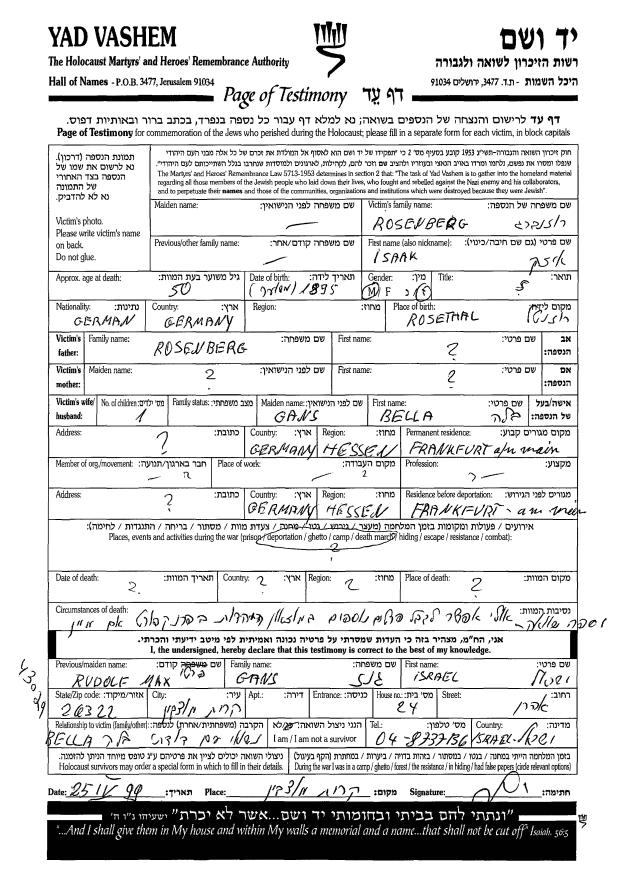
Unfortunately, all of them—Isaak, Bella, and Rita—were murdered by the Nazis. According to Yad Vashem, Isaak was deported from Frankfurt on August 10, 1942, and sent to the concentration camp in Majdanek, Poland, where he was murdered. His wife Bella’s nephew Israel Gans filed this Page of Testimony at Yad Vashem in his memory. The Hebrew written where it says “circumstances of death” merely says “perished in the Holocaust.” (Thank you to Hanna Gafni of Tracing the Tribe on Facebook for translating this line on this Page and the two below.)

The information available regarding the fates of Bella and Rita is far less specific. The Gedenbuch (Memorial Book) only reports that Bella was deported to Poland and killed there; perhaps she was deported on the same date as Isaak and to the same camp, but that isn’t stated. Nor does the Page of Testimony filed at Yad Vashem by Bella’s nephew Israel Gans provide any further details. The line for “Circumstances of Death” translates as “deported to Poland. Her fate is not known. Perished in the Holocaust.”

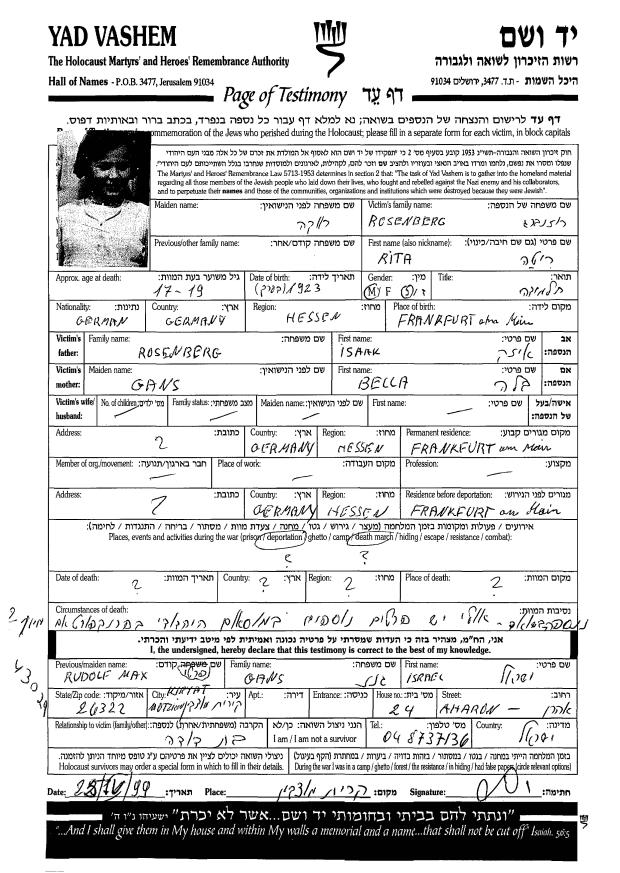
The information about Rita is even more limited. The Gedenbuch doesn’t even have information about where she was deported to or killed nor does her cousin Israel Gans’ Page of Testimony for her. The Hebrew written where it says “circumstances of death” says “perished in the Holocaust.”


This may be the first time that I have learned of family members who were killed in the Holocaust for whom there are no recorded details of their fates. Did Bella and Rita accompany Isaak to Majdanek? Or was the family separated? The lack of information somehow makes their deaths sting even more. The fact that the Nazis didn’t even document their murders makes it more likely that those deaths would have been somehow swept under the rug. So it is my task here to make sure that their lives and their murders are not forgotten.


That brings me to the end of the story of Rebecca Blumenfeld Rosenberg, the seventh child of Isaak Blumenfeld I and Gelle Strauss. Although Rebecca lost one son, Willi, as a young adult, and her son Isaak and his family were all murdered in the Holocaust, she was survived by seven grandchildren and has descendants still living today in Israel and the United States.

Next I turn to Rebecca’s younger sister, Friederike Blumenfeld, the eighth child of Isaak Blumenfeld I and Gelle Strauss and the last of their children to live to adulthood.

Rebecca Blumenfeld Rosenberg’s Daughter-in-Law Bella: An Admirable Woman

Rebecca Blumenfeld and Mendel Rosenberg’s second child was their son Joseph. As we saw, Joseph was born on February 4, 1886, in Rosenthal, Germany, and married Bella Oppenheim on February 21, 1913, in Bad Hersfeld, Germany. Bella was born there on June 8, 1891, to Aron Oppenheim and Hannchen Klebe. Bella’s sister Emma Oppenheim had married Meier Blumenfeld III on April 5, 1905, in Bad Hersfeld. Meier, the son of Giedel Blumenfeld and Gerson Blumenfeld, her first cousin, once removed, was thus Joseph Rosenberg’s first cousin, since their mothers Giedel and Rebecca were sisters.

Joseph and Bella had one child, Kurt, born in Sobernheim, Germany, on April 20, 1914.1 As I wrote in my earlier post, Sobernheim is not in the Hesse region where both Joseph and Bella were born and raised and where they married, but over 160 miles away in the Rhine Palatinate region.

Tragically, as we saw, Joseph, who was a doctor, died on May 4, 1922, at the age of 36, and was buried in Frankfurt, so perhaps he and his family had relocated from Sobernheim. His son Kurt was only eight years old when he lost his father.

Bella remarried a year after losing Joseph. Her second husband was Arthur Marx, born in Kempten, Germany, on August 4, 1890. They married in Frankfurt on June 22, 1923, in Frankfurt, and were living in Frankfurt.

Marriage of Bella Oppenheim Rosenberg to Arthur Marx, Hessisches Hauptstaatsarchiv; Wiesbaden, Deutschland; Bestand: 903, Year Range: 1923, Ancestry.com. Hesse, Germany, Marriages, 1849-1930

Kurt immigrated to the United States on October 16, 1937, when he was 23.2 His mother Bella and stepfather Arthur left Germany for the United States on May 27, 1938, and arrived in New York on June 2, 1938.

Arthur and Bella Marx passenger manifest, Year: 1938; Arrival: New York, New York, USA; Microfilm Serial: T715, 1897-1957; Line: 5; Page Number: 142, Ship or Roll Number: Europa, 
Ancestry.com. New York, U.S., Arriving Passenger and Crew Lists (including Castle Garden and Ellis Island), 1820-1957

Bella Oppenheim Rosenberg Marx then played a pivotal role in saving her niece Ruth Blumenfeld, the daughter of Emma Oppenheim and Meier Blumenfeld III, as I wrote about here. According to Ruth’s grandson Matthew, Bella, Ruth’s aunt, sponsored Ruth’s entry into the United States on March 4, 1940. Ruth was the only member of Emma and Meier’s family to survive the Holocaust. Her parents and her two sisters and their families were murdered by the Nazis. Matthew shared this photograph of Bella with her niece Ruth and Ruth’s husband Leo Friedman.

Bella Oppenheim Marx, Leo Friedman, and Ruth Blumenfeld Friedman. Courtesy of Matthew Steinhart

On the 1940 census, Bella and Arthur were living in Brooklyn, New York, and Arthur was working as a bank clerk and Bella as a practical nurse. They had two boarders living with them in addition to a niece (not Ruth), but not their son Kurt.

Arthur Marx and family 1940 US census, Year: 1940; Census Place: New York, Kings, New York; Roll: m-t0627-02580; Page: 4B; Enumeration District: 24-1310, Ancestry.com. 1940 United States Federal Census

Kurt, like his father Joseph, had become a doctor and was residing at Boulevard Hospital in Queens, New York, at the time of the 1940 census.2 He registered for the draft on October 16, 1940.

Kurt Rosenberg World War II draft registration, National Archives at St. Louis; St. Louis, Missouri; Wwii Draft Registration Cards For New York City, 10/16/1940 – 03/31/1947; Record Group: Records of the Selective Service System, 147, Ancestry.com. U.S., World War II Draft Cards Young Men, 1940-1947

After the war Kurt married Gertrude Stein,3 and in 1950 they were living in Queens and Kurt was practicing medicine.4 Kurt and Gertrude would have three children.

Unfortunately, like his father before him, Kurt died too young. He was 56 years old when he died suddenly on January 28, 1970, at the hospital where he worked as a gynecologist in Queens, New York. He was survived by his wife and children as well as his mother Bella.5

Bella died at the age of 94 on December 22, 1985.6 She had outlived her first husband Joseph Rosenberg and then her second husband Arthur Marx, who died on November 14, 1963, as well her son Kurt.7 She also had outlived her niece Ruth Blumenfeld Friedman, whose life she had helped to save back in 1940. Although she was only related to me by her marriage to my cousin Joseph Rosenberg, I feel a deep respect and a connection to her because of the life she lived and the things she endured along the way.


  1. Kurt Rosenberg, World War II draft registration, National Archives at St. Louis; St. Louis, Missouri; Wwii Draft Registration Cards For New York City, 10/16/1940 – 03/31/1947; Record Group: Records of the Selective Service System, 147, Ancestry.com. U.S., World War II Draft Cards Young Men, 1940-1947 
  2. Kurt Rosenberg, 1940 US census, Year: 1940; Census Place: New York, Queens, New York; Roll: m-t0627-02721; Page: 7A; Enumeration District: 41-105, Ancestry.com. 1940 United States Federal Census 
  3.  New York City Municipal Archives; New York, New York; Borough: Queens, Ancestry.com. New York, New York, U.S., Marriage License Indexes, 1907-2018 
  4. Kurt Rosenberg and family, 1950 US census, United States of America, Bureau of the Census; Washington, D.C.; Seventeenth Census of the United States, 1950; Record Group: Records of the Bureau of the Census, 1790-2007; Record Group Number: 29; Residence Date: 1950; Home in 1950: New York, Queens, New York; Roll: 4301; Sheet Number: 10; Enumeration District: 41-1012, Ancestry.com. 1950 United States Federal Census 
  5. Obituary for Kurt Rosenberg, Daily News, New York, New York, Thu, Jan 29, 1970
    Page 318. Kurt Rosenberg, Gender Male, Birth Date 20 Apr 1914, Death Date Jan 1970
    Claim Date 7 Mar 1970, SSN 072164680, Ancestry.com. U.S., Social Security Applications and Claims Index, 1936-2007 
  6. Bella Marx, Social Security Number 079-22-4508, Birth Date 8 Jun 1891, Issue year Before 1951, Issue State New York, Last Residence 11375, Flushing, Queens, New York, USA, Death Date Dec 1985, Social Security Administration; Washington D.C., USA; Social Security Death Index, Master File, Ancestry.com. U.S., Social Security Death Index, 1935-2014; Find a Grave, database and images (https://www.findagrave.com/memorial/77845632/bella-marx: accessed 29 May 2023), memorial page for Bella Marx (unknown–22 Dec 1985), Find a Grave Memorial ID 77845632, citing Mount Hebron Cemetery, Flushing, Queens County, New York, USA; Maintained by Athanatos (contributor 46907585). 
  7. Arthur Marx, Age 73, Birth Date abt 1890, Death Date 14 Nov 1963, Death Place Queens, New York, New York, USA, Certificate Number 14536, Ancestry.com. New York, New York, U.S., Death Index, 1949-1965 

Good for A Single Journey by Helen Joyce: A Review of A Wonderful New Book and An Interview with the Author

Today I have the great pleasure of sharing my virtual interview with author Helen Joyce. She has recently published a family history novel titled Good for A Single Journey, a moving and beautifully written telling of her maternal family’s story. Joyce’s great-grandparents were living in a small town in what was then Galicia in Eastern Europe in the early 20th century when oppression and poverty forced them to relocate to Vienna, where they hoped to have greater freedom and economic security. And they did find great success there. But like so many Jewish families, they eventually suffered from the horrors of the Holocaust. Although many, including Joyce’s mother, survived, many others were murdered, and all suffered from persecution and financial loss. And those who survived were once again forced to relocate and start all over in a new country.

Joyce has combined what she learned from her mother and other relatives with historical research to create a fascinating and illuminating look at the history of this era and its effect on one Jewish family. The book is a mix of fact and fiction, some parts totally created from her imagination and other parts entirely based on fact. The book reads like a novel. She has created wonderful three-dimensional characters, each with distinctive and memorable personalities and stories. I highly recommend this book to anyone interested in history and in Jewish history in particular. It is appropriate for young adults as well as adults and available for purchase on Amazon and Barnes & Noble here.

Good for a Single Journey has received a finalist’s award in the 2023 Next Generation Indie Book Awards and has also received a highly favorable review from Neville Teller in the June 12, 2023, issue of The Jerusalem Report. You can also learn more about Helen Joyce and her book at her website found here.  And in the interest of full disclosure, I should reveal that she is my fifth cousin on her paternal side; we are both descended from Jacob Falcke Goldschmidt and Eva Seligmann, our mutual four-times great-grandparents.

And now, let me introduce you to Helen Joyce and her wonderful book, Good for a Single Journey..

Thank you so much for agreeing to do this interview with me and to share more about your book, Good for a Single Journey.  Have you ever written a book or other fiction/non-fiction before?

No! I have written the odd article, contributed a chapter to two each of two academic books, and edited a community magazine which often entailed tightening the contributions of others. Otherwise, no formal writing experience.

So what made you decide to write this book at this time?

Old age! I always wanted to write an account of my mother’s life and never found the right time. Work, kids, and life in general always interfered. That and the self-defeating belief that the project was beyond me; that I was deluding myself if I thought I could write an account/memoir/novel of the type I imagined would do justice to her story. Finally, the reality of the fact that I was not getting any younger and triggered by taking our youngest granddaughter on a trip to Vienna where we visited my mother’s birthplace proved to be the catalyst for getting to work.

The author’s parents Max and Klari. Courtesy of Helen Joyce

I really enjoyed reading the book, and it reads like fiction. But I know that the book is based on the real lives of your parents, grandparents, and great-grandparents as well as many aunts, uncles, and cousins. How much of the book is fictionalized and how much is non-fiction?

It would take a long time to unravel fact from fiction but basically, I knew the ‘bare bones’ of the stories of all the characters. In the case of the two brothers, Chiel and Beresh, I knew very little indeed beyond the fact that they made Aliyah to pre-State Israel long around WWI. Therefore, I invented their adventures. I gave them experiences and put them in situations which were factually correct and allowed some of the history of the early Yishuv to come to light. I knew a little about Peppi, my grandmother’s sister, and of course the story of Suzanne became legendary!

Zissel, my other great-uncle, was a closed book to me until I unlocked the memoir of his son Yitzchak. That gave me the details of not only his travels across Europe and today’s Ukraine before reaching the shores of British mandate Palestine, but also revealed the entire saga of his grandparents’ (my great grandparents’) flight from Rozwadów to Ukraine and onwards to Siberia. I knew a great deal about my grandparents from my mother’s tales and, again through her, background details about day-to-day life in Vienna and the market town of Rozwadów, which she visited frequently on trips to her grandparents. The rags to riches story of my grandfather is true. Accounts of the flight from Vienna, the period in Prague, my mother’s experiences in London are also from my mother’s various shared memories.

My independent sources of research (apart from the internet and the cousin’s memoir which I mentioned) were my mother’s diaries and a stash of family letters collated and self-printed by my late uncle which charted the agony of desperation and fear as various members of the family tried to help and find ways to get those still trapped in Europe out. Obviously the most fictionalized accounts are those of the imagined conversations and emotions displayed by the various characters. The best I could do was to try and imagine I was them and put myself in their place at that time. What would I feel? How would I react?

How did you decide where to create fictional elements versus non-fiction?

Honestly, I don’t know! It just sort of flowed seamlessly. I wove elements of drama and fiction around the basic facts I knew. For example, I needed to get the two brothers from Vienna to Palestine during WWI. How would they have gone? What might they have done? WWI was raging so I thought it would be interesting to place them into an Austro-Hungarian unit which ended up in Palestine. When I started researching that possibility, I learned a great deal about the involvement of Jewish soldiers in the army, the unit I put them in was a real one (as was the officer which commanded it). The facts surrounding Aaron Aaronsohn, NILI, and their role in helping the British defeat the Ottomans in
Palestine and how these contributed to the fact of the Balfour Declaration was too good an opportunity to miss including. So, I did! Throughout the book I also wanted to give the lie to the myth that Jews were passive, never fought in armies and were pale scholars led to slaughter like sheep. Jews fought bravely (on all sides) in every theatre of war.

How did you research the parts of the book that are fact-based?

I read several books on WWI, biographies about Aaron Aaronsohn and NILI as well as books about the history of the Middle East. My mother’s cousin’s memoir was also very helpful. The internet is also a phenomenal resource. What was the weather like in Gallipoli in November 1915 – click. What train routes were available on the Chemins de fer Orientaux during WWI – click! What date was Rosh Hashanah in 1914 – click. All there in your hand-held mobile phone!

Your book begins with your great-grandparents leaving Rozwadów. Why did you decide to begin there?

The book begins with a train journey, the journey of my great grandparents fleeing their hometown in Galicia. I decided to start with that train ride as it gave me the opportunity to introduce all the main characters as well as a major theme of the book. Migration and journeys. The entire book is about the journey of individuals, families, and the Jewish people. Trains feature quite prominently. That opening train ride. Greetings and goodbyes at train stations. The brothers’ train ride to war and onwards to Palestine. The train ride carrying my great grandparents and their youngest son to Siberia. The train ride my mother took to Scotland to meet her brother serving in the Jewish Brigade of the British army and of course the final horrific train rides to the death camps.

You include some living people and some recently deceased people in the book. How did you approach the issues of privacy with respect to those people? Were there things you had to change or avoid to protect the interests of your family?

Yes, absolutely. A lot was excluded! However, in discussion with as many of my cousins as I could track down, I realized they were quite happy for me to give details of their stories. I offered each of them drafts so they could check they were happy with what I had written. However, as nearly all the family descendants live in Israel, many of them do not read in English. That said, they were quite happy to know I had written some account and did not mind if it was fictionalized. The Israeli branch is very easy going! I gave my sister an early draft and she enjoyed the first half but did have some comments and suggestions about the second half of the book. I have tried to accommodate her feelings on this but, ultimately, we agreed that the book was a fictionalized novel.

Your family endured many of the challenges and horrors faced by many Jewish families in the 20th century: immigration to new countries (several times), World War I, and Nazi persecution and the Holocaust. What impact do you think that history has had on you and the other living descendants of your great-grandparents?

It’s hard to speak about this in general. The impact is surely quite different for each family and on each individual. For me, knowing what previous generations lived and died for made me want to cling to a Jewish lifestyle replete with the traditions that Hitler tried so hard to erase. I didn’t want to give Hitler any kind of posthumous victory and so I have tried to raise a Jewishly faithful family. Beyond that? I guess a sense of the importance of justice and the need to respect equality of all people regardless of gender, race, or religion.

You ultimately decided to leave England and make Aliyah to Israel. What in your family history contributed to that decision? Have you made connections to the cousins who were refugees to Israel during the Nazi era?

Many factors contributed to that decision. My husband comes from a very ‘English’ Jewish family but his mother, eldest of ten, was the only child left in the UK after the creation of the State of Israel. The rest were all pioneers in Israel (although two had died before that was possible). So, he already has a huge network of family here. Our son made Aliyah twenty years ago and was raising his children here and of course we wanted to be close to them. We have a daughter with special needs and she made Aliyah with us – we couldn’t contemplate leaving her behind and she is so very happy here with excellent care. Our youngest child followed us five years ago and so, to our delight, all our children and grandchildren are here. Yes, I have contact with some of my many cousins, but they are numerous and spread out so we do not meet that often although I do meet my first cousins more frequently.

Your book has many themes and covers many topics: different ways to practice Judaism, antisemitism, Zionism, mental health, marriage, parental love, and so on. Was there a specific point or theme that mattered most to you?

They all mattered and, in a way, I suppose several of them nestle into each other like a set of Russian matryoshka dolls! Parental love leads to stability and contributes to the type of marriage partnership one is likely to create as does a strong sense of community and belonging. Antisemitism and Zionism also have a kind of Yin and Yang partnership! If I had to choose one (you didn’t ask me that!) maybe I would say resilience and survival!

Who did you see as the audience for your book? Your own family and descendants? Young adults? Jewish readers? The entire universe of adult readers?

The entire universe! My family and their descendants were not really the target audience. Had they been, the book would have been far more factual and memoir-based. I hoped it would appeal to young adults and prove educational and am being told that teenagers are totally gripped by the story – which, given the amount of history in it – is great! However, I would dearly love the non-Jewish world to gain insight about a Jewish way of life, the history of persecution and the holocaust but also the historical underpinnings of the State of Israel under international law which was brought about together with the dismantling of previous empires. If Israel is to be accused of being a ‘colonialist enterprise’ then equally so is Syria, Lebanon, Jordan, Saudi Arabia and Iraq. Not to mention the many ‘new’ European countries created in the wake of WWI. Without understanding the impact of WWI, nothing about the modern world makes sense (including current events in Ukraine!)

This book focused on your maternal family. Do you plan to write a book about your paternal side?

Yes! And your blog will be a fantastic resource for me!!! However, marketing this book is taking up a lot of time at the moment. I have been invited to take part in Jewish Book Week School Events for schools around the UK which is fantastic. Events can be online so I can do them from here. This is really part of my dream – to bring the reality of the Jewish experience to a wider audience.

The author, Helen Joyce. Courtesy of Helen Joyce

Thank you again for taking the time to answer my questions, and I look forward to reading your next book and hope that my research will be helpful to you! Best of luck in your marketing efforts—your book deserves a wide and large audience.

 

Update on Jenny Blumenfeld Warburg from World Jewish Relief, A New (to Me) Research Tool

In my April 25, 2023, post about my cousin Jenny Blumenfeld Warburg, I described how I was able to establish through the anecdotal evidence from several cousins and from records from Israel that Jenny had married Siegmund Warburg in Israel/Palestine sometime between 1940 and 1950, but I had not been able to locate an actual marriage record. I still haven’t. But I have been able to find one more document that may relate to Jenny’s life.

I wrote in that earlier post that “In her [Shoah Foundation] testimony, [Jenny’s sister] Hilde [Blumenfeld Meinrath] said that Jenny left Germany and first went to England, where she met Siegmund Warburg and his family. They did not marry, however, until they were in Palestine/Israel.” I also wrote that I had not been able to find any record for Jenny in England. But now, thanks to the World Jewish Relief organization, I think I have.

First, let me tell you about this organization and how it can be a helpful research tool for anyone searching for information about relatives who escaped Nazi Germany to England in the 1930s and thereafter. According to their literature, World Jewish Relief was “[f]ounded in 1933 as the Central British Fund for German Jewry (CBF) … [and] helped bring around 65,000 Jewish refugees, predominantly from Germany and Austria, to Britain. Once here, [they] provided a welfare system, helping refugees find housing, employment, receive medical care and making sure they had enough money to survive. Through this work, the charity established a trusted relationship with the Home Office and lobbied Parliament to allow them to instigate schemes such as the Kindertransport, which rescued 10,000 children, and The Kitchener Camp, which was a means to bring approximately 4,500 Jewish men into the country, many from concentration camps.”

After the war, the organization continued to provide relief to Jewish survivors, bringing children who had survived the camps to England for care and education and rehabilitation. According to their literature, the charity “continued to help Jewish refugees throughout the twentieth century, including those fleeing Egypt, Iran, Czechoslovakia and Bosnia. From funding flights to finding them accommodation, we always provided a safe place for our global Jewish family.”

The charity changed its name to World Jewish Relief in the 1990s and has continued its mission of providing aid and assistance to people of all backgrounds from all over the world who have “survive[d] the consequences of conflict and disaster, to thrive and rebuild their lives.”

In addition to this important charitable work, the organization also provides research assistance to those like me who are looking for information about their family members who escaped to England as refugees from Nazi Germany. Although its files are not comprehensive, there are registration slips for 65,000 refugees and case files for about 35,000 of those refugees.

For Jenny Blumenfeld, there was not a complete case file, just a registration slip. But it provided me with a few more snippets of information about a woman named Jenny Blumenfeld, who probably was my cousin.

Jenny Blumenfeld registration slip from World Jewish Relief

From this brief document, I learned that a Jenny Blumenfeld arrived in England on May 2, 1934, and left for Palestine in 1935. Of course, this document isn’t necessarily for the same Jenny Blumenfeld. The one entry that gives me pause is that she was last living in Lueneburg, Germany, which is 230 miles from Kirchhain, where my Jenny was born and raised. What would a young single Jewish woman have been doing there in 1934? The card also doesn’t have an exact birth date, just an age, 26. Jenny was born on June 23, 1907, so would have been 26 (almost 27) on May 2, 1934.

I am not sure what the other two dates on the card refer to. There is a notation of “16-2-42” that is crossed out. And then on the reverse it says “Addr[ess?] Unknown rce?. reh? left? 24-5-44.” I don’t know the relevance of those two dates, but I know that Jenny was by that time living in Palestine. I asked Sharon Adler, the volunteer with the World Jewish Relief Archives who sent me the registration card, what she thought the dates meant, and she hypothesized that it might have been times that others were inquiring about Jenny’s whereabouts. But she could not be certain.

It’s too bad that World Jewish Relief does not have a complete file on Jenny so that I could be more certain that this is my cousin Jenny Blumenfeld Warburg. But since Hilde did say that Jenny first went to England before going to Palestine, there is enough here to give me some reason to believe that Jenny left Germany and went to England on May 2, 1934, and then left for Palestine the following year. Maybe these dates will lead to more information. If anyone has any ideas, let me know.

I am grateful to Sharon and the World Jewish Relief organization for their help, and I hope other researchers will also take advantage of this wonderful resource.


Rudolph Meyer: “A Great Man”

Back in late December, a new reader, Candice, left a comment on my blog saying that her grandparents were Rudolph Meyer and Ruth Cohn and that we were related. I love when a new cousin finds my blog and seeks to connect with me.

Candice and I are fifth cousins, once removed, through my Blumenfeld branch. Her grandfather Rudolph was the son of Rebecca Strauss, the grandson of Dusschen Blumenfeld Strauss, the great-grandson of Isaak Blumenfeld I, the great-great-grandson of Moses Blumenfeld I, and the great-great-great-grandson of Abraham Blumenfeld I, my four times great-grandfather. This chart shows Rudolph’s relationship to my father; they were fourth cousins, so Rudolph was my fourth cousin, once removed:

I wrote about Rudolph and his family here, but Candice and her father Albert were able to give me a more complete portrait of Rudolph and his wife Ruth Cohn. I already knew that Rudolph was born in Bonn, Germany, in 1908, and had arrived in the US from Germany in 1937 and settled first in New York City. By 1940 he was living in Albany, New York, and working for Cotrell & Leonard, a manufacturer of graduation caps and gowns.

Rudolph’s son Albert filled in some of the gaps in the story in the obituary he wrote about his father in 1984. Albert wrote in part:

Rudolf Raphael Meyer was born in Bonn, Germany, on March 17, 1908. He was to experience many of the history shaping events which influenced the course of his life and development. As the child of Albert and Rebecca Meyer with his sister Ilse he at the ages through 6-10 went through the trauma of World War I. The war brought hardship to him as did the period following it. The economic chaos of Weimar Germany with its rampant inflation left its mark on him in that no matter how well might do, he felt he never knew if he and his family would have enough just to provide for the basic necessities of life.

As the economic and political situation remained explosive in Germany and with Anti-semitism on the rise, he, his sister, and mother, his father having died, immigrated to the United States. However, life in the new country soon underwent its earthquake also with the coming of the Great Depression and World War II. The Depression only added to his feelings of anxiety regarding economic matters and [he] became a fervent supporter of the new deal with Franklin Delano Roosevelt and then Harry Truman representing the type of leadership he felt a society needed.

During the later years of the 30s he met Ruth Cohn and after a 3 year courtship they were married on August 10, 1941.

Rudolph enlisted in the US Army on September 6, 1943, and successfully petitioned for naturalization three months later in December 1943 from Spartanburg, South Carolina, where he was then stationed. What I did not know was that Rudolph then served overseas in Europe, fighting against the Nazis and the country where he was born.

Candice shared this photograph of her grandfather Rudy (as he was known) in uniform during World War II.

Rudolph Meyer during World War II. Courtesy of the family

Rudy wrote this poem about his outfit in World War II, the Blue Devils. Obviously, he was a proud American soldier out to defeat his former home country.

“Blue Devils,” by Rudolph Meyer c. 1944 (c) Courtesy of the family

What I also had not realized until Candice shared the family story is that Ruth was pregnant when Rudy left for Europe; their son Albert was born while he was abroad, fighting the Nazis. Rudy did not meet his child until after the war was over when Albert was already sixteen months old. Albert addressed this in his 1984 obituary for his father:

[Albert was born] while [Rudolf] was stationed overseas in Italy. The notice of his birth filled him with special joy as can be told by a reading of his letters from the war. As an additional sacrifice he did not get to see his child for another year.

Although the war was difficult and he was certainly not a young man while fighting in both North Africa and Italy for the Allies, his experience in the army gave him great pride. He felt he contributed to the service of his country and had helped to smash the Fascist Beast that had destroyed so many Europeans who could [not] leave and so many of his religious faith.

In fact among the things that gave him pride were his experience as a soldier, his role as a law abiding citizen, a good family provider. His citizenship was marked by regular voting, paying debts, attention by regular public affairs, and occasionally involvement in Democratic Party politics.

Here is a photograph of Albert as a baby taken while his father was away at war:

Albert Meyer Courtesy of the family

Ruth wrote this wonderful tribute to her husband, Rudy, whom she considered a “great man.”

Essay by Ruth Cohn Meyer (c) Courtesy of the family

A Great Man

My choice for the meaning of the word Great would be important. I write of a great man that I knew many years ago. His name was Rudolph Meyer. Now Rudy had a loving wife, and as is the nature of things, she became pregnant—and Rudy and his wife were very happy.

But then came fears of war from a country across the sea—a country from far away which hundreds of people were fleeing for they were afraid of what might now happen at this time. And Rudy and many of his fellow countrymen had found refuge in this country, the good old USA.

Then came the day when their fears for their country were alas confirmed. Atrocities! Tortures—and then War and Holocausts! Rudy immediately went to enlist. But at the recruitment center, he was told that because of his poor eyesight he would have to be rejected. But Rudy insisted—he must fight against the evil ones were who trying to destroy civilization. So—Rudy went to war!

I was sad. I was pregnant—but I knew in my heart that it was for those qualities in him—great devotion to family and country—that I loved him. And though I was sad—I was proud. My Love was a great man.

I waited—I would go to the grocery store. A pound of butter, if you please. Hey, Lady—don’t you know there’s a war on. Ah,yes—there’s a war on over there!

It is 4 years later—the end of the war. Rudy comes home. He holds in his arms a loving wife and 16 mo. old son. A great man has come home to us.

This was obviously a strong and loving marriage that endured for many years after Rudy returned home. This photograph of Ruth and their son Albert was taken after the war.

Albert Meyer and Ruth Cohn Meyer. 1948. Courtesy of the family

As I wrote in my earlier post, Rudy and Ruth moved to the Bronx after the war, and in 1950 they were living in the Bronx, and Rudy was now an accountant for motion pictures distributors. Ruth was an elementary schoolteacher.  Rudy’s mother Rebecca and Ruth’s father Benjamin were also living with Rudy and Ruth and their child, and Benjamin was working as a tailor.

I want to express my gratitude to Candice and her father Albert for sharing these stories and photographs about my cousin Rudolph Meyer, a man who truly lived up to his wife Ruth’s description, a great man.


Gerson Blumenfeld II: His Surviving Son Friedrich and His Family in America, Keeping Tradition Alive

I have been very fortunate to connect with four more Blumenfeld cousins, Steven, Milton, Alan, and Debbie, four of the grandchildren of Friedrich Blumenfeld, the last surviving son of Gerson Blumenfeld II. Alan has generously shared with me some wonderful family photographs, including the first I’ve seen of Gerson Blumenfeld II, Alan’s great-grandfather.

Gerson Blumenfeld II. Courtesy of his family.

Alan also shared these photos of his grandparents Friedrich and Lina and their two children, Gretel and Guenther (later spelled Gunter).

Fritz Blumenfeld as a young man. Courtesy of the family.

Lina Neuhas and Fritz Blumenfeld at their wedding, October 26, 1921. Courtesy of the family

Guenther and Gretel Blumenfeld, c. 1928 Courtesy of the family

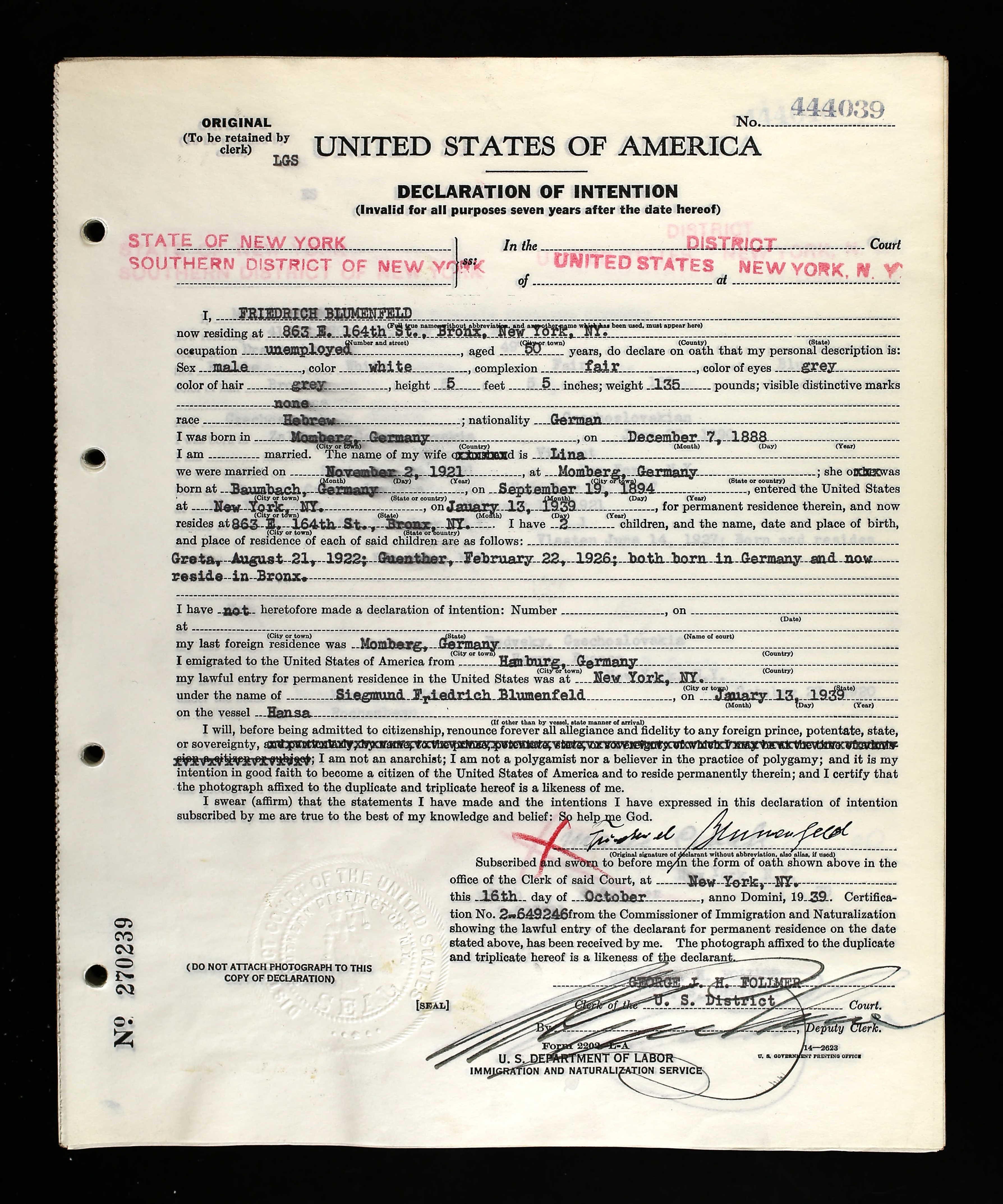
Friedrich (also known as Fritz) and his wife Lina and their two children Gretel and Guenther were safely in the US by 1939 and were living in the Bronx, according to the declaration of intention to become US citizens that Friedrich filed that year.

Friedrich Blumenfeld Declaration of Intention, The National Archives at Philadelphia; Philadelphia, PA; NAI Title: Declarations of Intention For Citizenship, 1/19/1842 – 10/29/1959; NAI Number: 4713410; Record Group Title: Records of District Courts of the United States, 1685-2009; Record Group Number: 21 Roll 567) Declarations of Intention For Citizenship, 1842-1959 (No 444001-444900), Ancestry.com. New York, U.S., State and Federal Naturalization Records, 1794-1943

Alan also shared this photograph of his father Guenther’s immigration card:

Guenther Blumenfeld immigration card, 1939. Courtesy of the family

By 1941 when Gretel filed her own declaration of intention, the family was living in the Washington Heights area of Manhattan. Gretel was then eighteen and working as an “operator.” According to her sons, she was working for a company manufacturing army blankets.1

Gretel Blumenfeld Declaration of Intention, The National Archives at Philadelphia; Philadelphia, PA; NAI Title: Declarations of Intention For Citizenship, 1/19/1842 – 10/29/1959; NAI Number: 4713410; Record Group Title: Records of District Courts of the United States, 1685-2009; Record Group Number: 21 (Roll 622) Declarations of Intention For Citizenship, 1842-1959 (No 492901-493800), Ancestry.com. New York, U.S., State and Federal Naturalization Records, 1794-1943

Her brother Gunter (now using that spelling) registered for the draft on February 23, 1944; they were still living in Washington Heights, and he was a high school student at that time and had just turned eighteen. He enlisted in the US Army on January 30, 1945, and served until August 28, 1946.2

Gunter Blumenfeld, World War II draft registration, National Archives at St. Louis; St. Louis, Missouri; WWII Draft Registration Cards for New York City, 10/16/1940 – 03/31/1947; Record Group: Records of the Selective Service System, 147, Ancestry.com. U.S., World War II Draft Cards Young Men, 1940-1947

Alan shared this photograph of his father Gunter in uniform during World War II:

Gunter Blumenfeld, c. 1945. Courtesy of the family

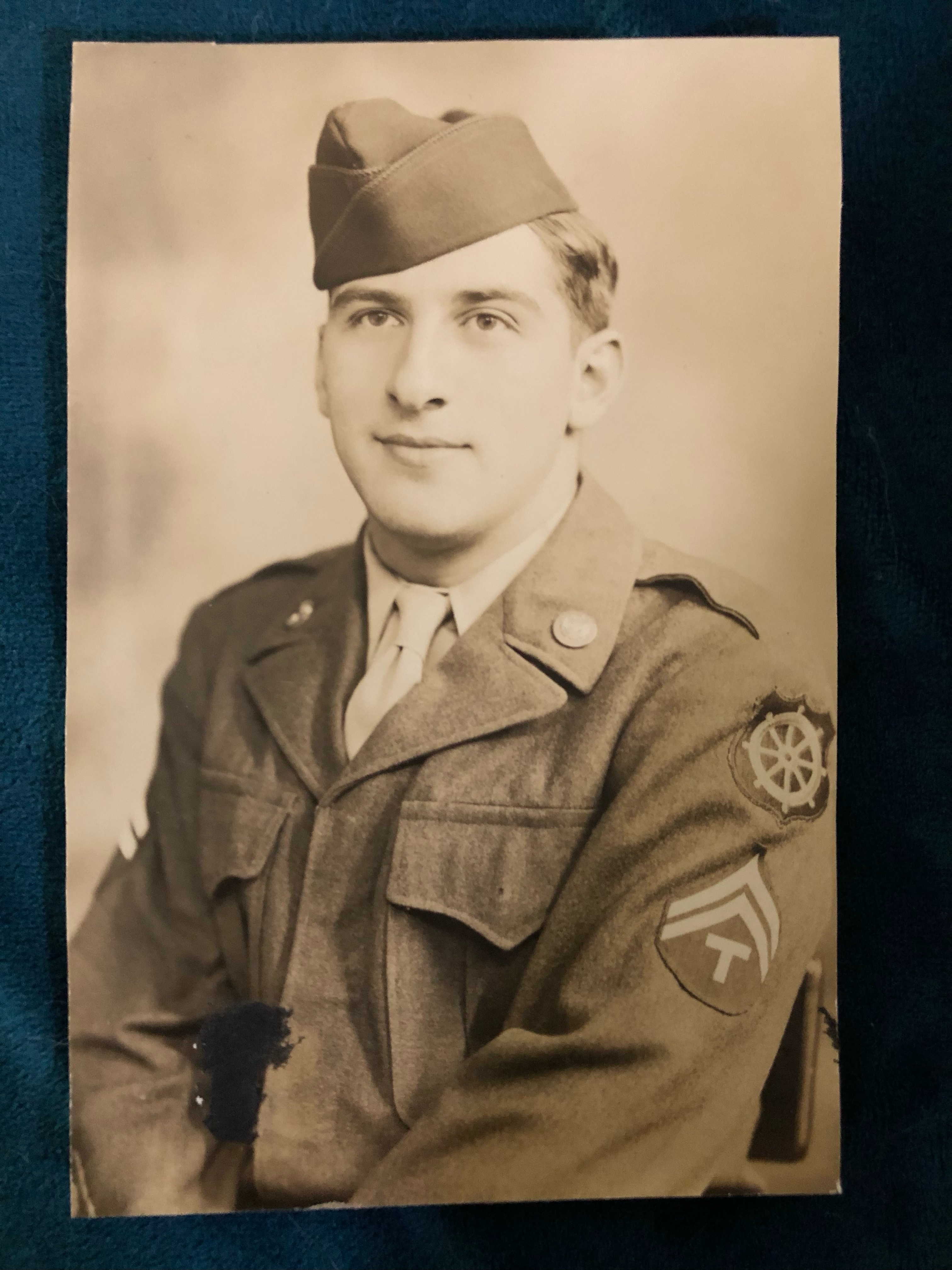
Gretel Blumenfeld married Joseph Hamburger on January 18, 1946.3 Joseph was born in Heuttengesass, Germany, on February 4, 1915, son of Simon Hamburger and Bertha Adler,4 and had immigrated to the US on April 2, 1936.5 According to his sons Steven and Milton, Joseph would have left earlier, but had to wait until he was twenty-one to leave without his parents’ consent; he had wanted to leave three years earlier when the Nazis prohibited Jews from being butchers, Joseph’s livelihood, but his parents refused. Gretel and Joseph met before the war, but waited to marry until after he came back from serving in World War II.6

In 1950, they were living in New York City, and Joseph was the owner of a kosher butcher shop. Gretel and Joseph had three children.

Joseph Hamburger 1950 US census, United States of America, Bureau of the Census; Washington, D.C.; Seventeenth Census of the United States, 1950; Record Group: Records of the Bureau of the Census, 1790-2007; Record Group Number: 29; Residence Date: 1950; Home in 1950: New York, New York, New York; Roll: 3572; Sheet Number: 71; Enumeration District: 31-2292, Ancestry.com. 1950 United States Federal Census

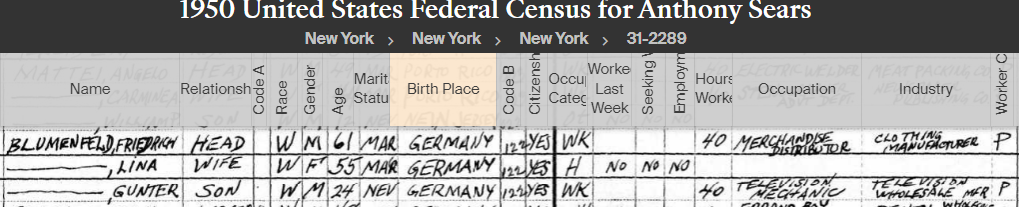
Gretel’s parents Friedrich and Lina and her brother Gunter were also living in New York City in 1950, and Friedrich was working as merchandise distributor for a clothing manufacturer. Gunter was working as a television mechanic.

Friedrich Blumenfeld 1950 US census, United States of America, Bureau of the Census; Washington, D.C.; Seventeenth Census of the United States, 1950; Record Group: Records of the Bureau of the Census, 1790-2007; Record Group Number: 29; Residence Date: 1950; Home in 1950: New York, New York, New York; Roll: 3572; Sheet Number: 73; Enumeration District: 31-2289, Ancestry.com. 1950 United States Federal Census

Gunter took out a marriage license to marry Hilde Hes on August 14, 1951.7 Hilde was born on April 8, 1931, in Bremen, Germany, and immigrated with her parents Paul Hes and Gertrude Wolff on September 14, 1939.8 Gunter and Hilde would have two children.

The extended family all lived close by in Washington Heights and were very close; Debbie and Alan lived in the same apartment building as their grandparents Fritz and Lina and saw them all the time, including regular shabbat dinners. Debbie shared that Lina was an excellent cook, and she has many warm memories of growing up with her cousins and other relatives.9

Alan shared this photo of Friedrich and Lina at the celebration of their 50th wedding anniversary in 1971:

Lina Neuhaus and Friedrich Blumenfeld, 1971. Courtesy of the family

Friedrich and Lina and their two children all lived relatively long lives and remained in New York City for the rest of their lives. Friedrich was 88 when he died in New York on November 14, 1977.10

Fritz Blumenfeld death notice, Aufbau, November 25, 1977, p. 28, found at https://archive.org/details/aufbau431977germ/page/n677/mode/1up?view=theater

Lina died three years later on December 15, 1980. She was 86. 11

Lina Blumenfeld death notice , Aufbau, Jan 2 1981, p. 24, found at https://archive.org/details/aufbau471981germ/page/n11/mode/1up?view=theater

Gretel Blumenfeld Hamburger died on July 25, 2008, when she was 85;12 her husband Joseph had predeceased her, dying on December 18, 2004, when he was 89.13  Gunter Blumenfeld died on July 16, 2010; he was 84.14

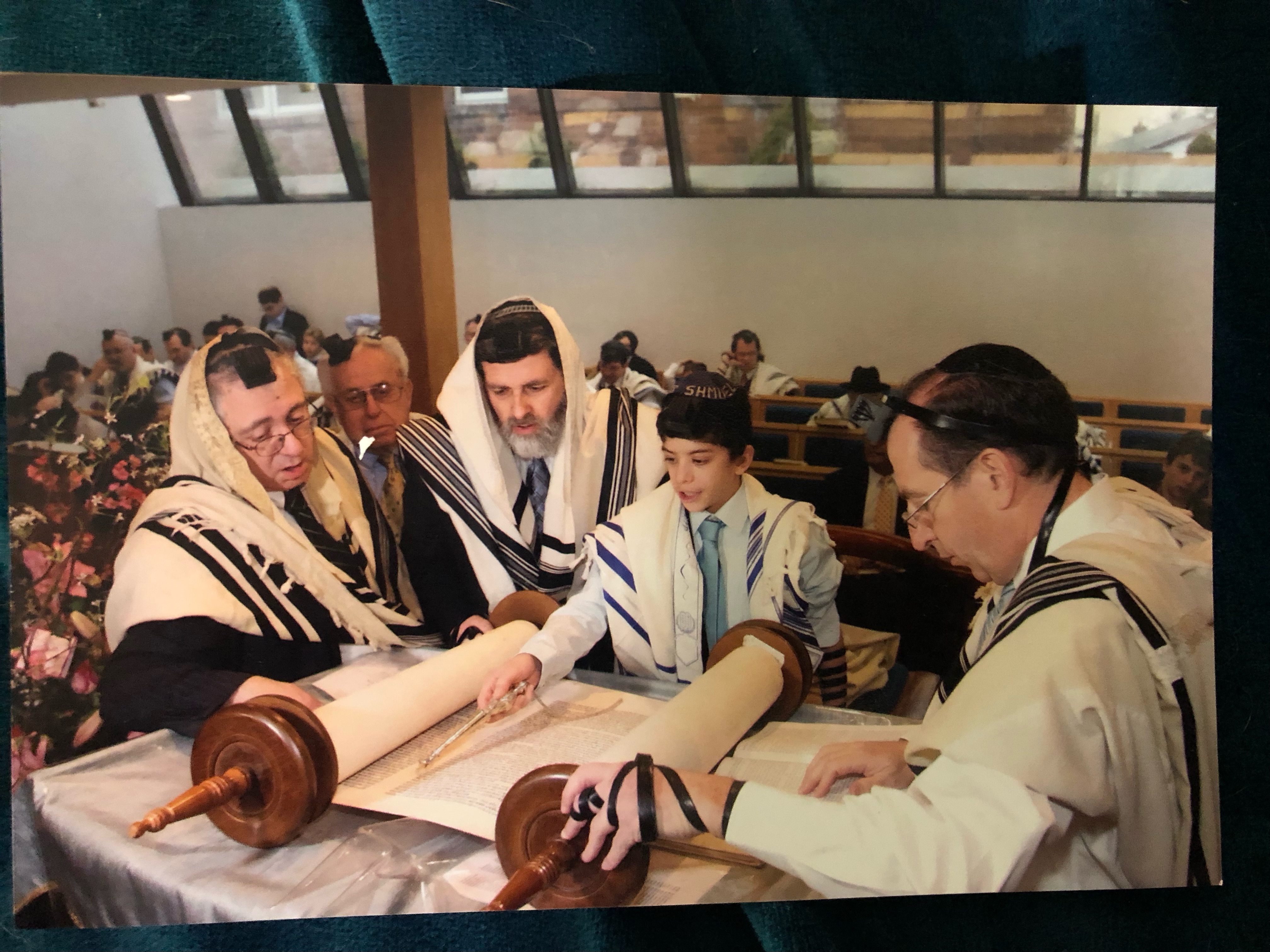
Perhaps some of my favorite photographs of those shared by Alan are these three that show the Sefer Torah (Torah scroll) that had been rescued by Friedrich Blumenfeld during Kristallnacht while the Momberg synagogue was burning and then safely brought to the US from Momberg by the family.15 The photographs were taken at Alan’s son’s bar mitzvah and show Gunter, Alan, and his son Sandy honoring that Sefer Torah during the bar mitzvah service.

c. 2008 Courtesy of the family

c. 2008 Courtesy of the family

c. 2008 Courtesy of the family

Friedrich and Lina are survived by their grandchildren and great-grandchildren and great-great-grandchildren. I was privileged to connect with four of their five grandchildren—Steven, Milton, Alan, and Debbie (and will be talking to the fifth, Kenny, soon during a Blumenfeld family zoom).  Thank you all for sharing  these fabulous photographs and your stories with me and for keeping alive the memories, traditions, and legacy of your family.


  1. Zoom call with Steven Hamburger and Milton Hamburger, November 10, 2022. 
  2. Gunter Blumenfeld, Race White, Marital Status Single, without dependents (Single)
    Rank Private, Birth Year 1926, Nativity State or Country Danzig or Germany, Citizenship Not Yet a Citizen, Residence New York, New York, Education 3 years of high school, Enlistment Date 30 Jan 1945, Enlistment Place New York City, New York, Service Number 42205064, Branch No branch assignment, Component Selectees (Enlisted Men), Source Civil Life, Height 80, Weight 995 [??], National Archives at College Park; College Park, Maryland, USA; Electronic Army Serial Number Merged File, 1938-1946; NAID: 1263923; Record Group Title: Records of the National Archives and Records Administration, 1789-ca. 2007; Record Group: 64; Box Number: 15188; Reel: 30, Ancestry.com. U.S., World War II Army Enlistment Records, 1938-1946 
  3. Gretel Blumenfeld, Gender: Female, Marriage License Date: 18 Jan 1946, Marriage License Place: Manhattan, New York City, New York, USA, Spouse:
    Joseph Hamburger License Number: 2005, New York City Municipal Archives; New York, New York; Borough: Manhattan; Volume Number: 3, Ancestry.com. New York, New York, U.S., Marriage License Indexes, 1907-2018 
  4. Joseph Hamburger, Gender: Male, Race: White, Birth Date: 4 Feb 1915, Birth Place: Huettengesae, Federal Republic of Germany, Death Date: 18 Dec 2004, Father:
    Simon Hamburger, Mother: Bertha Adler, SSN: 077073405, Ancestry.com. U.S., Social Security Applications and Claims Index, 1936-2007 
  5. Joseph Hamburger, passenger manifest, Year: 1936; Arrival: New York, New York, USA; Microfilm Serial: T715, 1897-1957; Line: 20; Page Number: 39, Ancestry.com. New York, U.S., Arriving Passenger and Crew Lists (including Castle Garden and Ellis Island), 1820-1957 
  6. See Note 1, supra. 
  7. Gunter Blumenfeld, Gender: Male, Marriage License Date: 1951, Marriage License Place: Manhattan, New York City, New York, USA, Spouse: Hilde M. Hes, License Number: 21506, New York City Municipal Archives; New York, New York; Borough: Manhattan, Ancestry.com. New York, New York, U.S., Marriage License Indexes, 1907-2018 
  8. Paul Hes, Declaration of Intention, The National Archives at Philadelphia; Philadelphia, PA; NAI Title: Declarations of Intention For Citizenship, 1/19/1842 – 10/29/1959; NAI Number: 4713410; Record Group Title: Records of District Courts of the United States, 1685-2009; Record Group Number: 21, Roll 569) Declarations of Intention For Citizenship, 1842-1959 (No 445801-446600), Ancestry.com. New York, U.S., State and Federal Naturalization Records, 1794-1943 
  9. Email from Debbie Salamon, December 7, 2022. 
  10. Friederich Blumenfeld, Social Security Number: 065-12-8954, Birth Date: 7 Dec 1888, Issue Year: Before 1951, Issue State: New York, Last Residence: 10033, New York, New York, New York, USA, Death Date: Nov 1977, Social Security Administration; Washington D.C., USA; Social Security Death Index, Master File, Ancestry.com. U.S., Social Security Death Index, 1935-2014 
  11. Lina Blumenfeld, Social Security Number: 119-18-7181, Birth Date: 19 Sep 1894, Issue Year: Before 1951, Issue State: New York, Last Residence: 10033, New York, New York, New York, USA, Death Date: Dec 1980, Social Security Administration; Washington D.C., USA; Social Security Death Index, Master File, Ancestry.com. U.S., Social Security Death Index, 1935-2014 
  12. Gretel Hamburger, Social Security Number: 081-12-7517, Birth Date: 21 Aug 1922, Issue Year: Before 1951, Issue State: New York, Last Residence: 10040, New York, New York, New York, Death Date: 28 Jul 2008, Social Security Administration; Washington D.C., USA; Social Security Death Index, Master File, Ancestry.com. U.S., Social Security Death Index, 1935-2014 
  13. Joseph Hamburger, Social Security Number: 077-07-3405, Birth Date: 4 Feb 1915, Issue Year: Before 1951, Issue State: New York, Last Residence: 10040, New York, New York, New York, USA, Death Date: 18 Dec 2004, Social Security Administration; Washington D.C., USA; Social Security Death Index, Master File, Ancestry.com. U.S., Social Security Death Index, 1935-2014 
  14. Gunter Blumenfeld, Social Security Number: 081-20-7923, Birth Date: 22 Feb 1926, Issue Year: Before 1951, Issue State: New York, Last Residence: 10040, New York, New York, New York, Death Date: 16 Jul 2010, Social Security Administration; Washington D.C., USA; Social Security Death Index, Master File, Ancestry.com. U.S., Social Security Death Index, 1935-2014 
  15. Email from Alan Blumenfeld, December 6, 2022. 

Sitta Blumenfeld Spier and Her Daughter Gisela—A Story of Survival and Hope in the Midst of Despair and Death

Although three of the four surviving children of Gerson Blumenfeld II—Friedrich, Katinka, and Mina/Meta—and all their children escaped from Germany to the US and avoided being murdered by the Nazis, the fourth surviving child, Sitta Blumenfeld Spier, and her husband Siegfried Spier and their two children Manfred and Gisela were not as fortunate. As explained by Gisela’s son Simeon Spier in the eulogy he wrote for his mother, “[Siegfried] tried frantically to get the family out of Germany but since he was a wounded veteran from World War I – he had been awarded the Iron Cross for bravery and still had a bullet lodged in his lung – he was considered a health risk and emigration to other countries was not possible.”1

What a cruel irony—because he was wounded fighting for Germany, Siegfried could not escape German persecution twenty years later.

Sitta, Siegfried, Manfred, and Gisela were all deported to the concentration camp at Theriesenstadt on September 7, 1942.2 Manfred was sixteen and Gisela thirteen at that time. Gisela was “allowed” to participate as an athlete in games filmed by the Nazis for propaganda purposes—to show how “humanely” the camp prisoners were being treated.3 You can read more about the propaganda film created by the Nazis and see a clip from it here.

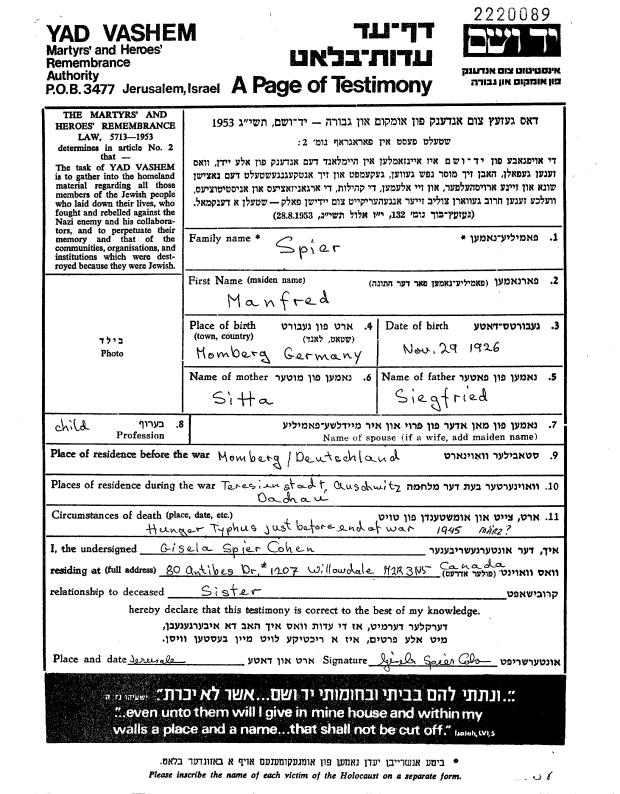
By October, 1944, all four members of Sitta’s family had been transported from Theriesenstadt to Auschwitz where Sitta and Siegfried were immediately sent to the gas chambers. Manfred was transferred several days later to the Dachau concentration where he died from starvation and typhus on April 18, 1945, just a few weeks before Germany surrendered and the war in Europe ended. He was nineteen years old.4

Manfred Spier Page of Testimony at Yad Vashem, found at https://yvng.yadvashem.org/nameDetails.html?language=en&itemId=1879134&ind=1

The only member of Sitta’s family to survive was her daughter Gisela. She was sent from Auschwitz on October 12, 1944,5 to the concentration camp in Flossenburg, Germany, a camp where prisoners worked as slave labor to build fighter planes and other equipment for the German military. The US Holocaust Museum and Memorial  provided this description of conditions at Flossenburg:

The conditions under which the camp authorities forced the prisoners to work and the absence of even rudimentary medical care facilitated the spread of disease, including dysentery and typhus. In addition to the dreadful living conditions, the prisoners suffered beatings and arbitrary punishments.

About 30,000 people died there, but somehow Gisela survived.

On April 29, 1945, as the Allied forces were approaching Flossenburg, the Nazis began to evacuate the camp and transport the prisoners elsewhere. Gisela was transferred from Flossenburg to the Mauthausen concentration camp,6 where she was liberated by the Allies on May 5, 1945. She was sixteen years old and weighed 46 pounds when she was freed.7

In his eulogy for his mother, Gisela’s son Simeon Spier wrote this description of Gisela’s life after she was liberated in May, 1945.8

She travelled with a friend she met in a displaced persons camp to Paris.  They were on one of the first trains to arrive in Paris at Gare de l’Est after the war’s end and were mobbed by frantic people looking for word of loved ones.  It was at that time she realized she had survived an atrocity of epic proportions.

She searched for her brother through refugee organizations.  She found out he had died of hunger and exhaustion at Dachau.  She saw 2 men on the streets of Paris wearing Magen David.  She asked them why they were wearing Stars of David now that the war was over. They told her they were part of a brigade building the Jewish state in Palestine.  They told her if she wanted to go to Palestine there was a boat leaving from the port of Marseille in several days.

With no family left, she set off to Marseille and boarded the ship, the Mataroa, to Palestine.  Since Jewish immigration to Palestine was illegal under the British Mandate, she was detained by the British army upon reaching Palestine.  She was imprisoned in Atlit ….  The Jewish underground broke her free from Atlit.  Her name was changed to escape British authorities.  She became Yael Blumenfeld – Gisela to Gazella to Yaela to Yael.  Blumenfeld for her mother’s maiden name.  She said when she became Yael Blumenfeld, she finally felt free.

She lived in the youth village of Ben Shemen, joined the Palmach army and fought in the Israeli War of Independence.  She was a decorated veteran of the 1948 war.

In 1950, Gisela came to New York with the help of her mother’s siblings and then got a job in Montreal as a secretary for a synagogue. She met her husband Israel Cohen in Canada, where they were married in 1956.9

Gisela and Israel had three children, each named for one of Gisela’s family members who had been killed in the Holocaust— a daughter Sitta, named in memory of Gisela’s mother Sitta Blumenfeld Spier, a son Simeon, named in memory of Gisela’s father Siegfried Spier, and a daughter Michall, named in memory of Gisela’s brother Manfred. The family lived in Montreal and later in Toronto.10

Once her children were grown, Gisela devoted a great deal of her time and energy to Holocaust education, including regularly traveling back to Momberg and other towns in Germany, to educate German children about what had happened to her family and many other Jewish families.11

Here is a very moving video of Gisela produced by the Sarah and Chaim Neuberger Holocaust Education Centre at the UJA Federation of Greater Toronto as part of Gisela’s efforts to provide education about the Holocaust. I highly recommend you watch this eight-minute interview so that you can see and hear this remarkable woman.

Gisela died on February 19, 2016, in Toronto. She was 87 years old and had endured and experienced so much. Simeon ended his eulogy for his mother Gisela in words that bring tears to my eyes each time I re-read them.12

My mother was overwhelmed by the good fortune her life had brought her after suffering such unbearable loss early in life.  As her life neared its end, she became at peace with herself having lived a full life bearing witness to history’s most brutal atrocity.

Death, to her meant two things. She would be re-united with her family and the ability to have a real grave with a tombstone – something her family never had.  She had always mourned that according to Jewish tradition, a son must say Kaddish at the grave of his parents and that no one had been able to say Kaddish for her parents and brother.  Today, we will go to the cemetery and say Kaddish at her grave – for her, her mother, father, and brother.  And for this, we are all very happy.

Gisela Spier Cohen was survived by her three children and her grandchildren. Her life exemplified courage and persistence and hope against all odds. I feel so moved and honored to be able to share her story and that of her family.

Special thanks to my cousin Simeon Spier for allowing me to quote extensively from the beautiful eulogy he wrote for his mother.


  1. “In Loving Memory of Yael Gisela Spier Cohen,” by Simeon Spier, published February 28, 2016, found here
  2. See the entries at Yad Vashem at the links in the text. 
  3. Obituary for Gisela Spier Cohen in Oberhesslische Press, March 23, 2016, found at https://www.op-marburg.de/Landkreis/Ostkreis/Zeitzeugin-verstirbt-fern-ihres-Geburtsortes 
  4. Manfred Spier, Nationality: German or Austrian, Birth Date: 29 Nov 1925, Birth Place: Momberg, Prior Residence: Momberg, Street Address: Marburg a. d. L, Arrival Date: 10 Oct 1944, Arrival Country: Germany, Death Date: 18 Apr 1945, Prisoner Number: 115317, Arrival Notes: 10 Oct 1944 from Auschwitz, Disposition Notes: died 18 Apr 1945, Description: prisoner German or Austrian Jew, Page: 5440/Bg.
    Original Notes (desc. / arr. / dis.): Sch. DR. J./ 10 Oct 1944 v. Au./ gest. 18 Apr 1945, JewishGen volunteers, comp. Germany, Dachau Concentration Camp Records, 1945 
  5. Gizela Spier, Nationality: German, Born: 29 Nov 1928, Prisoner Number: 54367
    Classification: Jew, Arrival: 12 Oct 1944, Record Source: Reel 2, Image #: 269, Page #: 1000, JewishGen Volunteers. Germany, Flossenbürg Concentration Camp Records, 1938-1945 
  6. Gisela Spier, Date of Birth: 29 Nov 1928, Nationality: German. Prisoner Number: 54,367, Category: Jew, Town/Camp: Freiberg, Factory: Hildebrandt, Transferred from (camp name): Auschwitz, Date transferred: 12 Oct 1944, Transferred to (camp name): Mauthausen, Date transferred: 29 Apr 1945, Ancestry.com. Germany, Women in Flossenbürg Branch Camps (Hans Brenner Book Lists), 1944-1945 
  7. See Note 1, supra. 
  8. See Note 1, supra. 
  9. See Note 1, infra. 
  10. See Note 1, supra. 
  11. See Note 1, supra. See also Note 3, supra. 
  12. See Note 1, supra. 

Gerson Blumenfeld II, Part III: The Nazis Come to Momberg

As we saw, Gerson Blumenfeld II died on July 29, 1919, in the aftermath of losing two of his sons—Moritz and Isaak—during their service to Germany in World War I. He was survived by his wife Berta, one remaining son Friedrich, and his three daughters, Mina, Katinka, and Sida, as well as Mina’s husband Albert Simon, and their children.

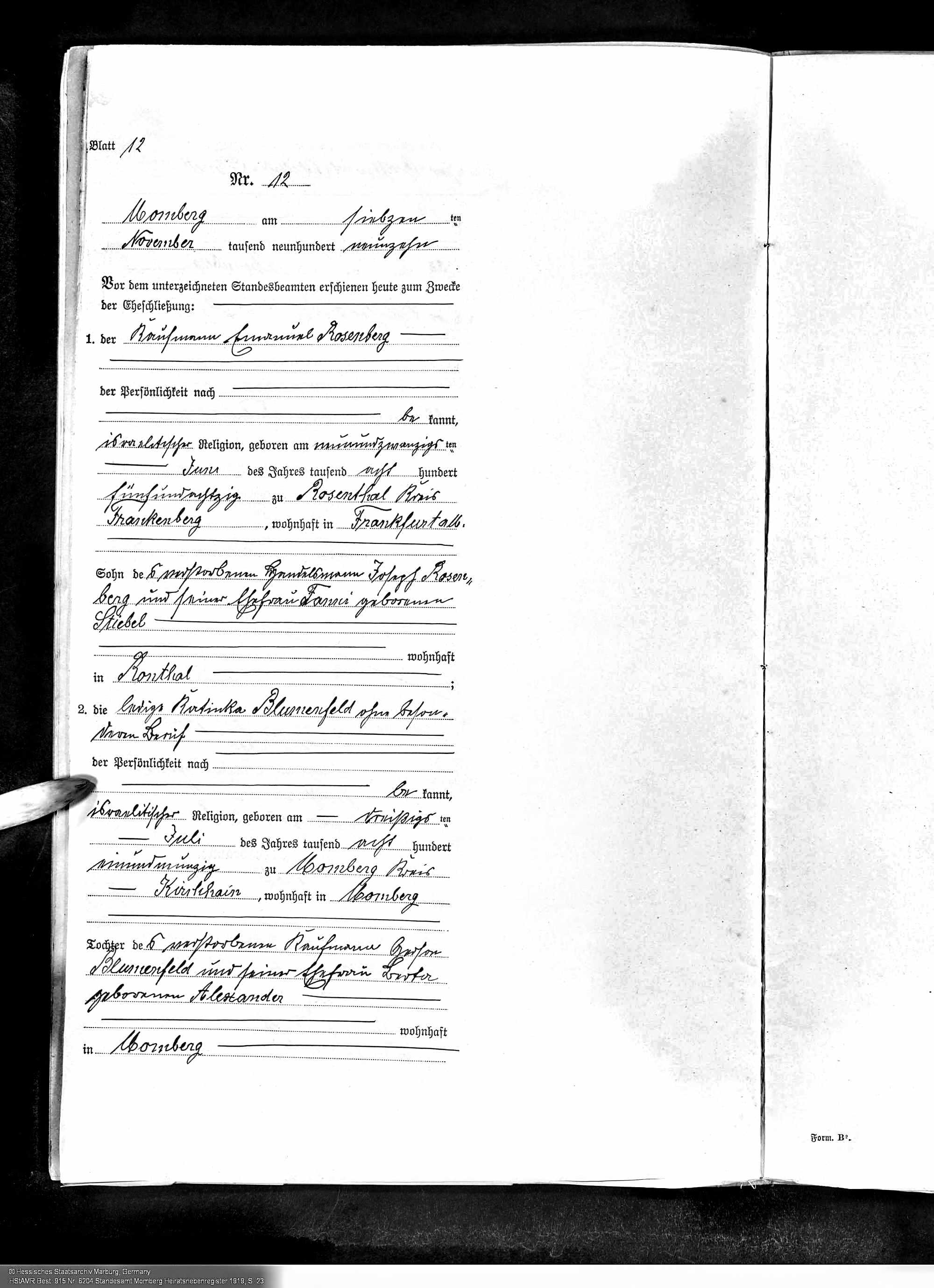
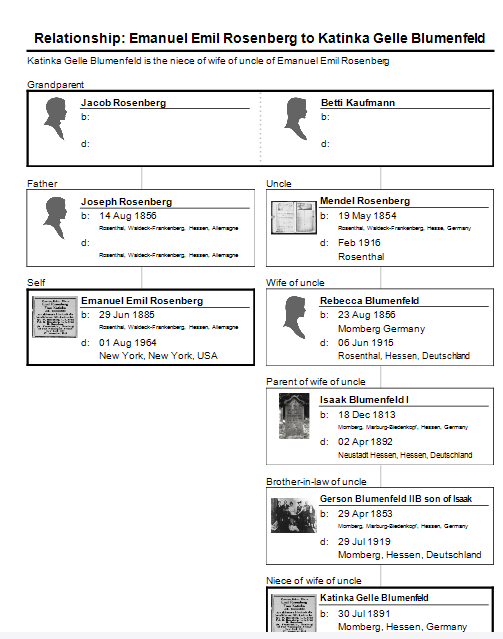
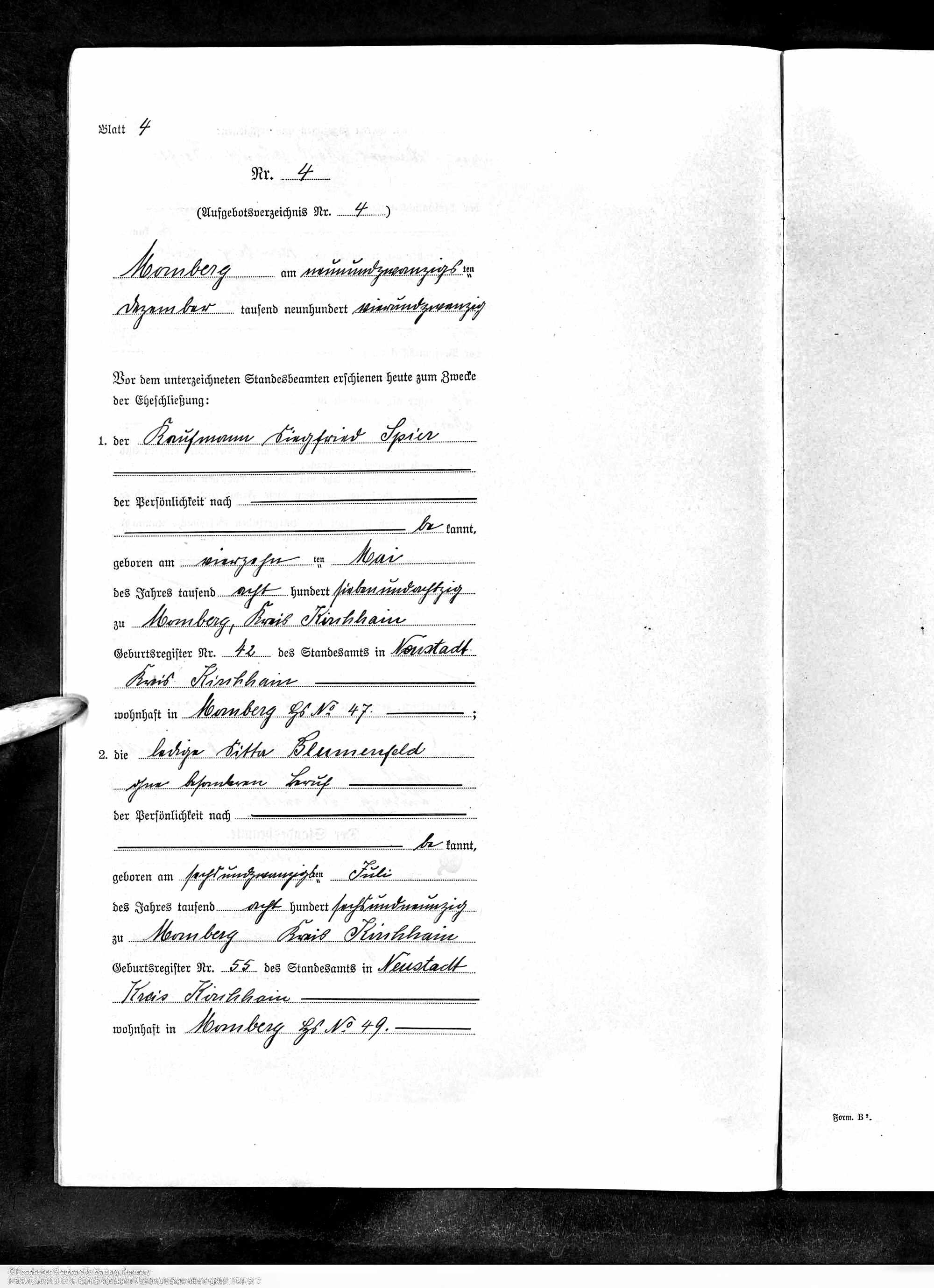
Fortunately, the family continued to grow after the war. Katinka married Emanuel Emil Rosenberg on November 7, 1919. Emanuel was born on June 19, 1885, in Rosenthal, Germany, to Joseph Rosenberg and Fanni Stiebel. He was also the nephew of Mendel Rosenberg, who was married to Katinka’s aunt Rebecca Blumenfeld, her father Gerson’s sister.

Katinka Blumenfeld marriage to Emanuel Rosenberg, Hessisches Hauptstaatsarchiv; Wiesbaden, Deutschland; Bestand: 915; Laufende Nummer: 6204, Year Range: 1919, Ancestry.com. Hesse, Germany, Marriages, 1849-1930

Katinka and Emanuel had three sons: Walter, born in Frankfurt, Germany, on October 17, 1920;1 Guenther, born in Frankfurt on July 7, 1925;2 and Heinz, born in 1928.3

Katinka’s older brother Friedrich married Lina Neuhaus on October 26, 1921, in Braach, Germany. She was born on September 19, 1894, in Braach (sometimes listed as Baumbach, which is less than two miles from Braach) to Samuel Neuhaus and Bertha Wallach.

Siegmund Friedrich Blumenfeld marriage to Lina Neuhaus, Hessisches Hauptstaatsarchiv; Wiesbaden, Deutschland; Bestand: 907; Laufende Nummer: 510, Year Range: 1921, Ancestry.com. Hesse, Germany, Marriages, 1849-1930

Friedrich and Lina had two children: Gretel was born August 21, 1922, in Momberg,4 and Gunter was born on February 22, 1926, in Momberg.5

Sida Blumenfeld, the youngest child of Gerson II and Berta, married Siegfried Spier on December 29, 1924, in Momberg. Her name is spelled Sitta on the marriage record, and I will use that spelling going forward. Siegfried was also a native of Momberg; he was born there on May 14, 1887, to Michael Spier and Veilchen Nussbaum. He was the owner of a matza factory.6

Sitta Blumenfeld marriage to Siegfried Spier, Hessisches Hauptstaatsarchiv; Wiesbaden, Deutschland; Bestand: 915; Laufende Nummer: 6209, Year Range: 1924, Ancestry.com. Hesse, Germany, Marriages, 1849-1930

Sitta and Siegfried had two children, Manfred, born on November 29, 1925, in Momberg,7 and Gisela, born exactly four years later on November 29, 1929.8

Gisela’s son Simeon Spier wrote this beautiful description of his mother’s family’s life in Momberg before the Nazis came to power in the 1930s.9

Momberg was like a storybook village of gingerbread cookies and green rolling hills.  Her family had lived there since the 17th century.  Her father, Siegfried Spier, owned a matza factory started by her great grandfather.  Her mother, Sida, was a deeply religious woman.   Her paternal grandmother lived in her house and her maternal grandmother lived across the street.  It was a world of German folk songs and Jewish religion.  She played soccer with her brother and cousins, attended the village school and went to the tiny village shul on Shabbos.

I also had the great pleasure of speaking to Katinka’s son Heinz (now Henry) Rosenberg just a week or so ago. He also spent his early childhood years in Momberg. He pointed out that since Gisela’s father Siegfried Spier owned a matza factory that employed many of the town’s residents, even after Hitler first came to power in 1933, no one bothered the Jews in Momberg at first because they were grateful to have jobs in the factory.10

That idyllic life would soon come to an end with Kristallnacht in November, 1938. Simeon Spier described what happened in Momberg to his mother and her family:11

On the 9th of November 1938 her world was destroyed by the Nazis during the Kristallnacht. The synagogue was burned down and the men were taken to concentration camps. Her brother’s Bar Mitzvah could not take place later that month as there was not a minyan of 10 adult Jewish men in the village. This saddened her all her life since her brother had been practicing his parsha and haftorah for months. She too knew the words and could recite them the rest of her life.

Jews were kicked out of the village school and Gisela and her brother were sent to an orphanage in Frankfurt. There, away from her family at 10 years old she would spend countless hours in the school’s gymnasium on the horizontal bar. Her love of sports helped her escape what was happening. She lived on Pfingsfeid Strasse near the zoo. Jews were not allowed in the zoo so all she could see was the head of the giraffe. She was forced to wear a yellow star.

Heinz/Henry Rosenberg also was unable to go to school for two years and still clearly remembers seeing the destruction of the Momberg synagogue on Kristallnacht. He shared with me the moving story of his family’s rescue of a Torah scroll that had belonged to his grandfather Gerson Blumenfeld and had been damaged during the violence of Kristallnacht. They brought that scroll with them to the US, and Henry read from it at his bar mitzvah in 1941 as did his grandson over seventy years later.

Fortunately, like that Torah scroll, almost all of Gerson Blumenfeld’s children and grandchildren got out of Germany in time and survived the Holocaust. Almost all.


  1. Walter Joseph Rosenberg, Gender: Male, Petition Age: 24, Birth Date: 17 Oct 1920
    Birth Place: Frankfurt, Germany, Record Type: Naturalization Petition, Petition Number: 1788, National Archives and Records Administration – Southeast Region (Atlanta); Atlanta, GA; Petitions For Naturalization, Compiled 1922-1964; Series Number: 648598; Record Group Title: Records of District Courts of the United States; Record Group Number: 21, Ancestry.com. Louisiana, U.S., Naturalization Records, 1836-2001 
  2. Guenther Rosenberg, [George G Rosenberg], [George Rosenberg], Gender: Male
    Race: White, Birth Date: 7 Jul 1925, Birth Place: Frankfurt MA, Federal Republic of Germany, Death Date: 27 Oct 1998. Father: Emil Rosenberg. Mother: Katinka Blumenfeld, SSN: 093129735, Ancestry.com. U.S., Social Security Applications and Claims Index, 1936-2007 
  3. Heinz, Record Type: Naturalization Declaration., Birth Date: — 1928, Birth Place: Frankfurt, Germany, Court: U.S. District Court for the Southern District of New York, Father: Emanuel Rosenberg, Box Number: 338, The National Archives at Philadelphia; Philadelphia, PA; NAI Title: Declarations of Intention For Citizenship, 1/19/1842 – 10/29/1959; NAI Number: 4713410; Record Group Title: Records of District Courts of the United States, 1685-2009; Record Group Number: 21, Source Information
    Ancestry.com. New York, U.S., State and Federal Naturalization Records, 1794-1943. Because Heinz/Henry is still living, I am not disclosing his exact birth date. 
  4. Gretel Blumenfeld, [Grethe Blumenfeld], Gender: Female, Race: White, Declaration Age: 18, Record Type: Naturalization Declaration, Birth Date: 21 Aug 1922
    Birth Place: Momberg, Germany, Court: U.S. District Court for the Southern District of New York, Declaration Number: 493628, Box Number: 366, The National Archives at Philadelphia; Philadelphia, PA; NAI Title: Declarations of Intention For Citizenship, 1/19/1842 – 10/29/1959; NAI Number: 4713410; Record Group Title: Records of District Courts of the United States, 1685-2009; Record Group Number: 21, Ancestry.com. New York, U.S., State and Federal Naturalization Records, 1794-1943 
  5. Gunter Blumenfeld, Petition Age: 19, Record Type: Naturalization Petition, Birth Date: 22 Feb 1926, Birth Place: Momberg, Germany, Departure Place: Momberg, Germany, Petition Place: Augusta, Augusta-Richmond, Georgia, USA, Ship: Hansa
    Description: Augusta Naturalization Petitions 9/1943-12/1953 (Box 2), National Archives and Records Administration; Washington, DC; ARC Title: Petitions For Naturalization, Compiled 1909 – 1970; ARC Number: 2143321; Record Group Title: Records of District Courts of the United States; Record Group Number: 21, Ancestry.com. Georgia, U.S., Naturalization Records, 1794-1993 
  6. “In Loving Memory of Yael Gisela Spier Cohen,” by Simeon Spier, published February 28, 2016, found here
  7. Manfred Spier, Nationality German or Austrian, Birth Date 29 Nov 1925, Birth Place Momberg, Prior Residence Momberg, Street Address Marburg a. d. L., Arrival Date 10 Oct 1944, Arrival Country Germany, Death Date 18 Apr 1945, Prisoner Number 115317
    Arrival Notes 10 Oct 1944 from Auschwitz, Disposition Notes died 18 Apr 1945, Description prisoner German or Austrian Jew, Page 5440/Bg., Original Notes (desc. / arr. / dis.) Sch. DR. J./ 10 Oct 1944 v. Au./ gest. 18 Apr 1945, JewishGen volunteers, comp. Germany, Dachau Concentration Camp Records, 1945 
  8. Giesela Sara Spier, Gender: weiblich (Female), Nationality: Deutsch Juden, Record Type: Inventory, Birth Date: 29 Nov 1928, Birth Place: Momberg, Last Residence: Momberg, Residence Place: Momberg, Marburg an der Lahn
    Notes: Inventories of personal estates of foreigners and especially German Jews
    Reference Number: 02010103 oS, Document ID: 85950815, Arolsen Archives, Digital Archive; Bad Arolsen, Germany; Lists of Persecutees 2.1.1.3, Ancestry.com. Free Access: Europe, Registration of Foreigners and German Persecutees, 1939-1947 
  9. See Note 6, supra. 
  10. Phone conversation with Henry Rosenberg, October 30, 2022. 
  11. See Note 6, supra. 

Meier Blumenfeld IIB, Part II: His Three Surviving Children Were All Murdered in the Holocaust

Meier Blumenfeld IIB, who died in 1922, and his wife Sarchen, who died in 1930, were survived by three of their five children: Moses Blumenfeld III and his wife Sarah Rothschild and their son Julius; Hermann Blumenfeld III and his wife Elsa Drucker and their three children, Eric, Hilde, and Liselotte; and Rosa Blumenfeld and her husband Julius Hess. As of 1933 when Hitler came to power, they were all living in Germany.

Tragically, all three of Meier IIB and Sarchen’s children were murdered in the Holocaust. Moses IIB and Sarah were deported to the Litzmannstadt Ghetto in Lodz on October 20, 1941, and died sometime thereafter. Fortunately, their son Julius escaped to Argentina in 1936. I don’t know what happened to Julius afterwards, but at least he managed to avoid the fate of his parents.1

Moses IIB’s sister Rosa and her husband Julius Hess were also both killed by the Nazis. They were deported on June 11, 1942, from Frankfurt either to the Sobibor death camp and/or to the camp at Majdanek, where they were murdered.2

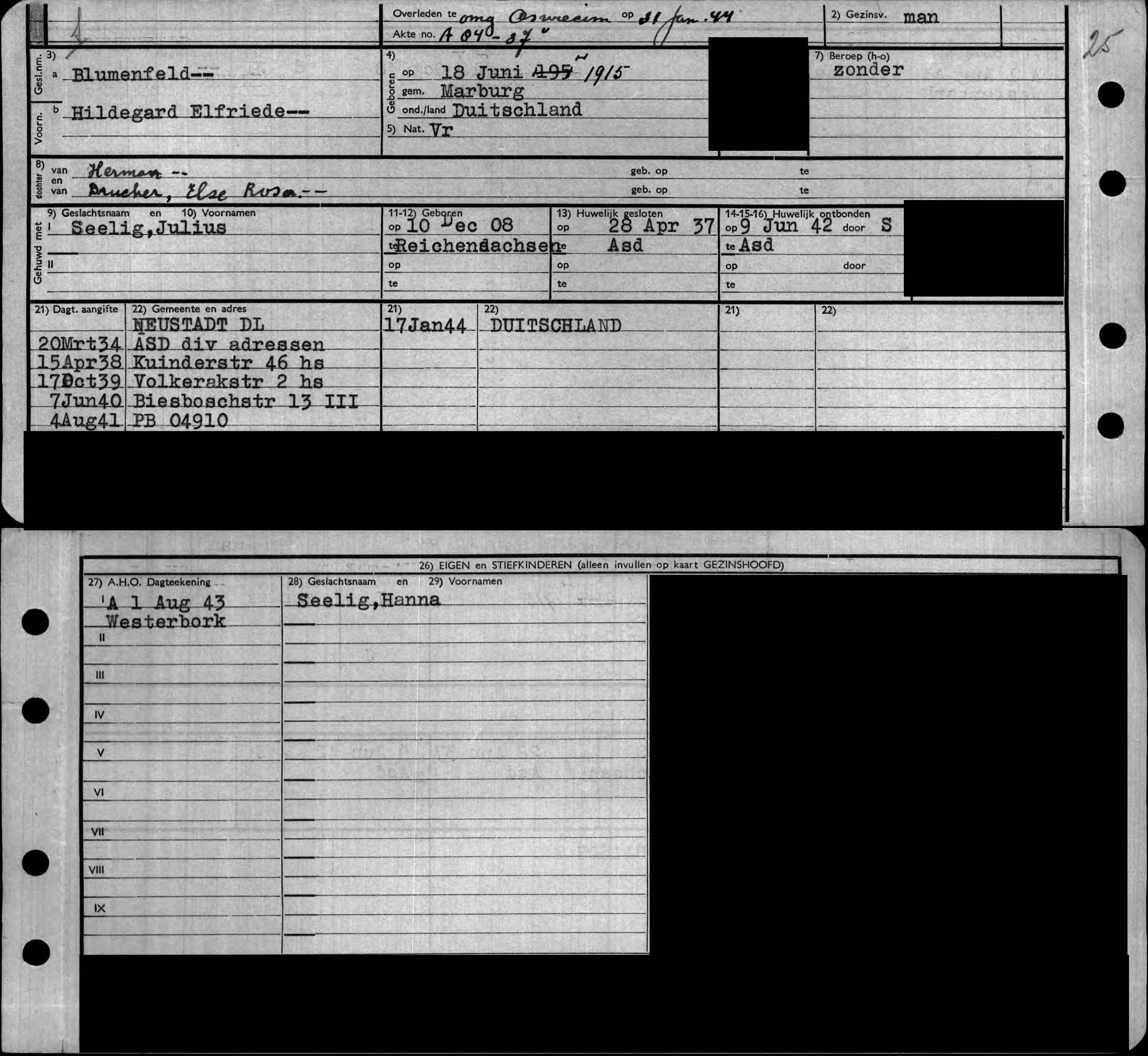
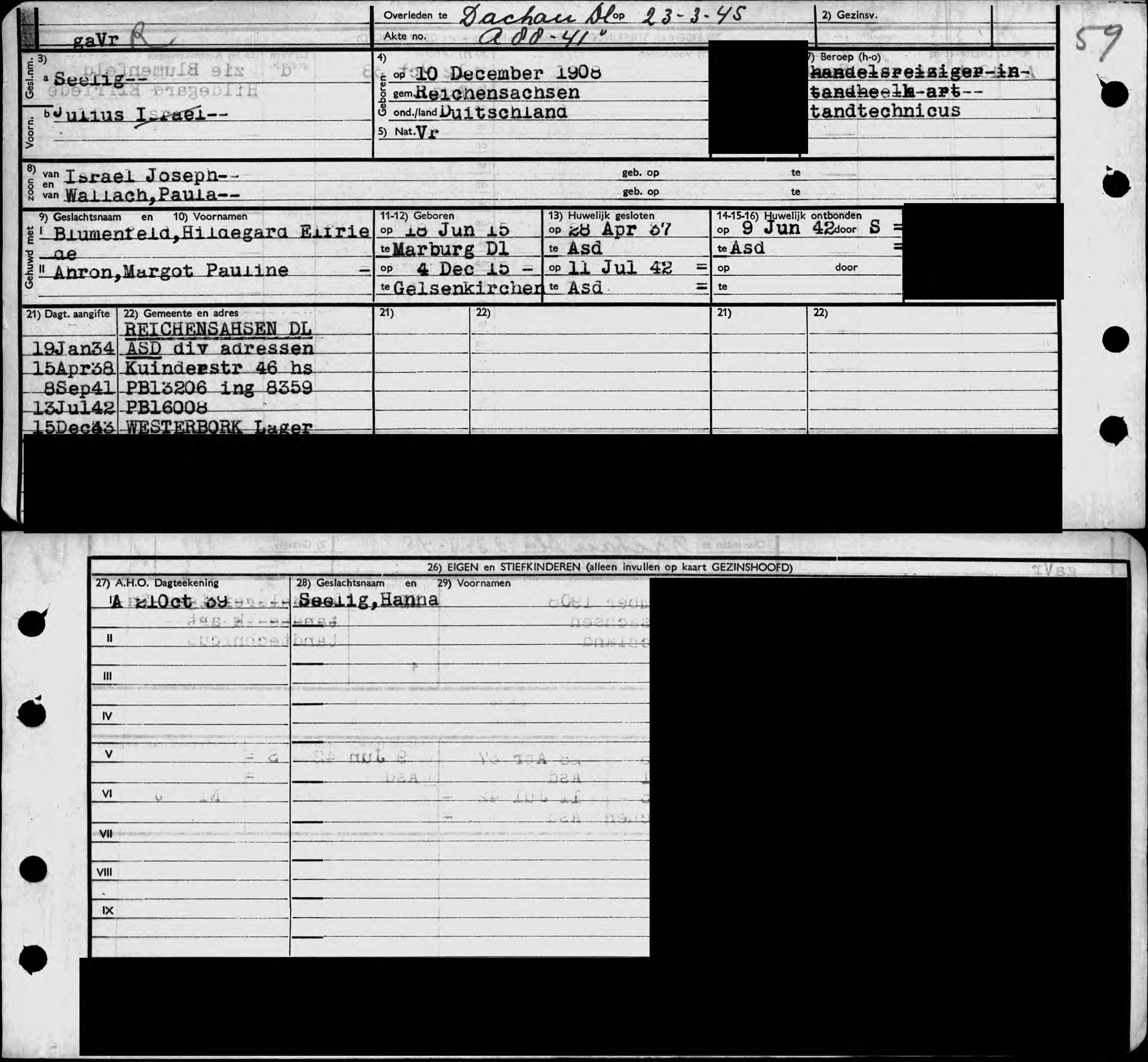
Hermann Blumenfeld III and his wife Elsa were also murdered by the Nazis, as were their daughter Hilde and her family, despite the fact that they all had left Nazi Germany. Hilde had immigrated to Amsterdam in March 1934, and she had married Julius Seelig on April 28, 1937, in Amsterdam. Julius was born in Reichensachen, Germany, on December 10, 1908, to Joseph Seelig and Paula Wallach. Hilde and Julius had one child, a daughter Hanna born in Amsterdam on October 12, 1938. Julius and Hilde were divorced on June 9, 1942, and Julius soon remarried another woman, Margot Pauline Aharon, in July 1942.

Here are the Amsterdam registration cards for Hilde, Julius, and Hanna that report this information:

Amsterdam City Archives, Archive cards , archive number 30238 , inventory number 78
Municipality : Amsterdam, Period : 1939-1960, found at https://archief.amsterdam/indexen/deeds/98533418-6d7f-56a3-e053-b784100ade19

Amsterdam City Archives, Archive cards , Archive cards , archive number 30238 , inventory number 719, Municipality : Amsterdam, Period : 1939-1960 found at https://archief.amsterdam/indexen/deeds/9853340a-857d-56a3-e053-b784100ade19

Amsterdam City Archives, Archive cards , archive number 30238 , inventory number 719
Municipality : Amsterdam, Period : 1939-1960, found at https://archief.amsterdam/indexen/deeds/9853341a-53f7-56a3-e053-b784100ade19

Hilde’s parents Hermann and Elsa came to Amsterdam later than Hilde, arriving in May 1939, according to Hermann’s Amsterdam registration card.

Amsterdam City Archives, Archive cards , archive number 30238 , inventory number 78
Municipality : Amsterdam
Period : 1939-1960 found at https://archief.amsterdam/indexen/persons?sa=%7B%22person_1%22:%7B%22search_t_geslachtsnaam%22:%22Blumenfeld%22,%22search_t_voornaam%22:%22Hermann%22%7D%7D

But escaping to Amsterdam did not keep any of them safe. According to records at Yad Vashem, Hermann and Else were sent to the Westerbork Detention Camp in 1943 and from there deported to Auschwitz where they were both killed on February 11, 1944.

Hilde and her daughter Hanna were also first sent to Westerbork in August 1943 and then to Auschwitz. Hilde died on January 31, 1944, and her five-year-old daughter Hanna on February 11, 1944, according to Yad Vashem.

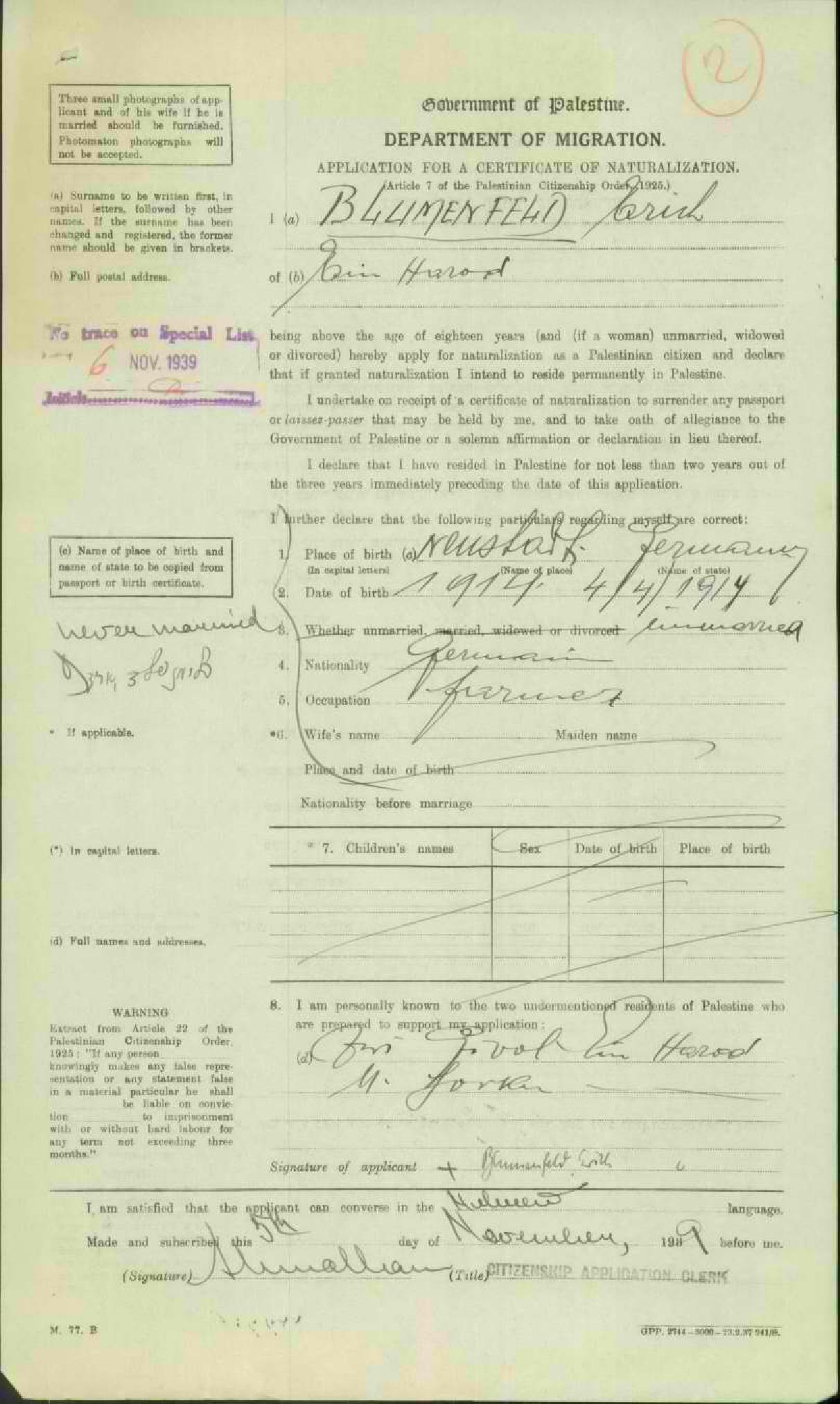
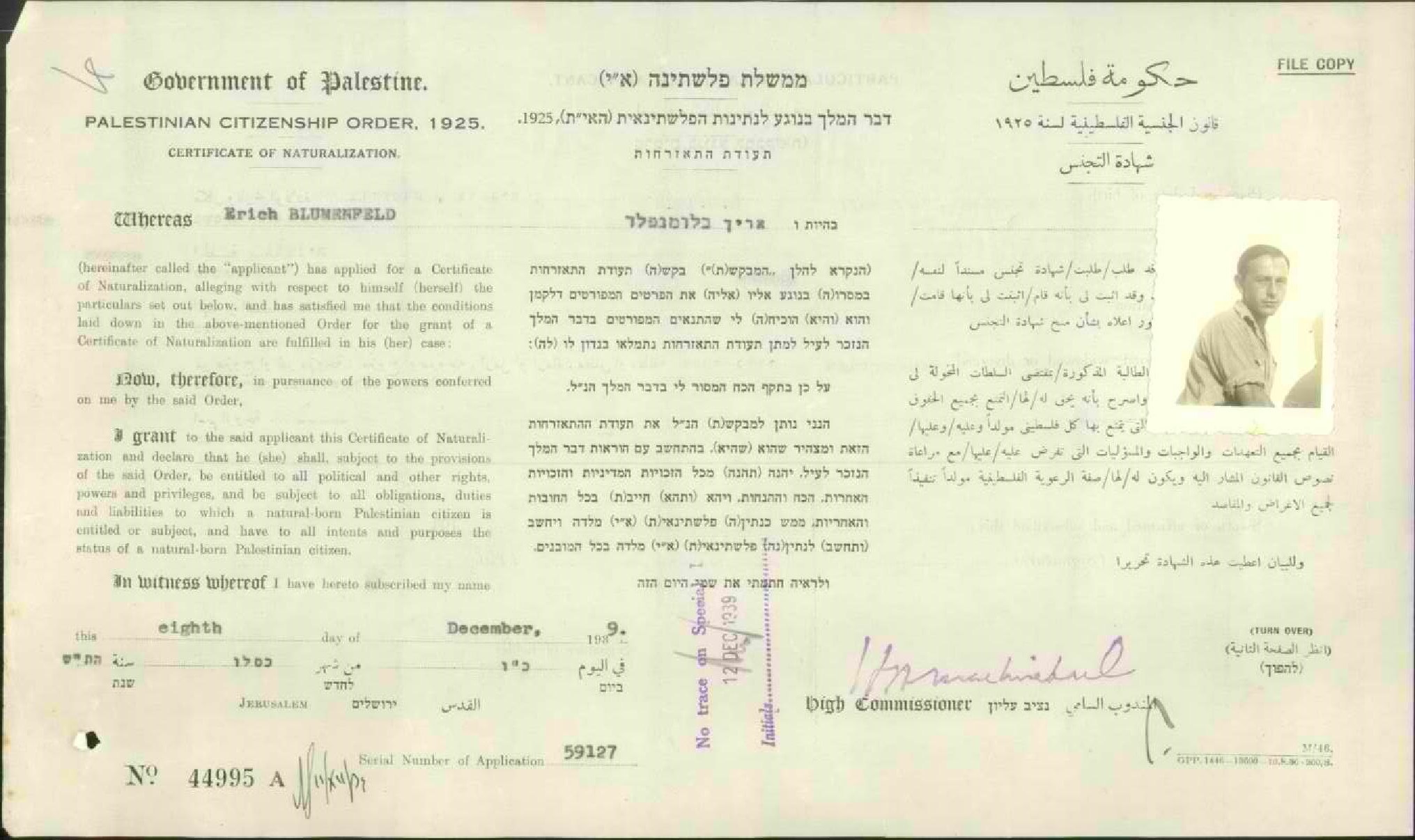
Fortunately, Hilde’s two siblings survived the Holocaust. Erich Blumenfeld immigrated to Palestine on September 13, 1937, and became a naturalized citizen there on December 19, 1939.3

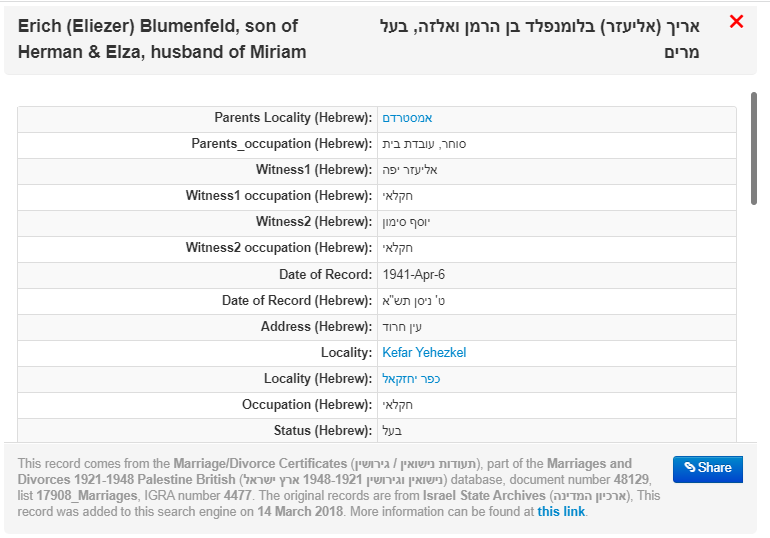
Erich married Miriam Emerich, daughter of Robert and Hannah Emerich, on April 6, 1941.4

Erich changed his name in 1948 to Eliezer Shadmon. Shadmon means farm in Hebrew, and according to Erich/Eliezer’s application for naturalization, he was working as a farmer at Ein Harod at that time, as seen in the images above.5 Unfortunately, I’ve not yet found any further information about Erich/Eliezer.

Liselotte Blumenfeld, the youngest child of Hermann III and Else, immigrated to the US and arrived in New York City on August 5, 1937. She was heading to Lexington, Kentucky, according to the ship manifest,6 and in 1940, she was living with James and Nanette Strause in Fayette, Kentucky and working as a nurse, presumably for their seven year old son. I don’t know why Liselotte chose Kentucky as her destination, but I assume there was some friend or family member living there when she immigrated or she had arranged the job before leaving Germany. (I’ve recently learned that another branch of the Blumenfeld family that I’ve yet to research settled in Kentucky long before the 1930s, so perhaps that was Liselotte’s connection. To be determined…)

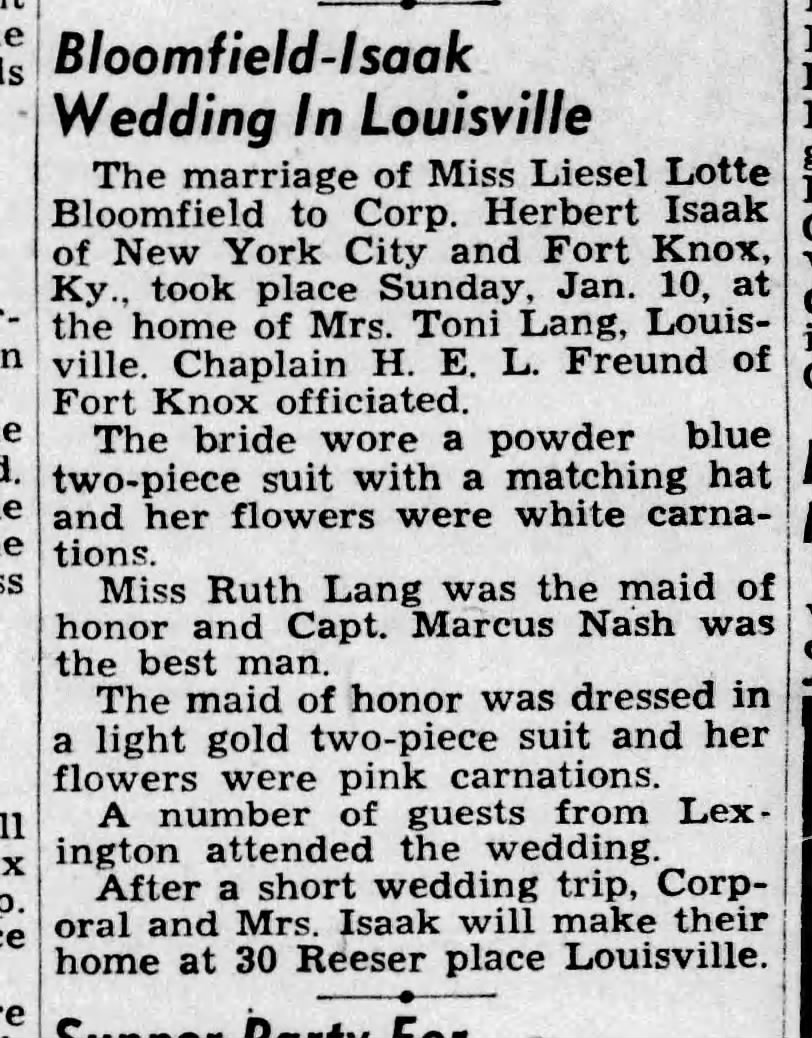
On January 10, 1943, Liselotte, referred to here as Liesel Lotte Bloomfield, married Corporal Herbert Isaak in Louisville, Kentucky.

“Bloomfield-Isaak Wedding in Louisville,” Lexington Herald-Leader, January 17, 1943, p. 18

Herbert was born in Munich, Germany, on March 21, 1920, and had immigrated to the US on April 25, 1941; he’d enlisted in the US Army on January 5, 1942. His parents were Emil Charles Isaak and Therese Meyer.7 Liselotte and Herbert had one child born in the 1940s. According to his obituary, Herbert had survived the Dachau Concentration Camp and had served as a field-commissioned second lieutenant in the US  Army at the Nuremberg Trials.8

In 1950, the family was living in New York City, and Herbert was working as a traveling salesman for a “ladies suits and coats factory.”9 The family must have relocated to the South at some later date because, according to Herbert’s obituary, “he was a traveling sales representative of women’s coats in Virginia and the Carolinas and had a showroom in Charlotte, N.C.”10 Herbert died on November 18, 2001, in Myrtle Beach, South Carolina; he was 81. Liselotte outlived him by thirteen years; she was just a few days shy of her 97th birthday when she died on November 5, 2014. Herbert and Liselotte were both buried at Florence National Cemetery in Florence, South Carolina.11

I haven’t yet determined whether Liselotte Blumenfeld Isaak or Erich Blumenfeld/Eliezer Shadmon have living descendants. Nor have I found more information about their cousin Julius Blumenfeld, the son of Moses IIB. I am hoping that there are more descendants alive to carry on the legacy of Meier Blumenfeld IIB and his wife Sarchen Moses and their children.


  1. “Uruguay, listas de pasajeros, 1888-1980,” database, FamilySearch (https://familysearch.org/ark:/61903/3:1:3Q9M-C33M-19T3?cc=2691993 : 30 June 2020), > image 1 of 1; Archivo General de la Nación, Dirección Nacional de Migración (General Archive of the Nation, National Migration), Montevideo. Also, see Arolsen Archives, Digital Archive; Bad Arolsen, Germany; Lists of Persecutees 2.1.1.1, Description Reference Code: 02010101 oS, Ancestry.com. Free Access: Europe, Registration of Foreigners and German Persecutees, 1939-1947 
  2. The Gedenbuch and Yad Vashem records mention both camps. I guess the evidence of where Rosa and Julius ended up is unclear, but their ultimate fate is not. 
  3. Erich Blumenfeld, Palestine Immigration File, found at the Israel Archives website at https://www.archives.gov.il/catalogue/group/1?kw=erich%20blumenfeld 
  4. Marriage record found at the Israel Genealogy Research Association website by searching for Erich Blumenfeld. https://genealogy.org.il/AID/ 
  5. Name change found at the IGRA website by searching for Eliezer Shadmon. https://genealogy.org.il/AID/ 
  6. Liselotte Brilea Ingeborg Blumenfeld, ship manifest, Year: 1937; Arrival: New York, New York, USA; Microfilm Serial: T715, 1897-1957; Line: 21; Page Number: 37,
    Ancestry.com. New York, U.S., Arriving Passenger and Crew Lists (including Castle Garden and Ellis Island), 1820-1957 
  7. Herbert Jsaak [Herbert Isaak] Gender: Male Race: White Birth Date: 21 Mar 1920
    Birth Place: Munich, Federal Republic of Germany, Death Date: 18 Nov 2001, Father:
    Emil Jsaak Mother: Therese Meyer SSN: 046143654, Ancestry.com. U.S., Social Security Applications and Claims Index, 1936-2007; Herbert Isaak, Petition for Naturalization, The National Archives at Atlanta; Atlanta, GA; Petitions For Naturalization , Compiled 1906-1978; NAI: 1275754; Record Group Title: Records of District Courts of the United States; Record Group Number: 21, Ancestry.com. Kentucky, U.S., Naturalization Records, 1906-1991; Herbert Isaak, National Archives at College Park; College Park, Maryland, USA; Electronic Army Serial Number Merged File, 1938-1946; NAID: 1263923; Record Group Title: Records of the National Archives and Records Administration, 1789-ca. 2007; Record Group: 64; Box Number: 04782; Reel: 142, Ancestry.com. U.S., World War II Army Enlistment Records, 1938-1946 
  8. “Herbert Isaak,” Myrtle Beach Sun-News, November 21, 2001, p. 35. 
  9. Herbert Isaak and family, 1950 US census, United States of America, Bureau of the Census; Washington, D.C.; Seventeenth Census of the United States, 1950; Record Group: Records of the Bureau of the Census, 1790-2007; Record Group Number: 29; Residence Date: 1950; Home in 1950: New York, New York, New York; Roll: 4377; Sheet Number: 12; Enumeration District: 31-2180, Ancestry.com. 1950 United States Federal Census 
  10. See Note 8, supra. 
  11. Find a Grave, database and images (https://www.findagrave.com/memorial/138910393/liesel-isaak: accessed 21 September 2022), memorial page for Liesel Bloomfield Isaak (23 Nov 1917–5 Nov 2014), Find a Grave Memorial ID 138910393, citing Florence National Cemetery, Florence, Florence County, South Carolina, USA; Maintained by Danny & Judy Ard (contributor 47789022); Liesel Isaak, Rank: T/5, Death Age: 96, Birth Date: 23 Nov 1917, Death Date: 5 Nov 2014, Interment Place: Florence, South Carolina, USA, Cemetery Address: 803 East National Cemetery Road, Cemetery Postal Code: 29501, Cemetery: Florence National Cemetery, Section: 11 Plot: 37, War: World War II, Branch of Service: US Army
    Relative: Herbert Isaak, Comments: Wife, National Cemetery Administration; U.S. Veterans’ Gravesites, National Cemetery Administration. U.S., Veterans’ Gravesites, ca.1775-2019; 

Finding Max Blumenfeld and His Family: A Postscript

Yesterday I Zoomed with four of my Blumenfeld cousins—Richard, whose been my research partner for quite a while now, his first cousin Jim, who is also a wonderful genealogy researcher, and the two surviving grandchildren of Max Blumenfeld, Max and Omri. We spanned three continents—Omri in Israel, Richard in Switzerland, and Max, Jim, and I in New England. We chatted for an hour, but could have gone on much longer and hope to continue the conversation another time.

During our conversation, we uncovered the answer to a question we still had been unable to answer despite all our research: when did Anna Grunwald Blumenfeld, Max Blumenfeld’s widow and Omri and Max’s grandmother, leave Italy and immigrate to Israel/Palestine? The records that Richard had obtained from Merano said she’d left in 1939, but Max had pointed out that that wasn’t possible since he and his sister were cared for by their grandmother Anna during World War II while their mother Edith worked with the Italian Resistance. Their father Josef had immigrated to the United States on November 1939.
For our Zoom, Omri had prepared a wonderful slide show of family photographs, some of which I’ve already shared on this blog, and some that were new to me. Among those photographs was one that helped to answer the question of when Anna arrived in Palestine. The photograph shows Anna in Palestine with two of her grandsons, Omri’s brothers Gideon and Hillel. Anna was holding Hillel, who was just a very small baby, and the photo was inscribed in Hebrew with the words, “Hillel is born! Oma [Anna] arrives! 29 May 1946.” So now we knew that Anna had only recently arrived in Palestine in May of 1946.
Here is another photo taken the same day showing Anna with Gideon and Hillel and their parents Fritz and Dora.

But then how do we explain the records that said Anna had left Merano in 1939? Well, Max had the answer to that question. Max explained that Anna and her daughter Edith and the two grandchildren, Max and his sister Margherita, all left Merano in 1939 and moved to Milan. Max has no memories of life in Merano since he was only a toddler when the family moved. But that would explain why the Merano records report that Anna left that place in 1939.

Max and his family stayed in Milan for several years, and then when Italy adopted laws persecuting the Jews in about 1942, his mother Edith was able to use her connections to obtain permission to leave Milan and move to the countryside outside of Milan.  The family remained there for the duration of the war, hiding the fact that they were Jews. They spoke Italian (although they all could also speak German) so that they could pass as Italian, and Max and his sister went to church on Sundays. In fact, Max and Margherita were not aware of the fact that they were Jewish and also didn’t know that their father was still alive—all to prevent the children from accidentally revealing the fact that they were Jews.

After the war, Edith took her children to America so they could all be reunited with Josef, and Anna went to Palestine to be with her son Fritz and his family, as depicted in the photograph above.

We spoke of many other interesting things during our Zoom, and there were many stories and many moments of laughter interspersed. It was truly a delightful hour and one I will always cherish and remember.

Thank you to Omri, Max, Richard, and Jim—all of whom are my fifth cousins, four people I never would have known if not for doing genealogy research.

And that, dear readers, is the magic of genealogy.