My Cousin Wolfgang and The Lessons of History: Will We Ever Learn Those Lessons?

When I started this blog back in October, 2013, I never anticipated that it would help family members find me.  But that has proven to be an incredible unexpected benefit of publishing this blog.  This is one of those stories.

Several weeks ago, I received a comment on the blog from a man named Wolfgang Seligmann, saying he was the son of Walter Seligmann, that he lived near Gau-Algesheim, and that he had found my blog while doing some research on his family.  He asked me to email him, which I did immediately, and we have since exchanged many emails and learned that we are third cousins, once removed:  his great-great-grandparents were Moritz Seligmann and Babetta Schoenfeld, my great-great-great-grandparents.  His great-grandfather August was the brother of Sigmund, Adolph and Bernard Seligman, the three who had settled in Santa Fe in the mid-19th century.   Wolfgang sent me a copy of August’s death certificate.
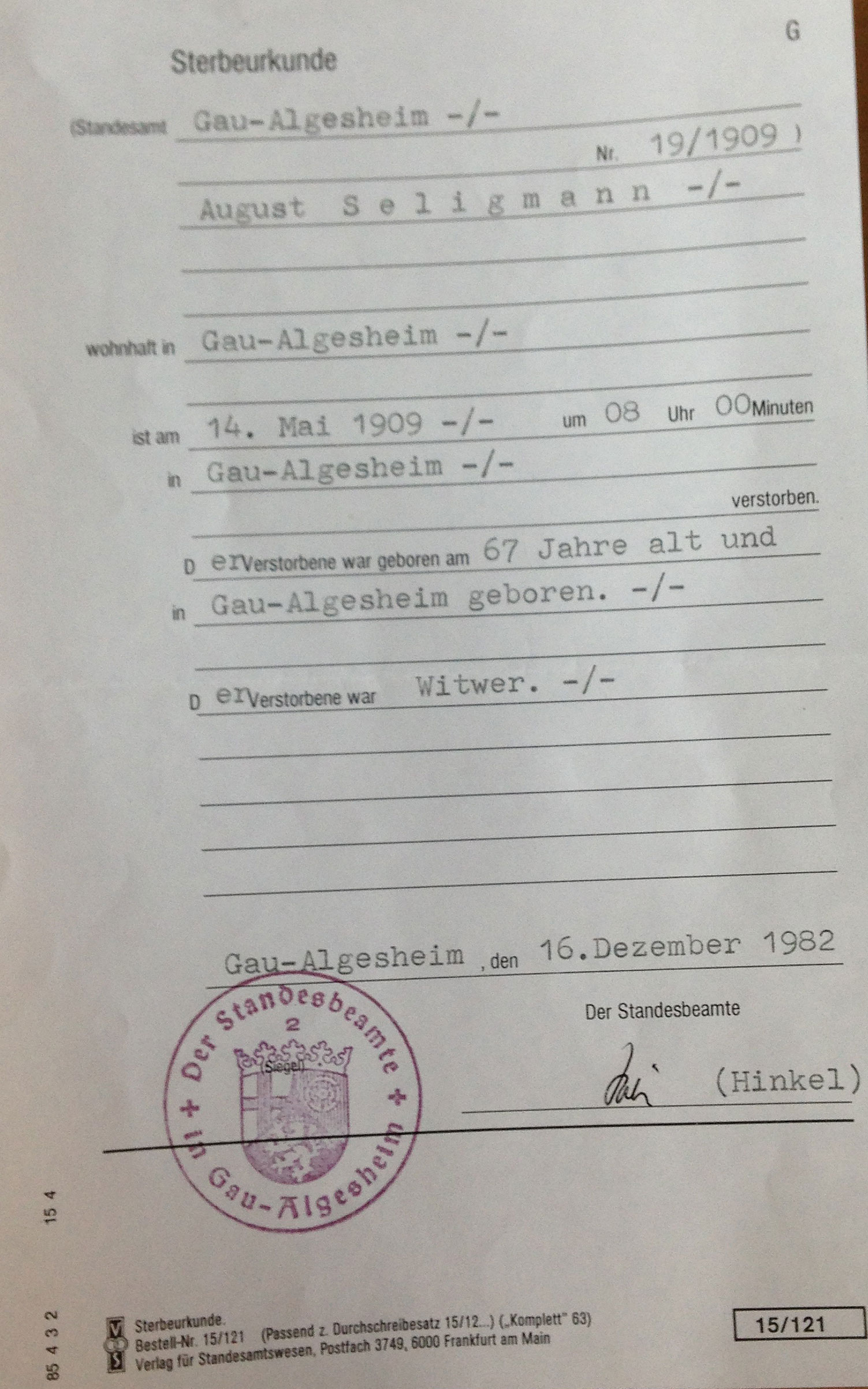
August Seligmann death certificate

August Seligmann death certificate

(Translations in this post courtesy of Wolfgang Seligmann except where noted: Registry-Office Gau-Algesheim: August Seligmann, living in Gau-Algesheim died the 14th of May 1909 at 8 a.m. in Gau-Algesheim. He was 67 years old and born in Gau-Algesheim. He was a widower.)

Our families had probably not been in touch since Bernard died in 1902 (or perhaps when Adolph died in 1920).  And now through the miracle of the internet and Google, Wolfgang had found my blog with his family’s names in it and had contacted me.  What would our mutual ancestors think of that?  It even seems miraculous to me, and I live in the 21st century.

Fortunately, Wolfgang’s English is excellent (since my knowledge of German is…well, about five words), and so we have been able to exchange some information about our families, and I have learned some answers to questions I had about the Seligmanns who stayed in Germany.  With Wolfgang’s permission, I would like to share some of those stories.

Wolfgang’s grandfather was Julius Seligmann, the second child and oldest son of August Seligmann and his wife Rosa Bergmann.  Julius was born in 1877 in Gau-Algesheim.  As I wrote about here, Julius was one of the Seligmanns written about in Ludwig Hellriegel’s book about the Jews of Gau-Algesheim.  He had been a merchant in the town.  On December 1, 1922, Julius had married a Catholic woman named Magdalena Kleisinger, who was born in Gau-Algesheim on July 9, 1882, and had himself converted to Catholicism.  Julius and Magdalena had two sons, Walter, who was born February 10, 1925, and Herbert, born July 27, 1927.  Julius and his family had left Gau-Algesheim for Bingen in 1939 after closing the store in 1935.

I had wondered why Julius had closed the store and then relocated to Bingen, and I asked Wolfgang what he knew about his grandfather’s life.  According to Wolfgang, his father Walter and uncle Herbert did not like to talk about the past, but Wolfgang knew that when Julius married and converted to Catholicism, his Jewish family was very upset and did not want to associate with him any longer.  In fact, Julius was forced to pay his siblings a substantial amount of money for some reason relating to his store in Gau-Algesheim, and that payment caused him and his family a great deal of financial hardship.  According to Wolfgang, Julius no longer had enough money to pay for his own home, and thus he and his family moved to Bingen in 1939 where they lived with Magdalena’s family or friends for some time.

Julius and Magdalena Seligmann

Julius and Magdalena Seligmann 1960s  Courtesy of Wolfgang Seligmann

The Hellriegel book also made some puzzling (to me) references to the military records of Wolfgang’s father and uncle, saying that they had been “allowed” to enlist in the army, but then were soon after dismissed.  Wolfgang explained that the German authorities did not know how to treat Catholic citizens with Jewish roots.  Wolfgang said that his father Walter had trained to be a pharmacist, but the Nazis would not allow him to work with anything poisonous.  In addition,  his father was not permitted to be in the army; instead  he was ordered by the authorities to work on the Siegfried Line, which was  originally built as a defensive line by the Germans during World War I.  In August 1944, Hitler ordered that it be strengthened and rebuilt, and according to Wikipedia, “20,000 forced labourers and members of the Reichsarbeitsdienst (Reich Labour Service), most of whom were 14–16-year-old boys, attempted to re-equip the line for defence purposes.”  Walter Seligmann was one of those forced laborers.

Map of the Siegfried line.

Map of the Siegfried line. (Photo credit: Wikipedia)

Here is a photograph of Walter Seligmann, Wolfgang’s father:
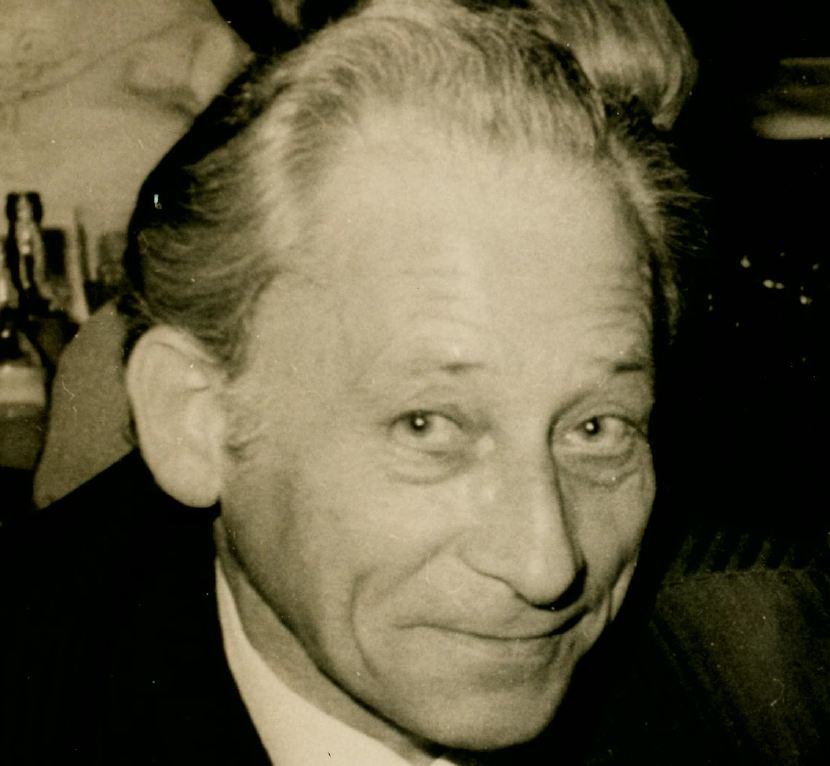
Walter Seligmann  Photo courtesy of Wolfgang Seligmann

Walter Seligmann Photo courtesy of Wolfgang Seligmann

As for Wolfgang’s uncle Herbert, he was sent by the local police to the army, but the army would not accept him.  He was dismissed and sent back to Bingen, where he was required to work in a warehouse until the war ended.

Herbert Seligmann courtesy of Christoph Seligmann

Herbert Seligmann courtesy of Christoph Seligmann

Julius Seligmann died in 1967, and his wife Magdalena died the following year.  Walter Seligmann died in 1993, and his brother Herbert died in 2001.
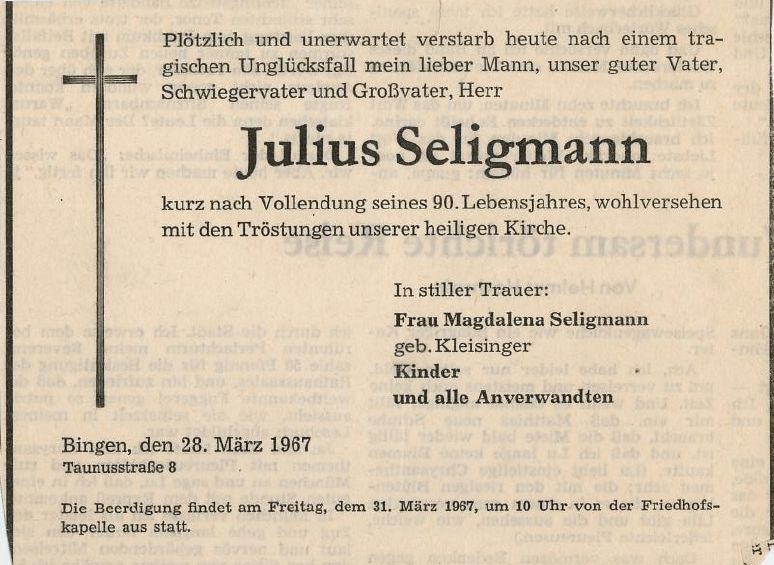
Julius Seligmann death notice

Julius Seligmann death notice

Magdalena Seligmann death notice

There are some very bitter ironies in these stories.  Julius and his family were not accepted by his Jewish family because they were Catholic, but the Nazis did not accept them either because they had Jewish roots.  As I commented to Wolfgang, prejudice of any sort is so destructive and unacceptable.  His family experienced it from two different directions.

Not that the two examples here can be equated in any way.  Although all prejudice is wrong, prejudice that leads to genocide is utterly reprehensible, an evil beyond comprehension for anyone who has a moral compass.  I have already written about my own personal horror and pain when I realized that I had family who had been murdered by the Nazis.  Wolfgang told me more about some of those who lost their lives to Hitler and his evil forces.

One victim was his great-uncle Moritz Seligmann (the grandson of Moritz Seligmann, my 3x-great-grandfather, and a son of August Seligmann).  My information about his fate comes from two websites that Wolfgang shared with me. According to these two sites, Moritz Seligmann, Julius’ younger brother, was born on June 25, 1881.  He fought in World War I for Germany, spent two years in captivity, and was honored with the Hindenburg Cross or Cross of Honor for his service.  Despite this, in the aftermath of Kristallnacht, on November 11, 1938, Moritz was arrested in Konigstein, where he had been living since 1925.  He was sent to the concentration camp at Buchenwald.

German Cross of Honour 1914-1918

German Cross of Honour 1914-1918 (Photo credit: Wikipedia)

Moritz wrote to the authorities in Konigstein, pointing out that he was the recipient of the Hindenburg Cross.  He was released from Buchenwald in December on the condition that he emigrate by March 31, 1939.  He was required to report to the police in Konigstein twice a week until then, and if he had not emigrated by the deadline, he was to be arrested.  On March 28, 1939, however, the Gestapo lifted the emigration order and the reporting requirement in light of Moritz’s service during World War I.

Here is a copy of the Gestapo letter, lifting the emigration order.  I found this a particularly chilling document to see.

Gestapo letter re Moritz Seligmann

Wolfgang helped me translate this letter as follows: Frankfort, March 20, 1939. Concerning: the “Aktionsjude” Moritz Seligmann born June 25, 1881, Gau-Algesheim, residing in Konigstein.  Seligmann has provided proof that he was a soldier in the World War as a combatant.  Therefore the reporting obligation and emigration order is lifted for him. I would ask the emigration (?) to supervise and notify us here.

As explained to me by Wolfgang and by Wikipedia,  the “Aktionsjude” referred to 26,000 Jews who were deported in the aftermath of Kristallnacht, as was Moritz Seligmann, as part of an effort to frighten other Jews to leave Germany.  Unfortunately, not enough of them did.

Despite the lifting of the order to emigrate, Moritz had hoped to immigrate to the US.  For various bureaucratic reasons described here, he was unable to get clearance to emigrate.  On June 10, 1942, he was picked up by the Nazis and transported somewhere to the east.  Exactly where and when he died is not known.

Wolfgang and his family, after researching the fate of Moritz, informed the town of Konigstein of their findings, and the town agreed to place a “stolperstein” in memory of Moritz Seligmann near his home in Konigstein.  A stolperstein (literally, a stumbling blog) is a memorial stone embedded in the ground to memorialize a victim of the Holocaust.  Here is a photograph of Wolfgang at the ceremony when Moritz Seligmann’s stolperstein was installed in Konigstein.

Wolfgang Seligmann

Wolfgang Seligmann  Courtesy of Wolfgang Seligmann

Behind him is a man who knew Moritz and remembered when Moritz was initially arrested in 1938, clinging to his Hindenburg Cross, believing it would save him from the murderous forces of the Nazis.  It may have stalled his murder, but it did not save him.

Wolfgang also told me about the fate of another sibling of his grandfather Julius, his younger sister Anna.  Anna, born in Gau-Algesheim in 1889, had married Hugo Goldmann, and they had a daughter Ruth, born in 1924 in Neunkirchen, a town about 80 miles southwest of Gau-Algesheim, where Anna and Hugo had settled. Between 1939 and 1940, many people from this area near the border with France were evacuated to locations in central Germany, and Anna, Hugo, and Ruth ended up in Halle, Germany, 350 miles to the northeast of Neunkirchen.  On June 1, 1942, they were all deported from Halle to the Sobibor concentration camp where they were all killed.  Click on each name to see the memorial pages established by the town of Halle in memory of Anna, Hugo, and Ruth.

Finally, Wolfgang told me about another member of the family.  Moritz Seligmann (the elder) had had a daughter Caroline with his first wife, Eva Schoenfeld.  Caroline was the half-sister of my great-great-grandfather Bernard. She had married a man named Siegfried Seligmann, perhaps a cousin.  Their son, Emil, died in Wiesbaden on August 9, 1942, when he was 78 years old.

Death record of Emil Seligmann, husband of Carolina Seligmann

Death record of Emil Seligmann, husband of Carolina Seligmann

(Wiesbaden: The Emil Jakob Israel Seligmann, without profession, “israelitisch”  [presumably meaning Jewish], living in Wiesbaden, Gothestraße Nr. 5, died on 9th of August 1942 in his Apartment. He  was born on 23th of December 1863 in Mainz.

Father: Siegfried Seligmann, deceased.  Mother: Karoline Seligmann, nee Seligmann, deceased.  He was widower of Anna Maria Angelika born as Illien. The death was announced by Emil Seligmann, his son, living Goethestraße Nr.5.

The stamp in the left hand margin says:  Wiesbaden, 31th of May 1949.  The “Zwangsvorname”Israel is deleted.  Zwangsvorname translates as “forced first name,” meaning that the name Israel had been required by the Nazis, I assume as a way to identify him as Jewish.

Emil had a son, also named Emil, who died in Buchenwald, as this record attests.

Emil Seligmann-KZ (1)

(To: Miss Christine Seligmann, Wiesbaden, Goethestr. Nr. 5,1

From: Special registry-office in Arolsen-Waldeck, department Buchenwald

Subject: death-certification for Emil-Jakob Seligmann, Your letter from the 1. of March 1950

Based on the documents of the International Tracing Service in Arolsen it is proved, that your brother died on 14th of February 1945 in the Concentration Camp Buchenwald. )

I imagine that this is not the end of the list of the Seligmanns who were murdered during the Holocaust, and I imagine that there are also many other family members I never knew about who were killed by the Nazis, whether they were named Schoenfeld, Nussbaum, Dreyfuss, Goldschlager, Rosenzweig, Cohen, or Brotman or something else.  I just haven’t found them yet.

Wolfgang and I plan to keep on exchanging stories, pictures, documents, and other information.  We have also already talked about meeting someday and walking in the footsteps of our mutual ancestors.  What an honor it will be to be with him as we share our family’s story.

Morton Tinslar Seligman:  A Heroic Career Ending in Accusations and Controversy, Part II

As I wrote last time, my cousin Morton Tinslar Seligman was a naval hero, both in wartime and in peacetime.  He served in World War I, clearing mines from the North Sea and earning a Navy Cross for his efforts.  He risked his life in an attempt to rescue two Navy pilots who were killed in a plane crash during peace time.  He again risked his life during the Battle of the Coral Sea in May, 1942, serving as executive officer of the USS Lexington and being among the last two to leave the ship when it was destroyed by the Japanese. For his efforts, he was again recognized by the Navy and was awarded a Gold Star in lieu of a second Navy Cross.

According to various reports, he also suffered severe injuries in the course of the Coral Sea battle as the Lexington exploded around him.[1]  Stanley Johnston, who would later play a critical role in the events that damaged Seligman’s career, was a reporter who had been aboard the Lexington with him during the battle.  According to an article in the Albuquerque Journal on June 18, 1942, Johnston had written in the Chicago Tribune that Commander Seligman had several times been “blown through open doors and out of scuttle holes like a cork out of a bottle.” (“Commander Morton Seligman of Santa Fe, Lexington Hero,” Albuquerque Journal (June 18, 1942), p. 1.)[2]

English: The Aircraft Carrier USS Lexington on...

English: The Aircraft Carrier USS Lexington on fire during the Battle of Coral Sea, Public domain photo from history.navy.mil (Photo credit: Wikipedia)

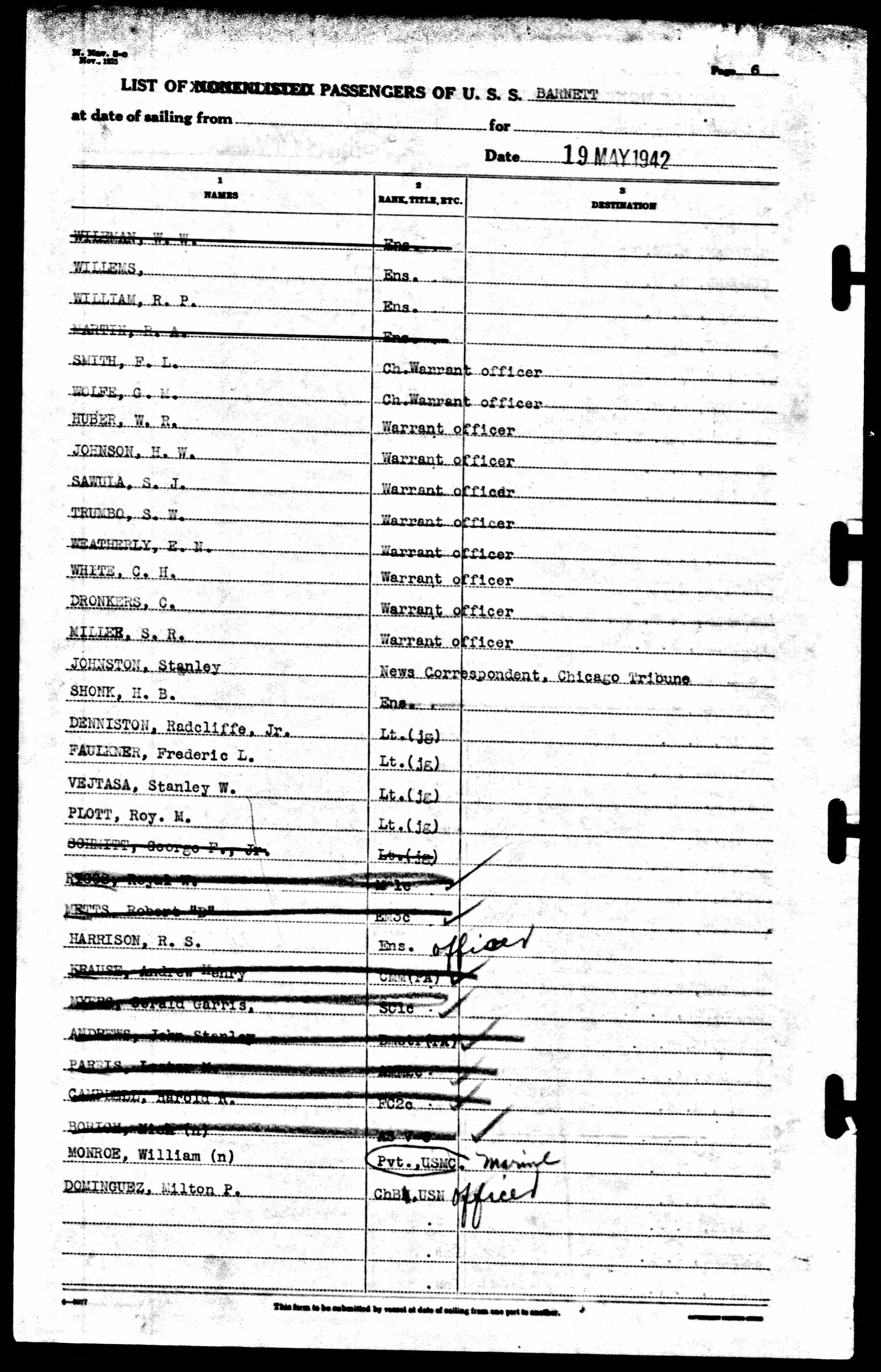
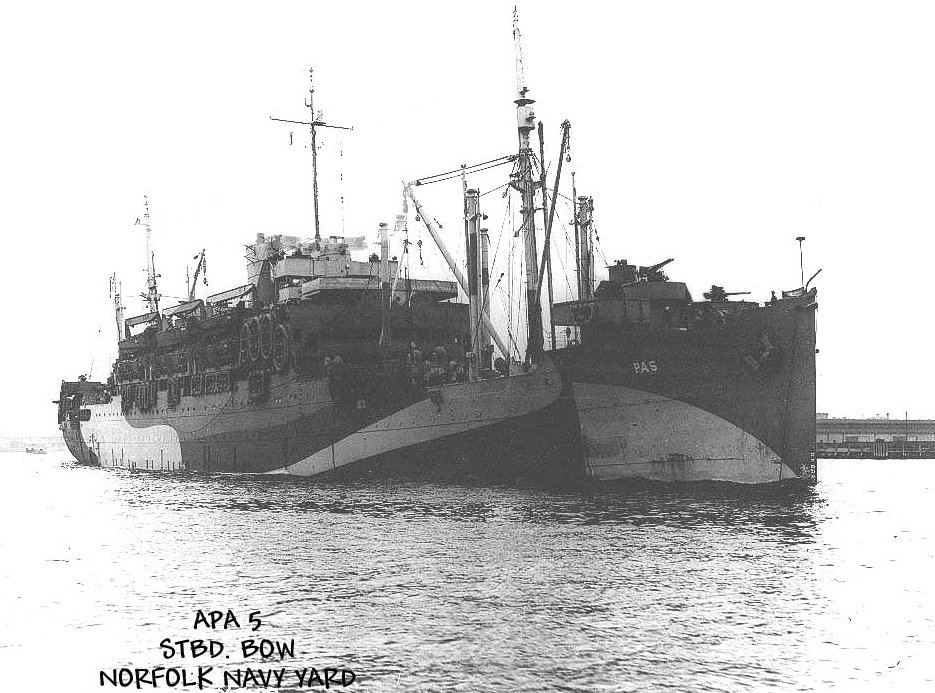
After the Lexington sank, Commander Seligman was assigned to two different ships.  First, he was on the USS Astoria as of May 13, 1942. [3]  As of May 16, 1942, he was assigned to the USS Barnett, [4] a ship that also carried the war correspondent for the Chicago Tribune Stanley Johnston, the same reporter who had described Commander Seligman’s heroism aboard the Lexington.[5]  These facts are not disputed and can be seen from the documents depicted below:

Morton Seligman on the USS Barnett National Archives at College Park; College Park, Maryland, United States; Muster Rolls of U.S. Navy Ships, Stations, and Other Naval Activities, 01/01/1939 - 01/01/1949; Record Group: 24, Records of the Bureau of Naval Personnel, 1798 - 2007; Series ARC ID: 594996; Series MLR Number: A1 135

Morton Seligman on the USS Barnett
National Archives at College Park; College Park, Maryland, United States; Muster Rolls of U.S. Navy Ships, Stations, and Other Naval Activities, 01/01/1939 – 01/01/1949; Record Group: 24, Records of the Bureau of Naval Personnel, 1798 – 2007; Series ARC ID: 594996; Series MLR Number: A1 135

Stanley Johnston on the USS Barnett

Stanley Johnston on the USS Barnett

At some point before June 7, Stanley Johnston obtained information revealing that the Navy had been able to decrypt Japanese code and learn the location of various Japanese ships.  Breaking the code had helped the US Navy during the Battle of the Coral Sea, but more importantly, would help during the Battle of Midway, which took place during the first week of June, 1942, one month after the Battle of the Coral Sea.

The Battle of Midway is considered to be one of the most significant battles of World War II and a turning point in the war against the Japanese.  According to the official Naval History and Heritage website, “The Battle of Midway, fought over and near the tiny U.S. mid-Pacific base at Midway atoll, represents the strategic high water mark of Japan’s Pacific Ocean war. Prior to this action, Japan possessed general navalsuperiority over the United States and could usually choose where and when to attack. After Midway, the two opposing fleets were essentially equals, and the United States soon took the offensive.”  One of the key factors leading to the United States’ success in this battle was the Navy’s ability to read Japanese coded communications and learn their strategy and ship locations.[6]


English: PACIFIC OCEAN (May 2, 2011) In commem...

English: PACIFIC OCEAN (May 2, 2011) In commemoration of the Battle of Midway, fought June 4-7, 1942. The U.S. Navy effectively destroyed Japan’s naval strength by sinking four of its aircraft carriers. It is considered one of the most important naval battles of World War II. Sailors assigned to the aircraft carrier USS Nimitz (CVN 68) created posters for a Battle of Midway Remembrance Dinner. (U.S. Navy photo illustration/Released) (Photo credit: Wikipedia)


After the Battle of Midway was successfully concluded, Stanley Johnston wrote a first page article for the Chicago Tribune, describing the victory and alluding, albeit somewhat indirectly, to the fact that the Navy had been able to break Japanese coded communications to learn the locations and identity of the Japanese ships.  The Navy and President Roosevelt himself were livid about the fact that the newspaper had revealed this government secret, and an investigation was conducted to bring a legal action based on the 1917 Espionage Act against Johnston, a Tribune editor, and the Tribune itself.  Just as the grand jury was to begin proceedings, however, the Navy decided that it did not want to pursue the matter if doing so would result in more disclosures that would jeopardize the war effort.  Without the critical testimony of Navy witnesses regarding the impact of the disclosure on the US war effort, the case before the grand jury was weakened, and ultimately the grand jury failed to issue an indictment against the Tribune or its employees.[7]

One key question raised during the investigation and afterwards by journalists and naval historians was the question of how Johnston had obtained the information about the Japanese ships and about the code-breaking in the first place.  Many concluded that Commander Seligman had been the source of the information. At least one writer suggested that Seligman had intentionally leaked the information to Johnston; others just concluded that Seligman, whether intentionally or not, had provided Johnston with access to the information.  Whatever their view of his state of mind, the majority of sources concluded that Seligman, whether directly or indirectly, was the key source of Johnston’s information about the code-breaking that revealed the names and locations of the Japanese ships. [8]

USS Barnett

USS Barnett

The most recent and most comprehensive and scholarly analysis of how Johnston obtained the information is in the 2014 article by two Ohio University professors, Michael Sweeney and Patrick Washburn, “ ‘Aint Justice Wonderful’– The Chicago Tribune’s Battle of Midway Story and the Government’s Attempt at an Espionage Act Indictment in 1942,” Journalism & Communication Monograph (2014).  I was very fortunate to be able to obtain a copy of this article from Professor Sweeney and will do my best to summarize their findings regarding Morton Seligman’s role in this matter.  I am not attempting to review all the writings on this issue, but the Sweeney and Patrick article itself summarizes much of the literature and cites to all the important sources, both primary and secondary, and I am largely relying on it though I have read some of the other sources as well.

First, some background: Stanley Johnston, the Tribune’s war correspondent, was “the only journalist at the Battle of the Coral Sea….No American journalist was at the crucial Battle of Midway in the following month.” Sweeney and Washburn, p. 18.  The Navy required any reporter in the war zone to be accredited, which included signing an agreement requiring the reporter to conform to the security regulations regarding what could and what could not be revealed to the public and what had to pass through Navy censors before publication.  Although Johnston did not sign such an agreement because he shipped out on the USS Lexington before he had a chance, no one disputes that he was aware of these restrictions and agreed to follow them. Ibid., p. 21.

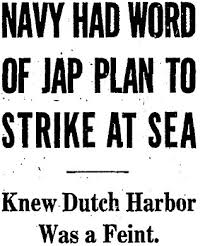
As stated above, Seligman was on the Barnett as of May 16, 1942, along with Johnston, and the ship arrived in San Diego on June 2, 1942.  A few days later Johnston was back in Chicago at the Tribune and was there to report on the Battle of Midway, which took place between June 4 and June 7, 1942.  Ibid., p. 22-26.  On June 6, Johnston wrote an article that identified which Japanese ships had been destroyed during the battle, information that was not publicly available according to the Navy, and known by no more than ten men in the Navy.  The Navy became immediately suspicious about Johnston’s knowledge of these facts.  In addition, the headline to the story (apparently written by someone other than Johnston) suggested that the Navy had obtained advance notice of the Japanese battle plans, saying “Navy Had Word of Jap Plan to Strike at Sea.”  The Navy also realized that the Tribune had not submitted the article to the Navy for clearance before publication. Ibid., 27-28.[9]

Chicago Trbune June 7, 1942

Chicago Tribune June 7, 1942

An internal investigation by the Navy led to the discovery that Johnston’s article was strikingly similar to a coded dispatch that Admiral Nimitz had sent to the Navy’s Pacific fleet outlining Japan’s plan to attack Midway and the list of Japanese ships that would be involved in that attack.  Ibid., p. 29.  On June 8, Johnston met with the Navy and was interrogated about his sources.  Johnston insisted that he had learned these facts while on the Lexington and the Barnett just by overhearing conversations among the crew. He denied ever seeing the Nimitz dispatch or any written list of Japanese ships.  After the first meeting, however, Johnston changed his story when he next was questioned by the Navy, claiming that he had found a writing with the list of Japanese ships and had copied it.  He explained why he had not initially admitted this by saying he had not wanted to get any of the brave servicemen aboard the ship into any trouble.  Ibid., pp. 33-34.

Meanwhile, the commanding officer of the Barnett, W.B. Phillips, reported to the Navy that one of the Lexington commanders on the ship told the Barnett’s communications officer that he had been authorized to show decoded messages to Johnston.  Phillips said the Lexington officers had thought that these disclosures were permissible since Johnston had been a witness to the Coral Sea battle and was already familiar with naval operations as a result.  Ibid., pp. 34-35.  The specific officer or officers were apparently not named by Phillips.

The Navy’s investigation was followed by an investigation by the Justice Department and the FBI, as directed by President Roosevelt.  Johnston was interviewed again, this time by William D. Mitchell, Attorney General under Hoover who was appointed by the Attorney General, Nicholas Biddle, to lead the prosecution of the case.  Johnston again insisted that he had obtained the information from conversations on board the ship.  Ibid., p. 45.  He downplayed the importance of the written list of ships that he had mentioned in his second interview with the Navy a month earlier.  Mitchell asked him to explain the striking similarity between his report and the Nimitz dispatch, and Johnston said he had no idea how that happened and denied seeing any secret dispatch.  Mitchell was unpersuaded and believed that Johnston must have seen the Nimitz dispatch.  Ibid., pp.  45-48.

William_D._Mitchell_cph.3b30394

William D. Mitchell, former US Attorney General

In a July 14, 1942 memorandum to the Attorney General and the Secretary of the Navy, Mitchell wrote that two officers, who remain unnamed, saw Commander Morton Seligman working at a table in the quarters he shared with Johnson, writing down a list of the Japanese ships.  The Mitchell memorandum then noted that Seligman stated that he did not remember making such a list, but that he might have done so.  Ibid., p. 48.  This is the first mention of Seligman in the Sweeney and Washburn article, and it suggests that Seligman was questioned by Mitchell sometime on or before July 14, 1942, but nothing more specific is provided in the text or in the footnotes about that interview or about the two unnamed officers.  Thus, by mid-July, Morton Seligman had become a key part of the government’s investigation.

In the third part of the story, I will address more specifically what Sweeney and Washburn found out about my cousin Morton Seligman’s role in this matter of state secrecy versus freedom of the press.


[1]    Michael S. Sweeney and Patrick S. Washburn, “Aint Justice Wonderful” The Chicago Tribune’s Battle of Midway Story and the Government’s Attempt at an Espionage Act Indictment in 1942”, Journalism & Communication Monograph“(2014), at 53-55;

[2] Other newspapers also carried the story.  E.g., “Morton Seligman Emerged as Hero of Last Hours of Lexington,” Clovis News-Journal, June 18, 1942, p.1.

[3] National Archives at College Park; College Park, Maryland, United States; Muster Rolls of U.S. Navy Ships, Stations, and Other Naval Activities, 01/01/1939 – 01/01/1949; Record Group: 24, Records of the Bureau of Naval Personnel, 1798 – 2007; Series ARC ID: 594996; Series MLR Number: A1 135

[4] Ancestry.com. U.S. World War II Navy Muster Rolls, 1938-1949 [database on-line]. Provo, UT, USA: Ancestry.com Operations Inc, 2011.

Original data: Muster Rolls of U.S. Navy Ships, Stations, and Other Naval Activities, 01/01/1939-01/01/1949; A-1 Entry 135, 10230 rolls, ARC ID: 594996. Records of the Bureau of Naval Personnel, Record Group Number 24. National Archives at College Park, College Park, MD.  National Archives at College Park; College Park, Maryland, United States; Muster Rolls of U.S. Navy Ships, Stations, and Other Naval Activities, 01/01/1939 – 01/01/1949; Record Group: 24, Records of the Bureau of Naval Personnel, 1798 – 2007; Series ARC ID: 594996; Series MLR Number: A1 135.

[5] National Archives at College Park; College Park, Maryland, United States; Muster Rolls of U.S. Navy Ships, Stations, and Other Naval Activities, 01/01/1939 – 01/01/1949; Record Group: 24, Records of the Bureau of Naval Personnel, 1798 – 2007; Series ARC ID: 594996; Series MLR Number: A1 135.  One source claims that Johnston had even been with Seligman aboard the Lexington and assisting him during those last critical moments before the ship sank in the Coral Sea. “Editorial: The Battle of Midway—A Secrets Storm,” Chicago Tribune, August 11, 2013, at http://articles.chicagotribune.com/2013-08-11/opinion/ct-edit-midway-20130811_1_tribune-tower-secrets-u-s-navy ;

[6] “Battle of Midway, 4-7 June 1942: Overview and Special Image Selection,” at http://www.history.navy.mil/photos/events/wwii-pac/midway/midway.htm ; Battle of Midway from Wikipedia at http://en.wikipedia.org/wiki/Battle_of_Midway .  See also  “Midway:  The Story that Never Ends,” by Thomas B. Allen (June 2007) at http://www.usni.org/magazines/proceedings/2007-06/midway-story-never-ends

[7]  Michael S. Sweeney and Patrick S. Washburn, “Aint Justice Wonderful” The Chicago Tribune’s Battle of Midway Story and the Government’s Attempt at an Espionage Act Indictment in 1942”, Journalism & Communication Monograph“(2014), at 65-71.  See also “Midway:  The Story that Never Ends,” by Thomas B. Allen (June 2007) at http://www.usni.org/magazines/proceedings/2007-06/midway-story-never-ends (“fearing disclosure of code-breaking secrets in an espionage trial, the Department of Justice quietly closed the case.”).   Allen also wrote that the impact of disclosing this information was substantial:  “Pearl Harbor code breakers believed that the damage had already been done. A key code, Japanese Fleet General-Purpose System, was changed on 15 August, only two months after an earlier change. Other alterations were made in “virtually all Japanese codes and ciphers,” and it took cryptanalysts nearly four months of around-the-clock work to crack the new version and once again penetrate the Japanese navy’s operational radio traffic.” Ibid., citing and quoting from Edwin T. Layton, USN (Ret.), with Captain Roger Pineau, USNR (Ret.), and John Costello, And I Was There: Pearl Harbor and Midway—Breaking the Secrets (New York: William Morrow and Co., 1985), p. 453.


Much has been written about the aftermath of the Tribune’s publication of Johnston’s article and the reporting of government secrets.  In fact, the issue has taken on new relevance in recent times after Edward Snowden’s disclosures of the NSA’s surveillance activities and the publication of those disclosures by the press.  It is far beyond the scope of this blog to try and describe that aspect of the matter; my focus is on the alleged role that my cousin Morton Seligman had in the matter and its effect on him and his career.  For an excellent analysis of the other issues as raised by the case, see Sweeney and Washburn, op. cit.

[8] See, e.g., Carey Shenkman, “70 Years Later, Still Playing Politics with the Freedom of the Press, June 18, 2014, at   http://www.huffingtonpost.com/carey-shenkman/freedom-of-the-press_b_5503196.html ; “Editorial: The Battle of Midway—A Secrets Storm,” Chicago Tribune, August 11, 2013 at  http://articles.chicagotribune.com/2013-08-11/opinion/ct-edit-midway-20130811_1_tribune-tower-secrets-u-s-navy ; Grant Sanger, MD, “Freedom of the Press or Treason?,” Proceedings Magazine, September, 1977 at   http://www.usni.org/magazines/proceedings/1977-09/freedom-press-or-treason ; “Midway:  The Story that Never Ends,” by Thomas B. Allen (June 2007) at http://www.usni.org/magazines/proceedings/2007-06/midway-story-never-ends ; “Stemming the Tide of Japanese Expansion,” at http://www.microworks.net/pacific/intelligence/stemming_tide.htm .  The author with the harshest view of Seligman is Capt. Lawrence B. Brennan, U.S. Navy (Ret’d), whose anger undermines any sense of objectivity to his conclusions.  Brennan, “Spilling the Secret—Morton T. Seligman, U.S. Navy (Retired), U.S. Naval Academy Class of 1919,” Naval Historical Foundation, February 28, 2013, at http://www.navyhistory.org/2013/02/spilling-the-secret-captain-morton-seligman/#fn-9595-2 .  The most recent scholarship on this issue is found in the 2014 monograph of Professors Michael Sweeny and Patrick Washburn, cited and discussed above in note 7 and in the text.

[9] The failure to submit the story for clearance was an important element in the investigation and case against the Tribune, but is beyond the scope of my interest here.  For more on that, I recommend reading the full article by Sweeney and Washburn.

Morton Tinslar Seligman:  Naval Hero, Part I

Midshipman Morton Tinslar Seligman c. 1918  Courtesy of Arthur Scott

Midshipman Morton Tinslar Seligman c. 1918
Courtesy of Arthur Scott

The story of Morton Tinslar Seligman is a fascinating one.  Morton, the son of James Leon and Ruth Seligman and my first cousin twice removed, was a decorated Navy hero in World War I and in World War II, but his name is also clouded by accusations that he leaked important classified information to a member of the press after the Battle of the Coral Sea during World War II.

Morton was born on July 1, 1895, in Salt Lake City, but grew up in Santa Fe, attended the University of New Mexico and then the US Naval Academy, from which he graduated in June, 1918, as described earlier.  After he graduated from Annapolis, he was commissioned as an ensign and was assigned to the U.S.S. Manchuria transport service.  By July, 1918, he was overseas engaged in submarine patrol off the coast of England and France.  After the war ended, he was promoted to lieutenant j.g., and from December, 1918, until October, 1919, he was engaged in an operation to clear the North Sea of mines.  He returned to New York in November, 1919, having overseen twenty subchasers in his command. Of those twenty, one was lost at sea due to explosions and fire, one was damaged so severely that it was not safe to sail it back to the US, and one was damaged but did eventually return.  No crew members were lost as a result of these damages, and his mission was completed successfully.

Morton Seligman WW 1 service history page 1

Morton Seligman WW1 service history

New Mexico Commission of Public Records, State Records Center and Archives; Santa Fe, New Mexico; Series Title: Service Reports; Series Number: 18.1.6; Box Number: 10899; Collection Name: New Mexico Adjutant General Records; Collection Number: 1973-019

For his service, Morton was awarded the Navy Cross for distinguished service.  (“Servicemen Cheer Hero at Canteen,” San Francisco Chronicle, August 21, 1943, p. 18)  His commendation read:

The President of the United States of America takes pleasure in presenting the Navy Cross to Lieutenant, Junior Grade Morton Tinslar Seligman (NSN: 0-34590), United States Navy, for exceptionally meritorious and distinguished service in the line of his profession as Commanding Officer of the U.S.S. C-272, engaged in the important and hazardous duty of sweeping for and removing the mines of the North Sea Barrage during World War I.

http://projects.militarytimes.com/citations-medals-awards/recipient.php?recipientid=10339

I am not sure where Morton was stationed once he returned to the US, but as of August 19, 1925, he was stationed in Honolulu as part of the aviation corps, according to a wedding announcement in the San Francisco Chronicle.  On that date, Morton married Eleanor Reynolds, the daughter of Ziba Wells Reynolds, who had been a pay director in the Navy; her brother Lieutenant Stewart Reynolds was also serving in the Navy.  The article, reprinted below with a photograph of the bride, reported that Morton was assigned to Honolulu for the next three years.  (Another article stated that his Honolulu assignment was for two years, and that appears to have been more accurate.  “Sail from San Pedro,” San Francisco Chronicle, September 2, 1925, p. 14)

Morton Seligman marriage article 8 19 25

San Francisco Chronicle, August 10, 1925, page 14

On August 29, 1925, Morton and Eleanor sailed out of Los Angeles to Hawaii on the SS Calawaii, arriving in Honolulu on September 5, 1925. (National Archives and Records Administration (NARA); Washington, D.C.; Passenger Lists of Vessels Arriving at Honolulu, Hawaii, compiled 02/13/1900 – 12/30/1953; National Archives Microfilm Publication: A3422; Roll: 083; Record Group Title: Records of the Immigration and Naturalization Service, 1787 – 2004; Record Group Number: RG 85)

Two years later they returned to California on the SS City of Honolulu, departing June 18, 1927, for Wilmington, California, where Morton was assigned to V.F. Squadron 6, a fighter squadron, part of the US Navy Battle Fleet. (Ancestry.com. U.S., Military Registers, 1862-1985[database on-line]. Provo, UT, USA: Ancestry.com Operations, Inc., 2013.)

Although he is listed as residing in San Diego in the 1929 San Diego city directory, he must have been reassigned during that year to Washington, DC, with the Bureau of Aeronautics. (“Mrs. Seligman Leaves for Washington, D.C.,” San Diego Union, September 23, 1929.)

It seems that the marriage did not survive long thereafter because by April 3, 1930, the date of the 1930 census, Morton was divorced, and he was living with a fellow Navy aviator in Washington, DC.  He was still with the Bureau of Aeronautics in 1931, according to the Washington city directory of that year, although he was temporarily attached to the US Marine Corps as part of a special assignment to transport aircraft to Port au Prince, Haiti, in October, 1931. ( Ancestry.com. U.S. Marine Corps Muster Rolls, 1798-1958 [database on-line]. Provo, UT, USA: Ancestry.com Operations Inc, 2007.)  He returned from Haiti on November 2, 1931, giving the Wardman Park Hotel in Washington as his address. (Year: 1931; Arrival: New York, New York; Microfilm Serial: T715, 1897-1957; Microfilm Roll: Roll 5067; Line: 7; Page Number: 64.)

Lt. Morton Seligman c. 1932  Courtesy of Arthur Scott

Lt. Morton Seligman c. 1932
Courtesy of Arthur Scott

By 1933, Morton was living in San Diego and was remarried to a woman named Adela.  I cannot find a marriage record or any other document that reveals Adela’s birth name, but she is listed with him as his wife on the 1933 San Diego city directory. He was now a Lieutenant Commander with the VF-1-B squadron, according to the U.S. Military Register for the year.  He and Adela were still living in San Diego as of 1939, according to that year’s directory, and Morton was still serving in the US Navy. According to the US Military Register for 1939, Morton was now a commander at the Naval Air Station in San Diego.  The 1940 census also has Morton and Adela living in San Diego, Morton’s occupation still as a naval aviator. By this time, Morton was 44, Adela was 41.   Morton had been serving in the Navy for over 20 years.  (Ancestry.com. U.S. Marine Corps Muster Rolls, 1798-1958 [database on-line]. Provo, UT, USA: Ancestry.com Operations Inc, 2007.)

In October, 1941, Morton risked his life in an unsuccessful attempt to rescue two naval aviators who died when their plane crashed into the bay off the coast of San Diego.  According to the San Diego Union:

“Comdr. Morton T. Seligman, Naval Air station executive officer, made a dramatic attempt to rescue the fliers a few minutes after the crash.  Speeding to the scene of the accident in a crash boat, Cmdr. Seligman discovered that no one aboard was a diver.  Despite the fact that he had never donned a diving helmet in his entire navy career, the officer put on the helmet and diving suit, instructed the crew of the crash boat how to operate the air pumps and then dived overboard. 

“In 25 feet of water, Cmdr. Seligman discovered the bodies of the airmen in the smashed plane.  In trying to extricate them, Cmdr. Seligman suffered severe cuts on his left hand from jagged pieces of metal and wood.”  (“Two Fliers Die As Navy Plane Falls Into Bay,” San Diego Union, October 5, 1941, p. 1)

Two months later, the US would enter World War II after the bombing of Pearl Harbor on December 7, 1941, a place where Morton had once served.  Not long after, Morton was an officer on the USS Lexington, which was destroyed during the Battle of the Coral Sea, which took place from May 4 through May 8, 1942.  The battle was described as follows on the official US Navy website Naval History and Heritage Command:  http://www.history.navy.mil/photos/events/wwii-pac/coralsea/coralsea.htm


“The Battle of the Coral Sea, fought in the waters southwest of the Solomon Islands and eastward from New Guinea, was the first of the Pacific War's six fights between opposing aircraft carrier forces. Though the Japanese could rightly claim a tactical victory on "points", it was an operational and strategic defeat for them, the first major check on the great offensive they had begun five months earlier at Pearl Harbor. The diversion of Japanese resources represented by the Coral Sea battle would also have immense consequences a month later, at the Battle of Midway.  ….. 

“Preliminary operations on 3-6 May and two days of active carrier combat on 7-8 May cost the United States one aircraft carrier, a destroyer and one of its very valuable fleet oilers, plus damage to the second carrier. However, the Japanese were forced to cancel their Port Moresby seaborne invasion. In the fighting, they lost a light carrier, a destroyer and some smaller ships. Shokaku received serious bomb damage and Zuikaku’s air group was badly depleted. Most importantly, those two carriers were eliminated from the upcoming Midway operation, contributing by their absence to that terrible Japanese defeat.”

English: Battle of the Coral Sea

English: Battle of the Coral Sea (Photo credit: Wikipedia)

The website also notes that “The U.S. Navy [was] tipped off to the enemy plans by superior communications intelligence” that helped them in their fight against the Japanese in this battle.

As for Morton’s role, a US Navy Cruise Book described the battle and the USS Lexington’s role in that battle in great detail.  According to this source, on the morning of May 7, 1942, the aircraft carrier was hit by five torpedoes and numerous bombs.  Although seriously damaged, the ship did not sink, and by 1 pm it was on even keel and only had one fire burning.  Then another major explosion occurred, caused by gasoline vapors igniting below the deck.  Several fires started, and by 5 pm the commanding office of the ship, Admiral Fitch, ordered the crew to abandon ship.  After the admiral and the crew had left, “Captain Sherman and his Executive Office, Commander Morton T. Seligman made a final inspection of their vessel amid flying debris, smoke and flames.  They then slid down a line, with the commanding officer being the last to leave—just as the torpedo head locker exploded, shaking both from the line and into the sea.  All but 26 officers and 190 men were rescued (including seven brothers aboard named Patten), and it is thought that none of these casualties occurred by drowning after abandoning ship.”

(Ancestry.com. U.S. Navy Cruise Books, 1918-2009 [database on-line]. Provo, UT, USA: Ancestry.com Operations, Inc, 2011. Original data: United States Navy. Various U.S. Navy Cruise Books. Navy Department Library, Washington, D.C.)

English: USS Lexington (CV-2), burning and sin...

English: USS Lexington (CV-2), burning and sinking after her crew abandoned ship during the Battle of Coral Sea, 8 May 1942. Note planes parked aft, where fires have not yet reached. Removed caption read: Photo # NH 51382 USS Lexington burning during the Battle of Coral Sea, May 1942 (Photo credit: Wikipedia)

For his service and heroism aboard the Lexington, Seligman was awarded a Gold Star in lieu of a second Navy Cross.  His citation read:

The President of the United States of America takes pleasure in presenting a Gold Star in lieu of a Second Award of the Navy Cross to Commander Morton Tinslar Seligman (NSN: 0-34590), United States Navy, for extraordinary heroism and distinguished service in the line of this profession as Executive Officer of the Aircraft Carrier U.S.S. LEXINGTON (CV-2), in action on 7 and 8 May 1942, during the Battle of the Coral Sea. During and after that battle Commander Morton directed the damage control and fire fighting parties, inspecting and visiting all critical parts of the ship. He personally assisted in removing all the wounded in many places. His distinguished leadership and timely decisions contributed greatly to the success of our forces and was largely responsible for the small loss of life that occurred when the ship was abandoned. Commander Seligman’s conduct throughout was in keeping with the highest traditions of the Navy of the United States.

http://projects.militarytimes.com/citations-medals-awards/recipient.php?recipientid=10339

Navy Cross

Navy Cross

A month later, Morton Seligman would be caught up in a controversy involving another major Pacific battle, the Battle of Midway.  More on that in Part II.

Arthur Lewis Wilde Cohen 1890-1955: Family Lore and The Tricks of Memory

Arthur Lewis Wilde Cohen, Sr.

Arthur Lewis Wilde Cohen, Sr.


When I first started researching my Cohen relatives about a year and a half ago, I was very fortunate to find one branch on that tree already recorded on ancestry.com by one of the direct descendants of Reuben Cohen, my great-granduncle.  The tree was created by the grandchild of Reuben and Sallie’s son Arthur Lewis Wilde Cohen.  I contacted the tree’s owner, and we exchanged a series of emails that established our family connection and that provided me with some wonderful background on Arthur Lewis Wilde’s children and grandchildren as well as some photographs.  This newly found third cousin of mine, Jim, was very helpful when it came to his father’s generation, but said he knew very little about the lives of his grandfather Arthur Lewis Wilde Cohen, Sr.,or his great-grandfather Reuben.

I filed away all the information and the photos my new cousin Jim shared with me, and then began to focus on my Brotman relatives, putting the Cohen research to the side for many months.  When I returned to the Cohens this spring, I dug up the information I’d gotten from Jim. In researching more deeply into the life of Arthur Lewis Wilde Cohen and his family, I experienced what all family researchers experience—that although family stories can almost always be very helpful in providing clues and richness to family history, you have to take into account that details often get blurry as stories are passed down from one generation to the next and that some facts are lost along the way. It took me some doing to untangle the family stories and find the facts, but with more research and more email conversations with Jim, I think I can now piece together the life of Arthur Lewis Wilde Cohen and his family.

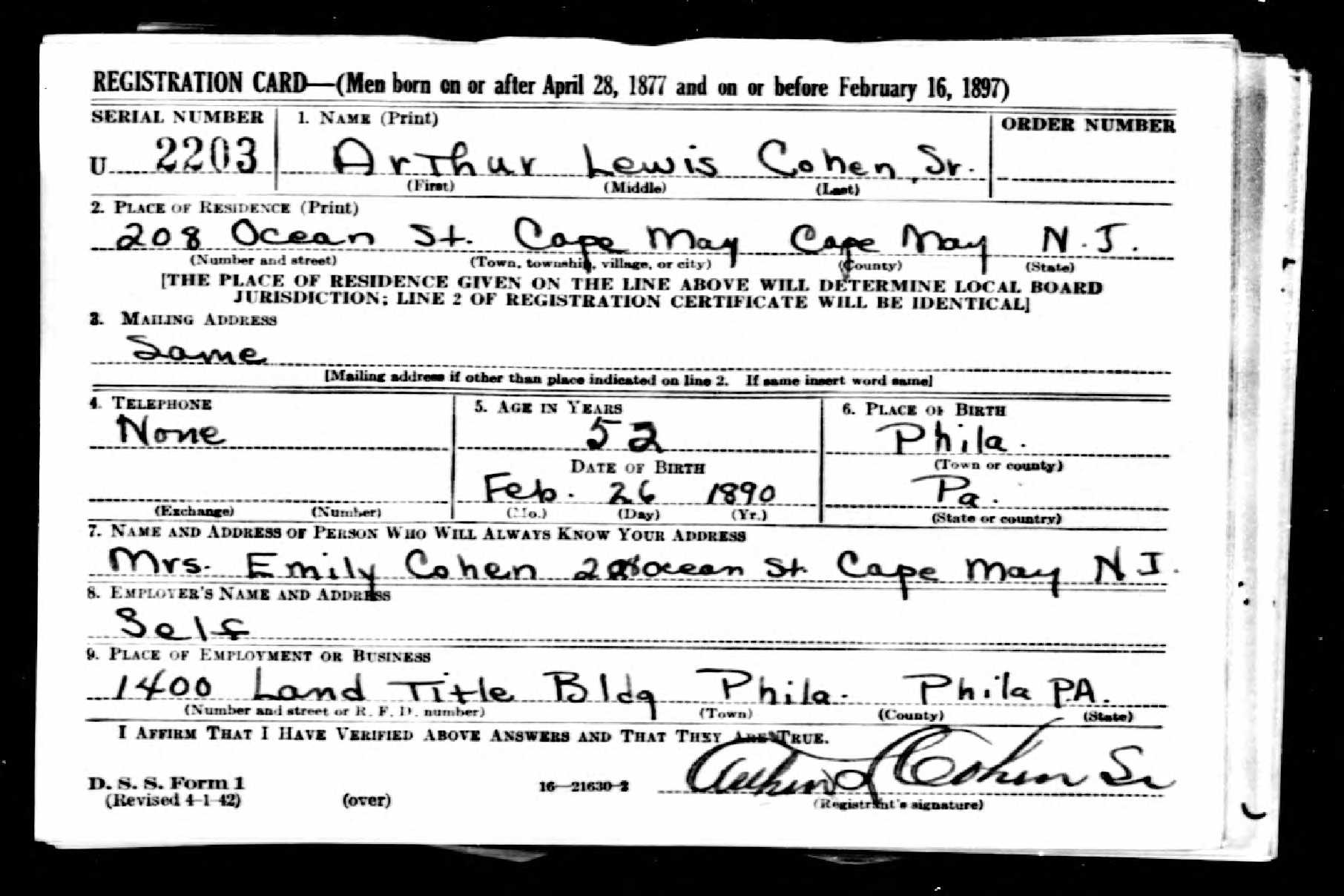
Number eleven out of seventeen, Arthur Lewis Wilde was born on February 26, 1890.  In 1910, he was a clerk in a “brokerage.”  At first I thought this referred to the pawnbroker business, but since his two brothers Reuben, Jr. and Lewis II, were listed as clerks in a loan office, not a brokerage, I was not sure.  Apparently he was an insurance broker, as I found out from his draft registrations.

In December 1915, when he was 25, Arthur became engaged to Gertrude Fanny Bowman of Richmond, Virginia, and they were married on March 27, 1916, in Richmond.

arthur engagement

(“Will Hold Reception December 26,” Date: Sunday, December 19, 1915 Paper: Philadelphia Inquirer (Philadelphia, PA) Volume: 173 Issue: 172 Section: News Page: 5)

According to his 1917 World War I draft registration, Arthur was self-employed as an insurance broker, and he and his wife Gertrude were living in Philadelphia at 2250 North 20th Street.

Arthur LW Cohen, Sr. World War I draft registration

Arthur LW Cohen, Sr. World War I draft registration


Arthur enlisted in the Navy in April, 1918, and was honorably discharged in December, 1920.  By 1920, however, Gertrude was back in Richmond, living with her sister and identifying as single and working as a stenographer.

Gertrude Fanny Bowman 1920 census

Gertrude Fanny Bowman 1920 census

I cannot find Arthur on the 1920 census as he was serving in the military and perhaps overseas, but presumably the marriage with Gertrude was over.  Gertrude apparently never remarried and died in 1963 in Richmond.

Emilie Wiley Cohen

Emilie WIley Cohen

By 1930 Arthur had married a woman named Emilie Wiley, who had also been previously married.  Emilie had married Frank G. Brown in 1905 and had had two daughters with him, Dorothy, born in 1906, and Jean or Jenette, born in 1908.  Emilie also was divorced or separated by 1920, and sometime after the 1920 census she married Arthur LW Cohen.  They had two children, Arthur, Jr., and Emilie, who were 8 and almost 5, respectively, at the time of the 1930 census.

Living with Arthur and Emilie in 1930 in Philadelphia, in addition to their two own children Arthur, Jr. and Emilie,  were Emilie’s mother, aged 81, Emilie’s daughter Jean Harral, and Jean’s son Richard Harral, Jr.  Emilie’s older daughter, Dorothy (or Dot, according to my cousin) had married Leroy Lewis in 1928 in Norristown, Pennsylvania, and was living out that way in 1930.  She and Leroy had one daughter, and Dot lived in Norristown until her death in 1992.

Jean had also married sometime before 1927 when Richard Harral, Jr. was born.  Although she still listed her status as married in 1930, she was apparently no longer living with Richard Harral, Sr., who eventually remarried and lived in Upper Darby, Pennsylvania for the rest of his life with his second wife and their two children.

Sometime after 1930, Arthur and Emilie moved permanently to Cape May, New Jersey, where they lived in the house at 208 Ocean Street that had been in Arthur’s family for many years as the summer home of Reuben and Sallie and their children when Arthur was growing up.  Although I cannot find Arthur on the 1940 census, according to his World War II draft registration, he was still living at 208 Ocean Street in 1942 and was self-employed, working at the Land Title Building in Philadelphia.

ALWC ww2 reg

Arthur Sr’s grandson Jim believed that his grandfather had been a jeweler, but I cannot find any evidence of that in the records as it appears that at least up until 1942, Arthur Sr. was still working in the insurance business in Philadelphia. What Jim did share with me was that his grandfather was well-respected and loved by many people.  He was a very humble and generous man who never wanted recognition for his generosity.

Arthur, Sr, was also someone who fought off death several times.  According to Jim, “He was erroneously pronounced dead four separate times (shades of Simon), all as a result of heart attacks. According to stories told by my father and aunt, on one of the occasions he woke as an orderly was wheeling him to the morgue. When he did, the orderly fainted.  The fifth and final pronouncement was also from heart attack he suffered in the family home on Ocean St. This time, it was permanent.”

He died in 1955 at age 65 and was buried at Presbyterian Cemetery in Cold Spring, New Jersey, less than four miles from the family home at 208 Ocean Street.

His widow Emilie applied for a military headstone for Arthur and requested a Christian, not a Hebrew, symbol to be placed on that headstone.  Although his mother Sallie may not have been Jewish, as noted earlier, Arthur had been confirmed in Mickve Israel Synagogue in Philadelphia when he was fifteen years old.  Then again, his father Reuben had made a donation to the Episcopal Church in Cape May.  I asked Jim about the family’s religious affiliation, and he told me that he was not sure whether his grandmother Emilie was born Jewish, but that both of his grandparents practiced Christianity after they were married. Despite this, Jim said that his father, Arthur LW Cohen, Jr., was Jewish and Jim himself is Jewish.  As Jim described his parents’ approach, I was amazed by how inclusive his parents were in their approach, letting each of their children find a path that worked for them, each parent maintaining their own chosen path but also sharing in and respecting the other’s chosen path.   Apparently his grandparents had done the same.

Arthur L W Cohen, Sr. Military Headstone application

Arthur L W Cohen, Sr.
Military Headstone application

Jim was able to tell me a great deal about Arthur and Emilie’s children, Arthur, Jr., and his sister Emilie.  With his permission, I am quoting directly from his messages to me about his parents:

My father, Arthur, Jr. (“Bud”), was also a jeweler. After he came home from World War II, he opened a repair and retail jewelry store on the first floor of the family home at 208 Ocean St. in Cape May, NJ. It remained open for the next 48 years until his death in 1991.

Arthur Lewis Wilde Cohen, Jr.

Arthur Lewis Wilde Cohen, Jr.

He was very active in the Cape May community and loved the city dearly. He was president of the Mall Merchant’s Association for over 20 years, was instrumental in having the entire city declared a National Historic Landmark (it’s one of the few full towns registered as such) for its standing Victorian-era homes and history; and if there was any event – from silly pet parades to building dedications, Memorial Day ceremonies, Easter, Halloween, Christmas parades, and so on, you name it – he was always the Master of Ceremonies. He had a fatal heart attack in the early-morning hours of February 18, 1991.

My mother, Martha, was a music teacher and opera Soprano who attended the Juilliard School of Music. She retired from her opera career almost as soon as it started so that she could marry my father. She became a music teacher and sang at many events and functions. The Goodyear family always contacted her to sing at their family events – mainly weddings and funerals (which always amused me). She died in 2005 following a series of strokes.

He also told me this about his Aunt Emilie:

Aunt Emily Marion Cohen-Brown (who went by “Marion” or, as a nickname I’ve never understood, “Mitchell”), was a first-class florist and lived here in Cape May until her death from cancer in 2003. She had one son, Gary, who lived in Oregon and made unbelievable fudge. I know he had a wife and kids, but we’ve lost contact. He predeceased her, also from cancer. I never met her husband, Harry, who died before I was born. She made the absolute best Navy bean soup you could ever taste, and I wish I had the recipe.

Although not a genetic relative of the Cohens, the story of Arthur Sr.’s stepdaughter Jean Harral and her son Richard is part of the family lore of Arthur Lewis Wilde Cohen and his descendants, so I will share it here.  Richard was mentally disabled, and at some point he and his mother Jean moved to New York City together.  Richard was working as a messenger for a company in New York, and his favorite pastime was sailing a model sailboat on the pond in Central Park.  In November, 1975, he was stabbed to death, apparently by a friend.  I could find no record of a trial or further development in the case aside from these few news articles from the New York Times.

Richard Harral murder part 1-page-001


Richard Harral murder-page-001

In December, 1975, just a month after Richard’s murder, his mother Jean died; accordingly to family lore, she starved herself to death out of grief over the death of her son.

I am deeply indebted to my cousin Jim for sharing his family’s stories with me as well as the photographs posted here.  There is nothing more meaningful for me in doing this project than hearing about my long-lost relatives from those who knew them best.


The Surviving Children of Reuben and Sallie Cohen, Part I: Minnie, Rae, Reuben, Jr., Lewis and Violet Mae

As I wrote last week, Reuben and Sallie Cohen had seventeen children, but ten of them predeceased their parents. Eight of the children died before they were four years old of various illnesses or, in the case of one child, as a result of a horrific accident.  Two of the children survived to adulthood, but then succumbed to illnesses in the early years of their adult lives.

That meant that Reuben and Sallie had only seven of their seventeen children alive when they died.  All but one of those children lived relatively full lives, living at least into their sixties if not beyond.  I will try and capture those lives, going in birth order.

The fourth child born after Sallie R., Jacob, and Hart, all of whom had died before their parents, was Minnie.  Minnie was born on September 25, 1882, and lived with her family in Philadelphia and Cape May.  On August 5, 1900, the Philadelphia Inquirer made this comment about Minnie in an article about summer visitors to Cape May:  “Miss Minnie Cohen is one of the prettiest girls at the resort.  Her bathing costume is always the picture of neatness.”  (“Cape May’s August Days,” Sunday, August 5, 1900, Philadelphia Inquirer (Philadelphia, PA)   Volume: 143   Issue: 36)

It was not until eighteen years later when she was almost 36 that Minnie married Harry Frechie in February, 1918.  The Philadelphia Inquirer had this to say about her wedding:

Minnie wedding

(“Matrimony Notice,” Friday, February 15, 1918, Philadelphia Inquirer (Philadelphia, PA)   Volume: 178   Issue: 46   Page: 10)  Mrs. S. Rosenblatt was her sister Rae, discussed below.  Violet Mae was her youngest sister, also discussed below.

Minnie and Harry were married for many years, but did not have any children. Like his father-in-law and many other family members, Harry was a pawnbroker. They appear to have traveled quite a bit, including a Caribbean cruise in 1939.  I have not yet been able to find a death record for Harry, but the 1950 Philadelphia city directory has a listing for Mrs. Harry Frechie alone, suggesting that Harry may have died sometime between the 1940 census and 1950. I also could not find a World War II draft registration for Harry, which could suggest he died before 1942.

UPDATE: With the release of the Pennsylvania death certificates through 1944, I am now able to update this post and the information regarding Harry Frechie.  Harry did die before 1942; he died on September 27, 1940.  No cause of death was given as there was a pending coroner’s inquest.  I will have to see if I can learn more about that.

Harry Frechie death certificate 1940

Harry Frechie death certificate 1940

At any rate, Minnie appears to have lived a life without much controversy as I cannot find any newspaper references to either Harry or Minnie aside from the wedding notice.  Minnie died in Philadelphia in 1977 when she was 95 years old.

Minnie’s sister and matron of honor, Rae, was the next child who survived.  She was born in 1886.  Rae married Samuel Rosenblatt in 1910.[1]  Sam was in the business of dress manufacturing according to the 1920 census, more specifically children’s dresses according to both the 1930 and 1940 census reports. They had one son, Samuel Rosenblatt, Jr., born in 1913, who died in July, 1933.  I have not found anything yet to explain why Samuel, Jr., died at such a young age.  The Philadelphia death certificates through 1944 are supposed to be online soon, so I am hoping to find out eventually what happened to Rae and Samuel’s only child.  Rae died in 1959 at age 73.  Her husband Samuel died in 1973.

UPDATE:  As noted above, I now have access to the Pennsylvania death certificates through 1944, including that of Samuel Rosenblatt, Jr.  Sadly, Samuel died from leukemia.

Samuel Rosenblatt, Jr. death certificate 1933

Samuel Rosenblatt, Jr. death certificate 1933


The next child of Sallie and Reuben Cohen to survive his parents was Reuben Cohen, Jr., born November 5, 1888.  Although at age 21 he was working as a clerk in a loan office according to the 1910 census, he appears not to have stayed in the pawnbroker business for his entire career.  In 1914, he married Leona Mayer, and according to the 1915 Philadelphia directory, he was a notary public by occupation at that time.  I don’t know how that would be a full time occupation, so perhaps he was still working in the “loan office” at that time as well.  In fact, on his World War I draft registration he listed his employer as his father, Reuben Cohen, Sr., so he must have still been working the pawnshop at that time.  In 1920, his occupation on the census is described as manager of a brokerage house, presumably a pawn brokerage, not a stock brokerage.  But in 1930 Reuben’s occupation was listed as a textile designer, and then in 1940 he is described as a salesman in textile manufacturing.  On his 1942 World War II draft registration, he listed his employment as “own business.”  Thus, it appears that Reuben, Jr., went out on his own and left the Cohen family pawnbroker business.

Reuben, Jr., and Leona had one child, Elinor Cohen, born in April, 1915, who married Melvin Beard.  I am now trying to contact their descendants.  Reuben Cohen, Jr. died January 28, 1958, when he was 69 years old.  His wife Leona died in 1970 at age 78.  Their daughter Elinor died thirteen years ago in 2001.

Reuben Jr.’s younger brother Arthur was the next sibling to survive their parents, but I am going to defer telling his story until I get a little more information from one of his descendants.

Of the seven surviving children, the one I have had the hardest time tracking is Lewis Cohen, who was born in September, 1892, the thirteenth child of Reuben and Sallie.  According to his World War I draft registration in 1917, he suffered from “nervous trouble.”

Lewis Cohen World War I draft registration

Lewis Cohen World War I draft registration


He was working as a real estate broker, and I was able to find a number of his real estate broker’s advertisements in the Philadelphia Inquirer as well as a news story about a large real estate transaction he brokered for a client in 1922.  On the 1920 census he was still living at his parents’ home at age 28, and as far as I can tell, he never married or had children.

It’s very odd, but I cannot find Lewis on either the 1930 census or the 1940 census, and at first I thought that perhaps he had died.  Then I found his 1942 World War II registration, in which he described himself as self-employed.  He was then living at the Roosevelt Hotel in Rittenhouse Square in Philadelphia, and his emergency contact person was a woman named Hilda Eskin, also at that location.

Lewis Cohen World War II draft registration

Lewis Cohen World War II draft registration

Where was he between 1920 and 1942?    I just cannot seem to find him. Is there any significance to the scar on his left wrist? To the fact that he was cross-eyed?  And who was Hilda Eskin? The only Hilda Eskin I could find in 1940 in Philadelphia was a divorced 45 year old woman, living with her parents; she owned a millinery shop.  She and her parents were living in 1940 at 329 South 63rd Street, about four miles west and across the Schuylkill River from the Roosevelt Hotel.  Since Hilda was not an employee of the hotel in 1940 and owned her own business, my hunch is that she was Lewis’ girlfriend in 1942, living with him at the Roosevelt Hotel.  I could not find Lewis living at that address in 1940.  I did find one Lewis Cohen as a prisoner at the Eastern State Penitentiary in Philadelphia whose age, birth place, and parents’ birth places all fit my Lewis Cohen, but then there were many Lewis Cohens living in Philadelphia who could have been the one in prison.  Maybe I can find something more about the person in prison?

The only other records I found for Lewis related to his death in November, 1964.  He is buried at Beverly National Cemetery in Burlington, NJ, as a veteran who served in the US Navy during World War I. So despite whatever the reference to “nervous trouble” meant on his draft registration for that war, he did serve in the Navy and was buried as a veteran of that war.  I will continue to look to see if I can fill the gaps in Lewis’ life and military service.

The youngest daughter of Sallie and Reuben Cohen was Violet Mae.  She was born May 7, 1895, and was living at home until 1921 when she married Abram E. Stern, who was born and lived in Washinton, DC.  Violet and Abram lived in Washington, DC, where Abram worked in the store fixture manufacturing business. They had two children in the years after they first married.  By 1940, they had divorced, and Abram was remarried.  Violet Mae died in December, 1974, in Silver Spring, MD, at the age of 79.  I am hoping I can track down her descendants and learn more about her.

Simon, the youngest child of Sallie and Reuben Cohen, did not live as long a life as the other six siblings who survived their parents. His story is another I will tell in a subsequent post once I get more information from one of Reuben’s descendants.

These five children of Reuben and Sallie Cohen all lived relatively long lives for those times and, in the case of Minnie, a very long life.    They all also lived lives that were, at least as far as I can tell, relatively trauma and drama free.  Yes, Violet was divorced, Rae lost her son when he was only 20, and certainly Lewis, Reuben, Jr., and Minnie must have also had some difficult times in their lives.  But given the family tragedies their parents endured, losing so many children, it is somewhat remarkable that these five led fairly quiet and, at least outwardly, regular lives.  But who knows what happened beneath the cold hard facts of census reports and city directories? Certainly losing ten siblings must have had some impact on these people.  Did Minnie not have children for fear of losing them as her parents had? Is that also why Rae and Reuben, Jr., each had just one child?  Did Lewis suffer from “nervous trouble” as a result of experiencing so many deaths?  I don’t know, but I have to believe that growing up as they did, seeing death occur over and over again, had to have affected all of them.


[1] There was also an entry on the Philadelphia marriage index for a Rae W. Cohen who married Isador Landau in 1913, but since I cannot find any other evidence of Mr. Landau and since Rae and Samuel Rosenblatt were together on the 1920, 1930, and 1940 census reports, I have to assume this was an error in indexing.

The Fusgeyers, Part III:  What Came Afterwards

In my last two posts, I wrote about the vast emigration of Jews from Romania between the late nineteenth century and World War I in the face of widespread anti-Semitism and poverty. According to one source, almost thirty percent of Romanian Jews migrated to the United States or Canada between 1871 and 1914; many others migrated to what was then Palestine.[1]  Wikipedia estimates that about 70,000 Jews emigrated from Romania, almost a quarter of the total Romanian Jewish population in that period.

Many of those who left were part of the Fusgeyer movement, groups who walked from their home towns across Romania to escape, often depending on donations raised by entertaining the crowds in towns throughout their route to freedom.  My grandfather was one of these walkers, and so perhaps were his siblings, cousins and other family members, though I’ve not heard any other descendant report that their grandparent walked across Romania.  According to Culiner, there are no statistics on how many people were a part of this movement or how long it lasted.  Groups ranged in size from forty people to 300 people, and in 1903 about 200 to 300 Jews were leaving Romania each week, many on foot. (Culiner, p. 20).

Although Jacob Finkelstein’s report of the experiences of his 1900 Fusgeyer group painted a generally rosy picture of their trek, being welcomed and well-fed in most places they visited, other groups faced greater struggles.  One observer reported that he saw groups where people were famished, in some cases starving, and living in horrible conditions.  He wrote:

One has to imagine 300 people, men, women and children wandering through the cemetery [where they were then living] like famished wolves, burnt by the sun during the day, tormented by mosquitoes in the night, all three hundred of them with bare feet, sick, some moaning, others crying: fever-racked women who are incapable of feeding their young, the children pale and suffering.[2]

Is it any wonder that my grandfather never talked about his life in Romania, other than to mention the music and beautiful horses he remembered? I’ve asked many of my newly-found Rosenzweig and Goldschlager cousins if they knew anything about their ancestors’  lives in the “old country,” and the response I’ve heard over and over is that their grandparent never wanted to talk about those days, but wanted to focus on the present and the future.  Given the conditions they endured both living in Romania and leaving it, why would they want to remember any of it?

Jewish population per county in Greater Romani...

Despite this large-scale emigration of Jews before World War I, there were close to 800,000 Jews remaining in Romania at the end of that war. (This large increase resulted from the addition of Bukovina, Transylvania, and Bessarabia to the territory controlled by Romania in accordance with the terms of the 1919 Paris Peace Conference after World War I.)


the death train from Iaşi

the death train from Iaşi (Photo credit: Wikipedia)

By the end of World War II, that community had been further decimated.  Approximately 300,000 Jews were murdered in the Holocaust between 1941 and 1944 by the Romanian government, the largest number of people killed by any Nazi ally other than Germany itself.  Nevertheless, unlike in many other countries in Europe, the majority of the Jews in Romania survived the war.  Estimates vary, but approximately 300,000 Romanian Jews survived.  Most, however, did not return to or remain very long in Romania. The Communist era resulted in further reduction of the Jewish population with many who had returned emigrating to Israel or the United States or elsewhere. Wikipedia includes this chart of the declining population of Jews in Romania:


Historical population
Year Pop.   ±%  
1866 134,168
1887 300,000 +123.6%
1899 256,588 −14.5%
1930 728,115 +183.8%
1956 146,264 −79.9%
1966 42,888 −70.7%
1977 24,667 −42.5%
1992 8,955 −63.7%
2002 5,785 −35.4%
2011 3,271 −43.5%
Censuses in 1948, 1956, 1966, 1977, 1992, 2002 and 2011 covered Romania’s present-day territory
Source: Demographic history of Romania


These facts are important in order to put into context my next post: what Romania is like today, as seen through Jill Culiner’s eyes in her book Finding Home and through Stuart Tower’s eyes as depicted in his photographs of Romania.


[1] Joseph Kissman, “The Immigration of Romanian Jews Up to 1914,” YIVO Annual of Jewish Social Science (New York 1947-1948), p. 165, as cited in Jill Culiner, Finding Home: In the Footsteps of the Jewish Fusgeyers (Sumach Press 2004), p. 19.


[2] Isaac Astruc, “Israelites de Roumanie,” p. 43, as translated by and quoted by Culiner, p. 23.


Enhanced by Zemanta

Maurice Goldschlager

A number of the photographs I received from Robin were of her father, my uncle, Maurice (Mike) Goldschlager.  I asked Robin to provide me with some information about her father’s life to fill in what I know so that I could write a short biography to go with her photos.  Much of this was new information to me.  What I knew of my uncle was that he was a man who had a wonderful sense of humor, a big tease who pinched our ears whenever we saw him, a man who loved his family, animals and the outdoors, a good businessman, a man who had served his country proudly, a man who was full of passion and loved life.

Isadore Gussie Maurice and Elaine about 1923

Isadore Gussie Maurice and Elaine about 1923

Maurice Lawrence (really Leon but he hated that name) was born June 10, 1919, the second child of Isadore and Gussie Goldschlager.  He was named for Isadore’s father, Moritz.  My mother has a book with some notes that her big brother wrote about his activities when he was a boy, and as I recall, he was keeping track of the number of animals he had captured.  I don’t have access to the notebook right now, but that’s my vague recollection.  Once I can get that notebook again, I will update this and scan some of his handwritten notes.

Maurice 1939

Maurice 1939

Here is a picture of Maurice in 1941 when he was twenty-two before he enrolled in the Army Air Corps to serve in World War II.

Maurice Labor Day 1941

Maurice Labor Day 1941

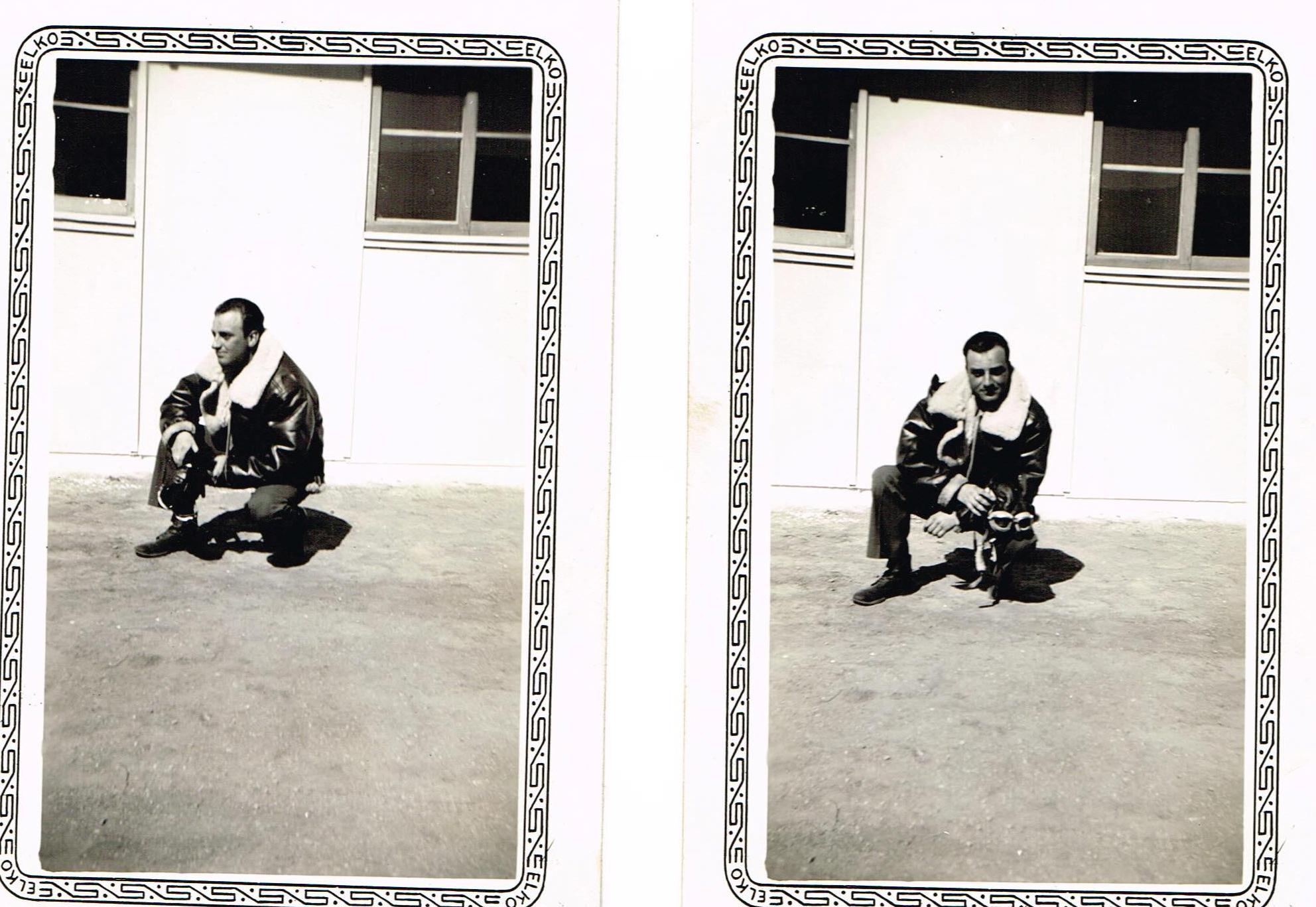
He enrolled on September 25, 1942 and served until the end of the war.  He was a staff sergeant and a tail gunner on a B 12 bomber.  He was stationed in North Africa and flew missions over Italy and France.  The day before he returned to the US, his tent caught fire, and he lost everything but what he was wearing.  Although I never heard my uncle talk specifically about his war experiences, we all knew that he was very proud of his service and remained close to many of his army buddies.  He had his wings made into an ID bracelet which his son Jim now wears in his memory.

Maurice at Aerial Gunnery School in Kingman, AZ

Maurice at Aerial Gunnery School in Kingman, AZ

Maurice 1942

Maurice 1942

Tilly with nephew Maurice 1944

Tilly with nephew Maurice 1944

Maurice 1942

At the end of the war he was stationed in New Jersey where he met Lynn Brodsky.  As Robin reported in my earlier post, it was love at first sight, and they were married on his birthday, June 10, 1945.
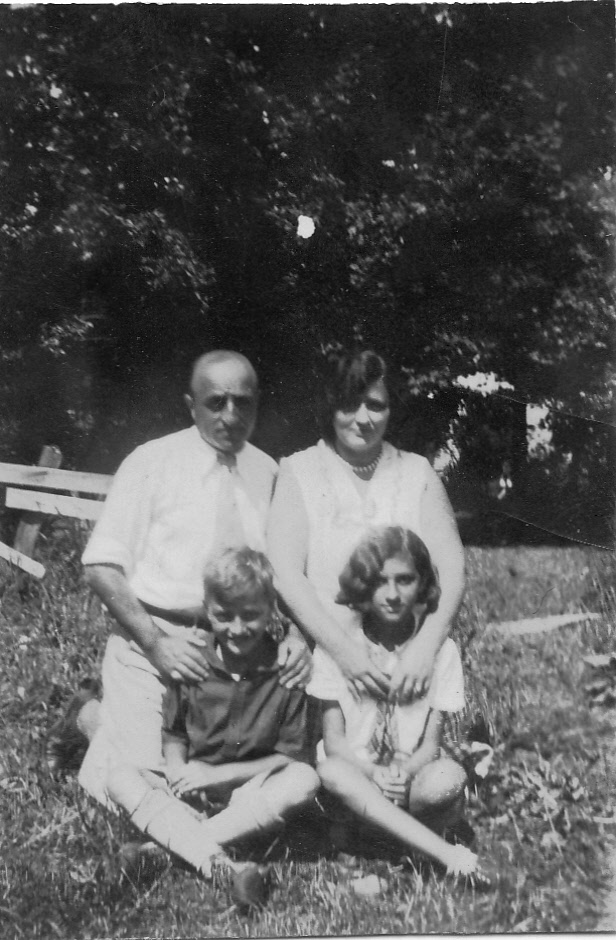
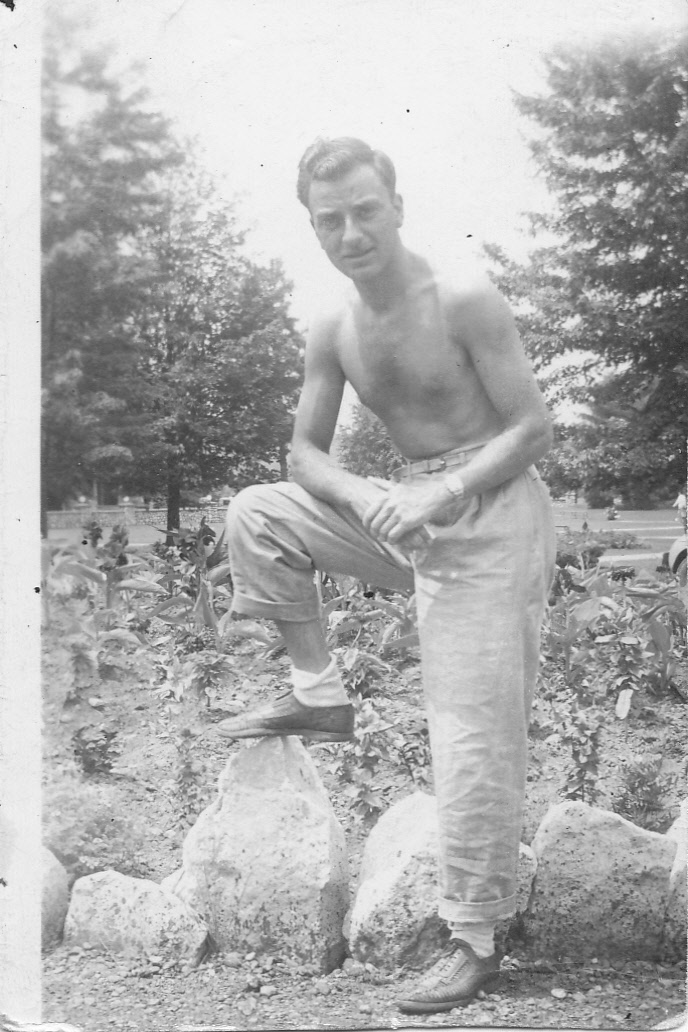
Maurice and Lynn 1946

Maurice and Lynn 1946

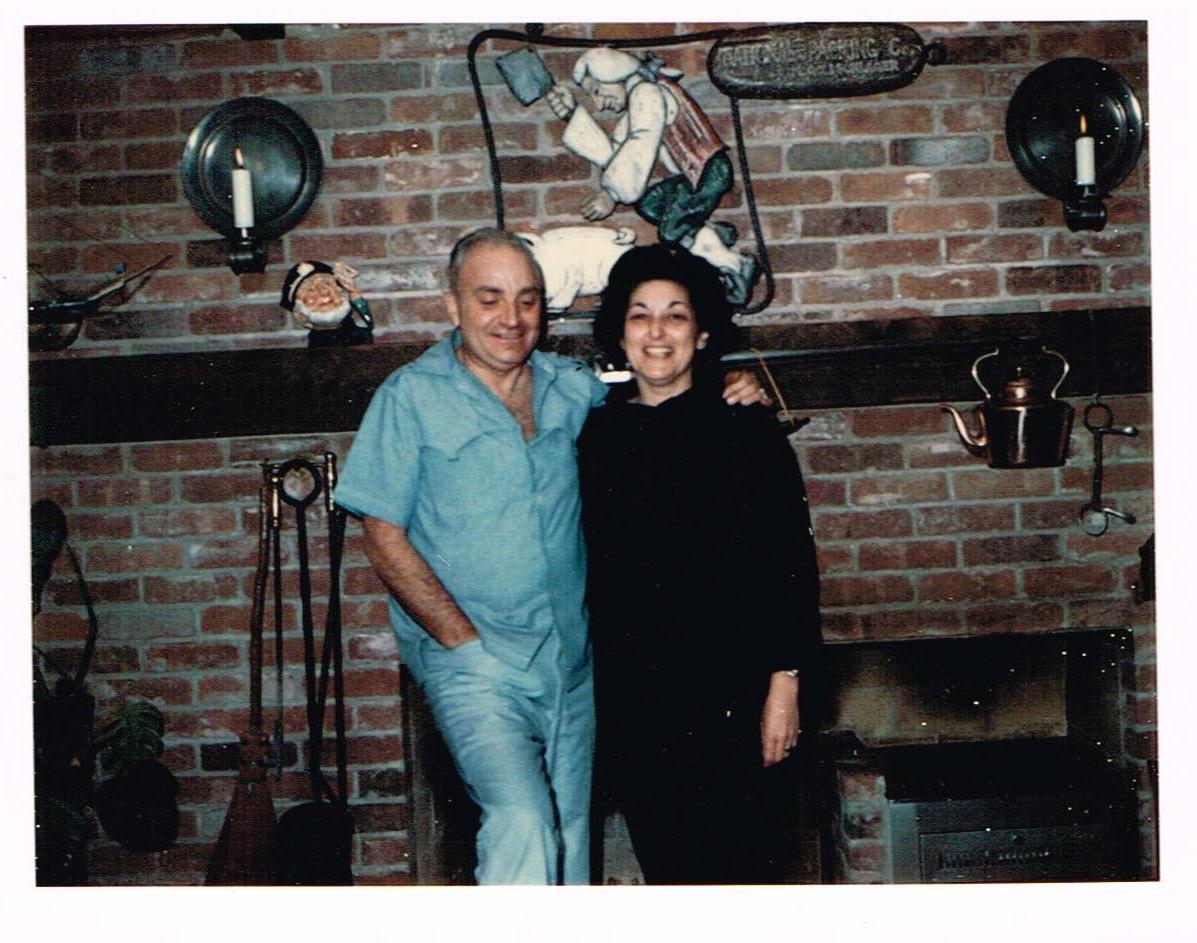
  They settled in New Jersey until Maurice had a run-in with his boss and lost his job.  Lynn’s uncle, Kurt Leopold, owned a meat packing company, Union Meat, in Hartford, Connecticut, and offered Maurice a job and a place to live until he and Lynn could get settled in Connecticut.  Maurice worked for Union Meat for several years and then started his own business with his partners Eric and Kurt Strauss called National Packing.  Lynn had a sign made with the National Packing logo that hung in their family room in West Hartford; my cousin Beth now has it hanging in her kitchen.

National Packing sign on fireplace behind Maurice and Lynn

National Packing sign on fireplace behind Maurice and Lynn

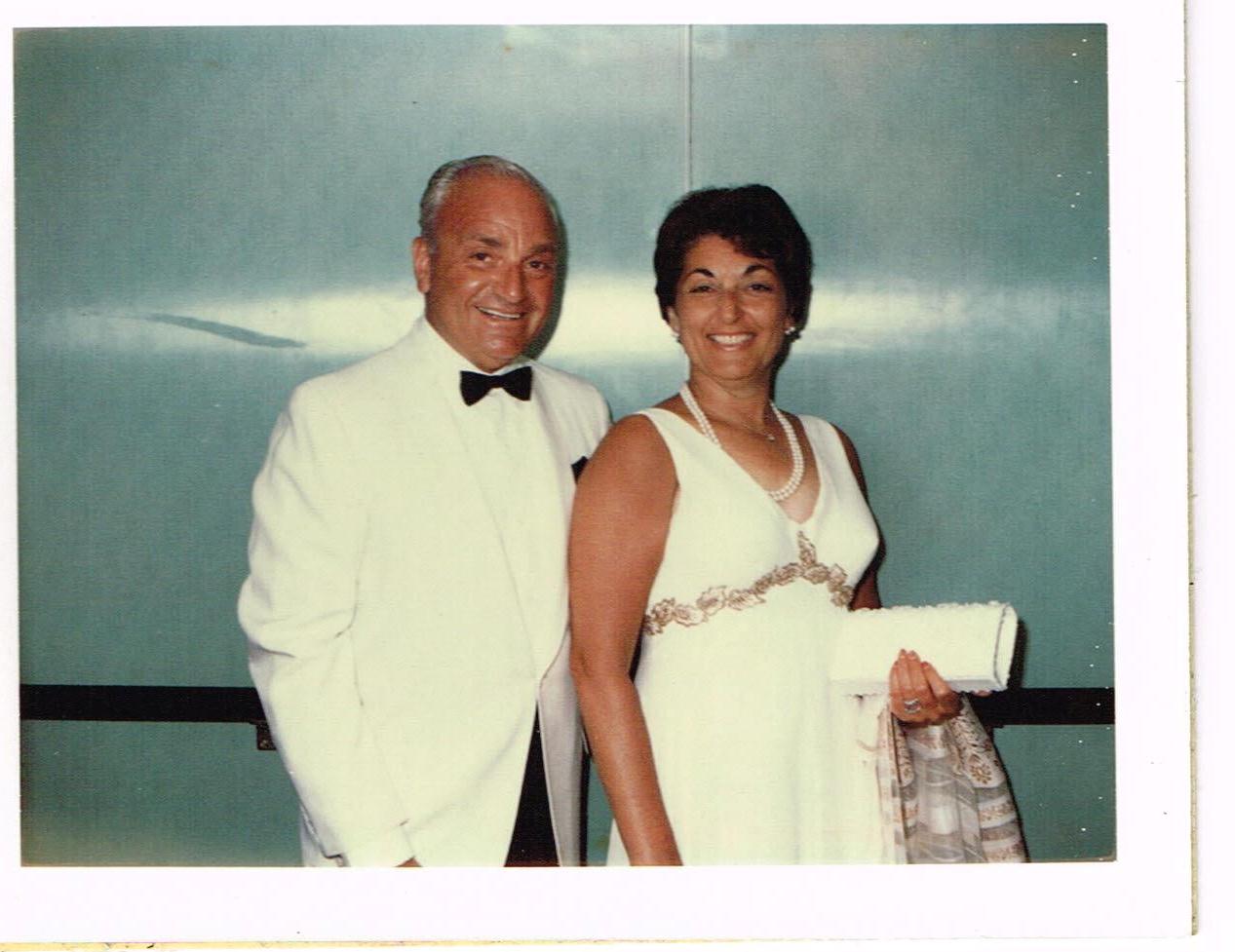
Maurice and Lynn 1967

Maurice and Lynn 1967

Maurice and Lynn had three daughters, my cousins Beth, Suzie and Robin.  Sadly, Lynn’s life was cut short on September 5, 1967 when she died of breast cancer at age 44.

Maurice was very fortunate to find love again with Diane Crone Schaler, who happened to be Lynn’s first cousin.  He and Diane married and had a son, Jim (James Ian).  In addition, Diane had two children from her first marriage, George and Leslie, and they all moved in together in Bloomfield, Connecticut, in a house that not only was filled with teenagers and one small boy, but also lots of animals—dogs, cats, horses, even chickens, ducks and geese, as I recall.

Beth, George, Sue, Leslie, Jim/Jamie, Robin

Beth, George, Sue, Leslie, Jim/Jamie, Robin

Diane and Maurice

Diane and Maurice

The whole family in BloomfieldThe whole family in Bloomfield plus some visitors

But tragedy struck again on April 24, 1978, when Maurice was killed in a freak accident while riding a lawn mower down an incline on the property in Bloomfield.  He was only 58 years old.   It was hard to believe that a man who was so full of love and life was gone so suddenly.  His name lives on through his many namesakes and in our memories and in these pictures.

.

Enhanced by Zemanta

Streets: A Memoir of the Lower East Side by Bella Spewack, Part II (up to age 12)

It was interesting to read about Bella’s childhood and developing American and Jewish identity growing up in the Lower East Side.  Not surprisingly, there was a wide range in the level of religious observance among the Jews on the Lower East Side.  Some Jews were very observant. Bella described the household of one of her childhood friends as follows:

“It was a decidedly quiet house—and more so on Friday and Saturday when religious observance forbade everything that would tend to introduce noise.  On Friday before sundown, the four girls of the family would comb their hair, the mother helping the youngest who had to wear hers in curls.  Before going to bed each would draw a cap over the freshly combed and plaited hair.  In the morning, the cap was removed but no comb touched the hair until Sunday morning.”  (p. 53)

On the other hand, Bella and Fanny seemed to live a very secular life.  A few pages after this passage, Bella described how she spent her Friday nights.  She would meet all her girlfriends and play loud and active games of tag and other outdoor games.  Bella also wrote that she felt “no everyday kinship with the synagogue” and “had an idea that it belonged to the menfolk only.”  (p. 47)   She wrote that she only went to the synagogue on holidays.

Bella in fact experienced real confusion over her religious identity and at one point decided that she wanted to be Christian, not Jewish, much to her mother’s dismay.  This desire seemed to have been rooted in Bella’s perception that Christians were more refined: they were gloves, had clean nails, and spoke perfect English.  Some of it may also have been rooted in her experiences with anti-Semitism, such as the time she and her mother were lost, walking in a strange neighborhood, and were accosted by a group of boys who called them sheenies and grabbed and poked at them.

Most of Bella’s childhood years, however, were spent focused on her friends, books, and school.  In the introduction to the book, Ruth Limmer wrote that the schools Bella attended “were both ideal and wretched—wretched in their overcrowding (class size was forty-five to fifty); ideal…in that they were rigid in their demand that the students seriously attend to learning English.”  (p. xx)

The mission of the schools was to Americanize the children of the immigrants (of all backgrounds) by immersing them in English literature, American and British history, physical training and athletics, and culture. Limmer asserted that as a result, parents often became dependent on their children, who spoke English and who were much more comfortable with the American way of doing things.

The schools also tried to instill values, including discipline and obedience.   Limmer wrote: “The routines began when they arrived at school each morning.  No horsing around.  They were required to line up in order of height on sex-segregated lines and, at the bell, were marched silently to their classrooms.”  (p. xxii)  Bella’s description of her day at school is consistent with Limmer’s overview:

“At school, there was first the assembly period when doors rolled back and mediocre schoolrooms became a vast auditorium.  You marched in with your class holding yourself straight and stiff, turning square corners with military exactitude.  You looked out furtively from beneath your lashes to see if your teacher… noticed that your shoulders were back and your stomach in.” (p. 66)

The students would then salute the flag and listen to readings from the Bible every day, apparently a common practice in the NYC public schools until after World War II, a practice that certainly conflicts with Constitutional principles as we understand them today.

Bella was also a regular visitor to the city’s public libraries and spent her school vacations at the library, reading as much as she could.

Seward Park Library

Seward Park Library

Obviously, she was well-served by those crowded schools and those libraries, as she grew up to be not only capable of communicating in English, but to be a very successful professional writer who contributed to the American culture in which she had been immersed.

Bella’s life was very much confined to her neighborhood; she was at least ten years old before she did much venturing outside of the Lower East Side.  Once she and a friend tried to walk to Andrew Carnegie’s house uptown, but got no further than Fourteenth Street, where they were mesmerized by the department store and its escalator.  Another time she participated in a play with other immigrant children organized by the neighborhood settlement house, another agency engaged in Americanizing immigrant children.  The group of children performing the play went as far uptown as 96th Street, which Bella said was as far from the Lower East Side as any of them had ever been.

Otherwise, Bella and her friends stayed in their neighborhood, where she engaged in common childhood activities, including piano lessons and a sewing club.  There is no mention of religious education.  Overall, Bella’s childhood, despite the poverty and those incidents of abuse and anti-Semitism, was a happy one up through age twelve.  She was a smart, studious girl, but one who had many friends and who knew how to have fun.

Perhaps Bella was looking back with rose-colored glasses, but I’d like to take away from her depiction of her childhood a better feeling about my grandmother’s childhood in the Lower East Side with her siblings.  Yes, they did not have an easy life, and losing their father so young must have been terrible.  But they had their sisters and brothers and a mother whom they all adored.  I hope that like Bella, my grandmother also enjoyed school, played games, and had a network of similarly situated friends with whom to share some of the joys of childhood.