Coming Back Soon

As our vacation winds down, I am looking backwards at all I’ve seen and done and looking forward to writing about it.  Here’s a sneak preview of our adventures in Colorado and New Mexico.

First, I spent four days with three of my best friends in the world.  We met our freshman year in college and spent four years living in the same dorms, talking, laughing, debating, consoling, sharing, and confiding in each other.  Although it was hard to get together in the years we were all raising families, in the last ten years or so we have gotten together every couple of years.  We got together this time in Boulder, Colorado, where one of my friends now lives.  It was my first time in the Rockies, and we hiked and walked all over Boulder, ate great food, and enjoyed good company and beautiful views.  And as if not one day had passed since we graduated over 40 years ago, we talked and laughed and debated and consoled and shared and confided in each other.

20160520_170549732_iOS

20160521_183012098_iOS


20160519_222807641_iOS


Then I met up with my husband at the Denver airport, and we began our travels together.  We spent about 24 hours in Denver, and in that time we explored downtown Denver and then explored my genealogical roots in the city where my paternal grandmother spent much of her childhood. More on that to come.

20160524_152548004_iOS

20160524_151205779_iOS

From Denver we drove all the way to Santa Fe, New Mexico, stopping in Raton, New Mexico, for a night, and arriving in Santa Fe the next day by lunch time.  I had lots of thoughts during that drive as we observed a part of the United States I’d never seen before, some of it incredibly beautiful and awe-inspiring and other parts that made me appreciate the struggles that so many Americans experience day to day.  More on that to come as well.

Raton

Raton

20160525_143124185_iOS

And then we got to Santa Fe, the main destination of our trip.  Santa Fe is a city with an incredibly long and rich history, including my Seligman family’s own personal history there, about which I’ve written extensively.  Being in this place that had been the home of my great-great-grandfather and his family—and where they had contributed so much to its commercial and political development—-was very moving and exciting.  And then there is the art, the glorious landscapes, the architecture.

20160526_151032795_iOS

20160527_164958541_iOS

20160527_200612447_iOS

The last leg of our trip took us to Taos where I again was inspired to think about the history of this country as well as its amazing landscapes and vistas.  It’s no wonder that so many artists were inspired by the scenery and the light and the skies over New Mexico.

20160530_150420390_iOS

20160530_155656274_iOS

I will be writing about the trip in the days that follow, and then I will return to the story of my family.  I have much to do after all these days away from research and from blogging.  I have missed the work and my family, my cats, and my friends, but as always, it’s good to get a break, some new perspectives, and a chance to reflect on all the wonders that life brings.

Time for A Break!

I will be absent from the blogosphere for a bit as I travel to see my college friends and then do some traveling with my husband.  I might post a photo or two if the mood hits, but no real posts until June.  I will try and keep up with comments and emails.

For those who are curious as to my destinations, here’s a genealogy quiz: I will be visiting a place where one of my grandmothers spent most of her childhood and then a place where one of my great-grandmothers was born and raised.

No cheating by my family and friends who know my destinations—this quiz is only for those to whom I’ve not revealed my plans.

Hope to catch up with my fellow bloggers when I return.  And when I do, I will finish the story of the Hambergs, tie up a few other loose ends, and then move on to the next major project, my great-grandmother Hilda Katzenstein’s family.

See you in a bit!

How Descendants Bear the Scars of their Forebears: The Legacy of Charles Hamberg and His Son Samuel

As my last several posts have described, Samuel T. Hamberg lived an interesting and in many ways sad life.  His mother Lena Goodman Hamberg died when he was nine; his father Charles Baruch Hamberg killed himself when Samuel was eleven.  Samuel was adopted by his second cousin, Henry Schoenthal, and moved to Washington, Pennsylvania, from Columbia, South Carolina.  He even probably lived with my great-grandfather Isidore Schoenthal, also his second cousin, for some time.  I feel some emotional connection to this poor orphaned boy.

Then he moved to Philadelphia where he attended and graduated from the Philadelphia College of Pharmacy.  He started to work as a pharmacist, married Jennie Tracy, moved to Camden, New Jersey, and had three children, Charles, Frances, and Edwin, with his wife Jennie.  His life seemed to be remarkably successful and happy for someone who had suffered so much trauma as a young child.

But perhaps there was just an outward appearance of happiness and success.  By 1910, Samuel was no longer living with his wife and children.  Even after Jennie died at a young age in 1917 when her children were not yet grown, Samuel did not come back to live with his children.  Instead, they lived with their aunt, Jennie’s widowed sister, Clara Campbell.

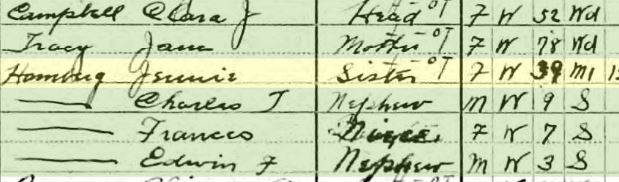
Jennie Hamberg and children 1910 census Year: 1910; Census Place: Camden Ward 12, Camden, New Jersey; Roll: T624_874; Page: 13A; Enumeration District: 0080; FHL microfilm: 1374887

Jennie Hamberg and children 1910 census
Year: 1910; Census Place: Camden Ward 12, Camden, New Jersey; Roll: T624_874; Page: 13A; Enumeration District: 0080; FHL microfilm: 1374887

Samuel lived in Pittsburgh for some time, working as an investigator for the state, and then by 1930 was back in Philadelphia living with a woman from western Pennsylvania named Cecelia Link.  Cecelia died in 1934.  And I have absolutely no idea what happened to Samuel after 1930.

I can’t find him on the 1940 census anywhere; I can’t find him in any city directory.  I can’t find him in any newspaper articles.  And I can’t find him on any death record. I called the cemetery where Jennie was buried.  He’s not there.  I contacted the Philadelphia College of Pharmacy, but received no response.  I have run out of ideas.  A solid brick wall.  I am still searching and hoping to find out more about the rest of his life, but I worry that Samuel’s life ended poorly.

English: A brick wall (stretcher bond) Françai...

English: A brick wall (stretcher bond) Français : Un mur de briques (Appareil en paneresses). (Photo credit: Wikipedia)

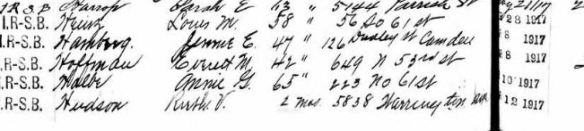
As for his children, in 1920 they were still living at 126 Dudley Street in Camden, but with only their aunt Clara Campbell (Jennie’s sister, a widow) as the adult in the household.  Charles, now nineteen, was working as a bonds salesman.  Frances, now sixteen, was working as a clerk in an insurance company, and Edwin, thirteen, was not employed.

Samuel Hamberg's children 1920 census Year: 1920; Census Place: Camden Ward 12, Camden, New Jersey; Roll: T625_1024; Page: 5A; Enumeration District: 84; Image: 182

Samuel Hamberg’s children 1920 census
Year: 1920; Census Place: Camden Ward 12, Camden, New Jersey; Roll: T625_1024; Page: 5A; Enumeration District: 84; Image: 182


In 1924, Charles and his sister Frances were still living together, but at a new address—2931 Mickle Street in Camden.  They also appear to have changed the spelling of their surname from Hamberg to Hamburg. Were they disassociating from their father? Why would they change the E to a U?

Charles was working as a salesman, Frances as a clerk.  Edwin, who would have been only seventeen, was not listed in the directory.  In 1926, Charles and Frances were living at yet another address—2918 Carman Street—and still working at the same occupations. Their surname is once again spelled Hamburg.  Edwin is still not listed.

And then Charles and Frances disappear.  They are not listed in the 1927 or 1928 Camden directories nor is Edwin.  But in 1929 Edwin does appear in the directory—as Edwin F. Hampton, a salesman residing at 67 South 29th Street in Camden. The 1929 directory has him with the same name, residing at the same address and indicating that he was a salesman in Philadelphia.

Edwin had apparently changed his surname also–from Hamberg to Hampton.  I knew this was the correct Edwin because on the 1930 census Edwin Hampton was living in Camden, NJ, with his aunt Clara Campbell, the same aunt who had taken care of Edwin and his siblings after their mother died in 1917. Edwin was married, and his wife’s name was Edna.  Edwin was working as a weather-stripping contractor, Edna as a bookkeeper in a dairy. Both were 24 and were married at 23, so about a year before the 1930 census.

Edwin Hampton 1930 census Year: 1930; Census Place: Camden, Camden, New Jersey; Roll: 1322; Page: 16B; Enumeration District: 0057; Image: 137.0; FHL microfilm: 2341057

Edwin Hampton 1930 census
Year: 1930; Census Place: Camden, Camden, New Jersey; Roll: 1322; Page: 16B; Enumeration District: 0057; Image: 137.0; FHL microfilm: 2341057


I don’t know how long the marriage between Edwin and Edna lasted, but in 1939 Edwin married Ruth V. Peterson, and he is listed on the 1940 census with this second wife, Ruth. Edwin was now working as a driver for an oil company, and they had a two year old daughter.  I again knew this was the correct Edwin because also living with them was Edwin’s aunt, Clara Campbell.  Ruth and Edwin were still living in Camden in 1943, according to the city directory for that year.

Edwin Hampton 1940 census Year: 1940; Census Place: Pennsauken, Camden, New Jersey; Roll: T627_2323; Page: 11A; Enumeration District: 4-116

Edwin Hampton 1940 census
Year: 1940; Census Place: Pennsauken, Camden, New Jersey; Roll: T627_2323; Page: 11A; Enumeration District: 4-116

After that there were no other records I could find for Edwin.  I did, however, find his wife Ruth’s obituary from June 25, 1995, which revealed both where she was to be buried, Bethel Memorial Park in Pennsauken, New Jersey, and that she was a widow when she died.  Thus, I knew that Edwin had died prior to June 1995.  I called the Bethel Memorial Park cemetery and asked if they had any information about Edwin.  I learned that he was buried there on November 23, 1970.  Even with that information, I could not find an exact date of death.  Edwin isn’t even listed in the Social Security Death Index.

What about his siblings, Charles and Frances?

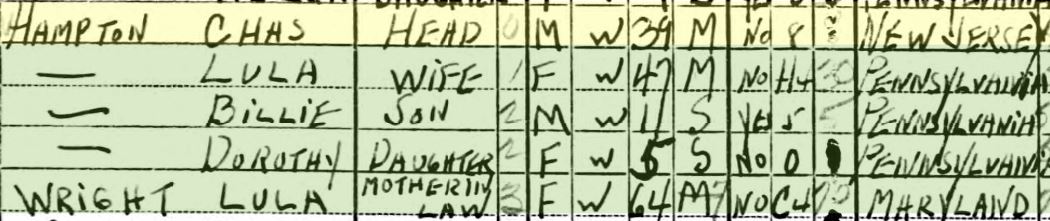
Knowing that Edwin had changed his surname to Hampton, I searched for Charles under that surname as well. There was a Charles T. Hampton in the 1930 census, listed as in the insurance business and residing at 2617 North 33rd Street in Philadelphia. He was married to a woman named Lula (and her mother Lula Wright was living with them), and the census indicated that they had been married about three years. I found a marriage record for Charles T. Hampton and Lula Wright in Philadelphia in 1927.  In 1930 at the time of the census, they had an eighteen month old son.

Charles Hampton 1930 census Year: 1930; Census Place: Philadelphia, Philadelphia, Pennsylvania; Roll: 2113; Page: 3B; Enumeration District: 0696; Image: 546.0; FHL microfilm: 2341847

Charles Hampton 1930 census
Year: 1930; Census Place: Philadelphia, Philadelphia, Pennsylvania; Roll: 2113; Page: 3B; Enumeration District: 0696; Image: 546.0; FHL microfilm: 2341847

At first I was not at all convinced that this was the right Charles.  He was 32, a few years older than my Charles T. Hamberg would have been in 1930.  The census said he was born in Pennsylvania, where Charles was in fact born, but the census also said that Charles Hampton’s father was born in Pennsylvania instead of South Carolina where Samuel Hamberg had been born.  That error and the age discrepancy gave me reason to doubt that this was Charles Hamberg.

That doubt increased substantially when I found another Charles T. Hampton on the 1900 census living in Aston, Pennsylvania, a seven month old baby who would have been close to the right age to match the Charles T. Hampton I’d found on the 1930 census.  That Charles was the son of Charles and Elsie Hampton.

Some of the doubt was erased, however, when I found those Hamptons on the 1910 and 1920 census and learned that the Charles Hampton born in October 1899 was in fact Charles August Hampton and that in 1930 Charles August Hampton was living in Chattanooga, Tennessee, married to a woman named Mary.

Although that eliminated that Charles Hampton, I still hadn’t confirmed that the Charles T. Hampton married to Lula Wright was in fact born Charles Hamberg, son of Samuel Hamberg and Jenny Tracey.  So I continued to look for more clues about Charles T. Hampton.

I found him with his family on the 1940 census.  He was still married to Lula, and they now had two children, an eleven year old son and a five year old daughter.  Lula’s mother was still living with them.  Charles was a life insurance salesman.  And this time his age was reported as 39, meaning he was born in 1900 or 1901, which is consistent with the birth year for Charles Hamberg.  I was now more convinced that this could be the right person.

Charles Hampton 1940 census Year: 1940; Census Place: Philadelphia, Philadelphia, Pennsylvania; Roll: T627_3714; Page: 3B; Enumeration District: 51-873

Charles Hampton 1940 census
Year: 1940; Census Place: Philadelphia, Philadelphia, Pennsylvania; Roll: T627_3714; Page: 3B; Enumeration District: 51-873

Could be, but was it?   Lula Wright Hampton died on October 4, 1955, from ovarian cancer.  Her husband Charles signed the death certificate as the informant, so I knew that Charles T. Hampton was still living as of October 4, 1955.  Lula was buried at Mt. Peace cemetery in Philadelphia.

Lula Wright Hampton death certificate Ancestry.com. Pennsylvania, Death Certificates, 1906-1963 [database on-line]. Provo, UT, USA: Ancestry.com Operations, Inc., 2014. Original data: Pennsylvania (State). Death certificates, 1906–1963. Series 11.90 (1,905 cartons). Records of the Pennsylvania Department of Health, Record Group 11. Pennsylvania Historical and Museum Commission, Harrisburg, Pennsylvania.

Lula Wright Hampton death certificate
Ancestry.com. Pennsylvania, Death Certificates, 1906-1963 [database on-line]. Provo, UT, USA: Ancestry.com Operations, Inc., 2014.
Original data: Pennsylvania (State). Death certificates, 1906–1963. Series 11.90 (1,905 cartons). Records of the Pennsylvania Department of Health, Record Group 11. Pennsylvania Historical and Museum Commission, Harrisburg, Pennsylvania.

And then I found an important clue: a June 10, 1968 bill submitted by the Oliver H. Bair funeral home for services rendered in connection with the funeral of Charles T. Hampton and his burial at Mt. Peace cemetery.  The same cemetery where Lula Hampton had been buried in 1955.  And the most revealing bit of information on that bill was that it had been submitted to Mr. Edwin F. Hampton.  That is, the brother of Charles T. Hampton.  For me, that was the one piece I needed to tie Charles T. Hampton, husband of Lula, to Charles T. Hamberg, son of Samuel: his funeral had been paid for by his brother, Edwin F. Hampton, born Edwin F. Hamberg.

Bill for funeral of Charles T. Hampton, June 1968 Ancestry.com. Pennsylvania, Oliver H. Bair Funeral Records Indexes, 1920-1980 [database on-line]. Provo, UT, USA: Ancestry.com Operations, Inc., 2012. Original data: Oliver H. Bair Funeral Records. Philadelphia, Pennsylvania: Historical Society of Pennsylvania.

Bill for funeral of Charles T. Hampton, June 1968
Ancestry.com. Pennsylvania, Oliver H. Bair Funeral Records Indexes, 1920-1980 [database on-line]. Provo, UT, USA: Ancestry.com Operations, Inc., 2012.
Original data: Oliver H. Bair Funeral Records. Philadelphia, Pennsylvania: Historical Society of Pennsylvania.

That left one more sibling to find: Frances D. Hamberg, born in 1903 or so, whom I’d last found in the 1926 Camden directory, living with her brother Charles and working as a clerk.  As is so often the case with women, she seemed to disappear.  I assumed she’d married, but I couldn’t find a marriage record.

Once again, one small clue broke down the wall.  Someone with a private tree on Ancestry had someone on their tree named Dorothy Whitman, wife of Frank E. Whitman, indicating that Dorothy Whitman was born Frances Dorothy Hamburg. [1]  I figured it was a clue worth pursuing.

And it indeed was.  I found a marriage record dated October 4, 1924 for Frank Eugene Whitman and Frances Dorothy Hamburg from the Holy Trinity Episcopal Church in Philadelphia.  And I knew this was the right Frances D. Hambe/urg because one of the witnesses at the wedding was her brother, Charles T. Hamburg (before he changed his surname to Hampton).  See the last entry on the document below:

Historical Society of Pennsylvania; Philadelphia, Pennsylvania; Collection Name: Historic Pennsylvania Church and Town Records; Reel: 1018 Description Organization Name : Holy Trinity Episcopal Church

Historical Society of Pennsylvania; Philadelphia, Pennsylvania; Collection Name: Historic Pennsylvania Church and Town Records; Reel: 1018
Description
Organization Name : Holy Trinity Episcopal Church


Frank E. Whitman had been previously married to Mildred Mendenhall, with whom he’d had a son in 1919 named Frank E. Whitman, Jr.  Mildred had died on January 31, 1920, from influenza during the epidemic that killed so many people.  Her infant son, like Samuel T. Hamberg and then like Samuel’s own three children, was left motherless.

There are some strange occurrences in the directory entries for Frank and for Frances in the years right after they married.  In 1925, Frank is listed in the Philadelphia directory as a salesman, living at 3450A Angora Street.  But in 1926, Frances is listed as Frances Hamburg in the Camden directory, living at the same address as her brother Charles, 2918 Carman Street. If she had married Frank in 1924, why was she still using Hamburg, and why was she living in Camden with her brother?

Finally, in 1927 Frank and Frances are listed together at 67 South 29th Street in Camden, the same address where Frances’ brother Edwin Hampton was living. Frank and Frances are listed again at the address two years later in the 1929 Camden directory.

But I cannot find Frank and Frances anywhere on the 1930 census—not in Camden, not in Philadelphia, not in any other place.  On the other hand, I did find Frank’s son from his first marriage living with his grandparents, Frank Sr.’s parents, in Philadelphia.  He was also living with them in 1940, so it appears that he was raised by his paternal grandparents, not his father and stepmother, just as his stepmother Frances had been raised by her aunt, not her father after her mother died.

So where were Frank and Frances in 1930? I don’t know.  They don’t reappear on any records until the 1940 census when they are listed as living at 215 Walnut Lane in Philadelphia, Apt. A202.  Frances is now using her middle name Dorothy as her first name.  Frank was working as a plant manager for a petroleum company.  They had been living at the same place in 1935, and they were still living there two years later when Frank registered for the World War II draft.

Frank and Dorothy Whitman 1940 census Year: 1940; Census Place: Philadelphia, Philadelphia, Pennsylvania; Roll: T627_3704; Page: 14A; Enumeration District: 51-553

Frank and Dorothy Whitman 1940 census
Year: 1940; Census Place: Philadelphia, Philadelphia, Pennsylvania; Roll: T627_3704; Page: 14A; Enumeration District: 51-553


Frank and Frances Dorothy (Hambe/urg) Whitman both died in Florida, Frank in 1981, Frances Dorothy in 1998. She was 95 years old.  As far as I can tell, they did not have children together, but without the 1930 census, I cannot be certain.  Her obituary had no personal information at all.

Thus ends the saga of Charles Hamberg, born Baruch Hamberg in Breuna, Germany.  As a young man, he immigrated in 1852 with his cousin Abraham, who died less than two years later.  Charles married Mary Hanchey in 1853, and she was murdered in Columbia, South Carolina, in 1866.  Charles remarried, and with his second wife Lena, he had one child, Samuel.  Then, as stated above, after Lena died and Charles took his own life, Samuel moved to western Pennsylvania where he grew up with his Schoenthal cousins.  As described above and in my prior post, Samuel’s own life was a rollercoaster—a tragic childhood, a promising young adulthood, and then a life that seemed to fray around the edges.

As Samuel must have borne the scars of his tragic childhood, so did his children.  They also lost their mother at a young age.  They also seemed to lose their father early in their lives, although not to death.  They all changed their surnames, perhaps to distance themselves from that father.  Charles Baruch Hamberg’s legacy appears to be a sad one, though without a few more answers, it is hard to know for sure.


[1] Although the tree was private, Ancestry will list names from a private tree; you just can’t see the details of the tree without permission of the owner.  .

From Orphan to Pharmacist and Then?

In two recent posts I shared the sad story of Charles Hamberg and his life in Columbia, South Carolina, which ended with his suicide in 1879.  His son Samuel was only eleven when his father died.  Samuel’s mother Lena had died two years earlier.  Charles’ cousin Amalia Hamberg administered his estate, and then somehow Charles’ son Samuel came to live in western Pennsylvania where he was adopted by his second cousin, my great-grandfather’s brother, Henry Schoenthal.
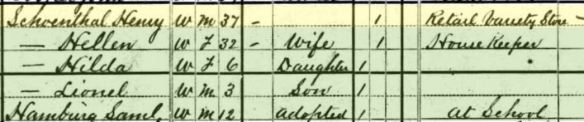
Henry Schoenthal and family 1880 census Year: 1880; Census Place: Washington, Washington, Pennsylvania; Roll: 1202; Family History Film: 1255202; Page: 596A; Enumeration District: 271

Henry Schoenthal and family 1880 census
Year: 1880; Census Place: Washington, Washington, Pennsylvania; Roll: 1202; Family History Film: 1255202; Page: 596A; Enumeration District: 271


In 1886 when Samuel was then eighteen years old, he was working as a clerk at 5 East Beau Street in Washington and living at the corner of Beau and Lincoln in that town, according to the 1886 directory for Washington, Pennsylvania.  According to that same source, my great-grandfather Isidore Schoenthal, who had arrived in Washington in 1881, was living at 203 East Beau Street that same year; looking at Google Maps, I see that 203 East Beau Street is located at the corner of Lincoln and Beau.

[Thanks to Lara of Lara’s Jewnealogy, I now know how to use Google Maps more effectively.  See her great post here.]

Thus, Samuel Hamberg was probably living with my great-grandfather.  I imagine that they lived and maybe even worked together, my great-grandfather watching over his younger second cousin.  Perhaps Samuel helped my great-grandfather learn English and adjust to American ways.

By 1889, Samuel, now 21 years old, had moved to Philadelphia.  He is listed in the directory for that year as Samuel T. Hamberg, a manager, residing at “134 E. Orthodox, FKD.”  FKD stands for Frankford, a neighborhood in northeast Philadelphia about six miles from the center of the city.  I wondered what had taken him there.

It took me a very long time to find out, but when I finally decided, after exhausting traditional genealogy sources, to Google “Samuel T. Hamberg” as a last ditch effort to learn more, I found these two entries in Google Books:

P.W. Bedford, Pharmaceutical Record and Weekly Market Review, Volume 10, April 21, 1890, p. 163, found here (list of graduates of the Philadelphia College of Pharmacy).

26th Annual Report of the Alumni Association of the Philadelphia College of Pharmacy (1890), found here.

Class of 1890, Philadelphia College of Pharmacy Alumni Association Report, p. 194

Class of 1890, Philadelphia College of Pharmacy
Alumni Association Report, p. 194

Samuel T. Hamberg, the boy who had lost both his parents before his twelfth birthday, had graduated from the four-year program at the Philadelphia College of Pharmacy in 1890 when he was 22 years old. The Philadelphia College of Pharmacy was the first pharmacy school in the United States and still exists today.

Not only had Samuel graduated from this prestigious institution, but a further search into both of the above sources revealed that his middle name was Tilden,[1] that he had written his thesis on nitroglycerin, that he had played the guitar to open the commencement exercises as part of a musical ensemble (perhaps his musical adoptive brother Lionel Schoenthal with whom he’d lived in Washington had given him music lessons), and that he had been selected to be the Class Poet.  The poem he read at the school’s commencement exercises in 1890 is filled with references to professors and specific memories of the school years, but this particular verse seemed a more personal statement:

Sorrows and losses may be borne,

Be baffled and dismayed,

Feel the sharp pang of many a thorn

By our own follies made.

But hope and effort may improve

And help us to thankful be,

It surely did in this case

It helped us—in a degree.

(Samuel Tilden Hamberg, 1890, as published in the Alumni Report, cited above, p.124.)

Samuel Tilden Hamberg certainly had suffered sorrows and losses, though not by his “own follies made.”  But it seems with the love of his family in Washington, Pennsylvania, he had in fact borne those sorrows and losses and succeeded in coming through them as a grateful and successful young man.

Philadelphia College of Pharmacy See page for author [CC BY 4.0 (http://creativecommons.org/licenses/by/4.0)], via Wikimedia Commons

Philadelphia College of Pharmacy
See page for author [CC BY 4.0 (http://creativecommons.org/licenses/by/4.0)%5D, via Wikimedia Commons

Samuel stayed on in Philadelphia after graduating. In the 1892 directory for Philadelphia, Samuel T. Hamberg is listed as a clerk, living now at 6933 Hagerman Avenue.  Two years later in 1894 he lists his occupation as druggist, living at 824 Somerset.  In 1895 and 1896 there are numerous advertisements listing Samuel T. Hamberg as a pharmacist in the Philadelphia Inquirer.

Samuel T. Hamberg married Jane E. Tracey on November 20, 1898, at the Zion Episcopal Church in Philadelphia.  At the time they married, Samuel had been residing in Camden, New Jersey, according to the marriage record.  His wife had been living in Philadelphia where she was born in December, 1869.  Jane, or Jennie as she was generally identified on most records, was the daughter of Edwin Tracey (often spelled Tracy) and Jane Irwin.  Edwin was a Philadelphia native and a shoemaker according to the 1880 census; his wife Jane was born in Ireland.  Jennie was the seventh of nine children.

Marriage record of Samuel Hamberg and Jane Tracey November 20, 1898, Zion Protestant Episcopal Church, Philadelphia Historical Society of Pennsylvania; Philadelphia, Pennsylvania; Collection Name: Historic Pennsylvania Church and Town Records; Reel: 978

Marriage record of Samuel Hamberg and Jane Tracey November 20, 1898, Zion Protestant Episcopal Church, Philadelphia
Historical Society of Pennsylvania; Philadelphia, Pennsylvania; Collection Name: Historic Pennsylvania Church and Town Records; Reel: 978


In 1900, Samuel and Jennie were living in Philadelphia in the household of Jennie’s brother Albert Tracy along with Jennie’s mother Jane and her three sisters.  Samuel was working as a hospital supplies salesman.  I know this is the correct Samuel Hamberg because his birth place is given as South Carolina, his father’s as Germany, his mother’s as South Carolina.  (I found it interesting that Samuel reported the birth places of his birth parents, Charles and Lena, not those of his adoptive parents.)

Samuel Hamberg 1900 census Year: 1900; Census Place: Philadelphia Ward 29, Philadelphia, Pennsylvania; Roll: 1472; Page: 12A; Enumeration District: 0748; FHL microfilm: 1241472

Samuel Hamberg 1900 census
Year: 1900; Census Place: Philadelphia Ward 29, Philadelphia, Pennsylvania; Roll: 1472; Page: 12A; Enumeration District: 0748; FHL microfilm: 1241472


On September 4, 1900, Samuel and Jennie had their first child, a son named Charles, presumably named for Samuel’s father Charles.

The family must have soon thereafter moved to Camden, New Jersey, for Samuel is listed as a salesman in the 1901 Camden directory.  Samuel and Jennie are also listed in the 1902 and 1903 Camden directories at 3010 Westfield Street; Samuel is still listed as a salesman.  A second child was born that year, Frances D. Hamberg, born in January, 1903, in New Jersey.  Samuel and Jennie were still living at the same address in 1904 and in 1905.

Then things start getting a little confusing.  In 1906 Samuel T. Hamberg is listed in the Philadelphia directory as a salesman residing at 27 North 60th Street in that city.  There is no listing for him in the Camden directory for that year.  But the following year Samuel is listed as a salesman in the Camden directory, residing at 126 Dudley Street.  Then in 1908, the listing is only in Jennie’s name—Jennie Hamberg at 126 Dudley Street.

Meanwhile in October 1907, a third child had been born to Samuel and Jennie—Edwin F. Hamberg.  Had Samuel and Jennie separated in 1906, reconciled and had a third child in 1907, and then separated again in 1908? Jennie is again listed alone at 126 Dudley in Camden in 1909, this time with an occupation, dressmaker.

But where was Samuel in 1908 and 1909? He is not listed in the Camden directory.  There are two Samuel Hambergs listed in Philadelphia in 1909, but they are father and son and listed as pawnbrokers, so neither of them seems to be the right Samuel.  There are no Samuel Hambergs listed in the directories for those years for Pittsburgh or Washington, Pennsylvania, or Baltimore.

In 1910, Samuel reappears on the 1910 census in Baltimore, Maryland, living as a boarder and working as a pharmacist in a drugstore.  I know this is my Samuel because he is Samuel T. Hamberg, born in South Carolina, father born in Germany, mother in South Carolina.  But why is he in Baltimore?  He is still listing himself as married, so maybe he went to Baltimore to find work.   Since he had been working as a salesman while living in Camden, maybe he wanted to return to being a regular pharmacist.
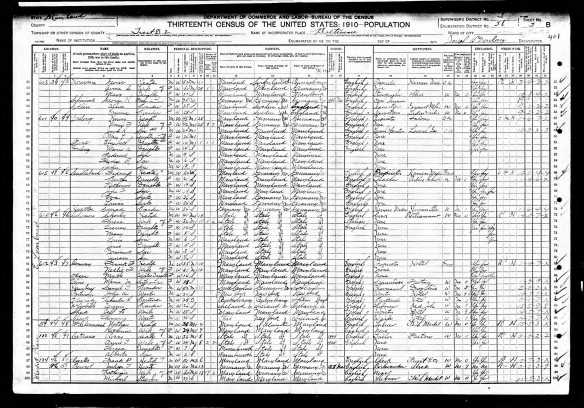
Samuel Hamberg 1910 census Year: 1910; Census Place: Baltimore Ward 4, Baltimore (Independent City), Maryland; Roll: T624_553; Page: 3B; Enumeration District: 0036; FHL microfilm: 1374566

Samuel Hamberg 1910 census Line 85
Year: 1910; Census Place: Baltimore Ward 4, Baltimore (Independent City), Maryland; Roll: T624_553; Page: 3B; Enumeration District: 0036; FHL microfilm: 1374566

Jennie and the three children were still living at 126 Dudley in Camden in 1910.  According to the census, they were living with Jennie’s sister Clara Campbell and her mother Jane Tracy.  Like Samuel, Jennie still reported herself as married.  Although Jennie reported no occupation on the 1910 census, the 1910 and 1911 Camden directories list her as a dressmaker.
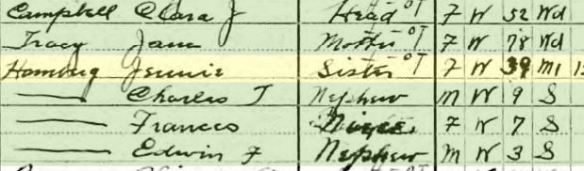
Jennie Hamberg and children 1910 census Year: 1910; Census Place: Camden Ward 12, Camden, New Jersey; Roll: T624_874; Page: 13A; Enumeration District: 0080; FHL microfilm: 1374887

Jennie Hamberg and children 1910 census
Year: 1910; Census Place: Camden Ward 12, Camden, New Jersey; Roll: T624_874; Page: 13A; Enumeration District: 0080; FHL microfilm: 1374887


Samuel is listed in the 1911 Baltimore directory, but then he again disappears.  I couldn’t find him in any newspaper article or any directory after 1911 during the decade of the 1910s.

Jennie, however, continued to be listed in the Camden directories from 1910 through 1916.  In 1915, she and her children are listed on the New Jersey census, once again living with her sister Clara and her mother Jane; Samuel is not part of their household.

Jennie Tracey Hamberg died from heart disease on March 4, 1917.  She was only 47 years old, and she left behind three children.  Charles was not yet sixteen, Frances not yet fourteen, and Edwin not yet ten years old.  Like their father Samuel, they lost their mother at a young age.
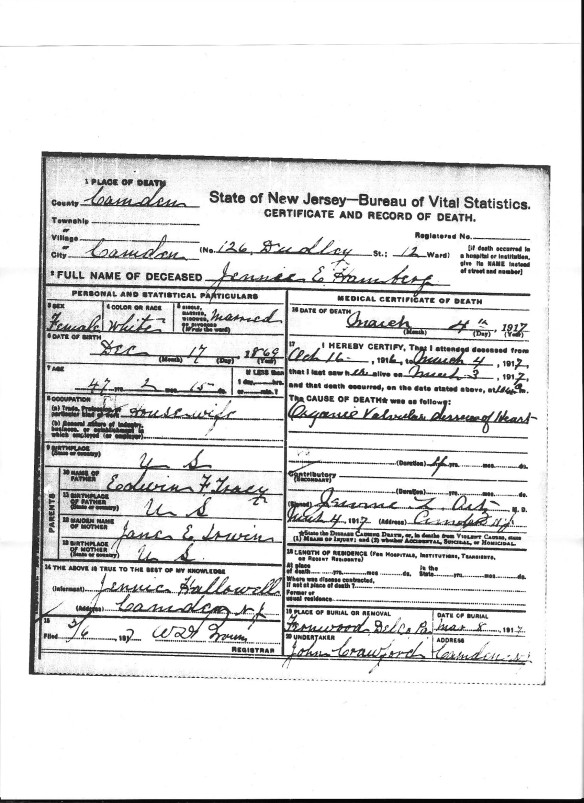
Jennie Tracey Hamberg death certificate

Jennie Hamberg burial record Fernwood Cemetery, Yeardon, PA Historical Society of Pennsylvania; Philadelphia, Pennsylvania; Collection Name: Historic Pennsylvania Church and Town Records

Jennie Hamberg burial record
Fernwood Cemetery, Yeardon, PA
Historical Society of Pennsylvania; Philadelphia, Pennsylvania; Collection Name: Historic Pennsylvania Church and Town Records

So where was their father? I could not find him on the 1920 census or anywhere during the 1920s until I searched for “Samuel T. Hamberg” in Google.  And along with the links noted above relating to his education as a pharmacist, I found several links indicating that in 1920 Samuel was in Pittsburgh working for the state of Pennsylvania as a temporary investigator doing fair price work.  Even knowing this additional information, I could not locate Samuel on the 1920 census or in any directory in the 1920s.
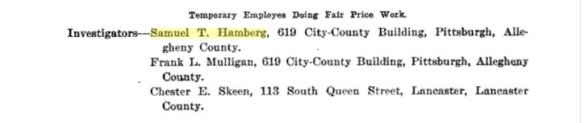
Samuel Hamberg investigator 1920

Herman P. Miller, Snull’s Legislative Handbook and Manual of the State of Pennsylvania, 1920, p. 144, found here.

But Samuel T. Hamberg does reappear on the 1930 census.  He is listed as Sam T. Hamberg, 62 years old (the correct age), married at age 30 (the correct age), widowed (Jennie was dead), born in South Carolina, father born in Germany, mother in South Carolina (all correct).  Clearly this is the right person.  He was now living in Philadelphia, working as a novelty salesman, and living with his “sister” Cecelia Link. What had happened to his pharmacy career? His work as a state investigator? And who was Cecelia Link?

Samuel Hamberg 1930 census Year: 1930; Census Place: Philadelphia, Philadelphia, Pennsylvania; Roll: 2125; Page: 14A; Enumeration District: 0777; Image: 969.0; FHL microfilm: 2341859

Samuel Hamberg 1930 census
Year: 1930; Census Place: Philadelphia, Philadelphia, Pennsylvania; Roll: 2125; Page: 14A; Enumeration District: 0777; Image: 969.0; FHL microfilm: 2341859

Samuel did not have any sisters except for his adoptive sister Hilda Schoenthal, the daughter of Henry Schoenthal.  Cecelia was twenty years younger than Samuel, according to the 1930 census, born in Pennsylvania, single, and working as a telephone operator.  Cecelia answered the enumerator’s questions as indicated by the H on the line where her name is. Who was she, and why was she living with Samuel?

I found a Celia Link living with her mother and two sisters (and a brother-in-law) in Pittsburgh on the 1920 census.  Celia was forty years old, single, and working as a telephone operator.  It seemed like an unlikely coincidence that there were two women with just about the same name, both born in Pennsylvania, and both working as telephone operators.  (Remember that Samuel was living in Pittsburgh in 1920.)

So I looked for more about this Celia Link.  The 1916 Pittsburgh directory had her listed as Cecelia Link working as a telephone operator, so now we had the exact same name.  The 1910 census has her again as Celia, living with her parents, working as a telephone operator, and 33 years old.  Going back yet another ten years, the 1900 census lists her as Cecilia, age 22, with a birth date of March 1878, and no occupation.

Then I found her death certificate.  Cecelia Link died of chronic myocarditis on May 6, 1934, at “abt age 48,” according to her sister, the informant.  Assuming that Cecelia was 22 in 1900, she would have been 56 in 1934.  Even in 1920, she reported to be 40, making her 54 in 1934.  She was therefore only about ten years younger than Samuel, not twenty.  Note also that she was born in Washington, Pennsylvania.

Cecilia Link death certificate Ancestry.com. Pennsylvania, Death Certificates, 1906-1963 [database on-line]. Provo, UT, USA: Ancestry.com Operations, Inc., 2014. Original data: Pennsylvania (State). Death certificates, 1906–1963. Series 11.90 (1,905 cartons). Records of the Pennsylvania Department of Health, Record Group 11. Pennsylvania Historical and Museum Commission, Harrisburg, Pennsylvania.

Cecilia Link death certificate
Ancestry.com. Pennsylvania, Death Certificates, 1906-1963 [database on-line]. Provo, UT, USA: Ancestry.com Operations, Inc., 2014.
Original data: Pennsylvania (State). Death certificates, 1906–1963. Series 11.90 (1,905 cartons). Records of the Pennsylvania Department of Health, Record Group 11. Pennsylvania Historical and Museum Commission, Harrisburg, Pennsylvania.

I assume that Samuel met Cecelia when he was working in Pittsburgh as an investigator. And that they were more than “brother and sister.”  I think Cecelia lied both about her age and her relationship to Charles.

But Cecelia died in 1934 back in Pittsburgh.  What happened to Samuel before and after her death? And where were his children?

More questions to answer.


[1] There is no earlier indication that Samuel’s middle name was Tilden.  Did he adopt this middle name himself? In 1868 when Samuel Hamberg was born in Columbia, South Carolina, Samuel Tilden was probably not a nationally known figure.  He was from New York State and a supporter of the Union during the Civil War.  After the war he was active in reforming the Democratic party.  Would Charles Hamberg have known of him and named his son for him? Unlikely.

But Samuel Tilden was the Democratic party’s nominee in the 1876 Presidential election; the results of the election were disputed when several states turned into multiple sets of return.  The Presidency was determined by a partisan commission established by Congress, and Tilden lost to Rutherford B. Hayes, even though he had won the popular vote.  I think it is more likely that Samuel Hamberg adopted Tilden’s name as his middle name sometime as a young adult after Tilden was more of a household name.  Tilden died in 1886, and the first use I’ve seen of the middle initial T by Samuel Hamberg was while he was in pharmacy school in the late 1880s.  For more on Samuel Tilden, see here and here and here.

The Mysterious Administratrix

As I wrote last week, Samuel Hamberg, my great-grandfather’s second cousin, was orphaned in 1879 in Columbia, South Carolina, when his father Charles committed suicide two years after Samuel’s mother Lena had died at age 28.  But how did Samuel end up in Pennsylvania? Looking for the answer to that question led to another mystery and, I think, more answers.

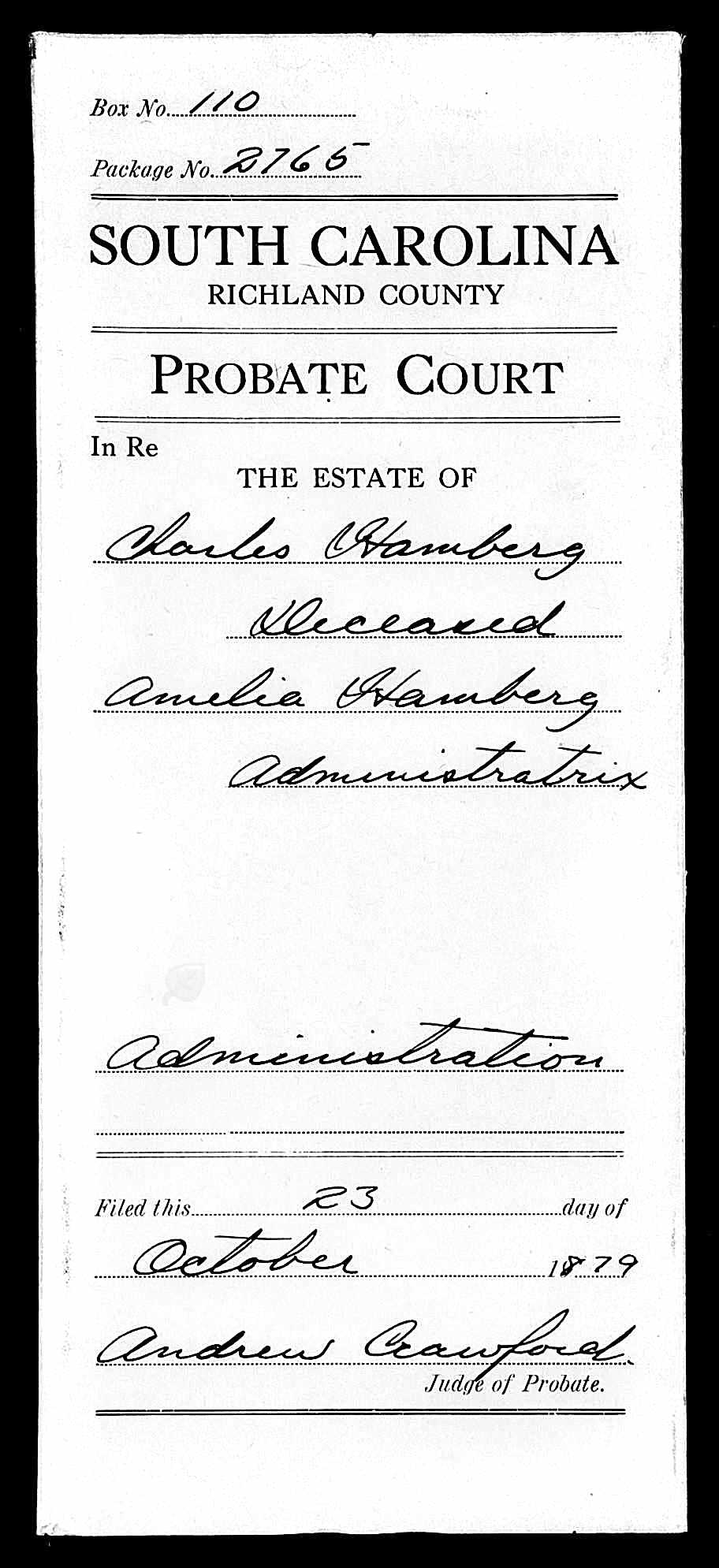
Charles Hamberg died without a will, leaving behind personal property consisting primarily of furniture and household items valued at that time at $487.71; today that would be equivalent to approximately $11,600.  The administratrix of his estate was someone named Amelia (or Amalia or Amalie[1] ) Hamberg.

Richland County, South Carolina Miscellaneous Estate Records, 1799-1955; Author: South Carolina. County Court (Richland County); Probate Place: Richland, South Carolina

Richland County, South Carolina Miscellaneous Estate Records, 1799-1955; Author: South Carolina. County Court (Richland County); Probate Place: Richland, South Carolina


Now who was she?  For a long time I assumed she was yet a third wife, someone Charles married after Mary, who’d been murdered, and Lena, mother of Samuel.  Lena had died in 1877, leaving Charles with their nine year old son.  I figured he had quickly married again, finding a mother for Samuel.  But I could not find one record for an Amalia or Amelia or Amalie Hamberg anywhere in South Carolina before or after Charles’ death. I couldn’t even find someone with just that first name who seemed a likely candidate.  I was working in circles, getting frustrated.

Then I searched for anyone named Amelia or Amalia or Amalie Hamberg anywhere in the US, and I found one Amalia Hamberg on a death record for her daughter Hattie Baer Herman, who had died in Philadelphia in 1910.  Hattie’s father was Jacob Baer.  Both parents were born in Germany, according to the death certificate.


Death certificate of Hattie Baer, daughter of Amalia Hamberg Ancestry.com. Pennsylvania, Death Certificates, 1906-1963 [database on-line]. Provo, UT, USA: Ancestry.com Operations, Inc., 2014. Original data: Pennsylvania (State). Death certificates, 1906–1963. Series 11.90 (1,905 cartons). Records of the Pennsylvania Department of Health, Record Group 11. Pennsylvania Historical and Museum Commission, Harrisburg, Pennsylvania.

Death certificate of Hattie Baer, daughter of Amalia Hamberg
Ancestry.com. Pennsylvania, Death Certificates, 1906-1963 [database on-line]. Provo, UT, USA: Ancestry.com Operations, Inc., 2014.
Original data: Pennsylvania (State). Death certificates, 1906–1963. Series 11.90 (1,905 cartons). Records of the Pennsylvania Department of Health, Record Group 11. Pennsylvania Historical and Museum Commission, Harrisburg, Pennsylvania.

Then it occurred to me: what if Amalia was not Charles Hamberg’s wife, but a sister or a cousin? If Charles died unmarried and intestate, some other family member might have been appointed to administer his estate.

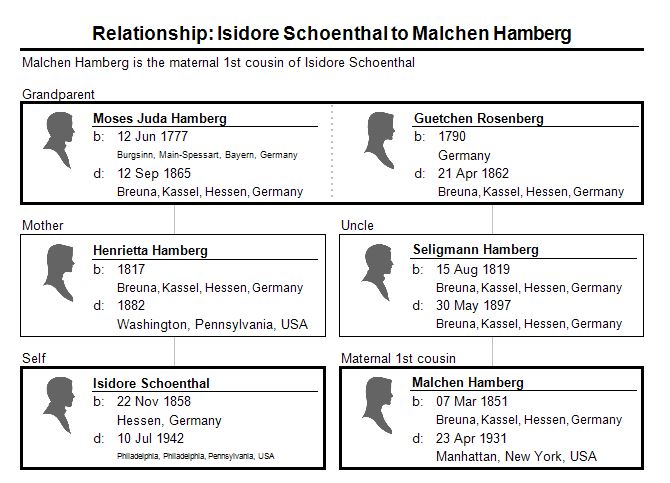
So I looked back at the Hamberg family tree, and I saw that there was a Malchen Hamberg on the tree.  Malchen was the daughter of Seligmann Hamberg and granddaughter of Moses Hamberg.  She was my great-grandfather’s first cousin.

corrected relationship isidore schoenthal to malchen hamberg


Malchen was born March 7, 1851, in Breuna, and according to the family report posted on the site maintained by Hans-Peter Klein, she had emigrated from Germany.  She certainly looked like a possible candidate for the Amalia Hamberg who had been appointed to administer Charles Hamberg’s estate.  She was, like my great-grandfather, a first cousin, once removed, of Charles Hamberg.

corrected chart charles hamberg to malchen hambeg


So I had found yet another Hamberg cousin who had immigrated to the US.  Further research revealed that Amalia had immigrated in 1871, arriving in Baltimore.

Amalie Hamberg passenger ship manifest for the USS Baltimore, arriving September 4, 1871, Baltimore, MD Maryland, Baltimore Passenger Lists, 1820-1948," database with images, FamilySearch (https://familysearch.org/ark:/61903/1:1:QK6L-H1ZK : accessed 2 May 2016), Amalie Hamberg, ; citing Immigration, Baltimore, Baltimore, Maryland, United States, NARA microfilm publications M255, M596, and T844 (Washington, D.C.: National Archives and Records Administration, n.d.); FHL film 417,401.

Amalie Hamberg passenger ship manifest for the USS Baltimore, arriving September 4, 1871, Baltimore, MD  Line 388
Maryland, Baltimore Passenger Lists, 1820-1948,” database with images, FamilySearch (https://familysearch.org/ark:/61903/1:1:QK6L-H1ZK : accessed 2 May 2016), Amalie Hamberg, ; citing Immigration, Baltimore, Baltimore, Maryland, United States, NARA microfilm publications M255, M596, and T844 (Washington, D.C.: National Archives and Records Administration, n.d.); FHL film 417,401.

According to the 1900 census, Amalia married Jacob Baer in 1873.  Reviewing the birth records of their children indicated that Amalia and Jacob lived in Pittsburgh for many years where they had nine children born between 1874 and 1891.  (More on Amalia and her family in a later post.)  The fact that Amalia ended up in Pittsburgh where her Schoenthal cousins were living further corroborated my assumption that she was in fact Malchen Hamberg of Breuna.

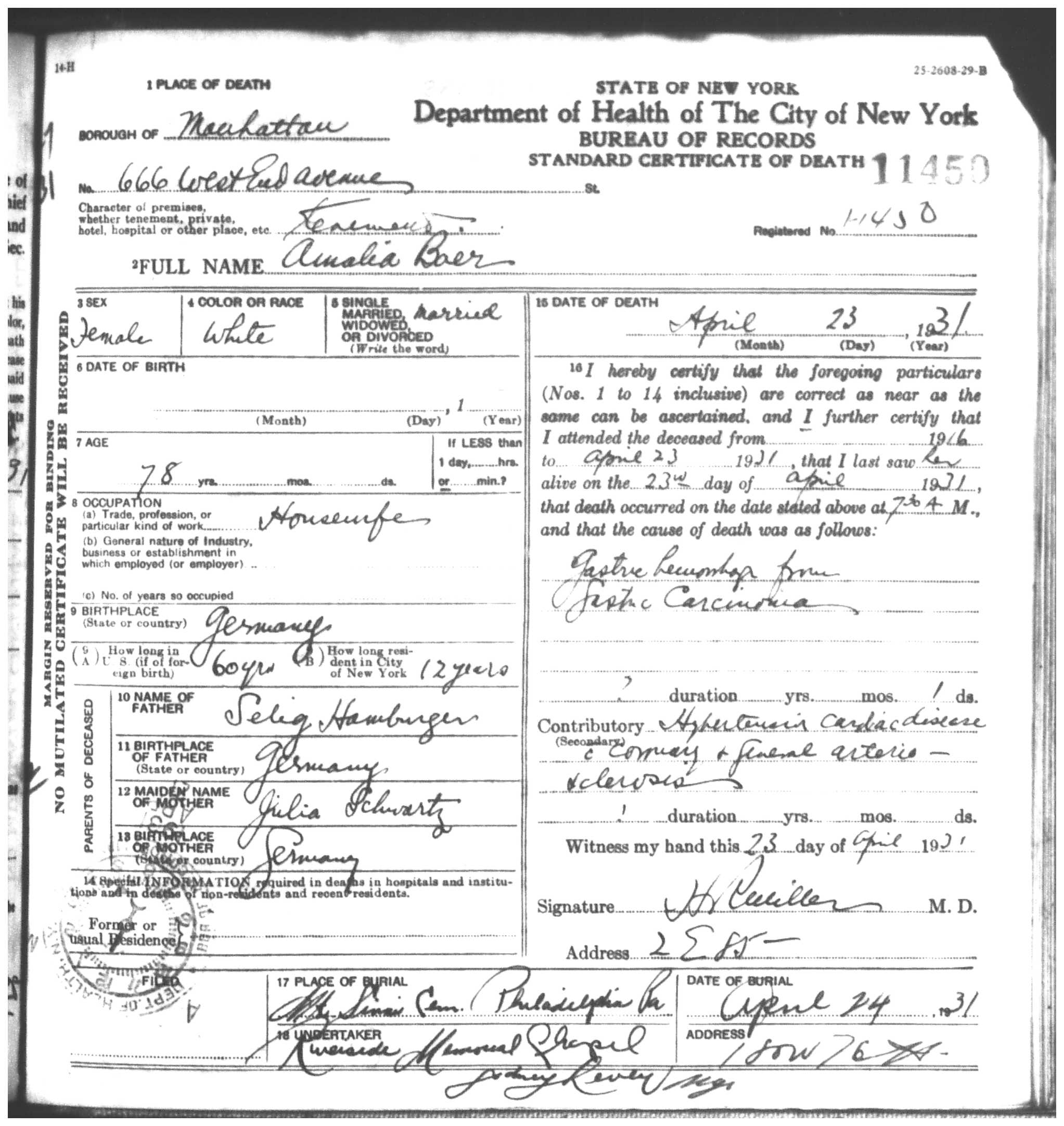
And then the icing on the cake: I received the death certificate for Amalia Baer.   Amalia Baer died on April 23, 1931, in New York City.  Her father’s name was Selig Hamburger.

Baer, Amalia death page 1

Baer, Amalia death page 2


Okay, it not precisely right.  Malchen’s father was Seligmann Hamberg.  So the informant cut off a syllable from the first name and added one to the surname.  I still think Amalia was Malchen.

The mother’s name was even further off—Julia Schwartz instead of Jette Gans.  But death certificates are often filled with mistakes, and it’s not surprising that the informant did not have completely accurate information about the parents of a 78 year old woman, parents that the informant had likely never met.

The certificate also stated that Amalia had been in the US for 60 years; Amalia Hamberg had arrived in 1871, sixty years before 1931, the year Amalia Baer died.

So I am 99% sure that Malchen Hamberg, granddaughter of my three-times great-grandfather Moses Hamberg, was Amalia Hamberg, wife of Jacob Baer, administratrix of Charles Hamberg’s estate.

Only one thing seemed strange.  If Amalia married Jacob Baer in 1873, why was she using the name Hamberg in 1879 when she was appointed to administer Charles’ estate? I don’t know.  Hence, that lingering one percent of doubt.

There are also other questions.  Why wasn’t Charles’ brother Moses made the administrator of his estate? He was the closest relative.  Why Amalia, his cousin and a woman, instead?

Well, I cannot find the Moses Hamberg from Breuna who immigrated in 1846 as a seventeen year old shoemaker on any subsequent record.  Having searched every census from 1850 forward using wild cards, misspellings, and several databases, I have hit that proverbial brick wall. I can find other men named Moses Hamberg, but none that fit the other criteria for being the correct person.  Either the age is off, the birth place is wrong, or the family members and structure are different.

Maybe Moses changed his name so drastically that it is undiscoverable.  Maybe he died and his death is not recorded anywhere I can find.  Maybe he returned to Germany or went to some third place.  I don’t know.  But I can’t find him.  That may explain why Amalia, not Moses, administered Charles Hamberg’s estate.

But there are other questions.  By 1879 Amalia had several young children of her own to care for.  Did she travel to South Carolina to deal with Samuel and with the estate?  Or was it all handled locally by Walter. S. Monteith, the Columbia attorney representing Amalia, according to the estate papers?

And how did Samuel get from Columbia, South Carolina, to Washington, Pennsylvania? Did Amalia go to get him? Or Henry? Or some other family member? Or did he take a train by himself? These are all questions for which I have no answers.

As for what happened to Samuel after he came to Pennsylvania—well, that’s a story for yet another post.


[1] The spelling varies according to the record; later records seem to consistently use Amalia so I will adopt that in this post.

Yom Hashoah—Holocaust Remembrance Day

Today is Yom Hashoah, Holocaust Remembrance Day, a day to remember all those who were killed during the Holocaust.

As a result of my genealogy work, I have learned in the last few years that there were many members of my extended family who were victims of the Nazis.  I had always assumed that all my relatives had left Europe before Hitler came to power—long before he came to power.  So learning about the many members of the Seligmann family who were killed and then more recently about the many members of the Schoenthal and Hamberg families who were killed has been very painful.

The Holocaust touched us all, whether we know it or not, whether we are Jewish or not. Our world lost millions of people.  As each generation learns how cruel and inhumane other people can be, there is once again a loss of innocence.  I dread the day when my grandsons also have to learn this horrible truth.

English: A lit Yom Hashoah candle in a dark ro...

English: A lit Yom Hashoah candle in a dark room on Yom Hashoah (Photo credit: Wikipedia)

Last spring I visited the camps at Terezin and Auschwitz.  I carried with me a list of the names of my relatives who had died at each of the camps so that I could honor their memories.

That list has grown since last spring.  One of the most recent names I’ve had to add to the list of those who died at Auschwitz was Liesel Mosbach Lion, granddaughter of Rosalie Schoenthal Heymann, my great-grandfather’s sister.  Liesel was my father’s second cousin.

I recently posted about Liesel and her family and what happened to them.  Most of what I knew came from the memoir written by Liesel’s husband Ernst Georg Lion, The Fountain at the Crossroads.  I was so moved by his book that I have decided to see whether there is a way to get it published in a format where it will be accessible to more people.  I am now in touch with Ernst’s son Tom.  He sent me photographs of Ernst and his family, including my cousin Liesel.  With his permission, I am posting a few of them here to honor their memory this Yom Hashoah.

The first three are of Ernst’s parents, Leo and Bertha (Weinberg) Lion.  Bertha died from the stress caused by the Nazi treatment of Jews during the 1930s.  Leo was killed in one of the camps.

Ernst Lion parents 1 Ernst Lion father

Ernst Lion parents 2

This is the last photograph taken of Leo Lion before he was arrested and sent to a concentration camp.

Ernst Lion father 2

On the left below is my cousin Liesel Mosbach Lion; she was killed at Auschwitz.  On the right is the wedding picture of Liesel and Ernst, December 18, 1939.

Liesel, her sister Grete, both of her parents, Helene Heymann Mosbach and Julius Mosbach, and her aunt Hilda Heymann were all killed during the Holocaust. Her grandfather Willy Heymann was arrested and taken to Dachau and died soon after being released.

They were all my cousins.

Liesel Mosbach Lion alone and in wedding picture with Ernst

These are various photographs of Ernst from childhood through the war years and afterwards in the US.  His story of suffering and survival is unforgettable.

pictures of Ernst Lion

We live in a time when once again hatred and fear permeate our world and demagogues are seeking power.  We must be vigilant and remember what happened then.  We must do all we can to ensure that genocide does not occur again anywhere.

We must never forget.  Never again.

The Tragic Story of Charles Hamberg: Gun Violence in South Carolina

Last week I wrote about Samuel Hamberg, the twelve year old boy who appeared in the household of my great-great-uncle Henry Schoenthal in 1880 as his adopted son.  As I described in that post, I had determined that Samuel was the son of Charles Hamberg of Columbia, South Carolina; he appeared on the 1870 census living in Charles Hamberg’s household along with a woman named Tenah Hamberg and a servant also with the first name Tenah.

Through my research, I concluded that Charles Hamberg was in fact born Baruch Hamberg, the son of the first Samuel Hamberg, my great-great-grandmother Henriette Hamberg Schoenthal’s uncle, her father’s younger brother.

Relationship of Henrietta Hamberg and Charles Hamberg

Baruch had left Breuna, Germany, in 1852, with his first cousin Abraham, who died in Savannah, George, in 1854.  Baruch, I postulated, became Charles and had married a woman named Mary E. Hanchey in New Hanover, North Carolina, in March, 1853.

Charles Hamberg and Mary Hanchey marriage record 1853 Ancestry.com. North Carolina, Marriage Records, 1741-2011 [database on-line]. Provo, UT, USA: Ancestry.com Operations, Inc., 2015. Original data: North Carolina County Registers of Deeds. Microfilm. Record Group 048. North Carolina State Archives, Raleigh, NC.

Charles Hamberg and Mary Hanchey marriage record 1853
Ancestry.com. North Carolina, Marriage Records, 1741-2011 [database on-line]. Provo, UT, USA: Ancestry.com Operations, Inc., 2015.
Original data: North Carolina County Registers of Deeds. Microfilm. Record Group 048. North Carolina State Archives, Raleigh, NC.

But why did Samuel end up with my great-great-uncle Henry in Washington, Pennsylvania, in 1880? What had happened to his father? His mother? And who was his mother? Was it Mary Hanchey, the woman Charles married in 1853 and with whom he was living in 1860? Or was it “Tenah,” the woman he was living with in 1870?

First, I focused on Mary, the first wife.  Searching on Ancestry, I found this entry:

Record of Deaths in Columbia South Carolina page 80 [p.80] Mrs. Mary A. Hamberg , wife of Charles Hamberg died in Col’a So. Ca. Novr 18, 1866, having been shot [page 166] by a man, Toland A. Bass, a few days previous.

Unfortunately, the database had no further information about this terrible incident, but I was determined to learn more about Mary’s death.  Was it accidental? A murder? What happened to Toland Bass?

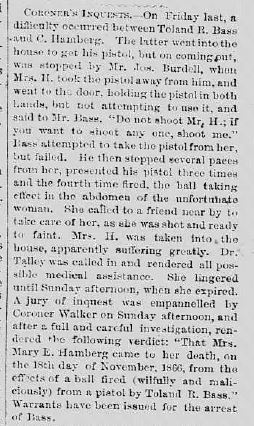
After much searching, I found this article from the November 20, 1866 issue of The Daily Phoenix, the Columbia, South Carolina, daily paper (p. 2):

Daily Phoenix article 11 20 1866 p 2


Coroner’s Inquests.—On Friday last, a difficulty occurred between Toland R. Bass and C. Hamberg.  The latter went into the house to get his pistol, but on coming out, was stopped by Mr. Jos. Burdell, when Mrs. H. took the pistol away from him and went to the door, holding the pistol in both hands, but not attempting to use it, and said to Mr. Bass, “Do not shoot Mr. H.; if you want to shoot any one, shoot me.”  Bass attempted to take the pistol from her, but failed.  He then stepped several paces from her, presented his pistol three times and the fourth time fired, the ball taking effect in the abdomen of the unfortunate woman. 

She called to a friend near by to take care of her, as she was shot and ready to faint.  Mrs. H. was taken into the house apparently suffering greatly.  Dr. Talley was called in and rendered all possible medical assistance.  She lingered until Sunday afternoon, when she expired.  A jury of inquest was empannelled by Coroner Walker on Sunday afternoon, and after a full and careful investigation, rendered the following verdict: “That Mrs. Mary E. Hamberg came to her death, on the 18th of November, 1866, from the effects of a ball fired (willfully and maliciously) from a pistol by Toland R. Bass.” Warrants have been issued for the arrest of Bass.

Who was Toland Bass, and why did he kill Mary Hanchey Hamberg? Why did Mary suggest that he should shoot her, not her husband?

The only thing I could find about Mr. Bass was that he served as a private in the Confederate Army during the Civil War in Company H of the South Carolina Cavalry Regiment.


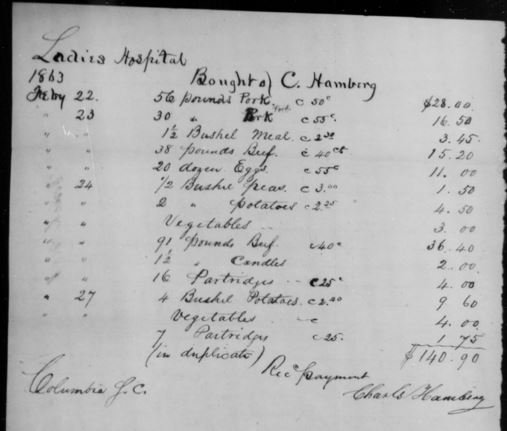
Charles Hamberg, on the other hand, appears to have been a private citizen in Columbia, South Carolina, during the Civil War, selling provisions to the Ladies Hospital.  Here is an example of an invoice he submitted:

Page 15 Confederate Citizens File - Fold3 https://www.fold3.com/image/31347220?xid=1945

Page 15 Confederate Citizens File – Fold3
https://www.fold3.com/image/31347220?xid=1945


I don’t know what might have precipitated this altercation between Bass and the Hambergs; all I can do is speculate.  Columbia, South Carolina, had suffered much damage during the Civil War.  The Union Army occupied the city during the last months of the war in 1865.  As described in Wikipedia:

On February 17, 1865, Columbia surrendered to Sherman, and Wade Hampton’s Confederate cavalry retreated from the city. Union forces were overwhelmed by throngs of liberated Federal prisoners and emancipated slaves. Many soldiers took advantage of ample supplies of liquor in the city and began to drink. Fires began in the city, and high winds spread the flames across a wide area. Most of the central city was destroyed, and municipal fire companies found it difficult to operate in conjunction with the invading army, many of whom were also fighting the fire. The burning of Columbia has engendered controversy ever since, with some claiming the fires were accidental, a deliberate act of vengeance, or perhaps set by retreating Confederate soldiers who lit cotton bales while leaving town. On that same day, the Confederates evacuated Charleston. On February 18, Sherman’s forces destroyed virtually anything of military value in Columbia, including railroad depots, warehouses, arsenals, and machine shops.

English: The Burning of Columbia, South Caroli...

English: The Burning of Columbia, South Carolina, February 17, 1865 (Photo credit: Wikipedia)

You can read more about the Columbia fires here and here.  In the aftermath of the war and during Reconstruction, places like Columbia struggled to rebuild their economy and their infrastructure.  There was widespread poverty.  Perhaps Toland Bass was an embittered Southern veteran; perhaps he resented Charles Hamberg as a merchant who not only didn’t serve in the war but made money during it.  Or maybe it is something much more personal that created the animosity that led to the gruesome murder of Mary Hanchey Hamberg. I don’t know.

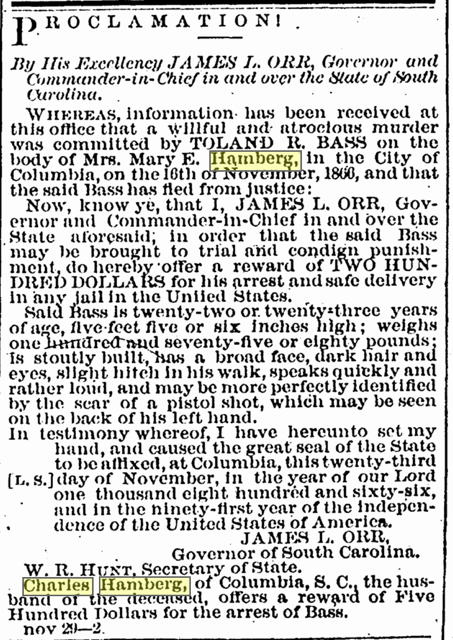
After the murder, Toland Bass ran off to avoid arrest, and the governor of South Carolina, James L. Orr, issued a proclamation offering an award of $200 for his arrest and delivery to South Carolina for trial. Charles Hamberg offered a separate award of $500 for his arrest. (Thank you to Ann Meddin Hellman of the Jewish Historical Society of South Carolina for helping me locate some of these articles

Proclamation about Mary Hamberg's murder

Thursday, November 29, 1866 Paper: (Charleston, South Carolina)


Bass eluded arrest for four months until he was finally found and arrested in New York in March, 1867.

Arrest of Toland Bass


I could not find any record of a trial or any other proceeding involving Bass, but I did find this news item announcing his death from cholera on July 15, 1867.

Death of Toland R Bass


Meanwhile, Charles Hamberg had moved on.  Thanks to my blogging friend Cathy Meder-Dempsey, I know that Charles married Lena Goodman on April 6, 1867, in Charleston, South Carolina.

I believe that Lena was incorrectly entered as “Tenah” on the 1870 census and that she was the mother of Samuel Hamberg, the boy later adopted by Henry Schoenthal.  Although I do not have an exact birthdate for Samuel, the 1900 census reported that he was born in February 1868, that is, about eleven months after the marriage of Charles Hamberg and Lena Goodman.

Even after remarrying, Charles seemed to have troubles in Columbia.  In September, 1869, he was involved in another rather unpleasant altercation:

Charles Hamberg assault

There was also a dispute at his store:

CHarles Hamberg unruly customer

Charles also charged a police officer with inappropriate conduct (public drunkenness) and engaged in a citizen’s arrest.  He seemed to have a tendency to get involved in conflicts.

In the 1870s, Charles advertised his wood and coal business regularly in the Columbia newspaper, The Daily Phoenix.

Charles Hamberg coal


He also participated in a Purim celebration in Columbia, dressing up as Jocko the Ape.  (Purim is a Jewish holiday where children and adults dress up in costumes and celebrate the triumph of the Jews over the evildoer Haman who sought to kill the Jews in ancient Persia.)

The Daily Phoenix, March 26, 1872, p. 2

The Daily Phoenix, March 26, 1872, p. 2


So whatever his troubles, Charles seemed to be living a somewhat ordinary life in Columbia.

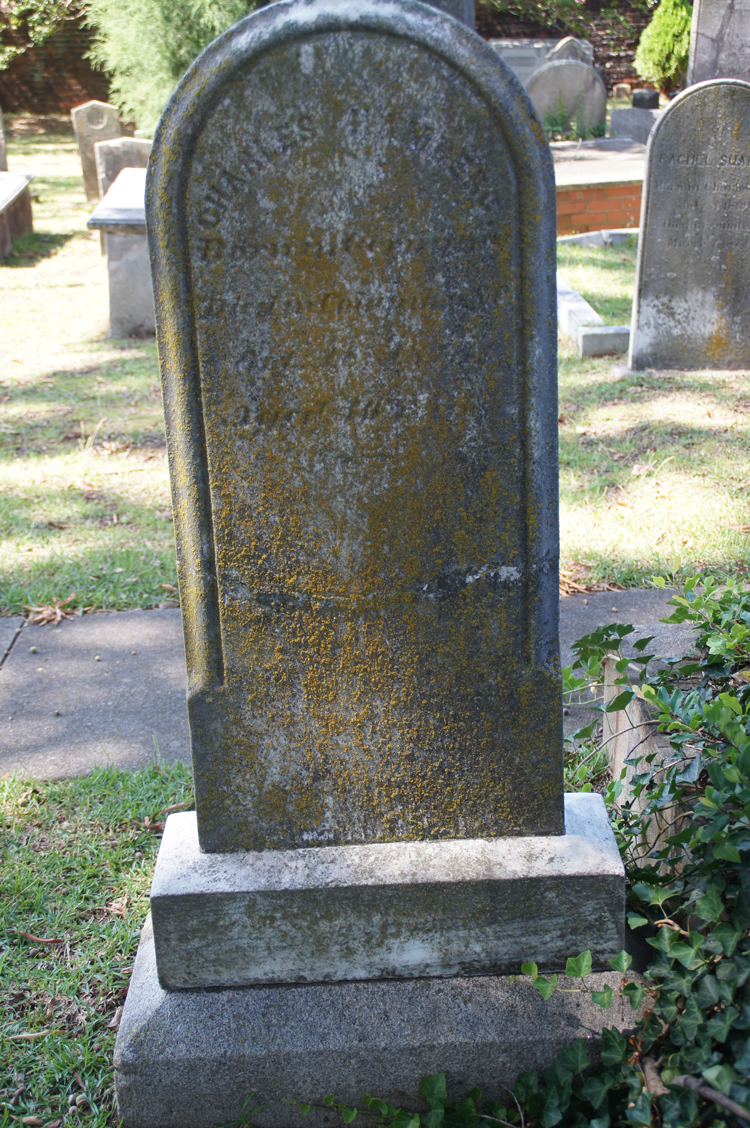
So what happened that caused little Samuel to be adopted by Henry Schoenthal? Tragically, both of Samuel’s parents died before 1880.  His mother Lena died in 1877 and is buried in the cemetery of the Columbia Hebrew Benevolent Society.  She was only 28 years old.  I’ve been unable to locate a death certificate or obituary yet, but will continue to look.  (I contacted the cemetery, but they did not have any further information.)

chbs1HambergLena

Headstone for Lena Hamberg at the Hebrew Benevolent Society cemetery in Columbia, SC http://jhssc.org/hebrew-benevolent-society-cemetery/


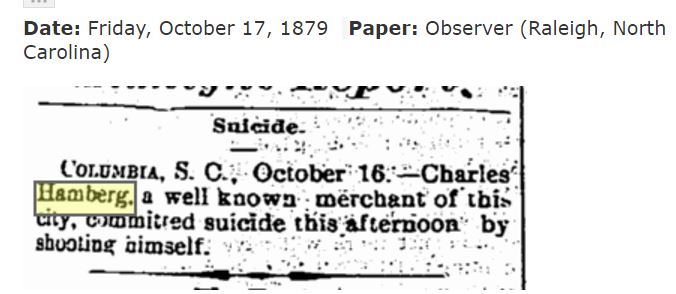
Two years later on October 16, 1879, Charles Hamberg ended his own life, apparently due to financial difficulties, although I would venture that having had one wife murdered and a second dying at a very young age might also have given him sufficient reason for some desperation.  His suicide made the papers even beyond Columbia.

Charles Hamberg suicide Charles Hamberg suicide 3 Charles Hamberg suicide 2


Can you imagine today identifying someone by their religious background for no apparently relevant reason?

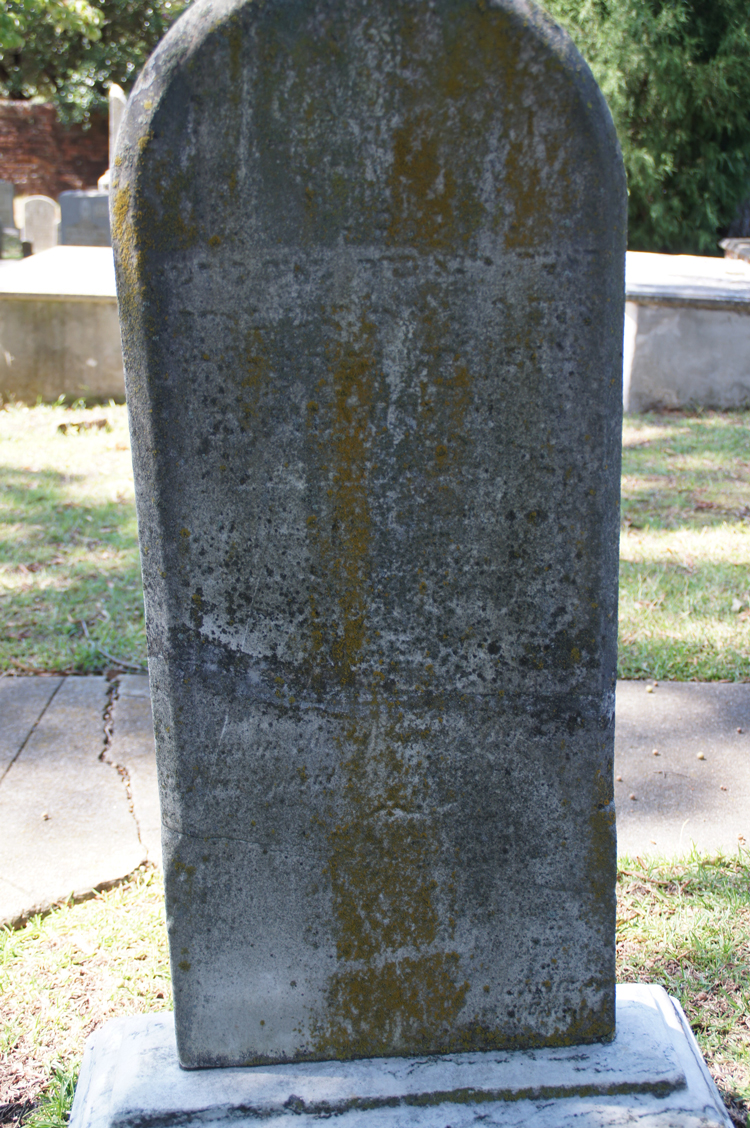
Charles is also buried in the Columbia Hebrew Benevolent Society cemetery, next to Lena.

Charles Hamberg headstone

Headstone of Charles Hamberg at Hebrew Benevolent Society cemetery in Columbia, SC http://jhssc.org/hebrew-benevolent-society-cemetery/

What a hard life Charles Hamberg had once coming to the US.  He lost his cousin Abraham in 1854, his wife Mary was murdered in 1866, his second wife Lena died in 1877, and he suffered financial problems and took his own life in 1879.   I imagine that that was not the life he dreamed of when he left Breuna, Germany, in 1852.  For him the American dream did not come to be.

His son Samuel was just eleven years old and had lost his mother and his father.   He ended up in Pennsylvania with Henry Schoenthal, his second cousin.  How did he end up there?  That leads to the next mystery.