What I Learned From My Great-Great-Grandmother’s Will

I am back from a break after a great visit with our kids and then a week to recover! Before I return to the story of the family of Malchen Rothschild (as I am still waiting to speak with her great-grandson Julio), I have an update about how I discovered my great-great-grandmother’s will.

Earlier this summer Teresa of Writing My Past wrote about full-text searching on FamilySearch. I had never known about this tool but was tempted to see what I could find. I followed the link that Teresa provided on her blog and entered “John Nusbaum Cohen” to see what would come up.

Lo and behold, it immediately retrieved what turned out to be the last will and testament of my great-great-grandmother Frances Nusbaum Seligman. Frances was the daughter of John Nusbaum, my three-times great-grandfather, and the wife of Bernard Seligman, my great-great-grandfather—-two of my pioneer ancestors who came to the US as young men from Germany in the mid-19th century. Both John Nusbaum and Bernard Seligman became successful merchants, John in Philadelphia and Bernard in Santa Fe. But neither came here as a wealthy man.

So I was amazed when I read this will to see just how much property—-jewelry, cash, and other property—Frances owned at the time of her death in Philadelphia on July 27, 1905. She was only 59 when she died, and she left behind three surviving children (two had died before adulthood): my great-grandmother Eva Seligman Cohen and her brothers James Seligman and Arthur Seligman. In addition, Frances had siblings and grandchildren, all of whom are named in her will, as well as other family members and friends.

There  were two inventories of Frances’ property. The bulk of her property was inventoried in September 1905 and included stock, cash, jewelry, and other personal items.1

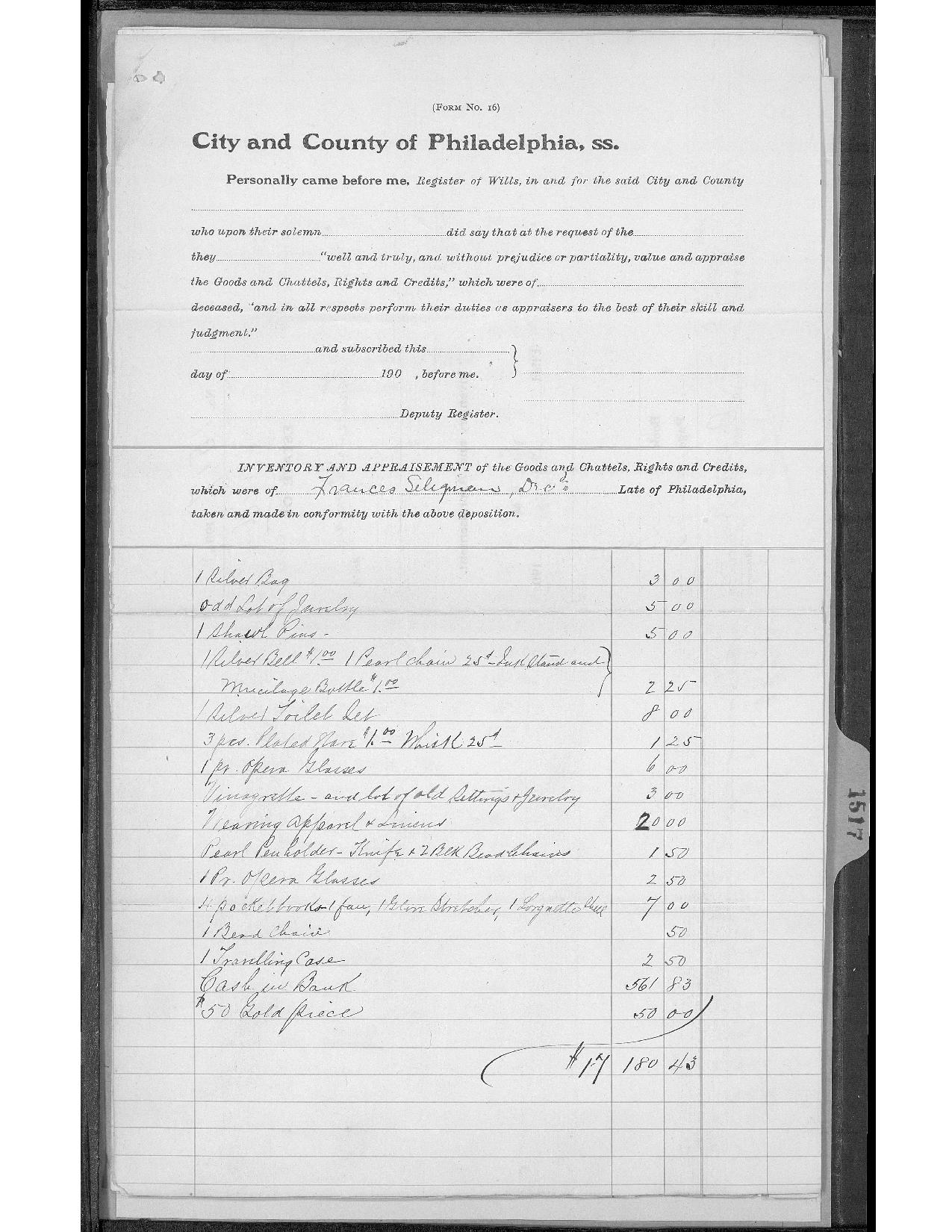
The total value of these properties came to $17,180.43, or approximately $617,000 in today’s dollars. Of course, many of these items, especially the jewelry, may have appreciated far beyond the value they had in 1905 and beyond what the inflation calculators consider.

The second inventory was of Frances’ kitchenware and dishware:
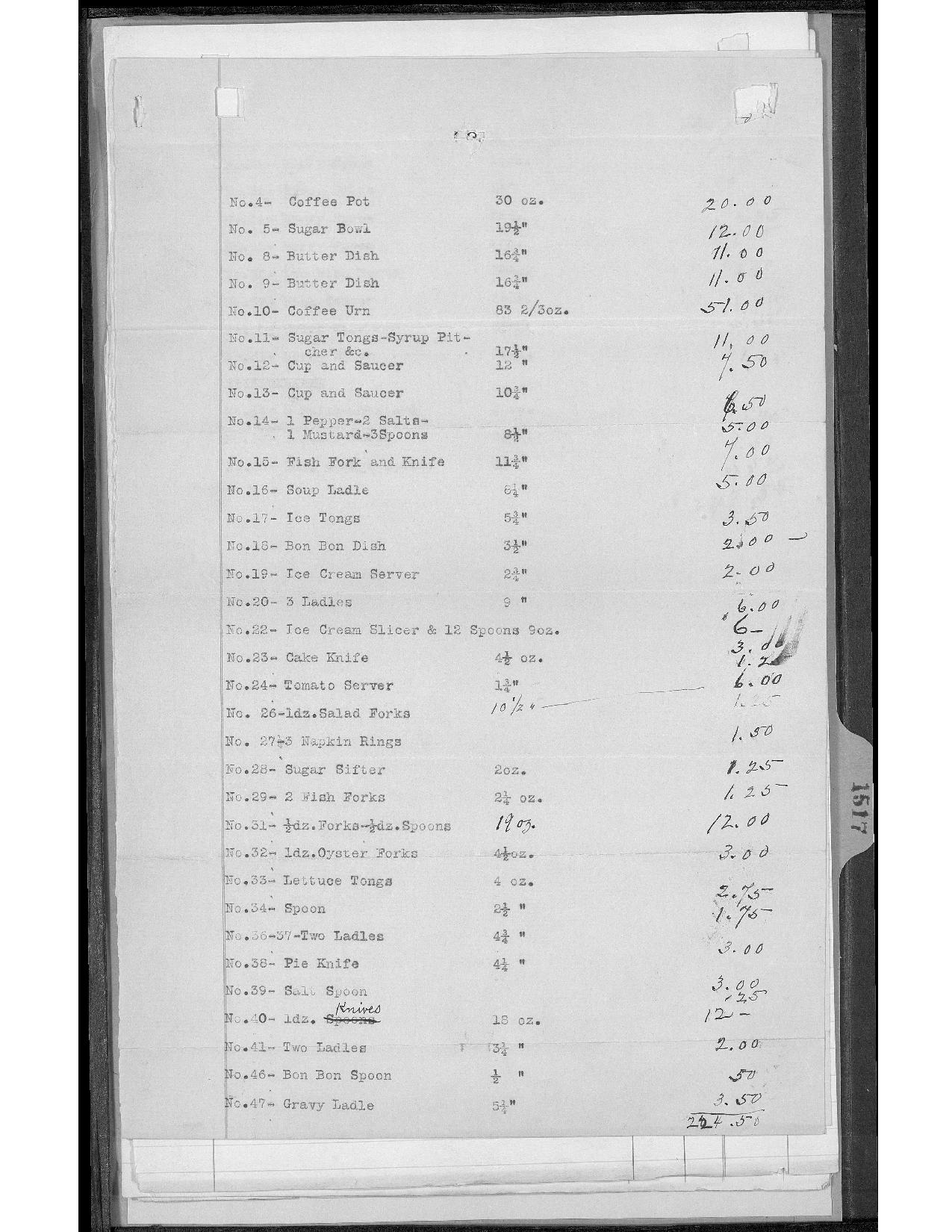
 

The value of these goods was appraised in 1906 as $247.55. In today’s dollars that would be approximately $9000.

The documents do not include any appraisal of any real estate although, as we will see, Frances owned some real estate in Santa Fe.

Frances’ will detailed with great specificity where all this personal and other property was to go. Her original will is eight typed pages plus there is a one page handwritten codicil. I loved reading this will because it names so many of the relatives I’ve written about on my blog. It was fascinating to see how inclusive Frances was in deciding who would get portions of her estate. The following images are the pages from the will with my comments about some or all of the provisions on that page.

In the Third Clause below, Frances divided $1250 among her four siblings. But Simon, Julius, and Miriam each got $250 whereas Lottie received $500. Did she love Lottie more than the others? Or did Lottie have greater need? Lottie never married, so unlike Miriam who had a husband to support her and Simon and Julius who were men, Lottie may in fact have had greater need.

There is a similar seemingly favorable bias in terms of Frances’ distribution to her three living children, Eva, James, and Arthur. Eva was to receive all of her mother’s linen and wearing apparel. Well, I guess the sons couldn’t wear her clothes. But then in the Fifth Clause above, Frances bequeathed a whole lot of jewelry to Eva: “my diamond bracelet, my diamond star with chain attached thereto, my watch studded with diamonds, one of the large diamonds from my thirteen stone diamond ring, my set of silver containing one dozen knives, one dozen large spoons, one dozen small spoons, one large soup ladle and one dozen silver forks.”

What did James get? “One diamond from my thirteen stone diamond ring and a silver coffee pot.” And Arthur: “the other large diamond from my thirteen stone diamond ring, and a silver coffee pot.”

Wow, did they get shafted or what! Even Emanuel Cohen, my great-grandfather and Eva’s husband, got “the centre diamond in my diamond cluster pin.” And he was married to Eva, who was already getting all those diamonds!

Frances then gave other jewelry items to her daughters-in-law and to her grandchildren. My grandfather John Nusbaum Cohen got “four stones from my diamond cluster pin.”

The will goes on to identify specific pieces of jewelry for other family members—aunts, uncles, nephews, nieces, brothers-in-law, and even August Seligman, the younger brother of Bernard Seligman, a brother who never left Germany. Did August get the “silver knife, fork and spoon marked S.S.”? Perhaps his great-grandson Wolfgang knows. I will have to ask him.

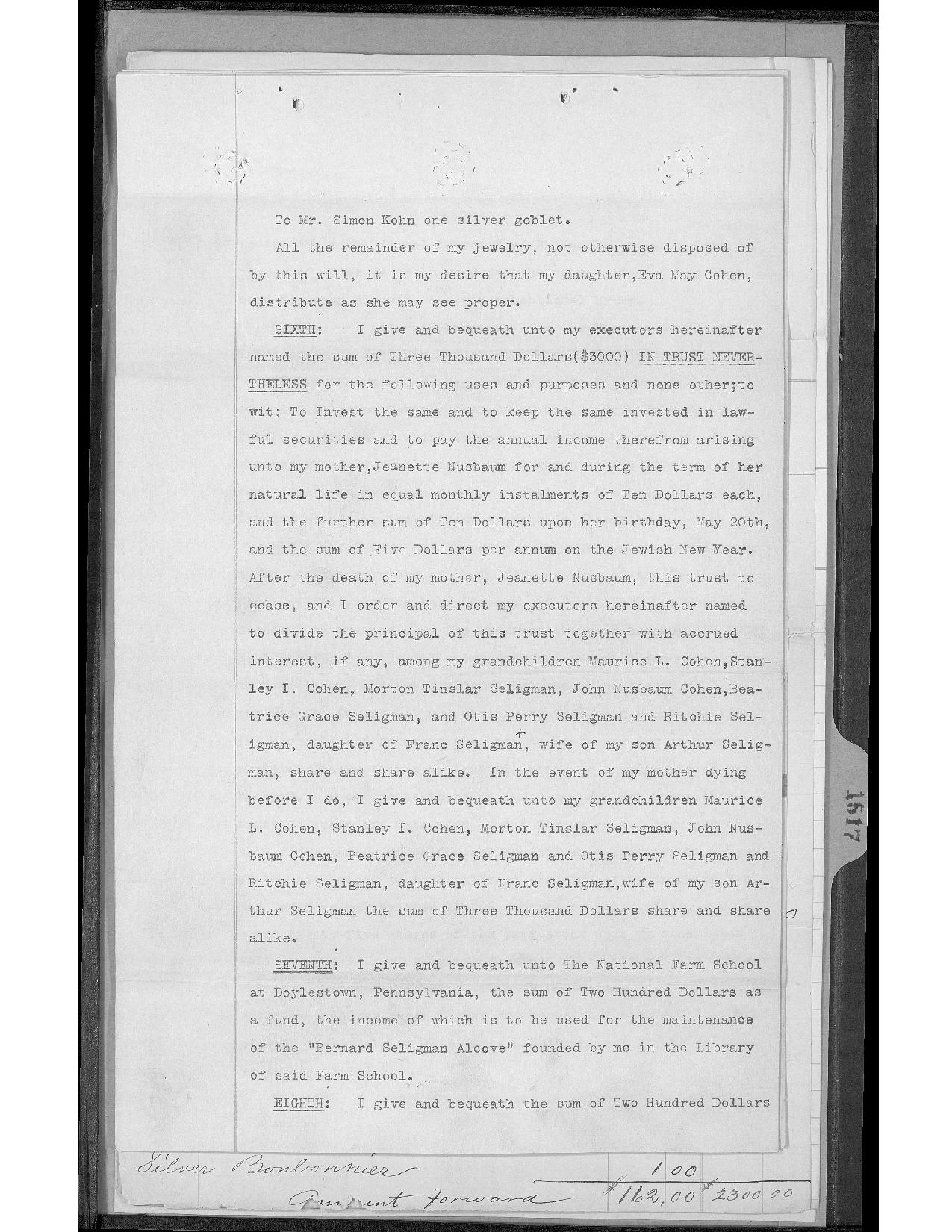
And then at the end of that Fifth Clause below, the will provides, “All the remainder of my jewelry, not otherwise disposed of by this will, it is my desire that my daughter, Eva May Cohen, distribute as she may see proper.”
Before I go on, I need to point out that I do not have one piece of jewelry or anything else that once belonged to Frances Nusbaum Seligman, my great-great-grandmother. Not one thing. Even though all those diamonds were bequeathed to my great-grandmother Eva Seligman Cohen, I have no idea where they went once Eva died. She raised my father and his sister from the time they were quite young when both their parents were hospitalized, yet my father did not have one thing—-not one spoon or even a coffee pot—-that had belonged to his beloved grandmother. I have no idea where it all went. Perhaps it was sold during the Depression. Perhaps the other three grandchildren of Eva Seligman Cohen received it, but that seems unlikely. In any event, it’s gone.

Having cleared the air on that, I am now looking at the Sixth Clause (see above). It provides in part for a $3000 trust for Frances’ mother Jeanette Dreyfus Nusbaum, my three-times great-grandmother, who was still living when Frances drew up this will in 1905. I love that Frances provided for her mother and even specified that she receive ten dollars on her birthday (May 20) and five dollars at the Jewish New Year in addition to the ten dollar regular monthly payments under this provision. It shows me how caring Frances was and also how much being Jewish was still an important part of the family’s life. Jeanette was 87 when the will was executed, and she outlived her daughter Frances, dying on January 12, 1908, at the age of 90.

There are then several bequests to various charitable organizations, and then we come to the Eleventh Clause (below), in which Frances requires that a trust be created from fifty shares of her stock in Seligman Brothers in Santa Fe, the dividends from which were to be paid to “my daughter Eva May Cohen, for and during her natural life, for her sole and separate use, not to be in any way or manner whatever liable to the contracts, debts, or engagements of her husband.” I am so impressed that Frances had the wisdom to set aside money that would be only for her daughter and not under the control of Eva’s husband. How progressive is that!

The provision further provides that Eva’s children would inherit that stock upon her death as well as Eva’s brothers James and Arthur. Sadly, Seligman Brothers itself did not survive long enough to benefit those beneficiaries as it closed for business by 1930.

Nevertheless, once again Frances favored Eva in the will.

The Twelfth Clause refers to a house and lot in Santa Fe to be shared by all three of Frances’ children. (I don’t see that property included in the inventories mentioned above so the estate was worth more than estimated above.) In 1904 when Frances executed this will that was the location of the oldest hotel in Santa Fe, the Exchange Hotel. I have no idea what it was worth at that time, but it certainly added something substantial to the overall value of Frances Nusbaum Seligman’s estate.

Below are the final provisions in the original will.

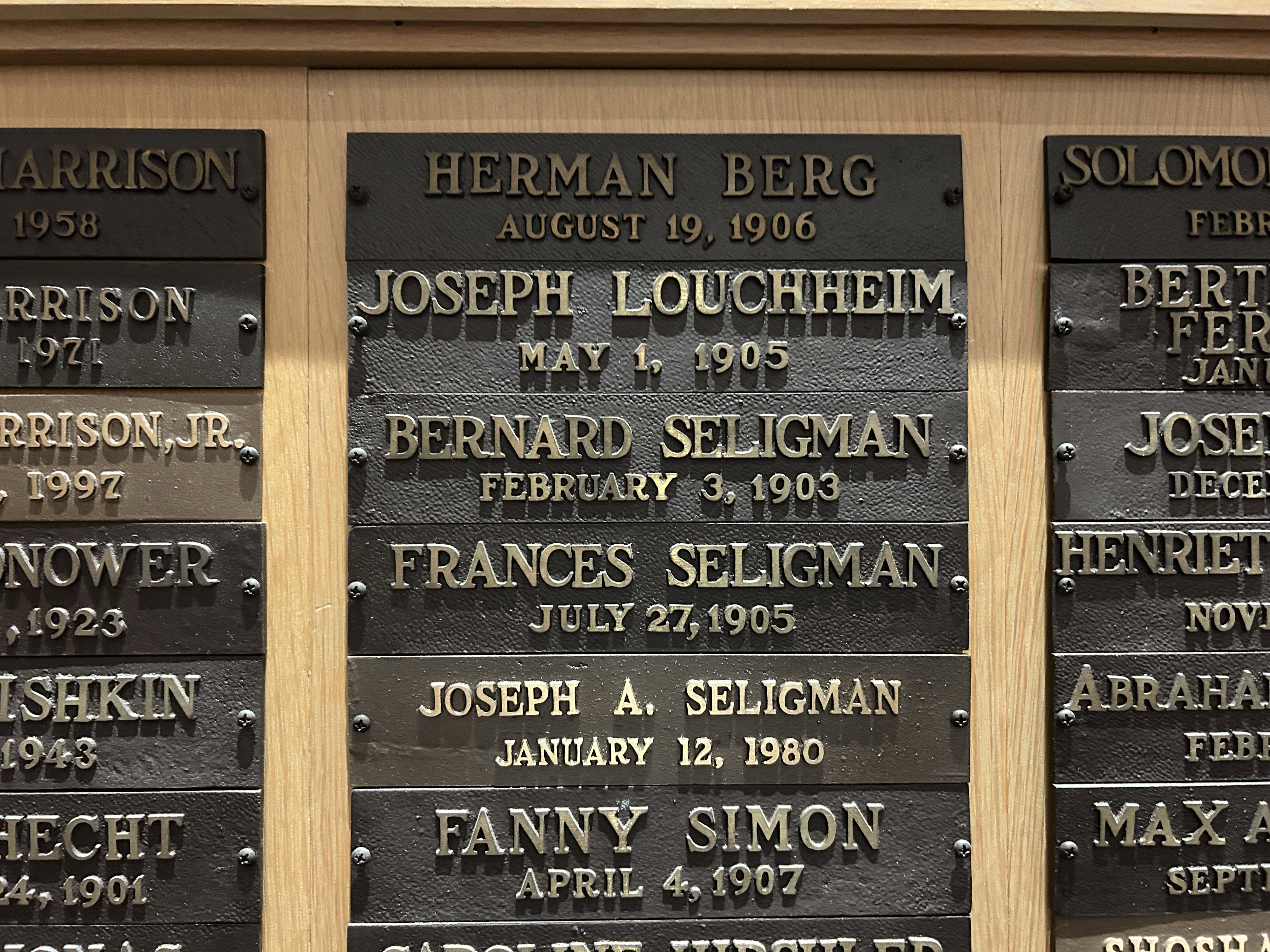
There is also a handwritten codicil to the will dated February 18, 1905. It includes additional specific bequests of various items of personal property and also provides that $200 was to be given to Congregation Keneseth Israel for the purpose of “placing the names of my husband Bernard Seligman and my own, together with the dates of our respective deaths, upon the memorial tablet on the North-East Wall of the Synagogue.” We all want to be remembered, don’t we?

I wrote to Congregation Keneseth Israel, now located in the suburbs of Philadelphia, asking about my great-great-grandparents’ plaque, and I was quite moved and relieved to learn that it still exists on their memorial wall in their suburban location. Their executive director Brian Rissinger kindly sent me this image of the plaques:
Finding this will was such a gift. It gave me insights into my great-great-grandmother Frances Nusbaum and her relationships with her children, grandchildren, siblings, and others. And it reminded me how extraordinary her life was—-growing up as the daughter of a successful merchant in Philadelphia only to fall in love with a young immigrant from Germany who had lived in Santa Fe. After marrying him and having four children in Philadelphia, she moved with him and their children to Santa Fe, living in what was then a small but growing pioneer town with very few Jews and even fewer Jewish women. And her will demonstrated that she cared deeply about her Jewish identity. She must have been so resilient and so devoted to make that adjustment to life in Santa Fe. I wrote about Frances and Bernard in my family history novel, Santa Fe Love Song for anyone who wants to know more about them..

Frances was described in her obituary in these terms:

“She was a beautiful and accomplished woman, as good as she was beautiful and as beautiful as she was good, and of a most lovable and gentle disposition. She was an exemplary wife, a fond and good mother, and a dutiful and loving daughter. Indeed she was all that is implied in the phrase ‘a thoroughly good and moral woman.’ … She will be especially remembered by the poor people of [Santa Fe], to whom she was particularly kind. Many and many truly charitable deeds have been put to her credit.”

Everything in her will reflected those same qualities.

I was deeply touched by the relationship between Frances and her daughter Eva, my great-grandmother. Frances had lost two daughters; her daughter Florence had died when she was just a month old, and her daughter Minnie had died when she was seventeen. Thus, Eva, her first born child, was her only surviving daughter, and that must have made Frances cherish her even more.

That Eva was deeply loved by her mother also sheds light on the woman she became. In learning about Eva from my father and from my research, I grew to appreciate what a strong and compassionate woman she was. Like her mother Frances, she lost one son as a baby and a second son predeceased her by committing suicide. Like her mother, Eva was uprooted from Philadelphia to Santa Fe, but returned to Philadelphia for college and lived the rest of her life there after marrying my great-grandfather Emanuel Cohen. Being so far from her parents and brothers back in Santa Fe must have been as difficult for her as it had been for her mother to leave her family behind in Philadelphia to move to Santa Fe.

Despite all those losses and difficulties, Eva clearly had a big heart. She took a widowed brother-in-law and his son into her home for many years, she took her parents into her home when they returned to Philadelphia to retire, and, most importantly to me, she took my father and aunt into her home and provided them with comfort, love, and security when their parents were unable to care for them.

The love between Frances and Eva, between mother and daughter, shines through in this will. And I am so grateful to Teresa for alerting me to the full-text search on FamilySearch so that I could find it.


  1. All the documents included in this post were located using the full-text search on FamilySearch. They are cited there as follows: Philadelphia, Philadelphia, Pennsylvania, United States records,” images,
    FamilySearch (https://www.familysearch.org/ark:/61903/3:1:S3HT-D4WP-CQ?
    view=fullText : Aug 30, 2025), images 189-206 of 315. 

Jacob’s Bible: Lost and Found

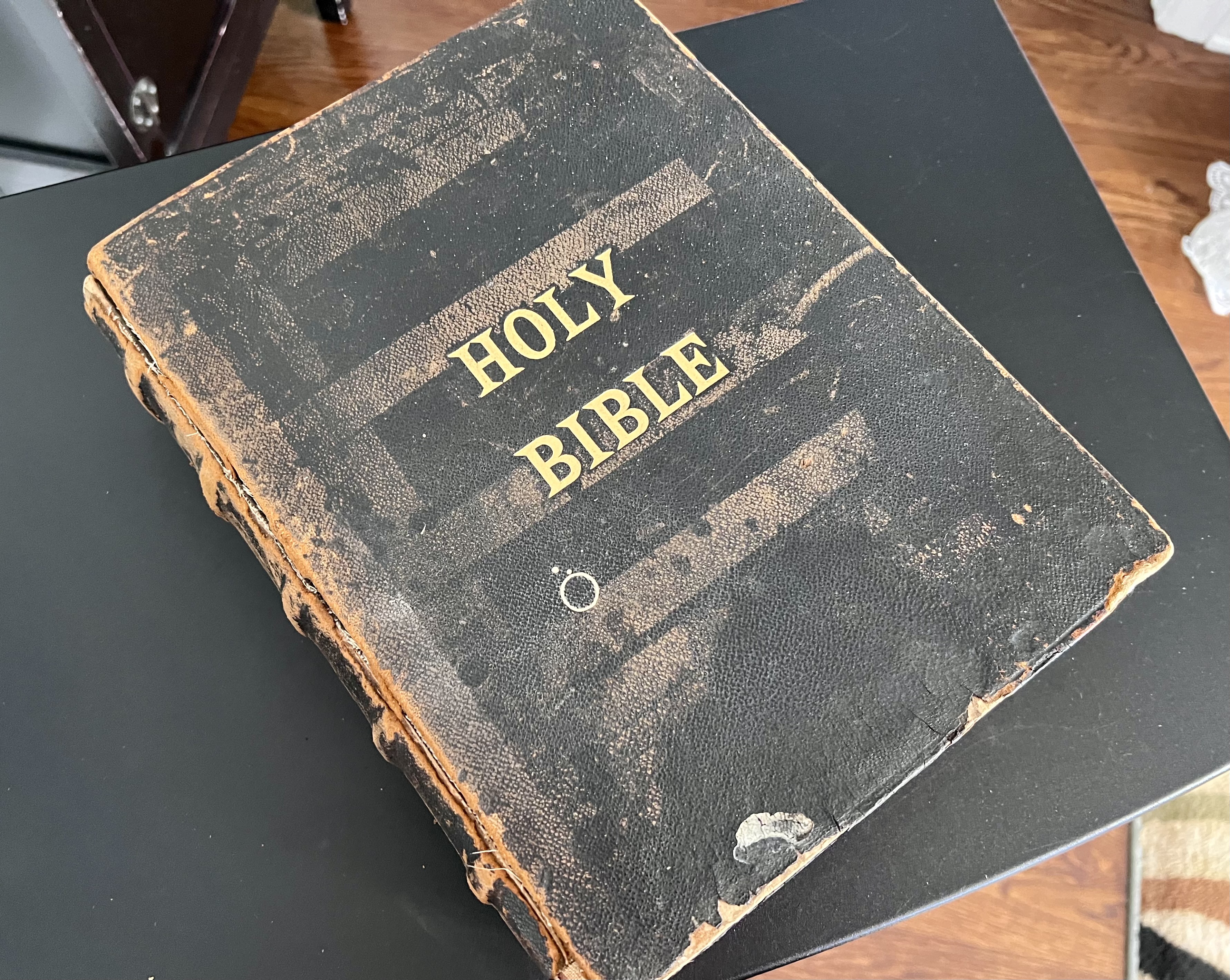
I continue to be amazed by the people who find my blog and contact me—whether it’s because they are related to someone I wrote about (and thus to me) or because they knew someone I wrote about or because, as in this case, they have found some artifact that relates to someone I wrote about. That is how Martin Gonzalez found me and told me about Jacob Cohen’s bible.

Back in early January 2024, Martin wrote to ask me if I was related to Jacob and Ida Cohen. When I asked him why, he told me that he owned a bible that had their names in it. He sent me a few images of the bible that showed Jacob and Ida’s names.

I did a search of my family tree and realized that the Jacob Cohen who had married Ida Siegel was my second cousin, twice removed, the great-grandson of my three-times great-grandfather, Hart Levy Cohen, and my grandfather John Nusbaum Cohen’s second cousin. You can read what I’ve already written about Jacob and Ida and their family (and find sources) in my earlier posts here and here. I will only include an outline of their lives here.

Jacob was born on March 9, 1870, in Washington, DC, to Moses Cohen and Henrietta Loeb. As a young man, Jacob moved to New York City, where he first worked as a bookkeeper. He married Ida Siegel in 1894, and they had two children: Aimee, born in 1895, and Gerson, born in 1900. You can see those births mentioned on this page from the bible:

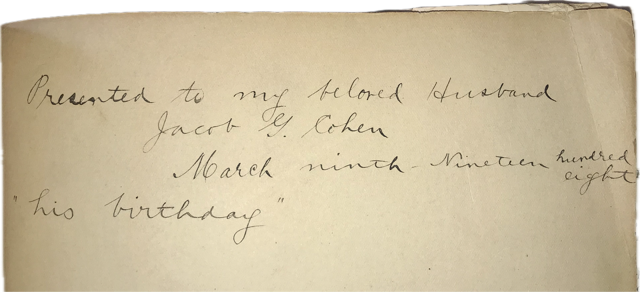
One of the images Martin shared from the bible showed that Ida had given Jacob the bible as a gift on this 38th birthday on March 9, 1908.

So I wrote back to Martin and told him that I was in fact related to Jacob Cohen and asked him how he had ended up with Jacob’s bible. He told me the following story:

Back in 1977, when I was 16 years old and in high school, I worked as a stock boy at Nadeen’s Department Store in the Bronx (NY).  One of my responsibilities was to sweep the floors. One day I came across a dirty old box under one of the clothing racks. I asked my store supervisor (Nathaniel, a devout Christian) about the box and he showed me its contents.

Two things I remembered seeing in the box vividly was a beautiful vintage radio, the kind that operated from glass tubes and an old, dusty Bible. As we spoke, he realized I had never read the Bible. So, he gave it to me as a gift. Nat told me it was previously given to him by our store manager at the time, Jack Katz.

In 1979, I graduated high school and joined the Marine Corps. The Bible stayed at my parents’ apartment while I toured.

After the service, a few years later, I came back home, and the book has been with me ever since. The Bible is in the plastic linen bag my wife came across to protect it and it fits perfectly!

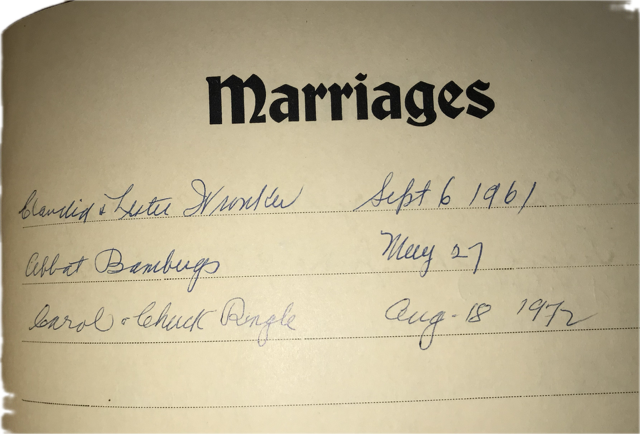
Martin then sent me more images from the bible, including this one with some unfamiliar names.

I set off to try and identify those people and realized that many of them were not in fact blood relatives of Jacob or Ida. But to understand how those names ended up in the bible, you need a little more background about Jacob, Ida, and their children. Again, except where noted, this information and my sources are from the earlier blog posts linked to above.

On February 12, 1917, Jacob and Ida’s daughter Aimee married Lester Wronker.  Aimee and Lester had a son, Robert, who was born in April, 1919.  In 1920, they were living in Manhattan.

In 1925 Jacob and Ida were living in Manhattan, and Jacob was working as an insurance agent.  Their daughter Aimee and her husband Lester and their son Robert were now living in Yonkers. Sometime thereafter, Jacob changed his surname from Cohen to Cole. His son Gerson also changed his name to Gary Cole and was living in 1930 in Detroit as a credit manager for a furniture business.

Jacob died on February 13, 1930.

In 1940, Jacob’s widow Ida was living with Aimee and Lester Wronker in Yonkers. Their son Robert Wronker graduated from Princeton University in 1940. Tragically, Robert died on August 20, 1956, after a long illness.  He was only 37 years old. He had never married or had children. Meanwhile, in Detroit, Jacob’s son Gary Cole had married Wanda Budzinsky in 1941, and they had two sons.

Ida Siegel Cohen/Cole died in 1949. Sadly, neither of her children outlived her by very long. Gary Cole died in 1955 at 55; his sister Aimee Cohen Wronker died in 1959 at 64. Thus, with Aimee’s death, the only direct descendants of Jacob G. Cohen and Ida Siegel who were still living were their two grandsons through their son Gary, and they were just teenagers and living in Detroit.

So what happened to Jacob’s bible after Aimee died in 1959 and Gary, Ida, and Jacob were already deceased? It appears that it was in the hands of Lester Wronker, Aimee’s widower, Jacob’s son-in-law.

Lester remarried in 1961, two years after Aimee’s 1959 death. His second wife was Claudia Langfeld Bamberg,1 a widow herself with one son, Abbot Strouse Bamberg, and two granddaughters, Abbot’s daughters Judith and Carol.2

You can see that someone—Claudia probably—added information about Claudia, her son Abbot, and her two granddaughters Judith and Carol to Jacob’s bible. Notice how the handwriting and the ink is noticeably different from the earlier entries made by Jacob or Ida or Aimee.

So how did the bible end up at Nadeen’s in 1977 where Martin discovered it? No one knows for sure. But after Lester Wronker died in 1976, it appears that Claudia and her son and granddaughters must have gotten rid of the bible, and somehow it ended up in a dirty old box in Nadeen’s women’s clothing store in the Bronx, where Martin Gonzalez discovered it in 1977 and kept it safe for close to fifty years.

Martin contacted me because he wanted to be sure that the bible did not someday once again end up in a dirty box in the backroom of some store or in a landfill. He offered it to me, but I suggested that it would be better to donate it to a library, museum, or archive where it would be kept safe in perpetuity. Martin liked that suggestion and has now sent it to the Jewish Genealogical Society of New York.

Today we hear so much about the ugliness in the world—the hatred, the anger, the polarization. But we also need to remember that there are also wonderful, loving, and generous people in the world who only want to do the right thing. Martin Gonzalez is one of those people. He easily could have done nothing, and Jacob’s bible might once again have been lost. But he took the time to search for someone who might help him preserve it, and fortunately he found my blog. Thank you, Martin, for restoring my faith in people and reminding me to believe that good can prevail over evil and love can prevail over hate. You have done an amazing mitzvah by taking such good care of Jacob’s bible.


  1. Lester Wronker, Gender Male, Marriage Date 6 Sep 1961, Marriage Place New Rochelle, New York, USA, Certificate Number 40700, Records Sharing Certificate Number (Name), Lester Wronker, Claudi L Bamberg, Claudi L Langfeld, New York State Department of Health; Albany, NY, USA; New York State Marriage Index, Ancestry.com. New York State, Marriage Index, 1881-1967 
  2. See “Abbot Bamberg, Former New Rochelle Resident,” The Daily Times (Mamaroneck, NY), May 23, 1990, p. 4. 

The Magic of Old Photos and Modern Technology: Memories of Parkchester

While I am on the subject of old photographs, I wanted to share a heartwarming story that started with one old  photograph.

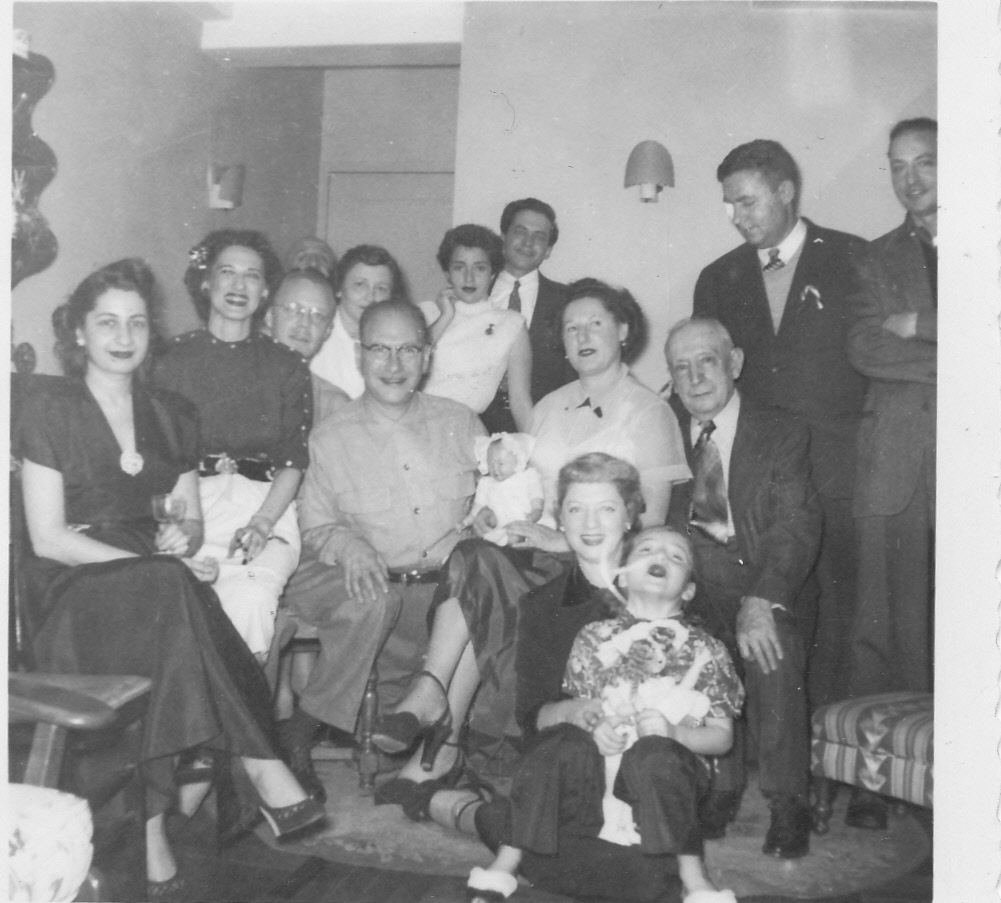
The photo was one I found mixed in with a bunch of old black and white photographs that had been my parents. I could immediately identify my very young parents in the photo. My mother is the woman in the back with the sleeveless white top. Standing behind her, the man in the suit and tie with dark hair is my father. When I looked more closely at the photo, I realized that my grandmother, Gussie Brotman Goldschlager, is standing to the left of my mother (on my mother’s right), and then all the way in the back left corner almost at the door with only his eyes and nose showing is my grandfather, Isadore Goldschlager.

Who are these people??

But I did not recognize one other person in the photo. Who were all those people with my parents and grandparents? I had no one to ask since my grandparents and my parents are no longer living, nor are any of their peers. But I was determined to try and find out. First I distributed the photo by email to all my Goldschlager and Brotman relatives. Did anyone recognize anyone in the photo? No one did. These did not appear to be my relatives.

I then had what turned out to be a brilliant idea. My grandparents and my parents all lived in Parkchester, a community of apartment buildings in the Bronx that was built in the early 1940s. My mother and her parents had moved there when she was about eleven in 1941 or 1942. Then after my parents married in 1951, my parents had an apartment there also. It was my first home. I hypothesized that the photograph might have been taken in Parkchester in the early 1950s. We moved away in 1957, and my parents looked really, really young here—it may have been taken even before I was born in 1952.

I searched to see if there was a Facebook group for people who once lived in Parkchester, and sure enough, there is one. I posted the photograph there, saying that the photograph was probably taken in the early 1950s and asking if anyone recognized anyone in the photograph. I received numerous comments about living in Parkchester in those years, but no one knew anyone in the photo.

Until, that is, a woman named Gail (Lipman) Amsterdam responded and said that her grandparents, her father, and several other people she knew were in the photograph. And even more incredible—she herself was the little girl sitting on the floor in the front of the photograph. I was totally blown away. Gail is sitting on her grandmother’s lap, and her grandfather is sitting behind her. Gail’s father, Sid Lipman, is the man in the center with the glasses. We assume that her mother either took the picture or was in the kitchen when it was taken.

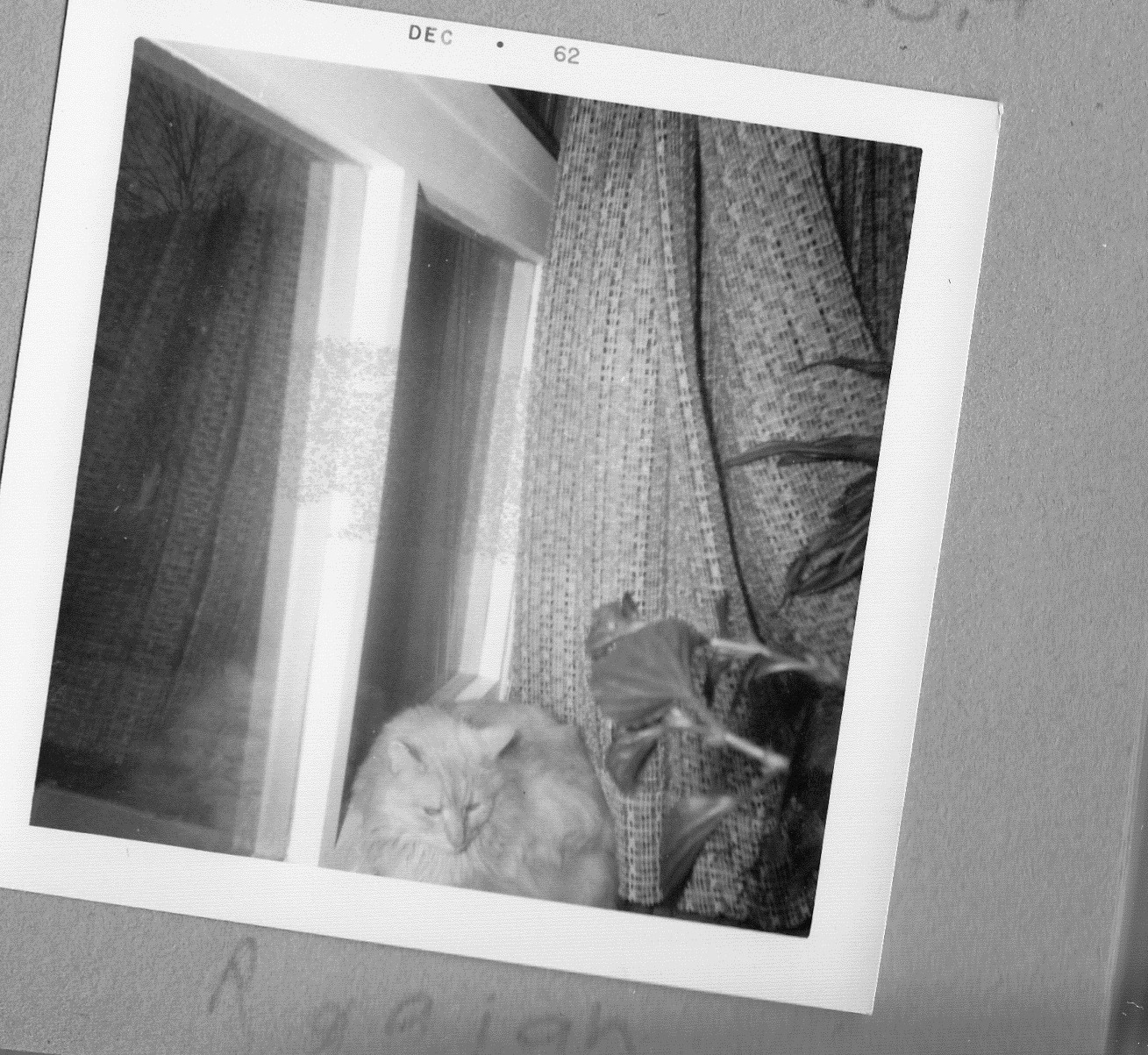
I learned that Gail had lived in the same building and on the same floor as my grandparents when she was a little girl and that she remembers them. She described them as kind and lovely people. And even more amazing—she remembers my grandparents’ cat and described him perfectly! She even remembers that his name was Rajah. She told me that my grandmother used to let her “borrow” Rajah and take him back to her apartment to play with her. I had a serious case of chills and tears as I read the email in which she shared this with me.  Here was someone I never met who remembered my grandparents and Rajah, who eventually became our cat when my grandmother no longer could care for him. It felt magical.

Rajah (cleverly misspelled by me at ten years old!)

Then I asked Gail about the other people in the photograph. She identified everyone else except for one woman. I told her that I was going to try and locate any relatives of those people because they also might enjoy seeing the photo. Gail said that all the people she knew in the photograph were deceased and that as far as she knew there were no living descendants. One couple did have a son, but in researching the family, I learned that that son had died in the last few years and had had no children or spouse who survived him.

As for the other three adults in the photo, one was Gail’s mother’s best friend, Helen Frankenstein Kaiserman (the woman holding Gail’s doll on her lap), and the two men standing on the right in the rear were Helen’s brothers Morris and Jerome Frankenstein. According to Gail, none of those three had children. Helen had been briefly married but was divorced by the time Gail knew her, and Gail believed that Jerome and Morris had never married.

But I was curious to learn more about the three siblings—Morris, Jerome, and Helen. I just couldn’t accept that there were no living relatives in this family. I turned to Ancestry and began to research the family and soon found them on the 1930 and 1940 census along with their parents and two other siblings. Maybe the other siblings had had children who might be interested in the photo?

In the course of doing that research, however, I stumbled upon an Ancestry tree that had Morris, Jerome, and Helen included. That tree was owned by a researcher named Renate Valencia, and I was surprised to see that according to her tree, Morris had married and had had children. Since his widow and children were still living, their names did not show up on the tree, so I decided to send Renate a message through Ancestry to learn more.

I didn’t have to wait long to hear from her. She was very excited to hear about the photograph and knew that her husband Steve, Morris’ son, would be delighted to see a photograph of his father, uncle, and aunt. Gail was surprised and happy to learn that in fact Morris had married and had had children. I connected Gail and Renate to each other, and they have been exchanging memories and asking and answering questions about the people in the photograph.

Renate sent me this link to a documentary about Parkchester, and it brought back many memories of visiting my grandmother there, going to Macy’s, playing in the playgrounds, chasing pigeons near the fountain, and taking the bright red elevator up to my grandmother’s apartment where once upon a time Gail had lived across the hall. Gail and I may have even ridden in that elevator at the same time, not knowing that all these years later we would connect through the magic of the internet and an old photograph.

All of this would never have been possible without the magic of photographs and the tricks of the internet. Without Facebook and Ancestry, I never would have found Gail or Renate. I never would have learned about the people in that photograph. Now I just wish that I could tell my parents and my grandparents this story and learn more about their memories of that evening and of the people in the photograph.

Can you imagine what all those people in the photograph would think if they knew that seventy or so years after that photograph was taken, three strangers would spend time remembering them all and sharing a magical experience like this? I still get the chills and a bit teary when I think about it.

Florence Goldschlager Cohen: A Life Filled with Love

Thank you to everyone who commented or emailed or texted me to express their condolences regarding the loss of my mother. I am deeply grateful to you all for your support during this difficult time. I hope to be back to regular blogging soon.

I wanted to share a little more about my mother’s life. She was born on October 15, 1930, in Brooklyn, New York. She was the third child of my maternal grandparents, Isadore Goldschlager and Gussie Brotman, whose stories were told in my family history novel, Pacific Street. My mother Florence was twelve years younger than her brother Maurice and thirteen years younger than her sister Elaine and so was very much the baby in the family. Her family lived in a small four unit building in the East Flatbush section of Brooklyn at 1010 Rutland Road. My grandfather was a milkman whose route was overnight and whose earnings were limited, although my mother said she never felt poor. There was always good food on the table and a roof over their heads.

Goldschlagers 1931

My mother loved growing up in Brooklyn. Her best friend Beatty lived in the building, and as I wrote about here,  I was able to reconnect my mother and Beatty about six years ago after they’d been out of touch for seventy years.

My mother was a good student although being left-handed back then meant that the teachers tried to force her to write with her right hand. But she was too left-dominant for that. She was a voracious reader from a young age and visited the local library in Brooklyn often to borrow books.

Florence and Elaine Goldschlager

When she was eleven, her parents decided to move to a new apartment complex in the Bronx called Parkchester where my aunt had moved after she got married. My mother was devastated to leave behind her friends especially Beatty and her beloved dog Sparky.

Beatty and my mother c. 1940

But she adjusted to life in the Bronx and made new friends and graduated from high school in 1948.

Florence Goldschlager 1948

Two years later she met my father at a Jewish singles camp, as I described here. They were married in 1951 in New York and had a long and happy marriage until my father died in 2019.

Florence and John Cohen 1951

My mother was a stay-at-home mom until 1965 when she decided to get a job as a teacher’s aide in the local elementary school. Because she proved to be so skilled as a teacher, she soon moved up to be a resource room teacher working with children with different learning styles and challenges. She was a devoted, well-respected, and beloved educator for many years, and even after she retired from full-time teaching, she continued to tutor children for most of the rest of her life.

She had many interests and never stopped loving books as well as theater, music, travel, knitting, cooking, gardening, Cape Cod, and especially animals. She was absolutely crazy about dogs and cats, and our home was always filled with both. She had a wonderful sense of humor and incredible taste in clothes, decor, food, and art.

But perhaps the most important thing I can say about my mother is that she was an unbelievably kind, loving, and compassionate woman—especially to her family, but also to her students, her colleagues, her friends, and everyone who ever had the good fortune of spending any time with her. I know I will keep her close to my heart for the rest of my life.

You can learn more about my mother and her life in her obituary found here.

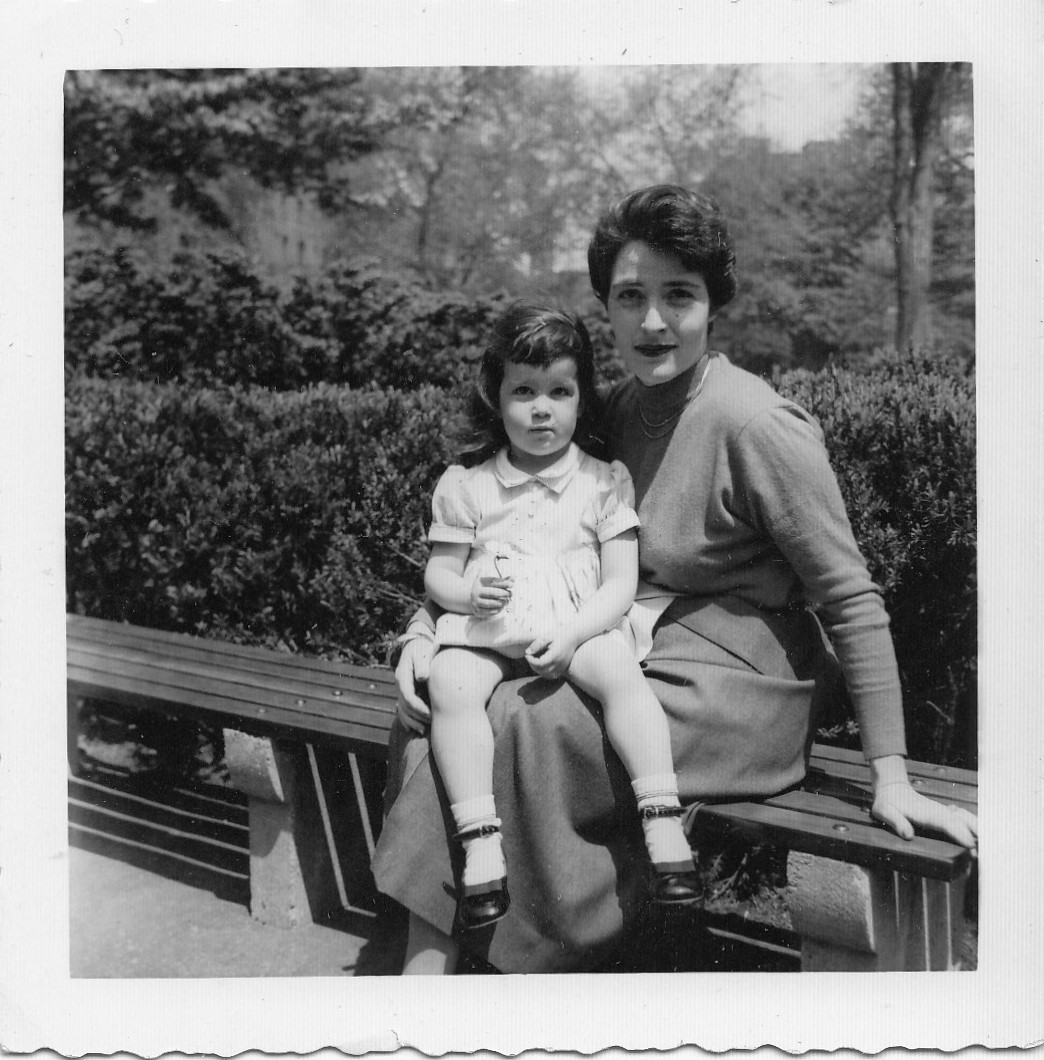
Ny mother and me, c. 1954

The Cohen Family Photograph: Who Are These People?

Ordinarily finding a large collection of photographs would be cause for much celebration, but when almost none of those photographs is labeled, it can be cause for much frustration.

That is the case with the collection of photographs my cousin Ken inherited from his great-grandparents, Lilian Katz and Isaac S. Cohen. Isaac S. Cohen was my grandfather’s first cousin. Isaac’s father Joseph Cohen was my great-grandfather Emanuel Cohen’s older brother. Thus, Ken and I are third cousins, once removed, both descended from Jacob Cohen and Sarah Jacobs, my great-great-grandparents. (All photos in this post are courtesy of my cousin Ken except where noted.)

Fortunately, some of the photographs in Ken’s collection were labeled. Most important to me was this photograph labeled “Cohen Family.” Ken and I assumed that the couple sitting second and third from the left  in the front row are Joseph Cohen and his wife Caroline Snellenburg Cohen, parents of Isaac S. Cohen, and that Isaac was one of the other men in the photograph.

Joseph Cohen and Family c. 1915-1917

“Cohen Family” Courtesy of Ken Newbury

To help us identify the people in the photograph, I once again retained the services of Ava Cohn a/k/a Sherlock Cohn, the Photogenealogist. She concluded that the Cohen Family photograph was likely taken around 1915-1916 based on the clothing. Joseph Cohen would have been 67 in 1915, and the man who is sitting second from the left in the front row could be in that age range.

The other three men in the Cohen Family photograph all resemble each other, but who are they? Here are closeups of those three. You can see that they all have similar hairlines, long noses, and similar mouths and ears. To me, they look like brothers, although the third looks much younger than the first two, who have graying hair.

My hunch was that these three men were three of Joseph Cohen’s five sons who were still living in 1915. In 1915 the five living sons were Jacob, who would have been 43, Isaac, who would have been 41, Nathan, who would have been 39, and Samuel and Morris (the twins), who would have been 28.

I found a passport photograph of Jacob Cohen taken in 1922 when he was 51, and I do not see a resemblance to the men in the photograph. He has more hair and a different shaped head. Ava agreed that Jacob is not in the Cohen Family photograph.

So that leaves Isaac, Nathan, and the two twins Samuel and Morris. Since the photograph was in Isaac’s possession, Ken and I assumed that Isaac was in the photograph, and we knew what Isaac looked like from other photographs in Ken’s collection.

For example, this photograph is of Isaac S. Cohen and Lilian Katz and their son Jac, Ken’s grandfather, who was born in April 1907. Ava estimated that this photograph was taken in about 1908, when Isaac would have been about 34.

Isaac, Jack, and Lillian Cohen, c. 1908

Isaac, Jac, and Lillian Cohen, c. 1908

Ava opined that Jac was about nine years old in this photograph of Isaac, Lillian and Jac, meaning it was taken in about 1916.

Isaac S., Jac, and Lillian Katz Cohen. c. 1917

Jac is also in this photograph, sitting at the piano, and Ava thought he  was about six or seven when it was taken, meaning it dates to about 1913. A closeup of Isaac from this photograph appears below it.

Isaac S Cohen, c. 1913

These two profile shots were snipped from two other photographs also taken around the same time. One was from a large photograph of men promoting the sale of war bonds for World War I; the other from a photograph that Ava dated as about 1915  of Isaac with Lillian and Jac and Lillian’s father Leo Katz.

Here’s a lineup of three of the photographs of Isaac and the closeup of the man on the left in the second row in the Cohen Family photograph. Based on all the above photographs, Ava concluded that the man on the left in the second row of the Cohen Family photograph was Isaac S. Cohen, Ken’s great-grandfather.

But who are the other two men in the family photo? Ava did not have enough information to reach a conclusion on that question. I have no photographs of Joseph’s son Nathan, so we have no way to identify him in the photograph. And I have no photographs of Morris, one of the twins, so cannot identify him either.

I was able to obtain two photographs of Samuel Cohen from his grandson Sam, but they were taken when Samuel was older. Even so, Ava and I both concluded that Samuel Cohen had ears that were closer to his head than any of the men in the Cohen Family photograph as well as a different shaped nose and thus was not in this photograph.

So without photographs of Joseph’s other sons, it’s impossible to make any identifcation of the other two men in the Cohen Family photograph.

And what about the women in the photograph? Assuming that Caroline Snellenburg Cohen is sitting next to Joseph, who are the other four women? They certainly appear to be much younger than Caroline. Joseph and Caroline Cohen had four daughters, and Ava thought it was likely that the four women are their daughters. In 1915 Bertha would have been 42, Sallye 38, Fannie 33, and Julia 31. The woman seated on the far right is the spitting image of Caroline. I’d be shocked if she was not her daughter.  So this could be a photograph of Joseph and Caroline, their four daughters, and three of their five sons. But we can’t be certain.

The other mystery is….who was cut out of the photograph?  Ava focused on the sleeves and the size of the hands and concluded that it was a woman. But who could she have been?

One possibility is that it was Lillian Katz, Isaac S. Cohen’s wife. Why, you ask, would she have been cut out of the picture?

Well, it appears that sometime between 1915, when they were living together in Atlantic City, and 1919, Isaac and Lillian separated and then filed for divorce in Allegheny County, Pennsylvania, in April 1919. They were divorced on February 20, 1920, on grounds of desertion. In 1920 Lillian was living with her parents in Pittsburgh with her son Jac (incorrectly listed here as John) and listed as divorced, and Isaac was living in Philadelphia with his sister Julia and her husband.1

Lillian Katz Cohen, 1920 US census, Census Place: Pittsburgh Ward 14, Allegheny, Pennsylvania; Roll: T625_1522; Page: 20B; Enumeration District: 550
Ancestry.com. 1920 United States Federal Census

Isaac Cohen 1920 US census, Census Place: Philadelphia Ward 38, Philadelphia, Pennsylvania; Roll: T625_1635; Page: 7A; Enumeration District: 1328
Ancestry.com. 1920 United States Federal Census

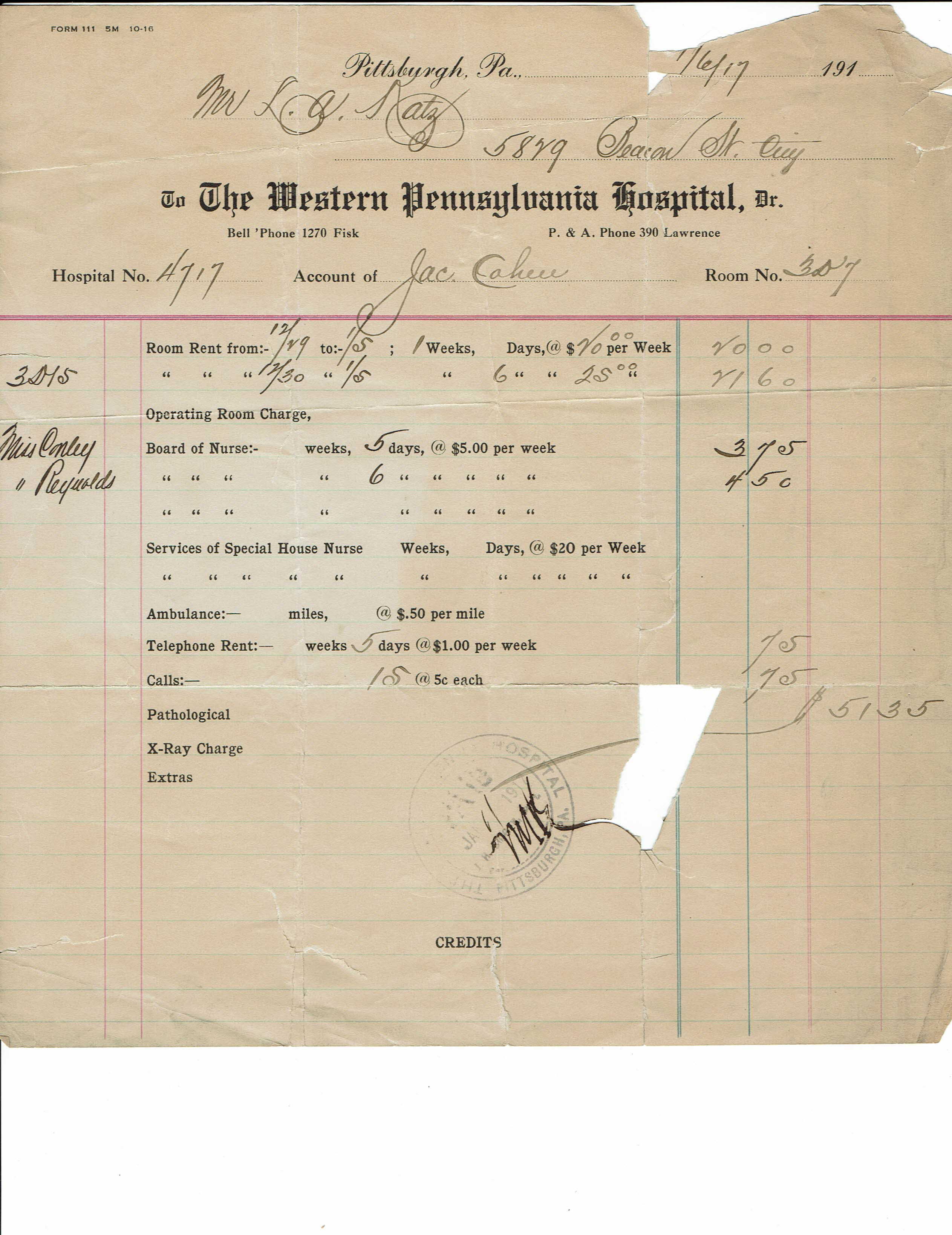
Ken told me that  when his grandfather Jac was a boy, he was run over by a trolley car while sledding; as a result, he lost an arm. We have the hospital record from Jac’s accident, and it’s dated January 6, 1917.  Ken wondered whether the injury to their son caused a rift between Isaac and Lillian, as sadly often happens when a child is seriously sick or injured and upset parents find it difficult to deal with the tragedy.

But the story has a happy ending. On August 12, 1921, Isaac and Lillian applied for a marriage license in Philadelphia and were remarried:

And records suggest that they remained married for the rest of their lives.

But maybe someone cut Lillian out of the family picture during the brief period when she and Isaac were divorced. It would seem odd that Lillian saved a photograph from which she had been removed, but stranger things have happened. But as Ava said, we really have no idea who was cut out or why. It’s just speculation.

In the end, we still have many questions but at least a few answers about the Cohen Family photograph. It’s a good reminder that I really should do my descendants a favor and go label all those photos from my own life.

Thank you to my cousin Ken for sharing the photographs and to Ava Cohn, aka Sherlock Cohn the Photogenealogist for her invaluable insights and her determination to get this right!


  1. Isaac listed his marital status as married; the divorce didn’t take effect until February 20, 1920, and the census was enumerated on January 17, 1920. Obviously Lillian was already considering herself divorced. 

The “Disappearance” of Arthur Cohen, My Grandfather’s First Cousin

Way back in July, 2014, I wrote about my great-grandfather Emanuel Cohen’s youngest sibling, his brother Abraham, the thirteenth child of my great-great-grandparents Jacob Cohen and Sarah Jacobs. What I reported was that Abraham, born in Philadelphia on March 29, 1866, had married Sallie McGonigal in 1886, and they had five children, but three of those children died in childhood. Only two children survived—their son Leslie, their second child, and their son Arthur, their fifth and youngest child. There were almost twenty years between the two boys: Leslie was born in 1889, Arthur in 1907.  They lost their mother Sallie to the dreadful flu epidemic on March 14, 1919.

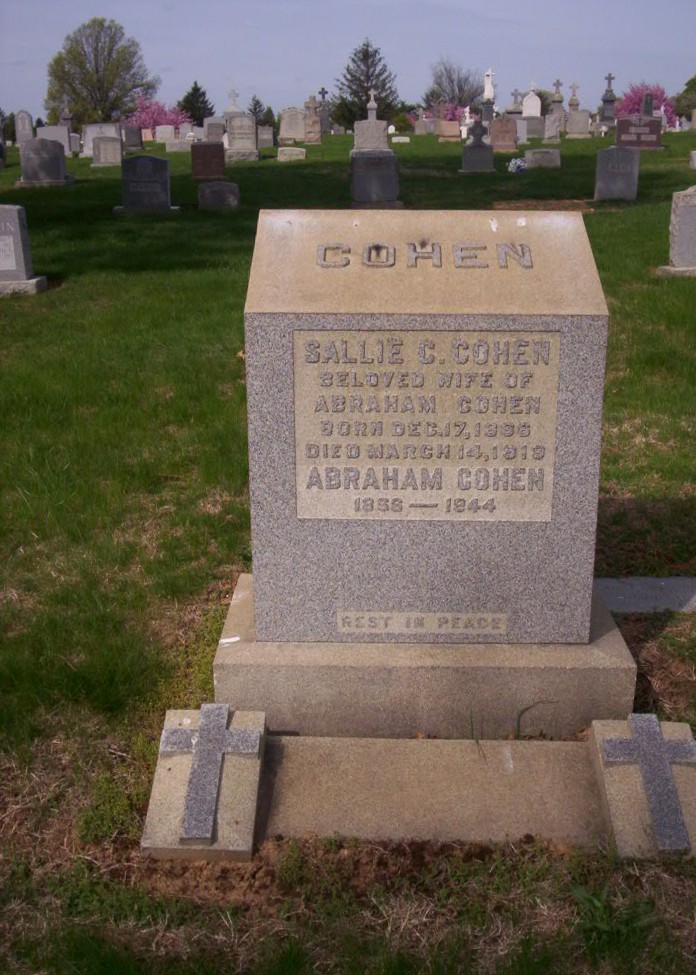
Gravestone for Sallie and Abraham Cohen, courtesy of Michael DeVane

Abraham Cohen remarried in 1920, and I was able to trace Abraham and his son Leslie up through their deaths, as described here.

But Arthur’s story was unfinished. The last record I had for him was the 1930 census when he was living with his father Abraham and stepmother Elizabeth in Philadelphia and working in a gas station. He was 23 at the time. After that, he disappeared. I could find other Arthur Cohens who matched in some ways, but not in others. Thus, I was unable to find anything after 1930 that was definitely about my Arthur Cohen.

Abe Cohen and family, 1930 US census, Year: 1930; Census Place: Philadelphia, Philadelphia, Pennsylvania; Page: 13A; Enumeration District: 0505; FHL microfilm: 2341874
Ancestry.com. 1930 United States Federal Censu

Until, that is, about a month ago when I received a comment on the blog from someone named Michael DeVane, who wrote, “I came across your blog while searching for information on Abraham Cohen, my grandfather. My father was Arthur Cohen. You really helped me fill in some of the missing information on my family. If you want to reach out to me, I will gladly help fill in some missing information to our family tree.” I immediately wrote back to Michael, and we arranged to chat by telephone a few days later.

To prepare for the conversation, I went back to all the research I’d done about Abraham and his family. One thing puzzled me. If Michael’s father was Arthur Cohen, why was his surname DeVane? Well, that clue led me to find more information, and then my conversation with Michael confirmed what I’d uncovered and added more insights. There was a very good reason that I’d not been able to find Arthur Cohen after 1930. By 1931, he’d changed his name to Arthur DeVane.

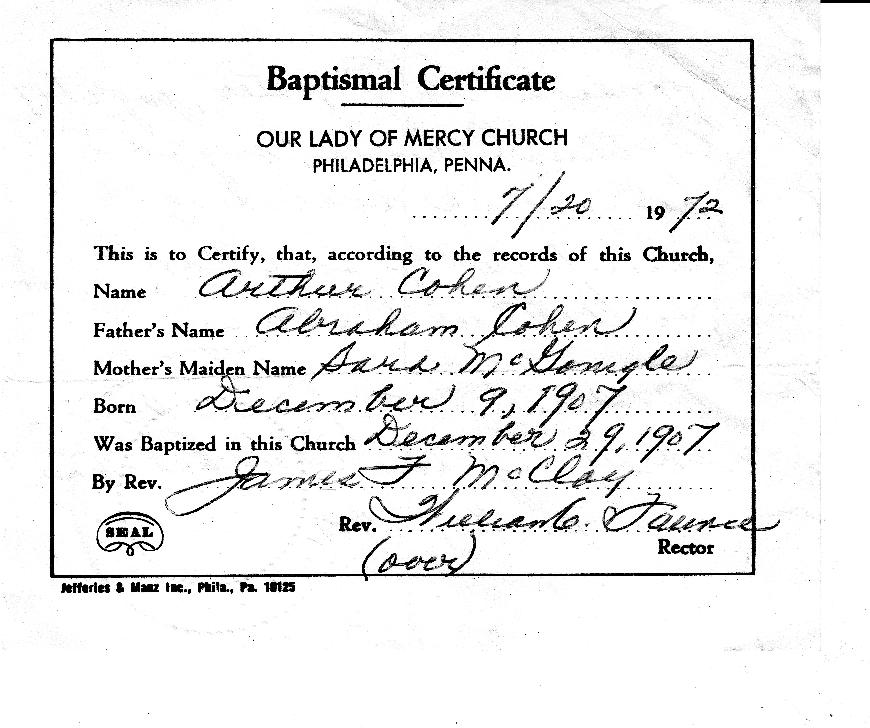
Once I knew that Arthur had in fact changed his name to DeVane, I located a marriage in the Philadelphia marriage index for Arthur DeVane and Ruth Bussard dated 1931. 1 Michael found in his family records the following document that confirmed that this marriage record was indeed for his father, born Arthur Cohen. It is his father’s baptismal certificate under the name Arthur Cohen with his parents identified.

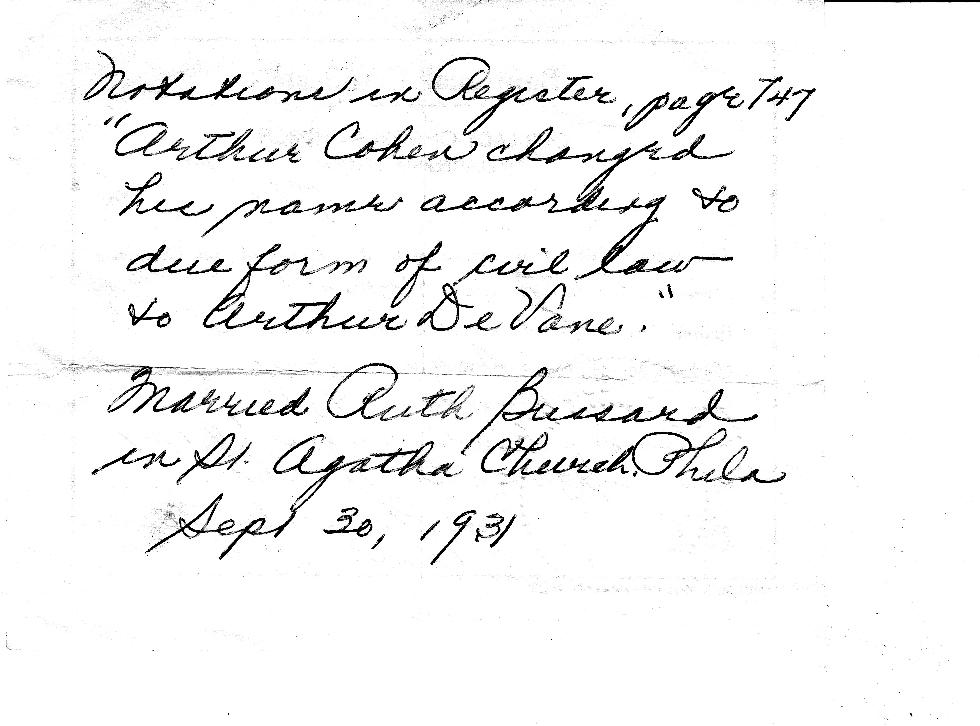
On the reverse, it notes that Arthur changed his name to DeVane and that he married Ruth Bussard on September 30, 1931, at St. Agnes Church in Philadelphia. Michael thought he might contact the church authorities to see if the record for the name change can be located.

Michael had understood that his father changed his name from Cohen to avoid anti-Semitism, but now we both wonder whether it also had to do with the marriage to Ruth Bussard. Perhaps she didn’t want to take on such an obviously Jewish name. As you can see from the headstone above, both of Arthur’s parents identified as Catholic and are buried in a Catholic cemetery, so Arthur was neither raised Jewish nor identified himself as Jewish.

In any event, the marriage to Ruth did not last. In September 1939, Ruth filed for divorce, and in February 1940, divorce was granted.2 Ruth remarried later that year.3

On the 1940 census, Arthur was living as a lodger with a family, listing his marital status as single and his occupation as a signal man for the railroad.4

On January 8, 1942, Arthur DeVane enlisted in the US armed services and served during World War II until September 5, 1945, including almost two and a half years serving overseas.5 During that time, while stationed in England , he met his second wife, Nellie Keep. Nellie was born April 1, 1917, in Oxford, England to Edward Keep and Nellie Massey. She and Arthur were married in New Hampshire on December 18, 1947. Like Arthur, Nellie had been previously married and divorced.

Marriage record of Arthur Devane and Nellie Keep, New England Historical Genealogical Society; New Hampshire Bureau of Vital Records, Concord, New Hampshire, Ancestry,com. New Hampshire, Marriage and Divorce Records, 1659-1947

The record for their marriage is interesting. Arthur reported that his father’s name was Leslie DeVane, not Abraham Cohen, the true name of his father. He also reported that his father had been a jeweler, when in truth, like so many of my Cohen relatives, Abraham had been a pawnbroker. Michael wasn’t sure whether Arthur did this to hide his background from his new wife or for some other reason, but Nellie did at some point know the truth of Arthur’s family background because she revealed it to Michael.

Part of the family lore is that Arthur had hoped to take over his father’s pawnbroker business, but that his father Abraham lost the business when his second wife Elizabeth died in 1939 and her family acquired it and apparently pushed Abraham out. That is why, as noted in my earlier post, Abraham’s death certificate in 1944 listed his occupation as elevator operator—a job he’d had to take after losing his business.

Abraham Cohen death certificate.

That meant Arthur also lost the business. Instead, Arthur ended up rejoining the military and spent most of his career serving his country in the US Air Force, as has his son Michael. Arthur was stationed over the years in England, Massachusetts, and New Jersey. He retired as a master sergeant in the Air Force after twenty years of service.

Arthur DeVane, born Arthur Cohen, died on April 16, 1976, in Burlington, New Jersey. He was sixty-eight years old.6  He was survived by his wife Nellie, who died in 2005, 7 and their three children and their grandchildren.

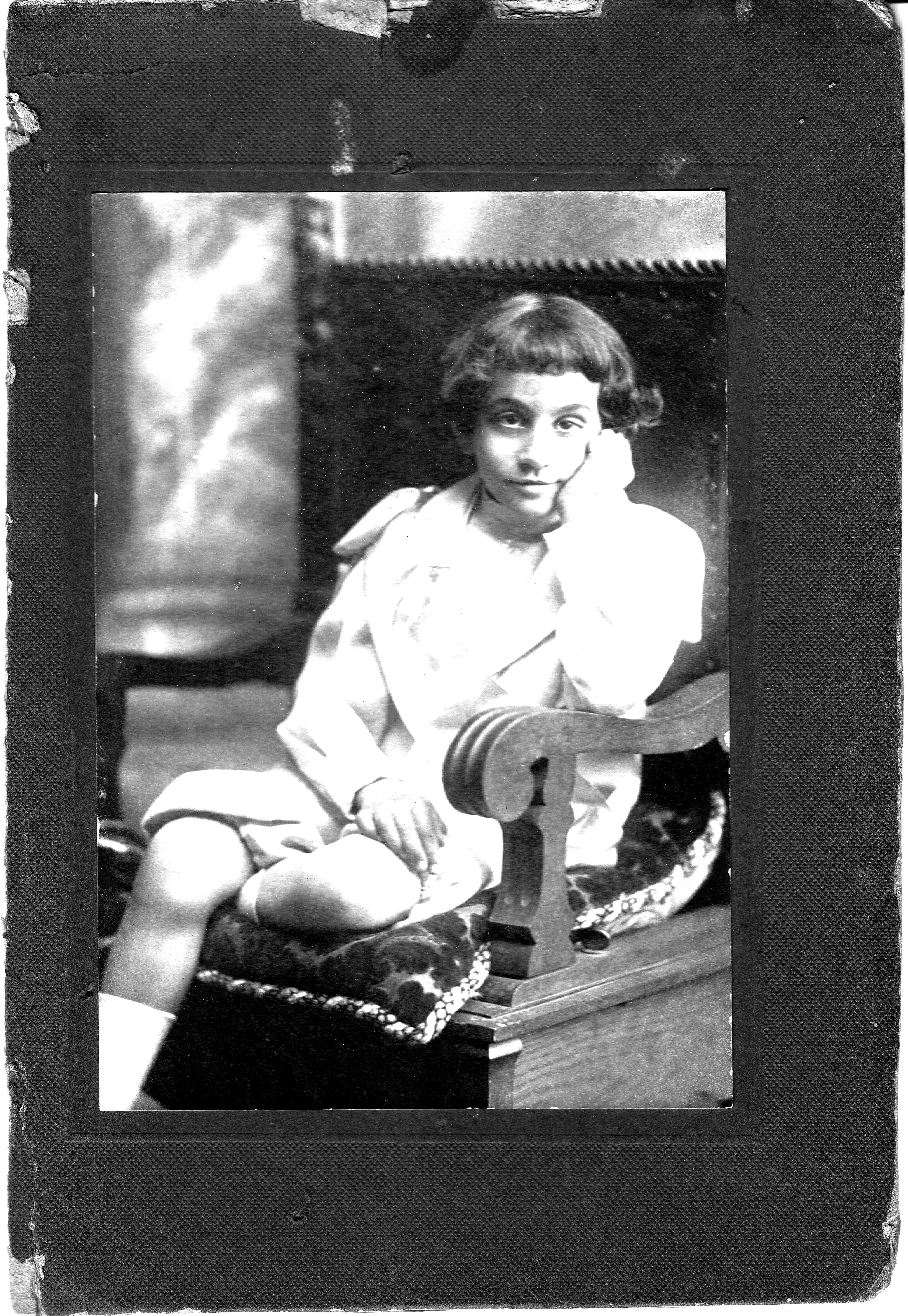
Michael kindly shared with me the following photograph of his father as a boy.

Arthur Cohen (later DeVane). Courtesy of Michael DeVane

I saw some similarity between young Arthur and his first cousin, once removed, my grandfather John Nusbaum Cohen, Sr., as a little boy, but it could just be the haircut.

John Cohen Sr as a baby

Michael also shared the following photograph of his father Arthur in 1948:

Arthur DeVane, 1948. Courtesy of Michael DeVane

I don’t see many resemblances here to either my father or my grandfather, except perhaps around the mouth and the large forehead.

John N. Cohen, Sr., 1921

John N. Cohen, Jr. c. 1945

I am so grateful to my cousin Michael, my father’s second cousin, for finding me and sharing his father’s story and photographs with me.


  1. Arthur J DeVane, Gender: Male, Spouse: Ruth H Bussard, Spouse Gender: Female
    Marriage Place: Philadelphia, Pennsylvania, United States, Marriage Year: 1931
    Marriage License Number: 606549, Digital GSU Number: 4141671, Ancestry.com. Philadelphia, Pennsylvania, Marriage Index, 1885-1951 
  2. The Philadelphia Inquirer – 27 Feb 1940 – Page 11, found at https://www.newspapers.com/clip/59928918/divorce-granted/?xid=637&_ga=2.20757178.305149426.1602707833-2106877110.1599576721 
  3. Ruth Devane, Gender: Female, Spouse: Marturano, Spouse Gender: Male
    Marriage Place: Philadelphia, Pennsylvania, United States, Marriage Year: 1940
    Marriage License Number: 716706, Digital GSU Number: 4141873, Ancestry.com. Philadelphia, Pennsylvania, Marriage Index, 1885-1951 
  4.  Year: 1940; Census Place: Philadelphia, Philadelphia, Pennsylvania; Roll: m-t0627-03723; Page: 61B; Enumeration District: 51-1118, Ancestry.com. 1940 United States Federal Census 
  5. Arthur J DeVane, Birth Date: 9 Dec 1907, Birth Place: Philadelphia, Philadelphia, Pennsylvania, USA, Gender: Male, Residence Date: 2 May 1950, Residence Place: Upper Darby, Delaware, Pennsylvania, USA, Ancestry.com. Pennsylvania, World War II Veteran Compensation Application Files, 1950-1966 
  6. Arthur Devane, Social Security Number: 182-10-8245, Birth Date: 9 Dec 1907
    Issue Year: Before 1951, Issue State: Pennsylvania, Last Residence: 08016, Burlington, Burlington, New Jersey, USA, Death Date: Apr 1976, Social Security Administration; Washington D.C., USA; Social Security Death Index, Master File, Ancestry.com. U.S., Social Security Death Index, 1935-2014 
  7.  Nellie A Devane, Social Security Number: 144-38-3406, Birth Date: 1 Apr 1917
    Issue Year: 1963, Issue State: New Jersey, Death Date: 26 Jun 2005, Social Security Administration; Washington D.C., USA; Social Security Death Index, Master File, Ancestry.com. U.S., Social Security Death Index, 1935-2014 

My Three-Times Great-Grandfather Hart Cohen, Witness for the Prosecution

Imagine being able to read the testimony your ancestor gave in a case back in 1831. Thanks to Teresa of the Writing My Past blog, I found a case where my three-times great-grandfather Hart Levy Cohen was a critical eyewitness to a crime.

Teresa wrote on her blog about the Proceedings of Old Bailey Online Project. As described on the project website, “The Proceedings of the Old Bailey, 1674-1913 [is a] fully searchable edition of the largest body of texts detailing the lives of non-elite people ever published, containing 197,745 criminal trials held at London’s central criminal court.”1 Teresa had found a number of interesting cases involving her English ancestors, and on a lark, I decided to search to see if I could find any references to my Cohen relatives who lived in London from about 1800 until 1851.

Old Bailey, photograph by Ben Sutherland from Crystal Palace, London, UK / CC BY (https://creativecommons.org/licenses/by/2.0)

Lo and behold, I found one case—an 1831 case in which Hart Cohen was a witness, not the defendant or the victim, fortunately.2  The case involved an alleged theft of money from a man named Michael Hart by a man named Isaac Isaacs. As described in the testimony recorded in the transcript of the trial, Michael Hart was a recent immigrant to England from Amsterdam and was courting Isaac Isaacs’ sister. According to Michael Hart, Isaacs grabbed Dutch notes worth 500 guilders from his hand and ran off with the money.

My three-times great-grandparents were present in the room when Isaacs took Michael Hart’s money, and Hart Cohen testified to the fact that he saw Isaacs snatch the notes. One witness, Mary Isaac (not a relative of the accused) testified that Michael Hart willingly gave the money to Isaacs. But the court found Isaacs guilty and sentenced him to “transportation for life,” meaning he was permanently exiled from England. I don’t know where Isaacs ended up, nor do I know where Michael Hart ended up.

UPDATE: Thank you to Teresa for pointing me to this site, which reveals that Isaac Isaacs was shipped of to what was then Van Diemen’s Island, now known as Tasmania. https://www.digitalpanopticon.org/life?id=obpt18311020-149-defend1043

In the testimony, Isaac Isaacs is referred to as “the prisoner” and Michael Hart is referred to either as “the prosecutor” or by his surname Hart. In the brief excerpt from the transcript below, I have added “the prosecutor” to any references to Michael Hart to prevent any confusion with my 3x-great-grandfather Hart Cohen. I also have highlighted a few relevant portions that I comment on below.

MICHAEL HART (through an interpreter.) I am a native of Amsterdam; I came to England nine or ten weeks ago, …. – I became acquainted with the prisoner, slightly, about a fortnight after I came to this country; I was courting his sister, and do so now. On a Monday morning, about eight o’clock, I met the prisoner in the neighbourhood, and went with him up the street to Whitechapel; we went into a public-house, and there had two quarterns of gin together- we then went back to the prisoner’s lodging: before we got there he asked me if I had my notes about me, and asked why I did not change them, as I could get English money for them; I said that at present I was not in need of money, and thought of saving them a little longer – I had them in my pocket at the time; they were two Amsterdam notes, for three hundred and two hundred guilders- he asked me to come home, and I went to his lodgings in Goulston-street, Whitechapel – when we got up stairs he asked me to let him look at the notes; I took them out of my pocket, intending to show them to him – I held them in my own hand; the prisoner took them out of my hand with one hand, and gave me a blow with his other hand – he went down stairs; I did not follow him immediately –[Hart] Cohen, his wife, and the prisoner’s wife and sister were in the room…. I went that evening to the Police-station, and told the inspector, who sent a Policeman with me, and he took the prisoner; I had a man with me, who interpreted for me – I have not seen or heard of my notes since – a guilder is worth 20d.

[Goulston Street was the street where my Cohen relatives were living on the 1841 English census. I tried to find a familial connection between Isaac Isaacs and my relatives but was unable to do so. I believe he was just a neighbor.]

New Goulston Street today

HART COHEN . I was in the prisoner’s room when he and the prosecutor came in, between eight and half-past eight o’clock in the morning – they spoke in Hebrew, which I understood, but did not notice what they were talking about; I saw [the prosecutor] Hart open his pocket-book, and take out some papers – the prisoner snatched them out of his hand, gave him a push, and ran down stairs; I could not see what the papers were, but [the prosecutor] Hart called out in Hebrew, “I have lost five hundred guilders;” I had seen him in possession of a three hundred and two hundred guilders Amsterdam notes; I have not seen them since.

[I found it interesting that Hart understood Hebrew—an indication that he was connected to Judaism and Jewish traditions.]

[Cross-examination of Hart Cohen]:  Who was in the room? A. My wife, the prisoner’s wife, his sister, and children: he being an intended brother-in-law, I did not like to interfere – I did not call Stop thief! my wife was alarmed – the prosecutor was standing up; he could have followed him down stairs if he chose – I had merely called there because the children were ill with the measles; I saw two men carrying the prisoner home, drunk, about two o’clock; the prosecutor went to Brighton, and my son went with him as an interpreter, and I wrote to him, directing my letters “Lewis Cohen,” which was my son’s name – the prisoner was to inquire at the post-office for a letter in that name; my wife is too ill to be here.

[When Hart testified “he being an intended brother-in-law,” I at first thought he meant that Isaacs was to be married to either his sister or his wife Rachel’s sister, but Isaacs was already married. On rereading, it was clear to me that Hart Cohen was referring to the fact that Michael Hart was courting Isaacs’ sister and thus was his intended brother-in-law.” It’s clear from this comment and the one that follows that Hart had not wanted to get involved in this dispute.]

[It was the mention of his son Lewis that helped to convince me that this was my Hart Cohen. Lewis would have been eleven years old at that time.]

[Witness for Isaacs] MARY ISAAC . I was at the prisoner’s house, between eight and nine o’clock, when this gentleman came up stairs, and he gave Mr. Isaacs the notes – I live there as servant to the prisoner; I am not related to him; Mr. and Mrs. Cohen. Mr. and Mrs. Isaacs, and I were in the room, nobody else – I cannot speak Hebrew; I saw the prosecutor give the prisoner the notes; he put them into his pocket, had his breakfast, shaved himself, and went down – before he went down the prosecutor took out his pocket-book, and wrote down on a piece of paper, how many guilders there were, and how much they would come to – I did not read the paper; he wrote it in numbers – I understand numbers; the prisoner then went down – Mr. Cohen went down directly after.

….

HART COHEN . I did not notice [Mary] Isaac there, and do not suppose that she was – it is a middling sized room, and has a bed in it.3

[This testimony effectively undercut Mary Isaac’s testimony. Hart made it clear that there was no way that he would not have seen her if she were in the room, given the size of the room.]

There were other witnesses and testimony, but I was primarily interested in the role my relative played in this dispute. And what did I learn? That my three-times great-grandfather was a man who did not initially want to get involved, but did his civic duty and testified to the facts he observed, that he knew Hebrew, and that my great-grandparents were neighbors who would come check on sick children. Given that I’d known nothing about his personality beforehand, these are wonderful insights.

Take a look at the Old Bailey project website if you ever had relatives living in London. It could provide interesting insights into their lives.


  1. Tim Hitchcock, Robert Shoemaker, Clive Emsley, Sharon Howard, and Jamie McLaughlin, et al., “Home page.” The Old Bailey Proceedings Online, 1674-1913 (www.oldbaileyonline.org, version 7.0, 24 March 2012).
  2. Old Bailey Proceedings Online (www.oldbaileyonline.org, version 8.0, 04 October 2020), October 1831, trial of ISAAC ISAACS (t18311020-149. 
  3. Ibid. Emphasis and annotations added. 

Blogging in a Pandemic, Part II

As we enter our third or really our fourth week of social distancing, self-quarantine, or whatever else you want to call it (no closer than six feet from anyone but each other, washing our hands religiously, no restaurants, no stores except when we can’t get delivery of groceries, and so on), I have to say that this week things suddenly seem much harder and much sadder. But we are still fortunately feeling fine despite having flown twice in March, and we feel very, very relieved, and are so grateful to be home.

And we also feel very grateful that so far our families are also okay and our friends. I almost am afraid to write that for fear of tempting the corona gods. But I know that magical thinking is just superstition. We all just have to keep staying apart, staying safe, and staying home. The anxiety sometimes feels unbearable, but my mantra has always been and continues to be—one day at a time.

We’ve taken some wonderful walks in places nearby, a few of which we’d never been to before. And we’ve taken many walks in our neighborhood, chatting with neighbors from at least six feet apart, and feeling a sense of community and warmth that can be overlooked when we all just drive in and out of our garages.

I’ve cleared out a drawer filled with expired medicines and other products, organized our “junk” drawer, and discovered dust in places you cannot imagine. Every day I try to think of at least one small project to accomplish, even if it is simply remembering to mail a check.

I’ve also started to accept that I will never do some of the things the internet keeps throwing at us: free courses online, free tours of museums and national parks, free videos of exercise classes, and so on. I just can’t focus long enough to do those things. Fortunately, doing genealogy in shorter spurts than usual and writing my blog still provide me with a way to escape from the pandemic pandemonium.

Now we are preparing for a Zoom seder. The planning has given me an opportunity to work with my nine-year-old grandson on that project. In fact, we’ve had more contact with our kids and grandsons during these weeks than we usually do, though not in person. I am reading the wonderful book Hatchet by Gary Paulsen with the older grandson and playing chess online with the younger one. And we’ve had Zoom cocktail hours with friends and with family. So it’s not all bad.

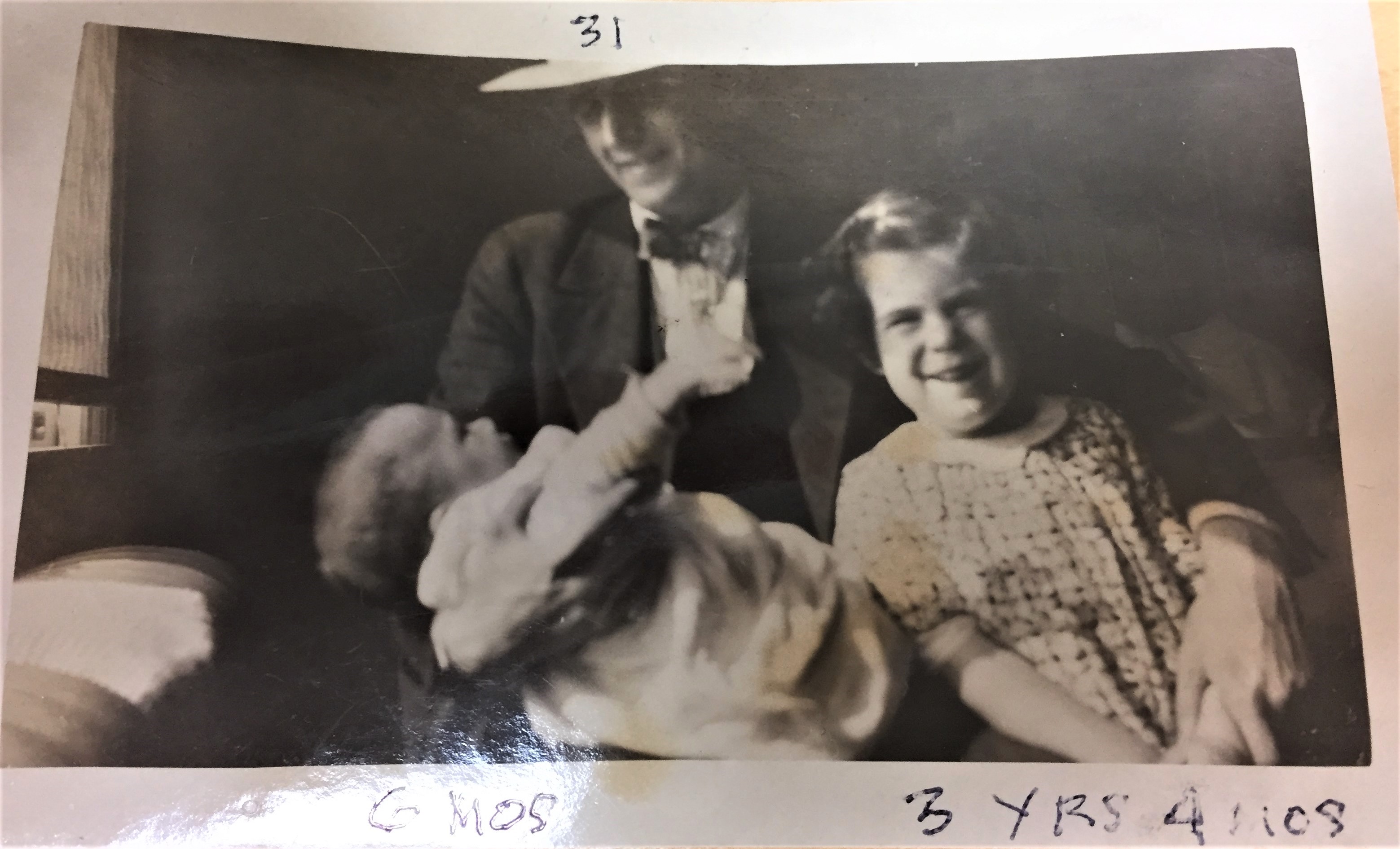
What really prompted me to write this particular post was one of those little benefits I’ve gotten from people spending all this time at home. My brother, who also has been spending more time at home than usual (but who is still working since he is a doctor), was going through a box of papers and photographs that had been my father’s and discovered this photograph.

I know this is not great quality (and my brother’s scan of it does not help). But I am so excited by this photograph. Let me explain why.

This is a photograph of my father as a baby being held by his father with my aunt sitting on her father’s left. My father had written the ages in the margins, and although he had not written the names, it was easy to deduce the identities from the relative ages and the facial characteristics using other photographs of my grandfather, of my aunt as a young child, and even of my father as a baby.

Eva Schoenthal and John Cohen, Sr. 1923

My aunt Eva Hilda Cohen and my grandmother Eva Schoenthal Cohen, c. 1925

My grandmother and my father, c. 1927

But what made this so special is that I had never seen a photograph of my grandfather with his children. All the photographs I had of him were either of him alone or with my grandmother. So seeing this photograph was really touching. Look at how he is looking at his son. There is such joy and love on his face.

It was especially touching because I knew that my father had had very few years living with his father before my grandfather became disabled from multiple sclerosis and was ultimately institutionalized for the rest of his life.  He died long before I was born, and for most of my life I knew almost nothing about him. I didn’t ask when I was young because my father seemed to be reluctant to talk about him. I didn’t know if that was out of sadness or anger or indifference. But I didn’t want to upset him either way.

One of the gifts of doing genealogy and talking to my father in the five or six years before he died in February 2019 was that he finally did talk a bit about his father. And in doing so, I realized that even though he had not spent many years living with his father, my father had loved him. His reluctance to talk about him was due to pain and sadness, not anger or indifference.

The fact that my father saved this photograph and hid it away in a box we never saw before is telling. This must have been a photograph he cherished, something special that he didn’t want mixed in with the hundreds of other photographs he had taken over the years of vacations and friends and family. I am so glad that my brother discovered it and that he shared it with me. It gave me new insights into my father and his father.

Have you discovered any wonderful photographs or other treasures while staying at home? Have you always planned to label and/or scan your family photographs? Maybe now is a good time.

The Man with the Mustache: Are You My Grandfather?

For Thanksgiving week, I am only posting once, so let me wish all of you a wonderful holiday (for those in the US, anyway). May we all be thankful for all the good we have in our lives—those ancestors and parents who paved the way for us, those we now share our lives and love with, be they spouses, relatives, or friends, and those who will come after us—our children, grandchildren and all our descendants.


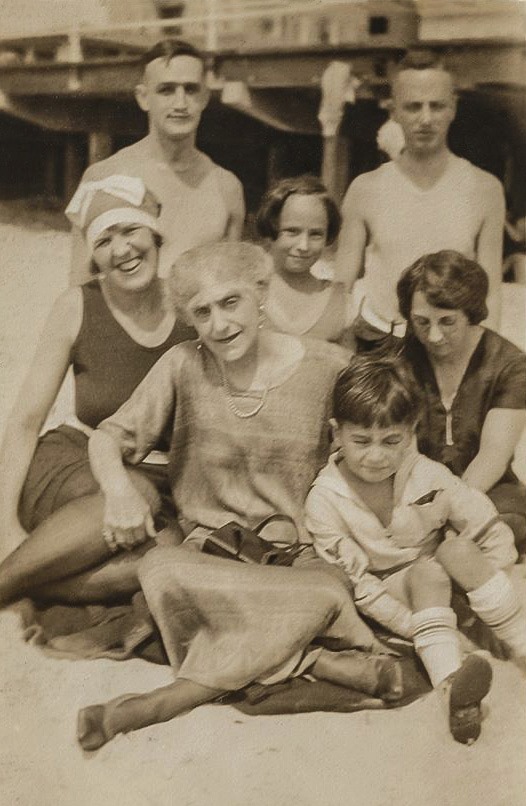
For today, I want to update an earlier post where I reported on Ava aka Sherlock Cohn’s analysis of this photograph, taken in 1923, probably in Atlantic City. I am curious about your reactions to our thoughts on the man with the mustache. Is he my grandfather John Nusbaum Cohen?

Based on earlier research and photographs along with Ava’s report, I am now fairly certain of the identities of most of those in the photograph, as I discussed here.  In the front row are Bessie Craig Cohen, probably her mother Sarah Tadley Craig, and Maurice Cohen, Jr. In the middle is Bessie’s niece Margaret Craig and behind Maurice Cohen Jr is his mother, Edna Mayer Cohen. Kneeling behind Edna is her husband, Maurice Cohen, Sr., my great-uncle. I also assume that the photograph was taken by my great-uncle Stanley Cohen based on the fact that he appears in a separate photograph quite obviously taken at the same time and place.

But who is the man kneeling on the left in the top photo, the man with the mustache? How does he connect to the rest of this group? It could not be Bessie Craig Cohen’s brother James because he died in 1918.1 It also could not be her brother Christopher if the photograph was taken in 1923 because he died in 1922.2 Edna Mayer Cohen had a brother Eugene born in 1893 who is the right age to be the man with the mustache. He was living in the Philadelphia area in the 1920s,3 so he is one possibility, but I have no photographs of Eugene.

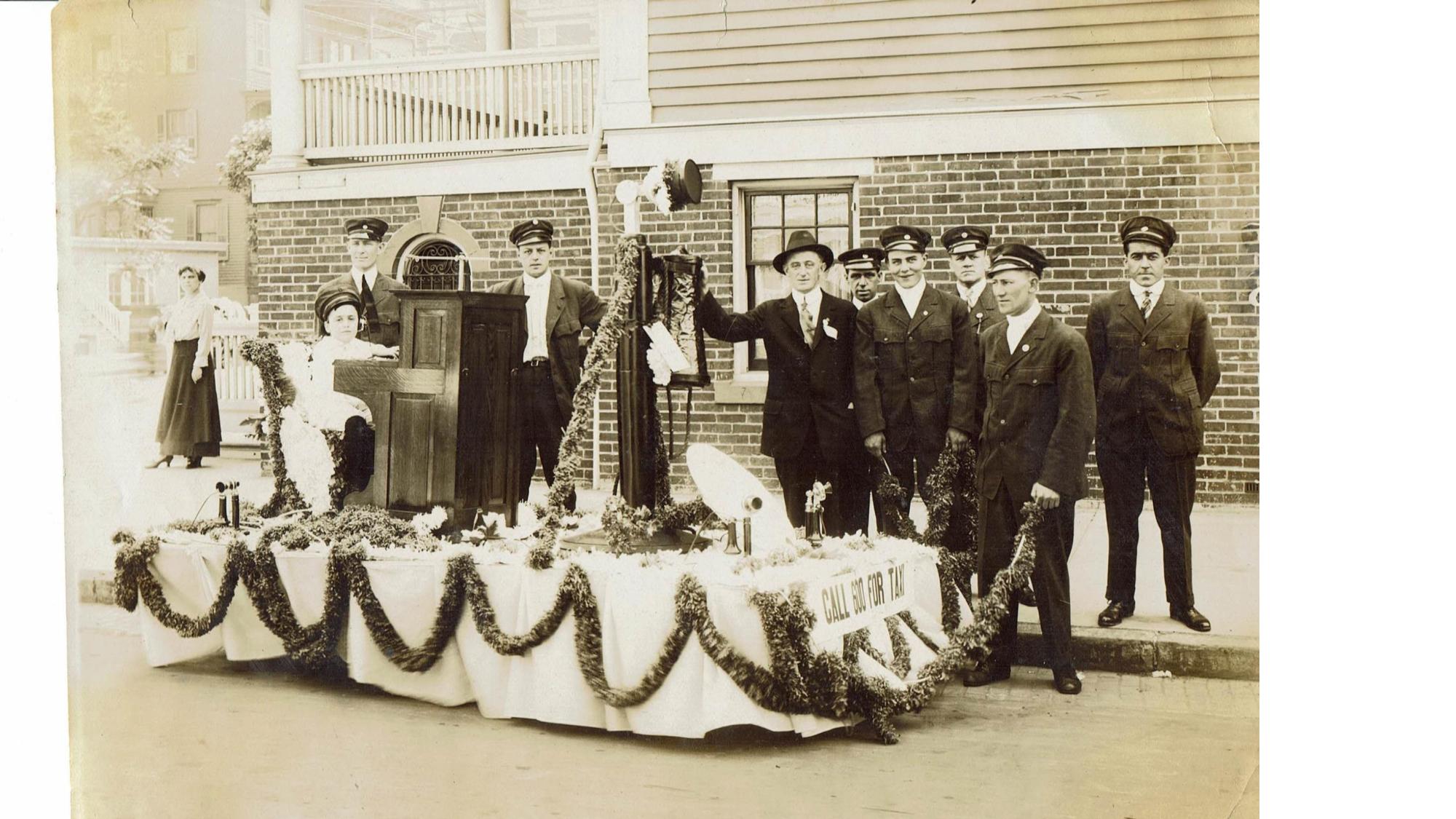
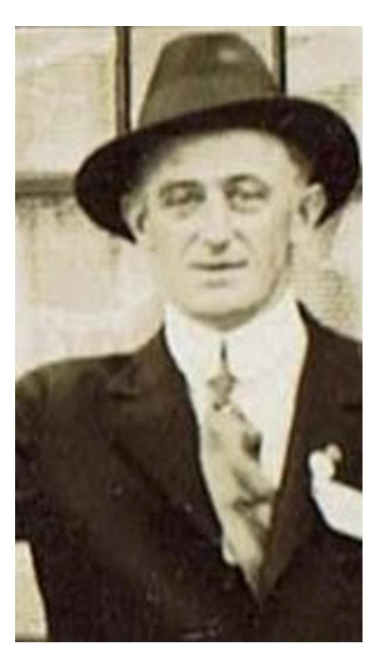
Ava at first had a much more intriguing conjecture with respect to the man with the mustache. She saw “a resemblance also to the young man holding a hat in the Cohen & Co. Money Loan Office photograph from ten years earlier. If we are to assume that the young man in that photograph is John Nusbaum Cohen, born 1895, then we can assume that the man on the beach is also John Nusbaum Cohen who I estimated to be born circa 1893-1895.” Ava had done a previous report for me on the Cohen & Company photograph and had tentatively identified the young man holding the hat as my grandfather John Nusbaum Cohen, Sr.

Cohen & Company photograph

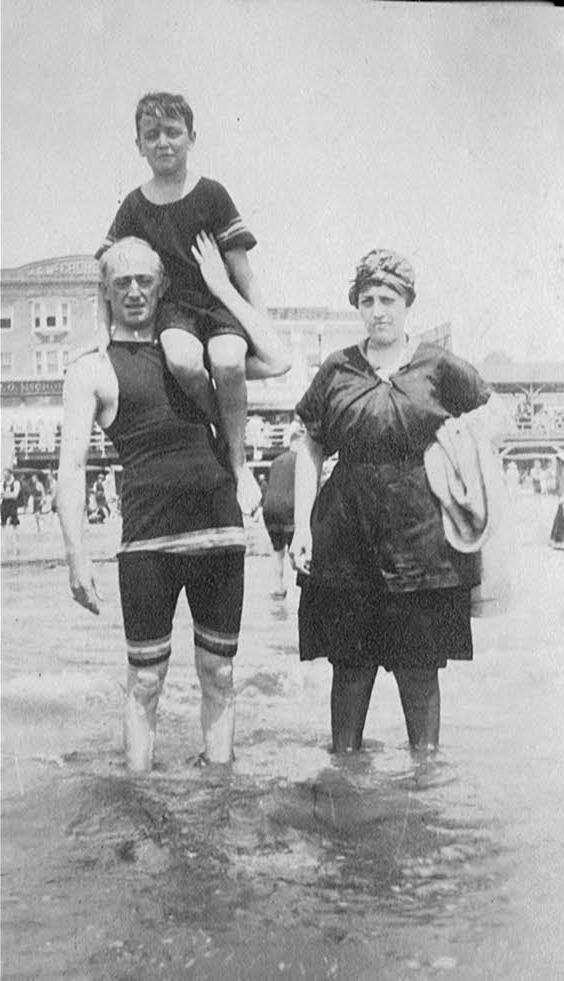
That is, Ava speculated that the man with the mustache could also be my grandfather because he resembled that boy holding the hat. I can definitely see the resemblance. Look at the chin and lips, the deep set eyes, the angles of the ears, and the high forehead:

It would make sense for my grandfather to be in the 1923 beach photograph.  He was the right age (born in 1895 so 28 in 1923), and he would have been with his two brothers and their wives.

But my grandfather did not have a mustache in any of the photographs I have of him. Also, my grandfather definitely had attached earlobes. It’s hard to see in the beach photograph, but that man does not appear to have attached earlobes.

And where is my grandmother? They married in January, 1923, so if the beach photo is correctly dated as 1923, my grandparents were already married by then. My grandmother would have been pregnant in the summer of 1923 as my aunt was born in January, 1924. Why wouldn’t she have been at the beach with her husband and brothers-in-law and sisters-in-law?

So I was not convinced that the man with the mustache in the photograph was my grandfather, but I also wasn’t willing to dismiss the possibility.

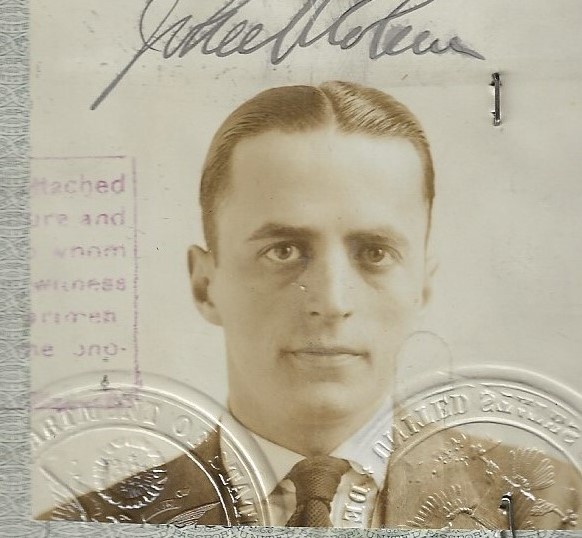
Then I received a whole box of photographs and other papers and books from my cousin Marjorie Cohen’s cousin Lou. Inside that box was this treasure, my grandfather’s 1921 passport including this stunningly clear version of his passport photograph:

The beach photograph was taken two years later in 1923. I definitely see similiarities—in the shape of the face, the lips, the forehead and eyebrows, the chin, and the nose. The eyes are so hard to see in the beach photograph, but they are definitely deep-set. But that mustache threw me off, and I could also see differences. My grandfather’s ears looked smaller and seemed lower set on his face, the top of his ears set below his eyes rather than at the same level.

Later, while doing a search on my computer for pictures of my father, I tripped on this photograph. I have no idea where I got this photograph. And I had no memory of seeing it before. But it had been saved to my computer three years ago. Hmmm. Why didn’t I label it when I got it?

Anyway, it’s another photograph of my paternal grandparents, Eva Schoenthal and John Nusbaum Cohen, Sr., taken some years later than the other two I have of them together. My grandfather was wearing glasses, so I wonder whether he was already having some of the early symptoms of multiple sclerosis.

Eva Schoenthal and John Cohen, Sr.

Does this help to identify the man with the mustache on the beach?

I sent these two additional photographs to Ava to see what she thought, and interestingly, she concluded that although she now believed that the young man holding the hat in the Cohen & Company photograph was my grandfather John Nusbam Cohen, Sr., she did not think that the man with the mustache on the beach was my grandfather. Ava wrote:

He does look similar and, as you know, I initially said that the man with the hat in Cohen & Co. is the same man with the mustache in the beach photo. But as I said, the man in the beach photo is about the same age as John in the [recently added] photo taken with Eva and the two look different. I’m figuring the John and Eva photo is circa 1928-1931. So John would be in his early 30s. I’m quite certain John is in Cohen & Co. and the fact that his hair was parted in the center in 1921 for his passport picture and again in about 1928 would make the 1923 beach photo an anomaly if he had grown a mustache and changed his hairstyle two years after his passport photo and then changed it back by the end of the twenties.

That mustache is the real problem for me. The change in hair style is less concerning—he was at the beach. Maybe he went swimming? But that mustache. Facial hair often makes a man look older, so maybe that’s why he looks more like he’s in his early 30s and not 28, as my grandfather would have been in 1923.

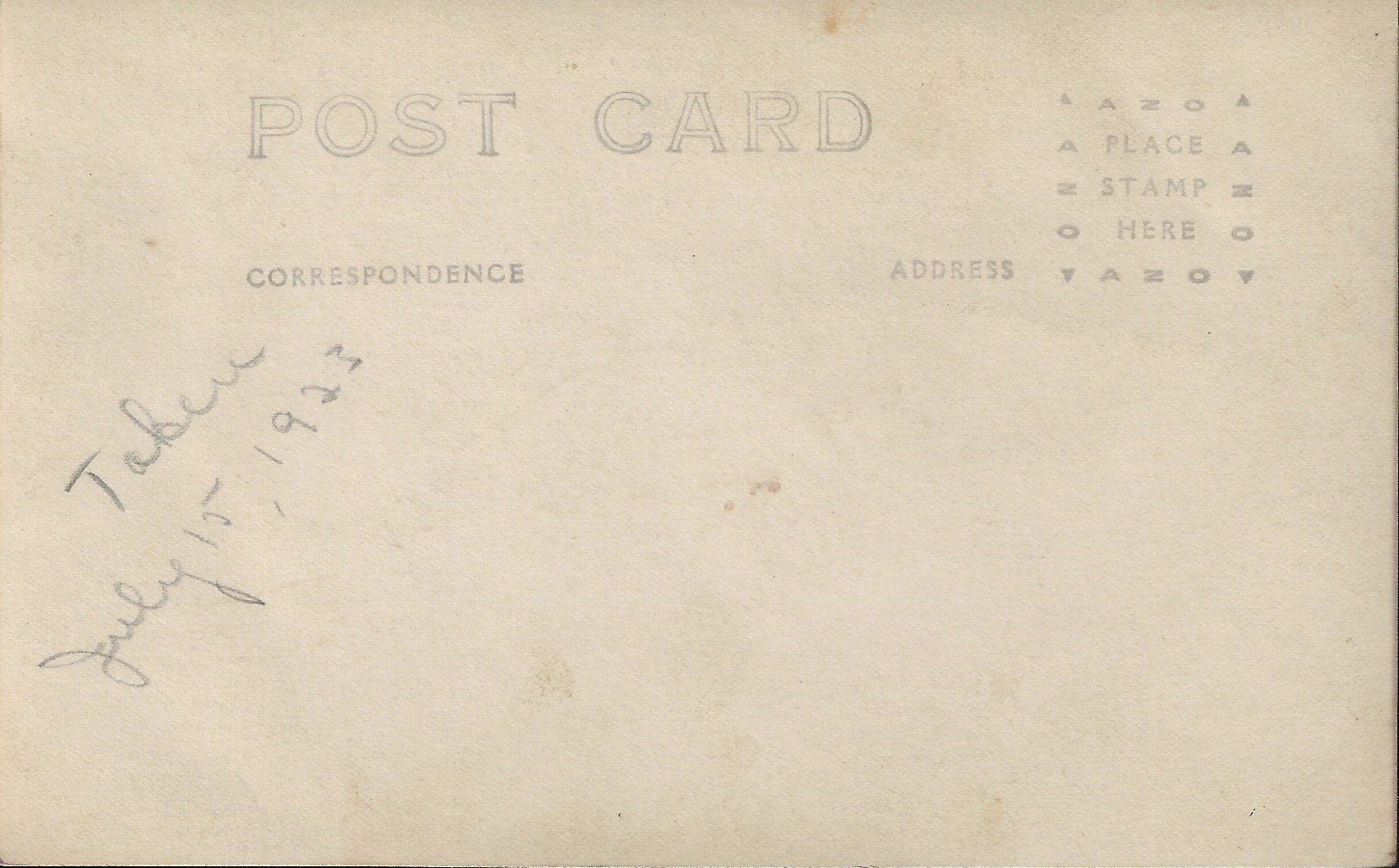
But as Ava said, none of the other photos I have of my grandfather show him with a mustache—not the passport photo from 1921, not the one taken with my grandmother in 1923, and not the two later photographs. In fact, the 1923 photograph of my grandparents is dated July 1923 on its reverse, as I discovered when Lou sent me Marjorie’s collection:

Eva Schoenthal and John Cohen, Jr. July 15, 1923

Did my grandfather grow a mustache sometime that summer after the July 1923 photograph was taken, or maybe before and then quickly shaved it off? Neither of his brothers ever had mustaches. Were they even in style then?

Ava and I decided we both needed to get some distance from the photograph and come back with fresh eyes.  So for over a month, I put this all aside as did Ava. Then we both returned to it.

I asked the Photo Restoration Free Service group on Facebook to help by adding some clarity to the photograph and removing the mustache. Here was the result:

We then studied all the photographs again, adding this new one to the mix.

As I looked over every adult photo of I have of my grandfather, I began to see that he looked different in every single one of them. I was totally befuddled, but now thought that the man on the beach wasn’t my grandfather.

Ava was also convinced that the man with the mustache was not my grandfather. She wrote:

I took a long look at John’s passport photo and compared it to the man on the beach. I still don’t believe the two are the same person. Besides the obvious clues like hairstyle and mustache, it appears that John’s ears and the ears of the man in the beach photo are not the same shape and even though they both seem to have attached earlobes, the pattern of the “shell” is different. … I looked at all the identified pictures of John that I have from you, including his baby picture. I don’t think the man on the beach is your grandfather. I also don’t think that the man on the beach is the person holding his hat in the storefront photo.

I responded that I agreed with her and wrote:

So here’s the $64,000 question—do you think the boy holding the hat in the Cohen & Company photo is my grandfather? 

Ava responded that she thinks it is likely that the boy holding his hat in the Cohen & Company photograph is my grandfather, but without more photographs, it’s impossible to be certain, especially given the blurriness of that photograph and the fact that the boy is squinting, making it difficult to see his eyes.

As I looked over the photographs yet another time, I made a new observation. My grandfather’s hairline, even as it receded, always seemed a bit further back along the temples, a bit more forward in the center. The man with the mustache seems to have a hairline that did not curve backwards in this way.

So in the end, Ava and I both concluded that the man with the mustache was not John Nusbaum Cohen, Sr., but that the boy holding the hat likely is.

What do you all think? Here for your final review are all the photographs that I know are of my grandfather, John Nusbaum Cohen, Sr. as well as the beach photo.


  1. James Craig, death certificate, Certificate Number: 140783, Pennsylvania Historic and Museum Commission; Harrisburg, Pennsylvania; Pennsylvania (State). Death certificates, 1906–1967; Certificate Number Range: 140251-143500, Ancestry.com. Pennsylvania, Death Certificates, 1906-1967 
  2. Christopher Craig, death certificate, Certificate Number: 23826, Pennsylvania Historic and Museum Commission; Harrisburg, Pennsylvania; Pennsylvania (State). Death certificates, 1906–1967; Certificate Number Range: 023001-026000, Ancestry.com. Pennsylvania, Death Certificates, 1906-1967 
  3. Eugene Mayer, 1930 US census, Census Place: Cheltenham, Montgomery, Pennsylvania; Page: 12B; Enumeration District: 0024; FHL microfilm: 2341815, Ancestry.com. 1930 United States Federal Census 

November 15, 2019

Today would have been my father’s 93rd birthday. Tomorrow it will be nine months since he died on February 16, 2019. Nine months is a long time—long enough for a human baby to gestate and be ready for life outside the womb. And yet it is just a flash in a life that lasted over 92 years.

These nine months have been the hardest of my life—dealing with not only losing my father, but watching my mother decline as well. Life without my father has been just too hard for her to bear.

So today I’d like to dedicate my blog to them both, two people whose love for each other was the key to almost all of their happiness, two beautiful young people who grew to be loving parents, adoring grandparents and great-grandparents and aunt and uncle, and loyal and caring friends to people in their community and elsewhere.

Florence and John Cohen 1951