The Long Depression, Part 2: Moving Back Home or Moving Away

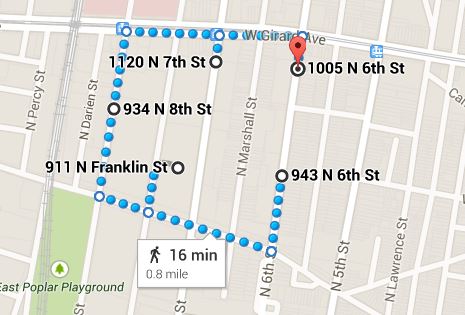
In the early 1870s Moses and Caroline (Dreyfuss) Wiler were living at 905 Franklin Avenue, just a few houses down from Caroline’s sister, Mathilde (Dreyfuss Nusbaum) Pollock and just three blocks away from their third sister, Jeanette (Dreyfuss) Nusbaum and her husband John, my three-times great-grandparents.  Ernst Nusbaum and his wife Clarissa were living down the block from his brother John. The area is known as the Poplar neighborhood in North Philadelphia. Plotting all their addresses on the map made me smile.  They must have all been so close, not only geographically but emotionally, to live so close to their siblings.  Imagine all the first cousins (some double first cousins) growing up within a short walk of each other.

map of nusbaum wiler simon homes 1870s

But as I wrote in my last post, things were not quite so idyllic in the 1870s.  The Panic of 1873 and the depression that followed had an impact on the family.  Like Mathilde and Moses Pollock, Caroline and Moses Wiler also must have felt some of that impact.  In 1873 Moses Wiler was listed in the directory without an occupation.  His partnership with his brother-in-law Moses Pollock had ended.  In 1875 he was still listed without an occupation, and they had moved from Franklin Avenue to 920 North 7th Street, still within two blocks of Caroline’s sisters.

Caroline and Moses Wiler’s son Simon also seems to have been affected by the Long Depression.  He had been part of the Simon and Pollock cloak and dry goods partnership of the late 1860s and early 1870s with his father and uncle.  After that business ended, Simon had a separate listing in the 1875 directory as a salesman, living at 701 North 6th Street, again in the same neighborhood as his extended family, just a few blocks south.  Simon was 32 and not married and presumably was doing well enough to afford his own place.  By 1877, however, he had moved back home with his parents at 920 North 7th Street.

In 1879, Moses Wiler was in the dry goods business, and his son Simon was a salesman, both living at 902 North 7th Street, as they were in 1880.  According to the 1880 census, Simon was a paper salesman, and Moses, who was 63, was a retired merchant.  Perhaps Moses had retired as early as 1873 when his listing no longer included an occupation.  Maybe he had done well enough to cope with the economic depression that occurred in 1873.

Poplar Street houses

House on Poplar Street, perhaps like those lived in by the extended Nusbaum-Dreyfuss family in the 1870s https://ssl.cdn-redfin.com/photo/93/bigphoto/440/6336440_0.jpg

By 1880, the three daughters of Caroline and Moses Wiler were no longer living with their parents.  Eliza Wiler had married Leman Simon in 1863, and in 1870 they had two children living with them, Joseph, who was five, and Flora, who was three. Sadly, in 1869, they had had a baby who was still born.   In 1870 they were living at 718 Coates Street, an address that appears not to exist anymore but was located where Fairmount Avenue is now located between the Delaware River and Old York Avenue.  Leman was in business with his brother Samuel, as he was in 1871. That business must have then ended.  According to the 1872 directory, Leman was then in the cloak business with his father Sampson Simon, who was living at the same address on Coates Street.  In 1874, Leman and Eliza had another child, Nellie, born on November 18 of that year.

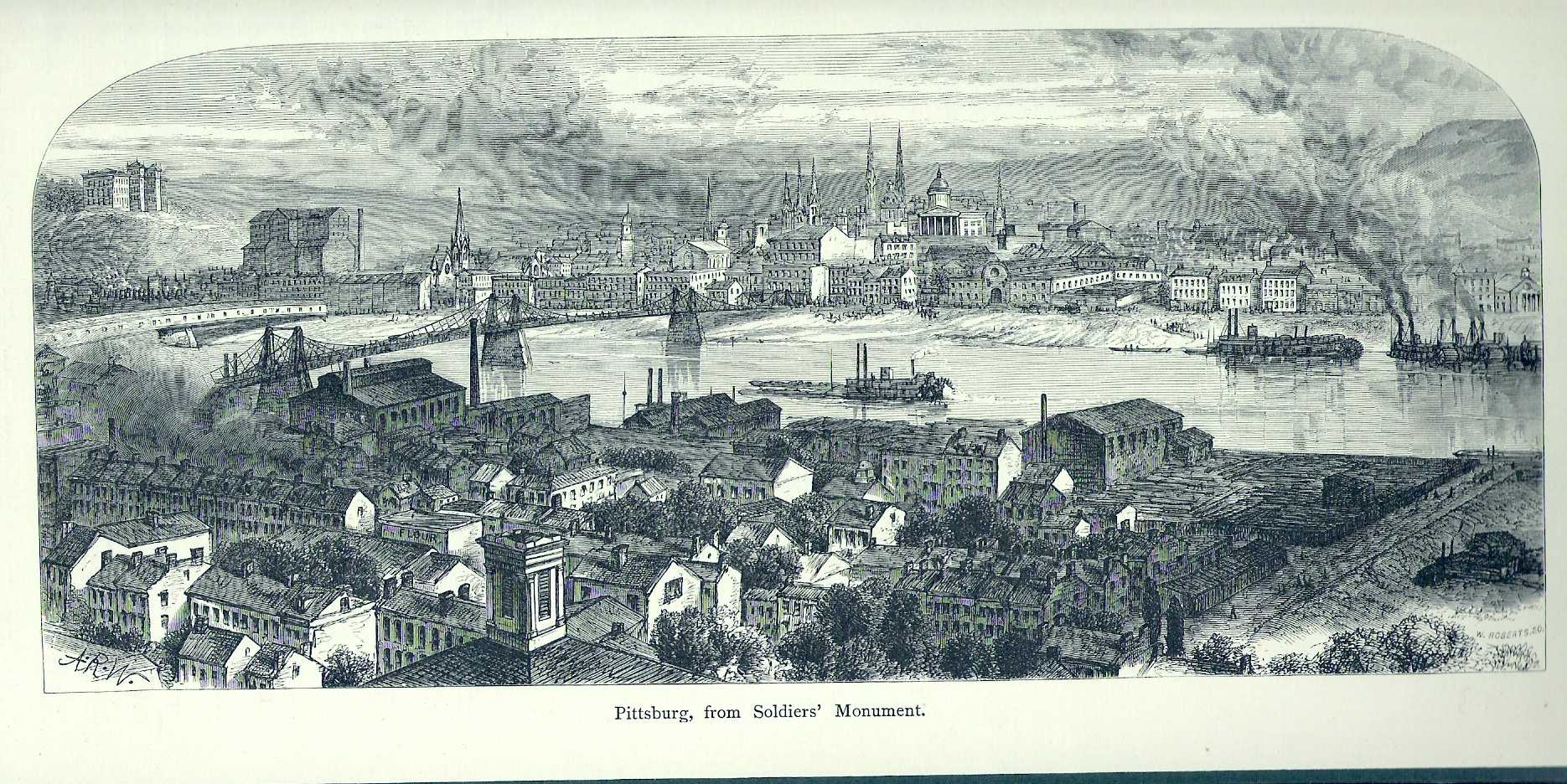
By 1876, Leman was listed as a salesman, living at 920 North 7th Street with his in-laws, Moses and Caroline Wiler.  Like Simon Wiler, Leman must have been feeling the effects of that Long Depression to have moved in with his in-laws after having his own home.   The next time Leman showed up in my search, he and Eliza were living in Pittsburgh, and Leman was working in the liquor business, like his cousin Albert Nusbaum.  Although I cannot find Leman on an 1877, 1878, or 1879 directory in any city, Leman and Eliza had another child, Leon, who was born in Pittsburgh on June 13, 1878, so the family must have relocated to Pittsburgh from Philadelphia by then.

Leman and Eliza also had a daughter Minnie, who was apparently born in 1877.  I say “apparently” because I cannot find a birth record for her, and there are only two census reports that include her, the 1880 and 1900 census reports.  The first says she was 2, meaning she was born either in 1877 or 1878; the latter says she was born in December, 1877.  But if she was born in December, 1877, then Eliza could not have given birth to Leon in June, 1878, just six months later.  I do have an official record for Leon’s birthdate with Eliza Wiler and Leman Simon named as his parents, so either Minnie was born sometime before September, 1877 or she is not Eliza’s child.

There are no other records I can find to determine Minnie’s precise birthdate; her death certificate also only specified her age, not an exact date of birth, and it also is consistent with a birth year of either 1877 or 1878.  Minnie died on August 5, 1904, at age 26 (more on that in a later post), meaning she was born on or before August 5, 1878, but not any earlier than August 6, 1877.  Somehow it seems quite unlikely that Caroline gave birth in August 1877, got almost immediately pregnant, and then had another child ten months after Minnie, but….stranger things have happened.  Or perhaps Minnie was adopted. Since I cannot find a birth record for a Minnie Simon in Pennsylvania for either 1877 or 1878, that certainly is a possibility.

In any event, in 1880, Eliza (Wiler) and Leman Simon were living far from their families in Pittsburgh with their five children, Joseph, Flora, Nellie, Minnie, and Leon.  Leman was in the liquor sales business, and perhaps life was a little easier out in the western part of Pennsylvania than it was in Philadelphia.

Eliza’s younger sister Fanny Wiler married Max Michaelis on July 12, 1874, in Philadelphia.  I am still working on Fanny’s story, and there are a lot of holes so that will wait for a later post.

The youngest child of Caroline (Dreyfuss) and Moses Wiler was Clara Wiler, born in 1850.  In 1871, she married Daniel Meyers, a German born clothing merchant operating in the 1870s under the firm name D. Meyers and Company.  He and Clara were living at 718 Fairmount Street, and their family grew quickly in the 1870s.  First, their daughter Bertha was born on December 4, 1972.  Less than two years later, their son Leon was born on June 12, 1874, followed the next year by Samuel on December 15, 1875.  A fourth child, Harry, was born January 15, 1878, and Isadore on September 25, 1879.  Five children in seven years.  Wow.

And they were not yet done.  But that would bring us into the 1880s, and I am not there yet.   But Daniel’s firm must have been weathering the storm of the 1870s depression better than most, including many in the extended family.  In 1880, he was supporting five children plus his wife Clara and himself in their house on Fairmount Street.

Thus, the Wiler family like the Pollock family had its ups and downs during the 1870s.  There were marriages and babies, but also some economic struggles for at least some of the members of the family.  Adult children had to move back home, and some had to leave town to find new opportunities for making a living.

The Long Depression:  The Family of Mathilde Dreyfuss Nusbaum Pollock


Embed from Getty Images

If the 1860s were mostly a decade of good things—weddings, babies, prosperity, and little impact from the Civil War, the 1870s were in contrast a more difficult decade for the extended Nusbaum-Dreyfuss-Dinkelspiel-Simon clan, both personally and economically.  This post will focus on the family of Mathilde Dreyfuss Nusbaum Pollock, and the next will focus on the family of Caroline Dreyfuss Wiler, my two three-times great grand aunts, sisters of Jeanette Dreyfuss.  The posts that follow will focus on the family of my three times great-grandparents John and Jeanette (Dreyfuss) Nusbaum and the families of John’s siblings Ernst Nusbaum, Leopold Nusbaum, and Mathilde (Nusbaum) Dinkelspiel during the 1870s.

First, the Pollocks. Mathilde (Dreyfuss Nusbaum) and Moses Pollock had relocated from Harrisburg to Philadelphia in the mid-1860s. Moses was engaged in the retail dry goods business. In June 1870 when the census was taken, the Pollocks had a very full house.  Mathilde’s daughter Flora and her new husband Samuel were living with them along with their new baby Meyer. Samuel was working on the wholesale side of clothing sales. In addition, Mathilde’s son Albert Nusbaum, now 19 and working as a clerk in a dry goods store (presumably his stepfather’s business), was living with them as well as Mathilde and Moses’ children, Emanuel (14) and Miriam (11), who were both in school.  In addition, there were three domestic servants living with them.  Moses must have been doing quite well.

It’s a good thing they had those servants because there were also three young children living with them, Annie (5), Alice (4), and Wilhelmina Jastrow (seven months old) plus another young woman, Augusta Wolfsohn, who was 22 years old.  Annie and Alice were born in Hesse-Darmstadt, but their baby sister Wilhelmina had been born in Pennsylvania in September, 1869.  Who were they? Where were their parents? Augusta was born in Prussia and does not appear to be the mother of the three young girls.  Who was she?  None of these girls was living with the Pollocks as of the 1880 census.

Fortunately, this was a mystery that did not take long to solve.  A little research on Ancestry.com, and I was able to find a happy ending to the story.  The Jastrow girls had parents, Marcus and Bertha (Wolfsohn) Jastrow.  By the second enumeration of the 1870 census in Philadelphia, they and their aunt Augusta Wolfsohn were all under the same roof as their parents and other siblings.  I don’t know why they were with the Pollocks during the earlier enumeration, but I assume that they were very recent immigrants who did not have enough room to accommodate everyone, and Moses and Mathilde were kind enough to take in the three youngest children and their aunt.

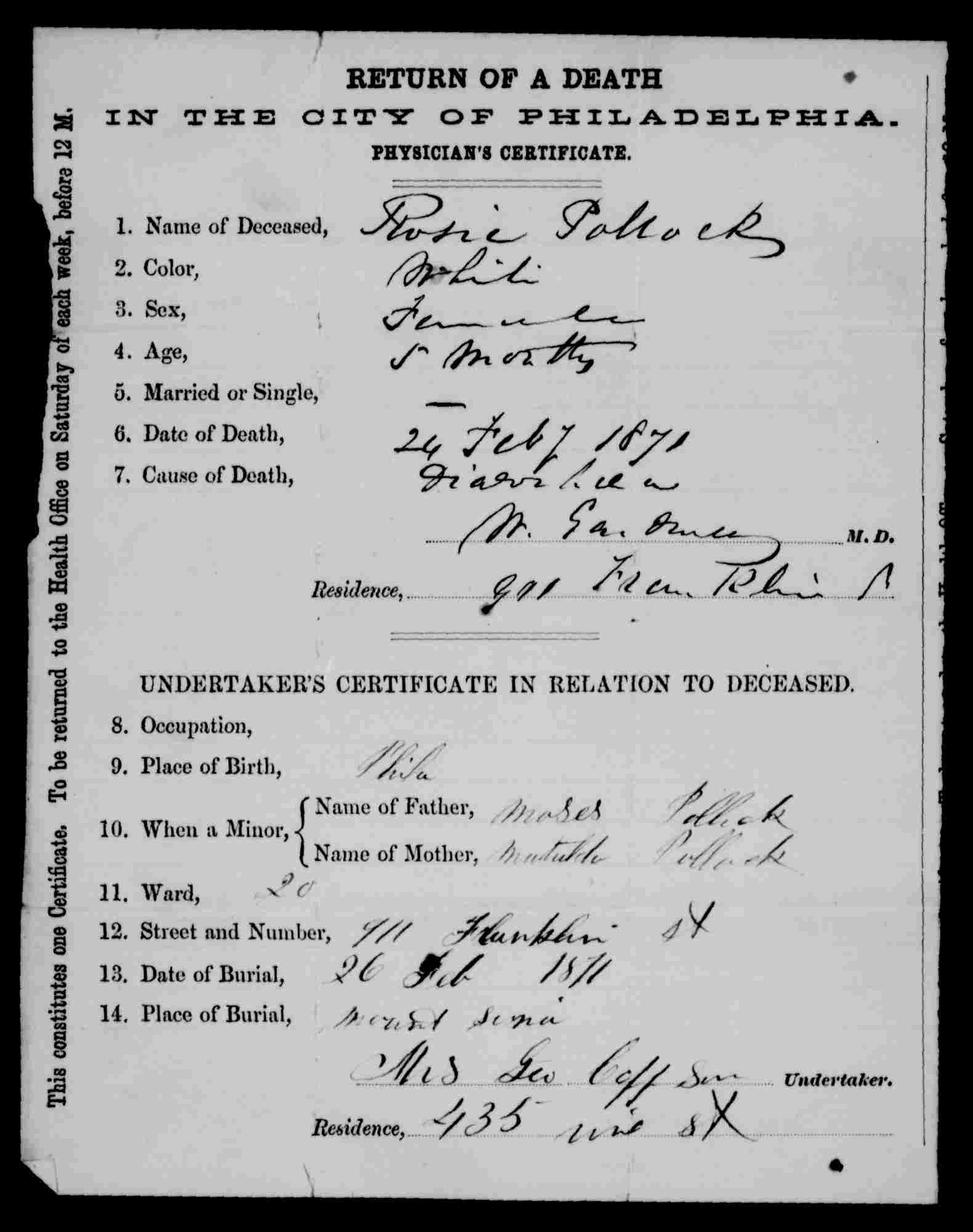
But fate was not kind to Moses and Mathilde despite their kindness to the Jastrows.  In September 1870, they had a third child together (a fifth for Mathilde), Rosia, but Rosia did not live long.  On February 26, 1871, she died, only five months old, from diarrhea.  Mathilde was 45 years old when Rosia was born, making me doubt my skepticism about the parentage of Lottie Nusbaum. Perhaps women just kept having babies into the mid to late 40s back then with more frequency than I would have thought.

Rosia Pollock death certificate 1871

Rosia Pollock death certificate 1871

What makes this late birth seem even stranger is that Mathilde had become a grandmother just nine months before Rosia was born when her grandson Meyer was born in January, 1870. Meyer and his parents Flora and Samuel Simon were living with the Pollocks in June of 1870 when Mathilde was pregnant with Rosia.  It is hard to imagine being pregnant and a grandmother, but times were different then.

Flora (Nusbaum) and Samuel Simon were still living with Flora’s family at 911 Franklin Street in 1871, but seem to have moved to their own place in 1872, and I say “seemed to” because their address was 909 Franklin Street, so right next door to Mathilde and Moses Pollock. Then in 1873, they are back at 911 Franklin.   Samuel was in business with his brother Leman in 1871, but seems to be on his own after that. He has no occupation listed in 1873 in the directory. Perhaps Flora and Simon could no longer afford to have their own place and returned to the Pollock residence.

According to the 1871 and 1872 Philadelphia directories, Moses Pollock had gone into business with his brother-in-law Moses Wiler, husband of Caroline Dreyfuss, Mathilde’s sister.  By 1873 it also appears that Moses Pollock and Moses Wiler were no longer in business together.  Moses Wiler is listed in the directories for 1873 and 1875 without an occupation, and Moses Pollock is listed in one as a salesman and another as a clerk.

What was going on around them? Why had these two family business partnerships ended?  It’s always important to keep the historical and socioeconomic context in mind when doing family research, and perhaps the most important development both in the US and worldwide in the 1870s was the so-called “Long Depression.”  The period after the Civil War brought widespread economic growth with railroad construction, technological developments, and expansion of exports to European markets.  However, in a way not dissimilar to more recent economic crashes, the economy tumbled in 1873 when banks and investment firms did not realize the profits they had expected from investing in the railroads and could no longer cover the loans they had made in the frenzy of the post-Civil War boom.[1]  In addition, an economic crisis abroad resulted in decreased demand for American exports.

The credit crisis led to panic with many investors withdrawing their money from the banks, thus worsening the precarious position of the banks.  Although the government intervened to try and stop the crisis, the overall confidence in the economy was gone, jobs dried up, people stopped buying, and railroad construction came to a halt.  There was also evidence of a great deal of corruption that was uncovered during this time.  The effects of this crisis were felt across the United States for at least five years with widespread unemployment, poverty, and social unrest.


It could very well have been this economic downturn that caused Moses Pollock and Moses Wiler to end this business partnership and also caused Leman and Samuel Simon to end their business partnership.

Moses Pollock continued to have some inconsistency in his occupation for the rest of the decade. In 1876 Mathilde and Moses Pollock are listed in business together selling “gentlemen’s furnishings” at 107 North 9th Street and were still living at 911 Franklin Street.  By 1878, they had moved to 934 North 8th Street, where they remained for many years.  Moses is listed as a salesman in the 1878, 1879, and 1880 Philadelphia directories, and according to the 1880 census he was working in a cloak store.  In 1880 he and Mathilde still had Albert Nusbaum, now 28, as well as Emanuel (24) and Miriam (21) living with them at home as well as one servant.  Albert had been working as a liquor salesman since 1873 when he was 21.  Emanuel had been in dry goods sales since 1877 when he was 21. Miriam and her mother Mathilde were “keeping house.”

Mathilde’s other daughter, Flora (Nusbaum) Simon and her husband Samuel meanwhile had had a second child.  Their daughter Minnie was born in 1873 or 1874 (documents vary).  Flora and Samuel seem to have moved out of the Pollock household sometime shortly thereafter and out of Philadelphia altogether by the end of the decade and perhaps even earlier.  It’s hard to know for sure because Samuel Simon was not an uncommon name.

There are three Samuel Simons listed in the 1874 Philadelphia directory: one was a laborer, one a restaurant worker, and a third was working in the ladies’ furnishings business.  None of the addresses line up with other members of the family, so I cannot tell which, if any of these Samuel Simons were married to Flora.  The ladies’ furnishings Samuel seems like the most likely, given the family’s pre-existing businesses, but I cannot be sure.  In 1875, there are two Samuel Simons, a laborer and a gardener.  Neither one seems likely to be Flora’s Samuel.

In 1876, there is only one Samuel Simon listed, a superintendent, and in 1877 again only one, a furrier.  In 1878 there was only Samuel the laborer, but in 1879 there were three Samuels: the laborer, the gardener, and a third selling produce.  My best hunch is that Samuel and Flora (Nusbaum) Simon had left Philadelphia by 1875.  According to the 1880 census, they were then living in Elkton, Maryland, about 50 miles from Philadelphia and 60 miles from Baltimore.  Samuel was working at a hotel there.  Again, my assumption is that the economic slowdown had contributed to this move away from their families in Philadelphia.

As will be evident as I examine each of the families, the Pollock line was not the only one that felt the impact of the Long Depression of the 1870s.


[1] I am greatly oversimplifying the causes and the effects of the Long Depression that began in 1873.  For more information, see http://www.socialwelfarehistory.com/eras/the-long-depression/   http://en.wikipedia.org/wiki/Panic_of_1873   http://macromarketmusings.blogspot.com/2010/05/about-that-long-depression-of-1870s_27.html

Four Weddings and a Funeral: More Twists and Turns

My last post covered the migration of several Nusbaum/Dreyfuss family members to Peoria, Illinois in the 1860s. Meanwhile, back in Pennsylvania, the rest of the Nusbaum/Dreyfuss clan was growing during the 1860s.  In Philadelphia, two of the Nusbaum brothers and two of the Dreyfuss sisters were seeing their families grow and their children grow.  Other family members were still in Harrisburg. By the end of the decade, even more of the family would have relocated to Philadelphia.

The Civil War was having at least some minor financial impact on the family.  For example, John Nusbaum was liable for $26.79 in income tax to the federal government in 1862 under the terms of the Internal Revenue Act of 1862 That law was enacted to raise money to help pay for the expenses incurred by the Union in fighting the Civil War.  It was the first progressive income tax imposed by the federal government.  For anyone whose income exceeded $600 a year, a tax was imposed based on the level of income.

For John Nusbaum, whose income was valued at $892.96 in 1862, that meant a tax of $26.79.  According to one inflation calculator, $892.96 in 1862 would be worth about $20,000 in 2014.     For someone with stores in Philadelphia and Peoria (and possibly still some interest in a store in Harrisburg) and who reported $6000 in real estate and $20,000 in personal property in 1860,[1] that does not seem like a lot of income, but I have no idea how that was determined back then.

Ancestry.com. U.S. IRS Tax Assessment Lists, 1862-1918 [database on-line]. Provo, UT, USA: Ancestry.com Operations Inc, 2008.

Ancestry.com. U.S. IRS Tax Assessment Lists, 1862-1918 [database on-line]. Provo, UT, USA: Ancestry.com Operations Inc, 2008.

By 1863 John and Jeanette (Dreyfuss) Nusbaum, my three-times great-grandparents, had seen their two older sons move to Peoria, but they still had one son, Julius, and two daughters at home in 1863: Frances, my great-great-grandmother, who was eighteen, and Miriam, who was only five years old in 1863.  Plus 1863 had started off with another new baby in the family.  Lottie Nusbaum was born on January 1, 1863.  Jeanette would have been almost 46 years old, and her first born child Adolphus was going on 23.

I have to admit that I have some questions about whether Lottie was actually the child of John and Jeanette.  Jeanette must have been close to the end of her child-bearing years.  They had not had a child in five years.  Could Lottie have been a child of one of their sons, raised as the child of her actual grandparents?  Or a child they adopted?  I have no way of knowing.  Lottie had no children, so even if I could figure out some way to use DNA to answer my doubts, there are no descendants to use for DNA testing.

On Lottie’s death certificate, the informant was Mrs. E. Cohen, that is, my great-grandmother Eva Seligman Cohen, Lottie Nusbaum’s niece and Frances Nusbaum Seligman’s daughter.  Eva filled in the father’s name as John, but put unknown for the mother’s maiden name.  Eva certainly knew her grandmother Jeanette’s name.  (Eva is the one who held and maintained the family bible for many years.) Did she not know her grandmother’s maiden name? Was she too grief-stricken to remember? Or was she suggesting that Jeanette was not in fact Lottie’s real mother?  I do not know, and there is no one left to ask.  But it did not do anything to resolve my doubts about the identity of Lottie’s parents.   Maybe I am too skeptical.  Maybe she was just a menopause baby. Maybe John and Jeanette were missing their boys so much that they decided to have one more child. Or maybe not.  What do you all think?

Lottie Nusbaum death certificate  Ancestry.com. Pennsylvania, Death Certificates, 1906-1963 [database on-line]. Provo, UT, USA: Ancestry.com Operations, Inc., 2014.

Lottie Nusbaum death certificate
Ancestry.com. Pennsylvania, Death Certificates, 1906-1963 [database on-line]. Provo, UT, USA: Ancestry.com Operations, Inc., 2014.

In any event, just as John and Jeanette were emptying their household of their sons, they had a new baby to raise.  The family was still living at 433 Vine Street in 1862, according to the Philadelphia city directory, but in 1864 they are listed at 455 York Avenue.  That address is about two and a half miles north of Vine Street, and as I’ve discussed earlier, Jews began to move north in Philadelphia as their socioeconomic status improved.

By 1865, John and Jeanette’s house on York Avenue was a little emptier.  By that time Julius had joined his brothers in Peoria, and on March 28, 1865, my great-great-grandmother Frances married Bernard Seligman.  For several years they lived in Philadelphia, and Bernard was apparently in business with his brothers-in-law in a firm called Nusbaum Brothers and Company.  They had four children between 1866 and 1869, including my great-grandmother Eva.  Then in 1870, Bernard returned full time to Santa Fe with Frances and their children where Frances and Bernard lived for almost all of the rest of their lives, as discussed in my Seligman blog posts.

Nusbaum Brothers and Company 1867 Philadelphia Directory  Ancestry.com. U.S. City Directories, 1821-1989 [database on-line]. Provo, UT, USA: Ancestry.com Operations, Inc., 2011.

Nusbaum Brothers and Company 1867 Philadelphia Directory
Ancestry.com. U.S. City Directories, 1821-1989 [database on-line]. Provo, UT, USA: Ancestry.com Operations, Inc., 2011.

John’s brother Ernst was also in Philadelphia during the early 1860s.  He was a clothier, working at 55 North Third Street and living at 626 North 6th Street.  He and his wife Clarissa had another child in 1861, Frank, bringing their family up to six children ranging in age from newborn to ten years old.  So both Ernest, who was 45 when Frank was born, and John, who was 49 when Lottie was born, had new babies in their homes in the 1860s.

Jeanette (Dreyfuss) Nusbaum also had a sibling living in Philadelphia.  Her sister Caroline (Dreyfuss) Wiler had also moved from Harrisburg to Philadelphia by 1860.  She and her husband Moses Wiler were living at 466 North 4th Street in 1862 with their four children, who ranged in age from Eliza who was twenty to Clara who was twelve.  Moses was in the cloak business.

The following year the Wiler household became a bit smaller when Eliza Wiler married Leman Simon on September 9, 1863, in Philadelphia.  Yes, Leman Simon.  Do you remember that name? He was the brother of Moses Simon, who married Paulina Dinkelspiel and started the migration of Nusbaums to Peoria.  So once again, my family tree groans and twists a bit.  Eliza and Paulina were already related, at least by marriage.  Eliza’s mother Caroline Dreyfuss was the sister-in-law of John Nusbaum, Paulina Dinkelspiel’s uncle.  Sometimes these people make me want to pull out my hair!  Imagine, I am casually researching Eliza, and I see her husband’s name and think, “Leman Simon.  Hmmm, that sounds familiar.”

So by 1863 the Simons, Nusbaums, Dinkelspiels, and Dreyfusses were all somehow interrelated, often in more than one way.

But it gets worse.

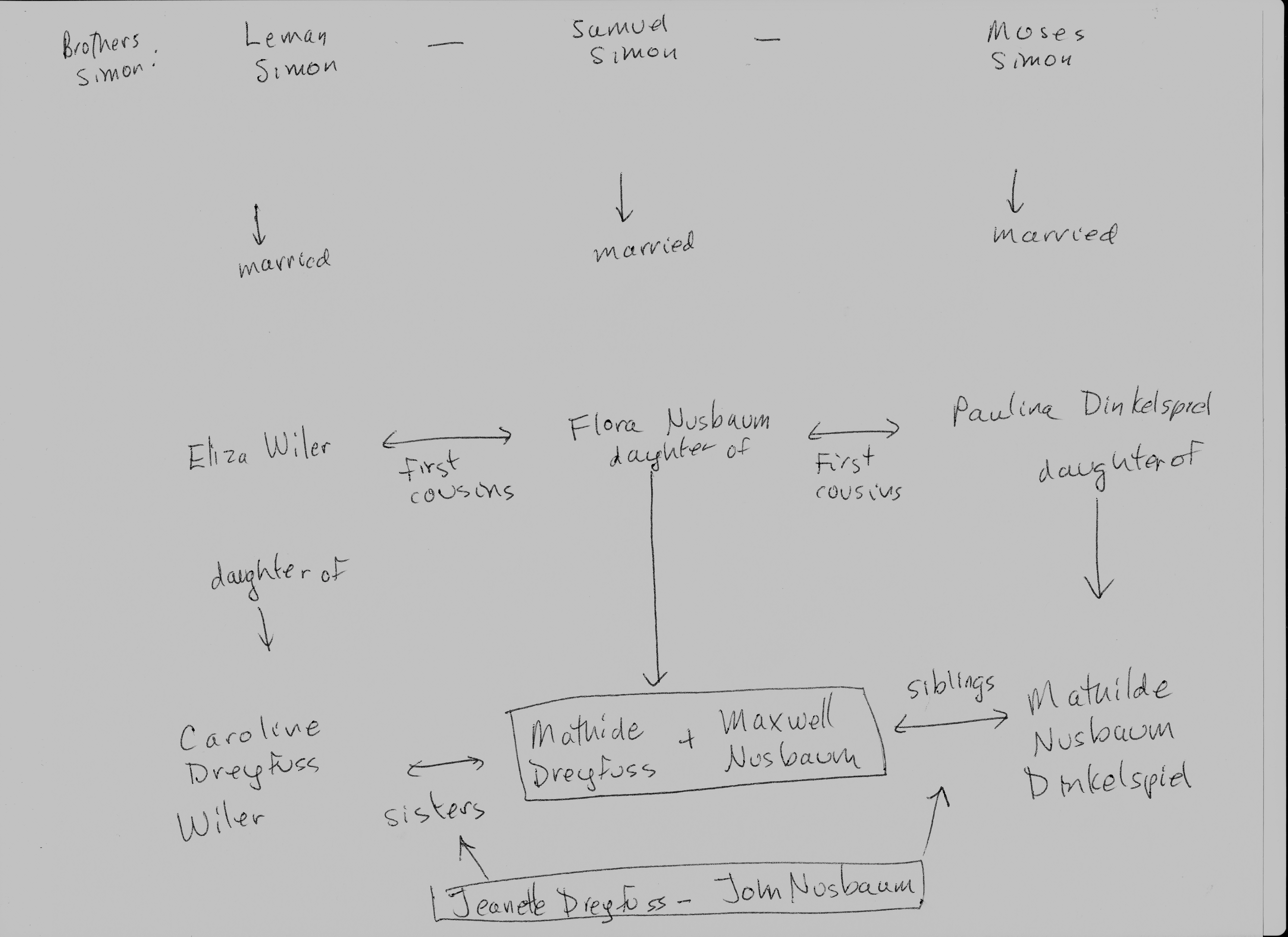
By 1866, Moses Pollock and Mathilde (Dreyfuss Nusbaum) Pollock had also moved to Philadelphia from Harrisburg. In 1868, Flora Nusbaum, the daughter of Mathilde Dreyfuss and Maxwell Nusbaum and step-daughter of Moses Pollock, married Samuel Simon.  I have mentioned this before because Flora Nusbaum is my double first cousin four times removed since both of her parents were siblings of one of my three times great-grandparents, Flora’s father being John Nusbaum’s brother, her mother being Jeanette Dreyfuss Nusbaum’s sister.  Now Flora was marrying her first cousin Paulina’s brother-in-law Samuel Simon, who was also her cousin Eliza’s brother-in law.

Groan…. Maybe this chart will help.
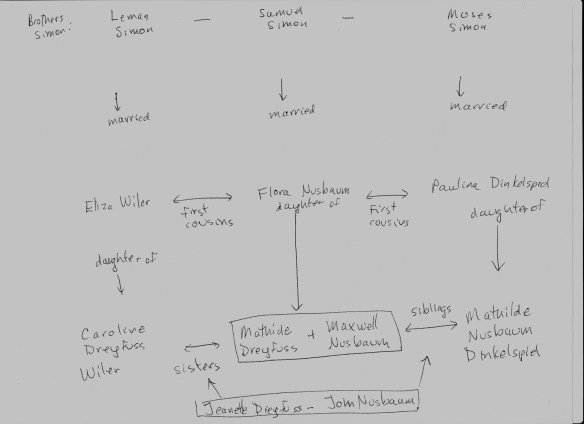
chart_NEW

So all three Simon brothers were now married to someone in the clan: Samuel to Flora Nusbaum, Leman to Eliza Wiler, and Moses to Paulina Dinkenspiel.

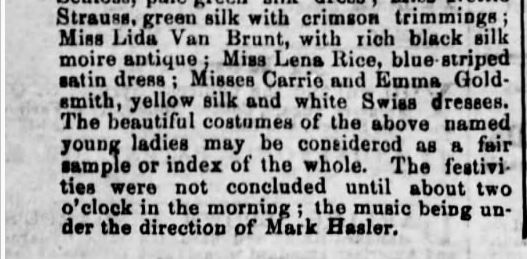
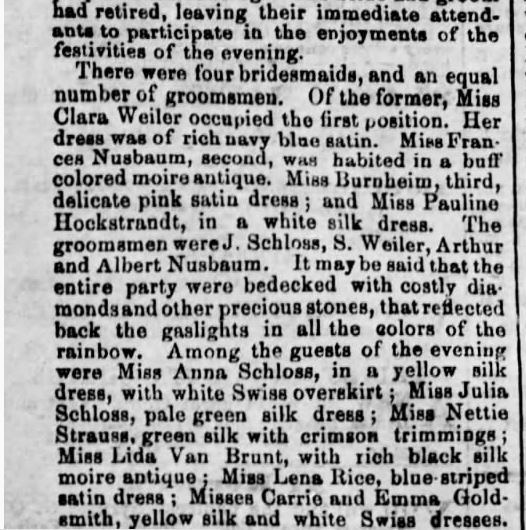
The wedding of Samuel Simon to Flora Nusbaum (Pollock) seems to have been a celebration worthy of all that interconnectedness.  Here is an article from the Harrisburg Telegraph of October 20, 1868, republishing an article from the Philadelphia Sunday Mercury that described their Philadelphia wedding.  It’s really worth reading to get the full flavor of both the wedding and “social media” in the 1860s.
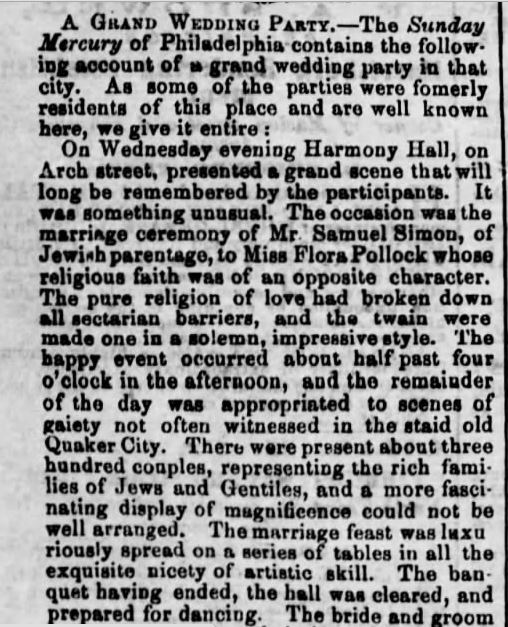
flora pollock wedding part 1

flora pollock wedding part 2

flora pollock part 3

The strangest part of this article is not the detailed description of the lavish, extravagant wedding celebration, but the reporter’s mistaken assertion that Flora was not Jewish.  Certainly her parents were both Jewish, and even her stepfather Moses Pollock was Jewish.  The reporter’s statement that “the pure religion of love had broken down all sectarian barriers” seems a bit strange for a wedding announcement, even if it had been an interfaith wedding.  But why would the reporter have thought Flora wasn’t Jewish?

The overlapping branches of the family were well represented in the bridal party: Clara Wiler and Simon Wiler, the children of Moses and Caroline (Dreyfuss) Wiler; Frances Nusbaum, the daughter of John and Jeanette (Dreyfuss) Nusbaum; Arthur Nusbaum, son of Ernst and Clara Nusbaum; and Albert Nusbaum, son of Maxwell and Mathilde (Dreyfuss) Nusbaum and brother of the bride.  I do not know who the Schloss family is or the Goldsmiths, at least not yet, but I fear more double twists yet to be uncovered.

So the extended family was doing quite well, and there were lots of new families being formed and babies born, but unfortunately there also was one big loss in the 1860s.  Leopold Nusbaum, who was still living in Harrisburg in the 1860s, died on December 24, 1866.  He was buried at Mt. Sinai Cemetery in Philadelphia.  His widow Rosa and sixteen year old daughter Francis moved shortly thereafter to Philadelphia, where they moved in with John and Jeanette Nusbaum, whose household had been reduced by two when Julius moved to Peoria and Frances married.

Below is a photo I found while searching for old images of Harrisburg.  I was so excited when I saw the name on the store at the far upper right—Leo Nusbaum!  Although this photo was dated 1889, Leopold Nusbaum’s name was still on the store even though he had died almost 25 years earlier.

Harrisburg Market Square with Leo Nusbaum store

Harrisburg Market Square with Leo Nusbaum store http://explorepahistory.com/displayimage.php?imgId=1-2-EC

The only Nusbaum family members left in Harrisburg by the end of the 1860s were Mathilde (Nusbaum) Dinkenspiel, her husband Isaac, and their daughter Sophia.  Their daughter Paulina (Dinkenspiel) Simon was living in Baltimore, and their son Adolph was in Peoria.  Their youngest child Sophia married Herman Marks, a Prussian born clothing merchant, in 1869, and they settled in Harrisburg as well.  Perhaps they were the ones to keep Mathilde’s brother’s name on the store.

Thus, by the end of the 1860s, most of the extended family was living in Philadelphia, with a small number living in Peoria, a few in Harrisburg, and a few in Baltimore.


[1] $600 in 1860 would be worth about $17,000 today, and $20,000 in 1860 would be worth about $571,000 today.  Not too shabby for someone who had come to America around 1840.

But Will It Play in Peoria?


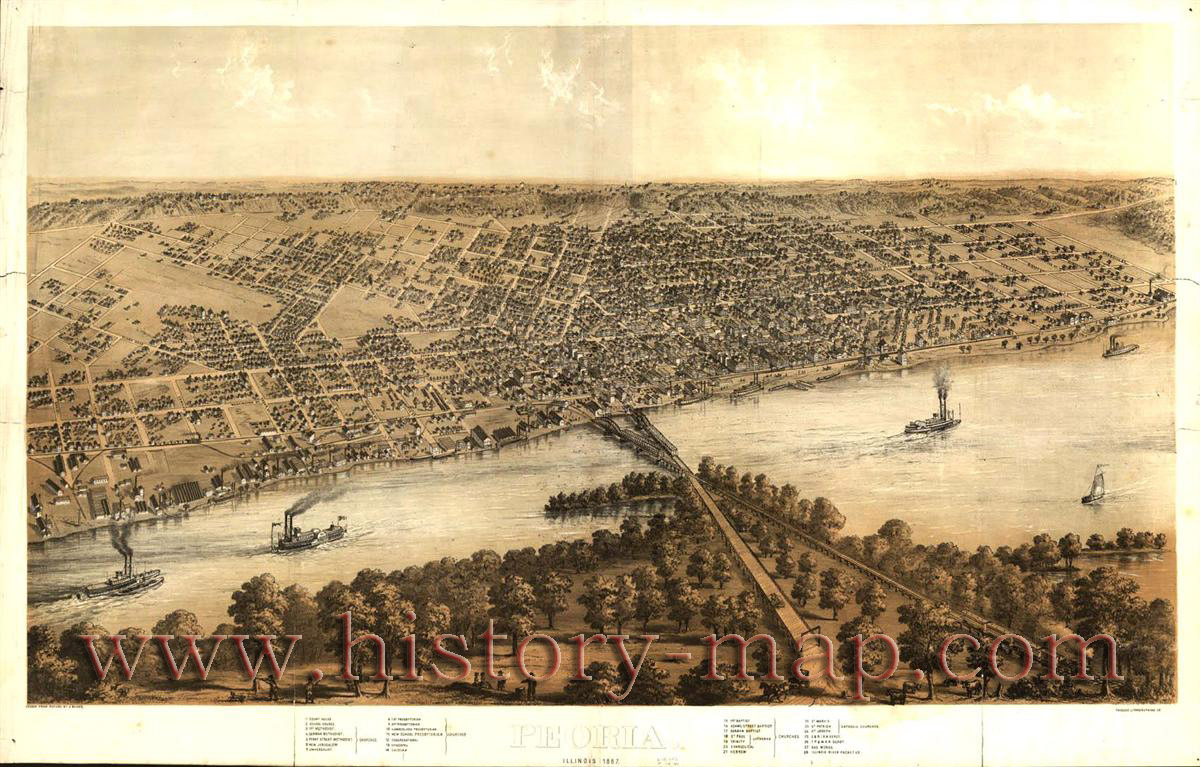
My father’s family has lived in some places that were surprising to me—Cohens in Des Moines and Kansas City, Seligmans in Santa Fe, and Nusbaums in Harrisburg and other small towns in Pennsylvania.  In the 1860s, some of the Nusbaums and their Dreyfuss, Dinkelspiel and Simon relatives ended up in Peoria.   All I knew about Peoria was the old line, “Will it play in Peoria?” As explained on the official website for Peoria, Illinois:

The phrase “Will It Play in Peoria?” originated in the early ’20s and ’30s during the US vaudeville era. At that time, Peoria was one of the country’s most important stops for vaudeville acts and performances. If an act did well in Peoria, vaudeville companies knew that it would work throughout the nation. The saying was popularized by movies with Groucho Marx, and on radio programs such as Jack Benny and Fibber McGee.  Because of it’s [sic] location and demographics, Peoria has since become a well known test market to gauge the popularity of products and ideas nationwide.

Peoria has become a symbol of mainstream America, a short-hand way of referring to the typical “Middle American,” as Richard Nixon might say.  So perhaps I should not be surprised that my entrepreneurial Nusbaum/Dreyfuss ancestors struck out for Peoria after succeeding in Harrisburg and Philadelphia.  It was a new market to exploit as the US population continued to expand and move west.

Location map of Peoria, Illinois

Location map of Peoria, Illinois (Photo credit: Wikipedia)

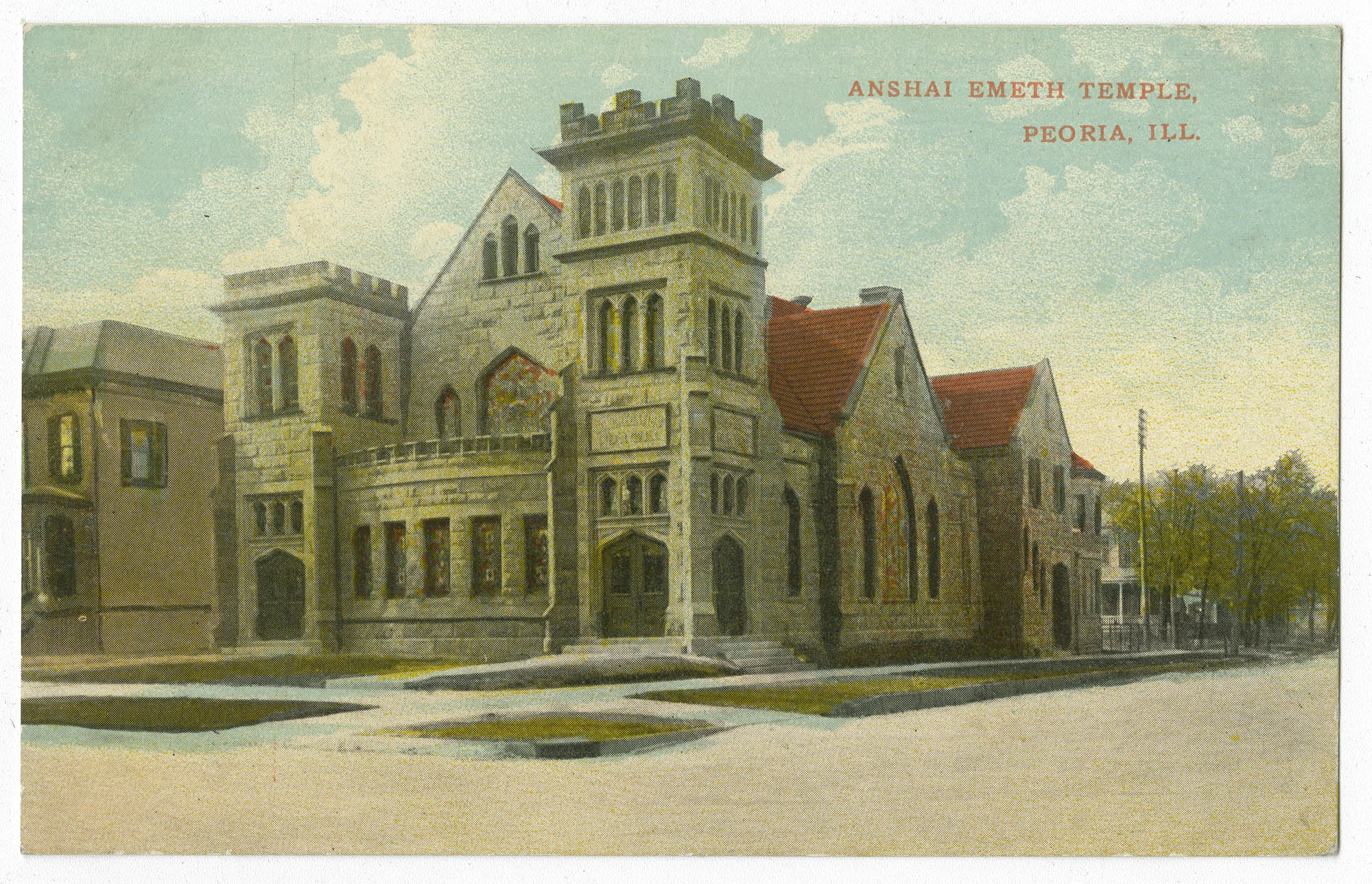
But were there Jews there in the 1860s? Surprisingly, there was an established Jewish community. According to the Jewish Virtual Library’s entry for Illinois, “The oldest Jewish community [in Illinois] outside of Chicago is Peoria, where the first Jews arrived in 1847. A benevolent society was organized in 1852 and the first congregation, Anshai Emeth, was formed in 1859.”     The website for Anshai Emeth reveals only a little bit more about the early history of Jews in Peoria:

The first Jewish settlers came to Peoria in approximately 1847. They soon organized themselves into groups and worshiped in private homes. Early settlers included Jacob Liebenstein (1848), Henry Ullman and Leopold Rosenfeld (1849), Abraham Schradski and Leopold Ballenberg (1851), and Aaron, Harry and David Ulman (1852), and Henry Schwabacker. Many of their descendants continue to live in the Peoria community.  Religious school classes were organized by 1852. In the same year, these Jewish settlers organized a burial association and bought a lot for the use as a cemetery. With this purchase grew the first organized Jewish life in Peoria. Religious services were held in various halls including Washington House on North Washington Street.  Abraham Frank, A. Rosenblat, Hart Ancker, A. Ackerland, Arnold Goodheart, and Abraham Solomon formally organized a congregation in 1859 and named themselves “Anshai Emeth,” or “People of Truth.”

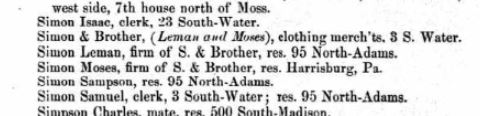
Although in 1860 the Nussbaum/Dreyfuss clan was settled either in Harrisburg or Philadelphia, as early as  1862 some of the next generation began moving to Peoria.  Paulina Dinkelspiel, the daughter of Mathilde Nusbaum and Isaac Dinkelspiel, married a man named Moses Simon in 1862.  Moses was born in 1835 in what is now the Hesse region of Germany.  He and his brothers Leman and Samuel had a business in Peoria as early as 1861, as did their father Sampson.

The Simons in Peoria 1861 Peoria directory

The Simons in Peoria 1861 Peoria directory

But as the directory indicated, Moses was residing in Harrisburg in 1861.  Perhaps Moses had a business relationship with the Nusbaum business; perhaps that is how he obtained his merchandise for their business in Peoria.  But while living in Harrisburg, Moses must have met Paulina. And after they were married, they moved to Peoria where their first two children were born, Joseph in 1862 and Francis in 1864.

Not long after, Paulina’s younger brother Adolph Dinkenspiel arrived in Peoria.  Although he is not listed in the 1861 directory, he does appear in the 1863 directory. While the Simon brothers and their father were all living at 95 North Adams Street that year, Adolph was boarding at the corner of North Adams and Hamilton Street, right down the block, and working as a clerk at 73 Main Street.

What was going on at 73 Main Street?  The Simon Brothers business was at 5 North Adams Street, so young Adolph was not working for his sister’s husband.  A look at the 1863 directory for Peoria under N revealed that John Nusbaum, my three-times great-grandfather, had a business at that location as a “fancy and staple dry goods merchant.”  Although John was still residing in Philadelphia, he is listed in the directory as are two of his sons.  His oldest son Adolphus, was residing at Peoria House, a hotel, I assume, and working for a firm called “Adler, N. & Higbie.” A further look through the 1863 directory uncovered a listing for a distillery called Adler, Nusbaum & Higbie.  John’s second son Simon is also listed in the 1863 Peoria directory, working as the business manager of his father’s store at 73 Main Street with his cousin Adolph Dinkenspiel and residing at 36 North Adams Street.

nusbaum 1863 peor

Nusbaums in Peoria 1863 Peoria directory

By 1863, the country was in the throes of the Civil War, yet it appears that my Peoria relatives were not serving in the war.  I did find a document that indicates that both Simon and Adolphus Nusbaum registered for the draft in 1863 for the Civil War, but I cannot find any other documentation of their service in that war.

National Archives and Records Administration (NARA); Consolidated Lists of Civil War Draft Registration Records (Provost Marshal General's Bureau; Consolidated Enrollment Lists, 1863-1865); Record Group: 110, Records of the Provost Marshal General's Bureau (Civil War); Collection Name: Consolidated Enrollment Lists, 1863-1865 (Civil War Union Draft Records); ARC Identifier: 4213514; Archive Volume Number: 2 of 5

National Archives and Records Administration (NARA); Consolidated Lists of Civil War Draft Registration Records (Provost Marshal General’s Bureau; Consolidated Enrollment Lists, 1863-1865); Record Group: 110, Records of the Provost Marshal General’s Bureau (Civil War); Collection Name: Consolidated Enrollment Lists, 1863-1865 (Civil War Union Draft Records); ARC Identifier: 4213514; Archive Volume Number: 2 of 5

Not one of these young men in the family appears in any of the databases listing those who served. I searched not only Ancestry, Fold3, and FamilySearch, but also the National Park Service database, the Civil War Soldiers and Sailors System, found here, and found nothing.

How had they all avoided service?  Simon and Adolphus registered, but I can’t even find registration evidence for Adolph Dinkelspiel.  The Draft Act of 1863 applied to all male citizens between 20 and 45 years old; in 1863 Adolphus was 21 and Simon and Adolph were 20.  Adolphus and Simon were born in the US and were thus citizens, but Adolph Dinkelspiel was born in Baden.  However, the Draft Act also applied to men who intended to become citizens.  Perhaps Adolph avoided registration by not declaring such an intention.  But how would his cousins Adolphus and Simon have avoided service?  Apparently there were two ways to avoid being drafted: hire a substitute or pay $300.  Perhaps that’s what the two Nusbaum brothers did.  Or maybe I just haven’t found the documentation of their service.    See also Michael T. Meier, “Civil War Draft Records: Exemptions and Enrollments,” Prologue Magazine (Winter, 1994) found online here.

All three of John’s sons were listed in the 1865 Peoria directory.  Julius joined Simon as a clerk at the Nusbaum dry goods store, now located at the corner of North Adams and Main Street, two blocks up from its 1863 location.  Adolphus, although still listed in the directory, was reported to be living in Philadelphia in 1865, but still associated with the Adler, Nusbaum & Higbie firm.  In addition, John’s older brother Isaac is listed in the 1865 Peoria directory, boarding at 36 North Adams Street, the same address given for Julius.  This is the first document evidencing Isaac’s presence in the US, so perhaps he was a late arrival and sent to Peoria to keep an eye on his nephews Julius and Simon Nusbaum and Adolph Dinkelspiel, who were single and only 17, 22, and 22 respectively in 1865.

Thus, in 1865, there were four male members of the extended Nusbaum family living in Peoria. Some members of the clan had left by then. Moses and Paulina (Dinkelspiel) Simon and Moses’ brothers Leman and Samuel and their father Sampson were gone from Peoria. Moses and Paulina had relocated to Baltimore where Moses was a “fancy goods” merchant. They had two more children between 1865 and 1870: Leon was born in 1866, and Flora in 1868, both born in Baltimore.  On the 1870 census, Moses described himself as a dealer in all kinds of leather. [1] Thus, Moses Simon who started the migration of the Nusbaums to Peoria was himself gone by 1865.

Adolphus was not listed as living in Peoria in 1865, but he did eventually return to Peoria in 1868.  There is an 1864 IRS tax report that lists the income for Adolphus and for the Adler, Nusbaum & Higbie distillery, so Adolphus was still in business in 1864 in Peoria.   The 1865 Peoria directory reported that he was living in Philadelphia though still in business in Peoria.

In 1867 the only members of the Nussbaum/Dreyfuss/Dinkelspiel/Simon clan listed as living in Peoria were Isaac Nusbaum, Julius Nusbaum, and Adolph Dinkelspiel.  However, the 1868 directory lists Isaac, Julius, S. (Simon?) and A. (Adolphus?) Nusbaum as well as Adolph Dinkelspiel.  The four younger men are also listed in the 1870 directory.  Simon and Adolphus were now in the distillery business together under the name Union Mills Distillery, and Julius was still working in his father’s “staple and fancy dry goods” business along with his cousin Adolph Dinkelspiel.  Thus, three of my great-great-grandmother’s brothers as well as my first cousin four times removed, Isaac Dinkenspiel, were living in Peoria in 1870.

Isaac Nusbaum, their uncle, had died in January, 1870. He was not yet sixty years old.  I could find no actual record of his death aside from the entry in the Nusbaum family bible and this rather peculiar news article from the January 25, 1870 Peoria Daily Transcript.

Peoria Daily Transcript January 25, 1870 p. 3

Peoria Daily Transcript January 25, 1870 p. 3

What does this mean? Why would his brother John have ordered the body returned to Peoria? Why had it first been en route to Philadelphia? How did Isaac die?  There was no obituary.  Isaac is a mystery to me.  I don’t know where he was before 1865.  It appears that he never married or had children.  If it had not been for the family bible, I might never have even known to look for him.

http://www.findagrave.com/cgi-bin/fg.cgi?page=pv&GRid=143048598&PIpi=117463912 Note says he is buried between two unrelated people.

http://www.findagrave.com/cgi-bin/fg.cgi?page=pv&GRid=143048598&PIpi=117463912
Note says he is buried between two unrelated people.

By 1870, the four young Nusbaum descendants were grown men.  Even the youngest, Julius, was 22.  All four would spend the next decade in Peoria as well; two of them would spend most of the rest of their lives there.

So yes, it played well in Peoria for the Nusbaum/Dreyfuss family.


[1] For some reason on the second enumeration of the 1870 census, Moses and his brothers Samuel and Leman are listed with their parents in Philadelphia; I assume that the parents were confused when asked about the members of their family and reported all three sons as living with them when in fact all three sons were married by then and living with their wives and children.

A Package from Germany, Part II: Did Moritz Seligmann Have Two Wives?

Gau-Algesheim, Rathaus am Marktplatz

Gau-Algesheim, Rathaus am Marktplatz (Photo credit: Wikipedia) (Town Hall)

As I mentioned in my last post, the package I received from Germany included both a book about Gau-Algesheim and photocopies of the birth records for Bernard Seligman and his siblings.  Unfortunately for me, the birth records were all in German and were half in Germanic font and half in handwritten old German script.  I could pick out names, and most meaningfully, I could see the signature of my great-great-great-grandfather Moritz Seligmann on all the records.  But I could not read any of the text.  Not the typeface print on the form, and certainly not the handwritten script.

Bernard Seligman's birth record

Bernard Seligman’s birth record

JewishGen has a function called ViewMate where you can upload documents and ask JewishGen members for help in translation.  I decided to try that first.  Unfortunately, ViewMate limits the size of the documents you can upload to a relatively small size, and once I reduced the records to the requisite size, they were hardly legible.  Plus ViewMate takes several days; your document has to be submitted to the site, approved, and then it will be posted.  Then you have to send an email to the listserv and ask for help in translating the documents up uploaded.  Then you have to wait for someone to see your email and respond.  And you can only do five documents in a week.  This seemed a bit frustrating for me in this day of instant communications.

So I turned once again to Facebook.  There is a group on Facebook for German Genealogy, and I asked a question about obtaining translations of German records.  Someone there referred me to a different group that exists just for that purpose: German Genealogy Transcriptions.  I joined the group, and I posted the record for Bernhard Seligmann depicted above, asking if anyone could help me translate it and other records like it.

Within two hours, I heard from a group member, Matthias Steinke, who translated that first document and then spent the next couple of hours—no exaggeration—helping me with all the others.  I was just blown away by his generosity as well as his ability to decipher that script from a small scanned photograph of the document.  Matthias, if you are reading this, once again I thank you from the bottom of my heart.

So what does that birth record for Bernhard Seligmann say?  This is the translation Matthias provided, as modified based on some of the later records he reviewed:

In the year thousand eighteen hundred thirtyandseven, the twentythird November at eleven o´clock pre midday came to me, Quirin Ewen, mayor and official for the civil registration of the comunity Gau-Algesheim, county Ober-Ingelheim, Moritz Seligmann, thirtyseven years old, merchant, residing in Gau-Algesheim and declared, that at the twentythird November Eighteen hundred thirtyseven at one o´clock in the morning in the Blosselgasse nr. 98, Babetta nee Schönfeld, twentyseven years old, wife of the named Moritz Seligmann, here residing gave birth to a child of male sex, who was showed to me and who got the first name Bernhard. The declaration and showing happened in presence of the witnesses: 1. Johann Kleissinger, thirty years old, church-clerk in Gau-Algesheim residing 2. Johann Wessel (?), thirtyfive years old, tax-messenger in Gau-Algesheim residing. [signatures]

There were nine records all together, and for the others I only needed the basic data: names, ages, dates, and addresses, since I now knew what the form template was asking based on this first translation.  All the basic dates and names for the children were consistent with the information I had been originally provided by Bernie Brettschneider from Gau-Algesheim, but now I had copies of the actual records to verify that information.

Plus I now had an address for where the family was living during the years from Sigmund’s birth in 1829 until Paulina’s birth in 1847.  Although the house numbers vary, throughout all those years the Seligmann family was living on Flossergasse (apparently rafter alley). (Bernard’s said Blossergasse, but all the others said Flossergasse.)   I was able to locate Flosserstrasse on the map as well as Langgasse where August and Hyronimus later lived.  I assume Flossergasse was either off of Flosserstrasse or the street was renamed at some point.


But the records also revealed a mystery.  For Sigmund (1829), Carolina (1833), and Benjamin (1835), the mother’s name is Eva nee Schonfeld.  But starting with Bernhard in 1837, the mother’s name is given as Babetta or Barbara nee Schonfeld for Bernhard (1837), Hyronimus (1839), August (1841), Adolph (1843), Mathilde (1845), and Paulina (1847).

At first I thought that Eva had changed her name, but Matthias pointed out that the ages did not quite line up.  Not all the birth records included a reference to the age of the mother, but in  March, 1833 Eva was 26, meaning a birth year of 1806/7, depending on the month of her birthday. In May, 1835, she was 28, so that is consistent with the same birth year range.  But on Bernhard’s birth record, Babette nee Schonfeld is 27 in 1837, meaning a birth year of 1809 or 1810.  Two years later on December 14, 1839, she was 30, meaning her birth year was most likely in 1809.  The other birth records are also consistent with a birth year for Babette in 1809.

So unless Eva both changed her name and lied about her age on the later birth records, it would appear that Sigmund, Carolina, and Benjamin had a different mother than their younger siblings and also perhaps that Moritz married Eva’s younger sister sometime between 1835 when Benjamin was born and 1837 when my great-great-grandfather was born.

Thanks again to Matthias Steinke for his incredible generosity and great skills in transcribing and translating from German to English.  Thank you also to Ralph Baer who has also  been a tremendous help. Ralph is the JewishGenner who has been helping me with my Nussbaum/Dreyfuss relatives as well as generally with German records and German translations.  Both Ralph and Matthias are also helping me with the Gau-Algesheim book as I try and confirm and understand the passages about the Seligmanns.

As Thanksgiving approaches, I am filled with gratitude for all the help I have received as I continue on this path to find my family—from the readers who comment and send me helpful suggestions to the people on Facebook who jump in to help, to the people at various libraries and historical societies who respond to my inquiries, and to the people at JewishGen who have helped me solve many mysteries.  As I’ve said several times, the generosity of the genealogy community is an inspiration.  If only the whole world was as giving and helpful as the people I have met in the genealogy world.


A Package from Germany and More Sobering Revelations: A Seligmann Update

Coat of arms of Gau-Algesheim

Coat of arms of Gau-Algesheim (Photo credit: Wikipedia)

A few days ago I received a package from Gau-Algesheim with photocopies of the birth records of Bernard Seligman and his siblings as well as a book about the Jews of Gau-Algesheim, Die Geschichte der Gau-Algesheimer Juden by Ludwig Hellriegel (1986, revised 2008)[The History of the Jews of Gau-Algesheim].  Of course, the records were in German, as is the book.  And the documents were also in Germanic font and in the old German script.   Completely unintelligible to me.  Here is an example, the birth certificate of my great-great-grandfather, Bernard Seligman or Bernhard Seligmann, as it was originally spelled.

Bernard Seligman's birth record

Bernard Seligman’s birth record

And so I started with the book, which is at least printed in regular font.  I first went through the entire book (about 110 pages), looking for the name Seligmann, not really expecting to find it.  But there on page 52 was the name Moritz Seligmann, and there again a few pages later, and then a list of Seligmanns a few pages after that, and then a few paragraphs here and a few paragraphs there.  But I can’t read German.

I painstakingly entered the passages that mention Seligmann into Google Translate and mostly got gibberish.  Google Translate does not like umlauts or those funny double S symbols used in German, and typing in German is very hard when you do not know the language.  Google Translate can do a word, but putting down a whole sentence leads to verbs and nouns and prepositions in places that just make it almost impossible to know what you are reading.

For example, what does this sentence mean?

Mr. Landauer of the Israelite Religious Community in Mainz has found that Moritz Seligmann who has led this protocol , although writes excellent German , but his burden with the Hebrew has unpunctured .

That is how Google Translate translated this sentence:  Herr Landauer von der israelitischen Religionsgemeinde in Mainz hat festgestellt, dass Moritz seligmann, der dieses protokoll gefuhrt hat, zwar ausgezeichnet deutsch schreibt, aber seine Last mit dem unpunktierten Hebraisch hat.

So if there are any readers out there who can help me with translation, please let me know.  I have no clue what that means except that perhaps my great-great-great-grandfather was very proficient in German.  The sentence that follows discusses the fact that the Jews in Gau-Algesheim did not speak or read Hebrew except for religious purposes.

Now I am working on getting a better translation program or finding someone to translate the book for me.  But here are a few random tidbits of information that I am pretty sure I did understand from my very poor translation of some of the passages.

Perhaps the most informative section revealed the livelihoods of two of my great-great-grandfather’s brothers, August and Hyronimus, and a third Seligmann whose name was Jacob, for whom I have no earlier record.  August opened a business in October, 1891, for iron and also spices and playing cards.  (That’s what Google Translate says anyway.)  August died on May 14, 1909.  Hyronimus also was in the iron and spice business as well in the wine trade; he opened his business on May 22, 1892.  Jacob was also in the iron trade and the wine and spirits trade; his business opened June 5, 1898.

I also know from the book that at one time August and Hyronimus both lived and/or did business on Langgasse or Long Alley.  I had posted this photo before without realizing that this was the street were some of my family lived or worked.

Gau-Algesheim. Langgasse.

Gau-Algesheim. Langgasse. (Photo credit: Wikipedia)

The paragraph that follows the one about the three Seligmanns and their businesses was a bit hard to follow with Google Translate, but from what I can decipher, August had a son named Julius born in 1877.  Julius married a Catholic woman and converted to Catholicism.  He had a hardware store in Gau-Algesheim as well as a spice business.  If I am reading the German correctly, he closed the store on December 9, 1935 and moved with his family to Bingen on September 15, 1939.  He had two sons, Herbert and Walter, who were both apparently still alive when the book was written.  Julius also survived the war, but was killed in a fatal car accident on his way to church on March 28, 1967.

Burg Klopp in Bingen am Rhein, Germany

Burg Klopp in Bingen am Rhein, Germany (Photo credit: Wikipedia)

Julius had an older sister Frances, born on December 26, 1875, who married Max Michel, but divorced him and moved to Bingen.  Frances died on December 19, 1933; her son Fred escaped to the United States in 1937.

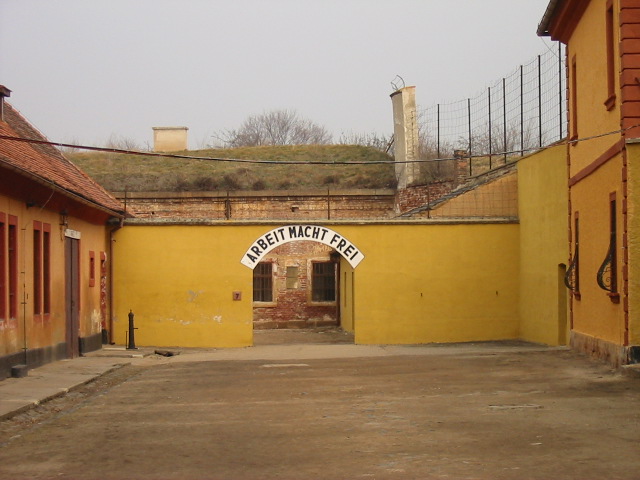
The third child of August Seligmann was named Moritz, and he participated in the town’s cycling association. Moritz Seligmann, his grandfather’s namesake, was born in June 25, 1881.  The book seems to be describing the skills of various members and seems to be praising the skills of young Moritz, who was nineteen when he joined the club.  The end of this passage about Moritz says that he was single and had moved to Koenigsberg and that it was believed he was killed in 1941 in Theresienstadt.

The fourth child of August Seligmann was his daughter Anna.  She was born on November 30, 1889, in Gau-Algesheim.  She had moved with her husband Hugo Goldmann to Neunkirchen in Saarland.  They and their three children, Ruth, Heinz, and Gretel, were all killed in the Holocaust.

There is also an entry for Elizabeth nee Seligman Arnfeld, who was born March 17, 1875.  She had moved to Mulheim on the Ruhr in 1938 and wanted to emigrate to the United States.  A woman named Leonara Morreau[1] had vouched for them, but for unknown reasons they were never able to emigrate.  Elizabeth died on January 23, 1943 at Theresienstadt.  Her son Heinz survived the war.  The book did not identify the parents of Elizabeth Seligman Arnfeld, but she could have been the daughter of Salomon or Benjamin, who unfortunately are not mentioned in the book, or of Hyronimus or Jacob.

Theresienstadt

Theresienstadt concentration camp

Now that I have more names and more recent relatives, I am hoping that perhaps I can find out more about these people.  I also now know that many of them moved to Bingen, so there may be records from that larger town that will tell me more about the Seligmanns who stayed in Germany. And from several other entries in the book, I know where they lived in Gau-Algesheim.

I would love to be able to read the entire book and learn more about the history and lives of Jews in Gau-Algesheim, but it took me a good part of two days just to translate these few passages, and those translations are not very reliable.  It seems hiring someone to translate the whole book could cost me as much as $1000, and that is not in my genealogy budget by a long shot.  If someone has any brilliant ideas on how to get the book translated for free or for a really reasonable price, please let me know.

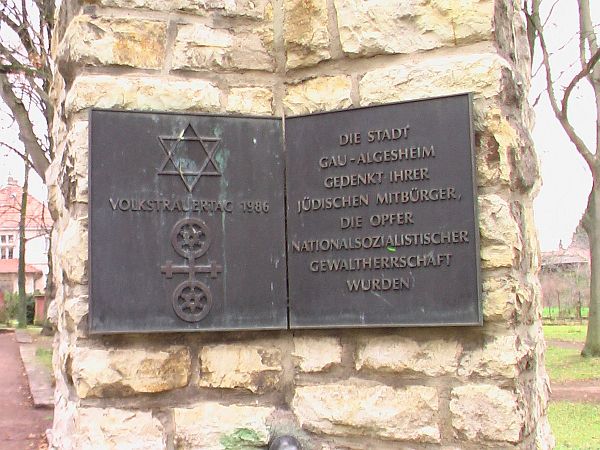
What I did learn from the passages I struggled to translate is that my family was not untouched by the Holocaust, as I once believed, but that we lost many people just from Gau-Algesheim alone.   I am hoping that I can find the descendants of the few who seem to have survived—Heinz Arnfeld and Fred Michel and Herbert and Walter Seligmann—and learn more.

In my next post I will discuss the birth records I received for the Seligmanns and how I was able to translate them.  Then I will return to the Nusbaums.

memorial plaque gau aldesheim

Holocaust Memorial plaque in Gau-Algesheim

[1] I found Leonara Morreau’s obituary and researched her a bit, but know of no reason that she would have had a connection to the Seligmanns in Germany.  She was born, married, and lived in Cleveland.  Her husband died in 1933, and she died in 1947.  As far as I can tell, they never traveled to Germany.  Leonara’s brother was Isaac Heller, who was also born in Cleveland, as was their father, Charles Heller.  Although their grandfather was born in Germany, it was not even in the same region as the Seligmanns.  Perhaps Leonara was active in trying to bring German Jews to the United States during Hitler’s reign, but I can find no evidence of that.  Her obituary only states that she was active in charitable and religious causes.

The Nusbaums Come to America

PA Harrisburg 1855

PA Harrisburg 1855 (Photo credit: Wikipedia)

I am having a hard time finding a place to start the rest of the story of my Nusbaum ancestors.  I just keep going in circles and hitting walls.  I have been able to locate most of the children of Amson and Voegele Nusbaum in the US, but for some have not been able to find very much about them.  I am still searching and hoping more will turn up, but the Nusbaums seem so far to have stayed pretty much under the radar, unlike the Seligmans for sure and even more so than the Cohens, about whom I found a number of newspaper articles.

So I will start with what I have and hope that as I go along, I will find more and learn more about the elusive Nusbaums.  From the report compiled by Rolf Hofmann based on the research of Angelika Brosig, I know that Amson and Voegele had eight children.  Guetel, the oldest, reportedly born in 1805, I have not had any luck finding either in Germany or in the United States.  I assume she married in Germany since she would have been in her mid-thirties by the time her other siblings left Germany in the 1840s.  Without access to marriage records or death records in Schopfloch, I have hit a dead end on Guetel.  At least for now.

I also have had no luck finding anything about Amson and Voegele’s fifth child, Sara, for what I assume are the same reasons.  Sara, born July 8, 1812, according to Angelika Brosig’s research, also was probably married before her siblings left Schopfloch.  Neither Guetel nor Sara appear in the Nusbaum family bible that belongs to my father, so I have to assume that they did not ever move to the United States.

On the other hand, I was able to find all five of Amson and Voegel’s sons in the United States without too much trouble, and I even was able to find their other daughter, Madel or Mathilde.  She was born on July 20, 1806, according to Angelika Brosig. My search for Mathilde was more successful than those for her two sisters because once again I was very fortunate to find someone who is related to me (and to Mathilde) by marriage.

I had posted a question on JewishGen seeking help in researching my Nus(s)baum ancestors from Schopfloch, and I received an email from a fellow researcher, Ned Lewison, who said that he doubted that he had anything helpful, but that one of his relatives, Isaac Dinkelspiel, also with ancestral ties to Schopfloch, had married someone named Mathilde Nusbaum, and that they had lived in Harrisburg, Pennsylvania.  (He also said that another relative had married another Nusbaum, but more on that in a later post.)  I knew right away that that could not be just coincidence since I already knew that John Nusbaum had settled also in Harrisburg.  Further research (to be described later) confirmed that Mathilde Nusbaum Dinkelspiel was John’s sister.

So I know of six Nusbaum children who came to the United States: Mathilde, Leopold, Isaac, John, Ernst, and Maxwell.  The earliest record I have found that might relate to my Nusbaum ancestors is an entry for a John Nussbaum on the 1840 census living in Harrisburg, Pennsylvania.

Unfortunately, the 1840 census does not provide a lot of information.  It only lists the male heads of household with check marks indicating the numbers of males and females within certain age ranges living in that household.  The entry for John Nussbaum has check marks for one male between 30 and 40 years old, one female between 20 and 30 years old, and one female between five and ten years old.  My three-times great-grandfather John Nusbaum would have been 36 in 1850, his wife Jeanette would have been 33, and they did not yet have any children that I am aware of.  In fact, the family bible lists their marriage date as July 1, 1841 and their first child, Adolphus, born in 1842.

Could this be my ancestor on the 1840 census?  I am not sure.  His wife’s age could be wrong, the family bible could be wrong about the marriage date, but who was the five to ten year old daughter?  Could John have had another wife and a child before Jeanette? I cannot be sure.  There are no birth records or death records on file in Pennsylvania before 1877 except for scattered church records and some local civil records.  There are some marriage records, but they are not complete, and I cannot find any Nusbaum marriage recorded that early.  I do know, however, that John was in Harrisburg by 1850. So maybe this is my ancestor on the 1840 census, maybe not.  I have written to the local historical society in Harrisburg and hope to get some answers.

I cannot find any of the other Nusbaum siblings on the 1840 census.  The next document I have that may relate to my Nusbaum ancestors is an immigration record for Leopold, John’s older brother. Since I only so far have the index entry and not the full ship manifest, this is also not a very helpful record.  According to the index, a Leopold Nussbaum, aged 35, arrived from Germany to New York on June 9, 1847. The family bible does not have a birthdate for Leopold (though it does have his date of death).  The Brosig records indicated that Leopold (Loew) was born on April 26, 1808, and the census records for Leopold in America conflict with each other, but suggest he was born between 1810 and 1812.  I do not know for sure, therefore, whether this is the same Leopold Nussbaum, and perhaps seeing the full ship manifest will tell me more.  But 1847 seems to be a reasonable date for the arrival of Leopold.

Although I have not been able to find any immigration records for any of the other Nusbaum siblings, I know that by 1850 four of them were already in the US because they appear on the 1850 census.  John was living in Harrisburg’s South Ward and working as a merchant.  He and his wife (listed as Shamet here) had four children: Adolphus (8), Simon (6), Frances (my great-great-grandmother, 4), and Julius (2), all born in Pennsylvania.[1]  They also had eight other unrelated adults living with them, two servants and six whose occupation was given as “clerk,” presumably in John’s store.  So by 1850 John Nusbaum was quite comfortably settled in Harrisburg.

John Nusbaum 1850 census Harrisburg, PA

John Nusbaum 1850 census Harrisburg, PA

As I indicated above, his older sister Mathilde was also living in Harrisburg with her husband Isaac Dinkelspiel.  Isaac was working as a peddler, and he and Mathilde had three children: Paulina (8), Adolph (6), and Sophia (2).  Since all three children were listed as born in Germany, this would suggest that Isaac and Mathilde had been in the United States for less than two years at the time of the 1850 census.  Mathilde and her husband Isaac had no servants living with them and presumably were not yet as comfortable as her brother John and his family, who may have been in Harrisburg for ten years at that point.

Mathilde and Isaac Dinkelspiel 1850 US census Harrisburg, PA

Mathilde and Isaac Dinkelspiel 1850 US census Harrisburg, PA

I did not find a definite listing for Leopold Nusbaum on the 1850 census, but I believe that this listing for L. Nussbaum is the right person.

L. Nusbaum 1850 census Lewistown, PA

L. Nusbaum 1850 census Blythe, PA

L. Nusbaum is listed as a butcher, 38 years old (which would give him a birth year of 1812), and married to Rosannah, both born in Germany, with two children: Adolph (2) and Francis (seven months), as well as a non-related person, perhaps a servant. Both children were born in Pennsylvania, meaning that Leopold and Rosannah had been in Pennsylvania since at least 1847, consistent with the ship manifest. They were living in Blythe, Pennsylvania, a town about seventy miles from Harrisburg.

Why do I believe this is Leopold? Because I know from later documents that Leopold’s wife was Rosa and that he had a son named Francis and a son named Adolph.   Both John and Leopold had children named Adolph/us and Francis/Frances.   Perhaps the two Adolphs were for Amson, the two Francis/Frances for Voegele. (Mathilde and Isaac Dinkelspiel also had a child named Adolph.)

The fourth sibling listed on the 1850 census is Maxwell (Meier) Nusbaum, the youngest of the Nusbaum siblings, born September 14, 1819.  In 1850, he was living with his wife Mathilde Dreyfuss Nusbaum and their two year old daughter Flora in Lewistown, Pennsylvania, which is about sixty miles from Harrisburg. Flora might also have been named for Voegele.  Maxwell was a merchant, and he had a clerk living in his household.  His wife Mathilde was the sister of Jeanette Dreyfuss Nusbaum, the wife of Maxwell’s brother John Nusbaum.  (More on the Dreyfuss family in a later post.)

Maxwell Nusbaum 1850 US census Lewistown, PA

Maxwell Nusbaum 1850 US census Lewistown, PA

Although I cannot find Ernst Nusbaum on the 1850 census, I did find a listing for an Ernest Nusbaum, a merchant in Philadelphia, on the 1852, 1854, and 1859 city directories for Philadelphia.  Given the name and the occupation and the fact that Ernst and his family show up on the 1860 census living in Philadelphia, I think it is reasonable to assume that Ernst was in Philadelphia by 1852. (Unfortunately, the 1860 census did not include street address information so I cannot compare it to the 1850s directories.)

Ernest Nusbaum in the 1852 Philadelphia city directory

Ernest Nusbaum in the 1852 Philadelphia city directory located at https://archive.org/details/mcelroysphiladel1852amce

As for Isaac Nusbaum, the remaining sibling who emigrated to the US, I have no record for him before 1865 in Peoria, Illinois.  I do not know when he arrived or where he was in 1850.

Thus, what I know with a reasonable degree of certainty is that by 1850 (1852 for Ernst), John, Mathilde, Leopold, Maxwell, and Ernst Nusbaum had settled in Pennsylvania, John and Mathilde in Harrisburg, Leopold in Blythe, Maxwell in Lewistown, and Ernst in Philadelphia.  What were they doing living in these places spread out miles from each other? In my next post I will address that question.

Nusbaum 1850 map

Google Maps


[1] The family bible says that Adolphus was born in Newville, Pennsylvania, which is about 32 miles from Harrisburg.  Simon, Frances, and Julius were all born in Harrisburg.

Follow up on Schopfloch: Who Replaced My 4x-Great-Grandfather Amson Nussbaum

In my last post, I wrote about the Jews Edict of 1813 in Bavaria and the impact it had on Jewish families.  To recap, since the law prohibited the increase in the number of Jewish families in a particular town, children would have to leave town to start their own families.

Yesterday I was very fortunate to receive the following document from a very generous fellow researcher named Ralph Baer.

1827 Matrikel part 1 for Amson Nussbaum

1826 Matrikel left side of page

1827 Matrikel part 2 for Amson Nussbaum

1826 Matrikel right side of page


This is from the census or Matrikel of 1826 for the town of Schopfloch, and the second name listed is the entry for my 4x-great-grandfather, Amson Meier Nussbaum, father of John Nusbaum.  It reports that he was born 1777 and matriculated on September 26, 1809. His occupation was “Handel mit alten Kleidern” or trade with old clothes. [Thank you, Ralph, for sending me this and for the translation.]

I was curious about the name under Amson’s name, Hayum Kronheimer, and Ralph explained to me that he was Amson’s replacement on the Matrikel.  In other words, after Amson died, Hayum Kronheimer replaced him in the count of permitted Jewish families in Schopfloch.

I’ve not yet had a chance to research Hayum Kronheimer.  Perhaps he was an in-law, or maybe just a stranger to the family. [UPDATE: Further research led me to a family tree for Hayum Kronheimer; it does not appear that he married anyone in the Nussbaum family.]   Either way, I found it rather chilling to see the actual name of the person who replaced my ancestor on the list of Jews allowed in the town.

A Town with A Secret Language: Schopfloch and the Nusbaums

I thought I should outline my connection to the Nusbaums before I began writing about them.   The chain between Amson Nusbaum  and me is as follows, with the Nusbaum descendants all on the left side of each couple:

Amson Nusbaum—Voegele Welsch  (my 4x-great-grandparents)

John (Josua) Nusbaum—Jeannette (Shamet) Dreyfuss  (my 3x-great-grandparents)

Frances Nusbaum—-Bernard Seligman  (my great-great-grandparents)

Eva May Seligman—-Emanuel Cohen (my great-grandparents)

John Nusbaum Cohen, Sr. — Eva Schoenthal  (my grandparents)

John Nusbaum Cohen, Jr. —-  Florence Goldschlager  (my parents)

Amy Cohen (me)

(Although the Nusbaums spelled their name with two S’s in Germany as in NUSSBAUM, the family dropped the second S once they got to the US, just as the Seligmanns dropped the second N when they immigrated.)

So where do I start telling this Nusbaum story? I have already talked about my grandfather John Nusbaum Cohen’s life and his mother Eva Seligman Cohen’s life in telling the stories of the Cohens and the Seligmans.  So I could start with my great-great-grandmother, Frances Nusbaum, who married Bernard Seligman.  I’ve also written a little about her.  But I prefer to start at the earliest point and move forward in time.   Right now the earliest Nusbaum ancestors I have found date back to the 18th century with Amson Nusbaum and Voegele Welsch.

This is the first branch that I have been able to take back as far as my 4x-great-grandparents.  Although I know very little about Amson Nusbaum and Voegele Welsch, I am hoping that I can learn more if I can obtain more records from Schopfloch.  But for now, here is what I know.

Amson Meier Nusbaum was born around 1777 possibly in Schopfloch, a small town in the Ansbach region of Bavaria.  He married Voegele Welsch, who was born March 7, 1782, somewhere in Germany.  They were married around 1804, and they had eight children born between 1805 and 1819, all born in Schopfloch.  Amson was a peddler.

Schopfloch

Schopfloch

Although I do not have much specific information about Amson and Voegele, I was interested in learning more about the town where they lived and raised their children in order to glean something about what their lives might have been like.

First, I read a little bit about Bavaria.  I really know almost nothing about Germany’s history, but I do know that it was not a unified country until 1871.  Before that, there were a number of separate duchys and kingdoms controlled by various aristocrats and noblemen, fighting over their borders for many hundreds of years. From the tenth century until the beginning of the nineteenth century, the land that we know as Germany was part of the Holy Roman Empire.   The Thirty Years War from 1618 to 1648, which started as a conflict between Protestants and Catholics and grew to a much larger regional conflict, was perhaps the most destructive of the wars that occurred during this pre-unification era in the area we now call Germany.

Map of the Imperial Circles of the Holy Roman ...

Map of the Imperial Circles of the Holy Roman Empire (c. 1512) (Photo credit: Wikipedia)

Bavaria was one of those regions within what is now Germany.  It is located in the southeastern part of the country, bordering the Czech Republic and Austria to the east and south.  The official website for what is now the state of Bavaria within the Federated Republic of Germany said this about the history of Bavaria:

Bavaria is one of the oldest states in Europe. Its origins go back to the 6th century AD. In the Middle Ages, Bavaria (until the start of the 19th century Old Bavaria) was a powerful dukedom, first under the Guelphs and then under the Wittelsbachs. … Cities like Regensburg developed into cultural and economic centres of European rank. After the Thirty Years War, the Electorate of Bavaria played an important role in the political deliberations of the major powers. In the 19th century Bavaria became a constitutional monarchy and the scene of a great cultural blossoming and of political and social reforms.

Schopfloch is a small town of three thousand people located near the western boundary of Bavaria.  It is about sixty miles west of Nuremberg, about one hundred miles northwest of Munich, and about eighty miles northeast of Stuttgart.

Schopfloch in AN

Schopfloch in AN (Photo credit: Wikipedia)

According to the official town website, the earliest mention of the town dates from March 11, 1260, on a land deed witnessed by someone named Ulricis de Schopfloch.  (Schopf loch apparently means “ crested hole” or “tuft hole,” and perhaps this is a reference to the fact that the town is located in a small valley).  During the Thirty Years War, many Protestants moved from Salzburg to Schopfloch.  They were primarily tradesman in the building trades—masons and bricklayers– and the town was known for its many families in the construction business.

The history of the Jews in Bavaria is, like the history of Jews in most countries in Europe, one of oppression, discrimination, unfair taxation, and frequent pogroms with occasional periods of greater tolerance and civil rights.  There is evidence of Jews living in Bavaria as early as the 900s, and numerous towns and cities in Bavaria had Jewish communities by the 12th century.  Jews were limited in their livelihoods in many locations; in many places, they were prohibited from most trades other than moneylending.  Beginning in the 14th century and continuing through the 17th century, the Jews were subjected to widespread orders of expulsion and deportation from many Bavarian communities.  A good summary of the history of Jews in Bavaria can be found here at H. Peter Sinclair’s “Chronology of the History of the Jews in Bavaria 906-1945,” .

As for Schopfloch specifically, the first Jews settled there in the fourteenth century.  According to The Encyclopedia of Jewish Life Before and During the Holocaust: K-Sered (Shmuel Spector, Geoffrey Wigoder, eds., 2001, NYU Press), p.1151, Jews moved to Schopfloch after being expelled from the nearby town of Dinkelsbuehl.   Another source suggests that Jews were welcomed to Schopfloch by rival nobles who took in Jews to increase their strength.     Jews were able to do well, engaging in cattle trade in Schopfloch and in several communities near Schopfloch.

A Jewish cemetery was created around 1612 and served not only the Jewish residents of Schopfloch but also those of surrounding towns.

A synagogue was built in 1679, and there was also a ritual bath and a school.   According to the website “Destroyed German Synagogues and Communities” :

The Jews of Schopfloch established a synagogue in 1679 and enlarged it in 1712 and again in 1715. Rabbis served the community during the 17th, 18th and 19th centuries, and the village was home to a regional rabbinate during the years 1841 to 1872. In 1877, a new synagogue was built on the Judengasse, or “Jews’ alley” (later renamed Bahnhofstrasse).

According to the town website, the Jewish residents played an important role in the social history of the town, and the long history of co-existence between the Christians and Jews in Schopfloch made it less susceptible to anti-Semitism even in the Nazi period.  Perhaps there were no pogroms or expulsion orders in Schopfloch.  None were mentioned in H. Peter Sinclair’s “Chronology of the History of the Jews in Bavaria 906-1945,” cited above and found here.

Overall, it would seem that Schopfloch would have been a relatively comfortable place for Jews to live when my ancestors Amson and Voegele Nussbaum were having children between 1805 and 1819 and the years following when their children were growing up.  Amson died June 7, 1836, and Voegele died October 2, 1842.  From what I can find in immigration records, my three-times great grandfather John (Josua) Nusbaum emigrated in 1843, the year after his mother died.  It appears that at least some of his siblings emigrated around the same time.  What would have motivated them to leave once their parents had died if in fact conditions for Jews were relatively good in Schopfloch?

The Nussbaum family was growing up in an era of significant change in Bavaria and in Europe generally.  Napoleon had risen to power in France as the 18th century ended, and the Holy Roman Empire crumbled. His armies invaded the lands in what is now Germany, and eventually he defeated the Austrian army and took over much of German land. His emancipation of the Jews in France in 1806 had an impact on those in Bavaria, and in 1813 Bavaria adopted the Jews Edict of 1813.  Although Napoleon was defeated shortly after, the Jews Edict of 1813 remained the law in Bavaria.

The Jews Edict was a mixed blessing.  As described by one source, “Jews now could acquire land and participate in trade but they were forced to adopt German surnames and to list the head of the household’s name and occupation as shown in the Matrikellisten (census) of 1817.”   This registry (while a good thing for genealogy research), which may seem benign, had a negative impact on Jews because it forced many Jews to leave their homeland.  Section 12 of the Edict provided that the number of Jewish families in any community could not increase.  That meant that a child in a Jewish family could not establish his or her own family, but had to leave the community.  Section 13 provided some exceptions, but they were quite restrictive.  In addition, Section 14 prohibited the issuance of a marriage permit even if the marriage would not result in an overall increase in Jewish families unless the man could demonstrate that he was going to engage in a legal occupation other than being a peddler.  http://www.rijo.homepage.t-online.de/pdf/EN_BY_JU_edikt_e.pdf

Thus, not all of Amson and Voegele’s children could stay in Schopfloch.   To do so would have created eight new Jewish families in the town.  Moreover, since Amson had been a peddler, chances are at least some of his sons had planned to engage in a similar trade.  So they had to leave Schopfloch, and since the neighboring towns were under the same restrictions, they could not even settle nearby.  They had to emigrate, and I am sure that America, a new country with a democratic form of government, must have been very appealing to these young people who were being denied the right to stay in the town where they were born.

The Jewish population in Schopfloch hit its peak in 1867 with 393 Jewish residents out of a total population of 1,788.  Although a new synagogue was built in 1877, by 1880 the Jewish population had dropped to 147 people.  It continued to drop so that by the early 1930s there were fewer than forty Jews in the town.  Nevertheless, the synagogue was renovated in 1932, and there was a large celebration rededicating the synagogue, attended by many Jews and non-Jews, including members of the Christian clergy, the mayor, and other town officials and residents.  One pastor spoke about the good relations between the Christian and Jewish residents of Schopfloch.

Schopfloch synagogue 1910 Source: Wallersteiner Kalendar, 1983 found at http://www.alemannia-judaica.de/schopfloch_synagoge.htm

Schopfloch synagogue 1910 Source: Wallersteiner Kalendar, 1983 found at http://www.alemannia-judaica.de/schopfloch_synagoge.htm

Tragically, just five years later on November 9, 1938, the Night of Broken Glass, or Kristallnacht, this newly renovated synagogue was destroyed by fire.  As described on the “Destroyed German Synagogues and Communities” website:

In 1938, in the wake of virulent anti-Jewish incitement, Schopfloch’s mayor advised the Jews to leave. All of them did so within months, and the synagogue was eventually sold (its ritual objects were transferred to Munich). Schopfloch’s last Jews left in October 1938. Although the synagogue was set on fire on Pogrom Night, the blaze was extinguished by the fire brigade. The building’s interior was completely destroyed, as were the ritual objects in Munich. Three Schopfloch Jews emigrated; the others relocated within Germany. Forty-eight perished in the Shoah. The synagogue building was demolished in 1939.

The cemetery, however, still exists, and a woman named Angelika Brosig began a project to restore the cemetery and to record all the names of those buried in the cemetery.  Sadly, Ms. Brosig died in 2013, and not all of the headstones have yet been translated and recorded, but the work is supposed to be continuing by others.  Thus far, I have not found any Nussbaums on the list, but I have to believe that my four-times great-grandparents Amson and Voegele are buried there.

Although Schopfloch is and was a small town without any particular historical significance of its own, it has been recognized for an interesting reason.  The Jews of Schopfloch developed a dialect of their own to be used in the course of cattle trade as a way of communicating without being understood.  It was a dialect combining Hebrew terms with German, and eventually it was used not only by the Jewish residents of Schopfloch but also by the non-Jewish residents.  In fact, the dialect, called Lachoudish, a shortened version of Lachon Kodesh, or “holy language” in Hebrew, continued to be used by the residents of Schopfloch long after all the Jews left the town in the 1930s.  The New York Times published an article about this secret language on February 10, 1984, giving some examples of the use of Hebrew terms in the dialect:

Lachoudisch is replete with words that bespeak the Jews’ wary relationship to Christian authority. The word for ”church” in Lachoudisch is ”tum” – from the Hebrew word for ”religiously unclean.” The word ”police” is ”sinem”- from the Hebrew for ”hated.” A priest is a ”gallach” or, in Hebrew, ”one who shaves.”

(James M. Markham, “Dialect of Lost Jews Lingers in a Bavarian Town,” The New York Times (February 10, 1984) found at http://www.nytimes.com/1984/02/10/world/dialect-of-lost-jews-lingers-in-a-bavarian-town.html  The article also provides historical and current information about the town.)

This website provides further examples of Hebrew terms used in Lachoudish.  http://www.medine-schopfloch.de/Lachoudisch/lachoudisch.html   Although Lachoudish is disappearing as there are fewer Schopfloch residents who remember it, there has been some effort to remember and revive the dialect.  This video, which unfortunately for me is in German, is about Lachoudish and also provides some images of Schopfloch today.  If anyone wishes to translate this for me, please let me know.

Coat of arms of Schopfloch

Coat of arms of Schopfloch (Photo credit: Wikipedia)


The Nusbaums: Were They Jewish? Learning from Rookie Mistakes

English: Postcard, dated 2.9.1917. Title: &quo...

English: Postcard, dated 2.9.1917. Title: “Schopfloch” Deutsch: Postkarte, datiert 2.9.1917. Titel: “Schopfloch” (Photo credit: Wikipedia)


Before I started doing genealogy research, I knew only one thing about the Nusbaum name.  I knew it was my father’s middle name, that it was also his father’s middle name, and that they were named for some ancestor named…John Nusbaum, my great-great-great-grandfather.

I had no idea who John Nusbaum was, although I think I did know he was from Germany.  I didn’t know if he had ever lived in the United States.  And I had no idea how he had gotten the name John.  John is not a Jewish name.  Jonathan, yes, but I do not think I have known more than one or two men named John who were Jewish, except for my father.  In fact, there were some people who had questioned whether my father really was Jewish, given his first name.

Things got even more confusing when I first started doing genealogy research a couple of years ago.  I was a real novice, and I did not know enough to know that people often put bad information on their family trees.  I assumed, very naively, that if someone put a tree on ancestry, it had to be right.  Like I said, I was a real novice.  So as I was adding information (much of it from reliable sources like census reports), I found several ancestry trees with my ancestor John Nusbaum appearing on it—with his descendants included.  I was excited—these trees linked my ancestor to a whole line of Nusbaums going back hundreds of years!  I felt like I had hit the jackpot.  I added all these people to my tree, thinking that I could now trace my family back centuries on the Nusbaum side.

I should have been more circumspect.  I should have picked up on a few clues—too many people named Johann, too many people named Maria, Christian, Catherine—no Jewish sounding names.  I began to think that in fact my Nusbaum ancestors had not been Jewish.  But I was new and trusting and just accepted what I saw.  It was the internet, after all. It had to be true. Right?

I had then turned to other things and put those Nusbaums aside.  After all, they were all done, I thought.  Someone else had found them all.

But then about a month ago I started looking again at those Nusbaums, an older and hopefully wiser researcher now.  I went back to all those trees, and I realized they had no sources to support the claim that my John Nusbaum was the same person as the Johann Nusbaum that linked back to all those non-Jewish sounding Nusbaums.  Only one tree had any sources at all for these earlier Nusbaums; the others had just somehow linked to that tree and added my ancestor to it, assuming John was the same as Johann.

I contacted the owner of that one sourced tree, and he and I had a good exchange and a few chuckles about all those other misleading trees.  His ancestors were Christian, and he had no sources indicating a link to a John Nusbaum who settled in Pennsylvania, as my John Nusbaum had done back in the 1840s.  I detached my ancestor from the other trees, sad to lose hundreds of years of ancestors, but happy to know that my Nusbaums could have been Jewish.  (I also wrote to the owners of those other trees, pointing out the error, but not one of them responded nor did they take my Nusbaums off their trees.)

So now my Nusbaum line ended with John Nusbaum.  I was able to find quite a bit in the US records, but had no hints as to his parents, siblings, or home town in Germany.  And then my father provided me with some answers.  He has the Nusbaum family bible, and it has entries for John and his siblings as well as his children, grandchildren, and great-grandchildren.  It told me where he was born—Schopfloch, Ansbach, Bavaria, in 1814.  I had names and birth dates for his siblings: Isaac (1812), Ernest (1816), Caroline (1822), Mathilde (1825).[1]  It was a gold mine.  And I was off and running to find the real Nusbaums.

A Map of Schopfloch im Landkreis Ansbach, Baye...

A Map of Schopfloch im Landkreis Ansbach, Bayern, Germany. (Photo credit: Wikipedia)

Now comes the best part.  I contacted the registry in Schopfloch to ask whether there were any records for my ancestors, giving the names of the Nusbaums I knew about.  And this is what I received in return from a man named Rolf Hofmann:

FAMILY SHEET  AMSON MEIER NUSSBAUM

OF SCHOPFLOCH

compiled by Rolf Hofmann (HarburgProject@aol.com)    VERSION 01 


AMSON MEIER NUSSBAUM

peddler in Schopfloch

born ca 1777 (Schopfloch ?), died 07 Jun 1836 Schopfloch

father = Meier ?

married ca 1804 ?


VOEGELE WELSCH

born 07 Mar 1782 (where ?), died 02 Oct 1842 Schopfloch

father = ? 


CHILDREN (all born in Schopfloch): 

(01) GUETEL                10 Feb 1805 – ?


(02) MADEL                 20 Jul 1806 – ?


(03) LOEW                  26 Apr 1808 – ?


(04) ISAK                  28 Mar 1810 – ?  emigrated to USA in 1843


(05) SARA                  08 Jul 1812 – ?


(06) JOSUA                 29 Nov 1814 – ?

(JOHN in USA)          emigrated to Philadelphia, USA around 1840

married ca 1852 [this is not correct]

JEANETTE  NN from Hesse-Darmstadt (Germany)

20 May 1817 – 12 Jan 1908 (died in Philadelphia)  parents = ? 

so far known children = Millen * 1853 + Lottie * 1863


(07) SALOMON               24 Aug 1816 – ?


(08) MEIER                 14 Sep 1819 – ?


I am now in touch with Mr. Hofmann and hope to get the sources for this information, but you can imagine the happy dance I did when I saw this.  I had the names of my FOUR-times great-grandparents, Amson and Voegele.  I had names for all their children, including some I had no records for and some who matched with the names I had from the family bible.  Madel must be Mathilda, Isak is Isaac, and I assume Ernst is Salomon, based on the birth year.  Also, I  found other Nusbaums through research—Meier is Maxwell, Loew is Leopold.

And most importantly?  Well, John, my three-times great-grandfather—his name was originally Josua.  He did in fact have a Jewish name.  He obviously Americanized it to John, just as many of his siblings Americanized their names to names that were less Jewish-sounding.  My father and my grandfather could have been named Joshua Nusbaum Cohen if their namesake had not changed his name to John.

There is still much research to be done and much to learn about the Nusbaums.  But one big mystery is solved.  My Nusbaums were not descended from all those Johanns and Marias, but were from a Jewish family living in Schopfloch, Bavaria, in the early 19th century.


[1] Although Caroline and Mathilde were listed with different surnames, I was able to find US records that verified that they were John’s sisters.  More on that later.