A wonderful email from a Selinger cousin

Yesterday I received an email from Ann Griffin Selinger, whose husband was John Reynolds Selinger, Sr.  John Selinger was the son of Maurice Selinger, Sr., and the grandson of Julius Selinger and Augusta Cohen, the oldest child of Moses, Jr, and Henrietta Cohen.  I was so touched by the stories that Ann had to share about her husband John and his family that I asked her whether I could quote from her email on the blog and share these memories of her family.  She graciously gave me permission to do so, and so here they are with just a few side comments by me.  Ann’s language is italicized, whereas mine is in regular font.

My husband, was John Reynolds Selinger, 1933-2007, born in Washington, DC as was his brother, Maurice Arthur Selinger, Jr.  For a time we lived in Chevy Chase, Maryland and one day we received a visit from Eliot Selinger who apparently lived around the corner from us with his family. We had exchanged mail a few times without meeting, but never looked into whether we were related.  He told us at the time that he thought we were related and that his father and John’s grandfather were brothers – Frederick and Julius.  We had been under the obviously false impression that Julius had no siblings.  

Interestingly, Mildred Selinger, Dr. Maurice A. Selinger’s wife, having lived in Washington her whole adult life, lived with us just before she died in 1981.  I see that Eliot died a year later.  He must have knocked on our door just before he died.


The comment about Julius and Frederick Selinger being brothers  was a very important revelation for me because it confirmed what I had suspected.  I assume that Alfred Selinger was also, given that he lived with Julius and traveled with Julius and Augusta before marrying Augusta’s sister Fanny.

Here is a bittersweet story about Eleanor Selinger, the daughter of Julius and Augusta  who married Henry Abbot and moved to England as discussed here.

Years earlier, John and I were in England and he said he would like to see if he could find his Aunt Eleanor.  
We were successful and made arrangements to have tea with her in her apartment just before we left London.  When she opened the door, John was astonished to notice she looked exactly like his Dad who had died over ten years before.  We had a lovely visit.  She shared that she loved to play cards, but had a hard time see the cards now.  So the next day we had some “jumbo faced” cards sent over to her from Harrod’s – a fun idea.  She called us to say she was so flustered when the delivery man said he was from Harrod’s that she had a hard time buzzing him in.  Very sweet – a wonderful connection that pleased my husband very much.  We flew home the next day and then received word a day later that she had died.
 

Ann also told me more about the accomplishments of Dr. Maurice Selinger, her husband’s father, who along with his brother Jerome were probably the first doctors in the extended Cohen family, as discussed here.

Dr. Maurice Selinger, my father-in-law, who died before John and I were married, served in World War I and World War II as a physician.  He was a very dedicated doctor who gave his all to medicine and his patients.  He was very highly regarded in the Washington medical world.  He was instrumental in bringing three hospitals together (Garfield, Emergency, and one other – can’t remember) to form the new Washington Hospital Center. I remember just after we were married going to a diabetes center in Maryland that was dedicated to Dr. Selinger.  I know nothing more about that.  Amazing what you don’t pay attention to when you are young.
They lived in a lovely home on California Street, NW – should look up the number, that is now the Embassy of Venezuela.

Washington Hospital Center   "WHCExtGarden". Via Wikipedia - http://en.wikipedia.org/wiki/File:WHCExtGarden.JPG#mediaviewer/File:WHCExtGarden.JPG

Washington Hospital Center
“WHCExtGarden”. Via Wikipedia – http://en.wikipedia.org/wiki/File:WHCExtGarden.JPG#mediaviewer/File:WHCExtGarden.JPG

And finally this story about John’s father Maurice and his grandfather Julius and the Selinger’s jewelry store on F Street discussed here.

John always told the story that when his father was a young boy he would earn his allowance by winding the clocks on F Street that were installed by his grandfather, Julius.  They also put the clock in the tower of the old National Savings and Trust Building downtown.  Years later, John became a banker and worked as a Vice President in that same bank.


National Savings and Trust Building, Washington, DC "15th, New York, & Pennsylvania Avenue, NW" by AgnosticPreachersKid - Own work. Licensed under Creative Commons Attribution-Share Alike 3.0 via Wikimedia Commons - http://commons.wikimedia.org/wiki/File:15th,_New_York,_%26_Pennsylvania_Avenue,_NW.jpg#mediaviewer/File:15th,_New_York,_%26_Pennsylvania_Avenue,_NW.jpg

National Savings and Trust Building, Washington, DC
“15th, New York, & Pennsylvania Avenue, NW” by AgnosticPreachersKid – Own work. Licensed under Creative Commons Attribution-Share Alike 3.0 via Wikimedia Commons – http://commons.wikimedia.org/wiki/File:15th,_New_York,_%26_Pennsylvania_Avenue,_NW.jpg#mediaviewer/File:15th,_New_York,_%26_Pennsylvania_Avenue,_NW.jpg


There is nothing better than hearing and preserving these family stories.  They take the facts and inferences I make from government documents come to life and fill them with the love and respect that these people deserve.  Thank you so much, Ann, for sharing these with me.  I can’t tell you how much it meant to me.


Blog Update: Cohen Family Trees

English: Leaves of Utah mountain trees changin...

English: Leaves of Utah mountain trees changing color during autumn. Deutsch: Die Farbe der Blätter ändert während des Herbstes. (Photo credit: Wikipedia)

I have added a new page to the blog.  If you look at the top where all the fixed pages are listed, you will see that the last entry is one that says “Cohen Family Trees.”   If you click on it, you will see a page that has a list of links.  Each of those links will lead to a PDF version of a family tree.  You can download and/or print these.

As I explain on the page itself, the first three trees are very large.  There is one for Hart Levy and Rachel Cohen, one of Jacob and Sarah Cohen, and one for Moses and Adeline Cohen, each going to several generations, but not including any living descendants.  To see these, you will probably need to print out the pages and line them up to see the overall family.

The other trees are for each individual child or grandchild of Hart and Rachel so that you can see each “branch” more clearly.  The bigger trees are rather difficult to use, so I made these smaller trees.  I hope this is helpful.

The Cohen family is very large, and there are so many people with similar or identical names.  I’ve lost track myself of how many Jacob Cohens there are, how many Isaac Cohens, Joseph Cohens, Rachel Cohens, etc.  I hope the trees will help keep these straight.


Hart Cohen of DC: The Rest of the Story

It’s been a week since I last posted anything new about the DC Cohen family.  I had last written about Solomon Monroe Cohen and his family, the son of Moses, Jr., and Henrietta Cohen.  Although I will continue to try and fill the gaps left in the research of the children of Moses, Jr. and Henrietta Cohen, I am now going to move on to the other children of Moses, Sr., and Adeline Cohen, first focusing on their son Hart, who was born in 1851 in Maryland.

It was this Hart (whom I’ve referred to as Hart DC) who had me confused because of the similarities between some of his biographical facts and those of his first cousin, my great-grandfather Emanuel’s brother, Hart Cohen of Philadelphia.  They had the same name, were born the same year, and were both married to women named Henrietta. It was this Hart who led me to the discovery of the DC branch of the Cohen family. Hart and his wife Henrietta Baer had four children: Frances, Munroe, Isadore, and Jacob.   Their son Munroe was killed in an awful accident while working as a brakeman on the railroad in Kingston, New York, in 1903.  Isadore had married Frances David in 1907, so in 1910, Hart and Henrietta had two children living at home, Frances (32) and Jacob (25). Jacob was working as a chauffeur, and Hart was working in a jewelry store. On August 8, 1914, Hart’s wife Henrietta Baer Cohen died; she was only 62.

Isadore and Frances had had a son Monroe born in 1910, presumably named for Isadore’s brother. In 1916, they had another son, Burton.  In 1917, Isadore was working as a department manager for a hotel according to his World War I draft registration.

Isadore Baer Cohen World War I draft registration

Isadore Baer Cohen World War I draft registration

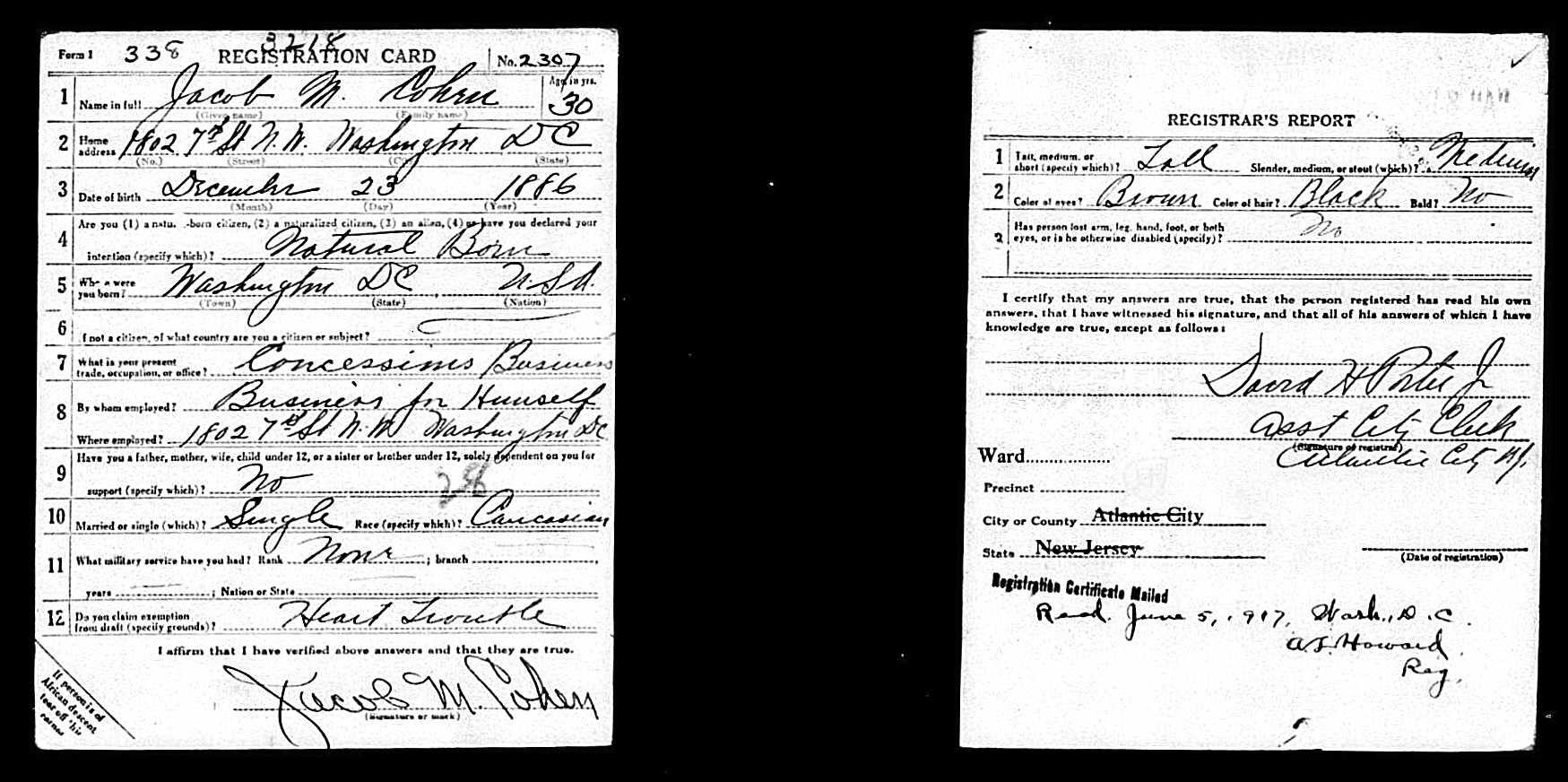
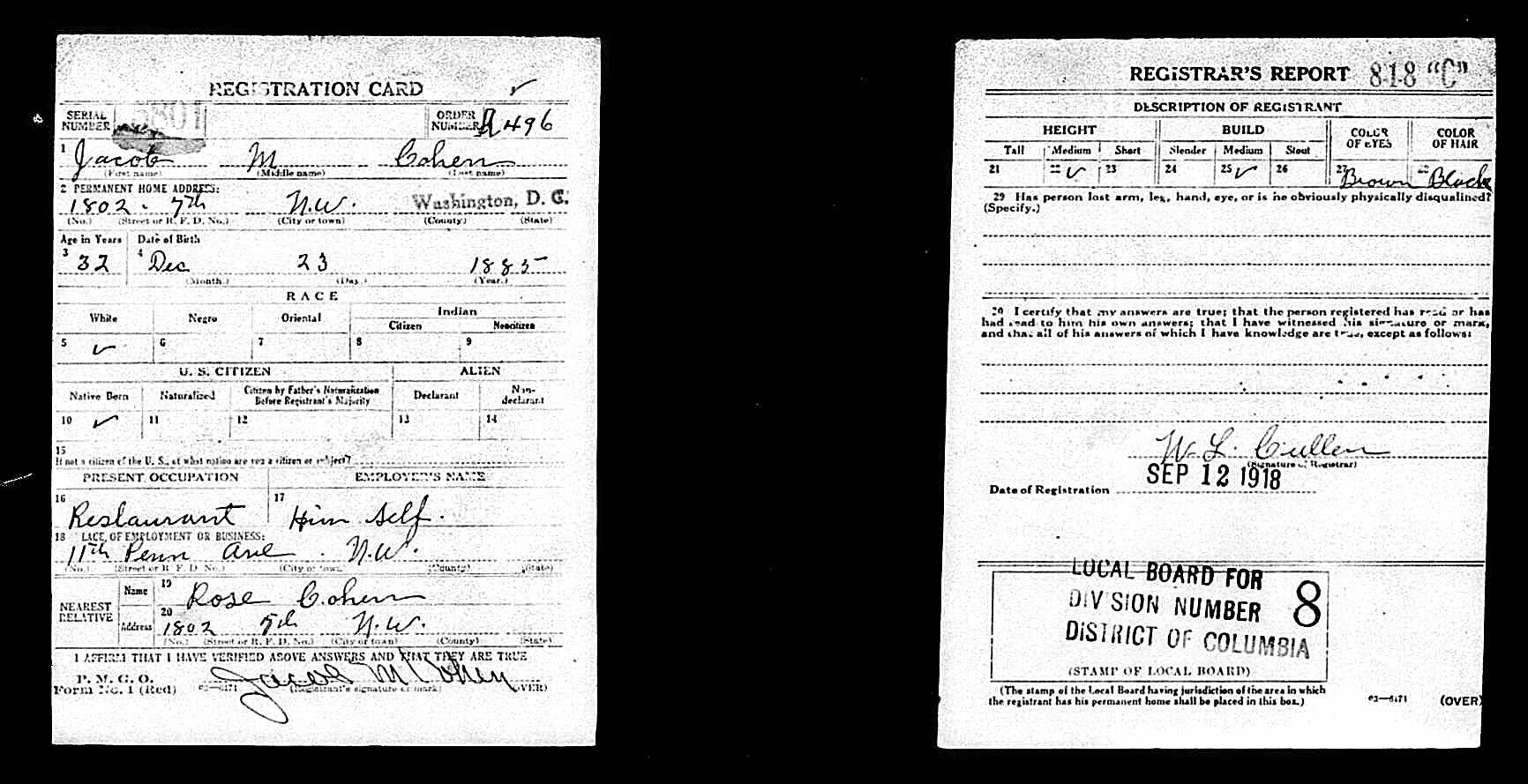
I found two World War I draft registrations for Jacob.  The earlier one, dated June, 1917, listed Jacob’s business as the concessions business and said he suffered from heart trouble.  His marital status was single, and he was living with his father and his sister Frances at 1802 7th Street NW in Washington.  The second one, dated September 1918, had a number of changes:  he was working in the restaurant business and was self-employed, he was married, and there was no mention of heart trouble.

Jacob M. Cohen World War I registration (first)

Jacob M. Cohen World War I registration (first)

Jacob M. Cohen World War I registration (second)

Jacob M. Cohen World War I registration (second)

According to the Philadelphia marriage index, Jacob had married Rose Serge in Philadelphia in 1918.  He was 33, and she was thirty when they married.   In 1918, they were living at 1802 7th Street with Jacob’s father and sister Frances.

In 1920, Hart and his daughter Frances were still living at 1802 7th Street, but Jacob and Rose had moved to their own place in Washington.  Jacob was still in the restaurant business.  Isadore and his family were also still living in Washington, and Isadore was still in the hotel business.

On August 10, 1926, Hart died at the age of 75.  His daughter Frances continued to live in the same residence at 1802 7th Street, now living alone and working as a retail merchant in the dry goods business, a business she had been working in since at least 1915.  She would continue to work in that business until her death in February, 1941, at age 62, the same age her mother had been when she died.  Frances’ death notice said that she had died suddenly. She was buried at Washington Hebrew Cemetery.  There is no mention of her brother Jacob in her death notice, only mention of her brother Isadore.  Frances never married or had children.

Ancestry.com. Historical Newspapers, Birth, Marriage, & Death Announcements, 1851-2003 [database on-line]. Provo, UT, USA: Ancestry.com Operations Inc, 2006.

Ancestry.com. Historical Newspapers, Birth, Marriage, & Death Announcements, 1851-2003 [database on-line]. Provo, UT, USA: Ancestry.com Operations Inc, 2006.

In 1930 Jacob and Rose were living in Philadelphia, where Jacob was the manager of a restaurant.  I could not find Jacob or Rose on the 1940 census, nor can I find a death record for Jacob, but given that he was not listed in his sister’s obituary and that he had had a history of heart trouble, my guess is that he had died before the 1940 census. He would have been younger than 55 years old when he died.  He and Rose did not have any children.

Although I could not find Rose on the 1940 census, she was still alive in 1949, as I found her on a ship manifest traveling to Hawaii. According to the ship manifest Rose was living at 41 Emory Street in Jersey City, New Jersey, in 1949. Rose had lived in Jersey City as a child, and 41 Emory Street is where her mother had been living in 1925 and where two of her sisters were living in 1930. Obviously, Rose had returned to her hometown after Jacob died.  She was still alive in 1952 when her sister Minnie died, but after that I cannot find any mention or record for her.  I tried contacting the funeral home that had handled other deaths in the Serge family, Wien and Wien in New Jersey, but sadly their records for the Jersey City funeral home were burned in a fire fifteen years ago.  I also called the cemetery where Minnie is buried to see if they have any records for Jacob or Rose Cohen, but have not heard back from them.

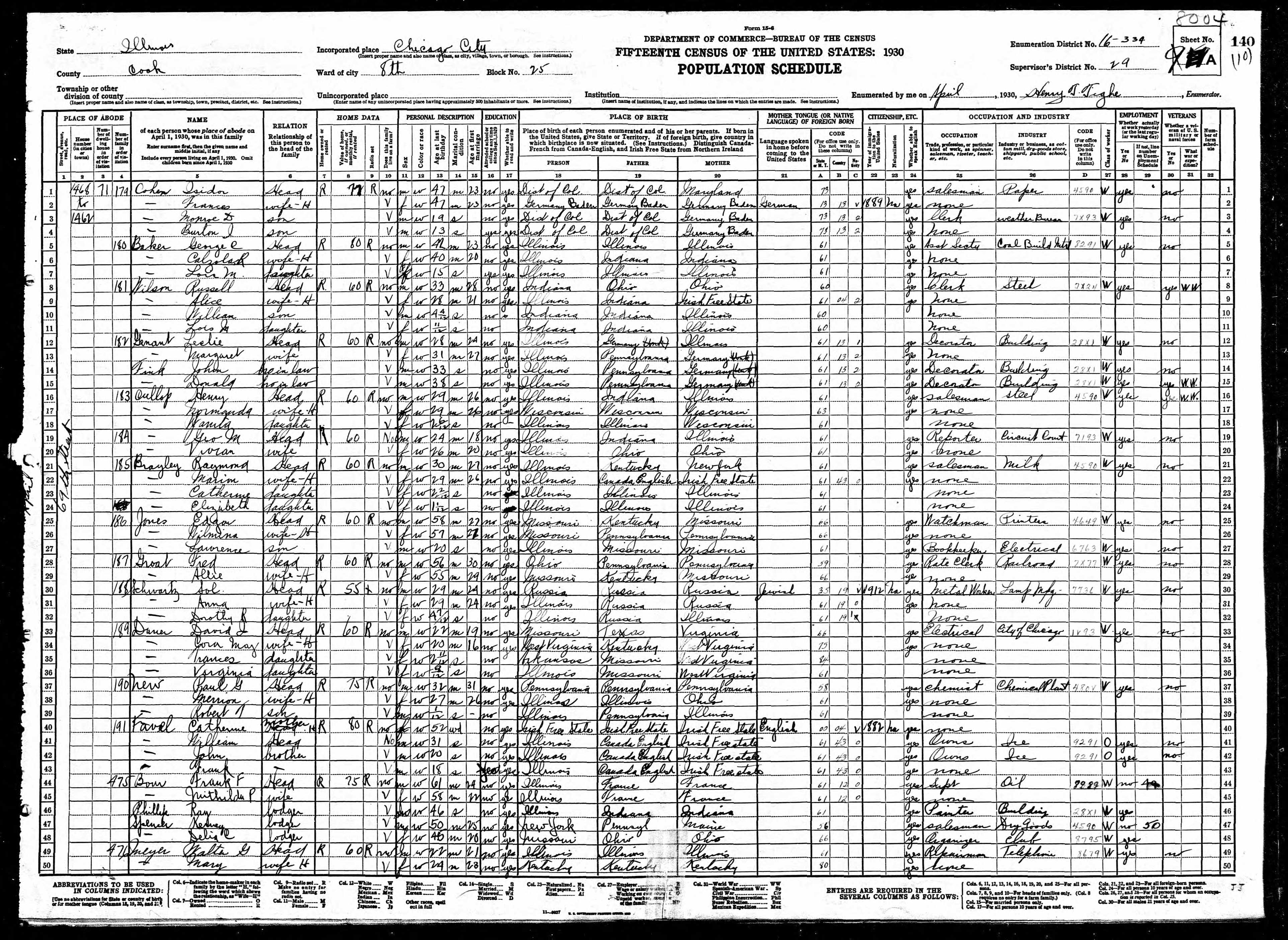
As for Isadore, in 1930, he and his family were living in Chicago, where Isadore was working as a salesman in the paper industry.  His son Monroe was a clerk in the weather bureau there.  I wonder what prompted the move to Chicago and the career change for Isadore.

Isadore Baer Cohen and family 1930 census

Isadore Baer Cohen and family 1930 census

In 1940, the family was still living together in Chicago, and Isadore was a book salesman. Both Monroe and Burton had changed their surname from Cohen to Coulter, though their parents were still using Cohen.   Although Monroe was now 30 and Burton 24, there is no occupation listed for either of them on the 1940 census.

Isadore Baer Cohen and family 1940 census

Isadore Baer Cohen and family 1940 census

By 1942, Isadore had retired, according to his draft registration.  He gave Burton’s name as his contact person, which I found interesting since his wife Frances was still alive at that time.

Isadore Baer Cohen World War II draft registration

Isadore Baer Cohen World War II draft registration

Sometime between 1942 and 1949, Isadore and Frances moved to California, where Frances died in 1949.  Isadore died in 1958 when he was 77 years old.  He lived a much longer life than any of his siblings or his mother.  His father Hart was the only other one to live past seventy.

According to his obituary in the Chicago Tribune of September 8, 1996, Isadore’s son Monroe Coulter had enlisted in the Army Air Corps before World War II and was an electrical engineer.  He married Fannie Simon on November 25, 1942, in Chicago and appears to have settled in Illinois. They had two children.   Monroe worked on the Air Force missile program and retired from the military in 1970 with the rank of lieutenant colonel.  He was living in Itasca, Illinois, when he died on September 6, 1996, and is buried at Shalom Memorial Park in Arlington Heights, Illinois.

His brother Burton moved to California in the 1950s.  He was married and had two children.  In 1952 he was working as the deputy county assessor in Alhambra, California, according to a directory for that city. Then, according to Sacramento city directories,  from at least 1959 through 1966 he lived in Sacramento and worked as an appraiser for the California Department of Equalization, a state agency responsible for administering the state tax laws.   Burton died in Los Angeles, California in 1978.  He was only 61 years old and thus was another family member who did not live to see seventy.

The family line of Hart and Henrietta Cohen thus is somewhat limited.  Of the four children of Hart and Henrietta, only Isadore lived past seventy, and only Isadore had children. Frances never married, and Jacob married, but did not have children. Munroe, Jacob, and Frances all died at relatively young ages, as did their mother Henrietta.  Although Munroe died in an accident, I do not know what led to the early deaths of Henrietta, Frances and Jacob, but will see if I can find out.

I am hoping that one of Isadore’s descendants will be able to provide a Y-DNA test to provide evidence of the genetic link between Moses Cohen, Sr., and my great-great-grandfather Jacob Cohen, but I am having some trouble making contact with them.  They are the only direct male genetic descendants of Moses Cohen, Sr. and thus my only option for finding that genetic connection between Moses and Jacob.  Maybe one of them will find this blog post and find me.


Wonderful Surprises and Gifts

I had two wonderful surprises this week.  Usually I am hunting down family members, hoping for a response.  Twice this week I heard from relatives who found me.

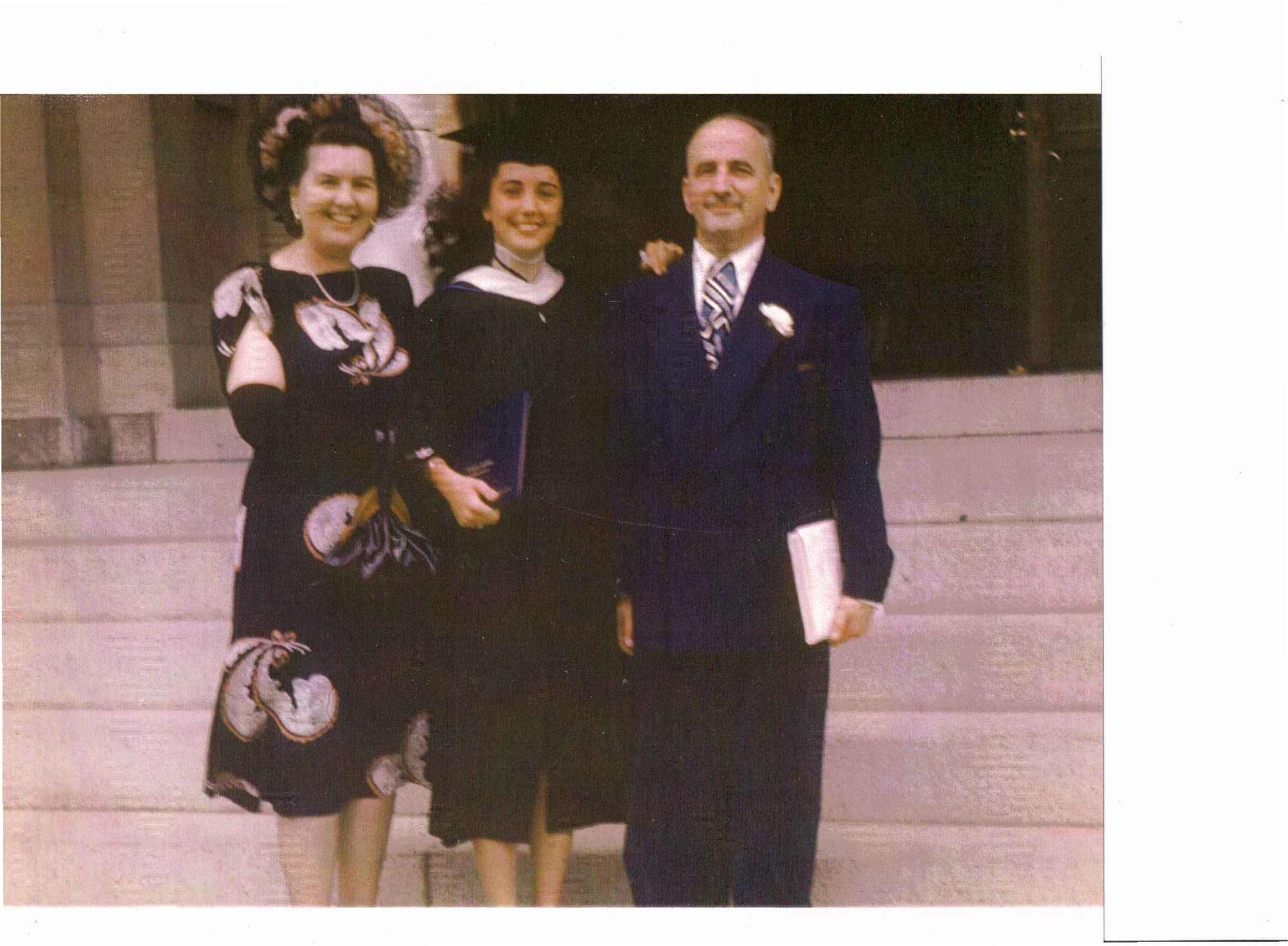
Lou, a relative by marriage, is a cousin of my cousin Marjorie.  He had visited Marjorie recently and heard about my contact with her.  He sent me two wonderful photographs of Marjorie.  One is posted here: a photograph of Marjorie and her parents, Bessie and Stanley Cohen, at her graduation from Trinity College in Washington, DC, probably around 1947.  I’d never seen a picture of any of these family members before, and it was so meaningful to be able to see Marjorie’s face after spending time getting to know her on the phone this summer.  I hope to be able to meet her in person in the coming months.  I also was excited to see what my great-uncle Stanley looked like and what his wife Bessie looked like.   It really helps to bring these people to life when you can put a face to the name.  Bessie and Stanley look so proud of their daughter, a college graduate back when most women did not even dream of going to college.  (The second photograph I will post when I get to my Seligman relatives as it depicts two of them.)

Bessie and Stanley Cohen with their daughter Marjorie at her graduation

Bessie and Stanley Cohen with their daughter Marjorie at her graduation

The second wonderful surprise came in the form of a comment on the blog from a descendant of Julius and Augusta Selinger, their great-grandson Cito.  He had just accidentally found the blog while searching for something else and was pleased to see and learn more about his family’s history.

He then sent me this wonderful photograph of his great-grandfather Julius’ jewelry store.  Although the photograph is not dated, if you look at it closely, you can read the larger sign in the window that says “Sale…Watches…$4,” and see at the bottom “Price during the War +15.”  I am not exactly sure what that means, but I assume that the reference is to World War I, dating the photograph during the second decade of the 20th century.

Selinger's Jewelry Store 820 F Street, Washington, DC

Selinger’s Jewelry Store 820 F Street, Washington, DC

That makes sense because the young woman to the right standing in the doorway is assumed by the family to be Eleanor Selinger, the daughter of Julius and Augusta who married Henry Abbot and moved to London in 1926.  Eleanor would have been about 22 years old in 1917 when the US entered World War I.  I love being able to see Eleanor’s face also.  She has such a searching, pensive look on her face—what was she thinking?  You can see the reflections of a crowd of people looking into the window as well as some of the buildings across the way.  The store was at 820 F Street in Washington, DC.  Perhaps some of you recognize that location?

Thanks to both Lou and Cito for generously sharing these photographs and for contacting me.  I am so happy that you both were able to find me.  I also received photographs from another family member this week, my cousin Jack, the great-grandson of Joseph Cohen, who was my great-grandfather Emanuel’s older brother.  I will post some of those photographs next week after I have a chance to scan them.

So it’s been a great week to be doing genealogy research.  I am feeling very fortunate for all the gifts that genealogy has provided to me.  Happy Labor Day Weekend, everyone!


The Flat: A film by Arnon Goldfinger


The other night we watched a fascinating movie, The Flat. It is a documentary made by Arnon Goldfinger about what he learns about his grandparents after his grandmother dies and he and his family clean out their apartment in Tel Aviv. His grandparents had lived in Berlin until 1936 when they left for Israel. Goldfinger and his family, including his mother, had almost no knowledge of the grandparents’ lives before they left Germany.

I do not want to reveal too much about what they learn because each viewer should be able to experience the revelations as they are uncovered in the course of the film. But I will say that this is a film that anyone interested in family history and the ethical dilemmas that are created when you learn something surprising and perhaps troubling about the past should watch. What is our obligation to reveal the truths we learn to those left behind, even if they were innocent of the past actions of their family members? Why do people hide from the truth? Why do some of us ask questions and seek answers whereas others prefer to avoid uncovering the past?

But this is not only a film for genealogists. It is a film for everyone who has an interest in human nature. The film addresses important questions of identity and nationality. What makes people identify with a country, a religion, a family? How do we pick our friends? How does denial play into our sense of who we are?

Finally, this is also a film about our legacy. What will our families do and think after we are gone?  When the family throws out bag after bag after bag of the treasured belongings of the grandparents, I couldn’t help but think about the way we all collect objects—clothing, books, jewelry, letters, photographs—that our descendants will toss away with barely a thought. We have to leave something else behind besides these material things—our good name, our good deeds, our stories, and our love. All else will vanish.

Solomon Monroe Cohen/Cole: Post Script

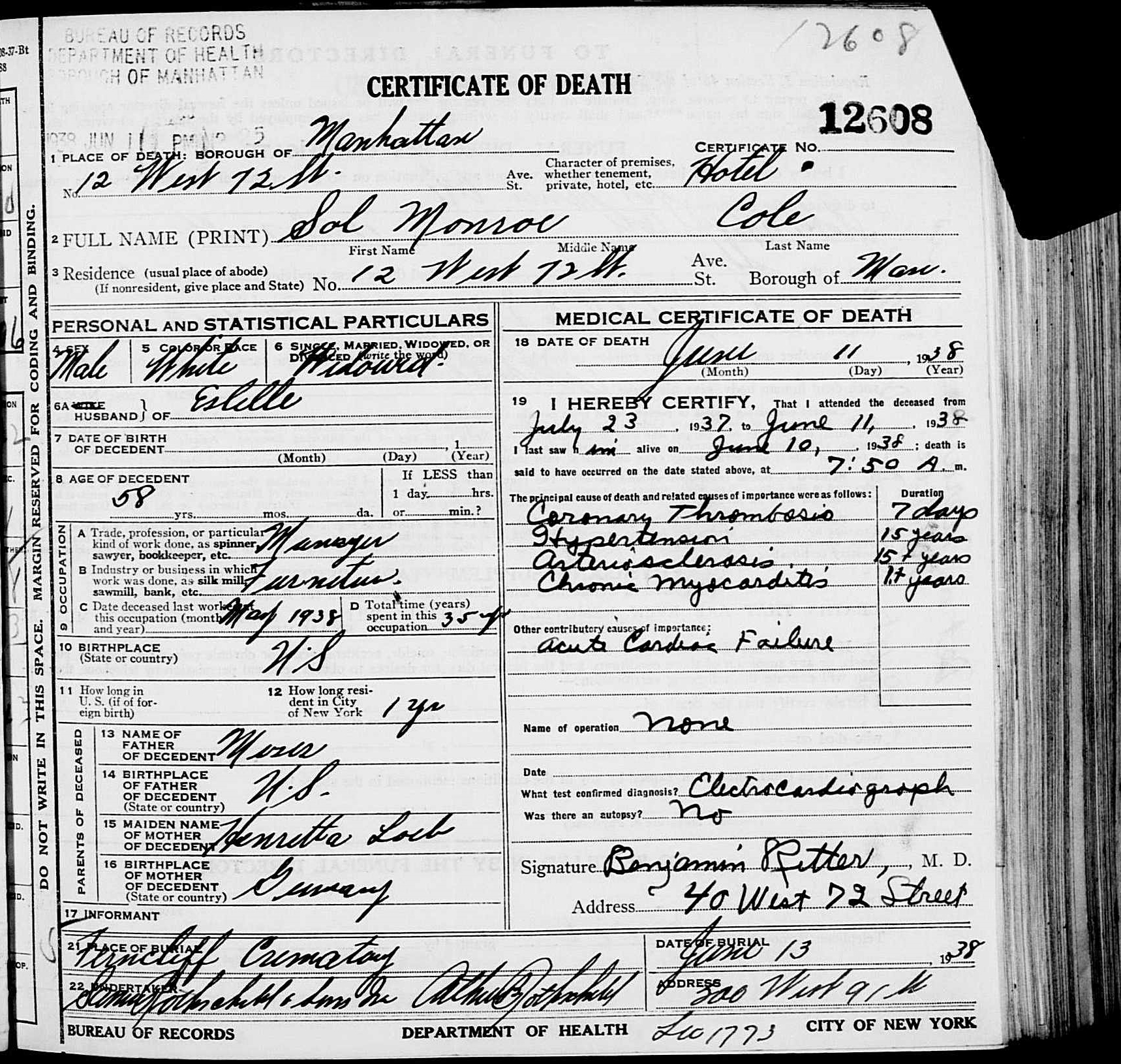
Yesterday I received a copy of the death certificate of Sol Cole, who died on June 11, 1938.

I learned a number of things from this document.  First, Sol died of heart disease when he was only 58 years old.  He had had hypertension and arteriosclerosis for fifteen years and myocarditis for over a year, and then for a week before he died, he suffered from coronary thrombosis and finally acute cardiac failure.  He had been under the same doctor’s care for close to a year and had been living in New York City for about the same period of time.

sol cole death cert page 1

He had been living at 12 West 72nd Street in what was then a hotel, located less than a block from Central Park.  The certificate indicates that he was working up until a month before he died as a manager in the furniture business, the same industry he had been working in for 35 years, starting in Detroit, then in Columbus, and ultimately in New York City.

sol cole death cert page 2

The certificate also corroborated the fact that Estelle had predeceased him, as he was a widower at the time of his death.  Sol’s remains were cremated by Ferncliff Crematory, and both of his sons, Ralph and Robert, signed a sworn statement to the New York City Department of Health that it had been their father’s wish to be cremated.  I called Ferncliff to see if they had any records for Estelle, but they did not; they only had records for Sol.  Although I cannot be certain, my hunch is that Sol moved to New York after Estelle died since there is no record of her death in New York City nor were her remains handled by the same institution.  I still do not know when or where Estelle died, but I will focus on Ohio as that is where I know she was living as of 1935.

A Photo Essay: The Strolowitz Adler Family, Joe Louis, and The Resilience of the Human Spirit

It’s been a long time since I’ve written about the Strolowitz Adler line in my family tree since I have been focused on my father’s Cohen line, but I have now completed my research on one other member of the Strolowitz Adler family so am taking a short break from the Cohens in order to report on that research.

Tillie Rosenzweig Strolowitz Adler was my great-grandmother Ghitla Rosenzweig Goldschlager’s sister.  Tillie was the aunt who provided a home for my grandfather Isadore Goldschlager and his sister Betty when their father died in 1909.  Tillie had been recently widowed herself after her husband Jacob had died shortly after arriving in NYC from Iasi.  Tillie also outlived two of her sons, Pincus and Isidor, both of whom had died from serious illnesses as young adults.  Her other five children lived to adulthood, but many of them also faced some personal struggles and in some cases tragic deaths.  Only Leah, the youngest child, seemed to lead a long and happy life with a long and happy marriage to Ben Schwartz.

The only one of Tillie’s children I had not yet written about was Rebecca, the fifth child born in 1892 in Iasi.  She was fifteen when she immigrated to the US with her parents and younger brother and sister in December, 1907, and in 1910 and 1915 she was working in a sweatshop as a dressmaker.

I am very fortunate to have this beautiful photograph of Rebecca Strolowitz Adler.  All the photos included in this post were provided by  members of the extended family.

Ray Adler

Rebecca Strolowitz/Ray Adler (undated)

On April 7, 1917, Rebecca, now using the name Ray, married Ben Seamon.

Ray Adler and Ben Seamon marriage certificate

Ray Adler and Ben Seamon marriage certificate

Ben was born in Chicago in 1893.  He enlisted in the US Army in November, 1917, and served during World War I until he was honorably discharged in January, 1919.  Ray and Ben’s first child Jerome was born in June 1919, and as of 1920, Ben was working as a foreman in a dressmaking shop (perhaps this is where he had met Ray?).  By 1925, Ray and Ben had two sons, Jerome born in 1919, and Paul, born in December, 1920, and the family had moved to the Bronx.  Ben was now working as a chauffeur.  Their third son, Harold, was born in October, 1924, and Ben and Ray’s youngest child Thelma was born in 1926.

By 1930, however, Ray was living with her children in the home of her brother David Adler along with his wife Bertha and their daughter Tessie in Manhattan.  Ben, on the other hand, was living in the Bronx with his mother and his brothers Samuel and Mannie Seamon.

Mannie Seamon ran a gym where he trained boxers, and according to the 1930 census, both Manny and Ben were working as managers at the gym at that time.  According to Mannie’s obituary in the NYTimes dated March 26, 1983, in 1937, Mannie was hired as the assistant to the trainer for Joe Louis, the world heavyweight boxing champion from 1937 until 1949, and in 1942 when that trainer died, Mannie became Joe Louis’ trainer, working in that position until 1951.

Manny Seamon and Joe Louis

Manny Seamon and Joe Louis

Mannie also had trained many other boxers, including Benny Leonard, the World Lightweight Boxing Champion.  According to Ben Seamon’s obituary in the July 25, 1971 NY Times, Ben also had been a boxer and a boxing trainer.

During the Depression, Ray became a patient at the Central Islip State Hospital.  I was not able to find any records for Ray after 1942. Her two youngest children, Thelma and Harold, were admitted to the Hebrew Orphan Asylum (HOA) in Manhattan on June 28, 1935.  Thelma resided there from ages 9 through 15.   Harold was discharged to return to live with his father on February 25, 1940;   Ben was then working as an announcer for boxing and wrestling bouts.  Thelma was discharged from the HOA on July 20, 1941, two months before the HOA closed in Sept. 1941.

Thelma Seamon visited by her cousin Teddy Schwartz

Teddy Schwartz, daughter of Leah Adler Schwartz, visiting her cousin Thelma Seamon around 1944

But it all seemed to work out well for Thelma.  While at the orphanage, she met her future husband, Nathan Letnick, who was also a resident there.  Thelma graduated from high school in 1942.

Thelma Graduation photo 1946

Thelma Seamon graduation photograph 1942

Jerome Seamon married Lillian Wolf on September 22, 1940:

Wedding of Jerome Seamon and Lillian Wolf September 22, 1940

Wedding of Jerome Seamon and Lillian Wolf September 22, 1940

Pictured here are Mannie Seamon (top row, second from left), Harry Seamon (right of Mannie), Paul Seamon (right of Harry).  Thelma is second from the left in the middle row.  In the front row, Ben Seamon is second from the left, then the groom Jerome Seamon, Ben’s mother, and the bride Lillian Wolf Seamon.  The others are relatives and cousins from the Seamon side of the family.

All three of Ben and Ray’s sons and their son-in-law Nathan served overseas during World War II, and Paul received a Purple Heart for his service.  Thelma worked at Western Electric in Manhattan during World War II.

Thelma working at Western Electric during World War II

Thelma working at Western Electric during World War II

Nathan Letnick and Thelma Seamon were married after the war on November 10, 1946.  Here is their wedding photograph with the extended family.

Nathan Letnick and Thelma Seamon's wedding 1946

Nathan Letnick and Thelma Seamon’s wedding 1946

Among those pictured above are the following people, most of whom are referred to in this post:

Back row, far left: Paul Seamon;  Middle row, far left: Jerry Seamon; Front row: Lillian Wolf Seamon (Jerry’s wife); Ben Seamon’s sister, Ida; Nathan Letnick; Thelma Seamon Letnick; Ben Seamon; Ben’s sister Bertha.

Nathan graduated from NYU with degrees in business, thanks to the GI Bill. The four Seamon children, Jerome, Paul, Harold, and Thelma,  eventually moved to Long Island after the war, where all except Harold married and raised families.

Here is a photograph from the wedding of Paul Seamon and Marilyn Tobetsky on August 6, 1949, showing all of Ray and Ben’s children and their spouses as well as Ben:

Wedding of Paul Seamon and Marilyn Tobetsky 1949

Wedding of Paul Seamon and Marilyn Tobetsky 1949

From left to right:  Nathan Letnick, Thelma Seamon Letnick, Ben Seamon, Mae, Paul Seamon, Marilyn Seamon, Jerome Seamon, Lillian Seamon,  and Harold Seamon

As for Ben, I found  a World War II draft registration dated 1942 that indicates that he was employed by the Town Pump in Tullahoma, Tennessee, but was residing with Jerome in the Bronx.  Ben moved to Florida sometime after 1952 and worked at a dog racing track now known as the Mardi Gras Casino.  He died in July, 1971, and is buried at Long Island National Cemetery.

After retirement Nat and Thelma moved to Florida.  They were still married in 2000 when tragically Thelma was killed by an elderly driver who had Alzheimer’s.  Nat died six years later.  Thelma’s daughter told me that one of Thelma’s passions was knitting:  “All her adult life, everyone knew my mother to be knitting something for everyone and anyone having a baby.”

Finally, a more recently dated photograph of Thelma and her brother Paul in 2000.

Thelma & Paul April 8, 2000

The story of Tillie Strolowitz Adler and her children is a story filled with lots of  heartbreak and  hardship but ultimately survival.  They all came as immigrants from Romania to New York City and sought happiness and success, which did not come easily to them.  Although they may have struggled, the generations who followed them found a home here in the US, served their country, and ultimately not only survived but thrived.  These photographs reflect the resilience of the human spirit better than I can ever capture it in words.

Florence and Grace Cohen:  The Baltimore Sisters

Baltimore City Hall

Baltimore City Hall (Photo credit: Wikipedia)

Florence and Grace Cohen were the sixth and seventh of the nine children of Moses, Jr. and Henrietta Cohen.  They were born just a year and a half apart, Florence in February, 1876, and Grace in September, 1877.  They spent their entire lives living close to each other and following many parallel paths.

Florence married Harry Panitz, a salesman from Baltimore, in October, 1898, and Grace married William Katz, German born but living in Baltimore when they married in January, 1901.  Florence moved to Baltimore after marrying Harry, and they had one child who died before she was a year old, Helen, and a second child, Aline, born in 1902.  Grace and William also moved to Baltimore soon after marrying, and their first child Hilda was born there on December 10, 1901.  On the 1910 census the two sisters and their families were living about six miles apart in Baltimore.  Harry was a traveling clothing salesman, and William was the manager of a furniture business.

In 1920, Harry was now the owner of his own clothing manufacturing business. Aline was eighteen. William was now in the jewelry business with his father’s extended family, S. N. Katz Jewelers.  (The business grew to many stores over the years and is still in existence today.)

S.N. Katz Jewelry advertisement 1921

S.N. Katz Jewelry advertisement 1921

He and Grace now had three children, Hilda (19), Morton (12), and Zerlina (6).   The two families had both moved from where they’d lived in 1910 and were now just over a mile apart.  I would imagine that the families were quite close, and that Hilda and Aline, being so close in age, might also have been close cousins.

Between 1920 and 1930, both Hilda and Aline would get married. Aline Panitz married Fred Katzner, a Baltimore native, on October 22, 1922, and Hilda Katz married Alfred Himmerich, a Baltimore native as well,  around 1929.  Both newlywed couples settled in Baltimore.  Fred Katzner was the vice president and secretary of Stadium Underwear Company.  Alfred Himmerich was the proprietor of an oil business.

By 1930 the two Cohen sisters, Florence and Grace, had moved even closer together.  Both families were living in the same apartment building, 2601 Madison Avenue, as were Aline and Fred Katzner.  Hilda and Alfred Himmerich, meanwhile, were less than a mile away at 2202 Park Avenue.  Morton Katz, now 22, was still living at home and working at the Katz family jewelry business with his father and uncles, while Harry Panitz was still in the clothing business. Zerlina was only sixteen and living at home.  So all but one of the immediate family members of the two Cohen sisters were living in one apartment building, and the other, Hilda, was only minutes away.

2601 Madison Avenue, Baltimore

2601 Madison Avenue, Baltimore

In the next two decades, much would change.  Although Aline and Fred Katzner did not have any children, Hilda and Alfred Himmerich had two children born in the 1930s.  Grace Cohen Katz died on November 17, 1939, and her sister Florence Cohen Panitz died six years later on October 23, 1945.  Once again, their lives paralleled, both dying before their husbands; Harry Panitz died on July 5, 1949, and William Katz died in May, 1963.

Aline Panitz Katzner and her sister-in-law Anna Katzner Robinson

Aline Panitz Katzner and her sister-in-law Anna Katzner Robinson Courtesy of Ellen Leopold, Anna’s granddaughter

Aline Panitz Katzner became a widow at a young age when her husband Fred died on February 17, 1950.  Aline traveled a great deal after Fred’s death—to Scotland, Italy, Puerto Rico, and other places, and she never remarried.  She died October 27, 1982.  There is a fund created in the names of Aline, her husband and her parents used to support various types of programming, Jewish and other, in the Baltimore area.  If you Google “Aline & Fred Katzner and Florence & Harry Panitz program,” you will see the numerous programs supported by this fund.

Ad from the Baltimore JCC Program Guide Fall 2011

Ad from the Baltimore JCC Program Guide Fall 2011

As for the children of Grace and William Katz, in addition to the family of Hilda and Alfred Himmelrich and their children and many grandchildren, Morton Katz married Hannah Needle sometime before 1937, and in 1940 he was working as a salesman, perhaps still in the family jewelry business.  He and his wife Hannah had three children.  Morton died in 1974, and Hannah died in 2009, according to the Social Security Death Index.  Zerlina Katz married I. Morris Harris, who was in the wire and cable business in 1956.  I am not sure where or when Zerlina married Morris, but they lived in southern California from at least 1956 until their deaths, Morris in 1980 and Zerlina in 1995.

Remarkably, although some family members did move away from the Baltimore area, most including many of the great-grandchildren of Grace Cohen Katz and Florence Cohen Panitz, stayed in Baltimore.  The two Cohen sisters, born close in time, both married Baltimore businessmen, both moved to Baltimore to live, had daughters close in age, and lived near each other all their lives.  They both died before reaching seventy, they both predeceased their husbands.[1] Their children all stayed in Baltimore as well. Their daughters both married Baltimore businessmen. Looking at it from the perspective of how we live our lives in 2014 where family members rarely live in the same state let alone the same city, it all seems quite remarkable.

Baltimore, Maryland Skyline from the Inner Harbor

Baltimore, Maryland Skyline from the Inner Harbor (Photo credit: Wikipedia)


[1] Interestingly, they are not buried at the same cemetery.  Harry and Florence Panitz are buried at the Baltimore Hebrew Friendship cemetery where the extended Panitz family is buried, and Grace and William Katz are buried at Oheb Shalom cemetery where the extended Katz family is buried.  The two cemeteries are only two miles apart, so even in death the family is fairly close together.

My Cousin, the Musical Star

ad dec 1 1917 for selma selingerWhen I spoke with my cousin Ellen Kleinfeld last week, she asked me whether I knew that there had been an opera singer in the family.  I said that I had not yet run across any family members who were opera singers.  She thought the cousin’s name was Sylvia, but wasn’t sure.  I told her that I would keep researching and would let her know if I found anyone that might fit that description.  I was skeptical of the claim that we had a singing star in the family, knowing how family myths can grow beyond the basic facts, but I figured I’d keep my eyes open for anyone who might be this musical “Sylvia.”

Well, it did not take long to find her, and it was not because I was looking for her specifically.  The fourth child of Moses, Jr. and Henrietta Cohen after Augusta, Myer, and Jacob was Fannie Cohen.  As written earlier, Fannie married Alfred Selinger, the assumed relative of Julius Selinger, who had married her older sister Augusta.  Fannie and Alfred had one child, a daughter Selma.  Selma was the mysterious singer my cousin Ellen had heard about as Sylvia.

Selma, who was born in 1894, was already performing as a singer at a Fourth of July celebration in Washington, DC, by 1905, when she was only eleven years old, and she is mentioned as a singer in numerous articles in the Washington area newspapers over the next 20 years.[1]

On September 14, 1912, Selma married William Danforth, who was an actor who worked under the stage name Billy L. Wilson, according to his passport application.  Three years later they had a daughter Mildred, but the marriage did not last.  An article from the Eau Claire (Wisconsin) Leader on April 10, 1917, told of a trip that Billy L. Wilson was making to Australia with his vaudeville partner, Joe F. Willard.  The article said that Billy and Joe had been on B.F. Keith‘s vaudeville circuit in the eastern and southern parts of the US.  (This is the same B.F. Keith who had married Ethel Chase, the sister-in-law of Ruth Cohen Chase, Selma’s first cousin, in 1913, six months before he died.  Ethel Chase later married Ruth and Selma’s other cousin, Jerome Selinger.  Perhaps Selma met Billy also through Ruth’s connection to B.F. Keith, or maybe Billy introduced Ethel to B.F. Keith.)

Apparently being on the road was not good for the marriage between Selma and Billy, and by 1920, they were divorced. She and Mildred were living with her parents, Fannie and Alfred. Alfred was working as a tailor, and Selma gave her occupation as a stenographer for a concert business. Throughout this time, however, Selma had continued to perform.[2]  I could only find one photograph of Selma, however, despite all the news coverage, and it is not a very clear photo.

Selma Selinger New York Times 1919

Selma Selinger New York Times 1919

On June 6, 1920, Selma sang at an event where a young man named Earl I. Klein was also performing and at later events he performed as her accompanist.[3]  Earl also had been a musician since an early age, performing as a pianist and a violinist at numerous events since 1907, when he was thirteen.  He had attended the Columbia Conservatory of Music.[4] What may have started as a professional relationship turned romantic, and on July 15, 1921, Selma married Earl Klein, and the two continued to perform together for some time thereafter.  Selma also sang on some radio broadcasts in the early 1920s.

Unfortunately, I could not find any coverage of Selma and Earl’s careers after 1922. By 1930, however, it seemed that both may have ended their musical careers.  On the 1930 census, Earl’s occupation is listed as the manager of a taxi company, and Selma has no occupation listed.  In 1940, Earl was selling insurance, and Selma again had no occupation listed. Selma’s parents, Fannie and Alfred Selinger, were living with them, as was Selma’s daughter Mildred.  (Fannie and Alfred must have also had a place in St. Petersburg, Florida, as they are listed in the city directories for that city in 1924 and 1934.)

Selma lost her mother, Fannie Cohen Selinger, on August 21, 1940, and her father Alfred Selinger died seven years later on October 11, 1947.   Her husband Earl died of a heart attack on June 9, 1957.  Earl was buried in Washington Hebrew Cemetery where Selma’s parents Fannie and Alfred are buried as well as her grandparents Moses, Jr. and Henrietta Cohen.

Selinger FannieSelinger AlfreadEarl Kline

(Photos courtesy of Ira Todd Cohen and Jane and Scott Cohen)

Sometime thereafter Selma remarried a man named Theodore C. Lewis.  Selma died on January 2, 1973, in Silver Spring, MarylandThe Washington Post published the obituary below, describing some of the highlights of her musical career.

The Washington Post, Times Herald (1959-1973) [Washington, D.C] 03 Jan 1973:

The Washington Post, Times Herald (1959-1973) [Washington, D.C] 03 Jan 1973:

Interestingly, Selma was not buried where her long time husband Earl is buried, and I still have not found where she is buried, though I am checking with the cemetery where her third husband is buried, Fort Lincoln.

UPDATE:  I just got confirmation that Selma is buried next to her third husband, Theodore Lewis, at Fort Lincoln cemetery.  Poor Earl–buried with the Cohen family, his in-laws, while his wife is buried elsewhere.

Selma’s daughter Mildred married a musician, Maurice or Maury Hall.  They lived in Las Vegas and then in North Hollywood, California.

Thus, one family “myth” has been validated.  Although Selma did not sing in a traditional opera setting, she was a professional soprano who sang both popular and classical musical works.  In the days before radio and recordings were widespread, hiring musicians for entertainment was much more common.  I can visualize these society gatherings and charitable and patriotic events where my cousin Selma sang to the delight of her audience, sometimes accompanied by her husband Earl.

I leave you with two links to click on to hear two songs that Selma sang (not, however, sung by her in these recordings). Although Selma sang everything from “Madame Butterfly” to Handel’s Oratorio “Judas Maccabeas”  to Kol Nidre at these performances,  I particularly enjoyed searching for these two songs that were popular during World War I, as they reminded me of a time many, many years ago I sat  with my father and a family friend as they discussed World War I songs.  I was probably about thirteen and could not for the life of me figure out why these two men were talking about (and singing) songs written before they were born.  As Mel Brooks said in The 2000 Year Old Man, we mock the things we are to be.

Cover of "The 2000 Year Old Man"

Cover of The 2000 Year Old Man

Roses of Picardy

Keep the Home Fires Burning

[1] For example, for some early performances,  see The Washington Evening Star, July 3, 1905, p. 3; “Dr. Simon Guest of Honor, Washington Evening Star, June 2, 1908, p. 9; “Eastern Star Entertainments,” April 15, 1909, Washington Evening Star, p. 15; Washington Evening Star, May 9, 1909, p. 65; “Have Lively Debate,” Washington Evening Star, April 6, 1910, p. 2; “Casino,”  Washington Evening Star, April 9, 1913.

[2] See “Jewish Women Hear their New Protégé,” Washington Evening Star, January 13, 1916, p. 24 (as Selma Selinger Danforth); “Grotto Will Entertain,”  Washington Evening Star, January 13, 1916, p. 24; “Arab Patrol Host to 1,500 Guests,” Washington Evening Star, April 29, 1916, p. 9; Washington Evening Star, December 9, 1917, p. 54 (‘…Miss Selma Selinger sang several patriotic solos which were so well received that she had to respond with several encores.”); “Liberty Loan Boosted at Patriotic Rally,” Washington Evening Star, April 7, 1918, p. 20.1  This is just a sampling; there were also mentions in the Washington Herald and the Washington Post.

[3] See Washington Evening Star, June 6, 1920, p. 53; “Florida Society,” Washington Evening Star, January 9, 1921, p. 25; Washington Evening Star, November 5, 1922, p. 63.

[4] Washington Evening Star, July 5, 1908, p. 26. Also, numerous other articles about Earl Klein’s performances can be found by searching genealogybank.com for Earl Klein in the District of Columbia.

Jacob G. Cohen, Almost State Treasurer, and his descendants: A Sad Ending and a Loose End

The third child of Moses, Jr., and his wife Henrietta was Jacob G. Cohen.  As I wrote previously, Jacob had married Ida Siegel in 1894 and had moved to New York City, where he first worked as a bookkeeper. Just this week I received a copy of their marriage certificate.

Jacob G. Cohen and Ida Siegel marriage certificate

Jacob G. Cohen and Ida Siegel marriage certificate


1894 14 Apr Cohen-Segel marriage cert#4384  pg2  007586923_00397

Jacob and Ida had two children, Aimee and Gerson, and by 1910 had moved to Yonkers, New York, where Jacob worked as the manager of a dry goods store, according to the 1910 census.  In 1912, Jacob and Ida traveled overseas, and in 1915 Jacob’s occupation was an office manager for a business that is not legible to me.  Maybe someone else can decipher it?  Ida’s obituary said he was the treasurer of a department store at some point, so perhaps this says department store?

UPDATE:  Thank you to Gil Weeder!  He read it as Dry Goods, and now that I look at it, I think that’s right, and it makes sense!

Jacob and Ida Cohen and family 1915 NY census

Jacob and Ida Cohen and family 1915 NY census

On February 12, 1917, their daughter Aimee married Lester Wronker, who was working in the leather goods industry.  Aimee and Lester had a son, Robert, who was born in April, 1919.  In 1920, the family was living in Manhattan.

Ida and Jacob’s son Gerson was a student at New York University at the time he registered for the draft in 1917.  He was inducted into the US Army on October 1, 1918, and was discharged on December 19, 1918, without ever serving overseas.  He was part of the NYU student training corps.

Gerson Siegel Cohen military record

Gerson Siegel Cohen military record

In 1918, Jacob G. Cohen ran as a Democrat for New York State Treasurer on the same ticket as Alfred E. Smith.  Although Smith won the governor’s seat, Jacob was defeated in the general election, losing to the Republican candidate, James L.Wells, 839,777 votes to 1,028,752 votes.   Although Smith and the Democratic candidate for Lieutenant Governor, Harry C. Walker, were victorious, all the other Democratic candidates on the slate were defeated by the Republican candidates.


Alfred E. Smith, Governor of New York

Al Smith served four terms as governor of New York State and in 1928 became the first Catholic nominated by a major party as a candidate for President of the United States.  He was soundly defeated by Herbert Hoover.  But imagine if Jacob had won and served as NYS treasurer with Al Smith—and imagine if Smith had won in 1928—my cousin Jacob G. Cohen might have become the US Treasury Secretary.  If he had won the election for New York State Treasurer, he would have been one of the first Jews to hold statewide office in New York.

Instead, Jacob returned to civilian life as a businessman.  In 1920, Jacob and Ida were living in Chicago as lodgers in what appears to have been a very large boarding house or hotel. Jacob was working as the manager of a department store.  Did he leave New York to escape after losing the election? In 1925 Jacob and Ida were back in New York, living in Manhattan, and Jacob was working as an insurance agent.  Their daughter Aimee and her husband Lester and their son Robert were now living in Yonkers, and Lester was working in the silk industry.  I was not able to locate Gerson on the 1920 US census or the 1925 New York State census.

Jacob died on February 13, 1930, according to a death notice in the New York Times.Jacob Cole death notice

(Obituary No. 5, February 15, 1930, New York Times, p. 17)

For a long time I could not find any records for Jacob or Ida after 1925, but then by searching for “Wronker” in the New York Times archives, I was able to find this death notice for Jacob, which revealed why I had not been able to find them: they had changed their surname from Cohen to Cole sometime between 1925 and 1930.

Gerson had also changed his last name to Cole and also his first name to Gary.  (Even searching for him under Gary Cole has not provided me with any information about his whereabouts between 1918 and 1930 or after 1930.)  After Jacob died, Ida moved in with Aimee and her family in Yonkers, where Lester continued to work as a sales manager in the silk industry.

Gerson, now Gary Cole, finally reappeared in 1930 in Detroit as a credit manager for a furniture business.  I believe this is the same Gary Cole/Gerson Cohen based on his age (30), birth place (New York), and birth places of his parents (Washington, DC.)  He was living in what seems to be a hotel as a guest.

Gary Cole 1930 census

Gary Cole 1930 census

In 1940, Ida was still living with Aimee and Lester in Yonkers.  Lester was now an executive in the silk business, according to the 1940 census.

Robert, now 20, was a student at Princeton, although he was still listed as living in his parents’ residence on the 1940 census.  (Although the Princeton yearbook lists his address as being in the village of Tuckahoe, the census considered that same address to be in Yonkers.)  According to several editions of the Princeton yearbook, Bric a Brac, found in the ancestry.com database, Robert played the oboe in the university band, was on the editorial staff of the Princeton Tiger, was a member of the Princeton Liberal Club and a member of the Nassau Literary Review (“the oldest undergraduate literary review in the country”), and was on the executive committee of the Princeton Anti-War Society in 1939, presumably a group arguing against the United States’ entry into World War II.  Robert graduated from Princeton in 1940.   The photo below is of Robert as an associate editor of the Nassau Literary Review.

Robert Wronker Ancestry.com. U.S. School Yearbooks [database on-line]. Provo, UT, USA: Ancestry.com Operations, Inc., 2010. Original data: Various school yearbooks from across the United States.

Robert Wronker Ancestry.com. U.S. School Yearbooks [database on-line]. Provo, UT, USA: Ancestry.com Operations, Inc., 2010. Original data: Various school yearbooks from across the United States.

Despite his anti-war feelings, Robert enlisted in the military on March 18, 1941, listing his occupation as an “author, editor, reporter,” not surprising given his activities at Princeton.

During the war, Robert served in the medical corps in Italy and then became an editor of the Mail Call column in Stars and Stripes, while stationed in Naples, Italy.  After the war he wrote several short pieces for the New York Times, and in 1955 he was working as a feature writer for the publicity department of 20th Century Fox.

After that he, like his uncle Gary Cole, disappeared.  I could not find anything, which was surprising given the unusual name and his interest in writing and journalism. I wondered: Did he also change his name? Did he die?  He is not listed under Robert Wronker on the SSDI or anywhere else. Once again, I was left with a loose end, a brick wall.

So I called on my mentor Renee Steinig once again for some direction, and damn, she found him so fast I was blown away.  She was able to find a death notice for Robert in the New York Times as well as a death notice in the Princeton alumni magazine that I had not found.  Robert had died on August 20, 1956, after a long illness.  He was only 37 years old.

Here is what the Princeton Alumni Weekly wrote about him:


robert wronker death notice princeton alumni weekly vol 57 pt 1

Wronker princeton death notice pt 2

(Princeton Alumni Weekly, Volume 57 (1956) )

What a waste.  Such a young and bright and talented person taken so young.  His mother Aimee died only three years later in January, 1959, when she was 64 years old.  His father Lester lived until October 1976, having survived both his wife and their only child.

Renee also helped me find this obituary of Ida Cole, who died July 25, 1949.

Ida Cole obituary Yonkers Herald Stateman July 26, 1949. p.  2

Ida Cole obituary Yonkers Herald Stateman July 26, 1949. p. 2

Since Ida was survived by three grandchildren and Aimee only had one child, Robert, Gary must have had two children.  I will continue to try and find Gary Cole/Gerson Siegel Cohen in hopes that the line of Jacob G. Cohen/Cole and his wife Ida did not end with the untimely death of their grandson Robert Wronker.

When I think about all the “what ifs” with Jacob and with his descendants, I feel very wistful about how this line might have ended.