Cruising to Cologne


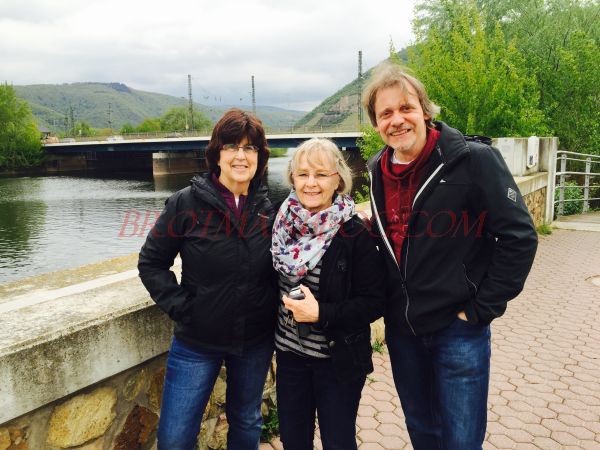
On Friday, May 5, our fourth day in Germany, we left the Mainz-Bingen region behind and took a three hour cruise on the Rhine from Bingen to Koblenz.  The weather was still quite dreary and cool, but the views out the window was nevertheless quite scenic—castles, little towns clustered at the shoreline, high cliffs and fields, and other boats cruising on the river.  It was very peaceful and relaxing, just what we needed after several very full and exciting days.

Burg Ehrenfels

We disembarked in Koblenz and walked through that city for an hour or so before taking a train to our next major stop, Cologne or Köln, as it is called in German.
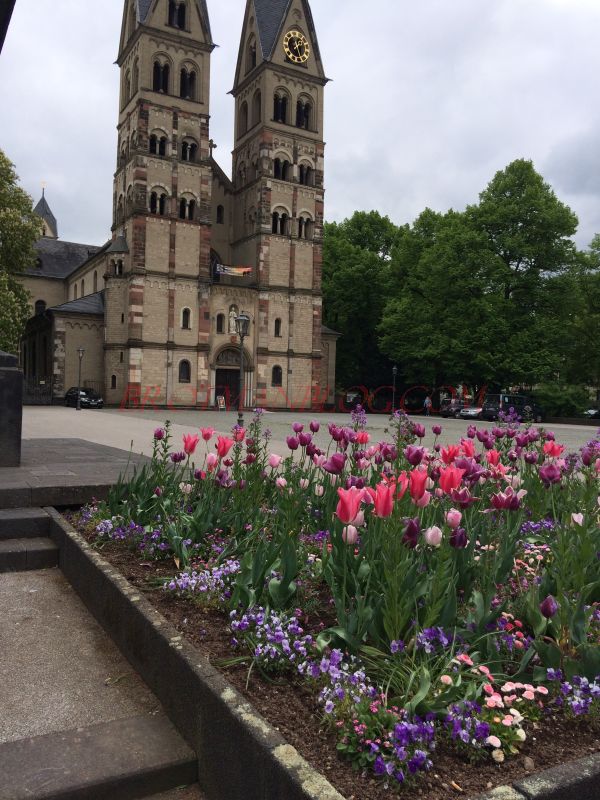
Koblenz

Deutsches Eck where the Moselle meets the Rhine in Koblenz

Once we got to the Cologne train station, we realized we had no idea how far our hotel was, so we checked Google Maps on my phone and were delighted to see that our hotel, the Marriott, was just a short few blocks away.  Although the Marriott is a large, American-style hotel, we were not very pleased with it.  I won’t get into details here, but if anyone is planning a trip to Cologne, check with us first.  The best thing about it was its location. We should not have “played it safe” and chosen a known brand.  Live and learn.

Nevertheless, we very much enjoyed the two days we had in Cologne.  The first night we had dinner at a very chic Italian restaurant, Da Damiano.  It wasn’t far from the hotel, but somehow we got a bit twisted around looking for it.  But that gave us our first glimpse of the Dom, the huge Gothic cathedral that dominates everything in Cologne.  The Dom dwarfs all the churches we’d seen before and even cathedrals we had seen in other cities such as Milan and Paris.  It is awesome in the literal sense of the word.  And you can see its spires almost anywhere in the city.

Cologne Dom

The following morning we went to the Ludwig Museum, which is almost right behind the Dom.  (The Dom quickly became our point of orientation for anything in the city.) The Ludwig is an extremely well-planned museum with lots of light and open space and a very impressive and enjoyable collection of 20th century art.  There were many works by Picasso including a very provocative sculpture of a mother pushing a child in a stroller, a rich collection of Expressionist and Surrealist artists, and a collection of art that had been rescued by a collector during the 1930s when Hitler condemned all modern art as degenerate and corrupt.

But the piece that really took us aback was a lifelike sculpture of a modern-dressed woman staring at art in one of the galleries.  Both of us had at first thought it was an actual person and only realized it was a sculpture on a second or third look.  It really made us think about what is art and what is real and how we often walk by real people without realizing they are real.

Woman with a Purse, Sculpture, by Duane Hanson (1974) at Ludwig Museum, Cologne, Germany Photo found on Pinterest at https://www.pinterest.com/pin/26317979044298519/

In the afternoon we went on a walking tour of Cologne with Free Walk Cologne (there is no fee, but tips are encouraged early and often).  Julian, our tour guide, was fluent in English and very engaging, knowledgeable, and entertaining.  We met at the Eigenstein Tur, one of the old Roman gates that still exist in the city, and our group was made up of people from Switzerland, Poland, Ecuador, and Scotland, as well as Philadelphia and California.  Julian provided us with some background in Cologne’s long history—it was once a military garrison during the Roman Empire, and a woman from Cologne married the Emperor and made Cologne an important outpost in the empire.  Julian claimed that Cologne still had more of an Italian feel to it—more laidback and liberal than most of Germany.

Eigenstein Tur

We also learned that one of the reasons Cologne has such a tremendous cathedral is that the remains of the Three Kings are kept there.  That made Cologne a pilgrimage destination long ago and thus a wealthy city filled even in early times with constant visitors.

The symbol of Cologne —the three crowns for the Three Kings and eleven tears for the eleven virgins killed by Attila the Hun

Julian then skipped to modern times and informed us that over 90% of Cologne had been destroyed by Allied bombing in World War II and that the city was rebuilt as cheaply and quickly as possible after the war, leaving it with buildings that are eclectic in style and not very well-planned.  People were allowed to build whatever they wanted, including a building that is only two meters wide.

Two meter wide building on Eigenstein Strasse

Eigenstein Strasse

Mural by artists protesting the takeover of space in Cologne by media corporations

Many immigrants from Greece and Turkey came to Cologne after the war to do this rebuilding as the male population of Cologne had been greatly reduced by wartime casualties.  These immigrants stayed, giving Cologne a diversity that was for a long time unusual for Germany.  (Now there are many immigrants living in Germany from all over the world.)

We saw a church, St Maria Himmelfahrt, that was bombed during the war and restored afterwards:

before the war

after bombing during WW II

Today

St Maria Himmelfahrte

Perhaps the most bizarre thing we saw was a Roman wall that was discovered in recent years during excavation for a parking lot near the Dom.  The wall was preserved and now can be seen in the middle of a modern parking lot.

Roman wall in parking lot under the Dom

There was also a Roman floor mosaic discovered nearby, and that also can be seen today by looking into the window of the city’s archaeological museum.

Roman mosaic

Our last major stop with Julian was the Dom itself.  He explained how it took over 600 years for the cathedral to be completed—with a three hundred year gap when nothing was done.  It was started in the 13th century and not completed until the 19th.  I’ve already mentioned how awesome the Dom is from the outside—the interior is equally breathtaking.  The height of the vaults, the almost delicate feel of the structure, and the stained glass windows are magnificent.

After the tour we had a beer along the Rhine with a few people from the tour and then returned to our hotel before dinner in the Belgian Quarter where we once again had Italian food.  That made it our third night in a row eating pasta plus the lunch in Gau-Algesheim—and it wouldn’t stop there.  German food just didn’t work for us—too much meat, too little fish.  It’s a real challenge for someone who is kosher and lactose intolerant. So we ate mostly Italian food throughout the trip.  And it was very good.  On the other hand, we also ate a lot of delicious German bread, pastries, and pretzels and drank wonderful German beer.  My favorite lunch was a fresh German roll with either a hard-boiled egg or smoked salmon.  I learned that salmon in German in Lachs—hence, the Yiddish term “lox.”  Believe me, we ate quite well—too well!

Marketplace in Cologne

People relaxing along the Rhine

Our second day in Cologne focused on its Jewish past and present.

Gau-Algesheim and Bingen: My Seligmann Family

Mural in parking lot—it says We Love Gau-Algesheim

On our second night in Germany (May 3), we had a truly joyful and unforgettable experience: dinner with Wolfgang and his family—his wife Bärbel and their twelve year old daughter Milena.  We met in the small town of Schwabenheim, located about halfway between Bingen, where we were staying, and Undenheim, where Wolfgang and his family live.  I could not remember the name of the restaurant, but fortunately I was able to WhatsApp with Milena who told me it was zum Engel.  The atmosphere was perfect—an old stone building divided into smaller rooms with just a few tables. It was a good thing that for much of the time we had our room to ourselves because there was much laughter throughout our meal.

All three Seligmanns understand English, but I wanted to practice my German.  So we switched back and forth, often with many questions about which word to use (on my part) and some inevitable misunderstandings based on use of the incorrect word (again, on my part). It could not have been a more enjoyable and relaxing evening—remarkable given that I’d never met Milena or Bärbel before and had only met Wolfgang the day before. The food was also excellent—salmon, potatoes, and my first experience with the white asparagus that is so popular in Germany—“spargel.” Es war lecker, as they say.  When Wolfgang asked at the end of the evening whether we wanted to have dinner with them all the next night, there was no hesitation.  “Of course,” we said.  (I think the German equivalent expression is “genau”—a word we heard over and over when we listed to Germans converse with each other.)

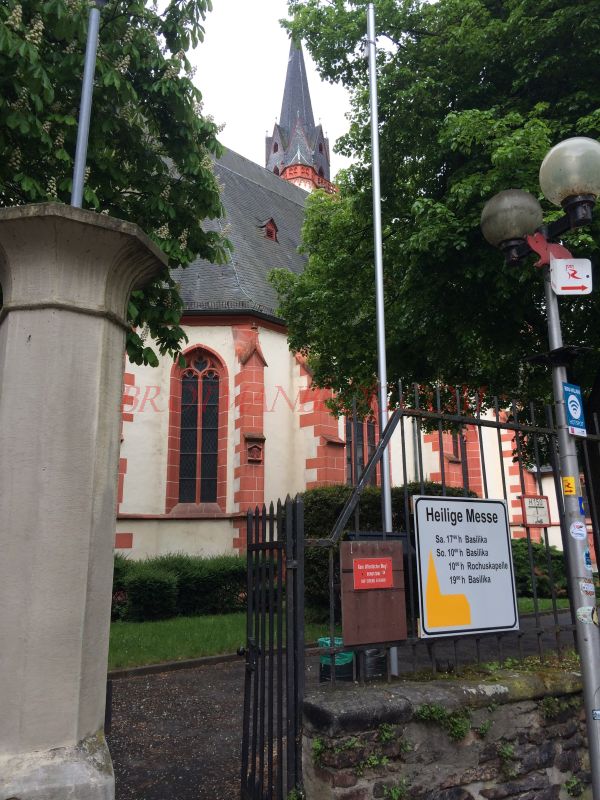
The following day Wolfgang, Harvey, and I traveled to Gau-Algesheim, the birthplace of my great-great-grandfather, Bernard Seligman, and of his younger brother August Seligmann, Wolfgang’s great-grandfather. But first Wolfgang took us to see the Rochus Chapel outside of Bingen where his grandparents and father and uncle hid during the bombing of Bingen during World War II. It is lovely church perched high above Bingen surrounded by trees and views of the valley and of the Rhine.  It was easy to see how this must have been a peaceful sanctuary for Wolfgang’s family and others during the bombing.

View from Rochuskappelle

Rochus Chapel

Inside Rochus Chapel

View of the Rhine from Rochus Chapel

Parklike grounds around Rochus Chapel

In some ways the survival of Wolfgang’s grandfather, father, and uncle is a miracle. Julius Seligmann was born Jewish, but converted when he married Magdalena Kleisinger, who was Catholic.  Their sons, Walter and Herbert, were raised as Catholics.  But in Nazi doctrine, that should not have mattered.  Julius had “Jewish blood,” and so did his sons.  Many of those with Jewish ancestors who converted or who were raised as Christians were not spared from death by the Nazis.

When I asked Wolfgang why he thought his grandfather, father, and uncle survived, he said that his mother always said that the Bingen Nazis were stupid. Or that perhaps the police in Bingen somehow provided protection. As I wrote earlier, Wolfgang’s father Walter did forced labor on the Siegfried Line during the war and there were restrictions placed on the men in terms of their occupations, but they were not deported or tortured.  I am thankful for that; otherwise, my dear cousins Wolfgang, Bärbel, and Milena would not be part of my life.

After leaving Rochus Chapel, we drove the short distance to Gau-Algesheim where we were to meet Dorothee Lottmann-Kaeseler, another German dedicated to preserving and honoring the history of the Jews in Germany.  Dorothee and I had connected several years back through JewishGen.org when I was searching for information about Gau-Algesheim.  She had worked on a cemetery restoration project with Walter Nathan, a man whose father’s roots were in Gau-Algesheim; Walter and his family had escaped to the US in 1936.  Dorothee and I have been exchanging information through email for several years—going far beyond my initial inquiries about Gau-Algesheim, and she is a regular reader and frequent commenter on my blog.  I was very much looking forward to meeting this friend in person, and she is terrific—outgoing, energetic, interesting, smart, and very insightful.

Dorothee

But it took some chasing to catch her! We drove up the road below the cemetery, and Wolfgang spotted what he believed was her car up on the hill near the cemetery gate.  We got out of the car and clambered up the hill only to see that Dorothee’s car had disappeared.  (We were a few minutes late arriving.) So we ran back down the hill, got in Wolfgang’s car, and raced back down the road where we again spotted Dorothee’s car.  She had driven back down, thinking we might have missed her.  It was like a scene out of a bad romantic comedy!

Anyway, after introductions were made and hugs exchanged, we all drove back up to the cemetery gate. Dorothee was accompanied by a Gau-Algesheim resident named Manfred Wantzen, who had the key to the cemetery.  But before we entered, Dorothee reminded us that in fact there were very few stones in the cemetery.  This was not an act of Nazi destruction; this was an act of stupidity on the part of a man in the 1983 who may have had good intentions. He thought the cemetery needed to be cleaned up and asked permission of the Jewish community in Mainz (which oversees the cemetery).  They agreed without asking what he planned to do.  The man then proceeded to remove the stones so he could cut the grass.  Some he placed against the cemetery wall, but others were carted away and lost forever.

The Gau-Algesheim cemetery—with stones removed.

Dorothee, Wolfgang, and Manfred Wantzen

View of Gau-Algesheim from the cemetery gate

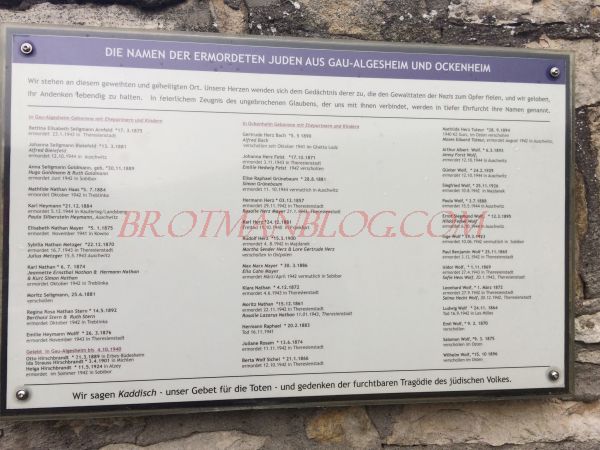
When Dorothee and Walter Nathan worked to preserve what was left of the cemetery, several plaques and markers were placed on the wall outside and inside the cemetery, one to commemorate those who were killed in the Holocaust and others to honor the memory of those who were buried in the cemetery but whose stones were no longer there.

Unfortunately, there were no stones to be found for my 3-x great-grandparents, Moritz Seligmann and Babetta Schoenfeld, who were undoubtedly buried in that cemetery.  There were likely many other relatives buried there, including Wolfgang’s great-grandfather August Seligmann, but the only family member whose stone survived is that of Rosa Bergmann Seligmann, August’s wife and Wolfgang’s great-grandmother.  But even that discovery was bittersweet as her stone had been vandalized several years ago by some local teenagers. Wolfgang and I each placed a stone on her grave to mark that we had been there and to honor her and all the other Seligmanns buried there.

Headstone for Rosa Bergmann Seligmann, great grandmother of Wolfgang

Although I left the cemetery disappointed and somewhat disheartened, my spirits were lifted when we drove into Gau-Algesheim and I got to see this little town of 7000 people where my ancestors had once lived. I have written before about Gau-Algesheim and seen photographs, but it was an entirely different experience being there in person and imagining a young Bernard Seligmann running through the narrow streets into the main square of the town where Langstrasse and Flosserstrasse meet and where the town hall and the fountain are located.  Here is Wolfgang standing where perhaps our mutual ancestors Moritz and Babetta once stood with their children:

Wolfgang in front of town hall in Gau-Algesheim

Medieval tower topped by Gothic addition

Town hall

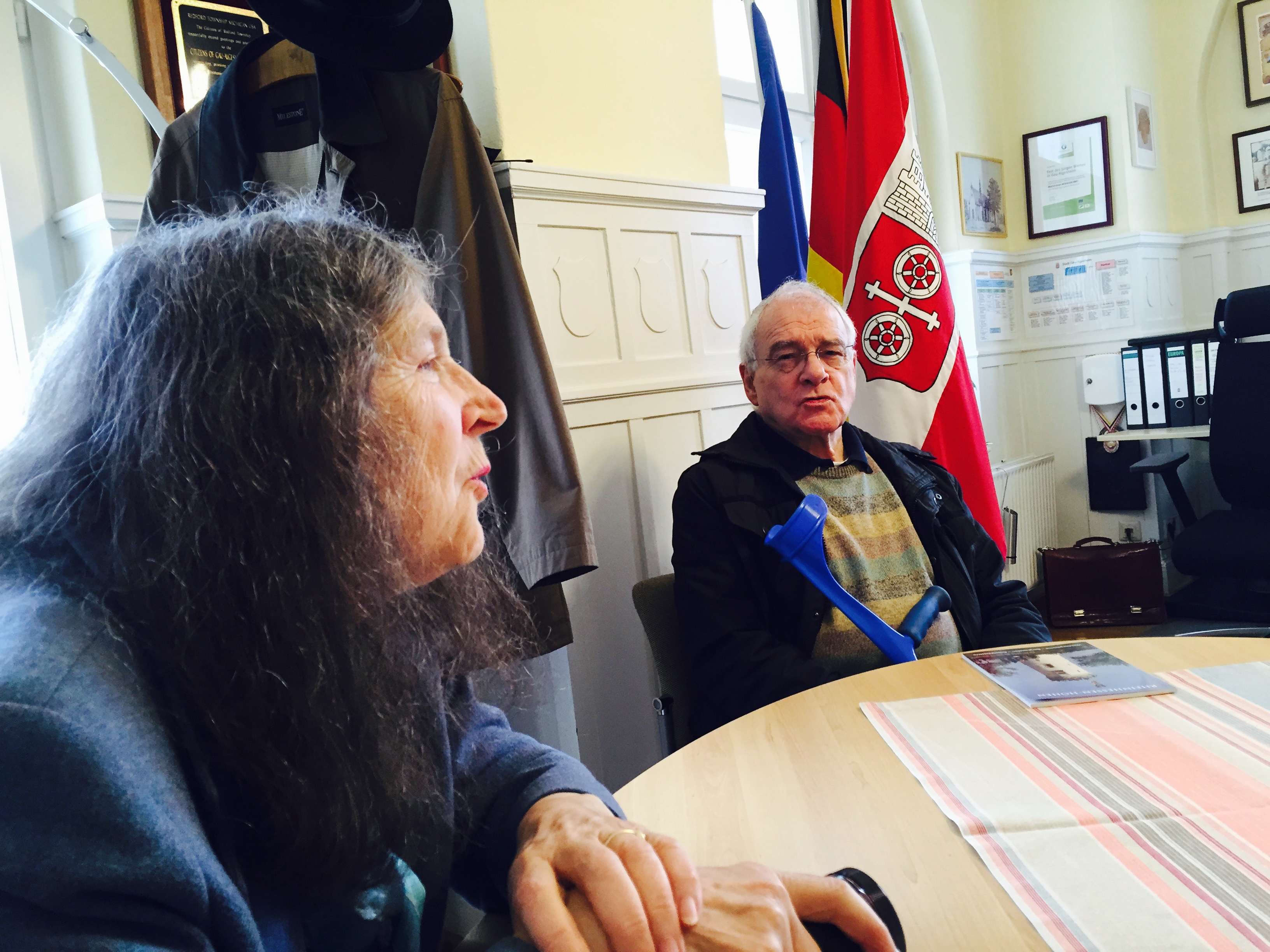
Dorothee had arranged for us to meet with the mayor of Gau-Algesheim, Dieter Faust.  We sat in his office where everyone but Harvey and I spoke rapid German.  I tried to understand, but it was futile.  The mayor was extremely engaging and clearly excited to have two descendants of Gau-Algesheim residents visiting, and after signing his guest book and taking photographs, we all went to lunch—in an Italian restaurant in the middle of this small German town.  And it was excellent! Somehow we all managed to converse and even managed to discuss American, French, and German politics with Dorothee and Wolfgang acting as interpreters.  It was a delightful experience.

Burgermeister Dieter Faust, Dorothee Lottman-Kaeseler, Wolfgang Seligmann, Manfred Wantzen, me, and Harvey

The mayor and me

Two proud descendants of the Seligmanns of Gau-Algesheim

Outside the restaurant where we were treated to lunch by the mayor

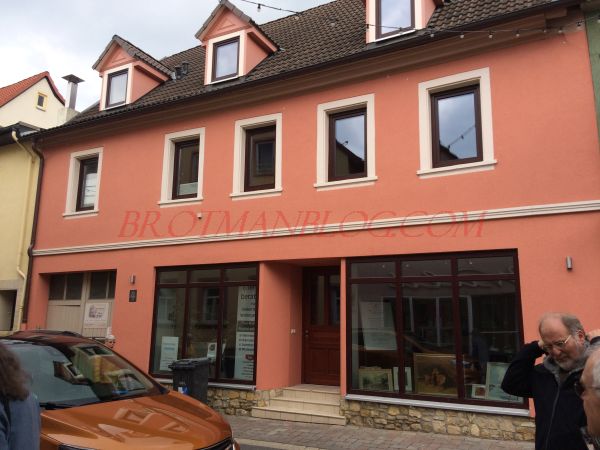
After lunch, Herr Wantzen and Dorothee guided us through the small town where we saw what had once been the synagogue in Gau-Algesheim.  It closed before 1932 because there was no longer a Jewish community in Gau-Algesheim. Today it is a storage shed behind someone’s house.  But the stained glass window over the door and the windows convey that this was once a house of prayer. A shul where my ancestors prayed almost 200 years ago.  It was awful to see its current condition, and I wish there was some way to create a fund to protect and restore the building before it deteriorates any further. I am hoping I can figure that out.

Plaque marking former synagogue

Former synagogue of Gau-Algesheim

We walked then along the streets where my family had once lived, saw the building where Wolfgang’s grandfather Julius once had a shop, and the street where my great-great-grandfather Bernard and his siblings were born.  It was surreal.  And emotionally exhausting.

Building where Julius Seligmann once had a wine shop

Maybe our ancestors once lived in this grand half-timber house on Flosserstrasse?

House built into the old wall that surrounded the town in medieval times

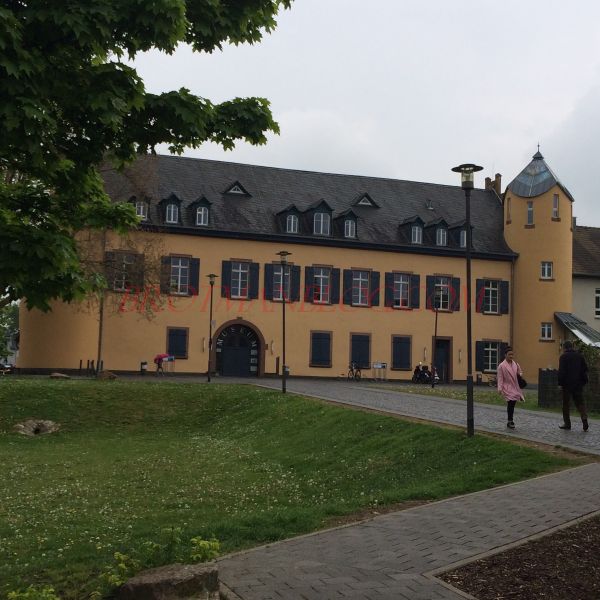
The castle of Gau-Algesheim

Our last stop was the Catholic Church in Gau-Algesheim, which Herr Wantzen was very excited to show us.  It was beautiful—far larger and more elaborate than one might expect in such a small town.  And a striking contrast to the size and condition of the abandoned synagogue.

Catholic church in Gau-Algesheim

We said goodbye to Dorothee and Herr Wantzen and returned to our hotel for a rest, and then at 6, Wolfgang picked up us again for dinner with his family in Bingen. We went to another very good restaurant, Alten Wache, and again had a wonderful time.

Bärbel, Milena, and Wolfgang—my dear cousins

After dinner we all climbed up the many steps to the Burg Klopp, the medieval castle that sits at the top of the hill overlooking  Bingen. As the sun began to set, the views were awe-inspiring. But I was already starting to feel emotional about saying goodbye to my wonderful cousins, Wolfgang, Bärbel, and Milena.  When Milena said to me in her perfect English that she was going to miss me, my eyes filled with tears.

Some new friends along with our new cousins. 🙂

Milena and a photographing tourist

View as we climb up to Burg Klopp

It was very hard to say goodbye, but I know that I will see my Seligmann cousins again—somewhere, sometime.  And until then, we have WhatsApp, email, and all our wonderful memories.  Auf wiedersehen, Wolfgang, Bärbel, Milena—and Bingen, Gau-Algesheim, and Mainz.  It was time to move on the next step of our journey.

Gau-Algesheim


Bingen: The Early Home and the Last Home in Germany for Many in the Seligmann Family


After lunch in Mainz on May 3, Wolfgang drove us to Bingen, where we were scheduled to meet Beate Goetz.  Beate, who volunteers at the Arbeitskreis Judische in Bingen, is one of the many German researchers who have helped me with my research.  Over the last two years she has sent  many records of our Seligmann relatives from the Bingen region, and she has been extremely helpful so I was looking forward to meeting her.  She had volunteered to show us around Bingen.  It was wonderful to meet her and spend time with her; she is one of the many dedicated people working to preserve the Jewish history of Germany.

Beate Goetz, Wolfgang, and me

In researching my Seligmann family, I had learned that my 4x-great-grandfather Jacob Seligmann and my three-times great-grandfather Moritz Seligmann were both born in Gaulsheim, a village that is now a part of Bingen.  I had wanted to see Gaulsheim, but Beate assured me that there was really nothing to see as all the old houses were gone.  Now it is just a residential area outside the main center of Bingen. So we focused instead on the center of the city itself.

https://www.google.com/maps/dir/Mainz,+Germany/Bingen,+Germany/@49.9832962,7.93582,11z/data=!3m1!4b1!4m14!4m13!1m5!1m1!1s0x47bd912e33df1379:0x422d4d510db1ba0!2m2!1d8.2472526!2d49.9928617!1m5!1m1!1s0x47bdefacf3e6e303:0x422d4d510db4180!2m2!1d7.904596!2d49.9667396!3e0

Bingen is located at the junction of two rivers—the Rhine and the Nahe.  It is a small city; today its population is about 25,000 people.  Our hotel, the Roemerhof, overlooked the Nahe river (which we could see if we peered between two buildings outside our window).  While walking along the river, we saw ducks swimming along.  The region is known for wine-making, and we could see vineyards in the hills surrounding the city.

There is evidence that Bingen was settled as early as Roman times, and its location gave it strategic importance as a gateway to the Rhine Valley region.  There was a Jewish community in Bingen at least as early as the 12th century. Although the Jews were expelled from Bingen in both the late 12th century and the 16th century, they returned and resettled.  Jews worked as money lenders in the earliest times, but in later times, Jews like my own relatives were merchants and wine traders. In 1933 there were 465 Jews living in Bingen. Half left by 1939, and those who remained were deported. Only four returned. Today there is a small number of Jews from Russia living in Bingen, but no real synagogue or formal Jewish community.

Jews being deported from Bingen. Courtesy of the Arbeitskreis Judische Bingen.

Bingen suffered extensive damage by Allied bombing during the war, and parts of the the city today are not particularly pretty, although there are still lovely winding streets and open squares throughout the city, some lined with older buildings and homes.  Many of the buildings, however, are post-war concrete construction that do not have much aesthetic appeal.

Catholic Church in Bingen

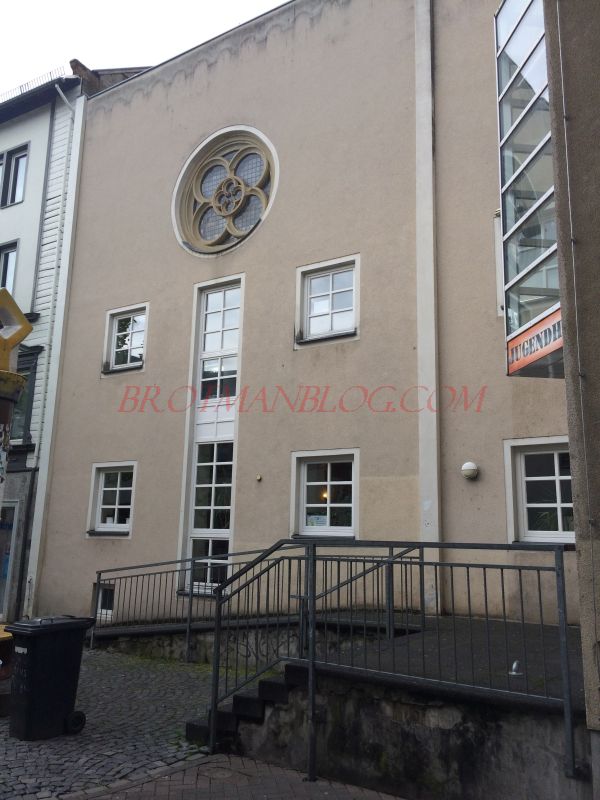
Beate took us to see two former synagogue buildings.  The first had been closed by the Jewish community itself in 1905 because the community, numbering at that time about 700 people, needed a larger space.  Today it is used as a youth center.

Old synagogue in Bingen

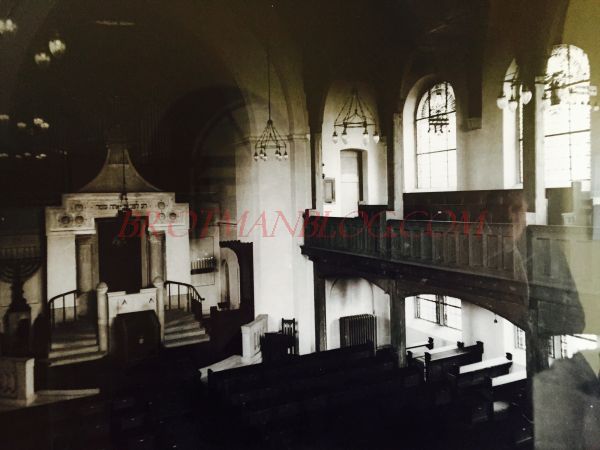
The second synagogue, which opened in 1905, was once quite a grand building. Here are some photographs from the Arbeitskreis Judsiche Bingen of what it looked like before 1938 as well as a model showing what the exterior looked like:

Courtesy of the Arbeitskreis Judische Bingen.

Courtesy of the Arbeitskreis Judische Bingen.

Courtesy of the Arbeitskreis Judische Bingen.

Like so many synagogues across Germany, it was partially destroyed by fire in November, 1938, on Kristallnacht. After the war the building was sold, as there was no longer a Jewish community that needed it. Most of the building was taken down, but part remains.  Today part of it houses the Arbeitskreis Judische and provides a meeting space for the Russian Jews who live in Bingen.

1905 Bingen synagogue

Beate also took us to several homes where some of our Seligmann cousins had once lived.  We saw the house that had belonged to Bernhard Gross and his wife, Bertha Seligmann.  Bertha was my first cousin, four times removed. Her grandparents were Jacob Seligmann and Martha Mayer, my 4x-great-grandparents; her mother, Martha Seligmann, was the sister of Moritz Seligmann, my three-times great-grandfather. Bertha and Bernard died from carbon monoxide poisoning in their own home in 1901, as I wrote about here.

Home of Bertha Seligmann and Bernhard Gross

We also saw the former home of Bertha and Bernard’s daughter Mathilde Gross and her husband Marx Mayer.  Mathilde is the cousin whose memoir inspired me to start learning German. (I still am not fluent enough to read it with much ease, however.) Her husband Marx died in 1934, but Mathilde and all their children emigrated from Germany in the 1930s and were able to survive the war.

House of Marx Mayer and Mathilde Gross

As you might imagine, seeing these two stately and large homes made me realize how successful the family had been and thus how much they had lost when they left Germany.

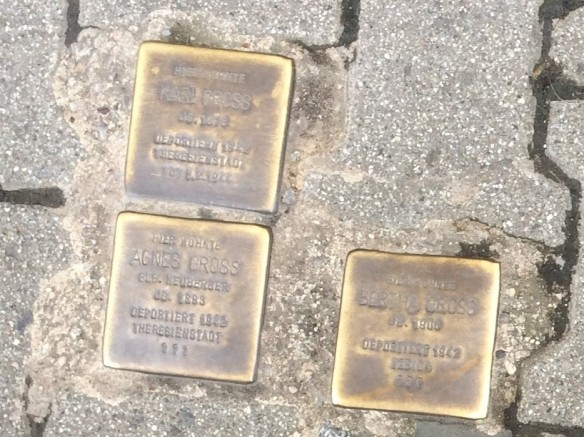
We also saw a number of stolpersteine, including these three for the family of Karl Gross, who was Mathilde Gross Mayer’s brother. Karl Gross, his wife Agnes Neuberger, and their daughter Bertha Gross were all killed in the Holocaust.  Karl was was my second cousin, three times removed. His grandparents, Jacob Seligmann and Martha Mayer, were my 4x great-grandparents. I wrote about the Gross family here.

Stolpersteins for Karl Gross and his family

Finally, Beate pointed out to us the location of the former shoe store owned by the family of Joseph Wiener.  Joseph Wiener married my cousin Anna Winter, daughter of Samuel Oskar Wiener and Rosina Laura Seligmann.  Rosina was the daughter of Hyronimus Seligmann, brother of my great-great-grandfather Bernard Seligman.  Rosina was thus also the sister of Johanna Seligmann Bielefeld, whose house in Mainz I’d seen the day before.  Rosina and her husband were both murdered in the Holocaust; their only son had been killed serving Germany in World War I.  Anna and Joseph survived and immigrated to the US in 1938.  Their daughters, Doris and Lotte, wrote the moving memoirs I was honored to excerpt on my blog here, here, here, and here.

Thus, as we left the downtown area of Bingen to drive to the Jewish cemetery up the steep hill from the town, I had the thoughts of all these cousins in my head. The people behind the names and stories I’d researched and studied suddenly felt very close and very real. Seeing some of the additional names in the cemetery made me appreciate how deeply connected my Seligmann relatives had been to the Bingen community.

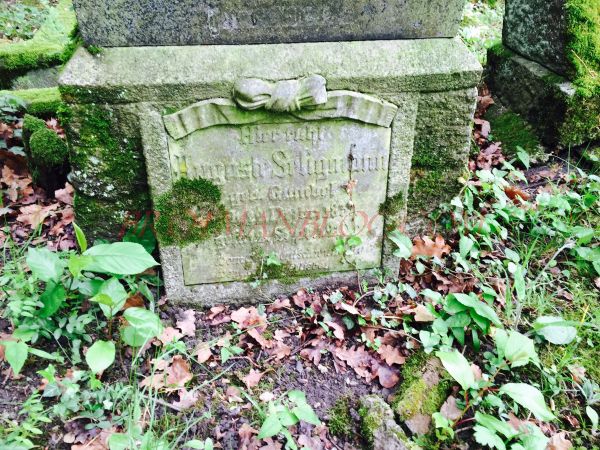
The cemetery is a large and peaceful place.  There are about a thousand headstones there in a beautiful wooded area overlooking the valley below.  It was overwhelming. I took many photographs, and I hope to be able to get some of them translated.  Here are just a few of the stones we saw for my Seligmann relatives.

Marx Mayer, husband of Mathilde Gross, granddaughter of Jacob Seligmann and Martha Mayer, my 4x-great-grandparents:

Marx Mayer

Ferdinand Seligmann and Lambert Seligmann: brothers of Bertha Seligmann. My first cousins, four times removed.

Graves of Ferdinand Seligmann and his brother Lambert Seligmann

Hermann Seligmann, brother of Ferdinand, Lambert, and Bertha.

Headstone of Hermann Seligmann

Ludwig or Louis Seligmann, son of Isaak Seligmann and another grandson of Jacob Seligmann and Martha Mayer.  Another first cousin, four times removed.

Louis Seligmann

Wife of Louis Seligmann, Auguste Gumbel

Auguste Seligmann geb. Gumbel

Emilie Seligmann Lorch. daughter of Benjamin Seligmann and Martha Seligmann (who were first cousins).  Martha Seligmann was the sister of Moritz Seligmann, my 3x-great-grandfather. She was my 4x great-aunt.

Emilie Seligmann Lorch

There were probably many, many more of my Seligmann cousins buried in Bingen’s Jewish cemetery, but many stones were impossible to read, and the sheer volume of stones made it overwhelming to think about searching for more.  I took some additional photographs of stones that would need translating from Hebrew, but I had to accept that there was no way to find and photograph every headstone in the cemetery in the limited time we had.

By the end of our afternoon in Bingen, it was clear to me that this city had been at one time the place where most of my Seligmann relatives and ancestors had lived.  Although I had not found the gravesites or homes of any of my direct ancestors, I knew that many of my cousins had lived and died in Bingen, sadly some at the hands of the Nazis.  Bingen was the home of the earliest Seligmann ancestors I’ve found, Jacob and Martha (Mayer) Seligmann back in late 18th century, and there were Seligmann descendants still living there in the 20th century.

We would return to Bingen the following evening for dinner, but first on the following day we were to visit Gau-Algesheim, where my great-great-grandfather Bernard was born and lived until he came to America in the1840s.

First Stop on Our Trip to Germany: Mainz

We spent our first day and a half in Germany in the beautiful and ancient city of Mainz, a city with a population of about 200,000 people and a city that was once an important center for Jewish learning and culture. Our visit there created some cognitive dissonance for me as we experienced such incredible beauty and also memories of such horrific ugliness.

We flew into Frankfurt Airport on May 2 and found the train to Mainz.  Once on the train, we were not entirely sure that we’d gotten on the right train.  Despite a full year of learning German online, I could not make out one word of the train announcements.  Fortunately, a very kind man sitting across from us realized we were confused and reassured us that we were on the right train and that he would tell us when to get off.  From the start, we were favorably impressed with the people in Germany.

Our hotel, the Mainz Hilton, was right on the Rhine; it is a large American-style hotel with large rooms and all the amenities.

The Rhine

We were exhausted after the overnight flight and took a short rest before meeting Wolfgang at 1:30.  And the adrenaline kept us going. I had so anticipated meeting my cousin Wolfgang.  We had been emailing each other for over two years on a regular basis, at first mostly about family history, but as time went on more often exchanging current information—about our families, our lives, politics, German and English, and life in general.  Meeting him in person for the first time, I felt as if I must have already met him and spent time with him. The connection was immediate, and he was just as I imagined based on his emails.  A warm and open person, sensitive and kind, intelligent and perceptive.  And with a delightful sense of humor.

My cousin Wolfgang and me

Wolfgang had planned a walk through the sights closest to our hotel and then a tram tour around the city to see some of the sites that were further out. We strolled along the Rhine for a bit.  The weather was rainy and quite cool, but it did not put a damper on my spirits. We passed a sculpture reflecting the division of Germany after World War II and its reunification in 1990.

We walked past a 15th century watch tower known as the Holzturm (“wooden tower); it was destroyed by bombing in World War II but reconstructed and restored to its original appearance.

Then Wolfgang showed us the house where Johanna Seligmann and Alfred Bielefeld had lived.  Johanna was my first cousin, three times removed.  She was the daughter of Hyronimus Seligmann, brother of my great-great-grandfather Bernard Seligman.  Alfred, her husband, was a wine merchant in Mainz.  Both were killed in the Holocaust.  They were deported to Terezin first, where Alfred died in 1945; Johanna was then sent to Auschwitz, where she was killed in 1945.  Their children, Hans and Lily, survived and lived in the United States.  I wrote about Johanna and her family here and here.

Johanna Bielefeld nee Seligmann

Bielelfed house in Mainz

Just around the corner from where the Bielefelds lived was the so-called “Jew House” where the Nazis moved Jewish families before deporting them.  Although the house itself no longer exists, this is where it was located:

We then visited a beautiful 18th century church, St. Augustine, with an elaborately decorated interior:

St Augustine church in Mainz

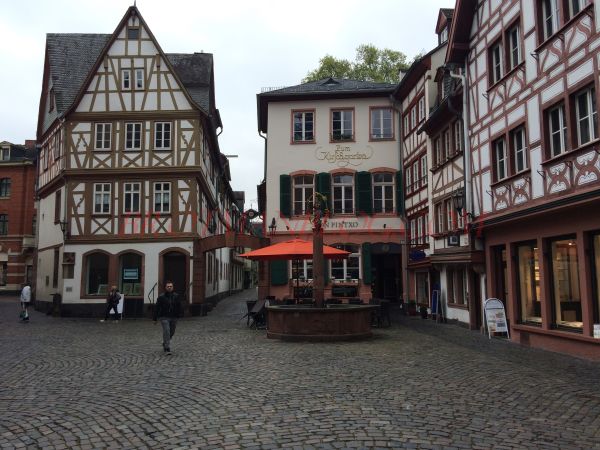
Perhaps my favorite spot in Mainz was the Kirschgarten—a small square framed by several half-timber houses, some now restaurants.  This little square captured exactly what I expected an old German city or town to look like—something out of Hansel and Gretel or some other fairy tale. The oldest house in Mainz is located in the Kirschgarten:

Kirschgarten in Mainz

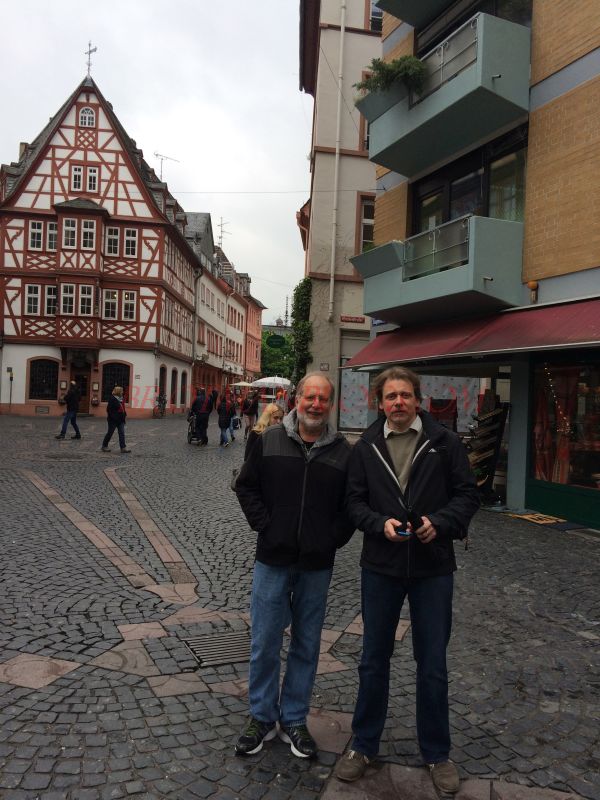
Everywhere we turned there were beautiful half-timber buildings, sometimes right next to a post-war building.

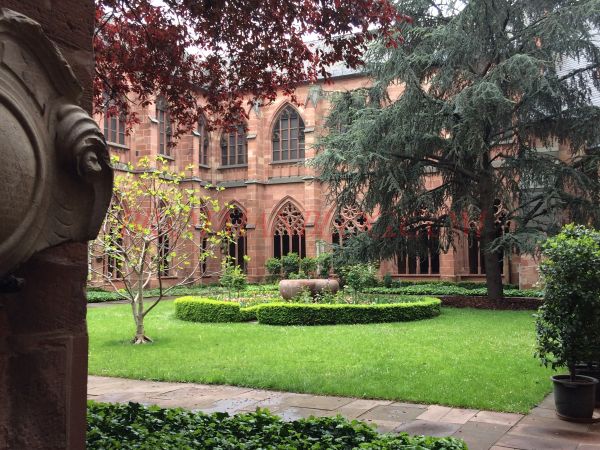
We then visited the Dom, or cathedral, a large Romanesque sandstone structure located on the main market square in Mainz. The cathedral’s oldest sections are a thousand years old with later additions over the years.  It was damaged by bombing in World War II, but restored afterwards.  The cloister is a peaceful place for contemplation, and the high vaulted ceiling in the main part of the cathedral forces you to look upwards.  It is an impressive and inspiring building.

Mainz Marktplatz

Cloister at the cathedral in Mainz

At this point we caught the little tram that took us on a tour around other parts of the city, passing the Rathaus (town hall), the Schloss (a palace more than a castle), the new synagogue, and the building where the Gestapo was housed during World War II. I couldn’t get any photos of these sites as we were moving too fast, but I was glad to be seated and not walking at that point. I asked Wolfgang if we could come back the next day to see the synagogue.

As I wrote here, our first stop on Wednesday was our visit with Wolfgang’s mother Annlis, a time I will never forget.

Then we continued our tour of Mainz.  We passed the location where Fritz/Fred Michel once owned a store.  Fred Michel was the son of Franzeska Seligmann and the grandson of August Seligmann, Wolfgang’s great-grandfather and another brother of my great-great-grandfather Bernard. Fred and his wife Ilse came to the US in the 1930s and settled in Scranton, Pennsylvania.  I wrote about Fred, his mother, and his family here.

Fred Michel and Franziska Seligmann Michel
Courtesy of the Family of Fred and Ilse Michel

Location of Fred Michel’s store in Mainz

We then walked up the steep hill to St. Stephen’s church, where there are a number of windows designed by Marc Chagall.  The contrast between the thousand year old medieval structure and the gorgeous blue Chagall windows is striking. Like so many other buildings in Mainz, this church was damaged by bombing during World War II.  According to Wikipedia, the priest at St. Stephens, Monsignor Klaus Mayer, was a friend of Marc Chagall and approached him in the 1970s to design new windows. This is the only church in Germany for which Chagall designed windows, and he saw it as a way of expressing his hope for peace between Christians and Jews.  To see the work of a Jewish artist and his depictions of figures from the Jewish bible inside a medieval Catholic church was very moving.

St Stephen’s church in Mainz with Chagall windows

We then walked back to the hotel to pick up our luggage and Wolfgang drove us to see the new synagogue.  I knew before coming that Mainz had a long and very important history as a Jewish community. According to several sources, Mainz had a Jewish community at least as early as the tenth century. Rabbi Gershom ben Judah, known as “the light of the diaspora,” was an early important leader of the Mainz Jewish community, and his codification of Jewish law was accepted in many other communities in Europe as well.

The Jews, however, were expelled from the city in the eleventh century; they returned later, but then a thousand were killed during the first Crusade during the twelfth century.  Later, many died from the Black Death and from persecution. For several centuries there was not much of a Jewish community in Mainz. The community began to grow again in the 18th and 19th centuries. Synagogues were constructed, and Jews for some time lived in peace in the community. By 1900, there were 3000 Jews living in Mainz, according to JewishGen.org

On November 9, 1938, the Mainz synagogues were attacked as part of Kristallnacht and burnt and in some cases destroyed; there were over 200 synagogues at that time in Mainz, including the largest synagogue, Neue Synagogue, which was completely destroyed. Most of the Jews who remained in Mainz, including my Bielefeld cousins, were eventually deported and killed.

But today there is hope.  A new synagogue was built on the site of the former Neue Synagogue in 2010, and it is an imposing structure.  As this article describes, it was consider a symbol of hope for the revival of Jewish life in Germany. Outside the synagogue stand pillars from the original synagogue, a permanent reminder of what had existed and what was destroyed. The city now has about a thousand Jews who are affiliated with the synagogue as well as many others who are not.

The website of Manuel Herz, the architect who designed the new synagogue, provides a great deal of information about the history and about the reasons for the choices made in naming and designing this new building.  The synagogue is called Meor Hagolah, which means “Light of the Diaspora,” the name used to refer to Gershom ben Judah because of his wisdom and his broad-reaching influence on the practice of Judaism. The Hebrew words on the door to the synagogue are translated as “Light of the Diaspora Synagogue Mainz.”

Meor Hagodah Synagogue Mainz

The building’s shape is supposed to evoke the Hebrew word Kedushah, meaning holiness and referring to one of the sections of the Amidah prayer. I must admit I could not see the letters no matter where I stood outside the building, but I like the concept. The building overall is quite imposing and, in my opinion, not very welcoming.  It looks more like a fortress than a house of prayer.  Maybe that is in part the point: that this is a safe place that will not be destroyed again.

We stopped at the historic Mainz cemetery on our way out of town.  I have no known family members there, and we could not go inside, but the age and number of the gravestones there are another reminder that there was once a large and important Jewish community there.

Mainz Jewish cemetery

Mainz is truly a beautiful city, and despite all the damage inflicted during the war, it retains its charm, its character, and its architectural beauty. It is hard to imagine, amidst all that beauty and all those churches, how the Jewish community that lived there so long could have been destroyed.  But it is also important to look forward. I left the city feeling hopeful, knowing that a new synagogue and a growing new Jewish community exist in the city of Mainz.


Why Germany?

Before we left for Germany, we received many strange reactions when we would tell people we were traveling to Germany.  Some people were quite blunt: how could we visit that country after what they did to the Jews in the Holocaust? Others were more subtle and just shrugged and said, “Why would you go there?” Others simply looked bemused.  Some people said, “Just Germany?” I know if we were going to Italy or England, no one would have reacted that way.  Germany just did not seem to be an appealing destination to many of the people we know.

Even when I explained that I was going to see the places where my father’s ancestors had lived and meeting cousins who live in Germany, people reacted strangely. So now that we are back, I can better explain why we went to Germany and why other people might want to go there as well. I will write about the specific experiences we had in the various places we visited in later posts, but first I want to put the trip in perspective and give some overall thoughts about what we saw and what we learned.

First, Germany is a beautiful country with so much to see and experience.  The Rhine River and the rolling hills and wide open green spaces are a delight.

On the Rhine from Bingen to Koblenz

Some of the cities and towns we saw are as charming, interesting, and historically and culturally rich as any we have seen in other places.  In particular, Mainz, Wurzburg, and Heidelberg are beautiful with storybook churches, elegant palaces, and inviting and exciting markets and squares.  The houses range from half-timber fairy tale houses to rococo-decorated merchant homes.

Mainz

In the smaller villages and towns, you get a feeling for how life has been lived in such places for centuries.  They are not like the small town where I now live.  There are clusters of houses around a central square with a church and town hall anchoring that common space.   Surrounding these clusters of homes and buildings are miles and miles of open land.

Countryside near Sielen

Second, people need to see and understand the damage that war can do. The places destroyed by the Nazis—especially the synagogues and cemeteries—are terribly heartbreaking to see, and there are constant reminders of the Jews who were deported and killed by the Nazis. You cannot go any place in Germany without being reminded that there were once Jews there and that they were persecuted and murdered.

Stolpersteine in Bingen

And some of the places we visited—Cologne, Kassel, and Bingen, in particular—were devastated by Allied bombing during the war.  They’ve been rebuilt, but quite often the new architecture is bland and boring. Often people would comment on how beautiful a city had been before the bombing. The Germans live with daily reminders of what their country did during the Third Reich and also what the war cost them.

A street in Cologne showing a Roman arch at the end of a post war street.

I can’t say that as an American Jew, I felt any guilt about the damage my country did to Germany in order to stop the Nazis.  But I also never once heard any of the many Germans we spoke to express resentment or hostility towards the Allies for the harm done to their country.  They seem to understand and accept that the Allied attacks were a necessary response to the aggression and genocide committed by the Nazis. Nevertheless, as the world continues to use violence and destruction as a means of settling disputes, we all should understand the consequences of war—not only in terms of loss of life, but also in terms of loss of culture, history, art, and architecture.

Which brings me to the third important lesson we learned while in Germany.  There are many non-Jewish Germans who are working with a true passion and commitment to preserve and restore the history of the Jewish communities that were wiped out during the Holocaust.  These people by and large are volunteers—good and dedicated people who were born either during or after the war and who are horrified by what the Nazis did.  We spent a great deal of time with six of these people in a number of different towns where my ancestors once lived.

Just a few of the good people we met in Germany (and my husband Harvey)

We asked all of them why they are doing this work.  Their answers varied; one said it was because she’d had a Jewish teacher as a child with whom she’d been very close; another said that it was discovering a former synagogue that had been desecrated; another mentioned that it was learning what had happened to the Jews in his small town that had motivated him to learn more.  They are all warm, thoughtful, and kind people. They became friends.  One man, with tears in his eyes, spoke about his gratitude to the US for the aid it provided to German citizens after World War II.  These people spent many hours with us and did not charge us one cent.  They just wanted to help.  They want Jews to know about the work they are doing; they want us to come and visit and reclaim our history.  They want to help us reclaim that history, and they want us to help them preserve it.

And that’s what I did in Germany.  I stood where my ancestors once stood.  I staked my claim as a person whose family once lived and thrived in the towns of Germany, as a person who is also a part of the history of that place.  I wanted to make a visible statement that Hitler did not win because Jews still exist; we survived, and we are as entitled as anyone to walk the streets of Germany.  By going to Germany and talking to those who live there, I was able to let them know that we have not forgotten what happened during the Third Reich, but we also have not forfeited our claim to our history in those places.

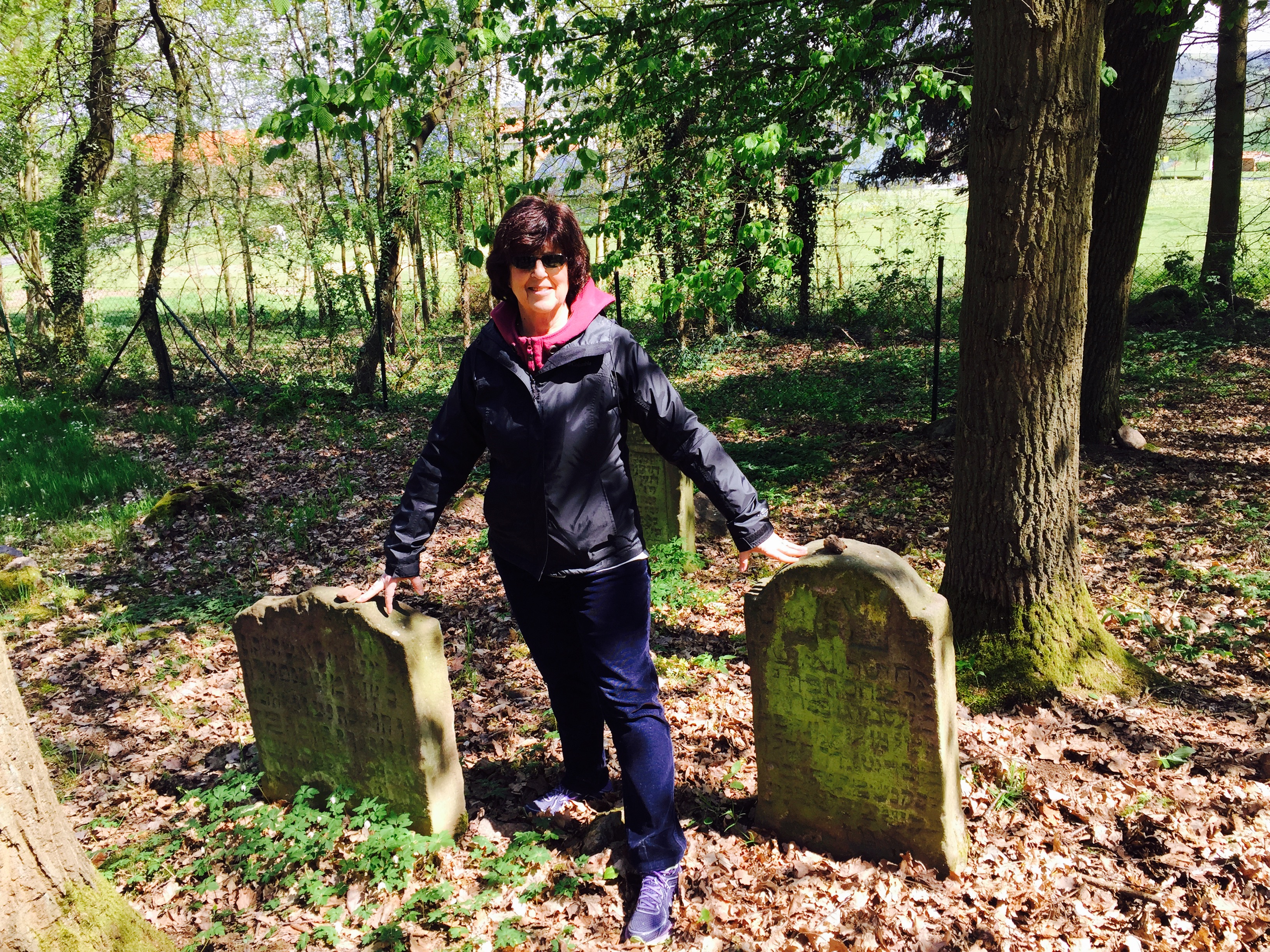
Standing at the graves of my 3x-great-grandparents, Scholum Katzenstein and Breine Blumenfeld in Haarhausen cemetery

I understand that not everyone will feel as I do. And it’s not my intention to change anyone’s mind.  I just want to explain my feelings to those who have asked and will continue to ask me with that skeptical look, “Why would you go to Germany?” Because we can.  Because the Nazis did not win.  Because we have every right to claim our rich heritage and our long history in that country. And because many people who live there want us to do just that.

Annlis Schäfer Seligmann 1924-2017

We have returned from our trip to Germany, and I have many things to share about the experience.  It was a trip filled with many joyous moments as well as many sad and heartbreaking moments.  One of the greatest joys and definitely the saddest moment involved Annlis Seligmann, mother of my dear cousin Wolfgang.

Annlis and Wolfgang

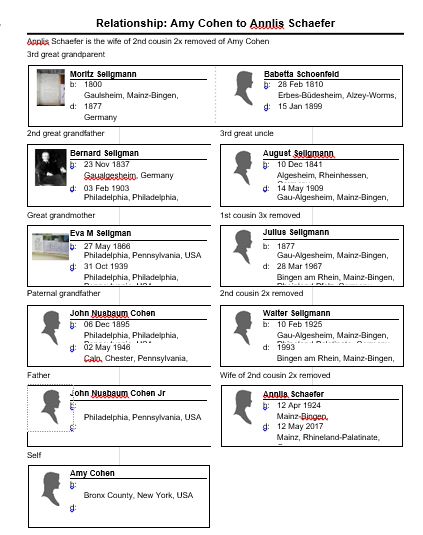
When Wolfgang found my blog almost two and half years ago, it was the result of a family research project he was sharing with his mother.  Annlis was not born a Seligmann; she was born Annlis Schäfer on April 12, 1924.  But in 1965 she married Wolfgang’s father Walter Seligmann, who died in 1993, and she was fascinated with the history of his family.  When the Seligmann family discovered the “magic suitcase” that had belonged to Walter’s brother Herbert, Annlis and Wolfgang began to search through the documents to learn more about the Seligmann family history.  Because Wolfgang could not read the old German script, Annlis had to decipher many of the old records and documents for him.

At some point in this process, Wolfgang discovered my blog, and together the three of us—Annlis, Wolfgang, and I—all worked together to find many of the missing pieces of the Seligmann family.  We were able to figure out how many of the people named in those documents were related to us all.  Without their help, I would not have found many of the Seligmanns who died in the Holocaust or who, like my cousins Lotte Wiener Furst and Fred Michel, were able to escape Germany before it was too late.

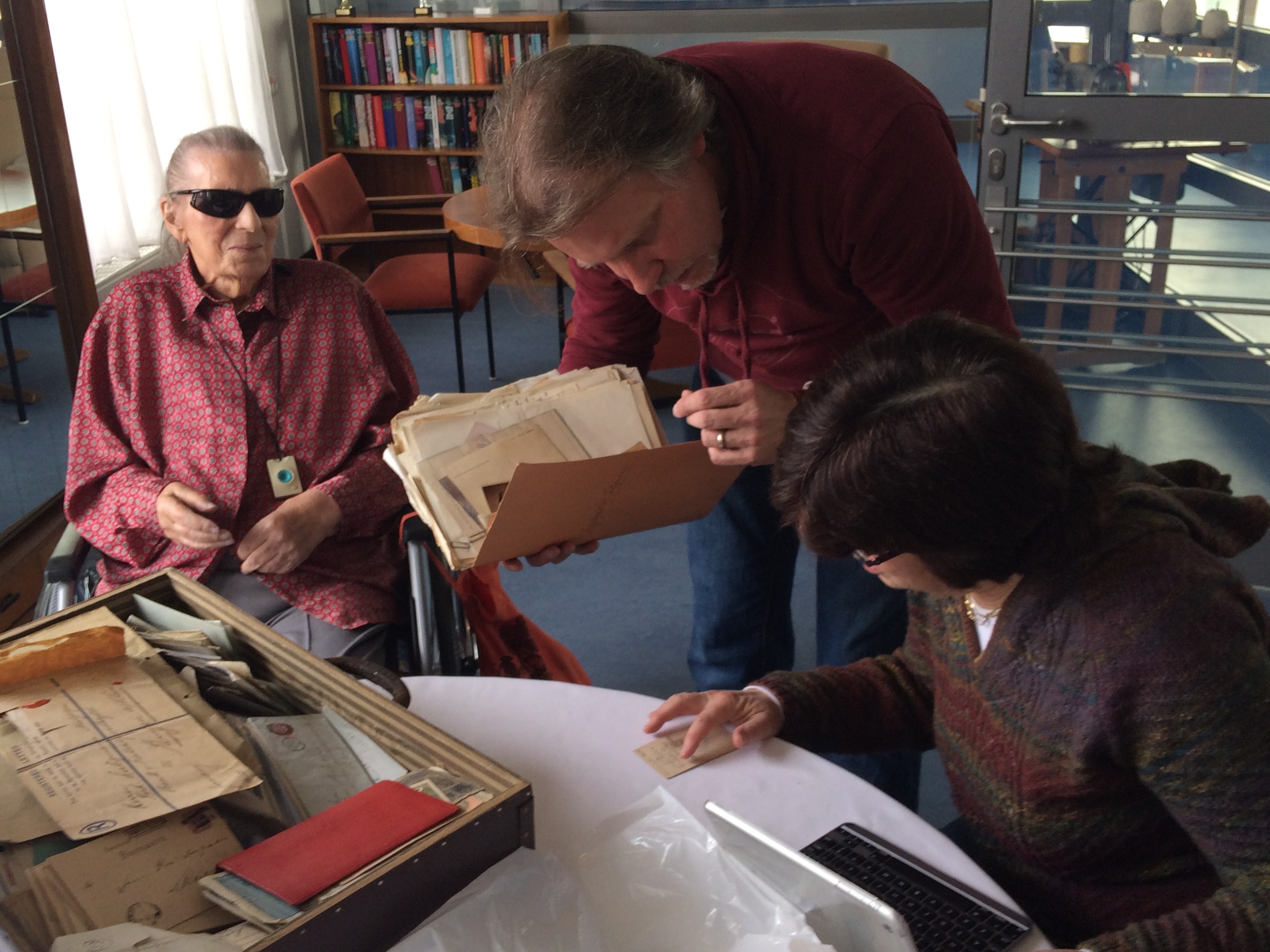
So when I was planning my trip to Germany, one of my priorities was to meet not only Wolfgang, his wife Bärbel, and daughter Milena, but also his mother Annlis.  We arrived in Germany on May 2, and the first thing we were scheduled to do on May 3 was meet Annlis.  We went with Wolfgang to the senior residence where she was living in Mainz (like an assisted living facility in the US) first thing that morning. Annlis did not speak English, so I was able to test my baby German.  With Wolfgang’s help, we were able to communicate.

She and Wolfgang showed me some family photographs, and I shared with her photographs of my parents, children, and grandchildren.  We looked through the magic suitcase together (there are still hundreds of letters and postcards still to be translated). Despite the language obstacles, I felt a strong connection to Annlis and was sad to say goodbye when our visit ended.

Annlis had been in declining health in recent months.  Her vision had become so poor that she could no longer read and help translate the documents, but she remained very interested in the family history and, according to Wolfgang, had been very anxious to meet me.  After our visit, she expressed to Wolfgang how happy she had been to meet me.  I was so touched and, of course, felt the same way.

So you can imagine my shock when less than ten days later while still in Germany, I received a message from Wolfgang telling me that his mother had died.  I was stunned and so sad.  And heartbroken for Wolfgang and his family.

Annlis lived a long and full life.  From Wolfgang I know that she grew up in Mainz where she also lived for the last five years of her life.  During World War II, she was working in Bingen.  In September, 1944, she witnessed the murder of an American soldier, Odis Lee Apple, whose plane had been shot down and crashed nearby.  As described here by Wolfgang himself on the website for the radio station where he works, the caretaker for the building where Annlis worked notified the people in the office that an American soldier was walking on the street outside the building.

Annlis and three of her co-workers left the building and followed Apple, whom she described as a man with a friendly face.  Then suddenly the building’s caretaker rushed out onto the street in his SA uniform and shot Apple.  He did not die right away, but was suffering terribly from the gunshot wound.  At some point someone else shot him, and he died.

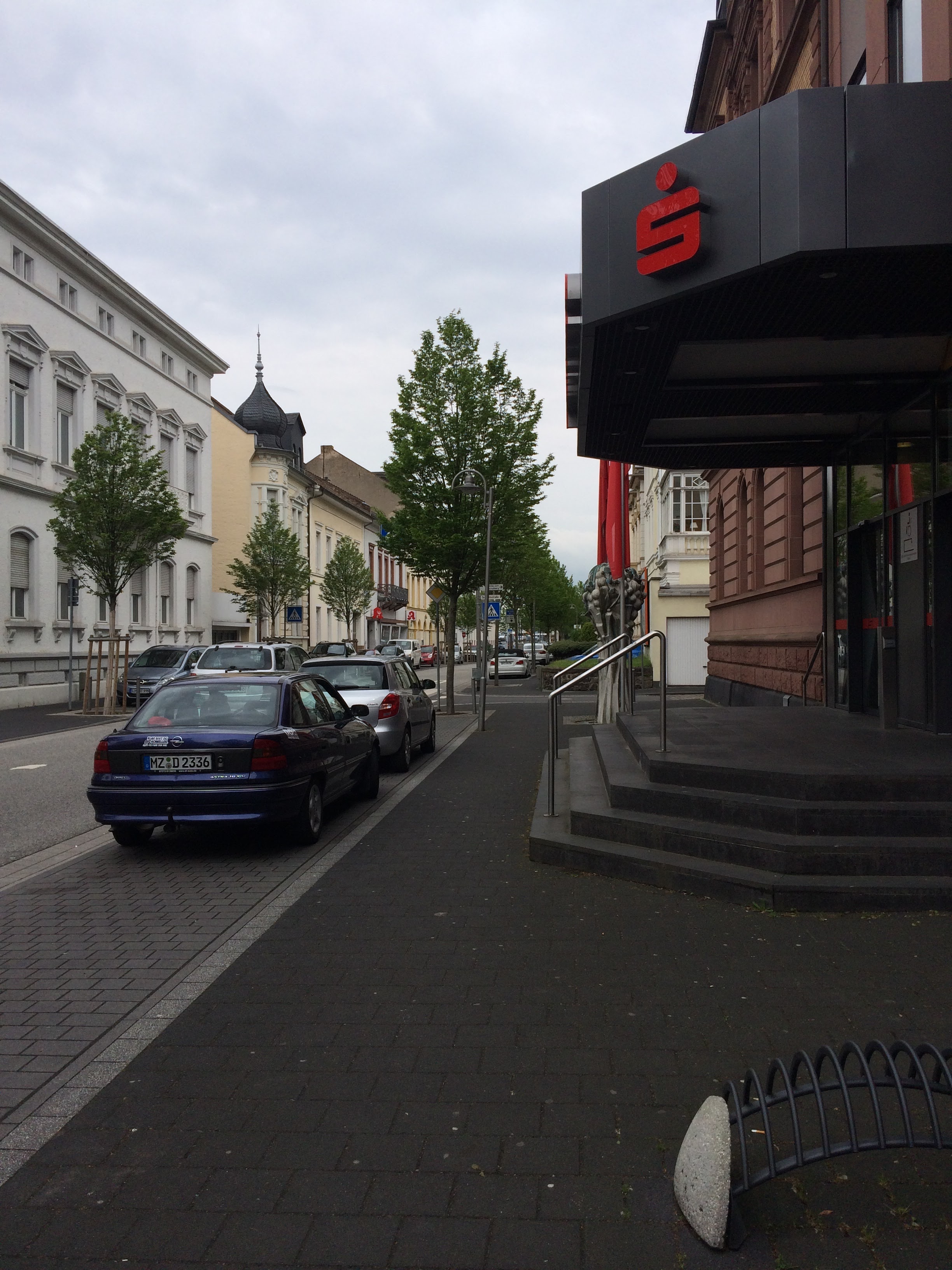
Street in Bingen where Annlis worked and witnessed the murder of Odis Lee Apple

After the war, the US Army investigated Apple’s death; Annlis provided testimony, and several people were sentenced to prison.  The caretaker, however, had died not long after the shooting during a bombing attack on Bingen.

According to Wolfgang, his mother never forgot this incident and was horrified by what she had witnessed. Even though at that point the US was at war against Germany, Annlis knew it was wrong to kill someone in cold blood like that.

Tribute to Odis Lee Apple at the spot where he was shot

It was not until twenty years after the war that Annlis married Walter Seligmann in 1965.  Together they raised their son Wolfgang in a neighborhood outside of Mainz in an apartment overlooking the valley.  She lived in that apartment until five years before her death when she moved to the building where I met with her on May 3.

Annlis Seligmann lived a good and long life; she had just turned 93 a month before her death.  I feel so privileged and fortunate that I was able to be a part of her life in the last two years and especially that I was able to meet her in person, share some time with her, and give her a hug.  My heart goes out to Wolfgang, Bärbel, Milena, and the entire extended family.  May her memory be a blessing.