Dusschen Blumenfeld Strauss, Part II: Escaping from Germany

I know it’s been a while since my last genealogy post. Between the death of my cat Smokey and all the chaos involved with moving, I’ve had neither the time nor the inclination. But now I am dipping my toe back in genealogical waters.

As seen in my last Blumenfeld post, three of the seven children of Dusschen Blumenfeld and Isaac Strauss left Germany in the late 19th, early 20th century for the United States. Moritz, the oldest son, left in 1889 and married there and had two children. Bertha, the oldest daughter, married in New York in 1901 and had her first child there, but returned to Germany by 1909 when her second child was born. And Meier, the third son and fifth child of Dusschen and Isaac, immigrated to the US in 1904 and remained, marrying and having two children born in the US.

During that same period, most of Dusschen and Isaac’s children who were still in Germany also married and had children. But unfortunately, the youngest child of Dusschen and Isaac, their son Sali (spelled Sally on this gravestone), died at a young age. He was only twenty years old when he died on February 12, 1906.

Hermann, the second son and fourth child, married Julie (Julchen) Alexander in Wetter on June 22, 1906. Julchen was born to Abraham Alexander and Roschen Rosenblatt on May 30, 1881, in Waltersbruck, Germany.

Marriage record of Hermann Strauss and Julchen Alexander,Hessisches Hauptstaatsarchiv; Wiesbaden, Deutschland; Bestand: 915; Laufende Nummer: 9573, Year: 1906, Ancestry.com. Hesse, Germany, Marriages, 1849-1930

Hermann and Julchen had three children. Sally (later Robert) was born in Wetter on July 3, 1907.1 He was presumably named for Hermann’s brother Sally who had died the year before. A second child Max was born to Hermann and Julchen on May 28, 1910, in Wetter.2 And their daughter Ilse was born in Marburg on February 3, 1915.3

Dusschen and Isaac’s sixth child Rebekah married Albert Meyer on May 14, 1907, in Bonn, Germany. Albert was born in Bonn on July 18, 1872.4 Rebekah and Albert had two children: Rudolph Raphael, born in Bonn on March 17, 1908,5 and Ilse, born in Bonn on August 20, 1910.6

Thus, by 1915, Dusschen and Isaac had nine grandchildren with two more to be born between 1916 and 1920. Four of those grandchildren were in the US with their parents, and the others were all in Germany.

Sadly, Isaac Strauss did not live to see the births of those last two grandchildren. He died on October 2, 1916, in Wetter.7 He was survived by his wife Dusschen Blumenfeld Strauss, who died twelve years later on October 11, 1928. They were survived by six of their seven children, four of whom were still living in Germany when Hitler came to power in 1933.

Dusschen Blumenfeld Strauss death record, Hessisches Hauptstaatsarchiv; Wiesbaden, Deutschland; Personenstandsregister Sterberegister; Bestand: 9652; Laufende Nummer: 915
Year Range: 1928, Ancestry.com. Hesse, Germany, Deaths, 1851-1958

Fortunately, three of those remaining in Germany were lucky to leave in time to escape being killed in the Holocaust. Hermann, the only surviving brother who was still in Germany, arrived in the US on November 28, 1934, with his wife Julchen and daughter Ilse. Their younger son Max had preceded them by nine months, immigrating to the US on February 5, 1934.8

Hermann Strauss ship manifest, Year: 1934; Arrival: New York, New York, USA; Microfilm Serial: T715, 1897-1957; Line: 11; Page Number: 83,Ship or Roll Number: Manhattan, Ancestry.com. New York, U.S., Arriving Passenger and Crew Lists (including Castle Garden and Ellis Island), 1820-1957

Their older son Sally had immigrated years before, arriving on October 28, 1926, when he was nineteen. When he filed a Declaration of Intention to become a US citizen on October 19, 1927, he was using the name Sol, working as a salesman, and living in New York City.9 He became a naturalized citizen in 1933 in Rockford, Illinois, and changed his name to Robert Sally Strauss.

Robert Sally Strauss naturalization record, National Archives at Chicago; Chicago, Illinois; ARC Title: Petitions for Naturalization for the United States District and Circuit Courts, Northern District of Illinois and Immigration and Naturalization Service District 9, 1840-1950; NAI Number: M1285; Record Group Title: Records of the Immigration and Naturalization Service; Record Group Number: RG 85  Description: Index to Naturalization Petitions, S-352 H· to S-362 Vyncenz, Ancestry.com. Illinois, U.S., Federal Naturalization Records, 1856-1991

Hermann’s sister Bertha Strauss Herz, who had previously lived and married in New York, returned to the US with her husband Morris (Moritz on the manifest) Herz on August 16, 1936. Their daughter Henrietta arrived on the same ship with her husband Alfred Gaertner and their eleven-year-old daughter Ingeborg. Both Alfred and Morris listed their occupations as tailors on the ship manifest. Alfred, who was born in Brohl, Germany, on August 9, 1895, had married Henrietta in Bonn on July 29, 1923, and their daughter Ingeborg was born on February 22, 1925.10

Herz and Gaetner families, ship manifest, Year: 1936; Arrival: New York, New York, USA; Microfilm Serial: T715, 1897-1957; Line: 10; Page Number: 47, Ship or Roll Number: Britannic
Ancestry.com. New York, U.S., Arriving Passenger and Crew Lists (including Castle Garden and Ellis Island), 1820-1957

Bertha and Morris Herz’s son Manfred Edgar Herz did not immigrate until July 28, 1939. On the ship manifest he listed his occupation as auto mechanic and his last residence as Frankfurt.11

Rebekka Strauss Meyer was the last sibling to come to the US, arriving on March 25, 1938.12 She had lost her husband Albert on May 26, 1928, in Bonn. Rebekka’s children had arrived before her, Rudolph on April 12, 1937, listing his occupation as an insurance agent,13 and Ilse on May 9, 1937. Ilse was working as a nursemaid in New York when she filed her declaration of intention on August 4, 1937.14

Only one sibling remained in Germany as of 1939, the third child of Dusschen Blumenfeld and Isaac Strauss, their daughter Kathinka, who had never married. She died on November 8, 1940, in the Krankenhaus Judische Kultusvereinigung (the Jewish Religious Association Hospital) in Frankfurt from a bile duct obstruction and jaundice. She was 65 years old. Kathinka was survived by her five surviving siblings and their children.

Kathinka Strauss death record, Hessisches Hauptstaatsarchiv; Wiesbaden, Deutschland; Personenstandsregister Sterberegister; Signatur: 11114; Laufende Nummer: 903, Year Range: 1940, Ancestry.com. Hesse, Germany, Deaths, 1851-1958

All five of those siblings and all the grandchildren of Dusschen Blumenfeld and Isaac Strauss were safely out of Germany by that time and survived the Holocaust. More on their lives in the US in the next two posts.


  1. Sol Strauss, Declaration of Intention, he National Archives at Philadelphia; Philadelphia, Pennsylvania; NAI Title: Declarations of Intention for Citizenship, 1/19/1842 – 10/29/1959; NAI Number: 4713410; Record Group Title: Records of District Courts of the United States, 1685-2009; Record Group Number: 21, Description
    Description: (Roll 379) Declarations of Intention for Citizenship, 1842-1959 (No 248601-249750), Ancestry.com. New York, U.S., State and Federal Naturalization Records, 1794-1943 ↩
  2. Max Strauss, Gender: Male, Race: White, Marital Status: Single, Marriage Age: 28
    Birth Date: 28 May 1910, Birth Place: Walter Germany, Marriage Affidavit Date: 2 May 1939, Marriage Date: 7 May 1939, Marriage Place: New York, Manhattan, New York, New York, USA, Residence Street Address: 4520 Broadway, Residence Place: New York, Manhattan, Occupation: Route Salesman, Father: Hermann Strauss, Mother:
    Julie Strauss, Spouse: Betty Heinemann, Certificate Number: 5322, Current Marriage Number: 0, New York City Department of Records & Information Services; New York City, New York; New York City Marriage Licenses; Borough: Manhattan; Year: 1939, Ancestry.com. New York, New York, Index to Marriage Licenses, 1908-1910, 1938-1940 ↩
  3. Ilse Strauss, [Ilse Strauss Wurzburger], Gender: Female, Race: White, Birth Date: 3 Feb 1915, Birth Place: Federal Republic of Germany, Death Date: 23 Feb 2006, Father: Herman Strauss, Mother: Julia Alexander, SSN: 059077009, Ancestry.com. U.S., Social Security Applications and Claims Index, 1936-2007 ↩
  4. Rebecka Meyer, Declaration of Intention, The National Archives at Philadelphia; Philadelphia, Pennsylvania; NAI Title: Declarations of Intention for Citizenship, 1/19/1842 – 10/29/1959; NAI Number: 4713410; Record Group Title: Records of District Courts of the United States, 1685-2009; Record Group Number: 21, Ancestry.com. New York, U.S., State and Federal Naturalization Records, 1794-1943 ↩
  5. Rudolph Raphael Meyer, Record Type: Naturalization, Birth Date: 17 Mar 1908
    Birth Place: Bonn, Prussia, Germany, Arrival Date: 12 Apr 1937, Arrival Place: New York NY, Naturalization Place: Tennessee, USA, Spouse: Ruth Cohn Meyer, National Archives and Records Administration; Washington, D.c.; Record Group Title: Records of District Courts of the United States; Record Group Number: 21, Ancestry.com. Tennessee, U.S., Naturalization Records, 1888-1992 ↩
  6. Ilse Meyer, Record Type: Petition, Birth Date: 20 Aug 1910, Birth Place: Germany
    Arrival Date: 1937, Residence Place: New York, USA, Petition Date: 4 Aug 1937, Petition Place: New York, USA, Court: District Court, Court District: Southern District, New York, Description: (Roll 1449) Petition No. 433501 – Petition No. 433836, The National Archives and Records Administration; Washington, D.C.; Petitions for Naturalization from the U.S. District Court for the Southern District of New York, 1897-1944; Series: M1972; Roll: 1449, Ancestry.com. New York, U.S., Naturalization Records, 1882-1944; Rebecka Meyer, Declaration of Intention, The National Archives at Philadelphia; Philadelphia, Pennsylvania; NAI Title: Declarations of Intention for Citizenship, 1/19/1842 – 10/29/1959; NAI Number: 4713410; Record Group Title: Records of District Courts of the United States, 1685-2009; Record Group Number: 21, Ancestry.com. New York, U.S., State and Federal Naturalization Records, 1794-1943 ↩
  7.  Hessisches Hauptstaatsarchiv; Wiesbaden, Deutschland; Personenstandsregister Sterberegister; Bestand: 9640; Laufende Nummer: 915, Ancestry.com. Hesse, Germany, Deaths, 1851-1958 ↩
  8. Max Strauss ship manifest, Year: 1934; Arrival: New York, New York, USA; Microfilm Serial: T715, 1897-1957; Line: 3; Page Number: 120, Ancestry.com. New York, U.S., Arriving Passenger and Crew Lists (including Castle Garden and Ellis Island), 1820-1957 ↩
  9. See Note 1, supra. ↩
  10. Alfred Gaertner, Declaration of Intention, The National Archives at Philadelphia; Philadelphia, Pennsylvania; NAI Title: Declarations of Intention for Citizenship, 1/19/1842 – 10/29/1959; NAI Number: 4713410; Record Group Title: Records of District Courts of the United States, 1685-2009; Record Group Number: 21, Description: (Roll 514) Declarations of Intention for Citizenship, 1842-1959 (No 392101-393200), Ancestry.com. New York, U.S., State and Federal Naturalization Records, 1794-1943 ↩
  11. Manfred Herz, ship manifest, Year: 1939; Arrival: New York, New York, USA; Microfilm Serial: T715, 1897-1957; Line: 19; Page Number: 37, Description Ship or Roll Number: New York, Ancestry.com. New York, U.S., Arriving Passenger and Crew Lists (including Castle Garden and Ellis Island), 1820-1957 ↩
  12. See Note 4, supra. ↩
  13. See Note 4, supra. ↩
  14. See Note 5, supra. ↩

Moritz Werner and Family, Part II: From Comfort to Escape 1922-1945

When Max Werner II was born on September 5, 1922, in Eschwege, Germany, to Moritz Werner and Jenny Kahn, his paternal grandparents Max Werner I and Helene Katzenstein had both passed away. His father Moritz was one of the owners of the LS Brinkmann Knitwear Company, and the family was living a very comfortable life.

Max’s daughter Joyce described her father as “an indulged only child from a wealthy local family.” Her sister Judith noted that their father “was an only child, and he was a very solitary child. His main companions were the chauffeur Petach and his dog.”1

Here are some photos of Max as a child including two with the dog, two in the garden of the family’s home in Eschwege, and one with his nurse or nanny.

Max Werner with nurse Courtesy of the family

Max Werner Courtesy of the family

Max Werner in the garden of his family home in Eschwege Courtesy of the family

Max Werner in the garden of his family home in Eschwege Courtesy of the family

Max and his dog Courtesy of the family

Max Werner c. 1934

But everything changed with the rise of the Nazis. Joyce and Judith both shared what they knew about the way life changed for their father and grandparents. Judith wrote, “Things became more and more difficult at school for my father, but he never complained to his parents. Except one day the kids from his school surrounded him with knives, and my father was seen fending them off with his leather satchel by friends of my grandparents.”

Joyce shared additional details about that incident:

Our father, a tall, strong pre-teen, was having terrible trouble at school. Not only did he face taunting and attacks from boys in the Hitler Youth, but teachers also joined in the Jew baiting. I recall that he told me on one occasion that another Jewish boy (small and reedy) had been beaten up by some classmates and the child made the mistake of telling the teacher. The teacher got out his strap and announced to the class, ‘Now I will show you how you should beat a Jew.’ Our father in general held his own well and was known to be strong and aggressive, and classmates generally steered clear of him. However, the incident Judy described was a final straw – especially as during the ensuing fray which took place on the school stairwell after class, he picked up the lead troublemaker and hurled him down a few stairs causing a broken nose. At home, he couldn’t hide the marks of the fight, confessed all and was sent that same night to Zurich to his Aunt Rosa [Werner] Wormser [sister of their grandfather Moritz Werner].

Max spent four or five years living away from his parents in Zurich. Although he was generally happy and became very close to his cousin Julius Wormser during those years, Joyce described the deeper impact these experiences had on Max:

The experience was formative for him. Although he had many good memories of his life in Zurich, he was separated from his home, parents, and his former life. I think the main lesson he learned was ‘fight back’. Sadly (in my opinion) he also learned that, in reality, ‘might is right’. I believe it was this which affected his personality. Used to getting his own way as an adored (and unexpected) child, seeing the brutality of life in Germany and the fact that bullies get what they want and the weak suffer, he made a decision there and then. It shaped him as a person who was determined and uncompromising. He was logical and intelligent, but when he was crossed or disagreed with someone, he could be very aggressive – both verbally and physically.

Meanwhile, Max’s parents Moritz and Jenny were still in Eschwege, Germany. Judith wrote that:

My grandfather was generous with everybody and was always ready to help those in need whether Jewish or not. He and my grandmother for many years helped to support and educate a young boy whose father had died and whose mother needed assistance. In the 1930s, my grandfather … was helping members of the family and others leave Germany but he himself did not believe that Nazism would survive in Germany. My grandmother, on the other hand, was ready in 1933 and packed. But they did put a lot of money into antiques and Old Master pictures. They were aware that they were not allowed to take much money but were allowed to take personal possessions.

Joyce also described the way their grandparents differed in their reactions to the rise of Hitler:

Our grandmother Jenny was alert to the danger Hitler posed from the very start. She believed his rhetoric and said that if he came to power, he would enact every threat against the Jews he had scapegoated for Germany’s ills. Our grandfather Moritz, like so many, believed such things would never happen in the ‘fatherland’ for which he had fought at great personal cost and for which his brother had given his life.  Consequently, she quietly prepared for emigration by investing in ‘movable assets’ e.g. art and antiques.

Here’s a photo of their grandmother, Jenny:

Under Hitler’s Aryanization program, Moritz was forced to sell LS Brinkmann in 1938, as I wrote about here. According to Judith, shortly before World War II started in September 1939,

The Bishop of the area came to my grandpa and told him it was time for him to leave. That it was too dangerous for him to stay. … So after that my grandfather went to the area comandante in Kassel in order to get a pass to exit the country. This person happened to be somebody who had served in the first World War under my grandfather in the cavalry. So this gentleman gave my grandfather a bit of a problem, and my grandfather, who had the use of a stick, banged it on the man’s desk and gave him a thorough dressing down. He got his pass. Then my grandparents took the chauffeur driven car up to either Hamburg or Bremen and took a ship to England.

Max soon thereafter joined his parents in England and attended school and then Leeds University, where he studied engineering. Moritz and Jenny were able to sell some of the art and antiques they took with them from Germany not only to support themselves, but to invest in a new company in England. Joyce wrote:

My grandfather – with extraordinary energy and determination in my opinion – found a couple of partners and started a new company ‘Benlows’ selling cigarette lighters. It became so successful that after the war it became a public company floated on the Stock Exchange.

Thus, Moritz, Jenny, and Max were able to escape from Nazi Germany and survive the Holocaust. But not without enduring a forced sale of their successful business, harassment and violence, displacement from their home in Eschwege, and a long separation of Max from his parents. As Joyce wrote, this had a lasting impact on Max and presumably also on Moritz and Jenny.

In the next post, Joyce and Judith will share the story of what happened to the family after World War II ended in 1945.


  1. Again as in the last post, the quotes, photos, stories, and information from Joyce and Judith came from a series of emails we all exchanged during May and June, 2022.  I am so grateful for all their help and generosity. ↩

Finding Max Blumenfeld and His Family: A Postscript

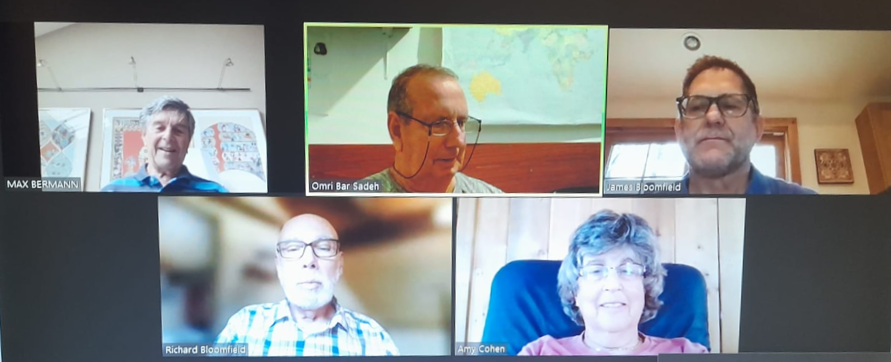
Yesterday I Zoomed with four of my Blumenfeld cousins—Richard, whose been my research partner for quite a while now, his first cousin Jim, who is also a wonderful genealogy researcher, and the two surviving grandchildren of Max Blumenfeld, Max and Omri. We spanned three continents—Omri in Israel, Richard in Switzerland, and Max, Jim, and I in New England. We chatted for an hour, but could have gone on much longer and hope to continue the conversation another time.

During our conversation, we uncovered the answer to a question we still had been unable to answer despite all our research: when did Anna Grunwald Blumenfeld, Max Blumenfeld’s widow and Omri and Max’s grandmother, leave Italy and immigrate to Israel/Palestine? The records that Richard had obtained from Merano said she’d left in 1939, but Max had pointed out that that wasn’t possible since he and his sister were cared for by their grandmother Anna during World War II while their mother Edith worked with the Italian Resistance. Their father Josef had immigrated to the United States on November 1939.

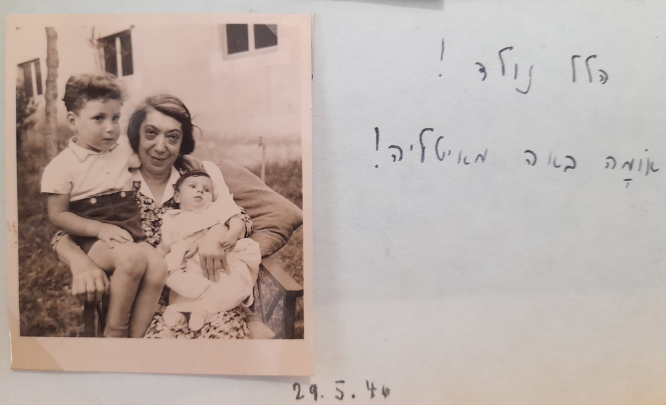
For our Zoom, Omri had prepared a wonderful slide show of family photographs, some of which I’ve already shared on this blog, and some that were new to me. Among those photographs was one that helped to answer the question of when Anna arrived in Palestine. The photograph shows Anna in Palestine with two of her grandsons, Omri’s brothers Gideon and Hillel. Anna was holding Hillel, who was just a very small baby, and the photo was inscribed in Hebrew with the words, “Hillel is born! Oma [Anna] arrives! 29 May 1946.” So now we knew that Anna had only recently arrived in Palestine in May of 1946.

Here is another photo taken the same day showing Anna with Gideon and Hillel and their parents Fritz and Dora.

But then how do we explain the records that said Anna had left Merano in 1939? Well, Max had the answer to that question. Max explained that Anna and her daughter Edith and the two grandchildren, Max and his sister Margherita, all left Merano in 1939 and moved to Milan. Max has no memories of life in Merano since he was only a toddler when the family moved. But that would explain why the Merano records report that Anna left that place in 1939.

Max and his family stayed in Milan for several years, and then when Italy adopted laws persecuting the Jews in about 1942, his mother Edith was able to use her connections to obtain permission to leave Milan and move to the countryside outside of Milan.  The family remained there for the duration of the war, hiding the fact that they were Jews. They spoke Italian (although they all could also speak German) so that they could pass as Italian, and Max and his sister went to church on Sundays. In fact, Max and Margherita were not aware of the fact that they were Jewish and also didn’t know that their father was still alive—all to prevent the children from accidentally revealing the fact that they were Jews.

After the war, Edith took her children to America so they could all be reunited with Josef, and Anna went to Palestine to be with her son Fritz and his family, as depicted in the photograph above.

We spoke of many other interesting things during our Zoom, and there were many stories and many moments of laughter interspersed. It was truly a delightful hour and one I will always cherish and remember.

Thank you to Omri, Max, Richard, and Jim—all of whom are my fifth cousins, four people I never would have known if not for doing genealogy research.

And that, dear readers, is the magic of genealogy.

The Search for Max Blumenfeld, Part II: Finding His Daughter Edith

There were several questions that remained unanswered even after Richard and I learned that Max Blumenfeld had died in Merano, Italy, on May 8, 1936. What happened to his wife Anna Grunwald Blumenfeld after he died? Did Max and Anna have any children other than their son Fritz? And are there living descendants of Max and Anna? With continued research, Richard and I, along with additional help from David Lesser from Tracing the Tribe, were able to find some answers to these questions.

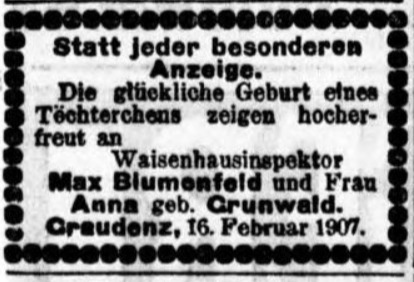
First, Richard saw on MyHeritage that Max and Anna did have another child, a daughter Edith. According to that page, Edith was born on February 16, 1907, in Graudenz, Germany. There was even a birth announcement attached to her profile on this MyHeritage page. 

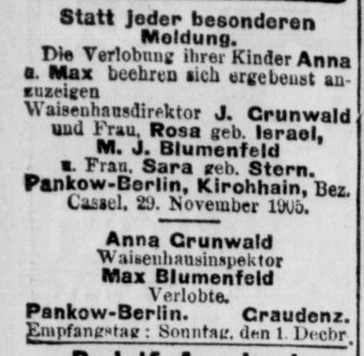
That tree on MyHeritage also had an announcement for Max and Anna’s engagement in 1905.1

Now that we knew there was a daughter born to Max and Anna, I started to look for information about Edith. Although I could not locate a birth record, based on the dates given on MyHeritage and the birth announcement, I was able to narrow down the search. I also knew from the MyHeritage profile that Edith was reportedly married to a doctor named Joseph Berman and had two children.

With that information to get my research started, I soon located numerous documents that appeared to be related to Edith Blumenfeld, daughter of Max and Anna. Putting together what I’d found in chronological order, Edith at 22 sailed from Hamburg to Antwerp on August 9, 1929. I assume that this was a pleasure trip, not an immigration move.

Edith Blumenfeld, 1929 passenger manifest, Staatsarchiv Hamburg; Hamburg, Deutschland; Hamburger Passagierlisten; Volume: 373-7 I, VIII A 1 Band 370; Page: 1843; Microfilm No.: K_1977, Month: Band 370 (Aug 1929 – Sep 1929), Staatsarchiv Hamburg. Hamburg Passenger Lists, 1850-1934

According to the England & Wales, Civil Registration Marriage Index, 1916-2005 index on Ancestry, Edith married Giuseppe Bermann in the first quarter of 1935 in England. Richard, however, found a wedding announcement in the February 13, 1935 issue of the Alpenzeitung that indicates that they married on February 3, 1935, in Berlin. We are not sure whether there were two weddings or whether there is some other explanation for the inconsistency.2

Edith next turned up as Edith Bermann on a ship manifest sailing with her two children from Naples, Italy, to New York, arriving on February 20, 1946. She reported her last residence had been Naples, Italy. How did I know this was the right Edith? Because she named her brother Fritz Blumenfeld living in “En Charod, Palestine” as the person she left behind and her husband Joseph Bermann as the person she was going to in New York, where he was residing at 752 West End Avenue. In addition, she was 39 years old in 1946, meaning she was born in about 1907, and her birth place was given as “Grundzias” in Poland. Since Graudenz was located in a region that was given to Poland after the war, these additional facts convinced me that this was Edith Blumenfeld.

Edith Berman and children, 1946 ship manifest, Year: 1946; Arrival: New York, New York, USA; Microfilm Serial: T715, 1897-1957; Line: 1; Page Number: 34, Ship or Roll Number: Gripsholm, Ancestry.com. New York, U.S., Arriving Passenger and Crew Lists (including Castle Garden and Ellis Island), 1820-1957

The manifest form asked for the name and address of the “nearest relative or friend in country whence alien came, or if none there, then in country of which alien is a citizen or subject.” The fact that Edith gave the name of her brother Fritz who was living in Palestine at that time raised a few questions for me. If Edith was last living in Milan, Italy, why would she name a relative living in Palestine?

Second page of manifest seen above.

To me that suggested that her mother Anna was no longer living in Italy or Edith would have named her, given that Edith’s last residence was Italy. Whether or not Anna was deceased or living elsewhere is not known. Secondly, Edith listed her nationality as Italian on the manifest, not as a “citizen or subject of Palestine,” yet she listed Fritz in Palestine, who was neither in the place she last lived or in the place where she was a citizen. Did the authorities simply allow her to list Fritz because he was the only relative or friend she could name even though he was not in Italy? I don’t know.

Since Joseph apparently had arrived in New York before his wife Edith and their two children, I looked and located a ship manifest for his immigration to the US. I found him on a manifest for a ship sailing from Genoa, Italy, to New York, arriving on November 17, 1939, five and a half years before Edith and the children arrived and a month and a half after World War II started. He sailed as Giuseppe Bermann and gave his birthplace and last residence as Merano, Italy, and his occupation as “medical.” Interestingly, his passport had been issued in September, 1939, from Jerusalem. Although I searched both the Israel State Archives and the IGRA website, I could not find any record establishing that Joseph or Edith ever was in Palestine before 1946.

Giuseppe Bermann, ship manifest, Year: 1939; Arrival: New York, New York, USA; Microfilm Serial: T715, 1897-1957; Line: 1; Page Number: 63, Ship or Roll Number: Saturnia, Ancestry.com. New York, U.S., Arriving Passenger and Crew Lists (including Castle Garden and Ellis Island), 1820-1957

Joseph settled in New York City, and in 1940 he filed a Declaration of Intention to become a US citizen, listing his family back in Italy and noting that they were now living in Milan. From this document I also learned that Joseph and Edith were married in London, England, on January 31, 1935, as also confirmed by the entry in the England & Wales, Civil Registration Marriage Index, 1916-2005 on Ancestry.3 I wonder when they arrived and for how long they lived in England.

Joseph Bermann, Declaration of Intention, he National Archives at Philadelphia; Philadelphia, Pennsylvania; NAI Title: Declarations of Intention for Citizenship, 1/19/1842 – 10/29/1959; NAI Number: 4713410; Record Group Title: Records of District Courts of the United States, 1685-2009; Record Group Number: 21, Description: (Roll 579) Declarations of Intention for Citizenship, 1842-1959 (No 453801-454600), Ancestry.com. New York, U.S., State and Federal Naturalization Records, 1794-1943

In 1942, Joseph registered for the World War II draft. He was living at 121 West 77th Street and practicing medicine. He listed his mother Caroline Ullmann Bermann as his contact person.

Joseph Bermann, World War II draft registration, National Archives at St. Louis; St. Louis, Missouri; WWII Draft Registration Cards for New York City, 10/16/1940 – 03/31/1947; Record Group: Records of the Selective Service System, 147, Ancestry.com. U.S., World War II Draft Cards Young Men, 1940-1947

And then finally in February, 1946, he was reunited with his family. Joseph had left Edith and two very young children in Italy in November, 1939, probably assuming they would be able to follow him in the reasonably foreseeable future. Instead, the war intervened, and they were separated for five and a half years. Joseph missed all those years when his children were young, and Edith had to raise them alone for all that time. It must have been a joyous reunion when Edith and the children finally arrived in February, 1946.

Of course, there were more questions. How did Edith and the children stay safe during the war? Italy was after all an ally of Germany in World War II. The US Holocaust Museum has this information on its website about the fate of Jews in Italy during World War II.

Despite its alliance with Germany, the Fascist regime responded equivocally to German demands first to concentrate and then to deport Jews residing in Italian occupation zones in Yugoslavia, Greece, and France to killing centers in the German-occupied Poland. Italian military authorities generally refused to participate in mass murder of Jews or to permit deportations from Italy or Italian-occupied territory; and the Fascist leadership was both unable and unwilling to force the issue.

Italian-occupied areas were therefore relatively safe for Jews. Between 1941 and 1943, thousands of Jews escaped from German-occupied territory to the Italian-occupied zones of France, Greece, and Yugoslavia. The Italian authorities even evacuated some 4,000 Jewish refugees to the Italian mainland. Incarcerated in southern Italy, these Jewish refugees survived the war.

But that situation changed for the worse after there was a vote of no-confidence in Mussolini after many military defeats in North Africa, and the Italian king, Victor Emmanuel III, removed Mussolini as prime minister and named Pietro Badoglio to replace him. Badoglio negotiated a secret surrender to the Allies on September 8, 1943. At that point Germany took action.

The Germans, who had grown suspicious of Italian intentions, quickly occupied northern and central Italy. ….The German occupation of Italy radically altered the situation for the remaining 43,000 Italian Jews living in the northern half of the country. The Germans quickly established an SS and police apparatus, in part to deport the Italian Jews to Auschwitz-Birkenau.

In October and November 1943, German authorities rounded up Jews in Rome, Milan, Genoa, Florence, Trieste, and other major cities in northern Italy. ….In general, these operations had limited success, due in part to advance warning given to the Jews by Italian authorities and the Vatican, and in part to the unwillingness of many non-Jewish Italians…to participate in or facilitate the roundups.

Germany ended up deporting almost 9000 Jews to the concentration camps, and over a thousand survived. All in all, 40,000 Jews in Italy survived the Holocaust. Was Anna Grunwald Blumenfeld one of them? I still didn’t know.

But her two children survived, Fritz in Palestine, which soon became Israel, and Edith in the US. More on them and their children in my next post. And the answers to my questions about Anna.

Stay tuned.


  1. That announcement confused me since it says Anna’s parents were J. Grunwald and Rosa Israel, and I had from her birth record that their names were Isidor Grunwald and Nanny Braun. But Richard found a passage in Inge Lassel’s book about the Jewish orphanage in Pankow, Berlin, that explained the discrepancy; it revealed that Isidor’s first wife Nanny had died in 1903 and that he had then married Rosa Israel. Inge Lammel, Das Jüdische Waisenhaus in Pankow (2001), p. 24. ↩
  2.  General Register Office; United Kingdom; Volume: 1a; Page: 861, Ancestry.com. England & Wales, Civil Registration Marriage Index, 1916-2005. ↩
  3. Giuseppe Bermann, Registration Date: Jan 1935, Registration Quarter: Jan-Feb-Mar, Registration District: Westminster, Inferred County: Middlesex, Spouse: Edith N Blumenfeld, Volume Number: 1a, Page Number: 861, General Register Office; United Kingdom; Volume: 1a; Page: 861, Ancestry.com. England & Wales, Civil Registration Marriage Index, 1916-2005 ↩

The Search for Max Blumenfeld: It Took A Village, Part I

The search for what happened to Max Blumenfeld, son of Moses IIB, was not an easy one. It was a lesson in persistence and in the value of working with other researchers. My cousin Richard Bloomfield contributed a great deal to the research of the life of Max Blumenfeld as did David Lesser, my new research friend from Tracing the Tribe.

Finding Max’s birth and marriage records was easy. As I’ve already written, he was born in Kirchhain on June 13, 1880, and married Johanna Grunwald in Berlin on March 16, 1906.

But finding out what happened next was not as easy. Did they have children? Did Max and Johanna survive the Holocaust? Neither was listed in Yad Vashem, so I felt hopeful that they did. But I couldn’t find them anywhere else either. There were no records in the Arolsen Archives. There were no US immigration records or other records placing them in the US. There were no Palestinian immigration records for them either. Where else could they have gone? Did they die before the Nazi era? If so, I couldn’t find any German death records.

When I looked at other trees on Ancestry and at Geni and MyHeritage, there were similar holes in the information for Max and Johanna—-there was nothing after their marriage in 1906. I only found one tree that had more information, and fortunately for me, it was the tree of my fifth cousin and fellow researcher Richard Bloomfield. According to Richard’s tree, Max had emigrated to Italy in 1933 and died there, Johanna had died in Israel sometime after 1947, and they had a son named Fritz who died in about 1977 in Israel.

I contacted Richard to ask where he’d gotten the information, and he said he’d gotten the information from someone else’s tree. So he and I began to see if we could verify any of that information.

Richard noted that on Max’s marriage record his occupation was given as “Waisenhausinspektor” or orphanage inspector and that he was living in Graudenz at the time of his marriage. But since Max and Johanna were married in Berlin, Richard had a hunch that Max had become the Waisenhausdirektor for the Jewish orphanage in Berlin and decided to search old Berlin directories. He found Max listed as the Waisenhausdirektor in those directories for a number of years, including 1934, 1935, and 1936. Thus, we knew that Max had not immigrated to Italy in 1933, but was still in Berlin at least until the 1936 directory was compiled.1

Max Blumenfeld, Title: Amtliches Fernsprechbuch für Berlin und Umgegend, 1936, Ancestry.com. German Phone Directories, 1915-1981

On a very recent trip to Berlin, Richard took and shared these photos of the building where the Judische Waisenhaus once stood.

Judische Waisenhause building in Berlin. Photo courtesy of Richard Bloomfield

Photo courtesy of Richard Bloomfield

Richard and I then started to see if we could find any evidence of Fritz Blumenfeld, the supposed son of Max and Johanna. Richard located a record on the IGRA website that indicated that a Fritz Blumenfeld, son of Max, born in 1910,was registered as a voter in Palestine in 1939 and living in En Harod.

Found at the Israel Genealogy Research Association website at https://genealogy.org.il/AID/index.php

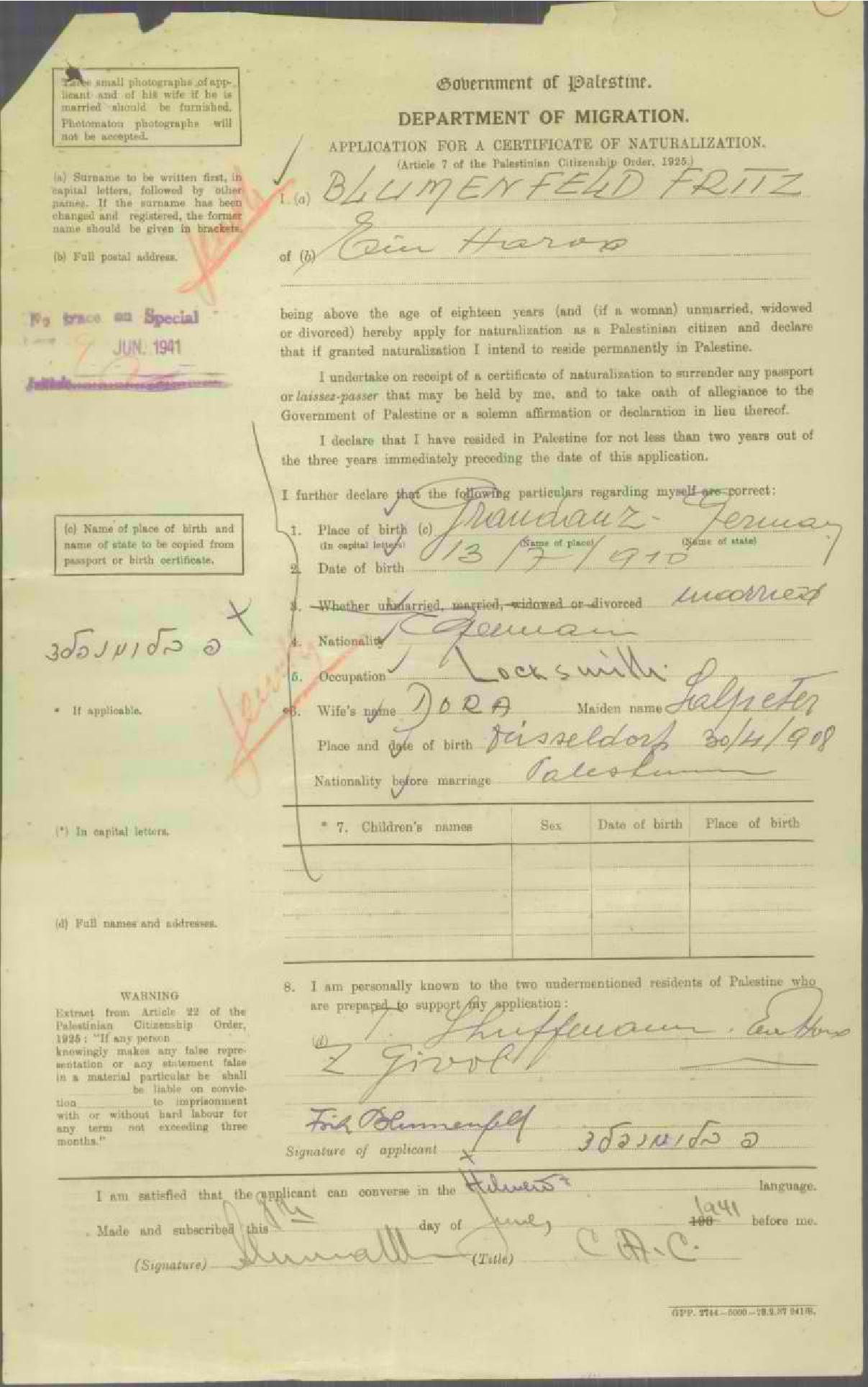
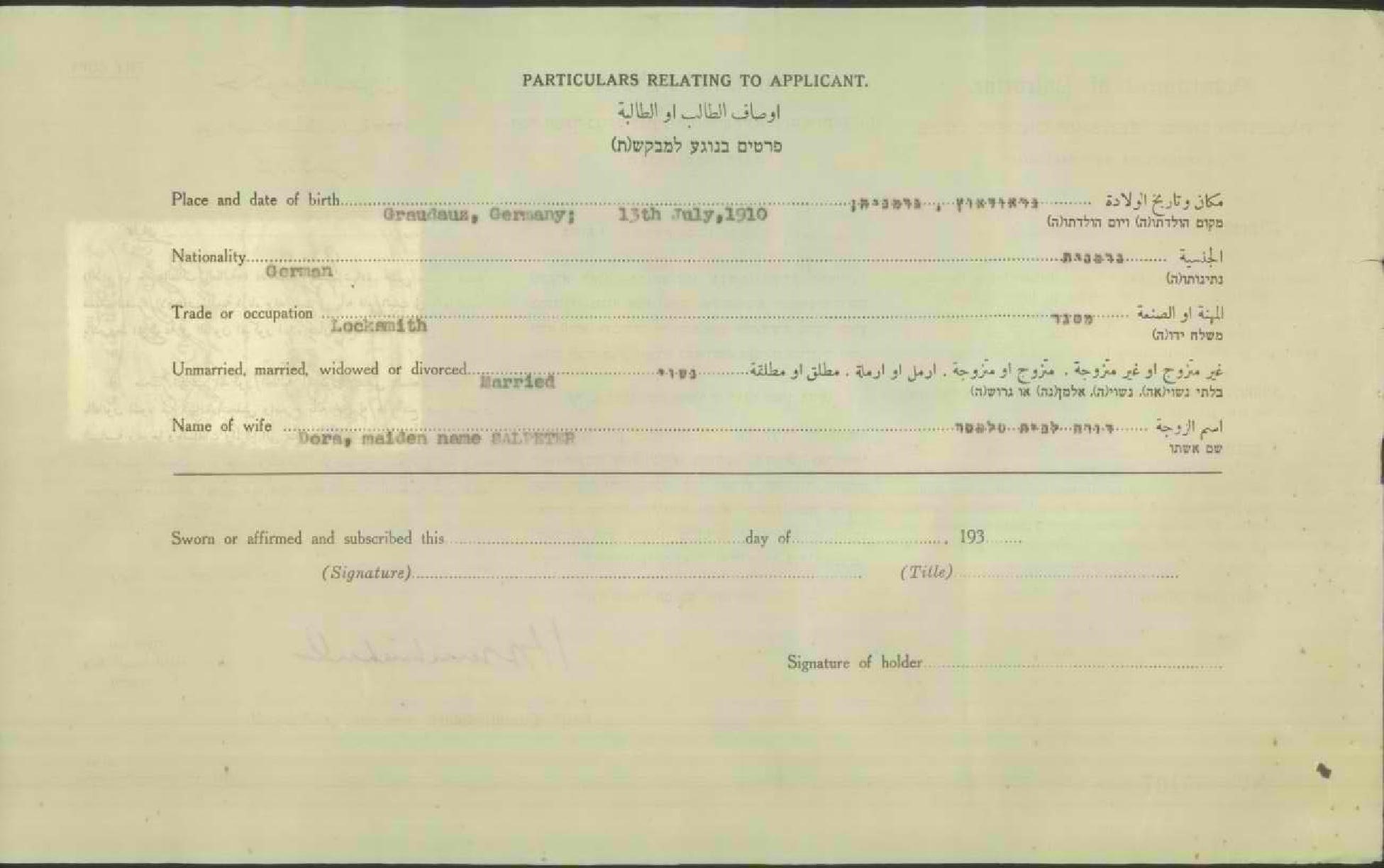
Then I located a Fritz Blumenfeld who had Palestine immigration papers at the Israel Archives website. Fritz was born in Graudenz, Germany, on July 13, 1910, the same town where Max had been living when he married Johanna in 1906. He was married to Dora Salpeter and working as a locksmith. He had first entered Palestine on June 28, 1937.

Fritz Blumenfeld and Dora Salpeter immigration file found at Israel State Archives at https://www.archives.gov.il/en/

Richard found directories for Graudenz that listed Max as a teacher there in 1905, as a teacher and orphanage inspector in 1907, and as the Waisenhausinspektor there in 1909, 1911, and 1913. Thus, Max and Johanna were living in Graudenz when Fritz Blumenfeld was born. This certainly seemed to be their son.2

And then I found the record that definitely tied Fritz to Max and Johanna. Returning to the IGRA website, I located Fritz Blumenfeld’s marriage record. Fritz married Devorah on August 15, 1940, in Israel, and his marriage record indicated that he was a locksmith, which was consistent with his Palestinian citizenship application. On those Palestinian immigration papers, I learned that Devorah’s name was originally Dora Salpeter.

Most importantly, Fritz’s parents were listed as Max and Hanna, confirming for me that this was the son of Max Blumenfeld and (Jo)hanna Grunwald. Since it appears that Johanna was better known as Hanna or Anna, I will use the name Anna to refer to her going forward.

That marriage record gave me two other critical pieces of information. It said the groom’s parents lived in Italy—although it took help from Tracing the Tribe for me to learn that the Hebrew I was reading as Atelah was in fact Italia in Hebrew. The marriage record also indicated that Anna was at home, but Max was deceased. Thus, we now knew that Max had died sometime before Fritz married on August 15, 1940, and presumably had died in Italy.

Fritz Blumenfeld marriage record, found at the Israel Genealogy Research Association website at https://genealogy.org.il/AID/

I didn’t think we would get any further than that since I had no idea how to research deaths in Italy. But once again Richard came to the rescue. He found two more sources. One was a German book, Das Jüdische Waisenhaus in Pankow (2001) by Inge Lammel, about the Jewish orphanage in Berlin where Max had been the Waisenhausdirektor. Lammel’s book included this passage, as translated by Richard:3

When Isidor Grunwald [Johanna’s father] died in February 1925, his son-in-law, Max Blumenfeld, took over the directorship of the house. Martin Davidsohn [long-time teacher at the Second Jewish Orphanage] says that he brought a more liberal spirit into the educational process, democratic structures, such as an opportunity to utter grievances and a trainees’ adjudicatory council elected by secret ballot, which gave the trainees more self-confidence.

Richard paraphrased the information about Isidor Grunwald that he found in the book:4

Max’s father-in-law had been an officer in the army and carried the army’s manner of doing things over into his work at the orphanage. He patrolled the large dormitory hall carrying his ring of large keys to enforce discipline. He had the boys line up each night in front of his apartment in the house according to height, shook their hands and wished them good night. In addition to physical education, he had the boys do drills led by a drill sergeant and sometimes accompanied by flute and drum music

Here is a photo from the book showing Max standing with some of the children and staff at the orphanage in about 1933; he is the man in the dark suit in the foreground.

From Inge Lammel, Das Jüdische Waisenhaus in Pankow, 2001

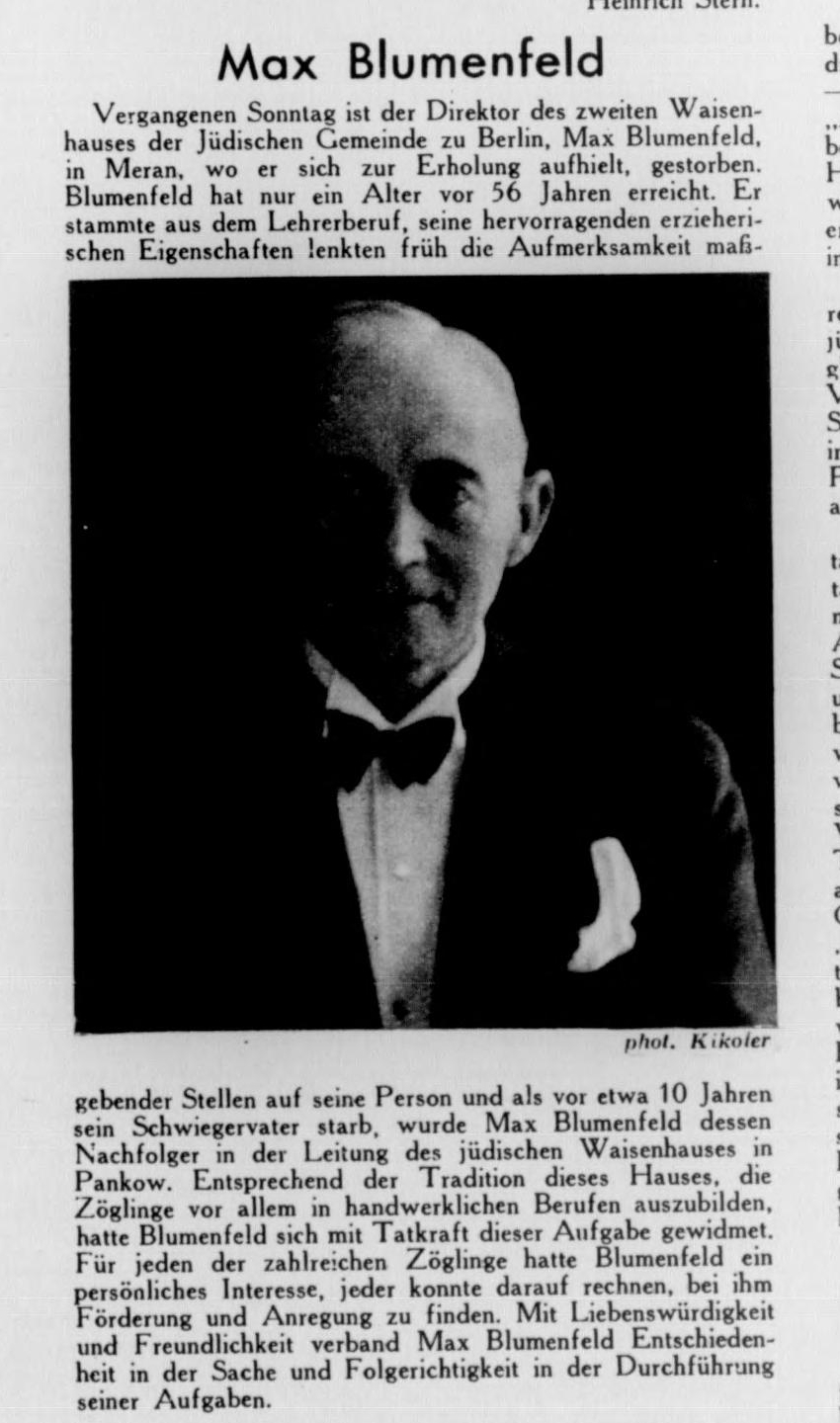
In addition to obtaining a copy of this book, Richard also located Max’s obituary, which not only provided us with the date and place of Max’s death (March 8, 1936, in Merano, Italy), but also more information about his life:

“Max Blumenfeld,” Gemeindeblatt der Jüdischen Gemeinde zu Berlin, March 15, 1936, page 7

Richard translated the obituary as follows:5

Last Sunday the director of the Second Orphanage of the Jewish Congregation in Berlin, Max Blumenfeld, died in Merano [Italy] where he was taking time for rest and recreation. Blumenfeld died young at the age of 56. He was originally a teacher whose excellent teaching abilities drew the attention of leading personalities, and when his father-in-law [Isidor Grunwald] died about ten years ago, Max Blumenfeld became his successor as director of the Jewish Orphanage in Pankow. Blumenfeld dedicated himself to the traditional task of the institution of training its students as craftsmen. Blumenfeld demonstrated a personal interest in each of the youth in his care, each of them could recon with his support and encouragement. He combined with kindness and friendliness decisiveness and consistence in the execution of his task.

These two documents discovered by Richard Bloomfield have given us a much fuller picture of our cousin Max Blumenfeld. He certainly left his mark and obviously was a kind and generous person.

Unfortunately, the obituary did not include information about his survivors. Was Fritz their only child? Did Johanna stay in Italy, as their son Fritz’s 1940 marriage certificate suggests? Did she return to Berlin? Immigrate to Palestine?

Well, the story of Max Blumenfeld doesn’t end here nor does the story of the collaboration it took to find the rest of that story.

More to come.


  1. Amtliches Fernsprechbuch für Berlin und Umgebun, 1934, 1935, 1936.  Ancestry.com. The one depicted I found on Ancestry for 1935. ↩
  2. I have tried to recreate Richard’s search through the Graudenz directories. He sent me to the GenWiki website section for directories, and although I found the Graudenz directories, I still need more lessons in how to search through those directories to find Max. ↩
  3. Inge Lammel, Das Jüdische Waisenhaus in Pankow (2001), p. 50. ↩
  4. Ibid, p. 48, as paraphrased by Richard Bloomfield, attachment to email May 1, 2022. ↩
  5. “Max Blumenfeld,” Gemeindeblatt der Jüdischen Gemeinde zu Berlin, March 15, 1936, page 7. ↩

Salomon Blumenfeld: An Entire Blumenfeld Family Who Survived the Holocaust

Moses IIB’s third child Salomon Blumenfeld and his wife Malchen Levi and their three daughters all left Germany in time and avoided being killed by the Nazis and thus were much more fortunate than Salomon’s siblings, Hermann, Bertha, and Clementine, and their families.

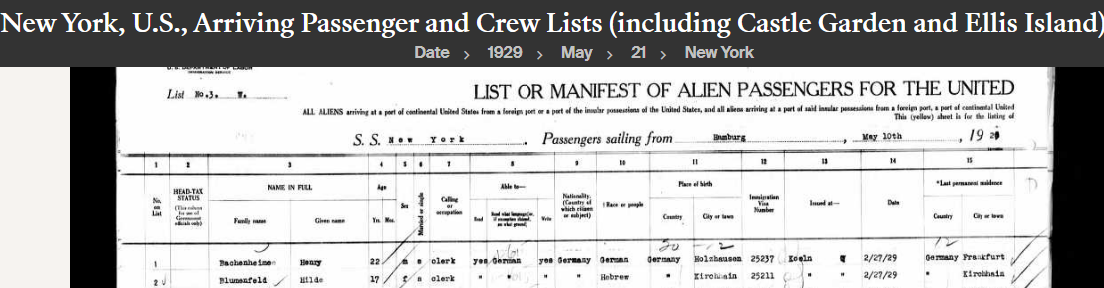
In fact, Salomon’s middle daughter Hilde left Germany even before Hitler came to power. In May 1929, when she was only seventeen, Hilde sailed from Hamburg to New York, listing an uncle, her mother’s brother Salli Levi, as the person she was going to and her occupation as a clerk.

Hilde Blumenfeld 1929 ship manifest, Year: 1929; Arrival: New York, New York, USA; Microfilm Serial: T715, 1897-1957; Line: 2; Page Number: 42, Ancestry.com. New York, U.S., Arriving Passenger and Crew Lists (including Castle Garden and Ellis Island), 1820-1957

When she filed a declaration of intention to become a US citizen on June 2, 1931, she was living in New York City and listed her occupation as a German-English stenographer.

HIlde Blumenfeld Declaration of Intention, The National Archives at Philadelphia; Philadelphia, Pennsylvania; NAI Title: Declarations of Intention for Citizenship, 1/19/1842 – 10/29/1959; NAI Number: 4713410; Record Group Title: Records of District Courts of the United States, 1685-2009; Record Group Number: 21, Ancestry.com. New York, U.S., State and Federal Naturalization Records, 1794-1943

But Hilde apparently never became a US citizen and did not remain in the US. Sometime before March 1934, she married Ludwig Felix Meinrath, and together they immigrated to Brazil. Ludwig was born in Cologne, Germany, in 1902, and immigrated with his parents Leopold and Anni and siblings to Antwerp, Belgium sometime before 1916.1 I don’t know whether they stayed in Belgium or where and when Ludwig and Hilde were married. But in 1934 they left for Brazil where they remained. They had at least one child, who was born in the 1930s.

Ludwig and Hilde Meinrath 1934 ship to Rio de Janeiro, Staatsarchiv Hamburg; Hamburg, Deutschland; Hamburger Passagierlisten; Volume: 373-7 I, VIII A 1 Band 424; Page: 385; Microfilm No.: K_2003, Staatsarchiv Hamburg. Hamburg Passenger Lists, 1850-1934

Hilde’s parents Salomon and Amalie/Malchen followed her to Brazil several years later. They arrived on March 29, 1939. Salomon listed his occupation as “comerciante” or merchant.

Salomon Blumenfeld, Digital GS Number: 004909061, Ancestry.com. Rio de Janeiro, Brazil, Immigration Cards, 1900-1965

Amalie Blumenfeld, Digital GS Number: 004913595, Ancestry.com. Rio de Janeiro, Brazil, Immigration Cards, 1900-1965

Meanwhile, Hilde’s older sister Gretel had married David Katz on January 24, 1930, in Kirchhain; David was the son of Mendel Katz and Jettchen Levi and was born in Nenterhausen, Germany, on February 11, 1897.

Marriage record of Gretel Blumenfeld and David Katz, Hessisches Hauptstaatsarchiv; Wiesbaden, Deutschland; Bestand: 915; Laufende Nummer: 5058, Year Range: 1930, Ancestry.com. Hesse, Germany, Marriages, 1849-1930

This remarkable photograph, which had a long caption labeling all those in it, was found on several Ancestry trees as well as on Geni. It was taken at Gretel and David’s wedding and shows many members of the two families. Of particular interest to my research, the middle row shows Salomon Blumenfeld on the far left next to David’s mother Jettchen, then the bride Gretel and groom David, then Gretel’s mother Amalie and at far right David’s father Mendel. In the bottom row, Salomon and Amalie’s daughter Jenny is seated second from the left, and Lilli Abraham, Salomon’s niece, is seated fourth from the left.2

Wedding of Gretel Blumenfeld and David Katz Source: Unknown

Gretel and David had one child born in 1931. They all immigrated to the US on August 18, 1939. David listed his occupation as teacher.

Katz family, ship manifest, Year: 1939; Arrival: New York, New York, USA; Microfilm Serial: T715, 1897-1957; Line: 1; Page Number: 19, Ship or Roll Number: Hamburg, Ancestry.com. New York, U.S., Arriving Passenger and Crew Lists (including Castle Garden and Ellis Island), 1820-1957

In 1940 they were living in New York City with several lodgers, and David was working as a schoolteacher.3

In August 1946, Gretel’s parents Salomon and Amalie sailed from Brazil to New York, Salomon arriving on August 14 and Amalie on August 29. Salomon’s entry on his manifest indicates that he was going to his daughter Gretel in New York and that he intended to stay permanently. It also indicated that he needed cataract surgery and had other medical issues.4 Amalie’s manifest similarly reported that she was going to Gretel, intended to stay permanently, and had a medical issue.5

Many trees report that the other daughter of Salomon and Amalie, Jenny, married Siegmund Rudolf Warburg on July 25, 1933, and that Siegmund was born in Berlin on May 26, 1896, to Otto Warburg and Bertha Cohen. But something doesn’t add up.

I found the birth record for Siegmund.

Siegmund Warburg birth record, Landesarchiv Berlin; Berlin, Deutschland; Personenstandsregister Geburtsregister; Laufendenummer: 95, Ancestry.com. Berlin, Germany, Births, 1874-1908

But I also found (after some searching because Ancestry had them indexed to the wrong image) a Siegmund Warburg with a different wife, Ilse, and two children, Gabriel and Thomas, sailing from Hamburg to New York on August 31, 1933. Was this a different Siegmund Warburg, also born in 1896 (37 years old) and having last lived in Berlin? Entirely possible.

Warburg family, ship manifest, Month: Band 417 (Aug 1933), Staatsarchiv Hamburg. Hamburg Passenger Lists, 1850-1934

Yet I cannot find any record attaching Jenny Blumenfeld to a man named Siegmund Warburg. The only references I could find (other than the unsourced trees) was a Shoah Foundation interview with Jenny’s sister Hilde that lists a “Geny Varbuk” as her sister.6 I requested access to the interview, hoping this would answer my questions, but alas, it was in Portuguese, and I can’t understand it. I am hoping I can get a transcript and translate it, but I don’t know if that exists. Also, Richard Bloomfield found Jenny’s gravestone on Billiongraves, and it has her name (in Hebrew) as Jenny Warburg.

Jenny Warburg, Yekhi’am cemetery, Akko, Israel, found at Billiongraves.com at https://billiongraves.com/grave/%D7%92%D7%A0%D7%99-%D7%95%D7%A8%D7%91%D7%95%D7%A8%D7%92/22732522

But when I searched on Billiongraves at that same cemetery, I could not find anyone named Siegmund Warburg. That, of course, doesn’t mean anything since Billiongraves doesn’t include everyone, but it also doesn’t help connect Jenny to Siegmund.

Perhaps Jenny was Siegmund’s second wife, but then she didn’t marry him in July 1933. Or maybe she married someone else named Siegmund Warburg and not the one married to Ilse. I don’t know, and I am still searching for answers. Maybe someone who knows Portuguese will listen to the Shoah Foundation testimony and hear Jenny’s sister talk about Jenny’s marriage and fill me in.

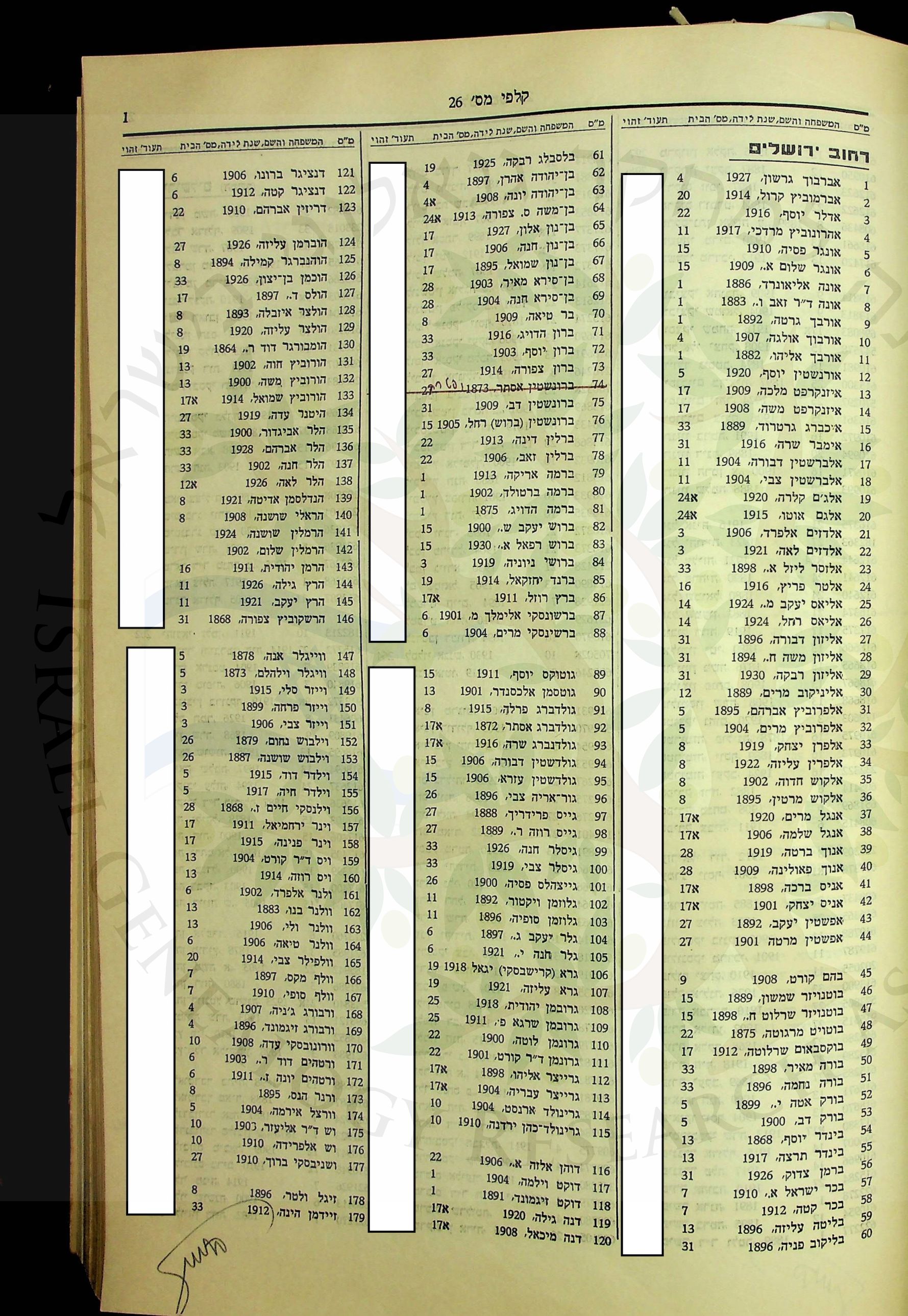
UPDATE: Thanks to Richard Bloomfield, I now have one piece of evidence that ties Jenny Blumenfeld to Siegmund Warburg. Richard found on the Israel Genealogy Research Association (IGRA) website a recently uploaded list of Haifa voters from 1950 that has Jenny Warburg and Siegmund Warburg listed together (see lines 168 and 169); we believe these are the right people because their birth years match what we have from other records. Although it isn’t truly enough to prove their relationship, it is certainly another piece in the puzzle supporting the conclusion that Jenny ended up in Israel and was married to Siegmund Warburg.

In any event, Salomon Blumenfeld’s entire family escaped Germany in time and were not killed by the Nazis, unlike Salomon’s siblings Hermann, Bertha, and Clementine.

The story of the remaining child of Moses Blumenfeld IIB, Max, was harder to uncover and will be discussed in my next series of posts.


  1. Louis Felix Meinrath, Birth Date: 1902, Birth Place: Keulen, Immigration Date: 1901-1915, Immigration Place: Antwerpen, Belgium, File Number: 119901, Page: 438
    FHL Film Number: 2234442, Ancestry.com. Belgium, Antwerp Police Immigration Index, 1840-1930 ↩
  2. The photograph may have first appeared on Geni on the profile of David Katz. I have written to the manager of that profile to ask for the photo’s source, but have not heard back. ↩
  3. Katz family, 1940 US census, Year: 1940; Census Place: New York, New York, New York; Roll: m-t0627-02675; Page: 1A; Enumeration District: 31-2085, Ancestry.com. 1940 United States Federal Census ↩
  4. “New York, New York Passenger and Crew Lists, 1909, 1925-1957,” database with images, FamilySearch (https://familysearch.org/ark:/61903/3:1:3QSQ-G94V-SWMS?cc=1923888&wc=MFK4-H6D%3A1030138201 : 2 October 2015), 7158 – vol 15390-15391, Aug 14, 1946 > image 1317 of 1489; citing NARA microfilm publication T715 (Washington, D.C.: National Archives and Records Administration, n.d.). ↩
  5. Malchen Blumenfeld, ship manifest, Year: 1946; Arrival: New York, New York, USA; Microfilm Serial: T715, 1897-1957; Line: 12; Page Number: 63, Ancestry.com. New York, U.S., Arriving Passenger and Crew Lists (including Castle Garden and Ellis Island), 1820-1957 ↩
  6. Interview with Hilde Meinrath, USC Shoah Foundation; Los Angeles, California; Visual History Archive: The Holocaust, Free Access: USC Shoah Foundation, Holocaust – Jewish Survivor Interviews ↩

Bertha Blumenfeld Fernich: Another Family Destroyed in the Holocaust

Another tragic story. There are times I can barely bring myself to write about what happened to so many of my relatives. Bertha Blumenfeld Fernich was my third cousin, twice removed.

Bertha, the second child of Moses IIB and Sara Blumenfeld, was born in 1876 and married Ludwig Fernich in 1900, as we saw. They had two daughters, Jenny, born in 1904, and Else, born in 1905. Jenny had married Julius Asser in 1926, and they had two children, Kurt and Lissy, born in 1926 and 1927, respectively.

It appears that Bertha’s husband Ludwig died sometime before January 18, 1939 since he is not included in the marginal note on their marriage record made on that date, which reported that Bertha had had Sara added to her name to identify her asJewish as required by Nazi law. My assumption is that Ludwig must have died or the note would have indicated that Israel had been added to his name. But I’ve been unable to locate an actual death record for Ludwig.

Marriage record of Bertha Blumenfeld and Ludwig Fernich, Hessisches Hauptstaatsarchiv; Wiesbaden, Deutschland; Bestand: 915; Laufende Nummer: 5028
Description
Year Range: 1900
Ancestry.com. Hesse, Germany, Marriages, 1849-1930

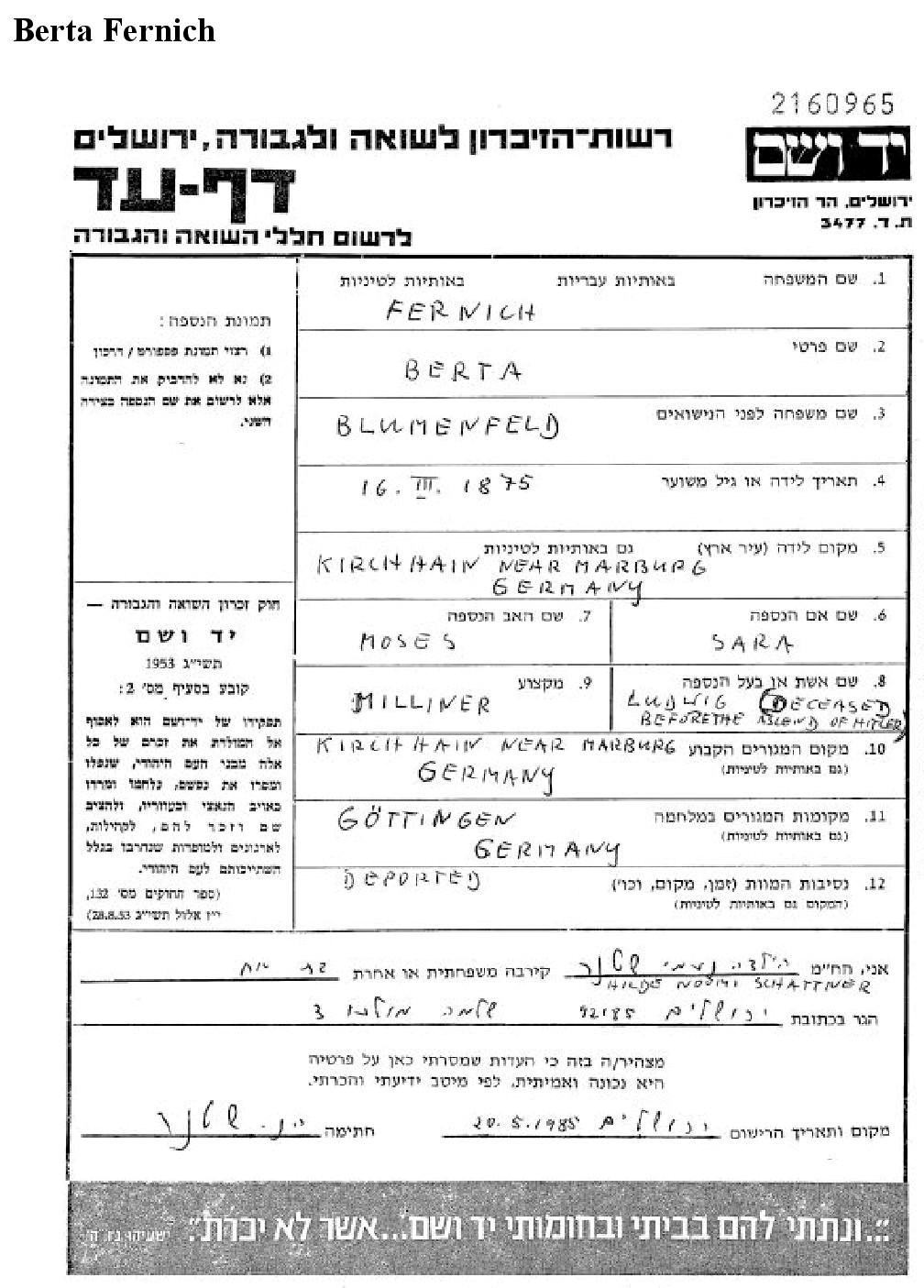
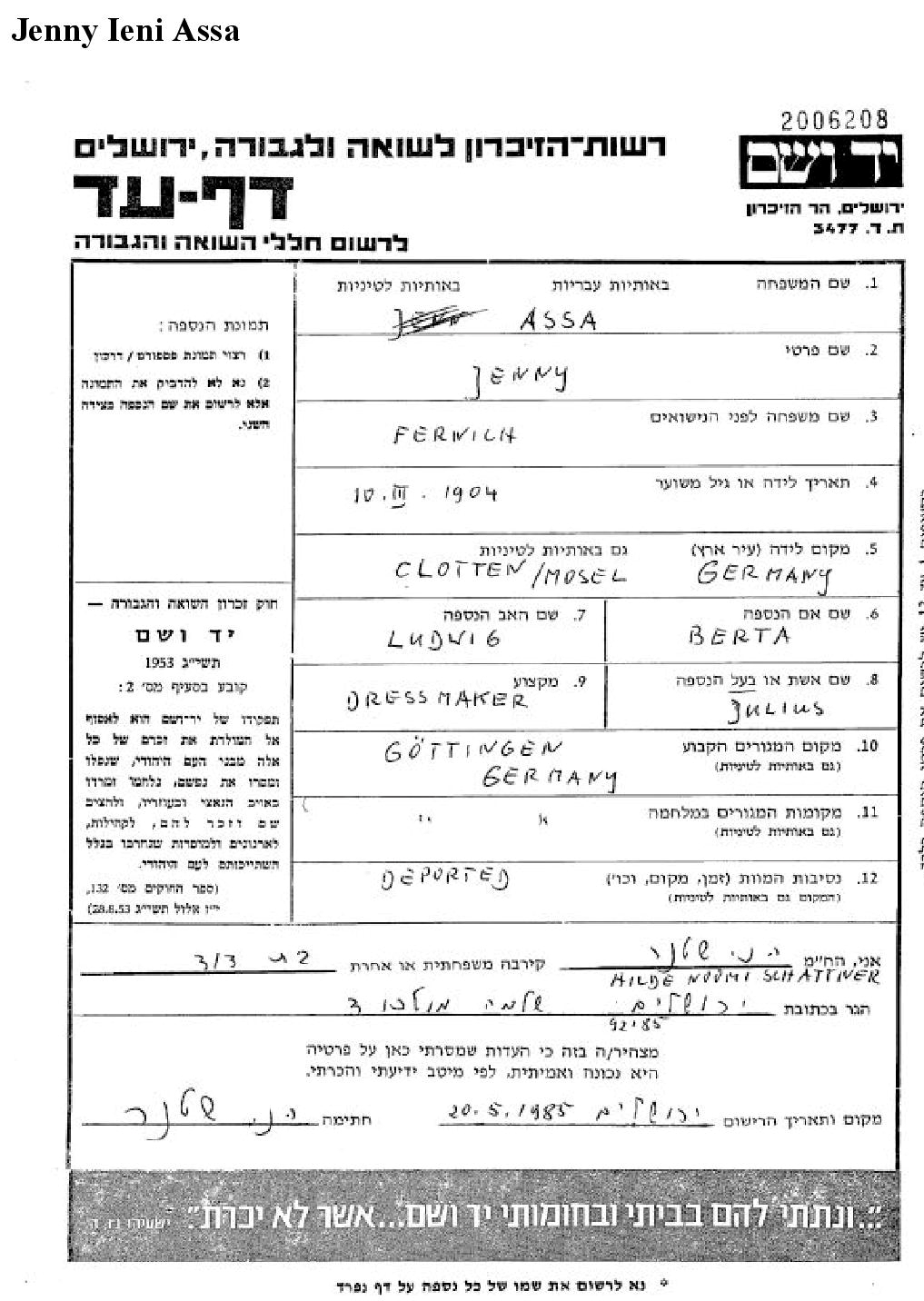
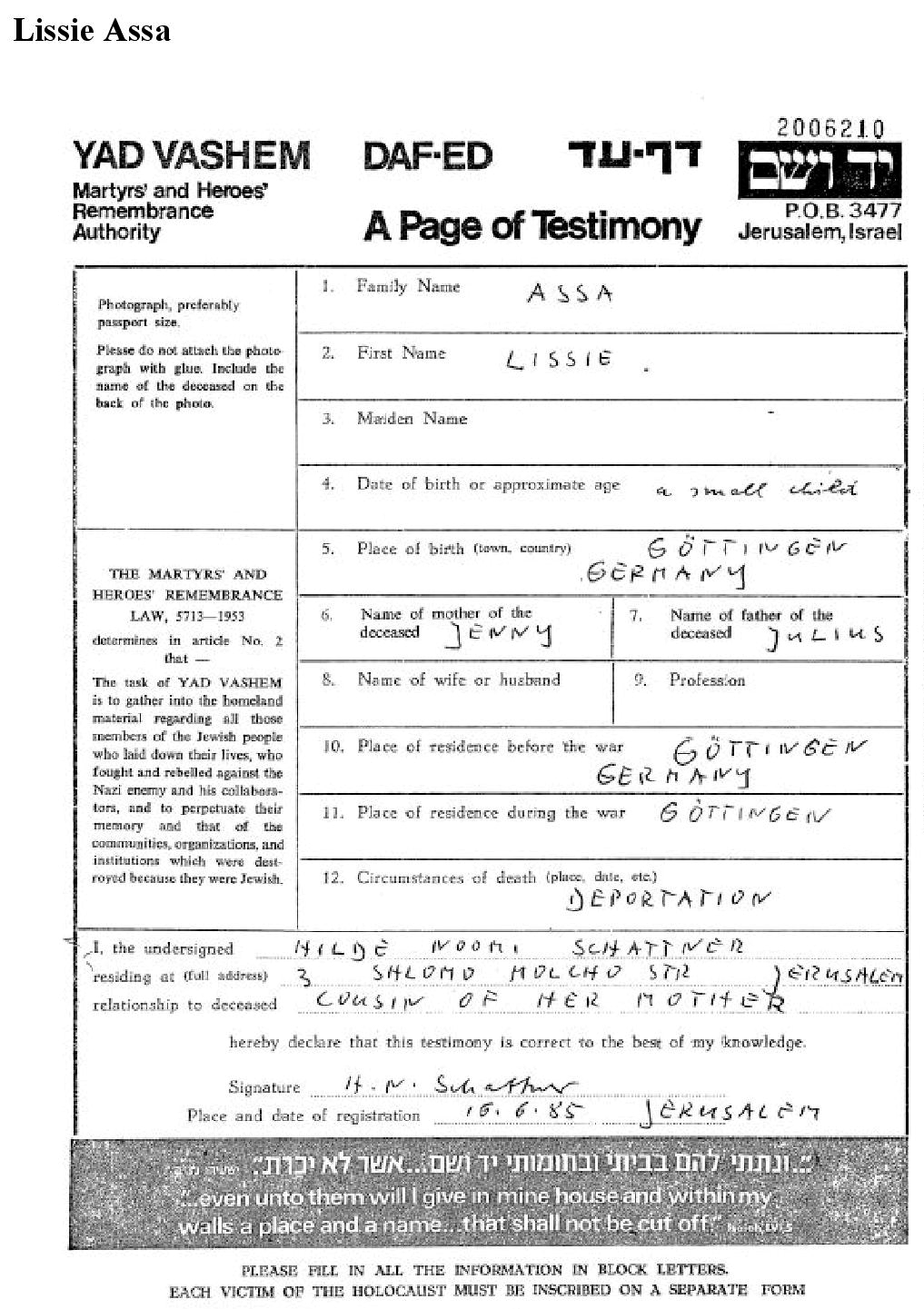
Bertha, her daughter Jenny, son-in-law Julius Asser, and grandchildren Kurt and Lissy Asser were all deported to the Warsaw Ghetto in 1942 and were killed during Holocaust. Kurt and Lissy were young teenagers. Although I cannot fathom how a human being kills another human being for no reason, I find it especially hard to imagine how anyone kills innocent children who haven’t even had a chance to live life.

Bertha Blumenfeld Fernich Page of Testimony at Yad Vashem, found at https://yvng.yadvashem.org/nameDetails.html?language=en&itemId=3579289&ind=1

Jenny Fernich Asser, Page of Testimony at Yad Vashem, found at https://yvng.yadvashem.org/nameDetails.html?language=en&itemId=1882529&ind=2

Julius Asser, Page of Testimony at Yad Vashem, found at https://yvng.yadvashem.org/nameDetails.html?language=en&itemId=1853283&ind=1

Kurt Asser Page of Testimony at Yad Vashem found at https://yvng.yadvashem.org/nameDetails.html?language=en&itemId=1853448&ind=1

Lissy Asser Page of Testimony at Yad Vashem, found at https://yvng.yadvashem.org/nameDetails.html?language=en&itemId=1797444&ind=1

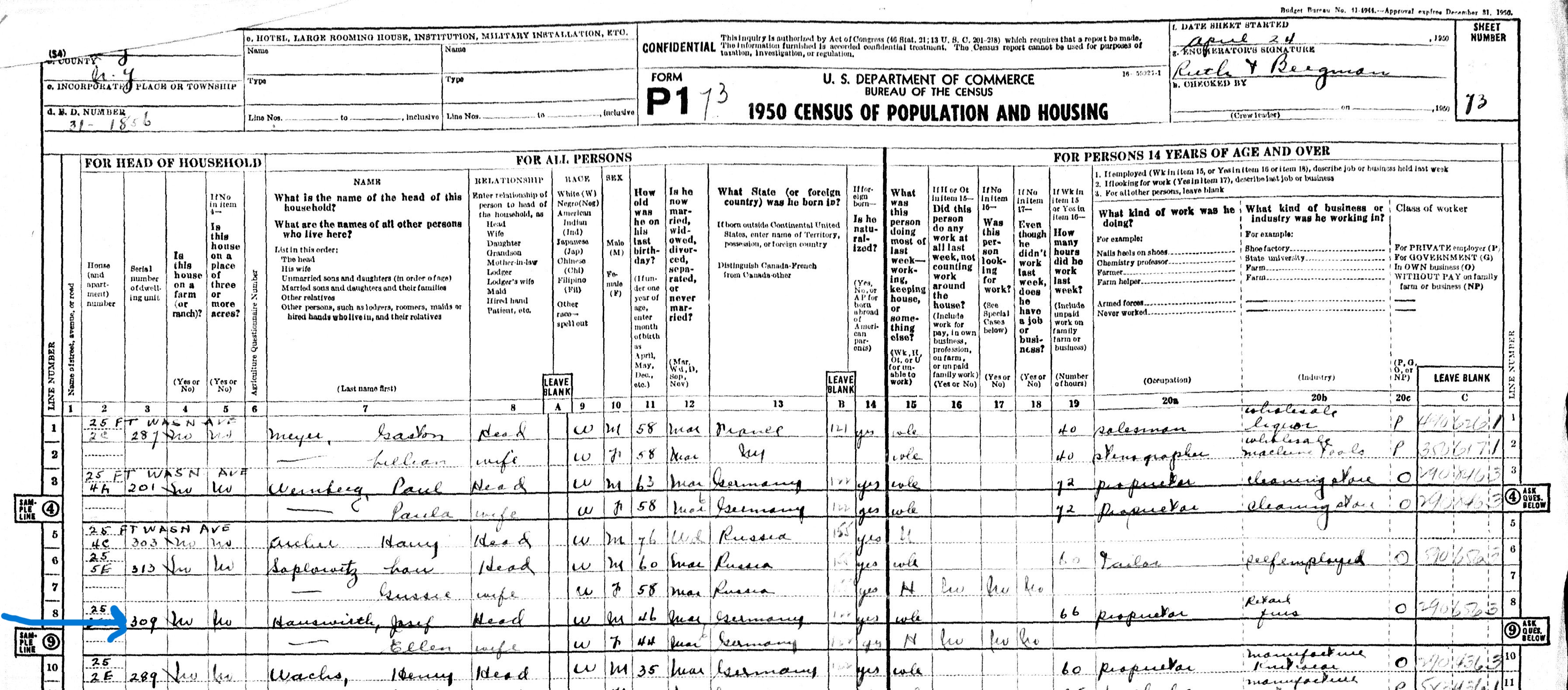
But Bertha’s younger daughter Else and her husband Josef Hauswirth did escape in time. Else had married Josef on August 19, 1932, in Dortmund, Germany, where Josef was born on January 8, 1904. They immigrated to the US on June 24, 1937, and settled in New York City,1 where in 1940 they were living at 153 West 80th Street and both were working as operators in the fur trade; Else was now using the name Ellen.2 On his World War II draft registration, Josef indicated that he was self-employed, so apparently this was their own fur business. And I was lucky to find Josef and Ellen on the 1950 census, my first real research use of the 1950 census! They were still living in New York City, and Josef was the owner of a fur business.

Josef Hauswirth, World War II draft registration, National Archives at St. Louis; St. Louis, Missouri; WWII Draft Registration Cards for New York City, 10/16/1940 – 03/31/1947; Record Group: Records of the Selective Service System, 147, Ancestry.com. U.S., World War II Draft Cards Young Men, 1940-1947

By 1958 Ellen and Josef Hauswirth were registered to vote in Los Angeles, California.3 They both died in California, Joseph on April 16, 1987,4 Ellen on March 12, 1998.5 As far as I can tell, Josef and Ellen did not have children as none was living with them in either 1940 or 1950 or when they immigrated. Did they choose not to have children because of the Holocaust? We will never know.

Thus, Bertha Blumenfeld Fernwich has no living descendants today. Most of her family was murdered by the Nazis, and her only surviving child Else/Ellen had no children.


I will be taking a much needed break from blogging next week. I will be back on May 17.


  1. Else Fernich Hauswirth Petition for Naturalization, The National Archives and Records Administration; Washington, D.C.; Petitions for Naturalization from the U.S. District Court for the Southern District of New York, 1897-1944; Series: M1972; Roll: 1440, Archive Roll Descriptions: (Roll 1440) Petition No· 430413 – Petition No· 430800,
    Ancestry.com. New York, U.S., Naturalization Records, 1882-1944 ↩
  2. Ellen and Josef Hauswirth, 1940 US Census, Year: 1940; Census Place: New York, New York, New York; Roll: m-t0627-02636; Page: 12B; Enumeration District: 31-559, Ancestry.com. 1940 United States Federal Census ↩
  3. Josef Hauswirth, Residence Date: 1958, Street Address: 6052 Willouchby Ave, Residence Place: Los Angeles, California, USA, Party Affiliation: Democrat, California State Library; Sacramento, California; Great Register of Voters, 1900-1968, Ancestry.com. California, U.S., Voter Registrations, 1900-1968 ↩
  4. Josef Hauswirth, Social Security #: 123039073, Gender: Male, Birth Date: 8 Jan 1904, Birth Place: Other Country, Death Date: 16 Apr 1987, Death Place: Los Angeles
    Mother’s Maiden Name: Kempler, Place: Los Angeles; Date: 16 Apr 1987; Social Security: 123039073, Ancestry.com. California, U.S., Death Index, 1940-1997 ↩
  5.  Ellen F. Hauswirth, Social Security Number: 119-09-1530, Birth Date: 9 Dec 1905
    Issue Year: Before 1951, Issue State: New York, Last Residence: 90048, Los Angeles, Los Angeles, California, USA, Death Date: 12 Mar 1998, Social Security Administration; Washington D.C., USA; Social Security Death Index, Master File, Ancestry.com. U.S., Social Security Death Index, 1935-2014 ↩

Does Hermann Blumenfeld Have Any Living Descendants?

Before I move on to Bertha Blumenfeld and her family, I have an update to my last post. One of my loyal readers, my dear friend Laurel, wanted to know whether either of the two children of Hermann and Helma (Lillienstein) Blumenfeld, Hilde Nomi and Hanan/Hans, had children. Were there living descendants of Hermann and Helma and their two children? My first response was I don’t know, and I’ve no idea how to find out.

But I mentioned this question to David Lesser, the Tracing the Tribe member who so generously helped me find the information about Hanan’s second marriage, and he once again offered to help. He contacted someone in Israel who provided him with some information.

Hanan did not have children, according to the research done by David’s contact. Hilde Nomi, however, did have a child with her husband Isaac Schattner. I was delighted to hear that and hope to be able to contact him.

David then went a few steps further and researched Hilde’s husband, Isaac Schattner, who was a well-known and well-regarded professor of geography at Hebrew University in Jerusalem. According to Wikipedia (as translated by Google Translate):

Yitzhak Shatner studied geography and history at the University of Vienna , received his doctorate in 1925 and worked there at the Geographical Institute. At the same time he devoted himself to Zionist activity and prepared for immigration to Eretz Israel….

In 1936 , Yitzhak Shatner immigrated to Eretz Israel. His first professional steps in the Land of Israel included part-time mapping work in the Department of Geology at the Hebrew University, as well as advising the Jewish Agency on land-settlement relations.….In 1947 he was responsible for the collection of maps and aerial photographs of the Haganah in Jerusalem, and after the establishment of the state he served in the decipherment unit of the IDF.

In 1949, Shatner joined the faculty of the Department of Geography at the Hebrew University, founded by his colleague David Amiran . The establishment of the department is considered a turning point in the development of geography as an academic discipline in Israel and the beginning of rapid change in study and research…..

During the late fifties and early sixties , Shatner taught physical geography at the Hebrew University, during which time he authored the first Hebrew textbook in geomorphology. Some see the education of generations of Israeli geomorphologists as the main scientific legacy of Yitzhak Shatner, who continued to guide students and colleagues even after his retirement in 1968 and encouraged them to follow the paths of revolutions that changed the face of geomorphology.

Isaac Schattner found athttps://he.wikipedia.org/wiki/%D7%99%D7%A6%D7%97%D7%A7_%D7%A9%D7%98%D7%A0%D7%A8

David also found several newspaper notices about Hilde and Isaac’s deaths and about the bar mitzvah of their son as well as information about some of Isaac’s family members.

Thus, I now can answer Laurel’s question, thank to the generous assistance of David Lesser. There is at least one living descendant of Hermann and Helma Blumenfeld. Thank you so much, David!


In Honor of Yom HaShoah and Yom HaAtzmaut: Hermann Blumenfeld and His Family

After Moses IIB and Sara (Stern) Blumenfeld died, Moses in 1911, Sara in 1928, they had five surviving children and eleven grandchildren.

Hermann and his wife Helma had two children: Hilde Nomi and Hans. Bertha and her husband Ludwig Fernich had two children: Jenny and Else. Salomon and his wife Malchen or known more often as Amalie had three: Gretel, Jenny, and Hilde. Clementine and her husband Richard Abraham had three: Lilli, Martin, and Walter.  Max and his wife Johanna Gruenwald had one child, a son Fritz.

Of those twenty-one family members, only about half are known to have survived the Holocaust. In addition, some of the great-grandchildren of Moses IIB and Sara were also killed in the Holocaust. This post will tell the story of Hermann Blumenfeld, the oldest child of Moses IIB and Sara. It is an appropriate post for today, just a day after Yom HaShoah, Holocaust Remembrance Day, and just six days before Yom HaAtzmaut, Israel Independence Day, because although Hermann and his wife Helma were murdered in the Holocaust, their two children survived by escaping to what was then Palestine, but what became the independent state of Israel in 1948.

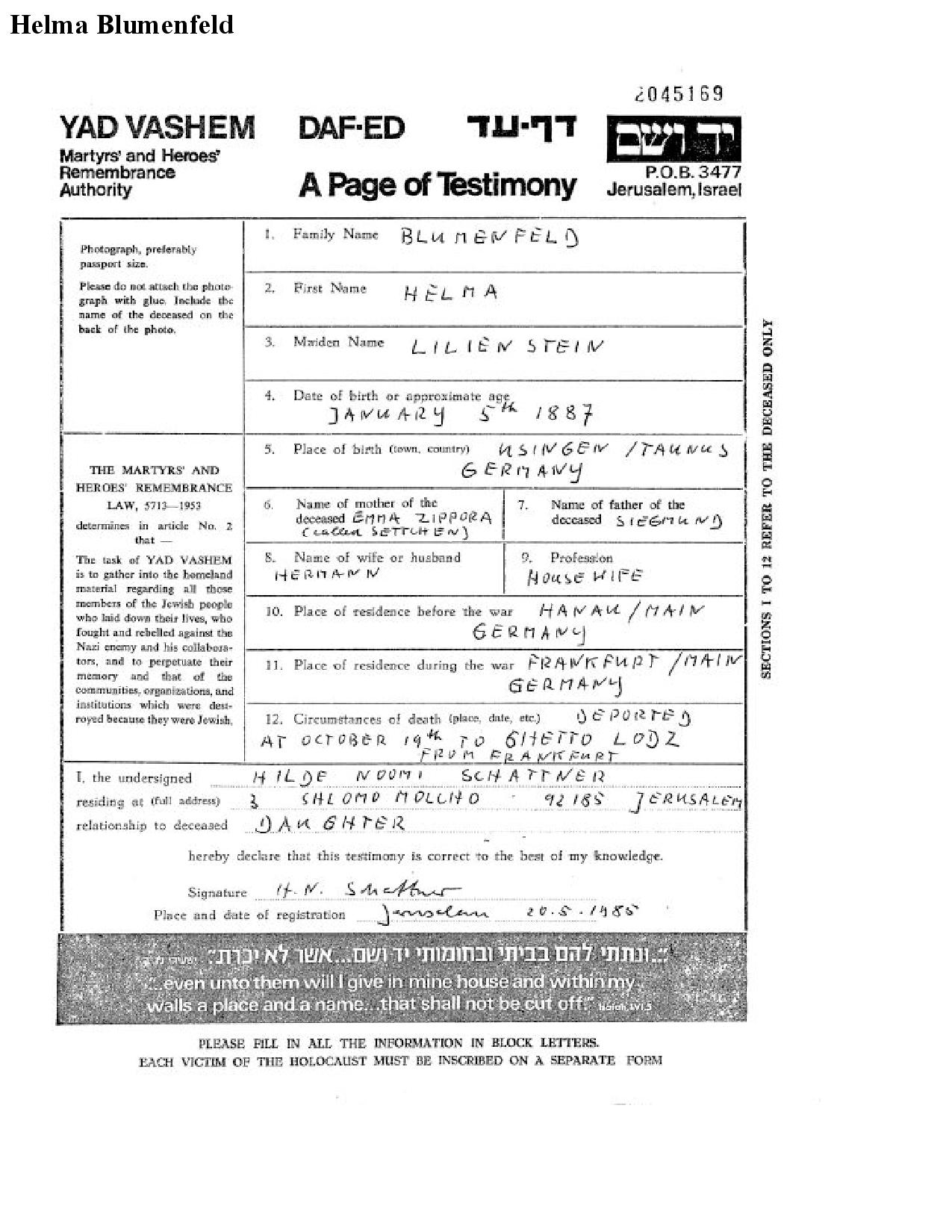
Hermann Blumenfeld and his wife Helma were deported from Frankfurt to the Litzmannstadt Ghetto in Lodz, Poland, on October 19, 1941, and were killed sometime thereafter.

Hermann Blumenfeld, Page of Testimony at Yad Vashem by his daughter Hilde, found at https://yvng.yadvashem.org/nameDetails.html?language=en&itemId=1899981&ind=1

Helma Lillienstein Blumenfeld Page of Testimony at Yad Vashem by her daughter Hilde, found at https://yvng.yadvashem.org/nameDetails.html?language=en&itemId=1899975&ind=1

Fortunately, their two children both left Germany earlier and eventually immigrated to what was then Palestine.

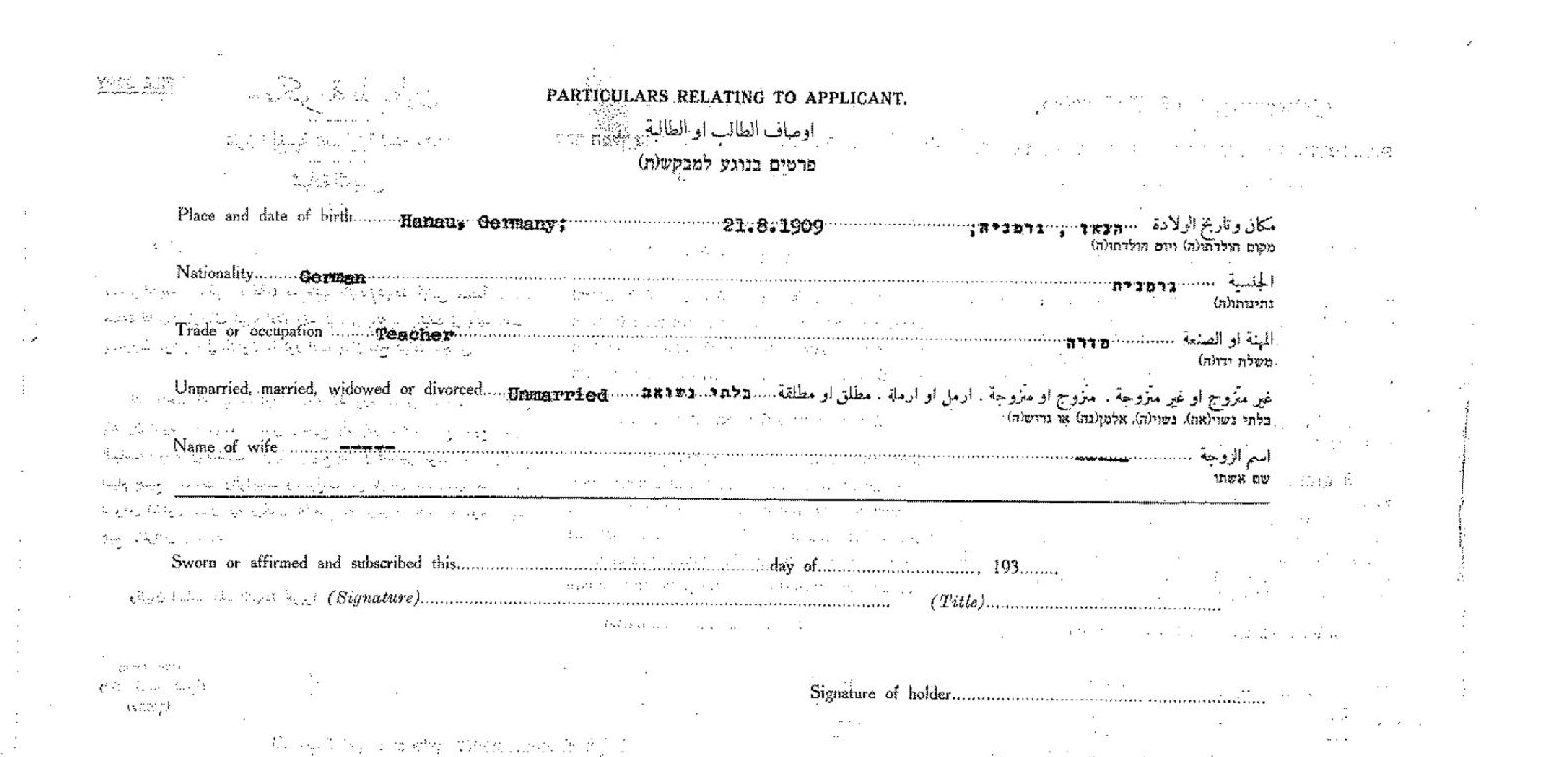
Hilde Nomi left Germany for Oslo, Norway, on August 19, 1933, and then entered Palestine on April 22, 1936. She applied for citizenship there on May 23, 1938, when she was living near Haifa and working as a teacher. She became a Palestinian citizen on June 21, 1938. You can see her full immigration file at Blumenfeld Hilda _ מחלקת ההגירה – ממשלת ארץ ישראל – בקשות לאזרחות _ ארכיון המדינה

Hilde Blumenfeld, Palestine Immigration file found at the Israel State Archives at https://www.archives.gov.il/en/

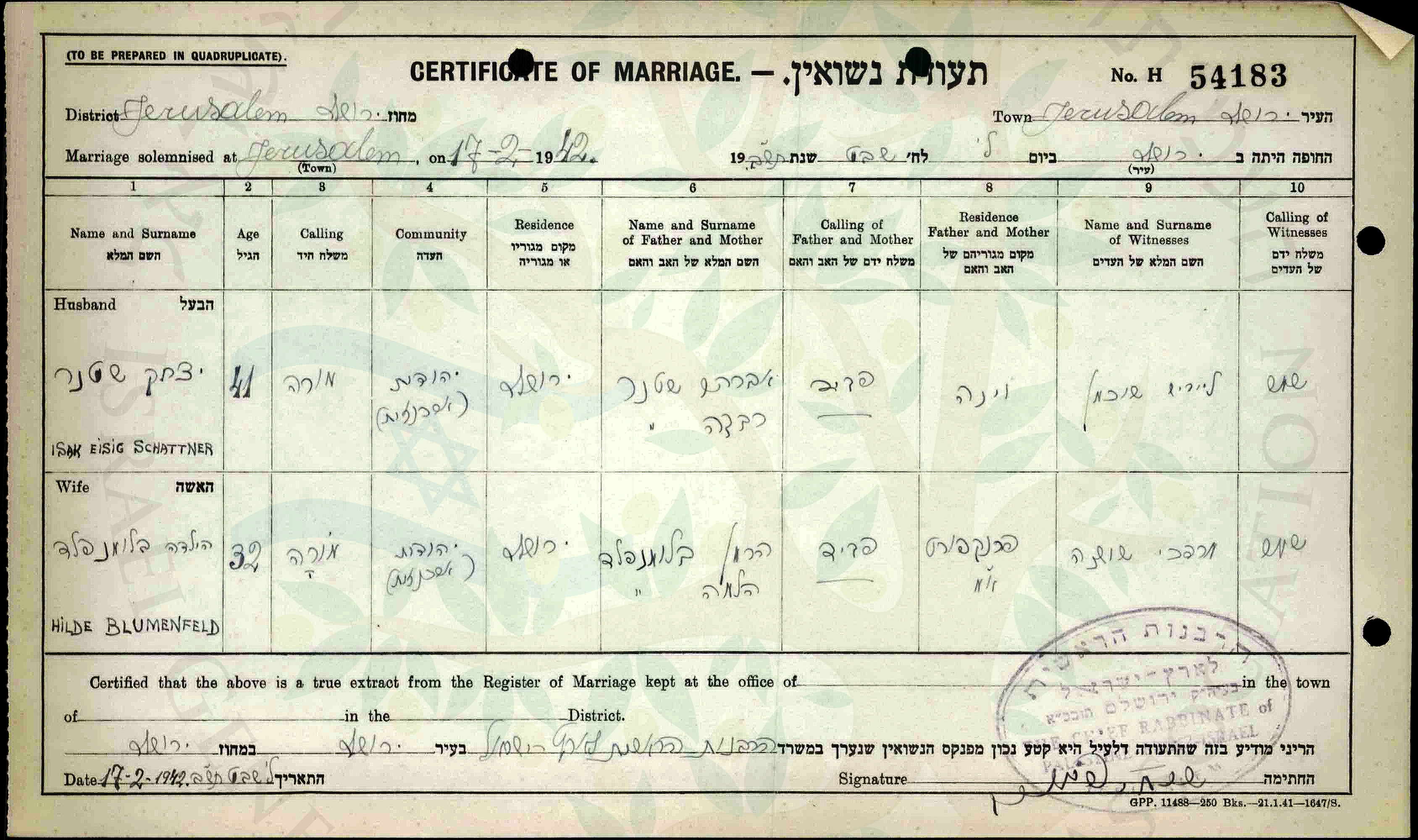
She remained in Palestine, later Israel, and married Isaac Schattner in Jerusalem on February 17, 1942.

Marriage record of Hilde Blumenfeld and Isaac Schattner, found at the Israel Genealogy Research Association at https://genealogy.org.il/AID/

Hilde Nomi died on February 1, 2012.

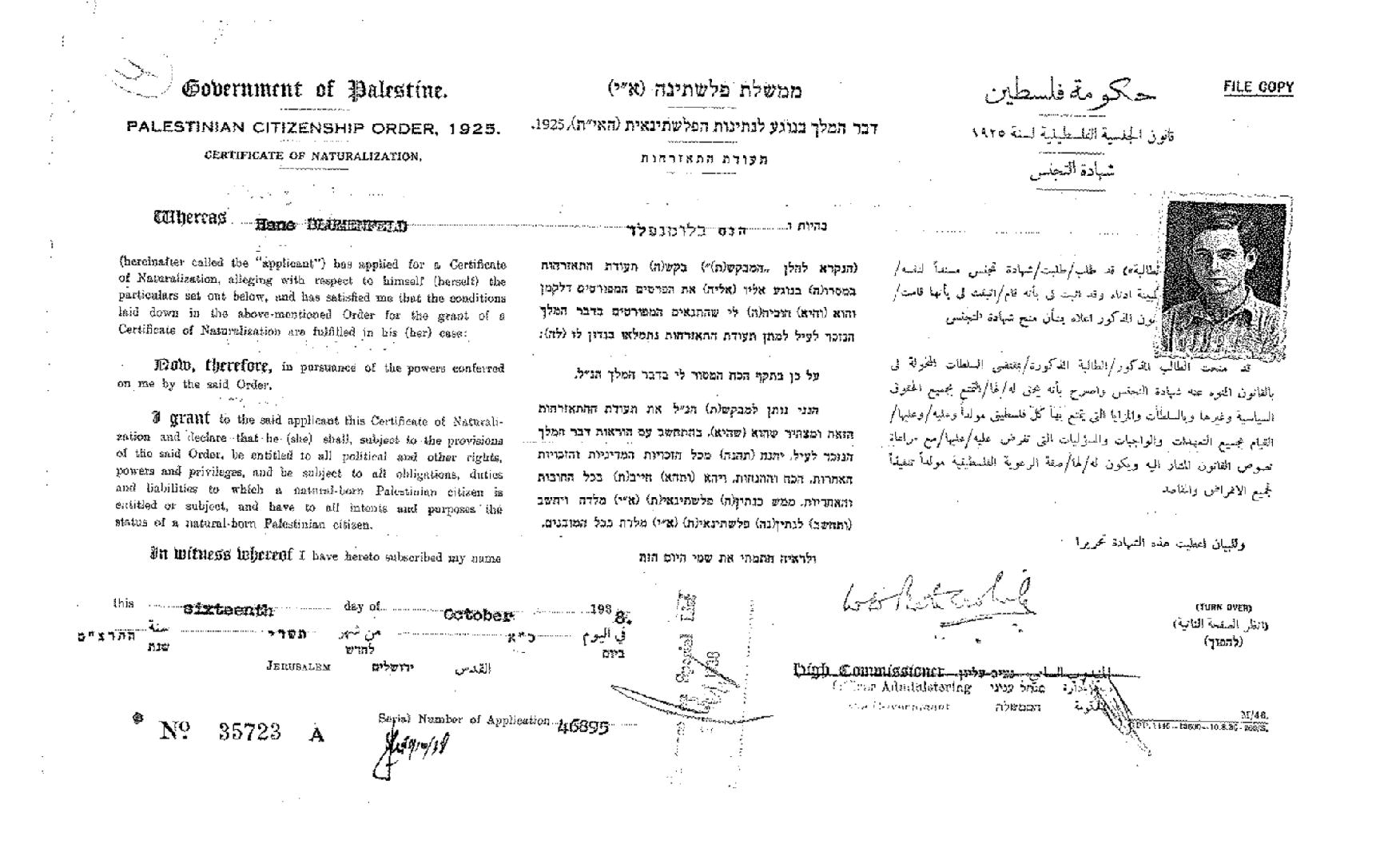
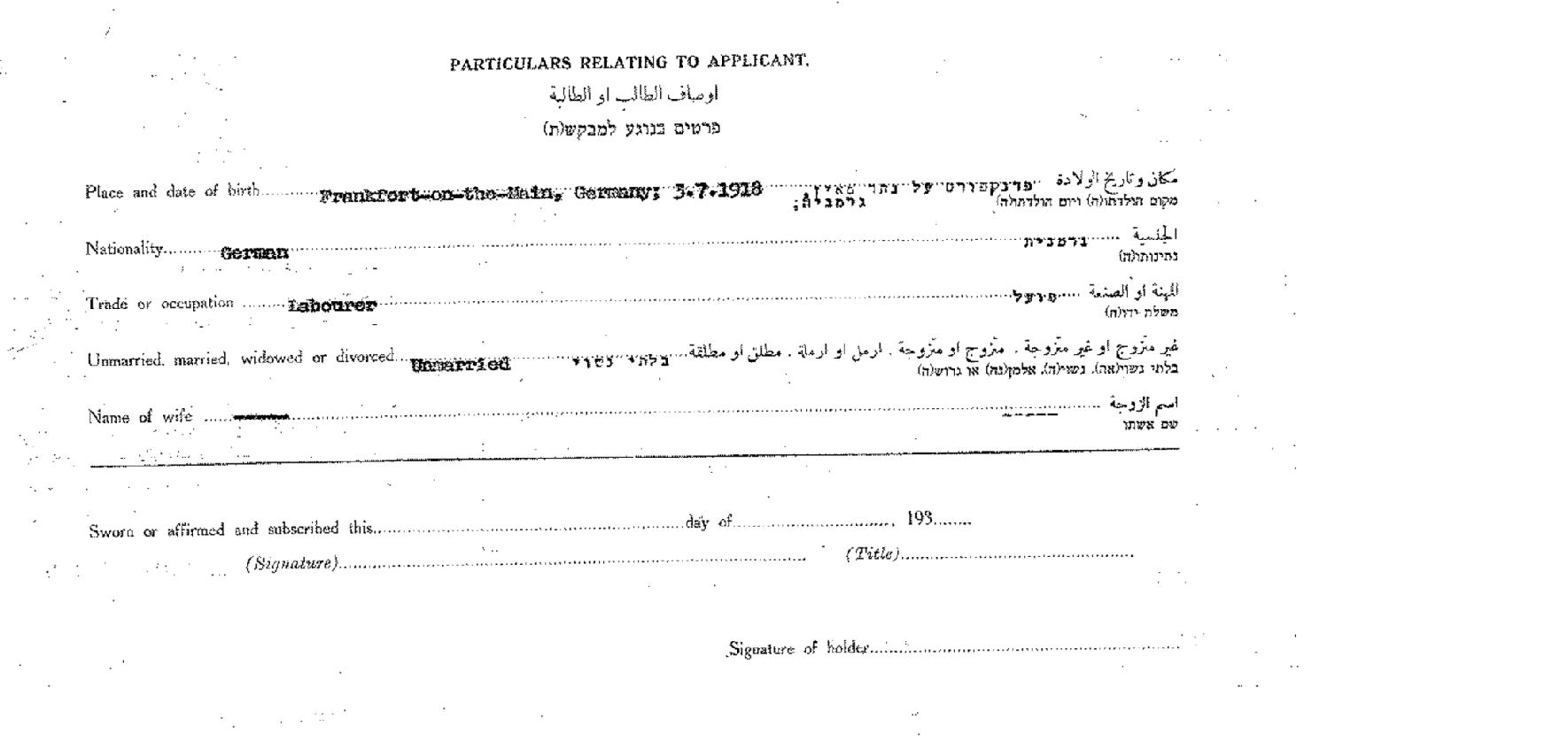
Her brother Hans arrived in Palestine on July 1, 1935, when he was seventeen. He applied for Palestinian citizenship on September 13, 1938, and was granted citizenship on October 16, 1938. He was working as a laborer at that time and living in Jerusalem. His full immigration file can be seen here: Blumenfeld Hans _ מחלקת ההגירה – ממשלת ארץ ישראל – בקשות לאזרחות _ ארכיון המדינה

Hans Blumenfeld Palestine immigration file found at the Israel State Archives at https://www.archives.gov.il/en/

Hans remained in Palestine, later Israel, and married Ruth Herman in Jerusalem on August 8, 1941. His marriage record confirmed my earlier assumption that he was in fact the son of Hermann and Helma Blumenfeld.

Marriage record of Hans Blumenfeld and Ruth Herman, found at the Israel Genealogy Research Association at https://genealogy.org.il/AID/

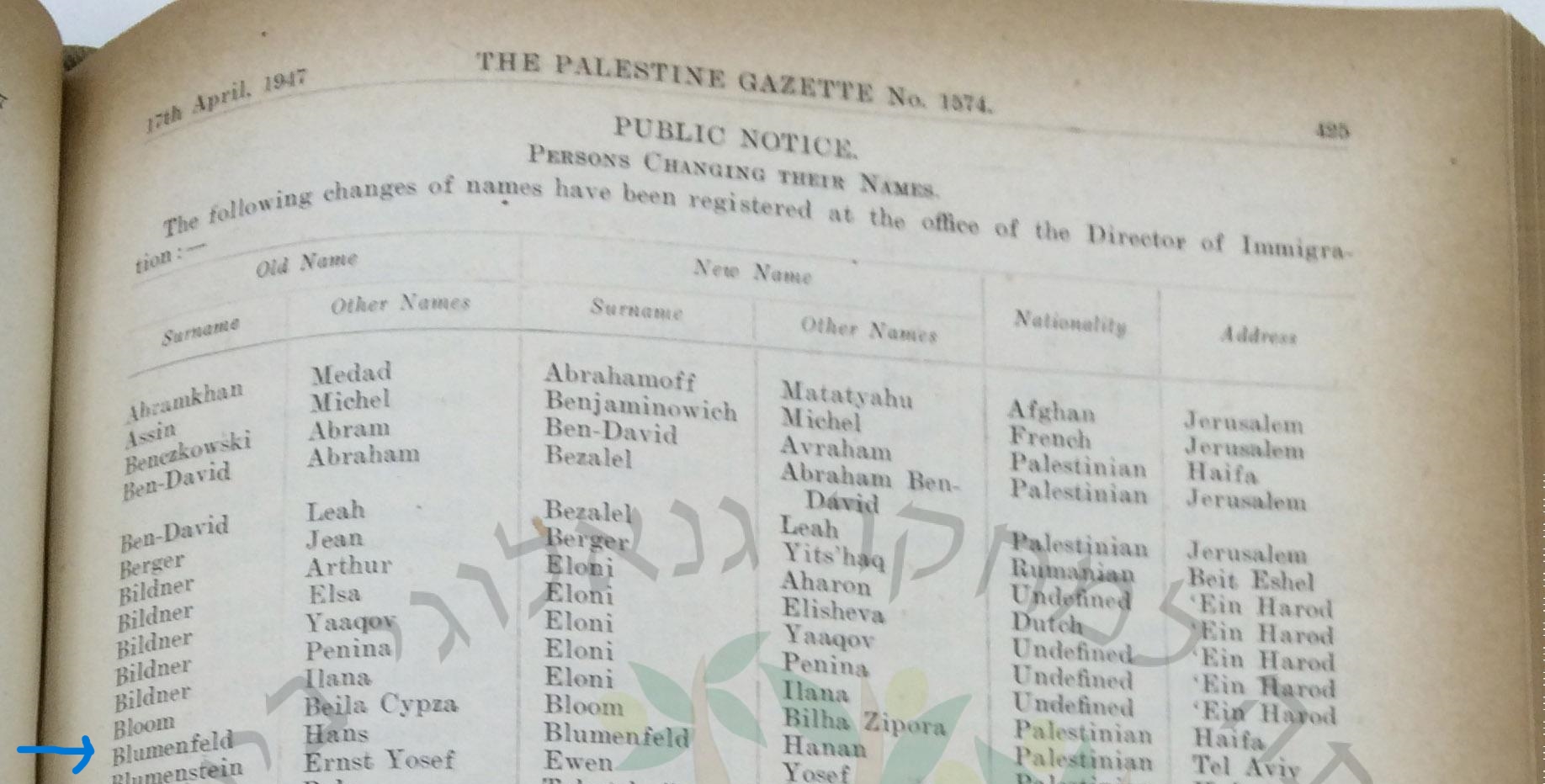
In 1947, Hans changed his first name to Hanan.

IGRA website found at https://genealogy.org.il/AID/

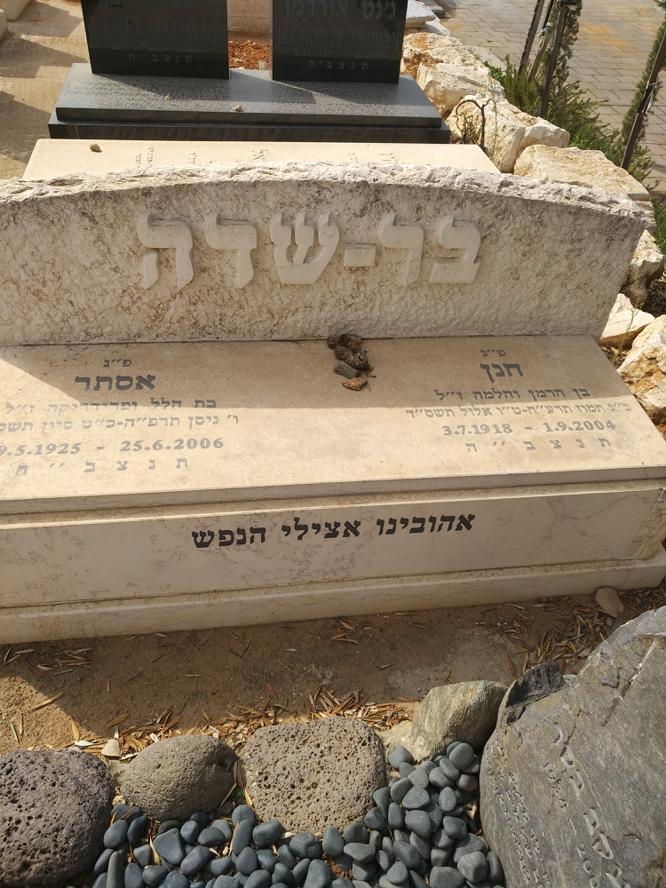
At some later point Hanan changed his surname to Bar Sadeh. He and his first wife Ruth were divorced, and in November 1954, he married Esther Asch, daughter of Hillel and Fredericka Asch. I am indebted to David Lesser of Tracing the Tribe who translated the headstone and then went even further and found the wedding announcement for Hanan and Esther on p. 3 of the November 22, 1954, issue of Hatzofe (the Observer), an the Israeli newspaper.  David translated the announcement as follows: “Hanan Bar-Sadeh (Blumenfeld) son of Herman, Divorcee, Germany Tel-Aviv to Esther Ash Daughter of Hillel, Single, Germany Tel-Aviv.”

According to their gravestone, Esther was born May 29, 1925, and died on June 25, 2006. Hans died on September 1, 2004.

Hanan Bar-Sadeh gravestone found at GRAVEZ at https://gravez.me/en/deceased/9A0712A0-3749-4251-A557-E8EDAA465AF2

Thus, because they were able to escape to what was then Palestine and is today Israel, the children of Hermann Blumenfeld and Helma Lillienstein survived the Holocaust. Unfortunately, Hermann and Helma did not.

Nor did Bertha Blumenfeld Fernich and most of her family, as we will see next.

Salli Blumenfeld and His Family: A Branch With No New Leaves

Although the last few posts have had their sad stories—young children who died, a horrible accident taking the life of a young mother, a young man dying at 29 from a heart attack—I was at least spared the pain of writing about the murder of my relatives by the Nazis. Sadly, I now must return to such horrific stories as I turn to the two youngest sons of Giedel Blumenfeld and her husband Gerson Blumenfeld, Salli and Meier. First, I will tell the story of Salli Blumenfeld.

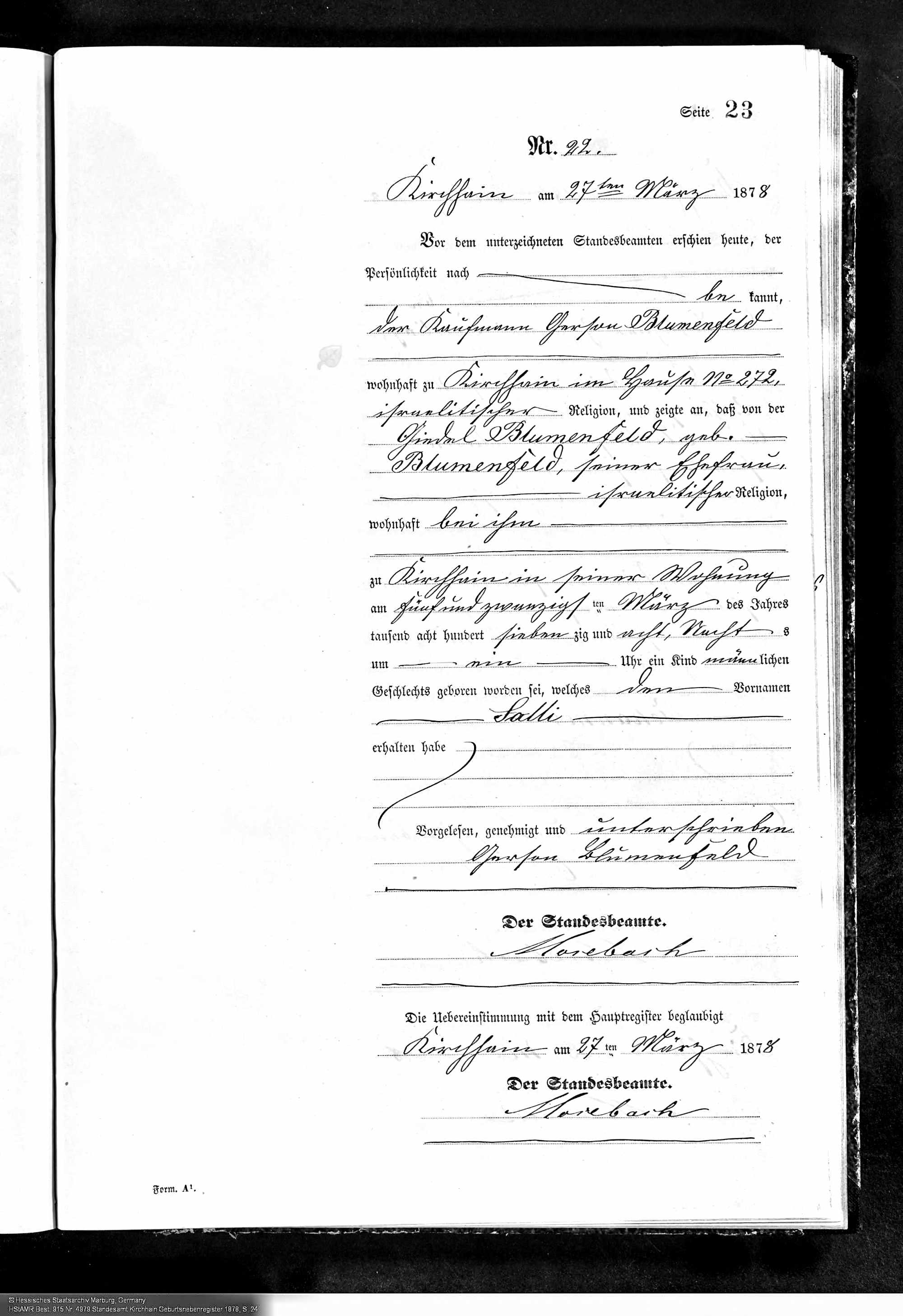
Salli Blumenfeld was born in Kirchhain on March 25, 1878.

Salli Blumenfeld birth record, Hessisches Hauptstaatsarchiv; Wiesbaden, Deutschland; Bestand: 915; Laufende Nummer: 4979, Ancestry.com. Hesse, Germany, Births, 1851-1901

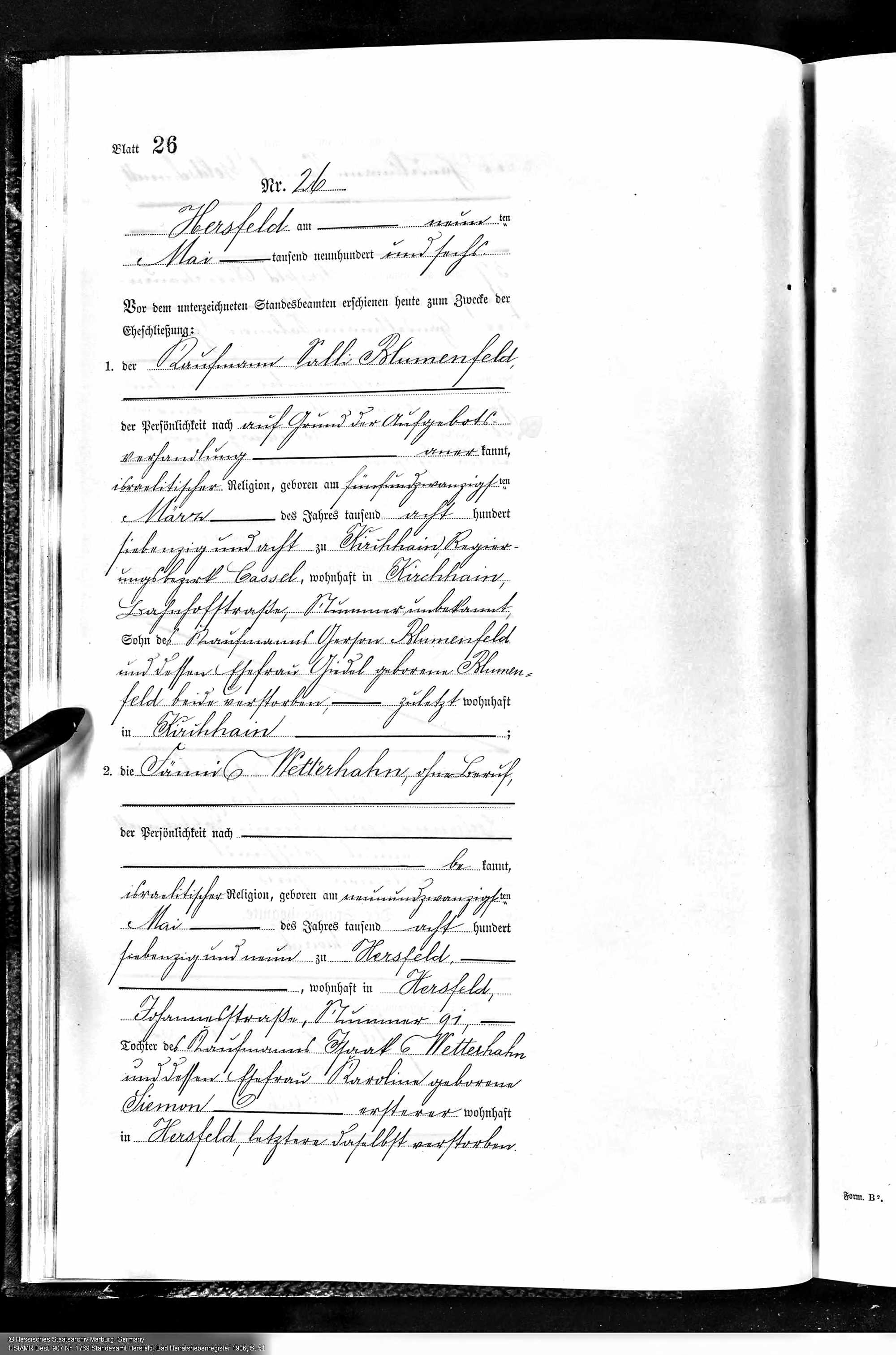
Salli married Fanni Wetterhahn on May 9, 1906, in Hersfeld, Germany. Fanni was born there on May 29, 1879, to Isaak Wetterhahn and Karoline Simon.

Salli Blumenfeld Fanni Wetterhahn marriage record, Hessisches Hauptstaatsarchiv; Wiesbaden, Deutschland; Bestand: 907, Year Range: 1906, Ancestry.com. Hesse, Germany, Marriages, 1849-1930

Salli and Fanni had two children. Siegfried was born on July 25, 1907, in Kirchhain.1 According to several trees and other secondary sources, a daughter Kathe Karoline was born to Salli and Fanni on November 4, 1910; I don’t have any record tying this child to Salli and Fanni, however. I do have one record showing that a woman named Kathe Karoline Blumenfeld was born in Kirchhain on November 4, 1910, but that record does not identify her parents.2 For now I will assume she was the daughter of Salli and Fanni.

Salli and Fanni’s son Siegfried married Betti Reutlinger on February 24, 1935, in Frankfurt. Betti was born on May 28, 1908, in Frankfurt. Her parents were Julius Reutlinger and Sophie Weil.3

But then this story turns tragic. Salli and Fanni and their presumed daughter Kathe Karoline were all killed in the Holocaust.  They were all deported from Kassel to Riga, Latvia, on December 9, 1941, and died sometime thereafter.

Only Salli and Fanni’s son Siegfried and his wife Betti escaped in time. They arrived in New York on October 21, 1938, with Betti’s mother Sophie Weil and sister Martha Weil.

Siegfried Blumenfeld ship manifest, Year: 1938; Arrival: New York, New York, USA; Microfilm Serial: T715, 1897-1957; Line: 1; Page Number: 59, Ship or Roll Number: Hansa, Ancestry.com. New York, U.S., Arriving Passenger and Crew Lists (including Castle Garden and Ellis Island), 1820-1957

On his Declaration of Intention dated March 1, 1939, Siegfried reported that he was a factory hand. He and Betti were living in New York and had no children.4

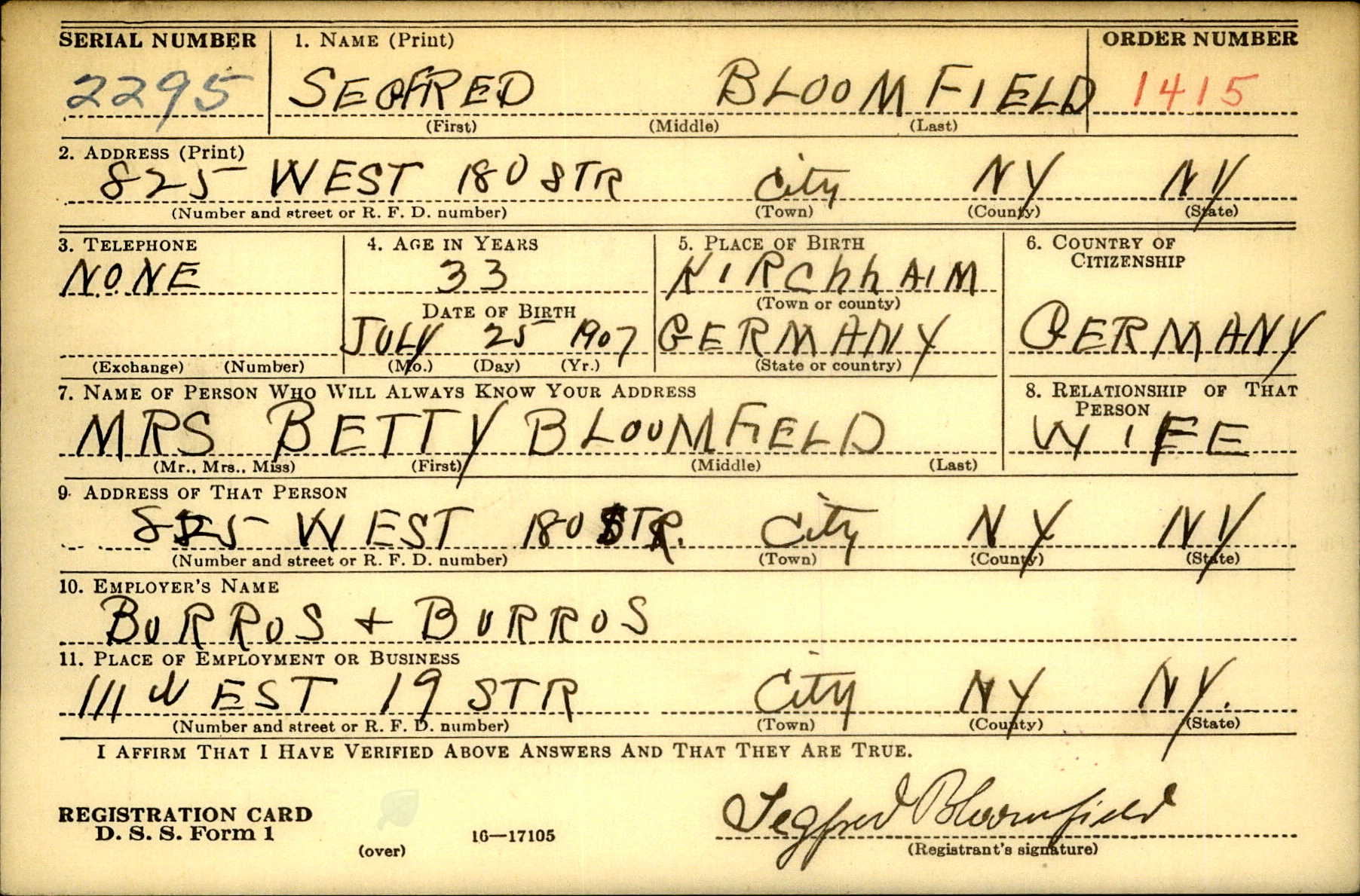
In 1940, Siegfried and Betti were living with her mother Sophie and brother Walter in New York.5 Siegfried was working as a machine operator. His World War II draft registration lists his employer as Burros and Burros. By that time he had changed his surname to Bloomfield.

Siegfried Bloomfield, World War II draft registration, National Archives at St. Louis; St. Louis, Missouri; WWII Draft Registration Cards for New York City, 10/16/1940 – 03/31/1947; Record Group: Records of the Selective Service System, 147, Ancestry.com. U.S., World War II Draft Cards Young Men, 1940-1947

Siegfried died at the age of 55 in June 1963;5 Betti outlived him by 34 years. She died March 4, 1997, at 88.6 I have not been able to find any record that Siegfried and Betti ever had children. If that is true, it appears that this is another branch of the family of Giedel Blumenfeld and her husband Gerson Blumenfeld that has no living descendants.

Next, the story of Giedel Blumenfeld’s youngest son to live to adulthood, Meier Blumenfeld.


  1. Siegfried Bloomfield, [Siegfried Gerson Blumenfeld], Gender: Male, Declaration Age: 31, Record Type: Declaration, Birth Date: 25 Jul 1907, Birth Place: Kirchheim Germany, Arrival Date: 21 Oct 1938, Arrival Place: New York, New York, USA, Declaration Date: 1 Mar 1939, Declaration Place: New York  Court: U.S. District Court for the Southern District of New York, Spouse: Betti, Declaration Number: 429824
    Box Number: 295, The National Archives at Philadelphia; Philadelphia, Pennsylvania; NAI Title: Declarations of Intention for Citizenship, 1/19/1842 – 10/29/1959; NAI Number: 4713410; Record Group Title: Records of District Courts of the United States, 1685-2009; Record Group Number: 21, Ancestry.com. New York, U.S., State and Federal Naturalization Records, 1794-1943 ↩
  2. Käthe Blumenfeld, Gender: weiblich (Female), Nationality: Deutsche Julen, Residence Age: 28, Record Type: Residence, Birth Date: 4 Nov 1910, Birth Place: Kirchhain, Sojourn Start Date: 2 Sep 1939, Residence Place: Marburg Marburg an der Lahn, Sojourn End Date: 8 Dez 1941 (8 Dec 1941), Notes: Foreigners who were living in the location during the war – permanently or temporarily, Reference Number: 02010101 oS, Document ID: 70454281, Arolsen Archives, Digital Archive; Bad Arolsen, Germany; Lists of Persecutees 2.1.1.1, Ancestry.com. Free Access: Europe, Registration of Foreigners and German Persecutees, 1939-1947 ↩
  3. See Note 1. Betti Paula Bloomfield, [Betty Bloomfield] [Betti Paula Reutlinger], Gender: Female, Race: White, Birth Date: 28 May 1908, Birth Place: Frankfort, Federal Republic of Germany, Death Date: 4 Mar 1997, Father: Julius Reutlinger, Mother:
    Sophie Weil, SSN: 104124761, Ancestry.com. U.S., Social Security Applications and Claims Index, 1936-2007 ↩
  4. See Note 1. ↩
  5.  Siegrfried Bloomfield, Social Security Number: 066-14-7836, Birth Date: 25 Jul 1907, Issue Year: Before 1951, Issue State: New York, Death Date: Jun 1963, Social Security Administration; Washington D.C., USA; Social Security Death Index, Master File, Ancestry.com. U.S., Social Security Death Index, 1935-2014 ↩ ↩
  6. Betti Paula Bloomfield, [Betty Bloomfield] [Betti Paula Reutlinger], Gender: Female, Race: White, Birth Date: 28 May 1908, Birth Place: Frankfort, Federal Republic of Germany, Death Date: 4 Mar 1997, Father: Julius Reutlinger, Mother:
    Sophie Weil, SSN: 104124761, Ancestry.com. U.S., Social Security Applications and Claims Index, 1936-2007 ↩