My Cousins Julius Goldfarb and Ida Hecht: Lives Well Lived

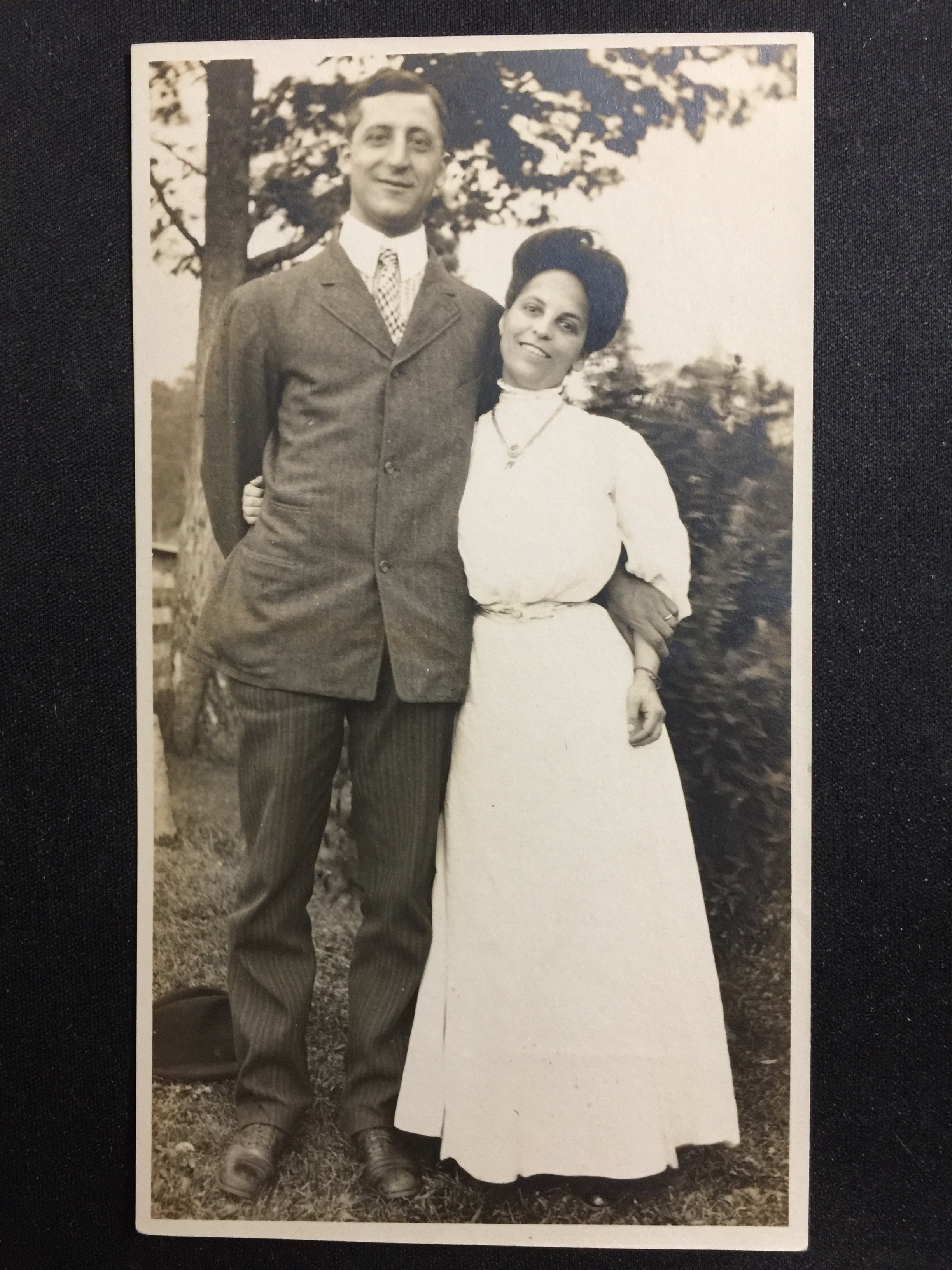
Julius Goldfarb, my grandmother Gussie’s first cousin, and Ida Hecht, my grandmother Gussie’s half-sister’s daughter, knew each other as teenagers when their families were living next door to each other on Avenue C in New York City. They married in 1913, had four daughters, and by 1940 had created a happy and comfortable life for themselves and their daughters in Jersey City, New Jersey, supported by their real estate investments and their liquor business.

Julius Goldfarb had been forced out of the liquor business by Prohibition, but once Prohibition ended, he returned to it, now as the owner of a liquor store in Jersey City called Stuyvesant Wine and Liquor. He also continued to be involved in real estate and was prospering in both businesses.

But starting in 1939, the store was repeatedly the target of robberies. We already saw the news article about that first robbery where Julius was held up by three armed gunmen who then locked him in a storeroom closet. He lost $220 in that crime.

Julius was robbed again in 1941. A single armed robber walked behind the counter and forced Julius to lie on the floor; he then stole $124 from Julius. This time, however, Julius was insured for the loss.

“Holdup in Boulevard Liquor Store,” Jersey Journal, April 15, 1941, p, 1

But Julius and Ida’s life was not overshadowed by these events. Rather, they were enjoying life with their growing family—their four daughters and their grandchildren. Julius and Ida’s oldest daughter Sylvia remarried on October 31, 1942. Her second husband was George Horowitz; he was also a native of Jersey City and was born on September 16, 1912, to Abraham Horowitz and Sophie Margulies. George was working as a photographer for Sun-Ray Studios in Jersey City in 1942. Sylvia and George would have one child together born several years later.1

The third of Julius and Ida’s daughters, Ethel, became engaged to Herbert Rothman in May 1944; he was then a corporal in the US Army stationed at Camp Ruston in Louisiana. Herbert was the son of Irving Rothman and Sarah Berger and was born on July 26, 1922, in New York. At the time of their engagement, Ethel was attending New York University. Ethel and Herbert were married in November, 1945, and had two sons. Herbert ended up working in the liquor business with Julius.2

Evelyn Goldfarb was briefly married in the 1940s to a man named Seymour Hutchinson, but that marriage did not last or produce any children.3 As noted below, Evelyn would remarry some years later.

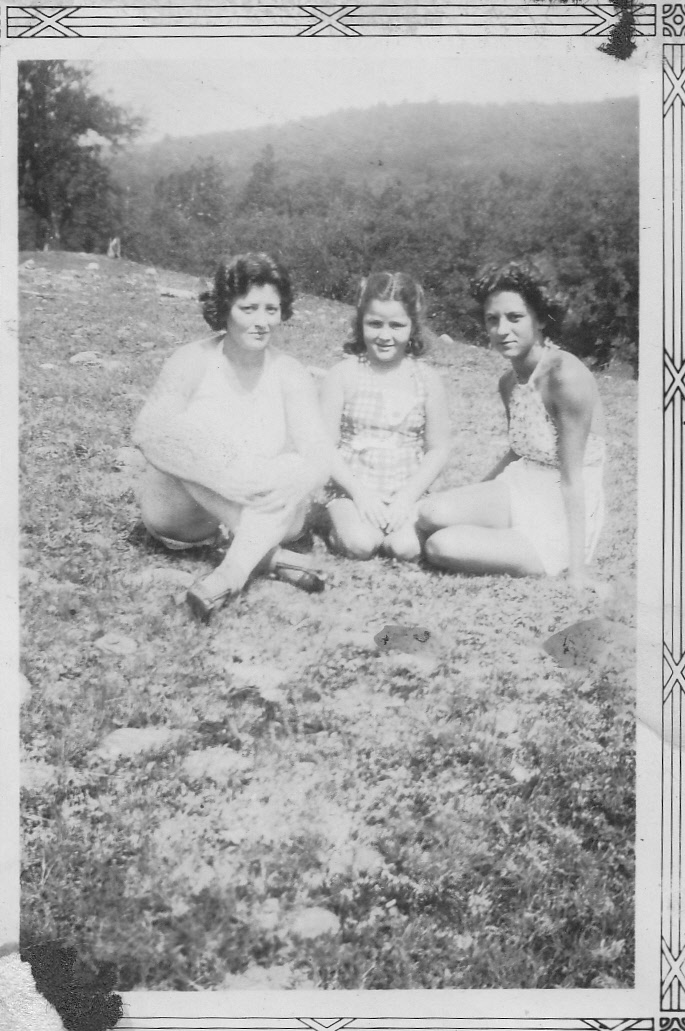
Here is a beautiful photograph of three of the four daughters of Julius Goldfarb and Ida Hecht, my double cousins, Evelyn, Sylvia, and Ethel:

Evelyn, Sylvia, and Ethel Goldfarb c. 1942 Courtesy of Sue Wartur

And here is a photograph of Julius and Ida with their youngest daughter Evelyn in 1951.

Julius, Evelyn, and Ida Goldfarb 1951. Courtesy of Sue Wartur

My cousin Sue recalls many happy times with her grandparents Ida and Julius. She wrote to me about the beach house on Long Island where Julius and Ida and their extended family would spend their summers:

“From spring until late fall, sometimes until after the High Holy Days, my grandparents would be at their beach house, steps from the Atlantic, in Long Beach, Long Island. [My grandfather Julius] would arrive in the wee hours of Sat night/Sunday morning, his car laden with Sunday papers, his favorite…eggplants and grapefuits, and sodas and chips from the store. We had huge family spreads on the beach…cousins, aunts, uncles, and Grandma’s sister Jean and family, whose “dacha” was just around the corner.” 4

This is a photograph of Ida and Julius at their summer cottage in Long Beach and then a photograph of Julius on the beach:

Ida and Julius at their summer cottage on Long Beach, LI. Courtesy of Sue Wartur

Julius Goldfarb, Long Beach, NY. Courtesy of Sue Wartur

Meanwhile, Julius continued to have trouble at his store. In June 1951 Julius was again robbed; this time he was forced to lie on the floor of the lavatory at the back of his store while the robber made off with almost $100.5

Julius was not present in the store for the next robbery in July 1952. Instead his son-in-law Herbert Rothman, husband of Ethel, was the victim. He and two other employees were locked in the storeroom by two thieves armed with penknives. This time the criminals made off with $150.  The news story about this robbery refers to it as the fourth holdup of the store in the past year, so there must have been other robberies that did not appear in the paper.6

But it appears that Julius finally received more protection from the local police after this event. When another attempted robbery occurred in November 1952 while Herbert Rothman was working at the store, two plainclothes detectives stopped the holdup, and when the robber pointed his “toy gun” at them, one of those detectives shot and seriously wounded him.7

I don’t know whether that was the last time the store was the site of a robbery, but that was the last article reporting one that I could find in the Jersey City newspapers.

Not long before this last robbery, on October 25, 1952, Evelyn Goldfarb married her second husband, Samuel Block. He was also a native of Jersey City, New Jersey, born there on September 17, 1922, the son of Meyer Block and Gussie Greenberg. Evelyn and Samuel had two children born in the 1950s.8

Thus, by 1952 all four of Julius and Ida’s daughters were married. And in 1959, their first-born granddaughter, my cousin Sue, was married, and Julius and Ida were there to celebrate. Thank you to Sue for sharing some of her beautiful wedding photographs.

Sue (Leyner) and Larry Wartur, 1959. Courtesy of Sue Wartur.

Julius and Ida Goldfarb at their granddaughter Sue’s wedding. Courtesy of Sue Wartur

Julius and Ida Goldfarb at their granddaughter Sue’s wedding. Courtesy of Sue Wartur

In the end there were nine grandchildren who survived Ida and Julius as well as their four daughters and sons-in-law. Ida died on March 7, 1966, in Jersey City; she was 71.9 Julius died two years later on November 20, 1968, also in Jersey City. He was 83.10

Julius Goldfarb and Ida Hecht had lived a full and interesting life together. Born in Galicia, Julius came to the US when he was ten years old and had to learn a new language and adapt to a new culture. According to his granddaughter Sue, he remained a religious man all his life. He belonged to an Orthodox synagogue where Sue would watch him praying from her seat in the women’s section above the main sanctuary. Ida also was quite observant. Sue remembered that Ida always lit candles on Friday night, went to services on Saturday morning, and studied Torah at home.

But Julius also adapted to American life. He was a success both in the real estate and liquor businesses and more than once survived attacks on his business and himself, determined to protect his livelihood and his family. Ida contributed to that success not only on the homefront, but also by working with Julius in both the liquor and real estate businesses.

Their granddaughter Sue reminded me that what we see in newspapers and records is only a small part of the lives people lived and that while the news articles might leave an impression of a life darkened by robberies and crime, that was not how Julius and Ida saw their life. Rather, it was a life filled with joy and faith and love.

Sue wrote that even long after Julius and Ida’s four daughters were grown and married with children of their own, they always thought of 24 Clendenny Avenue in Jersey City as their home. That itself is a testament to the warm and loving family life that Julius and Ida created for their children and grandchildren.


I will be taking a short break from blogging in the next week or so. See you with more Goldfarb history when I return.


  1. Family records. George Horowitz, Birth Date: 16 Sep 1912, Birth Place: Jersey City, New Jersey, Death Date: 23 Sep 1999, Father: Abraham Horowitz, Mother:
    Sophie Marqulies, SSN: 140077673, Ancestry.com. U.S., Social Security Applications and Claims Index, 1936-2007. George Horowitz, World War II draft registration, The National Archives in St. Louis, Missouri; St. Louis, Missouri; WWII Draft Registration Cards for New Jersey, 10/16/1940-03/31/1947; Record Group: Records of the Selective Service System, 147; Box: 303, Ancestry.com. U.S., World War II Draft Cards Young Men, 1940-1947 
  2. “Miss Ethel Goldfarb To Wed Corp. Rothman,” Jersey Journal, May 16, 1944, p. 22. New Jersey State Archives; Trenton, New Jersey; Marriage Indexes; Index Type: Bride; Year Range: 1945; Surname Range: A – Z, Ancestry.com. New Jersey, U.S., Marriage Index, 1901-2016. Herbert Rothman, Birth Date: 26 Jul 1922
    Birth Place: Manhattan, New York City, New York, USA, Ancestry.com. New York, New York, U.S., Birth Index, 1910-1965. New York, New York City Marriage Records, 1829-1940,” database, FamilySearch (https://familysearch.org/ark:/61903/1:1:24WF-8T8 : 10 February 2018), Irving Rothman and Sarah Berger, 20 Sep 1921; citing Marriage, Manhattan, New York, New York, United States, New York City Municipal Archives, New York; FHL microfilm 1,653,292. 
  3.  Evelyn Goldfarb, Marriage License Date: 1 Oct 1945, Marriage License Place: Queens, New York City, New York, USA, Spouse: Seymour M Hutchinson, License Number: 5965, New York City Municipal Archives; New York, New York; Borough: Queens, Ancestry.com. New York, New York, U.S., Marriage License Indexes, 1907-2018 
  4. Email from Sue Wartur, April 14, 2021. 
  5. “Fat Thug Gets $100 in Holdup,” Jersey Journal, June 29, 1951, p. 1. 
  6. “Store Held Up Fourth Time,” Jersey Journal, July 30, 1952, p. 1. 
  7. “Shots Fell ‘Toy Gun’ Bandit,” Jersey Journal, November 17, 1952, p. 1. 
  8. “Evelyn Goldfarb,” Jersey Journal, July 30, 1952, p. 10. “Miss Goldfarb, Jersey City, Wed to Samuel Block,” Hudson Dispatch, October 1952. Samuel Block
    Gender: Male, Birth Date: 17 Sep 1922, Birth Place: Jersey City, New Jersey
    Death Date: 3 Nov 1988, Father: Meyer Block, Mother:Gussie Greenberg
    SSN: 140185188, Ancestry.com. U.S., Social Security Applications and Claims Index, 1936-2007 
  9.  Ida Goldfarb, Death Date: Mar 1966, Death Place: Jersey City, Hudson, New Jersey, USA, Year Range: 1966; Surname Range: G-N; Title: New Jersey, Death Indexes, 1904-2000.Ancestry.com. New Jersey, U.S., Death Index, 1901-2017. Family records. 
  10. Julius Goldfarb, Death Date: 20 Nov 1968, Death Place: Jersey City, Hudson, New Jersey, USA, Year Range: 1968; Surname Range: A-G; Title: New Jersey, Death Indexes, 1904-2000, Ancestry.com. New Jersey, U.S., Death Index, 1901-2017 

Sarah Brod Goldfarb, My Great-grandmother’s Sister: From Immigrant to American Grandmother

Sarah Brod Goldfarb, my great-grandmother’s sister, was widowed on October 4, 1926, when her husband Samuel died. She was sixty years old. The 1930 census shows her living at 526 William Street in Brooklyn, her long-time home, with her two youngest children, Leo and Rose. Leo was now 28 and working as a real estate salesman. Rose was 24 and not employed outside the home.1

Thank you to my cousin Alyce for sharing this photograph of Sarah with her son Leo. I love the shadow of Leo, pipe and all, that appears behind them:

Leo Goldfarb and his mother, Sarah Brod Goldfarb
Courtesy of Alyce Shapiro Kunstadt

Living just down the street at 542 Williams Street was Sarah’s son Morris Goldfarb with his wife Anna and their two sons, Martin (10) and Irvin (8). Morris owned a grocery store.2 Not long after the 1930 census was enumerated, Morris and Annie had a third son Saul, born June 10, 1930, in New York.3

Sarah’s three other surviving children were all married and living with their children in Jersey City, New Jersey, where their families also continued to grow. Julius and Ida had their four daughters. Bessie and her husband Meyer Malzberg had had another child, their fourth son, Saul, born on January 23, 1928, in Jersey City. Joseph Goldfarb and his wife Betty had their third child, Selma, born January 13, 1928, ten days before her first cousin Saul Malzberg.

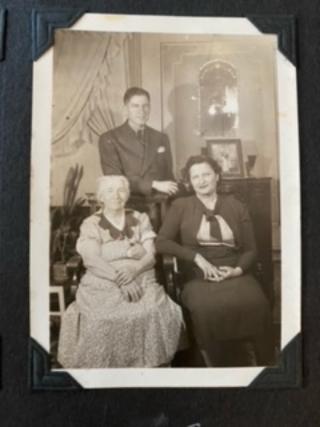
I have two more photographs from Alyce of Sarah with her family that appear to have been taken the same day and location as the photo of Sarah with Leo above. My cousin Steve believes that the first one shows his grandmother Bessie with her husband Meyer Malzberg standing behind her and her mother Sarah.

I am particularly intrigued by the photograph that appears on the piece of furniture behind Bessie. Is that her wedding photograph? A graduation photograph? Too small to say.

Meyer Malzberg, rear. Sarah Brod Goldfarb and Bessie Goldfarb Malzberg, seated. Courtesy of Alyce Shapiro Kunstadt

The next one is of two of the Malzberg grandsons although we are still not sure which of the four are in the photograph.

Sarah Brod Goldfarb, seated. Possibly Burton and Saul Malzberg, standing. Courtesy of Alyce Shapiro Kunstadt

If I had some way of dating the photograph, it would be easier to identify the two boys. Norman was born in 1915, Gustave in 1919, Burton in 1923, and Saul in 1928. To my grandmotherly eye, the two boys look around seven and eleven, but each could be a year or two older or younger than that guess. Sam Goldfarb is not in the photograph, meaning it was probably taken after his death in 1926.

So if the photograph was taken in the late 1920s, it would have to be Norman and Gustave. But if it was taken in the mid 1930s, it’s Burton and Saul. I believe it’s the latter. First, Steve did not see his father Gustave in the photograph. Second, something about Bessie’s dress makes me thing this is the 1930s, not the 1920s—the tight belted waist on her dress seems unlike the dropped waist dresses worn in the 1920s. But I am far from a fashion expert, so I’d love others’ opinions.

By 1930, Sarah had fourteen grandchildren. Three more would come, but after Sarah died on July 2, 1937, at the age of 71. Sarah died from hypertensive heart disease with hypertension and diabetes as contributing causes.

New York, New York City Municipal Deaths, 1795-1949″, database, FamilySearch (https://www.familysearch.org/ark:/61903/1:1:2WT7-T1D : 3 June 2020), Sarah Goldfarb, 1937.

Sarah had outlived her older sister, my great-grandmother Bessie Brod Brotman, by three years, as Bessie had died in 1934 at the age of 77. Like my great-grandmother Bessie, Sarah had stayed behind in Galicia when her husband went off to America. Sarah had four young children at the time, and in 1896, she had traveled with those children alone to meet Sam in America. After immigrating, she had three more children. She raised those seven children first in Galicia, then in Pittsgrove, New Jersey, and then by 1902 in the Lower East Side of New York, living right across the street from her sister Bessie.

I like to imagine the two sisters whose lives had so many parallels raising their six American-born youngest children together. Bessie’s American-born children were my grandmother Gussie, born in 1895, Frieda in 1897, and Sam in 1900. They were close in age to Sarah’s American-born children Joe, born in 1897, Leo in 1899, and Rose in 1902. The six first cousins, living across the street from each other for at least their earliest years, must have played together and been close to each other even after Sarah and Sam moved a mile away from 84 Ridge Street to 321 Avenue C by 1910.


One piece of evidence I have of that cousin connection is the amazing photograph that Alyce shared of my grandmother Gussie with her two cousins Joe and Rose. In this more clear version of that photograph I can see my grandmother’s arm affectionately draped around Rose’s shoulder:

Rose Goldfarb Levine, Joe Goldfarb, and Gussie Brotman Goldschlager

Sarah Brod Goldfarb outlived her husband Samuel and her daughter Gussie. But she was survived by her other six children and ultimately by seventeen grandchildren. The choice she and Sam made to leave Europe when they did still has rippling effects down the generations to their many descendants, including my cousins Sue, Alyce, Rebecca, Ann, Melissa, Steve, and many others.

Now I will return to the stories of each of the six children who survived Sam and Sarah and tell their stories more completely.


  1. Sarah Goldfarb and family, 1930 US census, Year: 1930; Census Place: Brooklyn, Kings, New York; Page: 7A; Enumeration District: 1220; FHL microfilm: 2341228, District: 1220; Ancestry.com. 1930 United States Federal Census 
  2. Morris Goldfarb and family, 1930 US census, Year: 1930; Census Place: Brooklyn, Kings, New York; Page: 10A; Enumeration District: 1218; FHL microfilm: 2341227
    Ancestry.com. 1930 United States Federal Census 
  3. Saul Goldfarb, Birth Date: 10 Jun 1930, Birth Place: Brooklyn, New York City, New York, USA, Certificate Number: 234??, Ancestry.com. New York, New York, U.S., Birth Index, 1910-1965 

Of DNA Testing and The Magic of Photographs: Who is That Woman?

As many of you know, I have not had much success using DNA as a genealogy research tool. Because I have thousands of matches on each of the major DNA testing sites (Ancestry, 23andme, FamilyTreeDNA, and MyHeritage), finding a true match—not one just based on endogamy—is like looking for a needle in a haystack. Over time I have found some “real” matches, but I usually only know they’re real because I’ve already found those cousins through traditional genealogical research. Finding that the DNA confirms what I already knew is nice, but not really helpful in terms of advancing my research. Even when I look at the matches that cousin shares with me, I am not making progress because our shared matches also number in the hundreds if not thousands.

Nevertheless, I periodically check my matches on each of the sites to see if any truly close matches have appeared. A couple of weeks ago I checked with 23andme and discovered a new third cousin match, Alyce, who also shared a family surname that appears on my tree—Goldfarb. Since the Goldfarbs are related to my Brotman line, I was quite excited. My Brotman line is one of my biggest brickwalls. I cannot get beyond the names of my great-great-grandparents.

Some background: my maternal grandmother’s parents were Joseph Brotman and Bessie Brod. But sometimes Joseph’s surname is listed as Brod, sometimes Bessie’s is listed as Brotman. Family lore is that Bessie, Joseph’s second wife, was his first cousin. Various US records revealed that Joseph’s parents were Abraham Brotman and maybe Yette Sadie Burstein; Bessie’s parents were Joseph Brod and Gittel Schwartz. But I have no records from Poland where they once lived to verify those names, nor can I get any further back to determine if Joseph and Bessie were in fact first cousins.

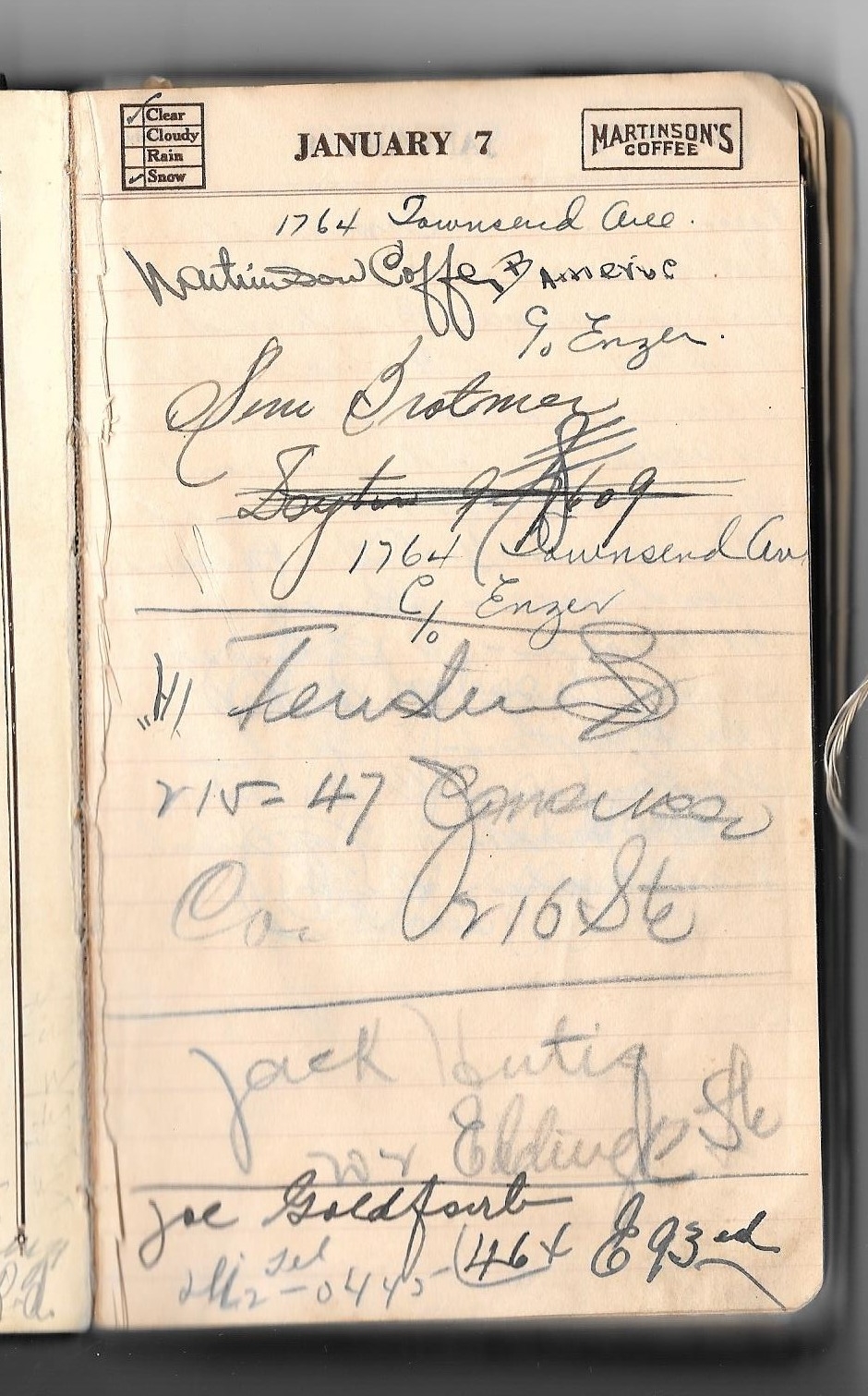
Then years later I discovered the Goldfarb cousins after seeing the names Joe and Julius Goldfarb and Taube Hecht in my grandfather’s address book and my aunt’s baby book.

After much digging, I learned that my great-grandmother Bessie Brod had a sister Sarah Brod (or Brotman) who married Sam Goldfarb. Joe and Julius Goldfarb were two of their sons, my grandmother’s first cousins. And Taube Hecht was my grandmother’s half-sister Taube Brotman, daughter of Joseph Brotman and his first wife. Taube’s daughter Ida had married Julius Goldfarb.

Through more research I was able to locate cousins descended from the Goldfarb line and from the Hecht line—Sue, a granddaughter of Julius Goldfarb and Ida Hecht, and Jan, a descendant of Taube Brotman Hecht line through her son Harry. They tested, but the results didn’t help me advance my research. I still couldn’t determine if my great-grandparents were in fact first cousins, and I still hadn’t found anything to expand the reach of my Brotman/Brod family tree.

Then a few weeks ago I found Alyce, a granddaughter of Joe Goldfarb and his wife Betty Amer and thus a pure Goldfarb (non-Hecht) cousin. She connected me with a few other Goldfarb cousins—descendants of Joe or one of his siblings. That’s a lot more DNA to work with, and I am hoping that I can get someone who’s more expert at parsing these things to help me use the DNA of these new cousins to advance my research. So far all I can do is stare at chromosome browsers and see overlaps, but I have no idea how to parse out the Goldfarb (Brod) DNA from the Hecht (Brotman) DNA to get any answers.

All of this I will return to at some point when I have more to say about what the DNA reveals. For now I want to talk about the photographs that Alyce shared with me of my Goldfarb relatives. Alyce sent me over twenty photographs. She was able to identify the people in many of them, but unfortunately a number are unlabeled. Also the quality of some of the photos is quite poor. I won’t post them all, but I will post a few today and more in a later post.

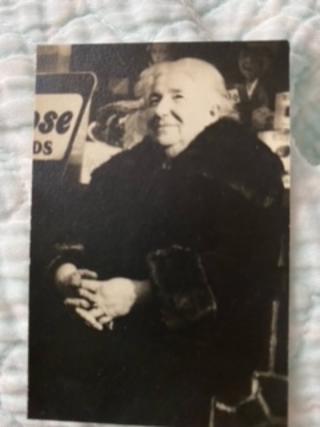
First, in Alyce’s collection was this photograph she labeled “I think this is Grandpa’s mother Sarah Brothman. I could be wrong.” (Brothman was yet another variation on how Joseph, Bessie, and Sarah spelled their surname.)

“Sarah Brothman” Courtesy of Alyce Shapiro Kunstadt

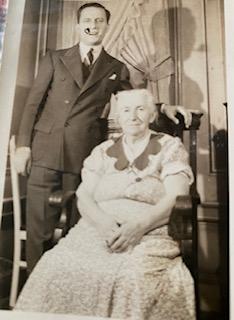
I almost fell off my chair. I had that exact same photograph, but in our collection the photograph was said to be of my great-grandmother Bessie Brod Brotman.

My great-grandmother Bessie Brotman (or so I was told)

I wasn’t sure who had the right label for the photograph, but just the fact that Alyce and I had in our possession copies of the same photograph seemed to confirm what the DNA and all my research had already told me—we were cousins!

Alyce had other photographs of her great-grandmother Sarah, and when I saw those I thought that in fact that first photograph was of Sarah, not Bessie. Here are her other photographs of Sarah, all courtesy of Alyce, and then another photograph I had of my great-grandmother Bessie.

Sarah Brod/Brotman Goldfarb and her son Leo Goldfarb. Courtesy of Alyce Shapiro Kunstadt

Bessie Brotman

Bessie Brotman

It seems to me that Bessie had a rounder and softer edged face than the woman seated in front of the grocery store, so I think that woman was indeed Sarah, Bessie’s sister.

So somehow my family ended up with a photograph of Bessie’s sister Sarah. And we never would have known if I hadn’t found Alyce and she hadn’t shared her copy of the photograph.

I slowly flipped through the rest of Alyce’s photos, noting the faces of my grandmother’s Goldfarb first cousins Joe and Leo and their wives and children, hoping I could identify some of the unknowns in Alyce’s collection, when I came to this photograph. This time my jaw dropped.

Rose Goldfarb, Joe Goldfarb, Gussie Brotman

Alyce labeled this photograph, “Grandpa Joe. I think that could be Aunt Rose [the youngest child of Sarah Brod and Sam Goldfarb] on the left. Not sure who’s on the right.”

But I knew who was on the right. I had no doubt. That woman was my grandmother, Gussie Brotman Goldschlager, posing with two of her first cousins, Joe and Rose Goldfarb. I was blown away. How could Alyce, who until just a few days earlier was unknown to me, have a photograph of my grandmother—a photograph I’d never seen before?

I sent the photograph to my brother for confirmation, and he agreed. I ran the photograph through Google’s face identification software, and Google agreed. Here are some other photographs of my grandmother.

Gussie Brotman

Goldschlagers 1935

Jeff and Gussie c. 1946

I think you also will agree.  Alyce, my third cousin, had a photograph of her grandfather Joe and my grandmother Gussie together. Wow.

More Photos of My Double Cousin Hannah Goldsmith Benedict and Her Family

I recently posted photos that my cousin Bruce Velzy sent me of his great-great-grandmother Hannah Goldsmith. Hannah is one of the relatives whose lives most fascinate me. Her parents were both related to me. Her father Simon Goldschmidt was my four-times great-uncle, and her mother Fradchen or Fanny Schoenthal was my three-times great-aunt. Simon and Fanny were recent immigrants from Germany to the US when Hannah was born in 1848. And then Hannah lost her mother shortly after Hannah’s second birthday.

Hannah and her brother Henry then moved with their father Simon to Washington, Pennsylvania, where they lived with Hannah’s half-brother Jacob Goldsmith and his wife and children. Then when she was just eighteen, Hannah married Joseph Benedict, a rag dealer who was fourteen years older, and moved to Pittsburgh; her father moved with her. Hannah and Joseph had five children, but only three survived infancy: Jacob (1870), Herschel (1871), and C. Harry (1876).

Bruce is descended from Hannah’s son Jacob and shared these photos, which I’ve previously posted:

Hannah Goldsmith Benedict. Courtesy of the family and edited by the Photo Restoration Facebook group.

Sons of Hannah Goldsmith and Joseph Benedict, c. 1890. Courtesy of the family

Joseph Benedict, Helen Benedict, Marian Benedict, and Hannah Goldsmith Benedict. August 24, 1908. Courtesy of Bruce Velzy

One of the things that makes Hannah’s story so remarkable is the success of her son C. Harry Benedict and of his two sons, Manson Benedict and William Benedict, as I wrote about here and here. They all were Ivy League graduates who pursued highly successful careers in science and engineering.

A few weeks ago I heard from Manson’s Benedict’s daughter Mary, She found my blog and commented as follows:

My father was Manson Benedict, son of C.Harry Benedict. Manson played a large part in the successful development of the atomic bomb. His contribution was developing a process to separate the isotopes of Uranium at a plant in Oak Ridge Tennessee. After the war he became the first professor of nuclear engineering at MIT, and was active in research on peaceful uses for atomic energy, such as nuclear power. I got a Master’s degree in chemistry, doing research on radiation chemistry. My granddaughter, Kirsten Benedict Sauer, earned a PhD in geology and is now employed at Los Alamos National Laboratory, where she is developing ways to safely dispose of radioactive waste from reactors.

I emailed Mary and learned that she and her granddaughter are not the only ones carrying on the Benedict tradition in the sciences. Both of Mary’s sons are scientists as are her daughter-in-law and some of her grandchildren, and her daughter majored in psychology. It’s amazing to see how the DNA carries certain interests and skills from one generation to another.

Mary also shared three photographs with me, including this one taken at the celebration of Hannah Goldsmith’s 90th birthday in 1938. The photo includes Hannah’s three sons Jacob, Herschel, and C. Harry, her grandsons Manson and William, her daughters-in-law and granddaughter-in-law, and her great-granddaughter Mary.

Celebration of Hannah Goldsmith Benedict’s 90th birthday in 1938. Standing in rear Jake, C. Harry, Manson, Herschel, and William Benedict. Seated Marjorie Allen Benedict, Lena Manson Benedict with Mary Benedict Sauer, and Hannah Goldsmith Benedict. Courtesy of Mary Benedict Sauer.

Mary also sent me two wedding photographs. This one is of her grandparents C.Harry Benedict and Lena Manson on their wedding day, February 7, 1902.

C. Harry Benedict and Lena Manson, 1902. Courtesy of Mary Benedict Sauer.

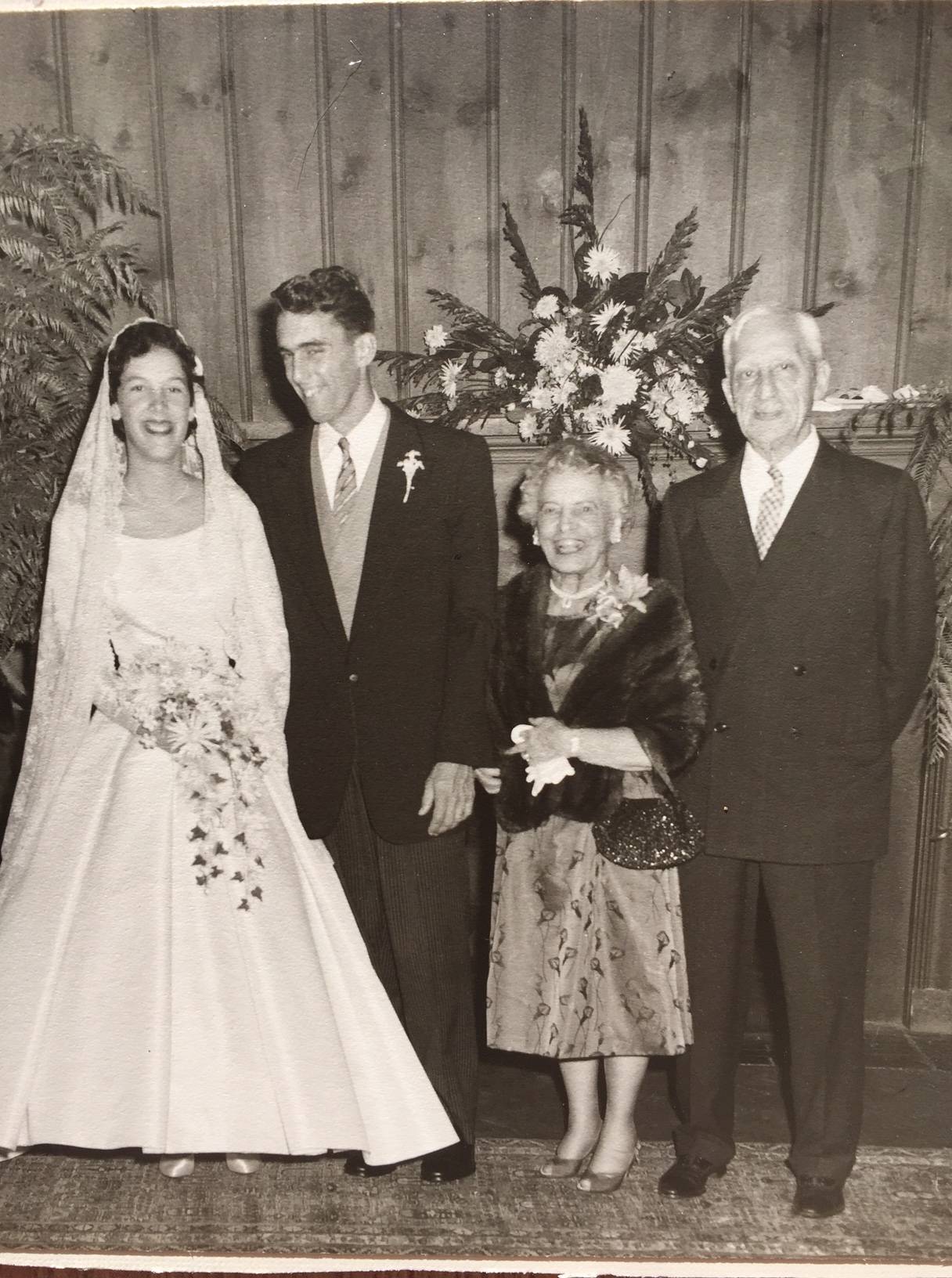
And this one is from Mary’s own wedding in 1959. Mary and her husband Myran Charles Sauer, Jr. are standing with Mary’s grandparents, C Harry Benedict and Lena Manson Benedict.

Mary Benedict, Myran Charles Sauer, Jr., Lena Manson, and C.Harry Benedict, 1959. Courtesy of Mary Sauer.

Once again, I am so drawn to the story of Hannah Goldsmith and so grateful to her descendants for sharing the stories and photographs they have of her.

Amalie Schoenthal Wolfe and Etta Wolfe Wise: Photo Analysis Part III

In this third and final post devoted to photographs of Amalie Schoenthal Wolfe and her daughter Etta, I will look at two more photographs that my cousin Alan sent me and try and identify the others in the photo.

In this photograph, I’ve assumed Amalie is on the left and possibly Etta on the right. Then who are the three young women?

I don’t know. But Amalie had four granddaughters: Flora’s daughters Helen and Marjorie, Lee’s daughter Ruth, and Etta’s daughter Florence. My guess is that this is three of those four.

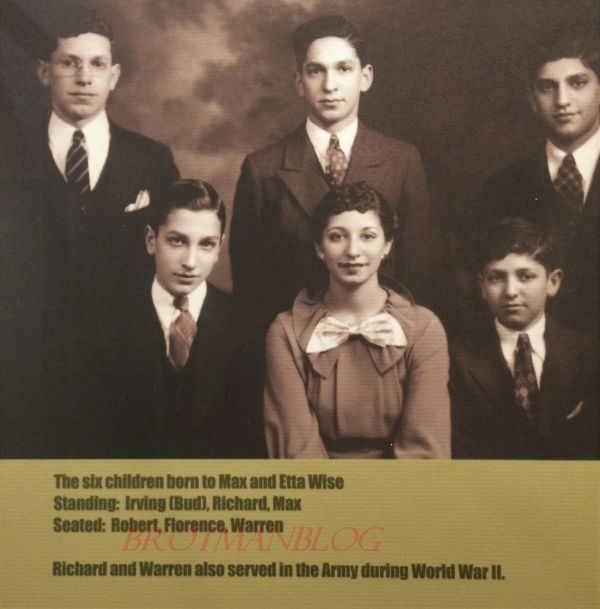
Here are some photos of Florence. This one is of Etta and her six children; Florence, her only daughter, is seated on our right.

Etta and her children. Courtesy of the family.

Here are another two of the children of Etta and Max Wise:

Do you see Florence in the photo above? Is she the tall girl standing between Amalie and Etta? I don’t think so, but am not sure. And as for the other two girls in the forefront? I have no idea. So maybe they are Helen, Marjorie, and/or Ruth. Or maybe not!

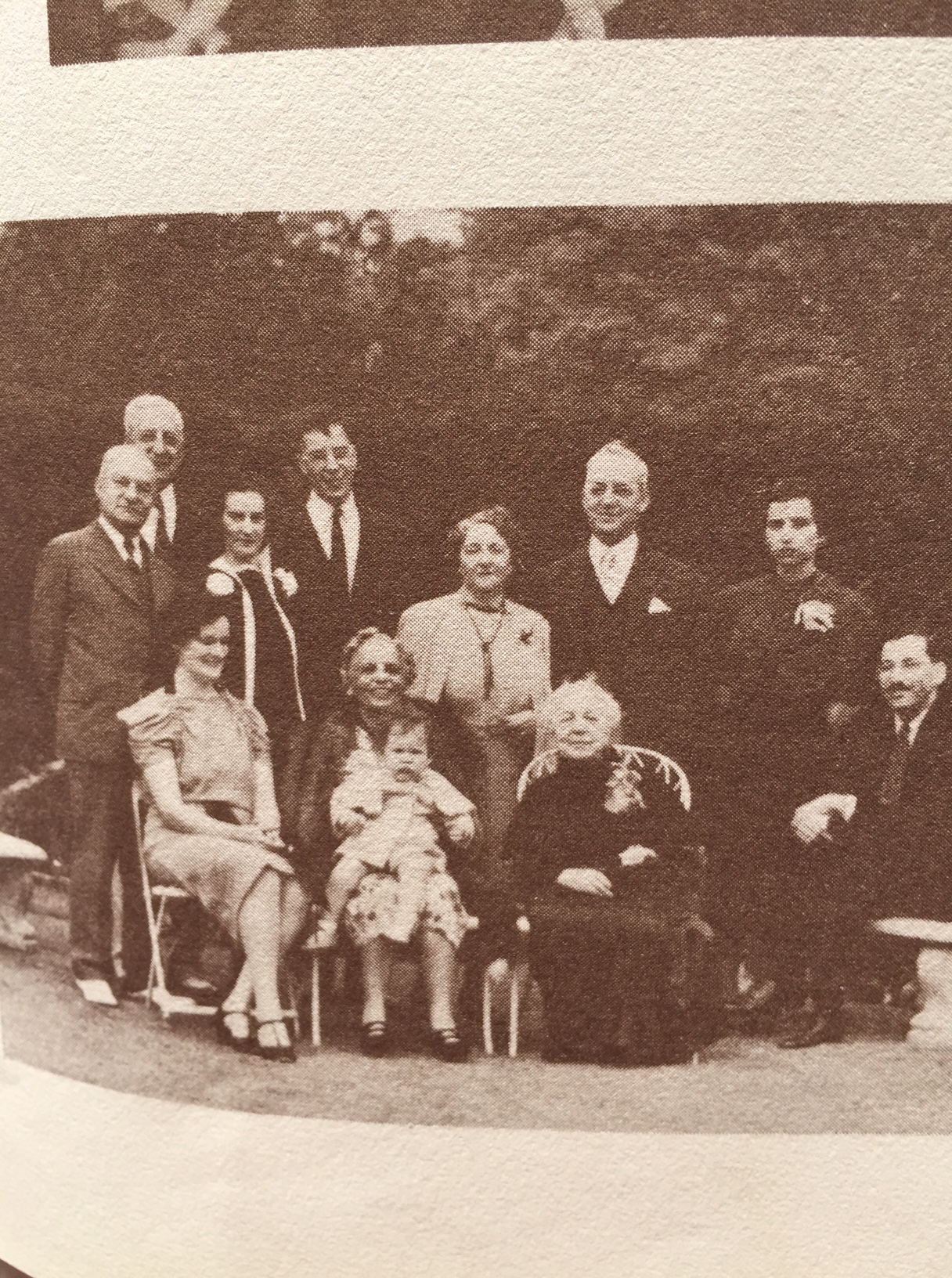
Finally, there is this photograph, which I will refer to as the living room photo:

The Wise Family Courtesy of the family

Seated in the middle rear are Etta, Amalie, and Max. The girl sitting right in front of Etta is her daughter Florence, and the four little boys on the floor and the little boy sitting on the lap of the man next to Max are the five sons of Etta and Max: Irving (Bud), Richard, Max, Jr., Robert, and Warren. From the ages of the children, I would guess that this photograph was taken in the early 1920s since Warren was born in 1920, Robert in 1919. You can compare the children to those in the photo of Etta surrounded by her children, probably taken a year before, and see the similarities.

So who are the other people in the living room photograph? Are they other relatives of Amalie and Etta? Or are they relatives of Max Wise? This photograph of Etta and Max with Max’s brothers and their wives shows what two of his brothers looked like. Alan agreed with me that the Wise brothers are not in the living room photograph with Etta’s children.

I think therefore that these are Etta’s relatives in the living room photo. Maybe the three older men are three of Etta’s four brothers: Maurice, Lee, Ira, and Herbert.  Maurice was living in Middletown, Ohio in 1920, as were Etta and Max, so it’s likely he is in the photograph.In 1920 Lee was in Pittsburgh, and Herbert in Detroit. Ira was living in Illinois in 1920 and died in 1924.

As for the two women sitting to Etta’s right, perhaps one is a sister-in-law, maybe both are. Perhaps one is Flora’s daughter Helen or her daughter Marjorie. And maybe the younger man perched on a table on our far left is Flora’s son Leroy. Or maybe her son Donald.

At this point it’s far too much speculation, but perhaps a cousin will find me who knows the answers. I am open to suggestions!

And please, everyone, label your photographs and spare some future family member from doing all this impossible guesswork.

Amalie Schoenthal Wolfe and Etta Wolfe Wise: Photo Analysis Part II

Looking back at my prior post, let’s assume for purposes of this post that I have correctly identified Amalie Schoenthal Wolfe and her daughter Etta Wolfe Wise in the two photographs below.

Etta Wolfe Wise to far right, upper. Courtesy of the family

Courtesy of the Family

Then who are the other people in these two photographs? Are they other relatives of mine, relatives of Amalie and Etta?

Starting with the first photograph, which I will refer to as the porch photo, I am assuming that the older woman standing on the porch is Amalie and Etta is to her left. Who is the woman on the other side of Amalie, and who are those five adorable little children in front of them?

Looking at the second photograph, which I will refer to as the formal photograph, I identified the older woman as Amalie and the woman standing in the rear next to her as Etta. So who is the other woman? Is she the same woman as the woman standing on the porch with Amalie and Etta in the other photo?

When I compare those two women, I believe they are the same woman, and my guess is that she is Etta’s only sister and Amalie’s only other daughter, Flora Wolfe Goldman.

The hair and how it is parted and the mouth seem so similar that I think they are the same person. What do you think?

I think the formal photograph was taken some years before the porch photograph, and that the two children in the formal photograph are mostly likely two of Flora’s children. Flora had four children: Leroy (1901), Helen (1903), Donald (1905), and Marjorie (1908). I am guessing that the little boy in the photo is Leroy and the little girl is Helen. My guess is that the photo was taken between 1904 and 1905 and perhaps Flora was pregnant with Donald when it was taken.

So that brings me to the next question: Who are those five little children in the porch photograph?

Assuming that is Flora in the porch photograph, it had to have been taken before September 30, 1910, when Flora died. She died from puerperal fever—a fever caused by a uterine infection after childbirth.1 Since Flora does not look obviously pregnant in the porch photograph and since it looks like the weather must have been relatively warm or at least not wintry, I am going to assume that the photograph was taken no later than the fall of 1909, but after 1905 or so when the formal photograph was taken.

At the time Flora died, her mother Amalie had six grandchildren. Flora’s four, Leroy, Helen, Donald, and Marjorie, and Amalie’s two grandchildren through her son Lee: Lloyd, born in 1902, and Ruth, born in 1905.

I would guess that the children in the photograph range in age from about fifteen months old to four years old. If the photograph was taken in 1906 or so, Flora’s children would have been five, three, and one (Marjorie would not yet have been born).  Lee’s two children would have been four and one in 1906.  Since there are only five children in the photo, maybe they are Flora’s older three (Leroy, Helen, and Donald) and Lee’s two (Lloyd and Ruth). And although they all look like girls, I know that little boys often wore dresses back in those days.

So I have no idea. Maybe they’re cousins from another branch of the family or neighbors. Without more photographs and information, I am grasping at straws!

But I do feel pretty comfortable identifying Etta, Flora, and Amalie.

I have a few more Etta/Amalie photographs to analyze. Maybe they will shed more light.


  1. There was no death certificate for a baby born in 1910 to Flora Wolfe Goldman so I assume the baby was stillborn or perhaps was miscarried. If Flora had an early miscarriage that led to a uterine infection, I suppose the photograph might have been taken in the spring of 1910. 

Amalie Schoenthal Wolfe and Her Daughter Etta Wolfe Wise: Some Photo Analysis

I have already written about Amalie Schoenthal Wolfe, the sister of my great-grandfather Isidore Schoenthal. Amalie was born in Sielen, Germany, in 1847, and came to the US as a young woman in 1867. In 1872 she married Elias Wolfe, and together they had six children, including her daughter Etta Wolfe Wise, who was born in Pittsburgh in 1883.

A few weeks ago I heard from Alan, one of Etta’s descendants, and he shared with me numerous photographs of the family, including two that were labeled in part “Etta’s mother.” I was excited to see photographs of Amalie.

Alan said this one was labeled as Etta’s mother Amalie on the right:

And that this one labeled Etta’s mother Amalie as the woman on the left:

I can see that the two older women in these two photos are the same person—do you agree? The shape of their chins and their cheekbones are the most obvious similarities.

This is Amalie’s daughter Etta Wolfe Wise, my grandmother Eva Schoenthal’s first cousin. It might have been taken on her wedding day, June 2, 1910:

Etta Wolfe Wise, c. 1910. Courtesy of the family

And this is her husband, Max Wise, perhaps taken around the same time:

Max Wise Courtesy of the family

Knowing what Etta looked like made it easy to identify her in other photos, such as this one. That looks like Etta standing in the rear to our right.

Etta Wolfe Wise to far right, upper. Courtesy of the family

I think that the older woman standing next to Etta is the same woman as the older woman in the first two photos above and so presumably Amalie.

And I think Amalie is also the woman sitting between Etta and Max Wise in the next photo, Max sitting highest on the chair fourth from the left, then Amalie to his right, and then Etta to Amalie’s right.

The Wise Family Courtesy of the family

Here are closeups of the four faces of the older woman cropped from those photographs:

What do you think? Are these all the same woman?

That left me puzzled about the people in the other photos of Amalie. For example, in this one, is that Etta standing next to her? At first glance I thought so, but then I wasn’t sure.  Etta has such distinctive deep-set eyes, and the eyes of the woman in this photo looked different.

Here are some closeups of Etta from the known photos and from this one:

The more I look, the more I think it is Etta. And is this Etta in the more recent photo showing Amalie on the far left?

I think so, although the glasses and her squint make is hard to be sure. She certainly looks like the woman in the last of the cropped photos above.

So…what do you think? Is that Amalie in all those photos? Have I correctly identified Etta in the photos?

If so, then I need to figure out who the other people are in those photographs. To be continued…

New Year’s Eve 1919-1920 in Frankfurt, Germany

Two weeks ago I said I was taking a break, trying to figure out where to go next with my research and clearing my head. Well, my head is still not clear, and I still am on the fence about what to do next.

But while I was taking that breather, I heard from multiple new cousins as well as new communications from cousins I’d already found. New photos, new stories, new people. These include new DNA matches on my Brotman line, new photos for my Schoenthal line, new photos for my Seligmann line, a new connection from a Seligmann cousin who also appears to be a Goldschmidt cousin, a new Katzenstein cousin, a set of documents sent by a man living in Oberlistingen about the Goldschmidts, and numerous other questions, comments, or requests coming from my blog, Facebook, or email.  I will blog about many of these once I get my arms wrapped around the details.

All of this has given me a shot in the arm (and yes, I now am fully vaccinated against COVID as well) that I sorely needed. It’s so hard to transition from one research project to another, especially after three years. So these smaller, more focused projects are what I need right now. Especially since I also want to spend some time promoting my new book, Santa Fe Love Song.

Today I want to share an amazing photograph that my cousin Greg Rapp sent me. He cannot identify anyone in the photograph, but Greg is a Goldschmidt cousin (a descendant of Jacob Meier Goldschmidt), and the photo was labeled “New Year’s Eve 1919-1920.” Whether or not we can ever identify anyone in the photograph, it is nevertheless worth sharing. It captures German society during the Weimar Republic. The young women smoking cigarettes evoke that era as does the energy, the expressions, and the postures of all the young people in the picture.

If anyone can identify anyone in this photograph, please let me know.

Two Cousins Whose Lives Tell the Overall Story of the Goldschmidts

As I draw to the close of my Goldschmidt family history project, it seemed quite appropriate that I recently received photographs of two members of that family who  exemplify two very different stories of this family’s history, my cousins Herman Goldsmith and Hannah Goldsmith. Hannah was born in America in 1848 and lived until 1939, and Herman was born in Germany in 1912 and lived until 2016.

First I received this photograph of Herman Goldsmith and my cousin Susan and her husband Richard. Susan said it was taken in June 2013 when Herman was 100 years old. He would turn 101 on December 6, 2013, and live until October 27, 2016, just a little over a month before he would have turned 104.

Richard and Susan (Vogel) Neulist and Herman Goldsmith, June 2013. Courtesy of Susan Neulist

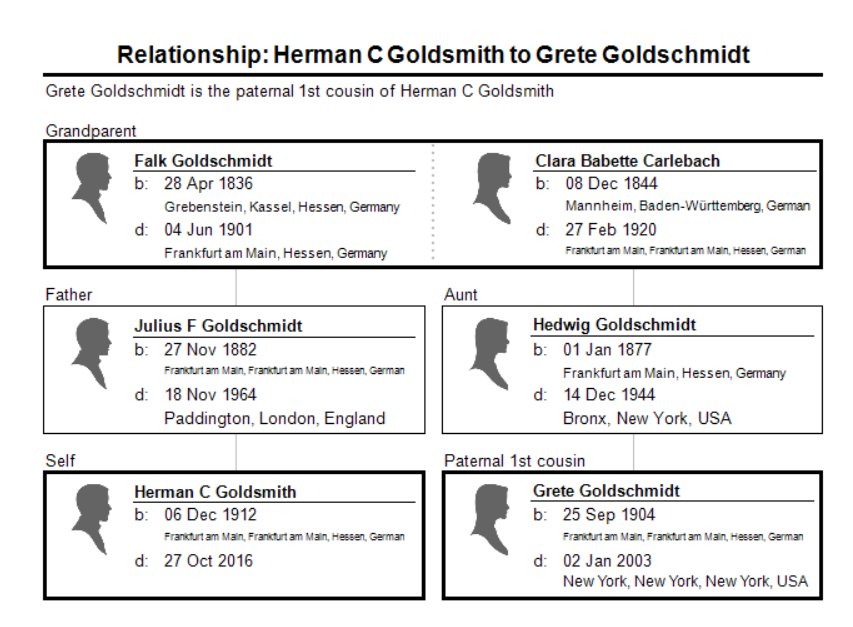
I wrote about Herman here. He was the son of Julius Falk Goldschmidt and Helene “Leni” Goldschmidt. Julius Falk Goldschmidt was the son of Falk Goldschmidt, and Leni Goldschmidt was the granddaughter of Jacob Meier Goldschmidt. Since Falk and Jacob Meier were brothers, Julius and Leni were first cousins, once removed, making Herman his own cousin.

After escaping from Nazi Germany to the US in the 1930s, Herman settled in New York City where so many Goldschmidt family members ended up. He remained in touch with his Goldschmidt relatives. Susan said he visited her grandmother, Grete Goldschmidt Heimerdinger, every week for many years.

Grete was also a double cousin as she was the daughter of Marcel (Maier) Goldschmidt, son of Jacob Meier Goldschmidt, and Hedwig Goldschmidt, daughter of Falk Goldschmidt. Hedwig and Marcel were first cousins, and so like Herman, Grete was her own cousin.

And since Hedwig Goldschmidt, Grete’s mother, and Julius Falk Goldschmidt, Herman’s father, were siblings, Grete and Herman were first cousins, both the grandchildren of Falk Goldschmidt.

But they were also both descended from Jacob Meier Goldschmidt, Herman’s great-grandfather and Grete’s grandfather, so they were also first cousins, once removed, through Herman’s mother Helene “Leni” Goldschmidt and Grete’s father Marcel Goldschmidt. Oy vey! No wonder they were so close! Susan described Herman as “quite the gentleman and full of wonderful stories.” I wish I knew more of his stories.

I also received a wonderful photograph from my cousin, Bruce, the great-great-great-grandson of Fradchen Schoenthal, sister of my great-great-grandfather Levi Schoenthal, and also the great-great-grandson of Simon Goldschmidt, brother of my three-times great-grandfather Seligmann Goldschmidt.

So Bruce is my double cousin. He’s my fourth cousin, once removed, through our Schoenthal side and my fifth cousin through our Goldschmidt side.

Isn’t Jewish genealogy fun?

Anyway, Bruce’s great-great-grandmother was Hannah Goldsmith Benedict, daughter of the above-mentioned Simon Goldschmidt. Hannah and her brother Henry were the first Goldschmidts born in the US, Henry in 1847 and Hannah in 1848. I’ve written much about Hannah and her family—here and here and here  and here and here and here and here. Hannah married Joseph Benedict in 1867, and they had five children, including Jacob Benedict, Bruce’s great-grandfather. Jacob had two daughters with his wife Clara Kaufman: Helen, born in 1907, and Marian, born in 1908. Helen was Bruce’s grandmother.

Bruce told me that this photograph was dated August 24, 1908, and shows Hannah Goldsmith Benedict with her husband Joseph and their two granddaughters Helen and Marian. At that time Jacob Benedict and his family were living in Paducah, Kentucky, and Hannah and Joseph were living in Pittsburgh. Jacob’s brother Herschel was living in Pittsburgh, and his brother Harry was living in Michigan by 1910.  But the photograph was apparently taken in Kenosha, Wisconsin. I wonder how that happened….

Joseph Benedict, Helen Benedict, Marian Benedict, and Hannah Goldsmith Benedict. August 24, 1908. Courtesy of Bruce Velzy

Another mystery to solve. But seeing one of my earliest American-born relatives with her granddaughters is very exciting.

It’s so fitting to close my Goldschmidt family blog posts with photographs of these two members of the family. Hannah Goldsmith and Herman Goldsmith were first cousins, twice removed, since Hannah’s father Simon Goldschmidt and Herman’s great-grandfather Meyer Goldschmidt were brothers.

Hannah was born in the United States when the country was still very young. She lived through the Civil War, World War I, the Roaring Twenties, and the Great Depression, dying in November 1939 while her German cousins were being persecuted and fleeing from Nazi Germany. She was 91 years old.

Just two months before Hannah died, her cousin Herman arrived in the US as one of those cousins escaping from Germany. Herman Goldsmith was born in 1912 in Frankfurt, Germany, and had grown up in the comfort of the large and well-to-do Goldschmidt family. Unlike Hannah, his life was radically changed by the events of the 1930s. But like Hannah, he saw so much in his lifetime, living until he was almost 104. He not only lived through World War I, the Weimar Republic years, the Depression, and World War II—he saw the radical changes that came after the war—the creation of the state of Israel, the Cold War, the assassination of JFK, the civil rights movement, the women’s movement, the moon landing, the gay rights movement, the rise of the internet, 9/11, and the election of the first Black man to serve as president of the US.

Can you imagine the stories Herman and Hannah could tell each other as well as us?  They lived such different lives in such different places and times, overlapping in time between only 1912 and 1939, but on different continents. But together the lives of Hannah Goldsmith and Herman Goldsmith tell us so much not only about the richness of the Goldschmidt family’s story, but also about the history of Jews in America and in Germany.

Thank you to Susan and to Bruce for sharing these photographs. And thank you to each and everyone of my Goldschmidt cousins who have helped me understand and appreciate our shared history.


The Diaries of a Young Boy: An Update on the Family of Arthur Rapp

Before I move on to the last child of Meyer Goldschmidt, his son Falk, I have two updates that relate to Meyer’s two other sons, Jacob Meier Goldschmidt and Selig Goldschmidt. Today’s involves descendants of Jacob Meier Goldschmidt.

Once again I have had the good fortune of connecting with a Goldschmidt fifth cousin, my cousin Greg. Greg is the great-grandson of Helmina Goldschmidt Rapp, the youngest child of Jacob Meier Goldschmidt. Greg’s grandfather was Helmina’s son Arthur Rapp, and his father was Gordon (born Gunther) Rapp.

Greg shared with me numerous photographs and documents, including his father’s diaries written during World War II when he was a teenager. Greg also put together a timeline of his family’s travels from Germany to Italy to England to Brazil and finally to the US, all between the years of 1934 to 1941 or from when his father was eight years old until he was sixteen. In other words, the Rapp family lived in five countries in the span of seven years.

Although I have already written most of the skeleton of the Rapp family story in my earlier post, after reviewing the materials Greg shared and speaking with him, I want to supplement that post because I can now better describe the family’s life in Frankfurt and the journey that finally brought them to the US in 1941.

Arthur Rapp and his wife Alice Kahn were married in Frankfurt on May 6, 1921. This photograph might be their wedding photograph, but Greg wasn’t certain.

Wedding of Alice Kahn and Arthur Rapp 1921. Courtesy of Greg Rapp

It was Arthur’s second marriage, and he had a daughter Rita from that first marriage who was born in 1908. Then Arthur and Alice had two sons, Helmut, born in 1923, and Gunther, born in 1925. These photographs of the family in the years before they left Germany in March 1934 illustrate their comfortable lifestyle with family vacations to the shore and to the mountains. I don’t have exact dates for these photographs but can only estimate from the presumed ages of Helmut and Gunther.

Helmut and Gunter Rapp c. 1926
Courtesy of Greg Rapp

Helmut Rapp c. 1924 Courtesy of Greg Rapp

The two brothers were very close:1

Helmut and Gunther, c. 1933 Courtesy of Greg Rapp

Helmut and Gunther Rapp, c. 1933 Courtesy of Greg Rapp

Helmut and Gunther Rapp c. 1933 Courtesy of Greg Rapp

They went to the mountains:

Gunther and Helmut Rapp with unknown woman c. 1930 Courtesy of Greg Rapp

The beach:

Rapp family beach c. 1930 Courtesy of Greg Rapp

Rapp family c. 1930

And skiing and ice skating:

Arthur Rapp skiing  Courtesy of Greg Rapp

Alice and Arthur Rapp Courtesy of Greg Rapp

Alice and Arthur Rapp Courtesy of Greg Rapp

Alice and Arthur Rapp Courtesy of Greg Rapp

During these years Arthur was working for the H. Fuld Telephone company as a director and salesman. H. Fuld was started by Arthur’s first cousin Harry Fuld, about whom I wrote in this blog post.

Gunther Rapp started school in Frankfurt on April 6, 1932, when he was six, and spent two years in school in Frankfurt, ending on February 23, 1934, as seen on this report card his son Greg shared with me. His first year was at the Holzhausen School, and his second year was at the Philanthropin School.

Courtesy of Greg Rapp

Then, one year after Hitler had become Chancellor of Germany, the Rapp family left their comfortable life in Frankfurt and moved to Milan, Italy, where on March 2, 1934, Gunther was enrolled in a Swiss school in Milan, as seen in this report card:

Courtesy of Greg Rapp

The family lived in Milan until about December 1937. Greg wasn’t sure what his grandfather was doing at that time but speculated that since the H. Fuld Telephone Company was international, he was continuing to work for that company during this time.

I think these photographs were probably taken during the time they were in Italy from March 1934 until December 1937, or from the time Gunther was eight until he was twelve; on the other hand, they might have been taken in England, their next home:

Gunther and Helmut Rapp c. 1936 Courtesy of Greg Rapp

Gunther and Helmut Rapp c. 1936

Then the family moved again, this time to London. Gunther was now twelve, his brother Helmut was fourteen. Having learned Italian and studied French while in Milan, the boys now had to learn a fourth language, English. When he started school in England in January 1938 at the Normandie Preparatory School in Bexhill-on-the-Sea, Gunther knew only three words: please, thank you, and yes.2

Gunther’s report card a year later in December 1938 showed just how much progress he had made in English and in school in general (despite the comment about how he was doing in Scripture). Perhaps most telling is the comment at the bottom: “He is losing his shyness and beginning to talk more readily.”

Courtesy of Greg Rapp

Gunther celebrated becoming a bar mitzvah that December as well, delivering his bar mitzvah speech in German, which he later translated to English. His speech was primarily an expression of gratitude to his parents and his grandmother for the way they instilled joy and love into all their lives. A note at the bottom contained Gunther’s admission (possibly added years later) that the rabbi wrote most of his speech (something that may be true for many bar/bat mitzvah students).

And then nine months later on September 1, 1939, World War II started. The headmaster of Gunther’s school wrote to his parents, trying to persuade them to keep Gunther at the school.

Courtesy of Greg Rapp

Two things are of particular interest: first, the fact that the school had built a trench so that the students never had to go outside. And secondly, the letter assured Gunther’s parents that the fact that he was German-born would not be an issue, noting that, “We all know that you have exactly the same feelings as an Englishman about the tyrant in Germany….”

But the Normandale School was on the south coast of England on the English Channel, and the Rapps decided that boys would be safer elsewhere. Gunther and his brother Helmut were sent to High Bullen Farm in Lynton, Ilkerton-Devon, on the west coast of England. The farm had no electricity, only kerosene lamps, and water had to be pumped by hand. The Rapp brothers helped on the farm—milking cows, hunting rabbits, and watched the slaughtering of a pig.3

Starting in January 1940, Gunther began to keep a diary. The three months of the first year of his diaries are, interestingly, written in German, not English; many of the entries simply say he went to school or he was sick in bed or he played football (soccer, I assume) or hockey or golf.  In April 1940, he switched to English, which I found noteworthy. I wonder whether England being at war against Germany had anything to do with that or whether he just finally felt fluent enough in English to use it. There is no mention of the war, however, until May 8, 1940, when he included a small news clipping about the war after entering his activities for that day: “Go to school. Play cricket. Became a prefect.”

Courtesy of Greg Rapp

But his parents were already looking to get out of England:

Courtesy of Greg Rapp

From then on, Gunther made occasional entries about the progress of the war or entered news clippings, but mostly he reported on going to school and engaging in sports. In June 1940, he and Helmut left Devon and returned to the family home in Stanmore where their parents had built a house with a bomb shelter in the backyard to keep them safe.4

On June 26, 1940, Gunther wrote the following brief entry: “Pa is interned at 10 o’clock. Mu [his mother, I assume] is very worried. Read. Mu goes to Consuls and tries to get a visa.” On Friday, August 2, 1940, Gunther wrote, “We get a ‘phone call that we will shortly get the visa.” On August 16, he spoke of men coming to pack and of an air raid warning. There are then several more references to air raid warnings, and on August 29, he noted that his diary had been checked by a censor as the family was preparing to leave England.

Courtesy of Greg Rapp

And then on September 6, 1940, he described their departure from England, commenting in part that “We are all very pleased. Pa came out of the internment camp.” They were headed to Sao Paulo, Brazil, Gunther’s fourth country in six years. He was not yet fifteen years old.

From his description of the trip from England to Brazil, you would think he was on a pleasure cruise with his diary entries repeatedly saying, “Lie on deck. Read and play,” with an occasional reference to learning Portuguese—his fifth language after German, Italian, French, and English.

The Rapp family’s time in Brazil was relatively short, and Gunther’s diary entries mostly refer to learning Portuguese, going to the museum, exploring Sao Paulo, and engaging in some project with marble blocks. He also commented on Helmut’s fascination with watches and clocks and his work at a clock repair store. Then in December he started school and commented, “I hardly understand anything the teachers say.” But that same week in December, 1940, Gunther wrote about going with his parents to the American consul to get a visa to travel to the US.

Courtesy of Greg Rapp

The 1941 diary began by noting that he was going to school each morning to learn Portuguese and taking typing lessons in the afternoon. But meanwhile the family was preparing to sail to the US. Helmut continued to repair watches. On his last day at the school in Brazil, January 31, 1941, Gunther wrote, “I’m glad I don’t have to go there any more because I didn’t like it there.”  Overall, he seemed not to be the least bit sad when they left Brazil on February 5, 1941, and sailed to the United States.

On February 17, 1941, the ship arrived in New York harbor. Gunther wrote on that day:

“We are getting nearer our destination. On our left and our right, we can see strips of land, with a blanket of snow on it. Hardly visible through the fog is the imposing statue of liberty, which guards the entrance of the N. York harbor. … We step ashore at 330 and are welcomed at the quay by aunt Alice [Rapp, his father’s sister] and [her husband] Sally and one or two other friends. It’s snowing and terribly cold. …. We go with Uncle Sally and Mr. Drey to the Whitehall Hotel by U-ground, which isn’t as nice as in London [ed.: that is still true today]. I haven’t seen much of N.Y. yet, but from what I have seen, I think I’m going to like it.”

He in fact lived the rest of his life in the greater New York City area, moving only as far as New Jersey in the mid-1970s.

Gunther (who became Gordon in the US) continued to keep his diaries through 1945, and when I have time I hope to read through more of them. But for now I have told the part of the story I wanted to share—the story of a boy who left his homeland at eight for Italy, then at twelve moved to England, at fourteen left for Brazil, and finally in February 1941 when he was fifteen, moved to the United States, where he spent the rest of his life.

As I wrote in my earlier post about the Rapp family, both Gunther/Gordon and his brother Helmut/Harold lived long and successful and productive lives in the US—Harold rising from doing watch repairs to becoming the president of Bulova International, Gordon obtaining degrees from Cornell University and Purdue University and becoming a product and marketing manager with Corn Products Corporation.

From reading the diaries, looking at the photos, and reading the letters written about him by his teachers, it truly seems that Gunther Rapp’s bar mitzvah speech was truthful—even if the rabbi wrote much of it. Gunther seems to have always felt safe and secure with his parents and brother, well-loved and filled with joy, despite all the turmoil and changes going on in his external circumstances.

Thank you so much to my cousin Greg for sharing this incredible archive of photographs, diaries, and other documents. By doing so, he has brought his father to life for me and, I hope I have been able to honor the memory of this man whose boyhood was interrupted, but who never seemed to lose his joyfulness or his desire to succeed.


  1. Conversation with Greg Rapp, December 17, 2020. 
  2. Email from Greg Rapp, December 17, 2020. 
  3. Email from Greg Rapp, December 17, 2020
  4. Conversation with Greg Rapp, December 17, 2020.