Malchen Rothschild Rosenblatt, Part II: Who Shall Live and Who Shall Die

Of the five children of Malchen Rothschild and Daniel Rosenblatt who were still living when Hitler came to power in 1933, only two survived, the two sons Felix and Siegmund. Their three daughters—Julchen/Julie, Jette/Thekla, and Auguste–were all murdered by the Nazis.

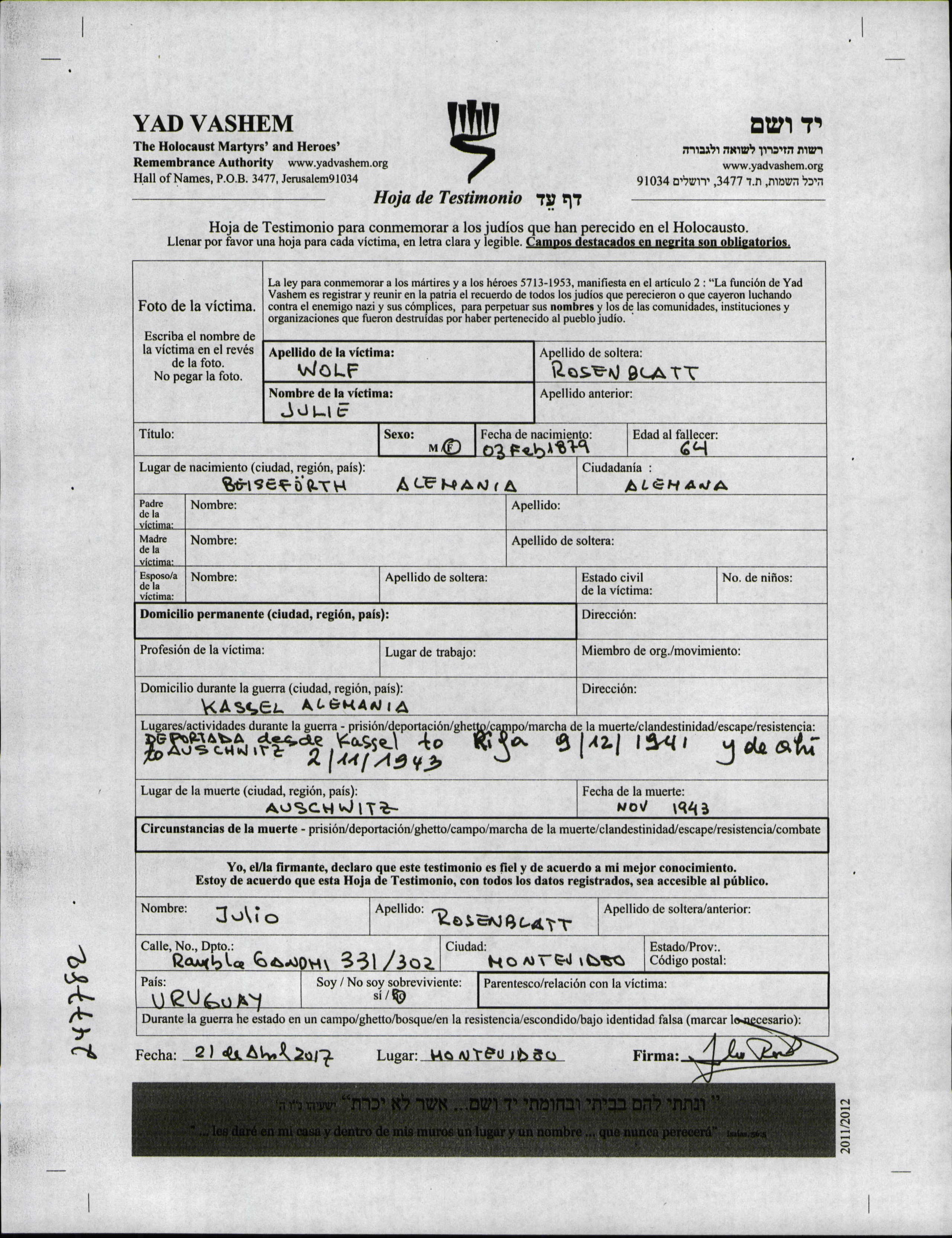
Julchen/Julie and her husband Max Wolf were first deported from Kassel to the Riga ghetto on the December 9, 1941, transport that had deported so many other Rothschild family members. Julie and Max were then deported from Riga to Auschwitz on November 2, 1943, where they were murdered. Since their only child Edgar had died as a toddler, they had no direct descendants.

Julie Rosenblatt Wolf page of testimony, found at https://collections.yadvashem.org/en/names/13324463

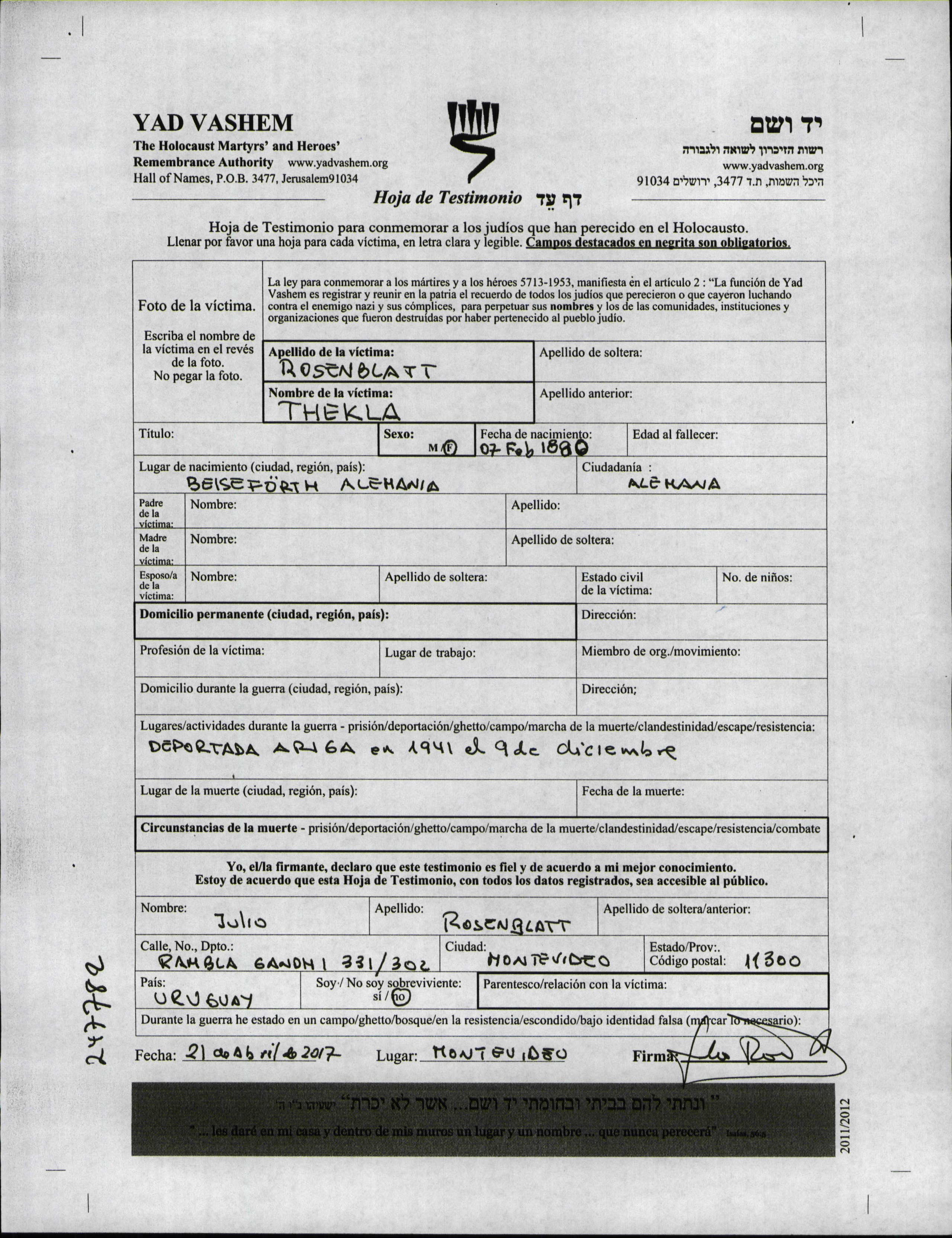
Jette/Thekla Rosenblatt was also on the December 9, 1941, transport to Riga, where she did not survive. Since she had never married or had children, she also had no direct descendants.

Thekla Rosenblatt page of testimony, found at https://collections.yadvashem.org/en/names/13324460

Auguste’s husband Samuel Roth died on February 15, 1935, in Breitenbach. He was 52 years old.1 Auguste unfortunately had to face Nazi persecution without him. She was deported to the Sobibor death camp on June 1, 1942, and killed there two days later on June 3, 1942.

As for the four children of Auguste and Samuel, I only have the following information:

Irma Roth married Alfred Moses on December 19, 1934, in Berlin.

Irma Roth and Alfred Moses marriage record, Landesarchiv Berlin; Berlin, Deutschland; Personenstandsregister Heiratsregister, Register Year or Type: 1934 (Erstregister). Ancestry.com. Berlin, Germany, Marriages, 1874-1940

I found Alfred listed on the CEMLA website, immigrating to Argentina on December 30, 1939. I could not find a listing for Irma, but I assume she immigrated there as well since they are both buried together at the Cementerio Comunitario de Berazategui in Buenos Aires, Argentina. Alfred(o) died on March 28, 1980, and Irma died on May 30, 1999. I do not know whether they ever had children.

Alfred Moses CEMLA listing, at https://cemla.com/buscador/

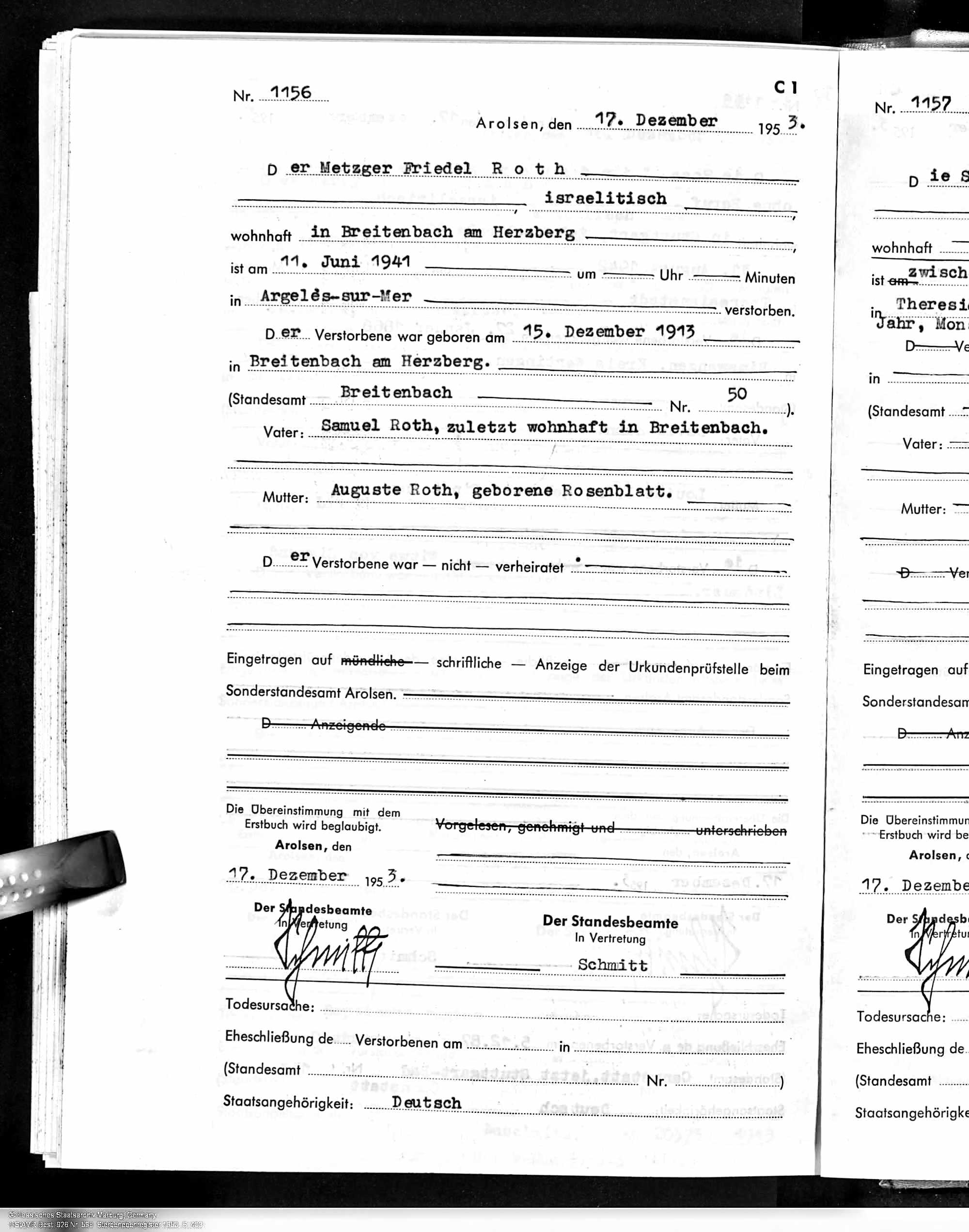
Irma’s sister Friedel never married as far as I can tell. She was living in Luxembourg during World War II and was deported from there to the concentration camp at Argeles-sur-Mer in France. The camp at Argeles-sur-Mer was built by the French in 1939 to house refugees from the Spanish Civil War, and conditions were horrific. “The lack of lodging structures, as well as unsafe water supply and food scarcity, added to the exiled people’s poor health conditions caused the spreading of several diseases that, in turn, led to a dramatic increase in mortality among refugees.” Then during World War II, the camp was used to imprison Jews, gypsies, and other targets of Nazi persecution. Friedel Roth died as a prisoner there on June 11, 1941.

Friedel Roth death record, Hessisches Hauptstaatsarchiv; Wiesbaden, Deutschland; Personenstandsregister Sterberegister; Signatur: 598; Laufende Nummer: 926, Year Range: 1953, Ancestry.com. Hesse, Germany, Deaths, 1851-1958

Lothar Roth, the third child of Auguste Rosenblatt and Samuel Roth, also appears to have never married. The only record I could locate for him was a burial record in Buenos Aires, Argentina, indicating that he died there on July 27, 1992. I could not locate any birth or immigration or marriage record for him.

Auguste and Samuel’s youngest child Gretl was also murdered by the Nazis. I could not find any record of marriage for Gretl. She was deported from Berlin to Auschwitz on March 1, 1943, and was murdered there.

Thus, the three daughters of Malchen Rothschild and Daniel Rosenblatt and some of their children were victims of the Nazi killing machines.

But the two sons of Malchen and Daniel fared better than their sisters. For a long time I was up against a brick wall trying to find more about Felix and Siegmund Rosenblatt. I knew that they had gone to Argentina, but aside from burial records, I could learn nothing more.

And then I looked at the name of the submitter on the Pages of Testimony above for Julie and Thekla Rosenblatt: Julio Rosenblatt of Montevideo, Uruguay. I googled his name, and the bricks on that brick wall began to crumble.


  1. Samuel Roth death record, LAGIS Hessen Archives, TitelStandesamt Breitenbach am Herzberg Sterbenebenregister 1935 (HStAMR Best. 907 Nr. 927)AutorHessisches Staatsarchiv MarburgErscheinungsortBreitenbach am HerzbergErscheinungsjahr1935, p 6, found at https://dfg-viewer.de/show?id=9&tx_dlf%5Bid%5D=https%3A%2F%2Fdigitalisate-he.arcinsys.de%2Fhstam%2F907%2F927.xml&tx_dlf%5Bpage%5D=6 

Rosa and Amalie Rothschild, Gerson and Fanny’s Youngest Daughters

Getting to know Hal Katz and his family and learning the stories about Clara Rothschild and Moritz Katz and their children and grandchildren has been a real highlight of the past few months. Now I turn to Clara’s two younger sisters, the seventh and eighth children of Gerson Rothschild and Fanny Kugelmann of those who survived to adulthood. And unfortunately there is no joy in telling their stories.

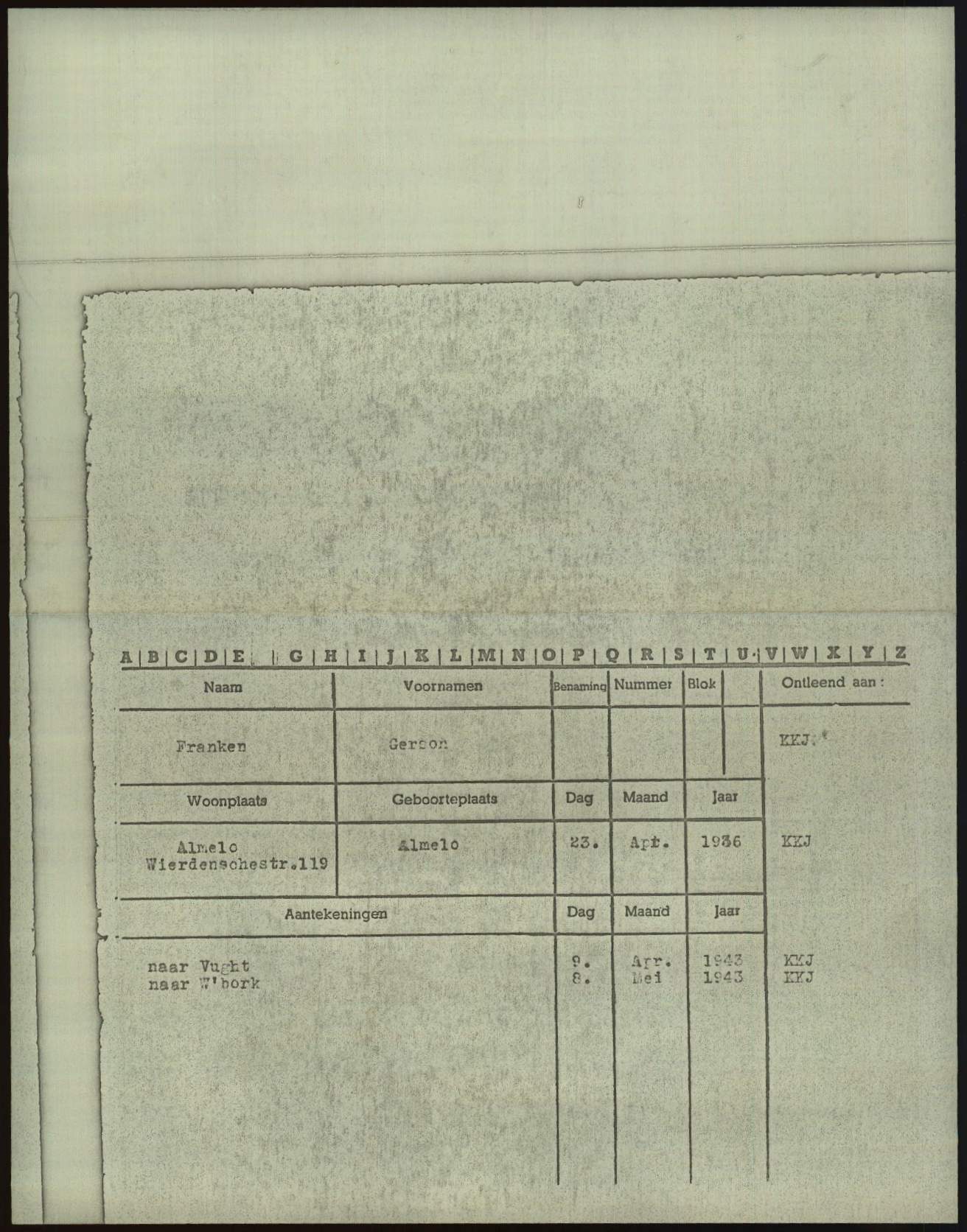
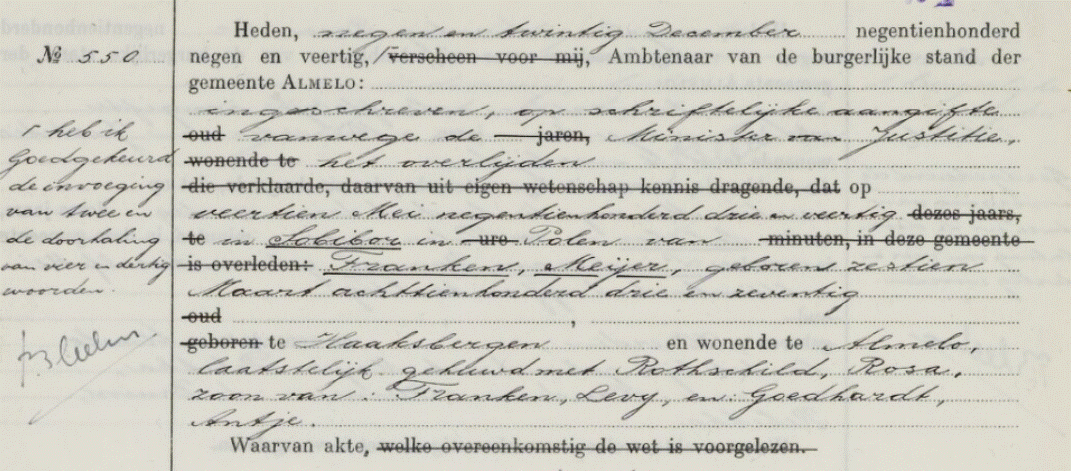
Rosa Rothschild, who was born on May 16, 1893, in Zimmersrode, married Meijer Franken sometime before April 23, 1936, when their son Gerson was born in Almelo, Netherlands. I don’t know whether Rosa married Meijer in the Netherlands or Germany because I cannot find a marriage record in either country.1 Meijer was Dutch, born in Haaksbergen, Netherlands, on March 16, 1873, making him twenty years older than Rosa. His parents were Levij Franken and Antje Goedhardt.2 Meijer had been previously married; his first wife Jeanette Herzog, died in Almela, Netherlands, on November 12, 1923.3

Presumably Rosa married Meijer sometime after November 12, 1923, when his first wife died, and before April 23, 1936, when Gerson was born in Almelo, Netherlands. I don’t know whether Rosa met Meijer before moving to the Netherlands or moved there to escape Hitler and met Meijer thereafter. I think it’s reasonable to assume she moved first sometime after 1933 when Hitler came to power and then met and married Meijer. Her mother Frommet “Fanny” Kugelmann Rothschild also moved to Almelo, Netherlands, either with Rosa or afterwards, and was living with Rosa, Meijer, and and her grandson Gerson, named for Rosa’s father and Fanny’s husband, Gerson Rothschild.4 Hal Katz told me that she came to his bar mitzvah in late 1937, but that she was already living in the Netherlands at that time.

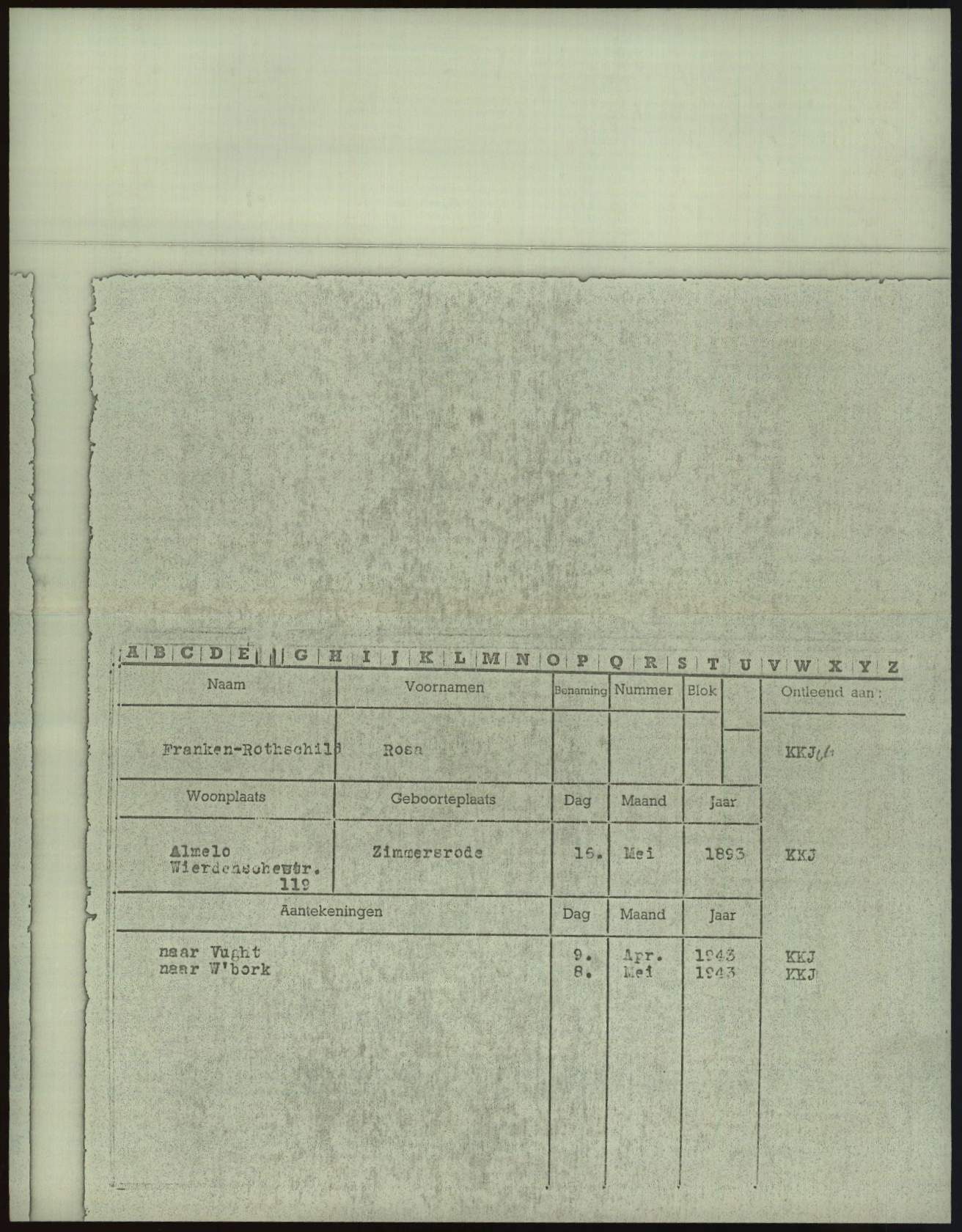
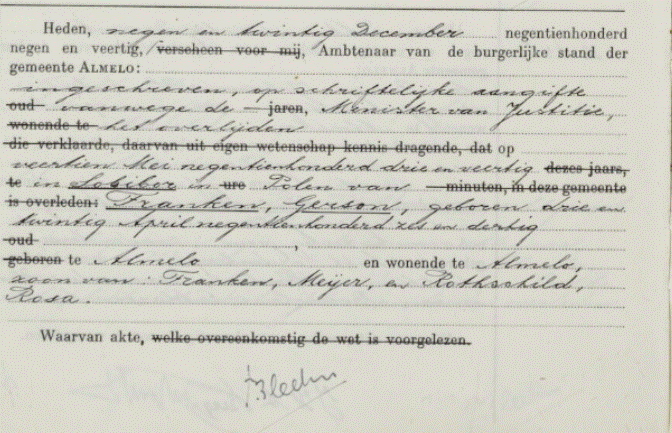
Unfortunately, the move to the Netherlands did not protect Rosa, her mother, her husband, or her son from the scourge of the Nazis. On April 9, 1943, they were sent to the Herzogenbusch concentration camp near Vught in the Netherlands, and then on May 8, they were sent to Westerbork where they were then sent to Sobibor, where they were murdered by the Nazis: all four of them, 86 year old Fanny, 70 year old Meijer, 49 year old Rosa, and seven year old Gerson.

Arolsen Archives, DocID: 402367 (FROMMET ROTSCHILD KUGELMANN)
DeepLink: https://collections.arolsen-archives.org/de/document/402367

Arolsen Archives, DocID: 355979 (ROSA FRANKEN ROTHSCHILD)
DeepLink: https://collections.arolsen-archives.org/de/document/355979

Arolsen Archives, DocID: 355969 (MEIJER FRANKEN)
DeepLink: https://collections.arolsen-archives.org/en/document/355969

Arolsen Archives, DocID: 355947 (GERSON FRANKEN)
DeepLink: https://collections.arolsen-archives.org/en/document/355947

Here are the official Dutch death records for Rosa and her family, showing they were killed at Sobibor :

Rosa Rothschild Franken death record, BS Death Heritage institution Collection Overijssel Institution place Zwolle Collection region Overijssel Archive 0123 Registration number 16645 Sourcenumber 14 Registration date 09-01-1950 Document place Almelo Collection Civil Registry in Overijssel Book

Meijer Franken death record, Collection Overijssel location Zwolle in Zwolle (Netherlands), Civil registration deaths Burgerlijke Stand in Overijssel, Almelo, archive 0123, inventory number 16644, 29-12-1949, Register van overlijden, Almelo, record number 550

Gerson Franken death record, Collection Overijssel location Zwolle in Zwolle (Netherlands), Civil registration deaths Burgerlijke Stand in Overijssel, Almelo, archive 0123, inventory number 16644, 29-12-1949, Register van overlijden, Almelo, record number 549

Frommet Kugelmann Rothschild death record, Register of deaths, Almelo (Overijssel Collection, Zwolle location), Death Frommet Kugelmann, 14-05-1943, Type of deed :
death certificate, Date of deed: 09-01-1950 Location of deed: Almelo, born in Wohra (D); date of birth 11-09-1857, Access number : 0123 Civil Registry in Overijssel Inventory number :
16645 File number : 12

Rosa’s sister Amalie, the youngest of Fanny and Gerson Rothschild’s children, met a similar fate. Amalie, who was born on April 26, 1901, married Jakob Stiefel, who was born January 19, 1893, in Ziegenhain, Germany, and was the son of Michel Stiefel and Emilie Bachrach. As with Rosa Rothschild and Meijer Franken, I don’t have a marriage record for Amalie and Jakob, but according to Holocaust records, they had two children, Eva, born April 3, 1937, in Fritzlar, Germany, and Gerhard, born April 26, 1938, in Kassel, Germany. The family was living in Kassel at that time.

Amalie, Jakob, Eva, and Gerhard were among those who were sent from Kassel on December 9, 1941, to the Riga ghetto. Remember that Amalie’s older sisters Katchen, Auguste, and Jenny were also deported to the Riga ghetto on that same transport. In any event, they all ended up in Riga. In 1942, Jakob died in the Kaiserwald camp near Riga. On November 2, 1943, Amalie and her two young children, six year old Eva and five year old Gerhard were sent from Riga to Auschwitz, where they were murdered. Another family of Rothschild cousins was destroyed by the Nazis.

Thus, of the eight children of Gerson Rothschild and Fanny Kugelmann who had survived to adulthood, five of them were murdered by the Nazis: Katchen, Auguste, Jenny, Rosa, and Amalie, as well as their mother Fanny and almost all of their children. Only Siegmund, Max, and Clara and their families escaped in time, as well as Auguste’s son Bruno Feldheim. That is just one family’s saga, but it was multiplied millions of times over for all the other families who were torn apart and destroyed by the hatred of the Nazis and those who supported them.

What gives me hope after learning all this tragic information about the family of Gerson Rothschild is the incredible strength I’ve seen in the descendants of Siegmund and Clara, those who are here today because their parents or grandparents were able to escape in time. Those descendants are all examples of how good can conquer over evil and love can overcome hatred.


  1. I could not locate a marriage record for Rosa and Meijer in either the Dutch archives at WieWasWie or in the various Hessen archives for Zimmersrode or Waltersbrueck, Germany, where Rosa was presumably living before relocating to the Netherlands. But Rosa and Meijer are listed as Gerson’s parents on his Dutch death record and as each other’s partner on each of their Dutch death records. See images below. 
  2. Meijer Franken, Birth Date 16 mrt. 1873 (16 Mar 1873), Birth Place Haaksbergen
    Father Levij Franken, Mother Antje Goedhardt, Collectie Overijssel; The Hague, Netherlands; Burgerlijke stand. Ancestry.com. Netherlands, Birth Index, 1784-1923 
  3. Jeannette Hertog, Age 52, Birth Date abt 1871, Birth Place Meerssen
    Death Date 12 nov. 1923 (12 Nov 1923), Death Place Almelo, Father Alexander Hertog, Mother Carolina Anschil, Historisch Centrum Overijssel (HCO); Den Haag, Nederland; Burgerlijke stand (overlijdensakten), Ancestry.com. Netherlands, Death Index, 1796-1973 
  4. A document in the Arolsen Archives for Fanny shows that her residence before deported to a concentration camp was Wierdensestr. 119 in Almelo, Netherlands. A similar document in the Arolsen Archives for Rosa shows her living at the same address. See Arolsen Archives, DocID: 402367 (FROMMET ROTSCHILD KUGELMANN) at https://collections.arolsen-archives.org/de/document/402367 and DocID: 355979 (ROSA FRANKEN ROTHSCHILD), at https://collections.arolsen-archives.org/de/document/355979 

Jeanette “Jenny” Rothschild Abraham: An Entire Family Murdered

Turning now to Jeanette or Jenny Rothschild, the fifth of the eight Rothschild children who survived to adulthood, we saw that she married Salomon Abraham on November 11, 1920, and that they had two children: Walter, born in 1921, and Herta, born in 1928.

This photograph is possibly of Jenny and Salomon:

Maybe Jenny Rothschild Abraham
Courtesy of the family

Unfortunately, Jenny and her family suffered a fate like those of her older sisters Katchen and Auguste and not like those of her older brothers Siegmund and Max, both of whom survived the Holocaust. Jenny, Salomon, Walter, and Herta were all murdered in the Holocaust.

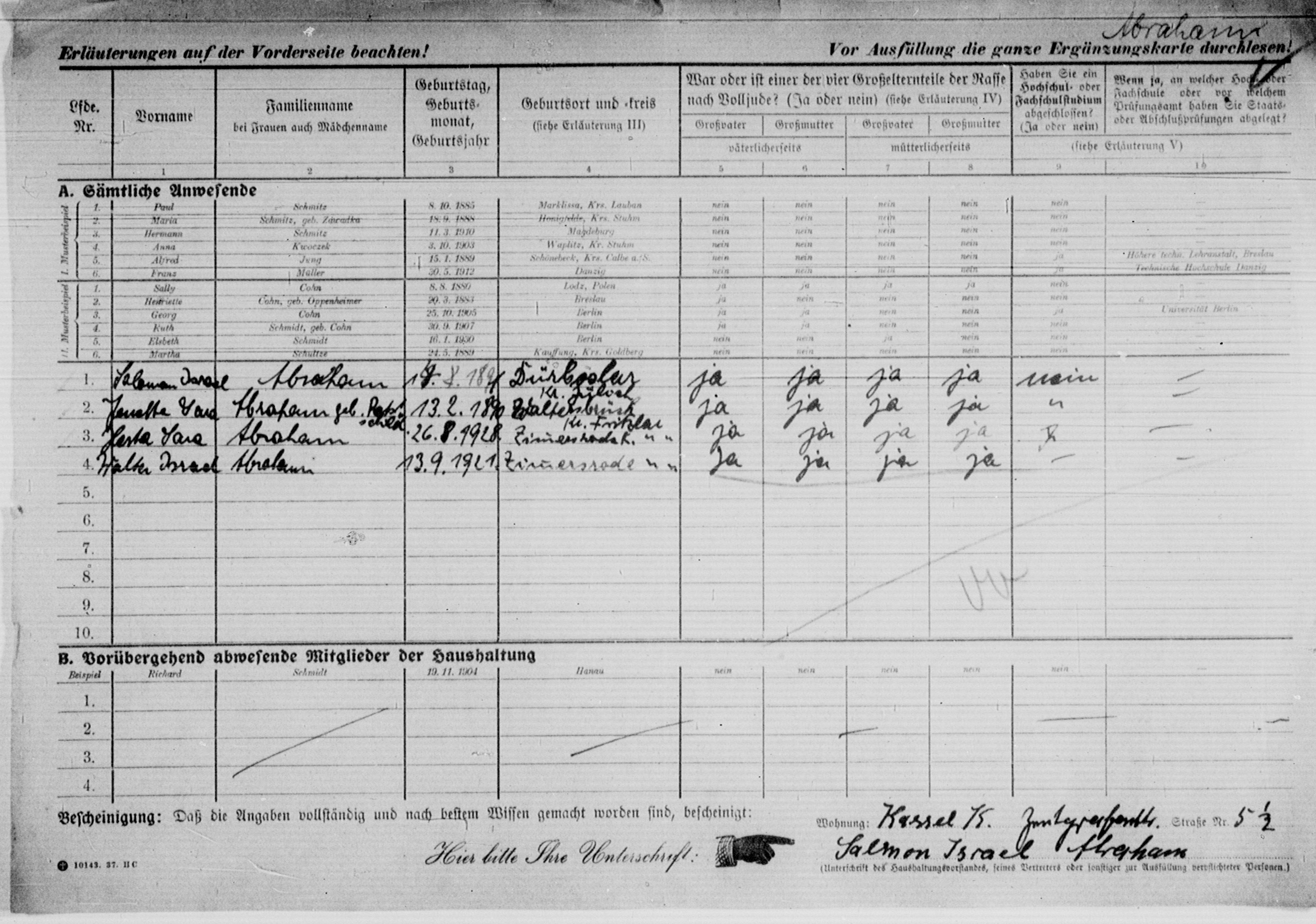
This document from the census taken in 1938-1939 by the Nazis of any household where a resident had at least one Jewish grandparent shows us that Jenny and Salomon and their children were living in Kassel at that time. It also shows that none of them had finished high school or vocational school and that all of them had four Jewish grandparents.

Salomon Abraham and family, RG-14.013M.0216.00000011, German minority census of 1939, United States Holocaust Museum and Memorial, also summarized at MyHeritage at   https://www.myheritage.com/research/record-10901-14585/herta-greta-abraham-in-german-minority-census?fbclid=IwY2xjawJyNahleHRuA2FlbQIxMAABHjMpngFoUVAHvZ8hfTE5lCsMwdc-9bHAeMU5opyaipBCxYmQYX8bXBPReDTp_aem_DvzcPxQysQHhqKjX3STcgw

Another document created by the International Tracing Service reveals that in 1939-1940, Salomon Abraham was working in Kassel for the Georg Sauer railway, road, and underground construction company.1

Yad Vashem files and the Gedenkbuch report that on December 9, 1941, Salomon, Jenny, and their thirteen-year-old daughter Herta were deported along with over a thousand other Jews from Kassel and surrounding towns and sent to the Jewish ghetto established by the Nazis in Riga, Latvia. According to an article about the transport on Yad Vashem, “The deportees were told to bring a sum of 50 Reichmarks, a suitcase, a set of clothes, suitable shoes, bedding, tableware, and food supplies for a few days. They were also required to produce an inventory of all their properties. In the Kassel district, the Jews received notification that all furniture was to be carefully packed and placed in one room of the apartment. Household valuables were to be deposited in a closet together with a list of contents.”

The train took three days to get to Riga, arriving on December 12, 1941; according to one account by a survivor as quoted in the same Yad Vashem article, “The temperature was 40 degrees below freezing. Most of the luggage was left at the train station and we never saw it again. We had to walk to the ghetto while a terrible snow storm was blowing.”

Unfortunately, I do not have any specific information about what happened to Salomon or Jenny after arriving in Riga, except I know that they did not survive. Readers may recall that Jenny’s sisters Auguste and Katchen as well as Katchen’s husband Adolf Hirschberg and their son Ludwig Hirschberg were also deported to Riga on December 9, 1941, and that none of them survived the Holocaust either. According to the Yad Vashem article, “little is known about the further fate of the deportees from Kassel in the Riga ghetto. More than 900 Jews were shot in several “Aktionen” in the Bikerniki forest. Others were transported to Auschwitz-Birkenau or to Stutthof concentration camp for forced labour. According to the historian Monica Kingreen only 137 Jews from this transport survived.”

Records show that little Herta was one of those transported to the Stutthof concentration camp. The report from the ITS on Herta Abraham states that she was sent to Stutthof on October 1, 1944.2  I do not know what happened to Herta after that, but she also did not survive the Holocaust.

As for Walter Abraham, he had moved to Berlin sometime after the 1939 Minority Census was taken and was working as a baker. One document seems to suggest he had left Kassel on April 28, 1940. Unfortunately Walter’s move to Berlin did not save his life. On December 7, 1943, he was deported from Berlin to Auschwitz. I don’t know when exactly Walter was killed there, but like his mother, father, and sister, he was murdered by the Nazis.3

There thus are no descendants of Jenny Rothschild Abraham. Her entire family was wiped out by the Nazis.


  1. Tracing and documentation case no. 416.705 for ABRAHAM, SALOMON born 14.08.1898, Reference Code 06030302.0.382.916, 6 Records of the ITS and its predecessors / 6.3 Inquiry processing / 6.3.3 ITS case files as of 1947 / 6.3.3.2 Repository of T/D cases / Tracing and documentation cases with (T/D) numbers between 250.000 and 499.999 / Tracing and documentation cases with (T/D) numbers between 416.500 and 416.999 ITS Digital Archive, Arolsen Archives 
  2. See Note 1, supra. 
  3. Welle 61 – 47. Osttransport in das KL Auschwitz, 07.12.1943, 1 Inhaftierungsdokumente / 1.2 Verschiedenes / 1.2.1 Deportationen und Transporte / 1.2.1.1 Deportationen / Deportationen aus dem Gestapobereich Berlin /  Signatur 15510056b, Entstehungszeitraum. 1943-12-07 – 1943-12-10, Anzahl Dokumente 4, ITS Digital Archive, Arolsen Archive 

Katchen Rothschild Hirschberg: A Family Destroyed

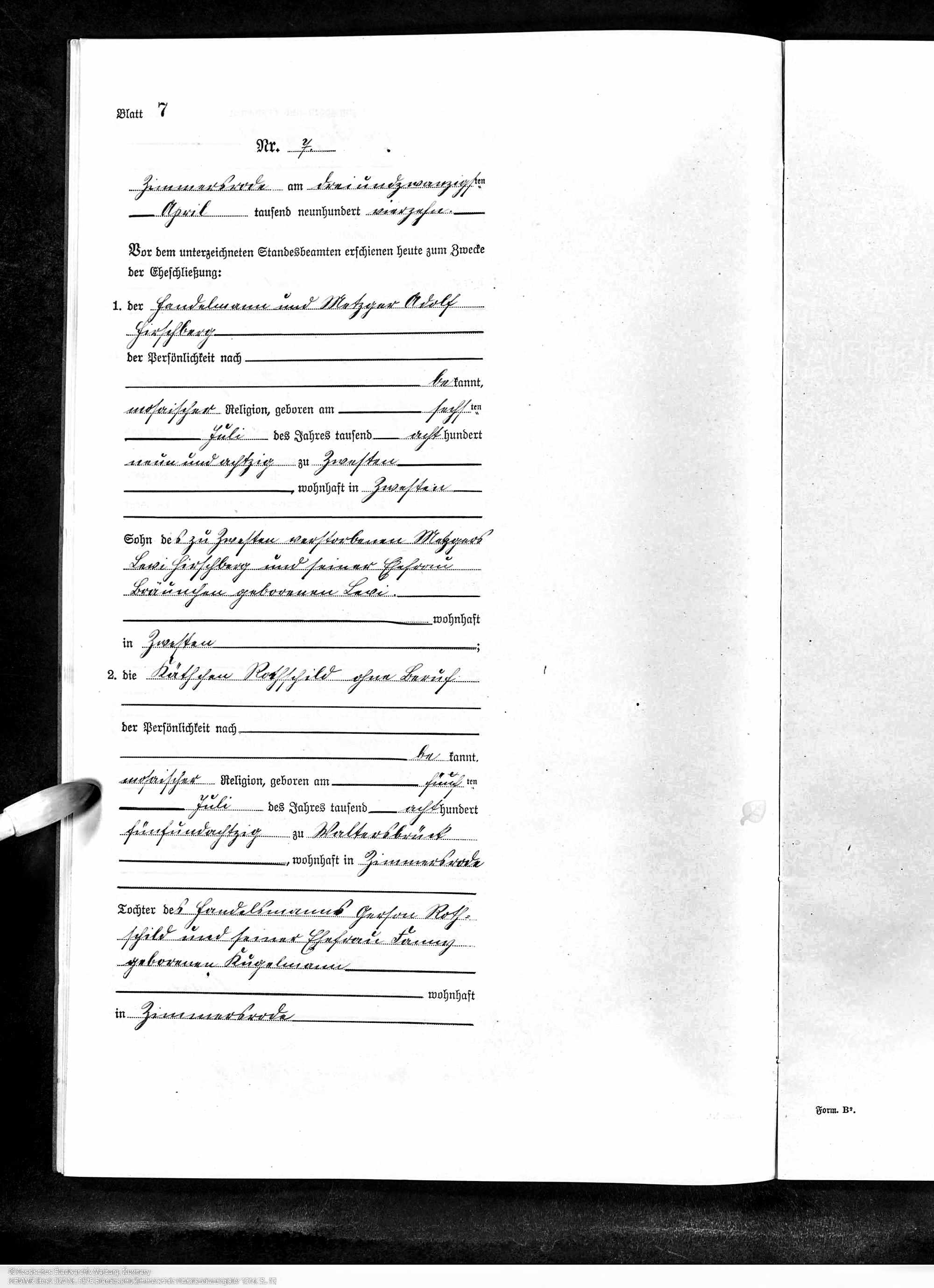
The second oldest child of Gerson Rothschild and Fanny Kugelmann was their daughter Katchen, born in 1885 in Waltersbrueck. As we saw, she married Adolf Hirschberg in 1914, and they had one child, a son Ludwig born in 1920. According to their marriage record, Adolf was a merchant and a butcher. They were living in Kassel, Germany, when Ludwig was born in 1920. Unfortunately, I do not know much more about their lives before the Nazi era. But I know that all three were persecuted and killed during the Holocaust. But the records of where and how they died are in conflict.

Katchen Rothschild and Adolf Hirschberg marriage record, Hessisches Hauptstaatsarchiv; Wiesbaden, Deutschland; Bestand: 920; Laufende Nummer: 9576, Year Range: 1914, Ancestry.com. Hesse, Germany, Marriages, 1849-1930

First, there are records at the Arolsen Archives showing that both Adolf and Ludwig were incarcerated at Buchenwald for some period of time after Kristallnacht in 1938.

Then, according to entries in the Gedenbuch (“Victims of the Persecution of Jews under the National Socialist Tyranny in Germany 1933 – 1945″ prepared by the German Federal Archives) as recorded at Yad Vashem, Katchen, Adolf, and Ludwig Hirschberg were all deported from Kassel on December 9, 1941, to the Riga ghetto in Latvia. As best I can determine from records at Yad Vashem, Katchen died in the Riga ghetto, but no date was given. For Adolf, the Gedenbuch reported that he died there on August 24, 1943.

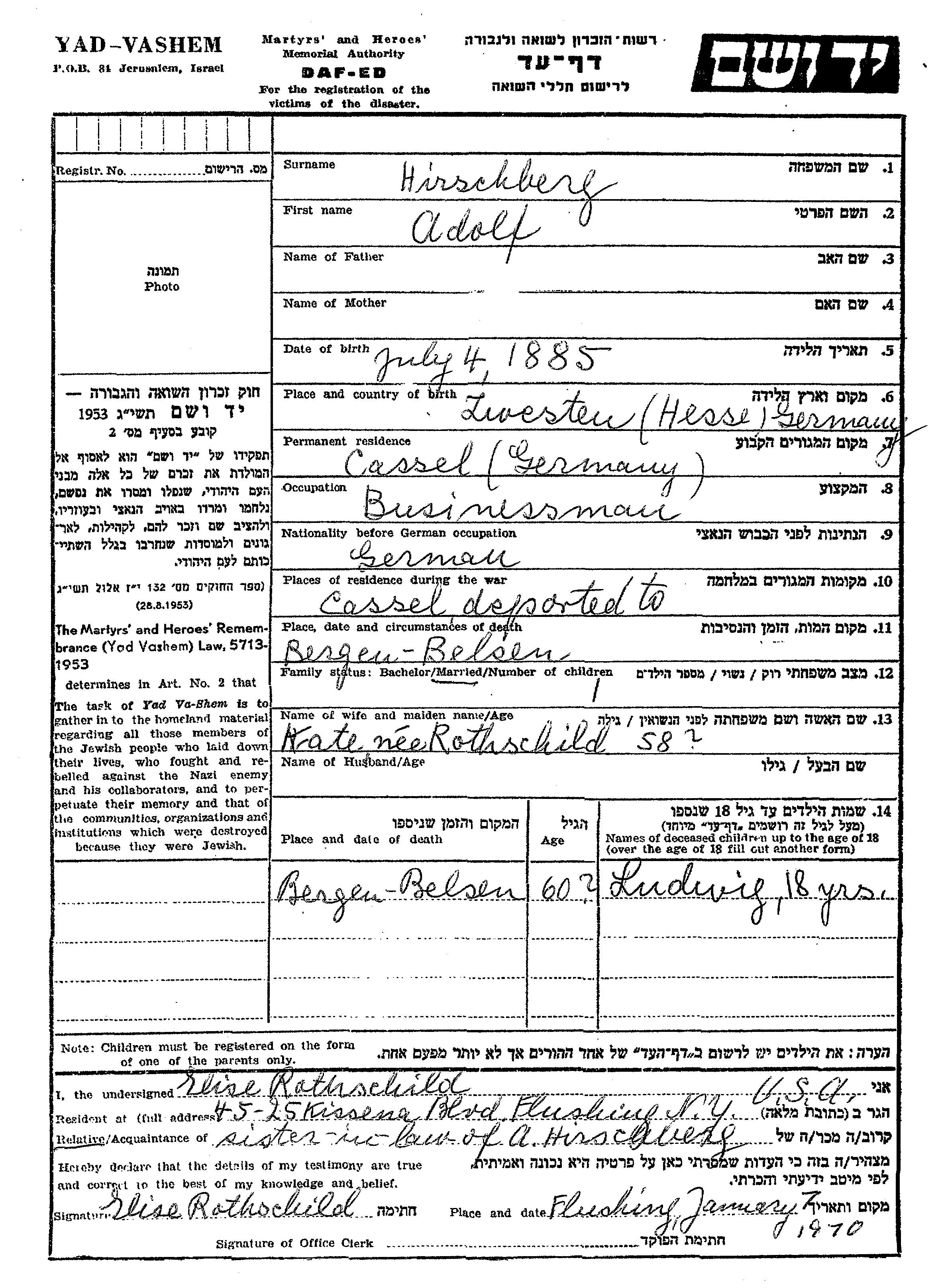
Pages of Testimony were filed at Yad Vashem for Katchen, Adolf, and Ludwig by Katchen’s sister-in-law, Elise Block Rothschild, the wife of Siegmund Rothschild, one of the few siblings to survive the Holocaust. Elise filed many Pages of Testimony for the family members murdered by the Nazis, as we will see. Her Pages of Testimony for Katchen and Adolf state that they died at the Bergen-Belsen concentration camp, but after searching the Arolsen Archives lists of those killed at Bergen-Belsen, I was unable to find either Adolf or Katchen’s name, so I do not know how accurate Elise’s information was. Did they die in Riga, or were they at some point transferred to Bergen-Belsen and killed there? I don’t know.

Adolf Hirschberg Page of Testimony filed at Yad Vashem, found at https://collections.yadvashem.org/en/names/14982438

Katchen Rothschild Hirschberg Page of Testimony filed at Yad Vashem, found at https://collections.yadvashem.org/en/names/645337

As for Ludwig, there is also conflicting information. The Gedenbuch summary at Yad Vashem reports that Ludwig was killed at the Natzweiler-Struthof concentration camp in France on December 24, 1944. A record in the Arolsen Archives also indicates that he died at Natzweiler-Struthof on that date, and there is also a record on Ancestry that seems to confirm that Ludwig was imprisoned at Natzweiler-Struthof during the Holocaust.1 Both records indicate that Ludwig was transferred to Natzweiler-Struthof from the camp in Dautmergen, a town in southwest Germany about 100 miles from Natzweiler-Struthof in France.

Ludwig Hirschberg record at Arolsen Archives, 2 Registration of Foreigners and German Persecutees by Public Institutions, Social Securities and Companies (1939 – 1947) / 2.3 Post-war Evaluations of Various Organizations / 2.3.3 Haut-Commissariat de la République Française en Allemagne / 2.3.3.1 Card file of persecutees in the later French zone and of French persecutees in other areas / Documents without (captured) names and names from A; further sub-structure available /, Reference Code
02030301001.474

But other records on JewishGen and Ancestry2 indicate that Ludwig was at the Stutthof concentration camp in Poland. Those records, however, are confusing because they say “Riga/Stutthof/Natzweiler.” Did they mean Stutthof, or did they mean Struthof/Natzweiler?

But this card from the Arolsen Archives is clearly marked only Stutthof and indicates that Ludwig Hirschberg was incarcerated there.

Ludwig Hirschberg at Stutthof, 1 Incarceration Documents / 1.1 Camps and Ghettos / 1.1.41 Stutthof Concentration Camp / 1.1.41.2 Individual Documents Stutthof / Personal Files – Stutthof Concentration Camp / Files with names from HERZ , Reference Code
01014102 047.243found at https://collections.arolsen-archives.org/en/document/4493200

Could he have been at both camps? Or is one of these records incorrect? After all Struthof and Stutthof could be easily confused. The Page of Testimony filed by Elise Block Rothschild does not resolve this confusion because it only reported that his place of death was unknown.

Ludiwg Hirschberg page of testimony at Yad Vashem, found at https://collections.yadvashem.org/en/names/622945

Only to add to the confusion, the Projekt Judische Leben Frankfurt states that Ludwig was one of the passengers on the St. Louis, the ship that was turned back in 1939 after being refused entry by both Cuba and the United States, and that he was later killed at Auschwitz. I searched the list of St. Louis passengers on file at the US Holocaust Museum and Memorial, however, and did not find Ludwig Hirschberg on that list. Nor does any record at Yad Vashem or on JewishGen or on Ancestry indicate that Ludwig was murdered at Auschwitz.

One might conclude that Ludwig was at Natzweiler-Struthof based on the larger number of records so indicating, but how did he get there from the Riga ghetto? They are more than 1200 miles apart. Not that Riga is close to Stutthof either (469 miles), but still much closer. Also, the JewishGen database devoted to Stutthof includes a description that states, “The Stutthof camp was originally not designed to hold Jews, but, beginning in 1944, substantial numbers (30,000-50,000) of Jews were sent there, primarily from Kovno, Rīga and Auschwitz.” So it would make sense that Ludwig would have been sent from Riga to Stutthof, not to Natzweiler-Struthof.

Unless Ludwig was in fact on the St Louis? Since many of those passengers did end up in France after being turned back by the US and Cuba, that might explain how Ludwig ended up in Natzweiler-Struthof. But if he was on the St Louis in 1939 and then sent to France, how could he have been deported to Riga from Kassel with his parents in 1941? Something didn’t add up.

I was very fortunate to speak with Ludwig’s first cousin Hal Katz on May 8, 2025, and he confirmed that Ludwig was not on the St. Louis. That makes it even less likely that Ludwig ended up in France and thus in Natzweiler-Struthof. My best guess at this point is that Ludwig was sent to Stuffhof along with other prisoners from Riga. My hunch, totally speculative, is that somewhere someone mixed up Struthof and Stutthof and wrote the wrong name on one of Ludwig’s records.

Sadly, in the end, these details do not change the ultimate outcome. Katchen, Adolf, and Ludwig Hirschberg were all murdered by the Nazis during the Holocaust. One family story shared with me in my conversation with Hal Katz and his daughter Sandy and niece Judy is that Ludwig survived in the camp and was shot in cold blood by a guard on the day the camp was to be liberated.

May the names and memories of Katchen, Adolf, and Ludwig be preserved forever.


  1. Name Ludwig Hirschberg, Nationality German Jew, Birth Date 1 Feb 1920
    Transfer Place In Dautmergen, Death Date 24 Dec 1944, Prisoner Number 34908
    Microfilm/Roll/Section A3355/2/4, Alphabetical/Roll/Section A3355/76/GOE-HUA
    Record Number 24120, Irvin Horn, comp. France, Natzweiler-Struthof Concentration Camp Record Book, 1940-1945 
  2. Ludwig Hirschberg, Birth Date 1 Feb 1920, Birth Place Kassel, Residence Kassel, Camp Riga/Stutthof/Natzweiler, Ancestry.com. Poland, German Jews at Stutthof Concentration Camp, 1940-1945. See also the same information at JewishGen found at https://www.jewishgen.org/databases/jgdetail_2.php 

Friederike Blumenfeld Schoen, Part III: Her Son Moses Escapes to America

I have been unable to do any new research in these last few weeks since the horrendous massacre in Israel by Hamas on October 7. I just can’t seem to focus on research right now. Fortunately I had several blog posts ready in my queue and will publish those, including this one. Perhaps the best way I can support Israel right now is to educate and remind people about the long history of persecution of Jews and antisemitism so that they best understand why Israel exists and why it must survive.


Although Friederike’s oldest child Jakob died in 1937 and his widow and daughter were killed by the Nazis, her other three surviving children all managed to escape the Nazis.

Friederike’s son Moses, more commonly known as Moritz, wanted to leave Germany quite early. As described by his son Kurt Leopold Schoen in the oral history interview he did with the US Holocaust Memorial and Museum, Moritz had had a successful wholesale and retail shoe business in Kassel, but once the Nazis came to power the business suffered. Non-Jews boycotted the store, and Moritz had to close the business and work as a shoemaker.1

But leaving Germany was difficult. The family needed affidavits from someone in the US to get a visa to enter the country, and the relatives in the US were reluctant to sponsor a family with three young children. Fortunately, Moritz and Else’s fourteen-year-old daughter Alice was given an opportunity to leave when the National Council of the Jewish Women in the US organized a rescue mission that brought many children out of Germany.2 Alice came to the US on May 13, 1938, and was sent to live with a Jewish family in San Antonio, Texas, the Rosenbergs, as seen on the 1940 US census.3

Alice Schoen passenger manifest, The National Archives and Records Administration; Washington, D.C.; Passenger and Crew Lists of Vessels Arriving at and Departing from Ogdensburg, New York, 5/27/1948 – 11/28/1972; Microfilm Serial or NAID: T715, 1897-1957
Ancestry.com. New York, U.S., Arriving Passenger and Crew Lists (including Castle Garden and Ellis Island), 1820-1957

The website for the Holocaust Memorial Museum of San Antonio reported that Abe and Bella Rosenberg “took [Alice] into their lives as if she were a long lost relative. The Rosenberg children, Miriam and Stanley, and a host of aunts, uncles, and cousins who treated her with affection and kindness made her adjustment to a new life easier.” In his oral history interview, Alice’s brother Kurt mentioned that the Rosenbergs were a very nice family, but nevertheless Alice was naturally very homesick.  She did not see her family again until 1940.4

But Alice was able to get help from the Rosenberg family to bring her father Moritz to the US from Germany. As reported on the website for the Holocaust Memorial Museum of San Antonio, they signed affidavits pledging financial support for him.

Once he had an affidavit from the Rosenbergs, Moritz was able to go to the US consulate in Germany and receive a visa. But before he could leave, he was arrested during the Kristallnacht riots in November, 1938. According to his son Kurt, Moritz was not sent to Buchenwald like so many other Jewish men were after Kristallnacht because he already had a visa to leave Germany. He was released within a day or two from police custody in Kassel and prepared to leave for the US.5

Moritz arrived on December 3, 1938, seven months after Alice’s arrival, and settled in New York City. His ship manifest lists his wife Else as the person he was leaving behind in Kassel, Germany, and his sister-in-law Betty Lutz (born Babette Freimark) as the person he was going to in the US. He listed his occupation as a shoemaker.6

Meanwhile, back in Germany, Else and her two young sons Manfred and Kurt moved to Frankfurt; the boys were sent to a Jewish orphanage and Else moved in with one of her sisters. Kurt described the orphanage as a place where he and his brother were well treated. They went to school and learned English. Finally in April 1939, they were released and reunited with their mother and allowed to leave Germany for the US. Kurt, who was eleven at the time, recalled that the Nazis tore through their luggage and stole everything Else had packed except one small teapot.7

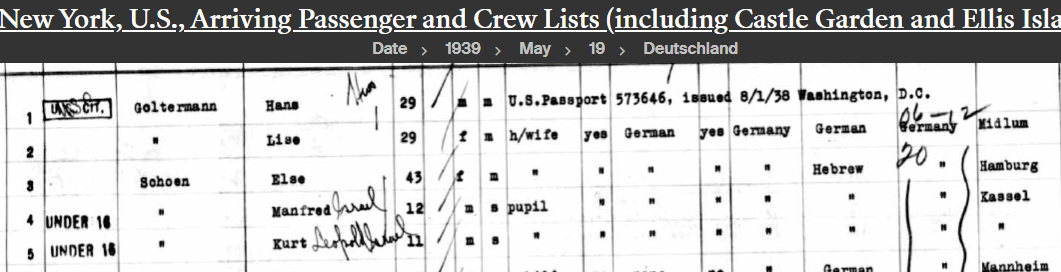
Else arrived in New York with Manfred and Kurt (listed as Kurt Leopold Israel on the manifest) on May 19, 1939.

Else Schoen and children, passenger manifest, The National Archives and Records Administration; Washington, D.C.; Passenger and Crew Lists of Vessels Arriving at and Departing from Ogdensburg, New York, 5/27/1948 – 11/28/1972; Microfilm Serial or NAID: T715, 1897-1957
Ship or Roll Number: Deutschland, Ancestry.com. New York, U.S., Arriving Passenger and Crew Lists (including Castle Garden and Ellis Island), 1820-1957

The family moved into a small apartment riddled with bed bugs; Moritz worked doing shoe repairs and barely made a living. But as Kurt said, they were happy to be out of Germany and safely living in New York. They moved frequently from one apartment to another in order to get the benefit of one or two free months of rent being offered by landlords. Manfred and Kurt started school where they quickly learned English and rose from the lower levels of their grade to the highest within a year.8

Alice was reunited with her parents and brothers sometime in 1940 when the Rosenberg family brought her to New York after taking a trip to Canada to see the Dionne Quintuplets. She married just three years later when she was nineteen, according to her brother Kurt.9 Her husband, Albert Bernhard Schwarz, was born on October 22, 1922, in Busenberg, Germany, to Alfred Lazarus Schwarz and Berta Levy. Like Alice, he was refugee from Germany; he had arrived on August 13, 1938.10 He was the only member of his family to survive. His parents and all his siblings were killed by the Nazis.11

Albert entered the US Army on March 26, 1943, listing his marital status as single.12 He and Alice must have married later that year. According to one biography of Albert, he was assigned to Camp Ritchie in Maryland and trained for military intelligence. As a Ritchie Boy, as they were known, Albert was trained to interrogate German prisoners of war. Starting in October 1944 he was with the 7th Armored Division of the II English Army in France and the northern part of Belgium. On November 5-6, 1944, during the Battle of the Bulge, Albert’s jeep hit a German mine near a bridge over the Meuse River. Albert suffered severe head injuries from which he suffered the rest of his life. He was in a coma for over a month in a English military hospital and remained there until February, 1945. He returned to the US in the spring of 1945, but was hospitalized until July. On Aug. 02, 1945, he was discharged from military service at Camp Edward, Massachusetts.13

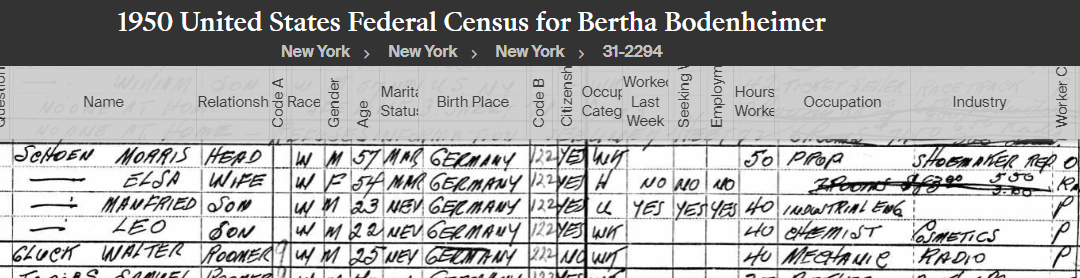
Alice and Albert had three children born after the war. In 1950 they were living in New York City, and Albert was working as a butcher.14 Alice’s parents Moritz and Else Schoen and her brothers Manfred and Kurt (listed as Leo here) were also living in New York City. Moritz now owned his own shoemaking business. Manfred was an industrial engineer, and Leo/Kurt was a chemist in a cosmetics company.

Morris Schoen and family, 1950 US census, National Archives at Washington, DC; Washington, D.C.; Seventeenth Census of the United States, 1950; Year: 1950; Census Place: New York, New York, New York; Roll: 3572; Page: 9; Enumeration District: 31-2294, Ancestry.com. 1950 United States Federal Census

Meanwhile, Moritz’s two remaining siblings had survived the war in Shanghai, China. More on that in my next post.


  1. Many of the personal details in this post came from Kurt Leopold Schoen’s interview with the USHMM. Kurt L. Schoen, July 24, 2004 interview, Accession Number: 1997.A.0441.512 | RG Number: RG-50.462.0512, United States Holocaust Memorial Museum Collection, Gift of the Gratz College Holocaust Oral History Archive, found at https://collections.ushmm.org/search/catalog/irn566135.  Although Kurt is listed as Leopold or Leo on many US records, he used the name Kurt for most of his adult life in the US and will be referred to here as Kurt for that reason. 
  2. See Note 1, supra. 
  3. Alice Schoen, 1940 US Census, Year: 1940; Census Place: San Antonio, Bexar, Texas; Roll: m-t0627-04201; Page: 61A; Enumeration District: 259-6, Ancestry.com. 1940 United States Federal Census 
  4. See Note 1, supra. 
  5. See Note 1, supra. 
  6. Moses Schoen, passenger manifest, The National Archives and Records Administration; Washington, D.C.; Passenger and Crew Lists of Vessels Arriving at and Departing from Ogdensburg, New York, 5/27/1948 – 11/28/1972; Microfilm Serial or NAID: T715, 1897-1957, Ship or Roll Number: Hamburg, Ancestry.com. New York, U.S., Arriving Passenger and Crew Lists (including Castle Garden and Ellis Island), 1820-1957 
  7. See Note 1, supra. 
  8. See Note 1, supra. 
  9. See Note 1, supra. 
  10. Albert Schwarz, Declaration of Intention, The National Archives at Philadelphia; Philadelphia, PA; NAI Title: Declarations of Intention For Citizenship, 1/19/1842 – 10/29/1959; NAI Number: 4713410; Record Group Title: Records of District Courts of the United States, 1685-2009; Record Group Number: 21, Description
    Description: (Roll 610) Declarations of Intention For Citizenship, 1842-1959 (No 481301-482200), Ancestry.com. New York, U.S., State and Federal Naturalization Records, 1794-1943 
  11. Family history of Schwarz family, Arbeitskreis Judentum im Wasgau, Elisabeth & Otmar Weber, Schillerstraße 10b, 66994, found at /https://judentum-im-wasgau.de/images/geschichte/jugemeinden/jufbusenberg/02_schwarz_jakob_hauptstr_49_bu.pdf 
  12. Albert B Schwarz, Race White, Marital Status Single, without dependents (Single)
    Rank Private, Birth Year 1922, Nativity State or Country Danzig or Germany, Citizenship Not Yet a Citizen, Residence New York, New York, Education 2 years of high school
    Civil Occupation Stock clerks, Enlistment Date 26 Mar 1943, Enlistment Place New York City, New York, Service Number 32874464, Branch No branch assignment, Component Selectees (Enlisted Men), National Archives at College Park; College Park, Maryland, USA; Electronic Army Serial Number Merged File, 1938-1946; NAID: 1263923; Record Group Title: Records of the National Archives and Records Administration, 1789-ca. 2007; Record Group: 64; Box Number: 05772; Reel: 241, Ancestry.com. U.S., World War II Army Enlistment Records, 1938-1946 
  13. See Note 11, supra. 
  14. Albert Schwarz and family, 1940 US census, National Archives at Washington, DC; Washington, D.C.; Seventeenth Census of the United States, 1950; Year: 1950; Census Place: New York, New York, New York; Roll: 6203; Page: 6; Enumeration District: 31-1913, Ancestry.com. 1950 United States Federal Census 

Salomon Blumenfeld’s Children Thekla and Felix: Killed by the Nazis

In April, 1933,  Salomon Blumenfeld’s two children from his first marriage, Thekla Blumenfeld Gruenbaum and Felix Blumenfeld, were both living in Kassel, Germany. All of their children and grandchildren were also still in Germany. With Hitler’s rise to power, some of the family members left Germany not long afterwards. But others were not so fortunate.

Thekla Blumenfeld Gruenbaum was murdered by the Nazis. She was first deported to Theriesenstadt on July 25, 1942.  Two months later on September 26, 1942, she was sent to the extermination camp at Treblinka where she was killed. She was seventy years old. She had lived a hard life—losing her mother when she was just a toddler, being left behind by her father a few years later, losing her husband, and then being killed at Treblinka.

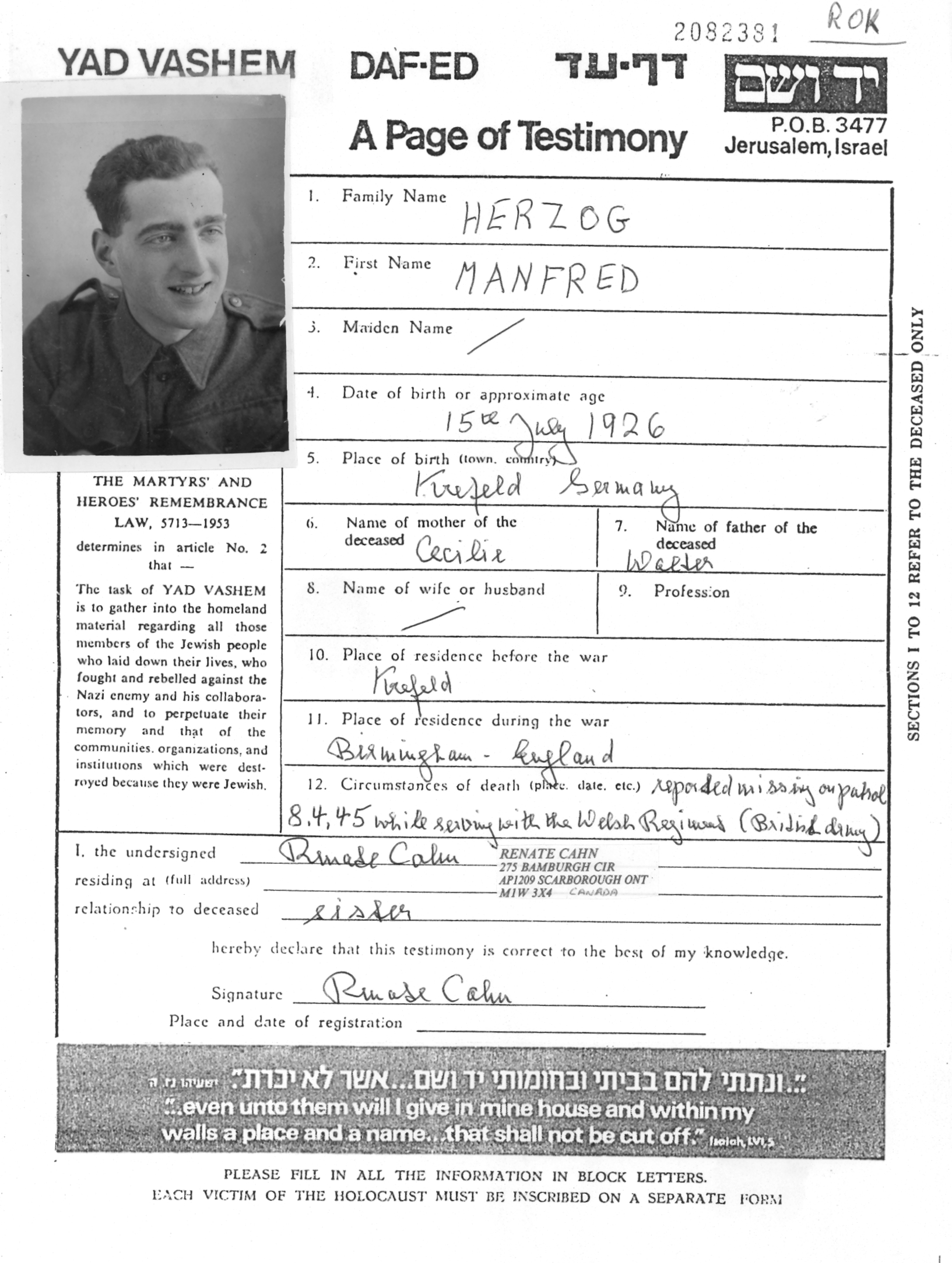
Thekla’s daughter Caecilie and her husband Walter Herzog were living in Krefeld, Germany, before the war. I am still researching where and when, but the evidence indicates that the two children of Caecilie and Walter, Renata and Manfred, were sent to England before the war.1 Walter was a successful silk tie manufacturer and had deposited a fair amount of money in a Swiss banking account; that account was confiscated by the Nazis.2 In December 1941, both Walter and Caecile3 were deported to the concentration camp in Riga, Latvia. Walter was later transferred to Buchenwald where he was “declared dead” on May 8, 1945.

Caecile was sent from Riga to the Stutthof concentration camp.4 The Holocaust Encyclopedia provided this information about the Stutthof camp:5

Conditions in the camp were brutal. Many prisoners died in typhus epidemics that swept the camp in the winter of 1942 and again in 1944. Those whom the SS guards judged too weak or sick to work were gassed in the camp’s small gas chamber. Gassing with Zyklon B View This Term in the Glossary gas began in June 1944. Camp doctors also killed sick or injured prisoners in the infirmary with lethal injections. More than 60,000 people died in the camp.

The Germans used Stutthof prisoners as forced laborers. … In 1944, as forced labor by concentration camp prisoners became increasingly important in armaments production, a Focke-Wulff airplane factory was constructed at Stutthof. Eventually, the Stutthof camp system became a vast network of forced-labor camps….

The evacuation of prisoners from the Stutthof camp system in northern Poland began in January 1945. When the final evacuation began, there were nearly 50,000 prisoners, the overwhelming majority of them Jews, in the Stutthof camp system. About 5,000 prisoners from Stutthof subcamps were marched to the Baltic Sea coast, forced into the water, and machine gunned. The rest of the prisoners were marched in the direction of Lauenburg in eastern Germany. They were cut off by advancing Soviet forces. The Germans forced the surviving prisoners back to Stutthof. Marching in severe winter conditions and treated brutally by SS guards, thousands died during the march.

In late April 1945, the remaining prisoners were removed from Stutthof by sea, since Stutthof was completely encircled by Soviet forces. Again, hundreds of prisoners were forced into the sea and shot. … It has been estimated that over 25,000 prisoners, one in two, died during the evacuation from Stutthof and its subcamps. 

Soviet forces liberated Stutthof on May 9, 1945, and liberated about 100 prisoners who had managed to hide during the final evacuation of the camp.

How did Caecilie manage to survive this ordeal? Was she one of the hundred who were hiding in the camp during its final evacuation? Her odds for survival were overwhelmingly low, yet somehow she did. After time as a displaced person and with the help of HIAS (Hebrew Immigrant Aid Society), she was able to immigrate to the US in July 1946.

Arolesn Archives; Bad Arlosen, Germany, Resettlement Year: 1946, Ancestry.com. Free Acces Africa, Asia and Europe, Passenger Lists of Displaced Persons, 1946-1971

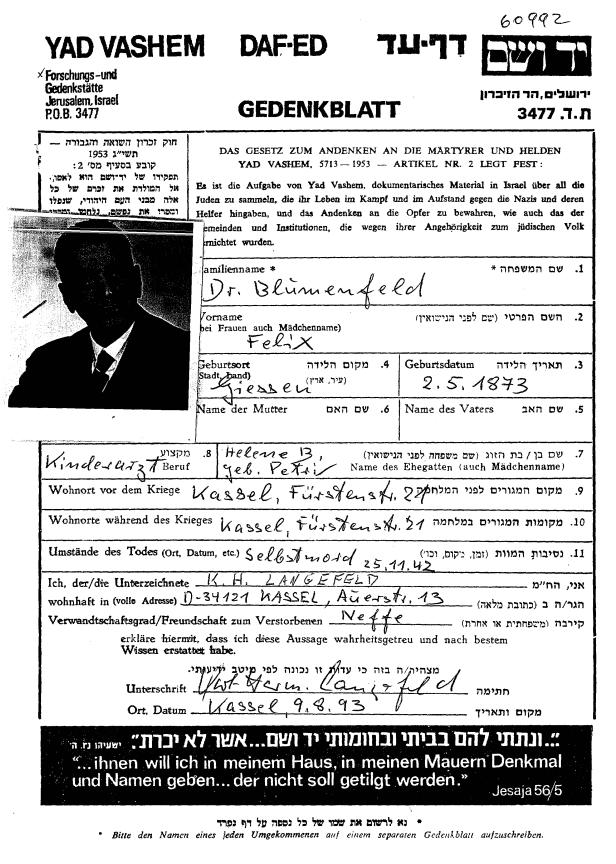
I was able to locate more information about Thekla’s brother Felix Blumenfeld through several sources, including a detailed and well-sourced biography online. Felix had studied medicine at both the University of Marburg and the University of Munich. He served as a ship’s doctor and later as doctor in a POW camp during World War I. As we saw, Felix lost his first wife Thekla Wertheim in 1917, and on February 16, 1920, in Nordhausen, Germany, he married his second wife Helene Petri, who was not Jewish. She was born on October 20, 1894, in Nordhausen, the daughter of Fritz Petri and Bertha Peter. Felix and Helene were living in Kassel, where Felix was a practicing pediatrician.

The detailed biography of Felix I found online describes in great detail all the contributions that Felix made as a doctor and citizen in Kassel.

Encouraged by the high infant mortality rate among children of poor parents, he began to use his position as a doctor and to get involved in society. At his suggestion, milk kitchens were built in which perfectly hygienic milk-grain mixtures were produced as baby food and sold using a deposit bottle system . The products were also given free of charge to the poor.

He also served as the medical director of the children and infant’s home/hospital in the city and also was involved in other charitable and civic organizations.

Despite his service in World War I and all these contributions he made as a doctor and citizen, Felix was persecuted by the Nazis. 

Just a few weeks after the National Socialists came to power on April 1, 1933, as a Jew, he was deprived of the management of the children’s hospital, he was banned from working and had to give up his apartment and practice…. His property and library were confiscated and owing to the fact that his wife Leni was not Jewish, he was initially allowed to live in his summer house a…. He was forced to do auxiliary and road construction work and had to collect rags and scrap at the municipal scrap yard . He was exposed to constant discrimination and surveillance by the Gestapo.

A second biography written for the occasion of the installation of Stolpersteine in Felix Blumenfeld’s honor in Kassel also reported this information and explained that Felix ultimately decided to end his own life in order to avoid deportation and also to protect his wife Helene.

Before killing himself on January 25, 1942, Felix wrote a long letter to his two sons in America, Edgar and Gerd, explaining why he had decided to take his own life. The first part of the letter details some of the abuse and persecution he had endured, and then he ends with these paragraphs, as translated by DeepL:

But enough of that ! Let’s get to the main thing ! Life is no longer bearable for me! All my hope, to which I had clung, was to get out of this hell and to be united with you in a near or distant time. I dare not count on that hope any longer. For with the years of war my years of life also increase. But the worst thing at the present moment is that out of sheer arbitrariness they have deprived me of all my property and referred me to my hands work or to public welfare. Subsequently, they also “expropriated the wife of the Jew”, although since 1939 there had been a legal separation of property, i.e. there was no legal basis for this. Leni was in Berlin and has the prospect of getting part of her property back if she gets a divorce. I want to agree to this divorce in order not to endanger Lenimutter’s livelihood again and again through my person. In that case, however, my life, which has been ruined through no fault of my own, has lost all the more meaning, especially since it is not known what else will be done to us.

Under these circumstances, death seems more desirable to me than an existence with ever new torments. I am therefore leaving this world of meanness, baseness and inhumanity in order to enter eternal peace and to seek the path that leads from darkness to light.

My last thoughts belong to my faithful comrade, on an often thorny path, and to you my beloved children, my Edgar, Gerd, Annchen, Lotte and Little Gerard ! You will be with me in the hour that demands strength and courage. Especially with you, my Gerd, I would have liked to hold a conversation, you dear, you good one! Stay as good as you have been so far, and be the one who makes sure that you always stay together faithfully. Then I am always in your midst and remain eternally connected with you. Without looking backwards, move forward and build a more beautiful life in a hopefully better world. May it be a comforting thought to you that your father is relieved of all fear, worry and pain after his departure. We remain united ! ! You will never forget me, I know that, because my love for you was, is and will be infinite.

V a t e r

*** Translated with http://www.DeepL.com/Translator (free version) ***

Like his sister Thekla, Felix Blumenfeld lost his mother as a baby, then his father, and then his first wife. Nevertheless, he grew up to be a devoted father and pediatrician who contributed greatly to his community. Although not technically murdered by the Nazis, Felix is also rightfully counted among those whose deaths were caused by Nazi persecution.

There was one more death in the family attributable to Nazi Germany. Thekla Blumenfeld Gruenbaum’s grandson, Caecilie and Walter Herzog’s son Manfred, was killed in action while fighting for the Allies in Europe sometime in the spring of 1945.

Thus, the Nazis killed both Thekla and Felix, the two children Salomon Blumenfeld had with his first wife Caecilie Erlanger, as well as Thekla’s son-in-law Walter Herzog; in addition, Thekla’s grandson Manfred Herzog died fighting the Nazis in World War II. I can’t help but think about how Felix and Thekla’s lives would have been different if their father Salomon had taken them with him when he moved to Spain.

They were survived by the rest of the family. Their stories will be told in the next post.


  1. To be discussed in the next post. 
  2. Special Master’s Final Report on the Holocaust Victim Assets Litigation (Swiss Banks Settlement), Case No. CV 96-4849 (ERK)(MDG) (Consolidated with CV 96-5161 and CV 97-461) United States District Court, Eastern District of New York, pp.28-30. 
  3. Cecilia Herzog [Cecilia Gruenbaum] Birth Date: 26 Apr 1900 Birth Place: Kassel
    Residence: Krefeld Camp: Riga/Stutthof Ancestry.com. Poland, German Jews at Stutthof Concentration Camp, 1940-1945; Entry at the US Holocaust Memorial and Museum at https://www.ushmm.org/online/hsv/person_view.php?PersonId=3187531 
  4. See Note 3. 
  5. United States Holocaust Memorial Museum. “Stutthof.” Holocaust Encyclopedia. https://encyclopedia.ushmm.org/content/en/article/stutthof Accessed October 5, 2021. 

A Survivor’s Story: The Shoah Foundation Testimony of Inge Goldschmidt Oppenheimer

Antonie Blumenfeld and her husband Siegfried Engelbert died before Hitler came to power in Germany in 1933 and thus were spared seeing that their daughter Margot and her husband Gustav Neuhaus were sent to the Warsaw Ghetto and killed there in September 1942 and that their granddaughter Edith Neuhaus Kempner was killed at Auschwitz just two months later.

They were also spared knowing that their son Julius and his wife Ilse and son Werner were forced to leave Germany in 1939 to escape Hitler, but eventually survived and settled in the United States.

And they were spared knowing the terrible ordeals endured by their youngest child Elfriede and her husband Rudolf Goldschmidt and their children Gunther and Inge.

But we must remember their experiences and honor their memories. Thanks to the Shoah Foundation, we now have extensive interviews with many of the Holocaust survivors, including one with Inge Goldschmidt Oppenheimer, my fifth cousin.

I was privileged to listen to Inge’s interview and will attempt in my own words to tell her story. I am grateful to the Shoah Foundation for allowing me to do so. Except where noted, all the information below came from Inge’s interview.1 All the photographs are courtesy of Inge’s daughter Marsha.

Inge was born to Elfriede Engelbert and Rudolf Goldschmidt on April 13, 1929, in Kassel, Germany, just four years before Hitler came to power. She had almost no memory of life in Germany before the Nazis took control. She and her family lived in Kassel until 1938 when they moved to Cologne. Her memories of life in Kassel were terrible because of the persecution and harassment they faced as Jews. She and her brother Gunther went to a Jewish school and were often beaten up on the way home by Nazi youth members. As a result of incidents like that, the school decided to close fifteen minutes before the non-Jewish schools so that children could get home safely.

Here is a photograph of Inge with her brother Gunther taken in about 1934.

Gunther and Inge Goldschmidt. c. 1934-1935. Courtesy of the family

Inge’s father Rudolf was a veteran of World War I and had suffered a serious head injury while fighting for Germany. As a result, he eventually became paralyzed and wheelchair-bound. The family was living on the pension he received for his service in the war while also being forced to endure the anti-Semitism promoted by the government. Rudolf was very well-informed and followed the news on a radio tuned to the BBC, and although he wanted to leave Germany, his disability and their limited resources made that impossible.

Here is a photograph of Rudolf in uniform during World War I.

Rudolf Goldschmidt, c. 1914-1918. Courtesy of the family

Instead the family decided to leave Kassel and move to Cologne in 1938, believing that in the larger city they would be safer and also that life would be easier because it was less hilly than Kassel and thus easier for Elfriede to push Rudolf’s wheelchair. Here are two photographs of Inge from around this time.

Inge Goldschmidt, c. 1938-1939. Courtesy of the family

Inge and Rudolf Goldschmidt. Courtesy of the family

Gunther celebrated his bar mitzvah in Cologne in the summer of 1938, and a few months later in October his parents registered him for a children’s transport out of Germany to the United States. He ended up in St. Louis living with a foster family for many years. He was only thirteen. Inge was only nine and too young for those transports, so she stayed in Cologne with her parents. The photograph below shows the family at the train station in Cologne the day Gunther left for the US.

Margot Engelbert Neuhaus, Gustav Neuhas, Elfriede Engelbert Goldschmidt, Rudolf Goldschmidt, Inge Goldschmidt, unknown man. 1938. Courtesy of the family

Although things were initially better in Cologne than they had been in Kassel, after Kristallnacht and then once the war started in September 1939, conditions worsened. Their phones were taken, then their bicycles, and they lived in constant fear of being arrested. Then when the Allies started bombing Cologne in the early 1940s, they lived in fear of the bombs and poison gas as well. They moved frequently from one apartment to another and were later rounded up with other Jews and taken to a temporary camp outside of the city. By then they were required to wear the yellow star to identify them as Jews. Inge had hers pinned instead of sewn on as required so that she could sneak out of the camp and shop for the family, removing her star to do so without revealing that she was Jewish.

The star Inge Goldschmidt wore in Germany. Courtesy of the family

Elfriede Engelbert Goldschmidt identity card, 1939. Courtesy of the family

Then in 1942 the family was deported to Theriesenstadt. Inge and her mother Elfriede were in one of the barracks together, and her father Rudolf was in a separate men’s barrack. Interestingly, he was living with other men who were disabled World War I veterans. Inge speculated that but for his service in World War I he never would have been allowed to survive at all, given his physical disability.

Inge’s memories of life in Theriesenstadt are horrendous. She was scared and hungry all the time and often very ill. Her knee became infected, and she had to have it drained in the camp hospital without receiving anesthesia. They lived with bed bugs, lice, and a lack of sanitary facilities. They had no news of what was happening in the war or outside the camp itself.

Inge lived at Theriesenstadt for two years, and then in 1944 she was sent to Auschwitz and separated from her family. She was now fifteen years old and sick with typhus. Despite being sick, she knew enough not to let on and so did not get transported with those who were ill and were instantly killed when they arrived at Auschwitz. The train to Auschwitz was a nightmare—all of them standing packed into the cars with no food and sleeping standing up with only a bucket for a toilet.

She remembered vividly her arrival at Auschwitz. They arrived at night, and it was bitterly cold. The Kapos (Jewish prisoners forced to act as guards and agents for the Nazis) were screaming at them all to move out of the train while armed Nazi guards surrounded them. Inge went with the other women into one large room where they were forced to strip and have their heads shaved. They took cold showers and were disinfected and given rags to wear. She recalled one woman going into labor and giving birth during this ordeal and remembered hearing the women around her screaming when they realized they would never see their children again.

Inge was only at Auschwitz for a few weeks, but her memories of that time and place were seared in her memory. She recalled standing for hours each day in the snow for inspection while the guards selected those who would go to the gas chambers. Once she needed to urinate so badly that she just squatted on the ground and was beaten by the guard for doing so. At one point she was so despondent that she was going to run into the electric fence and kill herself, as she’d seen others do. But a kind woman convinced her not to, and so she survived.

After a few weeks she was selected to be sent to another camp near Leipzig, Germany, called Oederan. Oederan opened in September 1944; three transports brought five hundred women from Auschwitz to work in a munitions factory in a converted thread factory. Inge worked in the munitions factory making bullets; she recounted how she and the other prisoners tried to do things to sabotage the machines, although they knew they could be killed if they were caught. While at Oederan, she saw bright lights in the distance and asked innocently if that was the sun. It was in fact the fires from the Allied bombing of Dresden, which was about 35 miles away. A guard, thinking she was being disrespectful, punched her in the mouth and knocked out one of her teeth.

On April 12, 1945, the day before her 16th birthday, Inge heard that FDR had died, and she was bereft, believing that America was their one hope for survival and that FDR was a hero. But the news about the war was also starting to break through, and there were rumors that the Russians were coming to liberate them. What would she do if she survived to be liberated? What would she learn about the fate of her parents?

To be continued…


  1. Inge Oppenheimer, Interview 11370. Visual History Archive, USC Shoah Foundation, 1996. Accessed 17 August 2021. 

Antonie’s Children Margot Engelbert Neuhaus and Julius Engelbert

Antonie Blumenfeld Engelbert, daughter of Baruch Blumenfeld and Emma Docter, died in 1929, and her husband Siegfried Engelbert died three years later. They never knew what was going to happen to their family just a decade after their deaths.

Their oldest daughter Margot and her husband Gustav stayed in Goettingen after Hitler came to power in 1933. After Kristallnacht in November 1938, Gustav was forced by the Nazis to sell his cattle trading business far below its market value, a business that had been in his family since 1858 when it was started by his grandfather. Margot and Gustav were transported on March 31, 1942, to the Warsaw Ghetto, where they were killed on September 30, 1942. Here are the Pages of Testimony on file with Yad Vashem:1

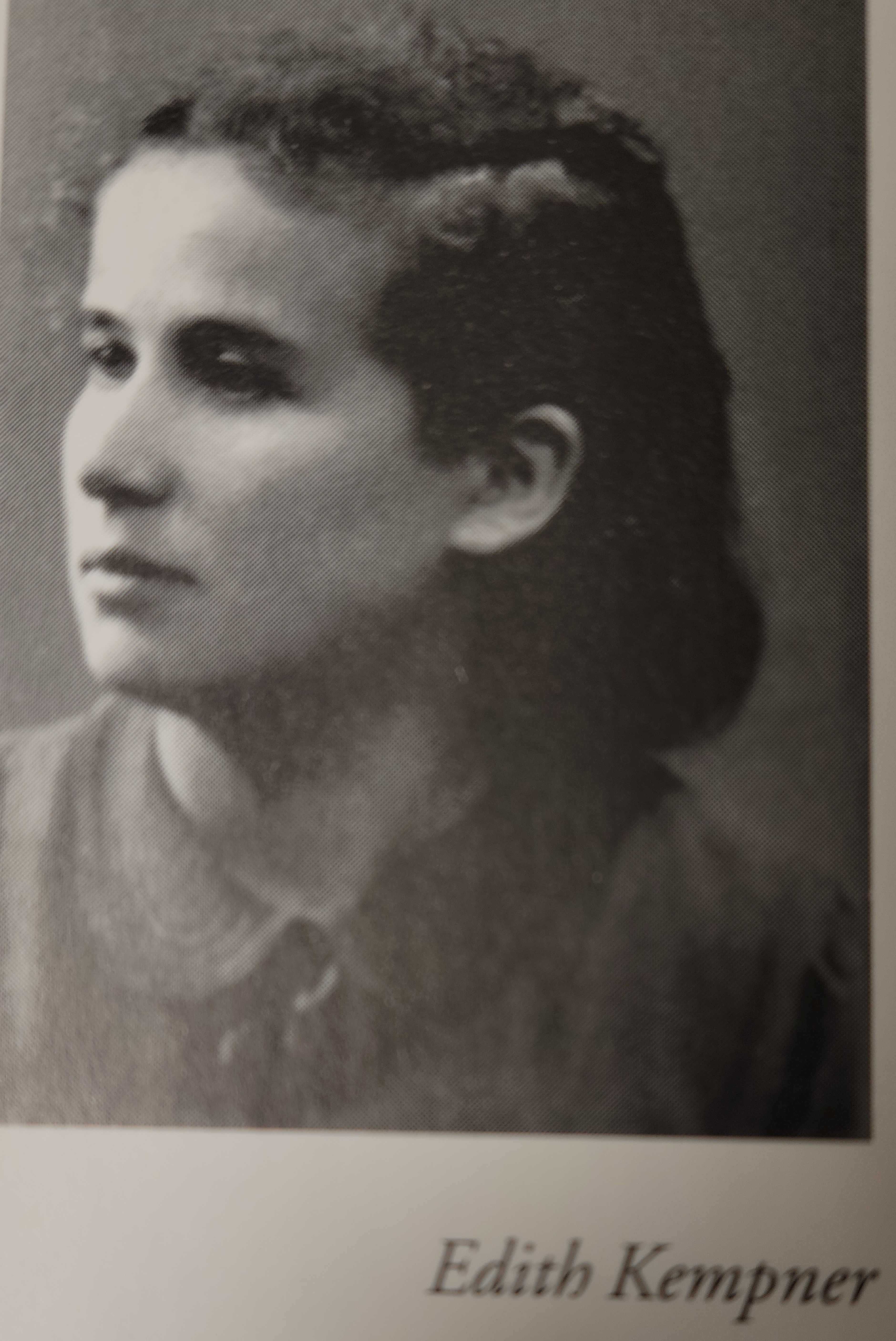
Margot and Gustav’s daughter Edith also was murdered by the Nazis. After she was prohibited from attending the local high school for girls in Goettingen in 1938, she went to Hamburg and then to Berlin, where she met and married her husband Herbert Kempner in 1942. But Herbert and Edith’s marriage was short-lived because on November 29, 1942, they were both deported to Auschwitz and murdered there. I am so grateful to Dennis Aron, who shared with me the entries about Gustav, Margot, and Edith from Die Juedischen Buerger im Kreis Goettingen 1933-1945: Ein Gedenkbuch, including this photograph of Edith. 2

Tragically, Margot and Gustav and their daughter Edith have no living descendants because of the Nazis. Thus, we must all remember them instead.

The other two children of Antonie Blumenfeld and Siegfried Engelbert survived the Holocaust, but not without facing Nazi persecution.

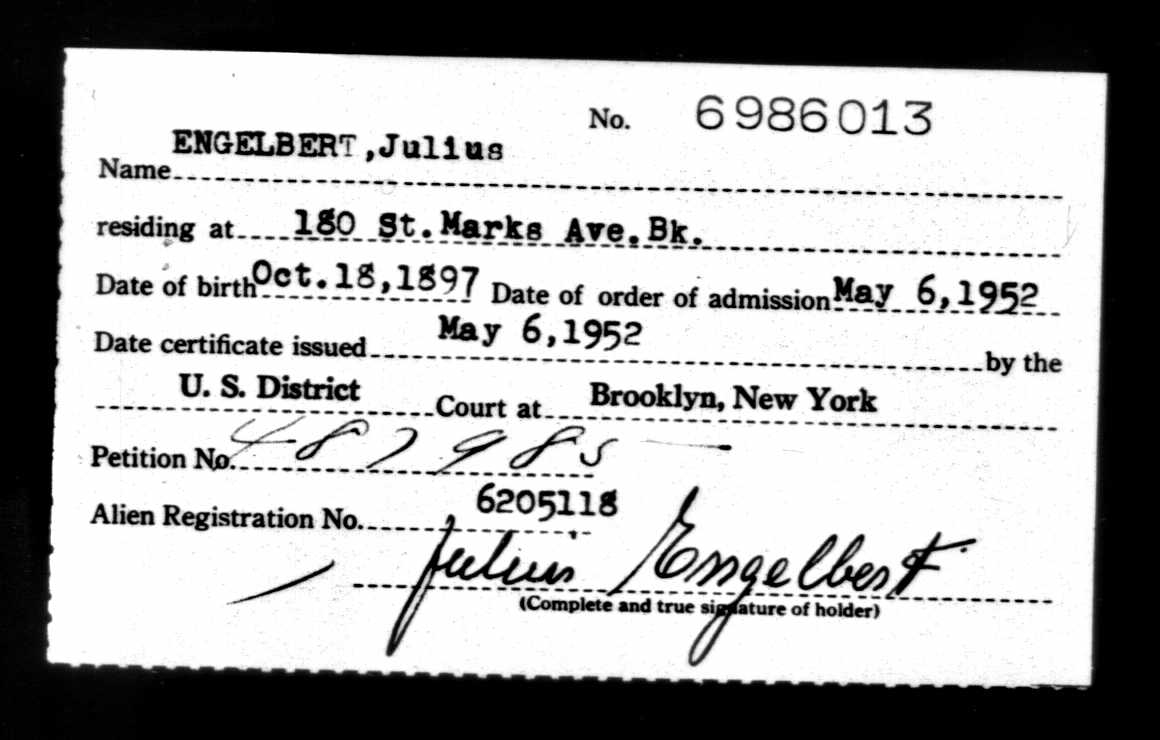
Their son Julius Engelbert, his wife Ilse, and their nine-year-old son Werner fled to Bolivia on September 23, 1939.3 Six years later the family immigrated to the United States, arriving on December 23, 1945.4 They settled in Brooklyn, New York, and they all became US citizens in 1952. Werner Engelbert became a pharmacist after graduating from the College of Pharmacy of the City of New York in 1952.5 According to his niece Marsha, Julius saved the many wonderful photographs published in this series of posts when he fled Germany in 1939. How fortunate we all are that he did.

Ancestry.com. U.S., Naturalization Records Indexes, 1794-1995

Julius Engelbert died in New York on July 25, 1965; he was 67. He was killed in a car accident driving to or from the Catskills.6 His wife Ilse survived him by twenty years, dying in February 1985 at the age of 78.7 Their son Werner died in 2019.8 He was survived by his wife and children and grandchildren.

Elfriede Engelbert Goldschmidt and her family also survived the Holocaust, but their path to survival was more complicated than that of her brother Julius and his family. I was privileged to listen to the testimony that Inge Goldschmidt Oppenheimer, Elfriede’s daughter, gave to the Shoah Foundation in 1996,9 and her story is both heartbreaking and inspiring. I will share her story in my next post.


  1. Margot Engelbert Neuhaus, Yad Vashem, at https://yvng.yadvashem.org/nameDetails.html?language=en&itemId=1306232&ind=2;  Gustav Neuhaus, Yad Vashem at https://yvng.yadvashem.org/nameDetails.html?language=en&itemId=1306229&ind=2. See also Uta Schaefer-Richter and Joerg Klein, Die Juedischen Buerger im Kreis Goettingen 1933-1945: Ein Gedenkbuch (Wallstein Verlag 1992), pp. 190-191. 
  2. Uta Schaefer-Richter and Joerg Klein, Die Juedischen Buerger im Kreis Goettingen 1933-1945: Ein Gedenkbuch (Wallstein Verlag 1992), p.190.Die Juedischen Buerger im Kreis Goettingen 1933-1945: Ein Gedenkbuch (Wallstein Verlag Goettingen), p. 126. 
  3. Julius Engelbert, Nationality: Deutsch Juden, Record Type: Miscellaneous
    Birth Date: 18 Okt 1897 (18 Oct 1897), Birth Place: Kassel, Residence Place: Kassel Kassel, Notes: Lists of judicial and official files concerning foreigners and German Jews
    Reference Number: 02010101 oS, Document ID: 70443285, Arolsen Archives, Digital Archive; Bad Arolsen, Germany; Lists of Persecutees 2.1.1.1, Ancestry.com. Free Access: Europe, Registration of Foreigners and German Persecutees, 1939-1947 
  4. Joseph Julius Engelbert, ship manifest, Year: 1945; Arrival: New York, New York, USA; Microfilm Serial: T715, 1897-1957; Line: 22; Page Number: 41, Ancestry.com. New York, U.S., Arriving Passenger and Crew Lists (including Castle Garden and Ellis Island), 1820-1957 
  5. Werner J Engelbert, Yearbook Date: 1952, School: College of Pharmacy of the City of New York, School Location: New York, New York, USA, U.S., School Yearbooks, 1880-2012″; School Name: College of Pharmacy of the City of New York; Year: 1952,
    Ancestry.com. U.S., School Yearbooks, 1900-1999 
  6. Julius Engelbert, Gender: Male, Age: 67, Birth Date: abt 1898, Residence Place: Adelphi, Kings, New York, USA, Death Date: 25 Jul 1965, Death Place: New York, USA, New York State Department of Health; Albany, NY, USA; New York State Death Index,
    Ancestry.com. New York State, U.S., Death Index, 1957-1969. Email from Marsha Eidlin, September 25, 2021. 
  7. Ilse Engelbert, Social Security Number: 129-22-5815, Birth Date: 31 Mar 1906
    Issue Year: Before 1951, Issue State: New York, Last Residence: 11210, Brooklyn, Kings, New York, USA, Death Date: Feb 1985, Social Security Administration; Washington D.C., USA; Social Security Death Index, Master File, Ancestry.com. U.S., Social Security Death Index, 1935-2014 
  8. https://jewishfunerals.com/service/werner-j-engelbert/ 
  9. Inge Oppenheimer, Interview 11370. Visual History Archive, USC Shoah Foundation, 1996. Accessed 17 August 2021. 

Baruch Blumenfeld’s Daughter Antonie: Life Before the Nazis

Although I have no definitive answer as to when Baruch Blumenfeld left his family in Germany, I do have information about what happened to his two daughters and their children.

As we saw, Baruch and Emma had two daughters: Antonie and Charlotte Jeanette, born in 1872 and 1875, respectively. This post and the three that follow will focus on Antonie and her descendants. I am deeply grateful to Antonie’s great-granddaughter Marsha for sharing her collection of family photos with me so that I can bring Antonie and her family to life.

Antonie married Sussel Siegfried (known as Siegfried) Engelbert in Neustadt, Germany, in 1894, and they had three children: Margot (born 1895), Joseph Julius (known as Julius) (born 1897), and Elfriede (born 1900). Siegfried owned a clothing store in Kassel, shown in this photograph.

Engelbert store, c. 1900, Kassel. Courtesy of the family.

The photograph below is of Antonie and below that are three photographs of her children, one taken in 1911 of Elfriede and Margot and an unknown little girl, the other taken in about 1920 of all three of Antonie and Siegfried Engelbert’s children, and the last a photograph of Julius Engelbert with his parents Antonie and Siegfried.

Antonie Blumenfeld Engelbert undated. Courtesy of the family

Elfriede Engelbert, unknown girl, Margot Engelbert, 1911. Courtesy of the family

Margot, Julius, and Elfriede Engelbert, c. 1920. Courtesy of the family

Julius, Antonie, and Siegfried Engelbert. Courtesy of the family

Margot married Gustav Neuhaus on December 3, 1920. He was born on December 5, 1884, in Bremke, Germany, to Hermann Neuhaus and Bernhardine Neuhaus. He was a cattle dealer in Goettingen, Germany; his grandfather had started the business in 1858.1

Marriage record of Margot Engelbert and Gustav Neuhaus, Hessisches Hauptstaatsarchiv; Wiesbaden, Deutschland; Bestand: 910, Year Range: 1920, Ancestry.com. Hesse, Germany, Marriages, 1849-1930

Margot and Gustav had one child, a daughter Edith, born on March 9, 1922.

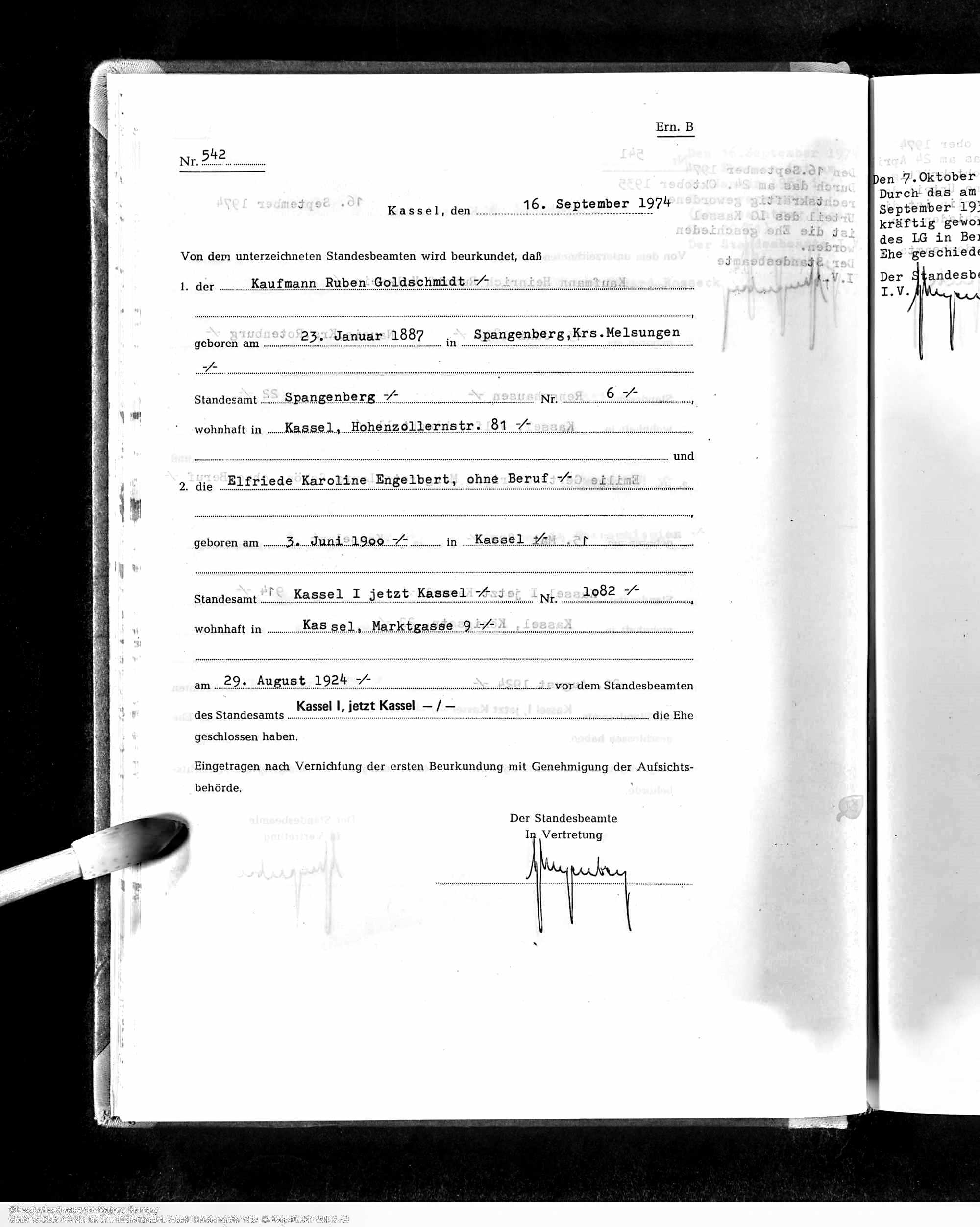
Elfriede Caroline Engelbert married Ruben Rudolf (known as Rudolf) Goldschmidt on August 19, 1924, in Kassel, Germany. Rudolf, the son of Gabriel Goldschmidt and Jettchen Levi, was born in Spangenburg, Germany, on January 23, 1887.2

Marriage record of Elfriede Engelbert and Ruben Goldschmidt, Hessisches Hauptstaatsarchiv; Wiesbaden, Deutschland; Bestand: 910, Year Range: 1924, Ancestry.com. Hesse, Germany, Marriages, 1849-1930

Here is a photograph of Elfriede and Rudolf taken when they were engaged in 1924.

Elfriede Engelbert and Rudolf Goldschmidt, 1924. Courtesy of the family

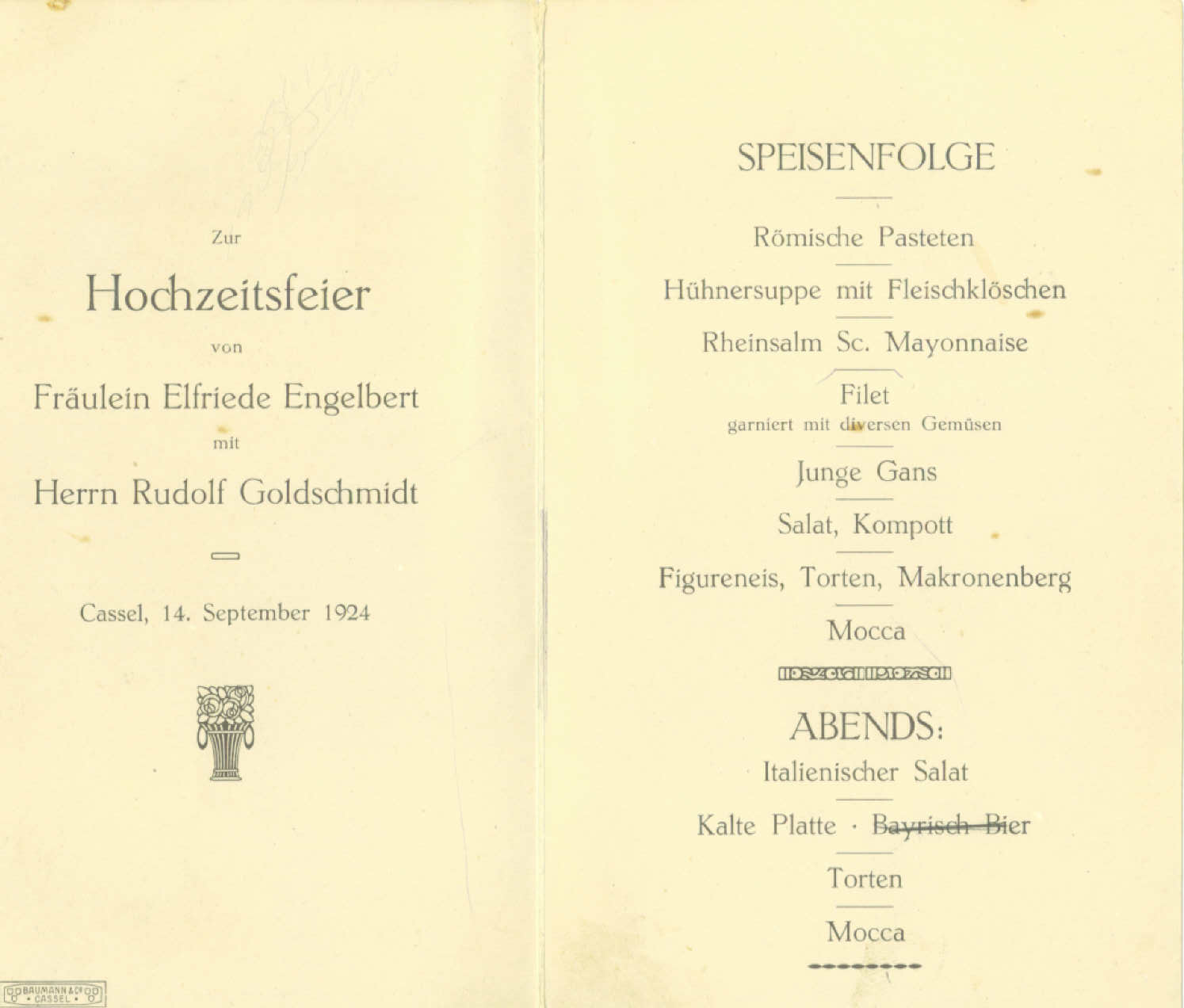
Marsha also shared the menu from Elfriede and Rudolf’s wedding. It must have been quite a lavish celebration.

Elfriede and Rudolf had two children, Gunther, born July 17, 1925,3 and Inge, born April 13, 1929,4 in Kassel where they resided.

Here are some photographs of Gunther and Inge as young children.

Gunther and Elfriede Engelbert Goldschmidt, 1925. Courtesy of the family

Inge and Gunther Goldschmidt, 1931. Courtesy of the family

Inge and Gunther Goldschmidt, c. 1931. Courtesy of the family

Elfriede, Gunther, and Inge Goldschmidt c. 1931. Courtesy of the family

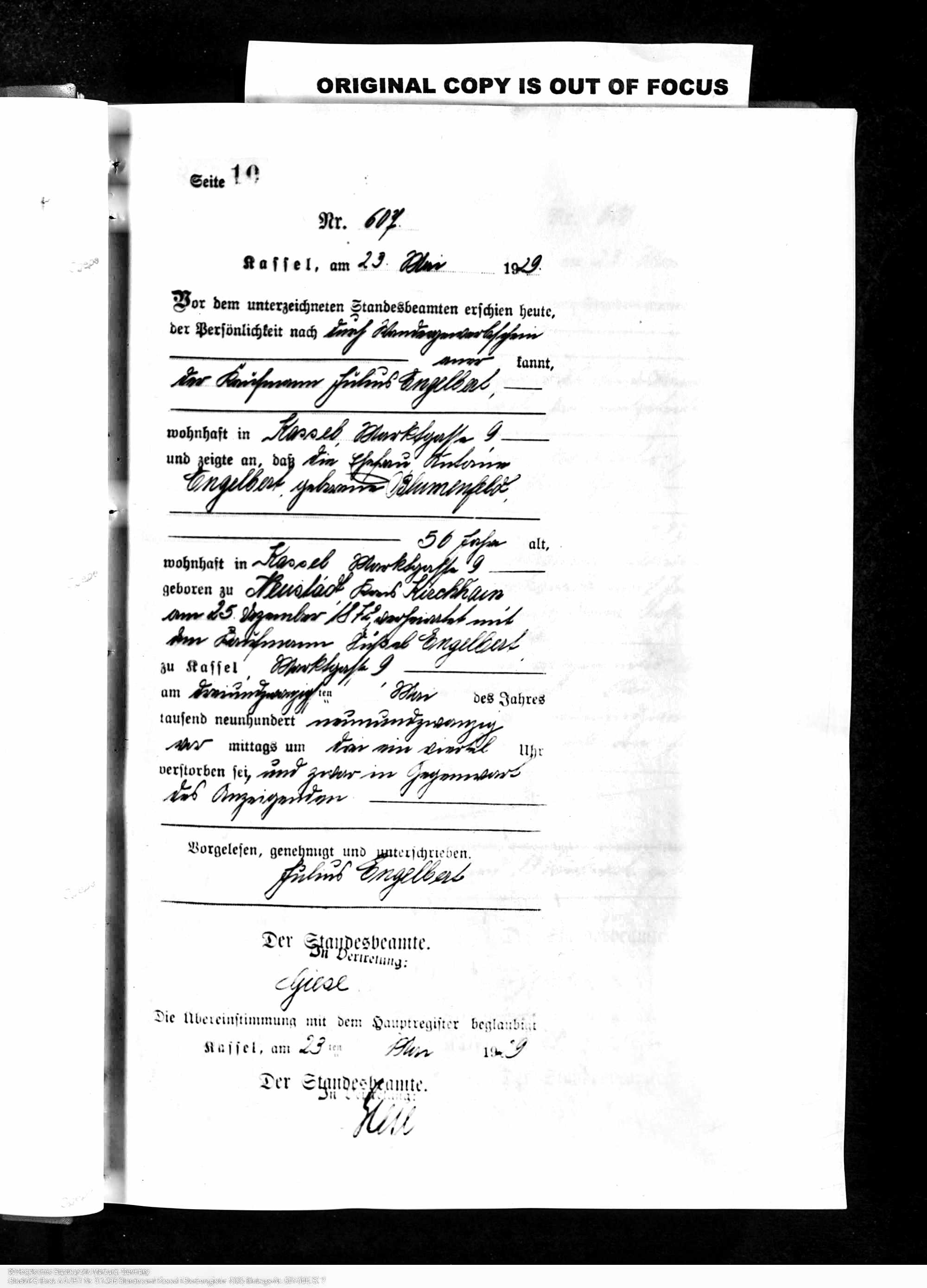
Antonie lived long enough to see her three grandchildren born, but she died on May 23, 1929, a month after Inge’s birth. She was survived by her husband and her children and grandchildren.

Antonie Blumenfeld Engelbert death record, Personenstandsregister Sterberegister; Bestand: 910; Signatur: 5619, Year Range: 1929, Ancestry.com. Hesse, Germany, Deaths, 1851-1958

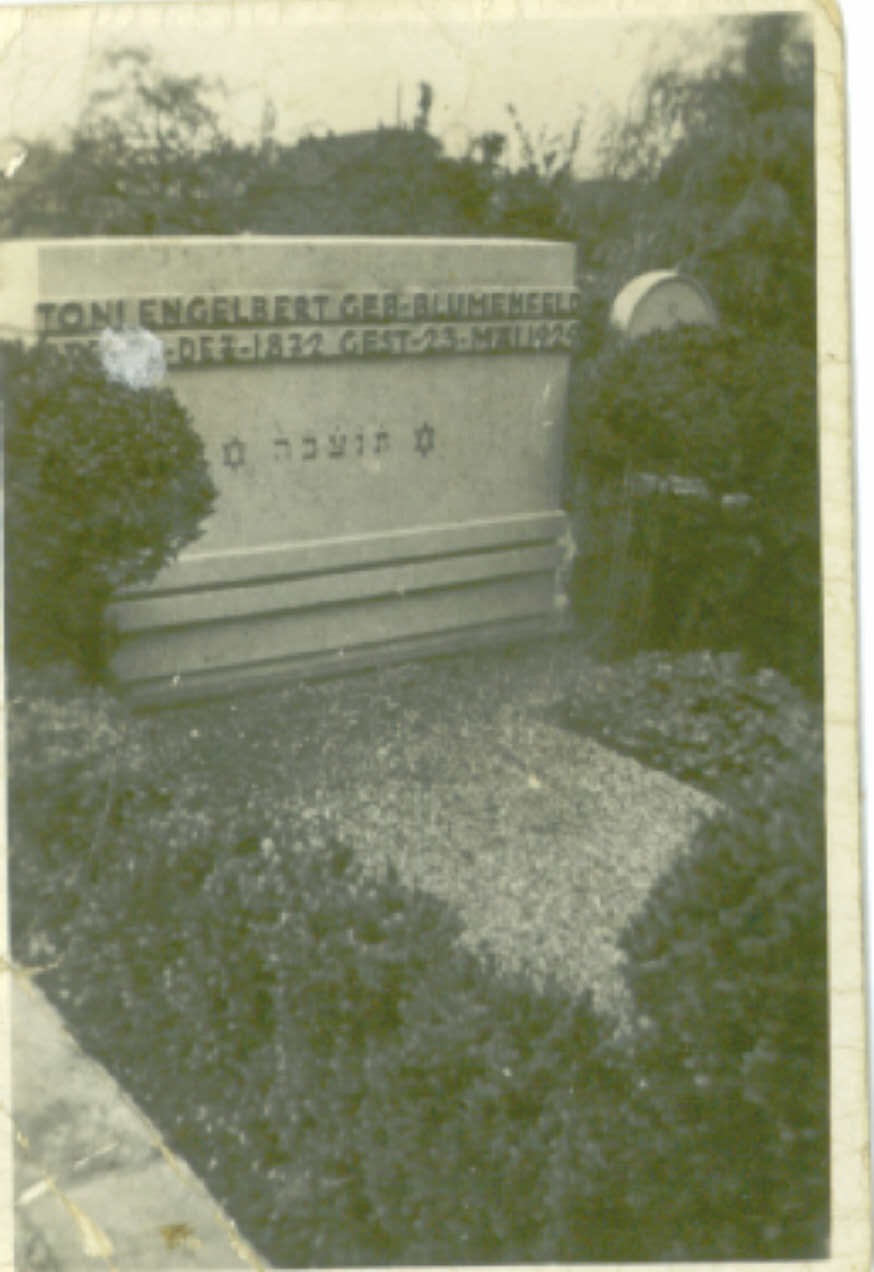
Here is one more photograph of Antonie and Julius and a photograph of Antonie’s headstone.

Siegfried Engelbert and Antonie Blumenfeld Engelbert. Courtesy of the family

Courtesy of the family

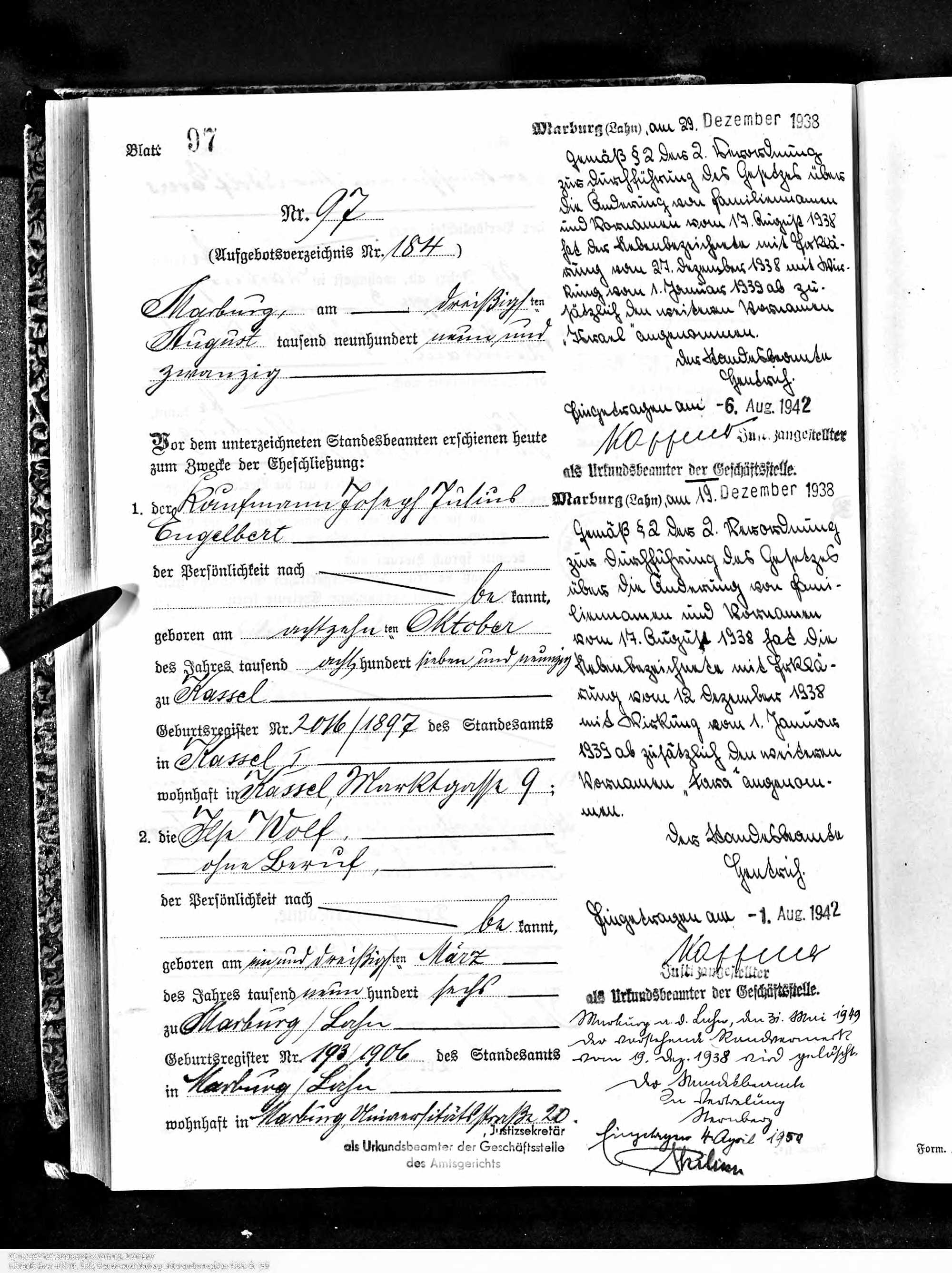
Julius Engelbert married a few months after his mother’s death. On August 29, 1929, he married Ilse Wolf in Marburg, Germany. She was born in Marburg on March 31, 1906. Julius and Ilse had one child, Werner, born in Kassel in 1930.5

Julius Engelbert and Ilse Wolf marriage record, Hessisches Hauptstaatsarchiv; Wiesbaden, Deutschland; Bestand: 915; Laufende Nummer: 5652, Year Range: 1929, Ancestry.com. Hesse, Germany, Marriages, 1849-1930

Two years later Siegfried Engelbert died on July 12, 1932, in Kassel.6 He was 65 and died before the Nazi takeover of Germany the following year.  He and Antonie were spared seeing what would happen to their children.

In this photograph are Elfriede, Rudolf, and Inge with Margot and her daughter Edith taken in 1936.  No one could have predicted what was to happen to them all in the next decade.

Elfriede Engelbert Goldschmidt, Inge Goldschmidt, Rudolf Goldschmidt, Edith Neuhaus, Margot Neuhaus, 1936. Courtesy of the family

To be continued.


  1. Gustav Neuhaus, Yad Vashem entry,  https://yvng.yadvashem.org/nameDetails.html?language=en&itemId=1306229&ind=2 and from the Neuhaus Family Tree on Ancestry found at https://www.ancestry.com/family-tree/person/tree/60044058/person/342252900990/facts. See also Uta Schaefer-Richter and Joerg Klein, Die Juedischen Buerger im Kreis Goettingen 1933-1945: Ein Gedenkbuch (Wallstein Verlag 1992), p.190. 
  2. Arcinsys Archives Hessen, HHStAW Fonds 365 No 782, p. 63. Inge Oppenheimer, Interview 11370. Visual History Archive, USC Shoah Foundation, 1996. Accessed 17 August 2021. 
  3. Gunther Goldschmidt, Social Security #: 488207584, Gender: Male
    Birth Date: 17 Jul 1925, Death Date: 30 Nov 1972, Death Place: San Francisco, Ancestry.com. California, U.S., Death Index, 1940-1997 
  4. Inge Oppenheimer, Interview 11370. Visual History Archive, USC Shoah Foundation, 1996. Accessed 17 August 2021. 
  5. Arolsen Archives, Digital Archive; Bad Arolsen, Germany; Lists of Persecutees 2.1.1.1, Reference Code: 02010101 oS, Ancestry.com. Free Access: Europe, Registration of Foreigners and German Persecutees, 1939-1947; Werner Jack Engelbert, Age: 22, Birth Date: 21 Jul 1930, Issue Date: 29 Jan 1952, State: New York
    Locality, Court: Eastern District of New York, District Court, National Archives and Records Administration (NARA); Washington, D.C.; Index to Naturalization Petitions of the United States District Court for the Eastern District of New York, 1865-1957; Microfilm Serial: M1164; Microfilm Roll: 53, Ancestry.com. U.S., Naturalization Records Indexes, 1794-1995 
  6. LAGIS Hessen Archives, Nr 587, p. 291, Standesamt Kassel I Sterberegister 1932, Eintrags-Nr. 301-600 (StadtAKS Best. A 3.35.1 Nr. 3.1.310) Autor Stadtarchiv Kassel Erscheinungsort Kassel IErscheinungsjahr 1932 

My Great-grandfather Comes to America: The Schoenthals in Western Pennsylvania 1880-1890

Map of Pennsylvania highlighting Allegheny County

Map of Pennsylvania highlighting Allegheny County (Photo credit: Wikipedia)

Or how my great-grandfather met my great-grandmother.  I love finding stories about how couples met each other.  From a little tiny news item in a small local paper in 1887, I may have found a clue as to how my Schoenthal/Katzenstein grandparents met each other.
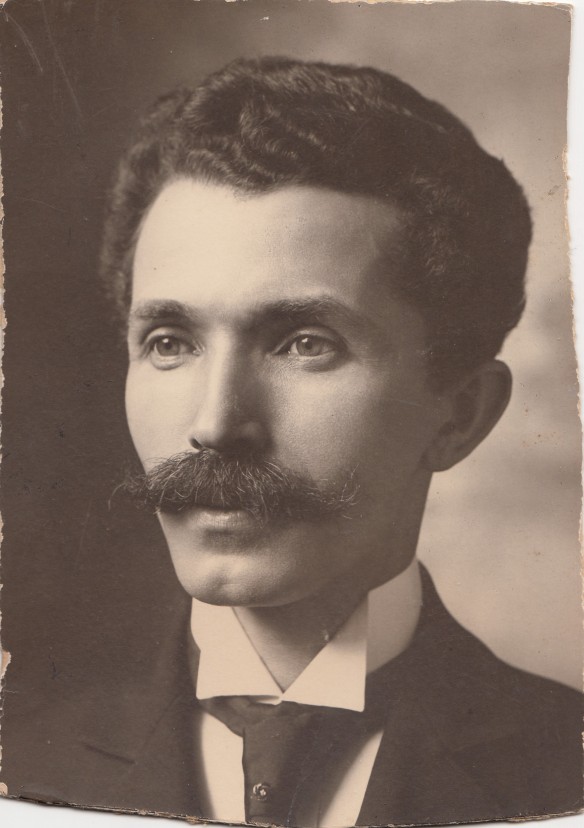
Isidore Schoenthal

Isidore Schoenthal

By 1880, many of the members of the family of Heinemann Schoenthal and Hendel Beerenstein had moved from Sielen, Germany, to the United States.  Their two daughters had arrived first: Fanny and her husband Simon Goldsmith and Mina and her husband Marcus Rosenberg.  They were followed by six of the children of Levi Schoenthal (Fanny and Mina’s brother) and Henrietta Hamberg: Henry, Julius, Amalie, Simon, Nathan, and Felix.

Their father Levi died in 1874; their mother Henrietta was still living in Germany in 1880. Four of the children of Levi and Henrietta were also still in Germany in 1880: Hannah, Jacob, Rosalie, and my great-grandfather Isidore.  All but Jacob would soon be in the United States.

Jacob had married Charlotte Lilienfeld in 1879 and was a merchant living in Cologne (or Koln), Germany.  Charlotte was the daughter of Meyer Lilienfeld and Hannchen Meiberg of Gudensberg, another small town in the Kassel district of Hessen, not far from Sielen.   Charlotte was the half-sister of Helen Lilienfeld, who had married Jacob’s brother Henry in 1872.   Although Jacob and Charlotte never emigrated from Germany, they had two sons who did: Lee, born in 1881, and Meyer, born in 1883. More on them in a later post.

HStAMR Best. 920 Nr. 2610 Standesamt Gudensberg Heiratsnebenregister 1879, S. 10
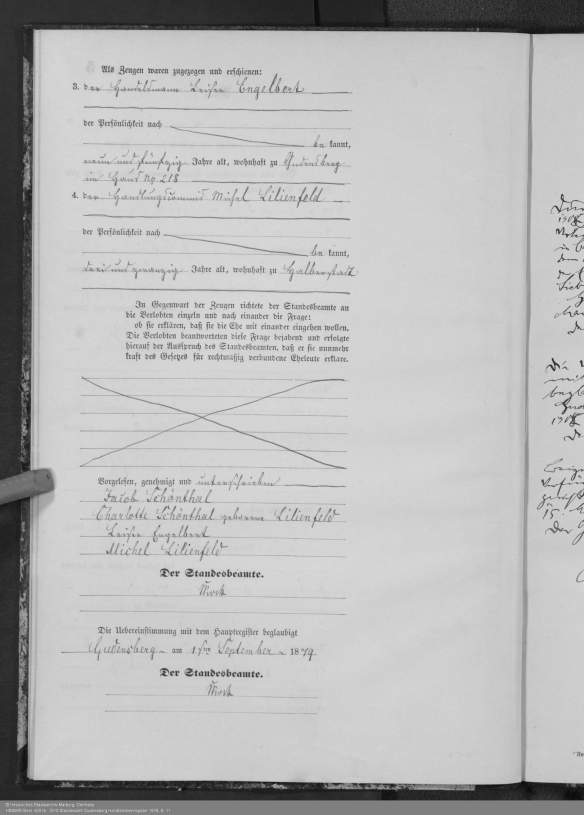
HStAMR Best. 920 Nr. 2610 Standesamt Gudensberg Heiratsnebenregister 1879, S. 10

Eine Vervielfältigung oder Verwendung dieser Seite in anderen elektronischen oder gedruckten Publikationen und deren Veröffentlichung (auch im Internet) ist nur nach vorheriger Genehmigung durch das Hessische Staatsarchivs Marburg, Friedrichsplatz 15, D-35037 Marburg, Germany gestattet.

HStAMR Best. 920 Nr. 2610 Standesamt Gudensberg Heiratsnebenregister 1879, S. 10

As for the many Schoenthal family members already in the United States, as of 1880 only Henry and his wife Helen (Lilienfeld) and their two young children, Hilda (six) and Lionel (three), were still living in Washington, Pennsylvania, where Henry owned a retail variety store.  Living with them and described as their adopted son was a twelve year old boy named Samuel Hamberg, who was born in South Carolina.  I have to believe that Samuel Hamberg was somehow related to Henry’s mother’s family, the Hambergs of Breuna, but I cannot find the connection.[1]  Henry and Helen would have one more child in the 1880s, a son born in 1883 named Meyer Lilienfeld Schoenthal, named for Helen’s father.
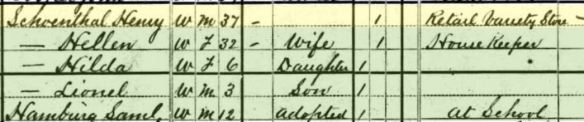
Henry Schoenthal and family 1880 census Year: 1880; Census Place: Washington, Washington, Pennsylvania; Roll: 1202; Family History Film: 1255202; Page: 596A; Enumeration District: 271

Henry Schoenthal and family 1880 census
Year: 1880; Census Place: Washington, Washington, Pennsylvania; Roll: 1202; Family History Film: 1255202; Page: 596A; Enumeration District: 271


Although Henry was the only Schoenthal sibling still in Washington, Pennsylvania in 1880, others were not too far away.  Amalie and her husband Elias Wolfe were now living in Allegheny (today part of Pittsburgh so from hereon I will refer to both Allegheny and Pittsburgh as Pittsburgh), Pennsylvania.  According to the entry in the census record, Elias was a “drover.”  I’d never heard this term before, but according to the Merriam-Webster dictionary online, a drover is “a person who moves groups of animals (such as cattle or sheep) from one place to another.”     Amalie and Elias had three children at the time of the census: Morris was 7, Florence was 5, and Lionel was 2.  A fourth child was born in June, 1880, shortly after the census, a son named Ira.   Two more were born in the 1880s: Henrietta (1883) and Herbert (1885).

Amalie Schoenthal Wolfe and family 1880 census Year: 1880; Census Place: Allegheny, Allegheny, Pennsylvania; Roll: 1086; Family History Film: 1255086; Page: 153C; Enumeration District: 006; Image: 0310

Amalie Schoenthal Wolfe and family 1880 census
Year: 1880; Census Place: Allegheny, Allegheny, Pennsylvania; Roll: 1086; Family History Film: 1255086; Page: 153C; Enumeration District: 006; Image: 0310


As noted in my earlier post, Felix Schoenthal was also still relatively close to Washington, Pennsylvania, living with his wife  Maggie in West Newton, about 25 miles away, where Felix was working as a clerk at the paper mill.  Felix and Maggie also had two children during the 1880s: Rachel (1881) and Yetta (1884).

The other siblings had moved further east.  Julius was in Washington, DC, working as a shoemaker, as described in my last post.  His brother Nathan was also now in DC, working as a clerk in a “fancy store.”  Simon Schoenthal had also moved further east by 1880.  Although he and his family were living in Pittsburgh in 1879, by 1880 he and Rose and their five children had moved to Philadelphia.  Simon was still working as a bookbinder. In the 1880s they would have four more children: Martin (1881), Jacob (1883), Hettie (1886), and Estelle (1889).  In 1891, one more child was added to the family, Sidney.
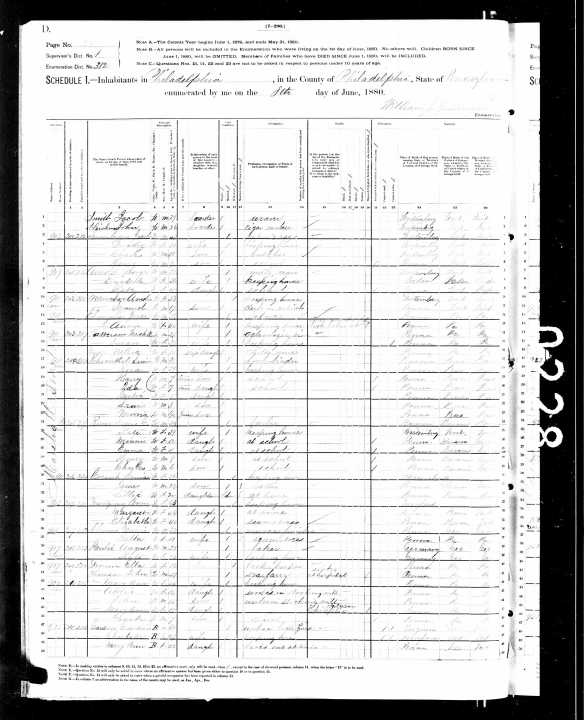
Simon Schoenthal and family 1880 census Year: 1880; Census Place: Philadelphia, Philadelphia, Pennsylvania; Roll: 1179; Family History Film: 1255179; Page: 12D; Enumeration District: 382; Image: 0218

Simon Schoenthal and family 1880 census
Year: 1880; Census Place: Philadelphia, Philadelphia, Pennsylvania; Roll: 1179; Family History Film: 1255179; Page: 12D; Enumeration District: 382; Image: 0218


But other members of the extended Schoenthal clan still lived in western Pennsylvania.  Fanny Schoenthal Goldsmith’s widower Simon Goldsmith was living in Pittsburgh with their daughter Hannah and her family.  Hannah’s husband Joseph Benedict was a rag dealer, and in 1880 they had three sons: Jacob (10), Hershel (9), and Harry (3).[2]

Simon Goldsmith and Joseph Benedict families on 1880 census Year: 1880; Census Place: Pittsburgh, Allegheny, Pennsylvania; Roll: 1092; Family History Film: 1255092; Page: 508D; Enumeration District: 122; Image: 0683

Simon Goldsmith and Joseph Benedict families on 1880 census
Year: 1880; Census Place: Pittsburgh, Allegheny, Pennsylvania; Roll: 1092; Family History Film: 1255092; Page: 508D; Enumeration District: 122; Image: 0683

As described in an earlier post, Mina Schoenthal Rosenberg and her husband Marcus Rosenberg and their daughter Julia were living in Elk City, Pennsylvania, in 1880.  Their daughter Hannah and her husband Herman Hirsh were living in Pittsburgh with their five children in 1880.  Their daughter Mary and her husband Joseph Podolsky and children were living in Ohio.  Mina’s other two children, Rachel and Harry, are missing from the 1880 census.

Thus, by 1880, there were still a large number of family members in western Pennsylvania; it was still home to most of the extended Schoenthal clan.  It is not surprising that when my great-grandfather Isidore arrived with his mother and sister Rosalie, they ended up in western Pennsylvania as well.

My great-grandfather Isidore, his mother Henrietta Hamberg Schoenthal, and his younger sister Rosalie arrived in New York on September 3, 1881, upon the ship Rhein, which had sailed from Bremen.  Isidore was 22, Rosalie was seventeen, and Henrietta was 64 years old.  They settled in Washington, Pennsylvania, where Henry was living. Isidore worked as a clerk in Henry’s variety store.

Henrietta died just a year later in December, 1882; she was buried at Troy Hill cemetery in Pittsburgh.  Washington did not yet have a Jewish cemetery.  Although I could not find an American death certificate, Henrietta’s death was recorded back in Sielen even though she had died in the US.
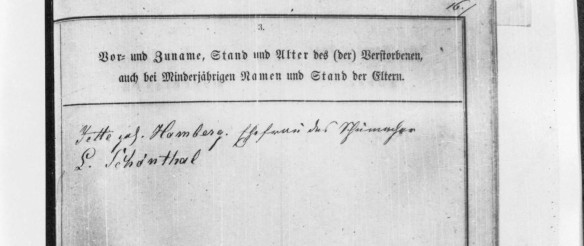
Henrietta Hamberg Schoenthal death record from Sielen HHStAW Abt. 365 Nr. 773, S. 10

Henrietta Hamberg Schoenthal death record from Sielen
HHStAW Abt. 365 Nr. 773, S. 10

Henrietta’s brother-in-law Simon Goldsmith died a few months later on March 17, 1883.  He also was buried at Troy Hill.

Rosalie Schoenthal, the youngest child of Levi and Henrietta, returned to Germany where she married William or Willie Heymann in Geldern, Germany, on December 8, 1884.  She and Willie would have four children born in Geldern: Lionel (1887, for Rosalie’s father Levi, presumably), Helen (1890), Max (1893), and Hilda (1898).  I assume that either Helen or Hilda was named for Rosalie’s mother Henrietta.  The two sons ended up immigrating to the United States; the two daughters and their families perished in the Holocaust.  But more on that in a later post.

There would be one more Schoenthal sibling who would immigrate to the US: the oldest child, Hannah.  Hannah had had a child out of wedlock in 1865, a daughter named Sarah whose father is unknown.
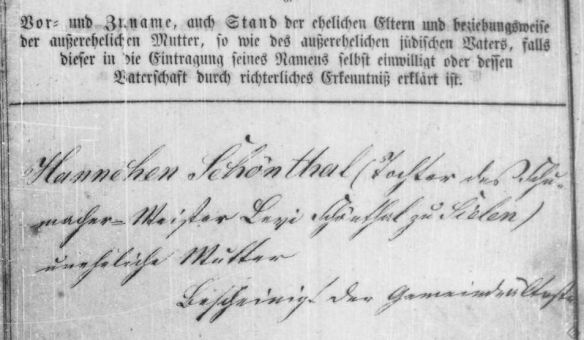
birth of Sarah Schoenthal, daughter of Hannah HHStAW fonds 365 No 772 p12

birth of Sarah Schoenthal, daughter of Hannah Schoenthal, in Sielen, 1865
HHStAW fonds 365 No 772 p12

[Translation: “Hannchen Schönthal (Tochter des Schuhmacher=Meister Levi Schönthal zu Sielen) uneheliche Mutter.”…..Hannchen Schönthal (daughter of the master shoemaker (cobbler) Levi Schönthal of Sielen) unmarried mother.]

Hannah later married Solomon Simon Stern in Sielen, Germany, on August 19, 1874, five months after her father Levi died.  She was 29 years old at that time.  Solomon was 57.
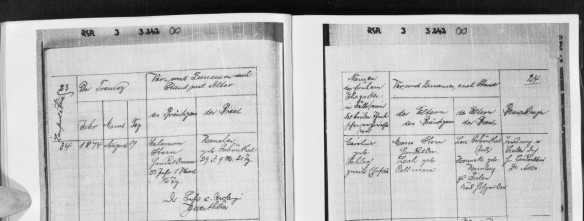
Marriage of Solomon Stern to Hannah Schoenthal HHStAW Abt. 365 Nr. 839, S. 22

Marriage of Solomon Stern to Hannah Schoenthal in Sielen
HHStAW Abt. 365 Nr. 839, S. 22

Together they would have three children: Jennie, born June 20, 1875; Edith, born September 7, 1877; and Louis, born May 17, 1879.  Solomon Stern died February 20, 1888, and Hannah and their three children emigrated from Germany shortly thereafter.  According to later census records, Hannah and the three children all emigrated in 1888.
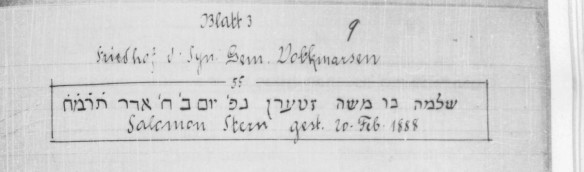
Solomon Stern gravestone inscription HHStAW Abt. 365 Nr. 842, S. 11

Solomon Stern gravestone inscription
HHStAW Abt. 365 Nr. 842, S. 11

Hannah and her children settled in Pittsburgh, where her sister Amalie and her husband Elias Wolfe and their six children, named above, were still living.  Elias continued to work as a drover.  Hannah and Amalie’s brother Felix also was in Pittsburgh by that time, having relocated there from West Newton by 1882.  He was working as a bookkeeper.  In 1889 he opened his own store:

 Pittsburgh Daily Post, 9 Apr 1889, Tue, Page 3

Pittsburgh Daily Post, 9 Apr 1889, Tue, Page 3

Also living in Pittsburgh in the 1880s was their Schoenthal cousin, Hannah Goldsmith Benedict, and her husband Joseph and three children, Jacob, Herschel, and Harry; Joseph was selling rags and paper stock.  Joseph became entangled in a rather gruesome lawsuit involving the sale of rags to a paper mill.  The purchaser had failed to pay the purchase price, and Joseph had sued for payment.  The purchaser alleged that they were not liable for the purchase price because the rags had been infected with the smallpox virus, and several of the purchaser’s employees had taken ill, causing the shutdown of the purchaser’s mills.  Thus, the purchaser claimed it had been damaged by loss of business in an amount exceeding what it allegedly owed Joseph Benedict.
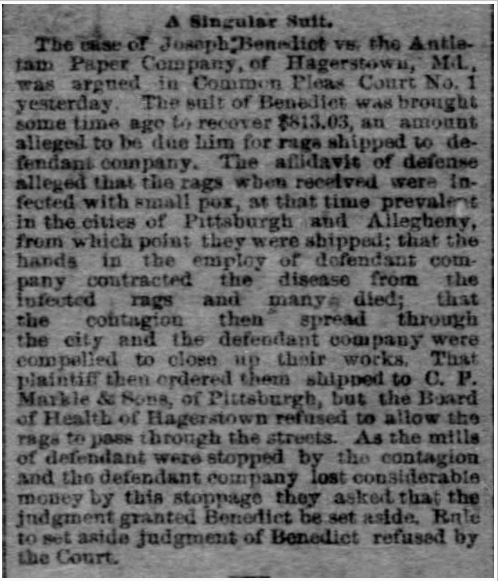
 Pittsburgh Post-Gazette, 5 Sep 1882, Tue, Page 1

Pittsburgh Post-Gazette, 5 Sep 1882, Tue, Page 1

This would have been a fun case for me to teach in my days as a law professor teaching Contracts.  It is similar to a famous case taught in most Contracts courses called Hadley v. Baxendale.  Was the shutdown of the paper mill a foreseeable consequence of the seller’s defective product? Here there are also issues of negligence, breach of warranty, damages, and so on.  It would have been a great exam question. Fortunately for Joseph Benedict, the court refused to set aside the judgment in his favor, and the paper mill was held liable for the purchase price of the rags.

Another Schoenthal cousin, Hannah Rosenberg Hirsh, and her husband Herman and their five children, Morris, Nathan, Carrie, Harry, and Sidney, were also living in Pittsburgh; Herman was in the varnish business, at first for the Michigan Furniture Company and then in his own business manufacturing varnish.

Hannah thus had many family members close by in Pittsburgh to provide support as she raised her three children alone in the new country.

My great-grandfather Isidore lived in Pittsburgh for some time also around 1887 through 1889, working as a floor walker in a retail store, at least according to the listings in the Pittsburgh city directories for those years.  But sometime in early 1888 he married my great-grandmother Hilda Katzenstein in Philadelphia.  Hilda was the daughter of Eva Goldschmidt and granddaughter of Seligmann Goldschmidt.  As discussed in an earlier post, Seligmann Goldschmidt was the brother of Simon Goldschmidt, who became Simon Goldsmith and who had married Isidore’s aunt, Fanny Schoenthal. Thus, Hilda and Isidore were already related to each by marriage. In addition, Hilda’s brother S.J. Katzenstein was a merchant, living in Washington, Pennsylvania.  I don’t know whether my great-grandparents met through S.J. in Washington, Pennsylvania, or through their mutual cousins, the Goldsmiths, or perhaps even through Isidore’s brother Simon, who lived in Philadelphia, where Hilda had been born and raised.

But I did find this important clue:
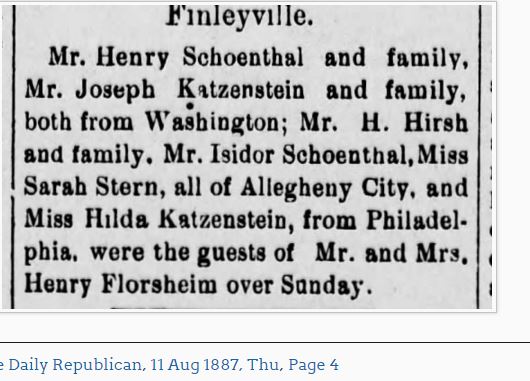
The Daily Republican (Monongahela, Pennsylvania) 11 Aug 1887, Thu • Page 4

The Daily Republican
(Monongahela, Pennsylvania)
11 Aug 1887, Thu • Page 4

Was this when Isidore and Hilda met—at a gathering at the house of a man named Henry Florsheim who lived in Finleyville? And who was he?  A little research revealed that Henry Florsheim was born in 1842 in Gudensberg, Germany, the same town where Helen and Charlotte Lilienfeld were born, the wives of Henry Schoenthal and Jacob Schoenthal, respectively.

Henry (Hienemann) Florsheim birth record HHStAW Abt. 365 Nr. 384, S. 35

Henry (Heinemann) Florsheim birth record from Gudensberg
HHStAW Abt. 365 Nr. 384, S. 35

In fact, according to research done by Hans-Peter Klein as reflected on his incredibly helpful website found here, Henry Florsheim’s sister married Helen Lilienfeld’s brother in Gudensberg in 1872, the same year that Helen Lilienfeld married Henry Schoenthal.  According to the 1910 census, Henry Florsheim came to the US in 1876, so the two families were already related by marriage when he arrived.  In 1880 Henry Florsheim was a merchant, living in Union Township in Washington County, Pennsylvania, about 20 miles from the city of Washington, PA.  An article in the January 31, 1887, Pittsburgh Daily Post (p.4) , reported that he was the proprietor of the Union Valley coal mines and had been presented with a gold watch by the citizens of Finleyville, a town about 16 miles from Washington and two miles from Union Township. Thus, in just a decade, Henry Florsheim had made quite a mark on his community.  Was this successful businessman the one who was responsible for bringing my great-grandparents together?  If so, thank you, Mr. Florsheim![3]
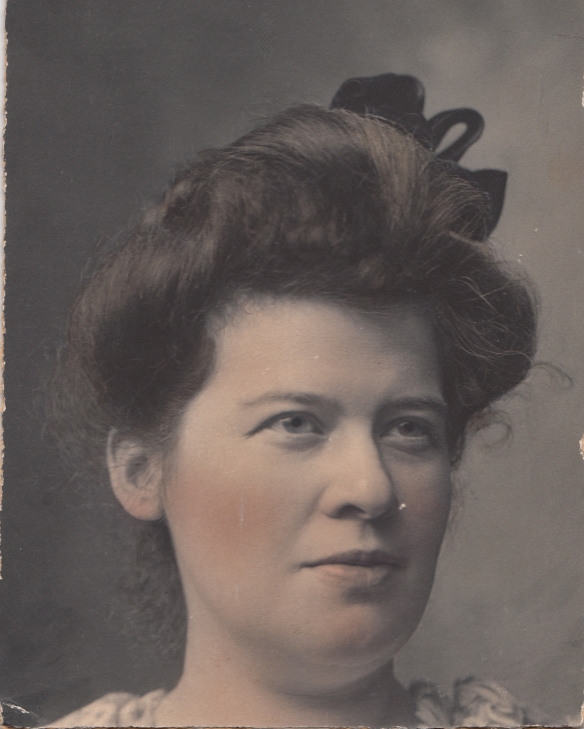
Hilda Katzenstein Schoenthal

Hilda Katzenstein Schoenthal

That was not the end of Henry Florsheim’s role in my great-grandparents’ lives.  In 1889, he hired my great-grandfather to work in his store in Finleyville; this news article suggests that they were still living in Pittsburgh before that opportunity arose.
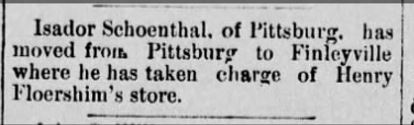
The Daily Republican (Monongahela, Pennsylvania) 8 Nov 1889, Fri • Page 1

The Daily Republican
(Monongahela, Pennsylvania)
8 Nov 1889, Fri • Page 1

Isidore and Hilda’s first child, my great-uncle Lester Henry Schoenthal, was born on December 3, 1888.  I assume that, like all the Lionels and Leo and Lee, he was named for Isidore’s father Levi.  About three years later on January 20, 1892, Isidore and Hilda had a second son, Gerson Katzenstein Schoenthal, named for Hilda’s father.  Their third child, Harold, and their fourth and youngest child, my grandmother Eva, would not arrive until after the 20th century had begun.

Thus, by 1890, the Schoenthal family had deep and wide connections to western Pennsylvania.  My next post will catch up with those family members who were living elsewhere in the 1880s: Washington DC, Ohio, and Philadelphia.


[1] All I can find about Samuel’s background is that he appears to have been the son of Charles Hamberg, who was born in Germany and emigrated before 1850; in 1853, Charles married Mary E. Hanchey in New Hanover, North Carolina.  She, however, was not Samuel’s mother because she was murdered on November 18, 1866.  On the 1870 census, Charles was living with a 21 year old woman named Tenah Hamberg and two year old Samuel. Since the 1870 census did not report information about the relationships among those in a household, I don’t know for sure whether Tenah was Charles’ wife or Samuel’s mother. Charles died in 1879, and the administrix of his intestate estate was a woman named Amalia Hamberg.  I don’t know who Amalia was or how she was related to Charles.  But by 1880, twelve year old Samuel had moved to Washington, Pennsylvania, to live with Henry.

[2] There were also two young boys, Jacob and Benjamin Goldsmith, living with them and a 21 years old named Jacob Basch.  They were labeled “grandsons,” but they had to be Simon’s grandsons, not Joseph and Hannah’s grandsons.  Jacob Basch was the son of Simon’s daughter Lena from his first marriage, who had married Gustav Basch.  I don’t know who the parents of Jacob and Benjamin Goldsmith were.

[3] That little article about Henry Florsheim’s party also led me to another question: who was the woman named Sarah Stern who also attended this gathering? I assumed she must have been a relative since everyone else at the Floersheim event was part of the Schoenthal or Katzenstein families, and I only knew of one Stern in the family—Solomon Stern who had married Hannah Schoenthal, the older sister of Henry, Isidore, and the other children of Levi Schoenthal.  Hannah’s first child, born before she married Solomon Stern, was named Sarah.  Was this Sarah Stern the same person, taking on her stepfather’s surname? Further investigation would support that conclusion, as I will describe in a later post.