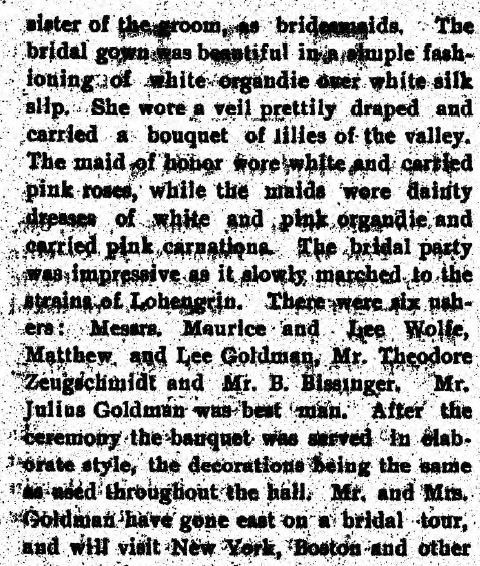
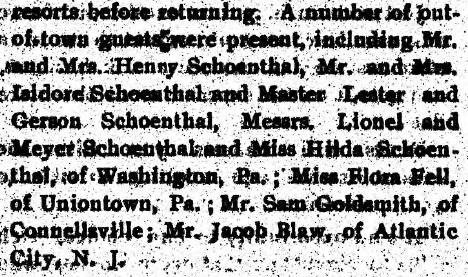
Jakob Schoenthal and Charlotte Lilienfeld, Part II: Finding Their Children and Grandchildren

In my last post, I talked about the twisted path I took to find my great-great-uncle Jakob Schoenthal and his wife Charlotte Lilienfeld.  After discovering that their daughter Henriette Schoenthal and her husband Julius Levi had been killed in the Holocaust, I was determined to find out what had happened to Henry Lyons, who was the son of Henriette and Julius Levi and who had filed Pages of Testimony for his parents with Yad Vashem.

I thought that would be easy.  After all, I had a name and a specific address from the Pages of Testimony—99-30 59th Avenue, Rego Park, New York.  And I did almost immediately find a Public Records listing with his name at that address that provided me with his birthdate, October 17, 1919.  But that didn’t tell me much more than what I knew from the Pages of Testimony.

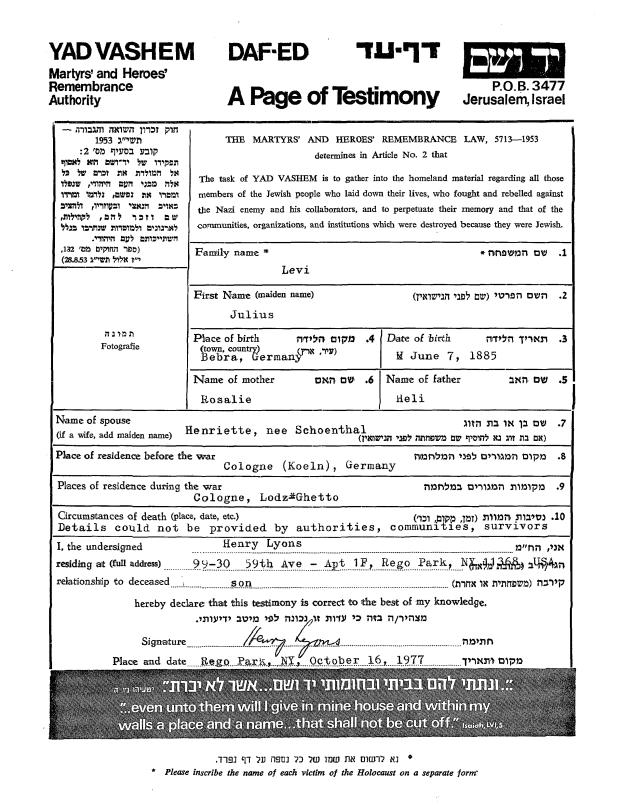
Yad Vashem page of testimony for Henriette Schoenthal Levi


Searching a bit further using the Rego Park address listed on the Pages of Testimony, I found a Pauline Lyons listed at that same address; I assumed that she was Henry’s wife.  Having both names made the search a bit easier since Henry Lyons itself is not exactly a unique name. I was able to use their two names together to find that they are both buried at Calverton National Cemetery and that Henry had died on December 18, 1986, and Pauline on November 30, 2007.  Henry had served in the US military during World War II, beginning his service on November 28, 1942, and thus was entitled to a military burial.  Imagine coming to America as a young man to escape Hitler and then fighting against the country of your birth.

When had he come to the US? Had he and Pauline had children? I wanted to know more.  I assumed Henry had arrived in the US sometime in the mid-to late 1930s.  I also assumed that he had arrived under the surname Levi, not Lyons.  After I wasted a lot of time searching for him under the wrong name, a member of the NYC Genealogy Group found a record for a man named Helmut Levi who had changed his name to Henry Lyons on October 5, 1953, in the city courts in New York.


Helmut Levi change of name to Henry Lyons Ancestry.com. U.S. Naturalization Record Indexes, 1791-1992 (Indexed in World Archives Project) [database on-line]. Provo, UT, USA: Ancestry.com

Helmut Levi change of name to Henry Lyons
Ancestry.com. U.S. Naturalization Record Indexes, 1791-1992 (Indexed in World Archives Project) [database on-line]. Provo, UT, USA: Ancestry.com

Armed with the information about what was probably his original name, I was able to find Helmut Levi on the 1940 census, living as a lodger at 204 West 87th Street in NYC and working as a watchmaker.  I was pretty certain I had found the right person when I saw on the census record that he had been living in Cologne, Germany, in 1935.

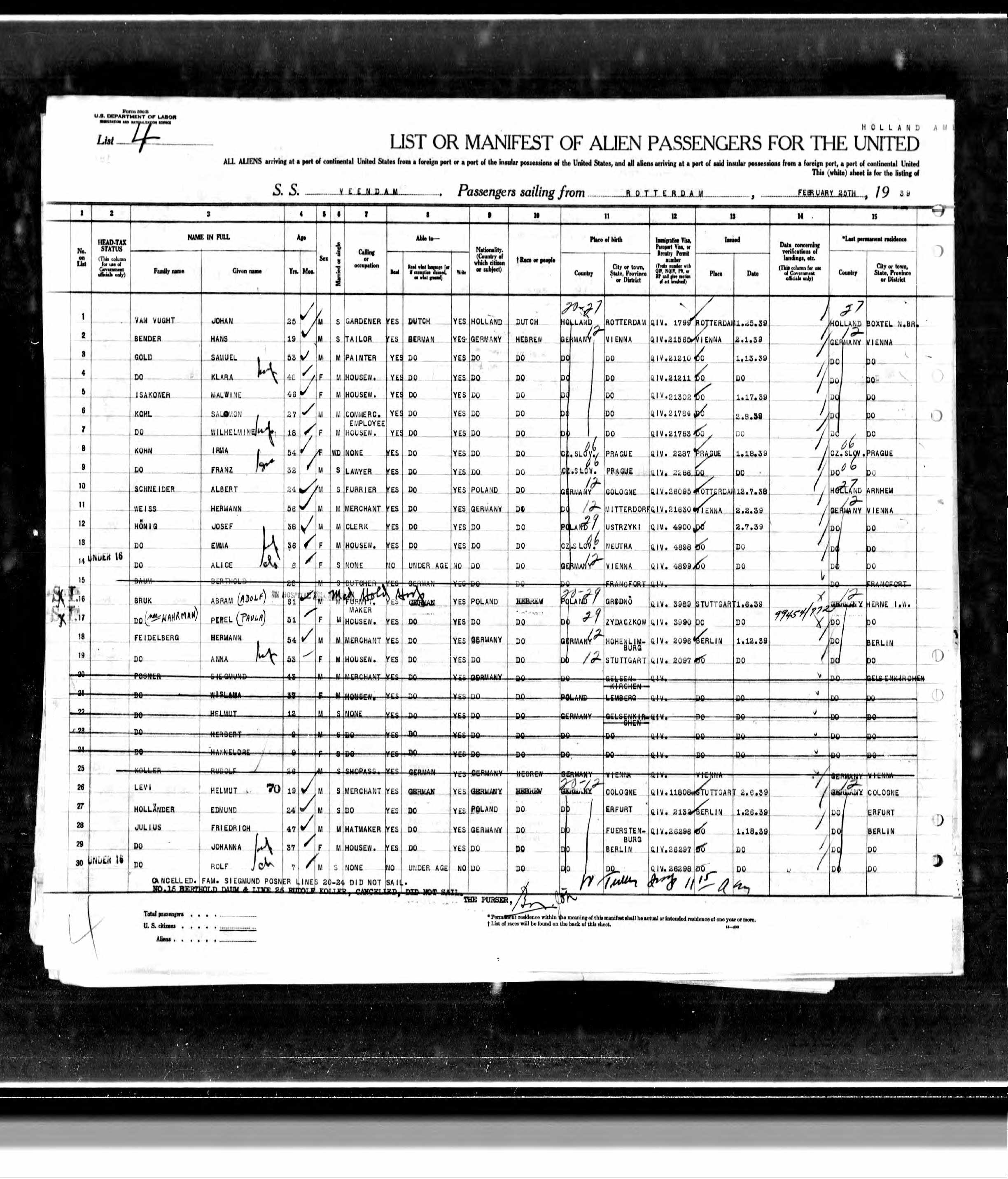
I also then found him on a passenger manifest (see line 26 on each page below):

Helmut Levy ship manifest p 1

Helmut Levi ship manifest Henry Lyons

Year: 1939; Arrival: New York, New York; Microfilm Serial: T715, 1897-1957; Microfilm Roll: Roll 6293; Line: 1; Page Number: 188


Helmut Levi had arrived in NYC on February 25, 1939.  According to the ship manifest, he was a nineteen year old merchant born and last residing in Cologne, leaving behind his father Julius Levi of Breitstrasse in Cologne and going to his uncle Lee Schoenthal of Washington, Pennsylvania.  This was obviously my cousin, the man later known as Henry Lyons.

I also found him on a second passenger manifest dated July 4, 1948, arriving in NYC from Bremerhaven, Germany.  Henry had returned to Germany after the war.  What a devastating trip that must have been.  The photo below shows what his home city of Cologne looked like after Allied bombing during the war.  Henry had not only lost his parents, but the place where he had lived as a child and a teenager.


By U.S. Department of Defense. Department of the Army. Office of the Chief Signal Officer. [2] [Public domain], via Wikimedia Commons

By U.S. Department of Defense. Department of the Army. Office of the Chief Signal Officer. [2] [Public domain], via Wikimedia Commons

From that 1948 passenger manifest (line 10), I saw that Helmut Levi was then living in Washington, Pennsylvania, where his two uncles, Lee and Meyer, were also living, that is, his mother’s brothers, the two sons of Jakob and Charlotte mentioned in my last post.  Like so many Schoenthal relatives before him, Helmut had spent time living in western Pennsylvania.  The ship manifest also indicated that by 1948, Helmut had married, although Pauline is not listed as traveling with him.


Helmut Levi aka Henry Lyons 1948 ship manifest

Helmut Levi 1948 ship manifest Year: 1948; Arrival: New York, New York; Microfilm Serial: T715, 1897-1957; Microfilm Roll: Roll 7624; Line: 10; Page Number: 9


But I still didn’t know whether Helmut/Henry and Pauline had had children or whether there were other family members I might have missed.  I called Calverton National Cemetery, but they had no additional information.  I searched in the newspaper databases for articles or obituaries that might reveal more about Henry and Pauline Lyons.  At first I limited myself to New York papers, but then I realized that that was too narrow, given that he had once lived in western Pennsylvania.  I broadened my search and found this obituary from the January 19, 1989, Pittsburgh Press:


Erna Schoenthal Haas obit 1989


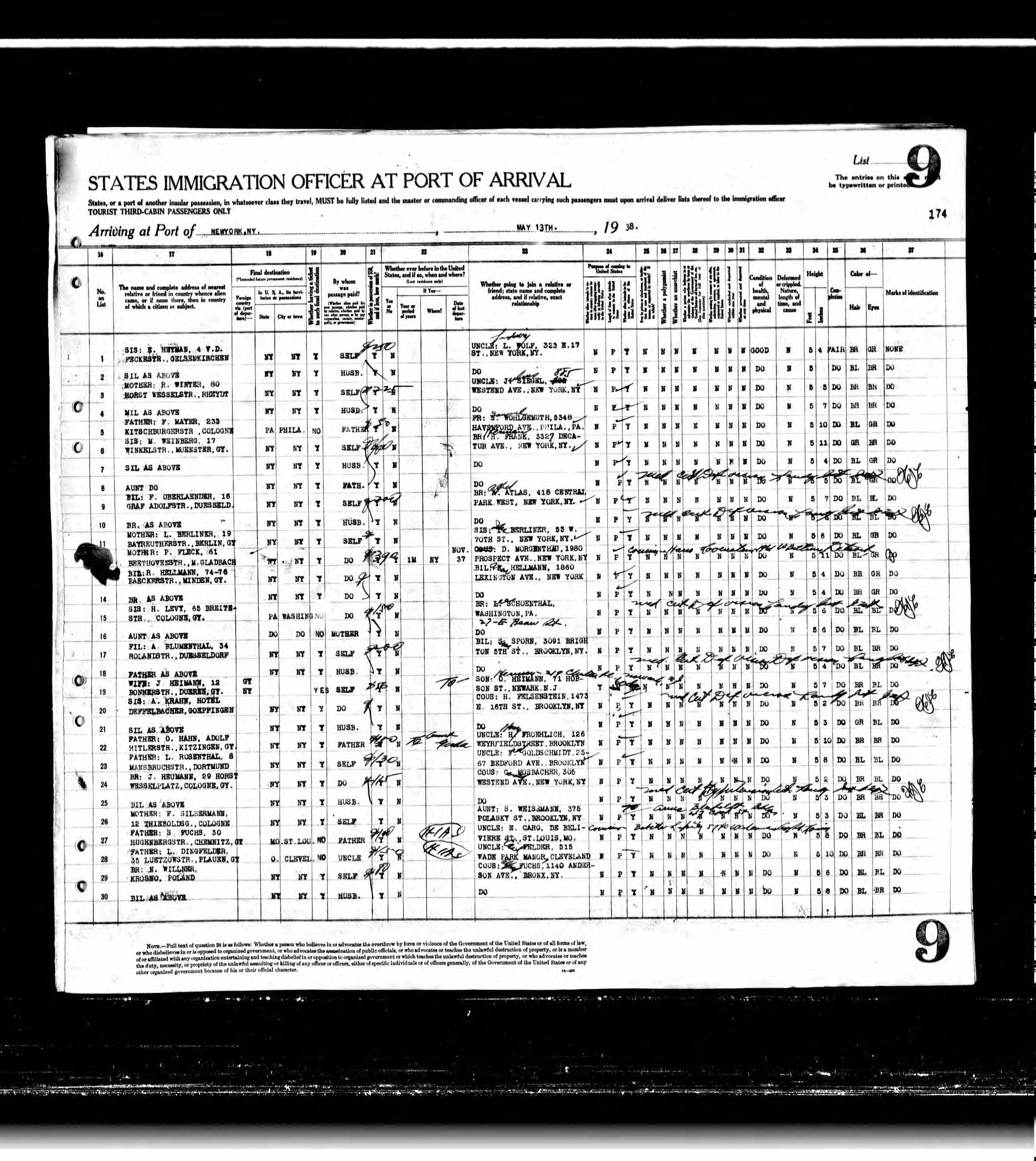
Who was Erna Haas? And was she Henry’s aunt or Pauline’s aunt? And who was Yohana Stern? I had more work to do.  I searched for Erna Haas, an unusual enough name, and was very excited to find this ship manifest (see lines 15 and 16):


Erna Haas ship manifest p 1

Year: 1938; Arrival: New York, New York; Microfilm Serial: T715, 1897-1957; Microfilm Roll: Roll 6152; Line: 1; Page Number: 174


Erna and her twelve year old son Werner had sailed from Hamburg, Germany on May 4, 1938; Erna was a beautician coming from Cologne.  I assumed that therefore her connection would be to Henry, a native of Cologne, not to Pauline, who was American-born.  Turning to the second page of the manifest, my hunch was confirmed (again, see lines 15 and 16):


Erna Haas ship manifest p 2

Year: 1938; Arrival: New York, New York; Microfilm Serial: T715, 1897-1957; Microfilm Roll: Roll 6152; Line: 1; Page Number: 174


Who was the person she named as living in the place she had left? Her sister, H. Levy of Breitstrasse in Cologne—that is, Henriette Schoenthal Levi, who had lived on that street as seen in the Köln directories in my last post. And who was she going to be with in the US? Her brother, Lee Schoenthal in Washington, Pennsylvania.  Erna Haas was another child of Jakob Schoenthal and Charlotte Lilienfeld.  She was also my grandmother’s first cousin.  And the aunt of Henry Lyons.  She was born Erna Schoenthal. I had found a fourth child of Jakob and Charlotte Schoenthal.

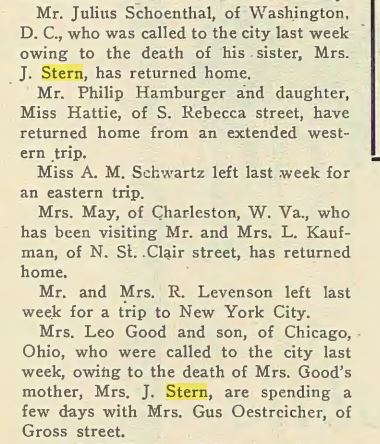
In 1940, Erna was listed on the census living with her son Werner in Pittsburgh, Erna working in cosmetics sales, Werner in newspaper sales.  Erna was a widow, so I assume that her husband Arnold had died in Germany, as I have no record of him in the US.  Unfortunately I have not yet found a record for him in Germany either.

But what about Yohana Stern, who had been listed in Erna’s obituary as her sister? I found this obituary for her husband Heinrich while searching for more information about Erna Haas:

Heinrich Stern obit


And then I located a ship manifest for Johanna Stern and Heinrich Stern (lines 3 and 4):


Ship manifest p 1 Johanna Schoenthal and Heinrich Stern


Ship manifest p 2 for Johanna Schoenthal and Heinrich Stern

Year: 1947; Arrival: New York, New York; Microfilm Serial: T715, 1897-1957; Microfilm Roll: Roll 7389; Line: 4; Page Number: 107


They had not arrived in the US until June 10, 1947, when they were 66 and 70 years old.  Notice that Johanna was born in Cologne, presumably around 1880.  How had she and Heinrich survived the Holocaust?  The manifest lists them as “stateless” and notes that they had last resided in “Lyon, France” and that their visas had been issued in “Marseille, France.”

The second page indicates that the person they were leaving behind at their last residence was a friend named Henry Kahnweiler of Paris (more on him in my next post) and the person they were going to see in the US was Johanna’s brother Lee Schoenthal of Washington, Pennsylvania.  Their final destination was Washington, Pennsylvania.  Yohana or Johanna Stern was born Johanna Schoenthal, a fifth child of Jakob and Charlotte Schoenthal. Another of my grandmother’s first cousins.


Thus, Jakob and Charlotte had had five children.  Their two sons Lee and Meyer had emigrated from Germany long before Hitler came to power; they had both settled near their aunt and uncle in Washington, Pennsylvania.    Jakob and Charlotte’s three daughters had stayed behind.  One, Henriette, was murdered by the Nazis with her husband Julius Levi at the Chelmno death camp in 1942, but their son Helmut Levi, aka Henry Lyons, left Germany in 1939 and survived.  Another daughter, Erna, left Germany with her son Werner in 1938.  And finally a third daughter, Johanna, somehow survived the war by going to France, and she and her husband Heinrich Stern came to the US in 1947.

It was a long and twisty road finding these five children, and it was heartbreaking to read of more cousins killed in the Holocaust.  But four of those five children survived and came to the US as did two of Jakob and Charlotte’s grandsons, Henry Lyons and Werner Haas.  More on the lives of these four children and their descendants in my next post.

The Brother Who Stayed Behind: Adventures in Genealogy Research

Born just one year after Simon, the next sibling was Jakob Schoenthal. (I am using the German spelling for two reasons.  First, Jakob stayed in Germany and thus that is how he spelled his name.  Second, it helps to distinguish him from his nephew, Simon’s son Jacob.) Finding Jakob’s story was quite a lesson in genealogy research.  It took some lucky breaks and the help of others, and in the end it led to a story of both tragedy and triumph.


Centro de la ciudad de Koln, Alemania Deutsch:...

Köln Germany, where Jakob Schoenthal lived as an adult (Photo credit: Wikipedia)


First, some background. I’ve already written about eight of the ten children of Levi Schoenthal and Henriette Hamberg, my great-great-grandparents.  They were the eight children who came to America between 1866 and 1881 and settled here permanently, including my great-grandfather Isidore Schoenthal.  All of them lived relatively long and seemingly satisfying lives.  They started in western Pennsylvania, but eventually they and/or their children moved far afield across the United States—to California, Illinois, New Jersey, New York, Massachusetts, and elsewhere.  They thrived in America, and they have many descendants still living in this country.

But there were two siblings who did not end up in America.  One, the youngest child, Rosalie, had in fact immigrated to the US in 1881 with her mother Henriette and her brother Isidore, my great-grandfather.  But Rosalie returned to Germany to marry Willy Heymann in 1884, and that decision was in the end one with devastating consequences for her family.  I will write more about Rosalie in a subsequent post.

The only sibling who never left Germany was the sixth child of Levi and Henriette, Jakob, who was born in Sielen in 1850.  I will always wonder why Jakob stayed when almost all of his siblings had emigrated from Germany by 1874.  Jakob was 24 by then, only a year younger than Simon, who had left in 1867. Why did he stay? I don’t know, but my theory is that Jakob stayed to take care of his mother and youngest siblings. By 1874 when his father Levi died, Jakob was the oldest son still in Germany, and there were still some younger siblings at home, including my great-grandfather.  So perhaps Jakob stayed out of a sense of family obligation. As with his sister Rosalie, that decision to stay had tragic consequences.

On September 1, 1879, Jakob married Charlotte Lilienfeld, the younger half-sister of Helen Lilienfeld, who had married Jakob’s brother Henry in 1872 and moved with him to Washington, Pennsylvania.  Charlotte and Helen were both the daughters of Meyer Lilienfeld of Gudensberg, where Henry Schoenthal had once been a teacher before immigrating to the US.

Marriage record of Jakob Schoenthal and Charlotte Lilienfeld Hessisches Hauptstaatsarchiv, Wiesbaden: Trauregister der Juden von Gudensberg 1825-1900 (HHStAW Abt. 365 Nr. 386) 1825-1900

Marriage record of Jakob Schoenthal and Charlotte Lilienfeld
Hessisches Hauptstaatsarchiv, Wiesbaden: Trauregister der Juden von Gudensberg 1825-1900 (HHStAW Abt. 365 Nr. 386, p.42) 1825-1900


For a long time I could not find much more information about Jakob.  I knew from the 1893 Beers biography of Henry Schoenthal that Jakob had then been living in Cologne, Germany in 1893, but I didn’t know if he and Charlotte had had children or if they had ever left Germany or when they had died.

Then while I was researching Henry Schoenthal and his family, I kept coming across two men living in Washingon, Pennsylvania, with the same names as two of Henry’s sons: Meyer and Lee Schoenthal.  At first I thought they were Henry’s sons, but soon it became clear that there were in fact two Meyers and two Lees.  When I found the death certificates for the Meyer and the Lee who were not the sons of Henry Schoenthal, I saw that their parents were Jakob Schoenthal and Charlotte Lilienfeld.


Lee Schoenthal death certificate Ancestry.com. Pennsylvania, Death Certificates, 1906-1963 [database on-line]. Provo, UT, USA: Ancestry.com Operations, Inc., 2014. Original data: Pennsylvania (State). Death certificates, 1906–1963. Series 11.90 (1,905 cartons). Records of the Pennsylvania Department of Health, Record Group 11. Pennsylvania Historical and Museum Commission, Harrisburg, Pennsylvania.

Lee Schoenthal death certificate
Ancestry.com. Pennsylvania, Death Certificates, 1906-1963 [database on-line]. Provo, UT, USA: Ancestry.com Operations, Inc., 2014.
Original data: Pennsylvania (State). Death certificates, 1906–1963. Series 11.90 (1,905 cartons). Records of the Pennsylvania Department of Health, Record Group 11. Pennsylvania Historical and Museum Commission, Harrisburg, Pennsylvania.

I knew then that Jakob and Charlotte had had at least two sons, both of whom had lived in Washington, Pennsylvania, where their Schoenthal uncles Henry and Isidore as well as their aunt Helen Lilienfeld Schoenthal were living.  And, of course, the identical names made sense.  Both Meyers were named for their maternal grandfather, Meyer Lilienfeld, and both Lees were named for their paternal grandfather, Levi Schoenthal.

And then I was stuck.   What else could I learn about Jakob and Charlotte? I asked in the German Genealogy group on Facebook whether there were records available online for Cologne, or Köln, as it is spelled in German, and I learned that there were in fact archives online with birth, marriage, and death records.  Unfortunately, the archives are divided into geographic areas in and around Köln, and I had no idea where in the city Jakob had lived.  In addition, I had no idea what years to search for births or deaths for his family, and the number of records was too overwhelming to search without some parameters.

But then another member of the Genealogy Group suggested I look in city directories to see if I could narrow down where in Köln Jakob and his family had lived.  I learned that there were city directories online that dated as early as 1797 all the way through to the 1960s.  I started searching year by year, and I eventually found many listings for him, starting with one in 1901 and going as late as 1935, and then he disappeared.  Here are a few examples:


Greven's address book for Cologne subtitle:and environment especially Mühlheim am Rhein and lime Author / Edit .: Ant. Carl Greven Publishing company: Greven's Cologne Address Book Publisher Ant. Carl Greven Vintage: 51 Year: 1905

Greven’s address book for Cologne
Author / Edit .: Ant. Carl Greven
Publishing company: Greven’s Cologne Address Book Publisher Ant. Carl Greven
Vintage: 51
Year: 1905


Grevens Adreßbuch 1915 Cologne and environs

Grevens Adreßbuch 1915 Cologne and environs


Greven's address book for Cologne subtitle:and neighborhood and business directory the circles Cologne-Mülheim country and a. Rh. Publishing company: Greven's Cologne Address Book Publisher Ant. Carl Greven Vintage: 67 Year: 1925

Greven’s address book for Cologne
Publishing company: Greven’s Cologne Address Book Publisher Ant. Carl Greven
Vintage: 67
Year: 1925


So I thought Jakob must have died or moved or emigrated around 1935, but not knowing German had once again proven to be a problem.  I posted the 1935 listing on the German Genealogy Facebook page, and my friend Matthias translated it and pointed out that the listing was not for Jakob, but rather for his widow.  He explained that the abbreviation Ww meant “widow,” and when I went back to look at the earlier directories, I saw that the Ww was included in almost all of the listings I had thought were for Jakob Schoenthal.


Greven's address book of Cologne subtitle:and its environs, as well as the address book of the circles Cologne-country Bensberg, Bergisch Gladbach u. Porz, Volume (→ Second volume ) Publishing company: Greven's Cologne Address Book Publisher Ant. Carl Greven Year: 1935

Greven’s address book of Cologne
Gladbach u. Porz, Volume (→ Second volume )
Publishing company: Greven’s Cologne Address Book Publisher Ant. Carl Greven
Year: 1935


I worked all the way back to 1905, seeing that Ww.  There were no directories on the website for 1902-1904, but in 1901, there was no Ww, so I assumed that meant that Jakob was still alive in 1900.  Thus, it seemed likely that Jakob had died sometime between 1901 and 1905.


Greven's address book for the borough Cologne subtitle:and for the environment especially: Mühlheim am Rhein and lime Author / Edit .: Ant. Carl Greven Publishing company: Greven's Cologne Address Book Publisher Ant. Carl Greven Vintage: 47 Year: 1901

Greven’s address book for the borough Cologne
Author / Edit .: Ant. Carl Greven
Publishing company: Greven’s Cologne Address Book Publisher Ant. Carl Greven
Vintage: 47
Year: 1901


From the address on Breite Strasse in the directories, my friends in the Germany Genealogy group thought that Jakob had lived in the central part of Köln.  Having narrowed down the years and the section of the city where he lived, I now combed through the relevant records until I found a death record for Jakob.  He had died on November 19, 1903.  He was only 53 years old when he died.  He was the first of his siblings to die.


Jakob Schoenthal death certificate Das Digitale Historiche Archiv Koln, Civil registry, civil registry Cologne I, deaths, 1903 1903 Vol 03 p.320

Jakob Schoenthal death certificate
Das Digitale Historiche Archiv Koln, Civil registry, civil registry Cologne I, deaths, 1903 1903 Vol 03 p.320


Since 1935 was the last year Jakob’s widow Charlotte was listed, I assumed that she must have died around 1935.  I wrote to the synagogue in Köln to see if they had information about Jakob and Charlotte, and the secretary there informed me that Jakob and Charlotte were both buried in their cemetery and that Charlotte had died on June 17, 1935.  She also confirmed Jakob’s date of death.  So I now knew when both Jakob and Charlotte had died and where they were buried.

But the 1935 Köln directory listing, along with a number of others, also revealed something else.  Notice that right above Jakob’s widow’s listing it says, “Schonthal & Co, Jul. Levi and Frau Jul. Levi,” and some additional text following, including the same address as that listed for Jakob’s widow.

Greven's address book of Cologne subtitle:and its environs, as well as the address book of the circles Cologne-country Bensberg, Bergisch Gladbach u. Porz, Volume (→ Second volume ) Publishing company: Greven's Cologne Address Book Publisher Ant. Carl Greven Year: 1935

Greven’s address book of Cologne
subtitle: and its environs, as well as the address book of the circles Cologne-country Bensberg, Bergisch Gladbach u. Porz, Volume (→ Second volume )
Publishing company: Greven’s Cologne Address Book Publisher Ant. Carl Greven
Year: 1935

My friends in the German Genealogy group explained that the first listing was for a Julius Levi and his wife, Henny nee Schoenthal.  Obviously Henny was Jakob and Charlotte’s daughter, living at the same address as her parents with her husband Julius Levi.

Julius Levi and Henny nee Schoenthal were listed again in 1936 (without a listing for Charlotte), but after that they disappeared.  By then, of course, Jewish-owned businesses were being restricted or closed by the Nazis.  What had happened to Julius and Henny? Had they left Germany, I hoped? Or had they been killed in the Holocaust?

Greven's address book of the Hanseatic City of Cologne subtitle:the circles Cologne-country, the county town of Bergisch Gladbach and Bensberg communities and Porz, Volume (→ Second volume ) Publishing company: Greven's Cologne Address Book Publisher Ant. Carl Greven Vintage: 78 Year: 1936

Greven’s address book of the Hanseatic City of Cologne
Publishing company: Greven’s Cologne Address Book Publisher Ant. Carl Greven
Vintage: 78
Year: 1936

Unfortunately, a search on Yad Vashem revealed that they were both victims of the Nazi atrocities.

Yad Vashem page of testimony for Henriette Schoenthal Levi Yad Vashem page of testimony for Julius Levi

I learned more details from a researcher in Köln named Barbara Becker, who informed me that Julius and Henriette Levi had been first moved to the ghetto in Köln in 1940 and then were deported to Lodz, Poland, on October 30, 1941.  From there they were sent to the death camp in Chelmno on September 10, 1942, where they were murdered by the Nazis.

Lodz Ghetto Bundesarchiv, Bild 137-051639A / CC-BY-SA 3.0 [CC BY-SA 3.0 de (http://creativecommons.org/licenses/by-sa/3.0/de/deed.en)], via Wikimedia Commons

Lodz Ghetto
Bundesarchiv, Bild 137-051639A / CC-BY-SA 3.0 [CC BY-SA 3.0 de (http://creativecommons.org/licenses/by-sa/3.0/de/deed.en)%5D, via Wikimedia Commons

Chelmno death camp 1942 By SS Unknown [Public domain], via Wikimedia Commons

Chelmno death camp 1942
By SS Unknown [Public domain], via Wikimedia Commons


Two more names to add to the growing list of my relatives who were killed during the Holocaust:  Henriette Schoenthal and her husband Julius Levi.  Henriette was probably named for her grandmother, Jakob’s mother Henriette Hamberg, my great-great-grandmother.   Henriette Schoenthal Levi was my first cousin, twice removed.  She was my grandmother Eva Schoenthal Cohen’s first cousin.

When I looked at the Pages of Testimony filed on behalf of Henriette (Schoenthal) and Julius Levi more closely, I saw that they were filed in 1977 by their son, Henry Lyons.  There was even an address for Henry: 99-30 59th Avenue, Rego Park, New York.  My next step had to be locating Henry Lyons, my father’s second cousin.

To be continued….


Honoring Women: Rose Mansbach Schoenthal

Tomorrow is International Women’s Day, and the month of March is Women’s History Month, according to Congress, and my genealogy blogger Janice Webster Brown of Cow Hampshire blog has encouraged her fellow genealogy bloggers to tell the story of at least one woman this month in honor of that occasion.  Although the theme this year for the national Women’s History Month is women who were active in government or public service, I’ve decided to highlight a woman whose life was more typical of her times, a woman who did not necessarily do anything historic or that would be remembered by anyone other than the members of her own family, but a woman who nevertheless is worth remembering and honoring more broadly.  This post is for all those women who lived lives that did not make headlines but who made their mark in quiet, unheralded ways that made a difference for their families and thus for all of us who followed.

It may not surprise those of you who have been reading my recent posts to know that I have chosen Rose Mansbach Schoenthal, the wife of Simon Schoenthal, my great-great-uncle.  Like most of the women I’ve researched, Rose did not leave behind much in terms of actual records or documents.  She did not have a career outside her home; she did not serve in the military.  There are no news articles reporting on her life.  All I really know about her is when she was born, who she married, where she lived, who her children were, and when she died.  The rest is all conjecture on my part and interpretation and extrapolation from those facts.

Rose Mansbach Schoenthal

Rose Mansbach Schoenthal


Rose was reportedly born in  Gudensberg, Germany, on March 12, 1850, according to her family.  I have not yet been able to find a birth record for her in that town, however, nor do I have any information about her parents.  I did, however, find a passenger manifest for a sixteen-year old girl named Rose Mansbach who immigrated to Pennsylvania from Germany and who listed her occupation as a servant.  That ship, the D.H. Wagen, arrived in New York on September 23, 1867.


Rose Mansbach on the DH Wagen, line 446 Ancestry.com. New York, Passenger Lists, 1820-1957 [database on-line]. Provo, UT, USA: Ancestry.com Operations, Inc., 2010. Original data: Passenger Lists of Vessels Arriving at New York, New York, 1820-1897. Microfilm Publication M237, 675 rolls. NAI: 6256867. Records of the U.S. Customs Service, Record Group 36. National Archives at Washington, D.C. Passenger and Crew Lists of Vessels Arriving at New York, New York, 1897-1957. Microfilm Publication T715, 8892 rolls. NAI: 300346. Records of the Immigration and Naturalization Service; National Archives at Washington, D.C.

Rose Mansbach on the DH Wagen, line 446
Ancestry.com. New York, Passenger Lists, 1820-1957 [database on-line]. Provo, UT, USA: Ancestry.com Operations, Inc., 2010.
Original data: Passenger Lists of Vessels Arriving at New York, New York, 1820-1897. Microfilm Publication M237, 675 rolls. NAI: 6256867. Records of the U.S. Customs Service, Record Group 36. National Archives at Washington, D.C. Passenger and Crew Lists of Vessels Arriving at New York, New York, 1897-1957. Microfilm Publication T715, 8892 rolls. NAI: 300346. Records of the Immigration and Naturalization Service; National Archives at Washington, D.C.

Guess who was also on that ship? Rose’s future husband, Simon Schoenthal, then just seventeen.  Did they know each other before they boarded, or did they meet on the ship?  I don’t know.


Simon Schoenthal and Amalie Schoenthal 1867 ship manifest, lines 230 and 231 Year: 1867; Arrival: New York, New York; Microfilm Serial: M237, 1820-1897; Microfilm Roll: Roll 286; Line: 1; List Number: 1004

Simon Schoenthal and Amalie Schoenthal 1867 ship manifest, lines 230 and 231
Year: 1867; Arrival: New York, New York; Microfilm Serial: M237, 1820-1897; Microfilm Roll: Roll 286; Line: 1; List Number: 1004


Unfortunately, I can’t find Rose Mansbach on the 1870 census nor can I find a record of her marriage to Simon, but the 1900 census reported that they had married in 1872.  That seems correct since their first children, the twins Harry and Ida, were born in 1873.

From there Rose went on to have eight more children—eight more pregnancies, eight more labors and deliveries.  Her last child, Sidney, was born in 1891, eighteen years after her first.  In between Rose had lost her first daughter, the twin Ida, in 1887 when Ida was just thirteen.  The family had moved from Pittsburgh to Philadelphia, and then not long after Sidney was born, they moved again to Atlantic City.

In 1904, Rose lost her husband Simon.  She was only 54 years old, and her children ranged in age at that point from Harry, who was 31, down to Sidney, who was 13.  Somehow she and her children pulled together and survived the death of Simon.


The nine surviving children of Simon and Rose (Mansbach) Schoenthal Photo courtesy of the family of Hettie Schoenthal Stein

The nine surviving children of Simon and Rose (Mansbach) Schoenthal
Photo courtesy of the family of Hettie Schoenthal Stein


Soon after Simon’s death, her children began to disperse.  In fact, Rose’s daughter Gertrude had already moved to Tucson, Arizona with her husband Jacob Miller before Simon died. Harry had moved not too far away in Philadelphia. A few years later, Martin and Maurice moved to Chicago, and Louis and then Sidney moved to California.  Hettie also left for Arizona, leaving only two of the surviving children, Jacob and Estelle, back in Atlantic City with Rose.  Rose had raised children who were as independent and courageous as she must have been when she boarded that ship when she was just sixteen.

And then Rose herself, already in her 60s, left for Tucson in the mid-1910s along with her daughter Estelle.  I can only imagine what Rose must have felt and experienced in the frontier country of Arizona with the coyotes and rattlesnakes that her daughter Hettie described in her memoirs.  When I look at this photograph of Rose looking so citified and civilized, it is hard to imagine her in the wild west of those times.

Rose Schoenthal -1916

By 1920 Rose and Estelle had returned to Atlantic City, and her other two daughters soon followed them back to the East Coast.  Harry, Martin, and Jacob also ended up living in Atlantic City.  Thus, for the last decade of her life, Rose had all but three of her nine children as well as most of her grandchildren living relatively close by.  Rose must have instilled in her children not only a love for their mother but for each other and for family generally.

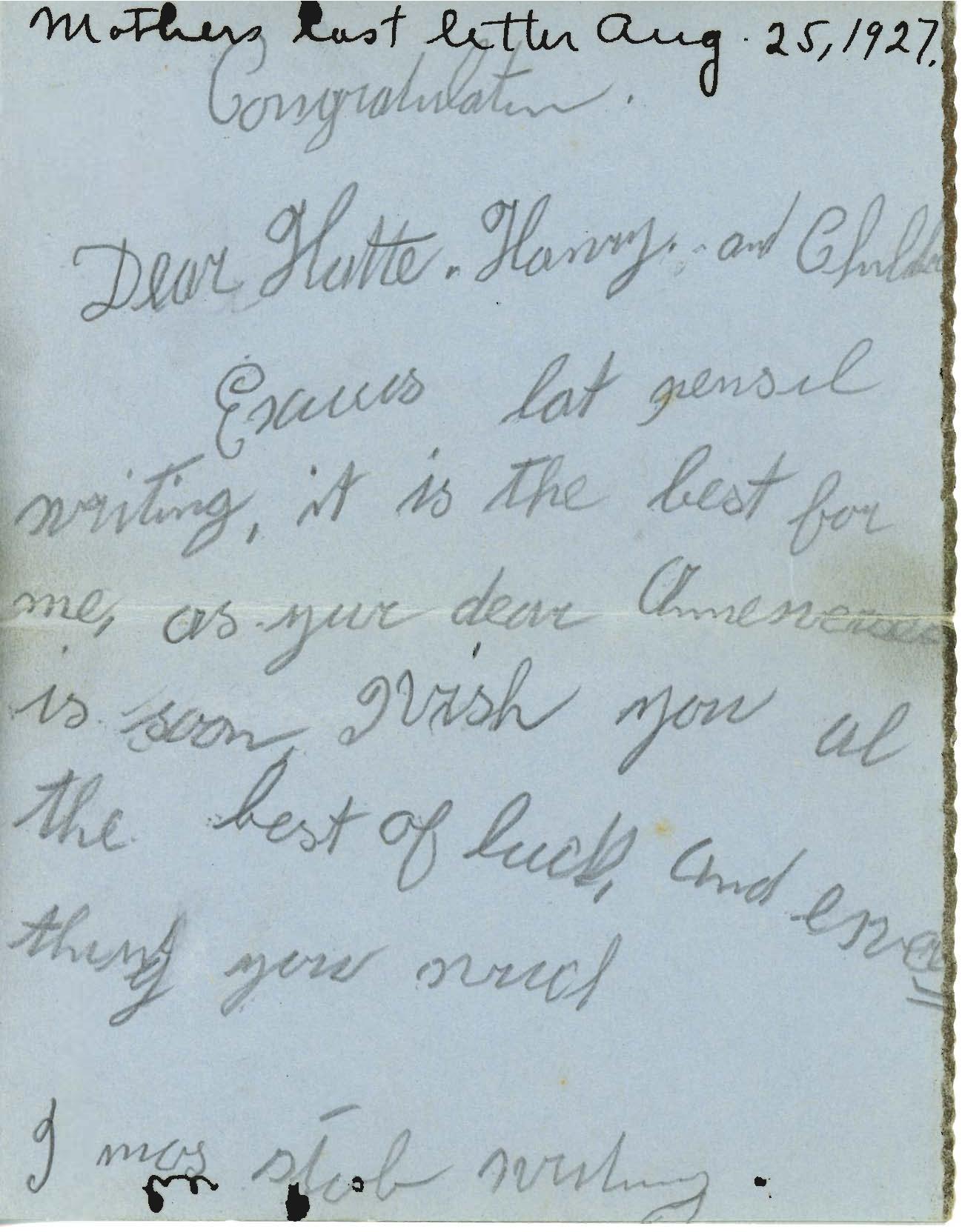
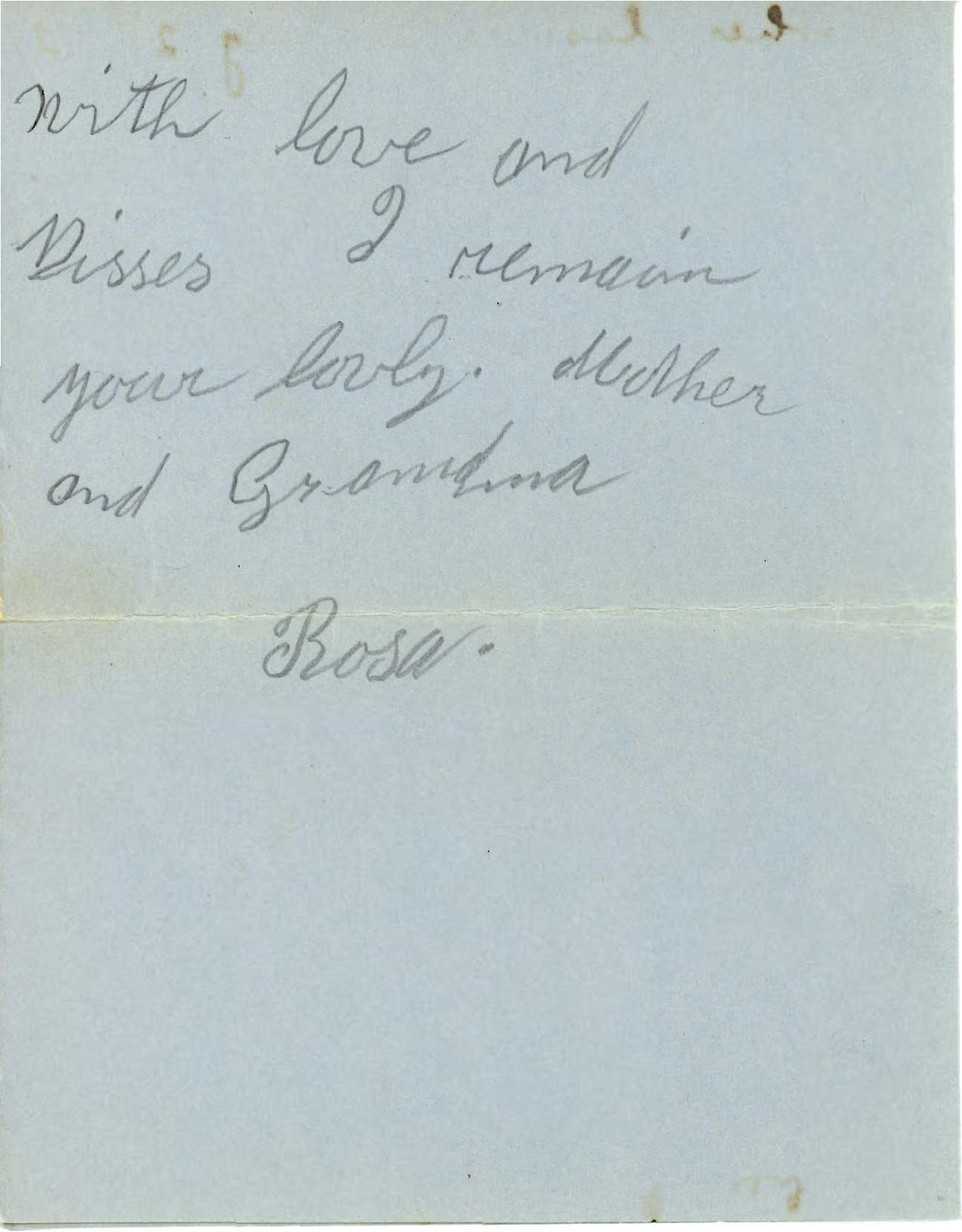
Up until last week, all of this was pure speculation on my part.  Rose had no actual voice—just government records and a few photographs told me what I knew about her.  But then Sharon Lippincott, her great-granddaughter-in-law, found a letter written by Rose to her daughter Hettie on August 25, 1927, on the occasion of Hettie’s eighteenth wedding anniversary.  In just a few short lines, I learned more about Rose than I had from any of those records and census reports I’d found:


Rose Schoenthal s last letter August 24 1927-page-001

Rose Schoenthal s last letter August 24 1927-page-002

Congratulation

Dear Hatte, Hanry and Children
Excuses lat [light?] pensil
writing, it is the best for
me, as yur dear Anneverses [Anniversary]
is soon. I Vish you al
the best of luck, and every
thing you want

I mus stob writing

with love and
kisses  I remain
your lovly. Mother
and Gramdma

Every time I read this letter, my eyes well up with tears.  When she wrote this letter, Rose was 77 years old and had been in the US for most of her life, almost sixty years.  English, however, was still difficult for her.  Yet despite the obstacles she faced writing in English, in these few words she expressed herself so clearly.  “With love and kisses”—not the stereotype I have of German Jewish grandmothers nor the words I would expect from Rose, having seen photographs of her where she appears rather stern.  With these few simple words she expressed so much love and affection for her daughter and son-in-law and grandchildren.


Rose Mansbach Schoenthal courtesy of the family of Hettie Schoenthal Stein

Rose Mansbach Schoenthal
courtesy of the family of Hettie Schoenthal Stein


Rose Mansbach Schoenthal died on May 16, 1929.  She was 79 years old.  Had she done anything notable in her life, anything that would make the history books or even a newspaper? Not really.  But think of what she had done.  She had ventured across the ocean at age 16 by herself.  She had raised ten children, nine to adulthood, all of whom seemed to have stayed close to her and to each other.  She had moved from Germany to Pittsburgh to Philadelphia to Atlantic City to Arizona and back to Atlantic City.  She had persevered even after her husband died, leaving her with three children who were still teenagers.  Rose had created a family, a family she raised and a family she loved.

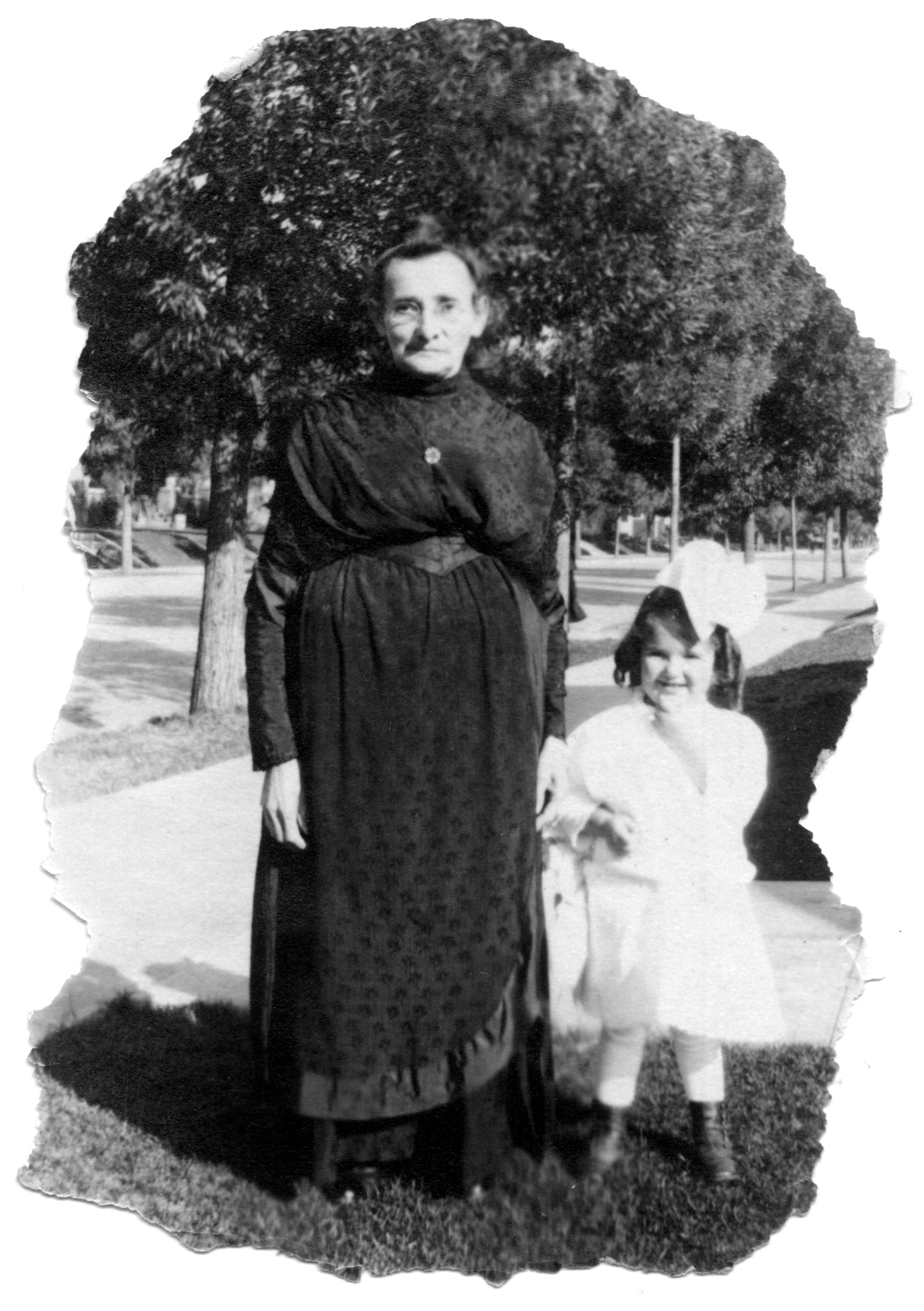
Rose Schoenthal and her granddaughter Blanche Stein, 1916

Rose Schoenthal and her granddaughter Blanche Stein, 1916

When I think about all that she did do in the quiet, unreported way that most women of those times lived their lives, I know that she deserves to be honored during Women’s History Month even if she never worked outside the home, ran for office, wrote a song or a poem, or carried a weapon in war.

Part II: The Benefits of Teamwork

So who was Frederick Selinger, and how did he fit into the family? And who was Fanny Selinger’s mother?

In Part I, I described the research I had done first with Val Collinson in 2014 and then separately with Shirley Allen during the summer and fall of 2015 to try and find the connections between all our various Selinger relatives. Through that research we had established with a fair degree of certainty that Julius and Alfred Selinger, who married two of my Cohen cousins, sisters Augusta and Fanny, were themselves brothers, the sons of Seligmann Selinger and Breinle Hofstadter. We had also established that Helena Selinger Auerbach, who had been Val’s great-grandmother, was a first cousin to Julius and Alfred and the daughter of Abraham Selinger and Rosalia Wilhelmsdorfer.

Relationship_ Julius Selinger to Helena Selinger

We also had established that Fanny Selinger Rosenthal, Shirley’s grandmother, was also a daughter of Abraham Selinger, but Shirley and I had not found any document that revealed whether her grandmother Fanny was a full or half sister to Helena and the other children of Abraham Selinger; we had not found her mother’s name or where she was born.

And I still didn’t know how Frederick Selinger fit into the question.

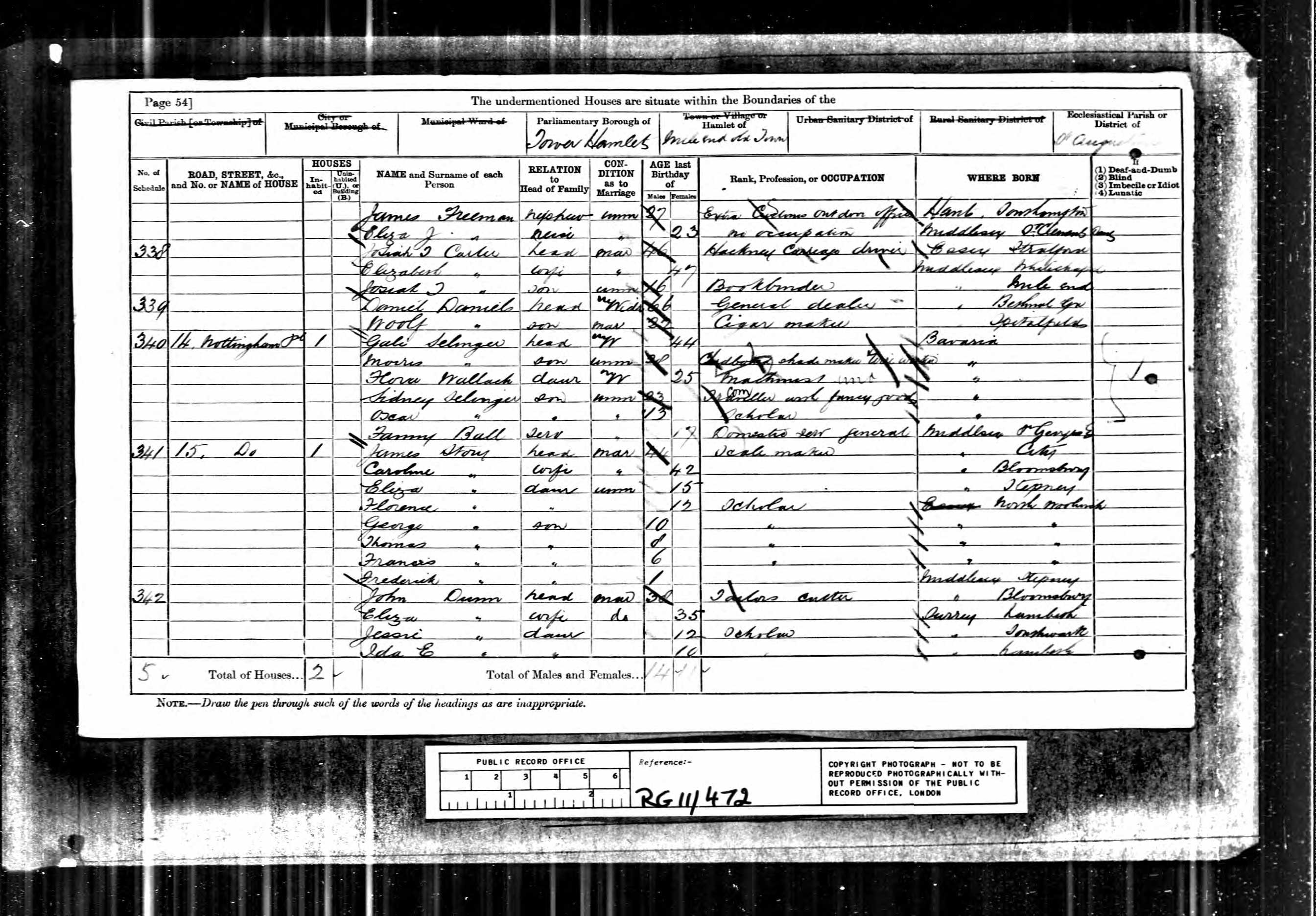
We also knew that Abraham Selinger had immigrated to England by 1871 because he appeared on the 1871 UK census with a second wife, Gali, along with several children: Sigfried, Helena, Cornelia, and Oscar.  By 1881, Abraham had died, and his widow Gali was living with some different children: Morris, Flora, and Sidney, plus Oscar.  Aside from Helena, who were all these children, and where were they born?  I had no birth records for Cornelia, Morris, Flora, Sidney, or Oscar.

So by late November, we had many answers, but many questions remained.

Fast forward again to January 13, when I again heard from Shirley.  She had received a copy of the marriage authorization for Fanny Selinger and Jacob Rosenthal from the Chief Rabbi in London.  It confirmed that Fanny was the daughter of Abraham and that she was born in Hurben, but did not reveal her mother’s name.  Although we did not have any new information, the new communication inspired us to try again to get answers to our primary questions: Who was Fanny Selinger’s mother?  And how did Frederick Selinger fit into the family, if at all?

Fanny Selinger Rosenthal and her husband Jacob Rosenthal and children Gladys, Daniel, and Alfred Courtesy of Shirley Allen

Fanny Selinger Rosenthal and her husband Jacob Rosenthal and children Gladys, Daniel, and Alfred
Courtesy of Shirley Allen

After reviewing everything we had, I decided to post on the German Genealogy group on Facebook for information about records in Ansbach , where Oskar Selinger had claimed to be born on his UK naturalization record.  Although I was unable to find Ansbach birth records for the appropriate years, my friend Matthias did find two websites with information about Abraham Selinger in Ansbach: one, a website listing past and present tobacco businesses in Germany; Abraham Selinger was listed as the manager of Equity and cigar-tobacco factory in Ansbach from 1862 until 1871. Thus, it made sense that Oscar Selinger was born in Ansbach.

The second website was even more revealing.  It was an Ansbach police report from 1870 reporting the arrest on May 31, 1870 of Abraham Selinger from Hurben, manager of a cigar factory,  for fraud.  Perhaps that is why 1871 was both the last date he had the cigar business in Ansbach as well as the first year he appeared on UK records.

But it also meant that the children I believed had been born to Abraham in the 1850s—Frederick, Fanny, Morris, Flora, and Sidney—were probably not born in Ansbach if Abraham’s business there didn’t start until 1862.  So where were they born?  Shirley continued to contact various offices in Germany, and I tried to think of new paths for research.

And then I had the best idea I’d had yet.  While doing all this work with Shirley in 2015, I had somehow forgotten about my correspondence with Val Collinson back in 2014.  Maybe Val had made some new discoveries or would have some new ideas.  I wrote to Val on January 22, 2016, and now we had three heads working on the mysterious Selingers.

Filament Productions

Filament Productions (Photo credit: Wikipedia)

The emails started flying back and forth among the three of us, and it became clear fairly quickly that Val and Shirley had some relatives in common, that is, relatives they both had met or at least had heard of.  I just sat back, enjoying the fact that I had brought these two cousins together.  They both were descendants of Abraham Selinger:  Shirley through his daughter Fanny, Val through his daughter Helena.  We weren’t yet sure whether Helena and Fanny were full or half-sisters, but in any event Shirley and Val, who’d never heard of each other before and who live about 60-100 miles apart in the UK, are third cousins.  I was thrilled that I’d brought these two wonderful family researchers and cousins together.

Shirley and Val both had lots of information about the marriages and descendants of some of the other Selinger siblings and also some wonderful photographs, but neither had any information about Frederick and neither was sure as to the identity of the mother or birthplaces of Fanny, Cornelia, Morris, Flora, or Sidney.

And then on January 29, 2016, the walls started tumbling down.  Val found this on Ancestry:

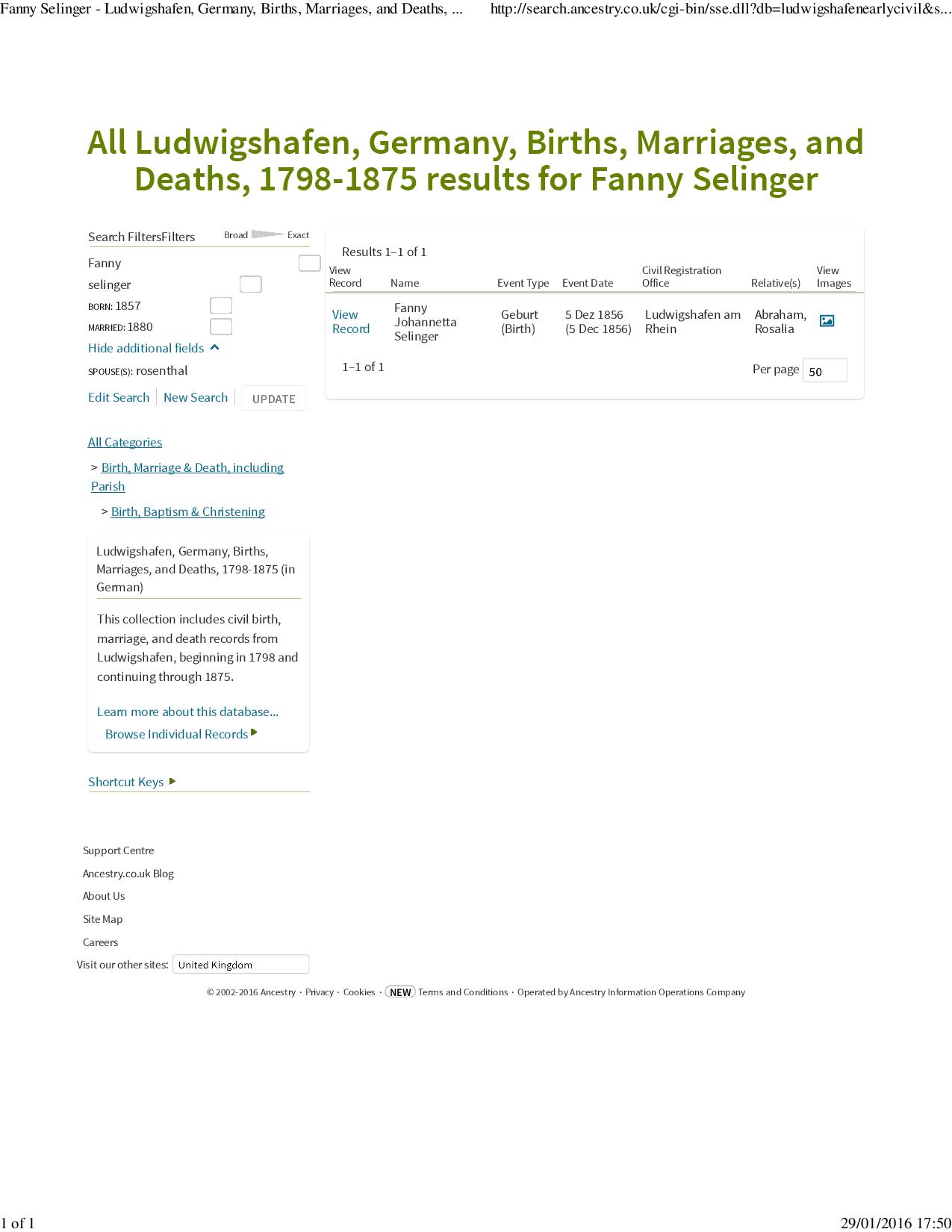
JPF Ludwigshafen page

Ludwigshafen?? Where was that? It’s a town very close to Mannheim.  Could be this OUR Fanny? Val asked me to follow up because I have the broadest Ancestry subscription (All Access), and I was able to pull up a scan of the actual record.  And not only did I find birth records for Fanny, I found them for three other children, all born to Abraham Selinger and Rosalia Wilhelmsdorfer, his first wife.

The four children born in Ludwigshafen were:  Babetta, born in 1853, died in 1854; Flora, born in 1855 (later Flora Wallach); Fanny, born December 5, 1856; and  Sigmund (later Sidney) born in 1858.  We finally had a birth record for Fanny, and we knew now that she was in fact a full sister to Helena as they were both the daughters of Abraham Selinger and Rosalia Wilhelmsdoerfer.  Val and Shirley were officially third cousins.


Fanny Selinger birth record from Ludwigshafen Ancestry.com. Ludwigshafen, Germany, Births, Marriages, and Deaths, 1798-1875 [database on-line]. Provo, UT, USA: Ancestry.com Operations, Inc., 2015. Original data: Ludwigshafen Zivilstandsregister, 1798-1875. Stadtarchiv Ludwigshafen, Ludwigshafen, Deutschland.

Fanny Selinger birth record from Ludwigshafen
Ancestry.com. Ludwigshafen, Germany, Births, Marriages, and Deaths, 1798-1875 [database on-line]. Provo, UT, USA: Ancestry.com Operations, Inc., 2015.
Original data: Ludwigshafen Zivilstandsregister, 1798-1875. Stadtarchiv Ludwigshafen, Ludwigshafen, Deutschland.

So that left three children whose birthplaces were still unknown: Morris, Cornelia, and, of course, Frederick.  Since Morris and Cornelia were both born before 1862 when the Selinger family arrived in Ansbach and after 1848 when the family had moved to Mannheim, I assumed that they were probably born in Mannheim.  The 1881 census recorded Cornelia’s age as 18, two years younger than Helena, whom they reported as twenty. But even English census records are unreliable.  Helena would have been turning 22 that year; maybe Cornelia was really 19 or 20 and thus born in 1850 or 1851.  The 1881 census said Morris was 28; he was probably born in 1852 since Babetta, the child who died in 1854, was born in 1853, in Ansbach.  Cornelia and Morris would also probably have been the children of Abraham and Rosalia since there were four children born to that couple even after Cornelia and Morris were born.

So I went back to the Mannheim records because my initial search had been only for the years between 1853 to 1859; now I searched the set of records before it, dating from 1842 to 1852.  And there they were, birth records for Cornelia (1850) and Morris (1852).  And Helena (1849).  All three were the children of Abraham Selinger and Rosalia Wilhelmdoerfer.

landesarchiv_baden-wuerttemberg_generallandesarchiv_karlsruhe_390_nr-_2862_bild_147_4-1229196-147 Birth record for Helena Selinger from Hurben

landesarchiv_baden-wuerttemberg_generallandesarchiv_karlsruhe_390_nr-_2862_bild_147_4-1229196-147
Birth record for Helena Selinger from Mannheim (center, left page)


So there are two birth records for Helena, one in Hurben, one in Mannheim.  Go figure.

Meanwhile, Val found yet another document:

Abraham Selinger - Ansbach, Germany JPG

(I cannot understand why neither the Ludwigshafen nor the Ansbach registers showed up for me when I searched.  Val has a magic touch with the search engine logic that I don’t have.)

I then retrieved the image of the actual document:

Abraham Selinger Lutheran register Ansbach


Abraham Selinger family in Ansbach Ancestry.com. Ansbach, Germany, Lutheran Parish Register Extracts, 1550-1920 [database on-line]. Provo, UT, USA: Ancestry.com Operations, Inc., 2015. Original data: Ansbach Lutheran Parish Register Extracts. Digital images Tobias Brenner Collection.

Abraham Selinger family in Ansbach
Ancestry.com. Ansbach, Germany, Lutheran Parish Register Extracts, 1550-1920 [database on-line]. Provo, UT, USA: Ancestry.com Operations, Inc., 2015.
Original data: Ansbach Lutheran Parish Register Extracts. Digital images Tobias Brenner Collection.

This document revealed two more things: that Gali’s birth name was Kohn and that she and Abraham had had another child before Oskar, Isidor, who died when he was an infant. So now I had a record confirming that Oscar was born in Ansbach and that his mother was Gali Kohn, not Rosalia Wilhelmsdoerfer.

Shirley, Val, and I had pretty much closed the circle on the children of Abraham Selinger.  But despite all our efforts, we still had not found one record for Frederick Selinger.  If he was born in 1856 as his passport application and his death certificate indicated, he should have been included with those children born in Ansbach.  He would have been born around the time of Flora or Fanny, maybe even a twin of one of them.  But he wasn’t there. And he wasn’t in the Mannheim records or the Hurben records.

So something did not make sense.  Frederick was not the child of Abraham Selinger with either of his wives.  I was convinced of it now.  So who was he? What was I missing?


P question

P question (Photo credit: Wikipedia)


This is the part of the story where I just want to kick myself.  I went back once again to the Hurben birth records and looked more closely at the children born to Seligman Selinger.  There were nineteen of them.  NINETEEN.  Nine were born to Seligman and his first wife between 1835 and 1844.  They all were born too early to be Frederick.  Ten children were born to Seligman Selinger and his second wife, Breinle Hofstadter, between 1849 and 1866.  There were five girls and five boys from that second marriage.  The five boys were Heinrich (1852), Julius (1853), Sigfried (1855), Hugo (1860), and Alfred (1866).  Julius and Alfred were the two who had married my Cohen cousins Augusta and Fanny.  That left Heinrich, Sigfried, and Hugo. Could any of them be Frederick?

Sigfried.  Hmm, I thought.  That could have become Frederick, maybe?? But he was born December 29, 1855, and Frederick was born in December 1856, according to his US death certificate and his US passport application.  So what, I thought? People lie! He made himself a year younger. The more I thought about it, the more I thought that Sigfried was Frederick.  The disparity in the dates in December for his birthday (the death certificate said December 27, the passport application December 21) didn’t bother me either.  Jews in Europe might not have known their birthday on a Gregorian calendar, only a Jewish calendar.  Frederick might have just known that his birthday was close to Hanukkah and nothing more precise than that.

I went back to Ancestry to look at the records I had for Frederick.  The earliest two—his 1880 marriage record and the 1880 census—list him as Fred, not Frederick.  Fred could be a shortened version of Sigfried, couldn’t it?  So I decided to search for Sigfried Selinger.

Marriage record for Frederick Selinger and Rachel Cohen 1880

Marriage record for Frederick Selinger and Rachel Cohen 1880

And I found this ship manifest from 1872:

Siegfried Selinger ship manifest 1872 to Baltimore The National Archives at Washington, D.C.; Washington, D.C.; Records of the US Customs Service, RG36; NAI Number: 2655153; Record Group Title: Records of the Immigration and Naturalization Service, 1787-2004; Record Group Number: 85

Siegfried Selinger ship manifest 1872 to Baltimore
The National Archives at Washington, D.C.; Washington, D.C.; Records of the US Customs Service, RG36; NAI Number: 2655153; Record Group Title: Records of the Immigration and Naturalization Service, 1787-2004; Record Group Number: 85

Siegfried Selinger, sixteen years old, arrived in Baltimore in June 1872, when Sigfried Selinger of Hurben would in fact have been still sixteen years old.  I thought that this could very well be the man who became Frederick Selinger.  Supporting this assumption was the fact that his marriage record states that he was from Baltimore and that he ended up marrying a woman from Washington, DC, so it would make sense that he would have entered the US through Baltimore, as his naturalization papers indicated.    (They also say he entered the country in June 1871.  People lie!  People forget!)

Frederick Selinger passport application National Archives and Records Administration (NARA); Washington D.C.; NARA Series: Passport Applications, 1795-1905; Roll #: 378; Volume #: Roll 378 - 14 Jul 1891-31 Jul 1891 Description Volume : Roll 378 - 14 Jul 1891-31 Jul 1891

Frederick Selinger passport application
National Archives and Records Administration (NARA); Washington D.C.; NARA Series: Passport Applications, 1795-1905; Roll #: 378; Volume #: Roll 378 – 14 Jul 1891-31 Jul 1891
Description
Volume : Roll 378 – 14 Jul 1891-31 Jul 1891

And when I searched for Fred Selinger in Baltimore, I found two listings in Baltimore directories, one in 1875, one in 1878.  I am quite certain I have found Frederick and now know that he was Sigfried Selinger,  the son of Selinger Seligmann and Breinle Hofstadter.  He was the middle brother to his brothers, Julius and Alfred, who followed him to the US in the following decade and married respectively the aunt (Augusta) and the sister (Fanny) of Frederick’s wife Rachel.

So why do I want to kick myself? Not only because I should have seen this much, much earlier, but because Ralph Bloch in fact told me he thought Sigfried could be Frederick way back in August, 2015.  I’d forgotten that until I reviewed all the old emails to write this blog post.  I probably saw his comment and forgot it or thought that I needed more proof.  And I got caught up in searching for Fanny and the other Selingers and for some reason assumed Frederick had to be the child of Abraham.  I could have so easily searched back then for Sigfried in the US and found what I found just this past week.

But actually I am so glad that I didn’t.  Because if I had done that in August, I might never have continued searching and working with Shirley and Val.  I might never have brought Shirley and Val together, third cousins who’d never known each other before.  I would have missed out on all the fun Val and Shirley and I have had as we worked together to solve this mystery.  That makes this all very worthwhile.

All this, you might say, for people who aren’t even my blood relatives? For people who happened to marry my distant cousins Rachel, Augusta, and Fanny?

It’s moments like this that I want to say, “We are all cousins.  Our families are all entangled.  And every person’s life, every person’s story is worth remembering and is worth memorializing.”


The Benefits of Teamwork: Part I

In my recent post, I mentioned that I had been working with two other researchers on the mystery of the three Selinger men who married my Cohen cousins.  Frederick Selinger had married my cousin Rachel Cohen in 1880 in Washington, DC.  Rachel was the daughter of Moses Cohen, my three times great-uncle (brother of my great-great-grandfather Jacob).  Julius Selinger had married Augusta Cohen in 1884 in Washington, DC; Augusta was the daughter of Moses Cohen, Jr. and niece of Rachel Cohen.  Finally, Alfred Selinger had married Fannie Cohen in Washington, DC, in 1893.  Fannie was also a daughter of Moses Cohen, Jr., also a niece of Rachel Cohen, and a sister of Augusta Cohen.

Julius and Augusta Cohen Selinger passport photos 1922

Julius and Augusta Cohen Selinger passport photos 1922


Way back on July 22, 2014, when I first posted about the three Selinger men, I had speculated that they all had to be related.  Both Julius and Frederick had documents indicating that they had been born in Hurben, Germany.  Alfred and Julius had lived together in DC before they’d married, and Alfred had traveled with Julius and Augusta to Europe before he married Augusta’s sister Fannie.  But I had nothing to support that speculation besides that circumstantial evidence.

Then a month later on August 5, 2014, I wrote about the marriage of Eleanor Selinger to Henry Abbot.  Eleanor was the daughter of Julius Selinger and Augusta Cohen; Henry was the son of Hyams Auerbach (Abbot) and Helena Selinger (some records say Ellen or Helen).  I was curious as to whether Helena Selinger was somehow related to Julius and the other Selinger men, Alfred and Frederick.  I thought that she might be since how else would an American woman have met an Englishman? And the shared name seemed too uncommon to be pure coincidence.


Eleanor Selinger Abbot and Abbot family-page-001

Eleanor Selinger Abbot (center) with the Abbot family Courtesy of Val Collinson


As I wrote then, I had contacted the owner of an Ancestry family tree who turned out to be Eleanor Selinger and Henry Abbot’s great-niece: Val Collinson.  Val and I exchanged a lot of information, but we could not at that time find any definitive evidence linking Helena Selinger, her great-grandmother, to Frederick or Julius or Alfred.  All were born in Germany, but it seemed from the records in different locations.  Helena’s marriage record indicated that her father’s name was Abraham Selinger, whereas Julius had indicated on his passport application that his father was Sigmund Selinger.  We were stumped.  And that was that.  Or so I thought.

Fast forward a full year to August, 2015, when I received a comment on my earlier blog post about Eleanor Selinger and Henry Abbot from someone named Shirley Allen, whose grandparents were Jacob Rosenthal and Fanny Selinger:

Fanny Selinger Rosenthal and her husband Jacob Rosenthal and children Gladys, Daniel, and Alfred Courtesy of Shirley Allen

Fanny Selinger Rosenthal and her husband Jacob Rosenthal and their children Gladys, Daniel, and Alfred
Courtesy of Shirley Allen

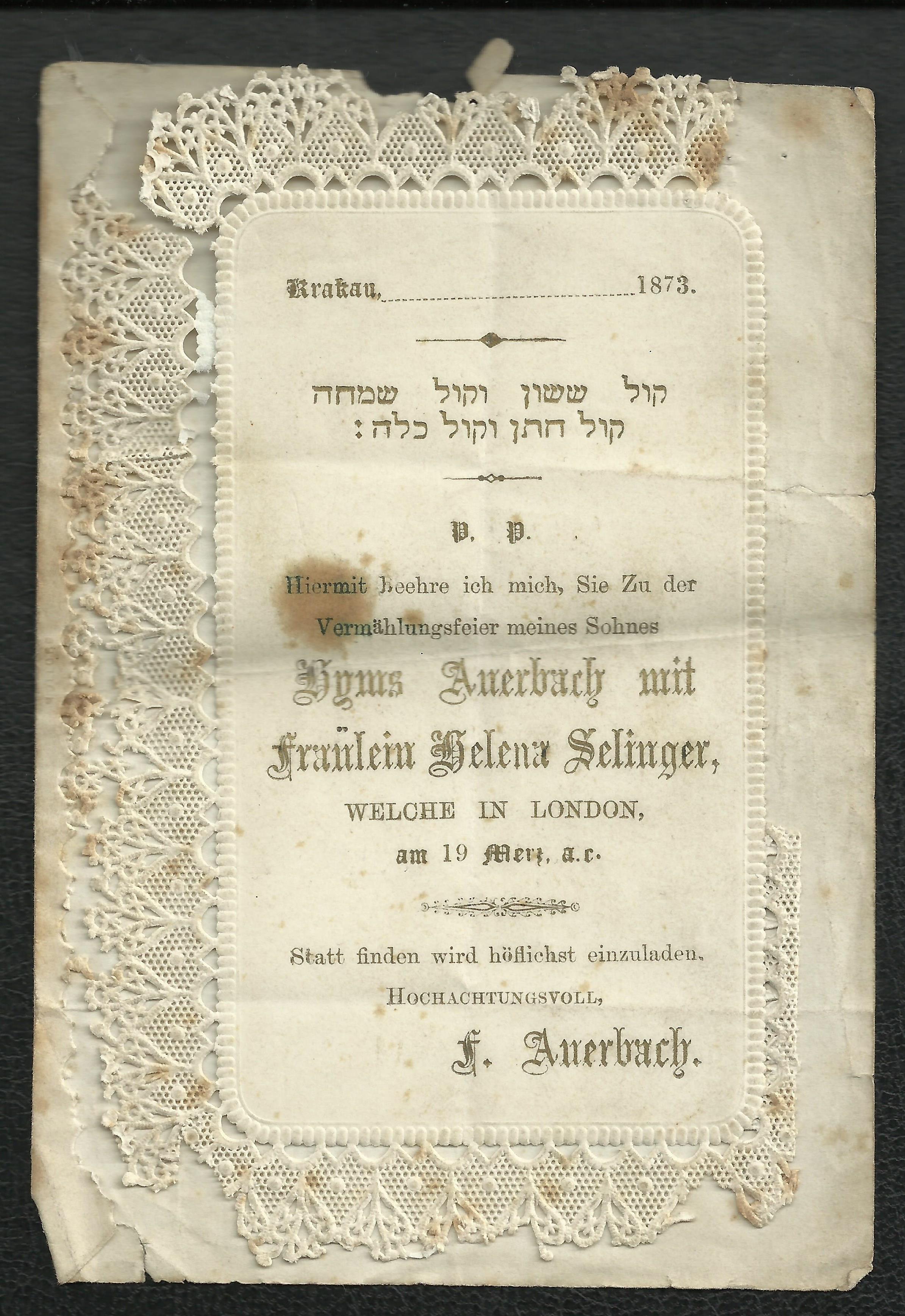
I’ve been delving into my paternal (Rosenthal) family history. I’ve found that my grandfather Jacob Rosenthal was married to Fanny Selinger. Unfortunately I haven’t found anything further about Fanny other than she was born in Germany, probably in 1857. However, I’ve recently come upon a wonderful paper lace invitation to the 1873 wedding of Hyams Auerbach and Helena Selinger that you referred to. What I don’t know is why Fanny would have been invited. Clearly she and Helena were related – but how ?

Needless to say, I was intrigued.  Maybe Fanny Selinger was related to Helena and/or maybe she was related to Julius, Frederick, and Alfred.  Shirley and I communicated by email, and we both started digging.

Invitation to the wedding of Helena Selinger and Hyms Auerbach Courtesy of Shirley Allen

Invitation to the wedding of Helena Selinger and Hyms Auerbach
Courtesy of Shirley Allen


I found a website called Jewish Genealogy of Bavarian Swabia (JGBS) that had records for Hurben and located 25 Selingers in their database, including those for Alfred and for Julius, who were the sons of Seligman Selinger and Breinle Hofstadter and thus were brothers, as I had suspected. Shirley and I both thought that Seligman Selinger had been Americanized to Sigmund by Julius on his passport application and that the birth records for Julius and Alfred confirmed that they were in fact brothers.

I also found a birth record for Helena Selinger, whose father was Abraham Selinger, not Seligman Selinger.  Abraham and his wife Rosalia Wilhelmsdoerfer had six children listed: Seligman (1842), Raphael (1843), Pauline (1845), Karolina (1847), Heinrich (1848), and Helena (1849). Pauline, Karolina, and Heinrich had all died as young children, leaving Seligman, Raphael, and Helena as the surviving children of Abraham.  Here is Helena’s birth record from Hurben in August 1849.

Helena Selinger birth record from Hurben http://jgbs.org/SuperSearch.php?Sp=3&Book=birth&Com=11

Helena Selinger birth record from Hurben (third from bottom)
http://jgbs.org/SuperSearch.php?Sp=3&Book=birth&Com=11


But what about Frederick?  And Fanny? And was there a connection between Helena’s father Abraham and the father of Julius and Alfred, Seligman Selinger?

A little more digging on the JGBS site revealed that both Abraham Selinger and Seligman Selinger were the sons of Joachim Selinger, thus confirming that they were brothers and thus that Helena was a first cousin to Julius and Alfred.

Marriage record from Hurben for Abraham Selinger, son of Joachim, and Rosalia Wilhelmsdoerfer http://jgbs.org/detail.php?book=marriage&id=%206671&mode=

Marriage record from Hurben for Abraham Selinger, son of Joachim, and Rosalia Wilhelmsdoerfer (second in page)
http://jgbs.org/detail.php?book=marriage&id=%206671&mode=


Seligmann Selinger, son of Joachim, marriage to Breinle Hoftsadter

Seligmann Selinger, son of Joachim, marriage to Breinle Hoftsadter (second from bottom) 1848 http://jgbs.org/detail.php?book=marriage&id=%206695&mode=


That meant that Eleanor Selinger, daughter of Julius Selinger, had married her second cousin, Henry Abbot, son of Helena Selinger.


But that still left us wondering about Frederick Selinger and Shirley’s great-grandmother Fanny Selinger.  How did they fit into this picture?

I contacted Ralph Bloch, the webmaster for the JGBS website, and he was extremely helpful.  More helpful than I realized at the time, but more on that later.  Ralph also could not find any evidence that Fanny was born in Hurben, and he reassured me that the birth records for Hurben were quite complete.  He even searched through the original pages to be sure that Fanny hadn’t somehow been missed when the records were indexed. (There was a Fany Selinger born in the 1830s, but that would have been far too early for Shirley’s ancestor.) Ralph also sent a photograph of Seligman Selinger’s headstone, which confirmed that his father’s name was Joachim or Chaim, his Hebrew name.

Seligman Selinger gravestone


So once again we hit the brick wall.  We still had not found either Frederick or Fanny.  Shirley said she would pursue it on her end, and I turned back to the other research I’d been doing when I received Shirley’s comment.

Not much happened again until late November when I heard again from Shirley, telling me that she had received a copy of Fanny Selinger’s marriage certificate, which revealed that Fanny was the daughter of Abraham Selinger.  Now we could link Fanny to Helena, also the daughter of Abraham, as well as to Julius and Alfred, Abraham’s nephews. But we didn’t know if Fanny and Helena were both the daughters of Rosalia Wilhelmsdoerfer.

Shirley’s research of UK records showed that by 1871 Abraham was married to a woman named Gali, and we assumed that Abraham had left Hurben at some point, that his first wife Rosalia had died, and that he had had several children with Gali.  That is what the UK census records from 1871 seemed to reflect. Abraham and Gali were living with Sigfried (28), Helena (20), Cornelia (18), and Oskar (4).  But there was neither a Fanny nor a Frederick.


Abraham Selinger and family 1881 UK census Class: RG10; Piece: 555; Folio: 86; Page: 3; GSU roll: 823397 Description Enumeration District : 10 Source Information Ancestry.com. 1871 England Census [database on-line]. Provo, UT, USA: Ancestry.com Operations Inc, 2004. Original data: Census Returns of England and Wales, 1871. Kew, Surrey, England: The National Archives of the UK (TNA): Public Record Office (PRO), 1871.

Abraham Selinger and family 1881 UK census
Class: RG10; Piece: 555; Folio: 86; Page: 3; GSU roll: 823397
Description
Enumeration District : 10
Source Information
Ancestry.com. 1871 England Census [database on-line]. Provo, UT, USA: Ancestry.com Operations Inc, 2004.
Original data: Census Returns of England and Wales, 1871. Kew, Surrey, England: The National Archives of the UK (TNA): Public Record Office (PRO), 1871.

Abraham died in 1880, and in 1881, Gali was living with four children, but aside from Oskar (13), they were all different from those on the 1871 census: Morris (28), Flora (surname Wallach) (25), and Sidney (23).  Now I was really confused.  Who were these people, and where had they been in 1871?  Flora was presumably married to someone named Wallach and now a widow, but Morris would have been eighteen in 1871 and Sidney only thirteen. Where were they living?  Who were they? None of those children were listed on the Hurben birth register on the JGBS site; in fact, there were no children listed for Abraham Selinger and any wife in Hurben after Helena’s birth in 1849.

Gali Selinger and family 1881 UK census Class: RG11; Piece: 472; Folio: 118; Page: 55; GSU roll: 1341103 Description Enumeration District : 9 Original data: Census Returns of England and Wales, 1881. Kew, Surrey, England: The National Archives of the UK (TNA): Public Record Office (PRO), 1881

Gali Selinger and family 1881 UK census
Class: RG11; Piece: 472; Folio: 118; Page: 55; GSU roll: 1341103
Description
Enumeration District : 9 Original data: Census Returns of England and Wales, 1881. Kew, Surrey, England: The National Archives of the UK (TNA): Public Record Office (PRO), 1881

I assumed that Morris, Flora, Sidney, and Oscar, all born after 1850, were born in a different place and perhaps to a different mother.  Certainly Oskar had to be Gali’s child since he was so much younger than all the rest and only four on the 1871 census.

Searching again on Ancestry, I found a new record:  an entry for Abraham, Rosalia, Seligman, and Raphael Selinger on the Mannheim, Germany, family register dated November 26, 1848.  What were they doing in Mannheim? By that time the three younger children, Pauline, Karolina, and Heinrich, had died.  Perhaps they needed a change of scenery.  But what about Helena? She was born in Hurben in 1849.

Then I found a second Mannheim family register that included Helena, the final entry on the page:


Abraham Selinger and family, Mannheim register Ancestry.com. Mannheim, Germany, Family Registers, 1760-1900 [database on-line]. Provo, UT, USA: Ancestry.com Operations, Inc., 2014. Original data: Polizeipräsidium Mannheim Familienbögen, 1800-1900. Digital images. Stadtarchiv Mannheim — Institut für Stadtgeschichte, Mannheim, Germany.

Abraham Selinger and family, Mannheim register
Ancestry.com. Mannheim, Germany, Family Registers, 1760-1900 [database on-line]. Provo, UT, USA: Ancestry.com Operations, Inc., 2014.
Original data: Polizeipräsidium Mannheim Familienbögen, 1800-1900. Digital images. Stadtarchiv Mannheim — Institut für Stadtgeschichte, Mannheim, Germany.

My friends in the German Genealogy group,  Heike Keohane, Matthias Steinke, and Bradley Hernlem, came to my rescue and translated it to read, “Helene, his daughter, here born the 22 August 1849.”  So Helena’s birth is entered on the Hurben birth records (on the same date) and on the Mannheim records.  I’ve no idea which is the correct birthplace; maybe Rosalia went home to Hurben to give birth and returned to Mannheim afterwards where the family was living.

But perhaps now I could find out where Frederick was born, not to mention Morris, Flora, Sidney, and Oscar. Maybe they were born in Mannheim.  I checked the Mannheim birth records from 1853 through 1866 and found not one person named Selinger.  I checked over and over, looking at each page until my eyes were blurry.  There were no Selingers born in Mannheim during that period that I could find.

Then I discovered that Oskar Selinger had listed Ansbach as his birth place on his UK naturalization papers and thought that perhaps the family had moved from Mannheim to Ansbach.

Oscar Selinger UK naturalization papers The National Archives; Kew, Surrey, England; Duplicate Certificates of Naturalisation, Declarations of British Nationality, and Declarations of Alienage; Class: HO 334; Piece: 54 Description Description : Piece 054: Certificate Numbers A20701 - A21000

Oscar Selinger UK naturalization papers
The National Archives; Kew, Surrey, England; Duplicate Certificates of Naturalisation, Declarations of British Nationality, and Declarations of Alienage; Class: HO 334; Piece: 54
Description
Description : Piece 054: Certificate Numbers A20701 – A21000

I had no luck locating Ansbach birth records for that period, and by then it was Thanksgiving, and other matters distracted me, and I put the Selinger mystery on the back burner.

To be continued…..

Two More Generations Back! The Amazing Seligmanns

Get ready for a real brain twister here.

As I mentioned in my last post, my cousin Wolfgang sent me several new documents relating to our mutual Seligmann ancestors.  Wolfgang and his mother received these from Beate Goetz, who had also sent me several important documents over a year ago.  I continue to be amazed by how much information is available about my Seligmann forebears.

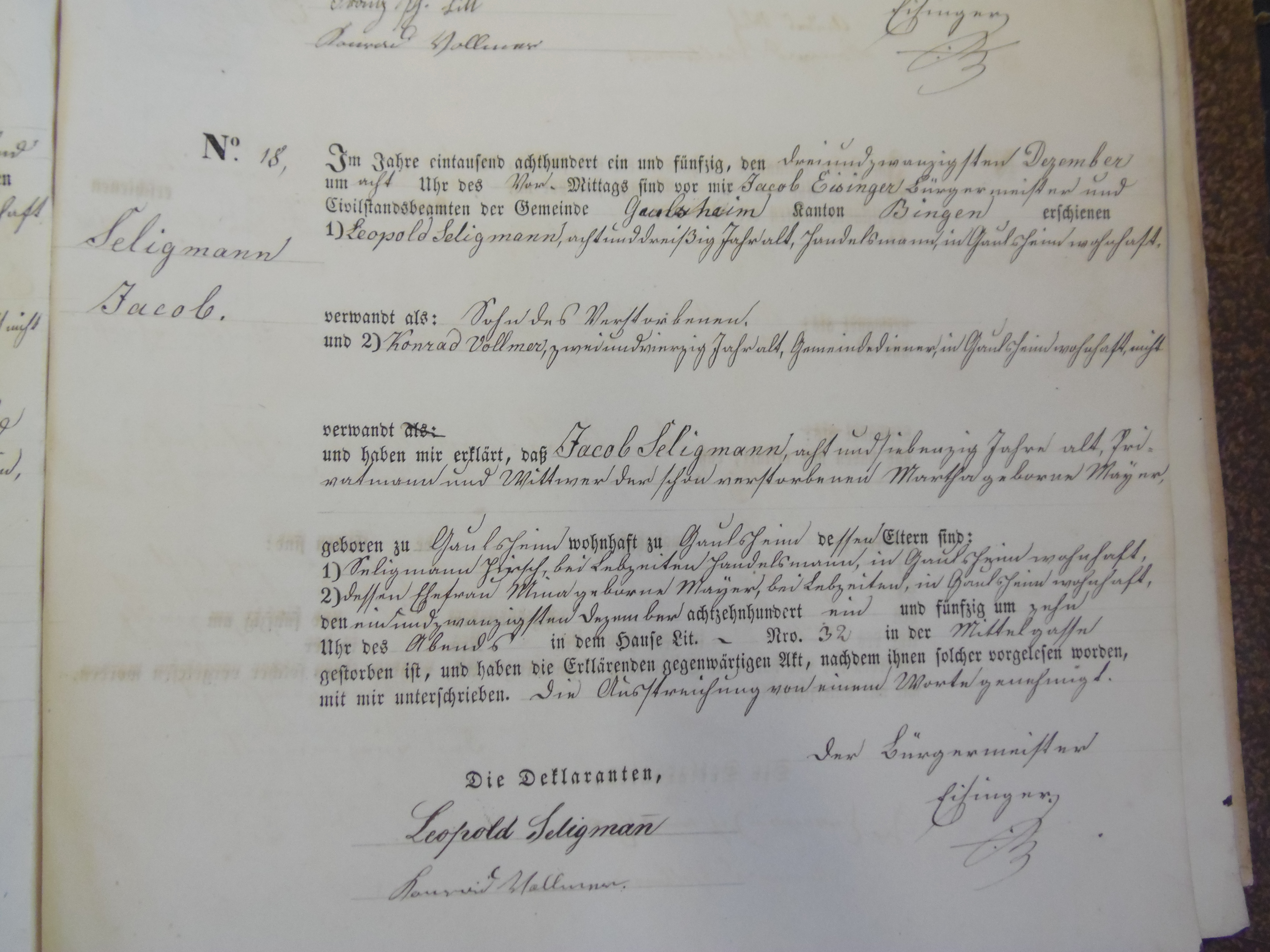
The first document is a death certificate for Jakob Seligmann, my four-times great-grandfather, father of Moritz Seligmann and grandfather of Bernard Seligman.  Until now Jakob was the earliest relative I had found in the Seligmann line; he was born in Gaulsheim, Germany in 1773 and died there in 1851.  His wife, my four-times great-grandmother, was Martha Mayer.

Jakob Seligmann death record

Jakob Seligmann death record


With help from Wolfgang, his mother, and my friend Matthias Steinke, I learned that this document says that Jakob Seligmann died on December 21, 1851, when he was 78 years old.  He was born in Gaulsheim, the son of Seligmann Hirsch, deceased, a merchant in Gaulsheim, and Mina nee Mayer.  The informants were his son Leopold Seligmann and Konrad Vollmer, not related.   What was most exciting about this document was that it revealed the names of Jakob’s parents: Seligmann Hirsch and Mina Mayer.

Seligmann Hirsch and Mina Mayer were thus my five-times great-grandparents.  I now had another generation back to add to my family tree.  And then something occurred to me.  When I saw that Mina’s birth name had been Mayer, I was puzzled.  Was she related to her daughter-in-law Martha Mayer? Of course, it could be.  But when I thought about it a bit more, I realized that when Mina was born in the mid-18th century, Jews were not using surnames.  Instead, they were using patronymics—Mina was probably the daughter of a man whose first name was Mayer, not whose surname was Mayer. She was Mina bat (daughter of) Mayer.

So if Jakob Seligmann’s father was Seligmann Hirsch, it meant that he was probably Seligmann ben (son of) Hirsch.  That meant that the Seligmann surname really came from Jakob’s father’s first name.  When Jakob had to adopt a surname in Napoleonic times, he must have taken his patronymic of Jakob ben (son of) Seligmann and compressed it into a first name and surname, creating Jakob Seligmann.  Seligmann ben Hirsch was thus the original source for the Seligmann surname that survives to this day in my family with Wolfgang himself.

And that meant that Seligmann ben Hirsch was the son of  a man named Hirsch, who was my six-times great-grandfather.

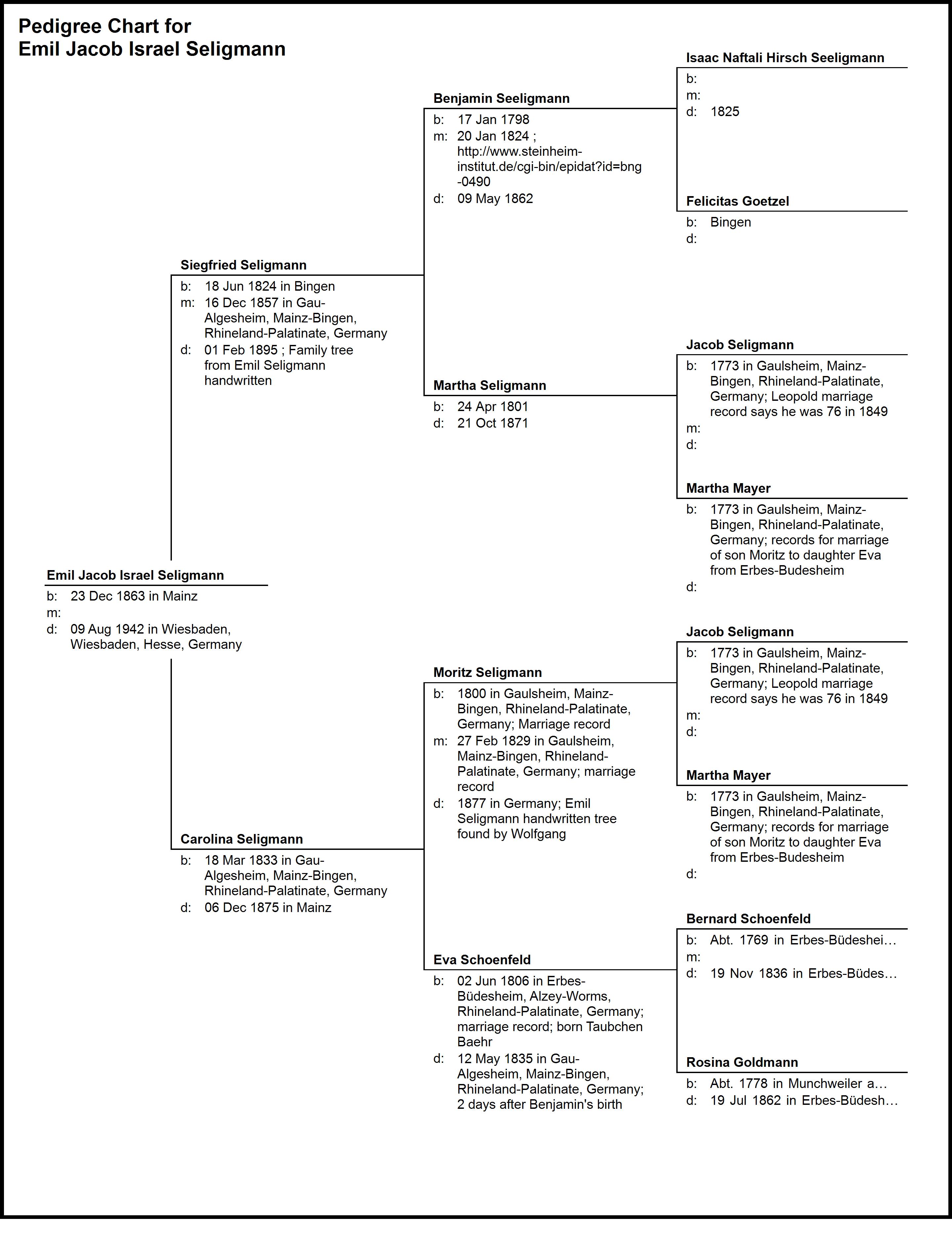
That hunch was corroborated by another bit of evidence that Wolfgang brought to my attention.  Back in July 2015, I posted about Moritz Seligmann’s sister, Martha Seligmann, who had married a man named Benjamin Seligmann, son of Isaac Seligmann and Felicitas Goetzel.  Martha and Benjamin’s son Siegfried had married Moritz and Eva Seligmann’s daughter Caroline.  Caroline and Siegfried were the parents of Emil Seligmann, who created that very long and detailed family tree I wrote about here.  That is, Emil was the grandson of both Moritz Seligmann AND his sister Martha Seligmann.  He was his own second cousin.

Here’s the chart I posted last time.  I know this is all confusing, but if I don’t write it down, I will never remember my own thought processes.

Pedigree Chart for Emil Seligmann

Pedigree Chart for Emil Seligmann


Or as I wrote then, “Emil’s father Siegfried was the son of Martha Seligmann; his mother Karoline was the daughter of Moritz Seligmann.  Moritz and Martha were siblings, so Siegfried and Karoline were first cousins.  Thus, Emil’s paternal grandmother Martha and his maternal grandfather Moritz were sister and brother.  Now if in fact Benjamin Seligmann, Martha’s husband, was also a cousin, there is truly a remarkable amount of inbreeding there.”

And I think that’s in fact the case: Benjamin and Martha were also first cousins.  Back in July I had thought that perhaps Benjamin Seligmann and his wife Martha Seligmann were cousins since both had the surname Seligmann.  I thought that their fathers, Isaac and Jakob, respectively, could have been brothers, but I had no way of proving it.  But now I know from Jakob’s death certificate that his father’s name was Seligmann ben Hirsch. Was that also the name of Isaac’s father?

A look at Isaac’s gravestone from the Steinheim Institute website revealed this, one of the most beautiful grave inscriptions I’ve ever seen:


האיש החשוב משכיל וטהור Here lies  the respected man wise and pure,
החבר ר’הירש בן כ”ה זעליגמאן the Torah Scholar Mr. Hirsch, son of the honored Mr. Seligmann of
גוילסהיים: למלאכתו מלאכת Gaulsheim. For his work was Heaven’s work.  As swift as 
שמים כצבי מהיר אור תורתו 5 a deer was the light of his Torah.  Like a sapphire. 
כספיר תאיר צדק קדמו פעמיו:  righteousness was before him.  A wholly righteous man, great in deeds, doing 
איש תמים ורב פעלי’ גומל חסדים many acts of lovingkindness  for the
רבים: לרעבים וצמאים hungry and thirsty.  
אורו נגנז יום וי”ו ך”ה ובא He died on six, 25 Iyar, and he came
למנוחתו כבוד יו’ א’ך”ו אייר 10 to his honored resting place Day 1, 27 Iyar.
לפרט יקר בעיני ד’המות’ לחסידי’ Especially dear in the eyes of the Lord is the death of the pious.
תנצב”ה May his soul be bound up in the bonds of eternal life.


(Thank you to Neil, Bracha, and Gerald from Tracing the Tribe on Facebook for help in translating the Hebrew; the original German translation on the Steinheim site did not translate well into English using Google Translate, so I decided it would be better to  get a translation of the Hebrew directly rather than getting a translation of the translation. If the lines of the translation do not line up exactly with the Hebrew text, that is my error, not that of my translators.)

And thank you to my friend Dorothee who told me about the link to the photograph of the headstone.

Hirsch "Isaac" ben Seligmann headstone Found at http://www.steinheim-institut.de/daten/picsbng/xl/0358_bng.jpg

Hirsch “Isaac” ben Seligmann headstone
Found at http://www.steinheim-institut.de/daten/picsbng/xl/0358_bng.jpg

“Isaac’s” Hebrew name was Hirsch, son of Seligmann. His father was thus named Seligmann, as was Jakob’s father.  Furthermore, Jewish naming patterns suggest that Isaac’s father could have been Seligmann son of Hirsch, the man who was also Jakob’s father. Hirsch/”Isaac” was older than Jakob; when Seligmann son of Hirsch had his first son, he named him for his own deceased father, Hirsch.  Jakob and Hirsch/“Isaac” were most likely brothers, both sons of Seligmann ben Hirsch.

Why then is Isaac referred to as Isaac, not Hirsch as his gravestone indicates? I don’t know.  The Steinheim Institute site notes that “Hirsch from Gaulsheim called Isaac Seligmann. He was a schoolteacher in Bingen,” without further explanation.  On the page for Hirsch/Isaac’s son Benjamin, the Steinheim site comments that “Benjamin Seligmann was in Gaulsheim (today district of Bingen), the son of school teacher Hirsch (later: Isaac) 1798 Seligmann and his wife Felicity born.” [Translation by Google Translate] Hirsch must have changed his name to Isaac.

So that means that Benjamin Seligmann, son of Hirsch/Isaac, and Martha Seligmann, daughter of Jakob, were first cousins.  Their son Siegfried was thus not only their son but also a first cousin removed from each of his parents.  Oy vey.  Siegfried then married his first cousin Caroline, daughter of his mother’s brother Moritz.  ENDOGAMY, anyone??  No wonder Emil’s tree was so convoluted!

Here is an updated pedigree chart for Emil Seligmann.  Notice that Seligmann ben Hirsch and Mina Mayer appear as his great-grandparents in three different places:

Extended Pedigree Chart for Emil Seligmann

Extended Pedigree Chart for Emil Seligmann


Where am I? Oh, right.  I now know that my six-times great-grandfather was named Hirsch and that he had a son named Seligmann, who had at least two children, Hirsch (who became Isaac) and Jakob.

But what about Jakob Seligmann’s wife Martha, daughter of Mayer, my four-times great-grandmother? The second document Wolfgang sent to me was her death certificate.  Martha died on December 17, 1849 in Gaulsheim when she was 76 years old.  She was born in Oberingelheim and was the daughter of Jakob Mayer, deceased, a merchant in Oberingelheim, and Odilia, nee Simon.  The informants were her husband, Jakob Seligmann, and Konrad Vollmer, who was not related to her.

Martha Seligmann nee Mayer death record

Martha Seligmann nee Mayer death record

Thus, I now know another set of five-times great-grandparents, Martha’s parents: Jakob Mayer (probably Jakob ben Mayer) and Odilia Simon (probably Odilia daughter of Simon).  And I know where to search for them: Oberlingelheim.  And if I am right about the patronymics, then I know two more of my sixth-great-grandfathers, Mayer, father of Jakob, and Simon, father of Odilia.

All that from two pieces of paper dating from the mid-nineteenth century.

Thank you, Beate Goetz, Wolfgang Seligmann and his mother Annlis, Matthias Steinke, and the members of Tracing the Tribe, for all your help.


Photo Analysis: Why You Should Ask an Expert

Sometimes you need to hire an expert to help with hard questions.  With the help of the genealogy village—my fellow bloggers and the members of the various Facebook groups and JewishGen—I have been able to find and learn more than I ever imagined.  But when it came to some of those mystery photos that bewildered and frustrated me, I decided it was time to find an expert, and the expert who came highly recommended—for good reason—is Ava Cohn, a/k/a Sherlock Cohn, the Photo Genealogist.

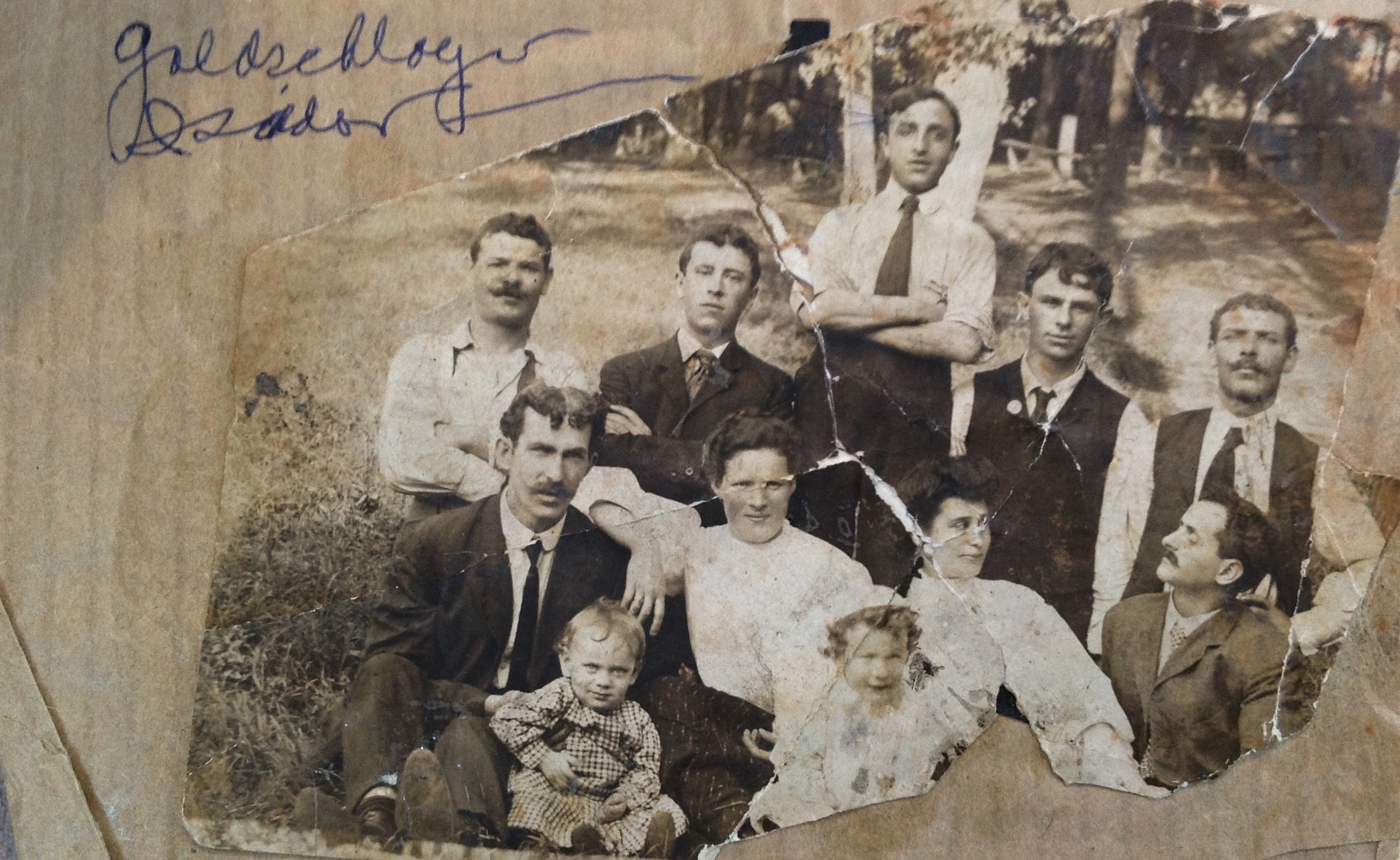
I had originally sent Ava this photo of my grandfather Isadore Goldschlager because I was curious about identifying the other people in the photograph.

Isadore Goldschlager and unknown others

Isadore Goldschlager and unknown others

But Ava and I discussed it, and she concluded that without more information and more photographs, it would be impossible to make much progress identifying total strangers who lived over a hundred years ago. I really appreciated Ava’s honesty, and when she asked if I had any other photographs that might be more amenable to her analysis, I looked back to consider some other options.

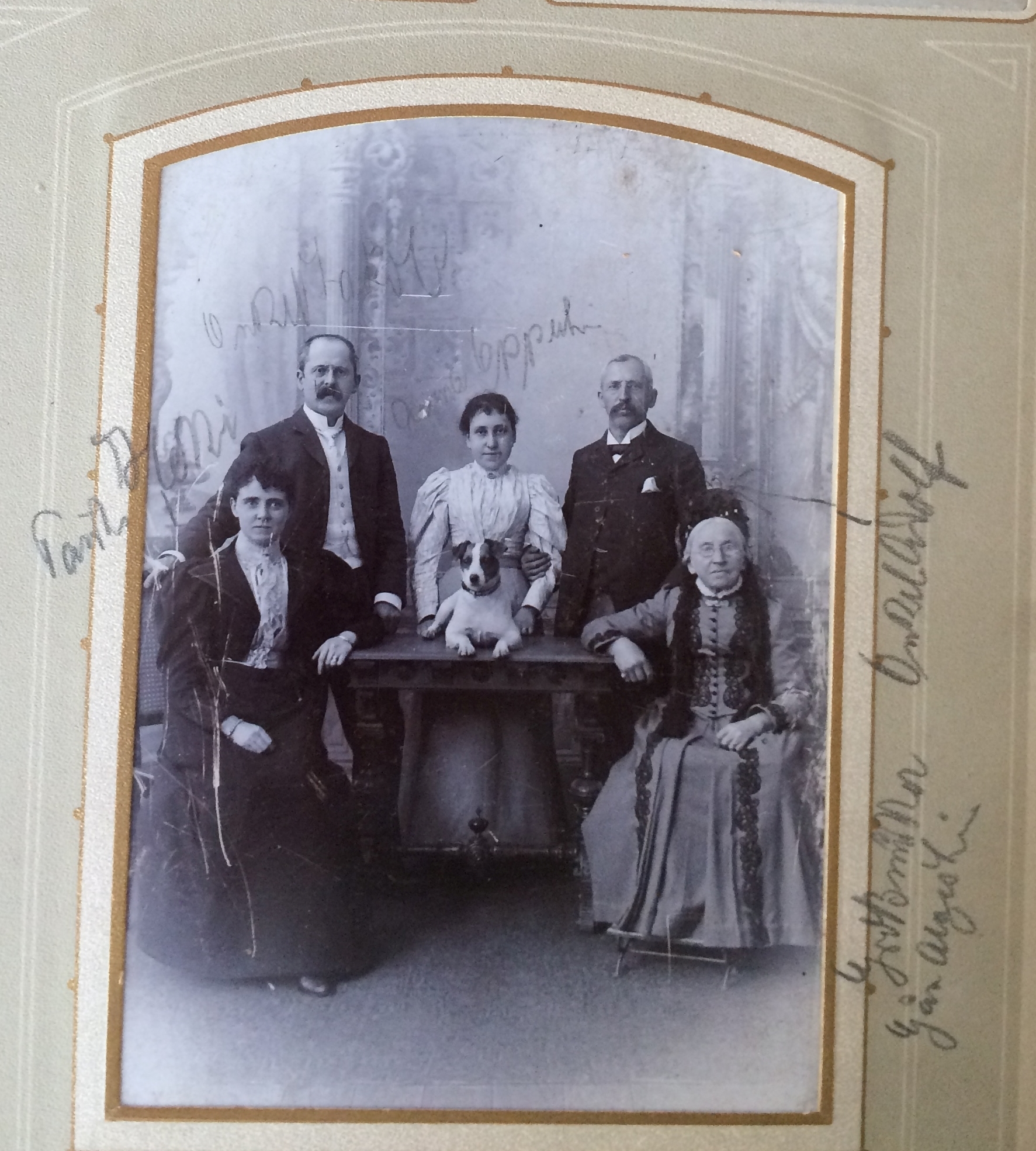
I sent her this photograph from Fred Michel’s album, which I had discussed here and here and here, but about which I remained somewhat mystified.

Uncle Adolf and Grandmother Gau Algesheim

I had concluded tentatively from my own analysis and comparison to other photographs and the inscriptions on the photograph that the older woman was probably my three-times great-grandmother Babetta Schoenfeld Seligmann, and the two men labeled Onkel Adolf and Onkel Jakob were probably Babetta’s sons, Adolf and James, brothers of my great-great grandfather Bernard Seligman.  Adolf, like my great-great-grandfather Bernard, had left Germany and settled in Santa Fe, New Mexico, and James had moved to Great Britain.  I had learned that James was not a common name for boys in Germany in the 19th century so it was likely that he was born Jakob and adopted the name James after emigrating.  Also, my cousin Lotte, who had met James Seligman when she was a young girl, thought that “Onkel Jakob” resembled the man she remembered as James Seligman.

But I was not at all sure who the two younger women were, especially the woman to the left in the photograph.  I’d asked on the blog if anyone could read the inscription near her picture, but no one was certain what it said.  The woman in the center appeared to be labeled Anna Oppenheimer, but I couldn’t understand why she would be in the photo.  Anna Oppenheimer was the daughter of Pauline Seligmann and Maier Oppenheimer and the granddaughter of Babetta.  But why of all the grandchildren would only she be in this photograph, especially since her mother was not included, just two of her uncles?

Ava studied the photograph as well as my blog posts, my family tree for the Seligmann family, and other photographs of the Seligmann family, and then sent me a detailed and thorough analysis of her own conclusions, which I found well-founded, fascinating, and persuasive.  With her permission, I am sharing some of her report.

I thought Ava’s analysis of the overall relationships among those in the photograph based on traditional posing in studio photographs of families was quite interesting:

In the mystery photograph, the family is posed in a typical family grouping of five individuals seated and standing around a large library table upon which is a dog, perhaps the family pet. The photo has been taken in a photographer’s studio with an appropriate backdrop for the time period. The two individuals on the left hand side appear to be a married couple while the elderly woman seated on the right could be mother or grandmother to one or more of the individuals in the photo. The man on the right, probably a son and the young woman in the center holding the dog could be related but are not married to each other.

Ava concluded that the photograph was taken in 1896-1897.  Here is part of the reasoning for her conclusion:

To establish a year for the photograph, I looked at the clothing worn. Since what we know of the family’s comfortable economic status, it is logical that they are wearing up-to-date fashions, for the most part. The elderly woman, as is customary for many older women, is not as fashionable as the two younger women. Her dress, with multiple small buttons down the bodice, is a typical style of the 1880s as is her bonnet. The other two women are wearing clothing from the latter half of the1890s, post 1895. By this point in time the enormous leg-o-mutton sleeves of the 1893-1895 time period have become less full with the vestige of fullness above the elbow.  The man on the left is wearing a high Imperial collar, common in the 1890s.

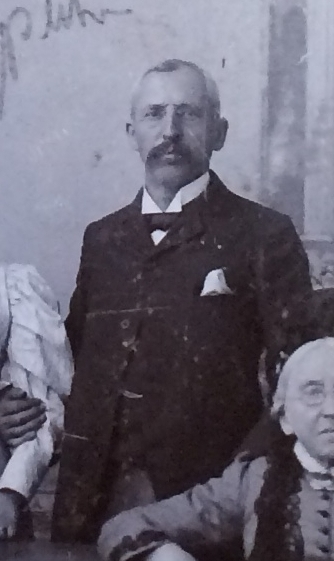
Ava agreed that it was reasonable to conclude that the elderly woman labeled “Grossmutter Gau Algesheim” was Babetta Schoenfeld Seligmann and that the man on the right, labeled Onkel Adolf, was her son Adolf Seligman, brother of Bernard and a resident of Santa Fe in the 1890s.  At that time Adolf was in his fifties (born in 1843) and unmarried.  Ava thought that the man labeled Onkel Adolf in the photo appeared to be in his mid-fifties. Ava did not think the woman in the center was Adolf’s wife, Lucy, since Lucy would have been only about fourteen in the mid-1890s and did not marry Adolf until 1902.


Onkle Adolf

Rather, Ava opined that the woman in the center was in fact Anna Oppenheimer as labeled.  She would have been nineteen or twenty in 1896-1897:

It appears that she is wearing a wedding or engagement ring in the photograph. The writer of the inscription has used Anna’s maiden name, Oppenheimer, as opposed to her married name, Anna Kaufman, so, along with the absence of Max Kaufman in the photograph, I believe that this photo was taken before her marriage to Max. Again, having a marriage certificate for Anna and Max could confirm why the writer used Anna’s maiden name here instead of her married name.

Unfortunately, I do not have a marriage record for Anna, and there is no record of any children born to her and her husband Max Kaufman so it is impossible to determine when exactly they married.

Anna Oppenheimer maybe

That left the two remaining people in the photograph: Onkel Jakob and the woman sitting on the left side of the picture whose name I could not decipher in the inscription.  Ava agreed that “Onkel Jakob” was James Seligman. So who was the other woman?

Ava believes that she was James/Jakob Seligman’s wife, Henrietta Walker Templeton, who was born in England in 1866 and married James Seligman in London in October 1887.  Ava read the inscription next to the woman to be “Tante Heni:”

Tante Glori


Heni is a nickname for Henrietta and clearly shows the relationship with the writer of the inscription because of the informal use of a nickname. Tante (Aunt) could be one by marriage not necessarily by blood. In the mystery photo Heni appears to be about age 30-31.

In addition, Ava interpreted the posing as indicative of a marital relationship between Jakob and the woman seated in front of him, saying, “The manner in which he is posed with his arm around the back of Heni’s chair suggests their relationship.”

This made perfect sense to me.  Ava speculated that perhaps James and Henrietta had come to Gau-Algesheim to celebrate their tenth anniversary with the Seligmann family, which would have been in 1897.  I also recalled that Lotte had mentioned in an email dated July 6, 2015, that James and his English wife (whom Lotte referred to as Hedy) had visited “the continent” once.  Lotte was born in 1921, so would not remember a visit in the 1890s, but the fact that James and his wife visited during Lotte’s lifetime in Germany makes it even more likely that they had in fact visited on earlier occasions.  Lotte also said that James returned after Henrietta’s death in 1928.

Ava even analyzed the dog in the photo.

Given that the same dog appears in both the mystery photograph and the one of Bettina Arnfeld nee Seligmann (born 1875), I thought I’d include that here. It is clearly the same dog. I had considered that the dog may have belonged to the photographer but given how calm he/she appears in the photographs, I believe he was a family pet. The photo of Bettina was taken roughly 3 years after this one, circa 1900. The photo of Bettina may have been an engagement picture as she and Adolf Arnfeld married in 1900.

Bettina Arnfeld nee Seligmann

Bettina Arnfeld nee Seligmann

Anna Oppenheimer maybe

Bettina Seligmann Arnfeld was the daughter of Hyronimus Seligmann, Babetta’s son and brother of Bernard, Adolf, and James, among others.  She was Anna Oppenheimer’s first cousin.  So whose dog was it? Certainly not James or Adolf since neither lived in Germany.  Perhaps the dog belonged to Babetta? She is the only common link between the two young women pictured with the dog.  Babetta died 1899; if Ava is correct and the photograph of Bettina was taken in 1900, perhaps Bettina inherited the dog from her grandmother?

I was quite satisfied and persuaded by Ava’s analysis of the family photograph.  But she didn’t stop there.  I had also supplied her with additional photographs to help with her analysis of the family photograph.  For example, I sent her this one, which I believed was a photograph of Babetta as a young woman.

Uncertain see ava report

I had based that conclusion on the fact that another photograph that I paired with the one of the woman was labeled Grossvatter and thus presumably was my three-times great-grandfather Moritz Seligmann.

Courtesy of the Family of Fred and Ilse Michel

Courtesy of the Family of Fred and Ilse Michel

But Ava disagreed about the identity of the young woman:

I did a comparison of the older photograph of a young woman that you supplied. This photograph is roughly dated circa 1859-1861 based on clothing and hairstyle as well as the type of image, most probably a daguerreotype popular in the 1850s and very early 1860s. The young woman appears to be in her teens and no more than 20 years of age. This eliminates the possibility that this earlier likeness is Babetta who would have been 49-51 years old. But there is a possibility given the provenance of the photograph and the resemblance to Babetta that this is one of her daughters, Pauline or Mathilde. It is unlikely to be her niece/stepdaughter, Caroline. Given that the photo was obtained from the Michel descendants, Pauline is the most likely candidate. Further research, documentation and comparison photographs would be needed to make a positive identification. 

Although I was quite disappointed to think that this was not Babetta, the more I considered Ava’s analysis and the more I looked at the photograph of the young woman and the one of Moritz, the more I realized my error.  The frames on the two photographs are quite different as is the style and the posing.  I had just jumped to the conclusion that because Suzanne had sent these two photographs in the same email that they were of a couple.  That’s why sometimes you need to hire an expert!

Finally, Ava also did an analysis of the wonderful photograph that my cousin Davita had sent of a man she said was her grandfather, Adolf Seligman, and his favorite sister, Minnie, riding camels in Egypt:

gramdfather Adolph and great aunt Minnie_rev

I was quite surprised but also persuaded by what Ava had to say about the identity of the people in this photograph; she is quite certain that the woman is in fact Henrietta Walker Templeton, and the more I studied the photograph, the more I agreed.

The Egypt photo is roughly dated based on her suit and hat as being taken in 1910. That would make Heni 44 years old. Her face has aged from the earlier photo and she’s put on a bit of weight, not uncommon approaching middle age.  She is very stylish in the 1897 photo and likewise in the 1910 one. In both, she has chosen an up-to-date suit rather than a dress. Her dark hair is the same style. Notice the “dip” in her bangs on the right side of her forehead. It’s the same as the earlier photo.  Her eyebrows, nose and mouth are the same as is the overall attitude captured by the photographer.

Tante Heni

Tante Heni


Minnie Seligmann

After I read Ava’s comment, I checked the emails that Lotte had sent me and saw that she had described James’ wife as “big and pompous.”  The woman Ava concluded was Henrietta certainly does have a certain air of superiority in both of the photographs.

Also, I have absolutely no record of any kind supporting the existence of a Seligmann sister named Minnie, so already had had questions about Davita’s description. Thus, I was open to the idea that it was not Minnie, but someone else.  I hadn’t considered Henrietta since I believed that the man was Adolf, as Davita said.  Why would Henrietta from England be riding a camel in Egypt with her brother-in-law Adolf, who lived in Santa Fe?

But Ava raised a question as to whether this was in fact Adolf. If the photograph was taken in 1910, why would Adolf, who had married in 1902 and had three children by 1910, be traveling to Egypt? The more I looked at the earlier photographs of Adolf and Jakob/James, the more I became convinced that the man on the camel is in fact James, not Adolf.  Ava also agreed that it seems quite likely that it is James, not Adolf, in the photograph, but that without more information, we can’t be entirely sure, especially since Davita, the source of the Egypt photograph, believed that it was her grandfather Adolf. (Adolf died before Davita was born, so she had never met him in person and only had this one photograph that she had been told was of her grandfather.)

Adolph Seligman in Egypt

James or Adolf?

Onkel Jakob

James Seligman

Onkle Adolf

Adolf Seligman

Thus, although without more photographs and/or records we cannot be 100% certain, I am persuaded that Ava’s conclusions are correct about the likely identities of the people in the group photograph, the portrait of the young woman, and the Egypt photograph.

It was well worth the fee I paid to have the benefit of Ava’s expertise.  I highly recommend her to anyone who has questions about an old photograph.  If you are interested, you can email Ava at Sherlock.cohn@comcast.net or check out her website at http://sherlockcohn.com/  You will probably have to wait quite a while because her services are very much in demand and she devotes a great deal of time to each project, but it will be worth the wait.

[I was not paid or required by my contract with Ava to advertise her services; I am writing this blog post as a service to others who might be interested.]


.


An Adventurous Spirit: Amalie Schoenthal and Her Children

When I read my great-great-uncle Henry Schoenthal’s diary and learned that his little sister Malchen (later, Amalie, then Amelia, but I will call her Amalie throughout) was the first of his siblings to express an interest in following him from Germany to the US, I was intrigued.  She was only twenty years old and not yet married.  Who was this adventurous young woman?

Amalie Schoenthal arrived in Pennsylvania in September, 1867, and in 1870, she was living in Pittsburgh with her aunt Fanny Schoenthal Goldmith and her family and working as a domestic.  In 1872, she married Elias Wolfe, the cattle drover, with whom she had six children between 1873 and 1885: Maurice, Florence (usually referred to as Flora), Lee (named for Amalie’s father Levi), Ira, Henrietta (or Etta, named for Amalie’s mother Henriette), and Herbert.  Although Amalie’s life was likely very traditional for a married woman with six children, some of her children seemed to have inherited her adventurous spirit.  Unlike most of the children and grandchildren of her older sister Hannah who stayed in Pittsburgh and the surrounding area for generations, most of the children of Amalie and Elias Wolfe ventured to places quite distant from Pittsburgh.

In 1899, Flora Wolfe, then 24 years old, was the first of the children of Amalie and Elias to marry.  She married Lehman Goldman on June 1, 1899, as described here:
Flora Wolfe wedding pt 1 Jewish Criterion 6 2 1899

FLora Wolfe wedding pt 2

Flora Wolfe wedding pt 3

Jewish Criterion, June 2, 1899, pp.8-9


From the description of the wedding, it would seem that Elias Wolfe must have been doing quite well in his business as a cattle drover.  A fancy wedding attended by over a hundred people would probably have been considered quite large in those times.  Flora’s maid of honor was her first cousin, Edith Stern, daughter of Hannah Schoenthal Stern.  Among the many guests, the last paragraph lists my great-grandparents, Isidore and Hilda (Katzenstein) Schoenthal, and their sons, my great-uncles Lester and Gerson, who would have been ten and seven years old at the time, respectively.

Flora’s groom, Lehman (sometimes spelled Leman) Goldman, was born in Baltimore in 1876, as was his father, Samuel Goldman, who was working as an insurance agent in 1900, according to the census.  After marrying, Flora and Lehman were living with Lehman’s family in Pittsburgh, and Lehman was working as a traveling salesman in the “furnishing goods” business.  I assume that that is another term for dry goods or clothing.

Flora and Lehman had four children in the first nine years of their marriage: Kenneth LeRoy (1901), Helen (1903), Donald (1905), and Marjorie (1907).

Flora’s sister and four brothers were still living at home with their parents Amalie (now called Amelia) and Elias Wolfe in 1900.  Elias was still a drover.  Maurice, now 27, and Lee, now 22, were clerks in a furnishings store. Ira was nineteen and working as a stenographer.  The two youngest children, Henrietta, seventeen, and Herbert, twelve, were still in school.

Elias Wolfe and family, 1900 census Year: 1900; Census Place: Allegheny Ward 2, Allegheny, Pennsylvania; Roll: 1355; Page: 14B; Enumeration District: 0018; FHL microfilm: 1241355

Elias Wolfe and family, 1900 census
Year: 1900; Census Place: Allegheny Ward 2, Allegheny, Pennsylvania; Roll: 1355; Page: 14B; Enumeration District: 0018; FHL microfilm: 1241355

Lee must have married shortly after 1900 (although I cannot find any record or news story to confirm it) because he and his wife Wilhelmina (Minnie) Heisch had a son named Lloyd on February 25, 1902, and a daughter named Ruth in 1905.  Minnie’s parents, John Heisch and Christine Kress, were born in Germany, and John was a carpenter.  Although I found newspaper announcements of engagements and marriages for Minnie’s siblings, I did not find one for Minnie and Lee nor did I find any mention of the marriage in the Jewish Criterion.  According to the entry in the 1908 Pittsburgh city directory, Lee was in the paper bag business.

His brother Maurice, the oldest son, was living with his parents in 1908 and working as a salesman.  Their sister Etta was working as a bookkeeper and also living at home.

Etta Wolfe 1908 directory

Ancestry.com. U.S. City Directories, 1822-1989 [database on-line]. Provo, UT, USA: Ancestry.com Operations, Inc., 2011.

Ancestry.com. U.S. City Directories, 1822-1989 [database on-line]. Provo, UT, USA: Ancestry.com Operations, Inc., 2011.

By 1910 and perhaps even earlier, Ira Wolfe had left Pennsylvania and moved to San Francisco.  He was 28 years old, working as a cashier for a lamp company, and lodging in someone’s home, according to the 1910 census. Herbert, the youngest child of Amalie and Elias Wolfe had also moved away by 1910; Herbert was 25 and had moved to Detroit where in 1910 he was working as a machinist and in 1911 as a sign writer. Thus, by 1910, the two youngest sons of Amalie and Elias had left for far off places.  I can’t help but wonder what drove them to move away from the place where their extended family was living.  Did they inherit their mother’s adventurous spirit? Or was it something else?

All the other Wolfes were still in Pittsburgh in 1910.  Etta was living with her parents at the time of the census in April, but she married Maximillian Joseph Wise on June 2, 1910.  Max was a German immigrant; although I cannot find him on the 1900 census, there was a Max Wise listed on the 1910 census who was living in Pittsburgh on Mellon Street, the same address given in the marriage announcement in the Pittsburgh Post Gazette.
Etta Wolfe wedding notice


Max Wise was a traveling salesman residing as a lodger in the residence of others at the time of the 1910 census.

I cannot find Maurice Wolfe on the 1910 census, but he is listed as living in Canonsburg in both the 1909 and 1911 directories for Washington, Pennsylvania, selling men’s furnishings.  His brother Lee was still living in Pittsburgh with his wife Minnie and their two children, Lloyd and Ruth; Lee was then a wrapping paper salesman.

As for Flora (Florence, here), at the time of the 1910 census she and her husband Lehman Goldman were also still living in Pittsburgh where Lehman was a clothing merchant.  Their four children were eight, six, four, and just about two years old when the census was taken on April 15, 1910.
Year: 1910; Census Place: Pittsburgh Ward 11, Allegheny, Pennsylvania; Roll: T624_1302; Page: 2A; Enumeration District: 0416; FHL microfilm: 1375315

Year: 1910; Census Place: Pittsburgh Ward 11, Allegheny, Pennsylvania; Roll: T624_1302; Page: 2A; Enumeration District: 0416; FHL microfilm: 1375315

Just five months later the Wolfe/Goldman families suffered a terrible loss.  Flora Wolfe Goldman, only 35 years old, died on September 30, 1910, from puerperal fever, also known as childbed fever.

Flora Wolfe death certificate Ancestry.com. Pennsylvania, Death Certificates, 1906-1963 [database on-line]. Provo, UT, USA: Ancestry.com Operations, Inc., 2014. Original data: Pennsylvania (State). Death certificates, 1906–1963. Series 11.90 (1,905 cartons). Records of the Pennsylvania Department of Health, Record Group 11. Pennsylvania Historical and Museum Commission, Harrisburg, Pennsylvania.
Flora Wolfe death certificate
Ancestry.com. Pennsylvania, Death Certificates, 1906-1963 [database on-line]. Provo, UT, USA: Ancestry.com Operations, Inc., 2014.
Original data: Pennsylvania (State). Death certificates, 1906–1963. Series 11.90 (1,905 cartons). Records of the Pennsylvania Department of Health, Record Group 11. Pennsylvania Historical and Museum Commission, Harrisburg, Pennsylvania.

Pittsburgh Daily Post, October 3, 1910, p. 2

Pittsburgh Daily Post, October 3, 1910, p. 2

According to Medicinenet.com, puerperal fever is:

Fever due to an infection after childbirth, usually of the placental site within the uterus. If the infection involves the bloodstream, it constitutes puerperal sepsis. Childbed fever was once a common cause of death for women of childbearing age, but it is now comparatively rare in the developed world due to improved sanitary practices in midwifery and obstetrics. Also known as childbirth fever and puerperal fever.

Since there is no record of another child born to Flora and Lehman, I assume that either the baby was stillborn or died shortly thereafter or that Flora had miscarried.  Flora left behind her 34 year old husband and four very young children.  Lehman remarried three years later on March 8, 1913; his second wife was Helene Hoffa, and they would have four more children together between 1914 and 1923.

Six months after Flora died, on March 3, 1911, Etta and Max Wise had their first child, a daughter whom they named Florence Emily, undoubtedly for Etta’s sister.  A second child, a boy named Irving, was born the following year on October 12, 1912.  In 1913, Etta and Max Wise relocated to Middletown, Ohio, where he opened a clothing store, as evidenced by the obituary written years later when Max Wise died,  seen below.

I was curious about Middletown, Ohio and what drew Max and Etta to relocate there.  Middletown is located roughly halfway between Cinncinati, Ohio, and Dayton, Ohio, and is about 280 miles west of Pittsburgh.  According to the Middletown Historical Society website, the town, which started as an agricultural community, experienced tremendous growth in the 19th and early 20th century due to industrialization:

During the 1800’s and early 1900s Middletown became this bustling municipality due to the growth of industry.  Many entrepreneurs developed their businesses and with the addition of ARMCO (now AK Steel) founded by George M. Verity, and Sorg Paper Company founded by Paul J. Sorg.

As reported on Wikipedia, the population of Middletown surged in these years, going from about 3,000 people in 1870 to over 9,000 by 1900 and to more than 23,000 by 1920.  Max Wise must have seen it as a place of great opportunity; as they say on the old commercial for Barney’s clothing store in New York City, everyone needs clothes.

But were there Jews there? From the American Jewish Archives website, I found this information about the Jewish community in Middletown when Max and Etta Wise moved there:

In 1903, ten Orthodox Jewish families rented a small room on Clinton Street in which to hold services.  Under the leadership of new Russian immigrant, Mr. Schomer, they rented a single Torah and created a makeshift Ark.  As the Orthodox community grew, the rented shul on Clinton Street became too small for weekly Shabbat services, and in 1915, the community bought a structure on First Avenue, across from the public library.  Rabbi Gilsey assumed the pulpit, and a regular religious school was formed. Three years later, in 1918, the shul was incorporated under the laws of the State of Ohio under the name “Anshe Sholom Yehudah Congregation.”  By 1920 there were approximately thirty-five families in the congregation, all of whom spoke mainly Yiddish.

The tragic death of Flora Wolfe Goldman in 1910 was not the only loss that the Wolfe family would suffer during the decade of the 1910s. On December 27, 1913, Elias Wolfe died at age 74 from heart disease.

Elias Wolfe death certificate Ancestry.com. Pennsylvania, Death Certificates, 1906-1963 [database on-line]. Provo, UT, USA: Ancestry.com Operations, Inc., 2014. Original data: Pennsylvania (State). Death certificates, 1906–1963. Series 11.90 (1,905 cartons). Records of the Pennsylvania Department of Health, Record Group 11. Pennsylvania Historical and Museum Commission, Harrisburg, Pennsylvania.

Elias Wolfe death certificate
Ancestry.com. Pennsylvania, Death Certificates, 1906-1963 [database on-line]. Provo, UT, USA: Ancestry.com Operations, Inc., 2014.
Original data: Pennsylvania (State). Death certificates, 1906–1963. Series 11.90 (1,905 cartons). Records of the Pennsylvania Department of Health, Record Group 11. Pennsylvania Historical and Museum Commission, Harrisburg, Pennsylvania.

Sometime after Elias died, Amalie Schoenthal Wolfe moved to Middletown, Ohio, as she is listed in the Middletown city directory for 1917.  Amalie obviously wanted to be closer to her only surviving daughter and her Ohio grandchildren.

Etta and Max Wise had four more sons after moving to Ohio: Richard Elias (1915), Max, Jr. (1917), Robert (1919), and Warren Harding Wise, born on September 19, 1920.  I guess we know who Max and Etta (if she voted since the 19th amendment had just been ratified on August 19, 1920) voted for in the 1920 Presidential election—the native son candidate from Ohio, Warren Harding.  I wonder how little Warren Harding Wise felt when he learned that his namesake was involved in the Teapot Dome scandal as well as other scandals, which were revealed in the years after Harding’s untimely death in office in 1923.

English: Warren G. Harding, by Harris & Ewing.

English: Warren G. Harding, by Harris & Ewing. (Photo credit: Wikipedia)


Meanwhile, out in California, Ira Wolfe was having his own troubles.  On June 29, 1911, he married Ada Piver in San Francisco. Just over six months later in January, 1912, Ada sued him for divorce, claiming “extreme cruelty,” as detailed in these two news articles.
San Francisco Chronicle, January 18, 1912, p. 16
San Francisco Chronicle, January 18, 1912, p. 16


Ira Wolfe divorce 2

Ira Wolfe broken toys

San Francisco Chronicle, May 15, 1913, p. 10

And if we think that social media and tabloids today have undermined all attempts at maintaining some privacy and dignity, this news article indicates that the public’s taste for gossip has always been a way of selling newspapers:
Ira and Ada Wolfe dine together

Ira Wolfe and Ada dine together

There’s no way of knowing the truth of Ada’s allegations (and I could find no follow-up story describing the court’s ruling in the case).  Assuming there was some truth to her descriptions of Ira’s temper, drinking, and violent nature, perhaps it is not surprising that he had moved so far from his home in Pittsburgh.

Ira’s younger brother Herbert, still living in Detroit, married Elsa Repp on June 24, 1916.  Elsa was a Detroit native, the daughter of John and Amelia Repp, who were also both American-born.  In 1910, John Repp was working as a metal polisher, and Elsa was working as a box maker in a laboratory.

Back in the Pittsburgh area, only two of Amalie and Elias Wolfe’s children remained.  Maurice Wolfe had married by 1917 according to his World War I draft registration.  I’ve not been able to find anything about his wife’s background; all I know is that her first name was May and that she was born around 1880 in New York, according to the 1920 census record.  In 1917, Maurice and May were living in Pittsburgh, and Maurice, who was lame in one leg, was working as an inspector for Westinghouse. As far as I can tell, they did not have any children.
Maurice Wolfe World War I draft registration Registration State: Pennsylvania; Registration County: Allegheny; Roll: 1909278; Draft Board: 18

Maurice Wolfe World War I draft registration
Registration State: Pennsylvania; Registration County: Allegheny; Roll: 1909278; Draft Board: 18

By 1917, Lee Wolfe and his wife Minnie had moved to Dormont, Pennsylvania, a suburb of Pittsburgh about four miles south.  Lee was the local manager of the Interstate Folding Box Company.  On the 1920 census, Lee, Minnie, and their two children, now teenagers, were still living in Dormont, and Lee was still working for a paper company as a commercial salesman.
Lee Wolfe and family, 1920 census Year: 1920; Census Place: Dormont, Allegheny, Pennsylvania; Roll: T625_1511; Page: 1A; Enumeration District: 882; Image: 267

Lee Wolfe and family, 1920 census
Year: 1920; Census Place: Dormont, Allegheny, Pennsylvania; Roll: T625_1511; Page: 1A; Enumeration District: 882; Image: 267

Lee’s brother Maurice was also still in Pittsburgh in 1920, working as a government clerk, but by 1923 he had relocated to Middletown, Ohio, where his mother and his sister Etta were living.  I cannot find Maurice on the 1930 census, but he was listed in the Middletown directory for that year.  On the 1940 census, he was still in Middletown, working as a salesman, and divorced.  Although I can’t be certain, I assume his marriage ended before he left Pittsburgh, but since I have no records for his wife May other than Maurice’s draft registration and the 1920 census, I can’t be sure.

In 1920, Max and Etta and their children continued to live in Middletown where Max was the proprietor of a clothing store.  Herbert Wolfe and his wife Elsa were still living in Detroit where Herbert was now working as an installer for the telephone company according to the 1920 census.

Although Ira Wolfe was listed as a salesman in the 1917 San Francisco directory, I cannot find a World War I draft registration for him nor can I find him on the 1920 census.  The last possible record I have for him is a listing on the Chicago, Illinois marriage index showing an Ira J. Wolfe marrying a woman named Agnes Resa on July 17, 1920.  I did find Agnes on the 1920 census, taken before she married.  She was thirty years old, born in Illinois, and living with her mother and brother in Chicago.  Agnes was working as a comptometer for the railroad.  What is a comptometer, I wondered? Apparently it was not itself an occupation, but a machine—a very early form of what today we would call an adding machine or a calculator.  I assume that Agnes operated a comptometer for the railroad.

English: Comptometer - model E Français : Comp...

English: Comptometer – model E Français : Comptomètre – modèle E (Photo credit: Wikipedia)


Thus, as of 1923, of the five surviving children of Amalie Schoenthal Wolfe, only Lee Wolfe was still living in Pittsburgh.  Maurice and Etta were in Middletown, Ohio; Herbert was in Detroit; Ira was in Chicago.  And Flora Wolfe Goldman’s children were living in Atlantic City, where Lehman and his family had moved by 1920.

Their mother Amalie/Amelia Schoenthal Wolfe was living in Middletown when she died on February 10, 1924.
Amelia Wolfe death notice

Hamilton (Ohio) Evening Journal. February 12, 1924, p. 2

Hamilton (Ohio) Evening Journal. February 12, 1924, p. 2

Just ten days later, her will was filed for probate:
Amelia Wolfe will

I found this very interesting.  I am not surprised that Amalie (or Amelia) left her personal property to her only surviving daughter Etta; after all, she had been living with her for many years.  But I did find it surprising that she named her daughter Etta, not one of her sons, as the one to execute her will, in an era where men primarily took on such roles.

In addition, Amalie left $25 to each of her Goldman granddaughters—including Fay and Celeste, who were not even her blood relatives, but born to Lehman Goldman and his second wife Helen.  Why not any of her grandsons? I understand why she only left the money to the Goldman grandchildren; since she was leaving the remainder of her estate to her surviving children, Flora’s children needed to be taken care of separately.  But why not the boys? I’d like to think that Amalie was protecting the women in the family—making her daughter the executrix and only leaving money to her granddaughters.  Perhaps she thought that the boys would be more able to take care of themselves in a world where women were still very dependent on men for support. I would like to think that Amalie, that adventurous young woman who had been eager to move to America , was somewhat of a feminist, treating her daughter and granddaughters favorably in her will to encourage their own independence.

I also noticed that she did not include her son Ira as one of her five surviving children in her will.  When I saw that, I assumed that Ira had been disowned or had died by the time of Amalie’s death.  Then I found this news article on page 14 of the Daily Register-Gazette of Rockford, Illinois, dated July 24, 1924, five months after Amalie died:
Ira Wolfe death highlights


This is clearly the same Ira J. Wolfe who married Agnes Resa on July 20, 1917, in Chicago.  Can I be certain that this was Ira J. Wolfe, the son of Amalie and Elias Wolfe? According to the 1900 census, their son Ira J. Wolfe was born in June 1880, so he would have been 44, not 42, in July, 1924.  Close enough?  According to this article, he had been a general sales manager for a fuse company in Detroit; my Ira J. Wolfe had been a salesman for Pittsburgh Electric Company in San Francisco, so in the same field of electrical products.  My Ira had a brother, Herbert, living in Detroit and then working for the phone company.  Is this enough circumstantial evidence to support my assumption that the Ira J. Wolfe who married Agnes Resa and died in July, 1924, was the son of Amalie Schoenthal Wolfe?  If so, he was still living when his mother Amalie died and thus was intentionally excluded from her will.

The 1930 census records for the surviving Wolfe siblings show that not much changed between 1920 and 1930.  Lee was still in the paper business in Pittsburgh; his two children were now in their 20s.  Lloyd, 28, was still living at home and working as a gas station attendant.  His sister Ruth, 25, was also living at home and not employed.

Max and Etta were still in Middletown, Ohio, living with all of their children, who now ranged in age from nine to nineteen; Max still owned a clothing store.   Etta’s brother Maurice was also still living in Middletown, as noted above.  Herbert and Elsa continued to live in Detroit, where Herbert was a car salesman now.  They had had a child in 1925.

As for the children of Flora Wolfe Goldman, by 1930 they were adults. Kenneth LeRoy (known as LeRoy K.) Goldman, Flora’s oldest child, was still living with his father and stepmother and half-siblings in 1930, working as a men’s clothing salesman. His sister Helen Goldman had married Bertie Kenneth Paget in 1926 and was living with him and their two year old daughter in Queens, New York, in 1930.  Bertie was in the publishing business.  Donald Goldman was living in Atlantic City in 1930 and was married to Marguerite Simpson; their daughter was born in 1931.  Marjorie Goldman married John Lynn in 1929, and in 1930 they were living in Philadelphia where John was an insurance salesman.  They would have two children in the 1930s.

On November 19, 1934, Max Wise died at age 60:
Obituary for Max J. Wise, The Journal News (Hamilton, Ohio) , November 20, 1934 p 2.

Obituary for Max J. Wise,
The Journal News (Hamilton, Ohio) , November 20, 1934 p 2.

According to the obituary, Max had been in poor health, but died rather suddenly.  He was survived by Etta, who was 50 years old, and his six children, who ranged from fourteen to 23 when they lost their father.

The 1940 census found all the remaining Wolfe siblings in the same locations as 1930: Maurice was in Middletown working as a salesman. Etta was also in Middletown with five of her six children still living with her; they all were now in their 20s, except Warren, who was 19.  Only Irving had moved out; he was married and living in Miamisburg, Ohio, less than fifteen miles from Middletown.  Lee Wolfe was still in Pittsburgh, still selling paper, and living with his wife and his two children, who were now in their 30s. Herbert continued to live with his wife and child in Detroit where he was the sales manager for the Detroit Auto Club.  Thus, although the Wolfe siblings other than Lee had spread quite far from Pittsburgh, once they settled elsewhere, they stayed put.

Maurice Wolfe died in Middletown, Ohio, in 1941.  His brother Herbert died in Detroit in 1951.  Etta Wolfe Wise died in Middletown in 1957.  Lee Wolfe lived to be almost 100 years old, dying in 1975 in the Pittsburgh area where he had lived his entire life.

Today we take for granted that our children will move away from the town where they were raised and that we will have to travel to see them.  I sometimes wish for the “olden days” when children and grandchildren grew up in the same place where they were raised and multiple generations lived close by—whether it was a shtetl in Poland, a small town in Germany, or the Lower East Side of New York.  I am sure I have romanticized the notion far beyond the reality.  Nevertheless, it certainly was the general rule at least until after World War II that in many families, family members tended to stay put.  My Cohen and Nussbaum relatives stayed for the most part in Philadelphia; my Brotman and Goldschlager relatives stayed in the greater NYC area.

The children of Amalie Schoenthal Wolfe seemed to be ahead of their times, moving far from home and from each other.  I don’t know what motivated them all to move apart, but I’d like to think that it was the same spirit of adventure that led their mother Amalie, when she was still Malchen Schoenthal, to be the first sibling to express a desire to leave Sielen, Germany, and move to the United States to join her big brother Henry.



The Pittsburgh Schoenthals, Part I: Hannah Schoenthal and Her Descendants

During the years that my great-grandfather Isidore Schoenthal and his brother Henry were living in Washington, PA, a number of their siblings and cousins were living in Pittsburgh about thirty miles away.  I wrote about these family members and their lives up to 1890 here, but now want to catch up with what they were doing in the years that followed.

I will start with the oldest sibling, Hannah, who was the last sibling to arrive, coming to Pittsburgh in 1888 as a widow with her three children from her marriage to Solomon Stern: Jennie, Edith, and Louis.  (I’ve already written about Hannah’s first born child, Sarah, and her life story here.) When they arrived, Jennie was thirteen, Edith was eleven, and Louis was nine.  I have no idea how Hannah supported herself and three growing children, but there is no occupation listed for her in the several listings included in Pittsburgh directories during the 1890s.  Perhaps her brothers and sisters helped her; perhaps her husband Solomon had left her enough money to support her family.  I don’t know.  But obviously her children were too young to be working, and there is no indication that Hannah was working outside the home.

In 1896, Hannah’s daughter Jennie, then 21, was engaged to marry Max Arnold.

As you can see, it was quite an elaborate affair, and Jennie’s uncles Henry and Simon were there as were her cousins Lionel (Leon here), Meyer (Mayer here) and Hilda.  I wonder why my great-grandparents were not in attendance or at least not mentioned.

Jennie’s husband Max was also a recent immigrant from Germany; according to the 1900 census, he arrived in 1884.  He was ten years older than Jennie.  Within the first two years of their marriage, they had two children: Jerome, born October 20, 1897, and Hattie, born October 3, 1899.  Max was employed as a drover, like his brother-in-law Elias Wolfe.

Hannah was living with her two youngest children, Edith and Louis, in 1900, as well as with her stepson Morris Stern, who must have been Solomon Stern’s son from an earlier marriage; he was 44 years old in 1900.  Perhaps he had been a source of income for Hannah during the 1890s.  Morris was working as an oil merchant, Edith as a saleswoman, and Louis as a bookkeeper.  Interestingly, Hannah reported that she had had seven children, but only four were still living, meaning that sometime before emigrating, she had lost three children.

The first decade of the 20th century was one of growth for Hannah’s adult children.  Jennie (Stern) and Max Arnold had two more children in addition to Jerome and Hattie: Bernice, October 3, 1901 (same birthday as Hattie and third child born in October), and Sylvan, December 25, 1903.

Jennie’s sister Edith married Leo Good on October 24, 1904.

The wedding took place at her sister Sarah’s home, and this time the guest list did include my great-grandparents as well as Henry Schoenthal and his wife and daughter Hilda.

Edith’s husband Leo was four years younger than she and was a recent immigrant from Switzerland.  Their son Bernard was born on November 24, 1907.  Although the wedding article stated that Edith and Leo would be living in Johnstown, Pennsylvania, by 1910 they were living in Pittsburgh.  According to the 1910 census, Leo was a commercial traveler in dry goods, which I interpret to mean a traveling salesman.  Living with Edith, Leo, and their son Bernard in 1910 was Edith’s mother Hannah and Edith’s brother Louis, who was also working as a commercial traveler, but in bronze goods.  Leo’s cousin Sam Jacobs was also living with them.

In 1910 Jennie and Max Arnold and their children were still living in Pittsburgh, and Max continued to work as a cattle dealer.  On April 5, 1911, they would have one more child, Max, Jr., bringing the total number of children in their family to five.

Sometime shortly after the 1910 census, Edith and Leo Good and their son Bernard left Pittsburgh and moved to Chicago.  This article in The Jewish Criterion, dated September 8, 1911, reports that Edith had come to Pittsburgh to visit her sister Sarah (Mrs. Gus Oestreicher) and returned to home in Chicago.  There is also a 1914 article reporting that Hannah Stern, Edith’s mother, had gone to Chicago to visit Edith.


Hannah Schoenthal Stern died the following year in Pittsburgh on May 20, 1915.  She was 73 years old and died from arteriosclerosis and diabetes.  The informant on the death certificate was G. Oestreicher, the husband of Hannah’s first born child, Sarah.

Hannah Schoenthal Stern death certificate Ancestry.com. Pennsylvania, Death Certificates, 1906-1963 [database on-line]. Provo, UT, USA: Ancestry.com Operations, Inc., 2014. Original data: Pennsylvania (State). Death certificates, 1906–1963. Series 11.90 (1,905 cartons). Records of the Pennsylvania Department of Health, Record Group 11. Pennsylvania Historical and Museum Commission, Harrisburg, Pennsylvania

Hannah Schoenthal Stern death certificate
Ancestry.com. Pennsylvania, Death Certificates, 1906-1963 [database on-line]. Provo, UT, USA: Ancestry.com Operations, Inc., 2014.
Original data: Pennsylvania (State). Death certificates, 1906–1963. Series 11.90 (1,905 cartons). Records of the Pennsylvania Department of Health, Record Group 11. Pennsylvania Historical and Museum Commission, Harrisburg, Pennsylvania

Although I could not find an obituary for Hannah, the Jewish Criterion did report that her brother Julius had come from Washington, DC, and her daughter Edith and her family from Chicago when she died.

Hannah’s story is one of resilience.  She had a child out of wedlock when she was quite young; then she married a much older man with whom she had three more children.   When he died in 1888 and those children were still young, Hannah brought them to Pittsburgh where they could grow up near their aunts, uncles, and cousins.   She raised them as a single mother in a new country.  That must have taken a lot of strength and a lot of courage.

Now to follow up with Hannah’s three children with Solomon Stern and their lives after the death of their mother:

Jennie Stern Arnold and Her Children

After losing her mother Hannah in 1915, Jennie would soon suffer another loss, her husband Max.  On the 1920 census, Max listed his occupation as “stock yards,” so he was still in the cattle business. From this ad in the March 12, 1915 Jewish Criterion, it would appear that Max was not only a livestock broker, but also the owner of a meat market:

Their children were all still living at home; Jerome was now 22, Hattie 20, Bernice 18, Sylvan 16, and Max, Jr. was eight years old.  Although the census does not list an occupation for Jerome, according to his World War I draft registration, he was working for his father in the meat market.

Registration State: Pennsylvania; Registration County: Allegheny; Roll: 1909238; Draft Board: 11

Registration State: Pennsylvania; Registration County: Allegheny; Roll: 1909238; Draft Board: 11

Ten months after the census was taken, Max died at age 55 on October 25, 1920, from diabetes.  His death certificate listed his occupation as livestock broker.  Like her mother, Jennie was a young widow, only 45 when Max died, and still housing and supporting four children, including little Max, Jr.

Max Arnold, Sr. death certificate Ancestry.com. Pennsylvania, Death Certificates, 1906-1963 [database on-line]. Provo, UT, USA: Ancestry.com Operations, Inc., 2014. Original data: Pennsylvania (State). Death certificates, 1906–1963. Series 11.90 (1,905 cartons). Records of the Pennsylvania Department of Health, Record Group 11. Pennsylvania Historical and Museum Commission, Harrisburg, Pennsylvania.

Max Arnold, Sr. death certificate
Ancestry.com. Pennsylvania, Death Certificates, 1906-1963 [database on-line]. Provo, UT, USA: Ancestry.com Operations, Inc., 2014.
Original data: Pennsylvania (State). Death certificates, 1906–1963. Series 11.90 (1,905 cartons). Records of the Pennsylvania Department of Health, Record Group 11. Pennsylvania Historical and Museum Commission, Harrisburg, Pennsylvania.

Soon, however, her older children would marry and move on.  Her daughter Hattie married Martin Schulherr, on May 10, 1921.

Martin was a German immigrant who had arrived just ten years before and who had become a naturalized citizen just a month before their marriage, according to his passport application.  On the 1920 census, he had been living with his uncle in Pittsburgh and working as a jewelry salesman.  Martin and Hattie would have one child, a daughter born in 1929.

Martin Schulherr passport application, p 2 National Archives and Records Administration (NARA); Washington D.C.; NARA Series: Passport Applications, January 2, 1906 - March 31, 1925; Roll #: 1582; Volume #: Roll 1582 - Certificates: 24750-25125, 26 Apr 1921-27 Apr 1921

Martin Schulherr passport application, p 2
National Archives and Records Administration (NARA); Washington D.C.; NARA Series: Passport Applications, January 2, 1906 – March 31, 1925; Roll #: 1582; Volume #: Roll 1582 – Certificates: 24750-25125, 26 Apr 1921-27 Apr 1921


Hattie’s older brother Jerome also married in the 1920s.  In May, 1924, he married Ellen Schwabrow, with whom he had his first child in 1925 with two more to follow in the next ten years.  Ellen was born in upstate New York to German immigrant parents and had moved to Pittsburgh by the time she was twelve years old.

Bernice Arnold, Jennie’s second daughter, married Julius Averbach on September 5, 1926, according to this news item:

Pittsburgh Post Gazette August 29, 1926 p. 44

Pittsburgh Post Gazette August 29, 1926 p. 44


Julius was the youngest and only American-born child of Russian immigrants.  His father Meyer was a traveling dry goods salesman, living in Pittsburgh.

In August, 1927, the fourth of Jennie’s five children married.  Sylvan Arnold married Ada Feigenbaum, who was also born and raised in Pittsburgh.  Her father Morris was in the produce business, and Ada was the youngest of their ten children.  Sylvan and Ada would have two children born in 1929 and 1932.

Thus, by 1930 Jennie’s four oldest children were married, and she was living with just nineteen year old Max, Jr., who was working at what had been his father’s butcher shop.  His older brother Jerome was also working in the meat market and living with his wife Ellen, her parents, and their two sons in Pittsburgh.  Sylvan was also working in the family meat business and living with his wife Ada and their son in Pittsburgh.  Obviously Max Arnold, Sr., had established a very successful business that it could support his three sons and their families.

As for Jennie and Max Arnold’s daughters, in 1930, Hattie and her husband Martin Schulherr and their daughter were also living in Pittsburgh, and Martin was a jewelry importer.  The 1930 census reports that Bernice and her husband Julius Averbach were living in Beaver Falls; Julius was in the men’s furnishings business.

On November 24, 1932, Max Arnold, Jr., married Cecilia Lefkowitz, another Pittsburgh native.


Her parents were Hungarian immigrants, and her father Morris was a tailor.  By 1935, Max and Cecilia had moved to Morgantown, West Virginia, where Max was working as the manager of the Morgan Theater.  By 1937, however, Max is no longer listed in the Morgantown directory, and in 1940, he and Cecilia were living back in Pittsburgh where Max was now the owner of a beauty supply equipment business.  Their first child was born later that year. A second child was born in 1947.

In 1940, Jennie and four of her five children were still living in Pittsburgh.  Jennie was living with her daughter Hattie and her husband Martin, who was still in the jewelry business.  Jerome was still working as a butcher in the family grocery business, and two of his children were also working in the store.  Sylvan was also working as a butcher in the business.  Bernice was still married to Julius Averbach and living in Beaver Falls.

Bernice and Julius appear together on the 1930 and 1940 census reports; there are no children listed.  Sometime after 1940, Bernice married a second time.  Her second husband, Abe Sultanov, was a widower with two children, and Bernice is mentioned in various wedding and birth announcement as the grandmother of Abe’s grandchildren.

Jennie Stern Arnold, my first cousin twice removed, died on June 25, 1945.  She was seventy years old and died from coronary occlusion and other heart related ailments.

Jennie Stern Arnold death certificate Ancestry.com. Pennsylvania, Death Certificates, 1906-1963 [database on-line]. Provo, UT, USA: Ancestry.com Operations, Inc., 2014. Original data: Pennsylvania (State). Death certificates, 1906–1963. Series 11.90 (1,905 cartons). Records of the Pennsylvania Department of Health, Record Group 11. Pennsylvania Historical and Museum Commission, Harrisburg, Pennsylvania.

Jennie Stern Arnold death certificate
Ancestry.com. Pennsylvania, Death Certificates, 1906-1963 [database on-line]. Provo, UT, USA: Ancestry.com Operations, Inc., 2014.
Original data: Pennsylvania (State). Death certificates, 1906–1963. Series 11.90 (1,905 cartons). Records of the Pennsylvania Department of Health, Record Group 11. Pennsylvania Historical and Museum Commission, Harrisburg, Pennsylvania.

She had been a widow for 25 years, but was fortunate enough to have all five of her children plus many of her other relatives living close by in Pittsburgh and the surrounding area. Jennie was survived by all five of her children and ten grandchildren.

Edith Stern Good and Her Family

Unlike her sister Jennie, who remained in Pittsburgh her whole life after emigrating from Germany as a child, Edith Stern had left Pittsburgh by 1911 with her husband Leo Good and son Bernard to move to Chicago, where she lived for the rest of her life.  According to several Chicago directories between 1912 and 1920, Leo was a manufacturer’s agent, but I don’t know for which or what type of manufacturer.  I could not find Leo and Edith on the 1920 census, but on the 1930 census Leo described his occupation as a salesman of ladies’ clothing, so perhaps he had been engaged in that field all along.  By 1930 their son Bernard was 22 and working as a stationery salesman.

Leo, Edith, and Bernard Good 1930 census Year: 1930; Census Place: Chicago, Cook, Illinois; Roll: 425; Page: 16B; Enumeration District: 0283; Image: 561.0; FHL microfilm: 2340160

Leo, Edith, and Bernard Good 1930 census
Year: 1930; Census Place: Chicago, Cook, Illinois; Roll: 425; Page: 16B; Enumeration District: 0283; Image: 561.0; FHL microfilm: 2340160

Bernard Good married Fannie Dorothy Herzfeld in Dade County, Florida, in 1935.  Fannie Dorothy was born in Alabama and had been living with her parents in Miami in 1935. By 1939 (if not before) Bernard and Dorothy were living in Chicago where their one child was born that year.  In 1940 Bernard was working in sportswear sales, according to the 1940 census.

In 1940, Leo and Edith (Stern) Good were still living in Chicago, and Leo was a traveling salesman selling ladies’ ready-to-wear lingerie.  Four years later Edith died in Chicago on September 7, 1944; she was 66 years old.  Her husband Leo died five years later on April 19, 1949; he was 67.  Leo died in Los Angeles, where I assume his son Bernard had moved since Bernard died in Los Angeles also; he died on May 15, 1973.

Louis Wolf Stern

Hannah Schoenthal Stern’s youngest child was her only son, Louis.  In 1910 Louis had been living with his mother and his sister Edith and her family; he’d been working as a traveling salesman in bronze goods.  By 1918, Louis had moved to Newark, New Jersey, according to his World War I draft registration.  He was then working as a bookkeeper for H.H. Garfunkle.  He listed his sister Sarah (Mrs. G. Oestreicher) as his next of kin and also reported that he had filed his first papers for naturalization as a US citizen.  He was then 38 years old.

After that Louis disappears for a while.  I cannot find him on the 1920 census in New Jersey, Pennsylvania, New York, or anywhere else.  But in 1930 he resurfaced in New York City, working as a process server.  He was living as a lodger in the home of someone named Morris Cohn.  His marital status was single.  As far as I can tell, Louis never married.

According to the 1940 census, Louis was still living in New York in 1935, but by 1940 he had returned to Pittsburgh where he was working as a bookkeeper for a beauty supply equipment company, perhaps that owned by his nephew, Max Arnold, Jr.  As he had in New York, Louis was living as a lodger in someone’s home.

Louis died in Pittsburgh from a cerebral hemorrhage on January 29, 1942.  He was only 61 years old.  His sister Jennie was the informant on the death certificate.  Despite being Hannah’s youngest child, he was the second to die, two years after his oldest sister Sarah.

Louis W. Stern death certificate Ancestry.com. Pennsylvania, Death Certificates, 1906-1963 [database on-line]. Provo, UT, USA: Ancestry.com Operations, Inc., 2014. Original data: Pennsylvania (State). Death certificates, 1906–1963. Series 11.90 (1,905 cartons). Records of the Pennsylvania Department of Health, Record Group 11. Pennsylvania Historical and Museum Commission, Harrisburg, Pennsylvania.

Louis W. Stern death certificate
Ancestry.com. Pennsylvania, Death Certificates, 1906-1963 [database on-line]. Provo, UT, USA: Ancestry.com Operations, Inc., 2014.
Original data: Pennsylvania (State). Death certificates, 1906–1963. Series 11.90 (1,905 cartons). Records of the Pennsylvania Department of Health, Record Group 11. Pennsylvania Historical and Museum Commission, Harrisburg, Pennsylvania.

Thus, all of Hannah Schoenthal Stern’s children died within four years of each other: Sarah in 1940, Louis in 1942, Edith in 1944, and Jennie in 1945.  Only Jennie made it to seventy years old.   Hannah had had nine grandchildren,  Sarah’s three children, Jennie’s five children, and Edith’s one.  Because their grandmother had had the courage to bring her children to the US from Germany after her husband died in 1888, Hannah’s grandchildren were saved from the fate of their cousins and relatives who stayed in Germany.  Had Hannah’s husband not died and had she and her children stayed in Germany, those children might not have been able to continue the line of Levi Schoenthal and Henrietta Hamberg’s oldest child, Hannah.


A Brief History of Jews in Western Pennsylvania: 1840-1900

Pittsburgh 1874 By Otto Krebs [Public domain], via Wikimedia Commons

Pittsburgh 1874
By Otto Krebs [Public domain], via Wikimedia Commons

One of the questions I had when I started researching my Schoenthal relatives and their lives in western Pennsylvania was what kind of Jewish community existed in that region during the second half of the 19th century.  Learning more about my great-great-uncle Henry Schoenthal made me even more curious about that community.   I now have found two resources that help answer that question.

Susan Melnick, who is doing a project on the history of Jews in western Pennsylvania, told me about Jacob Feldman’s The Jewish Experience in Western Pennsylvania: A History 1755-1945 (1986, The Historical Society of Western Pennsylvania), and I ordered a copy.  According to Feldman, although there were a number of Jews who traveled to the Pittsburgh area to transact trade and a few who even briefly settled in the region or purchased land there for investment in the mid-1700s, there was no established Jewish community in the region until the 19th century.  In fact, Jews were slow to move to Pittsburgh even in the first half of the 19th century even though the Jewish population of the US was growing as many more Jewish immigrants arrived from Europe.  Jews were settling in places like Cleveland, Cincinnati, and New Orleans, but not in Pittsburgh because it was at that point less accessible.  Although Pittsburgh was itself growing as the coal industry and manufacturing developed, there was no real Jewish community in western Pennsylvania’s largest city or elsewhere in the region as of 1840.  (Feldman, pp. 3-12)

Slowly in the early 1840s, Jewish peddlers and merchants began to arrive in Pittsburgh, and some settled there.  But as Feldman wrote, “Certainly, this tiny group of Jews could not muster a minyan, a quorum of ten men aged thirteen and over, for the religious services they held in private homes unless a few itinerant peddlers or visitors also were stopping off in town.” (Feldman, p. 16)

As transportation to and from Pittsburgh improved after 1845, the Jewish population grew, with most of the men engaged in sales of dry goods.  By 1848 Jews had organized a cemetery (Troy Hill), a mourner’s society, and a synagogue in Pittsburgh, Shaare Shamayim. Feldman estimated that by 1850 there were 35 Jewish men in Pittsburgh, three times the number of Jews that had been there just three years earlier—before the cemetery and synagogue had been founded.   These were predominantly immigrants from Germany, Lithuania, and Russia.  They were engaged primarily in making and selling clothing as well as sales of dry goods. (Feldman, 17-20)

Photo courtesy of Lisa Albanese

Troy HIll cemetery Photo courtesy of Lisa Albanese

The arrival of the railroad in the 1850s led to another substantial increase in Pittsburgh’s overall population and economy, and poor economic conditions in Germany also led to an increase in the number of Jewish immigrants leaving Germany and arriving in western Pennsylvania, including my cousins Marcus and Mina (Schoenthal) Rosenberg and Simon and Fanny (Schoenthal) Goldschmidt (later Goldsmith).  Pittsburgh was also experiencing some significant industrial development, including the beginnings of a glass manufacturing industry.  Jews expanded beyond the dry goods and clothing fields to sales of liquor and of livestock.  Many were drovers, like Amalie Schoenthal’s husband, Elias Wolfe. (Feldman, 21-23)

As the Jewish population grew, so did the number of Jewish institutions in Pittsburgh, including a benevolent society to help new arrivals, a burial society, a kosher butcher, and a new synagogue.  A  number of members split from the first synagogue, Shaare Shamayim, and formed Rodef Shalom in 1855.  The population could not support two separate congregations, however, and as more and more members joined Rodef Shalom, Shaare Shamayim suffered and in 1860 merged with Rodef Shalom, which became the name of the surviving synagogue.  In 1861, the cornerstone was laid for a synagogue building, which would be the first building owned by a Jewish congregation not only in Pittsburgh, but anywhere in western Pennsylvania.  It opened to great fanfare in 1862.  (Feldman, 23-31.)

Rodef Shalom Temple, Pittsburgh, Pennsylvania,...

Rodef Shalom Temple, Pittsburgh, Pennsylvania, USA. (Photo credit: Wikipedia) (Current building, not the original)

During the 1860s and 1870s, the Jewish population of Pittsburgh continued to grow.  Rodef Shalom faced challenges as it moved from an Orthodox practice to Reform under the influence of its German-American leaders.  Those who wanted to continue an Orthodox practice left to form Tree of Life congregation.  Because services at Rodef Shalom were conducted in German,  other members left a few years later and formed another new congregation, Emanuel, also Reform but with services in English. Now the Jewish population in the city was large enough to support three congregations.  Thus, by the time some of my Schoenthal ancestors were moving to Pittsburgh in the 1870s and 1880s, there was a well-established Jewish community in Pittsburgh. (Feldman, 33-54)

But what about “Little Washington,” a much smaller town 30 miles from Pittsburgh? What kind of Jewish community existed there when Henry Schoenthal arrived in 1866 and when my great-grandfather arrived fifteen years later in 1881? Feldman reported that in 1853 my cousin Jacob Goldsmith may have been the first Jew in Washington, Pennsylvania,  followed by four more Jews within the next five or six years.  According to Feldman, when one of them, David Wolfe (possibly a relative of Amalie’s husband Elias Wolfe?) was killed accidentally by some rowdy soldiers in 1863, all the other Jews left Little Washington. (Feldman, p. 57)

According to my records, Jacob Goldsmith is listed as living in Washington, PA, even before 1853. The 1850 US census has him listed as living there and working as a tailor.  He was still there for the 1860 census and also registered for the Civil War draft in Washington in 1863. His father Simon, widow of Fanny Schoenthal, was also living in Washington by 1860. And Jacob Goldsmith was still there when his cousin Henry Schoenthal arrived there in 1866, according to Henry’s diary and the Beers biography of Henry, which says that Henry clerked in Jacob’s store for three years after he arrived in Washington.

But Jacob Goldsmith had moved to Philadelphia by 1870 and Simon Goldsmith had returned to Pittsburgh by then as well, so Henry Schoenthal and his family must have been among a very small number of Jewish residents of Washington in 1870.   Feldman noted that in 1860 there were only 250 Jews, “mostly of German origin,” living in western Pennsylvania in places other than Pittsburgh, spread out over an area of about 15,000 square miles, meaning that there were not too many Jews in any one locality.  (Feldman, p. 58)  In places like Washington, the few Jews who lived there would meet in private homes for prayer services. My great-great-uncle Henry was one of those who hosted and led such services. As of 1880, only Pittsburgh and two other towns in western Pennsylvania, Altoona and Erie, had actual synagogues. (Feldman, p. 63)

By 1890, things began to change in Little Washington.  In that year the very small Jewish community established a synagogue, Beth Israel, a congregation which exists to this day.  I was very fortunate to connect with Marilyn A. Posner, a past president of Beth Israel as well as the author of the centennial history of the synagogue, The House of Israel, A Home in Washington: 100 Years of Beth Israel Congregation, 1891-1991 / 5652-5752 (1991, Congregation Beth Israel, Washington, Pennsylvania).  As Posner’s book describes, in 1890 the congregation hired a young rabbi named Jacob Goldfarb as its first spiritual leader.  Rabbi Goldfarb was a recent immigrant from Lithuania.  As described by Posner, “He was fluent in the Lithuanian, Russian, German, Hebrew and Yiddish languages.  He was a mohel, able to perform ritual circumcisions; a shochet, or ritual butcher; a chazzan or cantor; and he studied Talmud and Torah.” (Posner, p. 1.)  If that’s not killing multiple birds with one stone, I don’t know what is!

Photo courtesy of Marilyn Posner from her book, "The House of Israel, A Home in Washington: 100 Years of Beth Israel Congregation, 1891-1991 / 5652-5752

Photo courtesy of Marilyn A. Posner from her book,
“The House of Israel, A Home in Washington: 100 Years of Beth Israel Congregation, 1891-1991 / 5652-5752


Beth Israel’s services were at first held in the home of one of its members, Nathan Samuels.  Then the congregation met in rented facilities for some years.

House of Nathan Samuels in Washiington PA where Beth Israel congregants first met Photo courtesy of Marily Posner from her book, "The House of Israel, A Home in Washington: 100 Years of Beth Israel Congregation, 1891-1991 / 5652-5752

House of Nathan Samuels in Washiington PA where Beth Israel congregants first met
Photo courtesy of Marilyn A. Posner from her book, “The House of Israel, A Home in Washington: 100 Years of Beth Israel Congregation, 1891-1991 / 5652-5752

Among the nine original members of the congregation were four of my relatives, my great-grandfather Isidore Schoenthal and two of his brothers, Henry and Nathan[1], and S.J. Katzenstein, my great-grandmother Hilda’s brother.  (Posner, p. 2).  Henry also became the president of the local branch of B’nai Brith, the Jewish fraternal organization.  (Feldman, p. 231)  My relatives were not, however, on the list of those who signed the original synagogue charter in 1901.  Feldman explained it as follows:

Beth Israel, unlike some nearby synagogues, was not Hungarian or Galician.  When its charter was taken out in 1901, twenty-four of its twenty-seven subscribers were Lithuanian …. The few Germans in Washington, Henry Schoenthal among them, were absent from the charter.

(Feldman, p. 199)

With the synagogue officially chartered, ground was broken for building a permanent home for the congregation and a cornerstone was laid on June 29, 1902.  By that time the Washington Jewish community had become one of the leading Jewish communities in western Pennsylvania outside of Pittsburgh.

Sketch of the original Beth Israel synagogue building. Courtesy of Marilyn Posner from her book, "The House of Israel, A Home in Washington: 100 Years of Beth Israel Congregation, 1891-1991 / 5652-5752

Sketch of the original Beth Israel synagogue building.
Courtesy of Marilyn A. Posner from her book,
“The House of Israel, A Home in Washington: 100 Years of Beth Israel Congregation, 1891-1991 / 5652-5752

With this history in mind, I better understand why my relatives settled in western Pennsylvania and specifically in Washington and why they felt comfortable living there.   Many of the Schoenthal descendants continued to live there for many years, and there are still quite a few living in Pittsburgh to this day.

———-

[1] My research indicates that Nathan was no longer living in western Pennsylvania, let alone Washington, in 1890, but that he had moved to Washington, DC, ten years before and was living in either Richmond, VA, or Philadelphia by 1890.