Adolph Seligman: A Rift in the Family?

Before I continue to write about the children of Bernard and Frances Seligman, I want to write about Bernard’s other siblings, most importantly Adolph Seligman, the third Seligman brother who settled in Santa Fe.   I am aware of one other brother, James, who settled in England, but there may have been and probably were other siblings.  Bernard’s obituary referred to siblings in Germany and in England who survived him, and the age gaps between Sigmund (1830), Bernard (1837), Adolph (1840 to 1845), and James (1853) suggest that there may have been other children born in the gaps between those years.  I have found one other record for an August Seligman (1841), who may have been another sibling, but I have only two mentions in German indices for August to rely on.

For now, however, I will focus on the life of Adolph Seligman.  Adolph was born between 1840 and 1845, according to various records, and he arrived in the US in 1863, as seen on the two ship manifests below.  The first indicates that he was born in Gau-Algesheim, was a merchant, and was 20 years old.  He sailed from Hamburg on the Germania on August 22, 1863, and arrived in New York on September 7, 1863.
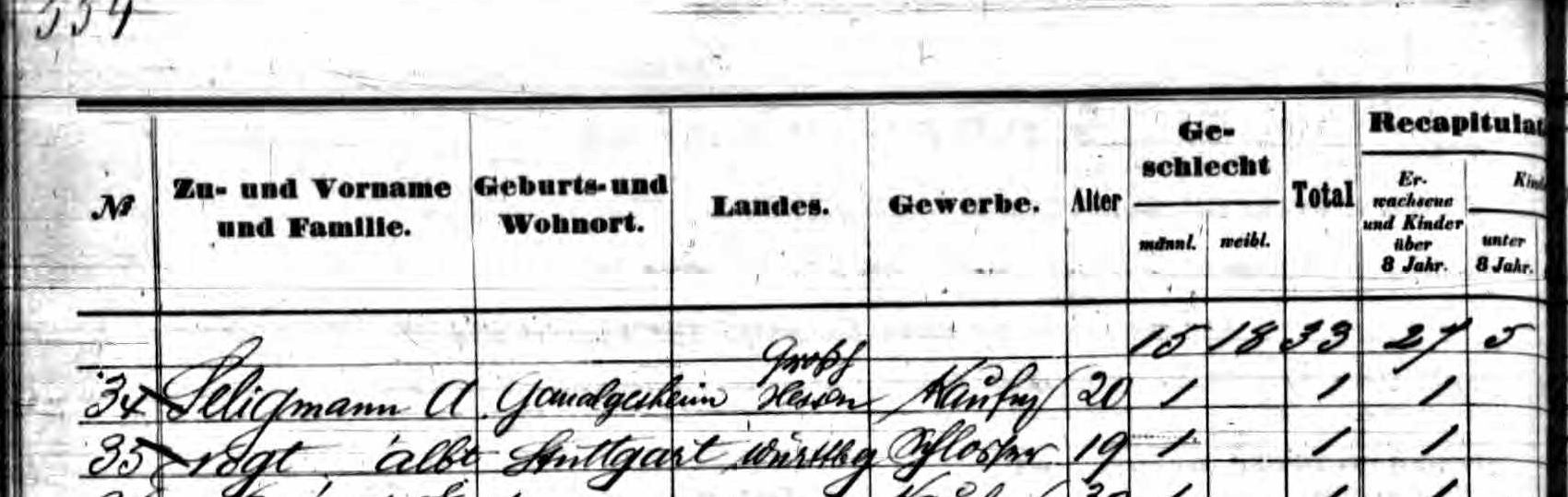
Adolph Seligman lines

Staatsarchiv Hamburg; Volume: 373-7 I, VIII A 1 Band 017; Seite: 545 Description Month : Direkt Band 017 (10 Jan 1863 – 26 Dez 1863) The Germania, Departure from Hamburg to New York on August 22, 1863

New York, Passenger Lists, 1820-1891," index and images, FamilySearch (https://familysearch.org/pal:/MM9.3.1/TH-1-16955-70464-13?cc=1849782 : accessed 09 Oct 2014), 233 - 3 Sep 1863-3 Oct 1863 > image 63 of 409; citing National Archives, Washington D.C.

New York, Passenger Lists, 1820-1891,” index and images, FamilySearch (https://familysearch.org/pal:/MM9.3.1/TH-1-16955-70464-13?cc=1849782 : accessed 09 Oct 2014), 233 – 3 Sep 1863-3 Oct 1863 > image 63 of 409; citing National Archives, Washington D.C.  Arrival September 7, 1863

This was apparently the maiden voyage for this ship.  To see a photo of the ship and more about it, click here.

Although Adolph landed in New York City, he was definitely in New Mexico by 1868 because he appears on the IRS tax assessment records there for that year, residing in Elizabethtown.  On the 1870 census he appears as a dry goods merchant living in Colfax, New Mexico.

By 1873, he was residing in Santa Fe, and he is listed with his brother Sigmund and with Julius Nusbaum, Bernard’s brother-in-law, as one of the principals in Seligman Brothers and Company on the 1873 IRS tax assessment list. (As discussed here, Bernard withdrew from the business in 1873, and Adolph and Julius took his place as owners of the company.)

Adolph 1873 tax assessment

1873 IRS Tax Assessment for Adolph Seligman The National Archives and Records Administration; Washington, D.C.; Internal Revenue Assessment Lists for the Territory of New Mexico, 1862-1870, 1872-1874; Series: M782; Roll: 1; Description: Monthly and Special Lists; 1869-1874; Record Group: 58, Records of the Internal Revenue Service, 1791 – 2006.

On the 1880 US census, Adolph was living with Bernard and his family in Santa Fe; both Bernard and Adolph listed their occupation as general merchants.  (In addition to Adolph, Bernard also was providing a home for his father-in-law John Nusbaum, my three-times great-grandfather, and Simon Nusbaum, his brother-in-law, that year.)

Seligman and Nusbaums on 1880 US census santa fe

1880 Census for Bernard Seligman and household Year: 1880; Census Place: Santa Fe, Santa Fe, New Mexico; Roll: 804; Family History Film: 1254804; Page: 27A; Enumeration District: 040; Image: 0056.

Adolph was still living with Bernard and his family (and Simon Nusbaum) in 1885.  On April 6, 1886, Adolph was appointed postmaster for Santa Fe and continued in that position until at least July, 1889.

In 1890, Adolph was elected president and his nephew Arthur Seligman and two other men were elected officers of a corporation organized for a mining venture.  According to an article dated April 26, 1890, in the Santa Fe Sun, the mine, called the Chester mine, was “a fine mine and its development will disclose ore of startling richness.  The last fifty-six sacks of ore taken from this mine yielded the owners $1,700 per ton in Denver.  The gentlemen engaged in this enterprise are all energetic men of business and well deserve the success that is sure to follow their work.”

Santa Fe Sun, April 26, 1890

Santa Fe Sun, April 26, 1890

It seems that Adolph must have struggled with some health issues during the late 1890s as I found two news articles, one dated 1900 after a trip to Europe and one dated 1898 after a trip to Santa Rosalia Hot Springs, Chihuahua, both mentioning how his health was improved after these vacations.

adolf 1894 europe trip

Date: Saturday, November 10, 1900 Paper: New Mexican (Santa Fe, NM) Volume: 37 Issue: 226 Page: 4
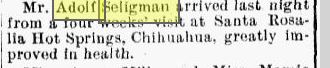
Adolf 1898 trip health july 11 1898 SF NM p 4


(The 1900 trip may explain why I cannot find Adolph on the 1900 US census.)

Adolph then went through some transitions at the Seligman’s family business. The Santa Fe New Mexican of January 21, 1903, announced that Adolph had withdrawn from the business as of December 31, 1902, and that a new corporation had been formed under the name Seligman Brothers Company with Frances, James, and Arthur Seligman as stockholders.  James was to be the president and general manager and Arthur the secretary and treasurer of the newly formed corporation.  Bernard was described as the senior member of the company, representing its business as a buyer in the east (as by that time Bernard and Frances were living in Philadelphia, as discussed here).

So what happened to Adolph?  Had he been pushed out, or he had retired for health reasons? Was there a rift in the family or just an independent decision to leave?  I don’t know.  In the 1903 New Mexico city directory, Adolph is listed as a saloon owner in Santa Fe.  An ad in the May 2, 1904 Santa Fe New Mexican reveals that at that time, Adolph was back in the dry goods business, selling men’s, women’s, and children’s shoes.

May 2, 1904 Santa Fe New Mexican

May 2, 1904 Santa Fe New Mexican


In fact, during the next decade or more, Adolph appears to have been in competition with his brother’s company, as seen in this ad from the Santa Fe New Mexican in 1911. Notice that the clipping has an ad for Seligman Brothers on the left side and one for Adolph Seligman Dry Goods on the right side.

1911 aselnmexoct12.1911.jpg

October 2, 1911 Santa Fe New Mexican


Meanwhile, Adolph’s personal life had also changed around the same time as these changes in his work life.  Adolph was single until 1902, and then when he was about sixty years old, he married Lucille Gorman, who was only nineteen years old at the time. Did this change in his personal life have anything to do with his withdrawal from Seligman Brothers?  I do not know.

Adolph and Lucille had a daughter Minnie in 1903, the year after they married, and then had five more children:  Jacob and Adolph, Jr. (1909),[1] William (1911), Gladys (1915), and Mildred (1919).

On the 1920 census when he was reported to be 76 years old, Adolph reported no occupation; Lucille was working as a seamstress.

Adolph Seligman and family 1920 US census

Adolph Seligman and family 1920 US census Year: 1920; Census Place: Santa Fe, Santa Fe, New Mexico; Roll: T625_1080; Page: 11B; Enumeration District: 129; Image: 123

Adolph died soon after this census was taken.  He died on February 12, 1920, from locomotor ataxia.  He was about 76 years old, although his death certificate reported his birth date to be September 29, 1840, and his age to be 79.

adolph Seligman death cert

New Mexico, Deaths, 1889-1945,” index, FamilySearch (https://familysearch.org/pal:/MM9.1.1/FLTH-K9Y : accessed 06 Sep 2014), Adolf Seligman, 12 Feb 1920; citing Santa Fe, Santa Fe, New Mexico, reference Item 3, Bureau of Vital Records and Health Statistic

I am not sure whether this birthdate is accurate, given the ages on all the other records, and also given that the death certificate said his birthplace was Cologne, Germany, which is inconsistent with earlier records placing his birth in the Hesse-Darmstadt region just like his brothers Sigmund and Bernard. The ship manifest for his trip from Hamburg in 1863 also said that he was from Gau-Algesheim.

Lucille was left with six children ranging in ages from a year old to seventeen years old, and she herself was only 37 when Adolph died.  In 1930 she was listed as a widow on the census with no occupation, but her three oldest children were employed, Minnie as a salesperson, Adolph, Jr., as a tailor, and Jake as an electrician.  All six children were still living with her, now ages eleven to 27 (although Minnie’s age was listed as 23 on the census).  Sometime after the census was taken but during 1930, Lucille remarried.  She is listed as Lucille, wife of Frank C. Daniels, in the 1930 Santa Fe city directory.

Adolph, Jr., died the following year on June 13, 1931; he was only 22 years old.  I was not able to access a death certificate to determine his cause of death.  Lucille died a year after her son on November 10, 1932, under the name Lucille S. Daniels.  She was 40 years old.  I don’t know her cause of death either.

Her widower Frank Daniels, who had married Lucille just two years earlier, took on the responsibility for her three daughters and her son William, all of whom were still living with him as late as 1940, some using the surname Daniels. Frank was working as a carpenter for a building supply company.  Minnie was now 37 (35 on the census) and working as bookkeeper for a building supply company; William, 28, was also working as a bookkeeper for a building supply company.  (I assume that Frank, Minnie, and William were all working for the same company.) Gladys was 24 and working as a cashier for the power company.  Mildred was 21 and had no occupation listed.

Jake, who had been living with his siblings and stepfather Frank in 1932 according to the Santa Fe city directory of that year, married Adela Roybal sometime soon thereafter.  He continued to work as an electrician.  He and Adela had one child. Two of Adolph’s children never married or had children, Minnie and Gladys.  William married Mae Leeper, and they had four children.  William served as a city councilman in Santa Fe.  Mildred married David Roberson and had one child.  Many of Adolph and Lucille’s descendants continue to live in Santa Fe.

There are many unanswered questions about Adolph and his life after 1902.  Like his brothers Sigmund and Bernard, he was a risk-taker and a pioneer, both following in his older brothers’ footsteps and also finding his own path.

——————–

[1] Although several records indicate that both Jacob and Adolph, Jr., were born in 1909, neither appears on the 1910 census, and on the 1920 census, Adolph was reported to be eleven whereas Jake was said to be only ten.  The 1930 census has Adolph as 21 (meaning a birth year of 1909), but has Jacob’s age as 18, meaning a birth year of 1912.  Adolph’s headstone has a birth year of 1909.  Jacob’s obituary states that he was born on September 9, 1909, as does his entry in the SSDI.  I will have to request a search from the New Mexico Bureau of Vital Records to determine the exact birth dates, which will take as much as 12 weeks to process.

Sigmund Seligman: “A Beloved Friend to Humanity and an Uncompromising Lover of His Country”

"La Ciudad de Santa Fe." Engraving f...

“La Ciudad de Santa Fe.” Engraving from “Report of Lt. J. W. Abert of his Examination of New Mexico in the Years 1846-1847.” (Photo credit: Wikipedia)


My great-great-uncle Sigmund Seligman must have been an impressive human being.  Born in 1830, he came by himself to the US from a small town in Germany before he was even twenty years old.  Although I have no records of his arrival or where he might have settled first (although other facts suggest he first settled in Philadelphia), historical sources report that by 1849 he had settled in Santa Fe, first working as a photographer there and then joining up with Charles Clever to start the trading business that became Seligman and Clever and eventually Seligman Brothers, a business that flourished and eventually supported not only Sigmund, but also his two brothers, Bernard and Adolph, and their families.


By 1857, he had applied for US citizenship in Philadelphia, and by 1860 he reported on the US census that he had $20,000 worth of personal property and the same in 1870.  According to two different websites I found for converting 1860 dollars to today’s money, that amount would be the equivalent of over $400,000 today.  Not too bad for a thirty year old entrepreneur.

I found a number of interesting news articles about Sigmund, including one dated June 6, 1871, that announced Sigmund’s return to Santa Fe after being away for a year “in the states and Germany.”  I would love to know what took Sigmund back to Germany in 1870-1871.  There must have still been family members there, but I have no idea who he might have been visiting.  Maybe he was looking for a wife—as Parish had said, many men traveled back east or to Germany to find a Jewish woman to marry.  If that was the purpose of Sigmund’s travels, he seems not to have been successful as he never married.

Sigmund Welcome Home 1871-page-001

Santa Fe Daily New Mexican June 6, 1871, p.1


I assume that his travels in the states included Philadelphia, where his brother Bernard and his family were living during at least some part of that time.  Perhaps Bernard was traveling back and forth, as I suggested in an earlier post, to keep an eye on the business while Sigmund was away. Sigmund had applied for a US passport on April 26, 1870, in Philadelphia, presumably for this trip.  Written across the letter are the words “Nat Dis Court Santa Fe, New Mexico, December 15, 1856. Paid.”   I don’t know what the December 15, 1856 date refers to, but I assume that Sigmund applied for this passport in order to take his trip back to Germany.  He also had become a US citizen on April 26, 1870, also in Philadelphia, signed by the same notary who wrote in support of his passport application.

Sigmund Seligman passport application

Sigmund Seligman passport application 1870 National Archives and Records Administration (NARA); Washington D.C.; Passport Applications, 1795-1905; Collection Number: ARC Identifier 566612 / MLR Number A1 508; NARA Series: M1372; Roll #: 165.

Sigismund Seligman naturalization affidavit

National Archives and Records Administration (NARA); Washington D.C.; Passport Applications, 1795-1905; Collection Number: ARC Identifier 566612 / MLR Number A1 508; NARA Series: M1372; Roll #: 165.


A year is a long time to leave a thriving business, and Sigmund reportedly received a “hearty welcome from his numerous friends” when he returned.  (Santa Fe Daily New Mexican (Santa Fe, NM), June 6, 1871, p. 1)  Sigmund was apparently quite well liked.  In an editorial dated May 21, 1875, the Santa Fe New Mexican singled out Sigmund for his generosity and civic-mindedness based on his support of a project to provide sprinklers for the streets of Santa Fe to control the dust that tended to develop there on what I assume were dirt roads.

Sigmund praised for sprinklers-page-001

(Santa Fe New Mexican, May 21, 1875, p. 1)

Unfortunately, Sigmund’s life was cut short when he was only 46 years old on October 4, 1876.  He died at Fort Craig, New Mexico, a site that is 181 miles from Santa Fe, so quite a distance; it was a US Army fort, the largest in the Southwest.  As his obituary described it, he was in a “far off portion of the Territory.”


English: Former officers' quarters, Fort Craig...

English: Former officers’ quarters, Fort Craig, New Mexico, USA (Photo credit: Wikipedia)


He died of apoplexy, according to one death record, and his obituary indicated that he died “from a sudden and resistless stroke of disease.”  According to MedlinePlus, “When the word apoplexy (with no organ specified) is used alone, it often refers to stroke symptoms that occur suddenly. Such symptoms can be caused by bleeding into the brain or by a blood clot in a brain blood vessel. Conditions such as subarachnoid hemorrhage or stroke are sometimes called apoplexy.”  http://www.nlm.nih.gov/medlineplus/ency/article/000328.htm

The public reaction to his death was described in expressive terms in Sigmund’s obituary in the Santa Fe New Mexican dated October 10, 1876.  The paper reported, “At no time in the history of our citizens has there been a more spontaneous outpouring of the people to show a becoming respect to the memory of a departed fellow-citizen and friend.”  A Jewish “burial service” was read by Lehman Spiegelberg, another Santa Fe merchant, and Sigmund was buried at Odd Fellows cemetery in Santa Fe on October 9, 1876. A eulogy was given by Edmund F. Dunne, “portraying in most affecting, generous and glowing terms the many virtues and excellent qualities of the deceased as a brother, friend, citizen and correct man of business.” The paper described him as “a beloved friend to humanity and an uncompromising lover of his country, her institutions and laws.”

sigmund obit full page from voces

Obituary of Sigmund Seligman 1876 Daily New Mexican page one Personal collection of Arthur Scott http://www.vocesdesantafe.org/index.php/explore-our-history/historical-documents2/item/301-the-daily-new-mexican-ocotober-10-1876


There was only one thing that puzzled me about this obituary.  It does not mention Bernard or his family at all.  In fact, the paper describes Adolph as “the surviving brother” as if there was no other.    Since Arthur Seligman, Bernard’s son was born in Santa Fe in 1871 and since Bernard appears as living there on both the 1870 and 1880 US census reports as well as serving on the Board of Trustees of the Santa Fe Academy in 1878, I would have assumed that Bernard would have been in Santa Fe in 1876.


Although Sigmund was initially buried in Santa Fe, his body was moved to Philadelphia in April, 1877, six months after his death, where he was buried at Mt Sinai cemetery, the same cemetery where his brother Bernard would later be buried as well as other members of Bernard’s family.  Putting this information together with Bernard’s absence from Sigmund’s funeral makes me wonder whether Bernard had in fact moved back to Philadelphia between 1876 and 1877 and decided to have his brother buried in a proper Jewish cemetery rather than in Santa Fe’s Odd Fellows cemetery.

Sigmund Seligman death record, Philadelphia

Sigmund Seligman death record, Philadelphia “Pennsylvania, Philadelphia City Death Certificates, 1803-1915,” index and images, FamilySearch (https://familysearch.org/pal:/MM9.3.1/TH-266-11110-64044-12?cc=1320976 : accessed 29 Sep 2014), 004000970 > image 141 of 448; citing Department of Records.


I am sorry that I do not have any photographs of Sigmund.  He must have been an interesting man—adventurous, courageous, generous, respected, and well-liked by his fellow Santa Fe citizens.  His life may have been short, but by going to Santa Fe, he not only made a good life for himself, he helped out his community, and he provided a good foundation for his two younger brothers and their families.


Jews on the Santa Fe Trail 1848-1871:  My Great-Great-Grandfather Bernard Seligman and his Brothers


Sign for Santa Fe National Historic Trail.

Sign for Santa Fe National Historic Trail. (Photo credit: Wikipedia)


My great-great-grandfather Bernard Seligman was born on November 23, 1837 in Gau-Algesheim, Germany.  When I learned about the small town in Germany where my great-great-grandfather Bernard Seligman was born, I was not surprised that he had decided to move away when he reached adulthood.  Gau-Algesheim was itself a very small town, and the Jewish population was tiny—perhaps 60-80 people during the 1840s and 1850s when Bernard was growing up.  The opportunities for a young Jewish man must have been very limited—socially and economically.  My research of the town indicated that by 1900 the Jewish population had declined dramatically.  My great-great-grandfather and his brothers were therefore not unlike many others who moved out of their small hometown to seek greater opportunities.

Before leaving Germany, Bernard received what was described as a “first class education in the public and commercial schools of his native land where he also gained considerable actual business experience while employed a wholesale establishment there.”[1]  According to a book written in 1925 by Ralph Emerson Twitchell, then the official state historian for New Mexico, Bernard Seligman had been associated with the Rothschild banking house in Frankfort-on-the-Main before coming to the US.[2]

Bernard was not the first of the Seligman brothers to arrive in the United States. His older brother Sigismund or Sigmund, born in 1830 in Gau-Algesheim, had arrived in Santa Fe in 1849.  At first, Sigmund found work as a photographer, running a daguerreotype portrait studio for a few years.[3]  But within a few years he and another recent German immigrant named Charles Clever “formed a business partnership … under the firm name and style of Seligman and Clever, engaging in general merchandizing and freighting over the old [Santa Fe] Trail.”[4]

This photo is claimed to be the oldest photograph of Santa Fe, taken about 1855.  You can see the sign for Seligman and Clever on the right.  At one time one of the streets in this photograph was called Seligman Street.


Sigmund’s younger brother Bernard, my great-great-grandfather, arrived in the United States on March 23, 1857, coming aboard the ship Mercury and landing in New York.  On the record for the passenger manifest it says that his occupation was a merchant.[5] Twitchell wrote that Bernard initially settled near Philadelphia and worked for a cotton manufacturing business.[6]  He is said to have arrived in Santa Fe in 1858, taking a position in his brother Sigmund’s business, according to Bernard’s obituary. [7]

When Sigmund’s partner Charles Clever resigned from the business a few years later to become a lawyer, Bernard became a partner with his brother Sigmund in the business, and it was renamed S. Seligman and Bro.  Some years later a third brother, Adolph, born in 1845, also settled in Santa Fe and joined his brothers’ business in the 1860s.[8]

As described by William J. Parish in “The German Jew and the Commercial Revolution in Territorial New Mexico 1850-1900,” New Mexico Historical Review, Vol. 35, p. 1 (1960), until the arrival of Jewish German immigrants like the Seligmans, the trade conditions in the New Mexico territory were quite rudimentary, a few small stands relying upon traveling merchants to provide them with merchandise.  According to Parish, heavy taxes and the high cost and risk of travel made many reluctant to deal in the region.  Storekeepers could not rely on these traveling merchants to supply an adequate inventory of goods.  Thus, few merchants established permanent roots in the area.

English: "Arrival of the caravan at Santa...

English: “Arrival of the caravan at Santa Fe” — Copy of original lithograph ca. 1844 (Photo credit: Wikipedia)

These conditions provided a substantial opportunity for Jewish German immigrants like my ancestors, the Seligmans. Beginning in the 1840s around the time that Sigmund immigrated, there were a number of recent Jewish German immigrants who brought a thriving economic base to Santa Fe and other New Mexican cities based on transporting goods from the eastern United States over the Santa Fe trail to the New Mexican territory recently acquired by the US after the Mexican War ended.[9]

As postulated by Parish, German Jews came to the US with a particularly good background to take advantage of these entrepreneurial opportunities.  Parish discusses how historically Jews in Western Europe, although foreclosed from entering many trades, had been allowed to take on the role of the moneylender, a livelihood to which Christians had an aversion and, in some cases, a religious opposition, thus leaving that unpopular job for their Jewish neighbors.  Although this created some hostility and resentment (as seen, of course, in The Merchant of Venice and the character of Shylock), it also provided Jewish men with the opportunity to develop skills in banking, business, and capitalism.  Jewish immigrants brought these skills with them to the US wherever they settled, and, as Parish points out, those who came to New Mexico had a profound impact on the fledgling economy that existed there.

This is a photograph of my great-great-grandfather Bernard Seligman (far left) with two other Santa Fe merchants,  Zadoc Staab and Lehman Spiegelberg,  and  two Kiowa Indian scouts.

Bernard Seligman and other merchants

Freighters on the Santa Fe Trail, Bernard Seligman, Zadoc Staab, Lehman Spiegelberg and Kiowa Indian scouts Palace of the Governors Photo Archives, New Mexico History Museum, Santa Fe


The growth of the economy is illustrated by the growth in the number of Jewish merchants in Santa Fe from 1850 to 1870.  In 1850 there were eight such merchants; by 1860 that number had doubled to sixteen.[10]  By 1870 it had doubled again to 32; clearly, my relatives had arrived at the right place at the right time.[11]  These merchants were not transient traveling merchants.  They established permanent businesses and stayed in the community.

Twitchell provided this vivid description of the scale of the Seligman brothers’ business:

“A Fair exemplar of the magnitude of the business of this firm is recorded in the fact that one caravan, conducted by firm, loaded at the Missouri river eighty-three wagons of merchandise consigned to the firm at Santa Fé, each wagon carrying not less than three tons of high class freight.  Another record in the books of the firm shows the payment of $30,000 in transportation charges on one caravan alone, all of the merchandise having been disposed of to New Mexican buyers within the brief period of three weeks after arrival in Santa Fé[. N]early three quarters of a century disclose an aggregate of more than fifteen millions of dollars.”[12]


Thus, by the 1860s, the Seligman Brothers’ business was thriving.  They and the other Jewish merchants had brought a reliable source of goods to Santa Fe for the first time.

These merchants, however, were not involved in any of the traditional practices of Jewish life.  According to Henry J. Tobias, the author of The History of the Jews in New Mexico, although these men identified as Jews, there was no evidence of any regular Jewish observance in Santa Fe during those early days—no evidence of a synagogue or any form community prayer or celebration, no observance of dietary laws.[13]  The Jewish population was less than five percent of one percent of the overall population at that time, and the Jews had to adapt to living in a culture where they were such a tiny segment of the community.

Most of the Jewish residents in the 1860s were single men, although a few women and families were starting to arrive.  In 1860 there was a celebration of Yom Kippur at the home of Levi Spiegelberg, another Jewish merchant, who had recently married a Jewish woman from Germany.  Tobias speculated that perhaps the arrival of Spiegelberg’s bride, one of only two Jewish women in the town at that time, made the others nostalgic for the traditions from back home and thus inspired this day long observance of fasting and prayer.[14]

After the Civil War[15] and after his younger brother Adolph had arrived in Santa Fe, Bernard moved back east to Philadelphia for several years.  Parish pointed out that there were no Jewish single women in Santa Fe in the 1850s and 1860s, and that while some Jewish men intermarried, most went back east to find a Jewish woman to marry.[16]  Sigmund never married, and Adolph did not marry until he was in his 60s, but Bernard went back east and found a Jewish woman from Pennsylvania, my great-great-grandmother Frances Nusbaum.  She was born in Harrisburg, Pennsylvania, in 1845, but by 1860 she and her family had moved to Philadelphia.  Bernard and Frances married on March 28, 1865, and my great-grandmother Eva (named Evalynn at birth) was born the following year on May 27, 1866 in Philadelphia.  According to the Philadelphia city directories for 1867, Bernard was in business with his Nusbaum in-laws at that time.

On August 17, 1867, Bernard and Frances had a second daughter, Florence; the baby only lived five weeks and died on September 26, 1867.  She was buried at Mt. Sinai cemetery in Philadelphia, along with many of the Nusbaum family members (and also many of my Cohen relatives).  A third child, James Leon Seligman, was born on August 11, 1868, and then another daughter, Minnie, was born on October 31, 1869.  All of these children were born in Philadelphia, and Bernard, Frances and the three surviving children are all listed in the 1870 census as living in Philadelphia in the 13th Ward. Bernard is also listed in 1871 in the Philadelphia directory.

Bernard, however, must have been traveling back and forth between Santa Fe and Philadelphia because he is also listed in Santa Fe on the 1870 census, living with his brother Sigmund and two clerks.  Bernard is listed as owning $25,000 worth of real estate and $20,000 in personal property. (Strangely, Sigmund only claimed $20,000 in personal property and no real estate, despite being the founder of the store and the full time resident.)

At some point, however, in 1871, Bernard and Frances and their children relocated to Santa Fe, and their last child, Arthur Seligman, was born on June 14, 1871, in Santa Fe, the first family member to be born in that city.  According to Twitchell, Frances Nusbaum Seligman was one of only eight women living in Santa Fe at that time who did not come from a Spanish background.  Twitchell described my great-great-grandmother as “a woman of rare beauty, great intelligence and charming personality.”[17]  Although I will write about the Nusbaum family at a later time, for now I can say that they were a large and successful Philadelphia family with a German Jewish background; it must have been very difficult for Frances to leave her family behind and move all the way to Santa Fe, a frontier town far different from Philadelphia.

My great-grandmother Eva was only five years old when she made that cross-country trip with her parents and her siblings, leaving Philadelphia temporarily behind. She lived there for ten years, and when she was fifteen years old, she returned to Philadelphia for college and married my great-grandfather Emanuel Cohen when she was twenty.  She lived in Philadelphia for the rest of her life.  But most of the Seligman family developed and maintained deep roots in Santa Fe, ties that still exist today for many of their descendants.


In my posts to follow, I will first write about the years that my great-grandmother lived in Santa Fe, 1871-1881, and about her family.  Then I will write about the years that followed, including the story of my great-great-uncle Arthur Seligman and his career as a political leader and ultimately governor of New Mexico.


Santa Fe Trail around 1845 plus connecting tra...

Santa Fe Trail around 1845 plus connecting trading routes to commercial hubs and ports in the USA (Photo credit: Wikipedia)


[1] “A Good and True Man Called Home,” Santa Fe New Mexican, February 3, 1903.


[2] Ralph Emerson Twitchell, Old Santa Fe: The Story of New Mexico’s Ancient Capital (The Rio Grande Press 1925), pp 476-478.  I found a few errors in Twitchell’s account of Bernard Seligman, including the birth year of his brother Sigmund and the birth places of his first three children.  I cannot independently verify some of his other assertions, unfortunately, but report them here as they were reported in Twitchell’s book.


[3] Arthur Scott, “My Grandfather’s Birthplace on the Santa Fe Plaza,” found at http://www.vocesdesantafe.org/index.php/explore-our-history/santa-fe/item/1090-my-grandfathers-birthplace-on-the-santa-fe-plaza

[4] Twitchell, p. 477.  It is important to note that there was an entirely separate Seligman family that settled in Bernalillo, New Mexico around the same time that my Seligman ancestors were settling in Santa Fe.  As far as I can tell, there is no familial relationship between the two families and the “other” Seligmans came from a different region in Germany, but one never knows.  Henry Tobias and Sarah Payne, “Jewish Pioneers of New Mexico: The Seligman Family” (The New Mexico Jewish Historical Society, 2005).


[5] United States Germans to America Index, 1850-1897,” index, FamilySearch (https://familysearch.org/pal:/MM9.1.1/KDWS-R3N : accessed 20 Sep 2014), Bernhard Seligmann, 23 Mar 1857; citing Germans to America Passenger Data file, 1850-1897, ARC identifier 1746067; Ship Mercury, departed from Havre, arrived in New York, New York, New York, United States, National Archives and Records Administration, Washington D.C.)


[6] Twitchell, p. 477.  Bernard’s obituary claimed that he had come to Santa Fe directly after immigrating, but it makes sense that he would have spent some time in the east since he arrived in NY in 1857 and is said to have arrived in Santa Fe in 1858.  Also, perhaps it was that initial stay in Philadelphia that caused him to return to Philadelphia some years later and to meet and marry my great-great-grandmother.


[7] “A Good and True Man Called Home,” Santa Fe New Mexican, February 3, 1903.


[8] Arthur Scott, “Seligman Brothers—Pioneer Jewish Entrepreneurs of Santa Fe and the New Mexico Territory,” http://www.newmexicohistory.org/people/seligman-brothers-pioneer-jewish-entrepreneurs-of-santa-fe-and-the-new-mexi


[9] Parish; also,  Gunther Paul Barth, Instant Cities: Urbanization and the Rise of San Francisco and Denver


(Oxford University Press, 1975), pp. 71-73.


[10] Parish, p. 15.  See also Henry J. Tobias, A History of the Jews of New Mexico (Univ. N. Mex. Press. 1990), p. 40-41.


[11] Parish, p. 15


[12] Twitchell, p.477.


[13] Tobias, pp. 43-44.


[14] Tobias, pp. 42-43.


[15]  During the Civil War, Bernard served as a captain and quarter master for the Union Army.   Arthur Scott, “Seligman Brothers—Pioneer Jewish Entrepreneurs of Santa Fe and the New Mexican Territory,” at http://www.newmexicohistory.org/people/seligman-brothers-pioneer-jewish-entrepreneurs-of-santa-fe-and-the-new-mexi   See also Tobias, p. 54.


[16] Parish, p. 23, 129.


[17] Twitchell, p. 477.


Gau-Algesheim and the Seligmans: My Great-great-grandfather’s Birthplace and What I Learned

Coat of arms of Gau-Algesheim

Coat of arms of Gau-Algesheim (Photo credit: Wikipedia)

From several documents and historical references, I know that Bernard Seligman, my great-great-grandfather, and his brothers Adolph and Sigmund were born in a small town close to the Rhine River called Gau-Algesheim in what was then the Hesse Darmstadt region of Germany. Today it is located in the Mainz-Bingen district in the Rheinland-Pfalz state in Germany.   Gau-Algesheim is about 15 miles southwest of Mainz and 40 miles southwest of Frankfort, Germany.  Its population in 2012 was under seven thousand people, and it is less than five miles square in area.[1]   From the photographs posted on the town’s official website, it appears to be a very charming and scenic location.  There are wineries nearby, and tourism appears to be an important source of revenue for the town.[2]


What was Gau-Algesheim like almost 200 years ago when my ancestors were living there?  How long had my Seligman ancestors been there, and were there any family members who remained behind after Bernard and his brothers left? How long had there been Jews living in Gau-Algesheim, and are there any left today? These were the questions that interested me the most about my great-great-grandfather’s birthplace.

There is a book about the history of Jews in Gau-Algesheim written by Ludwig Hellriegel in 1986, Die Geschichte der Gau-Algesheimer Juden, but unfortunately there is no copy available online, and the closest hard copy is in the New York Public Library.  I tried to borrow it through my university’s interlibrary loan program, but was it was not available for lending.  Thus, I’ve had to piece together bits of information from Wikipedia, JewishGen.org, the Gau-Algesheim website, and http://www.alemannia-judaica.de to get some answers to my questions, relying on Google Translate in order to read the sources written in German.  What follows is a very brief skeletal history of Gau-Algesheim overall and in particular of the history of Jewish life there based on these limited secondary sources.

Gau-Algesheim has ancient roots.  There is evidence of graves dating back as far as 1800 BCE, and evidence of a settlement during Roman times as well.  In the 700s a church and a monastery were established.  Gau-Algesheim was part of the Holy Roman Empire in the Middle Ages, and during that time was under the control of various different officials and jurisdictions within the Empire and often the subject of disputes and battles for control.  See  http://en.wikipedia.org/wiki/Gau-Algesheim  http://www.gau-algesheim.de/category/stadt-gau-algesheim/geschichte/  It was part of Napoleon’s empire until 1812, and then eventually became part of the nation state of Germany in the mid-19th century.


Gau-Algesheim. Rathaus am Marktplatz.

Gau-Algesheim. Rathaus am Marktplatz. (Photo credit: Wikipedia)

Its Jewish history dates back to at least the 14th century.  By the 14th century, the town had developed into a commercial center.  Many merchants and artisans lived in the town, including herring merchants, blacksmiths, bakers, barbers, coopers, tailors, and shopkeepers.  The monasteries owned a lot of the land, and there was also a fairly large class of nobility.  By 1334, there must have been a Jewish community in Gau-Algesheim because in that year a head tax was imposed upon the Jewish residents.  According to Wikipedia, Jews were required to pay this additional tax because they were considered the property of the crown and under its protection.[3] There was also a Jewish cemetery in existence during the 14th century.  However, this community must have been a very small minority, and the Jews were certainly considered outsiders by the Catholic majority.  In 1348 there was a flu pandemic in the region, and Jews were accused of poisoning the water, such accusations then leading to pogroms across the region.

Gau-Algesheim. Langgasse.

Gau-Algesheim. Langgasse. (Photo credit: Wikipedia)

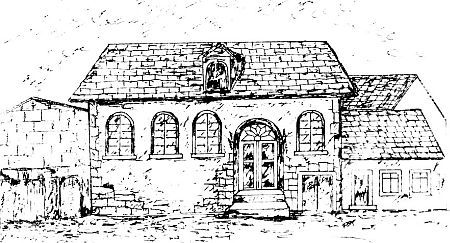
My sources do not reveal anything about Jewish life in Gau-Algesheim between 1400 and 1800, but the population in 1790 was reportedly only nineteen (it’s not clear whether this refers to people or households, but I assume it refers to total people).  In 1808 there were three Jewish families, and in 1819 only six Jewish families.  In 1857, the Jewish population was fifty people, and the Jewish population peaked in Gau-Algesheim in 1880 when it reached eighty people or 2.6% of the total population of the town, according to the alemannia-judaica website.  (JewishGen puts the 1880 population at only 66.[4])  According to alemannia-judaica, a synagogue is not mentioned as being in the town until 1838. It was described as very old and in poor condition in 1850 and was rebuilt in 1861 and renovated again in 1873-1874.  There was also a mikveh and a religious school, although it seems that there was a joint school with the nearby town of Bingen. (Bingen, by comparison, had 542 Jews in 1880, amounting to almost eight percent of its overall population; it was only six miles away from Gau-Algesheim. By further comparison, Mainz had a Jewish population of about 3,000 in 1900, and Frankfurt had almost 12,000 Jews in 1900.)[5]

The tiny size of the Jewish population in Gau-Algesheim in the 19th century in the years when my ancestors were living there surprised me.  How did my family end up there?  And why did they leave? I don’t know the answers to the first question at all and can only speculate about the second and will write more generally about it in a later post.   But what I want to focus on for now is what happened to the Jewish community in Gau-Algesheim after my great-great-grandfather Bernard and his brothers left in the middle of the 19th century.

It appears that my ancestors were not the only Jews to leave Gau-Algesheim.  By 1900, the Jewish population had declined to 27 people; in 1931 there were only 31 Jewish residents.  Presumably many of these Jews had immigrated to another country, and many may have moved to the larger cities in Germany.  In the Reichstag elections of 1933, the Nazi Party only received 26.6% of the vote in Gau-Algesheim with the Center Party carrying almost half the vote.  Unfortunately, that did not reflect the overall vote in Germany, and the Nazi Party took control of the country, soon dissolving the Reichstag and all other political parties, ultimately leading to World War II and the Holocaust.  Whatever Jews were left in Gau-Algesheim before World War II either left the town or were killed by the Nazis.

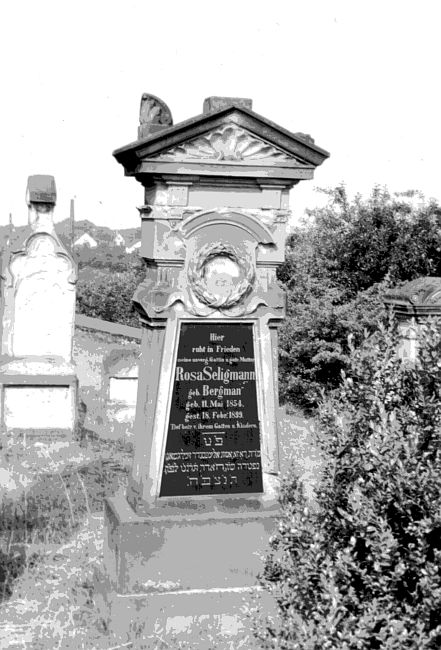
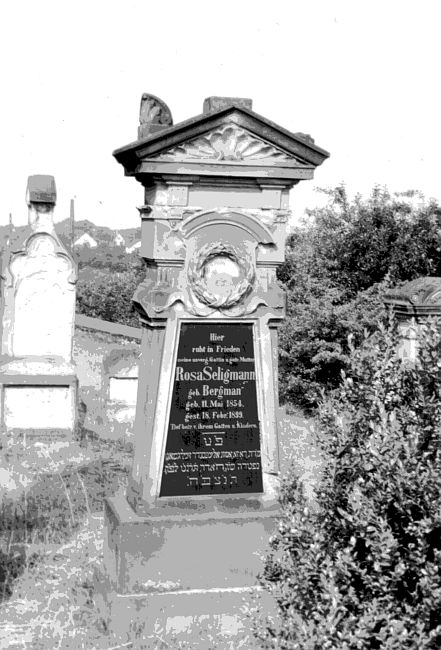
There is no Jewish community there today.  The Jewish cemetery remains, however, although it was desecrated during the Holocaust and has been vandalized several times since then.  In 2006, Walter Nathan, whose father was born in Gau-Algesheim, visited the cemetery and was so disturbed by the condition of the cemetery that he decided to work to have it restored and to create a memorial to those who were buried there and also to those who had been killed in the Holocaust.  On November 9, 2008, on the 70th anniversary of Kristallnacht, the memorial was dedicated by Nathan and many members of his extended family.[6]  Included in the headstones remaining in the cemetery was this one for a woman named Rosa Gebmann Seligmann who was born in 1853 and died in 1899 and married someone who was probably my relative.

With the help of two members of the Tracing the Tribe Facebook group, I can provide this translation of the German and the Hebrew on the headstone.  The German says, “Here rests in peace my unforgettable wife and good mother Rosa Seligman, nee Bergman, born May 11, 1854, died Feb.1 8, 1899. Deeply missed by her husband and children.  The Hebrew at the bottom says, “Here is buried Mrs. Roza wife of Alexander Seligman Died (on the) holy Shabbos 8(th day of) Adar 5659 by the small count. May her soul be bound in the bonds of life.”

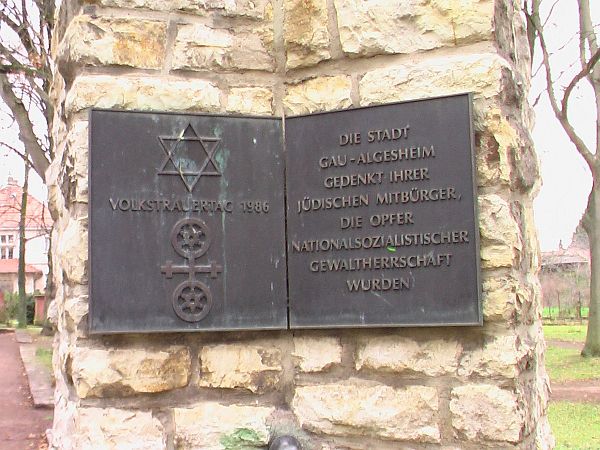
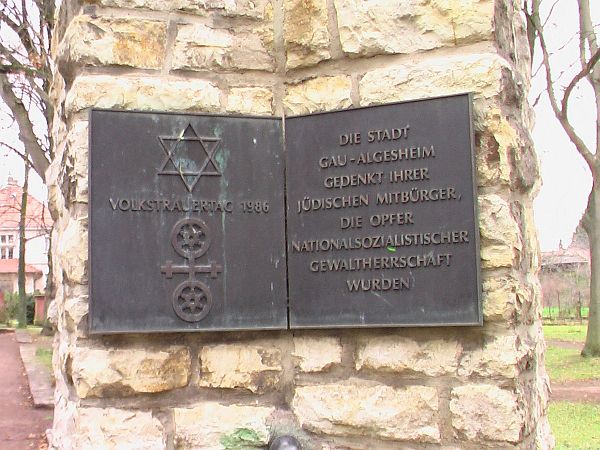
There is also a plaque in town commemorating the Jewish citizens of Gau-Algesheim who were killed by the Nazis. It says, as translated by Google Translate, “The city of Gau-Algesheim commemorates their Jewish fellow citizens who were victims of Nazi violence and domination.”


There is another plaque hanging on the wall of the cemetery listing the Jews born in Gau-Algesheim who were murdered during the Holocaust according to Memorial Book: Victims of the Persecution of Jews under the National Socialist Tyranny in Germany 1933 – 1945.  It says, “Standing in this sacred place our hearts turn to the memory of those who fell victim to the violence of the Nazis, and we vow to keep their memory alive. In solemn testimony of the unbroken faith that connects us with them, their names are referred to in profound awe. We say the Kaddish—the prayer for the dead— and remember the terrible tragedy of the Jewish people.”

Among the names listed on this second plaque were these individuals: Bettina Elisabeth Arnfeld born Seligmann (1875), Johanna Bielefeld born Seligmann (1881), Anna Goldmann born Seligmann (1889), and Moritz Seligmann (1881),.[7]

On the JewishGen.org site, I found two more Seligmanns born in Gau-Algesheim: Jacob Seligmann, born April 8, 1869, who became a resident of Neunkirche and emigrated in 1935 to Luxembourg, and Laura Seligmann Winter, born June 9, 1870, who was also a resident of Neunkirche and immigrated to Luxembourg in 1935. [8]

These may have been my relatives.  Given the small size of the Jewish community that lived in Gau-Algesheim, I have to assume that at least some if not all of those named Seligmann were related to my great-great-grandfather Bernard and were thus related to me.  When I saw those names, I was stunned.   Because I have not found where my Brotman relatives lived in Galicia, because I have not found any Goldschlagers from Iasi who were killed in the Holocaust, because my Cohen relatives left Europe long before Hitler was even born, I had not ever before seen the names of possible relatives who were victims of the Holocaust.  But Bettina, Johanna, Anna, Moritz, Jacob, and Laura Seligmann—they were likely the nieces and nephew or the cousins of Bernard, Sigmund, Adolph and James Seligman.  They were likely my family.

Now I need to see what I can learn about them and what happened to them.  I need to be sure that their names are not forgotten.  This is what I know so far from the Yad Vashem names database:

Bettina Elizabeth Seligmann Arnfeld, born March 17, 1875, was residing in Muelheim Ruhr, Dusseldorf, Rhine Province, and was deported to Theresienstadt on July 21, 1942, and she died there on January 23, 1943.


Johanna Seligmann Bielefeld, born March 13, 1881, was living in Mainz during the war.  She died in Auschwitz.


Anna Seligmann Goldmann, born November 30, 1889, was living in Halle der Saale, Merseburg, Saxony Province.  She was deported from there May 30, 1942.  Her husband Hugo Goldmann, born in 1885, and their daughter Ruth Sara, born in 1924, were also deported that same day.  They were all murdered.


Moritz Seligmann, born in 1881, was not listed in the Yad Vashem database.  On the memorial plaque placed at the cemetery in Gau-Algesheim the only notation after his name is Verschollen, which means “missing, lost without a trace,” according to one source.


Jacob Seligmann, despite escaping Germany in 1935 and moving to Luxemburg, did not escape the Nazis.  He was killed in 1941 in Luxemburg, according to the Yad Vashem website.

Laura Seligmann Winter, who may have been Jacob’s sister, was a widow; on August 28, 1940, she also was killed in Luxemburg.


I will continue to look for more records that will tell something about the lives of these people and their families so that they can be remembered not only for how they died but also for how they lived.


“Dachau never again” by Forrest R. Whitesides – Own work. Licensed under Creative Commons Attribution-Share Alike 3.0 via Wikimedia Commons – http://commons.wikimedia.org/wiki/File:Dachau_never_again.jpg#mediaviewer/File:Dachau_never_again.jpg


[1] See http://en.wikipedia.org/wiki/Gau-Algesheim


[2] See http://www.gau-algesheim.de/category/stadt-gau-algesheim/geschichte/


[3] See http://en.wikipedia.org/wiki/Leibzoll


[4] See http://data.jewishgen.org/wconnect/wc.dll?jg~jgsys~community~-1774383


[5] See http://fr.wikipedia.org/wiki/Synagogue_de_Bingen_am_Rhein_(1905-1938)


[6] See http://www.iit.edu/magazine/spring_2009/article_1.shtml#top


[8] [8] http://www.bundesarchiv.de/gedenkbuch/directory.html