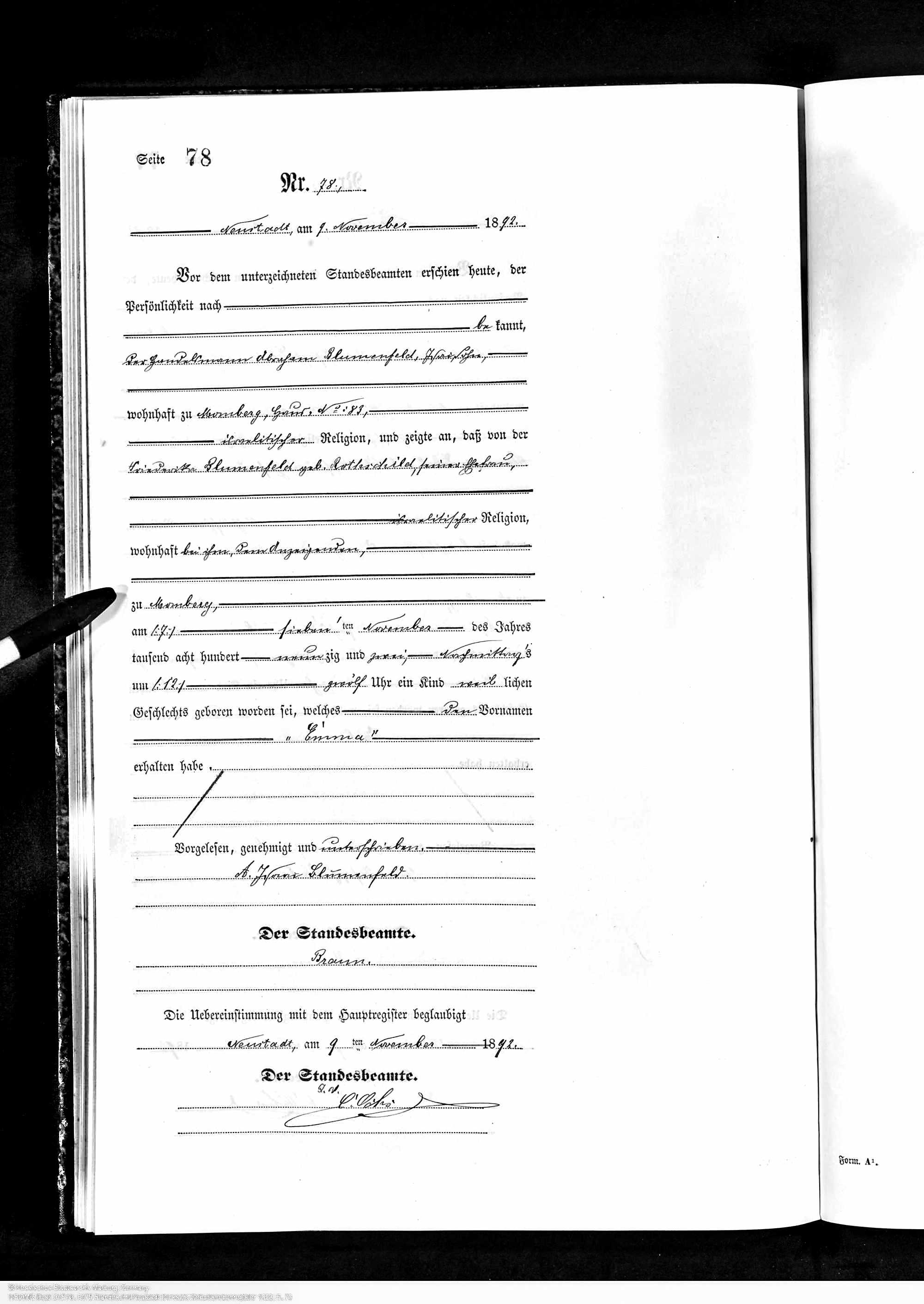
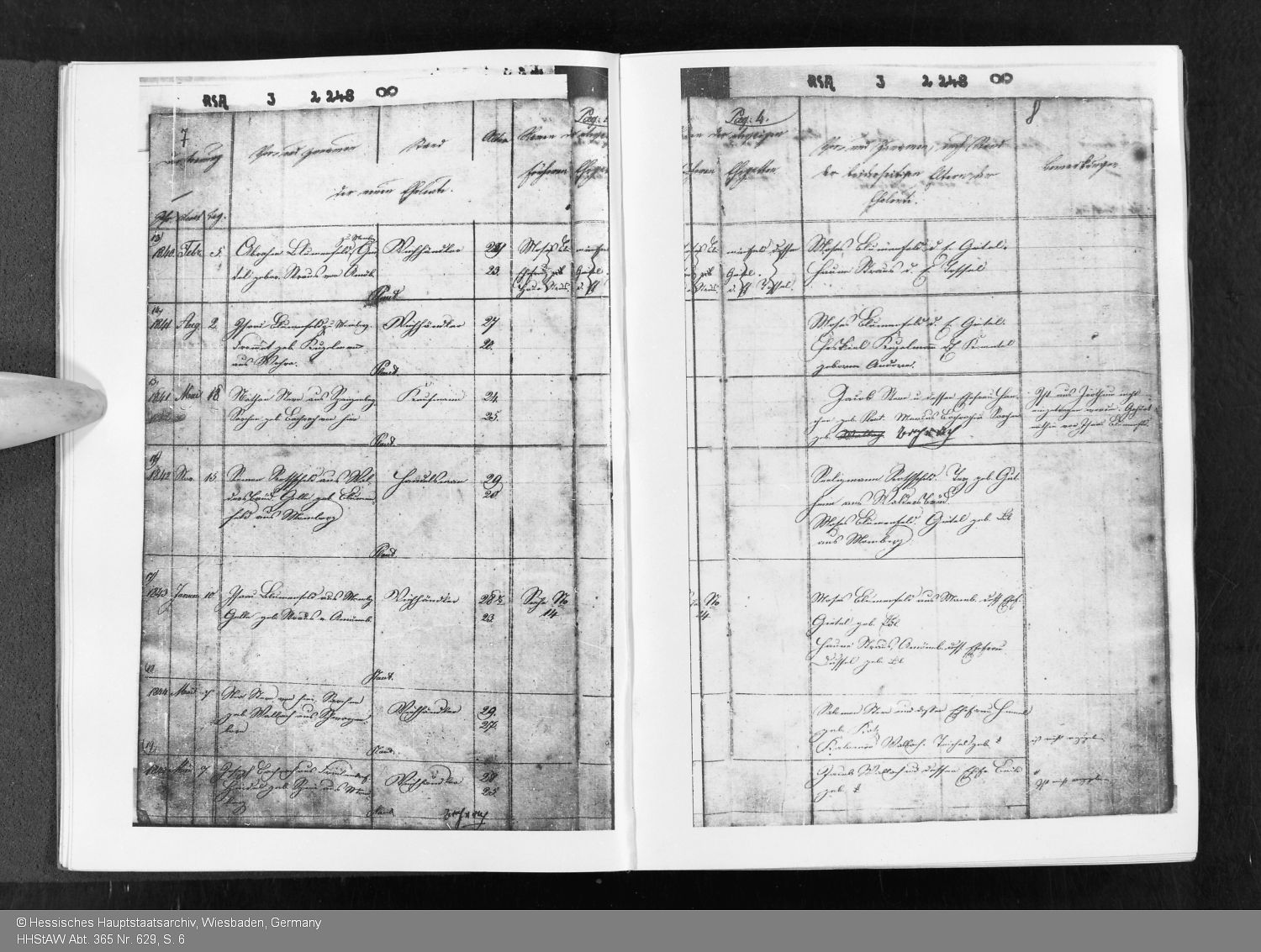
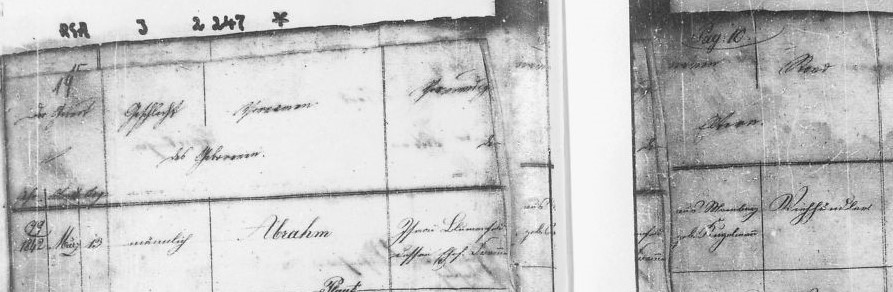
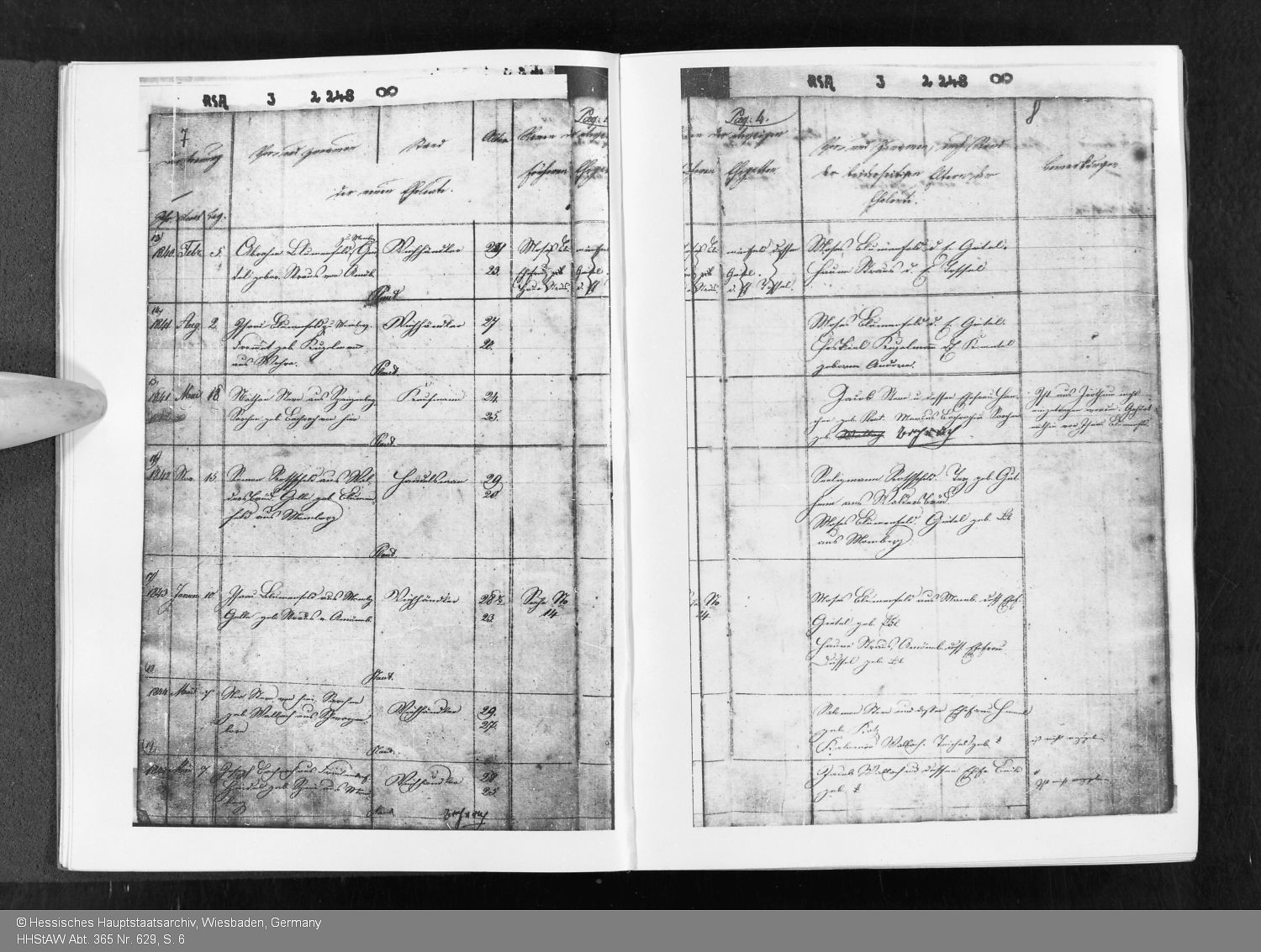
The Fate of Caroline Blumenfeld Hoxter and Her Children: Final Chapter

As we saw, by the middle of 1940, all three of Caroline Blumenfeld Hoxter’s daughters and their families were safely out of Germany. Toni and Gerda were in the US as were their children, and Betty and her family were in Palestine.

But what about their mother Caroline? Last we knew she, having lost her husband Simon in 1932, had been living in Marburg with Toni and her family after Toni’s husband Sally was driven out of his haberdashery business in Hersfeld by Nazi persecution. But Caroline was not with Toni and Sally when they left for America in 1940 nor was she with Gerda and her family when they left Germany in 1939. Nor was Caroline with her daughter Betty in Palestine.

Tragically, Caroline was still in Germany. At some point she moved to Frankfurt, and in 1942 she was taken to Theriesenstadt where she died on February 17, 1942. Her daughter Betty (here spelled Beti) filed this Page of Testimony with Yad Vashem:

Caroline Hoxter, Page of Testimony at Yad Vashem, filed by her daughter Beti Openheimer, found athttps://yvng.yadvashem.org/nameDetails.html?language=en&itemId=1617046&ind=1

In her speech to middle school students in 2020, Caroline’s granddaughter Jane explained why Caroline had been unable to leave Germany with her family:1

Before we left [Germany], my sister and I went to see our grandmother who was blind and could not come with us. Much later she was deported to Thereisenstadt concentration camp. She was then in her late 80s. We were informed that she died of natural causes. Can you imagine for someone that old to travel for three weeks in a cattle car? It is still very hard for me to think about that and accept it.

Jane rightfully questioned whether her grandmother’s death was in fact from “natural causes.” Subjecting an elderly and blind woman to the conditions she must have experienced on that cattle car and then at Theriesenstadt surely contributed to her death as much as if she’d been gassed or shot by the Nazis.

I am very grateful to Andre Guenther from Tracing the Tribe who located Caroline’s death certificate from Theriesenstadt; she died from “enteritis darmkatarrah” or what we might call gastroenteritis.

At no point during the Shoah Foundation interview with Arthur Goldschmidt,2 did the interviewer ask about the fate of his grandmother Caroline Blumenfeld Hoxter, and Arthur did not bring it up himself. I don’t know whether this was an oversight or whether he simply could not bring himself to speak about what happened to his grandmother. I imagine the family must have been devastated by what happened to her. Peter, Jane’s son, told me that his mother still gets emotional when she talks about her grandmother Caroline and what happened to her.

But Caroline was blessed that her three daughters and her grandchildren all escaped and survived the Holocaust.

Her daughter Toni died in New York on April 21, 1956,[^3] two years after her husband Sol, who died on May 13, 1954, in New York.3 Their daughter Miriam died on January 7, 1988, in Queens, New York,4 followed by her husband Rudolf on January 21, 1993, in Los Angeles.5 They were survived by their daughter and her family.

Their son Arthur Goldschmidt shared this photograph of his parents with the Shoah Foundation:

Toni Hoxter and Sally (Sol) Goldschmidt. Arthur Goldschmidt, Interview 8542,  Visual History Archive, USC Shoah Foundation,  November 10, 1995. Accessed 15 August 2021, from the archive of the University of California Shoah Foundation Institute for Visual History and Education, found at https://sfi.usc.edu/what-we-do/collections

Toni’s sister Betty/Beti lived the rest of her life in Israel and died on December 15, 1975, at the age of 86. She was predeceased by her husband Max, who died May 25, 1961, in Israel. They were survived by their daughter Lotte, who married Theo Kleeman in Israel and who died June 26, 1998, in Israel, and their son Shimon, who died August 14, 2012, in Haifa, Israel. Today they have grandchildren and great-grandchildren in Israel.6

The youngest sister Gerda died in New York on April 13 1974,7 two years after her husband Adolf, who died March 18, 1972.8 They were survived by their two daughters. Their daughter Alice Lore Goldschmidt married Richard Oster,9 with whom she had two children. Alice died on January 13, 2014.10

Their other daughter Jane Inge Goldschmidt married Ralph Keibel on August  11, 1950,11. Peter shared with me his parents’ wedding photograph.

Jane and Ralph had two children, including my cousin Peter. Jane is still living and is 98 years old. Imagine—she gave that speech to the Vermont middle school group when she was almost 97 years old. Just remarkable.

As for Arthur Goldschmidt, whose interview helped me tell this story, after World War II he returned to New York City where he met and married his wife Ruth Herz. As he told the story, they met in January 1950, were engaged by April, and married in August 1950. Ruth was also a refugee from Germany. She was born on April 18, 1922, in Holzheim, Germany, to Eugen Isaak Herz and Lilli Weinberg.12 Her father had died in 1932, and her mother was killed in the Holocaust.

According to her obituary, “Ruth left Germany at age 16 via the Kindertransport and spent nine years on the run, in hiding, in a displaced persons camp, and then came to the US where she was able to build a good life. She met her husband Arthur Goldschmidt on a blind date that blossomed into their beautiful marriage on August 27, 1950.”13 Ruth and Arthur had two children. It was clear from the video of the interview that they both still adored each other 45 years after their marriage began.

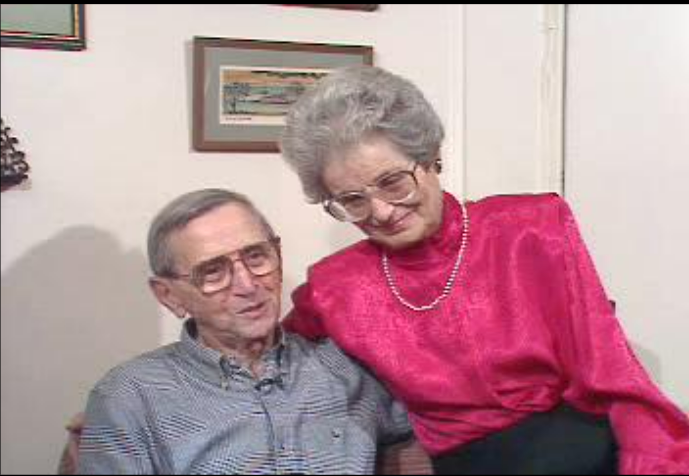
Arthur Goldschmidt and his wife Ruth during the Shoah Foundation interview. Arthur Goldschmidt, Interview 8542,  Visual History Archive, USC Shoah Foundation,  November 10, 1995. Accessed 15 August 2021, from the archive of the University of California Shoah Foundation Institute for Visual History and Education, found at https://sfi.usc.edu/what-we-do/collections

Arthur worked for many years at a dairy company on Long Island, so the skills he learned back in the 1930s from the Zionist organization that prepared him to work on a kibbutz in Palestine/Israel held him in good stead. He died on January 15, 2021, in New York; he was 96 years old.14

It was an honor to watch his interview the Shoah Foundation. He was amazingly matter-of-fact through almost the entire interview, answering questions calmly and saying that he and his family survived because they were able to get out early enough. He didn’t seem angry or resentful at all—until the very end when the interviewer asked him a simple and straightforward question about what he hoped the world had learned. He then broke down in tears, unable to speak, finally saying in essence that we must never forget and that we must never let it happen again.15

Today Caroline Blumenfeld Hoxter has many living descendants in Israel and in the US. She may not have survived the Holocaust, but her daughters and their families did, and they and their descendants carry on her legacy.

I am deeply grateful to my cousin Peter Keibel for sharing so much of his information and his family photographs with me and especially for sharing his mother’s speech about her experiences before and during the Holocaust.


And this brings me to the end of not only Caroline Blumenfeld Hoxter’s story and that of her children and grandchildren, but also to the end of the story of Abraham Blumenfeld IIA since Caroline was the youngest of his eight children. Now I will turn to Abraham’s younger siblings. First, his brother Isaak, the second child of my four-times great-uncle Moses Blumenfeld.


  1. Jane Inge Goldschmidt Keibel, Speech to Hazen School, Hardwick, Vermont, 2020, shared by Peter Keibel. 
  2. Arthur Goldschmidt, Interview 8542,  Visual History Archive, USC Shoah Foundation,  November 10, 1995. Accessed 15 August 2021, from the archive of the University of California Shoah Foundation Institute for Visual History and Education, found at https://sfi.usc.edu/what-we-do/collections 
  3. Toni Goldschmidt, Age: 70, Birth Date: abt 1886, Death Date: 21 Apr 1956, Death Place: Queens, New York, New York, USA, Certificate Number: 4251, Ancestry.com. New York, New York, U.S., Death Index, 1949-1965 
  4. Sol Goldschmidt, Age: 72, Birth Date: abt 1882, Death Date: 13 May 1954, Death Place: Manhattan, New York, New York, USA, Certificate Number: 10469, Ancestry.com. New York, New York, U.S., Death Index, 1949-1965 
  5.  Miriam Lauter, Social Security Number: 112-05-7561, Birth Date: 23 Apr 1911, Issue Year: Before 1951, Issue State: New York, Last Residence: 11375, Flushing, Queens, New York, USA, Death Date: 7 Jan 1988, Social Security Administration; Washington D.C., USA; Social Security Death Index, Master File, Ancestry.com. U.S., Social Security Death Index, 1935-2014 
  6. These dates came from Peter Keibel, Betty’s nephew. Email from Peter Keibel, November 17, 2021.  I have no official records for them. 
  7. Date is from her grandson, Peter Keibel, FamilyTree on Ancestry.com, found at https://www.ancestry.com/family-tree/person/tree/52614823/person/372143503930/facts 
  8. Date is from his grandson, Peter Keibel, FamilyTree on Ancestry.com, found at https://www.ancestry.com/family-tree/person/tree/52614823/person/372143503930/facts 
  9. Alice L Goldsmith, Gender: Female, Marriage License Date: 18 Jul 1950, Marriage License Place: Manhattan, New York City, New York, USA, Spouse: Richard Oster, License Number: 18819, New York City Municipal Archives; New York, New York; Borough: Manhattan; Volume Number: 27, Ancestry.com. New York, New York, U.S., Marriage License Indexes, 1907-2018 
  10. Find a Grave, database and images (https://www.findagrave.com/memorial/130447894/alice-oster : accessed 02 December 2021), memorial page for Alice Oster (unknown–13 Jan 2014), Find a Grave Memorial ID 130447894, citing Mount Hebron Cemetery, Flushing, Queens County, New York, USA ; Maintained by Mom (contributor 48202874) . 
  11. From their son Peter Keibel, https://www.ancestry.com/family-tree/person/tree/52614823/person/372143503829/facts 
  12. Peter Keibel Ancestry Family Tree, https://www.ancestry.com/family-tree/person/tree/52614823/person/372145394061/facts; Ruth Goldschmidt
    Age: 29, Birth Date: 18 Apr 1922, Issue Date: 12 Jun 1951, State: New York
    Locality, Court: Eastern District of New York, District Court, National Archives and Records Administration (NARA); Washington, D.C.; Index to Naturalization Petitions of the United States District Court for the Eastern District of New York, 1865-1957; Microfilm Serial: M1164; Microfilm Roll: 63, Ancestry.com. U.S., Naturalization Records Indexes, 1794-1995. The other information came from Arthur Goldsdchmidt’s Shoah Foundation interview. Arthur Goldschmidt, Interview 8542,  Visual History Archive, USC Shoah Foundation,  November 10, 1995. Accessed 15 August 2021, from the archive of the University of California Shoah Foundation Institute for Visual History and Education, found at https://sfi.usc.edu/what-we-do/collections 
  13. “Goldschmidt, Ruth,” The Baltimore Sun, Baltimore, Maryland, 03 Jan 2021, Sun • Page A14 
  14.  Arthur Goldschmidt, Social Security Number: 099-24-1370, Birth Date: 9 Aug 1913, Issue Year: Before 1951, Issue State: New York, Last Residence: 11415, Jamaica, Queens, New York, Death Date: 15 Jan 2010, Social Security Administration; Washington D.C., USA; Social Security Death Index, Master File, Ancestry.com. U.S., Social Security Death Index, 1935-2014 
  15. Arthur Goldschmidt, Interview 8542,  Visual History Archive, USC Shoah Foundation,  November 10, 1995. Accessed 15 August 2021, from the archive of the University of California Shoah Foundation Institute for Visual History and Education, found at https://sfi.usc.edu/what-we-do/collections 

My Cousins on the SS St Louis: The Shameful Conduct of the US Government

We left off in my last post with the family of Gerda Hoxter and Adolph Goldschmidt about to board the SS St. Louis to go to Cuba and escape from Germany. As described on the US Holocaust Museum website:

On May 13, 1939, the German transatlantic liner St. Louis sailed from Hamburg, Germany, for Havana, Cuba. On the voyage were 937 passengers. Almost all were Jews fleeing from the Third Reich. Most were German citizens, some were from eastern Europe, and a few were officially “stateless.”The majority of the Jewish passengers had applied for US visas, and had planned to stay in Cuba only until they could enter the United States.

Gerda’s daughter Jane provided this more personal account in her speech to middle school students in early 2020:1

May 13, 1939, was a Saturday and the ship sailed in the afternoon. We stood at the railing of the ship to wave good-bye to relatives with a heavy heart. The possibility certainly existed that we were never going to see them again. One of the things we remember was that upon boarding the band was playing Strauss waltzes. In the captain’s daily log, he noted that the mood of the passengers was very solemn, but he was assured that good food and sea air for two weeks will lift the pain that was emanating from the passengers.

We settled into our new routine of shipboard life and day by day the moods lifted. My sister and I made friends with other young people on board. One of these people became my best friend. She lived in upstate NY with her husband who also was a passenger on the St. Louis.

Peter, Jane’s son, shared with me this remarkable photograph of his grandfather Adolf Goldschmidt boarding the St. Louis; he is the man on the far right in the light colored coat, holding a book:

Adolf Goldschmidt aboard the St. Louis. Courtesy of the family

Jane’s story continued:

After a two week voyage, we arrived in the harbor of Havana, Cuba. We were informed that we could not lay anchor at the pier because our credentials had to be checked. Even after they were checked, there were more excuses for not letting us land and disembark. A day before arrival in Cuba the Captain was informed that he cannot lay anchor at a pier, he had to stay in the middle of the harbor. We stayed in the harbor for one week.

We did not want to return to Germany, nothing was left there, no housing, no money – all the savings people had accumulated had to be left to the German government – so we would all be taken to a concentration camp, an impossible thought. We had people on board who were released from concentration camps under the condition never to return to Germany. These men considered mutiny or committing suicide. The captain was very diligent and did not want this to happen.

During that time one man slashed his wrist and jumped overboard. He was saved and taken to a hospital in Havana. His wife was not allowed to visit him, but after his recuperation he was returned to his wife.

Small boats came to the side of the St. Louis with relatives who lived in Cuba to shout encouragements to us. Meanwhile, organizations, Jewish and government, were at work to see what can be done to have us disembark. Also contact was made with almost every country to see if one of them would take us in.

The German propaganda had a field day. No one wanted Jews, Hitler was right in ridding his country of them.

The Captain tried everything to enable us to land. He even went so far and visited the President of Cuba to plead for us. Nothing helped.

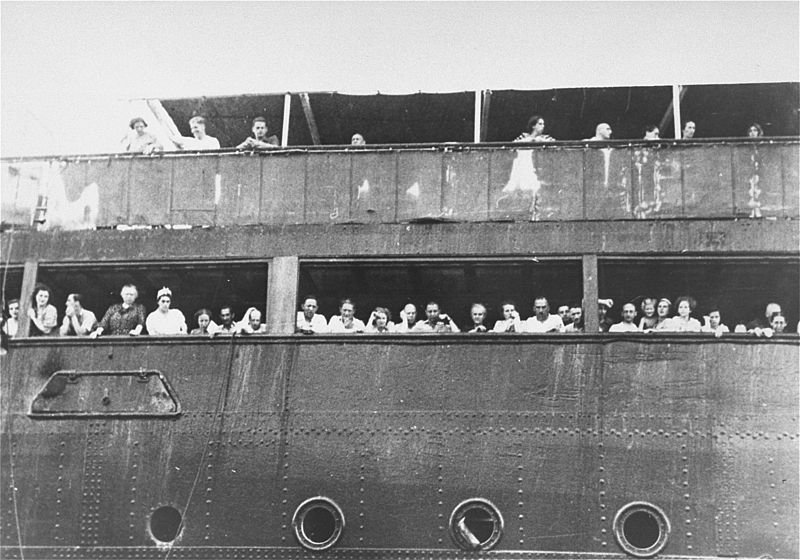
Jewish refugees aboard the SS St. Louis attempt to communicate with friends and relatives in Cuba, who were permitted to approach the docked vessel in small boats. |Source=USHMM, courtesy of National Archives and Records Adminis (public domain)

The Holocaust Museum article describes the purported reasons for Cuba’s refusal to admit the refugees—not just anti-Semitism, but economic conditions and anti-immigration sentiment.

So the refugees and others tried to find help in places besides Cuba. As Jane described it:2

From the ship, telegrams were sent to heads of states and Jewish organizations. The children pleaded by telegram with Mrs. Roosevelt for shelter, but no reply came from her or the President. After 10 days in limbo, the captain was told to leave Cuban waters. Very slowly the Captain steered the ship toward the US, toward Miami, hoping that the President would relent and let us land. There were 935 people on board who were seeking refuge. Instead the Coast Guard was on watch to see that no one jumped overboard and swam ashore. We went up the coast to New York and then the captain was informed to hurry home. He was such a decent man that he really did not want to take us back, but he had no alternative. In his log, he wrote that he would scuttle his ship on the English shore if no result was forthcoming, to prevent us returning to Germany. This action cost him his job.

The Holocaust Museum article also described the US indifference to the needs of the refugees:

Sailing so close to Florida that they could see the lights of Miami, some passengers on the St. Louis cabled President Franklin D. Roosevelt asking for refuge. Roosevelt never responded. The State Department and the White House had decided not to take extraordinary measures to permit the refugees to enter the United States. A State Department telegram sent to a passenger stated that the passengers must “await their turns on the waiting list and qualify for and obtain immigration visas before they may be admissible into the United States.” US diplomats in Havana intervened once more with the Cuban government to admit the passengers on a “humanitarian” basis, but without success.

Having nowhere to disembark, the passengers on the St. Louis were forced to return to Europe, where Great Britain, the Netherlands, Belgium, and France responded more humanely than the US or Cuba had to the needs of these refugees.

Jane described what happened next to her family and to others:3

Meanwhile, negotiations went on to find some country that had mercy on us. The passengers were becoming more desperate. Long face and worried looks were on everyone’s faces. We were close to the English Channel when we were informed that four countries were willing to take the passengers. Morris Troper of the European Joint Distribution Committee was responsible for securing that haven. The grateful passengers cabled him that their gratitude was as immense as the ocean on which they have been traveling. It was England, France, Belgium and the Netherlands. You could have heard the biggest sigh when the news was broadcast. Again people made plans and their outlook was improving.

On June 17, we landed in Antwerp, Belgium, and disembarked to immediately go on to a freighter that was provided by the Germans for those who went to France and England.

Our captain really tried his best and risked his life and career for us. Many years later, the surviving passengers signed a petition to recommend him as a righteous gentile, which afforded him a place at the Yad Vashem in Jerusalem.

Our family was sent to France, where my sister, I, and other children were taken in by an orphanage. Our parents and other adults were placed in Le Mans, a city west of Paris. Because no one had money, we were only allowed 10 German Marks (Approximately $80 today) to take out of Germany. We all lived on charity provided by Jewish organizations. During those six months my parents lived in Le Mans, they were supported by the HIAS, a Jewish relief organization that helps immigrants. They lived in a house that was shared with three other couples, one bedroom each, communal kitchen and living room.

When the War broke out, September 1, 1939, all the men were interned as foreigners and the women had to double up. My sister and I and all other children under 18 years were sent by train to OSE homes near Paris. The OSE is a Russian organization that is involved with the care of orphans. These homes were led by a Viennese educator and his wife, a physician. Personally, I enjoyed my stay there, although once the War broke out it got a little scary, especially when the air raid sirens sounded and we had to go to the shelters. The older children took care of the young ones.

But ultimately, after the Nazis took over France, Belgium, and the Netherlands in the spring of 1940, 254 of the over 900 passengers who had been on the St. Louis and had been forced back to Europe in May, 1939, were murdered by the Nazis.

Gerda and her family were among the lucky ones who were able to immigrate successfully to the US. They arrived in New York on January 8, 1940. I don’t know when this photograph of Gerda and Adolf was taken, but from their ages, I assume it was sometime during this era, either before or after they came to the US.

Adolf and Gerda (Hoxter) Goldschmidt. Courtesy of the family

This is one of the most shameful examples of the way the US acted during the 1930s and 1940s, knowing the dangers that Jews were facing in Nazi Germany and elsewhere in Europe, but cold-heartedly turning the other way, refusing to help those in need. I do wonder, however, whether we’ve learned our lesson. Money and jobs (not to mention xenophobia and prejudice) still seem to trump the needs of those who are suffering when it comes to US immigration policy.


  1. Jane Inge Goldschmidt Keibel, Speech to Hazen School, Hardwick, Vermont, 2020, shared by Peter Keibel. 
  2. Jane Inge Goldschmidt Keibel, Speech to Hazen School, Hardwick, Vermont, 2020, shared by Peter Keibel. 
  3. Jane Inge Goldschmidt Keibel, Speech to Hazen School, Hardwick, Vermont, 2020, shared by Peter Keibel. 

The Children and Grandchildren of Caroline Blumenfeld Hoxter: Leaving Germany

Happy New Year, everyone! I hope you had a good holiday season and are safe and healthy. I have been trying to relax and gain some perspective on 2021, a tough year, and prepare for 2022, a year I expect to be just as tough. But genealogy and family history always help me put things in perspective, so I am ready to return and find new meaning and new discoveries in the history of my family.

Let me refresh your memories of where I was back in December 2021. I have been writing about my Blumenfeld branch and more specifically the line that begins with my four-times great-uncle Moses Blumenfeld and goes from his son Abraham Blumenfeld IIA to Abraham’s daughter Caroline Blumenfeld Hoxter. We saw that Caroline’s son Siegmund died fighting for Germany in World War I, that her husband Simon died in 1932, and that her daughter Toni Hoxter Goldschmidt and her family had all escaped from Nazi Germany by 1940.

But what about Caroline herself and her two other daughters, Betty and Gerda? What happened to them and their families?

Again I want to thank the Shoah Foundation for allowing me to have access to the interview done with Arthur Goldschmidt,1 Toni’s son, so that I could learn more about the fate of his family, including that of his aunts Betty and Gerda. I am also deeply grateful to Peter Keibel, grandson of Gerda Hoxter Goldschmidt, for sharing the speech his mother Jane Inge Goldschmidt gave to a middle school in Vermont in early 2020 about her experiences during the Nazi era.

Like Arthur and Miriam, her nephew and niece, Betty Hoxter Oppenheimer and her husband Max and their two children Lotte and Franz Siegmund left Germany not long after Hitler’s rise to power. According to Arthur, Max Oppenheimer was a doctor, and once he was restricted by Nazi law from being able to practice medicine fully, he and his family left for England. But they must not have stayed there long because on November 26, 1934, they arrived in Palestine. Max was a physician, Lotte, their daughter, was an orthopedist, and their son, who became Shimon, was a carpenter. By 1938, they had all obtained citizenship to Palestine.2

Max and Betty (Hoxter) Oppenheimer, Palestinian citizenship cards found at the Israel State Archives, at https://www.archives.gov.il/en/

Lotte Oppenheimer, Palestine citizenship card, found at the Israel State Archives, at https://www.archives.gov.il/en/

The family of Gerda Hoxter Goldschmidt, the youngest child of Caroline Blumenfeld and Simon Hoxter, had a harder time escaping from Germany. Gerda’s daughter Inge Goldschmidt, who became Jane in the US and who is Peter Keibel’s mother, provided this description of her family’s life in Germany before and during the Nazi era in a speech she gave to a middle school in Vermont in early 2020:3

My father owned a department store in that town [Wuppertal]. My sister and I attended public schools. My father was well known because of the store and we were in comfortable circumstances. … In 1933 when Hitler came to power my father’s store was closed to make the population aware that the owner was Jewish and to discourage the people from doing business with a Jewish establishment. Some days later business resumed at a normal rate, but our lives changed. It seems that every year another law was passed that made our lives almost unbearable. We could not attend school any more or use public pools. Park benches were marked where we could sit. [The Nazis] burned books by Jewish authors and … destroyed Jewish businesses. On November 9, 1938, Kristallnacht started, the synagogues, Jewish houses of worship were destroyed. Many Jewish men were sent to concentration camps.

Our parents were well known and liked. Our father was tipped off by an official and was therefore able to leave town and avoid internment. The Gestapo did come to our house to look for him, but we were not molested, and our house was not ransacked. We did not know where he went. Occasionally he called, but those were very tense days for us. His safety was always on our minds. After his return, he was seriously looking to leave the country.

We had received a quota number from the US Embassy, but we were also aware that it was a very high number and there was no way we could leave before a year or two. So my father searched for a country that we could go to while waiting for our quota number. Of course, the store was closed and had to be sold to the Germans for a very minimal amount. He preferred to leave Europe as he did not think it was safe to stay there. America let only a designated number of people to immigrate into their country. My father purchased Visas ($250 for each person which in today’s dollars is $4,362) for Cuba and booked passage on the ocean liner, SS St. Louis that belonged to a German shipping company.

Thus, Gerda and her family were among those who sailed to Cuba on the ill-fated St. Louis in May 1939.

For those who don’t know the story of the St. Louis, it is one example of the shameful and tragic ways the US government failed to respond to the cries for help of those seeking to escape the horrors of the Holocaust. Jane’s telling of the story will continue in my next post.


  1. Arthur Goldschmidt, Interview 8542,  Visual History Archive, USC Shoah Foundation,  November 10, 1995. Accessed 15 August 2021, from the archive of the University of California Shoah Foundation Institute for Visual History and Education, found at https://sfi.usc.edu/what-we-do/collections 
  2. The Palestine citizenship papers can be found at the Israel State Archives by searching for their names. Unfortunately, the site does not provide specific links to those results, but the site can be found at https://www.archives.gov.il/en/ 
  3. Jane Inge Goldschmidt Keibel, Speech to Hazen School, Hardwick, Vermont, 2020, shared by Peter Keibel. 

Leaving Germany: The Family of Toni Hoxter Goldschmidt

By 1930, the three daughters of Caroline Blumenfeld and Simon Hoxter were married, and each had two children. Their son Siegmund had been killed fighting for Germany in World War I, but their lives otherwise as middle-class German Jews must have seemed secure and comfortable. Here is a wonderful photograph of Caroline and Simon, shared by their great-grandson Peter:

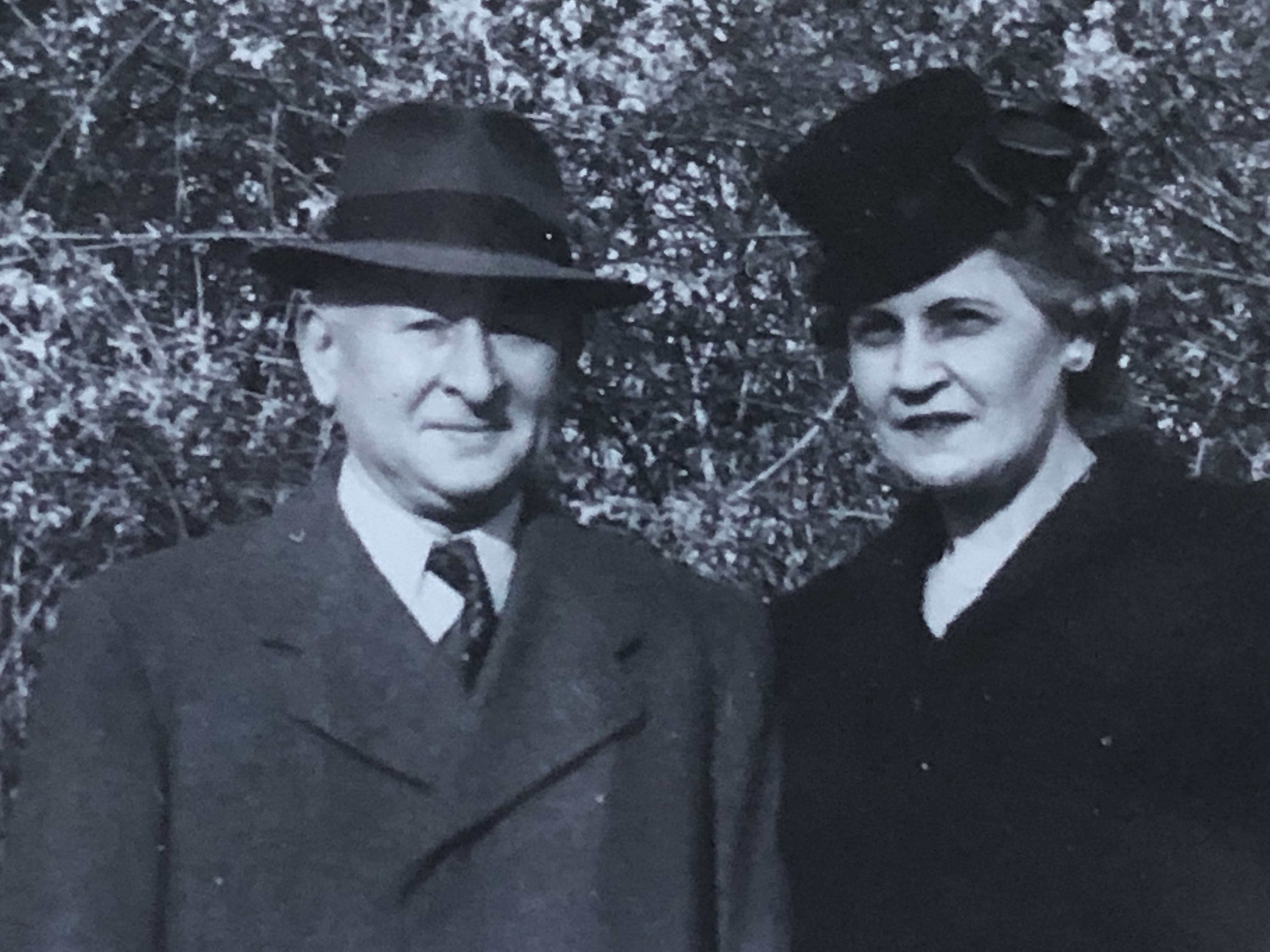
Simon and Karoline (Blumenfeld) Hoxter. c. 1930 Courtesy of the family.

The next decade saw the family ripped apart and separated as each daughter and her family had to find a way to escape from Nazi Germany. But even before Hitler came to power, the family faced another loss. Simon Hoxter died in Marburg, Germany, on June 10, 1932, at the age of 79.

Simon Hoxter death record, Personenstandsregister Sterberegister; Bestand: 915; Laufende Nummer: 5739, Year Range: 1932, Ancestry.com. Hesse, Germany, Deaths, 1851-1958

Less than a year later, Hitler came to power, and soon thereafter members of the family began to look for ways to leave Germany. I am grateful to the Shoah Foundation for providing me with access to the interview given by Arthur Goldschmidt, Caroline and Simon’s grandson and the son of Toni Hoexter and Sally Goldschmidt, in which Arthur shared much of the story of how most of his relatives escaped from Germany. Much of the information in this post came from Arthur’s interview, except where noted.1

Arthur and his sister Miriam were among the first to make plans to leave Germany. Arthur, who had been raised in the town of Hersfeld, described a relatively innocent childhood in that town. It was a town of about 12,000 people where most people worked as cattle dealers, but also as lawyers and doctors and merchants and other tradesmen. His father Sally owned a haberdashery store and did business with Jews and non-Jews in the town. Aside from some anti-Semitic taunting on occasion, Arthur experienced no sense of danger and no physical assaults. He went to school with and was friends with both Jewish and non-Jewish children. When he was sixteen, Arthur left school and left Hersfeld. He went to the city of Hamm in Westphalia about three hours from Hersfeld, where he trained in a department store to be a salesman. He was there for four years until Hitler came to power in 1933.

Here is a photograph of Hersfeld that Arthur shared with the Shoah Foundation. The building in the left background with the two little turrets is the house where Arthur and his family lived.

Arthur Goldschmidt. Arthur Goldschmidt, Interview 8542,  Visual History Archive, USC Shoah Foundation,  November 10, 1995. Accessed 15 August 2021, from the archive of the University of California Shoah Foundation Institute for Visual History and Education, found at https://sfi.usc.edu/what-we-do/collections

In October 1933, Arthur joined a cousin in Berlin where a Zionist organization was training young people to become farmers in preparation for immigration to Palestine. Arthur was there until June 1934, working for a farmer who happened to be a Nazi, but who, according to Arthur, was very kind to him and the other Jewish youth. (He did note that they were providing the farmer with free labor.)  From there, Arthur was sent by the Zionist organization to Yugoslavia to continue his training until December 1935 when he received a certificate to go Palestine. He arrived in Palestine in January 1936.

Meanwhile, the rest of his immediate family was also experiencing relocation. His parents Sally Goldschmidt and Toni Hoxter relocated from Hersfeld to Marburg in 1933 after Sally’s haberdashery business began to fail as a result of Nazi persecution. He no longer could do business with non-Jewish residents, and many of the Jewish residents were leaving or planning to leave Germany. They decided to move in with Toni’s mother, Caroline Blumenfeld Hoxter, who still owned her home in Marburg after the death of her husband Simon in 1932.

Their daughter Miriam left Marburg for New York, arriving on November 1, 1934. She listed her occupation on the ship manifest as a clerk and listing her cousin Rosalie Livingston as the person she was going to in the US.2 On September 27, 1936, after settling in New York, she married Rudolf Lauter, who was also a refugee from Germany. Interestingly, Rudolf was born and had last lived in Hamm, Germany, the same city that Miriam’s brother Arthur had lived in from 1929 to 1933. Rudolf was born on April 27, 1906, the son of Isidore Lauter and Helene Schonberger.3

Thus, by 1936 Toni and Sally’s children Arthur and Miriam were safely out of Germany. Arthur was living on a kibbutz near Rehovoth in Palestine, working at the new port in Tel Aviv that had opened after the Arab-controlled port in Jaffa was closed to Jewish businesses. Miriam urged Arthur to come to the US, and in 1938 when she was able to provide an affidavit for her brother, he was able to do that. He arrived on May 31, 1938,4 and after a brief stay with Miriam and Rudolf, he got a job on a farm in upstate New York in the town of Windsor near Binghamton; he was living there with some paternal cousins in 1940.

But Toni Hoxter and Sally Goldschmidt, Arthur and Miriam’s parents, were still in Germany, living in Marburg. According to Arthur’s testimony, his father was taken to Buchenwald. Arthur didn’t know when or for how long, but he said the experience forever changed his father; my guess is that this was after Kristallnacht in November 1938 when thousands of Jewish men were rounded up and taken to Buchenwald. Sally had served for Germany in World War I, earning the Iron Cross. His brother and his brother-in-law Siegmund Hoxter, Toni’s brother, were both killed fighting for Germany in that war, and Sally could never forgive Germany for ignoring his service and those sacrifices just twenty years later, imprisoning him in a concentration camp and destroying his business and his family’s life.

By the spring of 1940, Arthur was able to provide an affidavit for his parents to leave Germany, and on April 29, 1940, Toni and Sally (soon to be known as Sol) arrived in New York.5 According to Arthur, that was the last or one of the last ships allowed to sail from Europe after the war broke out. At that time Arthur’s sister Miriam and her husband Rudolf and their daughter were living in Bridgeport, Connecticut, where Rudolf was working as a butcher.6 Thus, Toni Hoxter Goldschmidt’s family was safely out of Germany by the spring of 1940.

What about Toni’s sisters Betty and Gerda and their families? And what about their mother Caroline? What happened to them? And what happened to Toni and Sol and their children Miriam and Arthur after arriving in the US? Those stories will be told next.

But not until early January 2022. I will be taking the next couple of weeks off from blogging.

Happy Holidays to All! I wish all my readers who celebrate a merry Christmas and a happy New Year to everyone! May 2022 bring us all good health and peace and progress on the many challenges facing us all, globally and personally.


  1. The information in this post, except where otherwise noted, is from the Shoah Foundation interview with Arthur Goldschmidt. Arthur Goldschmidt, Interview 8542,  Visual History Archive, USC Shoah Foundation,  November 10, 1995. Accessed 15 August 2021, from the archive of the University of California Shoah Foundation Institute for Visual History and Education, found at https://sfi.usc.edu/what-we-do/collections 
  2. Miriam Goldschmidt, Gender: Female, Ethnicity/ Nationality: Hebrew, Marital status: Single, Age: 23, Birth Date: abt 1911, Birth Place: Germany, Other Birth Place: Hersfeld, Last Known Residence: Frankfurt, Germany, Departure Port: Hamburg, Germany,Arrival Date: 1 Nov 1934, Arrival Port: New York, New York, USA, Final Destination: Chicago, Illinois, Years in US: Permanently, Citizenship Intention: Yes, Height: 5 Feet, 8 Inches, Hair Color: Blonde, Eye Color: Blue, Complexion: Fair, Money in Possession: 50 Person in Old Country: Sally Goldschmidt, Person in Old Country Relationship: Father Person in Old Country Residence: Marburg.gy, Person in US: Rosalie Livingston, Person in US Relationship: Cousin, Father: Sally Goldschmidt, Ship Name: Manhattan Year: 1934; Arrival: New York, New York, USA; Microfilm Serial: T715, 1897-1957; Line: 12; Page Number: 32, Ancestry.com. New York, U.S., Arriving Passenger and Crew Lists (including Castle Garden and Ellis Island), 1820-1957 
  3. Naturalization papers for Rudolf Lauter and Miriam Goldschmidt, Court District: Southern District, New York, Description: (Roll 1332) Petition No. 383569 – Petition No. 383997, The National Archives and Records Administration; Washington, D.C.; Petitions for Naturalization from the U.S. District Court for the Southern District of New York, 1897-1944; Series: M1972; Roll: 1332, Ancestry.com. New York, U.S., Naturalization Records, 1882-1944. The naturalization papers filed for both Rudolf and Miriam indicate that they were married on September 27, 1936, but that Rudolf did not arrive in the US until December 24, 1936. I had no way to reconcile these two recorded assertions, but I then I found Rudolf on a passenger manifest arriving in New York on August 20, 1936. Given that there was just a month between his arrival and his marriage to Miriam, I believe they must have known each other in Germany before immigrating to the US. Since on that manifest Rudolf indicated he was intending to stay only four months, my hunch is that he then returned to Germany after they married and came back to the US permanently on December 24, 1936, as indicated on his naturalization papers. Rudolf Lauter, Marital status: Single,Age: 30, Birth Date: abt 1906, Birth Place: Germany, Other Birth Place: Hamm, Last Known Residence: Amsterdam, Hamburg??
    Place of Origin: Germany, Departure Port: France, Arrival Date: 20 Aug 1936
    Arrival Port: New York, New York, USA, Years in US: 4 Months, Citizenship Intention: No, Height: 5 Feet, 11 Inches, Hair Color: Brown, Eye Color: Brown, Complexion: Dark
    Money in Possession: $200, Person in Old Country: Helene Lauter, Person in Old Country Relationship: Mother, Person in Old Country Residence: Germany
    Person in US: George H Lauter, Mother: Helene Lauter, Ship Name: Washington
    Year: 1936; Arrival: New York, New York, USA; Microfilm Serial: T715, 1897-1957; Line: 3; Page Number: 108, Ancestry.com. New York, U.S., Arriving Passenger and Crew Lists (including Castle Garden and Ellis Island), 1820-1957 
  4.  Arthur Goldschmidt, Gender: Male, Ethnicity/ Nationality: Hebrew, Marital status: Single, Age: 24, Birth Date: abt 1914, Birth Place: Germany, Other Birth Place: Hersfeld
    Last Known Residence: Telaviv, Palastine, Place of Origin: Palastine, Departure Port: Cherbourg,France, Arrival Date: 31 May 1938, Arrival Port: New York, New York, USA
    Final Destination: L. I., New York, Years in US: Permanently, Citizenship Intention: Yes
    Height: 5 Feet, 9 Inches, Hair Color: Brown, Eye Color: Brown, Complexion: Fair
    Money in Possession: 19.00, Person in Old Country: Sally Goldschmidt, Person in Old Country Relationship: Father, Person in Old Country Residence: Marburg. Person in US: Miriam Lauter, Person in US Relationship: Sister, Father: Sally Goldschmidt
    Sibling: Miriam Lauter, Ship Name: Aquitania, Year: 1938; Arrival: New York, New York, USA; Microfilm Serial: T715, 1897-1957; Line: 18; Page Number: 103, Ancestry.com. New York, U.S., Arriving Passenger and Crew Lists (including Castle Garden and Ellis Island), 1820-1957 
  5. Sally and Toni (Hoxter) Goldschmidt ship manifest, Year: 1940; Arrival: New York, New York, USA; Microfilm Serial: T715, 1897-1957; Line: 9; Page Number: 85, Ancestry.com. New York, U.S., Arriving Passenger and Crew Lists (including Castle Garden and Ellis Island), 1820-1957 
  6. Lauter family, 1940 US census, Year: 1940; Census Place: Bridgeport, Fairfield, Connecticut; Roll: m-t0627-00532; Page: 7A; Enumeration District: 9-92, Ancestry.com. 1940 United States Federal Census 

Caroline Blumenfeld Hoxter and Her Family, Part I: A Son Killed in Battle

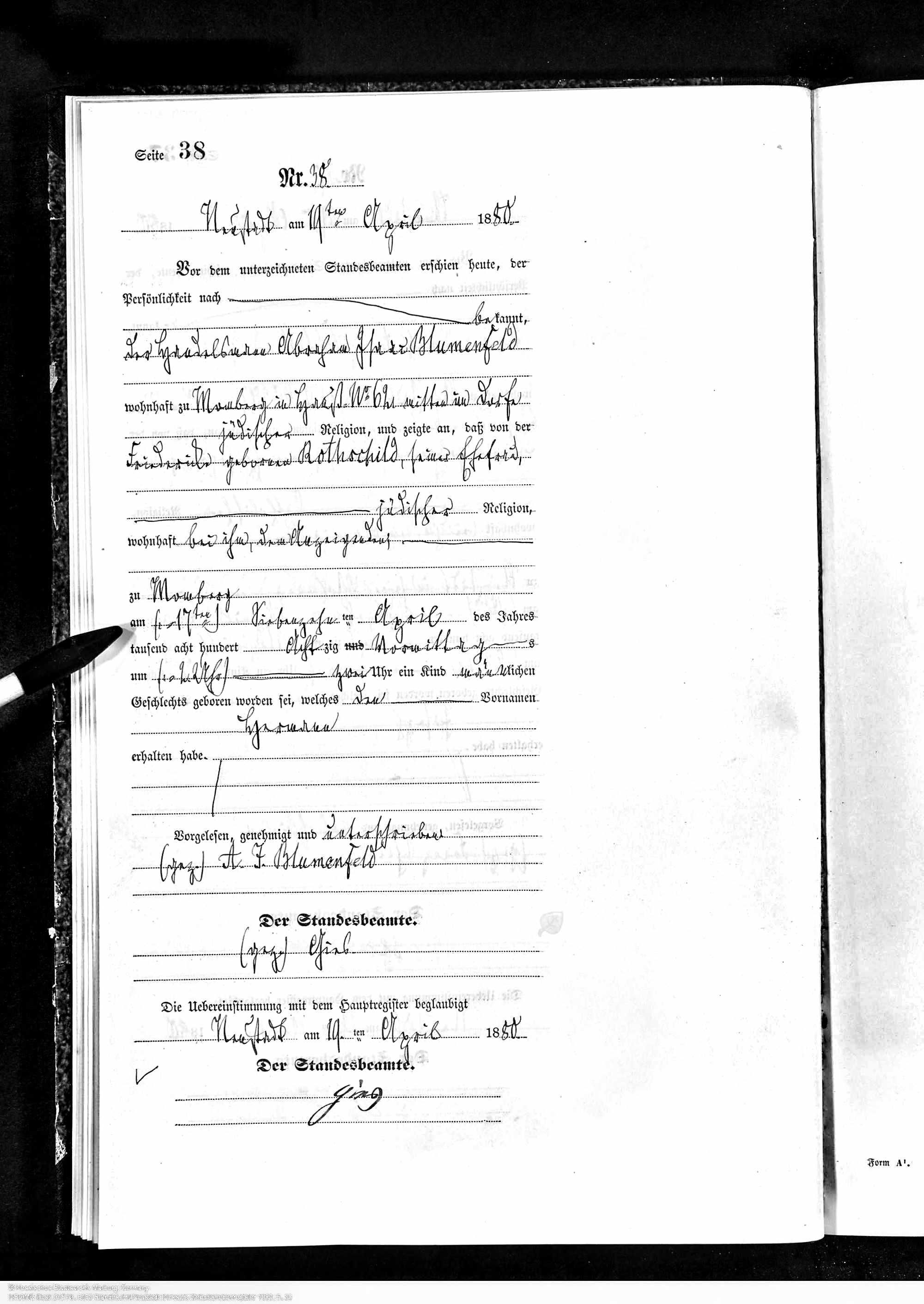
Having told the stories of seven of Abraham Blumenfeld IIA’s eight children,1 I now turn to his youngest child, his daughter Gelle. She was born on July 16, 1857. Later records refer to her as Caroline (or Karoline) and so I will refer to her by that name was as well.2

Birth record of Gelle Blumenfeld, Arcinsys Hessen Archives, HHStAW Fonds 365 No 608, p. 5

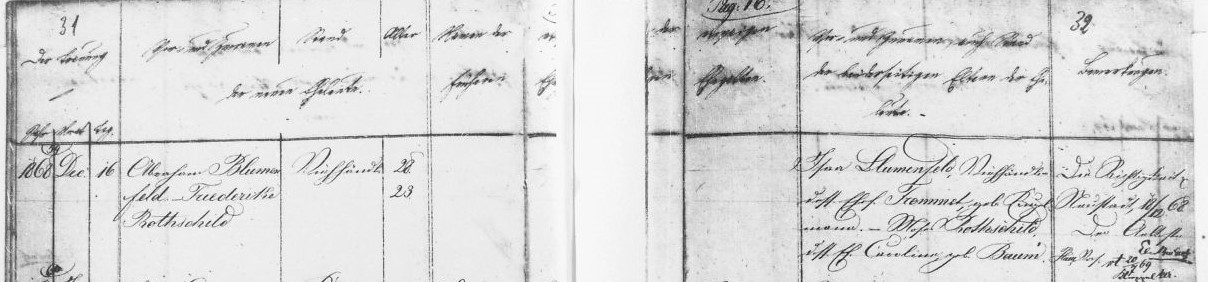
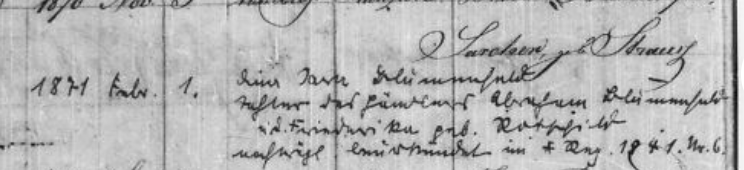
Caroline married Simon Hoxter on November 30, 1882, in Neustadt, Germany. Simon was born in Gemunden, Germany, on August 26, 1852, to Anselm Hoxter and Betty Blumenthal. (Hoxter is spelled with an umlaut or an “oe” in German, but for simplicity purposes, I am just going to spell it Hoxter.)

Jettchen Blumenfeld, Gender: weiblich (Female),Age: 25, Birth Date: 16 Jul 1857
Marriage Date: 20 Nov 1882, Marriage Place: Neustadt, Hessen (Hesse), Deutschland (Germany)
Civil Registration Office: Neustadt (Hessen), Father: Abraham Blumenfeld, Mother: Güdel Blumenfeld, Spouse: Simon Thoxter, Certificate Number: 16, Hessisches Hauptstaatsarchiv; Wiesbaden, Deutschland; Bestand: 915; Laufende Nummer: 6492, Ancestry.com. Hesse, Germany, Marriages, 1849-1930

Thank you to my cousin Peter Keibel, great-grandson of Caroline and Simon, for sharing these two photographs of his great-grandparents.

Caroline Blumenfeld Hoxter. Courtesy of the family

Simon Hoxter. Courtesy of the family

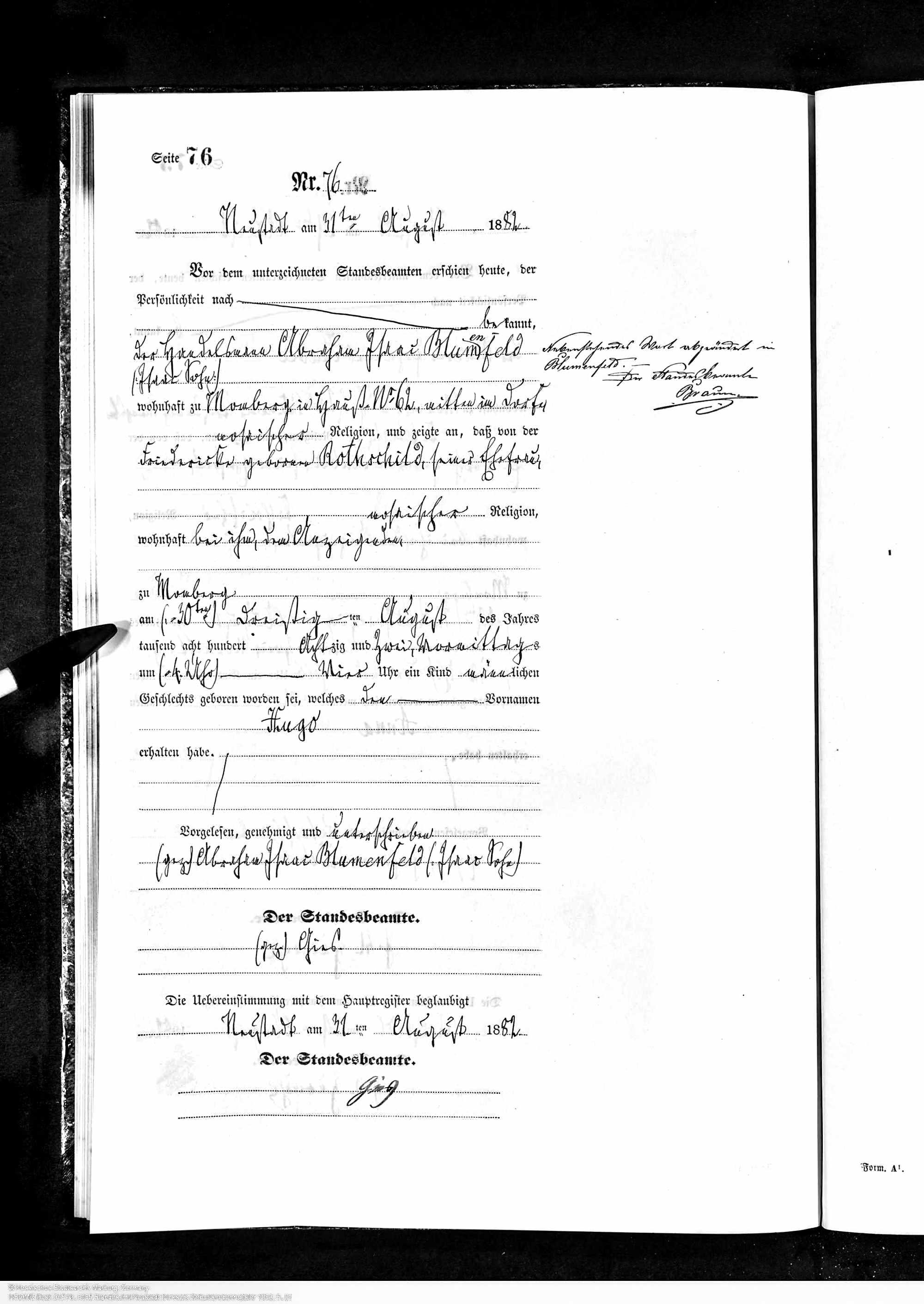
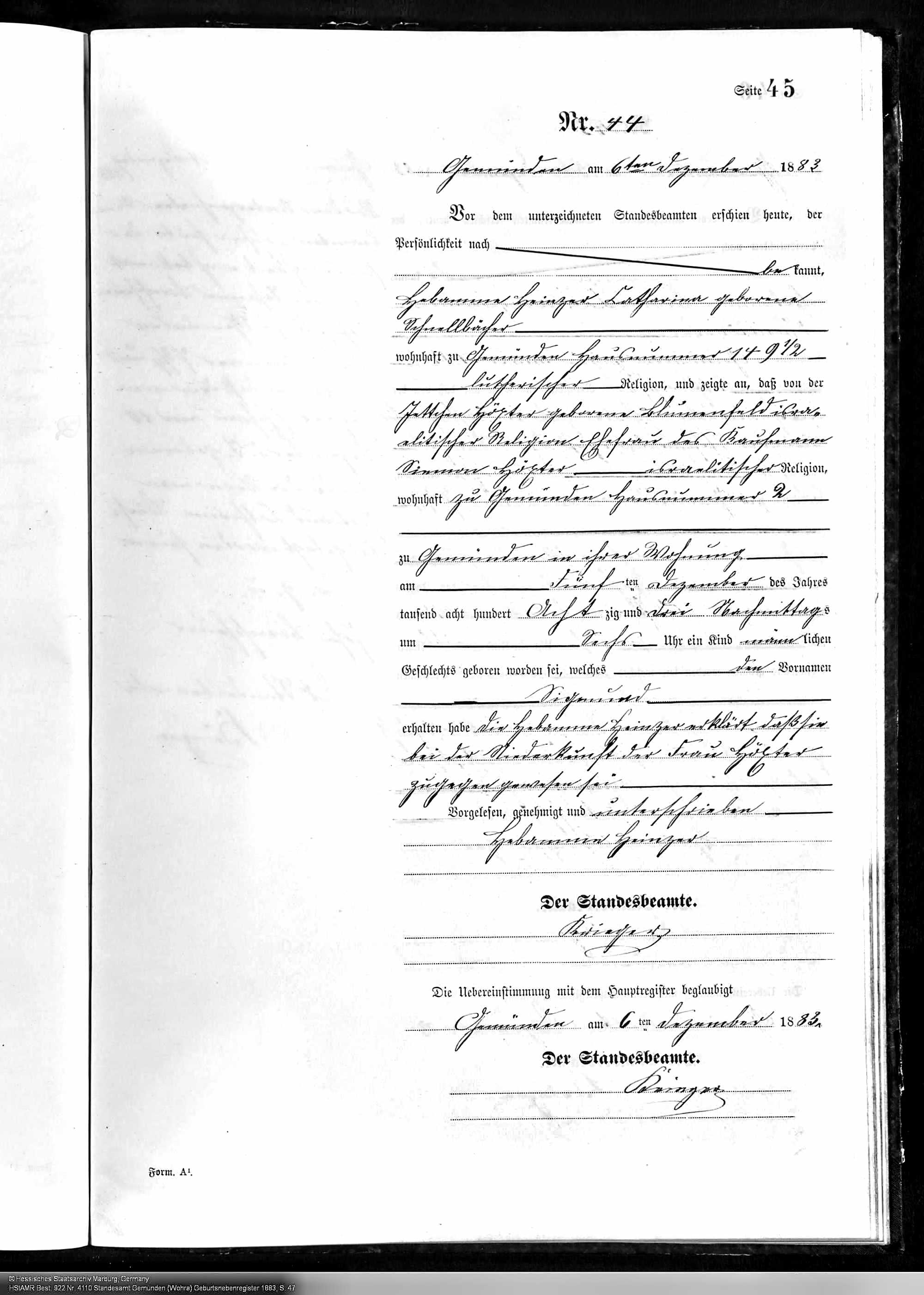
Caroline and Simon had four children, one son and three daughters. Their son Siegmund was born on December 5, 1883, in Gemuenden.

Siegmund Hoexter birth record, Hessisches Hauptstaatsarchiv; Wiesbaden, Deutschland; Signatur: 4110, Year Range: 1883, Ancestry.com. Hesse, Germany, Births, 1851-1901

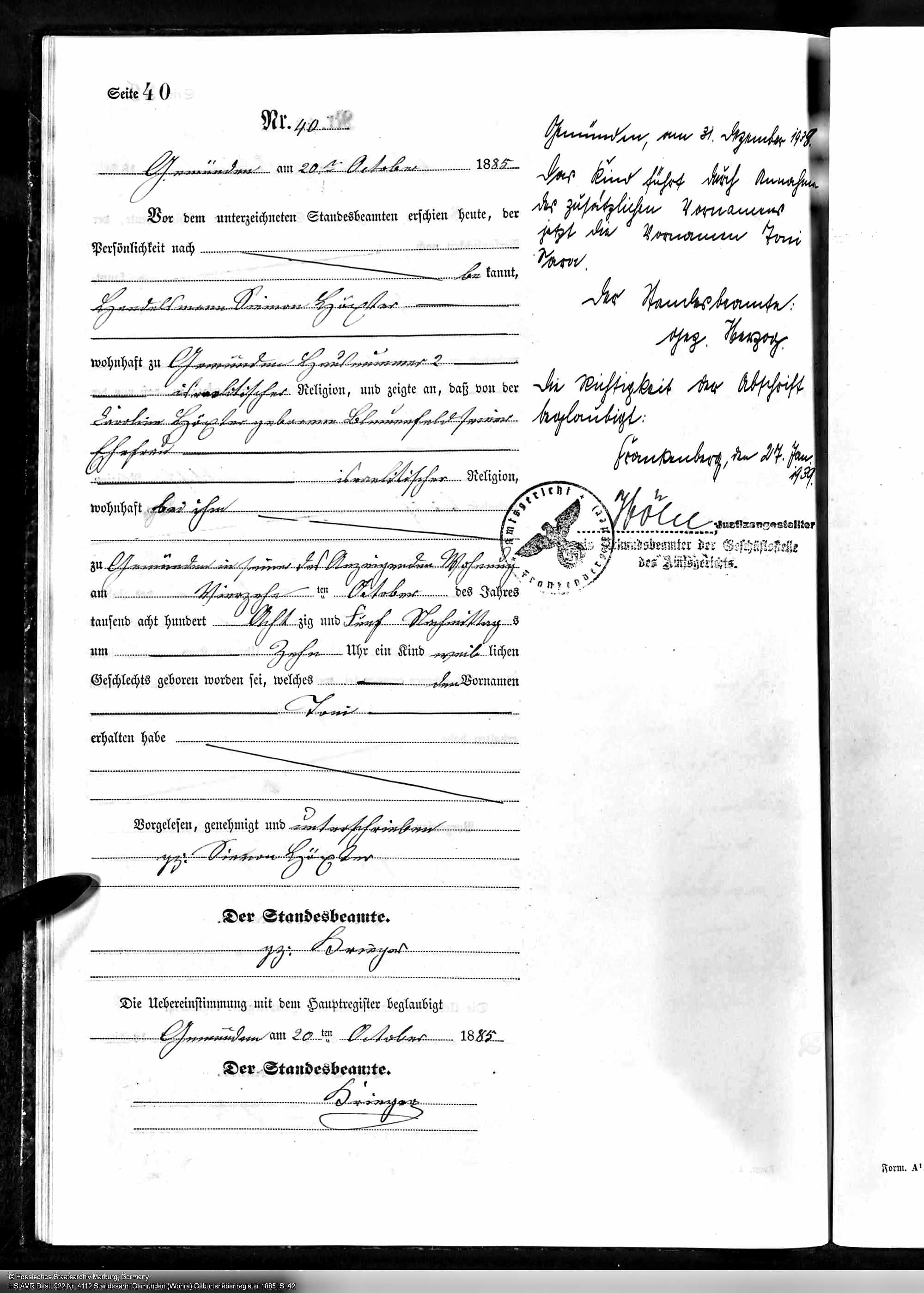
Their daughter Toni was born on October 14, 1885, in Gemuenden.

Toni Hoxter birth record, Hessisches Hauptstaatsarchiv; Wiesbaden, Deutschland; Signatur: 4112
Year Range: 1885, Ancestry.com. Hesse, Germany, Births, 1851-1901

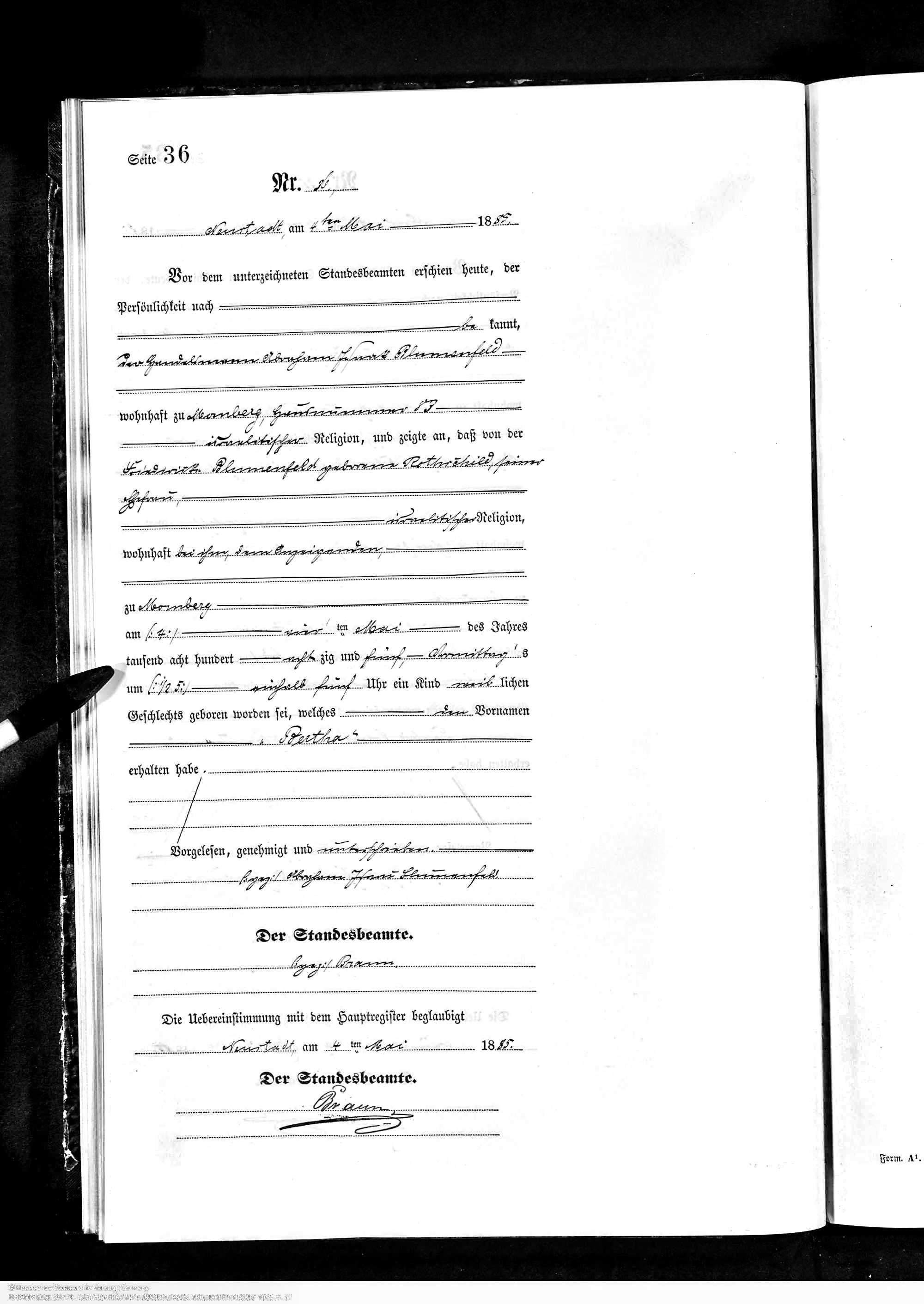
Then came Betty, born August 3, 1889, in Gemuenden.

Betty Hoexter birth record, Hessisches Hauptstaatsarchiv; Wiesbaden, Deutschland; Signatur: 4116, Year Range: 1889, Ancestry.com. Hesse, Germany, Births, 1851-1901

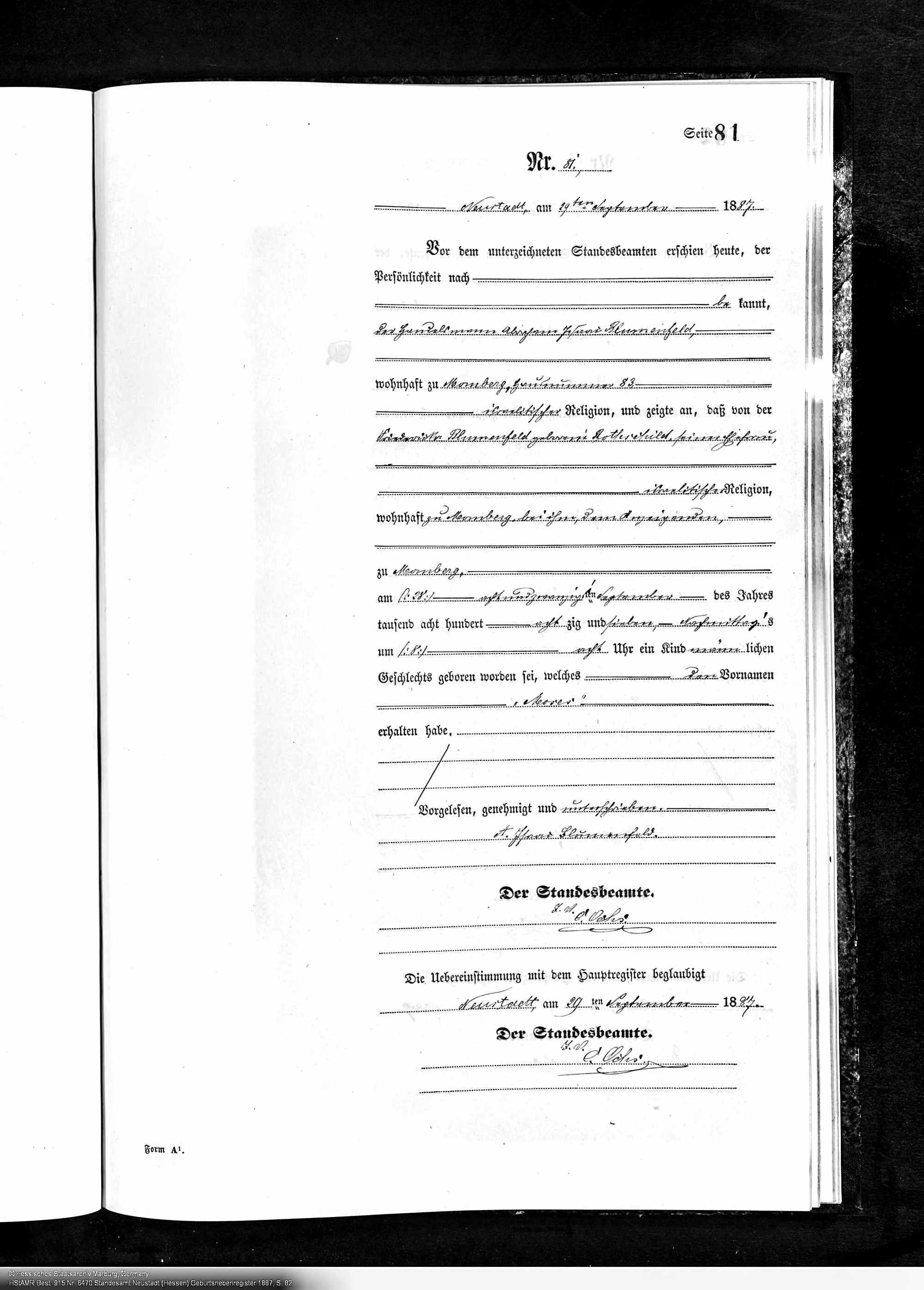
Finally, Gerda, the youngest child, was born June 7, 1895, in Gemuenden.

Gerda Hoexter birth record, Hessisches Hauptstaatsarchiv; Wiesbaden, Deutschland; Signatur: 4122, Year Range: 1895, Ancestry.com. Hesse, Germany, Births, 1851-1901

I am grateful to my cousin Peter Keibel for sharing this wonderful photograph of the four children of his great-grandparents Simon Hoxter and Caroline Blumenfeld: Betty, Siegmund, Gerda, and Toni.

Betty, Siegmund, Gerda, and Toni Hoxter, c. 1910. Courtesy of the family

Toni married Sally (later Sol) Goldschmidt on July 6, 1910. He was born on July 4, 1881, in Bad Hersfeld, Germany, to Isaak Goldschmidt and Malchen Greif.

Marriage record of Toni Hoxter and Sally Goldschmidt, Hessisches Hauptstaatsarchiv; Wiesbaden, Deutschland; Bestand: 915; Laufende Nummer: 5625, Year Range: 1910, Ancestry.com. Hesse, Germany, Marriages, 1849-1930

Toni and Sally had two children, a daughter Miriam born on April 23, 1911, in Hersfeld,3 and a son Arthur born on August 9, 1913, in Hersfeld.4

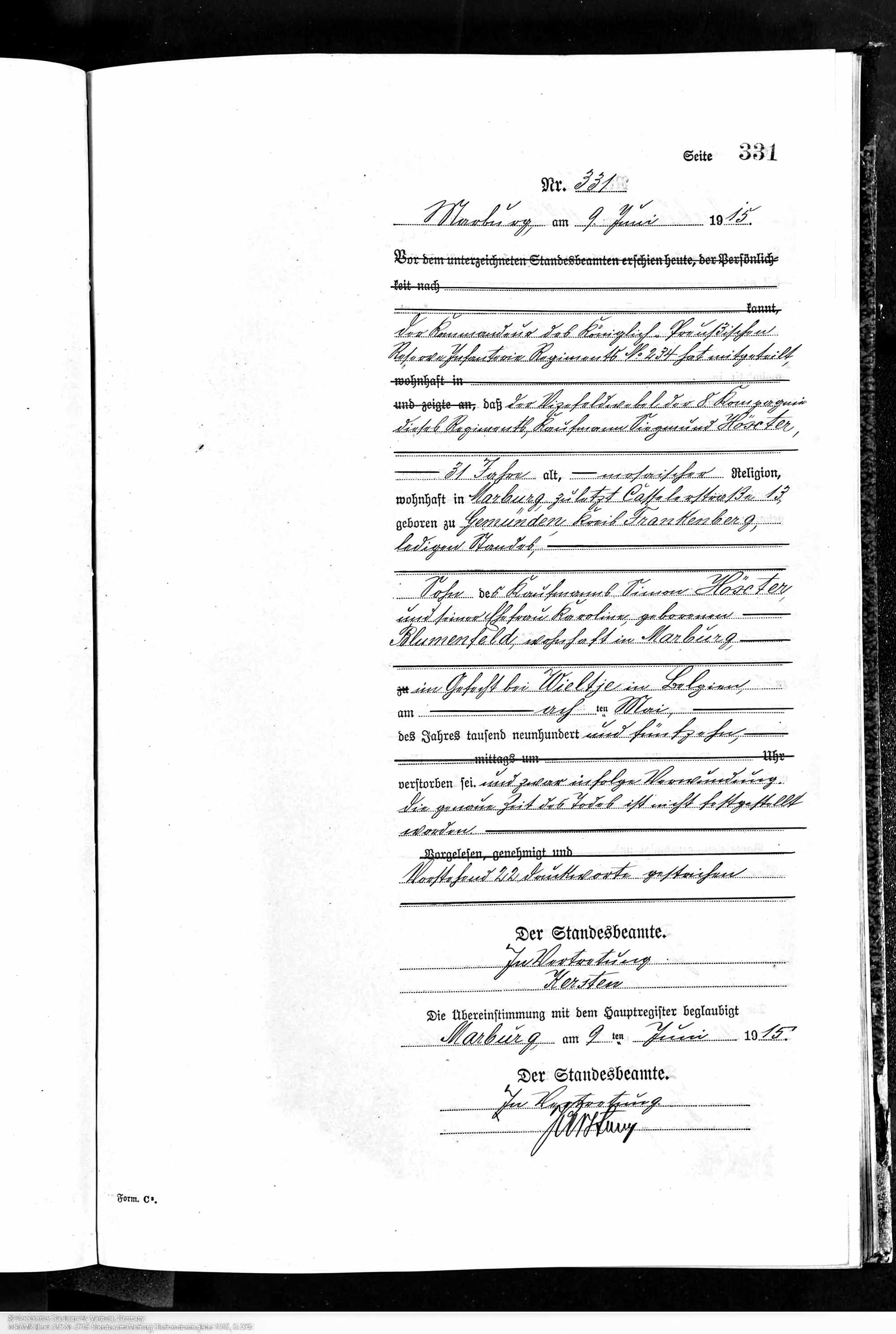
The family’s life was cruelly disrupted when Caroline and Simon’s son Siegmund was killed while fighting for Germany in World War I. He was killed during the Second Battle of Ypres on May 8, 1915. His death record says that he was the Vizefeldwebel (vice-sergeant) of the Königlich-Preussisches Reserve-Infanterie-Regiment 46 No. 234, 8. Kompanie and died in Wieltje, Belgium. He was one of over 35,000 German soldiers killed in that battle; the Allies lost roughly 59,000 troops, making this one of the costliest battles in World War I. It is perhaps mostly remembered as the first time the Germans used chlorine gas in combat on the Western front, explaining why so many more Allies died as compared to the German losses.[5]

Siegmund Höxter, Age: 31, Birth Date: abt 1884, Death Date: 8 Mai 1915 (8 May 1915)
Death Place: Marburg, Hessen (Hesse), Deutschland (Germany), Civil Registration Office: Marburg, Father: Simon Höxter, Mother: Karoline Höxter, Certificate Number: 331, 
Personenstandsregister Sterberegister; Bestand: 915; Laufende Nummer: 5705, Ancestry.com. Hesse, Germany, Deaths, 1851-1958

Caroline and Simon thus lost their oldest child and only son fighting for Germany in the war. Here is a beautiful photograph of Siegmund wearing his World War I uniform, courtesy of Peter Keibel and the family.

Siegmund Hoxter. Courtesy of the family

Five months after Siegmund’s death, his sister Betty married Max Oppenheimer on October 5, 1915. Max, a doctor, was born on August 28, 1886, in Hadamar, Germany, and was the son of Adolf Oppenheimer, a teacher, and Johanna WInkelstein.5

Betty and Max had two children, Lotte and Franz Siegmund. Lotte was born on January 29, 1917, in Posen in what was still a province of Germany at that time and  is now part of Poland, as it became in the aftermath of World War I.6 Franz Siegmund, presumably named in memory of Betty’s brother, was born on February 17, 1920, in Friedberg, Germany.7 I don’t know why Betty and Max’s children were born in two different cities, one quite far from the Hesse region where both Betty and Max were from.

Betty’s younger sister and Caroline and Simon’s youngest child Gerda married Adolf Goldschmidt on May 8, 1922, in Marburg, Germany. Adolf was the son of Louis Elieser Goldschmidt and Sophie Adler and was born on March 11, 1885, in Eldagsen in the Hanover region of Germany. Adolf Goldschmidt and Toni’s husband Sally Goldschmidt were first cousins, both grandsons of  Feist Goldschmidt and Minna Wallach.8

Marriage record of Gerda Hoxter and Adolf Goldschmidt, Hessisches Hauptstaatsarchiv; Wiesbaden, Deutschland; Bestand: 915; Laufende Nummer: 5640, Year Range: 1922, Ancestry.com. Hesse, Germany, Marriages, 1849-1930

Gerda and Adolf’s grandson Peter shared this beautiful photograph of his grandparents:

Gerda Hoxter and Adolf Goldschmidt. Courtesy of the family

Gerda and Adolf had two daughters. Inge was born in Dusseldorf, Germany, in 1923, and Lore was born three years later on March 23, 1926, in Elberfeld, a section of Wuppertal not far from Dusseldorf where Adolf now owned a department store.9 This adorable photo of Inge (later Jane) and Lore (later Alice) was provided by Jane’s son, my cousin Peter.

(Alice) Lore Goldschmidt and (Jane) Inge Goldschmidt, c. 1931. Courtesy of the family

Thus, by 1926, Caroline Blumenfeld and her husband Simon Hoxter had six grandchildren. They had tragically lost their son Siegmund during his service for Germany in World War I, but I hope they were finding joy in those grandchildren and with their three daughters in the years after Siegmund’s death.

Of course, the family’s life would change drastically in the 1930s.

To be continued.


  1. As mentioned earlier, the sixth child Rebecca died when she was four years old, and the seventh child Heinemann married my cousin Caroline Katzenstein and their story and that of their children was told when I was writing about my Katzenstein family line. 
  2. Her marriage record refers to her as Jettchen Blumenfeld, but I don’t see that name used on any other records. 
  3.  Miriam Lauter, Social Security Number: 112-05-7561, Birth Date: 23 Apr 1911
    Issue Year: Before 1951, Issue State: New York, Last Residence: 11375, Flushing, Queens, New York, USA, Death Date: 7 Jan 1988, Social Security Administration; Washington D.C., USA; Social Security Death Index, Master File, Ancestry.com. U.S., Social Security Death Index, 1935-2014 
  4. Arthur Goldschmidt, World War II draft registration, National Archives at St. Louis; St. Louis, Missouri; WWII Draft Registration Cards for New York State, 10/16/1940 – 03/31/1947; Record Group: Records of the Selective Service System, 147, Ancestry.com. U.S., World War II Draft Cards Young Men, 1940-1947 
  5. The marriage date came from Peter Keibel, grandson of Toni Hoxter and Sally Goldschmidt, and thus the nephew of Betty Hoxter Oppenheimer. Peter also provided me with some other information, as will be noted. Max’s birth and parent information was found on his birth record, Hessisches Hauptstaatsarchiv; Wiesbaden, Deutschland; Bestand: 912; Laufende Nummer: 1832, Year Range: 1886, Ancestry.com. Hesse, Germany, Births, 1851-1901. Thank you to the members of the German Genealogy group for helping me to decipher Adolf’s mother’s birth name. 
  6. Lotte’s birth information was found in her immigration file at the Israel State Archives, which can be found by searching for her name at https://www.archives.gov.il/en/ 
  7. Franz Siegmund’s birth information was found in his father’s immigration file at the Israel State Archives, found by searching for his name at https://www.archives.gov.il/en/ 
  8. The familial connection between Adolf and Sally Goldschmidt was pointed out to me Peter Keibel; I then found the marriage records of their respective parents, which corroborated that their fathers were both the sons of Feist Goldschmidt and Minna Wallach. 
  9. Inge is still living, so I will not reveal her exact birth date; Lore’s birth information came from Ancestry.com. U.S., Public Records Index, 1950-1993, Volume 2. Inge (later Jane)’s son Peter provided the information about his grandfather’s store in Wuppertal. 

Moses Blumenfeld IIA’s Surviving Children All Died Between 1930 and 1939

Moses Blumenfeld IIA and his wife Fanny Bachrach had two children who predeceased them, Frida and Karl, and three children who survived them after Moses died in 1911 and Fanny in 1928: Antonie Blumenfeld Katz, Hedwig Blumenfeld Kaufmann, and Ernst Blumenfeld. By 1939, all three had died, Ernst at 46, Hedwig at 57, and Antonie at 63.

Hedwig died first on September 5, 1934 in Marburg.

Hedwig Blumenfeld Kaufmann death record, Personenstandsregister Sterberegister; Bestand: 915; Laufende Nummer: 5744, Year Range: 1934, Ancestry.com. Hesse, Germany, Deaths, 1851-1958

She was survived by her husband Moritz Kaufmann, who died just four months later on January 10, 1935. He was 79 years old. He also died in Marburg.1 I found it interesting to see that Hedwig and Moritz had returned to Germany after living some years in Paris, where their children were both born.

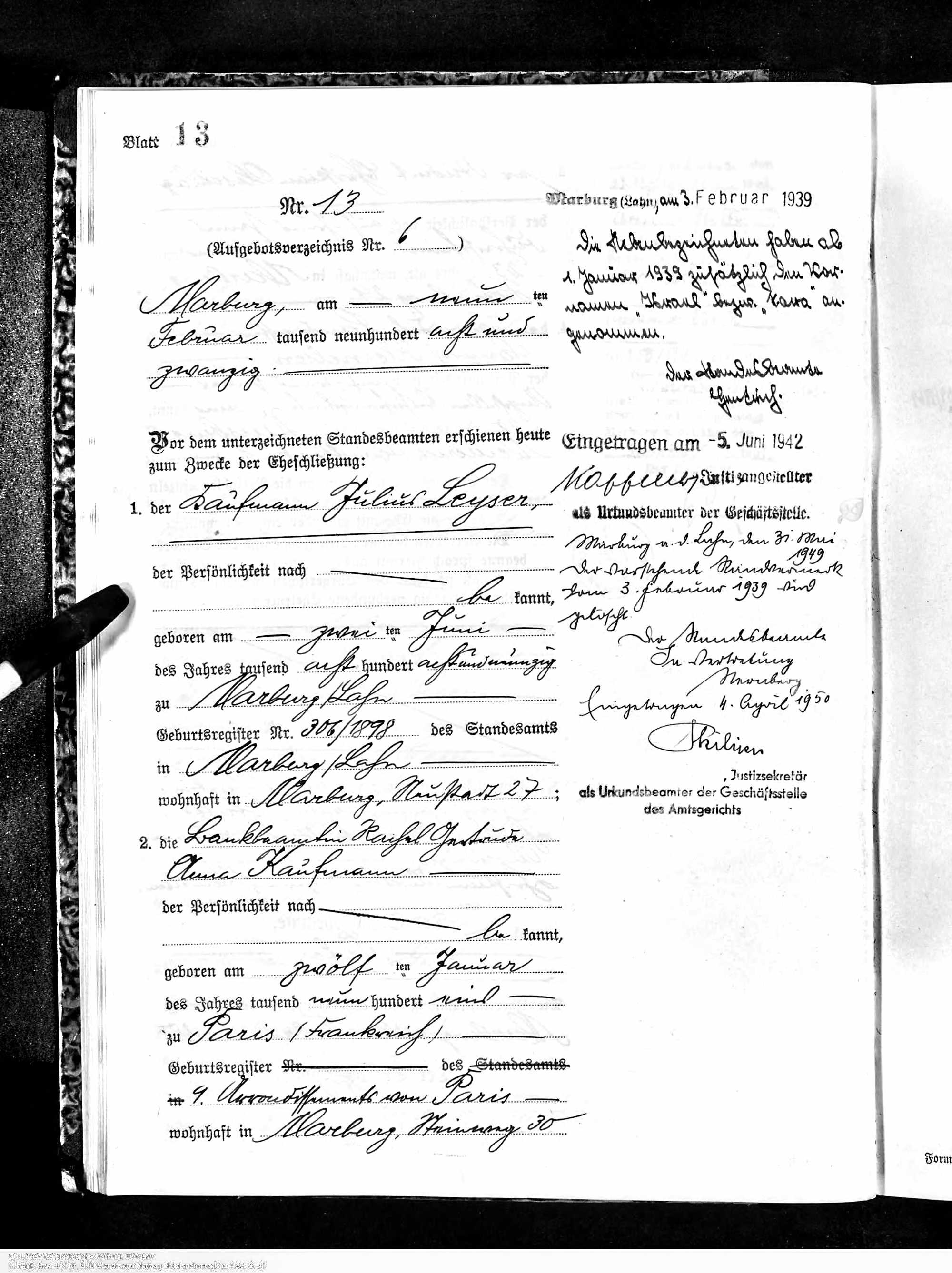
Hedwig and Moritz were survived by those two children. Their daughter Rachel Gertrude Anna Kaufmann (known as Anna) had married Julius Leyser on February 9, 1928, in Marburg. Julius was born in Marburg on June 2, 1898 to Markus Leyser and Lina Baum.2

Marriage record of Anna Kaufmann and Julius Leyser, Hessisches Hauptstaatsarchiv; Wiesbaden, Deutschland; Bestand: 915; Laufende Nummer: 5650, Year Range: 1928, Ancestry.com. Hesse, Germany, Marriages, 1849-1930

Julius and Anna had two children: Ernst, born on February 7, 1930, in Marburg,3 and Hans, born June 18, 1932, in Marburg.4

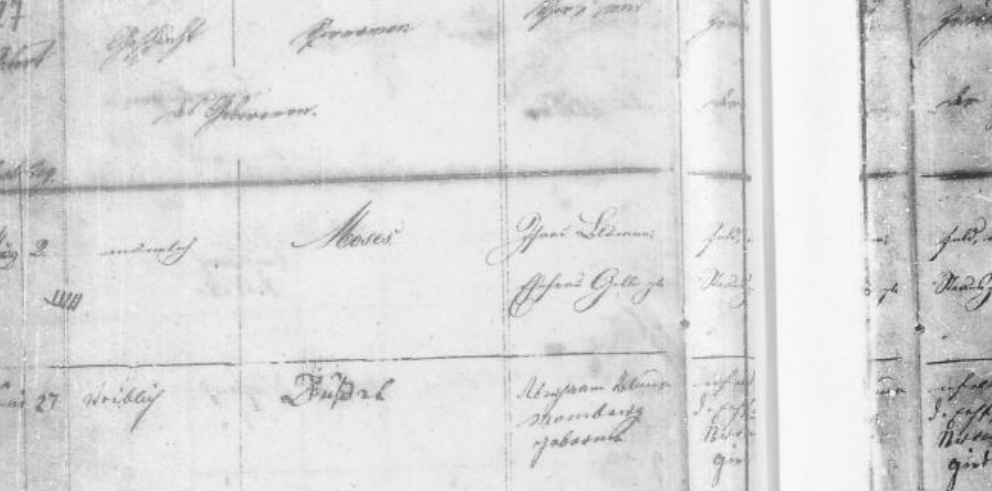
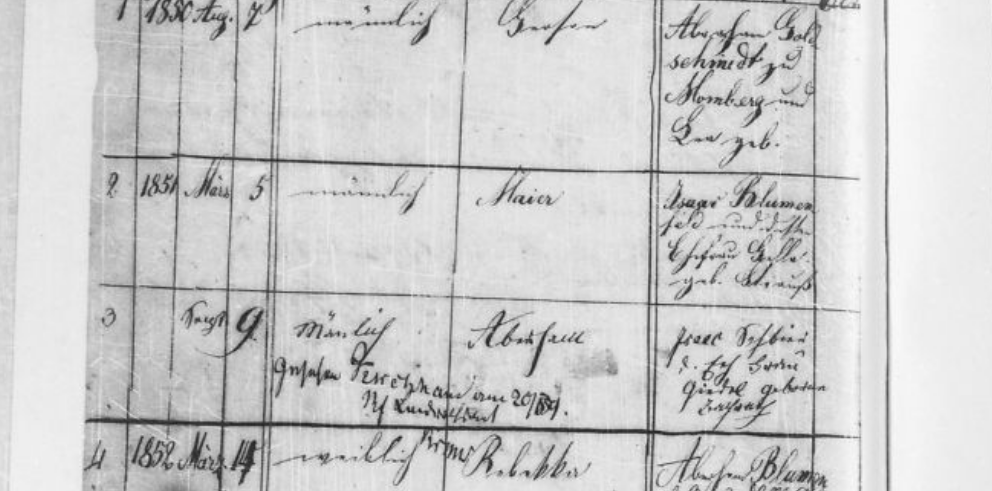
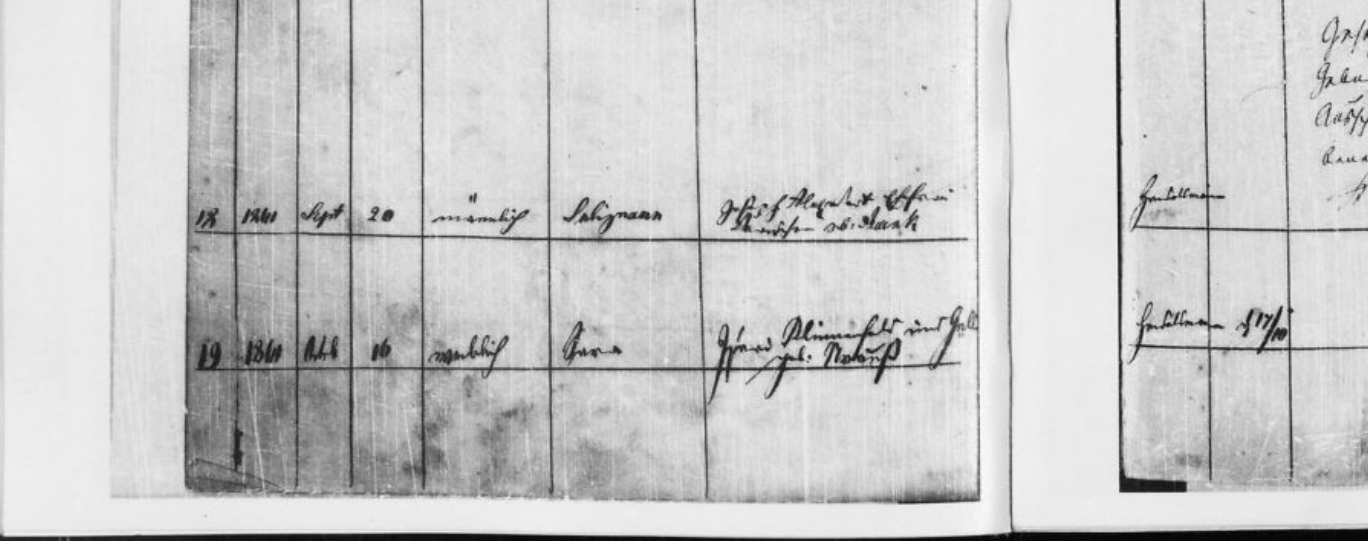
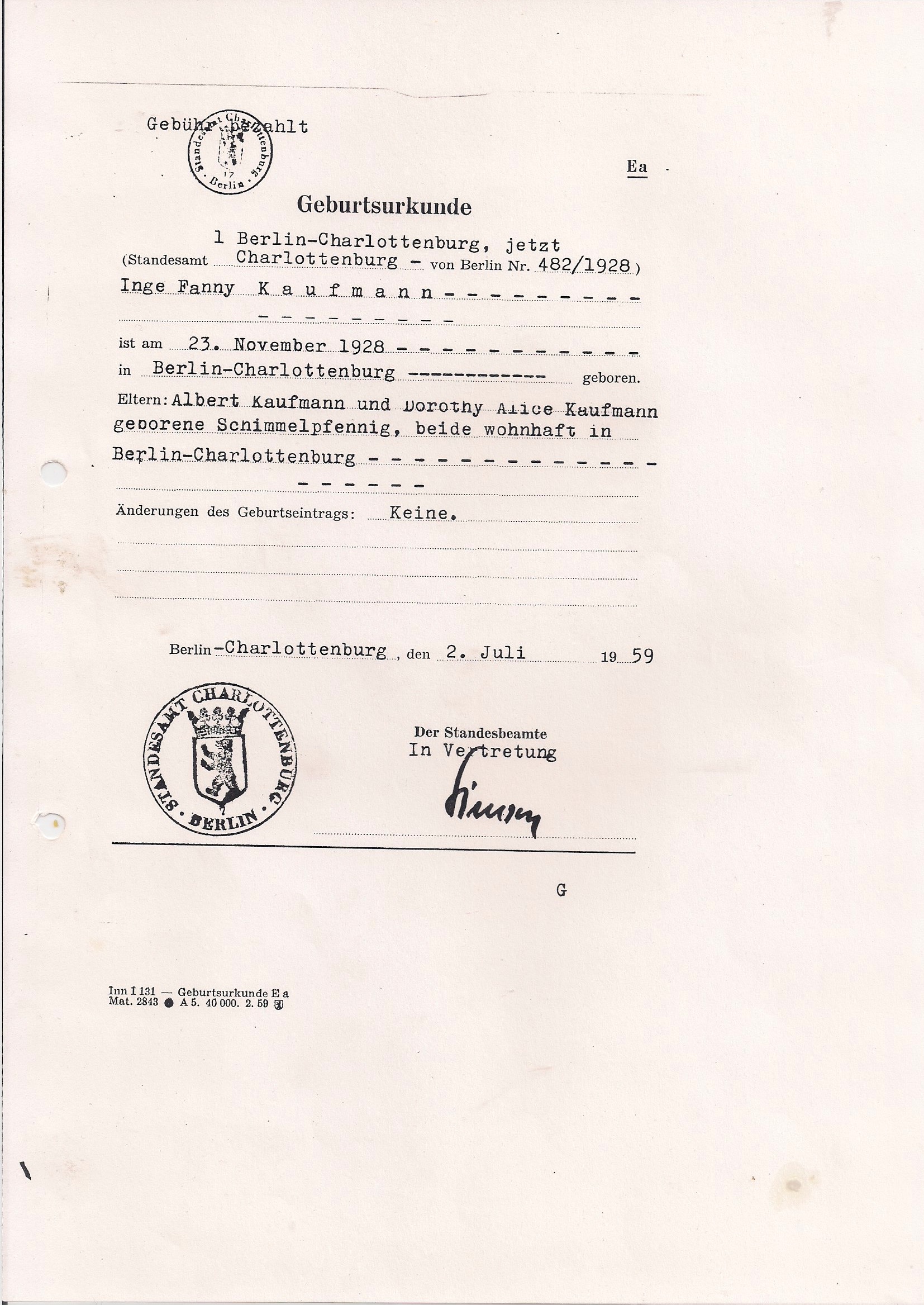
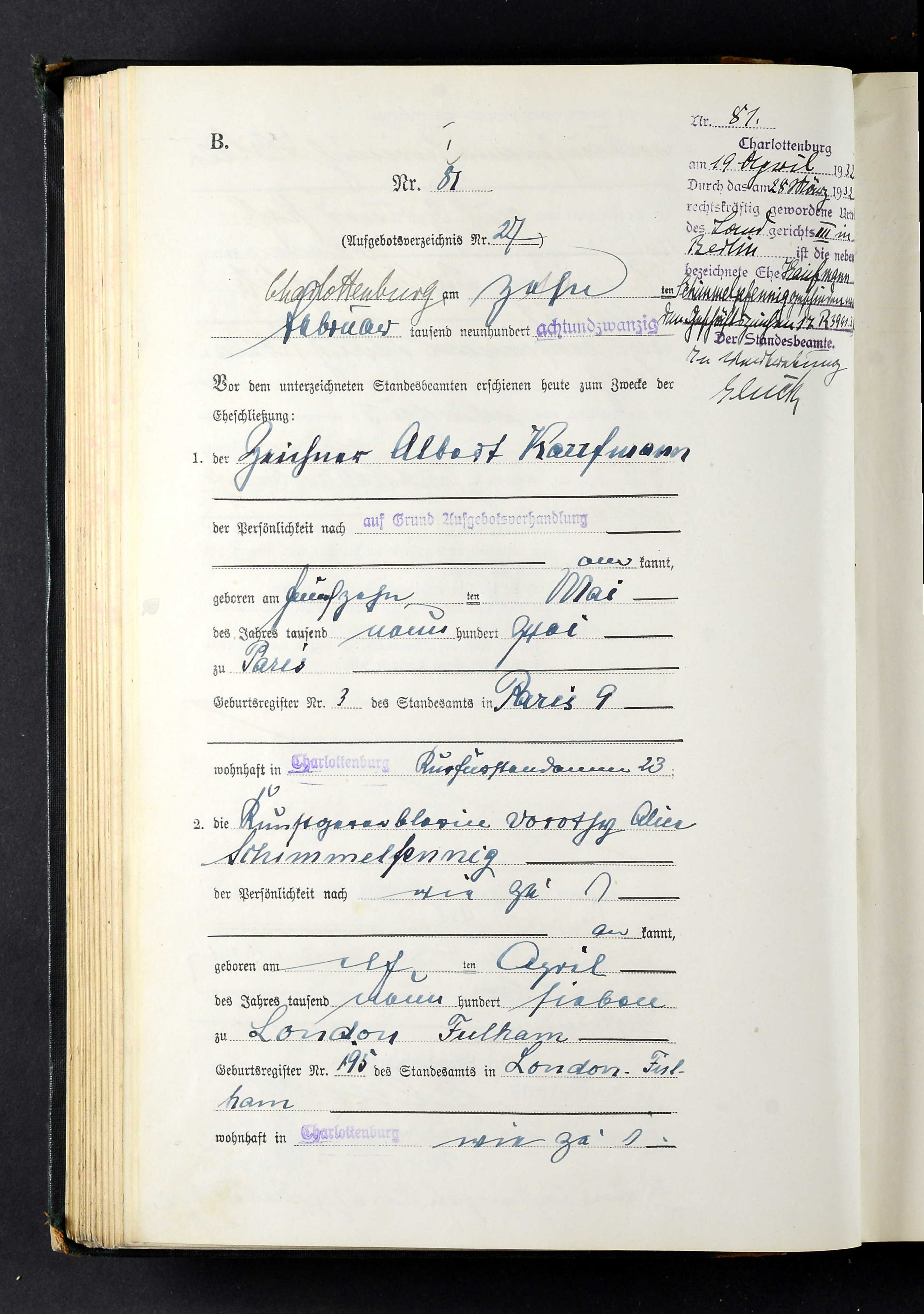
Moritz and Hedwig’s second child, their son Albert, married Dorothy Alice Schimmelfennig in Berlin on February 10, 1928. Dorothy was born in London on April 11, 1907, the daughter of Leo Schimmelfennig and Cecelia Sarah Pick. As far as I’ve been able to determine, they did not have children. Their marriage ended in divorce.

Dorothy Schimmerfennig birth record, Registration District: Fulham, Subdistrict North East Fulham, County of London, 1907.
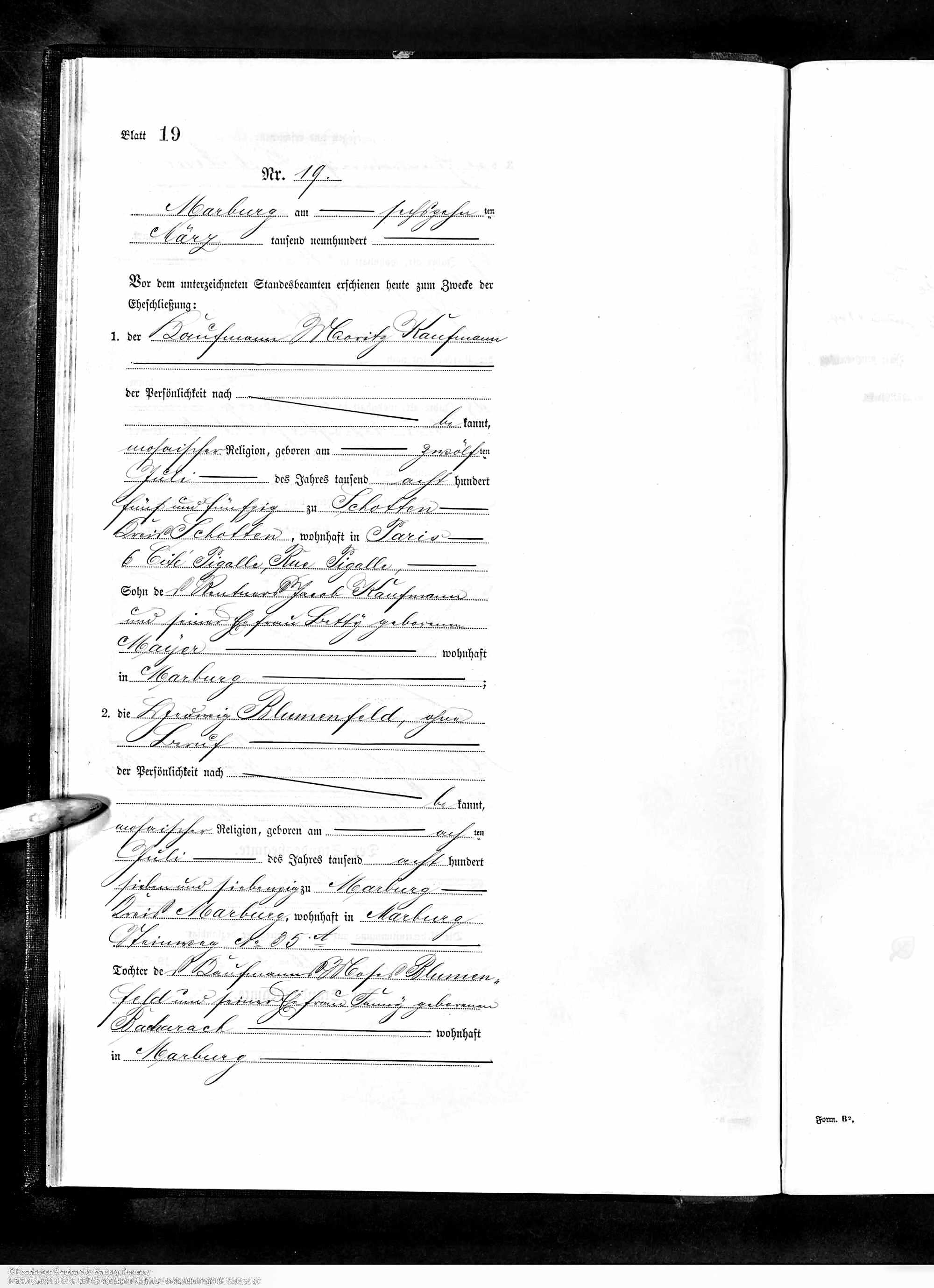
Marriage record of Albert Kaufmann and Dorothy Schimmelfennig, Landesarchiv Berlin; Berlin, Deutschland; Personenstandsregister Heiratsregister; Laufendenummer: 132, Register Year or Type: 1928 (Erstregister), Ancestry.com. Berlin, Germany, Marriages, 1874-1936

Ernst Blumenfeld, Moses and Fanny’s only surviving son and last born child, died on April 24, 1935, in Marburg. His three children Lore, Franz, and Paul were only eight, six and three years old, respectively, when they lost their father. Ernst was also survived by his wife Bella, who was widowed at 35.

Ernst Blumenfeld death record, Personenstandsregister Sterberegister; Bestand: 915; Laufende Nummer: 5745, Year Range: 1935, Ancestry.com. Hesse, Germany, Deaths, 1851-1958

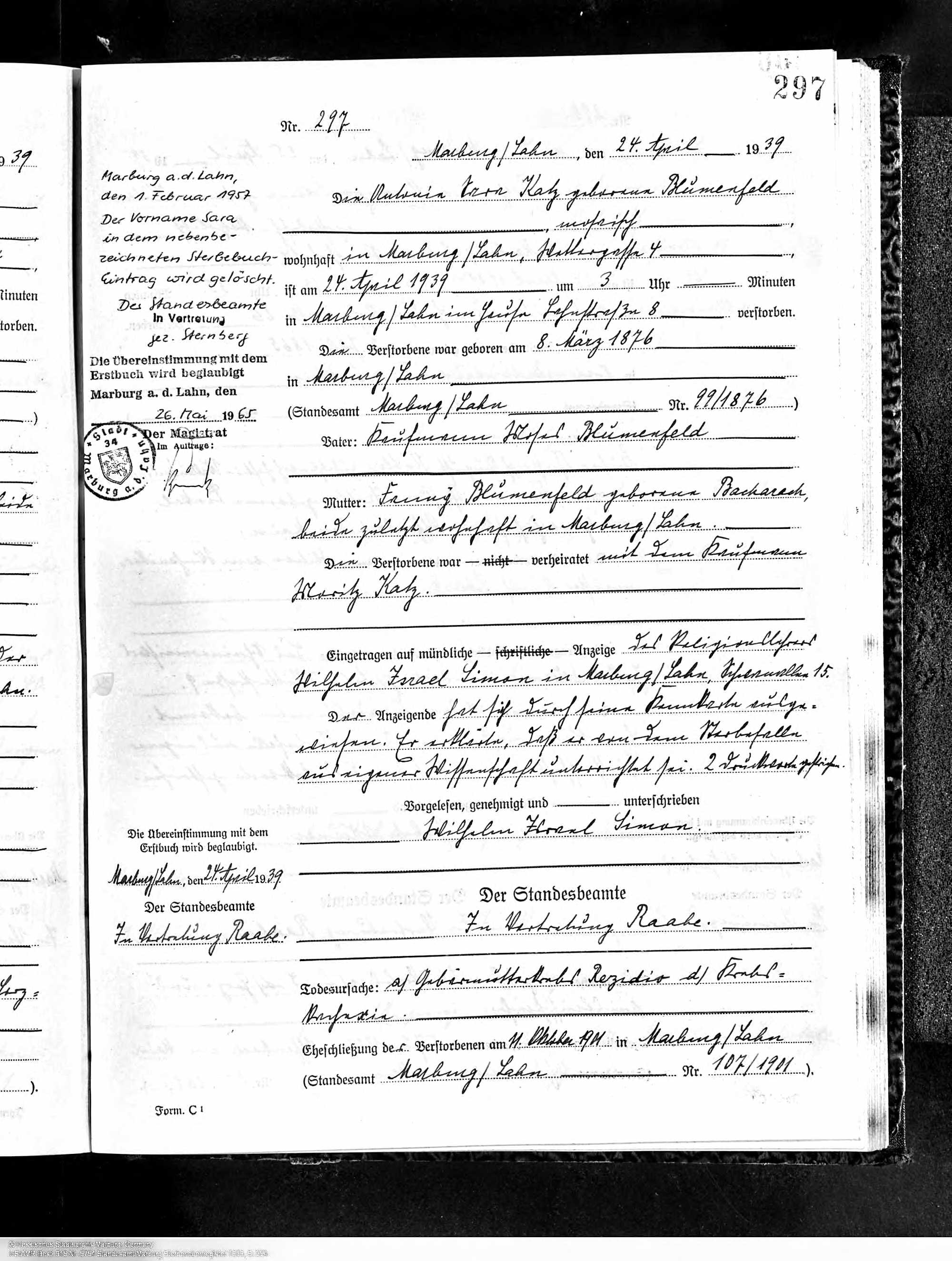
Antonie Blumenfeld Katz was the first-born child of Moses and Fanny and the one who survived the longest. She outlived all her younger siblings. Yet she was only 63 when she died of uterine cancer on April 24, 1939, in Marburg. She was survived by her husband Moritz Katz and her children Artur/Avraham and Margarete.

Antonie Blumenfeld Katz death record, Personenstandsregister Sterberegister; Bestand: 915; Laufende Nummer: 5754, Ancestry.com. Hesse, Germany, Deaths, 1851-1958

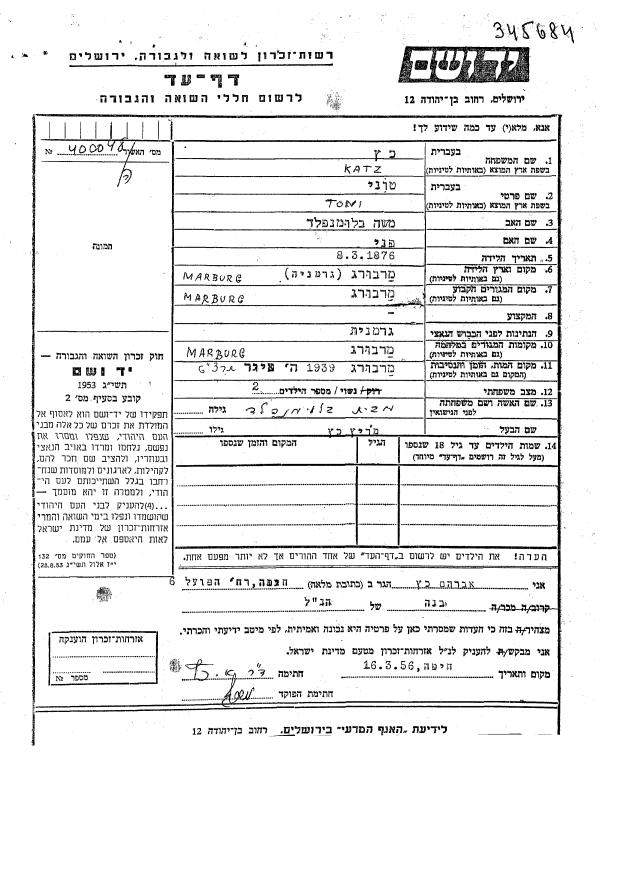
Antonie’s death record is one of the very few German death records I’ve seen that listed a cause of death, and it was very useful to resolve a question I had about a document filed at Yad Vashem by Antonie’s son Artur, later known as Avraham. He wrote that his mother Antonie had been murdered. I found this a bit surprising since in April 1939, as far as I knew, Nazis were not generally killing Jewish women in their hometowns in Germany, though certainly there were persecution and deaths even that early. Why would Antonie have been killed at that time?

Antonie Blumenfeld Katz, Page of Testimony at Yad Vashem, found at https://yvng.yadvashem.org/nameDetails.html?language=en&itemId=842831&ind=1

In searching for the answer, I asked for help in translating Antonie’s death record. Kira Dolcimascolo of Tracing the Tribe first alerted me to the fact that the death record included a cause of death and that it was uterine cancer, and  then Cathy Meder-Dempsey and Katherine O’Grady of the German Genealogy group  were able to transcribe and translate the remainder of the cause of death—cancer achexia or extreme weight loss and muscle wasting.

Antonie was not murdered, but died of natural causes, according to her death record. Did her son Avraham not believe the death record? Or did he somehow link his mother’s medical condition to the Nazi persecution going on in Germany in the 1930s? Was she unable to get medical help? Had she refused medical help because of persecution? I don’t know. 5

In any event, by April 1939, all three of Moses IIA and Fanny (Bachrach) Blumenfeld’s children had died. What about the seven grandchildren—the children of Antonie, Hedwig, and Ernst? Their story will be told in the next post.


  1.  Moritz Kaufmann, Age: 79, Birth Date: abt 1856, Death Date: 10 Jan 1935
    Death Place: Marburg, Hessen (Hesse), Deutschland (Germany), Civil Registration Office: Marburg, Certificate Number: 21, Personenstandsregister Sterberegister; Bestand: 915; Laufende Nummer: 5745, Ancestry.com. Hesse, Germany, Deaths, 1851-1958 
  2. Julius Leyser birth record,Birth Date: 2 Jun 1898, Birth Place: Marburg, Hessen (Hesse), Deutschland (Germany), Civil Registration Office: Marburg, Father: Markus Leÿser, Mother: Lina Leÿser, Certificate Number: 306, Hessisches Hauptstaatsarchiv; Wiesbaden, Deutschland; Bestand: 915; Laufende Nummer: 5583, Ancestry.com. Hesse, Germany, Births, 1851-1901 
  3. Entry at Yad Vashem, found at https://yvng.yadvashem.org/nameDetails.html?language=en&itemId=11572295&ind=1 
  4. Entry at Yad Vashem, found at https://yvng.yadvashem.org/nameDetails.html?language=en&itemId=4266841&ind=1 
  5. I also found an interview that Antonie’s grandson Yoram Jacobson gave in 2012 in which he said his grandmother died in 1939, but did not attribute her death to the Nazis. See the interview at http://www.garten-des-gedenkens.de/?page_id=414&lang=EN 

My Cousin Moses Blumenfeld (1849-1911) of Momberg, Part I

I now turn to the fifth of the eight children of Abraham Blumenfeld II and Giedel Strauss, their fourth son Moses Blumenfeld IIA, named presumably for his grandfather Moses Blumenfeld, the brother of my 3x-great-grandmother Breine Blumenfeld Katzenstein.  He was one of six cousins named Moses Blumenfeld on my tree, all presumably named for their grandfather (or great-grandfather) Moses Blumenfeld I.  I am referring to this Moses as IIA, the A signifying Abraham II, Moses Blumenfeld I’s oldest son and father of Moses IIA.

Moses IIA was born on December 31, 1849, in Momberg, Germany.

Arcinsys Archives Hessen,HHStAW Fonds 365 No 628, p. 17

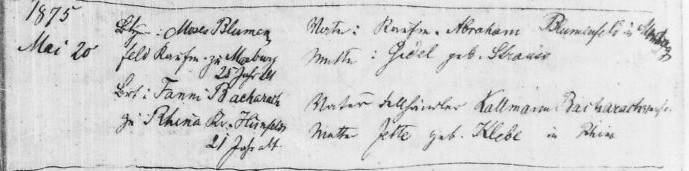
On May 25, 1875, he married Fanny Bachrach. She was born in Rhina, Germany, to Kallman Bachrach and Jette Klebe on October 30, 1853.1

Marriage record of Moses Blumenfeld and Fanny Bachrach, Arcinsys Archives Hessen, HHStAW Fonds 365 No 585, p, 27

Moses IIA and Fanny had five children. Their first was Antonie Blumenfeld, born March 8, 1876, in Momberg.

Antonie Blumenfeld birth record, Hessisches Hauptstaatsarchiv; Wiesbaden, Deutschland; Bestand: 915; Laufende Nummer: 5555, Year Range: 1876, Ancestry.com. Hesse, Germany, Births, 1851-1901

Second born was Hedwig Blumenfeld, born in Marburg on July 8, 1877.

Hedwig Blumenfeld birth record, Hessisches Hauptstaatsarchiv; Wiesbaden, Deutschland; Bestand: 915; Laufende Nummer: 5556, Year Range: 1877, Ancestry.com. Hesse, Germany, Births, 1851-1901

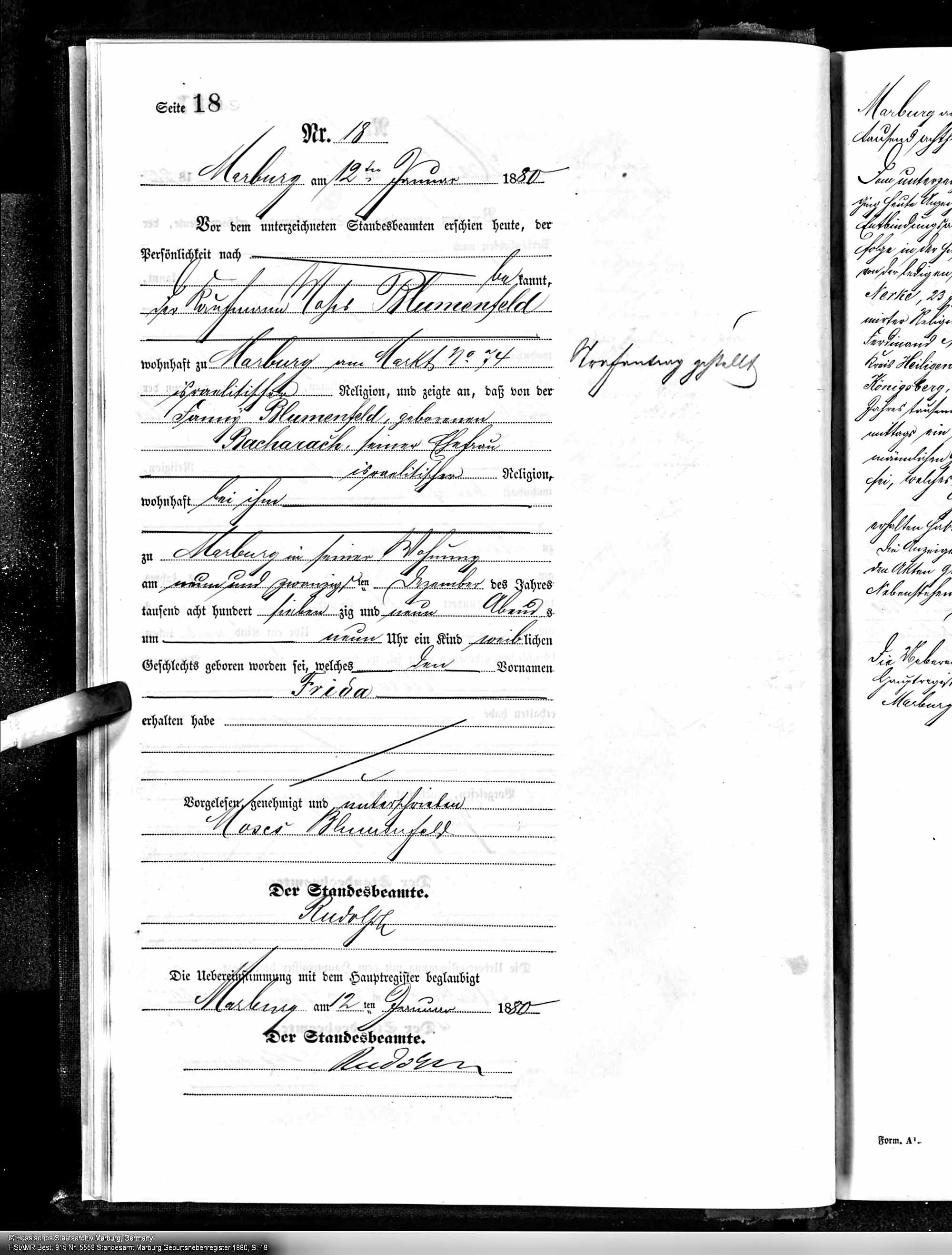
Frida, a third daughter, was born on December 29, 1879.

Frida Blumenfeld birth record, Hessisches Hauptstaatsarchiv; Wiesbaden, Deutschland; Bestand: 915; Laufende Nummer: 5559, Year Range: 1880, Ancestry.com. Hesse, Germany, Births, 1851-1901

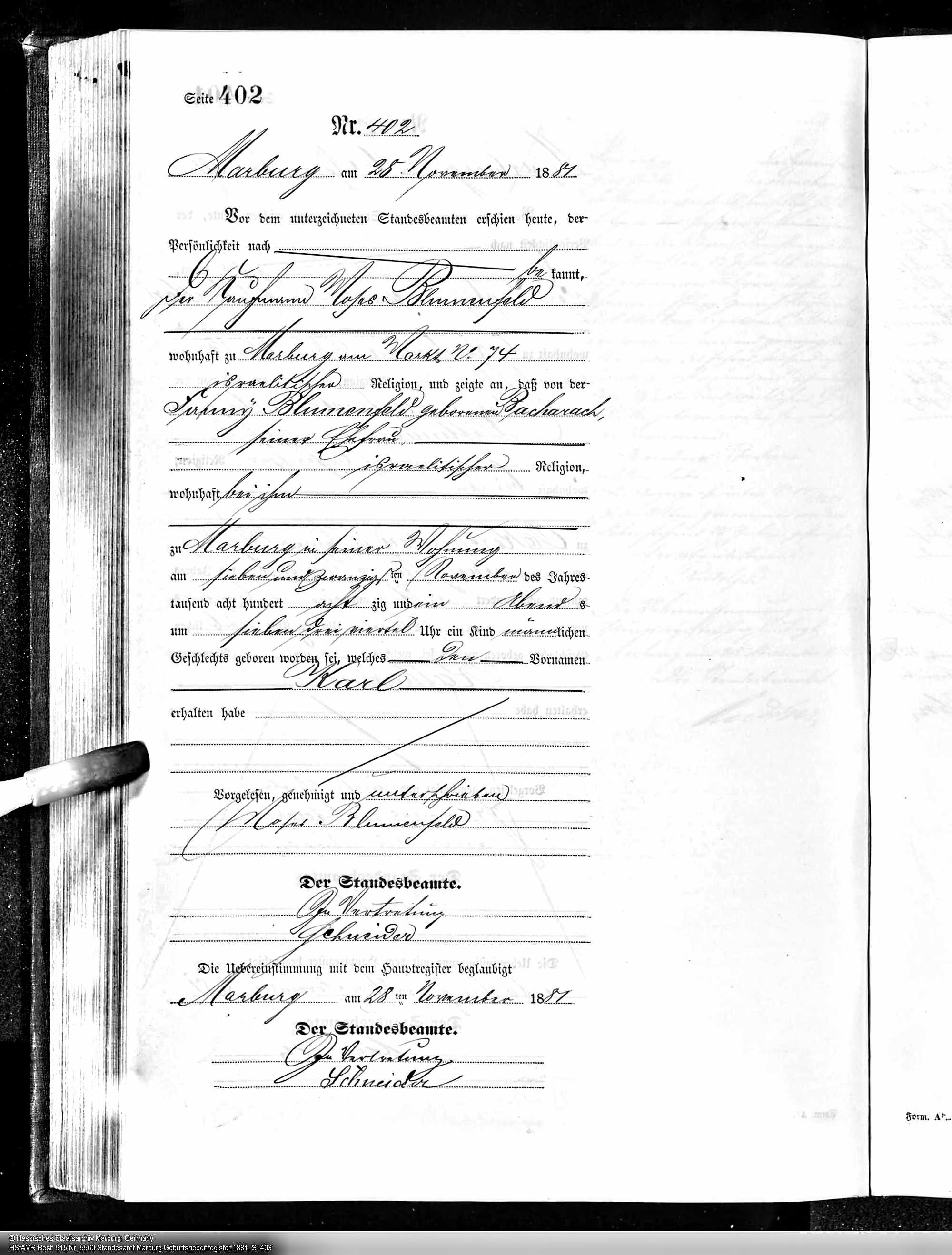
She was followed by Moses IIA and Fanny’s first son, Karl, who was born on November 27, 1881, in Marburg.

Karl Blumenfeld birth record, Hessisches Hauptstaatsarchiv; Wiesbaden, Deutschland; Bestand: 915; Laufende Nummer: 5560, Year Range: 1881, Ancestry.com. Hesse, Germany, Births, 1851-1901

Sadly, both Frida and Karl died in March, 1882, Karl on March 3 at three months of age, and Frida eleven days later on March 14 at age two . I can’t begin to imagine the family’s grief over losing these two young children. 2

Frida and Karl Blumenfeld deaths, Arcinsys Archives Hessen, HHStAW Fonds 365 No 586 p. 35

Moses IIA and Fanny had one more child, another son, Ernst, born February 22, 1889, seven years after the deaths of Frida and Karl.

Ernst Blumenfeld birth record, Hessisches Hauptstaatsarchiv; Wiesbaden, Deutschland; Bestand: 915; Laufende Nummer: 5570, Year Range: 1889, Ancestry.com. Hesse, Germany, Births, 1851-1901

Fortunately, Ernst and his older sisters Antonie and Hedwig lived to adulthood.

Antonie married Morris Katz sometime before 1902. Morris was born in Mollenfelde, Germany, on October 28, 1870.3  Antonie and Morris had two children, a son Artur (Avraham) Katz, born September 6, 1902, in Goettingen, Germany,4 and a daughter Margarete Martha Katz, born in Marburg on September 17, 1906.5

Hedwig Blumenfeld married Moritz Kaufmann on March 16, 1900, in Marburg. Moritz, son of Jacob Kaufmann and Betty Mayer, was born on July 12, 1855, in Schotten, Germany. He was living in Paris when he married Hedwig.

Hedwig Blumenfeld and Kaufmann marriage record, Hessisches Hauptstaatsarchiv; Wiesbaden, Deutschland; Bestand: 915; Laufende Nummer: 5614, Year Range: 1900, Ancestry.com. Hesse, Germany, Marriages, 1849-1930

Their two children were born in Paris where they settled: Rachel Gertrude Anna Kaufmann, born on January 12, 1901, and Albert Kaufmann, born on May 15, 1902.

Rachel Gertrude Anna Kaufmann birth record, Archives de Paris; Paris, France; Etat Civil 1792-1902, BrowseLevel: 62058_B964336, Paris, France, Births, Marriages, and Deaths, 1792-1930

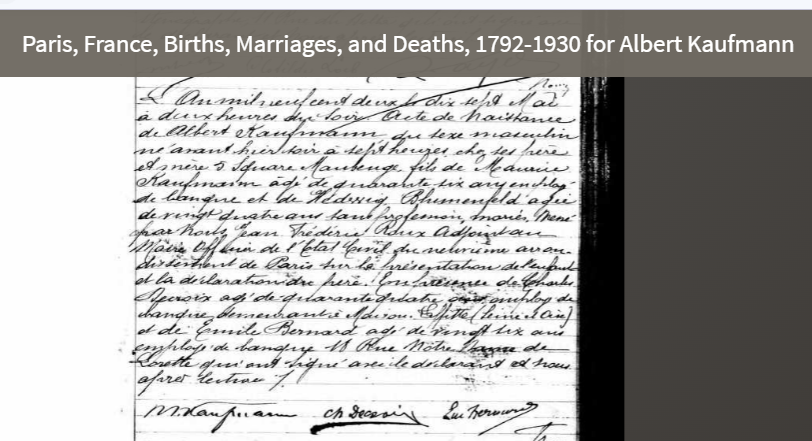
Albert Kaufmann birth record, Archives de Paris; Paris, France; Etat Civil 1792-1902, BrowseLevel: 62058_B960111, Paris, France, Births, Marriages, and Deaths, 1792-1930

Moses Blumenfeld IIA did not live to see his youngest child and only surviving son Ernst get married. He died on June 3, 1911, in Marburg when he was 61.

Moses Blumenfeld IIA death record, Personenstandsregister Sterberegister; Bestand: 915; Laufende Nummer: 5700, Year Range: 1911,  Ancestry.com. Hesse, Germany, Deaths, 1851-1958

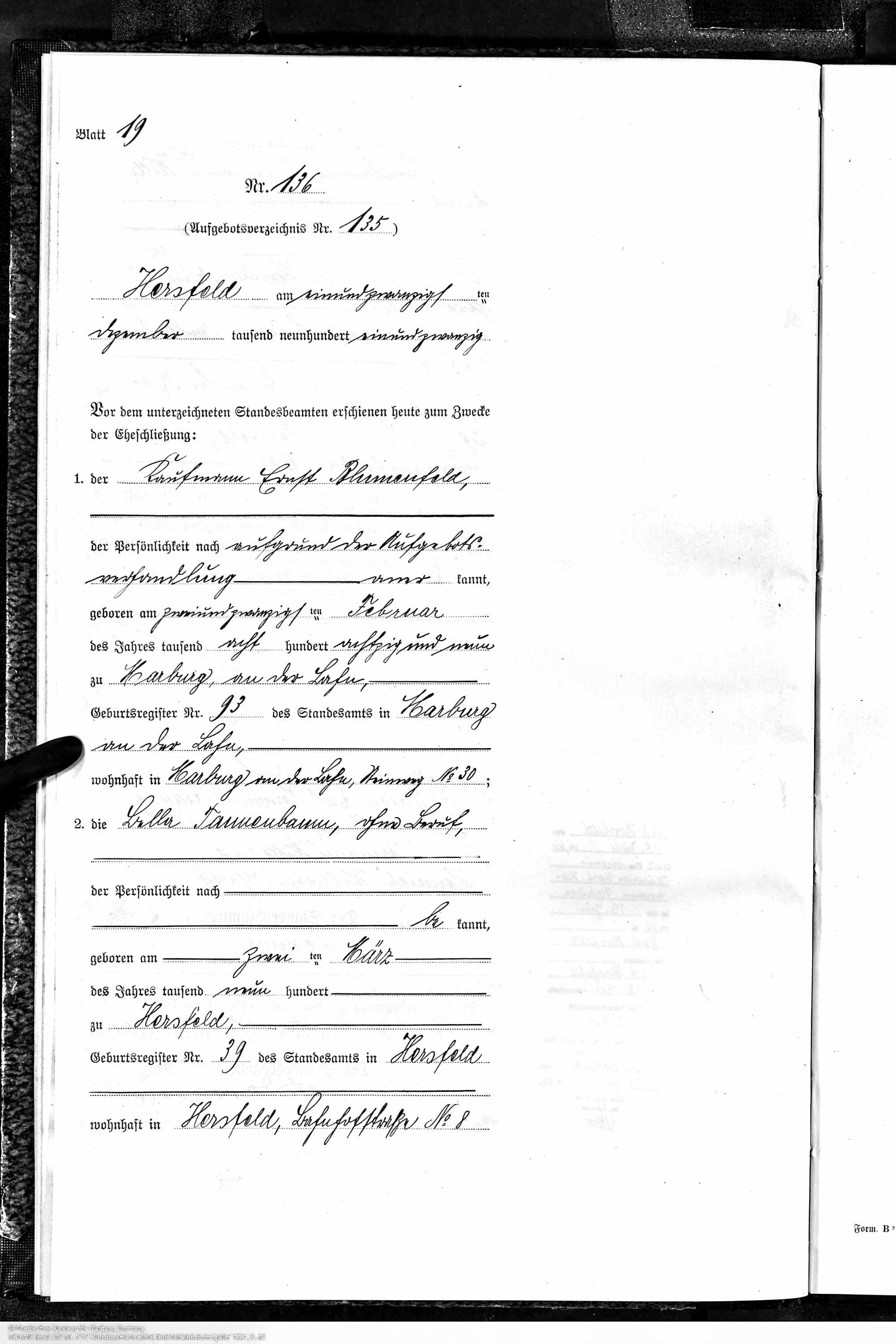
Ernst Blumenfeld married on December 12, 1921, ten years after his father died . He married Bella Tannenbaum in Bad Hersfeld, Germany, where she was born on March 2, 1900, to Levi Tannenbaum and Rosa Katz.6

Ernst Blumenfeld and Bella Tannenbaum marriage record, Hessisches Hauptstaatsarchiv; Wiesbaden, Deutschland; Bestand: 907, Year Range: 1921, Ancestry.com. Hesse, Germany, Marriages, 1849-1930

Ernst and Bella had three children. Lore was born in Marburg on March 13, 1927.7 Her brother Franz was born two years later on March 21, 1929, in Marburg.8 The third child Paul was born three years after Franz on February 2, 1932, in Marburg.9

Fanny Bachrach Blumenfeld did not live to see the births of her last two grandchildren Franz and Paul. She died at 74 on April 9, 1928, in Marburg. She was survived by three of her children, Antonie, Hedwig, and Ernst, and by seven grandchildren.

Fanny Bachrach death record, Personenstandsregister Sterberegister; Bestand: 915; Laufende Nummer: 5731, Year Range: 1928, Ancestry.com. Hesse, Germany, Deaths, 1851-1958

Unfortunately, the three surviving children of Fanny and Moses Blumenfeld IIA would not survive the 1930s. More on their stories and those of Moses and Fanny’s grandchildren in my next post.


  1. Arcinsys Archives Hessen, HHStAW Abt. 365 Nr. 687, 49. 
  2.   A separate death record for Karl states that he died on March 10. I don’t know which one is more accurate. See Personenstandsregister Sterberegister; Bestand: 915; Laufende Nummer: 5662, Certificate 90, Ancestry.com. Hesse, Germany, Deaths, 1851-1958 
  3. Moritz Katz, Gender: männlich (Male), Nationality: Deutsch Juden, Residence Age: 68, Record Type: Residence, Birth Date: 28 Okt 1870 (28 Oct 1870), Birth Place: Mollenfelde, Sojourn Start Date: 2 Sep 1939, Residence Place: Marburg Marburg an der Lahn, Sojourn End Date: 5 Sep 1942, Reference Number: 02010101 oS, Document ID: 70454287, Arolsen Archives, Digital Archive; Bad Arolsen, Germany; Lists of Persecutees 2.1.1.1, Ancestry.com. Free Access: Europe, Registration of Foreigners and German Persecutees, 1939-1947. I was unable to locate an actual birth record for Moritz or a record of his marriage to Antonie. 
  4. The only “source” I could find for his birth date was an entry on Geni at https://www.geni.com/people/Abraham-Katz/6000000028354088593?through=6000000028354250250. I don’t know how reliable this is given that no real sources were provided on Geni. 
  5. Margarete’s birth date was found on her Palestine immigration papers found at the Israel State Archives, by searching for her Friedrich Max Jacobsohn,https://www.archives.gov.il/en/catalogue/group/1?kw=max%20jacobsohn 
  6.  Bella Tannenbaum, Gender: weiblich (Female), Birth Date: 2 Mrz 1900 (2 Mar 1900), Birth Place: Hersfeld, Bad, Hessen (Hesse), Deutschland (Germany), Civil Registration Office: Bad Hersfeld, Father: Levi Tannenbaum, Mother: Rosa Tannenbaum, Certificate Number: 39, Hessisches Hauptstaatsarchiv; Wiesbaden, Deutschland; Bestand: 907; Signatur: 907_7150, Ancestry.com. Hesse, Germany, Births, 1851-1901 
  7. Lore Gertrude Blumenfeld, [Lore Ger Oppenheim], Gender: Female, Race: White
    Birth Date: 13 Mar 1927, Birth Place: Marburg, Federal Republic of Germany, [Marbury, Federal Republic of Germany], Death Date: 14 Nov 1991, Father: Ernest Blumenfeld
    Mother: Bella Tannenbaum, SSN: 132142097, Ancestry.com. U.S., Social Security Applications and Claims Index, 1936-2007 
  8. Frank Martin Blumenfeld, Gender: Male, Race: White, Birth Date: 21 Mar 1929
    Birth Place: Marburg, Federal Republic of Germany, Death Date: 22 Mar 2002
    Father: Ernest Blumenfeld, Mother: Bella Kannenbaum, SSN: 120204479, Ancestry.com. U.S., Social Security Applications and Claims Index, 1936-2007 
  9. Paul F Blumenfeld, Gender: Male, Race: White, Birth Date: 2 Feb 1932, Birth Place: Marbery, Federal Republic of Germany, Death Date: Jun 1986, Father:
    Ernst Blumenfeld, Mother: Bella Tannenbaum, SSN: 105247709, Ancestry.com. U.S., Social Security Applications and Claims Index, 1936-2007 

German Jewish Immigrants in America in the 1800s: The Livingstons in Bloomington, Illinois, as a Classic Example

In 1882, Dora Blumenfeld Loewenstein and six of her children arrived from Germany and settled with her husband Meyer Loewenstein in Bloomington, Illinois, where they had two more children, completing their family. But why Bloomington? What brought them there? It was not near any major city—about 140 miles from Chicago, 170 from Indianapolis. But between 1850, when there were only about 1500 people living there, and 1880, when there were about 17,000 people, it had experienced a huge population explosion. Its rich farm land attracted settlers, and it grew to be a center for trade in central Illinois. Even Abraham Lincoln was known for traveling there from his home in Springfield, Illinois, seventy miles away.

But why did Meyer choose Bloomington? A February 10,1927, article (pp. 3, 5) from The Pantagraph, the Bloomington newspaper, provided the background to answer that question.

History of Livingston Family in Bloomington -

History of Livingstons in Bloomington part 2 -

The Pantagraph, February 10, 1927, pp, 3, 5

I will excerpt from and summarize some of the pertinent parts of this long article. Note that Meyer is spelled “Mayer” in this article as it sometimes was on other records as well.

Probably no other family in Bloomington has played such a prominent part in the mercantile history of the community as the Livingston. No other has produced so many buildings or taken such an active part in the commercial affairs of the city. Dating back to the middle ages and originating in Hessen, Germany, the father of the first representatives of the Livingston family to reach Bloomington was Hirsch, who resided at Daubriegn [sic], a suburb of Giessen in Hessen. He was the fiscal agent for a baronetcy and very prominent in that locality.

It was in the early fifties that two of his sons, Sam and Aaron, then in their teens, decided to emigrate to America to carve their fortune in the land of liberty. … They came over in a sailing vessel and the voyage required two months. …

The two lads came to Cincinnati where an uncle, Mayer Livingston [note: not Dora’s husband, but his uncle], was in business and with whom they resided until they had mastered the English language. They then started out with peddlers packs upon their backs and sold merchandise thru Ohio. Reports of a more prosperous condition in Illinois, led to their shift to this state in 1852, and they did so well with their merchandising that they were able to buy a horse and wagon with which they traveled from farm to farm. They found the farmers hospitable and the two boys accumulated a little money.

Aaron was the first to reach Bloomington, coming in 1855 and renting a little shack at the southwest corner of Main and Washington streets for a clothing store. ….

Prosperity came and a few months later, the brother Sam also laid aside the peddler’s pack and also opened a clothing store at the southwest corner of Main and Front streets…These two establishments marked the inaugural of the Livingston business in Bloomington….

On the early seventies Sam and Aaron erected the building at the northwest corner of Center and Washington streets [which a third brother, Maik, managed]. …Aaron also launched a dry goods store at the south side of the square and which he turned over to his cousins….

That was a notable event in the Livingston family when their beloved father, Hirsch, was induced to join his sons here and see the prosperity that had come to them. The old man made the long voyage in 1880, just arriving to witness the death of Aaron. Hirsch, a fine type of the old school of German families, was greatly interested in Bloomington, saw the need of a Jewish synagogue here and was the founder of the Moses Montefiore edifice which was erected in the early eighties. Hirsch passed to his forefathers in 1885, his couch surrounded by his sorrowing children and grandchildren.

When Aaron died, the remainder of the family sent for Isaac and Mayer to come over from Germany….Mayer arrived in 1881 and Isaac in 1882. [This confirmed my hunch that the Isaac Loewenstein sailing with Dora and her children was indeed her brother-in-law.] Following a conference, it was decided that Mayer should take charge of the clothing store at the corner of Main and Front streets; Isaac, the clothing store [at Main and Washington]; while Sam was to take charge of the 640-acre farm in Old Town township.

The article continues and brings the history of the Livingston family in Bloomington up to 1927, but I will stop here for now and return to the specific story of Meyer and Dora and their eight children.

The story of Hirsch Loewenstein and his sons is so typical in many ways of the German Jews who immigrated to the US in the mid-nineteenth century. Like my Katz/Katzenstein, Schoenthal, and Nusbaum families in particular, the Loewensteins/Livingstons came as young men, became peddlers traveling to far flung and rural parts of the growing country, eventually becoming successful enough to settle in one place and establish permanent stores there. Those stores grew to become department stores, leading to prosperity and security for those young immigrants and their families. It was not only my family’s story, but the story of many of the great department stores that grew all over this country in the mid to late 19th century, many of which still exist today.


Dusschen Dora Blumenfeld and Her Children: Immigrating to America in 1882

I am now up to the fourth child and first daughter of Abraham Blumenfeld II and his wife Giedel Strauss, Dusschen Blumenfeld. Dusschen would have eight children, and I admit that when I looked at that list, I grew a bit weary. After all, Dusschen is only the fourth of the eight children of Abraham II, and Abraham II is the oldest of the three children of Moses Blumenfeld, the oldest sibling of my three-times great-grandmother Breine Blumenfeld Katzenstein.

So I still have so much to do on this Blumenfeld branch of my tree. I am not complaining; well, not really. It’s all good. I am glad to have the work. But sometimes it does feel overwhelming. Does anyone else ever feel that way about researching large families with many children?

And then, to make things even more overwhelming, I ended up confusing two different Dusschen Blumenfelds, one the daughter of Abraham II, one the daughter of his brother Isaac. After getting a lot of help from other researchers, I managed to sort it out and learned which one was born when, which one married which man.1

Anyway, enough kvetching! On to Dusschen Blumenfeld I, the daughter of Abraham Blumenfeld II and Giedel Strauss.

She was born on June 27, 1847, in Momberg, Germany.

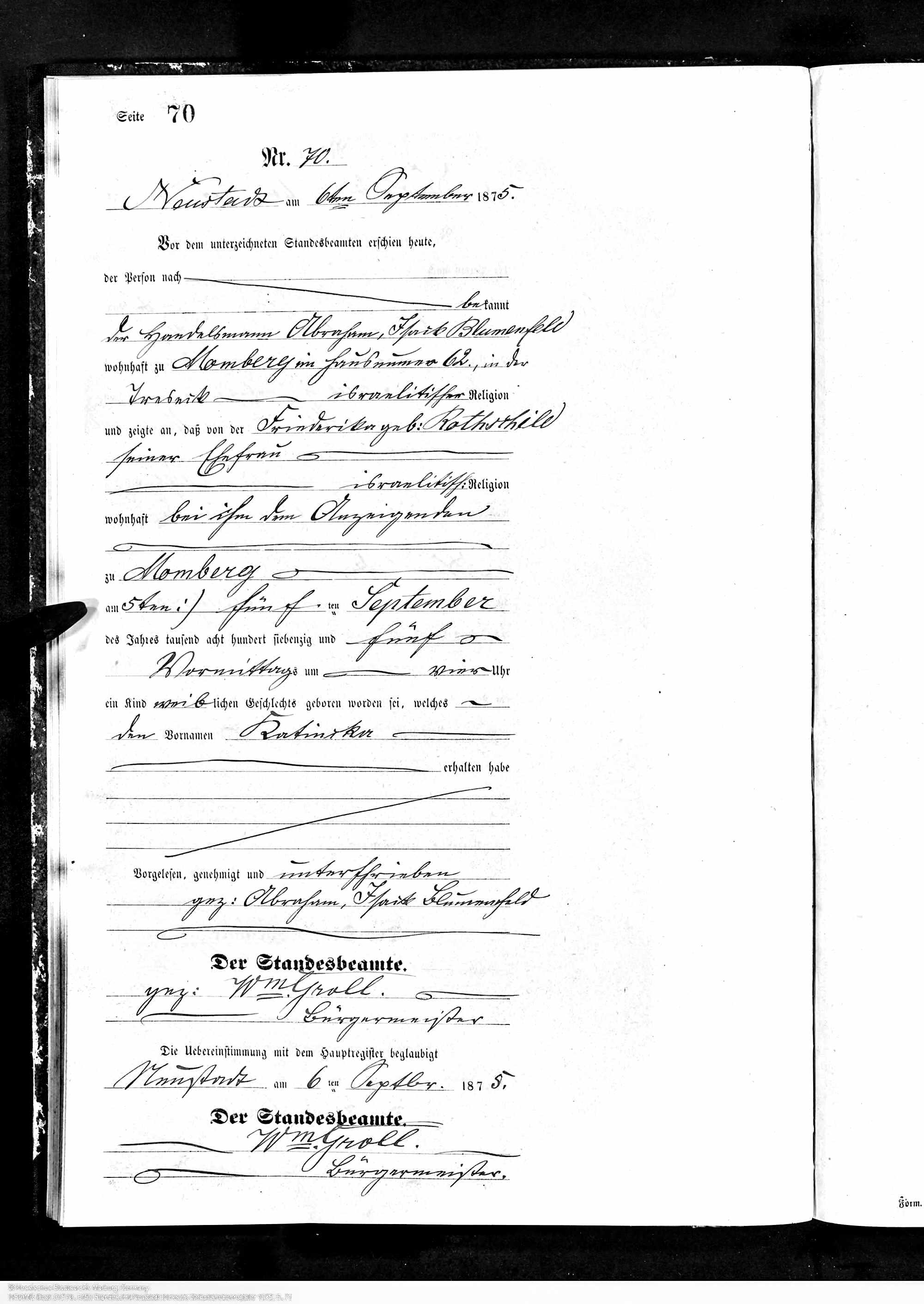
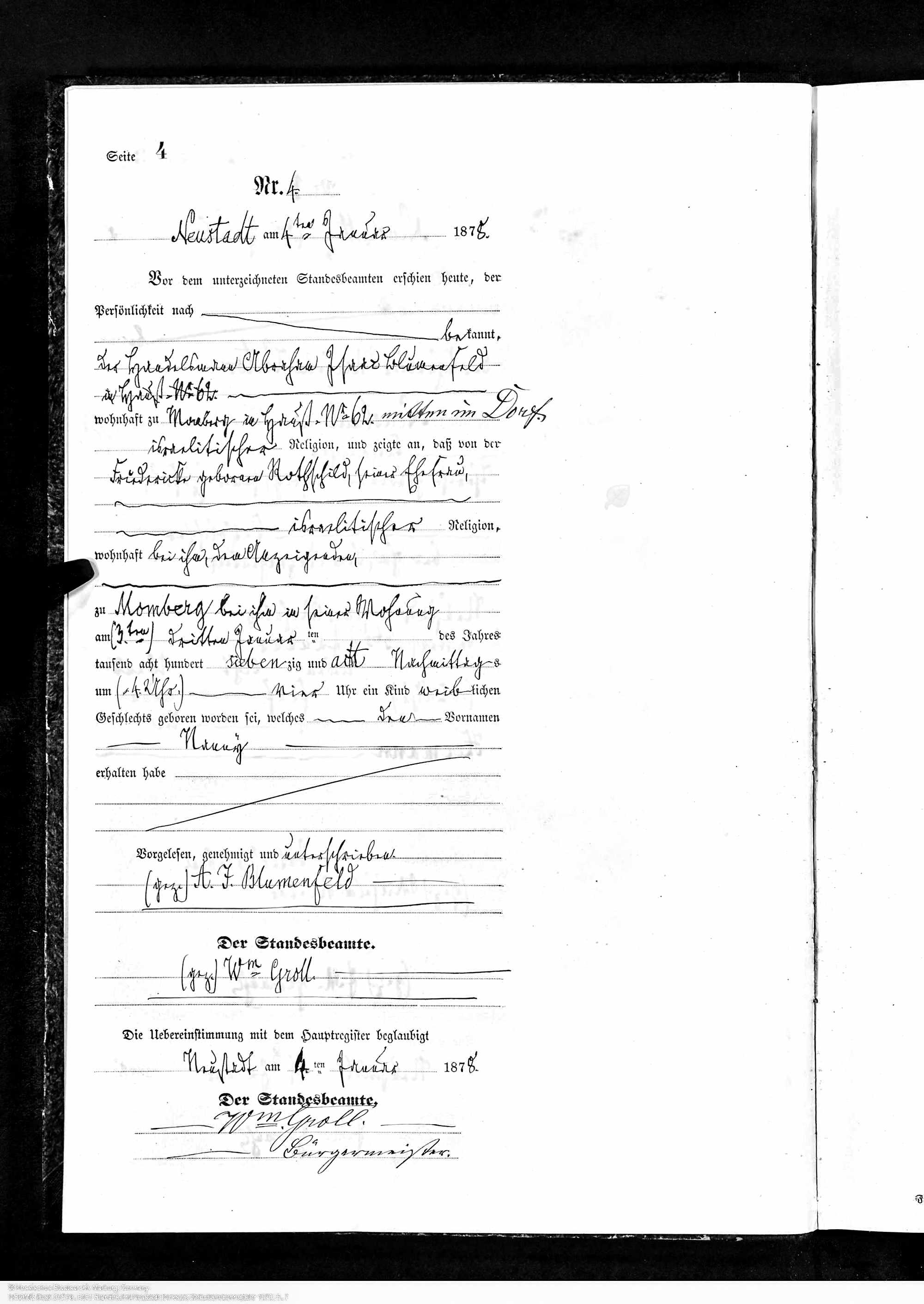
Birth record of Dusschen Blumenfeld I, daughter of Abraham Blumenfeld. Arcinsys Archives Hessen, HHStAW Fonds 365 No 628, p. 16

Unfortunately, that is the only German record I can find for Dusschen I. Since she was later known as Dora, I will use that name going forward when I refer to her.

In 1868, Dora married Meyer Loewenstein,2 who was born in Daubringen, Germany, on November 9, 1839.3 Unfortunately, I do not have an actual birth or marriage record for Meyer, but had to rely on the information that he provided after he immigrated to the United States. Similarly, I had to rely on US records to find the birth dates for his children. Giessen, the town where Dora and Meyer lived in Germany, does not have records online for the dates that are relevant to this family.

UPDATE: Since publishing this post, I was able to obtain a book titled Juden in Giessen 1788-1942 by Hanno Miller (Giessen, 2012) that lists on p, 392 information about Meyer, Dora, and six of their children. Although no primary sources are included, the descriptions of the records include enough detail (time of birth, witnesses to each birth) that the information appears to be quite reliable. According to this source, Meyer was born on November 9, 1839, and Dora and Meyer were married on April 23, 1868.

Hanno Miller, Juden in Giessen 1788-1942 (Giessen 2012), p. 392.

I have noted below where the Juden in Giessen book provides different birth dates for the children of Dora and Meyer than those found in US sources. These discrepancies corroborate the accepted notion that birthdays were less important to European Jews than here in the US and that people estimated their birthdates rather than knowing them exactly.

As noted above, Dora and Meyer had eight children, and the first six of those children were born in Germany. Their first born was Rosalie, born April 3, 1869.4 Then came Moritz, born January 14, 1871.5 A second son Sigmund was born on December 13, 1872,6 and then Hermann, their third son and fourth child, was born December 25, 1874.7

After giving birth to four children in five years, Dora may have had a bit of a respite. Her fifth baby Aaron (later Alfred) was born on January 15, 1879.8 Perhaps that break came because Meyer had been traveling; I found a Meyer Loewenstein from Germany who was 41 years old on an 1878 ship manifest from Hamburg to New York.9 But I can’t be certain that is the same Meyer, given the lack of identifying information on the manifest and the discrepancy in the age.10

Dora and Meyer did have one more child in Germany before immigrating. Their sixth child and second daughter Auguste or Gussie was born on October 30, 1881.11 Dora and her six children sailed to New York from Bremen, arriving on September 9, 1882. The children are listed as Pauline (11 ½), Moritz (10), Sigmund (1 ½ ??), Hermann (7), Alfred (3), and Auguste (1). Meyer was not sailing with them so perhaps he’d returned to the United States before his wife and children though I cannot find him on any manifest after the 1878 one mentioned above.

Listed right above Dora on the 1882 manifest is another Loewenstein family: Isaac Loewenstein (38), his wife Rosa (28) and their two children (presumably), Rosalie (11) and Hermann (9).

Dora Loewenstein and children on ship manifest, Year: 1882; Arrival: New York, New York, USA; Microfilm Serial: M237, 1820-1897; Line: 1; List Number: 1286, Ship or Roll Number: Elbe
Ancestry.com. New York, U.S., Arriving Passenger and Crew Lists (including Castle Garden and Ellis Island), 1820-1957

I speculated that Isaac was the brother of Meyer Loewenstein. Why? Both ended up settling in Bloomington, Illinois, and both changed their surnames to Livingston (sometimes spelled Livingstone).

In any event, Dora and the children arrived in October 1882 and settled in Bloomington, Illinois, where on January 2, 1884, Dora gave birth to their seventh child and fifth son, Isaac, later Irvin.12 Their last child, Harold, was born on November 16, 1887, in Bloomington.13

Why Bloomington, Illinois? Why did Meyer and Isaac choose that city? I didn’t know the answer until I found a long news article from the Bloomington newspaper, The Pantagraph, dated February 10, 1927. More on that in my next post.


  1. Thank you so much to Richard Bloomfield and Michael Rosenberg for the invaluable assistance with straightening out the two Dusschen Blumenfelds, including helping me find and transcribe their birth records, which appear on the same page of the Momberg registry. 
  2. Livingston family, 1900 US census, Year: 1900; Census Place: Bloomington Ward 1, McLean, Illinois; Page: 6; Enumeration District: 0080; FHL microfilm: 1240321, Ancestry.com. 1900 United States Federal Census 
  3. Hanno Miller, Juden in Giessen 1788-1942 (Giessen, 2012), p. 392. Find a Grave, database and images (https://www.findagrave.com/memorial/9198505/mayer-livingston : accessed 27 October 2021), memorial page for Mayer Livingston (Nov 1839–10 Oct 1915), Find a Grave Memorial ID 9198505, citing Jewish Cemetery, Bloomington, McLean County, Illinois, USA ; Maintained by Robin Farley Dixson Coon (contributor 46558224) .
  4. Hanno Miller, Juden in Giessen 1788-1942 (Giessen, 2012), p. 392. Find a Grave, database and images (https://www.findagrave.com/memorial/9198011/rosalie-m-livingston : accessed 27 October 2021), memorial page for Rosalie M “Rosa” Livingston (3 Apr 1869–19 Jul 1943), Find a Grave Memorial ID 9198011, citing Jewish Cemetery, Bloomington, McLean County, Illinois, USA ; Maintained by Robin Farley Dixson Coon (contributor 46558224) . 
  5. Hanno Miller, Juden in Giessen 1788-1942 (Giessen, 2012), p. 392. Find a Grave, database and images (https://www.findagrave.com/memorial/9198500/maurice-livingston : accessed 27 October 2021), memorial page for Maurice Livingston (14 Jan 1871–19 Nov 1923), Find a Grave Memorial ID 9198500, citing Jewish Cemetery, Bloomington, McLean County, Illinois, USA ; Maintained by Robin Farley Dixson Coon (contributor 46558224) . 
  6. Hanno Miller, Juden in Giessen 1788-1942 (Giessen 2012), p. 392. US sources say December 27, 1872 or December 29, 1872. Sigmund Livingston, Age: 39, Birth Date: 27 Dec 1872, Birth Place: Giessen, Germany, Residence Place: Bloomington, Illinois, Passport Issue Date: 25 Mar 1912
    Has Photo: No, Certificate Number: 68761, National Archives and Records Administration (NARA); Washington D.C.; Roll #: 155; Volume #: Roll 0155 – Certificates: 68321-69176, 18 Mar 1912-30 Mar 1912, Ancestry.com. U.S., Passport Applications, 1795-1925 
  7. Hanno Miller, Juden in Giessen 1788-1942 (Giessen 2012), p. 392. US sources say December 29, 1874.  Find a Grave, database and images (https://www.findagrave.com/memorial/9199176/herman-livingston : accessed 27 October 2021), memorial page for Herman Livingston (29 Dec 1874–17 Feb 1951), Find a Grave Memorial ID 9199176, citing Jewish Cemetery, Bloomington, McLean County, Illinois, USA ; Maintained by Robin Farley Dixson Coon (contributor 46558224) . 
  8. Hanno Miller, Juden in Giessen 1788-1942 (Giessen 2012), p. 392.Find a Grave, database and images (https://www.findagrave.com/memorial/9199178/alfred-livingston : accessed 27 October 2021), memorial page for Alfred Livingston (15 Jan 1879–1 Apr 1949), Find a Grave Memorial ID 9199178, citing Jewish Cemetery, Bloomington, McLean County, Illinois, USA ; Maintained by Robin Farley Dixson Coon (contributor 46558224) . 
  9.  Meyer Loewenstein, Gender: Male, Ethnicity/ Nationality: German, Age: 41
    Birth Date: abt 1837, Place of Origin: Germany, Departure Port: Hamburg, Germany and Le Havre, France, Destination: USA, Arrival Date: 17 Dec 1878, Arrival Port: New York, New York, USA, Ship Name: Cimbria, Year: 1878; Arrival: New York, New York, USA; Microfilm Serial: M237, 1820-1897; Line: 53; List Number: 1326, Ancestry.com. New York, U.S., Arriving Passenger and Crew Lists (including Castle Garden and Ellis Island), 1820-1957 
  10. The 1900 US census indicated that Dora had given birth to eighteen children, eight of whom were still living. So perhaps that gap between 1874 and 1879 reflects at least some children who did not survive. But ten deceased children in five years seemed unlikely, and when I checked the 1910 US census, it reported that Dora had had eight children, all of whom were still living. 
  11. Hanno Miller, Juden in Giessen 1788-1942 (Giessen 2012), p. 392. US sources say October 27, 1881. Find a Grave, database and images (https://www.findagrave.com/memorial/9198642/gussie-l-wertheimer : accessed 27 October 2021), memorial page for Gussie L Wertheimer (27 Oct 1881–12 Sep 1957), Find a Grave Memorial ID 9198642, citing Jewish Cemetery, Bloomington, McLean County, Illinois, USA ; Maintained by Robin Farley Dixson Coon (contributor 46558224) . 
  12. Irvin I Livingston, Gender: Male, Race: White, Birth Date: 2 Jan 1884, Birth Place: Bloomington, Illinois, USA, Residence Place: Glencoe, Illinois, USA, Military Draft Date: 1942, Relationship to Draftee: Head, The National Archives at St. Louis; St. Louis, Missouri; World War II Draft Cards (Fourth Registration), for The State of Illinois; Record Group Title: Records of the Selective Service System; Record Group Number: 147; Series Number: M2097, Ancestry.com. U.S., World War II Draft Registration Cards, 1942 
  13. Harold Hirsch Livingston, Gender: Male, Race: White, Birth Date: 16 Nov 1887
    Birth Place: Bloomington, Illinois, Father: Mayer Livingston, Mother: Dora Blumenfeld
    SSN: 336146596, Ancestry.com. U.S., Social Security Applications and Claims Index, 1936-2007 

Another Update from Another Cousin! The Story of Karl Gutmann

Once again, I have been very fortunate because another cousin found my blog and connected with me, sharing information and photographs of members of my ever-growing family tree. This time it was my fifth cousin, once removed, Jennifer, the granddaughter of Karl Gutmann, who has enriched my understanding of my family history. The information in this post, except where otherwise noted, came from my email correspondence with Jennifer, as did all the photographs.

You can read more about Karl and his family here and here, but let me provide a brief overview. Karl, born in 1923, was the only child of Moritz Gutmann and my cousin Nelly Goldschmidt; Nelly was the daughter of Hedwig Goldschmidt and Marcel Goldschmidt who themselves were first cousins, the grandchildren of Meyer Goldschmidt, my four-times great-uncle.

Jennifer shared with me this photograph of her grandfather Karl with his mother Nelly as well as the one that follows of Karl as a young boy.

Nelly Goldschmidt Gutmann and her son Karl Gutmann, c. 1927-1928 Courtesy of the family

Karl Gutmann Courtesy of the family

Nelly’s sister Else was married to Siegfried Gutmann, brother of Moritz Gutmann. Else and Siegfried, like Nelly and Moritz, had only one child, a son named Hermann Gutmann, later known as Dennis Goodman. I wrote about Dennis and his experiences here and here. Thus, Karl and Dennis were first cousins, and according to Jennifer, the two boys were very close growing up in Germany. They were both born in 1923, Dennis in February, Karl in May. They must have been like brothers to each other.

Tragically, Karl and Dennis were separated from each other because of the Nazis. As I wrote in my earlier post, Karl’s father Moritz came to the US in 1936, leaving his wife Nelly and Karl behind. What Jennifer shared with me was that her great-grandmother Nelly had long suffered from mental illness and had been institutionalized for some time before the Holocaust. Moritz, who resented the fact that her family had failed to disclose her mental health issues before they married, filed for divorce once he was in the United States. Jennifer shared this photograph of her great-grandfather Moritz Gutmann, whom she described as a very difficult man.

Moritz Gutmann Courtesy of the family

Meanwhile, Moritz and Nelly’s son Karl was living in Amsterdam as were his grandmother Hedwig Goldschmidt and his aunt Else Goldschmidt and uncle Siegfried Gutmann.  His cousin Hermann (Dennis) was sent in 1936 to England where he attended a Jewish boarding school, and the following year Karl went to the US.

From the apparent age of Karl in this photograph (he appears to be at least thirteen), I would guess that this photograph was taken either in Amsterdam or after he came to the US. I don’t know who the other boy was.

Karl Gutman and friend Courtesy of the family

What I did not know until Jennifer shared it with me was that Karl’s father Moritz traveled to Amsterdam to get his son and bring him back to the US; I now was able to locate Moritz on the same ship as the one that brought Karl to the US. Moritz, however, was sailing in a second class cabin whereas his fourteen-year-old son was sailing third class in a separate cabin (last line on second image below).

Moritz Gutmann, Year: 1937; Arrival: New York, New York, USA; Microfilm Serial: T715, 1897-1957; Line: 1; Page Number: 124,  Statendam, Ancestry.com. New York, U.S., Arriving Passenger and Crew Lists (including Castle Garden and Ellis Island), 1820-1957

Karl Gutmann (last line), Year: 1937; Arrival: New York, New York, USA; Microfilm Serial: T715, 1897-1957; Line: 1; Page Number: 143,  Statendam, Ancestry.com. New York, U.S., Arriving Passenger and Crew Lists (including Castle Garden and Ellis Island), 1820-1957

Karl earned money selling newspapers when he first got to the US, but then enlisted in the US Army in 1943. By that time he had joined his father in the art dealing business and brought art work back and forth between Europe and the US during the war. Karl became one of the Ritchie Boys, the elite espionage unit made up of German Jewish refugees who used their knowledge of Germany and German to spy on the Nazis and obtain critical military intelligence for the Allies. Here is Karl in uniform during World War II.

Karl Gutmann, c. 1945 Courtesy of the family

But it was too late to save his mother Nelly, who was killed by the Nazis in 1940. Tragically, both of Dennis Goodman’s parents were also murdered in the Holocaust. Karl and Dennis’s grandmother Hedwig Goldschmidt, however, miraculously survived after hiding in the Netherlands during the war, as described here. Jennifer shared this photograph of Hedwig, taken after she had safely immigrated to the US after the war.

Hedwig Goldschmidt Gutmann  Courtesy of the family

When Karl returned to the US after the war, he married Joan Fenton. What I had not known before Jennifer contacted me was that Joan, her grandmother, was the best friend of Karl’s first cousin Gabrielle Heimerdinger, the daughter of Greta Goldschmidt, Karl’s aunt, his mother Nelly’s sister. Gabrielle introduced Joan to Karl, and together they had three children. Jennifer, Karl and Joan’s granddaughter, has many memories of visiting her relatives in New York, including her grandfather’s first cousin Gabrielle, whose children I wrote about here. Karl went into the television repair business after the war and became quite successful.

While serving overseas as one of the Ritchie Boys, Karl had run into his cousin Dennis, Karl fighting the Nazis for the US, Dennis fighting the Nazis for England. Once the two cousins reconnected, they remained close for the rest of their lives, traveling back and forth between England and the US after the war many times. Thanks to Jennifer, I can share this photograph of Karl and Dennis joyfully reunited after the war. The other man on the left is their paternal cousin John Gutmann, and the woman is Karl’s second wife Gisela.

John Gutmann, Karl Gutmann, Gisela Bartels Gutmann, and Dennis Goodman Courtesy of the family

Jennifer remembered her grandfather Karl as a man with a strong work ethic and one who never wanted to talk about his past. But through her grandmother Joan and other family members, Jennifer was able to learn more about her grandfather’s story and the tragedies that her other relatives suffered during the Holocaust. I am so grateful that she shared their stories and her photographs with me.