Elkton, Maryland, The Wedding Capital of the East

As seen in my last post, in 1920 Edwin M. Goldsmith, Sr., was the secretary-treasurer of his uncle’s textile company, Friedberger-Aaron, and also the owner of thirteen US patents. He and his wife Jennie and their two sons, Henry and Edwin, Jr., were living together in Philadelphia. They also maintained a residence in Longport, New Jersey, near Atlantic City. Their daughter Cecile and her husband Julian Stern Simsohn and their two children were also living in Philadelphia, and Julian was working as a chemical engineer. Cecile and Julian had a third child, a daughter named Marjorie Goldsmith Simsohn, born on August 12, 1921, in Philadelphia.1

Edwin continued to be a successful inventor during the 1920s. He added six more patents to his portfolio between 1921 and 1930. His first was for the design for a stuffed doll encased in a removable cover so that it could be washed:2

In addition to patenting several inventions relating to the packaging, display, and sale of the textile fabrics made by Friedberger-Aaron where Edwin continued to work as secretary-treasurer, he also developed an invention for a hair curler “which may be operated to receive, confine and release the hair with the greatest possible facility”3  and a product that combined soap and towel into one article.4 The latter was described by Edwin as follows:

… a sheet of readily destructible material, such as paper tissue, of a size and having absorptive qualities enabling it to be used as a towel, the sheet being folded into flat form, and means connected to the sheet and forming a closed container or receptacle containing a quantity of soap, preferably in powder form.

During the 1920s, Edwin also held elective offices in Longport, New Jersey, where his second home was located:

Asbury Park Press, May 9, 1928, p. 2.

Edwin and Jennie’s son-in-law Julian Simsohn was very active as a chemical engineer in Philadelphia during the 1920s, as seen in numerous ads for his services in not just the Philadelphia newspapers but also papers in Chicago, Pittsburgh, St. Louis, and  during those years. Here are two, one from the Philadelphia Evening Ledger and one I particularly liked which appeared in the Indianapolis Star:

Philadelphia Evening Ledger, September 20, 1928, p. 13.

Indianapolis Star, November 30, 1930, p. 25.

Here is a close up of the section in the cigar featuring Julian Simsohn:


Edwin and Jennie’s older son Henry, also a chemical engineer, had been working for a radiator manufacturer in 1920, and he continued to be listed with that company, G & O Mfg., in the 1921 and 1922 Philadelphia directories.5

I knew from the 1930 census that Henry married sometime before 1930, but I could not locate any record or other information about when he’d married until I found this list in the August 16, 1925 Philadelphia Inquirer of marriage licenses issued in one day in Elkton, Maryland:

“Elkton Marriages,” The Philadelphia Inquirer, August 16, 1925, p. 8.

Notice that it includes Henry F. Goldsmith and Ida P. Stryker of Longport, New Jersey, the town where Edwin’s family spent their summers. But why were so many people getting marriage licenses in one day from Elkton, Maryland? What was going on?

Well, according to this article by Marshall S. Berdan from the February 13, 2002 edition of the Washington Post, from about 1913 until 1938, Elkton, Maryland was a destination for those wishing to marry quickly. As the article explains:

It all started in 1913 when Delaware passed mandatory matrimonial waiting and public notification laws. Meanwhile Maryland — the “Free State” — imposed neither waiting period nor residency requirement. Those Delaware moralists should have just put up a sign reading “This Way to Elkton.”

As the most northeasterly county seat in Maryland, Elkton became the roadside chapel of choice for those who chose to marry in haste from throughout the Northeast. From just over 100 marriages per year at the turn of the century, tiny Elkton was soon cranking out well over 10,000 newlyweds a year — the vast majority from New York, New Jersey and Pennsylvania — during the 1920s and ’30s. It became known as “America’s Gretna Green.”

This blog also sheds light on why Elkton became a wedding destination.

But why would Henry Goldsmith and Ida Stryker have been in such a rush to marry and in a place like Elkton?

Well, I have two theories.  First, Ida Stryker was born in Philadelphia on February 26, 1908.6 She was only seventeen in August 1925; Henry, who was born in 1893, was 32, almost twice her age. I can’t imagine that her parents would have been happy to see their teenage daughter marry a man in his thirties.

Second, Ida was not Jewish.  Her parents, George Holmes Stryker and Ella Williams, were Episcopalian.7  Perhaps her parents or Henry’s parents did not approve of the interfaith marriage. But Henry and Ida did marry, and in fact they stayed married until Henry’s death in 1963.  Ida, who lived to be 96, never remarried.

In 1930, Henry and Ida were living in Philadelphia, and Henry was working as an executive in a textile company—and I believe that company was Friedberger-Aaron. It is unnamed on the census,8 and the page where the Goldsmiths are listed in the 1930 Philadelphia directory on Ancestry is barely legible, but on the page with Goldsmiths listed, I can see two entries with Friedberger-Aaron after the names, so I assume those are the listings for Edwin and Henry Goldsmith.9 Perhaps that meant that at least Henry’s family was on good terms with Henry and Ida. Henry and Ida had one child together, a son Thomas Holmes Goldsmith, born in 1931.

Henry’s sister Cecile and her husband Julian Simsohn continued to live in Philadelphia with their three children in 1930, and Julian continued to work as an engineer.10

Edwin and Jennie’s youngest child, Edwin M. Goldsmith, Jr., was just coming of age in the 1920s.  He had graduated from Central High School in Philadelphia and then graduated from Massachusetts Institute of Technology in 1923 with a degree in industrial engineering. 11 On the 1930 census he was living with his parents Edwin, Sr., and Jennie, in Longport, New Jersey,  and according to the census record, he was a radio salesman. His father continued to list textile manufacturing as his occupation.12

The 1920s were thus a good decade for the family of Edwin and Jennie Goldsmith. Their children were grown, and Edwin continued to find success with his inventions. The 1930s brought some changes to the family of Edwin Goldsmith, some happy, some sad.


  1.  Ancestry.com. U.S., Social Security Applications and Claims Index, 1936-2007. Original data: Social Security Applications and Claims, 1936-2007. SSN 169164752 
  2. E.M. Goldsmith, Doll, U.S. Patent No. 1,370,107, March 1, 1921. 
  3. E.M. Goldsmith, Hair Curler, U.S. Patent No. 1,493,195, May 6, 1924. 
  4. E.M. Goldsmith, Individual Washing and Drying Toilet Article, U.S. Patent No. 1,608,934, November 30, 1926 
  5.  Philadelphia, Pennsylvania, City Directory, 1921, 1922. Source Information
    Ancestry.com. U.S. City Directories, 1822-1995 
  6.  Ancestry.com. Pennsylvania, Birth Certificates, 1906-1910 [database on-line]. Lehi, UT, USA: Ancestry.com Operations, Inc., 2015. Original data: Pennsylvania (State). Birth certificates, 1906–1910. Series 11.89 (50 cartons). Records of the Pennsylvania Department of Health, Record Group 11. Pennsylvania Historical and Museum Commission, Harrisburg, Pennsylvania. Certificate No. 30149 
  7. Marriage record of George Stryker and Ella Williams, November 19, 1903, Philadelphia, PA.  Historical Society of Pennsylvania; Philadelphia, Pennsylvania; Reel: 343. Ancestry.com. Pennsylvania and New Jersey, Church and Town Records, 1669-2013 [database on-line]. Lehi, UT, USA: Ancestry.com Operations, Inc., 2011. Original data: Historic Pennsylvania Church and Town Records. Philadelphia, Pennsylvania: Historical Society of Pennsylvania. 
  8. Henry and Ida Goldsmith, 1930 US census, Philadelphia, Philadelphia, Pennsylvania; Page: 18A; Enumeration District: 1029.
    Ancestry.com. 1930 United States Federal Census. 
  9. Philadelphia, Pennsylvania, City Directory, 1930. Source Information
    Ancestry.com. U.S. City Directories, 1822-1995 
  10. Cecile and Julian Simsohn, 1930 US Census, Philadelphia, Philadelphia, Pennsylvania; Page: 12A;Enumeration District: 1030. Ancestry.com. 1930 United States Federal Census 
  11.  Philadelphia Inquirer, obituary for EDWIN GOLDSMITH, RETIRED ENGINEER, (https://www.genealogybank.com/doc/obituaries/obit/0FBAE6E80E61F93B-0FBAE6E80E61F93B : accessed 25 March 2018). 
  12. Edwin Goldsmith, Sr., and family, 1930 US Census, Longport, Atlantic, New Jersey; Page: 1A; Enumeration District: 0056. Ancestry.com. 1930 United States Federal Census 

Edwin M Goldsmith, Inventor

Edwin M. Goldsmith, the second son and third child of Abraham Goldsmith and Cecelia Adler, was born on April 10, 1864. 1 As we have seen, for many years he and his brother Milton worked together in their father’s clothing business in Philadelphia, A. Goldsmith & Sons. But in the 20th century and especially after their father died in 1902, their lives took separate and quite different directions.

Whereas Milton focused on his writing and worked in advertising in New York City, Edwin stayed in Philadelphia and became an inventor. Between 1900 and 1933 he was awarded 23 patents on a wide range of inventions. But like his brother Milton, he relied on a more conventional career for income, in his case working as an executive in a textile company.

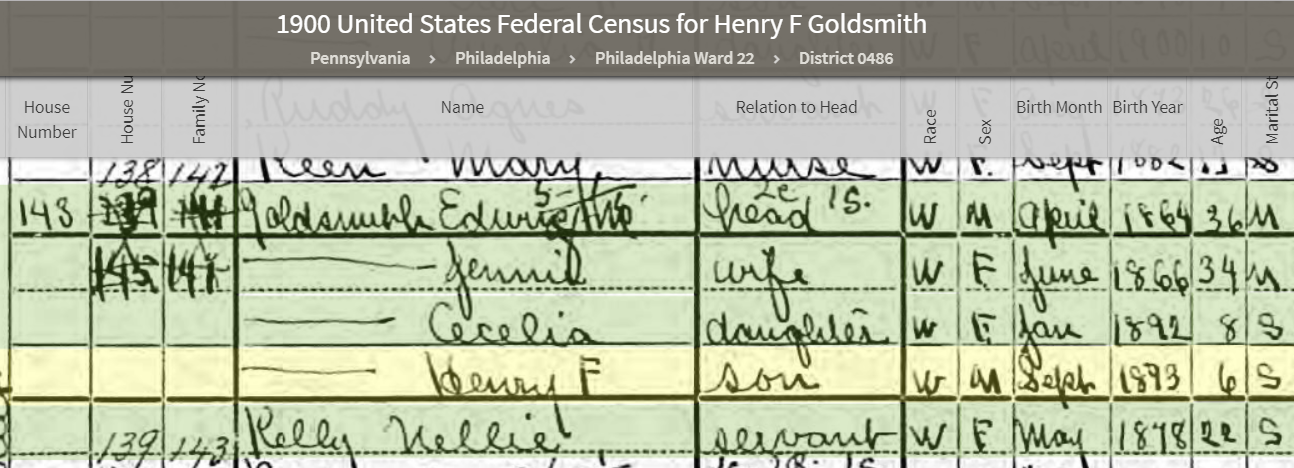
As I wrote earlier, Edwin Goldsmith married Sarah Virginia “Jennie” Friedberger in 1891. Edwin and Jennie had their first child, Cecile Adler Goldsmith, on January 28, 1892; she was named for Edwin’s mother. A second child, Henry Friedberger Goldsmith, named for Jennie’s father, was born on September 8, 1893. In 1900 Edwin and Jennie and their children were living in Philadelphia where Edwin continued to be a clothing merchant. Their third and final child, Edwin M. Goldsmith, Jr., was born on March 8, 1902, in Philadelphia.2

Edwin Goldsmith and family, 1900 US census
ear: 1900; Census Place: Philadelphia Ward 22, Philadelphia, Pennsylvania; Page: 7; Enumeration District: 0486
Description
Enumeration District: 0486; Description: Philadelphia City Pa, 22nd Ward, 10th Division, bounded by Hancock, Penn, Germantown Ave, Laurel, Bowman
Source Information
Ancestry.com. 1900 United States Federal Census

It was also in this first decade of the 20th century that Edwin began to obtain patents on many of his inventions. Between 1900 and 1906, he was awarded eight patents. One of his first patents was awarded for the design of a pencil, which Edwin described as follows:3

My invention consists of a lead or other pencil formed of a telescopic or collapsible barrel and means for connecting a length or piece of lead or marking material therewith whereby as said lead or material is worn away it may be exposed to present a fresh portion by the reduction in the length of the barrel, said piece having one end movably guided in the tip of the pencil and its other end rigidly held in the opposite end of the barrel whereby it cannot be detached through said tip.

In other words—a retractable pencil!

Among his other early inventions were a method for holding a cylindrical cake of soap to maximize the use of the soap;4 a savings-bank coin-operated clock; 5 a pencil sharpener designed to prevent the breaking of the point of the pencil;6 a device for carrying a pocketbook or purse;7 and the design of memorandum or account or other books that facilitated turning pages to get to a new leaf. 8 Obviously Edwin was interested and skilled in creating a wide array of products.

While working on these inventions, Edwin continued to work as a clothier, as seen in the 1905 Philadelphia city directory.9 But by 1910, he had changed occupations and reported on the 1910 census that he was a manufacturer of braids and lace. In the 1910 and 1911 Philadelphia directories10 (and in many thereafter), he was listed as the secretary-treasurer of Friedberger-Aaron Manufacturing Company, a textile company incorporated by Edwin’s uncle Simon Friedberger and his partner Max Aaron in 1899.11

Edwin Goldsmith and family, 1910 US Census,
Year: 1910; Census Place: Philadelphia Ward 22, Philadelphia, Pennsylvania; Roll: T624_1395; Page: 5A; Enumeration District: 0403; FHL microfilm: 1375408
Ancestry.com. 1910 United States Federal Census

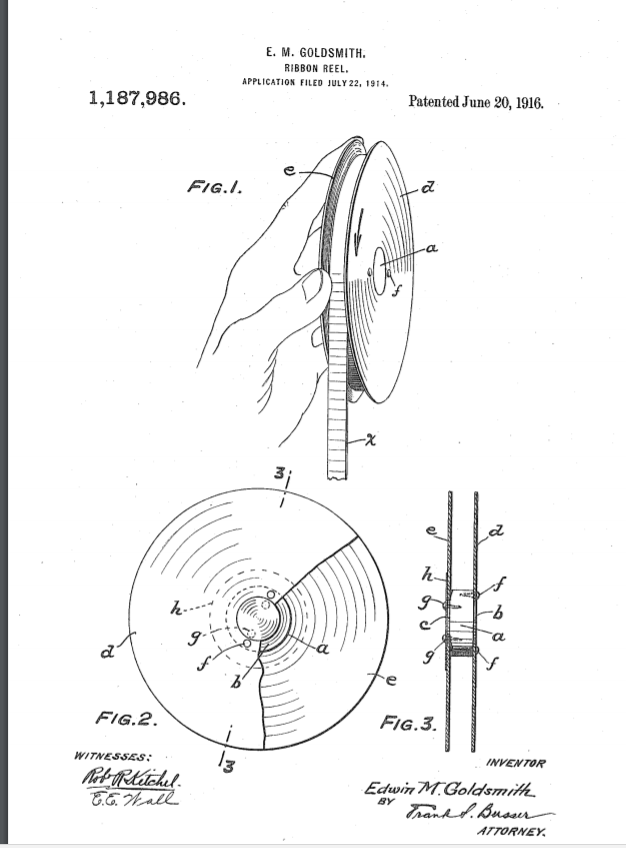
From that point on, some of his patented inventions were assigned to Friedberger-Aaron and many related to the display and/or sale of merchandise in their business. For example, in 1916, Edwin received a patent for a ribbon reel, which he described as follows:12

The object of my invention is to provide a reel for ribbons that may be readily manipulated to effect or facilitate the winding upon, or unwinding from, the reel of the ribbon, and to construct the same so inexpensively that it will be practicable to give the same away with the ribbon as an inducement for the latter’s purchase.

Some of his other inventions relating to the business of Friedberger-Aaron included a box for displaying and selling fabric so that the purchaser could see the fabric both before and after purchasing;13 a travel container for toiletries designed to use space efficiently;14 and a holder for containing and displaying silk and other fabrics.15

Beginning in about 1909, Edwin and his family started spending extended periods in the Atlantic City area. The Philadelphia Inquirer reported on June 13, 1909, that Edwin Goldsmith and his family were beginning an extended stay at the Hotel Rudolph in Atlantic City, a hotel opened in 1895 and located on the Boardwalk.16

In 1911, Edwin is listed in the Atlantic City directory in its Longport section.17 In 1915 he and his family were listed in the New Jersey census in Longport. The census was dated June 16, 1915, suggesting that Edwin’s family was in Longport for the summer.  Living with them were also a cook and a maid:

Edwin Goldsmith, Sr., and family, 1915 NJ Census
New Jersey State Archive; Trenton, NJ, USA; State Census of New Jersey, 1915; Reference Number: L-13; Film Number: 2
Township: Buena Vista – Weymouth
Ancestry.com. New Jersey, State Census, 1915

But their principal residence remained Philadelphia.  They are listed in several Philadelphia directories during the 1910s.18

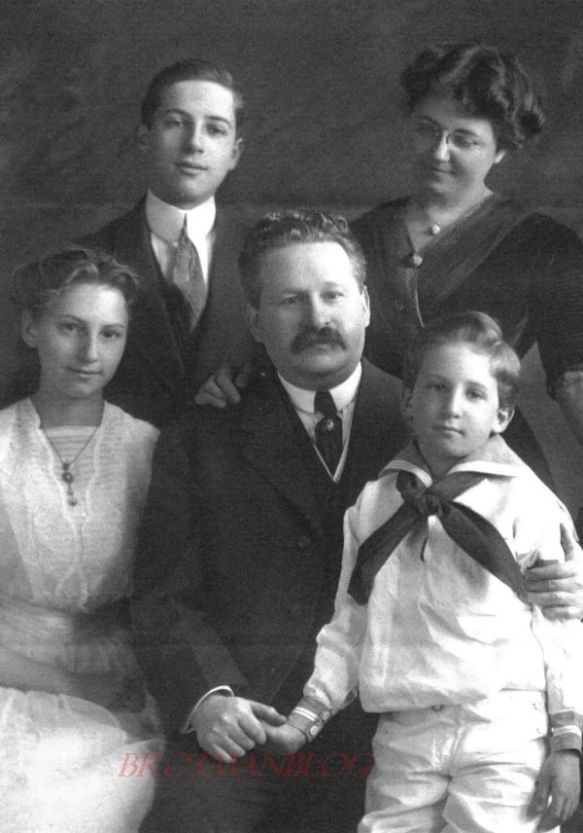
Thank you to David Baron and Roger Cibella for sharing this photograph of Edwin Goldsmith and his family. From left to right, Cecile, Henry, Edwin, Jennie, and Edwin, Jr.:

EdwinMGoldsmith

Edwin Goldsmith and family, c. 1910

Edwin and Jennie’s older son Henry graduated from the University of Pennsylvania in 1914 and then from Massachusetts Institute of Technology in 1917, according to his obituary. 19 On June 15, 1917, Henry registered for the World War I draft:

Henry F. Goldsmith World War I draft registration
Registration State: Pennsylvania; Registration County: Philadelphia; Roll: 1907644; Draft Board: 24.  Ancestry.com. U.S., World War I Draft Registration Cards, 1917-1918

At that time Henry was employed by Midvale Steel Company and Worth Business Company as a chemical engineer doing expert work in their munitions departments. He later enlisted in the Navy Reserve Force on April 2, 1918, and was on active duty until March 8, 1919, in the Third Naval District in New York City. He was discharged on September 10, 1921 after an additional eighteen months of inactive duty.20

After the war, life returned to normal for the Goldsmith family. On July 23, 1920, the Philadelphia Evening Public Ledger reported that Edwin and his family were “passing the summer at their bungalow, in Longport, N.J.” 21 On the 1920 census, Edwin, Jennie, and their two sons Henry and Edwin, Jr., were listed as living in Philadelphia.  Strangely, Edwin was now listed as a chocolate manufacturer. But that must be an enumerator error, as the 1921 Philadelphia directory continued to list Edwin as the secretary-treasurer of Friedberger-Aaron.

That same directory lists Henry Goldsmith as a manager at G & O Manufacturing, a company that manufactured automobile radiators; the 1920 census listed Henry as a radiator salesman.22 Edwin, Jr. must have still been in school as he is listed without an occupation; he was eighteen in 1920.

Edwin Goldsmith and family 1920 US Census
Year: 1920; Census Place: Philadelphia Ward 28, Philadelphia, Pennsylvania; Roll: T625_1632; Page: 1A; Enumeration District: 885. Ancestry.com. 1920 United States Federal Census

Edwin and Jennie’s daughter Cecile was not living with them in 1920 because she had married Julian Stern Simsohn in 1916.23 Julian was born on January 19, 1890, in Philadelphia, and was the son of Joseph S Simsohn, a physician born in 1852 in either Romania or Germany (the records conflict) who immigrated to the United States in 1873. Julian’s mother Clara Stern was a native Philadelphian. 24 Julian had graduated from the University of Pennsylvania in 1911 with a degree in chemistry and is listed in their 1917 alumni directory as a consultant on water purification and boiler treatment and an inventor of photographic apparatus. Edwin must have been pleased to have a son-in-law who was also an inventor.25

UPDATE: It turns out that Julian was related by marriage to Cecile. His mother Clara had a brother Sidney who was married to Edwin’s sister Rose.  See more here.

From Julian’s registration for the draft in World War I we can see a clue as to how Cecile met Julian.  It appears that, like Cecile’s brother Henry, Julian was also working as a munitions expert for Midvale Steel Company:

Julian Stern Simsohn World War I draft registration
Registration State: Pennsylvania; Registration County: Philadelphia; Roll: 1907616; Draft Board: 13.  Ancestry.com. U.S., World War I Draft Registration Cards, 1917-1918

Cecile and Julian’s first child was born on November 19, 1917, a daughter named Jean Claire Simsohn. Two years later on December 10, 1918, their son Julian Stern Simsohn, Jr., was born. On the 1920 census they were all living in Philadelphia, and Julian Sr. was working as a chemical engineer.


Julian and Cecile Goldsmith Simsohn, 1920 census
Year: 1920; Census Place: Philadelphia Ward 28, Philadelphia, Pennsylvania; Roll: T625_1632; Page: 3B; Enumeration District: 886

Thus, by 1920 Edwin Goldsmith and his family were all doing well in Philadelphia. He had continued his work as an inventor, and he had a son Henry and a son-in-law Julian who were both chemical engineers.  Edwin and Jennie had two young grandchildren.  They all seemed to be living comfortably.

What would the next decade bring them?

To be continued.


  1.  Pennsylvania, Philadelphia City Births, 1860-1906,” database with images, FamilySearch (https://familysearch.org/ark:/61903/3:1:S3HY-6FXJ-86?cc=1951739&wc=M61X-4PF%3A251391701 : 21 May 2014), 004198957 > image 126 of 604; Department of Records. Their second child Hilda had died as a child, as discussed here. 
  2. National Archives and Records Administration (NARA); Washington D.C.; Roll #: 2288; Volume #: Roll 2288 – Certificates: 301350-301849, 01 Jun 1923-02 Jun 1923. Source Information Ancestry.com. U.S. Passport Applications, 1795-1925  
  3. E.M. Goldsmith, Lead or other pencil, U.S. Patent 659,026, October 2,1900. 
  4. E.M. Goldsmith, Soap and soap-holder, U.S. Patent 757397, April 12, 1904. 
  5. E. M. Goldsmith, Clock, U.S. Patent 822,598, June 5, 1906. 
  6. E.M. Goldsmith, Pencil-sharpener, U.S. Patent 755,480, March 22, 1904. 
  7. E.M. Goldsmith, Carrying device for pocket-books, etc., U.S. Patent 667,083, January 29, 1901. 
  8. E.M Goldsmith, Memorandum, order, diary, account, sample, or similar book, U.S. Patent 803,480, June 5, 1906. 
  9. 1905 Philadelphia Directory, Ancestry.com. U.S. City Directories, 1822-1995 [database on-line]. Provo, UT, USA: Ancestry.com Operations, Inc., 2011. 
  10. 1910 and 1911 Philadelphia directories, Ancestry.com. U.S. City Directories, 1822-1995 [database on-line]. Provo, UT, USA: Ancestry.com Operations, Inc., 2011. 
  11. Legal Notices, The Philadelphia Inquirer, April 27, 1899, p. 11. 
  12. E.M. Goldsmith, Ribbon Reel, U.S. Patent 1,187,986, June 20 1916. 
  13. E.M. Goldsmith, Combined braid-holder and bodkin-carrier, U.S. Patent 1,054,763, March 4, 1913. 
  14. E.M. Goldsmith, Container for toilet preparations, U.S. Patent 1,289,440, December 31, 1918. 
  15. E.M. Goldsmith, Holder for elastic and similar goods, U.S. Patent 1,183,003, May 16, 1915. 
  16. The Philadelphia Inquirer, June 13, 1909, p. 47. 
  17. Atlantic City, New Jersey, City Directory, 1911, Ancestry.com. U.S. City Directories, 1822-1995. 
  18. E.g. Philadelphia city directories, 1911, 1914, Ancestry.com. U.S. City Directories, 1822-1995. 
  19. “H.F. Goldsmith, Nylon Executive,” The Phladelphia Inquirer, October 29, 1963, p. 38. 
  20.  Ancestry.com. Pennsylvania, WWI Veterans Service and Compensation Files, 1917-1919, 1934-1948[database on-line]. Provo, UT, USA: Ancestry.com Operations, Inc., 2015. Original data: World War I Veterans Service and Compensation File, 1934–1948. RG 19, Series 19.91. Pennsylvania Historical and Museum Commission, Harrisburg Pennsylvania 
  21. Philadelphia Evening Public Ledger, July 23, 1920, p. 9. 
  22. Philadelphia city directory, 1921, Ancestry.com. U.S. City Directories, 1822-1995. 
  23.  Ancestry.com. Philadelphia, Pennsylvania, Marriage Index, 1885-1951 [database on-line]. Provo, UT, USA: Ancestry.com Operations, Inc., 2011. Original data:”Pennsylvania, Philadelphia Marriage Index, 1885–1951.” Index. FamilySearch, Salt Lake City, Utah, 2009. Philadelphia County Pennsylvania Clerk of the Orphans’ Court. “Pennsylvania, Philadelphia marriage license index, 1885-1951.” Clerk of the Orphans’ Court, Philadelphia, Pennsylvania. License No. 350555 
  24. E.g.,Julian Simsohn and parents, 1910 US Census, Year: 1910; Census Place: Philadelphia Ward 20, Philadelphia, Pennsylvania; Roll: T624_1394; Page: 6A; Enumeration District: 0334; FHL microfilm: 1375407. Ancestry.com. 1910 United States Federal Census. 
  25. Ancestry.com. U.S., School Catalogs, 1765-1935 [database on-line]. Provo, UT, USA: Ancestry.com Operations, Inc., 2012. 

The 1896 Atlantic City Train Disaster

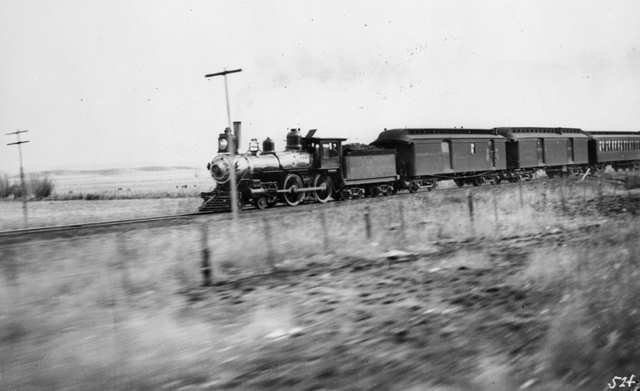
Shortly after 6:30 pm on July 30, 1896, a seven-car train of the West Jersey Railroad was proceeding west from Atlantic City, New Jersey, when the engineer of that train observed a Reading Railroad train approaching the crossing ahead of him. Because the signals indicated that it was safe for him to proceed through the crossing, the West Jersey engineer continued into the crossing.  He had almost cleared the crossing when the locomotive of the Reading Railroad train slammed into the first car of the West Jersey train.  The New York Times described the consequences of this collision:1

…[T]he locomotive of the Reading train…struck the first car full in the centre, throwing it far off the track into a nearby ditch, and completely submerging it. The second car of the West Jersey train was also carried into the ditch, the third and fourth cars begin [sic—being?] telescoped. The engine of the Reading train was thrown to the other side of the track, carrying with it the first coach.

A few minutes after the collision, to add to the horror of the situation, the boiler of the Reading locomotive exploded, scalding several to death and casting boiling spray over many of the injured passengers.

One of the sub-headlines to this article read, “Five Loaded Passenger Coaches Crushed into Kindling Wood,” a reminder that train cars were made from wood, not steel, in those days.

The article then described the horrifying scene when rescue efforts began:

It was a gruesome sight presented to onlookers as the mangled and burned forms of the dead were carried from the wreckage which bound them and laid side by side on the gravel bank near the track, with no other pall than the few newspapers gathered from the passengers.2

An investigation into the cause of the accident soon determined that it was the engineer of the Reading Railroad train, Edward Farr, who had been primarily at fault. There was evidence that the Reading train had been traveling at a speed of 45 miles per hour and that Farr had failed to heed the danger signal in time to avoid the collision with the West Jersey train.

However, there was apparently a practice in that area that gave express trains like the Reading train the right of way at crossings over smaller trains like the West Jersey. The tower man in control of the signals disregarded that practice by giving the danger signal to Reading and the go-ahead signal to West Jersey. There was also testimony that Farr was a man of good character and not reckless or careless. Farr himself was killed in the crash; The New York Times reported that when his wife was informed of his death, she collapsed in shock and also died, but The Philadelphia Inquirer in its coverage of Farr’s funeral reported that his his widow attended the funeral.

On August 8, 1896, the coroner’s jury returned a verdict holding Edward Farr primarily at fault for failing to heed the danger signal, but also found that the tower man and the West Jersey engineer had contributed to the tragedy.3

“Three Buried Here,” The Philadelphia Inquirer, August 3, 1896, p.4.

In the end, fifty people died in this horrific accident, including two of my Goldschmidt relatives, my cousin Phillip Goldsmith, son of Jacob and Fannie, and his wife Nellie Buxbaum.  Phillip was forty years old, and Nellie was 33; they left behind three sons, Sidney Byron, who was fourteen, Herbert Nathaniel, who was thirteen, and Joseph Jerome, who was only eight years old.

In its coverage of this disaster, The Philadelphia Times reported the following about Phillip and Nellie Goldsmith:

Both Mr. and Mrs. Goldsmith were said to be particularly cautious in respect to public travel and rarely ventured abroad except on business, and Mr. Goldsmith’s long-time employee, Henry Kirchoff, expressed great surprise this morning that the couple should have ventured on this excursion at all.4

The Tyrone Daily Herald of Tyrone, Pennsylvania, reported that Phillip and Nellie had died “hand in hand.”5  The Philadelphia Inquirer covered the funeral of Phillip and Nellie and included these sketches as well as details of the funeral and a list of those who attended, including Phillip’s mother Fannie and his siblings. The rabbi in his eulogy “paid high tribute to the departed, dwelling especially on the honorable career of Mr. Goldsmith and the sweet, charitable disposition of his wife.”6

“Three Buried Here,” The Philadelphia Inquirer, August 3, 1896, p.4.

“Three Buried Here,” The Philadelphia Inquirer, August 3, 1896, p.4.


All in all, this was one of those terrible tragedies where human error, not malice, was to blame. For the family of Phillip and Nellie Goldsmith, it must have been devastating.

Their three sons went to live with Nellie’s family; on the 1900 census they were living in Philadelphia in the household of Nellie’s widowed sister Hortense Buxbaum Strouse along with Nellie’s mother and other siblings.

Goldsmith sons with aunts and uncle 1900 census
Year: 1900; Census Place: Philadelphia Ward 28, Philadelphia, Pennsylvania; Roll: 1470; Page: 1; Enumeration District: 0680; FHL microfilm: 1241470

By 1910, the three Goldsmith orphans were young men in their twenties. Herbert (26) and Jerome (21) (as he was known) were still living in Philadelphia with their aunt Hortense as well as her brother and three sisters, all of whom were unmarried. Herbert and Jerome and their uncle Herbert Buxbaum were all working in a lithography business:

Herbert and Jerome Goldsmith 1910 census
Year: 1910; Census Place: Philadelphia Ward 28, Philadelphia, Pennsylvania; Roll: T624_1402; Page: 9B; Enumeration District: 0634; FHL microfilm: 1375415

The oldest Goldsmith son, Sidney Byron (later known as Byron) was 27 in 1910 and was a physician in Philadelphia.7 He was a graduate of the University of Pennsylvania.  Here he is in the 1905 yearbook of the university:

Sidney Byron Goldsmith 1905 UPenn yearbook
“U.S., School Yearbooks, 1880-2012”; Yearbook Title: The Record; Year: 1905
Year: 1905  Ancestry.com. U.S., School Yearbooks, 1900-1990

Note the resemblance to his father. Byron married Mary Elizabeth Long on March 1, 1917.8

All three Goldsmith brothers registered for the World War I draft. Byron’s registration did not disclose any important additional information:

Sidney Byron Goldsmith World War I draft registration
Registration State: Pennsylvania; Registration County: Philadelphia; Roll: 1907531; Draft Board: 06  Ancestry.com. U.S., World War I Draft Registration Cards, 1917-1918

Herbert’s registration revealed that he was working in the tire manufacturing business:

# Herbert Goldsmith World War I draft registration
Registration State: Pennsylvania; Registration County: Philadelphia; Roll: 1907644; Draft Board: 24
Ancestry.com. U.S., World War I Draft Registration Cards, 1917-1918


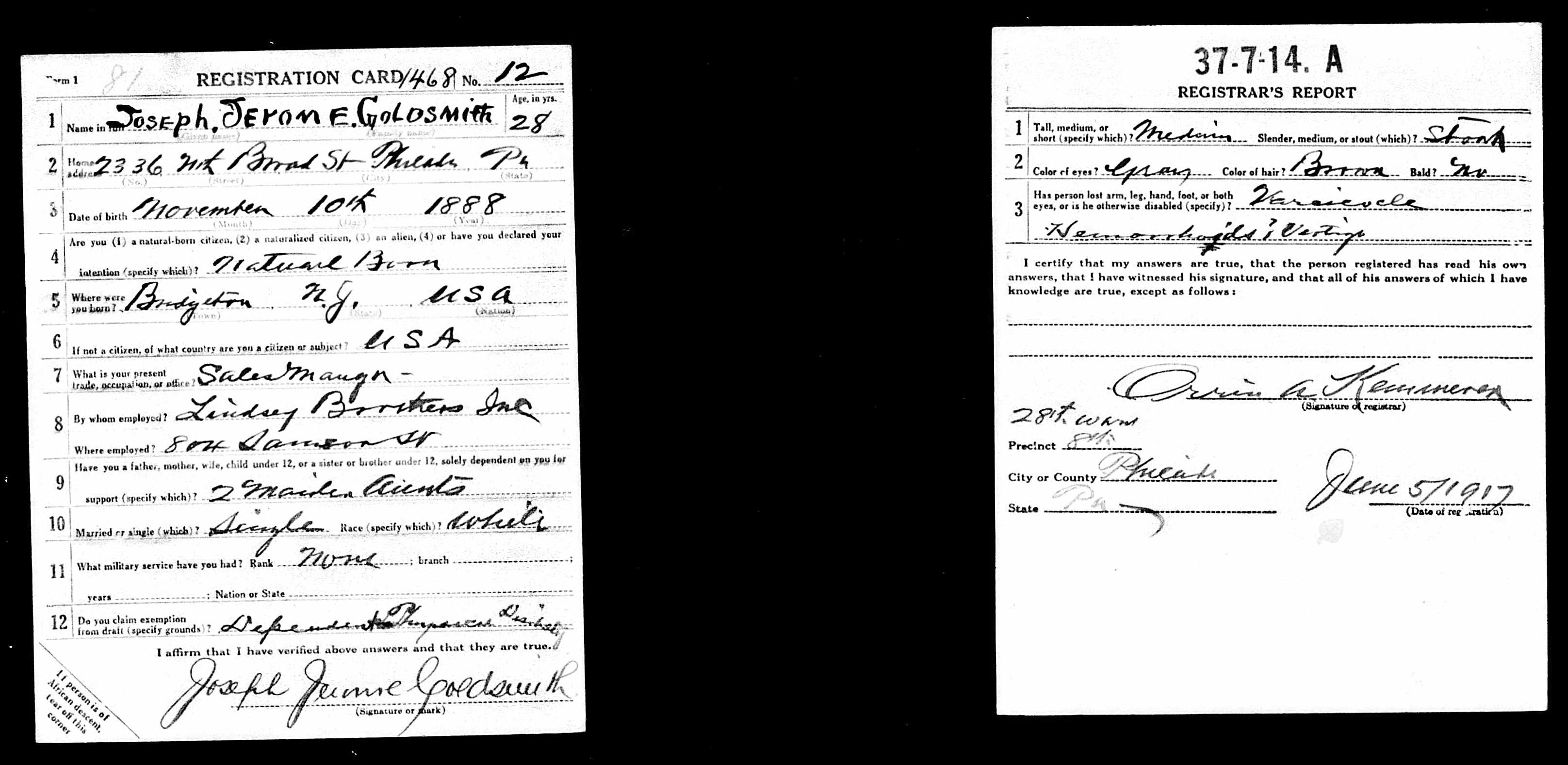
According to Jerome’s registration, he was working as a sales manager for a company called Lindsay Brothers, Inc. He claimed an exemption from the draft based on the fact that he had “two maiden aunts” who were solely dependent on him for support. He also claimed disability based on vertigo, varicocele, and hemorrhoids. Varicocele is a condition of varicose veins on the testicles, sometimes leading to infertility.

J Jerome Goldsmith World War I draft registration
Registration State: Pennsylvania; Registration County: Philadelphia; Roll: 1907644; Draft Board: 24
Ancestry.com. U.S., World War I Draft Registration Cards, 1917-1918


In 1920, Jerome and Herbert were still living with their aunt Hortense and her siblings; now both brothers were working in the tire business, as were two of their Buxbaum uncles.9

Their older brother Sidney Byron and his wife Elizabeth (as she was known) had a child on January 12, 1920,10 and were still living in Philadelphia where Byron was practicing medicine in 1920:

Sidney B Goldsmith and family 1920 census
Year: 1920; Census Place: Philadelphia Ward 7, Philadelphia, Pennsylvania; Roll: T625_1618; Page: 12A; Enumeration District: 153

On November 6, 1929, Jerome Goldsmith married Berda Gans Marks,11 who was a Philadelphia native, daughter of Emanuel Marks and Carrie Gans. He was forty years old, and Berda was 37.  In 1930, they were living in Philadelphia, and Jerome was still working in the tire business as a salesman. Berda was working as a secretary in a medical practice—perhaps that of Jerome’s brother Byron?12

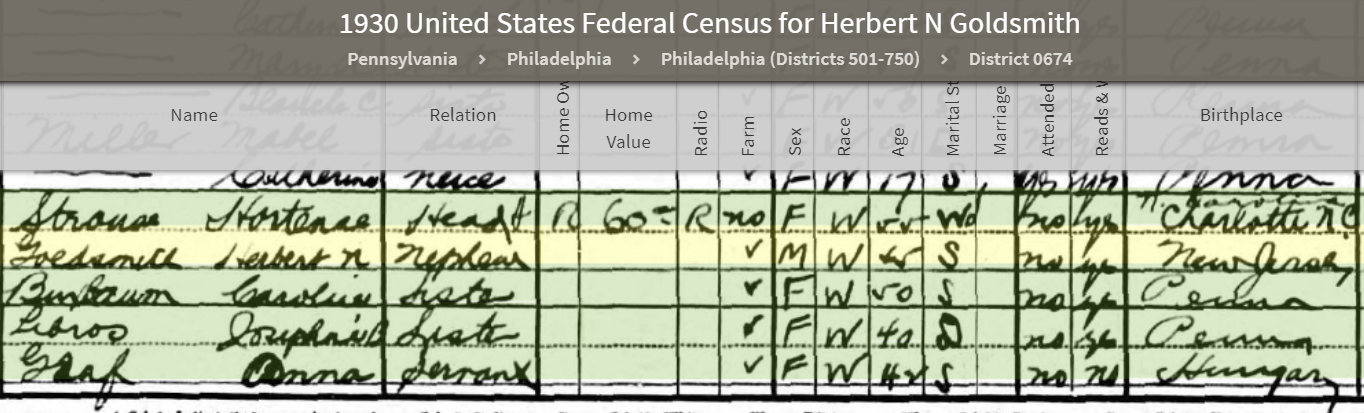
Byron and his family were also still living in Philadelphia in 1930, and Byron continued to practice medicine.13  Herbert, the middle brother, continued to live with his aunts and now listed himself as the proprietor of the tire business.

Herbert Goldsmith 1930 census
Year: 1930; Census Place: Philadelphia, Philadelphia, Pennsylvania; Roll: 2112; Page: 12B; Enumeration District: 0674; FHL microfilm: 2341846

Ten years later, Herbert was still living with his aunts, but now was a broker in the wholesale jewelry business. Perhaps his tire business did not weather the Depression well. He was now 56 years old although the census reports that he was only 52.14

Byron continued to practice medicine and live with his family in Philadelphia in 1940,15 and Jerome and Berda were also living in Philadelphia where Berda continued to work as a medical secretary and Jerome was a salesman for retail tires and radios.16

All three brothers registered for the World War II draft. Byron was still practicing medicine.

S Byron Goldsmith World War II draft registration
The National Archives at St. Louis; St. Louis, Missouri; World War II draft cards (Fourth Registration) for the State of Pennsylvania; Record Group Title: Records of the Selective Service System, 1926-1975; Record Group Number: 147; Series Number: M1951

Herbert was the tallest of the brothers—six feet tall whereas the other two were both 5’ ” 6″ or so. Herbert noted that he had a “cast” in his right eye—a small brown spot. He was now working for a transit company.

Herbert Goldsmith World War II draft registration
The National Archives at St. Louis; St. Louis, Missouri; World War II draft cards (Fourth Registration) for the State of Pennsylvania; Record Group Title: Records of the Selective Service System, 1926-1975; Record Group Number: 147; Series Number: M1951


This time Jerome did not claim the same disabilities that he had in the earlier draft, but did note that he had had two fingers “cut” by an electric saw and tattoos on both arms:

Jerome Goldsmith World War II draft registration
The National Archives at St. Louis; St. Louis, Missouri; World War II draft cards (Fourth Registration) for the State of Pennsylvania; Record Group Title: Records of the Selective Service System, 1926-1975; Record Group Number: 147; Series Number: M1951


Five years later on April 16, 1947, Herbert Goldsmith passed away at the age of 63 from acute coronary thrombosis. His aunt Hortense Strouse, with whom he had lived since being orphaned as a young boy in 1896, was the informant on his death certificate.  The death certificate reports that he was a statistician, something that had not been at all evident from his draft or census records.

Herbert Goldsmith death certificate
Certificate Number Range: 036751-039300
Source Information
Ancestry.com. Pennsylvania, Death Certificates, 1906-1964 [database on-line]. Provo, UT, USA: Ancestry.com Operations, Inc., 2014.
Original data: Pennsylvania (State). Death certificates, 1906–1963. Series 11.90 (1,905 cartons). Records of the Pennsylvania Department of Health, Record Group 11. Pennsylvania Historical and Museum Commission, Harrisburg, Pennsylvania.

The two other Goldsmith brothers lived long lives. Jerome died at 86 on July 21, 1975. 17 His wife Berda lived to 97, dying on October 27, 1989. What her obituary revealed that had not been revealed by the official records was that she was an accomplished pianist and that she and her husband had been quite generous contributors to charitable organizations.  One other revelation: at some point after 1940 Jerome had gone into the food importing business.

Berda Marks Goldsmith obituary
The Philadelphia Inquirer, 30 Oct 1989, Mon, Main Edition, Page 31


Byron died just a few months after his brother Jerome on November 3, 1975; he was 93.18 His wife Elizabeth had predeceased him on May 28, 1973, when she was 85.  They were survived by their daughter and grandchildren, the only remaining descendants of Philip Goldsmith and Nellie Buxbaum.

The story of the three orphaned Goldsmith brothers is another story of human resilience. Having lost their parents in a horrendous tragedy when they were so young, it’s remarkable that these three boys seemed to have overcome those losses and survived. Perhaps the credit goes to their parents for whatever strength and love they gave them as children and to their aunt Hortense and their other aunts and uncles for raising them after they’d lost their parents in 1896.


  1. “42 Killed, 80 Injured,” The New York Times, July 31, 1896 
  2.  Ibid. 
  3. See “42 Killed, 80 Injured,” The New York Times, July 31, 1896; “The Story of the Wreck,” The New York Times, August 1, 1896; “Farr, The Dead, Blamed,” The New York Times, August 5, 1896; “Three Meadow Wreck Verdicts,” The New York Times, August 8, 1896;“Three Buried Here,” The Philadelphia Inquirer, August 3, 1896, p.4. 
  4. “Bridgeton’s Dead,” The Philadelphia Times, August 1, 1896, p. 3. 
  5. “The Atlantic Horror,” Tyrone Daily Herald, August 3, 1896, p. 3. 
  6. “Three Buried Here,” The Philadelphia Inquirer, August 3, 1896, p.4. 
  7. Year: 1910; Census Place: Philadelphia Ward 8, Philadelphia, Pennsylvania; Roll: T624_1387; Page: 10A; Enumeration District: 0124; FHL microfilm: 1375400 
  8. Online publication – Provo, UT, USA: Ancestry.com Operations, Inc., 2011.Original data – “Pennsylvania, Philadelphia Marriage Index, 1885–1951.” Index. FamilySearch, Salt Lake City, Utah, 2009. Philadelphia County Pennsylvania Clerk of the Orphans’ Court. 
  9. Year: 1920; Census Place: Philadelphia Ward 28, Philadelphia, Pennsylvania; Roll: T625_1632; Page: 8B; Enumeration District: 885 
  10. U.S., Social Security Applications and Claims Index, 1936-2007 for Dorothy Jane Goldsmith 
  11. Online publication – Provo, UT, USA: Ancestry.com Operations, Inc., 2011.Original data – “Pennsylvania, Philadelphia Marriage Index, 1885–1951.” Index. FamilySearch, Salt Lake City, Utah, 2009. Philadelphia County Pennsylvania Clerk of the Orphans’ Court. 
  12. 1930 US Census for Jerome and Berda Goldsmith,Year: 1930; Census Place: Philadelphia, Philadelphia, Pennsylvania; Roll: 2095;Page: 24A; Enumeration District: 0275;FHL microfilm: 2341829 
  13. 1930 US Census for Byron Goldsmith and family; Year: 1930; Census Place: Philadelphia, Philadelphia, Pennsylvania; Roll: 2136;Page: 29A; Enumeration District: 1075;FHL microfilm: 2341870 
  14. 1940 US Census for Herbert Goldsmith; Year: 1940; Census Place: Philadelphia, Philadelphia, Pennsylvania; Roll: m-t0627-03713; Page: 9A; Enumeration District: 51-838 
  15. 1940 US Census for Byron Goldsmith and family; Year: 1940; Census Place: Philadelphia, Philadelphia, Pennsylvania; Roll: m-t0627-03753; Page: 8B; Enumeration District: 51-2142 
  16. 1940 US Census for Jerome Goldsmith; Year: 1940; Census Place: Philadelphia, Philadelphia, Pennsylvania; Roll: m-t0627-03691; Page: 81B; Enumeration District: 51-125 
  17. Historical Society of Pennsylvania; Philadelphia, Pennsylvania; Historic Pennsylvania Church and Town Records 
  18. The Philadelphia Inquirer, 04 Nov 1975, Tue, Main Edition, Page 16 

One Mystery Laid to Rest: Baby Rose Schoenthal

One of the most frustrating brick walls I’ve encountered is the mystery of Baby Rose Schoenthal.  I have written several blog posts about Baby Rose, and I have never had any success in finding this child. I stopped looking because I was troubled by the possibility that if I did find her or a descendant, I might be stirring up trouble for some unknowing person.

Some background for those who may not remember the story. On the 1930 census, my grandmother’s first cousin Jacob Schoenthal and his wife Florence are listed with a 15 month old daughter named Rose, living in Atlantic City, New Jersey.

Jacob Schoenthal and family 1930 US census Year: 1930; Census Place: Atlantic City, Atlantic, New Jersey; Roll: 1308; Page: 10B; Enumeration District: 0003; Image: 129.0; FHL microfilm: 2341043

But that there is not one whit of evidence to support the existence of that child aside from that census entry. I have searched for birth records, death records, marriage records. Nothing. I found Jacob’s will—no mention of a daughter. There was no daughter buried with Jacob and Florence. She would have been only eleven in 1940, but she does not appear on the 1940 census.

I had decided that either (1) she never existed or (2) she’d been given up for adoption or (3) she had been a foster child returned to her own parents.

Then in March 2017,  a Schoenthal cousin found me through the blog.  Barbara wrote that she was the granddaughter of Estella Schoenthal, who was my grandmother Eva Schoenthal’s first cousin and Jacob Schoenthal’s sister. Barbara and I are third cousins.

We exchanged information, and she filled me in on the names and dates of the descendants of Estella Schoenthal and Leon Klein. But perhaps most importantly, she gave me closure on that nagging question: Did Estella’s brother Jacob Schoenthal and his wife Florence Truempy have a daughter named Rose born in 1928 or 1929?

Barbara asked her mother, who said without hesitation that Jacob and Florence never had children. Could she be wrong? Of course.  Barbara’s mother might not have been born in 1930 and she definitely was not yet married to Barbara’s father in 1930, and so it’s entirely possible that IF Jacob and Florence had a child who was given up for adoption or only lived with them for a brief period, Barbara’s mother would never have known.

But I have chosen to believe that Barbara’s mother is right. I have chosen to believe that Baby Rose never existed. It never made sense to me that she’d been given up for adoption because she was already 15 months old (if she existed) in 1930, and there’s no reason to think her parents would have given her up at that point: they were mature adults and married, living comfortably, and had plenty of family around for support.

Also, the child’s name was Rose Maxine or Maime (it’s hard to read). Jacob’s mother’s name was Rose Mansbach Schoenthal. She had died in May, 1929, four months after the supposed birth of the child Rose in February, 1929. It seemed very unlikely that Jacob would have named a child for his mother before she died.

Rose Mansbach Schoenthal
courtesy of the family of Hettie Schoenthal Stein

I also didn’t buy that “Rose” had been a foster child. It seems quite an unlikely coincidence that a foster child would have the same name and middle initial as the mother of the man acting as her foster father.

So with the statement by Barbara’s mother that Jacob and Florence never had children, I am willing to close the door on the mystery of Baby Rose M Schoenthal. I think the census enumerator made a mistake. My working theory? That the enumerator was told that a Rose M had lived in the household until fifteen months before, and somehow the enumerator recorded that as meaning a fifteen month old child named Rose M was currently living in the household.

In addition to helping me with that mystery, Barbara also provided me with this handsome photograph of Sidney Schoenthal, her great-uncle and my grandmother’s first cousin.

Sidney Schoenthal

I see a resemblance to my grandmother (first photo below) and to my father (second photo below)—what do you think?

Eva Schoenthal and John Cohen, Sr. 1923

Florence and John Cohen, Jr., 1951

I am very grateful to Barbara for helping me get closure on Baby Rose. And for sharing this photograph of my cousin Sidney Schoenthal.

Double Cousins…Everywhere!

The best part of my discoveries of the Goldfarb and Hecht families is that I have found more new cousins, three of whom are my double cousins—Sue, Debrah, and Lisa. They are descendants of Julius Goldfarb and Ida Hecht. Sue’s daughter Lisa shared this wonderful wedding photograph of Julius and Ida.

julius-ida-goldfarb-wedding-from-lisa-wartur

Wedding photograph of Julius Goldfarb, my grandmother’s first cousin, and Ida Hecht, my grandmother’s niece. Courtesy of the Goldfarb/Hecht family


Julius was the son of Sarah Goldfarb, my great-grandmother’s sister; Ida was the daughter of Tillie Hecht, my grandmother’s half-sister.   So I am related to both of them.

Julius and Ida had four daughters, Sylvia, Gertrude, Ethel and Evelyn. Sue, Sylvia’s daughter, shared with me this precious photograph of her grandmother Ida holding her as a baby:

ida-hecht-goldfarb-and-her-granddaughter-sue-1938

Ida Hecht Goldfarb and granddaughter Sue

And Debrah shared this photograph of her grandparents, Julius and Ida, with her mother Evelyn:


Julius, Evelyn, and Ida (Hecht) Goldfarb

Julius, Evelyn, and Ida (Hecht) Goldfarb

One thing I wanted to define is how, if at all, Julius and Ida were related to each other, aside from being husband and wife.  Hecht/Goldfarb family lore says Julius and Ida were “distant cousins.”

Julius was the son of Sarah Goldfarb.  Sarah’s sister Bessie Brotman was the stepmother of Ida’s mother, Toba, as Bessie married Toba’s father Joseph after his Toba’s mother died.  Although that makes things complicated, it does not alone create any genetic connection between Julius and Ida since Bessie (and thus Sarah) had no blood relationship with Toba.

relationship-bessie-brod-to-tillie-brotman

But if Brotman family lore is correct and Bessie and her husband Joseph Brotman were first cousins, then Joseph Brotman and Bessie’s sister Sarah were also first cousins. Sarah’s son Julius married Ida, who was the granddaughter of Sarah’s first cousin Joseph, making Julius and Ida second cousins, once removed.

relationship-of-julius-goldfarb-to-ida-hecht-better

That is, assuming that Joseph and Sarah were first cousins as Brotman family lore reports, Ida and Julius were in fact “distant cousins,” as Hecht/Goldfarb family lore indicates.  So maybe together the Brotman family lore and the Hecht/Goldfarb family lore validate each other.

Sue and Debrah, who are granddaughters of Julius Goldfarb and Ida Hecht, thus are both the great-granddaughters of Sarah Brotman Goldfarb, making them my third cousins on my great-grandmother Bessie’s side, and the great-great-granddaughters of Joseph Brotman, making them also my second cousins, once removed, on my great-grandfather Joseph’s side. (Lisa is one more step removed on both sides.) Renee is my second cousin; her mother Jean Hecht was my mother’s first cousin; her grandmother Toba was my grandmother Gussie’s half-sister. And then I’ve also found a cousin Jan, whose grandfather was Harry Hecht, Toba’s son, and my mother’s first cousin.

inset-from-harry-hecht-photo

Harry Hecht and his wife and children 1945 Courtesy of the family

And, of course, if my great-grandparents Joseph and Bessie Brotman were in fact first cousins, the relationships get even more convoluted. But I think I will skip that calculation.  At least for now.  Maybe some brave soul out there wants to try and figure it out?

With all this shared DNA, I was very curious to see if there were any family resemblances among the various members of the Goldfarb, Hecht, and Brotman families.  My newly found double cousins Debrah, Sue, and Lisa shared some family photos with me, including this one of Toba/ Taube/Tillie Brotman Hecht:

toba-tillie-brotman-hecht

Toba/Taube/Tillie Brotman Hecht Courtesy of the Goldfarb/Hecht family

Here is a photograph of her brother Max Brotman that I’d earlier received from his family:

Max Brotman

Max Brotman, courtesy of the family

Do you see a resemblance? Unfortunately I don’t have any photographs of Toba’s other full siblings, Abraham and David, to help with the comparison.

But here are photographs of Toba’s half-siblings, Hyman, Tillie (Ressler), Sam, and my grandmother Gussie:

Hyman Brotman

Hyman Brotman

Tilly Brotman

Tilly Brotman Ressler

Sam Brotman

Sam Brotman

Gussie Brotman

Gussie Brotman Goldschlager

I can see some similarities—in particular in the shape of the noses.  But it appears that Max and Toba do not have faces that are as round as those of their half-siblings.  Perhaps the shape of their faces was a genetic trait they inherited from their mother Chaye, not their father Joseph Brotman.

Here is one other photograph of the extended Goldfarb and Hecht family.

goldfarb-hecht-family-gathering

Goldfarb Hecht family gathering for Chanukah

Standing on the far left is Julius Goldfarb.  Seated at the head of the table is Ida Hecht Goldfarb.  On the right side of the table starting at the front are two of Ida’s sister, Etta and Jean Hecht.  Also in the photograph are Julius and Ida’s four daughters as well as their spouses and a few of the grandchildren and other cousins.

It’s sad to think that in 1917 Julius and Ida were close enough to my grandmother that they came to visit when my aunt was born, as did Ida’s mother, my grandmother’s sister Toba Hecht, but somehow the families all lost touch, and my mother only has a few  memories of some of the Goldfarbs from her childhood.

On the other hand, I feel very fortunate that now, almost a century after my aunt was born, I know who the Goldfarbs and Hechts were and I am in touch with a number of these “new”  cousins of mine.


The Goldfarbs and the Hechts: Some Lingering Questions and Some Answers

Finding the woman I believe to have been my grandmother’s long missing sister was definitely one of those high points in my research that I will always remember.  I had spent hours and hours searching for the elusive Sophie years before. I had completely given up on ever finding her.  I even wondered whether she’d been a figment of my aunt’s very creative imagination. But she wasn’t.  My aunt just had the wrong name.

That she ended up being named Toba or Taube or Tillie and not Sophie certainly is a lesson in not relying too heavily on family lore, and it is also one of the many perplexing things about this discovery and how it fits with family stories.

max mason

Hecht family lore said that Taube had two brothers who had arrived in the US before she did, but I have no evidence that there were two Brotman brothers here before 1887 when Taube arrived.  Joseph Brotman had three sons in Galicia with his first wife Chaye and one with his second wife, my great-grandmother, Bessie.  His oldest sons, Abraham and David, came to the US in 1889, the same year that Joseph immigrated; Max came in 1890. His next son, Hyman, was born in 1883 and came to the US with my great-grandmother Bessie in 1891.  None of these European born sons was here in 1887 when Taube arrived, at least as far as I can tell.

Of course, it is possible that I have missed a child or missed an earlier manifest.  Or it is possible that the Hecht family lore is not correct, just as my aunt’s document naming the missing sister as Sophie is seemingly not correct.  I don’t know which is more likely.

There’s also the mystery of Eva Singer and Ascher Singer, the two people who sailed from Tarnobrzeg on the Moravia apparently with Taube Brodt.  Were they really sailing with her or just bracketed on the manifest to show they were all from the same town? And what happened to the Singers after they got to the United States?

Taube Brodt ship manifest 1887 Staatsarchiv Hamburg; Hamburg, Deutschland; Hamburger Passagierlisten; Microfilm No.: K_1736 Description Month : Direkt Band 059 (3 Jul 1887 - 29 Dez 1887)

Taube Brodt ship manifest 1887
Staatsarchiv Hamburg; Hamburg, Deutschland; Hamburger Passagierlisten; Microfilm No.: K_1736
Description
Month : Direkt Band 059 (3 Jul 1887 – 29 Dez 1887)

More importantly, what happened to Taube after she arrived if, in fact, she did not have two brothers living here already? Did she really go to St. Louis, as Hecht family lore indicates?

How I wish we had the 1890 census.  Perhaps if it still existed, I would have found that my great-grandfather Joseph Brotman was living in 1890 with his four children from his first marriage: Abraham, David, Max, and Taube.  But the 1890 census was destroyed in a fire, taking the answers with it.

I searched the 1890 New York City police census and the 1892 New York census on Ancestry, but alas, none of the Brotmans appears on those either.  I’ve searched in city directories for both New York and St. Louis, but again with no luck. There is a J. Brodman in the 1891 NYC directory, a “pedlar” living on Ridge Street; that could be my great-grandfather, but I certainly can’t tell for sure; plus it doesn’t help me find Taube as there is no listing for her nor, for that matter, for Abraham, David, or Max.

I thus don’t know where Taube was from the time she arrived in the US in 1887 until she gave birth to her first son, Harry, in 1892.  But from there on, I have been able to find her story—up to her sad death in 1944.

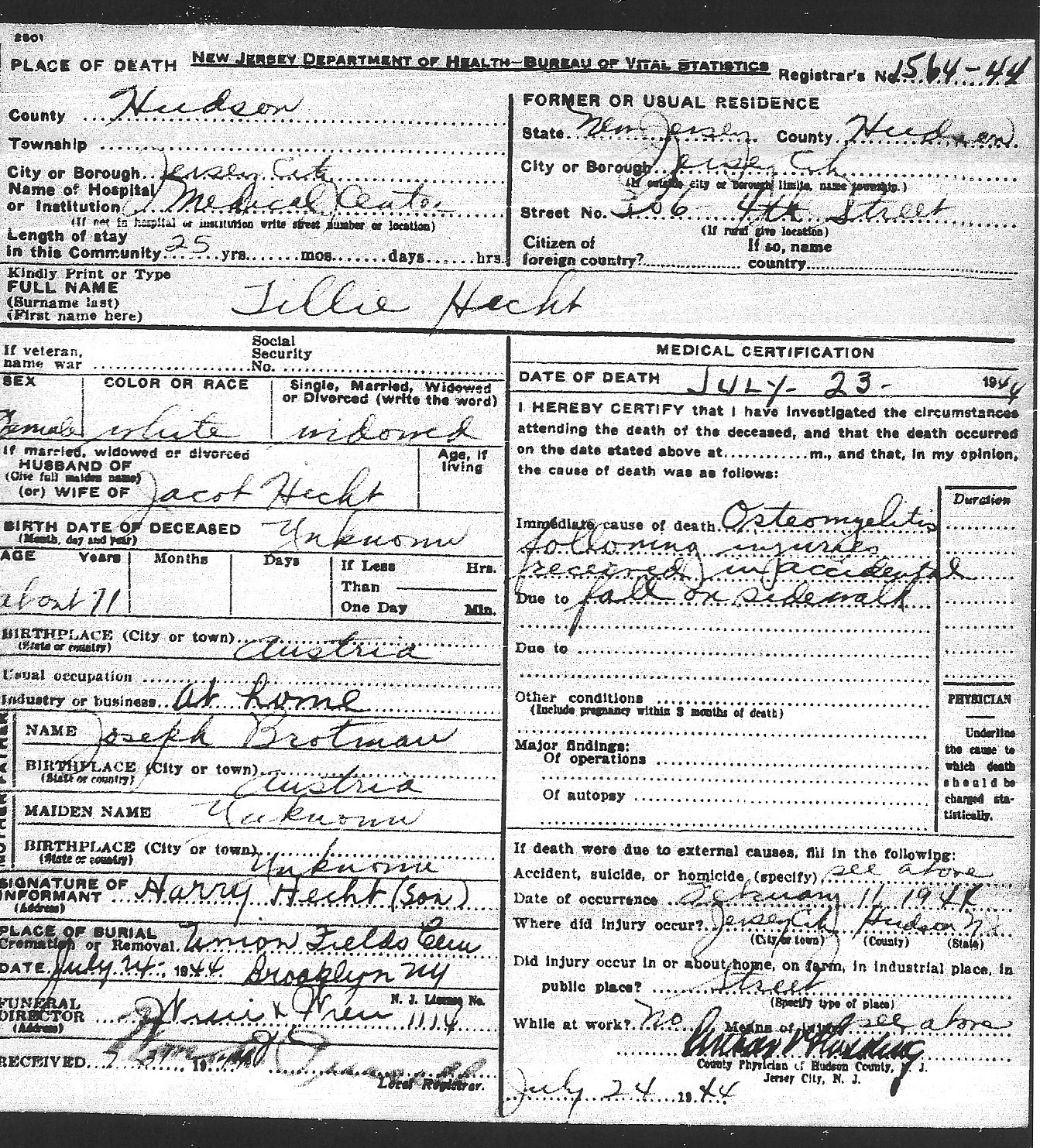
tillie-hecht-death-certificate

As her death certificate reported. she died from osteomyelitis after a fall on the sidewalk. The Mayo Clinic defined osteomyelitis as follows: “Osteomyelitis is an infection in a bone. Infections can reach a bone by traveling through the bloodstream or spreading from nearby tissue. Infections can also begin in the bone itself if an injury exposes the bone to germs.”  According to my medical consultant, today osteomyelitis rarely results in death, but back in 1944, antibiotic treatment was not as effective.

I also have an answer to the question I posed in my last post; I had asked for help in deciphering Ida Hecht’s occupation on the 1910 census:

Ida Hecht occupation on 1910 census

Ida Hecht occupation on 1910 census

Several readers, here and on Facebook, responded to my question with “button holer.” I wasn’t sure what that was, but another commenter did.  Bob Brotman (no relationship yet found to my Brotmans) wrote that it meant buttonhole maker, and explained, “In 1910 it was a specialized skill in the sweat shops and worth higher pay than most of the piece work. Women who sewed their own clothing at home would take the almost finished garments to a buttonhole maker for this final touch. Special buttonhole making machines were used commercially in the late 1800’s. Home sewing machines could not make decent buttonholes until the 1950’s.” Live and learn—always something new!

But other questions remain unanswered. There is the question of whether Brod, Brodman, Brotman, etc., are different names or different versions of the same name.  Were my great-grandparents both really named Brod or Brotman? Or was one a Brod, the other a Brotman?

I posted a question on the JewishGen listserv about whether Brod and Brotman were the same or different names, and I received conflicting responses.  One person, referring to Alexander Beider’s Dictionary of Surnames for the Russian Empire, wrote that Brotman is just another form of the surname Brot, meaning bread or bread man. Another person suggested that Brotman was an Americanization of Brod and that people often forgot the original name once they immigrated.

But another person said that they are two different names; this person said Brotman means “bread man” whereas Brot is a toponym for the place where people “ford” rivers, Brodt being a Slavic word for “ford.”  And then Stanley Diamond of JRI Poland wrote that both names existed in the Tarnobrzeg region and seemed to come from different families. So I am just as confused as I was before I asked the question.

Also, I still don’t know how, if at all, my great-grandparents Joseph and Bessie were related to each other. If they were first cousins, through what relationship? Were their fathers brothers? Or was it that one’s mother and the other’s father were siblings? Or were their mother’s sisters? I don’t know.

As has happened time and again with my Brotman line, I can only move forward in inches, but at least I am moving forward.  I have found a woman I believe to have been my great-grandmother’s sister—Sarah Brod/Brotman Goldfarb.  I have also found a woman I believe to have been my grandmother’s half-sister—Toba/Taube/Tillie Brotman Hecht.  And it all started with the discovery of my aunt’s 1917 baby book and two names that were not familiar to me.[1]  Once again, I am indebted to my Aunt Elaine, who would have been 99 years old tomorrow.

Aunt Elaine baby book 5

Can I say with 100% certainty that I am right about either one? No, but I am probably as right about it as I can get.  Having checked again to see if there were any new records discovered in Tarnobrzeg and learning that there have not been (and will not be, apparently), this may be the best I can do.

In my next post I will share some of the photos of my Hecht and Goldfarb cousins and compare them to my known Brotman relatives to see if there are any family resemblances.


[1] There are still other names in the baby that I will investigate more completely, though nothing has yet turned up that’s been helpful.

Oh, Happy Day! Tillie Hecht Mystery, Part II

I was just about to throw in the towel.  I couldn’t find one additional clue about Taube Brotman Hecht and whether she was related to me.  There were no records online to help.

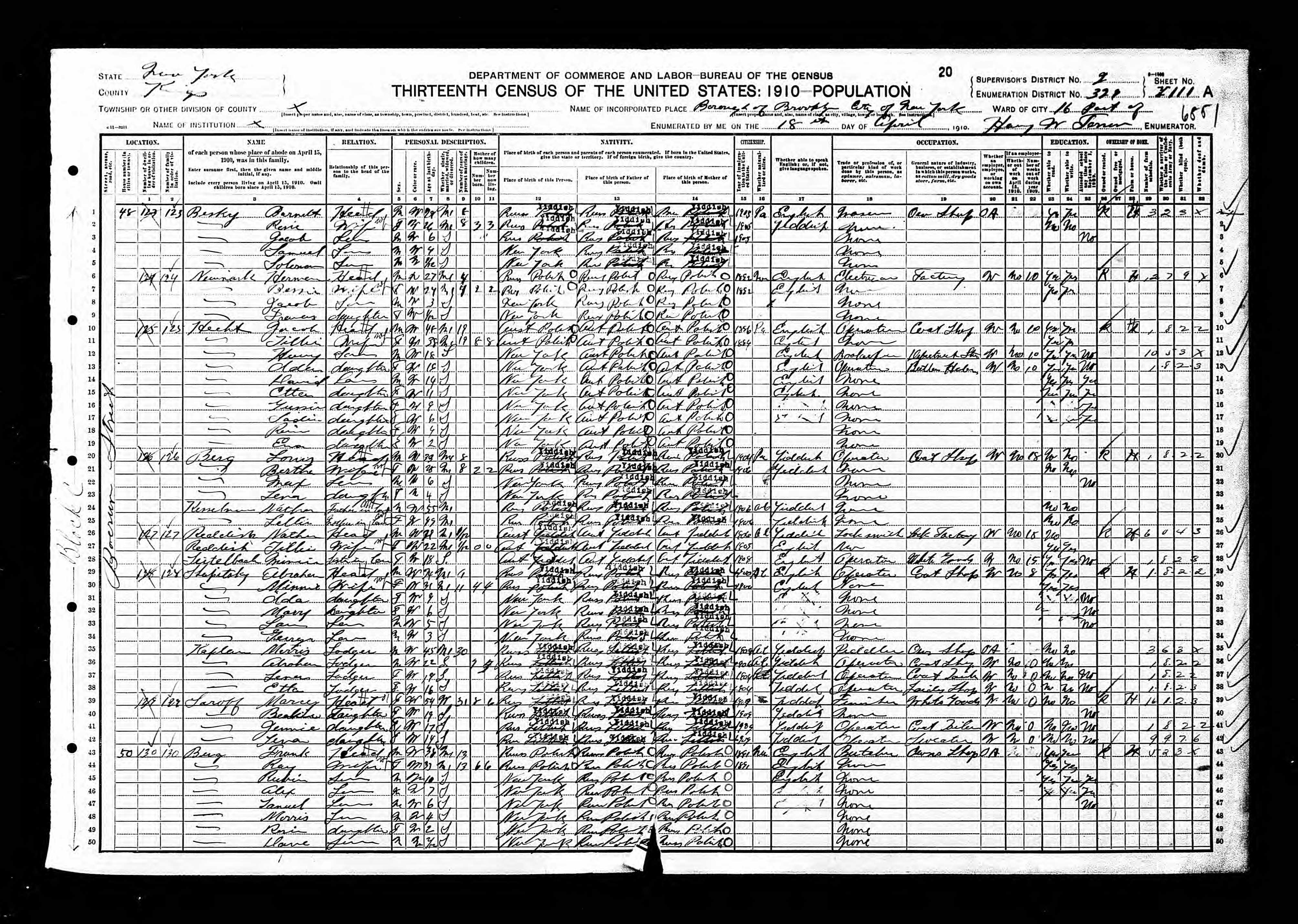
According to the 1900 and 1905 census records, Jacob Hecht and his wife Tillie lived in the Lower East Side and then by 1910 had moved to Brooklyn.  Jacob was a tailor, and in 1910 their son Harry was working as a bookkeeper in a department store and their daughter Ida was also employed, but I can’t quite make out her job: operator in a button or butter something?

jacob-and-tillie-hecht-1910-census

Jacob and Tillie Hecht 1910 US census Year: 1910; Census Place: Brooklyn Ward 16, Kings, New York; Roll: T624_964; Page: 8A; Enumeration District: 0329; FHL microfilm: 1374977

Ida Hecht occupation on 1910 census

Ida Hecht occupation on 1910 census

In 1913, Ida married Julius Goldfarb, as noted in an earlier post.  In 1915, Jacob and Tillie Hecht and their other seven children were living in the same building as Sam and Sarah Goldfarb, Ida’s in-laws, and Hyman and Sophie Brotman, my grandmother’s brother and his wife.  Jacob was working as a tailor, and Harry was working as a salesman; the other children were still in school.

sam-goldfarb-and-family-1915-ny-census-bottom-left-and-top-right

Hecht family 1915 NY census;  New York State Archives; Albany, New York; State Population Census Schedules, 1915; Election District: 18; Assembly District: 06; City: New York; County: New York; Page: 85

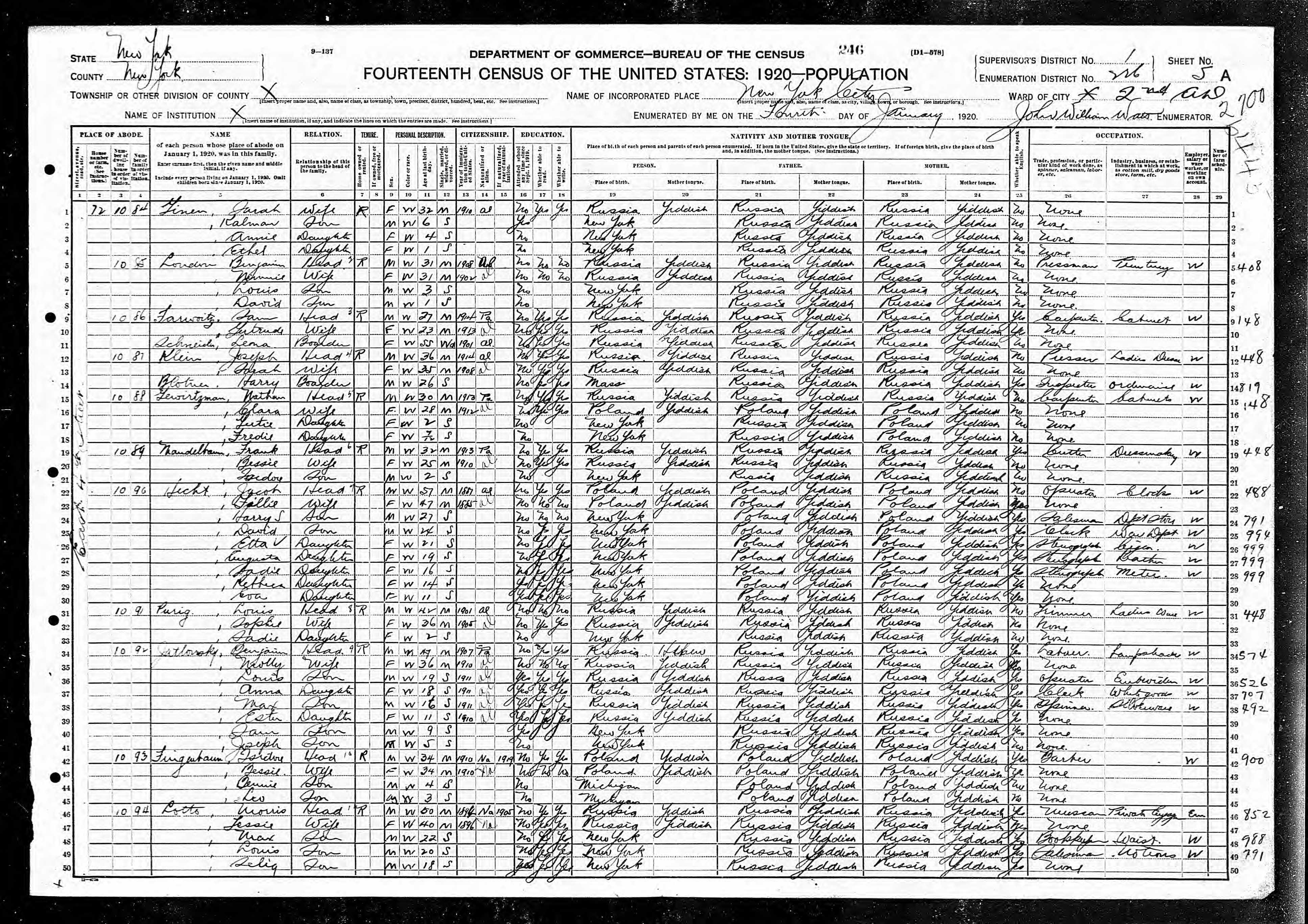
Jacob and Tillie Hecht still had the seven other children living with them in 1920, now on East 4th Street in New York City; Jacob continued to work as an operator in a cloak factory and Harry as a salesman in a department store.  David Hecht was working as a clerk for the War Department, and Etta, Gussie (listed as Augusta here) and Sadie were all working as stenographers.  The two youngest children, Rose (listed as Rebecca here) and Eva, were not yet employed.

jacob-and-tillie-hecht-1920-us-census

Jacob and Tillie Hecht and family, 1920 US census Year: 1920; Census Place: Manhattan Assembly District 2, New York, New York; Roll: T625_1188; Page: 5A; Enumeration District: 226; Image: 1055

Meanwhile, Ida and her husband Julius Goldfarb and their children had by 1920 moved to Jersey City, NJ, where Julius was in the liquor business.  Within five years, almost all of the Hecht family had followed them to Jersey City, including Jacob and Tillie.  As you can see from this segment from the 1925 Jersey City directory, Jacob and Tillie were now living at 306 4th Street, and right above their listing is a listing for their son Harry.  He was working as a clerk for none other than Herman Brotman: my great-uncle, my grandmother’s brother Hymie.  Another piece of the puzzle was fitting together.

Hechts in 1925 Jersey City directory Title : Jersey City, New Jersey, City Directory, 1925 Source Information Ancestry.com. U.S. City Directories, 1822-1995 [database on-line]. Provo, UT, USA: Ancestry.com Operations, Inc., 2011.

Hechts in 1925 Jersey City directory
Title : Jersey City, New Jersey, City Directory, 1925
Source Information
Ancestry.com. U.S. City Directories, 1822-1995 [database on-line]. Provo, UT, USA: Ancestry.com Operations, Inc., 2011.

But there were two other Hechts listed here at the same address as Jacob and Tillie: Jean and Shirley, both working as stenographers.  I wasn’t sure which daughter was now using Jean and which was now using Shirley, but I guessed that Jean was probably Gussie and Shirley was probably Sadie. David, Etta, Rose, and Eva were not listed.  I could not find them elsewhere either.  Was Etta married? Rose and Eva were young enough that they could have still been in school, but where was David, who would have been 29 in 1925?

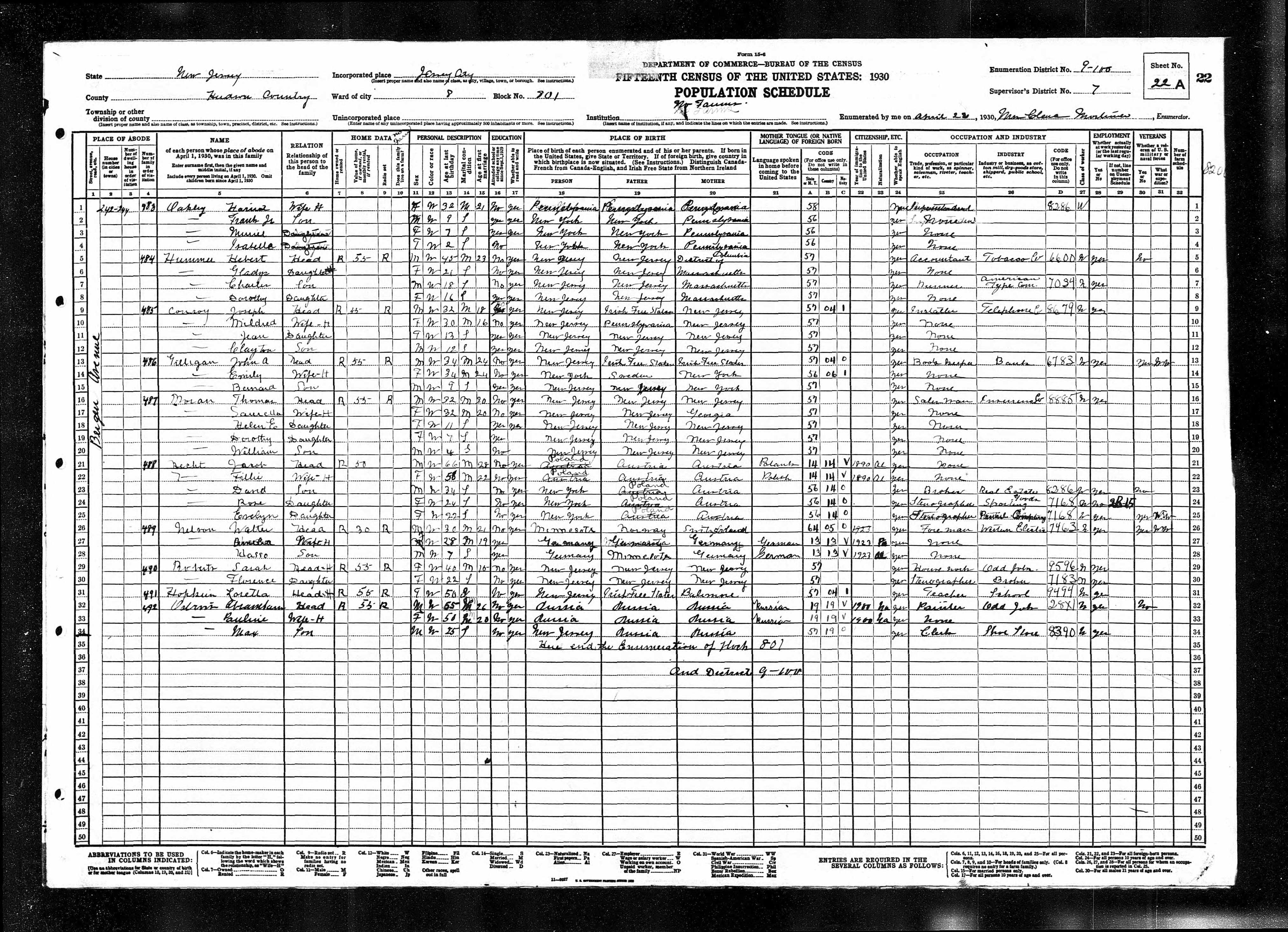
Fortunately, I was able to find a few of the Hechts on the 1930 census, which answered some of those questions.  In 1930, Jacob and Tillie were still living in Jersey City with David, Rose, and Eva (listed as Evelyn here).  Jacob was no longer working, but David was working as a real estate broker and Rose and Eva were both working as stenographers.

Jacob and Tillie Hecht 1930 US census Year: 1930; Census Place: Jersey City, Hudson, New Jersey; Roll: 1353; Page: 22A; Enumeration District: 0100; Image: 602.0; FHL microfilm: 2341088

Jacob and Tillie Hecht 1930 US census
Year: 1930; Census Place: Jersey City, Hudson, New Jersey; Roll: 1353; Page: 22A; Enumeration District: 0100; Image: 602.0; FHL microfilm: 2341088

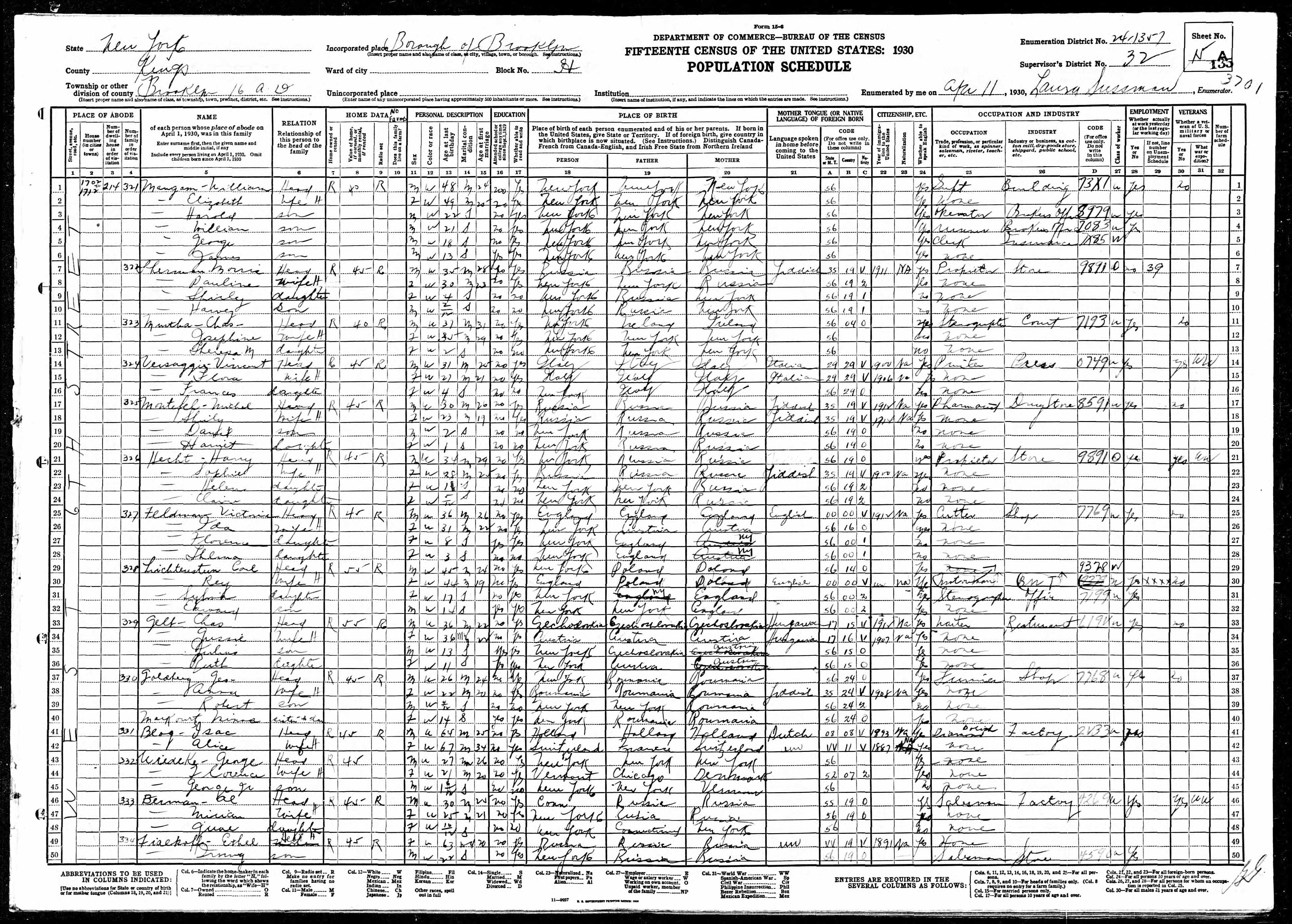
Their son Harry Hecht had moved to Brooklyn by 1930 and was now married to a woman named Sophie; they had two children.  Harry was the proprietor of a store.

Harry Hecht and family 1930 US census Year: 1930; Census Place: Brooklyn, Kings, New York; Roll: 1522; Page: 15A; Enumeration District: 1357; Image: 271.0; FHL microfilm: 2341257

Harry Hecht and family 1930 US census
Year: 1930; Census Place: Brooklyn, Kings, New York; Roll: 1522; Page: 15A; Enumeration District: 1357; Image: 271.0; FHL microfilm: 2341257

As for Etta, Gussie, and Sadie, I assumed they were married, but I couldn’t find them.  And at that point I hit a wall. I could not find any of the Hecht daughters on the NYC marriage index.  Because the family had moved to New Jersey, and New Jersey has so far refused to put even an index of its birth, marriage, or death records online, there was no simple way for me to find marriage records for them in New Jersey. I assumed that Gussie/Jean and Sadie/Shirley had married between 1925 and 1930 and that Etta had married between 1920 and 1925, but paying for a search for these certificates did not seem like a wise use of my resources.

I already had two documents that said that Tillie Hecht’s birth name had been Taube or Toba Brotman: her son Harry’s birth certificate and her daughter Ida’s marriage certificate; there was also a ship manifest for a Taube Brodt from Tarnobrzeg.    In addition, I had found this entry on the SSACI for a Jean Gross, giving me not only information about Jean Hecht’s married name, but also another confirmation that Taube’s birth name was Toba Brotman:

Ancestry.com. U.S., Social Security Applications and Claims Index, 1936-2007 [database on-line]. Provo, UT, USA: Ancestry.com Operations, Inc., 2015.

Ancestry.com. U.S., Social Security Applications and Claims Index, 1936-2007 [database on-line]. Provo, UT, USA: Ancestry.com Operations, Inc., 2015.

The additional marriage certificates for the remaining daughters might have given me further confirmation that their mother’s birth name was Taube/Toba Brotman, but what I really wanted to know was who Taube’s parents were.  And that meant finding either her marriage certificate or her death certificate, not her children’s marriage certificates.  But before I could do that, I wanted some rough idea of when she died so that I could make a reasonable request of my researcher in Trenton.

That meant finding the 1940 census to see if Tillie Hecht was still alive in 1940.  The New Jersey archives allows public access to death certificates up to 1955; I had to hope that Tillie had died in New Jersey before 1955.


I was able to find Tillie Hecht on the 1940 census; she was still living in Jersey City at 306 East 4th Street.

Tillie Hecht and family 1940 US census Year: 1940; Census Place: Jersey City, Hudson, New Jersey; Roll: T627_2401; Page: 3B; Enumeration District: 24-50

Tillie Hecht and family 1940 US census
Year: 1940; Census Place: Jersey City, Hudson, New Jersey; Roll: T627_2401; Page: 3B; Enumeration District: 24-50

She was now a widow, so Jacob had died since the 1930 census. It also says she was sixty years old whereas Tillie would really have been at least sixty-four.  There were two adult children living with her: Dave, who was listed as 35 and not employed, and Ruth, who was 26 and working as an assistant in a doctor’s office.  David Hecht should have been 45 in 1950, and Rose would have been 36. Had Rose changed her name from Rebecca (1930) to Ruth in 1940?  Had Tillie shaved ten years off the ages of herself and both of her children, or was there possibly another Tillie Hecht living in Jersey City, born in Austria?

I decided to assume for search purposes that this was the right Tillie Hecht and to ask my researcher to see if she could find a death certificate for a Taube or Tillie Hecht between 1940 and 1955.  And then I waited.

But while I was waiting, I also emailed Tillie’s great-granddaughter Sue and asked her what she knew about her Hecht relatives: what were the married names of her grandmother’s sisters? When did Jacob and Tillie and their children die? Did she know anything else that might help me find out how Tillie Brotman Hecht was related to my Brotmans, if at all?

Sue then spoke to her cousin Renee, one of Tillie’s grandchildren (Jean Hecht’s daughter), and filled me in on what Renee had told her.  It was an email filled with a great deal of information, but the part that was most critical to solving my question about Tillie Hecht was this one:

Tillie (Toba) Brotman came to U.S. at 10 years of age she thinks. 2 brothers were already here…redheads …or at least one was. The brothers sent Tillie to a house in St. Louis…to work…learn English, or both. Renee remembers her mother and Aunt Etta (also a Hecht girl) taking the subway to Brooklyn to see “The Uncle” who must have been one of Tillie’s brothers.

I read this paragraph several times, trying to sort out what it meant.  First, the fact that Tillie had come to the US at ten was consistent with the Taube Brodt I’d found on the 1887 ship manifest, listing Taube as eleven at that time.

Second, Renee reported that Taube had had two brothers here already— and that they were redheads.  That stopped me in my tracks—my mother, my aunt, my grandmother, my grandmother’s sisters—all were redheads.  Red hair is recessive and not all that common.  Could this just be coincidence? A Brotman from Tarnobrzeg with red hair had to be related to my family.

My grandmother with her two daughters, my Aunt Elaine and my mother 1933

My grandmother with her two daughters, my Aunt Elaine and my mother 1933.  All redheads.

But who were these two brothers? And why did they send Taube to St. Louis? I had no record of any Brotman from my family arriving before 1887 when Taube Brodt arrived.

I then read Sue’s email again.  This time a different paragraph jumped out at me:

Renee recalls meeting a cousin also named Renee who she thinks was the daughter of one of Tillie’s brothers. As she recalls, they owned a hardware store on Lexington Ave. and 59th in NYC.  Renee thought that both Renees were named for an Aunt Irene.

A big, loud bell went off in my slow-witted brain.  I knew who that second Renee was.  She was Renee Brotman, daughter of Max Brotman, my grandmother’s older half-brother.  Renee had married Charles Haber, and they owned a hardware store on Lexington Avenue and 59th Street in New York City.  I emailed Renee’s daughter Judy to confirm that that was in fact the address.

Max, Sophie, Rosalie and Renee

Max, Sophie, Rosalie and Renee Brotman. Max was my grandmother’s half-brother.

Suddenly I knew exactly who Toba Brotman, aka Taube Brodt, aka Tillie Hecht, was.

She was my grandmother’s half-sister, the missing sibling I had long ago, years ago, given up on ever finding.  I had searched and searched and found not one shred of a clue.  I only knew she existed because my Aunt Elaine had listed all of the children of Joseph Brotman, including those with his first wife Chaye, on her family tree.  There had been a daughter named Sophie, according to my aunt.

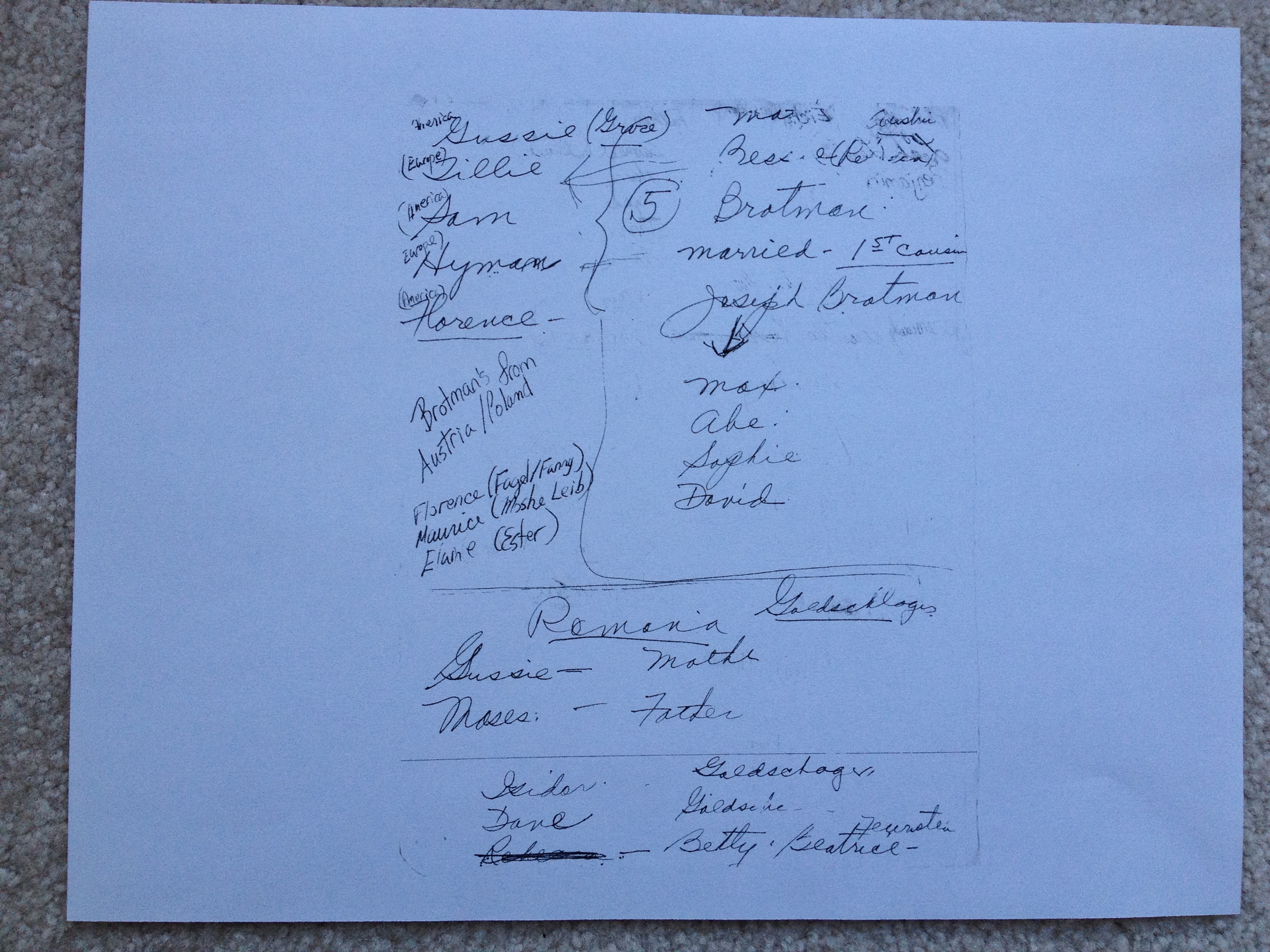
Family Tree drawn by Elaine Goldschlager Lehbraum

Family Tree drawn by Elaine Goldschlager Lehbraum

max mason

My aunt had all the other names right—could she have been mistaken about Sophie’s name? Was it really Toba or Taube or Tillie?

Plus there was another thing that troubled me: if Tillie Hecht was really my grandmother’s sister, it meant that my grandmother had two sisters using the name Tillie: her full sister Tillie, the one my mother knew well, Tillie Brotman Ressler, and this other half-sister Tillie Brotman Hecht.  How could there be two sisters with the same first name?

Tilly Ressler 1944

Tilly Brotman Ressler 1944.  My grandmother’s sister. And also a redhead.

But then I thought some more.  Tillie Hecht’s original name had been Toba; Tillie Ressler’s original name had been Tema.  They were not given the same name at birth; they both had just adopted the same Americanized nickname in the United States.  Maybe that’s why my aunt thought of Tillie Hecht as Sophie? Maybe some in the family still called her Toba or Taube and that sounded like Sophie to my aunt? (Those of us who knew her well knew how my Aunt Elaine could mangle a name.)

And who was this Aunt Irene that the two Renees were named for? A clue for that came from my cousin Judy; she said her mother Renee had originally been named Ida, but it was changed to Irene soon after she was born.  Irene then evolved into Renee.  When I saw “Ida,” I recalled that Ida was often a secular name for girls named Chaye.  Chaye was the name of Joseph Brotman’s first wife, the mother of Abraham, David, Max, and “Sophie.” Max Brotman had named his daughter Ida (then Irene) for his mother Chaye.  If Tillie Brotman Hecht was in fact “Sophie,” it made sense that she also named her first daughter Ida for her mother Chaye.

It all made sense.  But I knew better than to rely on family lore.  I needed some kind of official record to back up my hypothesis.

And then it arrived.  Tillie Hecht’s death certificate:

tillie-hecht-death-certificate

Her father was Joseph Brotman, my great-grandfather. Tillie Hecht, born Toba Brotman, was my grandmother’s half-sister.  The Hecht children, all eight of them, were my mother’s first cousins.  I had found the long missing Sophie, only she was really Toba.

There were still questions to address, but for the moment, I just was content to wallow in the joyous mud of discovery.


Who was Tillie Hecht? Another Brotman Mystery

If you had asked me three years ago when I started this blog whether I’d still be finding new Brotman relatives three years later, I’d have laughed. I had so little information about even my great-grandparents.  And yet here I am in 2016 having found a whole new Brotman/Brod family of relatives based on a name in a baby book from 1917.

The discovery of Julius Goldfarb and his family, in particular his mother Sarah Brotman/Brod, was a true blessing.  Now I have corroboration of where my great-grandparents lived in Poland, and I have a better picture of my grandmother’s extended family and the people who were part of her life when she was a child and an adult.  I also have several newly discovered living cousins who have already enriched my life.

Even more amazing to me is the most recent discovery of Taube Hecht because that discovery was even more far-fetched.  Remember that in my aunt’s baby book the last name on the list of visitors was Mrs. Taube Hecht.  At first I’d had no idea who she was.

Aunt Elaine baby book 5

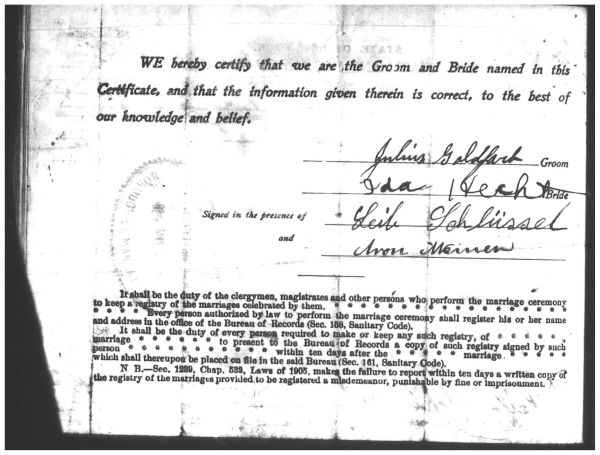
Then while researching Julius Goldfarb to figure out how he was related to my grandmother, I obtained a copy of his marriage certificate.  Julius Goldfarb had married Ida Hecht, and on their marriage certificate it said her father was Jacob Hecht and her mother’s name was originally Taube Brotman, now Taube Hecht.  I had wondered whether Ida’s mother was also somehow related to my grandmother’s family.

goldfarb-hecht-marriage-page-3

In researching Taube Brotman Hecht, I learned that she was also known as Tillie and that she’d had eight children with Jacob Hecht: Harry (1892); Ida (1894); David (1896); Gussie (1899?); Etta (1900); Sadie (1903); Rose (1906); and Eva (1908).

On the 1915 New York State census, the Hecht family was living in the same building on Avenue C in New York City as Sam and Sarah Brotman/Brod Goldfarb and as Hyman Brotman, my great-uncle, and his family.  It certainly seemed possible that Taube was related to my Brotman great-grandparents and to Sarah Brotman/Brod Goldfarb.

sam-goldfarb-and-family-1915-ny-census-bottom-left-and-top-right

1915 NYS census with the Hecht family, the Goldfarb family, and the family of Hyman Brotman

So I jumped for joy—perhaps another relative, another set of clues about my Brod/Brotman relatives.  And then I jumped back into the research, hoping that Taube Brotman Hecht would provide more clues about my elusive relatives from Galicia.  I figured that with eight Hecht children to research, I would undoubtedly find more clues from birth, marriage, and death certificates.  But alas, the Hechts proved to be far more elusive than I’d hoped.

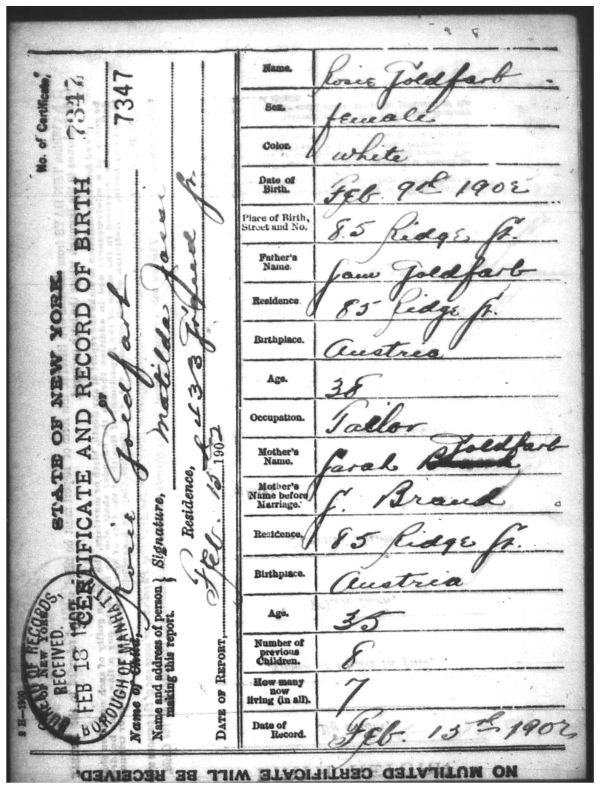
I started by searching for birth certificates.  Since I knew from the Goldfarb family records provided to me by my cousin Sue that Ida Hecht Goldfarb was born in New York City on October 19, 1894, and that the Hechts were still living in New York City in 1910 when the US census was taken, it seemed quite likely that all eight children, born between 1892 and 1908, were also born in New York City.  I searched the New York City birth records databases on Ancestry, FamilySearch, and Steve Morse’s website, and I could only find birth records listed for two of those eight children: the firstborn, Harry, and the last born child, Eva.  The other six children are just not there at all, no matter how I spelled their names, no matter how many wildcards I used.  Jacob and Taube must not have filed a birth certificate at all for those other six children.

In addition, when I asked my regular researcher at the Family History Library in Salt Lake City to find Harry’s birth certificate, she was unable to do so because it was a certificate marked “S,” meaning a later filed certificate.  Those are not on the microfilms at the FHL.  Instead I had to ask someone in NYC to go to the archives there to dig up Harry’s birth certificate.  It hadn’t been filed until 1906 when Harry was already fourteen years old.  I wonder what would have prompted the family to file it at that point in time.

harry-hecht-birth-certificate-resized

But the certificate is quite interesting.  It shows that in 1892, Jacob and Taube (“Toba” here, the Hebrew name) were living at 33 East Houston Street in New York City, that they were both born in Austria, and that Jacob (like Sam Goldfarb) was a cloaks operator.  Jacob was 25 when Harry was born, Toba only twenty, meaning they were born in about 1867 and 1872, respectively.

And most importantly, Harry’s birth certificate records Toba’s name before marriage as Toba Brotman.  Brotman! I was right that Ida’s marriage certificate said “Brotman,” not Braitmer as it had been indexed.  And, of course, this meant that there was a real chance that Toba, like Sarah Goldfarb, was related to my great-grandparents in some way.

And then I looked at the certificate I’d ordered for Eva Hecht.

eva-hecht-birth-certificate-resized

She was born on January 30, 1908, at 38 Montrose Avenue in Brooklyn.  On the 1910 census, the Hecht family was living at 48 Boerum Street in Brooklyn, which is right around the block from 38 Montrose Avenue.  So far, so good.  But then I looked at her parents’ names: JOSEPH Hecht and Tillie ROTHMAN.  Was this in fact the same Eva Hecht? The father was 40 years old, meaning born in about 1868; the mother was 37, so born about 1871. Those years were very close to the ages Jacob and Taube would have been in 1908.  Both parents were born in Austria, as were Jacob and Taube.  And the father “Joseph” was a tailor, as was Jacob Hecht.

Given all these similarities and the fact that by that time Taube was using Tillie on the census records, I have to believe that this is in fact a birth certificate for Eva Hecht, daughter of Jacob and Tillie/Taube/Toba Hecht.  And if it has Jacob’s first name wrong, it could very well have Tillie’s birth surname wrong.  Rothman does sound like Brotman, and many family members spelled Brotman as Brothman.  Perhaps the person filing the birth certificate, Mrs. Ida Goldman, just had bad hearing or the family’s accents were hard for her to understand.

So I had one new solid piece of evidence that Taube Hecht was born Toba Brotman and one rather shaky document that was at least somewhat supportive of that assumption. And, of course, I had Ida’s marriage certificate as well.  What else might I find? If there were no more birth certificates, could I find other marriage certificates or death certificates? Would the census records provide any more clues? So I decided to start from the beginning and search for records about the Hecht family.

The earliest census on which they appear is the 1900 US census.  The family was then living at 64 Broome Street on the Lower East Side.  The information for Jacob Hecht (spelled “Hect” here and indexed by Ancestry as “Hast,” making this a tough one to find) has some inconsistencies.   His birth year is 1870, so a year or two later than the other records indicated.  His birth place is Russia, not Austria.  But he is working as a tailor.  His wife’s name is listed as Mitilda, which certainly could be Tillie, and she also is listed as born in Russia, not Austria.  Her birth year is given as 1875, also several years later than her children’s birth records indicated.

Hecht family 1900 US census Year: 1900; Census Place: Manhattan, New York, New York; Roll: 1094; Page: 14A; Enumeration District: 0290; FHL microfilm: 1241094

Hecht family 1900 US census
Year: 1900; Census Place: Manhattan, New York, New York; Roll: 1094; Page: 14A; Enumeration District: 0290; FHL microfilm: 1241094

The names of their children also have some consistencies, some differences.  The first born, Harry, was born in 1892; that was consistent with Harry Hecht’s birth record.  The second child, however, is listed as Annie, born in 1893.  That should be Ida, the second child, who, according to the Goldfarb family papers, was born in 1894.  The third child, David, was reported to be four years old (the birth year is not very legible); that is consistent with David’s name and birth year on later census reports.  The fourth child is Yetta, who is listed on later reports as Etta; she is reported to have been seven months old when the census was enumerated in June 9, 1900, meaning she would have been born in October, 1899, not October 1889, as the census record has it recorded.  A birth year of 1899 is consistent with later census reports for Etta.

What this census record also revealed was that Jacob and “Miltilda” had been married for nine years, or in 1891.  It also said that Jacob had been in the US for only twelve years and arrived in 1887 (though it looks like 1777).  “Mitilda” had arrived earlier and had been in the country for fifteen years or since 1885 (though it looks like 1875 was written over it).  With this additional information, I searched for both a marriage record for Jacob and Taube/Tillie/Mitilda and for immigration records.

I had no luck finding a marriage record in the New York City marriage databases on Ancestry, FamilySearch, or Steve Morse’s website.  I guess it’s not surprising that a couple who failed to file birth certificates for their children also had failed to file a marriage record.  I am still hoping that some record will show up.

As for immigration records, I am fairly certain that I found the ship manifests for Taube.  I found two manifests, first a German manifest for the ship Moravia, dated July 9, 1887, sailing to New York from Hamburg.  On that manifest is a passenger named Taube Brodt, an eleven year old girl, and her name is bracketed with two other passengers, Eva Singer, a 38 year old woman, and an eleven month old baby named Ascher Singer, presumably the son of Eva.  And all three are listed as last residing in “Tarnobchek.”  That is, Tarnobrzeg—the home of my great-grandparents Joseph Brotman and Bessie Brod.

Taube Brodt ship manifest 1887 Staatsarchiv Hamburg; Hamburg, Deutschland; Hamburger Passagierlisten; Microfilm No.: K_1736 Description Month : Direkt Band 059 (3 Jul 1887 - 29 Dez 1887)

Taube Brodt ship manifest 1887
Staatsarchiv Hamburg; Hamburg, Deutschland; Hamburger Passagierlisten; Microfilm No.: K_1736
Description
Month : Direkt Band 059 (3 Jul 1887 – 29 Dez 1887)

The second manifest is also for the Moravia, but is the American manifest, written in English, and dated July 21, 1887, the arrival date in New York; it also lists Taube Brodt and the Singers as coming from Tarnobchek.

Taube Brodt 1887 NY ship manifest Year: 1887; Arrival: New York, New York; Microfilm Serial: M237, 1820-1897; Microfilm Roll: Roll 509; Line: 1; List Number: 911

Taube Brodt 1887 NY ship manifest
Year: 1887; Arrival: New York, New York; Microfilm Serial: M237, 1820-1897; Microfilm Roll: Roll 509; Line: 1; List Number: 911

But who were Eva and Ascher Singer? And why was this eleven year old child traveling with them? My great-grandfather arrived in 1889, my great-grandmother 1891; Sarah Brod/Brotman Goldfarb didn’t arrive until 1896.  So if Taube Brodt was their relative, who was she going to and why was she leaving home at such a young age? And where did Taube Brodt and Eva and Ascher Singer end up after they disembarked in New York City in July 1887?

Although I can find many women named Eva Singer, there is only one born in Austria who arrived in 1887 and who had a son who would have been born in 1886.  But that Eva’s son’s name is Herman, and that Eva was older than the one who sailed on the Moravia with Taube.  Maybe that is the right Eva, and Ascher became Herman.  That Eva’s birth name was Goldman, according to the listings in the SSCAI for two of her children.

And I had little luck finding an Ascher Singer.  The only record I could find that might fit was a marriage record dated 1910 for an Ascher Singer marrying Lena Laufer.  I ordered that marriage record, and it shows that Ascher’s parents were Seide Singer and Taube Druckman.

singer-laufer-marriage-page-1

When I saw the name Taube, I wondered—could Ascher have been Taube Brodt’s baby, not Eva’s? Maybe Taube wasn’t only eleven.  Taube’s age on the census records and her children’s birth certificates suggest she was born in 1871 or 1872, not 1876, as the ship manifest would suggest.  So maybe she was really fifteen, not eleven, when she emigrated.

But that is the only record I can find for Ascher Singer, and there is no way to know for sure whether it is the same person who sailed with Taube on the Moravia in 1887 or whether Taube Druckman was really Taube Brodt.

Plus even if this is the right Eva or the right Ascher, I’ve no idea how they are connected to Taube Brodt or anyone else in my family. And maybe they weren’t.  Maybe Taube just happened to be traveling with them.  But then where was she going and to whom? And was this even the same person who married Jacob Hecht in about 1891? If so, she would have been only 15 in 1891 if she was eleven in 1887.  Maybe Taube Brodt isn’t even Toba/Taube/Tillie Brotman Hecht?

Now what could I do?  Besides pull my hair out.  I kept on looking.

And then the most amazing thing happened. One of my toughest brick walls came tumbling down and when I least expected it.


Who was Sarah Goldfarb? Searching for Answers

In my last post, I described the research path I followed to determine whether and how Julius and Joe Goldfarb were related to my grandmother Gussie Brotman. After much searching, I had established the following with some degree of certainty:

Julius and Joseph Goldfarb were both sons of Sam and Sarah Goldfarb.  Sarah and Sam had lived in Grombow/Grebow, Poland, before immigrating to the United States, which was the same town my great-uncles Abraham Brotman and David Brotman had listed as their home on the ship manifest when they immigrated in 1889.  Sam Goldfarb had arrived in 1892, Sarah in 1896.  Sarah came with four children, Julius (Joel), Morris (Moische), Gussie (Gitel), and Bessie (Pesie).  They had sailed to Philadelphia, and in 1900, they were living in Pittsgrove, New Jersey, where my great-grandfather’s brother Moses Brotman was also residing.  By that time, Sarah and Sam (called Solomon on the 1900 census) had had two more children: Joseph and Leo (or Lewis).  Sam was working as a tailor, perhaps even in my grandmother’s first cousin Abraham Brotman’s factory in Pittsgrove, New Jersey.

Sam Goldfarb and family 1900 US census Year: 1900; Census Place: Pittsgrove, Salem, New Jersey; Roll: 993; Page: 17B; Enumeration District: 0179; FHL microfilm: 1240993

Sam Goldfarb and family 1900 US census
Year: 1900; Census Place: Pittsgrove, Salem, New Jersey; Roll: 993; Page: 17B; Enumeration District: 0179; FHL microfilm: 1240993

By 1902, Sam and Sarah had moved to the Lower East Side of New York City where their seventh child, Rosie, was born on February 9, 1902.  They were living across the street from my grandmother and her family on Ridge Street; my great-grandmother Bessie (Brod) Brotman was then a widow, as my great-grandfather Joseph Brotman had died in 1901.  According to the 1905 census, Sam Goldfarb was working as a cloak maker.

Sam Goldfarb and family 1905 NY census New York State Archives; Albany, New York; State Population Census Schedules, 1905; Election District: A.D. 12 E.D. 06; City: Manhattan; County: New York; Page: 32

Sam Goldfarb and family 1905 NY census
New York State Archives; Albany, New York; State Population Census Schedules, 1905; Election District: A.D. 12 E.D. 06; City: Manhattan; County: New York; Page: 32

In 1910, the Goldfarbs were living on Avenue C in New York, and Sam was still working as a tailor in a cloak factory.  Their son Julius was working as a conductor on a street car, and Morris as a cutter in a neckwear factory.

Sam Goldfarb and family 1910 US census, lines 8-17 Year: 1910; Census Place: Manhattan Ward 11, New York, New York; Roll: T624_1012; Page: 17A; Enumeration District: 0259; FHL microfilm: 1375025

Sam Goldfarb and family 1910 US census, lines 8-17
Year: 1910; Census Place: Manhattan Ward 11, New York, New York; Roll: T624_1012; Page: 17A; Enumeration District: 0259; FHL microfilm: 1375025

In April 1910, Sam and Sarah’s daughter Gussie married Max Katz, a window decorator who was born in Russia; on the 1910 census, Gussie and Max are listed as living with Max’s parents in Brooklyn. According to the marriage index on FamilySearch, Gussie Goldfarb’s mother’s birth name was “Brohmen,” one of the clues that made me think that Sarah was a relative of my great-grandfather, Joseph Brotman.

In 1915, Gussie and Max had moved out on their own and were living on Malta Street in Brooklyn.  Max was working in the men’s clothing business.

Gussie Goldfarb and Max Katz 1915 NY census New York State Archives; Albany, New York; State Population Census Schedules, 1915; Election District: 51; Assembly District: 22; City: New York; County: Kings; Page: 148

Gussie Goldfarb and Max Katz 1915 NY census
New York State Archives; Albany, New York; State Population Census Schedules, 1915; Election District: 51; Assembly District: 22; City: New York; County: Kings; Page: 148

I found another clue for Sarah’s birth name on her son Julius’ marriage license, as indexed on FamilySearch: Sarah Brothman.  Julius married Ida Hecht in November, 1913. In 1915, Sam and Sarah and the remaining five unmarried children (Morris, Bessie, Joe, Leo, and Rose) were still living on Avenue C in the same building as my great-uncle Hyman Brotman and his family.  Sam was still working as a tailor, as was his son Morris.

Based on these two New York City marriage index listings, one for the marriage of Gussie Goldfarb and one for the marriage of Julius Goldfarb, it looked like their mother Sarah’s birth name was Brothman or Brohmen.  To find out more, I would need to order the actual records plus any other vital records that might reveal Sarah’s parentage and family.  So I ordered these two marriage records; I also ordered the birth record for Sarah and Sam’s last child, Rosie.

The marriage record for Gussie was consistent with the information on the NYC marriage index, except that it was evident that Gussie’s mother’s name was not spelled Brohmen, but Brotmen, on the actual certificate.

katz-goldfarb-marriage-page-1 katz-goldfarb-marriage-page-2

The actual marriage record for Julius Brotman and Ida Hecht was also consistent with what I’d seen on the index in terms of Sarah’s birth name—Brothman.  But the record revealed a new mystery.

goldfarb-hecht-marriage-page-3 goldfarb-hecht-marriage-page-4

Ida’s mother’s birth name certainly looks like it was Taube Brotman, doesn’t it? (The index said Braitmer.) Who was this? Perhaps Taube Hecht had come to see my aunt as a baby not simply because her daughter Ida was married to my grandmother’s cousin Julius; maybe she came because she herself was a Brotman relative.  I decided to put that mystery aside for the time being and focus on Sarah Goldfarb.

And Rosie Goldfarb’s birth record made me really scratch my head. It gave Sarah Goldfarb’s name before marriage as S. Braud or maybe Brand.  Not Brotman or Brothman or Brotmen.  I was confused.  Was it Brod? Was Sarah actually my great-grandmother Bessie Brod’s sister, and not the sister of my great-grandfather Joseph Brotman.  Obviously I needed to do more digging.

goldfarb-rosie-birth

Having first worked backward in time, I now worked from 1915 forward to see what else I might find to help me determine if Sarah Goldfarb was a Brod or a Brotman.  Both Julius and his brother Morris registered for the draft in World War I.  I’d already seen the draft registration card for Julius, but had not seen the card for Morris.  It added no new information, but confirmed that he was born in “Grombow Galicia Austria.”[1]

morris-goldfard-ww1-draft-reg

Morris Goldfarb World War I draft registration Registration State: New York; Registration County: New York; Roll: 1765780; Draft Board: 104

On February 2, 1919, Morris married Anna Grinbaum in Brooklyn, according to the NYC marriage index.  I ordered a copy of his marriage record, and his record listed his mother’s birth name as Sarah Brod.  Now I had two records that indicated Sarah’s birth name was not Brotman, like my great-grandfather, but Brod, like my great-grandmother.  I wanted to hit my head against the wall!

goldfarb-grinbaum-marriage-page-1


Tragedy struck the Goldfarb family when Sarah and Sam’s oldest daughter, Gussie, died on May 13, 1919 at age 29 from acute lobar pneumonia.  As far as I can tell, Gussie and her husband Max Katz had not had any children.  On Gussie’s death certificate, her parents’ names are listed as Solomon Goldfarb and Sarah Brotman.  Another point for Brotman.

katz-gussie-death

In 1920, Sam and Sarah only had three children still living with them: Joe (22), Leo (20), and Rose (18).  Joe and Leo were both working as clerks for an express company, and Rose was working as a dressmaker.  Sam was no longer working; he was now 64 years old. They were living on Williams Avenue in Brooklyn; I now knew that the “S. Goldfarb” on Williams Avenue listed in my grandfather’s notebook had to be either Sam or Sarah Goldfarb.

Sam and Sarah Goldfarb 1920 US census Year: 1920; Census Place: Brooklyn Assembly District 2, Kings, New York; Roll: T625_1146; Page: 9A; Enumeration District: 82; Image: 21

Sam and Sarah Goldfarb 1920 US census
Year: 1920; Census Place: Brooklyn Assembly District 2, Kings, New York; Roll: T625_1146; Page: 9A; Enumeration District: 82; Image: 21

Grandpa notebook 13 more addresses Joe Goldfarb

But where was their daughter Bessie? She had been living with the family in 1915, so I assumed she had married sometime between 1915 and 1920.  I searched for her in the NYC marriage index, but there was no listing for a Bessie Goldfarb.  Instead I found this record from the Michigan marriage database on Ancestry:

meyer-malzberg-and-bessie-goldfarb-marriage-record-from-michigan-p-1

Meyer Malzberg and Bessie Goldfarb marriage record 1914 Ancestry.com. Michigan, Marriage Records, 1867-1952 [database on-line]. Provo, UT, USA: Ancestry.com Operations, Inc., 2015. Original data: Michigan, Marriage Records, 1867–1952. Michigan Department of Community Health, Division for Vital Records and Health Statistics.

Meyer Malzberg and Bessie Goldfarb marriage record 1914
Ancestry.com. Michigan, Marriage Records, 1867-1952 [database on-line]. Provo, UT, USA: Ancestry.com Operations, Inc., 2015.
Original data: Michigan, Marriage Records, 1867–1952. Michigan Department of Community Health, Division for Vital Records and Health Statistics.

The top image shows the bride and groom, Bessie Goldfarb and Meyer Malzberg, their ages, and that they were residing in Detroit.  It also shows their birthplaces, and for Bessie it is Austria.  The lower image shows the father’s first name, Sam for Bessie, and then the mother’s birth names.  Although it is partly hidden by the fold on the page, it definitely looks like “ah Brothman.”

This is most definitely my cousin Bessie Goldfarb: she was born in “Austria,” her father was named Sam, her mother Sarah Brothman.  But why was she a resident of Detroit? And how did she knew Meyer Malzberg?  And most confusing, if she married him on August 9, 1914 as this record reports, was she really living back in Brooklyn when the NY census was taken in 1915?

It got even more bewildering.  In 1910, Meyer Malzberg was living with his father and sister in New York City, working as a stock clerk in a department store.  In fact, although he was born in Russia, he and his family had been living in New York City since their arrival in about 1900 (records conflict).  So what were he and Bessie doing in Detroit in 1914?

In June, 1917, when Meyer registered for the World War I draft, he was still living in Detroit, working as a driver for the Detroit Creamery Company.  He also claimed an exemption from service because he was supporting his father, his wife, and a child.  So by 1917, Meyer and Bessie had had a child.

Meyer Malzberg World War I draft registration Registration State: Michigan; Registration County: Wayne; Roll: 2024027; Draft Board: 06

Meyer Malzberg World War I draft registration
Registration State: Michigan; Registration County: Wayne; Roll: 2024027; Draft Board: 06

But if Meyer and Bessie had had a child between 1914 and 1917, why was Bessie living with her parents in New York in 1915 while Meyer was still apparently living in Detroit? A little more research revealed that that first child, a son named Norman, was born in New York in May, 1915; although the NY census is dated on the form as June 1, 1915, it must have been actually enumerated before then since the baby is not listed.

sam-goldfarb-and-family-1915-ny-census-bottom-left-and-top-right

My best guess is that Bessie had come back to New York to have her baby where her family was living while Meyer stayed in Detroit to earn a living.  Unfortunately, I was unable to find Bessie and Meyer on the 1920 census, but their second child Gustave was born in Brooklyn in 1919 and their two youngest sons Burton and Saul were born in Jersey City in the 1920s.

Obviously, the stay in Detroit was relatively short-lived, and Meyer and Bessie had returned to the New York metropolitan area before 1920.  In fact, when I looked back at my grandfather’s notebook, I noticed that there was an entry for M. Malzberg at 361 2d Street, JC, or Jersey CIty:

Grandpa notebook 13 more addresses Joe Goldfarb

Bessie’s brother Julius and his family were also living in Jersey City in 1920, and Julius was continuing to work in the liquor business; by 1920, they had two young daughters, Sylvia and Gertrude.

Julius Goldfarb and family 1920 US census lines 70-73 Year: 1920; Census Place: Jersey City Ward 3, Hudson, New Jersey; Roll: T625_1043; Page: 17B; Enumeration District: 135; Image: 1104

Julius Goldfarb and family 1920 US census
lines 70-73
Year: 1920; Census Place: Jersey City Ward 3, Hudson, New Jersey; Roll: T625_1043; Page: 17B; Enumeration District: 135; Image: 1104

To review: as of 1920, Sam and Sarah Goldfarb were living with their children Joe, Leo, and Rose in Brooklyn; Julius and Ida were living in Jersey City; Morris and Anna were probably living in Brooklyn; Gussie was deceased; and Bessie and Meyer were living in either Jersey City or in Brooklyn.

At this point in my research, I started to move beyond 1920 and to look for living descendants to see what I might learn about the family and specifically about Sarah Goldfarb.  I was very fortunate to find two of the descendants of Julius and Ida (Hecht) Goldfarb.  And they provided me with extensive family history notes that a member of the Goldfarb family had researched years before.  More on what I learned from that research in my next post.

But for now, a summary of the clues I’d found so far about Sarah Goldfarb’s connection to my grandmother: three marriage records and one death record for Sarah’s children indicated that Sarah’s birth name had been “Brot(h)man,” but one marriage record for Morris and one birth record for Rose said it was “Brod” or “Braud.”

The evidence seemed to weigh in favor of Sarah being perhaps a sibling of my great-grandfather Joseph Brotman.  Also pointing in that direction was the fact that when they first came to the US, Sam and Sarah had lived in the same town as Moses Brotman, my great-grandfather’s brother.

But then by 1902, Sarah and Sam had moved across the street from my great-grandmother after my great-grandfather had died.  Did that suggest that Sarah was Bessie’s sister and had moved to New York to be closer to her widowed sister? Was Sarah a Brod, not a Brotman, as the wedding certificate for Morris and Rose’s birth certificate indicated?

Plus there were some conflicting clues raised by the naming pattern.  If Sarah had a sister named Bessie (my great-grandmother), would she have named a child Bessie? But Sarah also had a son named Joseph who was born before my great-grandfather Joseph Brotman died.  Would she have given a son the same name as her brother?  Ashkenazi Jews don’t name their children after living relatives, so these name choices certainly confused the matter.

The evidence certainly was not conclusive.  I needed more.


[1] Although the documents I found spelled the town several different ways, Grembow, Grombow, and Grebow, I believe that the last is the correct spelling.  I searched JewishGen, and the only town with a name similar to those names that had had a Jewish community before the Holocaust was Grebow, the town I visited in 2015, the town right near Tarnobrzeg.

The Family of Amalia Hamberg Baer, the Administratrix

Back in May, I wrote about the sad saga of Charles Hamberg and his son Samuel Hamberg.  Charles, my great-grandfather Isidore Schoenthal’s first cousin, had lost two wives—one was murdered, one died quite young.  He had then committed suicide, leaving his nine year old son Samuel an orphan.  Charles’ estate was administered by another cousin, Amalia Hamberg Baer, who at the time was living in western Pennsylvania where my great-grandfather and many other Hamberg relatives were then living.

In fact, Amalia (born Malchen) was a first cousin to Isidore Schoenthal, my great-grandfather:

corrected relationship isidore schoenthal to malchen hamberg


She had come to the US from Breuna, Germany, in 1871, and had married Jacob Baer in 1873, according to the 1900 census. (For more on how I linked Amalia Hamberg to Jacob Baer, see my earlier post.)  Jacob was born in the Rhein Pfalz[1] region of Germany in about 1851 and had immigrated to the US in 1867, according to several census records.  From entries in the Pittsburgh city directories, he appears to have settled in the Pittsburgh area.

In 1880, Jacob and Amalia were living in Allegheny, Pennsylvania (now part of Pittsburgh), and Jacob was working as a clerk in a shoe store.  They already had four children: Maurice Jay (1874), Hattie (1876), Josephine (1878), Amanda (1880).

Jacob and Amalia Hamberg Baer 1880 US census Year: 1880; Census Place: Allegheny, Allegheny, Pennsylvania; Roll: 1086; Family History Film: 1255086; Page: 198D; Enumeration District: 008; Image: 0402

Jacob and Amalia Hamberg Baer 1880 US census
Year: 1880; Census Place: Allegheny, Allegheny, Pennsylvania; Roll: 1086; Family History Film: 1255086; Page: 198D; Enumeration District: 008; Image: 0402


Between 1880 and 1891, they would have five more children: Flora (1882), Tilda (1884), Elsie Victoria (1886), Alfred (1889), and Lawrence (1891). (The birth years for the daughters as reported in various records are all over the place as they kept making themselves younger as the years went on, so I am relying on the 1880 and 1900 census records when they were still probably young enough not to lie about their ages.)  During those years, Jacob was listed as a salesman in the Pittsburgh city directories.

In 1900, Jacob and Amalia were still living in Allegheny with all nine of their children.  Jacob continued to work as a salesman, as did their son Maurice (Morris here, now 26).  Hattie (24) and Josephine (Josie here, now 21) were working as stenographers.  The rest of the children were not employed.

Amalia Baer 1900 census p 1

Jacob and Amalia Hamberg Baer 1900 census Year: 1900; Census Place: Allegheny Ward 5, Allegheny, Pennsylvania; Roll: 1356; Enumeration District: 0050; FHL microfilm: 1241356

Jacob and Amalia Hamberg Baer 1900 census
Year: 1900; Census Place: Allegheny Ward 5, Allegheny, Pennsylvania; Roll: 1356; Enumeration District: 0050; FHL microfilm: 1241356


In the next decade many of the children began to move on to their own lives.  In fact, even before 1900, Maurice, the oldest child, had ventured quite far from Pittsburgh.  As I will write about in a post to follow this one, Maurice moved to Attleboro, Massachusetts,[2] and established a very successful jewelry business in which four of the siblings’ families would be involved, that is, Maurice, Tilda, Elsie, and Lawrence.  This post will focus on the other five siblings—Hattie, Josephine, Flora, Amanda, and Alfred—and their parents, Amalia and Jacob.

On July 17, 1905, Hattie Baer, the second child who was then 29, married Meyer Herman, a clothing salesman living in Philadelphia who was born in Manchester, England.

Marriage record of Hattie Baer and Meyer Herman Pennsylvania, County Marriages, 1885-1950," database with images, FamilySearch (https://familysearch.org/pal:/MM9.3.1/TH-1951-21130-27078-9?cc=1589502 : accessed 12 May 2016), 004264779 > image 383 of 454; county courthouses, Pennsylvania.

Marriage record of Hattie Baer and Meyer Herman
Pennsylvania, County Marriages, 1885-1950,” database with images, FamilySearch (https://familysearch.org/pal:/MM9.3.1/TH-1951-21130-27078-9?cc=1589502 : accessed 12 May 2016), 004264779 > image 383 of 454; county courthouses, Pennsylvania.

They settled in Philadelphia, where they had two sons, Justin Baer Herman, born in April, 1907, and Richard B. Herman, born in July, 1910.  Then tragically, Hattie died on October 15, 1910, of a perforated bowel and peritonitis.  She was only 33 years old when she died, and she left behind a three year old toddler and a two and a half month old infant son.

Hattie Baer Herman death certificate Ancestry.com. Pennsylvania, Death Certificates, 1906-1963 [database on-line]. Provo, UT, USA: Ancestry.com Operations, Inc., 2014. Original data: Pennsylvania (State). Death certificates, 1906–1963. Series 11.90 (1,905 cartons). Records of the Pennsylvania Department of Health, Record Group 11. Pennsylvania Historical and Museum Commission, Harrisburg, Pennsylvania.

Hattie Baer Herman death certificate
Ancestry.com. Pennsylvania, Death Certificates, 1906-1963 [database on-line]. Provo, UT, USA: Ancestry.com Operations, Inc., 2014.
Original data: Pennsylvania (State). Death certificates, 1906–1963. Series 11.90 (1,905 cartons). Records of the Pennsylvania Department of Health, Record Group 11. Pennsylvania Historical and Museum Commission, Harrisburg, Pennsylvania.

Five years later in 1915, Hattie’s younger sister Amanda married her brother-in-law Meyer Herman in Philadelphia and took on the responsibility for raising her two nephews, Justin and Richard, then just eight and five years old.  In 1920, Meyer was still a clothing salesman, and the family continued to live in Philadelphia.

Meyer and Amanda Baer Herman 1920 census Year: 1920; Census Place: Philadelphia Ward 22, Philadelphia, Pennsylvania; Roll: T625_1623; Page: 8A; Enumeration District: 591; Image: 961

Meyer and Amanda Baer Herman 1920 census
Year: 1920; Census Place: Philadelphia Ward 22, Philadelphia, Pennsylvania; Roll: T625_1623; Page: 8A; Enumeration District: 591; Image: 961

Ten years later in 1930, Meyer had moved from being a salesman to being the owner of a clothing manufacturing business.  The two sons were also working; Justin, now 23, was a newspaper editor, and Richard, now 19, was selling real estate.  Both were still living at home with Meyer and Amanda in Philadelphia.

Herman and Amanda Baer Herman 1930 census Year: 1930; Census Place: Philadelphia, Philadelphia, Pennsylvania; Roll: 2104; Page: 23A; Enumeration District: 0627; Image: 902.0; FHL microfilm: 2341838

Herman and Amanda Baer Herman 1930 census
Year: 1930; Census Place: Philadelphia, Philadelphia, Pennsylvania; Roll: 2104; Page: 23A; Enumeration District: 0627; Image: 902.0; FHL microfilm: 2341838

Meanwhile, the third child of Amalia and Jacob Baer, Josephine, had married Morris Alon Green on January 2, 1906.  Morris was a Pittsburgh native, born there on February 17, 1875, the son of Abraham Green, an immigrant from Holland, and Jeanette Bloomberg, born in Germany.  In 1900, Morris was living with his parents in Pittsburgh and working as a bookkeeper.

Marriage record of Morris Green and Josephine Baer Pennsylvania, County Marriages, 1885-1950," database with images, FamilySearch (https://familysearch.org/pal:/MM9.3.1/TH-1942-20622-18713-16?cc=1589502 : accessed 10 June 2016), 004811570 > image 334 of 449; county courthouses, Pennsylvania.

Marriage record of Morris Green and Josephine Baer
Pennsylvania, County Marriages, 1885-1950,” database with images, FamilySearch (https://familysearch.org/pal:/MM9.3.1/TH-1942-20622-18713-16?cc=1589502 : accessed 10 June 2016), 004811570 > image 334 of 449; county courthouses, Pennsylvania.

Josephine and Morris settled in Pittsburgh where their son Alan Baer Green was born on October 30, 1906.  In 1910, the Greens were living in Pittsburgh as boarders in the household of another family, and Morris was working as a claims agent.

Morris and Josephine Baer Green on 1910 census Year: 1910; Census Place: Pittsburgh Ward 8, Allegheny, Pennsylvania; Roll: T624_1301; Page: 2A; Enumeration District: 0379; FHL microfilm: 1375314

Morris and Josephine Baer Green on 1910 census
Year: 1910; Census Place: Pittsburgh Ward 8, Allegheny, Pennsylvania; Roll: T624_1301; Page: 2A; Enumeration District: 0379; FHL microfilm: 1375314

The next several years must have been successful ones for Morris because by 1918, he was the general agent and executive of the Crucible Steel Company and by 1920 he and Josephine and their son Alan were living in their own (rented) home with a nurse and servant residing with them.

Morris A Green, World War I draft registration Registration State: Pennsylvania; Registration County: Allegheny; Roll: 1909239; Draft Board: 11

Morris A Green, World War I draft registration
Registration State: Pennsylvania; Registration County: Allegheny; Roll: 1909239; Draft Board: 11

By 1925, Josephine and Morris had left western Pennsylvania for New York City, where they were living at the Hotel Alexander at 150 West 103rd Street.  Their son Alan is not listed as living with them; perhaps he was away at college as he would have been nineteen at that time.  In 1930, Alan was living with his parents in Manhattan, working in advertising.  His father Morris listed his occupation/industry as “financial.”

Morris and Josephine Baer Green and Alan Baer Green, 1930 census Year: 1930; Census Place: Manhattan, New York, New York; Roll: 1556; Page: 19A; Enumeration District: 0443; Image: 762.0; FHL microfilm: 2341291

Morris and Josephine Baer Green and Alan Baer Green, 1930 census
Year: 1930; Census Place: Manhattan, New York, New York; Roll: 1556; Page: 19A; Enumeration District: 0443; Image: 762.0; FHL microfilm: 2341291

The fifth child of Amalia and Jacob was Flora.  In 1907, she is listed in the Pittsburgh city directory as a teacher, residing in Bellevue, a town near Pittsburgh. In 1910, when she was 28 (although listed as 24 on the 1910 census), she was still single and living with her parents and not employed outside the home.

Jacob and Amalia Schoenthal Baer and family 1910 census Year: 1910; Census Place: Pittsburgh Ward 14, Allegheny, Pennsylvania; Roll: T624_1304; Page: 6B; Enumeration District: 0468; FHL microfilm: 1375317

Jacob and Amalia Schoenthal Baer and family 1910 census
Year: 1910; Census Place: Pittsburgh Ward 14, Allegheny, Pennsylvania; Roll: T624_1304; Page: 6B; Enumeration District: 0468; FHL microfilm: 1375317


In 1915, she married Julius Adler.  Julius was the son of Simon Adler, a German immigrant who in 1880 was living in Memphis, Tennessee, working in a shoe store.  Julius’ mother Elizabeth was a native of Missouri; she married Simon in 1881, and they had four children born in Memphis between 1882 and 1887, when their youngest son Julius was born.  By 1900, the family had relocated to Philadelphia.

According to his obituary, Julius graduated from the University of Pennsylvania with a degree in engineering in 1908.  In 1910, he was teaching at the University of Washington in Seattle.  But by 1915 he had returned to Philadelphia, where he married Flora Baer.  In 1917, they were living in Harrisburg, Pennsylvania, where Julius was working as a civil engineer for the state highway department.  They would have three children, Stanley, Jerrold, and Amy, born between 1917 and 1920.

Julius Adler, World War I draft registration Registration State: Pennsylvania; Registration County: Dauphin; Roll: 1893237; Draft Board: 3

Julius Adler, World War I draft registration
Registration State: Pennsylvania; Registration County: Dauphin; Roll: 1893237; Draft Board: 3

In 1920, the family had returned to Philadelphia, where Julius was now employed as a technical engineer for an oil company.  According to his obituary, during the 1920s, Julius was working as the deputy chief of the Philadelphia highway department and was involved in supervising the construction of the Benjamin Franklin Bridge, the bridge that spans the Delaware River connecting Philadelphia to Camden, New Jersey (originally called the Delaware River Bridge).  In 1930, Julius and Flora and their two sons continued to live in Philadelphia, Julius working as a civil engineer.

Benjamin Franklin Bridge linking Camden, NJ wi...

Benjamin Franklin Bridge linking Camden, NJ with Philadelphia, PA – Taken from the 22nd floor of Waterfront Square (Photo credit: Wikipedia)

Alfred, the second youngest child of Amalia and Jacob, was the only other child not involved with the Attleboro jewelry business.  In 1900, he was living with his family in Pittsburgh, but he is not listed with them in 1910, when he would have been 21 years old.  There is an Alfred H. Baer listed in the 1907 Pittsburgh directory, working as a clerk, but I am not sure that that is the same person.  According to his registration for the draft in World War I, Alfred was living in a sanitarium and “mentally incapacitated for work of any kind.”

Alfred Baer ww1 draft reg

Alfred Baer, World War I draft registration Registration State: Pennsylvania; Registration County: Philadelphia; Roll: 1907636; Draft Board: 17

Five years later, at age 34, Alfred died on December 13, 1923.  He was buried where his sister Hattie was buried and where later his parents, his sister Flora, and his brother Maurice would be buried at Mt. Sinai cemetery in Philadelphia. I was unable to locate a death certificate, so I do not know the cause of death.  According to his burial record, he was residing in Stamford, Connecticut, at the time of his death.

Thus, by 1930, Amalia (Hamberg) and Jacob Baer had lost two of their children, Hattie and Alfred. Their other children were doing quite well.  Amanda and Flora had moved to Philadelphia with their husbands and children, and Josephine was living in New York City with her husband and son.  The other four children were also living away from Pittsburgh, as we will see in the next post.

Even Jacob and Amalia had left Pittsburgh by that time.  In fact, sometime between 1918 and 1922, they had moved to Atlantic City.  In 1922, they were listed in the Atlantic City directory, living at The Amsterdam in Atlantic City.  The following year on March 27, 1923, their children honored their parents on the occasion of their 50th wedding anniversary with a dinner at the Esplanade Hotel in New York City.

Jacob and Amalia Baer anniversary party


In 1930 Jacob and Amalia, now 83 and 79 (although the 1930 census says 77), were living at 250 West 103rd Street in New York City, with Jacob listed as the head of household for what appears to be a small hotel; there are 28 guests listed as living with them.  Their daughter Josephine was living not too far away at 666 West End Avenue.

Amalia Baer, born Malchen Hamberg in Breuna, Germany, died on April 23, 1931, in New York City.  She was 80 years old.  She was buried in Mt. Sinai cemetery in Philadelphia where the two children who predeceased her, Hattie and Alfred, were buried.  A year later her husband Jacob died on September 1, 1932.  He was 85 years old, and he was buried with his wife and children in Mt. Sinai cemetery.  His death notice ran in the September 3, 1932 issue of The New York Times:

NY Times, September 3, 1932

NY Times, September 3, 1932

In my next post, I will write about the four children of Amalia and Jacob who were involved in the jewelry business in Attleboro, Massachusetts.  Then in a subsequent post I will report on what later happened to the children and the grandchildren of Jacob and Amalia (Hamberg) Baer.


[1] Thank you to Michael Palmer and Cathy Meder-Dempsey of the German Genealogy group on Facebook for helping me decipher Jacob’s birthplace.

[2] I am not sure why Maurice is listed as living in Pittsburgh on the 1900 census as several reports indicate he had established the business in Attleboro before then.  Perhaps he was still traveling back and forth between Pennsylvania and Massachusetts at that time.