This is NOT a test even if it looks and sounds like one!

As promised, here is a chart to illustrate one possible way that my mother Florence, Elaine and Frieda are all connected.

New PDF Chart showing relationships of Moses Joseph Bessie et al-page-001


There are a LOT of unknowns and assumptions here.

First, we are assuming that Joseph Brotman and Bessie Brot were first cousins, as family lore says.  If so, then one of Joseph’s parents was a sibling to one of Bessie’s parents.  On this chart, I am assuming that Joseph’s father Abraham was a sibling to Bessie’s mother Gittel Brot because I don’t think Abraham would have named a son Joseph if he had a living brother named Joseph.

Second, we are assuming based on DNA results that Joseph Brotman and Moses Brotman were brothers, making their children first cousins and their grandchildren, here Florence and Elaine, second cousins.  The DNA results seem to support that assumption.

Third, we are assuming that Florence and Frieda are also second cousins based on the DNA results, meaning that Gussie Brotman and Sabina Brod were first cousins, meaning that one of Gussie’s parents and one of Sabina’s parents were siblings.  Here, I am making the assumption that Bessie Brot, Gussie’s mother, was the sister of Sabina’s mother, but it could be that Bessie was Sabina’s father’s sister.  I don’t know whether Brod was a name Sabina got from her mother or her father because in Galicia in those times, the state often treated Jewish children as illegitimate if their parents had only a Jewish marriage ceremony and thus assigned the mother’s name to the children instead of the father’s.  So either is possible here.

So what does this all mean? Well, hold on because this is where it gets a bit slippery. Taking the above chart as true (which is still very speculative), it means that Elaine, Florence, and Frieda are all third cousins since they all have the same great-great-grandparents, i.e., whoever were the parents of Abraham Brotman and Gittel Brot.  (I don’t know whether Brotman and Brot were two versions of the same name or two completely different names in the family; both exist as surnames so they could be as unrelated as someone named Rosen is to someone named Rosenberg, for example.)

BUT Elaine and Florence are also second cousins (as well as third cousins) since they are the children of first cousins (Louis and Gussie) and the grandchildren of siblings (Moses and Joseph Brotman).  AND the same is true for Florence and Frieda: they are second cousins because they are the children of first cousins (Gussie and Sabina) and the grandchildren of siblings (Bessie and the parent of Sabina).

Cousin_tree

So my mother is a second cousin to both Elaine and Frieda (since her grandparents were first cousins), BUT Elaine and Frieda are not second cousins, only third cousins.  Their grandparents (Moses Brotman and Sabina’s parent) were not first cousins, just second cousins.

That is consistent with the DNA results which showed my mother as a second cousin to Elaine and also to Frieda but showed Elaine and Frieda as likely third to fifth cousins.

I have no idea whether that is a help or not.  In fact, I think I am more confused now than before.  Please tell me if that makes no sense.  Ask me questions.  Test my thinking.  Please.

And a big THANK YOU to my new cousin Phyllis for helping me sort through all of this!

Brotman Update! The Trials and Tribulations of DNA Testing

Animation of the structure of a section of DNA...

Animation of the structure of a section of DNA. The bases lie horizontally between the two spiraling strands. (Photo credit: Wikipedia)


I am now delving into a part of genealogy research that is the hardest thing I’ve yet done in this project: DNA testing.  I am not and never was a science or math person.  My head starts spinning when I see too many numbers and/or scientific terms.  Reading about DNA results is like reading Russian or Chinese for me.  The words are not at all familiar, and the numbers have no meaning in the world in which I am used to operating.  Terms like SNP, centimorgan, autosomal, and others I can’t even keep in my head at all mean little or nothing to me, even after reading several articles and websites defining the terms.

I say all this by way of disclaimer.  Everything I am writing about today is foreign to me, and I am still trying to get help to be able to comprehend these test results more fully and to figure out what I can learn from them.

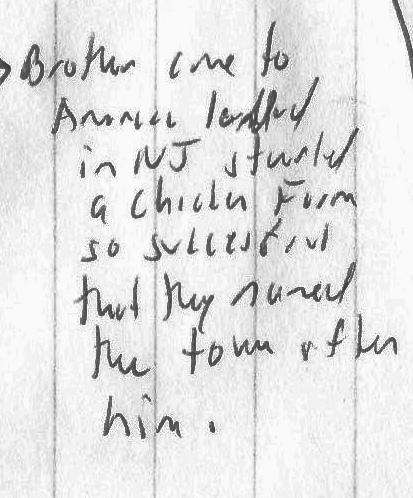
Having said all that, here’s the story.  Those who have followed this blog for a long time know that one of my brick walls was trying to find out whether my Brotman great-grandparents, Joseph and Bessie, were related to the Brotmans who settled in southern New Jersey in the 1890s and founded the town that is called Brotmanville.  My Aunt Elaine had told my cousin Jody and her husband Joel that Joseph had had a brother who moved to New Jersey where the town was named after him. Through my research and contacts with members of the Brotmanville Brotman family, I learned that Moses Brotman, a contemporary of Joseph Brotman, also had a father named Abraham and also was from Galicia, as was Joseph.  The Brotmanville Brotmans believed that Moses was from Przemyl, which is about 100 miles from Tarnobrzeg.  But none of us had any documentation of the family in Galicia or anything more than anecdotal evidence of a connection or birthplace.

brotmanville

My aunt’s story about Brotmanville

So last spring I decided to try DNA testing to see if I could break through this brick wall.  My first thought was to do a Y-DNA test on a male descendant of Moses and a male descendant of Joseph.  It had to be a father-son-grandson-great-grandson connection to get a reliable Y chain as Y DNA is only passed from fathers to sons.  I found one great-grandson of Moses Brotman who qualified and also asked one of my second cousins who was a direct male descendant of Joseph. We had the tests done by Family Tree DNA or FTDNA.  It took about three months for both test results to return, and it showed that my Moses descendant Larry and my Joseph descendant Bruce shared 34 of 37 markers on their Y-DNA.

English: A DNA microarray. Français : Une puce...

English: A DNA microarray. Français : Une puce à ADN. (Photo credit: Wikipedia)

I had no clue what that meant.  According to a woman who works for FTDNA, it meant that there is a high likelihood of “some genetic connection,” especially since the two lines share the same surname, Brotman. By “some genetic connection,” she meant that at some point in time the NY Brotmans had a common ancestor with the Brotmanville Brotmans.  It might have been as recently as Abraham Brotman, the father of Joseph and perhaps the father of Moses, or it might have been centuries ago.  The fact that Bruce and Larry have 34 out of 37 markers that were identical indicates that there is some family tie—but those three different markers suggest that there were mutations.  Those mutations might have occurred between Bruce and his father or his father and his grandfather or even earlier.  Or they might have been on Larry’s side.  There was no way to know from the Y DNA results alone.

So my contact at FTDNA suggested that the next step would be to try a different DNA test called an autosomal DNA test, which is better at predicting the degree of connection—i.e., would better tell us whether Joseph and Moses were brothers, both sons of the same Abraham Brotman.  My contact at FTDNA said that if we could get two of the grandchildren of Joseph and Moses to take the autosomal test, it would tell us if they are likely second cousins.

As I understand it (and remember the disclaimer above), autosomal DNA is DNA we inherit from both of our parents.  We got an X from our mothers and either a Y or an X from our fathers to determine our sex.  The other 22 pairs of chromosomes are also made up of genetic material we get from both parents, and those 22 pairs are our autosomal DNA.  But it is not obvious which half of each pair came from which parent.  This is where I start getting that deer in headlights look and feel.

But what I’ve been told and what I’ve read indicates that autosomal DNA testing is quite useful in figuring out the degree of relationship between two people.  So I asked Elaine, Moses’ granddaughter, and my mother, Joseph’s granddaughter, if they would take the autosomal DNA test through FTDNA, called the Family Finder test.  If the test showed that they were second cousins, we would have fairly strong evidence that their grandfathers, Moses and Joseph, were brothers.  My mother and Elaine agreed to take the test, and once again we waited for results.

English: The structure of DNA showing with det...

English: The structure of DNA showing with detail showing the structure of the four bases, adenine, cytosine, guanine and thymine, and the location of the major and minor groove. (Photo credit: Wikipedia)

Those results came in about a week ago.  First, I got Elaine’s results, and then a few days later, I received my mother’s results.  And they matched!  FTDNA predicts their relationship to be second cousins!  Of course, this is not definitive proof.  DNA testing is just a prediction, but at this degree of closeness, it is considered quite strong evidence, especially with the anecdotal evidence behind it, that is, the shared surnames, the shared father’s name, my aunt’s story, etc.  Elaine and my mother share 334 centimorgans.  That seems to suggest close cousins.

And then there was more.  Although Elaine and my mother were each other’s closest matches, my mother had a second very close match to a woman named Frieda.  She shared 292 centimorgans with Frieda, and Frieda was another predicted second cousin.  But Elaine was not a close match to Frieda, although she was listed as a possible third to fifth cousin.  So who was this Frieda?  The FTDNA page listed Brod as one of her ancestral names and one of her ancestral towns as Radomysl nad Sanem, which is about 20 miles from Tarnobrzeg, where I believe Joseph and Bessie lived.

I emailed the person in charge of Frieda’s results, her niece Phyllis, and we have now started trying to figure out how Frieda is related to my mother.  Since Frieda is listed as a likely second cousin, she could have shared a great-grandparent with my mother.  But since Frieda is not as close a match to Elaine, they did not share a great-grandparent. That could mean that Frieda and my mother are both the great-granddaughters of  the parents of Bessie Brot/Brotman whereas my mother and Elaine are both the great-granddaughters of  the parents of Joseph Brotman and Moses Brotman.

And since Bessie was Joseph’s first cousin, that could explain why Elaine is a more distant cousin than my mother is to Frieda but still related to both.  Elaine is not directly descended from Bessie’s line, but is directly descended from Moses Brotman, who would also have been Bessie’s first cousin if Moses and my great-grandfather Joseph were brothers.  Elaine would have some of the same genetic material as Frieda as a third cousin, but not as much as she has with my mother, her presumed second cousin.

Screenshot (24)

A screenshot of the chromosome browser showing where on my mother’s chromosomes Elaine and Frieda match her DNA

Have I lost you yet?  I am trying to create a chart and will post it once I am sure I have it right.

This was incredible news for me.  First, finding the connection between Elaine and my mother was corroborating evidence of our tie to the Brotmanville Brotmans.  Second, finding Frieda gives me an opening to find out more about Bessie and Joseph and where they lived.

But I am once again at a stumbling block.  Phyllis knows only that her great-grandmother, Frieda’s grandmother, was named Sabina Brod and was from Radomysl nad Sanem.  She does not know anything more about Sabina’s family—who her parents were or who her siblings were.  Sabina moved to Germany with her husband in the early 20th century and died there in the 1930s.  As far as Phyllis knew, Sabina had no relatives who were in the US.  Neither Phyllis nor I have found any definite records of our Brod or Brodman or Brotman relatives in Galicia.

So for now all we have is the DNA results.   And I am struggling to understand them and to learn more from them.  And it is a struggle for me.  If there is anyone out there reading this who is comfortable with this type of data, I’d love an advisor who can assist me.

But for now it feels like I have found another opening into the mystery of my Brotman ancestors.  I feel one step closer to knowing where they lived and who their families were.

English: DNA replication or DNA synthesis is t...

English: DNA replication or DNA synthesis is the process of copying a double-stranded DNA molecule. This process is paramount to all life as we know it. (Photo credit: Wikipedia)


Back to the Real World and the 1870s…

And I am back from vacation.  We had a wonderful time, and not having reliable internet access may have been a blessing.  I couldn’t do any new research or posting to the blog so my brain had a chance to clear.  Always a good thing.  I did, however, have one more post “in the bank” that I prepared before I left, so here it is. I was awaiting a few more documents, hoping they would answer a few questions, and I received some while away that I have just reviewed.

I wish I could post a somewhat more uplifting post for the holiday season, but I can’t deny the sad fact that some of my relatives suffered considerable sadness in their lives.  On the other hand, researching and writing about the families of Leopold Nusbaum and his sister Mathilde Nusbaum Dinkelspiel only made me appreciate all my blessings.  So in that sense it is perhaps appropriate.  Nothing can make you appreciate all you have more than realizing how little others have.

So here is the story of two of the Nusbaum siblings, one of the brothers and one of the sisters of my three-times great-grandfather John Nusbaum.

Leopold Nusbaum had died in 1866 when he was 58 years old, leaving his widow Rosa and daughter Francis (how she apparently spelled it for most of her life) behind. Leopold and Rosa had lost a son, Adolph, who died when he was just a young boy.  Francis was only 16 when her father died.  After Leopold died, Rosa and Francis moved from Harrisburg to Philadelphia and were living in 1870 with Rosa’s brother-in-law, John Nusbaum.

Late in 1870, Francis Nusbaum married Henry N. Frank.  Henry, the son of Nathan and Caroline Frank, was born in Lewistown, Pennsylvania, where Leopold’s brother Maxwell Nusbaum and his family had once lived before relocating to Harrisburg.  Henry’s father Nathan Frank was in the dry goods business, so the Nusbaums and Franks might have known each other from those earlier times. Nathan, Caroline, and their children had relocated to Philadelphia by 1870 and were living on Franklin Avenue right near the Simons, Wilers, and other members of the Nusbaum/Dreyfuss clan.  Perhaps that is how Francis and Henry met, if not from an earlier family connection.

Not long after they were married, Henry and Francis must have moved back to Lewistown because their first child, Leopold, was born there on August 11, 1871.  Leopold was obviously named for Francis’ father.  A second child, Senie, was born in May 1876, and then another, Cora, was born in 1877.  In 1880, Henry and Francis were living in Lewistown with their three young children as well as Francis’ mother Rosa and Henry’s father Nathan. Maybe Nathan was shuttling back and forth between Lewistown and Philadelphia because he is listed on the 1880 census in both places, once with Henry and Francis and then again with Caroline and their other children.  Both Henry and his father Nathan listed their occupations as merchants.

Lewistown Town Square By KATMAAN (Own work) [CC BY-SA 3.0 (http://creativecommons.org/licenses/by-sa/3.0) or GFDL (http://www.gnu.org/copyleft/fdl.html)], via Wikimedia Commons

Lewistown Town Square
By KATMAAN (Own work) [CC BY-SA 3.0 (http://creativecommons.org/licenses/by-sa/3.0) or GFDL (http://www.gnu.org/copyleft/fdl.html)%5D, via Wikimedia Commons

Unfortunately, there is not much else I can find about Henry, Francis, or their children during the 1870s because Lewistown does not appear to have any directories on the ancestry.com city directory database. Lewistown’s population in 1880 was only a little more than three thousand people, which, while a 17% increase from its population of about 2700 in 1870, is still a fairly small town.  It is about 60 miles from Harrisburg, however, and as I’ve written before, well located for trade, so the Frank family must have thought that it was still a good place to have a business even if the rest of the family had relocated to Philadelphia.

Mathilde Nusbaum Dinkelspiels’ family is better documented.  She and her husband Isaac had settled and stayed in Harrisburg, which is where they were living as the 1870s began. Isaac was working as a merchant.  Both of their children were out of the house.  Adolph was living in Peoria at the same address as his cousin Julius Nusbaum and working with him in John Nusbaum’s dry goods store in that city.  On January 4, 1871, Adolph Dinkelspiel married Nancy Lyon in Peoria, and their daughter Eva was born a year later on January 25, 1872.  Adolph and Nancy remained in Peoria, and by 1875 Adolph was listed as the “superintendent” of John Nusbaum’s store.  (Julius does not appear in the 1875 directory, though he does reappear in Peoria in 1876.)

On November 28, 1879, his daughter Eva died from scarlet fever.  She was not quite eight years old.  Adolph and Nancy did not have other children, and this must have been a devastating loss.

eva dinkelspiel death cert

In fact, shortly thereafter Adolph, who had been in Peoria for over sixteen years, and Nancy, who was born there and still had family there, left Peoria and relocated to Philadelphia.  On the 1880 census, Adolph was working as a clothing salesman and Nancy as a barber.  (At least that’s what I think it says.  What do you think?)  Perhaps Adolph and Nancy left to find better opportunities or perhaps they left to escape the painful memories.  Whatever took them away from Peoria, however, was enough that they never lived there again.

adolph dinkelspiel snip 1880 census

Adolph and Nancy did not remain in Philadelphia for very long, however.  By 1882 Adolph and Nancy had relocated to St. Louis, Missouri, where Adolph worked as a bookkeeper for many years.  They remained in St. Louis for the rest of their lives.  Adolph died on November 25, 1896, and Nancy less than a year and a half later on March 5, 1898. Adolph was only 53, and Nancy was not even fifty years old.

My cousin-by-marriage Ned Lewison sent me a copy of Nancy’s obituary from the March 7, 1898 Peoria Evening Star.  It reported the following information about Nancy and Adolph Dinkelspiel:

“She married Adolph Dinkelspiel, at that time manager of the Philadelphia store on the corner of Main and Adams Street, one of the leading dry goods houses in Peoria.  When the house failed, they removed to St. Louis and lived happily together until the death of Mr. Dinkelspiel, when his widow came to this city.  But she preferred St. Louis for a residence, and although she made frequent visits to Peoria, she did not take up residence here.”

I found two points of interest in this obituary.  One, there is no mention of their daughter Eva.  And two, it reveals that the Nusbaum store in Peoria had closed, prompting Nancy and Adolph to relocate.  Thus, Adolph and Nancy not only suffered a terrible personal loss, like many others in the family and in the country, they were negatively affected by the economic conditions of the 1870s.

Nancy and Adolph are both buried, along with their daughter Eva, in Peoria.  Only death, it seems, could bring them back to Peoria.

dinkelspiel headstone

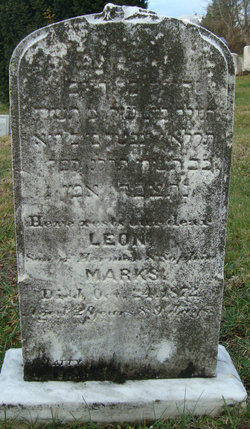
Adolph’s sisters Paulina and Sophia Dinkelspiel did not have lives quite as sad as that of their brother, but they did have their share of heartbreak.  Sophia, who had married Herman Marks in 1869, and was living in Harrisburg, had a child Leon who was born on October 15, 1870.  Leon died when he was just two years old on October 24, 1872.  I do not know the cause of death because the only record I have for Leon at the moment is his headstone.  (Ned’ s research uncovered yet another child who died young, May Marks, but I cannot find any record for her.)

leon marks headstone

Sophia and Herman did have three other children in the 1870s who did survive: Hattie, born May 30, 1873, just seven months after Leon died; Jennie, born August 24, 1876; and Edgar, born August 27, 1879.  Herman worked as a clothing merchant, and during the 1870s the family lived at the same address as the store, 435 Market Street in Harrisburg.

Paulina (Dinkelspiel) and Moses Simon, meanwhile, were still in Baltimore in the 1870s.  In 1870 Moses was a dealer “in all kinds of leather,” according to the 1870 census. At first I thought that Moses and Paulina had relocated to Philadelphia in 1871 because I found a Moses Simon in the Philadelphia directories for the years starting in 1871 who was living near the other family members and dealing in men’s clothing.  But since Moses and Paulina Simon are listed as living in Baltimore for the 1880 census and since Moses was a liquor dealer in Baltimore on that census, I realized that I had been confused and returned to look for Moses in Baltimore directories for that decade.

Sure enough, beginning in 1871 Moses was in the liquor business, making me wonder whether the 1870 census taker had heard “liquor” as “leather.”  After all, who says they deal in all kinds of leather?  All kinds of liquor makes more sense.  Thus, like the other members of the next generation, Adolphus and Simon Nusbaum in Peoria, Leman Simon in Pittsburgh, and Albert Nusbaum in Philadelphia, Moses Simon had become a liquor dealer.


http://www.gettyimages.com/detail/114527609

Moses and Paulina had a fourth child in 1872, Nellie. The other children of Moses and Paulina were growing up in the 1870s.  By the end of the decade, Joseph was eighteen, Leon was fourteen, Flora was twelve, and little Nellie was eight.

Ned Lewison, my more experienced colleague and Dinkelspiel cousin, found a fifth child Albert born in 1875 who died August 25, 1876 and a sixth child Miriam born in July 1877 who died October 30, 1878, both of whom are buried at Oheb Shalom cemetery in Harrisburg, where their parents would also later be buried.  Thus, Paulina lost two babies in the 1870s.  For her parents, Mathilde and Isaac, that meant the deaths of four grandchildren in the 1870s alone.

As for Mathilde and Isaac Dinkelspiel themselves, although they began and ended the decade in Harrisburg, my research suggests that for at least part of that decade, they had moved to Baltimore.  Isaac has no listing in the 1875 and 1876 Harrisburg directories (there were no directories for Harrisburg on line for the years between 1870 and 1874), but he does show up again in the Harrisburg directories for 1877 and 1878.  When I broadened the geographic scope of my search, I found an Isaac Dinkelspiel listed in the Baltimore directories for the years 1872, 1873, 1874, and 1875 as a liquor dealer.  This seemed like it could not be coincidental.  It’s such an unusual name, and Isaac’s son-in-law Moses Simon was a liquor dealer in Baltimore.  It seems that for at least four years, Isaac and Mathilde had left Harrisburg for Baltimore, leaving their other daughter Sophia and her husband Herman Marks in charge of the business at 435 Market Street in Harrisburg, where Isaac and Mathilde lived when they returned to Harrisburg in 1877.

Market Street in Harrisburg 1910  By Wrightchr at en.wikipedia [Public domain], via Wikimedia Commons

Market Street in Harrisburg 1910
By Wrightchr at en.wikipedia [Public domain], via Wikimedia Commons

The extended Dinkelspiel family as well as the Nusbaum family suffered another major loss before the end of the decade.  According to Ned Lewison’s research, Mathilde Nusbaum Dinkelspiel died on June 20, 1878. Another Nusbaum sibling had died, leaving only John and Ernst alive of the original six who had emigrated from Germany to America; Maxwell, Leopold, Isaac, and now Mathilde were gone. Mathilde is buried at Oheb Shalom cemetery in Harrisburg.

What happened to Isaac Dinkelspiel after his wife Mathilde died? Although Isaac appeared in the 1880 Harrisburg directory at 435 Market Street, the same address as his son-in-law Herman and daughter Sophia (Dinkelspiel) Marks, he does not appear with them on the 1880 census at that address.  In fact, I cannot find him living with any of his children or anywhere else on the 1880 census, although he is again listed in the Harrisburg directory at 435 Market Street for every year between 1880 and 1889 (except 1881, which is not included in the collection on ancestry.com).  I assume the omission from the census is just that—an omission, and that Isaac was in fact living with Sophia and Herman during 1880 and until he died on October 26, 1889, in Harrisburg.  He is buried with his wife Mathilde at Oheb Shalom cemetery in Harrisburg.

Thus, the Dinkelspiels certainly suffered greatly in the 18070s.  Five children died in the 1870s—Eva Dinkelspiel, May Marks, Leon Marks, Albert Simon, and Miriam Simon.  And their grandmother, Mathilde Nusbaum Dinkelspiel, also passed away, joining her brothers Maxwell, Leopold, and Isaac, leaving only John and Ernst left of the six Nusbaum siblings who left Schopfloch beginning in the 1840s to come to America.

And so I leave you with this thought as we start looking forward to a New Year.  Don’t take your children or your grandchildren for granted.  Cherish every moment you get to share with them.  And be grateful for modern medicine and the way it has substantially reduced the risks of children being taken from us so cruelly.


The Mystery of Fanny Wiler: A Two Part Saga

Here’s a mystery for you to ponder while I take a short break.  This is Part I, and I will post Part II within a week.  But meanwhile, see if you can solve the mystery.

As I mentioned a few posts back, I was having trouble filling the holes in the story of Fanny Wiler, the daughter of Moses and Caroline (Dreyfuss) Wiler.  I still am.  Let me tell you what I know and what I think I know, and see if you can add your insights.

What I know for sure:  My cousin Fanny Wiler was born in Pennsylvania, probably Harrisburg, in either 1845 or 1846.  She is listed as four years old on the 1850 census, living with her parents in Harrisburg, and as fourteen on the 1860 census, living with her parents in Philadelphia.

That is all I know for certain.

Fanny does not appear on the 1870 census with the rest of her family.  Her siblings Simon and Clara are listed (Eliza was married by this time), but Fanny is not.  Fanny would have been 24 in 1870 and thus possibly married, but I have yet to find a marriage record for her between 1860 and 1870.

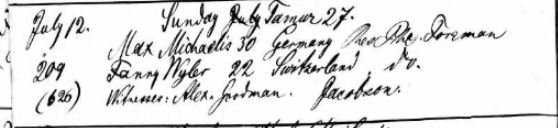
I did find a marriage record for a Fanny WYLER to Max Michaelis, dated 1874.  I was not sure that this was the same Fanny, not only because the name was spelled differently, but also the record says Fanny was born in Switzerland and that her age was 22. My Fanny was born in Pennsylvania.  If Fanny was in fact born in 1846, she would have been 28 in 1874, not 22.   But I thought Fanny might have lied about her age; I have seen that many times on marriage records.  And I thought maybe she put her father’s birthplace, which was Switzerland, by mistake.  So I decided to assume tentatively that this was my Fanny and chase down what I could find about Fanny and Max Michaelis.

Fanny Wyler marriage record

Fanny Wyler marriage to Max Michaelis July 12 1874
Historical Society of Pennsylvania; Historic Pennsylvania Church and Town Records; Reel: 792

But I could not find Fanny and Max on the 1880 census anywhere.  What I did find was a census entry for a Fanny Wiler (correct spelling), aged 24, whose parents were born in Switzerland and Germany.  This certainly matches my Fanny except for the age, which is off by ten years.  But this Fanny was working as a servant in someone’s home.   Could this really be my Fanny? I was not sure.

Fanny Wiler 1880 census  Source Citation Year: 1880; Census Place: Philadelphia, Philadelphia, Pennsylvania; Roll: 1169; Family History Film: 1255169; Page: 243B; Enumeration District: 090; Image: 0495

Fanny Wiler 1880 census
Source Citation
Year: 1880; Census Place: Philadelphia, Philadelphia, Pennsylvania; Roll: 1169; Family History Film: 1255169; Page: 243B; Enumeration District: 090; Image: 0495

So I started to search for Max Michaelis.  The first thing that came up was a second Philadelphia marriage record for a man with that name to a woman named Donice Coyne in 1876.  This was a church record, and it was not at all legible to me.  Could Max and Fanny have divorced already, thus explaining Fanny’s return to her birth name? Did women do that back then? It seemed possible.  But I could not find any other documentation of Max Michaelis with a Donice Coyne or with anyone with a name even close to resembling Donice.  So I put that aside.

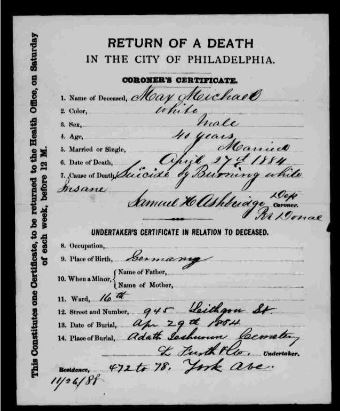
When I could not find Max on the 1880, 1900, 1910, etc., census reports in Philadelphia, I started to wonder if he had died. And so I looked for death certificates.  And I found this one:

Max Michael death certificate 1884

Max Michael death certificate 1884

I was horrified.  Could this be the Max who married my cousin? I looked for news articles to learn more and found this one:

A Madman's Act. How Max Michael Killed His Child and Committed Suicide Date: Thursday, May 1, 1884  Paper: Trenton Evening Times (Trenton, NJ)   Volume: II   Issue: 70   Page: 5

A Madman’s Act. How Max Michael Killed His Child and Committed Suicide
Date: Thursday, May 1, 1884 Paper: Trenton Evening Times (Trenton, NJ) Volume: II Issue: 70 Page: 5

Although there were many hits for news articles about this horrific event, they all were essentially the same article.  The story was picked up by Associated Press and published in many papers.  But none gave more than these bare facts: Max Michael was 40 years old, so the same age as the Max who married Fanny Wyler in 1874.  He had been a patient at Norristown State Hospital for the Insane (as it was called then).  His wife and three children were living at 945 Leithgow Street in Philadelphia, and one child, Rose, a sixteen month old girl, was killed in the fire.  But not one of the articles revealed the name of the wife of Max Michaels or the names of the other two children.

How could I find out if this was the Max who married Fanny Wyler in 1874?  I searched for information about the child who died. It did not take long to find the death certificate for the child, Rose.  It was heartbreaking to read this certificate.  And it did not provide me with the information I needed.   There was no indication of the mother’s name, not even her first name, let alone her birth name.

Rose Michael death certificate 1884

Rose Michael death certificate 1884 Pennsylvania, Philadelphia City Death Certificates, 1803-1915,” index and images, FamilySearch (https://familysearch.org/pal:/MM9.1.1/JKQJ-T8Z : accessed 17 December 2014), Rose Michael, 27 Apr 1884; citing , Philadelphia City Archives and Historical Society of Pennsylvania, Philadelphia; FHL microfilm 2,069,561.

I then searched for a birth record for Rose.  I found a Rosa Michaels, born December 21, 1882, in Philadelphia.  This had to be the right child.  Right name or close anyway, right age.  Father’s name: Max Michaels. Mother’s name: Farmer.  Farmer?? I did not have the actual document, just the information listed on FamilySearch.  The image itself is not available online, so I ordered the microfilm.  It meant a long wait.

You see, the Family History Library has discontinued its free photoduplication service.  In fact, there is now no photoduplication service even for a fee.  You have to order the microfilm and have it sent to your closest Family History Center.  The one closest to me is in Bloomfield, Connecticut.  It took me an hour to get there the one time I went (yes, I got lost, and yes, I did not take the highway, but it would still take 45 minutes even if I went the fastest way).  And it is only open limited hours during the week.  So I ordered the microfilm, but then received a notification that another user had it and it was not available.  Arggh. It will get there eventually.  But I am not a patient person.  How long would it take until I knew whether Farmer was really Fanny? Or was it the mother’s birth surname?

My next step was to use the address where the fire occurred, 945 Leithgow Street, and see if I could find out who lived there at the time of the 1880 census.  Although I had had no luck finding Max on that census, maybe if I searched by the address, I would find him with some mangled spelling of his name.  I went to stevemorse.org and used his Enumeration District tool, and after many hours of scanning numerous EDs, I finally found 945 Leithgow Street.  No luck.  Someone else was living there in 1880.  Not Max or Fanny or anyone with a name anything like Michael.

Now what? I turned to the Philadelphia city directories.  Perhaps I could track Max through the years by looking at every Philadelphia city directory available online.  Since only a few listings came up by searching under the name “Max Michael” and since I know these directories are indexed by use of an OCR scanner, I knew that the index might not be completely accurate. So I went year by year, looking through the directories for any listing for a name like Max Michael.  Here’s what I found:

1875: Maximilian Michaelis, 140 Noble Street

1876: Maximilian Michaelis, hairworker, on Green Street

1877: no listing found

1878: Max Michaels, laborer, at 2133 East Thompson Street

1879: Same as 1878

1880: Max Michel, peddler, at 1072 Leithgow Stret

1881: Max Michaels, laborer, 2133 East Thompson Street

1882: same

1883: same

1884 through 1889: no listing found

At first I thought that the Max Michel at 1072 Leithgow might be the right Max, but after searching further, I found that there were two different men with similar names, but the Max Michel who lived at 1072 Leithgow was much older and had a wife named Caroline and several children born in the 1860s.  So despite the fact that he was living on Leithgow, I eliminated him from consideration.

That left Max Michaels of 2133 East Thompson Street.  So I started searching for that address through stevemorse.org.  I searched about ten EDs, but not one of them had house numbers even close to 2133.  I was stuck.

I decided to try another approach.  The 1884 news articles said that Max and his wife had three children.  Who were the other two children? Since I had no census reports that included Max for 1880, I had no idea.  I decided to search for all people named Michaels born in the 1870s and 1880s in Philadelphia. Ancestry revealed that there was an Isabella Michaels who died in 1890, whose father’s name was Max, mother’s name was Fannie.  Bingo! I thought all my problems were solved.  I went to Familysearch.org to get the image of that death certificate and was frustrated to see that Fannie’s maiden name was not included.  (I also realized that I was so eager to solve this mystery that I was losing sight of the fact that a sixteen year girl had died.)

Isabella Michael death certificate 1890 Pennsylvania, Philadelphia City Death Certificates, 1803-1915," index and images, FamilySearch (https://familysearch.org/pal:/MM9.3.1/TH-267-12389-23257-67?cc=1320976 : accessed 10 December 2014), 004009728 > image 968 of 1766; Philadelphia City Archives and Historical Society of Pennsylvania, Philadelphia

Isabella Michael death certificate 1890
Pennsylvania, Philadelphia City Death Certificates, 1803-1915,” index and images, FamilySearch (https://familysearch.org/pal:/MM9.3.1/TH-267-12389-23257-67?cc=1320976 : accessed 10 December 2014), 004009728 > image 968 of 1766; Philadelphia City Archives and Historical Society of Pennsylvania, Philadelphia

So was this MY Fanny? It certainly seemed like it was the Max and Fanny who married in 1874, since Isabella was born in 1874.  But was that Fanny Wyler the same as my Fanny Wiler? I still didn’t know.

But now I had another clue.  Isabella’s residence at her time of death was 918 Hutchinson Street in Philadelphia.  But the 1890 US census was destroyed in a fire, so I would not be able to use a census to learn who was living at 918 Hutchinson in 1890 when Isabella died.  My best bet was to use the directory database again.  Max Michaels had disappeared from those directories in 1884 (the year of that terrible fire that killed a man named Max Michaels).  I had been assuming that the Max who had been a laborer and lived as 2133 East Thompson was the one killed in the fire so had stopped searching for him after 1889.

So I started with the 1890 directory this time, and I found a Fannie Michaels, widow of Max, living at 934 Poplar Street (with a separate listing under Max Michaels as a laborer, living at that address, even though he was dead, presumably).  But in 1891 there is a Fannie Michels, widow of Max, living at 918 Hutchinson Street, the address where Isabella Michaels had been living when she died in 1890.  There was the same listing for 1892.  Certainly this was the same Fannie and Max whose daughter Isabella died in 1890.  And Max was dead.  I thought I was getting closer.  Didn’t it all add up? Fannie Michaels had a husband named Max who had died sometime before 1890, and they’d had a daughter Isabella.  That much seemed fairly certain.

But was this MY Fanny? I still wasn’t sure because I had no document that included Fanny’s birth name other than the 1874 marriage record for the Fanny Wyler born in Switzerland.  But I was getting more and more convinced that Fanny Wyler was my Fanny Wiler, despite the discrepancies.  Wouldn’t you have been?

To be continued…

Question mark

Question mark (Photo credit: Wikipedia)

Boy, Is My Face Red. The Real Story of Milton Josephs’ Death and a Few Important Research Lessons

In my earlier post this morning, I wrote about little Milton Josephs, not yet two years old, whose cause of death was listed as marasmus on the Federal Census Mortality Schedule for 1880.  I was horrified that a child living in Philadelphia in a middle class home in 1880 could have died from starvation.

My medical consultant, whose expertise is in pediatrics and anesthesia (and who is also my brother, for those of you who haven’t figured it out), also thought that it seemed strange that a child would have died from severe malnutrition without there being some other underlying cause such as cancer or some syndrome that prevented him from being able to absorb nutrients.

His questions made me go back to see if I could find the actual death certificate for Milton on line.  My initial searches on both ancestry.com and FamilySearch.org had failed to pick up Milton’s death certificate no matter how I tried searching or spelling his name.  But this time I realized there was another way to search.  Ancestry.com had a record for Milton in the index of Philadelphia death certificates, but no image of that actual certificate.  But the record included the FHL film number, that is, the catalog number for the microfilm in the Family History Library in Salt Lake City.

For some reason, I’d never before tried searching by the FHL number on FamilySearch.   I know to those out there who are experienced genealogists this must seem like a terrible rookie mistake, and I am quite embarrassed that I’d never thought to do that before.

But it worked. Plugging the film number into the FamilySearch search engine resulted in the retrieval of this document:

Milton Joseph's death certificate  "Pennsylvania, Philadelphia City Death Certificates, 1803-1915," index and images, FamilySearch (https://familysearch.org/pal:/MM9.3.1/TH-266-11063-42231-79?cc=1320976 : accessed 14 December 2014), 004058647 > image 406 of 969; Philadelphia City Archives and Historical Society of Pennsylvania, Philadelphia.

Milton Joseph’s death certificate
“Pennsylvania, Philadelphia City Death Certificates, 1803-1915,” index and images, FamilySearch (https://familysearch.org/pal:/MM9.3.1/TH-266-11063-42231-79?cc=1320976 : accessed 14 December 2014), 004058647 > image 406 of 969; Philadelphia City Archives and Historical Society of Pennsylvania, Philadelphia.

It is a bit hard to read, but if you look carefully you can see that on the certificate it says Milton died from bronchial pneumonia, not marasmus.  My brother agreed that this was a much more likely cause of death for a boy living at home with his family in Philadelphia than starvation, and he thought it was unlikely that somehow marasmus led to pneumonia or vice versa.

Then why would the 1880 Federal Census Mortality Schedule have said the cause of death was marasmus? Well, once again I am embarrassed.  I looked more closely at the mortality schedule, and sure, it says M. Josephs, and sure, ancestry.com retrieved it as relating to Milton Josephs, but I should have looked more closely.  Because now that I have looked again, I realize that the schedule says that M. Josephs was 5/12, that is, five months old.

Milton Joseph on the Federal Mortality Schedule 1880

Milton Joseph on the Federal Mortality Schedule 1880

And a little more research uncovered the death of a child name Mike Josephs who died of marasmus in December 1879 at five months of age.  So stupid mistake number two:  I too quickly assumed that M. Josephs was Milton without reading the document carefully and without even stopping to think that Milton had died in November, 1880, too late to have been listed on the Federal Census Mortality Schedule for 1880, which was dated May 31, 1880.

So I apologize for my carelesness and for maligning the reputation of my ancestors whose son died from pneumonia, not starvation.

Do I feel any better about Milton, knowing that he did not die from starvation?  I suppose that I better understand how a toddler can die from pneumonia than starvation, especially in the era before antibiotics.  But no, I don’t feel better.  A little boy died what still must have been a painful death, and his family still lost a beloved child.

And another family, that of Mike Josephs, did lose a five month old baby to starvation.

There is no good news here, but I did learn a few important lessons.  Thanks to my brother, I was able to find my mistakes and set the record straight.

The Struggles of My Three-times Great-grandparents in the 1870s

The 1870s were not an easy decade for my three-times great-grandparents, John and Jeanette Nusbaum.  Like Jeanette’s sisters Caroline and Mathilde and their families, the Nusbaums confronted some of the effects of the economic depression affecting the country.[1]

By 1870 John and Jeanette only had two children living at home with them, Miriam, now 12, and Lottie, who was seven.  Adolphus, Simon, and Julius, their three sons, were all living in Peoria, and Frances was married and living in Santa Fe with her husband Bernard Seligman and their three children, Eva, my great-grandmother, James, and Minnie.  In 1871, Frances and Bernard’s son Arthur was born, giving John and Jeanette a fourth grandchild.[2]

In 1872, Adolphus married Fannie Fox in Laporte, Indiana, but they settled together in Peoria.  Until at least 1873, Adolphus and his brother Simon remained proprietors of the Union Mill Distillery, and their younger brother Julius continued to work as a clerk in their father’s store in Peoria.

But something changed by 1876, and in the Peoria directory for that year, although Adolphus was still listed as a distiller and Julius is still a clerk at John Nusbaum’s store, Simon was now in a different firm, Kingsland and Nusbaum, a firm engaged in the wholesale and commercial sales of liquor.  Had there been a falling out between Simon and Adolphus, or had Simon just formed a separate business to distribute the liquor distilled by his brother’s company?


http://www.gettyimages.com/detail/121333164

As I started studying the occupations of the younger generation of men in the extended Nusbaum-Dreyfuss-Simon clan, I was struck by the fact that whereas the older generation was involved primarily in the sale of clothing and other “dry goods,” the younger generation was definitely more into “wet goods.”  Albert Nusbaum, Leman Simon, and Adolphus and Simon Nusbaum were all now in the liquor trade.  In addition, Moses Simon ended up in the liquor business as well.  Was this a sign of the times? Were people drinking more because of the economic conditions, thus making this an attractive business for the entrepreneurial cousins?  Or was it more that once one cousin had success, the others figured they’d go into that line of business as well?

Apparently, Peoria was once known as the “Whiskey Capital of the World” and had over 24 breweries and 73 distilleries during the period between 1837 and 1919.  The 1860s and 1870s were the high point of Peoria’s liquor production and distribution, so it is not surprising that Adolphus and Simon became involved in the liquor business.  As for Albert, Leman, and Moses, it would appear that they followed the trend that the Nusbaum brothers had started.  Interestingly, this is also a period when the movement for prohibition of alcohol also started gaining momentum, making the liquor business a risky venture in the long term.  But for the 1870s, it might have been a wise business move.

The three Nusbaum brothers remained in Peoria throughout the 1870s, although by 1880, as we will see, Simon had relocated. Meanwhile, back in Philadelphia, their parents must have been having some problems.  The 1877 census had John listed as living at the same address at 943 North 6th Street in Philadelphia, but without an occupation.  John was now 63 years old, and at first I thought that he had simply retired.  But the 1877 Peoria directory also had a listing for John Nusbaum, and this is the first time that it includes a residential listing.  Was this a mistake? Or was John spending part of his time in Peoria? Had John’s Philadelphia store closed?

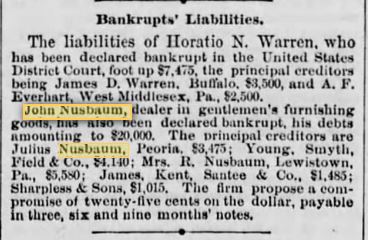
Perhaps these two news clippings from 1878 can shed some light on what was going on:

John Nusbaum bankrupt Aug 23 1878 Phil Times p 4

Philadelphia Times, August 23, 1878, p. 4

John N bankruptcy October 1878 p 1

Philadelphia Times October 31, 1878 p. 1

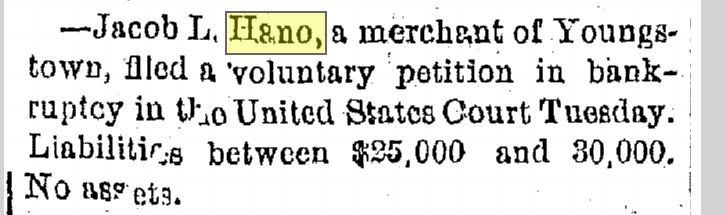
John was bankrupt, in debt for $20,000, and his principal creditors included two of his relatives: his son Julius, who was working at the Peoria store, and his sister-in-law Rose, widow of his brother Leopold, who had moved to Lewistown, Pennsylvania, after living with John and Jeanette during the period after Leopold died in 1866.  The bankruptcy settlement allowed John to pay them a quarter of what he owed them.

I wish I could find out more about this, and perhaps there is some way of finding some documents about the bankruptcy proceedings.  If anyone has any suggestions, let me know.  It just seems odd that Julius, who was working in his father’s store in Peoria, was owed almost $3500.  And how did John become indebted to his widowed sister-in-law for over $3500? But obviously John was having financial problems, another family member feeling the impact from the economic crisis of the 1870s.

John was again listed without an occupation in the 1879 Philadelphia directory, and although he is listed as being in the dry goods business again in the 1880 Philadelphia directory, there also appears to be something else going on.  On the 1880 US census, John Nusbaum is listed as living in Santa Fe, New Mexico with his daughter Frances Nusbaum Seligman and her family.  John’s son and Frances’ brother Simon is also living with the family (as is Bernard’s brother Adolph).  John’s occupation is described as “retired merchant,” and Simon is a bookkeeper.  Why did Simon leave Peoria? What had happened to his liquor business? And what was John doing in Santa Fe…without his wife?

Seligman and Nusbaums on 1880 US census santa fe

John and Simon Nusbaum with Bernard and Frances Seligman in Santa Fe 1880 US census

Jeanette was not with John nor were their two younger daughters. Rather, Jeanette, along with her youngest daughter Lottie, was listed in the 1880 census living at her other daughter Miriam’s house at 1120 Master Street in Philadelphia.  Miriam had married Gustav Josephs on March 20, 1878.  Gustav was listed as being in the handkerchief business in the 1880 Philadelphia directory and in the embroidery business on the 1880 census, so my guess is he either sold or made embroidered handkerchiefs at that time.  Gustav and Miriam had had a son Milton, who was born on December 28, 1878.  Yes, I realize that that means that Milton was born just nine months after his parents were married, but that certainly happens.  These are dates from the family bible, and while perhaps not as official as a government record, for my money and from my experience, the family bible has proven to be at least as reliable if not more reliable than many government records.

So Jeanette was in Philadelphia while John was in Santa Fe.   Since John was retired, it does not appear that this was a business decision.  Did the experience of bankruptcy lead him to leave Philadelphia for some time? Was there tension between Jeanette and John due to financial stress?

Jeanette Nusbaum 1880 US census in Philadelphia

Jeanette Nusbaum 1880 US census in Philadelphia

I do not know, but I do know that by 1881, John was back in Philadelphia where he would live the remainder of his days.  In 1881 he also was living at 1120 Master Street and thus presumably reunited with Jeanette, living in the home of Miriam and her husband Gustav.

Gustav and Miriam had had a second child, Florence, born on July 28, 1880, but just a few months later, the family suffered a sad loss. On November 17, 1880, Gustav and Miriam’s toddler son Milton died from marasmus.  Marasmus is a severe form of malnutrition caused by a lack of protein and calories.  Poor little Milton essentially starved to death.  He was one month short of his second birthday.  Today this is something we think of as a third world problem, but here he was, the grandson of a once-successful merchant, living in one of the biggest cities in the US at the time.  It’s hard to imagine how this could have happened.

IMPORTANT UPDATE: Please see my next post here.  Milton did not die from marasmus, but from pneumonia.

Milton Joseph on the Federal Mortality Schedule 1880

Milton Joseph (third from bottom) on the Federal Mortality Schedule 1880

Thus, the 1870s were a tough decade for my three-times great-grandparents, both personally and professionally. By 1880 John had also lost another sibling in addition to Leopold, who had died in 1866, and Isaac, who had died in 1870.  But that will wait for another post.

But not all the news was bad news.  Two more of their children had married, Adolphus and Miriam, and John and Jeanette had two new grandchildren, Florence Josephs, Miriam’s daughter, and Arthur Seligman, Frances’ son, the grandson who would one day be the governor of New Mexico.  There definitely were better days ahead for the Nusbaum family.

tunnel-336693_1280


[1] My brother told me that titling my posts “The Long Depression” was not a way to entice readers, so I’ve changed it a bit for this one.  I am not sure that does much more to make this into uplifting reading, but these were tough times.

[2] That does not count Florence Seligman, who was born in August, 1867 and died a few weeks later, as I’ve written about previously.

The Long Depression, Part 2: Moving Back Home or Moving Away

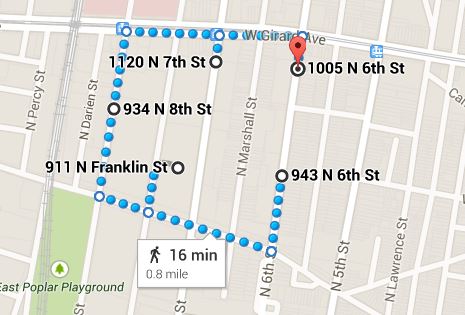
In the early 1870s Moses and Caroline (Dreyfuss) Wiler were living at 905 Franklin Avenue, just a few houses down from Caroline’s sister, Mathilde (Dreyfuss Nusbaum) Pollock and just three blocks away from their third sister, Jeanette (Dreyfuss) Nusbaum and her husband John, my three-times great-grandparents.  Ernst Nusbaum and his wife Clarissa were living down the block from his brother John. The area is known as the Poplar neighborhood in North Philadelphia. Plotting all their addresses on the map made me smile.  They must have all been so close, not only geographically but emotionally, to live so close to their siblings.  Imagine all the first cousins (some double first cousins) growing up within a short walk of each other.

map of nusbaum wiler simon homes 1870s

But as I wrote in my last post, things were not quite so idyllic in the 1870s.  The Panic of 1873 and the depression that followed had an impact on the family.  Like Mathilde and Moses Pollock, Caroline and Moses Wiler also must have felt some of that impact.  In 1873 Moses Wiler was listed in the directory without an occupation.  His partnership with his brother-in-law Moses Pollock had ended.  In 1875 he was still listed without an occupation, and they had moved from Franklin Avenue to 920 North 7th Street, still within two blocks of Caroline’s sisters.

Caroline and Moses Wiler’s son Simon also seems to have been affected by the Long Depression.  He had been part of the Simon and Pollock cloak and dry goods partnership of the late 1860s and early 1870s with his father and uncle.  After that business ended, Simon had a separate listing in the 1875 directory as a salesman, living at 701 North 6th Street, again in the same neighborhood as his extended family, just a few blocks south.  Simon was 32 and not married and presumably was doing well enough to afford his own place.  By 1877, however, he had moved back home with his parents at 920 North 7th Street.

In 1879, Moses Wiler was in the dry goods business, and his son Simon was a salesman, both living at 902 North 7th Street, as they were in 1880.  According to the 1880 census, Simon was a paper salesman, and Moses, who was 63, was a retired merchant.  Perhaps Moses had retired as early as 1873 when his listing no longer included an occupation.  Maybe he had done well enough to cope with the economic depression that occurred in 1873.

Poplar Street houses

House on Poplar Street, perhaps like those lived in by the extended Nusbaum-Dreyfuss family in the 1870s https://ssl.cdn-redfin.com/photo/93/bigphoto/440/6336440_0.jpg

By 1880, the three daughters of Caroline and Moses Wiler were no longer living with their parents.  Eliza Wiler had married Leman Simon in 1863, and in 1870 they had two children living with them, Joseph, who was five, and Flora, who was three. Sadly, in 1869, they had had a baby who was still born.   In 1870 they were living at 718 Coates Street, an address that appears not to exist anymore but was located where Fairmount Avenue is now located between the Delaware River and Old York Avenue.  Leman was in business with his brother Samuel, as he was in 1871. That business must have then ended.  According to the 1872 directory, Leman was then in the cloak business with his father Sampson Simon, who was living at the same address on Coates Street.  In 1874, Leman and Eliza had another child, Nellie, born on November 18 of that year.

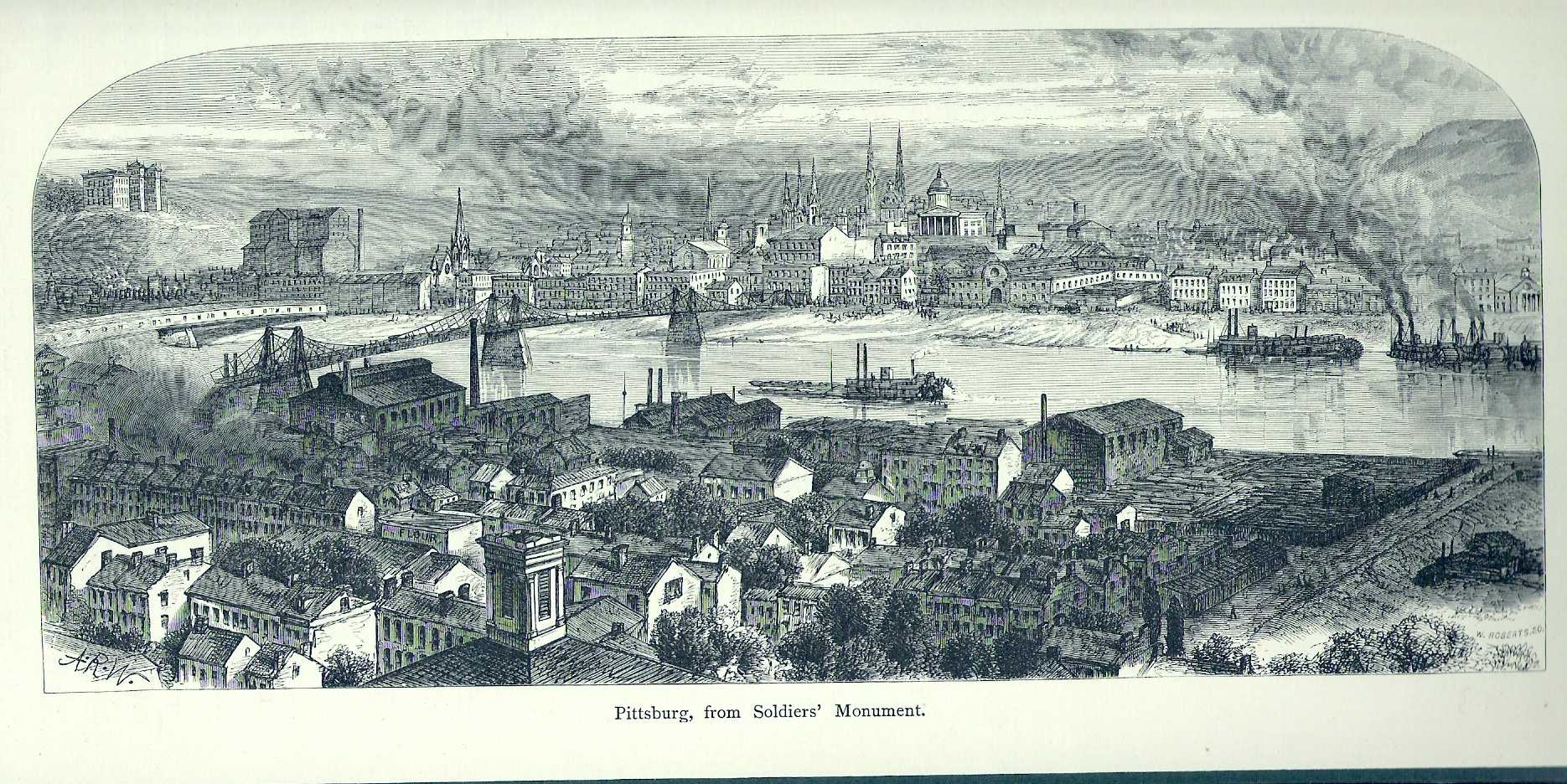
By 1876, Leman was listed as a salesman, living at 920 North 7th Street with his in-laws, Moses and Caroline Wiler.  Like Simon Wiler, Leman must have been feeling the effects of that Long Depression to have moved in with his in-laws after having his own home.   The next time Leman showed up in my search, he and Eliza were living in Pittsburgh, and Leman was working in the liquor business, like his cousin Albert Nusbaum.  Although I cannot find Leman on an 1877, 1878, or 1879 directory in any city, Leman and Eliza had another child, Leon, who was born in Pittsburgh on June 13, 1878, so the family must have relocated to Pittsburgh from Philadelphia by then.

Leman and Eliza also had a daughter Minnie, who was apparently born in 1877.  I say “apparently” because I cannot find a birth record for her, and there are only two census reports that include her, the 1880 and 1900 census reports.  The first says she was 2, meaning she was born either in 1877 or 1878; the latter says she was born in December, 1877.  But if she was born in December, 1877, then Eliza could not have given birth to Leon in June, 1878, just six months later.  I do have an official record for Leon’s birthdate with Eliza Wiler and Leman Simon named as his parents, so either Minnie was born sometime before September, 1877 or she is not Eliza’s child.

There are no other records I can find to determine Minnie’s precise birthdate; her death certificate also only specified her age, not an exact date of birth, and it also is consistent with a birth year of either 1877 or 1878.  Minnie died on August 5, 1904, at age 26 (more on that in a later post), meaning she was born on or before August 5, 1878, but not any earlier than August 6, 1877.  Somehow it seems quite unlikely that Caroline gave birth in August 1877, got almost immediately pregnant, and then had another child ten months after Minnie, but….stranger things have happened.  Or perhaps Minnie was adopted. Since I cannot find a birth record for a Minnie Simon in Pennsylvania for either 1877 or 1878, that certainly is a possibility.

In any event, in 1880, Eliza (Wiler) and Leman Simon were living far from their families in Pittsburgh with their five children, Joseph, Flora, Nellie, Minnie, and Leon.  Leman was in the liquor sales business, and perhaps life was a little easier out in the western part of Pennsylvania than it was in Philadelphia.

Eliza’s younger sister Fanny Wiler married Max Michaelis on July 12, 1874, in Philadelphia.  I am still working on Fanny’s story, and there are a lot of holes so that will wait for a later post.

The youngest child of Caroline (Dreyfuss) and Moses Wiler was Clara Wiler, born in 1850.  In 1871, she married Daniel Meyers, a German born clothing merchant operating in the 1870s under the firm name D. Meyers and Company.  He and Clara were living at 718 Fairmount Street, and their family grew quickly in the 1870s.  First, their daughter Bertha was born on December 4, 1972.  Less than two years later, their son Leon was born on June 12, 1874, followed the next year by Samuel on December 15, 1875.  A fourth child, Harry, was born January 15, 1878, and Isadore on September 25, 1879.  Five children in seven years.  Wow.

And they were not yet done.  But that would bring us into the 1880s, and I am not there yet.   But Daniel’s firm must have been weathering the storm of the 1870s depression better than most, including many in the extended family.  In 1880, he was supporting five children plus his wife Clara and himself in their house on Fairmount Street.

Thus, the Wiler family like the Pollock family had its ups and downs during the 1870s.  There were marriages and babies, but also some economic struggles for at least some of the members of the family.  Adult children had to move back home, and some had to leave town to find new opportunities for making a living.

The Long Depression:  The Family of Mathilde Dreyfuss Nusbaum Pollock


Embed from Getty Images

If the 1860s were mostly a decade of good things—weddings, babies, prosperity, and little impact from the Civil War, the 1870s were in contrast a more difficult decade for the extended Nusbaum-Dreyfuss-Dinkelspiel-Simon clan, both personally and economically.  This post will focus on the family of Mathilde Dreyfuss Nusbaum Pollock, and the next will focus on the family of Caroline Dreyfuss Wiler, my two three-times great grand aunts, sisters of Jeanette Dreyfuss.  The posts that follow will focus on the family of my three times great-grandparents John and Jeanette (Dreyfuss) Nusbaum and the families of John’s siblings Ernst Nusbaum, Leopold Nusbaum, and Mathilde (Nusbaum) Dinkelspiel during the 1870s.

First, the Pollocks. Mathilde (Dreyfuss Nusbaum) and Moses Pollock had relocated from Harrisburg to Philadelphia in the mid-1860s. Moses was engaged in the retail dry goods business. In June 1870 when the census was taken, the Pollocks had a very full house.  Mathilde’s daughter Flora and her new husband Samuel were living with them along with their new baby Meyer. Samuel was working on the wholesale side of clothing sales. In addition, Mathilde’s son Albert Nusbaum, now 19 and working as a clerk in a dry goods store (presumably his stepfather’s business), was living with them as well as Mathilde and Moses’ children, Emanuel (14) and Miriam (11), who were both in school.  In addition, there were three domestic servants living with them.  Moses must have been doing quite well.

It’s a good thing they had those servants because there were also three young children living with them, Annie (5), Alice (4), and Wilhelmina Jastrow (seven months old) plus another young woman, Augusta Wolfsohn, who was 22 years old.  Annie and Alice were born in Hesse-Darmstadt, but their baby sister Wilhelmina had been born in Pennsylvania in September, 1869.  Who were they? Where were their parents? Augusta was born in Prussia and does not appear to be the mother of the three young girls.  Who was she?  None of these girls was living with the Pollocks as of the 1880 census.

Fortunately, this was a mystery that did not take long to solve.  A little research on Ancestry.com, and I was able to find a happy ending to the story.  The Jastrow girls had parents, Marcus and Bertha (Wolfsohn) Jastrow.  By the second enumeration of the 1870 census in Philadelphia, they and their aunt Augusta Wolfsohn were all under the same roof as their parents and other siblings.  I don’t know why they were with the Pollocks during the earlier enumeration, but I assume that they were very recent immigrants who did not have enough room to accommodate everyone, and Moses and Mathilde were kind enough to take in the three youngest children and their aunt.

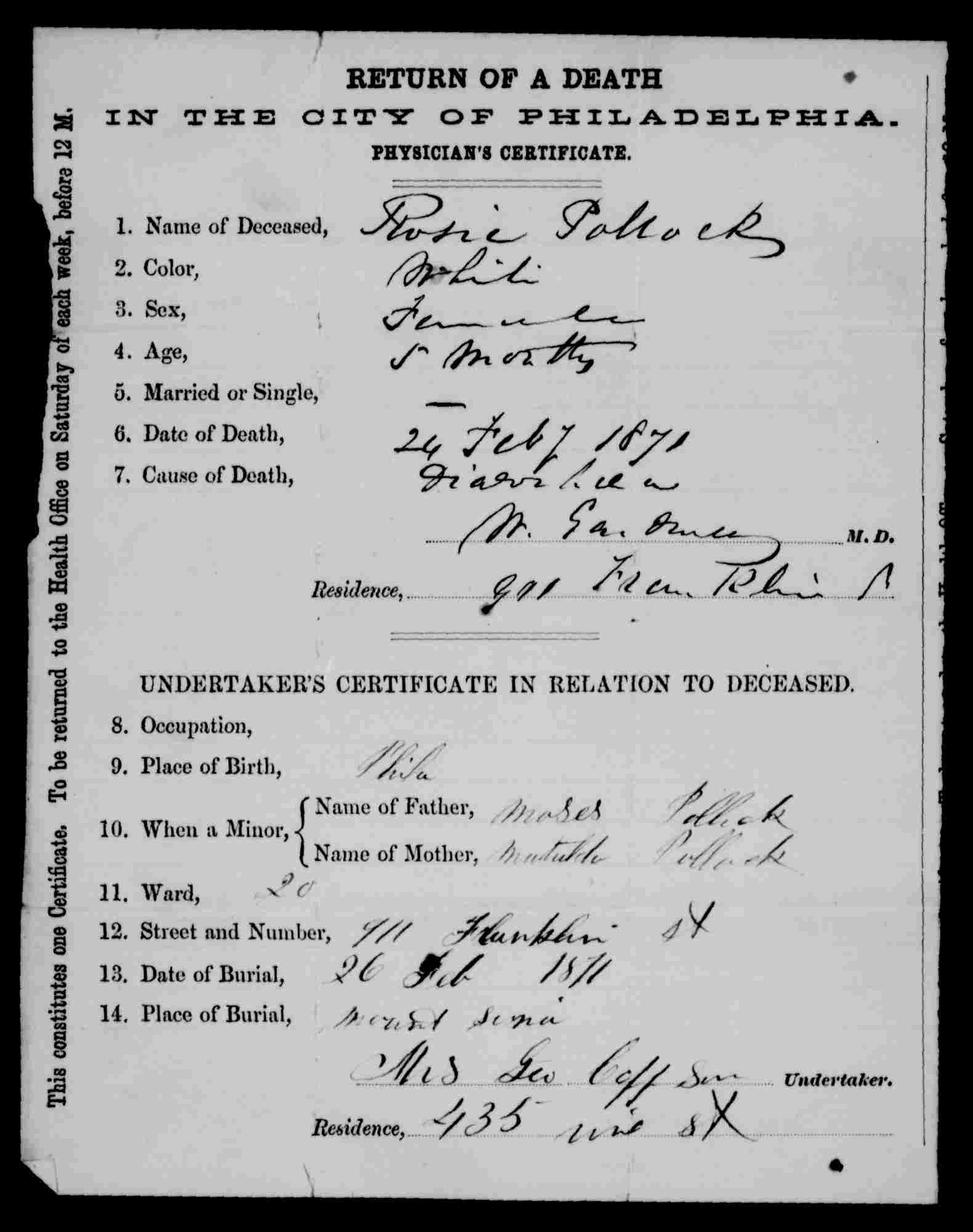
But fate was not kind to Moses and Mathilde despite their kindness to the Jastrows.  In September 1870, they had a third child together (a fifth for Mathilde), Rosia, but Rosia did not live long.  On February 26, 1871, she died, only five months old, from diarrhea.  Mathilde was 45 years old when Rosia was born, making me doubt my skepticism about the parentage of Lottie Nusbaum. Perhaps women just kept having babies into the mid to late 40s back then with more frequency than I would have thought.

Rosia Pollock death certificate 1871

Rosia Pollock death certificate 1871

What makes this late birth seem even stranger is that Mathilde had become a grandmother just nine months before Rosia was born when her grandson Meyer was born in January, 1870. Meyer and his parents Flora and Samuel Simon were living with the Pollocks in June of 1870 when Mathilde was pregnant with Rosia.  It is hard to imagine being pregnant and a grandmother, but times were different then.

Flora (Nusbaum) and Samuel Simon were still living with Flora’s family at 911 Franklin Street in 1871, but seem to have moved to their own place in 1872, and I say “seemed to” because their address was 909 Franklin Street, so right next door to Mathilde and Moses Pollock. Then in 1873, they are back at 911 Franklin.   Samuel was in business with his brother Leman in 1871, but seems to be on his own after that. He has no occupation listed in 1873 in the directory. Perhaps Flora and Simon could no longer afford to have their own place and returned to the Pollock residence.

According to the 1871 and 1872 Philadelphia directories, Moses Pollock had gone into business with his brother-in-law Moses Wiler, husband of Caroline Dreyfuss, Mathilde’s sister.  By 1873 it also appears that Moses Pollock and Moses Wiler were no longer in business together.  Moses Wiler is listed in the directories for 1873 and 1875 without an occupation, and Moses Pollock is listed in one as a salesman and another as a clerk.

What was going on around them? Why had these two family business partnerships ended?  It’s always important to keep the historical and socioeconomic context in mind when doing family research, and perhaps the most important development both in the US and worldwide in the 1870s was the so-called “Long Depression.”  The period after the Civil War brought widespread economic growth with railroad construction, technological developments, and expansion of exports to European markets.  However, in a way not dissimilar to more recent economic crashes, the economy tumbled in 1873 when banks and investment firms did not realize the profits they had expected from investing in the railroads and could no longer cover the loans they had made in the frenzy of the post-Civil War boom.[1]  In addition, an economic crisis abroad resulted in decreased demand for American exports.

The credit crisis led to panic with many investors withdrawing their money from the banks, thus worsening the precarious position of the banks.  Although the government intervened to try and stop the crisis, the overall confidence in the economy was gone, jobs dried up, people stopped buying, and railroad construction came to a halt.  There was also evidence of a great deal of corruption that was uncovered during this time.  The effects of this crisis were felt across the United States for at least five years with widespread unemployment, poverty, and social unrest.


It could very well have been this economic downturn that caused Moses Pollock and Moses Wiler to end this business partnership and also caused Leman and Samuel Simon to end their business partnership.

Moses Pollock continued to have some inconsistency in his occupation for the rest of the decade. In 1876 Mathilde and Moses Pollock are listed in business together selling “gentlemen’s furnishings” at 107 North 9th Street and were still living at 911 Franklin Street.  By 1878, they had moved to 934 North 8th Street, where they remained for many years.  Moses is listed as a salesman in the 1878, 1879, and 1880 Philadelphia directories, and according to the 1880 census he was working in a cloak store.  In 1880 he and Mathilde still had Albert Nusbaum, now 28, as well as Emanuel (24) and Miriam (21) living with them at home as well as one servant.  Albert had been working as a liquor salesman since 1873 when he was 21.  Emanuel had been in dry goods sales since 1877 when he was 21. Miriam and her mother Mathilde were “keeping house.”

Mathilde’s other daughter, Flora (Nusbaum) Simon and her husband Samuel meanwhile had had a second child.  Their daughter Minnie was born in 1873 or 1874 (documents vary).  Flora and Samuel seem to have moved out of the Pollock household sometime shortly thereafter and out of Philadelphia altogether by the end of the decade and perhaps even earlier.  It’s hard to know for sure because Samuel Simon was not an uncommon name.

There are three Samuel Simons listed in the 1874 Philadelphia directory: one was a laborer, one a restaurant worker, and a third was working in the ladies’ furnishings business.  None of the addresses line up with other members of the family, so I cannot tell which, if any of these Samuel Simons were married to Flora.  The ladies’ furnishings Samuel seems like the most likely, given the family’s pre-existing businesses, but I cannot be sure.  In 1875, there are two Samuel Simons, a laborer and a gardener.  Neither one seems likely to be Flora’s Samuel.

In 1876, there is only one Samuel Simon listed, a superintendent, and in 1877 again only one, a furrier.  In 1878 there was only Samuel the laborer, but in 1879 there were three Samuels: the laborer, the gardener, and a third selling produce.  My best hunch is that Samuel and Flora (Nusbaum) Simon had left Philadelphia by 1875.  According to the 1880 census, they were then living in Elkton, Maryland, about 50 miles from Philadelphia and 60 miles from Baltimore.  Samuel was working at a hotel there.  Again, my assumption is that the economic slowdown had contributed to this move away from their families in Philadelphia.

As will be evident as I examine each of the families, the Pollock line was not the only one that felt the impact of the Long Depression of the 1870s.


[1] I am greatly oversimplifying the causes and the effects of the Long Depression that began in 1873.  For more information, see http://www.socialwelfarehistory.com/eras/the-long-depression/   http://en.wikipedia.org/wiki/Panic_of_1873   http://macromarketmusings.blogspot.com/2010/05/about-that-long-depression-of-1870s_27.html

Four Weddings and a Funeral: More Twists and Turns

My last post covered the migration of several Nusbaum/Dreyfuss family members to Peoria, Illinois in the 1860s. Meanwhile, back in Pennsylvania, the rest of the Nusbaum/Dreyfuss clan was growing during the 1860s.  In Philadelphia, two of the Nusbaum brothers and two of the Dreyfuss sisters were seeing their families grow and their children grow.  Other family members were still in Harrisburg. By the end of the decade, even more of the family would have relocated to Philadelphia.

The Civil War was having at least some minor financial impact on the family.  For example, John Nusbaum was liable for $26.79 in income tax to the federal government in 1862 under the terms of the Internal Revenue Act of 1862.  That law was enacted to raise money to help pay for the expenses incurred by the Union in fighting the Civil War.  It was the first progressive income tax imposed by the federal government.  For anyone whose income exceeded $600 a year, a tax was imposed based on the level of income.

For John Nusbaum, whose income was valued at $892.96 in 1862, that meant a tax of $26.79.  According to one inflation calculator, $892.96 in 1862 would be worth about $20,000 in 2014.     For someone with stores in Philadelphia and Peoria (and possibly still some interest in a store in Harrisburg) and who reported $6000 in real estate and $20,000 in personal property in 1860,[1] that does not seem like a lot of income, but I have no idea how that was determined back then.

Ancestry.com. U.S. IRS Tax Assessment Lists, 1862-1918 [database on-line]. Provo, UT, USA: Ancestry.com Operations Inc, 2008.

Ancestry.com. U.S. IRS Tax Assessment Lists, 1862-1918 [database on-line]. Provo, UT, USA: Ancestry.com Operations Inc, 2008.

By 1863 John and Jeanette (Dreyfuss) Nusbaum, my three-times great-grandparents, had seen their two older sons move to Peoria, but they still had one son, Julius, and two daughters at home in 1863: Frances, my great-great-grandmother, who was eighteen, and Miriam, who was only five years old in 1863.  Plus 1863 had started off with another new baby in the family.  Lottie Nusbaum was born on January 1, 1863.  Jeanette would have been almost 46 years old, and her first born child Adolphus was going on 23.

I have to admit that I have some questions about whether Lottie was actually the child of John and Jeanette.  Jeanette must have been close to the end of her child-bearing years.  They had not had a child in five years.  Could Lottie have been a child of one of their sons, raised as the child of her actual grandparents?  Or a child they adopted?  I have no way of knowing.  Lottie had no children, so even if I could figure out some way to use DNA to answer my doubts, there are no descendants to use for DNA testing.

On Lottie’s death certificate, the informant was Mrs. E. Cohen, that is, my great-grandmother Eva Seligman Cohen, Lottie Nusbaum’s niece and Frances Nusbaum Seligman’s daughter.  Eva filled in the father’s name as John, but put unknown for the mother’s maiden name.  Eva certainly knew her grandmother Jeanette’s name.  (Eva is the one who held and maintained the family bible for many years.) Did she not know her grandmother’s maiden name? Was she too grief-stricken to remember? Or was she suggesting that Jeanette was not in fact Lottie’s real mother?  I do not know, and there is no one left to ask.  But it did not do anything to resolve my doubts about the identity of Lottie’s parents.   Maybe I am too skeptical.  Maybe she was just a menopause baby. Maybe John and Jeanette were missing their boys so much that they decided to have one more child. Or maybe not.  What do you all think?

Lottie Nusbaum death certificate  Ancestry.com. Pennsylvania, Death Certificates, 1906-1963 [database on-line]. Provo, UT, USA: Ancestry.com Operations, Inc., 2014.

Lottie Nusbaum death certificate
Ancestry.com. Pennsylvania, Death Certificates, 1906-1963 [database on-line]. Provo, UT, USA: Ancestry.com Operations, Inc., 2014.

In any event, just as John and Jeanette were emptying their household of their sons, they had a new baby to raise.  The family was still living at 433 Vine Street in 1862, according to the Philadelphia city directory, but in 1864 they are listed at 455 York Avenue.  That address is about two and a half miles north of Vine Street, and as I’ve discussed earlier, Jews began to move north in Philadelphia as their socioeconomic status improved.

By 1865, John and Jeanette’s house on York Avenue was a little emptier.  By that time Julius had joined his brothers in Peoria, and on March 28, 1865, my great-great-grandmother Frances married Bernard Seligman.  For several years they lived in Philadelphia, and Bernard was apparently in business with his brothers-in-law in a firm called Nusbaum Brothers and Company.  They had four children between 1866 and 1869, including my great-grandmother Eva.  Then in 1870, Bernard returned full time to Santa Fe with Frances and their children where Frances and Bernard lived for almost all of the rest of their lives, as discussed in my Seligman blog posts.

Nusbaum Brothers and Company 1867 Philadelphia Directory  Ancestry.com. U.S. City Directories, 1821-1989 [database on-line]. Provo, UT, USA: Ancestry.com Operations, Inc., 2011.

Nusbaum Brothers and Company 1867 Philadelphia Directory
Ancestry.com. U.S. City Directories, 1821-1989 [database on-line]. Provo, UT, USA: Ancestry.com Operations, Inc., 2011.

John’s brother Ernst was also in Philadelphia during the early 1860s.  He was a clothier, working at 55 North Third Street and living at 626 North 6th Street.  He and his wife Clarissa had another child in 1861, Frank, bringing their family up to six children ranging in age from newborn to ten years old.  So both Ernest, who was 45 when Frank was born, and John, who was 49 when Lottie was born, had new babies in their homes in the 1860s.

Jeanette (Dreyfuss) Nusbaum also had a sibling living in Philadelphia.  Her sister Caroline (Dreyfuss) Wiler had also moved from Harrisburg to Philadelphia by 1860.  She and her husband Moses Wiler were living at 466 North 4th Street in 1862 with their four children, who ranged in age from Eliza who was twenty to Clara who was twelve.  Moses was in the cloak business.

The following year the Wiler household became a bit smaller when Eliza Wiler married Leman Simon on September 9, 1863, in Philadelphia.  Yes, Leman Simon.  Do you remember that name? He was the brother of Moses Simon, who married Paulina Dinkelspiel and started the migration of Nusbaums to Peoria.  So once again, my family tree groans and twists a bit.  Eliza and Paulina were already related, at least by marriage.  Eliza’s mother Caroline Dreyfuss was the sister-in-law of John Nusbaum, Paulina Dinkelspiel’s uncle.  Sometimes these people make me want to pull out my hair!  Imagine, I am casually researching Eliza, and I see her husband’s name and think, “Leman Simon.  Hmmm, that sounds familiar.”

So by 1863 the Simons, Nusbaums, Dinkelspiels, and Dreyfusses were all somehow interrelated, often in more than one way.

But it gets worse.

By 1866, Moses Pollock and Mathilde (Dreyfuss Nusbaum) Pollock had also moved to Philadelphia from Harrisburg. In 1868, Flora Nusbaum, the daughter of Mathilde Dreyfuss and Maxwell Nusbaum and step-daughter of Moses Pollock, married Samuel Simon.  I have mentioned this before because Flora Nusbaum is my double first cousin four times removed since both of her parents were siblings of one of my three times great-grandparents, Flora’s father being John Nusbaum’s brother, her mother being Jeanette Dreyfuss Nusbaum’s sister.  Now Flora was marrying her first cousin Paulina’s brother-in-law Samuel Simon, who was also her cousin Eliza’s brother-in law.

Groan…. Maybe this chart will help.

chart_NEW

So all three Simon brothers were now married to someone in the clan: Samuel to Flora Nusbaum, Leman to Eliza Wiler, and Moses to Paulina Dinkenspiel.

The wedding of Samuel Simon to Flora Nusbaum (Pollock) seems to have been a celebration worthy of all that interconnectedness.  Here is an article from the Harrisburg Telegraph of October 20, 1868, republishing an article from the Philadelphia Sunday Mercury that described their Philadelphia wedding.  It’s really worth reading to get the full flavor of both the wedding and “social media” in the 1860s.

flora pollock wedding part 1

flora pollock wedding part 2

flora pollock part 3

The strangest part of this article is not the detailed description of the lavish, extravagant wedding celebration, but the reporter’s mistaken assertion that Flora was not Jewish.  Certainly her parents were both Jewish, and even her stepfather Moses Pollock was Jewish.  The reporter’s statement that “the pure religion of love had broken down all sectarian barriers” seems a bit strange for a wedding announcement, even if it had been an interfaith wedding.  But why would the reporter have thought Flora wasn’t Jewish?

The overlapping branches of the family were well represented in the bridal party: Clara Wiler and Simon Wiler, the children of Moses and Caroline (Dreyfuss) Wiler; Frances Nusbaum, the daughter of John and Jeanette (Dreyfuss) Nusbaum; Arthur Nusbaum, son of Ernst and Clara Nusbaum; and Albert Nusbaum, son of Maxwell and Mathilde (Dreyfuss) Nusbaum and brother of the bride.  I do not know who the Schloss family is or the Goldsmiths, at least not yet, but I fear more double twists yet to be uncovered.

So the extended family was doing quite well, and there were lots of new families being formed and babies born, but unfortunately there also was one big loss in the 1860s.  Leopold Nusbaum, who was still living in Harrisburg in the 1860s, died on December 24, 1866.  He was buried at Mt. Sinai Cemetery in Philadelphia.  His widow Rosa and sixteen year old daughter Francis moved shortly thereafter to Philadelphia, where they moved in with John and Jeanette Nusbaum, whose household had been reduced by two when Julius moved to Peoria and Frances married.

Below is a photo I found while searching for old images of Harrisburg.  I was so excited when I saw the name on the store at the far upper right—Leo Nusbaum!  Although this photo was dated 1889, Leopold Nusbaum’s name was still on the store even though he had died almost 25 years earlier.

Harrisburg Market Square with Leo Nusbaum store

Harrisburg Market Square with Leo Nusbaum store http://explorepahistory.com/displayimage.php?imgId=1-2-EC

The only Nusbaum family members left in Harrisburg by the end of the 1860s were Mathilde (Nusbaum) Dinkenspiel, her husband Isaac, and their daughter Sophia.  Their daughter Paulina (Dinkenspiel) Simon was living in Baltimore, and their son Adolph was in Peoria.  Their youngest child Sophia married Herman Marks, a Prussian born clothing merchant, in 1869, and they settled in Harrisburg as well.  Perhaps they were the ones to keep Mathilde’s brother’s name on the store.

Thus, by the end of the 1860s, most of the extended family was living in Philadelphia, with a small number living in Peoria, a few in Harrisburg, and a few in Baltimore.


[1] $600 in 1860 would be worth about $17,000 today, and $20,000 in 1860 would be worth about $571,000 today.  Not too shabby for someone who had come to America around 1840.

But Will It Play in Peoria?


My father’s family has lived in some places that were surprising to me—Cohens in Des Moines and Kansas City, Seligmans in Santa Fe, and Nusbaums in Harrisburg and other small towns in Pennsylvania.  In the 1860s, some of the Nusbaums and their Dreyfuss, Dinkelspiel and Simon relatives ended up in Peoria.   All I knew about Peoria was the old line, “Will it play in Peoria?” As explained on the official website for Peoria, Illinois:

The phrase “Will It Play in Peoria?” originated in the early ’20s and ’30s during the US vaudeville era. At that time, Peoria was one of the country’s most important stops for vaudeville acts and performances. If an act did well in Peoria, vaudeville companies knew that it would work throughout the nation. The saying was popularized by movies with Groucho Marx, and on radio programs such as Jack Benny and Fibber McGee.  Because of it’s [sic] location and demographics, Peoria has since become a well known test market to gauge the popularity of products and ideas nationwide.

Peoria has become a symbol of mainstream America, a short-hand way of referring to the typical “Middle American,” as Richard Nixon might say.  So perhaps I should not be surprised that my entrepreneurial Nusbaum/Dreyfuss ancestors struck out for Peoria after succeeding in Harrisburg and Philadelphia.  It was a new market to exploit as the US population continued to expand and move west.

Location map of Peoria, Illinois

Location map of Peoria, Illinois (Photo credit: Wikipedia)

But were there Jews there in the 1860s? Surprisingly, there was an established Jewish community. According to the Jewish Virtual Library’s entry for Illinois, “The oldest Jewish community [in Illinois] outside of Chicago is Peoria, where the first Jews arrived in 1847. A benevolent society was organized in 1852 and the first congregation, Anshai Emeth, was formed in 1859.”     The website for Anshai Emeth reveals only a little bit more about the early history of Jews in Peoria:

The first Jewish settlers came to Peoria in approximately 1847. They soon organized themselves into groups and worshiped in private homes. Early settlers included Jacob Liebenstein (1848), Henry Ullman and Leopold Rosenfeld (1849), Abraham Schradski and Leopold Ballenberg (1851), and Aaron, Harry and David Ulman (1852), and Henry Schwabacker. Many of their descendants continue to live in the Peoria community.  Religious school classes were organized by 1852. In the same year, these Jewish settlers organized a burial association and bought a lot for the use as a cemetery. With this purchase grew the first organized Jewish life in Peoria. Religious services were held in various halls including Washington House on North Washington Street.  Abraham Frank, A. Rosenblat, Hart Ancker, A. Ackerland, Arnold Goodheart, and Abraham Solomon formally organized a congregation in 1859 and named themselves “Anshai Emeth,” or “People of Truth.”

Although in 1860 the Nussbaum/Dreyfuss clan was settled either in Harrisburg or Philadelphia, as early as  1862 some of the next generation began moving to Peoria.  Paulina Dinkelspiel, the daughter of Mathilde Nusbaum and Isaac Dinkelspiel, married a man named Moses Simon in 1862.  Moses was born in 1835 in what is now the Hesse region of Germany.  He and his brothers Leman and Samuel had a business in Peoria as early as 1861, as did their father Sampson.

The Simons in Peoria 1861 Peoria directory

The Simons in Peoria 1861 Peoria directory

But as the directory indicated, Moses was residing in Harrisburg in 1861.  Perhaps Moses had a business relationship with the Nusbaum business; perhaps that is how he obtained his merchandise for their business in Peoria.  But while living in Harrisburg, Moses must have met Paulina. And after they were married, they moved to Peoria where their first two children were born, Joseph in 1862 and Francis in 1864.

Not long after, Paulina’s younger brother Adolph Dinkenspiel arrived in Peoria.  Although he is not listed in the 1861 directory, he does appear in the 1863 directory. While the Simon brothers and their father were all living at 95 North Adams Street that year, Adolph was boarding at the corner of North Adams and Hamilton Street, right down the block, and working as a clerk at 73 Main Street.

What was going on at 73 Main Street?  The Simon Brothers business was at 5 North Adams Street, so young Adolph was not working for his sister’s husband.  A look at the 1863 directory for Peoria under N revealed that John Nusbaum, my three-times great-grandfather, had a business at that location as a “fancy and staple dry goods merchant.”  Although John was still residing in Philadelphia, he is listed in the directory as are two of his sons.  His oldest son Adolphus, was residing at Peoria House, a hotel, I assume, and working for a firm called “Adler, N. & Higbie.” A further look through the 1863 directory uncovered a listing for a distillery called Adler, Nusbaum & Higbie.  John’s second son Simon is also listed in the 1863 Peoria directory, working as the business manager of his father’s store at 73 Main Street with his cousin Adolph Dinkenspiel and residing at 36 North Adams Street.

nusbaum 1863 peor

Nusbaums in Peoria 1863 Peoria directory

By 1863, the country was in the throes of the Civil War, yet it appears that my Peoria relatives were not serving in the war.  I did find a document that indicates that both Simon and Adolphus Nusbaum registered for the draft in 1863 for the Civil War, but I cannot find any other documentation of their service in that war.

National Archives and Records Administration (NARA); Consolidated Lists of Civil War Draft Registration Records (Provost Marshal General's Bureau; Consolidated Enrollment Lists, 1863-1865); Record Group: 110, Records of the Provost Marshal General's Bureau (Civil War); Collection Name: Consolidated Enrollment Lists, 1863-1865 (Civil War Union Draft Records); ARC Identifier: 4213514; Archive Volume Number: 2 of 5

National Archives and Records Administration (NARA); Consolidated Lists of Civil War Draft Registration Records (Provost Marshal General’s Bureau; Consolidated Enrollment Lists, 1863-1865); Record Group: 110, Records of the Provost Marshal General’s Bureau (Civil War); Collection Name: Consolidated Enrollment Lists, 1863-1865 (Civil War Union Draft Records); ARC Identifier: 4213514; Archive Volume Number: 2 of 5

Not one of these young men in the family appears in any of the databases listing those who served. I searched not only Ancestry, Fold3, and FamilySearch, but also the National Park Service database, the Civil War Soldiers and Sailors System, found here, and found nothing.

How had they all avoided service?  Simon and Adolphus registered, but I can’t even find registration evidence for Adolph Dinkelspiel.  The Draft Act of 1863 applied to all male citizens between 20 and 45 years old; in 1863 Adolphus was 21 and Simon and Adolph were 20.  Adolphus and Simon were born in the US and were thus citizens, but Adolph Dinkelspiel was born in Baden.  However, the Draft Act also applied to men who intended to become citizens.  Perhaps Adolph avoided registration by not declaring such an intention.  But how would his cousins Adolphus and Simon have avoided service?  Apparently there were two ways to avoid being drafted: hire a substitute or pay $300.  Perhaps that’s what the two Nusbaum brothers did.  Or maybe I just haven’t found the documentation of their service.    See also Michael T. Meier, “Civil War Draft Records: Exemptions and Enrollments,” Prologue Magazine (Winter, 1994) found online here.

All three of John’s sons were listed in the 1865 Peoria directory.  Julius joined Simon as a clerk at the Nusbaum dry goods store, now located at the corner of North Adams and Main Street, two blocks up from its 1863 location.  Adolphus, although still listed in the directory, was reported to be living in Philadelphia in 1865, but still associated with the Adler, Nusbaum & Higbie firm.  In addition, John’s older brother Isaac is listed in the 1865 Peoria directory, boarding at 36 North Adams Street, the same address given for Julius.  This is the first document evidencing Isaac’s presence in the US, so perhaps he was a late arrival and sent to Peoria to keep an eye on his nephews Julius and Simon Nusbaum and Adolph Dinkelspiel, who were single and only 17, 22, and 22 respectively in 1865.

Thus, in 1865, there were four male members of the extended Nusbaum family living in Peoria. Some members of the clan had left by then. Moses and Paulina (Dinkelspiel) Simon and Moses’ brothers Leman and Samuel and their father Sampson were gone from Peoria. Moses and Paulina had relocated to Baltimore where Moses was a “fancy goods” merchant. They had two more children between 1865 and 1870: Leon was born in 1866, and Flora in 1868, both born in Baltimore.  On the 1870 census, Moses described himself as a dealer in all kinds of leather. [1] Thus, Moses Simon who started the migration of the Nusbaums to Peoria was himself gone by 1865.

Adolphus was not listed as living in Peoria in 1865, but he did eventually return to Peoria in 1868.  There is an 1864 IRS tax report that lists the income for Adolphus and for the Adler, Nusbaum & Higbie distillery, so Adolphus was still in business in 1864 in Peoria.   The 1865 Peoria directory reported that he was living in Philadelphia though still in business in Peoria.

In 1867 the only members of the Nussbaum/Dreyfuss/Dinkelspiel/Simon clan listed as living in Peoria were Isaac Nusbaum, Julius Nusbaum, and Adolph Dinkelspiel.  However, the 1868 directory lists Isaac, Julius, S. (Simon?) and A. (Adolphus?) Nusbaum as well as Adolph Dinkelspiel.  The four younger men are also listed in the 1870 directory.  Simon and Adolphus were now in the distillery business together under the name Union Mills Distillery, and Julius was still working in his father’s “staple and fancy dry goods” business along with his cousin Adolph Dinkelspiel.  Thus, three of my great-great-grandmother’s brothers as well as my first cousin four times removed, Isaac Dinkenspiel, were living in Peoria in 1870.

Isaac Nusbaum, their uncle, had died in January, 1870. He was not yet sixty years old.  I could find no actual record of his death aside from the entry in the Nusbaum family bible and this rather peculiar news article from the January 25, 1870 Peoria Daily Transcript.

Peoria Daily Transcript January 25, 1870 p. 3

Peoria Daily Transcript January 25, 1870 p. 3

What does this mean? Why would his brother John have ordered the body returned to Peoria? Why had it first been en route to Philadelphia? How did Isaac die?  There was no obituary.  Isaac is a mystery to me.  I don’t know where he was before 1865.  It appears that he never married or had children.  If it had not been for the family bible, I might never have even known to look for him.

http://www.findagrave.com/cgi-bin/fg.cgi?page=pv&GRid=143048598&PIpi=117463912 Note says he is buried between two unrelated people.

http://www.findagrave.com/cgi-bin/fg.cgi?page=pv&GRid=143048598&PIpi=117463912
Note says he is buried between two unrelated people.

By 1870, the four young Nusbaum descendants were grown men.  Even the youngest, Julius, was 22.  All four would spend the next decade in Peoria as well; two of them would spend most of the rest of their lives there.

So yes, it played well in Peoria for the Nusbaum/Dreyfuss family.


[1] For some reason on the second enumeration of the 1870 census, Moses and his brothers Samuel and Leman are listed with their parents in Philadelphia; I assume that the parents were confused when asked about the members of their family and reported all three sons as living with them when in fact all three sons were married by then and living with their wives and children.