Bingen: The Early Home and the Last Home in Germany for Many in the Seligmann Family


After lunch in Mainz on May 3, Wolfgang drove us to Bingen, where we were scheduled to meet Beate Goetz.  Beate, who volunteers at the Arbeitskreis Judische in Bingen, is one of the many German researchers who have helped me with my research.  Over the last two years she has sent  many records of our Seligmann relatives from the Bingen region, and she has been extremely helpful so I was looking forward to meeting her.  She had volunteered to show us around Bingen.  It was wonderful to meet her and spend time with her; she is one of the many dedicated people working to preserve the Jewish history of Germany.
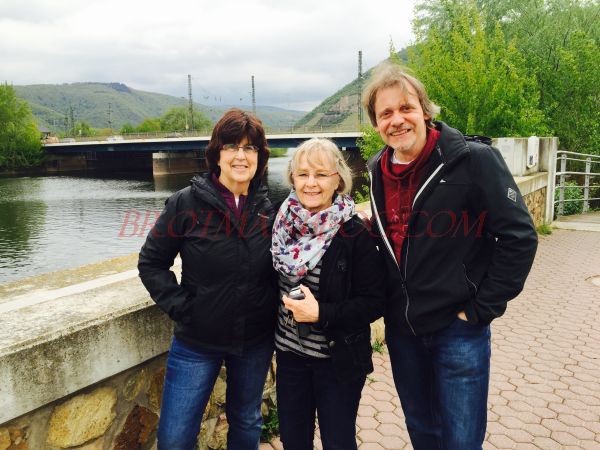
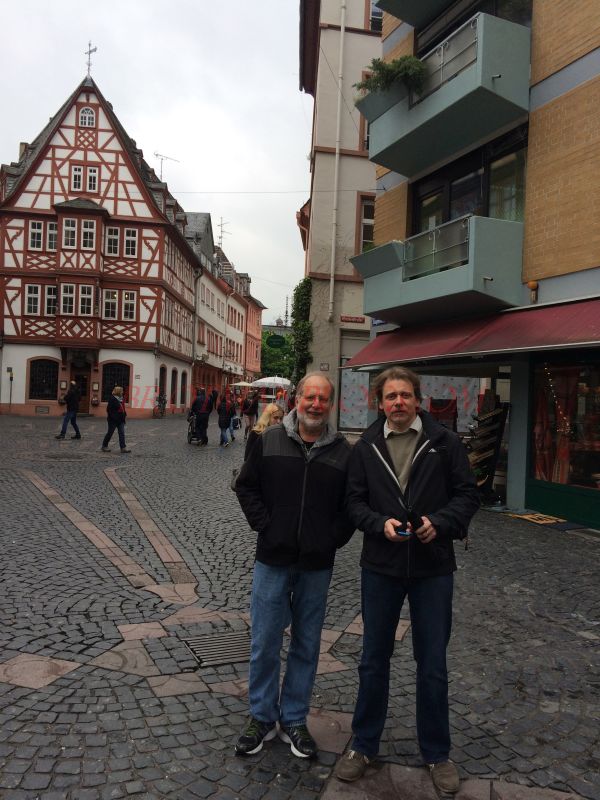
Beate Goetz, Wolfgang, and me

In researching my Seligmann family, I had learned that my 4x-great-grandfather Jacob Seligmann and my three-times great-grandfather Moritz Seligmann were both born in Gaulsheim, a village that is now a part of Bingen.  I had wanted to see Gaulsheim, but Beate assured me that there was really nothing to see as all the old houses were gone.  Now it is just a residential area outside the main center of Bingen. So we focused instead on the center of the city itself.

https://www.google.com/maps/dir/Mainz,+Germany/Bingen,+Germany/@49.9832962,7.93582,11z/data=!3m1!4b1!4m14!4m13!1m5!1m1!1s0x47bd912e33df1379:0x422d4d510db1ba0!2m2!1d8.2472526!2d49.9928617!1m5!1m1!1s0x47bdefacf3e6e303:0x422d4d510db4180!2m2!1d7.904596!2d49.9667396!3e0

Bingen is located at the junction of two rivers—the Rhine and the Nahe.  It is a small city; today its population is about 25,000 people.  Our hotel, the Roemerhof, overlooked the Nahe river (which we could see if we peered between two buildings outside our window).  While walking along the river, we saw ducks swimming along.  The region is known for wine-making, and we could see vineyards in the hills surrounding the city.

There is evidence that Bingen was settled as early as Roman times, and its location gave it strategic importance as a gateway to the Rhine Valley region.  There was a Jewish community in Bingen at least as early as the 12th century. Although the Jews were expelled from Bingen in both the late 12th century and the 16th century, they returned and resettled.  Jews worked as money lenders in the earliest times, but in later times, Jews like my own relatives were merchants and wine traders. In 1933 there were 465 Jews living in Bingen. Half left by 1939, and those who remained were deported. Only four returned. Today there is a small number of Jews from Russia living in Bingen, but no real synagogue or formal Jewish community.

Jews being deported from Bingen. Courtesy of the Arbeitskreis Judische Bingen.

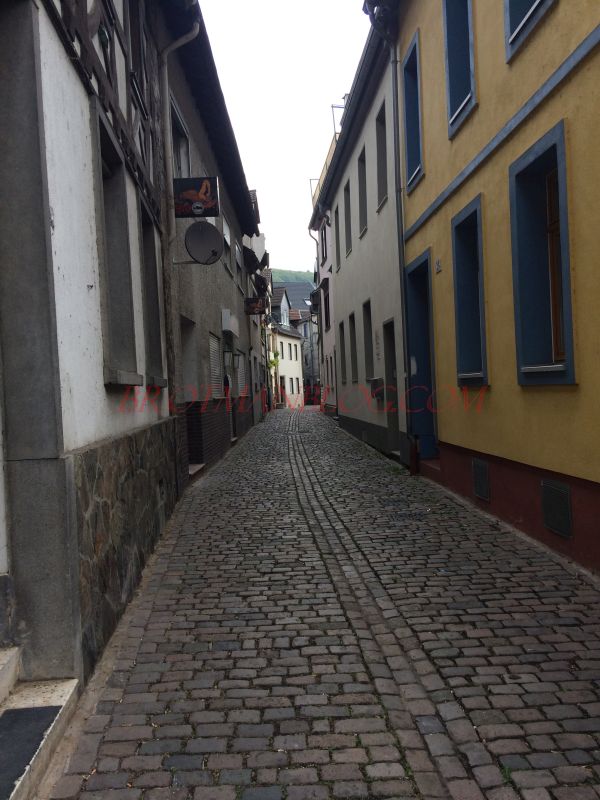
Bingen suffered extensive damage by Allied bombing during the war, and parts of the the city today are not particularly pretty, although there are still lovely winding streets and open squares throughout the city, some lined with older buildings and homes.  Many of the buildings, however, are post-war concrete construction that do not have much aesthetic appeal.
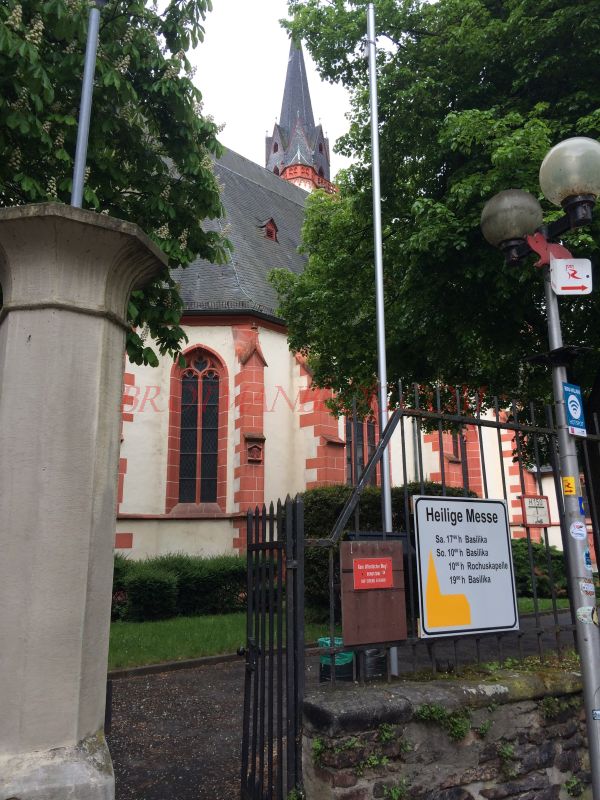
Catholic Church in Bingen
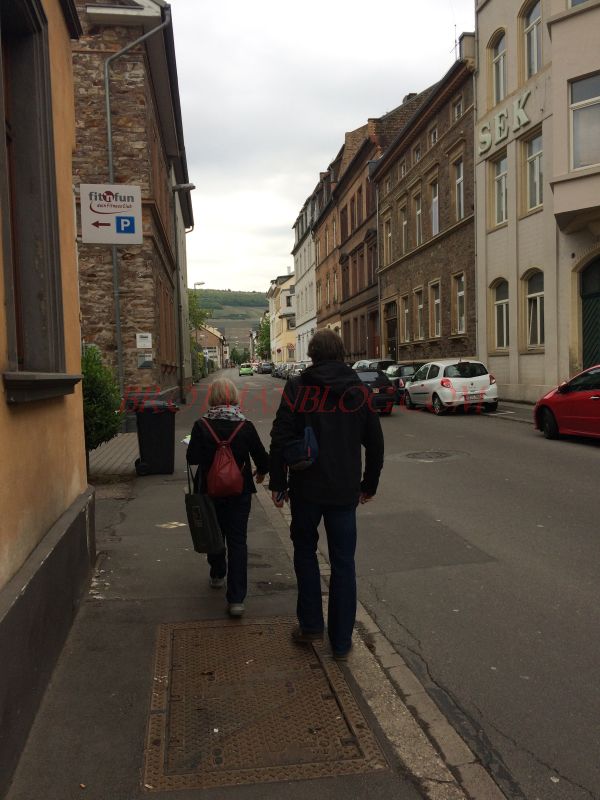
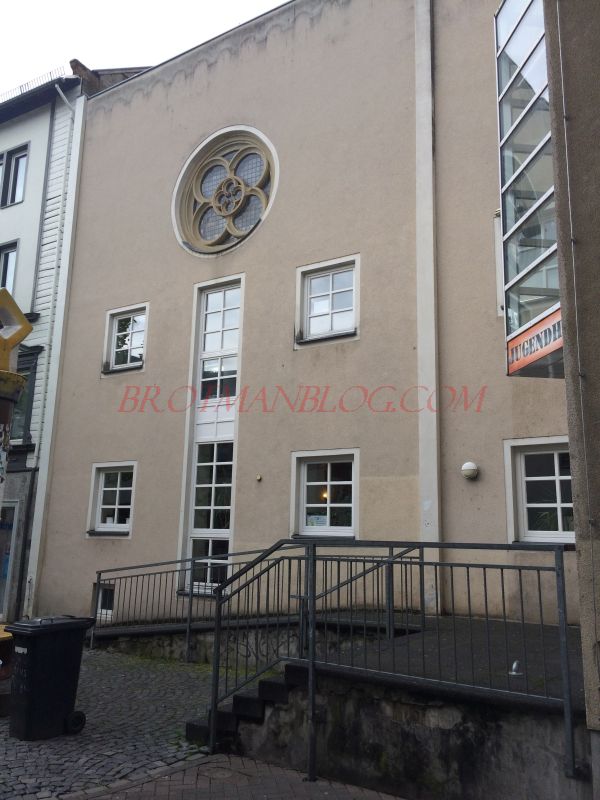
Beate took us to see two former synagogue buildings.  The first had been closed by the Jewish community itself in 1905 because the community, numbering at that time about 700 people, needed a larger space.  Today it is used as a youth center.

Old synagogue in Bingen

The second synagogue, which opened in 1905, was once quite a grand building. Here are some photographs from the Arbeitskreis Judsiche Bingen of what it looked like before 1938 as well as a model showing what the exterior looked like:
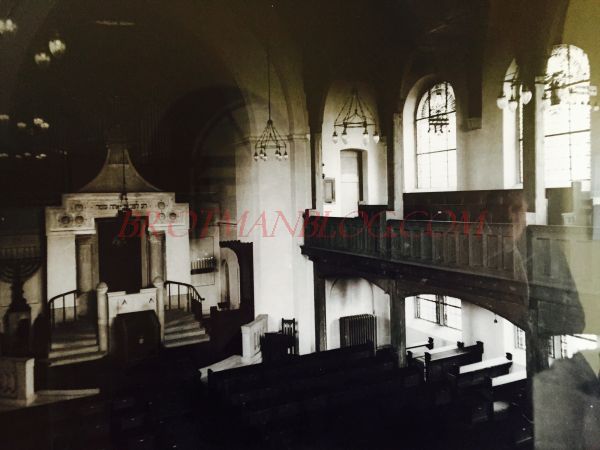
Courtesy of the Arbeitskreis Judische Bingen.

Courtesy of the Arbeitskreis Judische Bingen.

Courtesy of the Arbeitskreis Judische Bingen.

Like so many synagogues across Germany, it was partially destroyed by fire in November, 1938, on Kristallnacht. After the war the building was sold, as there was no longer a Jewish community that needed it. Most of the building was taken down, but part remains.  Today part of it houses the Arbeitskreis Judische and provides a meeting space for the Russian Jews who live in Bingen.

1905 Bingen synagogue

Beate also took us to several homes where some of our Seligmann cousins had once lived.  We saw the house that had belonged to Bernhard Gross and his wife, Bertha Seligmann.  Bertha was my first cousin, four times removed. Her grandparents were Jacob Seligmann and Martha Mayer, my 4x-great-grandparents; her mother, Martha Seligmann, was the sister of Moritz Seligmann, my three-times great-grandfather. Bertha and Bernard died from carbon monoxide poisoning in their own home in 1901, as I wrote about here.

Home of Bertha Seligmann and Bernhard Gross

We also saw the former home of Bertha and Bernard’s daughter Mathilde Gross and her husband Marx Mayer.  Mathilde is the cousin whose memoir inspired me to start learning German. (I still am not fluent enough to read it with much ease, however.) Her husband Marx died in 1934, but Mathilde and all their children emigrated from Germany in the 1930s and were able to survive the war.

House of Marx Mayer and Mathilde Gross

As you might imagine, seeing these two stately and large homes made me realize how successful the family had been and thus how much they had lost when they left Germany.

We also saw a number of stolpersteine, including these three for the family of Karl Gross, who was Mathilde Gross Mayer’s brother. Karl Gross, his wife Agnes Neuberger, and their daughter Bertha Gross were all killed in the Holocaust.  Karl was was my second cousin, three times removed. His grandparents, Jacob Seligmann and Martha Mayer, were my 4x great-grandparents. I wrote about the Gross family here.
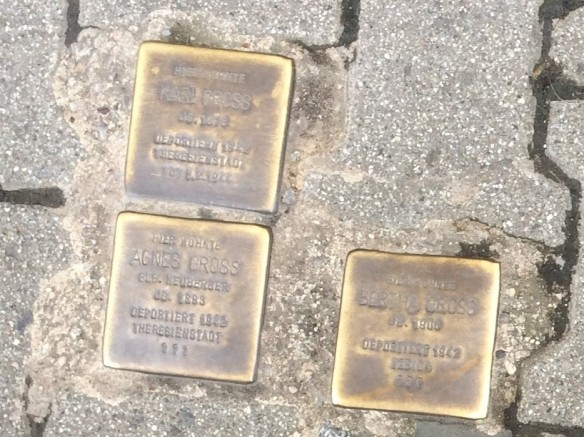
Stolpersteins for Karl Gross and his family

Finally, Beate pointed out to us the location of the former shoe store owned by the family of Joseph Wiener.  Joseph Wiener married my cousin Anna Winter, daughter of Samuel Oskar Wiener and Rosina Laura Seligmann.  Rosina was the daughter of Hyronimus Seligmann, brother of my great-great-grandfather Bernard Seligman.  Rosina was thus also the sister of Johanna Seligmann Bielefeld, whose house in Mainz I’d seen the day before.  Rosina and her husband were both murdered in the Holocaust; their only son had been killed serving Germany in World War I.  Anna and Joseph survived and immigrated to the US in 1938.  Their daughters, Doris and Lotte, wrote the moving memoirs I was honored to excerpt on my blog here, here, here, and here.

Thus, as we left the downtown area of Bingen to drive to the Jewish cemetery up the steep hill from the town, I had the thoughts of all these cousins in my head. The people behind the names and stories I’d researched and studied suddenly felt very close and very real. Seeing some of the additional names in the cemetery made me appreciate how deeply connected my Seligmann relatives had been to the Bingen community.

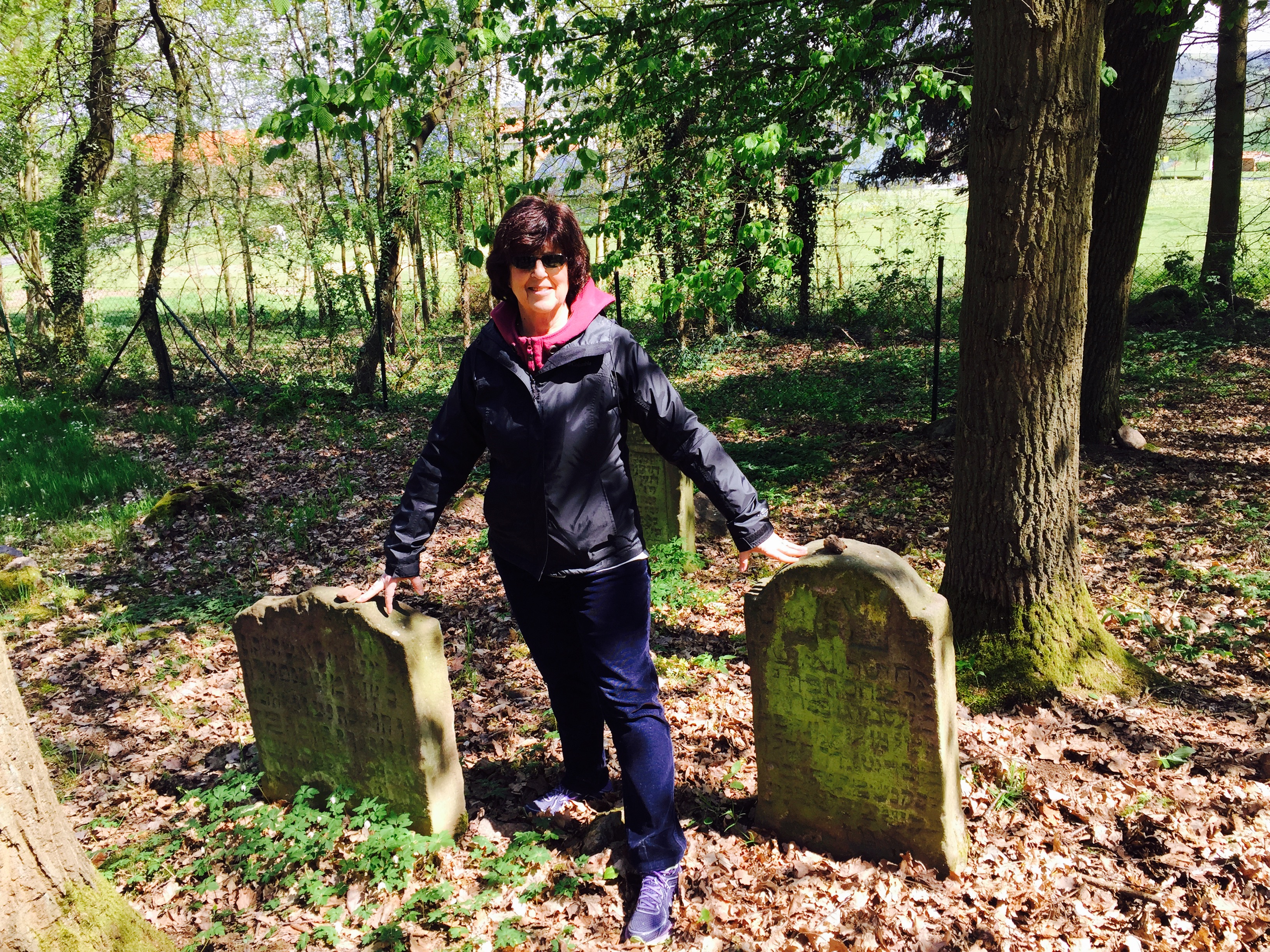
The cemetery is a large and peaceful place.  There are about a thousand headstones there in a beautiful wooded area overlooking the valley below.  It was overwhelming. I took many photographs, and I hope to be able to get some of them translated.  Here are just a few of the stones we saw for my Seligmann relatives.

Marx Mayer, husband of Mathilde Gross, granddaughter of Jacob Seligmann and Martha Mayer, my 4x-great-grandparents:

Marx Mayer

Ferdinand Seligmann and Lambert Seligmann: brothers of Bertha Seligmann. My first cousins, four times removed.

Graves of Ferdinand Seligmann and his brother Lambert Seligmann

Hermann Seligmann, brother of Ferdinand, Lambert, and Bertha.

Headstone of Hermann Seligmann

Ludwig or Louis Seligmann, son of Isaak Seligmann and another grandson of Jacob Seligmann and Martha Mayer.  Another first cousin, four times removed.

Louis Seligmann

Wife of Louis Seligmann, Auguste Gumbel
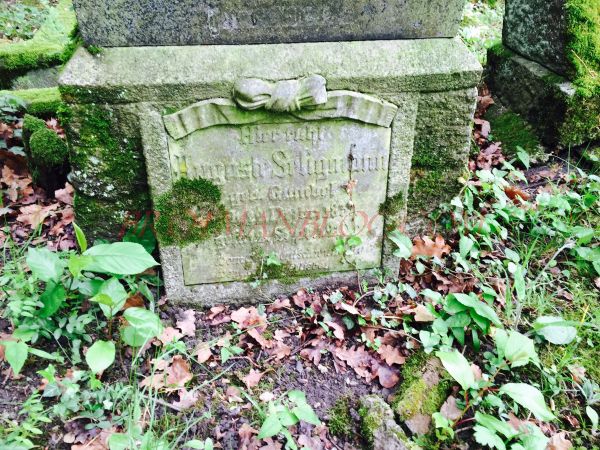
Auguste Seligmann geb. Gumbel

Emilie Seligmann Lorch. daughter of Benjamin Seligmann and Martha Seligmann (who were first cousins).  Martha Seligmann was the sister of Moritz Seligmann, my 3x-great-grandfather. She was my 4x great-aunt.

Emilie Seligmann Lorch

There were probably many, many more of my Seligmann cousins buried in Bingen’s Jewish cemetery, but many stones were impossible to read, and the sheer volume of stones made it overwhelming to think about searching for more.  I took some additional photographs of stones that would need translating from Hebrew, but I had to accept that there was no way to find and photograph every headstone in the cemetery in the limited time we had.

By the end of our afternoon in Bingen, it was clear to me that this city had been at one time the place where most of my Seligmann relatives and ancestors had lived.  Although I had not found the gravesites or homes of any of my direct ancestors, I knew that many of my cousins had lived and died in Bingen, sadly some at the hands of the Nazis.  Bingen was the home of the earliest Seligmann ancestors I’ve found, Jacob and Martha (Mayer) Seligmann back in late 18th century, and there were Seligmann descendants still living there in the 20th century.

We would return to Bingen the following evening for dinner, but first on the following day we were to visit Gau-Algesheim, where my great-great-grandfather Bernard was born and lived until he came to America in the1840s.

First Stop on Our Trip to Germany: Mainz

We spent our first day and a half in Germany in the beautiful and ancient city of Mainz, a city with a population of about 200,000 people and a city that was once an important center for Jewish learning and culture. Our visit there created some cognitive dissonance for me as we experienced such incredible beauty and also memories of such horrific ugliness.

We flew into Frankfurt Airport on May 2 and found the train to Mainz.  Once on the train, we were not entirely sure that we’d gotten on the right train.  Despite a full year of learning German online, I could not make out one word of the train announcements.  Fortunately, a very kind man sitting across from us realized we were confused and reassured us that we were on the right train and that he would tell us when to get off.  From the start, we were favorably impressed with the people in Germany.

Our hotel, the Mainz Hilton, was right on the Rhine; it is a large American-style hotel with large rooms and all the amenities.

The Rhine

We were exhausted after the overnight flight and took a short rest before meeting Wolfgang at 1:30.  And the adrenaline kept us going. I had so anticipated meeting my cousin Wolfgang.  We had been emailing each other for over two years on a regular basis, at first mostly about family history, but as time went on more often exchanging current information—about our families, our lives, politics, German and English, and life in general.  Meeting him in person for the first time, I felt as if I must have already met him and spent time with him. The connection was immediate, and he was just as I imagined based on his emails.  A warm and open person, sensitive and kind, intelligent and perceptive.  And with a delightful sense of humor.

My cousin Wolfgang and me

Wolfgang had planned a walk through the sights closest to our hotel and then a tram tour around the city to see some of the sites that were further out. We strolled along the Rhine for a bit.  The weather was rainy and quite cool, but it did not put a damper on my spirits. We passed a sculpture reflecting the division of Germany after World War II and its reunification in 1990.

We walked past a 15th century watch tower known as the Holzturm (“wooden tower); it was destroyed by bombing in World War II but reconstructed and restored to its original appearance.

Then Wolfgang showed us the house where Johanna Seligmann and Alfred Bielefeld had lived.  Johanna was my first cousin, three times removed.  She was the daughter of Hyronimus Seligmann, brother of my great-great-grandfather Bernard Seligman.  Alfred, her husband, was a wine merchant in Mainz.  Both were killed in the Holocaust.  They were deported to Terezin first, where Alfred died in 1945; Johanna was then sent to Auschwitz, where she was killed in 1945.  Their children, Hans and Lily, survived and lived in the United States.  I wrote about Johanna and her family here and here.

Johanna Bielefeld nee Seligmann

Bielelfed house in Mainz

Just around the corner from where the Bielefelds lived was the so-called “Jew House” where the Nazis moved Jewish families before deporting them.  Although the house itself no longer exists, this is where it was located:

We then visited a beautiful 18th century church, St. Augustine, with an elaborately decorated interior:

St Augustine church in Mainz

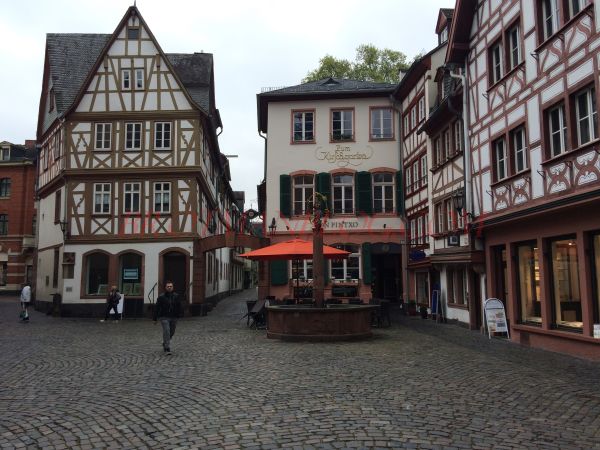
Perhaps my favorite spot in Mainz was the Kirschgarten—a small square framed by several half-timber houses, some now restaurants.  This little square captured exactly what I expected an old German city or town to look like—something out of Hansel and Gretel or some other fairy tale. The oldest house in Mainz is located in the Kirschgarten:

Kirschgarten in Mainz

Everywhere we turned there were beautiful half-timber buildings, sometimes right next to a post-war building.

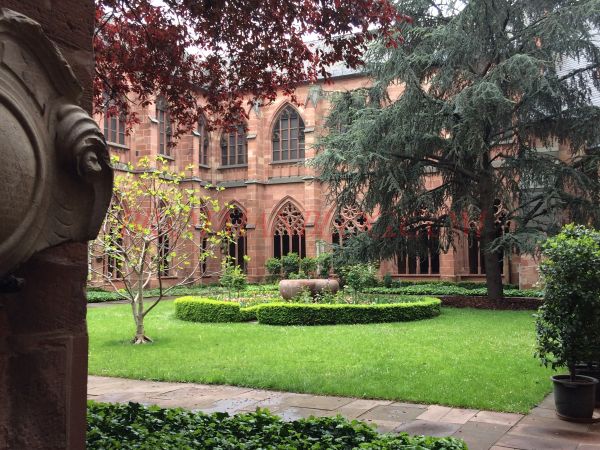
We then visited the Dom, or cathedral, a large Romanesque sandstone structure located on the main market square in Mainz. The cathedral’s oldest sections are a thousand years old with later additions over the years.  It was damaged by bombing in World War II, but restored afterwards.  The cloister is a peaceful place for contemplation, and the high vaulted ceiling in the main part of the cathedral forces you to look upwards.  It is an impressive and inspiring building.

Mainz Marktplatz

Cloister at the cathedral in Mainz

At this point we caught the little tram that took us on a tour around other parts of the city, passing the Rathaus (town hall), the Schloss (a palace more than a castle), the new synagogue, and the building where the Gestapo was housed during World War II. I couldn’t get any photos of these sites as we were moving too fast, but I was glad to be seated and not walking at that point. I asked Wolfgang if we could come back the next day to see the synagogue.

As I wrote here, our first stop on Wednesday was our visit with Wolfgang’s mother Annlis, a time I will never forget.

Then we continued our tour of Mainz.  We passed the location where Fritz/Fred Michel once owned a store.  Fred Michel was the son of Franzeska Seligmann and the grandson of August Seligmann, Wolfgang’s great-grandfather and another brother of my great-great-grandfather Bernard. Fred and his wife Ilse came to the US in the 1930s and settled in Scranton, Pennsylvania.  I wrote about Fred, his mother, and his family here.

Fred Michel and Franziska Seligmann Michel
Courtesy of the Family of Fred and Ilse Michel

Location of Fred Michel’s store in Mainz

We then walked up the steep hill to St. Stephen’s church, where there are a number of windows designed by Marc Chagall.  The contrast between the thousand year old medieval structure and the gorgeous blue Chagall windows is striking. Like so many other buildings in Mainz, this church was damaged by bombing during World War II.  According to Wikipedia, the priest at St. Stephens, Monsignor Klaus Mayer, was a friend of Marc Chagall and approached him in the 1970s to design new windows. This is the only church in Germany for which Chagall designed windows, and he saw it as a way of expressing his hope for peace between Christians and Jews.  To see the work of a Jewish artist and his depictions of figures from the Jewish bible inside a medieval Catholic church was very moving.

St Stephen’s church in Mainz with Chagall windows

We then walked back to the hotel to pick up our luggage and Wolfgang drove us to see the new synagogue.  I knew before coming that Mainz had a long and very important history as a Jewish community. According to several sources, Mainz had a Jewish community at least as early as the tenth century. Rabbi Gershom ben Judah, known as “the light of the diaspora,” was an early important leader of the Mainz Jewish community, and his codification of Jewish law was accepted in many other communities in Europe as well.

The Jews, however, were expelled from the city in the eleventh century; they returned later, but then a thousand were killed during the first Crusade during the twelfth century.  Later, many died from the Black Death and from persecution. For several centuries there was not much of a Jewish community in Mainz. The community began to grow again in the 18th and 19th centuries. Synagogues were constructed, and Jews for some time lived in peace in the community. By 1900, there were 3000 Jews living in Mainz, according to JewishGen.org

On November 9, 1938, the Mainz synagogues were attacked as part of Kristallnacht and burnt and in some cases destroyed; there were over 200 synagogues at that time in Mainz, including the largest synagogue, Neue Synagogue, which was completely destroyed. Most of the Jews who remained in Mainz, including my Bielefeld cousins, were eventually deported and killed.

But today there is hope.  A new synagogue was built on the site of the former Neue Synagogue in 2010, and it is an imposing structure.  As this article describes, it was consider a symbol of hope for the revival of Jewish life in Germany. Outside the synagogue stand pillars from the original synagogue, a permanent reminder of what had existed and what was destroyed. The city now has about a thousand Jews who are affiliated with the synagogue as well as many others who are not.

The website of Manuel Herz, the architect who designed the new synagogue, provides a great deal of information about the history and about the reasons for the choices made in naming and designing this new building.  The synagogue is called Meor Hagolah, which means “Light of the Diaspora,” the name used to refer to Gershom ben Judah because of his wisdom and his broad-reaching influence on the practice of Judaism. The Hebrew words on the door to the synagogue are translated as “Light of the Diaspora Synagogue Mainz.”

Meor Hagodah Synagogue Mainz

The building’s shape is supposed to evoke the Hebrew word Kedushah, meaning holiness and referring to one of the sections of the Amidah prayer. I must admit I could not see the letters no matter where I stood outside the building, but I like the concept. The building overall is quite imposing and, in my opinion, not very welcoming.  It looks more like a fortress than a house of prayer.  Maybe that is in part the point: that this is a safe place that will not be destroyed again.

We stopped at the historic Mainz cemetery on our way out of town.  I have no known family members there, and we could not go inside, but the age and number of the gravestones there are another reminder that there was once a large and important Jewish community there.

Mainz Jewish cemetery

Mainz is truly a beautiful city, and despite all the damage inflicted during the war, it retains its charm, its character, and its architectural beauty. It is hard to imagine, amidst all that beauty and all those churches, how the Jewish community that lived there so long could have been destroyed.  But it is also important to look forward. I left the city feeling hopeful, knowing that a new synagogue and a growing new Jewish community exist in the city of Mainz.


Why Germany?

Before we left for Germany, we received many strange reactions when we would tell people we were traveling to Germany.  Some people were quite blunt: how could we visit that country after what they did to the Jews in the Holocaust? Others were more subtle and just shrugged and said, “Why would you go there?” Others simply looked bemused.  Some people said, “Just Germany?” I know if we were going to Italy or England, no one would have reacted that way.  Germany just did not seem to be an appealing destination to many of the people we know.

Even when I explained that I was going to see the places where my father’s ancestors had lived and meeting cousins who live in Germany, people reacted strangely. So now that we are back, I can better explain why we went to Germany and why other people might want to go there as well. I will write about the specific experiences we had in the various places we visited in later posts, but first I want to put the trip in perspective and give some overall thoughts about what we saw and what we learned.

First, Germany is a beautiful country with so much to see and experience.  The Rhine River and the rolling hills and wide open green spaces are a delight.

On the Rhine from Bingen to Koblenz

Some of the cities and towns we saw are as charming, interesting, and historically and culturally rich as any we have seen in other places.  In particular, Mainz, Wurzburg, and Heidelberg are beautiful with storybook churches, elegant palaces, and inviting and exciting markets and squares.  The houses range from half-timber fairy tale houses to rococo-decorated merchant homes.

Mainz

In the smaller villages and towns, you get a feeling for how life has been lived in such places for centuries.  They are not like the small town where I now live.  There are clusters of houses around a central square with a church and town hall anchoring that common space.   Surrounding these clusters of homes and buildings are miles and miles of open land.

Countryside near Sielen

Second, people need to see and understand the damage that war can do. The places destroyed by the Nazis—especially the synagogues and cemeteries—are terribly heartbreaking to see, and there are constant reminders of the Jews who were deported and killed by the Nazis. You cannot go any place in Germany without being reminded that there were once Jews there and that they were persecuted and murdered.

Stolpersteine in Bingen

And some of the places we visited—Cologne, Kassel, and Bingen, in particular—were devastated by Allied bombing during the war.  They’ve been rebuilt, but quite often the new architecture is bland and boring. Often people would comment on how beautiful a city had been before the bombing. The Germans live with daily reminders of what their country did during the Third Reich and also what the war cost them.

A street in Cologne showing a Roman arch at the end of a post war street.

I can’t say that as an American Jew, I felt any guilt about the damage my country did to Germany in order to stop the Nazis.  But I also never once heard any of the many Germans we spoke to express resentment or hostility towards the Allies for the harm done to their country.  They seem to understand and accept that the Allied attacks were a necessary response to the aggression and genocide committed by the Nazis. Nevertheless, as the world continues to use violence and destruction as a means of settling disputes, we all should understand the consequences of war—not only in terms of loss of life, but also in terms of loss of culture, history, art, and architecture.

Which brings me to the third important lesson we learned while in Germany.  There are many non-Jewish Germans who are working with a true passion and commitment to preserve and restore the history of the Jewish communities that were wiped out during the Holocaust.  These people by and large are volunteers—good and dedicated people who were born either during or after the war and who are horrified by what the Nazis did.  We spent a great deal of time with six of these people in a number of different towns where my ancestors once lived.

Just a few of the good people we met in Germany (and my husband Harvey)

We asked all of them why they are doing this work.  Their answers varied; one said it was because she’d had a Jewish teacher as a child with whom she’d been very close; another said that it was discovering a former synagogue that had been desecrated; another mentioned that it was learning what had happened to the Jews in his small town that had motivated him to learn more.  They are all warm, thoughtful, and kind people. They became friends.  One man, with tears in his eyes, spoke about his gratitude to the US for the aid it provided to German citizens after World War II.  These people spent many hours with us and did not charge us one cent.  They just wanted to help.  They want Jews to know about the work they are doing; they want us to come and visit and reclaim our history.  They want to help us reclaim that history, and they want us to help them preserve it.

And that’s what I did in Germany.  I stood where my ancestors once stood.  I staked my claim as a person whose family once lived and thrived in the towns of Germany, as a person who is also a part of the history of that place.  I wanted to make a visible statement that Hitler did not win because Jews still exist; we survived, and we are as entitled as anyone to walk the streets of Germany.  By going to Germany and talking to those who live there, I was able to let them know that we have not forgotten what happened during the Third Reich, but we also have not forfeited our claim to our history in those places.

Standing at the graves of my 3x-great-grandparents, Scholum Katzenstein and Breine Blumenfeld in Haarhausen cemetery

I understand that not everyone will feel as I do. And it’s not my intention to change anyone’s mind.  I just want to explain my feelings to those who have asked and will continue to ask me with that skeptical look, “Why would you go to Germany?” Because we can.  Because the Nazis did not win.  Because we have every right to claim our rich heritage and our long history in that country. And because many people who live there want us to do just that.

The Rest of the Trip: Thoughts on My Country

This post was originally written before the horrific event in Orlando, Florida, last weekend.  I’ve rewritten it in part as I reflect on what is happening in the US these days and how the opportunity to see another part of the country affected my views.

The Road to Taos, Taos, and the Road Back to Denver

Because we had taken the “low road” or “river road” from Taos south to Santa Fe when we arrived, we decided to take the “high road” back to Taos when we left Santa Fe.  Although some commenters on TripAdvisor had made it seem as if this was going to be a very scary ride, it wasn’t at all.  It was, however, incredibly scenic.

20160529_155217874_iOS 20160529_155224179_iOS


We stopped at the Santuario de Chimayo on our way.  It is an important Catholic pilgrimage site and a pretty adobe church on lovely grounds.  I was particularly taken by this painting, which reminded me of Da Vinci’s Last Supper; the people surrounding Jesus are quite obviously Native American and Spanish in their ethnicity.

20160529_155639759_iOS 20160529_155900091_iOS 20160529_160352596_iOS

We continued north, and the scenery just got better and better.

20160529_162335775_iOS 20160529_162400407_iOS 20160529_162405596_iOS 20160529_164016050_iOS 20160529_171800829_iOS 20160529_171803732_iOS 20160529_171856537_iOS 20160529_171901440_iOS

Finally, we arrived in Taos.  As you can see, there was some kind of motorcycle event going on that weekend, and everywhere we turned, we saw and heard motorcycles.

20160529_192103172_iOS 20160529_195841501_iOS 20160529_200641449_iOS 20160529_200649572_iOS 20160529_200758531_iOS


Taos is actually quite a small town, and we realized pretty quickly that we had seen a good part of the town when we’d stopped to stretch our legs on our way south to Santa Fe four days before.  In fact, Taos seems like a down-sized version of Santa Fe.  There is a plaza and even a hotel called La Fonda on the plaza.  There is an old street called Ledoux Street that has some galleries and historic homes, like a much smaller version of Canyon Road in Santa Fe.

20160529_201206084_iOS 20160529_201314077_iOS 20160529_201405292_iOS


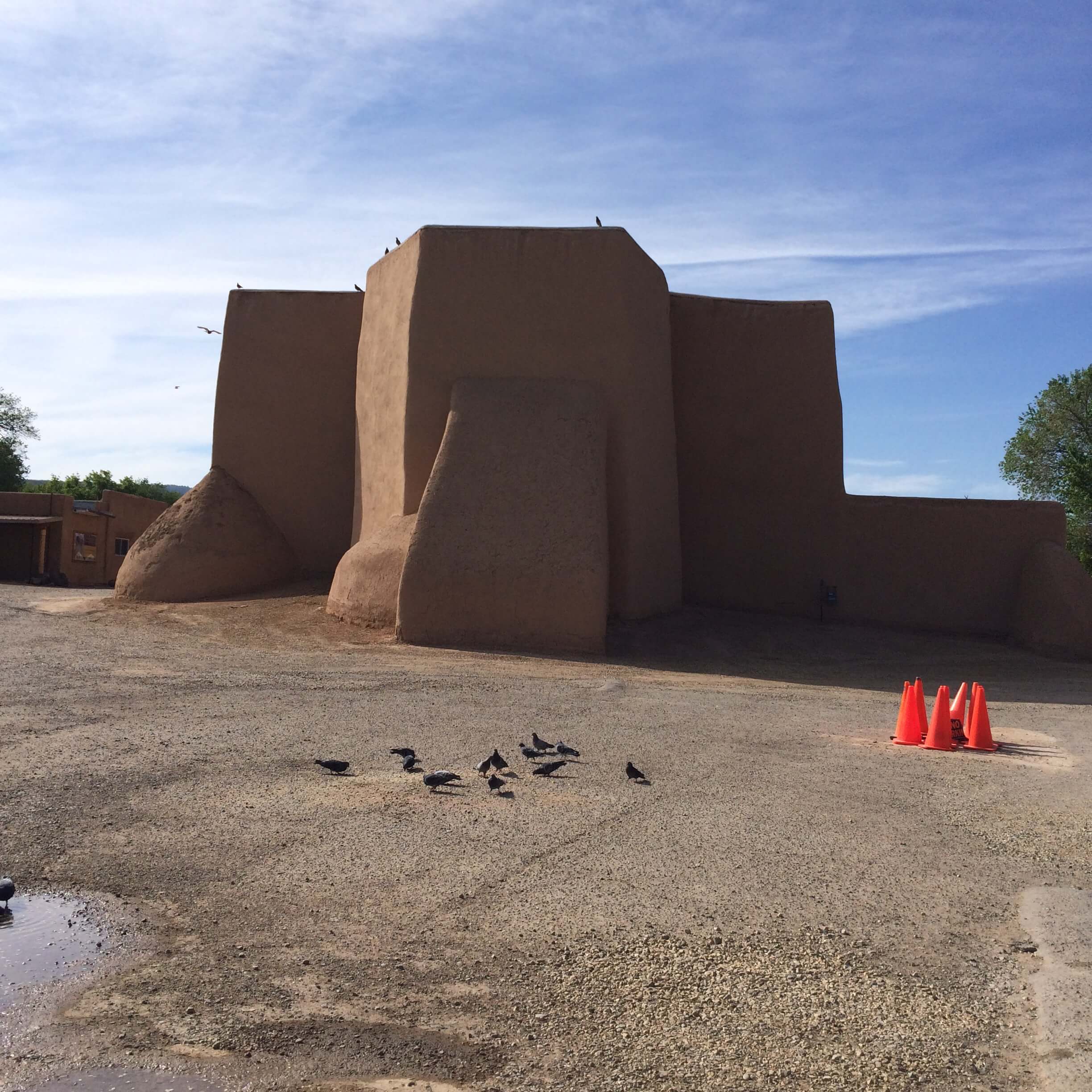
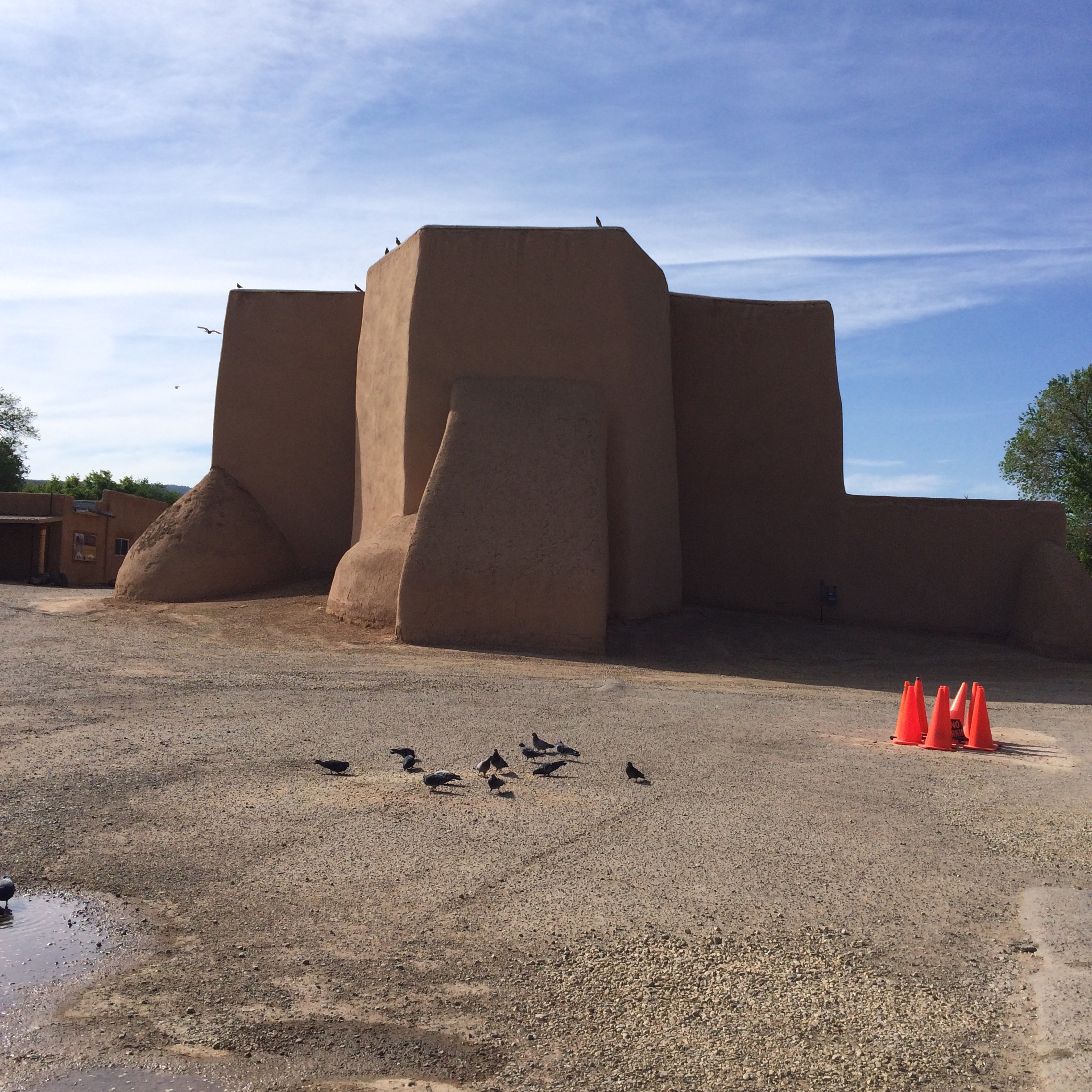
On the outskirts of Taos, a few miles south of the town, there is a church named for St. Francis, just as in Santa Fe.  This one, however, is an adobe church, and it has been painted by Georgia O’Keefe and photographed by Ansel Adams.  You can see why even in my photographs.  The way the light hits the various planes of the church’s exterior gives it a sculptural feel that goes beyond its architectural and religious aspects.

20160530_151004562_iOS

20160530_150420390_iOS 20160530_150519660_iOS 20160530_150611622_iOS 20160530_150756429_iOS 20160530_151039002_iOS

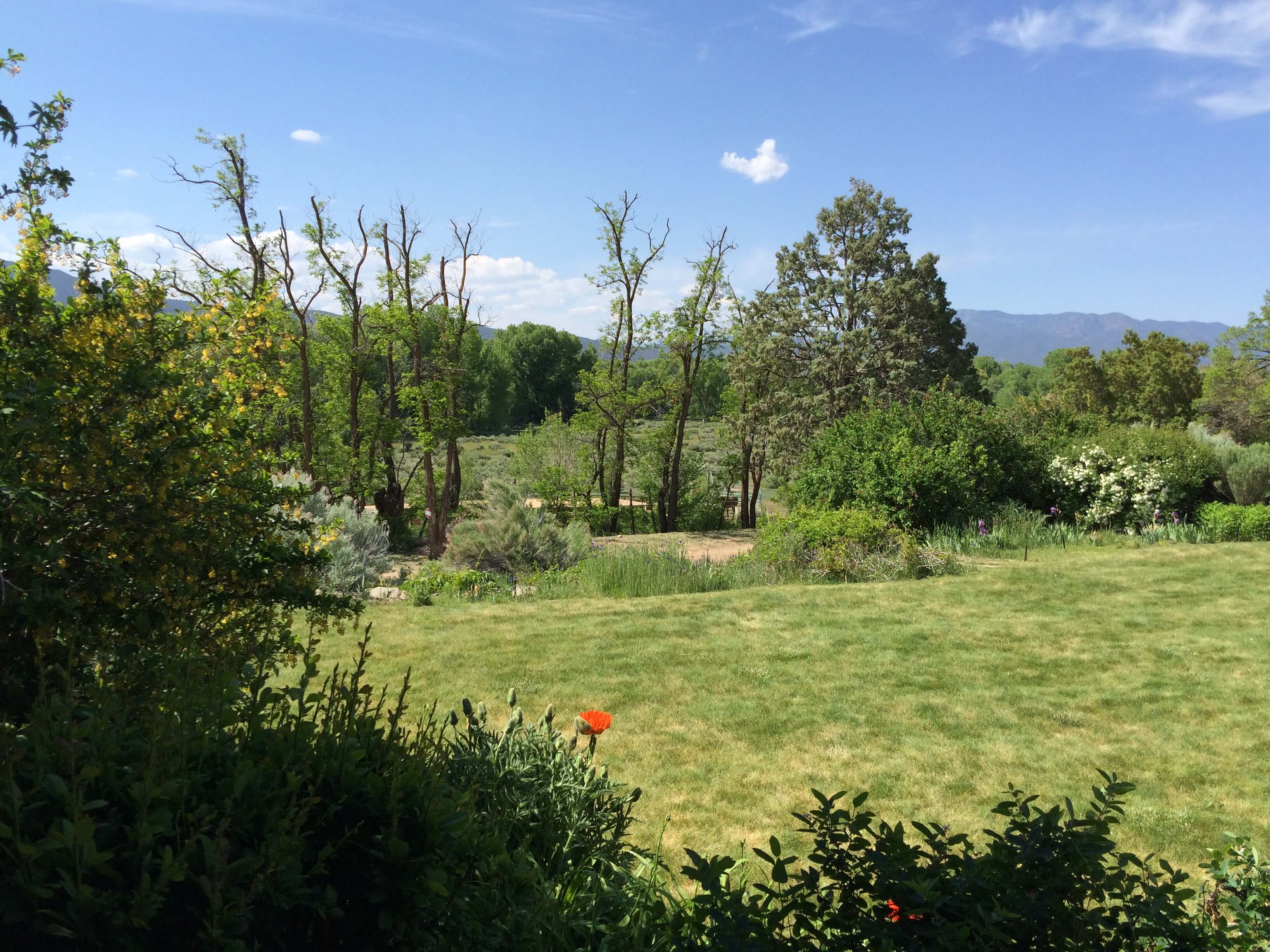
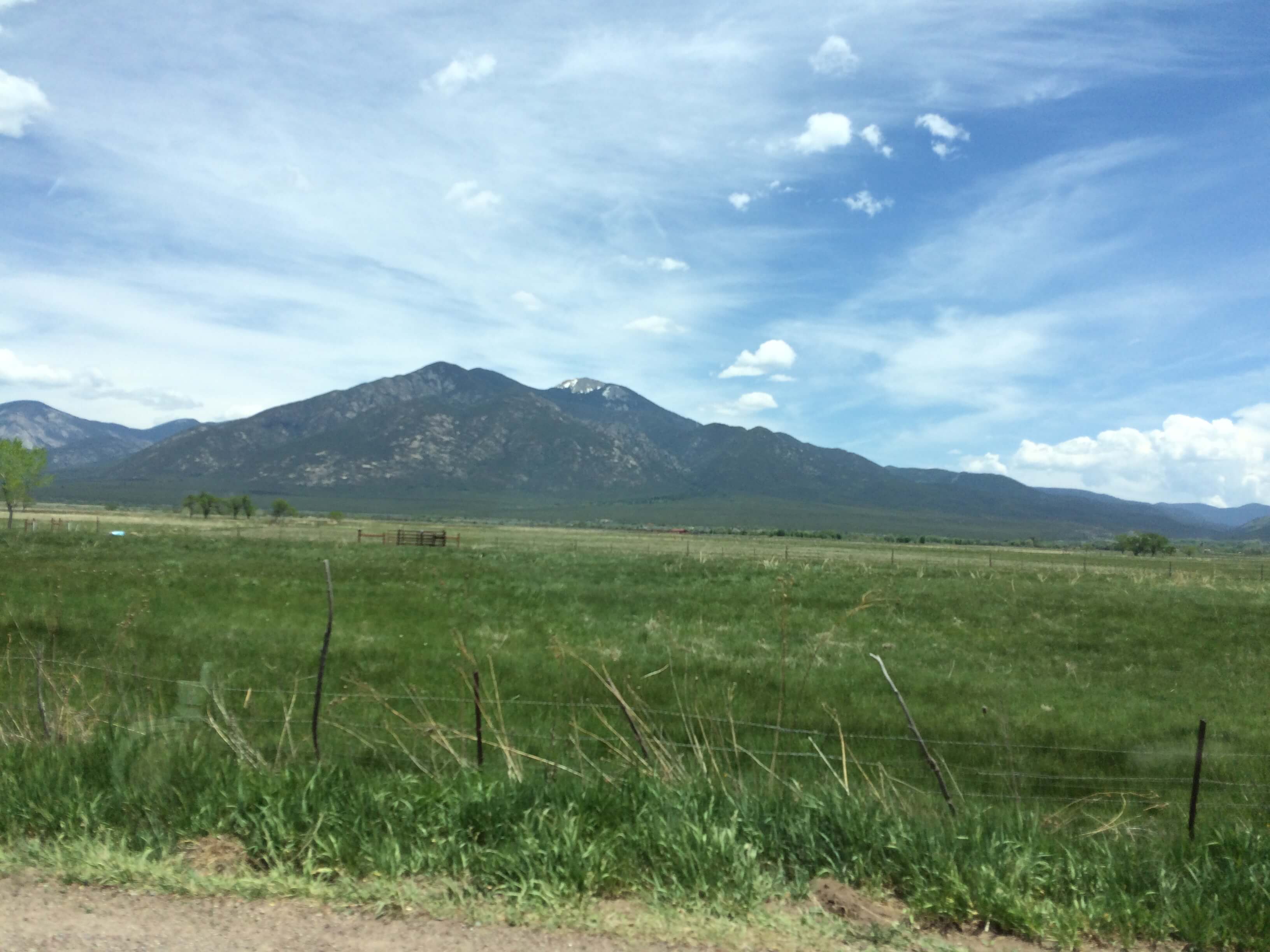
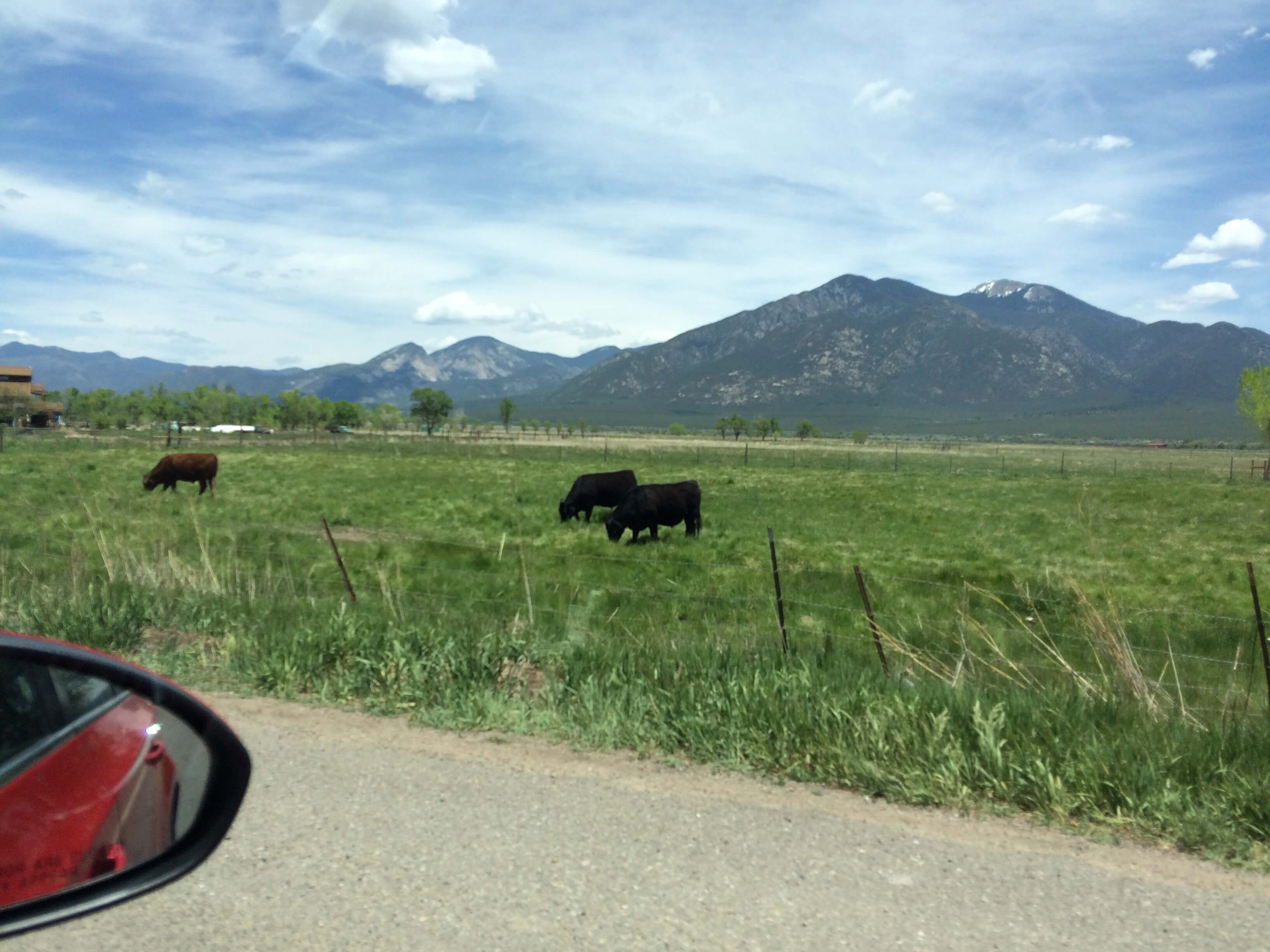
The scenery around Taos also makes you stop and appreciate where you are:

20160530_155656274_iOS 20160530_160844320_iOS 20160530_161007594_iOS 20160530_161017502_iOS 20160530_161029211_iOS

Despite its small size, Taos has four museums that we found well worth visiting.  Two reflected the importance of Taos as an art center.  First, on Ledoux Street, we visited what was once the home of the artist Ernest Blumenschein[1] and is now a museum of his works and those of his wife Mary Shepherd Greene Blumenschein and his daughter Helen Greene Blumenschein. Ernest Blumenschein was one of the founders of the Taos Society of Artists in 1915 and is considered one of those who drew other artists to Taos, making it an important art center.  Blumenschein himself was considered one of the leading artists in the Taos art community.

English: Ernest and Mary Blumenschein, New Yor...

English: Ernest and Mary Blumenschein, New York, 1910. (Photo credit: Wikipedia)

I’d never heard of any of the Blumenscheins before, and although their art was worth seeing, what was more interesting to me was the house itself.  It was created from what had once been a fortress surrounding the town made up of interconnecting rooms.  Over time the Blumenscheins acquired a fair number of these rooms for their home.   The rooms are all connected end to end (with a few exceptions), and it was interesting to see how the family had decorated them and turned what had been a fort into a home.

20160529_201442719_iOS

The second museum we visited was also on Ledoux Street, the Harwood Museum of Art, where we saw a really fascinating exhibit about Mabel Dodge Luhan, another person whose name was unfamiliar to me, but whose life was quite remarkable.   As described on the brochure for the exhibit, Mable Dodge Luhan (1879-1962) “brought modern art to Taos, New Mexico, putting it on the national and international maps of the avant-garde and creating a ‘Paris West’ in the American Southwest.”  Among those whom she invited to Taos were Georgia O’Keefe, D.H. Lawrence, Edward Weston, Martha Graham, and Ansel Adams.


Carl Van Vechten, Portrait of Mabel Dodge Luha...

Carl Van Vechten, Portrait of Mabel Dodge Luhan (1879-1962), 1934 (Photo credit: Wikipedia)

Mabel was born in Buffalo, New York, and lived in Paris, where she met her first husband, Edward Dodge, and then in Florence, where she and her husband established a salon attended by Gertrude Stein and many other artists and writers of the early 20th century.   When she and her husband returned to New York City, they established another salon and became instrumental in introducing modern art to the United States in the 1910s.  Mabel left her first husband for John Reed (subject of the movie Reds) in 1913, and in 1915 she established the Elizabeth Duncan [sister of Isadora] School of Dance in Croton-on-Hudson, New York (where 50 years later I would go to a music and arts camp).

English: John Reed, American journalist and ra...

English: John Reed, American journalist and radical political activist, c. 1917. Portrait published in USA prior to 1923, public domain. (Photo credit: Wikipedia)

Mabel then met her second husband, Maurice Sterne, and spent the summer of 1915 with him in Provincetown (a town I know well, having visited there every year since I was ten years old).  She and Sterne married in 1917 in Peekskill, New York (where my husband and I were married just about 60 years later and almost 40 years ago).  Shortly after, Mabel and Maurice moved to Taos, where she lived for most of the rest of her life.  She married her third husband, Tony Luhan, in 1923, and that relationship seemed to endure for the remainder of her life.  She died in 1962 and is buried in Taos.

I was tickled by the number of geographic parallels Mabel and I shared (Croton, Provincetown, Peekskill), and the exhibit was very effectively organized to show the impact she had on Taos by displaying works of the artists she drew to Taos and various quotations and other writings by or about Mabel and her role in the Taos art community.

In the other two museums we visited we learned more about the general history and culture of the region.  First, at the Kit Carson Home & Museum, we learned something about the real man behind the myth of Kit Carson (1809-1868).  Although he is best known for his role as a trapper and scout who helped with the exploration of the American West, he was also a family man.  He was married three times, each time to a Native American woman.  His first wife, with whom he had two daughters, died; his second marriage did not last; his third marriage to Josefa in Taos lasted until his death.  With Josefa he had eight children; Josefa died in 1868 giving birth to the eighth, and Kit died just a month later.

Christopher 'Kit' Carson (1809-1868), American...

Christopher ‘Kit’ Carson (1809-1868), American explorer (Photo credit: Wikipedia)

Although Kit Carson is known as someone who fought in many battles against the Indians, he also served as an agent for the Native Americans in the Taos area. However, he is known for leading the relocation of the Navajo people from Arizona to New Mexico at Bosque Redondo.  I found this description of that event and Carson’s role in it quite disturbing:

Although his orders were to capture women and children and kill all men, Carson chose to disregard the orders.  He ultimately gained the submission of the Navajo people by destroying their food sources at Canyon de Chilly.

Escorted by U.S. troops, over 9,500 men, women and children were led on foot to Bosque Redondo, a reservation in New Mexico 400 miles from their homes.  The march was brutal and many Navajo died on The Long Walk.

Realizing the utter failure of the Bosque Redondo reservation, Carson was influential in urging Congress to grant permission to the Navajo peoples to return to their homeland in 1868.  Today there is a memorial to the Navajo people at Bosque Redondo.

[From the guide to the Kit Carson Home & Museum]

20160530_161624617_iOS 20160530_161752548_iOS

Thus, Carson had conflicting roles and relationships with the Native American people. He married three Native American women, but he also fought to take the land from Native American people.  He led a forced relocation of the Navajo people, but then acted as their agent and argued to obtain permission for them to return to their original land.

Finally, we visited the Millicent Rogers Museum.  Millicent Rogers (1902-1953) was another name that I’d not heard before.  Her grandfather Henry Rogers founded Standard Oil with John D. Rockefeller; she herself was an artist and a collector, and she moved to Taos in 1947 in the aftermath of a relationship with Clark Gable.  She designed jewelry, and she supported the artistic careers of many Native American and Hispanic artists.  The museum not only displays her own work, but also (and primarily) the work of those local artists.  I found an exhibit comparing Native American weavings with Hispanic weavings quite interesting as it showed how the two styles influenced each other over time.  An exhibit of baskets revealed how different tribes used different basket making techniques and styles.

Decorated bowl from the ruins of the former Ho...

Decorated bowl from the ruins of the former Hopi village of , circa 1400-1625 AD; now located at the Millicent Rogers museum in Taos, New Mexico (Photo credit: Wikipedia)

The following photos were taken on our way to the Millicent Rogers Museum, as we started our drive north from Taos towards Colorado.

20160530_183637143_iOS 20160530_183640812_iOS 20160530_184106519_iOS 20160530_184157236_iOS


From these four museums, I developed a perspective not only on Taos, but on art, culture, and history.  All four museums focused on how individuals can influence history and culture and effect changes in both: Carson, through his explorations and through his role in the mistreatment of Native American peoples; Blumenschein, Luhan, and Rogers through their efforts to support and encourage the creation of artistic works.  Rogers helped to preserve the local culture of the Native American and Hispanic communities in and near Taos.

I also was struck by the painful disparities that exist in this country: people who have incredible wealth and power or perhaps just one or the other, like Carson, Blumenschein, Lujan, and Rogers, and people who are poverty stricken and powerless.  People who abuse their power and people who use their power for good cause.  People who respect the diversity and cultures of others and people who believe that only they know what is right and good.

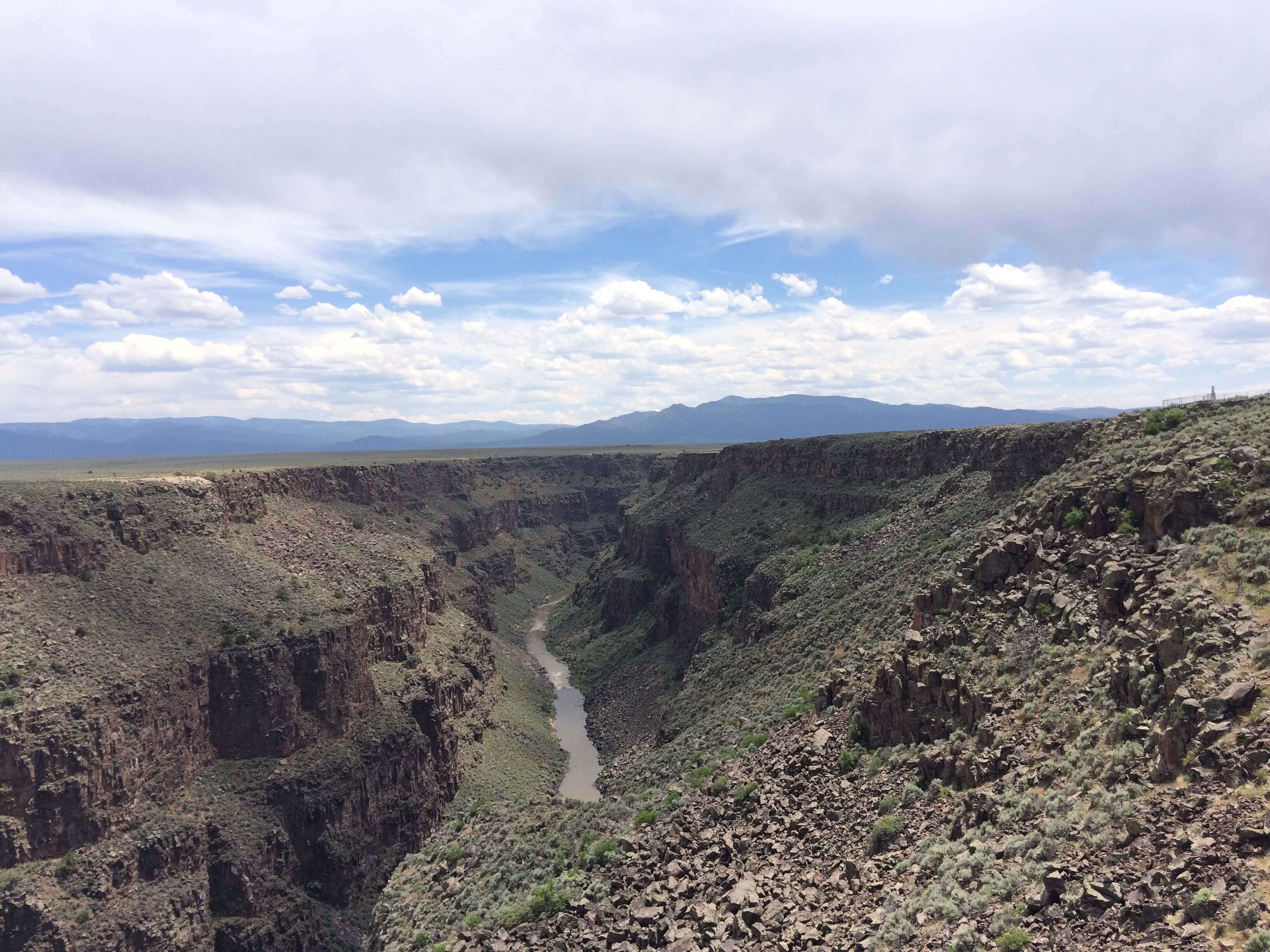
Traveling back from Taos to Denver, we again marveled at the open spaces, the gorgeous vistas, the limitless sky.  The views from the Rio Grande Bridge north of Taos are breathtaking.  Crossing through the mountains east of Fort Garland was incredibly uplifting.

20160530_194224062_iOS 20160530_194308508_iOS 20160530_194418843_iOS 20160530_215505394_iOS 20160530_215508430_iOS 20160530_215535790_iOS 20160530_215722186_iOS 20160530_220330167_iOS

Looking back on this trip and all that we saw, especially in light of what is happening across this country, I am struck by the contrasts and incongruities that riddle our nation. This is such a beautiful country.  Everywhere you look, there are sights to inspire you and make you realize how small we are and how majestic nature is.  Everywhere you go, there are signs that we human beings recognize that beauty, that majesty, especially in the art we are inspired to create and to appreciate.

But there is also much ugliness in us, so much hate and disrespect and intolerance. There is not enough understanding of diversity; there is not enough empathy for those who live in poverty and feel powerless.  There is too much ignorance and prejudice.

In light of this weekend’s hate-filled massacre in Orlando, in light of the electoral process which has produced a candidate who promotes hate and intolerance, in light of the continuing paralysis in our government over issues like gun control and climate control and so many other critical issues, it is hard not to feel hopeless and disgusted and despair about our country.

But then I look back on my photographs and remember all that we saw and felt and learned, and I remember that people can appreciate each other and can be sensitive and tolerant.  People can be filled with awe and inspiration and love and respect.  Yes, we have much to be ashamed of in our history, but we also have much that should give us pride. We have moved forward in many ways. In my own lifetime, I’ve seen much social progress; the civil rights movement, the women’s movement, the LGBT movement, and the environmental movement have all had major impacts on our society, making this a better place for all of us to live.

We can make the right decisions. Yes, too often we have chosen the wrong path. But I want to believe that we can more often do what is right—that we can live in peace, that we can love and respect one another, and that we can appreciate the beauty that surrounds us all, inside and outside.


[1] Blumenschein was born in Pittsburgh in 1874, and his father was a German immigrant.  I wondered whether his family had any Jewish roots or whether he might have crossed paths with my Schoenthal relatives in Pittsburgh, but I’ve found nothing to support either notion.

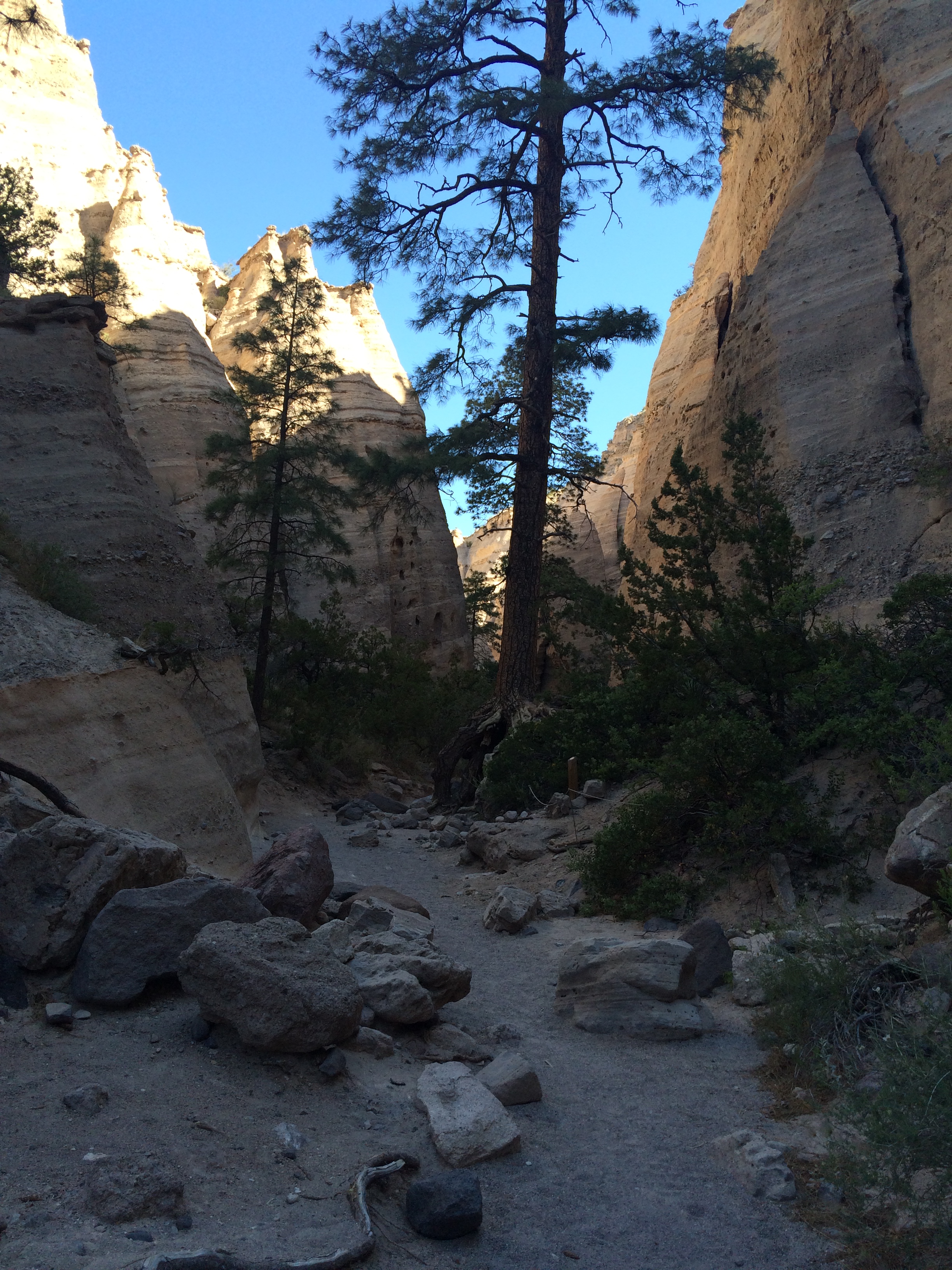
Kasha-Katuwe Tent Rocks National Monument

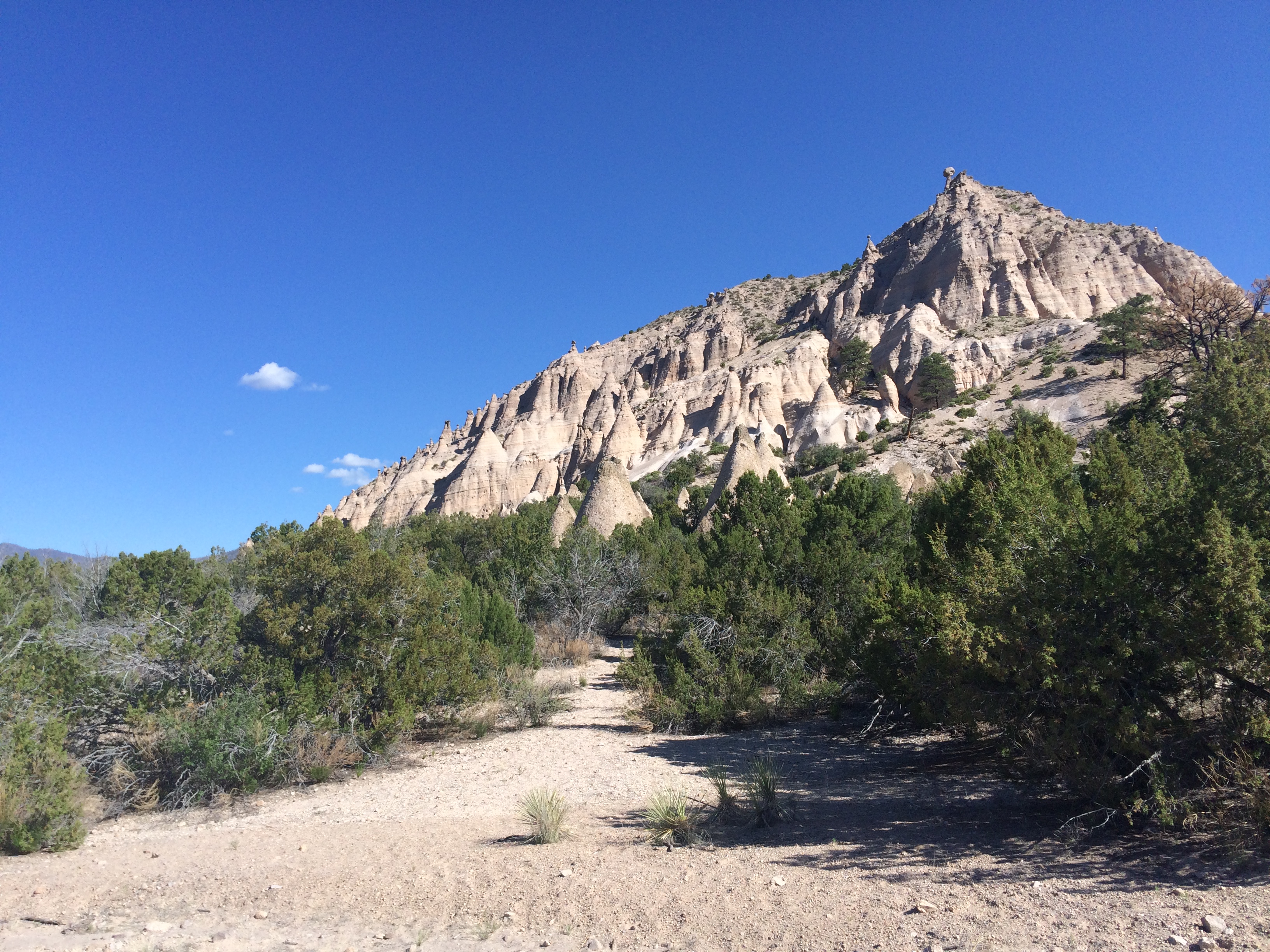
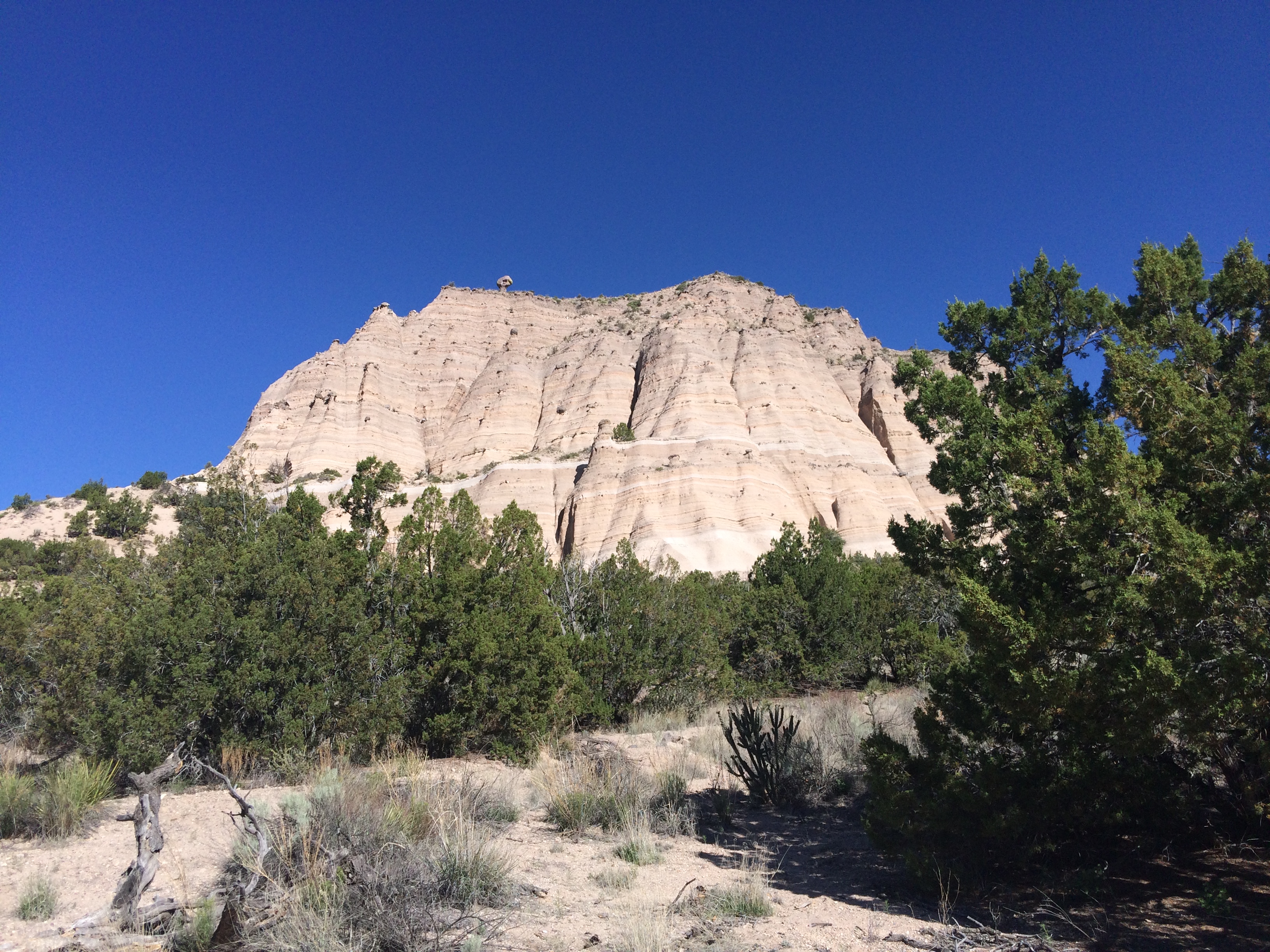
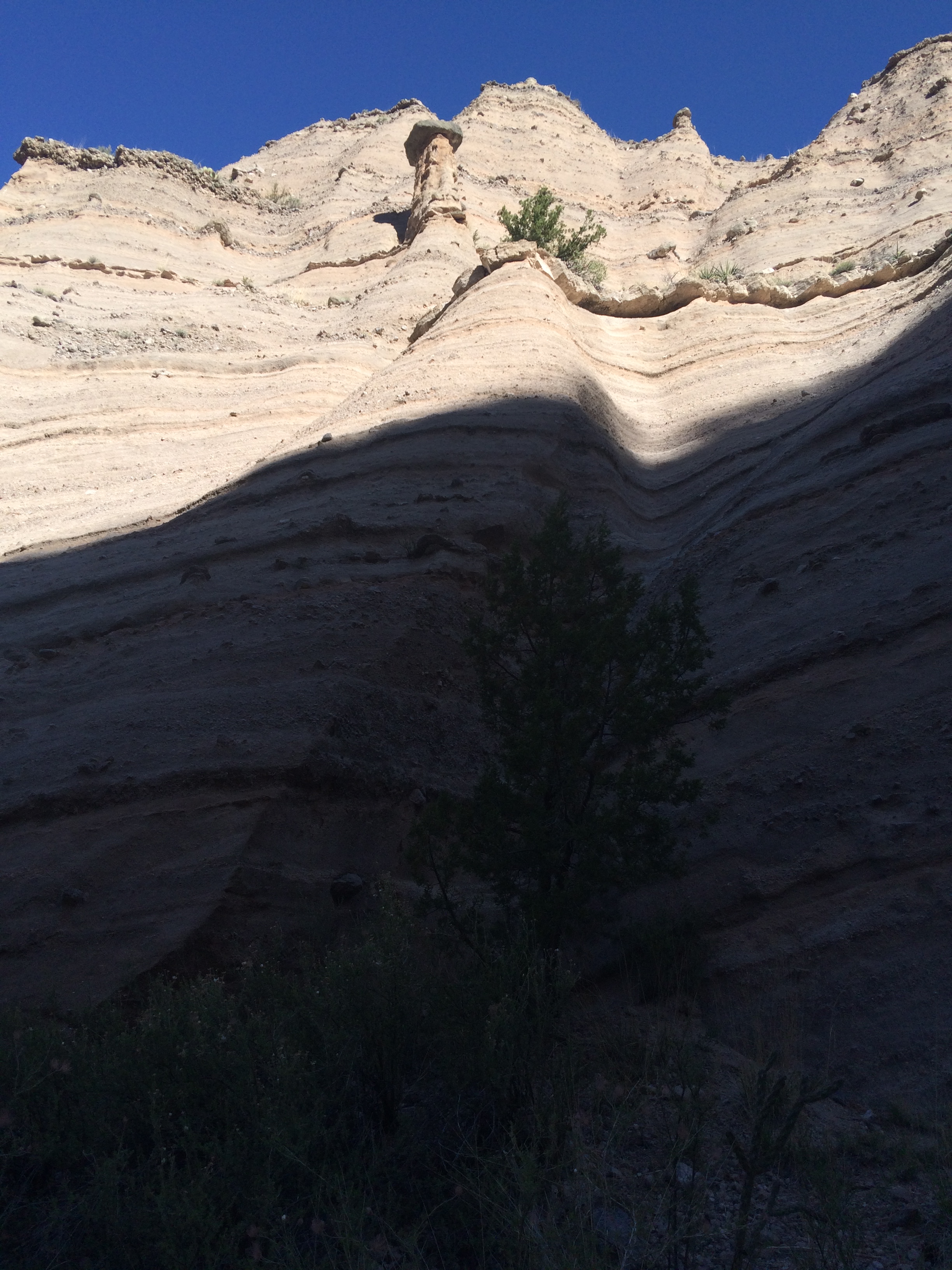
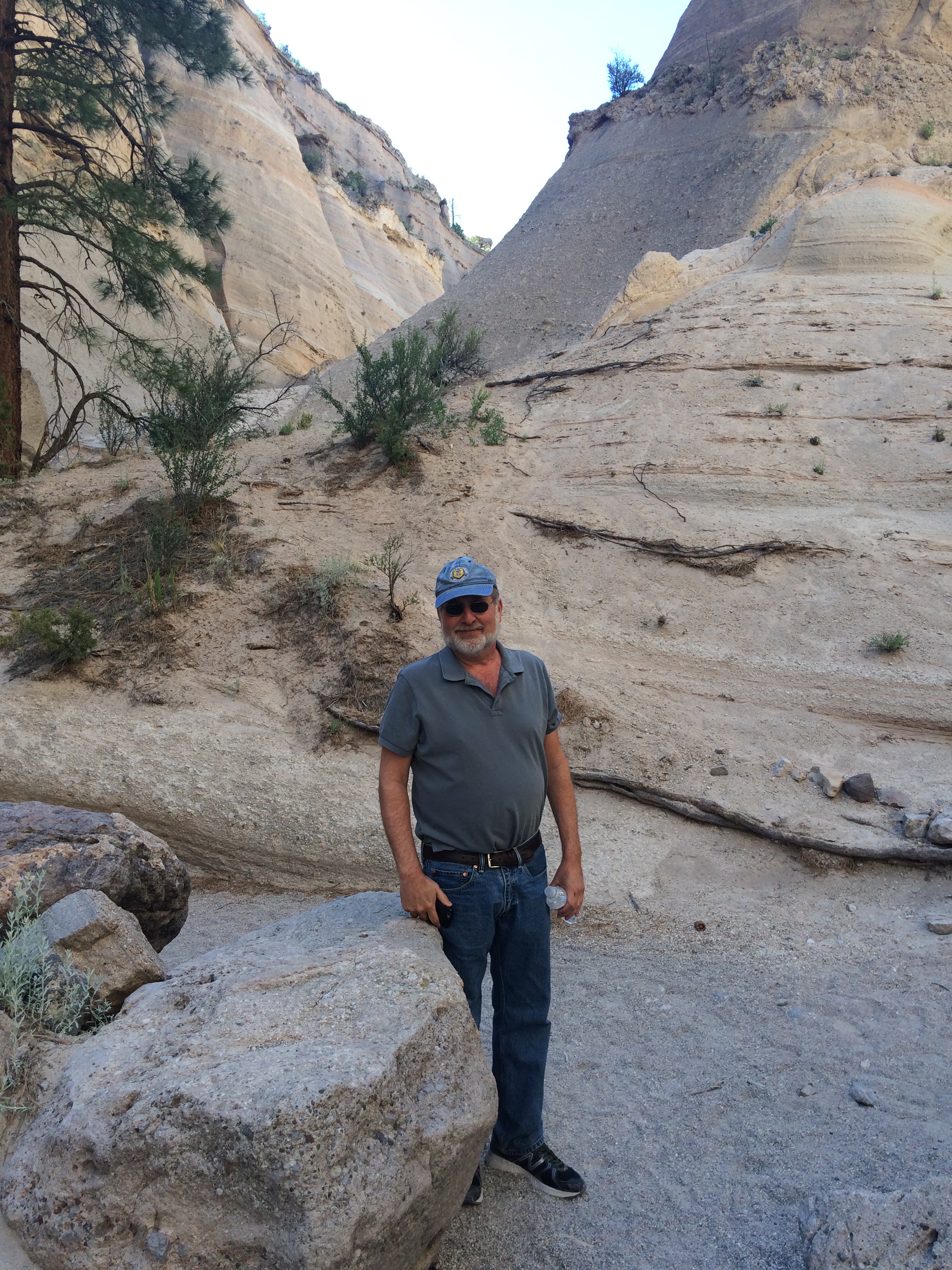
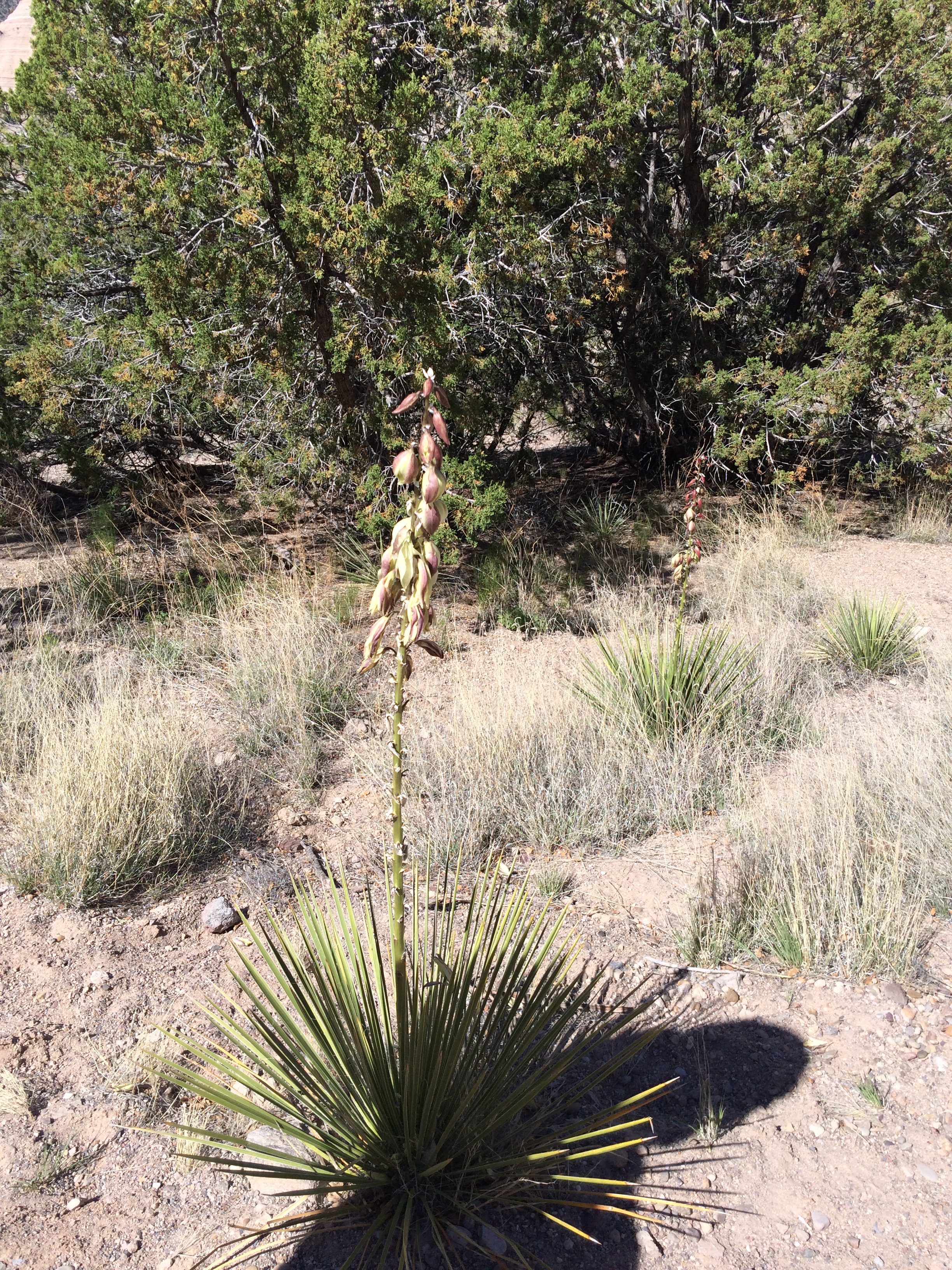
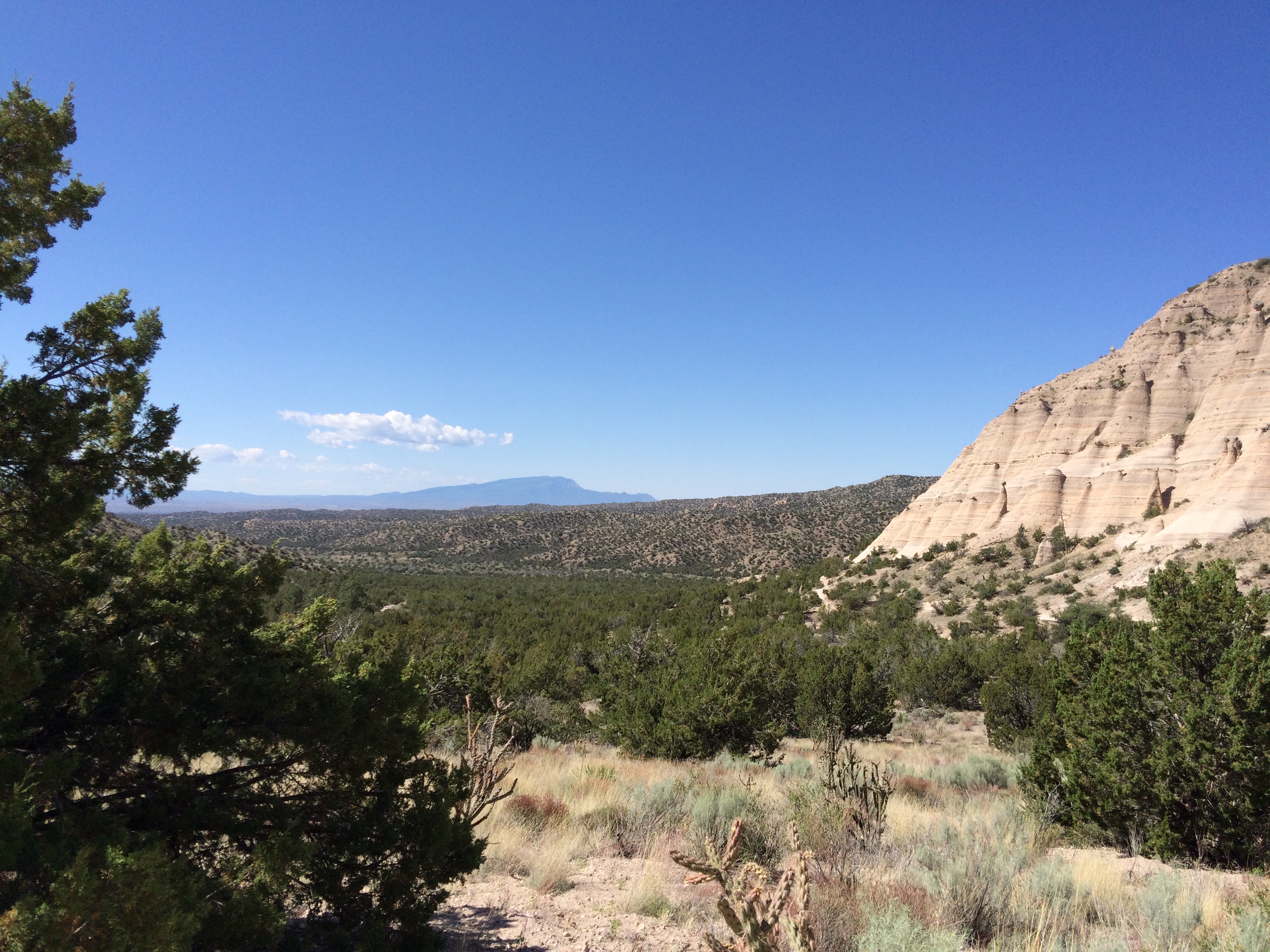
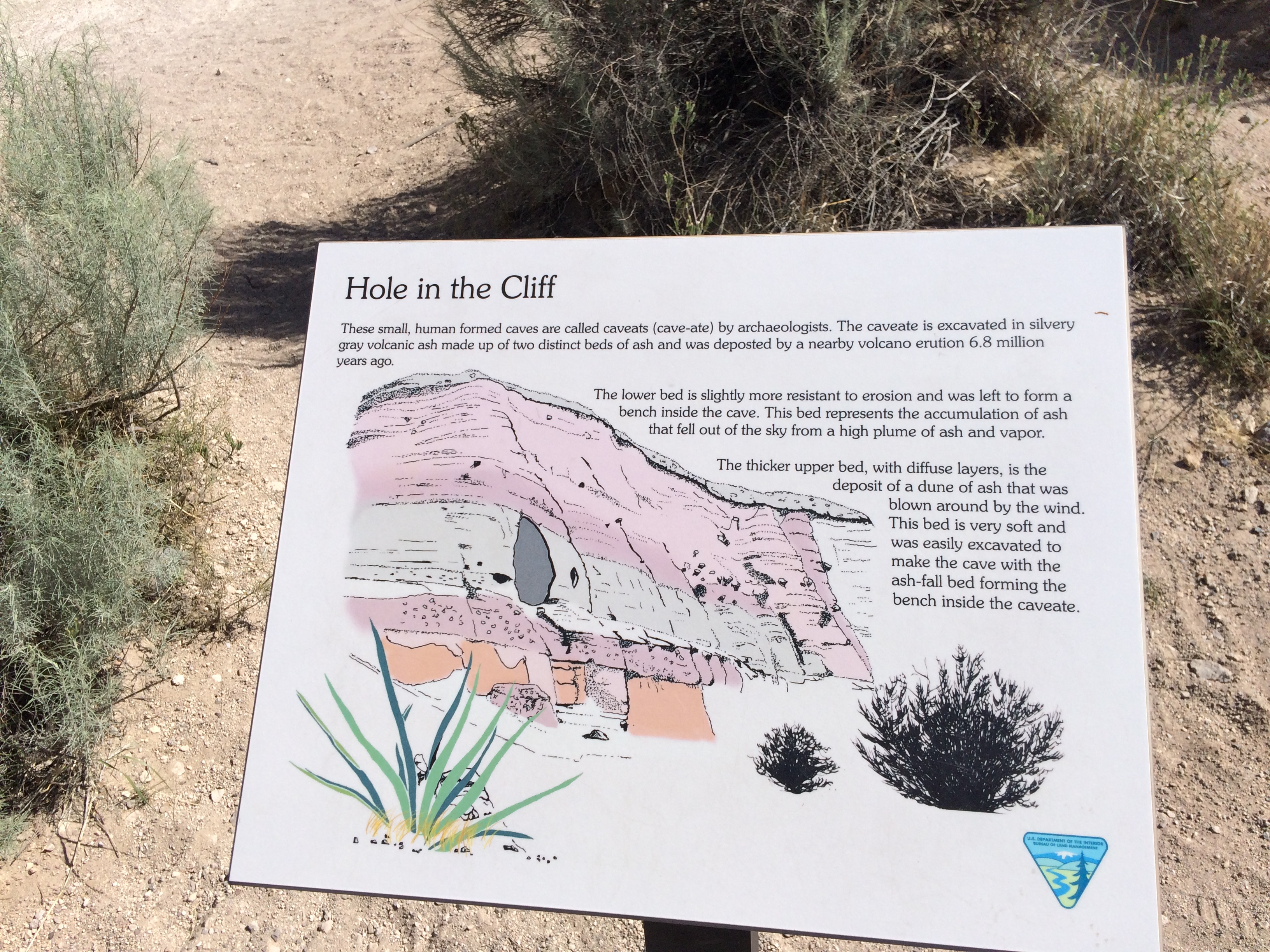
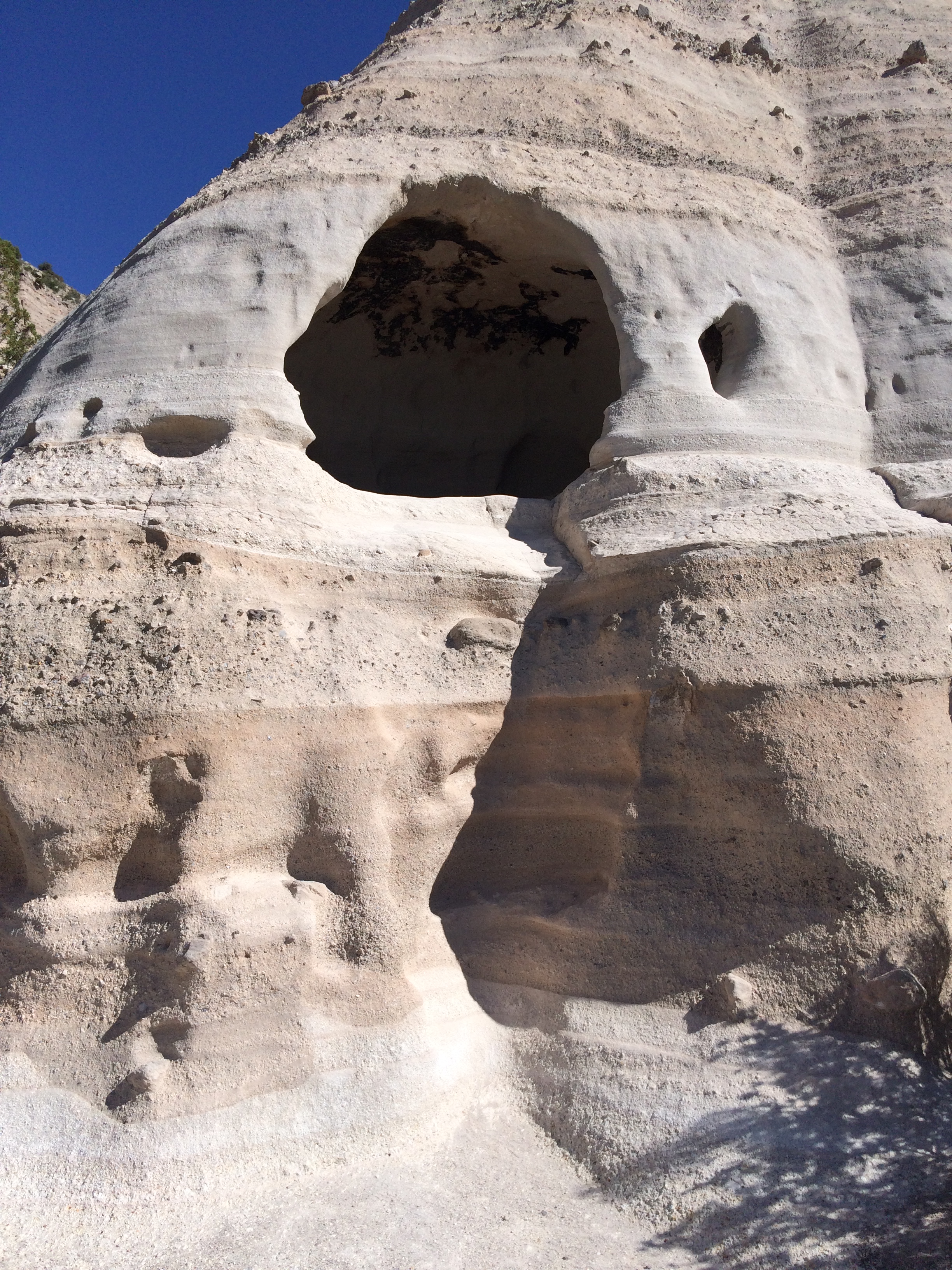
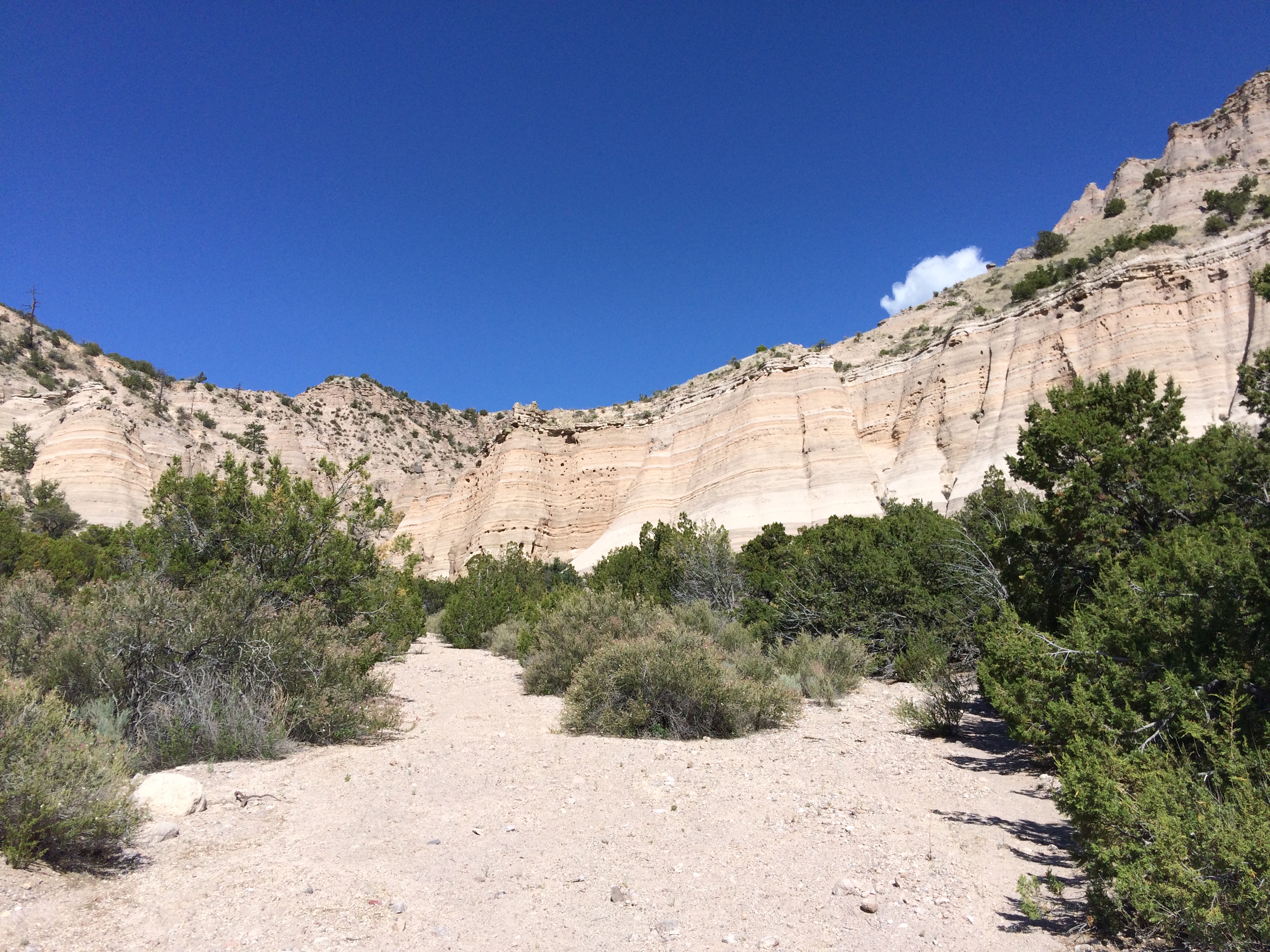
About 45 minutes outside of Santa Fe is a true natural wonder, Kasha-Katuwe Tent Rocks National Monument.  It was not a place that we had on our original itinerary, but while in Boulder with my college friends, one of those friends suggested that we take the side trip to see this place.  She described it in ways that made it seem like something we shouldn’t miss, and she was right.  I am so grateful to her for making this suggestion.  This had to be one of the most awe-inspiring places I’d ever seen.  I will let my photographs speak for themselves, but keep in mind that these were taken with an iPhone 5s camera and that the colors and the textures are even more amazing in real life.

20160528_150702666_iOS

20160528_150707354_iOS 20160528_151001810_iOS 20160528_151010663_iOS 20160528_151501847_iOS 20160528_151505033_iOS 20160528_152236474_iOS 20160528_152253706_iOS 20160528_152322794_iOS 20160528_152513078_iOS 20160528_152856060_iOS 20160528_152858682_iOS 20160528_152908510_iOS 20160528_152924990_iOS 20160528_153549763_iOS 20160528_153552016_iOS 20160528_154340400_iOS 20160528_155202533_iOS 20160528_155206120_iOS 20160528_155805099_iOS 20160528_155915427_iOS 20160528_155919631_iOS 20160528_160028134_iOS 20160528_160043931_iOS 20160528_160131331_iOS 20160528_160457412_iOS 20160528_160529049_iOS 20160528_161248170_iOS 20160528_161422446_iOS 20160528_161732598_iOS

My Ancestral Town: Santa Fe, New Mexico

Sign for Santa Fe National Historic Trail.

Sign for Santa Fe National Historic Trail. (Photo credit: Wikipedia)

Over 160 years ago, three Jewish brothers from Gau-Algesheim, Germany, left their homeland as young men and somehow ended up on the frontier, traveling the Santa Fe Trail, bringing goods to the towns of the New Mexico territory just recently acquired by the US after the Mexican War, and eventually establishing a store on the plaza of Santa Fe: Seligman Brothers, a store that lasted over 70 years before closing in the 1920s.  One of those brothers was my great-great-grandfather, Bernard Seligman (born Bernhard Seligmann), father of my great-grandmother Evalyn (later Eval) as well as Arthur, who would become governor of New Mexico in 1930.
Santa Fe Trail around 1845 plus connecting tra...

Santa Fe Trail around 1845 plus connecting trading routes to commercial hubs and ports in the USA (Photo credit: Wikipedia)

I’ve written a great deal about my Seligmann ancestors—too many posts to try and provide links to here. (Just look in the Seligman category to see those posts.)  I’ve had great fortune in finding sources not only about the three Seligman brothers who came to Santa Fe, but also about their other siblings, their parents, their grandparents, their descendants, and many of their cousins.  And I’ve been especially blessed to find a number of current living descendants, including my cousin Pete Scott (grandson of Arthur Seligman), my cousin Wolfgang Seligmann, my cousin Angelika Oppenheimer, my cousin Steven Seligman, and so many others.    The Seligmann/Seligman line seems to have a strong interest in family history; perhaps this is where my own passion for genealogy comes from, my Seligman DNA.

So it should not be surprising that Santa Fe was a city I wanted to visit.  It’s a city where my family left a substantial mark and a city that left a substantial mark on them.  It’s a city with a long and rich history of its own, one of the oldest cities in the United States, and as I learned, one of the most beautiful.

My cousin Pete was born and raised in Santa Fe, and he has done a lot of research and writing about the history of the city including about our family’s history there.  He and his good friend Mike Lord have provided a wealth of information on their website Voces de Sante Fe, and Pete arranged for Mike to meet with us for one of the days that we would be spending in Santa Fe.

By the standards of most major US cities, Santa Fe is quite small.  We walked the whole plaza area many times, and most of the major sites in the city are in an area that is no bigger than about two miles square.  There are no skyscrapers, and the tallest building we saw in the central part of the city aside from the St. Francis Cathedral was our hotel, which is five stories high.

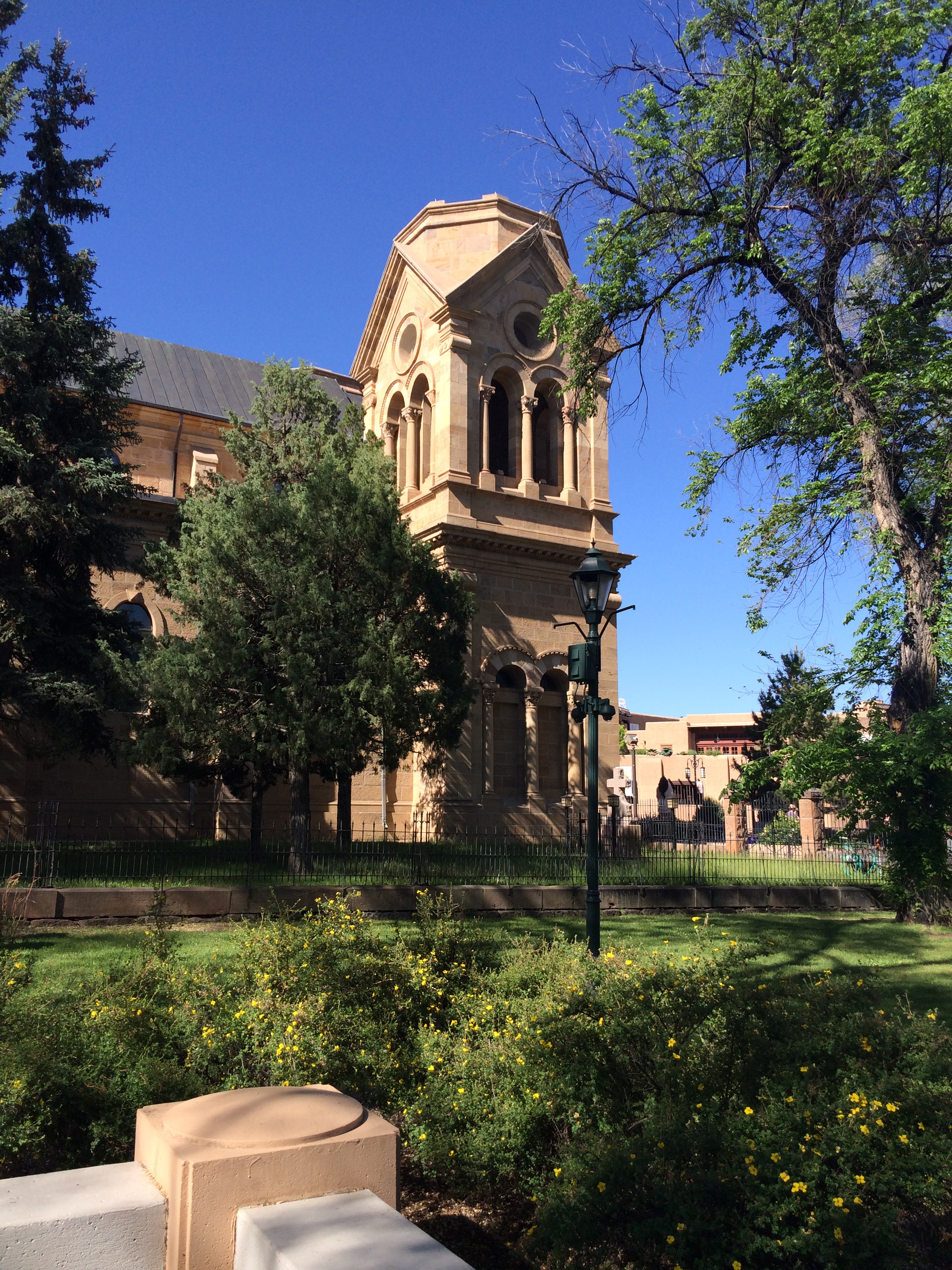
Below are various shots of the cathedral, which was built between 1869 and 1886:

St Francis Cathedral

St Francis Cathedral

20160526_152338365_iOS 20160529_030643043_iOS 20160529_030808930_iOS

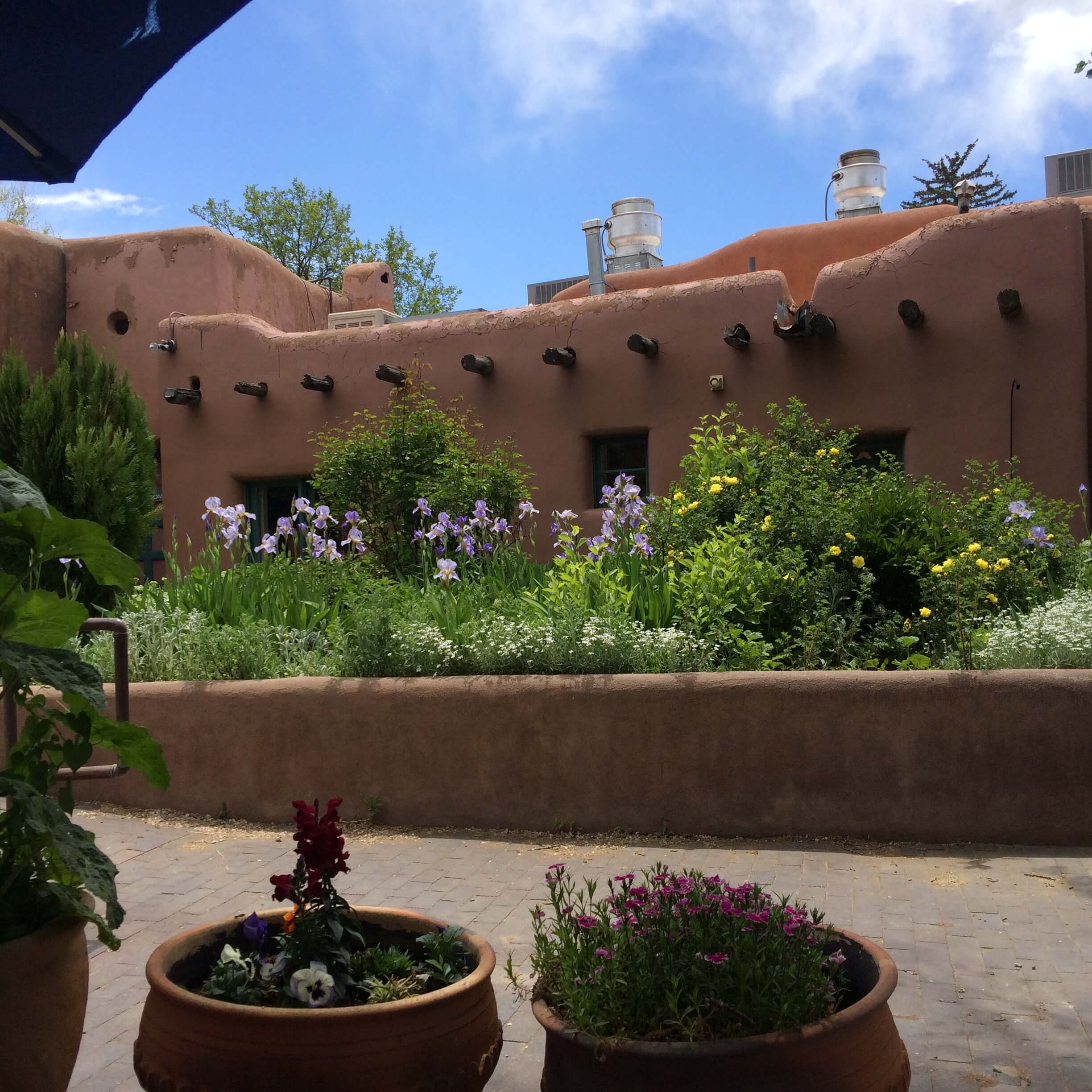
The sky over Santa Fe feels wide open, and the uniformity of the color of the buildings gives the place an aesthetic unity that is both appealing and quite unreal.

20160527_164908171_iOS 20160527_164958541_iOS

20160526_152600649_iOS

When we met with Pete’s friend (and now our friend) Mike to learn about the history of Santa Fe, he likened Santa Fe to an adobe amusement park.  He pointed out that it was not until the 1950s that the uniform adobe look was mandated; historically there was a great deal more diversity to the architecture of the city, as you can see from this photo that Mike shared with us, dated in the 1890s.

Santa Fe 1890s

Santa Fe 1890s

For a city of this relatively small size, there is an incredible amount to see far beyond my genealogical interests.  We loved the Georgia O’Keefe Museum; not only did we get to see that her artistic style had evolved over the years and that that style had a much broader range than the works with which we were already familiar, we also learned about her fascinating life.  Having driven through the New Mexico landscape, we could understand what drew her and so many artists to this place.  Santa Fe has long been a place that has drawn artists to its light and its scenery and its independent spirit, and we enjoyed strolling through the galleries along Canyon Road and in the plaza area itself to see what today’s artists are creating.


http://www.gettyimages.com/detail/522010290

We also enjoyed seeing the miraculous staircase in the Loretto Chapel.  It was built in the late 1870s by a carpenter who claimed he could provide a way to reach the choir loft without taking up too much space in the church’s main level.  Somehow he built it without any central support.  It’s quite fascinating to see—almost like an optical illusion.

20160527_021305983_iOS

Loretto Chapel from our hotel room

20160526_154014010_iOS 20160526_154106183_iOS

Santa Fe’s long history was evidenced by what is claimed to be the oldest still-standing home in the US, the De Vargas Street house, as well as the first church in the US, the San Miguel Chapel.  Both date back to the early 1600s. The Spanish came to this area in the late 16th century, making it the earliest European settlement in the US west of the Mississippi River.

20160527_150758310_iOS 20160527_150829798_iOS 20160527_150854957_iOS 20160527_151008225_iOS

oldest house in the US

oldest house in the US

20160527_151220176_iOS 20160527_151245241_iOS

Among the earliest European settlers were what we now call Crypto Jews, that is, hidden Jews.  We went with Mike to see a very comprehensive exhibit about the Inquisition and the Crypto Jews at the New Mexico History Museum in the former Palace of Governors in Santa Fe.  When the Inquisition began in Spain in 1492, Jews were forced either to leave Spain, convert to Catholicism, or be punished, including by execution.   Some of the Jews left with Spanish colonists to go to Mexico, but because they were still within the realm of the Spanish empire, they still had to convert or face prosecution as infidels.

In the 1600s, some of those “conversos” who had gone to Mexico migrated to what would later become New Mexico, but even there they were still subject to the rules of the Inquisition.  Many, however, continued to follow Jewish laws and honor Jewish rituals, such as lighting candles on Friday nights, covering mirrors when someone died, abstaining from pork, and going to worship (at church) on Saturday instead of Sunday.

Thus, long before German Jewish merchants like my great-grandfather arrived in Santa Fe in the 19th century, there was a population of people with Jewish roots in Santa Fe and other places in New Mexico, even if they did not outwardly (or even internally) identify as Jews.

Of course, my principal historical interest was in those German Jewish merchants, the Seligmans as well as their fellow pioneers, the Spiegelbergs, the Staabs, and others.  What was Santa Fe like when they started arriving in the 1840s and 1850s?  It is hard to imagine what my great-great-grandfather and his brothers thought when they arrived in this place, having come from Germany where there were so many old and grand cities with towering cathedrals and castles.  And what did my great-great-grandmother Frances Nusbaum think when she moved from Philadelphia, itself already quite an established city, to be with her husband Bernard Seligman in Santa Fe?

English: "Arrival of the caravan at Santa...

English: “Arrival of the caravan at Santa Fe” — Copy of original lithograph ca. 1844 (Photo credit: Wikipedia)

Mike shared with us this photo of Santa Fe from 1855 that conveys just how primitive the town’s architecture was at the time that Bernard Seligman and his brothers arrived there.

Santa Fe 1855

Santa Fe 1855

And where did my ancestors live and work when they settled in this frontier town? When we were making our travel plans, I had asked Pete where we should stay in Santa Fe, whether there was a place with a connection to the Seligman history there.  He suggested La Fonda Hotel.  Although the current building was built in the 1920s, it sits on the site of the first hotel in Santa Fe, at one time called the Exchange Hotel.  The Exchange Hotel was the building on the other side of the Santa Fe Trail from Seligman Brothers on the plaza in Santa Fe.  Here is Pete’s post about La Fonda and the history of the hotels built on that site.

Old Fonda, courtesy of Pete Scott and Voces de Santa Fe

Old Fonda, courtesy of Pete Scott and Voces de Santa Fe

etching of santa fe

Etching of Santa Fe showing the Exchange Hotel and Seligman Brothers store on the Plaza

On this map dated 1912, you can see that the street to the right (east) of the Plaza running between San Francisco Street (where La Fonda and Seligman Brothers store are/were located) and Palace Avenue was then called Seligman Street.

Map of the City Plan, showing Street, Park and River Improvements Proposed to the City Planning Board.” N. L. King 1912 Thanks to Mike Lord for sending me this map.

Map of the City Plan, showing Street, Park and River Improvements Proposed to the City Planning Board.”
N. L. King
1912
Thanks to Mike Lord for sending me this map.

Thus, we decided to stay at La Fonda.  It was a wonderful hotel, and we are very grateful to Pete for his suggestion.  From the moment I walked into the lobby, I knew that I was in a very different part of the country.

La Fonda Hotel today

La Fonda Hotel today

20160527_020856388_iOS

View from the bar on the roof of the hotel

20160526_152600649_iOS 20160527_021136309_iOS

La Fonda lobby

La Fonda lobby

Below is the building located where Seligman Brothers’ store was once located, across the street from La Fonda:

location of Seligman's Store

location of Seligman’s Store as it looks today

I walked into the store that is currently located where Seligman Brothers’ store once stood, thinking about the fact that I was standing where my great-great-grandfather and his family had once sold dry goods to residents of the area.

20160529_013821140_iOS

Although census records indicate that the Seligmans at one point lived on Palace Avenue, there are no longer any visible signs in the city to show where Bernard Seligman and his family lived.

There is, however, a street that was named for his brother-in-law Simon Nusbaum, who had moved to Santa Fe around 1880 and lived with his sister Frances and her husband Bernard Seligman for some time before marrying and living in his own home, which sadly no longer exists.

20160526_171224269_iOS

In the New Mexico Statehouse, a quite grand and beautiful building built in 1966 and renovated in the 1990s, there is a gallery of portraits of all the governors of New Mexico from statehood in 1912 through today, and there on the wall was a portrait of my great-great-uncle, Arthur Seligman, governor from 1930 until his death in office in 1933.

20160527_154147244_iOS

Arthur Seligman portrait in State House

Arthur Seligman portrait in State House

Mike took us to see Arthur’s mud wagon in the New Mexico History Museum and drove us past the house where Arthur and his family had lived in Santa Fe.

Arthur Seligman's mud buggy

Arthur Seligman’s mud wagon

Arthur Seligman's home in Santa Fe

Arthur Seligman’s home in Santa Fe

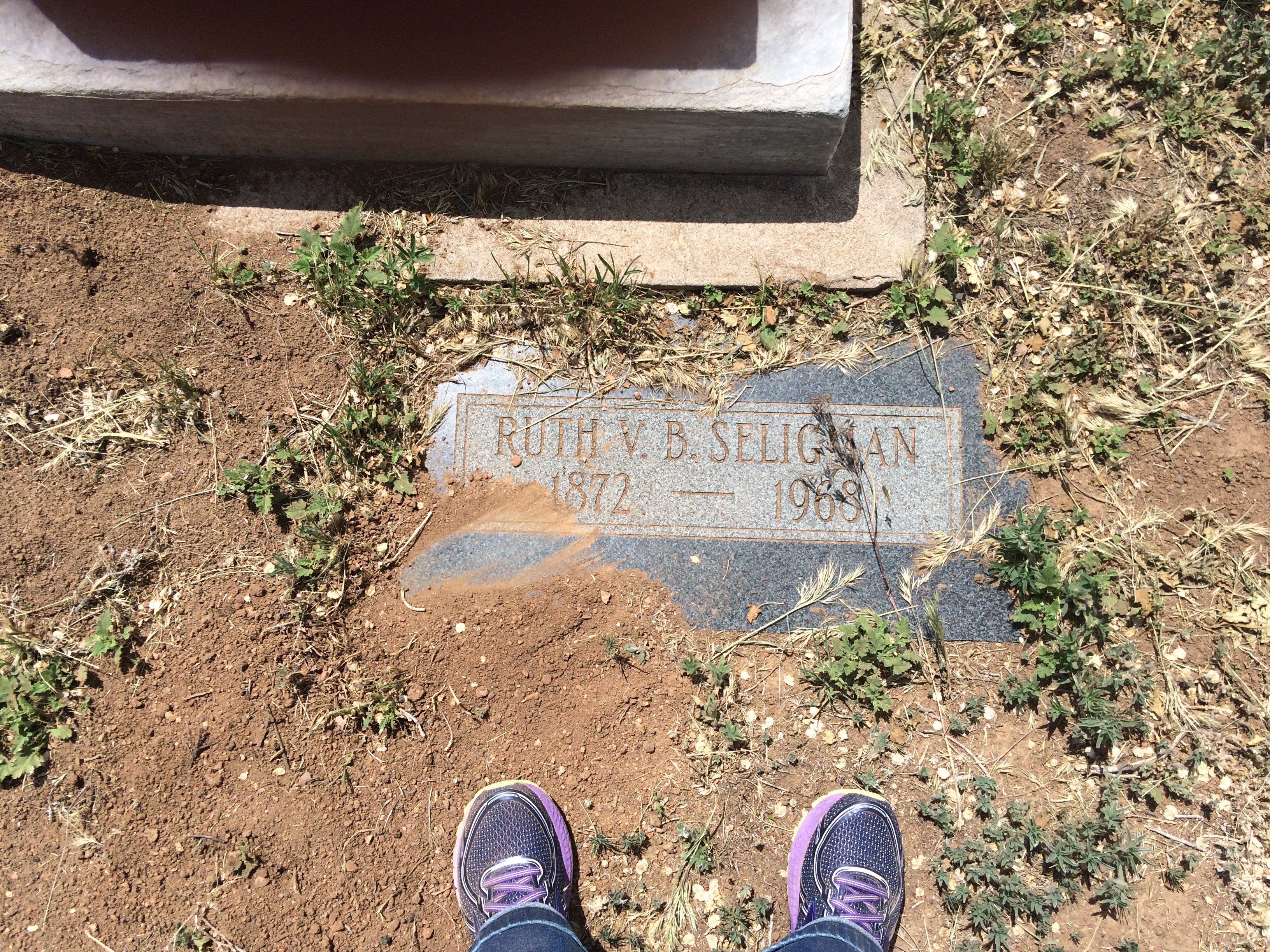
Then he took us to Fairview Cemetery, where many of my Seligman and Nusbaum relatives are buried.

20160527_200612447_iOS

20160527_200600324_iOS

Otis Seligman, son of Arthur and Franc Seligman

20160527_202238871_iOS

William Seligman, son of Adolf Seligman, and his wife Mae Leeper

20160527_203355211_iOS

20160527_203411793_iOS

James Seligman, my great-grandmother’s brother and son of Bernard Seligman and Frances Nusbaum

20160527_203415395_iOS

Beatrice Seligman, daughter of James Seligman

20160527_203406822_iOS

Ruth V.B. Seligman, wife of James Seligman

20160527_202608521_iOS

Simon Nusbaum, son of John Nusbaum, my 3x-great-grandfather and brother of Frances Nusbaum Seligman

20160527_202550324_iOS

Dora Nusbaum, Simon’s wife; their son John Bernard Nusbaum and his wife Esther Maltby

20160527_202540385_iOS

Nelle Nusbaum Healy, daughter of Simon Nusbaum

20160527_202556079_iOS

Although there was nothing on any of these stones to indicate that these were the graves of Jewish people, I left a stone on many of them, as is Jewish custom when visiting a grave to mark that someone was there to remember them.

Thus, our days in Santa Fe were a wonderful blend of history, art, architecture, and family history.  They call New Mexico the Land of Enchantment, and Santa Fe is an enchanting place even if you have no family ties to the place.  But for me, it was more than that.  Although at times it was hard to imagine what is now very much a tourist-filled place as the old settlement of native Americans, Spanish and Mexican settlers, and then later Anglo settlers like my ancestor, when I could time-travel in my mind to the years when my great-great-grandparents and their children roamed those same streets around the plaza, it was quite magical, and yes, enchanting.


Thoughts While Driving from Denver to Santa Fe:  A Northeasterner’s View of the Southwest

Before this trip, I’d never been to Colorado or New Mexico before.  I’d never seen the Rocky Mountains, and although I had been to Arizona, it was almost 20 years ago, and I didn’t get the same perspective that I had this time.  This time I found myself truly marveling at the landscape, the mountains, the desert, the overall expanse of land that exists in so much of the United States.

After all, I am a Northeasterner: born in the Bronx, raised in the suburbs of NYC, and a resident of New England since I was eighteen years old.  I’ve never lived in the country; I’ve never lived more than 90 miles from a major metropolitan area.  I now live a few miles from Springfield, Masschusetts, and about 25 miles from Hartford, Connecticut.  Although Springfield and Hartford aren’t huge cities, they are densely populated urban areas without much open space.

It’s true that from our home we can drive thirty minutes or less and be in fairly rural places—farms are nearby, and the mountains of Vermont and New Hampshire are just two hours away.  But even in those places, you don’t see miles and miles of empty road surrounded by undeveloped land with barely a sign or gas station or store to be seen.

So driving through Colorado and especially New Mexico was eye-opening for me.  We took I-25 south from Denver and headed to New Mexico.  Here we were on an interstate highway, the speed limit 75 miles an hour, and within a short distance from Denver, we began to see mountains.  I snapped photo after photo as we sped by, trying to capture the Rocky Mountains from the car.

20160524_183949615_iOS 20160524_190740985_iOS

20160524_203849284_iOS 20160524_213717579_iOS


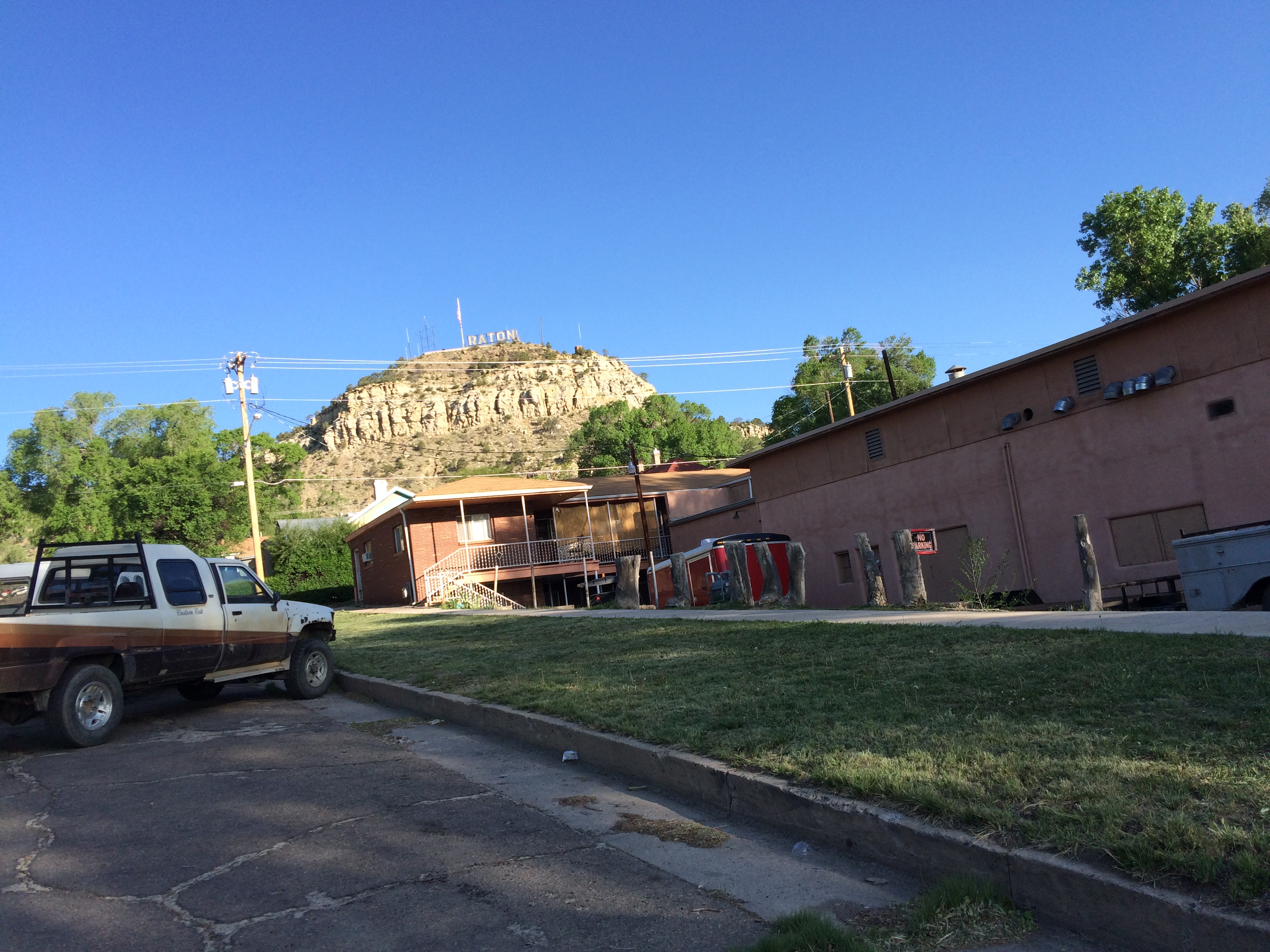
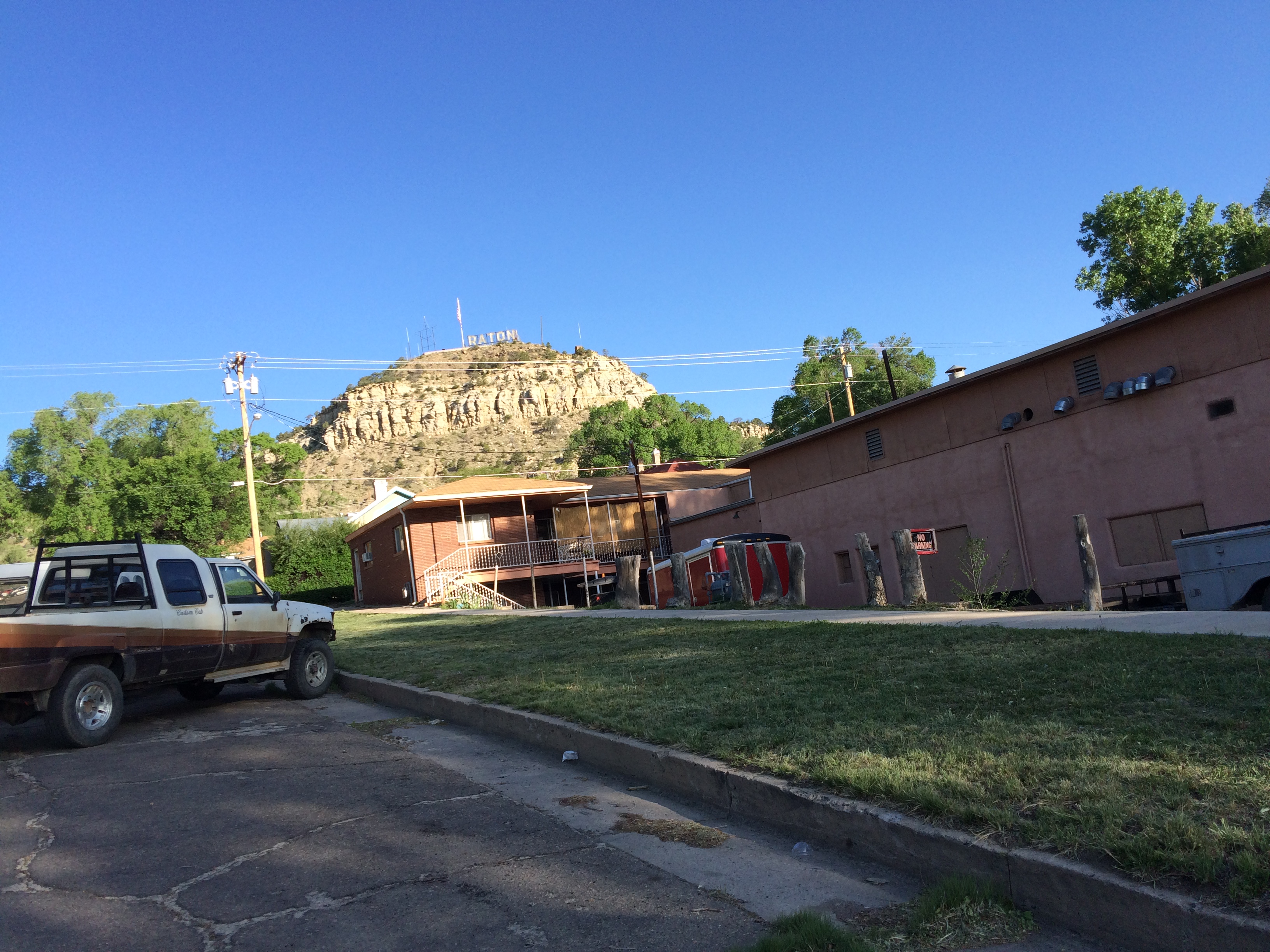
Fortunately, we decided not to take I-25 all the way to Santa Fe, but stopped overnight in Raton, New Mexico, the first town over the state line from Colorado, about three hours south of Denver.  It was not a scenic place.  We stayed in a Best Western right off the highway, and the highest rated restaurant in town on TripAdvisor and Yelp was the place right in the Best Western.  It was not good.  But it was edible.   There was no nightlife in Raton, so we rose early to get started on the rest of our journey.

Before we left Raton, however, I’d spotted a brochure for “Historic Raton” in the motel lobby and asked the person at the front desk how to get there.  She very pleasantly gave me directions, though I have to think she wondered why I wanted to see the town.  The town consisted of two parallel streets of buildings (with two or three cross streets) about maybe a quarter mile long.  And almost all the buildings were empty, boarded up, out of business.  It was depressing.

Raton

Raton

downtown raton

Downtown Raton

But it was important for us to see.  This was a town that had once been an important mining town, according to the brochure.  Even more recently those stores and building must have been occupied.  What did the people who lived in Raton now do for work, besides work at the Best Western and the few fast food places near the highway?  Is this why so many people in this country feel so disenfranchised, so angry? Sure, there is poverty in all kinds of places all over the country.  Springfield itself has a large population of people who are unemployed or underemployed, living in desperate conditions.  But a whole town of almost all empty buildings? What must it be like to live in such a place?

We left Raton with a sense of gratitude for all that we have and with a sense of embarrassment that we generally take so much for granted.

And then we ventured on towards Santa Fe.  This time we took Route 64, a two-lane road running southwest into New Mexico.  For the first forty miles or so, the road ran straight and flat through miles and miles of ranch land.  The endless fields of dry beige and green grass, speckled here and there with cattle, were mesmerizing.  We both just kept saying, “This is incredible! Look at how much land there is.”  I wish my little iPhone camera could capture the scope of open land we saw.  There were mountains in the distance, but overall the land was flat and wide as far as we could see.

20160525_133838331_iOS 20160525_134745252_iOS 20160525_140635804_iOS 20160525_141154474_iOS

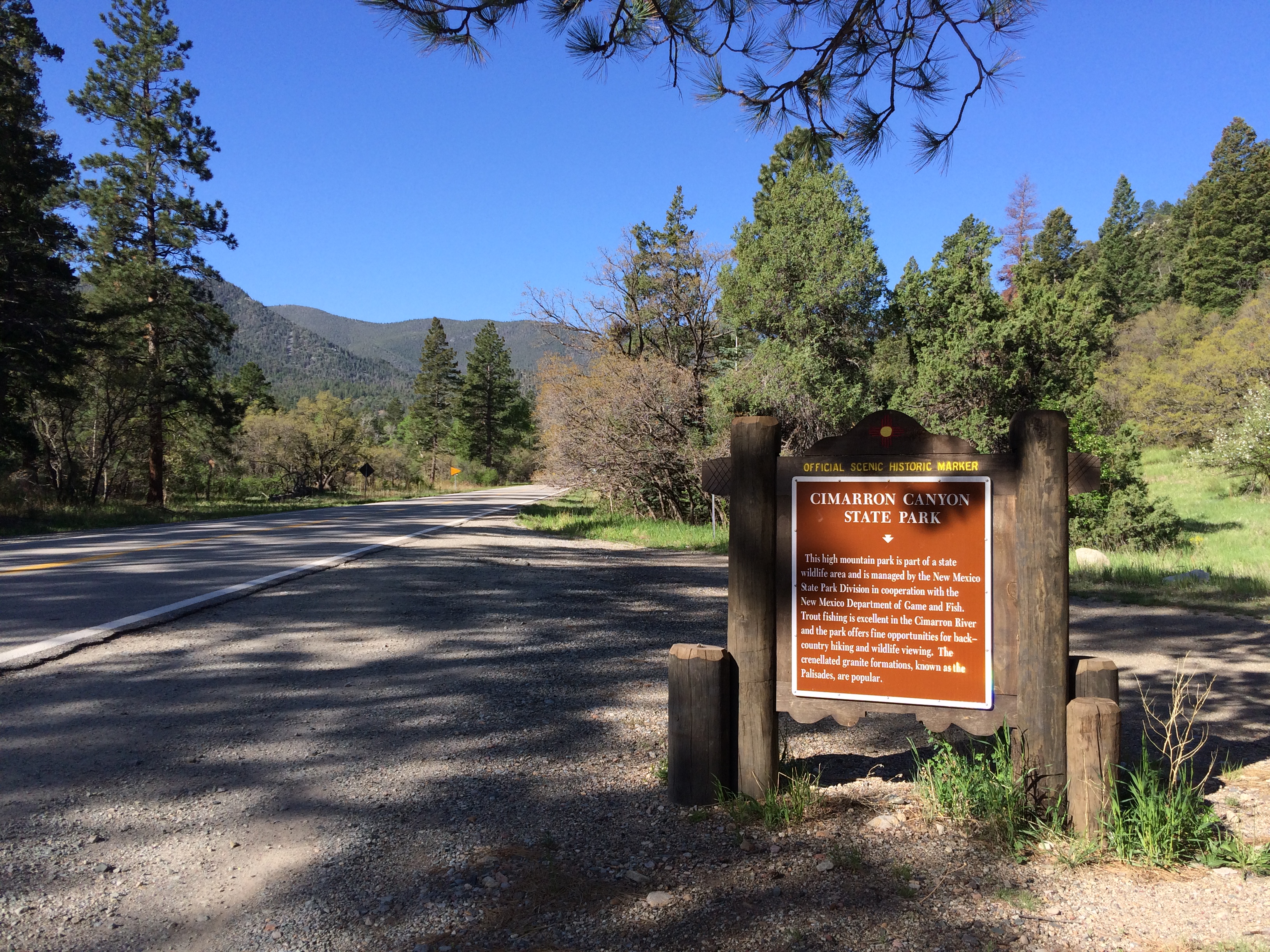
Then we entered the Cimarron Canyon area, and the terrain suddenly changed.  We were surrounded on both sides by walls of tall evergreen trees and then incredible stone formations above and in front of us as we followed the winding roads up and down and up and down the terrain.  It was like going from a huge empty room into a tiny dark hallway that twisted and turned so that you couldn’t see where it would end.  And it was gorgeous.  It was truly gorgeous.

Entering Cimarron Canyon

Entering Cimarron Canyon

20160525_142704356_iOS 20160525_143101662_iOS 20160525_143124185_iOS

And then it got better.  We passed through the canyon and emerged at the top of hill overlooking the Eagle Nest area with a large blue lake below us to the left and the mountains shadowing us to our right.  In just over sixty miles we had seen three very different types of terrain.  And barely a town or even many cars.  Who owned all those ranches? Who worked on them? Where did they live? We didn’t know.

20160525_144336328_iOS 20160525_144339466_iOS 20160525_144344554_iOS 20160525_144506423_iOS 20160525_144644707_iOS 20160525_144708507_iOS

From Eagle Nest we drove another thirty miles to Taos, passing through more open land and more mountain roads.  We stopped briefly in Taos to stretch our legs, but we knew we were coming back there after our stay in Santa Fe, so we did not take the time to look around.

Quick stop in Taos

Quick stop in Taos

After following Route 64 for about 100 miles (and for just over two hours), we picked up Route 68 in Taos to take the “low road” or “river road” to Santa Fe.  The first portion of Route 68 was awe-inspiring as we looked down at the Rio Grande and climbed high and twisted roads over the mountains and back down again.  In front of us and to our left we could see the white snow-covered peaks of the mountains while to our right we could see the deep gorge that the Rio Grande had carved into the land around it.

20160525_172606142_iOS 20160525_173012800_iOS 20160525_173018888_iOS 20160525_173044128_iOS 20160525_175017231_iOS 20160525_175022403_iOS

Finally, after passing through the rather non-scenic section of Route 68 near Espinola, we arrived in Santa Fe by lunch time.  And there we settled for the next four days, having now seen both how beautiful and inspirational our country can be and also how sad and empty it can be.


Denver and A New Portrait of My Grandmother

About 110 years ago, my great-grandparents Isidore and Hilda (Katzenstein) Schoenthal and their four children, Lester, Gerson, Harold, and my grandmother Eva, moved from Washington, Pennsylvania, to Denver, Colorado.  Gerson had allergies and asthma, and doctors had suggested that the air in Denver would be better for him.  My grandmother was only a few years old, her brother Harold only six, and the two older brothers were teenagers when they moved.  My grandmother spent her childhood in Denver, leaving when she was eighteen to marry my grandfather, John Nusbaum Cohen, of Philadelphia.

As I wrote about here, my great-grandfather had several jobs in Denver, but spent most of his years in Denver working for Carson Crockery, a major distributor of china and other related products.

isidore schoenthal mgr carsonsBy the early 1920s, the family members began to leave Denver. My great-uncle Harold left to go to Columbia University; my grandmother moved to Philadelphia after marrying my grandfather in 1922.  Lester, the oldest son, and his wife Juliet Grace Beck, moved between Indiana and Colorado and back again over the years.  And my great-grandparents moved back east by 1929, settling in Montclair, New Jersey, where their son Harold had moved after finishing college. Eventually Lester and his wife also settled in Montclair.  Only Gerson stayed behind in Denver after the 1920s; he remained there until shortly before his death in 1954 in California, where he and his wife Maude had moved just a month beforehand.

Thus, for about twenty years, Denver was home to my great-grandparents and their children.  So when my friends and I decided to have our reunion in Boulder, Colorado, this year, I knew I had to spend some time in Denver to see the city where my Schoenthal family had lived in the early years of the 20th century.

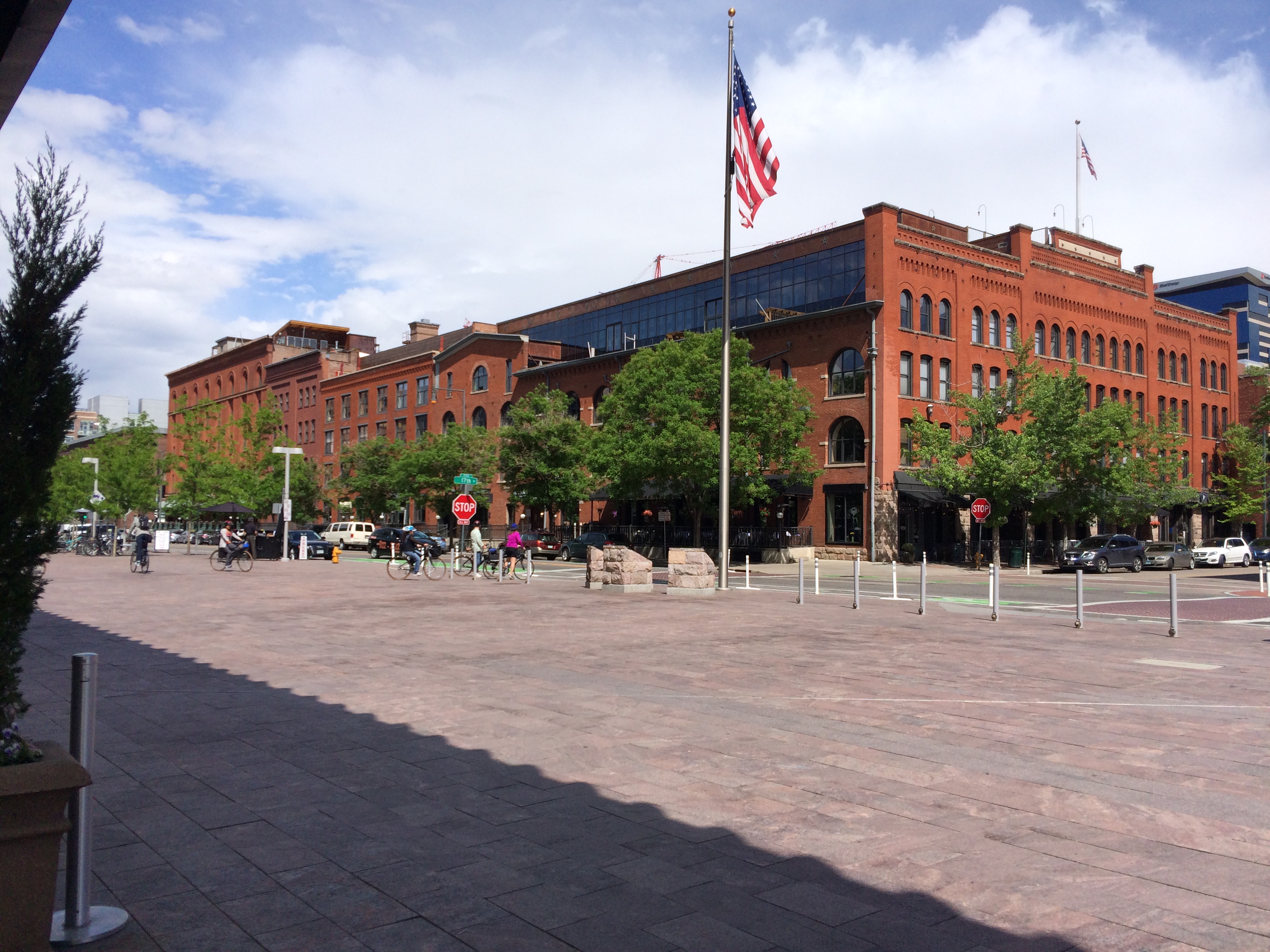
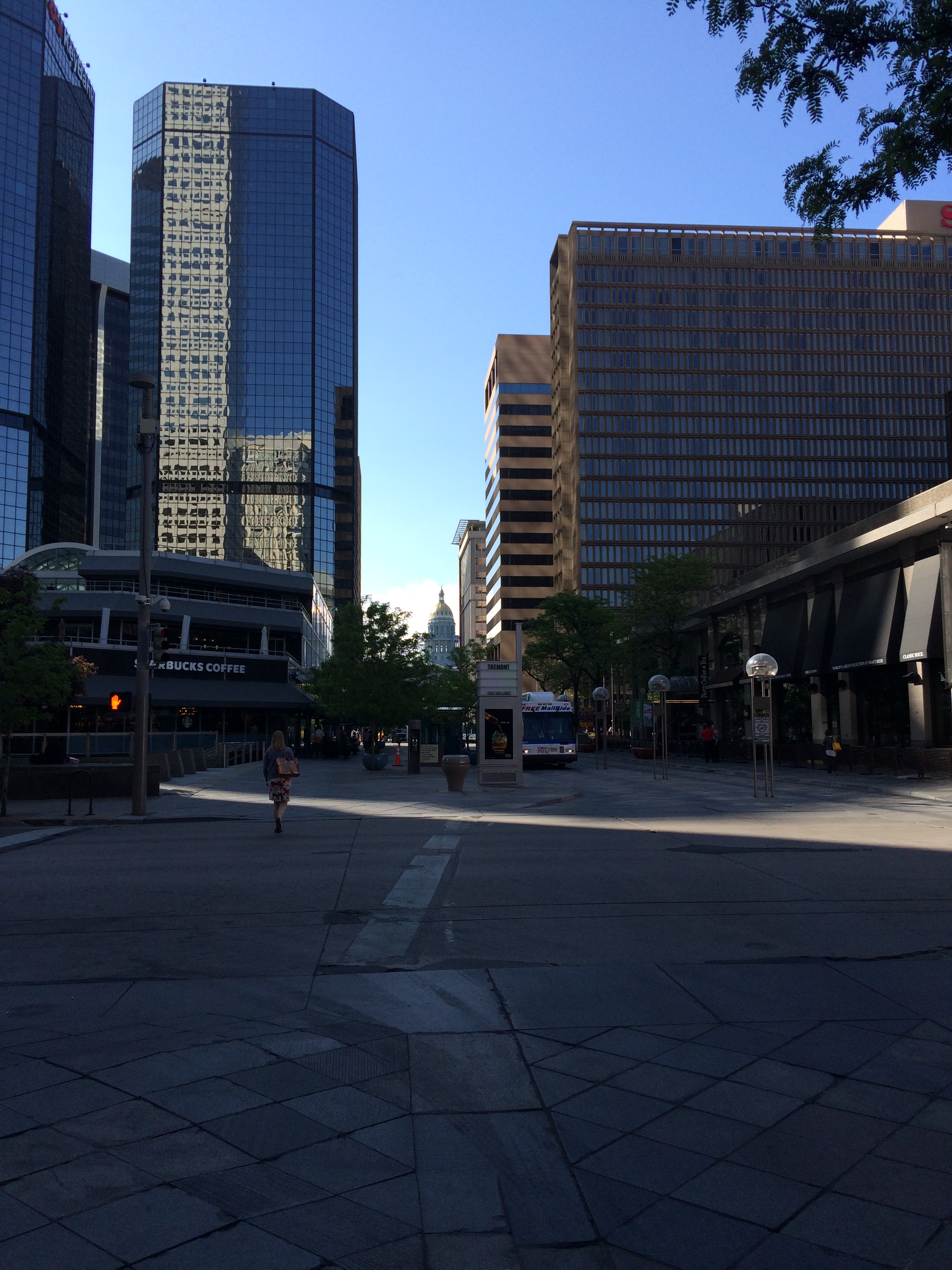
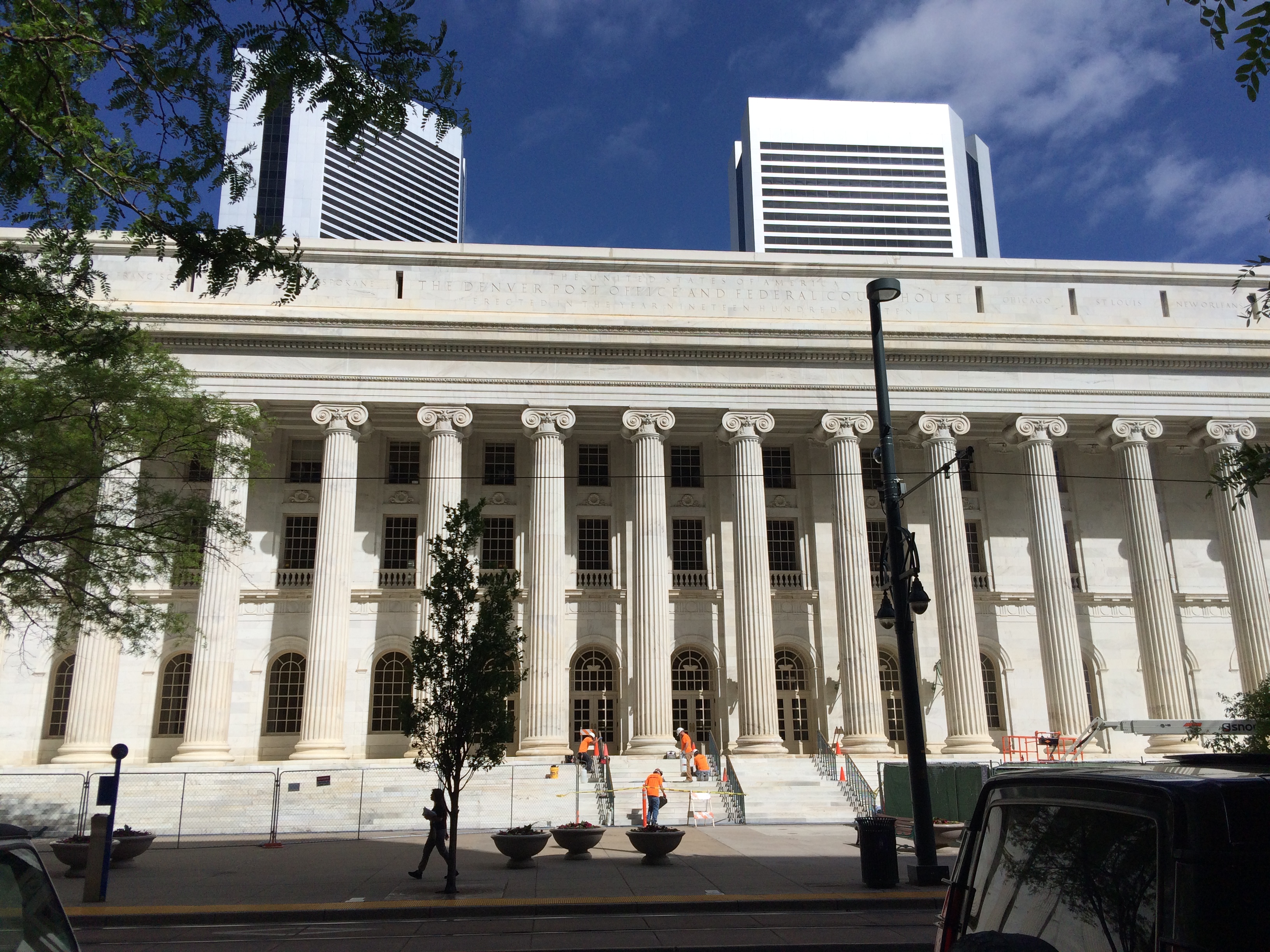
My husband and I didn’t have much time in Denver—just one afternoon and evening and the following morning.  Nevertheless, I think we got a fairly decent feel for the downtown section of the city.  We walked through the downtown area all the way from the Civic Center and State Capitol building to Union Station and the bridge over the river at the opposite end of Sixteenth Street.  Denver is quite obviously a city that has changed dramatically over the last couple of decades, as the mix of older and newer architecture reveals.  Everywhere you look you see new, shiny glass skyscrapers next to older buildings, some of which could date from the era when my great-grandparents lived in the city.  I tried to capture that contrast in these photos.

20160523_211910873_iOS 20160524_144443866_iOS 20160524_145832178_iOS

20160524_152548004_iOS 20160524_153332663_iOS 20160524_154639120_iOS 20160524_155017162_iOS

Although we arrived on a weekday, expecting the bustle of a big city, Denver felt strangely quiet even in the downtown area during a Monday workday, at least as compared to cities like New York or Boston.  Not that the streets were empty, but there was definitely a slower pace and fewer people on the streets than we would have expected.

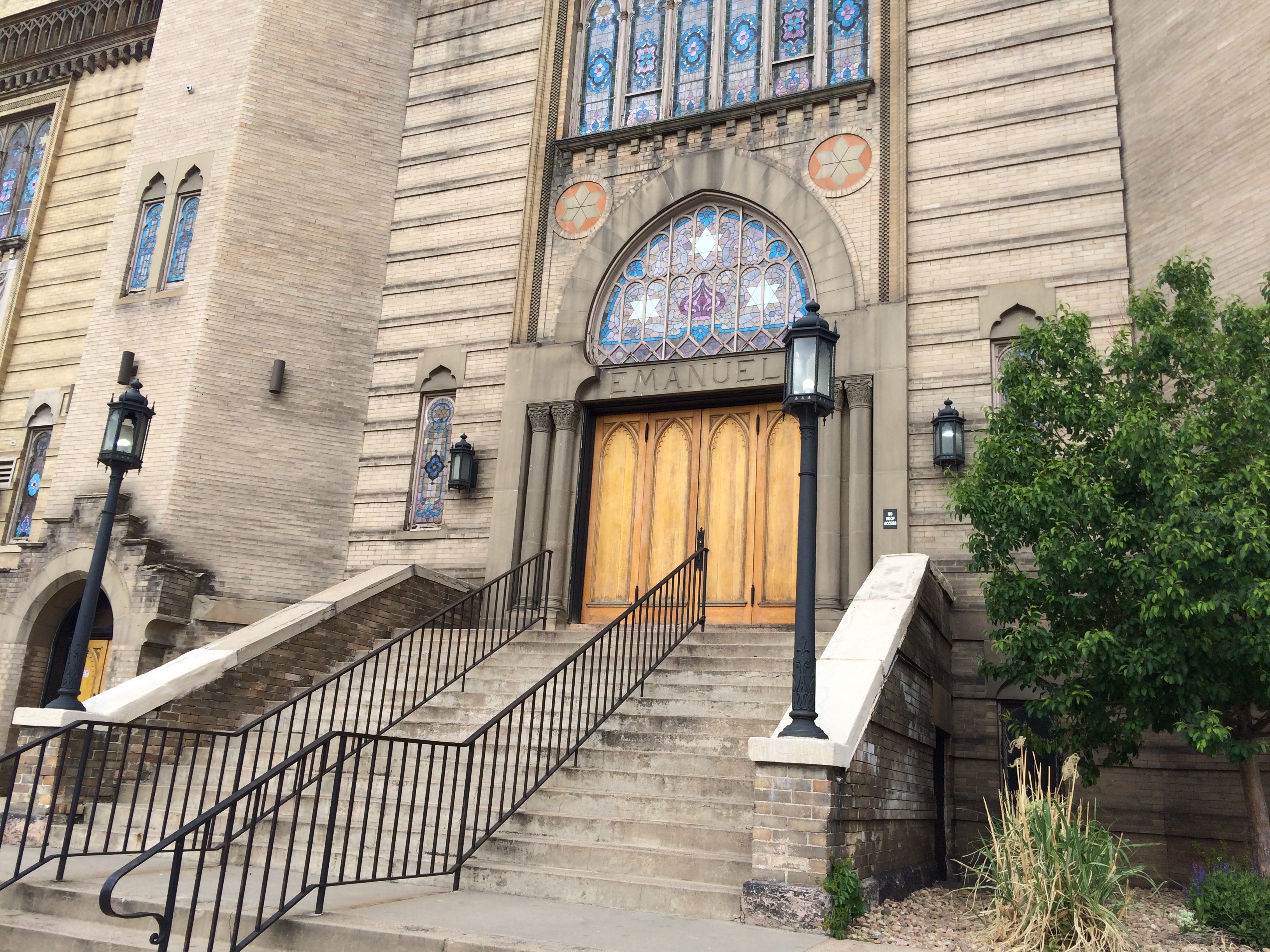
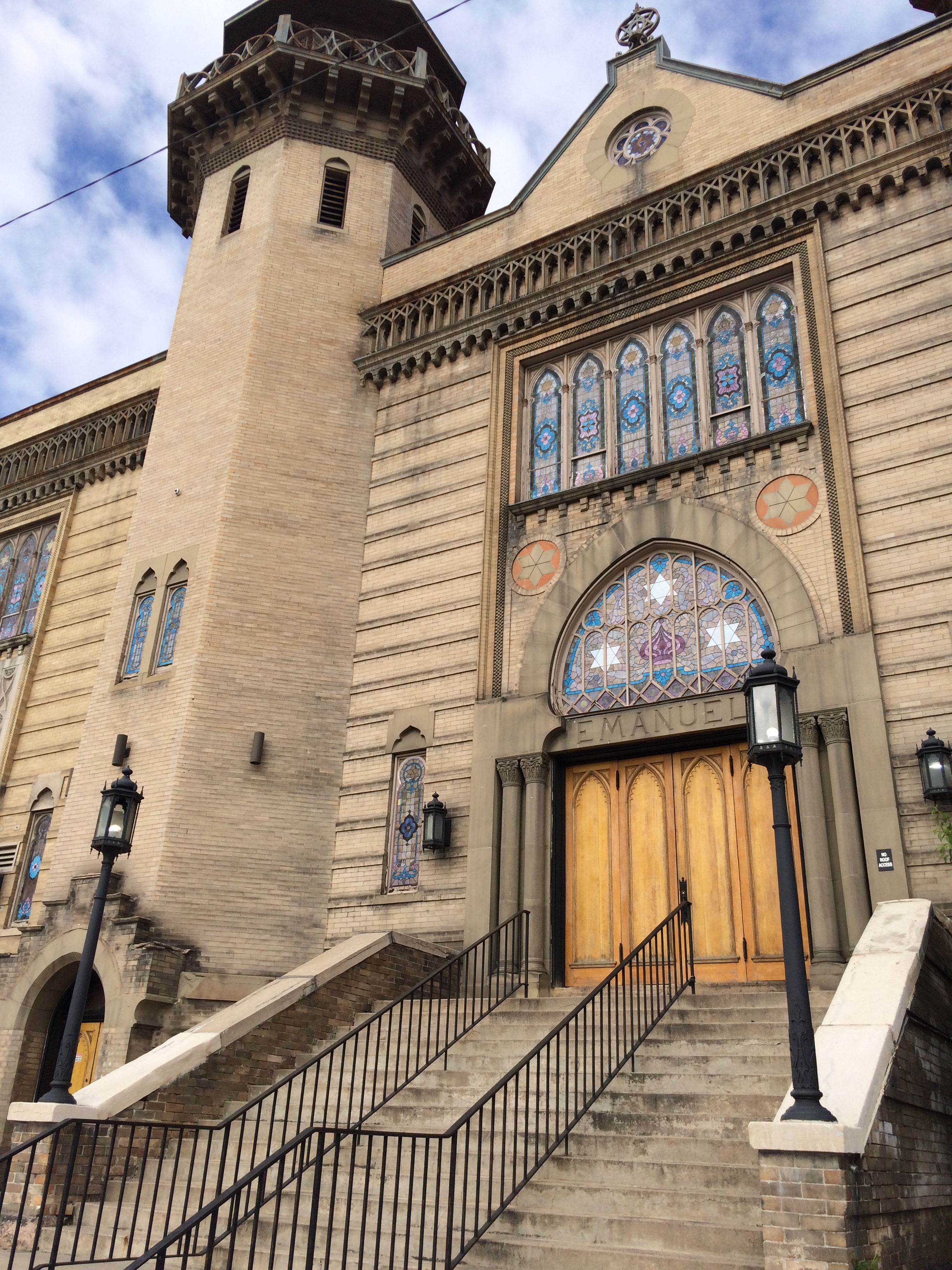
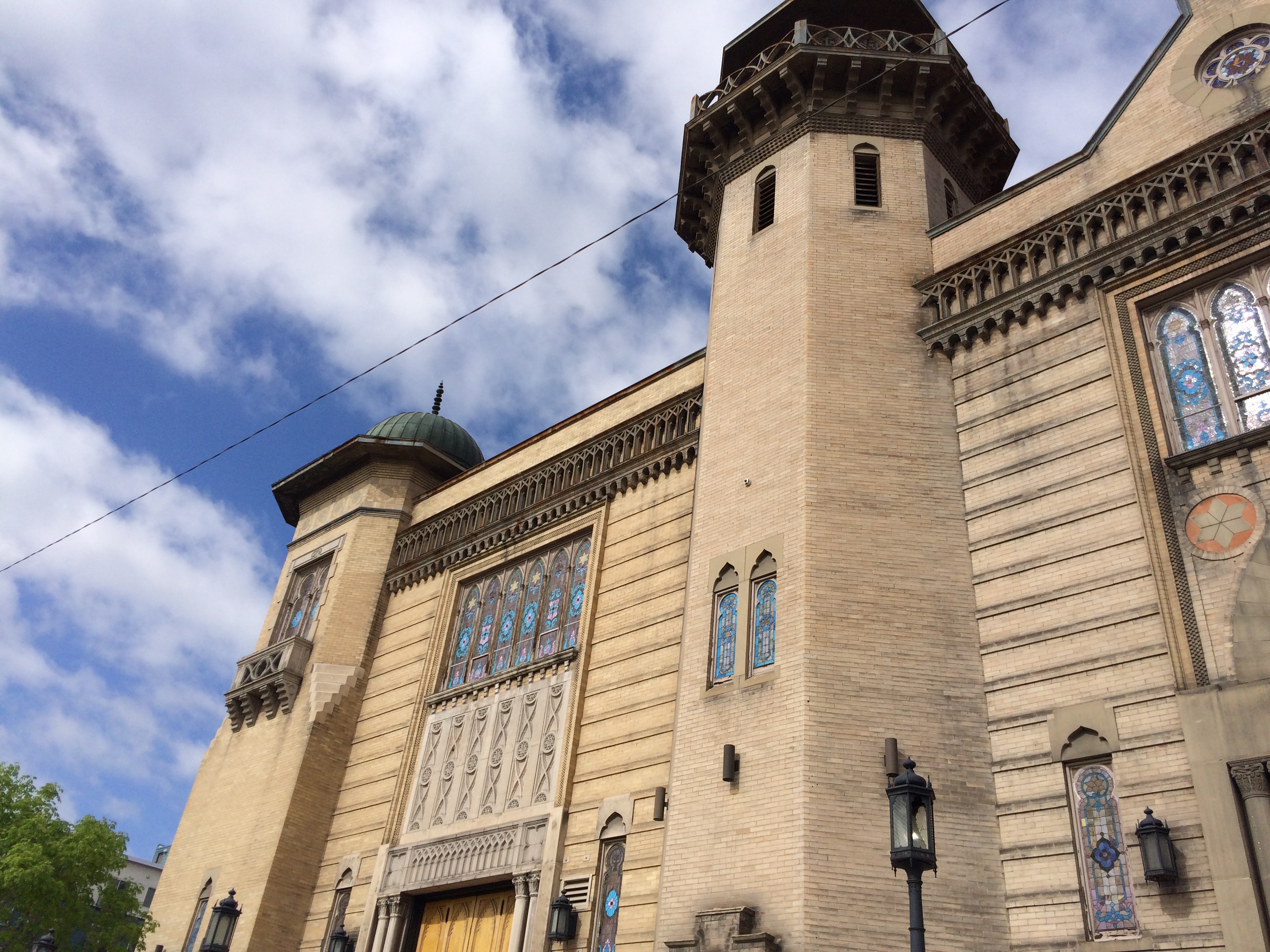
When my great-grandparents were living in Denver, they belonged to Temple Emanuel, where my grandmother and two of her brothers were confirmed. Temple Emanuel was then located on 16th Avenue and Pearl Street, a location about a fifteen minute walk from our hotel.  The building is still there, and it is beautiful. Although the Pearl Street building is now a church, the original building’s exterior has been preserved. (We did not see the interior.) The Star of David still appears in several places on the building, as does the name Emanuel, as you can see from these pictures.

20160524_151155406_iOS 20160524_151205779_iOS 20160524_151306771_iOS 20160524_151313831_iOS 20160524_151343268_iOS

Apparently the years that my family lived in Denver were years of growth for Emanuel as a substantial addition was built in the 1920s.  But after the war, the congregation left this downtown location and built a new building further out.

Before arriving in Denver, I had contacted Steve Stark, the current executive director at Temple Emanuel, to ask whether they would have any records or photographs from the era when my great-grandparents had been members.  He wrote back and told me that the confirmation class photographs from that time period were on the walls of the current building and that I was more than welcome to come to the building to see them.  So we drove out to Temple Emanuel’s current building after leaving downtown that morning.

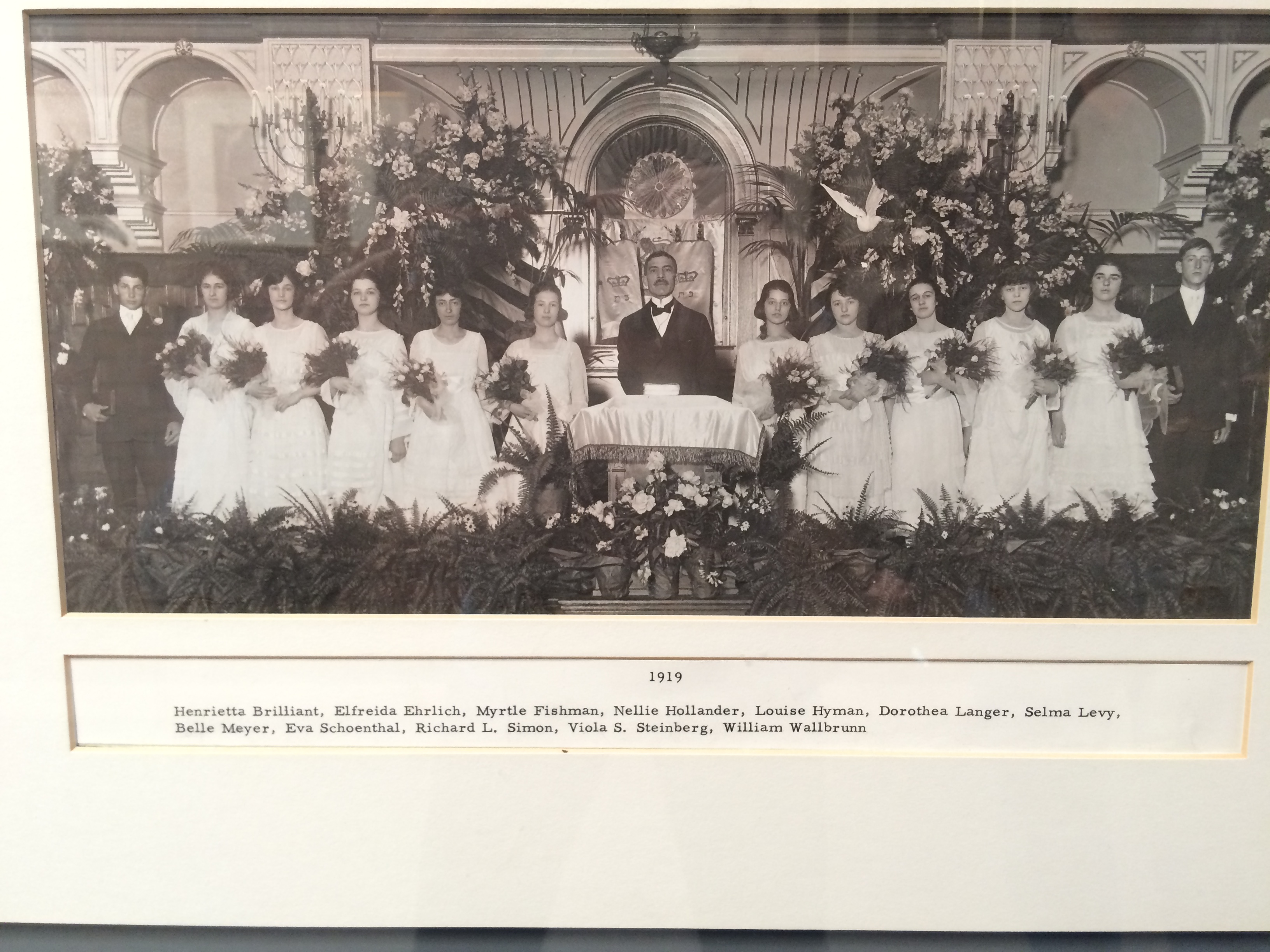
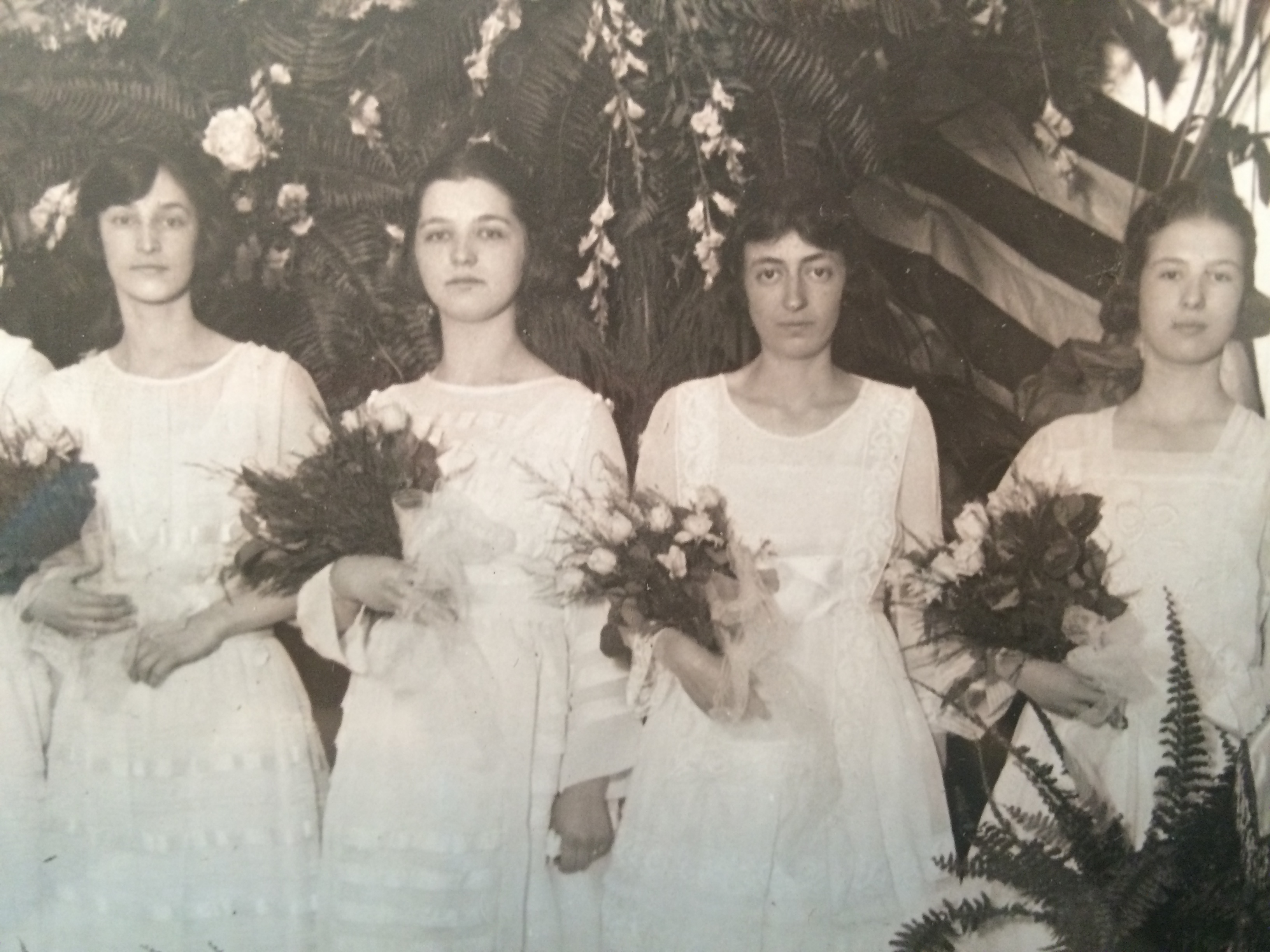
I was very excited when I was able to locate the photographs of the confirmation classes of three of Isidore and Hilda’s children: Gerson, class of 1908, Harold, class of 1916, and my grandmother Eva, class of 1919.  I was struck by how formal and how elegant they all look.  It’s hard to imagine a class of fifteen year olds looking like this today.

Temple Emanuel 1908 confirmation class with Gerson Schoenthal

Temple Emanuel 1908 confirmation class with Gerson Schoenthal

20160524_165822156_iOS

Temple Emanuel 1916 confirmation class with Harold Schoenthal


20160524_165743558_iOS

Temple Emanuel 1919 confirmation class with Eva Schoenthal

Although I was easily able to identify my grandmother in her class photograph, I will need to get my father’s help to pick out Harold and Gerson in their class pictures.

My grandmother Eva Schoenthal, second from left

My grandmother Eva Schoenthal, second from left

We then stopped by the Temple library to see if there were any other records from the early 20th century, but we learned that all records from that time period are archived in a separate storage facility.  However, Rita Dahlke, the assistant principal of the religious school and librarian at Emanuel, very generously gave me a copy of Temple Emanuel of Denver: A Centennial History by Marjorie Horbein (1971).  Although my family is not mentioned in the book, it does describe the years from 1900-1930 as years of significant growth for the congregation.

We also asked Rita about the history of their current building, which was built during the 1950s and officially opened in 1960.  I had seen a photograph of their sanctuary on their website and noted the similarity to the sanctuary of our synagogue, Temple Beth El in Springfield.  We were curious as to whether their building had also been designed by the noted synagogue architect, Percival Goodman, and Rita checked and confirmed that in fact their building was designed by Goodman.  She then took us into their sanctuary so that we could see it for ourselves.  The resemblance is striking.

Percival Goodman sanctuary, Temple Emanuel, Denver, Colorado

Percival Goodman sanctuary, Temple Emanuel, Denver, Colorado

Percival Goodman sanctuary, Temple Beth El, Springfield, Massachusetts

Percival Goodman sanctuary, Temple Beth El, Springfield, Massachusetts

It was a poignant moment for us as our current synagogue is considering changes to our sanctuary to accommodate today’s smaller crowds.  Temple Emanuel took a different path and built a separate smaller chapel in the late 1980s rather than compromise the beauty of Goodman’s design.

I also wanted to see if I could find any of the houses where my relatives had lived, but after checking, I realized that two no longer existed. The one closest to downtown must have been torn down when the Denver Performance Center was built, and the other address no longer has any structure on the site at all.

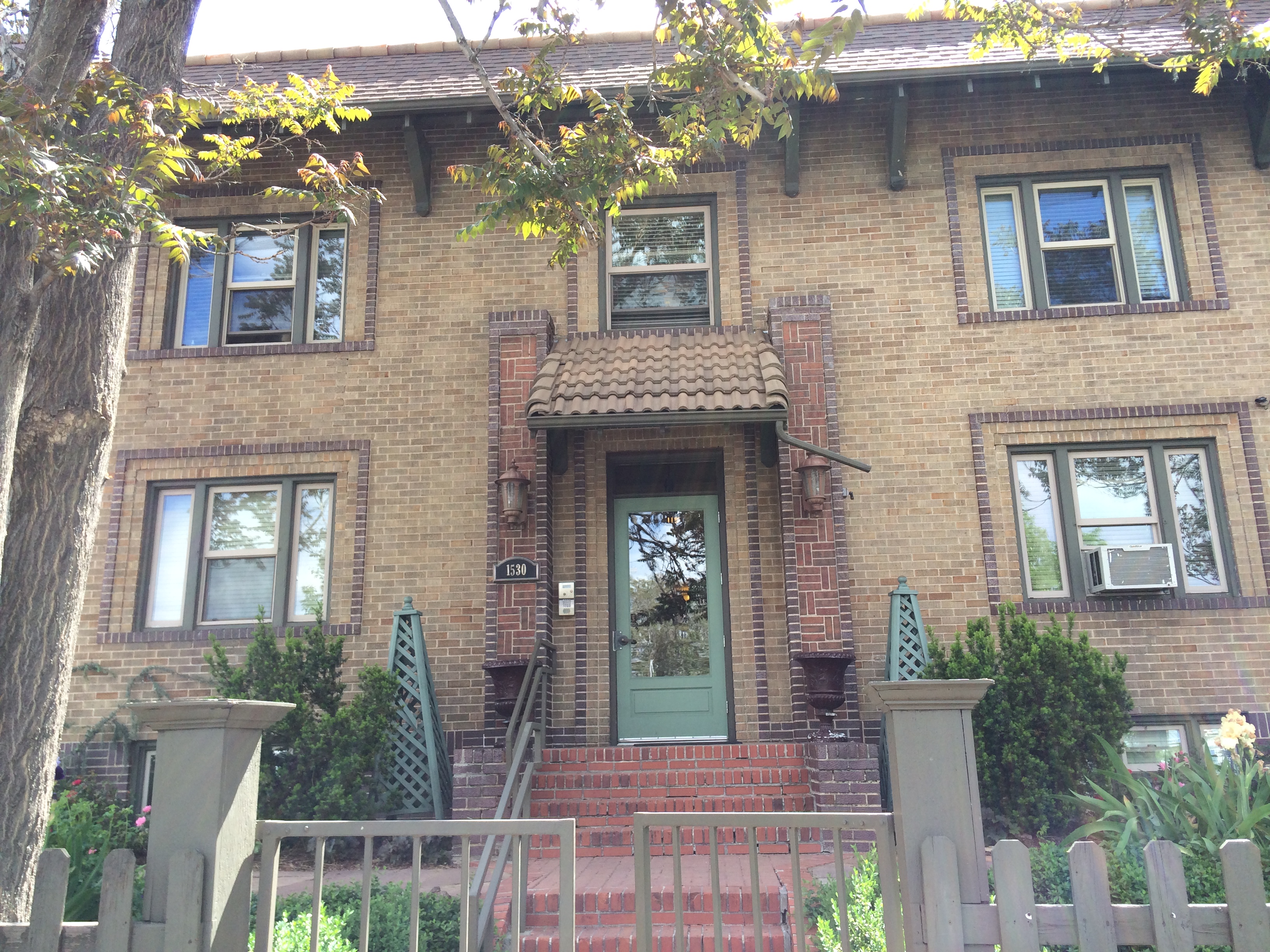
Then we found this lovely building at what I thought was 1550 Downing Street, the address listed as my great-grandparents’ residence in the 1908 Denver directory.  I got out of the car and took a lot of pictures of this building, thinking that this was my grandmother’s home in 1908. Here are two of them:

20160524_163424642_iOS 20160524_163441694_iOS

But I wasn’t sure when the building was built, so in writing this post, I googled 1550 Downing Street to see if I could find that information.  But Google kept showing me a very different house.  I was confused.  So I looked more closely at the house I’d photographed.  You can see that I took pictures of 1530, not 1550.  SIGH.

20160524_163442901_iOS

Here, however, courtesy of the internet, is a photo of 1550.  According to Zillow, it was built in 1888 and sold in March, 2016, for $798, 200.  It appears to have been totally gutted and renovated, and probably the only thing left from the time my grandmother lived there is the claw-footed tub.  You can see more pictures here.

1550 Downing Street better


Our visit to Denver was a touching one—to be able to see the building where my grandmother had been confirmed and acted in plays for the Jewish holidays, to see her photograph on the walls of the new building, to pass the addresses where she and her family once lived.  In my head I could envision my great-grandparents and their four children living in this place a century ago.

Below is an interactive map showing the places where my family lived in Denver and the location of their synagogue.  Click on the red balloons to see more about the location.

In a recent conversation with my father about his mother, he commented that I had presented only a partial representation of her in my writing about her.  In my limited times with her when I was child (she died when I was ten), she had seemed quiet and fragile and somewhat withdrawn.  But my father pointed out that in her youth, she had been very outgoing—someone who had performed in plays both at temple and at her high school.  He described her as very social—someone who had many boyfriends after my grandfather died; she also worked outside the home to support my father and my aunt once she was able to care for them again, working in the china business, making lampshades, and doing drafting for the military during the war.

Grandma Eva 1915 Denver Post photo

Eva Schoenthal, top left, 1915

Eva Schoenthal high school yearbook picture

Eva Schoenthal high school yearbook picture, 1922

John and Eva Cohen c. 1930

John and Eva (Schoenthal) Cohen

Hilda (Katzenstein) Schoenthal, Eva Schoenthal Cohen, Eva Hilda Cohen, and Harold Schoenthal

Hilda (Katzenstein) Schoenthal, Eva Schoenthal Cohen, Eva Hilda Cohen, and Harold Schoenthal

And although I had thought that her parents had moved to Philadelphia to help her care for my father and aunt, in fact the opposite was true.  They moved to Philadelphia so that she could care for them, as they both had become quite ill and needed help in their daily lives.  They moved next door so that she could cook and care for them.   My grandmother was not a timid or weak person, but a woman who had survived the tragic illness of her husband and her own troubles to come back to take care of others.

Fortunately, my father shared these thoughts with me before my trip out west, and so as I walked the streets of Denver, I imagined my grandmother not as I knew her in the later years of her life, but as a young, vibrant, beautiful and happy little girl and young woman, surrounded by her parents and three older brothers, performing on the stage, and actively participating in her school activities.  I am so glad that my father corrected my impressions of her and thus allowed me to envision her childhood in a more positive way.


Coming Back Soon

As our vacation winds down, I am looking backwards at all I’ve seen and done and looking forward to writing about it.  Here’s a sneak preview of our adventures in Colorado and New Mexico.

First, I spent four days with three of my best friends in the world.  We met our freshman year in college and spent four years living in the same dorms, talking, laughing, debating, consoling, sharing, and confiding in each other.  Although it was hard to get together in the years we were all raising families, in the last ten years or so we have gotten together every couple of years.  We got together this time in Boulder, Colorado, where one of my friends now lives.  It was my first time in the Rockies, and we hiked and walked all over Boulder, ate great food, and enjoyed good company and beautiful views.  And as if not one day had passed since we graduated over 40 years ago, we talked and laughed and debated and consoled and shared and confided in each other.

20160520_170549732_iOS

20160521_183012098_iOS


20160519_222807641_iOS


Then I met up with my husband at the Denver airport, and we began our travels together.  We spent about 24 hours in Denver, and in that time we explored downtown Denver and then explored my genealogical roots in the city where my paternal grandmother spent much of her childhood. More on that to come.

20160524_152548004_iOS

20160524_151205779_iOS

From Denver we drove all the way to Santa Fe, New Mexico, stopping in Raton, New Mexico, for a night, and arriving in Santa Fe the next day by lunch time.  I had lots of thoughts during that drive as we observed a part of the United States I’d never seen before, some of it incredibly beautiful and awe-inspiring and other parts that made me appreciate the struggles that so many Americans experience day to day.  More on that to come as well.

Raton

Raton

20160525_143124185_iOS

And then we got to Santa Fe, the main destination of our trip.  Santa Fe is a city with an incredibly long and rich history, including my Seligman family’s own personal history there, about which I’ve written extensively.  Being in this place that had been the home of my great-great-grandfather and his family—and where they had contributed so much to its commercial and political development—-was very moving and exciting.  And then there is the art, the glorious landscapes, the architecture.

20160526_151032795_iOS

20160527_164958541_iOS

20160527_200612447_iOS

The last leg of our trip took us to Taos where I again was inspired to think about the history of this country as well as its amazing landscapes and vistas.  It’s no wonder that so many artists were inspired by the scenery and the light and the skies over New Mexico.

20160530_150420390_iOS

20160530_155656274_iOS

I will be writing about the trip in the days that follow, and then I will return to the story of my family.  I have much to do after all these days away from research and from blogging.  I have missed the work and my family, my cats, and my friends, but as always, it’s good to get a break, some new perspectives, and a chance to reflect on all the wonders that life brings.

Impressions of Vienna and Some Concluding Thoughts on our Trip

To be honest, Vienna was not originally on our itinerary.  We wanted to go to Prague and Budapest and, of course, Poland, and we felt that given the number of days we could travel that that was already an ambitious itinerary.  But we could not find non-stop flights even out of NYC to any of those places, and we hate layovers, so we decided to fly in and out of Vienna.  It may not make sense to those of you who are regular jetsetters, but getting me on a plane is a big enough accomplishment; making me change planes might send me…flying?

Anyway, we were going to fly in and out of Vienna so we added a day to our trip.  It seemed crazy not to spend at least 24 hours in one of the world’s great cities, even though we knew that 24 hours would not be enough to scratch the surface of what there is to see there.  It would take some intense prioritizing and great organization to pack even a few top sights into our day.

We actually ended up with a day and a half, as our train from Budapest to Vienna arrived around 2:15 pm, and we were able to check into our hotel (Radisson Blu) quickly and be on our way.  The hotel was extremely well-situated for us to see many of the important sites just a short walking distance away.  It’s not the Boscolo, but it is a very clean, contemporary, and small boutique hotel.

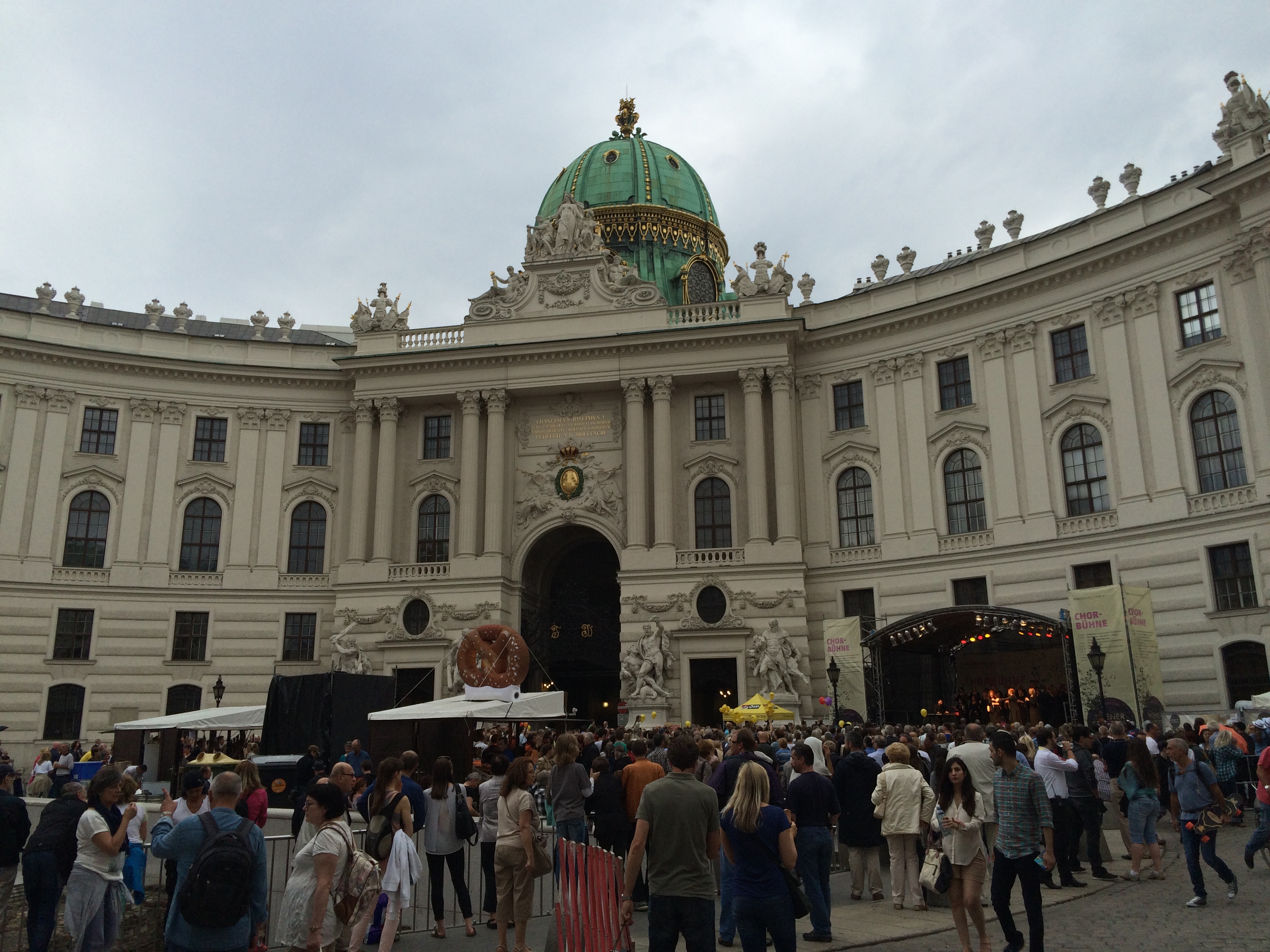
Just two blocks down the street was the Hofburg Palace where the Habsurgs lived in Vienna.  An outdoor music festival was going on that day, and there were crowds gathered to listen to the music—young choral groups performing primarily American music.  A bit incongruous—standing in front of an Austrian royal palace, listening to a group singing, “When the Saints Go Marching In.”  Our global world at work.

Hofburg Palace

Hofburg Palace

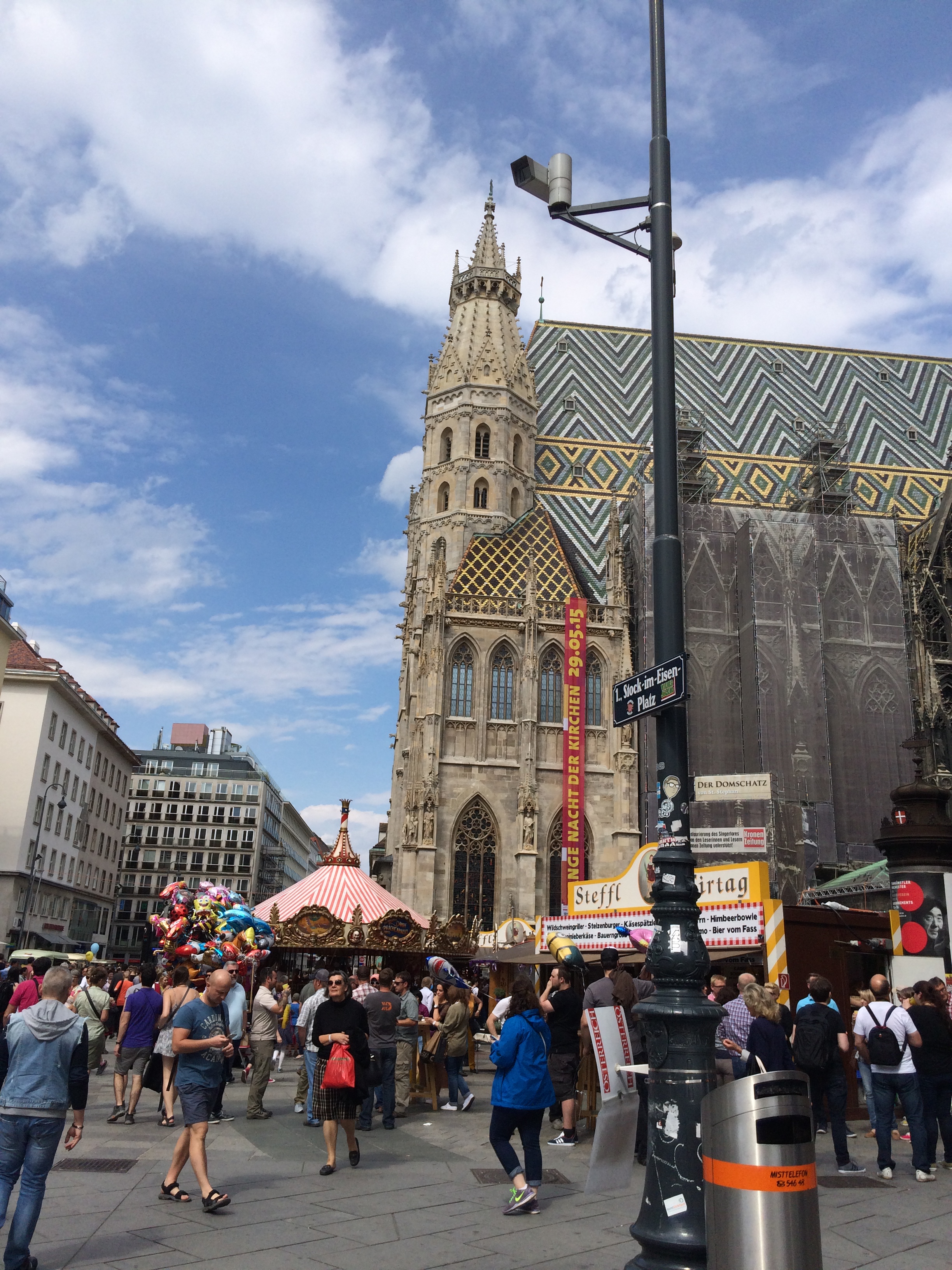
We wandered through the streets, passing many chic stores on Kohlmarket, and reached Graben, where there is a huge square lined with cafes and more fancy shops.  We stopped to see St. Stephen’s Cathedral and the all glass Haus Haus across the street.  Unlike the Hilton in Buda, this modern structure somehow blended in with the older buildings surrounding it.

IMG_2895 IMG_2896 IMG_2897 IMG_2898

We just had to stop and have some Viennese pastry, right?  It’s mandatory, I think. If one must drink beer in Prague, one must eat pastry in Vienna.  It was very much worth the unnecessary calories.  Vienna’s streets were packed with tourists, and there was lots of good people-watching to do from the café.

But we had miles to go in order to see at least some of the city, so off we marched towards the Opera House.  Like the Opera House in Budapest, it was a stately and beautiful building.  We opted not to do the tour inside this time, preferring to use our time to visit one of the art museums.

IMG_2907

It was already late in the afternoon, and we realized that we only had an hour until closing time, so we opted for the smaller Leopold Museum rather than the tremendous Kunsthistorische museum.  We were very glad that we did.  The museum focuses on the works of Gustav Klimt and Oskar Kokoschka as well as that of some of their less well-known contemporaries, and it does a masterful job of teaching about their art, their lives, and the politics and psychology that lie behind their art.  The room dedicated to the influence of Sigmund Freud was particularly well-done; a plaque with a quote from Freud hung near each painting, leaving it to the viewer to see the connection between the words and the art.

IMG_2909

We stayed until the museum closed and then wandered back to our hotel, not even realizing how close it was.  (We had basically walked a full circle from one side of the center of the city to the other and back without realizing it and were essentially behind the Hofburg Palace when we exited the museum quarter.)  We were amazed by how much we had seen in the few short hours since we’d arrived in Vienna.

The next day was jam-packed on my itinerary, but I quickly realized that there was no way we would get to the Schonbrunn Palace, even though I had pre-purchased tickets to go there.  It’s about 20 minutes outside of the city center, and since we were seeing the Hofburg Palace that morning, we decided that if you’ve seen one palace, you’ve seen them all. (Where is Spiro Agnew when you need him?)  Eliminating the Schonbrunn from the agenda loosened up our day considerably.

The Hofburg Palace was worth seeing; it tells the story of Emperor Franz Joseph and his wife Empress Elizabeth, commonly known as Sisi.  In particular, it tells the story of Sisi, who grew up as a young and independent child and married the emperor somewhat reluctantly, knowing that she would lose her freedom by doing so.  Eventually she became very unhappy living such a restricted life, and after one of her children died, she became severely depressed.  Although she contemplated suicide, in the end she was assassinated in Geneva by an Italian anarchist.  Her life story is well-told in the first several rooms in the palace.  After that, you then can see many of the lavish rooms where the emperor and empress lived and entertained in the palace.

After the palace tour, we went to see the performance of the Lipizzaner stallions at the Spanish Riding School.  This was another event that, like the baths in Budapest, several people said we could not miss.  We had standing room tickets, and the place was packed.  Within five minutes of the show starting, I almost left.  The first “act” involved some newer horses, and it was clear that at least one of them was not at all happy performing.  I couldn’t watch as the horse bucked and resisted his trainer’s attempts to control him.  We did stay for the next hour, and although the rest of the show involved more experienced horses, I just couldn’t shake the idea that these animals were being forced to do something they were not intended to do.  The horses are gorgeous, and if you love horses, you will either love this event or you will hate it.  I still am not sure how I feel about it. (We were not allowed to take photos, so I’ve inserted one from the internet.)


Embed from Getty Images

After lunch, I went to see the jewels at the Imperial Treasury while Harvey went to finalize our boarding passes for our flight the next morning.  The jewels were amazing.  I will let the pictures reveal what I saw.

IMG_2917

This opal was the size of a large pear. My Aunt Elaine would have loved it.

IMG_2920 IMG_2922 IMG_2927

The last thing we wanted to do before leaving Vienna was see some evidence of the Jewish world that once existed there.  Vienna had a large and thriving Jewish population before the Holocaust, including many famous artists, writers, musicians, and, of course, Freud.  Yet unlike Prague or Krakow or Budapest, there is almost nothing left in what was once the oldest Jewish section of the city to let you know that there once was a vibrant Jewish community there.  In that place, called Judenplatz, there are two reminders of the Jewish community: a museum which contains the remains of a medieval synagogue and a Holocaust memorial sculpture.  The museum’s exhibit is fascinating.  You can actually walk through the remains and see where the bima was, where the ark was, where the men sat to pray.

As for the Holocaust sculpture, it stands in the center of the square, and it is a large cube placed in the center of a larger platform.  On the sides of the cube are engraved the names of all the concentration and death camps.  I think it is supposed to evoke the sense of being locked inside, given the locked door on the exterior.  What was very disturbing about the memorial was the fact that there were many people sitting on the platform, idly eating ice cream and chatting, seemingly oblivious to the purpose of the sculpture.


The memorial to the 65,000 murdered Austrian J...

The memorial to the 65,000 murdered Austrian Jews in the Holocaust at Judenplatz in Vienna. (Photo credit: Wikipedia)

That perhaps is itself a metaphor for the Austrian attitude towards the Holocaust for many years after the war: denial.  As we learned at the main building of Jewish museum, it was not until fifty years after the war that Austrian officials apologized for their country’s role in the Holocaust.  They refused to acknowledge their complicity with the Nazis in the persecution and eventual murders of their Jewish citizens.  What had been a large and wealthy and intellectual community had been almost entirely wiped out.  Today there is some revival of Jewish life in Vienna, mostly made up of immigrants from the former Soviet Union.

We ended our trip going to the Musikverein, a great music hall in Vienna, where we heard Haydn, Poulenc, and Sibelius.  The sounds were as clear as could be, and the music was just wonderful.

IMG_2935

Musikverein Concert Hall

Although we saw so much of great beauty in Vienna—the buildings, the pastries, the jewels, the art, and the music, our visit to Judenplatz and to the Jewish museums put an overall damper on my feelings for Vienna.  Perhaps I am not being fair; we were there for such a short time, and perhaps a longer visit would have provided me with more perspective.  We had no guides in Vienna, just our handy Rick Steve’s guidebook and TripAdviser. I understand that there are a number of stolpersteins in the Second District where the Jewish community was located right before World War II.  We did not get there nor did we see where the current synagogues are located or talk to anyone familiar with the city and its history as we had in the other cities.  I am sure there is more than what we saw in such a short time—an important lesson to keep in mind in visiting any place.  You can’t see it all in a short visit as a tourist.

****

Thus ends my travelogue of our trip to Central Europe.  Some concluding thoughts:

  1. The best way to learn about the history, values, and people of another country is to go there and walk where they walk. If you do, be sure to find a way to talk to someone who lives in that place.  Guidebooks are great, group tours may be fine—but nothing beats developing a personal relationship with someone who knows that city like you know your home town and your history. Talk to them about their families, their personal history, and you will learn so much more than you ever could from a book or recorded tour.
  2. Take notes, take pictures. Memories vanish very quickly.  In writing this, I had to go back to my books, notes, photographs, and, yes, the internet, to be sure I had the right name for the right place and the right numbers and dates.
  3. Travel the way you want to travel.  I know many people prefer to travel on organized tours or at least with a group of friends.  Call us anti-social, but we have learned that traveling with others means compromising our own priorities.  We don’t get to travel as often as we’d like, and when we do, we want to go where we want to go, eat when and where we want to eat, and see and hear what we want to see and hear.  It’s really not that hard to research and plan your own trip.  Just my opinion, of course.  I fully understand that for other people, traveling with others is more comfortable and more fun.  Like I said, travel the way you want to travel.
  4. There is both incredible beauty in the world and incredible evil. Human beings have created incredibly awe-inspiring buildings, music, and art.  Each place we visited was a testament to man’s ability to create beauty.  Sadly, each place was also a testament to man’s ability to do incredible evil.  We tried always to let the beauty remind us that for the most part, human beings are good.
  5. If you know where your ancestors lived, go there, even if it’s a small town in the middle of nowhere where no traces are left of your ancestors or their community. I understand that some people have too many feelings of anger about the past to do this, but if you don’t feel that way and can go, go there.  You will be forever changed.

Thank you to all who have followed me through this telling of our trip.  I will now return to a focus on genealogy, but I felt a real need to write about this trip for so many reasons, not the least of which is to keep a record for me about what I saw and what I felt.  It is not an experience I ever want to forget.