Helene Goldschmidt Fuld’s Children: Marriages and Divorces

The oldest child of Jacob Meier Goldschmidt and Jettchen Cahn, Helene Goldschmidt Fuld, was widowed as a young mother in 1882 and left to raise her four children on her own: Clementine II (1874), Minna (1875), Harry (1878) and Hedwig (1880).

In the 1890s, her three daughters all married.

The oldest daughter Clementine Fuld II married David Cramer, son of Jacob Cramer and Caroline Furth, on June 24, 1892, in Frankfurt. David was born in Thundorf, Germany on January 1, 1862.

Marriage of Clementine Fuld and David Cramer, Hessisches Hauptstaatsarchiv; Wiesbaden, Deutschland; Bestand: 903, Year Range: 1892, Ancestry.com. Hesse, Germany, Marriages, 1849-1930

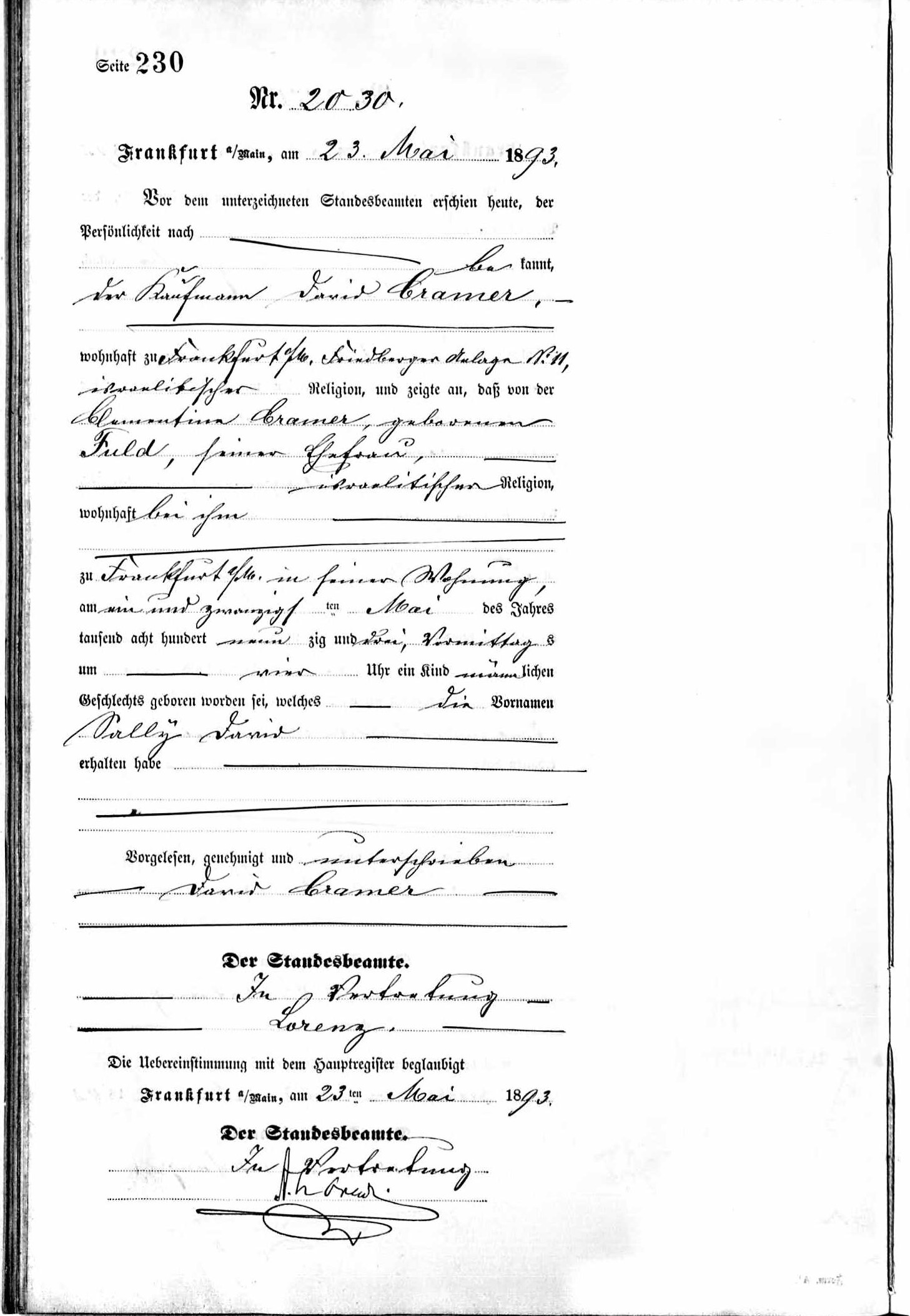
Clementine II and David had two children. Sally David Cramer was born on May 21, 1893, in Frankfurt.

Sally David Cramer birth record, Hessisches Hauptstaatsarchiv; Wiesbaden, Deutschland; Bestand: 903; Signatur: 903_9120, Year Range: 1893, Ancestry.com. Hesse, Germany, Births, 1851-1901

His sister Caroline Lilly Cramer was born the following year on September 26, 1894, in Frankfurt.

Caroline Lilly Cramer birth record, Hessisches Hauptstaatsarchiv; Wiesbaden, Deutschland; Bestand: 903; Signatur: 903_9138, Year Range: 1894, Ancestry.com. Hesse, Germany, Births, 1851-1901

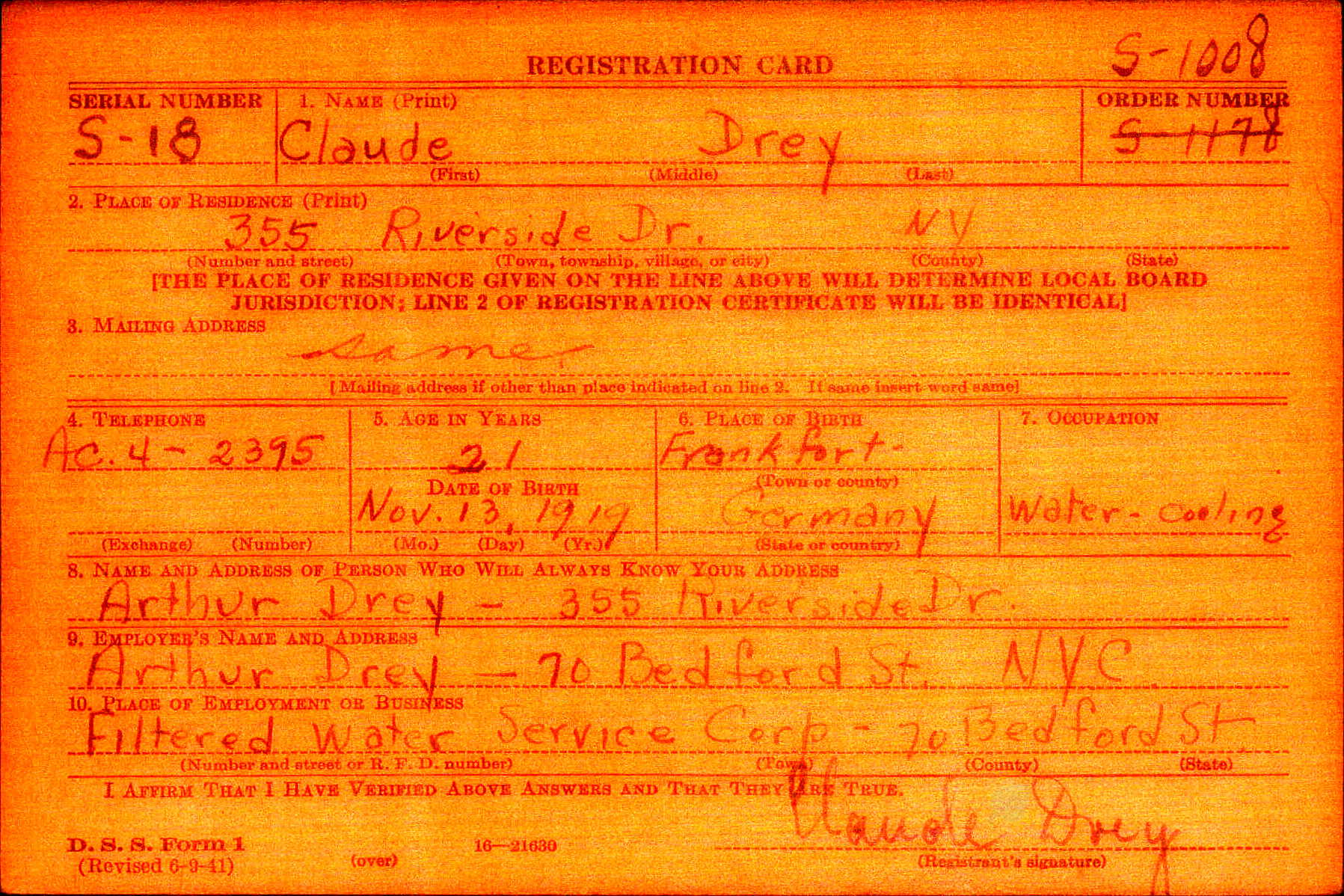
Caroline Lilly Cramer (known as Lilly) married Arthur Drey on January 27, 1919. Arthur was the son of Simon Drey and Flora Lovis and was born on September 9, 1890, in Wuerzberg, Germany. Arthur and Lilly would have three children born between 1919 and 1926: Claude (1919),1 Florence (1921),2 and Elisabeth (1926).3

Lilly Cramer and Arthur Drey marriage record,
Hessisches Hauptstaatsarchiv; Wiesbaden, Deutschland; Bestand: 903
Ancestry.com. Hesse, Germany, Marriages, 1849-1930

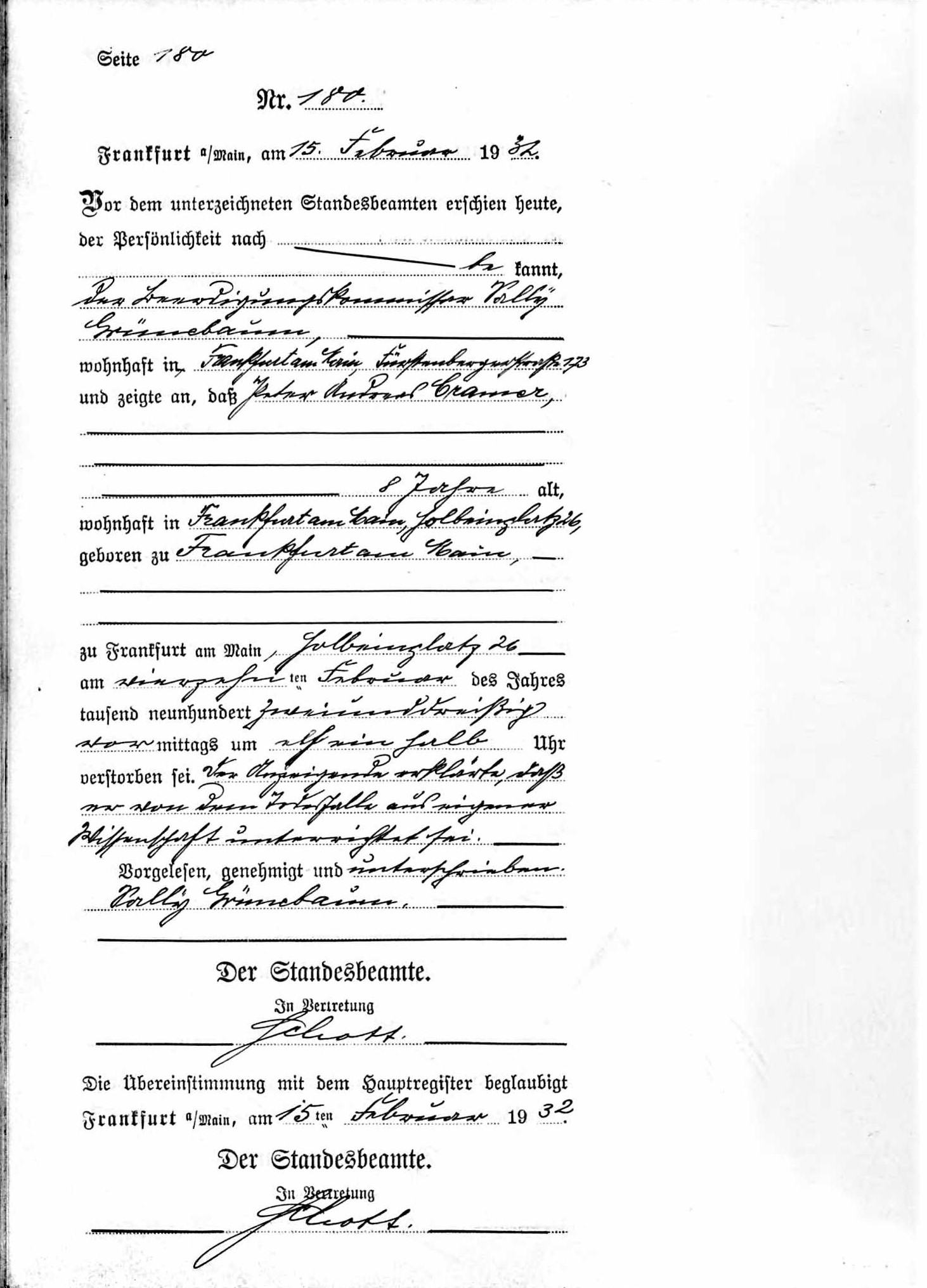
Lilly Cramer Drey’s brother Sally Cramer married two years after she did. Sally married Margarete Steinberg on April 29, 1921 in Frankfurt. She was born in Frankfurt to Albert and Carrie Steinberg on April 24, 1898.  Sally and Margarete had two sons born in the 1920s: Hans (1921)4 and Peter (1923).5

Sally Cramer and Margarete Steinberg marriage record, Hessisches Hauptstaatsarchiv; Wiesbaden, Deutschland; Bestand: 903, Year Range: 1921, Ancestry.com. Hesse, Germany, Marriages, 1849-1930

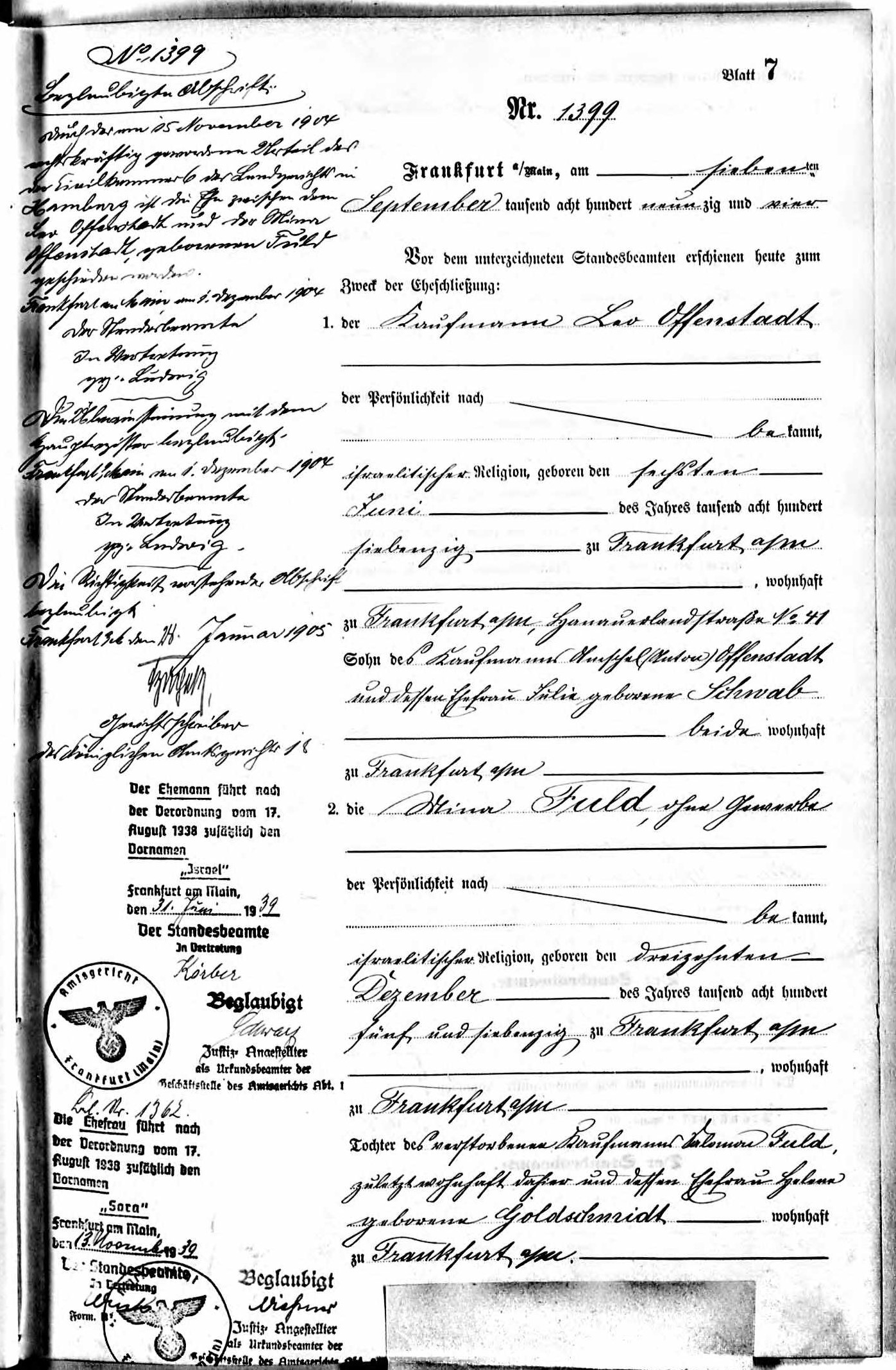
Salomon and Helene’s second child, Minna Fuld, married Leo Offenstadt on September 7, 1894, just over two months after her sister Clementine’s wedding. Leo was born on June 6, 1870, in Frankfurt, the son of Amschel Offenstadt and Julie Schwab.

Marriage record of Minna Fuld and Leo Offenstadt, Hessisches Hauptstaatsarchiv; Wiesbaden, Deutschland; Bestand: 903, Ancestry.com. Hesse, Germany, Marriages, 1849-1930

They had one daughter, Flora Offenstadt, born the following year on June 30, 1895, in Frankfurt.

Flora Offenstadt birth record, Hessisches Hauptstaatsarchiv; Wiesbaden, Deutschland; Bestand: 903; Signatur: 903_9153, Year Range: 1895, Ancestry.com. Hesse, Germany, Births, 1851-1901

Minna and Leo were divorced on November 15, 1904, as noted on their marriage record. According to several sources, including Roger Cibella and David Baron, in 1906 Minna then married Ladislaus Polacovitz, who was born in Kala, Hungary, on April 30, 1868. These sources also report that Minna and Ladislaus had a child, Liselotte Polacovitz, on May 14, 1907, in Sofia, Bulgaria.

I cannot find any source for the marriage or any other official record for Ladislaus, but I do have a FindAGrave entry for Ladislaus Polacavitz indicating that he died on September 13, 1913, in Frankfurt, just seven years after their marriage, if the unsourced marriage date is correct.6

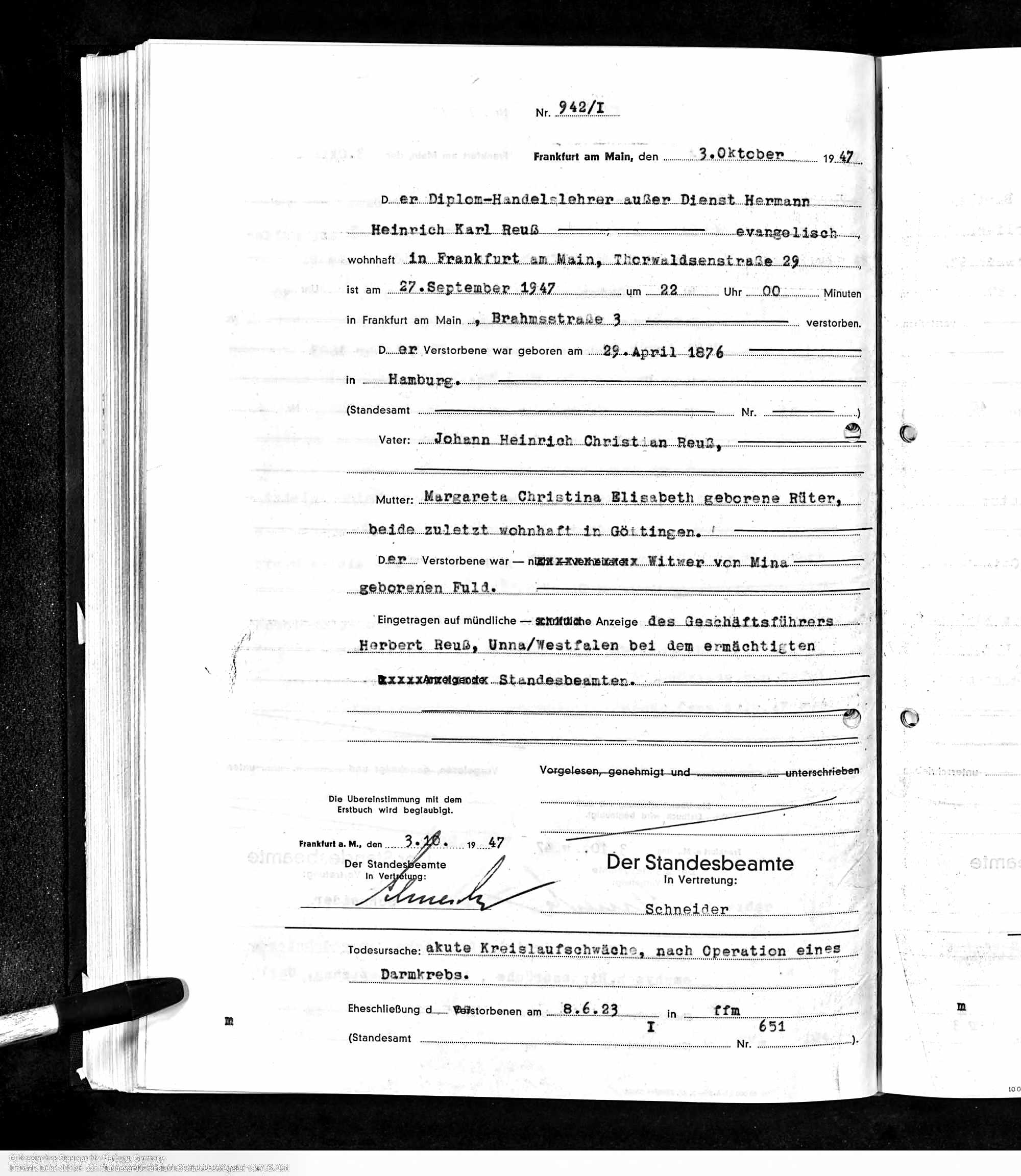
I have only two records that support the marriage of Ladislaus Polacovitz to Minna Fuld. The first is Minna’s third marriage record. On June 8, 1923 in Frankfurt, a Minna Polakovicz geb. Fuld married Hermann Heinrich Karl Reuss.

Marriage record of Minna Fuld and Hermann Reuss, Hessisches Hauptstaatsarchiv; Wiesbaden, Deutschland; Bestand: 903, Year Range: 1923, Ancestry.com. Hesse, Germany, Marriages, 1849-1930

The second record is a marriage record for a Liselotte Polacovitz and Wilhelm Strauss-Reich dated January 5, 1928. Wilhelm was the son of Benjamin Strauss and Franziska Silberberg and was born in Munich on May 29, 1899.

Marriage of Liselotte Polacovitz and Wilhelm Strauss-Reich, Hessisches Hauptstaatsarchiv; Wiesbaden, Deutschland; Bestand: 903, Year Range: 1928, Ancestry.com. Hesse, Germany, Marriages, 1849-1930

The marriage record does not include Liselotte’s parents’ names, but one of the witnesses to that marriage was Clementine Fuld Cramer, Minna’s sister, supporting the inference that Liselotte was related to Minna Fuld Polacovitz. Liselotte and Wilhelm had one child born in the 1920s, according to Cibella/Baron.

Meanwhile, Minna’s daughter from her first marriage, Flora Offenstadt, had married Hermann Durlacher on November 21, 1918, in Hamburg. That record indicates that her mother’s name was currently Polacovitz. Hermann Durlacher was born in Muehringen, Germany, on October 14, 1885, to Julius Durlacher and Luise Schweitzer. Flora and Hermann would have two children, Siegfried Fritz Julius Thomas, born in Hamburg on September 1, 1919,7 and Ulla Louise Sara, born on July 27, 1923, in Hamburg.8

Marriage of Flora Offerstadt and Hermann Durlacher, Year Range and Volume: 1918 Band 02
Ancestry.com. Hamburg, Germany, Marriages, 1874-1920. Original data: Best. 332-5 Standesämter, Personenstandsregister, Sterberegister, 1876-1950, Staatsarchiv Hamburg, Hamburg, Deutschland.

Here is a chart showing Minna’s three husbands and her two children and their spouses.

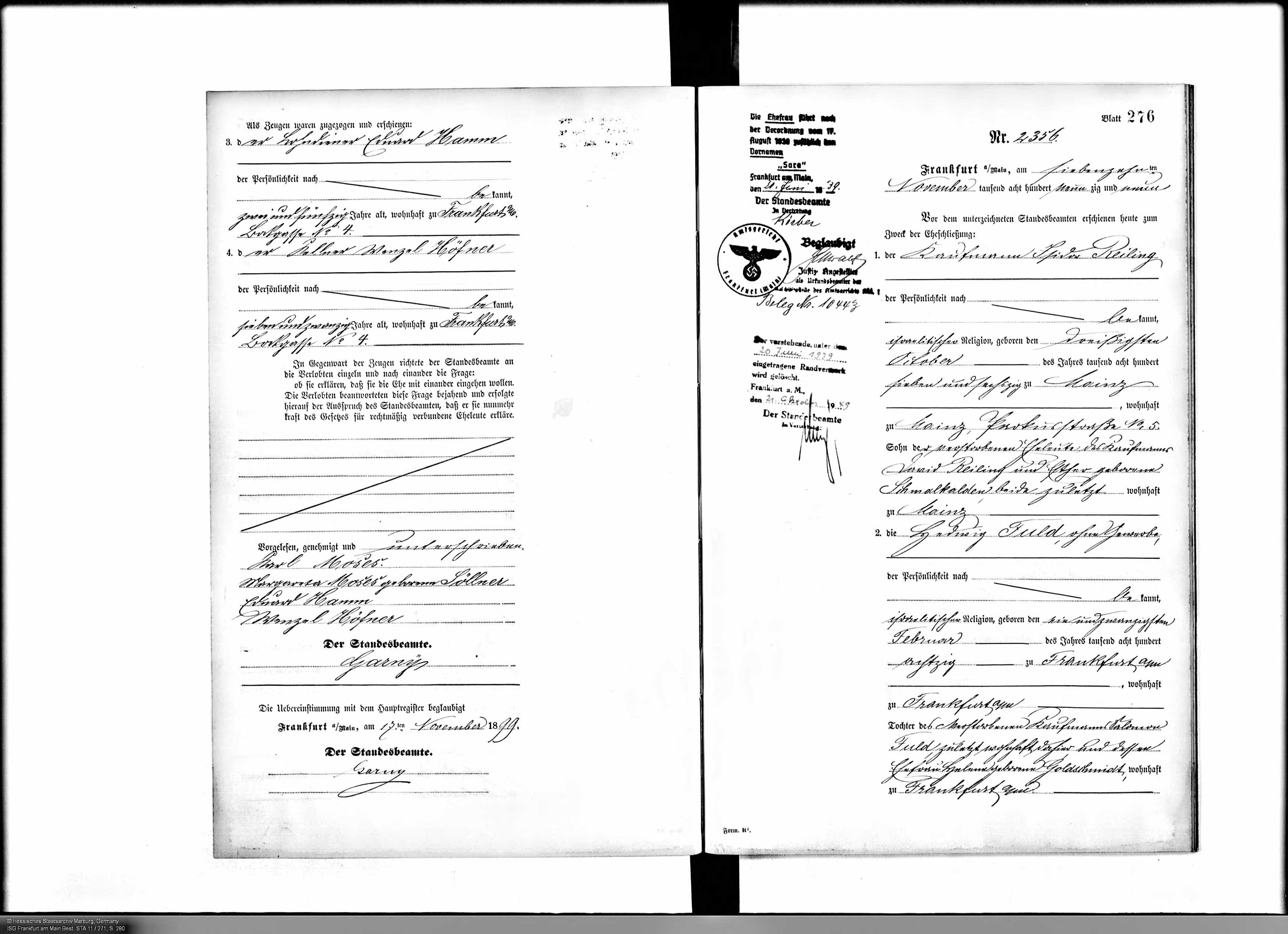
The youngest of Helene and Salomon’s daughters, Hedwig Fuld, also married before the 20th century began. She was nineteen when she married Isidor Reiling on November 17, 1899, in Frankfurt. Isidor was born in Mainz on October 30, 1867, making him thirteen years older than Hedwig. He was the son of David Reiling and Esther Schmalkalden.

Marriage record of Hedwig Fuld and Isidor Reiling, Hessisches Hauptstaatsarchiv; Wiesbaden, Deutschland; Bestand: 903, Year Range: 1899, Ancestry.com. Hesse, Germany, Marriages, 1849-1930

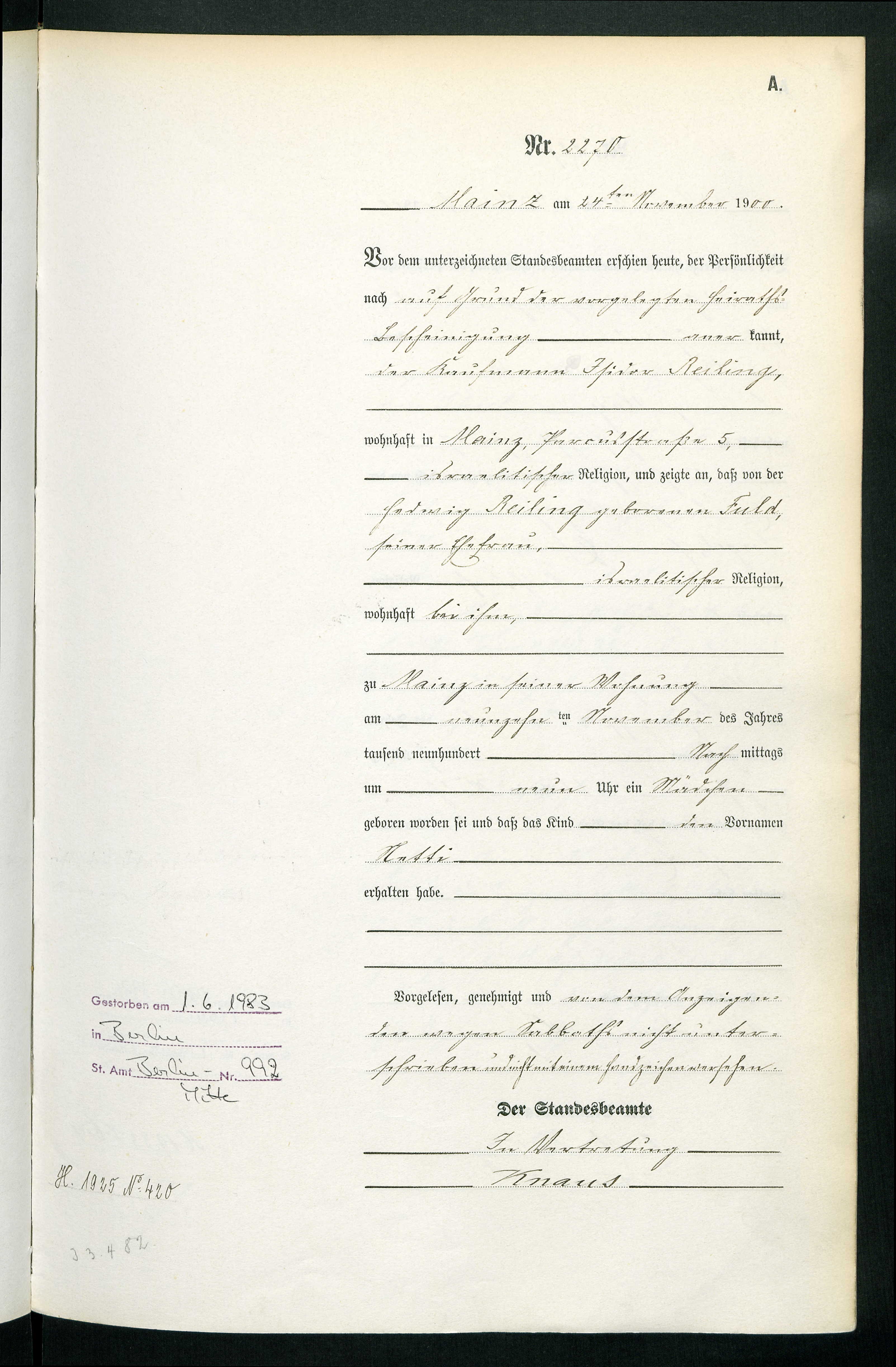
Hedwig and Isidor had one daughter, Netti Reiling, born in Mainz on November 19, 1900.

Netti Reiling birth record,Year Range: 1900 Band 5, Ancestry.com. Mainz, Germany, Birth Records, 1872-1900. Original data: Personenstandsregister Geburtenregister 1876-1900. Digital images. Stadtarchiv Mainz, Mainz, Germany.

On August 10,1925, Netti married Laszlo Radvani, who was born in September 13, 1900, in Budapest. I will have a lot to say about Netti and Laszlo in a later post.

Helene Goldschmidt Fuld’s son Harry Fuld married Flora Sondheimer sometime early in the 20th century. Flora was born in Strassbourg, France, on January 22, 1881, to Aron Sondheimer and Fanny Oppenheimer.9 I do not have a marriage record for Harry and Flora, but David Baron and Roger Cibella’s rerport shows that they were married in Strassbourg on March 12, 1903.

Harry and Flora had one child who shared his father’s name, Harry Fuld, Jr. He was born in Frankfurt on September 2, 1913.10 The fact that Harry was born ten years after the date reported for his parents’ marriage makes me wonder whether that date is correct. and if it is correct, whether there were other pregnancies prior to the birth of Harry, Jr.

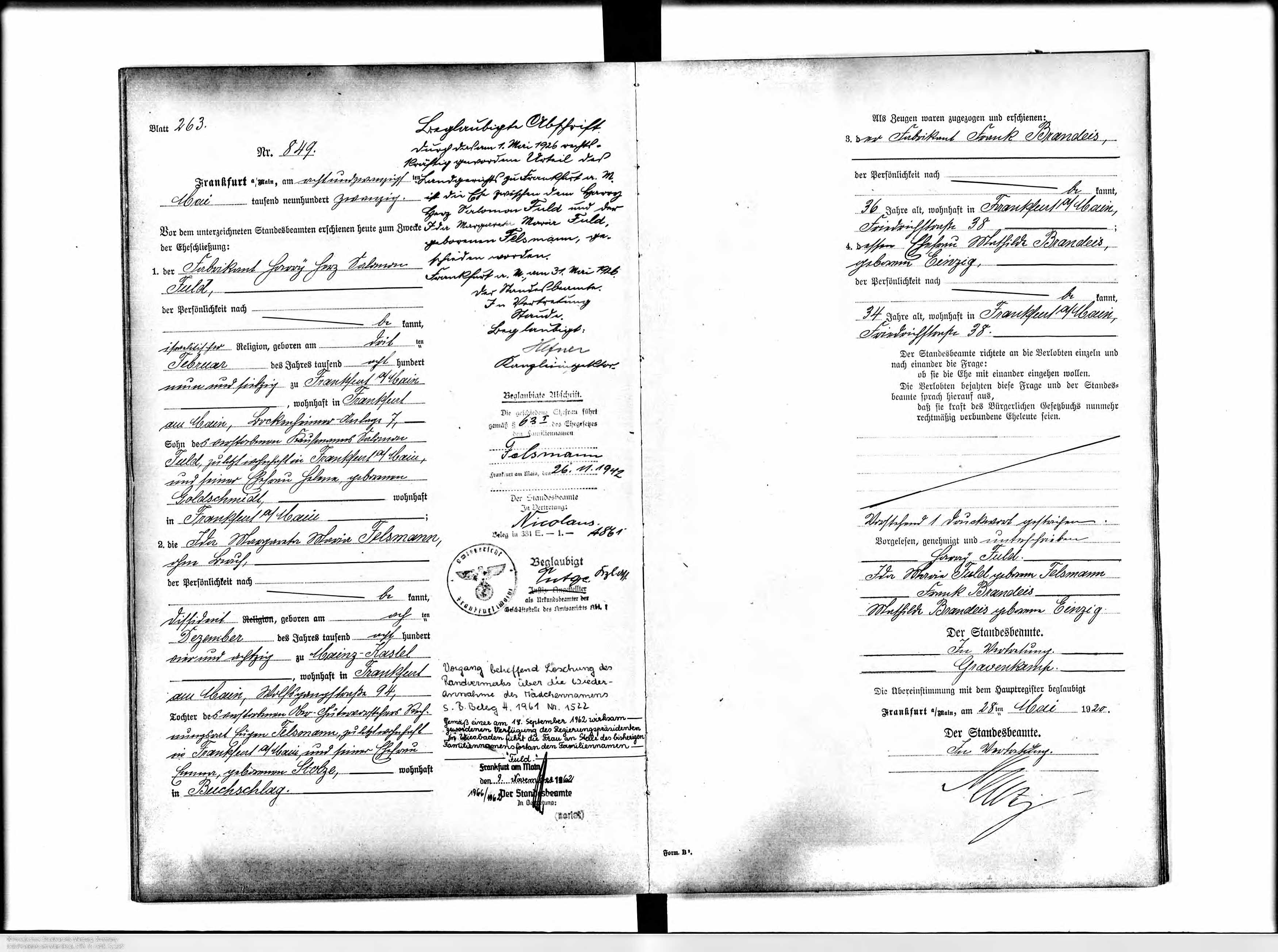
Harry, Sr., and Flora divorced sometime before May 28, 1920, when Harry married his second wife, Ida Margareta Maria Felsmann. She was the daughter of Eugen Felsmann and Emma Stolze and was born in Mainz on December 8, 1884. They had one son, Peter Harry Fuld, born in Frankfurt on February 12, 1921.11

Marriage of Harry Fuld, Sr. and Ida Margarete Maria Felsmann, Hessisches Hauptstaatsarchiv; Wiesbaden, Deutschland; Bestand: 903, Year Range: 1920, Ancestry.com. Hesse, Germany, Marriages, 1849-1930

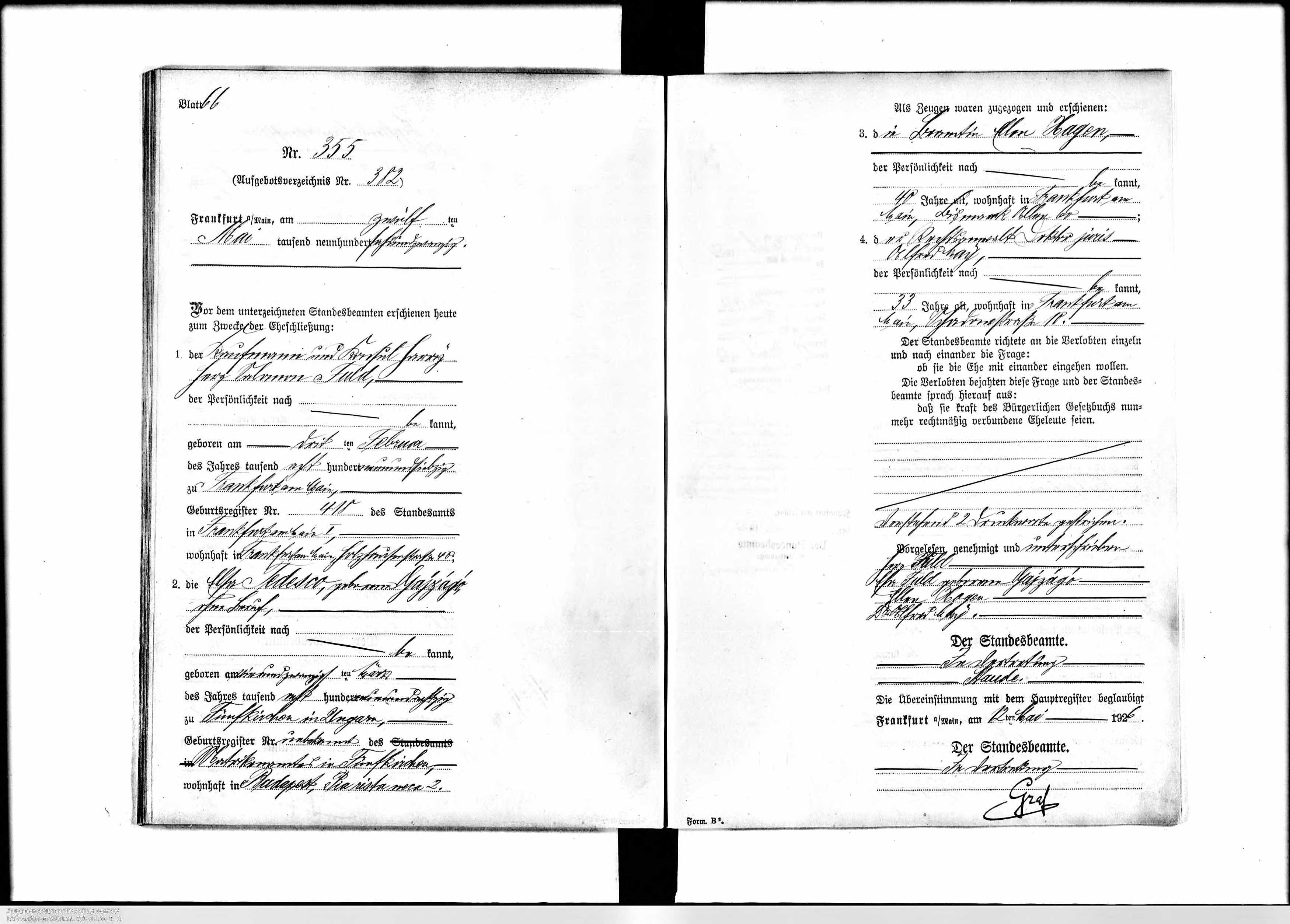
Harry and Ida divorced in 1926, and on May 12, 1926, Harry married his third wife, Elsa Cajzago Tedesco, who had also been previously married. Elsa was born in Funfkirchen, Hungary, on March 21, 1881, and was living in Budapest at the time of the marriage. More on Elsa in a subsequent post.

Marriage record of Harry Fuld and Elsa Tedesco, Hessisches Hauptstaatsarchiv; Wiesbaden, Deutschland; Bestand: 903, Year Range: 1926, Ancestry.com. Hesse, Germany, Marriages, 1849-1930

Here’s a chart showing Harry’s three marriages and his children.

While all these marriages, divorces, and births were occurring, the family lost its matriarch when Helene Goldschmidt Fuld died on April 15, 1922, at the age of 68.

Helene Goldschmidt I Fuld death record, Personenstandsregister Sterberegister; Bestand: 903; Signatur: 10857, Year Range: 1922, Ancestry.com. Hesse, Germany, Deaths, 1851-1958

She had outlived her husband Salomon by forty years and had managed to raise four children on her own. Looking at Minna and Harry’s marital histories–each married three times—one has to wonder what impact losing their father when they were so young had on them.

That brings Helene Goldschmidt Fuld’s family up to the late 1920s. Next we will see what happened to each of them in the 1930s and after.


  1. Claude Drey, Birth Date: 13 Nov 1919, Birth Place: Frankfort, Germany, Registration Date: 1 Jul 1941, Registration Place: New York, New York, Ancestry.com. U.S. WWII Draft Cards Young Men, 1940-1947 
  2. Dorothy Drey, Naturalization papers, The National Archives at Philadelphia; Philadelphia, Pennsylvania; NAI Title: Declarations of Intention for Citizenship, 1/19/1842 – 10/29/1959; NAI Number: 4713410; Record Group Title: Records of District Courts of the United States, 1685-2009; Record Group Number: 21, Ancestry.com. New York, State and Federal Naturalization Records, 1794-1943 
  3. Elizabeth Drey, Birth Date: 22 Jan 1926, Birth Place: Frankfurt Yi, Federal Republic of Germany, Father: Arthur Drey, Mother: Lilly Cramer, SSN: 076202437, Ancestry.com. U.S., Social Security Applications and Claims Index, 1936-2007 
  4.  Hans Clemens Cramer, Birth Date: 15 Dez 1921, Birth Place: Bonn, Last Residence: Frankfurt am Main, National Archives and Records Administration (NARA); Washington, DC; Name Index of Jews Whose German Nationality Was Annulled by the Nazi Regime (Berlin Documents Center); Record Group: 242, National Archives Collection of Foreign Records Seized, 1675 – 1958; Record Group ARC ID: 569; Publication Number: T355; Roll: 2, Brüll, Erna – Fränkel, Werner, Ancestry.com. Germany, Index of Jews Whose German Nationality was Annulled by Nazi Regime, 1935-1944 
  5.  Peter Andreas Cramer, Age: 8, Death Date: 14 Feb 1932, Death Place: Frankfurt, Hessen (Hesse), Deutschland (Germany), Civil Registration Office: Frankfurt IV
    Certificate Number: 180, Personenstandsregister Sterberegister; Bestand: 903; Signatur: 11001, Ancestry.com. Hesse, Germany, Deaths, 1851-1958 
  6. Ancestry.com. Germany, Find A Grave Index, 1600s-Current, Original data: Find A Grave. Find A Grave. http://www.findagrave.com/cgi-bin/fg.cgi. 
  7.  Siegfried Fritz Julius Thomas Durlacher, Birth Date: 1 Sep 1919, Birth Place: Hamburg, National Archives and Records Administration (NARA); Washington, DC; Name Index of Jews Whose German Nationality Was Annulled by the Nazi Regime (Berlin Documents Center); Record Group: 242, National Archives Collection of Foreign Records Seized, 1675 – 1958; Record Group ARC ID: 569; Publication Number: T355; Roll: 2, Brüll, Erna – Fränkel, Werner, Ancestry.com. Germany, Index of Jews Whose German Nationality was Annulled by Nazi Regime, 1935-1944 
  8.  Ulla Louise Sara Durlacher, Birth Date: 27 Jul 1923, Birth Place: Hamburg, National Archives and Records Administration (NARA); Washington, DC; Name Index of Jews Whose German Nationality Was Annulled by the Nazi Regime (Berlin Documents Center); Record Group: 242, National Archives Collection of Foreign Records Seized, 1675 – 1958; Record Group ARC ID: 569; Publication Number: T355; Roll: 2, Brüll, Erna – Fränkel, Werner, Ancestry.com. Germany, Index of Jews Whose German Nationality was Annulled by Nazi Regime, 1935-1944 
  9. Flora Sondheimer Fuld death record, Personenstandsregister Sterberegister; Bestand: 903; Signatur: 11125, Year Range: 1941, Ancestry.com. Hesse, Germany, Deaths, 1851-1958 
  10. Harry Fuld, Gender: Male, Nationality: German, Birth Date: 2 Sep 1913, Birth Place: Frankfurt, Germany, The National Archives; Kew, London, England; HO 396 WW2 Internees (Aliens) Index Cards 1939-1947; Reference Number: HO 396/152, Ancestry.com. UK, WWII Alien Internees, 1939-1945 
  11. Peter Fuld death record, Deutschland, Hessen, Frankfurt, Standesbücher 1928-1978,” database with images, FamilySearch (https://familysearch.org/ark:/61903/1:1:QKVW-26XV : 12 April 2019), Peter Harry Fuld, 21 Mar 1962; citing Death, Frankfurt am Main, Hessen, Deutschland, Hessische 

Passover During A Pandemic

Every year for as far back as I can remember, my family has gathered for Passover. In my childhood, we had seders at my aunt and uncle’s house with my cousins Jody and Jeff. Then we all started doing a second seder together at our house. Every year, no matter what else was happening, we had seders. They were wild and chaotic and so much fun. Passover was my favorite holiday and was my first introduction to Jewish culture, history, and religion.

Once I married, the tradition shifted, but nevertheless, every year we had seders, one with my family at my parents’ house, one with my husband’s family either in New Jersey or the Bronx or later in Newton. They were all wild and chaotic and a great deal of fun.

Then we had grandchildren, and we began hosting one of the seders at our house, relieving my mother of the burdens of preparing the seder. We love hosting the seder, although the craziness beforehand and during makes me appreciate what all those who had hosted in the past were experiencing. Trying to convert our house to Passover dishes and pots and pans while also cooking some food ahead of time, renting tables and table cloths to accommodate the crowd, and then attempting to participate in the seder while also warming and serving food was a logistical challenge.

Passover 2019

But seeing my family gathered together around our table made it all more than worthwhile.

My dad and Remy, Passover 2016

Harvey and Nate

So here we were, facing Passover during the social distancing brought on by the COVID-19 pandemic. How were we going to celebrate without being together? Would this be the first year ever in my memory that I would not be going to a seder? The thought saddened me, as I know it did for Jews all over the world.

Fortunately, my nine-year-old grandson Nate presented us with a challenge and an idea. Could we do a virtual seder using Zoom, the platform his school was using for remote learning? We spent some time learning how to use Zoom and thinking of how we could do this.

We scanned the Haggadah my family has used forever (The Haggadah for the American Family—mostly in English and accessible to all) and figured out who would read which parts. We added back in the handwashing we usually overlook. Nate and Remy practiced the four questions. Then we distributed a PDF of the scanned Haggadah to all who would be attending with their parts designated in the margins. As a final touch, Nate filmed himself doing an introduction and explanation of how things would work, and I emailed it all to everyone along with a Zoom invitation.

Nevertheless, the day of the first seder, I was feeling a bit blue. Sure, I had a lot less work to do, but that made me feel a bit at loose ends. Was it really Passover? I set the table for two with our seder plate filled with the usual ingredients, our cups for Elijah and for Miriam, our matzah holder, and salt water for the parsley.  It looked empty. We even put on nicer clothes than what we’ve been wearing since self-quarantining to make the day feel special. And then we waited for our guests to arrive in the Zoom waiting room.

Our seder table 2020 (before the seder plate was filled)

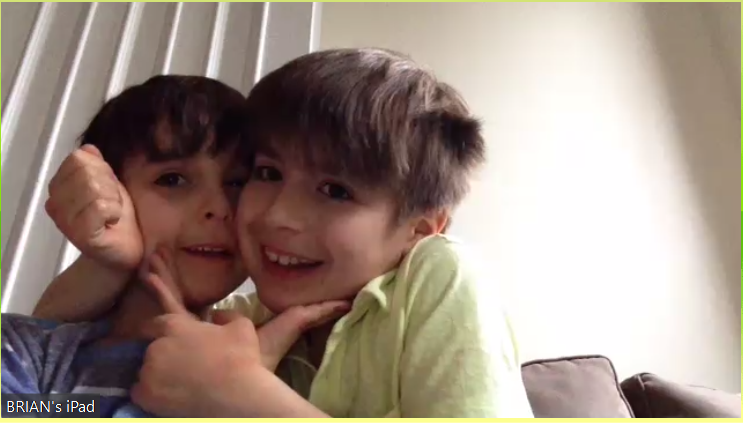
And they all showed up on time, ready to go. After chatting a bit and saying hello, our grandson Remy, only five, asked if we could have a virtual group hug. Can you imagine how happy that made me? We all reached out our arms to each other. What an amazing insight for a five-year-old—to recognize that we all needed that embrace, even if it was only across the internet.

I asked if everyone had a seder plate, and sure enough, everyone had made the effort to put together as best they could a plate with charoset (or an apple), moror, an egg, a shankbone (or a plastic sheep), and parsley or some other green. It was so uplifting, seeing that everyone had made the effort to make this a real Passover. Here are a few examples; you can see the creativity involved.

In fact, my younger daughter Maddy went all out and made chicken soup and matzoh balls, something she had never cooked before, and it looked amazing. My older daughter Rebecca made homemade macaroons. Everyone cared enough to do whatever they could to honor our holiday and our traditions. Suddenly it felt like this was really Passover.

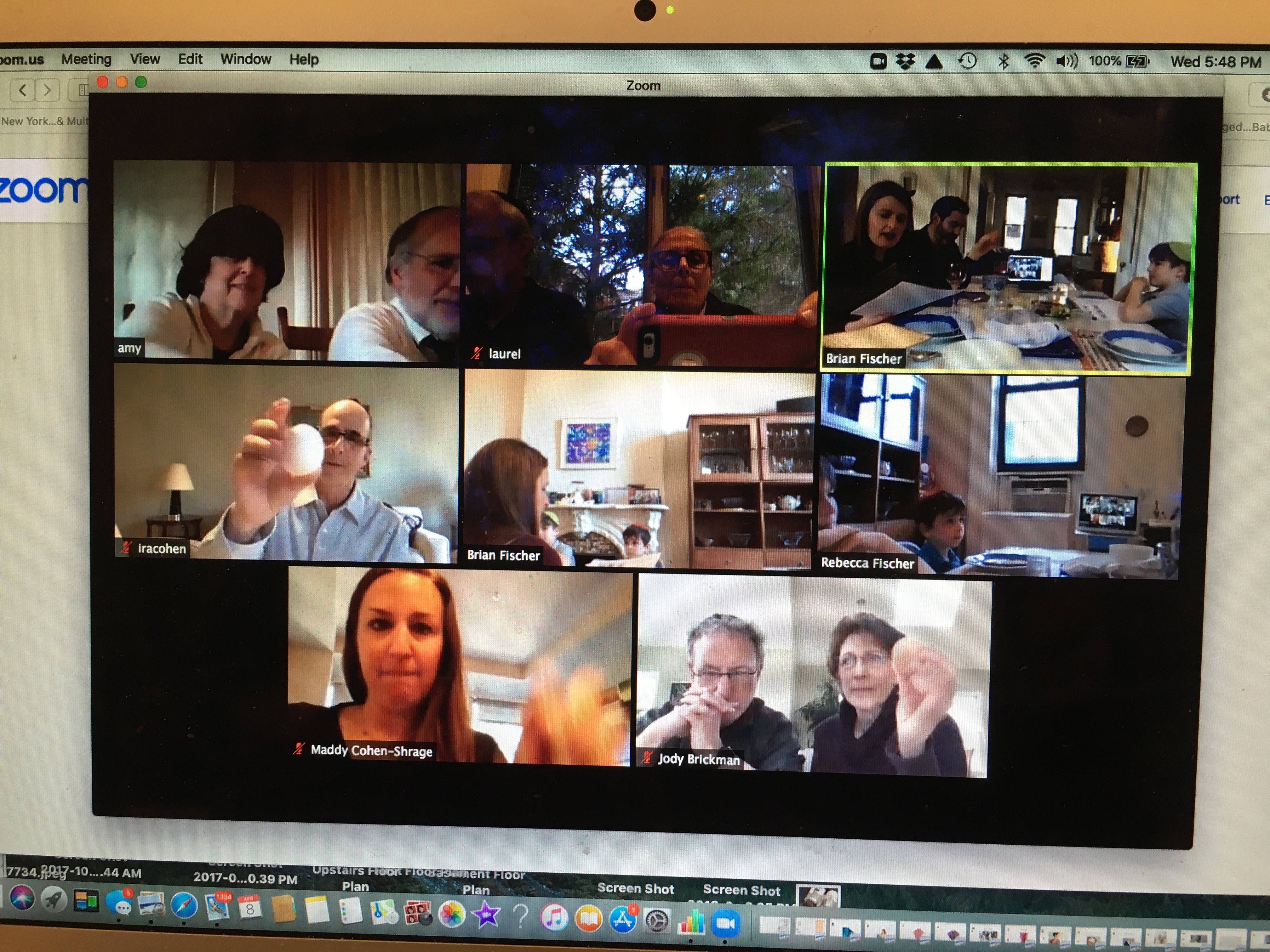
Once we started the seder, it was almost as if we were all in the same room. Nate and my husband shared the responsibilities of being the leader, an honor Nate had certainly earned by virtue of his efforts and creativity in getting the seder organized. We went through our Haggadah as we usually do, adding a few extra comments appropriate to the situation—talking about the need for handwashing, adding an eleventh plague for COVID19, and recognizing the current meaning of the lesson that the wise child is the one who works for the benefit of all humankind, not just for him or herself.

Nate and Remy did a beautiful reading of the four questions, first in English and then in Hebrew. Then I read something our rabbi had written, describing how this Passover is different from all other Passovers and making us all think about our gratitude to those on the front lines of this pandemic—the medical personnel, those working at grocery stores and drug stores, the delivery people, the police and fire and other emergency personnel. Her words also gave us hope that as with our ancestors in ancient times, we would pull through and get out of this contemporary time of captivity.

And then we shared our dinners together, gefilte fish, soup, or whatever we each had prepared for that evening. Nate and Remy searched for the afikomen in their own home, and we sang for Elijah, but didn’t let anyone else inside. We pulled out whatever we had for dessert, and then we said good night.

Of course, it wasn’t the same as being together. Zoom makes it hard to have individual conversations or any real extended conversations that aren’t interrupted by the chatter of everyone else. And there are no hugs and kisses to say hello and goodbye.  But we had celebrated Passover. We had been together. We had remembered our own family traditions as well as the traditions of Jews everywhere around the world and throughout all time. We had had a seder.

Next year we hope we will be together in one space. But maybe this year’s seder will be the one we will always remember best. Because we all cared enough to make it real, to feel the connection to each other, and to appreciate what our traditions have taught us about hope and freedom and gratitude.

A Mother and Her Daughter, Both Widowed Too Young

Having told the stories of my four-times great-uncle Meyer Goldschmidt’s two oldest children, Ella and Sarah, I now turn to his oldest son and third child, Jacob Meier Goldschmidt. Jacob was born on October 26, 1824, in Grebenstein, Germany. We saw that Jacob married Jettchen Cahn on July 6, 1853.

Jacob and Jettchen had five children.

Helene Goldschmidt was born on April 4, 1854, in Frankfurt.

Helene Goldschmidt birth record, Hessisches Hauptstaatsarchiv; Wiesbaden, Deutschland; Bestand: 903; Signatur: 903_8804, Year Range: 1854, Ancestry.com. Hesse, Germany, Births, 1851-1901

Regina Goldschmidt was born July 31, 1855, in Frankfurt.

Regina Goldschmidt birth record, Hessisches Hauptstaatsarchiv; Wiesbaden, Deutschland; Bestand: 903; Signatur: 903_8806, Year Range: 1855, Ancestry.com. Hesse, Germany, Births, 1851-1901

Julius Goldschmidt was born on March 20, 1858, in Frankfurt.

Julius Goldschmidt birth record, Hessisches Hauptstaatsarchiv; Wiesbaden, Deutschland; Bestand: 903; Signatur: 903_8812, Year Range: 1858, Ancestry.com. Hesse, Germany, Births, 1851-1901

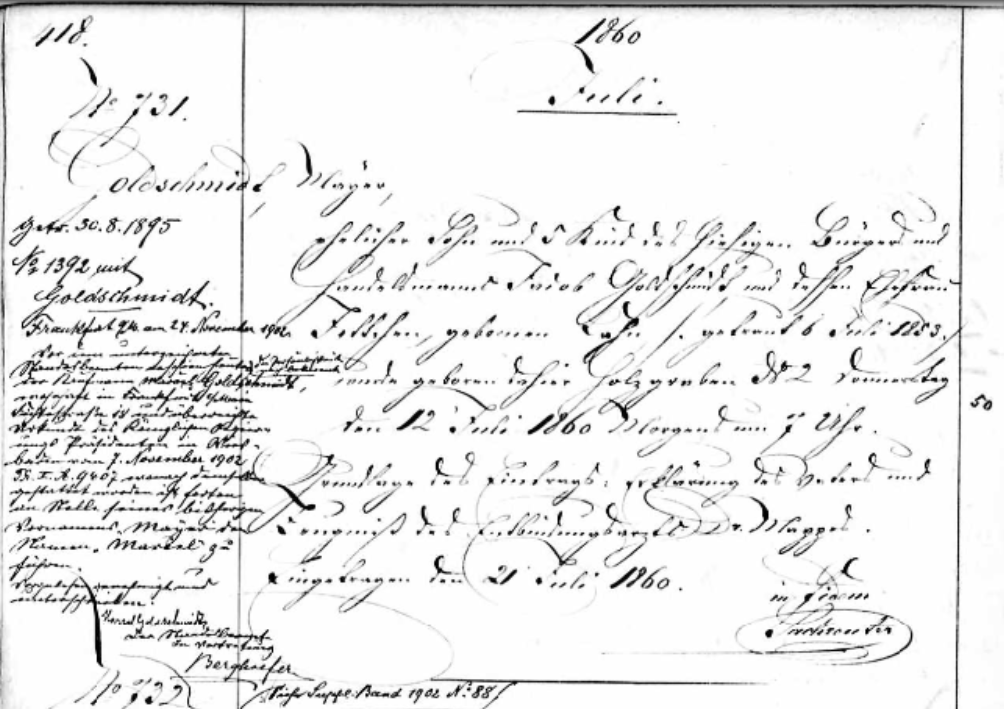
Mayer Goldschmidt (obviously named for his grandfather and later known as Marcel) was born on July 12, 1860, in Frankfurt.

Mayer Goldschmidt birth record, Hessisches Hauptstaatsarchiv; Wiesbaden, Deutschland; Bestand: 903; Signatur: 903_8816, Year  Range: 1860, Ancestry.com. Hesse, Germany, Births, 1851-1901

And finally, Helmina Goldschmidt was born in Frankfurt on October 23, 1863.

Helmina Goldschmidt birth record, Certificate Number: 1368, Hessisches Hauptstaatsarchiv; Wiesbaden, Deutschland; Bestand: 903; Signatur: 903_8824, Ancestry.com. Hesse, Germany, Births, 1851-1901

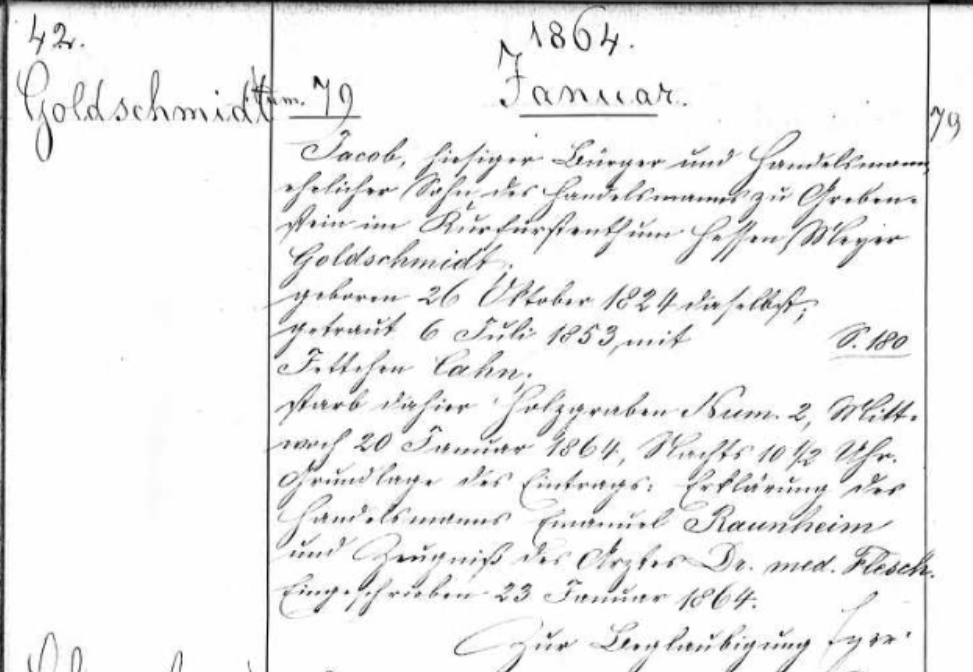
But Jacob Meier Goldschmidt did not live to see those five children grow up. He died January 20, 1864, when he was only 39 and his children were all younger than ten years old. Little Helmina was only three months old and never knew her father.

Jacob Meier Goldschmidt, death record, Personenstandsregister Sterberegister; Bestand: 903; Signatur: 10258, Year Range: 1864, Ancestry.com. Hesse, Germany, Deaths, 1851-1958

Losing their father at such a young age must have been traumatic for the family. Fortunately, Jacob’s family continued to grow and become his legacy—his five children, twenty-two grandchildren, and numerous great-grandchildren, as we will see.

The rest of this post and the set that follow will focus on his oldest child, Helene Goldschmidt Fuld, and her family.

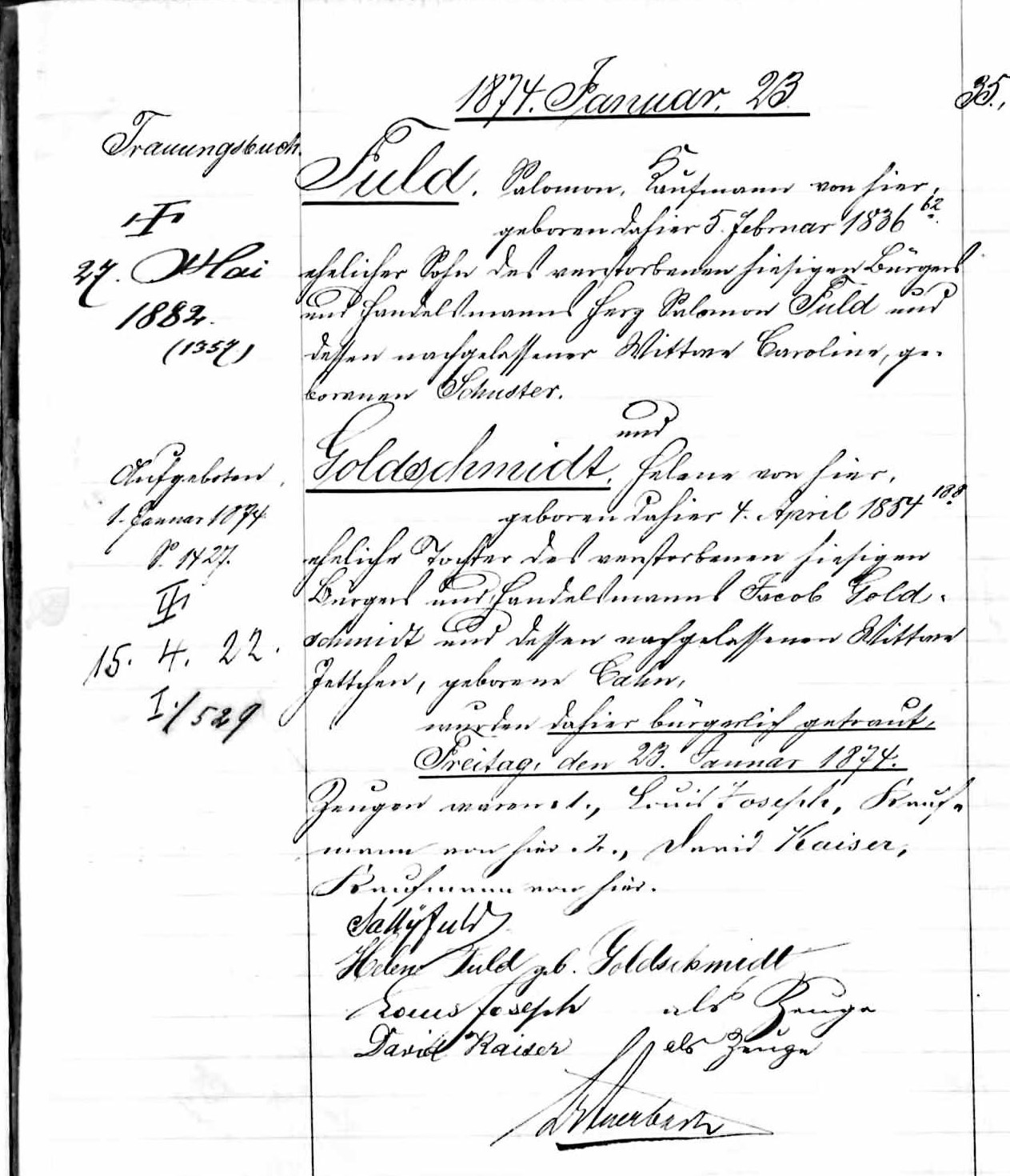
Helene married Salomon Fuld on January 23, 1874, in Frankfurt.

Helene Goldschmidt I marriage to Salomon Fuld, Hessisches Hauptstaatsarchiv; Wiesbaden, Deutschland, Year Range: 1874, Ancestry.com. Hesse, Germany, Marriages, 1849-1930

Salomon was also a Frankfurt native, born there on February 5, 1836, making him nineteen years older than Helene. He was the son of Herz Salomon Fuld and Caroline Schuster and the older brother of Clementine Fuld, wife of Selig Goldschmidt, who was Helene’s uncle, her father Jacob’s brother.

Helene and Salomon had four children, Clementine, Minna, Harry and Hedwig.

Clementine Fuld was born December 3, 1874, in Frankfurt. At first I thought she’d been named for Salomon’s sister, but his sister Clementine was still alive when her niece was born. If the baby was named for her living aunt, that would have been unusual, given Jewish naming patterns. She could have been named for the same deceased relative for whom Clementine I was named.  But it seemed to happen a few times in this branch of the family that children were given the names of living relatives. I will refer to Helene and Salomon’s daughter as Clementine Fuld II.

Clementine Fuld II birth record, Hessisches Hauptstaatsarchiv; Wiesbaden, Deutschland; Bestand: 903; Signatur: 903_8859, Year Range: 1874, Ancestry.com. Hesse, Germany, Births, 1851-1901

Helene and Salomon’s second daughter Minna Fuld was born on December 13, 1875, in Frankfurt.

Minna Fuld birth record, Hessisches Hauptstaatsarchiv; Wiesbaden, Deutschland; Bestand: 903; Signatur: 903_8867, Year Range: 1875, Ancestry.com. Hesse, Germany, Births, 1851-1901

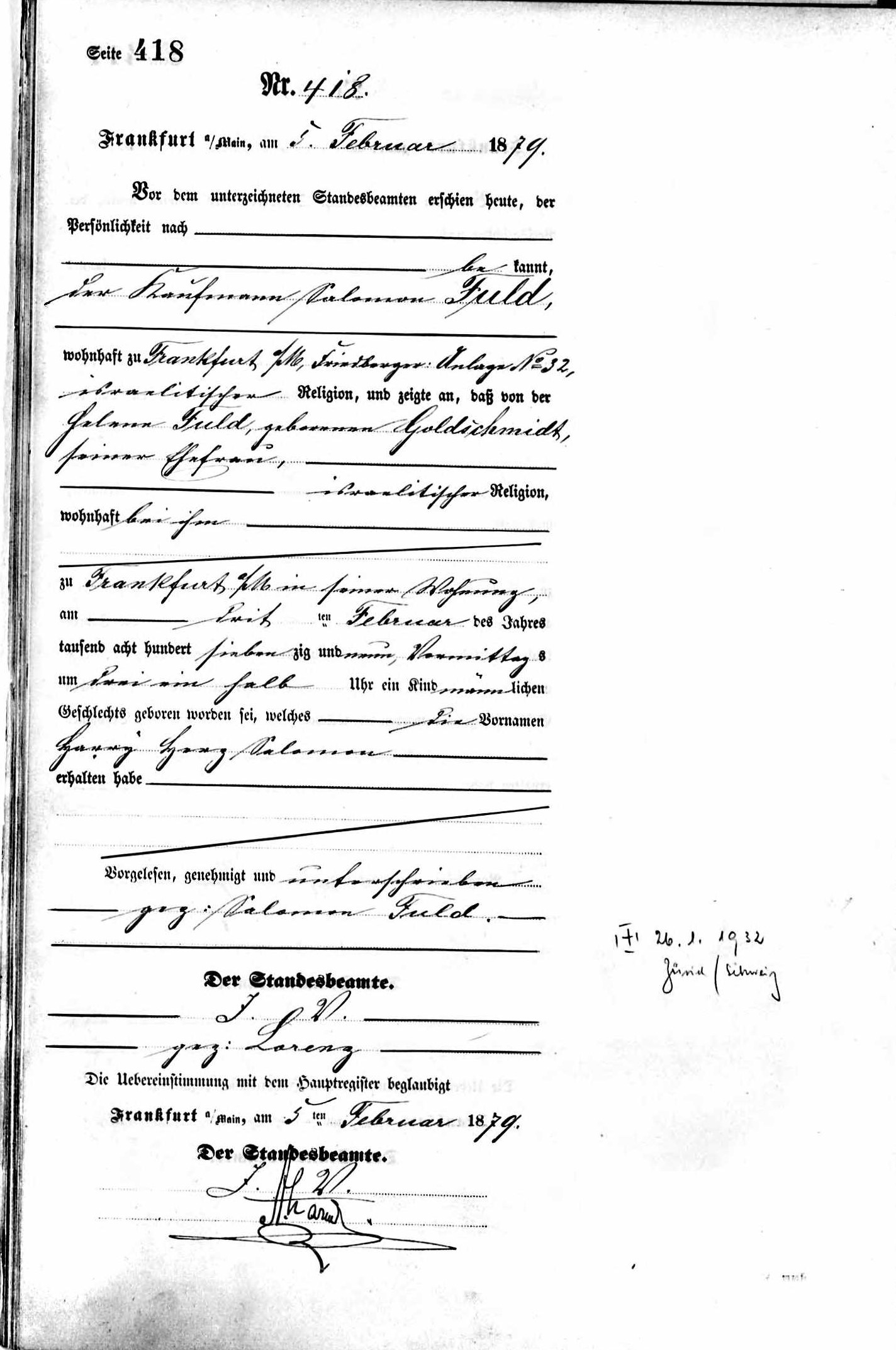
Harry Fuld was born on February 3, 1879, in Frankfurt.

Harry Fuld birth record, Hessisches Hauptstaatsarchiv; Wiesbaden, Deutschland; Bestand: 903; Signatur: 903_8927, Year Range: 1879, Ancestry.com. Hesse, Germany, Births, 1851-1901

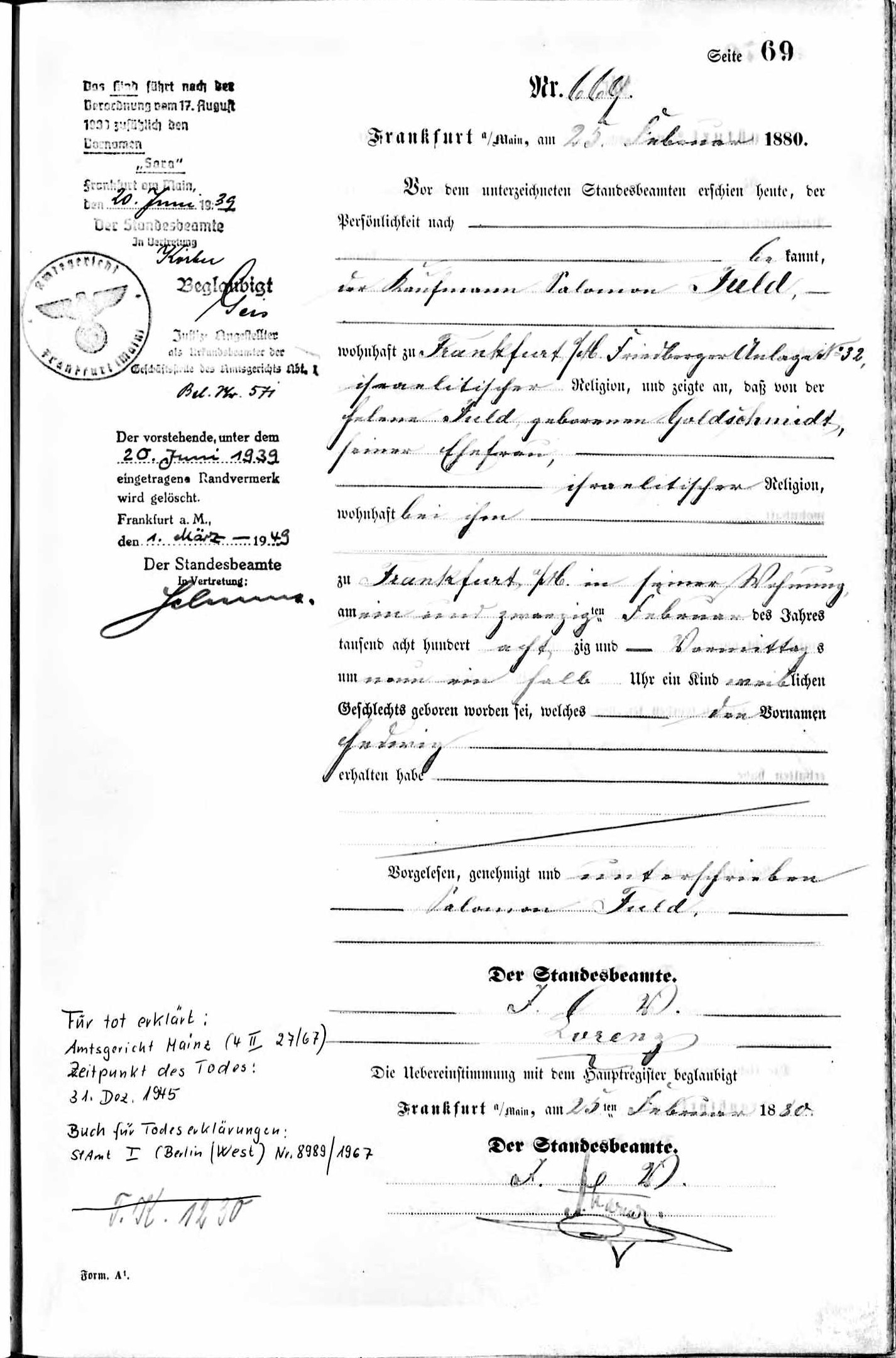
And finally, Hedwig Fuld was born in Frankfurt on February 21, 1880.

Hedwig Fuld birth record, Hessisches Hauptstaatsarchiv; Wiesbaden, Deutschland; Bestand: 903; Signatur: 903_8941, Year Range: 1880, Ancestry.com. Hesse, Germany, Births, 1851-1901

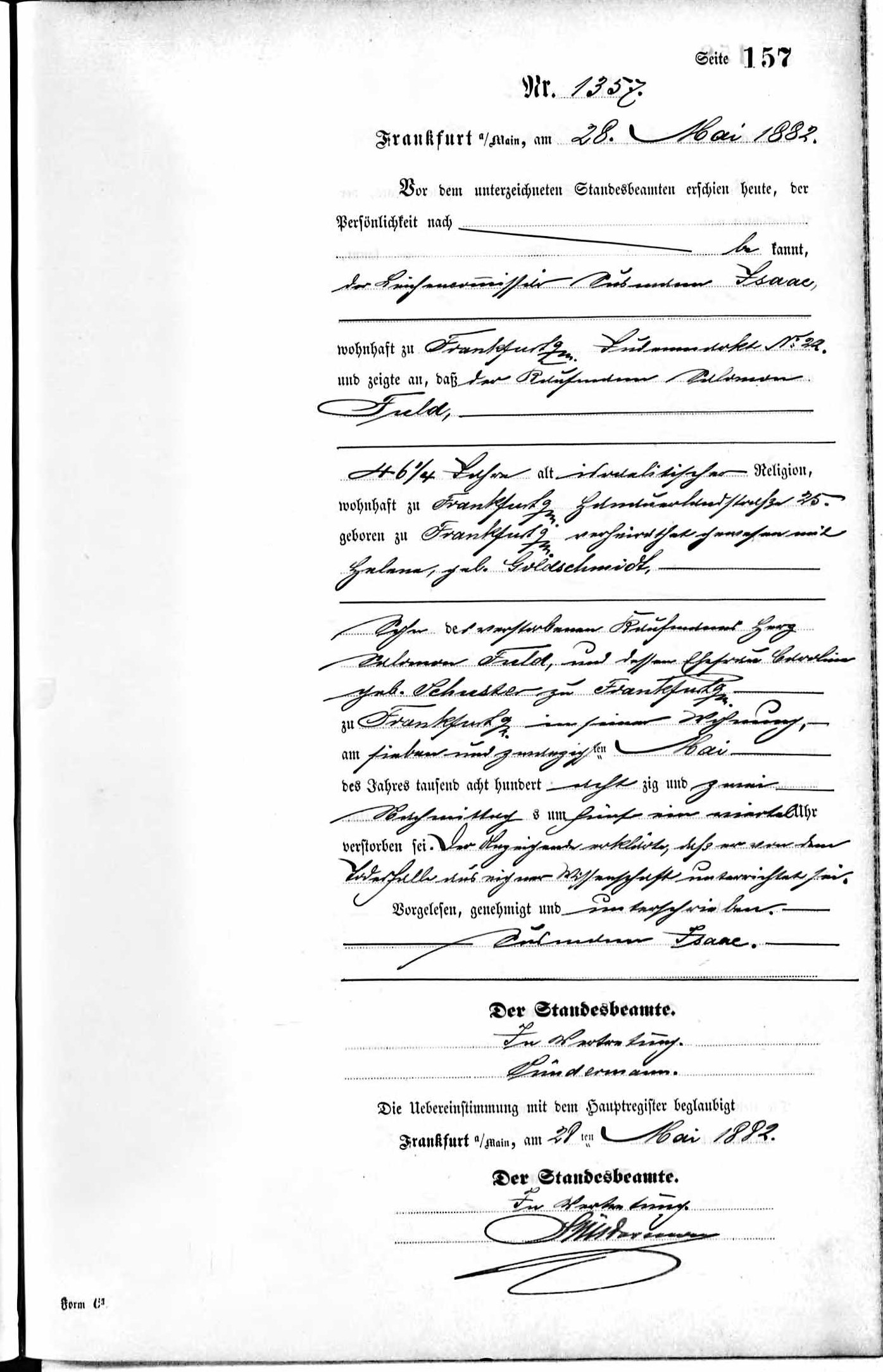
Then, just as Helene had lost her own father when she was just nine years old, her children lost their father as young children when Salomon Fuld died on May 27, 1882 at the age of 46. Helene was only 28, a widow with four children ranging in age from two year old Hedwig to seven year old Clementine II.

Salomon Fuld, death record, Personenstandsregister Sterberegister; Bestand: 903; Signatur: 10353, Year Range: 1882, Ancestry.com. Hesse, Germany, Deaths, 1851-1958

Helene managed to raise those four children on her own, perhaps with the help of her extended family, as we will see in the next post.


Blogging in a Pandemic, Part II

As we enter our third or really our fourth week of social distancing, self-quarantine, or whatever else you want to call it (no closer than six feet from anyone but each other, washing our hands religiously, no restaurants, no stores except when we can’t get delivery of groceries, and so on), I have to say that this week things suddenly seem much harder and much sadder. But we are still fortunately feeling fine despite having flown twice in March, and we feel very, very relieved, and are so grateful to be home.

And we also feel very grateful that so far our families are also okay and our friends. I almost am afraid to write that for fear of tempting the corona gods. But I know that magical thinking is just superstition. We all just have to keep staying apart, staying safe, and staying home. The anxiety sometimes feels unbearable, but my mantra has always been and continues to be—one day at a time.

We’ve taken some wonderful walks in places nearby, a few of which we’d never been to before. And we’ve taken many walks in our neighborhood, chatting with neighbors from at least six feet apart, and feeling a sense of community and warmth that can be overlooked when we all just drive in and out of our garages.

I’ve cleared out a drawer filled with expired medicines and other products, organized our “junk” drawer, and discovered dust in places you cannot imagine. Every day I try to think of at least one small project to accomplish, even if it is simply remembering to mail a check.

I’ve also started to accept that I will never do some of the things the internet keeps throwing at us: free courses online, free tours of museums and national parks, free videos of exercise classes, and so on. I just can’t focus long enough to do those things. Fortunately, doing genealogy in shorter spurts than usual and writing my blog still provide me with a way to escape from the pandemic pandemonium.

Now we are preparing for a Zoom seder. The planning has given me an opportunity to work with my nine-year-old grandson on that project. In fact, we’ve had more contact with our kids and grandsons during these weeks than we usually do, though not in person. I am reading the wonderful book Hatchet by Gary Paulsen with the older grandson and playing chess online with the younger one. And we’ve had Zoom cocktail hours with friends and with family. So it’s not all bad.

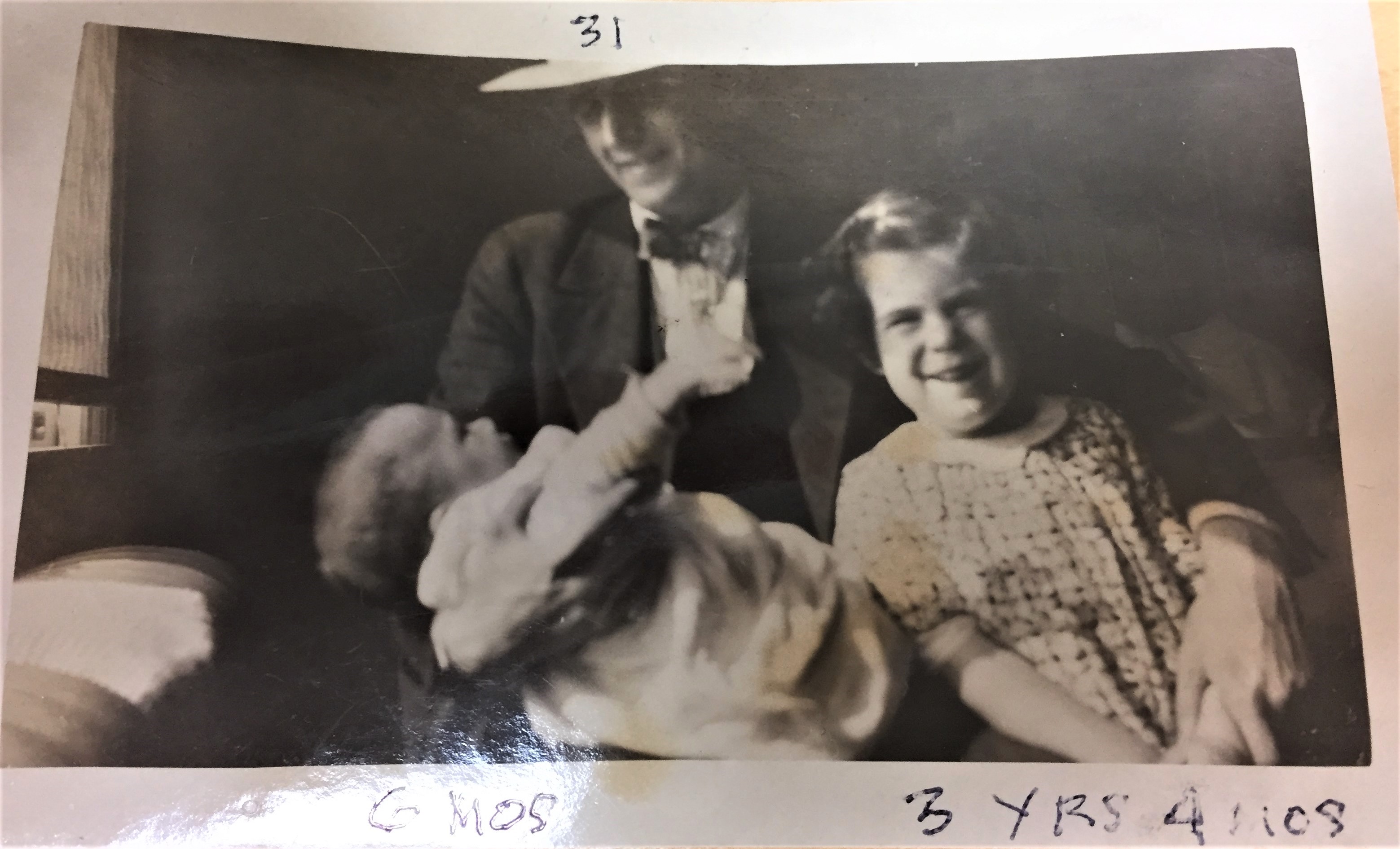
What really prompted me to write this particular post was one of those little benefits I’ve gotten from people spending all this time at home. My brother, who also has been spending more time at home than usual (but who is still working since he is a doctor), was going through a box of papers and photographs that had been my father’s and discovered this photograph.

I know this is not great quality (and my brother’s scan of it does not help). But I am so excited by this photograph. Let me explain why.

This is a photograph of my father as a baby being held by his father with my aunt sitting on her father’s left. My father had written the ages in the margins, and although he had not written the names, it was easy to deduce the identities from the relative ages and the facial characteristics using other photographs of my grandfather, of my aunt as a young child, and even of my father as a baby.

Eva Schoenthal and John Cohen, Sr. 1923

My aunt Eva Hilda Cohen and my grandmother Eva Schoenthal Cohen, c. 1925

My grandmother and my father, c. 1927

But what made this so special is that I had never seen a photograph of my grandfather with his children. All the photographs I had of him were either of him alone or with my grandmother. So seeing this photograph was really touching. Look at how he is looking at his son. There is such joy and love on his face.

It was especially touching because I knew that my father had had very few years living with his father before my grandfather became disabled from multiple sclerosis and was ultimately institutionalized for the rest of his life.  He died long before I was born, and for most of my life I knew almost nothing about him. I didn’t ask when I was young because my father seemed to be reluctant to talk about him. I didn’t know if that was out of sadness or anger or indifference. But I didn’t want to upset him either way.

One of the gifts of doing genealogy and talking to my father in the five or six years before he died in February 2019 was that he finally did talk a bit about his father. And in doing so, I realized that even though he had not spent many years living with his father, my father had loved him. His reluctance to talk about him was due to pain and sadness, not anger or indifference.

The fact that my father saved this photograph and hid it away in a box we never saw before is telling. This must have been a photograph he cherished, something special that he didn’t want mixed in with the hundreds of other photographs he had taken over the years of vacations and friends and family. I am so glad that my brother discovered it and that he shared it with me. It gave me new insights into my father and his father.

Have you discovered any wonderful photographs or other treasures while staying at home? Have you always planned to label and/or scan your family photographs? Maybe now is a good time.

Escaping from Germany, Part VII: Children Separated from their Parents

This is the final chapter in the story of my cousin Sarah Goldschmidt, daughter of my fourth great-uncle, Meyer Goldschmidt. These last seven chapters about her descendants’ struggles during and for the most part survival of the Nazi era have been an inspiration to me during this pandemic. We need to remember that human beings have survived many other challenges as we continue to fight this one.

The youngest child of Sarah Goldschmidt and Salomon Stern was their son Mayer. As we have seen, Mayer was married to Gella Hirsch, and they had two children, Elsa (1891) and Markus Kurt (1895)(later known as Kurt Marco).

As of 1930, Mayer and Gella were living in Frankfurt. Their daughter Elsa had been married to her second cousin Jacob Schwarzschild, with whom she’d had a daughter Elizabeth (1915). That marriage ended in divorce, and in 1920, Elsa had married Alfred Hirsch, with whom she had three children in the 1920s. Kurt Stern was married to Rhee Mess; they had no children.

With the rise of Hitler, the family began to disperse. Kurt and Rhee left Germany first. From 1918 to 1923, Kurt had worked as an art dealer in Frankfurt with his father and Goldschmidt relatives in the firm of I & S Goldschmidt (more on them to come). He and Rhee had then moved to Paris, where he became an independent art dealer.1 Then they immigrated to the US, arriving in New York on October 4, 1934. Kurt declared his intention to become a US citizen on February 19, 1935, four months after arriving in New York.

Kurt Marco Stern declaration of intention, The National Archives and Records Administration; Washington, D.C.; Petitions for Naturalization from the U.S. District Court for the Southern District of New York, 1897-1944; Series: M1972; Roll: 1256
Archive Roll Descriptions: (Roll 1256) Petition No· 352904 – Petition No· 353350
Ancestry.com. New York, Naturalization Records, 1882-1944

Kurt registered for the US draft on April 26, 1942, at which time he was a self-employed art dealer, living in New York City.

Kurt Stern, World War II draft registration, Ancestry.com. U.S., World War II Draft Registration Cards, 1942

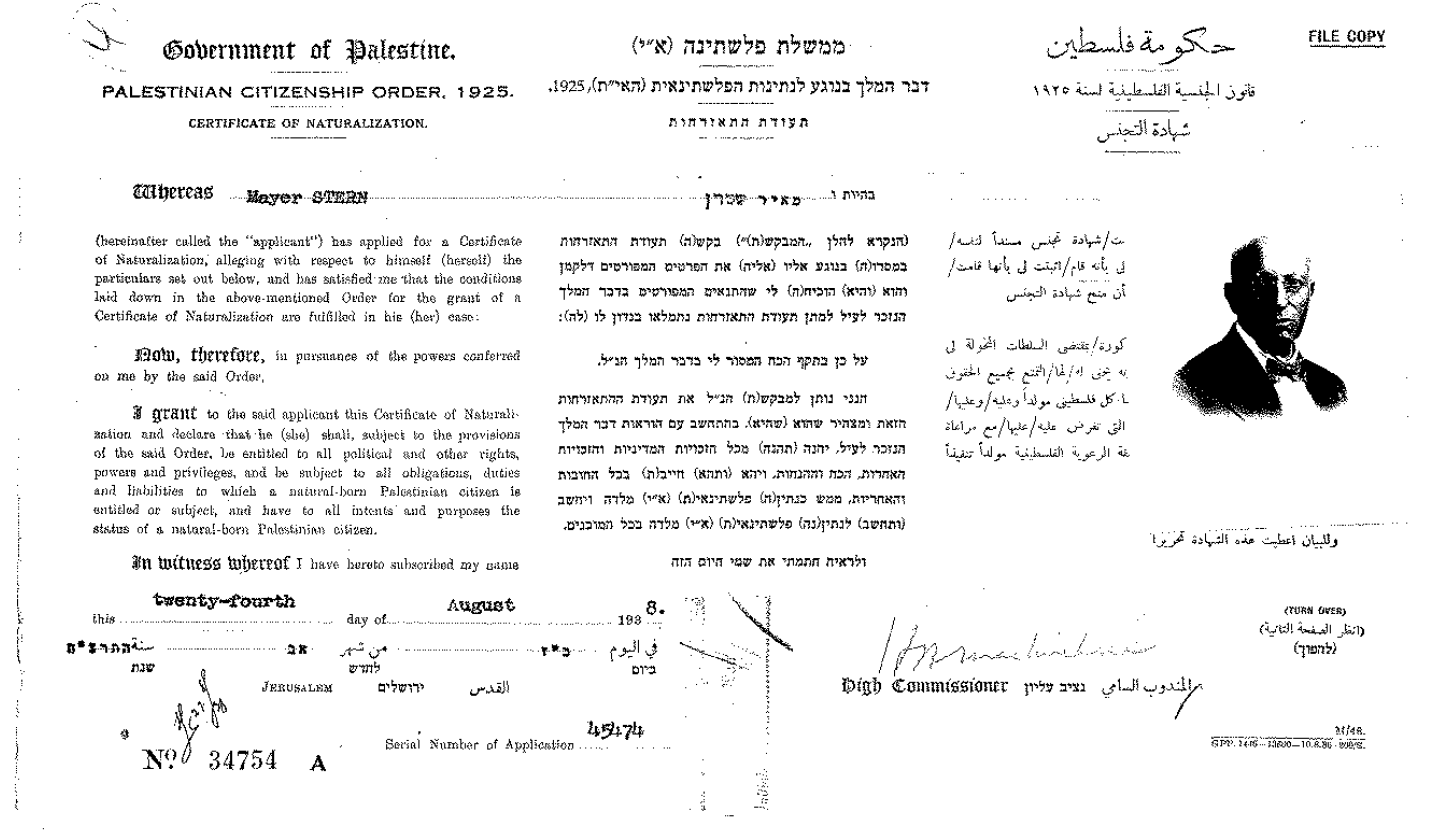
Kurt’s parents Mayer and Gella Stern also left Germany around that time. According to Mayer Stern’s immigration papers, he and Gella arrived in Palestine on April 12, 1935. Sadly, Gella died less than two months later on June 1, 1935, in Haifa. She was 71 years old. Mayer remained in Haifa and became a Palestinian citizen on August 24, 1938.2

Mayer Stern, Palestinian citizenship certificate, found at https://tinyurl.com/ugr2b62

But Mayer did not live much longer. He died on September 15, 1939, in Haifa, where he is buried. He was 78.

The grave site of מאיר שטרן. Cemetery: Haifa Mahane David – Sde Yehoshua Cemetery, Location: Haifa, Haifa District, Israel. Birth: 7 Jan 1861, Death: 15 Sep 1939. Found at https://tinyurl.com/whnye25 Photographer  Nadezda

As for Mayer and Gella’s daughter Elsa Stern Schwarzschild Hirsch, she and her husband Alfred Hirsch and three children also immigrated to Palestine, arriving in 1938, according to their immigration file.3

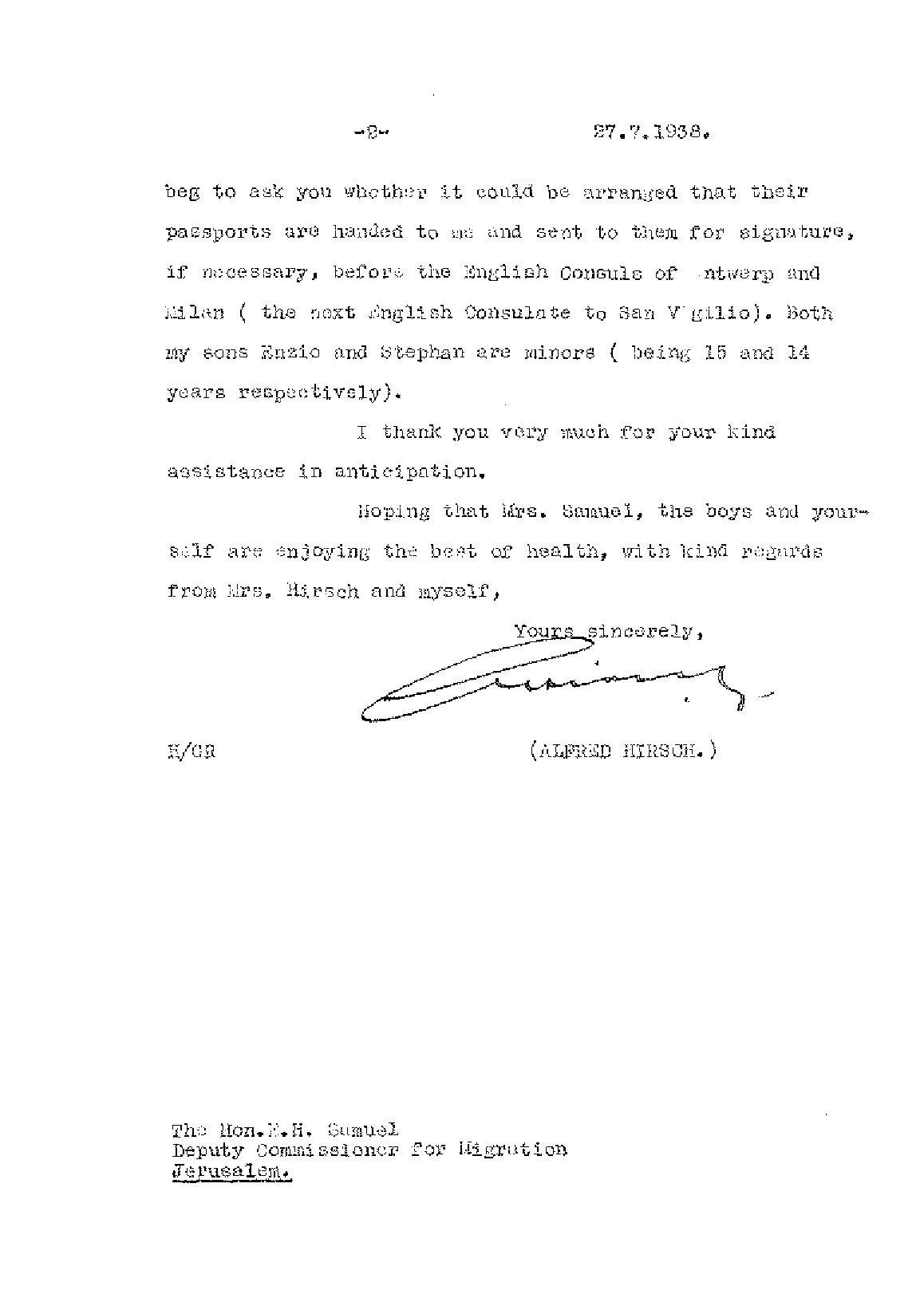
The file includes letters indicating that two of Elsa and Alfred’s children returned to Europe after arriving in Palestine, one to Antwerp to study, the other to Italy for health reasons. Alfred requested that the two children be granted Palestinian passports expeditiously because they each had limited visas from those countries that would expire before they could return to Palestine to sign their new passports.

Alfred received a response that the Palestinian officials would ask the British consul to issue Palestinian passports to the two children once Alfred himself was naturalized. Alfred and Elsa were naturalized on August 14, 1938. Alfred was working as the general manager of the Palestine Milling & Trading Company at that time.4

Elsa and Alfred Hirsch, Palestinian citizenship certificate, found at https://tinyurl.com/vebdvxq

I assume the two children were able to return soon thereafter to Palestine to join their family. But can you imagine the anxiety experienced by them all, thinking that the two young teenagers might be stranded in Europe as the Nazi persecution of Jews intensified in 1938, culminating in Kristallnacht just a few months after Alfred and Elsa received their naturalization certificate?

One of their children immigrated to the US as early as 1940 and was residing without any family members in New York City at the YMHA on the 1940 US census;5 his uncle Kurt was, however, residing in New York at that time, where he was the owner of an “art shop,” according to the census.6

The rest of the family joined them in the US after the war. Alfred and Elsa arrived in New York on December 24, 1946.7 Alfred died less than two months later on February 6, 1947; he was only 56 years old.8 Elsa outlived him by over forty years; she died in Dallas, Texas, on October 4, 1988.  She was 97 years old.9

Elsa’s brother Kurt Stern unfortunately did not have his sister’s longevity. He died on April 16, 1962 at the age of 67 after a long illness, according to his obituary.10 He was survived by his wife Rhee, who died in August 1986 at the age of 91,11 and his sister Elsa and her three children.

Thus ends not only the story of Mayer Stern, but that of his parents Sarah Goldschmidt and Salomon Stern. Their story is overall a story shared by so many German Jews. They went from being successful merchants living in comfort and security, raising children and grandchildren in a country that they saw as their home, to being refugees from the worst kind of persecution and violence anyone can imagine.

Sarah Goldschmidt’s descendants were, however, among the more fortunate ones. Out of all of Sarah’s children and grandchildren and great-grandchildren living in Germany during the Nazi era, only one, little Margot Fulda, just thirteen years old, was murdered by the Nazis. The rest were uprooted from their homes and torn from the comfort they’d known, but were able to escape to Palestine, to England, and to the United States. Their descendants live among us today in places all over the world. How fortunate and blessed we are that they do.

Next I will turn my attention to Sarah’s younger brother Jacob Meier Goldschmidt and his family.


  1. “Kurt M. Stern Dies; Art Dealer Was 67,” The New York Times, April 17, 1962, p.34. 
  2. Mayer Stern, Immigration and Naturalization File, Israel Archives, found at https://tinyurl.com/ugr2b62 
  3. Elsa and Alfred Hirsch, Immigration and Naturalization File, Israel Archives, found at https://tinyurl.com/vebdvxq 
  4. Ibid. 
  5. Stephen Hirsch, 1940 US census, Census Place: New York, New York, New York; Roll: m-t0627-02663; Page: 83B; Enumeration District: 31-1658, Ancestry.com. 1940 United States Federal Census 
  6. Kurt M. Stern, 1940 US census, Census Place: New York, New York, New York; Roll: m-t0627-02656; Page: 2A; Enumeration District: 31-1368, Ancestry.com. 1940 United States Federal Census 
  7. Alfred and Elsa Hirsch, ship manifest, Year: 1946; Arrival: New York, New York; Microfilm Serial: T715, 1897-1957; Microfilm Roll: Roll 7250; Line: 1; Page Number: 10,
    Ancestry.com. New York, Passenger and Crew Lists (including Castle Garden and Ellis Island), 1820-1957 
  8. Ancestry.com. New York, New York, Extracted Death Index, 1862-1948 
  9. Else Hirsch, Social Security Number: 119-36-5922, Birth Date: 4 Jan 1891
    Issue year: 1962, Issue State: New York, Last Residence: 75219, Dallas, Dallas, Texas, USA, Death Date: 4 Oct 1988, Social Security Administration; Washington D.C., USA; Social Security Death Index, Master File, Ancestry.com. U.S., Social Security Death Index, 1935-2014 
  10. Kurt M Stern, Birth Date: 28 Jan 1895, Death Date: 16 Apr 1962, Claim Date: 17 Aug 1962, SSN: 060070787, Ancestry.com. U.S., Social Security Applications and Claims Index, 1936-2007. “Kurt M. Stern Dies; Art Dealer Was 67,” The New York Times, April 17, 1962, p.34. 
  11.  Rhee Stern, Social Security Number: 065-52-1280, Birth Date: 12 Jun 1895
    Issue year: 1973, Issue State: New York, Last Residence: 10028, New York, New York, New York, USA, Death Date: Aug 1986, Social Security Administration; Washington D.C., USA; Social Security Death Index, Master File, Ancestry.com. U.S., Social Security Death Index, 1935-2014 

Escaping from Germany, Part VI: Germany’s Loss, America and Israel’s Gains

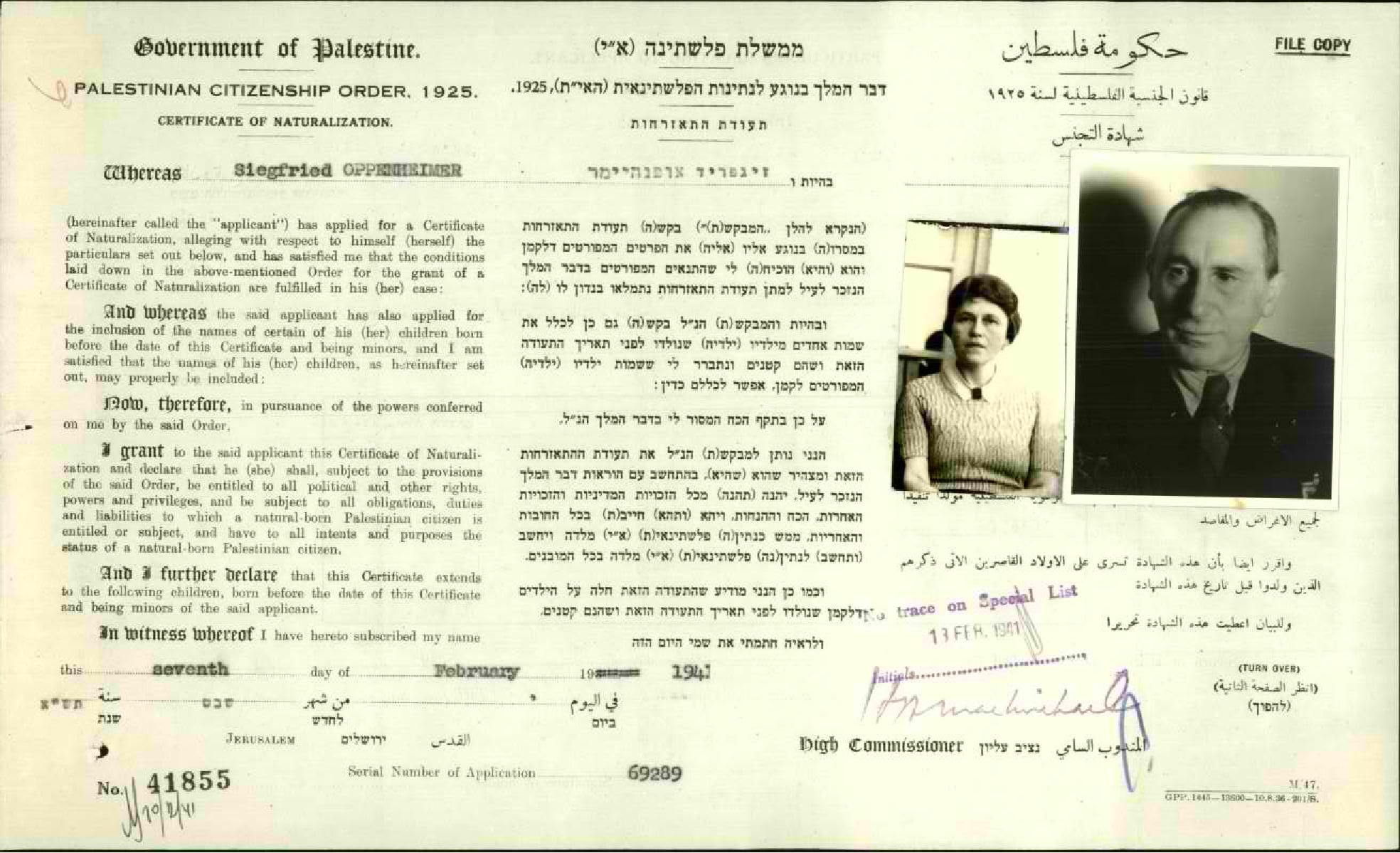
Abraham and Johanna (Goldschmidt) Stern’s daughter Clementine had died in 1919 during the 1918 flu epidemic, survived by her husband Siegfried Oppenheimer and three children: Erika (1909), William Erwin (1912), and Sarah Gabriele (1917). After Clementine’s death, Siegfried married her younger sister Alice Lea, with whom he had five more children, all born in the 1920s. All eight of those children as well as Alice and Siegfried themselves escaped from Germany in the 1930s.

The Children of Clementine Stern and Siegfried Oppenheimer

Siegfried and Clementine’s oldest child, Erika Oppenheimer, first escaped to the Netherlands in 1933, but she immigrated to the United States on July 4, 1938, appropriately enough. Two weeks later she married Paul Fromm in Chicago, Illinois, on July 20, 1938. Paul also had arrived on July 4, 1938, so the two may have met and fallen in love on the ship that brought them to the US. Paul was born in Kitzingen, Germany, on September 28, 1906, into a family with a long tradition as vintners. He had been living in Bingen, Germany, before immigrating. Erika and Paul both filed their naturalization papers on August 26, 1938, less than two months after their arrival.

Erika Oppenheimer Fromm, Declaration of Intent, National Archives at Chicago; Chicago, Illinois; ARC Title: Illinois, Petitions for Naturalization, 1906-1991; NAI Number: 593882; Record Group Title: Records of District Courts of the United States, 1685-2009; Record Group Number: RG 21
Description: Petitions for naturalization, v 1185, no 296351-296550, ca 1943-1944
Ancestry.com. Illinois, Federal Naturalization Records, 1856-1991

Paul Fromm, Declaration of Intent, National Archives at Chicago; Chicago, Illinois; ARC Title: Illinois, Petitions for Naturalization, 1906-1991; NAI Number: 593882; Record Group Title: Records of District Courts of the United States, 1685-2009; Record Group Number: RG 21
Description: Petitions for naturalization, v 1185, no 296351-296550, ca 1943-1944
Ancestry.com. Illinois, Federal Naturalization Records, 1856-1991

The 1940 census reports them living in Chicago, where Paul was the proprietor of a wholesale liquor importation business and Erika a psychologist working in a hospital clinic.1 They would have one child born in 1940.

Both Paul and Erika achieved great success in the US. Paul was a very successful wine merchant, but also made his name as a philanthropist who generously supported the arts, music specifically. He created the Fromm Foundation at Harvard to support musicians and composers and musical events such as Tanglewood and the Aspen Music Festival. John Rockwell, the long-time music critic for the New York Times, described Paul Fromm as “the most active and distinguished private patron of contemporary classical music in the United States.” Paul died on the 49th anniversary of his arrival in the US, July 4, 1987.  He was eighty years old.2

Erika also had a distinguished career. She had received her doctorate in psychology from the University of Frankfurt in 1933 before escaping to the Netherlands. After immigrating to the US in 1938, she became a research assistant in psychiatry at the University of Chicago for a few years and then spent years in practice, eventually returning to the faculty at the University of Chicago in 1961, where she became a scholarly expert in the use of hypnosis. Her obituary described some of her professional accomplishments:3

Dr. Fromm considered hypnosis a valuable analytical tool that, when used by a skilled practitioner, could provide access to a patient’s unconscious conflicts and desires. She said hypnosis could induce an altered state of consciousness involving heightened awareness and focus in approximately 1 in 12 people.

She used hypnosis to treat severely disturbed patients as well as victims of incest and those suffering from post-traumatic stress disorders. She also advocated self-hypnosis as a path to self-exploration.

In the 1980’s, Dr. Fromm joined the growing field of behavioral medicine, which uses hypnosis, meditation, biofeedback and other techniques to treat physical ailments. Her book ”Hypnosis and Behavioral Medicine,” written with Dr. Daniel P. Brown and published in 1987, presented research supporting those methods in treating allergies, asthma, migraines and hypertension.

Erika Oppenheimer Fromm died on May 25, 2003, in Chicago. She was 93.4

Clementine and Siegfried’s son William Erwin Oppenheimer (often called Erwin) left Germany very early; he arrived in Palestine on November 8, 1933, less than a year after Hitler was elected Chancellor of Germany. By 1938, when he applied for Palestinian citizenship, he was married to Hannie Halpern, who was also a refugee from Germany. She was born in Frankfurt on September 1, 1914. Erwin was then working as a farmer near Rehovoth.5 According to trees on MyHeritage, he died on April 22, 1963, in Jerusalem. He was only fifty years old.

Immigration and Naturalization File, Israel Archives, found at https://www.archives.gov.il/en/archives/#/Archive/0b07170680034dc1/File/0b071706810638e5

As for Clementine and Siegfried’s younger daughter Sarah Gabriele Oppenheimer, known as Gabriele, I am missing some pieces to Gabriele’s story, but it appears from documents that she had been married to a man named Leon Schindel, whom she divorced in Jerusalem on July 28, 1941.6

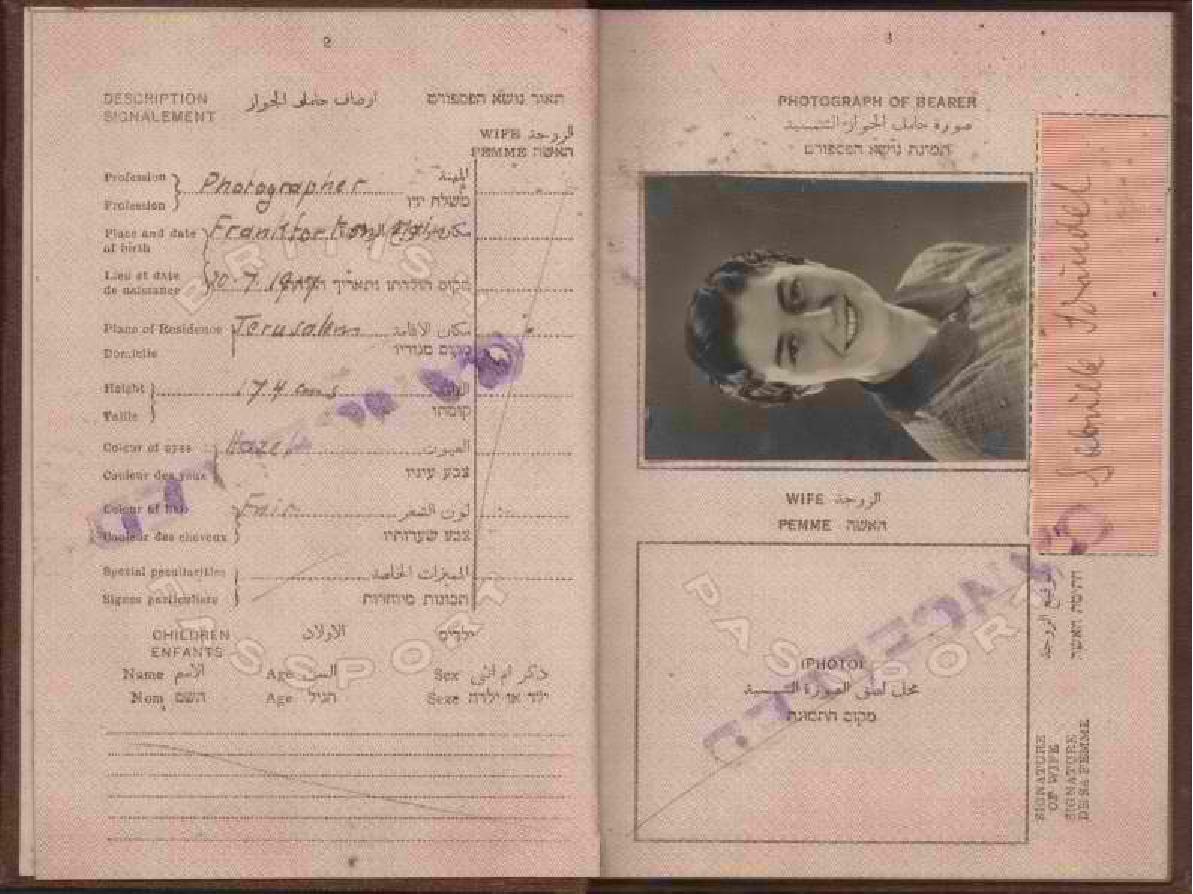
Among Gabriele’s immigration documents is her original Palestinian passport, issued on December 2, 1937, so she was already a citizen of Palestine by then. She was a professional photographer, according to her passport.

She married a second time in Tel Aviv on September 11, 1942, to Martin Lederman; he was born in Dresden, Germany, on April 13, 1904, and had immigrated to Palestine on March 26, 1940; he had previously been living in Panama. According to his Palestinian naturalization papers, Martin was a publisher.7

Martin and Gabriele did not remain in Palestine, later Israel, for too long after the war ended.  They made several trips to England and the US after the war, and in June 1949, they indicated on the ship manifest taking them from England to the US that their intended future permanent residence was the “USA.”8  Gabriele became a naturalized US citizen on December 20, 1954,9 and Martin on February 14, 1955.10 They were residing in New York City.

Both Martin and Gabriele lived into their eighties. Martin died on July 9, 1991, at 87,11 and Gabriele died on January 11, 2001, at the age of 83.12 As far as I can tell, they did not have any children.

Alice Stern and Siegfried Oppenheimer

I don’t have many documents for what happened to Alice and Siegfried Oppenheimer before they arrived in Palestine in late 1938. But as we saw in my last post, a letter written by Erich Stern, Siegfried Stern’s son, to his brother Gunther Stern in 1938 on November 13, 1938, revealed that Siegfried Oppenheimer was arrested in the aftermath of Kristallnacht just days before his family planned to travel to Palestine.

But eventually Siegfried and Alice and all five of their children made it to Palestine. Alice and Siegfried Oppenheimer arrived with three youngest of those children, and their two oldest children arrived separately around the same time.13 They all became naturalized citizens of Palestine in 1941.

I do not have death records for Alice or Siegfried, but the research of Cibella/Baron indicates that both died in Israel, Siegfried in 1959, Alice in 1986. All but one of their five children also lived the rest of their lives in Israel; the other child immigrated to the US after the war.

Thus, of the eight children of Clementine and Alice Stern, six ended up in Israel, two in the United States. Clementine, Alice, and Siegfried Oppenheimer have many descendants living in both countries. What Germany lost—e.g., a brilliant psychologist, a philanthropist and entrepreneur, and a photographer–were gifts to the countries that took them in.


  1. Erika and Paul Fromm, 1940 US census, Census Place: Chicago, Cook, Illinois; Roll: m-t0627-00929; Page: 4B; Enumeration District: 103-268, Ancestry.com. 1940 United States Federal Census 
  2. “Paul Fromm dies at 80; was Fromm week patron,” The Berkshire Eagle
    Pittsfield, Massachusetts, 07 Jul 1987, Tue • Page 12. “Paul Fromm, Philanthropist,” Hartford Courant, Hartford, Connecticut, 06 Jul 1987, Mon • Page 128. Paul Fromm
    Social Security Number: 323-12-0163, Birth Date: 28 Sep 1906, Issue State: Illinois
    Last Residence: 60637, Chicago, Cook, Illinois, USA, Death Date: Jul 1987, Social Security Administration; Washington D.C., USA; Social Security Death Index, Master File, Ancestry.com. U.S., Social Security Death Index, 1935-2014 
  3. “Erika Fromm, 93, Psychologist and Expert in Use in Hypnosis,” The New York Times, May 30, 2003, Section B, Page 9. 
  4.  Erika Fromm, Social Security Number: 340-32-7862, Birth Date: 23 Dec 1909
    Issue year: 1955-1956, Issue State: Illinois, Last Residence: 60637, Chicago, Cook, Illinois, USA, Death Date: 25 May 2003, Social Security Administration; Washington D.C., USA; Social Security Death Index, Master File, Ancestry.com. U.S., Social Security Death Index, 1935-2014 
  5. Erwin Oppenheimer, Immigration and Naturalization File, Israel Archives, found at https://tinyurl.com/rxv8ox4 
  6. Martin Lederman and Gabriele Oppenheimer Schindel Lederman, Immigration and Naturalization File, Israel Archives, found at https://tinyurl.com/tbvdq97 
  7. See footnote 6. 
  8. Martin and Gabriele Lederman, ship manifest, Departure Date: 22 Jun 1949
    Port of Departure: Southampton, England, Destination Port: New York, USA,
    Ancestry.com. UK and Ireland, Outward Passenger Lists, 1890-1960 
  9. Martin Lederman, Naturalization Date: 14 Feb 1955, Residence: New York, New York, Ancestry.com. New York, Index to Petitions for Naturalization filed in New York City, 1792-1989 
  10. Gabriele Lederman, Naturalization Date: 20 Dec 1954, Residence: New York, New York, Ancestry.com. New York, Index to Petitions for Naturalization filed in New York City, 1792-1989 
  11.  Martin Lederman, Social Security Number: 060-26-6446, Birth Date: 13 Apr 1904
    Death Date: 9 Jul 1991, Social Security Administration; Washington D.C., USA; Social Security Death Index, Master File, Ancestry.com. U.S., Social Security Death Index, 1935-2014 
  12.  Gabriele Lederman, Social Security Number: 121-54-6243, Birth Date: 20 Jul 1917, Death Date: 11 Jan 2001, Social Security Administration; Washington D.C., USA; Social Security Death Index, Master File, Ancestry.com. U.S., Social Security Death Index, 1935-2014 
  13. Siegfried and Alice Stern Oppenheimer, Immigration and Naturalization File, Israel Archives, at https://tinyurl.com/r7k6qau 

Escaping from Germany, Part V: Being “Enemy Aliens” in England

Having completed the stories of Sarah Goldschmidt Stern’s daughters Lina and Keile, we now turn to her son, Abraham Stern and his family and what happened to them during the Holocaust. Abraham died in 1925, but was survived by his widow Johanna, who was also his first cousin, and two of their children, Alice and Sittah Sarah, and numerous grandchildren; two of his children had predeceased him, Clementine and Siegfried,  

When Hitler came to power in 1933, Abraham’s widow (and first cousin) Johanna Goldschmidt Stern and their surviving children and grandchildren were still living in Germany. Johanna died on June 2, 1937; she was 69 years old.1

Her gorgeous headstone, matching those of her husband and son, was beautifully translated by a member of Tracing the Tribe. What a lovely and loving inscription.

Johanna Goldschmidt Stern’s gravestone. Courtesy of her great-grandson, Rafi Stern

Here lies buried Mrs Hindla known as Johanna, daughter of Mr Zelig Goldschmidt, wife of Mr Asher Avraham, known as Adolf, Stern, the memory of the righteous is a blessing,
A generous daughter to her parents and a trusted help to her husband,
She was known as a wise woman,

Her heart directed with intelligence and insight,
She educated her children in the paths of faith,
Only good and kindness, she pursued all her life,
Until she rested in peace next to the husband of her youth on 23 Sivan 5697.
May her soul be bound in the bond of life.

This post will tell what happened to the families of two of Abraham and Johanna’s children, Siegfried and Sittah Sarah. The next post will focus on the families of their other two children, Clementine and Alice.

The Children of Siegfried Stern

Siegfried Stern had died in 1921, leaving behind his wife Lea Hirsch and two young sons, Erich (1913) and Gunther (1916). Thanks to Aaron Knappstein, I now have the birth records for Erich and Gunther, and they show that in 1922, their birth records were amended to add their father’s name Siegfried to theirs.

Erich Stern birth record

Gunther Stern birth record

Siegfried’s widow Lea married Ernst Schwarzschild in 1924 and relocated to Cologne with Erich and Gunther where she and Ernst had two additional children.

After Hitler came to power, Lea and Ernst Schwarzschild escaped to England with Erich and Gunther Stern and the two children they had together. According to Gunther’s son Rafi, the family was able to take a fair amount of money out of Germany and first lived in the Golders Green neighborhood of London. In 1939 they were living in Chesham, England, a town about 30 miles northwest of London. Ernst was working as a non-ferrous metals merchant while Lea was engaged in “unpaid domestic duties.”

Ernst and Lea (Hirsch Stern) Schwarzschild, The National Archives; Kew, London, England; 1939 Register; Reference: RG 101/2110H, Enumeration District: DVIH, Ancestry.com. 1939 England and Wales Register

Although not listed on this register, Erich Stern was living with his mother and stepfather in Chesham at some point in 1939 and working as a clerk in a travel agency; like his stepfather Ernst, he was exempted from being interned as an enemy alien.

Ernst Schwarzschild, Enemy Alien Exemption, The National Archives; Kew, London, England; HO 396 WW2 Internees (Aliens) Index Cards 1939-1947; Reference Number: HO 396/83
Piece Number Description: 083: Internees at Liberty in UK 1939-1942: Schw-Scu
Ancestry.com. UK, WWII Alien Internees, 1939-1945

Erich Stern, Enemy Alien Exemption, The National Archives; Kew, London, England; HO 396 WW2 Internees (Aliens) Index Cards 1939-1947; Reference Number: HO 396/89
Piece Number Description: 089: Internees at Liberty in UK 1939-1942: Steinf-Stern
Ancestry.com. UK, WWII Alien Internees, 1939-1945

Gunther, however, was not as fortunate. According to his son Rafi, Gunther was unable to obtain a permanent visa to live in England and was forced to go back and forth every three months between Antwerp, where an uncle lived, and England. Fortunately, in 1939 when the war broke out, he was living in England with his mother, stepfather, and brother in Chesham, working as an apprentice to a wood importer, and was initially exempted from internment as an enemy alien.

But as the document below reveals and as his son Rafi reported to me, Gunther was later interned. He spent time at three different internment centers: Preece Heath, Shropshire, and the Isle of Man. He was eventually released because of poor health and found employment with a manufacturing company where he worked for the rest of his career.

Gunther Stern, Enemy Alien registration, The National Archives; Kew, London, England; HO 396 WW2 Internees (Aliens) Index Cards 1939-1947; Reference Number: HO 396/197
Piece Number Description: 197: German Internees Released in UK 1939-1942: Spirg-Stern
Ancestry.com. UK, WWII Alien Internees, 1939-1945

Both Erich and Gunther married after the war and had children. Their mother Lea died in 1970 in England.2 Erich died in England in May 2001,3 and his brother Gunther died a year later in June 2002 in Israel, where his son Rafi had immigrated.4

Sittah Sarah Stern and Abraham Mainz and Their Children

Sittah Sarah Stern was married to Abraham Mainz, and they had two children, Marguerite (1913) and Helmut (1918); they were living in Frankfurt in the 1920s.

Like the family of her older brother Siegfried Stern, Sittah Sarah Stern and her husband Abraham Mainz and their children eventually safely immigrated to England, but faced some difficult challenges in the aftermath of Kristallnacht, as reported by a letter written by Erich Stern, Sittah’s nephew, on November 13, 1938, to his brother Gunther:5

Unfortunately we have very bad news from Frankfurt. Uncle Siegfried [Oppenheimer], who wanted to travel to Palestina on Sunday with his family, was arrested on Friday, as well as Aunt Sittah, Marguerite and Helmut [Mainz]. Aba [Abraham Mainz] has fled and no one knows to where. Really horrible conditions.

Where had Abraham gone? And how long were Sittah and her children detained? I don’t know, but I do know that by 1939 they were living in London along with Abraham’s parents. Abraham (also known as Albert) was working as a wool merchant and his daughter Marguerite was a student.

The National Archives; Kew, London, England; 1939 Register; Reference: RG 101/235D
Enumeration District: AKAN, Ancestry.com. 1939 England and Wales Register

Although he is not listed as living with his family on the 1939 register, Helmut Mainz was also in England by 1939, as seen in his Enemy Alien registration form. Like his father, he was a wool merchant and was exempted from internment.

Helmut Mainz, Enemy Alien registration, The National Archives; Kew, London, England; HO 396 WW2 Internees (Aliens) Index Cards 1939-1947; Reference Number: HO 396/58
Piece Number Description: 058: Internees at Liberty in UK 1939-1942: Ma-Man
Ancestry.com. UK, WWII Alien Internees, 1939-1945

Abraham Mainz6 and his daughter Marguerite were also exempted from internment. At the time of her exemption, Marguerite was working as a secretary.

Marguerite Mainz, Enemy Alien registration, The National Archives; Kew, London, England; HO 396 WW2 Internees (Aliens) Index Cards 1939-1947; Reference Number: HO 396/222
Piece Number Description: 222: Dead Index (Wives of Germans etc) 1941-1947: Eastw-Fey
Ancestry.com. UK, WWII Alien Internees, 1939-1945

The family was thus all safe and living in England, and Marguerite married Arthur Feuchtwanger in 1944,7 with whom she had three children.

But the family suffered terrible losses soon thereafter. Abraham Albert Mainz died on November 3, 1944; he was 61.8  Less than four months later his wife Sittah Sarah Stern Mainz died on February 26, 1945; she was only 53. Had their lives been cut short by the stress of living through the Nazi era?

Ancestry.com. England & Wales, National Probate Calendar (Index of Wills and Administrations), 1858-1995. Original data: Principal Probate Registry. Calendar of the Grants of Probate and Letters of Administration made in the Probate Registries of the High Court of Justice in England.

The family’s tragedies did not end there. Helmut Mainz married Carla Adler in July 1948,9 and they had three children in the next five years. But then Carla died in July 1957 when she was only thirty years old, leaving behind three very young children and her husband Helmut.10

Within just a few years Helmut had lost both of his parents and his wife. But he lived a full life, dying at the age of 87 in Yorkshire, England, on September 13, 2005.11 His sister Marguerite died March 22, 2001, in Netanya, Israel.12

Headstones for Carla Adler Mainz and Helmut Mainz, Find A Grave, database and images (https://www.findagrave.com : accessed 02 March 2020), memorial page for Carla Adler Mainz (8 Sep 1926–3 Jul 1957), Find A Grave Memorial no. 185877700, citing United Hebrew Congregation Cemetery, Gildersome, Metropolitan Borough of Leeds, West Yorkshire, England ; Maintained by leedspyeman (contributor 47407284) . Courtesy of Leedspyeman.

The families of Siegfried Stern and of his sister Sittah Sarah Stern Mainz fortunately escaped from Germany to England in time and were not murdered by the Nazis, but were treated as “enemy aliens” by England. Their descendants, including my cousin Rafi who shared so much of his family’s story with me, continue to honor their memories and prove that the Nazis did not prevail.

UPDATE: Steve Mondros from TTT posted this article from the May 17, 1940 London Times that sheds some light on the internment process in England.

Enemy Aliens article London Times May 17, 1940 from Steve Mondros on FB


  1. Name: Johanna Goldschmidt, Gender: Female, Birth Date: 18 Dec
    Birth Place: Frankfurt Main, Hessen-Nassau, Preussen, Germany, Death Date: 2 Jun 1937, Father: Seelig Goldschmidt. Mother: Cllementine Fuld, FHL Film Number: 342033, Ancestry.com. Germany, Select Births and Baptisms, 1558-1898 
  2. Lea Schwarzschild, Death Age: 78, Birth Date: 10 Apr 1892, Registration Date: Oct 1970, Registration Quarter: Oct-Nov-DecRegistration district: Paddington, Inferred County: Greater London, Volume: 5d, Page: 1148, General Register Office; United Kingdom; Volume: 5d; Page: 1148, Ancestry.com. England & Wales, Civil Registration Death Index, 1916-2007 
  3. Erich Stern, Death Age: 88, Birth Date: 29 May 1913, Registration Date: May 2001
    Registration district: Bury, Inferred County: Greater Manchester, Register Number: A54B, District and Subdistrict: 0031A, Entry Number: 283, General Register Office; United Kingdom, Ancestry.com. England & Wales, Civil Registration Death Index, 1916-2007 
  4. As per Rafi Stern, Gunther’s son. 
  5. Letter made available to me by Rafi Stern, Gunther’s son. 
  6. Abraham Mainz, Enemy Alien registration, The National Archives; Kew, London, England; HO 396 WW2 Internees (Aliens) Index Cards 1939-1947; Reference Number: HO 396/234, Piece Number Description: 234: Dead Index (Wives of Germans etc) 1941-1947: Loeb-Melo, Ancestry.com. UK, WWII Alien Internees, 1939-1945 
  7.  Marguerita V Mainz, Registration Date: Jan 1944, Registration Quarter: Jan-Feb-Mar, Registration district: Knaresborough, Inferred County: Yorkshire West Riding
    Spouse: Arthur Fenchtwanger, Volume Number: 9a, Page Number: 229, General Register Office; United Kingdom; Volume: 9a; Page: 229, Ancestry.com. England & Wales, Civil Registration Marriage Index, 1916-2005 
  8.  Abraham A Mainz, Death Age: 61, Birth Date: abt 1883, Registration Quarter: Oct-Nov-Dec 1944, Registration district: Knaresborough, Inferred County: Yorkshire West Riding, Volume: 9a, Page: 107, General Register Office; United Kingdom; Volume: 9a; Page: 107, Ancestry.com. England & Wales, Civil Registration Death Index, 1916-2007 
  9.  Helmut Mainz, Registration Quarter: Apr-May-Jun 1948, Registration district: Claro
    Inferred County: Yorkshire West Riding, Spouse: Carla Adler, Volume Number: 2c, Page Number: 320, General Register Office; United Kingdom; Volume: 2c; Page: 320, Ancestry.com. England & Wales, Civil Registration Marriage Index, 1916-2005 
  10.  Carla Mainz, Death Age: 30, Registration Quarter: Jul-Aug-Sep 1957, Registration district: Claro, Inferred County: Yorkshire West Riding, Volume: 2c
    Page: 66, General Register Office; United Kingdom; Volume: 2c; Page: 66, Ancestry.com. England & Wales, Civil Registration Death Index, 1916-2007 
  11.  Helmut Walter S Mainz, Death Age: 87, Birth Date: 23 Apr 1918, Registration Date: Sep 2005, Registration district: North Yorkshire. Inferred County: North Yorkshire,
    Register Number: A9, District and Subdistrict: 650/1A, Entry Number: 265, General Register Office; United Kingdom, Ancestry.com. England & Wales, Civil Registration Death Index, 1916-2007. 
  12. As per Rafi Stern and a Feuchtwanger family tree he shared with me. 

Escaping from Germany, Part IV: Helene and Martha Loewenthal, An Unfinished Research Project

I am really torn. Do I post about my family history in these times when we are all so anxious and focused on the present and the future, not the past? I prepared this post a few weeks ago, and in re-reading it now, I decided that reading about how others faced serious threats to their lives and their family’s lives might provide hope and strength to some who read it. So I am going forward.


Thus far we have seen what happened to three of Abraham Loewenthal and Keile Stern’s children and their children during the Holocaust. This post will report on the two youngest siblings, Helene and Martha, and their families. How did their lives change as a result of the Holocaust?

We saw that Helene Loewenthal’s first marriage to Edward Feuchtwanger had not lasted and that in 1913 she had married Oscar Friedrich August Heinrich Maximilian Schultze. They had one child, Elisabeth Auguste Aloysia Schultze, born on December 3, 1914, in Coblenz, Germany, where she was baptized on May 12, 1915. Thanks to my dear friend Aaron Knappstein, I now have Elisabeth’s birth record.

Notice that it indicates that her religion was evanglische, i.e., Protestant.
Elisabeth Schultze, birth record, Coblenz

Oscar Schultze died on September 6, 1931, in Hanover, Germany. (Thank you again to Aaron Knappstein for obtaining this death record for me.) He was survived by his widow Helene and daughter Elisabeth.

StadtAH_1_NR_3_08_2_1057_1920_1931 Oscar Schultze death certificate

Despite the fact that Elisabeth was raised as a Christian and that her mother Helene had married a Christian, both Elisabeth and Helene were enumerated as minorities on the 1939 Minority Census in Germany, living in Hannover.1 Helene died three years later on November 28, 1942, according to this document found in the Arolsen Archives. She was 65. It incorrectly lists her birth name as Loewenstein, not Loewenthal, but this is definitely my cousin Helene.

1 Incarceration Documents / 1.2 Miscellaneous / 1.2.4 Various Organizations /
1.2.4.1 “Reichsvereinigung der Juden” Card File / 12673184 – HELENE SCHULTZE. ITS Digital Archive, Arolsen Archives

I don’t know what happened to Elisabeth during the Nazi era after 1939. She would have been considered a “Mischling” of the first degree since her mother was born Jewish as were her mother’s parents, and not as a Jew because she was not disqualified from being a Mischling under the criteria enumerated by the Nazis, that is, she was not raised as a Jew nor was she married to one before 1935. Whether she faced any persecution or not is not clear, but we’ve seen that other Mischlings were persecuted.

But Elisabeth did survive the war. As indicated on the annotation to the birth record shown below, Elisabeth married in Hamburg in 1955 and died in Bad Krozingen in 1991. Aaron Knappstein is now looking to see if he can find her marriage and death records. Since it appears that Elisabeth married when she was 41, I assume she did not have children.

Annotation to birth record of Elisabeth Schultze

As for Martha Loewenthal, I have mostly secondary information from my cousins Roger Cibella and David Baron and numerous unsourced family trees on Ancestry and Heritage, but I will report what I can as best I can to do honor to these cousins. We’ve seen already that she married Jakob Wolff and that they had three children in the first decade of the 20th century: Anna, Hans Anton, and Hans Walter.

UPDATE: Thank you once again to Aaron Knappstein, who has located the marriage record for Anna Wolff and Simon Wittekind. They were married on June 7, 1929, in Frankfurt. Simon was the son of Wilhelm Wittekind and Fanny Mendele, and he was born in Bad Kissingen on December 10, 1892. He had served in World War I for Germany.2 He was a doctor.

Less than a year after witnessing her daughter’s marriage, Martha Loewenthal Wolff died on May 19, 1930, in Frankfurt, as we saw.

Her widower Jakob Wolff immigrated to Palestine on August 21, 1934. By that time Jakob had remarried; his second wife was Ilse Gruenebaum, born October 27, 1901, in Maden, Germany. They became naturalized citizens of Palestine on July 21, 1938.3

Naturalization Certificate of Jacob and Ilse Wolff found at https://www.archives.gov.il/en/archives/#/Archive/0b07170680034dc1/File/0b07170680e4ea29

MyHeritage reports that Jakob and Martha (Loewenthal) Wolff’s children all also ended up in Palestine/Israel, where they married and had children and have descendants still living in Israel. Their father Jakob died on October 14, 1953, in Israel. He was 77.4

If and when I find more documentation for Elisabeth Schultze and the descendants of Martha Loewenthal Wolff, I will update this post. For now, that brings to a close the stories of the children of Sarah Goldschmidt Stern’s daughter Keile and her husband Abraham Loewenthal. Next I will turn to the families of Keile’s brother Abraham Stern and his wife and cousin, Johanna Goldschmidt, and their fate during and after the Nazi era.


  1. Helene and Elisabeth Schultze, German Federal Archives, Abteilung R (Deutsches Reich), List of Jewish Residents of the German Reich 1933-1945, found at https://tinyurl.com/tyzfaab and at https://tinyurl.com/tjfhud3 
  2.  Bayerisches Hauptstaatsarchiv; München; Abteilung IV Kriegsarchiv. Kriegstammrollen, 1914-1918; Volume: 20351. Kriegsstammrolle, Ancestry.com. Bavaria, Germany, WWI Personnel Rosters, 1914-1918 
  3. Immigration and Naturalization File of Jacob and Ilse Wolff, Israel Archives, found at https://tinyurl.com/r7524xh 
  4. https://tinyurl.com/regavyr 

Blogging During A Pandemic

Ordinarily on Tuesday mornings I post about my genealogy research. I have such a post ready for today, but decided that I needed or wanted to write about the present, not the past, today. Often when I am researching a relative from the past, I wonder how they coped, what they felt, what they thought during some personal or public crisis—during wars, the Holocaust, the Depression, the flu epidemic of 1918, and so on. Today I thought I would share with my future descendants answers to those questions for me and my family regarding the current pandemic.

First, let me say that so far everyone in my immediate family has been symptom free. We may be infected, but we have no way of knowing at this moment. My grandsons, my daughters, our son-in-law, my husband, and I are fine. So far. And our extended famiy members and our friends are also fine. So far. Most importantly, my vulnerable 89 year old mother is safely locked down in her wonderful and loving assisted living facility. It’s terrible that I cannot visit her, but it’s also the smart and ethical thing to do. And we have all been able to Skype with her—which she seems to love. As long as she knows we are here and thinking of her and have not just walked away, I can sleep at night knowing she is safe. So far.

Of course, all those “so fars” are what makes much of this so nerve-racking. No matter how strictly we stay isolated away from others and how often we wash our hands, no one is suggesting for a minute that we won’t all end up getting the virus. All they are saying is that doing these things will slow down the progress of the spread so that doctors and nurses and hospitals will be more able to handle the flood of cases. So am I anxiety-free? Hardly. Is anyone?

On the positive side, I am just so proud and impressed by my daughters. Our younger daughter has had a terrible week in so many ways. She’s been training for the Boston Marathon for months, only to have it postponed until September. She was supposed to go to Florida for five days. That trip was canceled. And yesterday she learned that because all the restaurants in Massachusetts have been ordered to close, she will be out of work until they can re-open. Yes, each of these disappointments upset her, but with her usual optimism and strength, she has quickly rebounded and found the positive. She noted that running in September means she can celebrate her birthday when we are all in Boston to watch her cross the finish line. She has been surrounded by love and support from her incredible network of friends and her family and feels so grateful to them all. And when confronted by the reality of losing income for some unknown period of time, she remarked with her characteristic wit, “Well, with all the restaurants, bars, and stores closed, I will be spending a lot less money anyway.”

There have been lots of disappointments. My grandsons were looking forward to a trip to St Martin with their parents. Canceled. Grandparents Day at their school. Canceled. A performance by our older grandson. Canceled. But they also have taken these disappointments in stride—upset, but accepting the wisdom of those decisions. Our son-in-law celebrated his birthday this week—no fancy dinner out, no celebration with friends. But he found joy in being home with his family, sharing a homemade cake. If you look closely at each disappointment and how we respond, you will find that love and gratitude will quickly help you forget that disappointment.

Our older daughter has taken on the role of being our protector. Weeks ago before we were getting any really clear guidance from the government, she was warning us that we should not go to Florida in March as we had planned. She begged, pleaded with us, not to go. But we, being the stubborn teenagers in this scenario, pooh-poohed her concerns. After all, we consulted four doctors (yes, really. Four different doctors.), and all told us we shouldn’t cancel the trip, that we would be fine. Our daughter was apoplectic. The night before we left (yes, we did go), I couldn’t sleep. I knew she was right. But we went.

We practiced as much self-isolation as we could.  We didn’t see people. We walked, and we sat on the beach. We didn’t eat in restaurants unless there was outdoor dining. But after four days of anxiety, we decided it was just too much. There were rumors that all domestic flights would be canceled. So we left. We came home. Our daughter had been right all along.

I don’t want to make this political, except to say that I wish that my two daughters were in charge of our government. Where is the compassion, the honesty, the directness, the sense of hope tempered by the sense of urgency and wisdom that we all have needed since January when the first news of the viral spread in China was published?

So now we are home.  We are trying not to panic. We are not hoarding toilet paper or food or water. We have what we need. So far.  We are staying in touch with our family and our friends. We are grateful for modern technology, which allows us to see each others’ faces, hear their voices, read their words.  We are reaching out to others, and others are reaching out to us. That part feels good.

But the physical isolation is hard. How I wish I could hug and kiss my daughters and my grandsons. And my mother. I am worried about them all, and I am worried about my friends. And yes, I am worried about my husband and me. I know the worst is yet to come. And no, I am not ready for it. But we have no choice.

Stay home, everyone. Be wise. Be compassionate. Do the ethical thing, and keep away from others as much as and as best you can. Find love and gratitude even in these dark days.


Escaping from Germany, Part III: A Family Divided Across the World

The story of my cousin Siegfried Loewenthal is the story of how one family ended up separated and spread all over the world in order to escape Nazi Germany.

Abraham Loewenthal and Keile Stern’s younger son Siegfried and his wife Henriette Feuchtwanger had five children, as we have seen: Rosel (or Rosa) (1908), Albert (1909), Louise (1910), Grete (1913), and Lotte (1914).

Rosa Loewenthal married Justin Held in Frankfurt on August 24, 1928. Justin was born in Kulsheim, Germany on October 18, 1900.

Marriage record of Justin Held and Rosa Loewenthal, Hessisches Hauptstaatsarchiv; Wiesbaden, Deutschland; Bestand: 903. Year Range: 1928, Ancestry.com. Hesse, Germany, Marriages, 1849-1930

Rosa and Justin had two daughters born in Germany, one in 1929, one in 1930.

When Hitler came to power in 1933, Siegfried and Henriette’s family began to disperse. First, their son Albert Loewenthal went to Palestine on March 26, 1934.1 I do not have a marriage record for Albert, but my cousins Roger Cibella and David Baron report that he married Hilda Weingarten in Jerusalem on June 12, 1935. Hilda was born in Hamburg, Germany, on April 10, 1911. I do know that they were married by the time they applied to become naturalized citizens of Palestine in April 1938, and they had a son born in Jerusalem in 1937.2 According to Cibella/Baron, Hilda died in Switzerland in 1954, Albert in 1995 in Jerusalem (after marrying two more times and having several more children).

Naturalization certificate for Albert and Hilda Loewenthal, found at https://www.archives.gov.il/en/archives/#/Archive/0b07170680034dc1/File/0b07170680fd584e

By 1939, the rest of Siegfried’s family had also left Germany. Siegfried and Henriette themselves arrived in Palestine on March 20, 1939, and became naturalized citizens in 1941.3 Unfortunately, Siegfried died just a year later in Tel Aviv on February 25, 1942. He was 62 years old and survived by his wife and all five of his children.4

Naturalization certificate of Siegfried and Henriette (Feuchtwanger) Loewenthal, https://www.archives.gov.il/en/archives/#/Archive/0b07170680034dc1/File/0b07170680b9fac4

And those children were all over the world by then. Rosa Loewenthal and Justin Held and their children left for England in 1939 and then immigrated to the United States in 1940.5 They ended up living in New York and becoming naturalized citizens.6 Justin died in 1980,7 Rosa in 1993.8

The National Archives; Kew, London, England; 1939 Register; Reference: RG 101/243J
Enumeration District: AKCZ, Ancestry.com. 1939 England and Wales Register

Louise Loewenthal had married Walter Meier Strauss in Basel, Switzerland. Walter was native to Frankfurt, where he was born on December 18, 1909.9 I was fortunate to find a long biography of Walter written by one of his grandsons and posted on the family genealogy website.  According to this document, Walter was employed by a woolen factory in Frankfurt when he was a teenager, and when he was in his early twenties or in the early 1930s, the company moved to Switzerland, and the owner asked Walter to come with them, which he did. By that time he had been dating Louise Loewenthal for seven years, and they soon married and moved to Basel, Switzerland. According to the grandson’s biography of Walter:

During the War, friends from home that were now in the concentration camps sent him letters about the atrocities that were going on in the War and specifically in the Camps. Trying to help, he established a group consisting of himself… and a few other men from Basel. The group would send very small care packages periodically to the people in the camps. The packages consisted of food such as salami, sardines, and any other small items that the people requested or needed and was small enough that it could be sent. Every sunday they would load up the packages in a car and drive all over Basel putting them in many different mailboxes, for if they were all dumped in one mailbox they would surely not arrive at the camps.

Thus, Louise and Walter were able to survive the Holocaust; Walter’s parents and brother were, however, murdered at Sobibor.10

In 1946, after the war ended, Louise and Walter Strauss and their two children immigrated to the US; Max Stern, husband of Louise’s first cousin Hilda, helped them get a visa. The ship manifest listed Justin Held, Louise’s brother-in-law married to her older sister Rosa, as the person they were going to in the US.11 They settled in New York where Walter once again got a job with a woolen factory. Walter died in 1990 while on a business trip in Switzerland and was buried in Israel.12 Louise died in New York on August 11, 2003; she was 92 and was survived by her two children and her grandchildren.13

Grete Loewenthal immigrated to Palestine, arriving on April 6, 1936. She became a naturalized citizen on November 29, 1938. She was working as an assistant pharmacist at the time and was unmarried.14

Cibella/Baron report that she married Fritz Altar in 1948, but I have no records to verify that fact. I did find two ship manifests, one outgoing from England, one arriving in New York, in May 1958, that list Grete and Fritz Altar, residents of Austria and working as hotel managers.15 The English manifest indicates that they were headed to the US as “the country of intended permanent residence.” But I have found no records showing that Grete and Fritz lived in the US. Fritz died in Vienna on January 30, 1993, and is buried there.16 Unsourced trees on Geni and MyHeritage report that Grete died on September 27, 1995, also in Vienna. I have no verification of that fact.

Lotte Loewenthal also had left Germany by 1939. She and her husband Erich Posen are listed on the 1939 England and Wales Register showing residence in England by 1939. Erich was working as an optical goods salesman.

Lotte Loewenthal and Erich Posen, The National Archives; Kew, London, England; 1939 Register; Reference: RG 101/980H, Enumeration District: BXHY, Ancestry.com. 1939 England and Wales Register

Unfortunately I have no marriage record for Lotte and Erich, but I know this is the correct person because after the war when she and Erich had their first child in January 1946, Lotte had serious complications and her mother Henriette had to get permission to leave Palestine to go to England for a few months to help Lotte with the new baby.16

Immigration and Naturalization File for Siegfried and Henriette (Feuchtwanger) Loewenthal, Israel Archives, found at https://www.archives.gov.il/en/archives/#/Archive/0b07170680034dc1/File/0b07170680b9fac4

Lotte was not destined for a long life. She died at the age of 52 in 1967 in England, survived by her husband Erich and two children.17 Her mother also survived her; Henriette Feuchtwanger Loewenthal died at the age of 93 in Israel, according to the work of Roger Cibella and David Baron.

Despite the lack of sources for some of the stories of Siegfried Loewenthal and his family, there is enough information to conclude that he, his wife, and all five of their children and their grandchildren escaped Germany in time and survived the Holocaust. In doing so, they ended up spread across three continents and three different countries.

There are always costs to these relocations and disruptions. Siegfried’s early death in 1942 certainly could have been just one of those costs.

Gravestone of Siegfried Loewenthal, photograph by Ben Ariel October 17, 2015, found at https://billiongraves.com/grave/%D7%A9%D7%9C%D7%9E%D7%94-%D7%9C%D7%95%D7%95%D7%A0%D7%98%D7%94%D7%9C/18779141?referrer=myheritage

Gravestone of Henriette Feuchtwanger Loewenthal photo by Ben Ariel October 17, 2015 , found at https://billiongraves.com/grave/%D7%A9%D7%9C%D7%9E%D7%94-%D7%9C%D7%95%D7%95%D7%A0%D7%98%D7%94%D7%9C/18779141?referrer=myheritage


  1. Immigration and Naturalization File for Albert and Hilda (Weingarten) Loewenthal, Israel Archives, found at https://tinyurl.com/w33mluf 
  2. Ibid. 
  3. Immigration and Naturalization File for Siegfried and Henriette (Feuchtwanger) Loewenthal, Israel Archives, found at https://tinyurl.com/tjk92a5 
  4. https://tinyurl.com/u3jsyyc 
  5. Rosa and Justin Held and family, passenger ship manifest, Year: 1940; Arrival: New York, New York; Microfilm Serial: T715, 1897-1957; Microfilm Roll: Roll 6459; Line: 16; Page Number: 81, Ancestry.com. New York, Passenger and Crew Lists (including Castle Garden and Ellis Island), 1820-1957 
  6. Name: Rosa Held, Birth Date: 14 Feb 1908, Age: 39, Naturalization Date: 20 Nov 1947, Residence: New York, New York, Title and Location of Court: New York Southern District, Ancestry.com. New York, Index to Petitions for Naturalization filed in New York City, 1792-1989. Justin Held, Birth Date: 18 Oct 1900, Age: 47, Naturalization Date: 15 Jul 1948, Residence: New York, New York, Title and Location of Court: New York Southern District, Ancestry.com. New York, Index to Petitions for Naturalization filed in New York City, 1792-1989. 
  7.  Justin Held, Social Security Number: 092-14-6607, Birth Date: 18 Oct 1900
    Death Date: Dec 1980, Social Security Administration; Washington D.C., USA; Social Security Death Index, Master File, Ancestry.com. U.S., Social Security Death Index, 1935-2014 
  8. Rose Held, Birth Date: 14 Feb 1908, Death Date: Mar 1993, SSN: 095144557,
    Ancestry.com. U.S., Social Security Applications and Claims Index, 1936-2007 
  9. Walter Meier Strauss, Birth Date: 18 Dec 1909, Naturalization Date: 24 Mar 1952,
    Residence: New York, New York, Title and Location of Court: New York Southern District, Ancestry.com. New York, Index to Petitions for Naturalization filed in New York City, 1792-1989 
  10. “My Genealogy Home Page:Information about Walter Meyer Strauss,” Jonathan Strauss, found at https://tinyurl.com/ttlo7rl 
  11. Walter and Louise Strauss and children, ship manifest, Year: 1946; Arrival: New York, New York; Microfilm Serial: T715, 1897-1957; Microfilm Roll: Roll 7161; Line: 1; Page Number: 267, Ancestry.com. New York, Passenger and Crew Lists (including Castle Garden and Ellis Island), 1820-1957 
  12. See footnote 10. Walter M Strauss, Death Date: 15 Oct 1990, SSN: 065246257,
    Ancestry.com. U.S., Social Security Applications and Claims Index, 1936-2007 
  13. Louise Strauss, Death Date: 11 Aug 2003, SSN: 122285989, Ancestry.com. U.S., Social Security Applications and Claims Index, 1936-2007 
  14. Immigration and Naturalization File for Grete Loewenthal, Israel Archives, found at https://tinyurl.com/v5mxvs9 
  15. Fritz and Grete Altar, ship manifest, 15 May 1958, Port of Departure: Southampton, England, Destination Port: New York, USA, Ship Name: Ryndam
    Ancestry.com. UK and Ireland, Outward Passenger Lists, 1890-1960. Grete and Fritz Altar, ship manifest, 24 May 1958, Arrival Place: New York, New York, USA, Ship: Ryndam, The National Archives at Washington, D.C.; Washington, D.C.; NAI Number: 2990227; Record Group Title: Records of the Immigration and Naturalization Service, 1787 – 2004; Record Group Number: 85; Series Number: A4115; NARA Roll Number: 447, Ancestry.com. New York State, Passenger and Crew Lists, 1917-1967 
  16. See multiple letters in Immigration and Naturalization File for Siegfried and Henriette (Feuchtwanger) Loewenthal, Israel Archives, found at https://tinyurl.com/tjk92a5 
  17. Lottie V Posen, Death Age: 52, Registration Date: Jul 1967, Registration district: Hampstead, Inferred County: Greater London, General Register Office; United Kingdom; Volume: 5b; Page: 583, Ancestry.com. England & Wales, Civil Registration Death Index, 1916-2007