The Fusgeyers, Part II: How They Did It

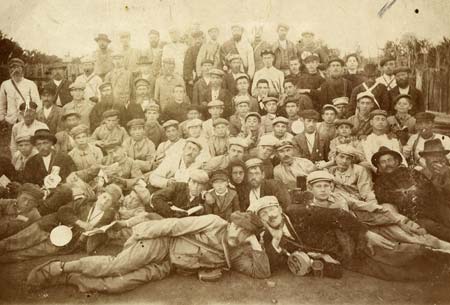
A Group of Fusgeyers from Iasi, c. 1900 http://epyc.yivo.org/content/photos/14_q_RM-RUMANI-4_lg.jpg

Yesterday’s post described some of the reasons that Jews like my grandfather and his relatives decided to leave Romania in the early years of the 20th century: rampant anti-Semitism, poverty, violence, false accusations, and laws depriving Jews of access to education and to most means of earning a living as well as denying them the legal rights of citizens.  Thousands of Jews left Romania between 1900 and 1910, many of them on foot, including my grandfather.  In both The Wayfarers by Stuart Tower and Finding Home by Jill Culiner, there are vivid descriptions of how these people managed to accomplish the task of walking about 1500 miles to cross the border from their homes in eastern Romania to Hungary or Galicia, where many then caught trains that would eventually bring them to the ports where they could sail to the United States.

Both Tower and Culiner relied heavily on the unpublished manuscript written by Jacob Finkelstein around 1942, describing his personal experience as a member of the first group of Fusgeyers.  Finkelstein’s memoir appears to be the most important primary source regarding the Fusgeyers, and Culiner begins most of her chapters with an excerpt from that manuscript.  The first group of Fusgeyers walked out of Romania in 1900, traveling by foot from Barlad to Predeal and crossing into Hungary.  As detailed in both Tower’s and Culiner’s books and as described by Finkelstein, that first group was an outgrowth of a club of young people in Barlad who put on theatrical works to raise money for charitable causes.  Members of the group decided that they could use their talents to raise money to pay for their travels out of Romania.  They raised some initial money through donations and from fees collected from those who wished to join them, and eventually there were seventy-five men and three women who joined the group and left Barlad in April, 1900.

The Gheorghe Rosca Codreanu Lyceum in Barlad (...

Barlad, Romania

Română: Timisul de Jos,Predeal,Brasov,Romania.

Română: Timisul de Jos,Predeal,Brasov,Romania. (Photo credit: Wikipedia)

One person was selected to be the leader of the group, and others were appointed to various roles: treasurer, medical care, scouts, and security.  They had flyers printed to distribute in the towns they planned to visit, and the people of Barlad provided not only financial support, but food and supplies to the group.  The group then walked from town to town across Romania, often being treated very well; in some places people provided them with food, shelter, and generous donations.  The group would stage musical performances to raise money.  Many newspapers publicized the movement, bringing even more donations and larger audiences to greet and support the Fusgeyers.  Moreover, this first group inspired new groups to form and to leave their homes as well.  My grandfather, who loved music and was smart and funny, might very well have been one of the Fusgeyers who left Iasi in 1904.

Sometimes, however, the group met up with hostility.  In Ramnicu Sarat, the police confiscated the passports of that first Barlad group, telling them to keep themselves from being noticed.  The passports were, however, returned once they left the town.  The group was threatened with arrest if they entered the town of Mizil, so they stayed out, sleeping in tents in the rain instead, and they were told to avoid the next town as well, resulting in another night of sleeping in the rain.  There was even trouble within the group; money was wrongfully taken by one of the group representatives.  Overall, however, at least according to Finkelstein, his group’s experience was a huge success—enabling not only that group to escape, but also inspiring thousands of other Romanians to do the same.

I cannot capture or describe all the details of the experiences of the Fusgeyers.  All I have as primary material in Finkelstein’s memoir, but Stuart Tower’s book takes the skeleton of facts provided by Finkelstein and builds from those facts a novelized version of that experience that helps to bring to life the Fusgeyers’ trek through Romania.  He developed characters and storylines that add an extra layer of humanity to this basic story.

The Wayfarers (Paperback) ~ Stuart Tower (Author) Cover Art


When I was doing some additional research about the Fusgeyers yesterday, I happened upon a website that described plans to turn Tower’s novel into a documentary about the Fusgeyers.  I did not realize it at first, but the website was a page on Kickstarter, a crowd-sourced fundraising site that helps people raise funds for private projects—in the arts and otherwise.  The Kickstarter page for The Wayfarers movie had not yet attracted any donors.  I made a small donation and also left a comment for the contact person of the page, Ron Richard, explaining my interest and expressing my concern that there had not yet been any other donations for the project.

I have heard back now both from Ron Richard and from Stuart Tower, the author of The Wayfarers.  Tower sent me some wonderful photographs of Romania from a Fusgeyer tour he ran in 2005, and I am hoping to get permission to post some of those photos here.  If any of you would also like to help Ron Richard and Stuart Tower make this film about the Romanian Fusgeyers, please check out their Kickstarter site at  https://www.kickstarter.com/projects/1552736981/the-wayfarers-the-story-of-the-fusgeyers?ref=live  It may be the best opportunity many of us have to see Romania and to understand better the experiences of our ancestors.

Jill Culiner’s book takes a different approach to exploring the Fusgeyer experience.  After reading Finkelstein’s memoir, she decided to re-enact the walk of the Fusgeyers, also walking from Berlad to Predeal, but not with a large group, just with one companion.   Her experiences doing this provide a chilling post-script to the story of the Jews in Romania, one that I found moving and haunting even re-reading it.  I will post more about her book and her experiences tomorrow.


Enhanced by Zemanta

The Fusgeyers: Why They Left Romania

Isadore Goldschlager

Isadore Goldschlager

“Grandpa walked out of Romania to escape from the Romanian army.”  That was the one story I knew about my grandfather’s life before he came to the US as a teenager.  I knew a few other snippets about him in general—that he loved music and animals, that he knew multiple languages, that he was a union activist and very left-wing in his political views, that he was a milkman, and that he was a terrible tease and had a great sense of humor.  But the story about him walking out of Romania was the one that always intrigued me the most.  I would ask my mother questions: Did he go alone?  Where did he walk to? How did he get to the United States? But she knew nothing more than that barebones story—that as a teenager, he decided to run away from the army and walked across the country to escape.

When I first started researching my grandfather’s family, I wanted to know more about this story.  Was it just a myth, or was there any factual basis to it?  I did some initial research and learned that there was in fact an entire movement of Jews who left Romania by foot beginning in the early 1900s, around the same time my grandfather left (1904).  These walkers were known as the Fusgeyers or “foot-goers.”  Unfortunately, I could not find many sources of information about this movement.  I found only two books devoted in depth to the topic.   One is a novel called The Wayfarers by Stuart F. Tower; although written as a novel, it was inspired by the author’s actual search to learn about the Fusgeyers.  It tells the story of an American man whose grandfather left Romania by foot.  The grandson, now an adult, takes his own teenage son and his elderly father to Romania to learn more about his grandfather’s escape from Romania.  The author describes long conversations that the lead character had with a rabbi living in Romania who was familiar with the Fusgeyer movement.  Although this book gave me a taste of what the movement was like, I wanted to read something more fact-based and scholarly to understand and know more about the Fusgeyers.[1]

I found that in the second book about the Fusgeyers: Finding Home: In the Footsteps of the Jewish Fusgeyers by Jill Culiner.  This book, a work of non-fiction, is fascinating and heart-breaking.   After reading Jacob Finkelstein’s “Memoir of a Fusgeyer from Romania to America,” an unpublished Yiddish manuscript written around 1942 and held by the New York-based YIVO Institute, Culiner, not herself a descendant of Romanian Jewss, decided to retrace the routes taken by the Fusgeyers as they walked out of Romania.  She actually walked these routes, visiting all the towns and cities along the way, asking current residents what they remembered of the Fusgeyers and of the Jewish communities that existed in those towns before the Holocaust.  What she learned about the past and present in Romania is what makes the book both fascinating and heart-breaking, and in a subsequent post, I will write more about that.  But first, I want to set the scene by describing what I learned from this book and elsewhere about why the Jews left Romania in the early 1900s.

As reported by Culiner and others[2], Jews had likely been living in the two principalities that became Romania, Walachia and Moldavia, since Roman times.   The Jewish population increased significantly in the second half of the 14th century when many Jews from Hungary and Poland immigrated there after being expelled from their home countries. (Wikipedia).  Ironically, Romania eventually became one of the most anti-Semitic of the European countries.  In 1640, the Church Codes of Walachia and Moldavia declared Jews heretics and banned all relationships between Christians and Jews. (Culiner, p. 15). During the 17th and 18th century, there were repeated “blood libel” accusations against Jews—being accused of killing Christian children for their blood— followed by violence and persecution.  (Culiner, p. 15; Wikipedia).

The widespread anti-Semitism really came to a head in the mid-nineteenth century during the movement for Romanian independence and the unification of Walachia and Moldavia into the independent nation of Romania. As the report on Romanian anti-Semitism on file with Yad Vashem reports, after the Crimean War and the defeat of Russia, which had previously controlled Walachia and Moldavia, the European powers (primarily France and Britain) put a great deal of pressure on the leaders of the independence movement in the region to grant Jews full legal status in the new country.  Although the leaders had originally argued for such rights during the uprisings against Russia, the external pressure created a great deal of resentment, and in the end the European powers backed off from insisting on full legal rights for the Jewish residents of the newly-united nation of Romania.  (Yad Vashem report).

The Yad Vashem report continues:  “A real explosion of openly expressed antisemitism occurred as the prospect of achieving national independence became more certain. During discussions of the new Constitution of 1866, Romanian leaders began to portray Jews as a principal obstacle to Romanian independence, prosperity, and culture.”  As finally drafted, Article 7 of the new Constitution for Romania provided that “[t]he status of Romanian citizen is acquired, maintained, and forfeited in accordance with rules established through civil legislation. Only foreign individuals who are of the Christian rite may acquire Romanian citizenship.”  Culiner described this development, saying that “anti-Semitism had now become part of the national identity.” (Culiner, p. 15)

Despite protests and outcry from western European countries, the new country persisted in its anti-Semitic views and practices.  Between 1866 and 1900, a number of laws were enacted restricting the business and other activities of Jewish residents in Romania.  Jews could not become officers in the military, customs officials, journalists, craftsmen or clerks.  Jews could not vote or obtain licenses to sell alcohol.  Jews could not own or cultivate land.  Jews could not own or manage pharmacies.  They could not work in psychiatric institutions or receive care as free patients in hospitals.  Jews could not sell tobacco or soda water or certain baked goods. Fewer than ten percent of Jewish children were allowed to attend public schools, and Jews were prohibited from opening their own schools.  Jews were not allowed to work as peddlers, which was sometimes interpreted to include owning shops.  Jewish homes were randomly destroyed as “unsanitary.”  (Culiner, pp. 16-17)

Culiner wrote:  “Eventually, 20,000 Jews found themselves on the streets of Romania and dying of starvation.  There were many suicides in Iasi, Bacu, and Roman….In 1899 and 1900, harvests were poor and a severe depression gripped the country.  Anti-Semitic decrees were applied with new severity and anti-Jewish speeches were delivered in parliament.  Riots took place in several towns, and…a pogrom broke out in Iasi.”  (Culiner, pp. 17, 19) (See also Wikipedia  and the Yad Vashem report on Anti-Semitism in Romania.)

That pogrom in Iasi was described in the American Jewish Yearbook of 1900: “For several hours there was fighting, merciless blows, pillaging and devastation, all under the paternal eyes of the police authorities and the army, which interfered only to hinder the Jews from defending themselves.”[3]

In 1900, my grandfather was twelve years old.  He lived in Iasi.  He experienced this horrible violence and hatred.  By that time his uncle Gustave and his aunt Zusi had already left for America.  Is it any surprise that this young teenager would have wanted to escape from his homeland and seek refuge someplace else?

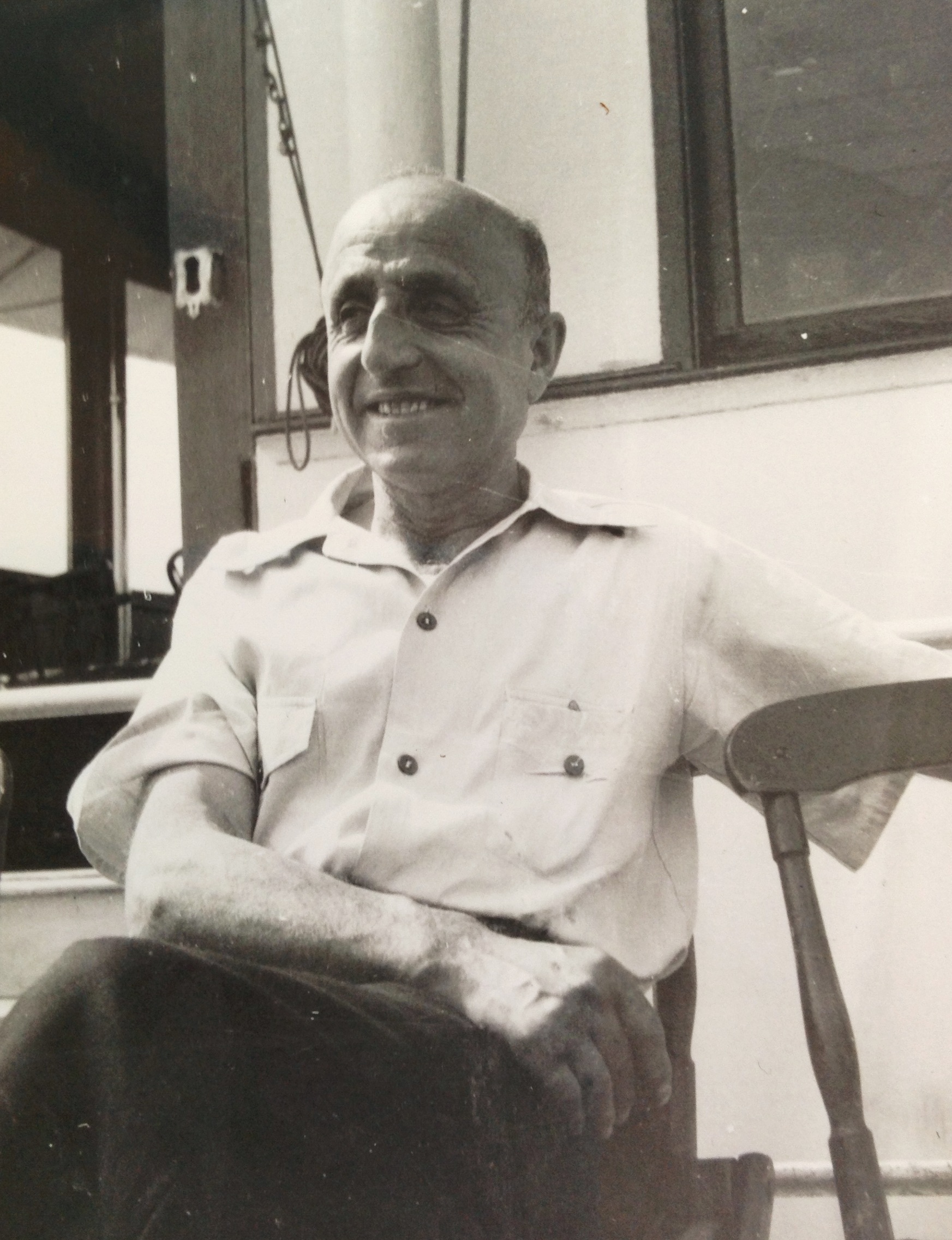
Isadore age 27

Isadore age 27

As I will report in a later post, he and thousands of other Jews did leave, many on foot, walking out of Romania to find a better life.  My grandfather followed his uncle and his aunt, who had left in the late 1880s, but he left alone, without his parents or siblings.  His first cousin Srul Srulovici, who became Isador Adler, had left two years before him in 1902, also alone and without his parents and siblings.  My grandfather left in 1904, and by 1910 the rest of his family—his siblings, mother and father and the rest of his Srulovici cousins—had also arrived.  I don’t know the details of how any of them got out or whether they were also Fusgeyers, but they all  followed their two oldest sons and brothers, both to be called Isadore in the United States.

So  my grandfather left Romania on foot, but not only to escape the Romanian army.  He escaped a life of poverty, of hatred, of discrimination.  He was only sixteen, but he was brave enough, smart enough, and strong enough to get out of a place that held no future for him.  He led his family to freedom.  Whatever life brought them in America, and it wasn’t easy, it was better than what they had left behind.


[1] Apparently the novel is being turned into a documentary about the Fusgeyer movement.  See https://www.kickstarter.com/projects/1552736981/the-wayfarers-the-story-of-the-fusgeyers

[2] Wikipedia has a long and detailed article on the history of the Jews in Romania at http://en.wikipedia.org/wiki/History_of_the_Jews_in_Romania.  I also consulted other sources, such as a report on Romanian anti-Semitism filed on the Yad Vashem website at http://www.yadvashem.org/yv/en/about/events/pdf/report/english/1.1_roots_of_romanian_antisemitism.pdf

[3][3] “Romania since the Berlin Treaty,” The American Jewish Yearbook (Philadelphia: The Jewish Publication Society of America, 1900), p. 83, as quoted in Culiner, p, 19.

Enhanced by Zemanta

Max and Irving: The Sons of Abraham Rosenzweig

Abraham Rosenzweig was the oldest son of Gustave and Gussie Rosenzweig and my grandfather Isadore’s first cousin.  He was born in New York City on February 12, 1889, apparently the first of their children born in the US.  He served in the Navy before and during World War I, and he worked for a bakery after the war and thereafter.

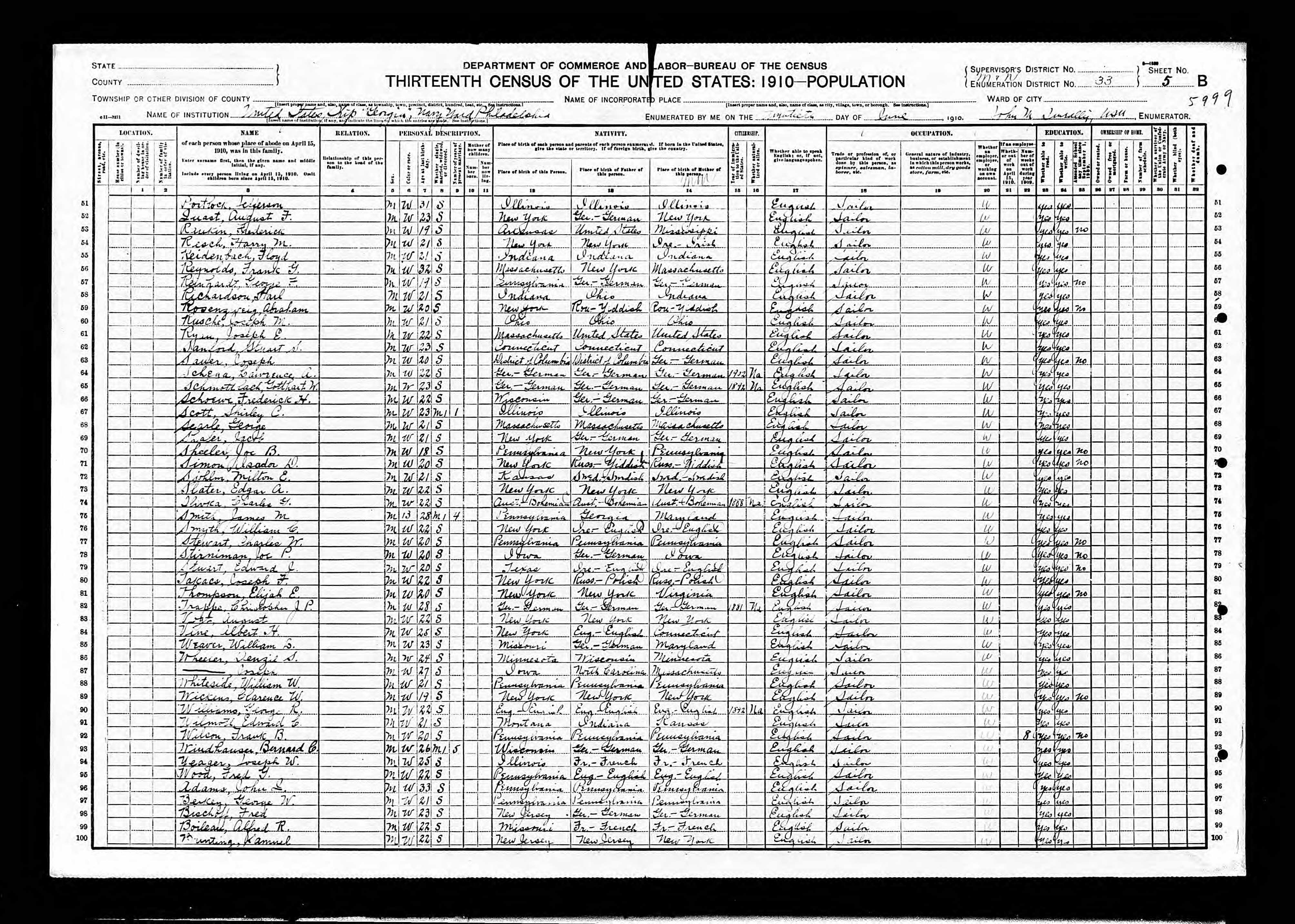
Although I do not have any documentation for Abraham’s marriage, it seems that he probably married in Pennsylvania.  Rebecca Fagles, his wife, was born in Pennsylvania, and Abraham was stationed on the USS Georgia in Philadelphia in 1910.

Abraham Rosenzweig 1910 census US Navy

I assume that that was when and where they met and that they married around 1915 because although Abraham was living with his family and single as of the 1915 census, his first son Maxwell was born April 2, 1916.  Abraham and Rebecca’s second son Irving was born April 26, 1919, and in 1920, they were all living in Brooklyn, according to the 1920 US census.

UPDATE: I was able to find the marriage of Reba Fagles and Abraham Rosenzweig in 1915 on the Philadelphia marriage index.  I am assuming that that is the record for Abraham and Rebecca.

Abraham Rosenzweig and family 1920 census

Abraham Rosenzweig and family 1920 census

Abraham and Rebecca, known as Abe and Beck, lived in Brooklyn for the rest of their lives, where they raised their two sons, Max and Irving.  Max married Sylvia Herrick and had two sons, Joseph and Gerald.

Max and Sylvia Ross

Max and Sylvia Ross

Irving married Irene Rubenstein/Robbins and had two daughters, Jane and Arlene.  Gerry remembers his grandparents very well since he grew up in Brooklyn where they lived.  He remembers that his grandmother Beck served untoasted English muffins and used memorial candle holders as glasses.  Gerry named his two children for his grandparents, his son for Abe and his daughter for Beck.  Abe died in 1961, and Beck died in 1970.

Abe, Sylvia, Ray (Abe's sister) and Beck

Abe, Sylvia, Ray (Abe’s sister) and Beck

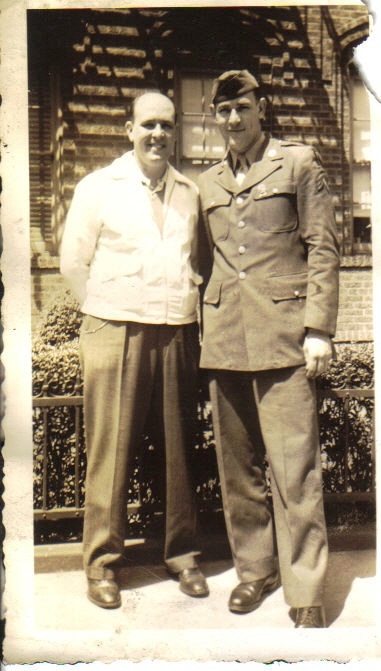
Here are some photographs of Max and Irving and one with their aunt Ray, an aunt I’ve otherwise been unable to locate.

Max and Irving Rosenzweig/Ross

Max and Irving Rosenzweig/Ross

Max and Irving with their aunt Ray

Max and Irving with their aunt Ray

I was able to get some background information about the lives of Max and Irving from Gerry and Arlene.

Max and Sylvia settled in Brooklyn, where Max first was in the egg and poultry business and then in the business of reconditioning steel drums for storing oil.  At some time after World War II while doing business with the army, Max changed his last name from Rosenzweig to Ross, believing that he would have more success with a name that was not obviously Jewish.  Sometime thereafter Irving also changed his last name to Ross for similar reasons and also because their mother Beck did not like the idea of the two brothers having different last names.

Arlene told me that her father Irving had met her mother Irene when her uncle Max went to Sylvia’s house while they were dating and brought his younger brother Irving with him.  One of Sylvia’s friends was there and arranged for Irving to meet her younger sister Irene.  For Irving, it was love at first sight, but not for Irene.  For a year, Irving pursued her.  Irene had joined the Navy, one of the first ten women to become a WAVE, and Irving, himself in the US Army, placed an ad in the Stars and Stripes to find her and to get her attention.  Eventually, Irene agreed to date him and fell in love with him as well.

They were married in 1945, and according to Arlene, to his dying day, her father would do anything to make Irene happy.  Irving and Irene  Irene and Irving lived at 41 Kew Gardens Road, Queens, and their two daughters were born at Kew Gardens General Hospital.  Irving owned a share in a successful hardware business.

In 1957, Irving and Irene and their daughters went to visit Irene’s parents, who had moved to the Miami, FL, area.  Irene was so taken with life in South Florida that within days after returning to Brooklyn, Irving sold his share in the hardware business and bought three tickets to Miami for Irene and his daughters, coming down a few months later himself once his business matters were resolved.  He was, as Arlene said, determined to make Irene as happy as possible.

Within five years, Irving, a man who never graduated from high school, had obtained a license to sell insurance and had established a very successful insurance brokerage business.  He was able to provide his family with a large, custom-built house and a comfortable lifestyle.  Irving and Irene remained in the Miami area thereafter and only occasionally would they return to the New York area.

Sadly, their lives would be marked by tragedy.  In 1968, Irving was admitted to Baptist Hospital in Miami for congestive heart failure.  While he was being admitted, Irene and Arlene went to get something to eat, and while driving down North Kendall Drive, where Baptist Hospital is still located, they were hit head-on by a minibus going northbound on U.S. 1, South Dixie Highway.  The minivan had defective brakes and  had skidded across the median.  Both Irene and Arlene suffered severe injuries, and Arlene underwent numerous surgeries and was laid up for a substantial time after the accident.  For some period of time all three members of the family shared one hospital room.

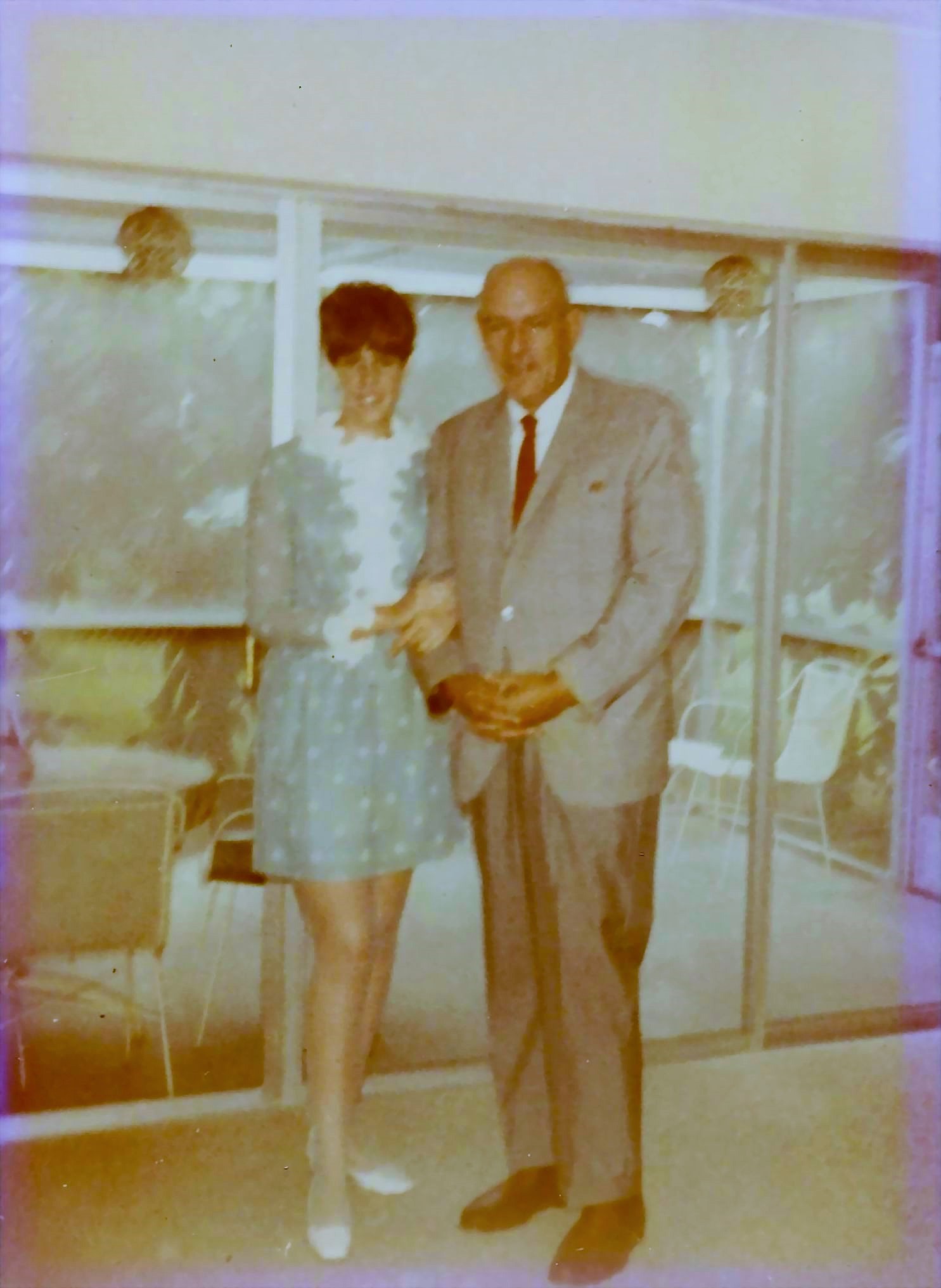
Arlene and Irving Ross August1968

Arlene and Irving Ross August1968

Not long after the accident, Irving was diagnosed with inoperable cancer and died at age 51 on August 5, 1970.  Irene was only 49 when he died.  She had to go to work to support herself and her children and became a purchasing agent at Florida International University, where she worked for many years.  She died January 16, 2009, at age 88.

Irene Ross in 2006

Irene Ross in 2006

Arlene Ross

Arlene Ross

Max also died at a prematurely young age.  His wife Sylvia had a number of medical problems, and while accompanying her for treatment at Massachusetts General Hospital in November, 1975, Max had an aneurysm and died.  He was only 59 years old. Sylvia lived more than twenty years after Max died.

Sylvia Ross

Sylvia Ross

The two sons of Abraham and Rebecca, Max and Irving, thus had many parallels in their lives.  Both were big strong men over six feet tall, both had changed their name to Ross, both had had two children and long marriages to women to whom they were devoted, and both had died before they were sixty years old. Gerry said he speaks to his father daily and has every day since he died in 1975; Arlene also spoke adoringly of her father.  I could tell in speaking with both Gerry and Arlene that each of them loved their fathers dearly and want their memories preserved.   I hope this blog will help to do that.

Enhanced by Zemanta

Itic Jankel Srulovici

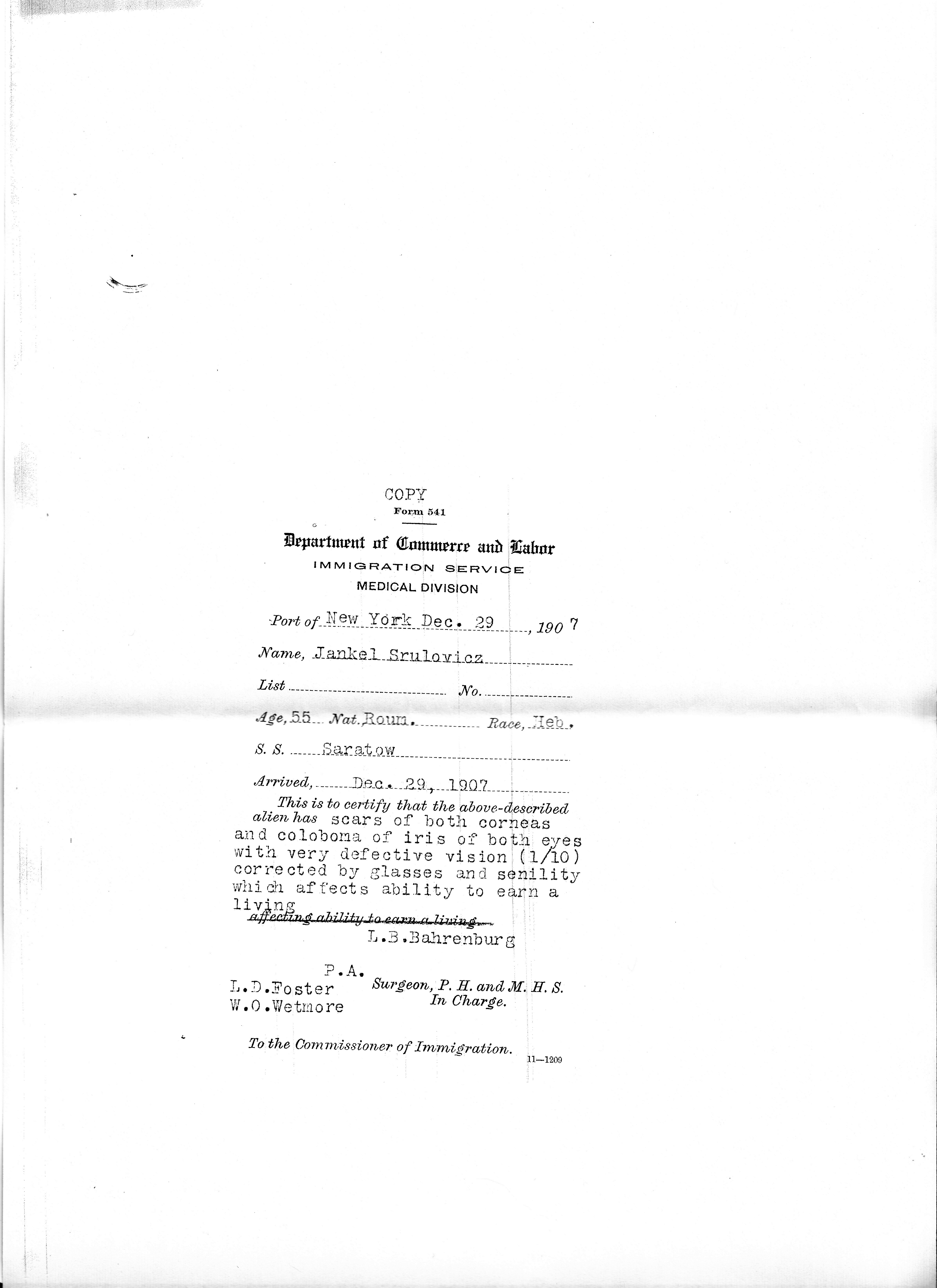
As you may recall, one of the mysteries I was having trouble solving was the fate of Itic Jankel Srulovic, aka Jacob Strolowitz or Adler, aka a number of other possible spellings of both his first and last name.  He was the husband of Tillie Rosenzweig Strolowitz, my great-grandmother Ghitla Rosenzweig Goldschlager’s sister.  He had arrived with his wife and his three youngest children on December 29, 1907, aboard the SS Saratov and had been detained because of problems with his eyes—scars on his corneas and coloboma on both irises.  Family lore suggested that he had never left Ellis Island, either having been deported or dying there, but the passenger manifest was stamped “Admitted,” indicating that a bond had been posted.

I had requested the case file for Jankel Srulovici from NARA, the National Archives and Records Administration in Washington, DC, a few weeks ago, and it arrived yesterday.  I have been studying it ever since.  The papers are fascinating not only because of what they reveal about Jankel and his family, but also because they provide some insight into the times and the experiences of immigrants. I will post scans of the documents in their entirety for those who are interested in the general history as well as those who are interested in the particulars of the family history.

The first document, dated December 31, 1907, is a recommendation from the Acting Commissioner of the Immigration Service, Joseph Murray, that Jankel Srulovic [sic] be admitted to the United States based on a bond of $1000 that was being posted. Commissioner Murray then described Jankel’s eye problems as causing “very defective vision (1/10), corrected by glasses,” but also said that Jankel was suffering from senility which affected his ability to earn a living.  He was only 55 years old; why was he suffering from senility?  What was this diagnosis based upon? There is later testimony that Jankel could not read or write; perhaps the diagnoses was based on his illiteracy, or maybe his illiteracy and his apparent senility was really more a misdiagnosis based on the fact that he did not speak English. Or, of course, perhaps he was really senile.

acting commissioner's recommendation

Enclosed with the recommendation were the report of the doctor’s exam of Jankel, as described in the Acting Commissiner’s letter,doctor's report and a transcript of the hearing held on December 30, 1907.  The transcript names the parties detained and subject to the inquiry as Itie Jankel Srulovic, 55, Roumanian Hebrew, and his wife Tille, 48, and children Riwke [Beckie, then Ray], 15, Pinkus, 9, and Lea, 7.  There is then what I assume to be a translation of some of the testimony given by Jankel.  He named his four older children already residing in the United States, Srul [Isidore], 26, Judel [David?], 21, Brucha [Bertha], 23, and Bluma [Bella], 18.  He testified that he could not read or write, that he was a painter, that he paid his own passage on the Saratov, and that he had $100, which he showed to the hearing officers.  He then was asked whether he had worked before coming to the US or been supported by his children, and he responded, “I supported myself without assistance from my children.”

transcript

transcript

A few things struck me by this testimony. First, I had an immediate reaction of surprise and anger that Jankel was identified by his religion.  Why was the fact that he was “Hebrew” at all relevant, especially in the context of a legal hearing to determine his right to enter the country, a country supposedly founded in large part on the principle of freedom of religious exercise?  Second, I could almost feel Jankel’s humiliation; he was asked whether he needed his children to support him.  He had to admit that he could not read and write.  On the other hand, he had $100—was that a lot or a little for an immigrant to have with them back then? And he had a trade—he was a painter.

The next paragraph made me smile because the next witness was Gustave Rosenzweig.  You may recall that I had noticed on Bertha Strulowitz’s marriage certificate that one of the witnesses was named Gustave Rosenzweig, and I had wondered whether this could be Tillie’s brother and thus also my great-grandmother’s brother.  Well, here he was, testifying at the hearing where the future of Tillie and her husband and children were at stake.  Gustave testified that he wanted [to help?] his sister, brother-in-law and their children.  He said, “I am worth $6000, all told; have a business of Painter Supplies,” and further said, “I will do the best I can for them.”  When asked whether Jankel could work, Gustav responded,”He has no business to work at all.  I will keep him in my house.”  He further testified that Jankel had “four grown children here to take care of them and able to take care of them.”

I was impressed both by the fact that Gustav had $6000 in assets and that he was so generous in coming forward to help his sister and her family.  He could not have been in the US that long himself, and he had to have some concern and fears about facing an official governmental agency, but he stood up for Jankel and his family.  Based on this testimony, the board of inquiry recommended that Jankel be “given this opportunity” to apply for admission on bond.

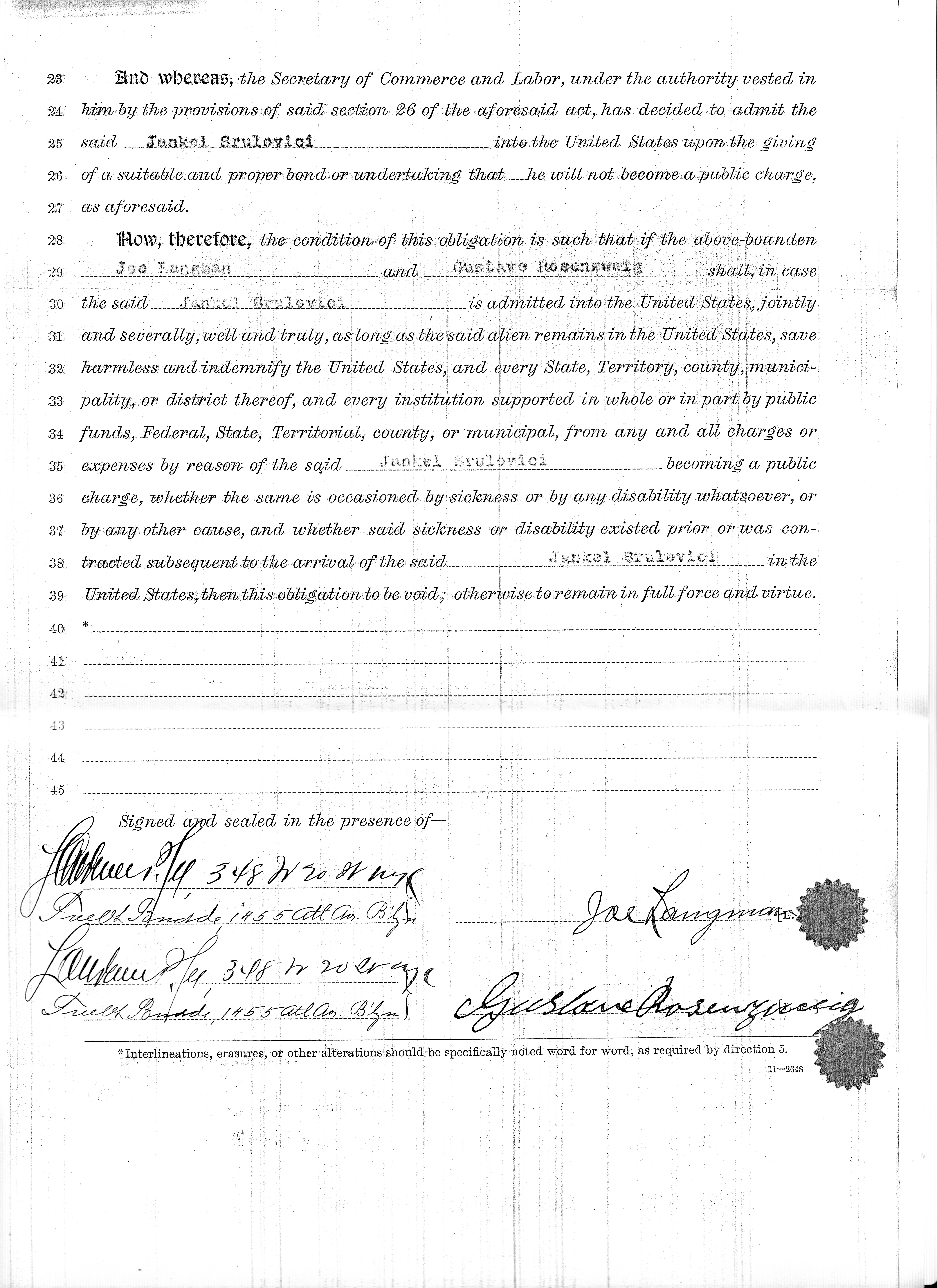
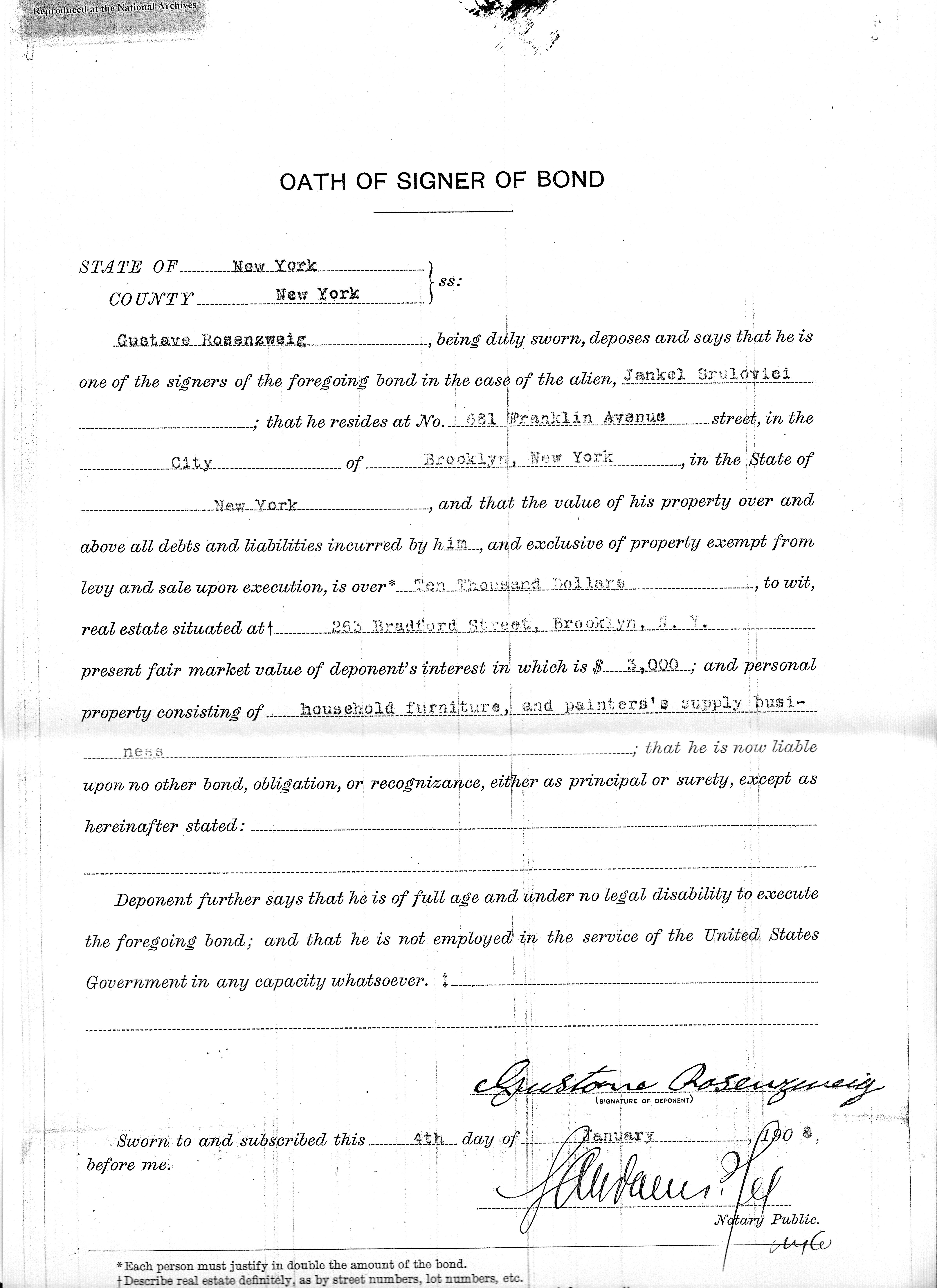
The remaining pages included with the Acting Commissioner’s recommendation are the bond, the application for the bond, and the oaths made by those providing the bond, Gustave Rosenzweig and Joe Langman.  Although I have only done some preliminary research on Joe Langman, it appears that he was also from Iasi and had been in the US for some time before this hearing.  I do not know whether there is any family connection, or whether he was just a landsman helping out another Romanian from Iasi.  Langman signed an oath claiming to have real property in Manhattan worth over $60,000, which must have been quite a substantial sum back then.  Gustave also signed a similar oath, asserting that he had $3000 worth of interest in real estate located in Brooklyn as well as personal property consisting of furniture and his painters’ supply business (presumably worth the other $3000).  Based on these oaths, a bond was issued for $1000 and presented in order that Jankel “shall not become a public charge” and be allowed to enter the country.

bond application p.1

bond application p.1

page 2

page 2

Oath of Joe Langman

Oath of Joe Langman

Oath of Gustave Rosenzweig

Oath of Gustave Rosenzweig

One other interesting thing I noticed about these documents: at the bottom of the page containing the oath is a footnote that reads, “In case signer of bond is a woman, insert here [on a line on the oath] “that deponent is an unmarried woman.” “ I had to stop and think about that for a minute, and then I realized what it meant.  Only an unmarried woman could post a bond because a married woman had no independent claim to property.  Boy, between being Jewish and a married woman, I would have had no rights back in 1908.

The final document in the file is the recommendation of the Commissioner of Immigration Services to the Secretary of Commerce and Labor, agreeing with the Acting Commissioner’s recommendation and recommending that Jankel Srulovici be granted admission on bond.  Although there is no response from the Secretary, I would assume that in general the Secretary deferred to the Commissioner and his hearing officers, and that Jankel and his family were in fact admitted into the United States and that he was not left on Ellis Island or deported.commissioner's recommendation

And yet, despite spending hours again last night searching for some record of his death or a gravesite, I still cannot find anything that reveals what happened to Jankel after January, 1908, when he was admitted, and April 29, 1910, when, according to the 1910 US census, Tillie was already a widow.

I’ve also been tracking down records for Gustav Rosenzweig and Joe Langer, but more on that in the next post.

Enhanced by Zemanta

First Cousins: The Grandchildren of David and Esther Rosensweig

Immigrants just arrived from Foreign Countries...

Immigrants just arrived from Foreign Countries–Immigrant Building, Ellis Island, New York Harbor. (Half of a stereo card) (Photo credit: Wikipedia)

Genealogy research can be both very frustrating and very exhilarating.  Sometimes you feel like you have hit a wall and can get no further.  Every stone you turn leads nowhere.  People don’t respond to requests for information, documents have been lost or destroyed, and you feel like you will never find anything new.  Then there are the times that are exhilarating.  You find a document that tells a story and reveals a relative you never knew about.  You contact a long lost cousin and make a new friend.  You put together pieces of a puzzle and see a picture of your family that touches you in ways you never anticipated.

Yesterday was one of those exhilarating days.  I had found an email address for someone I thought could be one of Leah Adler’s grandsons and had taken a chance that it was the right person and that he would respond.  It was a long shot—we are fairly distant cousins—third cousins—and it was very unlikely that my name and background would mean much to him.  Well, I hit the jackpot!  He forwarded my email to his sister Jean, who is herself someone with 30 years of experience in genealogy.  Jean wrote to me right away, and we have since exchanged several emails and lots of information.  Through this contact, I have been able to learn a lot more about my great-grandmother’s sister Tillie and her family.

Some might wonder why I care so much about these individuals and their lives.  Well, these were my grandfather’s first cousins.  He and his brother David were close in age to Isidor, Bertha, Bella, David, Pincus and Becky, and his sister Betty would have been close in age to Leah.  These could have been their playmates as children in Iasi.  They all had the same grandparents, David and Esther Rosensweig.  Tillie and Ghitla both named sons for their father David.

Moreover, Tillie took in my grandfather and his sister in 1910 when she herself was a single mother already caring for her seven children.  My grandfather and his sister must have been mourning their father, who had died in April, 1910, and awaiting their mother, who arrived in November.  (One mystery: I cannot find David Goldschlager on any 1910 census, though he shows up living with his mother and siblings in 1915.)

So what have I learned from Jean about my grandfather’s aunt and her children? For one thing, it now seems quite clear that Itic Yankel Srulivici and Jacob Adler were one and the same person.  Jean said that family lore in her family is that Jacob never left Ellis Island.  The ship manifest does indicate that he was admitted in 1907, but perhaps something happened after that to block his ability to leave Ellis Island.  The ship manifest does indicate that he was examined by a doctor and had scars on his corneas and coloboma of both irises.  Could that have been enough to block his entry and have him deported?  I have ordered a death certificate for a Jacob Adler who died in 1910, and I have asked my Romanian researcher to look for a record for Itic in Romania.

Jean was also able to confirm much of the information that I had found in public documents: that Bertha had been briefly married, that David died in the 1930s, and that her mother Teddy had married Abner Cohen.  She also told me that Bertha had been killed in an accident in the 1960s, that Bella had married Baer Rothschild and had had no children, and that Beckie, who became Ray as an adult, had married Ben Seamon and had four children, including a daughter Thelma with whom Jean had corresponded in the late 1970s and who had filled Jean in on many of these details.  Sadly, Thelma was also killed in a freak accident in 2000.

It seems no one knows what happened to Isidor, and I have sent for one death certificate that might be his from 1915.  If it is in fact his death certificate, it would mean he died very young, as did his brother Pincus.  The Adler family had more than their fair share of tragedies—losing Jacob, Isidor, Pincus and David at such young ages and losing Bertha and Thelma to freak accidents.  As with my grandfather as well as his brother David Goldschlager, it seems that Leah and her siblings also did not like discussing their past or their childhood family.  Perhaps the hardships of leaving Iasi where they had lived as children, coming to America as immigrants, and fighting to survive the poverty and the language and cultural differences left them all with scars that made it too painful to recall the past.

I don’t know anything about what their childhoods were like in Iasi.  I’ve read enough to know that there was terrible anti-Semitism in Romania during those years and also terrible poverty.  But children often are immune to those external factors in many ways because they know nothing else.  I’d like to think that the Goldschlager-Rosensweig-Srulivici children as young children had some joyfulness in their lives.  I’d like to imagine that Isadore, David and Betty Goldschlager and Isidor, Bertha, Bella, David, Beckie, Pincus and Leah Srulivic/Adler were all young cousins who played together and grew up together in Iasi, just as I was fortunate enough to grow up with my first cousins Jeff and Jody, who lived less than 20 minutes away from us during my childhood. All my first cousins—Jeff, Jody, Beth, Suzie, Robin and Jamie (Jim)– added so much laughter and joy to my life as a child, and I would hope that the same was true for my grandfather, his siblings and his first cousins.

Isadore and Gussie’s nine grandchildren 

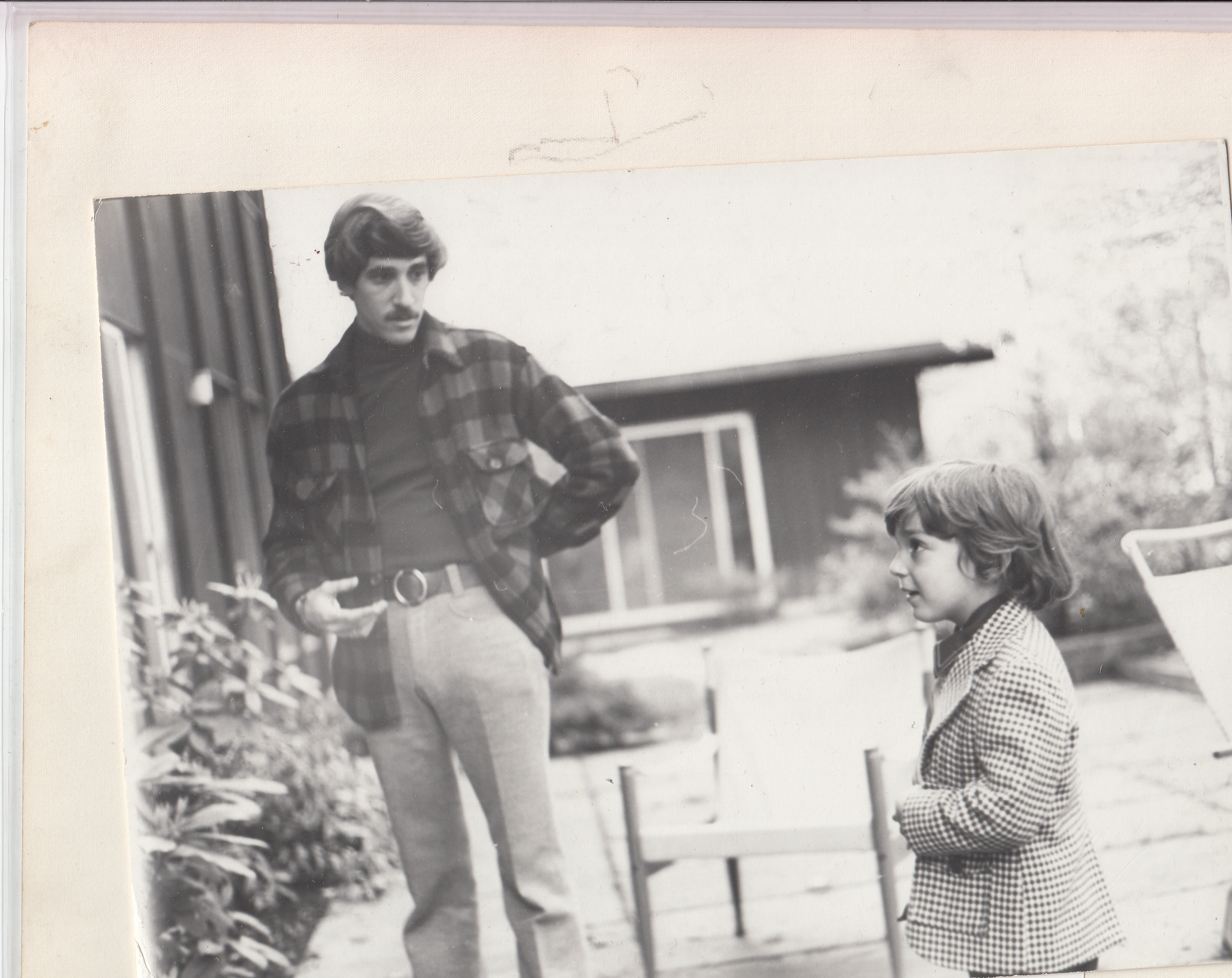
Jeff and Jim 1971

Jeff and Jim 1971

jody julie and ira 1963

jody julie and ira 1963

Beth 1954

Beth 1954

Julie, Robin, Amy, Suzie, and Ira 1962

Julie, Robin, Amy, Suzie, and Ira 1962

Elaine Jeff and Amy 1953

Amy and Jeff (with Elaine) 1953

Enhanced by Zemanta

The Goldschlagers

Having reached (for now) a dead end on my research of the Brotman family, I have decided to turn to, or rather return to, my research of my grandfather’s family, my Goldschlager relatives.  I had previously done a fair amount of research on the Goldschlager line, but had put it aside when I found my Brotman cousins. For some of you, the Goldschlager story will be perhaps of less interest, although it is itself a wonderful story of American Jewish immigration.  For others, in particular my first cousins and siblings and my mother, the Goldschlager story will be of great interest.  And for those who are interested in genealogy generally and/or the history of Jews in Europe and America, this story should also be a great interest.

So although this blog is called the Brotmanblog (and will continue to be so titled), I have created a new page for my Goldschlager ancestors and relatives.  If you are interested, please check it out.  I also will be writing some posts to describe the research I’ve done to uncover the story of my grandfather, his siblings and his parents and grandparents.

In this first Goldschlager post, I want to tell the story of my grandfather Isadore.  Isadore was born in Iasi (or Jassy), Romania.  He was the oldest child of Moritz (Moses, Moshe, or Morris)and Gitla (Gittel or Gussie) Goldschlager.  He was born in August, 1888; his younger brother David was born the following year, and their younger sister Betty was born in 1896.  Isadore was named for his grandfather, Ira Goldschlager.  I was very fortunate to find a researcher in Iasi who located and translated several documents relating to these relatives, including birth records and marriage records for Moritz and Gitla, my great-grandparents.

Moritz and Gittel's marriage certificate

Moritz and Gittel’s marriage certificate

He even took a photograph of the house were my grandfather and his parents and siblings lived in Iasi.

The Goldschlager House in Iasi

The Goldschlager House in Iasi

When my grandfather was 16 years old, he left Iasi and walked through Romania to escape the tzar’s army and persecution.  Romania was one of the most anti-Semitic and oppressive countries in Europe at the time, and many Jewish residents decided to escape in the early years of the 20th century. In a subsequent post, I will write more about the conditions in Romania and the history of the Fusgeyers—the “foot goers” who left Romania on foot.  My mother said that she does not remember her father talking about Romania very much, except to talk about the horses and the music, two things that he loved very much.

My teenaged grandfather arrived in New York City in 1904 without any relatives and under his brother’s name.  In 1905 he had a job as a storekeeper in a grocery store and lived in what is now East Harlem at 113th Street, apparently alone or perhaps in a boarding house.  His father Moritz arrived in 1909, and his mother Gittel, brother David, and sister Betty in 1910.  Sadly, it appears that Gittel, David and Betty arrived shortly after Moritz had died.

By 1915, Isadore and his mother and siblings were living together in East Harlem.  David was working at a hat maker, Betty as a dressmaker.  Isadore’s occupation unfortunately is not legible on the 1915 census form.  Edit:  On closer examination, I believe it says “Driver Milk,” which is consistent with what he was doing for the rest of his working life.

1905 NY census

1905 NY census

1915 NY Census for the Goldschlagers

1915 NY Census for the Goldschlagers

By 1917, when Isadore registered for the draft, he was working as a driver for a dairy company and married to my grandmother Gussie and living in Brooklyn.

Isadore's World War I draft registration

Isadore’s World War I draft registration

He continued working for dairy companies and eventually became a foreman.  He and my grandmother had three children. As a milkman, my grandfather worked at night to deliver the milk by morning.  When he delivered milk to people in the poor communities, they all loved him so much that they would bring him food.

My grandparents moved to Parkchester in the 1940s with my mother, who was only twelve at the time.  When I was born ten years later, my parents also lived in Parkchester, just a few buildings away from my grandparents, so I spent my first four and half years living right near my grandparents.

My grandparents and me 1956

My grandparents and me 1956

Although my grandfather died before I was five years old and thus my memories of him are vague, I do have a memory of him as a loving grandfather.  Perhaps it is the stories I’ve heard all my life about him rather than my own memories—it’s hard to know.  I know that my mother and her siblings loved him a great deal, that he was a big tease with a great sense of humor, and that although he left Romania at fifteen and never received a high school education, he spoke several languages and was a very smart and witty man.  He must have been an incredibly strong person to have left his family at such a young age; most likely he helped the rest of his family come to the United States once he got here.

I wish I had known him longer, and I wish I knew more about his life both in Romania and in New York.  Perhaps as I pursue this line of research I will learn more.  I have just located one of David’s grandsons, Richard, and David’s son Murray is 92 and living in Arizona.  I am hoping that Murray may know more about David’s life in Romania and the relationship between the two brothers, David and Isadore.

Enhanced by Zemanta

A World Apart: Conclusion

I finished Joseph Margoshes’ A World Apart last night, and I did find the answer to why he left Galicia.  When the lease his father-in-law had for the Yozefov estate expired after ten years, he was unable to obtain an extension, as it was leased to a different Jewish man.  Margoshes took the assets he had and obtained a lease on a different estate for himself and his wife, but he ran into difficulties and ended up in substantial debt.  When that lease expired in 1898, his father-in-law paid off Margoshes’ debt, and Margoshes and his wife and children left to seek better opportunities in America.

His father-in-law also ran into some difficulties when the lease on his estate in Zgursk expired and he, too, was unable to obtain an extension.  Margoshes described a long-running feud between his father-in-law and the people of Rzhokov, a small and poor shtetl across the Vistula River from Kielkov where the Shtiglitz (Margoshes’ in-laws) had family.  According to Margoshes, in the 1860s there was a huge dispute when one of these relatives died, a very wealthy man named Reb Yisroel Kielkover.  Reb Yisroel had not only provided work for many of the poor Jewish residents of Rzhokov, he had also provided charitable support, including free food and liquor.  Despite his generosity, when he died, the people of Rzhokov led by a man named Yankle Leiman refused to allow Reb Yisroel to be buried in the cemetery (which was used by residents of Kielkov as well as Rzhokov) unless his estate provided substantial financial support to raise the standard of living for the poor Jewish residents of Rzhokov.

Margoshes’ father-in-law and others were outraged and came to Rzhokov to demand that they be allowed to bury Reb Yisroel.  A violent fight broke out between the two groups of Jews, ultimately settled when Reb Yisroel’s side agreed to provide about half the money demanded by the group led by Leiman.  Margoshes’ father-in-law then brought criminal proceedings against Leiman for blackmail, resulting in Leiman spending three months in jail.   The money was never paid to the residents of Rzhokov, and the charitable support ended as well.  Margoshes wrote that the people of the shtetl remained very poor and without adequate buildings for a shul or mikvah.  He blamed this result on their excessive greed.

The feud continued for many years,ultimately exploding when Margoshes’ father-in-law had to obtain a new lease when his lease on Zgursk expired.  The estate he wanted to lease was, perhaps not coincidentally, leased at that time to Yankel Leiman and was about to expire.  Shtiglitz essentially swooped in and struck a deal with the Polish landowner to get the next lease, depriving Leiman of the opportunity to extend.  When Shtiglitz arrived to take over the estate, he and his family found that Leiman and his people had, as an act of revenge, vandalized the manor house and other buildings, much as today people who lose their homes to foreclosure often vandalize their homes before moving out.  Nevertheless, Margoshes’ father-in-law stayed and was able to make a great deal of money for the years he leased this property.

The father-in-law, however, ultimately paid a price for his bad temper and greed.  When he became angry with a worker on the new estate for not working hard enough, Shtiglitz accidentally killed the man by kicking him in self-defense, according to Margoshes.  Shtiglitz went to trial and was sentenced to two years of hard labor for second degree murder.  He only served a year, and Margoshes dismissed the significance of this by commenting that it only cost him about 10,000 gulders.  There was no expression of remorse or sadness for the dead worker.

Margoshes there ends his memoirs without any comment or conclusions about these matters or about life in Galicia in general.  My own conclusions about the book, however, are mixed.  It was interesting to learn more about Jewish life in Galicia, but overall the book was not what I expected.  I was hoping for a depiction of what life was like not only for wealthy Jews, but also for those Jews who were not as fortunate.  Aside from the first section of the book, there is no discussion of how religion played a part in the lives of any of these people; instead, the focus is almost entirely on how wealthy Jews lived and made a living.  As I’ve written in prior posts, Margoshes comes across as a rich young man who had little empathy or interest in the lives of those who were less fortunate.   He seems deluded into thinking that life for the Jews was a paradise during these times, despite the poverty of many Jews, the underlying resentment of the peasants, and the obvious anti-Semitism of the wealthy Polish landowners.

Given his description of his childhood as a boy from a religious home whose favorite activities were reading and discussing books and given that he became a Yiddish writer and journalist in the United States, I would have expected more insight, more soul-searching from a seventy year old man writing his memoirs in 1936.

WHY

I wrote about how I started doing this research and what resources—human and otherwise—I’ve used to do it.  But I’ve given a lot of thought also to WHY.  Why am I doing this?  Why spend all this time, energy, money, etc. doing this?  What is it for?

Part of it is the fun and the excitement of hunting down information and then actually finding it.  Part of it is the reward of learning that I am connected to all these other people I never knew—that we shared ancestors and DNA and a history together, even if we’ve never met. And I hope that part of those rewards will be meeting you all in real space, not just cyberspace.

But it is more than that.  Someone involved in genealogy research told me that most people do not get involved with this kind of project until they are in their sixties.  I turned sixty last summer when I first started doing this.  Sadly, by the time we’re sixty, our grandparents are long gone, so our principal sources of information about our ancestors are not around to help.  But why do we get interested in our sixties? Obviously, as we start to face our own mortality, we must yearn for a sense of purpose.   Will anyone remember us in 100 years? That leads to—where did we come from? Who were the people who preceded us that we no longer remember? We’re all part of a long line of family history, and at some point many of us yearn to figure out what that history was.

I never, ever thought about my great-grandparents until I started this project.  I knew I was named for Bessie, my great-grandmother, but I never wondered what she was like, what was her life like, why did my parents choose to name me for someone who died when my mother wasn’t yet four years old.  I still don’t know the answers to all those questions, but I know more than I did a year ago.  She was a brave woman who married a man with at least two children from a prior marriage, both of whom were young boys in 1881 when she married him.  She had at least five children of her own with him, and probably others who died very young.  She left everything she knew to come with her young children to America, and then she lost her husband not long after doing so.  She picked herself up, remarried and helped raise more children.  She lost a leg to diabetes.  I know she loved animals because the one clear memory my mother has of her was that she played with kittens in her grandmother’s bathroom as a very young child.

And Joseph?  I have learned to admire him as well.  He came to the US before Bessie, establishing himself as a coal dealer.  He worked very hard at back breaking work to support his family and died just four months after his youngest child Sam was born.  From his footstone inscription, we know that his children and wife loved him and appreciated the hard work he did to bring them to the US and support them when they got here.

So what does all that mean to me? It means I came from people who were strong, brave, hard-working and dedicated to their family—all traits I admire and aspire to myself.  They obviously raised children who adapted well to America and made successes of themselves.  Those children, our grandparents, raised Americans, our parents, who moved to the suburbs, owned businesses, became professionals.  And then there is us—the fourth generation.  We are spread all over the US, we are involved in all different types of careers, we are the American dream.  Wouldn’t our great-grandparents who were raised in a shtetl and escaped poverty and anti-Semitism be amazed at who we are today?

So why? Because we need to know how we got here, why our lives are what they are.  We need to be grateful for those who left Europe, avoided the pogroms and Hitler, and gave us all the opportunity to live in freedom and to pursue our own dreams.