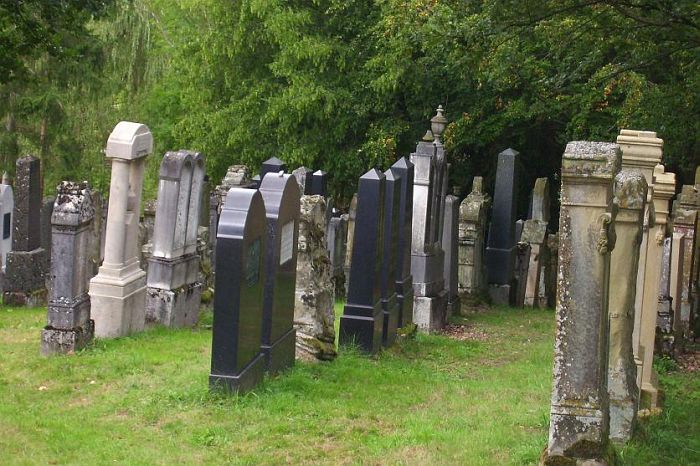
Yom Hashoah


http://www.gettyimages.com/detail/121859610

In honor of Yom Hashoah, Holocaust Memorial Day, I am posting the links to six of my blog posts in which I discussed the members of my own family who perished in the Holocaust. Six to represent the six million Jews who were slaughtered by the Nazis during World War II.

These are all members of the Seligmann/Schoenfeld family.  I did not even know about them a year ago. And I know that there must have been members of my other family lines who were also murdered during the war.  I just haven’t found them yet.  So in memory of all those who were killed, those we know about and all those we do not yet know about, please read these posts if you have not done so already.  Or even if you have.  We must never forget.

One

Two

Three

Four

Five

Six


English: A lit Yahrtzeit candle, a candle that...

English: A lit Yahrtzeit candle, a candle that is lit on the Hebrew anniversary of a loved one’s death. (Photo credit: Wikipedia)

Passover 2015: The American Jewish Story

Handmade shmura matzo used at the Passover Sed...

Handmade shmura matzo used at the Passover Seder especially for the mitzvot of eating matzo and afikoman. (Photo credit: Wikipedia)

A year ago I was feeling disconnected from Passover until I heard my grandson tell us the story of Passover in a way that made it feel new and exciting and different all over again.  This year his little brother will experience his first seder, though at only ten months, that experience will likely be short and quite unfocused.  Just a lot of really noisy people sitting around a table eating food that he neither can nor would want to eat.  But it’s a new reminder that every generation and every child experiences Passover as a new experience, allowing all of us who are jaded and detached to be able to relive our own early experiences with this special holiday.

Last year I entered into Passover thinking about my mother’s ancestors, the Brotmans, the Goldschlagers, and the Rosenzweigs.  I focused on their exodus from the oppression and poverty and anti-Semitism of Galicia and Romania and their courage and the desire for freedom that led them to leave all they knew to cross the continent and then the ocean and come to New York City, where they again lived in poverty but with greater hopes for a life of freedom and economic opportunity.  And they attained their goals if not in that first generation, certainly by the third and fourth generations.

Poor Jews taking home free matzohs, New York

Poor Jews taking home free matzohs, New York (Photo credit: Wikipedia)

For the last year now, I have been researching, studying and writing about my father’s paternal relatives.  It has taken just about a full year to cover the Cohens, the Jacobs (with whom I actually need to do more work), the Seligmans, the Schoenfelds, the Nusbaums, and the Dreyfusses.  Soon I will start my father’s maternal relatives—the Schoenthals and Katzensteins and whatever other surnames pop up along the way.  Researching my father’s families has been so different from my mother’s, and I can go so much further back.  I can’t get back much before 1840 with my mother’s family and have absolutely no records before 1885 or so for any of them.  Although I have a number of Romanian records for my Rosenzweig and Goldschlager relatives, I have no records at all from Europe for my great-grandparents Joseph and Bessie Brotman, despite hours and hours of searching and even DNA testing.

In contrast, my father’s ancestors have provided me with a rich opportunity to learn about Jews in Amsterdam, London, and especially the towns of Gau-Algesheim, Erbes-Budesheim, Bingen, and Schopfloch, Germany.  I have been able to find records all the way back to 1800 or so for almost every line.  I’ve had amazing help along the way on both sides of the Atlantic, and I’ve even learned a little German to boot.  My father’s families were pawnbrokers and peddlers and clothing merchants; they were pioneers and politicians and war heroes.


http://www.gettyimages.com/detail/182866324
Harrisburg Market Square with Leo Nusbaum store

Harrisburg Market Square with Leo Nusbaum store

They came to the United States in the 1840s and 1850s, and most of them suffered terrible heartbreaks, economic struggles, and early deaths.  Most of them settled in Philadelphia and other parts of Pennsylvania and New Jersey, but there were those who went to places that I’d never think a Jewish immigrant would go: Iowa, Texas, Illinois, Michigan, California, and, of course, New Mexico.  Many married outside the Jewish community and assimilated into American culture far more so than my mother’s relatives.  Ultimately, the Cohens/Jacobs and Seligmans/Schoenfelds and Nusbaums/Dreyfusses were successful; they found the American dream, and they embraced it.

But there is a very sad underside to this story of American success.  It’s the story of those who did not leave Europe.  For the first time in my life I confronted the reality that the Holocaust did not just happen to other families, to other Jews.  Not that I have not been deeply affected by the Holocaust all my life; ever since I read Anne Frank’s diary as a child, I’ve identified with and cried for all those who were murdered by the Nazis.  But I never knew that I had relatives left behind in Germany who were part of that slaughter.  I am still finding more, and I will write about them soon.  The list of names of my cousins who died in the Holocaust grows longer and longer, and I realize more than ever how grateful I should be to Bernard Seligman, John and Jeanette (Dreyfuss) Nusbaum, and Jacob and Sarah (Jacobs) Cohen for leaving Europe and taking a chance on the new country across the ocean.

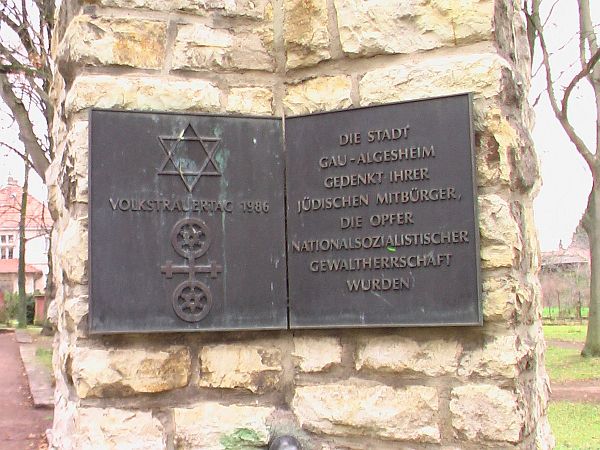
memorial plaque gau aldesheim

So this year for Passover I will be thinking about that first major migration of Jews from Europe to America.  I will be feeling thankful for the risks my ancestors took, and I will be feeling the loss of not only all those who were killed in the Holocaust, but the loss of all the children and grandchildren who would have been born but for those deaths.

And overall I will be celebrating family, freedom, and faith—faith that the world can be a better place and that human beings can be their best selves and live good and meaningful lives.  May all of you have a wonderful weekend—be it Passover or Easter or perhaps just another weekend in April for you.   Celebrate all the good things in life in whatever way you can.


Embed from Getty Images

My Cousin Wolfgang and The Lessons of History: Will We Ever Learn Those Lessons?

When I started this blog back in October, 2013, I never anticipated that it would help family members find me.  But that has proven to be an incredible unexpected benefit of publishing this blog.  This is one of those stories.

Several weeks ago, I received a comment on the blog from a man named Wolfgang Seligmann, saying he was the son of Walter Seligmann, that he lived near Gau-Algesheim, and that he had found my blog while doing some research on his family.  He asked me to email him, which I did immediately, and we have since exchanged many emails and learned that we are third cousins, once removed:  his great-great-grandparents were Moritz Seligmann and Babetta Schoenfeld, my great-great-great-grandparents.  His great-grandfather August was the brother of Sigmund, Adolph and Bernard Seligman, the three who had settled in Santa Fe in the mid-19th century.   Wolfgang sent me a copy of August’s death certificate.
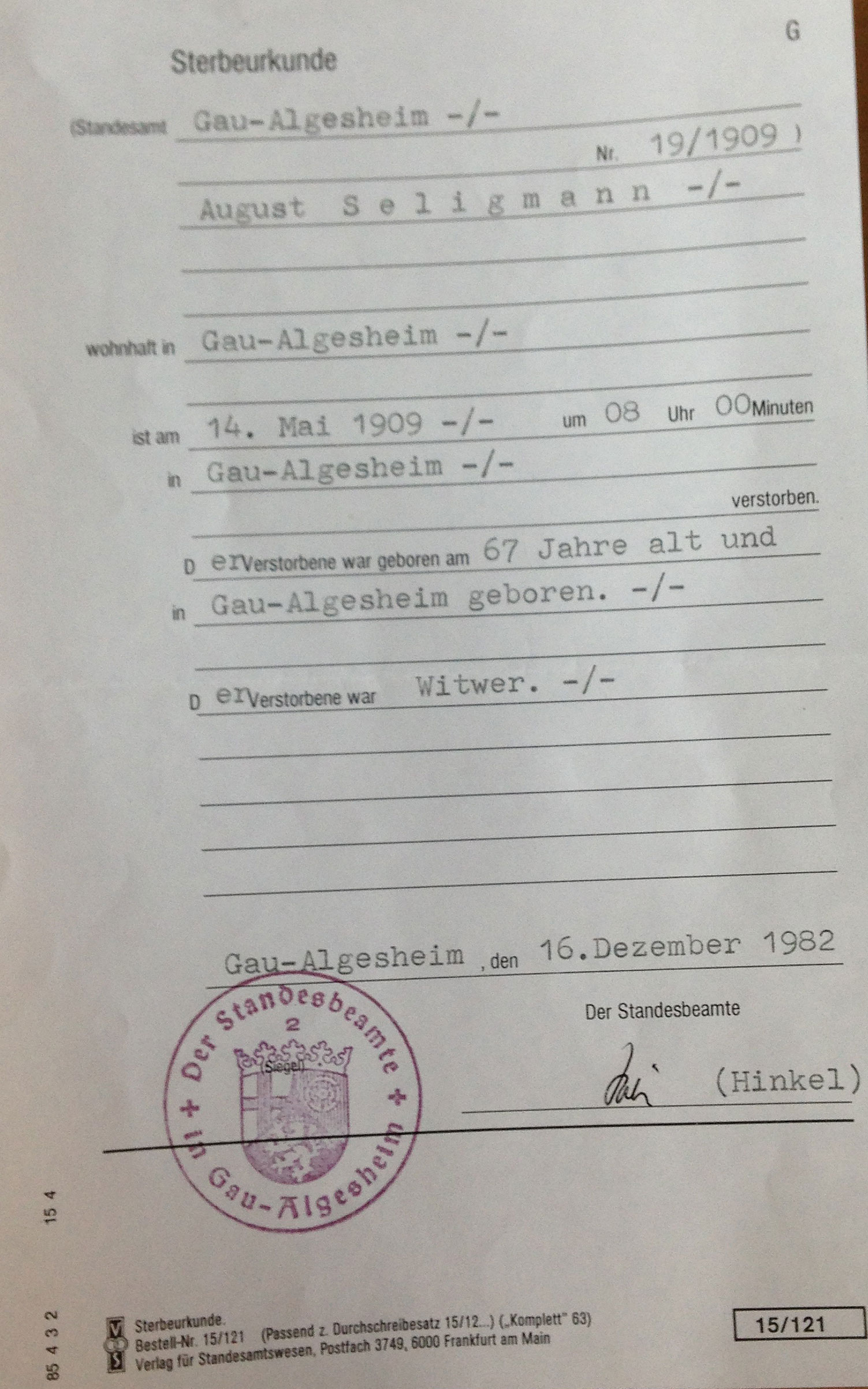
August Seligmann death certificate

August Seligmann death certificate

(Translations in this post courtesy of Wolfgang Seligmann except where noted: Registry-Office Gau-Algesheim: August Seligmann, living in Gau-Algesheim died the 14th of May 1909 at 8 a.m. in Gau-Algesheim. He was 67 years old and born in Gau-Algesheim. He was a widower.)

Our families had probably not been in touch since Bernard died in 1902 (or perhaps when Adolph died in 1920).  And now through the miracle of the internet and Google, Wolfgang had found my blog with his family’s names in it and had contacted me.  What would our mutual ancestors think of that?  It even seems miraculous to me, and I live in the 21st century.

Fortunately, Wolfgang’s English is excellent (since my knowledge of German is…well, about five words), and so we have been able to exchange some information about our families, and I have learned some answers to questions I had about the Seligmanns who stayed in Germany.  With Wolfgang’s permission, I would like to share some of those stories.

Wolfgang’s grandfather was Julius Seligmann, the second child and oldest son of August Seligmann and his wife Rosa Bergmann.  Julius was born in 1877 in Gau-Algesheim.  As I wrote about here, Julius was one of the Seligmanns written about in Ludwig Hellriegel’s book about the Jews of Gau-Algesheim.  He had been a merchant in the town.  On December 1, 1922, Julius had married a Catholic woman named Magdalena Kleisinger, who was born in Gau-Algesheim on July 9, 1882, and had himself converted to Catholicism.  Julius and Magdalena had two sons, Walter, who was born February 10, 1925, and Herbert, born July 27, 1927.  Julius and his family had left Gau-Algesheim for Bingen in 1939 after closing the store in 1935.

I had wondered why Julius had closed the store and then relocated to Bingen, and I asked Wolfgang what he knew about his grandfather’s life.  According to Wolfgang, his father Walter and uncle Herbert did not like to talk about the past, but Wolfgang knew that when Julius married and converted to Catholicism, his Jewish family was very upset and did not want to associate with him any longer.  In fact, Julius was forced to pay his siblings a substantial amount of money for some reason relating to his store in Gau-Algesheim, and that payment caused him and his family a great deal of financial hardship.  According to Wolfgang, Julius no longer had enough money to pay for his own home, and thus he and his family moved to Bingen in 1939 where they lived with Magdalena’s family or friends for some time.

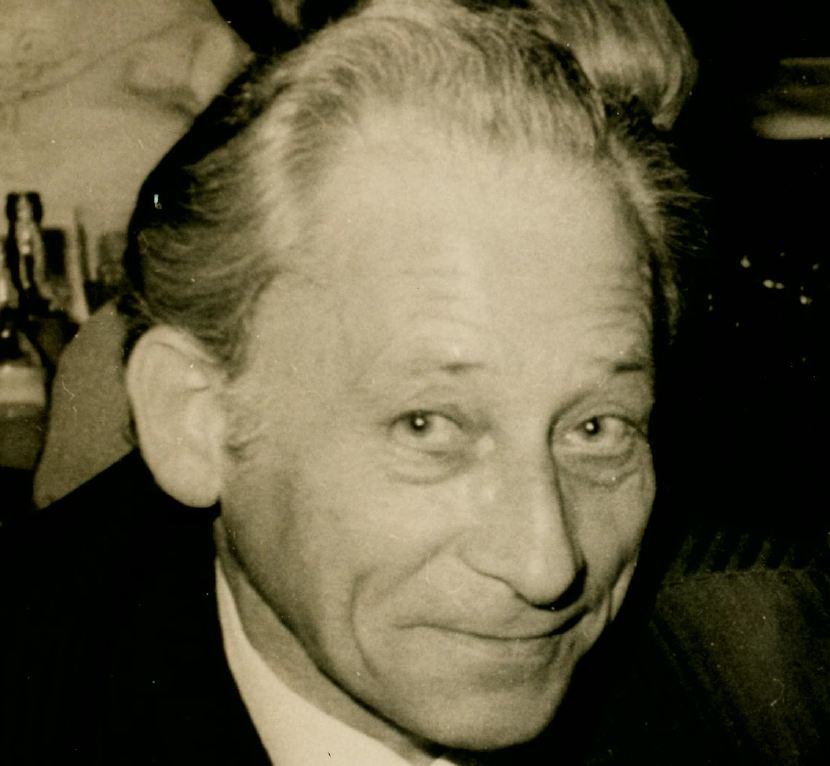
Julius and Magdalena Seligmann

Julius and Magdalena Seligmann 1960s  Courtesy of Wolfgang Seligmann

The Hellriegel book also made some puzzling (to me) references to the military records of Wolfgang’s father and uncle, saying that they had been “allowed” to enlist in the army, but then were soon after dismissed.  Wolfgang explained that the German authorities did not know how to treat Catholic citizens with Jewish roots.  Wolfgang said that his father Walter had trained to be a pharmacist, but the Nazis would not allow him to work with anything poisonous.  In addition,  his father was not permitted to be in the army; instead  he was ordered by the authorities to work on the Siegfried Line, which was  originally built as a defensive line by the Germans during World War I.  In August 1944, Hitler ordered that it be strengthened and rebuilt, and according to Wikipedia, “20,000 forced labourers and members of the Reichsarbeitsdienst (Reich Labour Service), most of whom were 14–16-year-old boys, attempted to re-equip the line for defence purposes.”  Walter Seligmann was one of those forced laborers.

Map of the Siegfried line.

Map of the Siegfried line. (Photo credit: Wikipedia)

Here is a photograph of Walter Seligmann, Wolfgang’s father:

Walter Seligmann  Photo courtesy of Wolfgang Seligmann

Walter Seligmann Photo courtesy of Wolfgang Seligmann

As for Wolfgang’s uncle Herbert, he was sent by the local police to the army, but the army would not accept him.  He was dismissed and sent back to Bingen, where he was required to work in a warehouse until the war ended.

Herbert Seligmann courtesy of Christoph Seligmann

Herbert Seligmann courtesy of Christoph Seligmann

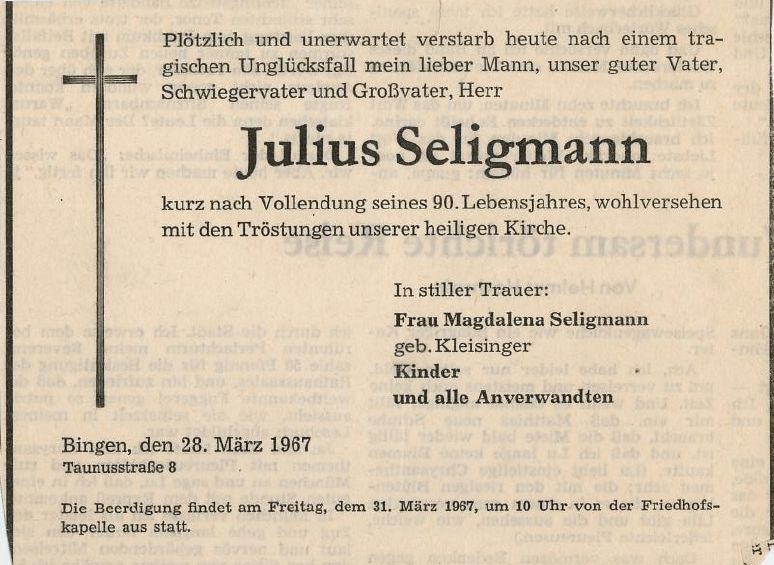
Julius Seligmann died in 1967, and his wife Magdalena died the following year.  Walter Seligmann died in 1993, and his brother Herbert died in 2001.

Julius Seligmann death notice

Julius Seligmann death notice

Magdalena Seligmann death notice

There are some very bitter ironies in these stories.  Julius and his family were not accepted by his Jewish family because they were Catholic, but the Nazis did not accept them either because they had Jewish roots.  As I commented to Wolfgang, prejudice of any sort is so destructive and unacceptable.  His family experienced it from two different directions.

Not that the two examples here can be equated in any way.  Although all prejudice is wrong, prejudice that leads to genocide is utterly reprehensible, an evil beyond comprehension for anyone who has a moral compass.  I have already written about my own personal horror and pain when I realized that I had family who had been murdered by the Nazis.  Wolfgang told me more about some of those who lost their lives to Hitler and his evil forces.

One victim was his great-uncle Moritz Seligmann (the grandson of Moritz Seligmann, my 3x-great-grandfather, and a son of August Seligmann).  My information about his fate comes from two websites that Wolfgang shared with me. According to these two sites, Moritz Seligmann, Julius’ younger brother, was born on June 25, 1881.  He fought in World War I for Germany, spent two years in captivity, and was honored with the Hindenburg Cross or Cross of Honor for his service.  Despite this, in the aftermath of Kristallnacht, on November 11, 1938, Moritz was arrested in Konigstein, where he had been living since 1925.  He was sent to the concentration camp at Buchenwald.

German Cross of Honour 1914-1918

German Cross of Honour 1914-1918 (Photo credit: Wikipedia)

Moritz wrote to the authorities in Konigstein, pointing out that he was the recipient of the Hindenburg Cross.  He was released from Buchenwald in December on the condition that he emigrate by March 31, 1939.  He was required to report to the police in Konigstein twice a week until then, and if he had not emigrated by the deadline, he was to be arrested.  On March 28, 1939, however, the Gestapo lifted the emigration order and the reporting requirement in light of Moritz’s service during World War I.

Here is a copy of the Gestapo letter, lifting the emigration order.  I found this a particularly chilling document to see.

Gestapo letter re Moritz Seligmann

Wolfgang helped me translate this letter as follows: Frankfort, March 20, 1939. Concerning: the “Aktionsjude” Moritz Seligmann born June 25, 1881, Gau-Algesheim, residing in Konigstein.  Seligmann has provided proof that he was a soldier in the World War as a combatant.  Therefore the reporting obligation and emigration order is lifted for him. I would ask the emigration (?) to supervise and notify us here.

As explained to me by Wolfgang and by Wikipedia,  the “Aktionsjude” referred to 26,000 Jews who were deported in the aftermath of Kristallnacht, as was Moritz Seligmann, as part of an effort to frighten other Jews to leave Germany.  Unfortunately, not enough of them did.

Despite the lifting of the order to emigrate, Moritz had hoped to immigrate to the US.  For various bureaucratic reasons described here, he was unable to get clearance to emigrate.  On June 10, 1942, he was picked up by the Nazis and transported somewhere to the east.  Exactly where and when he died is not known.

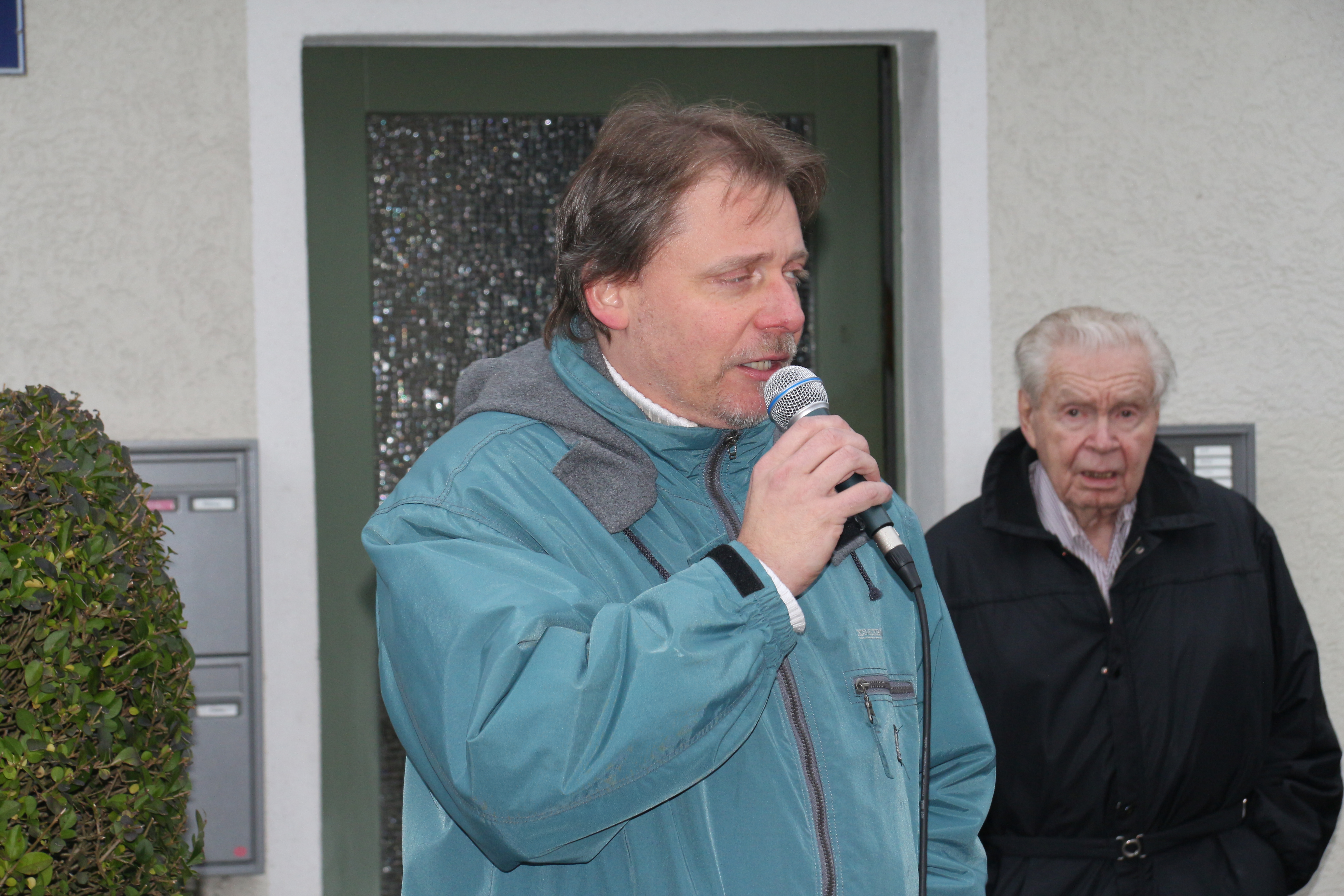
Wolfgang and his family, after researching the fate of Moritz, informed the town of Konigstein of their findings, and the town agreed to place a “stolperstein” in memory of Moritz Seligmann near his home in Konigstein.  A stolperstein (literally, a stumbling blog) is a memorial stone embedded in the ground to memorialize a victim of the Holocaust.  Here is a photograph of Wolfgang at the ceremony when Moritz Seligmann’s stolperstein was installed in Konigstein.

Wolfgang Seligmann

Wolfgang Seligmann  Courtesy of Wolfgang Seligmann

Behind him is a man who knew Moritz and remembered when Moritz was initially arrested in 1938, clinging to his Hindenburg Cross, believing it would save him from the murderous forces of the Nazis.  It may have stalled his murder, but it did not save him.

Wolfgang also told me about the fate of another sibling of his grandfather Julius, his younger sister Anna.  Anna, born in Gau-Algesheim in 1889, had married Hugo Goldmann, and they had a daughter Ruth, born in 1924 in Neunkirchen, a town about 80 miles southwest of Gau-Algesheim, where Anna and Hugo had settled. Between 1939 and 1940, many people from this area near the border with France were evacuated to locations in central Germany, and Anna, Hugo, and Ruth ended up in Halle, Germany, 350 miles to the northeast of Neunkirchen.  On June 1, 1942, they were all deported from Halle to the Sobibor concentration camp where they were all killed.  Click on each name to see the memorial pages established by the town of Halle in memory of Anna, Hugo, and Ruth.

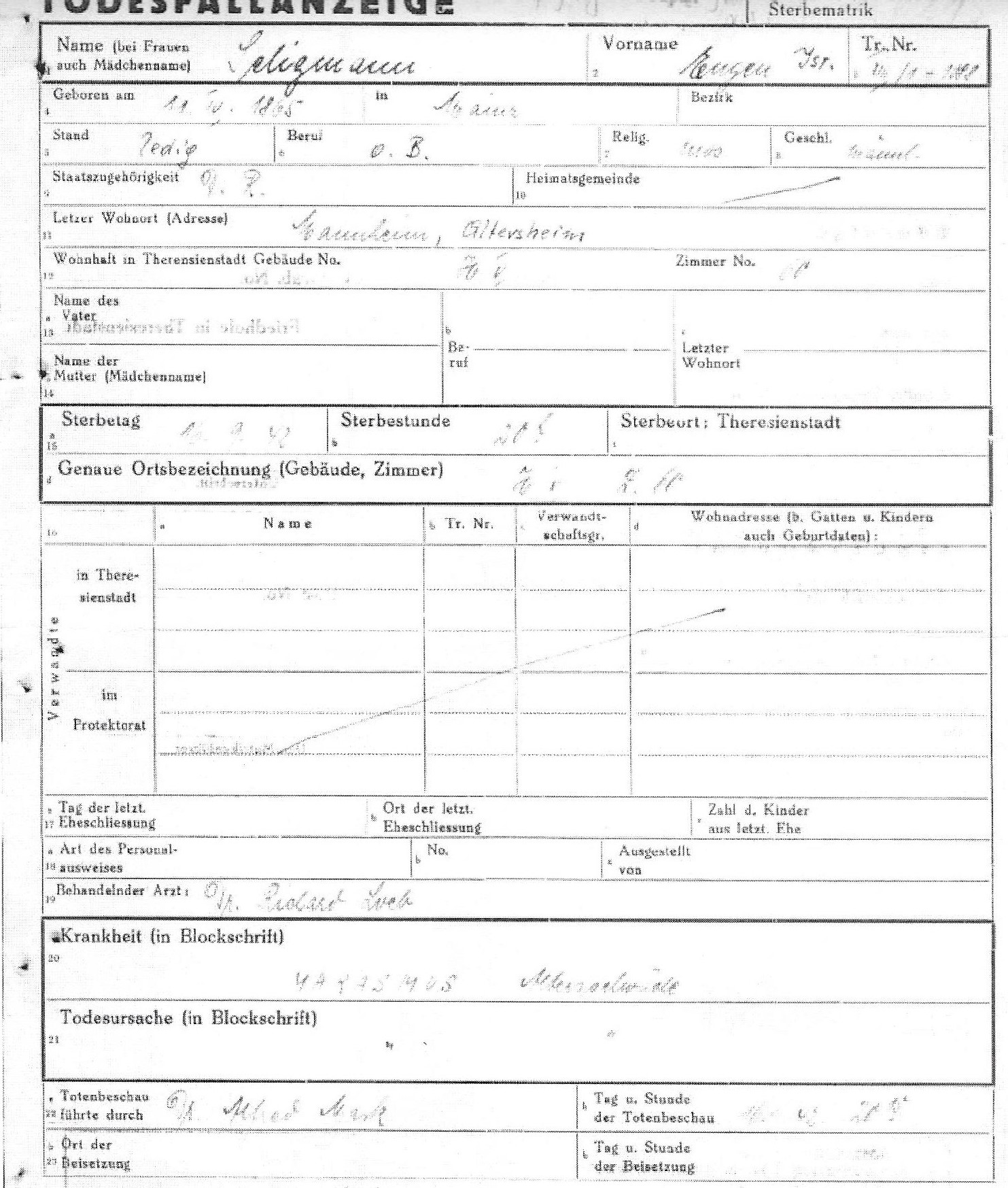
Finally, Wolfgang told me about another member of the family.  Moritz Seligmann (the elder) had had a daughter Caroline with his first wife, Eva Schoenfeld.  Caroline was the half-sister of my great-great-grandfather Bernard. She had married a man named Siegfried Seligmann, perhaps a cousin.  Their son, Emil, died in Wiesbaden on August 9, 1942, when he was 78 years old.

Death record of Emil Seligmann, husband of Carolina Seligmann

Death record of Emil Seligmann, husband of Carolina Seligmann

(Wiesbaden: The Emil Jakob Israel Seligmann, without profession, “israelitisch”  [presumably meaning Jewish], living in Wiesbaden, Gothestraße Nr. 5, died on 9th of August 1942 in his Apartment. He  was born on 23th of December 1863 in Mainz.

Father: Siegfried Seligmann, deceased.  Mother: Karoline Seligmann, nee Seligmann, deceased.  He was widower of Anna Maria Angelika born as Illien. The death was announced by Emil Seligmann, his son, living Goethestraße Nr.5.

The stamp in the left hand margin says:  Wiesbaden, 31th of May 1949.  The “Zwangsvorname”Israel is deleted.  Zwangsvorname translates as “forced first name,” meaning that the name Israel had been required by the Nazis, I assume as a way to identify him as Jewish.

Emil had a son, also named Emil, who died in Buchenwald, as this record attests.

Emil Seligmann-KZ (1)

(To: Miss Christine Seligmann, Wiesbaden, Goethestr. Nr. 5,1

From: Special registry-office in Arolsen-Waldeck, department Buchenwald

Subject: death-certification for Emil-Jakob Seligmann, Your letter from the 1. of March 1950

Based on the documents of the International Tracing Service in Arolsen it is proved, that your brother died on 14th of February 1945 in the Concentration Camp Buchenwald. )

I imagine that this is not the end of the list of the Seligmanns who were murdered during the Holocaust, and I imagine that there are also many other family members I never knew about who were killed by the Nazis, whether they were named Schoenfeld, Nussbaum, Dreyfuss, Goldschlager, Rosenzweig, Cohen, or Brotman or something else.  I just haven’t found them yet.

Wolfgang and I plan to keep on exchanging stories, pictures, documents, and other information.  We have also already talked about meeting someday and walking in the footsteps of our mutual ancestors.  What an honor it will be to be with him as we share our family’s story.

New Seligmann Discoveries: Erbes-Budesheim and the Schoenfelds, Part I

While you all may have thought that for the last several months I was obsessed with Nusbaums and Dreyfusses (and I guess I was), there were several other things happening in my genealogy life (not to mention my actual life) that I haven’t had a chance to blog about yet.  One of the biggest things was the discovery of documents and information about another line of my family, the Schoenfelds, and another ancestral town, Erbes-Budesheim.

Erbes-Büdesheim in January 2006

Erbes-Büdesheim in January 2006 (Photo credit: Wikipedia)

Who are the Schoenfelds?  Moritz Seligmann, my 3-x great-grandfather from Gau Algesheim, married two Schoenfeld sisters (not at the same time, of course).  First, he married Eva Schoenfeld and had four children with her, and then he married her younger sister, Babetta, my 3-x great-grandmother, the mother of Bernard Seligman, my great-great-grandfather.  Moritz and Babetta had seven children together in addition to the four born to Eva.

Because the birth names of women often disappear, it is all too easy to overlook the family names and lines that end when a woman changes her name to that of her husband.  Although I was always aware of the family names of Goldschlager, Brotman, Cohen, Nusbaum, and Seligman (as well as those from my paternal grandmother’s side, not yet covered on the blog), I had no awareness of a family connection to the names Rosenzweig, Dreyfuss, Jacobs, and Schoenfeld.  Discovering the Schoenfeld name, like discovering those others, was an exciting revelation and addition to my extended family tree.

So how did this happen?  As I wrote back on December 1, Ludwig Hellriegel’s book about the Jews of Gau Algesheim revealed that Moritz Seligmann was born in Gaulsheim and had moved to Gau Algesheim as an adult.  That discovery had led me to the Arbeitskreis Jüdisches Bingen and a woman named Beate Goetz.  Beate sent me the marriage record for Moritz Seligmann and Eva Schoenfeld, which revealed that Eva was the daughter of Bernhard Schoenfeld and Rosina Goldmann from Erbes-Budesheim.  (Now I also know another maternal name—Goldmann.)

Marriage record for Moritz Seligmann and Eva Schoenfeld February 27, 1829 Gaulsheim, Germany

Marriage record for Moritz Seligmann and Eva Schoenfeld February 27, 1829 Gaulsheim, Germany

From there I contacted the registry in Erbes-Budesheim to ask about records for my Schoenfeld ancestors, and within a short period of time, I received several emails from a man named Gerd Braun with an incredible treasure trove of information and records about my Schoenfeld ancestors.

But first, a little about Erbes-Budesheim.  Erbes-Budseheim is a municipality in the Alzey-Worms district of the Rhineland-Palatine state in Germany.  It is located about 25 miles south of Gaulsheim where Moritz Seligmann was born and grew up and about 27 miles south of Gau Algesheim where Moritz and his family eventually settled.  The closest major city is Frankfort, about 46 miles away.

Erbes-Büdesheim in AZ

Erbes-Büdesheim in AZ (Photo credit: Wikipedia)

The town has an ancient history, dating back to the Stone Age, according to Wikipedia.  Like many regions in Germany, it was subject to various wars and conquerors throughout much of its history.  During the Napoleonic era in the late 18th, early 19th century, Erbes-Budesheim and the entire Alzey region were annexed as part of France; after 1815 it was under the control of the Grand Duchy of Hesse.

Although originally a Catholic community, after the Reformation Erbes-Budesheim became a predominantly Protestant community.  Some sources say that there was a small Jewish community in Erbes-Budesheim as early as the 16th century, but as of 1701, there were only 15 Jews (two families) living in the town.  A third family lived there in 1733, but even as late as 1824 and throughout the entire 19th century, the population did not exceed 23 people.  The Jews in Erbes-Budesheim for much of that history joined with Jews from neighboring communities for prayer, education, and burial.

By 1849, however, one Jewish resident named Strauss had dedicated the first floor of his home for prayer services, and it was furnished with the essential elements for a synagogue: Torah scrolls, an ark, a yad, and a shofar, for example.  Perhaps this is where my 4-x great-grandfather Bernhard Schoenfeld went to daven [pray] when he and his family lived in Erbes-Budesheim.

Strauss home where the Erbes-Budesheim Synagogue was located  http://www.alemannia-judaica.de/erbes_buedesheim_synagoge.htm

Strauss home where the Erbes-Budesheim Synagogue was located
http://www.alemannia-judaica.de/erbes_buedesheim_synagoge.htm


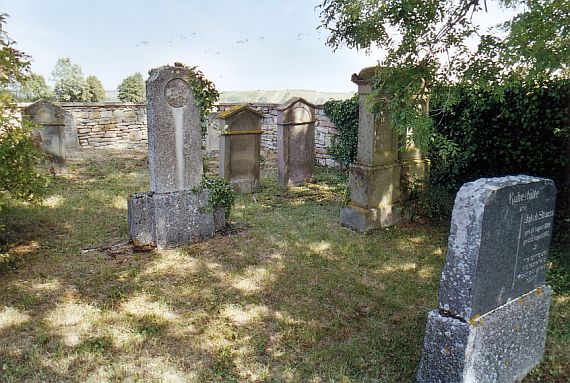
There is also a Jewish cemetery in Erbes-Budesheim.

On this video you can some headstones with the name Schoenfeld from the Erbes-Budesheim cemetery.

By 1939, there were only eight Jews left in the town, and it would appear from the allemannia-judaica website that none of these survived the Holocaust.

Thus, Erbes-Budesheim was never a place where a substantial Jewish community existed, and it makes me wonder what would have brought my ancestors there.  Why would anyone want to be one of a handful of Jews in a community?  In my next post, I will consider that question and share the documents I received from Erbes-Budesheim.

A Package from Germany and More Sobering Revelations: A Seligmann Update

Coat of arms of Gau-Algesheim

Coat of arms of Gau-Algesheim (Photo credit: Wikipedia)

A few days ago I received a package from Gau-Algesheim with photocopies of the birth records of Bernard Seligman and his siblings as well as a book about the Jews of Gau-Algesheim, Die Geschichte der Gau-Algesheimer Juden by Ludwig Hellriegel (1986, revised 2008)[The History of the Jews of Gau-Algesheim].  Of course, the records were in German, as is the book.  And the documents were also in Germanic font and in the old German script.   Completely unintelligible to me.  Here is an example, the birth certificate of my great-great-grandfather, Bernard Seligman or Bernhard Seligmann, as it was originally spelled.

Bernard Seligman's birth record

Bernard Seligman’s birth record

And so I started with the book, which is at least printed in regular font.  I first went through the entire book (about 110 pages), looking for the name Seligmann, not really expecting to find it.  But there on page 52 was the name Moritz Seligmann, and there again a few pages later, and then a list of Seligmanns a few pages after that, and then a few paragraphs here and a few paragraphs there.  But I can’t read German.

I painstakingly entered the passages that mention Seligmann into Google Translate and mostly got gibberish.  Google Translate does not like umlauts or those funny double S symbols used in German, and typing in German is very hard when you do not know the language.  Google Translate can do a word, but putting down a whole sentence leads to verbs and nouns and prepositions in places that just make it almost impossible to know what you are reading.

For example, what does this sentence mean?

Mr. Landauer of the Israelite Religious Community in Mainz has found that Moritz Seligmann who has led this protocol , although writes excellent German , but his burden with the Hebrew has unpunctured .

That is how Google Translate translated this sentence:  Herr Landauer von der israelitischen Religionsgemeinde in Mainz hat festgestellt, dass Moritz seligmann, der dieses protokoll gefuhrt hat, zwar ausgezeichnet deutsch schreibt, aber seine Last mit dem unpunktierten Hebraisch hat.

So if there are any readers out there who can help me with translation, please let me know.  I have no clue what that means except that perhaps my great-great-great-grandfather was very proficient in German.  The sentence that follows discusses the fact that the Jews in Gau-Algesheim did not speak or read Hebrew except for religious purposes.

Now I am working on getting a better translation program or finding someone to translate the book for me.  But here are a few random tidbits of information that I am pretty sure I did understand from my very poor translation of some of the passages.

Perhaps the most informative section revealed the livelihoods of two of my great-great-grandfather’s brothers, August and Hyronimus, and a third Seligmann whose name was Jacob, for whom I have no earlier record.  August opened a business in October, 1891, for iron and also spices and playing cards.  (That’s what Google Translate says anyway.)  August died on May 14, 1909.  Hyronimus also was in the iron and spice business as well in the wine trade; he opened his business on May 22, 1892.  Jacob was also in the iron trade and the wine and spirits trade; his business opened June 5, 1898.

I also know from the book that at one time August and Hyronimus both lived and/or did business on Langgasse or Long Alley.  I had posted this photo before without realizing that this was the street were some of my family lived or worked.

Gau-Algesheim. Langgasse.

Gau-Algesheim. Langgasse. (Photo credit: Wikipedia)

The paragraph that follows the one about the three Seligmanns and their businesses was a bit hard to follow with Google Translate, but from what I can decipher, August had a son named Julius born in 1877.  Julius married a Catholic woman and converted to Catholicism.  He had a hardware store in Gau-Algesheim as well as a spice business.  If I am reading the German correctly, he closed the store on December 9, 1935 and moved with his family to Bingen on September 15, 1939.  He had two sons, Herbert and Walter, who were both apparently still alive when the book was written.  Julius also survived the war, but was killed in a fatal car accident on his way to church on March 28, 1967.

Burg Klopp in Bingen am Rhein, Germany

Burg Klopp in Bingen am Rhein, Germany (Photo credit: Wikipedia)

Julius had an older sister Frances, born on December 26, 1875, who married Max Michel, but divorced him and moved to Bingen.  Frances died on December 19, 1933; her son Fred escaped to the United States in 1937.

The third child of August Seligmann was named Moritz, and he participated in the town’s cycling association. Moritz Seligmann, his grandfather’s namesake, was born in June 25, 1881.  The book seems to be describing the skills of various members and seems to be praising the skills of young Moritz, who was nineteen when he joined the club.  The end of this passage about Moritz says that he was single and had moved to Koenigsberg and that it was believed he was killed in 1941 in Theresienstadt.

The fourth child of August Seligmann was his daughter Anna.  She was born on November 30, 1889, in Gau-Algesheim.  She had moved with her husband Hugo Goldmann to Neunkirchen in Saarland.  They and their three children, Ruth, Heinz, and Gretel, were all killed in the Holocaust.

There is also an entry for Elizabeth nee Seligman Arnfeld, who was born March 17, 1875.  She had moved to Mulheim on the Ruhr in 1938 and wanted to emigrate to the United States.  A woman named Leonara Morreau[1] had vouched for them, but for unknown reasons they were never able to emigrate.  Elizabeth died on January 23, 1943 at Theresienstadt.  Her son Heinz survived the war.  The book did not identify the parents of Elizabeth Seligman Arnfeld, but she could have been the daughter of Salomon or Benjamin, who unfortunately are not mentioned in the book, or of Hyronimus or Jacob.

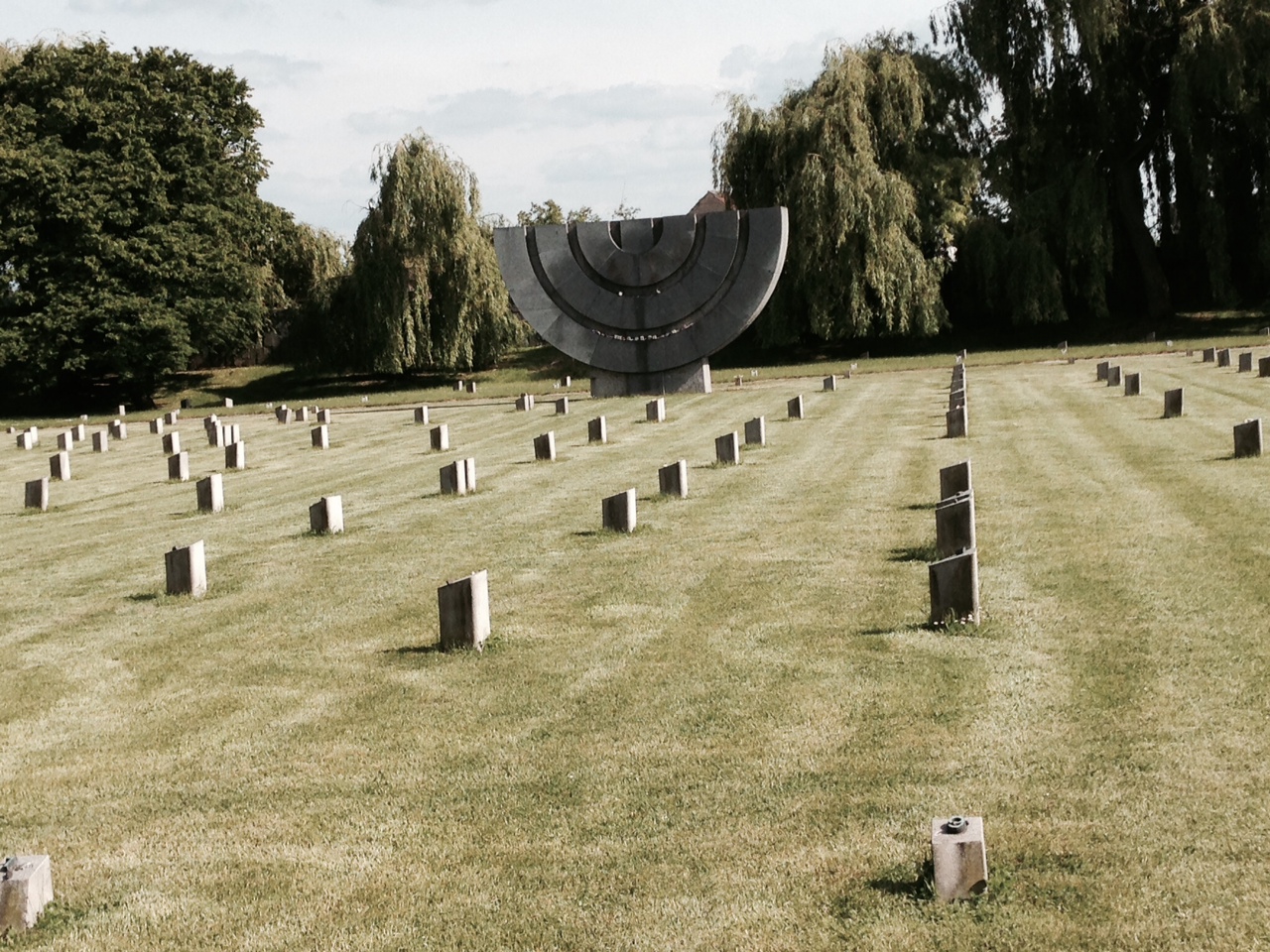
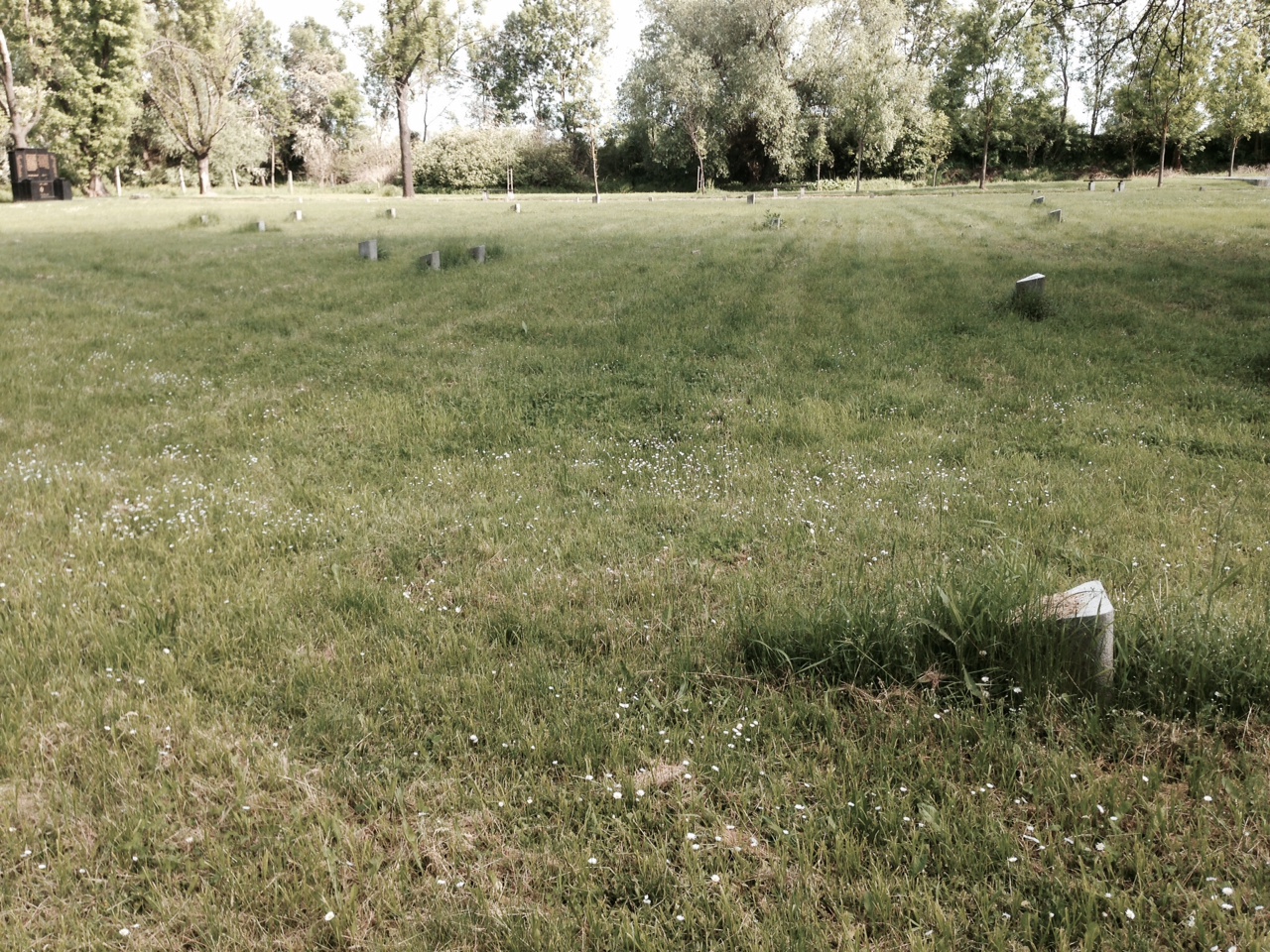
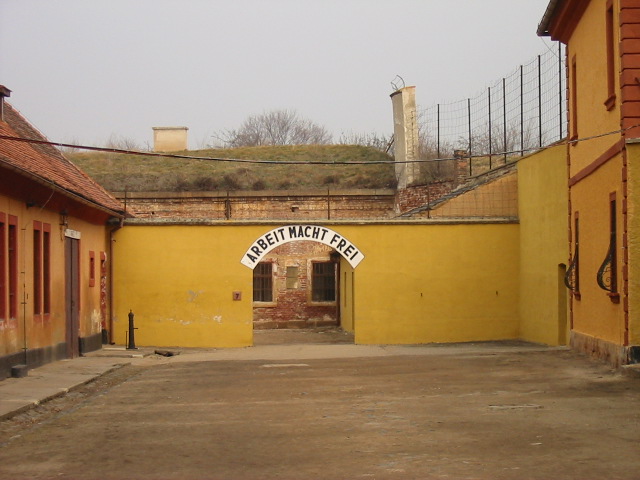
Theresienstadt

Theresienstadt concentration camp

Now that I have more names and more recent relatives, I am hoping that perhaps I can find out more about these people.  I also now know that many of them moved to Bingen, so there may be records from that larger town that will tell me more about the Seligmanns who stayed in Germany. And from several other entries in the book, I know where they lived in Gau-Algesheim.

I would love to be able to read the entire book and learn more about the history and lives of Jews in Gau-Algesheim, but it took me a good part of two days just to translate these few passages, and those translations are not very reliable.  It seems hiring someone to translate the whole book could cost me as much as $1000, and that is not in my genealogy budget by a long shot.  If someone has any brilliant ideas on how to get the book translated for free or for a really reasonable price, please let me know.

What I did learn from the passages I struggled to translate is that my family was not untouched by the Holocaust, as I once believed, but that we lost many people just from Gau-Algesheim alone.   I am hoping that I can find the descendants of the few who seem to have survived—Heinz Arnfeld and Fred Michel and Herbert and Walter Seligmann—and learn more.

In my next post I will discuss the birth records I received for the Seligmanns and how I was able to translate them.  Then I will return to the Nusbaums.

memorial plaque gau aldesheim

Holocaust Memorial plaque in Gau-Algesheim

[1] I found Leonara Morreau’s obituary and researched her a bit, but know of no reason that she would have had a connection to the Seligmanns in Germany.  She was born, married, and lived in Cleveland.  Her husband died in 1933, and she died in 1947.  As far as I can tell, they never traveled to Germany.  Leonara’s brother was Isaac Heller, who was also born in Cleveland, as was their father, Charles Heller.  Although their grandfather was born in Germany, it was not even in the same region as the Seligmanns.  Perhaps Leonara was active in trying to bring German Jews to the United States during Hitler’s reign, but I can find no evidence of that.  Her obituary only states that she was active in charitable and religious causes.

Follow up on Schopfloch: Who Replaced My 4x-Great-Grandfather Amson Nussbaum

In my last post, I wrote about the Jews Edict of 1813 in Bavaria and the impact it had on Jewish families.  To recap, since the law prohibited the increase in the number of Jewish families in a particular town, children would have to leave town to start their own families.

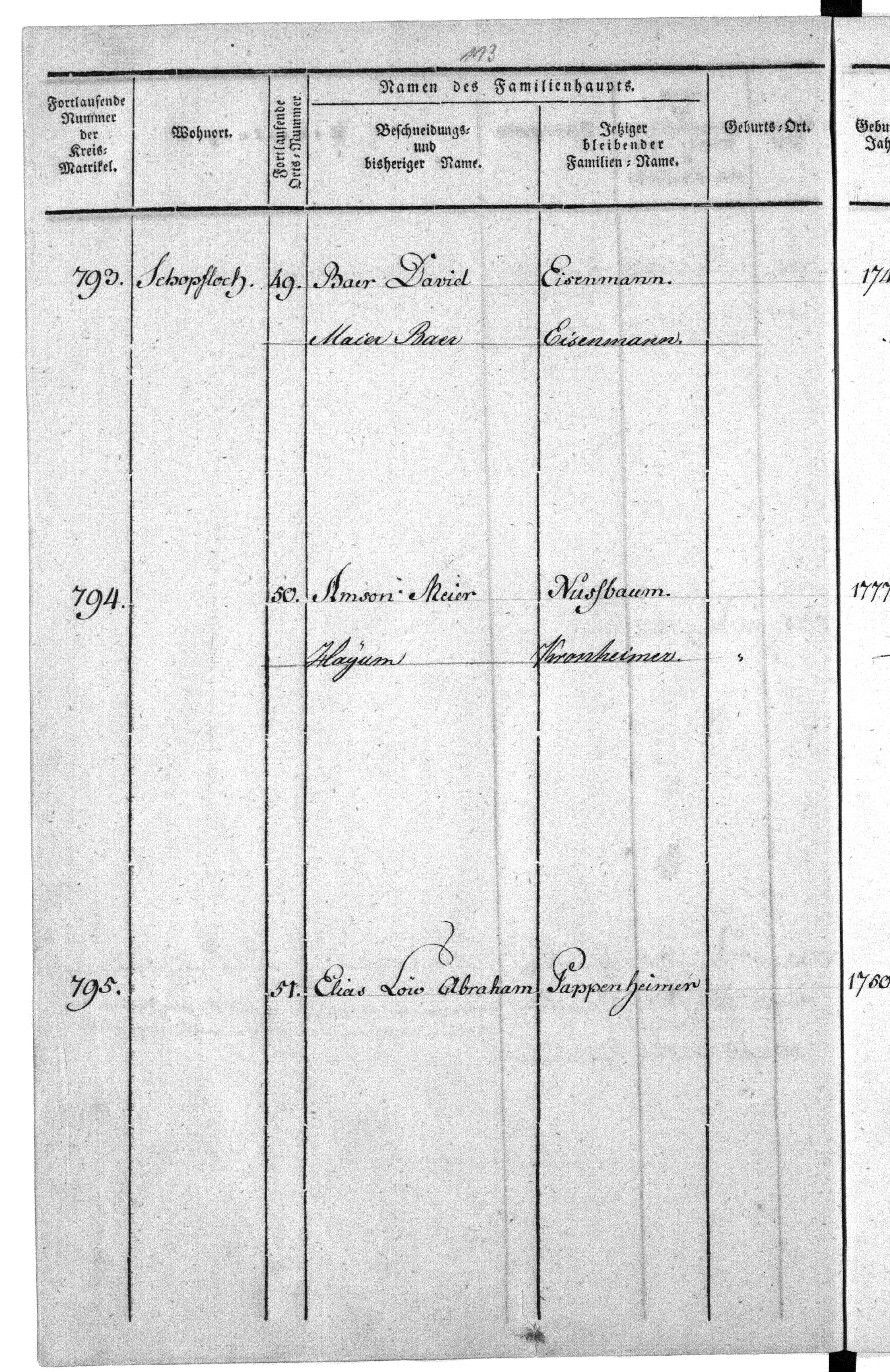
Yesterday I was very fortunate to receive the following document from a very generous fellow researcher named Ralph Baer.

1827 Matrikel part 1 for Amson Nussbaum

1826 Matrikel left side of page

1827 Matrikel part 2 for Amson Nussbaum

1826 Matrikel right side of page


This is from the census or Matrikel of 1826 for the town of Schopfloch, and the second name listed is the entry for my 4x-great-grandfather, Amson Meier Nussbaum, father of John Nusbaum.  It reports that he was born 1777 and matriculated on September 26, 1809. His occupation was “Handel mit alten Kleidern” or trade with old clothes. [Thank you, Ralph, for sending me this and for the translation.]

I was curious about the name under Amson’s name, Hayum Kronheimer, and Ralph explained to me that he was Amson’s replacement on the Matrikel.  In other words, after Amson died, Hayum Kronheimer replaced him in the count of permitted Jewish families in Schopfloch.

I’ve not yet had a chance to research Hayum Kronheimer.  Perhaps he was an in-law, or maybe just a stranger to the family. [UPDATE: Further research led me to a family tree for Hayum Kronheimer; it does not appear that he married anyone in the Nussbaum family.]   Either way, I found it rather chilling to see the actual name of the person who replaced my ancestor on the list of Jews allowed in the town.

A Town with A Secret Language: Schopfloch and the Nusbaums

I thought I should outline my connection to the Nusbaums before I began writing about them.   The chain between Amson Nusbaum  and me is as follows, with the Nusbaum descendants all on the left side of each couple:

Amson Nusbaum—Voegele Welsch  (my 4x-great-grandparents)

John (Josua) Nusbaum—Jeannette (Shamet) Dreyfuss  (my 3x-great-grandparents)

Frances Nusbaum—-Bernard Seligman  (my great-great-grandparents)

Eva May Seligman—-Emanuel Cohen (my great-grandparents)

John Nusbaum Cohen, Sr. — Eva Schoenthal  (my grandparents)

John Nusbaum Cohen, Jr. —-  Florence Goldschlager  (my parents)

Amy Cohen (me)

(Although the Nusbaums spelled their name with two S’s in Germany as in NUSSBAUM, the family dropped the second S once they got to the US, just as the Seligmanns dropped the second N when they immigrated.)

So where do I start telling this Nusbaum story? I have already talked about my grandfather John Nusbaum Cohen’s life and his mother Eva Seligman Cohen’s life in telling the stories of the Cohens and the Seligmans.  So I could start with my great-great-grandmother, Frances Nusbaum, who married Bernard Seligman.  I’ve also written a little about her.  But I prefer to start at the earliest point and move forward in time.   Right now the earliest Nusbaum ancestors I have found date back to the 18th century with Amson Nusbaum and Voegele Welsch.

This is the first branch that I have been able to take back as far as my 4x-great-grandparents.  Although I know very little about Amson Nusbaum and Voegele Welsch, I am hoping that I can learn more if I can obtain more records from Schopfloch.  But for now, here is what I know.

Amson Meier Nusbaum was born around 1777 possibly in Schopfloch, a small town in the Ansbach region of Bavaria.  He married Voegele Welsch, who was born March 7, 1782, somewhere in Germany.  They were married around 1804, and they had eight children born between 1805 and 1819, all born in Schopfloch.  Amson was a peddler.

Schopfloch

Schopfloch

Although I do not have much specific information about Amson and Voegele, I was interested in learning more about the town where they lived and raised their children in order to glean something about what their lives might have been like.

First, I read a little bit about Bavaria.  I really know almost nothing about Germany’s history, but I do know that it was not a unified country until 1871.  Before that, there were a number of separate duchys and kingdoms controlled by various aristocrats and noblemen, fighting over their borders for many hundreds of years. From the tenth century until the beginning of the nineteenth century, the land that we know as Germany was part of the Holy Roman Empire.   The Thirty Years War from 1618 to 1648, which started as a conflict between Protestants and Catholics and grew to a much larger regional conflict, was perhaps the most destructive of the wars that occurred during this pre-unification era in the area we now call Germany.

Map of the Imperial Circles of the Holy Roman ...

Map of the Imperial Circles of the Holy Roman Empire (c. 1512) (Photo credit: Wikipedia)

Bavaria was one of those regions within what is now Germany.  It is located in the southeastern part of the country, bordering the Czech Republic and Austria to the east and south.  The official website for what is now the state of Bavaria within the Federated Republic of Germany said this about the history of Bavaria:

Bavaria is one of the oldest states in Europe. Its origins go back to the 6th century AD. In the Middle Ages, Bavaria (until the start of the 19th century Old Bavaria) was a powerful dukedom, first under the Guelphs and then under the Wittelsbachs. … Cities like Regensburg developed into cultural and economic centres of European rank. After the Thirty Years War, the Electorate of Bavaria played an important role in the political deliberations of the major powers. In the 19th century Bavaria became a constitutional monarchy and the scene of a great cultural blossoming and of political and social reforms.

Schopfloch is a small town of three thousand people located near the western boundary of Bavaria.  It is about sixty miles west of Nuremberg, about one hundred miles northwest of Munich, and about eighty miles northeast of Stuttgart.

Schopfloch in AN

Schopfloch in AN (Photo credit: Wikipedia)

According to the official town website, the earliest mention of the town dates from March 11, 1260, on a land deed witnessed by someone named Ulricis de Schopfloch.  (Schopf loch apparently means “ crested hole” or “tuft hole,” and perhaps this is a reference to the fact that the town is located in a small valley).  During the Thirty Years War, many Protestants moved from Salzburg to Schopfloch.  They were primarily tradesman in the building trades—masons and bricklayers– and the town was known for its many families in the construction business.

The history of the Jews in Bavaria is, like the history of Jews in most countries in Europe, one of oppression, discrimination, unfair taxation, and frequent pogroms with occasional periods of greater tolerance and civil rights.  There is evidence of Jews living in Bavaria as early as the 900s, and numerous towns and cities in Bavaria had Jewish communities by the 12th century.  Jews were limited in their livelihoods in many locations; in many places, they were prohibited from most trades other than moneylending.  Beginning in the 14th century and continuing through the 17th century, the Jews were subjected to widespread orders of expulsion and deportation from many Bavarian communities.  A good summary of the history of Jews in Bavaria can be found here at H. Peter Sinclair’s “Chronology of the History of the Jews in Bavaria 906-1945,” .

As for Schopfloch specifically, the first Jews settled there in the fourteenth century.  According to The Encyclopedia of Jewish Life Before and During the Holocaust: K-Sered (Shmuel Spector, Geoffrey Wigoder, eds., 2001, NYU Press), p.1151, Jews moved to Schopfloch after being expelled from the nearby town of Dinkelsbuehl.   Another source suggests that Jews were welcomed to Schopfloch by rival nobles who took in Jews to increase their strength.     Jews were able to do well, engaging in cattle trade in Schopfloch and in several communities near Schopfloch.

A Jewish cemetery was created around 1612 and served not only the Jewish residents of Schopfloch but also those of surrounding towns.

A synagogue was built in 1679, and there was also a ritual bath and a school.   According to the website “Destroyed German Synagogues and Communities” :

The Jews of Schopfloch established a synagogue in 1679 and enlarged it in 1712 and again in 1715. Rabbis served the community during the 17th, 18th and 19th centuries, and the village was home to a regional rabbinate during the years 1841 to 1872. In 1877, a new synagogue was built on the Judengasse, or “Jews’ alley” (later renamed Bahnhofstrasse).

According to the town website, the Jewish residents played an important role in the social history of the town, and the long history of co-existence between the Christians and Jews in Schopfloch made it less susceptible to anti-Semitism even in the Nazi period.  Perhaps there were no pogroms or expulsion orders in Schopfloch.  None were mentioned in H. Peter Sinclair’s “Chronology of the History of the Jews in Bavaria 906-1945,” cited above and found here.

Overall, it would seem that Schopfloch would have been a relatively comfortable place for Jews to live when my ancestors Amson and Voegele Nussbaum were having children between 1805 and 1819 and the years following when their children were growing up.  Amson died June 7, 1836, and Voegele died October 2, 1842.  From what I can find in immigration records, my three-times great grandfather John (Josua) Nusbaum emigrated in 1843, the year after his mother died.  It appears that at least some of his siblings emigrated around the same time.  What would have motivated them to leave once their parents had died if in fact conditions for Jews were relatively good in Schopfloch?

The Nussbaum family was growing up in an era of significant change in Bavaria and in Europe generally.  Napoleon had risen to power in France as the 18th century ended, and the Holy Roman Empire crumbled. His armies invaded the lands in what is now Germany, and eventually he defeated the Austrian army and took over much of German land. His emancipation of the Jews in France in 1806 had an impact on those in Bavaria, and in 1813 Bavaria adopted the Jews Edict of 1813.  Although Napoleon was defeated shortly after, the Jews Edict of 1813 remained the law in Bavaria.

The Jews Edict was a mixed blessing.  As described by one source, “Jews now could acquire land and participate in trade but they were forced to adopt German surnames and to list the head of the household’s name and occupation as shown in the Matrikellisten (census) of 1817.”   This registry (while a good thing for genealogy research), which may seem benign, had a negative impact on Jews because it forced many Jews to leave their homeland.  Section 12 of the Edict provided that the number of Jewish families in any community could not increase.  That meant that a child in a Jewish family could not establish his or her own family, but had to leave the community.  Section 13 provided some exceptions, but they were quite restrictive.  In addition, Section 14 prohibited the issuance of a marriage permit even if the marriage would not result in an overall increase in Jewish families unless the man could demonstrate that he was going to engage in a legal occupation other than being a peddler.  http://www.rijo.homepage.t-online.de/pdf/EN_BY_JU_edikt_e.pdf

Thus, not all of Amson and Voegele’s children could stay in Schopfloch.   To do so would have created eight new Jewish families in the town.  Moreover, since Amson had been a peddler, chances are at least some of his sons had planned to engage in a similar trade.  So they had to leave Schopfloch, and since the neighboring towns were under the same restrictions, they could not even settle nearby.  They had to emigrate, and I am sure that America, a new country with a democratic form of government, must have been very appealing to these young people who were being denied the right to stay in the town where they were born.

The Jewish population in Schopfloch hit its peak in 1867 with 393 Jewish residents out of a total population of 1,788.  Although a new synagogue was built in 1877, by 1880 the Jewish population had dropped to 147 people.  It continued to drop so that by the early 1930s there were fewer than forty Jews in the town.  Nevertheless, the synagogue was renovated in 1932, and there was a large celebration rededicating the synagogue, attended by many Jews and non-Jews, including members of the Christian clergy, the mayor, and other town officials and residents.  One pastor spoke about the good relations between the Christian and Jewish residents of Schopfloch.

Schopfloch synagogue 1910 Source: Wallersteiner Kalendar, 1983 found at http://www.alemannia-judaica.de/schopfloch_synagoge.htm

Schopfloch synagogue 1910 Source: Wallersteiner Kalendar, 1983 found at http://www.alemannia-judaica.de/schopfloch_synagoge.htm

Tragically, just five years later on November 9, 1938, the Night of Broken Glass, or Kristallnacht, this newly renovated synagogue was destroyed by fire.  As described on the “Destroyed German Synagogues and Communities” website:

In 1938, in the wake of virulent anti-Jewish incitement, Schopfloch’s mayor advised the Jews to leave. All of them did so within months, and the synagogue was eventually sold (its ritual objects were transferred to Munich). Schopfloch’s last Jews left in October 1938. Although the synagogue was set on fire on Pogrom Night, the blaze was extinguished by the fire brigade. The building’s interior was completely destroyed, as were the ritual objects in Munich. Three Schopfloch Jews emigrated; the others relocated within Germany. Forty-eight perished in the Shoah. The synagogue building was demolished in 1939.

The cemetery, however, still exists, and a woman named Angelika Brosig began a project to restore the cemetery and to record all the names of those buried in the cemetery.  Sadly, Ms. Brosig died in 2013, and not all of the headstones have yet been translated and recorded, but the work is supposed to be continuing by others.  Thus far, I have not found any Nussbaums on the list, but I have to believe that my four-times great-grandparents Amson and Voegele are buried there.

Although Schopfloch is and was a small town without any particular historical significance of its own, it has been recognized for an interesting reason.  The Jews of Schopfloch developed a dialect of their own to be used in the course of cattle trade as a way of communicating without being understood.  It was a dialect combining Hebrew terms with German, and eventually it was used not only by the Jewish residents of Schopfloch but also by the non-Jewish residents.  In fact, the dialect, called Lachoudish, a shortened version of Lachon Kodesh, or “holy language” in Hebrew, continued to be used by the residents of Schopfloch long after all the Jews left the town in the 1930s.  The New York Times published an article about this secret language on February 10, 1984, giving some examples of the use of Hebrew terms in the dialect:

Lachoudisch is replete with words that bespeak the Jews’ wary relationship to Christian authority. The word for ”church” in Lachoudisch is ”tum” – from the Hebrew word for ”religiously unclean.” The word ”police” is ”sinem”- from the Hebrew for ”hated.” A priest is a ”gallach” or, in Hebrew, ”one who shaves.”

(James M. Markham, “Dialect of Lost Jews Lingers in a Bavarian Town,” The New York Times (February 10, 1984) found at http://www.nytimes.com/1984/02/10/world/dialect-of-lost-jews-lingers-in-a-bavarian-town.html  The article also provides historical and current information about the town.)

This website provides further examples of Hebrew terms used in Lachoudish.  http://www.medine-schopfloch.de/Lachoudisch/lachoudisch.html   Although Lachoudish is disappearing as there are fewer Schopfloch residents who remember it, there has been some effort to remember and revive the dialect.  This video, which unfortunately for me is in German, is about Lachoudish and also provides some images of Schopfloch today.  If anyone wishes to translate this for me, please let me know.

Coat of arms of Schopfloch

Coat of arms of Schopfloch (Photo credit: Wikipedia)


A Life of Service and Success: Arthur Seligman, Part III

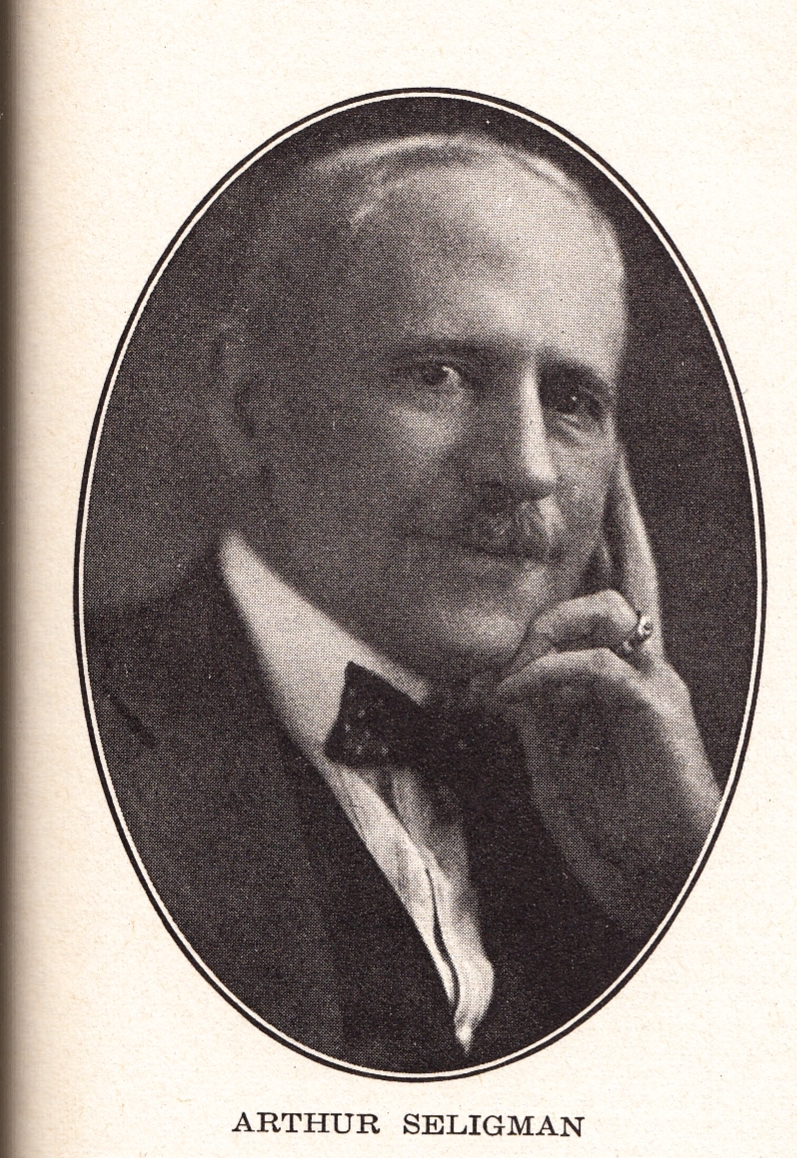
Arthur Seligman, c. 1925 from Twitchell, p. 479

Arthur Seligman, c. 1925 from Twitchell, p. 479

On September 25, 1933, less than a year into his second term as governor of New Mexico, my great-great-uncle Arthur Seligman died suddenly and unexpectedly of a heart attack.  After lying in state in the state capitol, he was buried on September 27, 1933, in the Fairview Cemetery in Santa Fe.  My great-grandmother Eva, his sister, traveled from Philadelphia to attend his funeral as she had done in January, 1931, for his first inauguration.  (“Late Governor Lies in State at the Capitol,” Las Vegas Daily Optic (September 27, 1933), pp. 1, 5)

Although certainly Arthur Seligman had his political enemies, the opinions expressed about him in numerous sources recognized that he was an effective leader, an able businessperson, and a successful politician.

The Clovis New-Journal wrote on September 26, 1933, p.2:

Deming headlight obit-page-001

To select just a few highlights from this editorial (which is hard to read, but I thought worth reproducing for those who want to try), the Clovis opined:

No man has ever had a more comprehensive understanding of the politics of this state than he, nor has any man ever attained the leadership that linked more completely the eastern and western sides.  This he accomplished through what often brought him criticism as a Democrat—a guiding hand in both democratic and progressive republican ranks….

He was a tireless man; one who drove himself at a terrific pace, and to this very fact may be charged his death….He worked until midnight nearly every night, and was at his office again by 10 o’clock in the morning, ever driving himself to the utmost of his strength.

The Deming Headlight also praised him, writing on September 29, 1933, p. 2:

deming obit

In the Dictionary of American Biography, he is described as follows:

Suave, fastidious in dress, aristocratic in taste but democratic in policy, always prominent in social life, he sought and attained a large measure of power through business and political channels. Intensely loyal to his numerous friends and an enemy to be feared, for more than a quarter of a century he had few peers in Democratic circles of the Southwest. The strong position of the Democratic party in New Mexico at the time of his death was largely due to his long, shrewd, and able leadership.

Dumas Malone, ed., Dictionary of American Biography (Charles Scribner & Sons 1935), located at http://www.mocavo.com/Dictionary-of-American-Biography-Volume-16/114492/584

The Jewish Telegraphic Agency provided a deeper and more personal look at the life of Arthur Seligman:

A mild manner man was Arthur Seligman, pioneer builder of his native state, New Mexico, one-time Mayor of one of its leading cities, Santa Fe, and since 1931 its Governor. His sudden and untimely death last Monday came as a shock to all who knew him.

Stately in appearance, democratic in demeanor, firm in his convictions, determined in his action, Seligman was not only New Mexico’s favorite son, but also an exemplary figure in American civic and political life. His rise to the highest position of honor and responsibility in the State where he lived virtually all his life, the state to which he contributed so many lasting monuments, was reflective of the esteem in which he was held by his fellow citizens. Though always gentle, he invariably dealt emphatically with those who would practice abuse in public office. In the government of his state he had no time for those who would see in political activity an opportunity for personal gain. He viewed public service as a privilege coming with American citizenship and felt that every one should accept this service in the spirit of a sacred trust. ….

Jewish Telegraphic Agency

Jewish Telegraphic Agency (Photo credit: Wikipedia)


The JTA also commented on Arthur’s religious identity:

Though distant from Jewish communal life. Seligman always evinced a deep interest in the affairs of his people. He kept in touch with Jewish activity and cooperated in many causes. There are only a handful of Jews in New Mexico, yet when he was candidate for the office of governor he had the Ku-Klux-Klan to deal with. These conducted a whispering campaign against him. This was his first encounter with anti-Semitism and upset him quite a bit. However, his standing in the community and his splendid record of achievement were too much for the Kluxers. His election as the first Jew to hold that office in New Mexico also helped to crush the Kluxers in the State. His sudden death last Monday is a distinct loss for he was a credit to his country and his people.

I had wondered whether there was any anti-Semitism underlying the attacks against him, and although I certainly did not find anything in the newspaper articles that expressly suggested that as a motivation behind those who criticized him, given the times and the location, there undoubtedly must have been many in New Mexico who were uncomfortable at best with the idea of a Jewish governor.  Despite that, Seligman was twice elected to the office.

Addressing the question of Arthur’s religious affiliation, Henry J. Tobias wrote in A History of the Jews in New Mexico (University of New Mexico Press 1990), pp. 160-161:

Though clearly of Jewish parentage, Governor Seligman’s religion at the time of his death is a matter of some debate.  Frankie Lacker Seligman, the governor’s wife, belonged to the Episcopal church, and the son born to them in 1898 [Otis] was christened there. … Upon his death, an Episcopal service for the dead was read at the House of Representatives.  At the Fairview Cemetery, however, the Masonic ritual was performed.  Given the uncertainty of the governor’s religious identity, it would be presumptuous to define it for him.  His family background and early life, however, place his career clearly within the framework of the history of the Jews of New Mexico.

Cover of "A History of the Jews in New Me...

Cover of A History of the Jews in New Mexico

Although he was not an observant Jew and did not marry a Jewish woman or raise his children as Jews, he is still always identified as Jewish on various lists and other sources.  (E.g., City of Albuquerque website  here ; Wikipedia article on Arthur Seligman at http://en.wikipedia.org/wiki/Arthur_Seligman ; list of Jewish governors in Jews in American Politics (Louis Sandy Maisel, Ira N. Forman, Donald Altschiller, Charles Walker Bassett, editors) (2001), p. 465.  As is often the case, it doesn’t matter what you do or believe or who you marry.  Once a Jew, always a Jew in the eyes of the much of the world.

Flag of City of Santa Fe

Flag of City of Santa Fe (Photo credit: Wikipedia)

Having now read so much about him after years of only knowing that I had some distant relative who had once been the governor of New Mexico, I now have great admiration for what he accomplished in his life.  He had the benefit of growing up as the son of a very successful merchant, his father Bernard, who also was his role model for public service.  His mother Frances Nusbaum Seligman was known as a gentle, kind and good woman.  He had three older siblings who must have doted on him; clearly his older sister Eva and he were very devoted to each other, traveling across the country to be with each other.  He had the benefit of a Swarthmore education and a business education.  There is no question that Arthur Seligman’s story is one that started with many advantages; it’s not a rags to riches story or the story of an immigrant achieving the American dream.

But it is nevertheless a remarkable life.  He could have taken the easy way—lived on the family’s wealth and remained a merchant or a banker and had a very comfortable life.  But he chose instead to serve his city as mayor, his party as chair, and his state as governor.  He faced some hostile opposition and apparently attacks by the KKK; he was referred to as Little Arthur in some news reports, mocking his small stature.  He was accused of being a greedy banker, undoubtedly a disguised anti-Semitic remark.  Yet he defeated his well-known Republican opponents, including one former governor, twice in races for the governor’s seat despite being a Jewish man from a state with almost no Jewish population.

As governor he somehow both cut the size of government and the tax rate while also instituting some important social reforms like vocational education and unemployment relief.  He faced a potentially violent strike by miners and a personal threat of kidnapping his granddaughter.  If he had not died in September, 1933, he might have been named a US Senator from New Mexico.  Who knows how far he could have gone or what else he might have accomplished?

Flag of New Mexico

Flag of New Mexico (Photo credit: Wikipedia)

Arthur Seligman’s story is the story of a man whose father came from a tiny town in Germany to a frontier town in New Mexico and became a successful American merchant.  It is the story of a boy who must have been grateful for the opportunities that America, New Mexico, and Santa Fe had afforded his family.  He took those opportunities and returned the gifts by working hard for the city, state, and country that had given so much to him and his family.


The Pawnbrokers: Not Reality TV, but Realities

Tradition symbol of pawnbrokers--three connect...

Tradition symbol of pawnbrokers–three connected balls (Photo credit: Wikipedia)

Growing up, I always heard my father’s family’s business referred to as jewelry and/or china dealers; I don’t recall them being described as pawnbrokers.  Maybe I just wasn’t listening (quite likely), or maybe that’s how my father explained it when I was too young to understand what “pawnshop” meant.

Anyway, I never thought of them as pawnbrokers.  My image of a pawnbroker was based on what I saw on crime shows on television, in movies like The Pawnbroker, and through windows as we drove through poor neighborhoods in New York.  The pawnshop was a place for either desperate people in need of money or criminals fencing stolen goods.  The pawnbroker was someone who was thus taking advantage of someone’s misfortune or the willing or unwitting participant in a crime.  I know of two incidents where my ancestors aided the police in solving crimes, so I am hoping that they were not complicit in receiving stolen goods, but were they taking advantage of the misfortunes of others?  Was this just a stereotype promoted in popular culture? Were pawnbrokers actually parasites, usurers, or were they providing a much needed service?

The Pawnbroker (film)

The Pawnbroker (film) (Photo credit: Wikipedia)

Interestingly, I had not really focused on this as I was researching until I could not decipher a word on the 1910 census for Joseph Cohen’s occupation, as I posted earlier this week.  I had asked for help here and elsewhere to decipher the word.  Several people expressed the same opinion—that the word is “loan office.”  As one person commented, it was just a nicer term for a pawnbroker.  Joseph may have been attempting to convey a less controversial image of his occupation.

I decided to do some reading to see what I could learn about pawnbrokers.  First, I wanted to better understand how the pawn business works.  I know that there are now a few reality television shows based on pawnshops, most notably Pawn Stars.  (One of my students brought this up in class this year during a discussion of bailment contracts, and I was sure he had said PORN Stars.  Just shows how uncool I can be….)  I read a few definitions and websites online about how pawning works, and this one seemed to be fairly accurate and concise, from Dictionary.com: “a dealer licensed to lend money at a specified rate of interest on the security of movable personal property, which can be sold if the loan is not repaid within a specified period.”

Wikipedia has a more expanded definition:  “If an item is pawned for a loan, within a certain contractual period of time the pawner may redeem it for the amount of the loan plus some agreed-upon amount for interest. The amount of time, and rate of interest, is governed by law or by the pawnbroker’s policies. If the loan is not paid (or extended, if applicable) within the time period, the pawned item will be offered for sale by the pawnbroker. Unlike other lenders, the pawnbroker does not report the defaulted loan on the customer’s credit report, since the pawnbroker has physical possession of the item and may recoup the loan value through outright sale of the item. The pawnbroker also sells items that have been sold outright to them by customers.”

So a person who needs money but for some reason cannot obtain a bank loan—insufficient credit, time pressure, some other reason that makes a bank an impractical choice—can take their property—jewelry, household items, clothing, whatever—to the pawnshop; the pawnbroker assesses the value of the items and provides a loan of cash to the person who agrees to pay with interest within a set period of time or to forfeit the personal property.

Since the pawnbroker must be licensed and since there are numerous state and federal regulations that apply to the business, there is nothing inherently shady about this business. It is a legal method of loaning money to those who choose not to go to a traditional bank.  So why is there an aura of shadiness often associated with the business?

Wendy A. Woloson wrote a book entitled In Hock, Pawning in America from Independence through the Great Depression (2006) that addressed just this question.  She wrote:

Pawnbrokers were at once essential to the continued well-being of this economic system and important scapegoats for the various social ills that the financial difficulties it brought.  Loans from pawnshops supplemented substandard wages, enabling workers to continue to feed their families and producers to continue to exploit their workers.  Although industrialists indirectly benefited from the services pawnbrokers provided, it was also in their interest to encourage the idea that pawnbrokers were fringe operators whose business had no place in the “mainstream” economic system. (p. 21)

Woloson contended that these capitalists promoted an image of pawnbrokers as hard-hearted, greedy and criminally inclined foreigners who used shady practices to exploit their customers. She also asserted that there was a fair degree of anti-Semitism behind these stereotypes.   Although not all pawnbrokers were Jewish, many were.  As Woloson explains, “Jews’ involvement with pawnbroking resulted not from any inherent character flaws or moral failings, as the popular press often posited. Rather, they took up pawnbroking and like occupations largely because they were barred from other trades, especially the mechanical and artisanal, and so necessarily developed an acumen dealing in consumer goods as peddlers, used clothing dealers, and auctioneers.”  (p. 71)

Of course, the negative stereotype of the Jewish moneylender is far more ancient than 19th century America; Shakespeare’s character Shylock from Elizabethan times is evidence of the way society and popular culture have long depicted Jews who were involved in the lending business.  Woloson elaborated on the role this stereotype and the anti-Semitism in society in general had on the popular assumptions about pawnbrokers—that they were Jewish opportunists taking money from hard working Americans.  (pp. 21-24)

Pawnbrokers were aliens in a commercial world populated by supposedly moral and upright Christian entrepreneurs, and the very nature of the business set it apart from ‘normal’ economic dealings.  The antithesis of merchants, pawnbrokers doled out money instead of taking it in, profiting from customers who lacked capital rather than possessed it. (p. 29)

As Woloson wrote, “Jews’ affiliation with pawnbroking and affiliated trades, such as dealing in used clothing and auctioneering, created among them a cohesive, commercially defined group; yet it also reinscribed outsiders’ perception that they operated beyond the currents of mainstream trade.” (p. 25-26)  Woloson explained that since most Americans in the early 19th century did not know many Jews, their preconceived image of the Jew as a greedy moneylender was reinforced by the fact that many pawnbrokers were Jewish. “It mattered little whether or not individual pawnbrokers were Jewish. Because they were all assumed to be, people scrutinized their business practices and questioned their ethics.” (p. 26)

Even as many Jews achieved substantial economic success through other businesses and finance in the 19th century, there was a common assumption that they had done so illegally, and the stereotype of the greedy, heartless moneylender persisted as part of popular culture. (p.28)  Pawnbrokers became common stock characters in works of popular culture, further promoting the negative and anti-Semitic stereotypes; Woloson catalogs a number of examples of novels and plays using such characters based on this stereotypes (pp. 28-53).

Woloson then provides evidence that in fact pawnshops served important public functions and were set up in ways to prevent exploitation of those who used their services. She describes how as cities grew and people outside the wealthy classes needed access to cash on short notice—to pay taxes or acquire assets they need to live or to work, there was a need for the services of pawnbrokers.  In the early 19th century, cities began to adopt regulations for pawnbroking.  I saw many legal notices in the Philadelphia Inquirer announcing the issuance of pawnbroking licenses to my ancestors and others. These required the posting of an expensive bond and thus ensured a commitment by the pawnbrokers to run their businesses in compliance with the regulations.  (pp.  54-57)

These local regulations controlled both the interest rate a pawnbroker could charge and the period a pawnbroker had to wait before the customer’s goods would be forfeited to the shop and available for sale.  For example, in Philadelphia in the 1860s, the interest rate could not exceed 6% and the pawnshop had to hold collateral for a year before reselling it. (p. 58)

Pawnbrokers hoped that this would add some legitimacy to their business and to their image, but apparently that did not occur.  As Woloson wrote:

Pawnbrokers were hardworking people who offered what was fast becoming a necessary service in maturing American cities, providing short-term loans on modest forms of collateral. Yet their profession, like dogcatching, was not one that people aspired to. Unlike clerks and mechanics, who received education through apprenticelike training and shared social activities, pawnbrokers enjoyed neither professional prestige, identity, specialized education, nor occupational camaraderie.  (p. 58)

According to Woloson, most pawnbrokers learned the trade by starting out as general dealers in goods, learning how to assess the value of those goods.  This is consistent with the experience of my ancestors.  First, they sold used goods and then perhaps newer goods, including china and clothing primarily.  Then they became pawnbrokers.  “A lasting and successful career in pawnbroking rested on one’s ability to identify local market niches and to accurately appraise a miscellany of goods.” (p. 60)

In Woloson’s opinion, these pawnbrokers provided substantial benefits to the people and the cities they lived in.  The money borrowed from the brokers helped not only their customers, but the economy of the city by enabling those people to buy goods and services and thus support local businesses.

She also discusses the typical patterns of the pawnbroking business in various cities, including Philadelphia.  Woloson noted that pawnshops tended to locate in areas that sold used clothing and furniture and other second hand goods rather than in the commercial heart of the cities where more elite retail centers would be located.  In Philadelphia, that meant that most pawnshops were located either north or south of the center of the city in areas, for example, like South Street where my great-grandfather’s pawnshop and home were located for many years.  Woloson provides this insightful description of that neighborhood in the mid-19th century:

Unburdened by any systematic police control, the diverse population and its many activities brought a liveliness to these areas. The very rich and the very poor mingled freely, as did members of various ethnicities and races. While this social mixing may have been scandalous to outside observers, residents themselves shared the collective ambition of getting ahead. The neighborhood’s mixed population at midcentury engaged in many enterprises. They drank, whored, pilfered, and occasionally rioted their way down South Street. By 1839 there were at least sixty-two taverns in the ten-block area.39 Men had their pick of brothels. ….  Some back alleys harbored “houses of prostitution of the lowest grade, the resort of pickpockets and thieves of every description.” Strangers were “earnestly admonished to not go there.” In contrast, another brothel only a few blocks away was home to a respectable “swarm of yellow [mulatto] girls, who promenade up and down Chestnut Street every evening, with their faces well powdered.” The lower sorts needed pawnbrokers to get them through the exigencies of the day and to fund their debauchery at night. Ten of the city’s thirteen pawnbrokers in 1850 were on South Street or within one block of the corridor. Rooted, the shops continued to hem the southern and northern fringes of the city until the end of the century.  (pp. 64-65; footnotes omitted)

H. Williams & Co. Ltd. Pawnbrokers

H. Williams & Co. Ltd. Pawnbrokers (Photo credit: christopher.woo)

This description gave me a far different impression than I previously had about how and where my great-grandfather Emanuel and his many siblings grew up; whereas I had never assumed that this was a wealthy neighborhood, I had assumed it was fairly safe and middle-class since Jacob had servants and a business that supported so many people.  Did my great-grandfather grow up hungry?  Probably not, but neither did he grow up in some swanky suburb or upscale city neighborhood.  He grew up surrounded by thieves, pickpockets, brothels, and bars.

These locations were, in Woloson’s view, business necessities.  The people who needed the services of the pawnbrokers were not the wealthy who shopped at fancy stores, but the working class and poor residents who could not get by without a quick and fairly easy loan.  Woloson opines that in some ways pawnbrokers were more straightforward businesspeople than those who used sales techniques to manipulate customers into buying goods.  In Woloson’s view, “Pawnbrokers made no pretense that they did anything other than loan money, and in this way many may have been more honest professionals than the retailers pushing goods on the other side of the city.” (p. 67-68)

Another pattern observed by Woloson was the tendency of pawnbrokers to expand and pass down their businesses within their families.  “Established, successful pawnshops were often passed down through single families rather than being taken over by outside partners; younger generations grew up in the trade and learned from fathers, uncles, and brothers, thus providing steady income to families over generations and contributing to social and economic stability where pawnbrokers resided.”  (p. 74)

Finally, Woloson also discusses the relative economic success of pawnbrokers, debunking the myth that many were wealthy as a result of the exploitation of those of lesser means.  She wrote:

Like many other businessmen operating in interstitial markets, most pawnbrokers worked the margins. Once they reached their professional apex, they typically did not advance much beyond the class of their customers and failed to accumulate enough capital to invest in larger financial endeavors that would have elevated them socially and economically. A pawnbroker’s profits were tied to the economic fortunes of his customers, and he often suffered losses at auctions of unredeemed collateral, especially during economic crunches. Pawnbrokers running shops in smaller cities necessarily supplemented the lending business with other petty entrepreneurial activities. Average pawnbrokers made enough money to support their families and to keep the business going, but probably not much more.  (p. 75)

I am really glad that I found this book because it has really given me a new perspective on my Cohen ancestors.  Compared to my Brotman and Goldschlager relatives, I’d always imagined that my Cohen relatives were wealthy and established.  Of course, by the late 19th century, early 20th century when my mother’s family started to arrive from Galicia and Romania, the Cohens had already been here for about 50 years and were well-settled, owning their own businesses, speaking English, and American-born.  They had the advantages of being here much earlier and so were far ahead economically when my mother’s family arrived.  But they were not the wealthy elite; they were probably at most middle class business people who were working in unpleasant neighborhoods, subjected to negative stereotypes based on their trade as well as their religion, and engaged in a business that required some risk-taking and business acumen but was not well-regarded.  That must have been very painful and frustrating.

Having this new perspective will help me better understand their lives as I continue to move forward in telling their story.


.

Enhanced by Zemanta

The Fusgeyers, Part IV: Romania Today

St_Andrew_Str_no_26_0002

Where my grandfather was born in 1888 in Iasi, Romania

As noted in my last post, the population of Jews in Romania has declined precipitously over the last one hundred years as a result of emigration before World War I and thereafter and also as a result of the murder of about 300,000 of them during the Holocaust.  From a peak of 800,000 after World I, there are now just a few thousand Jews living in Romania today. What is it like in Romania today, and, more specifically, what is it like to be a Jew living in Romania today? What  legacy is there in Romania from the once substantial Jewish community, and what do current residents know or remember of the Jewish communities and of the Fusgeyer movement that led many of those Jewish residents out of Romania?  Beyond the cold, hard statistical facts, what is left of Jewish Romania?

I have consulted only two sources of information to answer these questions, so my views are based on limited information and possibly inaccurate.  But those two sources left somewhat different impressions, so perhaps the truth lies somewhere in between.  Jill Culiner’s book, Finding Home, paints a rather gray and dismal picture of life in Romania in general and specifically of the Jewish legacy there.  Stuart Tower, author of The Wayfarers, has a more positive impression of Romania today and of its people as seen in the photographs he took first in the 1980s and then in 2005 and also from what he shared with me by email.  Culiner and Tower visited different cities and towns for the most part, but there was some overlap; both visited Barlad and Sinaia within a few years of each other.  Both ultimately paint a picture of a country that once had many thriving Jewish communities but that now has virtually no Jewish communities and few residents who remember the communities that once were there.

Tower based his book around the town of Barlad; it is where the three Americans, grandfather, father and son, go to learn about their ancestral roots and meet the rabbi there who tells them the story of the Barlad Fusgeyers.  Tower’s story is fictional, and he told me that he’d never actually met a rabbi in Barlad, but both Culiner’s book and Tower’s book talk about a very small Jewish community continuing to exist in that city and the beautiful synagogue that still stands there.  In Tower’s novel, the rabbi describes a community of thirty people who still keep kosher and observe shabbat, but who have trouble forming a regular minyan.  The elderly rabbi’s children have all moved away, and he knows that he will be the last rabbi in Barlad (spelled Birlad in the novel).

Culiner started her Romanian travels in Adjud, where she got off the train and began her Fusgeyer-inspired walk.  Her description of Adjud is disheartening:

Here, fields lie flat under a grueling sun, and cars, trucks and buses roar with giddy impunity over pot-holed, uneven main roads.  Under thirsty-looking trees outside the station, lining the street are unlovely lean-tos, modern bars and patios. All claim to be discos, all pump loud American music into the hot air.

Culiner, p, 35.

Culiner also said that “there were no buildings left from the pre-Communist era and certainly nothing of beauty.” (Culiner, p. 35)  Her encounters with the local people are no more heart-warming.  No one could tell her where there was a hotel or room to stay in, and she described the people she saw as “exhausted..expressionless, resigned.”  Culiner, p.36.  No one in town remembered  that there ever was a Jewish community there or a synagogue, although there had been a community of about a thousand Jews there in 1900.  The man who showed her where the non-Jewish cemetery was located demanded an exorbitant fee for his troubles.  By the end of this first chapter, I was already feeling rather depressed about her experience and about  life in Romania.

In contrast, here are some of Tower’s photos of the Romanian countryside that left me with a different impression.  Thank you to Stuart Tower for giving me permission to post these:

Recently%2520Updated%25201112 Recently%2520Updated%25201113 Casa Elena in Voronets Fall foliage in the Bicaz Gorge Romania%25202005%2520262 Romania%25202005%2520263 Romania%25202005%2520264

Culiner’s experience at her second stop, Podu Turcului, was not any better.  The townspeople warned her that her plans to walk through Romania were dangerous and that she would be better off visiting more modern cities elsewhere.  There were no Jews left in this town, and no one there remembered there ever being a synagogue, although there was a Jewish cemetery.  Only one man acknowledged that there once was a Jewish community there, a workman who had been curious about the Jews while in school and had learned where the Jewish residents had once lived in town, now just a neighborhood of faceless housing from the Communist era.  This man told Culiner that he had been unable to learn more about the Jewish community in his town because discussing such matters was prohibited during the Communist era.

Culiner and her companion next arrived in Barlad, a city of 79,000 people, the city where Tower’s characters stayed and learned about the Fusgeyers and were in awe of the beautiful synagogue.  Culiner is less enthusiastic.  Her first impression of the city is its “potholed, deteriorated sidewalks” and the “[r]are trees [that] gasp out their life in the dense cloud of exhaust fumes, providing little shelter from the pitiless sun.” (Culiner, p. 55) Culiner once again encountered skepticism about her plans and ignorance about the Jewish history of the city.  She was particularly disappointed that in this city where the Fusgeyer movement began, no one seemed to remember anything about them.  Even she, however, was impressed with the synagogue, to an extent:

Despite its rather austere, unassuming exterior, the synagogue is magnificent.  Dating from 1788, the walls and ceilings are decorated with paintings of birds, flowers, leaves and imagined scenes of Jerusalem.  Yet, despite its beauty, there is a strange feeling of loss, the aura of a building struggling to exist in a world that has little place for it.  It has become a relic.

Culiner, p. 58.

Although Tower also described a dying Jewish community in his novel, there was still some life, some people who cared in Barlad.  Culiner saw the glass as half-empty whereas Tower saw it as half-full.  Here are some pictures of the Barlad synagogue and some other towns visited by Tower that show a far less dismal impression of  in Romania.  All photos courtesy of Stuart Tower.

Synagogue in Barlad courtesy of Stuart Tower

Synagogue in Barlad  Photos courtesy of Stuart Tower

President Alexander Coitru

Stuart Tower reading from The Wayfarers at the Barlad Synagogue

Stuart Tower reading from The Wayfarers at the Barlad Synagogue

birlad shul interior

Romanian countryside

Romanian countryside

Romanian woman

Romanian woman

Romania%25202005%2520090 Romania%25202005%2520175

17th Century wooden synagogue in Piatra Neamts

17th Century wooden synagogue in Piatra Neamts

Piatra Neamts Sinagogaodd haystack, neighboring farm Troop Popa Tarpesht villagers and their War Lord

Culiner’s experiences in the towns and cities she visited after Barlad were not much different from her first three stops: ignorance and indifference to the history of the Jewish communities in those towns, ugly scenery, and disappointment.  She did meet some friendly and helpful people along the way, including some who were Jewish or were descended from Jews, but for the most part she found most Romanians at best ignorant and at worst rude and even hostile.

In Focsani, no one seemed to be able to help her find the synagogue, sending her on a wild goose chase only to find it right near her hotel.   On the other hand, Focsani had a fairly active Jewish community (relatively speaking), as the synagogue regularly drew about twenty people for shabbat services and more on major holidays.  Culiner was bewildered by the fact that the non-Jewish residents did not even know where the synagogue was located despite its central location.

In Kuku, Culiner met a friendly, helpful woman who likely lived in a building that was once the hostel where the Fusgeyers stayed while traveling through that town, but that woman also knew nothing about where the Jewish community had gone or about the Fusgeyers.   In Ramnicu Sarat, Culiner spent time with a woman whose mother was Jewish and who remembered the days of an active and close Jewish community.  The woman told Culiner that the Communists had demolished the synagogue that had once stood in the town.  She also talked about being unable to be openly Jewish during the Communist era.

Similarly, in Buzau she talked to a Jewish man who refused to take her inside the synagogue because he was ashamed of its condition; there were not enough Jews left in the town to make a minyan and not enough money to maintain the building.  This man told her that “the greatest threat is that all will be forgotten.” Culiner, p.122.   In Campina, another Jewish man told her, “The Jews will die out.  We will go to the cemetery.  And no one will replace us.” Culiner, p. 144.

Only in Sinaia did Culiner find anything of beauty in the countryside, but again not without some negative observations. She wrote: “The scenery is a slice out of a romantic painting and Watteau would have delighted in the mossy banks, the majestic spread of trees, although he might have taken artistic liberty, ignored the discarded shoes and packaging stuffed into vegetation, the tattered plastic and ripped shreds of fabric caught on branches in the river.”  Culiner, p. 146.  Tower’s photographs of Sinaia reveal all the beauty without the observations of garbage mentioned by Culiner.

Peles Castle, Sinaia and surrounding countryside

Peles Castle, Sinaia and surrounding countryside

cottage on the grounds Romania%25202005%2520042 Romania%25202005%2520044 October snowfall, near Peles

Before I read Culiner’s book, I had been giving serious thought to an eventual trip to Romania, in particular to Iasi.  After reading her book, I put that thought on the far back burner.  Her book left me with a vision of an ugly country filled with ugly people who hated Jews.  After looking at Tower’s photos and corresponding with him about his travels in Romania, I am reconsidering my decision to put a visit there on the back burner.  Just as I would like to visit Galicia to honor my Brotman family’s past, I would like to visit Iasi—to see where my grandfather was born and spent his first sixteen years, to honor his past and the lives of his family—-the Rosenzweigs and the Goldschlagers.  I have no illusions about what I will find there.  I know not to expect a lively Jewish community or even any Jewish community.  It’s all about walking where they walked and remembering their travails and their courage.  Maybe the scenery is not as idyllic as in some of Tower’s photos.  Maybe the people are not as colorful and friendly as they seem in his photos.  But that, after all, is not the point, is it?

Culiner did not visit Iasi, our ancestral town in Romania, on her trip, but Tower did, and I thought I would end this post by posting his pictures of Iasi and some of its people as well as those taken by my Romanian researcher Marius Chelcu.  Maybe someday I will get to be there in person and walk down St Andrew’s Street where my grandfather was born and pay tribute.

If we don’t, who will? Will we allow the story of the Fusgeyers and of the Jews of Romania to be forgotten for all time? That, in some ways, is the message of both Tower’s book and Culiner’s book: we need to learn and retell the story of our ancestors so that those stories and those people will not be forgotten.


Stuart Tower’s photos of Iasi

1670 Synagogue in Iasi

1670 Synagogue in Iasi

Traian Hotel, Iasi

Hotel

Father of Yiddish Theater

Father of Yiddish Theater, plaque in Iasi

National Theater, Iasi

National Theater, Iasi

Gypsy wagon, near Iasi (Yash) Astoria Hotel, Iasi Yash) Iasi street Recently%2520Updated%25201108 Lady/Man (?) walking toward Yash (Iasi) Gypsy family (Iasi), wanted food and money Iasi (yash) Ladies of Iasi (Yash)


Marius Chelcu’s photos of Iasi:

St_Andrew_Str_no_26_0003 St_Andrew_Str_no_26_0001 Near St Andrew Str_11 Near St Andrew Str_10 Near St Andrew Str_4 Near St Andrew Str_5 Near St Andrew Str_6 Near St Andrew Str_7 Near St Andrew Str_8 Near St Andrew Str_2

Photos taken near St Andrew Street where the Goldschlagers lived

Photos taken near St Andrew Street where the Goldschlagers lived


Enhanced by Zemanta