Why I Am Studying German

Along with researching, blogging, working on my novel, and doing other ordinary things with my days, I have started studying German.  I took French in high school and college, and I learned some Italian from a travel experience I had after college, but I knew no German.  Well, other than a word here and there like Danke and Gesundheit.

So why, you might ask, did I decide to learn German? It certainly is a challenge.  Although I’ve been delighted to see how many words are similar to English (like wein/wine and bier/beer) or Yiddish (like schön/shayne and schmutzig/schmutzy), German grammar is tough.  The sentence structure is hard.  The various cases are confusing; the articles and pronouns are a constant source of bewilderment.  But I am enjoying the challenge.

But that doesn’t address the question of why German.  Sure, I have many ancestors with German roots, and yes, it would be helpful to read the birth, marriage, and death records without depending on the generosity of people like Matthias Steinke, Ute Brandenburg, Ralph Baer, Dorothee Lottmann-Kaeseler. and others.  But I had already figured out the words for birth, death, marriage, mother, father, and even the months of the year.  So why struggle to learn ordinary vocabulary and grammar?

Yes, I am planning a trip to Germany for next year, and I do want to be able to get by as much as possible without expecting people to know English.  But I also know that I won’t be fluent enough really to do that, and I know that most people in Germany involved in the tourist industry will speak English, just as they did in Prague, Budapest, Vienna, and Krakow.

So why bother trying to learn German? It all started with Mathilde Mayer-Gross.  Who was she? She was my second cousin, three times removed:

Relationship_ Amy Cohen to Mathilde Gross part 1

Relationship_ Amy Cohen to Mathilde Gross part 2


That is, Mathilde’s grandmother Martha Seligmann and my three-time great-grandfather Moritz Seligmann were sister and brother.  We are both direct descendants of Jacob Seligmann

Mathilde is also related to me through her grandfather Benjamin Seligmann since he was his wife Martha’s first cousin; Martha’s grandfather Jacob Seligmann and Benjamin’s grandfather Hirsch Seligmann were brothers.

But I digress.


Mathilde was born in Bingen, Germany, in April 1869. She left in 1937 to escape from Nazi persecution when she was almost 68 years old and a grandmother; she lived over thirty years in the United States, dying in September, 1969, when she was a hundred years old.  She wrote a book about her remarkable life called Die Alte und Die Neu Welt.  [The Old and The New World] (1951).

Mathilde Mayer book cover

And I want to read her book.  But I can only find it in German. Ute Brandenburg did a wonderful job of translating one of the chapters, but I can’t afford to pay what it would cost to translate the rest of the book.

I used Google Translate to read some other excerpts from Mathilde’s book that appear on the Arbeitskreis Judische- Bingen website. I also read the memoir written by Mathilde’s granddaughter Ellen Kann Pine, One Life in Two Worlds (2009). But I still want to read Mathilde’s book itself.

20160810_174631600_iOS

So I decided to learn German.  After about four months of using the Duolingo program online, I can write a simple sentence or two to my cousin Wolfgang and his young daughter Milena, and I can understand enough to read simple sentences.  The Duolingo program is wonderful; I study every day about 30 minutes a day, and I am having a lot of fun. But so far my ten year old fourth cousin Milena knows a lot more English than I know German.

duolingo icon

Will I ever be able to read Mathilde’s book? I don’t know.  I may never be fluent enough to read it without a dictionary in hand (and Google Translate), but perhaps I will be able to read and understand enough to satisfy my curiosity about her life.

In the meantime, in my next few posts, I will take a break from the Schoenthal clan, and I will share some of what I learned about Mathilde and her family from the other sources I mentioned, including Arbeitskreis Judische-Bingen, Ellen Kann Pine’s book, and Chapter 2 of Mathilde’s own book as translated by Ute Brandenburg.  Maybe someday I will be able to fill in the rest of the stories of her life.


More Hidden Treasure from Wolfgang’s Magic Suitcase

http://www.wpclipart.com/money/. Per the licen...

http://www.wpclipart.com/money/. Per the license: These images are public domain. License . (Photo credit: Wikipedia)

I have had many exciting finds through the course of my search for my family history: wonderful photographs and letters, newspaper articles, government documents, birth and marriage and death certificates, and so on.  But for me some of the most special finds have been the family trees prepared by other members of my extended family, like the family tree prepared by my Aunt Elaine.  These trees are special not only for the information they convey, but also because they tie me to someone else who cared about the family history and wanted it preserved for posterity.

So you can imagine how excited I was when my cousin Wolfgang sent me a four page family tree prepared at least 75 years ago by one of our Seligmann cousins in Germany.  We know that this tree was prepared by a child of Karoline Seligmann, the daughter of my three-times great-grandfather Moritz Seligmann and his first wife, Eva Schoenfeld because the tree refers to Karoline Seligmann and her husband Siegfried Seligmann as “our parents.” Karoline (sometimes spelled Caroline or Carolina) and Siegfried had five sons and two daughters: Heinrich, Eva, Wilhelm, Emil, Eugen, Rosa, and Carl.  Two of the sons died in infancy, Wilhelm and Carl, , and one I cannot account for beyond his birth, Heinrich. Emil, Eugen, and Eva all died during the Holocaust.  Only one child survived the Holocaust, their daughter Rosa, who immigrated to the US in 1940.  I discussed Karoline’s children here.  I don’t know which child created this tree.

Wolfgang thought Emil was the most likely author of the tree, so for simplicity purposes I will refer to it as Emil’s tree and to its author as Emil.  (The last date given on the tree is 1909, and unfortunately it stops with the generation of Karoline and Siegfried and does not include their children.)  Although I cannot be sure which of the surviving children—Emil, Eva, Eugen, or Rosa—was my fellow genealogist, I am extremely grateful to whoever created this tree because it provides me with one more generation of my Seligmann and Schoenfeld relatives—the siblings of my three-times great-grandfather, Moritz Seligmann, and the siblings of my three-times great-grandmother, Babetta Schoenfeld (Eva’s sister).  It, of course, also raises new questions and new pathways for research.

Starting with page 1 of the tree:

Page 1 of Emil's tree

Page 1 of Emil’s tree

It says at the top, “Our great-grandparents in Gaulsheim: a) fathers side: Jacob Seeligmann, his wife: (Merle) Marta nee Mayer (Gaulsheim).”  I found it interesting that the early spelling of the family name was Seeligmann.  Marta (Martha) Mayer’s name is consistent with the record I obtained for the marriage of their son Moritz to Eva Schoenfeld.  Jacob and Marta were my four-times great-grandparents.  According to prior records I’d obtained, they were both born around 1773.

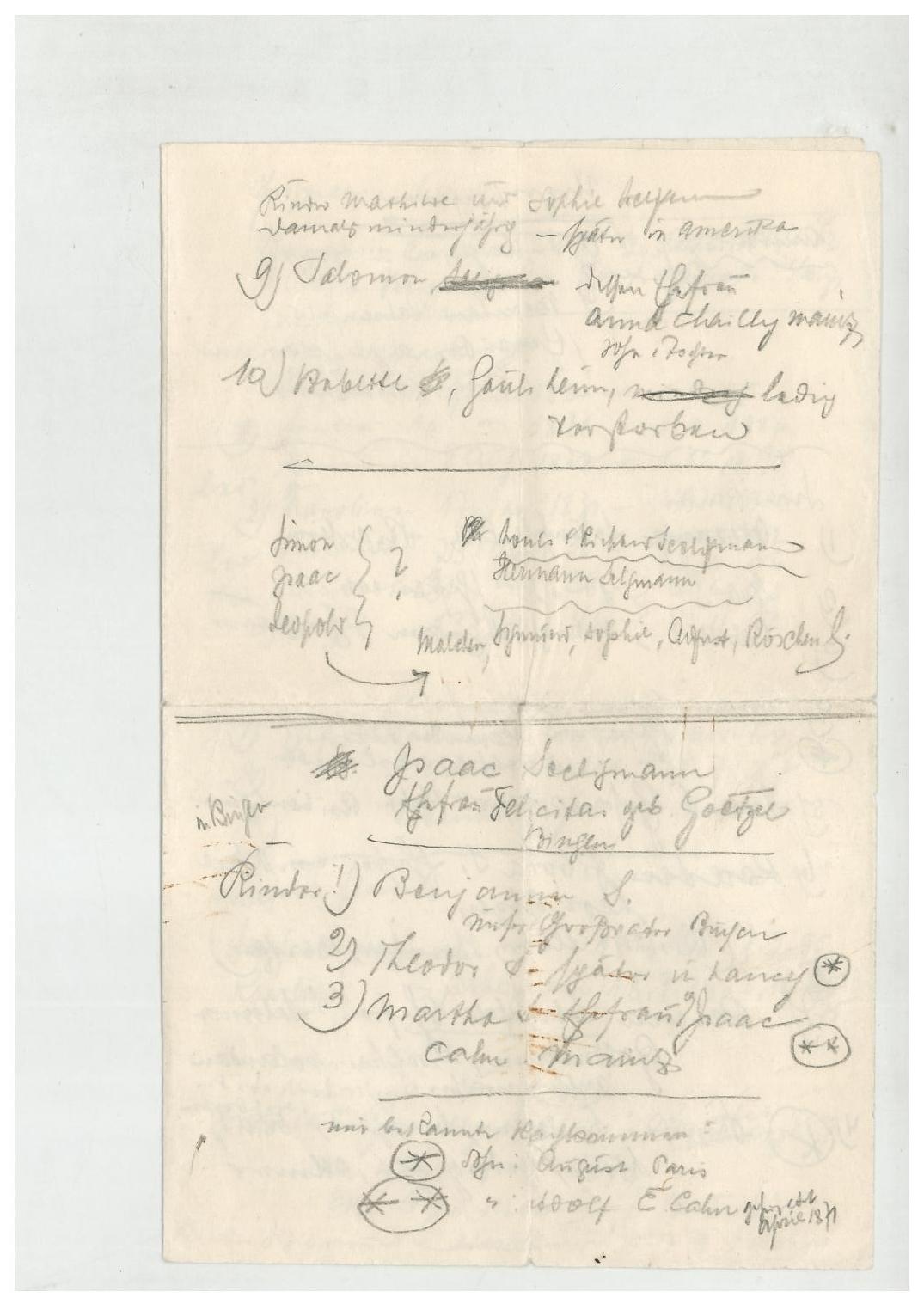
According to Emil’s tree, Jacob and Marta had ten children. Until seeing this tree, I had only found three: my three-times great-grandfather Moritz and two other sons, Leopold and Isaac.  I had found Leopold and Isaac on the Steinheim Institute website, but not the other seven children.  According to the Emil tree, they were Simon, Martha, Mina, Caroline, Marx, Salomon, and Babette.

The next section of the first page and the second page provide information for the ten children of Jacob and Marta.  For Simon and Isaac, it seemed that Emil had no information, except that Simon was living in Bingen. The entry for Leopold simply says “in Gaulsheim.”    But then on the second page of the tree (see below), Emil returned to Simon, Isaac, and Leopold and listed what appears to be the names of their children.  It looks like he thought Simon had two sons, Louis and Richard, and Isaac had a son named Hermann.  Leopold’s children were Malchen, Sigmund, Sophie, August, and Roschen.

Page 2 of Emil's tree

Page 2 of Emil’s tree

This, however, is not consistent with what I found on the Steinheim website.   According to the Steinheim website, Isaac was born in 1795 and died in 1860.  He seems to have lived in Gaulsheim all his life.  The Steinheim site states that Isaac married Rosine Blad and that they had five children: Pauline, Magdalena, Henriette, Ludwig (Louis), and Richard. My best guess is that Ludwig and Richard are the same people who Emil listed as Louis and Richard.  I don’t know whether Emil is correct or the Steinheim site is correct as to whether they were Simon’s sons or Isaac’s sons.  I also don’t know where Hermann fits into the family.  Was he really Simon’s son and Emil had it backwards?  I don’t know.

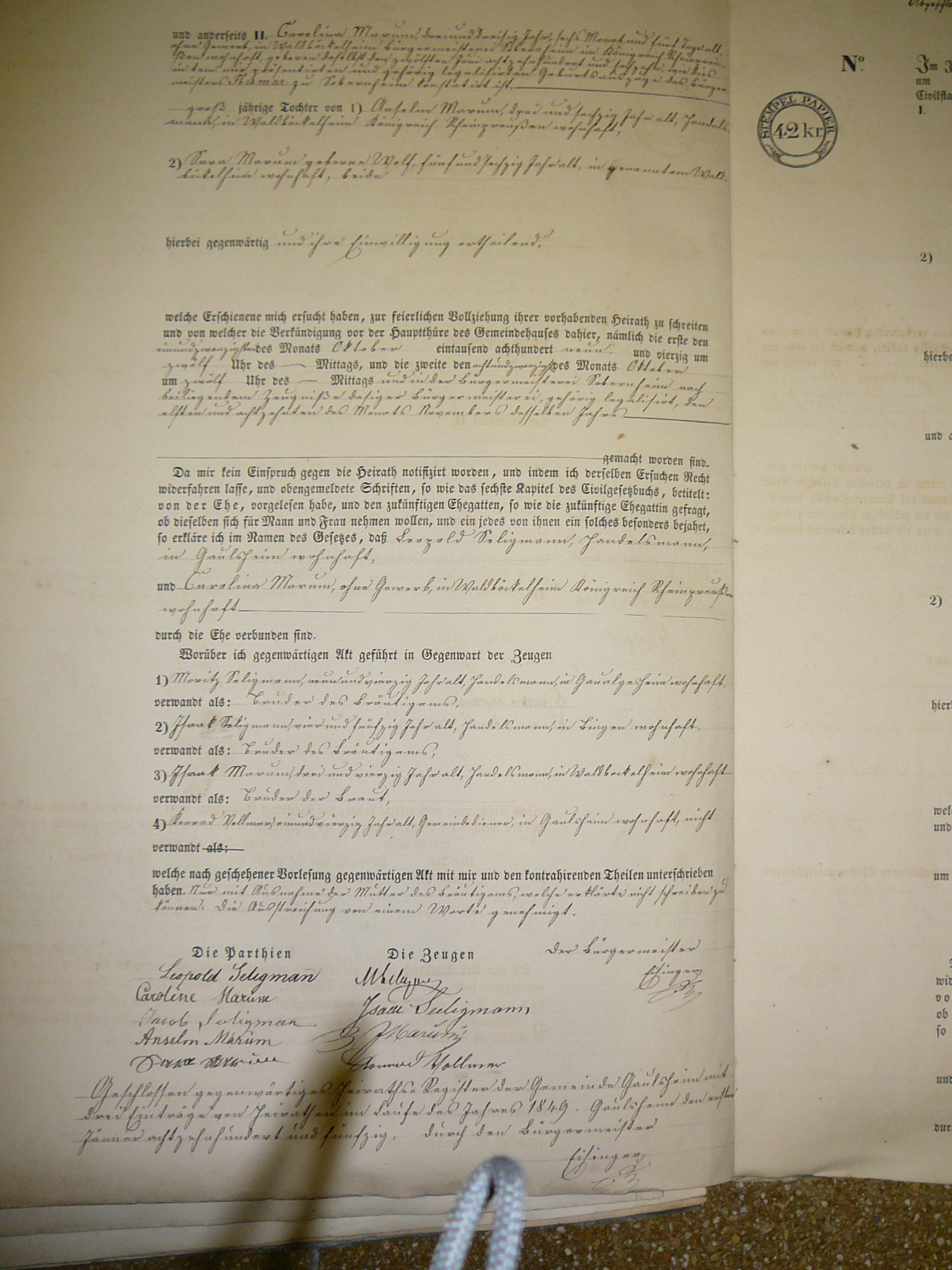
There is also some inconsistency between Emil’s facts for Leopold and the information on the Steinheim website.  The Steinheim site lists Leopold’s wife as Caroline Marum, and I found a marriage record for them dated December 17, 1849.

Marriage Record of Leopold Seligmann and Caroline Marum

Marriage Record of Leopold Seligmann and Caroline Marum

Leopold Seligmann marriage record

According to the Steinheim site, they had five children: Amalie, Rosalie (Roschen?), Sophia, August, and Therese.  Emil did not have Therese or Amalie, but had instead Malchen and Sigmund. I don’t know which information is more accurate.

For Jacob and Marta’s daughter Martha, Emil wrote that she married Benjamin Seeligmann. To the right of Martha’s name is a box that says, “Our grandparents in Bingen.” Then next, for our mutual ancestor Moritz, Emil wrote “our grandfather in Gau-Algesheim.”  There is a date underneath that looks like 13-2-1877; I believe that must be his date of death.  But how could Martha and Moritz, sister and brother, both be Emil’s grandparents? Well, that will become clear later on.

For Mina, it says that she was the wife of Leopold Mayer of Oberursel and that they had one child, Adolf Eduard, who died and was never married. I wonder if this Mayer was a relative of Mina’s mother Marta Mayer.  The next child of Jacob and Marta, Caroline, married Moses Moreau (?) of Worrstadt, and they had four children whose names are written underneath; the first I cannot decipher (maybe Markus?), but the other three are Albert, Bertha, and Alice.

The last entry on the first page is a long one for Marx Seligmann.  With the help of the kind people in the German Genealogy group on Facebook, I was able to get a sense of what happened to Marx.  He married Rosina Loeser on June 11, 1838.  They were legally separated in June 1848, and he agreed to pay support for the children.  They were divorced in February, 1849.

On page 2 of the Emil tree, Emil continued with the facts about Marx Seligmann.

Page 2 of Emil's tree

Page 2 of Emil’s tree

This is the hardest part of the document for me to understand, despite help from Wolfgang and the German Genealogy group.  At the top are listed the names of the two daughters of Marx and Rosina: Mathilde and Sophie. But what does it say underneath?  All my German helpers agreed that is says, “Underage ??? in Amerika.”  One thought it said “Wife in Amerika,” another thought it said “Later in Amerika.”  Who went to America?  And when did they go? I have started looking, but so far have not had any luck.

(As I was finishing this post, Wolfgang sent me another handwritten version of this tree with more information about Marx and a few others.  I need to finish deciphering that one and then will update with more information.)

Emil wrote that Salomon had a wife named Anna Chailly of Mainz and a son and daughter, whose names are not listed here.  I found an entry in the Mainz Family Register database on ancestry.com for Salomon and his family, and his children were named Emilie, Mathilde, Siegmund, and Jacob.  Jacob married Dora Rosenberg in 1887, and they had a daughter named Anna Dora, born in 1890.  I have not yet found any further information for the other three children of Salomon and Anna.

Finally, for Babette, the tree recorded that she had died unmarried and had lived in Gaulsheim.

That completed Emil’s entries for the children of Jacob Seeligmann and Marta Mayer.  He then drew a horizontal line across the page as if to start a new section.  Under that line he wrote, “Isaac Seeligmann and his wife Felicitas nee Goetzel of Bingen.”   I was totally confused when I saw this; was this the same Isaac Seligmann, the son of Jacob and Marta, about whom Emil had written already?  Underneath the names of this Isaac and Felicitas was a list of their children, and they were not the same names that I had found on the Steinheim site, discussed above, for Jacob and Marta’s son Isaac.  Instead, the following names were listed: Benjamin, Theodor, and Martha.  Who were these people?

According to my German Genealogy helpers, under Benjamin’s name it says, “Our grandfather from Bingen.” Suddenly something clicked.  This was the Benjamin Seeligmann who married Martha Seligmann, the daughter of Jacob and Marta and the sister of Moritz.  Remember that Martha and Benjamin had also been named as Emil’s grandparents.  This section of the tree is reporting on Emil’s other great-grandparents, the other Isaac Seligmann and his wife Felicitas Goetzel, and their children.

Was this Isaac Seeligmann related to Jacob Seeligmann, my four-times-great-grandfather?  They all lived in the Bingen-Gaulsheim area.  I’ve yet to find any documentation linking the two different Seligmann families, but my hunch is that they were in fact cousins if not brothers, meaning that Benjamin Seeligmann might have married a cousin, Martha Seligmann.

Emil then reported on his grandfather Benjamin’s siblings.  Theodor was living in Nancy (in France, presumably), and he had a son August who lived in Paris.  Martha married Isaac Cahn of Mainz, and they had a son Adolf Cahn.

That brings me to the third page of Emil’s tree.

Page 3 of Emil's tree

Page 3 of Emil’s tree

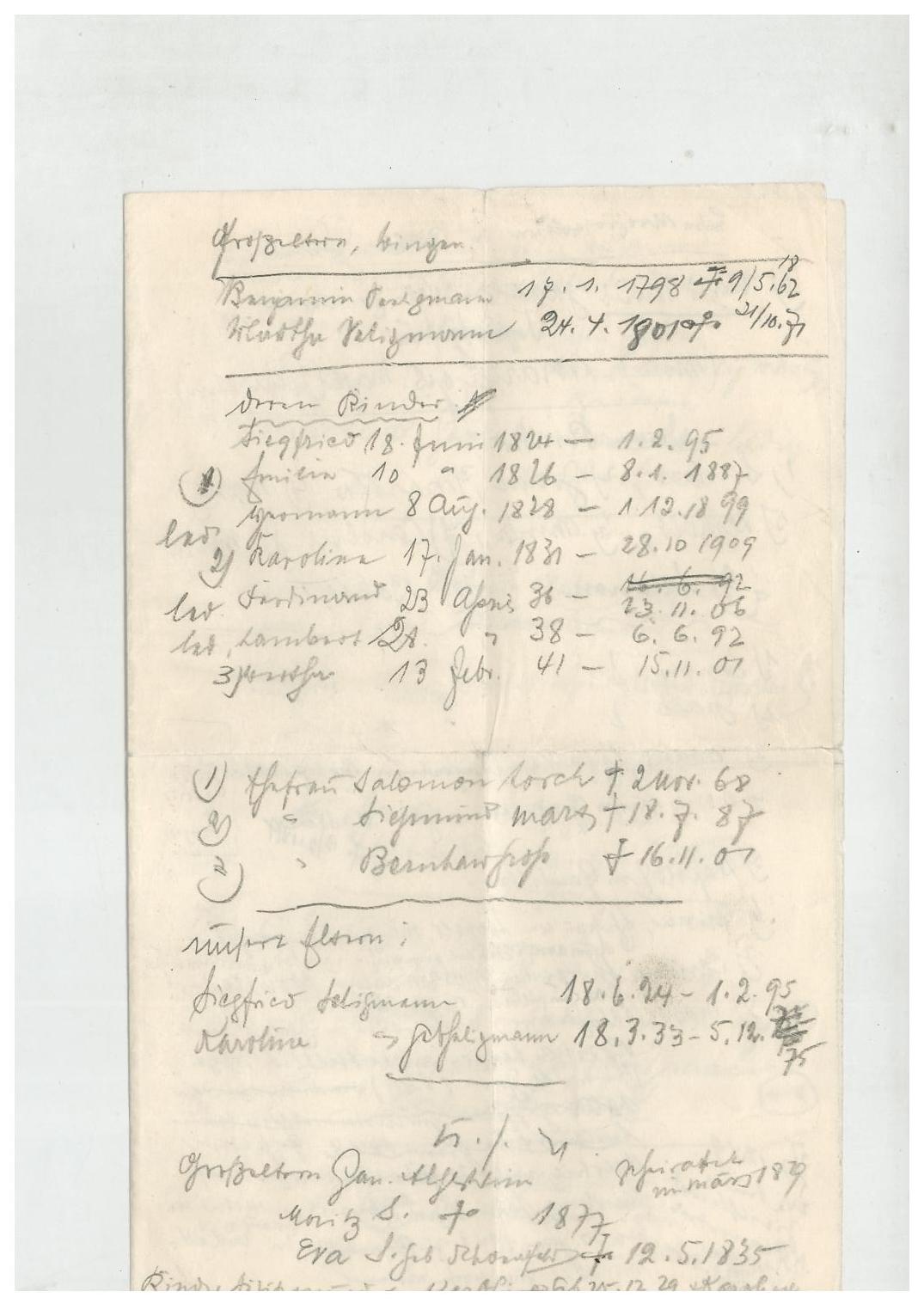
This page is primarily devoted to Emil’s grandparents Benjamin Seeligmann and Martha Seligmann.  He provides their birth and death dates and then the names of their seven children: Siegfried, Emilie, Hermann, Karoline, Ferdinand, Lambert, and Bertha.  Under their names, Emil reported on who some of them married, including his father Siegfried, who married Karoline Seligmann.  Suddenly the rest of the tree made sense to me.

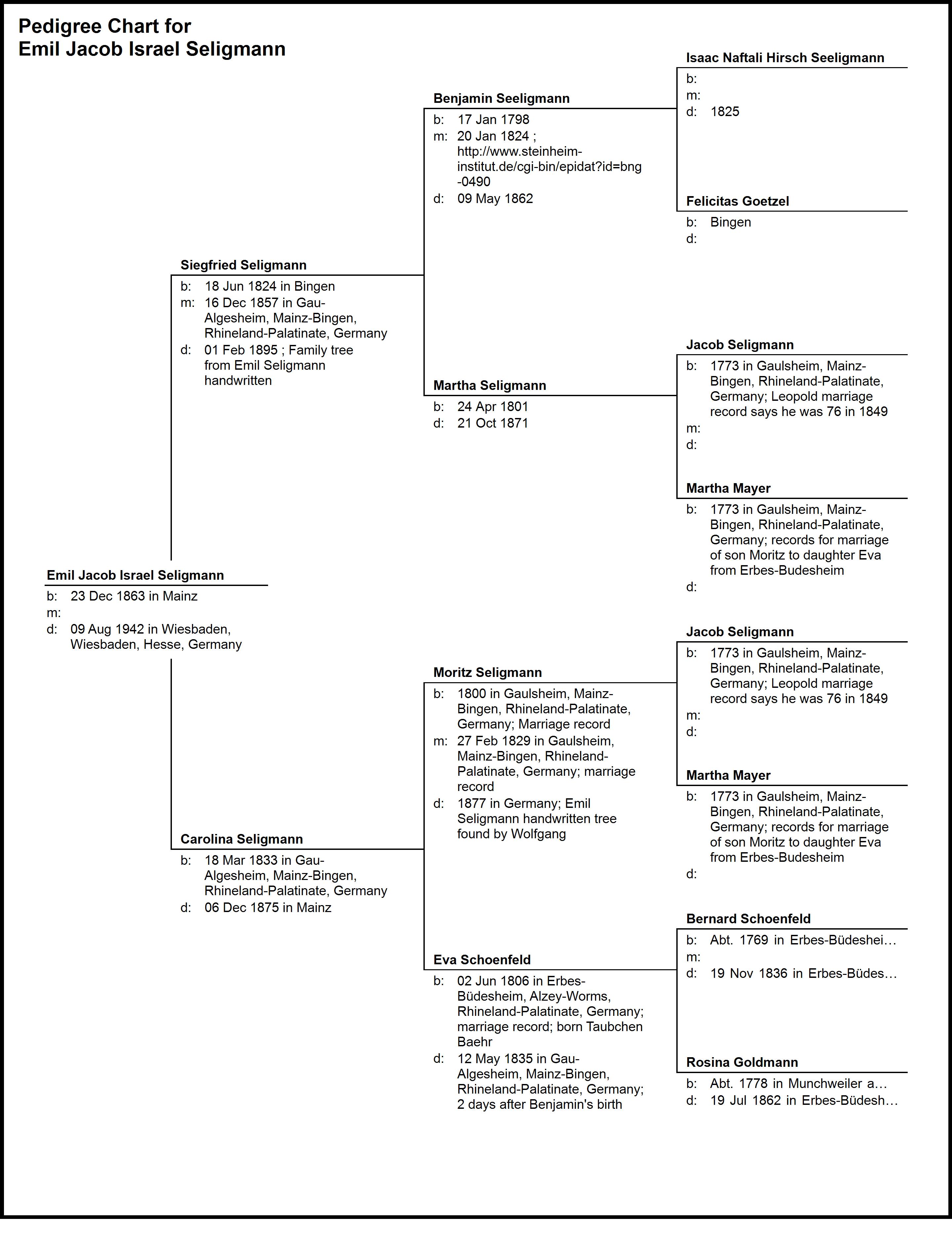
Emil’s father Siegfried was the son of Martha Seligmann; his mother Karoline was the daughter of Moritz Seligmann.  Moritz and Martha were siblings, so Siegfried and Karoline were first cousins.  Thus, Emil’s paternal grandmother Martha and his maternal grandfather Moritz were sister and brother.  Now if in fact Benjamin Seeligmann, Martha’s husband, was also a cousin, there is truly a remarkable amount of inbreeding there.  Here is a family chart that will (I hope) help to visualize these relationships:

Pedigree Chart for Emil Seligmann

Pedigree Chart for Emil Seligmann


The last entry on the third page provided me with the death dates for Moritz Seligmann and Eva Schoenfeld, information I had not had before.

Finally on page four Emil discusses his maternal great-grandparents, a) the family of Jacob Seligmann of Bingen, already discussed under his paternal great-grandparents; and b) the family of his grandmother Eva Schoenfeld, sister of my three-times great-grandmother Babetta Schoenfeld, the sister who married Moritz Seligmann after Eva died in 1835.

Page 4 of Emil's tree

Page 4 of Emil’s tree

As I already knew, Eva and Babetta were the daughters of Bernard Schoenfeld and Rosa Goldmann of Erbes-Budesheim.  I also had records of the names and births of most of their children.  Emil’s list confirmed these and added one more for whom I did not have a record, Alexander.  The children as listed on Emil’s tree are Alexander, Eva and Babetta (described as the first and second wives of Moritz Seligmann of Gau-Algesheim), Maria Anna (wife of Alexander Levi of Kirchheimbolanden), Sara (wife of Leokov (?) Kahn of Bubenheim), Zibora (wife of Karl Levi of Alzey and mother of Albert, Bernhard, and Berta), and Rebecca (wife of Salomon Goldmann of Kirchheimbolanden).  Then at the bottom Emil listed the children of Maria Anna and Alexander Levi: Fridolin, Leonhard, Judith, Lina, Hedwig, Elise, and Ottmar.

I was recently contacted through Wolfgang by one of the grandchildren of Zibora Schoenfeld Levi and am hoping to learn even more about my Schoenfeld ancestors.

What a treasure trove this tree is!  Such a gift from one of my predecessors as a family historian—someone who died during the Holocaust and who left behind evidence not only of his ancestors’ lives, but of his own.  Now it is my job to try and fill in the details and continue the story.


A Difficult Life: Julius Seligmann


http://www.gettyimages.com/detail/158503169

Julius Seligmann, son of August and grandfather of Wolfgang, lived a life filled with conflict.  As I’ve written previously, he was shunned by his family for converting to Catholicism and marrying Magdalena Kleisinger, a Catholic woman. Since their first child Walter was born in February, 1925, I assume that Julius and Magdalena must have married by 1924.  According to family lore, he had to pay his family a substantial sum of money, causing him great financial distress.

Since writing previously about the challenges Julius faced, I’ve learned a bit more, thanks to Wolfgang and some documents he was able to find.  One thing that Julius tried to do to address his financial condition was to secure some money from the estate of his uncle, the James Seligman who moved to England and died in 1930.  Although we now know that James’ widow had control over the estate for the duration of her life and the principal was not to be distributed for over another fifty years, Julius was obviously in great need of money and hoped to be able to get some of what must have been a substantial amount of money.

In April, 1931, he wrote the following letter to the lawyers handling the estate of his uncle James:

Lawyers-page-001


As translated by Wolfgang, in this letter Julius was asking the bank how to contact James’ widow in order to ask her for some money.  He wrote that he was having a lot of financial problems after the bank closed down and that he had had to apply for a “Vergleichsverfahren,” which is apparently a method used by debtors that is somewhat like a bankruptcy proceeding.  Julius told the lawyers he was looking for a thousand Reichsmarks in order to take care of his most urgent debts.

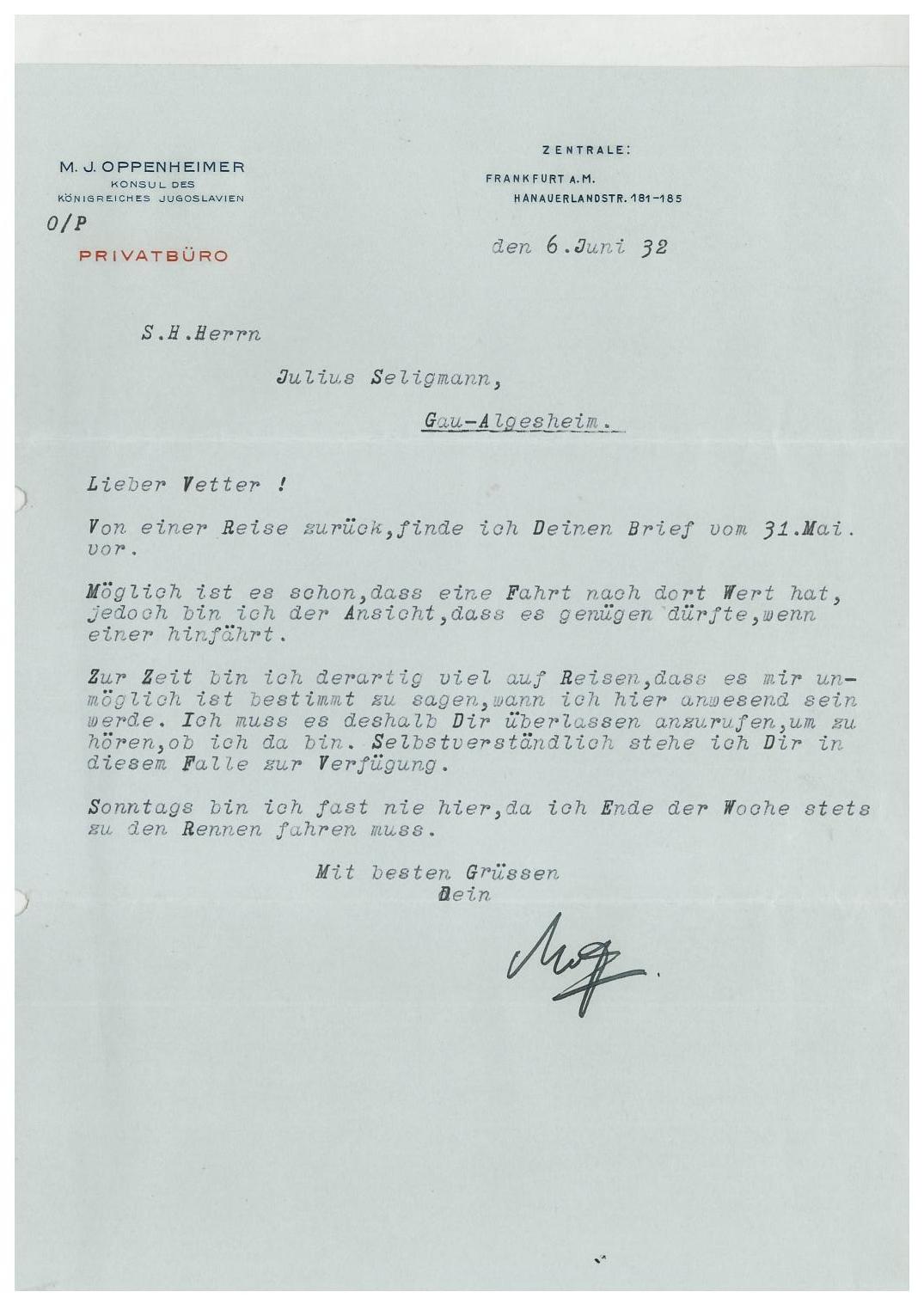
In June, 1932, Julius received the following letter from his cousin Moritz Oppenheimer.  Moritz, who I wrote about here, was both a successful businessman and a horse breeder with a large stud farm.

Oppenheimer-page-001

From this letter, as translated by Wolfgang, it would appear that Julius had asked Moritz to go to England to see if they could resolve their claims against the estate of James Seligman.  Moritz had responded that he thought such a trip might be successful and that it was only necessary for one person to go.  (It’s not clear who he thought should go.) But Moritz also wrote that he was traveling and not at home and that Julius should contact him and he would be glad to help.   He also wrote that he was not available on Sundays as he was at the races—horse races, I’d assume.[1]

In September, 1932, Julius wrote the following letter to the German embassy in London, seeking a lawyer there to help him with his claim against the estate of his uncle.

julius letter front-page-001

julius letter front-page-002

According to Wolfgang, Julius wrote in this letter that he had been notified that since his uncle had not had any children, he and other relatives were to inherit 150 to 300 pounds as their inheritance.  He asserted that the widow had promised to pay this money, but had never done so, and that now neither she nor her attorneys were responding to his requests for payment.  He commented that his economic situation was not good and that they needed to do something quickly.

I do not think anything came from any of these attempts to get money from the estate back in 1932 as we know that Julius eventually was forced to close his store in Gau-Algesheim in 1935 and move to Bingen in 1939.

Both the Hellriegel book about Gau-Algesheim and Wolfgang suggested that the chief of police in Bingen had extended protection to Julius and his family despite knowing that Julius had Jewish roots.  Wolfgang recently spoke with someone who knew his father Walter during the war; he told Wolfgang that everyone in the community knew that Julius had come from a Jewish family, but that no one cared.  This man’s father, like the prior in the Rochus chapel I wrote about last time, spoke out against Hitler and the Nazis.  It would appear that there were a good number of people in Bingen who were opposed to the Nazis and did what they could to protect the Jewish citizens. Sadly, however, it was not enough.

Deutsch: Rochus-Kapelle in Bingen am Rhein/Deu...

Deutsch: Rochus-Kapelle in Bingen am Rhein/Deutschland (Photo credit: Wikipedia)


****


[1] Wolfgang also found some discussion of Moritz Oppenheimer on a German internet horse-racing enthusiast’s forum back in 2010.  The participants were discussing the history of the stud farm once owned by Oppenheimer and how he had been driven to bankruptcy by the Nazis, forced to sell the stud farm for a price far below its value, and then died either by his own hand or executed by the Nazis.  http://www.galopper-forum.de/viewtopic.php?f=50&t=2473

The Faces of My Past: The Magic of Photography

I received some remarkable photographs from my cousin Suzanne, the daughter of Fred and Ilse Michel.  Fred, as I wrote about here, was the grandson of August Seligmann, who was my great-great-grandfather Bernard Seligman’s brother.  Fred would have been my grandfather John Nusbaum Cohen’s second cousin, making him my second cousin, twice removed.  Suzanne is thus my third cousin, once removed.

Suzanne sent me a number of photographs, including some taken of prints that had hung in her childhood home in Scranton, Pennsylvania.  For example, here are two prints of Bingen, Germany, the town where Fred Michel lived and also where our mutual ancestor Moritz Seligmann lived (in Gaulsheim, now part of Bingen) before moving to Gau-Algesheim.  It is also close to where my cousin Wolfgang now lives, and he identified the location and some of the structures depicted therein.

Courtesy of the Family of Fred and Ilse Michel

Courtesy of the Family of Fred and Ilse Michel

Courtesy of the Family of Fred and Ilse Michel

Courtesy of the Family of Fred and Ilse Michel

Bingen 3

Courtesy of the Family of Fred and Ilse Michel

These prints show the city of Bingen’s location at the intersection of the Rhine River and the Nahe River.  According to Wolfgang, the tower in the river is called the Mäuseturm or “tower of mice,” and the church on the hill in the top print is the Rochuskapelle or the chapel on Rochus Hill.  Wolfgang said that his grandfather Julius and his family survived the last part of World War II in the Rochus chapel. Wolfgang told me that much of the city of Bingen was destroyed by British bombers in November, 1944.  The bombs destroyed the apartment whereJulius Seligmann and his wife and sons lived, so they moved to the Rochuskappelle, which the monks had opened for those who had lost their homes and their possessions.

On the reverse of the top print is written, “So that you always think of Bingen and your friends: ???-Kathi-Rainer und Christa Güttler. Bingen, Nov,11, 1974.”  The reverse of the second print says, “The loving Ize and his wife to remember Bingen from Gret and Kath Scharer.”   Based on the captions on these photographs from an album that belonged to Fred Michel, these were close friends.

Courtesy of the family of Fred and Ilse Michel

Courtesy of the family of Fred and Ilse Michel

scharers in album

These prints of Bingen before the war and the photographs of Fred’s friends made me think about what was lost during the war.  Not just all the millions of people who died, but also the landscape, the history, and, for the many who were lucky enough to emigrate, their homeland.  Perhaps these old prints and the pictures of his friends helped keep some of those happier memories alive for Fred Michel.

Here is a photograph of Fred Michel and his mother Franziska Seligmann Michel taken when Fred was a young boy, when he likely could never foresee leaving Germany and moving to a place called Scranton:

Fred Michel and Franziska Seligmann Michel  Courtesy of the Family of Fred and Ilse Michel

Fred Michel and Franziska Seligmann Michel
Courtesy of the Family of Fred and Ilse Michel

Here is a photograph of Franziska’s headstone.  She died four years before Fred left for America.

Courtesy of the Family of Fred and Ilse Michel

Courtesy of the Family of Fred and Ilse Michel

I believe these are photographs of Fred as a young man, taken in Munich in 1928, according to the caption:

Courtesy of the Family of Fred and Ilse Michel

Courtesy of the Family of Fred and Ilse Michel

Although he is not identified in the photographs above, here is a photograph of Fred with Ilse and his children sometime around 1960, and it appears to be the same man many years later:

Courtesy of the Family of Fred and Ilse Michel

Courtesy of the Family of Fred and Ilse Michel

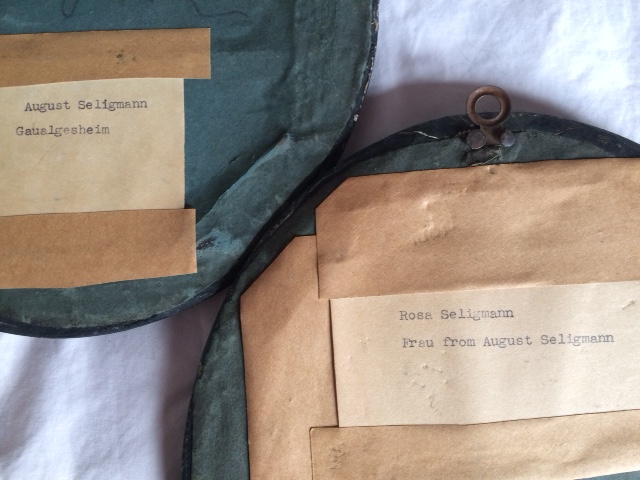
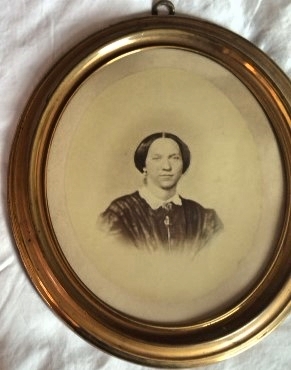
I was quite excited about these two portraits. I know who is in these photographs because of the inscriptions on the reverse:

August Seligmann

August Seligmann Courtesy of the Family of Fred and Ilse Michel

Rosa Goldmann Seligmann

Rosa Bergmann Seligmann Courtesy of the Family of Fred and Ilse Michel

Courtesy of the Family of Fred and Ilse Michel

Courtesy of the Family of Fred and Ilse Michel

August was my great-great-granduncle, the brother of Bernard Seligman.  Here is a picture of Bernard, my great-great-grandfather.  Can you see any resemblance between the two brothers?

Bernard Seligman

Bernard Seligman

Rosa’s headstone is the one that was terribly defaced in the Gau-Algesheim cemetery.

closeup of Rosa Seligmann headstone

And here are the portraits that intrigue me the most.

Courtesy of the Family of Fred and Ilse Michel

Courtesy of the Family of Fred and Ilse Michel

Courtesy of the Family of Fred and Ilse Michel

Courtesy of the Family of Fred and Ilse Michel

Who are these people?

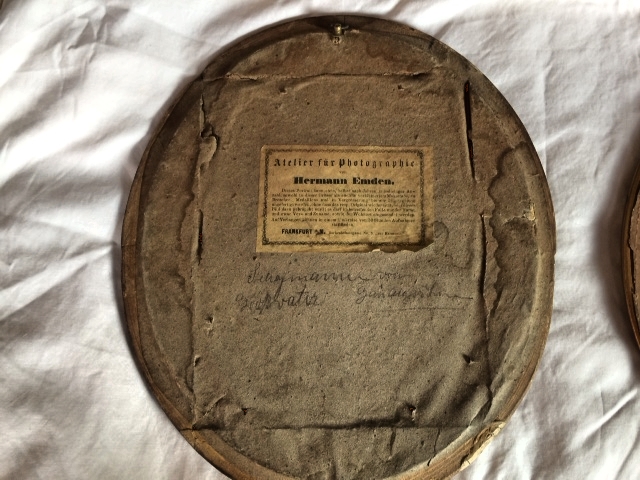
On the reverse of one of these is the following:

Courtesy of the Family of Fred and Ilse Michel

Courtesy of the Family of Fred and Ilse Michel

By editing and zooming and enlarging the script below the photographer’s information, I was able to see more clearly what was written there:

enhanced snip photo 2

I could decipher Seligmann there as well as von Gau-Algesheim to the right, but I was not able to read the word underneath Seligmann.  I posted the snip of this to the German Genealogy group on Facebook, and two people there confirmed that the word was the German word for “grandfather.”  One of the two also insisted that the name was Schafmann, not Seligmann, but I still am sure that it says Seligmann, and not only because I know that was the family’s name.  What do you think?

So if this man was a Seligmann and a grandfather, who was he?  Since the portrait belonged to Fred Michel, I would have assumed that it was his grandfather, that is, August Seligmann.  But the man in this portrait does not appear to be the same person as the man in the portrait above, which was clearly labeled August Seligmann.  So my thought/hope was that this was the grandfather of Fred’s mother Franzeska, who must have given these old pictures to her only child.  If that is the case, then these two portraits depict my great-great-great-grandparents, Moritz Seligmann and Babetta nee Schonfeld.

But Moritz was born in 1800 and Babetta in 1810.  I wondered whether there would even have been photography portraits like these in their lifetime.  I looked again at the label on the back of the photograph of Moritz and saw that the photographer was Hermann Emden of Frankfort.  I took a chance and googled the name, not expecting anything.  I was quite surprised and happy to get numerous hits for Hermann Emden.  His full name was Hermann Seligmann Emden, and he was a very well-known and successful Jewish photographer and artist.  Here is the entry from the Jewish Encyclopedia for Hermann Seligmann Emden:

German engraver and photographer; born at Frankfort-on-the-Main Oct. 18, 1815; died there Sept. 6, 1875. Early evincing a love for art and unable to afford an academic education, he entered an engraving and lithographic establishment as an apprentice, endeavoring especially to perfect himself in the artistic side of his work. In 1833 he left Frankfort and went to Hersfeld, Darmstadt, and Bonn. His portrait-engraving of Pope Pius IX. and his views of Caub, Bornhofen, and the Maxburg belong to this period. He also turned his attention to photography, then in its infancy, and was one of the first to establish a studio at Frankfort-on-the-Main. He made his reputation as photographer by the work “Der Dom zu Mainz und Seine Denkmäler in 36 Originalphoto-graphien,” to which Lübke refers several times in his “History of Art.” Emden was the first to compose artistic photographic groups (“Die Rastatter Dragoner,” “Die Saarbrücker Ulanen,” etc.), and was also among the first to utilize photography for the study of natural science.

You can see some of his more famous works here.

Once I saw that Emden died in 1875, I was even more certain that these were portraits of Moritz and Babetta Seligmann.  August would have only been 34 when Emden died, and the man in that portrait is quite clearly older than 34.  It has to be his father Moritz. Moritz and Babetta had to be quite comfortable, I would think, having their photographs taken by such a successful photographer.  I also wonder whether Emden was a relative.  Seligmann was a fairly common name, and it was often used as a first name as well as a surname.  But perhaps further research will reveal some familial connection.

But for me what is most important is that I am looking at the faces of my three-times great-grandparents.  I never ever thought that would be possible.

My Cousin Wolfgang and The Lessons of History: Will We Ever Learn Those Lessons?

When I started this blog back in October, 2013, I never anticipated that it would help family members find me.  But that has proven to be an incredible unexpected benefit of publishing this blog.  This is one of those stories.

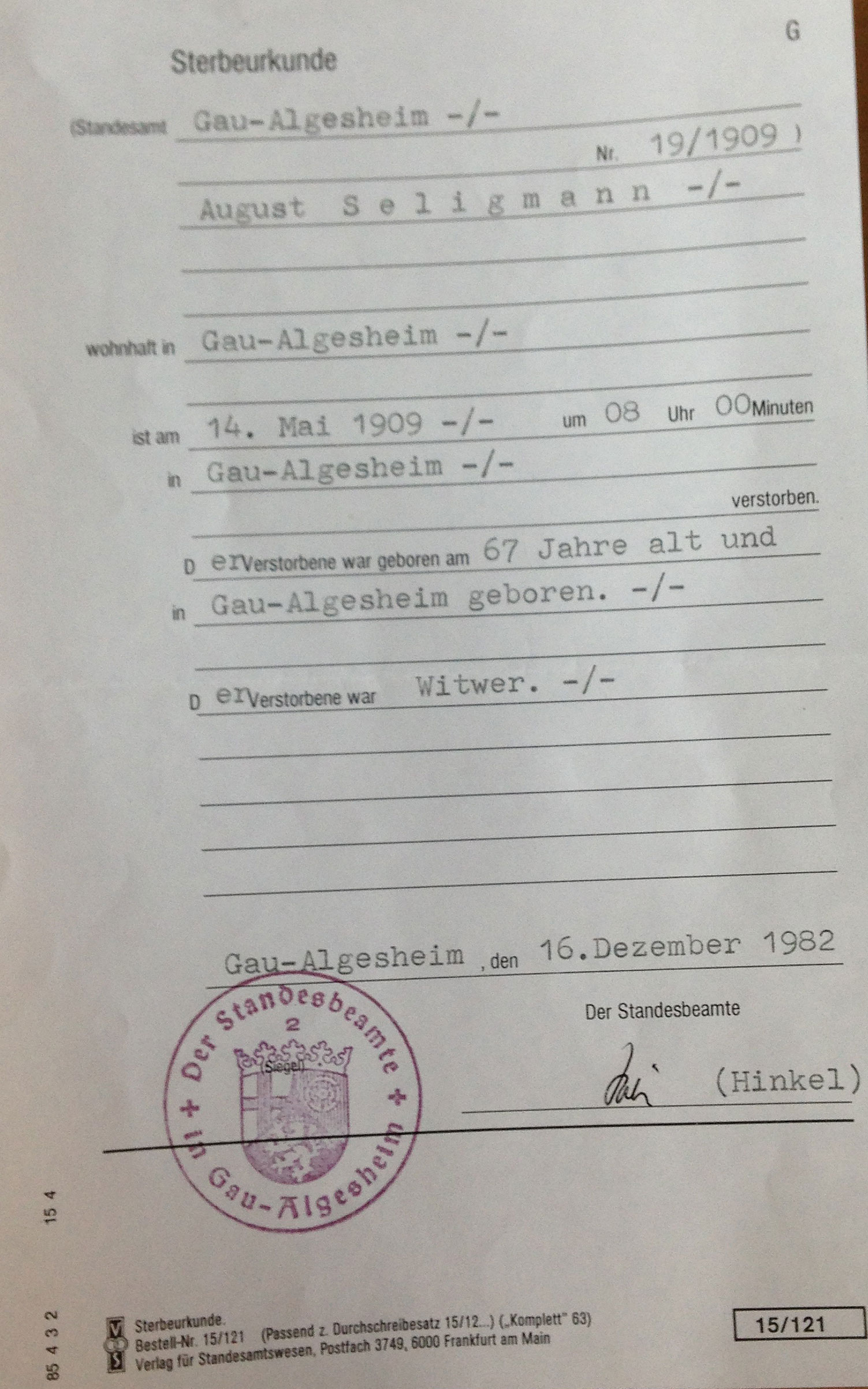
Several weeks ago, I received a comment on the blog from a man named Wolfgang Seligmann, saying he was the son of Walter Seligmann, that he lived near Gau-Algesheim, and that he had found my blog while doing some research on his family.  He asked me to email him, which I did immediately, and we have since exchanged many emails and learned that we are third cousins, once removed:  his great-great-grandparents were Moritz Seligmann and Babetta Schoenfeld, my great-great-great-grandparents.  His great-grandfather August was the brother of Sigmund, Adolph and Bernard Seligman, the three who had settled in Santa Fe in the mid-19th century.   Wolfgang sent me a copy of August’s death certificate.
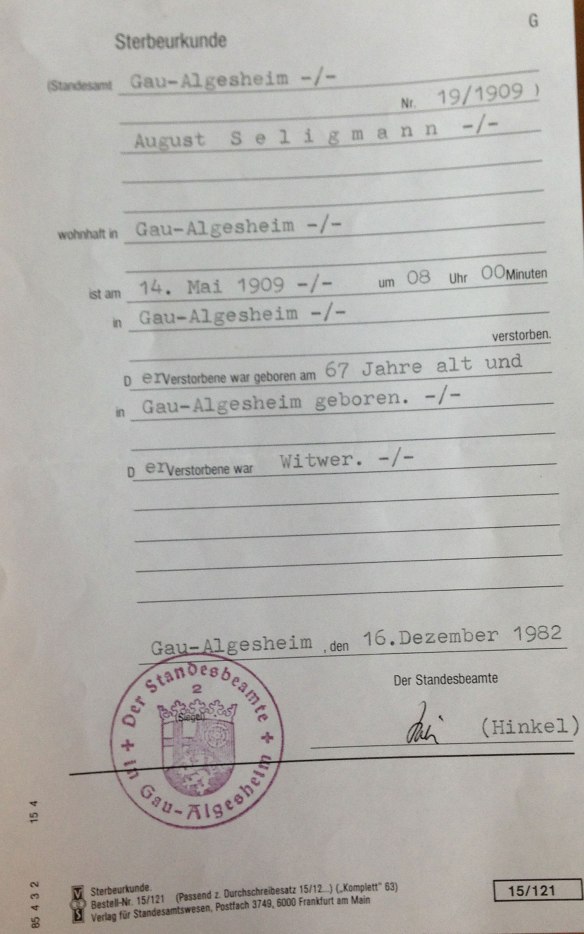
August Seligmann death certificate

August Seligmann death certificate

(Translations in this post courtesy of Wolfgang Seligmann except where noted: Registry-Office Gau-Algesheim: August Seligmann, living in Gau-Algesheim died the 14th of May 1909 at 8 a.m. in Gau-Algesheim. He was 67 years old and born in Gau-Algesheim. He was a widower.)

Our families had probably not been in touch since Bernard died in 1902 (or perhaps when Adolph died in 1920).  And now through the miracle of the internet and Google, Wolfgang had found my blog with his family’s names in it and had contacted me.  What would our mutual ancestors think of that?  It even seems miraculous to me, and I live in the 21st century.

Fortunately, Wolfgang’s English is excellent (since my knowledge of German is…well, about five words), and so we have been able to exchange some information about our families, and I have learned some answers to questions I had about the Seligmanns who stayed in Germany.  With Wolfgang’s permission, I would like to share some of those stories.

Wolfgang’s grandfather was Julius Seligmann, the second child and oldest son of August Seligmann and his wife Rosa Bergmann.  Julius was born in 1877 in Gau-Algesheim.  As I wrote about here, Julius was one of the Seligmanns written about in Ludwig Hellriegel’s book about the Jews of Gau-Algesheim.  He had been a merchant in the town.  On December 1, 1922, Julius had married a Catholic woman named Magdalena Kleisinger, who was born in Gau-Algesheim on July 9, 1882, and had himself converted to Catholicism.  Julius and Magdalena had two sons, Walter, who was born February 10, 1925, and Herbert, born July 27, 1927.  Julius and his family had left Gau-Algesheim for Bingen in 1939 after closing the store in 1935.

I had wondered why Julius had closed the store and then relocated to Bingen, and I asked Wolfgang what he knew about his grandfather’s life.  According to Wolfgang, his father Walter and uncle Herbert did not like to talk about the past, but Wolfgang knew that when Julius married and converted to Catholicism, his Jewish family was very upset and did not want to associate with him any longer.  In fact, Julius was forced to pay his siblings a substantial amount of money for some reason relating to his store in Gau-Algesheim, and that payment caused him and his family a great deal of financial hardship.  According to Wolfgang, Julius no longer had enough money to pay for his own home, and thus he and his family moved to Bingen in 1939 where they lived with Magdalena’s family or friends for some time.
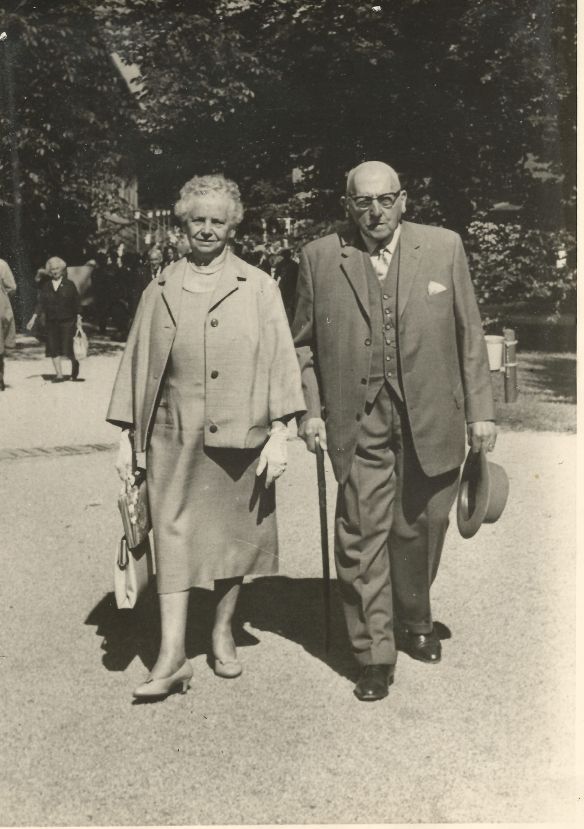
Julius and Magdalena Seligmann

Julius and Magdalena Seligmann 1960s  Courtesy of Wolfgang Seligmann

The Hellriegel book also made some puzzling (to me) references to the military records of Wolfgang’s father and uncle, saying that they had been “allowed” to enlist in the army, but then were soon after dismissed.  Wolfgang explained that the German authorities did not know how to treat Catholic citizens with Jewish roots.  Wolfgang said that his father Walter had trained to be a pharmacist, but the Nazis would not allow him to work with anything poisonous.  In addition,  his father was not permitted to be in the army; instead  he was ordered by the authorities to work on the Siegfried Line, which was  originally built as a defensive line by the Germans during World War I.  In August 1944, Hitler ordered that it be strengthened and rebuilt, and according to Wikipedia, “20,000 forced labourers and members of the Reichsarbeitsdienst (Reich Labour Service), most of whom were 14–16-year-old boys, attempted to re-equip the line for defence purposes.”  Walter Seligmann was one of those forced laborers.
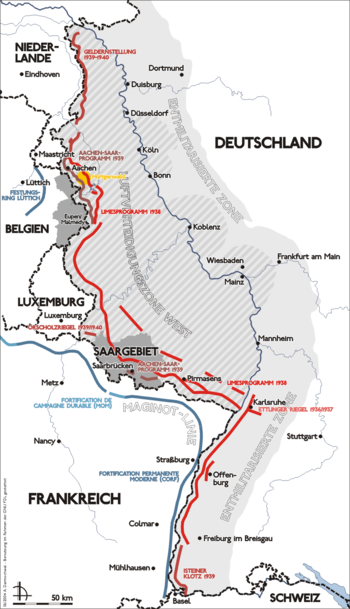
Map of the Siegfried line.

Map of the Siegfried line. (Photo credit: Wikipedia)

Here is a photograph of Walter Seligmann, Wolfgang’s father:
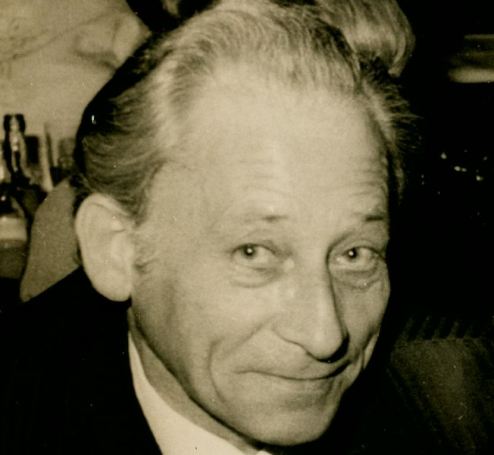
Walter Seligmann  Photo courtesy of Wolfgang Seligmann

Walter Seligmann Photo courtesy of Wolfgang Seligmann

As for Wolfgang’s uncle Herbert, he was sent by the local police to the army, but the army would not accept him.  He was dismissed and sent back to Bingen, where he was required to work in a warehouse until the war ended.
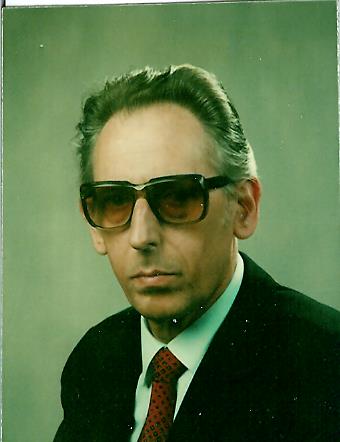
Herbert Seligmann courtesy of Christoph Seligmann

Herbert Seligmann courtesy of Christoph Seligmann

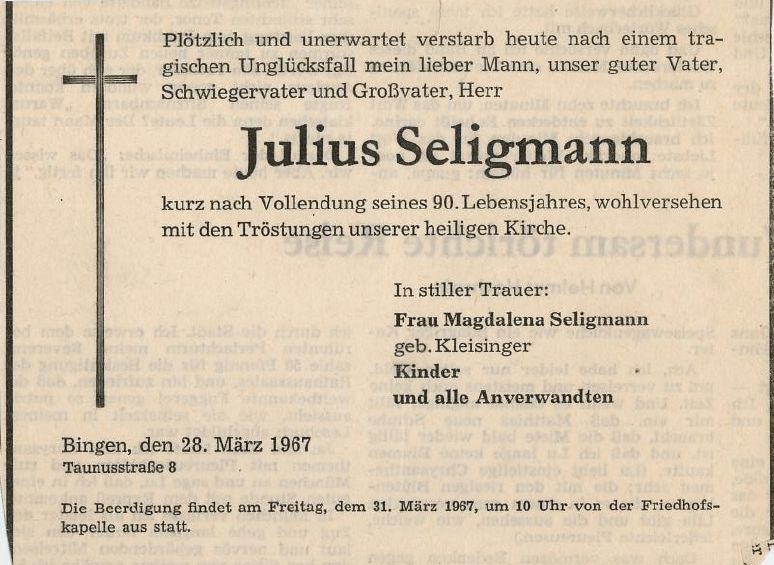
Julius Seligmann died in 1967, and his wife Magdalena died the following year.  Walter Seligmann died in 1993, and his brother Herbert died in 2001.
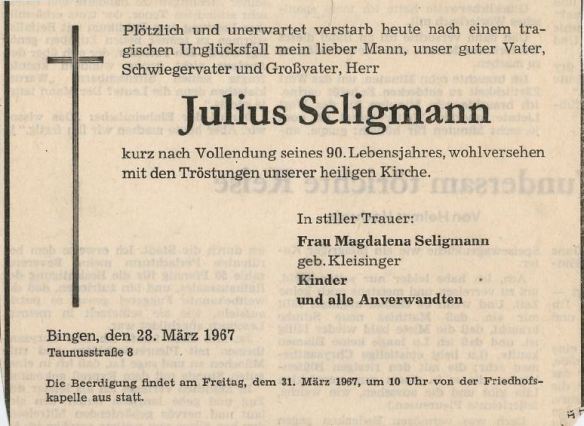
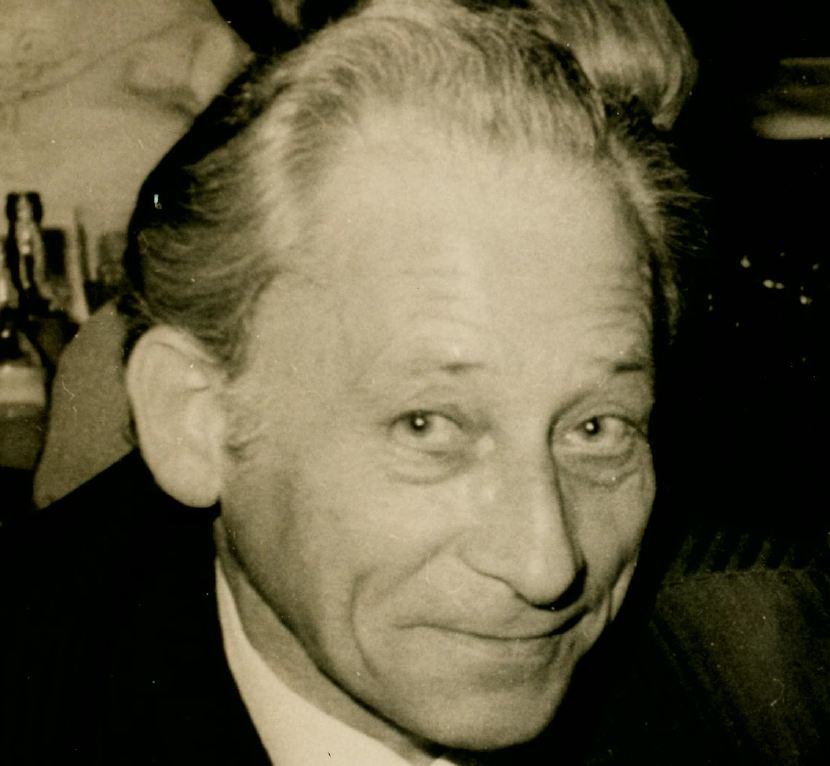
Julius Seligmann death notice
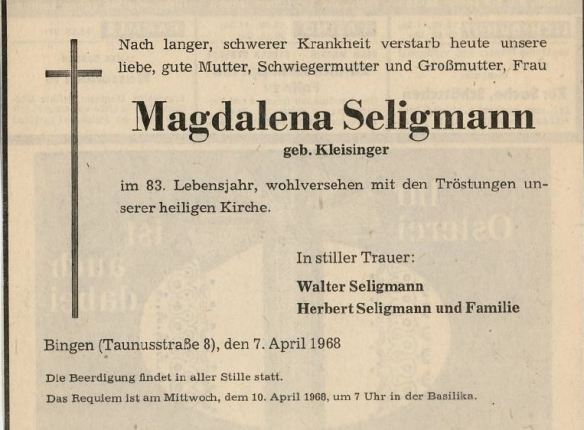
Julius Seligmann death notice

Magdalena Seligmann death notice

There are some very bitter ironies in these stories.  Julius and his family were not accepted by his Jewish family because they were Catholic, but the Nazis did not accept them either because they had Jewish roots.  As I commented to Wolfgang, prejudice of any sort is so destructive and unacceptable.  His family experienced it from two different directions.

Not that the two examples here can be equated in any way.  Although all prejudice is wrong, prejudice that leads to genocide is utterly reprehensible, an evil beyond comprehension for anyone who has a moral compass.  I have already written about my own personal horror and pain when I realized that I had family who had been murdered by the Nazis.  Wolfgang told me more about some of those who lost their lives to Hitler and his evil forces.

One victim was his great-uncle Moritz Seligmann (the grandson of Moritz Seligmann, my 3x-great-grandfather, and a son of August Seligmann).  My information about his fate comes from two websites that Wolfgang shared with me. According to these two sites, Moritz Seligmann, Julius’ younger brother, was born on June 25, 1881.  He fought in World War I for Germany, spent two years in captivity, and was honored with the Hindenburg Cross or Cross of Honor for his service.  Despite this, in the aftermath of Kristallnacht, on November 11, 1938, Moritz was arrested in Konigstein, where he had been living since 1925.  He was sent to the concentration camp at Buchenwald.

German Cross of Honour 1914-1918

German Cross of Honour 1914-1918 (Photo credit: Wikipedia)

Moritz wrote to the authorities in Konigstein, pointing out that he was the recipient of the Hindenburg Cross.  He was released from Buchenwald in December on the condition that he emigrate by March 31, 1939.  He was required to report to the police in Konigstein twice a week until then, and if he had not emigrated by the deadline, he was to be arrested.  On March 28, 1939, however, the Gestapo lifted the emigration order and the reporting requirement in light of Moritz’s service during World War I.

Here is a copy of the Gestapo letter, lifting the emigration order.  I found this a particularly chilling document to see.
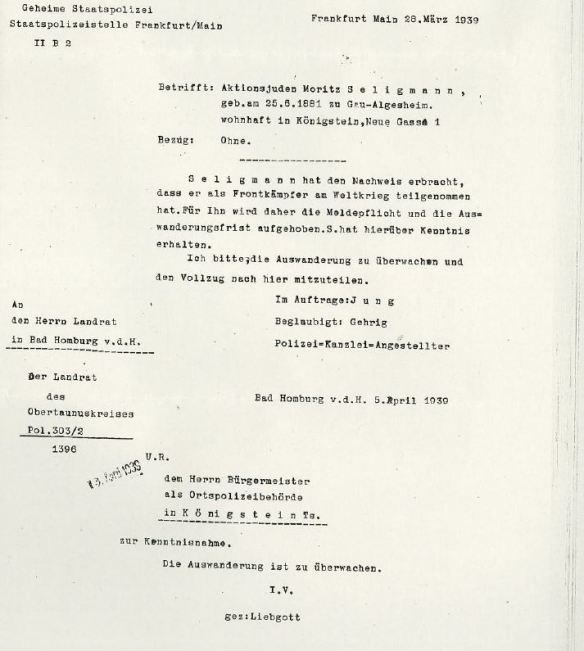
Gestapo letter re Moritz Seligmann

Wolfgang helped me translate this letter as follows: Frankfort, March 20, 1939. Concerning: the “Aktionsjude” Moritz Seligmann born June 25, 1881, Gau-Algesheim, residing in Konigstein.  Seligmann has provided proof that he was a soldier in the World War as a combatant.  Therefore the reporting obligation and emigration order is lifted for him. I would ask the emigration (?) to supervise and notify us here.

As explained to me by Wolfgang and by Wikipedia,  the “Aktionsjude” referred to 26,000 Jews who were deported in the aftermath of Kristallnacht, as was Moritz Seligmann, as part of an effort to frighten other Jews to leave Germany.  Unfortunately, not enough of them did.

Despite the lifting of the order to emigrate, Moritz had hoped to immigrate to the US.  For various bureaucratic reasons described here, he was unable to get clearance to emigrate.  On June 10, 1942, he was picked up by the Nazis and transported somewhere to the east.  Exactly where and when he died is not known.

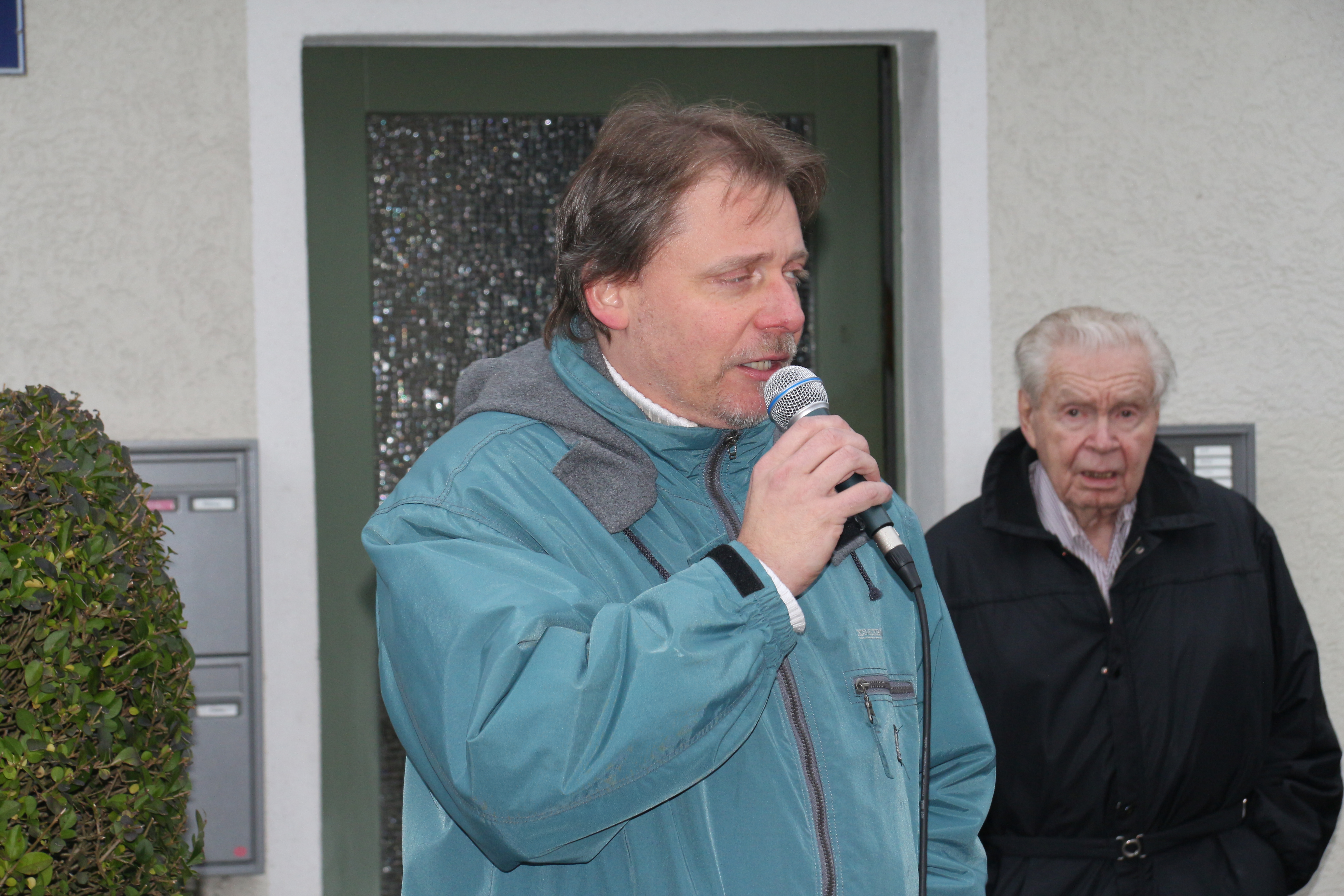
Wolfgang and his family, after researching the fate of Moritz, informed the town of Konigstein of their findings, and the town agreed to place a “stolperstein” in memory of Moritz Seligmann near his home in Konigstein.  A stolperstein (literally, a stumbling blog) is a memorial stone embedded in the ground to memorialize a victim of the Holocaust.  Here is a photograph of Wolfgang at the ceremony when Moritz Seligmann’s stolperstein was installed in Konigstein.
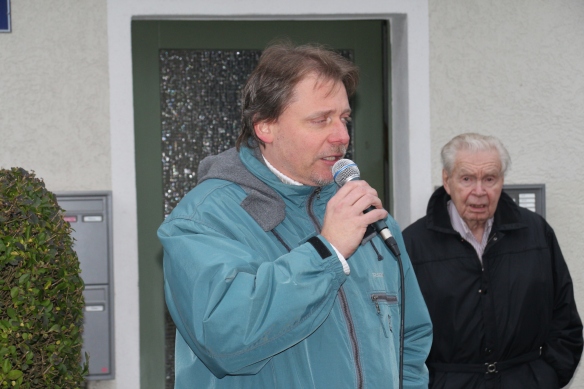
Wolfgang Seligmann

Wolfgang Seligmann  Courtesy of Wolfgang Seligmann

Behind him is a man who knew Moritz and remembered when Moritz was initially arrested in 1938, clinging to his Hindenburg Cross, believing it would save him from the murderous forces of the Nazis.  It may have stalled his murder, but it did not save him.

Wolfgang also told me about the fate of another sibling of his grandfather Julius, his younger sister Anna.  Anna, born in Gau-Algesheim in 1889, had married Hugo Goldmann, and they had a daughter Ruth, born in 1924 in Neunkirchen, a town about 80 miles southwest of Gau-Algesheim, where Anna and Hugo had settled. Between 1939 and 1940, many people from this area near the border with France were evacuated to locations in central Germany, and Anna, Hugo, and Ruth ended up in Halle, Germany, 350 miles to the northeast of Neunkirchen.  On June 1, 1942, they were all deported from Halle to the Sobibor concentration camp where they were all killed.  Click on each name to see the memorial pages established by the town of Halle in memory of Anna, Hugo, and Ruth.

Finally, Wolfgang told me about another member of the family.  Moritz Seligmann (the elder) had had a daughter Caroline with his first wife, Eva Schoenfeld.  Caroline was the half-sister of my great-great-grandfather Bernard. She had married a man named Siegfried Seligmann, perhaps a cousin.  Their son, Emil, died in Wiesbaden on August 9, 1942, when he was 78 years old.
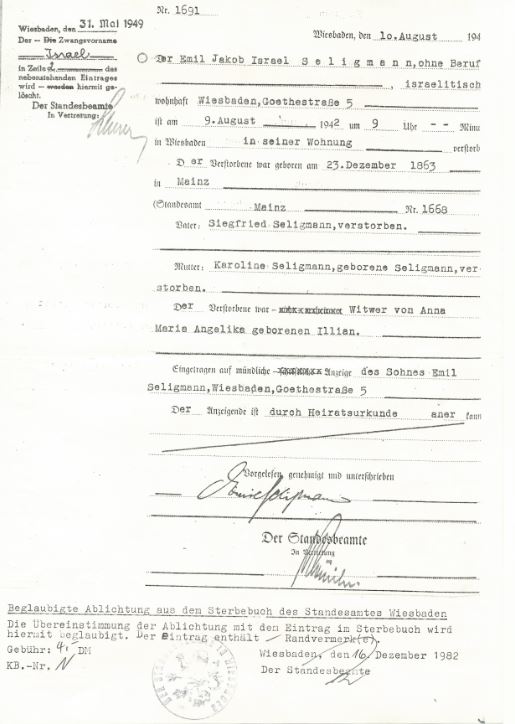
Death record of Emil Seligmann, husband of Carolina Seligmann

Death record of Emil Seligmann, husband of Carolina Seligmann

(Wiesbaden: The Emil Jakob Israel Seligmann, without profession, “israelitisch”  [presumably meaning Jewish], living in Wiesbaden, Gothestraße Nr. 5, died on 9th of August 1942 in his Apartment. He  was born on 23th of December 1863 in Mainz.

Father: Siegfried Seligmann, deceased.  Mother: Karoline Seligmann, nee Seligmann, deceased.  He was widower of Anna Maria Angelika born as Illien. The death was announced by Emil Seligmann, his son, living Goethestraße Nr.5.

The stamp in the left hand margin says:  Wiesbaden, 31th of May 1949.  The “Zwangsvorname”Israel is deleted.  Zwangsvorname translates as “forced first name,” meaning that the name Israel had been required by the Nazis, I assume as a way to identify him as Jewish.

Emil had a son, also named Emil, who died in Buchenwald, as this record attests.
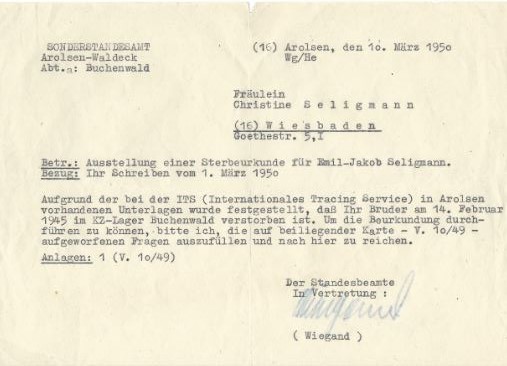
Emil Seligmann-KZ (1)

(To: Miss Christine Seligmann, Wiesbaden, Goethestr. Nr. 5,1

From: Special registry-office in Arolsen-Waldeck, department Buchenwald

Subject: death-certification for Emil-Jakob Seligmann, Your letter from the 1. of March 1950

Based on the documents of the International Tracing Service in Arolsen it is proved, that your brother died on 14th of February 1945 in the Concentration Camp Buchenwald. )

I imagine that this is not the end of the list of the Seligmanns who were murdered during the Holocaust, and I imagine that there are also many other family members I never knew about who were killed by the Nazis, whether they were named Schoenfeld, Nussbaum, Dreyfuss, Goldschlager, Rosenzweig, Cohen, or Brotman or something else.  I just haven’t found them yet.

Wolfgang and I plan to keep on exchanging stories, pictures, documents, and other information.  We have also already talked about meeting someday and walking in the footsteps of our mutual ancestors.  What an honor it will be to be with him as we share our family’s story.

More Blessings and More Insight into My Seligmann Ancestors

This morning I woke up to another email that made me smile to start my day. But to understand why, I need to backtrack a bit.
One of the passages that was translated by Ralph Baer from Ludwig Hellriegel’s book on the history of the Jews of Gau-Algesheim indicated that Moritz Seligmann had originally come from Gaulsheim, a town that is only five miles from Gau-Algesheim.  In this passage, Hellriegel described Moritz Seligmann’s attempt to get permission to move to Gau-Algesheim in 1828.  He was denied permission the first time because the mayor concluded that there were already too many Jews in the town.  He then appealed, and although the mayor still wanted to deny him permission, Seligmann prevailed because he was legally entitled to move to the town.

This passage gave me a clue as to where Moritz, my three-times great-grandfather, might have been born, and Ralph suggested I contact the archives in Gaulsheim for more information.  I found an organization called Arbeitskreis Judische Bingen, or a study group of Jews in Bingen. (Bingen now includes the town of Gaulsheim.)  I wrote to the organization, asking for any information that they might have on Moritz Seligmann or his family.

And that brings me to my happy morning email.  A woman from the Arbeitskreis named Beate Goetz sent me a copy of the marriage record for Moritz Seligmann and Eva Schoenfeld.  Not only did this email confirm that Moritz was born in Gaulsheim (on January 10, 1800) and that he married Eva Schoenfeld (on February 27, 1829), it told me the names of my four-times great-grandparents, Jacob Seligmann and Martha nee Jacob/Mayer (my guess is that Mayer was the surname adopted by her father Jacob when surnames were required in the early 19th century).

In addition, I know now when Eva Schoenfeld was born (June 2, 1806) and where she was born (in Erbes-Budenheim), and I know her parents’ names: Bernhard Schoenfeld and Rosina Goldmann.  Assuming that Eva and Babetta, Moritz’s second wife, were sisters, Bernhard and Rosina were also my four-times great-grandparents.  Now I need to see what records I can find in Erbes-Budenheim to determine if in fact Eva and Babetta were sisters.  Beate said that she would also continue to look for a birth record for Moritz (who was born Moises) and any other relevant records.

Marriage record for Moritz Seligmann and Eva Schoenfeld February 27, 1829 Gaulsheim, Germany

Marriage record for Moritz Seligmann and Eva Schoenfeld February 27, 1829 Gaulsheim, Germany

I also know from Ralph’s additional translation of the marriage record that Jacob Seligmann and Bernhard Schoenfeld were both traders as was Moritz.  The record also indicated that the bride’s parents did not attend the wedding; as Ralph explained, this was probably a second ceremony for purposes of civil law and thus not as important as the religious wedding ceremony, which presumably the couple’s parents did attend.

Thus, thanks to Ralph Baer’s translation of a passage in the Hellriegel book, I now have learned the names of four more of my ancestors.

The Hellriegel book just continues to be a treasure chest of information.  Thanks to Matthias Steinke, I also have a translation of another few passages of Ludwig Hellriegel’s book, which shed some additional light on the character of my ancestor Moritz Seligmann.

In one passage, Hellriegel discussed the education of Jewish children in Gau-Algesheim.  He reported that until 1841, Jewish boys were taught Hebrew and other important subjects by their fathers, but in 1841 they were permitted to attend the Christian school in town.  Apparently, this was difficult for the Jewish children, so Moritz Seligmann applied in 1850 to remove his children from the school.  He then hired a private teacher named Benjamin Mayer from Essenheim to come to Gau-Algesheim to teach the children. (Essenheim is about ten miles from Gau-Algesheim.)

Apparently, however, Mayer ran into trouble in Gau-Algesheim for speaking badly about the Catholic Church, saying in front of the children and two other witnesses that those who believe in the Catholic faith are “downright stupid.”  He reportedly left Gau-Algesheim shortly after this incident.

I found this passage interesting in many ways, but mostly for what it told me about my great-great-great-grandfather Moritz.  He was a man who was determined to see that his children received a good education and in a setting where they were comfortable. That is a value that has certainly been passed down the generations in my family.  Moritz also was apparently a man of some means since he had the money to hire a private teacher.

Coat of arms of Gau-Algesheim

Coat of arms of Gau-Algesheim (Photo credit: Wikipedia)

Matthias also helped me better understand a passage about Moritz and his knowledge of German.  According to Matthias’ reading of this paragraph, Moritz had some role in the synagogue as an educated man.  He was in charge of writing the lists of Hebrew prayers to be assigned to those who made contributions to the synagogue.  (This is somewhat unclear to me.  Perhaps these were prayers for certain members to lead or perhaps these were prayers for the benefit of certain members, or maybe the book is referring to payment in order to receive the honor of reading Torah in synagogue.)

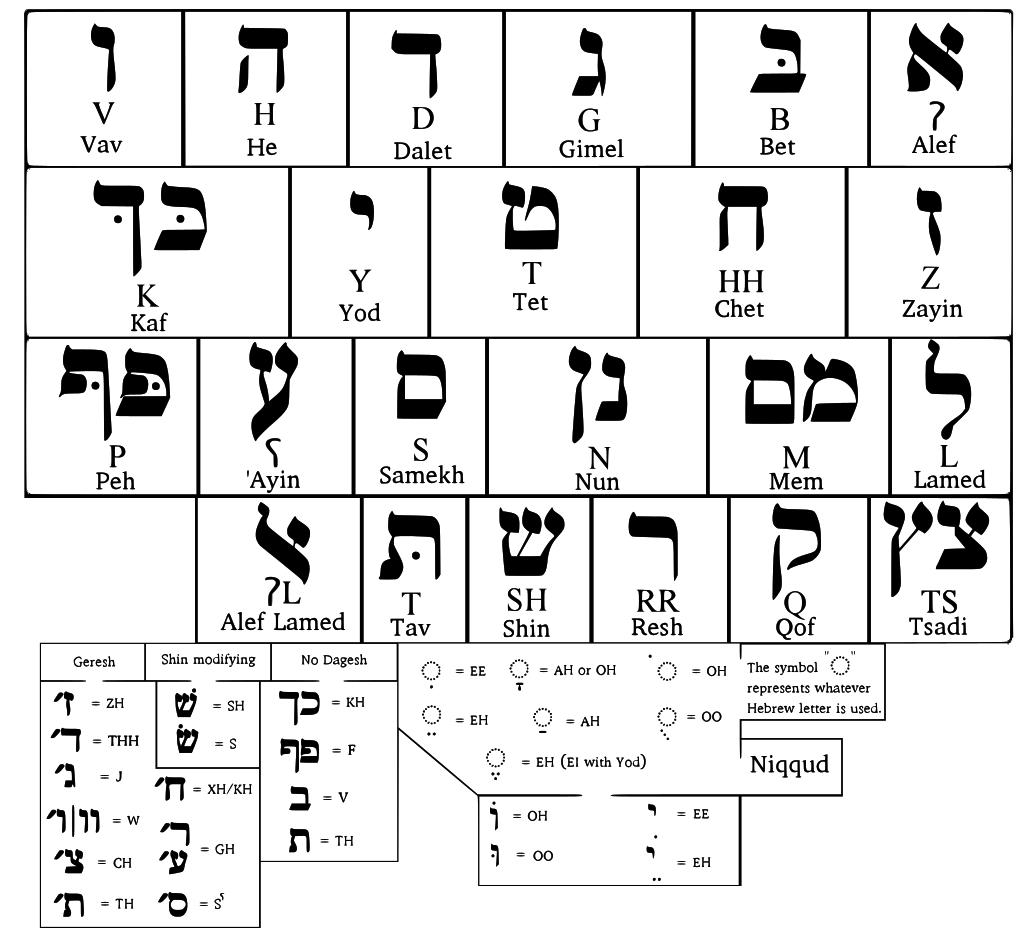
A man from Mainz, Mr. Landauer, commented that Moritz was able to write German very well in compiling these lists, but that he had trouble with “unpunctured” Hebrew.  I asked Ralph Baer what he thought unpunctured would mean in this context, and he explained that the German word could also be translated as undotted and that the reference to undotted Hebrew most likely meant that Moritz had a hard time reading Hebrew without vowel markings.  So Moritz was more fluent in writing and reading in German than he was in Hebrew.

1024px-Hebrew_Alphabet.svg

By Assyrio (Own work) [Public domain], via Wikimedia Commons


The final passage that Matthias helped me understand involved Julius Seligmann, the grandson of Moritz and son of August Seligmann, discussed previously.  He was the Seligmann who converted to Catholicism upon marrying a Catholic woman.  What I had not been able to understand before were references to Julius closing his business in 1935 in Gau-Algesheim and being the last Jew in Gau-Algesheim when he and his family left in 1939.  He and his family moved to Bingen, and the book states that there the police chief did nothing against him and that his two sons Herbert and Walter were even allowed to enlist in the army, although dismissed shortly afterwards.

With a better idea of what the words say, I now think that I understand the significance of this passage.  It seems that Julius, despite converting, was still seen as a Jew when the Nazis came to power and thus was forced to close his business.  However, once he relocated to Bingen, he was not harassed by the police, perhaps because they did not know he was Jewish.  And perhaps the significance of the sons being able to enlist also relates to this ability to deny their Jewish roots, at least for a short time.

I am obviously still reading between the lines, and without being able to read the entire book and read everything in context, I fear that I may be misreading some of these isolated passages.  It’s a long term project to be able to understand the whole book and the whole story of the Jews of Gau-Algesheim.  But already this little book has enabled me to learn so much more about my Seligmann ancestors.

By the way, Seligmann means “blessed man” in German.  The more I learn about the Seligman(n)s, both German and American, the more it seems to be an appropriate surname for the family to have adopted, especially for those Seligmans who were fortunate enough to have left Germany before the Holocaust.