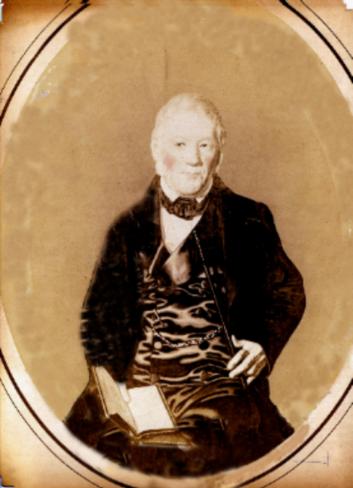
Seligmann Goldschmidt and Hincka Alexander, My 3x-Great-Grandparents of Oberlistingen

I have once again been truly fortunate as I begin my in-depth research of my Goldschmidt line. Not only do I have the benefit of the research done by Roger Cibella and David Baron, but through Roger and David, I have now connected with another Goldschmidt cousin, Art Mansbach, my third cousin, once removed. And Art, the great-great-grandson of Seligmann Goldschmidt and Hincka Alexander, has a treasure trove of pictures and documents and other items related to the Goldschmidt family. Art discovered a box of photographs in his father’s attic, and fortunately most of them were labeled with the names of those depicted. From Roger, David, and Art, I now have a fair amount of information about our mutual ancestors, Seligmann Goldschmidt and Hincka Alexander, as well as pictures of them.

My three-times great-grandfather Seligmann Goldschmidt was born in about 1783-1784 in Oberlistingen, Germany. (His birth date is inferred from his death record, to be discussed below.) He was the oldest son of my four-times great-grandparents Jacob Falcke Goldschmidt and Eva Reuben Seligmann, though he had two older half-brothers from his father’s prior marriages.

Seligmann Goldschmidt

According to Art and as reported on Roger Cibella and David Baron’s website, Seligmann was by trade a spice merchant. He also fought under General Bluecher against Napoleon at Waterloo and was cited for bravery and given a silver snuff box for his service. Art owns the snuff box and shared these photographs of this heirloom:

Sbox2

Sbox1


Although I have not found a marriage record, I assume that Seligmann married my three-times great-grandmother Hincka Alexander sometime before December 1, 1818, when their first child was born. According to her death record and gravestone, Hincka was born in Wolfhagen on September 14, 1797. I don’t yet know the names of her parents or whether she had any siblings.

Hincka Alexander Goldschmidt

Seligmann and Hincka had their first child, a daughter named Sarah, on December 1, 1818, according to her death record. Sarah was followed by seven other children: Jacob (1822), Levi (1824), my great-great-grandmother Eva (1827), Beile or Bette (1829 or 1830), Abraham (1832), Meyer (1834), and Rosa (1837).


All but Beile/Bette would end up immigrating to the United States, starting with Jacob who arrived before 1850 and ending with Sarah, who arrived in 1882. Thus, I will be able to report a fair amount about each of their lives and their families and will be devoting separate posts (probably multiple) to each one of them.

Seligmann and Hincka, however, did not leave Germany with their children. Hincka died on January 4, 1860, in Oberlistingen; according to her death record, she was 63 years old:

Hincka Alexander Goldschmidt death record
HHStAW Fonds 365 No 502, p.82


Although the part of the gravestone that included her name is broken off, it is obvious that this is her stone as it identifies her as the wife of Seligmann Goldschmidt and also because the date of death is consistent with that in the record above. Unfortunately, however, it did not enable me to learn Hincka’s full Hebrew name and thus her father’s name:

UPDATE: Thank you to Lara Diamond for pointing out that Hincka’s name is partially legible at the very top of the stone—it says Hincka Sara! But for some reason her father’s name was not included.  Thank you, Lara!

Goldschmidt, Hinka (1860) – Kassel-Bettenhausen“, in: Jüdische Grabstätten <http://www.lagis-hessen.de/en/subjects/idrec/sn/juf/id/6511&gt; (Stand: 24.3.2015)


The inscriptions is translated as follows:

Wife of Seligman Goldschmidt from Oberlistingen.

Born on the 23rd of Elul [5] 557

Died on Thursday, 10th Tewet,

and buried on Friday, the 11th Tewet [5] 620

Jewish era.

Her soul is bound in the bond of life.

Her husband Seligmann died nine years later on April 8, 1869; he was 85 or 86 years old, according to this death record:

Seligmann Goldschmidt death record
HHStAW Fonds 365 No 387, p.70


His headstone is in better shape than that of his wife Hincka:

Goldschmidt, Seligmann (1869) – Obervorschütz“, in: Jüdische Grabstätten <http://www.lagis-hessen.de/en/subjects/idrec/sn/juf/id/13188&gt; (Stand: 8.8.2014)


The inscription is translated as:

a sincere man among the generous ones.

He walked the path of the good.

He distributed his bread among the hungry.

He was God-fearing throughout his life.

Aaron, called Seligmann,

Son of Jacob. Died with a good reputation

on Thursday, the 27th Nisan, and buried

on Friday, the 28th of the month in the year

[5] 629 after the small count. His soul is bound in the bond of life.

One interesting insight here is that Seligmann’s Hebrew name was Aaron.

I love how this inscription revealed a bit about Seligmann’s personality and how he was perceived by his family; I wish the same had been done for Hincka. When Seligmann died in 1869, almost all of his children were in the United States, as had been many of them when their mother Hincka died in 1860. I wonder if they came home to Oberlistingen to bury their parents and whether they helped to determine the language that would go on their parents’ gravestones. Why was their mother’s inscription limited to the bare facts whereas their father’s was more descriptive and loving?

In posts to follow, I will explore the lives and families of each of the children of Seligmann and Hincka.


Several people raised questions about the meaning of “schutzbrief” in my prior post. I am researching those questions and will report back soon.


Introducing the Goldschmidts of Oberlistingen

It’s a new year, and it’s time to start the story of a new line in my family. As I was finishing the history of the Katzenstein family, I pondered which line I should work on next. Growing up, I’d only known the surnames of some of my ancestors: Cohen, Seligmann, Nusbaum, Schoenthal, Katzenstein, Brotman,  and Goldschlager, the lines I’ve focused on so far. I did not ever hear the names Jacobs, Schoenfeld, Hamberg, Goldschmidt, Brod, or Rosenzweig. Those names had disappeared when the women took their husbands’ names and gave their children only their husbands’ names. But after researching the husband’s lines, I learned the birth surnames of their wives. 

So now it’s time to go back and find the stories of these other families. I have decided to start with the Goldschmidt line—the family of my great-great-grandmother Eva Goldschmidt who married Gerson Katzenstein. She was the mother of my great-grandmother Hilda Katzenstein Schoenthal and the grandmother and namesake of my grandmother Eva Schoenthal Cohen. It made sense to start with the Goldschmidts because they are entangled in several ways with both my Katzenstein relatives and my Schoenthal relatives, as you will see. Also, I am intrigued by the idea of following the direct female line of my paternal grandmother–from Eva Schoenthal to Hilda Katzenstein to Eva Goldschmidt.

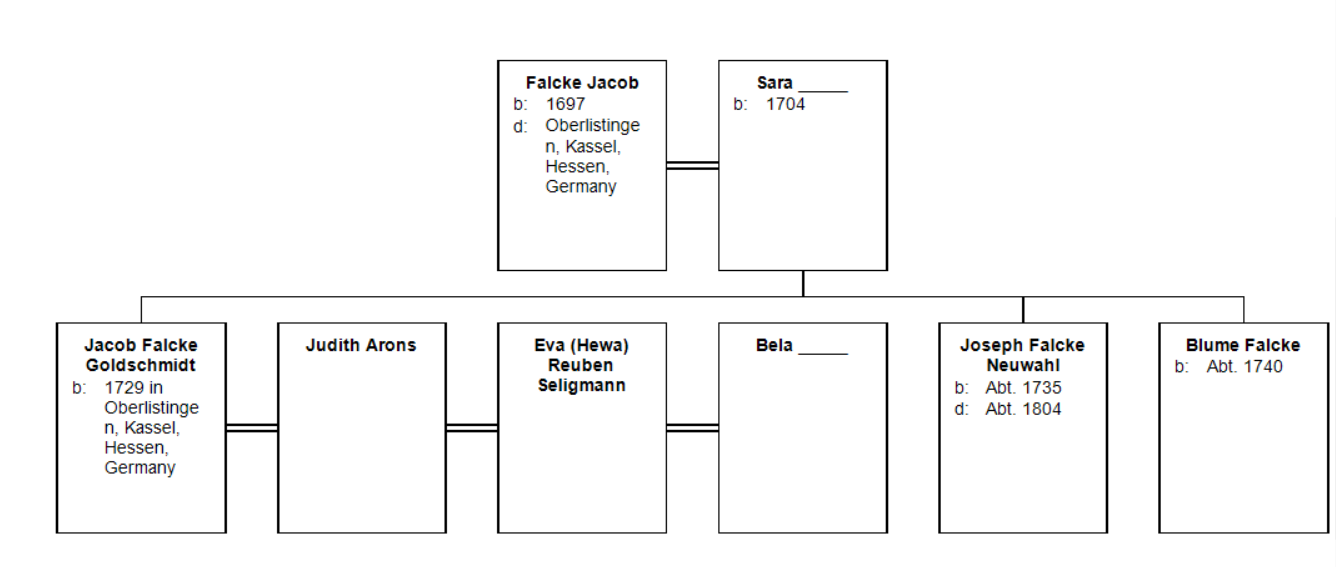
Thanks to the incredible work of David Baron and Roger Cibella, I can trace my Goldschmidt family back to my fifth-great-grandparents, Falcke Jacob, born in about 1697, and his wife Sara (surname unknown), born in about 1704.

My Goldschmidt ancestors came from Oberlistingen in the Hesse region of Germany, just a few miles from the village of Breuna, where my Hamberg ancestors once lived, about fourteen miles from Sielen where my Schoenthal ancestors lived, and about fifty miles north of Jesberg where my Katzenstein relatives lived.  Oberlistingen is in fact a small village within the larger township of Breuna, which also includes Niederlistingen, another small village very close to Oberlistingen. The two villages are sometimes referred together as the two “Listingens.”


Years ago David and Roger put together a website that traced the history of the Goldschmidt family and Oberlistingen and included excerpts from Chapter III of Dieter Carl’s book, Die Juden Geschichte Beider Listingen [The Jewish History of the Two Listingens] (Herausgegeben vom Gemeindevorstand der Gemeinde Breuna, 1999), as translated by Joseph Voss.

According to Dieter Carl, Jews had been expelled from the Hesse region by Duke Phillip the Generous in the mid-16th century in response to pressure from Martin Luther.  Then in 1592 Lord Moritz allowed a few Jews to settle in the region. Eventually more Jews settled in the Hesse region, but restrictions were imposed.

Carl provided this helpful background:

The unique position of the Jews derived from the nature of their religion, on one hand, and, on the other hand, stemmed from the nature of a people who had no citizens rights, who were not fully free, and stood outside of the established Christian society.  Therefore the Jews had gained the special protection of the Feudal lords needed for their security and livelihood for economical activity and housing.  Originally this protection was in the hands of the Kaiser, but in time it transmitted down to local Dukes.  ….  [T]he Dukes of Hessen … gave to certain families a letter “schutzbriefe” of protection–the legal basis for living in these rural areas.  The receiver of the schutzbriefe had to pay a reasonable sum and had to provide other services for the Lord.  The protection letter gave the Jews the legal right to trade and lend money.

For a long time Jews could not become artisans, farmers or civil servants, but only moneylenders or traders.  In order to limit the number of Jews in Hessian towns and villages, the letter could not be inheritable.  In reality though, the letter was passed down from father to eldest son with a small sum paid in order to continue that right.  This was beneficial for the right to do business and who could establish a family; hence the authorities could control the size of the Jewish population.  All the Jews for whatever reason did not possess the Schutzbrief, the youngest sons and unmarried daughters were the so-called “Unvergleitete” or disinherited.  From these large groups were created the Jewish under classes   or “Unterschicht”.  These consisted mainly as the “knechte, or the worker/ servants, the men and women who served the Schutzjuden in their employ.  In part they lived in great poverty and some resorted to begging for their livelihood.

According to Dieter Carl, the first Schutzbrief in Oberlistingen was given in 1724 to someone known as Juden Falcke, as seen in this letter dated October 19, 1724:

I, the undersigned am writing because I am protected by the esteemed sires of Malsburg.  I wish to become a member of the Oberlistingen community with permission to reside there.  I have obtained all of the rights to function in this community as a Jew and who has officially received these rights along with your right to cancel my contract.  Furthermore I am obligated, if the community is in need of money, and if I have the means to provide a loan without interest without damage to myself, I will make an advance to them if the need arises.  All of what is said here and recorded is based on free will and opinion, which my signature authenticates.

Signed 19 October 1724

Juden Falcke

Who was Juden Falcke? Was he related to me?

My fifth-great-grandparents Falcke Jacob and Sara had three children: Jacob Falcke, born in 1729; Joseph Falcke, born in 1734; and Blume Falcke, born in 1740.  Following the March 31, 1808 decree requiring Jews in the region to adopt surnames, Jacob Falcke adopted the surname Goldschmidt. Carl concluded that the “Juden Falcke” who received the first Schutzbrief for Oberlistingen was Jacob Falcke Goldschmidt, my four times great-grandfather. His brother Joseph adopted the surname Neuwahl and eventually also received a Schutzbrief to live in Oberlistingen.

Jacob Falcke Goldschmidt was married three times.  His first wife was named Bela, with whom he had one son; his second wife was Judith Arons, with whom he also had one son. Jacob’s third wife was my four-times great-grandmother, Eva Reuben Seligmann,[1] whom he married on November 24, 1780. [2]

Jacob Falcke Goldschmidt and Eva Reuben Seligmann had four sons:  my three-times great-grandfather Seligmann and his brothers Lehman, Meyer, and Simon. Dieter Carl also listed an unnamed daughter, and David Baron found a reference to this daughter in the Alex Bernstein Collection at the Leo Baeck Institute.  Her name was Jette, and she was born May 4, 1793; she married David Grunewald of Hoexter, Germany—the region that is the focus of Alex Bernstein’s research. According to his research, Jette died on August 4, 1822, and did not have any children.

CORRECTION: David Baron pointed out that I had misread Bernstein’s research. He found that Jette Goldschmidt did have children with David Grunewald before her death. First, a son Jacob Grunewald was born May 5, 1820; a second child was stillborn on July 30, 1822. Jette died five days later, presumably from complications from childbirth. Jacob Grunewald married and had fourteen children. Later I will return to these Goldschmidt cousins and report on them more fully.

Although I am primarily interested in my three-times great-grandfather Seligmann and his descendants, I will also write about his brothers, in part because his brother Simon was married to Fradchen Schoenthal, sister of Levi Schoenthal, my great-great-grandfather from Sielen.  Yes, my family tree continues to twist and bend.


[1] There is no known familial connection between Eva Reuben Seligmann, who was born in Warburg, Germany, and my Seligmann ancestors from Gau-Algesheim.

[2] This information all comes from Dieter Carl’s book as excerpted on the Cibella-Baron website. I will be focusing only on the children of my direct ancestor, Jacob Falcke Goldschmidt.

Happy New Year!

Happy New Year, everyone!

I am still on my blogging break for the next week or so, but wanted to reach out and thank all of you for reading my stories this year and especially to all of you who helped me by providing researching suggestions, translating documents, and commenting on my posts.  The support I’ve received is very much appreciated and makes this project so much more enjoyable and fulfilling than if I had to do it all alone without feedback and support.

As I look back on 2017, it wasn’t my favorite year in many ways, but in terms of family history, it was a wonderful year. Visiting Germany and getting to see where my ancestors once lived was an incredible experience; what made it particularly special was getting to spend time with my cousin Wolfgang and his family and with my cousin Ulrike and meeting in person some of the many people who have helped me with my research—Dorothee, Beate, Hans-Peter, Ernst, Julia, and Aaron.

In terms of research, 2017 was the year of the Katzensteins, and what a fascinating family they were and are. Visiting Jesberg made all that research come to life as I imagined my great-great-grandfather Gerson walking those streets along with his siblings and cousins.  And connecting with so many of my Katzenstein cousins made this research particularly rewarding and exciting. I have newly-found cousins from all over the US—Oklahoma, Texas, California, Massachusetts (!), Delaware, and so on. I cherish each and every one of the new leaves I’ve been able to add to the family tree.

As I venture into 2018, I look forward to learning the stories of my Goldschmidt ancestors and relatives.  Every family line I research brings me new insights into Jewish history and into my own story. Every new line teaches me how interconnected we human beings truly are—how we have unique personal stories but also share universal stories of love and hate, success and loss, courage and cowardice, creativity and inventiveness, peace and war, sickness and health.

Let us all hope that in 2018 our leaders and our world also recognize our interconnectedness, our need for each other, and our need to help each other. We cannot exist without each other. We are all part of one big family tree.

Rosa Abraham and Isidor Zechermann: A Final Update

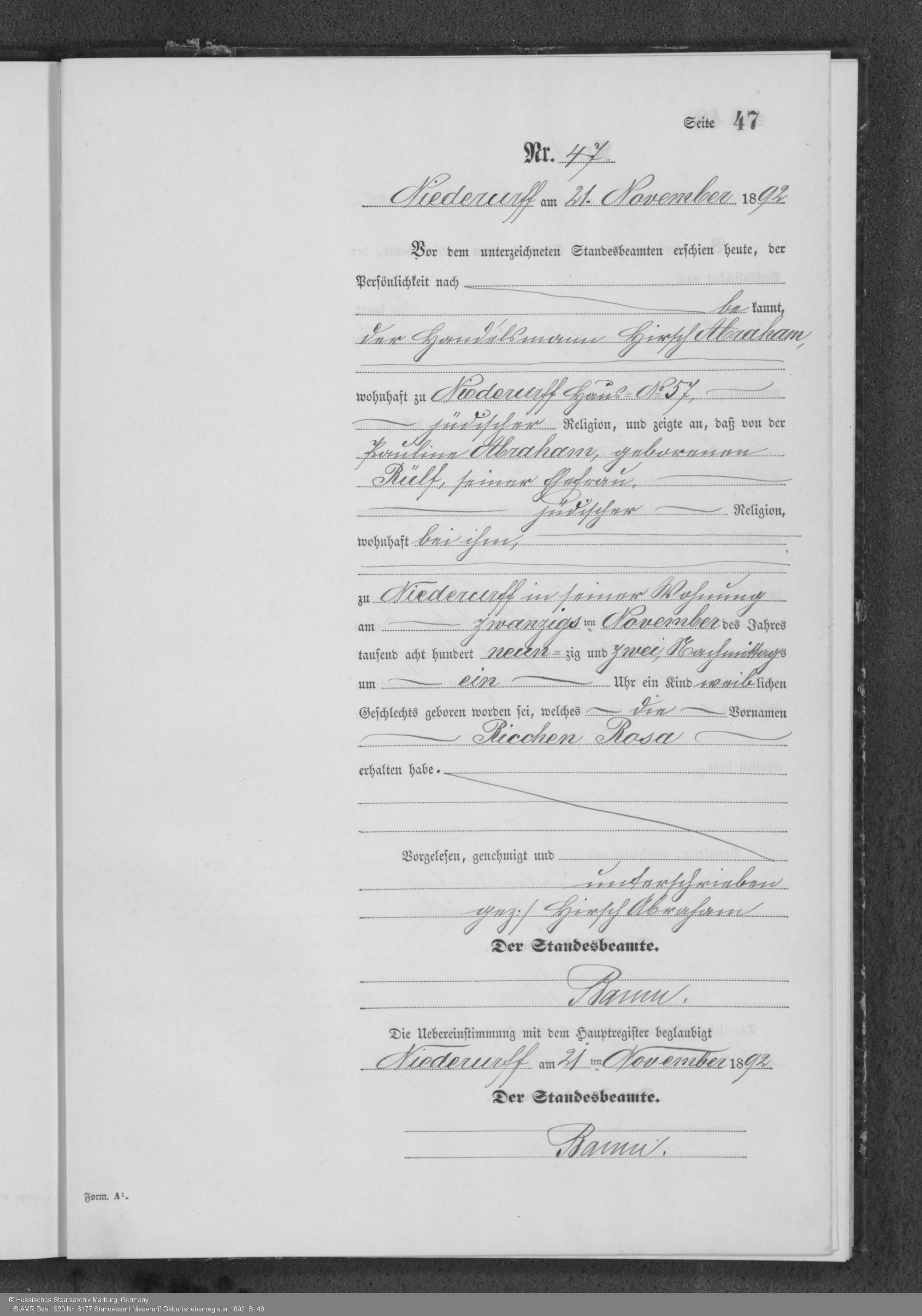
The process of finding the story of Rosa Abraham has been a challenging one. At first all I had was her birth record and one passenger manifest for a Rosa Zechermann with the same birth date and birth place.

Ricchen Rosa Abraham birth record Nov 20 1892 Hessisches Hauptstaatsarchiv; Wiesbaden, Deutschland; Collection: Personenstandsregister Geburtsregister; Bestand: 920; Laufende Nummer: 6177

Rosa Abraham passenger card
The National Archives at Washington, D.C.; Washington, D.C.; Series Title: Passenger and Crew Manifests of Airplanes Arriving at Miami, Florida.; NAI Number: 2788541; Record Group Title: Records of the Immigration and Naturalization Service, 1787 – 2004; Record Group Number: 85

Then with the incredible help of members of the Jekkes Facebook group, I learned that Rosa had married Isidor Zechermann and immigrated to Chile to escape Hitler. I had not found a marriage record, but several bits of circumstantial evidence supported that conclusion.

Most recently I’d received Rosa and Isidor’s request for repatriation as German citizens and Rosa’s application for reparations from the German government for the loss of her occupation. I also was able to deduce from various documents and directories that Rosa and Isidor must have married sometime between 1930 and 1932. But I still didn’t have a marriage record that proved when they were married and, perhaps most importantly, that the Rosa who married Isidor was in fact my cousin Rosa Abraham.  All the evidence pointed in that direction, but I had no official record, just secondary sources and circumstantial evidence.

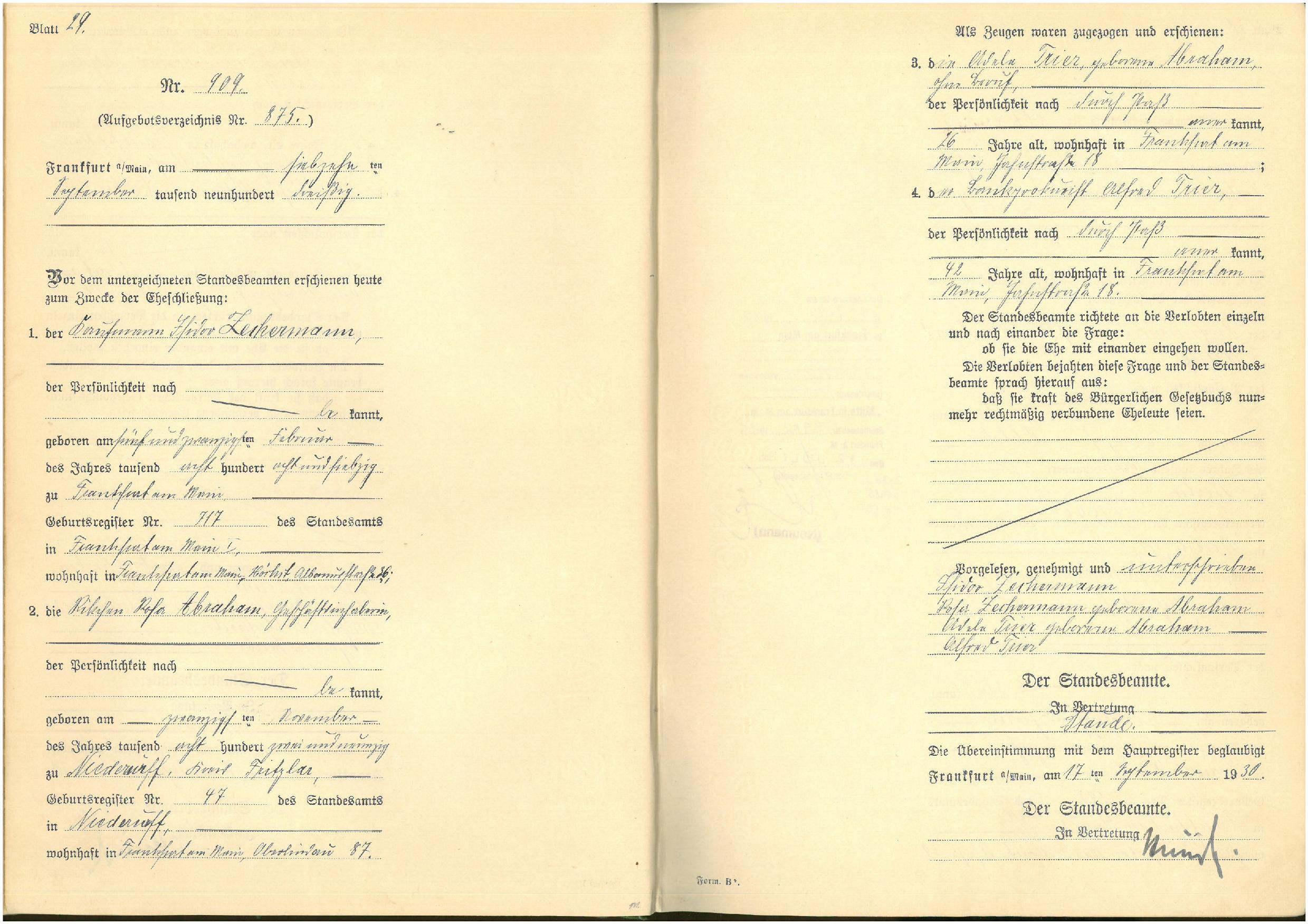
I wrote to the city of Frankfurt to request a marriage record, and Sigrid Kaempfer of the Institut fuer Stadtgeschichte responded not only with Isidor and Rosa’s long sought marriage record, but with three other interesting documents as well. First, that much hoped-for marriage record:

Marriage record of Rosa Abraham and Isidor Zechermann

It states that Isidor Zechermann, merchant, born on February 25, 1878, in Frankfurt and living in Frankfurt, married Ricchen Rosa Abraham, business owner, born on November 20, 1892, in Niederurff, on September 17, 1930, in Frankfurt. Finally, I had the proof I needed to get closure. My cousin Ricchen Rosa Abraham, daughter of Hirsch Abraham and Pauline Ruelf, born on November 20, 1892, was the wife of Isidor Zechermann and had married him in the time period I had determined in my last post about Rosa.

Also of interest—the two witnesses to the marriage were Adele Trier, geb. Abraham, Rosa’s sister, and Alfred Trier, Adele’s husband. Adele and Alfred were the couple Rosa and Isidor went to visit in Queens in 1952, as I wrote about here.

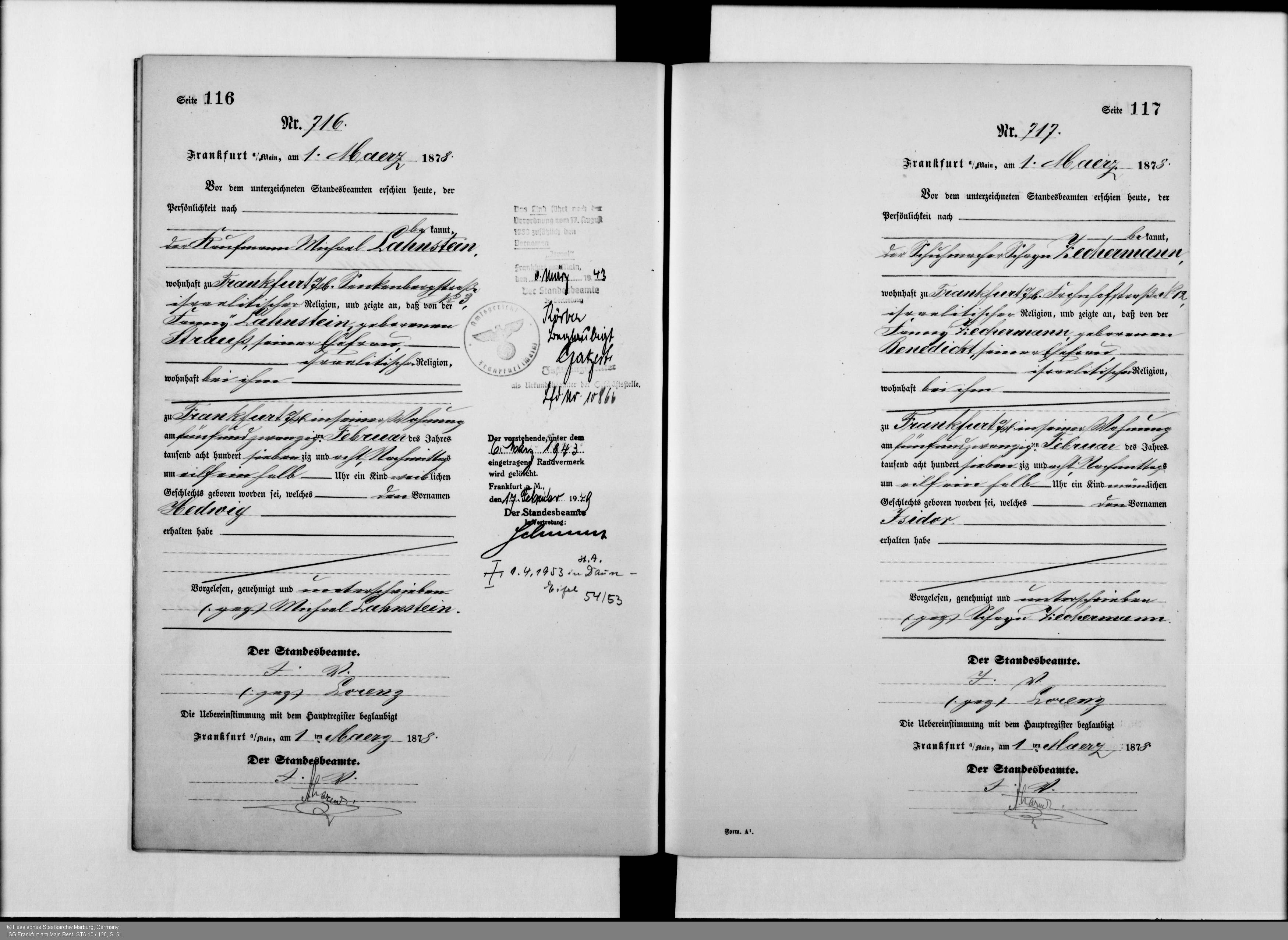
Ms. Kaempfer also sent me a link to Isidor’s birth record, confirming that he was born on February 25, 1878, in Frankfurt. With the help of the German Genealogy group, I learned that Isidor was the son of Schaye Zechermann, a shoemaker, and Fanny Benedikt. (Special thanks to Heike Keohane and Carolina Meyer for their extraordinary help in decoding Schaye’s first name!)

Isidor Zechermann birth record
HStAMR Best. 903 Nr. 8916 Standesamt Mitte (Frankfurt) Geburtsnebenregister 1878, S. 61

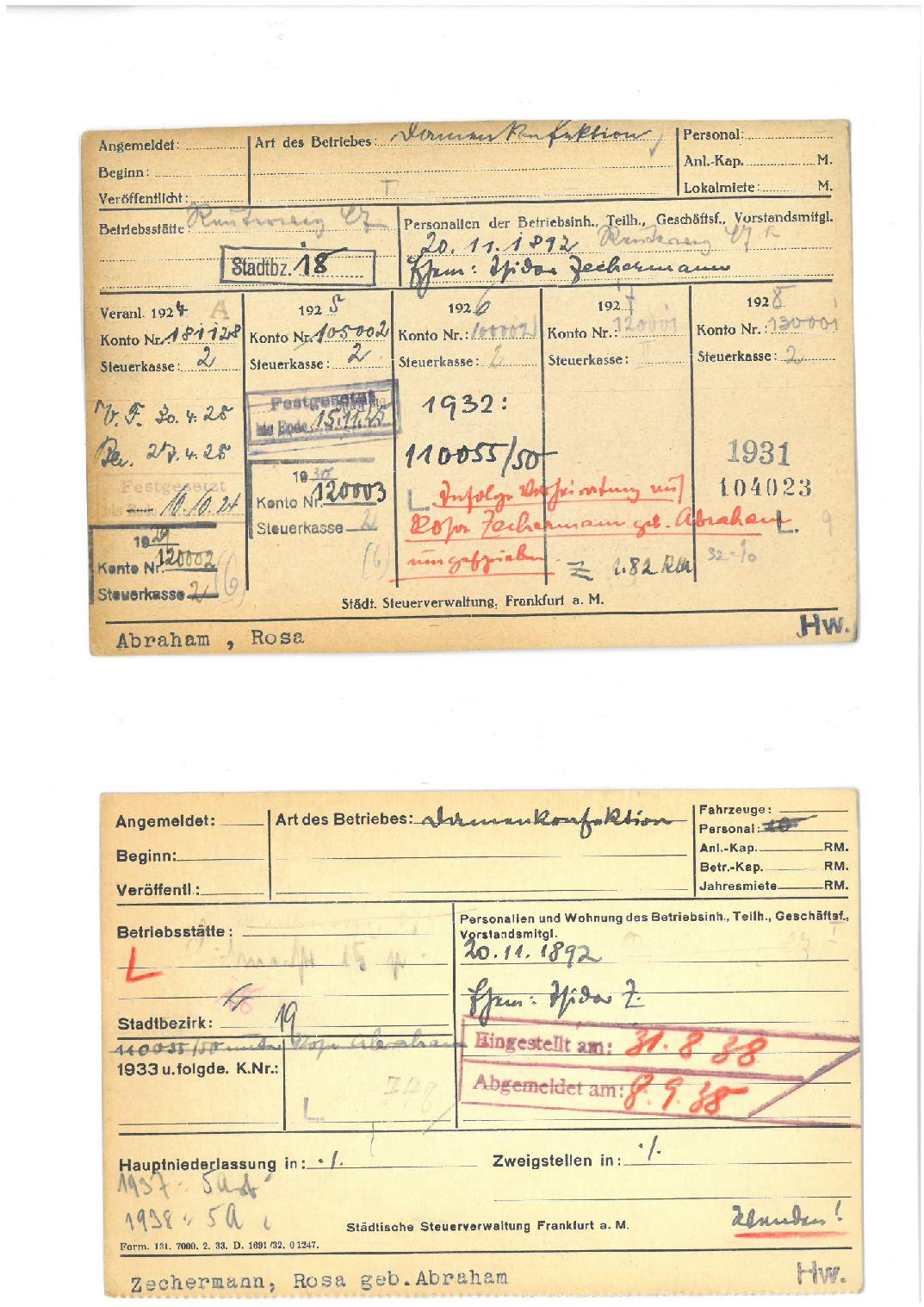
And Ms. Kaempfer sent me two documents relating to the businesses operated by Rosa and Isidor. For Rosa, she sent me this record of her tax payments from 1924 through 1932 for her “Damenkonfektion” or ladies’ clothing business. The form also notes the change to her married name Zechermann. And it indicates that Rosa’s business was shut down on August 31, 1938, and deregistered on September 8, 1938, presumably by the Nazis.

Rosa Abraham business record 1924-1938

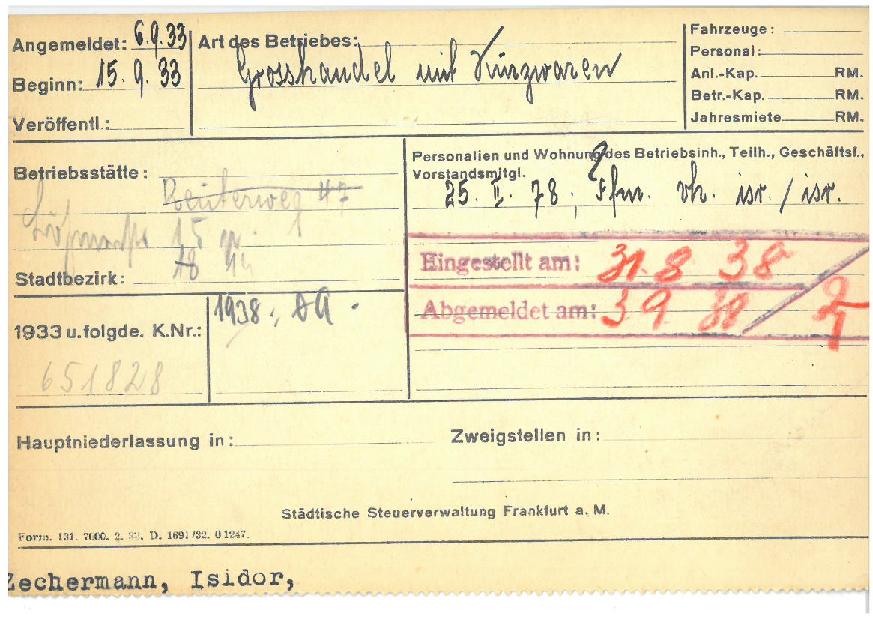
For Isidor, Ms. Kaempfer sent me the record of his registration as a haberdasher in Frankfurt. He first registered on September 6, 1933.

Isidor Zechermann business registration and deregistration

I am not sure how to interpret the various entries on the first line below the solid line on the right side of this card, which asks about the location and personnel of the management of the business, but the last two notes there—-“isr./isr” —-are quite obviously a reference to the fact that the owner of the business was Jewish (“Israeltisch”). And the red stamped entries on this card—indicating that the business was shut down on August 31, 1938 and deregistered on September 3, 1938—are clearly a reflection of Nazi persecution as presumably was the case with Rosa’s business.

With these final records, I now have closure on the life of Rosa Abraham and Isidor Zechermann.  I know when and where they were born, when and where they married, where they lived and worked in Frankfurt, when they emigrated from Germany and moved to Chile, and when they died. But it truly took a village to get here.

This search has proven once again that this work cannot be done alone and depends on the generosity of many people.  Thank you all! As this year draws to a close, I am mindful of and grateful for all the help I have received in 2017.

Let me take this opportunity to wish all my friends, family, and readers who celebrate Christmas a joyful and loving holiday.  I will be taking a short break from blogging, but will return in 2018 to start the saga of my Goldschmidt family.

Merry Christmas and  Happy New Year! Have a safe and happy holiday, everyone!


James Seligman: More Items from Wolfgang

When I wrote the recent post about the news articles my cousin Wolfgang had found about our Seligman(n) relatives, I had forgotten that a month earlier Wolfgang had sent me some other items he’d found about our relative, James Seligman—brother of Bernard, my great-great-grandfather, and August, Wolfgang’s great-grandfather. Somehow that earlier email had gotten lost in the mess that is my inbox. My apologies to Wolfgang!

A little more background on James: He was the youngest child of Babette Schoenfeld and Moritz Seligmann, born in about 1853 in Gau-Algesheim. By the time he was 28 in 1881 he had immigrated England where he was a wine merchant in Kilpin, Yorkshire, in conjunction with his brothers August and Hieronymus, who were living in Germany. He took sole control over that business in 1891.

London Gazette, March 20, 1891

In 1887, James married Henrietta Walker Templeton in London. In 1901, they were living in Scotland, but by the 1920s they had returned to England and were living in Birmingham where he remained for the rest of his life.

Henrietta died on October 4, 1928, and a year later in December 1929, James married his second wife Clara Elizabeth Perry. Clara was 45 years younger than James; she was 31 when they married, he was 76. He died just three months after they married on March 11, 1930. Clara remarried two years later and died in 1981. James did not have children with either of his wives.

Wolfgang found an obituary for James in the March 14, 1930 issue of the Birmingham Gazette:

b Birmingham Daily Gazette, March 14, 1930, p. 3

Mr. James Seligman

Death of Birmingham Hotel Expert

The death has occurred at the age of 77 of Mr. James Seligman, of 11 Yately-road, Edgbaston, Birmingham.

Formerly in business in Scotland, where he owned a number of hotels, Mr. Seligman was managing director of the Grand and Midland Hotels, Birmingham, and of the King’s Head Hotel, Sheffield.

He was an expert on all business matters connected with hotel management, and was often consulted by proprietors and managers of hotel establishments in all parts of the country.

He was the sole proprietor of Seligman and Co., wine merchanges, Colmore-row, Birmingham, and although ill in bed, was dealing with business affairs up to within a few hours of his death.

A great lover of music, Mr. Seligman was a regular concert-goer and an enthusiastic supporter of musical societies.

A funeral service will be held at Perry Barr Crematorium on Saturday.

From the obituary, Wolfgang knew where James had lived and captured this photograph of the former residence from Google Maps:

James Seligman residence in Birmingham, England

He also sent me this photograph of the Grand Hotel in Birmingham where James had been the managing director:

Grand Hotel, Colmore Road, Birmingham, England 1894

Interestingly, Wolfgang located an ad for Seligman’s Wine Merchants in the October 30, 1969, Birmingham Daily Post. It was still located on Colmore Row in Birmingham and called Seligman’s almost forty years after James died in 1930.

Birmingham Daily Post, October 30, 1969, p. 3

Thank you again to Wolfgang for sharing these items which shed more light on the personality and life of James Seligman, my three-times great-uncle and Wolfgang’s great-great-uncle.

Seligman(n)s in the News

One of the great advantages I had when I was researching my Santa Fe Seligman family was the availability of numerous newspaper articles about members of the family. Because my great-great-grandfather Bernard Seligman and his son Arthur Seligman were both important business and political leaders in Santa Fe, there was extensive coverage of their lives—and not just their business and political lives, but also their personal lives. The news articles gave me great insights into their personalities and the way they were perceived in their communities.

Now my cousin Wolfgang Seligmann has uncovered more articles—not only about the Santa Fe Seligmans but also about their relatives abroad.

My favorite article of those uncovered by Wolfgang is this one, an obituary of my three-times great-grandmother Babette Schoenfeld Seligmann from the February 2, 1899 issue of the Santa Fe New Mexican.

Obituary of Babette Schoenfeld Seligmann, Santa Fe New Mexican, February 2, 1899

Death of Mrs. M[oritz] Seligman

Hon. Bernard Seligman received the sad intelligence today, that Mrs. M. Seligman, mother of Bernard and Adolf Seligman, of this city, died at Gau-Algesheim, Germany, January 15, 1899, at the advanced age of 89. She left seven children, two daughters and five sons, all living, in England, Germany and the United States.  Mrs. Seligman was a remarkable women in many ways, she brought up her children to be honorable and valuable citizens, as might be inferred from the honored career of the two sons who have for so long been esteemed members of this community, and who are so widely respected throughout New Mexico.  Mrs. Seligman was a woman of rugged and sterling good sense, and a just, affectionate parent, and the many friends of Messrs. Seligman in this territory will sympathize with them in their loss.

The Sante Fe New Mexican reporter could not have known Babette, so the descriptions must have come from her sons Bernard and Adolf.  They reveal so much about Babette’s personality and how she was perceived and loved by her sons.

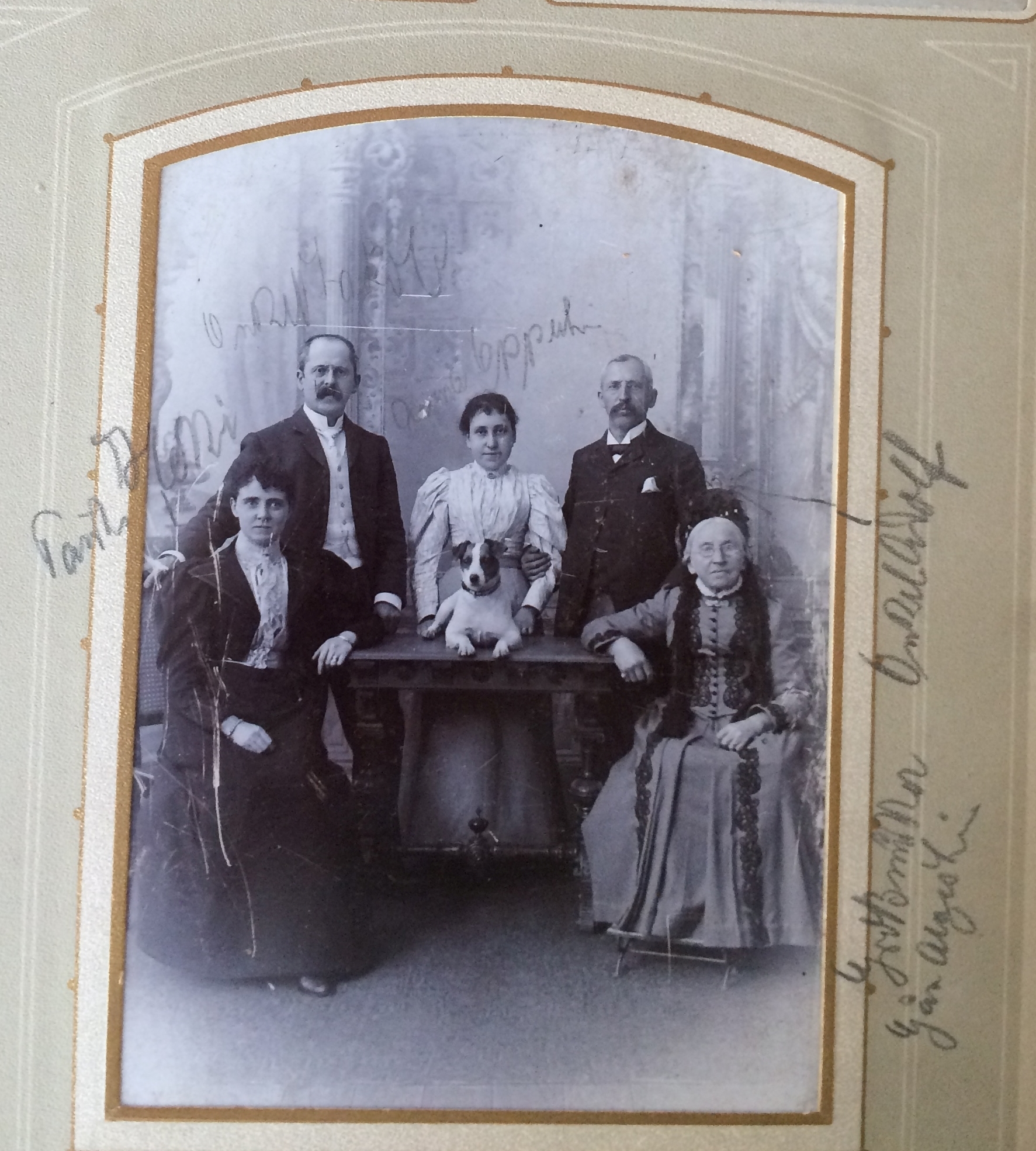
Here she is on the far right with two of her sons, James on the left, Adolf on the right, with her granddaughter Anna Oppenheimer in the center and her daughter-in-law Henrietta on the far left. (Sorry, I don’t know the name of the dog.)

Far right, Babette Schoenfeld Seligmann with two of her sons, Jakob/James and Adolf, James’ wife Henrietta, and in the center, granddaughter Anna Oppenheimer.

I thought this little news item that Wolfgang found was also interesting. It is an announcement of the dissolution of a London wine business owned by three of the Seligmann brothers: Wolfgang’s great-grandfather August Seligmann, his younger brother Hieronymus Seligmann, and the youngest sibling, James Seligman.   James, who was born Jakob, was the brother who left Germany for England and Scotland, unlike my great-great-grandfather Bernard and his brother Adolf, who went to New Mexico, or August and Hieronymus, who stayed in Germany.  The notice announced the takeover of the wine business in England by James alone as of the end of July, 1890.

London Gazette, March 20, 1891

I knew that James had been a wine merchant, but was not aware that his brothers were his partners initially. James was ultimately quite successful and, according to my cousin Lotte, owned hotels in Great Britain.

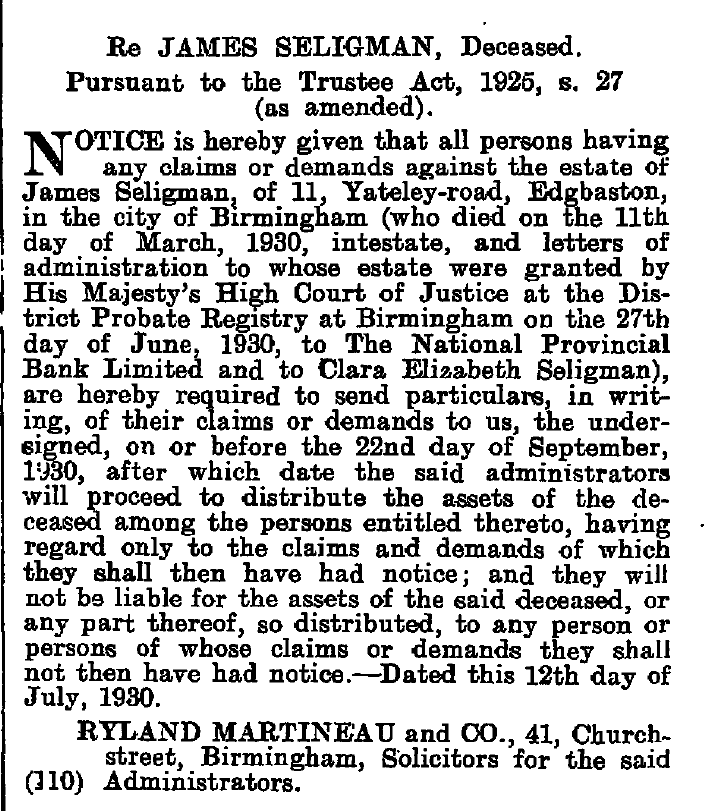
Wolfgang also found a notice in the July 15, 1930 issue of the London Gazette notifying those with possible claims against the estate of James Seligman of his death on March 11, 1930, and outlining what they needed to do to pursue those claims. It’s interesting that a man as successful as James died intestate (i.e., without a will).  The National Provisional Bank Limited and James’ widow Clara had been appointed administrators of his estate.  It was the settlement of James Seligman’s estate and the bank’s search for his heirs that led me to so many other Seligmann relatives.

London Gazette July 15, 1930

Two articles that Wolfgang sent were stories I’d not seen before about my great-uncle Arthur Seligman. The first is a profile of him published in the January 13, 1904, Santa Fe New Mexican (p. 9). The biographical information I have reported elsewhere so I will just quote a few excerpts from this article, written when Arthur was a County Commissioner in Santa Fe.

Describing the current status and success of the Seligman Brother’s mercantile business in Santa Fe, of which Arthur was then a director and secretary-treasurer, the article states, “Model methods, courteous treatment, absolutely fair dealing, and prompt service have characterized the business of the firm since 1856, and are today the mottoes of the two young men [Arthur and his younger brother James L. Seligman] conducting it.”

About Arthur specifically, the article states that he “is very popular in his home city.   [His success in the election as a County Commissioner] is good evidence that he is liked and respected where best known. It is a fact universally acknowledged that he has filled the important position of County Commissioner for the First District, for the past three years with marked ability, constant efficiency, and great benefit to the taxpayers and property owners, and that he has aided greatly in bringing about a very large and gratifying reduction in county expenses since taking office on the first of January, 1901.”

The article then goes on to praise his other roles and accomplishments, concluding by saying, “He is as enterprising, progressive and good a citizen as Santa Fe can boast of.”

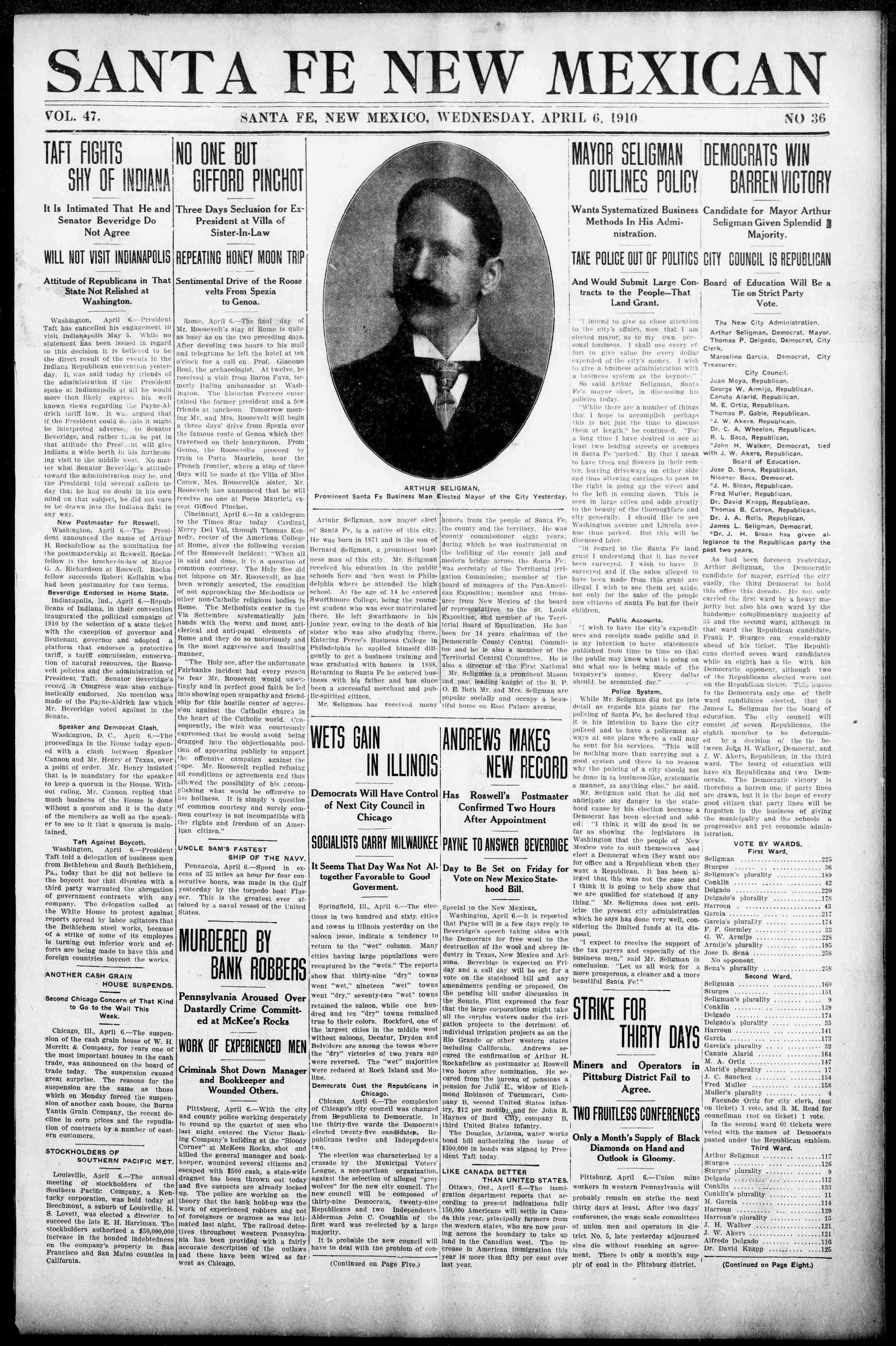
Six years later Arthur was elected mayor of Santa Fe and was featured on the front page of the April 6, 1910, issue of the Santa Fe New Mexican. The articles provide a biography and a description of his plans for Santa Fe during his upcoming term as mayor.

Santa Fe New Mexican, April 6, 1910, p. 1

Twenty years later, Arthur would be elected governor of New Mexico. Here he is attending the 1932 Democratic convention in Atlantic City, accompanied by my cousin Marjorie Cohen and my great-grandmother Eva Seligman Cohen, his sister.

Arthur Seligman, Marjorie, Cohen and Eva May Seligman Cohen, 1932 Atlantic City

Much thanks to my dear cousin Wolfgang for finding and sharing these articles about our relatives.


Julius Simon and Bertha Alexander: Mystery Solved!

Back on October 24, 2017, I wrote about Regina Katzenstein, the daughter of Mina Katzenstein and her husband Wolf Katzenstein. Mina Katzenstein was a daughter of Jacob Katzenstein and Sarchen Lion and was the niece of my great-great-grandfather Gerson Katzenstein. Her daughter Regina was thus my paternal grandmother’s first cousin.

Regina married Selig Alexander of Frankenau, and they had seven children, but only four lived to adulthood: Bertha, Rosa, Mina, and Samuel. I learned that Regina, Seligman, and three of their children had escaped to South Africa in the 1930s, but I had no luck finding out what had happened to their oldest daughter Bertha. I knew she had married Julius Simon of Pohl-Goens in 1922, but that was it. I didn’t know whether they had any children or whether they had survived the Holocaust. They just seemed to have disappeared.

I asked Aaron Knappstein if he could help, and he soon sent me this wonderful photograph of Julius Simon taken when he was serving in the German military during World War I. But I’d given up on ever finding out what had happened to Julius and Bertha after 1922.

And then last week Aaron shocked me by emailing me that he had learned what had happened to Julius Simon and Bertha Alexander. Aaron had written to Dr. Dieter Wolf, the head of the museum and archives for the city of Butzbach, Germany, and Dr. Wolf had responded with detailed information about Julius and Bertha. Now I have closure on one of the most perplexing mysteries in my research of the Katzenstein family.

Dr. Wolf relied on a review of documents including address books from Pohl-Goens but primarily on a book written by Werner Reusch in 1998 entitled Wäi the Bimbel noach ean Polgies gehale hoat. Pohl-Göns in the 20th century (Selbstverlag Butzbach-Ebersgöns 1998). [I have no idea what that title means, and neither did Google Translate.  Does anyone?] UPDATE: See the comment from Michael Zorn below. Michael lives in Pohl-Gons and informed me that the title means “When the Steam Train Stopped in Pohl-Gons.” Thank you, Michael.

The book not only includes information about the family of Julius Simon and Bertha Alexander; it includes several photographs of them. Here is one of Julius and Bertha with both Bertha’s parents and Julius’ parents taken in 1923; I believe the young boy was Julius’ nephew.

Back row: Bertha Alexander, Regina Katzenstein Alexander, Selig Alexander, and Julius Simon in 1923 (found at p. 263 of Werner Reusch’s book, Wäi die Bimbel noach ean Polgies gehale hoat. Pohl-Göns im 20. Jahrhundert.  Selbstverlag Butzbach-Ebersgöns 1998

According to Dr. Wolf and Werner Reusch, Bertha and Julius had two children, a daughter Senta, born in 1926, and a son Martin, who died before his first birthday. He was born on September 9, 1928, and died on January 9, 1929; Martin is buried in Pohl-Goens.  According to Werner Reusch, the Simon family was a distinguished family in the town.

When Julius received a warning that he was going to be arrested by the Nazis in early 1936, he and Bertha and Senta left immediately, first going to Frankfurt for a short time and then to Johannesburg, South Africa, where Bertha’s parents and siblings also settled as well as many of Julius’ relatives. This is a photograph from Reusch’s book of Senta, Julius, and Bertha in 1940 in Johannesburg.

Senta Simon, Julius Simon, and Bertha Alexander Simon, 1940 Johannesburg. Found in Werner’s Reusch’s book Wäi die Bimbel noach ean Polgies gehale hoat. Pohl-Göns im 20. Jahrhundert. Selbstverlag Butzbach-Ebersgöns 1998, p. 264

In 1966, Bertha, Julius, and Senta left South Africa and moved to Israel, where they settled in Rehovoth. Julius died there in January 1987; my cousin Bertha Alexander Simon lived to 101, dying in February 1995. Here is a photograph of her celebrating her 100th birthday in Israel.

Bertha Alexander Simon celebrating her 100th birthday in Israel. Found on p, 264 in Werner Reusch’s book, Wäi die Bimbel noach ean Polgies gehale hoat. Pohl-Göns im 20. Jahrhundert. Selbstverlag Butzbach-Ebersgöns 1998

In addition to their daughter Senta, Bertha and Julius were survived by two granddaughters.

Thank you once again to Aaron Knappstein, who has proven time and time again that he is an excellent and persistent researcher and a good friend.


Last but Not Least, Levi Katzenstein and His Heroic Great-Grandson, Arye Katzenstein

How painful it must have been for this family to lose a son to terrorism in Germany in 1970 after escaping from the Nazis in Germany less than forty years before.  This is the story of the family of Levi Katzenstein, the youngest child of the nine children of my three-times great-uncle Jakob Katzenstein and his wife Sarchen Lion. With this post I will have covered as best I can at this point the lives of all the descendants of Scholem Katzensten, my 4-times great-grandfather.

In some ways Levi’s story reflects the stories of all his siblings; there are children who died young or who were stillborn. There are children who were killed in the Holocaust. And there are children who escaped from Nazi Germany and whose descendants are alive today in various places in the world. And in this family, there was a hero who made the ultimate sacrifice to protect other people.

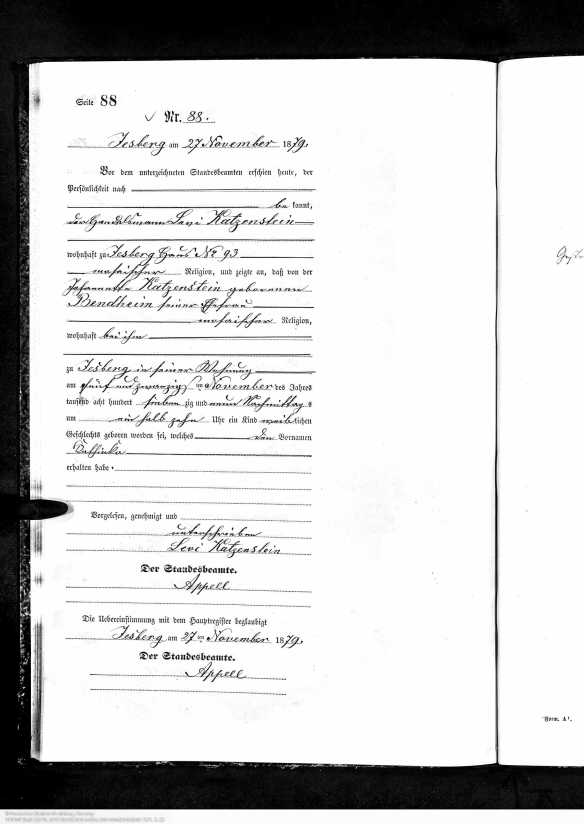
Levi was born on May 29, 1851, in Jesberg. He married Jeanette Bendheim on August 13, 1878.  Jeanette was born July 17, 1858, in Friedberg, Germany, daughter of Wolf Bendheim and Johanette Schering or maybe Schwarz (the mother’s birth name is very hard to read; these were the possibilities given by members of the Jekkes group on Facebook. I can’t read it at all.).

Marriage record for Levi Katzenstein

Marriage record of Levi Katzenstein and Jeanette Bendheim Hessisches Hauptstaatsarchiv; Wiesbaden, Deutschland; Collection: Personenstandsregister Heiratsregister; Signatur: 924; Laufende Nummer: 546

Levi and Jeanette had six children, four sons and two daughters. Their firstborn was Kathinka, born on November 25, 1879, in Jesberg.
Kathinka Katzenstein birth record
Hessisches Hauptstaatsarchiv; Wiesbaden, Deutschland; Collection: Personenstandsregister Geburtsregister; Signatur: 920; Laufende Nummer: 3810

Then came two sons, Jakob and David. Jakob was born February 25, 1882, six years after the death of his grandfather Jakob for whom he must have been named.

Jakob Katzenstein birth record
Hessisches Hauptstaatsarchiv; Wiesbaden, Deutschland; Collection: Personenstandsregister Geburtsregister; Signatur: 920; Laufende Nummer: 3813

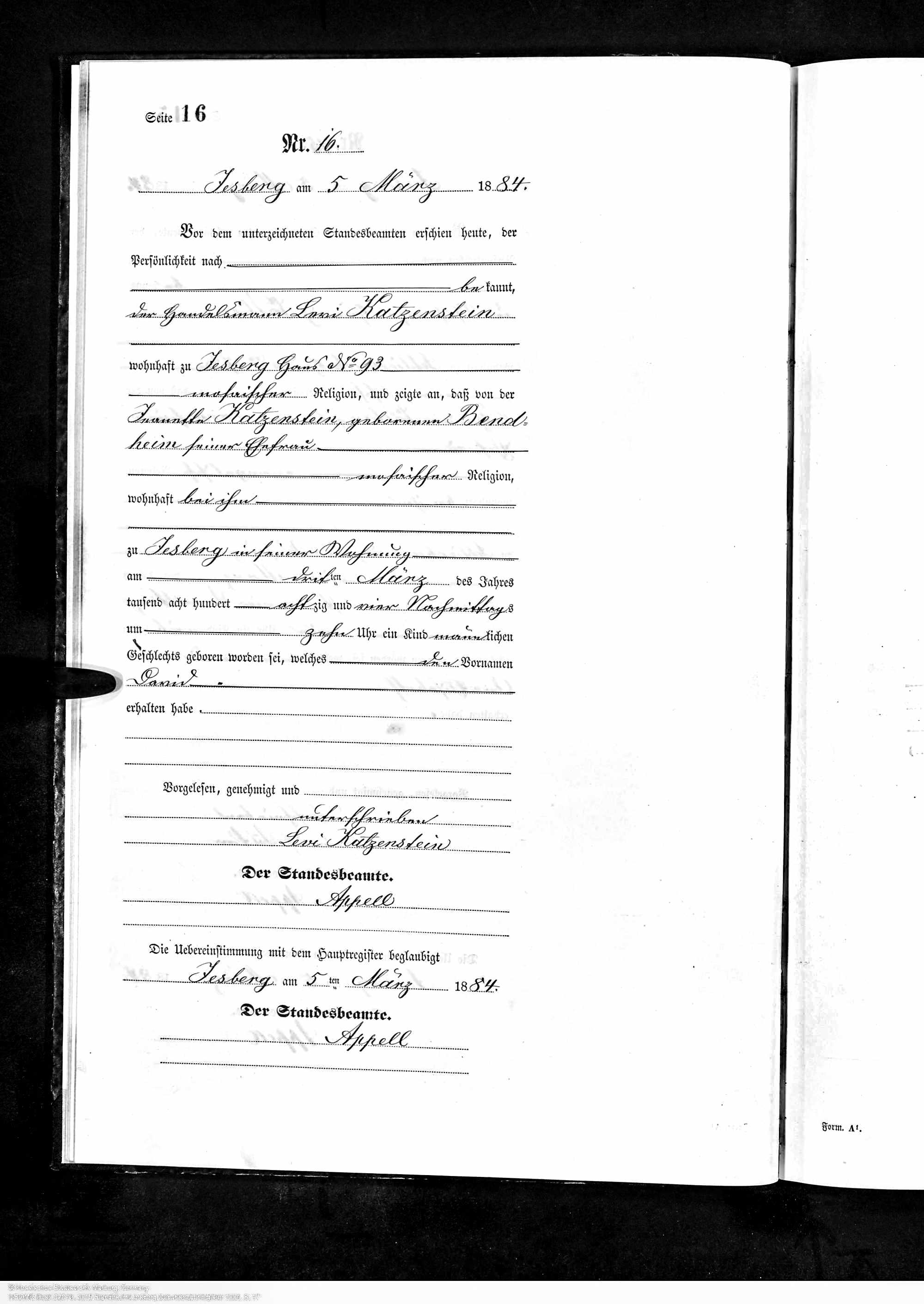
David was born two years later on March 3, 1884.

David Katzenstein birth record
Hessisches Hauptstaatsarchiv; Wiesbaden, Deutschland; Collection: Personenstandsregister Geburtsregister; Signatur: 920; Laufende Nummer: 3815

Sadly, the fourth child did not make it to her first birthday. Sara was born July 14, 1886, and died on May 11, 1887.

Sara Katzenstein death record
Hessisches Hauptstaatsarchiv; Wiesbaden, Deutschland; Personenstandsregister Sterberegister; Bestand: 920; Laufende Nummer: 3885

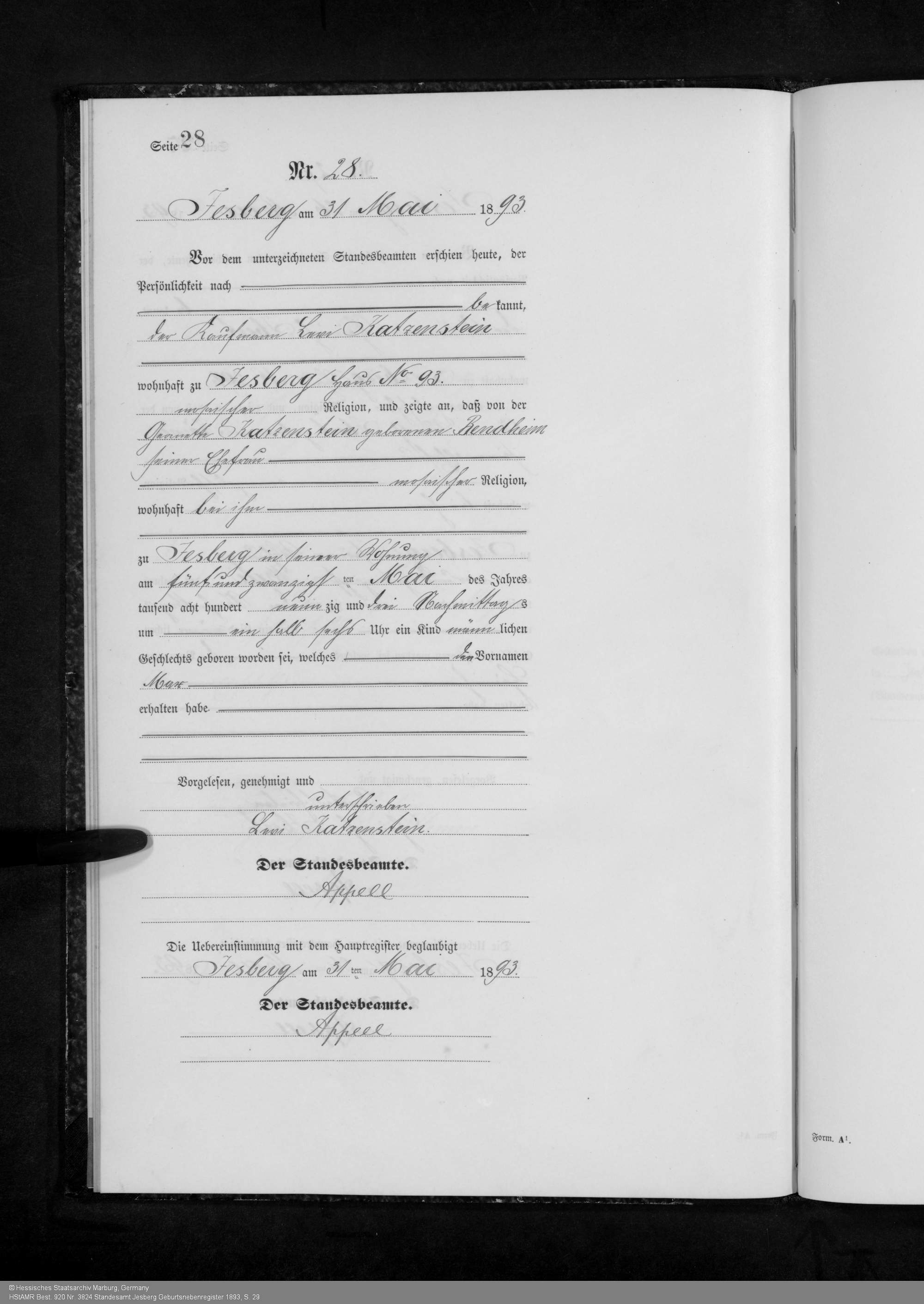
The last two children were boys. Sally Katzenstein was born on April 10, 1890, and Max Katzenstein was born on May 15, 1893.

Sally Katzenstein birth record
Hessisches Hauptstaatsarchiv; Wiesbaden, Deutschland; Collection: Personenstandsregister Geburtsregister; Signatur: 920; Laufende Nummer: 3821

Max Katzenstein birth record
HStAMR Best. 920 Nr. 3824 Standesamt Jesberg Geburtsnebenregister 1893, S. 29

Thanks to Barbara Greve, I can share this photograph of the house in Jesberg where Levi and Jeanette Katzenstein raised their children:

Home of Levi Katzenstein in Jesberg

Four of the five children of Levi and Jeanette Katzenstein married and had children. Kathinka married Meier Bamberger on August 8, 1905, in Jesberg. Meier was born on June 8, 1878, in Holzheim, Germany, the son of Joseph Bamberger and Settchen Meier.

Kathinka Katzenstein and Meier Bamberger marriage record
Hessisches Hauptstaatsarchiv; Wiesbaden, Deutschland; Collection: Personenstandsregister Heiratsregister; Signatur: 920; Laufende Nummer: 3860

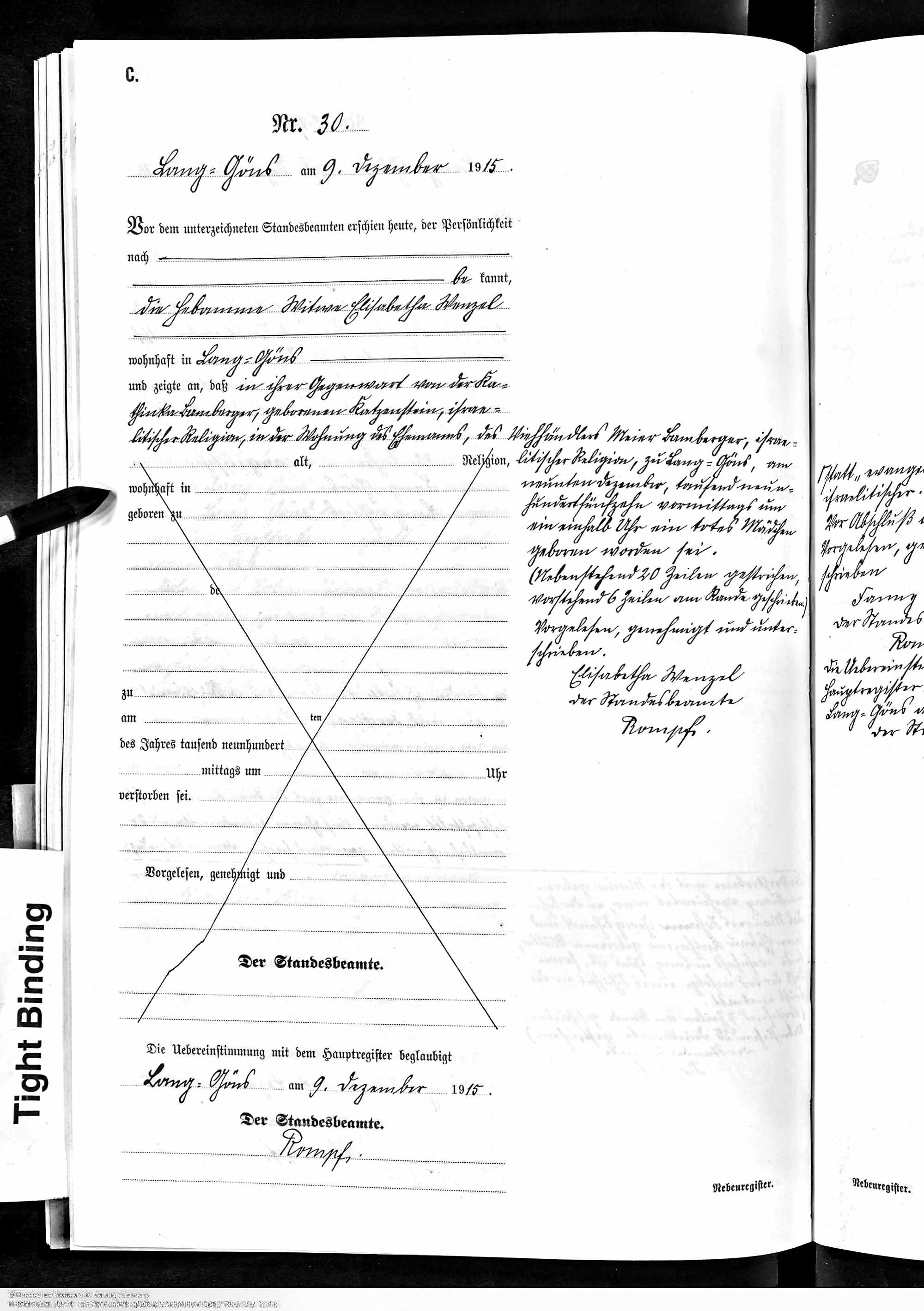
Kathinka and Meier Bamberger had one child who survived, a daughter Gertrud born in Holzheim on May 7, 1910, and also had a stillborn child on December 9, 1915.

stillborn child of Kathinka and Meier Bamberger
Hessisches Hauptstaatsarchiv; Wiesbaden, Deutschland; Personenstandsregister Sterberegister; Bestand: 905; Laufende Nummer: 796

Kathinka’s brother Jacob married Auguste Wallach on February 11, 1908, in Oberaula, Germany. Auguste was the daughter of Manus Wallach and Roschen Stern, and she was born on August 7, 1882, in Oberaula.

Marriage record of Jakob Katzenstein and Auguste Wallach
Hessisches Hauptstaatsarchiv; Wiesbaden, Deutschland; Collection: Personenstandsregister Heiratsregister; Signatur: 920; Laufende Nummer: 6351

Jacob and Auguste had one child, a son named Benjamin Willi born in Jesberg on November 18, 1908, according to the research done by Barbara Greve.

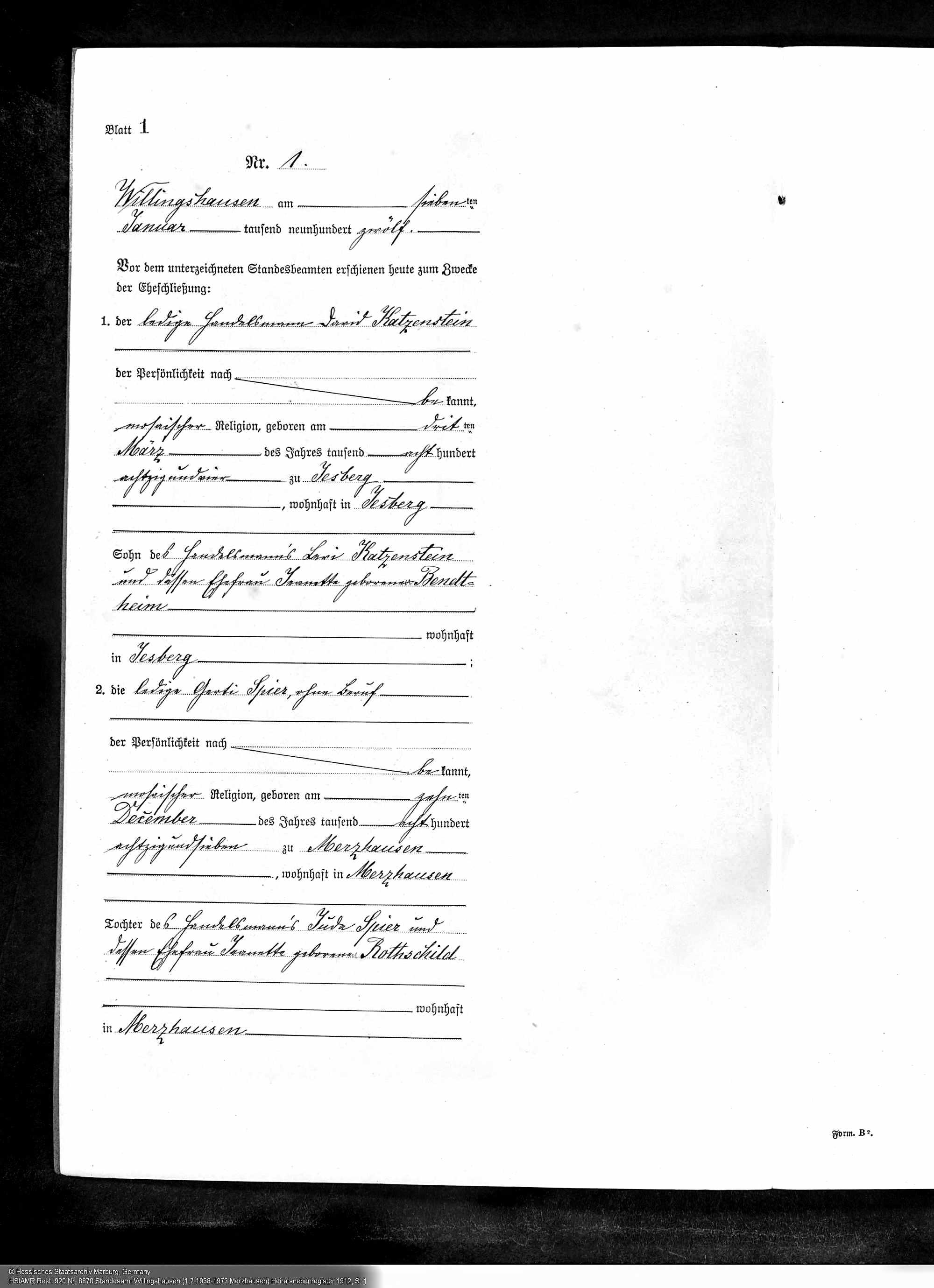
David Katzenstein married Gertrude Spier on January 7, 1912 in Merzhausen, Germany. Gertrude, the daughter of Juda Spier and Jeanette Rothschild, was born in Willinghausen, Merzhausen, Germany, on December 10, 1887.

Marriage record of David Katzenstein and Gertrude Spier
Hessisches Hauptstaatsarchiv; Wiesbaden, Deutschland; Collection: Personenstandsregister Heiratsregister; Signatur: 920; Laufende Nummer: 8870

David and Gertrude had a stillborn baby on October 27, 1912, and then three more children: Heinz (1913), Erich (1919), and Ursula (1923). Here is David Katzenstein’s house, as provided to me by Barbara Greve:

David Katzenstein’s house in Jesberg

The fourth surviving child of Levi and Jeanette was Sally Katzenstein. He married Gretha Nussbaum on December 24, 1913, in Wehrda, Germany. She was the daughter of Joseph Nussbaum and Rickchen Stein, born in Rhina, Germany, on August 5, 1891.

Marriage record of Sally Katzenstein and Gretha Nussbaum
Hessisches Hauptstaatsarchiv; Wiesbaden, Deutschland; Collection: Personenstandsregister Heiratsregister; Signatur: 907; Laufende Nummer: 6935

Sally and Gretha had two daughters, Elfriede (1914) and Ruth-Rika (1924).

The youngest child of Levi Katzenstein and Jeanette Bendheim was their son Max. Tragically, Max was killed fighting for Germany in World War I on June 4, 1915. According to Barbara Greve’s research, Max served as a musketeer in the Third Company of the 7th Infantry, Regiment No. 142. He was 22 years old. Given what happened to some of his siblings, his sacrifice for Germany is especially tragic.

Max Katzenstein death record
HStAMR Best. 920 Nr. 3913 Standesamt Jesberg Sterbenebenregister 1915, S. 27

Levi and Jeanette Katzenstein had thus already lost two of their children—their daughter Sara and their son Max. Then on May 17, 1921, they lost yet another child, their only other daughter Kathinka Katzenstein Bamberger. She was only 41 years old and left behind her husband Meier and their eleven year old daughter Gertrud.

Kathinka Katzenstein Bamberger death record
Hessisches Hauptstaatsarchiv; Wiesbaden, Deutschland; Personenstandsregister Sterberegister; Bestand: 905; Laufende Nummer: 797

Meier remarried seven months later on December 23, 1921; his second wife was Zerline Kahn, stepmother to little Gertrud.

After Kathinka’s death, Levi and Jeanette had only their three sons Jakob, David, and Sally surviving as well as their grandchildren. Levi died on April 3, 1929, and Jeanette died a year later on July 22, 1930.

Levi Katzenstein death record
Hessisches Hauptstaatsarchiv; Wiesbaden, Deutschland; Personenstandsregister Sterberegister; Bestand: 920; Laufende Nummer: 3920
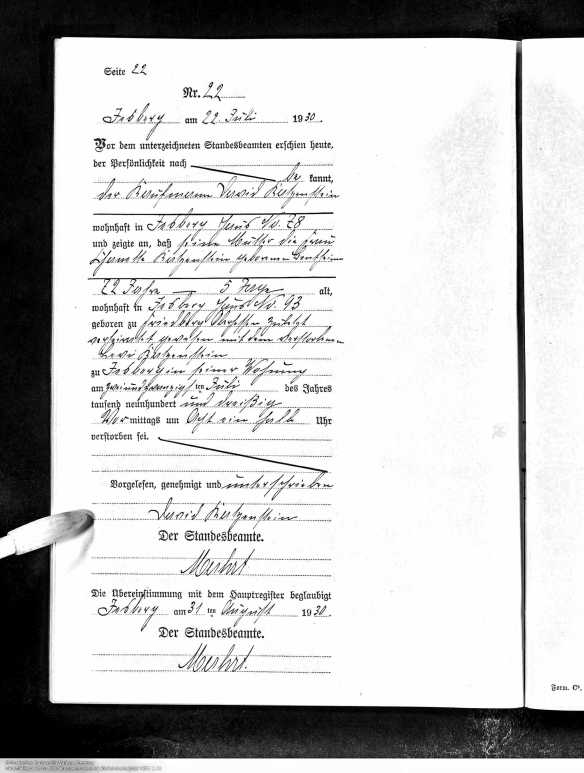
Jeanette Bendheim Katzenstein death record
Hessisches Hauptstaatsarchiv; Wiesbaden, Deutschland; Personenstandsregister Sterberegister; Bestand: 920; Laufende Nummer: 3921

They are both buried in Jesberg, as seen in this photograph I took while in Jesberg in May:

Levi Katzenstein and Jeanette Bendheim Katzenstein, Jesberg cemetery

Levi and Jeanette’s remaining family did not get to stay in their ancestral town of Jesberg. According to Barbara Greve, David Katzenstein was forced to sell his home and farm after the Nazis came to power. He and his family left for Palestine in 1934. His brother Jakob left three years later in 1937.

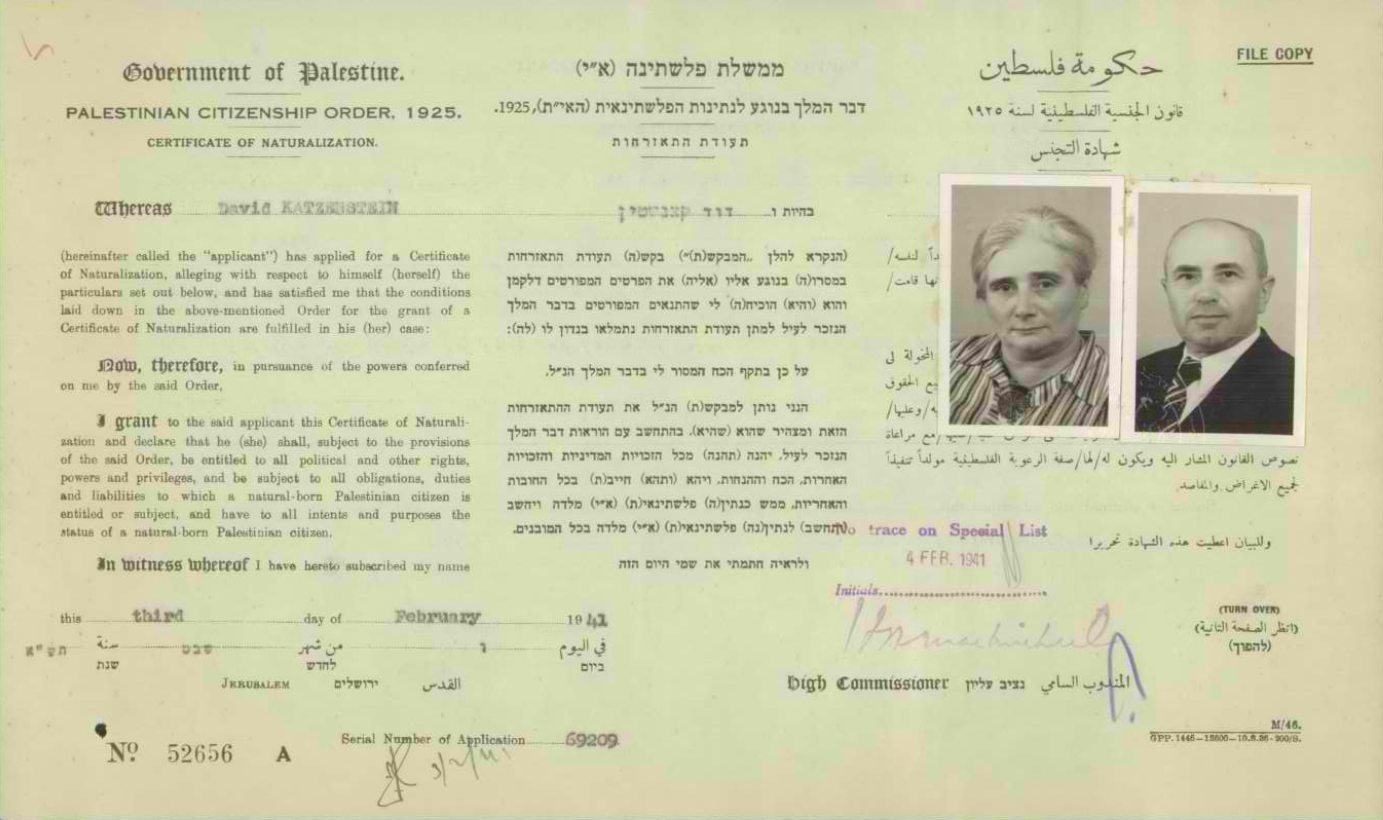
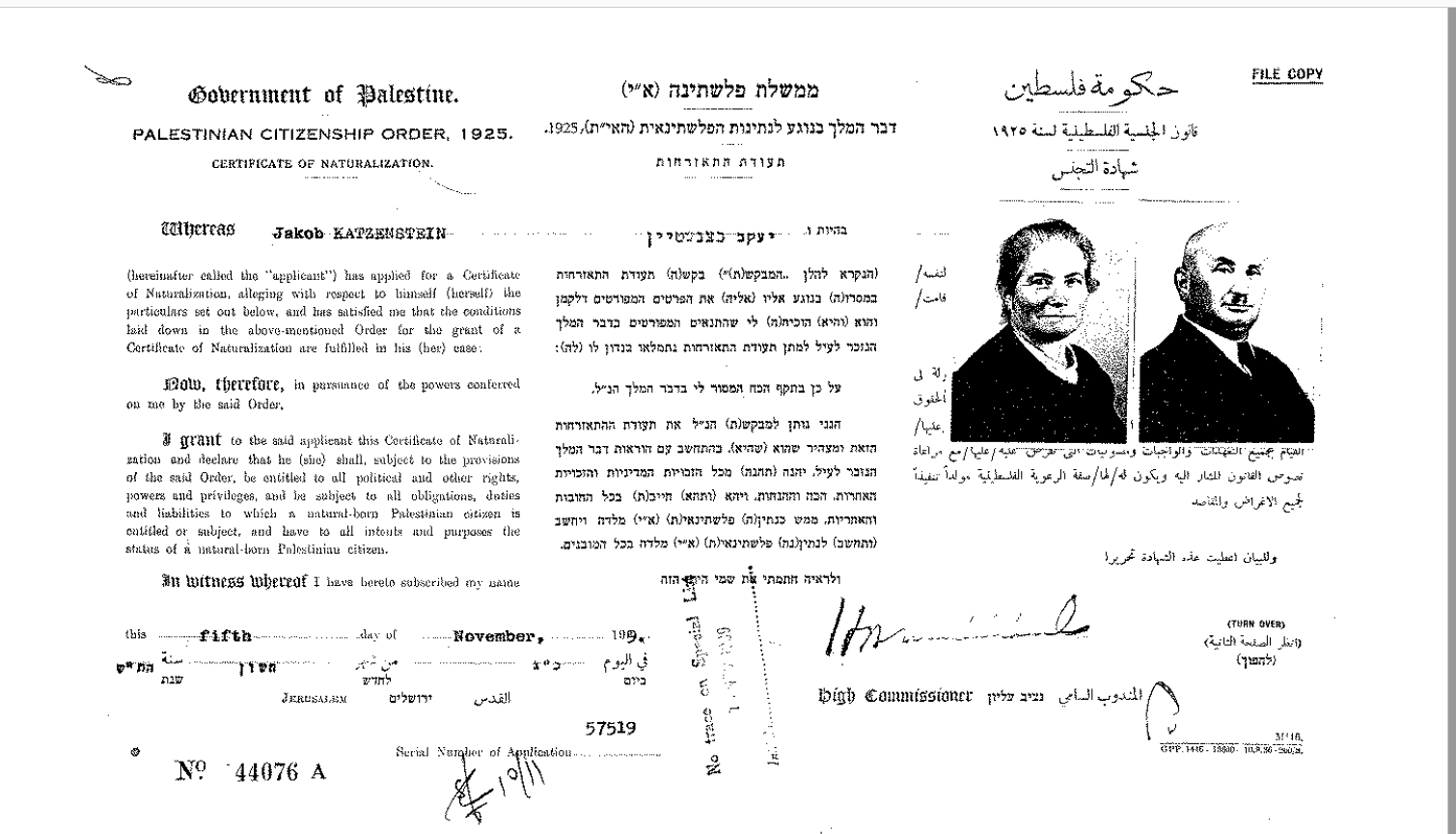
Jakob and David and their families survived the Holocaust and settled in Palestine where, as these documents reveal, they became naturalized citizens.

Naturalization petition and citizenship order in Palestine for David Katzenstein and
Gertrude Spier
http://www.archives.gov.il/en/

Naturalization petition and citizenship order in Palestine for David Katzenstein and Gertrude Spier http://www.archives.gov.il/en/

Palestine Application for Naturalization for Jakob Katzenstein and Auguste Wallach http://www.archives.gov.il/en/

Palestine Citizenship Order for Jakob Katzenstein and Auguste Wallach http://www.archives.gov.il/en/

Their younger brother Sally and his wife Gretha as well as their niece Gertrud Bamberger and her father and stepmother were not as fortunate.  They were all murdered by the Nazis. Gertrud Bamberger, her father Meier Bamberger and stepmother Zerline Kahn Bamberger were deported to the concentration camp at Treblinka on September 30, 1942, where they were killed. (The links are to their entries in the Yad Vashem database.)

The fate of Sally Katzenstein and his wife Gretha Nussbaum Katzenstein and their two daughters was described in detail on this website describing the Stolpersteine for the village of Minden, Germany. I will quote from this website, which tells in chilling terms the story of this Katzenstein family:

Sally Katzenstein was a teacher and a preacher. He taught in an Israeli school in Breitenbach, North Hessen, from 1911 and from 1921 until 1934 at the state school in Soest. At both schools he also had the responsibility for teaching four hours each week at a school for further education. In Soest he was [a] preacher to the Synagogue congregation.

Shortly after the National Socialists took over power on the 7th April, 1933, the law for the Reinstatement of the Career Civil Servants was passed. This was to enable the removal of unwanted officials, especially Jews, from governmental posts. Sally Katzstein also fell foul of this law and on 29th March, 1934, lost his occupation as a teacher.

On 1st September, 1935, the family moved to Minden and found a home in Wilhelmstrasse 18. Sally Katzenstein became the local representative for the National Association of Jews in Germany and later preacher to the Synagogue Community. As Jewish children were banned from State schools he held lessons in private rooms.

After the November Pogrom of 1938 Sally Katzenstein was required to pay 1.400 Reichsmark tax on his fortune. These taxes were cynically called ‘Jewish Punishment Tax’. With this money the Jews had to pay for damage that had been done to their property, by others, during the Pogrom.

In 1939 the family tried to emigrate to Palestine but only their daughter, Ruth Rika, was given permission to leave. Her sister, Elfriede, had emigrated in 1936. In 1941 Sally and Gretha submitted an application to emigrate to the USA and permission was granted but then was foiled by the USA entering the war.

In 1941 the Katzensteins were forced to leave their home and to move into the so called Jewish house in Kampstrasse 6, The Jewish community house together with lots of other Jews, in very cramped conditions.

In the spring of 1943 Sally and Gretha Katzenstein were the last Jews living in Minden but they were arrested and taken to Bielefeld and from there were deported to Teresienstadt. From there they were taken separately to Auschwitz where they were both murdered in October 1944.

Fortunately, both of Sally and Gretha’s daughters survived. Elfriede, their older daughter, married to Siegfried Berliner, settled in Palestine, now Israel, where she died on December 8, 2011, according to this obituary. She was 97 years old and had three children.  Her sister Ruth Rika Katzenstein married Harold Rosenberg and settled in Scotland where Ruth was registered as a nurse for many years. I have not yet found a death record for Ruth nor do I know whether she had any children.

UPDATE: As seen below, I was contacted in March 2023 by Glyn Green, who had some additional information about Ruth Katzenstein Rosenberg. That led me to check my notes and research a bit more. Ruth died on November 23, 2017, and is buried in Glenduffhill Cemetery in Glasgow; her husband Harold died May 20, 2007, and is buried in the same cemetery. Glyn reported that they had an adopted son Daniel. See the Scottish Jewish Cemetery website at https://scottishjewishcemeteries.org/?s=harold+rosenberg&asl_active=1&p_asid=1&p_asl_data=1&qtranslate_lang=0&asl_gen%5B%5D=title&asl_gen%5B%5D=content&asl_gen%5B%5D=excerpt&customset%5B%5D=graveyard

There is one final tragic story to tell about the descendants of Levi Katzenstein. As noted above, two of his sons, Jacob and David, immigrated to Palestine in the 1930s. David and his wife Gertrude had three children: Heinz, Erich, and Ursula. Heinz had a son named Arye born in Haifa, Israel, in 1937.

On February 10, 1970, Heinz was seriously injured and Arye was killed during a terrorist attack on a bus that was supposed to take them from the Munich Airport terminal to an El Al jet they were planning to board. The details were described in a September 6, 2015, obituary for Uriel Cohen, an El Al pilot who had tried to stop the attack:

The attack in Germany occurred on February 10, 1970, at 12:50pm. An El Al plane on Flight 435 from Israel had landed at the airport shortly before. Some passengers intended to continue to London, [and] were on their way to a bus that would take them to a connecting flight. A scream was suddenly heard and three young Arab men came from the direction of the transit hall stairs, shouting and running towards the bus, ordering passengers to put their hands up.

The captain tackled the assailants, but they managed to toss two hand grenades at the bus. One of the terrorists pulled out a gun, and another grenade was thrown. Arye Katzenstein of Haifa, 32 at the time, was on the bus with his father and sprinted towards one of the grenades. He used his body to prevent other passengers from being wounded. He died at the scene and his father was severely wounded.

Arye Katzenstein, my fourth cousin, was a hero. His family had left Germany to escape from the Nazis, and almost forty years later he was killed in Germany while trying to protect others from a terrorist attack.

It does make me wonder whether hate will ever end.  It also makes me realize that there will always be good people who will fight that hate and provide us all with hope and inspiration.

 

Pauline, Baruch, and Meier: Heartbreaking Stories

I am now more than half way through the nine children of  my three-times great-uncle Jakob Katzenstein and his wife Sarchen Lion; there are four more to go, and this post will cover three of them: Pauline, Baruch, and Meier. Special thanks to Cathy Meder-Dempsey for her help in translating some of the records in this post.

Sadly, I have very little to report about Pauline. She was born on May 12, 1841, in Jesberg, and died in Jesberg 61 years later on December 27, 1902. She did not marry or have children and presumably lived in Jesberg all her life.

Death record of Pauline Katzenstein
HStAMR Best. 920 Nr. 3900 Standesamt Jesberg Sterbenebenregister 1902, S. 49

As explained to me by Cathy Meder-Dempsey, the marginal notation refers to the fact that Pauline died without an occupation. She is buried in the cemetery in Jesberg, where I took this photograph of her gravestone.

Pauline Katzenstein, daughter of Jacob Katzenstein

I am sorry that I do not know more about her life.

Baruch, the seventh child of Jakob and Sarchen, was born April 30, 1844, in Jesberg, and died there when he was 75 on March 26, 1920.

Baruch Katzenstein death record
Hessisches Hauptstaatsarchiv; Wiesbaden, Deutschland; Personenstandsregister Sterberegister; Bestand: 920; Laufende Nummer: 3915

I also know very little about his life. Although I could not locate a marriage record, it appears that Baruch married Auguste Bertha Schlesinger, according to her death record.  She was born in Gladenbach in 1850 and died in Jesberg on November 2, 1890. She was the daughter of Feitel Schlesinger and Gelle Wolf, according to her death record.

Death record of August Bertha Schlesinger wife of Baruch Katzenstein
Hessisches Hauptstaatsarchiv; Wiesbaden, Deutschland; Personenstandsregister Sterberegister; Bestand: 920; Laufende Nummer: 3888

I was able to photograph the headstone for Baruch Katzenstein in Jesberg, but I don’t know where Auguste was buried. She died thirty years before Baruch and before the “new” Jesberg cemetery was being used. She should have been buried at Haarhausen cemetery, where the other Katzenstein family members were buried before Jesberg opened its own cemetery. But there is no record of her burial there on the LAGIS website, nor can I find a record of her burial at any of the other Hesse region Jewish cemeteries. Also, as far as I can tell, she and Baruch did not have any children.

Baruch Katzenstein, son of Jacob Katzenstein

Fortunately I have a little more information about Jakob and Sarchen Lion’s eighth child, Meier, but it is a very sad story.  Meier was born April 26, 1849. Sometime before September 1876, he married Auguste Wolf, who was born on October 27, 1851, in Gladenbach, Germany, to Folk Wolf and Ester Stern.

On September 13, 1876, Auguste Wolf Katzenstein gave birth to a son, August Felix Katzenstein.

August Felix Katzenstein birth record
Hessisches Hauptstaatsarchiv; Wiesbaden, Deutschland; Collection: Personenstandsregister Geburtsregister; Signatur: 920; Laufende Nummer: 3807

Six days later, Auguste Wolf Katzenstein died on September 19, 1876, leaving behind her husband Meier and her infant son. She was not yet 25 years old.

August Wolf Katzenstein death record
Hessisches Hauptstaatsarchiv; Wiesbaden, Deutschland; Personenstandsregister Sterberegister; Bestand: 920; Laufende Nummer: 3874

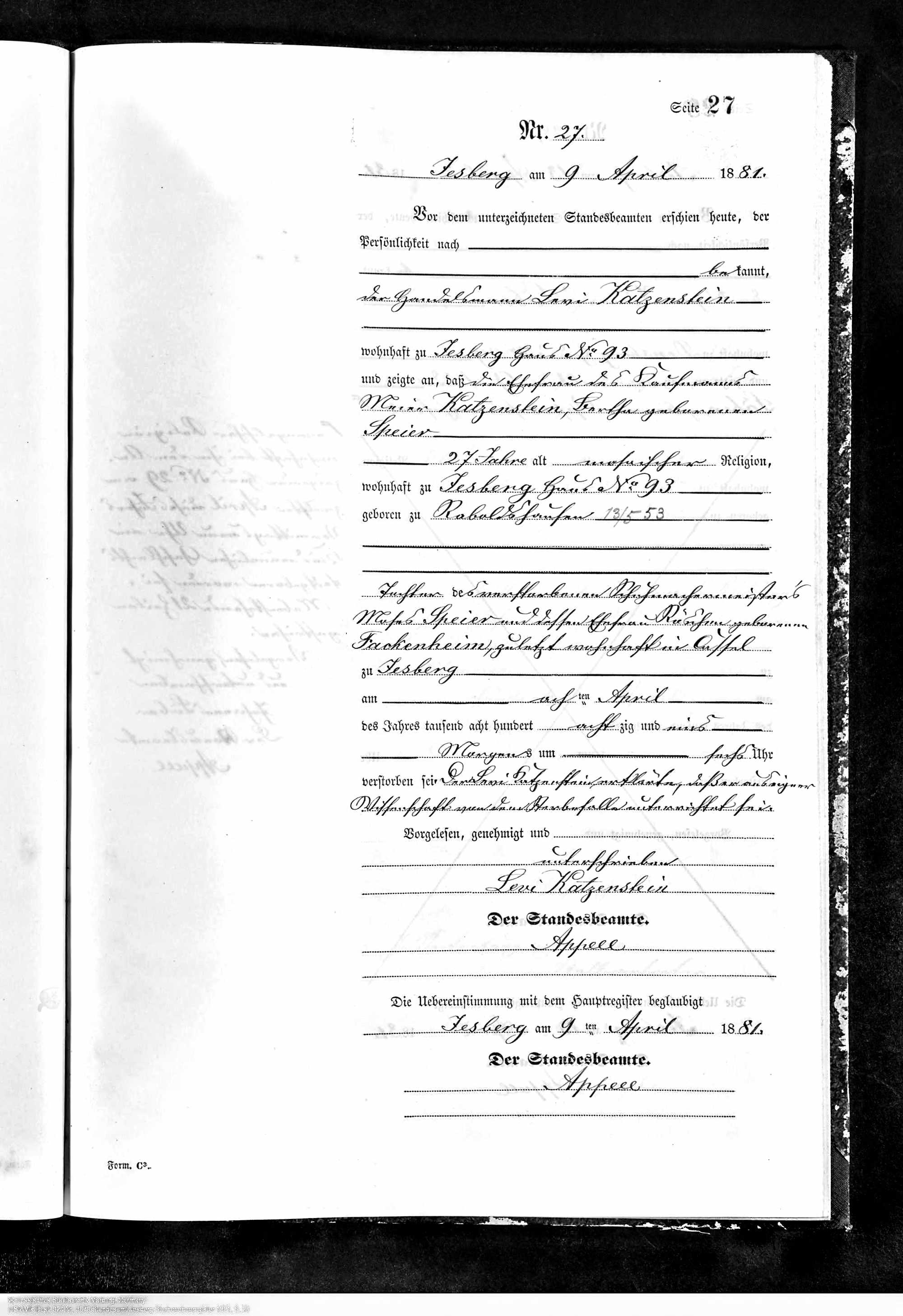
How Meier raised the baby for the next year and half is unknown, but then he married again. On May 19, 1878, he married Bertha Spier, daughter of Moses Spier and Roschen Fackenheim. Bertha was born in Raboldshausen on May 13, 1853.

Marriage record of Meier Katzenstein and Bertha Spier
Hessisches Hauptstaatsarchiv; Wiesbaden, Deutschland; Collection: Personenstandsregister Heiratsregister; Signatur: 920; Laufende Nummer: 3833

Bertha gave birth to the couple’s first child, a son named Julius, on March 18, 1879, in Jesberg.

Birth record of Julius Katzenstein
Hessisches Hauptstaatsarchiv; Wiesbaden, Deutschland; Collection: Personenstandsregister Geburtsregister; Signatur: 920; Laufende Nummer: 3810

A second child was born on July 2, 1880, a daughter named Ida.

Birth record of Ida Katzenstein
HStAMR Best. 920 Nr. 3811 Standesamt Jesberg Geburtsnebenregister 1880, S. 56

Ida only lived ten months; she died on April 1, 1881.

Death record of Ida Katzenstein
HStAMR Best. 920 Nr. 3879 Standesamt Jesberg Sterbenebenregister 1881, S. 26

Her mother Bertha died one week after her baby daughter on April 8, 1881.  She was 27 years old.

Death of Bertha Spier Katzenstein
Hessisches Hauptstaatsarchiv; Wiesbaden, Deutschland; Personenstandsregister Sterberegister; Bestand: 920; Laufende Nummer: 3879

It seems too cruel to imagine that in the space of less than five years Meier lost two young wives and a ten-month-old child. He died just three years after Ida and Bertha on September 10, 1884, in Jesberg. He was 35.

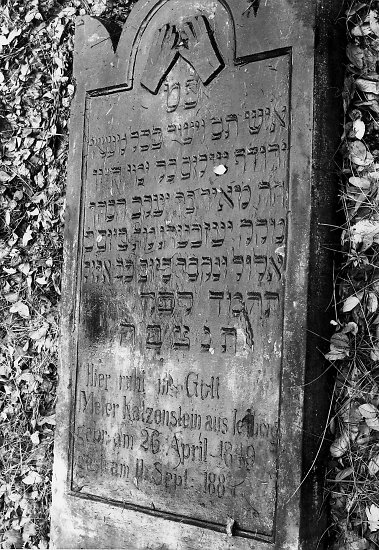
Here is his gravestone; unfortunately I did not find it when we were at Haarhausen, so this is from the LAGIS website:

According to the LAGIS website, the inscription reads as follows: “Here lies a righteous man, and upright in all his works, who strove for peace every day of his life. This is Meier, son of Jacob ha-Kohen, from the holy community of Jesberg.”

Meier left behind his two sons, August Felix Katzenstein, who was only eight years old when orphaned, and Julius Katzenstein, his half-brother who was only five years old. Where did these two little boys go after losing both of their parents? Did they go to live with their aunts or uncles who lived in Jesberg or nearby? I don’t know.

In fact, I have no further record for Julius Katzenstein—no marriage record, no death record. I wonder if he was adopted by a relative or another person and took on a new surname. Or did he also die as a child without a recorded death? I don’t know.

As for August Felix Katzenstein, his tragic story has already been told. He married his first cousin, once removed, Rosa Bachenheimer. August Felix was the grandson of Jakob Katzenstein and Sarchen Lion through their son Meier, and Rosa was their great-granddaughter through their daughter Gelle Katzenstein Ruelf and granddaughter Esther Ruelf Bachenheimer.

August and Rosa had two children: Margaretha Grete Katzenstein (1901) and Hans Peter Katzenstein (1905). All four of them, as well as Margaretha’s husband Rudolf Loewenstein, were deported on April 22, 1942, to a concentration camp in Izbica, Poland, where they were all murdered: RosaAugustMargaretha, Rudolf, and Hans-Jacob. (All links are to their entries in the Yad Vashem database.)

Thus, unless Julius Katzenstein survived, there are no descendants of these three children of Jakob Katzenstein and Sarchen Lion. Not a single soul alive to pass on the genes and the stories of Pauline, Baruch, or Meier Katzenstein.

That leaves only one more child of Jakob Katzenstein and Sarchen Lion, their youngest child, Levi. Because he had six children, I will tell his story in a separate post.


Klara Maas: A Survivor and American Idol Fan

As I said, many of the stories in this line of the family do not have happy endings. And it doesn’t get better with the next child of Jakob Katzenstein and Sarchen Lion, their fifth child and fourth daughter, Johanna. But there is hopefulness in this story as well.

As reflected on Reverend Bach’s report on the family of Jakob Katzenstein and Sarchen Lion, Johanna/Hanna was born on December 28, 1838, in Jesberg.

She married Simon Maas, who was five years younger than Johanna and born in June 1843 in Mardorf. According to Barbara Greve’s research, Johanna and Simon married on December 3, 1873. If so, Johanna was 35 and Simon 30.

Their first child was born on April 26, 1875, in Mardorf, a daughter named Gidel, also known as Auguste.

Birth record for Auguste Gidel Maas
Hessisches Hauptstaatsarchiv; Wiesbaden, Deutschland; Collection: Personenstandsregister Geburtsregister; Signatur: 915; Laufende Nummer: 5870

Their second child was a son, Jacob Levi, born on September 28, 1876.

Jakob Levi Maas birth record
Hessisches Hauptstaatsarchiv; Wiesbaden, Deutschland; Collection: Personenstandsregister Geburtsregister; Signatur: 915; Laufende Nummer: 5871

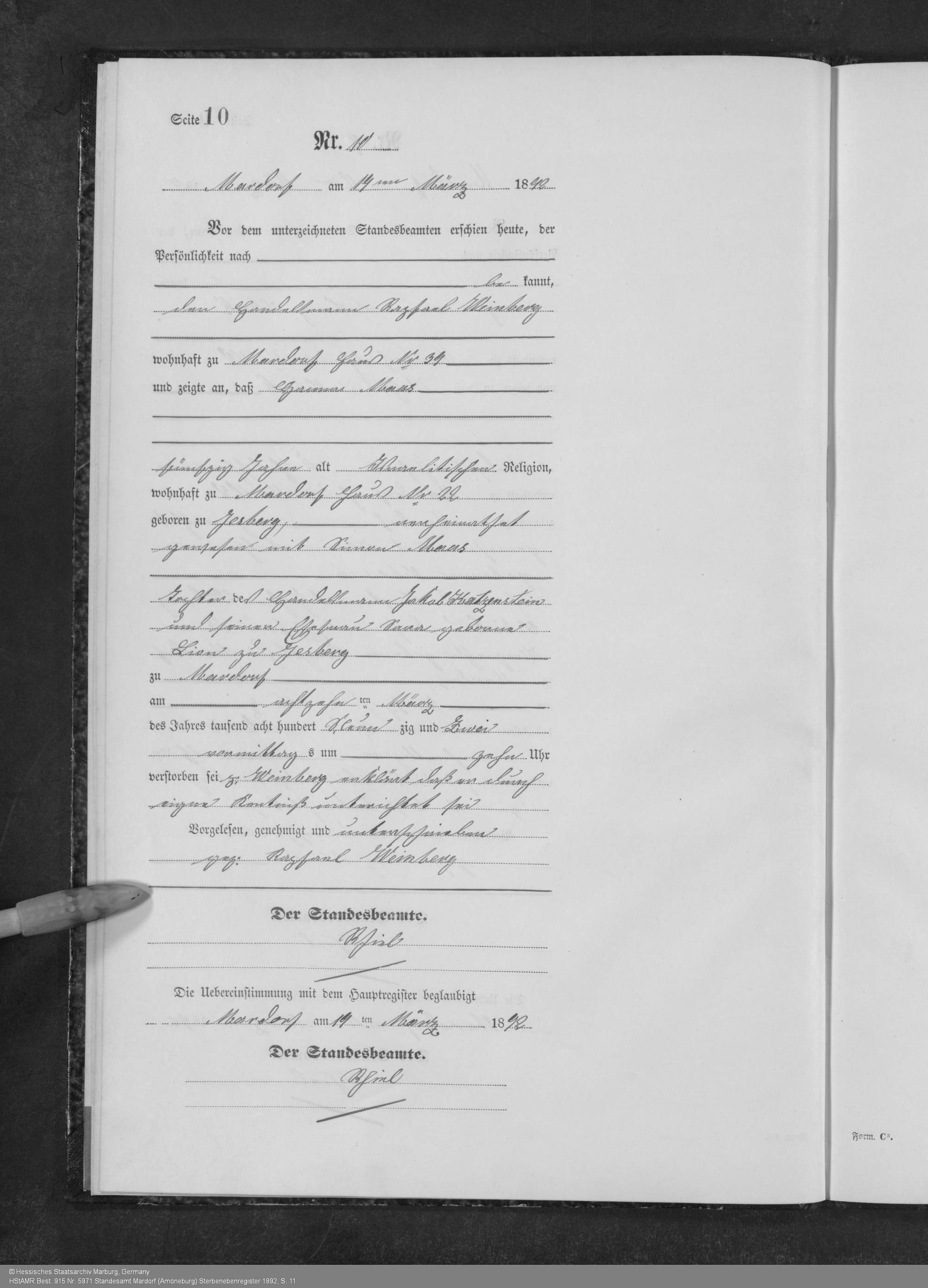
Johanna died on March 18, 1892; she was 53 years old.

Johanna Katzenstein Maas death record
Standesamt Mardorf (Amöneburg) Sterbenebenregister 1892 (HStAMR Best. 915 Nr. 5971)AutorHessisches Staatsarchiv MarburgErscheinungsortMardorf (Amöneburg)

Her husband Simon Maas died on April 22, 1910, at age 66.

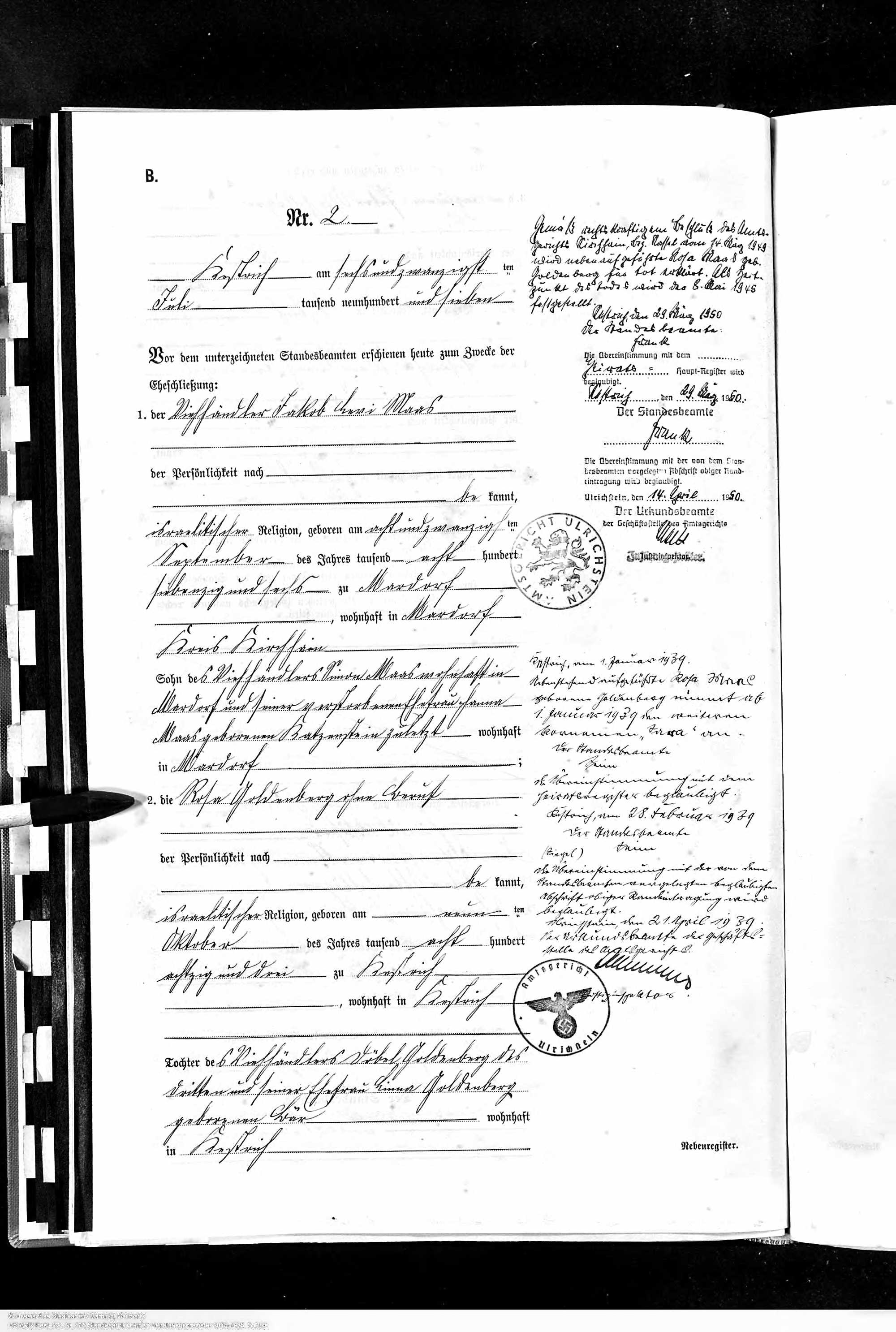
Their son Jakob married Rosa Goldenberg on July 26, 1907 in Kestrich, Germany. Rosa was the daughter of Dobel Goldenberg and Lina Baer. Rosa Goldenberg was also the sister of Nathan Goldenberg, whose wife Regina Katz was the granddaughter of Rahel Katzenstein, who was the sister of Jakob Maas’ grandfather Jakob Katzenstein. Thus, Rosa married a descendant of Jakob Katzenstein and her brother Nathan married a descendant of Rahel Katzenstein. Jakob and Rosa had one child, a daughter Klara born in 1921.

Marriage record of Jakob Levi Maas and Rosa Goldenberg
Hessisches Hauptstaatsarchiv; Wiesbaden, Deutschland; Collection: Personenstandsregister Heiratsregister; Signatur: 921; Laufende Nummer: 515

Neither of the two children of Johanna Katzenstein and Simon Maas survived the Holocaust.

On March 15, 1939, their daughter Auguste was sent to the Jakoby Institute in Sayn-Bendorf, at one-time a well-regarded psychiatric hospital for Jews that was warped into a facility used by the Nazis to mistreat Jewish patients.

According to this website,

During the first years of National Socialism the Jacoby Institute was left in relative peace; probably as an acknowledgement of the fact that it was an important employer for Sayn and the region. ….A circular decree issued by the Ministry of the Interior on 12th December 1940 decreed that “mentally ill Jews” were only to be accommodated in Sayn because “a cohabitation of Germans and Jews is not acceptable in any length of time” (illustr. 7). The option of concentrating all the patients in one location served as preparation of their deportation. In the course of five transports (between March and November 1942) 573 people were taken to the death camps in the East. 142 Jews died from 1940 till 1942 and were buried in the Jewish Cemetery in Sayn; most of them had already been seriously ill when they arrived in Sayn and not fit to travel. From 1940 to 1942 the graves in the Jewish Cemetery could not be marked with stones…

Auguste Gidel Maas is buried in one of those unmarked graves in Sayn-Bendorf. She died on October 29, 1941, according to the JewishGen Online Worldwide Burial Registry (JOWBR). She was 66. .

Her brother Jakob Levi Maas was arrested on May 6, 1941, and imprisoned at a forced labor camp in Breitenau. Two months later on July 18, 1941, he was sent to the Sachensausen concentration camp, where he died on May 16, 1942, according to Yad Vashem. His wife Rosa was also killed by the Nazis. She was sent to Theriesenstadt on September 7, 1942, and then to Auschwitz on January 23, 1943, where it is presumed she was murdered.

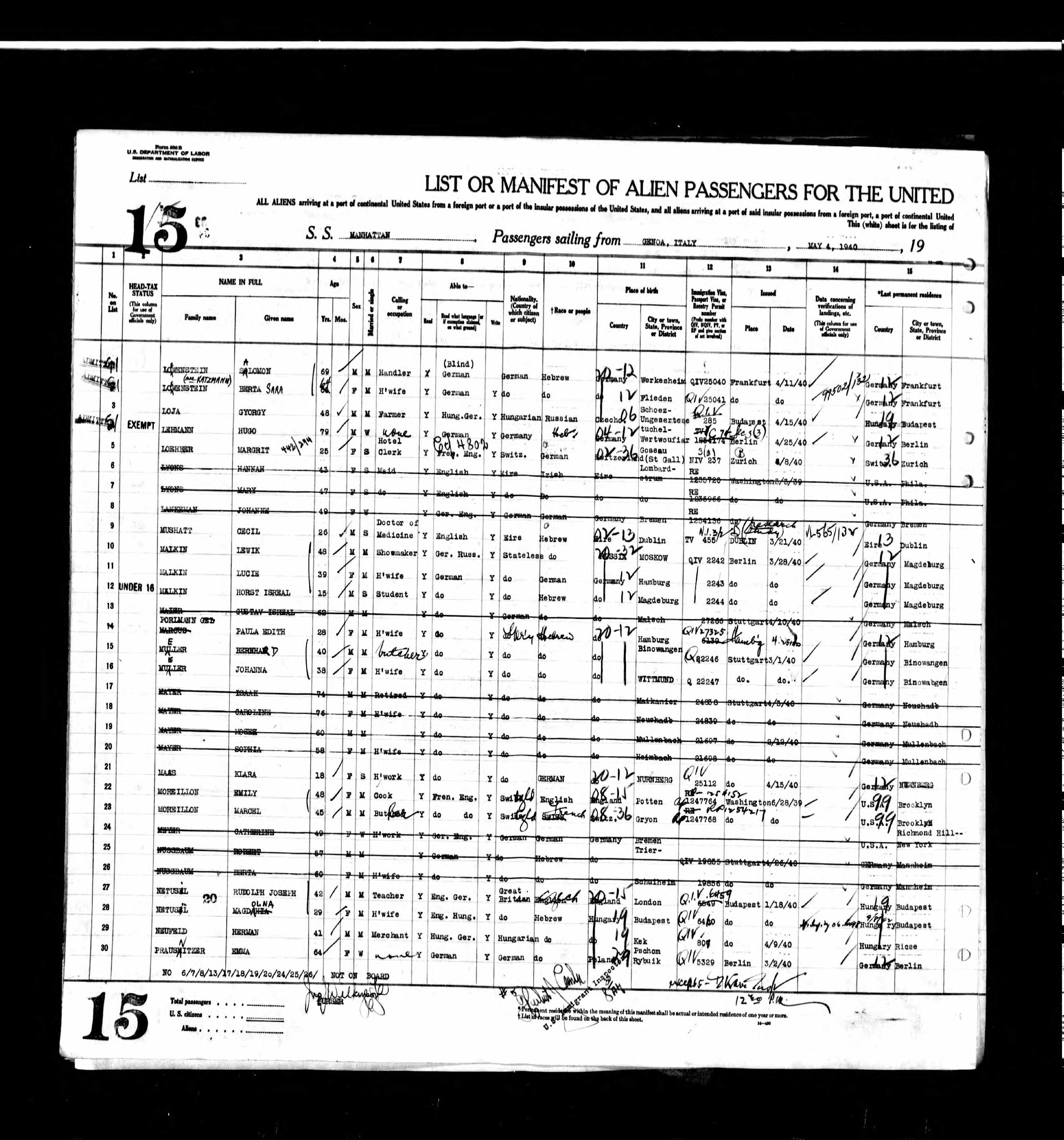
The only descendant of Johanna Katzenstein and Simon Maas who was not killed by the Nazis was Klara Maas, their granddaughter and the daughter of Jakob Maas and Rosa Goldenberg. Klara arrived in the United States on May 4, 1940. According to the ship manifest, she was going to New York City to her uncle Julius Goldenberg, brother of her mother Rosa and her uncle Nathan Goldenberg.

Klara Maas ship manifest 1940
Year: 1940; Arrival: New York, New York; Microfilm Serial: T715, 1897-1957; Microfilm Roll: Roll 6466; Line: 1; Page Number: 34

On April 9, 1941, Klara filed a Declaration of Intention to become a US citizen; she was working as a houseworker at the time and living in Forest Hills, New York. She was not yet twenty years old.

Klara Maas declaration of intention
New York, Southern District, U.S District Court Naturalization Records, 1824-1946,” database with images, FamilySearch (https://familysearch.org/ark:/61903/3:1:3QS7-99HD-TVB7?cc=2060123&wc=M5PF-PTG%3A351624701 : 22 May 2014), Petitions for naturalization a

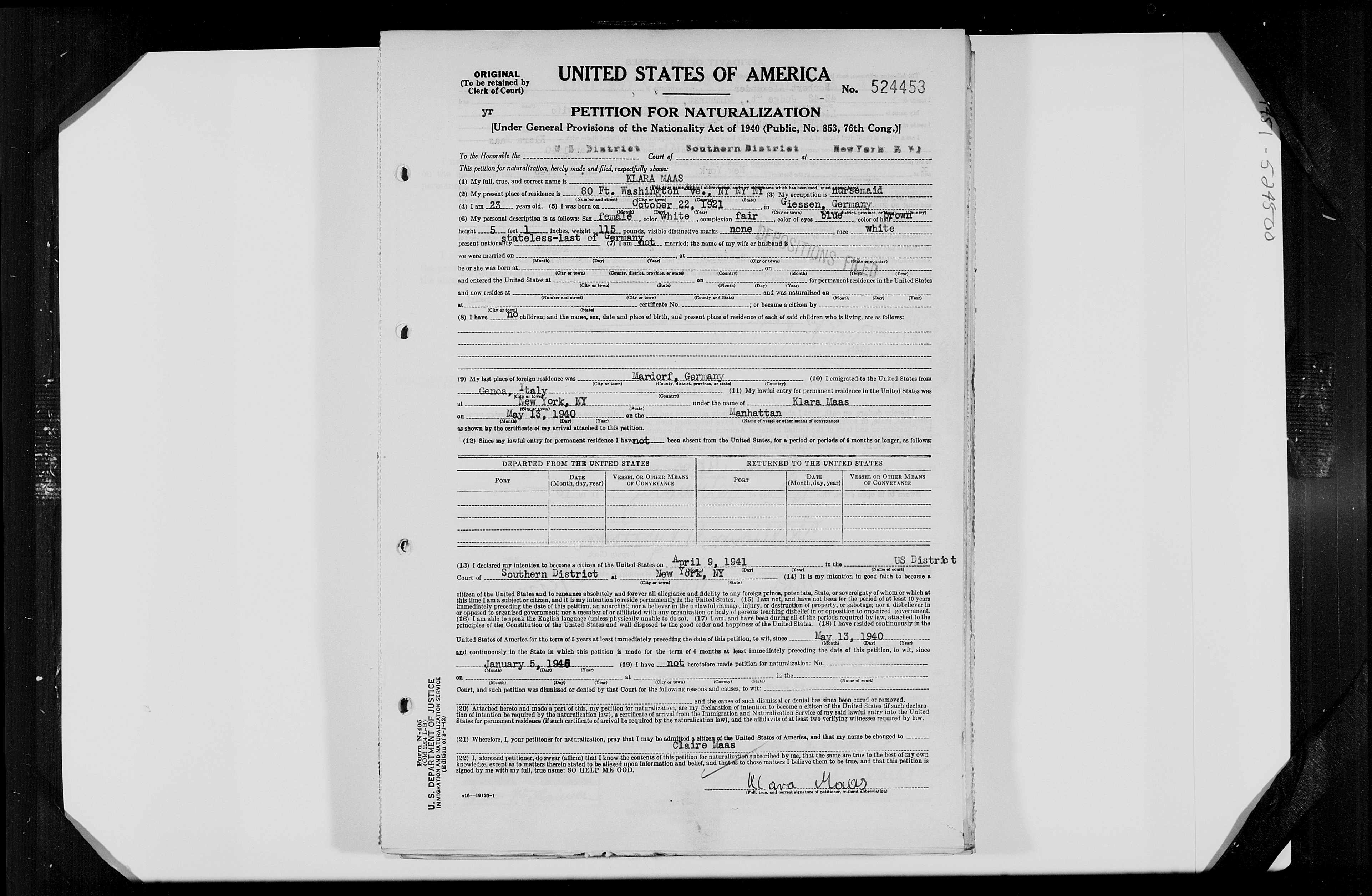
On August 2, 1945, Klara petitioned for naturalization; at that time she was working as a nursemaid and living back in Manhattan on Fort Washington Avenue. Her petition was supported by statements from two people, including Liselotte Goldenberg, the wife of Klara’s uncle Julius Goldenberg, who was also living on Fort Washington Avenue although at a different house number.

Petition for Naturalization “New York, Southern District, U.S District Court Naturalization Records, 1824-1946,” database with images, FamilySearch (https://familysearch.org/ark:/61903/3:1:3QS7-99HD-TVBP?cc=2060123&wc=M5PF-PTG%3A351624701 : 22 May 2014)

Klara was sworn in as a US citizen on February 18, 1946.

After that, I lost track of her. In 1946 she would have been 25 years old.  If she married after that, I could not find her in the NYC marriage index or elsewhere.

But then I went back to look at the documents I had to see if there were any clues I’d missed. And there was one: when she’d petitioned for naturalization, she’d petitioned to change her name from Klara to Claire.  I really didn’t think that this would make a difference in my search results since I knew that in my searches for Klara on both Ancestry and FamilySearch the search engines picked up women named Clara and Claire as well. But I figured, what the heck, let’s search for Claire Maas.

And this time Ancestry turned up something new, something important. It was an entry in the New York City Marriage License Index, 1907-1995, database that indicated that a Claire Maas had married a John Lind on March 21, 1949. Could it be my cousin Klara? I wasn’t sure. I had the names, date, and license number, so I contacted Allan Jordan, who generously offers to retrieve NYC documents for just his travel costs and the cost of the document. He said he hoped to get to the Clerk’s Office in the next week.

Claire Maas in NYC marriage license index
New York City Municipal Archives; New York, New York; Borough: Manhattan; Volume Number: 10  Year Range : 1949 Ancestry.com. New York City, Marriage License Indexes, 1907-1995

While waiting for the marriage license file, I spent hours and hours searching for John Lind, Claire Lind, Claire Maas, and any other combinations I could dream up on newspapers.com, GenealogyBank.com, Ancestry, FamilySearch, and Google. And the only real clue I came up with was a 2015 story about a group of senior citizens living in a Jewish nursing home in New Jersey who called themselves the Senior Jax Pack because they had become avid fans of a contestant on American Idol known as Jax.

One of the women in the Senior Jax Pack was named Claire Lind. She was 93 years old, and the article stated that she had escaped from “pre-war Germany as a child.”  Klara Maas would have been almost 94 in 2015, and she had been a teenager when she left Germany in 1940. Could this be my Klara Maas?

I wasn’t sure, and the article gave no more details except to mention that Claire Lind had recently passed away. I found an obituary for Claire Lind, who died on July 29, 2015, but it did not provide her birth name, her birth date, or the names of her spouse or survivors. I called the cemetery where she was buried and learned that she must have been the Claire Lind who married John Lind because he is also buried there.  I found a few other articles about the Senior Jax Pack that mentioned Claire Lind, but they also did not reveal any additional information about Claire’s identity.

And so I waited for Allan to send me the marriage license documents. While I waited, I watched the videos of Claire Lind from the first article I’d found and fell in love with her, hoping she would prove to be my cousin. Listen to her sing in the first one, and listen to her advice to Jax in the second.
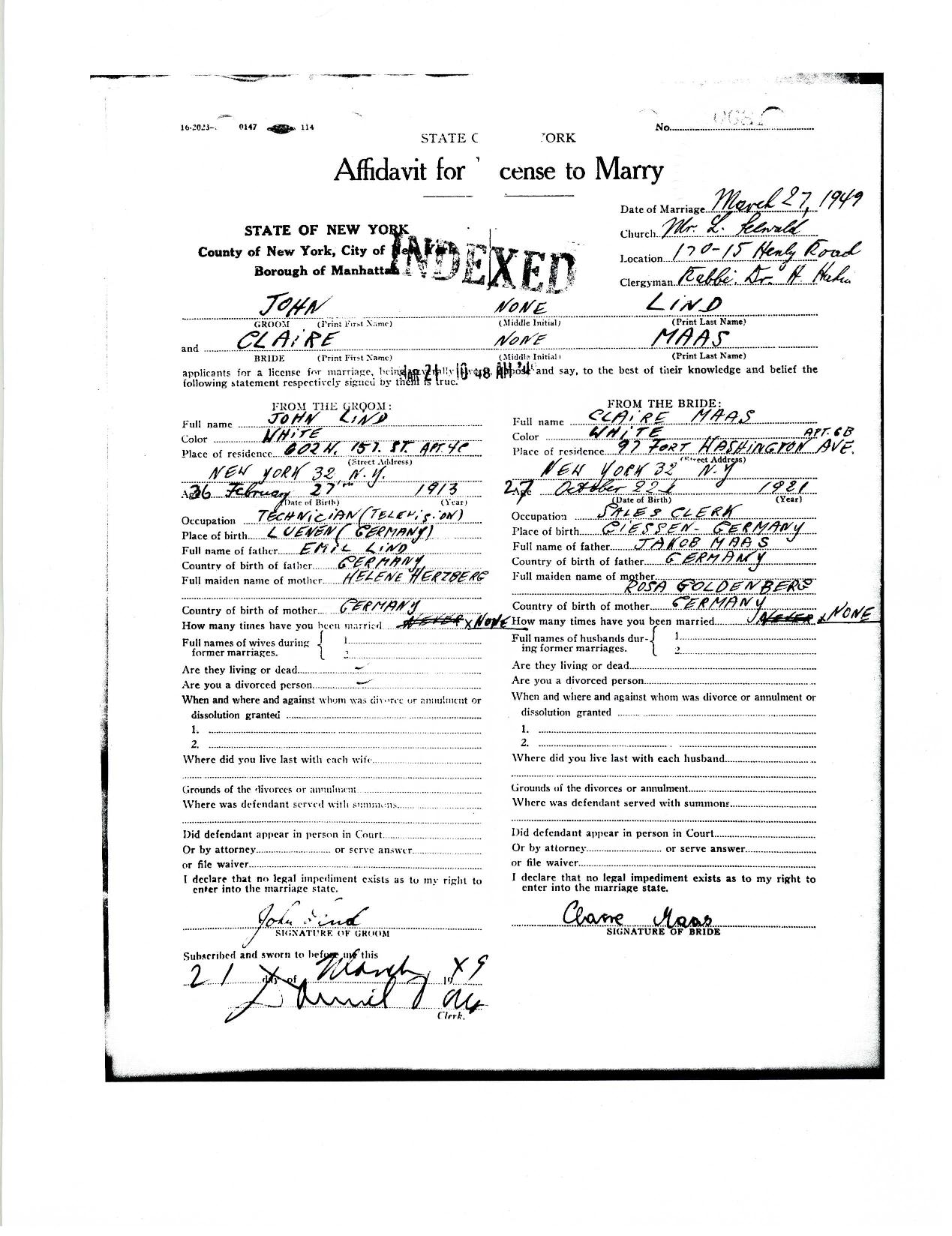
And then Allan sent me the marriage certificate:

Marriage license for Claire Maas and John Lind


There it was—Claire Maas Lind was the daughter of Jakob Maas and Rosa Goldenberg. She was born in Giessen, Germany on October 22, 1921. The woman who had married John Lind was my cousin; my cousin Klara/Claire Maas Lind was the woman who at age 93 was a member of the Senior Jax Pack.

A little research into John Lind revealed that he also had been a recent German refugee when he married Claire Maas in 1949. He was born Hans Levi in Luenen, Germany on February 27, 1913, and was the son of Emil Levi and Helen Herzberg (the family had changed its surname from Levi to Lind after arriving in the US). He died in 1977.

And so Klara Maas, whose parents had been murdered in the Holocaust, making her the sole surviving descendant of Johanna Katzenstein and Simon Maas, had lived a full life in the US. She became Claire Lind—singing into the last days of her life despite the heartbreak she must have experienced as a young woman.

I am so glad I found her story.