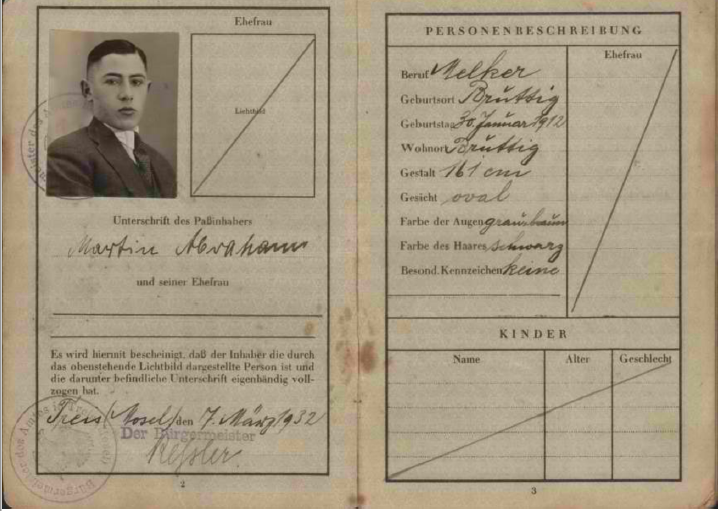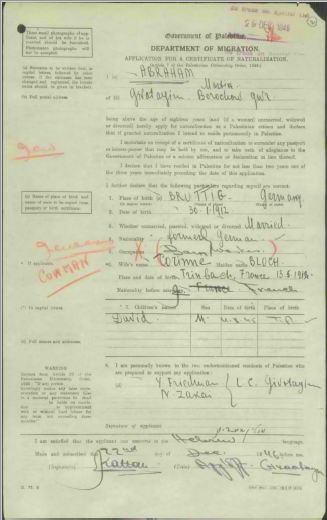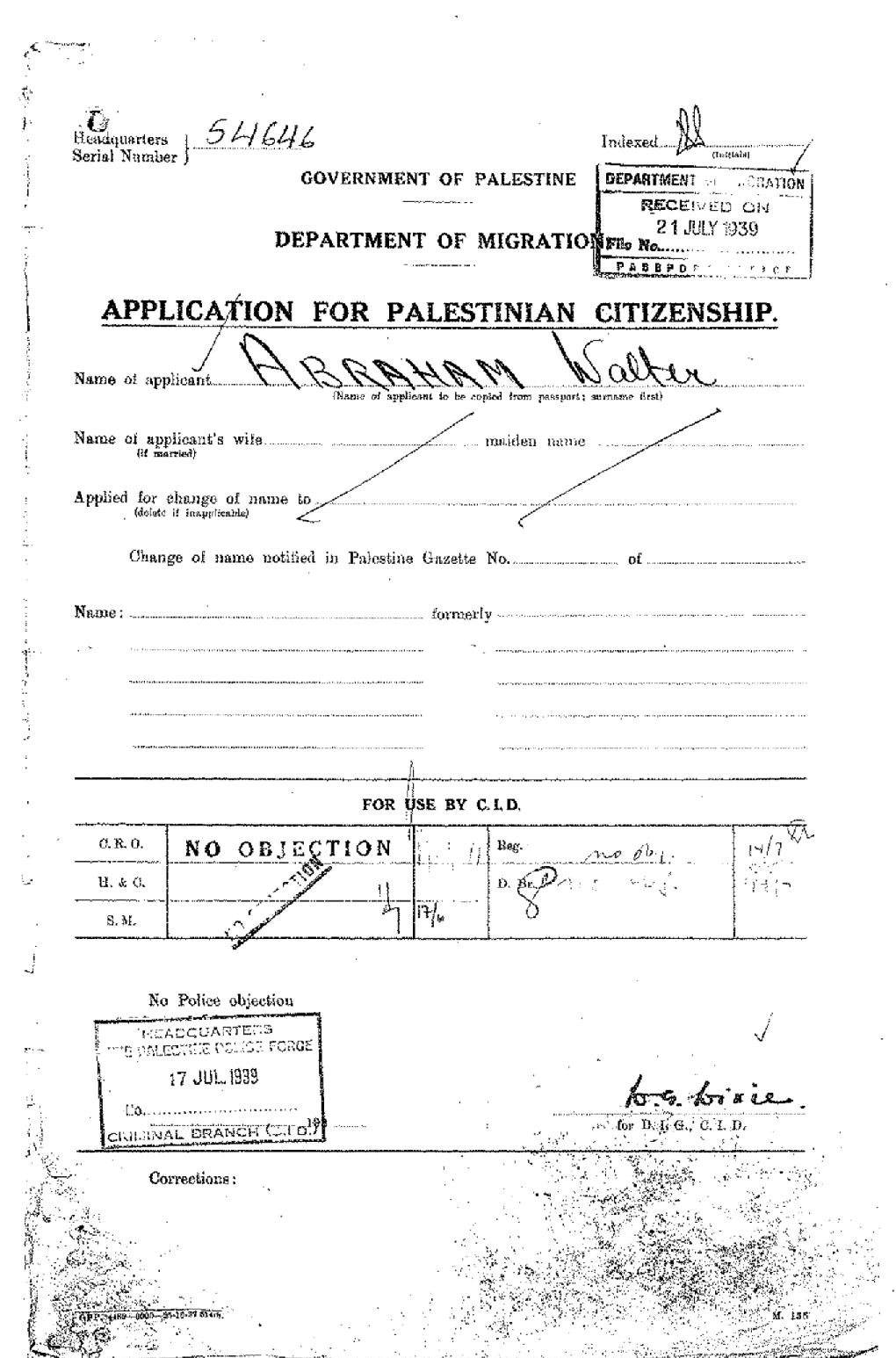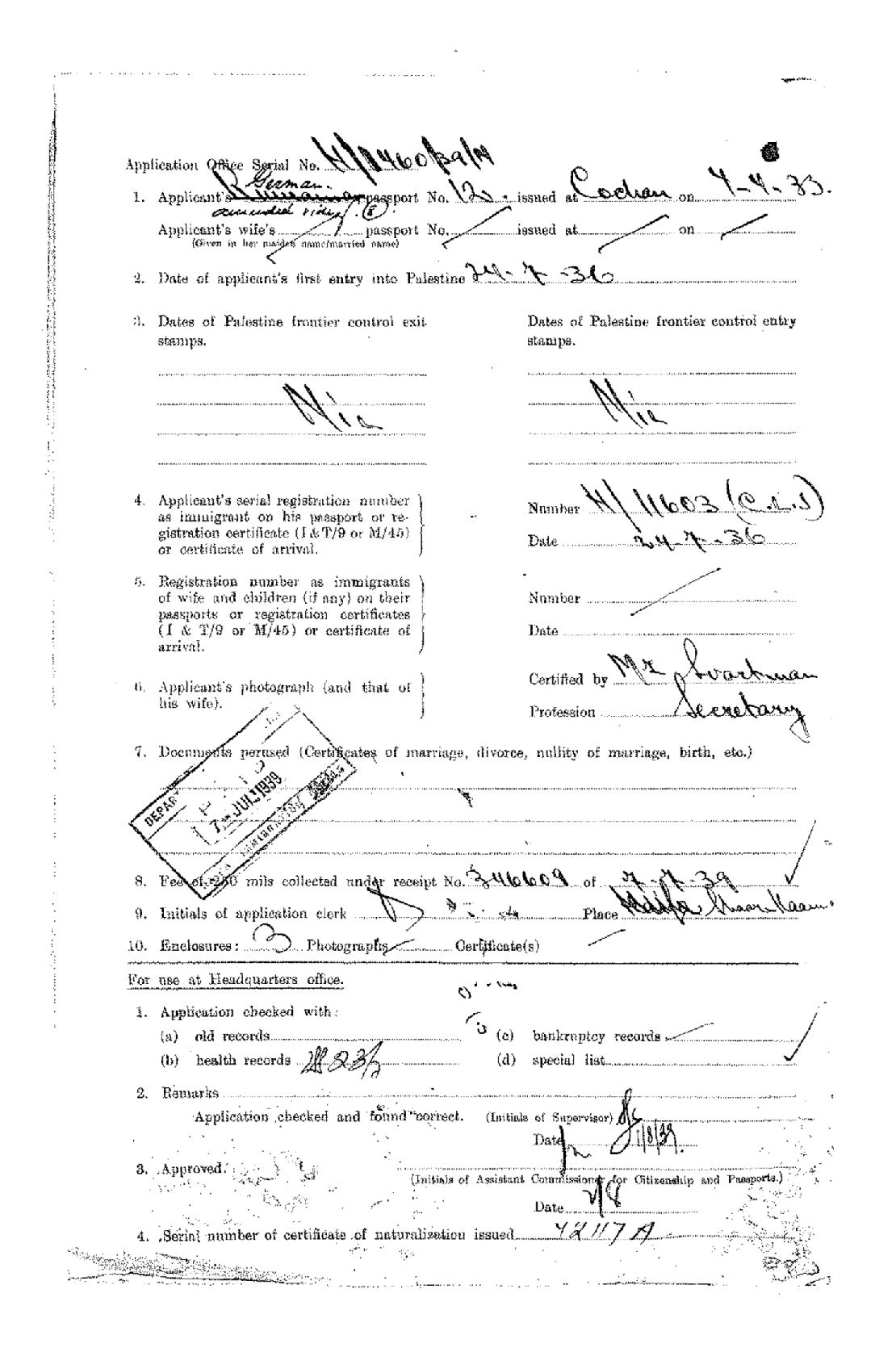
Lotte Nathan: Carrying and Passing on Family Trauma

Although I couldn’t find out what happened to Bertha Katzenstein Nathan Langebartels, I learned from her naturalization papers that Bertha had had a child with her first husband, Hermann Nathan, named Lotte. Lotte, according to the naturalization petition, was born on May 1, 1915, in Hamburg, Germany. She would have been only eleven years old when her mother and stepfather immigrated to the US in 1926, but she did not come with them. The naturalization petition stated that she “lives in Germany.” The petition also indicated that Friedrich and Bertha had last resided in Hamburg before coming to the United States. I hoped to find Lotte as another way of learning what happened to her mother.

Bertha Katzenstein Langebartels Weber petition for naturalization, The National Archives and Records Administration; Washington, D.C.; Petitions For Naturalization From the U.s. District Court For the Southern District of New York, 1897-1944; Series: M1972; Roll: 542
Description
Archive Roll Descriptions: (Roll 0542) Petition No· 124777-Petition No· 125042
Source Information
Ancestry.com. New York, U.S., Naturalization Records, 1882-1944

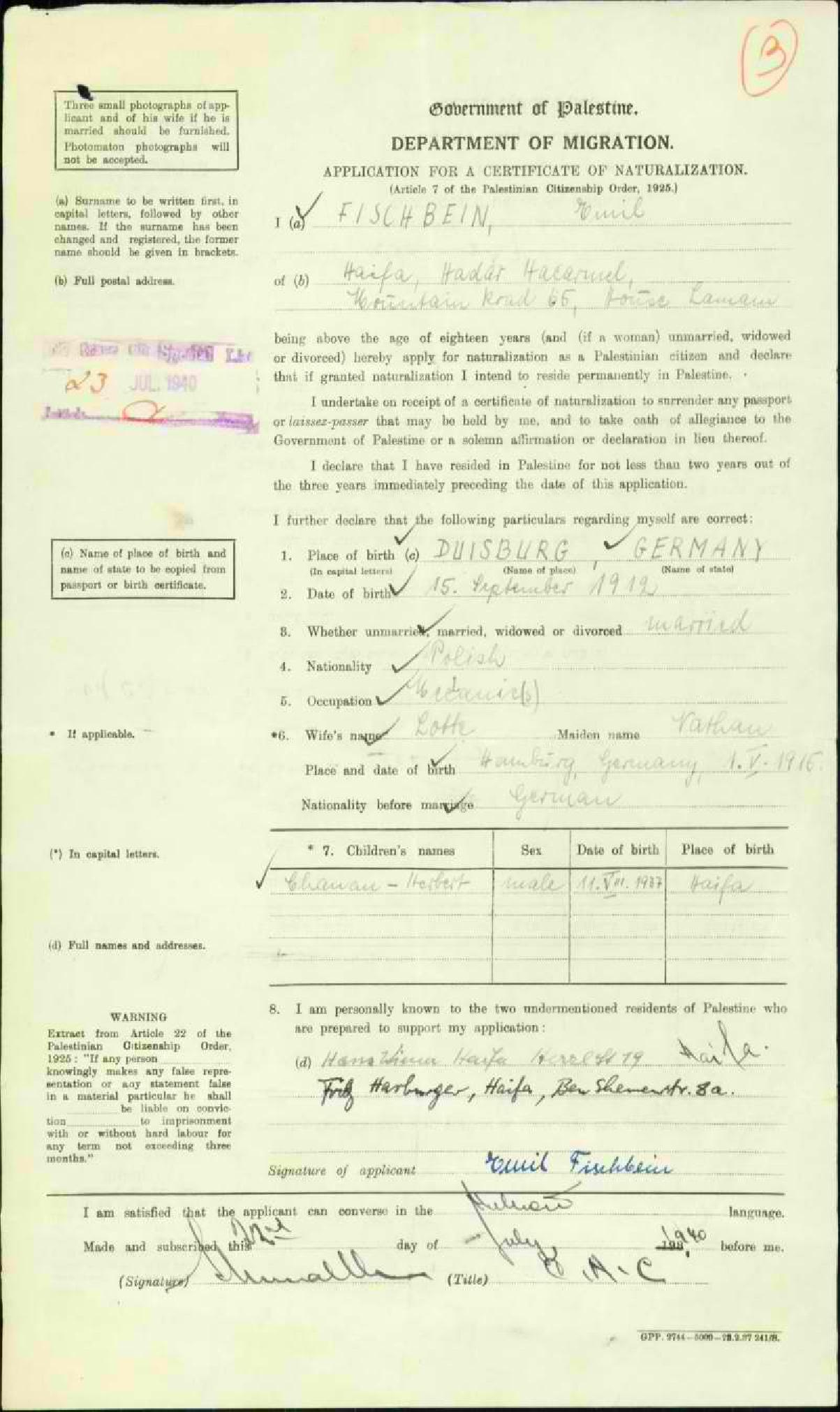
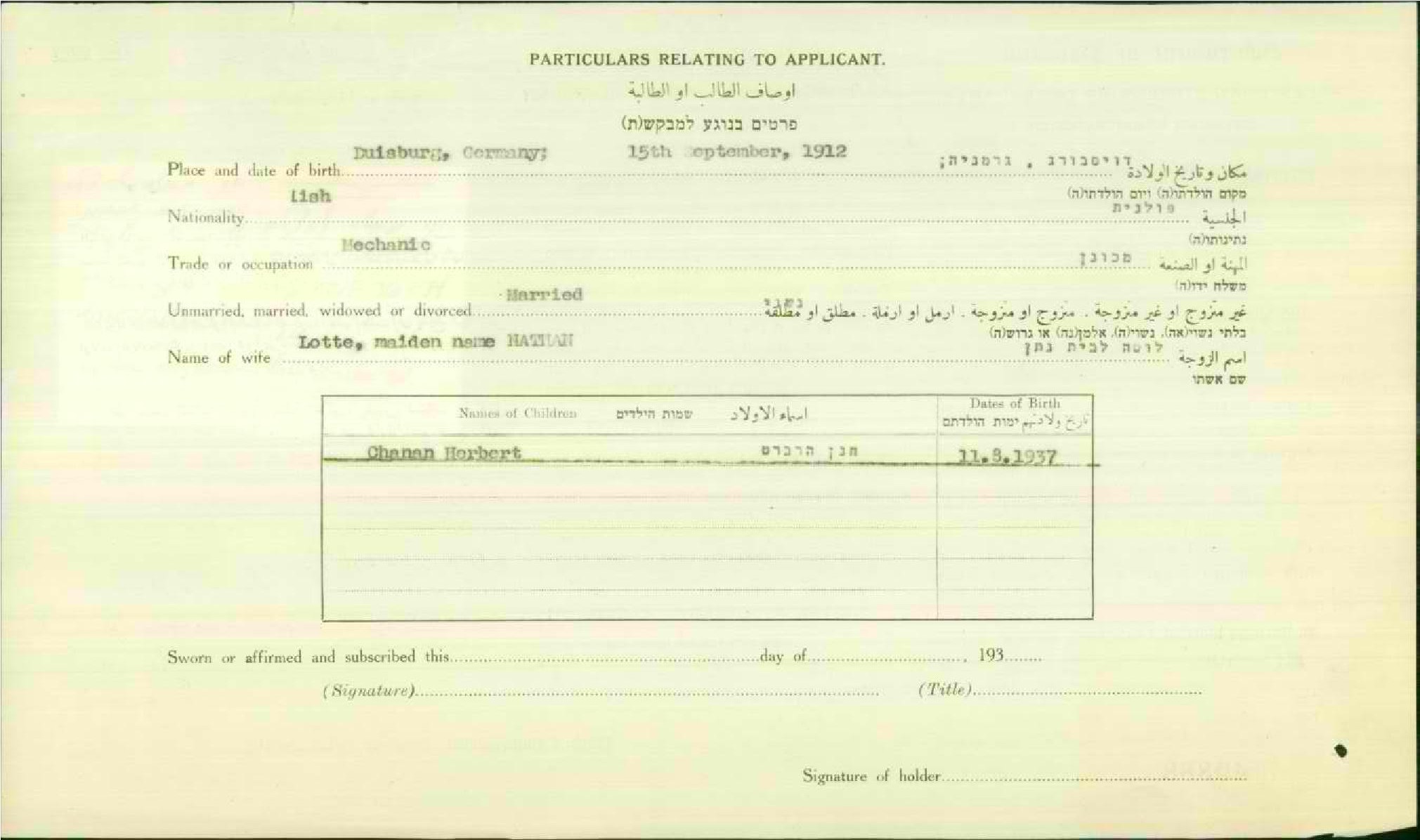
My hunch is that Lotte stayed behind with her father Hermann Nathan, but I can’t be certain. But I do know that sometime during or before 1936 Lotte married Emil Fischbein because on September 8, 1936, they left Germany and immigrated to Palestine as a married couple.1 Emil was born in Duisburg, Germany, on September 15, 1912, but was of Polish nationality, according to his Palestine immigration documents; one tree on MyHeritage created by his great-grandson Gil reports that Emil’s parents were Isaak and Esther Fischbein, both born in what is now Poland. German law at that time provided that children born to non-German parents were not considered German.

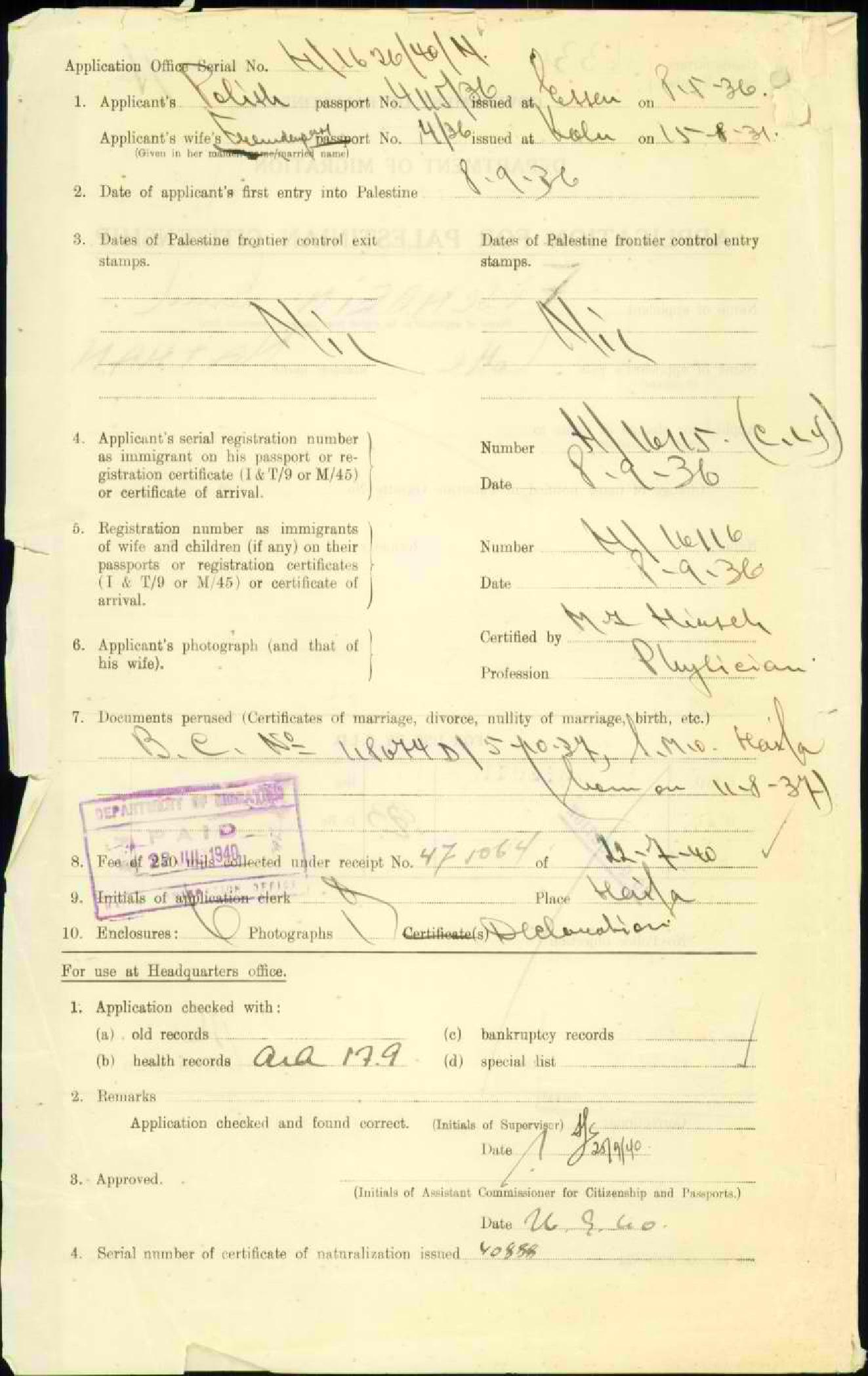
Emil and Lotte’s Palestine immigration documents also include Lotte’s passport,2 which was issued as a Fremdenpass, or a passport issued by the German government to non-Germans living in Germany. Lotte was not eligible for a regular German passport—either because she had married a “foreigner” or because she was Jewish. Jews whose citizenship had been revoked also were granted Fremdenpasses, not regular German passports.

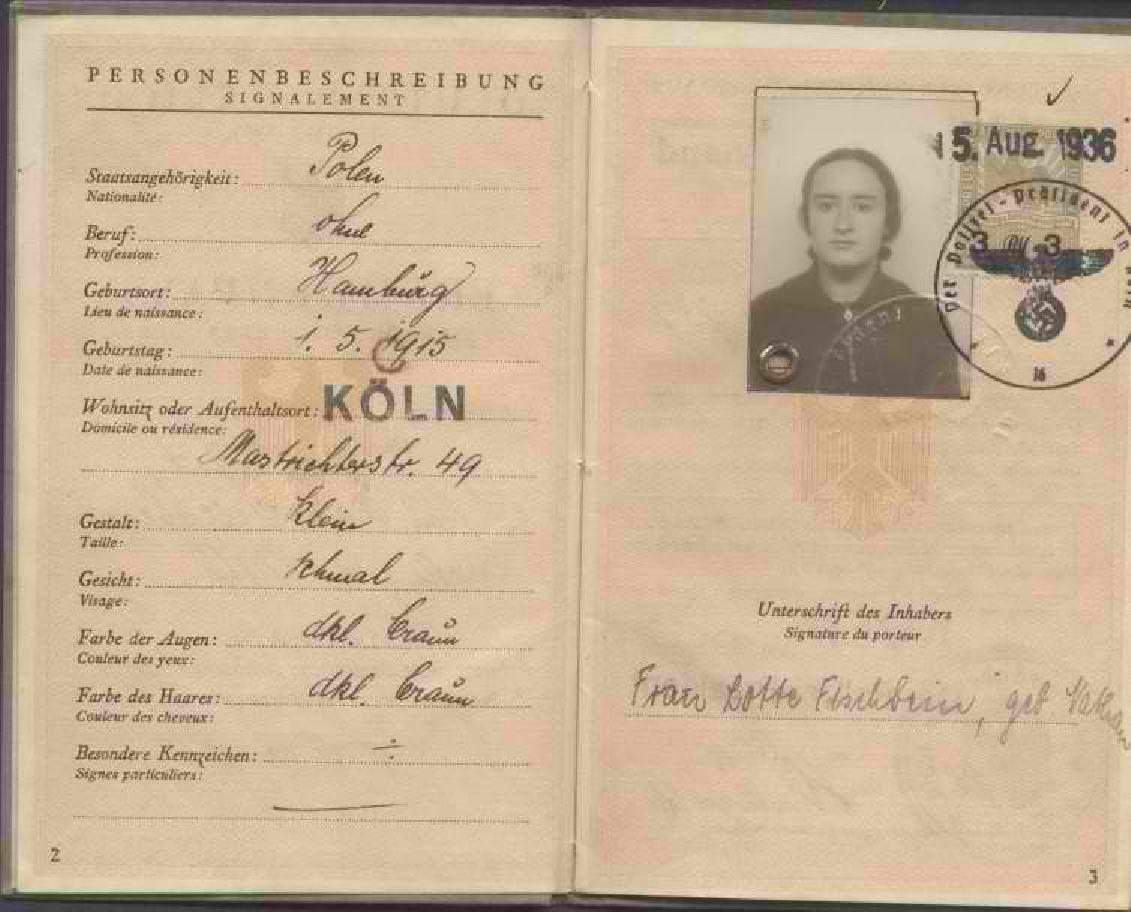
Lotte’s passport was issued on August 15, 1931, from Koeln (Cologne), which suggests that she was living in the German state of North Rhine Westphalia in 1931, not in Hamburg where she was born and where her mother and stepfather had been living before going to the US. It also appears that Lotte’s father Hermann Nathan was not living in North Rhine Westphalia; he was born in Wittingen3 and in 1939 was living in Hildesheim, both of which are located in the German state of Lower Saxony. Emil, however, was born in Duisburg, which is in North Rhine Westphalia, so perhaps that is where they connected with each other.

By October 15, 1940, when Lotte and Emil obtained Palestinian citizenship, they were living in Haifa and had a son, Hanan, who was born on August 11, 1937, in Haifa.4 Through MyHeritage, I located one of their descendants to learn more about Lotte and her family. Gil is Lotte’s great-grandson; his grandfather was Hanan, the baby born in Haifa in 1937. He told me that family lore is that Lotte left Emil and Hanan when Hanan was a child and went to England with an English soldier.

Some trees on Ancestry and MyHeritage indicate that she married Ronald Francis George Buchanan and died in England in 1971. There is a death record on Ancestry for  Lotte Emma B. Buchanan born on May 1, 1915, the day Lotte Nathan was born; the index indicated that she died in the fall of 1971 in Nottingham, England.5 Another record on Ancestry indicates that she died on November 21, 1971, and was cremated in Nottinghamshire on November 24, 1971.6

Lotte Nathan Fischbein Buchanan had a family history and personal history that was difficult. Her grandmother Bertha Metz died from complications of childbirth just two weeks after giving birth to Lotte’s mother Bertha Katzenstein in New York. Bertha Katzenstein was then taken by her father Adolf to Germany, away from her mother’s family.

Then Lotte’s mother Bertha married Hermann Nathan and had Lotte in 1915, only to be divorced from Hermann in 1919 and to marry Friedrich Langebartels in 1921. In 1926 Bertha and Friedrich came to the US and were there at least long enough to file for US citizenship in 1927, leaving Lotte behind in Germany at eleven years old. I don’t know what happened to Bertha after 1927 or whether Lotte ever reunited with her mother.

We know that there is truth to the concept of generational trauma—how the traumas and tragedies suffered by earlier generations are passed down to the children, grandchildren, and so forth of those earlier generations. Bertha Katzenstein grew up without a mother and was taken from the US to Germany as a child by her father, far from her maternal relatives. We don’t know how that trauma affected her, but in some ways her daughter Lotte suffered a similar trauma when her mother Bertha divorced her father, remarried, and left Lotte behind after moving to the US with her second husband. And then Lotte inflicted a similar trauma on her son Hanan, leaving him behind when she remarried and moved to England.

How tragic it is that the scars of one generation can be so easily passed on to the later generations.


  1. Emil and Lotte’s application for citizenship in Palestine in 1940 was found at the Israel State Archives website, temporarily found at https://search.archives.gov.il/, after a cyberattack on their main site. 
  2. See Note 1, supra. 
  3. Hermann Nathan and Bertha Katzenstein marriage record, Year Range and Volume: 1913 Band 01, Ancestry.com. Hamburg, Germany, Marriages, 1874-1920 
  4. See Palestine immigration documents above. 
  5. Name Lottie Emma B Buchanan, Death Age 56, Birth Date 1 May 1915, Registration Date Oct 1971, [Nov 1971] [Dec 1971], Registration Quarter Oct-Nov-Dec, Registration District Nottingham, Inferred County Nottinghamshire, Volume 3c
    Page 1274, General Register Office; United Kingdom; Volume: 3c; Page: 1274, Ancestry.com. England & Wales, Civil Registration Death Index, 1916-2007 
  6. Name Lottie Emma Bertha Buchanan, Register Type Cremation, Death Date 21 Nov 1971, Burial or Cremation Date 24 Nov 1971, Burial or Cremation Place Nottinghamshire, Deceased Online; Kettering, England, UK; Deceased Online Burial Indexes, Ancestry.com. Web: UK, Burial and Cremation Index, 1576-2024 

Levi Rothschild’s Children Part III: Escaping The Holocaust to South Africa, New York, and Palestine/Israel

Of the six children of Levi Rothschild and Clara Jacob who lived to adulthood in Germany, amazingly all but one escaped from Germany in time to avoid being killed by the Nazis. Only the youngest sibling Frieda was not as fortunate. But that doesn’t mean that there wasn’t suffering and loss endured by the other five. This post will focus on the three oldest children: Sigmund, Betti, and Moses.

Sigmund Rothschild and his wife Fanny Rosenbaum escaped to South Africa. I don’t know when or how they immigrated there, but Fanny died there on August 20, 1942, in Capetown at the age of  62.

Fanny Rosenbaum Rothschild death record, Municipality or Municipality Range: Cape Town
Ancestry.com. Cape Province, South Africa, Civil Deaths, 1895-1972

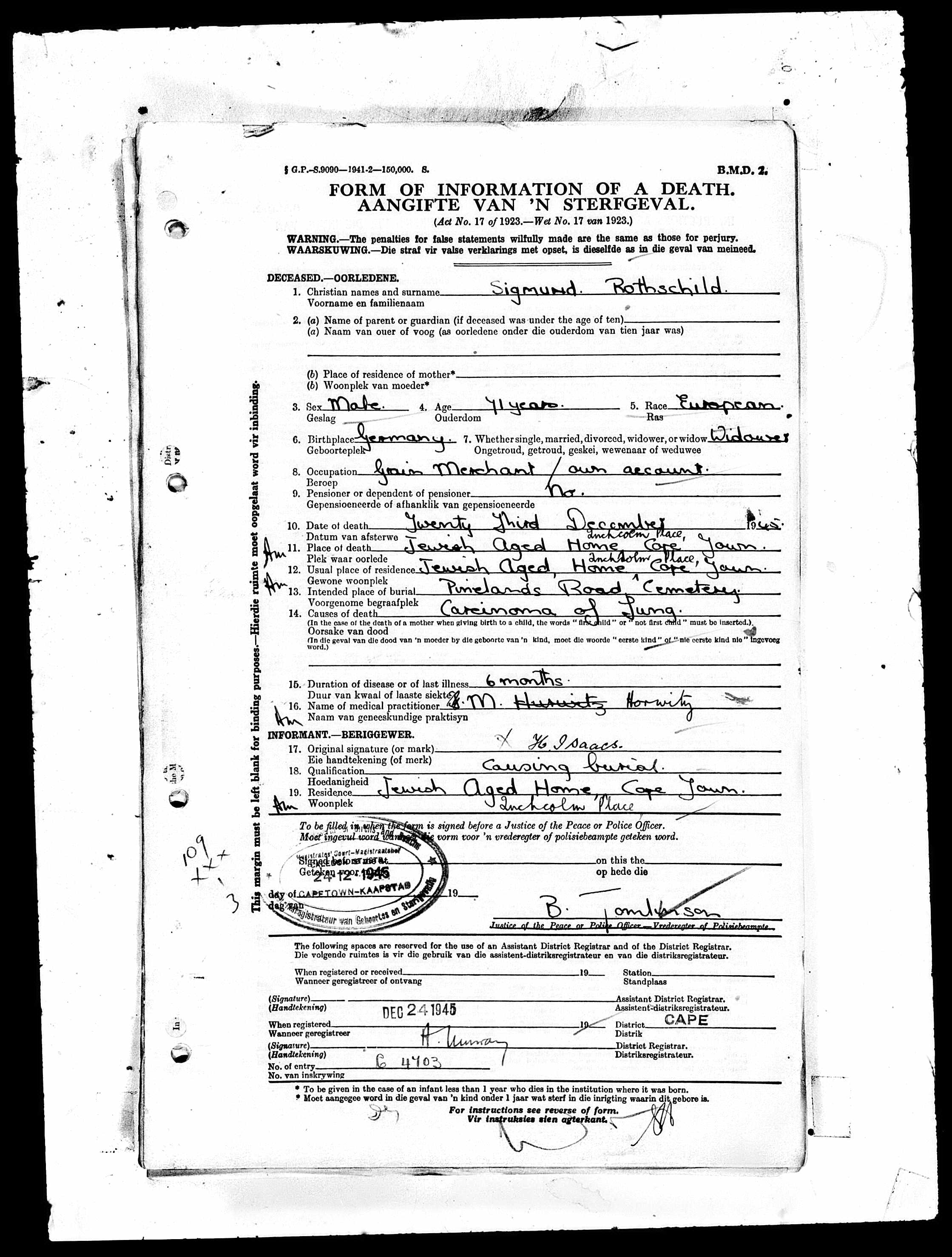
Her husband Sigmund died in Capetown three years later on December 23, 1945; he was 71.

Sigmund Rothschild death record, Municipality or Municipality Range: Cape Town
Ancestry.com. Cape Province, South Africa, Civil Deaths, 1895-1972

As for Sigmund and Fanny’s son Kurt, I have very little information. An entry in the England & Wales Civil Registration Death Index on Ancestry shows that he died in Lancaster, England, and that the death was registered in September 1997.1 A FindAGrave entry shows his gravestone with the date of death as August 30, 1997.

Find a Grave, database and images (https://www.findagrave.com/memorial/81923216/kurt-rothschild: accessed April 19, 2024), memorial page for Kurt Rothschild (1910–3 Sep 1997), Find a Grave Memorial ID 81923216, citing Lytham Park Cemetery and Crematorium, Lytham Saint Annes, Fylde Borough, Lancashire, England; Maintained by ProgBase (contributor 47278889).

The Ancestry tree that appears to have been created by Kurt’s daughter-in-law shows that Kurt married Erna Erdmann and had one child, who is the home person on that tree. I have not been able to find a marriage record for Kurt and Erna Erdmann or a birth record for their child, so I am hoping that the owner of that tree will respond to the message I sent to help me find out what happened to Kurt Rothschild and his family. But since it’s been well over two months at this point, I am not optimistic that I will hear from her anytime soon.

The second child of Levi and Klara, their daughter Betti, lost her husband Emanuel Hirschmann on November 4, 1932. He died in Fulda, Germany, and was 64.

Emanuel Hirschmann death record, Hessisches Hauptstaatsarchiv; Wiesbaden, Deutschland; Personenstandsregister Sterberegister; Signatur: 2470, Year Range: 1932, Ancestry.com. Hesse, Germany, Deaths, 1851-1958

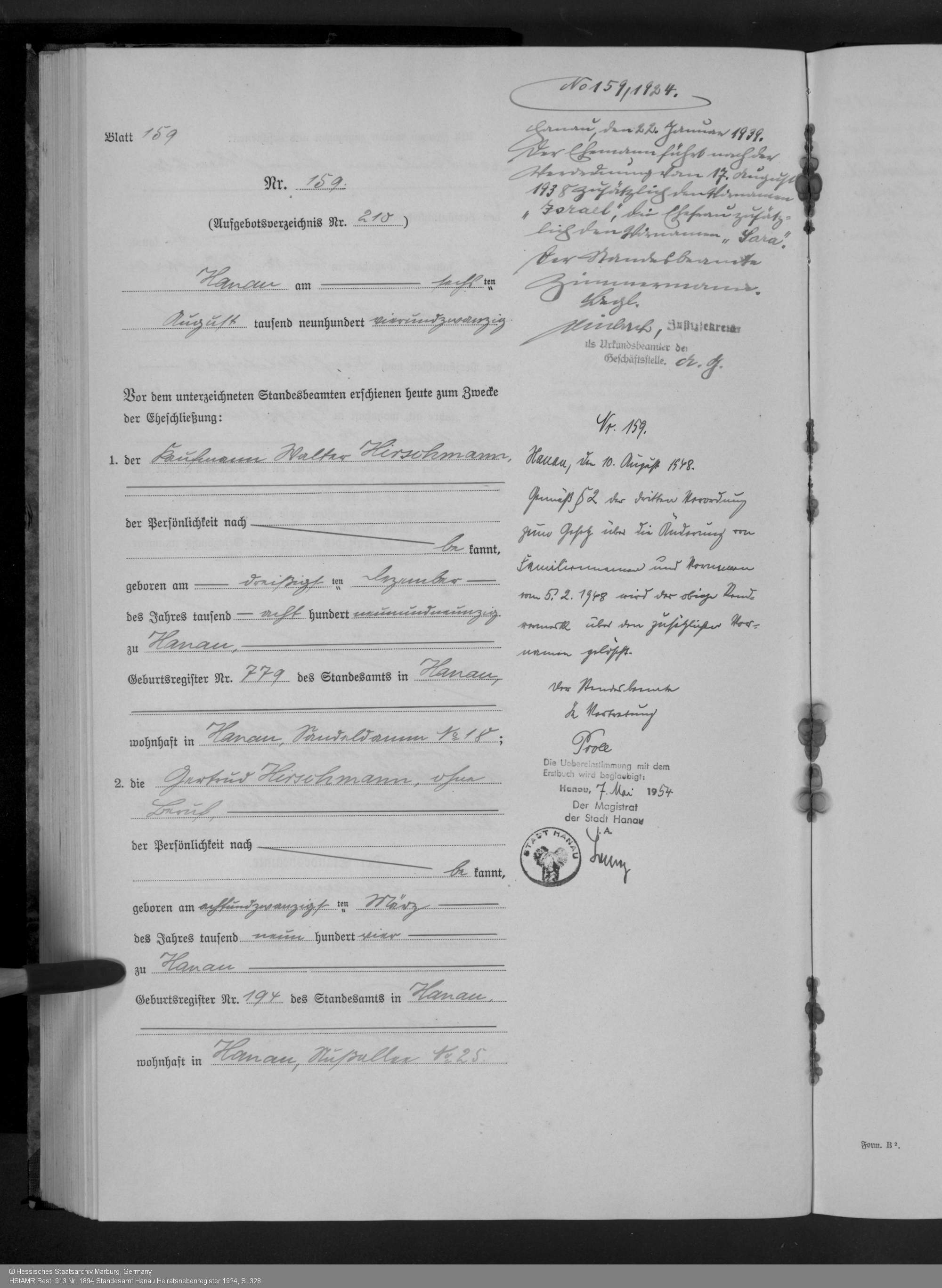
Their son Walter had married Gertrud Hirschmann on August 6, 1924, in Hanau, Germany. Gertrud was born in Hanau on March 28, 1904, according to their marriage record, but that record does not include her parents’ names. It would appear that Gertrud was likely a relative given the surname and her birth place, but so far I’ve not found any way to connect her to Walter’s Hirschmann relatives.

Walter Hirschmann and Gertrude Hirschmann marriage record, LAGIS Hessen Archives, Standesamt Hanau Heiratsnebenregister 1924 (HStAMR Best. 913 Nr. 1894)AutorHessisches Staatsarchiv MarburgErscheinungsortHanauErscheinungsjahr1924, p. 328

Walter Hirschmann and Gertrude Hirschmann marriage record, p. 2

Walter and Gertrud and their twelve year old daughter immigrated to the US on a December 15, 1938. Walter listed his occupation as a banker and their last residence as Frankfurt, Germany, where his mother “B. Hirschmann” was still residing. They were heading to a friend, L. Schwarzchild, in New York.2

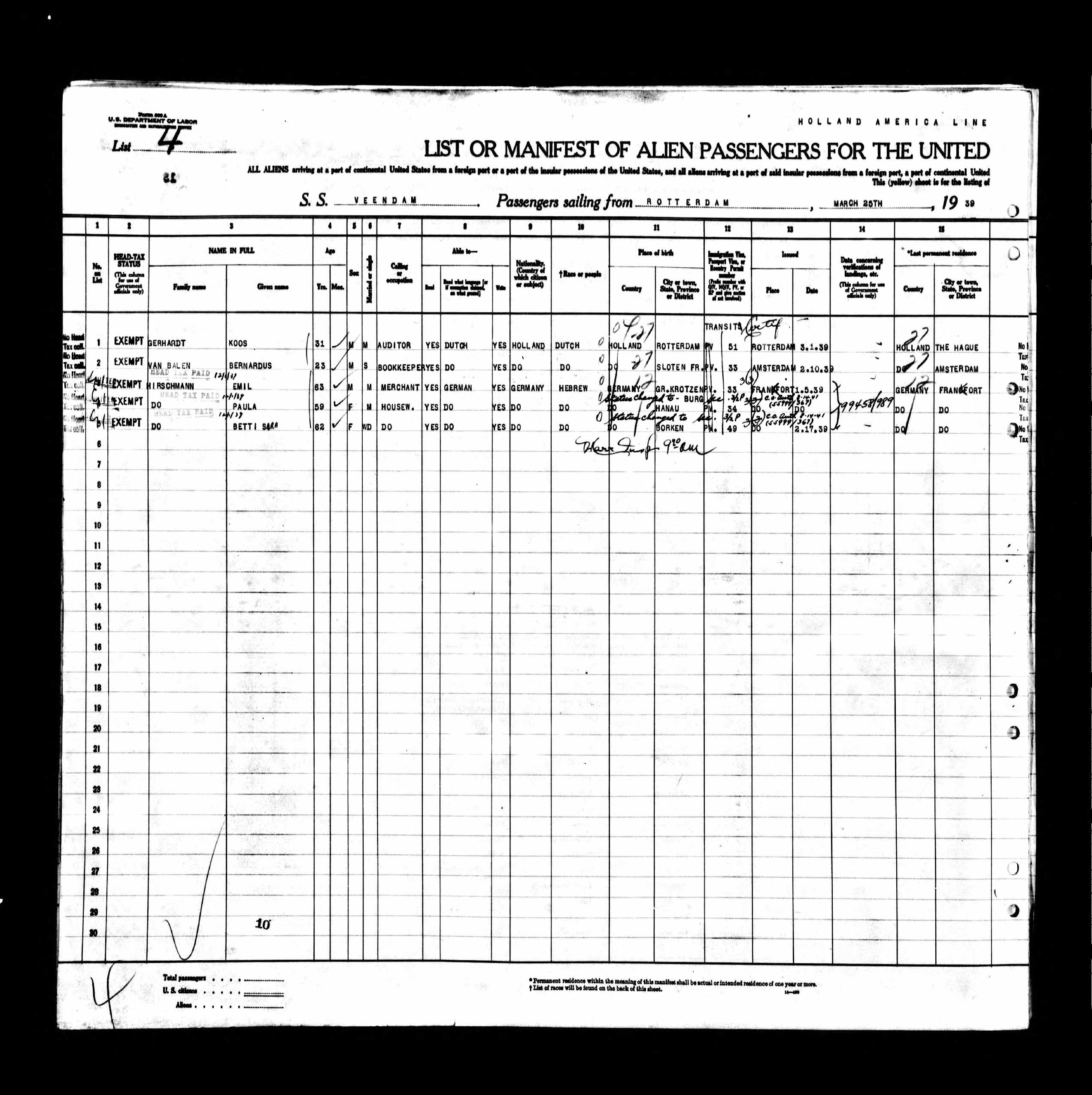
Walter’s mother Betti Rothschild Hirschmann immigrated to the US on March 25, 1939, with a cousin of her husband, Emil Hirschmann, and his wife Paula.

Betti Rothschild passenger manifest, The National Archives in Washington, DC; Washington, DC, USA; Passenger and Crew Lists of Vessels Arriving at New York, New York, 1897-1957; Microfilm Serial or NAID: T715; RG Title: Records of the Immigration and Naturalization Service, 1787-2004; RG: 85, Ship or Roll Number: Veendam, Ancestry.com. New York, U.S., Arriving Passenger and Crew Lists (including Castle Garden and Ellis Island), 1820-1957

On the 1940 census, Betti was living as a lodger in the household of Helena Pessel in New York City, but in the same building as her son Walter and his family at 670 Riverside Drive in New York City. Walter was employed as a salesman.3

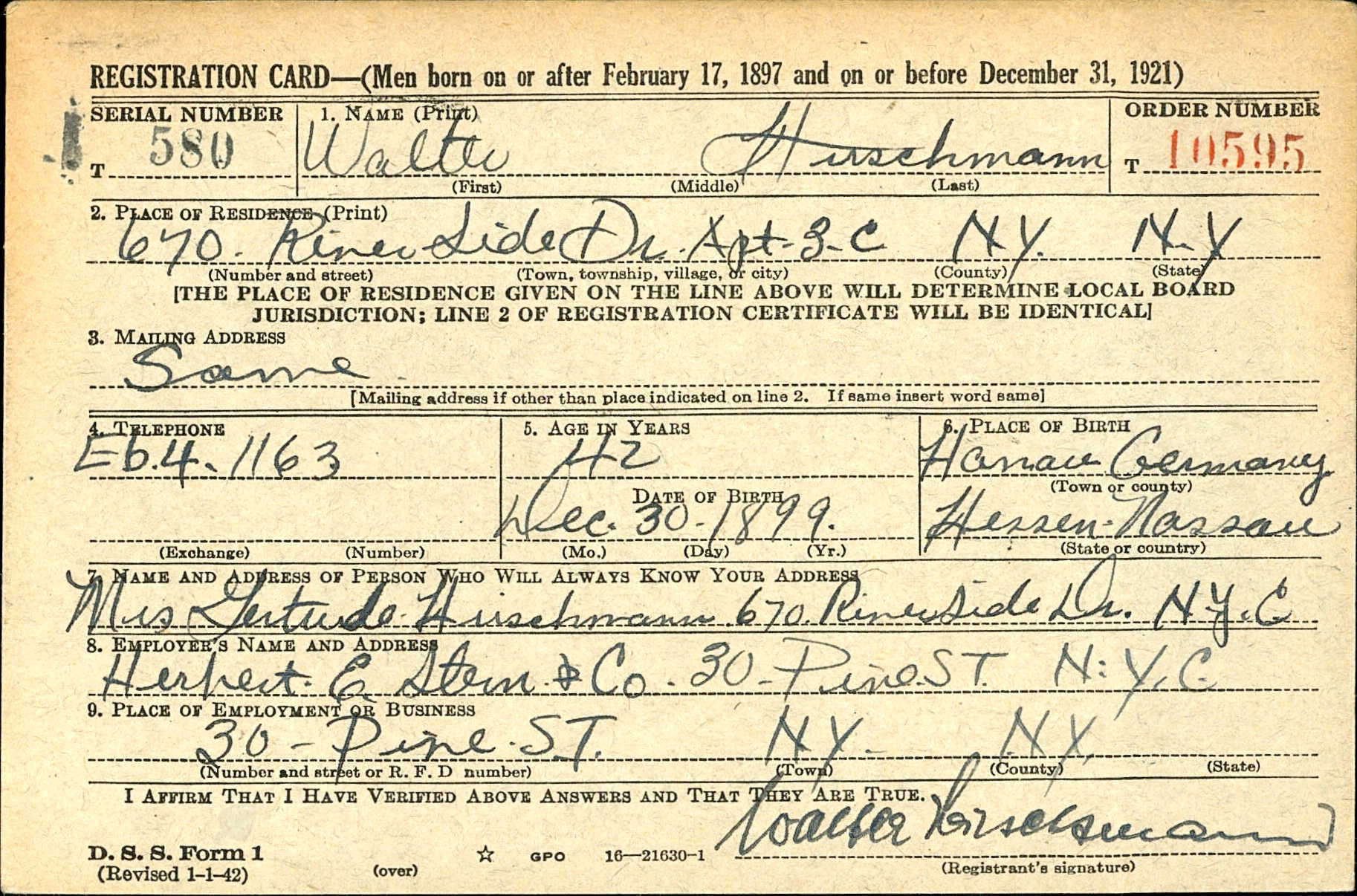
On his World War II draft registration, Walter identified his employer as Herbert E. Stern & Company. From his obituary I learned that Herbert E. Stern was also a refugee from Nazi Germany and an investment banker.4

Walter Hirschmann World War II draft registration, National Archives at St. Louis; St. Louis, Missouri; Wwii Draft Registration Cards For New York City, 10/16/1940 – 03/31/1947; Record Group: Records of the Selective Service System, 147, Name Range: Hirsch, Walfgang-Hobbs, Robert, Ancestry.com. U.S., World War II Draft Cards Young Men, 1940-1947

In 1950 Betti was still living in the same building as her son Walter and his family. Walter was still working as a broker and banker. I am very grateful to Eric Ald of Tracing the Tribe who found the 1950 census record for Betti and also a listing on Ancestry in the New York, New York Death Index for a Betty Hirschmann who died on February 15, 1956.5

Walter Hirschmann and Betty Hirschmann, 1950 US census, National Archives at Washington, DC; Washington, D.C.; Seventeenth Census of the United States, 1950; Year: 1950; Census Place: New York, New York, New York; Roll: 6203; Page: 75; Enumeration District: 31-1900, Ancestry.com. 1950 United States Federal Census

Her son Walter Hirschmann died on June 24, 1977, at the age of 77.6 He had been predeceased by his wife Gertrud, who died in December 1966 7 and was survived by their daughter and grandchildren.

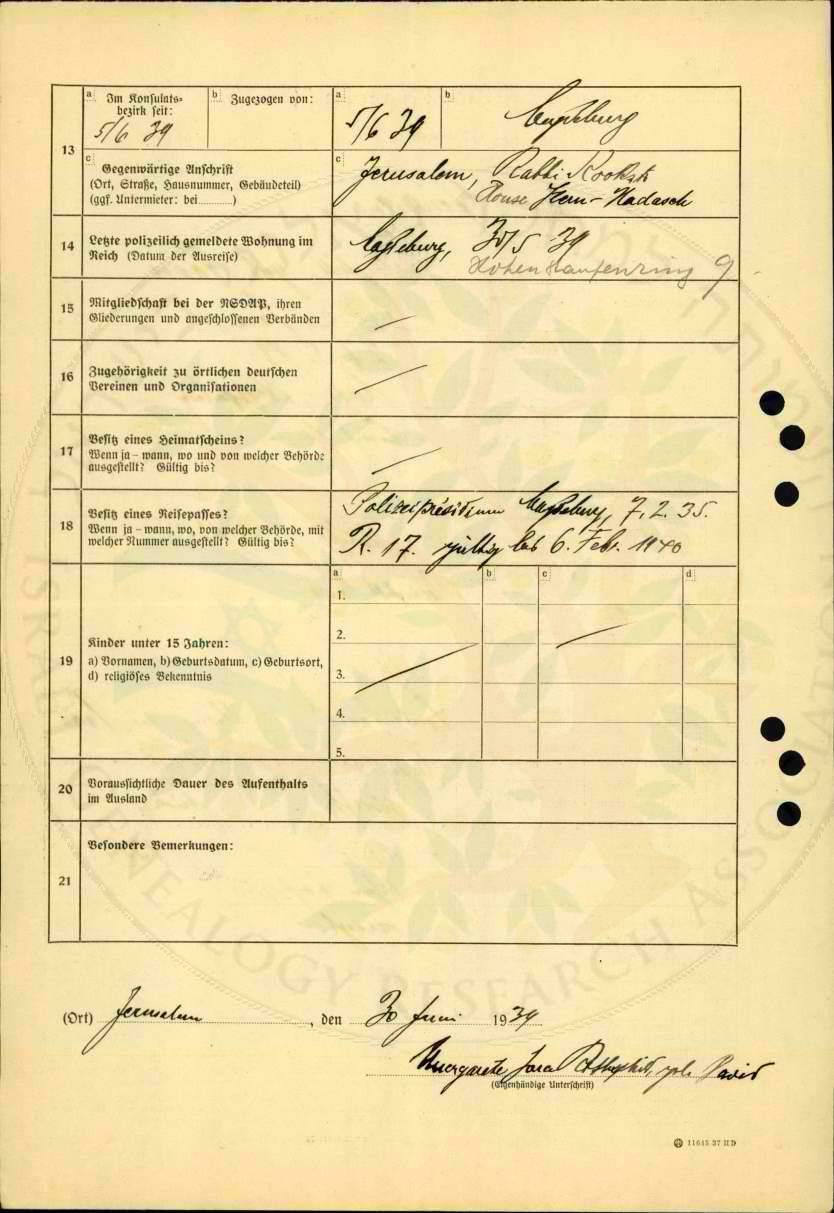
Sigmund and Betti’s brother Moses/Moritz Rothschild and his wife Margarete David ended up in Israel/Palestine in the 1930s along with their two children, Ruth, born October 8, 1914, in Magdeburg, Germany, and Herbert (later Yehuda), born December 10, 1921, in Magdeburg. The documents below are immigration documents showing that Moritz and Margarete were in Jerusalem by June 30, 1939; these and the others that follow were found at the Israel Genealogy Research Association website.

Registration form for Margarete David Rothschild reporting to the German Embassy Legation at the German Consulate General Consulate Bizekonsult in Jerusalem, A-B (טפסי הרשמה: A-B), part of the Residents 1938-1939 (תושבים 1938-1939) database, system number פ-500/5, IGRA number 1459. The original records are from Israel State Archives (ארכיון המדינה), and found at the IGRA website.

Registration form for Margarete David Rothschild reporting to the German Embassy Legation at the German Consulate General Consulate Bizekonsult in Jerusalem, A-B (טפסי הרשמה: A-B), part of the Residents 1938-1939 (תושבים 1938-1939) database, system number פ-500/5, IGRA number 1459. The original records are from Israel State Archives (ארכיון המדינה), and found at the IGRA website.

Registration form for Moses Moritz Rothschild, This record comes from the Meldeblaetter: A-B (טפסי הרשמה: A-B), part of the Residents 1938-1939 (תושבים 1938-1939) database, system number פ-500/5, IGRA number 1462. The original records are from Israel State Archives (ארכיון המדינה), and found at the IGRA website.

Registration form for Moses Moritz Rothschild, This record comes from the Meldeblaetter: A-B (טפסי הרשמה: A-B), part of the Residents 1938-1939 (תושבים 1938-1939) database, system number פ-500/5, IGRA number 1462. The original records are from Israel State Archives (ארכיון המדינה), and found at the IGRA website.

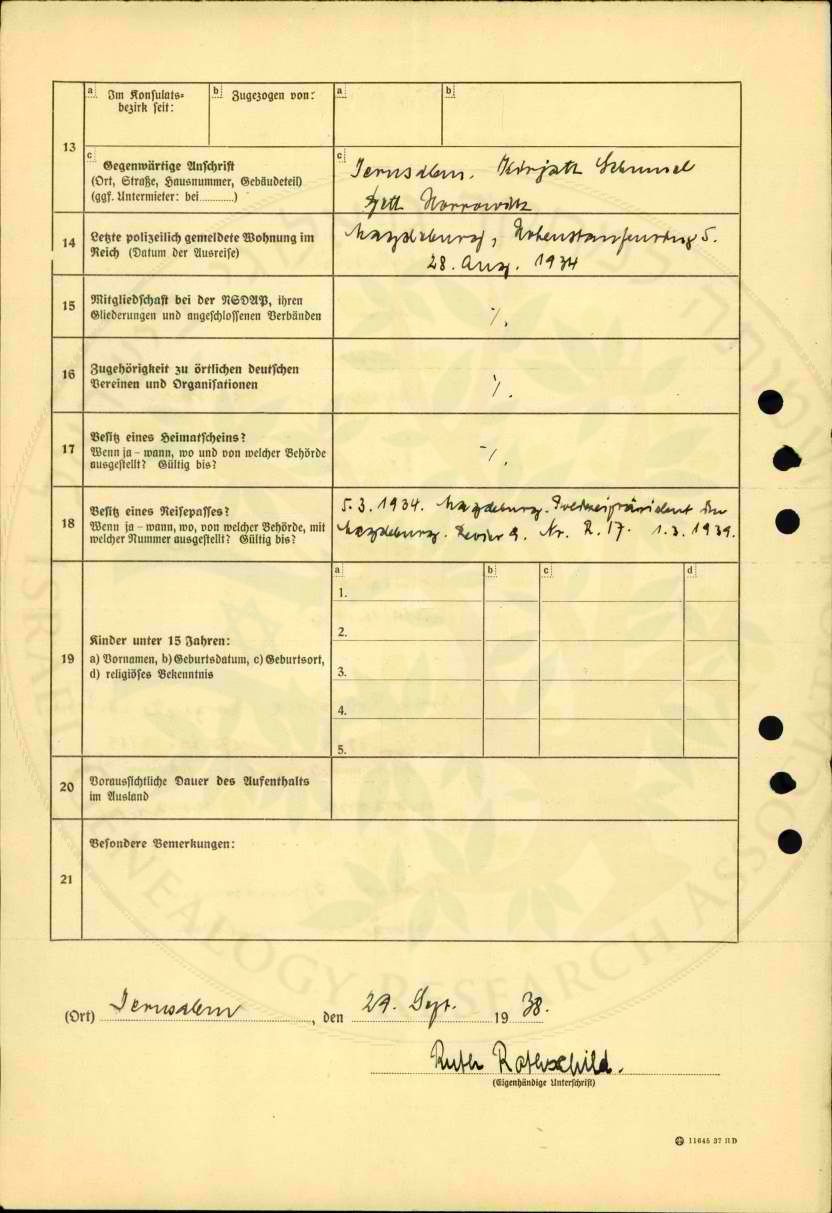
Their daughter Ruth had arrived by September 29, 1938.

Registration form for Ruth Rothschild reporting to the German Embassy Legation at the German Consulate General Consulate Bizekonsult in Jerusalem, A-B (טפסי הרשמה: A-B), part of the Residents 1938-1939 (תושבים 1938-1939) database, system number פ-500/5, IGRA number 1465. The original records are from Israel State Archives (ארכיון המדינה), as found at the IGRA website.

Registration form for Ruth Rothschild reporting to the German Embassy Legation at the German Consulate General Consulate Bizekonsult in Jerusalem, A-B (טפסי הרשמה: A-B), part of the Residents 1938-1939 (תושבים 1938-1939) database, system number פ-500/5, IGRA number 1465. The original records are from Israel State Archives (ארכיון המדינה), as found at the IGRA website.

Although I was unable to find a comparable record for Herbert/Yehuda, I found a record showing that he and his father Moritz were on the voter registration list and living at Kfar Yedidya in 1942:

Moritz and Yehuda Rothschild on 1942 Knesset register, This record comes from the Voters List Knesset Israel 1942 (פנקס הבוגרים של כנסת ישראל תש”ב), part of the Voters Knesset Israel 1942 (בוגרים של כנסת ישראל 1942) database, system number 001mush, document number 119, line 59, IGRA number 1107. The original records are from Israel State Archives (ארכיון המדינה), and was found at the IGRA website.

Yehuda married Ruth Hesin, daughter of Avraham and Hava, on April 17, 1949, in Haifa, Israel. She was 22 years old, he was 27.

Yehuda Rothschild marriage record, Marriage/Divorce Certificates (תעודות נישואין / גירושין), part of the Marriages and Divorces 1921-1948 Palestine British (נישואין וגירושין 1948-1921 ארץ ישראל) database, document number 91714, IGRA number 507. The original records are from Israel State Archives (ארכיון המדינה), and was found at the IGRA website.

At this time I have no further records for this family, but we know that at least they escaped from Germany in time to survive the Holocaust.

Thus, the first three children of Levi Rothschild and Clara Jacob all escaped from Nazi Germany in time, but look at what they lost. They were all spread across the globe: Sigmund in South Africa, Betti in the United States, and Moses in Palestine/Israel.

The fourth child of Levi and Klara, their son Hirsch Rothschild, also escaped. He and his wife Mathilde Rosenbaum and their three children Gertrude, Edith, and Edmund ended up, like Betti, in the US. I will write about Hirsch and his family in my next post.


  1. Kurt Rothschild, Death Age 87, Birth Date 30 Mar 1910, Registration Date Sep 1997, Registration district Lancaster, Inferred County Lancashire, Register Number A58B, District and Subdistrict 5871A, Entry Number 166, General Register Office; United Kingdom, Ancestry.com. England & Wales, Civil Registration Death Index, 1916-2007 
  2. Walter Hirschmann and family, passenger manifest, The National Archives in Washington, DC; Washington, DC, USA; Passenger and Crew Lists of Vessels Arriving at New York, New York, 1897-1957; Microfilm Serial or NAID: T715; RG Title: Records of the Immigration and Naturalization Service, 1787-2004; RG: 85, Ancestry.com. New York, U.S., Arriving Passenger and Crew Lists (including Castle Garden and Ellis Island), 1820-1957 
  3. Betti Hirschmann, 1940 US census, Year: 1940; Census Place: New York, New York, New York; Roll: m-t0627-02671; Page: 7B; Enumeration District: 31-1929, Ancestry.com. 1940 United States Federal Census. Walter Hirschmann and family, 1940 US census, Year: 1940; Census Place: New York, New York, New York; Roll: m-t0627-02671; Page: 7A; Enumeration District: 31-1929, Ancestry.com. 1940 United States Federal Census 
  4. “Herbert E. Stern Dead, An Investment Banker,” The New York Times, August 6, 1973, p. 32. 
  5. Betty Hirschmann, Age 75, Birth Date abt 1881, Death Date 15 Feb 1956, Death Place Manhattan, New York, New York, USA, Certificate Number 3638, Ancestry.com. New York, New York, U.S., Death Index, 1949-1965. Although there is a listing for Betti on the SSCAI with her Social Security Number, there is no listing on the SSDI for her under that number or under that date or under her name. Betty Sara Hirschmann, [Betty Sara Rohserild], Gender Female, Race White, Birth Date 14 Sep 1876, Birth Place Borken Hesse, Federal Republic of Germany, Father Levi Rohserild
    Mother, Clara Jacob, SSN 057200860, Notes Feb 1943: Name listed as BETTY SARA HIRSCHMANN, Ancestry.com. U.S., Social Security Applications and Claims Index, 1936-2007. 
  6. Walter Hirschmann death notice, The New York Times, June 27, 1977, p, 30. Walter Hirschmann, Social Security Number 092-14-5701, Birth Date 30 Dec 1899
    Issue year Before 1951, Issue State New York, Last Residence 10023, New York, New York, New York, USA, Death Date Jun 1977 Social Security Administration; Washington D.C., USA; Social Security Death Index, Master File,  Ancestry.com. U.S., Social Security Death Index, 1935-2014 
  7. Gertrud Hirschmann death notice, The New York Times, December 16, 1966, p. 47. 

For My Cousins in Israel

For all my cousins in Israel and their children and their families and their friends, my heart is with you. I am so blessed to have found you, and I will continue to stay in touch and hope for your safety and for peace. Please know that you are all in my thoughts—Omri, Ravid, Rafi, Joyce, Ester, Ariela, and Miki. And all your families and friends.

I wrote a short essay about Israel three days ago intending to post it here on my blog. But I was hurting too much, and since the blog is public, not private, I decided not to post. I did not want to invite anti-Israel, antisemitic posts by members of the public. Instead I posted on Facebook, limiting my audience to my Facebook friends. Fortunately, the responses I received were all sensitive and supportive from both my Jewish and non-Jewish friends.

I am still hurting too much. But I’ve decided to share this more publicly now. Because it’s important to speak up. Because now that Israel is fighting back, I know that the tide of public opinion will start to shift for many. I am not indifferent to the suffering of the people in Gaza. I understand that many of them are not terrorists. Many are children. But I also know that Israel has over and over again been convinced to walk away and agree to ceasefires only to once again have Hamas fire rockets and engage in terrorism to kill innocent people in Israel.

There is a lot of history here. It didn’t start in 1948 or 1967 or 1973. And it certainly didn’t start with Israel’s current response to the October 7 massacres. I can’t begin to summarize all the times that Israel has tried to find peace with the Palestinians only to find that violence and hatred are all they get in response. Of course, it’s not all Palestinians. It’s the leadership and the extremists who refuse to accept Israel’s right to exist. But it’s the leadership and the extremists who control whether or not there will be peace, and they refuse to take the steps that will bring peace, thus endangering the lives of not only Israelis but also their own people.

I am not a historian, but in the last week I’ve read many different articles outlining that history. For now I will only recommend two articles, one written in 2021 by Michael Oren that details the long history of Gaza and one published this week by David Brooks about more recent attempts to find peace between Israel and the Palestinians.

In that context, here are the words I posted on Facebook earlier this past week.


I can’t get the beautiful faces of the Israeli teens out of my head. My Facebook newsfeed contains one photo after another—of a teen taken hostage by Hamas or worse killed by Hamas. Or of the mother with her two young children. Or the elderly great-grandmother holding her great-grandchild. I can’t stop thinking about them all. And I can’t help but associate those faces with the names and faces of the many relatives I’ve researched who were killed by the Nazis. It’s all mixed up in my head.

I am not one who has been blind to Israel’s faults. I have often criticized the way Palestinians have been treated by Israel; I do not defend the oppression of others. I have been disappointed and angered by the way Netanyahu and the right-wing coalition he panders to have undermined liberal democracy and liberal Judaism in Israel. But those criticisms of Israel don’t mean that I don’t care about the people in and future of Israel just as it doesn’t mean I don’t care about America’s people and America’s future when I criticize it for its racism, the pandering to the white supremacists and the MAGA cult by Republicans, the failure to address poverty, the corporate greed, the gun violence, and so on. You can criticize without hating or being indifferent. You can love without being blind to the faults of those you love.

So right now my heart is with Israel and with its people. We can wonder later about how security failed or why or how this all happened. But no matter whatever criticisms anyone has of Israel, the terrorism of Hamas cannot be considered acceptable or understandable or justifiable. We need to stand together—and by “we” I don’t mean just Jews. I mean everyone. If you are silent or indifferent, you are part of the problem. If you can just scroll past all those beautiful faces and not feel anything, you are part of the problem.

When hatred starts to spread its poison and people remain silent, then we are all responsible for what happens next. Remember the six million. Please do not let it happen again.


Good for A Single Journey by Helen Joyce: A Review of A Wonderful New Book and An Interview with the Author

Today I have the great pleasure of sharing my virtual interview with author Helen Joyce. She has recently published a family history novel titled Good for A Single Journey, a moving and beautifully written telling of her maternal family’s story. Joyce’s great-grandparents were living in a small town in what was then Galicia in Eastern Europe in the early 20th century when oppression and poverty forced them to relocate to Vienna, where they hoped to have greater freedom and economic security. And they did find great success there. But like so many Jewish families, they eventually suffered from the horrors of the Holocaust. Although many, including Joyce’s mother, survived, many others were murdered, and all suffered from persecution and financial loss. And those who survived were once again forced to relocate and start all over in a new country.

Joyce has combined what she learned from her mother and other relatives with historical research to create a fascinating and illuminating look at the history of this era and its effect on one Jewish family. The book is a mix of fact and fiction, some parts totally created from her imagination and other parts entirely based on fact. The book reads like a novel. She has created wonderful three-dimensional characters, each with distinctive and memorable personalities and stories. I highly recommend this book to anyone interested in history and in Jewish history in particular. It is appropriate for young adults as well as adults and available for purchase on Amazon and Barnes & Noble here.

Good for a Single Journey has received a finalist’s award in the 2023 Next Generation Indie Book Awards and has also received a highly favorable review from Neville Teller in the June 12, 2023, issue of The Jerusalem Report. You can also learn more about Helen Joyce and her book at her website found here.  And in the interest of full disclosure, I should reveal that she is my fifth cousin on her paternal side; we are both descended from Jacob Falcke Goldschmidt and Eva Seligmann, our mutual four-times great-grandparents.

And now, let me introduce you to Helen Joyce and her wonderful book, Good for a Single Journey..

Thank you so much for agreeing to do this interview with me and to share more about your book, Good for a Single Journey.  Have you ever written a book or other fiction/non-fiction before?

No! I have written the odd article, contributed a chapter to two each of two academic books, and edited a community magazine which often entailed tightening the contributions of others. Otherwise, no formal writing experience.

So what made you decide to write this book at this time?

Old age! I always wanted to write an account of my mother’s life and never found the right time. Work, kids, and life in general always interfered. That and the self-defeating belief that the project was beyond me; that I was deluding myself if I thought I could write an account/memoir/novel of the type I imagined would do justice to her story. Finally, the reality of the fact that I was not getting any younger and triggered by taking our youngest granddaughter on a trip to Vienna where we visited my mother’s birthplace proved to be the catalyst for getting to work.

The author’s parents Max and Klari. Courtesy of Helen Joyce

I really enjoyed reading the book, and it reads like fiction. But I know that the book is based on the real lives of your parents, grandparents, and great-grandparents as well as many aunts, uncles, and cousins. How much of the book is fictionalized and how much is non-fiction?

It would take a long time to unravel fact from fiction but basically, I knew the ‘bare bones’ of the stories of all the characters. In the case of the two brothers, Chiel and Beresh, I knew very little indeed beyond the fact that they made Aliyah to pre-State Israel long around WWI. Therefore, I invented their adventures. I gave them experiences and put them in situations which were factually correct and allowed some of the history of the early Yishuv to come to light. I knew a little about Peppi, my grandmother’s sister, and of course the story of Suzanne became legendary!

Zissel, my other great-uncle, was a closed book to me until I unlocked the memoir of his son Yitzchak. That gave me the details of not only his travels across Europe and today’s Ukraine before reaching the shores of British mandate Palestine, but also revealed the entire saga of his grandparents’ (my great grandparents’) flight from Rozwadów to Ukraine and onwards to Siberia. I knew a great deal about my grandparents from my mother’s tales and, again through her, background details about day-to-day life in Vienna and the market town of Rozwadów, which she visited frequently on trips to her grandparents. The rags to riches story of my grandfather is true. Accounts of the flight from Vienna, the period in Prague, my mother’s experiences in London are also from my mother’s various shared memories.

My independent sources of research (apart from the internet and the cousin’s memoir which I mentioned) were my mother’s diaries and a stash of family letters collated and self-printed by my late uncle which charted the agony of desperation and fear as various members of the family tried to help and find ways to get those still trapped in Europe out. Obviously the most fictionalized accounts are those of the imagined conversations and emotions displayed by the various characters. The best I could do was to try and imagine I was them and put myself in their place at that time. What would I feel? How would I react?

How did you decide where to create fictional elements versus non-fiction?

Honestly, I don’t know! It just sort of flowed seamlessly. I wove elements of drama and fiction around the basic facts I knew. For example, I needed to get the two brothers from Vienna to Palestine during WWI. How would they have gone? What might they have done? WWI was raging so I thought it would be interesting to place them into an Austro-Hungarian unit which ended up in Palestine. When I started researching that possibility, I learned a great deal about the involvement of Jewish soldiers in the army, the unit I put them in was a real one (as was the officer which commanded it). The facts surrounding Aaron Aaronsohn, NILI, and their role in helping the British defeat the Ottomans in
Palestine and how these contributed to the fact of the Balfour Declaration was too good an opportunity to miss including. So, I did! Throughout the book I also wanted to give the lie to the myth that Jews were passive, never fought in armies and were pale scholars led to slaughter like sheep. Jews fought bravely (on all sides) in every theatre of war.

How did you research the parts of the book that are fact-based?

I read several books on WWI, biographies about Aaron Aaronsohn and NILI as well as books about the history of the Middle East. My mother’s cousin’s memoir was also very helpful. The internet is also a phenomenal resource. What was the weather like in Gallipoli in November 1915 – click. What train routes were available on the Chemins de fer Orientaux during WWI – click! What date was Rosh Hashanah in 1914 – click. All there in your hand-held mobile phone!

Your book begins with your great-grandparents leaving Rozwadów. Why did you decide to begin there?

The book begins with a train journey, the journey of my great grandparents fleeing their hometown in Galicia. I decided to start with that train ride as it gave me the opportunity to introduce all the main characters as well as a major theme of the book. Migration and journeys. The entire book is about the journey of individuals, families, and the Jewish people. Trains feature quite prominently. That opening train ride. Greetings and goodbyes at train stations. The brothers’ train ride to war and onwards to Palestine. The train ride carrying my great grandparents and their youngest son to Siberia. The train ride my mother took to Scotland to meet her brother serving in the Jewish Brigade of the British army and of course the final horrific train rides to the death camps.

You include some living people and some recently deceased people in the book. How did you approach the issues of privacy with respect to those people? Were there things you had to change or avoid to protect the interests of your family?

Yes, absolutely. A lot was excluded! However, in discussion with as many of my cousins as I could track down, I realized they were quite happy for me to give details of their stories. I offered each of them drafts so they could check they were happy with what I had written. However, as nearly all the family descendants live in Israel, many of them do not read in English. That said, they were quite happy to know I had written some account and did not mind if it was fictionalized. The Israeli branch is very easy going! I gave my sister an early draft and she enjoyed the first half but did have some comments and suggestions about the second half of the book. I have tried to accommodate her feelings on this but, ultimately, we agreed that the book was a fictionalized novel.

Your family endured many of the challenges and horrors faced by many Jewish families in the 20th century: immigration to new countries (several times), World War I, and Nazi persecution and the Holocaust. What impact do you think that history has had on you and the other living descendants of your great-grandparents?

It’s hard to speak about this in general. The impact is surely quite different for each family and on each individual. For me, knowing what previous generations lived and died for made me want to cling to a Jewish lifestyle replete with the traditions that Hitler tried so hard to erase. I didn’t want to give Hitler any kind of posthumous victory and so I have tried to raise a Jewishly faithful family. Beyond that? I guess a sense of the importance of justice and the need to respect equality of all people regardless of gender, race, or religion.

You ultimately decided to leave England and make Aliyah to Israel. What in your family history contributed to that decision? Have you made connections to the cousins who were refugees to Israel during the Nazi era?

Many factors contributed to that decision. My husband comes from a very ‘English’ Jewish family but his mother, eldest of ten, was the only child left in the UK after the creation of the State of Israel. The rest were all pioneers in Israel (although two had died before that was possible). So, he already has a huge network of family here. Our son made Aliyah twenty years ago and was raising his children here and of course we wanted to be close to them. We have a daughter with special needs and she made Aliyah with us – we couldn’t contemplate leaving her behind and she is so very happy here with excellent care. Our youngest child followed us five years ago and so, to our delight, all our children and grandchildren are here. Yes, I have contact with some of my many cousins, but they are numerous and spread out so we do not meet that often although I do meet my first cousins more frequently.

Your book has many themes and covers many topics: different ways to practice Judaism, antisemitism, Zionism, mental health, marriage, parental love, and so on. Was there a specific point or theme that mattered most to you?

They all mattered and, in a way, I suppose several of them nestle into each other like a set of Russian matryoshka dolls! Parental love leads to stability and contributes to the type of marriage partnership one is likely to create as does a strong sense of community and belonging. Antisemitism and Zionism also have a kind of Yin and Yang partnership! If I had to choose one (you didn’t ask me that!) maybe I would say resilience and survival!

Who did you see as the audience for your book? Your own family and descendants? Young adults? Jewish readers? The entire universe of adult readers?

The entire universe! My family and their descendants were not really the target audience. Had they been, the book would have been far more factual and memoir-based. I hoped it would appeal to young adults and prove educational and am being told that teenagers are totally gripped by the story – which, given the amount of history in it – is great! However, I would dearly love the non-Jewish world to gain insight about a Jewish way of life, the history of persecution and the holocaust but also the historical underpinnings of the State of Israel under international law which was brought about together with the dismantling of previous empires. If Israel is to be accused of being a ‘colonialist enterprise’ then equally so is Syria, Lebanon, Jordan, Saudi Arabia and Iraq. Not to mention the many ‘new’ European countries created in the wake of WWI. Without understanding the impact of WWI, nothing about the modern world makes sense (including current events in Ukraine!)

This book focused on your maternal family. Do you plan to write a book about your paternal side?

Yes! And your blog will be a fantastic resource for me!!! However, marketing this book is taking up a lot of time at the moment. I have been invited to take part in Jewish Book Week School Events for schools around the UK which is fantastic. Events can be online so I can do them from here. This is really part of my dream – to bring the reality of the Jewish experience to a wider audience.

The author, Helen Joyce. Courtesy of Helen Joyce

Thank you again for taking the time to answer my questions, and I look forward to reading your next book and hope that my research will be helpful to you! Best of luck in your marketing efforts—your book deserves a wide and large audience.


Did Jenny Blumenfeld marry Siegmund Warburg? A Brick Wall Tumbles

As I wrote in my last post about the family of Salomon Blumenfeld, Roberto Meinrath, my fifth cousin and the younger son of Hilde Blumenfeld Meinrath, left Brazil in 1960 after being selected by his congregation in Rio de Janeiro to spend a year in Israel in a leadership training program. I was hoping that Roberto might be able to provide information to answer questions I had about his mother’s sister Jenny Blumenfeld, who had immigrated to Israel (then Palestine) to escape Nazi Germany.

Back in May 2022, I wrote that many trees on Ancestry and elsewhere “report that … Jenny, married Siegmund Rudolf Warburg on July 25, 1933, and that Siegmund was born in Berlin on May 26, 1896, to Otto Warburg and Bertha Cohen.” I found Siegmund’s birth record, but I could find no record attaching Siegmund and Jenny; I had found “a Siegmund Warburg with a different wife, Ilse, and two children, Gabriel and Thomas, sailing from Hamburg to New York on August 31, 1933.” But was that the same Siegmund who supposedly married Jenny?

Siegmund Warburg birth record, Landesarchiv Berlin; Berlin, Deutschland; Personenstandsregister Geburtsregister; Laufendenummer: 95, Ancestry.com. Berlin, Germany, Births, 1874-1908

Warburg family, ship manifest, Month: Band 417 (Aug 1933), Staatsarchiv Hamburg. Hamburg Passenger Lists, 1850-1934, Staatsarchiv Hamburg; Hamburg, Deutschland; Hamburger Passagierlisten; Volume: 373-7 I, VIII A 1 Band 417; Page: 2211; Microfilm No.: K_2000
Staatsarchiv Hamburg. Hamburg Passenger Lists, 1850-1934, Ancestry.com

My cousin Richard Bloomfield then found what we believe is Jenny’s gravestone on Billiongraves based on the birth date on the stone, and it has her name as Jenny Warburg; Richard also found a 1950 list of registered voters in Haifa, Israel, that listed Jenny Warburg and Siegmund Warburg together. But none of that definitively proved that it was Jenny Blumenfeld who married Siegmund Warburg.

Jenny Warburg, Yekhi’am cemetery, Akko, Israel, found at Billiongraves.com at https://billiongraves.com/grave/%D7%92%D7%A0%D7%99-%D7%95%D7%A8%D7%91%D7%95%D7%A8%D7%92/22732522

So I asked Roberto what he knew about his aunt Jenny, and he was able to provide further evidence that she had married Siegmund Warburg because while living in Israel in 1960, Roberto spent time with his aunt Jenny and her husband Siegmund. Thus, Roberto was able to confirm that in fact that Jenny had married Siegmund. Roberto also said he knew “for sure” that Jenny and Siegmund did not have any children. Roberto also informed me that his grandmother Malchen/Amalie had gone to Israel after Salomon Blumenfeld died and was living at the same kibbutz as Jenny and Siegmund.1

Roberto wasn’t certain, but he thought that Siegmund may have had a son from a prior marriage also living in Israel. I thought that that might explain how Siegmund appeared on a ship manifest in 1933 with a wife named Ilse and two children, traveling to the US. Perhaps he and his family with Ilse had later immigrated to Palestine/Israel.

I decided to search on the Israel Genealogy Research Association website and found several relevant records. In 1938 Siegmund Warburg, son of Otto (so the same Siegmund born in Berlin on May 28, 1896) is listed with Ilse Warburg on the Haifa registered voters list, proving that the Siegmund who was sailing with Ilse and their children to the US in 1933 had immigrated to Palestine/Israel with Ilse by 1938. Then I found Ilse and Sigmund listed together as Haifa registered voters in 1941.2

Voters List Knesset Israel 1938 (פנקס הבוגרים של כנסת ישראל בחיפה 1938), part of the Voters Knesset Israel 1938 (בוגרים של כנסת ישראל 1938) database, system number גל-7408/5, line 42, IGRA number 12178. The original records are from Israel State Archives found at https://genealogy.org.il/AID/

But in 1942 Sigmund is listed without Ilse, and we know from Richard’s research that in 1950 Siegmund and Jenny were listed together as Haifa voters.3

Voters List – Local (רשימת הבוחרים למועצה המקומית), part of the Voters Local Authorities 1942 (בוחרים למועצות המקומיות 1942) database, document number 297, page 8946, IGRA number 32087. The original records are from City Archives – Haifa (ארכיון העיר – חיפה), found at https://genealogy.org.il/AID/

What does all this mean? It means that although I have no marriage record for Jenny Blumenfeld and Siegmund Warburg, one can presume that Siegmund came to Israel/Palestine with his wife Ilse and their children sometime before 1938, eventually divorced Ilse, and married Jenny sometime before 1950. I could not prove it, but I was persuaded that that’s what happened based on the circumstantial evidence.

I decided to post on the Tracing the Tribe group page on Facebook to see if someone knew where I might find a marriage record for Jenny and Siegmund, and I was surprised to receive a comment from my fifth cousin Simeon Spier, whose mother Gisela Spier I wrote about here. Simeon not only knew that Jenny had married Siegmund Warburg—he knew Jenny well as she and his mother Gisela had been very close.

Simeon wrote that Siegmund Warburg’s father Otto Warburg was an important early Zionist as well as a renowned botanist—something that I had not realized while searching for information about Siegmund. I found more information about Otto and his life and career from his obituary here and from other articles here and here.4

Simeon also told me that Siegmund’s marriage to Jenny was his second marriage; it was Jenny’s first marriage. So that corroborated both what Roberto remembered and what I found in my research. Simeon also confirmed that Siegmund had three children from his first marriage.

Simeon shared these two photographs of Jenny with Siegmund.

Jenny Blumenfeld and Siegmund Warburg Courtesy of Simeon Spier

Siegmund Warburg and Jenny Blumenfeld Courtesy of Simeon Spier

Simeon also shared two photographs of Jenny with his own family. The first one shows Jenny with her cousin Gisela Spier Cohen and Gisela’s children Sitta and Simeon in Haifa in 1965.

Sitta Cohen, Gisela Spier Cohen, Jenny Blumenfeld Warburg, Simeon Spier (Cohen) in Haifa, 1965 Courtesy of the family

This one shows Jenny with Simeon and his sisters when they visited her in Israel in 1974.

Jenny Blumenfeld with the children of Gisela Spier Cohen 1974   Courtesy of Simeon Spier

Simeon has fond memories of visiting Jenny in Israel and when she visited them in Toronto. He described her fondly as a “very orderly and proper woman.” He wrote:4

Jenny had a tiny but well-appointed apartment on the Carmel in Haifa. … The small living room was filled with Sigmund’s books and his furniture from Germany.  She used the covered balcony as her dining room.  She was an exquisite cook and she was proud of it!!  In fact, we have a saying in our family: “Jenny, I think I’ll come again.”  Jenny would taste her delicious cooking before serving it and comment: “Jenny, I think I’ll come again!”

You can see Sigmund’s large collection of books in the first photograph above. Unfortunately, we can’t sample Jenny’s cooking. But we can imagine it.

Jenny’s marriage to Siegmund was further confirmed when I connected with her great-nephew Michael Katz, the grandson of Jenny’s sister Gretel. Michael also met Jenny in Israel. So that was a third confirmation of the marriage.

And then, as yet another confirmation, I received the translation of Hilde’s Shoah Foundation testimony by Manuel Steccanella and Richard Bloomfield.5 In her testimony, Hilde said that Jenny left Germany and first went to England, where she met Siegmund Warburg and his family. They did not marry, however, until they were in Palestine/Israel. Hilde also stated that she herself went to Israel sometime after the end of the war and worked at a kibbutz for two months as arranged by Siegmund Warburg’s children.6

I have searched for a record showing that Jenny was in England before immigrating to Palestine/Israel, but so far have not located any. And I am still hoping someday to obtain an actual marriage certificate for Jenny and Siegmund (I’ve written to the kibbutz where they lived in 1960, but have gotten no response yet), but I am now convinced based on the statements of four witnesses, Roberto, Simeon, Michael,  and Hilde, as well as the photographs shared by Simeon that Jenny Blumenfeld was married to Siegmund Warburg, the son of Otto Warburg.

Thank you to my cousins Gabriela, Roberto, Simeon, and Michael for helping to break down this brick wall. Special thanks to Richard Bloomfield and Manuel Steccanella for translating Hilde’s Shoah Foundation testimony.


  1. Email from Roberto Meinrath, February 11, 2023. 
  2. Voters List – Local (רשימת הבוחרים למועצה המקומית), part of the Voters Local Authorities 1941 (בוחרים למועצות המקומיות 1941) database, system number 6/272, page 14, IGRA number 743. The original records are from City Archives – Haifa (ארכיון העיר – חיפה), found at https://genealogy.org.il/AID/ 
  3. Voters’ Ledgers Haifa Municipality 1950 (פנקס הבוחרים לעירית חיפה 1950), part of the Voters Local Authorities 1948-1953 (בוחרים רשויות מקומיות 1953-1948) database, list קלפי 26, page 1, line 169, IGRA number 21461. The original records are from City Archives – Haifa (ארכיון העיר – חיפה), found at https://genealogy.org.il/AID/.  I also found on the IGRA website an index of a record for the 1947 marriage of Hanna Warburg, twenty-one year old daughter of Zigmund Warburg, in Haifa, and one for the marriage of  Gavriel Warburg, son of Ilza and Shimon Warburg, dated February 23, 1949. He was 21 at the time, so born in about 1928. 
  4. Email from Simeon Spier, February 23, 2023. 
  5. The references in this post to the interview of Hilde Meinrath and the information contained therein are from her interview with the Shoah Foundation, March 18, 1998, which is in the archive of the University of Southern California Shoah Foundation Institute for Visual History and Education. For more information: http://dornsife.usc.edu/vhi 
  6. Ibid. 

Arye Katzenstein

I have researched and written about hundreds of relatives (maybe thousands?) over the almost ten years that I’ve been writing this blog. And aside from my own direct ancestors, of those many, many cousins and great-aunts and great-uncles going back over two hundred years, there are only a small number whose stories are so compelling and unforgettable that when I see their name, I immediately remember the details of their lives.

One of those cousins is my fourth cousin Arye Katzenstein, whose heroic story I wrote about here. During a terrorist attack at the Munich Airport on February 10, 1970, Arye threw himself on a grenade released by the Palestinian terrorists and sacrificed his own life so that he could save the life of his father, Heinz Katzenstein, and the lives of all the other travelers. He was only 32 years old.

So when I received a comment on my blog from a woman named Miki saying her father was Arye Katzenstein, I gasped. I’d had no idea that Arye had had children when he was killed. I immediately wrote to Miki and learned that after more than fifty years, the city of Munich is finally providing a memorial for Arye on the grounds where the attack occurred. The land is now owned by a private company, BrainLab, and together with that company, the city, and the family of Arye Katzenstein, a proper memorial is being established. BrainLab has commissioned an art work by Alicia Kwade, an internationally known artist, and the family is creating a website and informational materials for the site, which will be dedicated sometime in 2024.

From Miki, I learned a great deal more about her father and his family and his life. As I already knew, Arye was born in Haifa (then Palestine, now Israel) on November 23, 1937, after his parents fled from Nazi Germany. But I learned from Miki that he had spent time in Germany as a student. In 1959 he came to Munich to study veterinary medicine, but later returned to study engineering. He had married his wife Bilha on October 22, 1961, and their first child, my cousin Miki, was born in Munich a few years later. The family returned to Israel before the 1967 war and had two more children there, a son and another daughter.

Thus, Arye left behind not only his parents and siblings, but also his wife and three very young children. It’s hard to imagine the pain and suffering that his death must have caused his loved ones. But his legacy is one of heroism and courage.

Miki shared with me several photographs of her family. First is a photograph of her father Arye as a young man traveling in Europe.

Arye Katzenstein Courtesy of his family

This is a photograph taken at Arye and Bilha’s wedding. Bilha is third from our left, then Arye next to her. Next to Arye are his parents Mania (Miriam) Dorf and Heinz Katzenstein.

Wedding of Arye Katzenstein Courtesy of the family

This chilling photograph is of Arye’s notebook taken after the terrorist attack that killed him. It was returned to the family by El Al after Arye’s death.

Arye Katzenstein notebook returned to family by El Al Courtesy of the family

This photograph was taken on the 53rd yahrzeit (anniversary) of Arye’s death in 2023, just a month ago. Arye’s gravestone reads: “Here lies our dear, noble spirited Arye Katzenstein, son of Miriam and Jacob Hacohen, who sacrificed his live during the attack on El Al passengers.”

Gravestone of Arye Katzenstein Courtesy of the family

The stones for Miki’s grandparents appear below:

Gravestones of Heinz and Miriam Katzenstein Courtesy of the family

Finally, Miki shared with me this photograph of her family—her husband, her children, and herself. I don’t usually include photographs of living people, but in this case I do so to honor the memory of Arye Katzenstein and to recognize the resilience of his family and the hope for a better future where all of us can live in peace and without fear of terrorism.

Miki Katzenstein Dror and family Courtesy of the family


Meier Blumenfeld IIB, Part II: His Three Surviving Children Were All Murdered in the Holocaust

Meier Blumenfeld IIB, who died in 1922, and his wife Sarchen, who died in 1930, were survived by three of their five children: Moses Blumenfeld III and his wife Sarah Rothschild and their son Julius; Hermann Blumenfeld III and his wife Elsa Drucker and their three children, Eric, Hilde, and Liselotte; and Rosa Blumenfeld and her husband Julius Hess. As of 1933 when Hitler came to power, they were all living in Germany.

Tragically, all three of Meier IIB and Sarchen’s children were murdered in the Holocaust. Moses IIB and Sarah were deported to the Litzmannstadt Ghetto in Lodz on October 20, 1941, and died sometime thereafter. Fortunately, their son Julius escaped to Argentina in 1936. I don’t know what happened to Julius afterwards, but at least he managed to avoid the fate of his parents.1

Moses IIB’s sister Rosa and her husband Julius Hess were also both killed by the Nazis. They were deported on June 11, 1942, from Frankfurt either to the Sobibor death camp and/or to the camp at Majdanek, where they were murdered.2

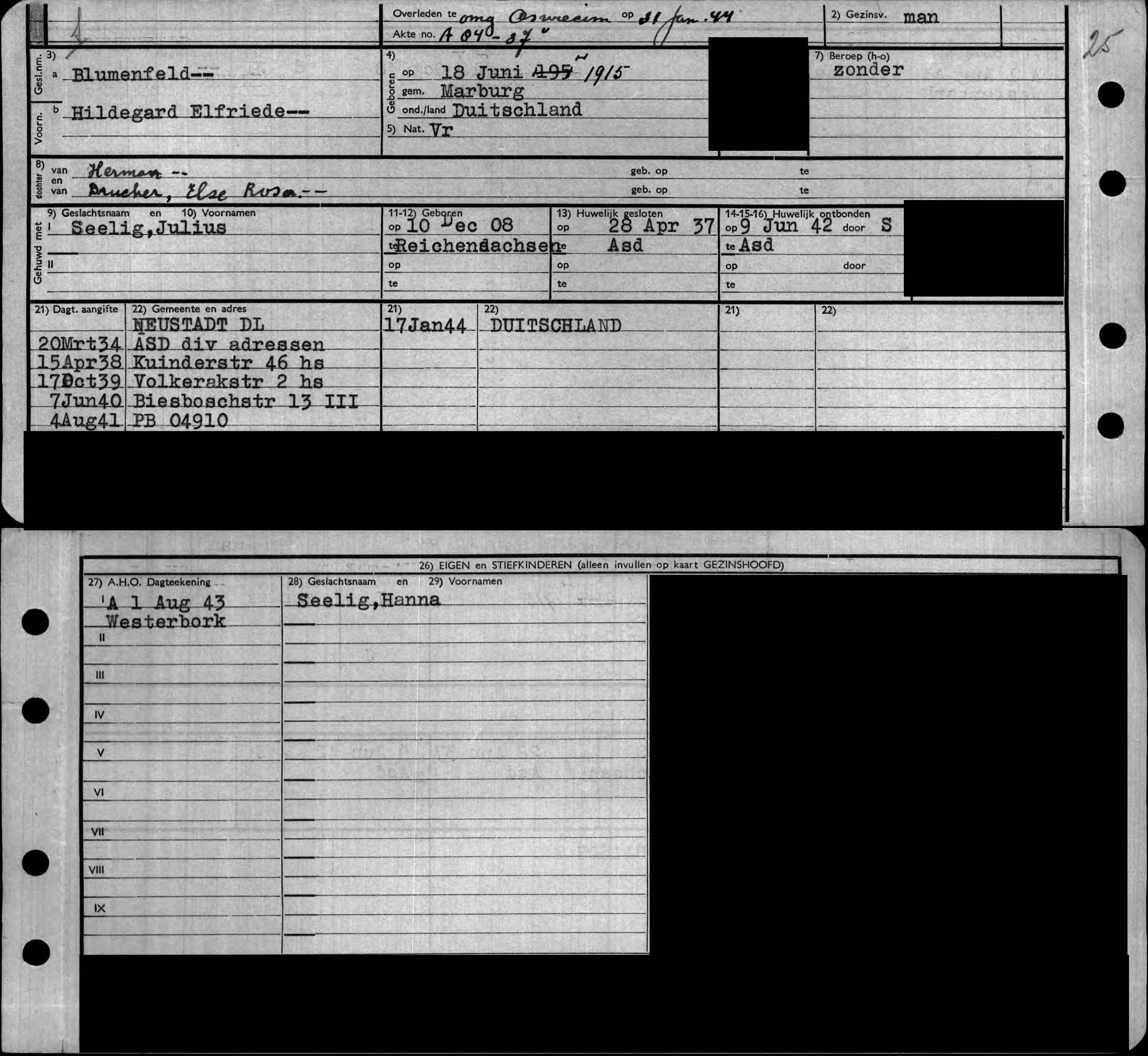
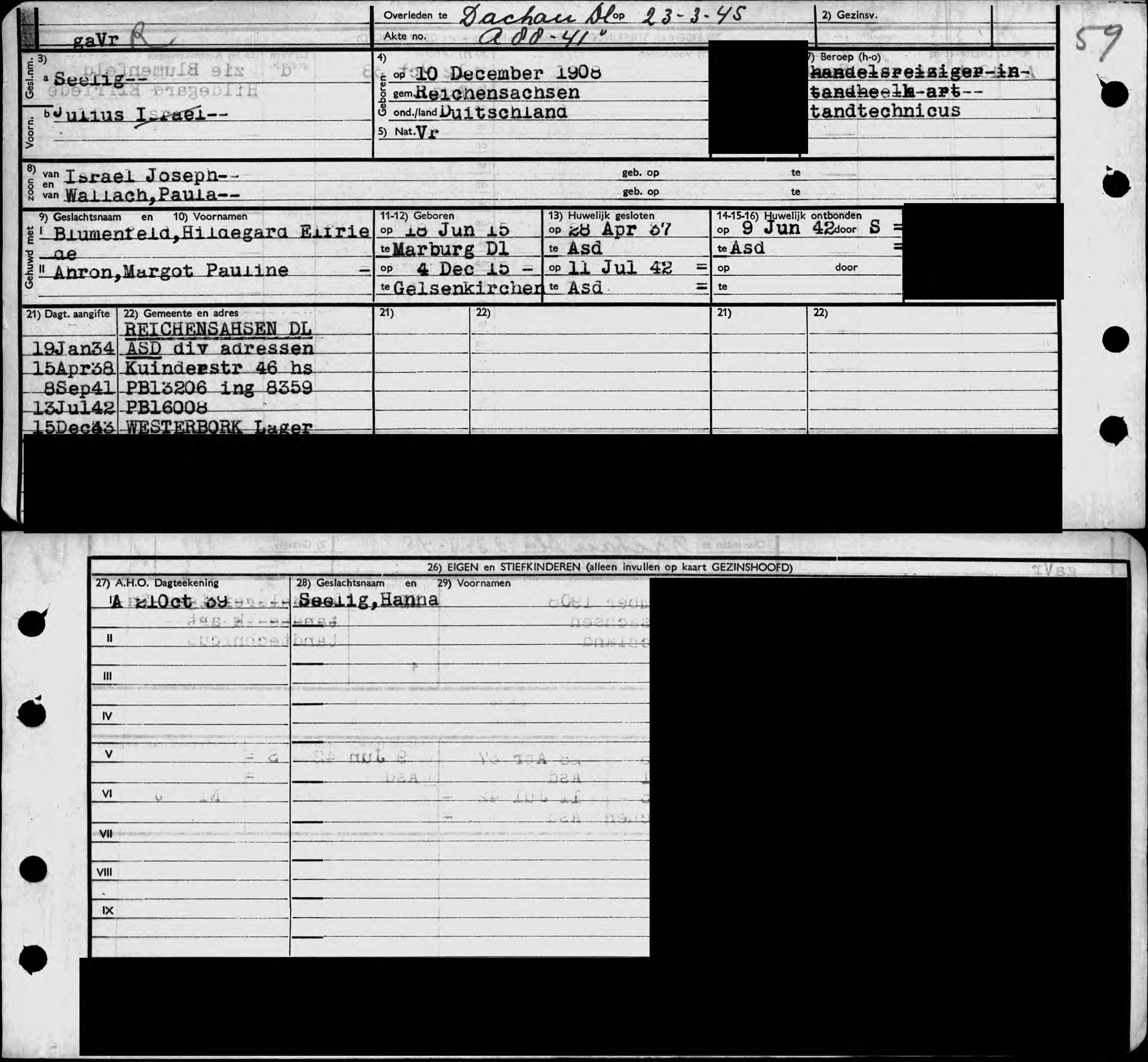
Hermann Blumenfeld III and his wife Elsa were also murdered by the Nazis, as were their daughter Hilde and her family, despite the fact that they all had left Nazi Germany. Hilde had immigrated to Amsterdam in March 1934, and she had married Julius Seelig on April 28, 1937, in Amsterdam. Julius was born in Reichensachen, Germany, on December 10, 1908, to Joseph Seelig and Paula Wallach. Hilde and Julius had one child, a daughter Hanna born in Amsterdam on October 12, 1938. Julius and Hilde were divorced on June 9, 1942, and Julius soon remarried another woman, Margot Pauline Aharon, in July 1942.

Here are the Amsterdam registration cards for Hilde, Julius, and Hanna that report this information:

Amsterdam City Archives, Archive cards , archive number 30238 , inventory number 78
Municipality : Amsterdam, Period : 1939-1960, found at https://archief.amsterdam/indexen/deeds/98533418-6d7f-56a3-e053-b784100ade19

Amsterdam City Archives, Archive cards , Archive cards , archive number 30238 , inventory number 719, Municipality : Amsterdam, Period : 1939-1960 found at https://archief.amsterdam/indexen/deeds/9853340a-857d-56a3-e053-b784100ade19

Amsterdam City Archives, Archive cards , archive number 30238 , inventory number 719
Municipality : Amsterdam, Period : 1939-1960, found at https://archief.amsterdam/indexen/deeds/9853341a-53f7-56a3-e053-b784100ade19

Hilde’s parents Hermann and Elsa came to Amsterdam later than Hilde, arriving in May 1939, according to Hermann’s Amsterdam registration card.

Amsterdam City Archives, Archive cards , archive number 30238 , inventory number 78
Municipality : Amsterdam
Period : 1939-1960 found at https://archief.amsterdam/indexen/persons?sa=%7B%22person_1%22:%7B%22search_t_geslachtsnaam%22:%22Blumenfeld%22,%22search_t_voornaam%22:%22Hermann%22%7D%7D

But escaping to Amsterdam did not keep any of them safe. According to records at Yad Vashem, Hermann and Else were sent to the Westerbork Detention Camp in 1943 and from there deported to Auschwitz where they were both killed on February 11, 1944.

Hilde and her daughter Hanna were also first sent to Westerbork in August 1943 and then to Auschwitz. Hilde died on January 31, 1944, and her five-year-old daughter Hanna on February 11, 1944, according to Yad Vashem.

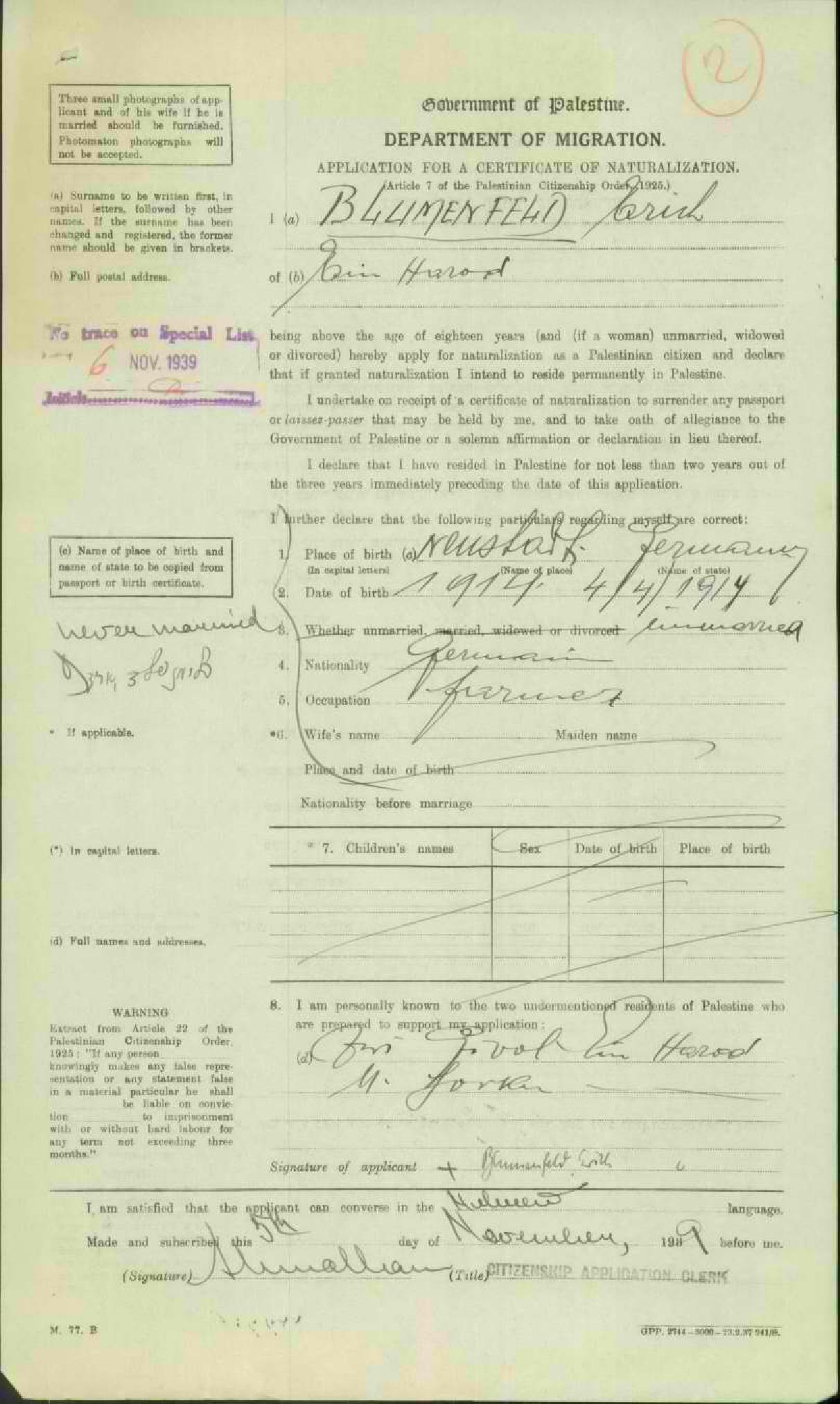
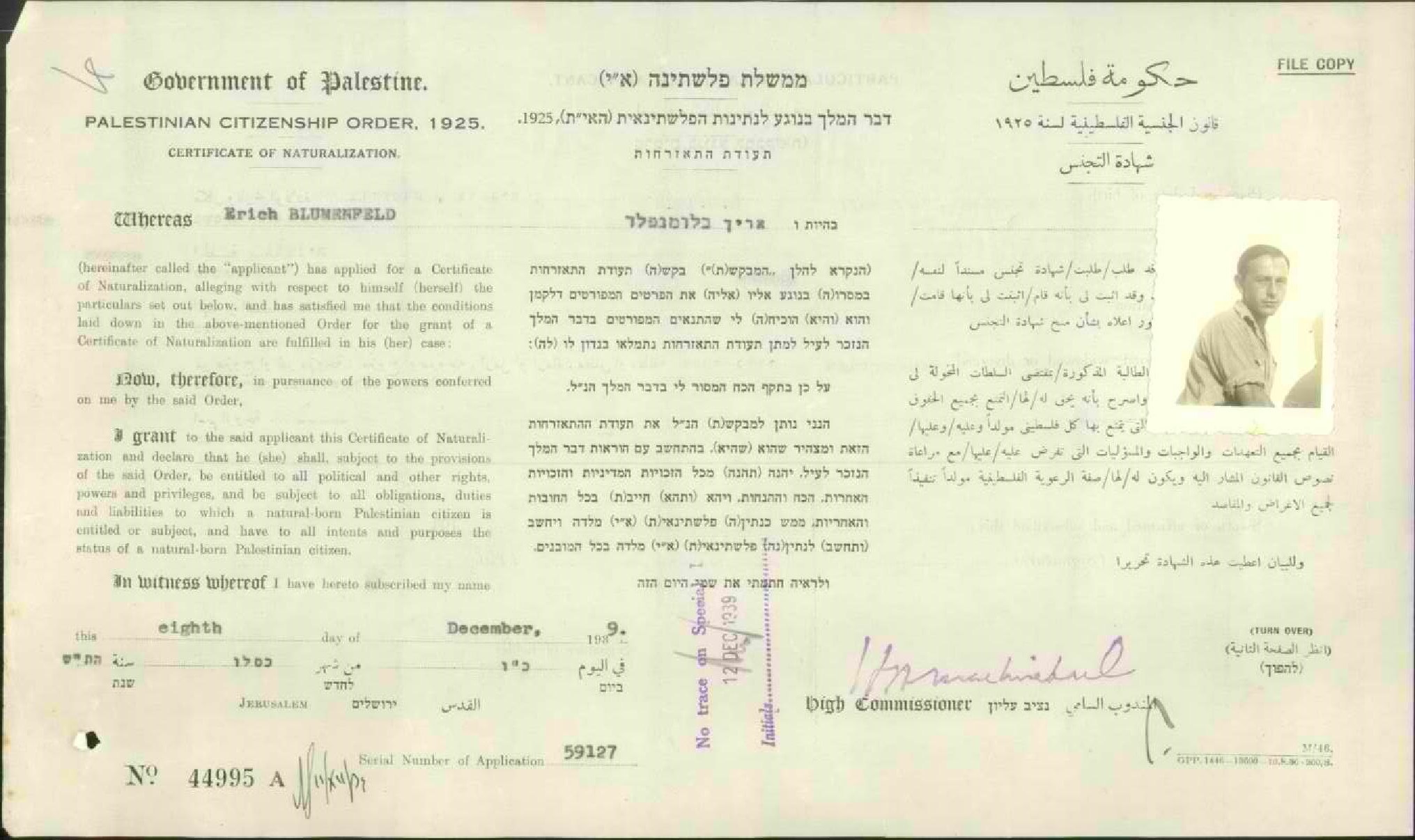
Fortunately, Hilde’s two siblings survived the Holocaust. Erich Blumenfeld immigrated to Palestine on September 13, 1937, and became a naturalized citizen there on December 19, 1939.3

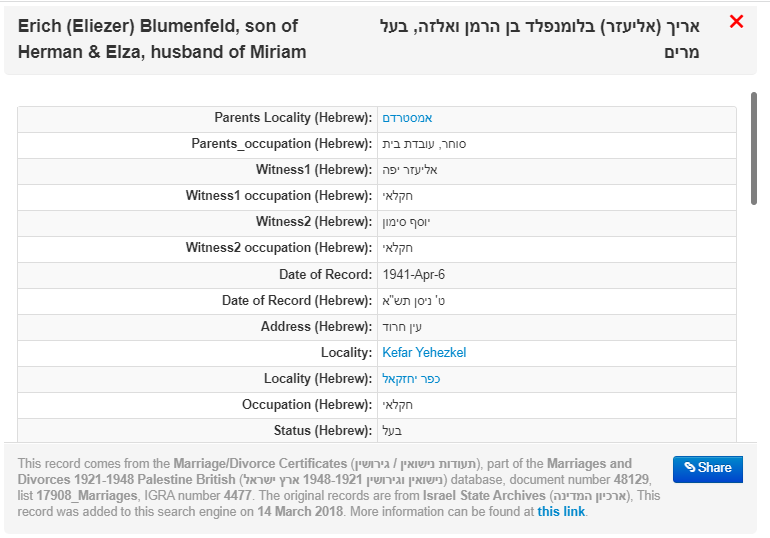
Erich married Miriam Emerich, daughter of Robert and Hannah Emerich, on April 6, 1941.4

Erich changed his name in 1948 to Eliezer Shadmon. Shadmon means farm in Hebrew, and according to Erich/Eliezer’s application for naturalization, he was working as a farmer at Ein Harod at that time, as seen in the images above.5 Unfortunately, I’ve not yet found any further information about Erich/Eliezer.

Liselotte Blumenfeld, the youngest child of Hermann III and Else, immigrated to the US and arrived in New York City on August 5, 1937. She was heading to Lexington, Kentucky, according to the ship manifest,6 and in 1940, she was living with James and Nanette Strause in Fayette, Kentucky and working as a nurse, presumably for their seven year old son. I don’t know why Liselotte chose Kentucky as her destination, but I assume there was some friend or family member living there when she immigrated or she had arranged the job before leaving Germany. (I’ve recently learned that another branch of the Blumenfeld family that I’ve yet to research settled in Kentucky long before the 1930s, so perhaps that was Liselotte’s connection. To be determined…)

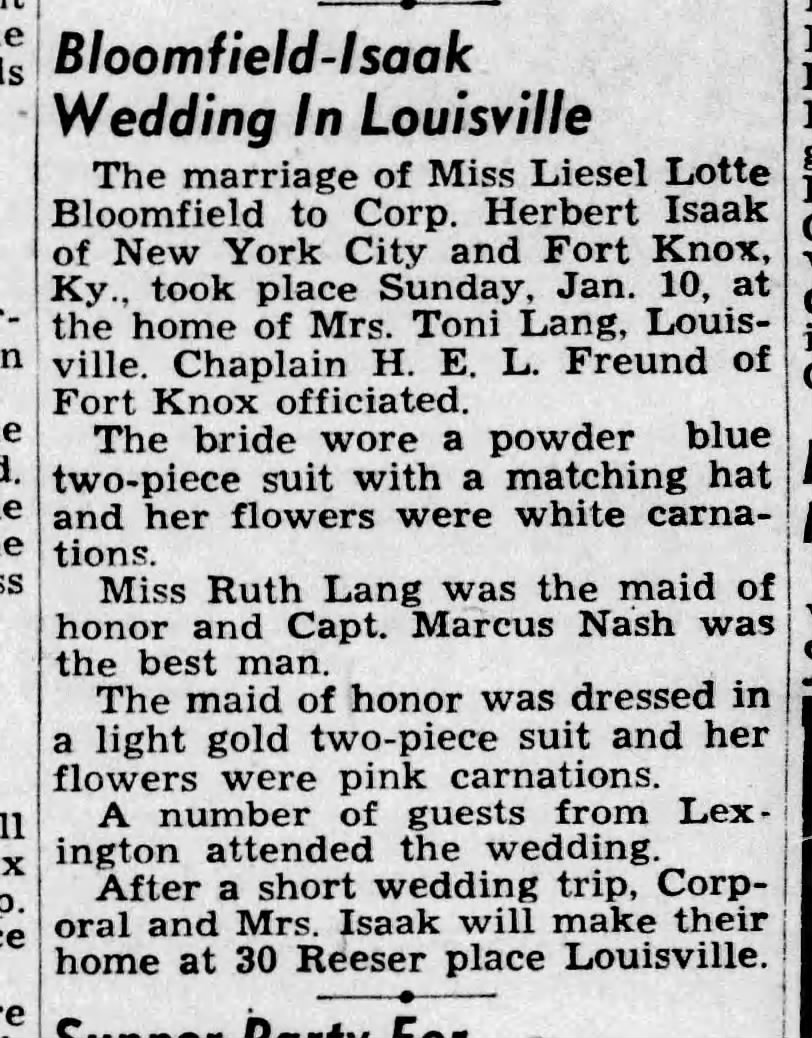
On January 10, 1943, Liselotte, referred to here as Liesel Lotte Bloomfield, married Corporal Herbert Isaak in Louisville, Kentucky.

“Bloomfield-Isaak Wedding in Louisville,” Lexington Herald-Leader, January 17, 1943, p. 18

Herbert was born in Munich, Germany, on March 21, 1920, and had immigrated to the US on April 25, 1941; he’d enlisted in the US Army on January 5, 1942. His parents were Emil Charles Isaak and Therese Meyer.7 Liselotte and Herbert had one child born in the 1940s. According to his obituary, Herbert had survived the Dachau Concentration Camp and had served as a field-commissioned second lieutenant in the US  Army at the Nuremberg Trials.8

In 1950, the family was living in New York City, and Herbert was working as a traveling salesman for a “ladies suits and coats factory.”9 The family must have relocated to the South at some later date because, according to Herbert’s obituary, “he was a traveling sales representative of women’s coats in Virginia and the Carolinas and had a showroom in Charlotte, N.C.”10 Herbert died on November 18, 2001, in Myrtle Beach, South Carolina; he was 81. Liselotte outlived him by thirteen years; she was just a few days shy of her 97th birthday when she died on November 5, 2014. Herbert and Liselotte were both buried at Florence National Cemetery in Florence, South Carolina.11

I haven’t yet determined whether Liselotte Blumenfeld Isaak or Erich Blumenfeld/Eliezer Shadmon have living descendants. Nor have I found more information about their cousin Julius Blumenfeld, the son of Moses IIB. I am hoping that there are more descendants alive to carry on the legacy of Meier Blumenfeld IIB and his wife Sarchen Moses and their children.


  1. “Uruguay, listas de pasajeros, 1888-1980,” database, FamilySearch (https://familysearch.org/ark:/61903/3:1:3Q9M-C33M-19T3?cc=2691993 : 30 June 2020), > image 1 of 1; Archivo General de la Nación, Dirección Nacional de Migración (General Archive of the Nation, National Migration), Montevideo. Also, see Arolsen Archives, Digital Archive; Bad Arolsen, Germany; Lists of Persecutees 2.1.1.1, Description Reference Code: 02010101 oS, Ancestry.com. Free Access: Europe, Registration of Foreigners and German Persecutees, 1939-1947 
  2. The Gedenbuch and Yad Vashem records mention both camps. I guess the evidence of where Rosa and Julius ended up is unclear, but their ultimate fate is not. 
  3. Erich Blumenfeld, Palestine Immigration File, found at the Israel Archives website at https://www.archives.gov.il/catalogue/group/1?kw=erich%20blumenfeld 
  4. Marriage record found at the Israel Genealogy Research Association website by searching for Erich Blumenfeld. https://genealogy.org.il/AID/ 
  5. Name change found at the IGRA website by searching for Eliezer Shadmon. https://genealogy.org.il/AID/ 
  6. Liselotte Brilea Ingeborg Blumenfeld, ship manifest, Year: 1937; Arrival: New York, New York, USA; Microfilm Serial: T715, 1897-1957; Line: 21; Page Number: 37,
    Ancestry.com. New York, U.S., Arriving Passenger and Crew Lists (including Castle Garden and Ellis Island), 1820-1957 
  7. Herbert Jsaak [Herbert Isaak] Gender: Male Race: White Birth Date: 21 Mar 1920
    Birth Place: Munich, Federal Republic of Germany, Death Date: 18 Nov 2001, Father:
    Emil Jsaak Mother: Therese Meyer SSN: 046143654, Ancestry.com. U.S., Social Security Applications and Claims Index, 1936-2007; Herbert Isaak, Petition for Naturalization, The National Archives at Atlanta; Atlanta, GA; Petitions For Naturalization , Compiled 1906-1978; NAI: 1275754; Record Group Title: Records of District Courts of the United States; Record Group Number: 21, Ancestry.com. Kentucky, U.S., Naturalization Records, 1906-1991; Herbert Isaak, National Archives at College Park; College Park, Maryland, USA; Electronic Army Serial Number Merged File, 1938-1946; NAID: 1263923; Record Group Title: Records of the National Archives and Records Administration, 1789-ca. 2007; Record Group: 64; Box Number: 04782; Reel: 142, Ancestry.com. U.S., World War II Army Enlistment Records, 1938-1946 
  8. “Herbert Isaak,” Myrtle Beach Sun-News, November 21, 2001, p. 35. 
  9. Herbert Isaak and family, 1950 US census, United States of America, Bureau of the Census; Washington, D.C.; Seventeenth Census of the United States, 1950; Record Group: Records of the Bureau of the Census, 1790-2007; Record Group Number: 29; Residence Date: 1950; Home in 1950: New York, New York, New York; Roll: 4377; Sheet Number: 12; Enumeration District: 31-2180, Ancestry.com. 1950 United States Federal Census 
  10. See Note 8, supra. 
  11. Find a Grave, database and images (https://www.findagrave.com/memorial/138910393/liesel-isaak: accessed 21 September 2022), memorial page for Liesel Bloomfield Isaak (23 Nov 1917–5 Nov 2014), Find a Grave Memorial ID 138910393, citing Florence National Cemetery, Florence, Florence County, South Carolina, USA; Maintained by Danny & Judy Ard (contributor 47789022); Liesel Isaak, Rank: T/5, Death Age: 96, Birth Date: 23 Nov 1917, Death Date: 5 Nov 2014, Interment Place: Florence, South Carolina, USA, Cemetery Address: 803 East National Cemetery Road, Cemetery Postal Code: 29501, Cemetery: Florence National Cemetery, Section: 11 Plot: 37, War: World War II, Branch of Service: US Army
    Relative: Herbert Isaak, Comments: Wife, National Cemetery Administration; U.S. Veterans’ Gravesites, National Cemetery Administration. U.S., Veterans’ Gravesites, ca.1775-2019; 

Finding Max Blumenfeld and His Family: A Postscript

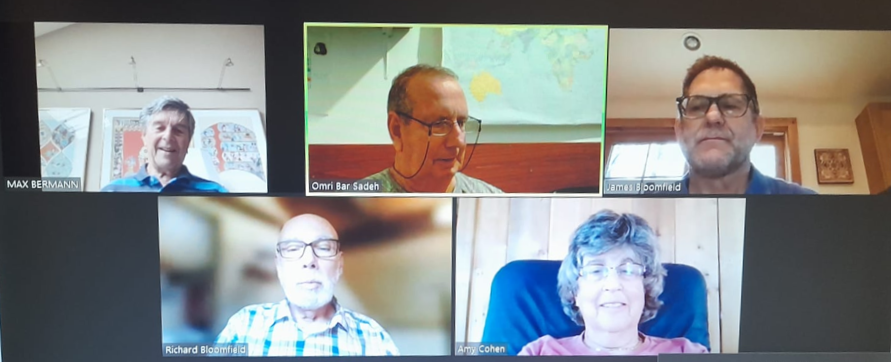
Yesterday I Zoomed with four of my Blumenfeld cousins—Richard, whose been my research partner for quite a while now, his first cousin Jim, who is also a wonderful genealogy researcher, and the two surviving grandchildren of Max Blumenfeld, Max and Omri. We spanned three continents—Omri in Israel, Richard in Switzerland, and Max, Jim, and I in New England. We chatted for an hour, but could have gone on much longer and hope to continue the conversation another time.

During our conversation, we uncovered the answer to a question we still had been unable to answer despite all our research: when did Anna Grunwald Blumenfeld, Max Blumenfeld’s widow and Omri and Max’s grandmother, leave Italy and immigrate to Israel/Palestine? The records that Richard had obtained from Merano said she’d left in 1939, but Max had pointed out that that wasn’t possible since he and his sister were cared for by their grandmother Anna during World War II while their mother Edith worked with the Italian Resistance. Their father Josef had immigrated to the United States on November 1939.

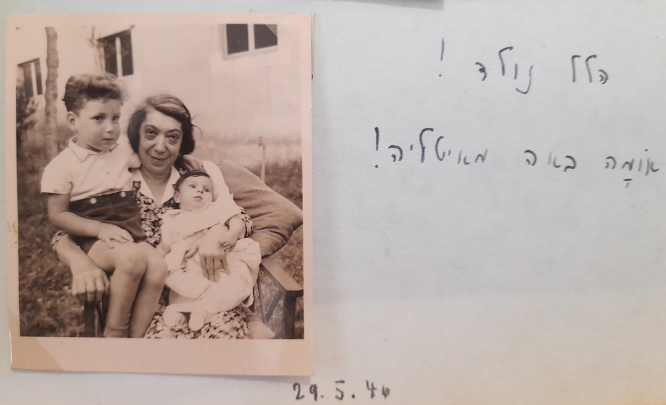
For our Zoom, Omri had prepared a wonderful slide show of family photographs, some of which I’ve already shared on this blog, and some that were new to me. Among those photographs was one that helped to answer the question of when Anna arrived in Palestine. The photograph shows Anna in Palestine with two of her grandsons, Omri’s brothers Gideon and Hillel. Anna was holding Hillel, who was just a very small baby, and the photo was inscribed in Hebrew with the words, “Hillel is born! Oma [Anna] arrives! 29 May 1946.” So now we knew that Anna had only recently arrived in Palestine in May of 1946.

Here is another photo taken the same day showing Anna with Gideon and Hillel and their parents Fritz and Dora.

But then how do we explain the records that said Anna had left Merano in 1939? Well, Max had the answer to that question. Max explained that Anna and her daughter Edith and the two grandchildren, Max and his sister Margherita, all left Merano in 1939 and moved to Milan. Max has no memories of life in Merano since he was only a toddler when the family moved. But that would explain why the Merano records report that Anna left that place in 1939.

Max and his family stayed in Milan for several years, and then when Italy adopted laws persecuting the Jews in about 1942, his mother Edith was able to use her connections to obtain permission to leave Milan and move to the countryside outside of Milan.  The family remained there for the duration of the war, hiding the fact that they were Jews. They spoke Italian (although they all could also speak German) so that they could pass as Italian, and Max and his sister went to church on Sundays. In fact, Max and Margherita were not aware of the fact that they were Jewish and also didn’t know that their father was still alive—all to prevent the children from accidentally revealing the fact that they were Jews.

After the war, Edith took her children to America so they could all be reunited with Josef, and Anna went to Palestine to be with her son Fritz and his family, as depicted in the photograph above.

We spoke of many other interesting things during our Zoom, and there were many stories and many moments of laughter interspersed. It was truly a delightful hour and one I will always cherish and remember.

Thank you to Omri, Max, Richard, and Jim—all of whom are my fifth cousins, four people I never would have known if not for doing genealogy research.

And that, dear readers, is the magic of genealogy.

Finding Max Blumenfeld, Part III: Finding His Grandsons

Although my cousin Richard and I had learned that Max Blumenfeld died in Merano, Italy, in 1936, we still didn’t know where and when his wife Anna died. We had some hints, but nothing definite. Her son Fritz’s marriage record in 1940 seemed to suggest she was still living in Italy. But her daughter Edith’s failure to list her mother on the 1946 ship manifest as her nearest relative in Italy, the place Edith had last resided, seemed to indicate that either Anna had died by then or had left Italy.

We were hoping that one of Max and Anna’s grandchildren might know the answers, and so I turned to locating those grandchildren. We knew that Max and Anna’s daughter Edith had two children with her husband Joseph Bermann, so I started to search for them. They all appear together on the 1950 US census, living in New York City. Joseph was practicing medicine, and Edith was working as a secretary for a general export business. Their two children Margherita (spelled Margaret on the census) and Max were 14 and 12.1 As of 1958, Edith and Joseph were still living in New York City.

Joseph Bermann, passenger manifest, The National Archives At Washington, D.C.; Washington, D.C.; Series Title: Passenger Manifests of Airplanes Arriving At San Juan, Puerto Rico; NAI Number: A3534; Record Group Title: Records of the Immigration and Naturalization Service, 1787-2004; Record Group Number: 85, Ancestry.com. Puerto Rico, U.S, Arriving Passenger and Crew Lists, 1901-1962

According to FindAGrave, Joseph died on May 1, 1966; he was 68.2 Edith died two years later on August 12, 1968. She was only 61.3 They were both buried in Westchester Hills Cemetery in Hastings-on-Hudson, New York. They were survived by their two children. Their daughter Margherita died on August 21, 2008;4 she was 72. Max, however, was as best I could tell, still living.

After using Google and other online tools, I finally located what I assumed was Max Bermann’s Facebook page. I noticed that he had a Facebook friend named Omri Bar Sadeh. You may recall that Hermann Blumenfeld, Max Blumenfeld’s older brother, had a son Hans who had changed his name to Hanan Bar Sadeh after immigrating to Israel/Palestine. I used the Google Translate tool and learned that “sadeh” means a cultivated field. So Bar Sadeh means son of a cultivated field. Since Blumenfeld translated from German as field of flowers, it made sense that Hanan had adopted a name that meant he was the son of a cultivated field, or a field of flowers, or a “Blumenfeld.”

So when I saw that Max Bermann had a Facebook friend with the surname Bar Sadeh, I assumed that this other person must be a descendant of Edith’s first cousin, Hanan Bar Sadeh. But David Lesser had reported that Hanan had no children, so I was not certain. Was it just a coincidence that Edith’s son Max had a friend with that surname? Or was this Facebook friend one of his cousins?

On Omri Bar Sadeh’s Facebook page, there was a video in Hebrew. I could not understand it, but I could translate the comment that had been included with the post, and it indicated that the video was about Omri Bar Sadeh’s brother Gideon Bar Sadeh. When I googled that name, I found this page:

Bar-Sadeh, Gideon

Son of Moses HaKohen and Devorah. He was born in Ein Harod on June 16, 1942, and completed his twelfth grade at the Kibbutz Ha-Meuchad School there. He had a penchant for drawing and found talent in his paintings. He would decorate his notebooks and make handsome posters and posters. He was quiet and humble in his ways. Was an animal breeder and loved them. Was drafted into the Israel Defense Forces in October 1960. On October 18, 1962, he fell in the line of duty and was brought to eternal rest in Ein Harod.

I knew that Edith Blumenfeld Bermann had listed her brother Fritz on her ship manifest in 1946 indicating that he was residing in “En Charod,” Palestine. Could Gideon have been Fritz’s son, I wondered? Fritz had married a woman named Devorah so that fit the puzzle. But then why did it say Gideon’s father was named Moses?

Then I remembered seeing on the IGRA website that in 1942 Fritz Blumenfeld, residing in En Harod, had been identified as “Moshe (Fritz) Blumenfeld, son of Max.” And given that Max’s father’s name had been Moses, it made sense that Fritz’s Hebrew name was Moshe and that he was named for his grandfather and adopted that name as his primary name in Israel.

Record located on the Israel Genealogy Research Association website at https://genealogy.org.il/AID/

With that additional insight, I realized that I had found the family of Fritz Moshe Blumenfeld and that Fritz, like his cousin Hanan, had changed his surname from Blumenfeld to Bar Sadeh for the same reasons. Just to be sure, I asked David Lesser if he would watch the video posted on Facebook about Gideon, and he confirmed that the video says that Gideon’s parents were Fritz and Devorah.

I sent messages to both of the surviving grandsons of Max and Anna (Grunwald) Blumenfeld, hoping that I would eventually learn what happened to Anna and the rest of the story of their family. Much to my delight, I heard from both of them.

Max Bermann, Edith’s son, was born in Merano, Italy, where his father Giuseppe (later Joseph) Bermann was born. That’s where the family was living (along with Anna) after Joseph left for the US in 1939. Although the family was originally supposed to follow once Joseph was settled, the war intervened, and they could not leave Italy. Max was just a toddler at the time. His grandmother Anna became the primary caregiver for his sister and him because their mother Edith was often away. Max later learned from his sister that Edith was acting as a courier for the partisans during the war.

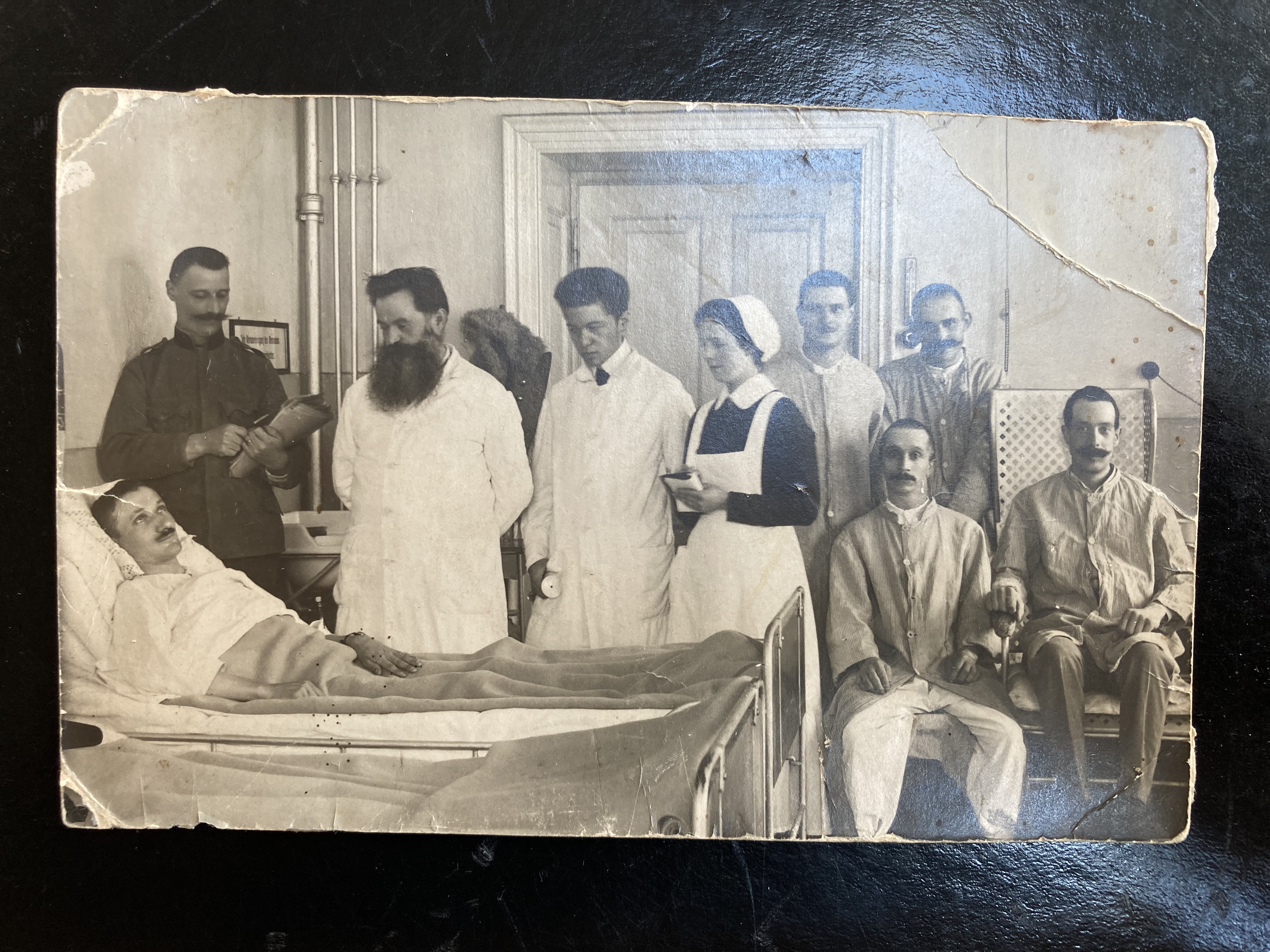
Max shared with me this photograph of Merano, where he and his father were born, as well as this photograph of his father and his father’s father, Max Bermann, both of whom were doctors at the Waldpark Sanitorium in Merano. The elder Max Bermann is the man with the long black beard and his son Joseph/Giuseppe Bermann, the younger doctor in the white coat, is standing next to him.

Dr Max Bermann and his son Dr Joseph Bermann in Waldpark Sanitorium, Merano, Italy. Courtesy of the family

When the war ended, Edith brought her children to the US, but Anna went to live with her son Fritz and his family in Ein Harod in Palestine. Neither Omri nor Max knew exactly when Anna immigrated, but as I was doing some of the final edits for this post, Richard emailed me with new information he’d found online—a database of information about the Jews of Merano.

There was an entry for Anna Grunwald Blumenfeld that reported that “Anna Grünwald-Blumenfeld came from Berlin and lived in Merano since 23.4.1936. On 22.8.1938 she was recorded in the census of “Jews” living in Italy by the fascist authorities as permanently resident in Merano. On 13.2.1939 her file received the note: “di razza ebraica”. On 1.4.1939 she fled to an unknown place, according to the registration office of the municipality of Merano. Later, April 1939 is given as the date of the flight abroad.”5 Thus, it would appear from this record that Anna left Merano for Palestine in April, 1939.

But as noted by Max and by my reader Teresa, this cannot be accurate. Max knows that his grandmother did not leave in 1939 because she cared for him during the war years. It appears more likely that these Merano records are inaccurate and that Anna was in Italy at least until the end of the war.

Now that I knew that Anna had survived the war and had immigrated to Palestine, I searched again on the Israel Genealogical Research Association website and found this record:

Anna Grunwald Blumenfeld died on September 7, 1946, in Ein Harod; she was only 61 years old. She had survived the move from Germany to Italy, the loss of her husband Max in 1936, World War II, and then a move from Italy to Palestine. She was survived by her daughter Edith and her family and her son Fritz and his family.

Anna and Max Blumenfeld’s grandson Max Bermann shared these lovely photographs of his family. First, some photographs of Anna and Max:

Anna Grunwald Blumenfeld Courtesy of the family

Anna Grunwald Blumenfeld and Max Blumenfeld Courtesy of the family

Max Blumenfeld Courtesy of the family

This photograph is of Max and Anna’s children Fritz and Edith as well as, on the right, Fritz’s wife Dora Salpeter Blumenfeld.

Fritz Blumenfeld, Edith Blumenfeld Bermann, and Dora Salpeter Blumenfeld Courtesy of the family

And this final photograph from Max shows him and his sister Margherita with a soldier they met when they visited Palestine (now Israel) with their mother after the war.

Margherita and Max Bermann in Italy shortly after the end of World War II with a soldier from Palestine. Courtesy of the family

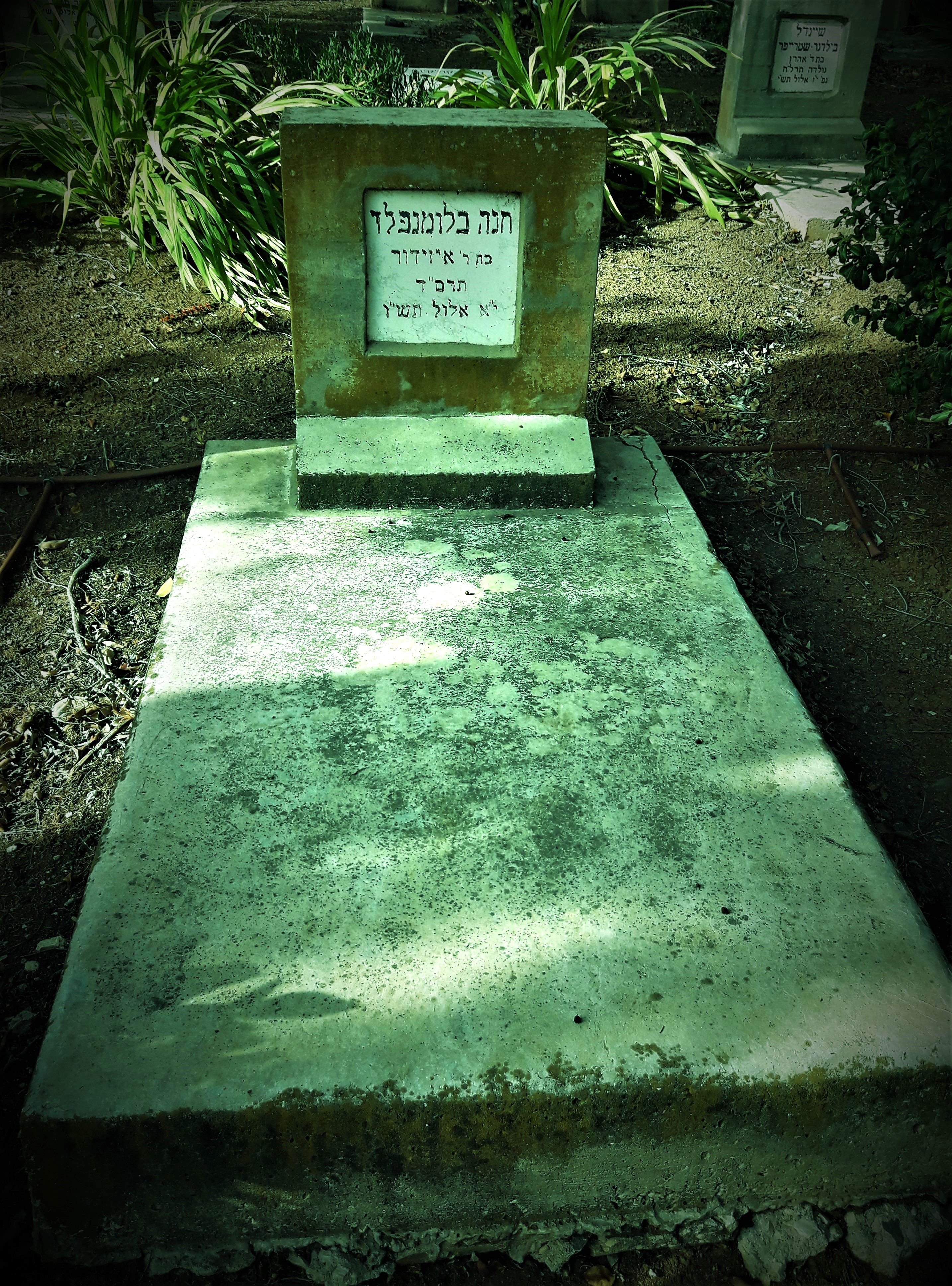
Omri also shared some photographs, including this one of his grandmother Anna’s gravestone.

Anna Blumenfeld, Ein Harod Photo courtesy of Omri Bar Sadeh

In addition, he shared photographs of the gravestones of his parents Fritz (Moshe) and Dora/Devorah and his two brothers Gideon and Hillel.

Gideon, as we saw, died fighting for Israel on October 18, 1962.

Gideon Bar Sadeh, Ein Harod Photo courtesy of Omri Bar Sadeh

Omri’s father Fritz Moshe Blumenfeld Bar Sadeh died December 12, 1977 in Ein Harod; he was 67. Devorah Salpeter Blumenfeld Bar Sadeh, outlived her husband by almost 23 years and died at 92 on November 27, 2000, in Ein Harod.

Dora and Fritz Bar Sadeh, Ein Harod Photo courtesy of Omri Bar Sadeh

Fritz and Devorah’s middle child, their son Hillel, died from cancer on December 30, 1996, in Ein Harod. He was only 50 and left behind a wife and four children.

Hillel Bar Sadeh, Ein Harod Photo courtesy of Omri Bar Sadeh

I am so grateful to my fifth cousins Max and Omri for sharing their family’s stories and their own stories and their photographs with me and allowing me to share them with you. I now have answers to all the questions I had when I first started searching for what happened to Max Blumenfeld after he married Anna Grunwald in 1906, thanks to the incredible help of Richard Bloomfield, David Lesser, Max Bermann, and Omri Bar Sadeh.


  1. Joseph Bermann family, 1950 US census, United States of America, Bureau of the Census; Washington, D.C.; Seventeenth Census of the United States, 1950; Record Group: Records of the Bureau of the Census, 1790-2007; Record Group Number: 29; Residence Date: 1950; Home in 1950: New York, New York, New York; Roll: 5665; Sheet Number: 72; Enumeration District: 31-675, Ancestry.com. 1950 United States Federal Census 
  2. Find a Grave, database and images (https://www.findagrave.com/memorial/173690239/joseph-bermann : accessed 18 May 2022), memorial page for Joseph Bermann (unknown–1 May 1966), Find a Grave Memorial ID 173690239, citing Westchester Hills Cemetery, Hastings-on-Hudson, Westchester County, New York, USA ; Maintained by BKGeni (contributor 46895980) . 
  3. Find a Grave, database and images (https://www.findagrave.com/memorial/173690238/edith-bermann : accessed 18 May 2022), memorial page for Edith Bermann (unknown–12 Aug 1968), Find a Grave Memorial ID 173690238, citing Westchester Hills Cemetery, Hastings-on-Hudson, Westchester County, New York, USA ; Maintained by BKGeni (contributor 46895980) . 
  4.  Margherita M. Bermann, Social Security Number: 085-30-0023, Birth Date: 22 Aug 1935, Issue Year: 1954-1956, Issue State: New York, Last Residence: 12550, Newburgh, Orange, New York, Death Date: 21 Aug 2008, Social Security Administration; Washington D.C., USA; Social Security Death Index, Master File, Ancestry.com. U.S., Social Security Death Index, 1935-2014 
  5.  There were also entries for Max and for their two children Fritz and Edith. Max’s entry confirmed that he died on March 7, 1936 and is buried in the Jewish cemetery in Merano. Edith’s entry reported that she had “married Josef Bermann on January 30, 1935. After a stay in London in the spring of 1935, she lived in Merano from April 8, 1935. On August 22, 1938, Edith Bermann was included in the census of “Jews” living in Italy by the fascist authorities. On February 13, 1939, her file received the note: “di razza ebraica”. Edith Bermann, who stayed in Milan again and again, fled to Milan.” Fritz’s entry in the Merano Jewish database reported that he “had lived in Merano since October 3, 1936, where his sister was married to the doctor Josef Bermann. On August 22, 1938, Fritz Blumenfeld was recorded by the fascist authorities as permanently residing in Merano in the census of “Jews” living in Italy. According to the registration office of the municipality of Merano, Fritz Blumenfeld fled to Palestine on May 15, 1939.” 

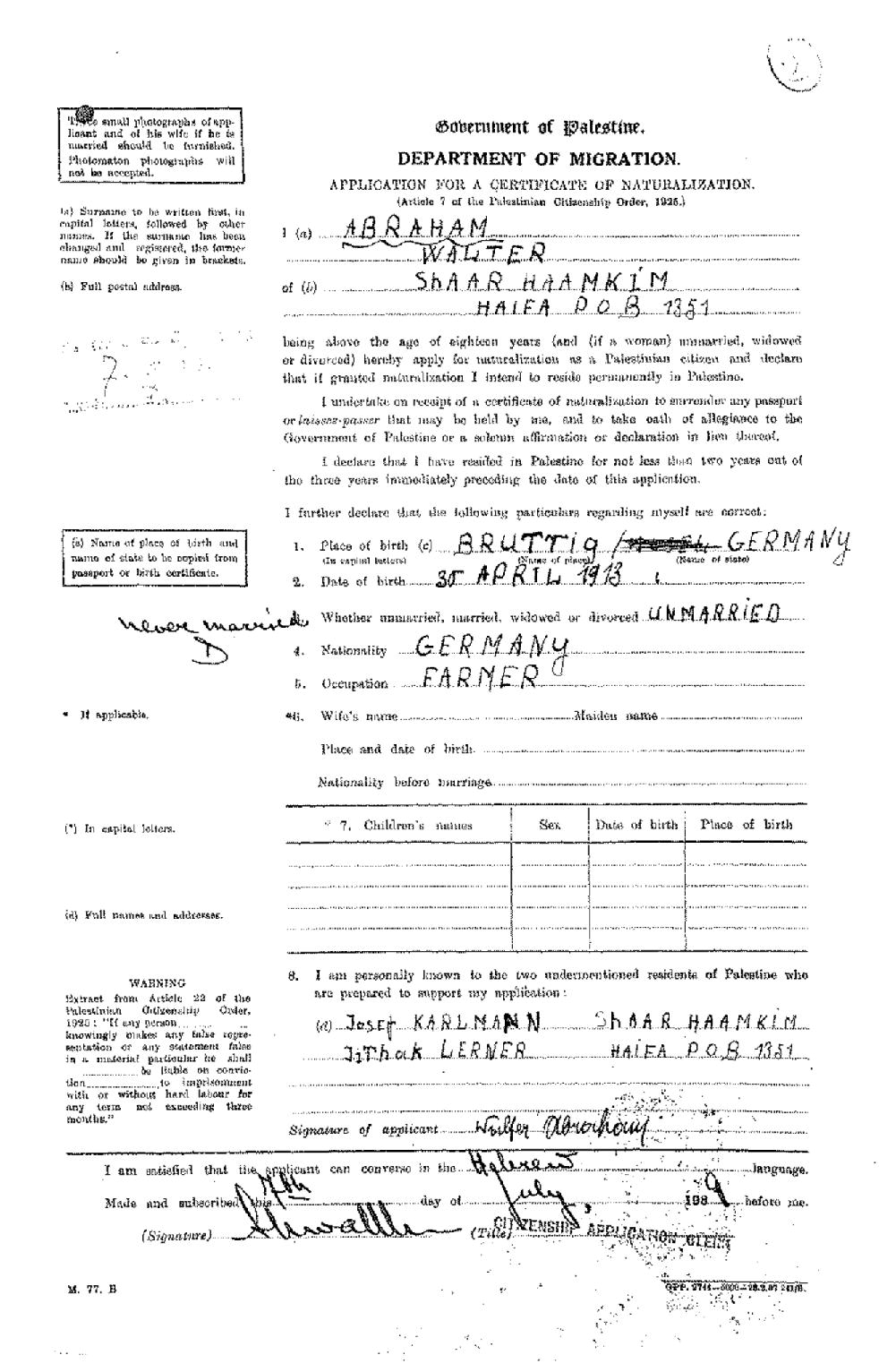
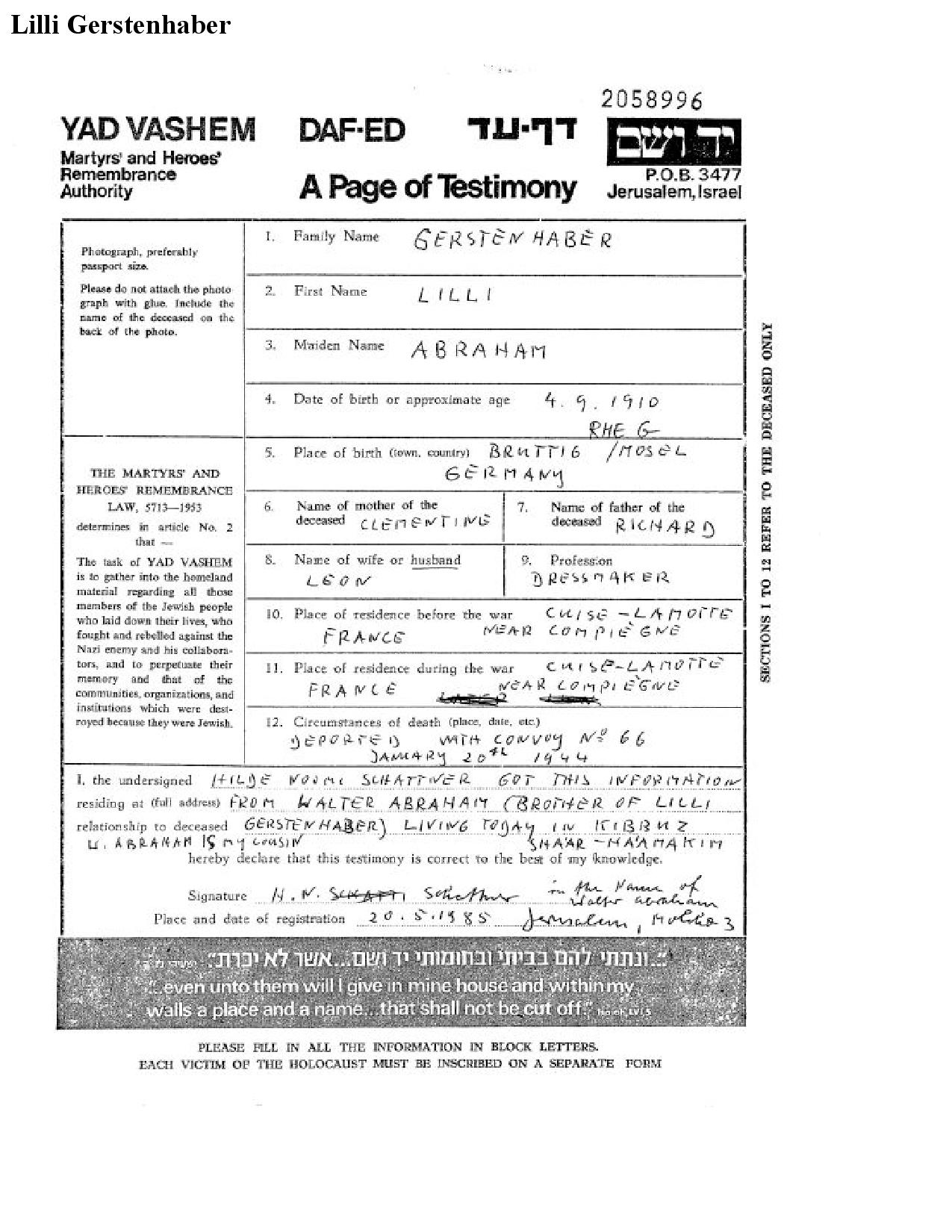
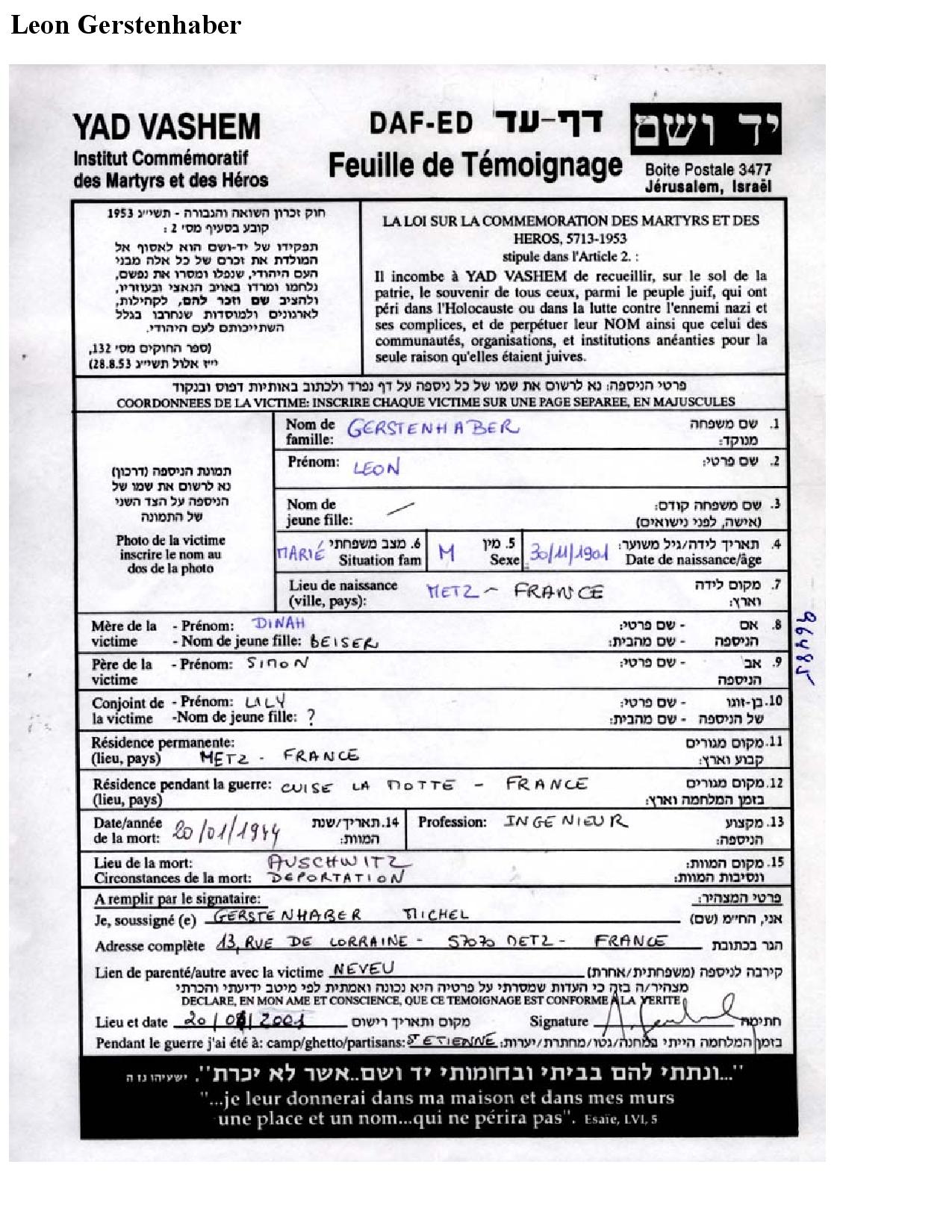
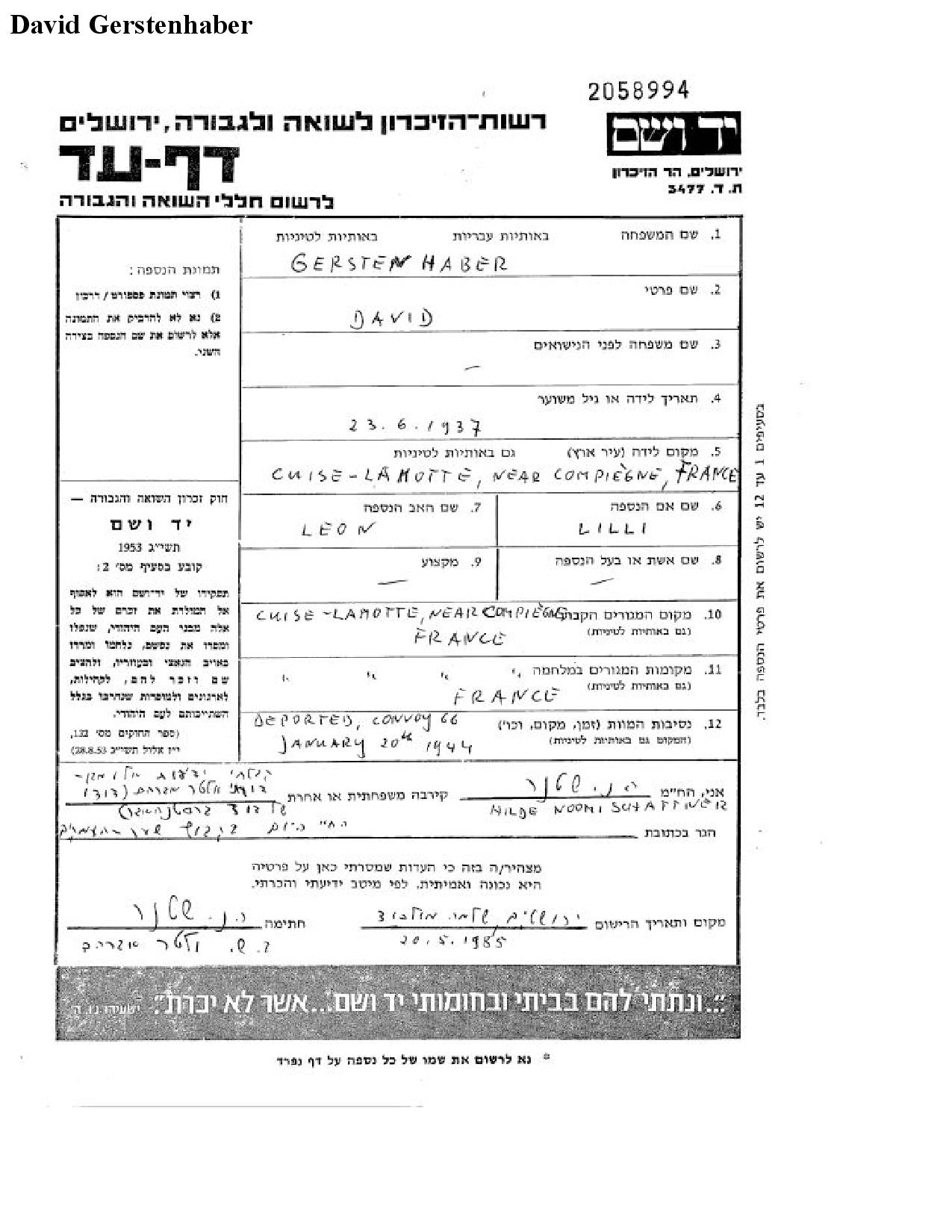
Clementine Blumenfeld Abraham’s Family: Her Sons Escaped; She, Her Husband, Daughter, Son-in-Law, and Grandson Did Not

I have returned from my break, and unfortunately, I have another sad post to publish about my third cousin, twice removed, Clementine Blumenfeld Abraham. Clementine was the youngest child of Moses Blumenfeld IIB, and like her siblings Hermann and Bertha, she and much of her family were killed in the Holocaust.

Clementine’s daughter Lilli married Leon Gerstenhaber sometime before June 23, 1937, when their son David was born in Metz, France.1 Leon was also born in Metz, France; he was born to Simon Gerstenhaber and Dinah Beiser on November 31, 1901.2

Martin Abraham, Clementine’s older son, traveled from Germany to France in 1932, perhaps to visit his sister Lilli, and then in the spring of 1936, he immigrated to Palestine. The documents below including his German passport are from his Palestinian immigration file found at the Israel State Archives. Martin married Corinne Bloch, who was born in Trimbach, France, on May 13, 1912. She immigrated to Palestine in 1938, and they had one child together born in the 1940s.


Martin’s brother Walter also immigrated to Palestine, arriving just a couple of months after Martin on July 24, 1936, as seen in these documents from the Israel State Archives.

Unfortunately, Clementine, her husband Richard Abraham, their daughter Lilli, and her husband Leon and their son David did not follow Martin and Walter to Palestine. They were all killed at Auschwitz. Richard was deported from the Drancy concentration camp to Auschwitz on Transport 40 on November 4, 1942. Clementine was also deported from the Drancy Camp to Auschwitz on Transport 62 on November 20, 1943. Lilli and her family were also sent from the Drancy concentration camp in France to Auschwitz on January 20, 1944 on Transport 66.

Clementine Blumenfeld Abraham, Page of Testimony at Yad Vashem found at https://yvng.yadvashem.org/nameDetails.html?language=en&itemId=612790&ind=2

Richard Abraham Page of Testimony at Yad Vashem, found at https://yvng.yadvashem.org/nameDetails.html?language=en&itemId=612794&ind=2

Lilli Abraham Gerstenhaber Page of Testimony at Yad Vashem, https://yvng.yadvashem.org/nameDetails.html?language=en&itemId=1949660&ind=2

Leon Gerstenhaber Page of Testimony at Yad Vashem, found at https://yvng.yadvashem.org/nameDetails.html?language=en&itemId=13857240&ind=1

David Gerstenhaber, Page of Testimony at Yad Vashem, found at https://yvng.yadvashem.org/nameDetails.html?language=en&itemId=1390876&ind=2

Thus, three of Moses IIB’s five surviving children—Hermann, Bertha, and Clementine—and most of their children and grandchildren were killed by the Nazis. I am totally drained by telling their stories and reading these Pages of Testimony. I am also so grateful that Israel exists to provide a sanctuary for those who escaped.

The remaining two children of Moses IIB and Sara Blumenfeld, Salomon and Max, were more fortunate than their other siblings.


  1. See Page of Testimony for David Gerstenhaber filed by Hilde Schattner at Yad Vashem, found at https://yvng.yadvashem.org/nameDetails.html?language=en&itemId=1390876&ind=2 
  2. See Page of Testimony for Leon Gerstenhaber filed by nephew Michael Gerstenhaber at Yad Vashem, found at https://yvng.yadvashem.org/nameDetails.html?language=en&itemId=13857240&ind=1