My Great-Great-Aunt Dean: The Story of A Strong Woman

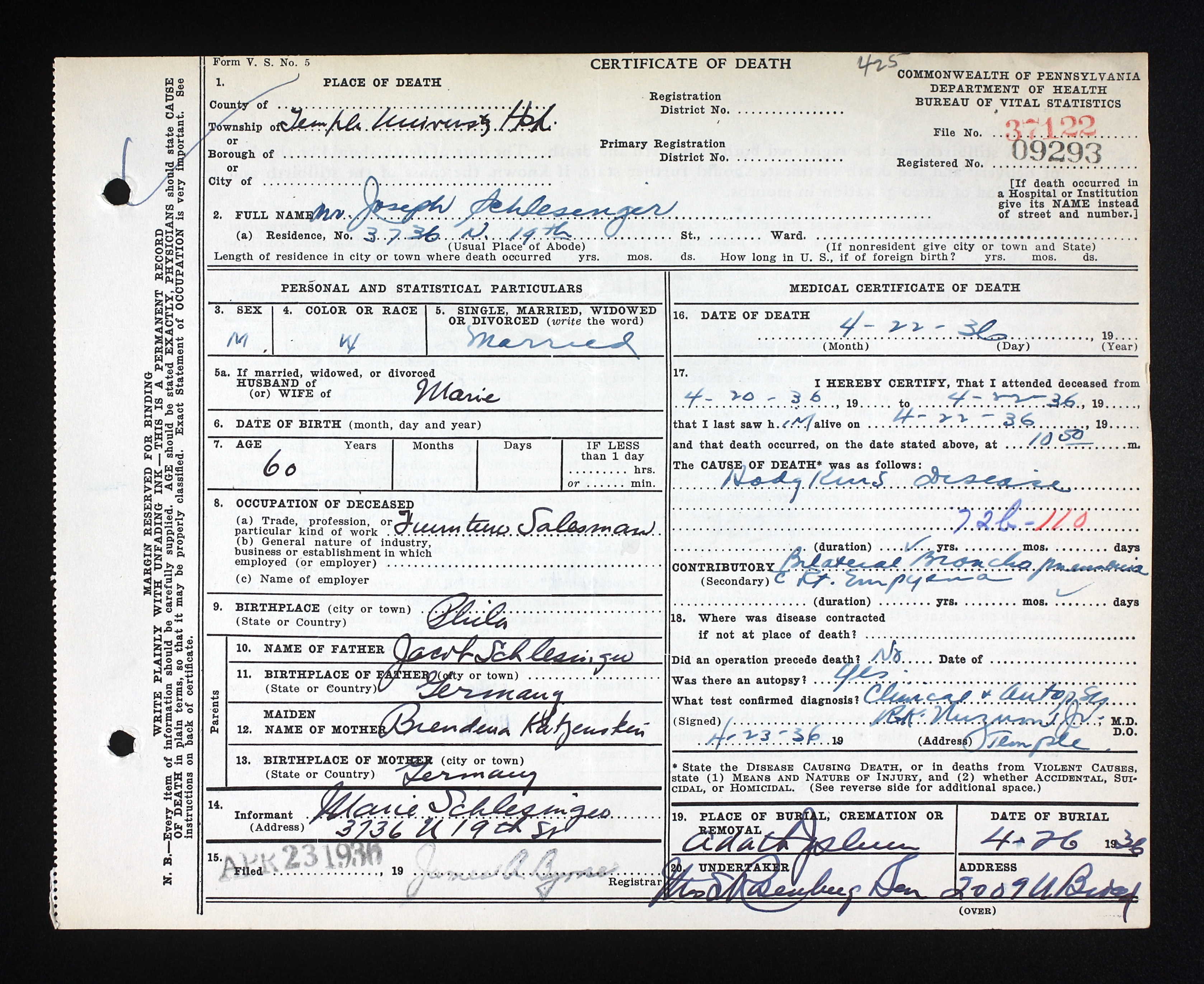
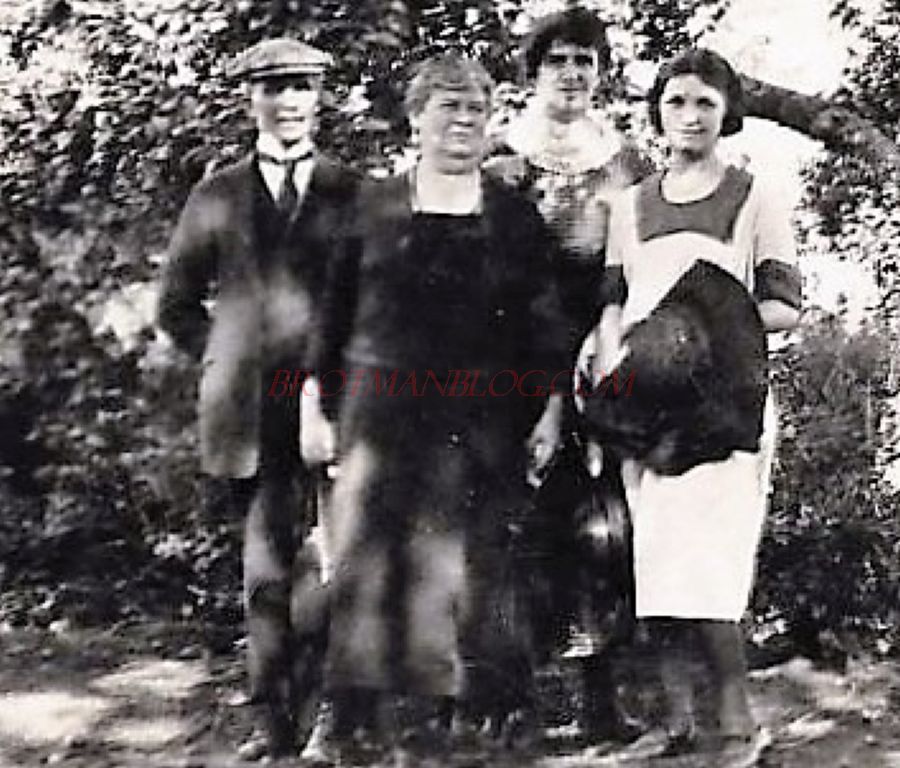
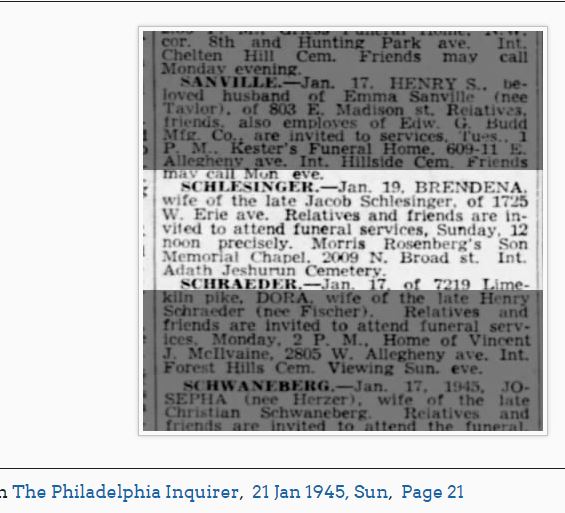
Having completed the story of my great-great-uncle S.J. Katzenstein and his family, I am now going to turn to my great-grandmother’s sister, Brendina, who was the third child of Gerson Katzenstein and Eva Goldschmidt and just three years old when the family immigrated to the US.[1]  I have been looking forward to writing about Brendina because my father knew her (he refers to her as Aunt Dean, which is how she was known in the family), and he knew some of her children and her granddaughter.  He has been able to bring them to life for me in a way that has not been possible with so many of my other ancestors and their families.

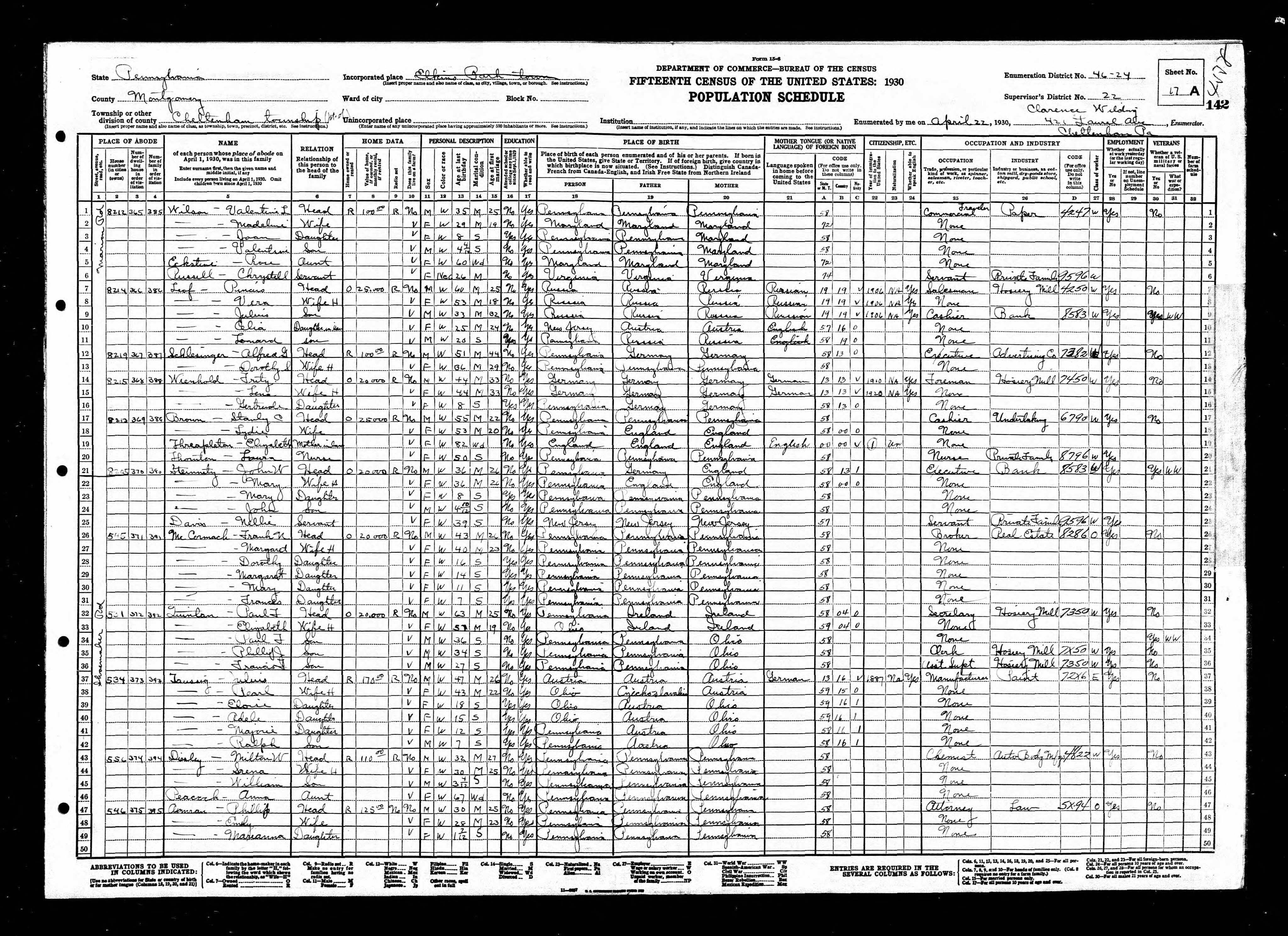
As I wrote previously, Brendina was married to Jacob Schlesinger, a butcher who had, like Brendina, emigrated from Germany with his family.  Brendina and Jacob had five children: Heloise (1874), Solomon Joseph (known as Joe, born 1875), Alfred (1879), Sidney (1880), and Aimee (1887). As of 1900, they were all still living together in in Philadelphia, and Jacob listed his occupation on the 1900 census as a meat salesman.  Their oldest son, Solomon Joseph, was a manager of a laundry, and Alfred was managing a newspaper. Sidney was working as a clerk in a clothing store.  The two daughters, Heloise and Aimee, were not employed.

Brendina and Jacob Schlesinger 1900 census Year: 1900; Census Place: Philadelphia Ward 20, Philadelphia, Pennsylvania; Roll: 1463; Enumeration District: 0421; FHL microfilm: 1241462

Brendina and Jacob Schlesinger 1900 census
Year: 1900; Census Place: Philadelphia Ward 20, Philadelphia, Pennsylvania; Roll: 1463; Enumeration District: 0421; FHL microfilm: 1241462

Ten years later, all five children were still living at home, ranging in age from 23 to 35.  Jacob had retired, but the three sons were all employed as was the younger daughter, Aimee.  Joseph was working as a salesman in a department store as was Sidney, and Alfred and Aimee were both working in advertising—Alfred as a manager, Aimee as a clerk. Heloise was not working outside the home.

Brendina Katzenstein Schlesinger and family 1910 census Year: 1910; Census Place: Philadelphia Ward 37, Philadelphia, Pennsylvania; Roll: T624_1407; Page: 10A; Enumeration District: 0912; FHL microfilm: 1375420

Brendina Katzenstein Schlesinger and family
1910 census
Year: 1910; Census Place: Philadelphia Ward 37, Philadelphia, Pennsylvania; Roll: T624_1407; Page: 10A; Enumeration District: 0912; FHL microfilm: 1375420

The years between 1910 and 1920 were eventful years for the Schlesinger family, some joyful, some quite tragic.

In 1911 Sidney Schlesinger was the first of the Schlesinger children to marry; he married Anna Levis.  My father remembers her fondly as his cousin Nan, as she was called.  Nan was the daughter of William R. Levis and Caroline Bopp.  Her father William, a plumber and son of a bricklayer, was born on December 25, 1860, in Philadelphia.  He married Caroline Bopp, daughter of Moritz Bopp, a liquor dealer, on December 25, 1882, in a Methodist church in Philadelphia.  Nan was born May 19, 1886, in Philadelphia.  Sadly, Nan’s father died on March 15, 1898.  He was only 37 years old and died from heart disease.  Nan was only eleven years old.

William Levis death certificate "Pennsylvania, Philadelphia City Death Certificates, 1803-1915," database with images, FamilySearch (https://familysearch.org/ark:/61903/3:1:S3HT-678Q-WCM?cc=1320976&wc=9F51-DP8%3A1073236401 : 16 May 2014), > image 1267 of 1772; Philadelphia City Archives

William Levis death certificate
“Pennsylvania, Philadelphia City Death Certificates, 1803-1915,” database with images, FamilySearch (https://familysearch.org/ark:/61903/3:1:S3HT-678Q-WCM?cc=1320976&wc=9F51-DP8%3A1073236401 : 16 May 2014), > image 1267 of 1772; Philadelphia City Archives

Before marrying Sidney in 1911, Nan had been living with her mother, her uncle, and her grandfather Moritz Bopp.  She was working as a stenographer in a bolt factory where her uncle attended the furnace.   Nan was 25 when she married Sidney; he was 31. Sidney and Nan had a daughter Jane born on May 13, 1913, in Philadelphia.

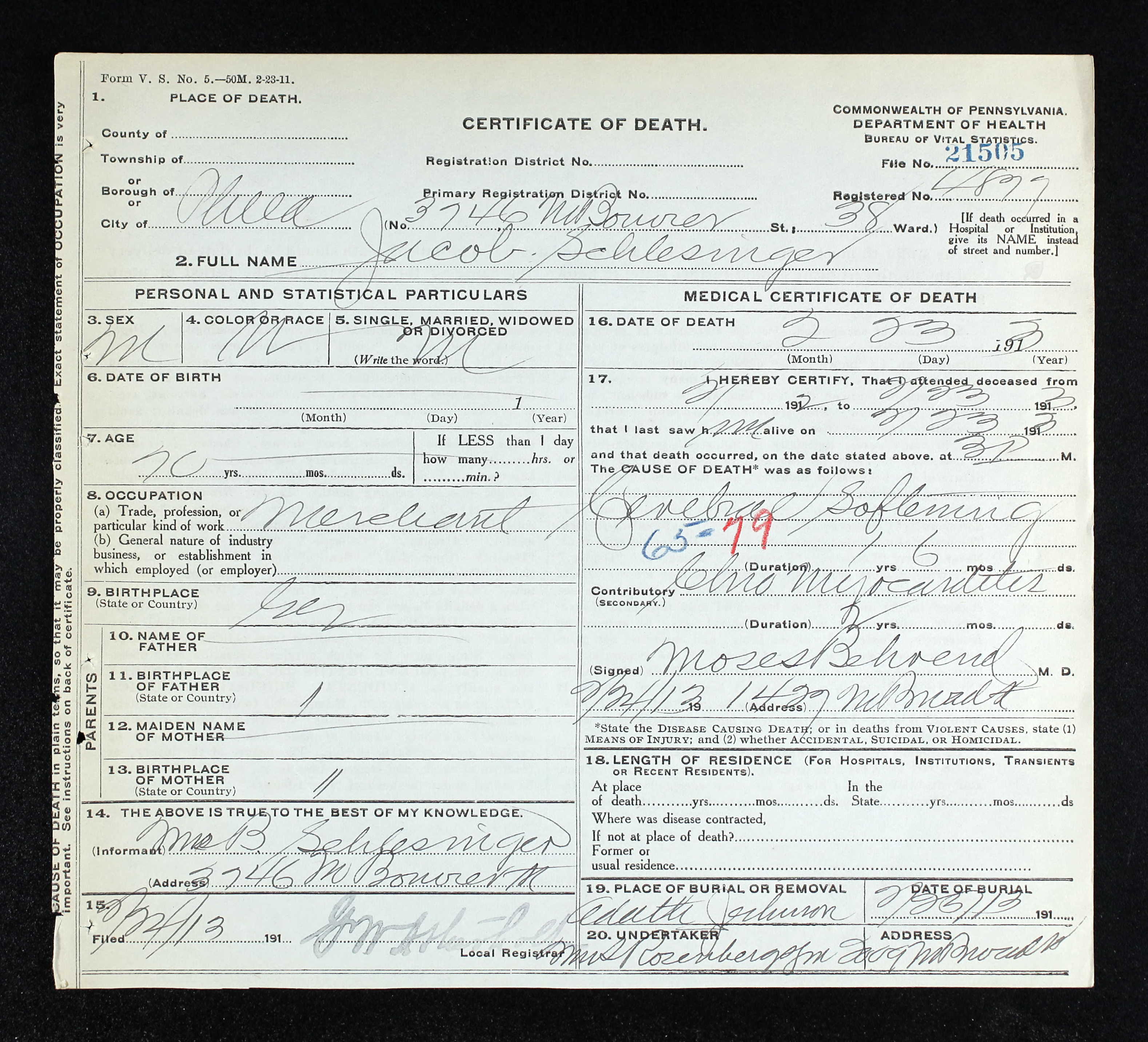
Just a few months before Jane was born, the family suffered a loss on February 23, 1913, when Jacob Schlesinger died a few weeks before his seventieth birthday; he died from cerebral softening and myocarditis.  He was buried at Adath Jeshurun cemetery in Philadelphia.

Jacob Schlesinger death certificate Pennsylvania Historic and Museum Commission; Pennsylvania, USA; Certificate Number Range: 019891-023570

Jacob Schlesinger death certificate
Pennsylvania Historic and Museum Commission; Pennsylvania, USA; Certificate Number Range: 019891-023570

Joe Schlesinger was the second child to marry; on July 11, 1915 he married Marie Wetherill in Philadelphia.  My father also has fond memories of his cousin Marie as a very sweet woman who cared for her mother-in-law Brendina for many years.  Marie was born on August 15, 1888. She was 27 when she married Joe, and he was 40.

I am sad that I’ve been unable yet to find out anything about Marie’s background or family history.  I did find a record of a Philadelphia birth certificate for a child born to a Francis M. Wetherill and his wife May on August 15, 1888, the same date given as Marie’s birth date on the SSDI and the Florida Death Index, but that child’s name was Emma Virginia M.  Wetherill.  Perhaps the M stood for Marie, but I can’t be sure.  Plus when I went to find the Wetherill family on the 1900 census, I could not find them, even though Marie would only have been twelve years old at that time.  If anyone has any suggestions for how I might learn more about Marie, please let me know.

possible-birth-record-for-marie

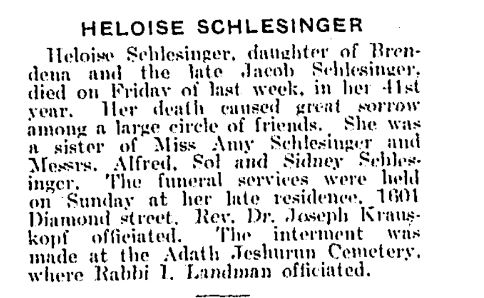
On October 29, 1915, the family suffered a terrible loss when Brendina’s oldest child Heloise died at age 41 of complications from diabetes.  Heloise had never married or worked out of the house so perhaps she had been suffering from diabetes for a long period of time. Like her father, Heloise was buried at Adath Jeshurun cemetery in Philadelphia.

Heloise Schlesinger death certificate Pennsylvania Historic and Museum Commission; Pennsylvania, USA; Certificate Number Range: 102051-105290

Heloise Schlesinger death certificate
Pennsylvania Historic and Museum Commission; Pennsylvania, USA; Certificate Number Range: 102051-105290

As this obituary notes, “Her death caused great sorrow among a large circle of friends.” How very sad this must have been for her family and her friends.

The Philadelphia Jewish Exponent, November 5, 1915, p. 12

The Philadelphia Jewish Exponent, November 5, 1915, p. 12


Meanwhile, World War I was raging in Europe, and all three of Brendina’s sons registered for the World War I draft.  Joe was working for the Pennsylvania Furniture Company as a salesman and an inspector of some kind—can anyone decipher what that says?

S. Joseph Schlesinger World War I draft registration Registration State: Pennsylvania; Registration County: Philadelphia; Roll: 1907753; Draft Board: 29

S. Joseph Schlesinger World War I draft registration
Registration State: Pennsylvania; Registration County: Philadelphia; Roll: 1907753; Draft Board: 29

Alfred was the secretary of a car advertising company:

Alfred Schlesinger World War I draft registration Registration State: Pennsylvania; Registration County: Philadelphia; Roll: 1907753; Draft Board: 29

Alfred Schlesinger
World War I draft registration
Registration State: Pennsylvania; Registration County: Philadelphia; Roll: 1907753; Draft Board: 29

And Sidney was, like Joe, a furniture salesman but for Stern & Company:

Sidney Schlesinger World War I draft registration Registration State: Pennsylvania; Registration County: Philadelphia; Roll: 1907952; Draft Board: 43

Sidney Schlesinger World War I draft registration
Registration State: Pennsylvania; Registration County: Philadelphia; Roll: 1907952; Draft Board: 43

Given that the three brothers were in their late 30s and early 40s during World War I, I do not believe any of them actually served in the war.

That was probably very fortunate as Brendina had already lost her husband and her daughter in less than three years. But the heartbreak did not end there.  On April 20, 1920, the youngest Schlesinger child, Aimee, died of breast cancer at age 33.

Aimee Schlesinger Steinberg death certificate Pennsylvania Historic and Museum Commission; Pennsylvania, USA; Certificate Number Range: 043501-046500

Aimee Schlesinger Steinberg death certificate
Pennsylvania Historic and Museum Commission; Pennsylvania, USA; Certificate Number Range: 043501-046500

Aimee was married to Samuel Steinberg, a Russian immigrant who had immigrated to the US with his parents, Menashe and Deborah, in 1890 when he was just a baby.  His father was in the butter and eggs business in Philadelphia in 1900. By 1910 Menashe owned a store in Philadelphia where Samuel and his brother both worked.

When he registered for the World War I draft in June, 1917, Samuel was still single and working as a presser. Thus, he and Aimee could not have been married very long at the time of her death.  They were living in Philadelphia with Brendina and her son Alfred in 1920.  Samuel was a commercial traveler in the jewelry business at that time.

Aimee Schlesinger Steinberg and family 1920 census

Aimee Schlesinger Steinberg and family 1920 census

Philadelphia Inquirer April 22, 1920 p. 18

Philadelphia Inquirer April 22, 1920 p. 18

After Aimee died, Brendina was left with her three sons, Joseph, Alfred, and Sidney, who were all living in Philadelphia.  As noted above, in 1920 she was living with Alfred, who was still single and was in the advertising business.  Joe, like Alfred, was in advertising and living with his wife Marie in 1920. Sidney and Nan were living with their daughter Jane and Nan’s mother Caroline in 1920; Sidney was working as a furniture salesman.

Sidney Schlesinger and family 1920 census Year: 1920; Census Place: Philadelphia Ward 42, Philadelphia, Pennsylvania; Roll: T625_1643; Page: 13B; Enumeration District: 1563; Image: 705

Sidney Schlesinger and family 1920 census
Year: 1920; Census Place: Philadelphia Ward 42, Philadelphia, Pennsylvania; Roll: T625_1643; Page: 13B; Enumeration District: 1563; Image: 705

Thus, after losing her parents in the 1890s and two of brothers in the 1900s, Brendina lost her husband and two of her daughters (as well as her last surviving brother Jacob) between 1910 and 1920.   Her only surviving sibling was my great-grandmother Hilda, who had moved all the way to Denver by 1910.  It’s hard to imagine how Aunt Dean endured so many losses.  And yet she did, for she lived long enough for my father to have clear memories of her. More on that in my next post.


[1] I am skipping over Jacob Katzenstein for now because I have ordered a book about the Jewish community in Johnstown and am waiting until I’ve read it before I continue the story of his life after the 1889 flood.

Katzenstein to Kay, Part II

In my prior post, we saw how the family of S.J. Katzenstein had moved on from Little Washington, Pennsylvania, after S.J. died.  His daughter Moynelle married Bert Spanye, who was a very successful businessman in Cleveland, and all but one of the five Katzenstein sons as well as S.J.’s widow Henrietta had also moved to Cleveland. Two sons went to college, and three served in World War I.

Moynelle and Bert had two children, Edward and Margaret. When Bert retired in 1924, Edward was working as a salesman and still living at home with his family in Cleveland in 1924. Margaret was just thirteen.

Then on July 2, 1926, Edward died at age 23 from a “twisting of mesentery by ileus of small bowel.” According to my medical consultant, the mesentery contains the blood vessels to the intestines, and when it twists, it can lead to “dead bowel” syndrome—that is, a blockage of blood to the intestines. Even today this condition is quite lethal if not treated quickly (and sometimes even with treatment). Edward’s death certificate states that he was an apprentice for a lithography company at the time of his death.  What a terrible shock this must have been for his family.

Edward Spanye death certificate "Ohio Deaths, 1908-1953," database with images, FamilySearch (https://familysearch.org/ark:/61903/3:1:33S7-9PJ1-S35L?cc=1307272&wc=MD9X-1PD%3A287601201%2C294566201 : 21 May 2014), 1926 > image 2692 of 3564.

Edward Spanye death certificate
“Ohio Deaths, 1908-1953,” database with images, FamilySearch (https://familysearch.org/ark:/61903/3:1:33S7-9PJ1-S35L?cc=1307272&wc=MD9X-1PD%3A287601201%2C294566201 : 21 May 2014), 1926 > image 2692 of 3564.


As for the five Katzenstein brothers, all had changed their name to Kay by 1920, and none had yet married. On July 25, 1925, Milton (also known as M. Boyd Kay), who had by then relocated from Pittsburgh to Detroit, married Dorothy V. Reese.  He was 44, she was 27. The marriage did not last, as Dorothy divorced him one year later on December 20, 1926, on grounds of extreme cruelty. (The petition had been filed on August 9, 1926, just over a year after they’d married.)

Marriage register for Milton Kay and Dorothy Veese Ancestry.com. Michigan, Marriage Records, 1867-1952 [database on-line]. Provo, UT, USA: Ancestry.com Operations, Inc., 2015. Original data: Michigan, Marriage Records, 1867–1952. Michigan Department of Community Health, Division for Vital Records and Health Statistics.

Marriage register for Milton Kay and Dorothy Veese
Ancestry.com. Michigan, Marriage Records, 1867-1952 [database on-line]. Provo, UT, USA: Ancestry.com Operations, Inc., 2015.
Original data: Michigan, Marriage Records, 1867–1952. Michigan Department of Community Health, Division for Vital Records and Health Statistics.

Divorce of Milton Boyd Kay by Dorothy Veese 1926 Ancestry.com. Michigan, Divorce Records, 1897-1952 [database on-line]. Provo, UT, USA: Ancestry.com Operations, Inc., 2014. Original data: Michigan. Divorce records. Michigan Department of Community Health, Division for Vital Records and Health Statistics, Lansing, Michigan

Divorce of Milton Boyd Kay by Dorothy Veese 1926
Ancestry.com. Michigan, Divorce Records, 1897-1952 [database on-line]. Provo, UT, USA: Ancestry.com Operations, Inc., 2014.
Original data: Michigan. Divorce records. Michigan Department of Community Health, Division for Vital Records and Health Statistics, Lansing, Michigan

The other brothers—Howard, Earl, Ivan, and Vernon—are missing from the Cleveland directories for several years after 1921.  In 1927, however, three of them are listed in the directory for that year.  Earl was working as a salesman for the Scott-Ullmann Company and living with his sister and her family at 11338 Belleflower; Howard was a merchandise manager for The Ames Company, still living at 7100 Euclid Avenue, as was his brother Vernon, who was the secretary-treasurer of the company where his older brother Earl was a salesman, Scott-Ullman.  Ivan is not listed, and I am not sure where he was living at that time.

Kays in 1927 Cleveland directory Title : Cleveland, Ohio, City Directory, 1927 Source Information Ancestry.com. U.S. City Directories, 1822-1995 [database on-line]. Provo, UT, USA: Ancestry.com Operations, Inc., 2011.

Kays in 1927 Cleveland directory
Title : Cleveland, Ohio, City Directory, 1927
Source Information
Ancestry.com. U.S. City Directories, 1822-1995 [database on-line]. Provo, UT, USA: Ancestry.com Operations, Inc., 2011.

As of 1930, three of the brothers were still living in Cleveland. Vernon and Ivan were living with their mother. Ivan was a superintendent in a department store, and Vernon was the manager of an electric factory. Earl was living in a hotel, working as a salesman of electric fixtures. (I assume Earl and Vernon were both still working for Scott-Ullmann, which must have been a lighting company.)

Howard and Ivan Kay and their mother on 1930 census Year: 1930; Census Place: Cleveland, Cuyahoga, Ohio; Roll: 1772; Page: 2B; Enumeration District: 0825; Image: 413.0; FHL microfilm: 2341506

Vernon and Ivan Kay and their mother on 1930 census
Year: 1930; Census Place: Cleveland, Cuyahoga, Ohio; Roll: 1772; Page: 2B; Enumeration District: 0825; Image: 413.0; FHL microfilm: 2341506

The oldest brother M. Boyd Kay was still living in Detroit in 1930; he was living in a hotel and practicing medicine. By 1932, he had relocated to Miami, Florida.

I couldn’t find Howard on the 1930 census, although I found his 7100 Euclid Avenue address on the census report.  He was not listed in what appears to have been a multi-family dwelling at that location.

I also could not find the Moynelle and her family on the 1930 census despite having the exact address of where they were living (11338 Belleflower Road, their home since at least 1910).  In 1930, Bert, Moynelle, and Margaret traveled together to Europe and listed their address as 11338 Belleflower Road in Cleveland.  Yet when I went through the enumeration district that includes that address on the 1930 census, that house number was not listed nor was the Spanye family.

On January 4, 1933, Moynelle and Bert’s daughter Margaret (also known as Mardi) married William Saul David Wolf. William, also a Cleveland native, was the son of Jacob Wolf and Jennie Schonberger and was working as a salesman when they married.

Marriage license of Margaret Spanye and William Wolf Ancestry.com. Ohio, County Marriages, 1774-1993 [database on-line]. Lehi, UT, USA: Ancestry.com Operations, Inc., 2016. Original data: Marriage Records. Ohio Marriages. FamilySearch, Salt Lake City, UT.

Marriage license of Margaret Spanye and William Wolf
Ancestry.com. Ohio, County Marriages, 1774-1993 [database on-line]. Lehi, UT, USA: Ancestry.com Operations, Inc., 2016.
Original data: Marriage Records. Ohio Marriages. FamilySearch, Salt Lake City, UT.

Cleveland Plain Dealer, January 2, 1933, p. 16

Cleveland Plain Dealer, January 2, 1933, p. 16

Margaret (also known as Mardi) and William had two children in the 1930s.

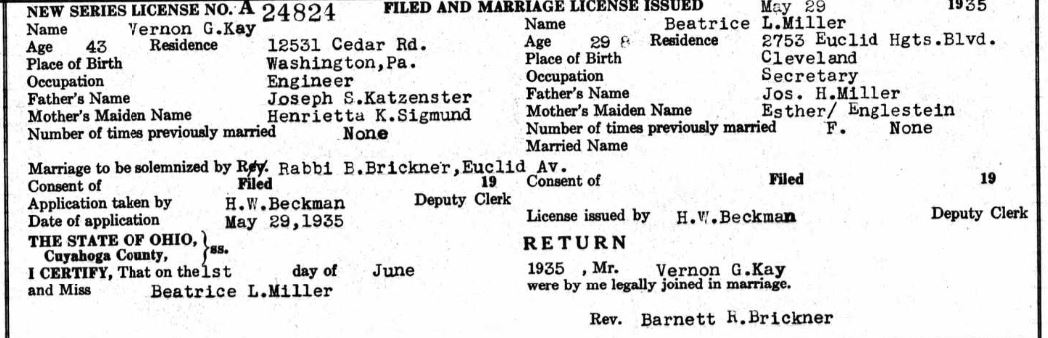
Meanwhile, none of the Katzenstein/Kay sons were married as 1935 began. Then, on June 1, 1935, the youngest child of S.J. Katzenstein, Vernon, married Beatrice L. Miller.  They were married by a rabbi in Cleveland.  Vernon was 43, Beatrice 29.  Vernon listed his occupation as an engineer.

Vernon Kay marriage license Cuyahoga County Archive; Cleveland, Ohio; Cuyahoga County, Ohio, Marriage Records, 1810-1973; Volume: Vol 173-174; Page: 165; Year Range: 1934 Oct - 1935 Aug

Vernon Kay marriage license
Cuyahoga County Archive; Cleveland, Ohio; Cuyahoga County, Ohio, Marriage Records, 1810-1973; Volume: Vol 173-174; Page: 165; Year Range: 1934 Oct – 1935 Aug

On June 1, 1936, Henrietta (Sigmund) Katzenstein died at age 84.  She was buried in Washington Cemetery in Washington, Pennsylvania, with her husband S. J. Katzenstein, who had died 35 years before. (This information was provided by the Washington Cemetery and is also found on FindAGrave and here.) She was survived by her six children, five of whom had lived nearby in Cleveland.  When she died, only two of her children were married, and she had just one grandchild, Margaret Spanye Wolf, her daughter Moynelle’s daughter.

Within a few years of Henrietta’s death, several of her sons married. Earl married Violet Heineman Willis on May 29, 1937. She had been married once before and widowed. She was 39 and working as a bookkeeper when they married.  Earl was 51 and living at the Hotel Statler and working as a salesman. They were married by a justice of the peace.

Marriage license for Earl Kay and VIolet WIllis Cuyahoga County Archive; Cleveland, Ohio; Cuyahoga County, Ohio, Marriage Records, 1810-1973; Volume: Vol 180-181; Page: 571; Year Range: 1937 Jan - 1937 Aug

Marriage license for Earl Kay and VIolet WIllis
Cuyahoga County Archive; Cleveland, Ohio; Cuyahoga County, Ohio, Marriage Records, 1810-1973; Volume: Vol 180-181; Page: 571; Year Range: 1937 Jan – 1937 Aug

On March 30, 1940, Milton Boyd Kay married Cassie Leopold Winkler in Miami. She was a widow who had previously lived in Pittsburgh before her first husband Leo Winkler died, so perhaps M. Boyd knew her from his days living there.  He was 59, she was 57. They were married by a county judge.

M Boyd Kay marriage to Cassie Winkler Ancestry.com. Florida, County Marriages, 1823-1982 [database on-line]. Lehi, UT, USA: Ancestry.com Operations, Inc., 2016. Original data: Marriage Records. Florida Marriages. FamilySearch, Salt Lake City, UT.

M Boyd Kay marriage to Cassie Winkler
Ancestry.com. Florida, County Marriages, 1823-1982 [database on-line]. Lehi, UT, USA: Ancestry.com Operations, Inc., 2016.
Original data: Marriage Records. Florida Marriages. FamilySearch, Salt Lake City, UT.

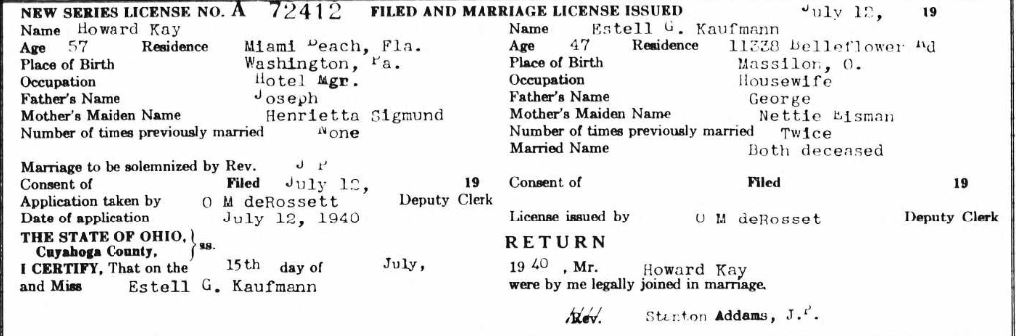
On July 15, 1940, Howard Kay married Estell Goodhart Kaufmann in Cleveland, though he was already residing in Miami by then; he was 57, she was 47 and had been widowed twice before marrying Howard. Estell had also grown up in Cleveland, so perhaps Howard had known her when he was younger. On the marriage registry, Estell gave her address as 11338 Belleflower Road, the address where Howard’s sister Moynelle and her family as well as his mother and he and his brothers had lived at various times over the years.  Howard reported his occupation as a hotel manager on the marriage record.

Howard Kay marriage to Estell Kaufmann Cuyahoga County Archive; Cleveland, Ohio; Cuyahoga County, Ohio, Marriage Records, 1810-1973; Volume: Vol 191-192; Page: 83; Year Range: 1940 Apr - 1940 Aug

Howard Kay marriage to Estell Kaufmann
Cuyahoga County Archive; Cleveland, Ohio; Cuyahoga County, Ohio, Marriage Records, 1810-1973; Volume: Vol 191-192; Page: 83; Year Range: 1940 Apr – 1940 Aug

Although I don’t have the exact date, Ivan was also married by 1940, as indicated on the 1940 census. His wife’s name was Rhea Kaufman, and in 1940, she was 50, Ivan was 55. Rhea was an instructor for a telegraph company and Ivan was still a superintendent in a department store.

Thus, within a few years after their mother died in 1936, all five Katzenstein/Kay sons were married whereas none had been married at the beginning of 1935.

In 1940, Moynelle and Bert Spanye were counted twice on the census. First, on April 9, they were included in the census report for Miami, Florida, where they were guests in the Triton Hotel, along with their daughter Margaret.  Moynelle’s brother Howard was also residing in the hotel and is listed as the hotel manager.

Howard Kay and Spanye family on 1940 US census Year: 1940; Census Place: Miami Beach, Dade, Florida; Roll: T627_581; Page: 83B; Enumeration District: 13-38B

Howard Kay and Spanye family on 1940 US census
Year: 1940; Census Place: Miami Beach, Dade, Florida; Roll: T627_581; Page: 83B; Enumeration District: 13-38B

But on April 12, 1940, Bert and Moynelle were enumerated in Cleveland at their home at 11338 Belleflower Road; Bert reported that he was now working in the real estate business. And Margaret was back with her husband and children in Cleveland by April 26, when they were enumerated. William was a salesman for a gas valve manufacturing company.

Six months later, on November 20, 1941, Bert Spanye died at age 73 in Miami, according to the Florida Death Index on Ancestry.  Three and a half years later Moynelle Katzenstein Spanye died on March 14, 1945 in Cleveland, according to the Ohio Deaths database on Ancestry. She was 76 and was survived by her daughter Margaret and her two grandchildren.  She also was survived by her five younger brothers, Milton, Howard, Ivan, Earl, and Vernon.

In 1945, Howard Kay and his wife Estell were living in Miami where Howard was now an account executive with Merrill Lynch. He died four years later on February 12, 1949, in Miami, and was buried at Mayfield Cemetery in Cleveland.  He was 66 years old. Estell died four years later on August 9, 1953, and she is buried with Howard at Mayfield Cemetery, according to information provided by the cemetery. She was 60 years old.

death-notice-for-howard-kay

M. Boyd Kay, aka Milton Boyd Katzenstein, died on October 13, 1952, in Miami, according to the Florida Death Index. He was 71.  He was buried in Washington, Pennsylvania, where he’d been born and where his parents were buried. His widow Cassie died in 1964 when she was 81, and she was buried at West View Cemetery in Pittsburgh, where her first husband Leo Winkler was buried.

The remaining siblings, Ivan, Earl, and Vernon, all lived much longer lives.  In 1942, Ivan and his wife Rhea were still living in Cleveland where he was employed by the May Company.  By 1945, they had moved to Miami as had Howard and Milton and their wives. Ivan lived in Miami until he died on July 6, 1972, according to the Florida Death Index.  He was 88 years old. His wife Rhea died a month later on August 7, 1972; she was 82. I do not know where they were buried.

Vernon Glyde Kay and his wife Beatrice were also still in Cleveland in 1942, but like his brothers, he also moved away. Although I’ve not found any records or even news articles about his life after 1942, his wife’s obituary revealed some information about their lives.  They lived in Chicago for a number of years and then in Hartsdale, New York.  When I read that, I realized that they were living only a few miles from where I was living as a child.  Vernon was my grandmother’s first cousin and was living close by, but I never met him and doubt even my father would have known who he was.

Vernon died on August 10, 1977; he was 85 years old.  His wife Beatrice died on December 19, 2006, almost 30 years later, in West Hartford, Connecticut.  She was just a few months shy of her 104th birthday.  Both Vernon and Beatrice were buried in Washington Cemetery in Washington, Pennsylvania. In Beatrice’s obituary, Vernon was described as “the love of her life.”

The last surviving child of S.J. Katzenstein and Henrietta Sigmund was Earl.  Like his brothers Howard and Ivan, in 1942 he and his wife Violet were still residing in Cleveland.  They were living at the Commodore Hotel, and Earl was working for Kay-Dee Tailoring Company.  He and Violet relocated to Miami by 1945, where he was retired.  But Earl and Violet did not stay in Miami.  By 1954, they had relocated to San Diego, California, where they lived for the rest of their lives. According to the California Death Index, Earl died on January 6, 1979. He was 93 years old. Violet died September 20, 1983; she was 86.  Like S.J. Katzenstein, his wife Henrietta, and their sons Vernon, Howard, and Milton, Earl and Violet were buried at Washington Cemetery.

The S.J. Katzenstein Mausoleum at Washington Cemetery Courtesy of Joe at FindAGrave https://s3-us-west-2.amazonaws.com/find-a-grave-prod/photos/2016/232/168667419_1471722303.jpg

The S.J. Katzenstein Mausoleum at Washington Cemetery
Courtesy of Joe at FindAGrave
https://s3-us-west-2.amazonaws.com/find-a-grave-prod/photos/2016/232/168667419_1471722303.jpg

Looking back at the children of S.J. Katzenstein and Henrietta Sigmund, they appear to have been a close family.  Five of the six lived close to each other for most of their adult lives—growing up in Washington, Pennsylvania, then moving to Cleveland, and finally retiring to Miami.  All five of the brothers married late in life, four not until after their mother died in 1936 when they were already in their 50s; none of the five brothers had children.  In fact, only their sister Moynelle had children, and only her daughter Margaret survived to adulthood and had children of her own.

Fortunately, for me, one of Moynelle’s descendants is my cousin Roger, whose husband David has been such a tremendous help to me in my research of the Katzenstein and Goldschmidt families.

From Katzenstein to Kay: America, the Land of Immigrants

This is the story of how the grandchildren of my great-great-grandparents became assimilated into American society. Their father, S. J. Katzenstein, was born in Germany and came to the US as a young boy; he became a successful business man in Washington, Pennsylvania, where his sister, my great-grandmother Hilda Katzenstein, had also lived after marrying my great-grandfather, Isidore Schoenthal.  His children, born in Washington, Pennsylvania, like my grandmother, grew up to become full-fledged Americans.

S.J. Katzenstein had died in 1901 when he was only 53 years old. He and his wife Henrietta Sigmund had six children: Moynelle (1879), Milton (1881), Howard (1882), Ivan (1884), Earl (1885), and Vernon (1892).  Moynelle, the oldest child, had married Bert Spanye on October 10, 1900, in Washington, Pennsylvania.

Moynelle Katzenstein and Bert Spanye marriage record Ancestry.com. Pennsylvania, Marriages, 1852-1968 [database on-line]. Lehi, UT, USA: Ancestry.com Operations, Inc., 2016. Original data: Marriage Records. Pennsylvania Marriages. FamilySearch, Salt Lake City, UT.

Moynelle Katzenstein and Bert Spanye marriage record
Ancestry.com. Pennsylvania, Marriages, 1852-1968 [database on-line]. Lehi, UT, USA: Ancestry.com Operations, Inc., 2016.
Original data: Marriage Records. Pennsylvania Marriages. FamilySearch, Salt Lake City, UT.

Bert was born September 24, 1868, in what was then a town in Hungary called Giralt. (Today it is known as Giraltovce and is in Slovakia).  According to a family genealogy website, Bert came to the US in 1887 with his uncle, CK Sunshine.  His parents, Emanuel and Rose Sonnenschein, did not emigrate.  Bert changed his surname from Sonnenschein to Spanye, unlike much of the rest of his extended family in the US who changed it to Sunshine.

According to an article written in the December 20, 1924 Cleveland Plain Dealer (p.15), when he first came to the US, Bert taught Latin, Greek, and German at Farmington College in Hiram, Ohio.  Then his uncle started him in business in a small Ohio town, and a few years later in February, 1899, Bert along with his uncle and another partner, Louis Black, started the Bailey & Company department store in Cleveland.  It became very successful.

When he and Moynelle were engaged,  the news was was written up in the June 17, 1900 Cleveland Plain Dealer (p. 10):

to-wed-pennsylvania-girl-mr-b-a-spanye-page-002

to-wed-pennsylvania-girl-mr-b-a-spanye-page-003


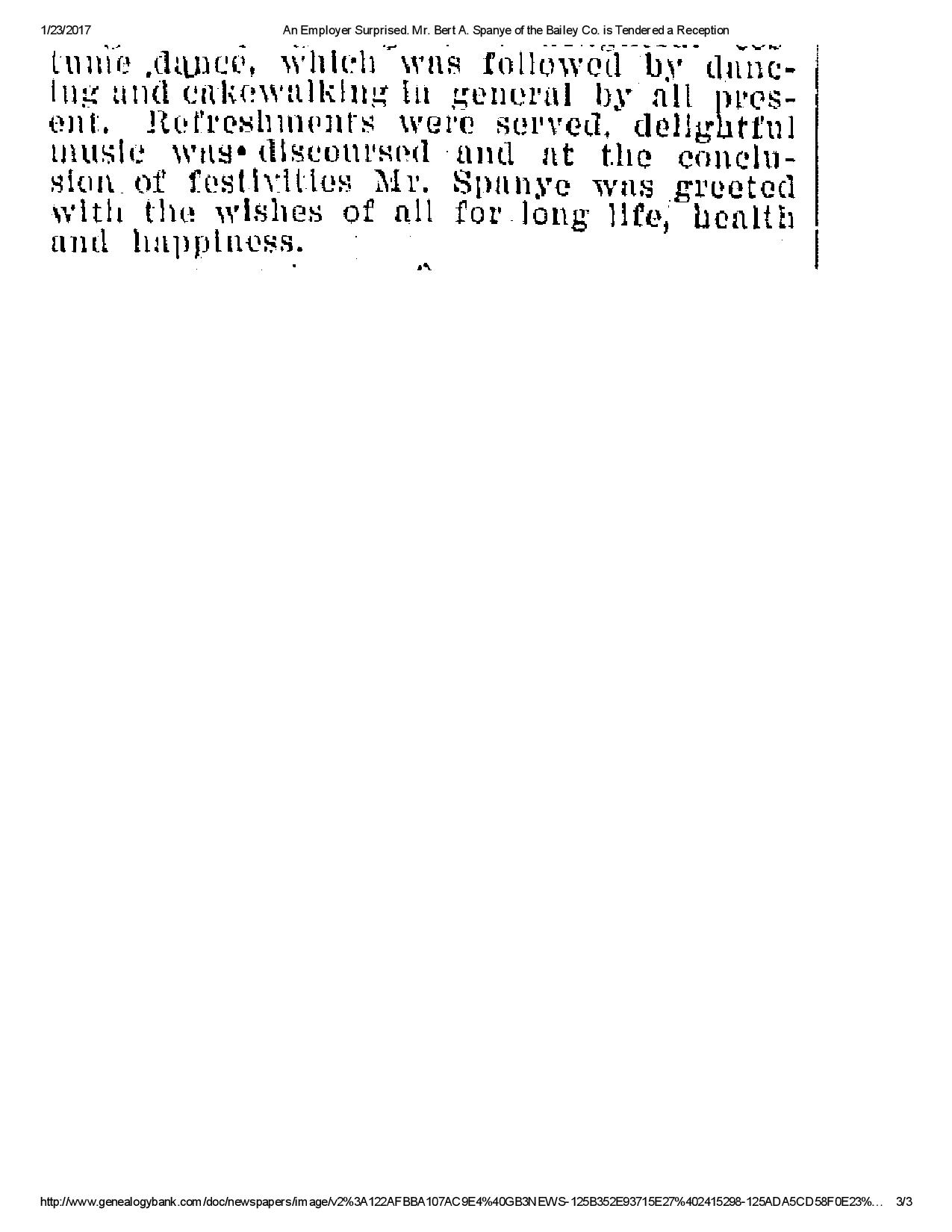
Then the company threw a surprise reception in his honor as described in the October 5, 1900 Cleveland Plain Dealer (p. 8):

an-employer-surprised-mr-bert-a-spanye-of-the-bailey-co-page-002

an-employer-surprised-mr-bert-a-spanye-of-the-bailey-co-page-003

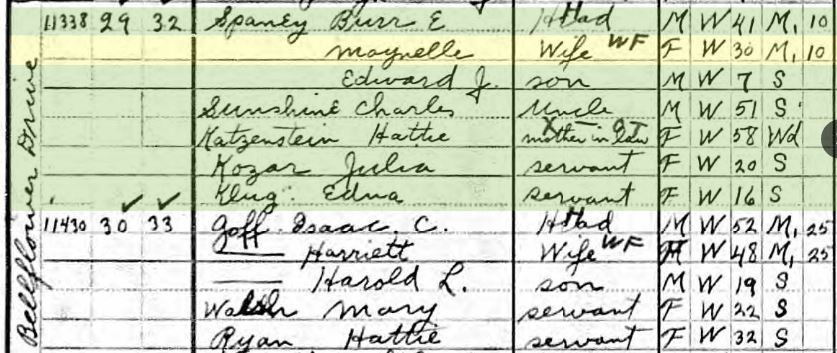
After they married, they settled in Cleveland; their first child, Edward, was born on September 19, 1902. On the 1910 census, Bert, Moynelle, and their son Edward were living at 11338 Belleflower Road and Bert’s uncle Charles (CK) and Moynelle’s mother (listed as Hattie here) were living with them as well as two servants.

Bert and Moynelle (Katzenstein) Spanye 1910 census Year: 1910; Census Place: Cleveland Ward 26, Cuyahoga, Ohio; Roll: T624_1176; Page: 13A; Enumeration District: 0388; FHL microfilm: 1375189

Bert and Moynelle (Katzenstein) Spanye 1910 census
Year: 1910; Census Place: Cleveland Ward 26, Cuyahoga, Ohio; Roll: T624_1176; Page: 13A; Enumeration District: 0388; FHL microfilm: 1375189

By that time at least three of Moynelle’s brothers had also relocated to Cleveland. Her brother Earl appears in the 1907 Cleveland directory, listing his occupation as a salesman (perhaps for his brother-in-law’s store).  Ivan Katzenstein is listed in the 1909 Cleveland directory as a department manager, and Earl as a clerk.  They and their mother Henrietta were all living at 11338 Belleflower Road, the home of Moynelle and Bert Spanye.

Katzensteins in 1909 Cleveland directory Title : Cleveland, Ohio, City Directory, 1909 Source Information Ancestry.com. U.S. City Directories, 1822-1995 [database on-line]. Provo, UT, USA: Ancestry.com Operations, Inc., 2011.

Katzensteins in 1909 Cleveland directory
Title : Cleveland, Ohio, City Directory, 1909
Source Information
Ancestry.com. U.S. City Directories, 1822-1995 [database on-line]. Provo, UT, USA: Ancestry.com Operations, Inc., 2011.

In 1910, Vernon, the youngest brother, and Ivan were living together as boarders. According to the 1910 census report, Vernon had no occupation listed (he was 18), and Ivan reported that he was a manager in a department store, again presumably the one owned in part by his brother-in-law Bert.

On June 26, 1911, Moynelle and Bert had their second child, Margaret.

Moynelle’s brother Howard had moved to Cleveland by 1912.  In the 1912 Cleveland directory, Howard is listed as a buyer for Bailey & Company, Earl as a department manager for Bailey & Company, and Ivan as a commercial traveler. They were all living together at 1946 East 71st Street NE in Cleveland.

Katzensteins in 1912 Cleveland directory Title : Cleveland, Ohio, City Directory, 1912 Source Information Ancestry.com. U.S. City Directories, 1822-1995 [database on-line]. Provo, UT, USA: Ancestry.com Operations, Inc., 2011. Original data: Original sources vary according to directory.

Katzensteins in 1912 Cleveland directory
Title : Cleveland, Ohio, City Directory, 1912
Source Information
Ancestry.com. U.S. City Directories, 1822-1995 [database on-line]. Provo, UT, USA: Ancestry.com Operations, Inc., 2011.
Original data: Original sources vary according to directory.

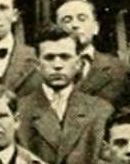
At that time, the youngest brother, Vernon, was a student at the Massachusetts Institute of Technology, Class of 1913. I was able to find this class photo and a legend that helped me find Vernon in the photo:

Massachusetts Institute of Technology Class of 1913 Ancestry.com. U.S., School Yearbooks, 1880-2012 [database on-line]. Provo, UT, USA: Ancestry.com Operations, Inc., 2010. Original data: Various school yearbooks from across the United States.

Massachusetts Institute of Technology Class of 1913
Ancestry.com. U.S., School Yearbooks, 1880-2012 [database on-line]. Provo, UT, USA: Ancestry.com Operations, Inc., 2010.
Original data: Various school yearbooks from across the United States.

vernon-katzenstein-in-mit-photo

Vernon Katzenstein, MIT Class of 1913

The only brother who did not move to Cleveland was the oldest, Milton. Milton was a graduate of Washington & Jefferson College in Washington, Pennsylvania, and a member of the class of 1905 at the University of Pennsylvania Medical School.

Milton Boyd Katzenstein, 1904 yearbook for the UPenn Medical School Ancestry.com. U.S., School Yearbooks, 1880-2012 [database on-line]. Provo, UT, USA: Ancestry.com Operations, Inc., 2010. Original data: Various school yearbooks from across the United States.

Milton Boyd Katzenstein, 1904 yearbook for the UPenn Medical School
Ancestry.com. U.S., School Yearbooks, 1880-2012 [database on-line]. Provo, UT, USA: Ancestry.com Operations, Inc., 2010.
Original data: Various school yearbooks from across the United States.

In 1910, he was practicing medicine in Pittsburgh and boarding with a family there.

Milton enlisted in the US Army in May, 1917, as a first lieutenant.  He served in the medical division from June 5, 1917 until March 28, 1919, including almost two years overseas in France during World War I.  He was promoted twice—to captain on November 24, 1917 and to major on November 19, 1918.

Milton Boyd Katzenstein military record Box Title : Kapp, Edward B - Kauffman, Frank (221) Source Information Ancestry.com. Pennsylvania, WWI Veterans Service and Compensation Files, 1917-1919, 1934-1948 [database on-line]. Provo, UT, USA: Ancestry.com Operations, Inc., 2015. Original data: World War I Veterans Service and Compensation File, 1934–1948. RG 19, Series 19.91. Pennsylvania Historical and Museum Commission, Harrisburg Pennsylvania.

Milton Boyd Katzenstein military record
Box Title : Kapp, Edward B – Kauffman, Frank (221)
Source Information
Ancestry.com. Pennsylvania, WWI Veterans Service and Compensation Files, 1917-1919, 1934-1948 [database on-line]. Provo, UT, USA: Ancestry.com Operations, Inc., 2015.
Original data: World War I Veterans Service and Compensation File, 1934–1948. RG 19, Series 19.91. Pennsylvania Historical and Museum Commission, Harrisburg Pennsylvania.

Box Title : Kapp, Edward B - Kauffman, Frank (221) Source Information Ancestry.com. Pennsylvania, WWI Veterans Service and Compensation Files, 1917-1919, 1934-1948 [database on-line]. Provo, UT, USA: Ancestry.com Operations, Inc., 2015. Original data: World War I Veterans Service and Compensation File, 1934–1948. RG 19, Series 19.91. Pennsylvania Historical and Museum Commission, Harrisburg Pennsylvania.

Box Title : Kapp, Edward B – Kauffman, Frank (221)
Source Information
Ancestry.com. Pennsylvania, WWI Veterans Service and Compensation Files, 1917-1919, 1934-1948 [database on-line]. Provo, UT, USA: Ancestry.com Operations, Inc., 2015.
Original data: World War I Veterans Service and Compensation File, 1934–1948. RG 19, Series 19.91. Pennsylvania Historical and Museum Commission, Harrisburg Pennsylvania.

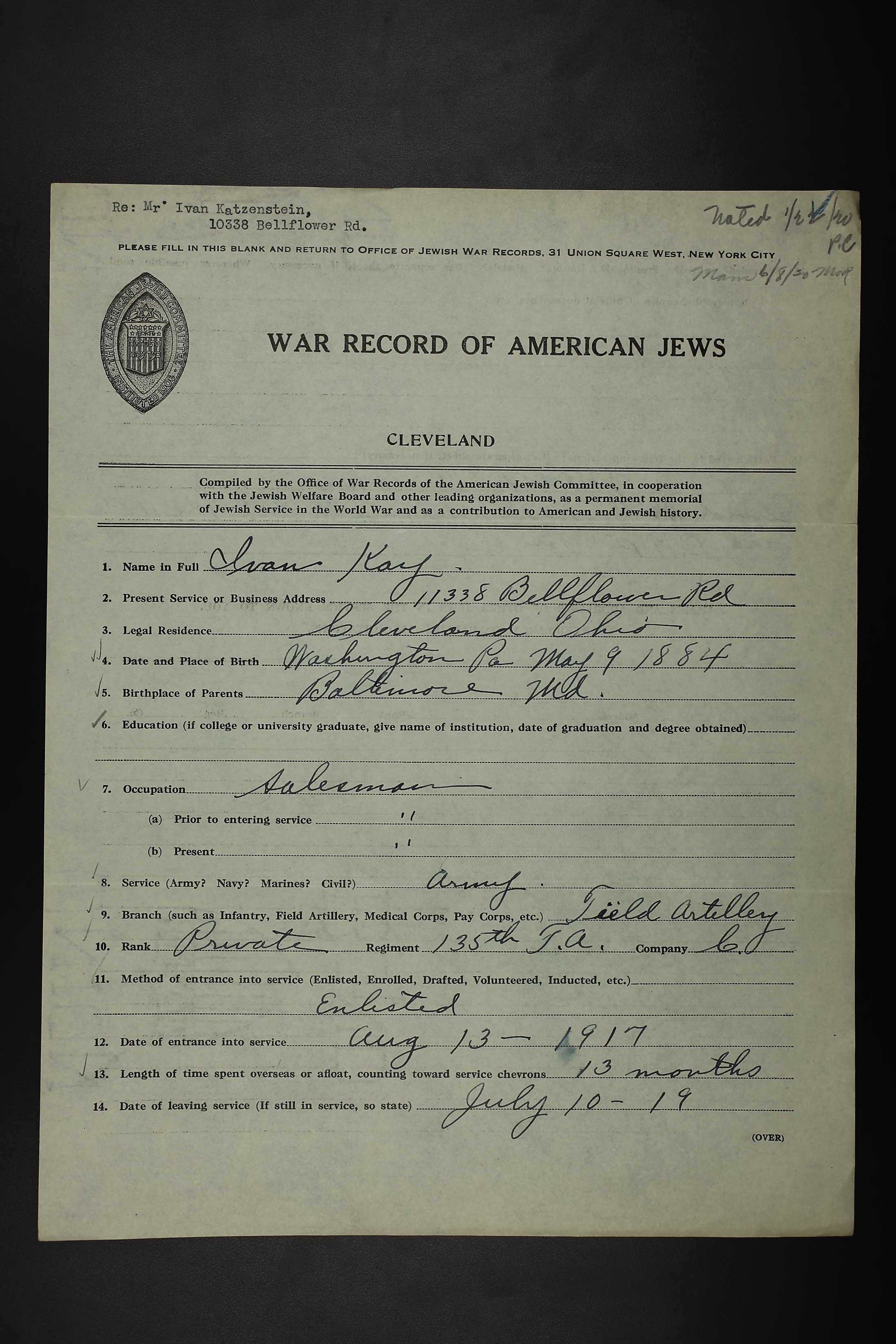
He was not the only Katzenstein brother to serve in World War I.  According to The Official Roster of Ohio Soldiers, Sailors, and Marines in the World War (Volume 9), Ivan Katzenstein joined the Ohio National Guard on August 13, 1917. He served in the field artillery in the Guard until August 31, 1918.  He then was sent to France where he served in the 135th Field Artillery, Company C, until July 5, 1919, and fought in the Meuse-Argonne offensive.  He was honorably discharged on July 11, 1919.

Title : The Official Roster of Ohio Soldiers, Sailors, and Marines in the World War Volume 9 Source Information Ancestry.com. U.S., Adjutant General Military Records, 1631-1976 [database on-line]. Provo, UT, USA: Ancestry.com Operations, Inc., 2011.

Title : The Official Roster of Ohio Soldiers, Sailors, and Marines in the World War Volume 9
Source Information
Ancestry.com. U.S., Adjutant General Military Records, 1631-1976 [database on-line]. Provo, UT, USA: Ancestry.com Operations, Inc., 2011.

Series II: Questionnaires: Jews; Record Group Description: (A) General Files, Army and Navy (Boxes 2-4); Box #: 3; Folder #: 9; Box Info: (Box 3) Cleveland: Privates, H-P Description Folder Content Description : (Box 3) Cleveland: Privates, H-P

Series II: Questionnaires: Jews; Record Group Description: (A) General Files, Army and Navy (Boxes 2-4); Box #: 3; Folder #: 9; Box Info: (Box 3) Cleveland: Privates, H-P
Description
Folder Content Description : (Box 3) Cleveland: Privates, H-P

Vernon also served during World War I.  He was a first lieutenant in the Officers’ Reserve Corps beginning July 6, 1917, serving in the Ordnance Corps. He served in the American Expeditionary Forces in World War I from December 3, 1917 until June 17, 1919, and was honorably discharged on June 25, 1919.

Title : The Official Roster of Ohio Soldiers, Sailors, and Marines in the World War Volume 9 Source Information Ancestry.com. U.S., Adjutant General Military Records, 1631-1976 [database on-line]. Provo, UT, USA: Ancestry.com Operations, Inc., 2011.

Title : The Official Roster of Ohio Soldiers, Sailors, and Marines in the World War Volume 9
Source Information
Ancestry.com. U.S., Adjutant General Military Records, 1631-1976 [database on-line]. Provo, UT, USA: Ancestry.com Operations, Inc., 2011.

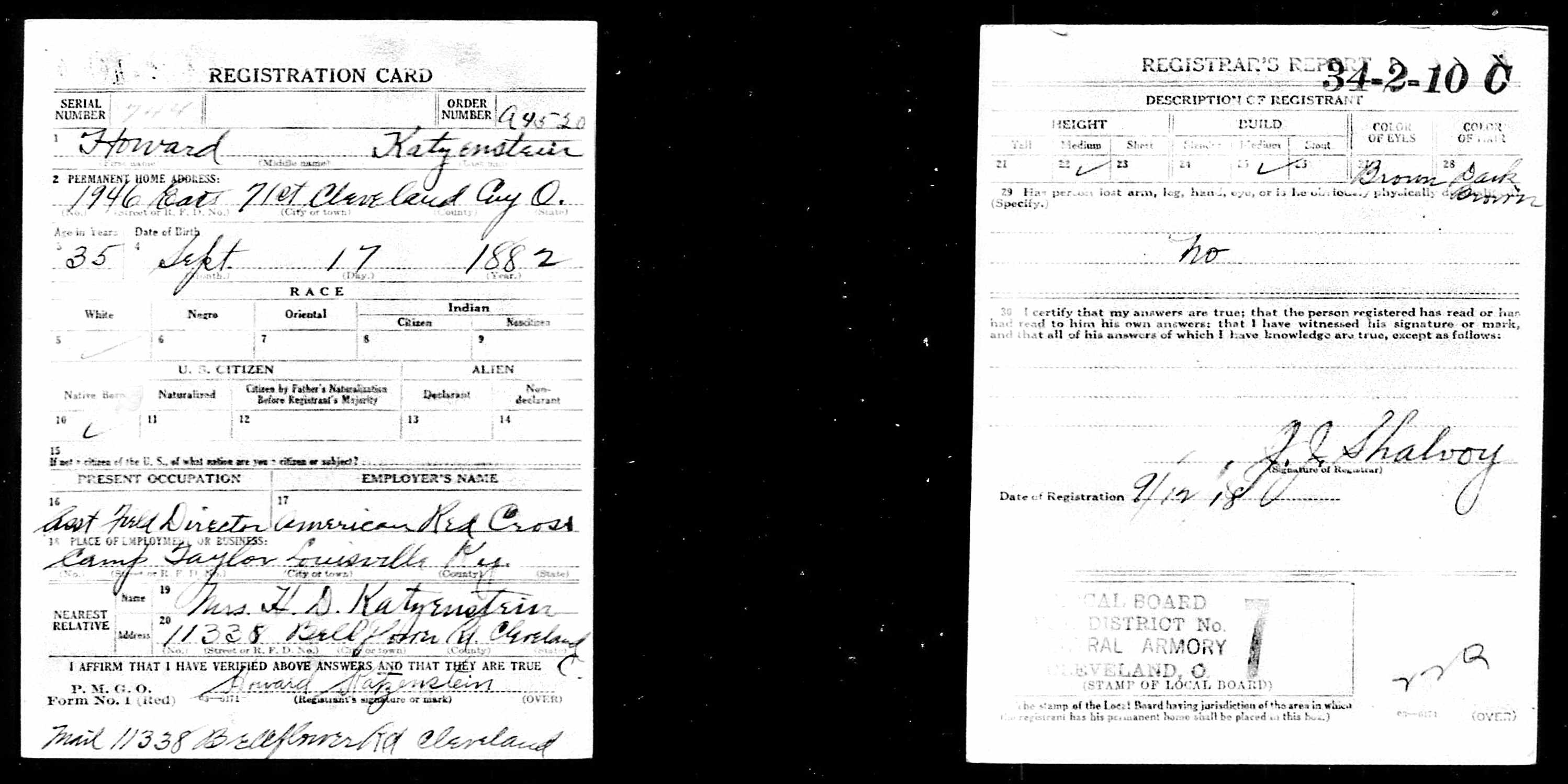
When the US entered World War I, Howard Katzenstein was working as the assistant field director for the American Red Cross at Camp Taylor in Louisville, Kentucky, according to his draft registration card:

Howard Katzenstein World War I draft registration Registration State: Ohio; Registration County: Cuyahoga; Roll: 1831766; Draft Board: 07

Howard Katzenstein World War I draft registration
Registration State: Ohio; Registration County: Cuyahoga; Roll: 1831766; Draft Board: 07

Earl Katzenstein was living in Cleveland and working as a traveling salesman for the S & S Shirt Company of Phillipsburg Center, Pennsylvania, according to his draft registration:

Earl Katzenstein World War I draft registration Registration State: Ohio; Registration County: Cuyahoga; Roll: 1831766; Draft Board: 07

Earl Katzenstein World War I draft registration
Registration State: Ohio; Registration County: Cuyahoga; Roll: 1831766; Draft Board: 07

By 1920, all of the Katzenstein brothers had adopted the surname Kay instead of Katzenstein.  Had they all decided that Katzenstein was too Jewish? Too German sounding after World War I? Too long? I don’t know. But like so many other children of immigrants, they changed their name and shedded part of their original identity.

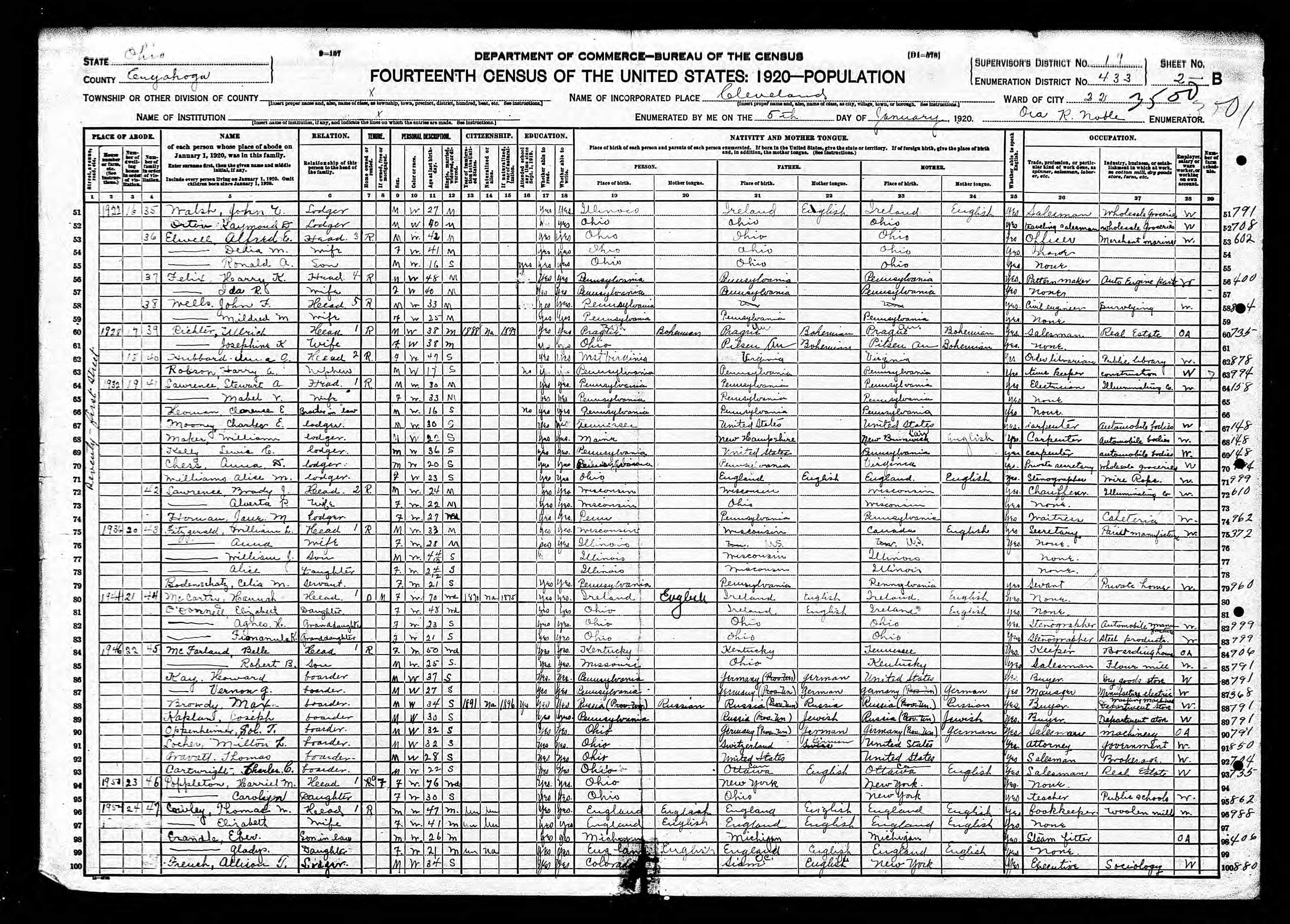
Three of the Kay brothers were living in Cleveland.  According to the 1920 census, Howard and Vernon were living together in a boarding house at 1946 71st Street; Howard was working as a buyer in a dry goods store, and Vernon was a manager in an electric washing machine manufacturing business.

Howard and Vernon Katzenstein 1920 US census Year: 1920; Census Place: Cleveland Ward 22, Cuyahoga, Ohio; Roll: T625_1371; Page: 2B; Enumeration District: 433; Image: 988

Howard and Vernon Katzenstein 1920 US census
Year: 1920; Census Place: Cleveland Ward 22, Cuyahoga, Ohio; Roll: T625_1371; Page: 2B; Enumeration District: 433; Image: 988

Interestingly, the 1920 Cleveland directory shows both Ivan and Vernon living at 1943 East 107th Street, but Howard is not listed; the 1921 directory lists all three brothers. Ivan and Vernon were both still living at 1943 East 107th Street; Ivan had no occupation listed, and Vernon was the vice-president of the Bell Washer & Wringer Company (a laundry business, I’d assume). Howard was living at 7100 Euclid Avenue; he had no occupation listed. I cannot find Ivan on the 1920 census.

Howard, Ivan, and Vernon Kay 1921 Cleveland directory Title : Cleveland, Ohio, City Directory, 1921 Source Information Ancestry.com. U.S. City Directories, 1822-1995 [database on-line]. Provo, UT, USA: Ancestry.com Operations, Inc., 2011. Original data: Original sources vary according to directory.

Howard, Ivan, and Vernon Kay 1921 Cleveland directory
Title : Cleveland, Ohio, City Directory, 1921
Source Information
Ancestry.com. U.S. City Directories, 1822-1995 [database on-line]. Provo, UT, USA: Ancestry.com Operations, Inc., 2011.
Original data: Original sources vary according to directory.

Meanwhile, in 1920 Earl was living in a boarding house in St. Louis, working as a traveling salesman.

By 1920, Milton was again boarding with a family in Pittsburgh and practicing medicine. Here is his listing from the UPenn alumni magazine for 1922:

1922 Catalog of the University of Pennsylvania Ancestry.com. U.S., College Student Lists, 1763-1924 [database on-line]. Provo, UT, USA: Ancestry.com Operations, Inc., 2012. Original data: College Student Lists. Worcester, Massachusetts: American Antiquarian Society.

1922 Catalog of the University of Pennsylvania
Ancestry.com. U.S., College Student Lists, 1763-1924 [database on-line]. Provo, UT, USA: Ancestry.com Operations, Inc., 2012.
Original data: College Student Lists. Worcester, Massachusetts: American Antiquarian Society.

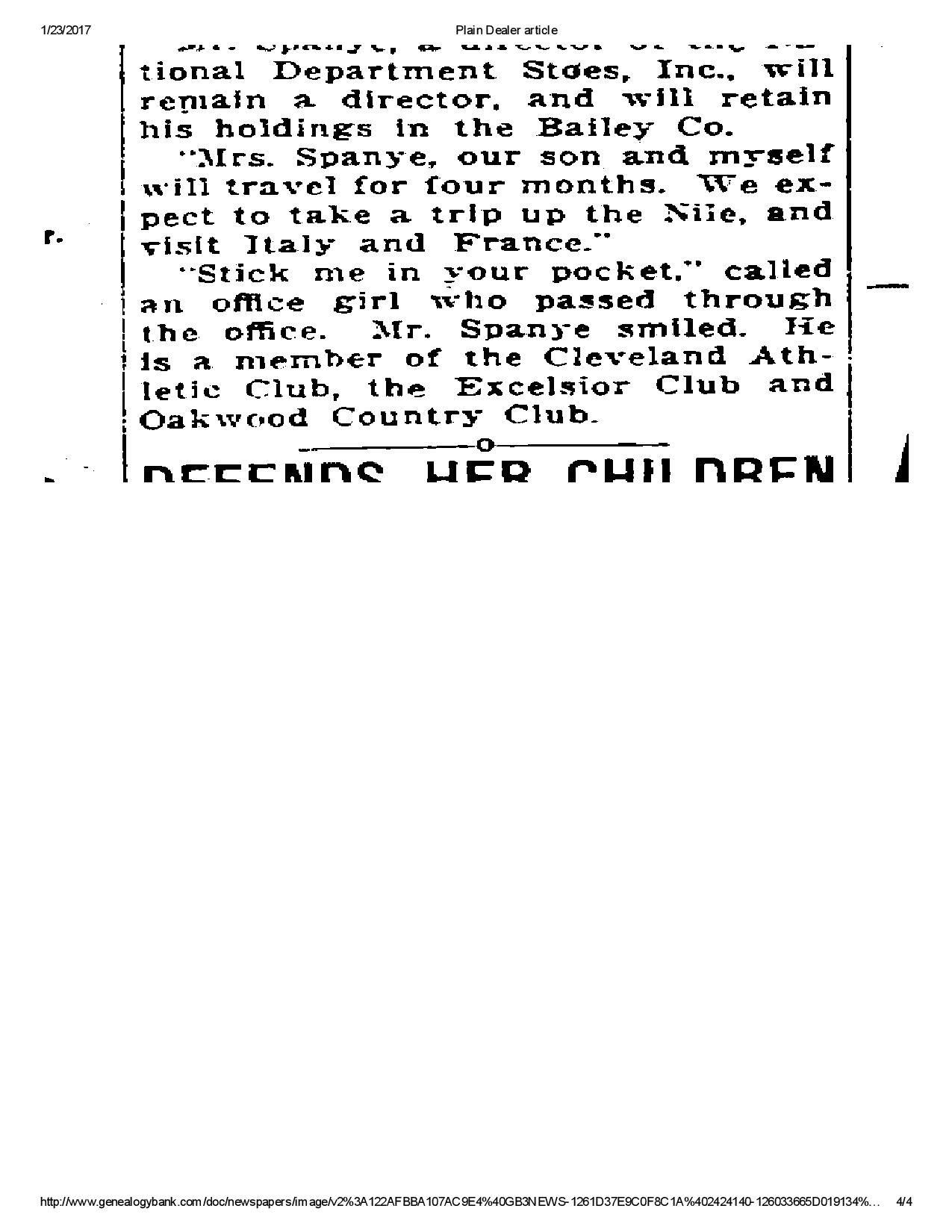
 As for Moynelle Katzenstein and Bert Spanye, in 1920 they and their children were living with Moynelle’s mother Henrietta and four servants in their home at 11338 Belleflower Road.  Then in 1924, Bert retired from Bailey & Company after 25 years, as reported in the December 20, 1924 Cleveland Plain Dealer (p. 15):

bert-spanye-retires-page-002 bert-spanye-retires-page-003 bert-spanye-retires-page-004

Thus, by 1925, the children of S.J. Katzenstein and Henrietta Sigmund had in many ways achieved and perhaps exceeded the dreams their grandparents Gerson and Eva must have had when they left Germany in the 1850s. Moynelle had married an immigrant who had quickly become a highly successful businessman.   Two of the Kay/Katzenstein sons were graduates of two of America’s elite universities, one an engineer, the other a doctor.  Three had served their country in World War I, fighting against the country where their parents and grandparents were born.

All of them were giving back to America whatever America had given them. As immigrants have always done and will continue to do.

Continued in my next post.

After the Flood, More Tears

In my last two posts I wrote about the tragedies the Katzenstein family endured in 1889 when Jacob Katzenstein, my great-grandmother Hilda’s brother, lost his son Edwin and his wife Ella (who may also have been related to me through my Goldschmidt line) in the devastating Johnstown flood of May 31, 1889. This post will follow up with the rest of my great-great-grandparents’ family.

Here is a family group sheet for the family of my great-great-grandparents, Gerson Katzenstein and Eva Goldschmidt and their six children, five of whom survived to adulthood.

family-group-sheet-for-gerson-katzenstein

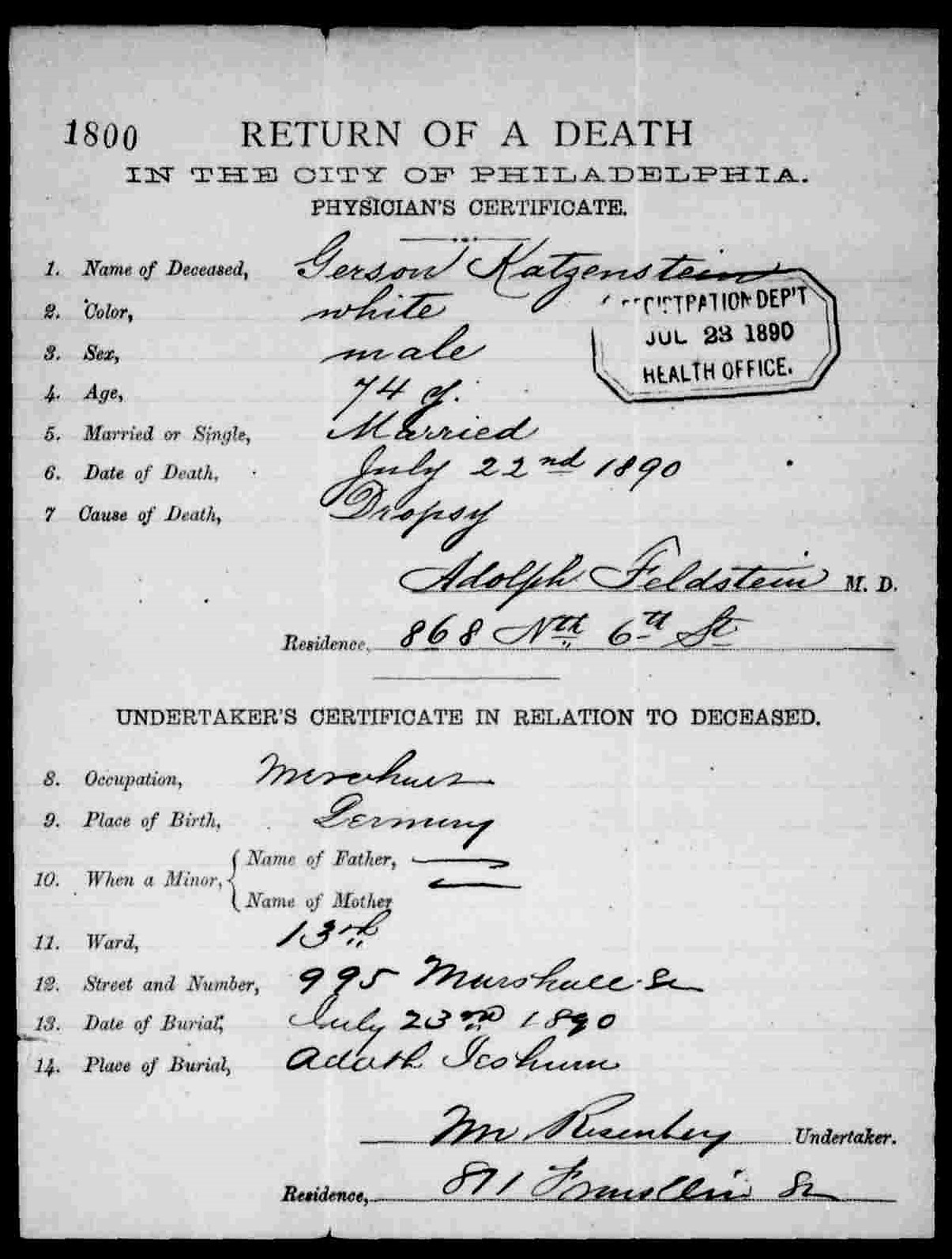
A little over a year after the flood, on July 22, 1890, my great-great-grandfather Gerson Katzenstein died of dropsy at age 75 in Philadelphia. According to several sources, “dropsy” is an old-fashioned term for edema or swelling of body tissues, whether it’s the brain, the heart, or some other body part or organ.  I don’t know what type of edema afflicted Gerson or why it killed him.  He was buried at Adath Jeshrun cemetery in Philadelphia.

gerson-katzenstein-death-cert

Gerson Katzenstein death certificate “Pennsylvania, Philadelphia City Death Certificates, 1803-1915,” database with images, FamilySearch (https://familysearch.org/ark:/61903/3:1:S3HT-68NW-375?cc=1320976&wc=9FR3-SP8%3A1073244201 : 16 May 2014), > image 340 of 1712; Philadelphia City Archives and Historical Society of Pennsylvania, Philadelphia.

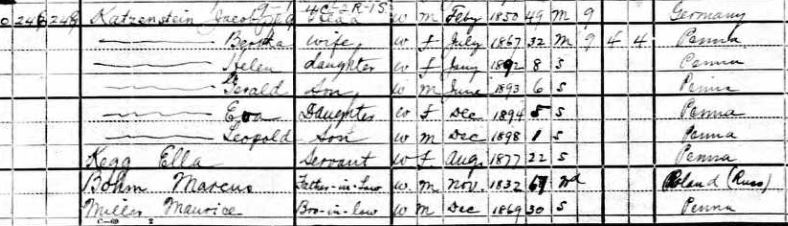
In March, 1891, his son Jacob remarried two years after losing his wife and son in the Johnstown flood.  Jacob married Bertha Miller, the daughter of Samuel Miller and Eliza Leopold, whom I mentioned here.  (As I described, Jacob’s first father-in-law, Marcus Bohm, would later be living with Jacob’s second wife Bertha Miller’s aunt, Minnie Leopold Reineman, in 1910 in Johnstown.)  Bertha’s parents were both born in Germany, and her father Samuel was a “merchant tailor” in Pottstown, Pennsylvania, in 1880.

Jacob Katzenstein wedding to Bertha Miller PHiladelphia Times March 12 1891 p. 3

Jacob Katzenstein wedding to Bertha Miller
PHiladelphia Times March 12 1891 p. 3

Bertha and Jacob had a child Helen in 1892, and they had a second child on June 8, 1893, whom they named Gerald, presumably for Gerson Katzenstein, Jacob’s father, my great-great-grandfather.  He was not the only grandson named for Gerson.  On January 20, 1892, my great-uncle Gerson Schoenthal was born, son of my great-grandparents Hilda Katzenstein and Isidore Schoenthal. In addition, SJ Katzenstein and his wife Henrietta also had a child possibly named for Gerson: Vernon Glyde, born on February 8, 1892.

My great-great-grandmother, Eva Goldschmidt Katzenstein, died on September 6, 1893.  She was 66 years old and died of “carcinoma ventric omentum.”  According to my medical consultant, today that is called “carcinoma of the ventral omentum, which is a part of the lining of the abdomen near the stomach.”

Eva also had grandchildren named for her, including my grandmother, Eva Schoenthal.  Jacob and Bertha’s third child, born December 2, 1894, was also named Eva.

eva-goldschmidt-katzenstein-death-cert

Eva Goldschmidt Katzenstein death certificate “Pennsylvania, Philadelphia City Death Certificates, 1803-1915,” database with images, FamilySearch (https://familysearch.org/ark:/61903/3:1:S3HY-DY6W-VS?cc=1320976&wc=9FRF-GP8%3A1073237701 : 16 May 2014), > image 1467 of 1730; Philadelphia City Archives and Historical Society of Pennsylvania, Philadelphia.

Jacob and Bertha had two more children by 1900: Leopold (1898) and Maurice (1900). As pointed our earlier, they were living in Johnstown in 1900 with Jacob’s first father-in-law Marcus Bohm and Bertha’s brother Maurice.  Jacob was working as a clothing merchant.

Jacob Katzenstein and family 1900 census Year: 1900; Census Place: Johnstown Ward 1, Cambria, Pennsylvania; Roll: 1388; Page: 12A; Enumeration District: 0124; FHL microfilm: 1241388

Jacob Katzenstein and family 1900 census
Year: 1900; Census Place: Johnstown Ward 1, Cambria, Pennsylvania; Roll: 1388; Page: 12A; Enumeration District: 0124; FHL microfilm: 1241388

SJ Katzenstein and his family were living in Washington, Pennsylvania in 1900, where he was still a clothing merchant as well.  Their children were all still at home and at school, except for Howard, who was working as a clerk.

SJ Katzenstein and family 1900 census Year: 1900; Census Place: Washington, Washington, Pennsylvania; Roll: 1494; Page: 16B; Enumeration District: 0173; FHL microfilm: 1241494

SJ Katzenstein and family 1900 census
Year: 1900; Census Place: Washington, Washington, Pennsylvania; Roll: 1494; Page: 16B; Enumeration District: 0173; FHL microfilm: 1241494

Brendina Katzenstein Schlesinger and her family were still in Philadelphia, and her husband Jacob listed his occupation on the 1900 census as a meat salesman.  Their oldest son, Solomon Joseph, was a manager of a laundry, and Alfred was managing a newspaper. Sidney was working as a clerk in a clothing store.  The two daughters, Heloise and Aimee, were not employed.

Brendina and Jacob Schlesinger 1900 census Year: 1900; Census Place: Philadelphia Ward 20, Philadelphia, Pennsylvania; Roll: 1463; Enumeration District: 0421; FHL microfilm: 1241462

Brendina and Jacob Schlesinger 1900 census
Year: 1900; Census Place: Philadelphia Ward 20, Philadelphia, Pennsylvania; Roll: 1463; Enumeration District: 0421; FHL microfilm: 1241462

Perry Katzenstein and his wife Rose were also living in Philadelphia where Perry was in the clothing business.  They had no children.  Rose’s sister Flora Elias was living with them.

Perry and Rose Katzenstein 1900 census Year: 1900; Census Place: Philadelphia Ward 32, Philadelphia, Pennsylvania; Roll: 1474; Page: 4A; Enumeration District: 0830; FHL microfilm: 1241474

Perry and Rose Katzenstein 1900 census
Year: 1900; Census Place: Philadelphia Ward 32, Philadelphia, Pennsylvania; Roll: 1474; Page: 4A; Enumeration District: 0830; FHL microfilm: 1241474

And, as I’ve written before, my great-grandparents Hilda Katzenstein and Isidore Schoenthal were living in Washington, Pennsylvania, with their two older sons, Lester and Gerson, and my great-grandfather was working in the china business there.

HIlda Katzenstein and Isidore Schoenthal 1900 census Year: 1900; Census Place: Washington, Washington, Pennsylvania; Roll: 1495; Page: 4A; Enumeration District: 0175; FHL microfilm: 1241495

HIlda Katzenstein and Isidore Schoenthal 1900 census Year: 1900; Census Place: Washington, Washington, Pennsylvania; Roll: 1495; Page: 4A; Enumeration District: 0175; FHL microfilm: 1241495

So as the century turned, my great-grandmother Hilda and her siblings had lost both of their parents, but the next generation of the family was growing. As of 1900, there were eighteen grandchildren—my grandmother’s first cousins and brothers— and my great-uncle Harold was born on August 28, 1901, bringing the total to nineteen.  My grandmother and one more first cousin were yet to be born.  All of them lived in Pennsylvania, spanning from Philadelphia in the east to Washington in the west with family living in Johnstown in between.

But the start of the 20th century was not very kind to the Katzenstein family.  On December 7, 1901, my great-great-uncle SJ Katzenstein died at age 53.  He left behind his wife Henrietta and six children, ranging in age from Moynelle, who was 22, to Vernon, who was only nine years old.

sj-katzenstein-obit

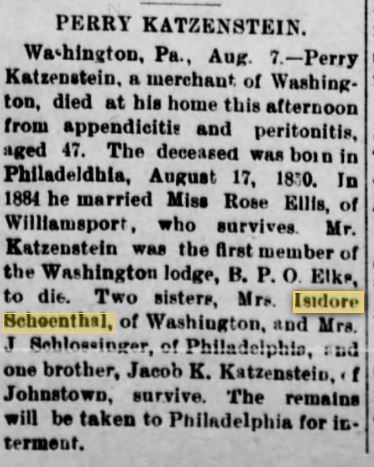
Then less than two years later, SJ’s younger brother Perry died.  He was just a few days shy of his 47th birthday.  According to his obituary, he had been living in Washington, Pennsylvania, not Philadelphia, at the time of his death.  Perhaps he had taken over SJ’s clothing business. Perry died from appendicitis and peritonitis. He was survived by his wife Rose.

Perry Katzenstein obituary Canonsburg PA Daily Notes August 8, 1903 p.2

Perry Katzenstein obituary Canonsburg PA Daily Notes August 8, 1903 p.2

perry-katzenstein-death-cert

But Rose did not last very long without him. While visiting her sister in Chicago on February 24, 1904, she took her own life.  Her death was ruled a suicide, strangulation by hanging.  Perry’s death must have been too much for her to bear.

rosa-elias-katzenstein-death-cert

Rose Elias Katzenstein death certificate “Pennsylvania, Philadelphia City Death Certificates, 1803-1915,” database with images, FamilySearch (https://familysearch.org/ark:/61903/3:1:S3HT-67QH-3T?cc=1320976&wc=9F5B-VZS%3A1073109202 : 16 May 2014), > image 232 of 538; Philadelphia City Archives and Historical Society of Pennsylvania, Philadelphia.

Rose Elias Katzenstein obituary Williamsport Sun-Gazette, February 26, 1904, p. 5

Rose Elias Katzenstein obituary
Williamsport Sun-Gazette, February 26, 1904, p. 5

Thus, by February, 1904, my great-grandmother Hilda had lost her parents, two of her three brothers, two nephews, and two sisters-in-law.  She also had her fourth and last child that year, my grandmother Eva, who was born on March 4, 1904, shortly after Rose’s death.

eva-schoenthal-cohen-watermarked

Eva Schoenthal Cohen, my grandmother

Jacob Katzenstein and his second wife Bertha also had their final child in 1904; he was born in August 1904 and was named Perry, obviously for Jacob’s brother Perry who had died the year before.

My great-great-grandparents Gerson and Eva (Goldschmidt) Katzenstein were thus survived by 21 grandchildren, including my grandmother Eva.  In posts to come, I will share their stories.

For now, I will be taking a short break from research, but will be sharing some of the photographs and records I’ve received but have not yet had a chance to post.


Who Was Ella Bohm Katzenstein? A Genealogy Adventure

This was truly a genealogy adventure. I’d written most of this post before I made two surprising discoveries that required me to rewrite substantial parts of it. The story of Jacob Katzenstein’s first wife Ella is heartbreaking. She was only 27 when she died in the 1889 Johnstown flood, and for a long time I knew almost nothing about her.  I’ve finally made some headway in learning more about her.

Here’s what I now know about her from various sources, more or less in the order I found them. Her first name was Ella, as seen from the birth record indexed on FamilySearch for her son, Milton B. Katzenstein.

milton-b-katzenstein-birth-record

Her birth surname was Bohm, as seen in a newspaper report of her death and as implicitly confirmed by the fact that Milton’s middle name was Bohm; that fact I learned from Milton’s burial record at Grandview Cemetery in Johnstown.

Philadelphia Jewish Exponent,, June 7, 1889, p. 3

Philadelphia Jewish Exponent,, June 7, 1889, p. 3

I know that Ella was probably born in February 1862, as indicated on the memorial stone placed at Eastview Cemetery in Cumberland, Maryland.   Her father’s name was apparently Marcus Bohm; that fact I inferred from the fact that Ella’s widower Jacob Katzenstein included Marcus in his household on the 1900 census and described him as his father-in-law (even though by that time Jacob had remarried). Ella presumably married Jacob sometime before or around January, 1886, since their son Milton was born in September, 1886. Milton died on April 18, 1889.  I also know that a second child, Edwin, was born June 5, 1887, and that he and Ella were killed in the Johnstown flood on May 31, 1889.

ella-katzenstein-and-edwin-katzenstein-headstone-from-findagrave

But where was Ella before marrying Jacob and having these two little boys?

For the longest time, I could not find her on the 1870  census, no matter how many ways I tried to spell her name, with and without wildcards. And then somehow she popped up after I’d just about given up.  I decided to search for any Ella with a surname starting with Bo born anywhere in about 1862 living in Pennsylvania or any state bordering it.  And there she was, listed as Ella Bohn, living in Philadelphia, an eight year old child born in Pennsylvania.  Her father was not living with her, nor was there anyone else in the household named Bohn or Bohm. So who was she living with?

Ella Bohm (Bohn) on the 1870 census Year: 1870; Census Place: Philadelphia Ward 12 District 36, Philadelphia, Pennsylvania

Ella Bohm (Bohn) on the 1870 census
Year: 1870; Census Place: Philadelphia Ward 12 District 36, Philadelphia, Pennsylvania

I took a deep breath when I saw.  She was living with Jacob Goldsmith. Who was he? The son of Simon Goldschmidt and Fradchen Schoenthal.  Simon Goldschmidt was the brother of my three-times great-grandfather Seligmann Goldschmidt, the father of Eva Goldschmidt Katzenstein, whose son Jacob would later marry Ella Bohm.  And Fradchen Schoenthal was the sister of my three-times great-grandfather Levi Schoenthal, father of Isidore Schoenthal who would later marry Hilda Katzenstein, daughter of Eva Goldschmidt Katzenstein and brother of Jacob Katzenstein, who would later marry Ella Bohm.

jacob-katzenstein-to-jacob-goldsmith

So little Ella Bohm was for some reason living with the first cousin, once removed, of her future husband Jacob Katzenstein.  And with in-law relatives of her future sister-in-law, Hilda Katzenstein, my great-grandmother. And they were all related to me.  Yikes.

But where was her father? Why wasn’t Ella living with him? Why was she living with Jacob Goldsmith? Unfortunately, the 1870 census did not include information about the relationships among those in a household, so I couldn’t tell.

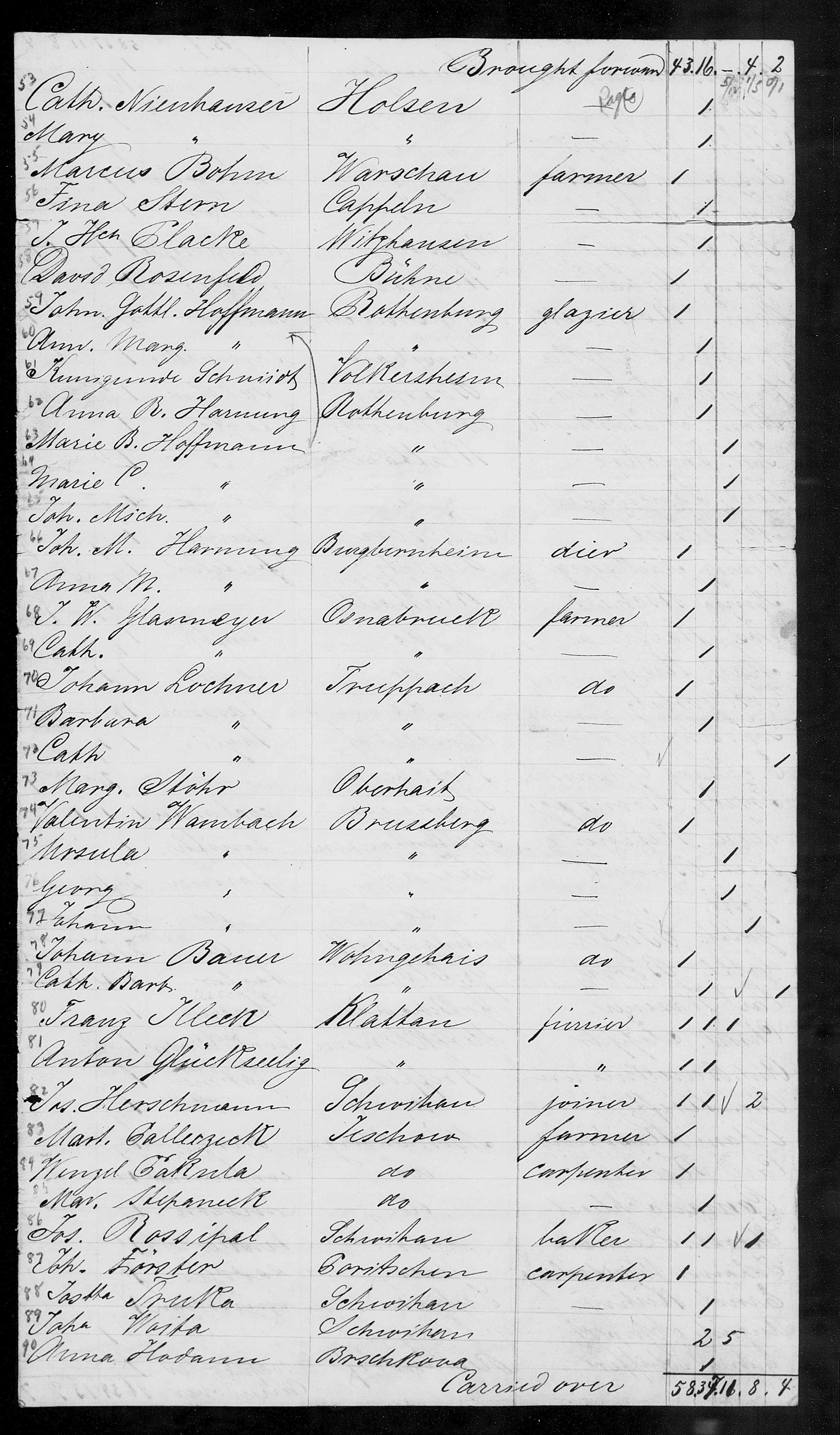
A search for information about Ella’s father Marcus Bohm turned up nothing explicit connecting him to Ella, though I was able to piece together some information about Marcus. He was born November 9, 1834, in Warsaw, Poland, and immigrated to the United States in 1849, arriving in Baltimore.

marcus-bohm-manifest-from-family-search

Maryland, Baltimore Passenger Lists, 1820-1948,” database with images, FamilySearch (https://familysearch.org/ark:/61903/3:1:3QS7-897J-P6W?cc=2018318&wc=MKZ4-GPF%3A1004777901%2C1004778901 : 25 September 2015), 1820-1891 (NARA M255, M596) > image 404 of 688; citing NARA microfilm publications M255, M596 and T844 (Washington, D.C.: National Archives and Records Administration, n.d.).

One document indicates that he was living in Washington, Pennsylvania, in 1853, which, of course, is where many members of my extended family also settled, including Jacob Goldsmith, who was a clothing merchant there as early as 1850, and Jacob Katzenstein’s brother SJ, who arrived around there in about 1871.

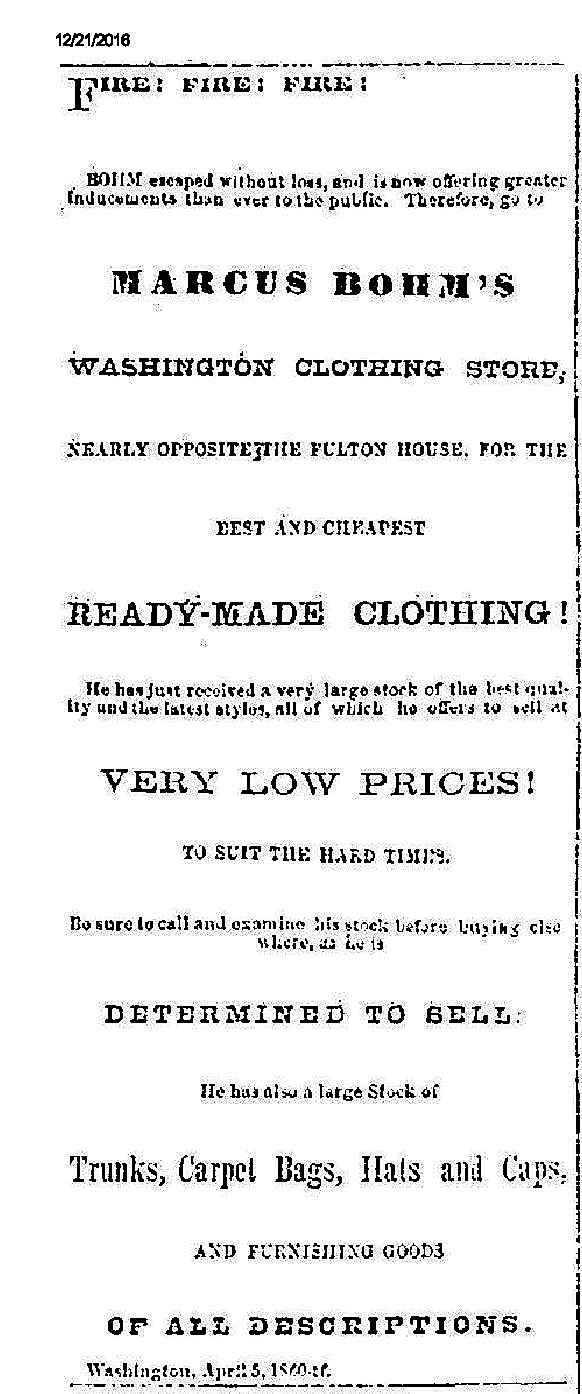
It appears that Marcus Bohm owned a clothing store there from at least 1853 from ads I found online in the Washington newspaper.  There was a fire at his store in April, 1860:

Washington Reporter, April 12, 1860, p. 3

Washington Reporter, April 12, 1860, p. 3

I also found an advertisement for Marcus Bohm’s clothing store in the Washington Reporter of August 30, 1860 (p.3):

ad-for-marcus-bohm-1860


But by November, 1860, Marcus was closing down his Washington store:

marcus-bohm-closing-down-store-in-wash-pa-page-001

It seems he then left Washington, Pennsylvania, because according to a New Jersey index of the 1860 census, Marcus was living in Hudson Township, New Jersey, in 1860, although I cannot find him on the actual 1860 census records.  He is listed in the 1867 Trenton, New Jersey, directory as working in the clothing business and living at Madison House. On the 1870 census, he is listed as living in a hotel in Trenton and working as a clothier. There is no wife or child living with him.

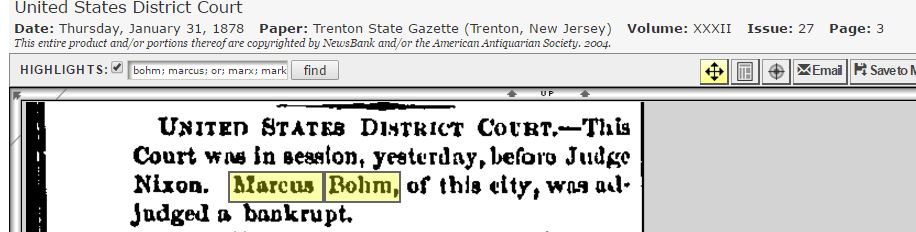
Marcus continued to be listed in Trenton city directories in the 1870s up through 1876, and he is consistently listed as a clothing merchant and tailor and living in various hotels in Trenton. But in 1878, he declared bankruptcy in Trenton:

marcus-bohm-bankrupt

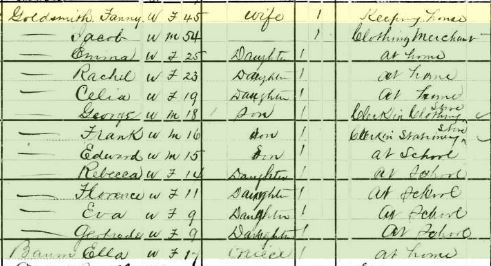
Why was his daughter Ella  living with the Goldsmiths in Philadelphia in 1870 and not with her father in Trenton? I decided to dig deeper into the background of Jacob Goldsmith, someone I had not yet really researched as I am (ahem) not yet focused on my Goldschmidt line (yet somehow they keep popping up everywhere).  I searched for him on the 1880 census, and this is what I found:

Jacob Goldsmith's family on 1880 census with Ella "Baum" Year: 1880; Census Place: Philadelphia, Philadelphia, Pennsylvania; Roll: 1173; Family History Film: 1255173; Page: 158D; Enumeration District: 210; Image: 0325

Jacob Goldsmith’s family on 1880 census with Ella “Baum”
Year: 1880; Census Place: Philadelphia, Philadelphia, Pennsylvania; Roll: 1173; Family History Film: 1255173; Page: 158D; Enumeration District: 210; Image: 0325

Jacob, Fanny, and their many children were living in Philadelphia, and living with them was a niece named Ella Baum, age 17.  This had to be Ella Bohm, who would have been turning 18 in 1880.  She was living with Jacob and Fanny Goldsmith because she was their niece! So her mother had to be either Fanny’s sister or Jacob’s sister. For reasons described below, I believe she was the daughter of Jacob’s sister Eva.

Jacob had several sisters, but for all but one, I’d found married names, and they had not married Marcus Bohm.  But there was one sister for whom I’d been unable to find anything more than her name on the passenger manifest with her father Simon and stepmother Fradchen in 1845 and her listing on the 1850 census with her father Simon and stepmother Fanny and several siblings. Her name was Eva Goldschmidt/Goldsmith.

Simon, Fradchen, and Eva Goldschmidt on 1845 passenger manifest The National Archives at Washington, D.C.; Washington, D.C.; Records of the US Customs Service, RG36; NAI Number: 2655153; Record Group Title: Records of the Immigration and Naturalization Service, 1787-2004; Record Group Number: 85

Simon, Fradchen, and Eva Goldschmidt on 1845 passenger manifest
The National Archives at Washington, D.C.; Washington, D.C.; Records of the US Customs Service, RG36; NAI Number: 2655153; Record Group Title: Records of the Immigration and Naturalization Service, 1787-2004; Record Group Number: 85

On the 1850 census, the names seem confused. It shows Simon’s wife’s name as Lena. Her name was Fradchen or Fanny in the US. Simon had a daughter Lena, who is also listed on the census.  And then there is a daughter named Fanny.  I think that daughter was really Eva, and the enumerator somehow thought Fanny was the daughter’s name instead of the wife and heard “Lena” instead of “Eva” for the other daughter’s name and thought that was the wife’s name. (Remember these were recent immigrants whose English might not have been very understandable.)

Simon Goldschmidt and family 1850 census Year: 1850; Census Place: Pittsburgh Ward 3, Allegheny, Pennsylvania; Roll: M432_745; Page: 135A; Image: 274

Simon Goldschmidt and family 1850 census
Year: 1850; Census Place: Pittsburgh Ward 3, Allegheny, Pennsylvania; Roll: M432_745; Page: 135A; Image: 274

But Eva is not listed as living with Simon in 1860 when he and two of her younger half-siblings had moved to Washington, Pennsylvania, to live with her older brother Jacob. So where was she then?  I don’t know, but here’s my theory.

My guess is that Marcus Bohm and Eva Goldsmith, Jacob’s sister, were married sometime around 1860. After their daughter Ella Bohm was born in 1862, Eva either died in childbirth or sometime shortly thereafter and before 1870. Supporting the theory that Eva had died is the fact that her brother Jacob named a child born in 1871 Eva.

I believe that Ella’s widowed father Marcus Bohm moved to New Jersey after losing his wife and his business in Washington, and he left his little daughter to be raised by her uncle, Jacob Goldsmith. That little girl then grew up and married Jacob Katzenstein, who was her second cousin.

I don’t know when she married Jacob. I cannot find Jacob or Ella on the 1880 census, although Jacob was listed in the Pittsburgh directories for 1879 and 1881, the Johnstown directory in 1884, both the Philadelphia and Johnstown directories for 1887, and the Johnstown directory in 1889. When their son Milton was born in 1886, Jacob and Ella must have been living in Philadelphia. And by 1889 they were living in Johnstown.

Where was Ella’s father Marcus in the 1880s? The 1880 census report shows that he was then living in Washington, Pennsylvania, boarding in a hotel there and working in a clothing store.  But by 1884, Marcus had moved to Johnstown, as the 1884 Johnstown directory lists Marcus living at 251 Main Street and working at 272 Main Street in the clothing business. That same directory lists Jacob Katzenstein as a commercial traveler living at 241 Main Street, just a few houses away from Marcus. I assume that Marcus moved to Johnstown because his daughter Ella had by that time married Jacob and was living there, but I don’t know for sure.

After the tragic deaths of his daughter Ella and his two grandsons Milton and Edwin in 1889, Marcus seemed to disappear for some years and does not appear in any city directories. The next record that does include Ella’s father Marcus is the 1900 census where, as noted above, he was living in Johnstown with Jacob Katzenstein and Jacob’s second wife Bertha Miller, their three children, Bertha’s brother Maurice, and a servant.  Marcus is described as Jacob’s father-in-law, widowed, and retired.

Jacob Katzenstein and family 1900 census Year: 1900; Census Place: Johnstown Ward 1, Cambria, Pennsylvania; Roll: 1388; Page: 12A; Enumeration District: 0124; FHL microfilm: 1241388

Jacob Katzenstein and family 1900 census
Year: 1900; Census Place: Johnstown Ward 1, Cambria, Pennsylvania; Roll: 1388; Page: 12A; Enumeration District: 0124; FHL microfilm: 1241388

I find it rather heartwarming that Bertha Miller took in the father of Jacob’s first wife.

Ten years later Marcus was still living in Johnstown, boarding in the household of Solomon Reineman, according to the 1910 census. I thought perhaps Solomon was a relative or married to a relative, but Solomon was born in Germany, not Poland. In 1880, Solomon had been living in Johnstown, so I assume that Marcus had become friendly with him during the 1880s when both were living in Johnstown.

And then I found a connection to Solomon’s wife, Minnie Leopold, though not directly. While researching Jacob’s second wife, Bertha Miller, I saw that her mother was named Eliza Leopold.  The name jumped out at me, and I thought—could there be a connection to Minnie Leopold? A few more steps of research, and lo and behold, I learned that Eliza and Minnie Leopold were sisters! So somehow Marcus Bohm ended up living with his son-in-law’s second wife’s aunt and her husband.

Two years later, however, Marcus had moved to Philadelphia. The 1912 Philadelphia directory lists Marcus Bohm living at 3333 North Broad Street. Four years later on February 25, 1916, Marcus died in Philadelphia.  He was 81 years old and died of chronic emphysema.

Pennsylvania Historic and Museum Commission; Pennsylvania, USA; Certificate Number Range: 021751-024880

Pennsylvania Historic and Museum Commission; Pennsylvania, USA; Certificate Number Range: 021751-024880

He’d been living at the Masonic Home of Pennsylvania, and the informant was William H. Sivel, the superintendent at 3333 North Broad Street, which I assume is the location of the Masonic Home and where Marcus had been residing.  There is no other personal information on the certificate except for Marcus Bohm’s birth date, birth place (Poland), age, and occupation, which the informant described as “gentleman.”  I was unable to find an obituary or any other document that would reveal family information for Marcus, only this death notice.

Philadelphia Inquirer, February 26, 1916, p. 18

Philadelphia Inquirer, February 26, 1916, p. 18

Thus, I was lucky enough to learn a little more about Ella Bohm Katzenstein and can only speculate that her mother was Eva Goldsmith, that Eva Goldsmith Bohm had died, and that Ella had been left to live with the family of Jacob Goldsmith while her father tried to recover from losing his wife and his store in Washington, Pennsylvania.

If I am right in this speculation, it makes her short life even more tragic. It was heartbreaking enough to know that she’d lost her first son Milton and then was killed along with her other son in the Johnstown flood of 1889 when she was only 27. But adding to that the loss of her mother and in some ways her father as a young child makes her story especially poignant.


The Flood

As we saw in my last post, by 1880, four of the five surviving children of Gerson and Eva (Goldschmidt) Katzenstein were on their own.  SJ, their oldest child, was married to his second cousin Henrietta Sigmund and living in Washington, Pennsylvania, where he was a merchant.  Brendina, the older daughter, was married to Jacob Schlesinger and living in Philadelphia, where Jacob worked as a butcher.   Jacob and Perry Katzenstein, the second and third sons of Gerson and Eva, were living together in Pittsburgh and working as salesmen.  Only my great-grandmother Hilda, who was seventeen in 1880, was still living at home with her parents in Philadelphia.

During the 1880s, Gerson and Eva were blessed with many grandchildren. SJ and Henrietta, whose first child Moynelle was born in 1879, had four sons in the 1880s: Milton (1881), Howard (1882), Ivan (1884), and Earl (1885).  Brendina and Jacob already had four children by 1880, Heloise (1874), Solomon Joseph (1875), and Alfred (1879), and a fourth child, Sidney, was born in 1880.  Their daughter Aimee was born seven years later in 1887.

In 1884 or 1885 (sources vary), Perry Katzenstein married Rose Elias, daughter of Samuel Elias and Fanny Greenwald.  Rose was born in Jersey Shore, Pennsylvania, which is, strangely enough, nowhere near the New Jersey shore.  In fact, it’s about 250 miles west of the Atlantic and about 190 miles west of Philadelphia and 180 miles east of Pittsburgh.   Rose’s parents were both German immigrants, and her father was a merchant. In 1880, her father was selling liquor; in 1870, he’d been selling clothing. In 1887, Perry is listed in the Philadelphia directory at the same address as his father, Gerson—870 Marshall Street.

His brother Jacob is listed right down the street at 919 Marshall Street in that same directory for 1887. Sometime before September 16, 1886, Jacob Katzenstein had married Ella Bohm, daughter of Marcus Bohm.  I cannot find any official records for Ella, except for this birth record indexed on FamilySearch:

milton-b-katzenstein-birth-record

Unfortunately, it did not reveal Ella’s original surname or anything else about her.  But it does show that their son Milton was born in Philadelphia in 1886, suggesting that they were all living there at that time.  I found her original surname and her father’s name from other sources, discussed below.

Jacob’s residence during the 1880s is a bit of a mystery.  I cannot find him on the 1880 census.  In 1881, he is listed in the Pittsburgh directory, living with Perry.  In 1884, he is listed in the Johnstown, Pennsylvania, directory, and in 1887, he is listed in both the Johnstown and Philadelphia directories.  I have no idea whether Ella was from Philadelphia, Johnstown, or someplace else. I don’t know where or when she and Jacob were married. I did find this quote about Jacob on my cousin Roger’s old website:

[Jacob] came to Johnstown in 1882, as a clerk for Louis Cohen.  He returned to Philadelphia for a few years but then came back to take charge of the Economy clothing Store which belonged to Amos Sulka and himself. (quoting Leonard Winograd, The Horse Died at Windber: A History of Johnstown’s Jews of Pennsylvania (Wyndham Hall Press, 1988)).

Jacob and Ella had a second son named Edwin born apparently on June 5, 1887, a date I determined from his headstone, as discussed below.  But June 5, 1887 is less than nine months after Milton’s birth date of September 16, 1886.  It seems highly unlikely that a woman could have had two children less than nine months apart. I assume one of those birth dates is off by at least a few months, or that Edwin was premature, or that Ella conceived almost immediately after Milton was born. Or that Ella was not the biological mother of one of those two children.

In 1888, Gerson and Eva saw their youngest child get married.  Hilda, my great-grandmother, married Isidore Schoenthal in Philadelphia. As I’ve written previously, Hilda and Isidore first lived in Pittsburgh, where on December 3, 1888, their first son was born, my great-uncle Lester Schoenthal.

Hilda Katzenstein Schoenthal

Hilda Katzenstein Schoenthal

Thus, by 1888, Gerson and Eva’s children were all married, and there were twelve grandchildren.  Things must have seemed quite good for them all, but in 1889, their fortunes began to change.  First, on April 18, 1889, Jacob and Ella’s son Milton died; he would have been only two and a half years old.  I learned of his death from an entry on FindAGrave showing his headstone at Grandview cemetery in Johnstown:

But the headstone says he was born in 1888, not 1886 as the Philadelphia birth record stated. So I searched the interment database for Grandview cemetery in Johnstown and saw that the interment record indicates that Milton was two when he died in April, 1889, suggesting that the headstone is wrong and the birth record and interment record are right.  Very odd.  I also learned from the interment record that Milton’s middle name was Bohm, his mother’s birth name.

A little over a month after Milton’s death in Johnstown, one of the most tragic events in American history occurred: the Johnstown flood of May 31, 1889. Over two thousand people died that day.  According to the Johnstown Area Heritage Association (JAHA) website, that was the largest loss of civilian life in America in one day until September 11, 2001.

The JAHA website and several other sources describe how after several days of heavy rain, the South Fork dam, which was in need of repairs, collapsed, causing havoc and death as the rushing waters swept everything in its path under and aside.


The aftermath of the Johnstown Flood (Johnstow...

The aftermath of the Johnstown Flood (Johnstown, Pennsylvania). “The Debris above the Pennsylvania Railroad Bridge.” In: “History of the Johnstown Flood”, by Willis Fletcher Johnson, 1889. P. 199. Library Call Number M79.4 J71h. (Photo credit: Wikipedia)

Here is how the JAHA described it:

20 million tons of water rushed down the narrow Conemaugh Valley like a moving mountain of water at an average speed of 40 miles per hour. The “terrible wave” picked up houses, trees, and even trains on its way down the valley. It flattened a railroad bridge. It swept whole towns away as it made its way to the city of Johnstown.

By the time it reached Johnstown the flood didn’t even look like water anymore. People who saw it coming said it looked like a moving, boiling black mountain of junk. 35 feet high at its crest, it had the force of Niagara Falls. Even the best swimmers couldn’t swim in that mess. Many people drowned. For most, the only warning was a thunderous rumble before the water hit.

In minutes, most of downtown Johnstown was destroyed. Survivors clung to roofs, debris, and the few buildings that remained standing. Others who weren’t killed instantly, were swept down the valley to their deaths.

Just when it seemed like it couldn’t get worse, it did. All that wreckage piled up behind the Pennsylvania Railroad’s Stone Bridge. People who managed to survive so far became trapped in the huge pile of debris, all wrapped in a tangle of barbed wire from destroyed Gautier Wire Works. Then the pile, which was 40 feet high and 30 acres across, caught fire!

Four square miles of downtown Johnstown was completely leveled, including about 1600 homes, 280 businesses, and much of the Cambria Iron Company. Even more tragic was the loss of life. 2,209 people are known to have died in the flood waters. 99 whole families perished. 400 children under the age of ten were killed.

Among those who lost their lives in the flood were Ella Bohm Katzenstein, Jacob’s wife, and their younger son, Edwin, who was just five days short of his second birthday.

Philadelphia Jewish Exponent,, June 7, 1889, p. 3

Philadelphia Jewish Exponent,, June 7, 1889, p. 3

Note that this list includes Ella (identified by her birth name incorrectly as Ellen) and her son among those who were killed and Jacob on the list of those who survived.

Jacob Katzenstein had lost his entire family starting with Milton on April 18 and then, 43 days later, he lost Ella and Edwin in the flood.

ella-katzenstein-and-edwin-katzenstein-headstone-from-findagrave

Headstone of Ella and Edwin Katzenstein, FindAGrave, courtesy of Byron http://www.findagrave.com/cgi-bin/fg.cgi?page=gr&GRid=118211407&ref=acom

The headstone allowed me to infer the birthdates for Ella (February 1862) and Edwin (June 5, 1887), as it says Ella was 27 years, six months, and zero days old at her death on May 31, 1889, and that Edwin was one year, eleven months, and six days old that day.

The odd thing is that this headstone is located at Eastview Cemetery in Cumberland, Maryland, not at Grandview Cemetery in Johnstown where Jacob and Ella had buried Milton the month before.  Also, note that the stone says “In Memory of,” an indication to me that it is not marking a grave, but is just operating as a memorial.  Maybe the bodies of Ella and little Edwin were never found. (I’ve contacted the Eastview Cemetery to see if they have more information, but so far they’ve not found any information about the stone, who put it there, or whether Ella and Edwin are in fact buried there.)

But why is this memorial in Cumberland? Jacob was living in Johnstown; his parents were living in Philadelphia. The only Katzenstein family members I know of who were living in Cumberland at that time were some members of the family of H.H. Mansbach, Jacob Katzenstein’s first cousin.  Did the Mansbach family install this memorial?  I am still trying to figure this one out.

It is hard to imagine the devastation caused by this flood. Over two thousand lives lost as well as all the injuries and the destruction of the town itself.  Just as we cannot really grasp the full meaning of  the more than two thousand people who died on 9/11, we cannot truly understand the impact of this tragedy unless we focus on one life at a time and the story of that life. Trying to imagine what this must have been like for Jacob Katzenstein gives me a better sense of how horrifying and devastating the flood must have been, multiplying his story over two thousand times.

English: After the Flood at Johnstown -- Main ...

English: After the Flood at Johnstown — Main Street, a wood engraving (Photo credit: Wikipedia)

It also makes me want to know more about Ella Bohm, the woman he married.  I am still trying to learn more about her.  All I know now is that she was born in February, 1862 (based on that headstone), that her father’s name was Marcus Bohm, that she had two sons, Milton and Edwin, and that both of them died as toddlers.  She was only 27 on May 31, 1889, when she died along with her son Edwin and the 2,207 other people who were killed in the Johnstown flood.

I will write more about her in my next post.


Of Rabbit Holes and Twisted Trees and the Curse of Endogamy

Now that I have emerged from the Mansbach rabbit hole I dove into weeks ago, I can return to the story of my direct ancestors, Gerson Katzenstein and Eva Goldschmidt and their children, including my great-grandmother Hilda Katzenstein.  As I wrote previously, Gerson was one of eight children of Scholum Katzenstein, including four full siblings, two of whom died as children, and three half-siblings, one of whom died as a child. As best I can tell Gerson was the only one of the eight to leave Germany and come to the United States.

Gerson and Eva were married in Oberlistingen in June 1847, and then settled in Gerson’s home town of Jesberg, where they had three children: Scholum (1848, named for Gerson’s father), Jacob (1851), and Brendina (1853, named for Gerson’s mother, Breine Blumenfeld).

marriage-record-of-gerson-katzenstein-and-eva-goldschmidt

Marriage record of Gerson Katzenstein and Eva Goldschmidt HHStAW fonds 365 No 673, Arcinsys Hessen

Gerson and Eva immigrated to the US in 1856 with Scholum, Jacob, and Brendina. A fourth child Perry was born a few months after they had settled in Philadelphia. In 1858, they had a fifth child, Hannah, and in 1860 they were all living in Philadelphia where Gerson was working as a salesman.  As noted in an earlier post, there were three others living in the household, Abraham “Anspach,” who I believe was actually Abraham Mansbach (III), David Frank, a bookkeeper, and Marley Mansbach, who I believe was Abraham Mansbach’s cousin and only related to Gerson through his sister Hannchen’s marriage into the Mansbach family.

Gerson Katzenstein in the 1856 Philadelphia directory

Gerson Katzenstein in the 1856 Philadelphia directory

Gerson Katzenstein and family 1860 US census Year: 1860; Census Place: Philadelphia Ward 13, Philadelphia, Pennsylvania; Roll: M653_1163; Page: 519; Image: 105; Family History Library Film: 805163

Gerson Katzenstein and family 1860 US census
Year: 1860; Census Place: Philadelphia Ward 13, Philadelphia, Pennsylvania; Roll: M653_1163; Page: 519; Image: 105; Family History Library Film: 805163

On August 17, 1863, Gerson and Eva had their sixth and final child, my great-grandmother Hilda.

The family suffered a terrible loss on December 17, 1866, when their eight year old daughter Hannah died from scarlet fever.  She was buried at Adath Jeshurun cemetery in Philadelphia. I have to wonder what impact that had on the family, especially little three year old Hilda, who must have been very frightened and confused.

Hannah Katzenstein death certificate "Pennsylvania, Philadelphia City Death Certificates, 1803-1915," database with images, FamilySearch (https://familysearch.org/ark:/61903/3:1:S3HY-DTXQ-JWY?cc=1320976&wc=9FRX-W38%3A1073285701 : 16 May 2014), > image 316 of 1079; Philadelphia City Archives and Historical Society of Pennsylvania, Philadelphia.

Hannah Katzenstein death certificate
“Pennsylvania, Philadelphia City Death Certificates, 1803-1915,” database with images, FamilySearch (https://familysearch.org/ark:/61903/3:1:S3HY-DTXQ-JWY?cc=1320976&wc=9FRX-W38%3A1073285701 : 16 May 2014), > image 316 of 1079; Philadelphia City Archives and Historical Society of Pennsylvania, Philadelphia.

In 1870, Gerson and Eva were living with their five surviving children.  Scholum was listed as Joseph and was 22; Jacob was 18, Brendina 15, Perry 14, and Hilda was seven.  The 1870 census was taken twice because there were felt to be errors in the first enumeration.  For the Katzenstein family, the first enumeration is barely legible and is missing some of the children, but indicates that Gerson was working as a clerk in a store.  The second enumeration is quite clear and includes all the children, but has no information about occupations.

gerson-katzenstein-1870-census-2

Gerson Katzenstein on 1870 census, first enumeration Year: 1870; Census Place: Philadelphia Ward 16 District 48, Philadelphia, Pennsylvania

gerson-katzenstein-1870-census-1

Gerson Katzenstein and family 1870 census, second enumeration Year: 1870; Census Place: Philadelphia Ward 16 Dist 48 (2nd Enum), Philadelphia, Pennsylvania; Roll: M593_1429; Page: 708B; Image: 258; Family History Library Film: 552928

Brendina Katzenstein, the oldest daughter and third child of Gerson and Eva, was the first to marry.  According to the 1900 census, she married Jacob Schlesinger in 1871 when she was only eighteen years old.  It took some serious digging and the help of the German Genealogy Facebook group to find some background on Jacob.  First, from his death notice, I saw that he was born in “Epplagan” in Germany.

jacob-schlesinger-death-notice

Nick in the German Genealogy group figured out that that was Eppingen.  I then searched the Landesarchiv for Baden Wurttemburg and found Jacob’s birth record, which Nick helped me translate:

Jacob Schlesinger birth record from Eppingen

Jacob Schlesinger birth record from Eppingen,  Landesarchiv Baden-Wurtenberg, 390 Nr. 1320, 1 Band Gliederungssymbol Eppingen, israelitische Gemeinde: Standesbuch 1811-1870 Bild 235

The child was born on March 3rd, 1843 and named Jacob. The father was Jacob (?) Schlesinger, a schützbürger (see note below) and hand[e]lsmann (merchant) and his wife Guste? born Sülzberger.

[UPDATE: Thanks to Dorothee Lottmann-Kaeseler for explaining the word “schutzburger” and providing a cite with this explanation: The “Law on the Situation of the Jews” (“Gesetz über die Verhältnisse der Juden”) from 1809 recognized the Jewish religious community as a church. Constitutionally, Jews were to be treated as free citizens. Their position in the municipalities did not change however, they remained only “protected citizens” (“Schutzbürger”) who did not have the right to be elected to a local council and did not have rights of usage of the common land.]

Nick wasn’t sure whether Jacob’s father’s name was Jacob, and I was skeptical of the fact that his father would also have been a Jacob.  Looking at the record itself, it certainly looks like “Jacob” was crossed out and something else was written over it.  Perhaps the scribe who entered the record confused the child’s name and the father’s name.

Although I could not find Jacob Schlesinger on any US census record before 1880, I was able to locate him in a number of Philadelphia directories where he was living at the same address with men named Abraham, Israel, and Myer Schlesinger, all of whom, like Jacob, were working as butchers.  I assumed these were his relatives, and so I searched for information about them.

I found a passenger manifest that shows an Israel Schlesinger and his family arriving in the US in 1860; along with Israel was his wife Gustel or Gurtel, sons Maier (26) and Abraham (11), and two daughters, Fanny (20) and Malchen (15).  There was no son named Jacob on this manifest.

Family of Israel Schlesinger 1860 ship manifest Year: 1860; Arrival: New York, New York; Microfilm Serial: M237, 1820-1897; Microfilm Roll: Roll 205; Line: 1; List Number: 918 Description Ship or Roll Number : Roll 205 Source Information Ancestry.com. New York, Passenger Lists, 1820-1957

Family of Israel Schlesinger 1860 ship manifest
Year: 1860; Arrival: New York, New York; Microfilm Serial: M237, 1820-1897; Microfilm Roll: Roll 205; Line: 1; List Number: 918
Description
Ship or Roll Number : Roll 205
Source Information
Ancestry.com. New York, Passenger Lists, 1820-1957

Then I found another manifest listing a fourteen year old named Jacob Schlesinger arriving in 1857 with what appears to be an older sibling named Hagar.  Since my Jacob Schlesinger reported on the 1910 census that he’d arrived in 1857 (and in 1855 according to the 1900 census) and he would have been fourteen in 1857, I assumed that this was the right Jacob.  Further research uncovered a Hagar Schlesinger, a woman of the right age, who was living in Philadelphia in 1885, so she was probably his sister.

Jacob and Hagar Schlesinger 1857 ship manifest Year: 1857; Arrival: New York, New York; Microfilm Serial: M237, 1820-1897; Microfilm Roll: Roll 173; Line: 1; List Number: 497

Jacob and Hagar Schlesinger 1857 ship manifest
Year: 1857; Arrival: New York, New York; Microfilm Serial: M237, 1820-1897; Microfilm Roll: Roll 173; Line: 1; List Number: 497

But I still had no proof that this Jacob was the son of Israel Schlesinger.  He could have been just a nephew or a cousin.  So I searched for a birth record for one of Israel’s sons and found this one for Myer, as translated by Nick:

Myer Schlesinger birth record landesarchiv_baden-wuerttemberg_generallandesarchiv_karlsruhe_390_nr-_1320_bild_174_4-1128670-174.jpg

Myer Schlesinger birth record
landesarchiv_baden-wuerttemberg_generallandesarchiv_karlsruhe_390_nr-_1320_bild_174_4-1128670-174.jpg

The child was born June 4th, 1834, named Mozes and the parents are Israel Schlesinger and Geitel Si?lzberger.

Myer was also the son of Geitel Sulzberger and Israel (not Jacob) Schlesinger.  Looking back at Jacob’s birth record, it does seem that “Israel” was written over “Jacob” and that thus Jacob’s father was also Israel Schlesinger.  I also found a birth record for Hagar Schlesinger; she also was the daughter of Israel and Geitel.

Thus, I feel fairly comfortable concluding that my Jacob Schlesinger was a son of Israel Schlesinger from Eppingen, especially since he and Israel were living at the same address in 1865, according to the Philadelphia directory for that year. In addition, Jacob, like Israel, Myer, and Abraham, was a butcher in Philadelphia, as seen in numerous entries in the Philadelphia city directories as well as census reports.

Brendina and Jacob Schlesinger had three children listed on the 1880 census: Heloise (5), Solomon (4), and Alfred (1). Jacob was still working as a butcher.  Brendina and Jacob would have a fourth child, Sidney, in 1880, and a fifth, Aimee, born in 1887.

Jacob and Brendina Schlesinger and family 1880 census Year: 1880; Census Place: Philadelphia, Philadelphia, Pennsylvania; Roll: 1176; Family History Film: 1255176; Page: 156A; Enumeration District: 301; Image: 0314

Jacob and Brendina Schlesinger and family
1880 census
Year: 1880; Census Place: Philadelphia, Philadelphia, Pennsylvania; Roll: 1176; Family History Film: 1255176; Page: 156A; Enumeration District: 301; Image: 0314


The 1870s were also active years for Brendina’s three brothers. The oldest brother, Scholum Joseph, had lived in many places since coming with his family to the US.  An 1896 profile of him reported that he had left his family for Leavenworth, Kansas, when he was fourteen to learn how to be a cigar maker, but since he did not arrive until he was eighteen in 1856, that seems more myth than truth.  The profile goes on to state that after being in Kansas for a number of years, he returned to Philadelphia, but eventually gave up the cigar trade because of health concerns.  The article continues by saying that he then “went to Winchester, VA., and took a clerkship, remaining for five years. Thence he went to Uhrichsville, Ohio, thence to New Castle and on the nineteenth of April 1871, he came to Washington [Pennsylvania].”  “The Saturday Evening Supper Table,” Washington, Pennsylvania, June 27, 1896, found here (my cousin Roger Cibella’s genealogy website).

The U.S. and Canada, Passenger and Immigration Lists Index, 1500s-1900s, database on Ancestry, confirms that by 1873, Scholum, also known as S.J. or Joseph Katzenstein, had moved to Washington, Pennsylvania.  That is, he moved to the small town in western Pennsylvania where his mother’s uncle Simon Goldschmidt and his children were living at that time.  Readers with excellent memories may recall that Simon Goldschmidt was married to Fanny Schoenthal, my great-grandfather Isidore Schoenthal’s sister. By 1881 Isidore was also living in Washington, Pennsylvania.

S.J.’s move to Washington, Pennsylvania, may have had long lasting repercussions for my family, as I am fairly confident that he was the one who engineered the introduction of his younger sister, my great-grandmother Hilda, to Isidore Schoenthal, my great-grandfather.

The Daily Republican (Monongahela, Pennsylvania) 11 Aug 1887, Thu • Page 4

The Daily Republican
(Monongahela, Pennsylvania)
11 Aug 1887, Thu • Page 4

S.J Katzenstein married Henrietta Sigmund in 1875.  Henrietta was born in 1851 in Baltimore to Ella Goldschmidt and Albert Sigmund. That added yet another twist to my family tree because Ella Goldschmidt was the daughter of Meyer Goldschmidt whose brothers were Seligmann Goldschmidt, father of Eva Goldschmidt Katzenstein, and Simon Goldschmidt, husband of Fanny Schoenthal.  In other words, Eva Goldschmidt Katzenstein was Ella Goldschmidt Sigmund’s first cousin, meaning that S.J. Katzenstein married his maternal second cousin, Henrietta Sigmund.

ella-goldschmidt-to-eva-goldschmidt

But let me stay focused on the Katzensteins rather than diving into the Goldschmidt rabbit hole.

S.J. and Henrietta, who was also known as Dot or Dottie, had a daughter Moynelle in 1879.  S.J., who is listed as Joseph on the 1880 census, was working as a clothing merchant in Washington, Pennsylvania. He and Henrietta would have five more children: Milton (1881), Howard (1882), Ivan (1884), Earl (1885), and Vernon (1892).

S. Joseph Katzenstein and family 1880 census Year: 1880; Census Place: Washington, Washington, Pennsylvania; Roll: 1202; Family History Film: 1255202; Page: 577A; Enumeration District: 270

S. Joseph Katzenstein and family 1880 census
Year: 1880; Census Place: Washington, Washington, Pennsylvania; Roll: 1202; Family History Film: 1255202; Page: 577A; Enumeration District: 270

S.J. was not the only child of Gerson and Eva Katzenstein to leave Philadelphia for western Pennsylvania in the 1870s.  In 1878, Perry Katzenstein, the third brother, was listed in the Pittsburgh directory as a clerk; the following year his brother Jacob joined him.  Both were living at 25 Second Avenue and working as salesmen.  Although I cannot find either of them on the 1880 census, both were listed in the 1881 Pittsburgh directory, still working as salesmen and still living together, though now at 188 Wylie Avenue. (Perry also appears in the 1880 directory, but Jacob does not.)

As for their parents and little sister Hilda, they were still living in Philadelphia in 1880.  Gerson continued to work as a clerk in a store.  Living with them, in addition to a number of boarders, was Louis Mansbach, listed as Gerson’s nephew, age 31, and born in “Prussia.” At first I thought this was Louis Mansbach, son of H.H. Mansbach, who would have been Gerson’s great-nephew.  But that Louis Mansbach was far too young and born in the US. So who was this Louis Mansbach?

Year: 1880; Census Place: Philadelphia, Philadelphia, Pennsylvania; Roll: 1173; Family History Film: 1255173; Page: 274B; Enumeration District: 219; Image: 0561

Year: 1880; Census Place: Philadelphia, Philadelphia, Pennsylvania; Roll: 1173; Family History Film: 1255173; Page: 274B; Enumeration District: 219; Image: 0561

Well, remember that post where I was trying to sort out all the different men named Abraham Mansbach? One of them, whom I called Abraham II, was the son of Leiser Mansbach and grandson of Abraham Mansbach I.  Abraham II was the brother of Marum Mansbach who married Hannchen Katzenstein, Gerson Katzenstein’s half-sister.  And Abraham II had a son in 1849 who was named for his grandfather: Leiser Mansbach II. He was therefore the nephew of Marum Mansbach and Hannchen Katzenstein.  Leiser became Louis, and he was living with Gerson and Eva Katzenstein in 1880, working as a veterinary surgeon.

And so you might be thinking, “Well, he wasn’t Gerson’s nephew.  He was Gerson’s brother-in-law’s nephew.” And you might be thinking, “Perhaps Gerson was just being liberal in using the term ‘nephew.’”

But, alas, it’s not that simple. Once again there is a twist in the tree.  Louis Mansbach’s mother was Sarah Goldschmidt, Eva Goldschmidt’s sister.  So Louis Mansbach was in fact Eva Goldschmidt Katzenstein’s nephew as well as Gerson’s brother-in-law’s nephew.

leiser-mansbach-to-gerson-katzenstein


And on that confusing note, I am going to go get a breath of fresh air and curse the endogamy gods who make using DNA results so utterly pointless in my family research.


The Gumps and the Business of Alcohol

Hannchen Katzenstein, my great-great-grandfather’s sister, and Marum Mansbach had three children; I’ve already written about the two sons, H.H. and Abraham. This post will be about their daughter and first child, Henrietta Mansbach.

As I’ve written previously, Henrietta married Gabriel Gump, brother of Eliza Gump, who was married to Henrietta’s brother Abraham.  Like her brother Abraham, Henrietta died relatively young at 61 in 1893.  In addition to her husband Gabriel, she was survived by four sons: Abraham, Louis, Harry, and Joseph.

Henrietta’s children and husband worked together in the family business, a wholesale liquor distributorship, and almost all of them lived their whole lives in Baltimore. Unlike the children of her brother, however, Henrietta’s children lived lives that were not marked by tragedy.

In 1887, Louis Gump, the second son, married Caroline (Carrie) Metzger.  She was the daughter of German immigrants, Aaron Metzger and Teresa Hamburg, and was herself born in Baltimore in 1865.  Her father was a horse dealer.  Louis and Carrie had a daughter Rosalind, on October 1, 1887. In 1894, Louis was working for Gump & Sons, his family’s liquor business. According to the 1900 census, Carrie had had two other babies after Rosalind, but only Rosaline was alive as of 1900.

Louis and Carrie Gump on 1900 census showing only 1 of 3 children alive

Louis and Carrie Gump on 1900 census showing only 1 of 3 children alive Year: 1900; Census Place: Baltimore Ward 16, Baltimore City (Independent City), Maryland; Roll: 615; Page: 12A; Enumeration District: 0209; FHL microfilm: 1240615

In December 1894, Abraham, the oldest Gump son married Jennie Hamburger.  She was also the daughter of German immigrants, Lewis and Rosa Hamburger; her father was a clothing merchant.  Jennie was born in Maryland.

Der Deutsche Correspondent December 13, 1894

Der Deutsche Correspondent December 13, 1894, p.4

The announcement reports that Jennie Hamburger married Abraham Gump, that they were married by two rabbis, and that there was a happy wedding celebration afterwards. It also lists some of the guests, including Harry and Joseph Gump, Abraham’s brothers, and Louis Mansbach, H.H. Mansbach’s son and Abraham Gump’s first cousin.

Abraham and Jennie had two daughters, Etta, born in 1895, and Ruth, born in 1899.

On December 27, 1899, the third Gump son, Harry, married Mildred Lewith of Wilkes-Barre, Pennsylvania.  Their wedding was described in incredible detail in this news article from the Wilkes-Barre Sunday News of December 31, 1899, p. 7:

jpg-elaborate_wedding_description_for_harry_gump_and_mildred_lewith-page-001

I will transcribe only a small portion of this long and extremely detailed article, but if you want to read an elaborate description of every step in their ceremony, click through to see the full text:

The wedding of Miss Mildred Lewith of this city and Harry Gump of Baltimore took place at the synagogue B’nai B’rith on South Washington Street at 7:30 Wednesday. The affair was the grandest Hebrew social event of the season. Everyone knew it was going to be a grand affair, but none thought it would be such a brilliant and gorgeous one, and surrounded by so much beauty.

[Then follows a lengthy and florid description of the clothing, the ceremony, the decorations at the reception, the orchestra, the gifts, and a list of the out of town guests.]

The bride and groom left on the midnight train for Old Point Comfort and will remain there for a week.  They will go to Washington, Baltimore, Philadelphia, and New York, and finally will return to this city and take up their residence in handsome apartments at the Sterling Hotel until late next fall, when their home in Baltimore will be ready for them. The fact that the bride will not at once make her home in another city will be good news to her many friends, for she is a deservedly popular young lady and her friends do not want to part with her.

A few observations about this wedding article. First, Mildred must have come from quite a wealthy family.  Mildred was a native of Wilkes-Barre, and her parents, Lewis Lewith and Josephine Freeman, were immigrants from Nepomuk in what is now the Czech Republic, but was then part of the Austria-Hungary Empire. Lewis, like Harry’s father Gabriel Gump, was in the wholesale liquor business in Wilkes-Barre.  I assume that that is how the connection was made between Harry and Mildred. Mildred and Harry did not have any children.

An old bird-eye map (circa 1889) for Wilkes-Ba...

An old bird-eye map (circa 1889) for Wilkes-Barre, Pennsylvania, United States. (Photo credit: Wikipedia)

Second, we think that social media today reveals too many intimate details about people’s lives, but even in 1899 the public was fascinated with the private lives of others. I also wonder how those whose marriage announcement followed this one in the Wilkes-Barre paper felt about their relatively meager announcements.

Thirdly, I don’t know what happened to the home being prepared for them in Baltimore, but as far as I can tell, Harry and Mildred never really left Wilkes-Barre, I am sure to the delight of her many friends.

Thus, as of 1900, three of the Gump sons—Abraham, Louis, and Harry— were married.   Their father Gabriel was living in Baltimore with Louis and his family in 1900, and the youngest son Joseph was living with them as well.

Louis Gump and family 1900 census Year: 1900; Census Place: Baltimore Ward 16, Baltimore City (Independent City), Maryland; Roll: 615; Page: 12A; Enumeration District: 0209; FHL microfilm: 1240615

Louis Gump and family 1900 census
Year: 1900; Census Place: Baltimore Ward 16, Baltimore City (Independent City), Maryland; Roll: 615; Page: 12A; Enumeration District: 0209; FHL microfilm: 1240615

Abraham was living with his wife Jennie and daughters in Baltimore also, and only Harry was living elsewhere—in Wilkes-Barre.

Joseph, the youngest son, married Francella (sometimes called Frances) Kohler sometime before June 25, 1907.  I cannot find any official or unofficial reference to the date of their marriage, but on that date a newspaper item appeared in the Baltimore Sun reporting that “Mrs. Joseph Gump” would spend July at the Blue Mountain House, a resort in the Blue Ridge Mountains near the border of Maryland and Pennsylvania.

mrs-joseph-gump-1907-in-baltimore

Baltimore Sun, June 23, 1907, p. 6

I wondered how Joseph Gump met Francella Kohler.  She was born in New York City in 1875 and lived in Brooklyn until she was about five when her parents, David Kohler and Jane Kurtz, moved to Baltimore.  David was a merchant, sometimes selling clothing, sometimes tobacco products, and Francella was one of eight children.  Her mother Jane died in 1880, and at some point her father David remarried, and by 1891 the family had moved to Savannah, Georgia.

So how did Joseph Gump meet Francella if she had moved from Baltimore by the time (and perhaps before) she was sixteen? He was four years older than Francella.  Perhaps they’d met while she and he were both growing up in Baltimore or their families were friendly.  Also, I found two items of social news in the Augusta, Georgia, newspaper, one from 1900 and one from 1902, reporting that Joseph Gump of Baltimore was staying in that city.  Although Augusta is almost 140 miles from Savannah, perhaps there was some event that brought Joseph and Francella together while he was visiting Georgia.

joseph-gump-in-ga-1902 joseph-gump-in-ga-1900

At any rate, Joseph and Francella married by June 1907, and on November 17, 1908, their son George Gump was born in Baltimore.  In 1910, Joseph, Francella, and George were living in Baltimore, and Joseph was working in the family liquor business.  Francella’s father David Kohler, widowed again, was living with them.

Joseph Gump and family 1910 US census Year: 1910; Census Place: Baltimore Ward 15, Baltimore (Independent City), Maryland; Roll: T624_558; Page: 4B; Enumeration District: 0259; FHL microfilm: 1374571

Joseph Gump and family 1910 US census
Year: 1910; Census Place: Baltimore Ward 15, Baltimore (Independent City), Maryland; Roll: T624_558; Page: 4B; Enumeration District: 0259; FHL microfilm: 1374571

Joseph’s father Gabriel was still living with his son Louis and his family in 1910. Gabriel was retired, but Louis was still working in the liquor business with his brothers.  Abraham also was still in the family liquor business, living in Baltimore with his wife and daughters.  Harry continued to live in Wilkes-Barre with his wife Mildred, and although the entry for him on the 1910 census is not legible, according to the 1910 Wilkes-Barre city directory, he was working as a commercial traveler, i.e., a traveling salesman.

On January 28, 1915, Gabriel Gump died at age 84 in Baltimore.  Although I could not find an obituary in the Baltimore Sun, the Wilkes-Barre Evening News (January 29, 1915, p. 5) ran this notice:

gabriel-gump-death-notice-1915

When Gabriel’s will was probated a month later, the Baltimore Sun published this article about the distribution of Gabriel’s estate:

Baltimore Sun, February 3, 1915, p. 4

Baltimore Sun, February 3, 1915, p. 4


Gabriel was survived by his four sons and four grandchildren: Rosalind, Etta, Ruth, and George.  In addition, when Gabriel died, he was already a great-grandfather.  His granddaughter Rosalind, daughter of Louis and Carrie (Metzger) Gump, had married Milton Wertheimer, who was born in New York in 1883, but was living in Baltimore in 1910 with his parents and working in his father’s manufacturing business. Rosalind and Milton had a son, Emanuel, in 1912.  A second son, Milton Wertheimer, Jr., was born just five months after Gabriel’s death in 1915.

Thus, at the time of Gabriel Gump’s death, his four sons and their families were prospering from the family’s wholesale liquor business.  The next decade saw drastic changes


Bad Luck or Bad Genes: The Sad Legacy of Abraham Mansbach

As seen in the last post, the family of Abraham Mansbach had prospered despite Abraham’s early death in 1887 at age 52.  Unfortunately, his DNA would cast a long shadow on his children and grandchildren.

The last post ended in 1915 when Abraham’s son Jerome married Ida Herzog. At that time Jerome and his sister Mollie and her family were all living in Baltimore.  Mollie was married to Herman Kerngood, a successful businessman, the owner and president of a button and metal fastening manufacturing business, Alma Manufacturing.  They had two sons, Allen and Morton Kerngood.

The World War I draft registrations for the Mansbach and Kerngood men revealed more details of their lives as of 1917-1918. Jerome Mansbach was living in Baltimore with Ida and working as a traveling salesman for H & S Cohn of New York City.  In 1920, Jerome and Ida were living with Ida’s father Charles and her sister and brother-in-law in Baltimore; Jerome continued to work as a traveling salesman.

Jerome Mansbach World War I draft registration Registration State: Maryland; Registration County: Baltimore; Roll: 1684239; Draft Board: 4

Jerome Mansbach World War I draft registration
Registration State: Maryland; Registration County: Baltimore; Roll: 1684239; Draft Board: 4

Jerome’s nephew Allen Kerngood was living in Baltimore with his wife, Myrtle Folb, and one child (a daughter, Marian, born in 1913), and he was working as a superintendent at his father’s company, Alma Manufacturing.

Allen Kerngood World War I draft registration Registration State: Maryland; Registration County: Baltimore (Independent City); Roll: 1684137; Draft Board: 13

Allen Kerngood World War I draft registration
Registration State: Maryland; Registration County: Baltimore (Independent City); Roll: 1684137; Draft Board: 13


Allen’s younger brother Morton Kerngood was working as an assistant superintendent at Alma Manufacturing and was now married and also living in Baltimore.  He was married to Myra Spandour, a Virginia native.

Morton Kerngood World War I draft registration Registration State: Maryland; Registration County: Baltimore (Independent City); Roll: 1684137; Draft Board: 13

Morton Kerngood World War I draft registration
Registration State: Maryland; Registration County: Baltimore (Independent City); Roll: 1684137; Draft Board: 13

Meanwhile, the family matriarch Eliza (Gump) Mansbach, Abraham’s widow, relocated to Atlantic City by 1920. Eliza is listed as residing at Gerstel’s Hotel in both the 1920 and 1921 Atlantic City directories. Although Eliza still had one brother, Jacob, and her two children and her grandchildren living in Baltimore, something prompted her to move by herself to Atlantic City. Of course, as I’ve written earlier in my posts about the family of Simon Schoenthal, the 1910s were the heyday of Atlantic City’s popularity.  But it still strikes me as somewhat surprising that Eliza, a widow in her seventies, would have moved away from her children and grandchildren.

As for Eliza’s daughter Mollie and her husband, Herman Kerngood, like Eliza, they seem to have eluded the census enumerator in 1920.  But other reports indicate that Herman was still the owner and president of Alma Manufacturing.  Herman was nominated to serve as a Supervisor for City Charities for the city of Baltimore in June 1921, and after some controversy, was appointed:

Baltimore Sun, June 18, 1921, p.17

Baltimore Sun, June 18, 1921, p.17

Six years later he was named to the Baltimore Board of Pension Trustees:

Baltimore Sun, July 18, 1927, p. 3

Baltimore Sun, July 18, 1927, p. 3

I was able to locate Mollie and Herman’s sons on the 1920 census records.  Their older son Allen and his wife Myrtle were living in Baltimore with their daughter Marian; Allen continued to work at Alma Manufacturing with his father.  Allen and Myrtle would have a second child, Herman (II), in 1922.  Allen’s brother Morton was also working at Alma Manufacturing; he and his wife Myra had a child, Morton, Jr., in 1921.  They were also living in Baltimore.

Thus, it seemed that the family was thriving and that life was treating them all well in the 1920s. But fortunes started to change in 1929.  On September 1 of that year, Eliza Gump Mansbach died at age 86 and was buried with her husband Abraham at Oheb Shalom cemetery in Baltimore; she had outlived him by 42 years.

Eliza Gump Mansbach death notice Baltimore Sun, September 2, 1929 p. 14

Eliza Gump Mansbach death notice
Baltimore Sun, September 2, 1929 p. 14

Her children did not outlive her for as many years. Although her daughter Mollie (Mansbach) Kerngood is listed with her husband Herman in the 1930 Baltimore directory, she is not listed with him on the 1930 census.  He is listed as living at the same address as that listed in the 1930 directory, but Mollie is not included.

On March 21, 1931, the Baltimore Sun reported that Herman Kerngood had been hospitalized after suffering a “breakdown.”

Baltimore Sun, March 21, 1931, p. 3

Baltimore Sun, March 21, 1931, p. 3

Four months later, the newspaper reported that Herman had been “dropped” from the Board of Pension Trustees by the current mayor; the article seemed to suggest that this was for political reasons, as Kerngood was a Republican and the new mayor a Democrat.

Baltimore Sun, July 11, 1931, p. 20

Baltimore Sun, July 11, 1931, p. 20

Then just a month later, on August 11, 1931, Mollie Kerngood died.  She was 64.  There was no obituary, just this short death notice, describing her as the “beloved wife” of Herman Kerngood.

Baltimore Sun, August 12, 1931, p. 19

Baltimore Sun, August 12, 1931, p. 19


I can’t quite put all these pieces together, but the timing of all of these events seems to be too odd to be coincidental.  Had Mollie taken ill sometime before April, 1930, when the census was taken? Had Herman’s breakdown been related to his wife’s illness? Had the mayor removed Herman because of this breakdown, not just for political reasons? What would you infer from this series of events? Was it the Depression, not illness, that caused the family’s problems? Some other issue?

The family’s travails did not end there. Herman Kerngood died eleven months after his wife Mollie on July 10, 1932. Despite his prominence as a business leader and public servant in Baltimore, I could not find an obituary for him, only these brief notices of his death and his funeral:

Baltimore Sun, July 12, 1932, p. 18

Baltimore Sun, July 12, 1932, p. 18

Baltimore Sun, July 12, 1932, p. 9

Baltimore Sun, July 12, 1932, p. 9

The funeral notice states that he died suddenly of heart trouble. When his estate was probated a month later, it was valued at $209, 393.  His sons, Allen and Morton, took over the business of Alma Manufacturing.

Baltimore Sun, August 7, 1932, p, 13

Baltimore Sun, August 7, 1932, p, 13

On top of these losses, the family suffered what must have been a terrible shock when Allen Kerngood’s wife Myrtle died in June, 1937, in what was reported to have been an accident.  Her body was found washed ashore on an island off the coast of Maryland after she had disappeared from a steamer traveling from Norfolk, Virginia, to Baltimore:

Baltimore Sun, June 28, 1937, p. 18

Baltimore Sun, June 28, 1937, p. 18

Myrtle was only 47, and her children Marian and Herman were 24 and 15, respectively, when she died.

Two years later Allen Kerngood lost his younger brother Morton when he died from a blood infection at age 49:

Baltimore Sun, May 13, 1939, p. 20

Baltimore Sun, May 13, 1939, p. 20

Morton’s son Morton, Jr. was seventeen when his father died in 1939; he lost his mother, Myra Spandour Kerngood, in 1942, leaving him an orphan at twenty-one years of age.

Thus, the family of Mollie (Mansbach) Kerngood had far more than their fair share of tragedy in the ten years after Mollie died in 1931.  First, Herman died in 1932, and then their son Morton died as well as both of their daughters-in-law.  The only surviving member of the family aside from the three grandchildren was Allen Kerngood, who died on October 5, 1948, when he was only 59.  According to his death notice, he died suddenly.

Baltimore Sun, October 5, 1948, p. 26

Baltimore Sun, October 5, 1948, p. 26

As for the Kerngood family business, its original facility in Baltimore closed in 1940, and the business was sold to the North and Judd Manufacturing Company of New Britain, Connecticut, in 1946.

Meanwhile, Jerome Mansbach, Mollie’s brother and the son of Abraham and Eliza (Gump) Mansbach, had continued to live with his wife Ida in Baltimore.  In 1930, Jerome was still a traveling salesman, but in 1940 when he was 62 he did not list an occupation on the census.  His 1942 World War II draft registration confirms that he was no longer employed.

Jerome Mansbach World War II draft registration The National Archives at St. Louis; St. Louis, Missouri; Draft Registration Cards for Fourth Registration for Maryland, 04/27/1942 - 04/27/1942; NAI Number: 563727; Record Group Title: Records of the Selective Service System; Record Group Number: 147

Jerome Mansbach World War II draft registration
The National Archives at St. Louis; St. Louis, Missouri; Draft Registration Cards for Fourth Registration for Maryland, 04/27/1942 – 04/27/1942; NAI Number: 563727; Record Group Title: Records of the Selective Service System; Record Group Number: 147

Jerome died on December 20, 1942; he was 63 or 64 (records conflict as to whether he was born in 1878 or 1879).  Like his nephew Morton and his father Abraham, he died suddenly.

Baltimore Sun, December 21, 1942, p. 18

Baltimore Sun, December 21, 1942, p. 18

His wife Ida died two years later in 1944 when she was 72.  Jerome and Ida had not had any children.

Longevity does not appear to have been in the genes of Abraham Mansbach and his children.  He died at 52; his daughter Mollie and his son Jerome both died when they were 64, and Mollie’s two sons died at even younger ages: Morton was 49, Allen was 59.  Although Eliza Gump Mansbach had lived into her eighties, it appears that neither her children nor her grandsons were as fortunate.


Finally, A Baseball Legend in the Family… Sort of

Having finished the story of H.H. Mansbach and his family, I want to return to his two older siblings, Abraham and Henrietta.  As I wrote earlier, Abraham and Henrietta married siblings: Eliza and Gabriel Gump.  Abraham died on November 18, 1887, leaving Eliza with two children, Mollie, who was 21, and Jerome, who was nine.  Then Henrietta died on March 15, 1893, survived by her husband Gabriel and their four sons, Abraham, Louis, Harry, and Joseph. What happened to these surviving spouses and their children?  This post will be about Abraham Mansbach’s family, his wife Eliza, and children Mollie and Jerome.

According to the 1900 census, Mollie Mansbach, Abraham and Eliza’s daughter, married Herman Kerngood in 1886 when she was twenty years old.  Herman was born in Warburg, Germany, in 1859 and had immigrated to the US in the 1870s.  By 1880 he was living in Baltimore with his uncle, William Kerngood, working as a clerk in his uncle’s dry goods business. But Herman did not remain a clerk for long. He established the Alma Button Company (later Alma Manufacturing) in 1887, the same year he married Mollie Mansbach.

It grew to be a very successful business, according to this site about Baltimore’s history:

Founded in 1887 by 28-year-old German immigrant Herman Kerngood, the Alma Manufacturing Company manufactured a wide variety of metal clothing trimmings including buckles, clasps, fasteners and steel buttons. Before Kerngood started his operation, conveniently located alongside the Baltimore & Ohio railroad tracks, textile companies in the United States had imported all their steel buttons from Germany. The firm produced around 35,000 specialized products (the “Superior Pantaloon Button” and “Perfect Trousers’ Hook” to name just a few) and could be found attached to hats, umbrellas, shoes and, of course, clothing produced at factories around the country.

Here is the drawing for one of the many patents obtained by Herman Kerngood for products and machinery used in his business, this one for studs for clasps awarded in 1896:

Another site describes more of Herman Kerngood’s entrepreneurial success:

At the beginning of the 20th century, Herman Kerngood formed a partnership with Moses Hecht, Benjamin F. Hecht, Nathan I. Hecht, S.B. Sonneborn, and Isaac Blum, to establish the American Steel Buckle Company, Inc. with an authorized capital stock of $1000.  The Hechts were of the same family that started Hecht Brothers and the Hecht Company chain of department stores in the Baltimore-Washington region, starting with a used furniture store founded by Samuel Hecht, in 1857.

In 1900, Mollie and Herman Kerngood were living with their two sons, Allen (11) and Morton (10) as well as Mollie’s mother Eliza (who for some reason is identified as Herman’s aunt on the census report).

Herman Kerngood and family 1900 census Year: 1900; Census Place: Baltimore Ward 15, Baltimore City (Independent City), Maryland; Roll: 614; Page: 6B; Enumeration District: 0191; FHL microfilm: 1240614

Herman Kerngood and family 1900 census
Year: 1900; Census Place: Baltimore Ward 15, Baltimore City (Independent City), Maryland; Roll: 614; Page: 6B; Enumeration District: 0191; FHL microfilm: 1240614

I am not sure where Mollie’s brother Jerome was at the time of the 1900 census.  Although he is listed in the 1899 Baltimore directory as residing at the same address as his mother and his sister, 2007 McCulloh Street, he does not appear with them on the 1900 census, and he is missing from the Baltimore directory for the years between 1899 and 1906.  The only references I could find as to his whereabouts were two short news clippings from 1900:

Philadelphia Inquirer, March 25, 1900, p. 29

Philadelphia Inquirer, March 25, 1900, p. 29

On March 25, 1900, he was identified in the Philadelphia Inquirer as being from Baltimore and visiting his first cousin Bertie (Bertha) Mansbach in Cumberland, Maryland.  Bertha was the daughter of H.H. Mansbach, Jerome’s uncle. This is more evidence that despite the fact that H.H. and his brother Abraham served on opposite sides of the Civil War, there was some continuing family relationship afterwards.

The second news clipping about Jerome, from the Baltimore Sun and dated just six days later on March 31, 1900, states that Jerome was formerly from Baltimore and was visiting the city:

Baltimore Sun, March 31, 1900, p.12

Baltimore Sun, March 31, 1900, p.12

So where was Jerome living at that time? I don’t know, but as noted above, he does reappear in the Baltimore city directory in 1906, living at the same address where his sister and her family and his mother were living in 1900, McCulloh Street. In 1907, he is listed as a clerk living at the Hotel Forbes in Baltimore. But he is not listed in the Baltimore directory after 1907 for several years until he reappears in the 1914 edition.  Nor can I find him on the 1910 census.

I also had no luck locating his mother Eliza (Gump) Mansbach on the 1910 census nor in any directory or other record for that year.  The only members of the Abraham Mansbach family I could find on the 1910 census were Mollie (Mansbach) and Herman Kerngood and their two sons. Mollie and Herman were still living in Baltimore with their younger son Morton, who was now twenty. Both Herman and Morton were working in Alma Manufacturing, Morton as a salesman.  Their older son Allen, 21, was living with his uncle, Julius Kerngood, in New York City and working as a “commercial traveller” selling buttons, presumably for his father’s company.

Jerome Mansbach reappears in the 1914 Baltimore directory, listing himself as a commercial traveler, and has the same listing in 1915.  I’ve no idea where Jerome was between 1907 and 1914, but my best guess is that as a traveling salesman, he was on the road so much that he somehow was missed in the 1910 census and wasn’t settled enough to list himself in a city directory for those years.

But on July 15, 1915, Jerome did finally settle down.  He married Ida Herzog, daughter of Charles and Josephine (Schwartz) Herzog of Govans, Maryland, a neighborhood in Baltimore.

jerome-mansbach-engagement-to-ida-herzog-1915

Ida’s father Charles was a Baltimore native, and her mother was born in New Jersey. Charles, the son of a beer brewer, was a lawyer, and Ida’s maternal grandfather, Andrew Schwartz, was a Methodist minister.  I can’t help but wonder how Ida’s grandfather felt about her marrying the son of a Jewish immigrant.

What really caught my eye in the marriage announcement, however, was the statement that Ida was the sister of “Buck” Herzog, “manager of the Cincinnati team.” I’d never heard of him before, but being a big baseball fan, I was curious as to whether the “Cincinnati team” meant the Cincinnati Reds.  Sure enough, it did, and it turns out that Buck Herzog was not only a manager, but a former Major League player who had played in the 1912 World Series and broken the record for most hits in a World Series, a record that stood for over fifty years.

Gabriel Schechter wrote a biography of Buck Herzog for the Society of American Baseball Research, from which this excerpt is taken:

Buck Herzog was one of the most versatile infielders in the history of the major leagues; his 1,493 games were divided almost equally among second base, shortstop, and third base. His motto, “When you get ’em down, choke ’em,” earned him the nickname “Choke ‘Em Charley.” John McGraw signed Herzog for the New York Giants in 1908, beginning a baseball love-hate relationship exceeded perhaps only by George Steinbrenner and Billy Martin. No player better exemplified McGraw’s ferocious fighting spirit than the 5’11”, 160 lb. Herzog, yet the two generally couldn’t stand each other. Over the course of a decade the Giants traded away the aggressive infielder three times and brought him back twice, both times experiencing immediate success when he re-entered the fold. “I hate his guts,” McGraw once said about Herzog, “but I want him on my club.”

Buck Herzog baseball card for the Boston Braves By Issued by: American Tobacco Company [Public domain], via Wikimedia Commons

Buck Herzog baseball card for the Boston Braves
By Issued by: American Tobacco Company [Public domain], via Wikimedia Commons

I realize that the connection is quite attenuated, but I still got a kick out of the fact that a distant cousin of mine married the sister of a genuine American baseball legend!