Two Who Got Away

Way back on November 22, 2014, I wrote very briefly about a cousin named Fred Michel.   He was mentioned in Ludwig Hellriegel’s book about the Jews of Gau-Algesheim as the son of Frances (Franziska) Seligmann and Max (Adolf?) Michel. Frances was the daughter of August Seligmann.  Since August Seligmann was my great-great-grandfather Bernard Seligman’s brother, his grandson Fred Michel would be my second cousin, twice removed.  According to Hellriegel’s book, Fred had escaped to the United States in 1937 after his mother died in 1933.  That was all I knew, and the name Fred Michel was common enough in the US that I had no way of narrowing it down to the right person based on the name alone.

Well, one email from my cousin Wolfgang opened up an entirely new door of research for me.  In his email, Wolfgang mentioned Fred Michel, the nephew of his grandfather Julius.  In that email, Wolfgang said that Fred had settled in Scranton, Pennsylvania.  From that one additional bit of information, I was able to find Fred and his wife Ilse on the 1940 census in Scranton living as boarders in the household of other German immigrants.  I also found them in several Scranton directories.

Year: 1940; Census Place: Scranton, Lackawanna, Pennsylvania; Roll: T627_3685; Page: 7A; Enumeration District: 71-106

Year: 1940; Census Place: Scranton, Lackawanna, Pennsylvania; Roll: T627_3685; Page: 7A; Enumeration District: 71-106

I also found Fred’s enlistment record in the US army in July 1943 on the Ancestry index.   That led me to his Veteran’s Burial Card, showing that he had served from July 1943 until September 1945 and that he had died on August 5, 1992, and was buried at Temple Hesed cemetery in Scranton.
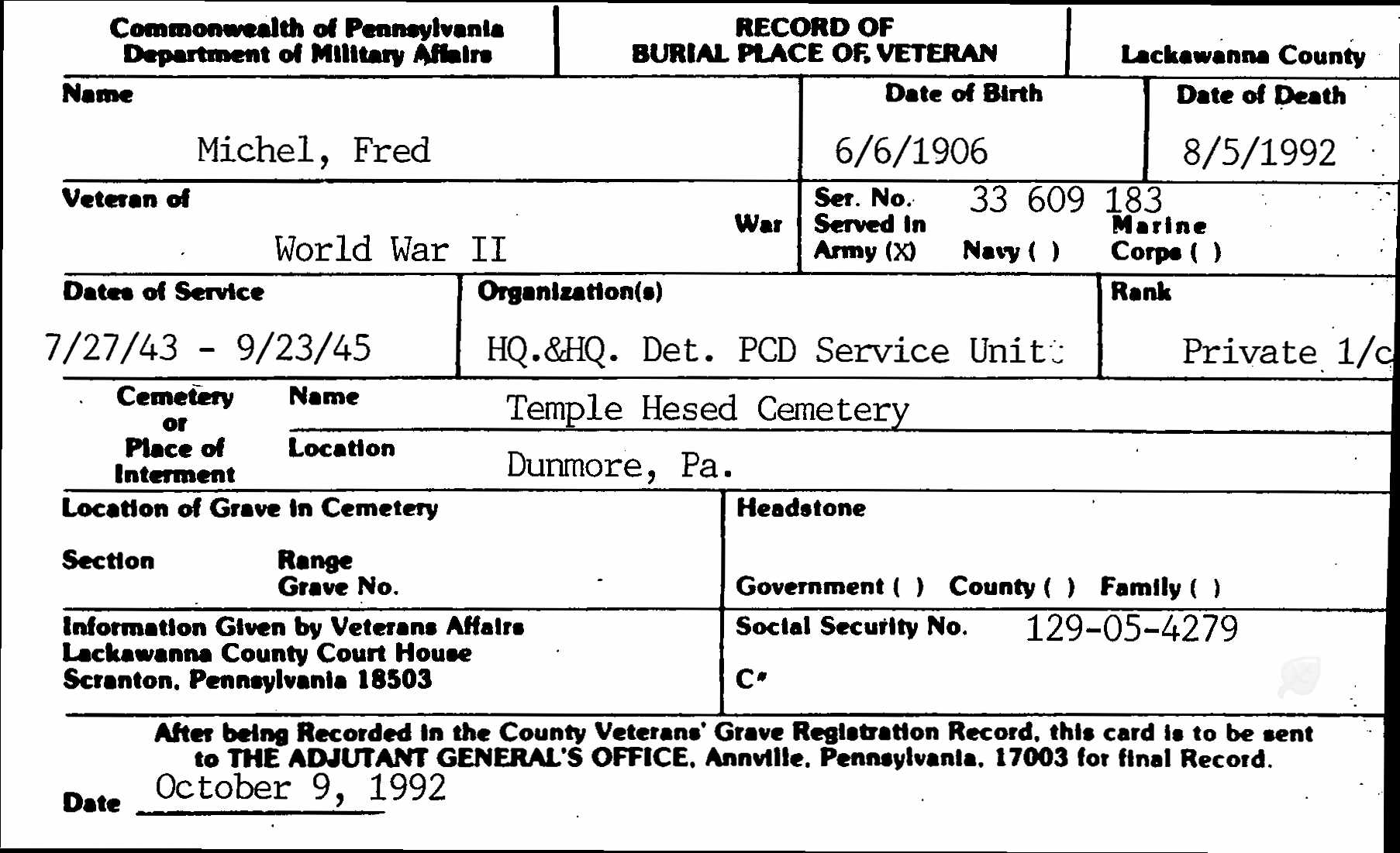
Pennsylvania Historical and Museum Commission; Harrisburg, Pennsylvania; Pennsylvania Veterans Burial Cards, 1929-1990; Archive Collection Number: Series 2-4; Folder Number: 655

Pennsylvania Historical and Museum Commission; Harrisburg, Pennsylvania; Pennsylvania Veterans Burial Cards, 1929-1990; Archive Collection Number: Series 2-4; Folder Number: 655

Since I also had learned that his wife’s name was Ilse, I researched what I could about Ilse.  She was also born in Germany, and at least according to the 1940 census, she’d been living in Frankfort, Germany in 1935.  I found various public records indicating that Ilse and Fred were still living in Scranton as of 1989, and I also found Ilse on the Social Security Death Index, indicating that she had died on July 22, 2002.

But I wanted to know more, and so I googled their names, Fred and Ilse Michel, with Scranton, and I found a gold mine.  Fred and Ilse donated their papers to the Leo Baeck Institute, and the papers have been digitized and are available online.   This is the description provided for the Michel papers, known as the Ilse and Fritz Michel Family Collection, AR 25502, at the Leo Baeck Institute:

“This collection contains personal and official documents pertaining to the family’s immigration to the United States and their situation in Germany as the political climate deteriorated. Included are a large amount of personal letters, supplemented by various other documents from government and military offices, some genealogical and tracing certificates, as well as other various material.”

In addition, the Leo Baeck Institute provided this biographical note for Ilse and Fred Michel:

Fritz (Fred) Michel (1902-1992) was born in Bingen am Rhein, Germany, the son of Adolf Michel and Franziska Michel, née Seligmann. Fred Michel’s wife, Ilse Hess (1911-2003), was born in Leipzig, daughter of Hermann Hess and Helene Hess, née Hirschfeld (1866-1943). Hermann Hess died in 1922 in Frankfurt am Main. After having been denied immigration to the U.S., Ilse’s mother Helene was deported to Theresienstadt in 1942, where she died in 1943.

Fritz (Fred) Michel emigrated from Frankfurt am Main to the U.S. via Antwerp, Belgium, in 1937. In the U.S. he changed his name to Fred. Ilse emigrated a year after that, via Hamburg, in 1938. Upon immigration Fred and Ilse remained separated for about two years, working in various areas in the state of New York, before they eventually settled in Scranton, Pennsylvania, in 1939, where they were married in 1940. There, Ilse started up a millinery business, while Fred maintained a position as bartender. They became naturalized citizens in 1943. The same year Fritz joined the U.S. army and served until 1945. They remained in Scranton for the rest of their lives.

There is truly a treasure trove in the collection—letters, documents, passports, photographs.  Many of the letters are in German, and I am hoping to find some way to translate them.  I also want to obtain permission to post some of the documents included in the collection if I can.

For now I can highlight some of the facts I was able to learn from the documents that are in English. Before coming to the United States in 1937, Fred had worked for Bamberger and Hertz, a men’s clothing store with several locations in Germany; Fred had worked for them in Cologne, Frankfort, and Munich between 1931 and 1936. On the website for the Jewish Museum in Berlin,  I found an article and photograph about Bamberger and Hertz and the effect Nazism had on the business.  The photograph depicts Nazi storm troopers posting leaflets on the store windows, warning people not to patronize this Jewish-owned business.
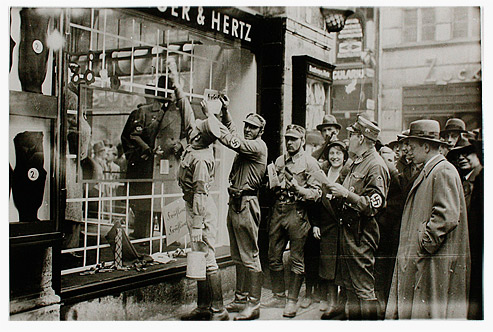


The article reports:

After the April Boycott sales declined at all the stores. The Saarbrücken branch closed in 1934 and a buyer was found for the Frankfurt store in 1935. The branches in Cologne, Stuttgart and Leipzig were forcibly sold or dissolved in 1938. In October of the same year Siegfried Bamberger managed to sell the Munich business to his trusted long-time employee Johann Hirmer. Although the transaction aroused the Nazis’ suspicions, it was carried out within the bounds of the law.

It is thus not surprising that Fred Michel would have left his home and his long-time employer in 1937.

According to Fred’s application for naturalization as a US citizen, he arrived in the United States on September 24, 1937, aboard the SS Koenigstein, departing from Antwerp, Belgium, and traveling tourist class. He had been examined by US immigration officials in Stuttgart before departing.

Of great interest to me was that Fred listed his sponsor as James Seligman of 324 Hillside Drive in Santa Fe, New MexicoJames Seligman.  This must have been my great-grandmother Eva Seligman’s younger brother James.  How did Fred Michel know him? To me, this makes it evident that my great-grandmother’s family was very much in touch with their relatives still in Germany when Hitler came to power.  What were they thinking about Hitler and the Nazis? How did James get involved with helping Fred?  Perhaps one of those letters in German will reveal more.[1]

James Seligman in Swarthmore register 1920

After arriving in the United States, Fred first lived in New York City and worked at a business called Burrus and Burrus for a year.  He then worked at the Hebrew National Orphan House in Yonkers, New York.  After that, he worked for a furniture company in Canonsburg, Pennsylvania, for a year, and then finally settled in Scranton in June, 1939. He worked in a couple of dress shops and then as a bartender at various clubs up to the time of his citizenship application in 1942.

Washington Avenue, Scranton, Pennsylvania, Uni...

Washington Avenue, Scranton, Pennsylvania, United States. (Photo credit: Wikipedia)

Fred and Ilse were married by a rabbi on January 16, 1940, in Scranton.  As of September, 1942, when they applied for citizenship, Fred and Ilse did not have any children.  After studying at night school, Fred became a naturalized citizen in June, 1943, shortly before he enlisted in the Army, as described above.  According to Fred’s honorable discharge papers from the Army in 1945, he served in Panama during World War II and received a Good Conduct medal, an American Theater Medal, and a World War II Victory medal.  He was responsible for handling secret documents, correspondence, and publications during the war.

World War II Victory Medal.

World War II Victory Medal. (Photo credit: Wikipedia)

Ilse became a naturalized citizen in December, 1943.  She had arrived in New York in April, 1938, after being examined by US immigration in Stuttgart.  She had lived in Woodmere, Long Island, New York, and Mt. Vernon, New York, and New York City before settling in Scranton in December, 1939.  She had worked as a bank teller and for various millinery houses during that time.  Like Fred, she had attended night school to become a US citizen.

After the war, Fred and Ilse attempted to learn what had happened to their family members back home.  Since most of these documents are in German and need to be translated, I will report on their heart-breaking efforts once I can be sure I am reading the documents correctly.

I don’t know from the collection much about Fred and Ilse’s life after the war.  I did find a Letter to the Editor of Life Magazine in the July 20, 1962, issue; it reveals some of the obstacles Fred had to overcome as a young boy and also some of his own nostalgia for his native country, even after all the horrors of the Holocaust:

Wolfgang has a number of letters written by Fred to Walter Seligmann, Wolfgang’s uncle, and he is going to translate those for me.  Wolfgang also sent me a copy of a letter that Fred received from the National Westminster Bank in England in December, 1982, regarding the estate of the other James Seligman, brother of Bernard and August and the other children of Moritz Seligmann and Babetta Schoenfeld.  Like Pete’s family and Wolfgang’s family, Fred received notification of his rights to inherit some of James estate.

Bank to Fred 1

Bank to Fred 2 Bank to Fred 3

I don’t know whether or not Fred ever obtained his share of the estate.  He died ten years after receiving this letter. From Fred’s death certificate, I learned that he had been a quality control officer for a clothing manufacturer.  He and Ilse were members of Temple Hesed in Scranton, and both are buried in its cemetery.

I  have written to the Leo Baeck Institute and am hoping they can help me as well as give me permission to post some of the documents included in the collection.  From what I have read, I only know the surface of what is obviously a much deeper story, a story of two people who escaped and survived, tearing themselves away from their homeland and their family just in time.  What was it like for them to leave? What did they know of what was happening in Germany once they left? How did they adjust to living in the United States? How were they received?

There are so many questions, and I am hoping that the materials I cannot yet read in the collection will answer some of them.


[1] This is also the same James Seligman whose son was Morton Tinslar Seligman, the Navy Commander whose career I described extensively here, here, and here.

The Lost Oppenheimers

My Seligman-Schoenfeld family tree continues to grow, and it continues to break my heart.  Thanks to my cousin Wolfgang, I now know more about another line in the family.  I already knew that my great-great-grandfather Bernard Seligman, who left Germany in the late 1850s and settled in Santa Fe, had a younger sister Paulina.  She was born in Gau-Algesheim in 1847, the daughter of Babetta Schoenfeld and Moritz Seligman.  I had received her birth records several months ago:

paulina seligmann birth record better

I had no record for Paulina aside from this one until I connected with Wolfgang.  It seems that Wolfgang’s family, like my cousin Pete’s family, had been contacted back in the 1980s by the National Westminster Bank in England, the bank handling the estate of James Seligman and looking for his heirs in order to distribute his estate after his wife died.  Just as they had provided Pete’s family with a family tree showing how they were related to James, the bank also provided Wolfgang’s family with a similar tree.  (I still don’t know why my father and his sister were not contacted, but that’s water under the bridge.)  James was, of course, a brother of Paulina and of Wolfgang’s great-grandfather August  just as he was a brother of Bernard.

You can see a PDF of Paulina’s section of the family tree provided to Wolfgang’s family by clicking here:

Pauline Seligmann Oppenheimer family tree

As you can see, it identifies the husband and descendants of Paulina Seligmann (here called Pauline).[1]  Paulina had married Maier Oppenheimer, and they had had five children:  Joseph (November 22, 1874), Martha (March 1, 1876), Anna (March 14, 1877), Ella (June 24, 1878), and Moritz James (June 10, 1879).  Her husband Maier died on June 8, 1900; he was 51 years old.  Although it is hard to read clearly, it looks like their daughter Anna died when she was only 31 years old in 1908.  She had married Max Kaufman, but did not have any children.  Paulina died April 10, 1926 when she was 79 years old.

Fortunately, Paulina did not live to see what happened to her children.  Although the other four children survived into the Nazi era, only one of the four was alive after the war had ended.  Ella, who never married, died in an “unknown concentration camp,” according to the bank’s tree.  Joseph died on October 21, 1940; one record on Ancestry.com shows that a Joseph Oppenheimer with the same birth and death dates shown on the bank’s family tree died as a prisoner at the Dachau concentration camp.  Joseph was married to Marie Johanna, but they had not had any children, according to the bank’s tree.  Martha, who did survive the war and died in 1967 when she was 91 years old according to the tree, lost two children in the Holocaust: Trude and Paul.  The bank’s tree did not include a name of a husband.

English: View of prisoners' barracks soon afte...

English: View of prisoners’ barracks soon after the liberation of the Dachau concentration camp Deutsch: Blick auf die Gefangenen Baracken kurz nach der Befreifung des KZs-Dachau. (Photo credit: Wikipedia)

Wolfgang was able to provide me with a little more information about the youngest child, Moritz James Oppenheimer, as gleaned from these two sources: a 1952 article from Der Spiegel and a website for a German company that supplies horse dressage and other equipment.   (Although both articles are in German, Wolfgang translated them for me.)  Moritz had owned a paper factory in Frankfort before the war as well as a successful horse stud farm where thoroughbred horses were raised and sold. I found this website about the stud farm as it exists today.  Obviously, Moritz Oppenheimer was quite well-to-do. In fact, Wolfgang’s grandfather Julius had written to his cousin Moritz for financial help after he lost his store in Gau-Algesheim.

The horse farm once owned by MJ Oppenheimer as it looks today

The horse farm once owned by MJ Oppenheimer as it looks today

After the Nazis came to power, Moritz had his marriage dissolved in 1936 because his wife, Emma Katherine Neuhoff, was not Jewish.  Wolfgang explained that this was often done under Nazi rule to those in interfaith marriages.  Then Moritz had his factory seized by the Nazis under the Nuremberg Laws, forcing him into bankruptcy.  As a result, he had to sell his horse farm in order to raise money.  The horse farm was sold to Baron Dr. Heinrich von Thyssen-Bornemisza, who was able to purchase the land, many valuable stallions and mares, and much more for just a few hundred thousand Deutsche marks.[2]  On May 9, 1941, the Gestapo visited Moritz in his apartment in Wiesbaden; shortly thereafter he was found dead in the apartment.  It was ruled a suicide.

Moritz had two children who survived him: a son Jur Georg Emil Walter Oppenheimer (born July 10, 1904) and Paula Herta Oppenheimer (April 11, 1902). The son married Elsa Lina, and they had one child, Angelika Emma Sybille, born in 1946.  Paula married someone named Spiegler and was still alive at the time that the bank prepared the family tree in the 1980s.

A stolpersteine was placed in front of Moritz’s residence in Frankfort at Schumannstrasse 15, depicted below.

By Karsten Ratzke (Own work) [CC0], via Wikimedia Commons

By Karsten Ratzke (Own work) [CC0], via Wikimedia Commons

Moritz, Ella, Joseph, Anna, and Martha: These were my great-grandmother Eva Seligman Cohen’s first cousins.  I wonder if she knew of them and her other German cousins.   Did her sons know of them? Did they know that Hitler had murdered many of these cousins?  Certainly my father didn’t know of them, nor did I.  Until now.


[1] I have not yet been able to find records to verify most of the facts on this family tree, but am trying to locate sources.


[2] According to one source, a US dollar in 1940 was worth about 2.5 deutsche marks, so 200,000 DM would have been equivalent to $80,000.  That would be worth about $1.3 million dollars today.    http://www.history.ucsb.edu/faculty/marcuse/projects/currency.htm#infcalc     http://www.westegg.com/inflation/   One prize thoroughbred horse today can command much more than that.


My Cousin Wolfgang and The Lessons of History: Will We Ever Learn Those Lessons?

When I started this blog back in October, 2013, I never anticipated that it would help family members find me.  But that has proven to be an incredible unexpected benefit of publishing this blog.  This is one of those stories.

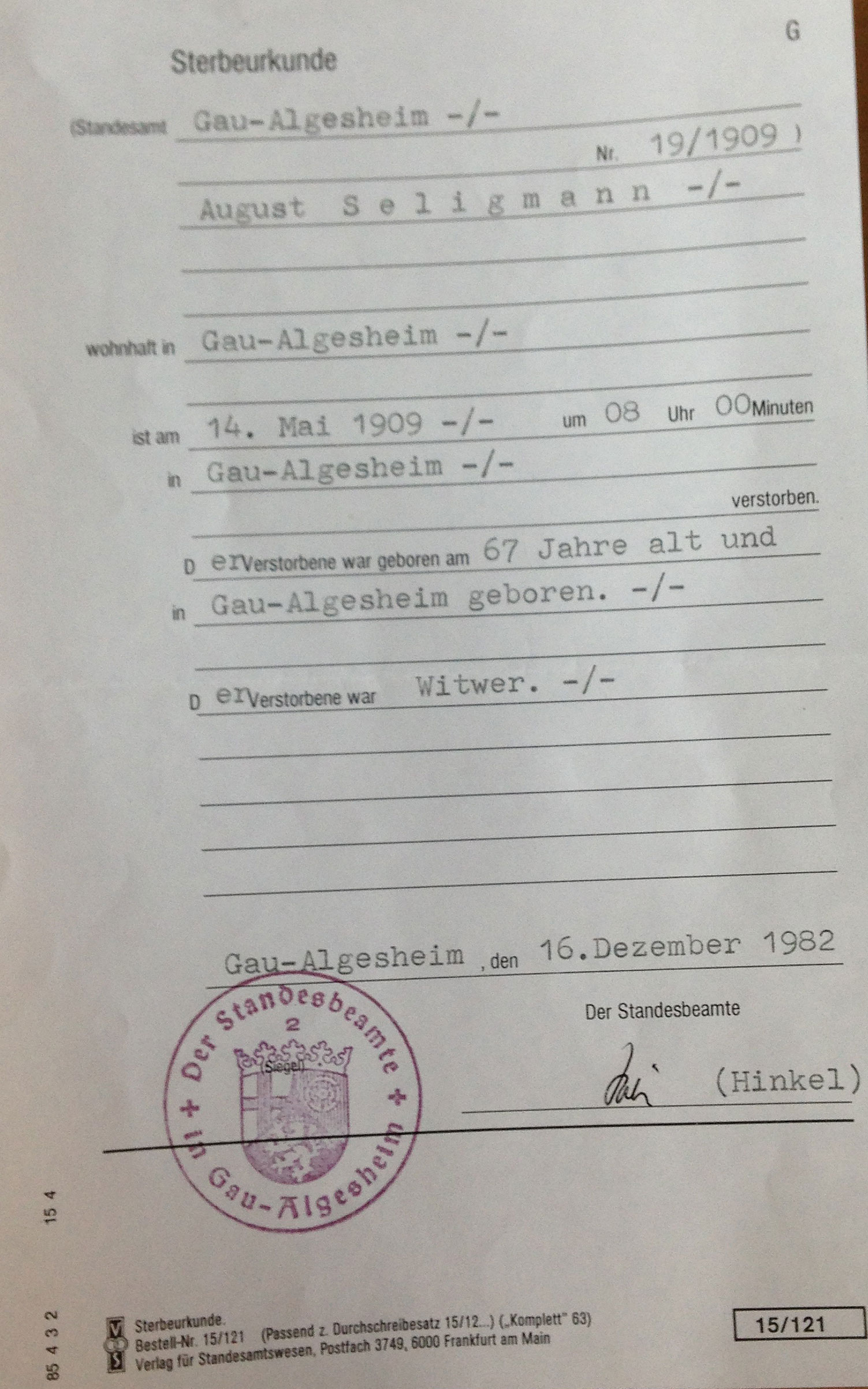
Several weeks ago, I received a comment on the blog from a man named Wolfgang Seligmann, saying he was the son of Walter Seligmann, that he lived near Gau-Algesheim, and that he had found my blog while doing some research on his family.  He asked me to email him, which I did immediately, and we have since exchanged many emails and learned that we are third cousins, once removed:  his great-great-grandparents were Moritz Seligmann and Babetta Schoenfeld, my great-great-great-grandparents.  His great-grandfather August was the brother of Sigmund, Adolph and Bernard Seligman, the three who had settled in Santa Fe in the mid-19th century.   Wolfgang sent me a copy of August’s death certificate.

August Seligmann death certificate

August Seligmann death certificate

(Translations in this post courtesy of Wolfgang Seligmann except where noted: Registry-Office Gau-Algesheim: August Seligmann, living in Gau-Algesheim died the 14th of May 1909 at 8 a.m. in Gau-Algesheim. He was 67 years old and born in Gau-Algesheim. He was a widower.)

Our families had probably not been in touch since Bernard died in 1902 (or perhaps when Adolph died in 1920).  And now through the miracle of the internet and Google, Wolfgang had found my blog with his family’s names in it and had contacted me.  What would our mutual ancestors think of that?  It even seems miraculous to me, and I live in the 21st century.

Fortunately, Wolfgang’s English is excellent (since my knowledge of German is…well, about five words), and so we have been able to exchange some information about our families, and I have learned some answers to questions I had about the Seligmanns who stayed in Germany.  With Wolfgang’s permission, I would like to share some of those stories.

Wolfgang’s grandfather was Julius Seligmann, the second child and oldest son of August Seligmann and his wife Rosa Bergmann.  Julius was born in 1877 in Gau-Algesheim.  As I wrote about here, Julius was one of the Seligmanns written about in Ludwig Hellriegel’s book about the Jews of Gau-Algesheim.  He had been a merchant in the town.  On December 1, 1922, Julius had married a Catholic woman named Magdalena Kleisinger, who was born in Gau-Algesheim on July 9, 1882, and had himself converted to Catholicism.  Julius and Magdalena had two sons, Walter, who was born February 10, 1925, and Herbert, born July 27, 1927.  Julius and his family had left Gau-Algesheim for Bingen in 1939 after closing the store in 1935.

I had wondered why Julius had closed the store and then relocated to Bingen, and I asked Wolfgang what he knew about his grandfather’s life.  According to Wolfgang, his father Walter and uncle Herbert did not like to talk about the past, but Wolfgang knew that when Julius married and converted to Catholicism, his Jewish family was very upset and did not want to associate with him any longer.  In fact, Julius was forced to pay his siblings a substantial amount of money for some reason relating to his store in Gau-Algesheim, and that payment caused him and his family a great deal of financial hardship.  According to Wolfgang, Julius no longer had enough money to pay for his own home, and thus he and his family moved to Bingen in 1939 where they lived with Magdalena’s family or friends for some time.

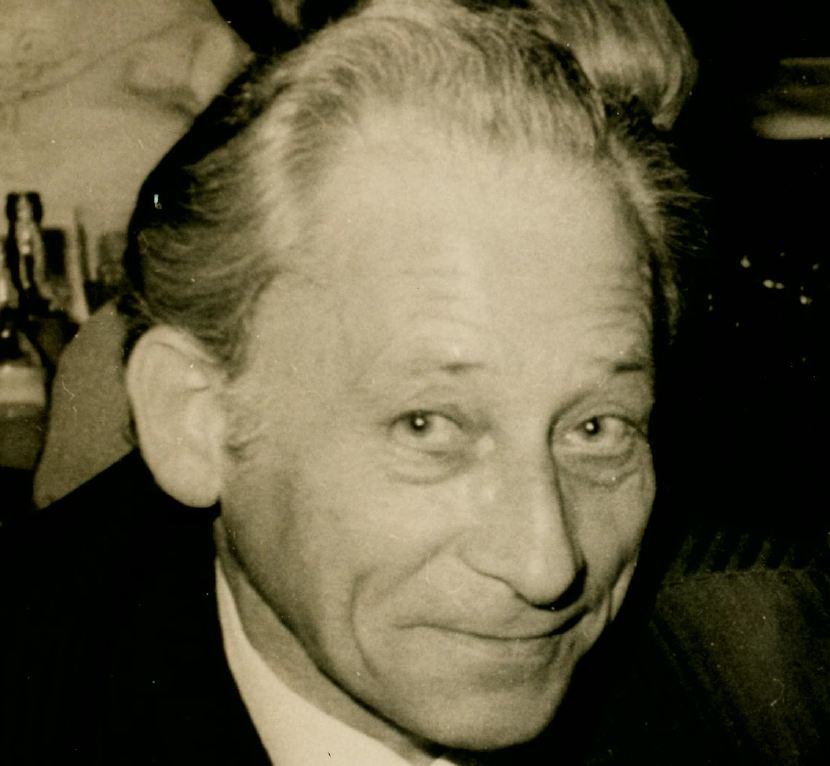
Julius and Magdalena Seligmann

Julius and Magdalena Seligmann 1960s  Courtesy of Wolfgang Seligmann

The Hellriegel book also made some puzzling (to me) references to the military records of Wolfgang’s father and uncle, saying that they had been “allowed” to enlist in the army, but then were soon after dismissed.  Wolfgang explained that the German authorities did not know how to treat Catholic citizens with Jewish roots.  Wolfgang said that his father Walter had trained to be a pharmacist, but the Nazis would not allow him to work with anything poisonous.  In addition,  his father was not permitted to be in the army; instead  he was ordered by the authorities to work on the Siegfried Line, which was  originally built as a defensive line by the Germans during World War I.  In August 1944, Hitler ordered that it be strengthened and rebuilt, and according to Wikipedia, “20,000 forced labourers and members of the Reichsarbeitsdienst (Reich Labour Service), most of whom were 14–16-year-old boys, attempted to re-equip the line for defence purposes.”  Walter Seligmann was one of those forced laborers.

Map of the Siegfried line.

Map of the Siegfried line. (Photo credit: Wikipedia)

Here is a photograph of Walter Seligmann, Wolfgang’s father:

Walter Seligmann  Photo courtesy of Wolfgang Seligmann

Walter Seligmann Photo courtesy of Wolfgang Seligmann

As for Wolfgang’s uncle Herbert, he was sent by the local police to the army, but the army would not accept him.  He was dismissed and sent back to Bingen, where he was required to work in a warehouse until the war ended.

Herbert Seligmann courtesy of Christoph Seligmann

Herbert Seligmann courtesy of Christoph Seligmann

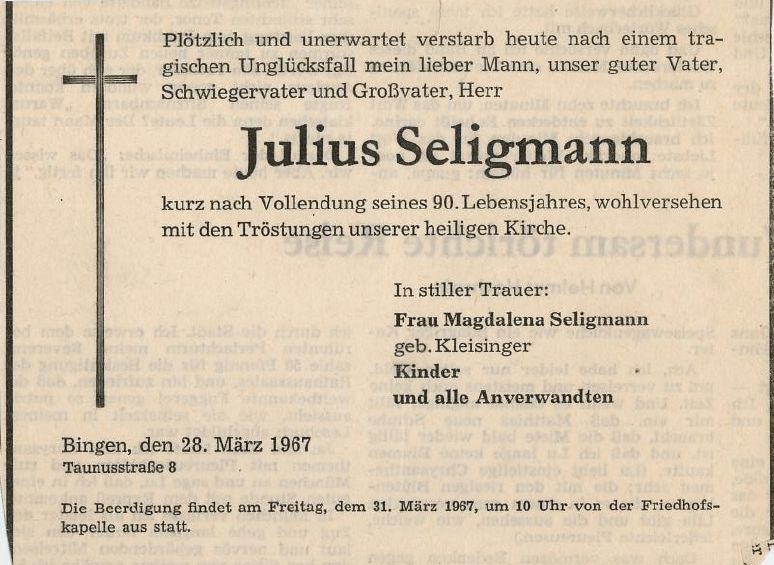
Julius Seligmann died in 1967, and his wife Magdalena died the following year.  Walter Seligmann died in 1993, and his brother Herbert died in 2001.

Julius Seligmann death notice

Julius Seligmann death notice

Magdalena Seligmann death notice

There are some very bitter ironies in these stories.  Julius and his family were not accepted by his Jewish family because they were Catholic, but the Nazis did not accept them either because they had Jewish roots.  As I commented to Wolfgang, prejudice of any sort is so destructive and unacceptable.  His family experienced it from two different directions.

Not that the two examples here can be equated in any way.  Although all prejudice is wrong, prejudice that leads to genocide is utterly reprehensible, an evil beyond comprehension for anyone who has a moral compass.  I have already written about my own personal horror and pain when I realized that I had family who had been murdered by the Nazis.  Wolfgang told me more about some of those who lost their lives to Hitler and his evil forces.

One victim was his great-uncle Moritz Seligmann (the grandson of Moritz Seligmann, my 3x-great-grandfather, and a son of August Seligmann).  My information about his fate comes from two websites that Wolfgang shared with me. According to these two sites, Moritz Seligmann, Julius’ younger brother, was born on June 25, 1881.  He fought in World War I for Germany, spent two years in captivity, and was honored with the Hindenburg Cross or Cross of Honor for his service.  Despite this, in the aftermath of Kristallnacht, on November 11, 1938, Moritz was arrested in Konigstein, where he had been living since 1925.  He was sent to the concentration camp at Buchenwald.

German Cross of Honour 1914-1918

German Cross of Honour 1914-1918 (Photo credit: Wikipedia)

Moritz wrote to the authorities in Konigstein, pointing out that he was the recipient of the Hindenburg Cross.  He was released from Buchenwald in December on the condition that he emigrate by March 31, 1939.  He was required to report to the police in Konigstein twice a week until then, and if he had not emigrated by the deadline, he was to be arrested.  On March 28, 1939, however, the Gestapo lifted the emigration order and the reporting requirement in light of Moritz’s service during World War I.

Here is a copy of the Gestapo letter, lifting the emigration order.  I found this a particularly chilling document to see.

Gestapo letter re Moritz Seligmann

Wolfgang helped me translate this letter as follows: Frankfort, March 20, 1939. Concerning: the “Aktionsjude” Moritz Seligmann born June 25, 1881, Gau-Algesheim, residing in Konigstein.  Seligmann has provided proof that he was a soldier in the World War as a combatant.  Therefore the reporting obligation and emigration order is lifted for him. I would ask the emigration (?) to supervise and notify us here.

As explained to me by Wolfgang and by Wikipedia,  the “Aktionsjude” referred to 26,000 Jews who were deported in the aftermath of Kristallnacht, as was Moritz Seligmann, as part of an effort to frighten other Jews to leave Germany.  Unfortunately, not enough of them did.

Despite the lifting of the order to emigrate, Moritz had hoped to immigrate to the US.  For various bureaucratic reasons described here, he was unable to get clearance to emigrate.  On June 10, 1942, he was picked up by the Nazis and transported somewhere to the east.  Exactly where and when he died is not known.

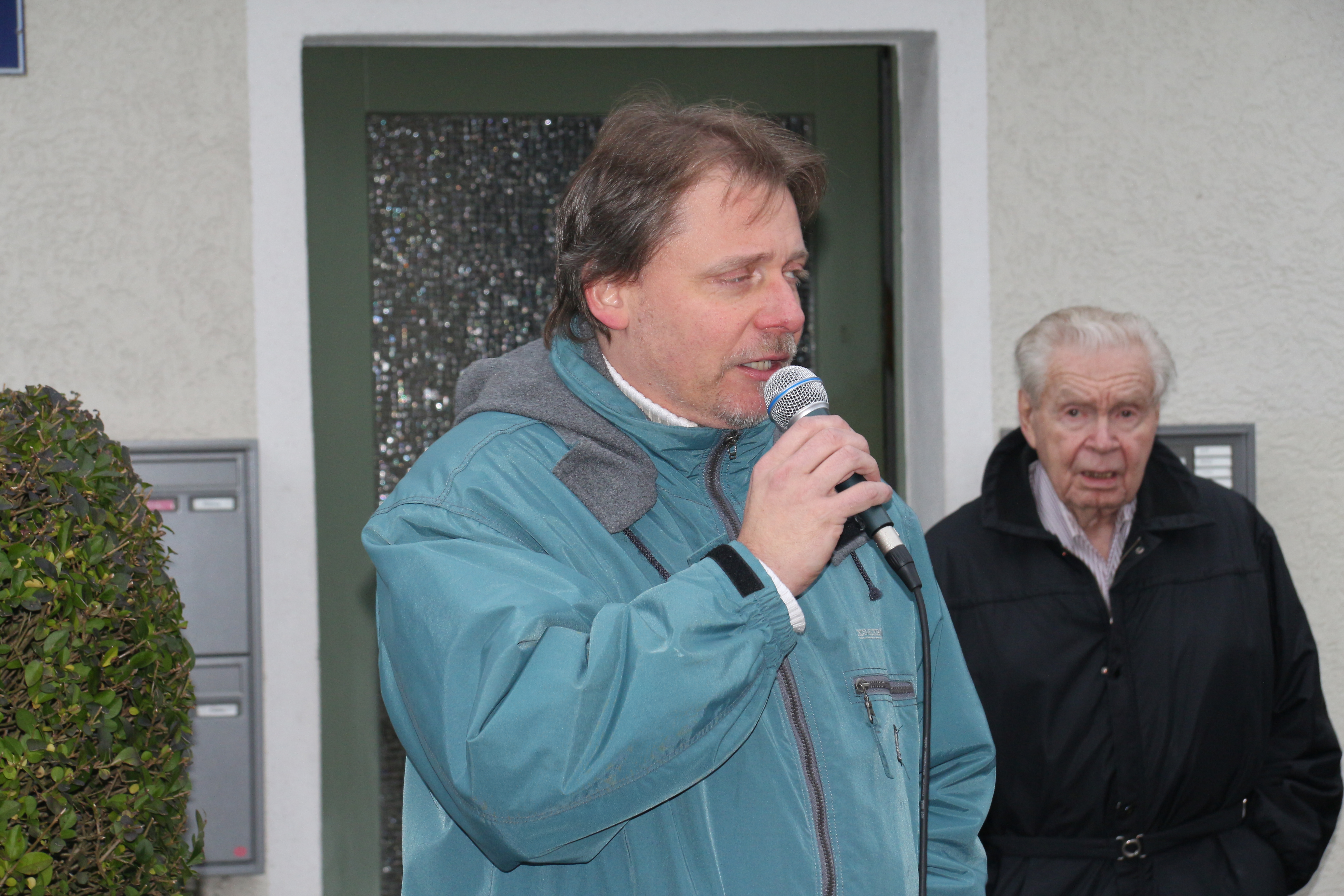
Wolfgang and his family, after researching the fate of Moritz, informed the town of Konigstein of their findings, and the town agreed to place a “stolperstein” in memory of Moritz Seligmann near his home in Konigstein.  A stolperstein (literally, a stumbling blog) is a memorial stone embedded in the ground to memorialize a victim of the Holocaust.  Here is a photograph of Wolfgang at the ceremony when Moritz Seligmann’s stolperstein was installed in Konigstein.

Wolfgang Seligmann

Wolfgang Seligmann  Courtesy of Wolfgang Seligmann

Behind him is a man who knew Moritz and remembered when Moritz was initially arrested in 1938, clinging to his Hindenburg Cross, believing it would save him from the murderous forces of the Nazis.  It may have stalled his murder, but it did not save him.

Wolfgang also told me about the fate of another sibling of his grandfather Julius, his younger sister Anna.  Anna, born in Gau-Algesheim in 1889, had married Hugo Goldmann, and they had a daughter Ruth, born in 1924 in Neunkirchen, a town about 80 miles southwest of Gau-Algesheim, where Anna and Hugo had settled. Between 1939 and 1940, many people from this area near the border with France were evacuated to locations in central Germany, and Anna, Hugo, and Ruth ended up in Halle, Germany, 350 miles to the northeast of Neunkirchen.  On June 1, 1942, they were all deported from Halle to the Sobibor concentration camp where they were all killed.  Click on each name to see the memorial pages established by the town of Halle in memory of Anna, Hugo, and Ruth.

Finally, Wolfgang told me about another member of the family.  Moritz Seligmann (the elder) had had a daughter Caroline with his first wife, Eva Schoenfeld.  Caroline was the half-sister of my great-great-grandfather Bernard. She had married a man named Siegfried Seligmann, perhaps a cousin.  Their son, Emil, died in Wiesbaden on August 9, 1942, when he was 78 years old.

Death record of Emil Seligmann, husband of Carolina Seligmann

Death record of Emil Seligmann, husband of Carolina Seligmann

(Wiesbaden: The Emil Jakob Israel Seligmann, without profession, “israelitisch”  [presumably meaning Jewish], living in Wiesbaden, Gothestraße Nr. 5, died on 9th of August 1942 in his Apartment. He  was born on 23th of December 1863 in Mainz.

Father: Siegfried Seligmann, deceased.  Mother: Karoline Seligmann, nee Seligmann, deceased.  He was widower of Anna Maria Angelika born as Illien. The death was announced by Emil Seligmann, his son, living Goethestraße Nr.5.

The stamp in the left hand margin says:  Wiesbaden, 31th of May 1949.  The “Zwangsvorname”Israel is deleted.  Zwangsvorname translates as “forced first name,” meaning that the name Israel had been required by the Nazis, I assume as a way to identify him as Jewish.

Emil had a son, also named Emil, who died in Buchenwald, as this record attests.

Emil Seligmann-KZ (1)

(To: Miss Christine Seligmann, Wiesbaden, Goethestr. Nr. 5,1

From: Special registry-office in Arolsen-Waldeck, department Buchenwald

Subject: death-certification for Emil-Jakob Seligmann, Your letter from the 1. of March 1950

Based on the documents of the International Tracing Service in Arolsen it is proved, that your brother died on 14th of February 1945 in the Concentration Camp Buchenwald. )

I imagine that this is not the end of the list of the Seligmanns who were murdered during the Holocaust, and I imagine that there are also many other family members I never knew about who were killed by the Nazis, whether they were named Schoenfeld, Nussbaum, Dreyfuss, Goldschlager, Rosenzweig, Cohen, or Brotman or something else.  I just haven’t found them yet.

Wolfgang and I plan to keep on exchanging stories, pictures, documents, and other information.  We have also already talked about meeting someday and walking in the footsteps of our mutual ancestors.  What an honor it will be to be with him as we share our family’s story.