Two Who Got Away

Way back on November 22, 2014, I wrote very briefly about a cousin named Fred Michel.   He was mentioned in Ludwig Hellriegel’s book about the Jews of Gau-Algesheim as the son of Frances (Franziska) Seligmann and Max (Adolf?) Michel. Frances was the daughter of August Seligmann.  Since August Seligmann was my great-great-grandfather Bernard Seligman’s brother, his grandson Fred Michel would be my second cousin, twice removed.  According to Hellriegel’s book, Fred had escaped to the United States in 1937 after his mother died in 1933.  That was all I knew, and the name Fred Michel was common enough in the US that I had no way of narrowing it down to the right person based on the name alone.

Well, one email from my cousin Wolfgang opened up an entirely new door of research for me.  In his email, Wolfgang mentioned Fred Michel, the nephew of his grandfather Julius.  In that email, Wolfgang said that Fred had settled in Scranton, Pennsylvania.  From that one additional bit of information, I was able to find Fred and his wife Ilse on the 1940 census in Scranton living as boarders in the household of other German immigrants.  I also found them in several Scranton directories.

Year: 1940; Census Place: Scranton, Lackawanna, Pennsylvania; Roll: T627_3685; Page: 7A; Enumeration District: 71-106

Year: 1940; Census Place: Scranton, Lackawanna, Pennsylvania; Roll: T627_3685; Page: 7A; Enumeration District: 71-106

I also found Fred’s enlistment record in the US army in July 1943 on the Ancestry index.   That led me to his Veteran’s Burial Card, showing that he had served from July 1943 until September 1945 and that he had died on August 5, 1992, and was buried at Temple Hesed cemetery in Scranton.
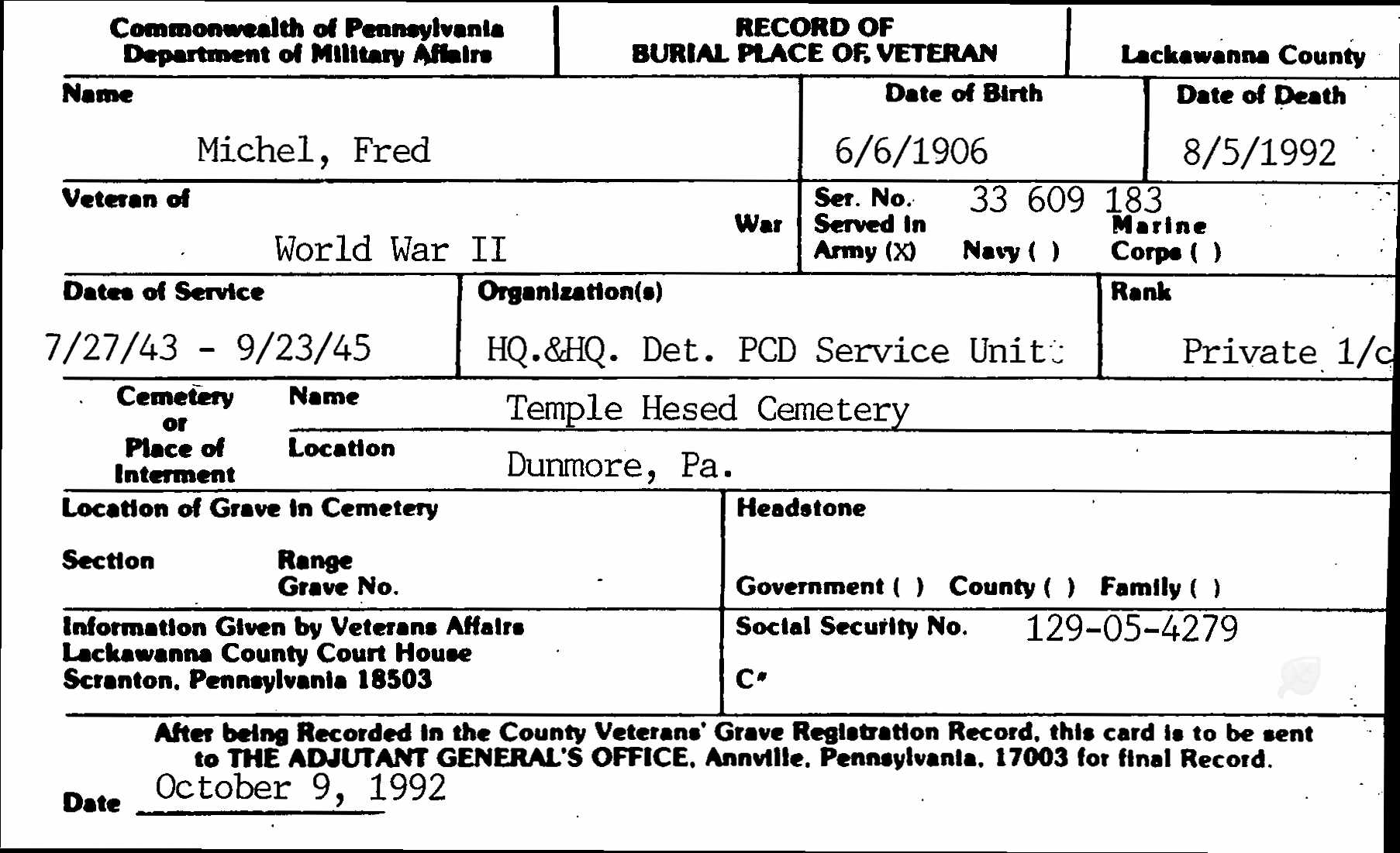
Pennsylvania Historical and Museum Commission; Harrisburg, Pennsylvania; Pennsylvania Veterans Burial Cards, 1929-1990; Archive Collection Number: Series 2-4; Folder Number: 655

Pennsylvania Historical and Museum Commission; Harrisburg, Pennsylvania; Pennsylvania Veterans Burial Cards, 1929-1990; Archive Collection Number: Series 2-4; Folder Number: 655

Since I also had learned that his wife’s name was Ilse, I researched what I could about Ilse.  She was also born in Germany, and at least according to the 1940 census, she’d been living in Frankfort, Germany in 1935.  I found various public records indicating that Ilse and Fred were still living in Scranton as of 1989, and I also found Ilse on the Social Security Death Index, indicating that she had died on July 22, 2002.

But I wanted to know more, and so I googled their names, Fred and Ilse Michel, with Scranton, and I found a gold mine.  Fred and Ilse donated their papers to the Leo Baeck Institute, and the papers have been digitized and are available online.   This is the description provided for the Michel papers, known as the Ilse and Fritz Michel Family Collection, AR 25502, at the Leo Baeck Institute:

“This collection contains personal and official documents pertaining to the family’s immigration to the United States and their situation in Germany as the political climate deteriorated. Included are a large amount of personal letters, supplemented by various other documents from government and military offices, some genealogical and tracing certificates, as well as other various material.”

In addition, the Leo Baeck Institute provided this biographical note for Ilse and Fred Michel:

Fritz (Fred) Michel (1902-1992) was born in Bingen am Rhein, Germany, the son of Adolf Michel and Franziska Michel, née Seligmann. Fred Michel’s wife, Ilse Hess (1911-2003), was born in Leipzig, daughter of Hermann Hess and Helene Hess, née Hirschfeld (1866-1943). Hermann Hess died in 1922 in Frankfurt am Main. After having been denied immigration to the U.S., Ilse’s mother Helene was deported to Theresienstadt in 1942, where she died in 1943.

Fritz (Fred) Michel emigrated from Frankfurt am Main to the U.S. via Antwerp, Belgium, in 1937. In the U.S. he changed his name to Fred. Ilse emigrated a year after that, via Hamburg, in 1938. Upon immigration Fred and Ilse remained separated for about two years, working in various areas in the state of New York, before they eventually settled in Scranton, Pennsylvania, in 1939, where they were married in 1940. There, Ilse started up a millinery business, while Fred maintained a position as bartender. They became naturalized citizens in 1943. The same year Fritz joined the U.S. army and served until 1945. They remained in Scranton for the rest of their lives.

There is truly a treasure trove in the collection—letters, documents, passports, photographs.  Many of the letters are in German, and I am hoping to find some way to translate them.  I also want to obtain permission to post some of the documents included in the collection if I can.

For now I can highlight some of the facts I was able to learn from the documents that are in English. Before coming to the United States in 1937, Fred had worked for Bamberger and Hertz, a men’s clothing store with several locations in Germany; Fred had worked for them in Cologne, Frankfort, and Munich between 1931 and 1936. On the website for the Jewish Museum in Berlin,  I found an article and photograph about Bamberger and Hertz and the effect Nazism had on the business.  The photograph depicts Nazi storm troopers posting leaflets on the store windows, warning people not to patronize this Jewish-owned business.
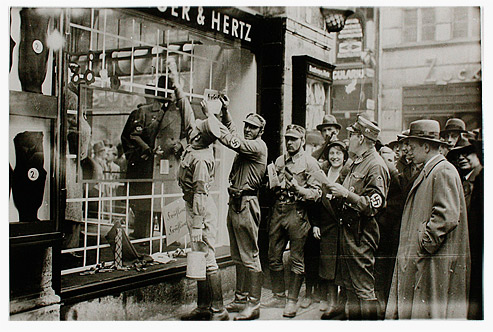


The article reports:

After the April Boycott sales declined at all the stores. The Saarbrücken branch closed in 1934 and a buyer was found for the Frankfurt store in 1935. The branches in Cologne, Stuttgart and Leipzig were forcibly sold or dissolved in 1938. In October of the same year Siegfried Bamberger managed to sell the Munich business to his trusted long-time employee Johann Hirmer. Although the transaction aroused the Nazis’ suspicions, it was carried out within the bounds of the law.

It is thus not surprising that Fred Michel would have left his home and his long-time employer in 1937.

According to Fred’s application for naturalization as a US citizen, he arrived in the United States on September 24, 1937, aboard the SS Koenigstein, departing from Antwerp, Belgium, and traveling tourist class. He had been examined by US immigration officials in Stuttgart before departing.

Of great interest to me was that Fred listed his sponsor as James Seligman of 324 Hillside Drive in Santa Fe, New MexicoJames Seligman.  This must have been my great-grandmother Eva Seligman’s younger brother James.  How did Fred Michel know him? To me, this makes it evident that my great-grandmother’s family was very much in touch with their relatives still in Germany when Hitler came to power.  What were they thinking about Hitler and the Nazis? How did James get involved with helping Fred?  Perhaps one of those letters in German will reveal more.[1]

James Seligman in Swarthmore register 1920

After arriving in the United States, Fred first lived in New York City and worked at a business called Burrus and Burrus for a year.  He then worked at the Hebrew National Orphan House in Yonkers, New York.  After that, he worked for a furniture company in Canonsburg, Pennsylvania, for a year, and then finally settled in Scranton in June, 1939. He worked in a couple of dress shops and then as a bartender at various clubs up to the time of his citizenship application in 1942.

Washington Avenue, Scranton, Pennsylvania, Uni...

Washington Avenue, Scranton, Pennsylvania, United States. (Photo credit: Wikipedia)

Fred and Ilse were married by a rabbi on January 16, 1940, in Scranton.  As of September, 1942, when they applied for citizenship, Fred and Ilse did not have any children.  After studying at night school, Fred became a naturalized citizen in June, 1943, shortly before he enlisted in the Army, as described above.  According to Fred’s honorable discharge papers from the Army in 1945, he served in Panama during World War II and received a Good Conduct medal, an American Theater Medal, and a World War II Victory medal.  He was responsible for handling secret documents, correspondence, and publications during the war.

World War II Victory Medal.

World War II Victory Medal. (Photo credit: Wikipedia)

Ilse became a naturalized citizen in December, 1943.  She had arrived in New York in April, 1938, after being examined by US immigration in Stuttgart.  She had lived in Woodmere, Long Island, New York, and Mt. Vernon, New York, and New York City before settling in Scranton in December, 1939.  She had worked as a bank teller and for various millinery houses during that time.  Like Fred, she had attended night school to become a US citizen.

After the war, Fred and Ilse attempted to learn what had happened to their family members back home.  Since most of these documents are in German and need to be translated, I will report on their heart-breaking efforts once I can be sure I am reading the documents correctly.

I don’t know from the collection much about Fred and Ilse’s life after the war.  I did find a Letter to the Editor of Life Magazine in the July 20, 1962, issue; it reveals some of the obstacles Fred had to overcome as a young boy and also some of his own nostalgia for his native country, even after all the horrors of the Holocaust:

Wolfgang has a number of letters written by Fred to Walter Seligmann, Wolfgang’s uncle, and he is going to translate those for me.  Wolfgang also sent me a copy of a letter that Fred received from the National Westminster Bank in England in December, 1982, regarding the estate of the other James Seligman, brother of Bernard and August and the other children of Moritz Seligmann and Babetta Schoenfeld.  Like Pete’s family and Wolfgang’s family, Fred received notification of his rights to inherit some of James estate.

Bank to Fred 1

Bank to Fred 2 Bank to Fred 3

I don’t know whether or not Fred ever obtained his share of the estate.  He died ten years after receiving this letter. From Fred’s death certificate, I learned that he had been a quality control officer for a clothing manufacturer.  He and Ilse were members of Temple Hesed in Scranton, and both are buried in its cemetery.

I  have written to the Leo Baeck Institute and am hoping they can help me as well as give me permission to post some of the documents included in the collection.  From what I have read, I only know the surface of what is obviously a much deeper story, a story of two people who escaped and survived, tearing themselves away from their homeland and their family just in time.  What was it like for them to leave? What did they know of what was happening in Germany once they left? How did they adjust to living in the United States? How were they received?

There are so many questions, and I am hoping that the materials I cannot yet read in the collection will answer some of them.


[1] This is also the same James Seligman whose son was Morton Tinslar Seligman, the Navy Commander whose career I described extensively here, here, and here.

The Mystery of Fanny Wiler: Post-script

Two days ago, I posted what I called my final chapter of the mystery of Fanny Wiler.  I had finally learned where and when and why Fanny had died after receiving her death certificate from the Carnegie Library in Pittsburgh.  But I ended that post with the remaining questions that still lingered.  Was the child Bertha born to a Fanny Wieler and Joseph Levi in New York City the daughter of my Fanny?  If so, what happened to her?  Since I could not find the family on either the 1870 or the 1880 census and since the 1890 does not exist, I didn’t know whether Bertha had died, married, or moved away between 1866 and 1900, and I could not find her in 1900 or afterwards either.

But first I had to determine whether this was in fact the child of Fanny Wiler Levy.  There was no point in chasing her down if she wasn’t my cousin.  I’d already spent far too many hours chasing the wrong Fanny Wiler.  So I ordered the birth certificate for the Bertha Levi born in New York in 1866.  It arrived hours after I posted about Fanny.  And I was both excited and a bit exasperated to see that Bertha was in fact the daughter of my Fanny.

Levi, Bertha Birth

Why exasperated?  Because I had no idea what had happened to Bertha.  I half-wanted that baby not to have been my cousin so I could finally really put closure on Fanny Wiler.  I also feared that that baby had died and would thus just be one more sad story to add to the life of Fanny WIler.  But there she was—definitely their child, daughter of Fanny Wieler born in Harrisburg.  It had to be the same Fanny and the same Joseph, despite the misspellings and despite the birth in New York, not Philadelphia.

So back to the books I went, now even more determined to find Bertha.  It took many searches and many different wildcards, databases, and spellings, and I still could not find the family on either the 1870 or 1880 census, but I did find this:

Ancestry.com. Pennsylvania, Death Certificates, 1906-1963 [database on-line]. Provo, UT, USA: Ancestry.com Operations, Inc., 2014. Original data: Pennsylvania (State). Death certificates, 1906–1963. Series 11.90 (1,905 cartons). Records of the Pennsylvania Department of Health, Record Group 11. Pennsylvania Historical and Museum Commission, Harrisburg, Pennsylvania

Ancestry.com. Pennsylvania, Death Certificates, 1906-1963 [database on-line]. Provo, UT, USA: Ancestry.com Operations, Inc., 2014.
Original data: Pennsylvania (State). Death certificates, 1906–1963. Series 11.90 (1,905 cartons). Records of the Pennsylvania Department of Health, Record Group 11. Pennsylvania Historical and Museum Commission, Harrisburg, Pennsylvania

How had this not turned up before? Because Joseph Levy was indexed as “Lery.”  It was only when I searched for the name as “?e?y” that I finally got a hit.  At first I wasn’t certain this was the right person, given that there was no mother’s name and that it said the mother was born in Germany.  But the informant was “A.J. Levy,” and Fanny and Joseph’s oldest son was Alfred J. Levy, so I felt that there was enough here to pursue this Bertha, indexed on Ancestry.com as “Bertha Gellect.”

Well, there was no Bertha Gellect, and I decided that the name Gellert was a more likely option, even though it does look more like a “c” than an “r” on the death certificate. I also knew that in 1917 Bertha Gellert was living in Pottsville, Pennsylvania. Fortunately, my hunch was right, and I soon found Bertha and Jacob Gellert on the 1900 census living in Pottsville.  Jacob was a tailor, born in New York, and he and Bertha had been married for three years or in 1897.  This time the birth places of Bertha’s parents were correct: mother born in Pennsylvania, father in Germany.  And the final clue that I had found the correct Bertha?  Their two year old daughter was named Fanny.

Year: 1900; Census Place: Pottsville, Schuylkill, Pennsylvania; Roll: 1485; Page: 1A; Enumeration District: 0186; FHL microfilm: 1241485

Year: 1900; Census Place: Pottsville, Schuylkill, Pennsylvania; Roll: 1485; Page: 1A; Enumeration District: 0186; FHL microfilm: 1241485

I laughed, smiled, even cried a bit.  My poor Fanny Wiler not only had been found; she had a namesake.  Her daughter Bertha had named her first born child for her mother.  Bertha had only been eleven when her mother died from tuberculosis, and it must have been an awful time for a young girl, watching her mother waste away from this dreadful disease.  Bertha had honored her mother by naming her own daughter Fanny.

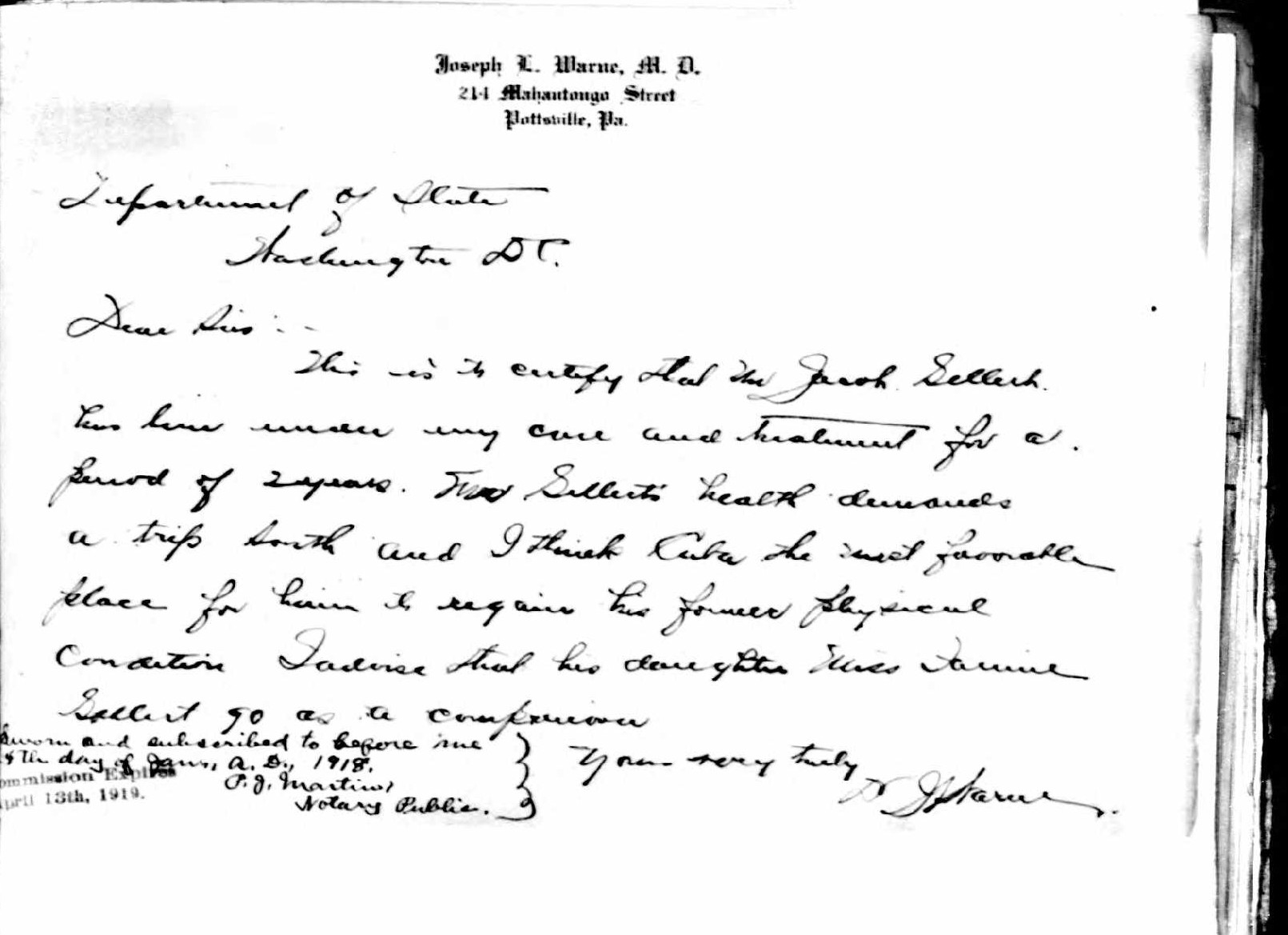
In 1910, Jacob, Bertha and Fanny were still living in Pottsville, but Jacob was now an insurance salesman, not a tailor.  Sadly, as seen above, Bertha died seven years later from diabetes.  She was only 51 years old.  A few months after Bertha’s death, Jacob and Fanny both applied for passports in order to take a trip to Cuba—for “pleasure and rest,” as Jacob wrote on his passport application.  Attached to Fanny’s application was a letter from a doctor, attesting to the health reasons for this trip to Cuba:

Ancestry.com. U.S. Passport Applications, 1795-1925 [database on-line]. Provo, UT, USA: Ancestry.com Operations, Inc., 2007.

Here is Fanny’s photograph from her passport application:

Ancestry.com. U.S. Passport Applications, 1795-1925 [database on-line]. Provo, UT, USA: Ancestry.com Operations, Inc., 2007.

Ancestry.com. U.S. Passport Applications, 1795-1925 [database on-line]. Provo, UT, USA: Ancestry.com Operations, Inc., 2007.

By the 1920 census, however, Jacob and Fanny were back in Pottsville. Jacob was now a widower, and his daughter Fanny was living with him.  Jacob had his own business selling fire insurance.  The following year, Fanny married Lester Guttman Block.  Lester was born in Trenton, New Jersey, in 1895, the son of German immigrants, Daniel and Bertha.  (Yes, his mother’s name was the same as that of his wife’s mother.)  His father was a clothing merchant.  In 1920, Lester was living with his widowed mother and his sister Alice in Trenton, where he worked as a clothing salesman in a retail store.

Fanny Gellert and Lester Block had two daughters born in the 1920s.  Fanny’s father Jacob died from a brain tumor on July 23, 1927; he was 55 years old.  His second wife Reba H. Gellert is named on the death certificate; he had married her by 1922, as they are listed together in the Pottsville directory of that year.  Max Gellert of Pottsville, Jacob’s brother, was named as the informant.  Notice also that Jacob’s mother’s name is given as Fanny Cohen.  Like his daughter, Jacob had married someone whose mother had the same name as his mother.  Could Fanny have been named for both of her grandmothers? Probably not since Jacob’s mother Fanny was still alive long after Jacob and Bertha’s daughter Fanny was born, and ordinarily Jews do not name their children for living grandparents.

Ancestry.com. Pennsylvania, Death Certificates, 1906-1963 [database on-line]. Provo, UT, USA: Ancestry.com Operations, Inc., 2014.

Ancestry.com. Pennsylvania, Death Certificates, 1906-1963 [database on-line]. Provo, UT, USA: Ancestry.com Operations, Inc., 2014.

In 1930 Lester and Fanny were living with their daughters as well as Lester’s mother Bertha.  One of the daughters had a name starting with B, and since Lester’s mother was still alive, I assume that the daughter was named for Bertha Levy Gellert, Fanny’s mother.  Lester was in the real estate and insurance business.  In 1940, the members of the household were the same, and Lester was still an insurance agent, like his father-in-law Jacob.

Lester died on December 18, 1953, and is buried at Greenwood Cemetery in Trenton.  Fanny Gellert Block, the granddaughter of Fanny Wiler Levy,the great-granddaughter of Caroline Dreyfuss Wiler, and my third cousin, twice removed, died on July 9, 1977, when she was 78 years old.  She is buried at Greenwood Cemetery with her husband Lester.

Trenton Evening Times, July 30, 1977, p. 31

Trenton Evening Times, July 30, 1977, p. 31

I am currently trying to contact the descendants of Fanny and Lester.  I am hoping that they also will find meaning in the lives of our mutual ancestors and cousins.


View of Pottsville, Pennsylvania.

View of Pottsville, Pennsylvania. (Photo credit: Wikipedia)


Embed from Getty Images

Arthur Nusbaum and His Family: Heartbreaking

In my last post about the family of Ernst Nusbaum, I brought his family up to 1900 and the beginning of the 20th century.  The family had lost both Ernst and his son Myer in 1894, but the family had survived these tragedies and continued their lives.  The early years of the 20th century also had their challenges.  For the family of Ernst and Clarissa’s oldest child, Arthur Nusbaum and his wife Henrietta Hilbronner, the first three decades of the 20th century brought far too many premature deaths.  Arthur was my first cousin, four times removed, the nephew of my three-times great-grandfather, John Nusbaum.

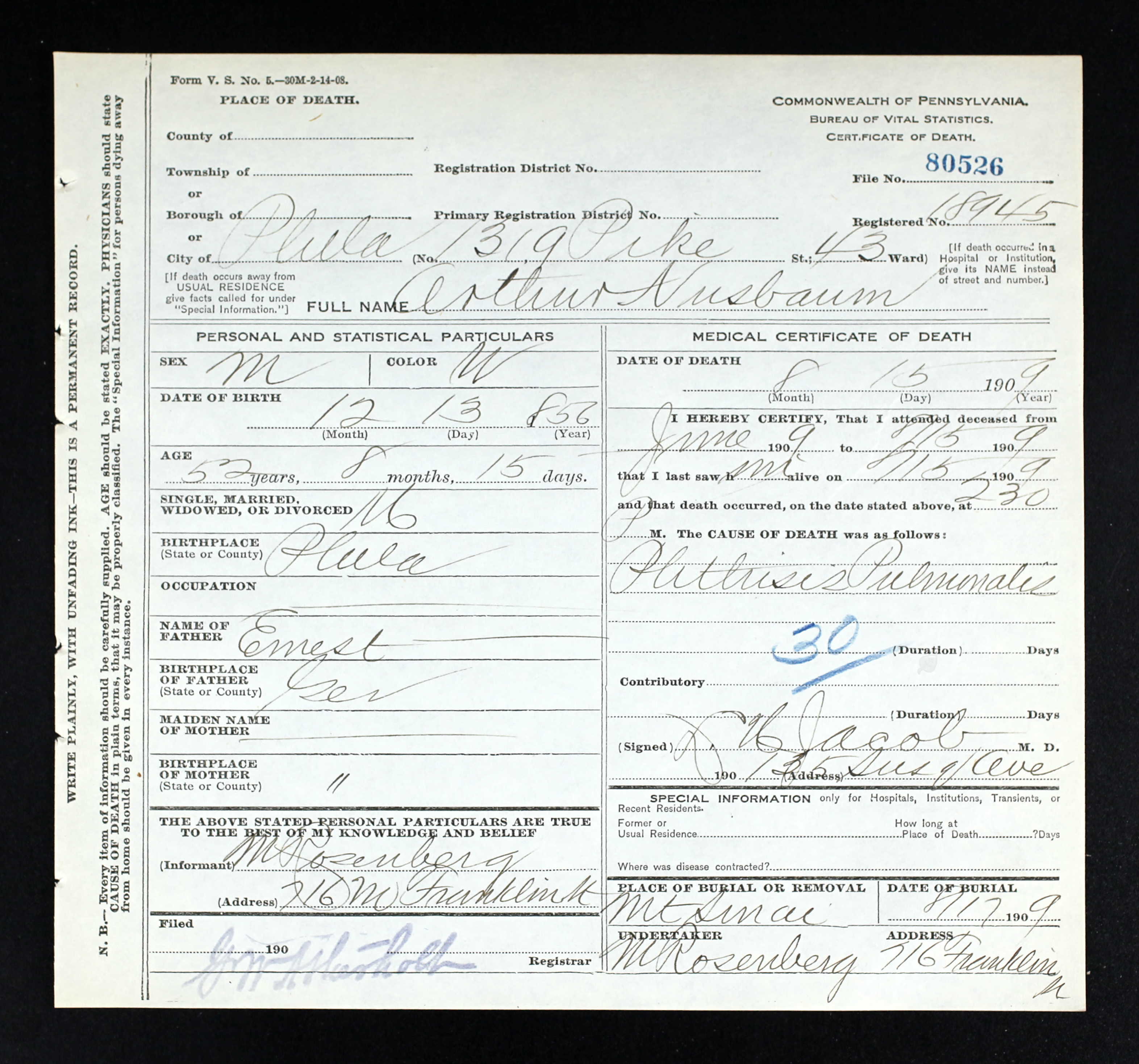
Arthur was the second of Ernst and Clarissa’s children to die, fourteen years after his brother Myer took his own life.  Arthur died on August 15, 1909, of phthisis pulmonalis, a form of tuberculosis that causes wasting of the body.  He was only 52 years old when he died and was buried at Mt. Sinai cemetery.  Tuberculosis had taken another member of the extended Nusbaum family.

Arthur Nusbaum death cert

Ancestry.com. Pennsylvania, Death Certificates, 1906-1963 [database on-line]. Provo, UT, USA: Ancestry.com Operations, Inc., 2014. Original data: Pennsylvania (State). Death certificates, 1906–1963. Series 11.90 (1,905 cartons). Records of the Pennsylvania Department of Health, Record Group 11. Pennsylvania Historical and Museum Commission, Harrisburg, Pennsylvania.

Just two months later, Arthur and Henrietta’s daughter Florence married Lewis Pierce Hoopes in New York City on October 19, 1909.  It is interesting that Florence and Lewis were married in New York, as both were Pennsylvania natives.  Lewis was born in Chester, Pennsylvania, a town about 20 miles south of Philadelphia, and the couple in fact resided in Chester with Lewis’ mother after the wedding and for many years afterwards. Lewis was the son of B. Tevis and Sara P. Hoopes, and in 1880, his father had owned a “furnishings” store, i.e., most likely a clothing store, in Chester.  B. Tevis Hoopes died in 1894.

In 1900 Lewis’ mother, Sara P. Hoopes owned the “furnishings” store in Chester, and Lewis was working as a clerk in a bank.  In 1910, Lewis is listed on the census as clerk in a notions store.  In 1920 he and Florence were still living with Sara Hoopes, and Sara was listed as the owner of a dry goods store with her son Lewis listed as a clerk.  On September 7, 1928, Lewis died from cerebral apoloxy; he was 56 years old.  Four years later Florence died from cancer; she was 54.  Florence and Lewis did not have any children.  Thus, there are no direct descendants.

Ancestry.com. Pennsylvania, Death Certificates, 1906-1963 [database on-line]. Provo, UT, USA: Ancestry.com Operations, Inc., 2014. Original data: Pennsylvania (State). Death certificates, 1906–1963. Series 11.90 (1,905 cartons). Records of the Pennsylvania Department of Health, Record Group 11. Pennsylvania Historical and Museum Commission, Harrisburg, Pennsylvania.

Ancestry.com. Pennsylvania, Death Certificates, 1906-1963 [database on-line]. Provo, UT, USA: Ancestry.com Operations, Inc., 2014.
Original data: Pennsylvania (State). Death certificates, 1906–1963. Series 11.90 (1,905 cartons). Records of the Pennsylvania Department of Health, Record Group 11. Pennsylvania Historical and Museum Commission, Harrisburg, Pennsylvania.

The second oldest of the children of Arthur and Henrietta, their son Sidney, married Emma Kleinsmith in 1903. Emma was also a Philadelphia native, born June 28, 1869.  Emma and Sidney had a son Sidney, Jr., born March 31, 1904.  The family was living at 3851 North Park Avenue in 1905, and Sidney was a salesman.  In 1910, he listed his occupation as the manager of a department store, but later records including his World War I draft registration and the 1920 census list his occupation as a clothing salesman. In 1920, Sidney, Emma, and their son were living on Erie Avenue in Philadelphia.

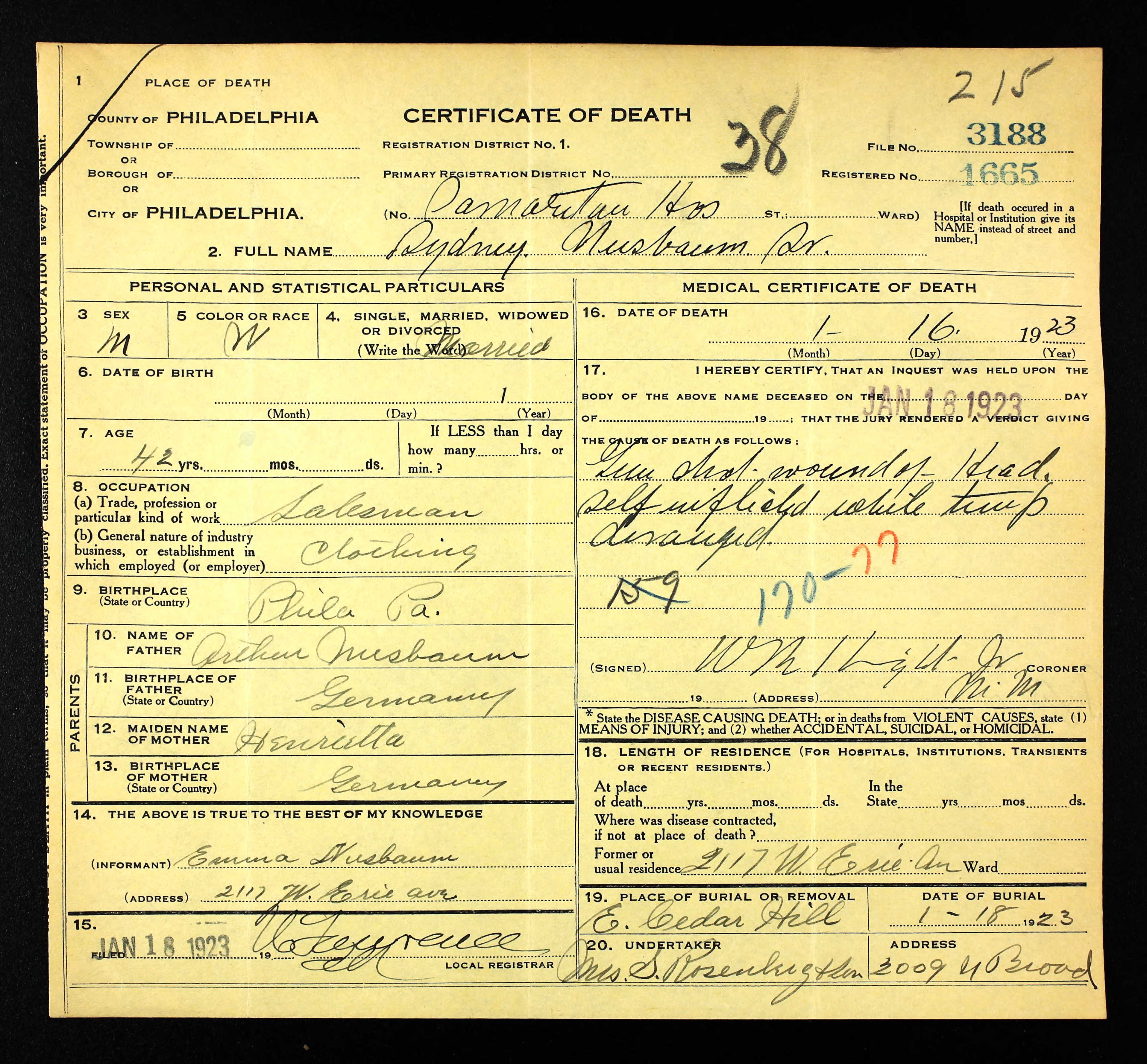
Sidney, Sr., died three years later on January 16, 1923, from a self-inflicted gunshot wound to the head while “temporarily deranged,” according to his death certificate.  Yet another family member had succumbed to suicide.  Sidney was 42 years old.

Sidney Nusbaum Sr death cert

Ancestry.com. Pennsylvania, Death Certificates, 1906-1963 [database on-line]. Provo, UT, USA: Ancestry.com Operations, Inc., 2014. Original data: Pennsylvania (State). Death certificates, 1906–1963. Series 11.90 (1,905 cartons). Records of the Pennsylvania Department of Health, Record Group 11. Pennsylvania Historical and Museum Commission, Harrisburg, Pennsylvania.

His son, Sidney, Jr., was only nineteen years old at the time of his father’s death.  He and his mother continued to live in the same residence on Erie Avenue in Philadelphia, and Sidney, Jr., was working as an electrician in 1930.  Sidney, Jr., also died young; on August 12, 1932, he accidentally drowned while swimming near a dam in Greene, Pennsylvania; he was 28 years old.

Sidney_Nusbaum_Jr_drowning-page-001

Ancestry.com. Pennsylvania, Death Certificates, 1906-1963 [database on-line]. Provo, UT, USA: Ancestry.com Operations, Inc., 2014. Original data: Pennsylvania (State). Death certificates, 1906–1963. Series 11.90 (1,905 cartons). Records of the Pennsylvania Department of Health, Record Group 11. Pennsylvania Historical and Museum Commission, Harrisburg, Pennsylvania.

Ancestry.com. Pennsylvania, Death Certificates, 1906-1963 [database on-line]. Provo, UT, USA: Ancestry.com Operations, Inc., 2014.
Original data: Pennsylvania (State). Death certificates, 1906–1963. Series 11.90 (1,905 cartons). Records of the Pennsylvania Department of Health, Record Group 11. Pennsylvania Historical and Museum Commission, Harrisburg, Pennsylvania.

How did his mother Emma cope?  She had lost both her husband and her son to terrible deaths. Somehow she pulled herself together, and in 1940 she was still living on Erie Avenue, now the owner of a dress shop.  Emma died on December 5, 1951, when she was 82 years old from a “ruptured heart.”  How her heart held up for as long as it did after all she endured is a mystery to me. Emma, her husband Sidney, and her son Sidney, are all buried at East Cedar Hill cemetery in Philadelphia.

Ancestry.com. Pennsylvania, Death Certificates, 1906-1963 [database on-line]. Provo, UT, USA: Ancestry.com Operations, Inc., 2014. Original data: Pennsylvania (State). Death certificates, 1906–1963. Series 11.90 (1,905 cartons). Records of the Pennsylvania Department of Health, Record Group 11. Pennsylvania Historical and Museum Commission, Harrisburg, Pennsylvania.

Ancestry.com. Pennsylvania, Death Certificates, 1906-1963 [database on-line]. Provo, UT, USA: Ancestry.com Operations, Inc., 2014.
Original data: Pennsylvania (State). Death certificates, 1906–1963. Series 11.90 (1,905 cartons). Records of the Pennsylvania Department of Health, Record Group 11. Pennsylvania Historical and Museum Commission, Harrisburg, Pennsylvania.

In 1909, not only did Florence Nusbaum marry Lewis Hoopes, Arthur and Henrietta’s third child Horace Nusbaum married Florence Crawford, the daughter of Jonathan Crawford, a widower from Scranton, Pennsylvania, where he was employed as a watchman. On April 5, 1910, Horace and Florence had a son, Arthur, obviously named in memory of Horace’s recently deceased father.  Tragically, little Arthur died just three months later on July 5, 1910, from acute gastroenteritis and malnutrition.  He was buried at Mt. Peace cemetery in Philadelphia.

Ancestry.com. Pennsylvania, Death Certificates, 1906-1963 [database on-line]. Provo, UT, USA: Ancestry.com Operations, Inc., 2014. Original data: Pennsylvania (State). Death certificates, 1906–1963. Series 11.90 (1,905 cartons). Records of the Pennsylvania Department of Health, Record Group 11. Pennsylvania Historical and Museum Commission, Harrisburg, Pennsylvania.

Ancestry.com. Pennsylvania, Death Certificates, 1906-1963 [database on-line]. Provo, UT, USA: Ancestry.com Operations, Inc., 2014.
Original data: Pennsylvania (State). Death certificates, 1906–1963. Series 11.90 (1,905 cartons). Records of the Pennsylvania Department of Health, Record Group 11. Pennsylvania Historical and Museum Commission, Harrisburg, Pennsylvania.

Although Horace and his family (including the infant Arthur) were listed in the 1900 census as living in Philadelphia, sometime thereafter Horace and Florence relocated to Chester, where his sister Florence and her husband Lewis Hoopes were also living.  On the 1910 census, Horace had listed his occupation as a solicitor for the electric company, and I had not known what that meant, but this article from the Delaware County Times from Chester, dated April 25, 1913, provided a clear picture:

Horace M. Nusbaum, a special representative of the Beacon Light Company, has been in the borough several days securing contracts for the change in rates of the company.  He reports meeting with great success, the plan being approved by nearly all the light consumers in the town, and as there are but a few left to sign the new contract he will soon complete his labors here.

(Delaware County Times, April 25, 1913, p. 9)

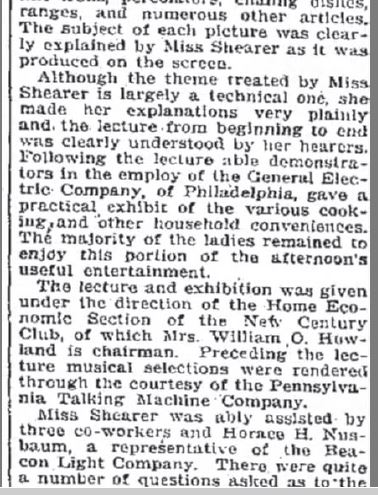
In addition, Horace took on a role as spokesperson, educator, and salesperson for the company, as this article reveals.  I also found it interesting for what it reveals about the role that electricity was beginning to play in the homes of ordinary citizens by 1914:

Horace Nusbaum article part 1

Horace Nusbaum article part 2

Horace Nusbaum article part 3

Delaware County Times, February 28, 1914, p. 7


Although the first report seemed to indicate Horace was not yet living in the Chester area, there were a number of later news reports revealing that he and Florence had relocated to that area.   A 1916 news item about their vacation described them as residents of Norwood, Pennsylvania, a town about five miles from Chester.  (Delaware County Times, July 31, 1916, p. 3)  A 1917 issue reports their attendance at a masquerade ball in Norwood.   (Delaware County Times, November 6, 1917, p. 2)

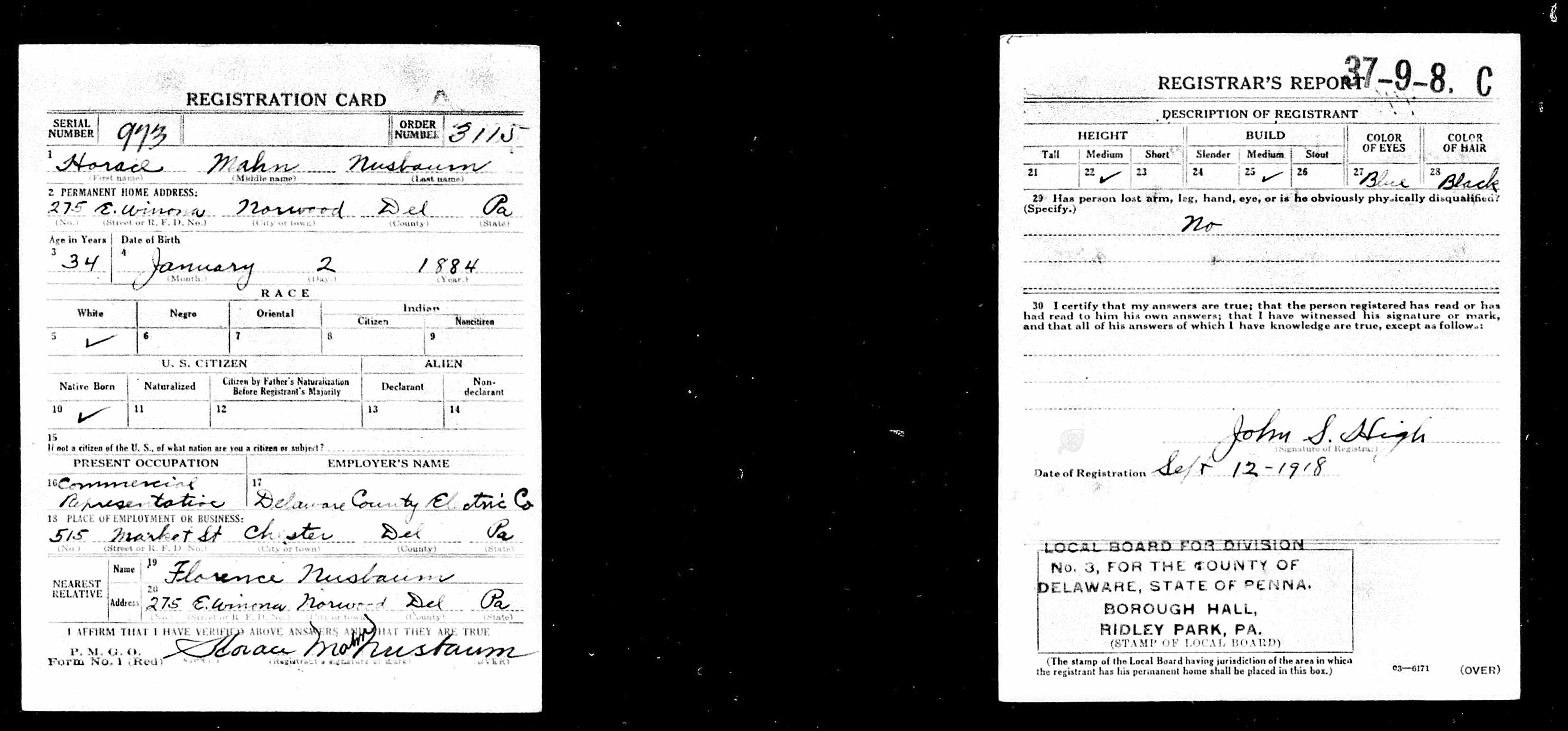
On his World War I draft registration dated September 12, 1918, Horace listed his occupation as the commercial representative for the Delaware County Electric Company, and he and Florence were residing in Norwood.

Registration State: Pennsylvania; Registration County: Delaware; Roll: 1877947; Draft Board:

Registration State: Pennsylvania; Registration County: Delaware; Roll: 1877947; Draft Board:

Just a few weeks later, his wife Florence would die during the Spanish flu epidemic on October 5, 1918, when she was only thirty years old. The number of death notices listing pneumonia or influenza as the cause of death in the week Florence died was staggering.

Ancestry.com. Pennsylvania, Death Certificates, 1906-1963 [database on-line]. Provo, UT, USA: Ancestry.com Operations, Inc., 2014. Original data: Pennsylvania (State). Death certificates, 1906–1963. Series 11.90 (1,905 cartons). Records of the Pennsylvania Department of Health, Record Group 11. Pennsylvania Historical and Museum Commission, Harrisburg, Pennsylvania.

Ancestry.com. Pennsylvania, Death Certificates, 1906-1963 [database on-line]. Provo, UT, USA: Ancestry.com Operations, Inc., 2014.
Original data: Pennsylvania (State). Death certificates, 1906–1963. Series 11.90 (1,905 cartons). Records of the Pennsylvania Department of Health, Record Group 11. Pennsylvania Historical and Museum Commission, Harrisburg, Pennsylvania.

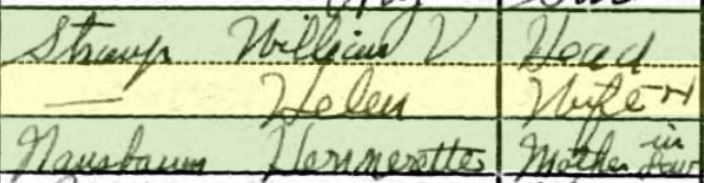
Horace had lost his infant son and then his wife in the space of eight years.  But like his sister-in-law Emma, Horace survived, and a year later he married again, marrying Edna M. Ephlin in 1919.  Edna was the daughter of Oscar and Julia Ephlin of Philadelphia; her father was a shipping clerk for a paper company.  After they married, in 1920 Horace and Edna lived at 1935 Park Avenue in Philadelphia with Horace’s mother Henrietta and his sister Clair as well as his youngest sister Helen and her husband William Stroup.  Horace continued to work as a salesman for the electric company.  He and Edna did not have any children.

Year: 1920; Census Place: Philadelphia Ward 32, Philadelphia, Pennsylvania; Roll: T625_1633; Page: 3A; Enumeration District: 1058; Image: 839

Year: 1920; Census Place: Philadelphia Ward 32, Philadelphia, Pennsylvania; Roll: T625_1633; Page: 3A; Enumeration District: 1058; Image: 839

As for the remaining three children of Arthur and Henrietta Nusbaum, Stella (20) and Clair (17) were both living at home and working at a department store in 1910.  The youngest child, Helen, now 15, was not employed.  In 1914, Stella married Roy Service, born in Bucks County, Pennsylvania, to James and Ella Service.  In 1920 Stella and Roy were living at 1229 Broad Street in Philadelphia, and Roy was a clerk.  (In earlier and later city directories, Roy’s occupation was listed as a printer.)  Stella and Roy never had children, and Stella died on January 27, 1929, from chronic myocarditis and multiple sclerosis.  She was 39 years old.

Ancestry.com. Pennsylvania, Death Certificates, 1906-1963 [database on-line]. Provo, UT, USA: Ancestry.com Operations, Inc., 2014. Original data: Pennsylvania (State). Death certificates, 1906–1963. Series 11.90 (1,905 cartons). Records of the Pennsylvania Department of Health, Record Group 11. Pennsylvania Historical and Museum Commission, Harrisburg, Pennsylvania.

Ancestry.com. Pennsylvania, Death Certificates, 1906-1963 [database on-line]. Provo, UT, USA: Ancestry.com Operations, Inc., 2014.
Original data: Pennsylvania (State). Death certificates, 1906–1963. Series 11.90 (1,905 cartons). Records of the Pennsylvania Department of Health, Record Group 11. Pennsylvania Historical and Museum Commission, Harrisburg, Pennsylvania.

In 1920, Stella’s younger sister Clair was living with her mother Henrietta as well as her brother Horace and his wife Edna and her sister Helen and her husband William Stroup. Clair, her mother, and her sisters had no occupations. Only the two men were working outside the home, Horace as a salesman for the electric company and William as an advertising salesman for a newspaper. (See the snip from the 1920 census above.)

In 1930, Clair, her widowed sister Florence Hoopes, and her mother Henrietta were all living together at 774 Spruce Street; only Clair was employed, working as a hairdresser.

Year: 1930; Census Place: Philadelphia, Philadelphia, Pennsylvania; Roll: 2139; Page: 35B; Enumeration District: 0498; Image: 1020.0; FHL microfilm: 2341873

Year: 1930; Census Place: Philadelphia, Philadelphia, Pennsylvania; Roll: 2139; Page: 35B; Enumeration District: 0498; Image: 1020.0; FHL microfilm: 2341873

[Notice how Clair’s surname is spelled—would you think that says Nusbaum? It’s a miracle that I found this census report.]

Helen, the youngest of Arthur and Henrietta’s children, had only been fourteen when her father died in 1909.  Helen married William Valentine Stroup, Jr., in 1919.  William was a native Philadelphian and an advertising salesman.  In 1920, as noted above Helen and William were living with her mother Henrietta, her sister Clair, her brother Horace, and Horace’s second wife Edna.  In 1930, Helen and William were living at 4741 13th Street; Helen’s mother Henrietta is also listed with them, though she was also listed in 1930 as living with her other two daughters Clair and Florence on Spruce Street.

Year: 1930; Census Place: Philadelphia, Philadelphia, Pennsylvania; Roll: 2135; Page: 4B; Enumeration District: 1073; Image: 1005.0; FHL microfilm: 2341869

Year: 1930; Census Place: Philadelphia, Philadelphia, Pennsylvania; Roll: 2135; Page: 4B; Enumeration District: 1073; Image: 1005.0; FHL microfilm: 2341869

Thus, as of 1932, Arthur Nusbaum’s wife Henrietta had lost her husband and three of her six children: Florence, Sidney, and Stella.  She had also lost her only two grandchildren: Arthur H. Nusbaum, Horace’s son, and Sidney Nusbaum, Jr., Sidney’s son.  Florence and Stella had not had any children, nor did Clair or Helen, so there are no possible living descendants of Arthur Nusbaum and Henrietta Hilbronner.

Henrietta died on August 24, 1935.  She was seventy years old and died of heart disease and kidney disease.  She was buried with her husband Arthur at Mt. Sinai cemetery.

Ancestry.com. Pennsylvania, Death Certificates, 1906-1963 [database on-line]. Provo, UT, USA: Ancestry.com Operations, Inc., 2014. Original data: Pennsylvania (State). Death certificates, 1906–1963. Series 11.90 (1,905 cartons). Records of the Pennsylvania Department of Health, Record Group 11. Pennsylvania Historical and Museum Commission, Harrisburg, Pennsylvania.

Ancestry.com. Pennsylvania, Death Certificates, 1906-1963 [database on-line]. Provo, UT, USA: Ancestry.com Operations, Inc., 2014.
Original data: Pennsylvania (State). Death certificates, 1906–1963. Series 11.90 (1,905 cartons). Records of the Pennsylvania Department of Health, Record Group 11. Pennsylvania Historical and Museum Commission, Harrisburg, Pennsylvania.

Her surviving children were Horace, Clair, and Helen.  In 1940, Horace and his second wife Edna were living in Upper Darby, where Horace worked as an insecticide salesman.  Edna sold women’s clothing.  Edna died six years later from heart failure.  She was only fifty-five years old.  Horace lived until January 23, 1962 (I have not yet located a death record for him, but found his burial entry on FindAGrave) and is buried with Edna at Arlington Cemetery in Drexel Hill, Pennsylvania.

The two youngest sisters, Clair and Helen, were living together in 1940.  Helen was divorced from William Stroup and working in lingerie sales (if I am reading the census correctly), and Clair was single and continuing to work as a hairdresser.

Year: 1940; Census Place: Philadelphia, Philadelphia, Pennsylvania; Roll: T627_3753; Page: 6A; Enumeration District: 51-2148

Year: 1940; Census Place: Philadelphia, Philadelphia, Pennsylvania; Roll: T627_3753; Page: 6A; Enumeration District: 51-2148

The last record I have for either of them is a listing for Clair in the 1950 Philadelphia telephone directory.  I cannot find a death record or obituary or burial record for them, but I assume that they both survived past 1963, the last year of death certificates now publicly available.  I am continuing to see if I can find some other record for Clair and Helen as well as their brother Horace.

Thus, the history of the family of Arthur Nusbaum is a rather heart-breaking one, filled with premature deaths and no descendants to carry on the family name.  Fortunately, some of the other children of Ernst and Clarissa have happier stories and more enduring family lines, though not all.


Tuberculosis Continues to Ravage the Family: The Children of Fanny Wiler and Clara Wiler

In 1910, the three sons of Fanny Wiler were still living with their father Joseph Levy and stepmother Bella Strouse Levy as well as their half-sister Miriam, who had married Arthur Hanff.  Alfred, Leon, and Monroe Levy were all single and all employed in sales.  Alfred was in lumber sales, and Leon and Monroe were selling clothing.

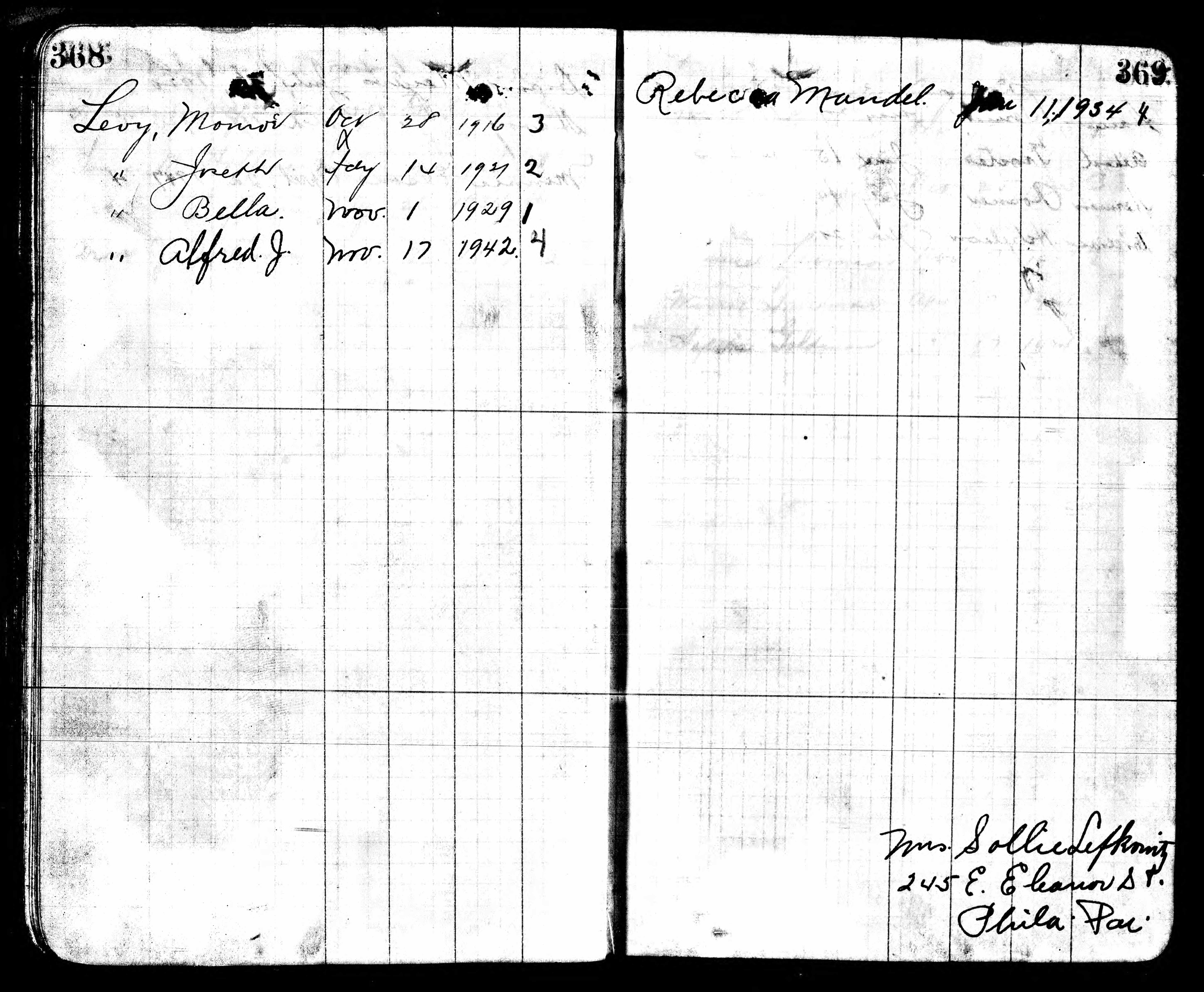
Five years later Monroe succumbed to the same awful disease that had taken the life of his cousin Leon Simon the year before: tuberculosis.  Like Leon Simon, Monroe had been living at a sanitarium, the Dermady Cottages Sanitarium in Morton, Pennsylvania, ten miles outside of Philadelphia.  Monroe had been there since November 24, 1913, and he died on October 28, 1916, almost three years later. Like his cousin Leon, he did not have a family member sign the death certificate as the informant; in Monroe’s case, it was the undertaker who took on that responsibility.    Monroe was 42 years old.  He was buried at Rodeph Shalom cemetery, another young man whose life was cut short by TB.

Ancestry.com. Pennsylvania, Death Certificates, 1906-1963 [database on-line]. Provo, UT, USA: Ancestry.com Operations, Inc., 2014. Original data: Pennsylvania (State). Death certificates, 1906–1963. Series 11.90 (1,905 cartons). Records of the Pennsylvania Department of Health, Record Group 11. Pennsylvania Historical and Museum Commission, Harrisburg, Pennsylvania.

Ancestry.com. Pennsylvania, Death Certificates, 1906-1963 [database on-line]. Provo, UT, USA: Ancestry.com Operations, Inc., 2014.
Original data: Pennsylvania (State). Death certificates, 1906–1963. Series 11.90 (1,905 cartons). Records of the Pennsylvania Department of Health, Record Group 11. Pennsylvania Historical and Museum Commission, Harrisburg, Pennsylvania.

His two older brothers fared much better. Leon J. Levy married Minnie Howell in Philadelphia in 1910, apparently after the 1910 census had been taken.  Minnie was a Pennsylvania native and was 35 when she married Leon; he was 38.  On his World War I draft registration, Leon recorded his occupation as the manager of Walter D. Dalsimer, which was a dry goods and clothing merchant in Philadelphia.  In 1920, he was still the manager of a clothing store, and Minnie was working as a chiropodist.  Minnie’s parents were living with them at 5214 Spruce Street.  There were no children.

On February 11, 1929, Leon died from complications from an intestinal obstruction that led to general peritonitis and a ruptured and gangrenous appendix.  He was not yet 57 years old.  His brother Alfred J. Levy was the informant on the death certificate.  Leon’s wife Minnie died just three years later from coronary thrombosis and hypertension.  She was also only 57 years old.  They are both buried at Arlington Cemetery in Drexel Hill, Pennsylvania, a non-sectarian cemetery.


Ancestry.com. Pennsylvania, Death Certificates, 1906-1963 [database on-line]. Provo, UT, USA: Ancestry.com Operations, Inc., 2014. Original data: Pennsylvania (State). Death certificates, 1906–1963. Series 11.90 (1,905 cartons). Records of the Pennsylvania Department of Health, Record Group 11. Pennsylvania Historical and Museum Commission, Harrisburg, Pennsylvania

Ancestry.com. Pennsylvania, Death Certificates, 1906-1963 [database on-line]. Provo, UT, USA: Ancestry.com Operations, Inc., 2014.
Original data: Pennsylvania (State). Death certificates, 1906–1963. Series 11.90 (1,905 cartons). Records of the Pennsylvania Department of Health, Record Group 11. Pennsylvania Historical and Museum Commission, Harrisburg, Pennsylvania

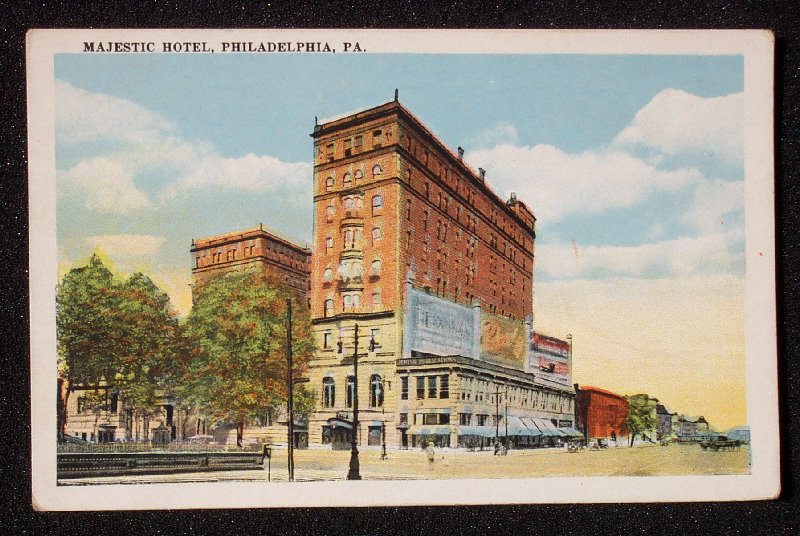
The oldest of Fanny Wiley and Joseph Levy’s sons, Alfred, married Josephine B. May in 1916.  He owned his own business, A. J. Lumber Company, and in 1917 was living in the Majestic, a grand hotel catering to the wealthy in those days.  Alfred and Josephine were still living there in 1918 as well, and on the 1920 census, they were still living there.  Alfred was then 51 years old, and his wife Josephine is listed as 22.  That means she was 18 when she married him, and he was 47.  (This family certainly liked to marry people who were significantly older or younger than they were.)  Alfred continued in the lumber business for many years.  In 1930 census, he was now 62, Josephine was 33, and there were no children, so it does not appear that the couple had any children.


Ten years later, Alfred was listed a widower on the 1940 census; he was living with his sister Miriam and her family, and he was still engaged in the lumber business.  Two years later, Alfred Levy died from liver cancer at 74 on November 15, 1942.  Contrary to the 1940 census, the death certificate indicates that Alfred was divorced, not a widower, at the time of his death. Since I cannot find a death certificate for Josephine, I assume that the death certificate is more accurate.[1] His last residence was with his sister Miriam and her husband Arthur Hanff, the informant on his certificate.


Ancestry.com. Pennsylvania, Death Certificates, 1906-1963 [database on-line]. Provo, UT, USA: Ancestry.com Operations, Inc., 2014. Original data: Pennsylvania (State). Death certificates, 1906–1963. Series 11.90 (1,905 cartons). Records of the Pennsylvania Department of Health, Record Group 11. Pennsylvania Historical and Museum Commission, Harrisburg, Pennsylvania

Ancestry.com. Pennsylvania, Death Certificates, 1906-1963 [database on-line]. Provo, UT, USA: Ancestry.com Operations, Inc., 2014.
Original data: Pennsylvania (State). Death certificates, 1906–1963. Series 11.90 (1,905 cartons). Records of the Pennsylvania Department of Health, Record Group 11. Pennsylvania Historical and Museum Commission, Harrisburg, Pennsylvania

Like his brother Monroe, Alfred was buried at Rodeph Shalom cemetery.

Burial plots for Joseph, Alfred and Monroe Levy

Historical Society of Pennsylvania; Historic Pennsylvania Church and Town Records; Reel: 1112 Description Organization Name : Rodeph Shalom Cemetery Records


Thus, none of Fanny Wiley and Joseph Levy’s sons had children, and there are no descendants.  From the three oldest children of Caroline Dreyfuss and Moses Wiler, there would be only one great-grandchild: Lester Strouse, the son of Flora Simon.  Lester was the only grandchild (of two) of Eliza Wiler and Leman Simon to survive to adulthood.  Fanny Wiler had no grandchildren.  Simon Wiler had no children.

Which brings me to Clara Wiler Meyers, the youngest child of Caroline Dreyfuss and Moses Wiler and the mother of thirteen children, eleven of whom survived to adulthood.  As of 1910, none of those children had married, although nine of the eleven were already in their 20s and 30s.  Only two of the eleven had moved out of the house.  In the next ten years most of those children moved out and on with their adult lives.  In addition, there were several losses.

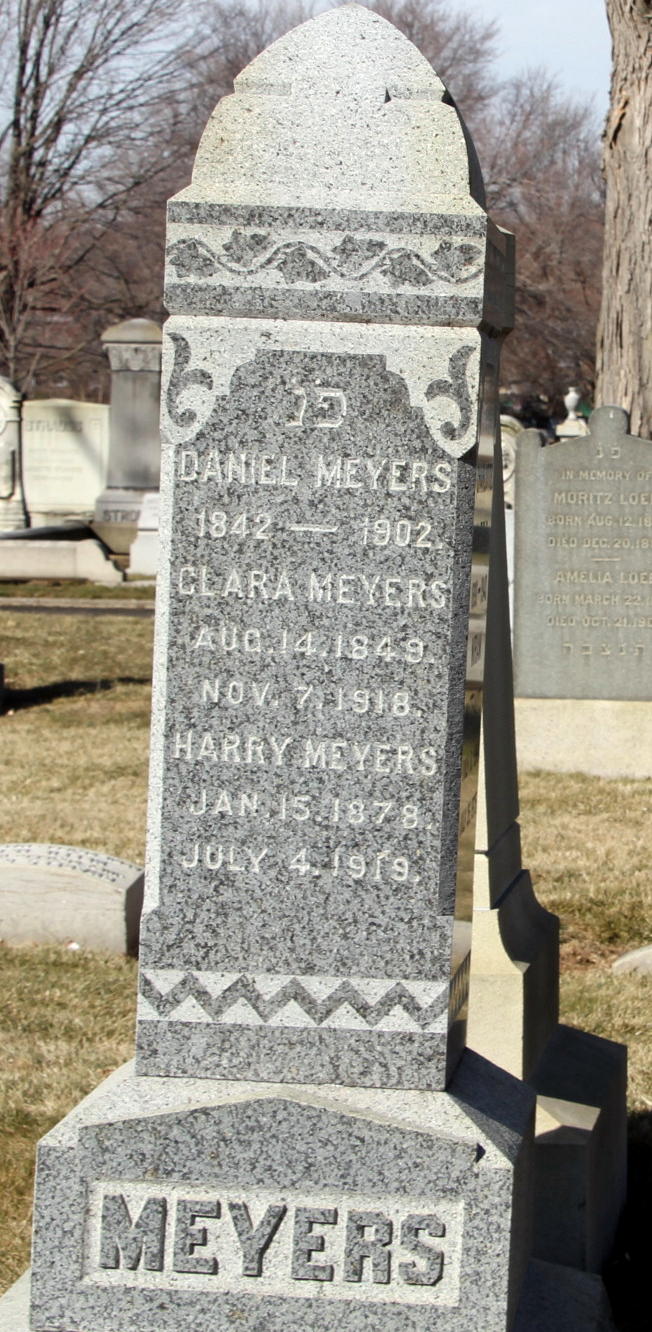
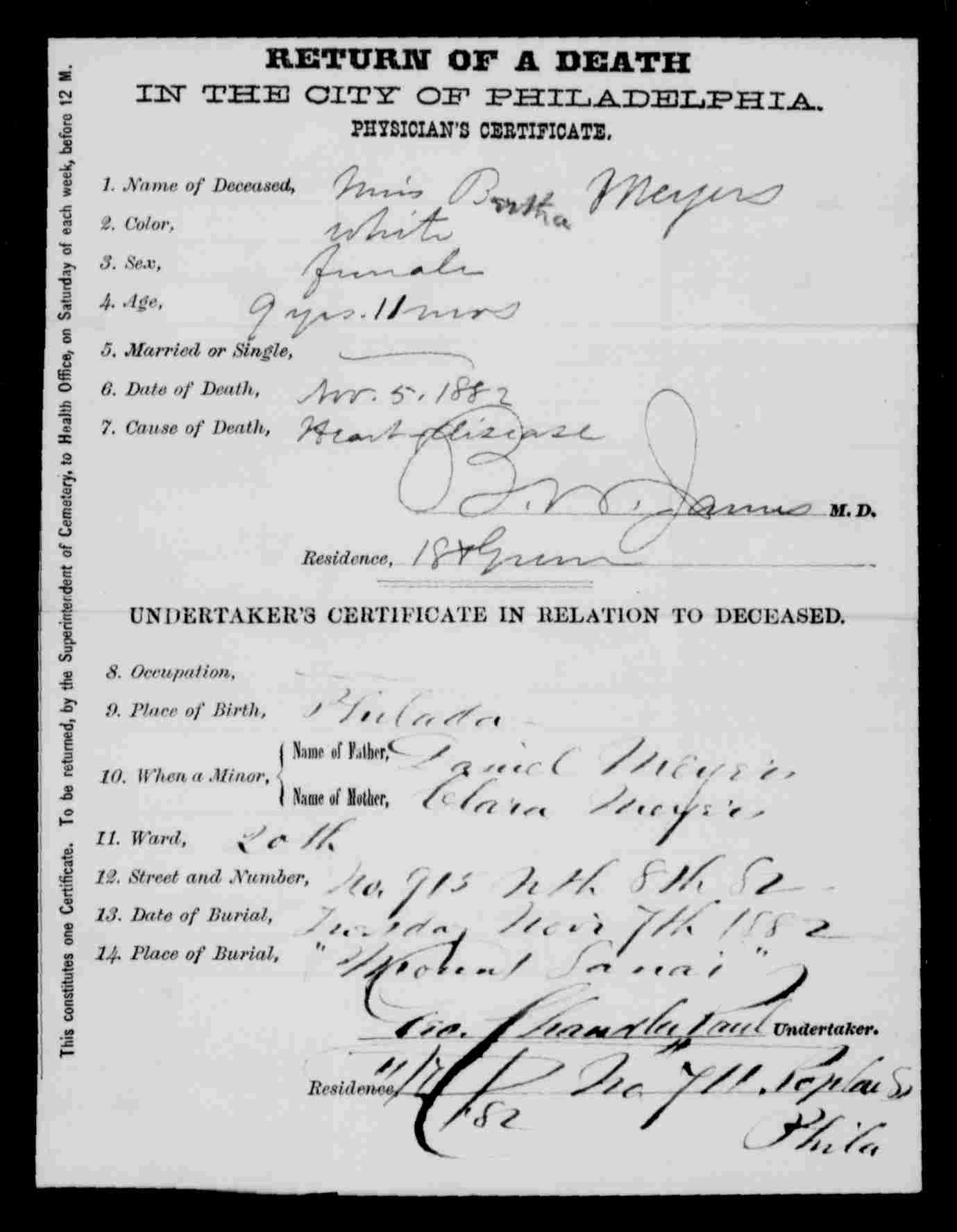
First, Clara Wiler Meyers, the mother of all those children and widow of Daniel Meyers, died on November 7, 1918, from fatty myocarditis.  She was living at 1905 Diamond Street, an address where at one time or another during the 1910s several of her children resided.  Clara was 68 years old when she died.  She had outlived one child, Bertha, and her husband, Daniel.  She had weathered the financial and legal problems he had faced in the late 1890s.  She had given birth to thirteen babies, one stillborn, and she had raised eleven of those babies to adulthood.  Like so many women of her times, she did remarkable things but things that history would not have noticed.


Ancestry.com. Pennsylvania, Death Certificates, 1906-1963 [database on-line]. Provo, UT, USA: Ancestry.com Operations, Inc., 2014. Original data: Pennsylvania (State). Death certificates, 1906–1963. Series 11.90 (1,905 cartons). Records of the Pennsylvania Department of Health, Record Group 11. Pennsylvania Historical and Museum Commission, Harrisburg, Pennsylvania.

Ancestry.com. Pennsylvania, Death Certificates, 1906-1963 [database on-line]. Provo, UT, USA: Ancestry.com Operations, Inc., 2014.
Original data: Pennsylvania (State). Death certificates, 1906–1963. Series 11.90 (1,905 cartons). Records of the Pennsylvania Department of Health, Record Group 11. Pennsylvania Historical and Museum Commission, Harrisburg, Pennsylvania.

Leon, her oldest surviving child, had moved out before 1910 and was working as optician and living at 1904 Somerset Street in 1911; the following year he was living and working on Market Street.  On his World War I draft registration form in 1917, Leon’s address was now 1905 Diamond Street,[2] the address where his mother was living, and he now described his occupation as a self-employed optometrist [3]working in Pottstown, Pennsylvania, almost 50 miles from Philadelphia, where his younger brother Franklin had been an optician/optometrist since at least 1914.  In the 1918 directory which covered Pottstown, Leon is listed at the same business address as his younger brother Franklin, working as the manager of the optometry practice and residing at the YMCA.  The strangest thing about his draft registration is Leon’s entry for his nearest relative: Bessie H. Meyers, address unknown.  Had Leon married since 1910? How could he be married to someone whose address he did not know? And doesn’t the name look more like MYERS than MEYERS?

Registration State: Pennsylvania; Registration County: Philadelphia; Roll: 1907649; Draft Board: 29

Registration State: Pennsylvania; Registration County: Philadelphia; Roll: 1907649; Draft Board: 29


The 1920 census may answer some of those questions.  Leon is listed as divorced and living in the household of his younger sister Charlotte and her husband, J.A. Field, at 1905 Diamond Street back in Philadelphia, along with his younger brother Milton.  Leon’s occupation is reported to be drug salesman.  What happened to being an optometrist?

By 1923 Leon had moved to Bethlehem, Pennsylvania, and resumed practicing optometry, as discussed below, after his brother Samuel died.  Leon is also listed in the Bethlehem directory with the same occupation in 1927.  Leon Meyers died from colon cancer at age 55 on February 14, 1930.  His brother Clarence was the informant on his death certificate.  His marital status was single, not divorced or widowed, so it would seem Leon had never married.  I still don’t know who Bessie Meyers was.


Ancestry.com. Pennsylvania, Death Certificates, 1906-1963 [database on-line]. Provo, UT, USA: Ancestry.com Operations, Inc., 2014. Original data: Pennsylvania (State). Death certificates, 1906–1963. Series 11.90 (1,905 cartons). Records of the Pennsylvania Department of Health, Record Group 11. Pennsylvania Historical and Museum Commission, Harrisburg, Pennsylvania.

Ancestry.com. Pennsylvania, Death Certificates, 1906-1963 [database on-line]. Provo, UT, USA: Ancestry.com Operations, Inc., 2014.
Original data: Pennsylvania (State). Death certificates, 1906–1963. Series 11.90 (1,905 cartons). Records of the Pennsylvania Department of Health, Record Group 11. Pennsylvania Historical and Museum Commission, Harrisburg, Pennsylvania.

Leon’s next oldest brother Samuel followed in his steps professionally, becoming an optometrist.  In 1912, Samuel was an optician in Philadelphia, living at 1906 Diamond Street, across the street from his mother and siblings Leon and Charlotte and Milton. By 1917, he had moved to Bethlehem, Pennsylvania, and was married to Mary Potts Hamilton, another Philadelphian.  They would have both been in their thirties when they married.  Samuel was an optometrist in Bethlehem, according to both the 1920 census and the 1920 Bethlehem directory.  There were no children.

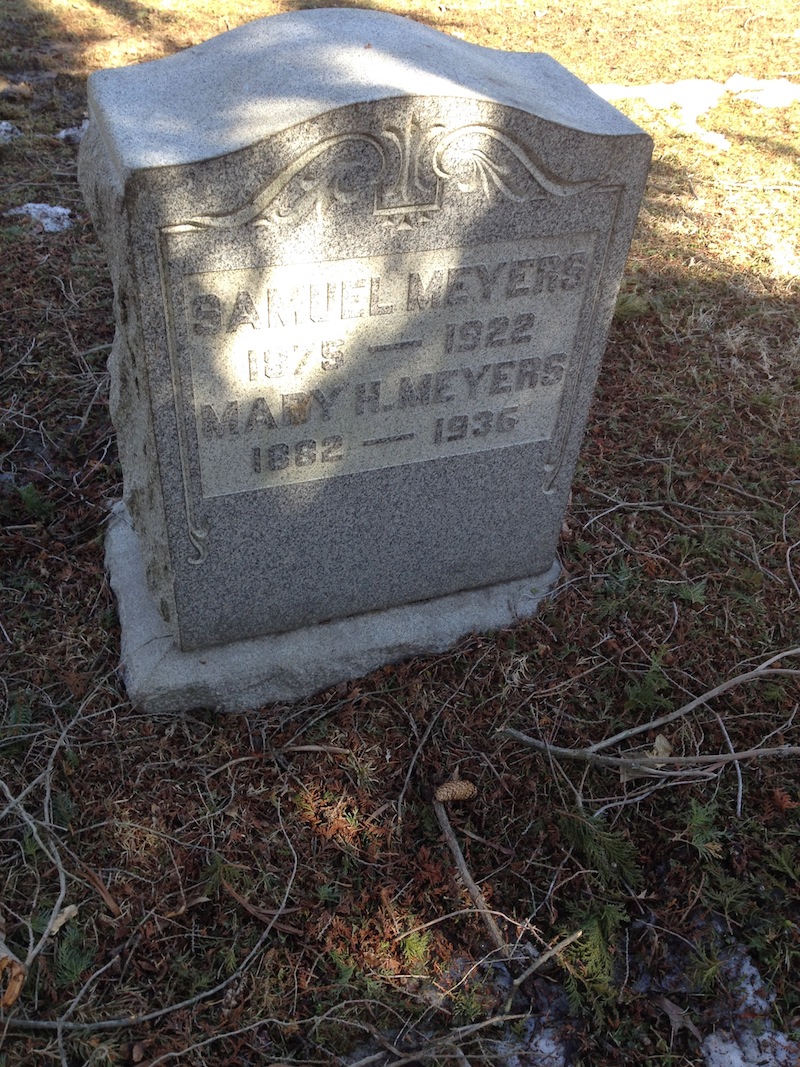
Samuel died May 10, 1922, from tubercular peritonitis, an infection caused by the same bacteria that causes tuberculosis but that manifests outside of the lungs (at least that’s what I think I understood from what I read online).  Another family member thus succumbed to the deadly bacteria that causes TB.  Samuel was 46 years old.  It would seem that Leon moved to Bethlehem after Samuel died, perhaps to take over his optometry practice.  Samuel’s widow Mary lived another 14 years, and Samuel and Mary Hamilton Meyers are both buried at Arlington Cemetery in Drexel Hill, Pennsylvania.

Harry Meyers, the next brother, also died young.  He was a tailor, and in 1912 he was living at 1906 Diamond Street, the same address as his brother Samuel that year and across the street from his mother and Leon, who were at 1905 Diamond Street.  On his World War I draft registration, Harry was living at 1905 Diamond Street and said he was an unemployed tailor.  He gave his mother’s name as his closest relative.  Harry died a year after his mother on July 4, 1919.  Like his brother Samuel and his cousins Leon Simon and Monroe Levy, he died from tuberculosis.  He had been sick for over five years, according to his death certificate, having been treated since January, 1914.  That would explain why he was unemployed in September, 1918, when he registered for the draft.   Harry was 41 when he died.  He never married; he had no descendants.


Thus, two of Clara’s three oldest children died from tuberculosis before they were fifty years old. Leon, the oldest, made it to 55.  These three oldest sons did not leave behind any descendants.  Fortunately, the family’s luck changed with the remaining siblings, all but two of whom lived until at least 1956.  For these siblings, I will write about their lives until 1920 and then will write a separate post for the future years.

Isadore was the fourth brother, and he had been working as a traveling salesman in 1910, selling men’s clothing.  In 1915 he married Elsie Goodman, also a native Philadelphian and the daughter of a salesman, Beno Goodman.  Elsie and Isadore had a baby boy on May 1, 1916, who died that same day from atelectasis, a complete or partial collapse of the lungs.  This is often associated with premature birth.

Ancestry.com. Pennsylvania, Death Certificates, 1906-1963 [database on-line]. Provo, UT, USA: Ancestry.com Operations, Inc., 2014. Original data: Pennsylvania (State). Death certificates, 1906–1963. Series 11.90 (1,905 cartons). Records of the Pennsylvania Department of Health, Record Group 11. Pennsylvania Historical and Museum Commission, Harrisburg, Pennsylvania.

Ancestry.com. Pennsylvania, Death Certificates, 1906-1963 [database on-line]. Provo, UT, USA: Ancestry.com Operations, Inc., 2014.
Original data: Pennsylvania (State). Death certificates, 1906–1963. Series 11.90 (1,905 cartons). Records of the Pennsylvania Department of Health, Record Group 11. Pennsylvania Historical and Museum Commission, Harrisburg, Pennsylvania.

In 1918 when he registered for the draft, Isadore’s occupation was a manufacturer.  He and Elsie were living at 812 North 15th Street, and they had a son born that year, Robert.  On the 1920 census, they were living on Camac Street, and Isadore’s younger brother Milton was also living with them.  They also had a servant living with them.  On June 19, 1920, not long after the census was taken, Elsie and Isadore had another son, David.

The brother who followed Isadore in birth order was Maxwell or Max.  In 1910 Max had been employed as a draftsman for a machine works company.  In 1912 Max was, like his older brothers, living at 1905 Diamond Street with his mother, and he continued to work as a draftsman.  In 1917 Max married Henrietta Klopfer, a Pennsylvania native and daughter of a millinery merchant.  On his World War I draft registration, Max reported his occupation to be a mechanical engineer for Newton Machine Tool Works in Philadelphia.  He and Henrietta were living at 1311 Ruscomb Street in Philadelphia. On September 17, 1918, their son Donald was born.  Their second child Dorothy was born five years later on September 3, 1923.   Here is a photo of one of the many machines made by Newton Machine Tool Works.


The sixth son was Benjamin Franklin Meyers.  (I do love that name.)  He was one of the earliest of the children to move away from home; in 1910, he was living in Trenton, New Jersey, working as a watchmaker.  He remained in New Jersey during the next decade, and he married Leona Faulcher, a Richmond, Virginia, native and daughter of a machinist who had been living in Camden, New Jersey in 1900 and 1910.  They were married as of September 1918 when Benjamin registered for the draft, and they were living in Collingswood, New Jersey.  Benjamin was now involved with aircraft production for the Victor Talking Machine Company, the company famous for the Victrola phonographs.  In September 1918, just when Benjamin was registering for the draft, the company converted to the production of aircraft parts as part of the war effort.

By Norman Bruderhofer (Collection of John Lampert-Hopkins) [CC BY-SA 2.5 (http://creativecommons.org/licenses/by-sa/2.5)], via Wikimedia Commons

By Norman Bruderhofer (Collection of John Lampert-Hopkins) [CC BY-SA 2.5 (http://creativecommons.org/licenses/by-sa/2.5)%5D, via Wikimedia Commons

In 1920, Benjamin and Leona were living with her parents in Collingswood along with her two sisters and their husbands.  Interestingly, Benjamin was now working as an optometrist like several of his brothers.  Benjamin and Leona would have two daughters in the 1920s, Margaret and Clara, the second obviously named for Benjamin’s mother, Clara Wiler Meyers.

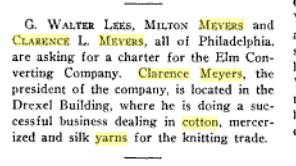
Clarence was the next son in line after Benjamin.  In 1910 when he was 24, he was already engaged in the cotton yarns business, an industry to which he dedicated his entire career.  Despite being the seventh child, he was the first to marry.  He married Estelle Seidenbach in 1911; she was just 21, and he was 24.  She was also a Philadelphia native; her father was already retired at age 50 in 1900, according to the census.  In 1912, they were living at 2251 North Park Avenue.  On October 23, 1919, their daughter Nancy was born.  On the 1920 census, the family was still residing at 2251 North Park Avenue, and Clarence was still a cotton yarns merchant.  Googling his name brings up a number of results regarding his business and the patents they owned and/or developed.

Here’s one little news item from the November 1919 Underwear and Hosiery Review:

The Underwear & Hosiery Review, Volume 2 (Google eBook) Front Cover Knit Goods Publishing Corporation, 1919 - Hosiery industry

The Underwear & Hosiery Review, Volume 2 (Google eBook)
Knit Goods Publishing Corporation, 1919 – Hosiery industry


Next in line was Franklin, born just a year after Clarence.  He was, like some of his older brothers, an optometrist.  In 1912, he was also still living with his family at 1906 Diamond Street. By 1914, he named his occupation as an optician in Pottstown, Pennsylvania, but by 1918 when he registered for the draft, he gave his occupation as optometrist.  At that time he was living and working in Pottstown, Pennsylvania, and was still single.  Sometime between 1918 and 1920, however, Franklin married Mae Gross, a native of Bloomsburg, Pennsylvania, and daughter of a clothing salesman.  Bloomsburg is 114 miles northwest of Pottstown, so it would be interesting to know how these two met.  In 1920, they were living in Pottstown, where Franklin continued to practice optometry.  They would have one child, Carolyn, born in 1922.

Finally, after having eight boys in a row, Clara and Daniel had a daughter, Miriam, born in 1892, five years after Franklin was born.  In 1910, Miriam had been only eighteen and was still at home.  In 1914, she married Abram Strauss.  He was born in Reynoldsville, Pennsylvania, in 1887; he was 27, and Miriam was 21 when they married.  Abram was a physician, and in 1916 he and Miriam were living at 600 Butler Avenue in Philadelphia.  Their first child, Daniel, was born that year.  They were still living at 600 Butler as of June, 1917, when Abram registered for the draft.  In 1920, Abram, Miriam and Daniel were living at 1848 North 16th Street, and Abram’s mother Mary, sister Helena, and aunt Clara were also living with them.  Only Abram and his sister were working outside the home.  By the next year Miriam, Abram, and Daniel were living at 1836 North 17th Street.  I am not sure how many of those in the 1920 household moved with them.  Miriam and Abram also had another child Richard in September, 1921.

The penultimate child of Clara Wiler and Daniel Meyers was Charlotte or Lottie, born a year after Miriam.  She married J. Albert Field in 1914 when she was 21; he was 33.  He was an assistant manager of a department store and the son of a salesman born in Northern Ireland and a woman born in New York.  In September 1918 when he registered for the draft, Albert and Miriam were living at 1905 Diamond Street, and Albert was a manager at John Wanamaker’s Department Store.  They were still living there in 1920, as mentioned above, along with Miriam’s oldest brother Leon and her youngest brother Milton.


Which brings me to Milton, the youngest of the children, born in 1896, so only fourteen in 1910.  He was living with his mother and siblings in 1918 when he registered for the draft and was working for his brother Clarence in the cotton yarns business. Milton served in the Navy from December 1917 until December 1918 during World War I. He was living at 1905 Diamond in 1920, as stated above, and working with Clarence.

Thus, by 1920, Clara Wiler Meyers and two of her adult children, Samuel and Harry, had died.  Several of the other sons had gone into optometry; one son was an engineer, one was a clothing manufacturer, one was a cotton yard manufacturer, and one was working in the production of aircraft parts. One daughter had married a doctor, and one a department store manager.  All of the children alive in 1920 other than Leon and Milton had married between 1910 and 1920; there were also a number of grandchildren born during the decade.  So although there were some terrible losses during this decade, for many members of the family the decade brought both some professional and personal successes.  Certainly Clara’s family overall fared better than the families of her siblings Fanny and Eliza.

Here is a Google Street View shot of 1905 Diamond Street today:

I will bring the Caroline Dreyfuss story to an end in my next post before moving on to the last of the extended Dreyfuss/Nusbaum clan, the family of Ernst Nusbaum.


[1] I did find a Josephine Levy, born in Pennsylvania, living in New York City on the 1940 census, of the approximate age.  She was listed as married, but living as a lodger and not with a husband.  That could be Alfred’s ex-wife, but I can’t be sure.

[2] This is the same address found on Simon Wiler’s death certificate in 1911.  I cannot (yet) explain whether that is a coincidence or not.

[3] It appears that before the 20th century, the term “optician” was used to refer both to those who made glasses and those who evaluated eyesight for the need for those glasses.  According to Wikipedia, “Although the term optometry appeared in the 1759 book A Treatise on the Eye: The Manner and Phenomena of Vision by Scottish physician William Porterfield, it was not until the early twentieth century in the United States and Australia that it began to be used to describe the profession.”    All of the Meyers brothers who started out as opticians eventually switched from the term optician to the term optometrist to describe their occupation.

Life’s Injustices

The last two posts and the research surrounding them have really been draining.  The sad stories of Minnie Simon and Daniel Meyers in particular were hard to read about and to write about.  And sadly the next decade for the descendants of Caroline Dreyfuss and Moses Wiler is no more uplifting.  In fact, in some ways it’s even worse than the first decade of the 20th century.  But rather than put it off, I want to get it done. Today I will post about the children of Eliza Wiler and Moses Simon; next I will post about the children of Fanny Wiler and Joseph Levy and the children of Clara Wiler and Daniel Meyers. Then maybe I can post some cartoons or funny pictures or pictures of kittens.  Anything but death, disease, and despair.

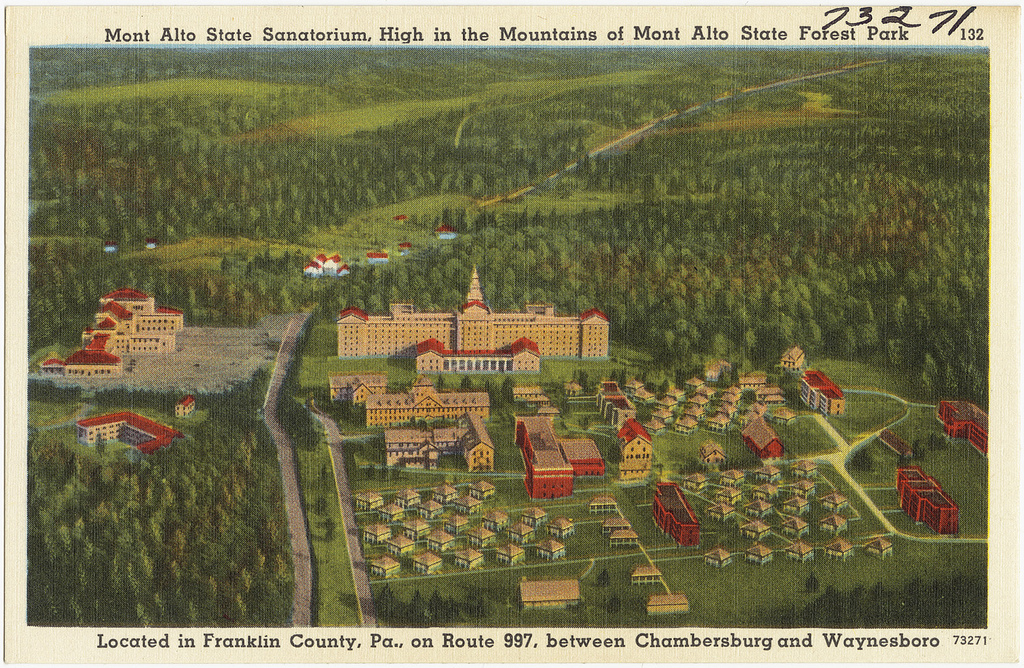
The four surviving children of Eliza Wiler and Leman Simon continued to have far more than their fair share of tragedy in the 1910s.  First, on April 20, 1915, the youngest child Leon died from tuberculosis.  He had been at the Mont Alto Sanitarium in Quincy, Pennsylvania for over a year.  He was only 36 years old.  Having just watched the PBS program about tuberculosis, “The Forgotten Plague,” on February 10, I have a whole new appreciation for the suffering this disease caused.  People could live for years with the disease, coughing, wasting away, and being sent to live in a sanitarium surrounded by others also suffering from these symptoms.  I now better understand how many people were affected by TB and how lucky we all are that medical science eventually figured out not only how to treat it, but also how to prevent it.

Title: Mont Alto State Sanatorium, high in the mountains of Mont Alto State Forest Park, located in Franklin County, Pa., on Route 997, between Chambersburg and Waynesboro   Created/Published: John Myerly Company, Hagerstown, Md.

Title: Mont Alto State Sanatorium, high in the mountains of Mont Alto State Forest Park, located in Franklin County, Pa., on Route 997, between Chambersburg and Waynesboro
Created/Published: John Myerly Company, Hagerstown, Md.

There are a number of strange things about Leon’s death certificate.  First, notice that it says Leon was widowed.  I have no record that he ever married, and since as I pointed out in my last post, I can’t find Leon on the 1910 census, I don’t know whether he married before or after the 1910 census.  In addition, if he was widowed, it means his wife also died very young.

Leon Simon death cert

Ancestry.com. Pennsylvania, Death Certificates, 1906-1963 [database on-line]. Provo, UT, USA: Ancestry.com Operations, Inc., 2014.

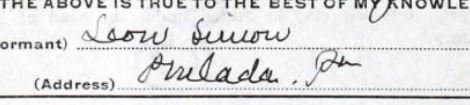
 The second strange thing is the name of the informant: Leon Simon.  Certainly Leon could not have signed his own death certificate.  I checked to see if there was another Leon Simon in the extended family who might have signed, and there was Leon (Dinkelspiel) Simon, the son of Moses Simon and Paulina Dinkelspiel, who was after all Leon (Wiler) Simon’s first cousin.  But that Leon was fifteen years older and lived in Baltimore.  I found it strange that he would be signing the death certificate when Leon the deceased had so many closer relatives living right in Philadelphia.

Leon Simon informant

Then I looked more closely and realized that the handwriting on the signature of the informant matched the handwriting of the local registrar, Wilson Reynolds.  The rest of the handwriting on the certificate matches that of the doctor, William McKelvey, who provided the cause of death.  I am not sure what to make of this except that perhaps Leon had provided all the information about his family to the sanitarium at some earlier point and that the doctor had then filled it out and the registrar just “rubber stamped” it by signing both Leon’s name and his own.

The final interesting piece of information on this certificate is the address provided as Leon’s last address before entering the sanitarium: 2513 South 18th Street.  You may remember that I also had trouble locating Leon’s brother Joseph on the 1910 census because there were so many men with that name in Philadelphia.   Using this address I found Joseph L. Simon living at that same address both on the 1910 and in the 1920 census reports as well as in the 1918 Philadelphia directory.  It is also the address that Joseph gave on the funeral bill for his brother Leon’s funeral in 1915.

Leon Simon funeral bill

On the two census reports, Joseph was married and living with his wife, Mary, who was nineteen years younger than he was.  The 1910 census reports that Joseph and Mary had been married for eight years, meaning they married in 1902. I’ve yet to find a marriage certificate.  Joseph was working as an accountant for a trust company (Providence Life & Trust Co, according to the funeral bill).

Provident Building, 401-09 Chestnut Street, Philadelphia, PA (1888-90, demolished 1945) in 1910. Library of Congress, Prints & Photographs Division, PA,51-PHILA,256A-1

Provident Building, 401-09 Chestnut Street, Philadelphia, PA (1888-90, demolished 1945) in 1910. Library of Congress, Prints & Photographs Division, PA,51-PHILA,256A-1


Mary was born in Virginia, as were both of her parents.  The only part of the 1910 census report that bothers me is that it says that Joseph’s father (Leman) was born in Pennsylvania; he was born in Germany.  It says that Joseph’s mother (Eliza) was born in Virginia; she was born in Pennsylvania.  But overall, it seems that this is definitely my Joseph Simon.  The address on Leon’s death certificate and funeral bill seem quite persuasive evidence of that conclusion.

The 1920 census did not help matters though.  On that census, Joseph’s parents are both listed as born in Virginia.  Very strange.  Could Mary have thought he was a Virginian like she was?  If he married her in 1902 as indicated on the 1910 census, Leman Simon was still alive.  I can’t imagine that a German immigrant sounded like a Virginian even after being in Pennsylvania for almost fifty years. Nevertheless, because they were still living at 2513 South 18th Street, I still believe that this is the right Joseph and Mary Simon.

And then Joseph and Mary disappear.  There are many, many Joseph and Mary Simons listed in directories in many, many places during this time period, yet the 1930 census does not have one  couple that fits my Joseph Simon even as closely as the 1910 and 1920 census reports.  This was the closest fit I could find for Joseph.

JOseph Simon 1930 census

Year: 1930; Census Place: Philadelphia, Philadelphia, Pennsylvania; Roll: 2102; Page: 20A; Enumeration District: 0572; Image: 389.0; FHL microfilm: 2341836

On this census the birth places of Joseph’s parents are correct: Germany and Pennsylvania.  The age is correct.  But the middle initial looks more like an H than an L.  There is no occupation, so that is no help.  Joseph’s marital status is given as single, and he is living at a lodger at what seems to be a very large boarding house.  I think this is Joseph.  If so, what happened to Mary?  Did she die? Did she leave him? I don’t know.  The trail has run dry.  It also ran dry on Joseph.  I cannot find him on the 1940 census nor have I found a record of his death.  He remains an elusive subject.

As for Flora Simon, she had been widowed back in 1901 when Nathan Strouse died, and she had remarried in 1903.  But that marriage did not last.  Although Flora was living with her second husband Albert Heulings in 1910, by 1917 he was married to another woman, Evelyn Cotton, according to both the Cook County, Illinois Marriage Index and his draft registration for World War I.

On the 1920 census, Flora was listed as divorced and living with her son Lester, now 31 years old.  Flora was working as the “keeper of an apartment house,” and Lester was in the advertising business.  There were also three lodgers plus Flora’s sister Nellie. Why was Nellie living with her sister? What had happened to her husband Louis? That’s when I looked and found the death certificate for Florrie Loux, a child I had not known about until I saw the 1920 census and looked for where Louis Loux might have been.

And that’s where the story really turns tragic.

I mentioned in my last post that I couldn’t find Nellie and Louis on the 1910 census and would not have known about their daughter if I had not found her death certificate.

Ancestry.com. Pennsylvania, Death Certificates, 1906-1963 [database on-line]. Provo, UT, USA: Ancestry.com Operations, Inc., 2014. Original data: Pennsylvania (State). Death certificates, 1906–1963. Series 11.90 (1,905 cartons). Records of the Pennsylvania Department of Health, Record Group 11. Pennsylvania Historical and Museum Commission, Harrisburg, Pennsylvania.

Ancestry.com. Pennsylvania, Death Certificates, 1906-1963 [database on-line]. Provo, UT, USA: Ancestry.com Operations, Inc., 2014.
Original data: Pennsylvania (State). Death certificates, 1906–1963. Series 11.90 (1,905 cartons). Records of the Pennsylvania Department of Health, Record Group 11. Pennsylvania Historical and Museum Commission, Harrisburg, Pennsylvania.

Florrie had died on September 21, 1918 from burns accidentally caused by matches.  A seven year old child.  There is nothing I can say to describe the horror I felt when I saw that death certificate.

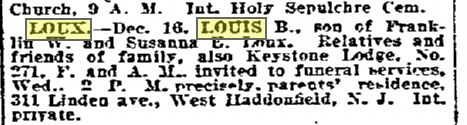
Three months later her father Louis B. Loux died from broncho pneumonia on December 15, 1918.

Philadelphia Inquirer December 17, 1918, p. 19

Philadelphia Inquirer December 17, 1918, p. 19

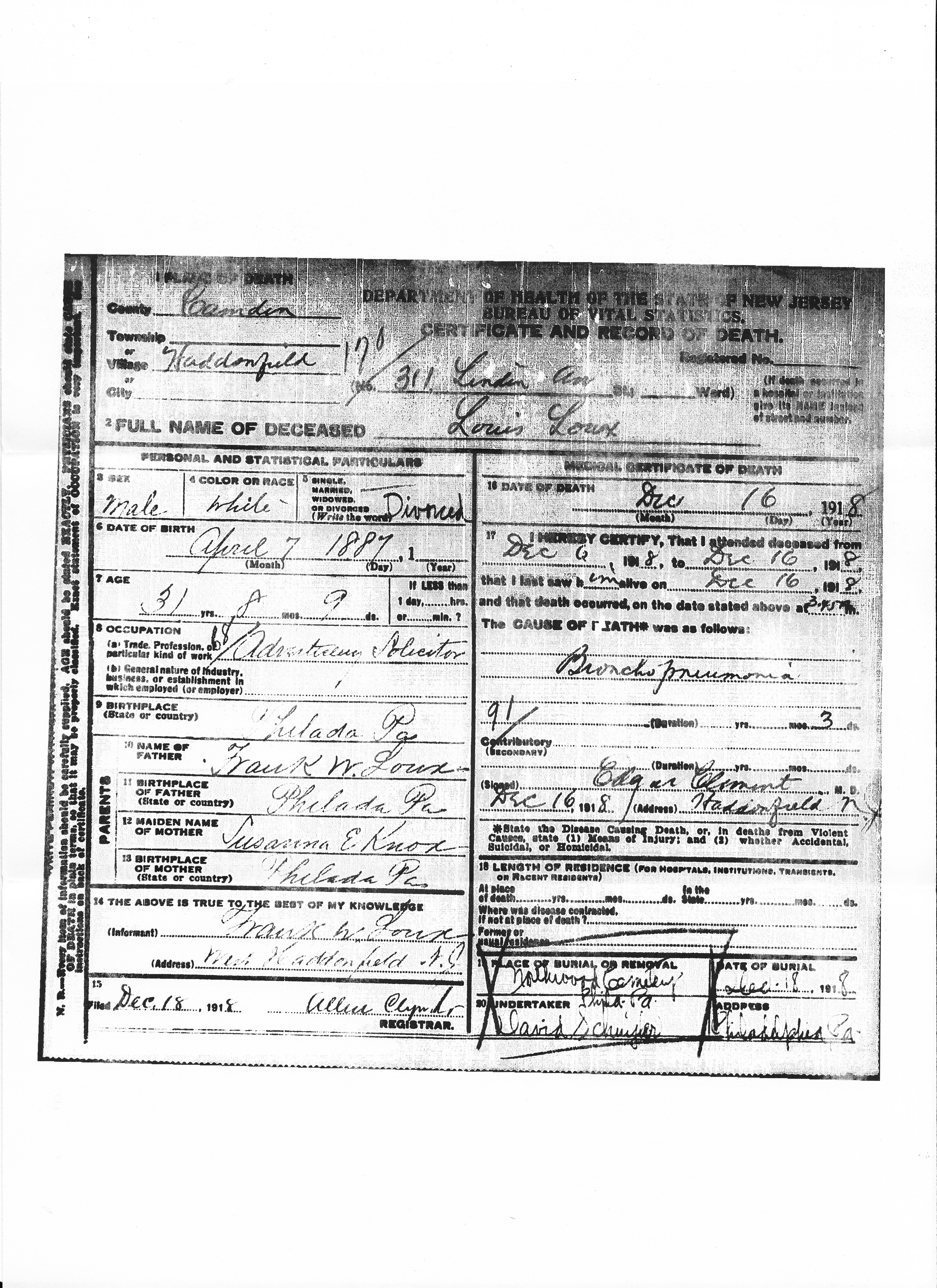
From his World War I draft registration, I know that in 1917 Louis had been working in Philadelphia doing advertising sales for the German Daily Gazette.  The home address he had provided for his 1917 draft registration, however,  was 311 Linden Street, Haddonfield, New Jersey.  The death notice for Louis indicated that that was his parents’ residential address in 1918.  But Florrie’s death certificate indicated that she and Louis both had been living at 128 North 10th Street in Philadelphia when she died.  I was able to obtain the information contained in the death certificate for Louis (I am still waiting the actual document), and it reports that he was divorced at the time of his death.  I cannot tell from these records whether Louis and Nellie had divorced before or after the death of their daughter.

UPDATE:  Here is the death certificate for Louis Loux.

Death certificates_0003_NEW

Think about it: between 1910 and 1920, Leon Simon had died from tuberculosis; Flora Simon, already widowed once, saw another marriage end; Joseph Simon was married, but sometime after 1920, his marriage seems also to have ended either by death or divorce; and Nellie Simon lost both her young daughter and her ex-husband in the space of a few months in 1918.  All this followed a decade where Leon, Flora, Joseph and Nellie had lost both of their parents and their sister Minnie.

Now you can see why I need something to lift my spirits.  Fortunately, as I will cover in my next post,  things were not as bad for the children of Fanny Wiler Levy or the children of Clara Wiler Meyers.  Not as bad.


Those Wily Wilers: Where were They in 1900?

Remember Fanny Wiler, the daughter of Caroline Dreyfuss and Moses Wiler, the one I could not find and thought might have been married to a man who killed himself and a child in a fire? Well, I still had not had any luck finding the real Fanny Wiler despite several more hours of going back over my research and looking more deeply into the sources.   Although I was doing pretty well with the rest of her family up through 1880, they also proved to be elusive as they approached the 20th century.

In 1880, Caroline and Moses Wiler were living in Philadelphia, and Moses had retired from his career as a merchant.  Their son Simon, then 37, was still living with his parents and working as a salesman.  Their daughter Eliza and her husband Leman Simon had moved to Pittsburgh where Leman was in the liquor business, and they had five children, Joseph, Flora, Nellie, Minnie, and Leon. While going back over my research, I discovered that Eliza and Leman had had one other child, Isadore, born in July, 1871, who died at 28 months on August 16, 1873.  I cannot decipher the cause of death.  Can anyone tell what it says?

UPDATE:  My expert says it says “Inflammation Brain.” Apparently doctors are trained to read each other’s awful handwriting.

Isadore A Simon death certificate FHL

“Pennsylvania, Philadelphia City Death Certificates, 1803-1915,” index and images, FamilySearch (https://familysearch.org/pal:/MM9.1.1/JKQ7-78S : accessed 6 February 2015), Isadore A Simon, 16 Aug 1873; citing , Philadelphia City Archives and Historical Society of Pennsylvania, Philadelphia; FHL microfilm 2,021,999.


When I last wrote about Eliza and Leman Simon, I was a bit puzzled by the seemingly impossibly close birth dates of Minnie and Leon, their youngest two children.  Two census reports indicated that Minnie was born in 1877, no earlier than August 1877 and possibly as late as December 1877, and Leon’s death certificate said he was born on June 13, 1878.  It just seemed very unlikely that Leon was born ten months (at most) after Minnie, but it was, of course, entirely possible.

But I went back to look again and realized that while Minnie was listed with the family on the 1880 census, Leon was not.  Further research uncovered this bill from his funeral, indicating that his birth date was June 13, 1881, not 1878, which makes a lot more sense.  Thus, the death certificate was most likely inaccurate (and there are other questions about that document, but I will get to that later).

Leon Simon funeral bill

Historical Society of Pennsylvania; Historic Pennsylvania Church and Town Records


Caroline and Moses Wiler’s youngest child, Clara, and her husband Daniel Meyers, a clothing merchant, were living in Philadelphia with their five children (as of 1880), Bertha, Leon, Samuel, Harry, and Isadore.

Thus, in 1880, I could account for Caroline Dreyfuss and Moses Wiler and three of their four children (all but Fanny) and their ten grandchildren.  Then things start getting a bit more difficult.  Although I found burial records for Caroline indicating that she had died on December 21, 1885, and was buried at Mt. Sinai cemetery in Philadelphia, I cannot locate a death certificate for her in the Philadelphia City Death Certificates 1803-1915 database on familysearch.org.  On the other hand, I was able to locate a death certificate for her husband Moses in that database; he died almost exactly two years later on December 26, 1887, and was also buried at Mt. Sinai.

Moses Wiler death certificate

“Pennsylvania, Philadelphia City Death Certificates, 1803-1915,” index and images, FamilySearch (https://familysearch.org/pal:/MM9.1.1/J6S6-XY5 : accessed 6 February 2015), Moses Simon, 27 Jan 1897; citing cn 15654, Philadelphia City Archives and Historical Society of Pennsylvania, Philadelphia; FHL microfilm 1,869,753.


Moses Wiler was residing at 1638 Franklin Street at the time of his death in 1887, and that is the same address listed for his son-in-law Leman Simon in the 1887 Philadelphia directory.  I don’t know whether Moses had moved in with Leman, Eliza, and their children, or vice versa.  Since Leman and Eliza had been listed in the 1884 directory for Pittsburgh, it could be that they had moved back to Philadelphia sometime around or after Caroline’s death to be with Moses.  Leman’s occupation is listed as “salesman” in that 1887 Philadelphia directory without any indication of whether he was still selling liquor.

Assuming that Eliza and Leman returned to Philadelphia around 1885 or so, their children would have been still relatively young: Joseph 21, Flora 19, Nellie 11, Minnie 7, and Leon 4.  Certainly the youngest three would still have been living at home.  Joseph appears to have been in Pittsburgh until at least 1886, as there is a Joseph L. Simon listed there, selling cigars and tobacco products, a business line that was being practiced by other members of the family during that time, including Joseph’s great-uncle John Nusbaum.  After that, however, he does not appear in the Pittsburgh directory as far as I can tell.

Eliza and Leman’s daughter Flora married Nathan Strouse in Philadelphia in 1888 when she was 22 and he was 46. Their son Lester Nathan Strouse was born on December 15 of that year.  In the 1890 Philadelphia directory, Nathan was listed as associated with Strouse, Loeb, and Company, clothiers.

Leman and Eliza were still living at 1638 Franklin until 1890 when they are listed at 1821 Franklin Street.  Joseph also is listed in the 1890 directory at that address, so he must have been living with his parents at that time along with the three younger children, Nellie, Minnie, and Leon.  Joseph was working as a clerk.  He may have moved out by 1892 because there are two Joseph Simons listed as salesman in the Philadelphia directory for that year, though I cannot be completely certain either is the correct Joseph Simon.

In 1897, Leman and Eliza (Wiler) Simon were living at 1537 Montgomery Street.  Eliza died of apoplexy on August 18, 1897.  She was 55 years old.  Leman continued to live at 1537 Montgomery Street through 1899, according to the Philadelphia directory of that year, which listed him once again as a salesman.

Eliza Simon death certificate 1897

“Pennsylvania, Philadelphia City Death Certificates, 1803-1915,” index and images, FamilySearch (https://familysearch.org/pal:/MM9.3.1/TH-266-11571-16485-19?cc=1320976 : accessed 6 February 2015), 004009659 > image 190 of 1791; Philadelphia City Archives and Historical Society of Pennsylvania, Philadelphia.


Now things get very sticky.  I had a very hard time locating the family of Eliza and Leman Simon on the 1900 census.  The only one I am certain about is Flora and her husband Nathan Strouse and son Lester Strouse.  On the 1900 census, Flora, Nathan, and Lester were living at 913 North 16th Street, and Nathan was 57 years old and did not provide an occupation for the census.  Living with them was a 30 year old woman named Nettie Dreifuss, born in 1870 in Illinois whose parents were born in Germany and Pennsylvania, as were Flora’s parents.  She is identified as the niece of the head of the household, Nathan.

Flora and Nathan Strouse 1900 census

I first wondered whether this was Nellie, Flora’s sister.  But Nellie was born in 1874 in Pennsylvania, not 1870 in Illinois, and she was Nathan’s sister-in-law, not his niece.  I then spent most of a day trying to find out whether Nathan had a sister who married a Dreifuss.  He did have several sisters: Rebecca, who never married; Gussie, who married Joseph DeYoung and had one daughter Harriet; Henrietta, who married Leopold Lewis and had two daughters, Minnie and Fanny; and Rachel, who married Ed Henrinan (?), but apparently was divorced and had no children.  I thought that perhaps it was one of Henrietta and Leopold Lewis’ daughters, but neither was named Nettie, and I located both elsewhere on the 1900 census.  So the “niece” did not appear to be Nathan’s niece.

If Nettie Dreifus was not Nathan’s niece, was she Flora’s niece? None of Flora’s siblings was married in 1900; none of them had had children.   I still don’t know who Nettie was.  But her name was Dreifuss, Caroline Wiler’s birth name.  Could this be a daughter of a Dreifuss/Dreyfuss brother whom I’ve yet to find?  That’s a research path I will need to pursue further.

But at least I knew where Flora and her family were living in 1900.  Her father and her siblings proved much more elusive.  I had a very hard time locating Leman Simon and his son Leon on the 1900 census, but I believe that this is Leman and Leon living together at 1514 Brown Street as Leon, Sr., and Leon, Jr.

Leman and Leon 1900 census

Why do I think this is Leman? Because he is a 64 year old widow born in Germany who immigrated in 1866 and who was working as a salesman.  Although my records show that Leman would have been 65 and that he immigrated in 1856, the numbers are close enough, given the general unreliability of census data.  In addition, Leon, Jr. fits with my Leon roughly also: born in 1880 in Pennsylvania to parents born in Germany and working as a clerk.  Again, it’s not perfect.  Leon was born in 1881, and his mother Eliza was born in Pennsylvania. So I am not at all positive that this is Leman and Leon, but they are the closest matches I can find on the 1900 census.

Despite using as many resources and wildcard searches as I could imagine, I cannot find Joseph at all on the 1900 census.  I even had assistance from Antoinette from the Facebook Pennsylania Genealogy group, but neither of us could find him.  There is a Joseph L. Simon living at 2137 North 18th Street in the 1901 Philadelphia directory, the same address that is given for Le(h)man Simon for that year, so I assume that is the right Joseph, working as a clerk with his father working as a salesman.  But Joseph is not listed at that address in the 1900 census nor is Leman, so they must have moved there in 1901.

As for Minnie and Nellie, I think I found them on the 1900 census, but cannot be 100% sure.  I found a Minnie Simon and a “Millie” Simon living at 2628 Diamond Street on the 1900 census.  Both are listed as boarders.  Minnie is listed as a single woman born in 1877 in Pennsylvania with a mother born in Pennsylvania and a father born in Germany; that matches Minnie correctly.  No occupation is given.

Year: 1900; Census Place: Philadelphia Ward 32, Philadelphia, Pennsylvania; Roll: 1473; Enumeration District: 0809; FHL microfilm: 1241473

Year: 1900; Census Place: Philadelphia Ward 32, Philadelphia, Pennsylvania; Roll: 1473; Enumeration District: 0809; FHL microfilm: 1241473

I was quite certain that this was Minnie, but it took me a while to think that “Millie” was Nellie because although they are both at the same address, Minnie is listed as a boarder in the household of Bertha Lipper, and Millie is listed as the head of household in a boarding house at the exact same address with sixteen boarders.  “Millie” was a single woman born in 1874 in Pennsylvania whose parents are listed as born in Germany, both mother and father.  Although Nellie’s mother was born in Pennsylvania, not Germany, the age and marital status are correct, and the name is quite similar.  Once again, I cannot be completely certain that this is Nellie, but I am pretty sure.  I think it was really one large boarding house where the two sisters were living.  I am not sure why “Millie” was also described as a head of household.

Thus, if my hunches here are all correct about Leman Simon and his children, only Joseph Simon was really missing from the 1900 census.  Leman was living as a boarder with his son Leon; Nellie was living as a boarder with her sister Minnie.  Flora was married and living with her husband Nathan Strouse and son Lester and a mysterious niece.  When I mapped out where they all were living, I realized that Flora was living just a few blocks from where Leman and Leon might have been living, but Minnie and Nellie were about two miles further north.  If Joseph was already living at 2137 North 18th Street sometime during that year, he was less than a mile from Minnie and Nellie.

As for the other children of Caroline Dreyfuss and Moses Wiler, Simon, Fanny, and Clara, Simon was working as a clerk in a hotel where he also resided in 1900 at 152 North 7th Street. He was single and 56 years old.  Clara and her husband Daniel Meyers were now living at 920 North Franklin Street.  Clara and Daniel had had five children as of 1880; between 1880 and 1896 they had had eight more children, including one stillbirth.  But in 1882, they lost their first born child Bertha to heart disease.  She was only nine years old.

"Pennsylvania, Philadelphia City Death Certificates, 1803-1915," index and images, FamilySearch (https://familysearch.org/pal:/MM9.3.1/TH-267-11083-70387-38?cc=1320976 : accessed 6 February 2015), 004058695 > image 726 of 994; Philadelphia City Archives and Historical Society of Pennsylvania, Philadelphia.

“Pennsylvania, Philadelphia City Death Certificates, 1803-1915,” index and images, FamilySearch (https://familysearch.org/pal:/MM9.3.1/TH-267-11083-70387-38?cc=1320976 : accessed 6 February 2015), 004058695 > image 726 of 994; Philadelphia City Archives and Historical Society of Pennsylvania, Philadelphia.

Thus, as of 1900, Clara Wiler and Daniel Meyers had eleven surviving children, all of them still living at home.

And, of course, Fanny Wiler still remained unaccounted for.  Or was she? Stay tuned…


The Dinkelspiel Descendants in the 20th Century

In my last post, I covered four of the five children of Paula Dinkelspiel and Moses Simon.  The remaining child was their fourth child, Flora, born in 1868.  Flora Simon married Charles Mayer in 1889.  Charles was born in Lancaster, Pennsylvania, in 1857, the son of Jacob Mayer and Mathilde Shoyer.  The family had moved to Philadelphia by the time Charles was three.  His father was a merchant on the 1860 census and in the wholesale liquor business on the 1870 census, but by 1880 and thereafter, he listed his occupation as a dentist.  He was a man with eleven children, and that made me wonder how he became a dentist while raising such a large family.

Most early “dentists” were actually barbers, blacksmiths, or apothecaries.  Sometimes physicians would do extractions.  Infection control was minimal, as was anesthesia.  According to the American Dental Association website, the first dental school in the world was established in 1841 in Baltimore.  Alabama enacted the first law to regulate the practice of dentistry also in 1841, but it was never enforced.  The American Dental Association was founded in 1857.  Pennsylvania had three dental schools by 1880, the newest being that established by the University of Pennsylvania.

Perhaps Jacob Mayer attended one of these, although I do not know when he would have had the time.  The earliest reference I could find to a Pennsylvania law regulating the practice of dentistry was this April, 16, 1879 article from the Harrisburg Telegraph, describing a bill being considered by the state legislature.

Harrisburg Telegraph April 16, 1879 p.1

Harrisburg Telegraph April 16, 1879 p.1

The bill was passed on a second reading, according to a May 16, 1879, article in the same paper (p.1).  Here is a description of that bill as reported the next day:

Harrisburg Telegraph May 17, 1879, p. 4

Harrisburg Telegraph May 17, 1879, p. 4

Thus, by the time Jacob Mayer was practicing dentistry, there was some state regulation of the practice.

At any rate, his son Charles did not follow him in to this practice.  By 1875 when he was eighteen, Charles was working as a salesman, though still living at home.  In the 1879 Philadelphia directory, he is listed as a bookkeeper, and on the 1880 census, he is a clerk, but in the 1880 directory, his occupation is salesman.  He was still living at home with his parents at this time.

After marrying Flora Simon in 1889, Charles and Flora remained in Philadelphia for a few more years and  Charles continued to work as a salesman.  Their first child Jerome was born in 1890, and their second child Madeline was born in 1892.  A third child, Evelyn, was born in October, 1895 according to the 1900 census (although her headstone says 1894), but I am not sure whether she was born in Philadelphia or in Lancaster because by 1896, the family had relocated to Lancaster, where Charles had been born almost forty years earlier.  He is listed in the 1896 Lancaster directory as the proprietor of the Parisian Cloak and Suit Company.  The family remained in Lancaster until at least 1901, when Charles is still listed as the proprietor of the same company.

"Downtown Lancaster, Pennsylvania 1874" by Author unknown. From the personal collection of historian Ronald C. Young of Brownstown, Pennsylvania. Published in the Lancaster Sunday Newspaper in November 2008. - http://articles.lancasteronline.com/local/5/229862/mon2. Licensed under Public Domain via Wikimedia Commons - http://commons.wikimedia.org/wiki/File:Downtown_Lancaster,_Pennsylvania_1874.jpg#mediaviewer/File:Downtown_Lancaster,_Pennsylvania_1874.jpg

“Downtown Lancaster, Pennsylvania 1874” by Author unknown. From the personal collection of historian Ronald C. Young of Brownstown, Pennsylvania. Published in the Lancaster Sunday Newspaper in November 2008. – http://articles.lancasteronline.com/local/5/229862/mon2. Licensed under Public Domain via Wikimedia Commons – http://commons.wikimedia.org/wiki/File:Downtown_Lancaster,_Pennsylvania_1874.jpg#mediaviewer/File:Downtown_Lancaster,_Pennsylvania_1874.jpg

By 1904, however, the family had returned to Philadelphia, and Charles is listed as affiliated with the A.J.S. Bowers Company, also known as the Philadelphia Cloak and Suit Company.  He listed his occupation on the 1910 census as a clothing manufacturer and continued to be associated with A.J.S. Bowers.  By 1914, however, he had started his own business, Charles S. Mayer & Co, and on the 1920 census described his business as a manufacturer of ladies’ dresses.

The three children of Flora and Charles Mayer, all now in their twenties, were still living at home with their parents in 1920.  Jerome was working as a salesman of ladies’ dresses, presumably in his father’s business.  Madeline was a primary school teacher, and so was her sister Evelyn.

Madeline married Gustave Winelander in 1925. Gustave was a 1914 graduate of the University of Pennsylvania with a B.S. in Chemistry.  He served in the US military forces during World War I and then was working as a chemist in 1918 according to the 1918 Philadelphia directory.  The 1920 census records that he and his father Max had their own extract business, and from later census and directory listings I determined that he was selling flavoring extracts used in baking.   Gustave and Madeline would have one daughter, Joan.

Flora and Charles Mayer’s youngest child, Evelyn, married Irving Frank sometime in or before 1922, as their son Irving was born in York, Pennsylvania, in January, 1922.  Irving, Senior, was born in New York City in 1893, but by 1903 he and his parents and siblings had relocated to Lancaster, Pennsylvania, where his younger sister Mildred was born.  In 1910, his father was a milliner, like Flora’s uncle, Joseph Simon.  Since York was only 26 miles from Lancaster, perhaps the two hat merchants knew each other.

Irving attended Lehigh University in 1912 and 1913, as a civil engineering major.  On his World War I draft registration, he listed his occupation as a manager at M. Frank in Lancaster, but by 1920 he was living in York with his aunt and uncle, working as a clerk in a department store.  Maybe he met Evelyn while working there when she was visiting her aunt and uncle, Joseph and Emilie Simon.  After marrying sometime thereafter, Irving and Evelyn settled in York, as Irving is listed a buyer there in the 1925 York directory.  By 1927, however, he was the proprietor of the Fashion Millinery in Lancaster, joining the same trade as his father and Evelyn’s uncle Joseph Simon.

Jerome, Madeline, and Evelyn’s mother Flora Simon Mayer died August 20, 1927, and was buried at Mt. Sinai cemetery in Philadelphia.  She died of bronchial pneumonia.  She was only 59 years old.

Ancestry.com. Pennsylvania, Death Certificates, 1906-1963 [database on-line]. Provo, UT, USA: Ancestry.com Operations, Inc., 2014.

Ancestry.com. Pennsylvania, Death Certificates, 1906-1963 [database on-line]. Provo, UT, USA: Ancestry.com Operations, Inc., 2014.

After Flora died, her husband Charles and her son Jerome continued to live together and work together in the women’s clothing business at least until 1930.  Sometime between 1930 and 1940, Jerome married Mabel Bamberger Sichel, who had a daughter Marion from an earlier marriage.  On the 1940 census, Jerome, Mabel, and Marion are living in the same house on Diamond Street that Jerome had lived in with his parents and sisters, and his father Charles and Mabel’s mother Rose Bamberger were living with them as well.  Jerome was working in the cheese business.

Irving  Frank remained a milliner in Lancaster for many years, at least until the early 1940s.  He died November 14, 1946, and was residing in York at that time. He was only 53 years old.  He was buried at Prospect Hill cemetery in York where Joseph, Emilie, and Moses Joseph Simon were buried.


Charles Mayer outlived his wife Flora by almost thirty years, dying at the age of 98 on July 7, 1955.  He was buried with her at Mt. Sinai cemetery.  His son Jerome died in December 1966 and is also buried at Mt. Sinai with his wife Mabel, who died in 1973.  Jerome’s sister Madeline died in 1968; her husband Gustave lived until 1989 when he was 95 years old; they also are buried at Mt. Sinai in Philadelphia.

For longevity, however, the prize goes to Evelyn Mayer Frank, who died in 2002 at the age of 107.  She is buried with her husband Irving in the Prospect Hill cemetery in York, Pennsylvania.  Imagine the changes she saw in her world between her birth in 1894 and her death in 2002.  I hope that her descendants and her siblings’ descendants had many opportunities to learn from her experiences and to hear her stories.


No More Dinkelspiels

My three-times-great-grandfather John Nusbaum had one sister who settled in the US (or at least she is the only one I’ve found): Mathilde Nusbaum, who married Isaac Dinkelspiel in Germany and immigrated with him to Harrisburg, Pennsylvania. As I have already discussed, Mathilde died in 1878, and her husband Isaac Dinkelspiel died in 1889.  Their son Adolph died in 1896, and he had no children who survived him.  That left Mathilde and Isaac’s two daughters, Paulina and Sophia, to continue the family line, although not the Dinkelspiel name.  Sadly, Adolph Dinkelspiel was the last member of my family to have this rather unique and interesting name.

This post will focus on the family of Paulina Dinkelspiel. Paulina had married one of the three Simon brothers, Moses, and in 1880 they were living in Baltimore with their children: Joseph, Francis, Leon, Flora, and Nellie, ranging in age from eighteen down to eight years old. Moses was in the retail liquor business.  Moses remained in the liquor business throughout the 1880s and 1890s until he died on February 12, 1899, at age 64.  His wife Paulina Dinkelspiel Simon died five years later on March 29, 1904.  She was 63.

Paulina Dinkelspiel Simon death certificate

Paulina Dinkelspiel Simon death certificate


The terms of Paulina Dinkelspiel Simon’s will were disclosed in a news story in the April 16, 1904, edition of the Baltimore Sun, page 8.  She left her house and its contents to her daughter Nellie.  Her granddaughter Madeline Mayer (daughter of Flora Simon Mayer, to be discussed in my next post) was given $500, and the rest of the estate was divided evenly among her five surviving children, Joseph, Francis, Leon, Flora, and Nellie.  It is interesting that she singled out one child and one grandchild over the others.

Baltimore Sun April 16, 1904, p 8

Baltimore Sun April 16, 1904, p 8

Paulina was buried at Oheb Shalom cemetery in Baltimore along with her husband Moses, her parents Isaac and Mathilde (Nusbaum) Dinkelspiel, and the two children who predeceased her and Moses, Albert and Miriam.

Paulina and Moses Simon’s oldest child Joseph Simon had married Emilie Baernstein in July, 1889, in Baltimore, where she was born and raised.  By 1902, Joseph and Emilie had moved to York, Pennsylvania, where Joseph purchased a millinery shop.

York Daily, January 13, 1902.

York Daily, January 13, 1902.

Joseph and Emilie had a son Moses Joseph Simon, born in 1902, who died in May, 1908.  Unfortunately, I could not locate a death certificate for Moses, so I do not know the cause of death.  All I could locate was this notice of his funeral in the York Daily newspaper and his headstone.

York Daily May 4, 1908 p. 5

York Daily May 4, 1908 p. 5


Joseph and Emilie did not have any other children. They were members of the Hebrew Reformed Congregation in York and supporters of the local symphony orchestra. Joseph worked as a milliner in York for many years until his death in April 1928.  Emilie lived another twelve years.  After Joseph died, she relocated to Baltimore, where she died in 1940.  They were buried with their son Moses at the Prospect Hill Cemetery in York, Pennsylvania.

simon-joseph-0 headstone simon-amelia-0

(Emilie’s official name appears to have been Amelia.)


simon-moses-0

(All headstone images found at http://usgwarchives.net/pa/york/1picts/cemeteries/prospect-hill-york-city/main/prospect-hill-s.htm )

Joseph’s younger brother Francis Simon, known as Frank, was working as a clerk in 1895, and in 1900 he was living with his mother and younger sister Nellie, still listing his occupation as a clerk.  Like his brother Joseph, Frank married a woman born and raised in Baltimore, Bertha May.  According to the 1930 census, Frank married Bertha when he was 40 years old and she was 34, or in 1904.  They did not have any children.  In 1910, Frank and Bertha were living with Bertha’s father and her sister Tillie and brother-in-law Joseph Wurtzburger and their children.  Frank was working as the treasurer of a mercantile business.  In 1920 Frank and Bertha were living on their own, and neither was employed.  Frank was 54, and Bertha was 50. In the 1922 Baltimore directory, however, Frank is listed as being in the soft drinks business.  The 1930 census again lists them without occupations.

Frank died January 31, 1932, and is buried at the Baltimore Hebrew cemetery; Bertha was living with her widowed sister, Tillie Wurtzburger, at the time of the 1940 census.  Her sister Tillie died in 1945, and Bertha died in June, 1951, at the age of 81.

The third child of Paulina Dinkelspiel and Moses Simon was Leon Simon, born in 1866, two years after Frank.  By 1895 Leon had his own company, L. Simon and Co., listed in the Baltimore directory as a cloak manufacturing company.  He married Helen Wolf the following year in Harrisburg, Pennsylvania.  Helen was born in Harrisburg, and her father William was a real estate agent there, according to the 1880 census.  Perhaps Frank’s mother Paulina had known the Wolf family when she was growing up in Harrisburg.

Leon and Helen had two sons, William Wolf Simon, born in 1897, and Mervyn Moses Simon, born in 1900: the first named for Helen’s father and the second for Leon’s father, who had died the year before.  Leon had no occupation listed on the 1900 census, but the 1902 Baltimore directory still listed him with L. Simon and Co.  On the 1910 census, however, his occupation appears to read “General Manager Furniture Business;” in the 1914 directory, his firm name now appears as Salontz & Simon, so it would seem that his cloak business no longer existed. I found a listing in a 1904 Pittsburgh directory for the Baltimore firm of Salontz & Simon in the fur business category.  The 1920 census is consistent with this, as it gives his occupation as a manufacturer of furs.  In 1930 he was still in the fur business, though now his occupation is described as a fur retail merchant. The 1940 census also described him as a retail furrier.

By Doug Coldwell (Own work) [CC BY-SA 3.0 (http://creativecommons.org/licenses/by-sa/3.0) or GFDL (http://www.gnu.org/copyleft/fdl.html)], via Wikimedia Commons

By Doug Coldwell (Own work) [CC BY-SA 3.0 (http://creativecommons.org/licenses/by-sa/3.0) or GFDL (http://www.gnu.org/copyleft/fdl.html)%5D, via Wikimedia Commons

All through these decades, Leon and Helen’s two sons lived with them, and they worked in their father’s fur business once they were old enough.  Neither son ever married.  Leon died on August 29, 1941, and his son Mervyn died the following year on August 27, 1942.  He was only 42 years old.  I have ordered a death certificate for Mervyn to determine his cause of death.

UPDATE: Here is Mervyn’s death certificate.

Mervyn Simon death certificate

William Simon, the older brother, continued to live with his mother at least until 1956 when both are listed at the same address in the Baltimore directory.  (No occupation was listed.)  Helen Wolf Simon died November 29, 1965, and William died less than a year later on October 4, 1966.  All four members of the family are buried at Baltimore Hebrew Congregation.

I am going to skip the fourth child Flora for now and move on to the fifth child, Nellie Simon, the one who inherited the house from her mother Paulina Dinkelspiel Simon.  I had a lot of trouble figuring out what happened to Nellie after her mother died in 1904.  In 1900 she had been living with her mother and brother Frank; she was 27 years old and had no occupation listed. She is also listed in the 1902 directory at the same address at 844 North Howard Street, again with no occupation listed.  Since her mother bequeathed that house to Nellie when she died in 1904, I expected to find Nellie living there in 1910.  But I could not find her there, and although there was another Nellie Simon working as a hairdresser in Baltimore in the 1910s, the address was not the same.

One tree on ancestry.com listed Nellie as married to an Adolph Feldstein, but I could not find any direct sources to corroborate that marriage.  I was able to find Adolph and Nellie S. Feldstein on the 1910 census as well as the 1920 and 1930 census reports living in Philadelphia.  The facts about that Nellie seemed consistent with my Nellie Simon: her age, parents’ birth places, and her birth place were all right, although the latter two census reports had her place of birth as Maryland instead of Pennsylvania.  I still felt uncertain until I found a bill from the funeral home in charge of Nellie’s funeral in 1958.  The document listed Horace A. Stern as the person responsible for the bill.  Although at first the name did not ring a bell, a quick search of my own family tree revealed that Horace Stern was married to the granddaughter of Nellie’s sister Flora.  That was enough to convince me that the Nellie who had married Adolph Feldstein was in fact Nellie Simon, the youngest child of Paulina Dinkelspiel and Moses Simon and the grandchild of Mathilde Nusbaum and Isaac Dinkelspiel.

Nellie and Adolph Feldstein did not have any children.  Adolph worked in his father’s business manufacturing “haircloth.”  I had never heard this term before, but a quick look on the internet revealed that according to the Merriam-Webster dictionary online, it is “any of various stiff wiry fabrics especially of horsehair or camel hair used for upholstery or for stiffening in garments.”   Adolph was the secretary and treasurer of the company in the 1910s, and he continued to work in the business throughout the 1920s and the 1930s until his death by suicide in 1937.  As mentioned above, Nellie lived another twenty years, passing away in 1958.

Hair Cloth Loom

Hair Cloth Loom

It’s interesting that three of these siblings were all involved in the clothing trade, although different aspects of it: hats, furs, and haircloth.  (I am not really sure how Frank supported himself and his wife.)  It’s also interesting that three of the five children of Paulina Dinkelspiel and Moses Simon did not have children who survived them.  Joseph’s one child passed away as a little boy, and Frank and Nellie married but never had children. Leon did have two sons who grew to adulthood, but his sons never married or had children, so there were no descendants to carry on his family line.  Only Flora, the remaining sibling, had grandchildren and further generations of descendants.  I will discuss her and her descendants in my next post.

Back to the Real World and the 1870s…

And I am back from vacation.  We had a wonderful time, and not having reliable internet access may have been a blessing.  I couldn’t do any new research or posting to the blog so my brain had a chance to clear.  Always a good thing.  I did, however, have one more post “in the bank” that I prepared before I left, so here it is. I was awaiting a few more documents, hoping they would answer a few questions, and I received some while away that I have just reviewed.

I wish I could post a somewhat more uplifting post for the holiday season, but I can’t deny the sad fact that some of my relatives suffered considerable sadness in their lives.  On the other hand, researching and writing about the families of Leopold Nusbaum and his sister Mathilde Nusbaum Dinkelspiel only made me appreciate all my blessings.  So in that sense it is perhaps appropriate.  Nothing can make you appreciate all you have more than realizing how little others have.

So here is the story of two of the Nusbaum siblings, one of the brothers and one of the sisters of my three-times great-grandfather John Nusbaum.

Leopold Nusbaum had died in 1866 when he was 58 years old, leaving his widow Rosa and daughter Francis (how she apparently spelled it for most of her life) behind. Leopold and Rosa had lost a son, Adolph, who died when he was just a young boy.  Francis was only 16 when her father died.  After Leopold died, Rosa and Francis moved from Harrisburg to Philadelphia and were living in 1870 with Rosa’s brother-in-law, John Nusbaum.

Late in 1870, Francis Nusbaum married Henry N. Frank.  Henry, the son of Nathan and Caroline Frank, was born in Lewistown, Pennsylvania, where Leopold’s brother Maxwell Nusbaum and his family had once lived before relocating to Harrisburg.  Henry’s father Nathan Frank was in the dry goods business, so the Nusbaums and Franks might have known each other from those earlier times. Nathan, Caroline, and their children had relocated to Philadelphia by 1870 and were living on Franklin Avenue right near the Simons, Wilers, and other members of the Nusbaum/Dreyfuss clan.  Perhaps that is how Francis and Henry met, if not from an earlier family connection.

Not long after they were married, Henry and Francis must have moved back to Lewistown because their first child, Leopold, was born there on August 11, 1871.  Leopold was obviously named for Francis’ father.  A second child, Senie, was born in May 1876, and then another, Cora, was born in 1877.  In 1880, Henry and Francis were living in Lewistown with their three young children as well as Francis’ mother Rosa and Henry’s father Nathan. Maybe Nathan was shuttling back and forth between Lewistown and Philadelphia because he is listed on the 1880 census in both places, once with Henry and Francis and then again with Caroline and their other children.  Both Henry and his father Nathan listed their occupations as merchants.

Lewistown Town Square By KATMAAN (Own work) [CC BY-SA 3.0 (http://creativecommons.org/licenses/by-sa/3.0) or GFDL (http://www.gnu.org/copyleft/fdl.html)], via Wikimedia Commons

Lewistown Town Square
By KATMAAN (Own work) [CC BY-SA 3.0 (http://creativecommons.org/licenses/by-sa/3.0) or GFDL (http://www.gnu.org/copyleft/fdl.html)%5D, via Wikimedia Commons

Unfortunately, there is not much else I can find about Henry, Francis, or their children during the 1870s because Lewistown does not appear to have any directories on the ancestry.com city directory database. Lewistown’s population in 1880 was only a little more than three thousand people, which, while a 17% increase from its population of about 2700 in 1870, is still a fairly small town.  It is about 60 miles from Harrisburg, however, and as I’ve written before, well located for trade, so the Frank family must have thought that it was still a good place to have a business even if the rest of the family had relocated to Philadelphia.

Mathilde Nusbaum Dinkelspiels’ family is better documented.  She and her husband Isaac had settled and stayed in Harrisburg, which is where they were living as the 1870s began. Isaac was working as a merchant.  Both of their children were out of the house.  Adolph was living in Peoria at the same address as his cousin Julius Nusbaum and working with him in John Nusbaum’s dry goods store in that city.  On January 4, 1871, Adolph Dinkelspiel married Nancy Lyon in Peoria, and their daughter Eva was born a year later on January 25, 1872.  Adolph and Nancy remained in Peoria, and by 1875 Adolph was listed as the “superintendent” of John Nusbaum’s store.  (Julius does not appear in the 1875 directory, though he does reappear in Peoria in 1876.)

On November 28, 1879, his daughter Eva died from scarlet fever.  She was not quite eight years old.  Adolph and Nancy did not have other children, and this must have been a devastating loss.

eva dinkelspiel death cert

In fact, shortly thereafter Adolph, who had been in Peoria for over sixteen years, and Nancy, who was born there and still had family there, left Peoria and relocated to Philadelphia.  On the 1880 census, Adolph was working as a clothing salesman and Nancy as a barber.  (At least that’s what I think it says.  What do you think?)  Perhaps Adolph and Nancy left to find better opportunities or perhaps they left to escape the painful memories.  Whatever took them away from Peoria, however, was enough that they never lived there again.

adolph dinkelspiel snip 1880 census

Adolph and Nancy did not remain in Philadelphia for very long, however.  By 1882 Adolph and Nancy had relocated to St. Louis, Missouri, where Adolph worked as a bookkeeper for many years.  They remained in St. Louis for the rest of their lives.  Adolph died on November 25, 1896, and Nancy less than a year and a half later on March 5, 1898. Adolph was only 53, and Nancy was not even fifty years old.

My cousin-by-marriage Ned Lewison sent me a copy of Nancy’s obituary from the March 7, 1898 Peoria Evening Star.  It reported the following information about Nancy and Adolph Dinkelspiel:

“She married Adolph Dinkelspiel, at that time manager of the Philadelphia store on the corner of Main and Adams Street, one of the leading dry goods houses in Peoria.  When the house failed, they removed to St. Louis and lived happily together until the death of Mr. Dinkelspiel, when his widow came to this city.  But she preferred St. Louis for a residence, and although she made frequent visits to Peoria, she did not take up residence here.”

I found two points of interest in this obituary.  One, there is no mention of their daughter Eva.  And two, it reveals that the Nusbaum store in Peoria had closed, prompting Nancy and Adolph to relocate.  Thus, Adolph and Nancy not only suffered a terrible personal loss, like many others in the family and in the country, they were negatively affected by the economic conditions of the 1870s.

Nancy and Adolph are both buried, along with their daughter Eva, in Peoria.  Only death, it seems, could bring them back to Peoria.

dinkelspiel headstone

Adolph’s sisters Paulina and Sophia Dinkelspiel did not have lives quite as sad as that of their brother, but they did have their share of heartbreak.  Sophia, who had married Herman Marks in 1869, and was living in Harrisburg, had a child Leon who was born on October 15, 1870.  Leon died when he was just two years old on October 24, 1872.  I do not know the cause of death because the only record I have for Leon at the moment is his headstone.  (Ned’ s research uncovered yet another child who died young, May Marks, but I cannot find any record for her.)

leon marks headstone

Sophia and Herman did have three other children in the 1870s who did survive: Hattie, born May 30, 1873, just seven months after Leon died; Jennie, born August 24, 1876; and Edgar, born August 27, 1879.  Herman worked as a clothing merchant, and during the 1870s the family lived at the same address as the store, 435 Market Street in Harrisburg.

Paulina (Dinkelspiel) and Moses Simon, meanwhile, were still in Baltimore in the 1870s.  In 1870 Moses was a dealer “in all kinds of leather,” according to the 1870 census. At first I thought that Moses and Paulina had relocated to Philadelphia in 1871 because I found a Moses Simon in the Philadelphia directories for the years starting in 1871 who was living near the other family members and dealing in men’s clothing.  But since Moses and Paulina Simon are listed as living in Baltimore for the 1880 census and since Moses was a liquor dealer in Baltimore on that census, I realized that I had been confused and returned to look for Moses in Baltimore directories for that decade.

Sure enough, beginning in 1871 Moses was in the liquor business, making me wonder whether the 1870 census taker had heard “liquor” as “leather.”  After all, who says they deal in all kinds of leather?  All kinds of liquor makes more sense.  Thus, like the other members of the next generation, Adolphus and Simon Nusbaum in Peoria, Leman Simon in Pittsburgh, and Albert Nusbaum in Philadelphia, Moses Simon had become a liquor dealer.


http://www.gettyimages.com/detail/114527609

Moses and Paulina had a fourth child in 1872, Nellie. The other children of Moses and Paulina were growing up in the 1870s.  By the end of the decade, Joseph was eighteen, Leon was fourteen, Flora was twelve, and little Nellie was eight.

Ned Lewison, my more experienced colleague and Dinkelspiel cousin, found a fifth child Albert born in 1875 who died August 25, 1876 and a sixth child Miriam born in July 1877 who died October 30, 1878, both of whom are buried at Oheb Shalom cemetery in Harrisburg, where their parents would also later be buried.  Thus, Paulina lost two babies in the 1870s.  For her parents, Mathilde and Isaac, that meant the deaths of four grandchildren in the 1870s alone.

As for Mathilde and Isaac Dinkelspiel themselves, although they began and ended the decade in Harrisburg, my research suggests that for at least part of that decade, they had moved to Baltimore.  Isaac has no listing in the 1875 and 1876 Harrisburg directories (there were no directories for Harrisburg on line for the years between 1870 and 1874), but he does show up again in the Harrisburg directories for 1877 and 1878.  When I broadened the geographic scope of my search, I found an Isaac Dinkelspiel listed in the Baltimore directories for the years 1872, 1873, 1874, and 1875 as a liquor dealer.  This seemed like it could not be coincidental.  It’s such an unusual name, and Isaac’s son-in-law Moses Simon was a liquor dealer in Baltimore.  It seems that for at least four years, Isaac and Mathilde had left Harrisburg for Baltimore, leaving their other daughter Sophia and her husband Herman Marks in charge of the business at 435 Market Street in Harrisburg, where Isaac and Mathilde lived when they returned to Harrisburg in 1877.

Market Street in Harrisburg 1910  By Wrightchr at en.wikipedia [Public domain], via Wikimedia Commons

Market Street in Harrisburg 1910
By Wrightchr at en.wikipedia [Public domain], via Wikimedia Commons

The extended Dinkelspiel family as well as the Nusbaum family suffered another major loss before the end of the decade.  According to Ned Lewison’s research, Mathilde Nusbaum Dinkelspiel died on June 20, 1878. Another Nusbaum sibling had died, leaving only John and Ernst alive of the original six who had emigrated from Germany to America; Maxwell, Leopold, Isaac, and now Mathilde were gone. Mathilde is buried at Oheb Shalom cemetery in Harrisburg.

What happened to Isaac Dinkelspiel after his wife Mathilde died? Although Isaac appeared in the 1880 Harrisburg directory at 435 Market Street, the same address as his son-in-law Herman and daughter Sophia (Dinkelspiel) Marks, he does not appear with them on the 1880 census at that address.  In fact, I cannot find him living with any of his children or anywhere else on the 1880 census, although he is again listed in the Harrisburg directory at 435 Market Street for every year between 1880 and 1889 (except 1881, which is not included in the collection on ancestry.com).  I assume the omission from the census is just that—an omission, and that Isaac was in fact living with Sophia and Herman during 1880 and until he died on October 26, 1889, in Harrisburg.  He is buried with his wife Mathilde at Oheb Shalom cemetery in Harrisburg.

Thus, the Dinkelspiels certainly suffered greatly in the 18070s.  Five children died in the 1870s—Eva Dinkelspiel, May Marks, Leon Marks, Albert Simon, and Miriam Simon.  And their grandmother, Mathilde Nusbaum Dinkelspiel, also passed away, joining her brothers Maxwell, Leopold, and Isaac, leaving only John and Ernst left of the six Nusbaum siblings who left Schopfloch beginning in the 1840s to come to America.

And so I leave you with this thought as we start looking forward to a New Year.  Don’t take your children or your grandchildren for granted.  Cherish every moment you get to share with them.  And be grateful for modern medicine and the way it has substantially reduced the risks of children being taken from us so cruelly.


The Struggles of My Three-times Great-grandparents in the 1870s

The 1870s were not an easy decade for my three-times great-grandparents, John and Jeanette Nusbaum.  Like Jeanette’s sisters Caroline and Mathilde and their families, the Nusbaums confronted some of the effects of the economic depression affecting the country.[1]

By 1870 John and Jeanette only had two children living at home with them, Miriam, now 12, and Lottie, who was seven.  Adolphus, Simon, and Julius, their three sons, were all living in Peoria, and Frances was married and living in Santa Fe with her husband Bernard Seligman and their three children, Eva, my great-grandmother, James, and Minnie.  In 1871, Frances and Bernard’s son Arthur was born, giving John and Jeanette a fourth grandchild.[2]

In 1872, Adolphus married Fannie Fox in Laporte, Indiana, but they settled together in Peoria.  Until at least 1873, Adolphus and his brother Simon remained proprietors of the Union Mill Distillery, and their younger brother Julius continued to work as a clerk in their father’s store in Peoria.

But something changed by 1876, and in the Peoria directory for that year, although Adolphus was still listed as a distiller and Julius is still a clerk at John Nusbaum’s store, Simon was now in a different firm, Kingsland and Nusbaum, a firm engaged in the wholesale and commercial sales of liquor.  Had there been a falling out between Simon and Adolphus, or had Simon just formed a separate business to distribute the liquor distilled by his brother’s company?


http://www.gettyimages.com/detail/121333164

As I started studying the occupations of the younger generation of men in the extended Nusbaum-Dreyfuss-Simon clan, I was struck by the fact that whereas the older generation was involved primarily in the sale of clothing and other “dry goods,” the younger generation was definitely more into “wet goods.”  Albert Nusbaum, Leman Simon, and Adolphus and Simon Nusbaum were all now in the liquor trade.  In addition, Moses Simon ended up in the liquor business as well.  Was this a sign of the times? Were people drinking more because of the economic conditions, thus making this an attractive business for the entrepreneurial cousins?  Or was it more that once one cousin had success, the others figured they’d go into that line of business as well?

Apparently, Peoria was once known as the “Whiskey Capital of the World” and had over 24 breweries and 73 distilleries during the period between 1837 and 1919.  The 1860s and 1870s were the high point of Peoria’s liquor production and distribution, so it is not surprising that Adolphus and Simon became involved in the liquor business.  As for Albert, Leman, and Moses, it would appear that they followed the trend that the Nusbaum brothers had started.  Interestingly, this is also a period when the movement for prohibition of alcohol also started gaining momentum, making the liquor business a risky venture in the long term.  But for the 1870s, it might have been a wise business move.

The three Nusbaum brothers remained in Peoria throughout the 1870s, although by 1880, as we will see, Simon had relocated. Meanwhile, back in Philadelphia, their parents must have been having some problems.  The 1877 census had John listed as living at the same address at 943 North 6th Street in Philadelphia, but without an occupation.  John was now 63 years old, and at first I thought that he had simply retired.  But the 1877 Peoria directory also had a listing for John Nusbaum, and this is the first time that it includes a residential listing.  Was this a mistake? Or was John spending part of his time in Peoria? Had John’s Philadelphia store closed?

Perhaps these two news clippings from 1878 can shed some light on what was going on:

John Nusbaum bankrupt Aug 23 1878 Phil Times p 4

Philadelphia Times, August 23, 1878, p. 4

John N bankruptcy October 1878 p 1

Philadelphia Times October 31, 1878 p. 1

John was bankrupt, in debt for $20,000, and his principal creditors included two of his relatives: his son Julius, who was working at the Peoria store, and his sister-in-law Rose, widow of his brother Leopold, who had moved to Lewistown, Pennsylvania, after living with John and Jeanette during the period after Leopold died in 1866.  The bankruptcy settlement allowed John to pay them a quarter of what he owed them.

I wish I could find out more about this, and perhaps there is some way of finding some documents about the bankruptcy proceedings.  If anyone has any suggestions, let me know.  It just seems odd that Julius, who was working in his father’s store in Peoria, was owed almost $3500.  And how did John become indebted to his widowed sister-in-law for over $3500? But obviously John was having financial problems, another family member feeling the impact from the economic crisis of the 1870s.

John was again listed without an occupation in the 1879 Philadelphia directory, and although he is listed as being in the dry goods business again in the 1880 Philadelphia directory, there also appears to be something else going on.  On the 1880 US census, John Nusbaum is listed as living in Santa Fe, New Mexico with his daughter Frances Nusbaum Seligman and her family.  John’s son and Frances’ brother Simon is also living with the family (as is Bernard’s brother Adolph).  John’s occupation is described as “retired merchant,” and Simon is a bookkeeper.  Why did Simon leave Peoria? What had happened to his liquor business? And what was John doing in Santa Fe…without his wife?

Seligman and Nusbaums on 1880 US census santa fe

John and Simon Nusbaum with Bernard and Frances Seligman in Santa Fe 1880 US census

Jeanette was not with John nor were their two younger daughters. Rather, Jeanette, along with her youngest daughter Lottie, was listed in the 1880 census living at her other daughter Miriam’s house at 1120 Master Street in Philadelphia.  Miriam had married Gustav Josephs on March 20, 1878.  Gustav was listed as being in the handkerchief business in the 1880 Philadelphia directory and in the embroidery business on the 1880 census, so my guess is he either sold or made embroidered handkerchiefs at that time.  Gustav and Miriam had had a son Milton, who was born on December 28, 1878.  Yes, I realize that that means that Milton was born just nine months after his parents were married, but that certainly happens.  These are dates from the family bible, and while perhaps not as official as a government record, for my money and from my experience, the family bible has proven to be at least as reliable if not more reliable than many government records.

So Jeanette was in Philadelphia while John was in Santa Fe.   Since John was retired, it does not appear that this was a business decision.  Did the experience of bankruptcy lead him to leave Philadelphia for some time? Was there tension between Jeanette and John due to financial stress?

Jeanette Nusbaum 1880 US census in Philadelphia

Jeanette Nusbaum 1880 US census in Philadelphia

I do not know, but I do know that by 1881, John was back in Philadelphia where he would live the remainder of his days.  In 1881 he also was living at 1120 Master Street and thus presumably reunited with Jeanette, living in the home of Miriam and her husband Gustav.

Gustav and Miriam had had a second child, Florence, born on July 28, 1880, but just a few months later, the family suffered a sad loss. On November 17, 1880, Gustav and Miriam’s toddler son Milton died from marasmus.  Marasmus is a severe form of malnutrition caused by a lack of protein and calories.  Poor little Milton essentially starved to death.  He was one month short of his second birthday.  Today this is something we think of as a third world problem, but here he was, the grandson of a once-successful merchant, living in one of the biggest cities in the US at the time.  It’s hard to imagine how this could have happened.

IMPORTANT UPDATE: Please see my next post here.  Milton did not die from marasmus, but from pneumonia.

Milton Joseph on the Federal Mortality Schedule 1880

Milton Joseph (third from bottom) on the Federal Mortality Schedule 1880

Thus, the 1870s were a tough decade for my three-times great-grandparents, both personally and professionally. By 1880 John had also lost another sibling in addition to Leopold, who had died in 1866, and Isaac, who had died in 1870.  But that will wait for another post.

But not all the news was bad news.  Two more of their children had married, Adolphus and Miriam, and John and Jeanette had two new grandchildren, Florence Josephs, Miriam’s daughter, and Arthur Seligman, Frances’ son, the grandson who would one day be the governor of New Mexico.  There definitely were better days ahead for the Nusbaum family.

tunnel-336693_1280


[1] My brother told me that titling my posts “The Long Depression” was not a way to entice readers, so I’ve changed it a bit for this one.  I am not sure that does much more to make this into uplifting reading, but these were tough times.

[2] That does not count Florence Seligman, who was born in August, 1867 and died a few weeks later, as I’ve written about previously.