Nusbaum Album: Santa Fe Photographs

I decided to move on from the Philadelphia photographs in the Nusbaum Album even though there were still many more of them in the album because it seemed to be unlikely that I would ever identify anyone.  I asked Ava to focus next on the six photographs taken in Sante Fe, hoping that they would more clearly be of my Santa Fe relatives.

Of those six, three were of young children, two were of adult men, and one was of a couple. My hope was that the couple would be Frances Nusbaum and Bernard Seligman, my great-great-grandparents, the children would be their children, and the two men would be other Seligmans or Nusbaums.
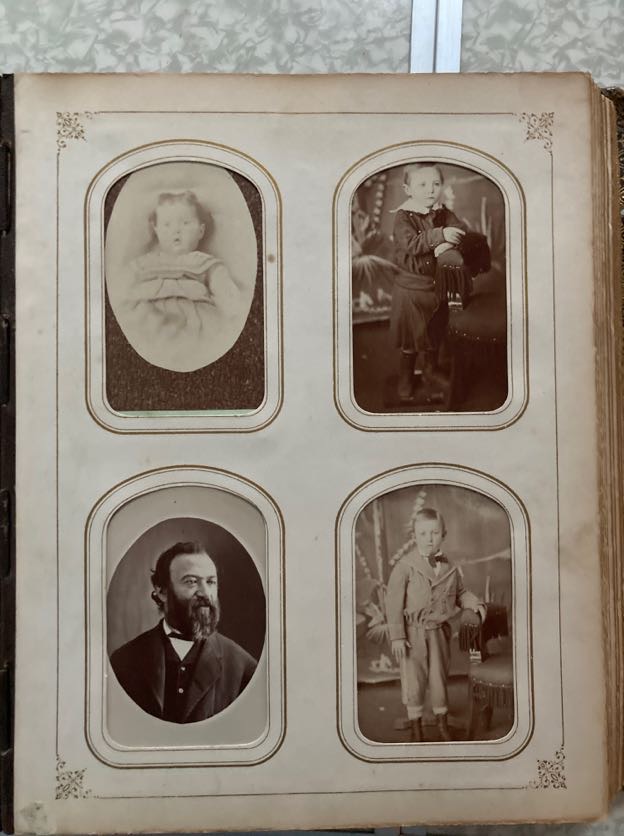
 

Once again there were no tax stamps on these photographs, so Ava concluded that they were taken either before August, 1864, or after August, 1866. Since Bernard and Frances didn’t move to Santa Fe until after 1868, I was hoping that the photographs fell into that later period. These photos also appear more than halfway into the album so were perhaps later than those 1863 to 1870 Philadelphia photographs Ava had already analyzed.

The three photographs of children were all taken by the same photographer, H.T. Hiester. Ava’s research of Hiester revealed that “Henry T. Hiester came to Santa Fe from Texas in the summer of 1871 at the request of Dr. Enos Andrews. Hiester was active in Santa Fe from 1871-1878. He had a studio in West Side Plaza from 1871-1874 and one on Main Street from September, 1874 to March, 1875.”1

Although Ava believed that two of these photographs were taken at the same studio given that they have the same set, back drop, and chair, she concluded that they were not taken at the same time. She opined that they were both of the same child, possibly James Seligman, Bernard and Frances’ older son who was born in 1868 in Philadelphia. She thought the photo on the upper right could be James at three or four and the photo on the lower right James at six or seven.

The baby in the first photograph cannot be James Seligman since he was born in 1868 in Philadelphia before the family moved to Santa Fe. Thus, that baby has to be Arthur Seligman—if it is of one of the children of Bernard and Frances Seligman—as he was the only child of theirs born in Santa Fe, and he was in fact born in 1871, the year that Ava dated the photograph. Perhaps one of the other photographs is of James or perhaps is Arthur as he grew older.

I can see by looking at the coloring on the reverse of these three photos that they might have been taken years apart as they have faded in different ways. (It’s hard to see in the scan below, but they were slightly different shades.) But nevertheless, I can’t imagine why Frances and Bernard would have three photographs of one of their three living children and none of the other two—including my great-grandmother Eva Seligman Cohen, their oldest child. I was so disappointed that there was no photograph of her.
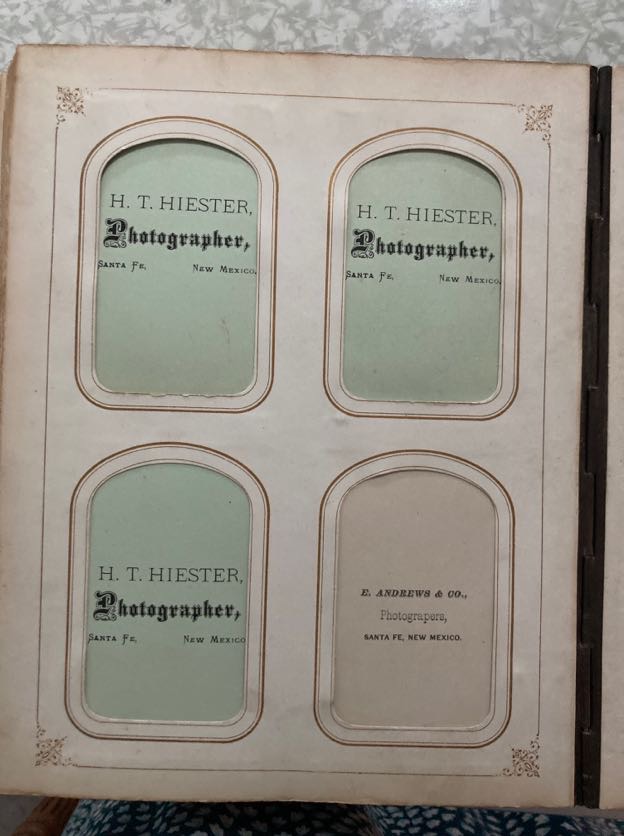
Moving on to the two men photographed in Santa Fe, the one on the same page as the three children (or the three photographs of the one child) was taken by a different Santa Fe photographer, Dr. Enos Andrews (1833-1910). Ava wrote that Andrews had a photography studio in Santa Fe from the end of the 1860s until the early 1870s. Based on her analysis of Santa Fe directory and census listings for Enos Andrews and other factors, Ava concluded this photograph was taken sometime between 1866 and 1871. Since she estimated that the man was about fifty years old, that would mean he was born between 1816 and 1821.2
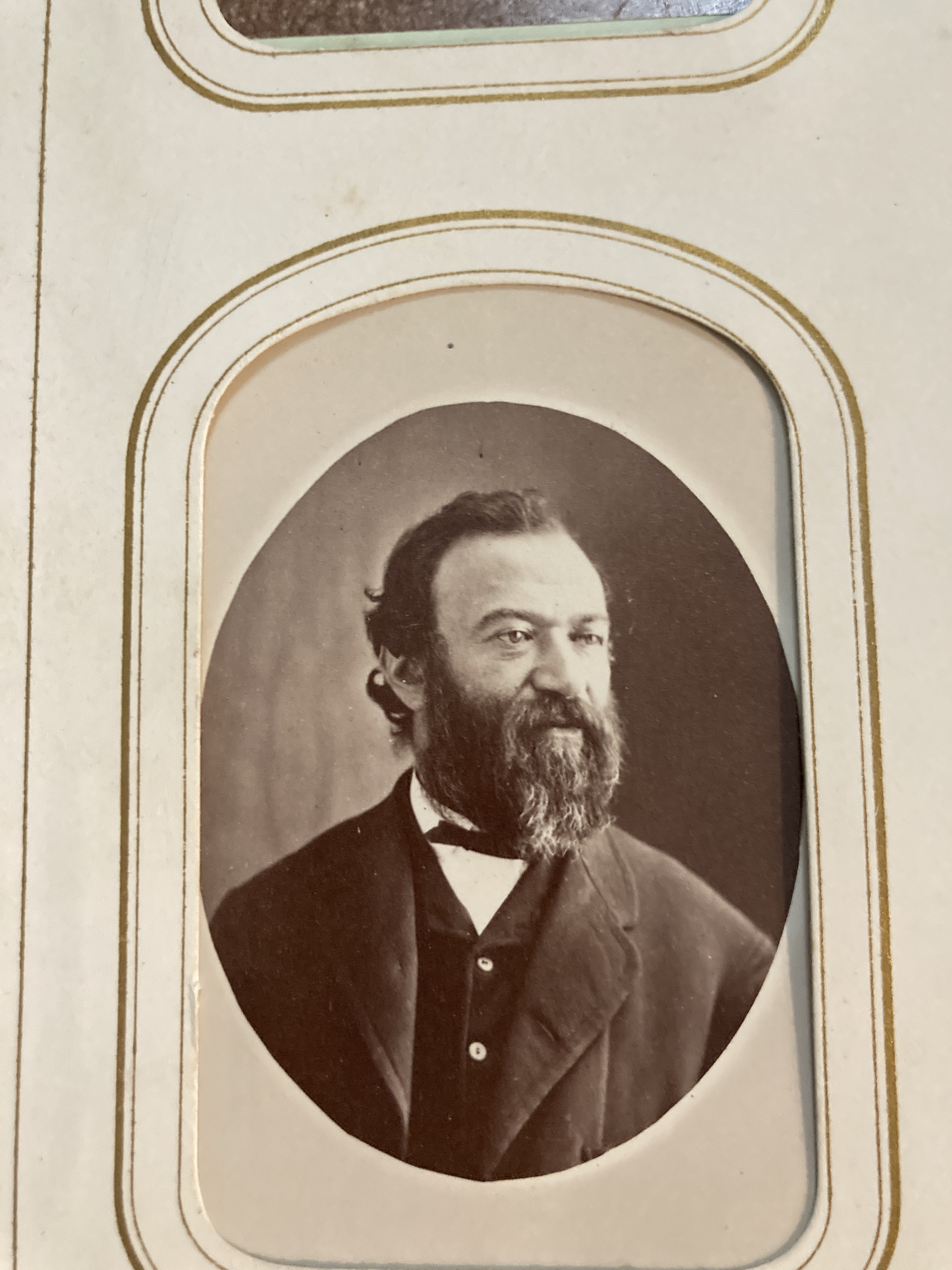
But who was he? Although the birth year might led me to believe it was John Nusbaum, who was born in 1818, Ava pointed out that in the late 1860s, John (as well as Frances and Bernard until at least 1868) was living in Philadelphia. But it was possible that John went to Santa Fe and had his photograph taken there. After comparing this photograph with the one we thought could be John Nusbaum on the first page, Ava and I both thought it could be the same man and both could be my three-times great-grandfather John Nusbaum.

What about the other photograph of a man taken in Santa Fe on the following page? That photo was taken by Nicholas Brown, who once partnered with Enos Andrews. Ava provided the following background on Nicholas Brown and his son William Henry Brown, who took the photograph of the couple on the same page.

Nicholas Brown (born 1830) was the father of William Henry Brown. Nicholas was active in Santa Fe in 1864-1865. In August of 1866, Nicholas announced the opening of a studio with his son, William. Between 1866 and 1867, William was in partnership with his father in Santa Fe and they advertised the studio as N. Brown & Son and N. Brown E Hijo (1860s in Mexico). At the end of 1870, William was in Mexico. At the beginning of 1871, Nicholas re-opened his studio in Santa Fe but this time it was located on West Side Plaza. Because there is no address on [the reverse of the Nicholas Brown photograph of the bearded man], I am placing this image before 1871.3

Ava dated this photograph as 1866-1867 and estimated the man’s age as 45 to 50, meaning he was born between 1816 and 1822.

I could speculate that maybe this is Bernard’s brother Sigmund Seligman, who lived in Santa Fe from at least 1860 until his death in 1874. Sigmund was born in 1829, so later than the 1816-1821 time frame Ava posited. Could this man be younger than fifty? Could he be in his forties? The beard does make it hard to tell. But it’s possible. So could this be Sigmund? Maybe. Maybe not. I have no idea. Maybe he was a friend of Bernard’s, not his brother. I have no way to know.

Finally, the last photograph from Santa Fe is the one of the couple taken by Nicholas Brown’s son, William Henry Brown. Ava dated this photograph far later than the one taken by Nicholas Brown because William was a partner in his father’s studio in Santa Fe from 1866-1867. By 1870, he was in Mexico. Then he returned to Santa Fe between 1880 and 1884 where he was a partner with George C. Bennett in a photographer studio on West Side Plaza. After 1884 William Henry Brown was no longer living or working in Santa Fe. Based on these facts, Ava dated this photograph at about 1882-1883.4

Ava thought that both the man and the woman were somewhere between 25 and 30 years old, meaning they were born between roughly 1852 and 1858, making them too young to be Bernard and Frances, who were born in 1838 and 1845, respectively. Thus, I have no idea who they are.

The fact that I could not identify the people in these Santa Fe photographs was disappointing. Ava reminded me again about the nature of CDVs—literally, “cartes de visite” or visiting cards. People gave them away, for example, when they came for a visit. And maybe they were taken while visiting and not in their hometown. That meant even those taken in Santa Fe or Philadelphia or elsewhere could be of people who didn’t live in those places. That meant the universe of people who might be in these photographs was anyone who lived during this time period. No wonder we couldn’t identify anyone with any degree of certainty without known photos of them.

The last portion of Ava’s work on this project was devoted to trying to identify the people in some of the photographs taken in Bingen and Mainz, Germany.


  1. Ava Cohn, Analysis of Nusbaum Album #3, January 24, 2024 
  2. See Note 1, supra. 
  3. See Note 1, supra. 
  4. See Note 1, supra. 

John Nusbaum Album: More Philadelphia People—Family, Friends, or Who Knows?

Having experienced some disappointment with the first batch of Philadelphia photographs from the Nusbaum album, I brainstormed with Ava about how to select the next group. In selecting the next group, I went through the album page by page, starting with the front of the second page. I looked for those that showed full body shots so that Ava would have more clothing to work with in dating the photographs. I also decided that since the photographs tended to be grouped on each page by photographer, I would select one from each page taken by a particular photographer in the hope that there would be some connection between the person I’d selected and the others whose photographs had been taken by that photographer and placed on the same page.

The second page in the album had one photograph taken in Philadelphia:

Since this photograph was taken by Robert Keely, the same photographer who took three of the photographs on the first page, I already knew the background and possible dating of this photograph to be around 1863-1864 (see my prior posts). Ava found additional evidence here in the fringed chair, which was introduced in 1864. She estimated that the little girl was about six years old so born in 1858.1 I theorized that she could be Miriam Nusbaum, John and Jeanette’s second daughter, who was born in 1858. She would have been my three-times great-aunt, Frances Nusbaum’s little sister. Can I be positive? No, since I have no known photograph of Miriam. But given the dating and the location and its placement on the second page of photographs, I think it’s likely.

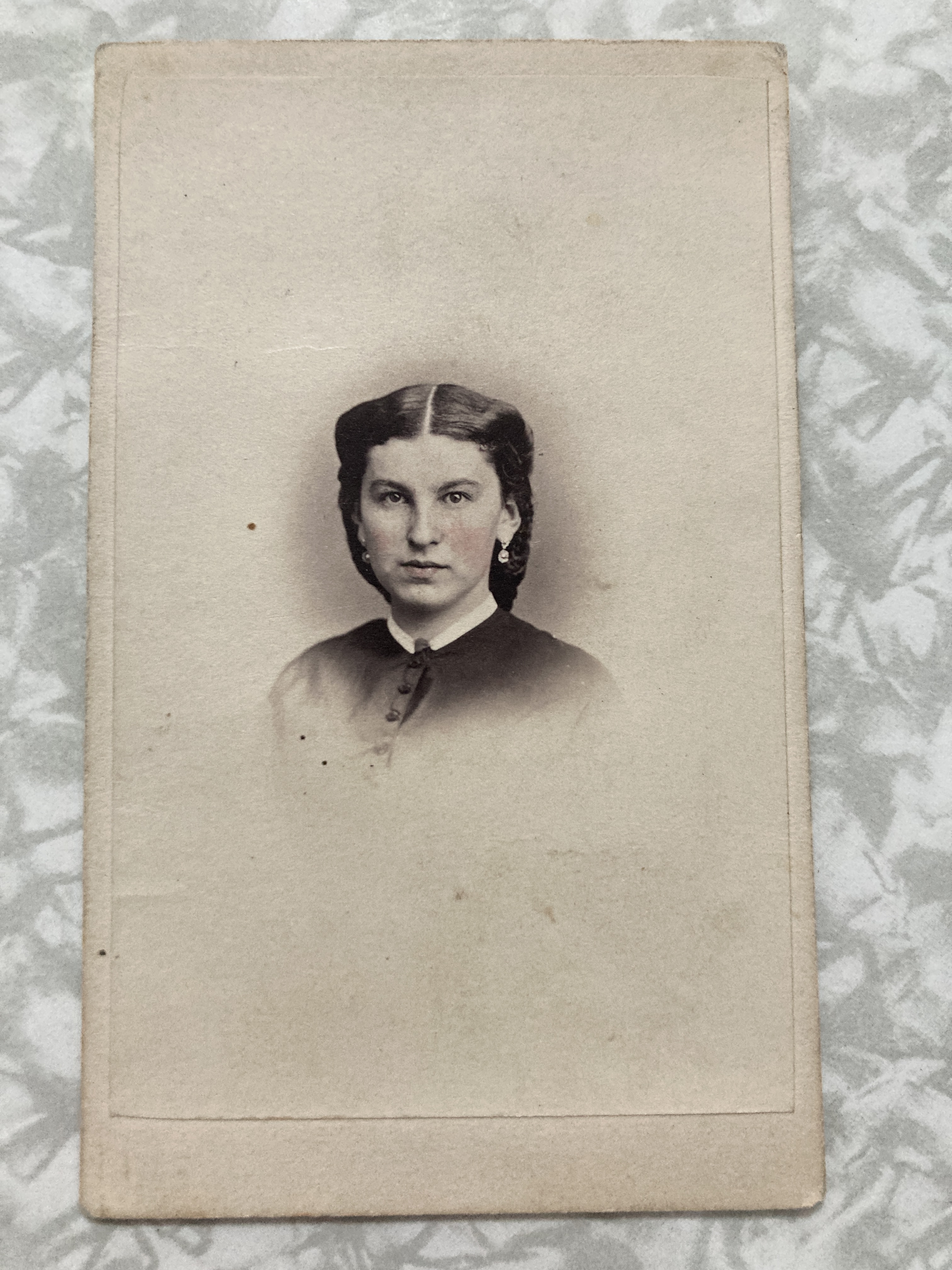
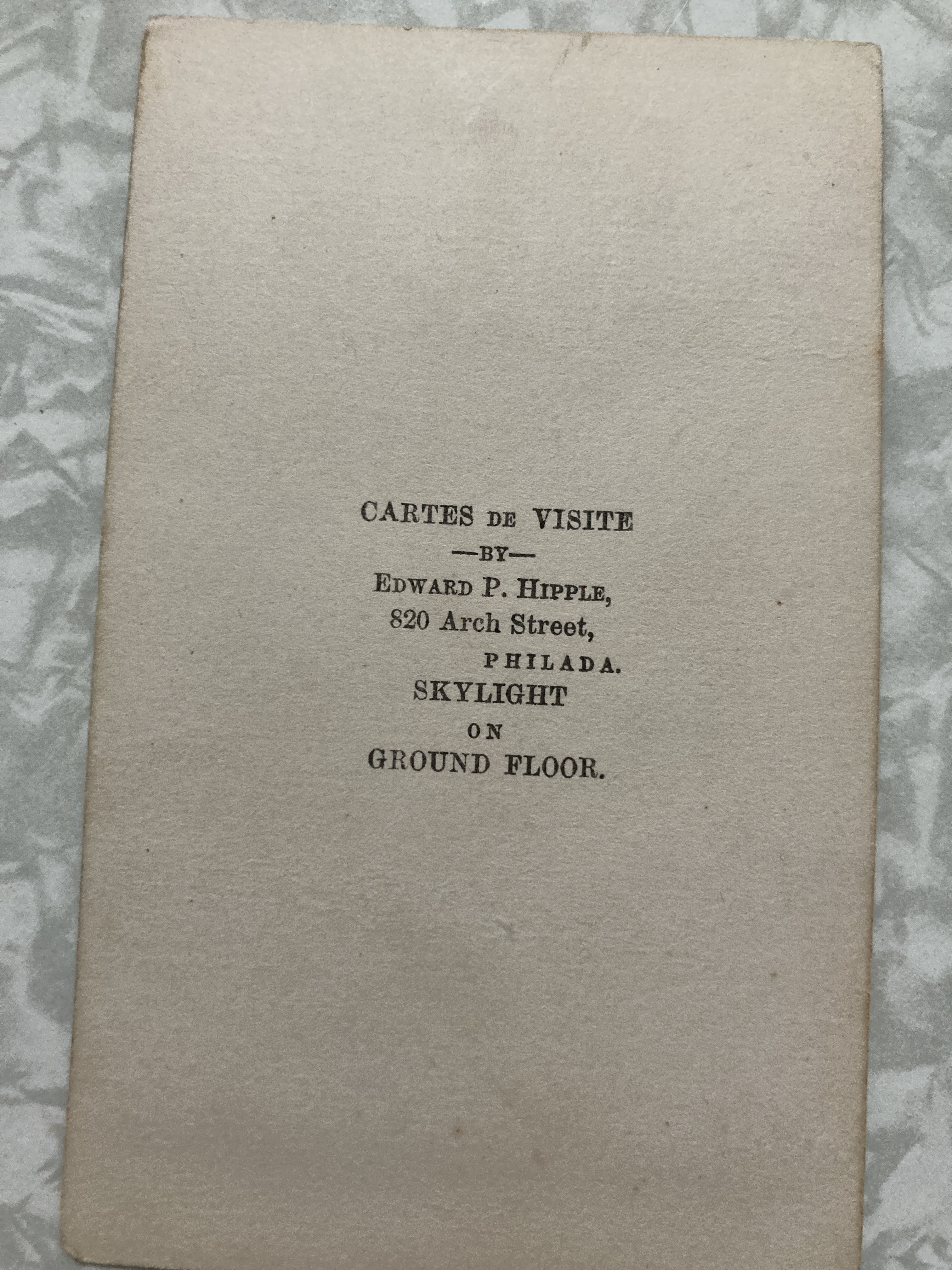
I then turned to this page in the album. All the photographs on this page were taken by the same photographer, Edward P. Hipple of 820 Arch Street, Philadelphia. Three are head shots and one is a full body photograph of a man.

I asked Ava to analyze the photograph in the upper right.

Ava dated this photograph as taken in about 1863. She wrote, “Hipple operated a studio at 820 Arch Street from 1862 to 1866. In 1865, he opened a second studio in Norristown. Since only the Philadelphia studio is on the reverse of this photo, it is assumed that this is prior to the Norristown studio being added. The lack of a tax revenue stamp places the date before 1864.”  Ava also estimated that the woman in that photograph was about 25 years old, giving her a birthdate of about 1838.2

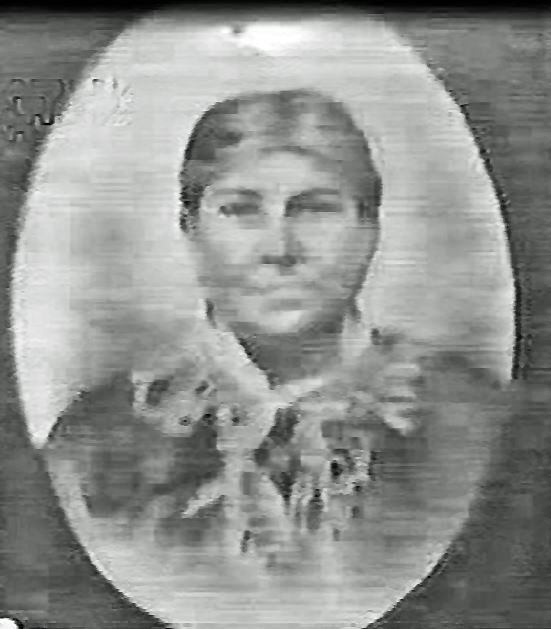
That conclusion sent me back to my family tree to see if I could find a woman born in about 1838 who was living in Philadelphia in 1863. The choices were limited. My great-great-grandmother Frances was born in 1845 and was living in Philadelphia in 1863, but Ava did not believe the photograph was of Frances, if we assume that the woman on the first page of the album was Frances. But we can’t be 100% certain. Ava tried AI, and it showed a high degree of similarity to the woman in the clip of the video of the portrait of Frances.

The only other family member who could have fit those criteria was Eliza Wiler, the daughter of Caroline Dreyfuss, Jeanette’s sister, and Moses Wiler. Eliza was born in 1842 in Harrisburg, but by 1863 she was married and living in Philadelphia. Eliza had one younger brother Simon (1843) and two younger sisters, Fanny (1846) and Clara (1850). Ava suggested that the four photographs on this page could be a father and his children. Perhaps then this is Moses Wiler at the bottom left with his son Simon and two of his daughters, Eliza and either Fanny or Clara. Maybe. But maybe not.

Turning to the next two pages, there are eight photographs all taken by another Philadelphia photographer, Frederick Gutekunst at 704 & 706 Arch Street, Philadelphia. Here are those two pages:

Ava had this to say about Gutekunst:

Gutekunst had a very prestigious studio in Philadelphia. He has been described as “America’s Most Famous Civil War Era Photographer.” Gutekunst photographed many famous people including Gen. Ulysses Grant, Major General George McClennan, Gen. Philip Sheridan, Walt Whitman, Henry W. Longfellow, Abraham Lincoln as well as other Civil War era celebrities and ordinary Union soldiers both before and around the time of the Battle of Gettysburg. He also photographed images from the Gettysburg battlefield itself.3

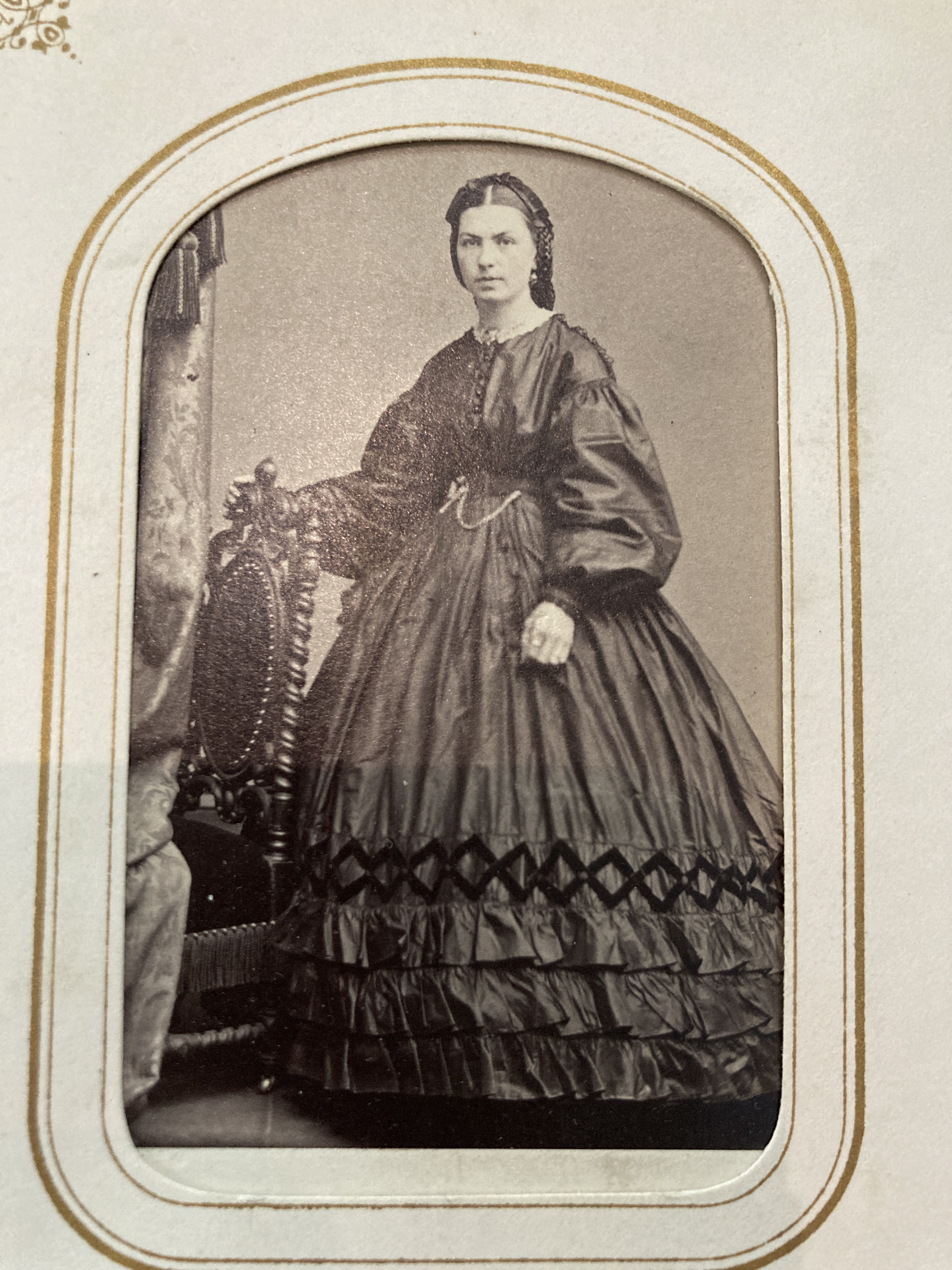
Who were these people photographed by this famous photographer? I asked Ava to focus on the woman in the upper left of the first page of Guntekunst photos since it was a full body shot with lots of clothing to help with dating the photo.

Ava thought that the woman was in her late 20s, 28-30, and that the photograph was taken between 1862 and 1864, meaning the woman was likely born in the early 1830s. Ava added these notes to her analysis:4

The woman in this photograph is wearing a ring, though it is on the wrong finger to be a wedding ring. Her hair and dress are also from this same time period.  The dark velvet applique trim on her skirt appears to have been added to an already made dress.  While there is no direct evidence that this has any meaning at all, it could be interpreted, given the time period, that this trim was added as a sign of mourning.

From the following page, I also selected a woman in a full body shot, the one at the lower right.

Ava thought this photograph was also taken between 1862 and 1864 and that this woman was a bit older than the one in a similar dress on the prior page. Comparing their clothing, Ava wrote, “Their dresses are similar, though this woman’s dress has Pamela sleeves which were fashionable at the time. The ruffles on her skirt have no added velvet trim.”5 If this woman was in her early thirties, she would have been born between about 1827 and 1830 or so.

I was at a total loss. There just weren’t any people on my family tree born in the late 1820s, early 1830s who were living in Philadelphia in the early 1860s. John and his siblings were too old; their children were too young. Jeanette Dreyfuss had two sisters born in the 1820s, Caroline in 1822 and Mathilde in 1825, and Mathilde was a widow after her first husband Maxwell died in 1851. But by 1862 she was remarried and presumably not wearing mourning clothes. As for all the other people on those two pages, I have no clues. They all look like adults in the 20s and 30s to me so also born in the 1830s and maybe 1840s, but who they could be is a mystery. Maybe family members, maybe not.

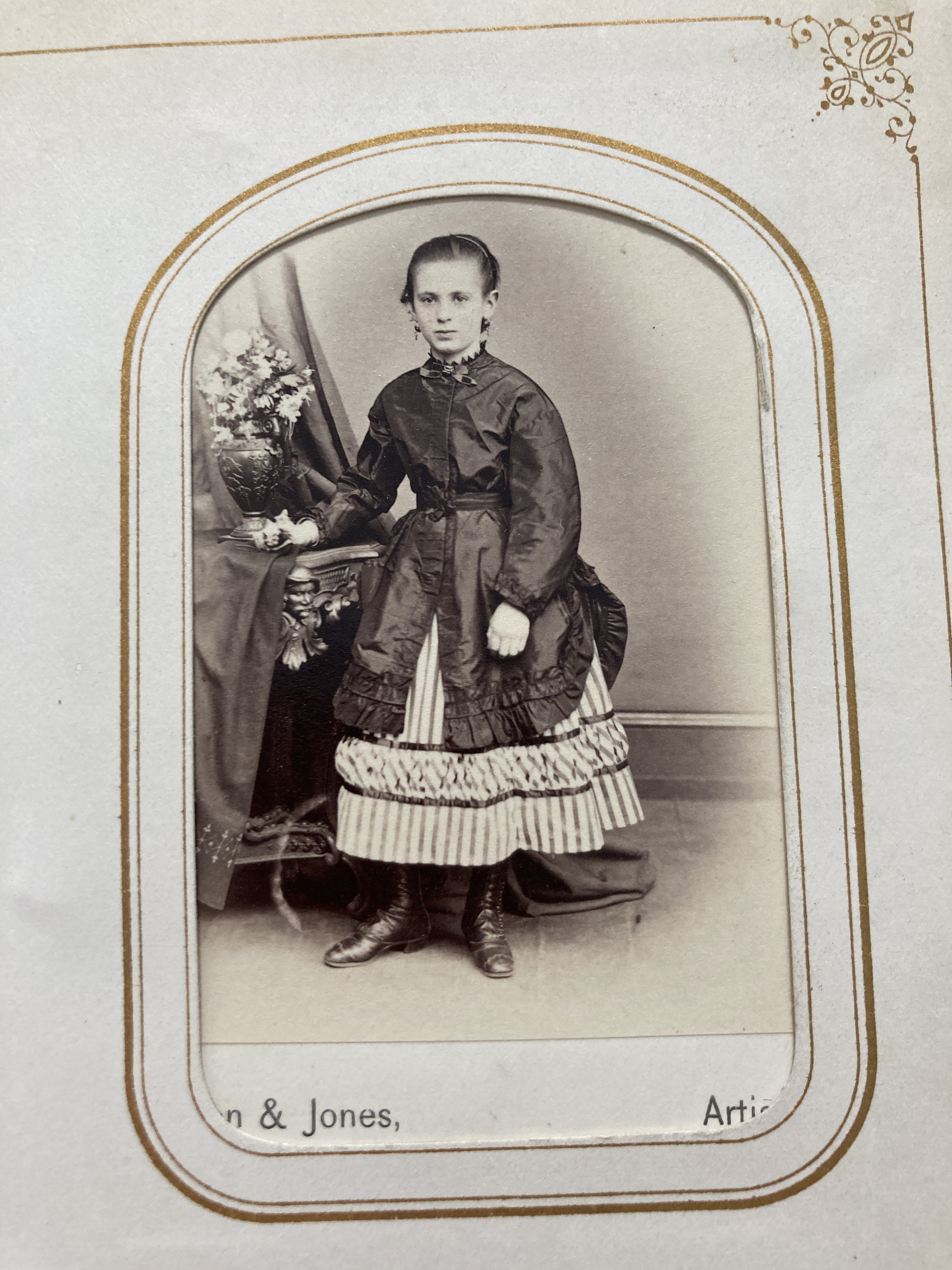
There were two more Philadelphia photographs I asked Ava to analyze, both on this page, the next one in the album:

I asked her to look at the little girl in the upper right and the couple on the lower left. Both were taken by yet another Philadelphia photography studio, Gihon & Jones, John L. Gihon and Alfred T. Jones, at 812 Arch Street, Philadelphia. Ava’s research found that Gihon and Jones were only in partnership at 812 Arch Street for one year, 1869-1870. She also concluded that the girl’s dress was from 1870. Since she thought the girl was between ten and twelve years old, she posited that she was born between 1857 and 1860.5

That means that this could be another photograph of Frances Nusbaum’s sister Miriam, who was born in 1858 and living in Philadelphia in 1870. Comparing this photograph to the one on an earlier page that also was possibly Miriam, I can see some similarity. Or it could be Lottie Nusbaum, the youngest child of John Nusbaum and Jeanette Dreyfuss and Frances’ youngest sibling. Lottie was born in 1863, however, so would have only been seven in 1870. Or…this could be any number of cousins or friends of the family.

1864 born about 1858 Philadelphia could be Miriam Nusbaum

As for the couple in the bottom left, Ava thought the man was around 21, the woman a bit younger, and that the photograph was taken in the year that Gihon and Jones were partners, 1869. That meant the man and woman were born around 1848-1850 or so. Ava ruled out that this was Bernard Seligman and Frances Nusbaum. That left numerous possibilities—too numerous to list and too speculative to list. Could be family, could be friends. We have no way of knowing.

At this point I decided to turn to the photographs from Sante Fe and stop trying to identify anyone in the Philadelphia photographs. There were only six taken in Santa Fe, and there were far fewer relatives who lived in Santa Fe during the mid-19th century. I figured these would be far easier to identify. I wish that were so.


  1. This and other information I received from Ava came from her second report on the album.  Ava Cohn, Analysis of Nusbaum Album #2, December 22, 2023. 
  2. See note 1, supra. 
  3. See Note 1, supra. 
  4. See Note 1, supra. 
  5. See Note 1, supra. 

John Nusbaum Album: Will the real Frances Nusbaum please identify herself?

As I wrote in my last post, I learned from Ava’s information and analysis of the photograph that might be John Nusbaum that without a photograph that was labeled “John Nusbaum” to use for comparison, there was no way to know for sure who that man really was.

Turning to the two photographs of women on the first page, I had hoped that the woman at the bottom of the page would be Frances Nusbaum. Let’s look at Ava’s analysis of this photograph:

It was taken by Keely, the Philadelphia photographer who took the photographs of the two men on this page, and, according to Ava, likely in the same time frame (if not at the same time) as those first two photographs, i.e., 1863 to 1864. Ava estimated that the young woman in the photograph would be 20-22 years old, meaning she was born in the early 1840s.1 Frances Nusbaum was born in 1845. She had no older sister, only older brothers. So this could be Frances.

But I have no other photograph of Frances, just a very blurry still from a video taken of a portrait made when she was much older. Ava didn’t find enough similarity between that blurry image and this photograph to conclude with certainty that this was Frances. Maybe it was, maybe it wasn’t. The placement on the first page adds weight to the conclusion that this could be Frances, but there is no certainty.

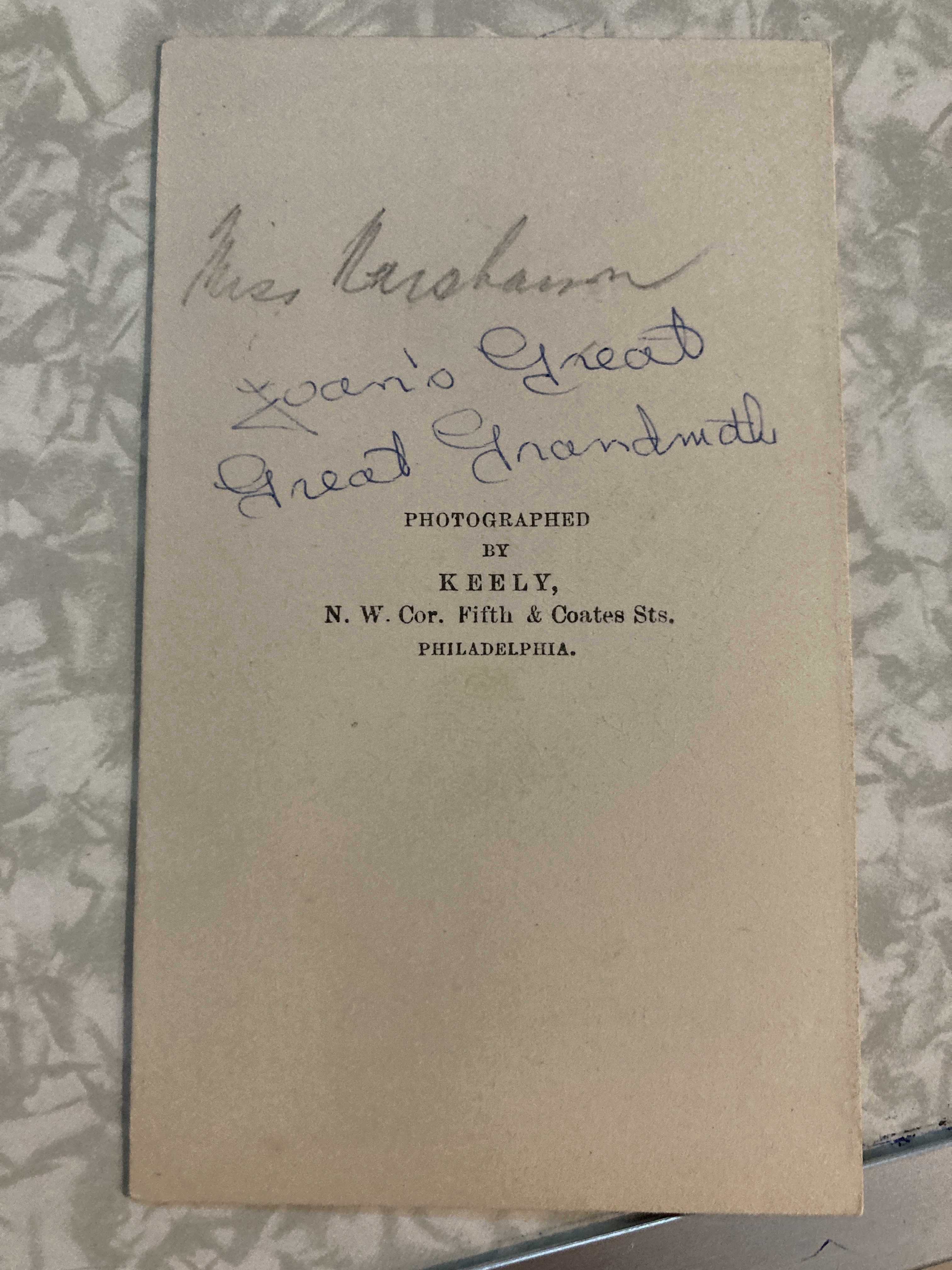
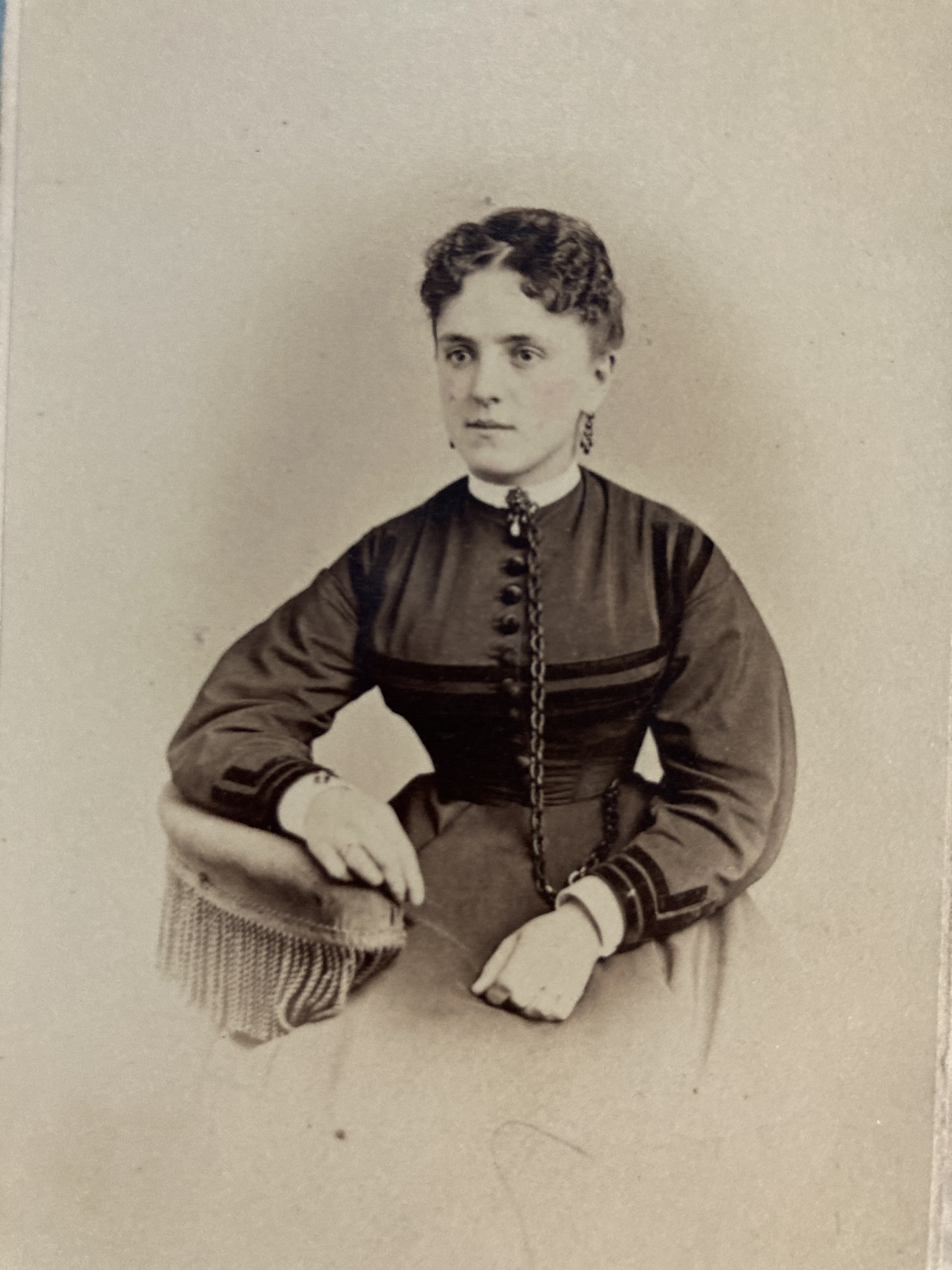
I was further confused about whether this could be Frances when I asked Ava to analyze a different Keely photograph later in the project but worth discussing now. That photograph appears much later in the album, close to the end of the album. But it had a specific inscription on it, one of the very few in the album that did.

The inscription reads “Miss Nusbaum” in one handwriting, and then in a separate hand someone wrote, “Joan’s Great-great-grandmother.” The reference to Joan is almost definitely Joan Seligman, the granddaughter of Arthur Seligman and one of the last people to own the album, according to her granddaughter Jhette. Joan was the great-granddaughter of Frances Nusbaum. Her great-great grandmother with a Nusbaum surname would have been Jeanette Dreyfuss Nusbaum. Could this be either Frances or Jeanette?

Since this was a Keely photograph with no tax stamp, Ava dated it as either before August 1864 or after August 1866; based on the clothing and furniture, she narrowed it down to the earlier period, roughly 1861-1863. She also estimated that the woman in the photograph was a teenager between fifteen and eighteen years old, meaning a birth date between 1843 and 1848.

That meant it could not be Jeanette, who would have been much older than that by 1861, but it could be Frances, who was born in 1845. That seemed the logical answer to me, given the inscription on the back. The misidentification of her as Joan’s great-great-grandmother rather than her great-grandmother seemed minor.

But Ava was skeptical. She did not see a similarity to the woman she thought was Frances on the first page in the album. And she did not see a similarity to the woman in the blurred image from a video of a portrait supposedly of Frances. And she thought it unlikely that if Frances owned the album that her photograph would appear so late in the album.

But what if someone moved the photographs around? What if the photograph on that first page is not Frances? In my mind, the inscription carries more weight than the location in the album, but it’s also possible that the inscription is wrong. Maybe it was a different Miss Nusbaum. Maybe it wasn’t Joan’s ancestor. I don’t know.

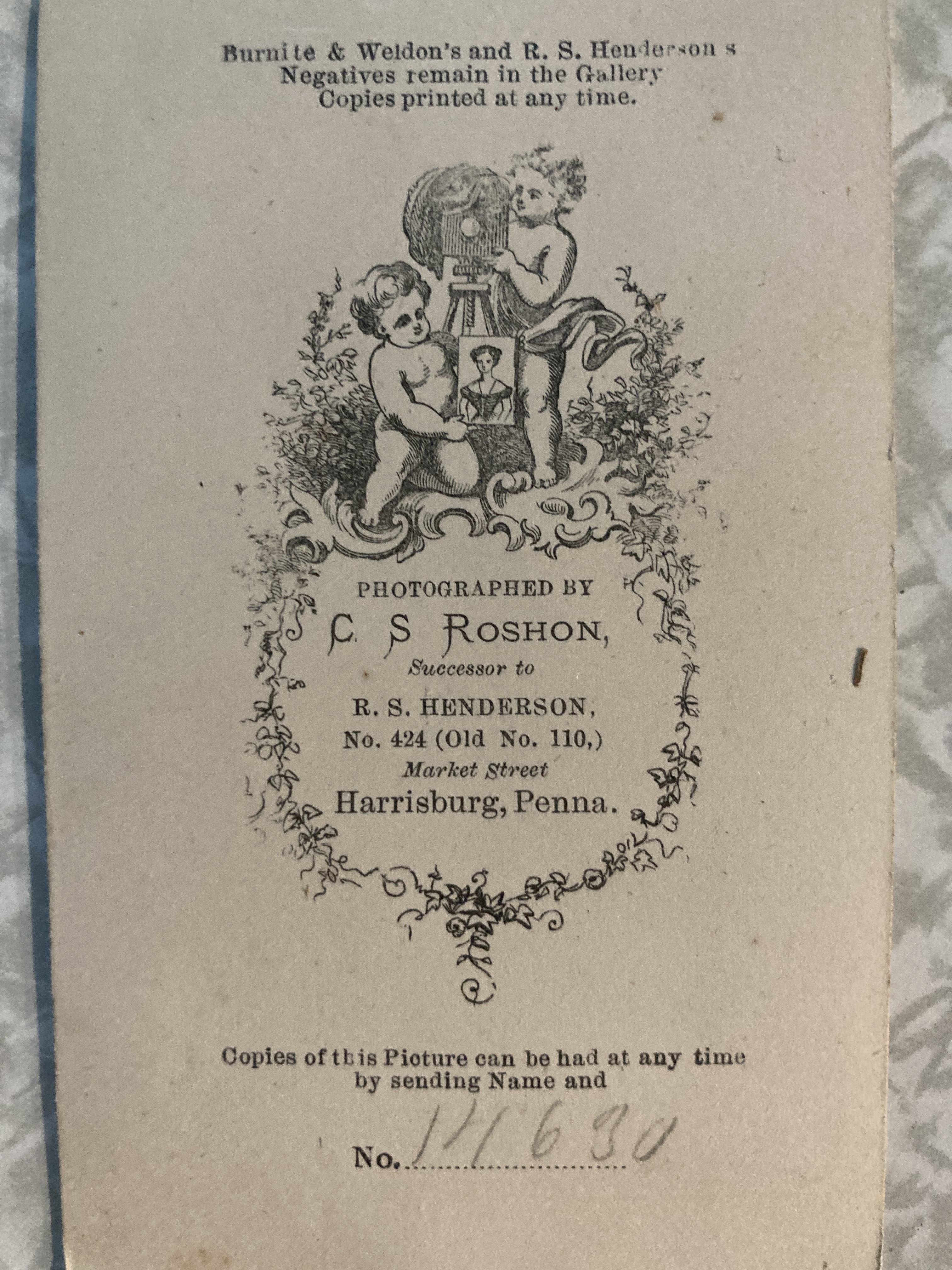
Finally, the remaining photograph on the first page, the one I’d hoped was Jeanette Dreyfuss, my three-times great-grandmother, turned out to be the most confusing one of all to identify. It is the very first photograph in the album; it should be of someone very important, you would think. I sure was hoping so.

This photograph was not taken by Keely, who took all the other photographs on the first page, and it was not taken in Philadelphia, but in Harrisburg, Pennsylvania. My three-times great-grandparents John and Jeanette (Dreyfuss) Nusbaum had lived in Harrisburg from about 1843 until about 1858. Frances Nusbaum, my great-great-grandmother, was born in Harrisburg in 1845. But by 1860 and thereafter, John and Jeanette and their children were living in Philadelphia. Thus, if this photograph was taken when my Nusbaum ancestors were living in Harrisburg, it had to be taken before 1860.

But Ava concluded that this photograph was taken after 1866. The photographer who took this photograph was Christian S. Roshon, located at “No. 424 (Old No. 110) Market Street Harrisburg, Penna.” By tracing the succession of photographers who worked at this location, Ava found that Roshon succeeded a photographer named Robert S. Henderson, who came after David C. Burnite.  Burnite (Burnite and Weldon’s) had been at 110 Market between 1864 and 1866, and Henderson was there with a photographer named Rogers from 1865-1866. That meant that Roshon didn’t occupy that address until 1866 or later, meaning that the first photograph in the album was taken after 1866. My Nusbaum ancestors were in Philadelphia by then, not in Harrisburg.

Since Ava estimated that the woman in the photograph was in her early 20s (20-22), she could not be Jeanette, who would have been far older than that by 1866. She might be Frances, who was 21 in 1866, but since Frances was no longer living in Harrisburg and was married to Bernard by 1866, that seemed unlikely.

So who could this young woman who holds the first spot in the album be? I searched my tree for a relative born in about 1845 who would have been living in Harrisburg in 1866. I could only find two women who came close to fitting into those parameters: Paulina and Sophia Dinkelspiel, daughters of Mathilde Nusbaum (John’s sister) and Isaac Dinkelspiel. Paulina was born in Germany in 1840, and Sophia was also born in Germany in 1849. Both were living in Harrisburg in the late 1860s. They were first cousins to Frances Nusbaum and John Nusbaum’s nieces.

Could that photograph be of Paulina or Sophia? Sure. But is the photo of either one of them? I have no idea. And if it is one of Frances’ cousins/John’s nieces, why would she be the first one in the album? It really doesn’t make much sense to me, but I also can’t disagree with Ava’s expert analysis of the dates of the photograph or the age of its subject.

Also, it’s important to remember that these CDVs could have been taken when someone was visiting from another town. Maybe Frances or someone else went to Harrisburg to visit her cousins and had her photograph taken while there. Of course, once you factor in that possibility, the photographer’s location becomes a less defining factor for identifying who was who in any of the photographs.

I decided to try a different approach with the next set of photographs.


  1. The references to Ava’s analysis in this post all come from her first report, Ava Cohn, Analysis of Nusbaum Album #1, December 16, 2023 

Nusbaum Album: Is this John Nusbaum? Is that Bernard Seligman?

After retaining Ava Cohn’s services to help me with the album of photos (“the Nusbaum album”) I’d obtained from an antique dealer in Santa Fe and selecting, with Ava’s advice, where to begin, I waited anxiously to see what Ava could tell me about the album and the first four photos we’d decided to start with, the ones on the very first page:

First page in the Nusbaum album

I had been staring at these over and over while waiting to hear back from Ava. Could the two on top be my three-times great-grandparents Jeanette Dreyfuss and John Nusbaum? Could the two on the bottom be my great-great-grandparents Bernard Seligman and Frances Nusbaum? I was hoping so. Wouldn’t that be a logical assumption to make?

But alas, I quickly learned that hopes and assumptions are not a reliable method for identifying photographs.

Ava started her analysis by providing some background on the album itself. She wrote, “The album was manufactured and sold by Henry Altemus Company of Philadelphia. Altemus and Company first published photographic albums in 1862 and remained in business until 1936….The album is one of Altemus’ larger albums, holding four cartes de visite (CDV) photographs per page.  The photographs are CDVs measuring 2 3/8” x 4.”1

One thing that Ava explained is that cartes de visite, as their name suggests, were used as calling cards. When someone visited, they would leave their photograph as a memento of that visit. That meant that, unlike a modern photograph album where most of the photographs are likely to be of family members and close friends, this album could include photographs of anyone who stopped in to visit the Nusbaums and the Seligmans.

Ava shared this poem that illustrates how CDVs were used:

Ashford, Brothers & Co, Album Filler Poem, c. 1865

Ava’s report continued with some observations about the photographs and some of the issues involved in analyzing them, including the fact that most of the photographs in the album show only heads or heads and shoulders of their subjects. Because Ava did not have the ability to see other details of what they were wearing, it would be more challenging to provide exact dating of the photographs.

Nevertheless, Ava was able to reach several conclusions about the dates when the photographs on the first page were taken. She concluded that the three from Philadelphia were taken in the Civil War era, but not between August, 1864, and August, 1866. As she explained, “Tax stamps were issued by Union states and were required to be placed on the backs of photographs from August, 1864 to August, 1866 to raise money for the war effort.”2 Since these photographs did not have tax stamps on them, they had to have been taken either before August, 1864, or after August, 1866.

With that time period in mind, Ava then focused on the specific photographers who took these first four photographs. Three of the photographs on the first page of the album were taken by Robert N. Keely; his address, as indicated on the back of these three photographs, was “N.W. cor. Fifth & Coates Sts., Philadelphia.” Ava found Keely listed in Philadelphia directories at that address or at nearby addresses throughout the 1850s and 1860s and into the 1870s.

Knowing that these three photographs were taken during that era, Ava then focused on the three individual photographs on that first page that were taken by Keely. First, she looked at this one:

Based on her estimate of his age (50 years old) and the possible dating of the photograph between 1863 and 1864, Ava concluded that the man in the photograph was likely born around 1813-1814. John Nusbaum, my three-times great-grandfather was born on November 26, 1814, according to the family bible. Ava and I speculated that the man in the photograph could be John Nusbaum, given those dates and given the placement of the photograph on the first page.

I was excited by this analysis, but also realized that nothing could be certain. Without another photograph of John, we had no truly definitive way of being sure this was in fact John Nusbaum. That was an important first lesson I learned from Ava’s work on the album.

Another photo taken by Keely that appears on the first page of the album is this one:

Philadelphia c 1863, born about 25 years, could be Bernard or a Nusbaum son

I had hoped this was Bernard Seligman. But Ava was not convinced. She dated this photograph in that same 1863-1864 time frame and found that the man was 20-25 years old, meaning the man was born roughly between 1838 and 1844; Bernard was born in 1837 so within some reasonable margin of error of that estimate. But Bernard and Frances didn’t marry until 1865. Would they have had their photographs taken before they were married?

Possibly, but there was another obstacle. When I shared the photographs I do have of Bernard as a young man and as an older man as well as the blurry still from a video taken of his supposed portrait, I could see similarities, but Ava was certain that the man in the album was not Bernard.


Bernard Seligman

So who was he? Maybe one of John and Jeanette’s sons? Adolphus was born in 1842, Simon in 1843, and Julius in 1848. It could be any one of them, but I have no photographs of any of them. So who knows… It would make sense that John and Jeanette would have put one of their sons on the first page, but I can’t be certain.

What about the two women on that first page? Were they Jeanette Dreyfuss Nusbaum and Frances Nusbaum Seligman? That will be discussed in the next post.


  1. Ava Cohn, Analysis of Nusbaum Album #1, December 16, 2023 
  2. See note 1, supra. 

The Nusbaum Album: An Introduction

Some of you may recall that last fall I received a call from an antique dealer in Santa Fe who had in her shop a photograph album with the names John Nusbaum and Frances Nusbaum engraved on the front and rear covers, respectively. I immediately knew that this album had belonged to my three-times great-grandfather John Nusbaum and his daughter Frances, my great-great-grandmother. Frances had married my great-great-grandfather Bernard Seligman and moved from Philadelphia to Sante Fe, where they raised their children, as I told in my family history novel, Santa Fe Love Song.

I agreed to purchase the album and when it arrived, I marveled at the collection of almost two hundred photographs of people I hoped were my relatives—or at least I hoped that some of them would be. But except for a handful of those photographs, there were no labels or names to identify the people in them. Almost all, however, had a photographers’ stamp that indicated where they were taken.

The largest group of photographs (43) were taken in Philadelphia, where John Nusbaum had settled after immigrating from Schopfloch, Germany, in about 1840. He had initially been a peddler traveling throughout Pennsylvania, but eventually settled in Philadelphia and established a dry goods store there. He married Jeanette Dreyfuss, another German immigrant, and had six children, my great-grandmother Frances being the third child and oldest daughter. Thus, I assumed many of the Philadelphia photographs were of John and his family as well as of other family members and friends. But who was who? I had no idea.

Not surprisingly, the next largest group of photographs were taken in Germany, including some taken in Mainz and some in Bingen, the two larger cities closest to Gau-Algesheim where Bernard Seligman and his siblings were born and raised. There were also photographs taken in other German cities, such as Stuttgart, Berlin, and Wiesbaden.

There were eight photographs taken in Santa Fe, where Frances Nusbaum had moved with her husband Bernard and their three older children in about 1870. Their youngest child Arthur Seligman was born in Santa Fe, but my great-grandmother Eva Seligman was born in 1866 in Philadelphia.

Three photographs were taken in Harrisburg, Pennsylvania, and several were taken in Lewistown, Pennsylvania, two locations where John and Jeanette’s siblings lived in Pennsylvania, so I assumed that those photographs were likely of those Nusbaum/Dreyfuss cousins. The remaining photographs were taken in other places such as New York City; Montgomery, Alabama; Wheeling, West Virginia; Peoria, Illinois; and St. Louis, Missouri.

Each page in the album has four slots for photographs. On the first four pages of the album, there are two photos, back-to-back, in each slot so that you cannot see the reverse of the photos without pulling them out of the slots. Then starting on the fifth page in the album, there are only four photos on each page, and the reverse of those photos shows through on the back of the slot on the back of the page.

What it took me a long time to realize is that all the photos squeezed into the back of those on the first four pages are photographs from Germany. I think that these photographs from Germany may have been added once all the other slots were filled. They likely belonged to Bernard Seligman and were added after he married Frances. I will get to these photographs in a later post, but my reason for mentioning this here is to indicate that I think that aside from those German photos, the others were probably placed by John, Jeanette, or Frances Nusbaum.

The photographs appear to be somewhat grouped together by the location where the photographs were taken and by photographer. The photographs seem to follow roughly this geographical order: Pennsylvania, including many from Philadelphia, but also Harrisburg and Lewistown; then two pages from Peoria, Illinois; then three pages of Santa Fe photographs; then some from New York City and other places; and then photographs from Germany (plus the ones on the reverse of the first few pages). There are also some that appear in random places within the album, but overall this is how the album is arranged.

Since I only had names on a handful of photographs and since I had no idea when the photographs were taken, I decided to retain the expert services of Ava Cohn, aka Sherlock Cohn, the Photo Genealogist. Long time readers of my blog know that I have had great success hiring Ava in the past to help me identify people in old photographs.

With the financial support of my brother and my cousins Marcia and Terry, I asked Ava to help me with this new project. I also agreed to sell the album after Ava and I were done with it to my cousin Jhette for the price I paid to the antique dealer; that way I had more money to hire Ava. Although I was sad to think that I would not be able to keep the album, I knew that Jhette, another descendant of Bernard Seligman and Frances Nusbaum, would take good care of it.

Because of the large number of photographs and my limited resources, I had to limit the scope of Ava’s work. I asked her only to date the photographs and to estimate the ages of the people in them. I was not asking her to do any identification of the people. I was hoping that with those two bits of dating information, I’d be able to deduce who the people were in the photographs—or at least narrow down the possibilities—by studying my family tree.

I also had to limit her work to about 20-25 of the almost two hundred photographs in the album. I decided to focus on those taken in Philadelphia, Santa Fe, Mainz, and Bingen because I knew that those would most likely be of my direct ancestors. As noted above, I figured that the Harrisburg, Peoria, and Lewistown photographs were of Nusbaum/Dreyfuss cousins. I had no idea who in the family (if anyone) lived in Berlin, Stuttgart, or Wiesbaden, Germany, or for that matter in St. Louis, Wheeling, or Montgomery. I knew of one branch that lived in New York, but not direct ancestors.

But because there were so many photographs taken in Philadelphia, I had to find some way to narrow down Ava’s work so that she could have the best chance of identifying the people in the photographs I chose. Based on her suggestions, we started with the photographs on the first page, figuring that those would most likely be the closest relatives if not the owners of the album; three of those were taken by the same photographer in Philadelphia. The fourth and the very first photograph in the album was taken in Harrisburg. There were two men and two women. In my wildest dreams, I was hoping that they were of John and Jeanette and Frances and Bernard.

Here are those first four photographs:

In my next two posts I will share what I learned from Ava about these four photographs and how I decided to choose the remaining 15-20 photographs for her to analyze. This will be a multipart series of posts devoted to the Nusbaum album.


The Magic of Old Photos and Modern Technology: Memories of Parkchester

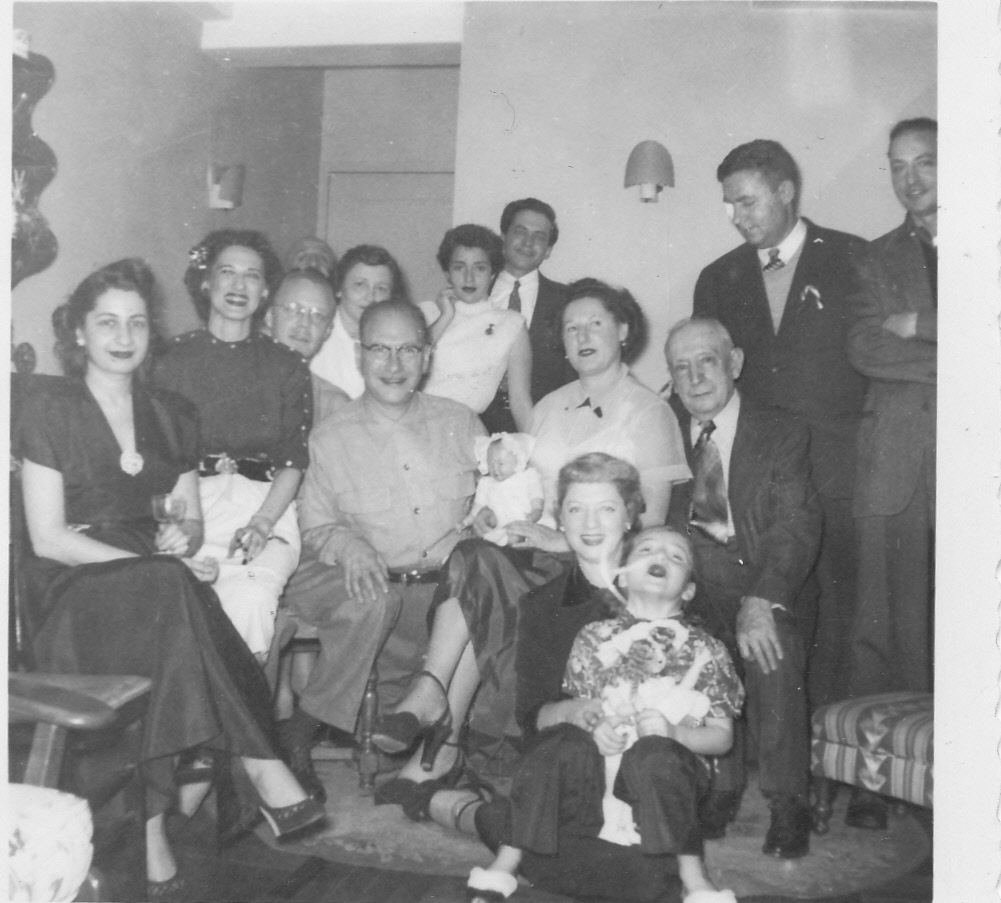
While I am on the subject of old photographs, I wanted to share a heartwarming story that started with one old  photograph.

The photo was one I found mixed in with a bunch of old black and white photographs that had been my parents. I could immediately identify my very young parents in the photo. My mother is the woman in the back with the sleeveless white top. Standing behind her, the man in the suit and tie with dark hair is my father. When I looked more closely at the photo, I realized that my grandmother, Gussie Brotman Goldschlager, is standing to the left of my mother (on my mother’s right), and then all the way in the back left corner almost at the door with only his eyes and nose showing is my grandfather, Isadore Goldschlager.

Who are these people??

But I did not recognize one other person in the photo. Who were all those people with my parents and grandparents? I had no one to ask since my grandparents and my parents are no longer living, nor are any of their peers. But I was determined to try and find out. First I distributed the photo by email to all my Goldschlager and Brotman relatives. Did anyone recognize anyone in the photo? No one did. These did not appear to be my relatives.

I then had what turned out to be a brilliant idea. My grandparents and my parents all lived in Parkchester, a community of apartment buildings in the Bronx that was built in the early 1940s. My mother and her parents had moved there when she was about eleven in 1941 or 1942. Then after my parents married in 1951, my parents had an apartment there also. It was my first home. I hypothesized that the photograph might have been taken in Parkchester in the early 1950s. We moved away in 1957, and my parents looked really, really young here—it may have been taken even before I was born in 1952.

I searched to see if there was a Facebook group for people who once lived in Parkchester, and sure enough, there is one. I posted the photograph there, saying that the photograph was probably taken in the early 1950s and asking if anyone recognized anyone in the photograph. I received numerous comments about living in Parkchester in those years, but no one knew anyone in the photo.

Until, that is, a woman named Gail (Lipman) Amsterdam responded and said that her grandparents, her father, and several other people she knew were in the photograph. And even more incredible—she herself was the little girl sitting on the floor in the front of the photograph. I was totally blown away. Gail is sitting on her grandmother’s lap, and her grandfather is sitting behind her. Gail’s father, Sid Lipman, is the man in the center with the glasses. We assume that her mother either took the picture or was in the kitchen when it was taken.

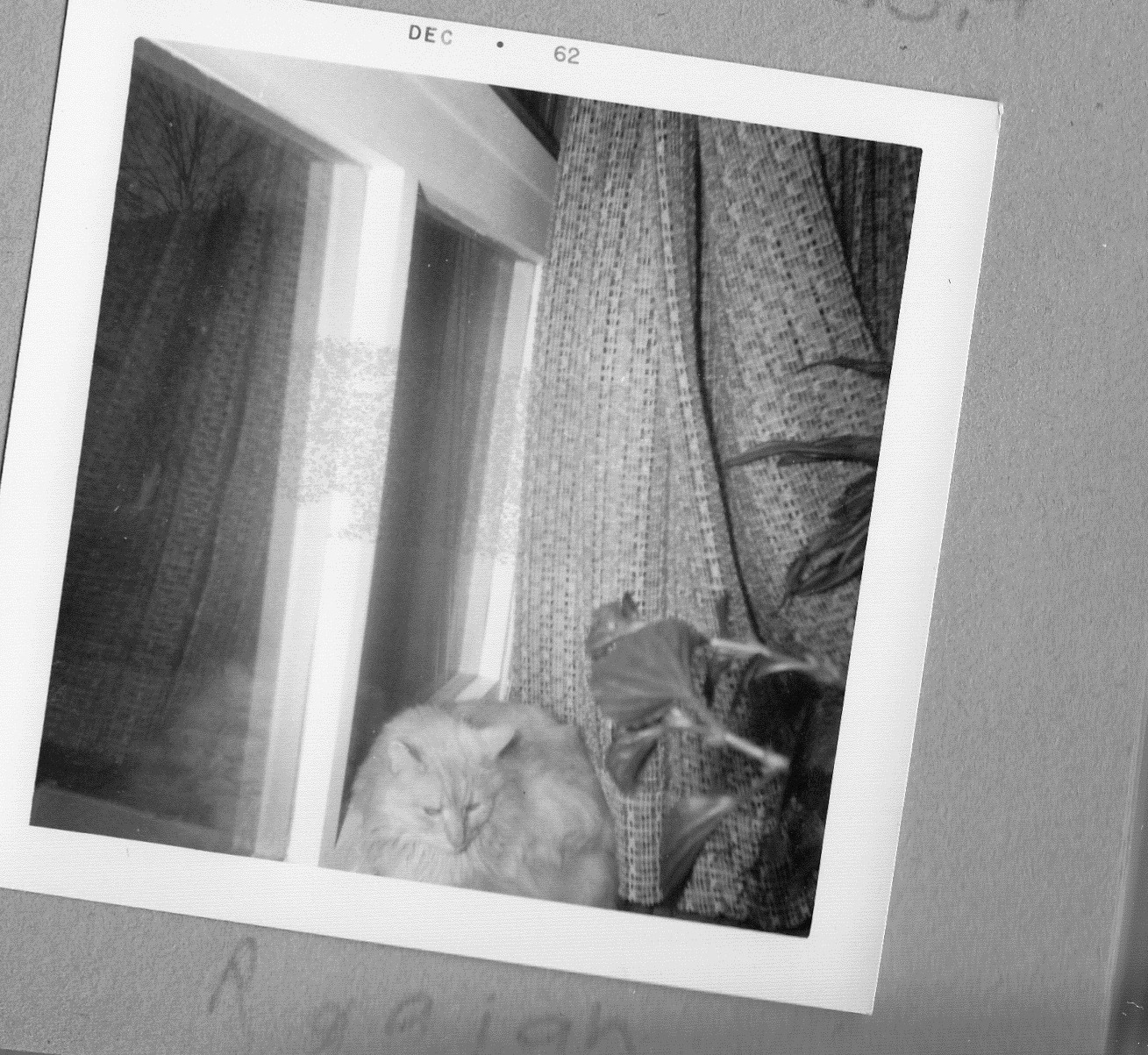
I learned that Gail had lived in the same building and on the same floor as my grandparents when she was a little girl and that she remembers them. She described them as kind and lovely people. And even more amazing—she remembers my grandparents’ cat and described him perfectly! She even remembers that his name was Rajah. She told me that my grandmother used to let her “borrow” Rajah and take him back to her apartment to play with her. I had a serious case of chills and tears as I read the email in which she shared this with me.  Here was someone I never met who remembered my grandparents and Rajah, who eventually became our cat when my grandmother no longer could care for him. It felt magical.

Rajah (cleverly misspelled by me at ten years old!)

Then I asked Gail about the other people in the photograph. She identified everyone else except for one woman. I told her that I was going to try and locate any relatives of those people because they also might enjoy seeing the photo. Gail said that all the people she knew in the photograph were deceased and that as far as she knew there were no living descendants. One couple did have a son, but in researching the family, I learned that that son had died in the last few years and had had no children or spouse who survived him.

As for the other three adults in the photo, one was Gail’s mother’s best friend, Helen Frankenstein Kaiserman (the woman holding Gail’s doll on her lap), and the two men standing on the right in the rear were Helen’s brothers Morris and Jerome Frankenstein. According to Gail, none of those three had children. Helen had been briefly married but was divorced by the time Gail knew her, and Gail believed that Jerome and Morris had never married.

But I was curious to learn more about the three siblings—Morris, Jerome, and Helen. I just couldn’t accept that there were no living relatives in this family. I turned to Ancestry and began to research the family and soon found them on the 1930 and 1940 census along with their parents and two other siblings. Maybe the other siblings had had children who might be interested in the photo?

In the course of doing that research, however, I stumbled upon an Ancestry tree that had Morris, Jerome, and Helen included. That tree was owned by a researcher named Renate Valencia, and I was surprised to see that according to her tree, Morris had married and had had children. Since his widow and children were still living, their names did not show up on the tree, so I decided to send Renate a message through Ancestry to learn more.

I didn’t have to wait long to hear from her. She was very excited to hear about the photograph and knew that her husband Steve, Morris’ son, would be delighted to see a photograph of his father, uncle, and aunt. Gail was surprised and happy to learn that in fact Morris had married and had had children. I connected Gail and Renate to each other, and they have been exchanging memories and asking and answering questions about the people in the photograph.

Renate sent me this link to a documentary about Parkchester, and it brought back many memories of visiting my grandmother there, going to Macy’s, playing in the playgrounds, chasing pigeons near the fountain, and taking the bright red elevator up to my grandmother’s apartment where once upon a time Gail had lived across the hall. Gail and I may have even ridden in that elevator at the same time, not knowing that all these years later we would connect through the magic of the internet and an old photograph.

All of this would never have been possible without the magic of photographs and the tricks of the internet. Without Facebook and Ancestry, I never would have found Gail or Renate. I never would have learned about the people in that photograph. Now I just wish that I could tell my parents and my grandparents this story and learn more about their memories of that evening and of the people in the photograph.

Can you imagine what all those people in the photograph would think if they knew that seventy or so years after that photograph was taken, three strangers would spend time remembering them all and sharing a magical experience like this? I still get the chills and a bit teary when I think about it.

A Dating Correction to One of Yesterday’s Photos: Thank you, Sherlock Cohn!

I am deeply grateful to Ava Cohn, aka Sherlock Cohn, the Photo Genealogist, for pointing out a dating error in one of the photographs I posted yesterday. The photo had been labeled in Robin’s collection as Cecilie and Thekla, and I assumed that it was Thekla Blumenfeld Gruenbaum with her infant daughter Cecilie Gruenbaum. Since Cecilie was born in 1895, I labeled the photo with the date 1895.

When was this photograph taken?

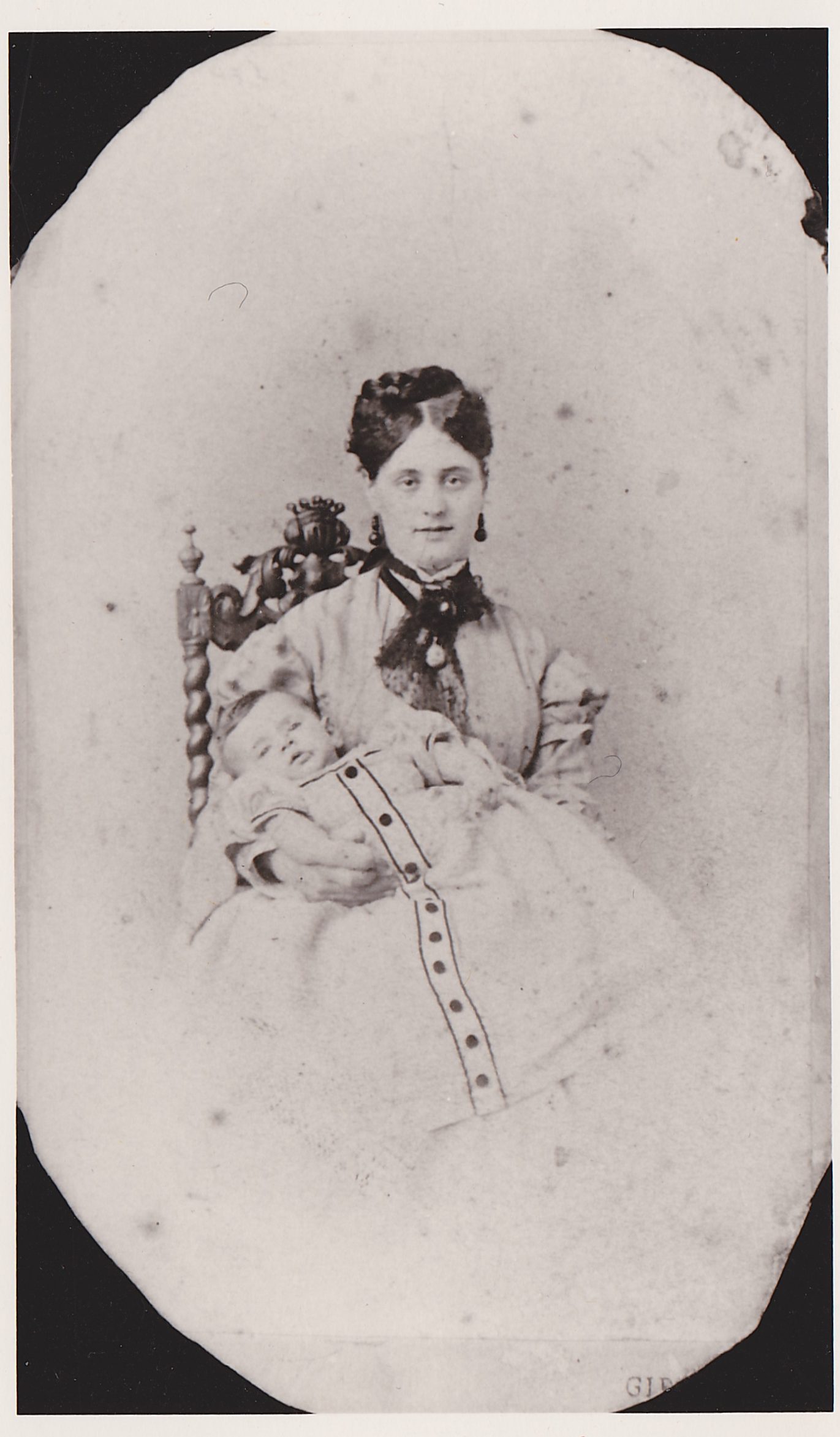
But Ava, whose expertise in dating photographs is astounding, noticed that something was off in that date because the clothing worn by the mother in the photo would not have been in fashion in the 1890s. She emailed me and said she thought it was more likely that the photograph was taken in the 1870s.

I went back and looked at the photograph and the information I had on Thekla’s family, and I hypothesized that although the photograph was labeled Thekla and Cecilie, it was of Thekla as an infant with her mother, who was also named Cecilie. That would date the photograph as 1872, not 1895. Ava said that that date made a lot more sense, and when I emailed Robin to ask her for her thoughts, she agreed that it was probably not Thekla as an adult with her daughter, but Thekla as a baby with her mother.

It once again proves that if you want accurate dating and insights into old photographs, don’t rely on the hunches of amateurs. Hire a professional. Ava does amazing work, and I am so grateful that she caught this mistake.

The Legacy of Thekla Blumenfeld Gruenbaum: Family Photos

I mentioned in my last blog post that I have recently connected with another cousin, Robin Kravets, the great-granddaughter of Thekla Blumenfeld Gruenbaum. Robin is my fifth cousin, once removed. We are both descendants of Abraham Blumenfeld and Geitel Katz, Robin through their son Moses and me through their daughter Breine.

Robin has generously shared with me a collection of photographs of her family, and I am delighted to be able to share them with you. All the photos in this post are courtesy of my cousin Robin. I am providing a summary of what I posted two years ago about Robin’s direct ancestors to provide context to the photos and to add some additional insights Robin shared with me. The blog posts from 2021 contain more details and my sources.

Salomon Blumenfeld, Robin’s great-great-grandfather, first married Caecilie Erlanger, but she died when she was only 24 years old, leaving behind two very young children: Thekla (Robin’s great-grandmother), not yet two, and Felix, just seven months old. Two years after his first wife Caecilie died, Salomon married Emma Bendheim and had a third child, Moritz, in 1877. And then sometime within the next five or six years, Salomon left Germany for Spain with Emma and Moritz, leaving his first two children, Thekla and Felix, behind. As best I can tell, Thekla and Felix, still both young children, must have been raised by their mother’s family, the Erlangers, in Marburg.

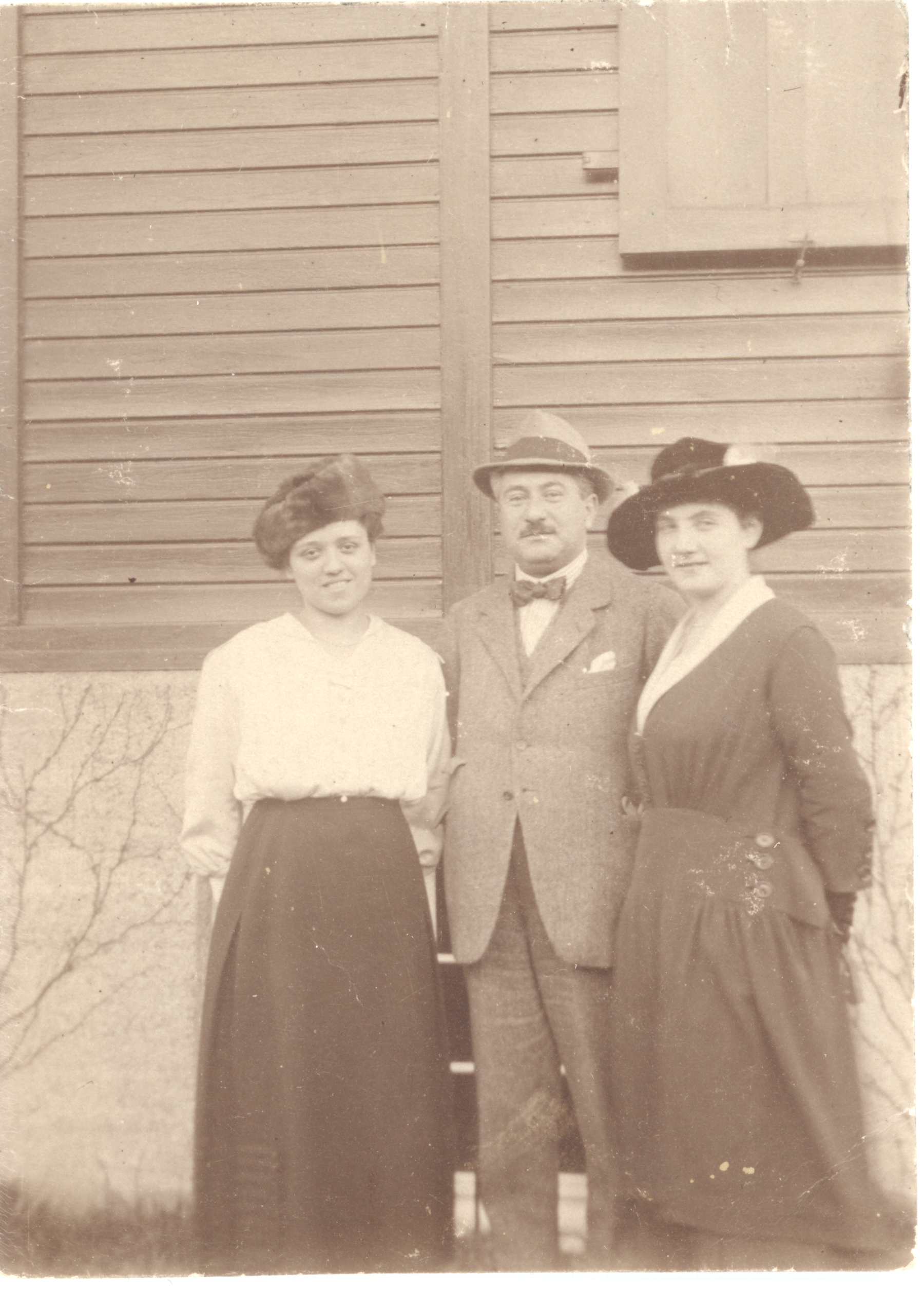
I had wondered whether Salomon or his son from his second marriage, Moritz, had remained in touch with Thekla and Felix. Robin provided this photograph of Moritz with his half-niece Cecilie, Thekla’s daughter, and another unidentified woman, so there is some evidence that at least Moritz had some contact with his half-sister Thekla and her family.

Moritz Blumenfeld and Cecilie Gruenbaum (with unknown woman on the left)
Courtesy of Robin H Kravets

This is the oldest photograph in Robin’s collection. It shows Thekla as an infant with her mother, Caecilie Erlanger Blumenfeld and must have been taken in about 1872 when Thekla was born. Thank you to Ava Cohn, aka Sherlock Cohn, The Photogenealogist, for pointing out the correct dating of this photograph.

Caecilie Erlanger Blumenfeld with Thekla Blumenfeld, c. 1872 Courtesy of Robin H Kravets

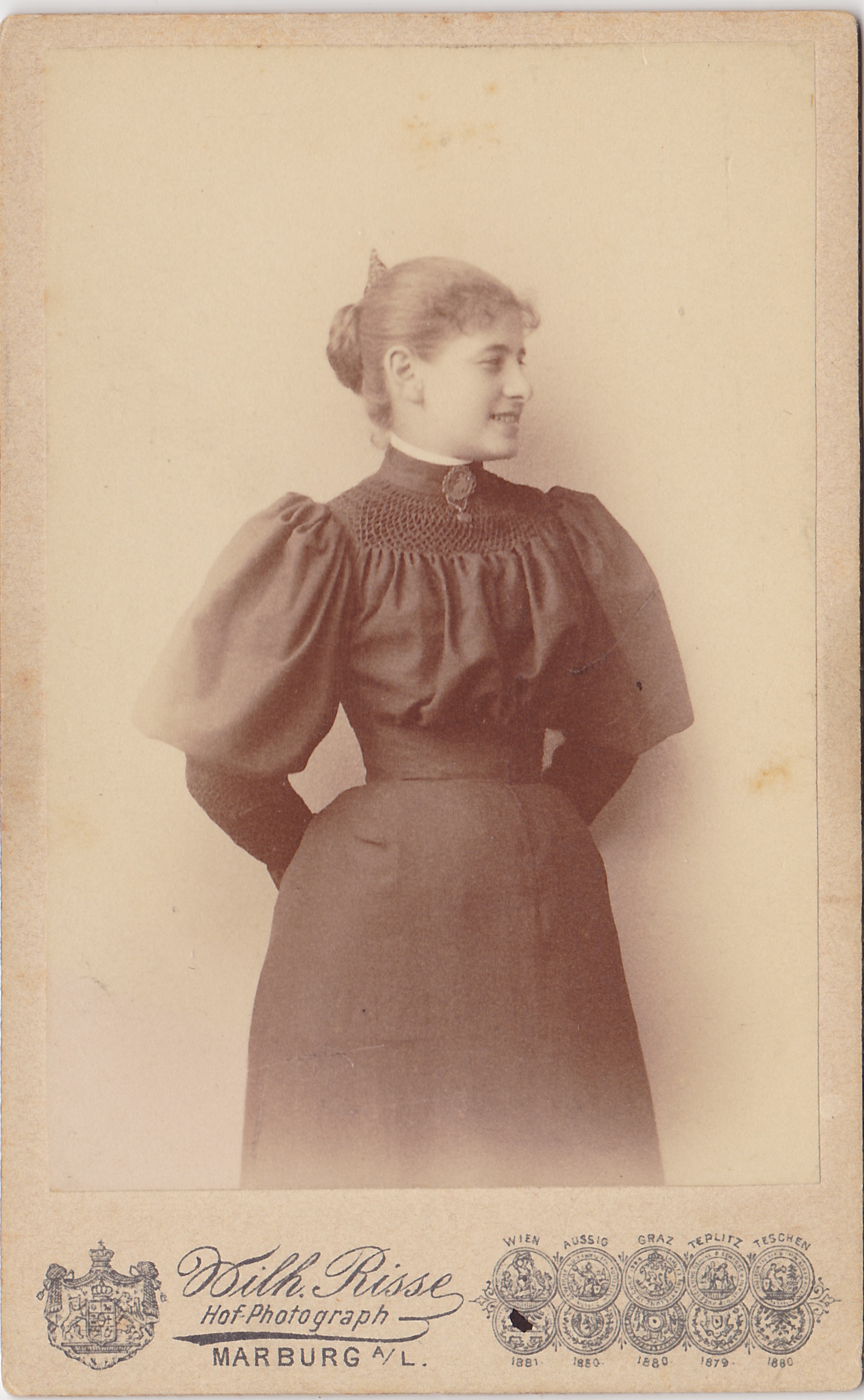
Here are two beautiful photographs of Thekla as a young woman.

Thekla Blumenfeld, courtesy of Robin H Kravets

Thekla Blumenfeld, courtesy of Robin H Kravets

Thekla married Max Gruenbaum in 1894. Here is a photograph of them taken in 1895.

Thekla Blumenfeld and Max Gruenbaum 1895
Courtesy of Robin H Kravets

Thekla and Max had four children: Cecilie (1895), Curt (1897), Franz (1899), and Rosemarie, Robin’s grandmother (1912).

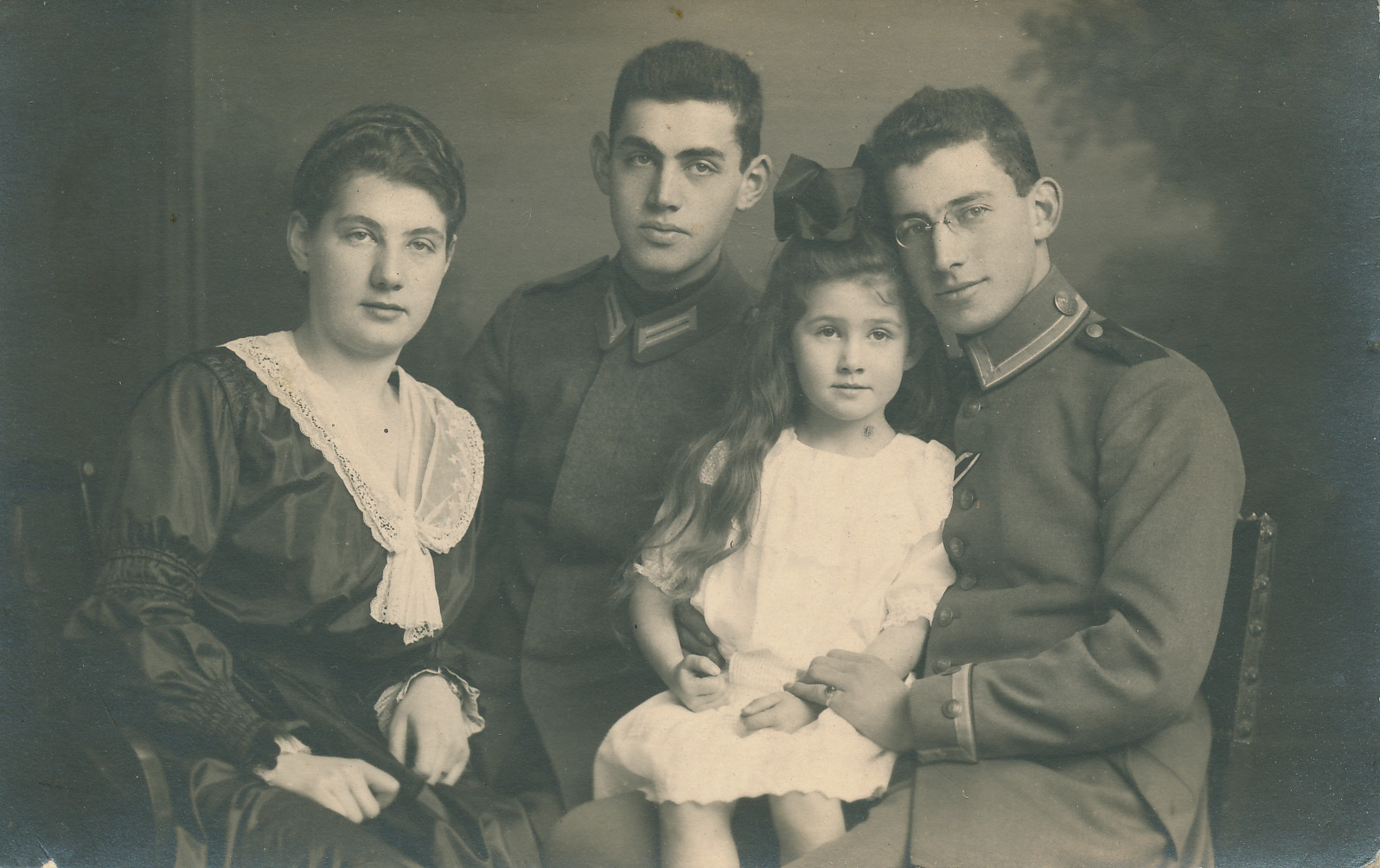
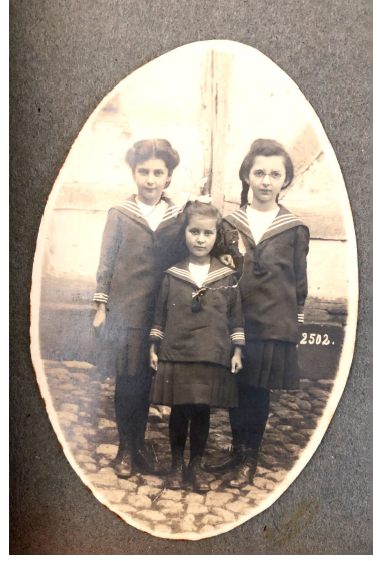
Cecilie, Curt, and Franz Gruenbaum c. 1908 Courtesy of Robin H Kravets

Courtesy of Robin H Kravets

Cecilie, Franz, Rosemarie and Curt Gruenbaum, 1918  Courtesy of Robin H Kravets

Thekla’s brother Felix married Thekla Wertheim in 1902, and they had two sons, Edgar (1903) and Gerhard (1906). Robin had just a few photos of Felix; he appears to be in uniform during World War I in these first two. The caption on the first translates as “to commemorate the first nailing of the Zaitenstock.” I am not sure what that means, but Wikipedia explains (as translated by Google) that zaitenstocke were part of the pipe systems used to carry water into the cities.

Felix Blumenfeld, 1915 Courtesy of Robin H Kravets

detail from photo above

Felix Blumenfeld, 1916
Courtesy of Robin H Kravets

detail from photo above

As I wrote in my earlier posts, both Felix and his sister Thekla lost their spouses at relatively young ages. Thekla’s husband Max Gruenbaum died in 1917, and Felix’s wife Thekla died in 1923.

But even more tragically, both Felix and Thekla were among the six million who were killed in the Holocaust, Felix by suicide in 1942, as detailed here, when he was in despair and had no hope in surviving, and Thekla at Treblinka in 1943.

Felix Blumenfeld
Courtesy of Robin H Kravets

Thekla had refused to leave Germany, and her daughter Cecilie would not leave her mother behind. Robin wrote that “[Cecilie] was very smart and saw the writing on the wall but her mother would not leave.  I remember my family talking about them having tickets on a boat somewhere. But the boat was cancelled.”1 Fortunately, Cecilie’s children were safely in England.

But Cecilie and her husband Walter Herzog were sent to the concentration camp in Riga in 1941. Walter did not survive, but against all odds, Cecilie did even after being sent to Stutthof, a camp where the conditions were truly horrible, as I wrote about here. When I asked Robin whether she had any information as to how Cecilie had survived, she wrote that “since she was trained as a nurse during WWI, she used her skills to help people in the camps. I have always believed it gave her a purpose to survive. The story I heard as a child was that when the Allies liberated the camp, she knew she had to get west. She collected a group of people and helped them make their way west. As a nurse, she knew that they needed to be very careful about overeating after being in the camps and made sure they did not die from bloating.”2 As was not uncommon with Holocaust survivors, Cecilie never wanted to talk about her experiences.

Cecilie Gruenbaum Herzog Courtesy of Robin H Kravets

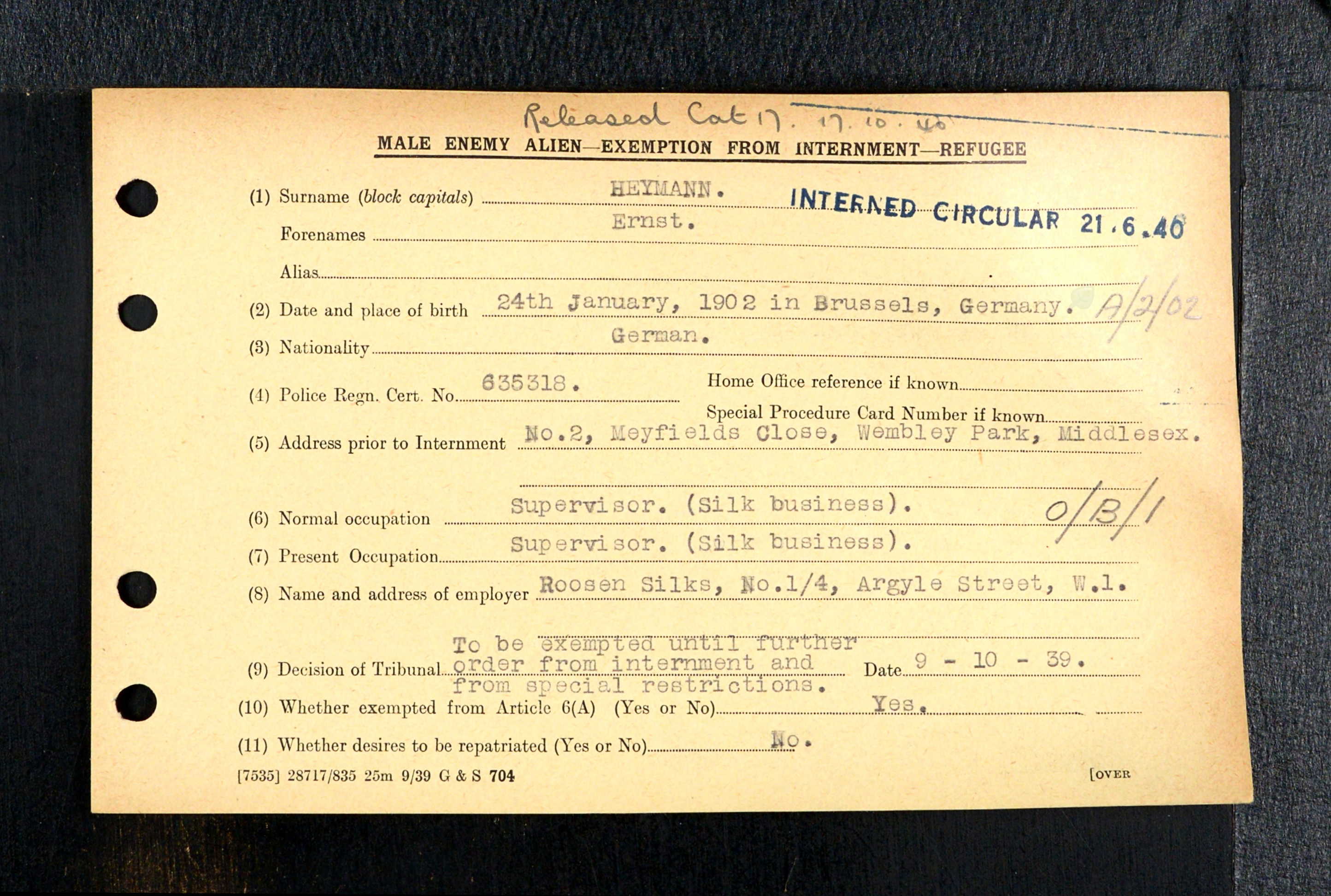
The other children of Thekla Blumenfeld Gruenbaum and Felix Blumenfeld had all managed to escape Germany before it was too late, as I wrote about here. Robin’s grandmother Rosemarie, the youngest of Thekla’s children, had married while still in Germany. In fact, as Robin explained, she had married her husband Ernest Heymann in absentia as Ernest was in England at the time, having gone there on business and then realizing it was not safe to return. I’d never heard of being married in absentia, but apparently Rosemarie’s nephew stood in as a surrogate groom.3

Rosemarie was able to get out of Germany and join Ernest in London where their first child, Robin’s mother, was born. After the war started, Ernest was one of the many Jewish refugees who was sent to an internment camp as a “enemy alien.” He was interned from June 21, 1940, until October 17, 1940.

Ernst Heymann, he National Archives; Kew, London, England; HO 396 WW2 Internees (Aliens) Index Cards 1939-1947; Reference Number: Ho 396/178
Piece Number Description: 178: German Internees Released in Uk 1939-1942: Hertzke-Hoj
Ancestry.com. UK, World War II Alien Internees, 1939-1945

After he was released, he and Rosemarie and their daughter immigrated to the US and settled in New York. They had another child in New York after the war.

Rosemarie’s sister Cecilie made it to the US in 1946 and went to live with Rosemarie and her family in New York. The two sisters lived together for the rest of their lives and remained close to their brothers Curt and Franz (later known as Frank), who visited them often from Massachusetts.  Cecilie lived to 95, dying in 1990, and Rosemarie to 91, dying in 2004.3

The story of Thekla Blumenfeld Gruenbaum is tragic: motherless as toddler, left behind by her father, widowed at a young age, and then killed by the Nazis. The fact that Thekla’s two daughters Cecilie and Rosemarie lived together and survived into their 90s is quite a tribute to the strength their mother must have had and that they both had.

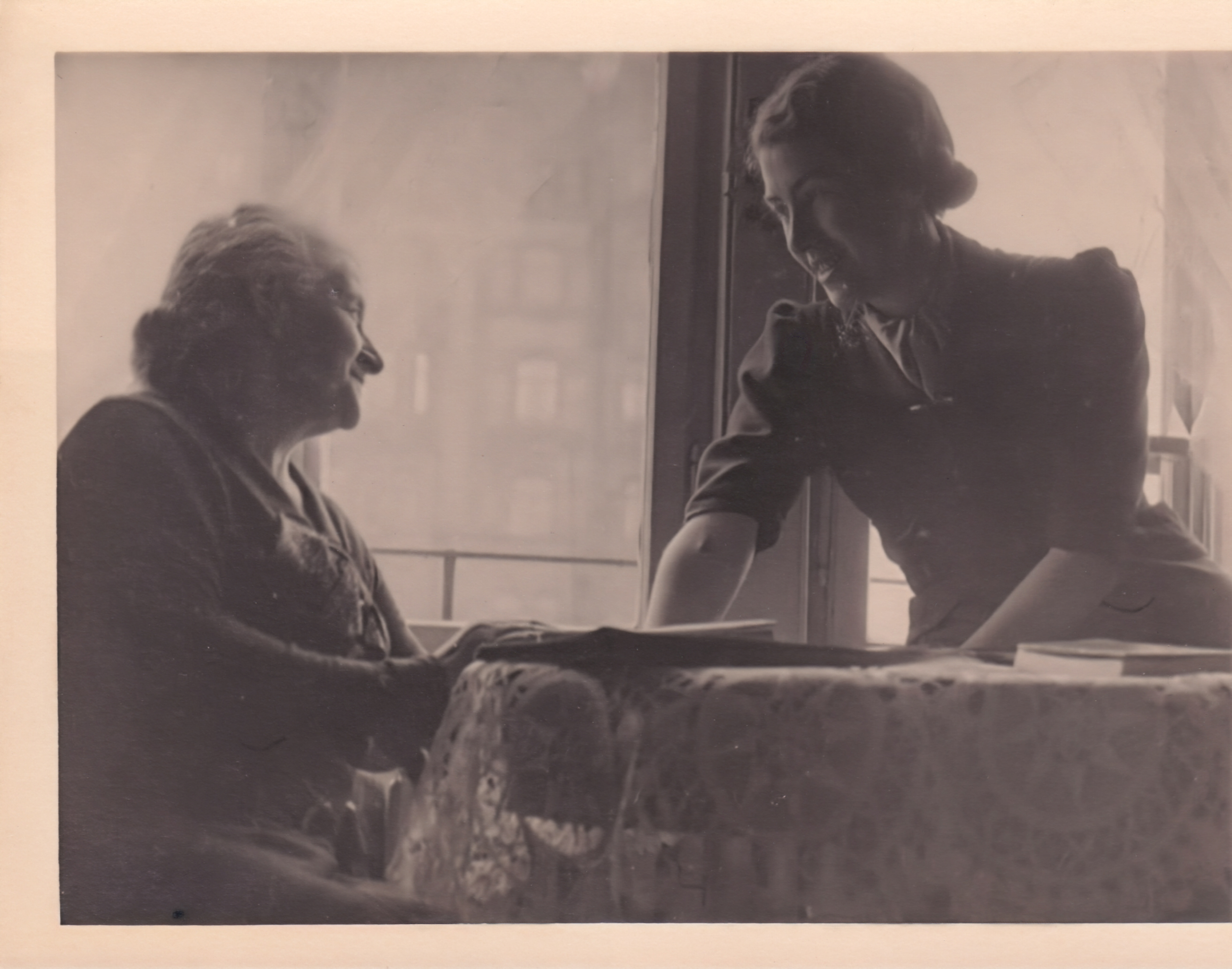
Thekla with her daughter Rosemarie Courtesy of Robin H Kravets

Thekla Blumenfeld Gruenbaum  Courtesy of Robin H Kravets

Thekla Blumenfeld Gruenbaum  Courtesy of Robin H Kravets


  1. Email from Robin H. Kravets, September 10, 2023. 
  2. Ibid. 
  3. Emails from Robin H. Kravets, September 10, 2023, and October 27, 2023. 

An Exciting New Project in the Works!

Before I move on to the next child of Moses Blumenfeld I, I have two other matters to write about. In my next post I will share some wonderful photographs that my cousin Robin shared with me. Robin, my fifth cousin, once removed, is descended from Abraham Blumenfeld and Geitel Katz through their son Moses I. More details to follow in the next post.

But today’s post is about some other amazing photographs. A couple of months ago I received an email out of the blue from an antiques dealer in Santa Fe named Peggy Gonzalez. Peggy had found me through my blog while looking for a descendant of John Nusbaum, my three times great-grandfather and my father’s namesake. Over thirty years ago at an estate sale, she had acquired a photograph album engraved with the name John Nusbaum on the front. She wanted to know whether I would be interested in buying the album.

At first I was skeptical. There are so many scams out there today. Anyone could have found my blog and made this up. But Peggy sounded honest, and she sent me these scans of the front and back of the album as well as a few representative photos. The back is engraved with “To F. Nusbaum.” My great-great-grandmother was John Nusbaum’s daughter Frances Nusbaum Seligman, and she had lived much of her adult life in Santa Fe with her husband Bernard, my great-great-grandfather. Peggy’s story seemed to be authentic.


I was extremely excited—as you might imagine. I’ve never seen a photograph of John Nusbaum or Frances, and here was a whole album of photos. Almost 200 photos. Thanks to the generosity of some of my Seligman/Nusbaum/Cohen relatives, I arranged to purchase the album. I also got extraordinary help from Mike Lord, our guide in Santa Fe from 2014 and a close friend of my cousin Pete. He acted as the middleman between Peggy and me, retrieving the album and giving Peggy my check and then sending me the album.

The album is now safely in my house, back in the hands of one of John Nusbaum’s descendants. I have retained the services of Ava Cohn, aka Sherlock Cohn, the Photogenealogist, and am now waiting in her queue for her to have time to devote to this project. I’ve scanned the front and back of all the photos. They are all studio photographs—cabinet photos, I think they are called. Small, but very clear. And they all have the names and addresses of the photographers on the reverse side. But only three have any identification of the people in the photograph.

There are photographs that were taken in several cities in Germany as well as all over the US: Philadelphia, New York, Santa Fe, Peoria, Lewistown (PA), and St. Louis. I am hoping that if Ava can provide dates for when they were taken and perhaps the ages of the people, I can then figure out who these people are.

I will wait to share the photos until after I have had the benefits of Ava’s help, but I wanted to share now my excitement about this. Stay tuned for more!


Hilde Blumenfeld Meinrath: A Strong and Determined Woman

Once again, a new cousin found my blog and helped me find information that I could not find through traditional research, this time because the family had ended up in Brazil. Not speaking Portuguese and thus not having easy access to any Brazilian sources, I had hit a brick wall when it came to the family of my cousin, Hilde Blumenfeld Meinrath, whom I wrote about here back on May 31, 2022.

On January 30, 2023, I heard from Ana Gabriela Meinrath, my fifth cousin, once removed, who left the a comment on my blog, telling me that she is the granddaughter of Hilde Blumenfeld Meinrath. Here is a chart showing my father’s connection to Hilde:

Hilde was the youngest of the three daughters of Salomon Blumenfeld and Malchen Levi: Gretel (born 1906), Jenny (born 1907), and Hilde (born 1911). Gabriela shared this wonderful photograph of the three sisters:

Jenny, Hilde, and Gretel Blumenfeld c. 1917 Courtesy of the family

Gabriela shared some family stories and many photographs and connected me to her uncle Roberto Meinrath, who added more information and stories about Hilde and her family. Roberto then connected me to Michael Katz, grandson of Gretel Blumenfeld Katz. Michael shared this photograph of Salomon and Malchen with all three of their daughters:

Salomon Blumenfeld and family Courtesy of the family

First, a summary of what I knew before Gabriela found me: I knew from my research that Salomon and Malchen and all three of their daughters survived the Holocaust by leaving Germany in time. Hilde, in fact, had left Germany as a seventeen year old in 1929, years before Hitler came to power. Later, she married Ludwig Meinrath, and eventually they immigrated to Brazil. Her parents followed her there, but later immigrated to the US where their second daughter Gretel and her family were living. The third daughter Jenny ended up in Israel.

But I had many questions left unanswered when I published that post on May 31, 2022, including why Hilde had left Germany in 1929 when she was only seventeen, how Hilde had met Ludwig and when they had married, why they had gone to Brazil, and whether Hilde and Ludwig had had more than one child. I also had questions about Hilde’s sister Jenny: had she married Siegmund Warburg, as many trees reported, and did she have children? And I knew few details about Gretel and her family.

Hilde had been interviewed by the Shoah Foundation, but unfortunately it was in Portuguese, and I couldn’t find anyone to translate it.

Most of my unanswered questions have now been answered, and I’ve learned a great deal more about the family from my cousins Roberto, Gabriela, Michael, and Simeon Spier. In addition, I’ve once again been working with my cousin Richard Bloomfield, and he was able to find someone to translate Hilde’s Shoah Foundation interview.

First, let me share the new information I have about Salomon Blumenfeld and his wife Malchen or Amalie Levi and their youngest daughter Hilde Blumenfeld Meinrath.

I learned from Hilde’s Shoah Foundation interview1 (as translated by Manuel Steccanella from Portuguese to German and then translated by Richard Bloomfield from German into English) that her father Salomon had served in the German military and fought for Germany during World War I, serving in France and Belgium, and leaving behind his wife and three young daughters. According to Hilde, when her father returned to Kirchhain from the war, he brought a hundred prisoners with him. Salomon owned a large hotel in Kirchhain, and the prisoners lived in the hotel and worked in Kirchhain. Hilde said that on Sundays, the prisoners butchered small animals and once made her a doublet from the fur to wear in the cold weather. They also shared with her the cookies and other baked goods they received from their families back in France and Belgium.

Gabriela shared this photograph of her great-grandfather’s hotel in Kirchhain:

Salomon Blumenfeld’s hotel in Kirchhain, Germany Courtesy of the family

Hilde reported that although her father was liberal in his Jewish observances, her mother was more orthodox. They would all go to synagogue on shabbat and on holidays, however. On Sundays, the children had religious instruction. But during the week they went to a non-religious school attended by Jews and non-Jews. Hilde would play with the non-Jewish children next door, and she recalled that their family was the only Jewish family on their street.2

After ten years at the local school in Kirchhain, Hilde went to study at the Elisabethschule in Marburg an der Lahn to study to become a librarian. She then worked at the Jewish library in Kassel for a year. At that time (1929), Hilde’s maternal uncle suggested that she come with him to the US to continue her studies.3 Hilde’s son Roberto had an additional insight into Hilde’s reason for going to the US. 4 he wrote that she left home at seventeen because she had socialist political opinions that created conflicts with her religious parents.  Her parents permitted her to go for a year.

Hilde lived with her uncle and his wife in New York for a year, learning English and secretarial skills. But when that year was up, Hilde did not return to Germany. By then she had saved enough money from working while going to school to get her own rented room, and she then got a job doing German-English translation for Siemens-Schuckert in their patent department. (According to Britannica, at that time Siemens was making medical diagnostic and therapeutic equipment, especially X-ray machines and electron microscopes.) She worked there for three years. At night she continued her studies.5
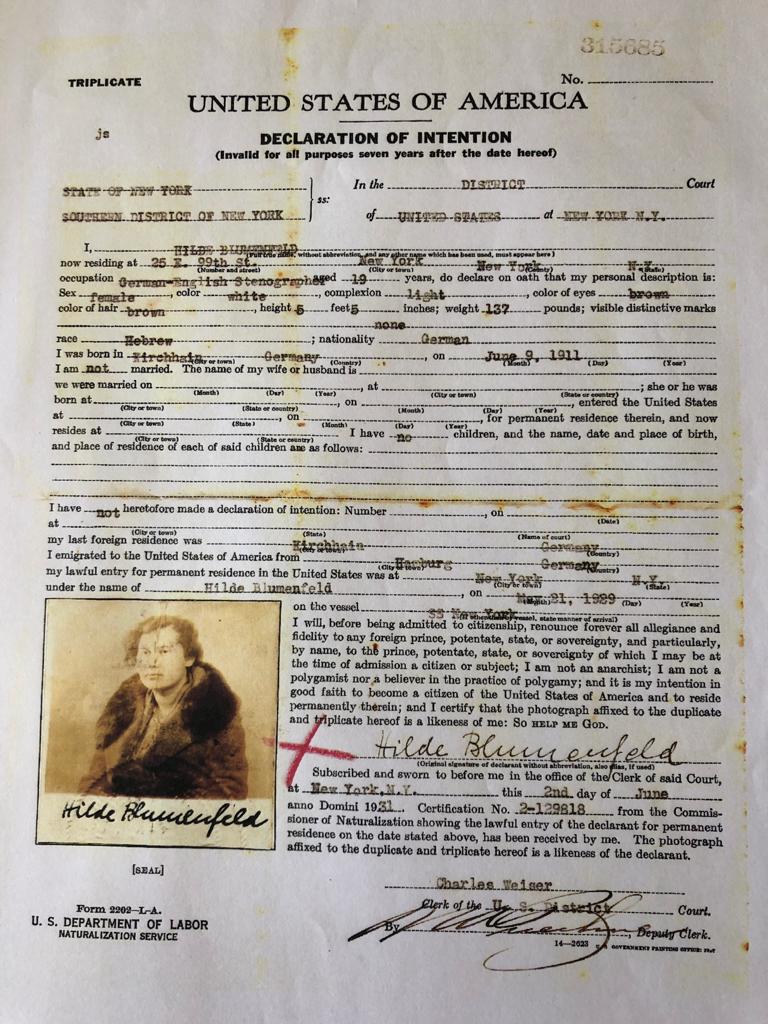
Hilde had serious intentions of staying in the US, as seen in her Declaration of Intention to become a US citizen, filed in 1931.

Hilde Blumenfeld Declaration of Intention. Courtesy of the family

But her life changed when she went back to Germany in 1932 to visit her family; she at first intended to stay for only six months and then return to New York, but then she met her future husband, Ludwig Meinrath, at a Purim ball and decided to stay in Germany longer.6 Here is a photograph of Hilde with Ludwig:

Hilde Blumenfeld and Ludwig Meinrath Courtesy of Richard Bloomfield

Hilde Blumenfeld and Ludwig Meinrath Courtesy of the family

Hilde began working for an American author named William March; Roberto told me that she was helping him with his manuscript for his book Company K. According to the description on Amazon.com, Company K is the “greatest First World War novel to come out of America[.] Company K is the unforgettable account of one US Marine company, from initial training, through to the trenches in France and post-war rehabilitation. Written in 1933 by a decorated Marine hero, this is an unflinching, visceral depiction of the brutal reality of war.”

William March was apparently quite fond of Hilde. Richard Bloomfield found this quote from a letter written by William March to John B. Waterman on February 18, 1933, as quoted in an article about March from the Fall 1977 issue of The Mississippi Quarterly written by R. S. Simmons (warning—it is quite sexist, but typical of its times): 7

[March] had this to say about the German secretary he had engaged: “As a matter of interest for the company’s records, Miss Blumenfeld is quite in the tradition of the Waterman Line not only for beauty but for intelligence.” He added whimsically: “Of course, the latter was merely a happy accident.”

It appeared that Hilde was not planning to leave Germany now that she was married and happily employed. But, of course, everything changed when Hitler came to power. More on that in the post to follow.


  1. The references in this post to the interview of Hilde Meinrath and the information contained therein are from her interview with the Shoah Foundation, March 18, 1998, which is in the archive of the University of Southern California Shoah Foundation Institute for Visual History and Education. For more information: http://dornsife.usc.edu/vhi 
  2. Ibid. 
  3. Ibid. 
  4. All the information in this post attributed to Roberto Meinrath as well as the quotations were shared through emails sent between February 11 and February 16, 2023. 
  5. See Note 1, supra
  6. See Note 1, supra
  7. R.S. Simmons, “William March’s ‘Personal Letter:’ Fact into Fiction,” The Mississippi Quarterly (Fall 1977), p. 625, 629, found at https://www.jstor.org/stable/26474519