Fighting their Native Country in World War II: Jakob Schoenthal’s Grandsons

As I wrote last time, the two sons of Jakob Schoenthal and Charlotte Lilienfeld had arrived in the US long before Hitler came to power in Germany.  They were working as tailors and living in Washington, Pennsylvania, where their uncles and aunt had lived for many years.  Then Hitler came to power, and their family back home was in danger.

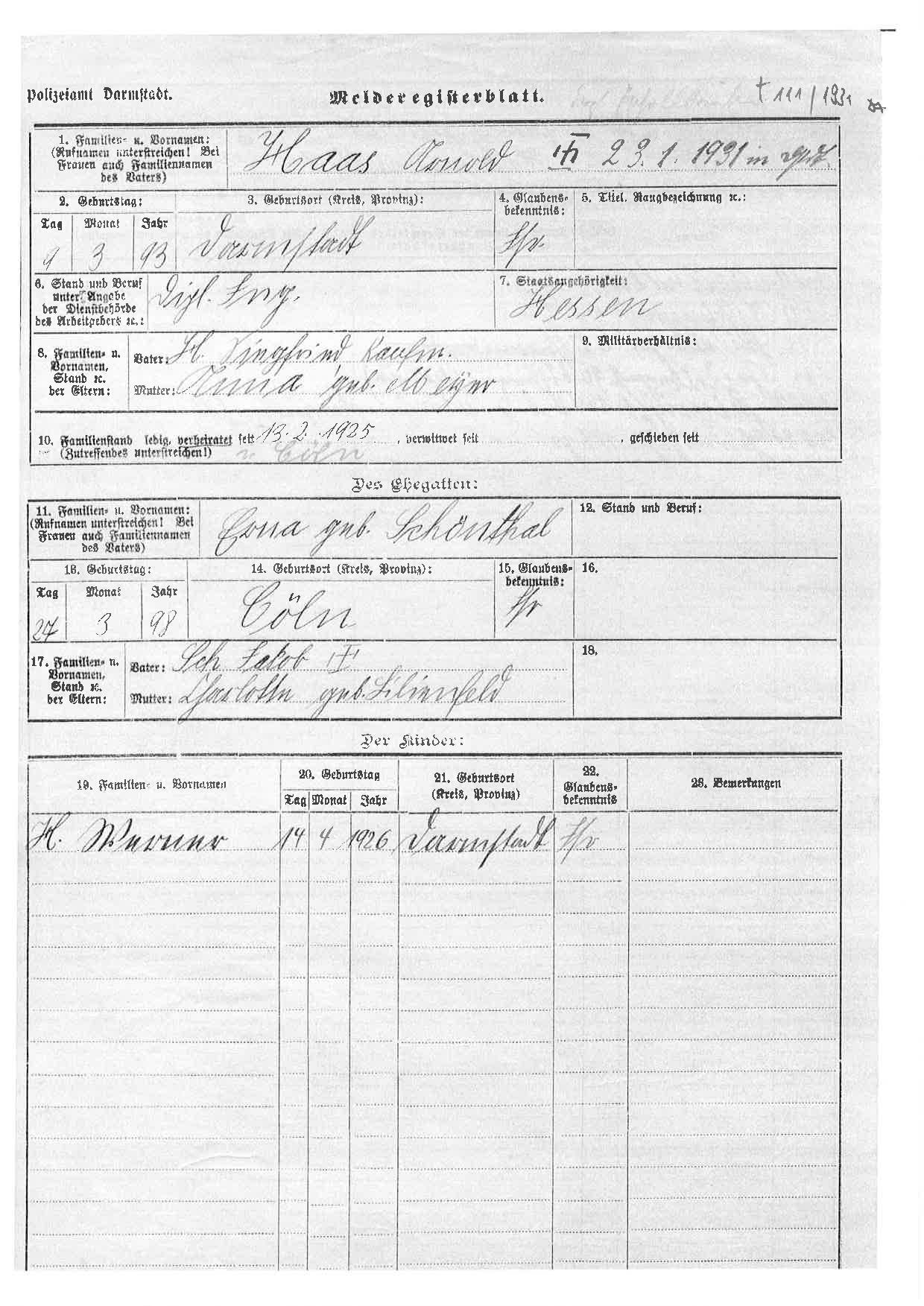
In 1938, Lee and Meyer’s sister Erna arrived from Germany with her son Werner.  I have now learned more about Erna’s husband Arnold Haas.  He was born in Darmstadt, Germany, in 1893, and had served his native country during World War I.  He and Erna Schoenthal had married on February 13, 1925, and their son Werner was born on April 14, 1926.  Then Arnold died at age 38 on January 23, 1931, leaving behind his young widow Erna and his not-yet five year old son Werner.  Fortunately Erna had the good sense to leave Germany in May, 1938, and bring her son and herself to safety in the US.  In 1940, they were living in Pittsburgh.

Darmstadt register for Arnold Haas and family indicating birth, marriage, and death of Haas and birth of son Werner

Darmstadt register for Arnold Haas and family indicating birth, marriage, and death of Arnold Haas and birth of son Werner

Helmut Levi, the son of Julius and Henriette (Schoenthal) Levi, had also arrived by then and was living in New York City.  Both Helmut and Werner soon found themselves fighting their former homeland when the US entered World War II at the end of 1941 after the bombing of Pearl Harbor.

Werner Haas joined the US Navy on March 15, 1944, when he was 18, and served until March 6, 1946.  He spent time at the Naval Air Stations in Norfolk, Virginia, and in Corpus Christi, Texas, before being assigned to the Destroyer Escort USS Wesson in June, 1945.  According to Michael Moskow, who has done extensive research on Jewish military service during World War II, the Wesson had been struck by a kamikazi in April, 1945, two months before Werner was assigned to that vessel.

As seen in the caption on the photo below, the Wesson was “in overhaul” from May to July 1945, so it would seem likely that Werner was working on her repairs when he was first assigned to that ship.  Werner served as a fireman on the destroyer; according to this site about military careers, “The training received as a Fireman or in the related engineering skill specialties is equivalent to that received as an electrician, electrical or power plant/co-generation plant operator or supervisor, diesel mechanic, or electronics repair technician.”  From various military records it appears that Werner was assigned to the Wesson for at least a year and was then assigned to two other naval ships.


English: 26 June 1945: Mare Island Naval Shipy...

English: 26 June 1945: Mare Island Naval Shipyard, San Francisco, Cal. – Forward plan view of USS Wesson (DE 184) at Mare Island. She was in overhaul at the yard from 16 May to 1 July 1945. USS Blessman (APD 48) inboard of Wesson and USS Hazelwood (DD 531) is on the opposite side of the pier. (U.S. Navy photo #DE-184-4842-45) (Photo credit: Wikipedia)


Werner’s older cousin Helmut Levi served in the US Army, enlisting on November 28, 1942.  He served as a private and then a corporal during the course of World War II.   Although I am still looking for more information about Helmut’s service during the war, I was able with the help of Michael Moskow to find this letter that Helmut Levi (presumably the same one) wrote to Yank magazine in September, 1944:


Pvt Helmut Levi letter to Yank magazine, September 29, 1944, p 14

Pvt Helmut Levi letter to Yank magazine, September 29, 1944, p 14, found at http://www.unz.org/Pub/Yank-1944sep29-00014


Not surprisingly, Helmut had strong feelings about the need for Germany (and Japan) to be occupied and supervised carefully after the war.  It appears that he was stationed in Britain in September, 1944, just months after the D-Day invasion and the beginning of the Allies’ advances in France against Germany.  During that time, Helmut’s aunt and uncle, Johanna (Schoenthal) and Heinrich Stern, were living in France, hiding from the Nazis. His parents had already been killed at the Chelmno death camp.

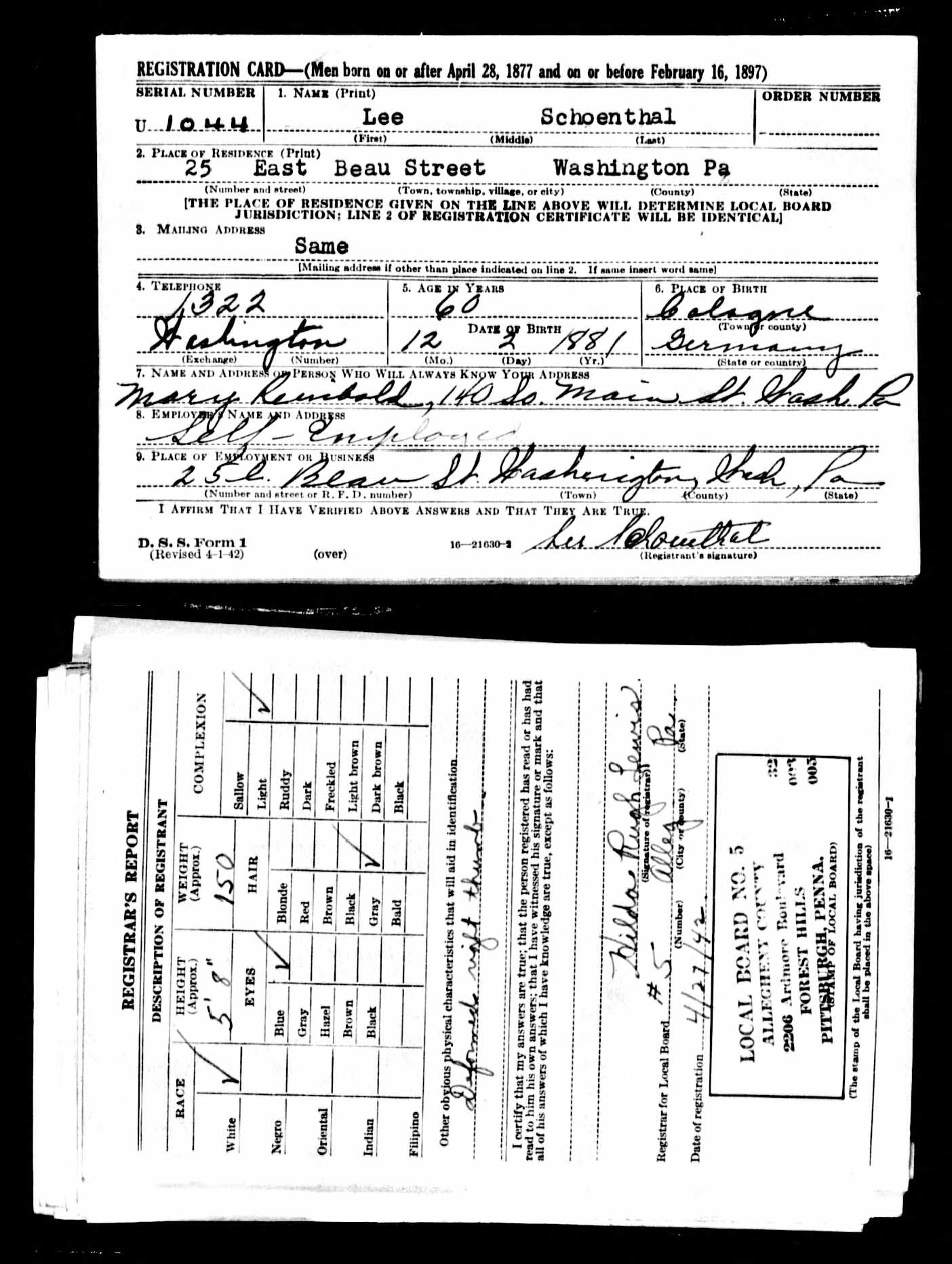
Lee and Meyer both registered for the World War II draft, though being almost in their sixties when the war began, neither served in the military during the war.  Note that Meyer was both working for and living with Lee in April 1942.  (Lee seems to have listed his work address as his residence.)  Although Meyer listed his brother Lee as the person who would always know his address, Lee listed someone named Mary Reinbold, who as listed in the 1940 census, was then a 39 year old single woman living with her father and brothers and working as a telephone operator.


Lee Schoenthal World War II draft registration The National Archives at St. Louis; St. Louis, Missouri; World War II draft cards (Fourth Registration) for the State of Pennsylvania; State Headquarters: Pennsylvania; Microfilm Series: M1951; Microfilm Roll: 278

Lee Schoenthal World War II draft registration
The National Archives at St. Louis; St. Louis, Missouri; World War II draft cards (Fourth Registration) for the State of Pennsylvania; State Headquarters: Pennsylvania; Microfilm Series: M1951; Microfilm Roll: 278


Meyer N Schoenthal World War II draft registration Ancestry.com. U.S., World War II Draft Registration Cards, 1942 [database on-line]. Provo, UT, USA: Ancestry.com Operations, Inc., 2010.

Meyer N Schoenthal World War II draft registration
Ancestry.com. U.S., World War II Draft Registration Cards, 1942 [database on-line]. Provo, UT, USA: Ancestry.com Operations, Inc., 2010.

Why wouldn’t Lee have listed Meyer as his contact just as Meyer had listed him? More on that in a later post.

Once the war ended, the family apparently spent a year trying to learn what had happened to Henriette Schoenthal and Julius Levi.  My heart broke when, with Michael Moskow’s help,  I found this notice in the June 14, 1946 issue of Aufbau, the newspaper published beginning in the 1930s for German Jewish immigrants in the United States:


Aufbau June 14, 1946

Aufbau June 14, 1946 found at http://archive.org/stream/aufbau1219461946germ#page/n475/mode/1up


Translation: After a one year search in Europe, we today know that our beloved parents and siblings, Julius Levi and Henriette Levi (nee Schoenthal) from Cologne have fallen to the Nazi terror …. [followed by the names of their son and their siblings].

By the time Helmut Levi had enlisted in the US Army in November 1942, his parents had already been murdered by the Nazis.  It must have just been unbearable for him to realize that while he had been fighting to defeat Hitler and the Nazis, it had already been too late to save his parents.

This notice also indicates that as of June 14, 1946, Helmut was still in the Army; although I am not sure what “Liaison Sec” refers to, G-2 is military shorthand for military intelligence staff.  It appears that Helmut was doing some kind of intelligence work in Berlin after the war, which makes sense, given his familiarity with Germany and the German language.  Being in Berlin may have also allowed him to search more quickly for what had happened to his parents.

As for Johanna Schoenthal Stern and her husband Heinrich Stern, they arrived in the US in 1947 from France.  As I mentioned in my prior post, Johanna and Heinrich had listed a friend named Henry Kahnweiler of Paris as their contact person in France.  I was curious as to who he was and how Johanna and Heinrich were connected to him.  I wanted to know more about their story—how and when did they go to France? How did they survive the Nazi occupation of France? Had they had children who had not survived the war?

Although I don’t have all the answers, I now have at least some answers to those questions.  I will address those in my next post.


Jakob Schoenthal and Charlotte Lilienfeld, Part II: Finding Their Children and Grandchildren

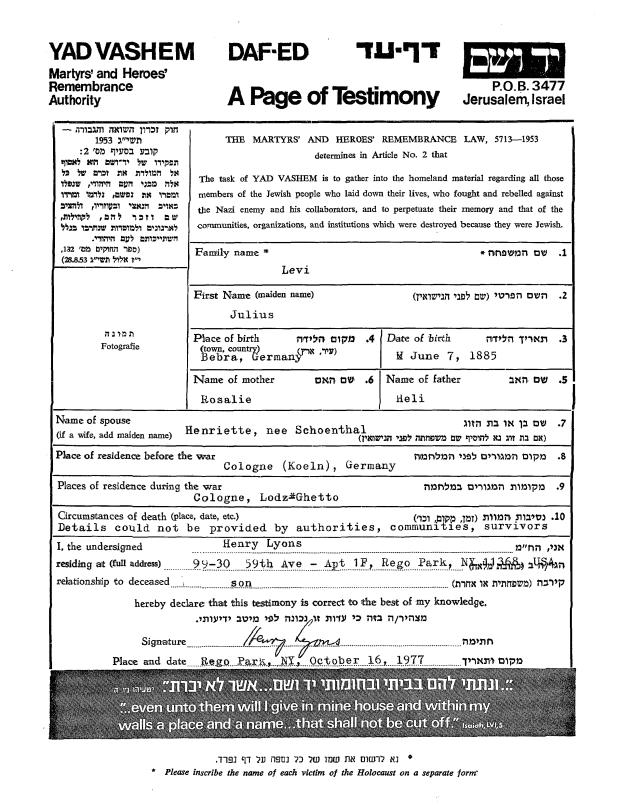
In my last post, I talked about the twisted path I took to find my great-great-uncle Jakob Schoenthal and his wife Charlotte Lilienfeld.  After discovering that their daughter Henriette Schoenthal and her husband Julius Levi had been killed in the Holocaust, I was determined to find out what had happened to Henry Lyons, who was the son of Henriette and Julius Levi and who had filed Pages of Testimony for his parents with Yad Vashem.

I thought that would be easy.  After all, I had a name and a specific address from the Pages of Testimony—99-30 59th Avenue, Rego Park, New York.  And I did almost immediately find a Public Records listing with his name at that address that provided me with his birthdate, October 17, 1919.  But that didn’t tell me much more than what I knew from the Pages of Testimony.

Yad Vashem page of testimony for Henriette Schoenthal Levi


Searching a bit further using the Rego Park address listed on the Pages of Testimony, I found a Pauline Lyons listed at that same address; I assumed that she was Henry’s wife.  Having both names made the search a bit easier since Henry Lyons itself is not exactly a unique name. I was able to use their two names together to find that they are both buried at Calverton National Cemetery and that Henry had died on December 18, 1986, and Pauline on November 30, 2007.  Henry had served in the US military during World War II, beginning his service on November 28, 1942, and thus was entitled to a military burial.  Imagine coming to America as a young man to escape Hitler and then fighting against the country of your birth.

When had he come to the US? Had he and Pauline had children? I wanted to know more.  I assumed Henry had arrived in the US sometime in the mid-to late 1930s.  I also assumed that he had arrived under the surname Levi, not Lyons.  After I wasted a lot of time searching for him under the wrong name, a member of the NYC Genealogy Group found a record for a man named Helmut Levi who had changed his name to Henry Lyons on October 5, 1953, in the city courts in New York.


Helmut Levi change of name to Henry Lyons Ancestry.com. U.S. Naturalization Record Indexes, 1791-1992 (Indexed in World Archives Project) [database on-line]. Provo, UT, USA: Ancestry.com

Helmut Levi change of name to Henry Lyons
Ancestry.com. U.S. Naturalization Record Indexes, 1791-1992 (Indexed in World Archives Project) [database on-line]. Provo, UT, USA: Ancestry.com

Armed with the information about what was probably his original name, I was able to find Helmut Levi on the 1940 census, living as a lodger at 204 West 87th Street in NYC and working as a watchmaker.  I was pretty certain I had found the right person when I saw on the census record that he had been living in Cologne, Germany, in 1935.

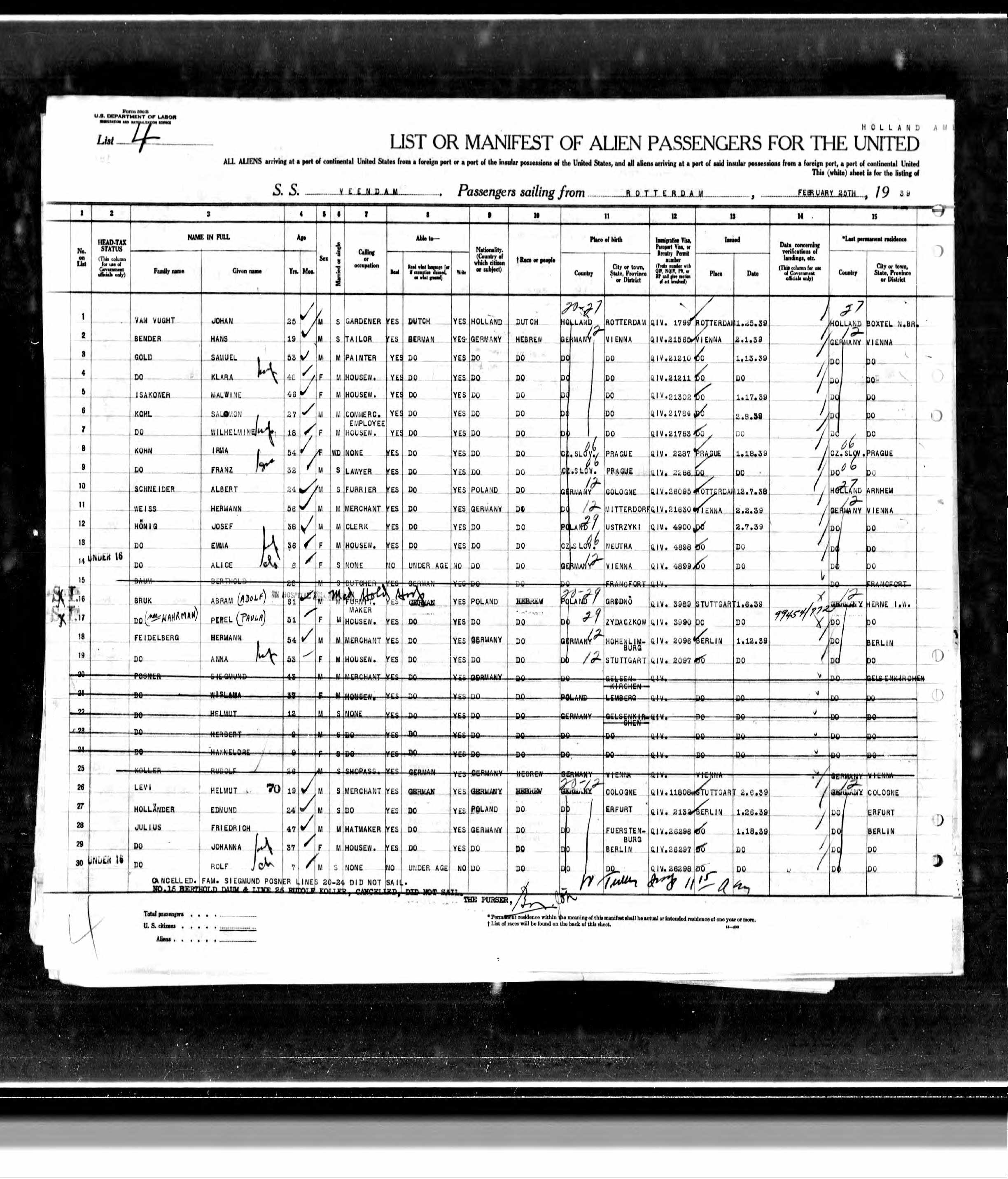
I also then found him on a passenger manifest (see line 26 on each page below):

Helmut Levy ship manifest p 1

Helmut Levi ship manifest Henry Lyons

Year: 1939; Arrival: New York, New York; Microfilm Serial: T715, 1897-1957; Microfilm Roll: Roll 6293; Line: 1; Page Number: 188


Helmut Levi had arrived in NYC on February 25, 1939.  According to the ship manifest, he was a nineteen year old merchant born and last residing in Cologne, leaving behind his father Julius Levi of Breitstrasse in Cologne and going to his uncle Lee Schoenthal of Washington, Pennsylvania.  This was obviously my cousin, the man later known as Henry Lyons.

I also found him on a second passenger manifest dated July 4, 1948, arriving in NYC from Bremerhaven, Germany.  Henry had returned to Germany after the war.  What a devastating trip that must have been.  The photo below shows what his home city of Cologne looked like after Allied bombing during the war.  Henry had not only lost his parents, but the place where he had lived as a child and a teenager.


By U.S. Department of Defense. Department of the Army. Office of the Chief Signal Officer. [2] [Public domain], via Wikimedia Commons

By U.S. Department of Defense. Department of the Army. Office of the Chief Signal Officer. [2] [Public domain], via Wikimedia Commons

From that 1948 passenger manifest (line 10), I saw that Helmut Levi was then living in Washington, Pennsylvania, where his two uncles, Lee and Meyer, were also living, that is, his mother’s brothers, the two sons of Jakob and Charlotte mentioned in my last post.  Like so many Schoenthal relatives before him, Helmut had spent time living in western Pennsylvania.  The ship manifest also indicated that by 1948, Helmut had married, although Pauline is not listed as traveling with him.


Helmut Levi aka Henry Lyons 1948 ship manifest

Helmut Levi 1948 ship manifest Year: 1948; Arrival: New York, New York; Microfilm Serial: T715, 1897-1957; Microfilm Roll: Roll 7624; Line: 10; Page Number: 9


But I still didn’t know whether Helmut/Henry and Pauline had had children or whether there were other family members I might have missed.  I called Calverton National Cemetery, but they had no additional information.  I searched in the newspaper databases for articles or obituaries that might reveal more about Henry and Pauline Lyons.  At first I limited myself to New York papers, but then I realized that that was too narrow, given that he had once lived in western Pennsylvania.  I broadened my search and found this obituary from the January 19, 1989, Pittsburgh Press:


Erna Schoenthal Haas obit 1989


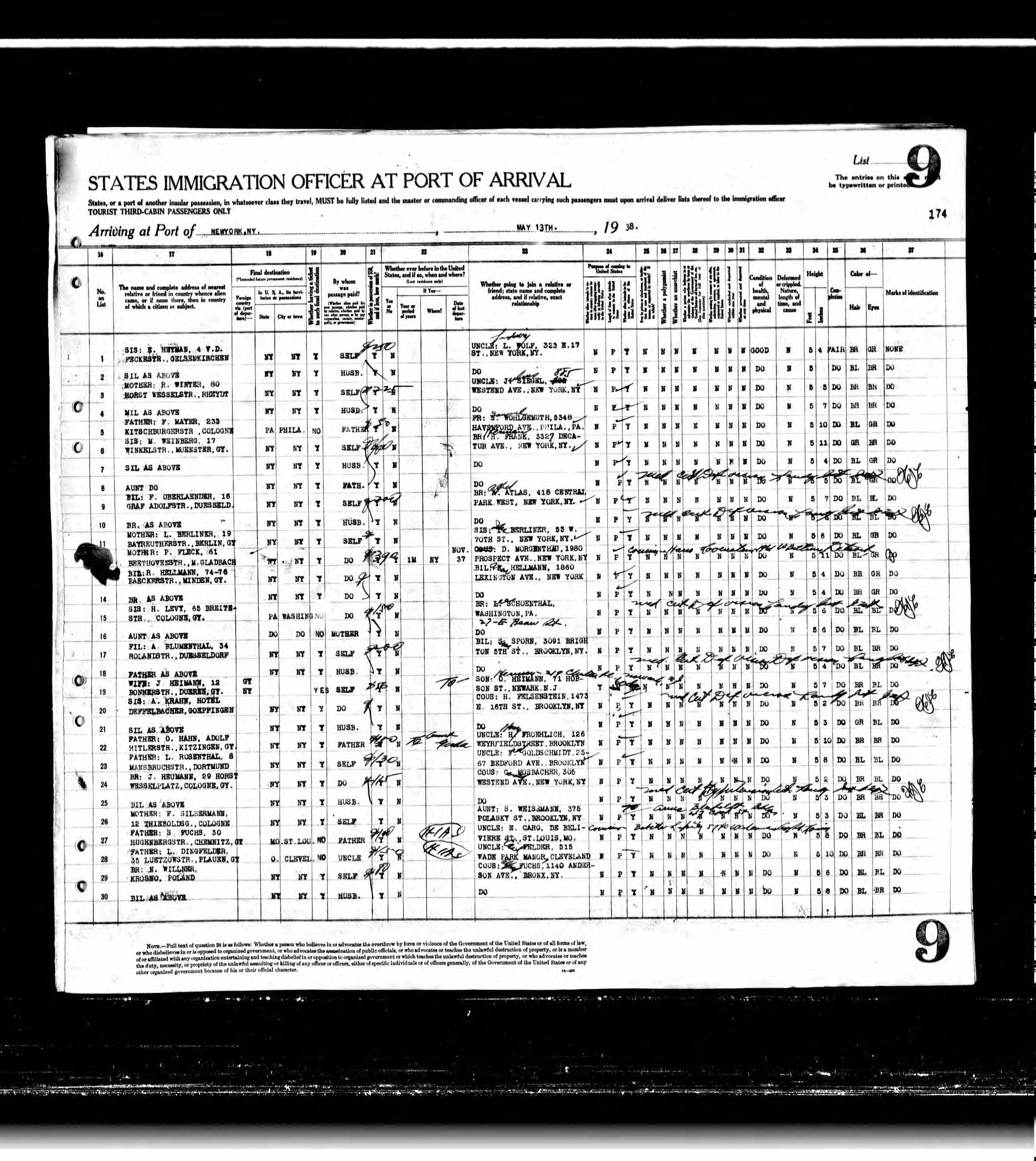
Who was Erna Haas? And was she Henry’s aunt or Pauline’s aunt? And who was Yohana Stern? I had more work to do.  I searched for Erna Haas, an unusual enough name, and was very excited to find this ship manifest (see lines 15 and 16):


Erna Haas ship manifest p 1

Year: 1938; Arrival: New York, New York; Microfilm Serial: T715, 1897-1957; Microfilm Roll: Roll 6152; Line: 1; Page Number: 174


Erna and her twelve year old son Werner had sailed from Hamburg, Germany on May 4, 1938; Erna was a beautician coming from Cologne.  I assumed that therefore her connection would be to Henry, a native of Cologne, not to Pauline, who was American-born.  Turning to the second page of the manifest, my hunch was confirmed (again, see lines 15 and 16):


Erna Haas ship manifest p 2

Year: 1938; Arrival: New York, New York; Microfilm Serial: T715, 1897-1957; Microfilm Roll: Roll 6152; Line: 1; Page Number: 174


Who was the person she named as living in the place she had left? Her sister, H. Levy of Breitstrasse in Cologne—that is, Henriette Schoenthal Levi, who had lived on that street as seen in the Köln directories in my last post. And who was she going to be with in the US? Her brother, Lee Schoenthal in Washington, Pennsylvania.  Erna Haas was another child of Jakob Schoenthal and Charlotte Lilienfeld.  She was also my grandmother’s first cousin.  And the aunt of Henry Lyons.  She was born Erna Schoenthal. I had found a fourth child of Jakob and Charlotte Schoenthal.

In 1940, Erna was listed on the census living with her son Werner in Pittsburgh, Erna working in cosmetics sales, Werner in newspaper sales.  Erna was a widow, so I assume that her husband Arnold had died in Germany, as I have no record of him in the US.  Unfortunately I have not yet found a record for him in Germany either.

But what about Yohana Stern, who had been listed in Erna’s obituary as her sister? I found this obituary for her husband Heinrich while searching for more information about Erna Haas:

Heinrich Stern obit


And then I located a ship manifest for Johanna Stern and Heinrich Stern (lines 3 and 4):


Ship manifest p 1 Johanna Schoenthal and Heinrich Stern


Ship manifest p 2 for Johanna Schoenthal and Heinrich Stern

Year: 1947; Arrival: New York, New York; Microfilm Serial: T715, 1897-1957; Microfilm Roll: Roll 7389; Line: 4; Page Number: 107


They had not arrived in the US until June 10, 1947, when they were 66 and 70 years old.  Notice that Johanna was born in Cologne, presumably around 1880.  How had she and Heinrich survived the Holocaust?  The manifest lists them as “stateless” and notes that they had last resided in “Lyon, France” and that their visas had been issued in “Marseille, France.”

The second page indicates that the person they were leaving behind at their last residence was a friend named Henry Kahnweiler of Paris (more on him in my next post) and the person they were going to see in the US was Johanna’s brother Lee Schoenthal of Washington, Pennsylvania.  Their final destination was Washington, Pennsylvania.  Yohana or Johanna Stern was born Johanna Schoenthal, a fifth child of Jakob and Charlotte Schoenthal. Another of my grandmother’s first cousins.


Thus, Jakob and Charlotte had had five children.  Their two sons Lee and Meyer had emigrated from Germany long before Hitler came to power; they had both settled near their aunt and uncle in Washington, Pennsylvania.    Jakob and Charlotte’s three daughters had stayed behind.  One, Henriette, was murdered by the Nazis with her husband Julius Levi at the Chelmno death camp in 1942, but their son Helmut Levi, aka Henry Lyons, left Germany in 1939 and survived.  Another daughter, Erna, left Germany with her son Werner in 1938.  And finally a third daughter, Johanna, somehow survived the war by going to France, and she and her husband Heinrich Stern came to the US in 1947.

It was a long and twisty road finding these five children, and it was heartbreaking to read of more cousins killed in the Holocaust.  But four of those five children survived and came to the US as did two of Jakob and Charlotte’s grandsons, Henry Lyons and Werner Haas.  More on the lives of these four children and their descendants in my next post.

The Brother Who Stayed Behind: Adventures in Genealogy Research

Born just one year after Simon, the next sibling was Jakob Schoenthal. (I am using the German spelling for two reasons.  First, Jakob stayed in Germany and thus that is how he spelled his name.  Second, it helps to distinguish him from his nephew, Simon’s son Jacob.) Finding Jakob’s story was quite a lesson in genealogy research.  It took some lucky breaks and the help of others, and in the end it led to a story of both tragedy and triumph.


Centro de la ciudad de Koln, Alemania Deutsch:...

Köln Germany, where Jakob Schoenthal lived as an adult (Photo credit: Wikipedia)


First, some background. I’ve already written about eight of the ten children of Levi Schoenthal and Henriette Hamberg, my great-great-grandparents.  They were the eight children who came to America between 1866 and 1881 and settled here permanently, including my great-grandfather Isidore Schoenthal.  All of them lived relatively long and seemingly satisfying lives.  They started in western Pennsylvania, but eventually they and/or their children moved far afield across the United States—to California, Illinois, New Jersey, New York, Massachusetts, and elsewhere.  They thrived in America, and they have many descendants still living in this country.

But there were two siblings who did not end up in America.  One, the youngest child, Rosalie, had in fact immigrated to the US in 1881 with her mother Henriette and her brother Isidore, my great-grandfather.  But Rosalie returned to Germany to marry Willy Heymann in 1884, and that decision was in the end one with devastating consequences for her family.  I will write more about Rosalie in a subsequent post.

The only sibling who never left Germany was the sixth child of Levi and Henriette, Jakob, who was born in Sielen in 1850.  I will always wonder why Jakob stayed when almost all of his siblings had emigrated from Germany by 1874.  Jakob was 24 by then, only a year younger than Simon, who had left in 1867. Why did he stay? I don’t know, but my theory is that Jakob stayed to take care of his mother and youngest siblings. By 1874 when his father Levi died, Jakob was the oldest son still in Germany, and there were still some younger siblings at home, including my great-grandfather.  So perhaps Jakob stayed out of a sense of family obligation. As with his sister Rosalie, that decision to stay had tragic consequences.

On September 1, 1879, Jakob married Charlotte Lilienfeld, the younger half-sister of Helen Lilienfeld, who had married Jakob’s brother Henry in 1872 and moved with him to Washington, Pennsylvania.  Charlotte and Helen were both the daughters of Meyer Lilienfeld of Gudensberg, where Henry Schoenthal had once been a teacher before immigrating to the US.

Marriage record of Jakob Schoenthal and Charlotte Lilienfeld Hessisches Hauptstaatsarchiv, Wiesbaden: Trauregister der Juden von Gudensberg 1825-1900 (HHStAW Abt. 365 Nr. 386) 1825-1900

Marriage record of Jakob Schoenthal and Charlotte Lilienfeld
Hessisches Hauptstaatsarchiv, Wiesbaden: Trauregister der Juden von Gudensberg 1825-1900 (HHStAW Abt. 365 Nr. 386, p.42) 1825-1900


For a long time I could not find much more information about Jakob.  I knew from the 1893 Beers biography of Henry Schoenthal that Jakob had then been living in Cologne, Germany in 1893, but I didn’t know if he and Charlotte had had children or if they had ever left Germany or when they had died.

Then while I was researching Henry Schoenthal and his family, I kept coming across two men living in Washingon, Pennsylvania, with the same names as two of Henry’s sons: Meyer and Lee Schoenthal.  At first I thought they were Henry’s sons, but soon it became clear that there were in fact two Meyers and two Lees.  When I found the death certificates for the Meyer and the Lee who were not the sons of Henry Schoenthal, I saw that their parents were Jakob Schoenthal and Charlotte Lilienfeld.


Lee Schoenthal death certificate Ancestry.com. Pennsylvania, Death Certificates, 1906-1963 [database on-line]. Provo, UT, USA: Ancestry.com Operations, Inc., 2014. Original data: Pennsylvania (State). Death certificates, 1906–1963. Series 11.90 (1,905 cartons). Records of the Pennsylvania Department of Health, Record Group 11. Pennsylvania Historical and Museum Commission, Harrisburg, Pennsylvania.

Lee Schoenthal death certificate
Ancestry.com. Pennsylvania, Death Certificates, 1906-1963 [database on-line]. Provo, UT, USA: Ancestry.com Operations, Inc., 2014.
Original data: Pennsylvania (State). Death certificates, 1906–1963. Series 11.90 (1,905 cartons). Records of the Pennsylvania Department of Health, Record Group 11. Pennsylvania Historical and Museum Commission, Harrisburg, Pennsylvania.

I knew then that Jakob and Charlotte had had at least two sons, both of whom had lived in Washington, Pennsylvania, where their Schoenthal uncles Henry and Isidore as well as their aunt Helen Lilienfeld Schoenthal were living.  And, of course, the identical names made sense.  Both Meyers were named for their maternal grandfather, Meyer Lilienfeld, and both Lees were named for their paternal grandfather, Levi Schoenthal.

And then I was stuck.   What else could I learn about Jakob and Charlotte? I asked in the German Genealogy group on Facebook whether there were records available online for Cologne, or Köln, as it is spelled in German, and I learned that there were in fact archives online with birth, marriage, and death records.  Unfortunately, the archives are divided into geographic areas in and around Köln, and I had no idea where in the city Jakob had lived.  In addition, I had no idea what years to search for births or deaths for his family, and the number of records was too overwhelming to search without some parameters.

But then another member of the Genealogy Group suggested I look in city directories to see if I could narrow down where in Köln Jakob and his family had lived.  I learned that there were city directories online that dated as early as 1797 all the way through to the 1960s.  I started searching year by year, and I eventually found many listings for him, starting with one in 1901 and going as late as 1935, and then he disappeared.  Here are a few examples:


Greven's address book for Cologne subtitle:and environment especially Mühlheim am Rhein and lime Author / Edit .: Ant. Carl Greven Publishing company: Greven's Cologne Address Book Publisher Ant. Carl Greven Vintage: 51 Year: 1905

Greven’s address book for Cologne
Author / Edit .: Ant. Carl Greven
Publishing company: Greven’s Cologne Address Book Publisher Ant. Carl Greven
Vintage: 51
Year: 1905


Grevens Adreßbuch 1915 Cologne and environs

Grevens Adreßbuch 1915 Cologne and environs


Greven's address book for Cologne subtitle:and neighborhood and business directory the circles Cologne-Mülheim country and a. Rh. Publishing company: Greven's Cologne Address Book Publisher Ant. Carl Greven Vintage: 67 Year: 1925

Greven’s address book for Cologne
Publishing company: Greven’s Cologne Address Book Publisher Ant. Carl Greven
Vintage: 67
Year: 1925


So I thought Jakob must have died or moved or emigrated around 1935, but not knowing German had once again proven to be a problem.  I posted the 1935 listing on the German Genealogy Facebook page, and my friend Matthias translated it and pointed out that the listing was not for Jakob, but rather for his widow.  He explained that the abbreviation Ww meant “widow,” and when I went back to look at the earlier directories, I saw that the Ww was included in almost all of the listings I had thought were for Jakob Schoenthal.


Greven's address book of Cologne subtitle:and its environs, as well as the address book of the circles Cologne-country Bensberg, Bergisch Gladbach u. Porz, Volume (→ Second volume ) Publishing company: Greven's Cologne Address Book Publisher Ant. Carl Greven Year: 1935

Greven’s address book of Cologne
Gladbach u. Porz, Volume (→ Second volume )
Publishing company: Greven’s Cologne Address Book Publisher Ant. Carl Greven
Year: 1935


I worked all the way back to 1905, seeing that Ww.  There were no directories on the website for 1902-1904, but in 1901, there was no Ww, so I assumed that meant that Jakob was still alive in 1900.  Thus, it seemed likely that Jakob had died sometime between 1901 and 1905.


Greven's address book for the borough Cologne subtitle:and for the environment especially: Mühlheim am Rhein and lime Author / Edit .: Ant. Carl Greven Publishing company: Greven's Cologne Address Book Publisher Ant. Carl Greven Vintage: 47 Year: 1901

Greven’s address book for the borough Cologne
Author / Edit .: Ant. Carl Greven
Publishing company: Greven’s Cologne Address Book Publisher Ant. Carl Greven
Vintage: 47
Year: 1901


From the address on Breite Strasse in the directories, my friends in the Germany Genealogy group thought that Jakob had lived in the central part of Köln.  Having narrowed down the years and the section of the city where he lived, I now combed through the relevant records until I found a death record for Jakob.  He had died on November 19, 1903.  He was only 53 years old when he died.  He was the first of his siblings to die.


Jakob Schoenthal death certificate Das Digitale Historiche Archiv Koln, Civil registry, civil registry Cologne I, deaths, 1903 1903 Vol 03 p.320

Jakob Schoenthal death certificate
Das Digitale Historiche Archiv Koln, Civil registry, civil registry Cologne I, deaths, 1903 1903 Vol 03 p.320


Since 1935 was the last year Jakob’s widow Charlotte was listed, I assumed that she must have died around 1935.  I wrote to the synagogue in Köln to see if they had information about Jakob and Charlotte, and the secretary there informed me that Jakob and Charlotte were both buried in their cemetery and that Charlotte had died on June 17, 1935.  She also confirmed Jakob’s date of death.  So I now knew when both Jakob and Charlotte had died and where they were buried.

But the 1935 Köln directory listing, along with a number of others, also revealed something else.  Notice that right above Jakob’s widow’s listing it says, “Schonthal & Co, Jul. Levi and Frau Jul. Levi,” and some additional text following, including the same address as that listed for Jakob’s widow.

Greven's address book of Cologne subtitle:and its environs, as well as the address book of the circles Cologne-country Bensberg, Bergisch Gladbach u. Porz, Volume (→ Second volume ) Publishing company: Greven's Cologne Address Book Publisher Ant. Carl Greven Year: 1935

Greven’s address book of Cologne
subtitle: and its environs, as well as the address book of the circles Cologne-country Bensberg, Bergisch Gladbach u. Porz, Volume (→ Second volume )
Publishing company: Greven’s Cologne Address Book Publisher Ant. Carl Greven
Year: 1935

My friends in the German Genealogy group explained that the first listing was for a Julius Levi and his wife, Henny nee Schoenthal.  Obviously Henny was Jakob and Charlotte’s daughter, living at the same address as her parents with her husband Julius Levi.

Julius Levi and Henny nee Schoenthal were listed again in 1936 (without a listing for Charlotte), but after that they disappeared.  By then, of course, Jewish-owned businesses were being restricted or closed by the Nazis.  What had happened to Julius and Henny? Had they left Germany, I hoped? Or had they been killed in the Holocaust?

Greven's address book of the Hanseatic City of Cologne subtitle:the circles Cologne-country, the county town of Bergisch Gladbach and Bensberg communities and Porz, Volume (→ Second volume ) Publishing company: Greven's Cologne Address Book Publisher Ant. Carl Greven Vintage: 78 Year: 1936

Greven’s address book of the Hanseatic City of Cologne
Publishing company: Greven’s Cologne Address Book Publisher Ant. Carl Greven
Vintage: 78
Year: 1936

Unfortunately, a search on Yad Vashem revealed that they were both victims of the Nazi atrocities.

Yad Vashem page of testimony for Henriette Schoenthal Levi Yad Vashem page of testimony for Julius Levi

I learned more details from a researcher in Köln named Barbara Becker, who informed me that Julius and Henriette Levi had been first moved to the ghetto in Köln in 1940 and then were deported to Lodz, Poland, on October 30, 1941.  From there they were sent to the death camp in Chelmno on September 10, 1942, where they were murdered by the Nazis.

Lodz Ghetto Bundesarchiv, Bild 137-051639A / CC-BY-SA 3.0 [CC BY-SA 3.0 de (http://creativecommons.org/licenses/by-sa/3.0/de/deed.en)], via Wikimedia Commons

Lodz Ghetto
Bundesarchiv, Bild 137-051639A / CC-BY-SA 3.0 [CC BY-SA 3.0 de (http://creativecommons.org/licenses/by-sa/3.0/de/deed.en)%5D, via Wikimedia Commons

Chelmno death camp 1942 By SS Unknown [Public domain], via Wikimedia Commons

Chelmno death camp 1942
By SS Unknown [Public domain], via Wikimedia Commons


Two more names to add to the growing list of my relatives who were killed during the Holocaust:  Henriette Schoenthal and her husband Julius Levi.  Henriette was probably named for her grandmother, Jakob’s mother Henriette Hamberg, my great-great-grandmother.   Henriette Schoenthal Levi was my first cousin, twice removed.  She was my grandmother Eva Schoenthal Cohen’s first cousin.

When I looked at the Pages of Testimony filed on behalf of Henriette (Schoenthal) and Julius Levi more closely, I saw that they were filed in 1977 by their son, Henry Lyons.  There was even an address for Henry: 99-30 59th Avenue, Rego Park, New York.  My next step had to be locating Henry Lyons, my father’s second cousin.

To be continued….


Honoring Women: Rose Mansbach Schoenthal

Tomorrow is International Women’s Day, and the month of March is Women’s History Month, according to Congress, and my genealogy blogger Janice Webster Brown of Cow Hampshire blog has encouraged her fellow genealogy bloggers to tell the story of at least one woman this month in honor of that occasion.  Although the theme this year for the national Women’s History Month is women who were active in government or public service, I’ve decided to highlight a woman whose life was more typical of her times, a woman who did not necessarily do anything historic or that would be remembered by anyone other than the members of her own family, but a woman who nevertheless is worth remembering and honoring more broadly.  This post is for all those women who lived lives that did not make headlines but who made their mark in quiet, unheralded ways that made a difference for their families and thus for all of us who followed.

It may not surprise those of you who have been reading my recent posts to know that I have chosen Rose Mansbach Schoenthal, the wife of Simon Schoenthal, my great-great-uncle.  Like most of the women I’ve researched, Rose did not leave behind much in terms of actual records or documents.  She did not have a career outside her home; she did not serve in the military.  There are no news articles reporting on her life.  All I really know about her is when she was born, who she married, where she lived, who her children were, and when she died.  The rest is all conjecture on my part and interpretation and extrapolation from those facts.

Rose Mansbach Schoenthal

Rose Mansbach Schoenthal


Rose was reportedly born in  Gudensberg, Germany, on March 12, 1850, according to her family.  I have not yet been able to find a birth record for her in that town, however, nor do I have any information about her parents.  I did, however, find a passenger manifest for a sixteen-year old girl named Rose Mansbach who immigrated to Pennsylvania from Germany and who listed her occupation as a servant.  That ship, the D.H. Wagen, arrived in New York on September 23, 1867.


Rose Mansbach on the DH Wagen, line 446 Ancestry.com. New York, Passenger Lists, 1820-1957 [database on-line]. Provo, UT, USA: Ancestry.com Operations, Inc., 2010. Original data: Passenger Lists of Vessels Arriving at New York, New York, 1820-1897. Microfilm Publication M237, 675 rolls. NAI: 6256867. Records of the U.S. Customs Service, Record Group 36. National Archives at Washington, D.C. Passenger and Crew Lists of Vessels Arriving at New York, New York, 1897-1957. Microfilm Publication T715, 8892 rolls. NAI: 300346. Records of the Immigration and Naturalization Service; National Archives at Washington, D.C.

Rose Mansbach on the DH Wagen, line 446
Ancestry.com. New York, Passenger Lists, 1820-1957 [database on-line]. Provo, UT, USA: Ancestry.com Operations, Inc., 2010.
Original data: Passenger Lists of Vessels Arriving at New York, New York, 1820-1897. Microfilm Publication M237, 675 rolls. NAI: 6256867. Records of the U.S. Customs Service, Record Group 36. National Archives at Washington, D.C. Passenger and Crew Lists of Vessels Arriving at New York, New York, 1897-1957. Microfilm Publication T715, 8892 rolls. NAI: 300346. Records of the Immigration and Naturalization Service; National Archives at Washington, D.C.

Guess who was also on that ship? Rose’s future husband, Simon Schoenthal, then just seventeen.  Did they know each other before they boarded, or did they meet on the ship?  I don’t know.


Simon Schoenthal and Amalie Schoenthal 1867 ship manifest, lines 230 and 231 Year: 1867; Arrival: New York, New York; Microfilm Serial: M237, 1820-1897; Microfilm Roll: Roll 286; Line: 1; List Number: 1004

Simon Schoenthal and Amalie Schoenthal 1867 ship manifest, lines 230 and 231
Year: 1867; Arrival: New York, New York; Microfilm Serial: M237, 1820-1897; Microfilm Roll: Roll 286; Line: 1; List Number: 1004


Unfortunately, I can’t find Rose Mansbach on the 1870 census nor can I find a record of her marriage to Simon, but the 1900 census reported that they had married in 1872.  That seems correct since their first children, the twins Harry and Ida, were born in 1873.

From there Rose went on to have eight more children—eight more pregnancies, eight more labors and deliveries.  Her last child, Sidney, was born in 1891, eighteen years after her first.  In between Rose had lost her first daughter, the twin Ida, in 1887 when Ida was just thirteen.  The family had moved from Pittsburgh to Philadelphia, and then not long after Sidney was born, they moved again to Atlantic City.

In 1904, Rose lost her husband Simon.  She was only 54 years old, and her children ranged in age at that point from Harry, who was 31, down to Sidney, who was 13.  Somehow she and her children pulled together and survived the death of Simon.


The nine surviving children of Simon and Rose (Mansbach) Schoenthal Photo courtesy of the family of Hettie Schoenthal Stein

The nine surviving children of Simon and Rose (Mansbach) Schoenthal
Photo courtesy of the family of Hettie Schoenthal Stein


Soon after Simon’s death, her children began to disperse.  In fact, Rose’s daughter Gertrude had already moved to Tucson, Arizona with her husband Jacob Miller before Simon died. Harry had moved not too far away in Philadelphia. A few years later, Martin and Maurice moved to Chicago, and Louis and then Sidney moved to California.  Hettie also left for Arizona, leaving only two of the surviving children, Jacob and Estelle, back in Atlantic City with Rose.  Rose had raised children who were as independent and courageous as she must have been when she boarded that ship when she was just sixteen.

And then Rose herself, already in her 60s, left for Tucson in the mid-1910s along with her daughter Estelle.  I can only imagine what Rose must have felt and experienced in the frontier country of Arizona with the coyotes and rattlesnakes that her daughter Hettie described in her memoirs.  When I look at this photograph of Rose looking so citified and civilized, it is hard to imagine her in the wild west of those times.

Rose Schoenthal -1916

By 1920 Rose and Estelle had returned to Atlantic City, and her other two daughters soon followed them back to the East Coast.  Harry, Martin, and Jacob also ended up living in Atlantic City.  Thus, for the last decade of her life, Rose had all but three of her nine children as well as most of her grandchildren living relatively close by.  Rose must have instilled in her children not only a love for their mother but for each other and for family generally.

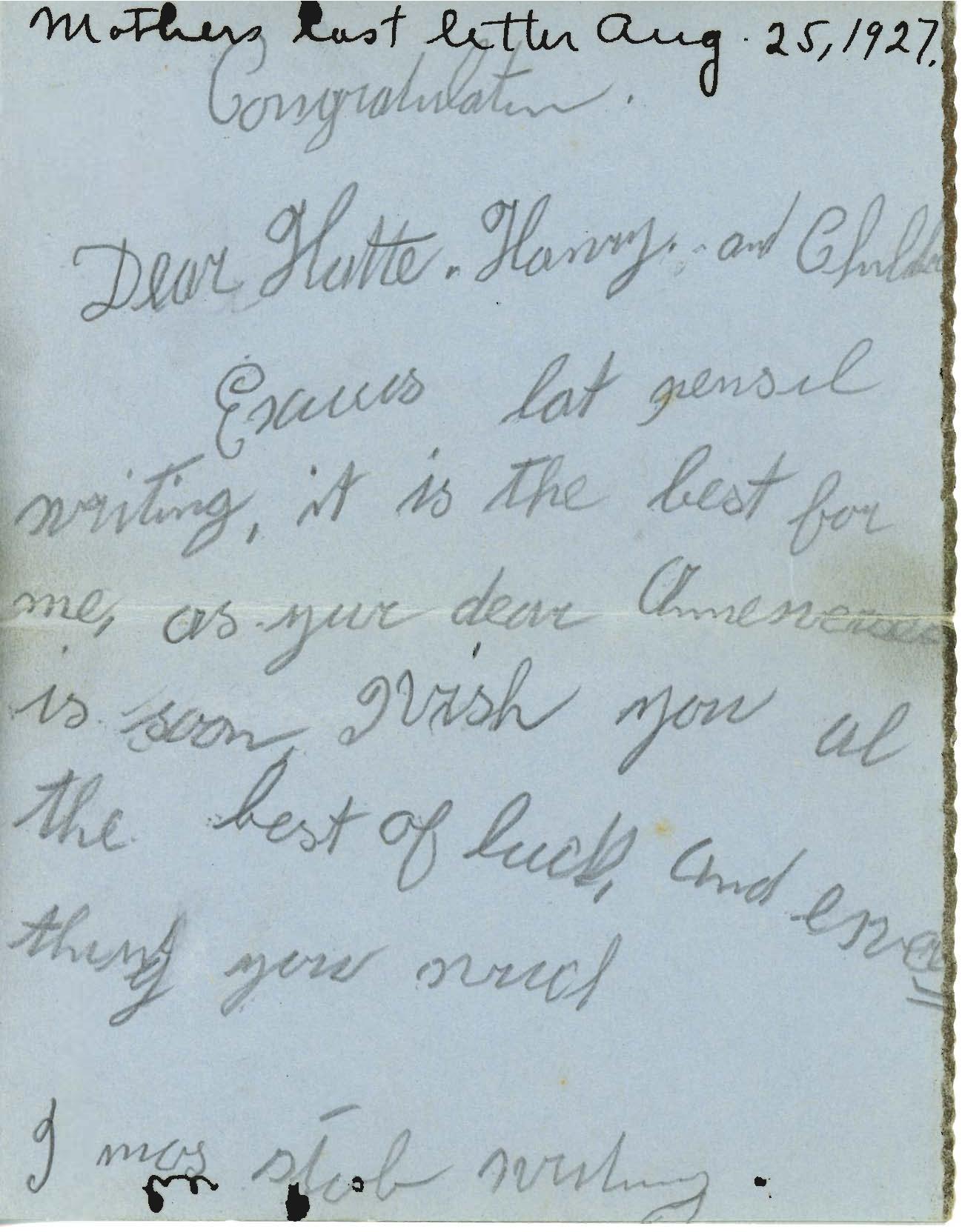
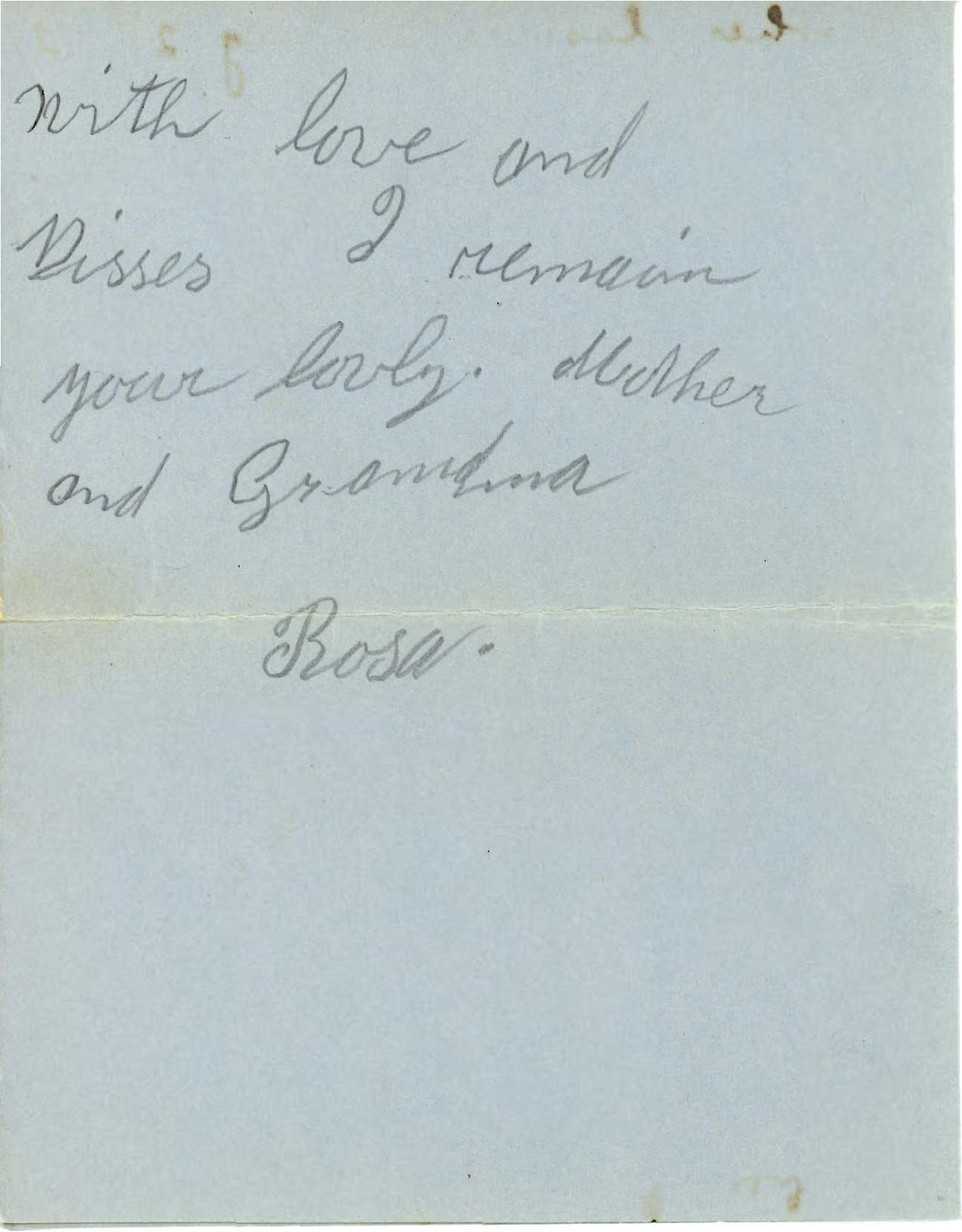
Up until last week, all of this was pure speculation on my part.  Rose had no actual voice—just government records and a few photographs told me what I knew about her.  But then Sharon Lippincott, her great-granddaughter-in-law, found a letter written by Rose to her daughter Hettie on August 25, 1927, on the occasion of Hettie’s eighteenth wedding anniversary.  In just a few short lines, I learned more about Rose than I had from any of those records and census reports I’d found:


Rose Schoenthal s last letter August 24 1927-page-001

Rose Schoenthal s last letter August 24 1927-page-002

Congratulation

Dear Hatte, Hanry and Children
Excuses lat [light?] pensil
writing, it is the best for
me, as yur dear Anneverses [Anniversary]
is soon. I Vish you al
the best of luck, and every
thing you want

I mus stob writing

with love and
kisses  I remain
your lovly. Mother
and Gramdma

Every time I read this letter, my eyes well up with tears.  When she wrote this letter, Rose was 77 years old and had been in the US for most of her life, almost sixty years.  English, however, was still difficult for her.  Yet despite the obstacles she faced writing in English, in these few words she expressed herself so clearly.  “With love and kisses”—not the stereotype I have of German Jewish grandmothers nor the words I would expect from Rose, having seen photographs of her where she appears rather stern.  With these few simple words she expressed so much love and affection for her daughter and son-in-law and grandchildren.


Rose Mansbach Schoenthal courtesy of the family of Hettie Schoenthal Stein

Rose Mansbach Schoenthal
courtesy of the family of Hettie Schoenthal Stein


Rose Mansbach Schoenthal died on May 16, 1929.  She was 79 years old.  Had she done anything notable in her life, anything that would make the history books or even a newspaper? Not really.  But think of what she had done.  She had ventured across the ocean at age 16 by herself.  She had raised ten children, nine to adulthood, all of whom seemed to have stayed close to her and to each other.  She had moved from Germany to Pittsburgh to Philadelphia to Atlantic City to Arizona and back to Atlantic City.  She had persevered even after her husband died, leaving her with three children who were still teenagers.  Rose had created a family, a family she raised and a family she loved.

Rose Schoenthal and her granddaughter Blanche Stein, 1916

Rose Schoenthal and her granddaughter Blanche Stein, 1916

When I think about all that she did do in the quiet, unreported way that most women of those times lived their lives, I know that she deserves to be honored during Women’s History Month even if she never worked outside the home, ran for office, wrote a song or a poem, or carried a weapon in war.

Hettie’s Spirit Lives On: Her Children Walter and Blanche

In my last two posts about Hettie Schoenthal, I was very fortunate because Hettie and her son Walter had written down their own memories and stories, making their lives so much more vivid and authentic than I could have ever done myself.  The wonderful photographs that their family provided also helped me tell the story of Hettie Schoenthal, her husband Henry Stein, and their two children, Walter and Blanche.

Hettie Schoenthal, 1906 Courtesy of her family

Hettie Schoenthal, 1906
Courtesy of her family

It was a reminder of how important it is for all of us to write about our own lives and to take and preserve photographs so that someday our descendants will benefit from these shared words.  My newly discovered cousin Sharon Lippincott, daughter-in-law of Blanche Stein Lippincott, writes  about the art of writing memoirs at her blog, The Heart and Craft of Life Writing, and has also published books on that subject.

In this post, I hope to convey how Hettie’s optimistic and energetic personality left its mark on her two children, both of whom also lived long and happy lives and were well-loved by many.  All photos are courtesy of their family.

Hettie and Henry had moved east from Arizona to Philadelphia in 1924, and a few years later their son Walter left home and moved to Atlantic City to work in his aunt’s hotel there, as seen on the 1930 census.  Walter remained in the Atlantic City area for the rest of his life, working in a restaurant and as a salesman over the years.  He married Ruth Levaur in 1938, and they had one daughter.

His sister Blanche also married in the 1930s, marrying Ezra Parvin Lippincott in 1937.  Ezra was a New Jersey native and a graduate of Rutgers University, and he worked as a banker and in the insurance business. They lived in New Jersey and had two children, a son and a daughter.  Sadly, Ezra died in 1969, leaving Blanche as a widow at only 57.

Blanche Stein Lippincott, 1938

Blanche Stein Lippincott, 1938


Blanche Stein Lippincott 1962

Blanche Stein Lippincott 1962


I don’t have a lot of “official” records about Walter or Blanche after 1940, but I don’t need them to convey the character and personality of these two people. Other people have already written about them both.

Both Walter and Blanche must have inherited their mother’s gene for longevity.  Walter died in 2007 at age 96, and Blanche died in 2013 when she was 101 years old.

Walter Stein in Atlantic City, 1987 courtesy of the family

Walter Stein in Atlantic City, 1987
courtesy of the family

Walter’s obituary from the Press of Atlantic City gives a vivid portrait of the man who spent his childhood with burros and snakes in Ray, Arizona:

Walter was born in Tucson, Territory of Arizona on October 9, 1910. He was recognized as a pioneer. He spent his childhood in Ray, Arizona in a mining camp and took pleasure in saying that his boyhood was what every boy dreams of. The family moved to Philadelphia in 1923, where Walter graduated from high school. In 1929 he went to Atlantic City for a vacation and never left the area except for four years. He met and married Ruth Levaur in 1938. They recently celebrated their 68th anniversary.

Walter was a fine fisherman, a championship bowler and a prize-winning marksman. He served on many boards, but his favorite was the 23 years he served on the Board of Friends of the (PAC) Performing Arts Center of Stockton College. Walter had a deep love of the theater. Some of his happiest moments were spent with Ruth and friends at the Metropolitan Opera, the Philadelphia Orchestra, the Ballet, the theater and museums. He was Vice President of Atlantic Beverage for 35 years. ….

Walter was loved and respected by all who knew him. His sense of humor, his positive spirit and generous nature placed him in a class by himself. He was often referred to as a man of all seasons, and he truly was.


Walter and Ruth Stein, 2002 at Blanche's 90th birthday celebration

Walter and Ruth Stein, 2002 at Blanche’s 90th birthday celebration


Blanche also seems to have inherited her mother’s optimistic and adventurous spirit; her daughter-in-law Sharon wrote this about her on her blog on the occasion of Blanche’s 100th birthday:

Blanche was born 100 years ago in Tucson, in the newly admitted state of Arizona. Her family soon moved to Ray, Arizona, a now deserted copper mining community, where they lived until she was about twelve. When the copper industry declined, her parents, along with a few aunts and uncles, decided to move back to Philadelphia.  ….

If you asked her, she’d tell you she has had a rather ordinary life, and so it may seem to some. She’s never done anything truly flamboyant. She hasn’t set records, started a business, or written a best-seller. But she has tackled life with gusto, always open to new adventures and experiences. ….

Perhaps her  most important attribute is her devotion to family, friends and community. ….  No family member or friend ever has to ask for help – things are taken care of, often before the need is recognized. She always has something good to say about anyone she speaks of, and she excels at showing gratitude and appreciation. …

I could not ask for a sweeter, more supportive and helpful mother-in-law, nor is anyone prouder than she of her two children and their spouses, her five grandchildren and their spouses, and her six great-grandchildren. She is the most optimistic person I know, and should I live to be 100, I hope I’ll be as vital and involved as she continues to be.

Blanche Stein Lippincott, 1984

Blanche Stein Lippincott, 1984


Blanche Stein Lippincott with her great-granddaughter 1996

Blanche Stein Lippincott with her great-granddaughter 1996

You can read the rest of Sharon’s tribute to her mother-in-law Blanche at her blog here. 

I feel very privileged to be even distantly related to Hettie and her children, who were, respectively, my first cousin, twice removed (my grandmother’s first cousin) and my second cousins, once removed (my father’s second cousins).  It’s just too bad that I missed the opportunity to know them in person, given how long and how close by they all lived.

Blanche and Walter, August 9, 2006 courtesy of the family

Blanche and Walter, August 9, 2006
courtesy of the family


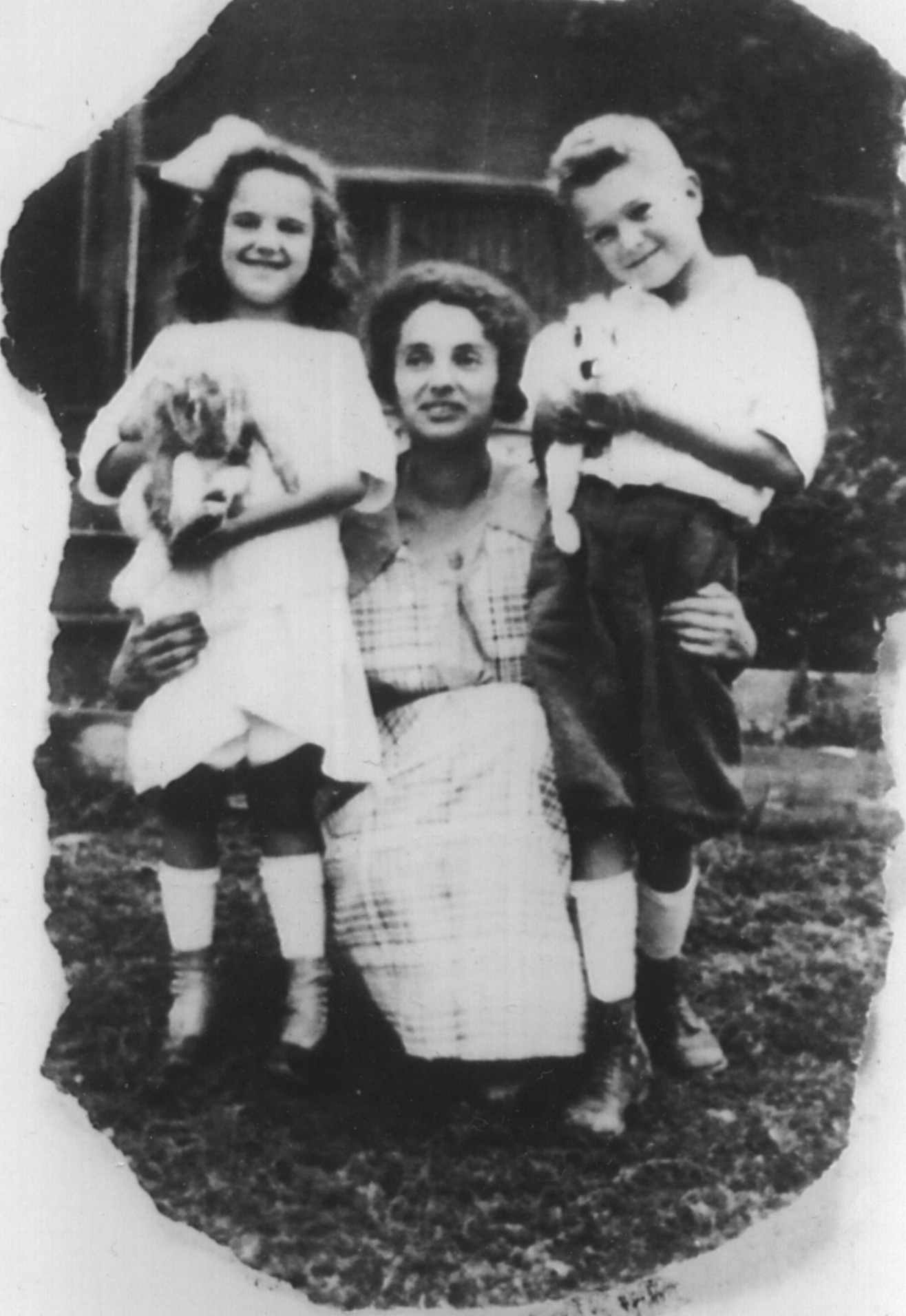
Blanche, Hettie, and Walter Stein

Blanche, Hettie, and Walter Stein

This post completes my research of the family of Simon Schoenthal and Rose Mansbach and their many children.  This has been a line of the family that has been a joy to research.  Although there were a few sad stories, this was a family of people who lived long lives and seemed to enjoy those lives.   They stayed close to one another even though at times they were separated by long distances.  And most of them spent much of their lives close to their childhood hometown of Atlantic City, New Jersey, once called the World’s Playground.

Unfortunately, the next chapter—the story of Simon’s brother Jakob and his family—is not as joyful.


Part II: Hettie Schoenthal, An Indomitable Spirit

In my prior post, we saw how Hettie Schoenthal Stein described the early part of her life in the memoirs she wrote to her grandson Ezra Parvin Lippincott, Jr., in 1973 and 1974.  After a childhood in Atlantic City with her many siblings, she had followed her sister Gertrude to Tucson, Arizona, married Henry Stein, and then moved with him and their two children Walter and Blanche to Ray, Arizona, a mining town over ninety miles from Tucson.
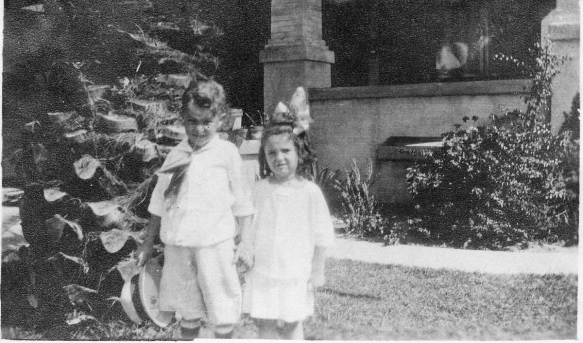
Walter and Blanche Stein, c. 1915 courtesy of their family

Walter and Blanche Stein, c. 1915
courtesy of their family

The FamilySearch.org website provided these insights into what might have attracted Hettie and Henry to Ray, Arizona:

The small town of Ray, Arizona, located in the south central portion of Pinal County, was founded in 1870.  By 1873, prospectors were engaged in silver mining and by 1880 high grade copper ore was being mined in Ray. The original founders were most likely a group of copper miners operating a small mine in this copper rich area. One of the miners, Mr. Bullinger, is said to have named the town Ray, after his daughter, Ray Bullinger. By 1909 The Arizona Hercules Copper Company had purchased the rights to the mine and constructed the town as a company town.  The mining operation in Ray enjoyed a worldwide reputation because of the innovative mining practices employed in the underground mine.

Ray, Arizona copper mine y Palmercokingcoal (Own work) [CC BY-SA 4.0 (http://creativecommons.org/licenses/by-sa/4.0)], via Wikimedia Commons

Ray, Arizona copper mine 1916
y Palmercokingcoal (Own work) [CC BY-SA 4.0 (http://creativecommons.org/licenses/by-sa/4.0)%5D, via Wikimedia Commons

The FamilySearch page also conveys a sense of what life was like in Ray in the early 20th century:

The original town of Ray consisted of one short main street with small businesses on both sides of the street. By 1909 the company had constructed a hospital and there are birth certificates from the hospital that date back to 1910. There was usually a doctor in Ray and the hospital employed at least 3 nurses and a cook according to Census Records. …  The elementary school (Lincoln Elementary) had grades 1 through 8 in eight classrooms. …. Ray High School was a short walk uphill from the elementary school.  ….  Ray didn’t have a newspaper, but people in the small town subscribed to The Arizona Republic, a newspaper in Phoenix. Ray had four churches….

Obviously, Ray was a booming town by the time Hettie and Henry moved there in the mid-1910s or so.

Ray, Arizona 1916 By Palmercokingcoal (Own work) [CC BY-SA 4.0 (http://creativecommons.org/licenses/by-sa/4.0)], via Wikimedia Commons

Ray, Arizona 1916
By Palmercokingcoal (Own work) [CC BY-SA 4.0 (http://creativecommons.org/licenses/by-sa/4.0)%5D, via Wikimedia Commons

Walter, their son, wrote about his own perspective on the town and his family’s life there:

To my knowledge the Steins and Millers were the only Jews living in Ray. My uncle Jake [Jacob Miller, Gertrude Schoenthal’s husband] and his brother, also called Uncle, had a dry goods and shoe store, and a general merchandise and grocery store. The general merchandise had hardware, mining equipment, farm equipment, guns, and shells. My dad ran the bakery and delivery of bread and pastries from a wagon, pulled by a horse (named Tom). One day my dad stopped for lunch at home with the bakery wagon. While he was having lunch, something frightened Tom and he bolted. There were bakery products all over the neighborhood. Tom was caught and calmed. Tom was not hurt.

My cousin (Harry) [Gertrude Schoenthal Miller’s son] used to spend the summer in Ray. He lived in Tucson and went to school there. While in Ray, Harry worked in the store. His job was to solicit orders at the houses in the residential sections of Ray. This was done on horseback.

The big event at the grocery store was uploading one hundred pound bags of flour, sugar, and salt that were skidded into the cellar on a slide. Lots of fun! We kids rode on the bags.

(From “Recollections,” by Walter Stein.)

From this excerpt, I get the impression, consistent with what I wrote about here, that Jacob Miller had moved to Ray, but left his wife Gertrude and family behind, perhaps so that his children could continue to go to school in Tucson.


Ray, Arizona 1916 By Palmercokingcoal (Own work) [CC BY-SA 4.0 (http://creativecommons.org/licenses/by-sa/4.0)], via Wikimedia Commons

Ray, Arizona 1916
By Palmercokingcoal (Own work) [CC BY-SA 4.0 (http://creativecommons.org/licenses/by-sa/4.0)%5D, via Wikimedia Commons


Walter’s description of his boyhood in Ray in many ways sounds idyllic:

I got in the swing of things, with friends I had made. Rode burros, mules, and spent plenty of time in the ball park. The burros ran loose, so you could grab one and jump on his back. If the burro was inclined to go, it was fine. If not, the burro would not move.

The mules were used at the copper mines. My friend Joe Garcia (his father took care of the mules) and I would go to the corral. One of us would bring one of the mules over to the side of the corral. The other one would climb up the side of the corral as the mules were too big for us to get on.

One thing that was standard at every house we lived in in Ray was a chicken coop with two to three dozen chickens and one or two roosters. Of course it does not take too many guesses as to who was assigned the care, feeding, and cleaning of the coop. Also a couple of rabbits and a dog (pedigree unknown).

(From “Recollections,” by Walter Stein.)
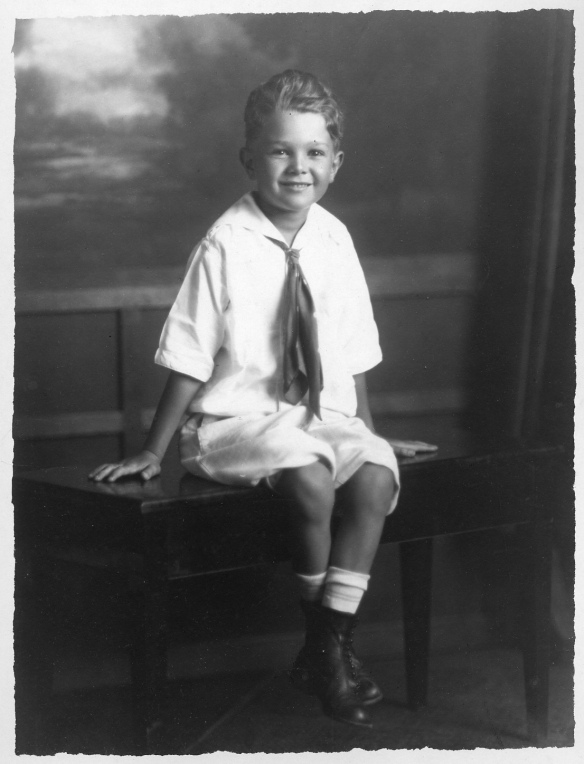
Walter Stein, c. 1919 when he was nine years old courtesy of the family
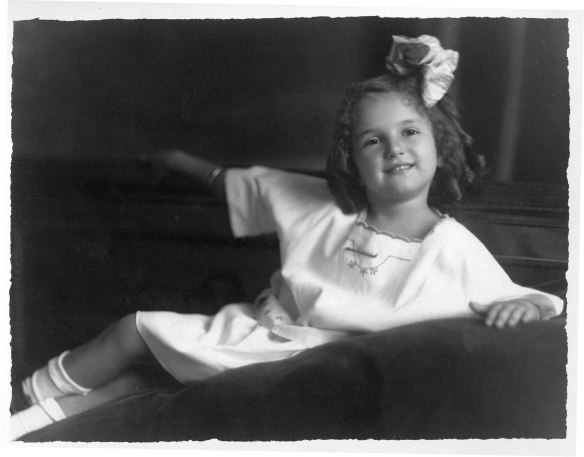
Walter Stein, c. 1919 when he was nine years old
courtesy of the family

Blanche Stein, c. 1920, when she was seven courtesy of the family

Blanche Stein, c. 1920, when she was seven
courtesy of the family

From Walter’s perspective, it was wonderful place to grow up, but their life in Ray had some challenges.  Walter described their two homes in Ray:

Our first house was placed on the side of a hill with one door. The back of the house was against the hill. To reach the house you walked up steps that also took care of other householders on the hill. I cannot remember the location of the outhouse. I do remember to bathe, water was heated on the stove and then poured into a galvanized tub that had been placed on the floor.

We didn’t live there very long. Our next house was in back of the ball park. This house had both front and back doors. Standard out house. No bathroom. After we had lived there a short time, Dad had a bathroom built. Still must use out house. Bathroom contained washstand and tub. In summer to bathe, one ran water into tub, and then waited for the water to cool. The water pipes from the reservoir laid on top of the ground and the sun heated the water too hot to bathe until it cooled.

(From “Recollections,” by Walter Stein.)


Embed from Getty Images

Hettie[1] had less fond memories of their house in Ray:

I will tell you a little about the house. It was up on a hill, just four rooms no bath or toilet. It was terrible. I did not think I could live there, but we did. Your grandfather and a helper built a room and we bought a tub. The pipes had to be on top of the ground. Well, the sun was so hot we had to draw the water and let it stand for hours before bathing.
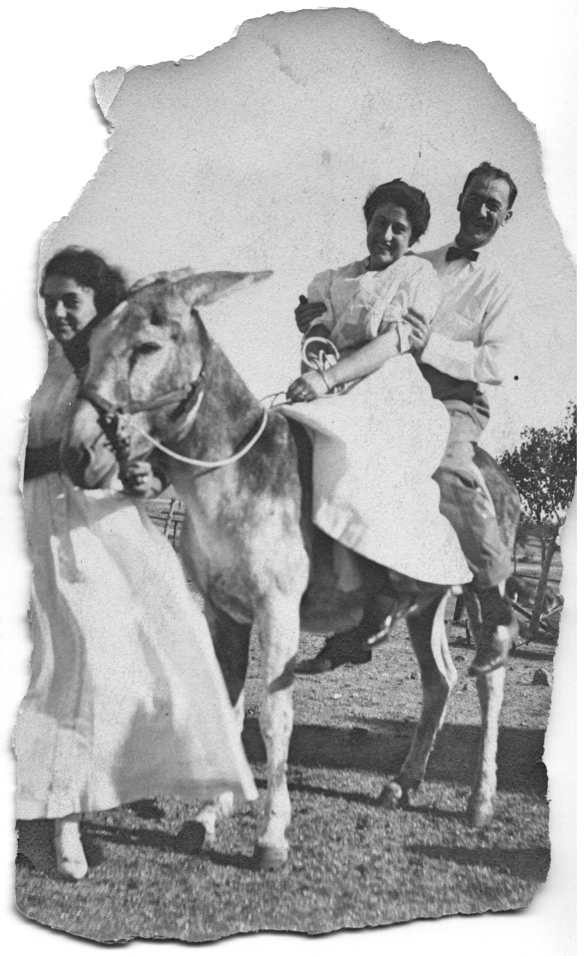
Hettie leading a donkey

Hettie leading a donkey

The accommodations were not the only challenges.  The wildlife and the weather also provided challenges.  Hettie recalled:

One day I was stung by a wasp and another time a Scorpin this happened in Ray Ariz. We lived up on a hill. We had a few chickens and it was so hot some time when I gathered they were hard boiled and this is (no joke)

Once I remember I came across some eggs in a nest and I took them and put them in the ice box. In those days we had to buy ice. A little later on I opened one egg and found a little chicken so I hurried and put the others back in the nest and a few hatched and I called them my ice box chicks. …

I learned to ride horseback. One day my brother Maurice took me riding. We rode to the Mission that was about ten miles out of town and a big rattle snake got in front of my horse, so my bro. got down from his horse and stoned it to death and had a belt made for me. It was very pretty.

English: Arizona Black Rattlesnake

English: Arizona Black Rattlesnake (Photo credit: Wikipedia)

I found it interesting that Maurice, one of the brothers who lived in Chicago, traveled out to Ray, Arizona, to see his little sister Hettie.  It seems that even though the siblings were quite spread out across the US, they still stayed in touch and even saw each other. Hettie also mentioned that in 1969 she visited her brother who lived in Los Angeles, that is, her younger brother Sidney.  And here is a photograph of her brother Martin with his niece Juliet Miller and nephew Walter Stein, possibly taken in Arizona when he visited from Chicago.
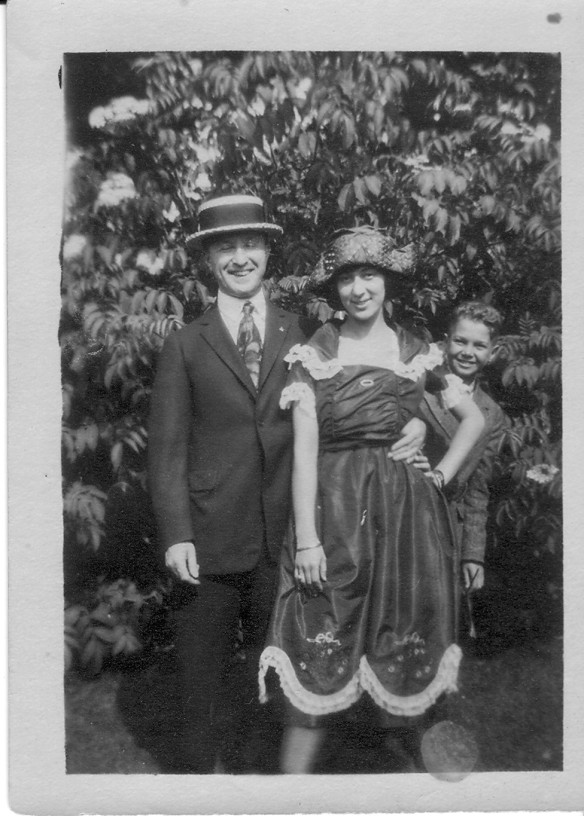
 

Martin Schoenthal, Juliet Miller Ferrin, and Walter Stein

Martin Schoenthal, Juliet Miller Ferrin, and Walter Stein


Here is Martin with Blanche, Gertrude, Hettie, and Walter.
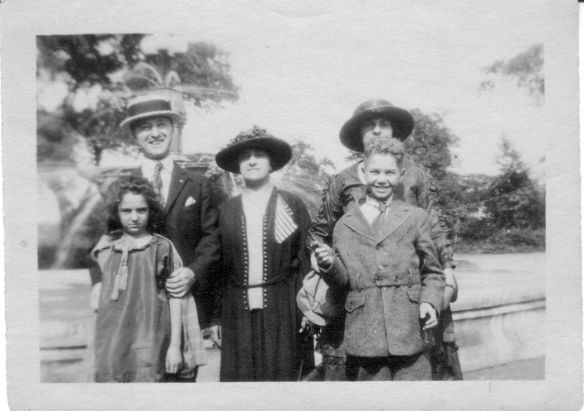
Martin Schoenthal, Gertrude Sch., Hettie Sch Blanche Walter

Blanche Stein, Martin Schoenthal, Gertude Schoenthal Miller, Hettie Schoenthal Stein, and Walter Stein c. early 1920s


One of the most amusing anecdotes Hettie shared in her memoirs involved the time her son Walter had to have surgery in Phoenix and she rented a room to stay with him while he had post-operative care:

After Walter got out of the Hospital I thought it would be nice if I could get a little apt near the Hospital as he had to go for treatments. Then I could have Blanche with me, so I found one. It had all new linens and silver and looked so nice. Your grandfather [Henry Stein] brought your mother [Blanche] up that weekend and the next day he was walking in the hall and a girl invited him in her apt. Then when he came in he said what kind of place I was in. Well, I was in a fast house. The first day I was there when Walter and I came out of the apt a couple of men smiled at me and I thought it was just because Walter’s head was bandaged. In the west people were very friendly. A lot of people asked me what happened to the boy and wished for a speady recovery. I moved out of there in a hurry.

Poor Hettie—she must have been mortified to realize she had taken her son to a “house of ill repute!”

In either 1923 or 1924 (various sources differ), Hettie, Henry, and their children left Ray, Arizona.[2]  This was also when Gertrude and her family left Arizona to return to Atlantic City, as I wrote about here.  Hettie’s description of their travels is colorful:

Now it is March 24, 1924 we are leaving the west to make our home in Phila. My brother-in-law [Jacob Miller] and your grandfather [Henry Stein] were driving to Phila. I forget what city it was but they put the car in a garage and it caught fire and every body lost there cars.

They had to take the train the rest of the way. When they arrived in Phila, they phoned us. We left the next day and a couple days later we had one stop over for one hour so my sister Gertie, your mother [Blanche] who at that time was about 12 years old and Walter took a walk. We were crossing the street when a car came along and I was run over. It was like in the movies. I was down and before you knew it I was up. All I could say is Thank God I am O.K. one wheel ran over my thigh. This man wanted to take me to the hospital but I said no. I think he gave me a card with his name and address on so in case I had any ill affects from it I should let him know. When we got to Chicago my two brothers [Maurice and Martin] wanted me to go to the hospital but I said I am O.K. I know God was with me.

(Perhaps the photographs of Martin with Gertrude and Hettie, shown above, were taken when the families stopped in Chicago.)

A few things struck me as interesting about this passage.  First, I was impressed by the fact that Gertrude and Hettie traveled alone by train with their children across the country while their husbands waited for them on the East Coast.  Also, once again there is evidence that these widely separated siblings stayed close, as Maurice and Martin, the two brothers in Chicago, urged their younger sister to go to the hospital.  But mostly I was struck by Hettie’s spirit, which seemed as resilient as her body, jumping up after being run over by a car.

Once they reached the East Coast, Gertrude went on to Atlantic City where she and Jacob became involved in the hotel business.  Hettie and Henry settled in Camden, New Jersey, and then in Philadelphia:

My sister husband and your Grand father bought a moving picture house in Camden N.J. we had that for a while then sold it and moved to Holmesburg Pa. that is part of Phila. I was the cashier, your grandfather was the ticket taker and your uncle Walter helped the operator. We all got along nicely.

I had lots of fun. There were three German men who came most every night so one night I said in german do you speak german? Well you should have heard them. I made them understand I only knew a few words but my husband understood better. They told me they came to learn the English language.

Hettie, the daughter of two German immigrants, knew only a few words of German.  In some ways, that is rather remarkable as it indicates how fluent her parents were in English.  But it is also somewhat sad that they did not pass on to their children the language of their native country.
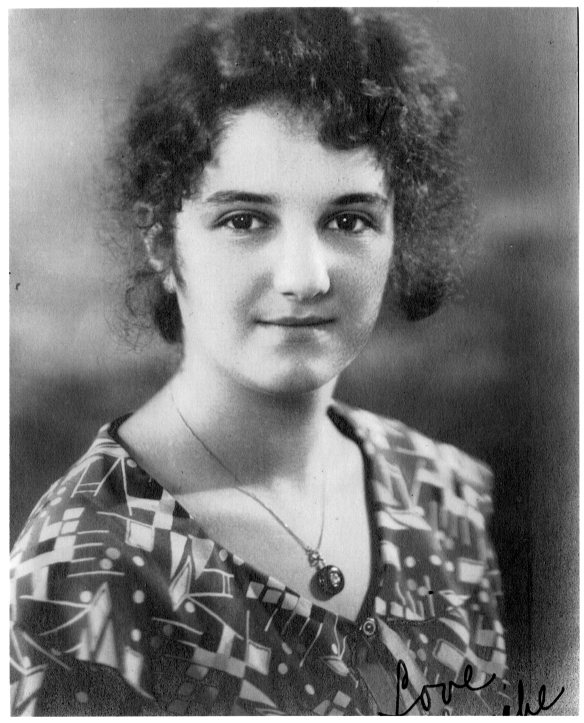
Blanche Stein, high school graduation picture

Blanche Stein, high school graduation picture.  Courtesy of the family

In 1930, Henry was working as a hosiery salesman.  Walter was living with his aunt and uncle, Gertrude and Jacob Miller, and working in their hotel as a bellman.  Blanche was still living at home in Philadelphia, working as a typist.
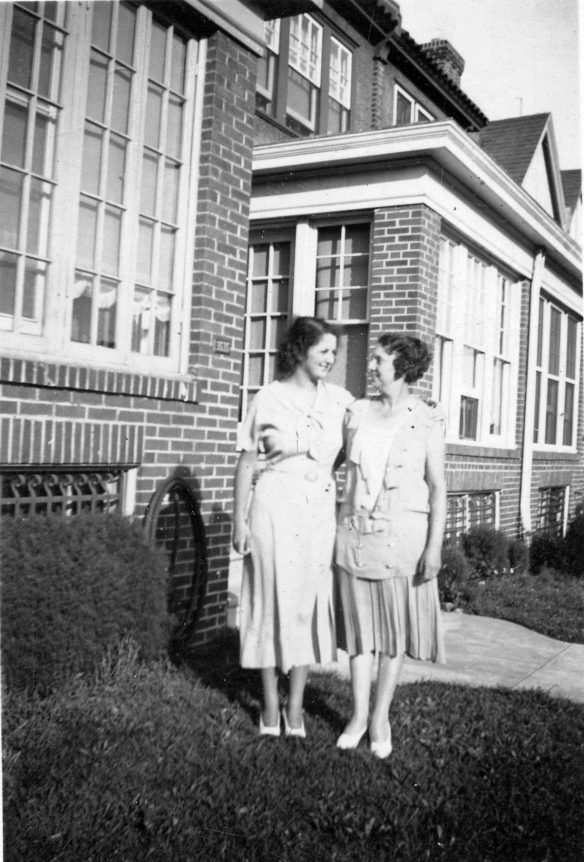
Blanche Stein and Hettie Schoenthal Stein, 1930, Mayfair, PA courtesy of the family

Blanche Stein and Hettie Schoenthal Stein, 1930, Mayfair, PA
courtesy of the family

By 1940 Blanche and Walter had both married (more on that in my next post), and Hettie and Henry were living in Philadelphia.  Henry was now an office equipment salesman.
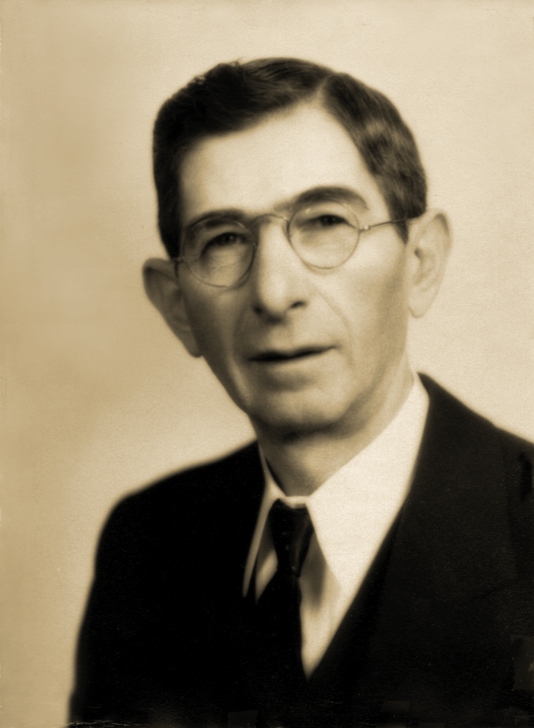
Henry Stein Courtesy of the family

Henry Stein
Courtesy of the family

Around this time, Hettie’s nephew Bob Klein, son of her sister Estelle and Leon Klein, came to live with them.

We had a five room apt. My nephew Bob Klein lived with us. I loved to paint so I did all the painting when I got the brush in my hand there was not telling where I would stop. I painted the toilet seat and forgot to put a sign on and Bob sat down you can guess the rest.

During World War II, Hettie volunteered for the Allied Prisoner of War Service.  While doing so, she made connections that led to a home-based business for her:

In Phila I volunteered one day a week for the Allied Prisoner of War Service that was in 1944 we shipped food to the War Zone. We had to show a card before we were admitted. One day one of the ladies asked me what I was to to do after we finish work so I said I am going to go get some yarn to make a wooley dog so they wanted to see them so the next week I took a couple in and they wanted to buy them so I realy got in business. Then your grandfather told one of his customers*, a florist, about my dogs. He wanted to see them, so I took six with me. He liked them so much he bought them and put them in the window. Some sailors came along and bought all six. I no more than got home when the phone rang and it was Mr. Jones. He said the dogs were gone and he would like to have 50 at once. I stayed up all night and took him what I had made the next day.

A salesman from Chicago saw them at the Florist and wanted to know how he could get in touch with me. He came to see me and ordered all I could make I had my sister Estelle and your mother and your grandpa helping and I sent him as many as I could. Then I had others that wanted them for there stores, my business got to big for me. I had to drop it.

Sadly, Henry Stein died on February 16, 1951, from prostate cancer; he was 79 years old.
Henry and Hettie (Schoenthal) Stein, 1951 courtesy of the family

Henry and Hettie (Schoenthal) Stein, 1951
courtesy of the family


After he died, Hettie lived for some time with a friend and for many years on her own in Atlantic City.  She continued to have a very full and active life, as you can see from these photographs.
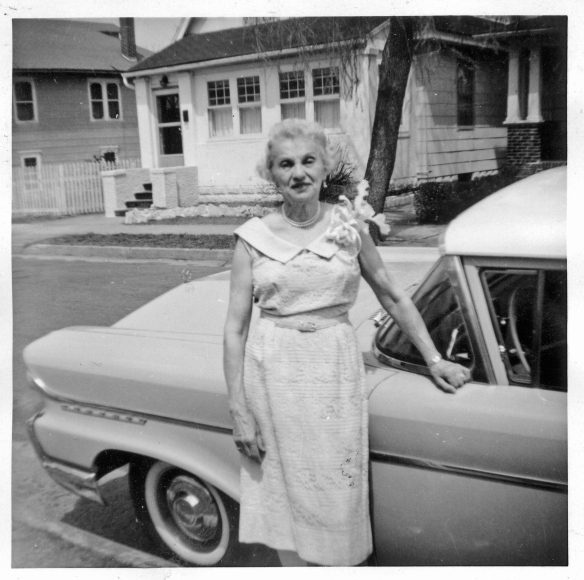
Hettie Stein, 75th birthday April 24, 1961 courtesy of the family
Hettie Stein, 75th birthday April 24, 1961
courtesy of the family

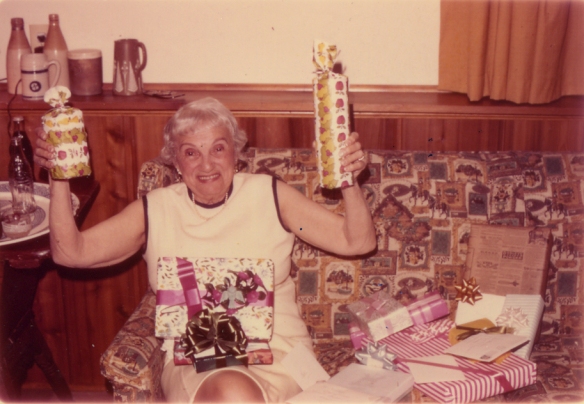
Hettie Schoenthal Stein, 85th birthday 1971

Hettie Schoenthal Stein, 85th birthday 1971

Even at 88, she was still volunteering for her synagogue’s rummage sale.
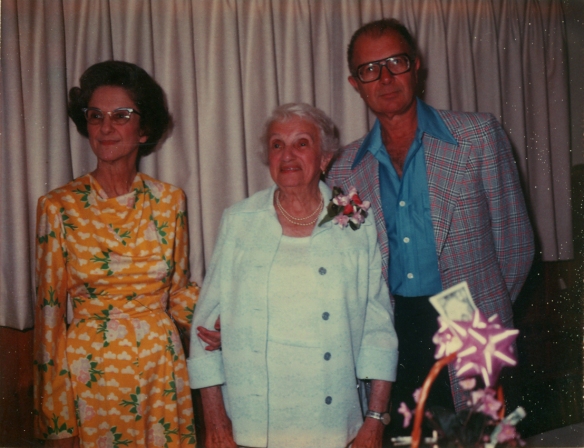
Hettie Stein's 90th birthday 1976

Hettie Stein’s 90th birthday 1976 with Blanche and Walter. Courtesy of the family.

When she was 95, Hettie moved in with her daughter Blanche in Medford, New Jersey. When Hettie turned 100, it was written up in the May 8, issue of the Central Record, the local newspaper for Medford, New Jersey:
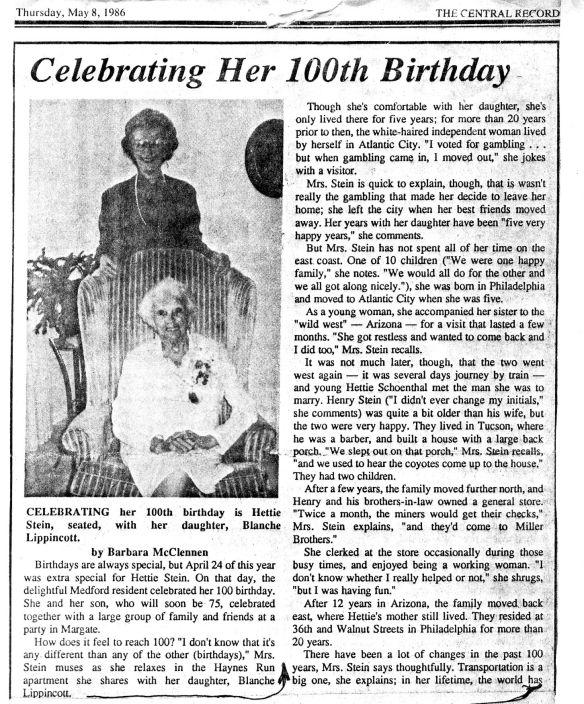
Hettie Stein Celebrates 100 part one

Hettie Stein Celebrates 100 part two

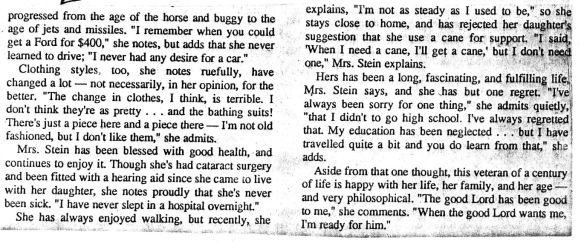
Reading this interview warmed my heart.  Even at 100, Hettie remained upbeat, gracious, and independent.  Her description of her childhood—“We were one happy family.  We would all do for the other, and we all got along nicely”–is certainly consistent with the photographs, the writings, and the facts I’ve seen and read about Hettie and her siblings.

Hettie survived her much beloved husband Henry by almost 38 years, dying on January 15, 1989, when she was just a few months shy of her 103rd birthday.  She, like so many of her siblings, was blessed with remarkable longevity.


I will close this post with the closing words of Hettie’s 1974 memoir, as they best convey the spirit and personality of this adventurous and upbeat woman:

Well, this all happened in my life time. I did have two men that wanted to marry me and two weeks ago the third one asked me. I was walking on the Boardwalk and a man I met about ten years ago came up to me and said, “Can I walk with you?” So I said yes. I knew his wife. She passed away a year ago. He wanted me to go to his apt for dinner. He had made a lamb stew. I thanked him and said my dinner was waiting for me. We talked for awhile and then he asked me if I would marry him. He has money, two sons, one a Dr., the other a Dentist and he is very good looking. But I am happy as I am.

I must tell you, I was getting some telephone calls from some man or boy. He kept telling me he wanted to come see me and give me some loving and I would hang up. On Sat. morning my son Walter took me shopping and when we came home the phone rang and it was the same person. I said wait, and I will let you talk to my husband. He hung up in a hurry and that was the end of that.

Two day is the 4th of July, 1974. A beautiful day. Your Ma [Blanche] called me. I am so happy she is enjoying life.

Hettie Excerpt 2


[1] All of the quotes by Hettie Schoenthal Stein are from her memoir, “This is My Life,” written in 1973-1974 for her grandson, Ezra Parvin Lippincott, Jr.

[2]  In the 1950s, the company that owned the copper mine in Ray expanded the mining area and moved the residents to a nearby town it built.  Today Ray is a ghost town.

Hettie Schoenthal, An Indomitable Spirit: Part I

With the next few posts I will finally complete the stories of the children of Simon Schoenthal, brother of my great-grandfather Isidore. These next few posts will be about Hettie Schoenthal Stein, the third youngest child and second youngest daughter of Simon and Rose.

Courtesy of the family of Hettie Schoenthal Stein

Courtesy of the family of Hettie Schoenthal Stein

In many ways I have saved the best for last because I was very fortunate to connect with Hettie’s grandson’s family, and they shared with me a number of photographs plus a memoir written by Hettie herself as well as an essay of memories written by her son Walter.  Some of those photographs and a bit of the memoir have already been included in earlier posts—with the family’s permission.  Hettie was almost ninety years old when she wrote her life story to share with her grandson.   I have kept the phrasing and spelling just as Hettie wrote it in 1973 and 1974.  All excerpts attributed to Hettie are from her memoir, “This is My Life.”

Hettie was born in Philadelphia on April 24, 1886, the eighth child of Simon Schoenthal and Rose Mansbach.  As Hettie tells it:

I was born and they named me Hettie Schoenthal in 1886, a tiney little girl weighing 8 ½ pounds. I was only two weeks old when Mother and I were taken to Wills Eye Hospital in Phila where Mother had an eye operation. My oldest sister [Gertrude] told me this story. She said I was such a good and pretty baby the Superviser wanted to adopt me as Mother only had seven more at home, then later on two more came along. There were six boy and four girls. The first were twins.

According to Hettie, the family left Philadelphia when she was five or in about 1891 for Atlantic City.  She described her childhood there:

I will tell you a little about my school days. I wish I had a picture of the school—it still looks the same as it did 85 years ago. I must tell you about the boy who sat in back of me. We liked each other. One day the teacher caught me turning around talking so she sent me to the coat room. When it was time for me to come out, she sent Frank in and I kissed him. I had a good time in there I played ball with the hats and tried on the coats.

They were the good old days.

I did not like school and I am sorry to say I did not go through high school but I am very happy and proud all my grandchildren are graduates of college. …

We had a big St. Bernard dog and I loved to take him on the beach. We would walk near the water. I made lots of friends both boys and girls.

Not all of Hettie’s memories were as pleasant:

Hettie Excerpt 1


I must tell you when I was seven or eight years old my sister was baking a cake and our maid said “Miss Gertie, you spilled some flour,” so I ran to get my little broom. When my sister came from the stove with boiling milk, I ran into her and was scalted very badely. I still have the scar. My hair covers it. I was lucky it did not go in my eye.

But that incident had some benefits:

My father was a strick man. He thought everything my mother cooked we should eat and I remember we had some sweet and sour beans. I would not eat them. I had a little apron on with a pocket and the beans landed in there. My dad happened to see me do it. He came over to my side of the table, took me by the hand, lead me in the other room, my panties came down, and the hand went to work. It was not to bad. I was the pet of the family because of my accident with the milk.

Clearly, Hettie was a spirited child.

Hettie also shared this story, which occurred when she was about twelve years old or in 1898:

One day I was walking on the Boardwalk and a photographer came along and wanted to take my picture so he did. Then Mr. Persky the Artist saw it and wanted to make a painting. It realey was beautiful it had a very expensive frame. It was put on display in a furniture store window. I was passing and I saw a crowd. I got way up front and some man said, “Here is the kid now.” My parents were able to buy it. It hung in our home for many years.

Fortunately, among the photographs I received from Hettie’s family was the one described above:

Hettie Schoenthal, c. 1898

Hettie Schoenthal, c. 1898

No wonder the photographer was taken with her! Hettie’s adventurous spirit is revealed in this anecdote from about 1903 when she was a teenager:

Now I think I am around 16 or 17 years old. I liked this boy very much. His name was Roy Willis. He wanted me to elope with him, so I would meet him around the corner. One night he had to work late, so I went for a walk and I met a boy who lived near us and he daired me to go on the Pier with him. So I went and Roy caught up to us and was very mad. The next day he and my brother Martin were going on vacation up in the mountain. He did not say good by. A few days later I got a post card with a picture of a fellow falling off of a horse saying I went off so suddenly he did not sign his name but did after he returned.

Hettie Schoenthal, 1906 Courtesy of her family

Hettie Schoenthal, 1906, about 20 years old
Courtesy of her family

In 1898, Hettie’s older sister Gertrude had married Jacob J. Miller and had moved soon thereafter to Tucson, Arizona.  When she was about twenty years old or around 1906, Hettie followed her big sister to Tucson. It must have been quite a shock for a girl who had grown up in the urban environment of Atlantic City.   Their house in Tucson “had a big screen porch and we slept out there most of the time and we would hear a coyot and sometimes we would smell a skunk.”

But Hettie seemed quite happy and had an active social life:

There were quite a few young folks in Tucson and I was having a good time horseback riding, card parties and Picnics. Two of the men were very nice to me. They wanted to date me every night. One was a traveling salesman and had to be out of town some time so Henry Stein was the winner. That summer it was very hot in Tucson so we went up to the mountains to a place called Orical. The hotel was run by an American Indian and his wife.

We had one very large room with four beds. When we went to bed the first night we saw a big Tarantular. That is a great big black spider on the ceiling. We were afraid for all of us to go to sleep so my sister and I took turns watching it. We had very little sleep.

On Sunday Henry and my sister’s husband drove up to see us and had dinner with us. Well we had a good dinner but I said the chicken tasted different. I found out later it was rabbit. I got so I liked Henry much better but I did not know if I loved him. He asked me to marry him but I thought he was so much older than I. There was 15 years difference. I came back to Atlantic City. After awhile I got restless, then my sister’s husband came east on a business trip and I was again for the west. I loved to travel.

Henry Stein and Hettie Schoenthal 1907 courtesy of their family

Henry Stein and Hettie Schoenthal 1907
courtesy of their family

Hettie also shared this story of her return to Atlantic City:

I must tell you, one day in Tucson Ariz, I think it was 1908, a girl from Phila and I went horse back riding. My horse belonged to our neighbor. I had ridden him many times and never had any trouble, but this time I don’t know if he got scared or what, but he tried to throw me. I stayed on him as long as I could. A man came along and told me I had better get off. I believe this girl’s name was Lena. One day she said “I am going back to Phila,” so I got restless so I said, “I will go with you.” So I got ready.

In those days it took 4 or 5 days by train. It had a Pullman car and the chairs were very comfortable. We met two very nice gentlemen. They wanted to treat us to a drink. We did not drink the kind they did. We had root beer. The one I liked best had a pretty red tie on. I admired it, so the next day when I saw him, he had a package for me. Guess what was in it? The red tie. That night I put on a white blouse and had the tie on. When they came in the dining car they got the next table to us. He said it looked better on me. Then he told me his wife made it. I said maybe I had better give it back and he said no. When we were getting near Phila he wanted my address. I told him I did not go with married men.

This photograph of Hettie with three of her siblings must have been taken during that return to Atlantic City in 1908 (love the wild hairstyles):

Hettie Schoenthal and her siblings, 1908 Atlantic City. Estelle, Martin, and Maurice?

Hettie Schoenthal and others—I think Sidney, Hettie, Estelle, and Jacob.  Atlantic City 1908 Courtesy of the family

Hettie must have returned to Arizona from the East not long after, and when she did, she seemed to have gotten over the fifteen year age difference between herself and Henry Stein:


Marriage license notice for Hettie Schoenthal and Henry Stein Los Angeles Herald Tribune, August 24, 1909, p. 14

Marriage license notice for Hettie Schoenthal and Henry Stein
Los Angeles Herald Tribune, August 24, 1909, p. 14

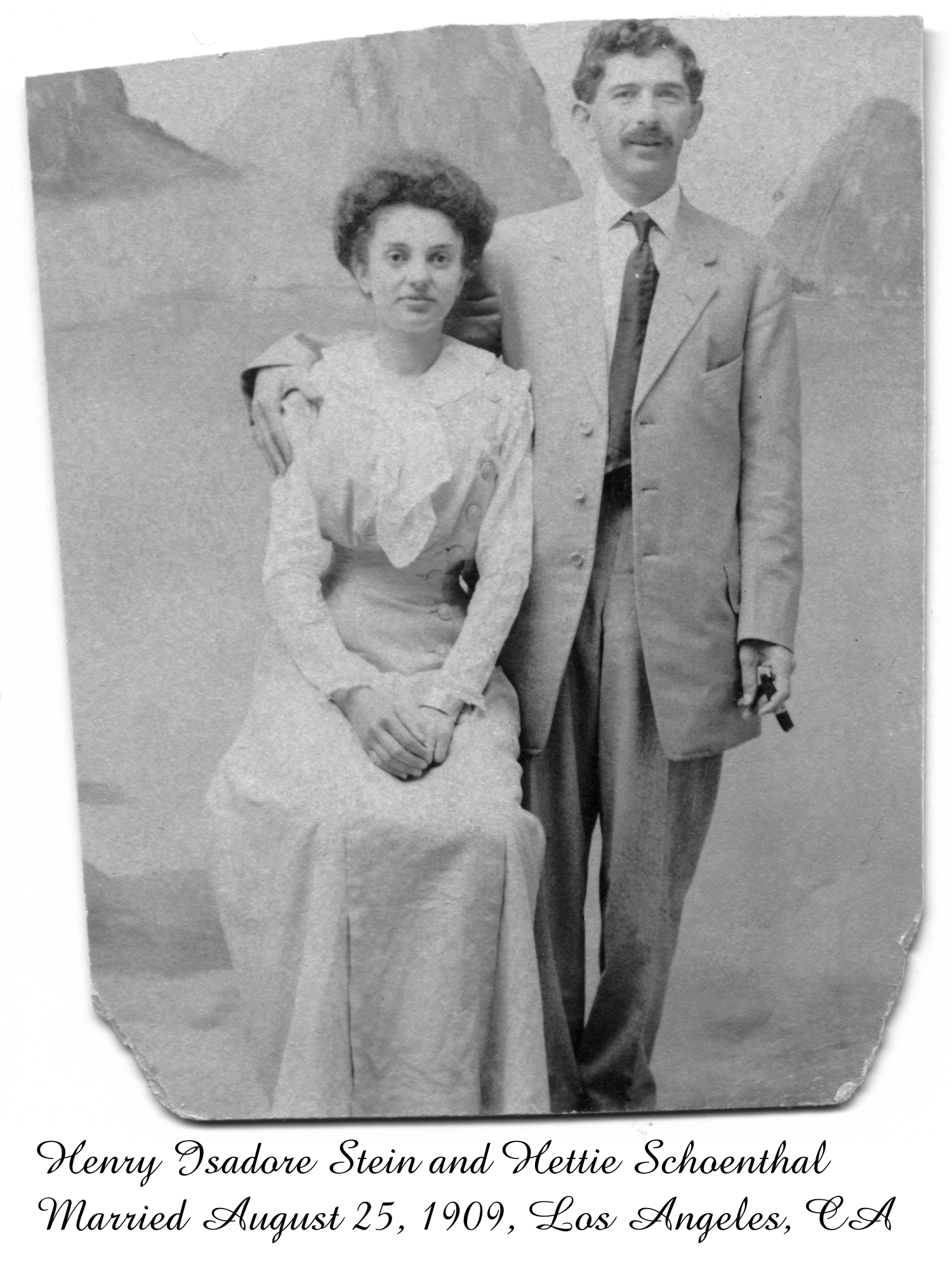
Hettie and Henry wedding photo

The summer of 1909 we went to Los Angeles, Cal, and Henry came up there and we decided to get married, so on Aug 24 we did and went on a nice honeymoon. Then we went back to Tucson to make our home.

Henry was the first white barber in Tucson. He shaved Grover Cleveland before we were married. His aunt brought him over from Uhel, Slovakia. He was very young. He had a younger brother over here who was in an accident and killed.

We built a very pretty home next to my sisters and we were very happy.

Two years later on Oct. 9, a little boy came along. We named him Walter, then Sept. 22nd two years later, a little girl. We named her Blanche. That was your mother. She was really beautiful.

Birth certificate of Walter Stein courtesy of the family

Birth certificate of Walter Stein
courtesy of the family


Henry Stein with his son Walter, 1910 courtesy of the family

Henry Stein with his son Walter, 1910
courtesy of the family


Walter and Blanche Stein, 1913 courtesy of their family

Walter and Blanche Stein, 1913
courtesy of their family


A few years after their daughter Blanche was born, Hettie and Henry and their children left Tucson for Ray, Arizona, a small mining town that was about 100 miles from Tucson.  What would have led them there?

Part II addresses that question and describes their life in Ray.


Blanche, Hettie, and Walter Stein

Blanche, Hettie, and Walter Stein


Sidney Schoenthal, the Youngest Sibling: A Long Life, but a Short Post

The last-born and tenth child of Simon Schoenthal and Rose Mansbach was their son Sidney, born September 18, 1891.  There was a gap of almost twenty years between the oldest son, Harry, born in 1873, and Sidney.


The three youngest children of Simon and Rose Schoenthal Estelle, Hettie, and Sidney, 1904 Courtesy of the family of Hettie Schoenthal Stein

The three youngest children of Simon and Rose Schoenthal
Estelle, Hettie, and Sidney, 1904
Courtesy of the family of Hettie Schoenthal Stein


Sidney was only thirteen when his father died in 1904, and as a teenager he worked with his older brothers in the family’s laundry business in Atlantic City, as seen in the 1911 directory for that city.


Incomparable Laundry Schoenthals brothers 1911 Atlantic City directory Ancestry.com. U.S. City Directories, 1822-1995 [database on-line]. Provo, UT, USA: Ancestry.com Operations, Inc., 2011. Original data: Original sources vary according to directory.

Incomparable Laundry
Schoenthals brothers 1911 Atlantic City directory
Ancestry.com. U.S. City Directories, 1822-1995 [database on-line]. Provo, UT, USA: Ancestry.com Operations, Inc., 2011.
Original data: Original sources vary according to directory.

But sometime between 1911 and 1914, Sidney left home for southern California and lived there for the rest of his life.  Of all the children of Simon Schoenthal and Rose Mansbach, Sidney was the one who spent the least amount of time in Atlantic City, living in Los Angeles for all but twenty of his almost hundred years of life.


Downtown Los Angeles c. 1910 By Pierce, C.C. (Charles C.), 1861-1946 [Public domain], via Wikimedia Commons

Downtown Los Angeles c. 1910
By Pierce, C.C. (Charles C.), 1861-1946 [Public domain], via Wikimedia Commons

In 1914 he was living with his brother Louis and working in his cigar business as a salesman in San Pedro, California.  He was living at the same address (930 ½  Santee) in 1915, now listed as part of Los Angeles.  The following year he was living at 1415 Winifred, working as a salesman for H.S. Webb. H.S. Webb is listed in the 1916 directory under the Cigars and Tobacco category, so Sidney had continued to be in the cigar business, although no longer working for Louis.

Location of the San Pedro region of the City o...

Location of the San Pedro region of the City of Los Angeles, California (Photo credit: Wikipedia)


By 1918, Sidney was married, according to his draft registration for World War I.  He was working as a cigar salesman for United Cigars, once the largest chain of cigar stores in the US.


Sidney Schoenthal World War I draft registration Registration State: California; Registration County: Los Angeles; Roll: 1530897; Draft Board: 11

Sidney Schoenthal World War I draft registration
Registration State: California; Registration County: Los Angeles; Roll: 1530897; Draft Board: 11


As seen on the 1920 census record, Sidney had married Harriet Lehman, and they were living along with their infant son Stanley with Harriet’s parents, George and Amelia Lehman, and her brother William.  Harriet’s parents were German immigrants, and in 1920, her father was working as a waiter at a club in Los Angeles.  Sidney continued to work as a cigar salesman, as his father Simon had done and as his brother Jacob was doing back in Atlantic City.


1905 advertisement for the Henry Clay brand of...

1905 advertisement for the Henry Clay brand of cigars. (Photo credit: Wikipedia)


Sidney and Harriet had a second son Robert born in 1925.  In 1930 they were all still living in Los Angeles along with Harriet’s father George, who was now a widower and continuing to work as a waiter at a clubhouse.  Sidney was still a cigar salesman.

Living a life of remarkable consistency, Sidney was still a cigar salesman in 1940, living in Los Angeles with his wife and two sons.   In 1942, he reported his employer to be Kelson Brothers, which is listed in the 1942 Los Angeles directory as a liquor business; perhaps they also sold cigars.


Sidney Schoenthal World War II draft registration Ancestry.com. U.S., World War II Draft Registration Cards, 1942 [database on-line]. Provo, UT, USA: Ancestry.com Operations, Inc., 2010. Original data: United States, Selective Service System. Selective Service Registration Cards, World War II: Fourth Registration. Records of the Selective Service System, Record Group Number 147. National Archives and Records Administration

Sidney Schoenthal World War II draft registration
Ancestry.com. U.S., World War II Draft Registration Cards, 1942 [database on-line]. Provo, UT, USA: Ancestry.com Operations, Inc., 2010.
Original data: United States, Selective Service System. Selective Service Registration Cards, World War II: Fourth Registration. Records of the Selective Service System, Record Group Number 147. National Archives and Records Administration

I found it interesting that Sidney listed someone named Sam Bornstein as the one who would always know his address and not Harriet.  Researching Sam Bornstein revealed that he was employed by the City of Los Angeles, married, and born in Chicago.  Perhaps he was a close friend and Sidney just didn’t think that naming his wife was the appropriate response.

Harriet Lehman Schoenthal died on February 12, 1956, in Los Angeles; she was only 62 years old. Her husband Sidney long outlived her.  Like so many of his siblings, Sidney lived a remarkably long life, dying on May 15, 1991, just four months short of his 100th birthday.  Sidney and Harriet both died and are buried in Los Angeles.

Unfortunately, I could not find an obituary or any other information to fill out the years between 1956, when Harriet died, and 1991, when Sidney died.  In fact, I could not find one news article about Sidney.  I imagine he was like most of us—a man who worked hard, supported his family, and lived a good and decent but quiet life.  I would love to know more about him—to fill in the empty spaces between the census records, directories, and draft registrations.  Perhaps one of his descendants will find me, or perhaps I will find them.


Sidney Schoenthal courtesy of the family of Hettie Schoethal Stein

Sidney Schoenthal
courtesy of the family of Hettie Schoethal Stein


My next few posts will be about Sidney’s sister Hettie and her family.  I have been very fortunate to connect with Hettie’s family and learn a great deal about her and her life.  Unfortunately, they did not have any additional information about Sidney or his family.


Where Did Baby Rose Go?

Although there are a number of unresolved matters in this post, the big question left is — what happened to little Rose Schoenthal, the daughter of Jacob Schoenthal and Florence Truempy?  Maybe you can help me.

Having now worked through the first five children of Simon Schoenthal and Rose Mansbach (Harry, Gertrude, Louis, Maurice, and Martin), it’s clear that Atlantic City had a strong hold on the family.  Although Simon had first settled in Pittsburgh and he and Rose had married there and had their first three children there, they had left for Philadelphia by 1880 and then around 1892 for Atlantic City.  Atlantic City is where they stayed.


Embed from Getty Images

Their oldest child Harry[1] lived there for most of his adult life after spending about ten years in Philadelphia between 1910 and 1920.  Gertrude and Martin also left and returned, Gertrude after about 20 years in Arizona, Martin after about ten years in Chicago.  Only Maurice and Louis of the siblings I’ve covered so far moved away from Atlantic City permanently.  Louis moved to California and never returned.  Maurice moved to the Midwest in about 1910 where he met and married his wife Blanche, a Missouri native.  Maurice and Blanche lived almost all of their married life in Chicago.

Of the four remaining children of Simon and Rose—Jacob, Hettie, Estelle, and Sidney—two were Atlantic City “lifers” —Jacob and Estelle.   Jacob was born in 1883 in Philadelphia; Estelle was born in Philadelphia in 1889. They were both children when the family moved to Atlantic City.  In 1900 when he was seventeen, Jacob was working in the laundry business with his brother Martin and living with his parents and siblings.

Jacob Schoenthal courtesy of the family of Hettie Schoenthal Stein

Jacob Schoenthal
courtesy of the family of Hettie Schoenthal Stein

Here is a photograph of Estelle, on the right, taken with her sister Hettie in 1906.

Hettie Schoenthal and Estelle Schoenthal, 1906 courtesy of the family of Hettie Schoenthal Stein

Hettie Schoenthal and Estelle Schoenthal, 1906
courtesy of the family of Hettie Schoenthal Stein


In 1910, Jacob and Estelle were both still living at home; their father had died in 1904, and they were living with their mother and their younger brother Sidney.  Jacob and Martin were still working in the family laundry business.  In 1911 Sidney joined them in that endeavor, called Incomparable Laundry.

Incomparable Laundry Schoenthals brothers 1911 Atlantic City directory Ancestry.com. U.S. City Directories, 1822-1995 [database on-line]. Provo, UT, USA: Ancestry.com Operations, Inc., 2011. Original data: Original sources vary according to directory.

Incomparable Laundry
Schoenthal brothers 1911 Atlantic City directory
Ancestry.com. U.S. City Directories, 1822-1995 [database on-line]. Provo, UT, USA: Ancestry.com Operations, Inc., 2011.
Original data: Original sources vary according to directory.

Their sister Hettie later wrote about the family laundry business:

When we moved to Atlantic City my father went into business. He had a stationery store. Next door was a cigar store and laundry office. The laundry was called the Incomparable Laundry. We had a branch of it. Two of my brothers had a big laundry wagon with big hampers to put the bundles. They’d pick it up on Monday and take it to Philadelphia, then deliver it on Friday. Some people brought their own bundles. Nobody had washing machines then. They had washboards and tin tubs for doing laundry at home.[2]

But in 1912 and in 1913, only Jacob was listed in the Atlantic City directories in connection with Incomparable Laundry.  Martin and Sidney had left Atlantic City, and the only Schoenthals listed in the directories for those two years were Jacob, Estelle, and Rose (their mother), all living at the same address, 25  Massachusetts Avenue.

Then in 1914, Jacob is the sole Schoenthal listed at all in the Atlantic City directory, still associated with Incomparable Laundry.  Where were his mother and his sister Estelle?

Estelle Schoenthal courtesy of the family of Hettie Schoenthal Stein

Estelle Schoenthal
courtesy of the family of Hettie Schoenthal Stein

I knew that Rose had been in Arizona with Gertrude in 1917 from my research of Martin Schoenthal, but was she also there in 1914? A search of the 1914 Tucson directory revealed that Estelle Schoenthal was living there that year at the same address as her sister Gertrude, 516 South 5th Avenue.  Perhaps Rose was there as well, just not included in the directory.  Estelle was working as a cashier at a business called Steinfeld’s.

Estelle Schoenthal 1914 Tucson, Arizona directory Ancestry.com. U.S. City Directories, 1822-1995 [database on-line]. Provo, UT, USA: Ancestry.com Operations, Inc., 2011. Original data: Original sources vary according to directory.

Estelle Schoenthal 1914 Tucson, Arizona directory
Ancestry.com. U.S. City Directories, 1822-1995 [database on-line]. Provo, UT, USA: Ancestry.com Operations, Inc., 2011.
Original data: Original sources vary according to directory.

And then between 1915 and 1918, there is not one Schoenthal listed in the Atlantic City directories. Harry was still in Philadelphia; Gertrude and presumably Rose and Estelle were in Arizona as was Hettie; Martin and Maurice were in Chicago; Louis and Sidney were in California.  Where was Jacob?

Jacob was still in Atlantic City in 1915, according to the New Jersey census of that year.  He was listed as single and working as a driver. (Thank you to Marilyn Silva for sending me a copy of that census record.)  In September 1918, when Jacob registered for the draft, he was still living in Atlantic City, married to a woman named Helen.  He was still working as a driver–for Abbott Dairy.

Jacob Schoenthal World War I draft registration Ancestry.com. U.S., World War I Draft Registration Cards, 1917-1918 [database on-line]. Provo, UT, USA: Ancestry.com Operations Inc, 2005. Original data: United States, Selective Service System. World War I Selective Service System Draft Registration Cards, 1917-1918. Washington, D.C.: National Archives and Records Administration. M1509, 4,582 rolls.

Jacob Schoenthal World War I draft registration
Ancestry.com. U.S., World War I Draft Registration Cards, 1917-1918 [database on-line]. Provo, UT, USA: Ancestry.com Operations Inc, 2005.
Original data: United States, Selective Service System. World War I Selective Service System Draft Registration Cards, 1917-1918. Washington, D.C.: National Archives and Records Administration. M1509, 4,582 rolls.

Thus, it appears that Jacob may have never left Atlantic City between 1915 and 1918 when the rest of his family had left to go west; he may be simply missing from the Atlantic City directories for those years.

By 1920 Jacob’s older brother Harry, his younger sister Estelle, and his mother Rose were back in Atlantic City.  Harry was married with two young children and working as a clerk in a hotel, and his mother and his younger sister Estelle were also living with him.

Jacob is listed in the 1920 Atlantic City directory still married to Helen and living at 421 Pacific Avenue and working in the real estate business.  But according to the 1920 census, Jacob was single and boarding with a family living on Atlantic Avenue.  The census record listed his occupation as an agent in the produce business.  Since the census is dated January 16, 1920, I thought that the directory for 1920, probably compiled in late 1919, predated the census and that thus Jacob’s marriage to Helen had ended by January 1920, and he had moved out and changed jobs.

But then in the 1921 Atlantic City directory, Jacob is still listed with Helen, living at 408 Murdock Terrace and working in the real estate business.

Jacob is not listed in the 1922 or the 1923 Atlantic City directories.  When he reappears in the 1924 directory, he is listed with a new wife named Florence.

Jacob and Florence Schoenthal 1924 Atlantic City directory Ancestry.com. U.S. City Directories, 1822-1995 [database on-line]. Provo, UT, USA: Ancestry.com Operations, Inc., 2011.

Jacob and Florence Schoenthal 1924 Atlantic City directory
Ancestry.com. U.S. City Directories, 1822-1995 [database on-line]. Provo, UT, USA: Ancestry.com Operations, Inc., 2011.

What happened to Helen? Where was Jacob in 1922 and 1923? And who was Florence?

All good questions, but so far I can only answer the last one.  I asked for help from the New Jersey Genealogy group on Facebook, and an incredibly generous member, Marilyn Silva, volunteered to look for marriage records for Jacob in the archives in Trenton, New Jersey.  Marilyn concluded after searching several different ways for all possible years that there were no New Jersey marriage records for Jacob Schoenthal either to a woman named Helen or to a woman named Florence.

Where else could Jacob have married Helen and Florence? Pennsylvania? Had he gone to Arizona or California or Illinois where his various siblings were living? I haven’t found one document that explains where and when Jacob married Helen or Florence or where he was living in those years. I don’t even know Helen’s birth name or where she was born or when.

But I do know something about Jacob’s second wife, Florence.  She was born Florence A. Truempy on December 30, 1892, in Pennsylvania (probably Philadelphia).  She was the daughter of Daniel Truempy and Annie Christina Lipps.  Daniel was born in Switzerland, Annie in Germany.  They had married in Philadelphia in 1883 and had had two sons before Florence was born in 1892.  Then when Florence was only three months old, her father died from inflammation of the lungs. He was only 27 years old and left behind three very young children.

Daniel Truempy death certificate Pennsylvania, Philadelphia City Death Certificates, 1803-1915," database with images, FamilySearch (https://familysearch.org/ark:/61903/1:1:J6MC-B24 : accessed 12 February 2016), Daniel Truempy, 19 Mar 1893; citing cn 20331, Philadelphia City Archives and Historical Society of Pennsylvania, Philadelphia; FHL microfilm 1,902,335.

Daniel Truempy death certificate
Pennsylvania, Philadelphia City Death Certificates, 1803-1915,” database with images, FamilySearch (https://familysearch.org/ark:/61903/1:1:J6MC-B24 : accessed 12 February 2016), Daniel Truempy, 19 Mar 1893; citing cn 20331, Philadelphia City Archives and Historical Society of Pennsylvania, Philadelphia; FHL microfilm 1,902,335.


Florence’s mother Annie remarried in 1894; her second husband was John Geary O’Connor, born in Ireland. In 1900 Florence was living with her mother, stepfather, and half-sister Mabel in Philadelphia.  Her stepfather John O’Connor was working as a police officer.  Florence is listed as “O’Connor” in the 1900 census, so I thought perhaps John had adopted her.  But on the 1910 census she and her two brothers are living in John O’Connor’s household and listed as his stepchildren, their surname as Truempy.  Florence was then seventeen years old. The family was at that time living in Camden, New Jersey, across the river and the state line from Philadelphia.  John had no occupation listed, but his wife Anna was working as a laborer for an oil cloth company. (I do wonder whether the enumerator placed John’s occupation on the line for Anna, but that’s just sexist speculation on my part.)

In the 1911 and 1912 directories for Camden, Florence is listed as working as a waitress and living at the same address as her two brothers. But in 1920 Florence is not listed with her mother, stepfather, and siblings on the census.  I don’t know where Florence went.  Like Jacob, she does not appear on any record I could find during those years until she re-appears in the 1924 directory for Atlantic City, married to Jacob.  Perhaps Florence had been married to someone else in that period, just as Jacob had been married to someone named Helen during the 1910s.  I don’t yet know.  But Jacob and Florence stayed married to each other for the rest of their lives.  Assuming they were married in about 1923, Jacob would have been 40 when they married, Florence 31.

English: Seascape with Distant Lighthouse, Atl...

English: Seascape with Distant Lighthouse, Atlantic City, New Jersey by William Trost Richards. Oil on canvas, 29.9 x 50.8 cm. Carmen Thyssen-Bornemisza Collection on loan to Museo Thyssen-Bornemisza, Madrid. (Photo credit: Wikipedia)

Meanwhile, Jacob’s sister Estelle also married sometime in the early 1920s.  Her husband Leon Klein was born in 1879 in Alsace-Lorraine, then under German control, and had immigrated to the US as a young child in 1881. After living in Philadelphia, the Klein family had relocated to Atlantic City.  In 1910, Leon and his brothers Abraham and Charles were the owners of a delicatessen in Atlantic City called Klein Brothers.  They were still listed that way in the 1916 Atlantic City directory.

But when he registered for the draft in September 1918, Leon was working as a grocer, living in Philadelphia.  In 1920, he was living with his brother Abraham and sister Rose in Philadelphia and still working as a grocer.  Then he returned to Atlantic City, where he is listed in the 1922 directory, married to Estelle, working as a grocer.  If he and Estelle married in 1921, they would have been 40 and 32 years old, respectively, when they married.

Thus, both Jacob and his sister Estelle married at “mature” ages for that generation.

Leon and Estelle had two sons in the 1920s, Morton and Robert.  By 1927, Leon had left the grocery business and was working in the hotel business like so many of his Schoenthal in-laws.  The 1928 and 1929 directories list his occupation as salesman; the 1930 census recorded his occupation simply as clerk, and the 1931 directory described him once again as a salesman.

The 1935 Atlantic City directory listing for Leon Klein reads, “Klein, Leon (Estella; Klein Haven).”  Klein Haven was also listed separately as “Klein Haven (Leon Klein) furn rms.” Was Leon in the hotel business or a salesman? I was confused by the flip-flopping of his described occupations.  Then I saw the 1940 census and learned that Leon was selling typewriter supplies.  Interestingly, Estelle is listed on the 1940 census as the head of household and the proprietor of a hotel, the Klein Haven.  Imagine that! A woman as the head of household in 1940, owning a hotel in her own name.

Estelle Schoenthal Klein and family 1940 census Year: 1940; Census Place: Atlantic City, Atlantic, New Jersey; Roll: T627_2300; Page: 83A; Enumeration District: 1-2

Estelle Schoenthal Klein and family 1940 census
Year: 1940; Census Place: Atlantic City, Atlantic, New Jersey; Roll: T627_2300; Page: 83A; Enumeration District: 1-2


I found the text of an advertisement for the Klein-Haven in the August 1, 1930 issue of The Jewish Criterion:

KLEIN-HAVEN
Open  All  Year 103   States  Avenue Atlantic  City,  N. J.
UNEXCELLED  CUISINE All outside rooms with private bath or running- water.    
Bathing privilege.    Family rates. Phone 4-0994        EstelJe S. Klein


As for her brother Jacob, he was not in the hotel business.  By the mid-1920s, Jacob was working in the cigar business, a business he pursued from then and throughout the 1930s.  He and Florence had a daughter Rose born in early 1929 (she was fifteen months old as of the date of the 1930 census, April 10, 1930).  It is that daughter who later disappears.

By 1930, two of the other siblings, Gertrude Schoenthal Miller and Martin Schoenthal, had also returned to Atlantic City and were also involved with hotels like Harry and Estelle, but Jacob continued to sell cigars throughout the 1930s, as his father Simon had done many years before.


Embed from Getty Images

In 1940, the census reported a different occupation for Jacob; he was now working as a clerk in a private office.  His wife Florence was working as a stockroom “girl” in an auction house.  Her mother Anna Lipps Truempy O’Connor was also living with Jacob and Florence.

But where was their daughter Rose, who’d been only fifteen months old old on the 1930 census? She was not listed with her parents.  Where could an eleven year old girl be? I feared the worst.  Had she died?

Marilyn Silva volunteered to search for a death certificate for a Rose Schoenthal born around 1929 who died between April 10, 1930 (the date of the 1930 census record) and April 18, 1940.  But Marilyn found no reported deaths in the New Jersey archives for a child with that name in that time period.  I searched Pennsylvania and other states where I thought Rose might have lived or died.  I couldn’t find her alive, and I couldn’t find any record of her death.  I even contacted the cemetery where Jacob and Florence are buried, Beth Israel near Atlantic City, and Rose is not buried with her parents.

Any ideas? I am at a total loss.  I’ve searched the newspaper databases as well as Ancestry, FamilySearch, and, thanks to Marilyn Silva, the New Jersey state archives, and I cannot find out anything about what happened to Rose Schoenthal.  Perhaps she never existed and the enumerator received bad information? Maybe she was institutionalized somewhere and not recorded?

On his World War II draft registration Jacob reported that his employer was Superior Cleaners.  He and Florence were still living in Atlantic City, where they continued to live throughout the 1950s and where Jacob continued to work in the cleaning business, according to Atlantic City directories from that decade.  Florence died in July 1967 when she was 74 years old; Jacob died in February 1976; he was 92 years old.


Jacob Schoenthal World War II draft registration Ancestry.com. U.S., World War II Draft Registration Cards, 1942 [database on-line]. Provo, UT, USA: Ancestry.com Operations, Inc., 2010. Original data: United States, Selective Service System. Selective Service Registration Cards, World War II: Fourth Registration. Records of the Selective Service System, Record Group Number 147. National Archives and Records Administration. Full Source Citation.

Jacob Schoenthal World War II draft registration
Ancestry.com. U.S., World War II Draft Registration Cards, 1942 [database on-line]. Provo, UT, USA: Ancestry.com Operations, Inc., 2010.
Original data: United States, Selective Service System. Selective Service Registration Cards, World War II: Fourth Registration. Records of the Selective Service System, Record Group Number 147. National Archives and Records Administration. Full Source Citation.

Jacob’s sister Estelle also remained in Atlantic City for the rest of her life.  She and her husband Leon are listed in several Atlantic City directories during the 1950s, although without any occupation listed.  Leon died on November 4, 1957, when he was 78; Estelle died on November 26, 1978, when she was 89 years old.

Both Jacob and his sister Estelle lived long lives, married “late” but had long marriages, and spent almost their entire lives in Atlantic City. Jacob in particular seems never to have wandered too far from Atlantic City.  He, however, did not devote his career to the hotel business as so many of his siblings had.  He worked in the laundry business, produce, real estate, the cigar business, and the cleaning business over his long life in Atlantic City.  His sister Estelle spent some years in Arizona, but returned to Atlantic City where she met and married Leon Klein and had two children.  She worked in the hospitality business as did so many of her siblings, and remarkably she was the hotel owner while her husband worked as a salesman.

Although Estelle’s story is quite complete, there are many holes left in the story of her brother Jacob—when and where did he marry Helen, and what happened to that marriage? When and where did he marry Florence? And most importantly, what happened to his daughter Rose?


[1] Harry’s twin Ida had died when she was a young teenager.  There were nine surviving siblings.

[2]  Hettie Schoenthal Stein, “This is My Life.” Courtesy of her family.

[3] Hettie was actually older than Estelle, but for several reasons I decided to write about Jacob and Estelle together and will pick up on Hettie in a later post.

The Gift of Photography: Bringing Faces to the Names

I know I just posted yesterday, but I am so excited by the photographs I received last night that I can’t wait to share them.  I have been very fortunate to connect with the family of one of Simon and Rose (Mansbach) Schoenthal’s children, the descendants of their daughter Hettie, whose life story I’ve yet to tell.  The family very generously shared with me a multitude of photographs, and I will share many of them on the blog in upcoming posts.

But some of these photographs are of family members about whom I have already posted.  I’ve added those photographs to the appropriate posts, but since I know it’s unlikely that people will go back to find those photographs, I wanted to share some of them here.  All of the photographs here are courtesy of the family of Ezra Parvin Lippincott, Jr., Hettie Schoenthal Stein’s grandson.

First, here are photographs of Simon Schoenthal and Rose Mansbach, the patriarch and matriarch of this large family:

Rose Mansbach Schoenthal

Rose Mansbach Schoenthal

Simon Schoenthal, my great-great-uncle

Simon Schoenthal, my great-great-uncle

Simon and Rose had ten children; their first two were twins, Harry and Ida.  Ida died when she was a young teenager, so I was very touched to see this photograph of Simon with the twins, taken in 1875 when they were two years old.

Simon Schoenthal with twins Harry and Ida 1875 Courtesy of the family of Hettie Schoenthal Stein

Simon Schoenthal with twins Harry and Ida 1875
Courtesy of the family of Hettie Schoenthal Stein

And here is a collage of photographs of the nine surviving children: Harry, Gertrude, Louis, Maurice, Martin, Jacob, Hettie, Estelle, and Sidney.  They were my grandmother Eva Schoenthal Cohen’s first cousins.

The nine surviving children of Simon and Rose (Mansbach) Schoenthal Photo courtesy of the family of Hettie Schoenthal Stein

The nine surviving children of Simon and Rose (Mansbach) Schoenthal
Photo courtesy of the family of Hettie Schoenthal Stein

Looking at all those faces, I cannot help but admire their mother Rose, especially knowing now how close these siblings were to each other.  Here are some additional photographs of Rose Mansbach Schoenthal:

Rose Mansbach Schoenthal courtesy of the family of Hettie Schoenthal Stein

Rose Mansbach Schoenthal
courtesy of the family of Hettie Schoenthal Stein

Rose Schoenthal -1916

Rose Mansbach Schoenthal 1916

Harry, the oldest surviving child, had a liquor business in Philadelphia for some time before returning to Atlantic City and working in the hotel business there.  I believe this photograph must be related to his Philadelphia business:

Uncle Harry's Beer Business Courtesy of the family of Hettie Schoenthal Stein

Uncle Harry’s Beer Businesss
Courtesy of the family of Hettie Schoenthal Stein

I am not sure, but perhaps one of those men is Harry himself.

I loved this photograph of Arthur H. Ferrin, who married Juliet Miller, the daughter of Jacob J. and Gertrude (Schoenthal) Miller.  You can tell that Arthur was a Tucson native:

Arthur  H. Ferrin 1905 courtesy of the family of Hettie Schoenthal Stein

Arthur H. Ferrin 1905
courtesy of the family of Hettie Schoenthal Stein

There are many more to come, but I didn’t want these to get lost in the shuffle.