Prague and Terezin

If our first day or so in Prague felt like a bit of a fairy tale, our second day had nothing magical about, just a lot of ghosts wherever we turned.  We had a new guide that day, Helena from Wittman Tours, a company that specializes in Jewish heritage tours of Prague and the surrounding area, including the concentration camp in Terezin.  We had heard good things about the company from friends at home, so chose to use one of their guides for our second full day in Prague.  Helena was another excellent guide, and she was able to provide us with another person’s perspective on Prague.

Helena, like Andrea, was a Czech native and had lived in Prague for many years.  When she told us that she was Jewish, I asked her about her family’s experience during the Holocaust.  Helena said that although her parents had never discussed the matter in any detail with her, she knew that somehow they had been able to obtain falsified papers giving them a Christian identity.  Like so many survivors, her parents preferred not to discuss those years, and thus Helena knew only those bare facts.

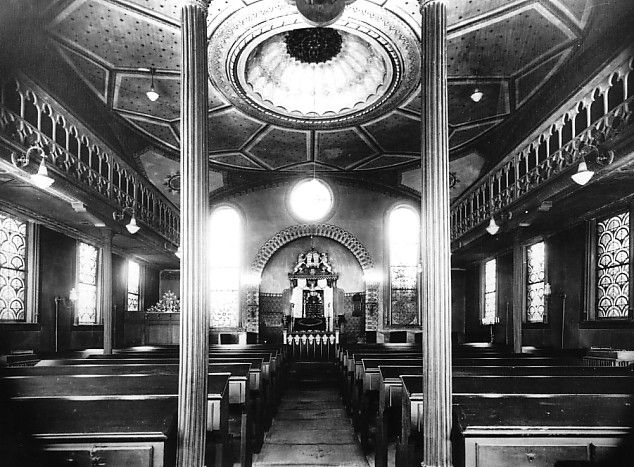
According to Helena, Prague had a Jewish community very early in its history, though many settlers came and left, depending on the economic and political situation.  There was a Jewish community as early as the tenth century, living near the Castle and the marketplace there.  Although that community was wiped out during the Crusades in the 12th century, there was then a new community growing on the other side of the river near what is now called Old Town, where in the 13th century the oldest still-existing synagogue was built, referred to as the Old-New Synagogue.  That synagogue is still providing religious services to this day.  It is claimed to be the oldest surviving synagogue in Europe.
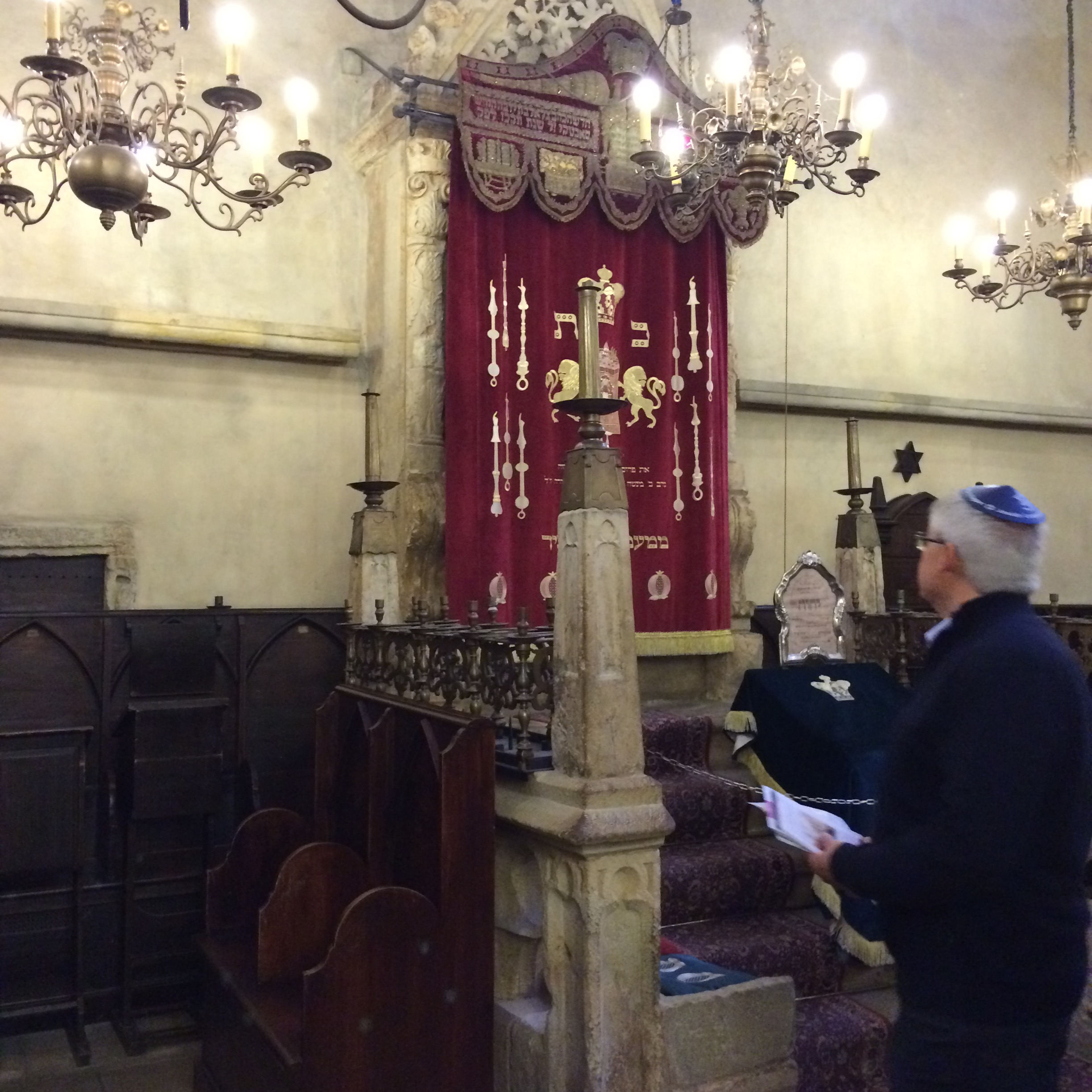
Entrance to prayer hall in Old New Synagogue

Entrance to prayer hall in Old New Synagogue

It was humbling to be in this synagogue, thinking of its long history.  Although it lacked the awesome size and height of the St. Vitus Cathedral and of some of the other synagogues we saw in the Jewish Quarter of Prague, it was moving to think about Jewish men (women prayed behind a thick stone wall with only a small hole to see into the main sanctuary) almost 800 years ago praying in this space.  Jews then lived in a ghetto, separated from the rest of the city by walls, and they faced anti-Semitism and periods of expulsion and then return, but were generally successful merchants and bankers and important contributors to the economy of the city.

At services women sit behind the wall where the opening is shown here

At services women sit behind the wall where the opening is shown here (not where this woman is seated)


The second oldest of the synagogues we saw in Prague was the Pinkas Synagogue, built in the early part of the 16th century.  Today it operates as a museum to educate people about the Jewish religion, its holidays and rituals, and does not operate as a place of religious services.

Pinkas Synagogue, Prague

Pinkas Synagogue, Prague

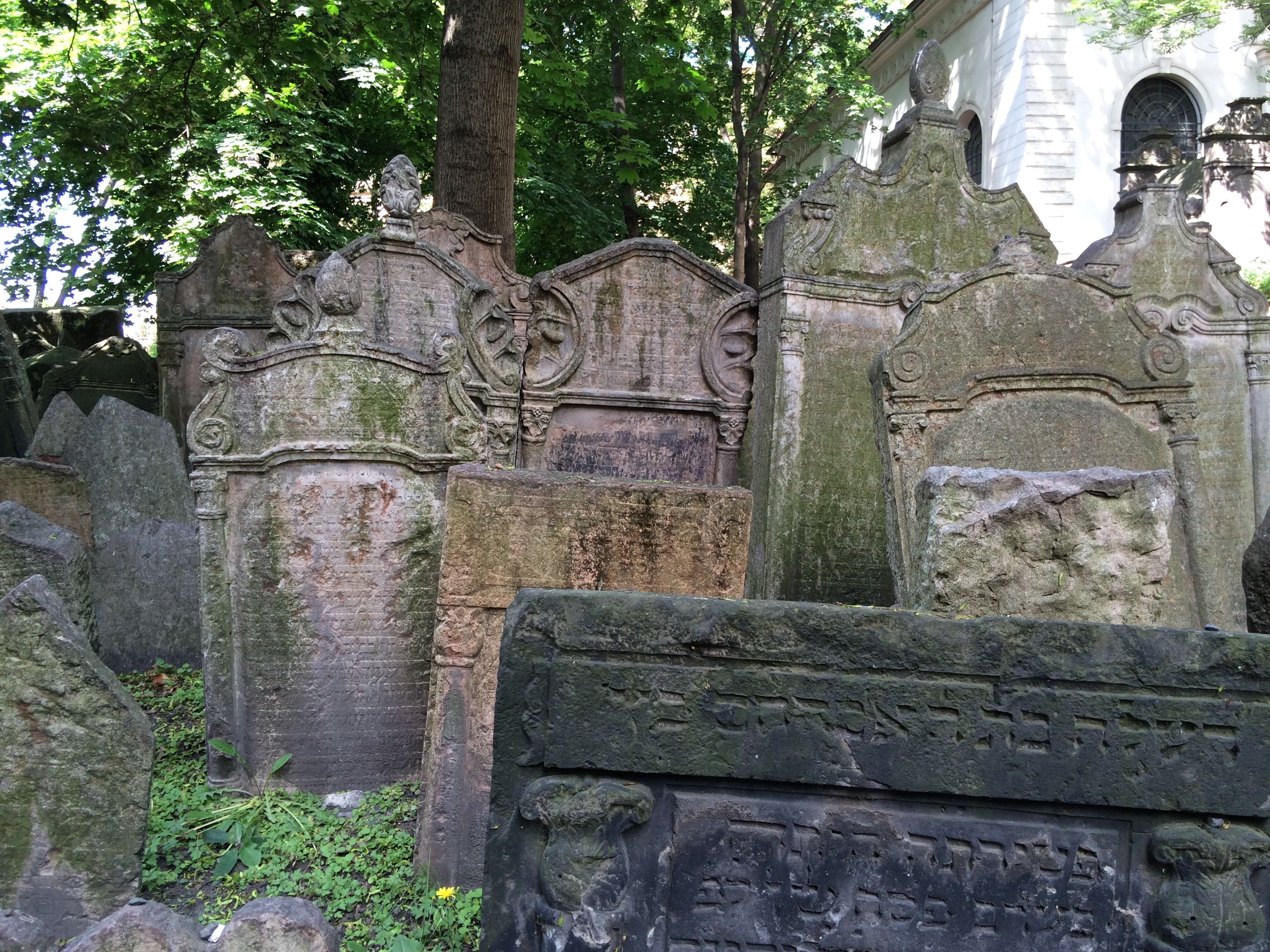
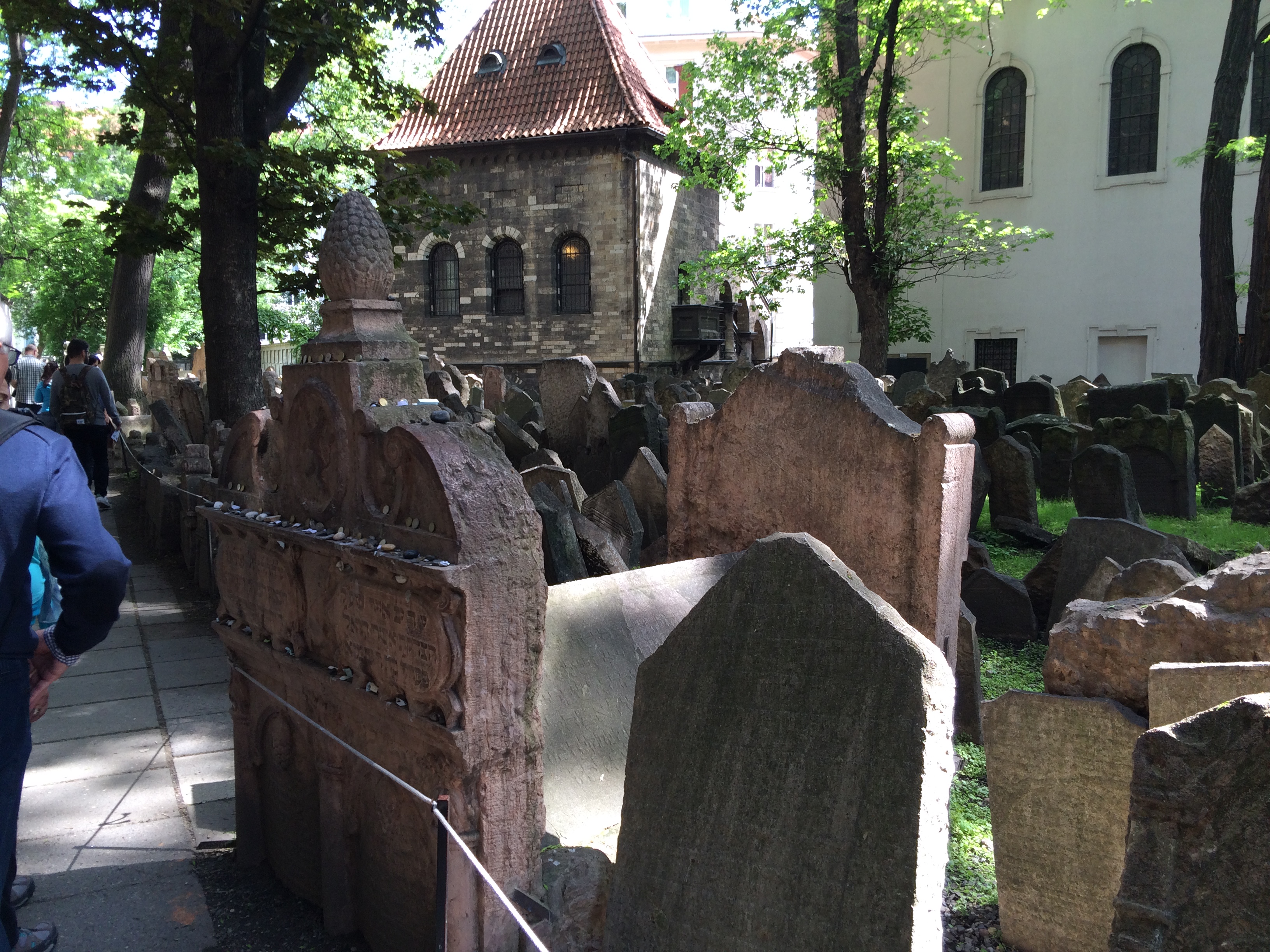
Immediately outside the synagogue is the oldest Jewish cemetery in Prague, so crowded with the remains of about 200,000 Jewish residents that the headstones are tumbled together and, according to Helena, are buried as many as twelve deep, one on top of the other.

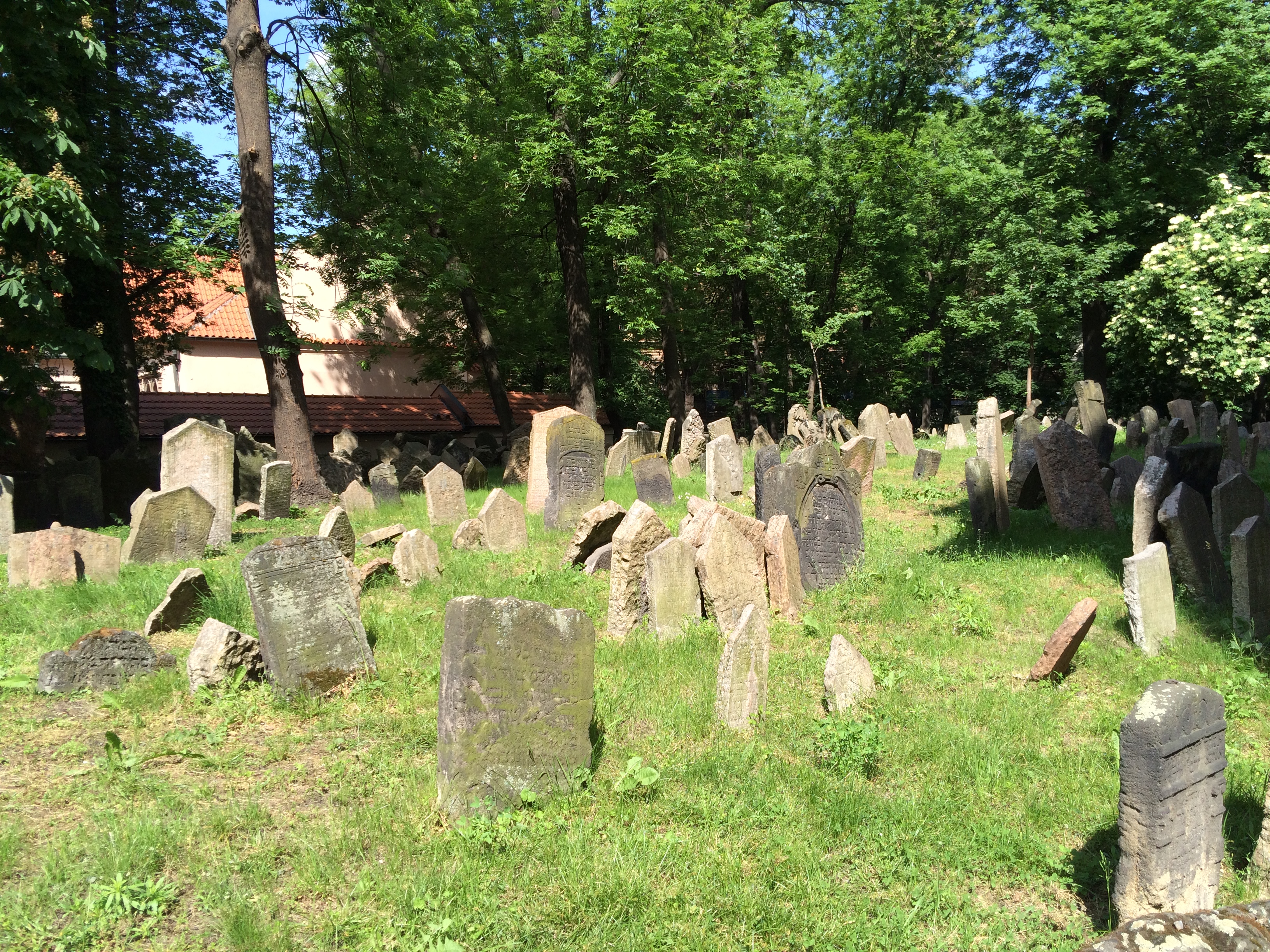
IMG_2549 buried 12 deep IMG_2550 cemetery


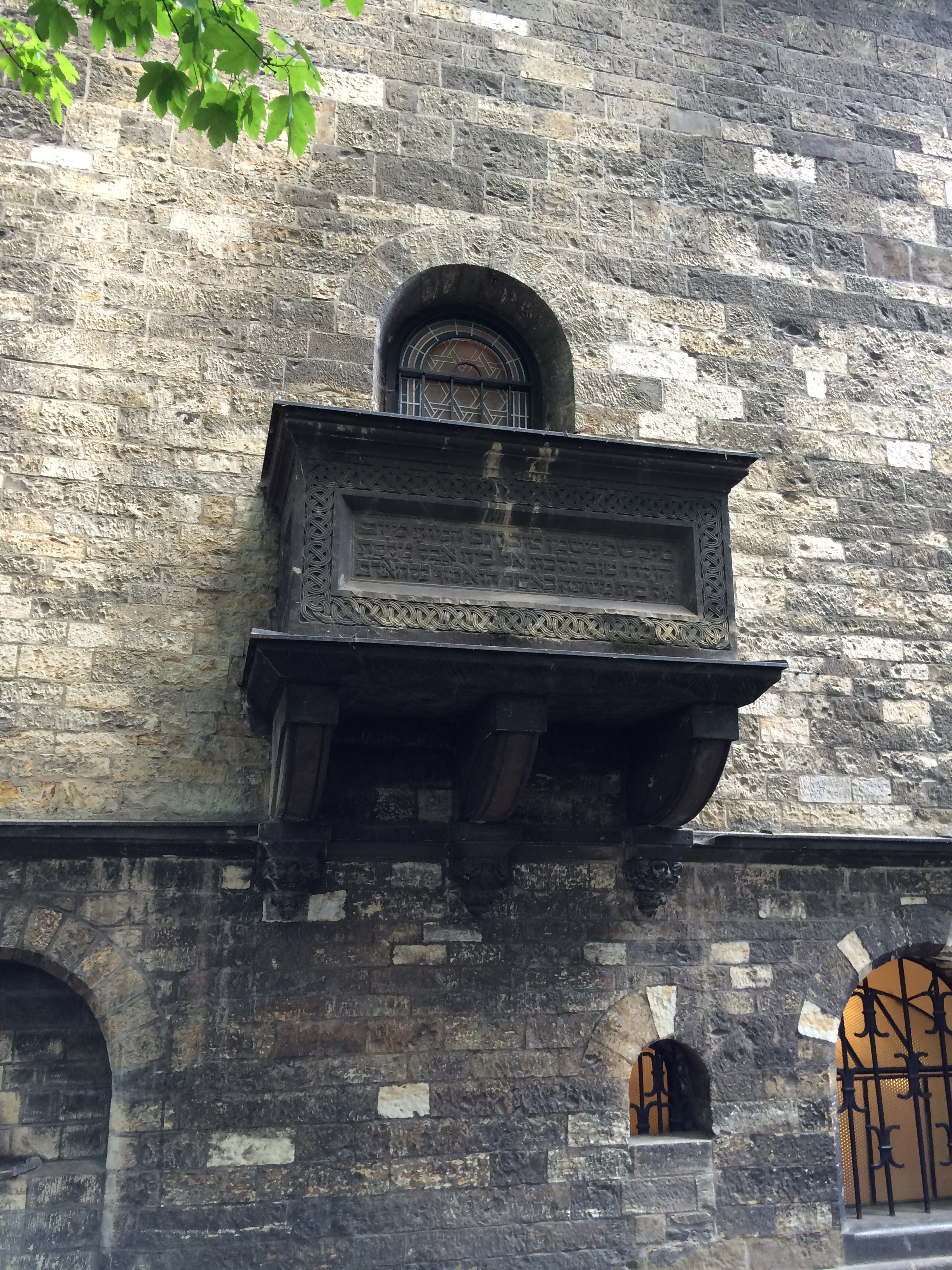
There is also a building for the chevra kadisha (burial society) on the cemetery grounds, including a balcony where the Cohanim stood since they were not allowed to enter the cemetery.  (According to Jewish law, the Cohanim, the priestly tribe descended from Aaron, are not to defile themselves by touching or going close to a dead body.)

chevra kadisha building

chevra kadisha building

IMG_2558 cohen symbol

Cohanim symbol

Cohanim balcony

Cohanim balcony

These ancient stones and their placement and inscriptions are evidence of what once was a crowded Jewish neighborhood within the ghetto walls, a community that was observant of Jewish laws and forced to live separately from their Christian neighbors.

In the 1500s Prague had one of the largest Jewish populations in Europe. Other synagogues were built, including a synagogue built by one of the wealthiest residents of Prague, Mordecai Maisel, as his own private synagogue.  According to Helena, Maisel was friendly with the reigning king, Rudolf II, and was an important merchant and property owner in Prague.  Maisel was also very friendly with Rabbi Judah Loew, a leading rabbi as well as a writer, best known for his rendition of the Golem legend.  Both Maisel and Rabbi Loew are buried in the Old Cemetery, their graves marked by large tent-like structures instead of plain headstones.  We were not able to get inside the Maisel synagogue as it is closed for renovations, but we were able to take some photographs of the exterior.

Maisel Synagogue, Prague

Maisel Synagogue, Prague

IMG_2544 Maisel synagogue 2

Maisel's tombstone

Maisel’s tombstone

IMG_2555 Rabbi Loew tombstone

Rabbi Loew’s tombstone

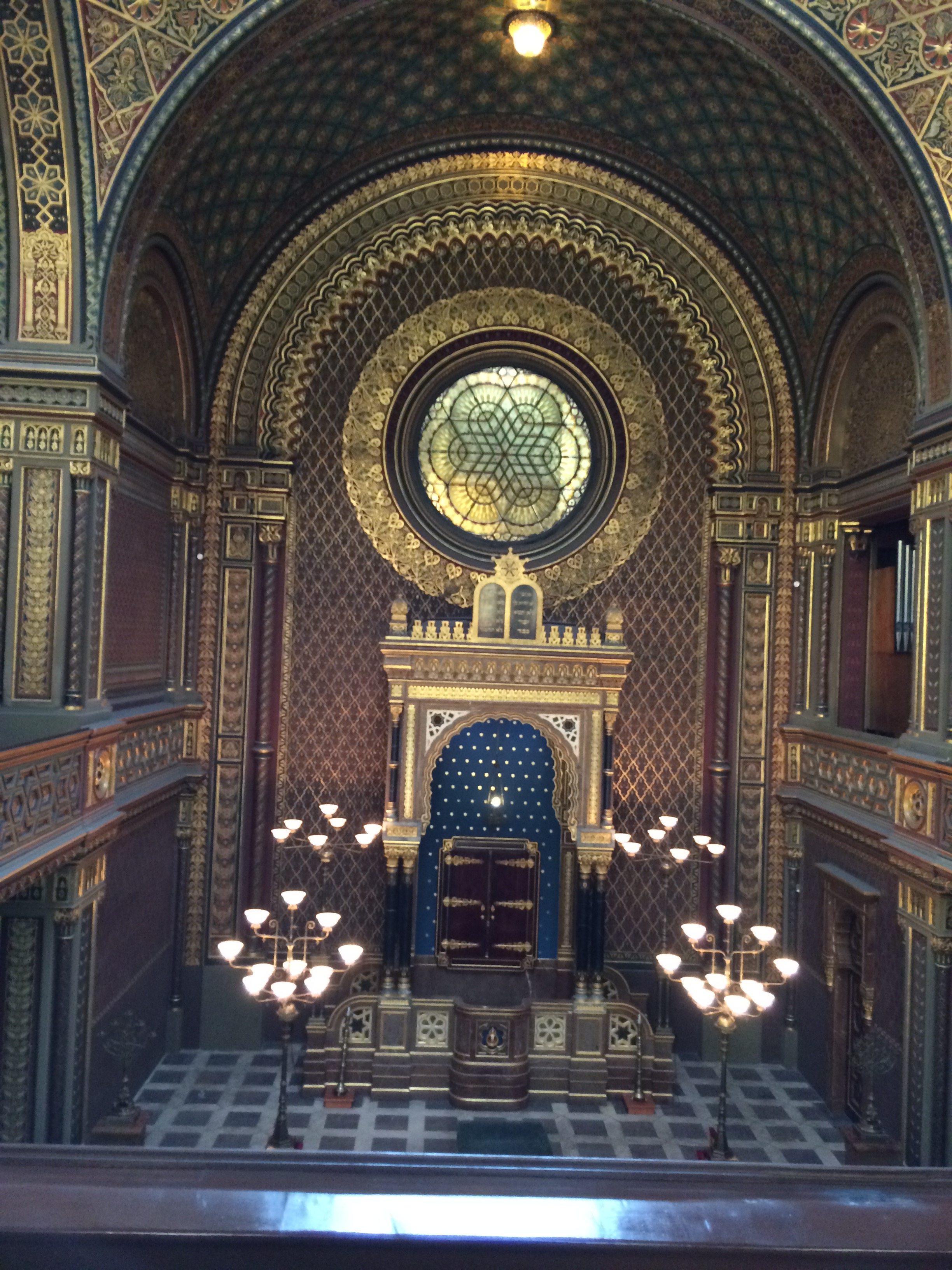
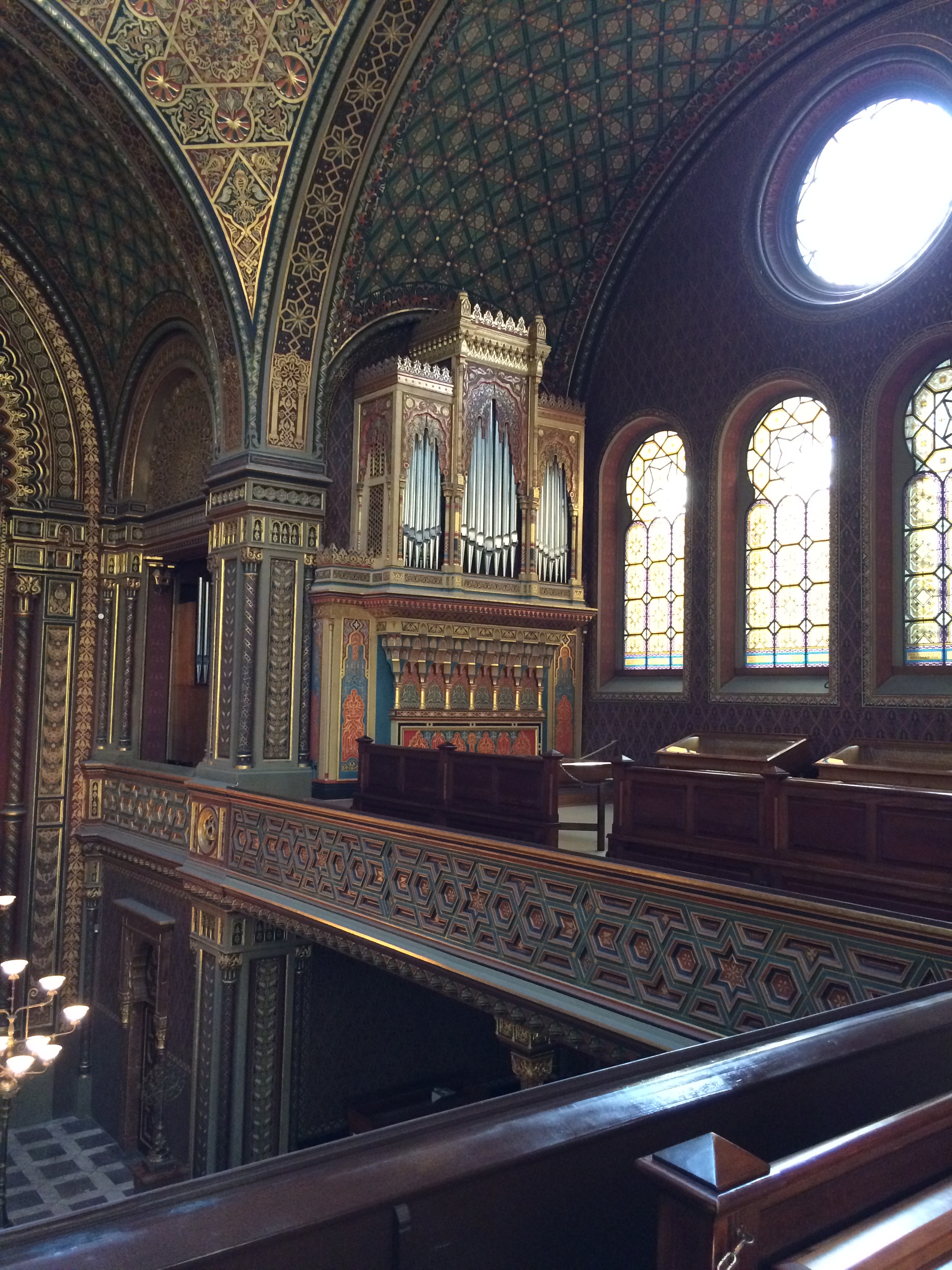
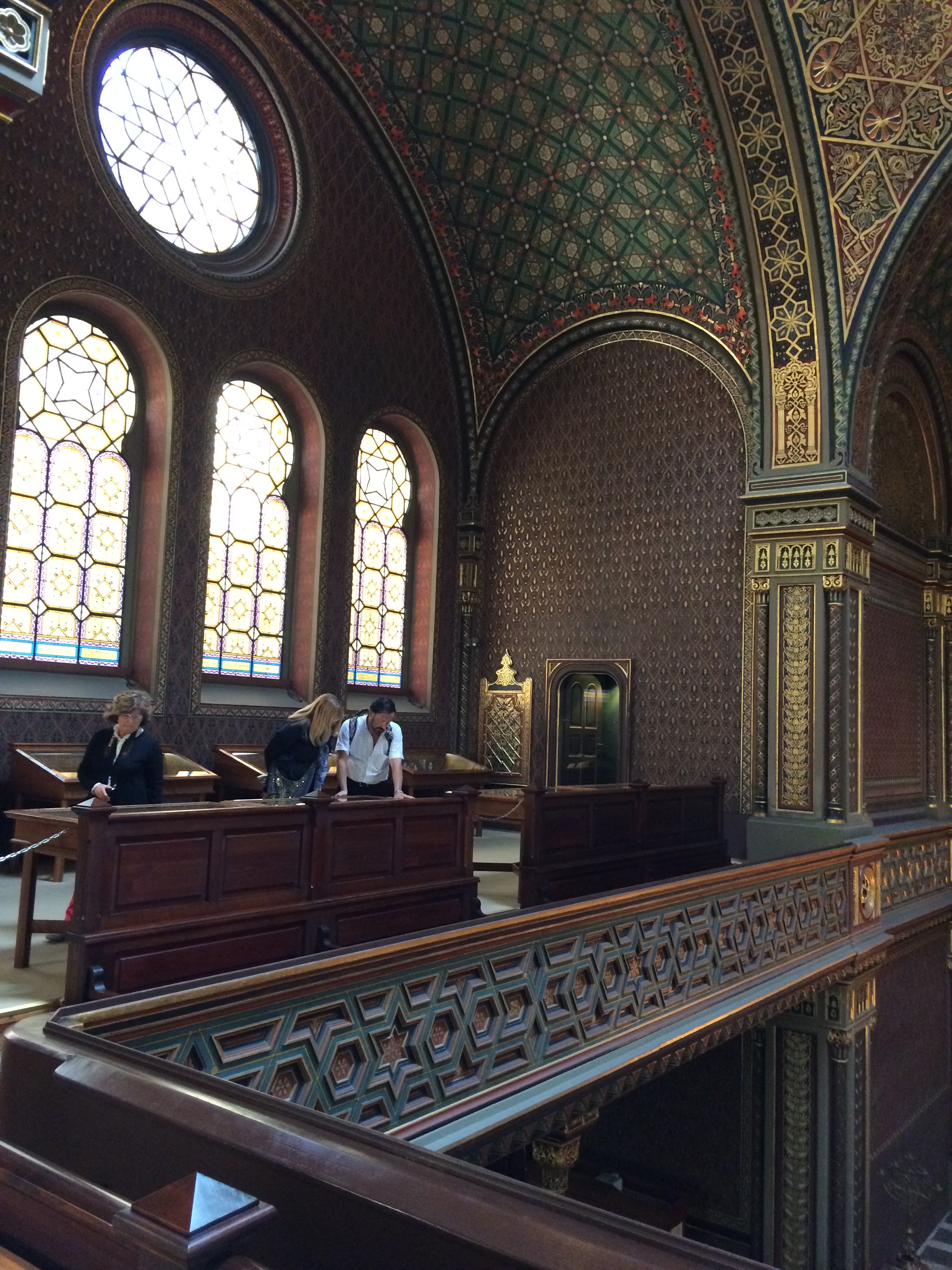
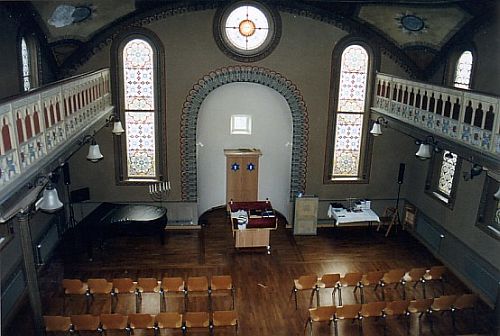
The newest synagogue we saw in the Jewish Quarter was the magnificent Spanish Synagogue.  Despite its name, the synagogue had nothing to do with Spain nor were its congregants Sephardic.  Rather the name refers to the Moorish designs that decorate both the exterior and the interior of the synagogue.  This synagogue was built in the second half of the 19th century and still offers services on Friday nights, attracting many tourists.

Spanish Synagogue, Prague

Spanish Synagogue, Prague

IMG_2535 interior of Spanish synagogue IMG_2536 organ in Spanish synagogue IMG_2537 Spanish synagogue interior IMG_2538 Spanish synagogue from above IMG_2539 women's section Spanish synagogue

Seeing this synagogue made me realize just how prosperous the Jewish community must have been in the 19th century.  The lavish and ornate wall coverings are indicative of the resources available to the Jewish residents.  In fact, Jews were granted equal rights around this time, and the ghetto walls came down, allowing Jews to move out of the Jewish Quarter.

Many moved to the New Town area, where yet another impressive synagogue was built in the early 20th century, the Jerusalem Synagogue.  We later visited this synagogue on our own, and although we did not get inside, we were once again dazzled by the colorful and elaborately designed exterior, which also reflects Moorish influence.

Jerusalem Synagogue, Prague
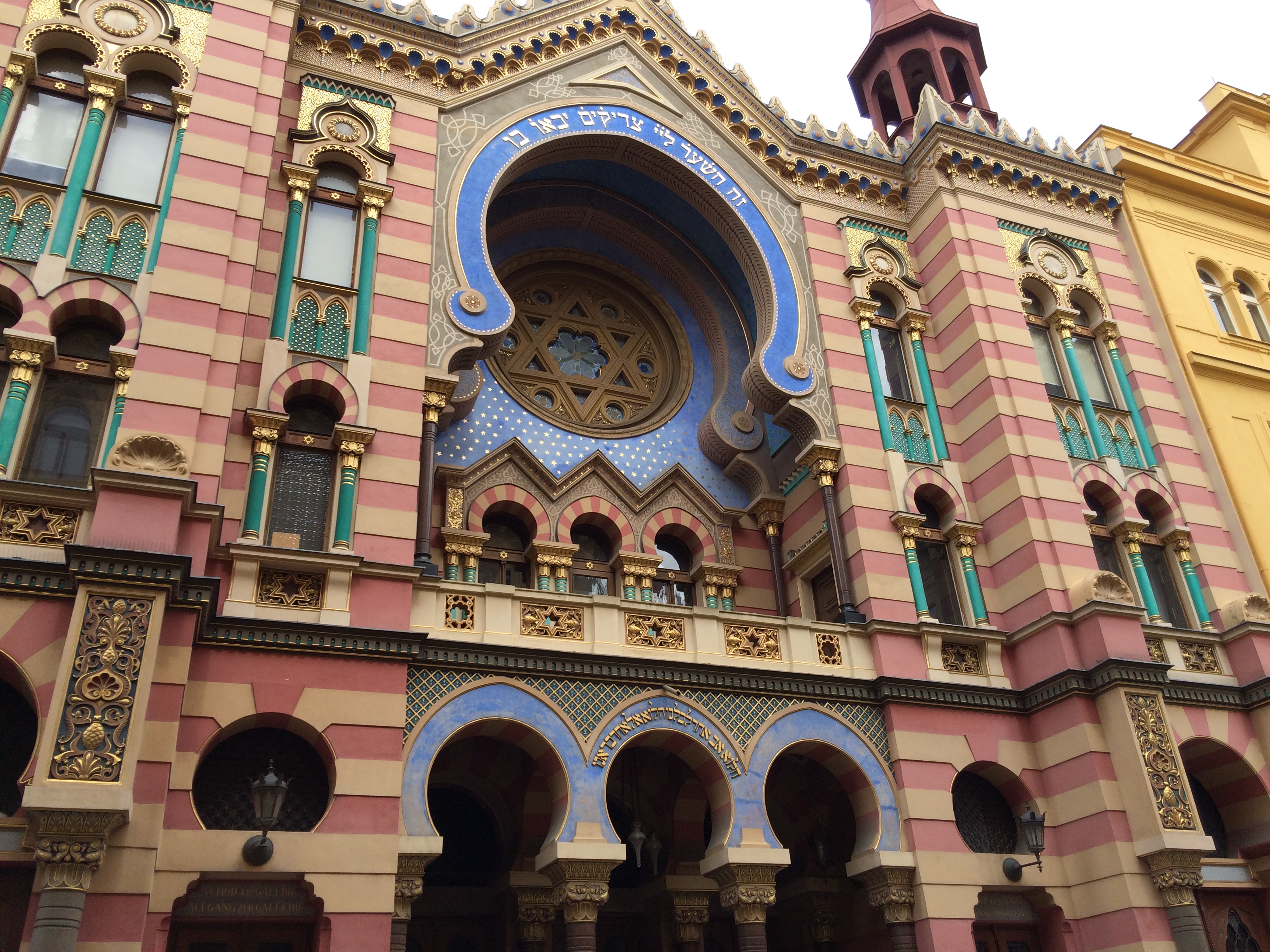
Jerusalem Synagogue, Prague

IMG_2622 Jerusalem Synagogue Prague

Helena told us that once the Jews were allowed to move out of the ghetto, most left if they could afford to do so, leaving behind only those too poor to move.  Poor Christians then moved into the area where the ghetto had existed, and because of the poverty, conditions deteriorated, leading to severe sanitary and health problems.  Eventually the city tore down the old buildings in an early form of urban renewal, replacing the older homes with the fancy Art Nouveau buildings that line the streets today.  The streets were widened, and the whole character of the former ghetto disappeared.  For the most part, only the synagogues survived.
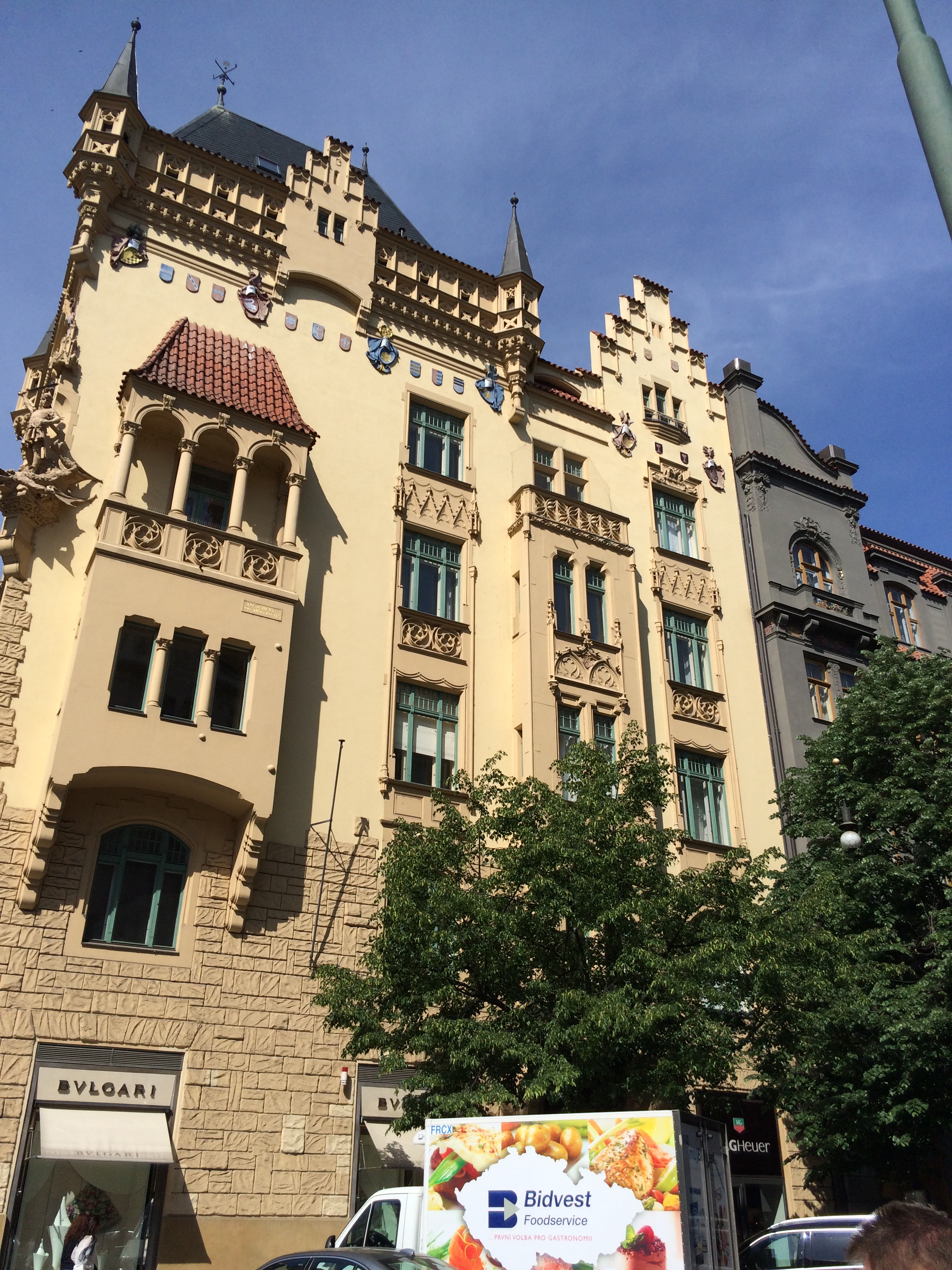
Newer buildings in what was once the ghetto

Newer buildings in what was once the ghetto

IMG_2568 Prague street 5 22

Wider streets in what was once the ghetto


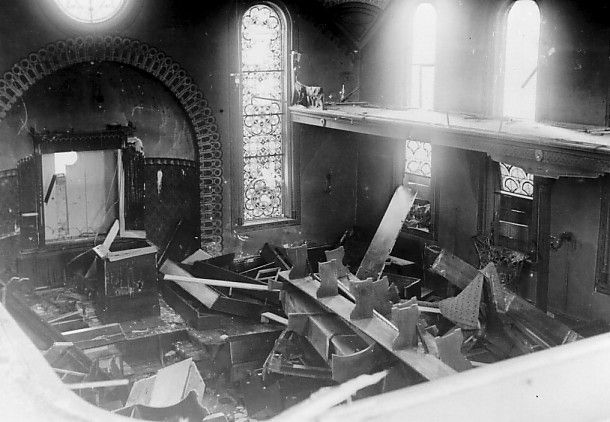
Then the Nazis arrived in the late 1930s and 1940s, and what had been a large and thriving Jewish community of over 90,000 people, amounting to about 20% of the city’s overall population, was destroyed.  The synagogue buildings survived only because the Nazis found them useful for storing their supplies and horses.  Most of the Jews who had lived in Prague were killed.  Today there are fewer than 2000 Jews living in Prague.

Seeing the Jewish Quarter and learning about its history helped place into context what we saw in the afternoon when we went to Terezin.  As we drove to Terezin, Helena told us about the assassination of Reinhard Heydrich, the SS officer who is considered to have been one of the principal planners of the Final Solution, the Nazi plan for exterminating the world’s Jewish population. He also was appointed as the SS officer responsible for overseeing the occupation of Czechoslovakia during the war and the creation of the Terezin concentration camp.  In May, 1942, two Czech resistance members attacked Heydrich’s car and assassinated him.  As revenge, the Nazis selected the town of Lidice, claiming it was the home of the assassins, and completed erased it from the face of the earth, killing all the men, deporting all the women and children, and razing all the buildings.  As Helena said, when people learned what had happened, they thought it could not get any worse.  But as we now know, it got much worse.

I am not sure how to write about Terezin.  I wanted to go there to pay my respects to the numerous Seligmann cousins who had died there as well as all the other thousands who had died there.  But part of the time I felt very uncomfortable, like I was visiting a museum, not a place where people were tortured, starved, and killed.  I took a few photographs at first and then stopped because I felt it to be disrespectful and trivializing to take pictures as if I were visiting an ordinary tourist attraction.

The last photo I took was one of a cell in the Small Fortress, the part of Terezin where dissidents and “criminals” were sent to be punished as opposed to the Large Fortress where the Jews were sent to await their deaths.  Of course, many Jews were also classified as  dissidents and “criminals” and ended up at the Small Fortress, and the room I photographed was one where such Jewish prisoners were sent, getting no meat and just water and a piece of bread twice a day and sleeping like animals on platforms squeezed into a tiny space where they were crowded on top of each other.  The solitary confinement cells, the yard where guards shot Jews for target practice, the sinks where no water ran but were there merely to fool the International Red Cross.  My brain had a hard time absorbing that these were real places where these horrendous things actually happened.

Jewish prisoners' cell, Terezin

Jewish prisoners’ cell, Terezin


My initial impression of the so-called Large Fortress or ghetto was that, by contrast to the Small Fortress, it was not that bad.  This was the camp that Hitler used as a “model camp” to convince the International Red Cross that Jews were being well-treated.   Children put on performances and created drawings and played soccer, all to impress the visitors.  Food was served for the visit that was never served again.  Children were required to lie to the visitors to create the impression that they were happy.

Some of the children’s drawings are on display at Terezin, and they are just heart-breaking.  The childlike depictions of their happy lives before the war and of their impressions of what was happening around them are so powerful.  I can’t possibly convey in words what these drawings convey.

Although Terezin was not a death camp, many thousands of people died at Terezin either from malnutrition, disease, or murder. When we saw the barracks where people lived and the living conditions they endured, my initial impressions were corrected, and I realized how horrible life must have been for those forced to live there while awaiting death, either at Terezin or later when shipped to Auschwitz.

As I noted above, according to records at Yad Vashem several of my Seligmann cousins died at Terezin, including Moritz Seligmann, Laura Seligmann Winter, Bettina Seligmann Arnfeld, Anna Seligmann Goldmann and her husband Hugo and their three children Ruth, Heinz, and Gretel, and Eugen Seligmann.  Helena was able to catch a researcher at Terezin right before he was leaving for the day, and in a few minutes he was able to provide me with information about one of these relatives, Eugen Seligmann.  He gave me these documents.

Record for Eugen Seligmann at Terezin
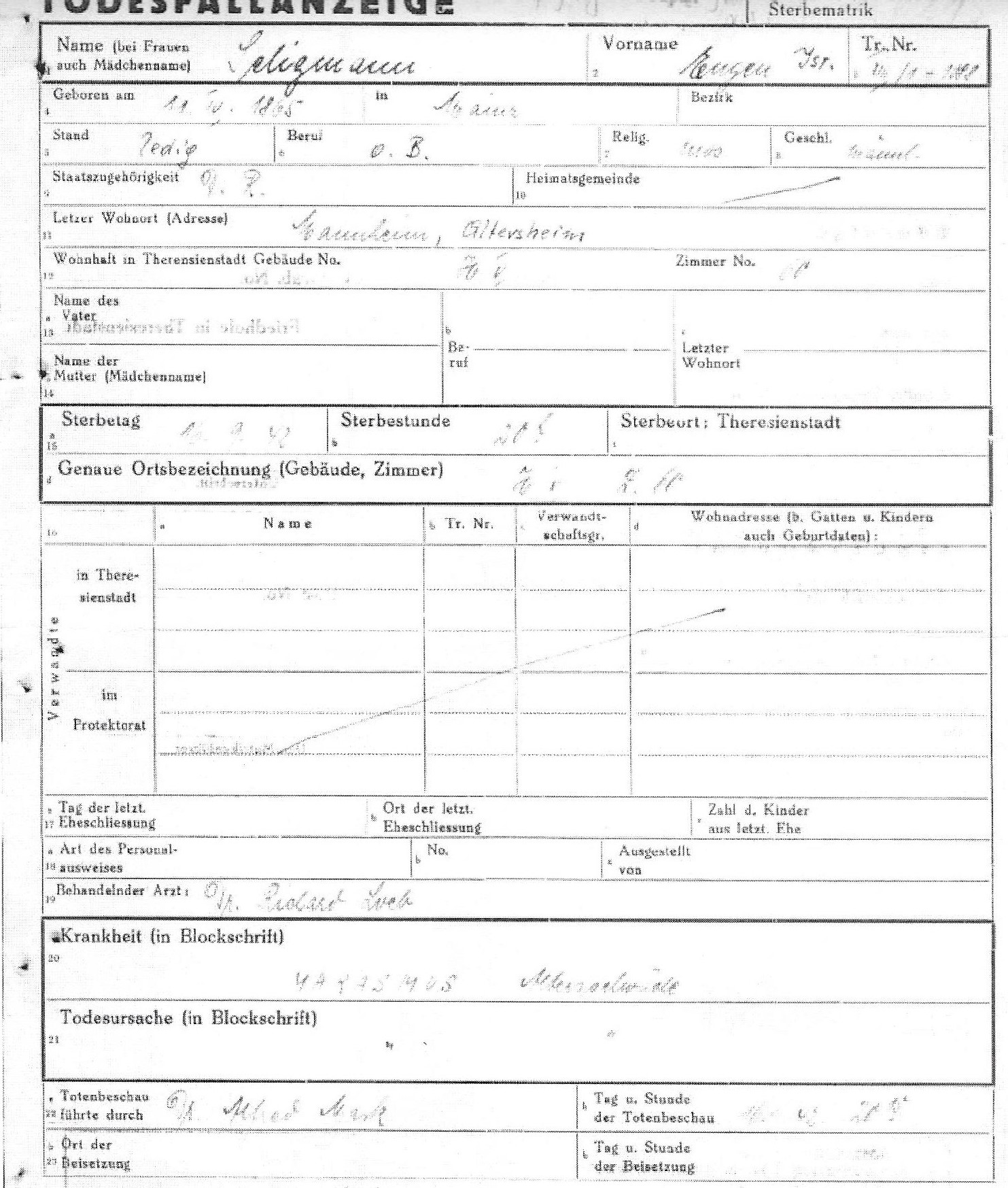
Record for Eugen Seligmann at Terezin

Scan0003

Death certificate for Eugen Seligmann at Terezin

Death certificate for Eugen Seligmann at Terezin

From these documents we were able to learn the day Eugen died and from that we were able to identify where in the burial grounds at Terezin Eugen had been buried.  You see, the bodies were buried in mass graves that were identifiable only by date.  Eugen died on September 16, 1942, and thus the archivist at Terezin could determine that he had been buried in a mass grave located at marker 59.

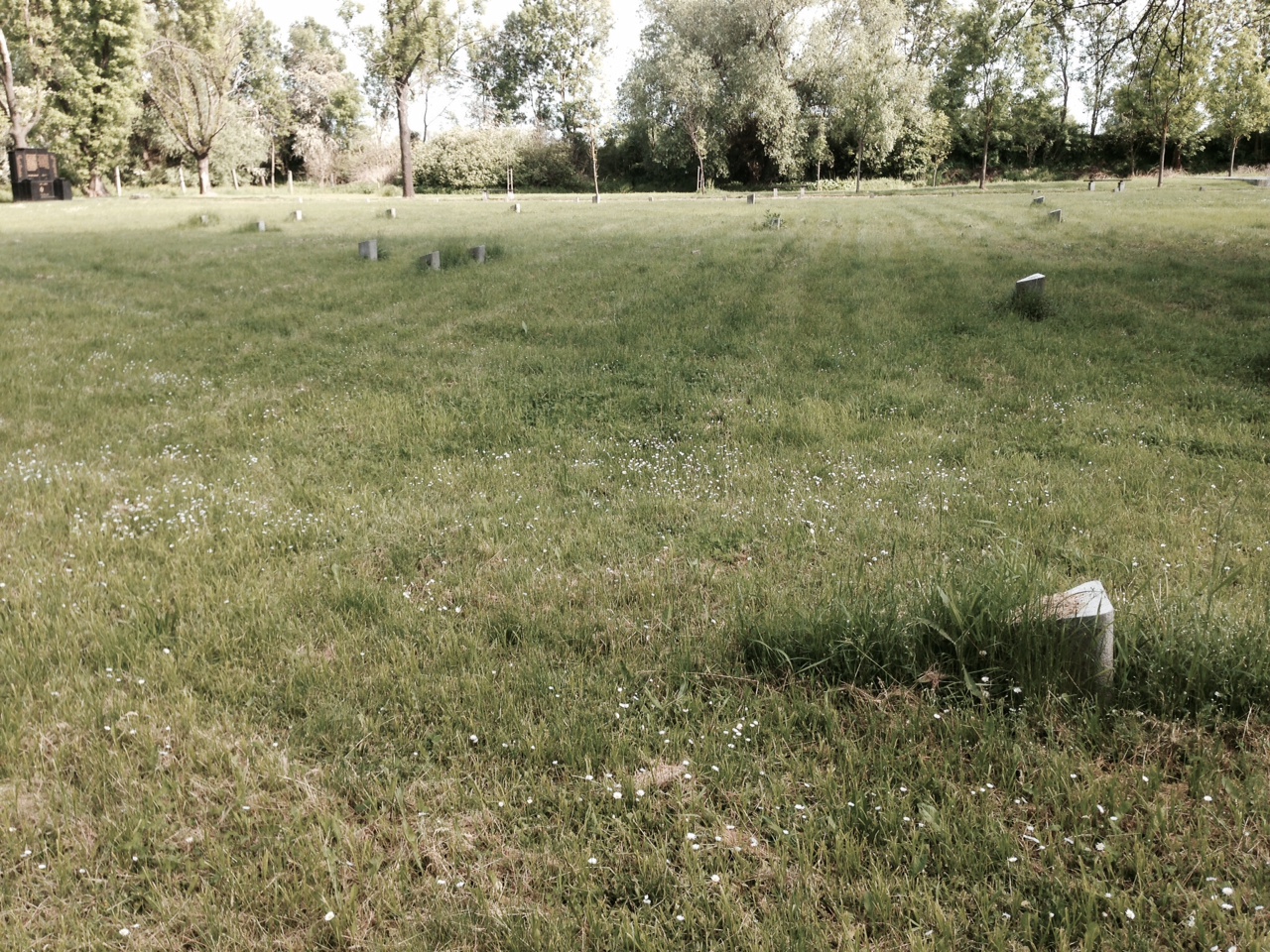
Helena led us to the cemetery where the markers are posted, and after some searching (many markers had numbers missing for reasons that were not clear) we found marker 59.  I placed a stone on the marker and stood in silence, thinking about this cousin I’d never known and what his life and his death at Terezin must have been like.
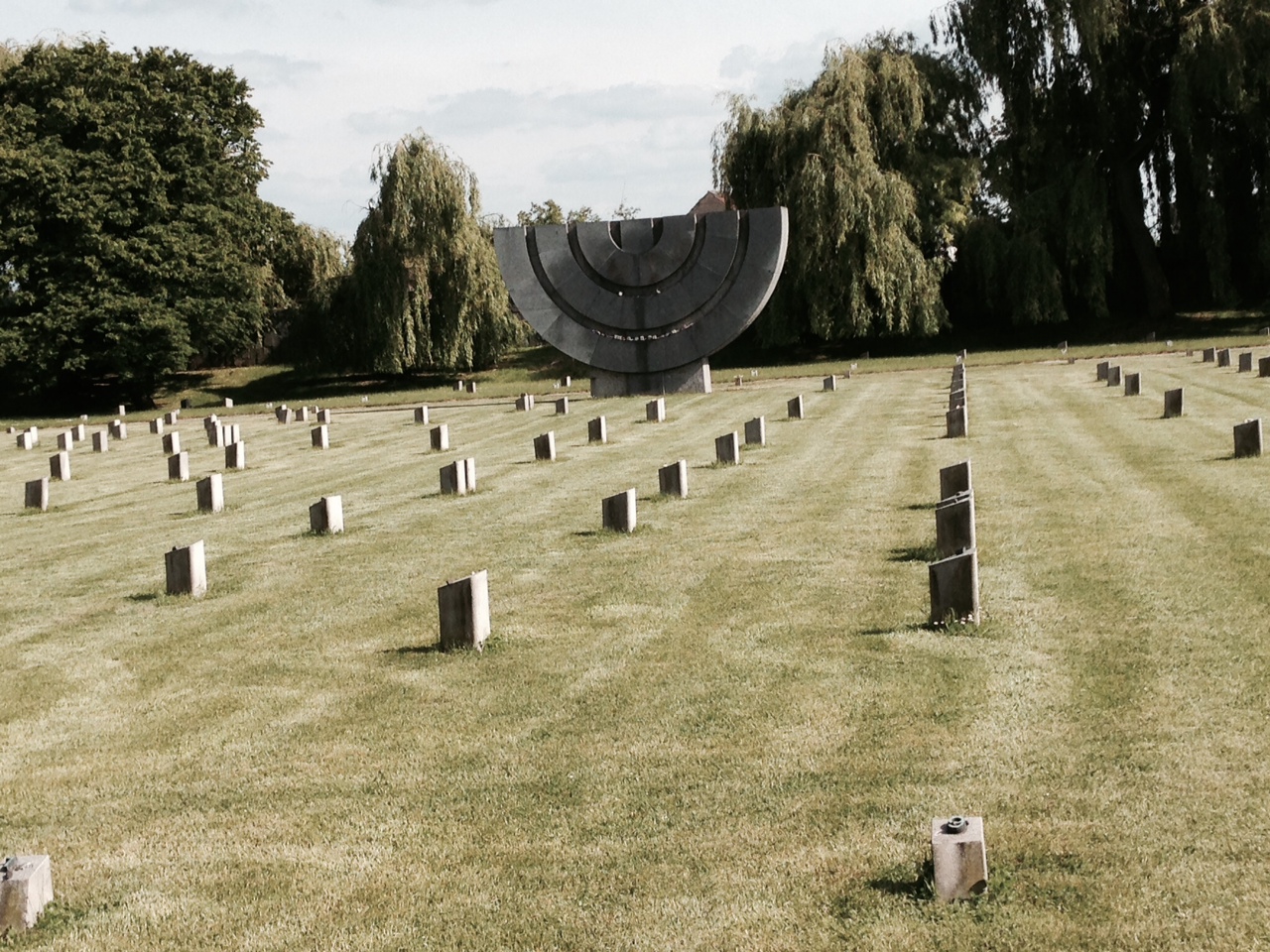
cemetery at Terezin

cemetery at Terezin

Marker 59

Marker 59

location of mass grave where Eugen Seligmann is buried

location of mass grave where Eugen Seligmann is buried

According to the death certificate, Eugen died from marasmus, or severe malnutrition.  In other words, this 87 year old man starved to death.  It is just horrifying to look at this document and translate the German words; the document records his birth date, his home town, his date, day, and time of death, his parents’ names and whether he was married and had children (none recorded here), the name of the attending physician, and other information—the level of detail is in direct conflict with the dehumanization the Nazis inflicted on these people.  Why create a record that creates an impression that someone cared who this man was and then toss his body into a mass grave?

Eugen, the son of Carolina and Siegfried Seligmann and a nephew of my great-great-grandfather Bernard Seligman, was a member of a successful Jewish German family. He was in his late 80s when he was taken to Terezin.  How can anyone possibly grasp what it must have been like for him to have been torn from his home and transported to this camp in Czechoslovakia, deprived of all his rights and property, forced to live in squalor and without any privacy or essentials? How can we grasp what it must have been like for this elderly man to starve to death in such a place? How can anyone understand how human beings can do this to other human beings?

I never knew Eugen or any of the other cousins who died at Terezin.  In fact, a year ago I didn’t know I had any cousins who died in the Holocaust.  Although going to Terezin was a very painful and nightmarish experience, I am glad that I was able to honor their memories by visiting the place where they are buried, the place where they were killed for no reason at all.  Even now I cannot really fathom what happened there.  It just is incomprehensible.


Home Sweet Home

We are back from our trip, and I have so much to say that I don’t even know where or how to start.  Traveling to a different place can change your whole view of the world, of your place in the world, and of yourself.  This trip did that in so many different ways.  I have hundreds of photographs to sort and label, a lot of notes to transcribe and ponder, and so many thoughts and memories floating through my head that I need to write them all down before I forget them.  So I can’t just start blogging in detail about the trip right away.  I will certainly report about the parts of the trip that related directly to my own family—the trip to Poland in particular—once I have it all digested.

For now I have these overall thoughts and a few photographs to share.  First, standing in the former Jewish quarters in Prague, Krakow, Budapest, and Vienna, some of which still have several synagogues (a few even still in operation), is a chilling and horrifying experience.  For me, these places that once bustled with Jewish grandparents, mothers, fathers, and children, going to work and going to school and going to shul, were a graphic and vivid reminder of what the world lost in the Holocaust.  Had it not been for the Nazis, these Jewish communities could and likely would still exist, adding to the culture and economy of these places and of the world just as they did for hundreds of years before their Jewish citizens were murdered.

A street in the former Jewish Quarter of Krakow

A street in the former Jewish Quarter of Krakow

Nothing made this more painfully vivid for me than standing in Tarnobrzeg, the town where my Brotman great-grandparents lived, a town that was once 75% Jewish and where not one Jew lives today.  The only signs that there were once Jews there were a small plaque on the library, a building that had once been the synagogue, and a Star of David near the gate to the neglected Jewish cemetery, where only a handful of headstones remain.

gravestone on the ground in the Jewish cemetery in Tarnobrzeg

gravestone on the ground in the Jewish cemetery in Tarnobrzeg

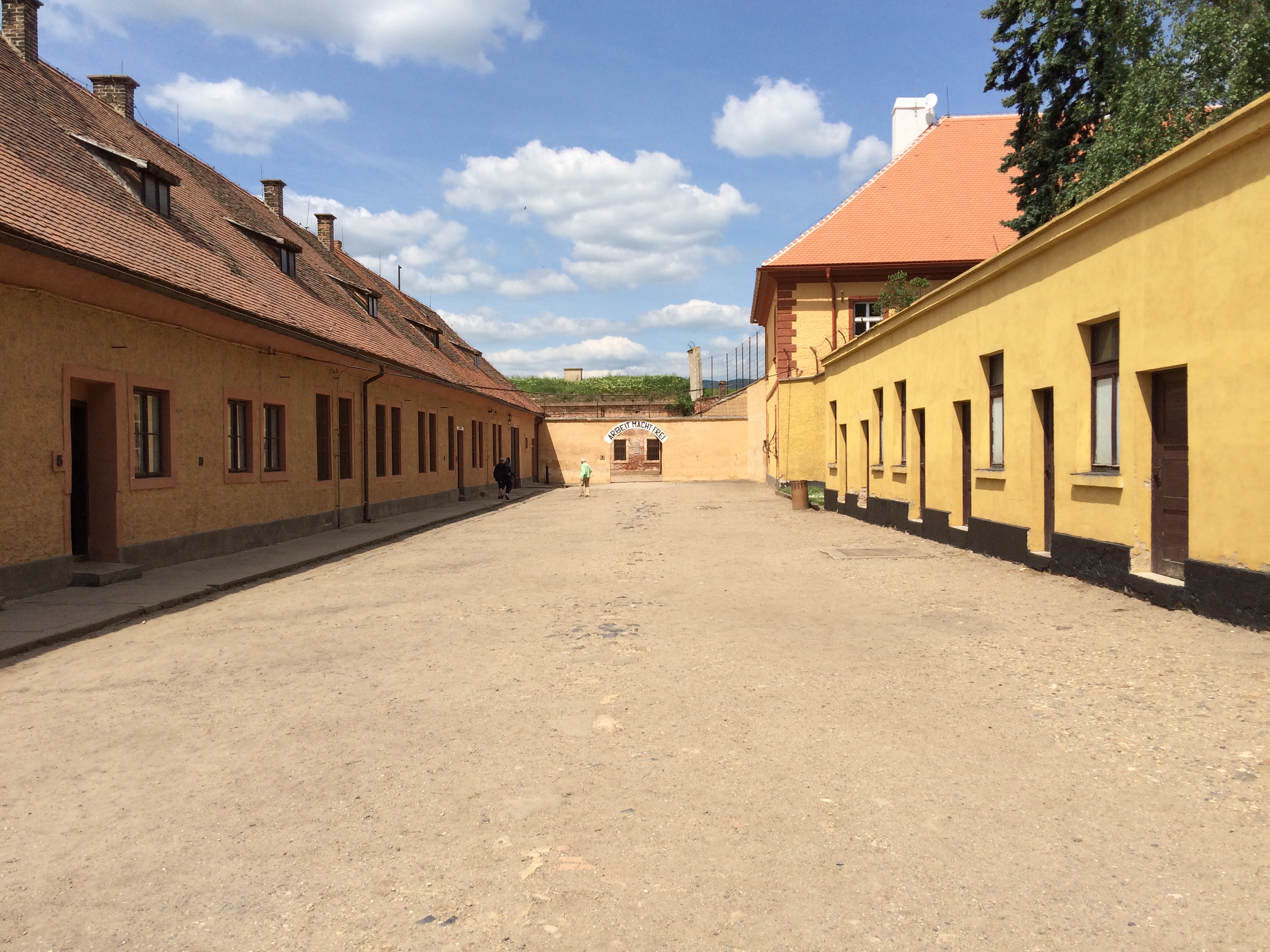
Second, every person, Jewish or not, should visit Terezin and Auschwitz.  I cannot say more.  The places say it all.  You cannot go to these places and not be changed.  No matter what you may have read or seen or heard about the Holocaust, you cannot be prepared for what you experience walking in those places of terror and death.  I have only two photographs of Terezin and no photographs of Auschwitz.  I could not bear to think about taking a photograph while standing where so many were slaughtered.

Terezin

Terezin

Third, I had little idea what life was like under Soviet domination in the Czech Republic, Poland, and Hungary until we met several people who had lived during that era.  We were lucky to have guides in Prague, Poland, and Budapest who had witnessed the changes and were able to describe to us how different life was before and after the Soviets left in the late 1980s, early 1990s.  Today all these places are clearly capitalist, for better in many ways, for worse in others.  Seeing Starbucks and McDonalds and KFC everywhere amidst the old buildings in these gorgeous cities is jolting, but much better than seeing empty store windows and children forced to march at rallies to support the “state.”

Despite all the sadness that we felt as we learned about the past in these places, overall we experienced these cities as places of joyfulness, liveliness, and overall comfort.  Yes, there were beggars and homeless people, especially in Budapest, and I am sure that outside the areas where tourists congregate there is plenty of poverty and misery.  But each of the cities we visited were beautiful places filled with incredible and fascinating architecture, a huge number of cafes and restaurants and bars, museums teeming with people, cobblestone streets crowded with tourists and tour groups, and the sounds of happy, excited people.  There was music everywhere—in the streets, in the churches, and in the concert halls.

Dohany Synagogue in Budapest

Dohany Synagogue in Budapest

We had an incredible time.  Our tears and sadness were well-balanced with times of pure joy—climbing the tower to see all of Prague, clapping to Klezmer music in Krakow, walking along the river in Budapest, and eating unbelievable pastries in Vienna.  We heard music in every city, we stood in awe in Gothic cathedrals, we watched people laughing and drinking and eating in the cafes, and we walked and walked and walked until our feet were numb.  We had an incredible time.

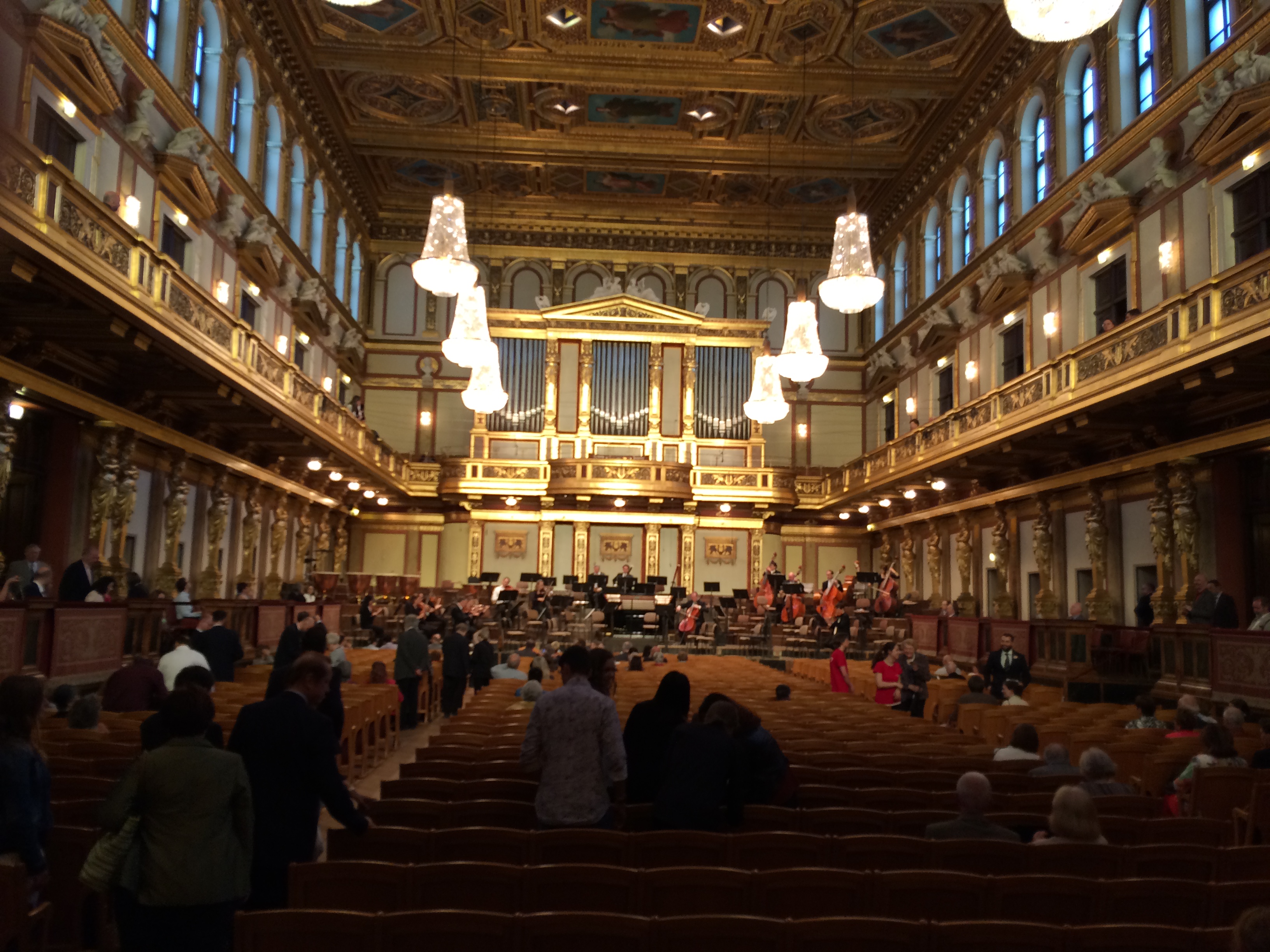
Musikverein in Vienna

Musikverein in Vienna


What Did They Know, and When Did They Know It?

As I’ve learned about the numerous members of my Seligmann family who were killed during the Holocaust, one of the questions that has bothered me was whether or not their American relatives were aware of what was going on in Germany.  This, of course, is part of the larger question of what Americans, Jewish or not, knew about Hitler and his plans to murder the world’s entire Jewish population. Certainly people were aware of the anti-Semitic laws and practices, of Kristallnacht, of some violence against Jews, but to what extent were they aware of the seriousness, the severity of the situation, of the plans for genocide?  We all know stories of immigrants who were denied entry, including full ships turned away from American ports.  Historians have written about the failure of the Roosevelt Administration to respond to pleas for help from those who were very much aware of what was happening in Germany and elsewhere in Europe.

But what did my own family know? Did my Seligman relatives here in the US know what was happening to their cousins in Germany?  In 1935 when the Nuremberg Laws were enacted in Germany, depriving Jews of their citizenship and imposing many other restrictions on their lives and livelihoods, both my great-grandmother Eva Seligman Cohen and her younger brother James Seligman, my great-great-uncle, were still alive (their youngest brother Arthur had died in 1933).  Did they even know they had cousins living in Germany? Were they in touch with them? Did they know what was going on there?

To some extent those questions now have some answers, thanks to a series of letters from and to Fred Michel sent to me by his children.  Fred Michel’s grandfather August Seligmann was the younger brother of Bernard Seligman, the father of Eva and James and my great-great-grandfather. Fred was thus the first cousin once removed of my great-grandmother and her brother.  I wrote previously that in Fred Michel’s citizenship application he had identified James Seligman of Santa Fe as his sponsor for immigrating to the United States in 1937.  Fred’s children have some letters written by James Seligman regarding the immigration of his German cousin that shed some light on my questions.

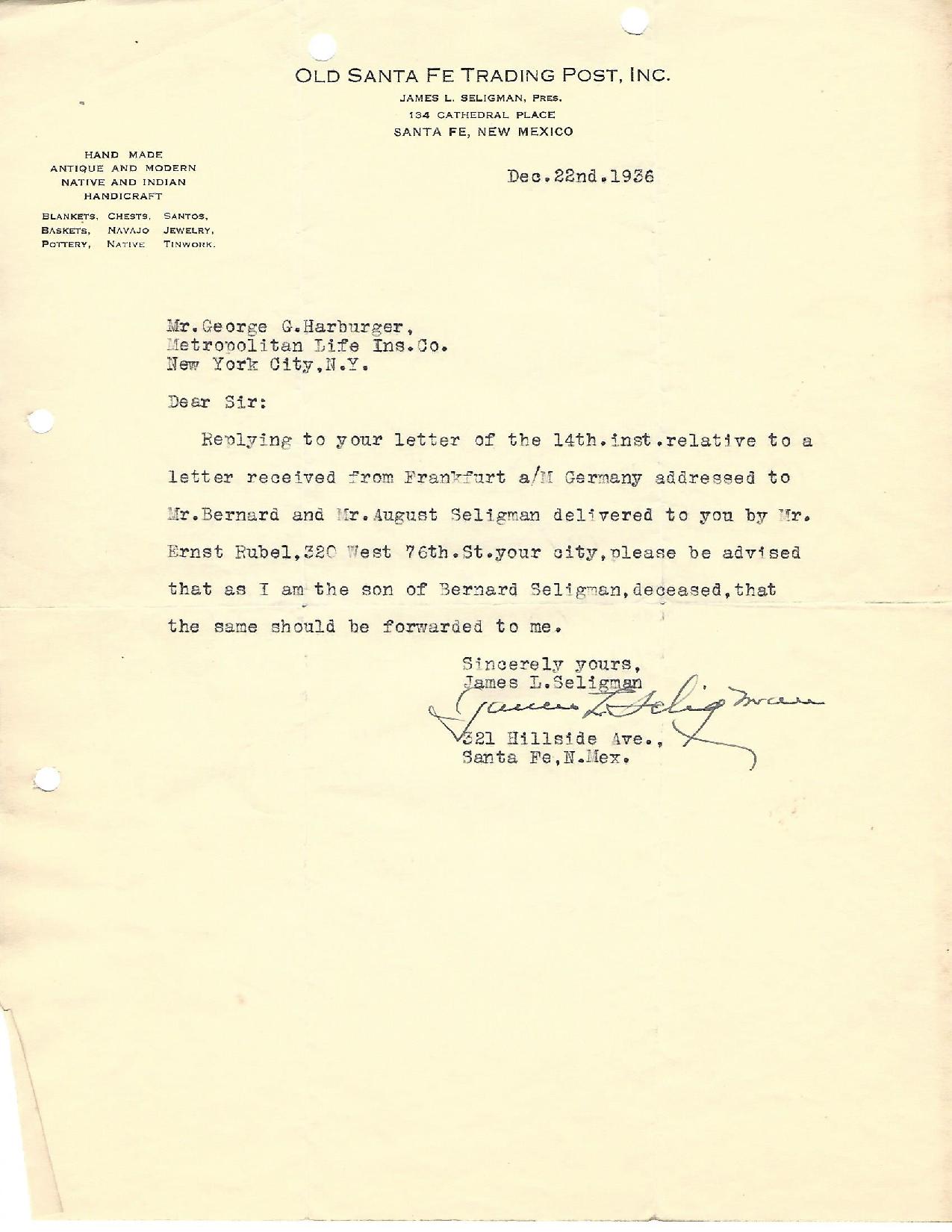
The earliest letter in this particular collection is one from James Seligman to George G. Harburger of Metropolitan Life Insurance in New York City, dated December 22, 1936.  In this letter, James was writing in response to a letter from Mr. Harburger regarding a letter that had been sent from Frankfort, Germany, to Bernard and August Seligman, which an Ernest Rubel had delivered to Harburger.  Ernest Rubel was the person whom Fred Michel later listed on his naturalization application as the person to whom he had been coming when he arrived in the US.

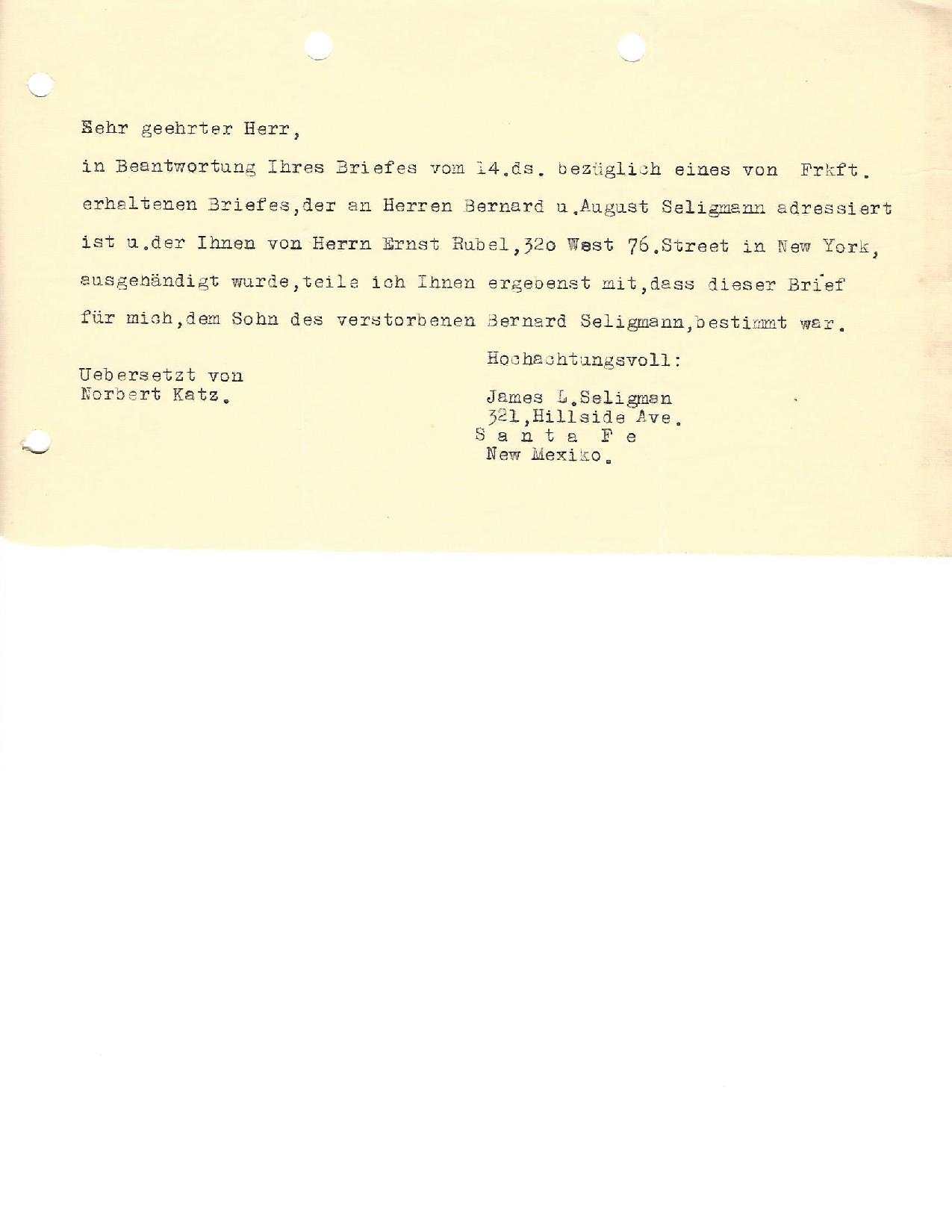
James requested that the letter be sent to him, as he was the son of Bernard Seligman. There follows a German translation of the same letter.  I wonder whether James knew German or whether he had someone else do this translation for him.

Courtesy of the Family of Fred and Ilse Michel

Courtesy of the Family of Fred and Ilse Michel

courtesy of the family of Fred and Ilse Michel

courtesy of the family of Fred and Ilse Michel

The next letter in the file is from James Seligman to Fred Michel.  (Note that James addresses the letter to Fritz, which was Fred’s real name before he changed it after immigrating.)  The letter is dated January 25, 1937, and in it James first described the American Seligmans—his father Bernard, his two uncles, Sigmund and Adolf, and his brother Arthur, all of whom had passed away by 1937, and then mentioned that only he and his sister were still living.  His sister, of course, was my great-grandmother Eva.

Courtesy of the Family of Fred and Ilse Michel

Courtesy of the Family of Fred and Ilse Michel

James then addressed the purpose of Fred’s letter to him: his desire to immigrate to the United States.  James warned Fred about the unemployment situation in the US, although recognized that Fred had a friend in the US who could help him.  Fred must have inquired about a possible job in Santa Fe with James, to which James replied, “As regards a job in this city, this would be out of the question as I only have a very small business myself with only one employee and which is all it will stand.”  By 1930, James Seligman was no longer affiliated with Seligman Brothers and had formed his own business, the Old Santa Fe Trading Post, which must have been the business to which he was referring in his letter to Fred Michel.  Fred might very well have been taken aback by this flat-out refusal to help him find a job in Santa Fe.  But James agreed to help Fred by sending an affidavit in support of his immigration and closed by wishing him the best and expressing hopes to meet him some day.

On February 11, 1937, George Harburger wrote to James Seligman to persuade him to help.  It appears from the letter that Ernest Rubel, Fred’s personal friend, had contacted Harburger to ask him to contact James for help.   I am not sure of the various connections there, but George described Fred as someone who had supported his mother all his life and as an intelligent and self-made man who would “never be a burden” to James and then instructed him how to submit an affidavit in support of Fred’s immigration.

James Seligman to Fred Michel first letter and supporting docs-page-005

Courtesy of the Michel Family

James Seligman to Fred Michel first letter and supporting docs-page-004

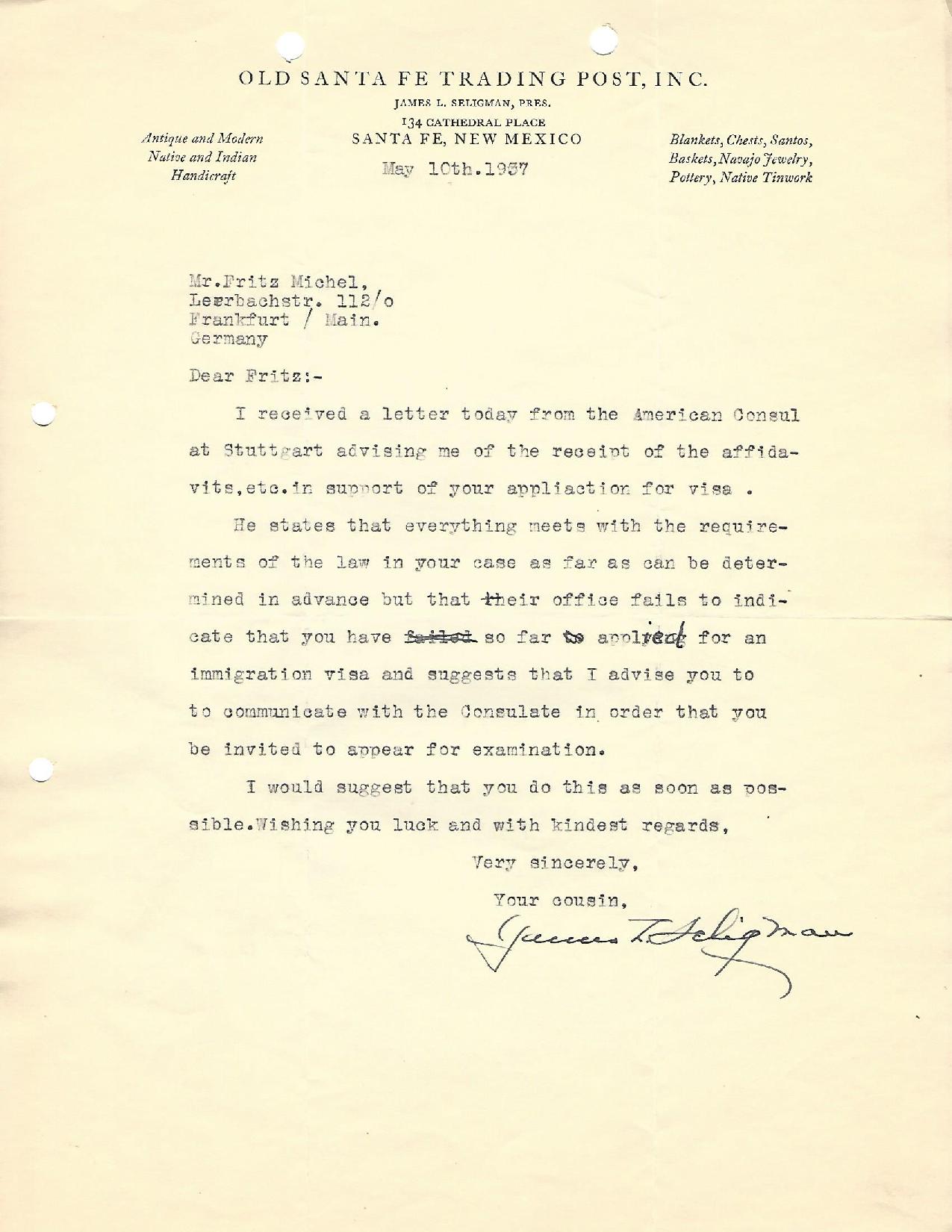
James then wrote to Fred again on May 10, 1937, advising Fred that the American Consulate had received James’ affidavit and that all was in order, but that they had not yet received an application from Fred himself.  James advised him to do so “as soon as possible.”

James Seligman to Fred Michel first letter and supporting docs-page-008

Courtesy of the Michel Family

Then there was a letter in German which I could not translate, but which the kind people in the Germany Genealogy group on Facebook helped me with:

James Seligman to Fred Michel first letter and supporting docs-page-009

Here is the translation of this letter from Fred Michel to the US Consulate on May 1, 1937:

Subject: Pledge from Mr James Seligman,321 Hilside Ave., Santa Fe,

for Fritz Michel, Leerbachstreet 112/o at Moritz (means in the apartment of Moritz), Frankfurt/Main

To the consulate general of the USA

Dear Mr Consul General!

Attached I’m sending you the missing papers for your examination.

Obtaining the papers I had to learn that my landlord didn’t register me for 3 month (from March until May 1933). Please find the reason for that in the authentication attached. Also you can find in attached transcript of my certificate where I was working during that time. If you wish I can bring the original paper with me. The County Department of Bingen /Rh. ( at the Rhine), where I complained about my certificate of good conduct four times, just sent me the information that the required paper was given to post it to Stuttgart on May 3 to your address.

I own a proper passport.

If I won’t hear from you, I’ll assume that my papers are in order.

Yours respectfully 

Attachments:

4 passport pictures, 2 birth certificates

4 certificates of good conduct

1 transcript of certificate

Reading this letter after I’d had it translated made me angry; it so clearly reflects how difficult some in Germany were making it for Fred to be able to leave, but also how difficult the US was making it for him to arrive.

From other documents we know that Fred Michel was finally allowed to immigrate and arrived in the US on September 24, 1937.  On October 10, 1937, his cousin James wrote to him again, welcoming him to the United States.  Fred must have enclosed a photograph in his letter to James telling him of his arrival because James referred to it as indicating the Fred must have encountered bad weather while crossing the ocean to America.  Fred also must have told James that he had landed a job and was living with friends.

I found the next paragraph of this letter very telling.  James warned Fred that it might take some time to adjust to his new country and then said, “How anyone can live in Germany under that man Hitler I cannot understand but suppose they cannot get away from it all.”  What did he know about Hitler as of September 1937? Were his feelings shared by Americans in general? And isn’t it also revealing that James, the son of a man who had left Germany behind about 80 years earlier, could not imagine why others were not also leaving Germany as his father and Fred Michel had done?  Would James have found it so easy to leave his homeland if the shoes were on the other feet?

James then thanked Fred for a gift he had sent him—a writing set—but says Fred should have saved his money until he “could afford it better.”  Was this insulting to Fred as patronizing? Or did he see it as an older cousin’s concern? James closed by saying, “Let me hear from you from time to time and let me know how you are getting along and what kind of work you are doing as I will always want to know.”  Although I read this as genuine interest and concern, it is not at all clear to me that Fred and James maintained much or any future contact.  Fred’s children seemed to believe that they did not.

courtesy of the Michel family

courtesy of the Michel family

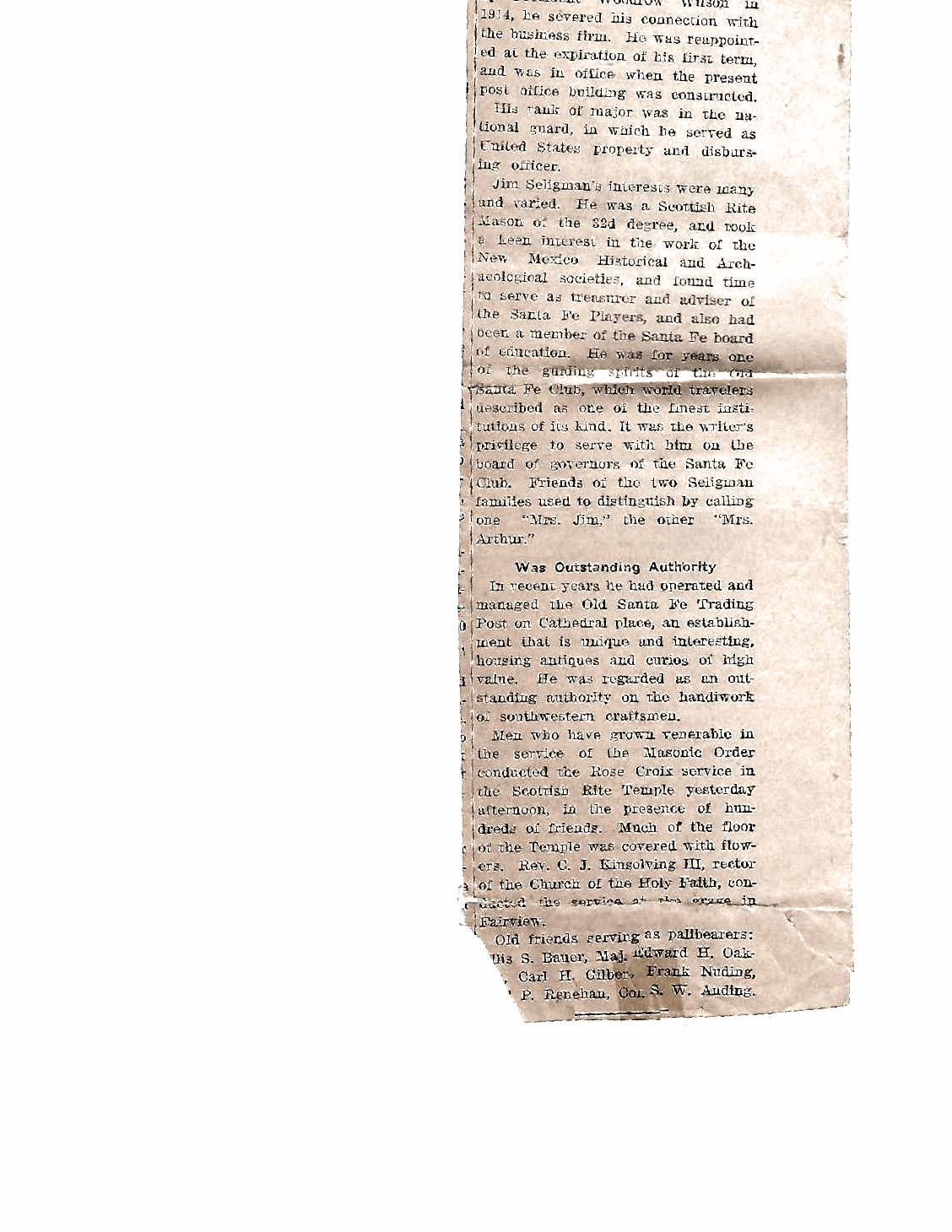
In any case, James died on December 15, 1940, just three years after Fred’s arrival in the US.  Among Fred’s papers was an obituary for his cousin James that he must have saved for many years.  I had not seen this obituary before, and I do not know in what paper it was published or the date and page.  I will not transcribe its content here, but will add it to the post I wrote quite a while back about James Seligman.

james seligman obit edit

James Seligman obit p 2 edit

The next letter in this file was written many years later.  On October 9, 1975, Fred wrote the following letter to Mrs. Randolph Seligman of Albuquerque, New Mexico, thinking she might perhaps be a relative, and identifying his own background and his connection to James Seligman of Santa Fe.

Courtesy of Michel Family

Courtesy of Michel Family

Of greatest interest to me in this letter is this short reference to my great-grandmother: “Once I met Eva Seligman in Philly.”  My great-grandmother died in October 1939, just two years after Fred arrived.  My father was living with her at the time that she likely met Fred Michel.  He doesn’t remember him, though he said the name was familiar, but probably from reading it on the blog.  From what I have learned about my great-grandmother, she was a warm and welcoming person who had several times taken in relatives in need.  I wish I knew more about her meeting with her German-born cousin Fred Michel.

Mrs. Randolph Seligman responded shortly thereafter that although she was not a relative of the Santa Fe Seligmans, the Santa Fe phone directory listed a William Seligman and a Jake Seligman living in Santa Fe. [These were the sons of Adolph Seligman, about whom I wrote here.]  She said they had once met William, known as Willie, years before in his clothing store in Sante Fe.  In November 1975, she wrote again, commenting that it was strange that the two New Mexico families did not know each other, but attributed that to the fact that “they married non-Jews and became affiliated with the Episcopal Church.”  Near the end of her letters she spoke of plans to visit with Willie Seligman in Santa Fe and identified him as a relative of Arthur and James Seligman.  Fred responded to her on January 5, 1976, expressing his delight that she had written to him again and filling her in on his family.

But within what is otherwise a newsy and cheery letter are two sad passages.  After referring to some relatives he remembered from Germany, Fred wrote, “As I write these notes I am amazed how much I know about my family when one considered I left “home” when I was 18, never to return. Finally, in 1972 while in Europe I contacted some survivors. It was an emotional experience we never forget. Some I haven’t seen since Hitler came to power.”[1]  For me, this is a powerful statement in its own understated way.  Here was a man who had left everything behind yet even he is surprised by how much he still remembered of his family and his past.

The other disturbing passage in this letter is in the following paragraph where Fred wrote about the travel plans he and Ilse had made in 1974, including to Santa Fe, where Fred had relatives, and to Georgia, where Ilse had relatives.  Fred wrote that they had discarded those plans “as Ilse reasoned that in spite of her writing after arriving here, she never received an answer and the same goes for my relatives in S.F. [Santa Fe].”  How sad that so many years later Fred and Ilse both still felt hurt by the fact that their American relatives had not stayed in touch with them.

I don’t know how to reconcile that with the welcoming letters that Fred received from James, but obviously there were some hard feelings there, whether justified or not.  I just find it very sad that two people who had lost so much felt so abandoned by their American relatives.

So what did those American Seligman relatives know by 1937 when Fred was trying to escape from Germany?  They knew that they had German relatives, they knew that things were bad for Jews with Hitler in power, and they knew that there were at least some family members who wanted to leave Germany and come to the United States.  Did they do enough? Of course, in retrospect nothing anyone did was enough, given the outcome of the Holocaust.  And it is hard to know sitting here today what more any one individual could or should have done.  Certainly James did what he was asked to do and helped Fred immigrate.  Could he have given him a job? Could he or any of the Seligmans have reached out to these newly arrived cousins in a more committed way? I don’t know, and I can’t judge.  But I do judge our government which closed its eyes and its ears for political and other reasons while thousands and eventually millions were killed.


[1] I don’t know why Fred wrote that he was 18 when he left home.  The US records all give his birth year as 1906, and he came to the US in 1937 when he was 31, not 18.  Perhaps he is referring to leaving home in a more specific way, not leaving Germany.

Putting The Puzzle Together:  Too Many Missing Pieces

Sometimes it is amazing to me how much information you can get from one document—an obituary, a death certificate, a news article.  This time it was a document my cousin Wolfgang Seligmann found in a suitcase.  In fact, I learned so much from this document that I have to divide this post into two separate posts to make each a reasonable length.

What Wolfgang found was a list of names of the heirs to the estate of James Seligman, the son of Moritz and Babetta who had moved to England. (I will refer to him as English James Seligman to distinguish him from the US James Seligman, my great-grandmother’s brother.)   The document is entitled: “J. Seligman Deceased: Statement as of 1st January 1950 of Nephews and Nieces and their Issue, who may take an interest under the Intestacy in the above Estate.”  There are 21 principals named on the document as well as the names of several of the children or relatives of those 21 who might inherit in their place, if the principals were deceased.

heirs list p 1

Heirs List p 2

I have spent a lot of time trying to figure out who these 21 people were and how they were related to English James and also thus to me.  Some of them were very easy to identify.  Number 21 was the easiest:  Mrs. Eva Cohen of Philadelphia was my great-grandmother.  She was deceased by 1950, and unfortunately there was no listing on the document of her heirs, which would have included my father, my aunt, my great-uncle Stanley, and the sons of Maurice Cohen, Buddy and Junior.

Numbers 19 and 20 were also easily identified: Arthur and US James Seligman, my great-grandmother’s brothers and the two other surviving children of Bernard Seligman, English James Seligman’s older brother.  For US James Seligman, Morton is listed as his surviving son.  For Arthur, there is mention of his “oldest son” (he had only one, Otis), and a note that he had been “Governor of Santa Fe” and might be able to find other relatives.  By 1950, however, Arthur and his son Otis were both deceased.  (These careless errors made me a bit skeptical of the Bank’s attention to detail.)

I also knew who Numbers 15 and 16 were: Emil and Eugen Seligmann were the sons of Carolina Seligmann, the half-sister of James, Bernard, and the others, and they were the grandsons of Moritz Seligmann and Eva Schoenfeld.  Emil had died from heart disease in 1942, and Eugen had died at Thierenstadt concentration camp in 1942.  Emil’s son also died during the Holocaust at Buchenwald in 1945.   His daughter Christine was still alive in 1950 when this document was created.

Number 6 is Wolfgang’s grandfather Julius, a son of August Seligmann and grandson of Moritz and Babetta.  He was still alive in 1950.  Number 7 is Moritz Seligmann, the brother of Julius about whom I wrote here.  He had served in World War I for Germany and been awarded the Cross of Honor, but was nevertheless killed during the Holocaust.  Number 8 is Franziska or Frances Seligmann Michel, the mother of Fred Michel, about whom I wrote here.  She was also the child of August Seligmann and the granddaughter of Moritz and Babetta, and had died in 1933.  Her son Fritz (Fred) is also mentioned on the heirs list.

Number 9 is Anna Seligmann Goldmann, the sister of Julius, Moritz, and Franziska and husband of Hugo Goldmann.  Anna, Hugo, and their three young children, Ruth, Grete, and Heinz, were all killed in the Holocaust.

The next four people, Numbers 10 through 13, are all from the Oppenheimer family, written about here.  Joseph, Martha, and Ella were the children of Paulina Seligmann and Meier Oppenheimer.  Paulina was the sister of Bernard, August, and James, and the daughter of Moritz and Babetta Seligmann.  Joseph and Ella both died during the Holocaust.  Martha survived, but her two children Gertrud and Paul did not.  With this document, I now learned that Martha’s married name was Floersheimer, and was able to find Gertrud and Paul in the Yad Vashem database.  Gertrud died at an unknown camp in 1942 after being deported on June 10 of that year from Wiesbaden, and her brother Paul died at a camp in Majdanek, Poland, on August 16, 1942.

Emma Oppenheimer, Number 13, I assume was Emma Neuhoff, the widow of Moritz James Oppenheimer, son of Paulina and a brother of Joseph, Martha, and Ella.  Moritz Oppenheimer, discussed here, had been a successful business person and horse breeder; he was reported to have committed suicide after being visited by the Gestapo in 1942.

That left me with eight unknowns: Numbers 1 through 5 and Numbers 14, 17 and 18.  Some of these I believe I have figured out; others I am not as certain about.  For example, Jack Seligmann, Number 1, has to be the son of a brother of James to have the Seligmann surname.  I knew he was not the son of Sigmund (never married, lived in the US), Bernard (lived in the US), or Adolph (lived in the US).  I assumed I had all the sons of August Seligmann from the records I found and records Wolfgang shared with me.  Salomon Seligmann died when he was 21, so I eliminated him.  That left only two of James’ brothers: Benjamin, a half-brother, and Hyronimus, a full-brother.  I had no records other than birth records for either Benjamin or Hyronimus, and thus, I had no way to determine whether Jack was a son of Benjamin or Hyronimus, but assumed he was the son of one or the other.

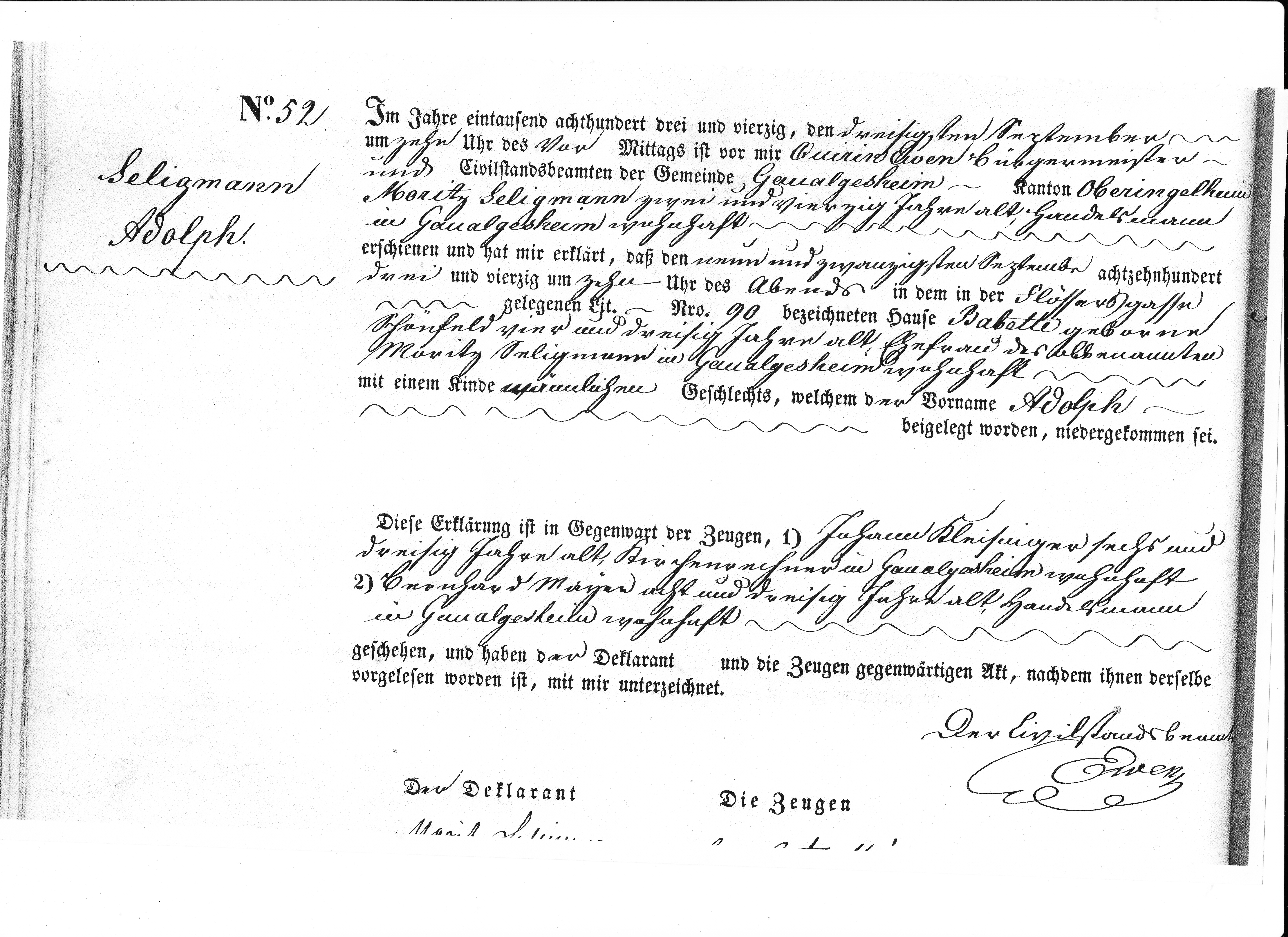
Then, while I was trying to puzzle this out, Wolfgang found another document.  It was a letter written in 1984 by Elsa Oppenheimer to the National Westminster Bank regarding the estate of English James Seligman.   (I think Elsa Oppenheimer was the daughter of Jur Oppenheimer, son of Moritz James Oppenheimer, based on the family tree I received from Wolfgang a few weeks ago.)  In her letter to the bank on July 9, 1984, Elsa attempted to correct some errors she felt the bank had made in identifying heirs of English James.    She claimed, for example, that the Bank had incorrectly listed Adolph as a son of Moritz and Babetta because she could not locate a birth record for him; she was wrong about that, however, as here is a copy of his birth record, naming Moritz and Babetta as his parents.

adolph seligman birth record


Elsa also claimed that she knew of all of the children of Hieronymous Seligmann based on birth records, and that they were Jacob and Auguste, twins born on April 8, 1869; Mathilde, born October 4, 1872; and Rosina Laura, born June 9, 1878.  Elsa asserted that Hieronymous did not have daughters named Elizabeth or Johanna.

Elsa Oppenheimer 1984 letter-page-001

Elsa Oppenheimer 1984 letter-page-002

From this letter, I am assuming that Jack Seligmann, Number 1 on the heirs’ list, was Jacob Seligmann, son of Hieronymous Seligmann and thus a grandson of Moritz and Babetta and a nephew of English James Seligman.  His wife Anna is named here as living in Luxembourg as of 1950, so I looked on Yad Vashem and found an entry for a Jacob Seligmann, born on April 8, 1869, married to Anna, a clear match to my Jacob Seligmann.  He was killed in Luxembourg in 1941, according to the Yad Vashem site.    I don’t know whether Jacob and Anna had had any children.

That brings me to Number 2, Laura Winter.  I am assuming that Laura Winter was born Rosina Laura, a daughter of Hieronymous, and married a man named Winter.  The document names a Frau Aennie Wiener as her next of kin and states that Laura and her husband also died in Luxembourg, reinforcing my assumption that she and Jacob were siblings.  Aennie Wiener is listed as residing at 8409 Talbot Street, Kew Gardens, Long Island.

For a while I didn’t know what had happened to Laura Seligmann Winter or her husband, although they were deceased by 1950 according to the list of heirs.  Included, however, in the Ilse and Fritz Michel Collection at the Leo Baeck Institute is one handwritten note that provided some clues.  The note has no title, but is just a list of names: Anna Goldmann, Hugo Goldmann, Grete Goldmann, Heinz Goldmann, Ruth Goldmann, Helene Hess [mother of Ilse Hess Michel], Max Michel, Sophie Michel, Moritz Seligmann, Jacob Seligmann, S Winter, Laura Winter, Martha Florsheimer, Paul Florsheimer, Trude Florsheimer.

Handwritten list of names Fred Michel

What can I infer from this list? I know that Ilse and Fred Michel were actively involved in trying to find family members who were missing after the war.  I know that the Goldmann family, Helene Hess, Moritz Seligmann, Jacob Seligmann, and Paul and Trude Florsheimer were all killed in the Holocaust.  Martha was not, but nevertheless my guess is that these were all people whom Fred and Ilse could not locate after the war.  My hunch was that since the Winters were listed as deceased on the list of heirs document that they also were killed in the Holocaust.

I then searched Yad Vashem’s database again, this time for anyone named Winter living in Luxembourg, and found just one listing—for a Samuel Winter.  It said he was born on October 27, 1863, in Dusseldorf, Germany, and that he was married to Martha Seligmann.  Could Martha Seligmann really be Laura Seligmann? Could there really be two German men with the surname Winter and first initial S living in Luxembourg and married to a woman whose birth name was Seligmann?  I thought the odds were slim, so I used the Related Search function on the Yad Vashem database, searching for anyone with the same surname and from the same residence.

This time I got a list of other Winters from Luxembourg, including a Laura Winter.  The entry did not have a birth date or birth place for Laura, but it said she was the widow of Samuel and that she had been murdered on August 28, 1940. But the entry for Samuel said he was not deported until April, 1943, and died on April 21, 1943, at Thieresenstadt.  So how could Laura have been a widow in 1940?  Was this a different Samuel Winter who was really married to a Martha Seligmann?  I don’t know.


Embed from Getty Images

Fortunately, it was not very difficult to find their daughter, Aennie Wiener since I had her address at 8409 Talbot Avenue in Kew Gardens, a section of Queens in New York City, was listed on the heirs’ document.  Searching for her on Ancestry quickly uncovered Anna and Joseph Wiener living at 8409 Talbot Avenue in Queens.  Their residence in 1935 had been Mannheim, Germany, and they were now 46 and 58 years old, respectively.  Living with them were their daughter Doris Grunewald, her husband Ernst Grunewald, also both German immigrants, and their one year old daughter, Hannah Grunewald, born in New York.

Year: 1940; Census Place: New York, Queens, New York; Roll: T627_2746; Page: 1B; Enumeration District: 41-1373

Year: 1940; Census Place: New York, Queens, New York; Roll: T627_2746; Page: 1B; Enumeration District: 41-1373

I also was able to find ship manifests for Anna, Doris, and Ernst, all of whom came between 1937 and 1938.  Four more who escaped from Nazi Germany. I’ve not yet found any records for any of them after the 1940 census, but I am still looking.  I am particularly interested in finding Hannah.


To be continued…


Yom Hashoah


http://www.gettyimages.com/detail/121859610

In honor of Yom Hashoah, Holocaust Memorial Day, I am posting the links to six of my blog posts in which I discussed the members of my own family who perished in the Holocaust. Six to represent the six million Jews who were slaughtered by the Nazis during World War II.

These are all members of the Seligmann/Schoenfeld family.  I did not even know about them a year ago. And I know that there must have been members of my other family lines who were also murdered during the war.  I just haven’t found them yet.  So in memory of all those who were killed, those we know about and all those we do not yet know about, please read these posts if you have not done so already.  Or even if you have.  We must never forget.

One

Two

Three

Four

Five

Six


English: A lit Yahrtzeit candle, a candle that...

English: A lit Yahrtzeit candle, a candle that is lit on the Hebrew anniversary of a loved one’s death. (Photo credit: Wikipedia)

The Lost Oppenheimers

My Seligman-Schoenfeld family tree continues to grow, and it continues to break my heart.  Thanks to my cousin Wolfgang, I now know more about another line in the family.  I already knew that my great-great-grandfather Bernard Seligman, who left Germany in the late 1850s and settled in Santa Fe, had a younger sister Paulina.  She was born in Gau-Algesheim in 1847, the daughter of Babetta Schoenfeld and Moritz Seligman.  I had received her birth records several months ago:

paulina seligmann birth record better

I had no record for Paulina aside from this one until I connected with Wolfgang.  It seems that Wolfgang’s family, like my cousin Pete’s family, had been contacted back in the 1980s by the National Westminster Bank in England, the bank handling the estate of James Seligman and looking for his heirs in order to distribute his estate after his wife died.  Just as they had provided Pete’s family with a family tree showing how they were related to James, the bank also provided Wolfgang’s family with a similar tree.  (I still don’t know why my father and his sister were not contacted, but that’s water under the bridge.)  James was, of course, a brother of Paulina and of Wolfgang’s great-grandfather August  just as he was a brother of Bernard.

You can see a PDF of Paulina’s section of the family tree provided to Wolfgang’s family by clicking here:

Pauline Seligmann Oppenheimer family tree

As you can see, it identifies the husband and descendants of Paulina Seligmann (here called Pauline).[1]  Paulina had married Maier Oppenheimer, and they had had five children:  Joseph (November 22, 1874), Martha (March 1, 1876), Anna (March 14, 1877), Ella (June 24, 1878), and Moritz James (June 10, 1879).  Her husband Maier died on June 8, 1900; he was 51 years old.  Although it is hard to read clearly, it looks like their daughter Anna died when she was only 31 years old in 1908.  She had married Max Kaufman, but did not have any children.  Paulina died April 10, 1926 when she was 79 years old.

Fortunately, Paulina did not live to see what happened to her children.  Although the other four children survived into the Nazi era, only one of the four was alive after the war had ended.  Ella, who never married, died in an “unknown concentration camp,” according to the bank’s tree.  Joseph died on October 21, 1940; one record on Ancestry.com shows that a Joseph Oppenheimer with the same birth and death dates shown on the bank’s family tree died as a prisoner at the Dachau concentration camp.  Joseph was married to Marie Johanna, but they had not had any children, according to the bank’s tree.  Martha, who did survive the war and died in 1967 when she was 91 years old according to the tree, lost two children in the Holocaust: Trude and Paul.  The bank’s tree did not include a name of a husband.

English: View of prisoners' barracks soon afte...

English: View of prisoners’ barracks soon after the liberation of the Dachau concentration camp Deutsch: Blick auf die Gefangenen Baracken kurz nach der Befreifung des KZs-Dachau. (Photo credit: Wikipedia)

Wolfgang was able to provide me with a little more information about the youngest child, Moritz James Oppenheimer, as gleaned from these two sources: a 1952 article from Der Spiegel and a website for a German company that supplies horse dressage and other equipment.   (Although both articles are in German, Wolfgang translated them for me.)  Moritz had owned a paper factory in Frankfort before the war as well as a successful horse stud farm where thoroughbred horses were raised and sold. I found this website about the stud farm as it exists today.  Obviously, Moritz Oppenheimer was quite well-to-do. In fact, Wolfgang’s grandfather Julius had written to his cousin Moritz for financial help after he lost his store in Gau-Algesheim.

The horse farm once owned by MJ Oppenheimer as it looks today

The horse farm once owned by MJ Oppenheimer as it looks today

After the Nazis came to power, Moritz had his marriage dissolved in 1936 because his wife, Emma Katherine Neuhoff, was not Jewish.  Wolfgang explained that this was often done under Nazi rule to those in interfaith marriages.  Then Moritz had his factory seized by the Nazis under the Nuremberg Laws, forcing him into bankruptcy.  As a result, he had to sell his horse farm in order to raise money.  The horse farm was sold to Baron Dr. Heinrich von Thyssen-Bornemisza, who was able to purchase the land, many valuable stallions and mares, and much more for just a few hundred thousand Deutsche marks.[2]  On May 9, 1941, the Gestapo visited Moritz in his apartment in Wiesbaden; shortly thereafter he was found dead in the apartment.  It was ruled a suicide.

Moritz had two children who survived him: a son Jur Georg Emil Walter Oppenheimer (born July 10, 1904) and Paula Herta Oppenheimer (April 11, 1902). The son married Elsa Lina, and they had one child, Angelika Emma Sybille, born in 1946.  Paula married someone named Spiegler and was still alive at the time that the bank prepared the family tree in the 1980s.

A stolpersteine was placed in front of Moritz’s residence in Frankfort at Schumannstrasse 15, depicted below.

By Karsten Ratzke (Own work) [CC0], via Wikimedia Commons

By Karsten Ratzke (Own work) [CC0], via Wikimedia Commons

Moritz, Ella, Joseph, Anna, and Martha: These were my great-grandmother Eva Seligman Cohen’s first cousins.  I wonder if she knew of them and her other German cousins.   Did her sons know of them? Did they know that Hitler had murdered many of these cousins?  Certainly my father didn’t know of them, nor did I.  Until now.


[1] I have not yet been able to find records to verify most of the facts on this family tree, but am trying to locate sources.


[2] According to one source, a US dollar in 1940 was worth about 2.5 deutsche marks, so 200,000 DM would have been equivalent to $80,000.  That would be worth about $1.3 million dollars today.    http://www.history.ucsb.edu/faculty/marcuse/projects/currency.htm#infcalc     http://www.westegg.com/inflation/   One prize thoroughbred horse today can command much more than that.


My Goldschlager Cousins: New Connections and New Photos

Lately it’s been sort of raining Goldschlagers.  First, I received an email from someone named Jeanne who matched me very distantly on the DNA testing website, but who’d spotted that one of my ancestral names was Goldschlager.  Jeanne had had an aunt named Anne Goldschlager; although her aunt was an aunt by marriage only, not genetically, Jeanne had loved her greatly and wondered whether we might be related since Anne Goldschlager’s family also had ties to Romania.

According to Jeanne, Anne’s father Max had moved to Dresden in the early 20th century where Anne and her sister Sabina were born.  In 1939, Max, his wife, and Sabina left Germany to go to Romania (I assume they thought it would be safer), and they left Anne behind.  She was 15 years old.  Somehow Anne got to England and survived the war, but her sister was killed in one of the concentration camps. Her parents survived the war and emigrated to Israel. Here is Sabina’s Page of Testimony at Yad Vashem, which includes this photograph:

Unfortunately, Anne has no biological descendants, and Jeanne knew nothing more about her family tree, so I don’t think I can get any further back to determine if her Goldschlagers were related to mine.

Then around the same time that I heard from Jeanne, my cousin Jim and his wife Jodi emailed me to say that their son Michael was in Spain for the Model UN and had met a fellow student named Eva Goldschlager.  Michael wanted to know if Eva could be related to our Goldschlagers.  After obtaining Eva’s father’s contact information, he and I have emailed several times.  His Goldschlager family is also from Romania—from the town of Siret, which is a little more than 100 miles from Iasi where my grandfather was born.  We’ve not gotten any further than that so far, but are trying to figure out how to learn more.

And then finally just the other day I received a whole bunch of new photographs from my cousin Richard, who lives in Australia but was in the US visiting his parents.  Richard is my second cousin; his father Murray is the son of David Goldschlager, my grandfather’s younger brother.  Although Murray changed his surname a long time ago, he is nevertheless a Goldschlager.  Here are some of the photographs Richard sent me of his grandparents.

Here are three photographs of David and Becky as young people.

David Goldschlager

David Goldschlager


Rebecca Schwartz

Rebecca Schwartz

Rebecca and David Goldschlager

Rebecca and David Goldschlager

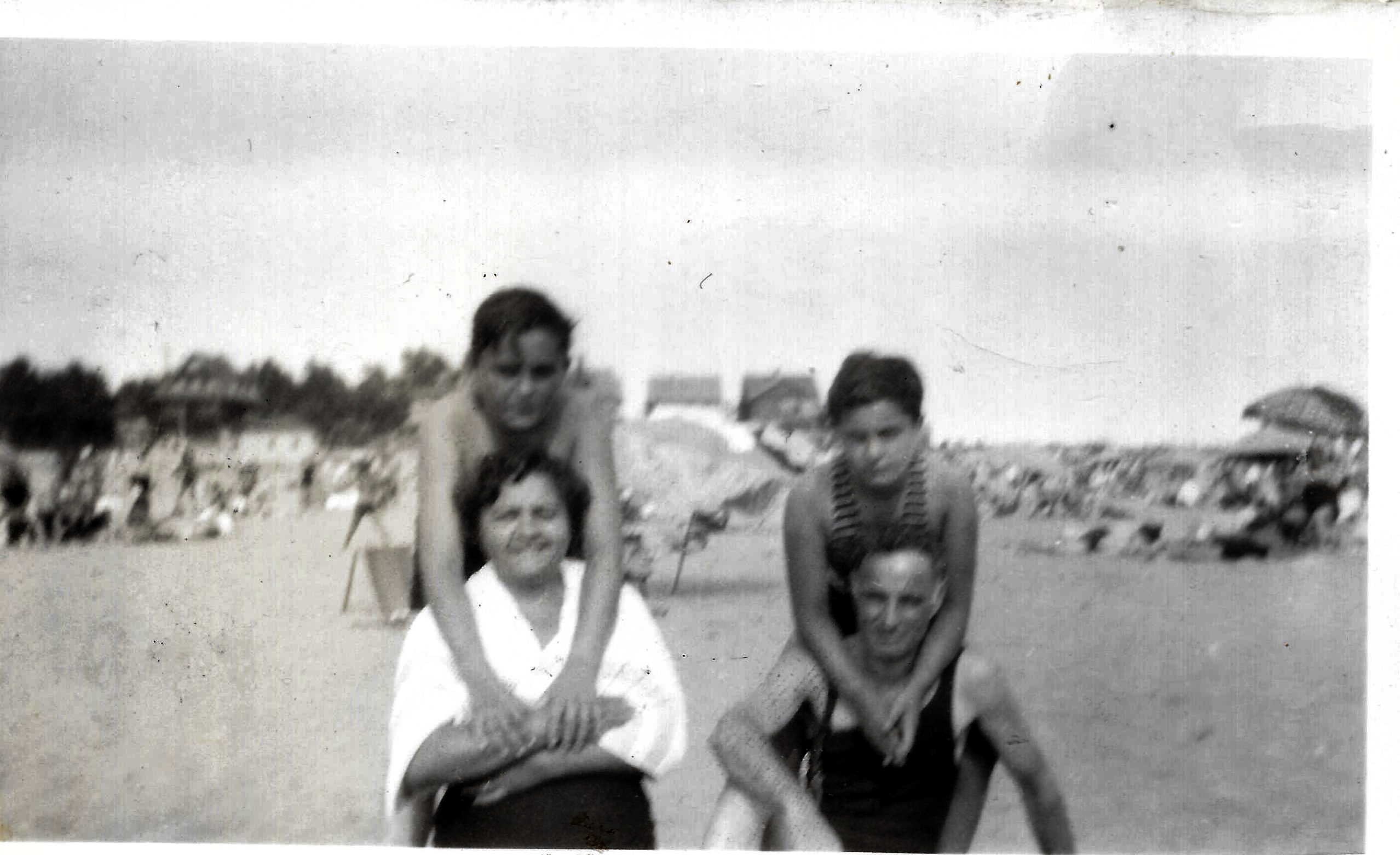
Here they are with their sons Murray and Sidney  at Brighton Beach probably in the 1930s:

David and Murray Goldschlager

David and Murray Goldschlager

David Rebecca Sidney and Murray at Brighton Beach

All four Goldschlagers at Brighton Beach


The others were taken when David and Becky had moved to Arizona where Murray and his wife Edna and their son Richard lived.

Richard Leonard and David Goldschlager

Richard and his grandfather David Goldschlager

Richard with his grandparents at his bar mitzvah

At Richard’s bar mitzvah

David and Becky at Richard's bar mitzvah David and Rebecca Goldschlager


Thank you so much to my cousin Richard who so generously shared these photographs with me.  I am so happy to have more pictures of my grandfather’s brother David and his family.


The First Chapter: The Dreyfuss Family

Yeah, I know.  My last post said it was the FINAL chapter of the Dreyfuss family.  How could this one be the first?

Way back on November 18, 2014, I wrote, “More on the Dreyfuss family in a later post.”  Then I proceeded to write about the Nusbaum family and the Dreyfuss family together.  Since two Dreyfuss sisters (Jeanette and Mathilde) had married two Nusbaum brothers (John and Maxwell), it just made sense to follow the stories of the three Dreyfuss sisters (Jeanette, Mathilde and Caroline) along with the stories of the Nusbaum siblings.  But what I never got back to doing was what I had promised back on November 18.  I never got back to the beginning of the Dreyfuss story as I moved forward from the 1840s in America through to the 20th century.  So although my last post was called the “Final Chapter” of the Dreyfuss family, I need to go back and write the first chapter before I can complete the story (as far as I currently know it).

So I need to step backwards in time—both in my time and in the times of the Dreyfuss family before 1840.  Back in the fall when I was researching the family of John Nusbaum, I had a wonderful resource in the family bible owned by my father.  My father had photocopied several pages of handwritten entries for births, deaths, and marriages from the bible , and most of those entries related to the Nusbaum family.  From studying the page for marriages, I learned that John Nusbaum, my three-times great-grandfather, had married Jeanette Dreyfus (as it was spelled there).  And that was the first time I knew the birth name of my three-times great-grandmother.  On the page for births, the second entry after the one for John Nusbaum was one for Jeanette Nusbaum, giving her birth date and her place of birth.  It took me a while to figure out what it said because of the handwriting, but eventually I was able to decipher it and learned that Jeanette was born in “Hechingen in Wurttemberg, Prussia,” as it is inscribed in the bible.

But there was no other Dreyfus(s) on any of the pages in the bible, and I was at that point in time focused on the Nusbaum line.  It wasn’t until weeks later that I realized that the bible’s death entry for Mathilde Pollock was not an entry for a sister of John Nusbaum, but an entry for a sister of Jeanette Dreyfuss (who happened to marry a brother of John Nusbaum) and that the entry for Caroline Wiler was also not a sister of John Nusbaum but another Dreyfuss sister. The big clue was finding 65 year old Mary Dreyfuss  on the 1850 census living with Caroline and Moses Wiler: a head-slapping moment when it occurred to me that it was Jeanette who was keeping the family bible and that, of course, she would record her sisters as well as her husband’s siblings in the family bible.

And then in mid-November I went on JewishGen’s Family Finder page and found Ralph Baer, who was also researching the Dreyfuss family from Hechingen.  I have mentioned Ralph before in the context of the Nusbaum/Dreyfuss family and his generous help with research and translation, but what I had forgotten to write about in my telling of the story of the Nusbaum/Dreyfuss family in the US was what Ralph had helped me learn about my Dreyfuss roots in Hechingen, Germany.

Hechingen, Germany

Hechingen, Germany (Photo credit: Wikipedia)

First, a little about Hechingen.  Today it is in the German state of Baden-Wurttemburg, located about 56 miles north of the Swiss border in southern Germany.  It is about 40 miles from Stuttgart, the state capital.  Although inhabited long before, the city was founded as the capital city of the Counts of Hohenzollern in 1255.  It remained during the Middle Ages a provincial and agricultural community.  During the 16th century, it became a center for art, architecture and music.  Even after the Reformation, it remained a largely Catholic community.  Throughout its pre-19th century history, Hechingen was subjected to many sieges and attacks by other German states as well as by Sweden.

de: Burg Hohenzollern bei Hechingen, Baden-Wür...

de: Burg Hohenzollern bei Hechingen, Baden-Württemberg, Deutschland en:Castle Hohenzollern near Hechingen, Germany (Photo credit: Wikipedia)

According to the Jewish Virtual Library, “There was a small Jewish settlement in Hechingen in the early 16th century, and a house was bought for use as a synagogue by the community of 10 families in 1546. In 1592 the burghers refused to conduct any commercial or financial transactions with Jews, who therefore left the town. There is no trace of Jewish settlement in the town during the next century. In 1701 Prince Frederick William I gave letters of protection lasting 10 years to six Jewish families in the neighboring villages; soon there were Jews living in the city as well. By 1737 there were 30 households, and a synagogue was built in 1761 which existed until 1870.”

The Jewish community blossomed in Hechingen in the late 18th and early 19th century through the efforts of a woman named Chaile Raphael Kaulla.  Her father was a successful entrepreneur and banker, and he provided Chaile with a good education.   She even learned German, not something girls were usually taught in those times.   When her father died, Chaile, being much older than her oldest brother, took over her father’s business; she managed the business very successfully while also raising six children.  Her husband, a Talmudic scholar, did not work.  Chaile and her brother Jacob developed a very good relationship with the authorities in Hechingen and became the leaders of the Jewish community there.  Here is more about Chaile from the Jewish Women’s Archive:

Chaile developed an aristocratic lifestyle, owning an elegant house and a horse-drawn carriage, but she continued to live according to Jewish law. She never forgot the mitzvot and cared for the Jewish community together with her brother, using her connections to the prince. The Kaulla family had their own private synagogue and rabbi. Both sister and brother gave generously to the Jewish as well as to the Christian poor and founded a hostel for needy and migrating Jews in Hechingen. In 1803, they donated a Bet Midrash, a Talmud school, with three rabbinical scholars whom they supported, together with their students and an important library.


The 19th century was a time of economic and industrial growth for the town of Hechingen and for its Jewish residents.  Wikipedia states that “By 1850, Hechingen had started to industrialize, primarily with Jewish enterprises. By 1871 the city had become one of the most important economic centres in the region, with textiles and machine shops among the major industries.”  According to the Jewish Virtual Library, the Jewish community in Hechingen was “prosperous and owned most of the local industries.” The Jewish population reached 809 people in 1842, which was about a quarter of the total population of the town.  This was also around the time that my three-times great-grandmother Jeanette and her sisters and mother would have left, which might seem strange, given how favorable the conditions there seemed to have been.

The Alemannia-Judaica, however, reports that there were some anti-Semitic “disturbances” in the 1840s, and the Dreyfuss sisters were not the only ones to leave.  By 1880, the Jewish population had dropped to 340; by the 1930s it had dropped to only 101.  Like so many other Europeans, Jews and non-Jews, the lure of opportunities elsewhere must have been irresistible.  The Dreyfuss sisters were wise to leave Hechingen because it was no more immune to the destruction and genocide of the Nazis than any other place during the Holocaust.  The synagogue was heavily damaged on Kristallnacht in November, 1938, and most of the Jewish men were sent to Dachau.  In the aftermath, 53 Jews emigrated successfully; the remaining 32 Jewish residents of Hechingen were sent to concentration camps where all but one were murdered by the Nazis.

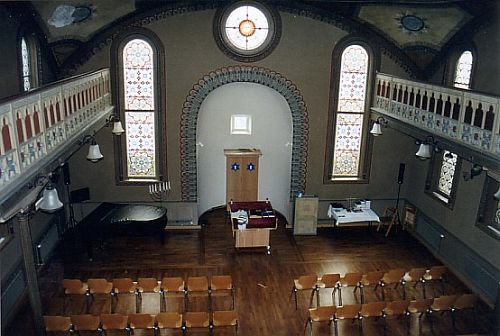
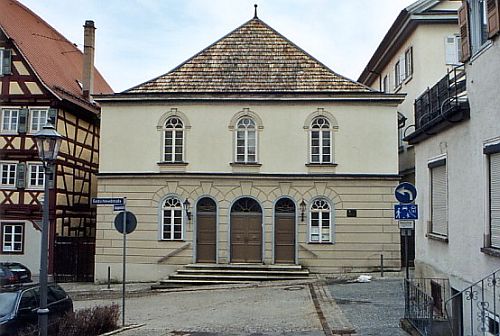
According to another source, “In 1991, the synagogue building was rebuilt as a cultural center, housing an exhibition on Hechingen’s Jewish history. A new Jewish community was founded in Hechingen in 2003.”  More pictures can be found here.


Where did my ancestors fit into this story of Hechingen? I was very, very lucky to find Ralph Baer on the JewishGen Family Finder because Ralph had already done extensive research on all the Hechingen Dreyfuss families years before I stumbled onto the name in the old family bible.  Even though he had not been able to find a connection between his Dreyfuss ancestors and mine, he had included my line in his tree when he’d done his research years ago.  Thus, my first email from Ralph in response to my inquiry as to his Hechingen Dreyfuss family included the following names:

A)3. Samuel (Sanwil) DREYFUß (ZELLER) 25 May 1776 Hechingen – 3 July 1859
Hechingen, married about 1805 to Miriam (Marianna) Samson BERNHEIM 17 May
1787 – 1841

A)31. Jeanette DREYFUß 20 May 1817 Hechingen, married to … NUßBAUM

A)32. Moses DREYFUß 10 February 1819 Hechingen

A)33. Goldel (Golde, Auguste) DREYFUß 16 October 1822 Hechingen,
married to … WEILER

A)34. Mathilde (Magdalena) DREYFUß 30 March 1825 Hechingen, married
to … POLLAK

A)35. Samson DREYFUß about 1827 Hechingen

A)36. Auguste DREYFUß about 1829 Hechingen[1]

There were my 3x-great-grandparents right at line 31, and there at line 33 was Caroline (born Golde) “Weiler” and at line 34 Mathilde “Pollak.”  I knew immediately that Ralph had found the three Dreyfuss sisters listed in my family bible.  Not only did the names line up, but so did the birth dates.  Thus, I now also knew that Jeanette, Caroline, and Mathilde were the daughters of Samuel Dreyfuss Zeller (later documents, as I found, indicated he had changed his surname to Zeller) and Miriam (Marianna) Samson Bernheim, that is, the Mary Dreyfuss I had found on the 1850 census living with her daughter Caroline in Pennsylvania.  (The death date of 1841 given for Miriam Ralph and I later discovered was not correct. I have not, however, found a death record for Miriam, though with two grandchildren named Miriam, one (Miriam Nusbaum, daughter of John Nusbaum and Jeanette Dreyfuss) in 1858, and one in 1859 (Miriam Pollock, daughter of Mathilde Dreyfuss and Moses Pollock, it would appear that Miriam died before 1858.)  In addition, I now had evidence of three other siblings: Moses, Samson, and Auguste.

But, of course, I wanted to see the actual records where Ralph had long ago found my relatives while researching his own.  With his patient assistance, I was able to locate a number of records relating to my Dreyfuss ancestors.  Fortunately, many of the Jewish vital records from the Baden-Wurttemburg region are digitized and available on line, and Ralph walked me step by step through the process of researching those archives and then helped me translate what I had found.  Once again, I struggled with the German script, but with Ralph’s help, I was able to find a number of relevant records.

I am now including the links to them here with a transcription of what is on each record so that I have a record later when I once again have trouble reading the script.  If you are interested in seeing the underlying documents, just click on the links.  The JPG versions were too blurry to read, so I am only posting links to the PDF versions, with two exceptions that were more legible.

Dreyfuss births (1)  Birth Registry for Hechingen 1800-1905

Line 132 Moses Dreyfuss                             Father Samuel                  Mother Miriam geb Bernheim

Line 186 Golde (Augusta) Dreyfuss           Father Samuel                 Mother Miriam geb Bernheim

Line 223 Mathilde Dreyfuss                                                 SAME


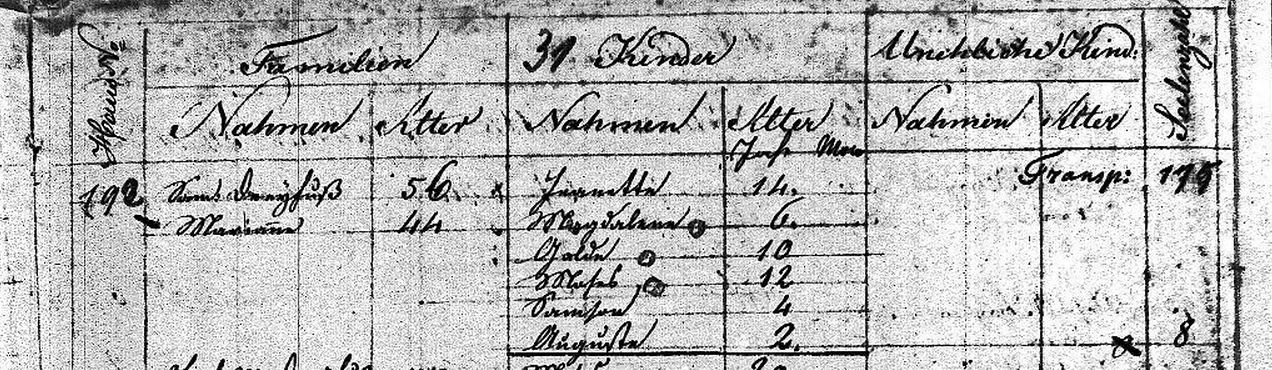
Dreyfuss Family on Archives film 240 bild 31  (Census 1831)

Dreyfuss family on archives film 240 film 31

#192 Samuel Dreyfuss 56 and Marianna 44. Six children: Jeanette 14, Magdalena 6, Golde 10, Moses 12, Samson 4, and Auguste 2.


Golde Auguste Caroline Dreyfuss birth record

First line:    October 16, 1822      Golde (Augusta)         Samuel Dreyfuss               Miriam geb Bernheim


Mathilde Dreyfuss birth record

Sixth line:  March 30 1825          Mathilde                       Samuel Dreyfuss                  Miriam geb Bernheim


Meier Dreyfuss brother of Samuel  Death Record

Parents               Samson Dreyfuss and Jeanette


Moses Dreyfuss birth record

Seventh line:  February 10, 1819    Moses Dreyfuss          Samuel Dreyfuss               Miriam geb Bernheim


Moses Zeller ne Dreyfuss death record Hechingen

Son of Samuel Zeller and Marie geb Bernheimer


Samuel Dreyfuss and family on Hechingen Family Records

Ralph helped me decipher this; otherwise, it would have meant nothing to me:  The name DREYFUSS is underlined with Samuel next to it. Below Samuel is written Zeller.  Below that it says Eltern (parents) Samson, and below that Jeanette(Scheile). To the right is geb. (born) and below that get. (married). The birth date for Samuel is on the right 1776 25 Mai. Between that is written “63 alt geworden” (became 63 years old, his age at the time of the compilation). For marriage it says angebl. (apparently) 1805 with also something in Hebrew. Samuel’s wife is on the right: Miriam, daughter of Samson Bern…and Golde. It also mentions a sister name Sussen right below that. The birth date for Miriam is listed as 17 Merz (March) 1787.  On the bottom are the children. The first one on the left is r Jeanette. In parentheses after her name is NUSSBAUM and below that 20 years old. To the left it states ca. 1817 20 Mai. Also listed are Moses, Mathilde Madel (Pollak), and Auguste (Golde) Weiler with birthdates.  (This was obviously compiled after 1851 since all three sisters are married and Mathilde is already married to Moses Pollock, whom she did not marry until after Maxwell Nusbaum died in 1851.)

Samuel Dreyfuss death record bild 143  (second on page)


Samuel Zeller death p 1 Samuel Zeller death p 2

Bottom of both pages: Samuel Zeller  Hechingen      Samson Dreyfuss and Jeanette    Alterschwaeche (old age)


There are some missing records.  I do not have a separate birth record for Jeanette.  Nor can I find a death record for her mother, my 4x-great-grandmother Miriam Bernheim.  I cannot find any records for the two youngest of the siblings, Samson and Auguste.  I also do not understand why there are two children with the name Auguste.  Perhaps one was a child of a family member who died? There is also a huge gap between the recorded marriage date for Samuel Dreyfuss and Miriam Bernheim of 1806 and the birth date of their oldest child, Jeanette, in 1817.  Did Samuel and Miriam have other children who died, or is their marriage date incorrect?  Samuel would have been 41 in 1817, Miriam would have been 30.  Both Samuel and Miriam had fathers named Samson.  Were both alive in 1819 when Moses was born? If not, it seems odd that their first son would not have been named Samson, unless there had been an earlier born son named Samson who had died.

I don’t know the answers to these questions, but I have answers to so many more questions than I ever expected, thanks to Ralph.  I know the names of my 4x-great-grandparents, Samuel Dreyfuss Zeller and Miriam Bernheim, and the names of my 5x-great-grandparents, Samson and Jeanette Dreyfuss and Samson and Golde Bernheim.  I have the names of the three other siblings of my 3-x great-grandmother Jeanette: Moses, Samson, and Auguste.  And I am not yet done looking for more about my Dreyfuss ancestors and now, my Bernheim ancestors as well.

Once again, I am deeply grateful to Ralph Baer.  Without him, none of this would have been possible.


[1] Together Ralph and I filled in many of the blanks here, enabling both of us to have a more complete record.