How Eugene Goldsmith Met May Jacobs

Over four and a half years ago, I wrote about Eugene Goldsmith, my great-grandmother Hilda Katzenstein Schoenthal’s first cousin.

Eugene was born in 1859 and had lived with his parents, Meyer Goldschmidt/Goldsmith and Helene Hohenfels, and his brother Maurice all his life, first growing up in Philadelphia and then in New York City. Then in 1913 at the age of 54, he married May Jacobs, who was 41.

One of the questions I had about Eugene was how he met his wife May Jacobs. I wrote then:

In 1913, Eugene married May Jacobs in Philadelphia. He was 54, she was 41. May was the daughter of Michael Jacobs and Alice Arnold, both of whom were born in Pennsylvania. May’s father died when she was just a young child, and she and her three sisters were all living together with their mother in Philadelphia in 1910. I’d love to know how May connected with Eugene, who had by that time been living in New York City for over twenty years.

Well, four and a half years after posting that question, I heard from a cousin of May Jacobs, and she may have found the answer. Lynn Hsu wrote to me on the blog that she was the great-granddaughter of Oscar Arnold, who was a first cousin of May Jacobs. Lynn wrote that Oscar was in the business of manufacturing umbrellas in New York City, and since Eugene and his brother Maurice were in the business of selling umbrellas in New York City, we hypothesized that Eugene knew Oscar from business and that Oscar set up Eugene with his cousin May, who was living in Philadelphia.

But Lynn actually had found several other hints that suggested that there were numerous earlier connections between her Arnold/Jacobs cousins and my Goldsmith cousins. On August 5, 1892, the Philadelphia Jewish Exponent reported that May Jacobs was on the same Atlantic City sailing party as Rose and Florence Goldsmith, the two younger sisters of Eugene Goldsmith. So as early as 1892, some 21 years before Eugene married May, there was a meeting of May Jacobs and Eugene’s sisters Florence and Rose. Whether they had already known each other before the sailing trip isn’t clear, but certainly they did once that trip was over.

Philadelphia Jewish Exponent, August 5, 1892, p. 8

Also, three years before May married Eugene, she attended his mother’s funeral, as reported by the Philadelphia Jewish Exponent on March 4, 1910:

Philadelphia Jewish Exponent, March 4, 1910, p. 14

Why it took Eugene and May until 1913, when he was 54 and she was 41, to decide to get married will remain a mystery. My only hypothesis is that Eugene waited until both his parents had died before “striking out on his own.” His mother died in 1910, his father in 1911. And then Eugene married May in 1913. His brother Maurice never married.

There was one other unexpected bonus connection that I learned about as a result of connecting with Lynn. May Jacobs Goldsmith, the daughter of Alice Arnold Jacobs, was the niece of Clarissa Arnold, Alice’s sister. Clarissa was married to Ernst Nusbaum, younger brother of my three-times great-grandfather John Nusbaum, namesake of my grandfather John Nusbaum Cohen and my father John Nusbaum Cohen, Jr. I wrote about Clarissa and Ernst and their family here and in many other of the posts that follow that one.

So the tree continues to twist! And thanks to Lynn, I now know even more about the Goldsmith/Goldschmidt and Nusbaum families.


More Cousins Discovered: The Family of Sigmund Livingston, Founder of the ADL

One of the other cousins whose name always stays with me is my third cousin, twice removed, Sigmund Livingston, the founder of the Anti-Defamation League, as I wrote about here as well as about his earlier years and his family here, here, here, here, and here.

Sigmund was related to me through our mutual ancestors Abraham and Geitel (Katz) Blumenfeld, as shown on this chart. He was my father’s third cousin, once removed:

To briefly summarize what I’d learned about Sigmund: he was born in Giessen, Germany, in 1872, to Meyer Loewenstein (later changed to Livingston) and Dora (Dusschen) Blumenfeld. He was only nine years old when his family immigrated to the United States in 1882 and settled in Bloomington, Illinois, where his father’s relatives had already established themselves as successful entrepreneurs. Sigmund ended up going to law school and practicing law in Bloomington. He married Hilda Freiler in 1918, and they had one child, Richard, born in 1920. The family later moved to Chicago where Sigmund continued to practice law.

After experiencing anti-Semitic stereotypes and slurs during a vaudeville show in the early 1900s, Sigmund decided to do something to fight back against anti-Semitism. He founded an organization in Bloomington that eventually grew to become known as the Anti-Defamation League, an international organization that still exists today, fighting against all forms of discrimination, including but not only anti-Semitism. When I learned that I was related, albeit very distantly, to the founder of the ADL, I felt incredibly proud to have that connection. Today the ADL continues to be at the forefront of those fighting against hatred and prejudice.

Recently I was thrilled to hear from two of Sigmund’s grandchildren, Richard and Laurie, who found me through my blog. Richard has done a great deal of genealogical research also and provided me with more information about the Livingston/Loewenstein side of his family tree. Richard and Laurie have also given me some additional new cousins on the Blumenfeld side of our family tree to contact, which I plan to do in the near future. And Richard caught two errors in my tree that I’ve now corrected both on the tree and on my blog; I am so grateful that Richard found those mistakes and told me.

But I was most excited to see additional photographs of Sigmund and his family and to learn a little more about his life and the life of his family. I particularly enjoyed seeing this photograph of Dora Blumenfeld and Meyer Loewenstein/Livingston:

This is the house where Sigmund was born in Giessen, Germany, in December 1872:

Birthplace of Sigmund Livingston in Giessen, Germany Courtesy of the family

Here are several photographs of Sigmund from age 20 up to age 47:

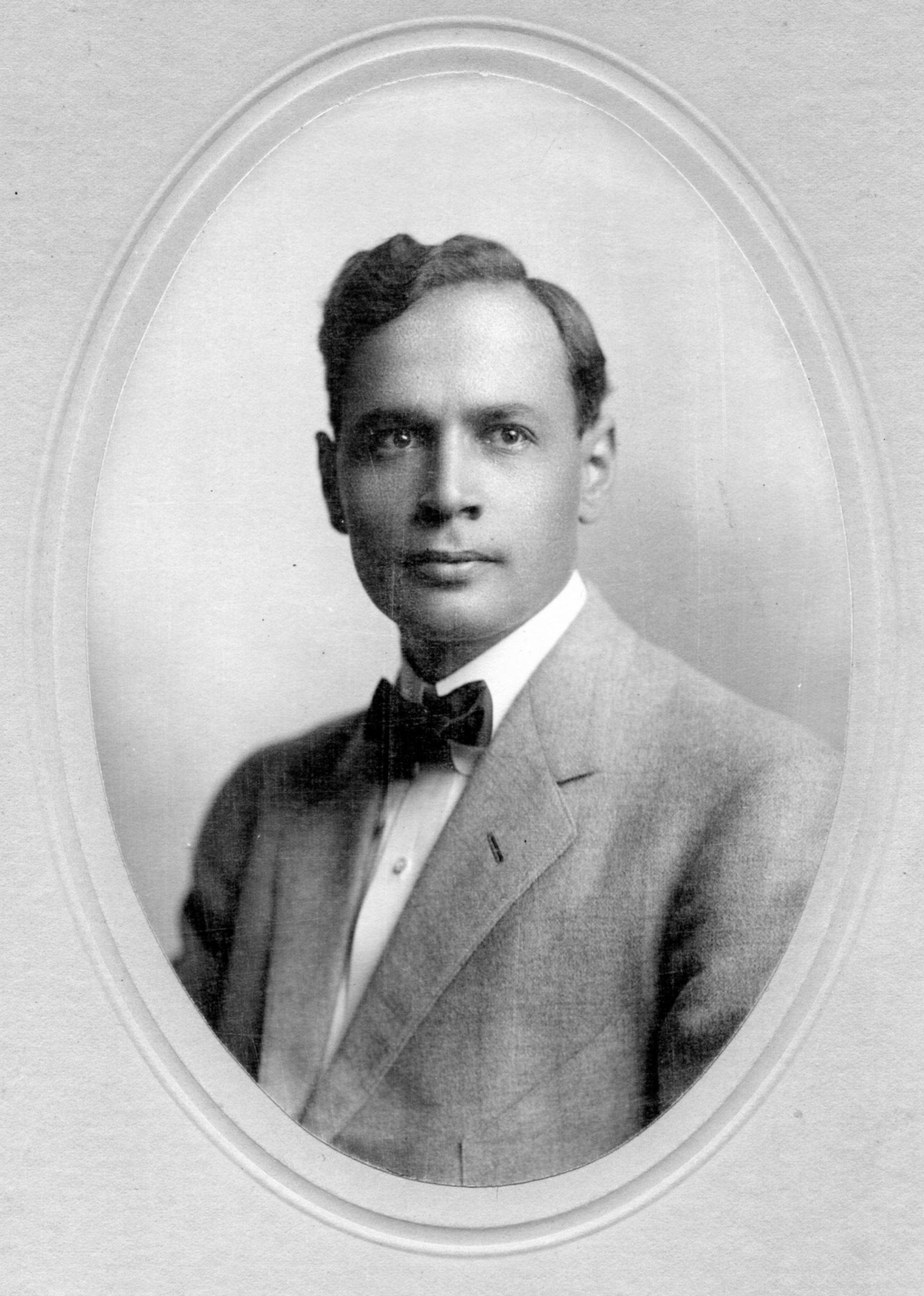
Sigmund Livingston, 1893 Courtesy of the family

Sigmund Livingston, 1903 Courtesy of the family

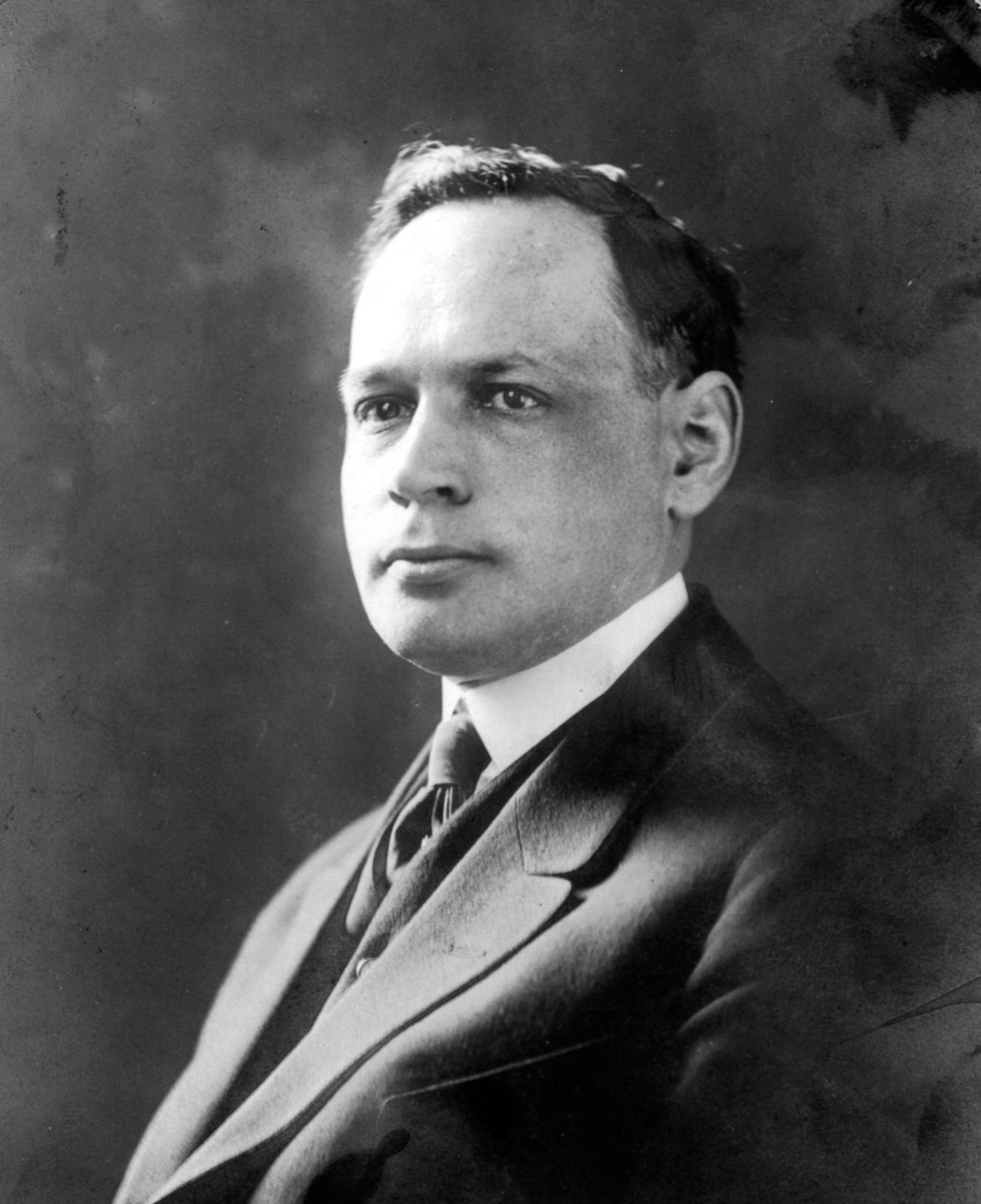
Sigmund Livingston, 1914 Courtesy of the family

Sigmund Livingston, 1918 Courtesy of the family

Sigmund Livingston, 1920 Courtesy of the family

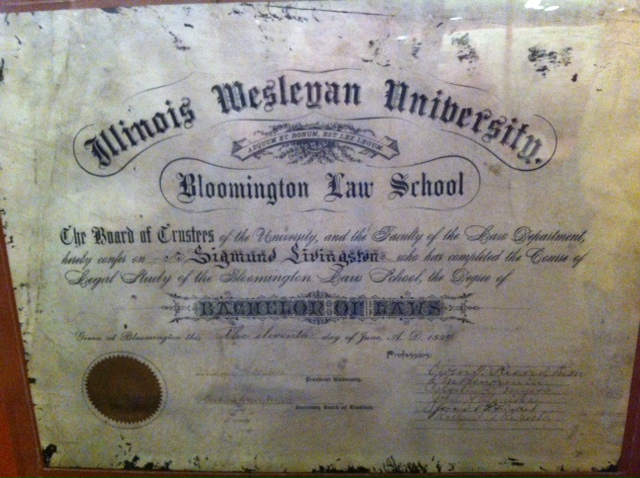
Here is Sigmund’s diploma from law school:

Sigmund Livingston diploma at McClean County Historical Museum Courtesy of the family

Finally, this photograph shows the family in about 1918-1919: Dora (Meyer had passed away in 1915) and her children and their spouses:

Back Row (left to right): Sigmund Livingston, Alfred Livingston, Eva Siegel Livingston (married to Alfred); Irvin Livingston; “Gramma” Dora (Dusschen) Blumenfeld Livingston; Dorothy Ensel Livingston (married to Herman); Herman Livingston, Rosalie Livingston Livingston; Harold Livingston (in back); Albert Livingston (cousin who married Rosalie); Maurice Livingston; Sol Salzenstein (married to Gussie). Front Row (left to right): Helen (Cubby) Baer(?) Livingston (married to Irwin); Hilda Freiler Livingston (married to Sigmund); Bertha August Livingston (married to Maurice); and Gussie (Gutschen) Livingston. Courtesy of the family

Richard shared what he knew about his grandfather Sigmund’s career after leaving Bloomington and moving to Chicago in 1928:1

When Sigmund left Bloomington in 1928, he gave his share in his local law practice to a young cousin, Herb Livingston; and joined a major Chicago law practice with his brother-in-law Charles Lederer. Charles was married to Hilda’s [Sigmund’s wife Hilda Freiler] older sister Florence. The firm was known as Lederer, Livingston, Kahn, and Adler or similar until approx. 1958; at which time its name became Arnstein and Lehr. Lederer & Livingston were Sears Roebuck & Co.’s legal counsel during its heyday.

Richard also filled me in on how his father Richard, who was known as Dick and who was born in Bloomington and then moved with his parents to Chicago when he was a boy, had ended up living in the suburbs of New York City as an adult:

My father Dick attended Duke University and was supposed to be class of ’42; but joined the US Army Air Corp for 5 years of WWII around his junior year. He was an airplane instruments technician or mechanic and trained pilots to read and understand the gauges and dials in a cockpit; but never was a pilot himself and fortunately never was stationed overseas or faced combat during the war. After the army, he returned to Duke University, graduating in Spring, 1947. Following graduation, he returned to Highland Park, IL, living with his mother Hilda (as best we know) and not sure if he was employed or not.

In February 1948, Hilda and Dick were vacationing at the Hollywood Beach Hotel in Hollywood Beach, Florida. Dick met a recent Wellesley graduate from New York City named Mimi Spector. They fell instantly in love and were soon thereafter married on May 30, 1948. Dick and Mimi moved into Mimi’s parent’s Manhattan apartment for a while before getting their own place. Dick initially worked in sales for his father-in-law’s business.

In the 1950s Dick and Mimi and their family moved to Westchester County in the suburbs of New York City, eventually settling in Scarsdale, less than five miles from where I lived and went to high school. Richard and Laurie and I were tickled to learn that we had all grown up not far from each other and went to neighboring high schools and even knew some of the same people. We likely crossed paths many times without knowing we were distant cousins.

It has taken over 50 years since high school before we finally connected. And I am so grateful that Richard and Laurie found my blog and reached out to me and have shared their stories and photographs.


  1. The quotes and other information from Richard Livingston were from emails dated from February 11 to February 21, 2023. 

Rudolph Meyer: “A Great Man”

Back in late December, a new reader, Candice, left a comment on my blog saying that her grandparents were Rudolph Meyer and Ruth Cohn and that we were related. I love when a new cousin finds my blog and seeks to connect with me.

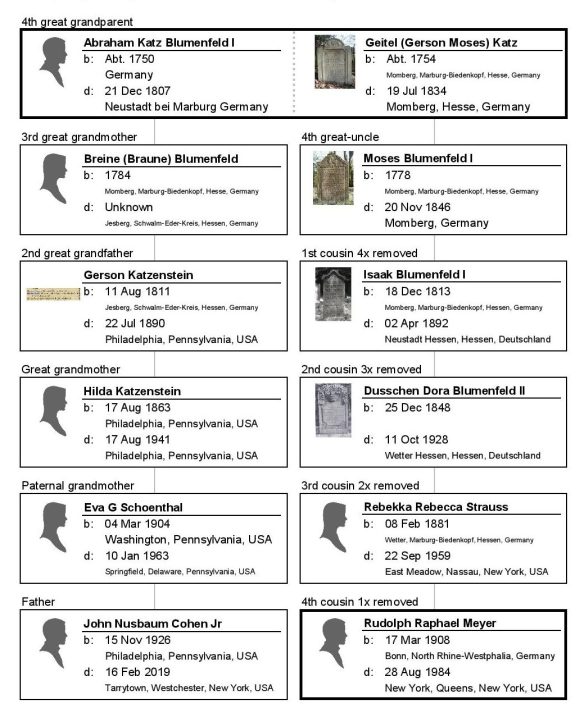
Candice and I are fifth cousins, once removed, through my Blumenfeld branch. Her grandfather Rudolph was the son of Rebecca Strauss, the grandson of Dusschen Blumenfeld Strauss, the great-grandson of Isaak Blumenfeld I, the great-great-grandson of Moses Blumenfeld I, and the great-great-great-grandson of Abraham Blumenfeld I, my four times great-grandfather. This chart shows Rudolph’s relationship to my father; they were fourth cousins, so Rudolph was my fourth cousin, once removed:
I wrote about Rudolph and his family here, but Candice and her father Albert were able to give me a more complete portrait of Rudolph and his wife Ruth Cohn. I already knew that Rudolph was born in Bonn, Germany, in 1908, and had arrived in the US from Germany in 1937 and settled first in New York City. By 1940 he was living in Albany, New York, and working for Cotrell & Leonard, a manufacturer of graduation caps and gowns.

Rudolph’s son Albert filled in some of the gaps in the story in the obituary he wrote about his father in 1984. Albert wrote in part:

Rudolf Raphael Meyer was born in Bonn, Germany, on March 17, 1908. He was to experience many of the history shaping events which influenced the course of his life and development. As the child of Albert and Rebecca Meyer with his sister Ilse he at the ages through 6-10 went through the trauma of World War I. The war brought hardship to him as did the period following it. The economic chaos of Weimar Germany with its rampant inflation left its mark on him in that no matter how well might do, he felt he never knew if he and his family would have enough just to provide for the basic necessities of life.

As the economic and political situation remained explosive in Germany and with Anti-semitism on the rise, he, his sister, and mother, his father having died, immigrated to the United States. However, life in the new country soon underwent its earthquake also with the coming of the Great Depression and World War II. The Depression only added to his feelings of anxiety regarding economic matters and [he] became a fervent supporter of the new deal with Franklin Delano Roosevelt and then Harry Truman representing the type of leadership he felt a society needed.

During the later years of the 30s he met Ruth Cohn and after a 3 year courtship they were married on August 10, 1941.

Rudolph enlisted in the US Army on September 6, 1943, and successfully petitioned for naturalization three months later in December 1943 from Spartanburg, South Carolina, where he was then stationed. What I did not know was that Rudolph then served overseas in Europe, fighting against the Nazis and the country where he was born.

Candice shared this photograph of her grandfather Rudy (as he was known) in uniform during World War II.

Rudolph Meyer during World War II. Courtesy of the family

Rudy wrote this poem about his outfit in World War II, the Blue Devils. Obviously, he was a proud American soldier out to defeat his former home country.

“Blue Devils,” by Rudolph Meyer c. 1944 (c) Courtesy of the family

What I also had not realized until Candice shared the family story is that Ruth was pregnant when Rudy left for Europe; their son Albert was born while he was abroad, fighting the Nazis. Rudy did not meet his child until after the war was over when Albert was already sixteen months old. Albert addressed this in his 1984 obituary for his father:

[Albert was born] while [Rudolf] was stationed overseas in Italy. The notice of his birth filled him with special joy as can be told by a reading of his letters from the war. As an additional sacrifice he did not get to see his child for another year.

Although the war was difficult and he was certainly not a young man while fighting in both North Africa and Italy for the Allies, his experience in the army gave him great pride. He felt he contributed to the service of his country and had helped to smash the Fascist Beast that had destroyed so many Europeans who could [not] leave and so many of his religious faith.

In fact among the things that gave him pride were his experience as a soldier, his role as a law abiding citizen, a good family provider. His citizenship was marked by regular voting, paying debts, attention by regular public affairs, and occasionally involvement in Democratic Party politics.

Here is a photograph of Albert as a baby taken while his father was away at war:
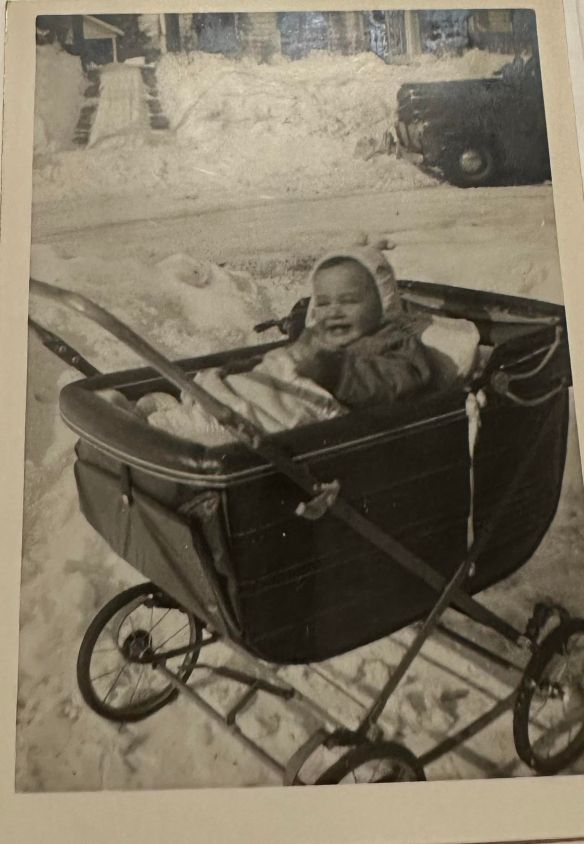
Albert Meyer Courtesy of the family

Ruth wrote this wonderful tribute to her husband, Rudy, whom she considered a “great man.”

Essay by Ruth Cohn Meyer (c) Courtesy of the family

A Great Man

My choice for the meaning of the word Great would be important. I write of a great man that I knew many years ago. His name was Rudolph Meyer. Now Rudy had a loving wife, and as is the nature of things, she became pregnant—and Rudy and his wife were very happy.

But then came fears of war from a country across the sea—a country from far away which hundreds of people were fleeing for they were afraid of what might now happen at this time. And Rudy and many of his fellow countrymen had found refuge in this country, the good old USA.

Then came the day when their fears for their country were alas confirmed. Atrocities! Tortures—and then War and Holocausts! Rudy immediately went to enlist. But at the recruitment center, he was told that because of his poor eyesight he would have to be rejected. But Rudy insisted—he must fight against the evil ones were who trying to destroy civilization. So—Rudy went to war!

I was sad. I was pregnant—but I knew in my heart that it was for those qualities in him—great devotion to family and country—that I loved him. And though I was sad—I was proud. My Love was a great man.

I waited—I would go to the grocery store. A pound of butter, if you please. Hey, Lady—don’t you know there’s a war on. Ah,yes—there’s a war on over there!

It is 4 years later—the end of the war. Rudy comes home. He holds in his arms a loving wife and 16 mo. old son. A great man has come home to us.

This was obviously a strong and loving marriage that endured for many years after Rudy returned home. This photograph of Ruth and their son Albert was taken after the war.

Albert Meyer and Ruth Cohn Meyer. 1948. Courtesy of the family

As I wrote in my earlier post, Rudy and Ruth moved to the Bronx after the war, and in 1950 they were living in the Bronx, and Rudy was now an accountant for motion pictures distributors. Ruth was an elementary schoolteacher.  Rudy’s mother Rebecca and Ruth’s father Benjamin were also living with Rudy and Ruth and their child, and Benjamin was working as a tailor.

I want to express my gratitude to Candice and her father Albert for sharing these stories and photographs about my cousin Rudolph Meyer, a man who truly lived up to his wife Ruth’s description, a great man.



Arye Katzenstein

I have researched and written about hundreds of relatives (maybe thousands?) over the almost ten years that I’ve been writing this blog. And aside from my own direct ancestors, of those many, many cousins and great-aunts and great-uncles going back over two hundred years, there are only a small number whose stories are so compelling and unforgettable that when I see their name, I immediately remember the details of their lives.

One of those cousins is my fourth cousin Arye Katzenstein, whose heroic story I wrote about here. During a terrorist attack at the Munich Airport on February 10, 1970, Arye threw himself on a grenade released by the Palestinian terrorists and sacrificed his own life so that he could save the life of his father, Heinz Katzenstein, and the lives of all the other travelers. He was only 32 years old.

So when I received a comment on my blog from a woman named Miki saying her father was Arye Katzenstein, I gasped. I’d had no idea that Arye had had children when he was killed. I immediately wrote to Miki and learned that after more than fifty years, the city of Munich is finally providing a memorial for Arye on the grounds where the attack occurred. The land is now owned by a private company, BrainLab, and together with that company, the city, and the family of Arye Katzenstein, a proper memorial is being established. BrainLab has commissioned an art work by Alicia Kwade, an internationally known artist, and the family is creating a website and informational materials for the site, which will be dedicated sometime in 2024.

From Miki, I learned a great deal more about her father and his family and his life. As I already knew, Arye was born in Haifa (then Palestine, now Israel) on November 23, 1937, after his parents fled from Nazi Germany. But I learned from Miki that he had spent time in Germany as a student. In 1959 he came to Munich to study veterinary medicine, but later returned to study engineering. He had married his wife Bilha on October 22, 1961, and their first child, my cousin Miki, was born in Munich a few years later. The family returned to Israel before the 1967 war and had two more children there, a son and another daughter.

Thus, Arye left behind not only his parents and siblings, but also his wife and three very young children. It’s hard to imagine the pain and suffering that his death must have caused his loved ones. But his legacy is one of heroism and courage.

Miki shared with me several photographs of her family. First is a photograph of her father Arye as a young man traveling in Europe.

Arye Katzenstein Courtesy of his family

This is a photograph taken at Arye and Bilha’s wedding. Bilha is third from our left, then Arye next to her. Next to Arye are his parents Mania (Miriam) Dorf and Heinz Katzenstein.

Wedding of Arye Katzenstein Courtesy of the family

This chilling photograph is of Arye’s notebook taken after the terrorist attack that killed him. It was returned to the family by El Al after Arye’s death.

Arye Katzenstein notebook returned to family by El Al Courtesy of the family

This photograph was taken on the 53rd yahrzeit (anniversary) of Arye’s death in 2023, just a month ago. Arye’s gravestone reads: “Here lies our dear, noble spirited Arye Katzenstein, son of Miriam and Jacob Hacohen, who sacrificed his live during the attack on El Al passengers.”

Gravestone of Arye Katzenstein Courtesy of the family

The stones for Miki’s grandparents appear below:

Gravestones of Heinz and Miriam Katzenstein Courtesy of the family

Finally, Miki shared with me this photograph of her family—her husband, her children, and herself. I don’t usually include photographs of living people, but in this case I do so to honor the memory of Arye Katzenstein and to recognize the resilience of his family and the hope for a better future where all of us can live in peace and without fear of terrorism.

Miki Katzenstein Dror and family Courtesy of the family