
We saw last time that Eugen Baer and his family left Griedel for Bad Nauheim and were in Bad Nauheim until August 1, 1939. According to their ship manifests, his wife Hedwig and son Adolf had visas for the US from the consulate in Stuttgart dated August 11, 1939, ten days later. But Eugen did not obtain his visa until October. And yet even Hedwig and Adolf did not sail for the US until November and Eugen not until December.
This had me perplexed. What could have held them up? Why didn’t they travel together? I had several theories. Maybe Eugen was sick. Maybe he had a harder time getting a visa. Maybe there were quotas for men that were different from women. Theories but no answers. I didn’t know why Eugen’s visa was dated so much later than that of his wife and son or why he didn’t get a ticket on the same ship as Hedwig and Adolf. Maybe there was no more room on that ship, maybe he needed to tie up loose ends before he could leave.
One thing my general research indicated was that none of them could have received a visa from the US consulate unless they already had tickets on a ship to the US.1 That meant that by August 11, 1939, at least Hedwig and Adolf and perhaps even Eugen already had purchased their tickets. And yet they didn’t arrive in the US for months.
And then I found a 2020 obituary for their son Adolf that revealed part of the story. It included this information:
Ed [as he was known in the US] was born on January 7, 1930 in Greidel [sic], Germany, and immigrated to New York City in 1939 with his mother, Hedwig. They settled in Baltimore, MD in 1940 when his father, Eugene, was able to join them after being separated from his family and held falsely in a French internment camp in Falaise.
So Eugen had been separated from his wife and son, but when? And why in France?
Only when I received the documents relating to the compensation claim that Eugen filed after the war was I able to put together more of their story. In detailing his emigration costs as part of that claim, Eugen claimed in part, “2½ tourist-class passages (per attached invoice) RM 1,163.12. These tickets were not used, since the ship was recalled before Southampton.”2
T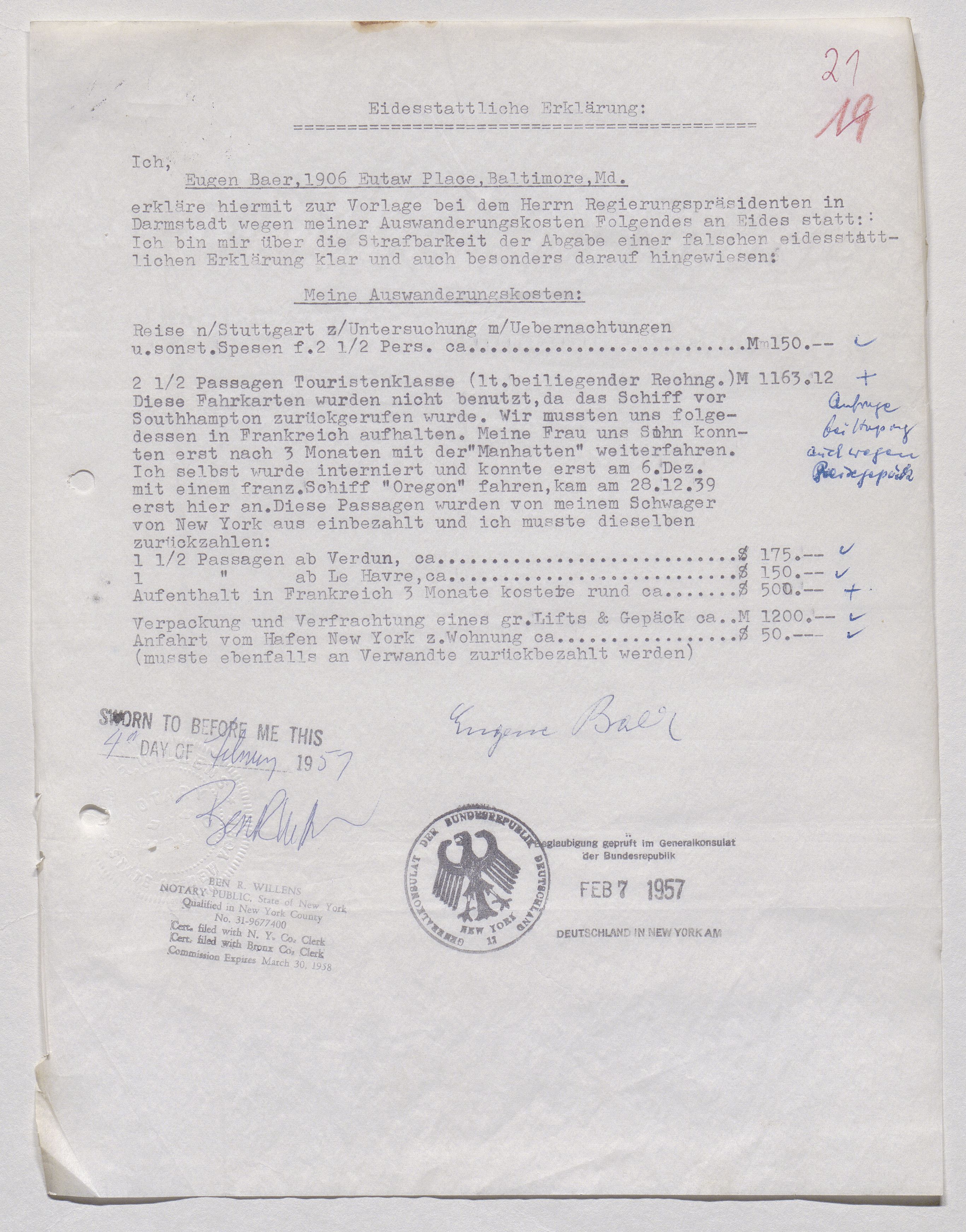 he file from Germany also included a confirmation of the purchase of these tickets from Hamburg-Amerika Linie, otherwise referred to as HAPAG, the shipping company from which Eugen and his family originally planned to travel to New York. This meant that at that time the ship was to sail in August, 1939, Eugen also must have had a visa from the US Consulate in Stuttgart, likely obtained the same time that Hedwig and Adolf received theirs.
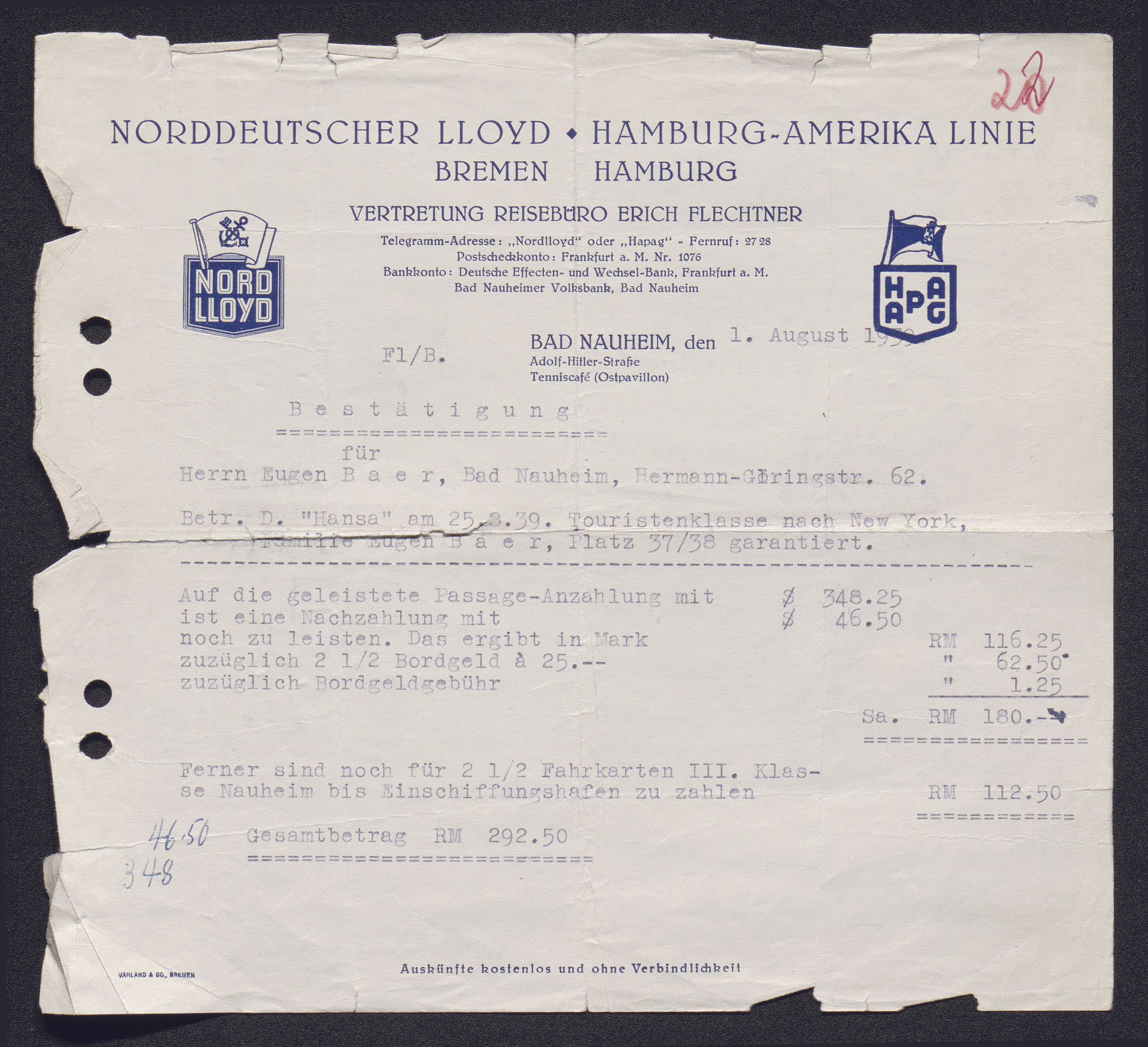
HHStAW Abt. 518 Nr. 23400, Norddeutscher Lloyd/Hamburg-Amerika Linie Bestätigung, 1 Aug. 1939, p. 22.
But that ship was recalled, as Eugen wrote, because two weeks after they obtained their visas on August 11, 1939, Hitler ordered all German commercial ships to return to Germany or a neutral port, and no German ships could leave Germany after that date.3
This explains why despite having visas in August, Hedwig and Adolf did not leave until months later. Their original plan to leave failed once the ship had to return to port. The family thus had to purchase new tickets from a non-German shipping company sailing out of a non-German port. As Eugen wrote:4
We consequently had to stay in France. My wife and son could only continue on with the “Manhattan” after 3 months. I myself was interned and could only travel on 6 Dec. with a French ship, the “Oregon,” arriving here only on 28.12.39. These passages were paid in advance by my brother-in-law from New York and I had to repay him:
1½ passages from Verdun, approx. $175.—
1 [passage] from Le Havre, approx. $150.—
Stay in France for 3 months cost approx. $500.—
But when had they gotten to France? And where did they stay? The compensation claim file included a statement from Julius Baer, Eugen’s brother, who, as you may recall, had left Germany in 1936 and settled with his family in Molsheim, France, in the Alsace region. Julius wrote:
My brother Eugen came 8 days before the outbreak of war, with his family (wife and son) to us in Molsheim, in order to emigrate to America from here. He had already paid for the ship tickets on the “Hansa” and wanted to board the ship with his family at the port of Cherbourg. Due to the war events the ship did not sail, and so he traveled back from Cherbourg to Paris. He himself was held as a foreigner in a camp until the end of 1939, and his wife and son were sent to Bordeaux and Limoges. Since all three had no financial means and had not anticipated these events, I of course, as the only brother living here, had to provide for their support. I lent them, successively, sums amounting to the equivalent of 500 dollars.[translation by Claude.ai]
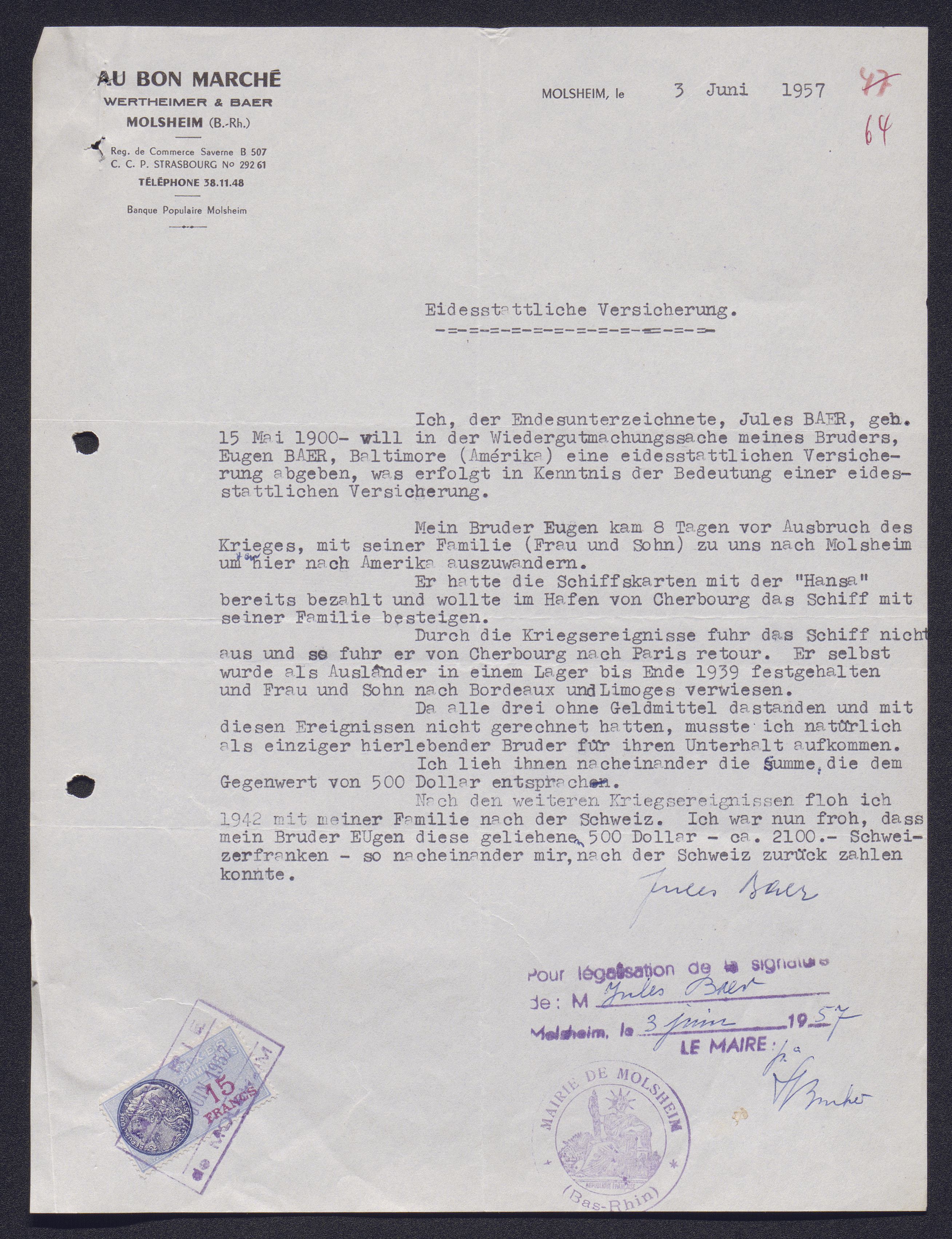
HHStAW Abt. 518 Nr. 23400, Jules Baer, eidesstattliche Versicherung, 3 June 1957, p. 47
World War II started on September 1, 1939, and eight days before September 1, 1939, was August 24, 1939. A separate confirmation from HAPAG indicates that August 24, 1939 was the day that Eugen, Helga, and Adolf were supposed to embark from Hamburg:
We hereby confirm that Mr. Eugen Baer and family traveled with our former ship S.S. HANSA on 24 August 1939 from Hamburg, and that this steamer was recalled one day after departure due to the threat of war, so that the family had to withdraw from the voyage. As is further evident from our records, the family’s assets were confiscated pursuant to an order of the Chief of the Security Police and the SD dated 2 November 1942.
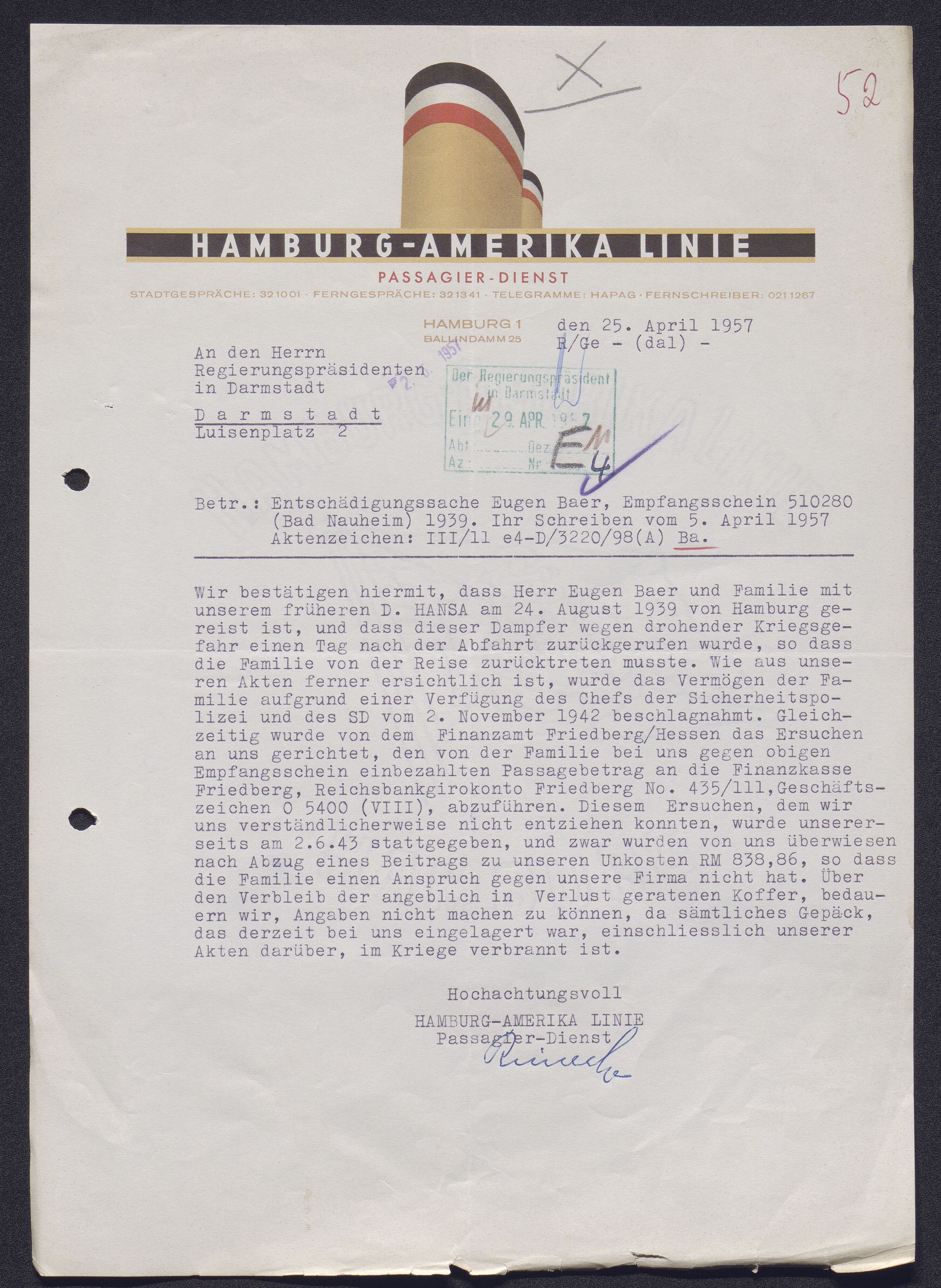
HHStAW Abt. 518 Nr. 23400, Hamburg-Amerika Linie to Regierungspräsident Darmstadt, 25 April 1957, p. 52.
Thus, Eugen and family went to Molsheim after their ship was turned back, leaving behind their possessions. I cannot explain why Julius said they were sailing from Cherbourg and HAPAG says Hamburg, but as we will see, their possessions were confiscated in Hamburg. More on that to come in my next post.
We know from their ship manifest that Hedwig and Adolf were eventually able to get tickets on the US-owned ship, the SS Manhattan, and left from Le Verdun, France on November 7, 1939. But Eugen was left behind. I am hoping to get more information about his arrest and time in the French concentration camp, but for now we know that Eugen was later able to get a new visa to travel to the US in October and sailed out of France in December. On December 28, 1939, he joined his family in the United States.
- United States Holocaust Memorial Museum, “Immigration to the United States, 1933–41,” Holocaust Encyclopedia, https://encyclopedia.ushmm.org/content/en/article/immigration-to-the-united-states-1933-41. ↩
- Hessisches Hauptstaatsarchiv Wiesbaden (HHStAW), Abt. 518, Nr. 23400 (Wiedergutmachungsakte Eugen Baer, 1954–1960) eidesstattliche Erklärung (emigration costs), 4 Feb. 1957, p. 21. [hereinafter cited as ” HHStAW Abt. 518 Nr. 23400, Eugen Baer” with the appropriate title and page number in the file.] ↩
- See, e.g., “The S.S. Bremen: Last Voyage of a Luxury Liner,” Cruising the Past, https://www.cruiselinehistory.com/the-s-s-bremen-last-voyage-of-a-luxury-liner/; also, see the Kriegstagebuch der Seekriegsleitung 1939–1945 (KTB Skl), the official daily war diary of the German Naval High Command, at https://uboatdata.ussleahy.com/SKL/1/Trans/wardiarygermanna11939germ.pdf ↩
- See Note 2, supra. ↩


Amy, you never give up?!
LikeLiked by 1 person
Nor do you! All our stories deserve to be found and told!
LikeLiked by 1 person
Considering our world today, it is unbelievable that these records have survived.
LikeLiked by 1 person
The German records are amazing. I think guilt and the general German nature to keep records have kept these records from being destroyed. Trying to get records from France, on the other hand, has proven to be far more difficult. Or Poland and Romania. Fortunately most of my paternal roots are from Germany!
LikeLiked by 1 person
It must have been such a scary time for the family. And how awful for Hedwig and Adolf to have to go on ahead…must have been heart-breaking.
LikeLiked by 1 person
I know…I can’t imagine it.
LikeLike
You’ve found some amazing details about this family.
LikeLiked by 1 person
It’s amazing what is out there to find.
LikeLiked by 1 person
It is difficult even to imagine how difficult this must have been. I keep thinking how amazing it is that they made it after war broke out. I hope that once they made it to the US there lives were free of worry and hardship.
LikeLiked by 1 person
Well, no one lives a life free of worry and hardship, even in the US, right? But they did survive. I don’t know how they felt, but I know where they were and what they did. More on that in a couple of weeks!
LikeLike
Bonjour, je viens de lire votre article. Si la famille BAER est passée par la France, il existe des dossiers les concernant aux Archives Nationales à Paris. Il s’agit des vérifications effectuées par le Consulat de France à Hambourg où la famille a effectué une demande de visa de transit auprès des services de Police de Sûreté + s’il est resté en France des traces de son internement à l’entrée en guerre puisque tous les ressortissants allemands, autrichiens et polonais avec un Fremdempass ont été internés dans un camp. Les femmes (et les enfants) ont pu d’ailleurs être internées en prison ou assignées à résidence dans des villes. Bref, pour
BAER Adolf Archives Nationales, Pierrefitte-sur-Seine, France Cote : 1994O434/22 Dossier 1581 1936-1937 BAER Adolphe Archives Nationales, Pierrefitte-sur-Seine, France Cote : 19940434/22, Dossier 15721 934-1936
BAER, Eugène : Archives Nationales, Pierrefitte-sur-Seine, France Cote : 19940434/23, Dossier 1633 1938-1939
Les dossiers peuvent comporter des photos. Quelquefois, les femmes ont eu leur propre dossier. Elles sont enregistrées sous leur nom de jeune fille.
Vous pouvez demander copie de ces dossiers https://www.siv.archives-nationales.culture.gouv.fr/siv/cms/content/display.action?uuid=Accueil1RootUuid&onglet=1
Il faut dans cet espace créer un espace personnel. Puis une fois créé vous avez un onglet : Demander une reproduction.
Best regards
Hello, I just read your article. If the BAER family has passed through France, there are files concerning them at the National Archives in Paris. These are the checks carried out by the French Consulate in Hamburg where the family applied for a transit visa from the Security Police services + if there were traces in France of his internment at the beginning of the war since all German, Austrian and Polish nationals with a Fremdempass were interned in a camp. Women (and children) may have been interned in prison or placed under house arrest in cities. In short, for
BAER Adolf National Archives, Pierrefitte-sur-Seine, France 1994O434/22 Dossier 1581 1936-1937 BAER Adolphe National Archives, Pierrefitte-sur-Seine, France 19940434/22, Dossier 15721 934-1936
BAER, Eugène: National Archives, Pierrefitte-sur-Seine, France 19940434/23, Dossier 1633 1938-1939
Folders may include photos. Sometimes women had their own file. They are registered under their maiden name.
You can request a copy of these files https://www.siv.archives-nationales.culture.gouv.fr/siv/cms/content/display.action?uuid=Accueil1RootUuid&onglet=1
It is necessary to create a personal space in this space. Then once created you have a tab: Request a reproduction.
Best regards
Olivier GUIVARC’H France
LikeLiked by 2 people
Thank you! I had actually written to the archives in Calvados looking for information about Eugen Baer’s time in Falaise, but they had no information. I will follow your suggestion to see what I can find. Thank you again!
LikeLike
Pingback: Eugen Baer’s Escape from Germany, Part III: The “Lost” Luggage | Brotmanblog: A Family Journey
Pingback: The Baer Siblings in Baltimore | Brotmanblog: A Family Journey