Part II: The Benefits of Teamwork

So who was Frederick Selinger, and how did he fit into the family? And who was Fanny Selinger’s mother?

In Part I, I described the research I had done first with Val Collinson in 2014 and then separately with Shirley Allen during the summer and fall of 2015 to try and find the connections between all our various Selinger relatives. Through that research we had established with a fair degree of certainty that Julius and Alfred Selinger, who married two of my Cohen cousins, sisters Augusta and Fanny, were themselves brothers, the sons of Seligmann Selinger and Breinle Hofstadter. We had also established that Helena Selinger Auerbach, who had been Val’s great-grandmother, was a first cousin to Julius and Alfred and the daughter of Abraham Selinger and Rosalia Wilhelmsdorfer.

Relationship_ Julius Selinger to Helena Selinger

We also had established that Fanny Selinger Rosenthal, Shirley’s grandmother, was also a daughter of Abraham Selinger, but Shirley and I had not found any document that revealed whether her grandmother Fanny was a full or half sister to Helena and the other children of Abraham Selinger; we had not found her mother’s name or where she was born.

And I still didn’t know how Frederick Selinger fit into the question.

We also knew that Abraham Selinger had immigrated to England by 1871 because he appeared on the 1871 UK census with a second wife, Gali, along with several children: Sigfried, Helena, Cornelia, and Oscar.  By 1881, Abraham had died, and his widow Gali was living with some different children: Morris, Flora, and Sidney, plus Oscar.  Aside from Helena, who were all these children, and where were they born?  I had no birth records for Cornelia, Morris, Flora, Sidney, or Oscar.

So by late November, we had many answers, but many questions remained.

Fast forward again to January 13, when I again heard from Shirley.  She had received a copy of the marriage authorization for Fanny Selinger and Jacob Rosenthal from the Chief Rabbi in London.  It confirmed that Fanny was the daughter of Abraham and that she was born in Hurben, but did not reveal her mother’s name.  Although we did not have any new information, the new communication inspired us to try again to get answers to our primary questions: Who was Fanny Selinger’s mother?  And how did Frederick Selinger fit into the family, if at all?

Fanny Selinger Rosenthal and her husband Jacob Rosenthal and children Gladys, Daniel, and Alfred Courtesy of Shirley Allen

Fanny Selinger Rosenthal and her husband Jacob Rosenthal and children Gladys, Daniel, and Alfred
Courtesy of Shirley Allen

After reviewing everything we had, I decided to post on the German Genealogy group on Facebook for information about records in Ansbach , where Oskar Selinger had claimed to be born on his UK naturalization record.  Although I was unable to find Ansbach birth records for the appropriate years, my friend Matthias did find two websites with information about Abraham Selinger in Ansbach: one, a website listing past and present tobacco businesses in Germany; Abraham Selinger was listed as the manager of Equity and cigar-tobacco factory in Ansbach from 1862 until 1871. Thus, it made sense that Oscar Selinger was born in Ansbach.

The second website was even more revealing.  It was an Ansbach police report from 1870 reporting the arrest on May 31, 1870 of Abraham Selinger from Hurben, manager of a cigar factory,  for fraud.  Perhaps that is why 1871 was both the last date he had the cigar business in Ansbach as well as the first year he appeared on UK records.

But it also meant that the children I believed had been born to Abraham in the 1850s—Frederick, Fanny, Morris, Flora, and Sidney—were probably not born in Ansbach if Abraham’s business there didn’t start until 1862.  So where were they born?  Shirley continued to contact various offices in Germany, and I tried to think of new paths for research.

And then I had the best idea I’d had yet.  While doing all this work with Shirley in 2015, I had somehow forgotten about my correspondence with Val Collinson back in 2014.  Maybe Val had made some new discoveries or would have some new ideas.  I wrote to Val on January 22, 2016, and now we had three heads working on the mysterious Selingers.

Filament Productions

Filament Productions (Photo credit: Wikipedia)

The emails started flying back and forth among the three of us, and it became clear fairly quickly that Val and Shirley had some relatives in common, that is, relatives they both had met or at least had heard of.  I just sat back, enjoying the fact that I had brought these two cousins together.  They both were descendants of Abraham Selinger:  Shirley through his daughter Fanny, Val through his daughter Helena.  We weren’t yet sure whether Helena and Fanny were full or half-sisters, but in any event Shirley and Val, who’d never heard of each other before and who live about 60-100 miles apart in the UK, are third cousins.  I was thrilled that I’d brought these two wonderful family researchers and cousins together.

Shirley and Val both had lots of information about the marriages and descendants of some of the other Selinger siblings and also some wonderful photographs, but neither had any information about Frederick and neither was sure as to the identity of the mother or birthplaces of Fanny, Cornelia, Morris, Flora, or Sidney.

And then on January 29, 2016, the walls started tumbling down.  Val found this on Ancestry:
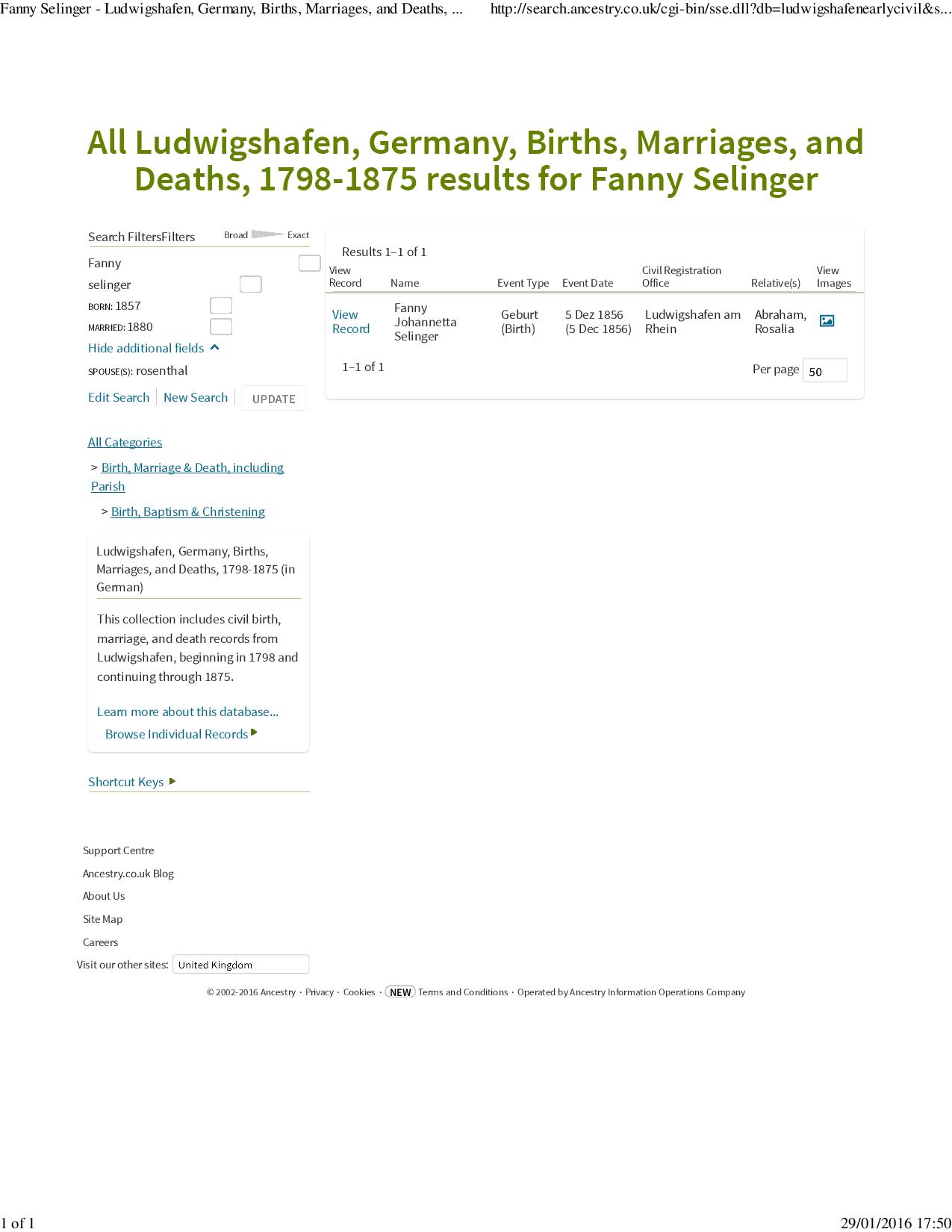
JPF Ludwigshafen page

Ludwigshafen?? Where was that? It’s a town very close to Mannheim.  Could be this OUR Fanny? Val asked me to follow up because I have the broadest Ancestry subscription (All Access), and I was able to pull up a scan of the actual record.  And not only did I find birth records for Fanny, I found them for three other children, all born to Abraham Selinger and Rosalia Wilhelmsdorfer, his first wife.

The four children born in Ludwigshafen were:  Babetta, born in 1853, died in 1854; Flora, born in 1855 (later Flora Wallach); Fanny, born December 5, 1856; and  Sigmund (later Sidney) born in 1858.  We finally had a birth record for Fanny, and we knew now that she was in fact a full sister to Helena as they were both the daughters of Abraham Selinger and Rosalia Wilhelmsdoerfer.  Val and Shirley were officially third cousins.


Fanny Selinger birth record from Ludwigshafen Ancestry.com. Ludwigshafen, Germany, Births, Marriages, and Deaths, 1798-1875 [database on-line]. Provo, UT, USA: Ancestry.com Operations, Inc., 2015. Original data: Ludwigshafen Zivilstandsregister, 1798-1875. Stadtarchiv Ludwigshafen, Ludwigshafen, Deutschland.

Fanny Selinger birth record from Ludwigshafen
Ancestry.com. Ludwigshafen, Germany, Births, Marriages, and Deaths, 1798-1875 [database on-line]. Provo, UT, USA: Ancestry.com Operations, Inc., 2015.
Original data: Ludwigshafen Zivilstandsregister, 1798-1875. Stadtarchiv Ludwigshafen, Ludwigshafen, Deutschland.

So that left three children whose birthplaces were still unknown: Morris, Cornelia, and, of course, Frederick.  Since Morris and Cornelia were both born before 1862 when the Selinger family arrived in Ansbach and after 1848 when the family had moved to Mannheim, I assumed that they were probably born in Mannheim.  The 1881 census recorded Cornelia’s age as 18, two years younger than Helena, whom they reported as twenty. But even English census records are unreliable.  Helena would have been turning 22 that year; maybe Cornelia was really 19 or 20 and thus born in 1850 or 1851.  The 1881 census said Morris was 28; he was probably born in 1852 since Babetta, the child who died in 1854, was born in 1853, in Ansbach.  Cornelia and Morris would also probably have been the children of Abraham and Rosalia since there were four children born to that couple even after Cornelia and Morris were born.

So I went back to the Mannheim records because my initial search had been only for the years between 1853 to 1859; now I searched the set of records before it, dating from 1842 to 1852.  And there they were, birth records for Cornelia (1850) and Morris (1852).  And Helena (1849).  All three were the children of Abraham Selinger and Rosalia Wilhelmdoerfer.

landesarchiv_baden-wuerttemberg_generallandesarchiv_karlsruhe_390_nr-_2862_bild_147_4-1229196-147 Birth record for Helena Selinger from Hurben

landesarchiv_baden-wuerttemberg_generallandesarchiv_karlsruhe_390_nr-_2862_bild_147_4-1229196-147
Birth record for Helena Selinger from Mannheim (center, left page)


So there are two birth records for Helena, one in Hurben, one in Mannheim.  Go figure.

Meanwhile, Val found yet another document:

Abraham Selinger - Ansbach, Germany JPG

(I cannot understand why neither the Ludwigshafen nor the Ansbach registers showed up for me when I searched.  Val has a magic touch with the search engine logic that I don’t have.)

I then retrieved the image of the actual document:

Abraham Selinger Lutheran register Ansbach


Abraham Selinger family in Ansbach Ancestry.com. Ansbach, Germany, Lutheran Parish Register Extracts, 1550-1920 [database on-line]. Provo, UT, USA: Ancestry.com Operations, Inc., 2015. Original data: Ansbach Lutheran Parish Register Extracts. Digital images Tobias Brenner Collection.

Abraham Selinger family in Ansbach
Ancestry.com. Ansbach, Germany, Lutheran Parish Register Extracts, 1550-1920 [database on-line]. Provo, UT, USA: Ancestry.com Operations, Inc., 2015.
Original data: Ansbach Lutheran Parish Register Extracts. Digital images Tobias Brenner Collection.

This document revealed two more things: that Gali’s birth name was Kohn and that she and Abraham had had another child before Oskar, Isidor, who died when he was an infant. So now I had a record confirming that Oscar was born in Ansbach and that his mother was Gali Kohn, not Rosalia Wilhelmsdoerfer.

Shirley, Val, and I had pretty much closed the circle on the children of Abraham Selinger.  But despite all our efforts, we still had not found one record for Frederick Selinger.  If he was born in 1856 as his passport application and his death certificate indicated, he should have been included with those children born in Ansbach.  He would have been born around the time of Flora or Fanny, maybe even a twin of one of them.  But he wasn’t there. And he wasn’t in the Mannheim records or the Hurben records.

So something did not make sense.  Frederick was not the child of Abraham Selinger with either of his wives.  I was convinced of it now.  So who was he? What was I missing?


P question

P question (Photo credit: Wikipedia)


This is the part of the story where I just want to kick myself.  I went back once again to the Hurben birth records and looked more closely at the children born to Seligman Selinger.  There were nineteen of them.  NINETEEN.  Nine were born to Seligman and his first wife between 1835 and 1844.  They all were born too early to be Frederick.  Ten children were born to Seligman Selinger and his second wife, Breinle Hofstadter, between 1849 and 1866.  There were five girls and five boys from that second marriage.  The five boys were Heinrich (1852), Julius (1853), Sigfried (1855), Hugo (1860), and Alfred (1866).  Julius and Alfred were the two who had married my Cohen cousins Augusta and Fanny.  That left Heinrich, Sigfried, and Hugo. Could any of them be Frederick?

Sigfried.  Hmm, I thought.  That could have become Frederick, maybe?? But he was born December 29, 1855, and Frederick was born in December 1856, according to his US death certificate and his US passport application.  So what, I thought? People lie! He made himself a year younger. The more I thought about it, the more I thought that Sigfried was Frederick.  The disparity in the dates in December for his birthday (the death certificate said December 27, the passport application December 21) didn’t bother me either.  Jews in Europe might not have known their birthday on a Gregorian calendar, only a Jewish calendar.  Frederick might have just known that his birthday was close to Hanukkah and nothing more precise than that.

I went back to Ancestry to look at the records I had for Frederick.  The earliest two—his 1880 marriage record and the 1880 census—list him as Fred, not Frederick.  Fred could be a shortened version of Sigfried, couldn’t it?  So I decided to search for Sigfried Selinger.

Marriage record for Frederick Selinger and Rachel Cohen 1880

Marriage record for Frederick Selinger and Rachel Cohen 1880

And I found this ship manifest from 1872:

Siegfried Selinger ship manifest 1872 to Baltimore The National Archives at Washington, D.C.; Washington, D.C.; Records of the US Customs Service, RG36; NAI Number: 2655153; Record Group Title: Records of the Immigration and Naturalization Service, 1787-2004; Record Group Number: 85

Siegfried Selinger ship manifest 1872 to Baltimore
The National Archives at Washington, D.C.; Washington, D.C.; Records of the US Customs Service, RG36; NAI Number: 2655153; Record Group Title: Records of the Immigration and Naturalization Service, 1787-2004; Record Group Number: 85

Siegfried Selinger, sixteen years old, arrived in Baltimore in June 1872, when Sigfried Selinger of Hurben would in fact have been still sixteen years old.  I thought that this could very well be the man who became Frederick Selinger.  Supporting this assumption was the fact that his marriage record states that he was from Baltimore and that he ended up marrying a woman from Washington, DC, so it would make sense that he would have entered the US through Baltimore, as his naturalization papers indicated.    (They also say he entered the country in June 1871.  People lie!  People forget!)

Frederick Selinger passport application National Archives and Records Administration (NARA); Washington D.C.; NARA Series: Passport Applications, 1795-1905; Roll #: 378; Volume #: Roll 378 - 14 Jul 1891-31 Jul 1891 Description Volume : Roll 378 - 14 Jul 1891-31 Jul 1891

Frederick Selinger passport application
National Archives and Records Administration (NARA); Washington D.C.; NARA Series: Passport Applications, 1795-1905; Roll #: 378; Volume #: Roll 378 – 14 Jul 1891-31 Jul 1891
Description
Volume : Roll 378 – 14 Jul 1891-31 Jul 1891

And when I searched for Fred Selinger in Baltimore, I found two listings in Baltimore directories, one in 1875, one in 1878.  I am quite certain I have found Frederick and now know that he was Sigfried Selinger,  the son of Selinger Seligmann and Breinle Hofstadter.  He was the middle brother to his brothers, Julius and Alfred, who followed him to the US in the following decade and married respectively the aunt (Augusta) and the sister (Fanny) of Frederick’s wife Rachel.

So why do I want to kick myself? Not only because I should have seen this much, much earlier, but because Ralph Bloch in fact told me he thought Sigfried could be Frederick way back in August, 2015.  I’d forgotten that until I reviewed all the old emails to write this blog post.  I probably saw his comment and forgot it or thought that I needed more proof.  And I got caught up in searching for Fanny and the other Selingers and for some reason assumed Frederick had to be the child of Abraham.  I could have so easily searched back then for Sigfried in the US and found what I found just this past week.

But actually I am so glad that I didn’t.  Because if I had done that in August, I might never have continued searching and working with Shirley and Val.  I might never have brought Shirley and Val together, third cousins who’d never known each other before.  I would have missed out on all the fun Val and Shirley and I have had as we worked together to solve this mystery.  That makes this all very worthwhile.

All this, you might say, for people who aren’t even my blood relatives? For people who happened to marry my distant cousins Rachel, Augusta, and Fanny?

It’s moments like this that I want to say, “We are all cousins.  Our families are all entangled.  And every person’s life, every person’s story is worth remembering and is worth memorializing.”


The Benefits of Teamwork: Part I

In my recent post, I mentioned that I had been working with two other researchers on the mystery of the three Selinger men who married my Cohen cousins.  Frederick Selinger had married my cousin Rachel Cohen in 1880 in Washington, DC.  Rachel was the daughter of Moses Cohen, my three times great-uncle (brother of my great-great-grandfather Jacob).  Julius Selinger had married Augusta Cohen in 1884 in Washington, DC; Augusta was the daughter of Moses Cohen, Jr. and niece of Rachel Cohen.  Finally, Alfred Selinger had married Fannie Cohen in Washington, DC, in 1893.  Fannie was also a daughter of Moses Cohen, Jr., also a niece of Rachel Cohen, and a sister of Augusta Cohen.

Julius and Augusta Cohen Selinger passport photos 1922

Julius and Augusta Cohen Selinger passport photos 1922


Way back on July 22, 2014, when I first posted about the three Selinger men, I had speculated that they all had to be related.  Both Julius and Frederick had documents indicating that they had been born in Hurben, Germany.  Alfred and Julius had lived together in DC before they’d married, and Alfred had traveled with Julius and Augusta to Europe before he married Augusta’s sister Fannie.  But I had nothing to support that speculation besides that circumstantial evidence.

Then a month later on August 5, 2014, I wrote about the marriage of Eleanor Selinger to Henry Abbot.  Eleanor was the daughter of Julius Selinger and Augusta Cohen; Henry was the son of Hyams Auerbach (Abbot) and Helena Selinger (some records say Ellen or Helen).  I was curious as to whether Helena Selinger was somehow related to Julius and the other Selinger men, Alfred and Frederick.  I thought that she might be since how else would an American woman have met an Englishman? And the shared name seemed too uncommon to be pure coincidence.
 

Eleanor Selinger Abbot and Abbot family-page-001

Eleanor Selinger Abbot (center) with the Abbot family Courtesy of Val Collinson


As I wrote then, I had contacted the owner of an Ancestry family tree who turned out to be Eleanor Selinger and Henry Abbot’s great-niece: Val Collinson.  Val and I exchanged a lot of information, but we could not at that time find any definitive evidence linking Helena Selinger, her great-grandmother, to Frederick or Julius or Alfred.  All were born in Germany, but it seemed from the records in different locations.  Helena’s marriage record indicated that her father’s name was Abraham Selinger, whereas Julius had indicated on his passport application that his father was Sigmund Selinger.  We were stumped.  And that was that.  Or so I thought.

Fast forward a full year to August, 2015, when I received a comment on my earlier blog post about Eleanor Selinger and Henry Abbot from someone named Shirley Allen, whose grandparents were Jacob Rosenthal and Fanny Selinger:

Fanny Selinger Rosenthal and her husband Jacob Rosenthal and children Gladys, Daniel, and Alfred Courtesy of Shirley Allen

Fanny Selinger Rosenthal and her husband Jacob Rosenthal and their children Gladys, Daniel, and Alfred
Courtesy of Shirley Allen

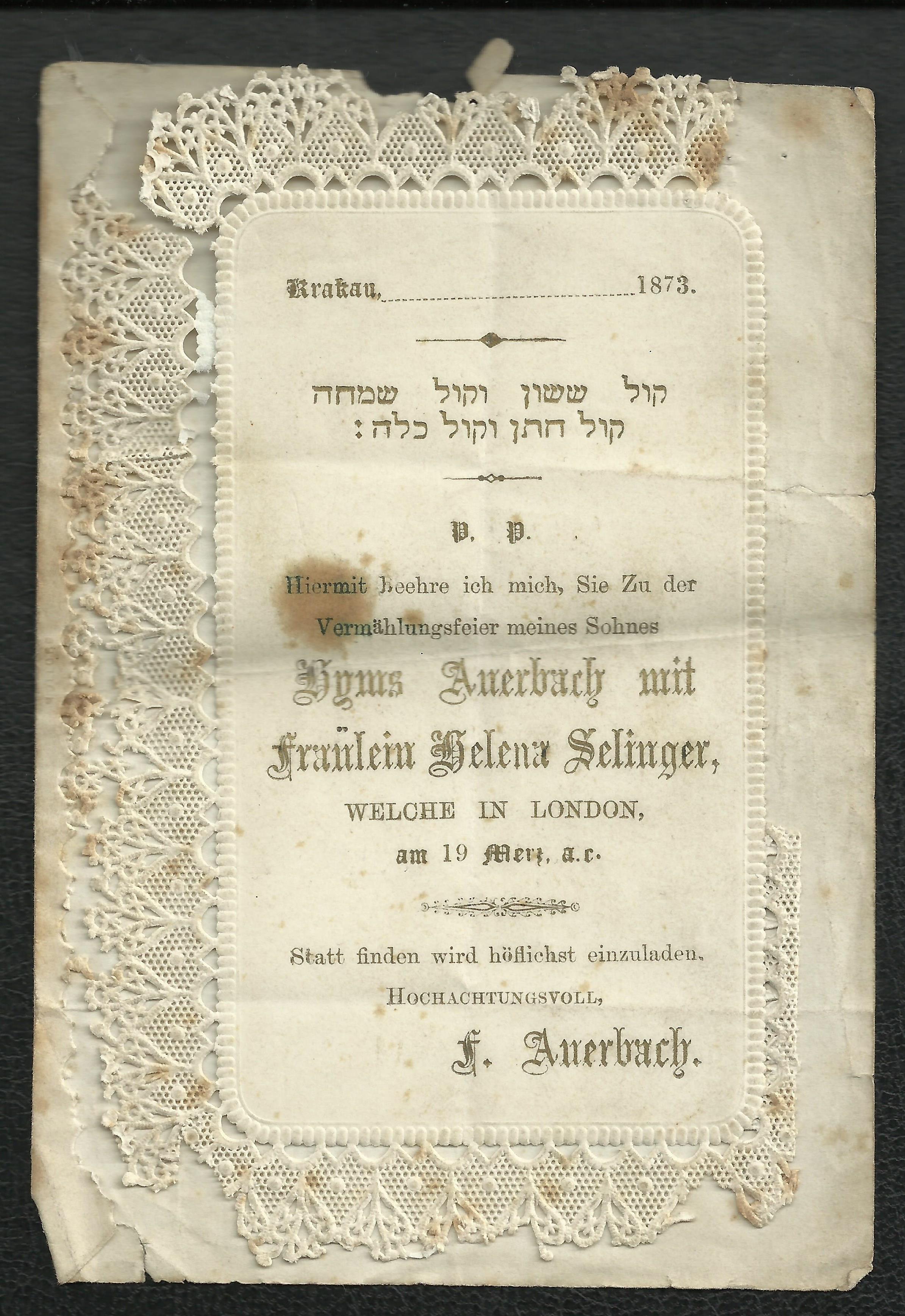
I’ve been delving into my paternal (Rosenthal) family history. I’ve found that my grandfather Jacob Rosenthal was married to Fanny Selinger. Unfortunately I haven’t found anything further about Fanny other than she was born in Germany, probably in 1857. However, I’ve recently come upon a wonderful paper lace invitation to the 1873 wedding of Hyams Auerbach and Helena Selinger that you referred to. What I don’t know is why Fanny would have been invited. Clearly she and Helena were related – but how ?

Needless to say, I was intrigued.  Maybe Fanny Selinger was related to Helena and/or maybe she was related to Julius, Frederick, and Alfred.  Shirley and I communicated by email, and we both started digging.

Invitation to the wedding of Helena Selinger and Hyms Auerbach Courtesy of Shirley Allen

Invitation to the wedding of Helena Selinger and Hyms Auerbach
Courtesy of Shirley Allen


I found a website called Jewish Genealogy of Bavarian Swabia (JGBS) that had records for Hurben and located 25 Selingers in their database, including those for Alfred and for Julius, who were the sons of Seligman Selinger and Breinle Hofstadter and thus were brothers, as I had suspected. Shirley and I both thought that Seligman Selinger had been Americanized to Sigmund by Julius on his passport application and that the birth records for Julius and Alfred confirmed that they were in fact brothers.

I also found a birth record for Helena Selinger, whose father was Abraham Selinger, not Seligman Selinger.  Abraham and his wife Rosalia Wilhelmsdoerfer had six children listed: Seligman (1842), Raphael (1843), Pauline (1845), Karolina (1847), Heinrich (1848), and Helena (1849). Pauline, Karolina, and Heinrich had all died as young children, leaving Seligman, Raphael, and Helena as the surviving children of Abraham.  Here is Helena’s birth record from Hurben in August 1849.

Helena Selinger birth record from Hurben http://jgbs.org/SuperSearch.php?Sp=3&Book=birth&Com=11

Helena Selinger birth record from Hurben (third from bottom)
http://jgbs.org/SuperSearch.php?Sp=3&Book=birth&Com=11


But what about Frederick?  And Fanny? And was there a connection between Helena’s father Abraham and the father of Julius and Alfred, Seligman Selinger?

A little more digging on the JGBS site revealed that both Abraham Selinger and Seligman Selinger were the sons of Joachim Selinger, thus confirming that they were brothers and thus that Helena was a first cousin to Julius and Alfred.

Marriage record from Hurben for Abraham Selinger, son of Joachim, and Rosalia Wilhelmsdoerfer http://jgbs.org/detail.php?book=marriage&id=%206671&mode=

Marriage record from Hurben for Abraham Selinger, son of Joachim, and Rosalia Wilhelmsdoerfer (second in page)
http://jgbs.org/detail.php?book=marriage&id=%206671&mode=


Seligmann Selinger, son of Joachim, marriage to Breinle Hoftsadter

Seligmann Selinger, son of Joachim, marriage to Breinle Hoftsadter (second from bottom) 1848 http://jgbs.org/detail.php?book=marriage&id=%206695&mode=


That meant that Eleanor Selinger, daughter of Julius Selinger, had married her second cousin, Henry Abbot, son of Helena Selinger.


But that still left us wondering about Frederick Selinger and Shirley’s great-grandmother Fanny Selinger.  How did they fit into this picture?

I contacted Ralph Bloch, the webmaster for the JGBS website, and he was extremely helpful.  More helpful than I realized at the time, but more on that later.  Ralph also could not find any evidence that Fanny was born in Hurben, and he reassured me that the birth records for Hurben were quite complete.  He even searched through the original pages to be sure that Fanny hadn’t somehow been missed when the records were indexed. (There was a Fany Selinger born in the 1830s, but that would have been far too early for Shirley’s ancestor.) Ralph also sent a photograph of Seligman Selinger’s headstone, which confirmed that his father’s name was Joachim or Chaim, his Hebrew name.

Seligman Selinger gravestone


So once again we hit the brick wall.  We still had not found either Frederick or Fanny.  Shirley said she would pursue it on her end, and I turned back to the other research I’d been doing when I received Shirley’s comment.

Not much happened again until late November when I heard again from Shirley, telling me that she had received a copy of Fanny Selinger’s marriage certificate, which revealed that Fanny was the daughter of Abraham Selinger.  Now we could link Fanny to Helena, also the daughter of Abraham, as well as to Julius and Alfred, Abraham’s nephews. But we didn’t know if Fanny and Helena were both the daughters of Rosalia Wilhelmsdoerfer.

Shirley’s research of UK records showed that by 1871 Abraham was married to a woman named Gali, and we assumed that Abraham had left Hurben at some point, that his first wife Rosalia had died, and that he had had several children with Gali.  That is what the UK census records from 1871 seemed to reflect. Abraham and Gali were living with Sigfried (28), Helena (20), Cornelia (18), and Oskar (4).  But there was neither a Fanny nor a Frederick.


Abraham Selinger and family 1881 UK census Class: RG10; Piece: 555; Folio: 86; Page: 3; GSU roll: 823397 Description Enumeration District : 10 Source Information Ancestry.com. 1871 England Census [database on-line]. Provo, UT, USA: Ancestry.com Operations Inc, 2004. Original data: Census Returns of England and Wales, 1871. Kew, Surrey, England: The National Archives of the UK (TNA): Public Record Office (PRO), 1871.

Abraham Selinger and family 1881 UK census
Class: RG10; Piece: 555; Folio: 86; Page: 3; GSU roll: 823397
Description
Enumeration District : 10
Source Information
Ancestry.com. 1871 England Census [database on-line]. Provo, UT, USA: Ancestry.com Operations Inc, 2004.
Original data: Census Returns of England and Wales, 1871. Kew, Surrey, England: The National Archives of the UK (TNA): Public Record Office (PRO), 1871.

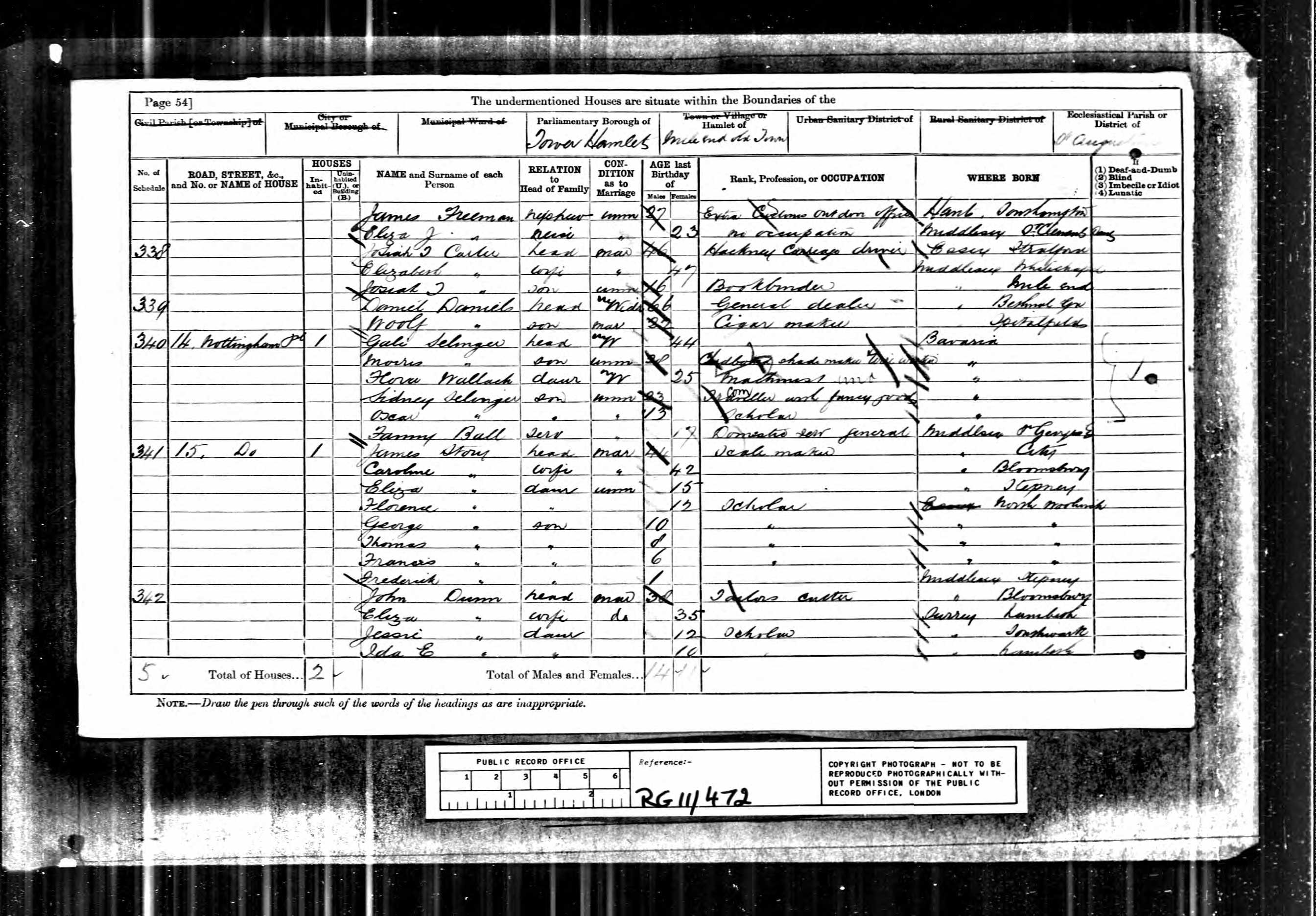
Abraham died in 1880, and in 1881, Gali was living with four children, but aside from Oskar (13), they were all different from those on the 1871 census: Morris (28), Flora (surname Wallach) (25), and Sidney (23).  Now I was really confused.  Who were these people, and where had they been in 1871?  Flora was presumably married to someone named Wallach and now a widow, but Morris would have been eighteen in 1871 and Sidney only thirteen. Where were they living?  Who were they? None of those children were listed on the Hurben birth register on the JGBS site; in fact, there were no children listed for Abraham Selinger and any wife in Hurben after Helena’s birth in 1849.

Gali Selinger and family 1881 UK census Class: RG11; Piece: 472; Folio: 118; Page: 55; GSU roll: 1341103 Description Enumeration District : 9 Original data: Census Returns of England and Wales, 1881. Kew, Surrey, England: The National Archives of the UK (TNA): Public Record Office (PRO), 1881

Gali Selinger and family 1881 UK census
Class: RG11; Piece: 472; Folio: 118; Page: 55; GSU roll: 1341103
Description
Enumeration District : 9 Original data: Census Returns of England and Wales, 1881. Kew, Surrey, England: The National Archives of the UK (TNA): Public Record Office (PRO), 1881

I assumed that Morris, Flora, Sidney, and Oscar, all born after 1850, were born in a different place and perhaps to a different mother.  Certainly Oskar had to be Gali’s child since he was so much younger than all the rest and only four on the 1871 census.

Searching again on Ancestry, I found a new record:  an entry for Abraham, Rosalia, Seligman, and Raphael Selinger on the Mannheim, Germany, family register dated November 26, 1848.  What were they doing in Mannheim? By that time the three younger children, Pauline, Karolina, and Heinrich, had died.  Perhaps they needed a change of scenery.  But what about Helena? She was born in Hurben in 1849.

Then I found a second Mannheim family register that included Helena, the final entry on the page:


Abraham Selinger and family, Mannheim register Ancestry.com. Mannheim, Germany, Family Registers, 1760-1900 [database on-line]. Provo, UT, USA: Ancestry.com Operations, Inc., 2014. Original data: Polizeipräsidium Mannheim Familienbögen, 1800-1900. Digital images. Stadtarchiv Mannheim — Institut für Stadtgeschichte, Mannheim, Germany.

Abraham Selinger and family, Mannheim register
Ancestry.com. Mannheim, Germany, Family Registers, 1760-1900 [database on-line]. Provo, UT, USA: Ancestry.com Operations, Inc., 2014.
Original data: Polizeipräsidium Mannheim Familienbögen, 1800-1900. Digital images. Stadtarchiv Mannheim — Institut für Stadtgeschichte, Mannheim, Germany.

My friends in the German Genealogy group,  Heike Keohane, Matthias Steinke, and Bradley Hernlem, came to my rescue and translated it to read, “Helene, his daughter, here born the 22 August 1849.”  So Helena’s birth is entered on the Hurben birth records (on the same date) and on the Mannheim records.  I’ve no idea which is the correct birthplace; maybe Rosalia went home to Hurben to give birth and returned to Mannheim afterwards where the family was living.

But perhaps now I could find out where Frederick was born, not to mention Morris, Flora, Sidney, and Oscar. Maybe they were born in Mannheim.  I checked the Mannheim birth records from 1853 through 1866 and found not one person named Selinger.  I checked over and over, looking at each page until my eyes were blurry.  There were no Selingers born in Mannheim during that period that I could find.

Then I discovered that Oskar Selinger had listed Ansbach as his birth place on his UK naturalization papers and thought that perhaps the family had moved from Mannheim to Ansbach.

Oscar Selinger UK naturalization papers The National Archives; Kew, Surrey, England; Duplicate Certificates of Naturalisation, Declarations of British Nationality, and Declarations of Alienage; Class: HO 334; Piece: 54 Description Description : Piece 054: Certificate Numbers A20701 - A21000

Oscar Selinger UK naturalization papers
The National Archives; Kew, Surrey, England; Duplicate Certificates of Naturalisation, Declarations of British Nationality, and Declarations of Alienage; Class: HO 334; Piece: 54
Description
Description : Piece 054: Certificate Numbers A20701 – A21000

I had no luck locating Ansbach birth records for that period, and by then it was Thanksgiving, and other matters distracted me, and I put the Selinger mystery on the back burner.

To be continued…..

Part III: My Grandmother and Her Brothers 1942-2004


As I wrote in my last post, my Schoenthal great-grandparents died in 1941 and 1942.  At that time, three of their children were living on the East Coast: Harold in Montclair, New Jersey, Lester in Upper Darby, Pennsylvania, and my grandmother Eva in Philadelphia.

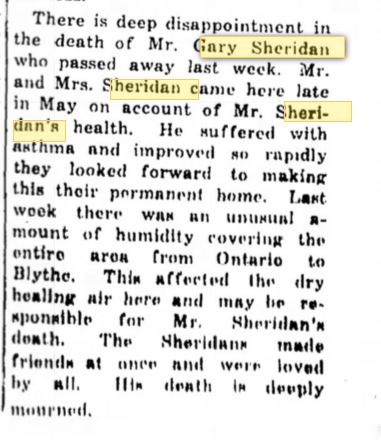
Gerson/Gary, the son whose asthma had taken them to Denver in 1907, continued to live in Denver with his wife Maude for many years, but in May, 1954 they decided to move to Desert Hot Springs, California, due to Gerson’s continuing health problems. The Desert Sentinel of Desert Hot Springs reported on June 10, 1954, p. 4, that, “Mr. and Mrs. Gary Sheridan are the lovely couple renting the Herb Ecclestone cottage for the summer. They are enamored of the village and will build a home here.” Sadly, within a few months of moving there, Gerson’s asthma finally took its toll, and he died at age 62.  As this article from the July 1, 1954, Desert Sentinel reported, it appears he and Maude had quickly made friends in their new home.

Gerson Schoenthal death Desert Sentinel July 1, 1954 p 1 Desert Hot Springs CA

How very sad that a fluke in the weather contributed to his death from the asthma he had battled for so many years.

Lester died five years later in August 1959, when he was seventy years old and had retired to Florida with his wife Juliet Grace “Julia” Beck.  She lived another fourteen years, dying in 1983, dying in and buried in Livingston County, Michigan.

Neither Lester nor Gerson had ever had children and thus have no descendants living today.  I never met Gerson or Lester, although I was two when Gerson died and seven when Lester died.  I had known virtually nothing about their lives before I started doing this research.


Harold Schoenthal

Harold Schoenthal


I did meet my great-uncle Harold, however. He had lived with his parents until they moved to Philadelphia in 1941 and had remained single.  When he was in his late 40s, he married May Gunther, and they had one child, my second cousin June.  Harold was in many ways a role model and mentor for my father.  He encouraged my father to pursue architecture, and my father took his advice and following in his footsteps, going to Columbia to study architecture.  Harold was not only a designer; he wrote poetry and painted.  He lived to 103, dying in 2004, in Montclair, New Jersey, where he had lived for almost eighty years.  Although I only saw him a handful of times, I remember him as a very gentle and kind man with a good sense of humor and a positive outlook on life.  I wish that I had been interested then in family history because he would have been an amazing source of information.


My Aunt Eva, my father, May and Harold Schoenthal

My Aunt Eva, my father, May and Harold Schoenthal

Uncle Harold and Aunt Eva

Aunt Eva and Great-Uncle Harold

Uncle Harold older


As for my grandmother, I knew almost nothing about her childhood before I started my research.  When I found the pictures and news stories about her in the Denver papers and in her high school yearbook, it made me think that she might have had a happy childhood growing up in Denver.  But her life was filled with challenges once she left Denver.  She was only eighteen and just out of high school when she married a man she had known for only half a year and who was nine years older than she was; within a year she had had a child and before she was twenty-three, she had two children.  She was living halfway across the country, far from her parents and two oldest brothers.  Only Harold was nearby.

Eva Schoenthal Cohen

Eva Schoenthal Cohen

Then her husband became disabled, and she just was not strong enough to deal with it all.  When she finally started getting her life back together in the early 1940s, she lost both of her parents within a year of each other. Soon thereafter both of her children became adults and left home.  She remarried in the 1950s to a very nice man named Frank Crocker who cared for her until she died in 1963 when she was 58 years old.

It was when she was married to Frank that I knew her, and we would see her a few times a year when we would make day trips to Philadelphia to visit. My clearest memory involves Frank more than my grandmother; he and I watched a Dodgers-Phillies game together on television during one of those visits, and if I remember correctly, Sandy Koufax was pitching.   I thought of that day when I saw last week that Sandy Koufax had turned eighty years old.

My memory of my grandmother is of someone who was fragile and insecure with a reserved and genteel presence.  But to be honest, I really did not know her well at all.  Doing this research has given me a somewhat fuller picture, and although she remains largely a mystery to me, at least I now know more about her brothers and her parents and the lives they led as well as more about her and her life.

My father and my grandmother at his graduation from Columbia, 1952

My father and my grandmother at his graduation from Columbia, 1952


My Aunt Eva’s Magic Suitcases: Another Small World Story

A long time back I mentioned that my father had two suitcases filled with photographs and letters that had belonged to his sister, my aunt, Eva Hilda Cohen.  My aunt had died February 14, 2011, but my father had never gone through the suitcases and wasn’t eager to do so.  Finally this past weekend he agreed to let my brother and me bring the suitcases down from their garage and go through their contents.  I was hoping for some old photographs or letters about my ancestors, and I didn’t find much of that, but there was an amazing small world story that came out of those suitcases. (I will report on the other finds in later posts.)

First, a little bit about my Aunt Eva.  She was born on January 13, 1924, the first child of my paternal grandparents, John Nusbaum Cohen, Sr. and Eva Schoenthal.

Eva Hilda Cohen

Eva Hilda Cohen

My father was born almost three years later.  They were very close as children growing up together.

Eva and John Cohen, Jr.

Eva and John Cohen, Jr.

My father describes his sister as a strong-willed and rebellious child who became a strong-willed and rebellious teenager and adult. She also was a very intelligent woman with many interests. She graduated from Gratz High School in Philadelphia in 1941, where she apparently was known by the nickname “Ave,” and was described as follows in the yearbook: “To Gratz our “Ave” has given services of hours; in almost every field she has displayed her powers.”  From the list of her activities, that inscription seems accurate: drama club, debate club, a cappella choir, and several others.

Aunt Eva yearbook picture

Simon Gratz High School yearbook 1941 Ancestry.com. U.S., School Yearbooks, 1880-2012 [database on-line]. Provo, UT, USA: Ancestry.com Operations, Inc., 2010.

During World War II, she served in the United States Navy. She served from February 10, 1944 until February 10, 1946, and was stationed in Corpus Christi, Texas, for most of her second year of service.  She wrote a letter to her mother in May, 1945, describing her trip by train from Philadelphia to Texas.  I had to chuckle as I read it because it sounded so much like her, describing and naming every person that she met along the way.    She clearly was a hit with the servicemen, frequently being invited to eat and drink and sit with them on that long train.  That ability to befriend new people wherever she went was a skill she maintained throughout her life.

After the war, she completed her education at the University of Colorado at Boulder.  There she also was active socially and academically.

Aunt Eva college yearbook

University of Colorado at Boulder yearbook 1949 Ancestry.com. U.S., School Yearbooks, 1880-2012 [database on-line]. Provo, UT, USA: Ancestry.com Operations, Inc., 2010.

After college she became engaged to be married to a man named Karl, but when she was diagnosed with multiple sclerosis, Karl broke it off, not wanting to care for someone he thought would be an invalid.

Eva and Karl

Eva and Karl

He sorely underestimated her.  She never married, but her inner strength and her independence held in her good stead for the rest of her life even as her physical challenges became greater.  She worked for the city of Philadelphia until retirement age, and she had a large circle of friends who were devoted to her. She traveled all over the world and was interested in many things and well-informed about current events. She remained devoted to my father, and he to her, her whole life.

Her collected photographs and letters reflected those priorities— the many letters she kept that she had received from my father over the years; lots of photographs of our family, extended and immediate; lots of pictures from her numerous trips and cruises.  And many, many pictures of people who were her friends. The photographs were not at all organized by subject matter or date, so as I went through the photographs with my brother, I sorted them into piles—family, travel, friends.  I wasn’t particularly interested in the last two categories, but I still looked at each photo, hoping to find some of my ancestors or distant cousins mixed in.

Then I found this photograph.  It was a Christmas card with a family photograph, an item for the friends’ pile.  But I looked at it more closely and thought one of the faces looked familiar.  Then I looked at the family’s surname, and I got the chills.  The face was in fact familiar.

Scan0014


The little boy in that photograph looked just like the young man who is now engaged to my daughter’s best friend Anna.  I knew that her fiancé Mark was from Philadelphia, and it certainly was possible that my aunt could have known his family.  But nevertheless—what were the odds?  Mark’s parents are at least a generation younger than my aunt.  How in the world would they have known her? It made no sense.  I continued looking through the photographs, and I found five more pictures of Mark’s family, including his parents’ wedding photograph.  Obviously, my aunt knew his family for a long, long time.

I took snapshots of the pictures of Mark’s family with my phone and sent them to Maddy and Anna, asking them if this was Mark’s family. Anna responded that indeed it was his family.  Anna asked Mark what he knew about my aunt, if anything, and he did remember her and said that his father had been a lifeguard at the pool in her building and had met her there.

That made perfect sense to me.  My aunt was an avid swimmer; being in the water gave her the mobility and comfort that she could not find out of the water because of her MS.  As my father wrote in one of his letters to her, she swam in pools and oceans all over the world; she found it liberating.  When she moved into The Philadelphian, one of the large apartment buildings in Philadelphia, one of the great benefits was that there was a pool in the building.  It was there that she made many friends over the years, including Mark’s father and his family.

Scan0016 (2)

I still get the chills thinking about this.  There I was sitting in my parents’ house, sorting through photographs mostly of strangers, and I found a photograph of someone who will now be marrying Anna.  Anna, whom I’ve known since she was born and who has been my daughter Maddy’s best friend since they sat in the sandbox as one year olds at our child care cooperative in 1985.  Anna, who was Maddy’s roommate in Boston for several years—until she met Mark.  Mark, a delightful young man whom we met the first time a few years back when he was helping Maddy and Anna move from one apartment to another and sitting patiently outside the apartment, watching their stuff while they went to rent a truck.  Mark, whose father befriended my aunt years before Mark was even born and who obviously stayed in touch with her over the years as his children grew to adulthood.

I am sure that my aunt would have been thrilled to know that her friend’s son was marrying her great-niece’s best friend.  I am just sorry she is no longer around to hear the story.  It’s the kind of story she would have loved.

Scan0025


My Grandmother, Eva Schoenthal Cohen

It’s time to turn another page in the history of my family, or I suppose I should say, to climb another branch on the family tree.  Thus far I have researched my mother’s maternal and paternal sides as far back as I’ve been able (not far enough yet, but as far as I can, given the lack of documentation) and my father’s paternal side as far as I’ve been able.  Now I turn my focus to my father’s maternal side—his mother’s parents and their ancestors.  His mother’s father was Isidore Schoenthal; his mother’s mother was Hilda Katzenstein.  I am going to start with the Schoenthal family and explore and learn what I can about my great-grandfather, his parents, his siblings, and his children, including my paternal grandmother Eva Schoenthal Cohen.

My Grandma Eva

My Grandma Eva

My grandmother Eva was a beautiful and refined woman.  She was born on March 4, 1904, in Washington, Pennsylvania, but the family moved to Denver, Colorado, by the time she was six years old because one of Eva’s brothers had allergies and the doctors had recommended the drier climate out West.  After graduating from high school in Denver in 1922, Eva traveled to Philadelphia to visit with some of her mother’s family who lived there.

Eva Schoenthal high school yearbook picture

Eva Schoenthal high school yearbook picture

My grandfather John Nusbaum Cohen, who was born and raised in Philadelphia, met her at a social event there, and he was so taken with her that he followed her back to Colorado to woo her and ask her to marry him.  She was very young when they met—only eighteen and right out of high school; my grandfather was nine years older.  Eva accepted his proposal, and they settled in Philadelphia after marrying in Denver on January 7, 1923.

Eva Schoenthal and John Cohen, Jr. 1923

Eva Schoenthal and John Nusbaum Cohen, Sr. 1923

John and Eva Cohen c. 1930

John and Eva (Schoenthal) Cohen
c. 1930

Their first child, my aunt Eva Hilda Cohen, was born a year later on January 13, 1924, and my father was born almost three years after that.

My grandmother Eva Schoenthal Cohen and my aunt Eval Hilda Cohen

My grandmother Eva Schoenthal Cohen and my aunt Eva Hilda Cohen

My grandmother and my father

My grandmother and my father

In 1930, they were living at 6625 17th Street in Philadelphia, and my grandfather was a merchant, selling jewelry and clothing at a store called The Commodore, as I’ve written about previously.  They even had a servant living with them named Frances Myers, according to the 1930 census.

Year: 1930; Census Place: Philadelphia, Philadelphia, Pennsylvania; Roll: 2133; Page: 41B; Enumeration District: 1034; Image: 588.0; FHL microfilm: 2341867

Year: 1930; Census Place: Philadelphia, Philadelphia, Pennsylvania; Roll: 2133; Page: 41B; Enumeration District: 1034; Image: 588.0; FHL microfilm: 2341867

But not long afterwards, their life as a family suffered two major blows.  My grandfather was diagnosed with multiple sclerosis, and by 1936 had to be admitted to a veteran’s hospital where he lived the rest of his life.  Meanwhile, my grandmother Eva, a fragile and sensitive woman probably overwhelmed by what was happening to her, had herself been hospitalized and when released was not able to take care of her two young children.  As I’ve written before, my father’s paternal grandmother Eva May Seligman Cohen took care of my father and my aunt for several years.  After my great-grandmother died in 1939, my grandmother was well enough to move back to Philadelphia to live with my father and aunt.  In 1940, the three of them were living at 2111 Venango Street, and my grandmother was employed as a saleswoman in the wholesale china business, according to the 1940 census.

Year: 1940; Census Place: Philadelphia, Philadelphia, Pennsylvania; Roll: T627_3732; Page: 11A; Enumeration District: 51-1431

Year: 1940; Census Place: Philadelphia, Philadelphia, Pennsylvania; Roll: T627_3732; Page: 11A; Enumeration District: 51-1431

The 1940s must have been very difficult for my grandmother.  Her mother died in 1941, her father the following year.  My father and my aunt both served in the military during World War II and went away to college.  My grandmother remarried after World War II.  Her second husband, Frank Crocker, was the only “grandfather” I knew on that side of my family.  He was a kind and talkative man, much more outgoing than my shy, reserved grandmother.

My father and my grandmother at his college graduation in 1952

My father and my grandmother at his college graduation in 1952

Even as a child, I sensed that that my grandmother was a bit insecure and unsure of herself and perhaps uncomfortable around her three grandchildren.  I found her beautiful and refined,  and also somewhat mysterious.  Of course, as a child I knew nothing about her life.  Only by stepping into the family history and asking my father more questions did I develop a better understanding of who she was.

My grandmother died on January 10, 1963, when I was ten years old.  Her death was the first one I ever experienced.  (Although my mother’s father Isadore Goldschlager died when I was four years old, I really have no memory of his death.)  I remember being frightened and worried about my father and also confused because no one really talked about it before she died or after.  We weren’t (and still aren’t) too good at those things.

So as I start to delve now more deeply into her family history, I do it with the perspective of trying to understand who my grandmother was, where she came from, what her family was like, and how that all fits with the woman I remember.

Passover 2015: The American Jewish Story

Handmade shmura matzo used at the Passover Sed...

Handmade shmura matzo used at the Passover Seder especially for the mitzvot of eating matzo and afikoman. (Photo credit: Wikipedia)

A year ago I was feeling disconnected from Passover until I heard my grandson tell us the story of Passover in a way that made it feel new and exciting and different all over again.  This year his little brother will experience his first seder, though at only ten months, that experience will likely be short and quite unfocused.  Just a lot of really noisy people sitting around a table eating food that he neither can nor would want to eat.  But it’s a new reminder that every generation and every child experiences Passover as a new experience, allowing all of us who are jaded and detached to be able to relive our own early experiences with this special holiday.

Last year I entered into Passover thinking about my mother’s ancestors, the Brotmans, the Goldschlagers, and the Rosenzweigs.  I focused on their exodus from the oppression and poverty and anti-Semitism of Galicia and Romania and their courage and the desire for freedom that led them to leave all they knew to cross the continent and then the ocean and come to New York City, where they again lived in poverty but with greater hopes for a life of freedom and economic opportunity.  And they attained their goals if not in that first generation, certainly by the third and fourth generations.

Poor Jews taking home free matzohs, New York

Poor Jews taking home free matzohs, New York (Photo credit: Wikipedia)

For the last year now, I have been researching, studying and writing about my father’s paternal relatives.  It has taken just about a full year to cover the Cohens, the Jacobs (with whom I actually need to do more work), the Seligmans, the Schoenfelds, the Nusbaums, and the Dreyfusses.  Soon I will start my father’s maternal relatives—the Schoenthals and Katzensteins and whatever other surnames pop up along the way.  Researching my father’s families has been so different from my mother’s, and I can go so much further back.  I can’t get back much before 1840 with my mother’s family and have absolutely no records before 1885 or so for any of them.  Although I have a number of Romanian records for my Rosenzweig and Goldschlager relatives, I have no records at all from Europe for my great-grandparents Joseph and Bessie Brotman, despite hours and hours of searching and even DNA testing.

In contrast, my father’s ancestors have provided me with a rich opportunity to learn about Jews in Amsterdam, London, and especially the towns of Gau-Algesheim, Erbes-Budesheim, Bingen, and Schopfloch, Germany.  I have been able to find records all the way back to 1800 or so for almost every line.  I’ve had amazing help along the way on both sides of the Atlantic, and I’ve even learned a little German to boot.  My father’s families were pawnbrokers and peddlers and clothing merchants; they were pioneers and politicians and war heroes.


http://www.gettyimages.com/detail/182866324
Harrisburg Market Square with Leo Nusbaum store

Harrisburg Market Square with Leo Nusbaum store

They came to the United States in the 1840s and 1850s, and most of them suffered terrible heartbreaks, economic struggles, and early deaths.  Most of them settled in Philadelphia and other parts of Pennsylvania and New Jersey, but there were those who went to places that I’d never think a Jewish immigrant would go: Iowa, Texas, Illinois, Michigan, California, and, of course, New Mexico.  Many married outside the Jewish community and assimilated into American culture far more so than my mother’s relatives.  Ultimately, the Cohens/Jacobs and Seligmans/Schoenfelds and Nusbaums/Dreyfusses were successful; they found the American dream, and they embraced it.

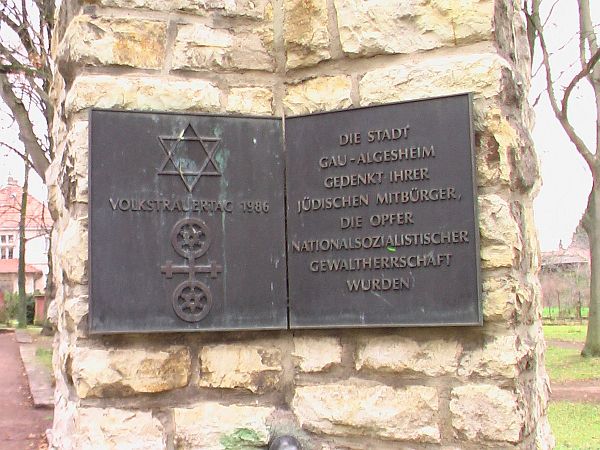
But there is a very sad underside to this story of American success.  It’s the story of those who did not leave Europe.  For the first time in my life I confronted the reality that the Holocaust did not just happen to other families, to other Jews.  Not that I have not been deeply affected by the Holocaust all my life; ever since I read Anne Frank’s diary as a child, I’ve identified with and cried for all those who were murdered by the Nazis.  But I never knew that I had relatives left behind in Germany who were part of that slaughter.  I am still finding more, and I will write about them soon.  The list of names of my cousins who died in the Holocaust grows longer and longer, and I realize more than ever how grateful I should be to Bernard Seligman, John and Jeanette (Dreyfuss) Nusbaum, and Jacob and Sarah (Jacobs) Cohen for leaving Europe and taking a chance on the new country across the ocean.

memorial plaque gau aldesheim

So this year for Passover I will be thinking about that first major migration of Jews from Europe to America.  I will be feeling thankful for the risks my ancestors took, and I will be feeling the loss of not only all those who were killed in the Holocaust, but the loss of all the children and grandchildren who would have been born but for those deaths.

And overall I will be celebrating family, freedom, and faith—faith that the world can be a better place and that human beings can be their best selves and live good and meaningful lives.  May all of you have a wonderful weekend—be it Passover or Easter or perhaps just another weekend in April for you.   Celebrate all the good things in life in whatever way you can.


Embed from Getty Images

Death Certificates: Answering Some Unanswered Questions

Over the last few weeks I have received a number of death certificates, most for people about whom I have written, so I will also post them as updates to the relevant posts.  But I also wanted to post about them separately for those who might never go back to those original posts.

Three of these were for relatively young men whose deaths puzzled me.  Why had they died so young?  E.g., Simon L.B. Cohen.  He was only 36 when he died on October 24, 1934, after serving valiantly in World War I.  He was my first cousin, twice removed, the first cousin of my grandfather John Nusbaum Cohen.  Simon had faced the horrors of war, been awarded a Distinguished Service Cross by General Pershing for his service, and had been reported killed in action when he was in fact still alive.  He came home and married, but then died only five years after he married.  I had wondered what might have caused such a young man to die after surviving everything he did during the war.

His death certificate reported that his cause of death was glomerulonephritis, chronic myocarditis, and arterial hypertension.  Glomerulonephritis is a form of kidney disease, sometimes triggered by an infection like strep or some other underlying disease.  Overall, it would appear that Simon was just not a healthy 36 year old.  But that’s not the whole story.  The death certificate also described Simon as an “unemployed disabled veteran.”  Although I do not know in what way he was disabled, obviously Simon paid a huge price for what he endured while serving in the military.

Death certificates_0004_NEW

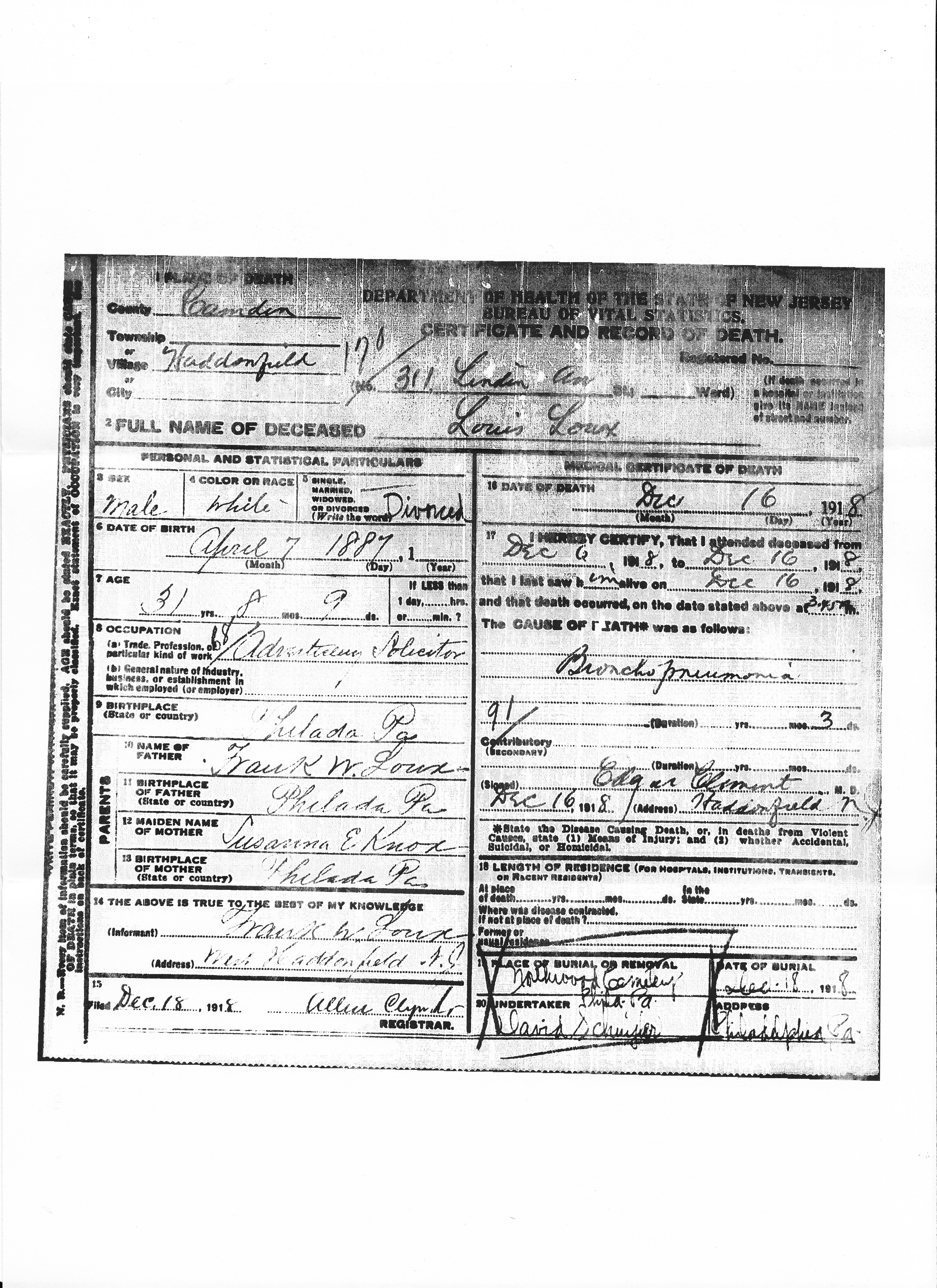
The second young man whose death puzzled me was Louis Loux.  Louis was the husband of Nellie Simon, daughter of Eliza Wiler and Leman Simon.  Louis was thirteen years younger than Nellie.  They had a daughter Florrie, born in 1910, who died from burns caused by matches.  She was only eight years old when she died in September, 1918.  Then her father Louis died just three months later on December 15, 1918.  He was only 36 years old.  I had wondered whether there was some connection between these two terrible deaths.  I knew from the 1920 census that Nellie and Louis had divorced, but I did not and still do not know whether that was before or after their daughter died.  From the death certificate for Louis, I learned that he died from broncho pneumonia. So it would seem that it was perhaps just a terrible sequence of events and that Louis’ death was not in any directly related to the death of his daughter.

Death certificates_0003_NEW

The next death I had wondered about was that of Mervin Simon, the great-grandson of Mathilde Nusbaum and Isaac Dinkelspiel.  He was only 42 years old when he died on August 27, 1942.  He was the son of Leon Simon, who was the son of Moses Simon and Paulina Dinkelspiel.  Mervin died almost a year to do the day after his father Leon.  According to his death certificate, he also died from broncho pneumonia.  Like Simon Cohen, he had no occupation listed on his death certificate.  Even on the 1940 census, neither Mervin nor his brother William had an occupation listed.

Mervyn Simon death certificate

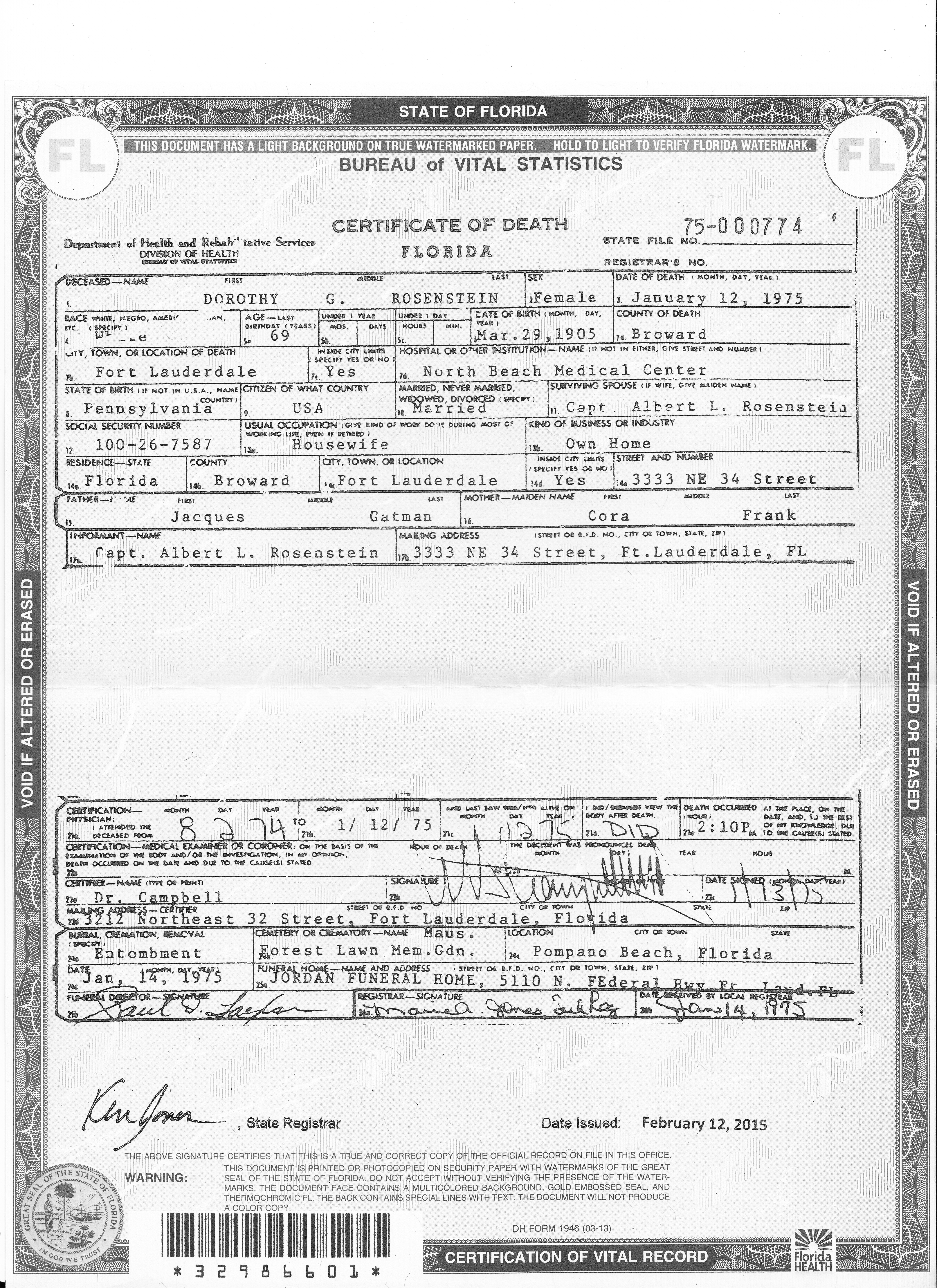
The last death certificate I received in the last few weeks was for Dorothy Gattman Rosenstein.  Dorothy was the daughter of Cora Frank from her first marriage to Jacques Gattman.  Cora was the daughter of Francis Nusbaum and Henry Frank and the granddaughter of Leopold Nusbaum.  Cora’s husband Jacques had died when Dorothy was just a young child, and Cora had remarried and moved to Dayton, Ohio, with her new husband Joseph Lehman and her daughter Dorothy.  I had had a very hard time tracking down what happened to both Cora and Dorothy, and only with the help from a number of kind people had I learned that Dorothy had married Albert Rosenstein from Lancaster, Pennsylvania.  But I wanted the death certificate to corroborate all the other less official evidence I had that this was in fact the same Dorothy Gattman, daughter of Jacques Gattman and Cora Frank.  Her death certificate confirmed that.

Death certificates_0001

Thus, all of these certificates helped put closure on some lingering questions that had bothered me.

John Nusbaum 1814-1889: The Family Patriarch

By 1880, my three-times great-grandparents, Jeanette (Dreyfuss) and John Nusbaum, and their extended families had not only grown in size but spread across a wider swath of the northeastern United States.  Some were still in Harrisburg or Philadelphia, but others were in Peoria, Baltimore, and Pittsburgh.  Although many were still dry goods merchants, the younger generations were also involved in various aspects of the liquor trade.  The family had endured the economic crisis of the 1870s, seeing some bankruptcies and the closings of several stores and businesses.  A number of young children had died, and by 1880, of the siblings of John and Jeanette Dreyfuss, only Ernst and John were still alive on the Nusbaum side, while Jeanette’s two sisters Caroline and Mathilde were both still living.

The next two decades brought with it more changes, more weddings, more new children, and sadly more deaths.  In my next series of Nusbaum/Dreyfuss posts I will try to bring the various branches up to the 20th century, focusing first on my direct ancestors, John and Jeanette and their children and grandchildren.

As I’ve written, in 1880 John and Jeanette were listed on the census in two different locations, living thousands of miles apart.  John was living with their daughter Frances and her husband Bernard Seligman (my great-great-grandparents) in Santa Fe along with his son Simon.  Jeanette, on the other hand, was living in Philadelphia with their daughter Miriam and her husband Gustavus Josephs along with Lottie Nusbaum, the youngest child of John and Jeanette, and Milton Josephs, the young son of Miriam and Gustavus who would die from bronchial pneumonia just a few months after the 1880 census was taken.  These must have been very hard times for my ancestors, and I will never know whether John moved to Santa Fe for financial reasons or because of marital problems.  I will never know whether he was there for a month or a year.

English: A Areal map of Santa Fe, New Mexico d...

English: A Areal map of Santa Fe, New Mexico during the Railroad era in 1882. (Photo credit: Wikipedia)

But I do know that John is listed in the 1881 Philadelphia directory as residing at 1129 Master Street, the same address where the Josephs family and Jeanette and Lottie were living on the 1880 census.  Whether John was actually back or not is hard to say for sure, but he does not appear again on any Philadelphia directory until 1886, when he is listed as being in the “segar” business and living at 524 North 11th Street, the same address given for his daughter Lottie.  Although Gustavus and his family are not listed in the 1881 directory, they show up in the 1884 directory still living on Master Street, so it would seem that sometime between 1881 and 1886, John and Lottie and presumably Jeanette had moved to their own home on North 11th Street.

I found it puzzling that John, after over forty years in the dry goods business, had entered the cigar business.  But his store had gone bankrupt, and perhaps this seemed to be a good way to make a fresh start in the 1880s.  John was already in his 70s by 1886, so it is even more surprising that he was starting in a new trade instead of just retiring.  I did some reading about the tobacco industry and learned that the John Bonsack invented the cigarette rolling machine in 1881, leading to a widespread increase in cigarette smoking (previously, tobacco was either chewed, smoked in a pipe, or hand rolled into a cigar or cigarette).   I don’t know whether this technological development had any effect on John’s decision to sell cigars, and I don’t know whether he sold only cigars or also cigarettes, but the timing does seem to be enough for me to think this was not just coincidental.  In 1887, John again is listed at the same residence and as being in the “segar” business.

English: Trade card of a cigar dealer after a ...

English: Trade card of a cigar dealer after a photograph of Napoleon Sarony, using Oscar Wilde’s popularity during his American trip of 1882 (Photo credit: Wikipedia)

Meanwhile, the children of John and Jeanette were also finding their way in the 1880s.  Adolphus and Julius were still in Peoria, working in the dry goods business, now called Nusbaum Bros.  Since Julius had been one of his father’s creditors in the bankruptcy proceedings, perhaps the business was now owned by the brothers instead of their father.  Julius was living with his brother Adolphus and sister-in-law Fannie, who had no children.

Simon, meanwhile, had remained in Santa Fe and was still unmarried and living with his sister, my great-great-grandmother Frances Nusbaum Seligman, and her family in 1885 according to the New Mexico Territorial Census of that year.   In 1887 Simon was appointed to be a clerk in the US post office in Santa Fe, a position he continued to hold for many years, being promoted to assistant postmaster by 1889 and ultimately to postmaster in 1898.

Miriam and Lottie, the remaining two children of John and Jeanette, were living in Philadelphia.  Miriam and her husband Gustavus had a third child in 1882, Gertrude, after losing Milton in 1880.  Their second child Florence was then two years old.  On November 28, 1888, Gertrude died from diphtheria (croupus form, according to the death certificate). She had just celebrated her sixth birthday less than a month before.  Eight year old Florence was once again an only child.  The family had lost yet another young child.  For Miriam and Gustavus to lose two young children in the space of eight years must have been completely devastating.

gertrude josephs death certificate

As for Lottie, John and Jeanette’s youngest child, she was just seventeen in 1880 and still living at home, as she did throughout the decade.

The decade drew near a close on another sad note for the family when my three-times great-grandfather John Nusbaum died on January 24, 1889.  He was 74 years old.  According to his death certificate, he died from lobular heart disease, chronic cystitis, and diabetes.  Notice also that the residential address on both Gertrude Josephs’ and John Nusbaum’s death certificates is the same: 1617 North 13th Street.

John Nusbaum death certificate

John Nusbaum was born in Schopfloch, Germany, in 1814, the sixth child of Amson Nusbaum and Voegele Welsch.  He had been one of the pioneers in the family, coming to Pennsylvania in the 1840s, probably starting as a peddler and then establishing himself as a merchant first in Harrisburg and then in Philadelphia.  He had seen much success and some failure in his business; he had helped out his siblings and their widows when his brothers Maxwell and Leopold died.  He and Jeanette had been the common link that brought together many connections between the Nusbaum, Dreyfuss, Dinkelspiel, Wiler, and Simon families.  I imagine that it must have been very hard for the family to lose him.  Sadly, I cannot find one obituary or death notice for him.

John Nusbaum’s name lived on in other ways, however. Four years after he died, his daughter Miriam and her husband Gustavus had one last child on July 26, 1893, five years after they had lost Gertrude and eleven years since Miriam had last given birth.  They named their son Jean, I assume in honor of Miriam’s father.

Two years later in 1895, John Nusbaum’s granddaughter Eva Seligman Cohen had a fourth son whom she and her husband Emanuel Cohen named John Nusbaum Cohen.  He was my grandfather, named for his great-grandfather.  Eva must have known her grandfather John Nusbaum very well, not only when she was a young child living in Philadelphia and not only when he had lived with her family for some period of time in Santa Fe, but also because she had moved to Philadelphia for college and then settled there after marrying my great-grandfather in 1886.  She must have seen a great deal of him in those last few years of his life.

John Nusbaum Cohen c. 1894

John Nusbaum Cohen c. 1895

When Simon Nusbaum married at a late age, he and his wife also named a son for Simon’s father.  John Bernard Nusbaum was born on May 15, 1904, in Santa Fe. (I assume that the Bernard was for Simon’s brother-in-law Bernard Seligman, who had died the year before.)

And, of course, John Nusbaum’s name lives on today through my father, John Nusbaum Cohen, Jr.  It’s a legacy that my three-times great-grandfather well deserved.  We may not have a photograph to remember his face, but we will always remember his name.


Who is the little boy?

For my first 2015 post, I have some wonderful new photos from my cousin Lou.  These are photos he scanned from our mutual cousin Marjorie’s photo collection, but we don’t yet know who some of the people are in these photos.  We are hoping Marjorie will be able to tell us.  Some of these are quite intriguing as I am hoping that they will be photographs of family members I’ve never seen before.

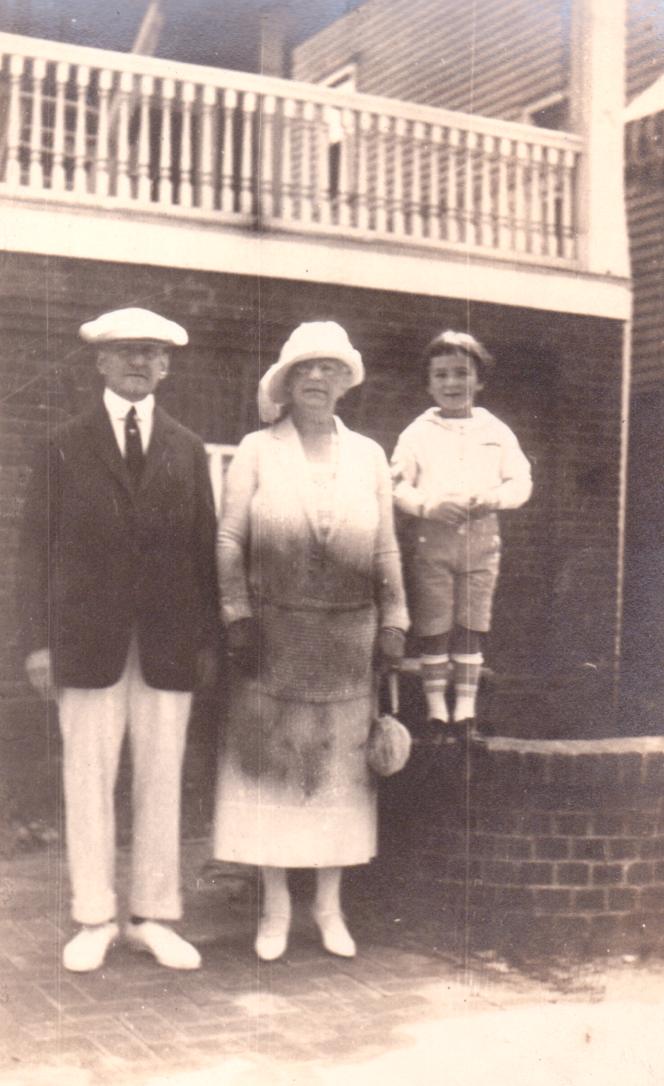
For example, here is a photograph of my great-grandmother, Eva Seligman Cohen, wife of Emanuel Cohen, daughter of Bernard Seligman and Frances Nusbaum.  But who is the man to her right? And who is the little boy to her left? Or is the little boy a little girl? Possibly Marjorie?

I showed my father the photograph, and he could not identify either person.  Could the man be Emanuel Cohen, my great-grandfather?  That would be the first photograph I’ve ever seen of him.  The little boy might be one of my father’s first cousins, Maurice Cohen, Junior, or Emanuel “Buddy” Cohen. If the older man is Emanuel, the photograph had to be taken in 1926 or before, as he died in February, 1927, and this is a photograph taken in the summertime.  Junior was born in 1917, Buddy in 1922, so it is possible that this is my great-grandparents standing with one of their grandsons.  I hope Marjorie can help us.

Eva Seligman Cohen with unknown man and boy

Here is another photograph of that little boy.  The man to his left is Stanley Cohen, my great-uncle, Marjorie’s father.   Marjorie album 58


But who is the man to his right?  Could it be my other great-uncle, Maurice Cohen, Senior?  I’ve never seen a picture of him nor have I seen a picture of either of his two sons, Junior and Buddy.  Maurice died in 1931; if this was taken in 1926 or so, this certainly could be him.  Maurice would have been 38 in 1926, Stanley would have been 37.

Finally, there is this photograph of the little boy.  Marjorie album 19

Who is that man?  It’s not the same man standing with my great-uncle Stanley in the prior photograph.  He seems to be a fair amount younger than both that other man and Stanley.

All those photographs seem to have been taken on the same day in Atlantic City, maybe around the same time as this photograph taken in 1932:

Eva M. Cohen, center, 1932 (Arthur Seligman, right)

Eva M. Cohen, center, 1932 (Arthur Seligman, right)

It looks like my great-grandmother was wearing the same or a similar hat and outfit to those she was wearing in the first photograph.

I am anxious to hear what Lou learns from Marjorie when he sees her.

Thanksgiving: More Gifts, More Gratitude

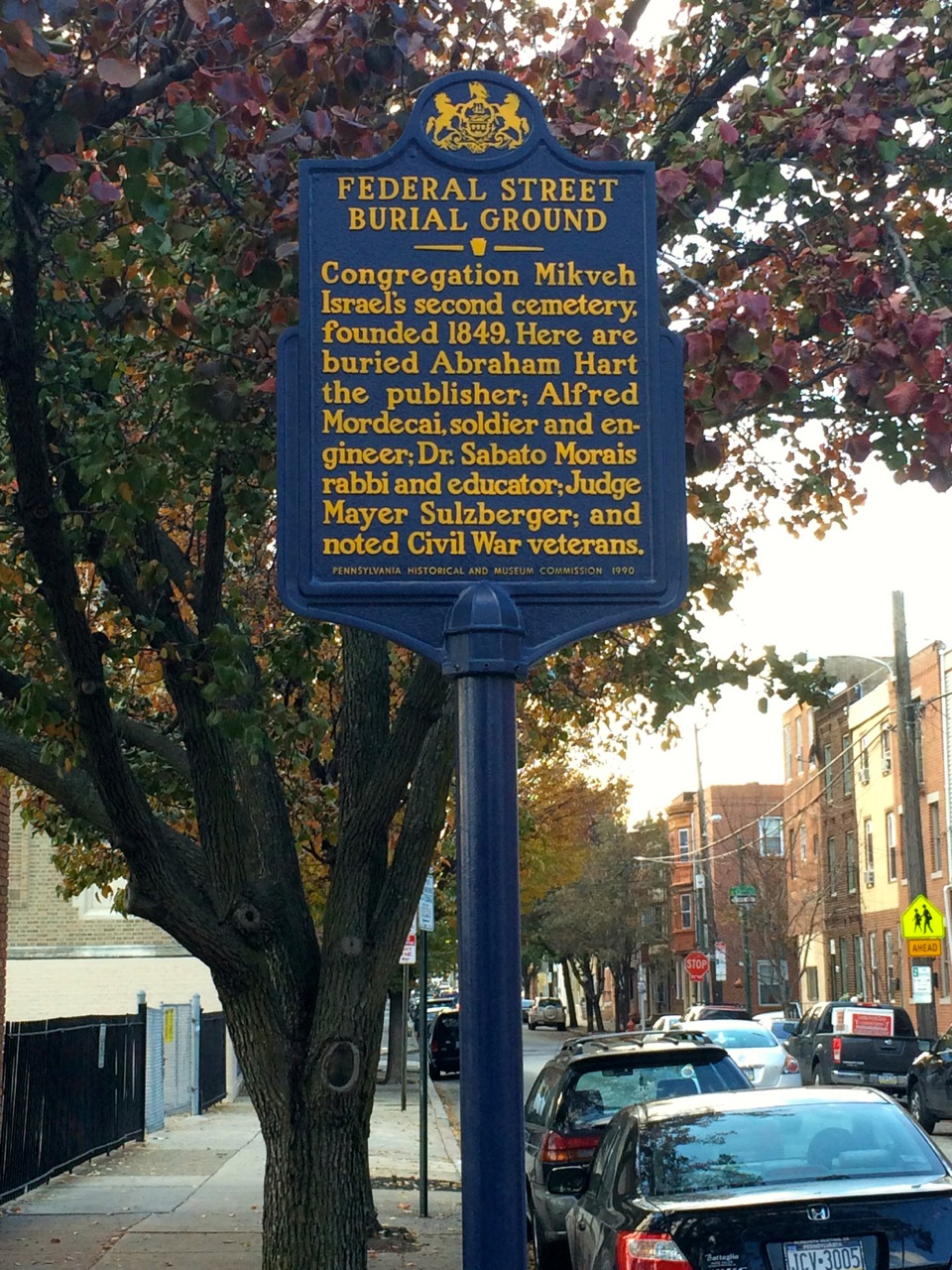
cemetery sign for Mikveh Israel

It’s been a week or so of amazing gifts.  First there was the package from Gau-Algesheim with the records and book relating to my Seligmann ancestors and the amazing help I received from Ralph Baer and Matthias Steinke with translation of these items.

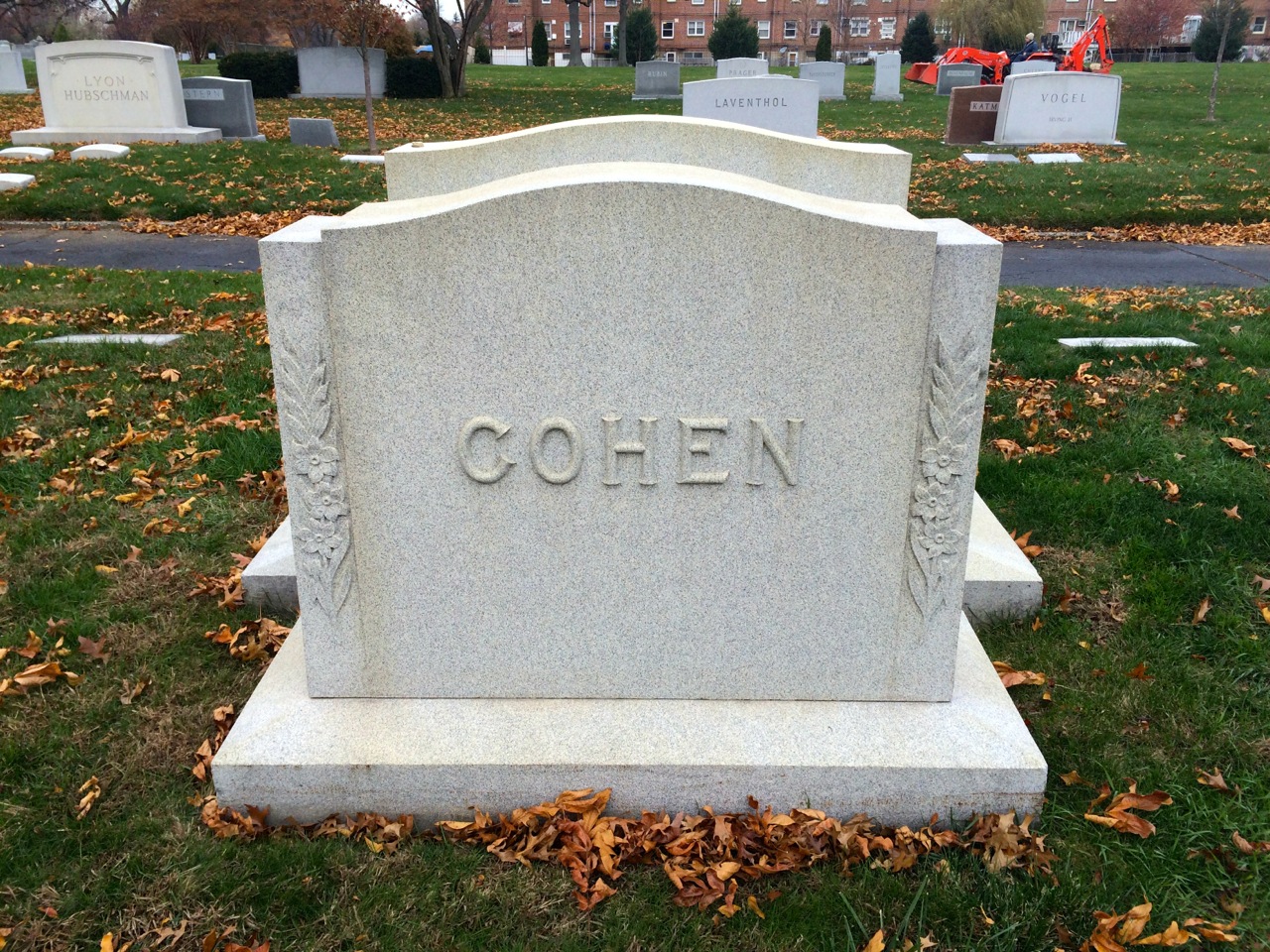
Then a day or so after the Gau-Algesheim package arrived, I received a gift from my third cousin once removed Todd Graham.  Todd is the great-great-great-grandson of Jacob Cohen, my great-great-grandfather.  Todd wrote to tell me that he had been to the Federal Street cemetery in Philadelphia where many of our mutual Cohen ancestors are buried and that he had taken photographs.  He asked if I wanted to see the photos, and I said of course.  So here are the photographs I received from Todd.

First is a photograph of where our ancestor Hart Levy Cohen is buried.  There is no stone visible, and the rabbi at the cemetery explained to Todd that they believed that the stone had sunk beneath the surface and was buried underground.  I have written to the rabbi and asked whether there is anything we can do to uncover the stone or to mark the gravesite in some other way.

Burial Site of Hart Levy Cohen

Burial Site of Hart Levy Cohen

This photo shows where Hart’s children Lewis and Elizabeth are buried.  Again, the stones are not visible, but this is the location of their graves.


Burial sites for Elizabeth Cohen and Lewis Cohen (Hart's children)

Burial sites for Elizabeth Cohen and Lewis Cohen (Hart’s children)

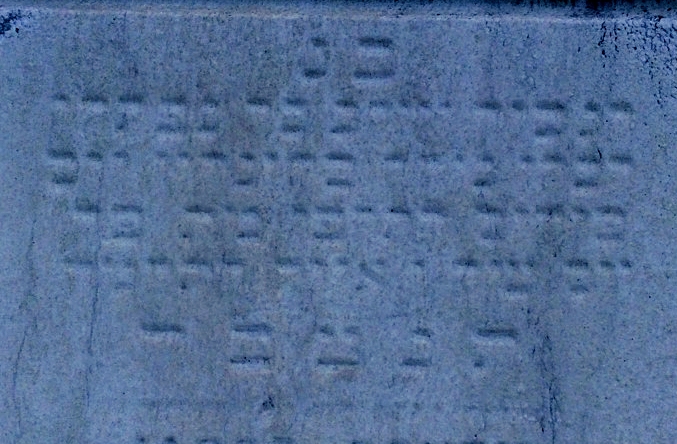
Todd also took photographs of the stone for Jacob and Sarah Cohen.  Although I had a photo of this stone before from Rabbi Albert Gabbai, I am hoping that these will be easier to read so that I can learn what the Hebrew inscription says.

Jacob and Sarah Cohen monument Jacob Cohen headstone by Todd Jacob Cohen monument by Todd jacob headstone edit 1


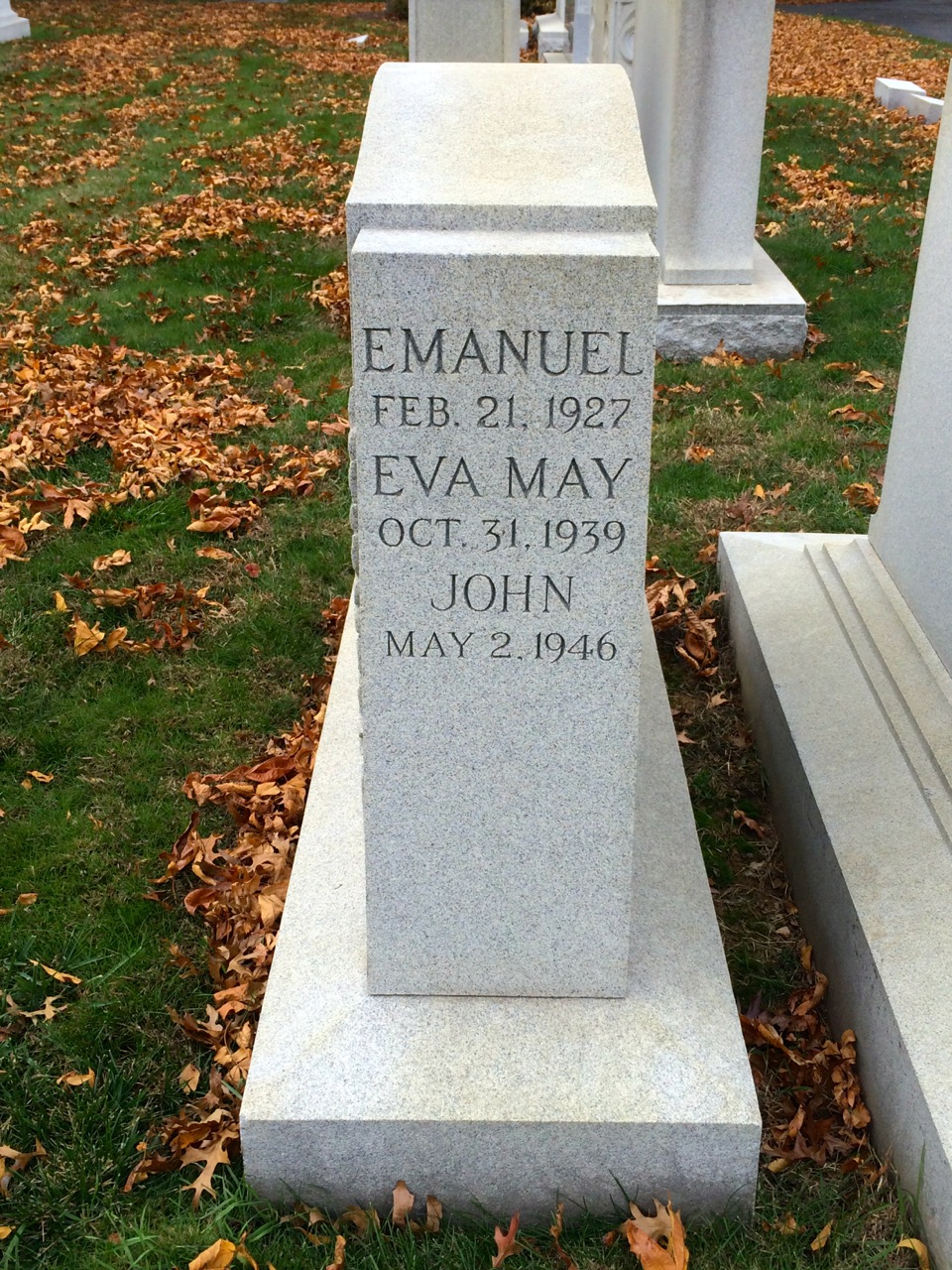
Todd also found the stones for three of Jacob’s children.  First, a new photograph of the headstone for my great-grandparents Emanuel and Eva (Seligman) Cohen and my grandfather John Nusbaum Cohen, Sr.

Headstone for Emanuel, Eva and John Cohen

Headstone for Emanuel, Eva and John Cohen

Side of Emanuel Eva and John by Todd

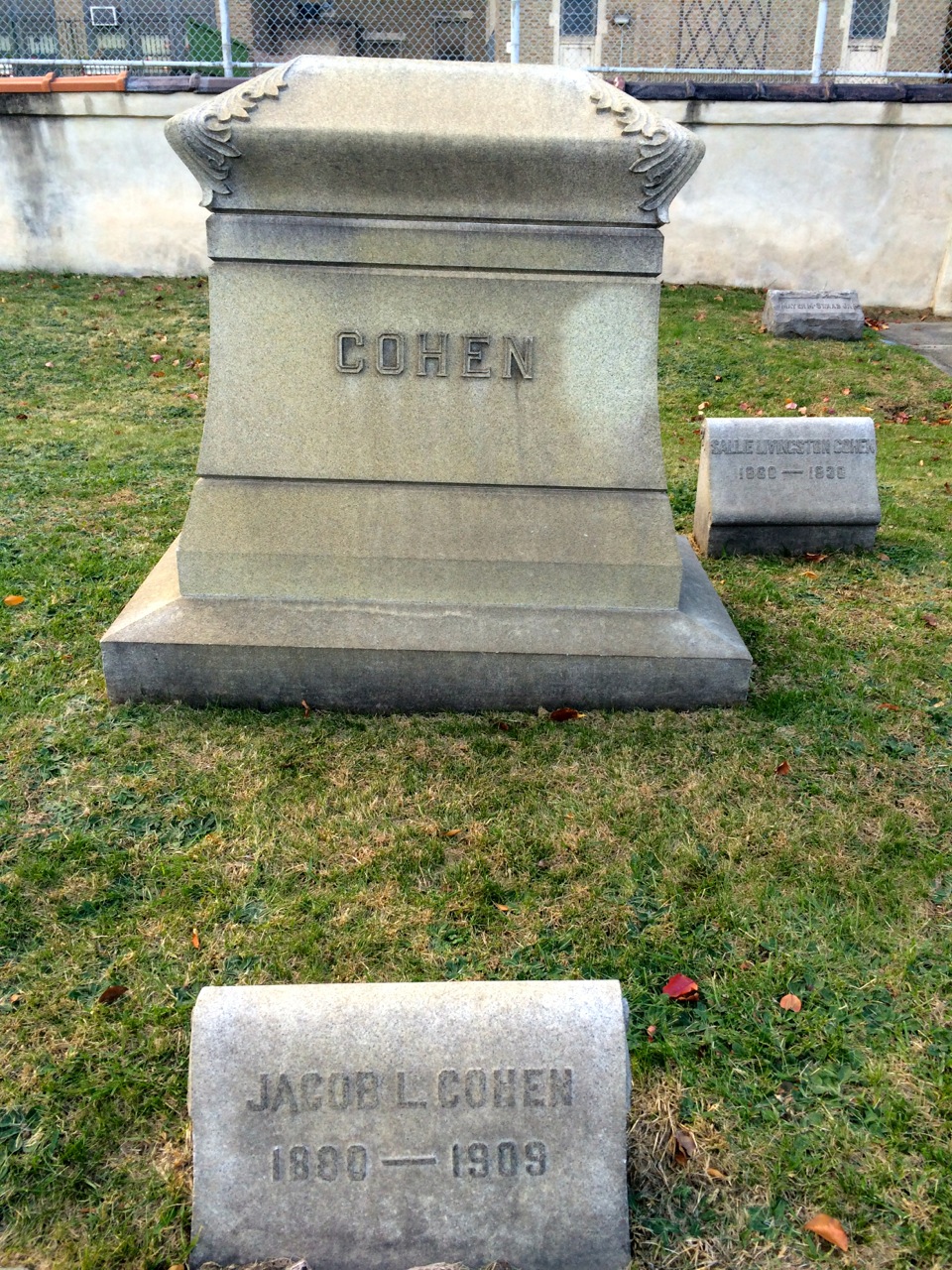
Next are photographs of the headstones for Emanuel’s brother Reuben and his wife Sallie Livingston Cohen and of their son Jacob Livingston Cohen.

Reuben and Sallie Livingston Cohen

Reuben and Sallie Livingston Cohen

Jacob Livingston Cohen

Jacob Livingston Cohen


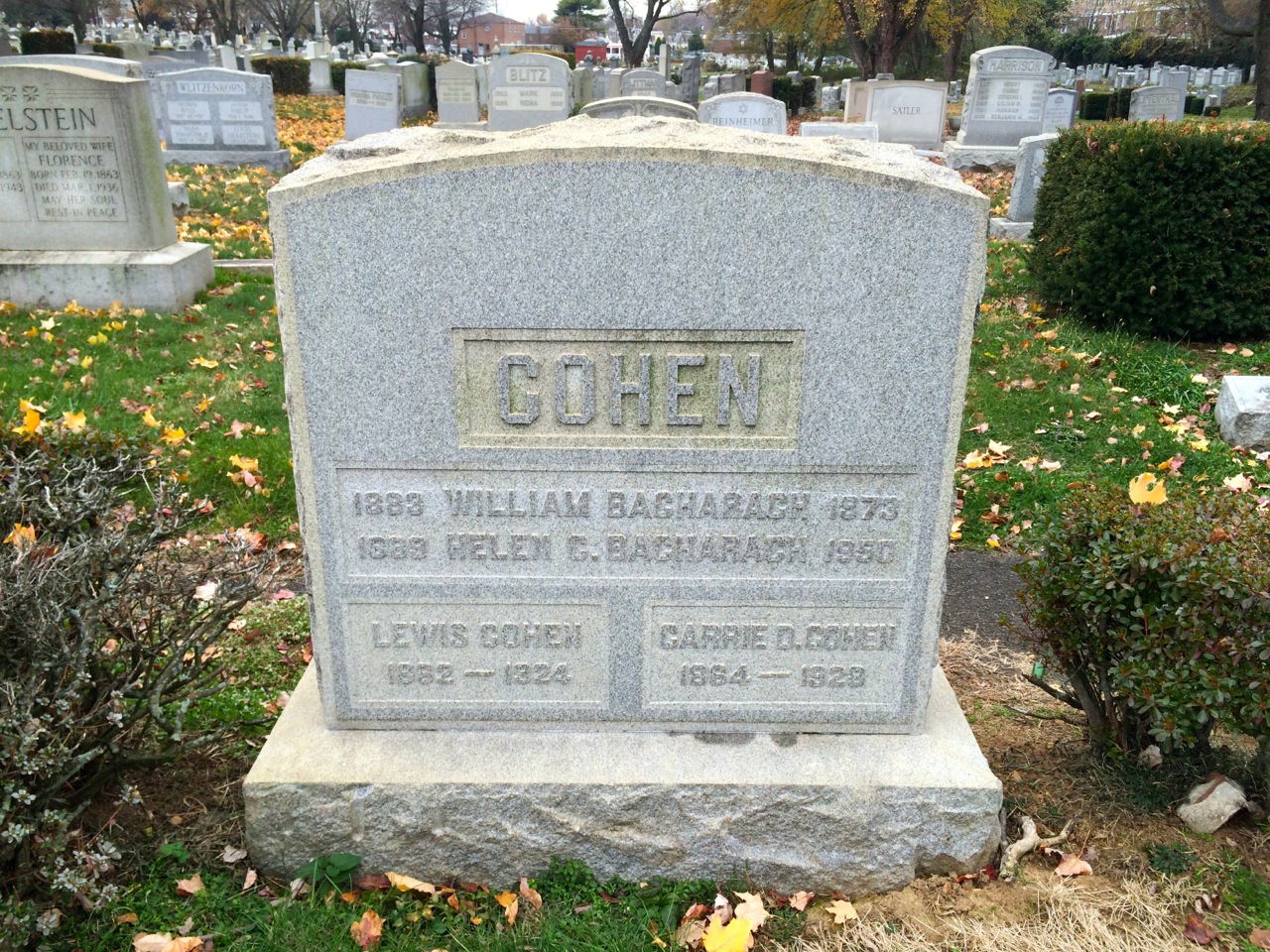
And finally, this is a photograph of the headstone for Todd’s great-great-grandparents Lewis and Carrie (Dannenbaum) Cohen and his grandparents William and Helen (Cohen) Bacharach.  Lewis Cohen was also the brother of my great-grandfather Emanuel Cohen.

Bacharach and Cohen headstone

Bacharach and Cohen headstone

Thank you so much, Todd, for these photographs, and I hope that we can do something to honor the graves of Hart, Lewis, and Elizabeth Cohen.

There is one more gift I want to acknowledge, and it came totally unsolicited and from a total stranger.  About two weeks ago I received a comment on the blog from someone who had found a set of matches on a website selling vintage items.  The matches were for a business called Selinger Associates at an address in Washington, DC.  Kimberly Crosson, the woman who commented on the blog, had purchased these matches and was now asking me whether this business was connected to the Selingers on my blog.  I was skeptical at first, I must admit.  I thought it was some kind of scam or spam.  But I emailed Kim and found out that not only was she not looking to make money, she was incredibly kind-hearted and generous and just wanted to get the matches to someone in the family—for no charge.

I checked the address and found that this was Eliot Selinger’s business.  Then I tracked down a descendant of Eliot Selinger and asked him if he was interested in the matches, and he was, so I put him in touch with Kim so that she could send him the matches.  I asked only for some pictures of the matches, so here is what Kim sent to me.  You can tell these are from a different era once you see the picture on the matches.

Selinger matches cover Selinger matches reverse


So once again, let me express my thanks to all these generous people, especially Todd and Kim for these photos, but to all who have helped and continue to help me with my research. I could never have done all this on my own.

And now I will be taking a short break from blogging for Thanksgiving.  May you all have a wonderful Thanksgiving, and thank you all for supporting me and providing me with so much help as I continue to learn about the lives of my ancestors.