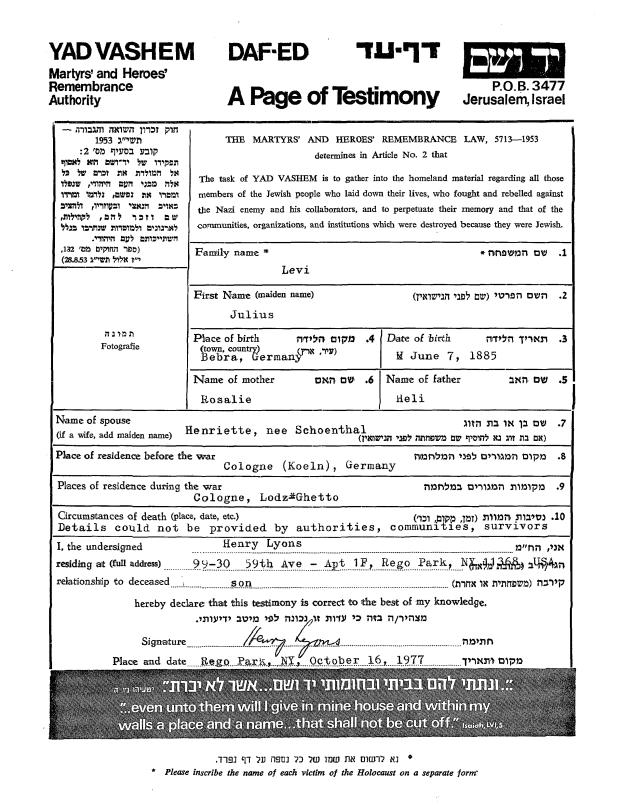
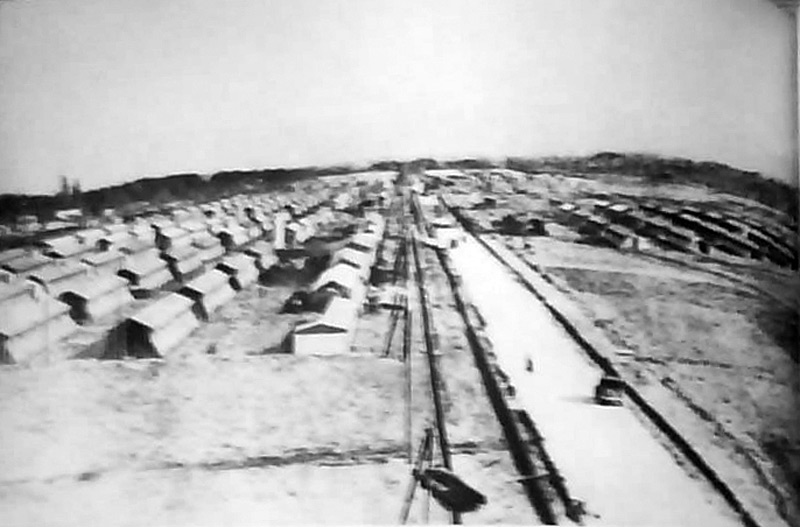
My Cousin in Sao Paulo

In an earlier post I mentioned that I had been fortunate to have several German sources of information about Rosalie Schoenthal Heymann, her husband Willy, and their six children, three sons, Lionel, Walter, and Max, and three daughters, Johanna, Helene, and Hilda.  I’ve already posted about the lives of the three sons. This post and the next will tell about the lives of the three daughters.

The death notice for one of those sons, Lionel, mentioned a sister named Henny Mosbach Rothschild; his full obituary mentioned an unnamed sister living in Sao Paulo, Brazil.


Ancestry.com. Historical Newspapers, Birth, Marriage, & Death Announcements, 1851-2003 [database on-line].

Ancestry.com. Historical Newspapers, Birth, Marriage, & Death Announcements, 1851-2003 [database on-line].

Ancestry.com. Historical Newspapers, Birth, Marriage, & Death Announcements, 1851-2003 [database on-line].

Ancestry.com. Historical Newspapers, Birth, Marriage, & Death Announcements, 1851-2003 [database on-line].


From the Steinheim site, I knew that the second-born child of Rosalie (Schoenthal) and Willy Heymann was their daughter Johanna; that site reported that Johanna was born in 1889, married someone named Mosbach, and died in Brazil.  From the Juden in der Geschichte des Gelderlandes book, I learned that Johanna’s husband was Hermann Mosbach, a merchant in Ratingen, and that they had married on April 8, 1915.


page 370 for blog

Bernhard Keuck and Gerd Halmanns, eds., Juden in der Geschichte des Gelderlandes, p. 370

Thus, I assumed that the sister mentioned in the obituary and the one named in the death notice were one and the same: Johanna (“Henny”) Schoenthal, who had married a man named Hermann Mosbach and who had ended up in Brazil.  But I didn’t know anything about what had happened in between: Why had she gone to Brazil, not Chicago where her three brothers were living? When had she gotten there? What had happened to Hermann Mosbach? And who was the apparent second husband named Rothschild?

I did not find anything helpful on Ancestry, but on FamilySearch.org, I found two records from Brazil. The first was a record for a widow (“viuva”), Johanna Mosbach, born February 27, 1889, in Geldern, Germany, daughter of Willy Heymann and Rosalie Schoenthal.  She was being admitted to Brazil as a permanent resident.  The card was dated February 18, 1939, and indicated that she had arrived at the Porto de Santos on the ship Monte Sarmento.


Brasil, São Paulo, Cartões de Imigração, 1902-1980," database with images, FamilySearch (https://familysearch.org/ark:/61903/1:1:QKD5-RQ52 : accessed 31 March 2016), Joana Mosbach Rothschild, 1939; citing Immigration, São Paulo, São Paulo, Brazil, certificate 544986, registration 20634, Arquivo Público do Estado de São Paulo (São Paulo State Public Archives, São Paulo).

Brasil, São Paulo, Cartões de Imigração, 1902-1980,” database with images, FamilySearch (https://familysearch.org/ark:/61903/1:1:QKD5-RQ52 : accessed 31 March 2016), Joana Mosbach Rothschild, 1939; citing Immigration, São Paulo, São Paulo, Brazil, certificate 544986, registration 20634, Arquivo Público do Estado de São Paulo (São Paulo State Public Archives, São Paulo).


The second record I found for Johanna through FamilySearch’s Brazil database was not dated, but was presumably some years later.  Her name is now recorded as Joana Mosbach Rothschild, same birth date as above, and she is now “casada” or married.  She was apparently still an alien as this was a card issued by the public security secretary for registration of foreigners or “estrangeiros.”


Brasil, São Paulo, Cartões de Imigração, 1902-1980," database with images, FamilySearch (https://familysearch.org/ark:/61903/1:1:QKJG-XR67 : accessed 31 March 2016), Joana Mosbach, 1939; citing Immigration, São Paulo, São Paulo, Brazil, certificate 20634, registration 544986, Arquivo Público do Estado de São Paulo (São Paulo State Public Archives, São Paulo).

Brasil, São Paulo, Cartões de Imigração, 1902-1980,” database with images, FamilySearch (https://familysearch.org/ark:/61903/1:1:QKJG-XR67 : accessed 31 March 2016), Joana Mosbach, 1939; citing Immigration, São Paulo, São Paulo, Brazil, certificate 20634, registration 544986, Arquivo Público do Estado de São Paulo (São Paulo State Public Archives, São Paulo).


But that was as far as I could get without more assistance, so I sent an inquiry to a woman named Anita on the JewishGen Family Finder, who listed Mosbach as one of her family names.  I also wrote to three of the JewishGen listservs, including one for Latin America.  Once again, the genealogy village came through and provided me with helpful suggestions and ultimately many answers.

First, Anita from the JewishGen Family Finder sent me three links that provided more information about Johanna and her first husband Hermann Mosbach.  All pertained to the Jewish community in Ratingen, Germany, before World War II.  From these three sources, I learned that Johanna was Hermann Mosbach’s second wife and that he’d had a daughter named Else with his first wife.  Hermann was born on July 18, 1877, and died on October 30, 1931, in Ratingen, when he was 54 years old.  Here is a photograph of Hermann, standing far right.


(Caption under photograph says, “Hermann Mosbach, owner of the “Rheinische department store C. Schmidt & Co.”, was a member of the Catholic Mercantile Association (CISO). In the picture he is seen at an event of the club in the second row on the right. (1928).”

These sources also indicated that Hermann’s daughter Else had immigrated to Brazil in 1936 and that Johanna also had left Ratingen by 1936.  Three years later she arrived in Brazil, presumably to be with her stepdaughter Else.  That might explain why she did not go to Chicago to be with her brothers.

I was curious as to why Else and then Johanna would have selected Brazil as their new home.  Was there a Jewish community there? Why Sao Paulo?

According to the Jewish Virtual Library, Sao Paulo had a long history of being a city that welcomed immigrants, receiving over three millions immigrants from all over the world before 1940.  Jewish immigrants began to arrive in the late 19th century, but Jewish immigration really surged in the 1920s as immigration obstacles in the US and Canada made those less likely destinations for Jews leaving Europe.  Sao Paulo, however, welcomed these immigrants, and during the 1920s, synagogues, Jewish schools, cemeteries, and other institutions were created to serve the growing Jewish population.  After Hitler came to power in 1933, there was another large influx of Jewish immigrants to Sao Paulo.  Thus, it made sense that Else Mosbach and her stepmother, Johanna Heymann Mosbach, would have settled there.

English: aerial photograph of Sao Paulo Brazil...

English: aerial photograph of Sao Paulo Brazil 2010 (Photo credit: Wikipedia)


Neither Anita nor I could find any information about what happened to Johanna or her stepdaughter Else once they got to Brazil.

Fortunately, I then heard from Sandra through the LatinAmSig on JewishGen; she was born in Sao Paulo, Brazil; her family had also immigrated there to escape Nazi Germany.  Sandra was incredibly generous and had asked her mother to see if she could find any information about Johanna or Else; she then sent me three links to additional online sources, including links to two newspaper articles regarding Else Mosbach Simon’s successful application to become a citizen of Brazil in 1950.

From those articles, I learned that Else was born on February 8, 1905, to Hermann and Selma Mosbach.  Thus, Else had been only ten years old when Johanna married her father in 1915, further explaining why Johanna would have moved to Sao Paulo—to be closer to the child she had helped to raise.  Else had married someone with the surname Simon by 1950, but unfortunately, I’ve not yet found out more information about her.

Sandra also gave me a link to the Arquivo Historico Judaico Brasileiro and suggested I contact the synagogues and Jewish cemeteries in Sao Paulo.  She then translated into Portuguese an email I drafted and sent it to a person she knew at the synagogue when I had trouble trying to contact them directly through their website.  From these sources, I learned that Johanna had died on September 11, 1971, and was buried at the Buntantan cemetery in Sao Paulo.  She was 82 years old.


By Dornicke (Own work) [CC BY 3.0 (http://creativecommons.org/licenses/by/3.0) or GFDL (http://www.gnu.org/copyleft/fdl.html)], via Wikimedia Commons

Synagogue Beth El in Sao Paulo By Dornicke (Own work) [CC BY 3.0 (http://creativecommons.org/licenses/by/3.0) or GFDL (http://www.gnu.org/copyleft/fdl.html)%5D, via Wikimedia Commons

The pieces were starting to come together, except that I still had no information about Johanna’s presumed second husband named Rothschild.  Then someone sent me (I apologize for failing to note who that was) this marriage announcement in the September 29, 1957 issue of the O Estado de Sao Paulo (p. 12) for someone named Hans Joseph Schmitz, described as the son of Ferdinand Rothschild and Johanna Mosbach Rothschild:


Could this be my Johanna? Could she have remarried and had a son born sometime after 1939 who was now marrying—although he could be no more than 18 years old?  That seemed unlikely, but now at least I had a first name to use for her presumed second husband.

I found a tree on Ancestry that included Ferdinand Rothschild and contacted the tree’s owner, Rainer.  He informed me that Ferdinand Rothschild had married Johanna Heymann on April 9, 1955, when Johanna was already 66 years old and Ferdinand was 67.  Ferdinand had been previously married to Grete or Gretchen Schmitz, Rainer’s great-aunt, who had died in Brazil on April 29, 1939.  Hans was her son.  He died on April 5, 1970, according to these death notices from the April 7, 1970, issue of O Estado de Sao Paulo, p. 35:


Hans Schmitz death notice April 7, 1970 O Estado de Sao Paulo Hans schmitz second death notice same paper p 35 same as other april 1970 o estado


Rainer also sent me Ferdinand’s death record.  He had died on December 31, 1958, while on a visit to Germany  and was buried in Dusseldorf, Germany, not in Sao Paulo where Johanna was living.  At the bottom of that record you can see a reference to the marriage date for Ferdinand and Johanna.


Ferdinand Rothschild death certificate

Ferdinand Rothschild death certificate


Johanna and Ferdinand had been married only three years when he died; he was seventy years old.  Johanna would outlive her second husband by another thirteen years, dying, as noted above, on September 11, 1971, in Sao Paulo.  Like her brothers Lionel and Walter, Johanna left no descendants behind, except for her stepdaughter Else Mosbach Simon and her stepson Hans Joseph Schmitz.

Once again, I am very grateful to all those who helped me put together these pieces of my cousin Johanna Heymann Mosbach Rothschild’s life, including my new cousins-by-marriage, Rainer and Anita, and especially Sandra, without whom I’d never have been able to learn where and when Johanna died and was buried.

That leaves me with the two remaining daughters of Rosalie Schoenthal and Willy Heymann: Helene and Hilda.


Quick Update on Lionel Heymann

In my last post, I discussed how I was puzzled to learn that Lionel Heymann had been a well-regarded photographer, but had listed his occupation as a waiter on the census records for 1930 and 1940.  Well, now I have found an explanation.

In the course of looking for a print of one of Lionel’s photographs to purchase (which I’ve not yet been able to locate), I found this bit of information about Lionel online, quoting from the catalog of  the Sixteenth Detroit International Salon of Photography, Photographic Society of Detroit, Detroit Institute of Arts, 1947.

“Started photography as a hobby by joining Fort Dearborn Camera Club in Chicago in 1928. Started professionally January 1945, and conducts a portrait studio in Blackstone Hotel. Conducts a weekly photographic class on portrait and paper negative process. Associated professionally with a photographer in Detroit, 1937-38.”

This explains so much.  First, it explains what Lionel was doing in Detroit when his brother Walter arrived from Germany.  Second, it explains why Lionel did not list photography as his occupation on the 1930 or 1940 census or on his World War II draft registration.  He did not become a professional photographer until 1945.

Lionel Heymann: His Other Life

In my earlier post, I wrote about the three sons of my great-great-aunt Rosalie Schoenthal and her husband Willy Heymann:  Lionel, Walter, and Max.  All three had left Germany and settled in Chicago by 1939.

The oldest brother, Lionel, had arrived first in the 1920s and had consistently reported on passenger manifests and census records that he worked as a hotel waiter.  So I was quite surprised when I found this obituary written when Lionel died in November, 1966:


Ancestry.com. Historical Newspapers, Birth, Marriage, & Death Announcements, 1851-2003 [database on-line].

Chicago Tribune, December 2, 1966, Ancestry.com. Historical Newspapers, Birth, Marriage, & Death Announcements, 1851-2003 [database on-line].

According to the obituary, Lionel Heymann had had a long and distinguished career as a photographer.  The obituary states that he had retired in 1964 after 40 years as a photographer in Chicago, including 25 years as the photographer at the Blackstone Hotel.  That is, although Lionel consistently listed his occupation as a waiter on various government forms, if the obituary is for the same man, he had been working as a photographer since 1924—in other words, since his very earliest days in Chicago.

But was this in fact the same Lionel Heymann?  The name and age and residence in Chicago certainly made it seem so, but there were no named survivors in the obituary, just an unnamed sister living in Brazil.  Could this be my cousin?

I then found a death notice for Lionel Heymann on the same date in the same paper that contained further information about his surviving family:


Ancestry.com. Historical Newspapers, Birth, Marriage, & Death Announcements, 1851-2003 [database on-line].

Chicago Tribune, December 2, 1966, Ancestry.com. Historical Newspapers, Birth, Marriage, & Death Announcements, 1851-2003 [database on-line].

This obviously was my cousin, whose two sisters-in-law were named Frieda and Lucy (or Lucie).  He was in fact the photographer described in the first obituary.

And he was not just a hotel photographer taking snapshots of guests. When I Googled his name and “photographer,” a number of links popped up, listing Lionel as an artist whose works are still being  auctioned by various art houses, online and elsewhere.  Lionel also wrote articles about photography and lectured frequently about the art of portrait photography. His works include portraits, nudes, architectural works, and highly stylized artistic photographs.

Here are two examples of the work done by Lionel Heymann; see the links above for others:

"The Shell", photograph by Lionel Heymann, April 1932 Camera Craft Magazine, accessed at http://s3.amazonaws.com/everystockphoto/fspid30/72/22/91/5/vintage-photograph-cameracraft-7222915-o.jpg

“The Shell”, photograph by Lionel Heymann, April 1932 Camera Craft Magazine, accessed at http://s3.amazonaws.com/everystockphoto/fspid30/72/22/91/5/vintage-photograph-cameracraft-7222915-o.jpg


Photograph by Lionel Heymann of Robert Maynard Hutchins, University of Chicago president (1929-1945) and chancellor (1945-1951), with team members of the Manhattan Project, the program established by the United States government to build the atomic bomb. Standing, from left: Mr. Hutchins, Walter H. Zinn, and Sumner Pike; seated: Farrington Daniels, and Enrico Fermi. University of Chicago Photographic Archive, [apf digital item number, e.g., apf12345], Special Collections Research Center, University of Chicago Library. accessed at http://photoarchive.lib.uchicago.edu/db.xqy?one=apf1-05063.xml

Photograph by Lionel Heymann of Robert Maynard Hutchins, University of Chicago president (1929-1945) and chancellor (1945-1951), with team members of the Manhattan Project, the program established by the United States government to build the atomic bomb. Standing, from left: Mr. Hutchins, Walter H. Zinn, and Sumner Pike; seated: Farrington Daniels, and Enrico Fermi. University of Chicago Photographic Archive, [apf digital item number, e.g., apf12345], Special Collections Research Center, University of Chicago Library. accessed at http://photoarchive.lib.uchicago.edu/db.xqy?one=apf1-05063.xml


Why hadn’t Lionel claimed on the census records and World War II draft registration that he was a photographer? Why wouldn’t he have wanted to reveal that information?  Was it just an avocation, not his livelihood?  Did that change after the 1940s?

UPDATE:  In the course of looking for a print of one of Lionel’s photographs to purchase (which I’ve not yet been able to locate), I found this bit of information about Lionel online, quoting from the catalog of  the Sixteenth Detroit International Salon of Photography, Photographic Society of Detroit, Detroit Institute of Arts, 1947.

“Started photography as a hobby by joining Fort Dearborn Camera Club in Chicago in 1928. Started professionally January 1945, and conducts a portrait studio in Blackstone Hotel. Conducts a weekly photographic class on portrait and paper negative process. Associated professionally with a photographer in Detroit, 1937-38.”

This explains so much.  First, it explains what Lionel was doing in Detroit when his brother Walter arrived in 1938.  Second, it explains why Lionel did not list photography as his occupation on the 1930 or 1940 census or on his World War II draft registration.

The obituary and death notice not only revealed that Lionel was a well-known photographer, but also provided more clues about his family.   First, who was this sister in the death notice named Henny Mosbach Rothschild? And was she the one described as living in Brazil in the obituary? And second, who was the nephew named Robert Heyman?

Since only one of Lionel’s brothers had had a child, I assume that this had to be Klaus Heymann, the son of Lionel’s brother Max. Unfortunately, I’ve not been able to yet find out more about Klaus Heymann/Robert Heyman, but I have requested the military records of a Klaus Robert Heymann from the national archives and hope that those records will relate to my cousin.  If so, I will provide an update.

As for the sister named Henny Mosbach Rothschild, I will address her in my next post.


The Little Sister Who Went Back Home: Rosalie Schoenthal, Part I


Finally I have come to the youngest of my great-grandfather’s siblings, the only one born after he was, his younger sister Rosalie.   Her story is even more tragic than that of her brother Jakob.

Rosalie was born in Sielen, Germany, in 1863, five years after my great-grandfather Isidore.  As I wrote earlier, she came with her mother and Isidore to the United States in 1881 when she was eighteen, but returned to Germany to marry Willy Heymann of Geldern, to whom she was apparently engaged even before leaving Germany. They were married on December 8, 1884, in Geldern.


I was fortunate that there were numerous sources available that provided me with information about Rosalie, Willy, and their family.  Two German websites had biographies of Willy and Rosalie Heymann and their children.  One, a site about the Geldern Jewish community, indicated that Willy and Rosalie had had six children, although it only named two of them, Helene and Hilda.  A second website containing information about the Heymann family was the Steinheim Institute site, which confirmed the fact that there had been six children and provided the names and birth years of all six as well as other pertinent facts that helped me with my research of Rosalie’s children.

From these two sources, I learned that Willy was a horse trader like his father Levi Heymann and was born in Geldern in February, 1857.  Geldern is about 150 miles from Sielen, so I’ve no idea how Rosalie and Willy knew each other; perhaps their fathers had known each other.  Willy and Rosalie settled in Geldern; their six children were: Lionel, born in 1887 and presumably named for Rosalie’s father, my great-great grandfather Levi Schoenthal; Johanna, born in 1889; Helene, born in 1890 (perhaps named for Henriette Hamberg, Rosalie’s mother), Max, 1893; Walter, 1896; and Hilda, born in 1898.

The Geldern site had a photograph of the Heymann home in Geldern, depicted below.


Home of Willy and Rosalie Schoenthal Heymann in Geldern http://hv-geldern.de/images/juden/juden.htm

Home of Willy and Rosalie Schoenthal Heymann in Geldern
http://hv-geldern.de/images/juden/juden.htm

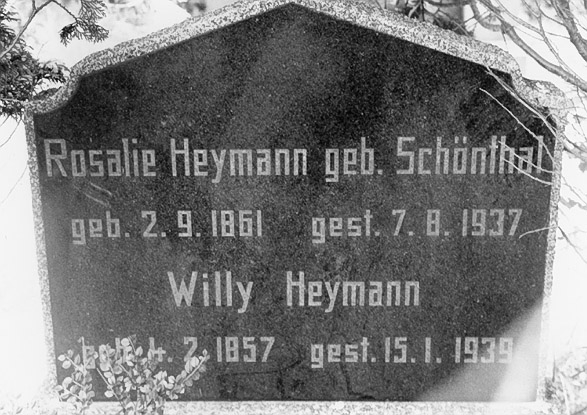
The Steinheim Institute site reported that Rosalie died on August 7, 1937, when she was 74 and that Willy Heymann died on January 15, 1939; it provided this description of his death:

Willy Heymann wurde nach seinem Tod von dem 14jährigen Fritz Davids, der erst kurze Zeit zuvor aus dem KZ Dachau zurückgekehrt war, in das man ihn nach der Pogromnacht mit seinem Vater verschleppt hatte, ganz alleine und heimlich zum Friedhof gebracht und begraben.

Translated by a member of the German Genealogy Facebook group as:

After his death, Willy Heyman was brought secretly to the cemetery and buried by 14 year old Fritz Davids alone, who had returned only a short time before from the concentration camp of Dachau where he had been brought with his father after the [Kristallnacht, Nov. 9, 1938].

How would you interpret that sentence? Does it mean that Willy had died outside of Geldern and been secretly returned by this fourteen year old boy? Had Willy also been at Dachau or just Fritz and his father? Or does it mean that Willy and Fritz’s father had been brought to Dachau after Kristallnacht? Does the “he” in that last phrase refer to Willy or Fritz?  I am inclined to think that Willy was at Dachau because otherwise, why would he have had to have been secretly brought to the Geldern cemetery?

UPDATE:  Thanks to Renate Adolfs and Cathy Meder-Dempsey, I now have more information about what happened to Willy, and it is awful.  Both Renate and Cathy found a link here that describes the terrible fate of Willy Heymann.  As translated by Cathy, this is the full story:

Aus dem KZ zurück, muß Fritz Davids schon zwei Monate später miterleben, wie schlimm es mittlerweile den Juden erging. Selbst vor dem Tod hat man nämlich keine Achtung mehr : Der Jude Willy Heymann war fast 84-jährig verstorben. Da ihn niemand begraben wollte oder konnte, lädt der 14-jährige Fritz die Leiche auf eine Schubkarre und fährt sie im Morgengrauen zum Boeckelter Weg auf den jüdischen Friedhof, wo er, ganz der ‚Würde” der Zeit entsprechend, dem alten Mann ein Grab schaufelt und den Kaddish spricht. Auch David Cain und Jakob Heymann wurden unter solchen entwürdigenden Umständen begraben.

Recently back from the concentration camp, Fritz Davids experienced, two months later, how bad the Jews had fared. There was no respect even for the dead. The Jew Willy Heymann died at the age of almost 84 years old. Since nobody wanted to bury him or could, the 14-year-old Fritz put the corpse in a wheelbarrow and at dawn wheeled it to Boeckelter Weg (street name) to the Jewish cemetery, where he, fully in dignity of the time, shoveled a grave for the old man and spoke the Kaddish. David Cain and Jacob Heymann were also buried under such humiliating circumstances.

Thank you, Renate and Cathy, for allowing me to memorialize Willy Heymann more completely.


The information about Willy and Rosalie and their children was also confirmed by a third source, Juden in der Geschichte des Gelderlandes (2002), a book edited by Gerd Halmanns and Bernhard Keuck that contains information, photographs, articles, documents, and maps of the Jewish communities in Geldern and the surrounding townsRodney Eisfelder from the GermanSIG of JewishGen kindly sent me a copy of page 370 from that book, which lists information about Willy Heymann and his family.  That page also provided me with numerous clues about the Heymann children.

page 370 for blog

From these sources, I knew that Lionel Heymann, the oldest child, had moved to Chicago, but I found out that before he immigrated to the US, he had left Germany for England; he is listed on the 1911 English census as a 24 year old German national, living in London and working as a hotel waiter.


Lionel Heymann 1911 UK census Ancestry.com. 1911 England Census [database on-line]. Provo, UT, USA: Ancestry.com Operations, Inc., 2011. Original data: Census Returns of England and Wales, 1911. Kew, Surrey, England: The National Archives of the UK (TNA), 1911. Data imaged from the National Archives, London, England.

Lionel Heymann 1911 UK census
Ancestry.com. 1911 England Census [database on-line]. Provo, UT, USA: Ancestry.com Operations, Inc., 2011.
Original data: Census Returns of England and Wales, 1911. Kew, Surrey, England: The National Archives of the UK (TNA), 1911. Data imaged from the National Archives, London, England.

In 1912 he sailed from England to Algiers, still a German citizen, but listing his intended future permanent residence as Switzerland.  He was working as a hotel manager, according to the ship manifest.


Lionel Heymann 1912 passenger manifest Ancestry.com. UK, Outward Passenger Lists, 1890-1960 [database on-line]. Provo, UT, USA: Ancestry.com Operations, Inc., 2012. Original data: Board of Trade: Commercial and Statistical Department and successors: Outwards Passenger Lists. BT27. Records of the Commercial, Companies, Labour, Railways and Statistics Departments. Records of the Board of Trade and of successor and related bodies. The National Archives, Kew, Richmond, Surrey, England.

Lionel Heymann 1912 passenger manifest
Ancestry.com. UK, Outward Passenger Lists, 1890-1960 [database on-line]. Provo, UT, USA: Ancestry.com Operations, Inc., 2012.
Original data: Board of Trade: Commercial and Statistical Department and successors: Outwards Passenger Lists. BT27. Records of the Commercial, Companies, Labour, Railways and Statistics Departments. Records of the Board of Trade and of successor and related bodies. The National Archives, Kew, Richmond, Surrey, England.

He next surfaced on a passenger ship manifest for a ship sailing from England to New York in 1924. He was still a German citizen, stating that his last permanent residence was Geldern, Germany, and listing his father “Wilhelm Hyman” of Geldern as his contact in that place.  He said that he was going to his uncle Harry Schoenthal of 260 Riverside Drive in New York City.  At first I was thrown by this, but then realized he must have meant Henry Schoenthal, his mother’s oldest brother, who was in fact living in New York at that time.  Lionel indicated on this manifest that he intended to settle permanently in the United States.


Lionel Heymann 1924 passenger manifest Ancestry.com. New York, Passenger Lists, 1820-1957 [database on-line]. Provo, UT, USA: Ancestry.com Operations, Inc., 2010. Original data: Passenger Lists of Vessels Arriving at New York, New York, 1820-1897. Microfilm Publication M237, 675 rolls. NAI: 6256867.

Lionel Heymann 1924 passenger manifest
Ancestry.com. New York, Passenger Lists, 1820-1957 [database on-line]. Provo, UT, USA: Ancestry.com Operations, Inc., 2010.
Original data: Passenger Lists of Vessels Arriving at New York, New York, 1820-1897. Microfilm Publication M237, 675 rolls. NAI: 6256867.

By 1928, Lionel was living in Chicago and working as a waiter, as reflected on this October 30, 1928 passenger manifest.  He was still an alien resident, listing his father again as his contact in Germany, but providing his Chicago address as his permanent address.  He was returning from Germany, so he probably had been visiting his family back home.


Lionel Heymann 1928 passenger manifest Year: 1928; Arrival: New York, New York; Microfilm Serial: T715, 1897-1957; Microfilm Roll: Roll 4280; Line: 1; Page Number: 200

Lionel Heymann 1928 passenger manifest
Year: 1928; Arrival: New York, New York; Microfilm Serial: T715, 1897-1957; Microfilm Roll: Roll 4280; Line: 1; Page Number: 200


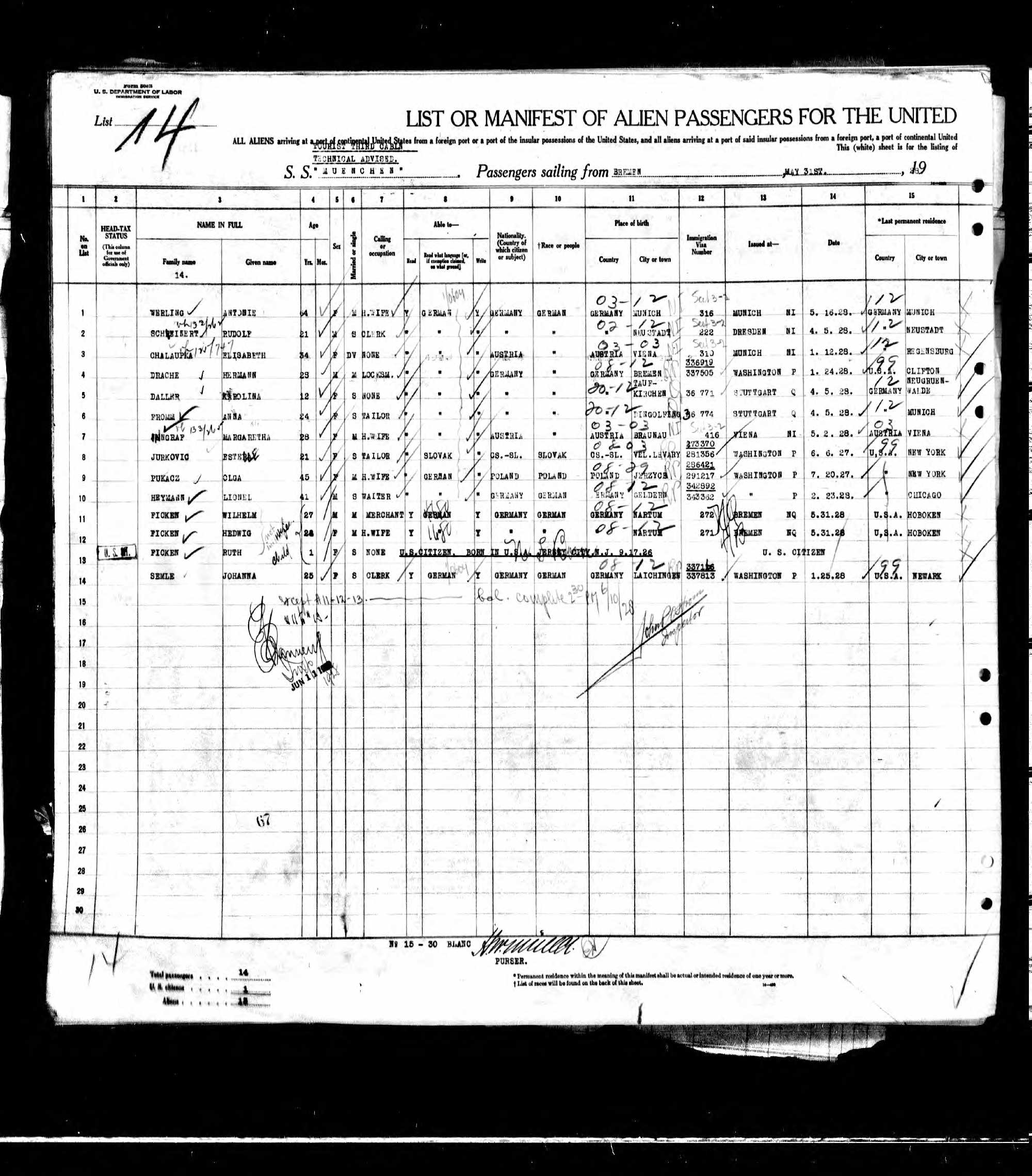
Interestingly, Lionel’s younger brother Walter had arrived in the US just a few months earlier in June, 1928.  This was consistent with the information in the above-mentioned  sources—that is,  that Walter also had ended up in Chicago. On the ship manifest for Walter’s arrival it reports that Walter was a cook, that he was 32, that his last residence had been Cologne, Germany, and that he was heading for Chicago where his brother Lionel resided.


Walter Heymann 1928 ship manifest Year: 1928; Arrival: New York, New York; Microfilm Serial: T715, 1897-1957; Microfilm Roll: Roll 4373; Line: 1; Page Number: 141

Walter Heymann 1928 ship manifest
Year: 1928; Arrival: New York, New York; Microfilm Serial: T715, 1897-1957; Microfilm Roll: Roll 4373; Line: 1; Page Number: 141


After searching the 1930 census as many ways as I could, including using Lionel’s address as given on both the 1928 ship manifests and his 1933 naturalization papers (1411 Winnemac Avenue), I concluded that the census enumerator had completely missed that address.  The listings include 1409 and 1413, but not 1411.  Just my luck.

Although I could not find Lionel on the 1930 census, Walter is listed on that census, living as a lodger in Chicago and working as a chef in a hotel.  He was then 34 years old and had been in the US for two years and had filed his papers for citizenship.

As mentioned, Lionel became a naturalized US citizen in 1933.

Ancestry.com. U.S. Naturalization Record Indexes, 1791-1992 (Indexed in World Archives Project) [database on-line]. Provo, UT, USA: Ancestry.com Operations, Inc., 2010.

Ancestry.com. U.S. Naturalization Record Indexes, 1791-1992 (Indexed in World Archives Project) [database on-line]. Provo, UT, USA: Ancestry.com Operations, Inc., 2010.

According to the Cook County, Illinois Marriage Index, Walter Heymann married Lucie Goldschmied on March 16, 1934.  Lucie was born in Frankfurt, Germany, on February 11, 1908, the daughter of Miksa (later Americanized to Michael) Goldschmied, a Hungarian native, and Bertha Hirschberg, a native of Eschbach, Germany.  Lucie first came to the US in 1928, according to the 1930 census, which has her listed as residing at the Moraine Hotel in Highland Park, Illinois (a suburb of Chicago), where she was employed as a pantry servant.  I assume that this was the same hotel where Walter was employed as a chef.

The Chicago Tribune described the history of the Moraine Hotel in an article published on May 11, 1986:

In the early years of this century, the Hotel Moraine-on-the-Lake sparkled as a North Shore glamor resort. Built on 15 acres overlooking Lake Michigan in Highland Park, the hostelry opened in 1900 with 140 rooms.

The Moraine immediately caught the eye of the rich and famous. Glancing through old guest registries (now in the Highland Park Historical Society), you`ll spot some well-known Chicago names–the Marshall Field family, the Swifts, the Pullmans, the Florsheims, and many others.

Guests came from all over the U.S. and even from abroad. Some of the more affluent even traveled with their chauffeurs and maids.

…   The heyday of the Moraine continued into the 1920s, when the increasing number of guests necessitated additions to the hotel. Then came the Depression and even the Moraine was not spared–it declared bankruptcy in 1937.

By 1939, the once-grand hotel had become a barracks for military officers. But sunnier days were just around the corner. In 1942, the hotel was purchased, rehabbed, and reopened. It regained some of its former glory and operated until 1969, when the last guest checked out.

In 1972, the Hotel Moraine-on-the-Lake itself checked out. It was torn down and the site was turned into a public park.

“North Shore Glamor Hotel Reborn,” Chicago Tribune, May 11, 1986


If this is indeed where Walter and Lucie were working when they met, they were certainly working in quite a grand place.

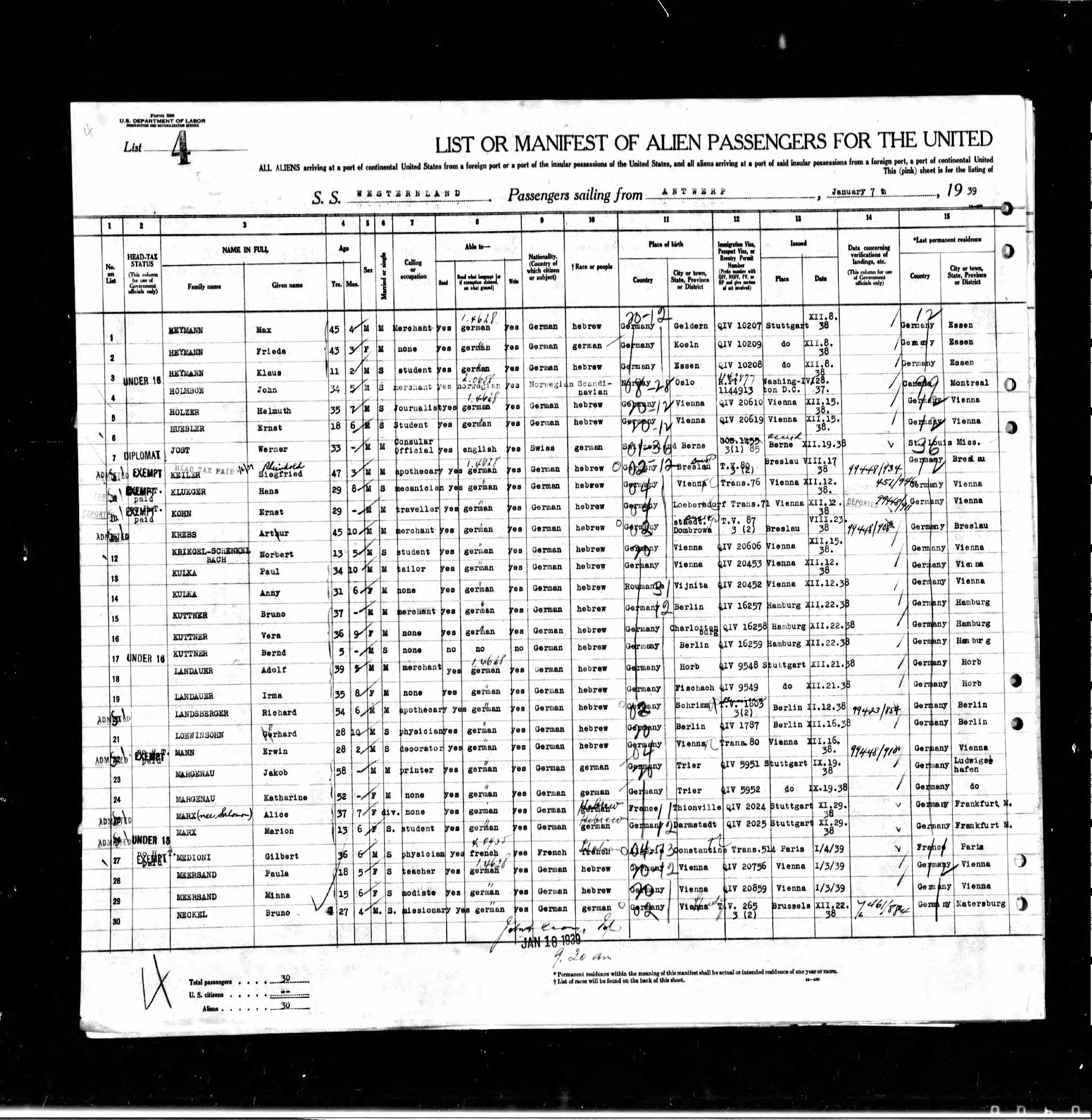
Max Heymann, the middle brother, was still back in Germany during this period, but he finally came to the US with his wife Frieda and their eleven year old son Klaus on January 7, 1939, escaping from Nazi Germany.  They had been most recently living in Essen, Germany, where Klaus was born.  Max listed his occupation as a merchant, his father Willy Heymann as the person he was leaving behind, and his brother Lionel as the person he was going to in the US.  I was surprised to see that Lionel was then living in Detroit, not Chicago.


Max and Frieda Heymann 1939 ship manifest Year: 1939; Arrival: New York, New York; Microfilm Serial: T715, 1897-1957; Microfilm Roll: Roll 6274; Line: 1; Page Number: 8

Max and Frieda Heymann 1939 ship manifest
Year: 1939; Arrival: New York, New York; Microfilm Serial: T715, 1897-1957; Microfilm Roll: Roll 6274; Line: 1; Page Number: 8


By 1940, all three of the sons of Rosalie Schoenthal and Willy Heymann were living in Chicago.  According to the 1940 census, Lionel was living in the household of his brother Max in 1940, apparently having returned from Detroit.  Lionel was now the head waiter at a hotel, according to the census.  Max was a salesman for a paper box manufacturing company. Lionel, Max, Frieda, and Klaus were living at 1441 Belle Plaine Avenue in Chicago.

Walter and his wife Lucie as well as Lucie’s recently arrived parents, Michael and Bertha Goldschmied, were living a mile away from Max and Lionel at 3325 North Paulina Street in Chicago.  Walter was continuing to work as the cook in a hotel, and Lucie was working as a waitress, perhaps in the same hotel restaurant.  Lucie and Walter did not have any children.

All three brothers registered for the World War II draft in 1942.  According to those registrations, Lionel was still living with Max on Belle Plaine Avenue and working for the Blackstone Hotel.  Max was now working for Parfeit Powder Puff Company in Chicago. Walter was still living on North Paulina Street and working for “Martin,” a restaurant.


Lionel Heymann World War II draft registration Ancestry.com. U.S., World War II Draft Registration Cards, 1942 [database on-line]. Provo, UT, USA: Ancestry.com Operations, Inc., 2010. Original data: United States, Selective Service System. Selective Service Registration Cards, World War II: Fourth Registration.

Lionel Heymann World War II draft registration
Ancestry.com. U.S., World War II Draft Registration Cards, 1942 [database on-line]. Provo, UT, USA: Ancestry.com Operations, Inc., 2010.
Original data: United States, Selective Service System. Selective Service Registration Cards, World War II: Fourth Registration.

Max Heymann World War II draft registration Ancestry.com. U.S., World War II Draft Registration Cards, 1942 [database on-line]. Provo, UT, USA: Ancestry.com Operations, Inc., 2010. Original data: United States, Selective Service System. Selective Service Registration Cards, World War II: Fourth Registration

Max Heymann World War II draft registration
Ancestry.com. U.S., World War II Draft Registration Cards, 1942 [database on-line]. Provo, UT, USA: Ancestry.com Operations, Inc., 2010.
Original data: United States, Selective Service System. Selective Service Registration Cards, World War II: Fourth Registration

Walter Heymann World War II draft registration Ancestry.com. U.S., World War II Draft Registration Cards, 1942 [database on-line]. Provo, UT, USA: Ancestry.com Operations, Inc., 2010. Original data: United States, Selective Service System. Selective Service Registration Cards, World War II: Fourth Registrati

Walter Heymann World War II draft registration
Ancestry.com. U.S., World War II Draft Registration Cards, 1942 [database on-line]. Provo, UT, USA: Ancestry.com Operations, Inc., 2010.
Original data: United States, Selective Service System. Selective Service Registration Cards, World War II: Fourth Registrati

Max died a year later on May 31, 1943.  He was only 49 years old.  Walter died ten years after his brother Max on August 14, 1953; he was only 57.  Did the stress of uprooting themselves and worrying about their relatives back home contribute to their early deaths? I don’t know.

Lionel, the oldest brother, lived the longest.  He died on November 29, 1966, when he was 79 years old.  I was fortunate to find both a death notice and an obituary for Lionel (but none for his brothers).  Those two records revealed more about Lionel than I’d been able to glean from the passenger ship manifests or the census records.  He’d had a whole other life not reported on those documents.

More on that in my next post.


The Final Chapter for Jakob Schoenthal and His Descendants

As of 1947, the four surviving children and two grandchildren of Jakob Schoenthal and Charlotte Lilienfeld were all settled in western Pennsylvania, living close to each other, Johanna and Erna in Pittsburgh and Lee and Meyer nearby in Washington, Pennsylvania.  Johanna and Erna had survived the Holocaust, as had Erna’s son Werner Haas and the son of their sister Henriette, Helmut Levi.

The next two decades were, however, not kind to the children of Jakob Schoenthal and Charlotte Lilienfeld.  First, on February 7, 1956, Johanna’s husband Heinrich Stern died at age 79; he’d been suffering from arteriosclerosis for years, according to his death certificate, and had been residing in the Jewish Home for the Aged in Pittsburgh.  His doctor had been caring for him since 1953, so Heinrich must have been in poor health for much of his time in the US.


Heinrich Stern death certificate Ancestry.com. Pennsylvania, Death Certificates, 1906-1963 [database on-line]. Provo, UT, USA: Ancestry.com Operations, Inc., 2014. Original data: Pennsylvania (State). Death certificates, 1906–1963. Series 11.90 (1,905 cartons). Records of the Pennsylvania Department of Health, Record Group 11. Pennsylvania Historical and Museum Commission, Harrisburg, Pennsylvania.

Heinrich Stern death certificate
Ancestry.com. Pennsylvania, Death Certificates, 1906-1963 [database on-line]. Provo, UT, USA: Ancestry.com Operations, Inc., 2014.
Original data: Pennsylvania (State). Death certificates, 1906–1963. Series 11.90 (1,905 cartons). Records of the Pennsylvania Department of Health, Record Group 11. Pennsylvania Historical and Museum Commission, Harrisburg, Pennsylvania.

Then the following year, the oldest sibling, Lee Schoenthal, died at age 75 on May 11, 1957.  He also suffered from arteriosclerosis and died from congestive heart failure.  His doctor had been caring for him since 1949, according to the death certificate.  Lee appears to have been the backbone of the family, the one who employed and housed his younger brother Meyer for some years and who also helped his two younger sisters Johanna and Erna as well as his nephew Helmut Levi come to and settle in the US.


Lee Schoenthal death certificate Ancestry.com. Pennsylvania, Death Certificates, 1906-1963 [database on-line]. Provo, UT, USA: Ancestry.com Operations, Inc., 2014. Original data: Pennsylvania (State). Death certificates, 1906–1963. Series 11.90 (1,905 cartons). Records of the Pennsylvania Department of Health, Record Group 11. Pennsylvania Historical and Museum Commission, Harrisburg, Pennsylvania.

Lee Schoenthal death certificate
Ancestry.com. Pennsylvania, Death Certificates, 1906-1963 [database on-line]. Provo, UT, USA: Ancestry.com Operations, Inc., 2014.
Original data: Pennsylvania (State). Death certificates, 1906–1963. Series 11.90 (1,905 cartons). Records of the Pennsylvania Department of Health, Record Group 11. Pennsylvania Historical and Museum Commission, Harrisburg, Pennsylvania.

It was almost three years later that Meyer himself died.  He was 76 years old, and the principal cause of death was a coronary occlusion.  But looking more closely at the death certificate revealed information that might have explained why Meyer had not appeared in any city directories after 1931 and why his sisters and nephew all listed only Lee as the person they knew in the US and not Meyer. It also explains why Lee had not listed Meyer on his World War II draft registration as the person who would always know his address.


Meyer N Schoenthal death certificate Ancestry.com. Pennsylvania, Death Certificates, 1906-1963 [database on-line]. Provo, UT, USA: Ancestry.com Operations, Inc., 2014. Original data: Pennsylvania (State). Death certificates, 1906–1963. Series 11.90 (1,905 cartons). Records of the Pennsylvania Department of Health, Record Group 11. Pennsylvania Historical and Museum Commission, Harrisburg, Pennsylvania.

Meyer N Schoenthal death certificate
Ancestry.com. Pennsylvania, Death Certificates, 1906-1963 [database on-line]. Provo, UT, USA: Ancestry.com Operations, Inc., 2014.
Original data: Pennsylvania (State). Death certificates, 1906–1963. Series 11.90 (1,905 cartons). Records of the Pennsylvania Department of Health, Record Group 11. Pennsylvania Historical and Museum Commission, Harrisburg, Pennsylvania.

Meyer suffered from manic depression (more commonly referred to as bipolar disorder today), which the doctor described as a contributing factor in his death.  Meyer had been living at Torrance State Hospital in Westmoreland, Pennsylvania, for over two and a half years at the time of his death on January 10, 1960.  In other words, he had been hospitalized shortly after his brother Lee’s death in May 1957.  Lee must have been caring for him up to that point.

Lee and Meyer were buried next to each other in Beth Israel cemetery in Washington, Pennsylvania.


The family’s heartbreak continued two years later when young Werner Haas died from Laennec’s cirrhosis of the liver, a form of cirrhosis associated with alcoholism.  According to the death certificate, he had been suffering for months and died after 48 hours in a hepatic coma.  He was only 36 years old.


Werner Haas death certificate Ancestry.com. Pennsylvania, Death Certificates, 1906-1963 [database on-line]. Provo, UT, USA: Ancestry.com Operations, Inc., 2014. Original data: Pennsylvania (State). Death certificates, 1906–1963. Series 11.90 (1,905 cartons). Records of the Pennsylvania Department of Health, Record Group 11. Pennsylvania Historical and Museum Commission, Harrisburg, Pennsylvania.

Werner Haas death certificate
Ancestry.com. Pennsylvania, Death Certificates, 1906-1963 [database on-line]. Provo, UT, USA: Ancestry.com Operations, Inc., 2014.
Original data: Pennsylvania (State). Death certificates, 1906–1963. Series 11.90 (1,905 cartons). Records of the Pennsylvania Department of Health, Record Group 11. Pennsylvania Historical and Museum Commission, Harrisburg, Pennsylvania.

His life had not been an easy one.  He had lost his father before he was five years old, and he had been uprooted from his home in Darmstadt, Germany, and brought to the US.  Then he had served in the US Navy as a fireman, a skilled technician, during World War II.  After the war he had been briefly married to Lillian Angeloff; at the time of his death he was married to Margaret Rusnack, who was more than ten years older than Werner and had a son from a prior marriage.  He had worked as a salesman before and after the war, but in 1950 he had changed occupations and was a driver.  In 1952 he was a construction worker, and then in 1958 and 1959 he was again a driver.  After that he does not appear in the Pittsburgh directories.

It’s hard to imagine what those years between 1953 and 1962 must have been like for the two remaining siblings.  Johanna lost a husband, two brothers, and a nephew, and Erna also lost her brothers, her brother-in-law, and her son.

Erna then lost her remaining sibling, Johanna, on February 23, 1967.  The only close relative who was left was her nephew Helmut Levi (who by that time was named Henry Lyons).  Henry and his wife Pauline continued to live at the same address in Rego Park, New York, until Henry’s death on December 18, 1986.  He was only 67 years old when he died.


Aufbau February 13, 1987 p. 41

Aufbau, February 13, 1987 p. 41


Erna Schoenthal Haas, the youngest child of Jakob and Charlotte, had outlived her parents, her husband, her siblings, her nieces and nephews, and even her son.  Despite all the terrible losses she had suffered including being widowed at a very young age, escaping from Nazi Germany, and losing her only child, she had persevered and even maintained a positive outlook, as this June 14, 1984 article from the Jewish Chronicle of Pittsburgh reveals:


Jewish Chronicle of Pittsburgh, June 14, 1984, p. 23 ewish+Chronicle+Vol.+23+No.+18 Formed+by+the+union+of:+Jewish+criterion+;++and:+American+Jewish+outlook. http://doi.library.cmu.edu/10.1184/pmc/CHR/CHR_1984_023_018_06141984

Jewish Chronicle of Pittsburgh, June 14, 1984, p. 23
Jewish+Chronicle+Vol.+23+No.+18
Formed+by+the+union+of:+Jewish+criterion+;++and:+American+Jewish+outlook.
http://doi.library.cmu.edu/10.1184/pmc/CHR/CHR_1984_023_018_06141984


Notice that Erna only mentioned one brother, presumably Lee, and also explained how her family knew Daniel-Henry Kahnweiler, the renowned art dealer and collector.

Erna died on January 17, 1989, the only sibling to make it to eighty years old, let alone ninety.  She is buried not where her brothers or her sister or even her son is buried, but at Chesed Shel Emeth cemetery near Pittsburgh.

Writing about the lives of Jakob Schoenthal and his children provided a stark contrast to the experience I had writing about Simon Schoenthal and his children.  These two brothers, born just a year apart, had such different lives and legacies. Both died too young and also just a year apart, Jakob in 1903, Simon in 1904. But although Simon and his wife Rose had suffered heartbreak when their daughter Ida died at a young age, overall their lives and their legacy were happy ones.  Simon’s nine surviving children almost all lived very long and happy lives filled with adventures, long marriages, children, and close relationships with each other.


The nine surviving children of Simon and Rose (Mansbach) Schoenthal Photo courtesy of the family of Hettie Schoenthal Stein

The nine surviving children of Simon and Rose (Mansbach) Schoenthal
Photo courtesy of the family of Hettie Schoenthal Stein


Jakob’s five children, on the other hand, were not so fortunate.  Henriette was killed in the Holocaust along with her husband.  Johanna was deported from her home to a camp in France and then somehow survived, probably hiding in France.  As far as I know, Johanna never had children.   Lee Schoenthal and Meyer Schoenthal never married or had children, and Meyer spent some part of his life struggling with mental illness.

I know of  only two grandchildren of Jakob and Charlotte Schoenthal.  Erna had one son, Werner, who died from liver disease, presumably caused by alcoholism, when he was only 36.  Henriette had a son Helmut, who married but had no children. Thus, neither of Jakob’s two grandsons had children.  There are no descendants to carry on that particular family’s line.

I can’t help but wonder how things might have turned out differently for Jakob and Charlotte and their children if they, like their siblings, had chosen to come to the US instead of staying in Germany.


Cousins Deported to France: The Camp at Gurs

Did you know that during the Holocaust some German Jews were deported not to the camps in the east, but to France? It was a revelation to me.

I left off my last post with a series of questions regarding the fate of my cousin Johanna Schoenthal and her husband Heinrich Stern, both of whom had been living in a hospice in southern France at the end of World War II. Why did they end up in France, and how long had they been there? How had they survived after the Nazis took over France in the spring of 1940? Who was Henry Kahnweiler,  the friend in Paris they named on their 1947 ship manifest when they left France for the US?  Had they had children?

Although I don’t have answers to all those questions, thanks to the United States Holocaust Memorial Museum and the people and sources on JewishGen, I have been able to piece together part of the story of Johanna and Heinrich’s ordeal during World War II.

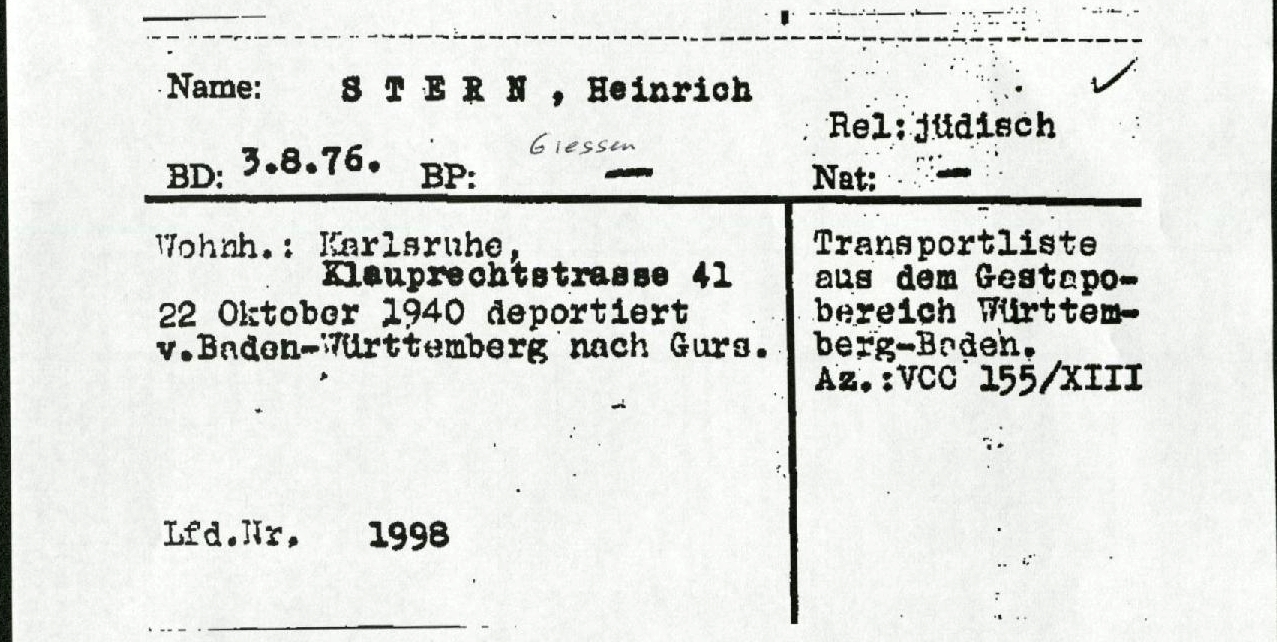
From the Mannheim Jewish Community database on JewishGen, I learned that Johanna and Heinrich Stern had resided in a town called Karlsruhe before the war.  Karlsruhe is about forty miles from Mannheim.  It is rather distant from Köln, where Johanna was born—almost 200 miles—and from Giessen, where Heinrich was born.  But perhaps more importantly, it is less than twenty miles from the French border.  I don’t know how the Sterns ended up living there or when they had moved there.

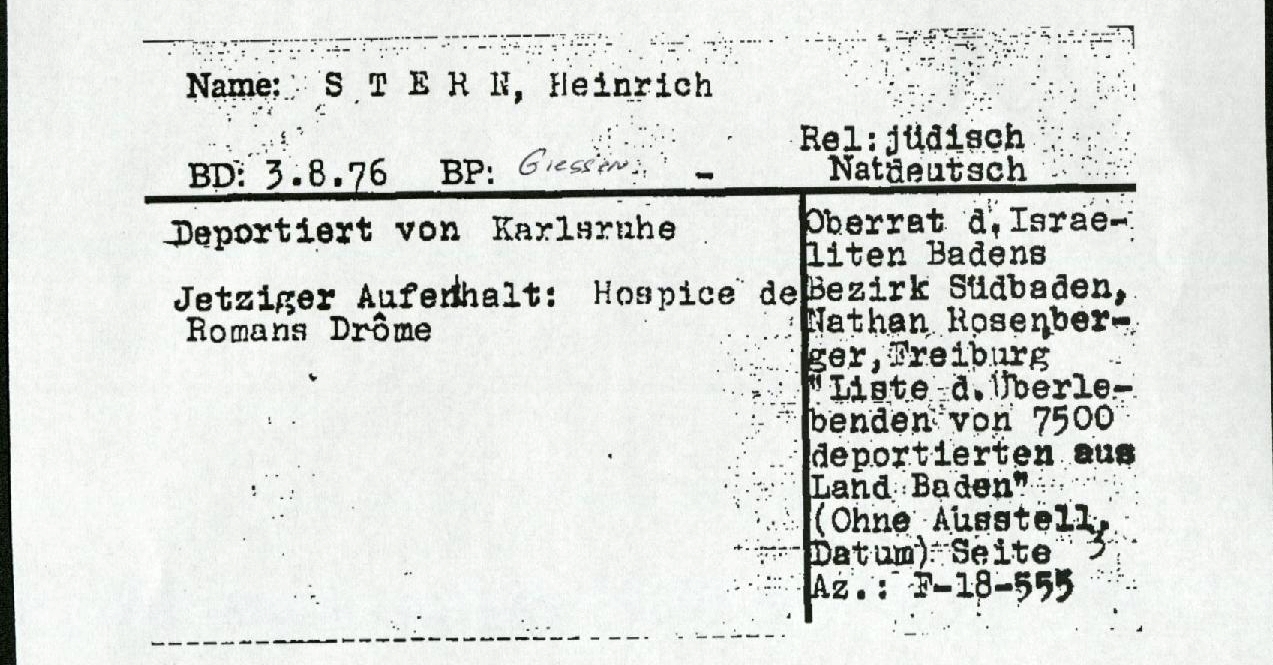
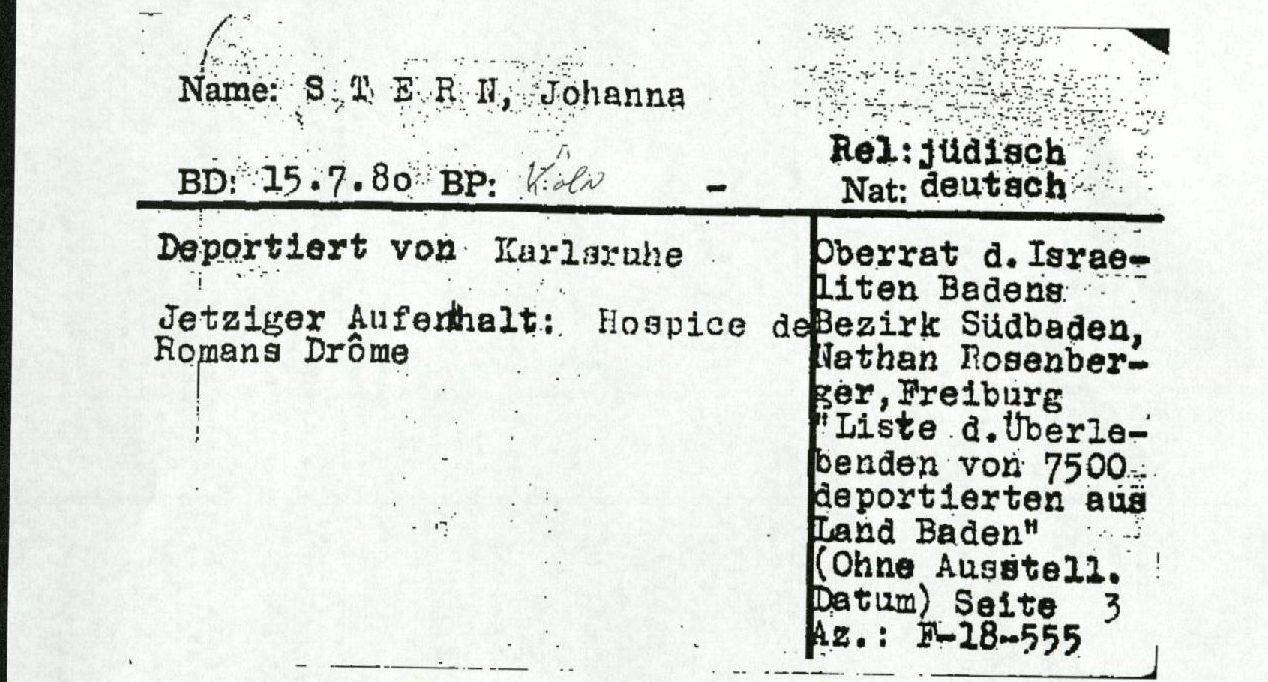
But I do know when they left.  Thanks to Peter Lande at the USHMM, I have learned about a whole new chapter in the history of the Holocaust.  Peter sent me the documents below regarding Johanna and Heinrich Stern:


Heinrich Stern ITS card page 1Heinrich Stern ITS card page 2


Johanna Stern ITS card


(Translation of first card: Stern, Heinrich, born 3rd August 1876 in Giessen, religion: Jewish, nationality: German – Senior councillor of the Jews in Baden, district South-Baden (source: Nathan Rosenberger, Freiburg: List of survivors of 7.500 deported from the state of Baden), without date, page 3 – ref.-nr. F-18-555 – residence: Karlsruhe, Kleinprechtstr. 41, deported from Karlsruhe at the 22 October 1940 to Gurs in Southern France, current address: Hospice de Romain Drome.

Second card: transport-list from the Gestapo, district Fürstenberg-Baden. ref-nr. VCC 155/XIII.  The third card is the same as the first, except it is for Johanna Stern, born 15th of July, 1880 in Köln. )

These cards were definitely about my cousin Johanna Schoenthal Stern and her husband Heinrich Stern.  The birth dates and places are consistent with the passenger ship manifest and the JewishGen sources I had found, and the place of last residence in Germany and the residence in France are also consistent with those sources and the notice posted by the family in Aufbau in 1946.  These cards told me what had happened to Johanna and Heinrich. They had been deported by the Gestapo from Karlsruhe on October 22, 1940, to a place called Gurs in southern France.

With these clues, I was able to find out more about the fate of the Sterns, not specifically but generally.  In October, 1940, the Nazi officials in charge of the Alsace and Lorraine regions of France as well as the Baden district of Germany decided to deport the Jews from Baden, having already deported those who had been living in Alsace and Lorraine.  This decision, known as the Wagner-Burckel Aktion for the two Nazi officials who planned and implemented it, led to the sudden deportation of approximately 7,500 Jews from the Baden region, including my cousins, the Sterns, who were living in Karlsruhe.  It would be the only deportation of German Jews to the west rather than the east of Germany during the Holocaust.


Railroad tracks to Gurs By Jean Michel Etchecolonea (Own work) [GFDL (http://www.gnu.org/copyleft/fdl.html) or CC BY-SA 3.0], via Wikimedia Commons

Railroad tracks to Gurs
By Jean Michel Etchecolonea (Own work) [GFDL (http://www.gnu.org/copyleft/fdl.html) or CC BY-SA 3.0], via Wikimedia Commons

Manfred Wildmann, a victim of this deportation, provided this chilling account of the deportation itself on his website Our Lives in Europe:

On October 21, 1940, late in the afternoon, my grandfather, as head of the Jewish community, was told to inform all the Jews of Philippsburg that the next day Jews were not allowed to leave their homes.  The next morning the police (it may have been the Gestapo) came to every Jewish house, to inform us that we had one hour to pack after which we would be taken away to an unknown destination.

An hour later, the police came to pick us up to march us to the central square, where a canvas covered truck was waiting for all the 21 Jews of Philippsburg, aged 10 to 80.  The truck took us to Bruchsal, 20 km away which was an assembly point for Jews from the area.  Late that afternoon, we were all marched to the railroad station.  When the train finally came, a passenger train with third class coaches, we were relieved that it was heading south and not north towards Poland.  While we didn’t know any details of what was happening in Poland, we knew that whatever it was, it wasn’t good.  All night long, the train headed south, stopping often to pick up more Jews along the way.  Early in the morning, we crossed the Rhine.  Now we knew that we were in France.

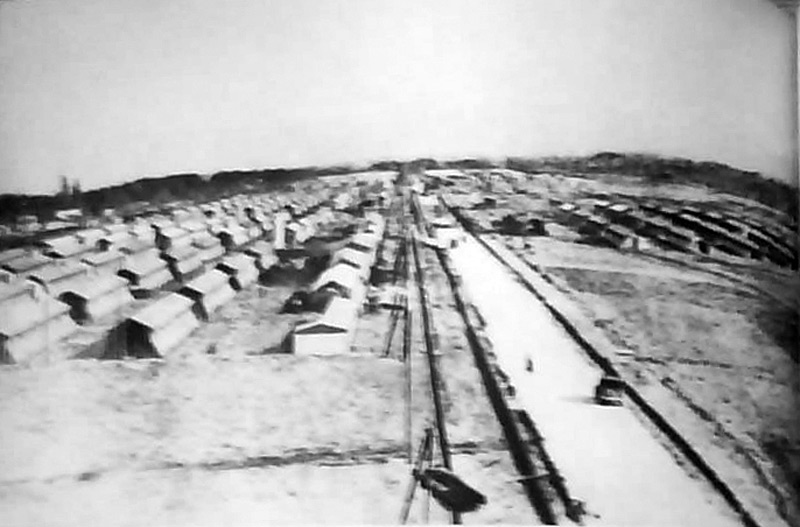
Once in France, the deportees were sent to a French detention camp in Gurs in the Basque region of southern France, near the border with Spain.  Originally built in 1939 by the French to house refugees from the Spanish Civil War, the camp had also been used by the French to detain German Jews as “enemy aliens” in 1940.  After Germany invaded France and the Vichy government was established, the camp came under Vichy control.  When the Jews from Baden arrived on nine trains in October 1940, the Vichy government decided to send them to the camp at Gurs.

According to the USHMM website, “Conditions in the Gurs camp were very primitive. It was overcrowded and there was a constant shortage of water, food, and clothing. During 1940-1941, 800 detainees died of contagious diseases, including typhoid fever and dysentery.”


Manfred Wildmann provided a more detailed and vivid description:

No vegetation grew in the entire Camp, and the constant rain transformed the ground into a sea of mud into which one could sink knee deep and lose one’s shoes.

The barracks of Gurs were of a special construction, with the lower parts of the walls slanting outwards.  They were constructed of rough wooden planks, covered with tar paper, with a wooden floor and a few small windows covered with plasticized chicken wire.  About eighty people were assigned to each.  The only furniture in the barracks was each person’s rolled up straw bag or mattress, suitcases and one cast iron stove in the center to provide a little heat.  Everybody lived sitting either on these straw bags or suitcases.  This is also how we ate, out of empty tin cans or any other suitable container we could find.

Another family memoir about life at Gurs can be found at The Grey Folder Project website by Toby Sonneman.

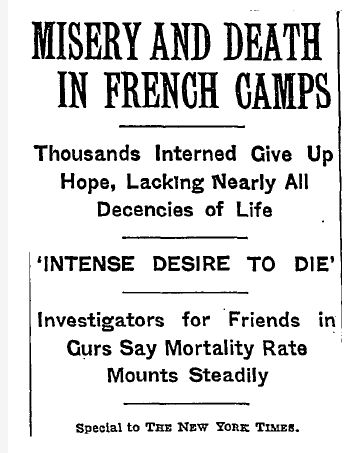
In January, 1941, the New York Times reported on conditions at Gurs, noting that there were fifty doctors providing medical treatment to over 7000 people interned in the camp, trying to “reduce an already high and still mounting mortality rate resulting from lack of food and medicine and unhygienic conditions, the physical resistance of most of the refugees already having been worn down through long suffering.”  The Times article stated that there were over 500 children in the camp and about 1200 people over seventy.   People were suffering from malnutrition, bleeding gums, heart problems, dysentery, typhoid, and lice.  There was severe overcrowding and poor heating and ventilation.  Fifteen to twenty-five people were dying every day.  “Misery and Death in French Camps, ” New York Times, January 26. 1941, p. 24.


New York Times, January 26, 1941, p. 25

New York Times, January 26, 1941, p. 24


What happened to those who survived? According to the USHMM, “1,710 were eventually released, 755 escaped, 1,940 were able to emigrate, and 2,820 men were conscripted into French labor battalions.”  The exact number of those who died of the 7,500 Jews who were deported from Baden is not known, but overall over 1000 people died at Gurs over the course of the war.  Many of those Baden deportees were transferred to other camps and some eventually to Auschwitz.  The USHMM website states, “Between August 6, 1942 and March 3, 1943, Vichy officials turned over 3,907 Jewish prisoners from Gurs to the Germans; the Germans sent the majority of them to the Drancy transit camp outside Paris in northern France. From Drancy, they were deported in six convoys to the extermination camps in occupied Poland, primarily Auschwitz.”


Cemetery for those who died at Gurs By Jean Michel Etchecolonea (Own work) [GFDL (http://www.gnu.org/copyleft/fdl.html) or CC BY-SA 3.0 (http://creativecommons.org/licenses/by-sa/3.0)], via Wikimedia Commons

Cemetery for those who died at Gurs
By Jean Michel Etchecolonea (Own work) [GFDL (http://www.gnu.org/copyleft/fdl.html) or CC BY-SA 3.0 (http://creativecommons.org/licenses/by-sa/3.0)%5D, via Wikimedia Commons

I don’t know how long Johanna and Heinrich were at Gurs or under what circumstances they were able to leave.  Perhaps they were among the 755 who escaped or the 1,710 who were released.  Maybe they were transferred to another camp.  The records that the USHMM had for them end with the cards posted above.

As for Henry Kahnweiler, the man the Sterns named as their contact person in France on the passenger manifest when they left for the US in 1947,  he was the very well-known German-born art dealer, Daniel-Henry Kahnweiler, described by one source “a banker, writer, publisher, and art dealer who became the pioneering champion of Cubism.”  As described by Johanna’s sister, Erna Schoenthal Haas, in the Pittsburgh Jewish Chronicle on June 14, 1989, Kahnweiler was a friend of her brother-in-law, Heinrich Stern, from the days they had both been working at a bank in Germany.  Kahnweiler’s parents had wanted him to be a banker, but instead he’d moved to Paris in 1907, where he soon established himself as a successful art collector and dealer. He became one of the principal dealers in Cubist art and a major dealer in the works of Picasso.

Here is a portrait of Kahnweiler done by the artist Juan Gris:

Deutsch: Juan Gris: Porträt Daniel-Henry Kahnw...

Deutsch: Juan Gris: Porträt Daniel-Henry Kahnweiler, 32,5 x 26 cm, Bleistift auf Papier, Museée National d’Art Moderne, Centre Georges Pompidou, Paris (Photo credit: Wikipedia)


During World War I, France appropriated and sold Kahnweiler’s collection because he was a German national and thus a national of an enemy state.  After spending the war in exile in Switzerland during which time he wrote several important works on Cubism and art history, Kahnweiler returned to Paris in 1920 and started over.  Here is he depicted in 1923 at his gallery in Paris:  standing, Daniel Henry Kahnweiler (r), Juan Gris (c) ; 1st row, Louise Leiris (c).


Embed from Getty Images

But then in the spring of 1940 when the Nazis invaded France, Kahnweiler, like thousands of other Jews living in France, went into hiding in the south of France.  This post describes in detail his ordeal and perhaps reflects the experience of many others including that of Johanna (Schoenthal) and Heinrich Stern.  I don’t know how the Sterns stayed in touch with Kahnweiler during the war, but they obviously knew his Paris address in 1947 when they departed for the US.

I imagine that the Schoenthals in the US—especially Lee, Meyer, and Erna—must have been greatly worried about their sister Johanna and her husband during the war, but by June 14, 1946, they knew that Johanna and Heinrich were alive and where they were living, as is apparent from the notice from the Aufbau regarding the deaths of Henriette and Julius Levi.  That notice indicates that Johanna and Heinrich were then living in a hospital or hospice in a town called Romans in the department of Drome in southeastern France.  I have written to the town of Romans in France to see if they have any information, but so far have not gotten any response.


Aufbau June 14, 1946

Aufbau June 14, 1946

It was almost exactly a year later that Johanna and Heinrich arrived in the US and settled in Pittsburgh.  I can only imagine the joy that the four surviving siblings experienced when they were finally all reunited.  A joy, however, that must have been bittersweet, tempered by the knowledge that their sister Henriette and her husband had not survived and that their sister Johanna and her husband must have suffered greatly in order to survive.

In my next post, I will write about the post-war lives of these four siblings, their spouses, and the two grandsons of Jakob and Charlotte Schoenthal, Werner Haas and Helmut Levi/Henry Lyons.


Fighting their Native Country in World War II: Jakob Schoenthal’s Grandsons

As I wrote last time, the two sons of Jakob Schoenthal and Charlotte Lilienfeld had arrived in the US long before Hitler came to power in Germany.  They were working as tailors and living in Washington, Pennsylvania, where their uncles and aunt had lived for many years.  Then Hitler came to power, and their family back home was in danger.

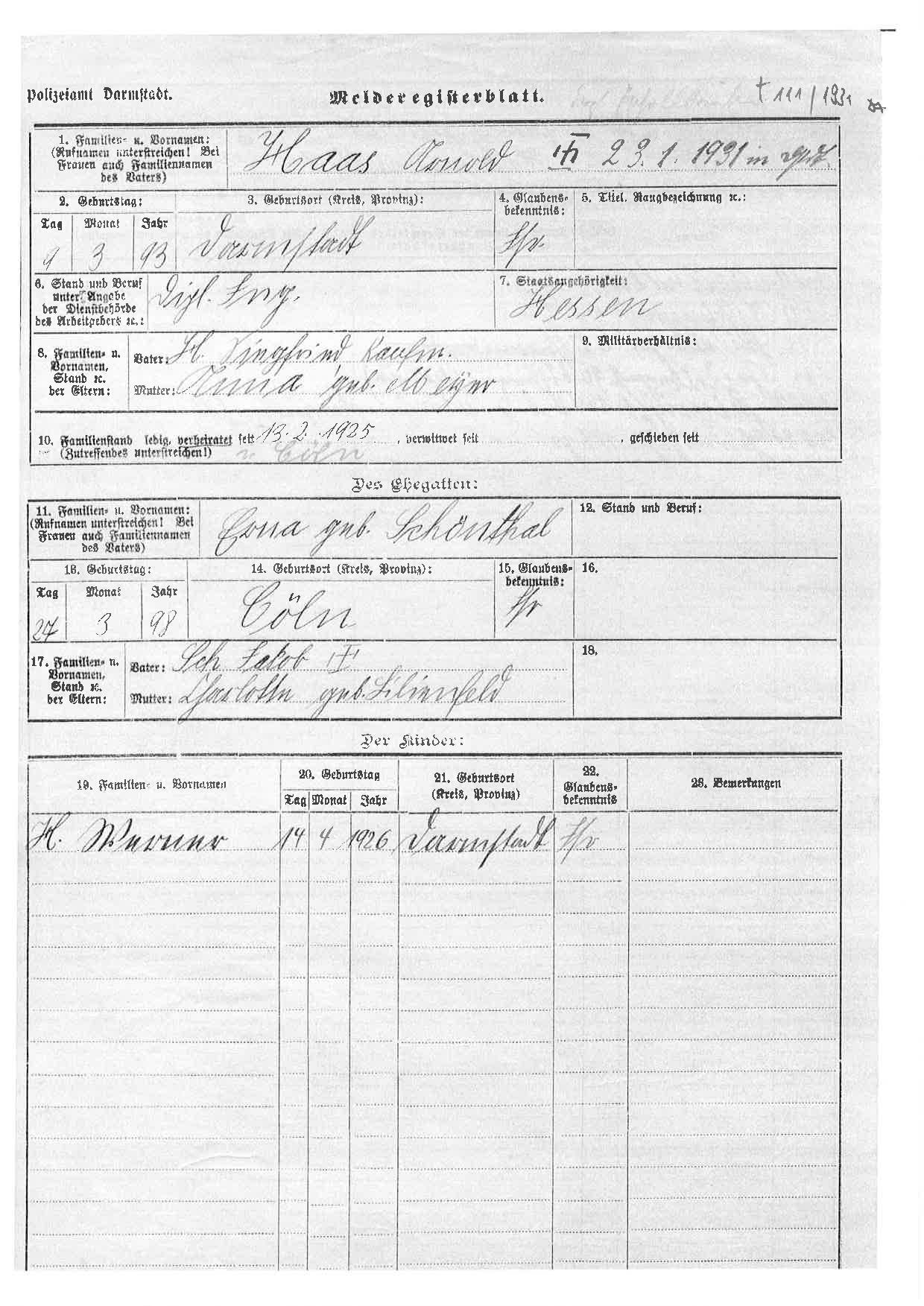
In 1938, Lee and Meyer’s sister Erna arrived from Germany with her son Werner.  I have now learned more about Erna’s husband Arnold Haas.  He was born in Darmstadt, Germany, in 1893, and had served his native country during World War I.  He and Erna Schoenthal had married on February 13, 1925, and their son Werner was born on April 14, 1926.  Then Arnold died at age 38 on January 23, 1931, leaving behind his young widow Erna and his not-yet five year old son Werner.  Fortunately Erna had the good sense to leave Germany in May, 1938, and bring her son and herself to safety in the US.  In 1940, they were living in Pittsburgh.

Darmstadt register for Arnold Haas and family indicating birth, marriage, and death of Haas and birth of son Werner

Darmstadt register for Arnold Haas and family indicating birth, marriage, and death of Arnold Haas and birth of son Werner

Helmut Levi, the son of Julius and Henriette (Schoenthal) Levi, had also arrived by then and was living in New York City.  Both Helmut and Werner soon found themselves fighting their former homeland when the US entered World War II at the end of 1941 after the bombing of Pearl Harbor.

Werner Haas joined the US Navy on March 15, 1944, when he was 18, and served until March 6, 1946.  He spent time at the Naval Air Stations in Norfolk, Virginia, and in Corpus Christi, Texas, before being assigned to the Destroyer Escort USS Wesson in June, 1945.  According to Michael Moskow, who has done extensive research on Jewish military service during World War II, the Wesson had been struck by a kamikazi in April, 1945, two months before Werner was assigned to that vessel.

As seen in the caption on the photo below, the Wesson was “in overhaul” from May to July 1945, so it would seem likely that Werner was working on her repairs when he was first assigned to that ship.  Werner served as a fireman on the destroyer; according to this site about military careers, “The training received as a Fireman or in the related engineering skill specialties is equivalent to that received as an electrician, electrical or power plant/co-generation plant operator or supervisor, diesel mechanic, or electronics repair technician.”  From various military records it appears that Werner was assigned to the Wesson for at least a year and was then assigned to two other naval ships.


English: 26 June 1945: Mare Island Naval Shipy...

English: 26 June 1945: Mare Island Naval Shipyard, San Francisco, Cal. – Forward plan view of USS Wesson (DE 184) at Mare Island. She was in overhaul at the yard from 16 May to 1 July 1945. USS Blessman (APD 48) inboard of Wesson and USS Hazelwood (DD 531) is on the opposite side of the pier. (U.S. Navy photo #DE-184-4842-45) (Photo credit: Wikipedia)


Werner’s older cousin Helmut Levi served in the US Army, enlisting on November 28, 1942.  He served as a private and then a corporal during the course of World War II.   Although I am still looking for more information about Helmut’s service during the war, I was able with the help of Michael Moskow to find this letter that Helmut Levi (presumably the same one) wrote to Yank magazine in September, 1944:


Pvt Helmut Levi letter to Yank magazine, September 29, 1944, p 14

Pvt Helmut Levi letter to Yank magazine, September 29, 1944, p 14, found at http://www.unz.org/Pub/Yank-1944sep29-00014


Not surprisingly, Helmut had strong feelings about the need for Germany (and Japan) to be occupied and supervised carefully after the war.  It appears that he was stationed in Britain in September, 1944, just months after the D-Day invasion and the beginning of the Allies’ advances in France against Germany.  During that time, Helmut’s aunt and uncle, Johanna (Schoenthal) and Heinrich Stern, were living in France, hiding from the Nazis. His parents had already been killed at the Chelmno death camp.

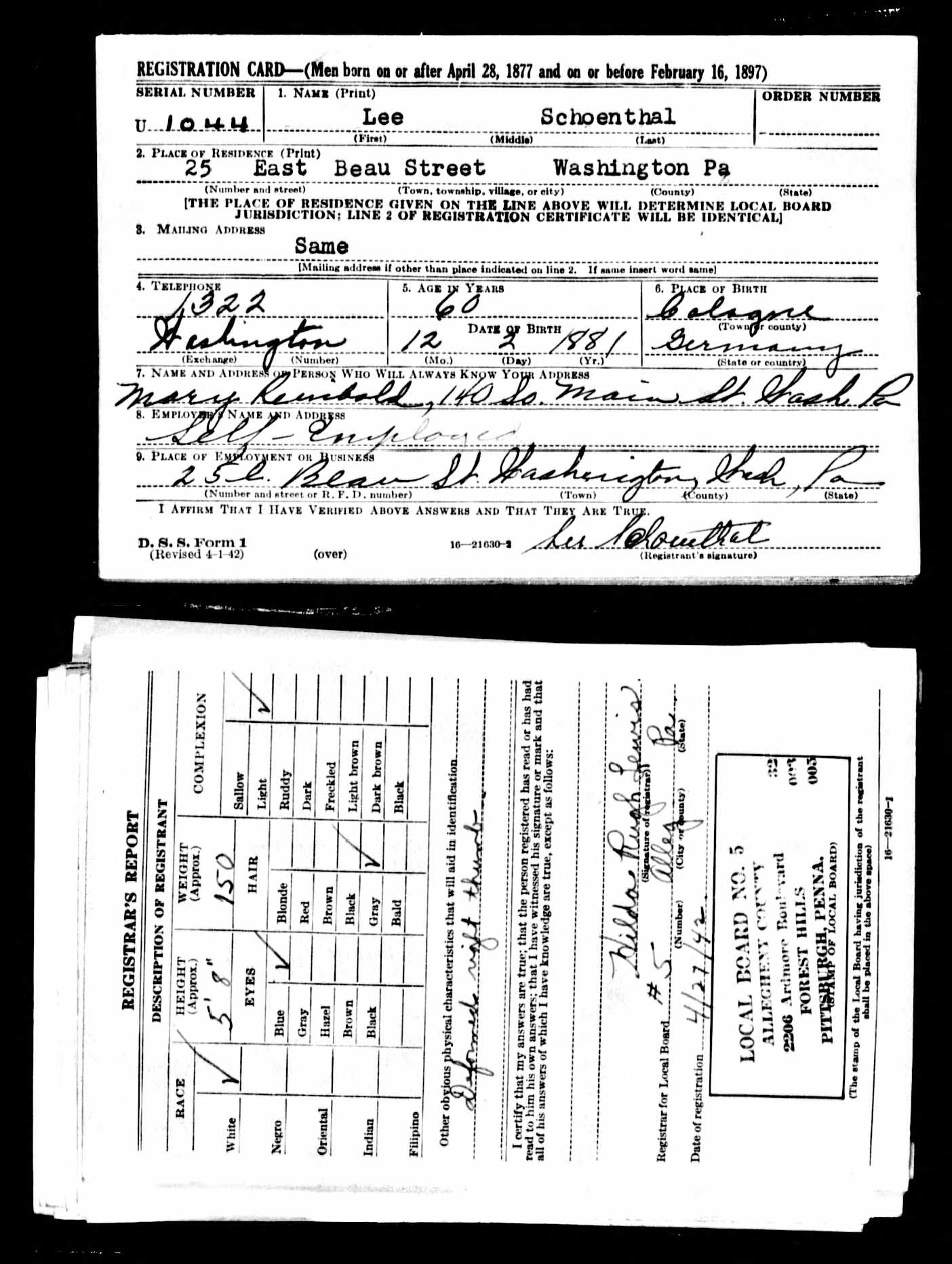
Lee and Meyer both registered for the World War II draft, though being almost in their sixties when the war began, neither served in the military during the war.  Note that Meyer was both working for and living with Lee in April 1942.  (Lee seems to have listed his work address as his residence.)  Although Meyer listed his brother Lee as the person who would always know his address, Lee listed someone named Mary Reinbold, who as listed in the 1940 census, was then a 39 year old single woman living with her father and brothers and working as a telephone operator.


Lee Schoenthal World War II draft registration The National Archives at St. Louis; St. Louis, Missouri; World War II draft cards (Fourth Registration) for the State of Pennsylvania; State Headquarters: Pennsylvania; Microfilm Series: M1951; Microfilm Roll: 278

Lee Schoenthal World War II draft registration
The National Archives at St. Louis; St. Louis, Missouri; World War II draft cards (Fourth Registration) for the State of Pennsylvania; State Headquarters: Pennsylvania; Microfilm Series: M1951; Microfilm Roll: 278


Meyer N Schoenthal World War II draft registration Ancestry.com. U.S., World War II Draft Registration Cards, 1942 [database on-line]. Provo, UT, USA: Ancestry.com Operations, Inc., 2010.

Meyer N Schoenthal World War II draft registration
Ancestry.com. U.S., World War II Draft Registration Cards, 1942 [database on-line]. Provo, UT, USA: Ancestry.com Operations, Inc., 2010.

Why wouldn’t Lee have listed Meyer as his contact just as Meyer had listed him? More on that in a later post.

Once the war ended, the family apparently spent a year trying to learn what had happened to Henriette Schoenthal and Julius Levi.  My heart broke when, with Michael Moskow’s help,  I found this notice in the June 14, 1946 issue of Aufbau, the newspaper published beginning in the 1930s for German Jewish immigrants in the United States:


Aufbau June 14, 1946

Aufbau June 14, 1946 found at http://archive.org/stream/aufbau1219461946germ#page/n475/mode/1up


Translation: After a one year search in Europe, we today know that our beloved parents and siblings, Julius Levi and Henriette Levi (nee Schoenthal) from Cologne have fallen to the Nazi terror …. [followed by the names of their son and their siblings].

By the time Helmut Levi had enlisted in the US Army in November 1942, his parents had already been murdered by the Nazis.  It must have just been unbearable for him to realize that while he had been fighting to defeat Hitler and the Nazis, it had already been too late to save his parents.

This notice also indicates that as of June 14, 1946, Helmut was still in the Army; although I am not sure what “Liaison Sec” refers to, G-2 is military shorthand for military intelligence staff.  It appears that Helmut was doing some kind of intelligence work in Berlin after the war, which makes sense, given his familiarity with Germany and the German language.  Being in Berlin may have also allowed him to search more quickly for what had happened to his parents.

As for Johanna Schoenthal Stern and her husband Heinrich Stern, they arrived in the US in 1947 from France.  As I mentioned in my prior post, Johanna and Heinrich had listed a friend named Henry Kahnweiler of Paris as their contact person in France.  I was curious as to who he was and how Johanna and Heinrich were connected to him.  I wanted to know more about their story—how and when did they go to France? How did they survive the Nazi occupation of France? Had they had children who had not survived the war?

Although I don’t have all the answers, I now have at least some answers to those questions.  I will address those in my next post.


The Children of Jakob Schoenthal and Charlotte Lilienfeld, Part III: Lee and Meyer Come to America

As I wrote in my two last posts, after following a rather convoluted research path, I had discovered that  my great-great-uncle Jakob Schoenthal and his wife Charlotte Lilienfeld had had five children born in Cologne, Germany: Johanna, born in 1880; Lee, born in 1881; Meyer, born in 1883; Henriette, born in 1885; and Erna, born in 1898.[1]   Their father Jakob had died in 1903 when Erna in particular was quite young.  Their mother Charlotte died in 1935.

Four of their five children immigrated to the US: the two sons Lee and Meyer arrived in Washington, Pennsylvania, in the early decades of the twentieth century.  Erna arrived in 1938 with her son Werner; she was a young widow when she arrived. (I am still looking for information about her husband Arnold and hope to have an update soon.) Johanna and her husband Heinrich Stern arrived in 1947, having somehow survived the war and last residing in Lyons, France.

Tragically, Jakob and Charlotte’s remaining child, Henriette, had been murdered by the Nazis along with her husband Julius Levi.  Their son Helmut, however, had left in time.  He came to the US in 1939 and eventually changed his name to Henry Lyons.  He and his wife Pauline nee Schwartz lived for many years in Rego Park, Queens, New York.

Rego Park, Queens, NY By Frank Hindimith [GFDL (http://www.gnu.org/copyleft/fdl.html) or CC-BY-SA-3.0 (http://creativecommons.org/licenses/by-sa/3.0/)], via Wikimedia Commons

Rego Park, Queens, NY
By Frank Hindimith [GFDL (http://www.gnu.org/copyleft/fdl.html) or CC-BY-SA-3.0 (http://creativecommons.org/licenses/by-sa/3.0/)%5D, via Wikimedia Commons

In the next few posts I will address these four children, Lee, Meyer, Erna, and Johanna, as well as the two grandsons Werner and Henry. Who were these people? What were their lives like once they got to the US?  I will discuss Lee and Meyer first and their early years in the US and then their sisters and nephews and what happened to them all during and after World War II.

Lee and Meyer were not the easiest to research.  Not only did I have the problem of distinguishing them from their first cousins with the same names, Lee and Meyer, the sons of Henry Schoenthal, I also had a very difficult time finding them on census reports.   Lee only appears on the 1920 census, Meyer only on the 1930 census.  I have no idea how they evaded so many census enumerators.

Figuring out when each of the brothers arrived was also a puzzle. I can’t find an early passenger manifest for either of them. The 1920 census reports that Lee arrived in the US in 1899, when he would have been eighteen years old, but Lee does not appear on the 1900 census nor does he appear in any of the available Washington, Pennsylvania directories until 1909, when he is listed as a tailor working at 12 East Cherry Avenue in Washington.

In 1911, Lee went back to Germany, presumably to visit his family.  On the ship manifest for that trip (line 26), Lee stated that he had been living at 18 East Cherry Avenue, Washington, Pennsylvania, from 1907 through 1911, but I cannot find him on the 1910 census.


1911 ship manifest for Lee Schoenthal page 1

1911 ship manifest for Lee Schoenthal, line 26 Ancestry.com. New York, Passenger Lists, 1820-1957 [database on-line]. Provo, UT, USA: Ancestry.com Operations, Inc., 2010. Original data: Passenger Lists of Vessels Arriving at New York, New York, 1820-1897. Microfilm Publication M237, 675 rolls. NAI: 6256867. Records of the U.S. Customs Service, Record Group 36. National Archives at Washington, D.C.

1911 ship manifest for Lee Schoenthal, line 26
Ancestry.com. New York, Passenger Lists, 1820-1957 [database on-line]. Provo, UT, USA: Ancestry.com Operations, Inc., 2010.
Original data: Passenger Lists of Vessels Arriving at New York, New York, 1820-1897. Microfilm Publication M237, 675 rolls. NAI: 6256867. Records of the U.S. Customs Service, Record Group 36. National Archives at Washington, D.C.

He does, however, appear in the Washington directories throughout the 1910s beginning in 1911, and he registered for the World War I draft in 1918.  Throughout, Lee was working as a tailor.  My best guess is that he had arrived in the US between 1907 and 1909.


Lee Schoenthal World War I draft registration Ancestry.com. U.S., World War I Draft Registration Cards, 1917-1918 [database on-line]. Provo, UT, USA: Ancestry.com Operations Inc, 2005. Original data: United States, Selective Service System. World War I Selective Service System Draft Registration Cards, 1917-1918. Washington, D.C.: National Archives and Records Administration. M1509, 4,582 rolls. Imaged from Family History Library microfilm.

Lee Schoenthal World War I draft registration
Ancestry.com. U.S., World War I Draft Registration Cards, 1917-1918 [database on-line]. Provo, UT, USA: Ancestry.com Operations Inc, 2005.
Original data: United States, Selective Service System. World War I Selective Service System Draft Registration Cards, 1917-1918. Washington, D.C.: National Archives and Records Administration. M1509, 4,582 rolls. Imaged from Family History Library microfilm.

Meyer, on the other hand, appears in the 1903 and 1905 Washington directories, working as a clerk for Rudolph Hanau and residing at 19 Sherman Avenue, as listed in both directories.  Lee does not appear in either of those directories.  Meyer, like Lee, is not on the 1910 census nor the 1920 census, nor does he appear in the 1909 directory or any other available Washington, Pennsylvania, directory between 1906 and 1928.  According to the 1930 census, the one census which includes Meyer, he arrived in the US in 1923.  But then how explain his listings in 1903 and 1905?  Had he left the US and returned to Germany for all those years, not returning until the 1920s?

I have two ship manifests showing Meyer traveling between Germany and the US, once in 1927 and once in 1929.  The 1927 manifest listing for Meyer states that his occupation was a merchant, that he was 44 years old, born in Koln, and last resided in Washington, Pennsylvania.


Meyer N Schoenthal 1927 ship manifest Year: 1927; Arrival: New York, New York; Microfilm Serial: T715, 1897-1957; Microfilm Roll: Roll 4123; Line: 1; Page Number: 134

Meyer N Schoenthal 1927 ship manifest
Year: 1927; Arrival: New York, New York; Microfilm Serial: T715, 1897-1957; Microfilm Roll: Roll 4123; Line: 1; Page Number: 134


The second page states that his contact in Germany was his brother-in-law, Julius Levi, and that his contact in the US was his cousin, the above-mentioned Rudolph Hanau of 26 Sherman Avenue, Washington, Pennsylvania.


Meyer N Schoenthal 1927 ship manifest, page 2 Year: 1927; Arrival: New York, New York; Microfilm Serial: T715, 1897-1957; Microfilm Roll: Roll 4123; Line: 1; Page Number: 134

Meyer N Schoenthal 1927 ship manifest, page 2
Year: 1927; Arrival: New York, New York; Microfilm Serial: T715, 1897-1957; Microfilm Roll: Roll 4123; Line: 1; Page Number: 134


Of course, when I saw that Rudolph Hanau was Meyer’s cousin, I had to figure out the connection.  After a few hours of looking at Ancestry and the Hessen archives online, I learned that Rudolph’s wife was Johanna Levi, daughter of Moses Levi and Rechel Lilienfeld.  Yep, Lilienfeld.  Rechel Lilienfeld was the sister of Helen and Charlotte Lilienfeld.  Thus, Johanna Levi was Meyer’s first cousin (and also, obviously, a first cousin to Lee, Johanna, Henriette, and Erna Schoenthal).

Her husband Rudolph Hanau was, like my great-grandfather Isidore and his brother Henry, a merchant in the china business in Washington, Pennsylvania. He must have known my great-grandfather well.   Thus, there were a number of other members of the extended family living in Little Washington whom I had not located earlier.

The second page of the 1927 manifest for Meyer’s trip to Germany notes that he had previously been in the US from 1911 through 1927.  This would explain why he is not on the 1910 census, but it doesn’t explain his absence from the 1920 census, unless he had been out of town then also.  It also is inconsistent with the fact that he appears in the 1903 and 1905 directories as well with the information on the 1930 census stating he had arrived in 1923.

The 1929 manifest for Meyer is similar in content to the 1927 manifest, but he now lists his mother Charlotte as his contact in Germany and his brother Lee as his contact in Washington.  Here he claims he had previously been in the US only since 1923, consistent with what he later reported on the 1930 census, but inconsistent with both the directory listings in 1903 and 1905 and the passenger manifest from 1927, just two years earlier.  Could the time periods listed on these manifests report times lived at a very specific address in the US, not time periods in the US generally?

Meyer N Schoenthal 1929 ship manifest page 1

Meyer N Schoenthal 1929 ship manifest page 2

Lee Schoenthal 1929 ship manifest Ancestry.com. New York, Passenger Lists, 1820-1957 [database on-line]. Provo, UT, USA: Ancestry.com Operations, Inc., 2010. Original data: Passenger Lists of Vessels Arriving at New York, New York, 1820-1897. Microfilm Publication M237, 675 rolls. NAI: 6256867. Records of the U.S. Customs Service, Record Group 36. National Archives at Washington, D.C.

Thus, both Lee and Meyer likely arrived in the US in the first decade of the 1900s, but may have spent time back in Germany for various periods.  Lee seems to have been permanently settled in the US by the 1910s, Meyer by the 1920s.

The 1929 directory for Washington, Pennsylvania, lists both Lee and Meyer as tailors, living at different addresses, Lee at 321 Burton Avenue, Meyer at 143 North Avenue, but only about a half mile apart.  As reported on the 1930 census, Meyer was living as a lodger in someone’s home.  In 1931, both Lee and Meyer are again listed as tailors in the directory and both residing at the same addresses provided in 1929.  But for some reason, Lee does not appear on the 1930 census.  (Residing at 321 Burton Avenue on the 1930 census was a couple named Jacob and Ruth Weber, owners of a grocery store; Lee is not listed as living with them.)


1931 Washington PS directory Ancestry.com. U.S. City Directories, 1822-1995 [database on-line]. Provo, UT, USA: Ancestry.com Operations, Inc., 2011.

1931 Washington PS directory
Ancestry.com. U.S. City Directories, 1822-1995 [database on-line]. Provo, UT, USA: Ancestry.com Operations, Inc., 2011.

Lee is listed on several Washington directories in the 1930s, but Meyer is not in any directory after the 1931 issue.  Where was Meyer, and why isn’t he included in the directories after 1931? I was puzzled by his absence.  More on that in a later post.

Thus, by the early 1930s, both Lee and Meyer had been settled in the US for quite some time.  Their sisters were all still living in Germany as was their mother.  That, of course, would all change once Hitler came to power.


[1] The thirteen year gap between Henriette and Erna and the fact that Charlotte would have been 43 in 1898 made me somewhat skeptical of Erna’s birth year, but three sources corroborate that as the correct year, so I have to assume it’s correct. Plus there was a gap of twelve years between my mother and her sibling closest in age, so I know it happens.

Jakob Schoenthal and Charlotte Lilienfeld, Part II: Finding Their Children and Grandchildren

In my last post, I talked about the twisted path I took to find my great-great-uncle Jakob Schoenthal and his wife Charlotte Lilienfeld.  After discovering that their daughter Henriette Schoenthal and her husband Julius Levi had been killed in the Holocaust, I was determined to find out what had happened to Henry Lyons, who was the son of Henriette and Julius Levi and who had filed Pages of Testimony for his parents with Yad Vashem.

I thought that would be easy.  After all, I had a name and a specific address from the Pages of Testimony—99-30 59th Avenue, Rego Park, New York.  And I did almost immediately find a Public Records listing with his name at that address that provided me with his birthdate, October 17, 1919.  But that didn’t tell me much more than what I knew from the Pages of Testimony.

Yad Vashem page of testimony for Henriette Schoenthal Levi


Searching a bit further using the Rego Park address listed on the Pages of Testimony, I found a Pauline Lyons listed at that same address; I assumed that she was Henry’s wife.  Having both names made the search a bit easier since Henry Lyons itself is not exactly a unique name. I was able to use their two names together to find that they are both buried at Calverton National Cemetery and that Henry had died on December 18, 1986, and Pauline on November 30, 2007.  Henry had served in the US military during World War II, beginning his service on November 28, 1942, and thus was entitled to a military burial.  Imagine coming to America as a young man to escape Hitler and then fighting against the country of your birth.

When had he come to the US? Had he and Pauline had children? I wanted to know more.  I assumed Henry had arrived in the US sometime in the mid-to late 1930s.  I also assumed that he had arrived under the surname Levi, not Lyons.  After I wasted a lot of time searching for him under the wrong name, a member of the NYC Genealogy Group found a record for a man named Helmut Levi who had changed his name to Henry Lyons on October 5, 1953, in the city courts in New York.


Helmut Levi change of name to Henry Lyons Ancestry.com. U.S. Naturalization Record Indexes, 1791-1992 (Indexed in World Archives Project) [database on-line]. Provo, UT, USA: Ancestry.com

Helmut Levi change of name to Henry Lyons
Ancestry.com. U.S. Naturalization Record Indexes, 1791-1992 (Indexed in World Archives Project) [database on-line]. Provo, UT, USA: Ancestry.com

Armed with the information about what was probably his original name, I was able to find Helmut Levi on the 1940 census, living as a lodger at 204 West 87th Street in NYC and working as a watchmaker.  I was pretty certain I had found the right person when I saw on the census record that he had been living in Cologne, Germany, in 1935.

I also then found him on a passenger manifest (see line 26 on each page below):

Helmut Levy ship manifest p 1

Helmut Levi ship manifest Henry Lyons

Year: 1939; Arrival: New York, New York; Microfilm Serial: T715, 1897-1957; Microfilm Roll: Roll 6293; Line: 1; Page Number: 188


Helmut Levi had arrived in NYC on February 25, 1939.  According to the ship manifest, he was a nineteen year old merchant born and last residing in Cologne, leaving behind his father Julius Levi of Breitstrasse in Cologne and going to his uncle Lee Schoenthal of Washington, Pennsylvania.  This was obviously my cousin, the man later known as Henry Lyons.

I also found him on a second passenger manifest dated July 4, 1948, arriving in NYC from Bremerhaven, Germany.  Henry had returned to Germany after the war.  What a devastating trip that must have been.  The photo below shows what his home city of Cologne looked like after Allied bombing during the war.  Henry had not only lost his parents, but the place where he had lived as a child and a teenager.


By U.S. Department of Defense. Department of the Army. Office of the Chief Signal Officer. [2] [Public domain], via Wikimedia Commons

By U.S. Department of Defense. Department of the Army. Office of the Chief Signal Officer. [2] [Public domain], via Wikimedia Commons

From that 1948 passenger manifest (line 10), I saw that Helmut Levi was then living in Washington, Pennsylvania, where his two uncles, Lee and Meyer, were also living, that is, his mother’s brothers, the two sons of Jakob and Charlotte mentioned in my last post.  Like so many Schoenthal relatives before him, Helmut had spent time living in western Pennsylvania.  The ship manifest also indicated that by 1948, Helmut had married, although Pauline is not listed as traveling with him.


Helmut Levi aka Henry Lyons 1948 ship manifest

Helmut Levi 1948 ship manifest Year: 1948; Arrival: New York, New York; Microfilm Serial: T715, 1897-1957; Microfilm Roll: Roll 7624; Line: 10; Page Number: 9


But I still didn’t know whether Helmut/Henry and Pauline had had children or whether there were other family members I might have missed.  I called Calverton National Cemetery, but they had no additional information.  I searched in the newspaper databases for articles or obituaries that might reveal more about Henry and Pauline Lyons.  At first I limited myself to New York papers, but then I realized that that was too narrow, given that he had once lived in western Pennsylvania.  I broadened my search and found this obituary from the January 19, 1989, Pittsburgh Press:


Erna Schoenthal Haas obit 1989


Who was Erna Haas? And was she Henry’s aunt or Pauline’s aunt? And who was Yohana Stern? I had more work to do.  I searched for Erna Haas, an unusual enough name, and was very excited to find this ship manifest (see lines 15 and 16):


Erna Haas ship manifest p 1

Year: 1938; Arrival: New York, New York; Microfilm Serial: T715, 1897-1957; Microfilm Roll: Roll 6152; Line: 1; Page Number: 174


Erna and her twelve year old son Werner had sailed from Hamburg, Germany on May 4, 1938; Erna was a beautician coming from Cologne.  I assumed that therefore her connection would be to Henry, a native of Cologne, not to Pauline, who was American-born.  Turning to the second page of the manifest, my hunch was confirmed (again, see lines 15 and 16):


Erna Haas ship manifest p 2

Year: 1938; Arrival: New York, New York; Microfilm Serial: T715, 1897-1957; Microfilm Roll: Roll 6152; Line: 1; Page Number: 174


Who was the person she named as living in the place she had left? Her sister, H. Levy of Breitstrasse in Cologne—that is, Henriette Schoenthal Levi, who had lived on that street as seen in the Köln directories in my last post. And who was she going to be with in the US? Her brother, Lee Schoenthal in Washington, Pennsylvania.  Erna Haas was another child of Jakob Schoenthal and Charlotte Lilienfeld.  She was also my grandmother’s first cousin.  And the aunt of Henry Lyons.  She was born Erna Schoenthal. I had found a fourth child of Jakob and Charlotte Schoenthal.

In 1940, Erna was listed on the census living with her son Werner in Pittsburgh, Erna working in cosmetics sales, Werner in newspaper sales.  Erna was a widow, so I assume that her husband Arnold had died in Germany, as I have no record of him in the US.  Unfortunately I have not yet found a record for him in Germany either.

But what about Yohana Stern, who had been listed in Erna’s obituary as her sister? I found this obituary for her husband Heinrich while searching for more information about Erna Haas:

Heinrich Stern obit


And then I located a ship manifest for Johanna Stern and Heinrich Stern (lines 3 and 4):


Ship manifest p 1 Johanna Schoenthal and Heinrich Stern


Ship manifest p 2 for Johanna Schoenthal and Heinrich Stern

Year: 1947; Arrival: New York, New York; Microfilm Serial: T715, 1897-1957; Microfilm Roll: Roll 7389; Line: 4; Page Number: 107


They had not arrived in the US until June 10, 1947, when they were 66 and 70 years old.  Notice that Johanna was born in Cologne, presumably around 1880.  How had she and Heinrich survived the Holocaust?  The manifest lists them as “stateless” and notes that they had last resided in “Lyon, France” and that their visas had been issued in “Marseille, France.”

The second page indicates that the person they were leaving behind at their last residence was a friend named Henry Kahnweiler of Paris (more on him in my next post) and the person they were going to see in the US was Johanna’s brother Lee Schoenthal of Washington, Pennsylvania.  Their final destination was Washington, Pennsylvania.  Yohana or Johanna Stern was born Johanna Schoenthal, a fifth child of Jakob and Charlotte Schoenthal. Another of my grandmother’s first cousins.


Thus, Jakob and Charlotte had had five children.  Their two sons Lee and Meyer had emigrated from Germany long before Hitler came to power; they had both settled near their aunt and uncle in Washington, Pennsylvania.    Jakob and Charlotte’s three daughters had stayed behind.  One, Henriette, was murdered by the Nazis with her husband Julius Levi at the Chelmno death camp in 1942, but their son Helmut Levi, aka Henry Lyons, left Germany in 1939 and survived.  Another daughter, Erna, left Germany with her son Werner in 1938.  And finally a third daughter, Johanna, somehow survived the war by going to France, and she and her husband Heinrich Stern came to the US in 1947.

It was a long and twisty road finding these five children, and it was heartbreaking to read of more cousins killed in the Holocaust.  But four of those five children survived and came to the US as did two of Jakob and Charlotte’s grandsons, Henry Lyons and Werner Haas.  More on the lives of these four children and their descendants in my next post.

The Brother Who Stayed Behind: Adventures in Genealogy Research

Born just one year after Simon, the next sibling was Jakob Schoenthal. (I am using the German spelling for two reasons.  First, Jakob stayed in Germany and thus that is how he spelled his name.  Second, it helps to distinguish him from his nephew, Simon’s son Jacob.) Finding Jakob’s story was quite a lesson in genealogy research.  It took some lucky breaks and the help of others, and in the end it led to a story of both tragedy and triumph.


Centro de la ciudad de Koln, Alemania Deutsch:...

Köln Germany, where Jakob Schoenthal lived as an adult (Photo credit: Wikipedia)


First, some background. I’ve already written about eight of the ten children of Levi Schoenthal and Henriette Hamberg, my great-great-grandparents.  They were the eight children who came to America between 1866 and 1881 and settled here permanently, including my great-grandfather Isidore Schoenthal.  All of them lived relatively long and seemingly satisfying lives.  They started in western Pennsylvania, but eventually they and/or their children moved far afield across the United States—to California, Illinois, New Jersey, New York, Massachusetts, and elsewhere.  They thrived in America, and they have many descendants still living in this country.

But there were two siblings who did not end up in America.  One, the youngest child, Rosalie, had in fact immigrated to the US in 1881 with her mother Henriette and her brother Isidore, my great-grandfather.  But Rosalie returned to Germany to marry Willy Heymann in 1884, and that decision was in the end one with devastating consequences for her family.  I will write more about Rosalie in a subsequent post.

The only sibling who never left Germany was the sixth child of Levi and Henriette, Jakob, who was born in Sielen in 1850.  I will always wonder why Jakob stayed when almost all of his siblings had emigrated from Germany by 1874.  Jakob was 24 by then, only a year younger than Simon, who had left in 1867. Why did he stay? I don’t know, but my theory is that Jakob stayed to take care of his mother and youngest siblings. By 1874 when his father Levi died, Jakob was the oldest son still in Germany, and there were still some younger siblings at home, including my great-grandfather.  So perhaps Jakob stayed out of a sense of family obligation. As with his sister Rosalie, that decision to stay had tragic consequences.

On September 1, 1879, Jakob married Charlotte Lilienfeld, the younger half-sister of Helen Lilienfeld, who had married Jakob’s brother Henry in 1872 and moved with him to Washington, Pennsylvania.  Charlotte and Helen were both the daughters of Meyer Lilienfeld of Gudensberg, where Henry Schoenthal had once been a teacher before immigrating to the US.

Marriage record of Jakob Schoenthal and Charlotte Lilienfeld Hessisches Hauptstaatsarchiv, Wiesbaden: Trauregister der Juden von Gudensberg 1825-1900 (HHStAW Abt. 365 Nr. 386) 1825-1900

Marriage record of Jakob Schoenthal and Charlotte Lilienfeld
Hessisches Hauptstaatsarchiv, Wiesbaden: Trauregister der Juden von Gudensberg 1825-1900 (HHStAW Abt. 365 Nr. 386, p.42) 1825-1900


For a long time I could not find much more information about Jakob.  I knew from the 1893 Beers biography of Henry Schoenthal that Jakob had then been living in Cologne, Germany in 1893, but I didn’t know if he and Charlotte had had children or if they had ever left Germany or when they had died.

Then while I was researching Henry Schoenthal and his family, I kept coming across two men living in Washingon, Pennsylvania, with the same names as two of Henry’s sons: Meyer and Lee Schoenthal.  At first I thought they were Henry’s sons, but soon it became clear that there were in fact two Meyers and two Lees.  When I found the death certificates for the Meyer and the Lee who were not the sons of Henry Schoenthal, I saw that their parents were Jakob Schoenthal and Charlotte Lilienfeld.


Lee Schoenthal death certificate Ancestry.com. Pennsylvania, Death Certificates, 1906-1963 [database on-line]. Provo, UT, USA: Ancestry.com Operations, Inc., 2014. Original data: Pennsylvania (State). Death certificates, 1906–1963. Series 11.90 (1,905 cartons). Records of the Pennsylvania Department of Health, Record Group 11. Pennsylvania Historical and Museum Commission, Harrisburg, Pennsylvania.

Lee Schoenthal death certificate
Ancestry.com. Pennsylvania, Death Certificates, 1906-1963 [database on-line]. Provo, UT, USA: Ancestry.com Operations, Inc., 2014.
Original data: Pennsylvania (State). Death certificates, 1906–1963. Series 11.90 (1,905 cartons). Records of the Pennsylvania Department of Health, Record Group 11. Pennsylvania Historical and Museum Commission, Harrisburg, Pennsylvania.

I knew then that Jakob and Charlotte had had at least two sons, both of whom had lived in Washington, Pennsylvania, where their Schoenthal uncles Henry and Isidore as well as their aunt Helen Lilienfeld Schoenthal were living.  And, of course, the identical names made sense.  Both Meyers were named for their maternal grandfather, Meyer Lilienfeld, and both Lees were named for their paternal grandfather, Levi Schoenthal.

And then I was stuck.   What else could I learn about Jakob and Charlotte? I asked in the German Genealogy group on Facebook whether there were records available online for Cologne, or Köln, as it is spelled in German, and I learned that there were in fact archives online with birth, marriage, and death records.  Unfortunately, the archives are divided into geographic areas in and around Köln, and I had no idea where in the city Jakob had lived.  In addition, I had no idea what years to search for births or deaths for his family, and the number of records was too overwhelming to search without some parameters.

But then another member of the Genealogy Group suggested I look in city directories to see if I could narrow down where in Köln Jakob and his family had lived.  I learned that there were city directories online that dated as early as 1797 all the way through to the 1960s.  I started searching year by year, and I eventually found many listings for him, starting with one in 1901 and going as late as 1935, and then he disappeared.  Here are a few examples:


Greven's address book for Cologne subtitle:and environment especially Mühlheim am Rhein and lime Author / Edit .: Ant. Carl Greven Publishing company: Greven's Cologne Address Book Publisher Ant. Carl Greven Vintage: 51 Year: 1905

Greven’s address book for Cologne
Author / Edit .: Ant. Carl Greven
Publishing company: Greven’s Cologne Address Book Publisher Ant. Carl Greven
Vintage: 51
Year: 1905


Grevens Adreßbuch 1915 Cologne and environs

Grevens Adreßbuch 1915 Cologne and environs


Greven's address book for Cologne subtitle:and neighborhood and business directory the circles Cologne-Mülheim country and a. Rh. Publishing company: Greven's Cologne Address Book Publisher Ant. Carl Greven Vintage: 67 Year: 1925

Greven’s address book for Cologne
Publishing company: Greven’s Cologne Address Book Publisher Ant. Carl Greven
Vintage: 67
Year: 1925


So I thought Jakob must have died or moved or emigrated around 1935, but not knowing German had once again proven to be a problem.  I posted the 1935 listing on the German Genealogy Facebook page, and my friend Matthias translated it and pointed out that the listing was not for Jakob, but rather for his widow.  He explained that the abbreviation Ww meant “widow,” and when I went back to look at the earlier directories, I saw that the Ww was included in almost all of the listings I had thought were for Jakob Schoenthal.


Greven's address book of Cologne subtitle:and its environs, as well as the address book of the circles Cologne-country Bensberg, Bergisch Gladbach u. Porz, Volume (→ Second volume ) Publishing company: Greven's Cologne Address Book Publisher Ant. Carl Greven Year: 1935

Greven’s address book of Cologne
Gladbach u. Porz, Volume (→ Second volume )
Publishing company: Greven’s Cologne Address Book Publisher Ant. Carl Greven
Year: 1935


I worked all the way back to 1905, seeing that Ww.  There were no directories on the website for 1902-1904, but in 1901, there was no Ww, so I assumed that meant that Jakob was still alive in 1900.  Thus, it seemed likely that Jakob had died sometime between 1901 and 1905.


Greven's address book for the borough Cologne subtitle:and for the environment especially: Mühlheim am Rhein and lime Author / Edit .: Ant. Carl Greven Publishing company: Greven's Cologne Address Book Publisher Ant. Carl Greven Vintage: 47 Year: 1901

Greven’s address book for the borough Cologne
Author / Edit .: Ant. Carl Greven
Publishing company: Greven’s Cologne Address Book Publisher Ant. Carl Greven
Vintage: 47
Year: 1901


From the address on Breite Strasse in the directories, my friends in the Germany Genealogy group thought that Jakob had lived in the central part of Köln.  Having narrowed down the years and the section of the city where he lived, I now combed through the relevant records until I found a death record for Jakob.  He had died on November 19, 1903.  He was only 53 years old when he died.  He was the first of his siblings to die.


Jakob Schoenthal death certificate Das Digitale Historiche Archiv Koln, Civil registry, civil registry Cologne I, deaths, 1903 1903 Vol 03 p.320

Jakob Schoenthal death certificate
Das Digitale Historiche Archiv Koln, Civil registry, civil registry Cologne I, deaths, 1903 1903 Vol 03 p.320


Since 1935 was the last year Jakob’s widow Charlotte was listed, I assumed that she must have died around 1935.  I wrote to the synagogue in Köln to see if they had information about Jakob and Charlotte, and the secretary there informed me that Jakob and Charlotte were both buried in their cemetery and that Charlotte had died on June 17, 1935.  She also confirmed Jakob’s date of death.  So I now knew when both Jakob and Charlotte had died and where they were buried.

But the 1935 Köln directory listing, along with a number of others, also revealed something else.  Notice that right above Jakob’s widow’s listing it says, “Schonthal & Co, Jul. Levi and Frau Jul. Levi,” and some additional text following, including the same address as that listed for Jakob’s widow.

Greven's address book of Cologne subtitle:and its environs, as well as the address book of the circles Cologne-country Bensberg, Bergisch Gladbach u. Porz, Volume (→ Second volume ) Publishing company: Greven's Cologne Address Book Publisher Ant. Carl Greven Year: 1935

Greven’s address book of Cologne
subtitle: and its environs, as well as the address book of the circles Cologne-country Bensberg, Bergisch Gladbach u. Porz, Volume (→ Second volume )
Publishing company: Greven’s Cologne Address Book Publisher Ant. Carl Greven
Year: 1935

My friends in the German Genealogy group explained that the first listing was for a Julius Levi and his wife, Henny nee Schoenthal.  Obviously Henny was Jakob and Charlotte’s daughter, living at the same address as her parents with her husband Julius Levi.

Julius Levi and Henny nee Schoenthal were listed again in 1936 (without a listing for Charlotte), but after that they disappeared.  By then, of course, Jewish-owned businesses were being restricted or closed by the Nazis.  What had happened to Julius and Henny? Had they left Germany, I hoped? Or had they been killed in the Holocaust?

Greven's address book of the Hanseatic City of Cologne subtitle:the circles Cologne-country, the county town of Bergisch Gladbach and Bensberg communities and Porz, Volume (→ Second volume ) Publishing company: Greven's Cologne Address Book Publisher Ant. Carl Greven Vintage: 78 Year: 1936

Greven’s address book of the Hanseatic City of Cologne
Publishing company: Greven’s Cologne Address Book Publisher Ant. Carl Greven
Vintage: 78
Year: 1936

Unfortunately, a search on Yad Vashem revealed that they were both victims of the Nazi atrocities.

Yad Vashem page of testimony for Henriette Schoenthal Levi Yad Vashem page of testimony for Julius Levi

I learned more details from a researcher in Köln named Barbara Becker, who informed me that Julius and Henriette Levi had been first moved to the ghetto in Köln in 1940 and then were deported to Lodz, Poland, on October 30, 1941.  From there they were sent to the death camp in Chelmno on September 10, 1942, where they were murdered by the Nazis.

Lodz Ghetto Bundesarchiv, Bild 137-051639A / CC-BY-SA 3.0 [CC BY-SA 3.0 de (http://creativecommons.org/licenses/by-sa/3.0/de/deed.en)], via Wikimedia Commons

Lodz Ghetto
Bundesarchiv, Bild 137-051639A / CC-BY-SA 3.0 [CC BY-SA 3.0 de (http://creativecommons.org/licenses/by-sa/3.0/de/deed.en)%5D, via Wikimedia Commons

Chelmno death camp 1942 By SS Unknown [Public domain], via Wikimedia Commons

Chelmno death camp 1942
By SS Unknown [Public domain], via Wikimedia Commons


Two more names to add to the growing list of my relatives who were killed during the Holocaust:  Henriette Schoenthal and her husband Julius Levi.  Henriette was probably named for her grandmother, Jakob’s mother Henriette Hamberg, my great-great-grandmother.   Henriette Schoenthal Levi was my first cousin, twice removed.  She was my grandmother Eva Schoenthal Cohen’s first cousin.

When I looked at the Pages of Testimony filed on behalf of Henriette (Schoenthal) and Julius Levi more closely, I saw that they were filed in 1977 by their son, Henry Lyons.  There was even an address for Henry: 99-30 59th Avenue, Rego Park, New York.  My next step had to be locating Henry Lyons, my father’s second cousin.

To be continued….