What I Learned From My Great-Great-Grandmother’s Will

I am back from a break after a great visit with our kids and then a week to recover! Before I return to the story of the family of Malchen Rothschild (as I am still waiting to speak with her great-grandson Julio), I have an update about how I discovered my great-great-grandmother’s will.

Earlier this summer Teresa of Writing My Past wrote about full-text searching on FamilySearch. I had never known about this tool but was tempted to see what I could find. I followed the link that Teresa provided on her blog and entered “John Nusbaum Cohen” to see what would come up.

Lo and behold, it immediately retrieved what turned out to be the last will and testament of my great-great-grandmother Frances Nusbaum Seligman. Frances was the daughter of John Nusbaum, my three-times great-grandfather, and the wife of Bernard Seligman, my great-great-grandfather—-two of my pioneer ancestors who came to the US as young men from Germany in the mid-19th century. Both John Nusbaum and Bernard Seligman became successful merchants, John in Philadelphia and Bernard in Santa Fe. But neither came here as a wealthy man.

So I was amazed when I read this will to see just how much property—-jewelry, cash, and other property—Frances owned at the time of her death in Philadelphia on July 27, 1905. She was only 59 when she died, and she left behind three surviving children (two had died before adulthood): my great-grandmother Eva Seligman Cohen and her brothers James Seligman and Arthur Seligman. In addition, Frances had siblings and grandchildren, all of whom are named in her will, as well as other family members and friends.

There  were two inventories of Frances’ property. The bulk of her property was inventoried in September 1905 and included stock, cash, jewelry, and other personal items.1

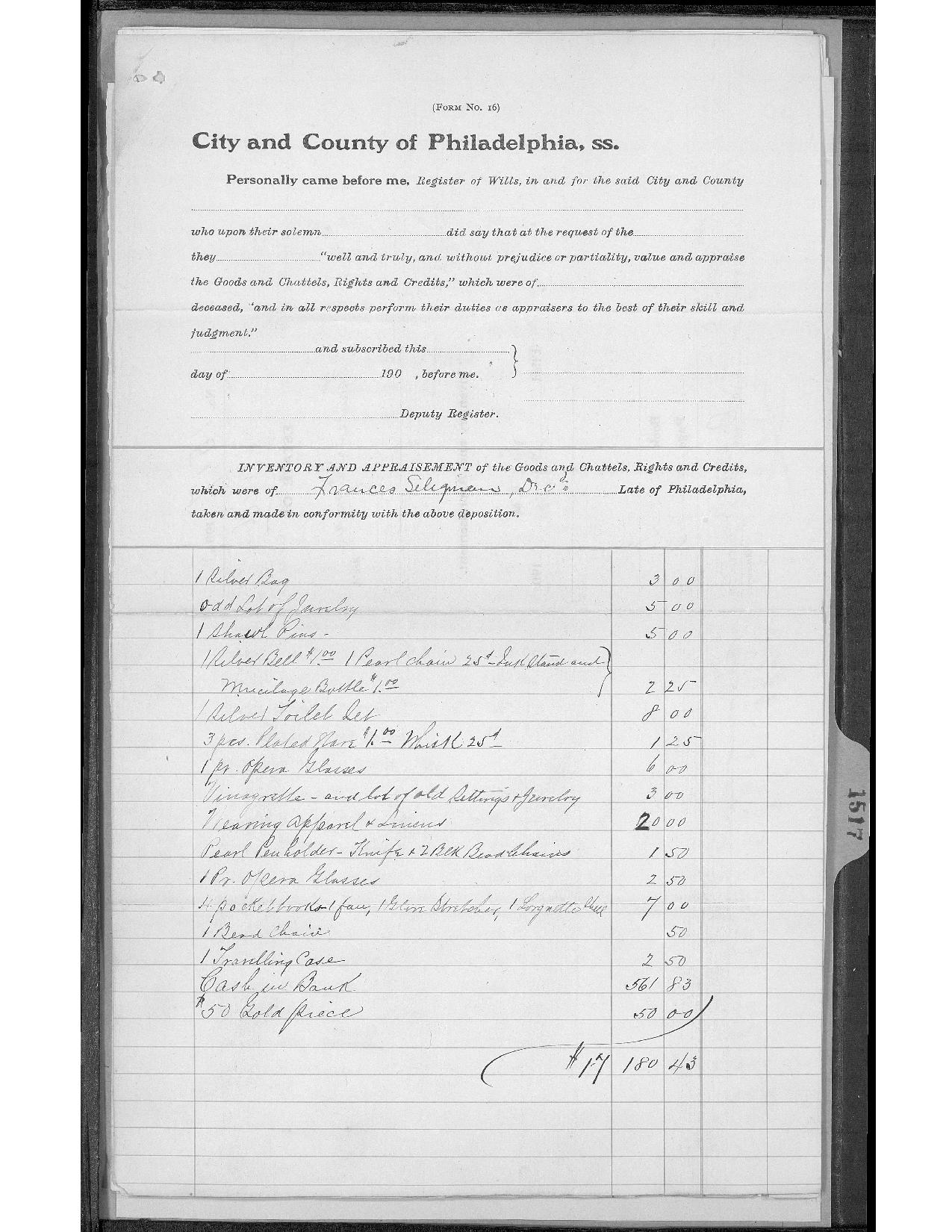
The total value of these properties came to $17,180.43, or approximately $617,000 in today’s dollars. Of course, many of these items, especially the jewelry, may have appreciated far beyond the value they had in 1905 and beyond what the inflation calculators consider.

The second inventory was of Frances’ kitchenware and dishware:
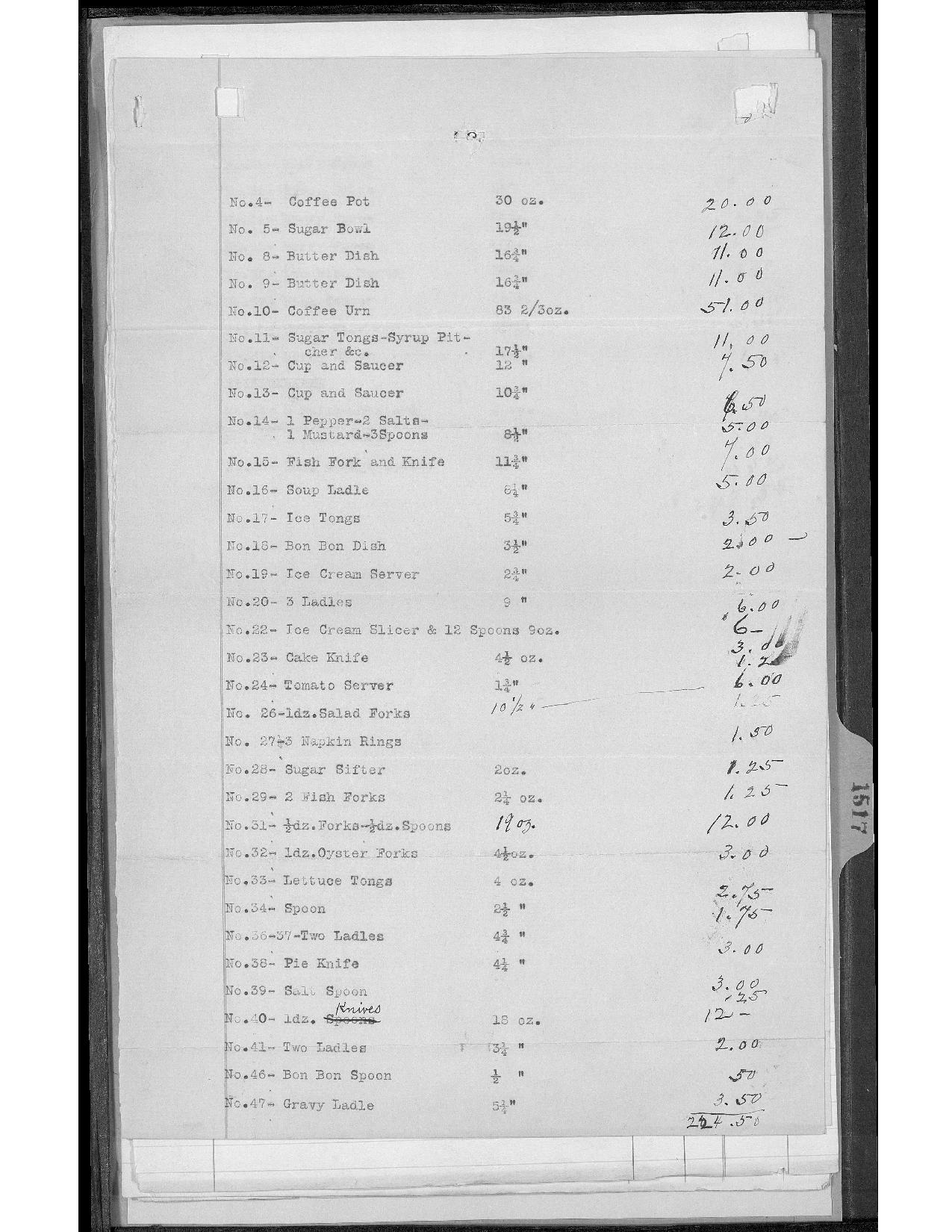
 

The value of these goods was appraised in 1906 as $247.55. In today’s dollars that would be approximately $9000.

The documents do not include any appraisal of any real estate although, as we will see, Frances owned some real estate in Santa Fe.

Frances’ will detailed with great specificity where all this personal and other property was to go. Her original will is eight typed pages plus there is a one page handwritten codicil. I loved reading this will because it names so many of the relatives I’ve written about on my blog. It was fascinating to see how inclusive Frances was in deciding who would get portions of her estate. The following images are the pages from the will with my comments about some or all of the provisions on that page.

In the Third Clause below, Frances divided $1250 among her four siblings. But Simon, Julius, and Miriam each got $250 whereas Lottie received $500. Did she love Lottie more than the others? Or did Lottie have greater need? Lottie never married, so unlike Miriam who had a husband to support her and Simon and Julius who were men, Lottie may in fact have had greater need.

There is a similar seemingly favorable bias in terms of Frances’ distribution to her three living children, Eva, James, and Arthur. Eva was to receive all of her mother’s linen and wearing apparel. Well, I guess the sons couldn’t wear her clothes. But then in the Fifth Clause above, Frances bequeathed a whole lot of jewelry to Eva: “my diamond bracelet, my diamond star with chain attached thereto, my watch studded with diamonds, one of the large diamonds from my thirteen stone diamond ring, my set of silver containing one dozen knives, one dozen large spoons, one dozen small spoons, one large soup ladle and one dozen silver forks.”

What did James get? “One diamond from my thirteen stone diamond ring and a silver coffee pot.” And Arthur: “the other large diamond from my thirteen stone diamond ring, and a silver coffee pot.”

Wow, did they get shafted or what! Even Emanuel Cohen, my great-grandfather and Eva’s husband, got “the centre diamond in my diamond cluster pin.” And he was married to Eva, who was already getting all those diamonds!

Frances then gave other jewelry items to her daughters-in-law and to her grandchildren. My grandfather John Nusbaum Cohen got “four stones from my diamond cluster pin.”

The will goes on to identify specific pieces of jewelry for other family members—aunts, uncles, nephews, nieces, brothers-in-law, and even August Seligman, the younger brother of Bernard Seligman, a brother who never left Germany. Did August get the “silver knife, fork and spoon marked S.S.”? Perhaps his great-grandson Wolfgang knows. I will have to ask him.

And then at the end of that Fifth Clause below, the will provides, “All the remainder of my jewelry, not otherwise disposed of by this will, it is my desire that my daughter, Eva May Cohen, distribute as she may see proper.”
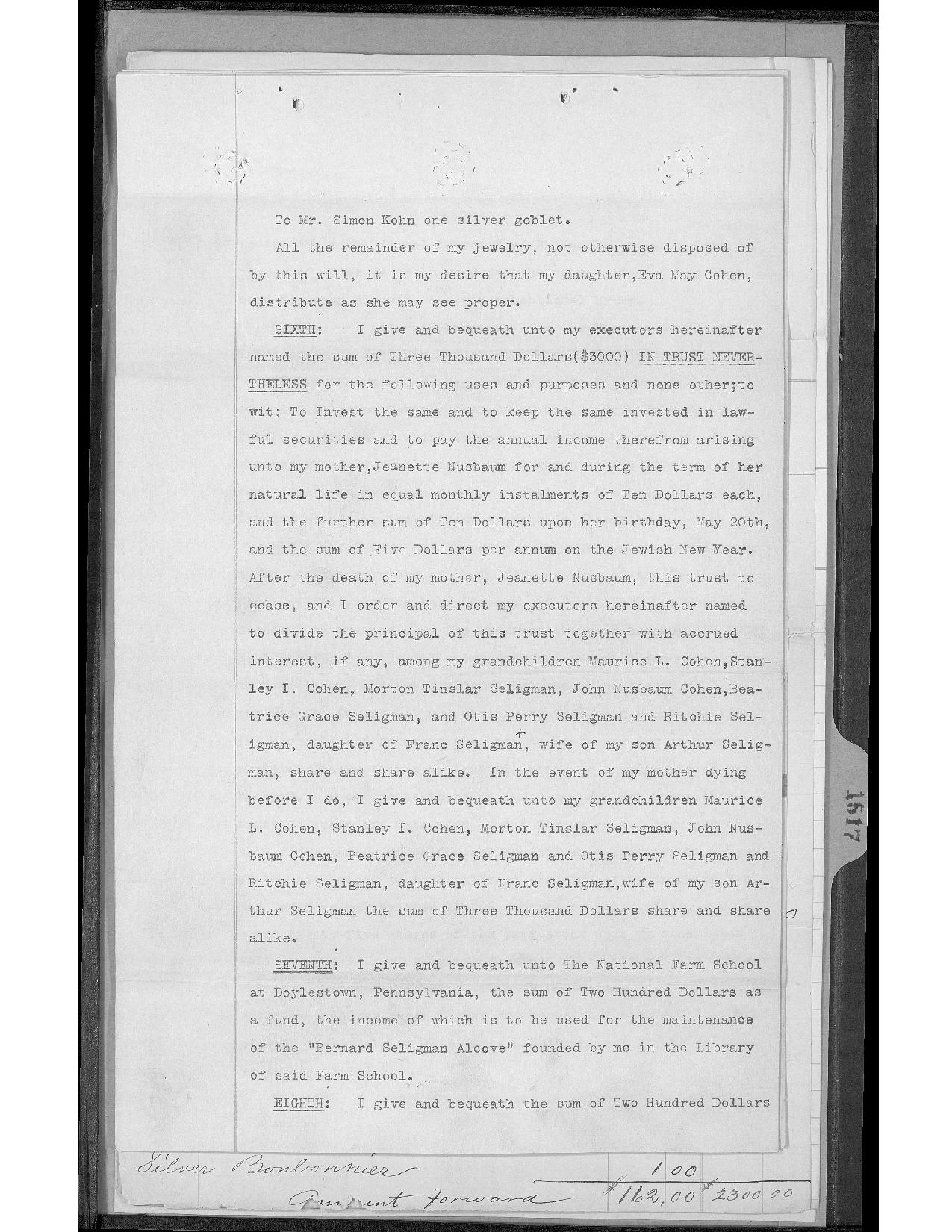
Before I go on, I need to point out that I do not have one piece of jewelry or anything else that once belonged to Frances Nusbaum Seligman, my great-great-grandmother. Not one thing. Even though all those diamonds were bequeathed to my great-grandmother Eva Seligman Cohen, I have no idea where they went once Eva died. She raised my father and his sister from the time they were quite young when both their parents were hospitalized, yet my father did not have one thing—-not one spoon or even a coffee pot—-that had belonged to his beloved grandmother. I have no idea where it all went. Perhaps it was sold during the Depression. Perhaps the other three grandchildren of Eva Seligman Cohen received it, but that seems unlikely. In any event, it’s gone.

Having cleared the air on that, I am now looking at the Sixth Clause (see above). It provides in part for a $3000 trust for Frances’ mother Jeanette Dreyfus Nusbaum, my three-times great-grandmother, who was still living when Frances drew up this will in 1905. I love that Frances provided for her mother and even specified that she receive ten dollars on her birthday (May 20) and five dollars at the Jewish New Year in addition to the ten dollar regular monthly payments under this provision. It shows me how caring Frances was and also how much being Jewish was still an important part of the family’s life. Jeanette was 87 when the will was executed, and she outlived her daughter Frances, dying on January 12, 1908, at the age of 90.

There are then several bequests to various charitable organizations, and then we come to the Eleventh Clause (below), in which Frances requires that a trust be created from fifty shares of her stock in Seligman Brothers in Santa Fe, the dividends from which were to be paid to “my daughter Eva May Cohen, for and during her natural life, for her sole and separate use, not to be in any way or manner whatever liable to the contracts, debts, or engagements of her husband.” I am so impressed that Frances had the wisdom to set aside money that would be only for her daughter and not under the control of Eva’s husband. How progressive is that!

The provision further provides that Eva’s children would inherit that stock upon her death as well as Eva’s brothers James and Arthur. Sadly, Seligman Brothers itself did not survive long enough to benefit those beneficiaries as it closed for business by 1930.

Nevertheless, once again Frances favored Eva in the will.

The Twelfth Clause refers to a house and lot in Santa Fe to be shared by all three of Frances’ children. (I don’t see that property included in the inventories mentioned above so the estate was worth more than estimated above.) In 1904 when Frances executed this will that was the location of the oldest hotel in Santa Fe, the Exchange Hotel. I have no idea what it was worth at that time, but it certainly added something substantial to the overall value of Frances Nusbaum Seligman’s estate.

Below are the final provisions in the original will.

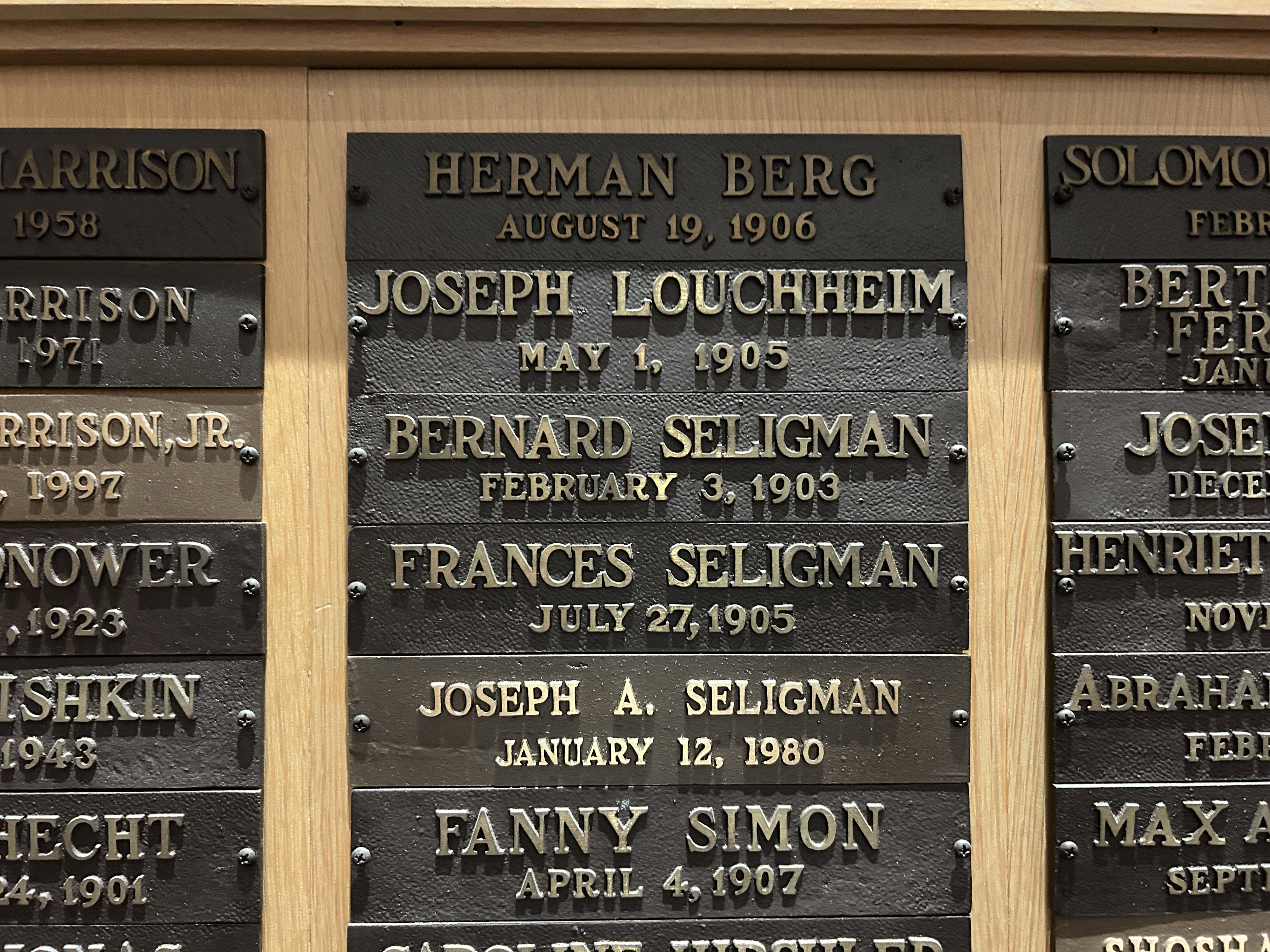
There is also a handwritten codicil to the will dated February 18, 1905. It includes additional specific bequests of various items of personal property and also provides that $200 was to be given to Congregation Keneseth Israel for the purpose of “placing the names of my husband Bernard Seligman and my own, together with the dates of our respective deaths, upon the memorial tablet on the North-East Wall of the Synagogue.” We all want to be remembered, don’t we?

I wrote to Congregation Keneseth Israel, now located in the suburbs of Philadelphia, asking about my great-great-grandparents’ plaque, and I was quite moved and relieved to learn that it still exists on their memorial wall in their suburban location. Their executive director Brian Rissinger kindly sent me this image of the plaques:
Finding this will was such a gift. It gave me insights into my great-great-grandmother Frances Nusbaum and her relationships with her children, grandchildren, siblings, and others. And it reminded me how extraordinary her life was—-growing up as the daughter of a successful merchant in Philadelphia only to fall in love with a young immigrant from Germany who had lived in Santa Fe. After marrying him and having four children in Philadelphia, she moved with him and their children to Santa Fe, living in what was then a small but growing pioneer town with very few Jews and even fewer Jewish women. And her will demonstrated that she cared deeply about her Jewish identity. She must have been so resilient and so devoted to make that adjustment to life in Santa Fe. I wrote about Frances and Bernard in my family history novel, Santa Fe Love Song for anyone who wants to know more about them..

Frances was described in her obituary in these terms:

“She was a beautiful and accomplished woman, as good as she was beautiful and as beautiful as she was good, and of a most lovable and gentle disposition. She was an exemplary wife, a fond and good mother, and a dutiful and loving daughter. Indeed she was all that is implied in the phrase ‘a thoroughly good and moral woman.’ … She will be especially remembered by the poor people of [Santa Fe], to whom she was particularly kind. Many and many truly charitable deeds have been put to her credit.”

Everything in her will reflected those same qualities.

I was deeply touched by the relationship between Frances and her daughter Eva, my great-grandmother. Frances had lost two daughters; her daughter Florence had died when she was just a month old, and her daughter Minnie had died when she was seventeen. Thus, Eva, her first born child, was her only surviving daughter, and that must have made Frances cherish her even more.

That Eva was deeply loved by her mother also sheds light on the woman she became. In learning about Eva from my father and from my research, I grew to appreciate what a strong and compassionate woman she was. Like her mother Frances, she lost one son as a baby and a second son predeceased her by committing suicide. Like her mother, Eva was uprooted from Philadelphia to Santa Fe, but returned to Philadelphia for college and lived the rest of her life there after marrying my great-grandfather Emanuel Cohen. Being so far from her parents and brothers back in Santa Fe must have been as difficult for her as it had been for her mother to leave her family behind in Philadelphia to move to Santa Fe.

Despite all those losses and difficulties, Eva clearly had a big heart. She took a widowed brother-in-law and his son into her home for many years, she took her parents into her home when they returned to Philadelphia to retire, and, most importantly to me, she took my father and aunt into her home and provided them with comfort, love, and security when their parents were unable to care for them.

The love between Frances and Eva, between mother and daughter, shines through in this will. And I am so grateful to Teresa for alerting me to the full-text search on FamilySearch so that I could find it.


  1. All the documents included in this post were located using the full-text search on FamilySearch. They are cited there as follows: Philadelphia, Philadelphia, Pennsylvania, United States records,” images,
    FamilySearch (https://www.familysearch.org/ark:/61903/3:1:S3HT-D4WP-CQ?
    view=fullText : Aug 30, 2025), images 189-206 of 315. 

The John Nusbaum Album: Some Final Thoughts

So what is left to talk about regarding the Nusbaum album, you may wonder? Well, Ava Cohn aka Sherlock Cohn analyzed about a quarter of the photographs taken in Philadelphia, all of the Santa Fe photographs, and about a third of the photographs from Germany. Add to that the handful I discussed that had names on them plus the photographs from Peoria, and that means many but not all of the photographs in the album have been discussed or analyzed. What can I say about those others?

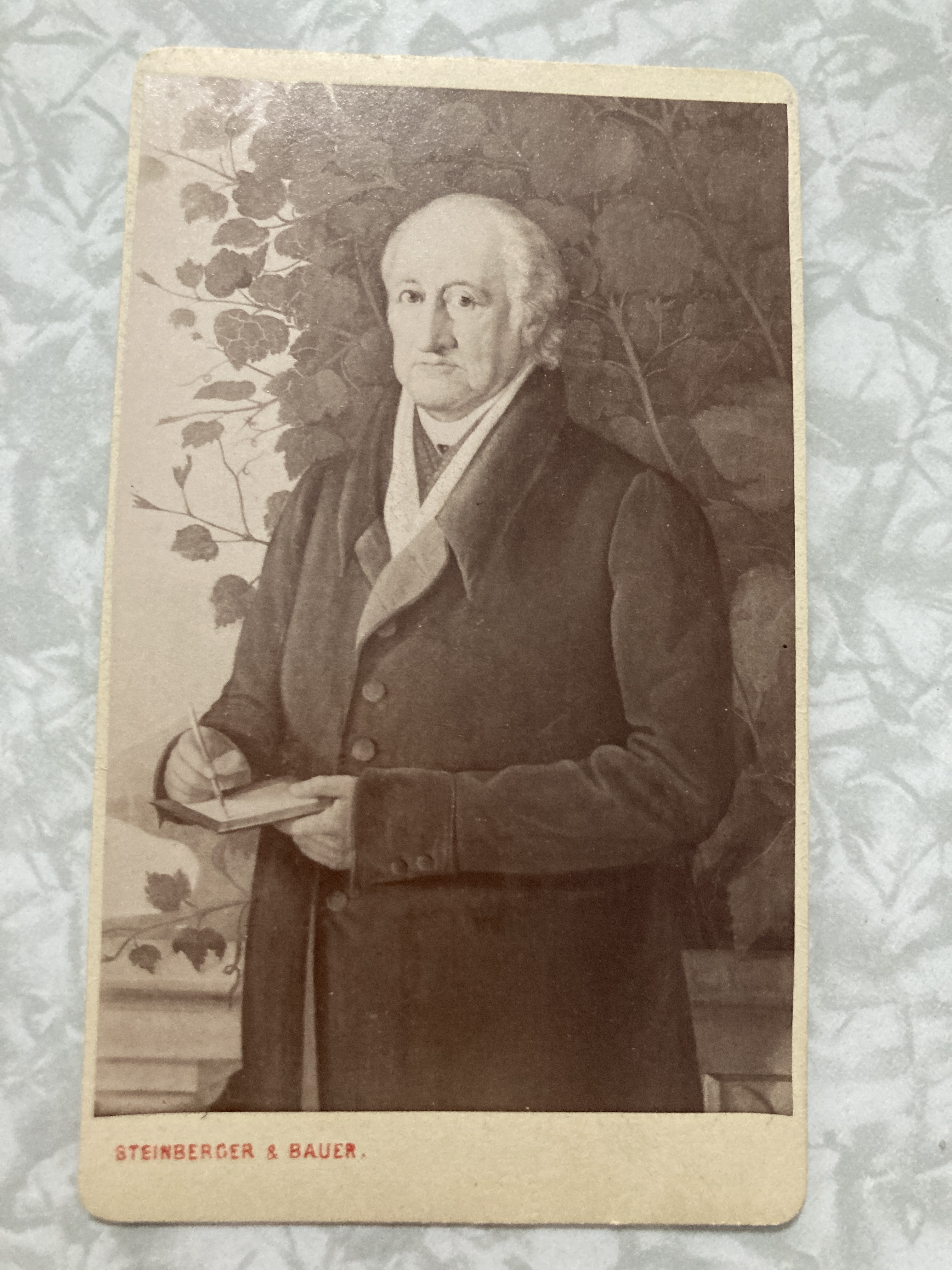
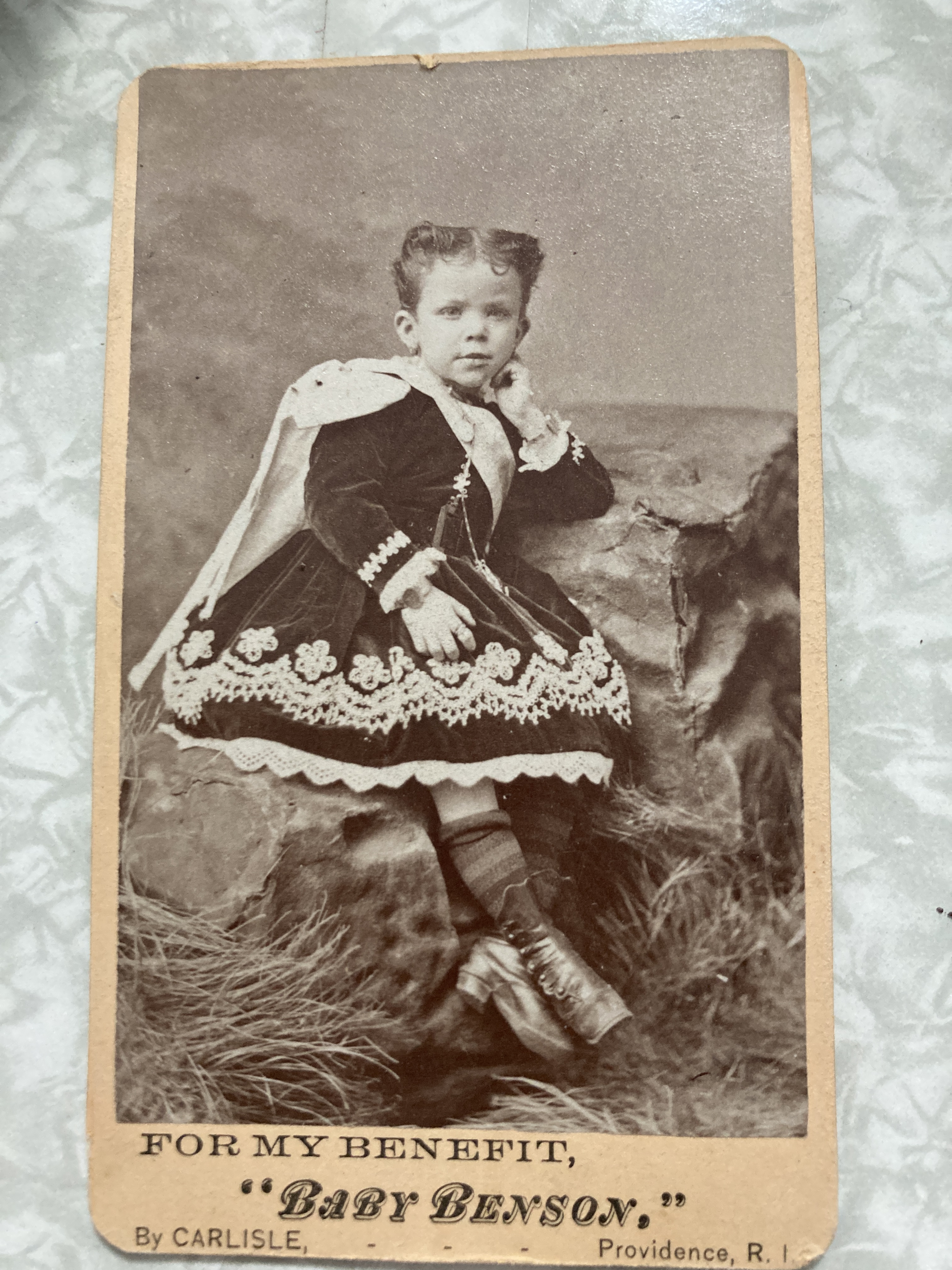
There are some that are more like postcards of famous places or people, e.g., a photograph of a painting of Goethe and one of “Baby Benson,” a child performer popular in the 1870s. But otherwise all the other photographs—at least another forty—are of people who have not been identified.

Goethe

I gave up on the ones from Philadelphia—too many possibilities! An infinite number now that I know that these CDVs could have been given to the Nusbaums by friends, acquaintances, even visitors from other states, as we saw with S.B. Axtell’s CDV left as a calling card. I posted on a Philadelphia genealogy group on Facebook, inviting people to send me photos of their ancestors that I would use to compare with mine, but I had no luck.

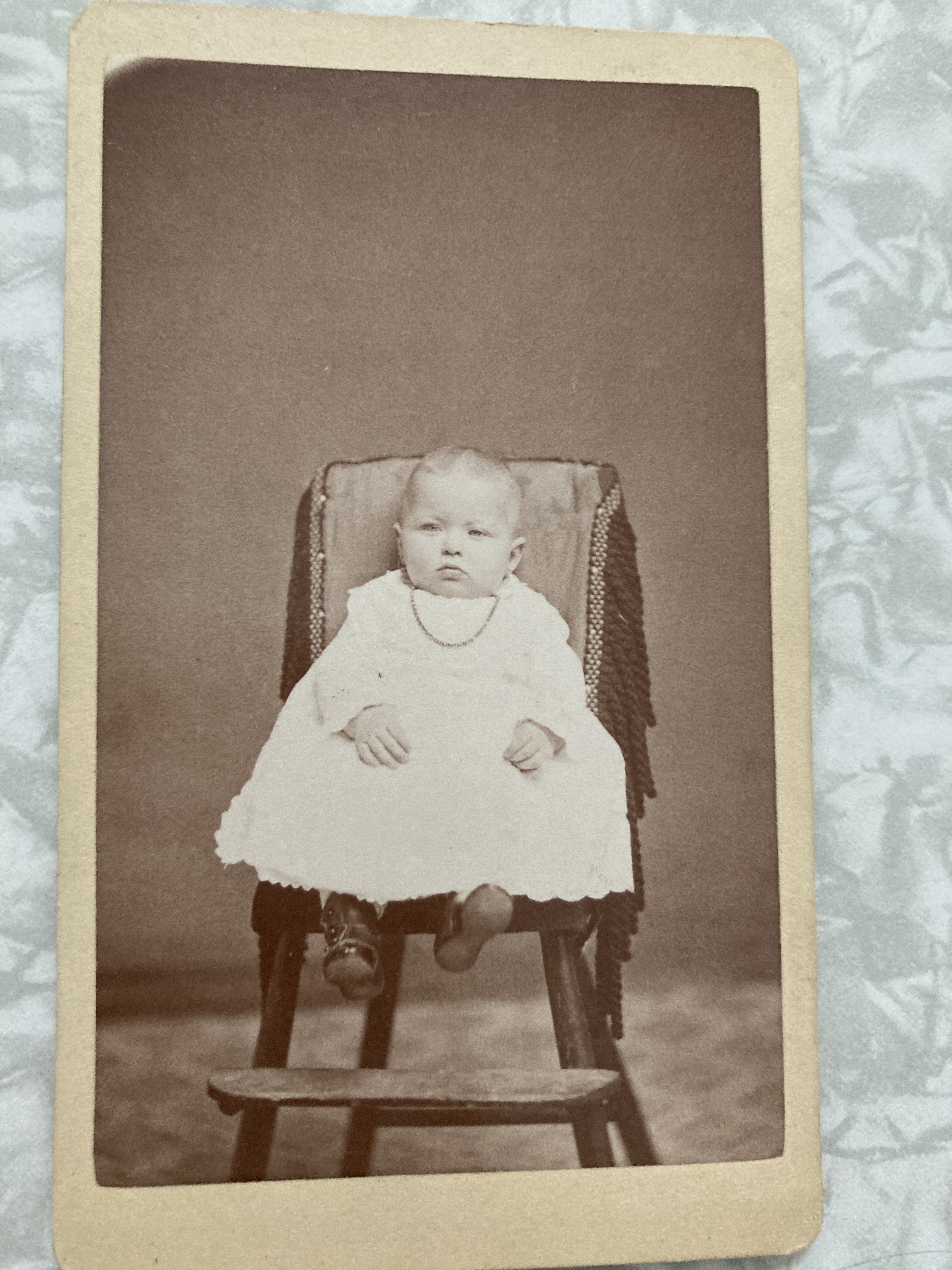
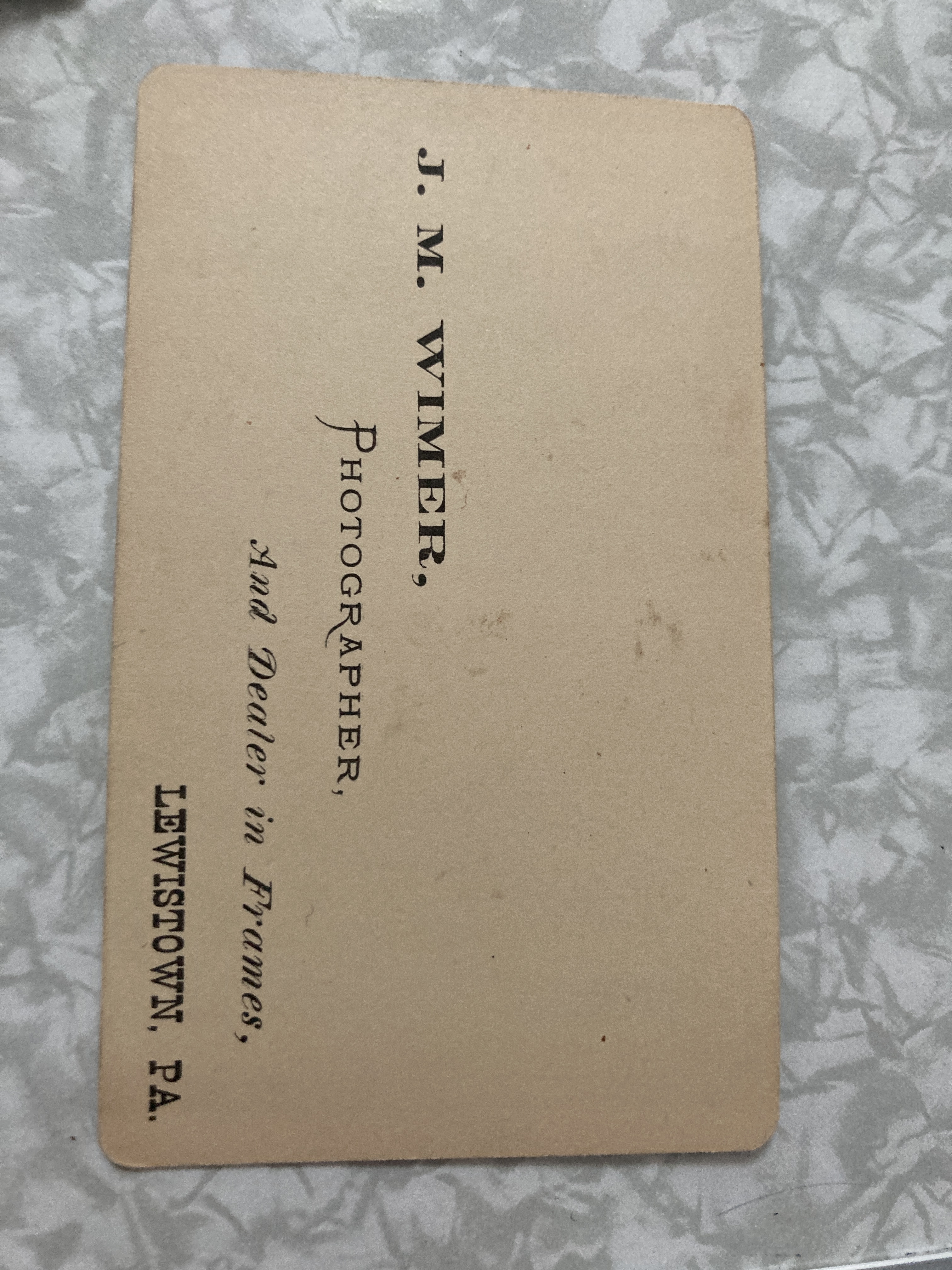
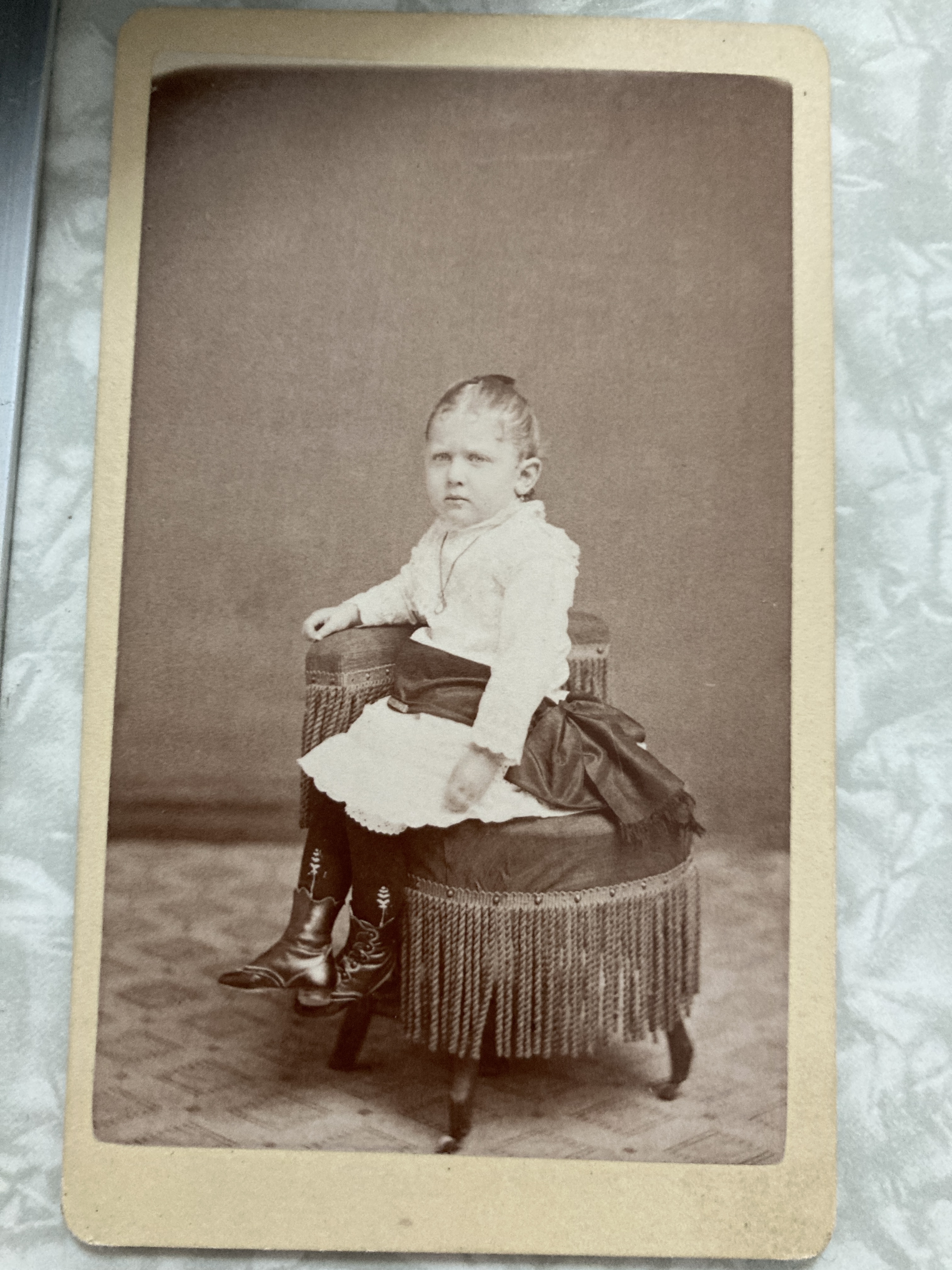
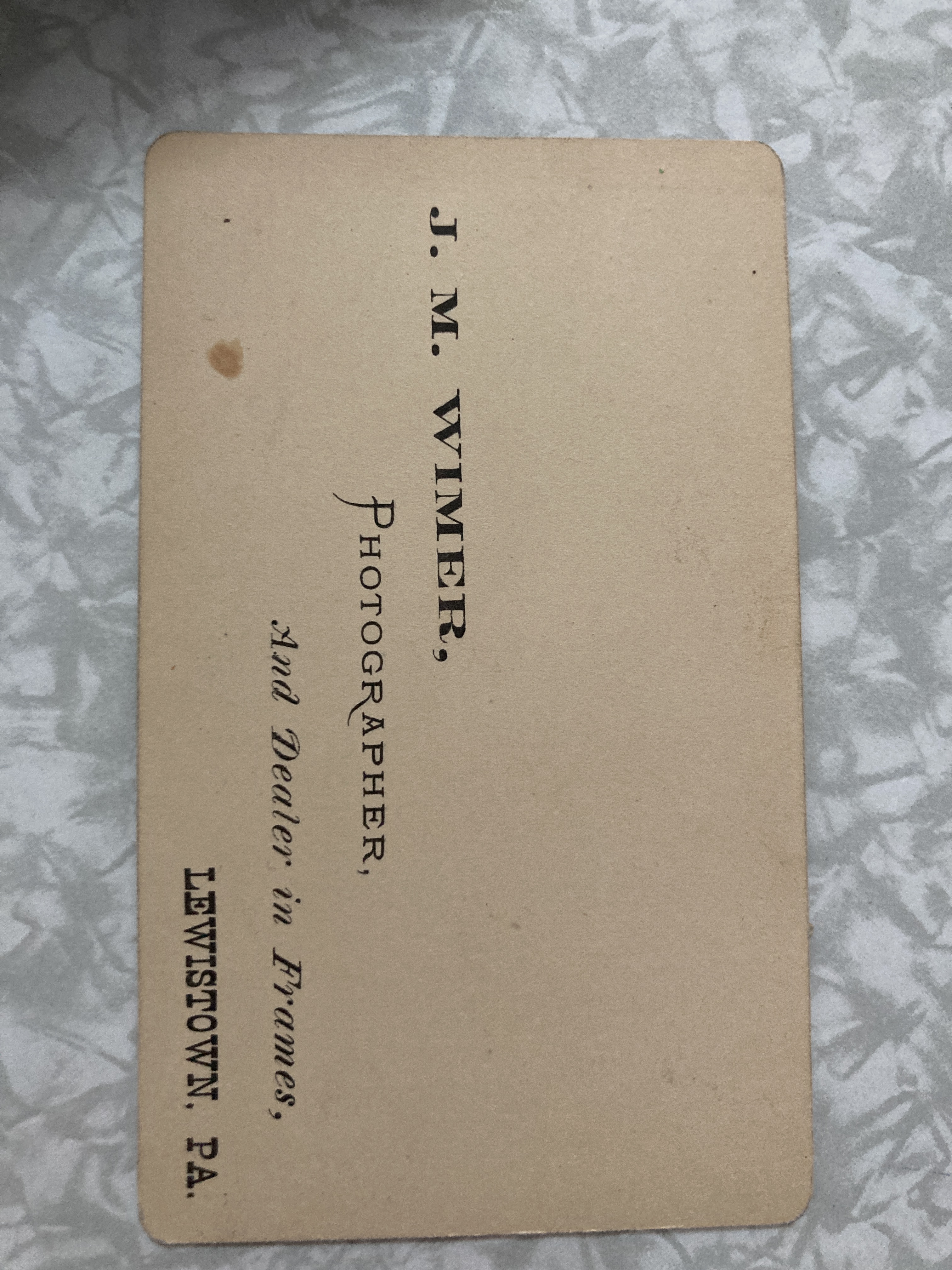
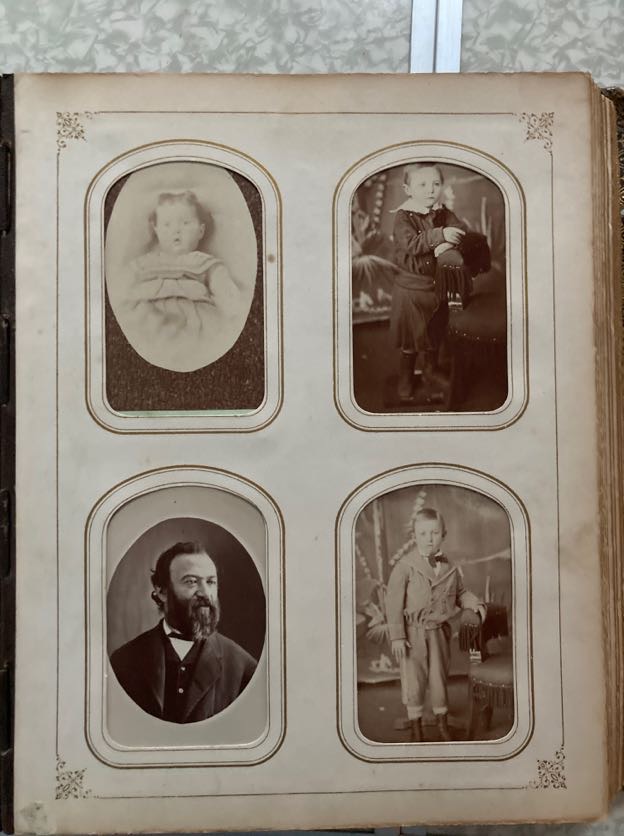
But I thought I could at least make an educated guess about the four photographs of children that were taken in Lewistown, Pennsylvania, all taken by a photographer named J.M. Wimer.

I have only one family on my family tree that lived in Lewistown in the mid-1800s—the family of Mathilde Dreyfuss Nusbaum Pollock. Mathilde Dreyfuss was the sister of my three-times great-grandmother Jeanette Dreyfuss Nusbaum. I at first thought it would be obvious who was who in these photos. As if…

Mathilde was married first to John Nusbaum’s younger brother Meier or Maxwell. They had two children together, Flora in 1848 and Albert in 1851. Tragically, Maxwell was killed in the San Francisco fire of 1851 while traveling there for business. Mathilde married Moses Pollock a few years later and had three children with him: Emanuel (1856), Miriam (1858), and Rosia (1870).

By 1860 Mathilde and her family were living in Harrisburg, Pennsylvania, and by 1870 they were living in Philadelphia. CDVs were first seen in the US in about 1859-1860. Assuming the photographs were taken before Mathilde moved to Harrisburg and thus before 1860, that would mean these photos were taken no earlier than 1859 and no later than 1860, if they are of Mathilde’s children while living in Lewistown. In 1859 Albert Nusbaum would have been eight, Emanuel Pollock would have been three, and Miriam Pollock would have been a year old. Rosia wasn’t yet born, and Flora would have been eleven, but I don’t see an eleven year old girl here. So I thought maybe the older boy was Albert, the baby was Miriam, and one of the others was Emanuel.

But then I remembered that Ava had said that the fringed chairs were not introduced until 1864.

Also, it appears that in the 1850s until sometime after 1870, J.M. Wimer (sometimes spelled Weimer) was living in Mifflintown, Pennsylvania, which is about thirteen miles from Lewistown. He doesn’t show up in Lewistown until the 1880 US census. Newspaper articles from 1871 show him as a resident of Mifflintown. Now thirteen miles doesn’t sound that far in today’s world, but in the horse and buggy era that might take three hours, not exactly a convenient commute.

So perhaps these photos were taken in the 1870s or 1880s. If so, I had no relatives living in Lewistown at that time. And thus, once again, I can’t be certain who these children are.

As for the remaining photographs in the album not taken in Pennsylvania, Santa Fe, or Germany, there are about twelve photographs in the album that were taken in New York City. I have no idea who could be in these photographs. As far as I can tell, assuming that these photographs were also taken some time between 1860 and 1890 like all the others in the album, there were no Nusbaum or Seligman relatives living in New York City during those years. Could they have visited and had photographs taken? Of course. Could these be friends of the family? Certainly. But unless someone comes up with a photograph to match these people, it’s like looking for a needle in a haystack to try and identify them. Or even more impossible.

Then there are the CDVs from places where I cannot find any likely family connections, like Montgomery, Alabama, St. Louis, Missouri, and Wheeling, West Virginia. Sadly, I have no way of knowing who these people could be. They, like so many of the others in the album, will remain a mystery.

And thus, I come to the end of this chapter in my genealogy journey. Out of over one hundred photographs, I have a positive identification of Moritz Seligmann, my three-times great-grandfather, and a probable identification of Babette Schoenfeld Seligmann, his wife, my three-times great-grandmother, based on earlier photographs. I have positive identification of two babies who died as children (Milton Josephs and Eva Dinkelspiel) because their names are on the photographs. Same for two people who were distantly related to me by marriage, the Gardiners, the parents of Doris Gardiner who married Otis Seligman. And also I can identify some people who were not related to me at all—Louis Sulzbacher, Goethe, Baby Benson, and some mysterious visitor named S.B. Axtell.

Beyond that, I have some possible identifications—maybe there’s a photograph or two of John Nusbaum, maybe some of his sons in Peoria, maybe a photograph of Frances Nusbaum, maybe one or two of her sister Miriam—but nothing nearly definite enough to label them as such.

Nevertheless, this has been an exciting and worthwhile adventure. I’ve learned a great deal about CDVs, the dating of photographs, and the names of some Philadelphia, Santa Fe, and German photographers and when and where they worked. I’ve had the great pleasure of collaborating with Ava Cohn in trying to identify the people in the photographs.

I’ve also gained some insights into the lives of my Nusbaum-Seligman relatives from the overall collection of CDVs. They knew many people from many different places, and the photographs appear to be of people who were if not wealthy, certainly not poor. They are well dressed and distinguished looking. Someone was a fan of Goethe, someone was a fan of Baby Benson. And reviewing the album reminded me of one of the tragic realities of life in those times—many children did not live to adulthood, like Milton Josephs and Eva Dinkelspiel. Even if I can’t put names to most of the faces, I have had a glimpse into the lives of my ancestors.

And I have had my hands on a physical object that I know for certain was handled by my three-times great-grandparents John Nusbaum and Jeanette Dreyfuss, by their daughter Frances, my great-great-grandmother, and by her husband Bernard Seligman, and most likely also by my great-grandmother Eva Seligman Cohen and her siblings. Before it ended up in the hands of an antique dealer in Santa Fe, it was in the possession of Eva’s niece and Arthur Seligman’s daughter Joan, Joan’s daughter Adrienne, and Joan’s granddaughter Jhette. It is now back safely in Jhette’s hands. And I instead have the scans of all the photos and that sweet memory of holding the album lovingly in my own hands for several months.

May it stay safe and protected for at least another 160 years.


John Nusbaum Album: Four Photographs With Names, But Who Were They?

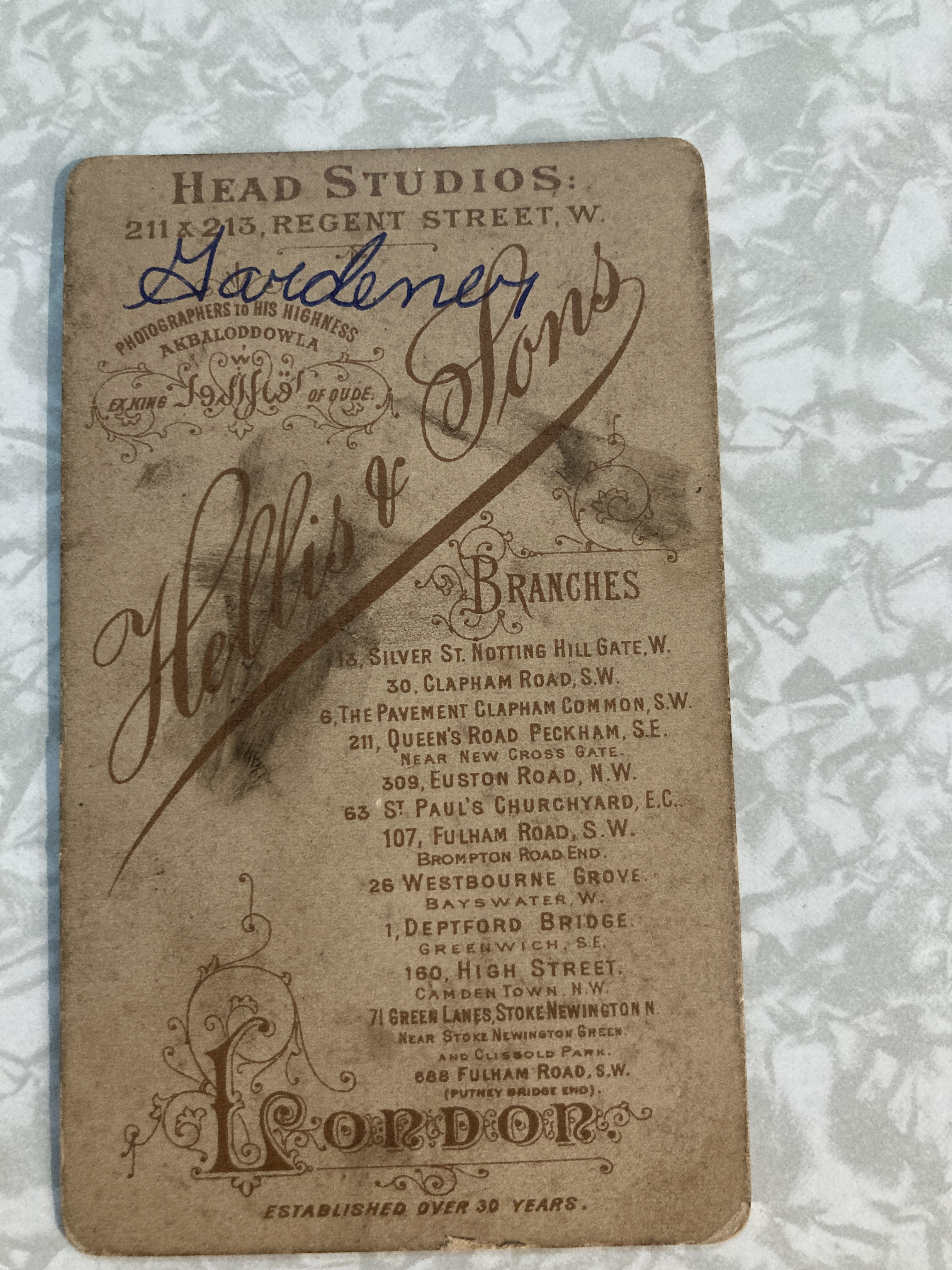
Returning once more to the Nusbaum Album, out of the more than one hundred CDVs in the album, only six had names on them. We saw two in my last post, and this post will discuss the other four that had names on them. Two had the name Gardiner on them:

The one of the man says Hellis & Sons at the bottom; on the reverse it repeats Hellis & Sons and lists all their branches, all in England. The one of the woman was taken by J. Telling Photographers in Bridgend, which is a town in Wales. Ava volunteered that she believed these were taken in the 1880s, the one of the man in the later part of the decade, the one of the woman in the early 1880s. She thought the man appeared to be in his early 20s, meaning he was born sometime in the late 1860s.

Since I had only one Gardiner family on my tree, I was pretty certain who those people might be. Bernard Seligman’s son Arthur, my great-grandmother Eva Seligman’s younger brother, had a son Otis Perry Seligman. Otis married a woman named Doris Gardiner, who was born in Nantymoel, Wales on February 17, 1901. Nantymoel is a village in the county of Bridgend. Doris Gardiner’s parents were George Gardiner, born in about 1864 in Wales, and Mary Ann Wilcox, born in 1866 in Wales.  It certainly appears that these two photographs were of Doris Gardiner’s parents George and Mary Ann.

These photographs appear on a very late page in the album on the reverse side of that page so probably were added after the album was otherwise filled. That makes sense since Doris Gardiner didn’t marry Otis Seligman until July 23, 1921, in Cleveland, Ohio, where Doris and her parents had settled after immigrating to the United States in 1914. Doris may have added these two photographs once she joined the family.

Doris and Otis were the parents of Arthur Seligman II, later known as Arthur “Pete” Scott, my second cousin, once removed. Pete was, as long-time readers may recall, a tremendous help to me when I was researching the Sante Fe branch of the family. His sister Joan Seligman Diamond was the grandmother of my cousin Jhette and a prior owner of the Nusbaum Album.  It certainly makes sense that Doris’ parents George and Mary Ann, grandparents to Pete and Joan, great-great-grandparents of Jhette, would be in this album.

The other two photographs with names on them are not related to me nor, as far as I can tell, anyone else in the family. The first, however, is of a fairly well-known person, Louis Sulzbacher. The back of this photograph has the following words written on it: “Compliments of Louis Sulzbacher, Las Vegas Feb 1878, Mrs. N. Seligman, S.F.”

Louis Sulzbacher

Louis Sulzbach

Louis Sulzbacher was, like Bernard Seligman, a German Jewish immigrant to the United States. The Encyclopedia of Oklahoma History and Culture includes this information about Sulzbacher:

An attorney and a judge of the United States Court for the Indian Territory, Louis M. Sulzbacher was born on May 10, 1842, in Kirchheimbolanden, Bavaria. Coming to the United States in 1859 as a young adult, he settled in New Mexico Territory, read law, was admitted to the bar, and opened a law office in Las Vegas. He remained in the Land of Enchantment for some two decades. In 1869 he married Paulina Flersheim in Kansas City, Missouri. In 1898, during the Spanish-American War, he served with Theodore Roosevelt’s Rough Riders.

In 1900 Pres. William McKinley appointed Sulzbacher to the newly created Supreme Court in the recently formed Territory of Puerto Rico. He served until his appointment to the [Oklahoma] Indian Territory bench. In 1904 Congress created four additional judgeships for the United States Court for the Indian Territory. Pres. Theodore Roosevelt appointed Sulzbacher as judge for the Western District [of Oklahoma].

He served until his appointment to the Indian Territory bench. Leaving the bench at Oklahoma 1907 statehood, Sulzbacher resided in Kansas City for a few years. He then moved to New York City, where he died in Manhattan on January 17, 1915, and was buried in Kansas City.

I have no idea what the connection was to the Seligman family in Santa Fe. I am not even sure who “Mrs. N. Seligman” could be, living in Santa Fe in 1878. Frances was living there at that time, but her initial would be F, not N, or if she were being referred to by her husband Bernard’s name, as women did back then, it would be B. Maybe it says Mn., not Mrs., but even then—I have no idea who that would be. I am going to assume that the N was a mistake and that Sulzbacher gave his CDV to Frances Nusbaum Seligman. Ah, maybe the N was for Nusbaum!

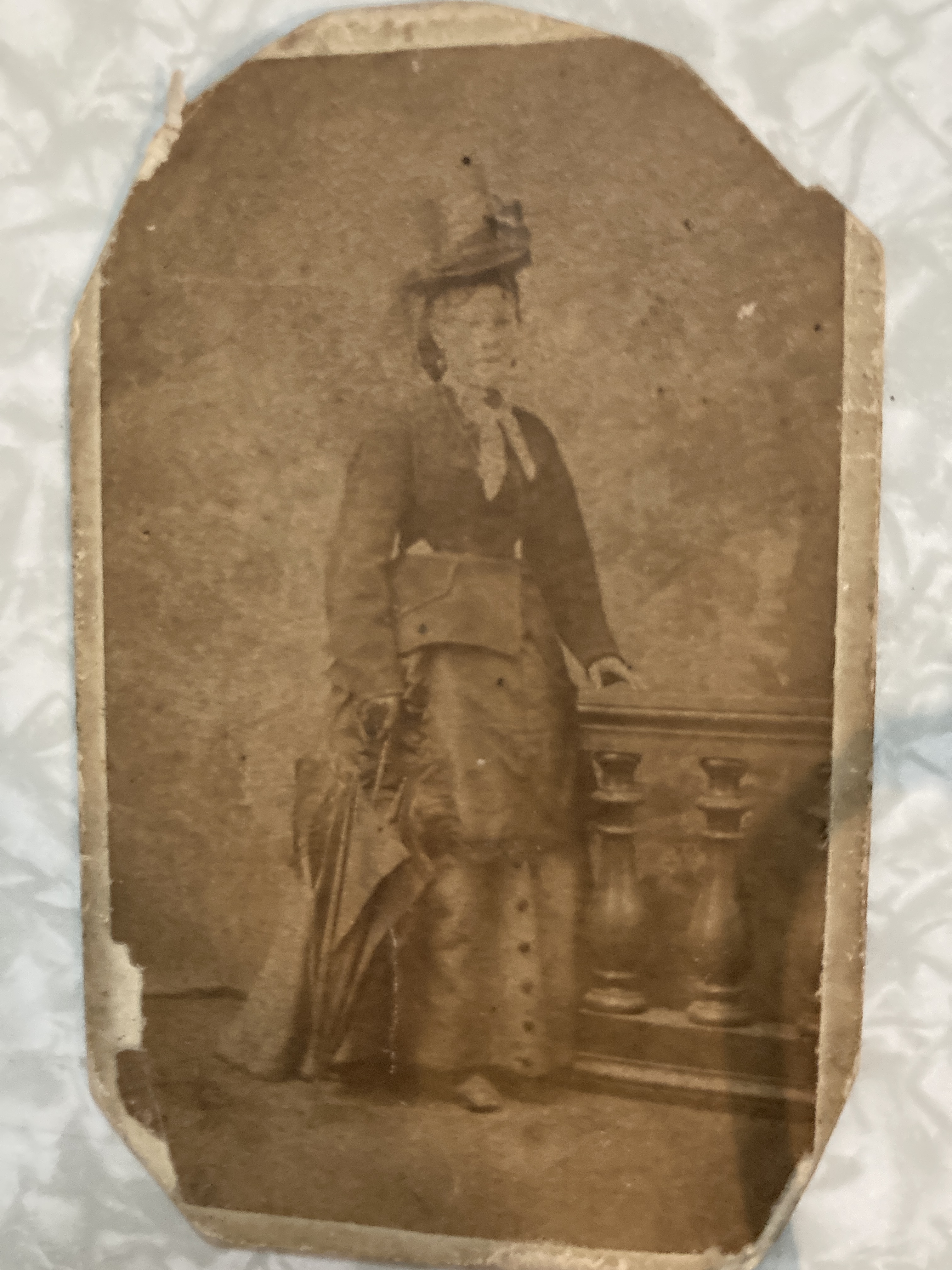
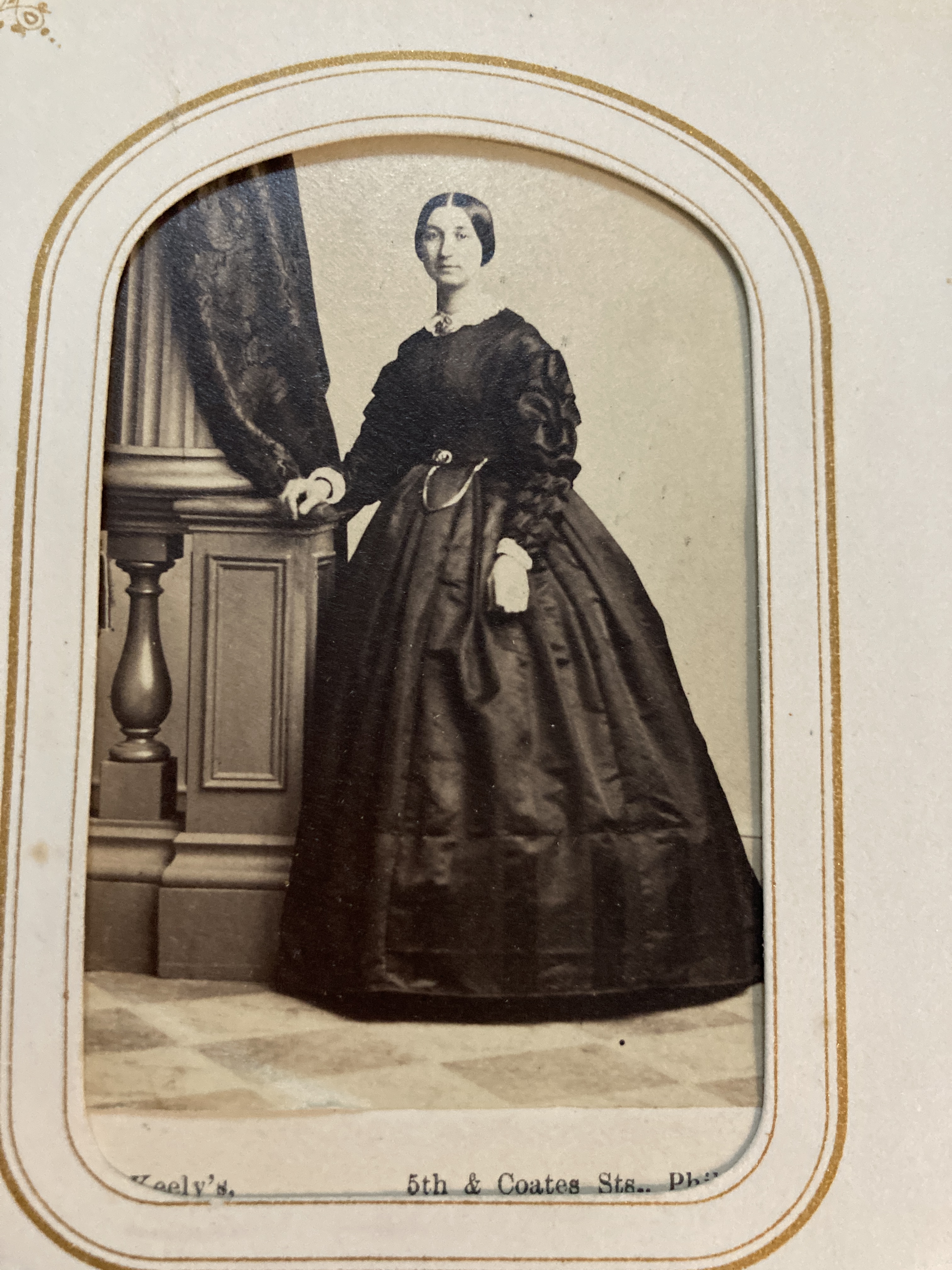
Finally, the only other photograph in the album that has a name written on it is this one:

The back reads as follows: “I am sorry you are not at home—will be in the city in about ten days when I hope to meet you. Yours, S. B. Axtell.”

The photograph is of a woman taken by Keely’s located at 5th and Coates Street in Philadelphia. This is the same photographer who Ava found at that location in Philadelphia directories in the 1850s and 1860s. I am in no position to judge the specific date by the clothing, but assuming this photograph was taken in the Civil War era, just who could S.B. Axtell be?

I found only two people with that surname and a first name that started with S—Samuel Axtell and his wife Sarah Leighty Axtell. Although they were married in 1854 in Athens, Ohio, where they thereafter lived,1 both Samuel and Sarah were Pennsylvania natives.2

Whether or not it was Samuel or Sarah Axtell who stopped by to see someone in Philadelphia, presumably John and Jeanette, is impossible for me to know. It’s the best guess I have.

What this photograph did demonstrate, however, along with the one of Louis Sulzbacher is that there are photographs in the album of people who were not part of either the Nusbaum or the Seligman family. As Ava had been telling me all along, people gave these CDVs to friends and family—as mementos, as gifts, as calling cards.

On that note, my next post will be my final post about the Nusbaum Album, and I will make some attempt to identify the people in some of the remaining photographs or at least to address who in the family could have been living in those locations during the second half of the 19th century. Keeping in mind that (1) they could be friends, not family, and (2) they could be of people visiting that location who don’t necessarily live there, I realize that to some extent this is an exercise in futility. But having gotten this far, why not engage in a bit more speculation?


  1. Sarah Ann Leighty, Gender Female, Marriage Date 12 Jan 1854, Marriage Place Athens, Ohio, USA, Spouse Samuel Axtell, Film Number 000311592, Ancestry.com. Ohio, U.S., County Marriage Records, 1774-1993 
  2. Samuel and Sarah Axtell and family, 1870 US census, Year: 1870; Census Place: Athens, Athens, Ohio; Roll: M593_1171; Page: 45B, Ancestry.com. 1870 United States Federal Census 

Nusbaum Album: Frances Nusbaum Seligman Redux

Before I turn to the photographs that I analyzed on my own (with a few tips from Ava along the way), I want to return to my great-great-grandmother Frances Nusbaum Seligman and my attempts to find her in the album–the album that once belonged to her and has her name on it. Some of this is a review of this post, but with some additional thoughts and images added.

There were several photos in the album that might be Frances based on her birthdate and the date Ava concluded that a photograph might have been taken. For example, on the very first page there is this photograph, which Ava dated as taken in about 1863 when Frances would have been 18; Ava thought the young woman was about 20-22 years old, so just a bit older than Frances would have been. The fact that it appears on the very first page of the album added weight to the possibility that it is Frances.

On the seventh page of the album is this photograph, which Ava also dated as taken in about 1863. Ava thought this woman could be about 25, so slightly older than the one on the first page, but still possibly Frances although Ava ultimately didn’t think so.

Philadelphia c 1863 born abt 1838 maybe Eliza Wiler

Then there is the photograph much later in the album that has an inscription on the back that says it is “Miss Nusbaum” and that it is Joan’s great-grandmother. Ava dated this photograph also in the 1863 time period and thought the woman was a teenager between fifteen and eighteen, placing her birth year very close to Frances’ birth year of 1845. But because this was so late in the album, Ava was skeptical about the inscription.

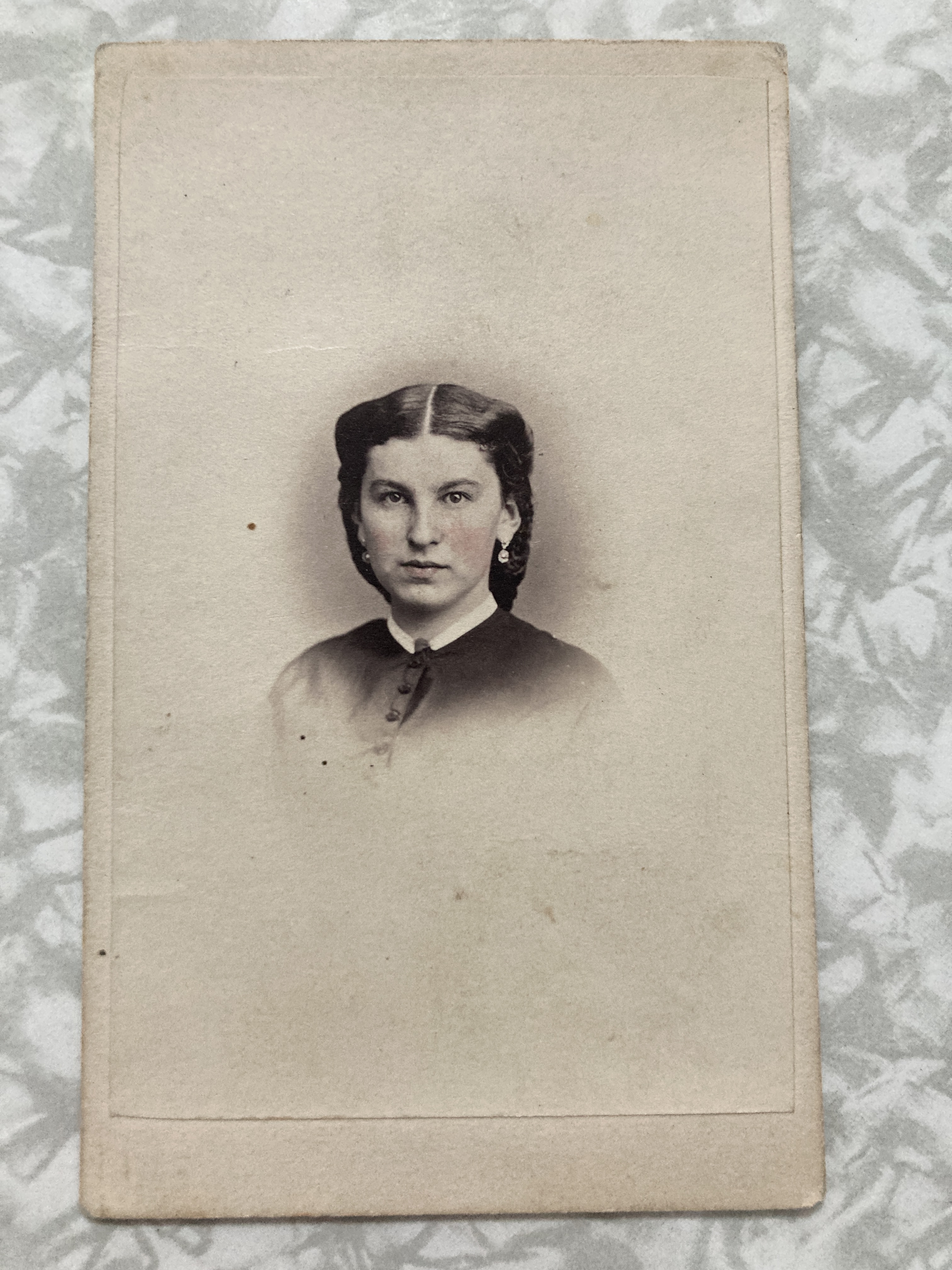
I added another photograph to this mix just recently. This one was taken in about 1870, and Ava thought the woman in this photograph was about twenty years old, so born in about 1850.

Philadelphia 1869 born about 1848

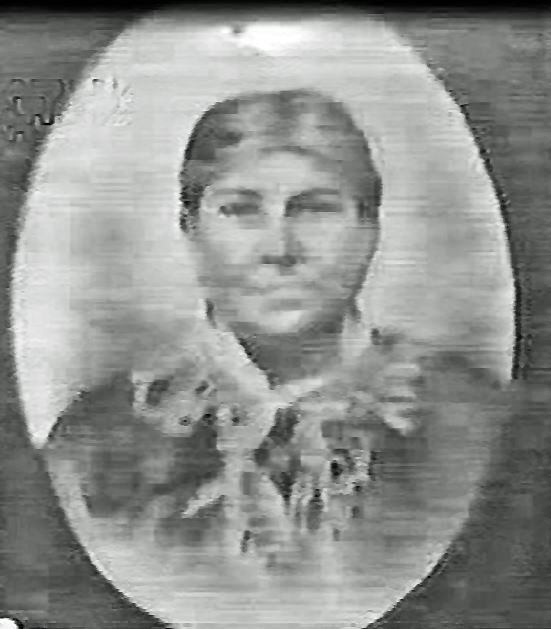
There was also the fuzzy still from a video of a portrait supposedly of Frances Nusbaum Seligman from Arthur Seligman’s house in Santa Fe.

Finally, there is one image I haven’t shared before and that Ava had not previously evaluated. It is not a CDV and it was not inserted into one of the openings in the album, but was just loose inside the album. It is an image of a portrait that sadly was not labeled.

I wondered whether this was a portrait of Frances, but Ava said that this was painted in the late 1840s, early 1850s so could not be Frances. But it possibly could be Frances’ mother, Jeanette Dreyfuss Nusbaum, my three-times great-grandmother.

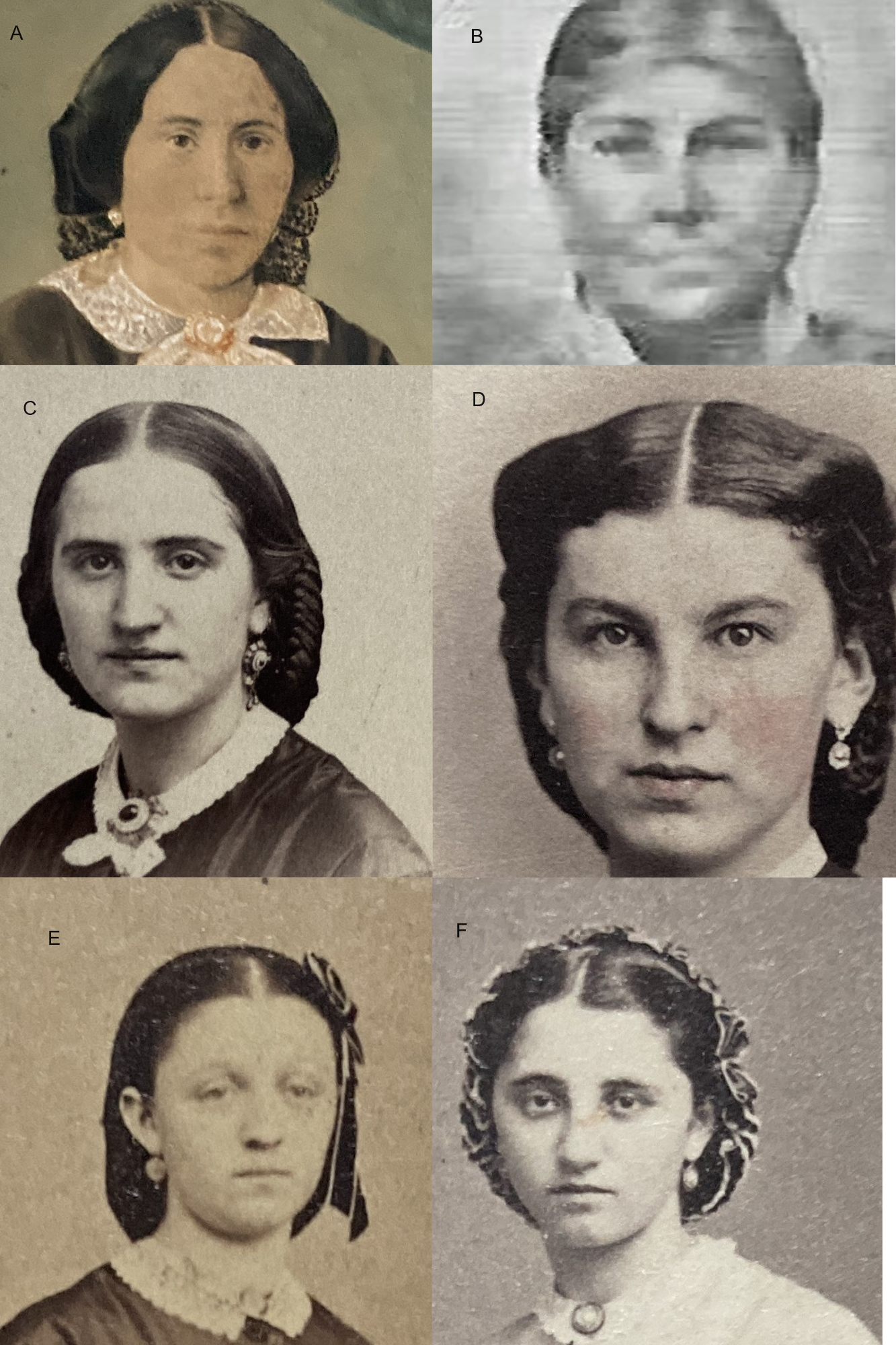
I then put together a collage of all six faces to compare them better:

One thing I noticed right away was that five of the women had similar lips—all but the one labeled D. Her lips were more heart-shaped. The other five had similar mouths. E seemed to have eyes that tilted down whereas all the others had eyes that went straight across. A and B are the portraits, A perhaps of Jeanette, B supposedly Frances. The more I looked at the two remaining images—C and F—the more alike they looked to me.

I ran them through two online face comparison websites, and both said that C and F were the same person. None of the others, however, matched C, F, or any of the others as the same person or even close. I asked Ava if she thought C and F were the same person, and her AI programs also found a match.

But Ava had reasons to doubt whether C and F were the same person. She pointed out that C, taken in 1863 or so, looks older than F, taken in 1870 or so. How could C have gotten younger looking seven years later?

Also, F is in a photograph with a young man who one might assume was her husband. She is wearing a wedding ring, and Frances was married in 1865. But the man in the photograph with F is not Frances Nusbaum’s husband, Bernard. Maybe it’s one of her brothers. But from the photograph one would think the man and woman are a couple.

So…bottom line? I still cannot be sure whether any of these women were Frances.

I have sent scans of the six photographs that were taken in Santa Fe to the New Mexico Jewish Historical Society and to the New Mexico History Museum, both in Santa Fe, hoping that perhaps they have somewhere a photograph of Frances. So far I have not heard back that they do. But I will keep hoping that I can someday figure out which woman in the album is my great-great-grandmother Frances Nusbaum Seligman.

Nusbaum Album: Are These My Seligmann Relatives from Germany?

With more realistic expectations but nevertheless high hopes, I awaited Ava’s final work on the Nusbaum Album, some of the photographs from Germany. Although there were some photographs from Stuttgart, Berlin, and Wiesbaden, since I did not know of any relatives living in those places in the mid to late 19th century, I focused on the photographs taken in Bingen and Mainz. Although my closest Seligmann relatives lived in the small town of Gau-Algesheim, both Bingen and Mainz were relatively close by and the closest cities to Gau-Algesheim, and many relatives eventually moved there. It seemed most likely that that my Seligmann relatives would have gone to one of those two cities to be photographed.

I selected three photographs from Mainz, all taken by the same photographer, Carl Hertel, and two from Bingen, both taken by J.B. Hilsdorf. These were all on the back of the first four pages at the beginning of the album whereas other photographs from Germany including from Mainz and Bingen were much later in the album. I hoped that meant the ones earlier in the album were more likely closer relatives.

The first Mainz photograph was dated by Ava as taken between 1873 and 1874; she noted that in 1874, Hertel became a court photographer. She wrote, “Generally, when a photographer was appointed as a court photographer that information would appear on the mounting card in the imprint and after the photographer’s name with the letters HOF. Since there is no indication of this appointment, I am placing the date of the photograph before 1874.”1 In addition, another photograph of Hertel’s found elsewhere with the same imprint was dated 1873.

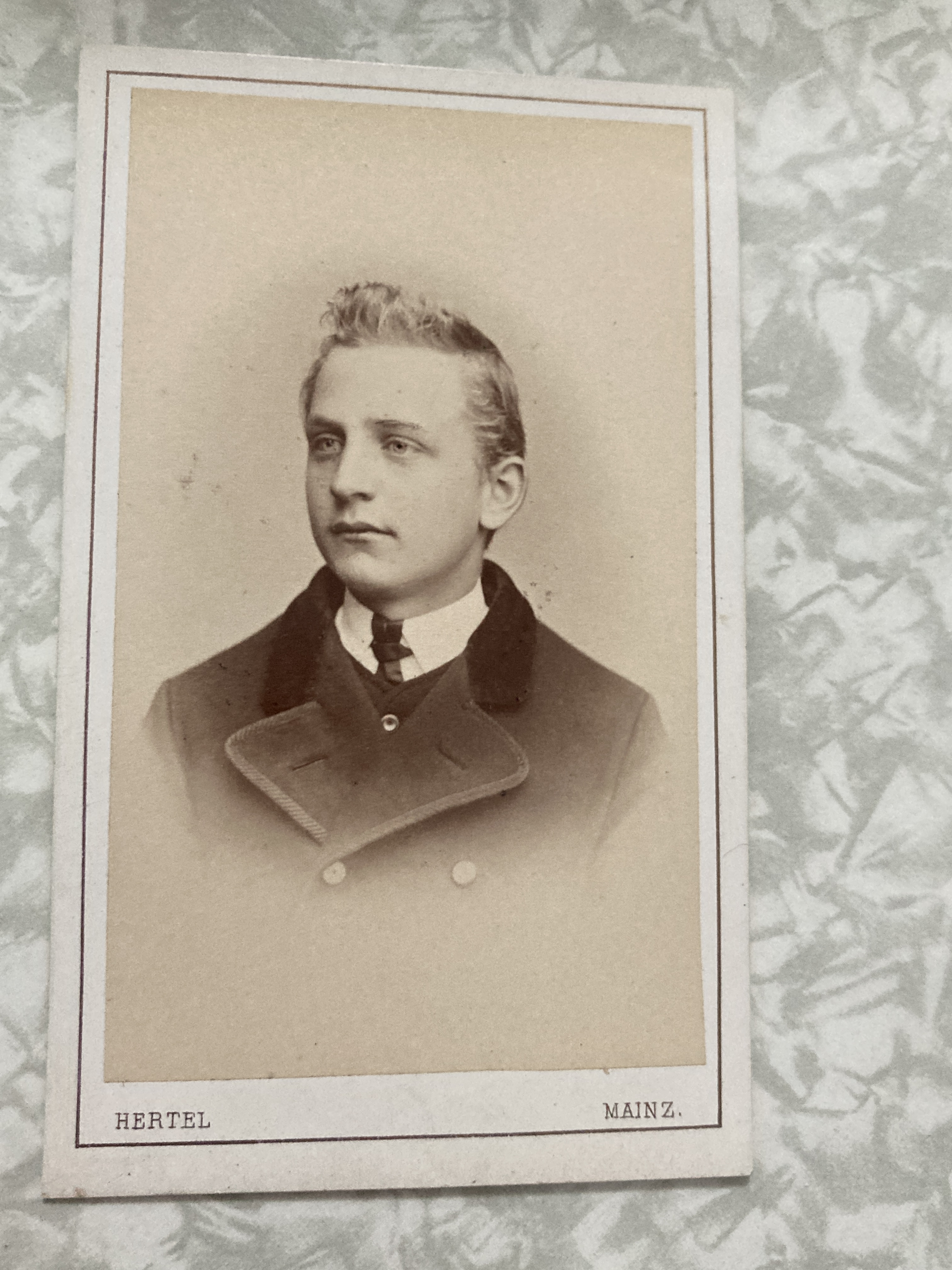
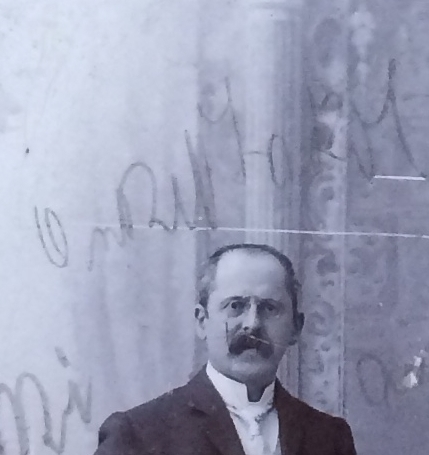
Ava estimated the age of the man as mid to late 70s based on the lines on his face and the style of his tie. That meant the man was born in about 1800-1804. Ava speculated that this could be my three-times great-grandfather Moritz Seligmann, who was born in 1800. And this time I was able to confirm that speculation because I belatedly remembered that I have an actual photograph of Moritz that I had obtained from a cousin years back:

Moritz Seligmann

So bingo! We had a positive identification!

Moving on to the next two Mainz photos, Ava concluded that they also were taken between 1873 and 1874 based on the information she’d already found about Hertel. The first one she believed to be of a man who was in his thirties, perhaps 35, so born in about 1838-1839. The younger man on that same page appeared to her to be eighteen so born in about 1855. Since these photographs were all taken by the same photographer at about the same time, I thought that perhaps these two younger men were sons of Moritz Seligmann, that is, brothers of Bernard, my great-great-grandfather. In addition, they appeared on the second page of Germany photographs right after the photograph of Moritz, who appeared on the first page of the Germany photographs in the album.

Looking at the family tree, I found two possibilities. The older “son” could be Hieronymous Seligmann, born in 1839. The younger “son” could be Moritz’s youngest child, Jakob Seligmann, born in 1853. I was excited at the thought that perhaps I finally had found some relatives I could identify in the album.

I shared my analysis with Ava. She was skeptical that the younger man was Jakob Seligmann because she had identified Jakob in a photograph from a different set of photographs that she had worked on during an earlier project, and she did not see any similarities or enough to believe that the blonde teenager photographed in Mainz was the same person identified as Onkle Jakob in the later photograph.

We went back and forth with me trying my lawyerly best to persuade her that the blonde man could have grown up to be the dark haired Oncle Jakob. But in the end I failed to do so. I have to defer to Ava. She’s the expert, and I am a biased viewer hoping to see what I want to see. But if this was not Jakob Seligmann, who was it? I don’t know. Maybe a nephew or a cousin. Maybe not anyone in the family at all.

Knowing now that the Hertel photographs were likely taken before 1874 as Ava concluded, I looked on my own at the other three Hertel photographs taken in Mainz that appear later in the album:


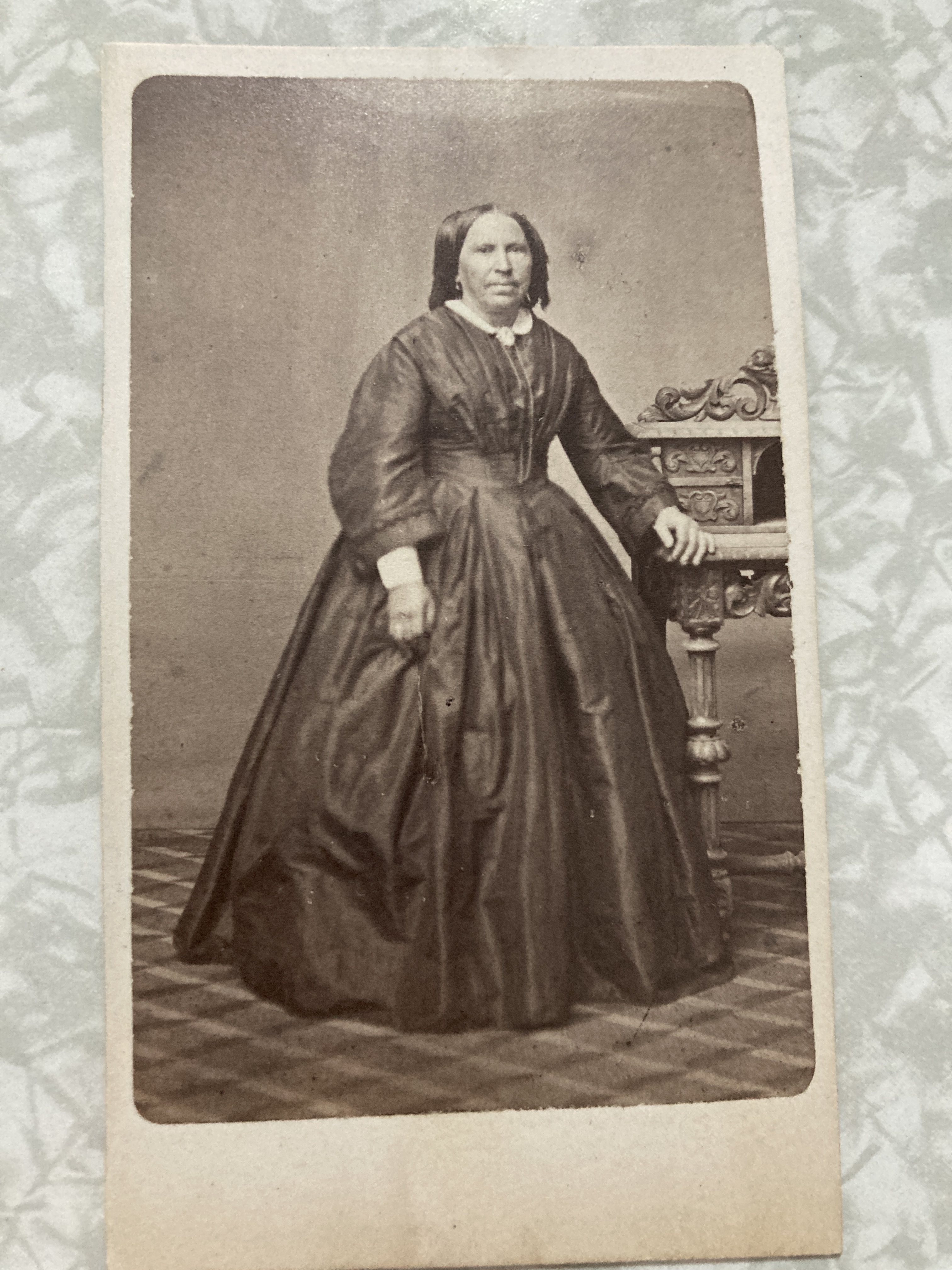
Who are these three women? I don’t know since I have no photographs to use for comparison. Two of them look too young to be Bernard Seligman’s sisters Mathilde and Pauline, who were born in 1845 and 1847, respectively, and certainly too young to be his half-sister Caroline born in 1833, if the photographs were taken around 1873 as Ava concluded about the other Hertel photographs. And they are too old looking to be the children of any of Bernard’s siblings. So sadly they also will remain unidentified.

The next photograph I asked Ava to analyze is on the same page as the two blonde men except this photograph was taken in Bingen, not Mainz, by J.B. Hilsdorf, who was in business in Bingen from 1861 to 1891, according to Ava’s research. When I believed that the other two men on that page were Hieronymous and Jakob, I speculated that this third man could be their brother August, the only other son of Moritz Seligmann who survived beyond 1853 and was living in Germany.

Based on the size of this particular photograph, Ava dated it in the mid-1860s. She thought the man was between 30 and 35 so born between 1827 and 1834.2 August Seligmann was born in 1841 so too young to be the man in this photograph. In addition, Ava compared this photograph to one I have of August and found them to be dissimilar. It didn’t take as much to persuade me this time.

August Seligmann

That left one last photograph for Ava to analyze, the second photograph from Bingen that I had selected.

It also was taken by J.B. Hilsdorf, and for the same reasons Ava dated it in the mid-1860s. She estimated the woman’s age to be in her late 40s, early 50s, giving her a birth year range of 1812 to 1817. Based on the age and other photographs I have of my three-times great-grandmother Babette Schoenfeld Seligmann, Ava thought there was a good possibility that this photograph was also Babette. Here are the other photographs of Babette that Ava used for comparison.

Ava did an incredible job of researching the photographers and the photographs they’ve taken to come up with reliable time frames for when the album photographs were likely taken. But it is only possible to go so far with identification without known photographs of the people in your family to use for comparison. You can narrow down the possibilities and eliminate those who clearly do not fit within the parameters of the dates, but you can never be 100% confident of the specific identity of the person in the photograph based just on dates and locations. I wish I had more photographs that Ava could have used to make facial comparisons, but I don’t. I have to accept that I may never know who most of these people were.

Fortunately, there were a handful of photographs in the Nusbaum Album that were labeled and that I could on my own identify and place in my family tree. More on those in my next few posts.


  1. Ava Cohn, Analysis of Nusbaum Album #4, March 17, 2024 
  2. Ava Cohn, Analysis of Nusbaum Album #5, April 3 ,2024

Nusbaum Album: Santa Fe Photographs

I decided to move on from the Philadelphia photographs in the Nusbaum Album even though there were still many more of them in the album because it seemed to be unlikely that I would ever identify anyone.  I asked Ava to focus next on the six photographs taken in Sante Fe, hoping that they would more clearly be of my Santa Fe relatives.

Of those six, three were of young children, two were of adult men, and one was of a couple. My hope was that the couple would be Frances Nusbaum and Bernard Seligman, my great-great-grandparents, the children would be their children, and the two men would be other Seligmans or Nusbaums.


Once again there were no tax stamps on these photographs, so Ava concluded that they were taken either before August, 1864, or after August, 1866. Since Bernard and Frances didn’t move to Santa Fe until after 1868, I was hoping that the photographs fell into that later period. These photos also appear more than halfway into the album so were perhaps later than those 1863 to 1870 Philadelphia photographs Ava had already analyzed.

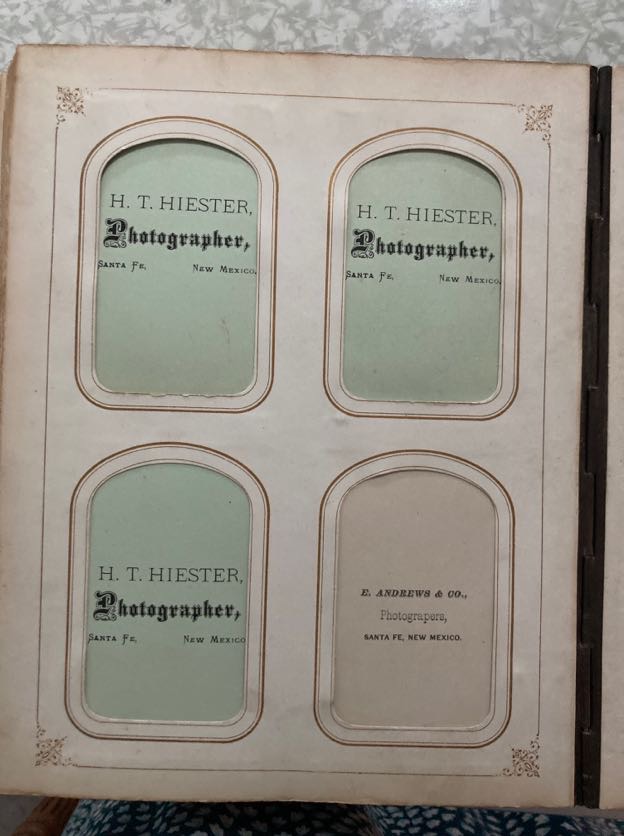
The three photographs of children were all taken by the same photographer, H.T. Hiester. Ava’s research of Hiester revealed that “Henry T. Hiester came to Santa Fe from Texas in the summer of 1871 at the request of Dr. Enos Andrews. Hiester was active in Santa Fe from 1871-1878. He had a studio in West Side Plaza from 1871-1874 and one on Main Street from September, 1874 to March, 1875.”1

Although Ava believed that two of these photographs were taken at the same studio given that they have the same set, back drop, and chair, she concluded that they were not taken at the same time. She opined that they were both of the same child, possibly James Seligman, Bernard and Frances’ older son who was born in 1868 in Philadelphia. She thought the photo on the upper right could be James at three or four and the photo on the lower right James at six or seven.

The baby in the first photograph cannot be James Seligman since he was born in 1868 in Philadelphia before the family moved to Santa Fe. Thus, that baby has to be Arthur Seligman—if it is of one of the children of Bernard and Frances Seligman—as he was the only child of theirs born in Santa Fe, and he was in fact born in 1871, the year that Ava dated the photograph. Perhaps one of the other photographs is of James or perhaps is Arthur as he grew older.

I can see by looking at the coloring on the reverse of these three photos that they might have been taken years apart as they have faded in different ways. (It’s hard to see in the scan below, but they were slightly different shades.) But nevertheless, I can’t imagine why Frances and Bernard would have three photographs of one of their three living children and none of the other two—including my great-grandmother Eva Seligman Cohen, their oldest child. I was so disappointed that there was no photograph of her.

Moving on to the two men photographed in Santa Fe, the one on the same page as the three children (or the three photographs of the one child) was taken by a different Santa Fe photographer, Dr. Enos Andrews (1833-1910). Ava wrote that Andrews had a photography studio in Santa Fe from the end of the 1860s until the early 1870s. Based on her analysis of Santa Fe directory and census listings for Enos Andrews and other factors, Ava concluded this photograph was taken sometime between 1866 and 1871. Since she estimated that the man was about fifty years old, that would mean he was born between 1816 and 1821.2

But who was he? Although the birth year might led me to believe it was John Nusbaum, who was born in 1818, Ava pointed out that in the late 1860s, John (as well as Frances and Bernard until at least 1868) was living in Philadelphia. But it was possible that John went to Santa Fe and had his photograph taken there. After comparing this photograph with the one we thought could be John Nusbaum on the first page, Ava and I both thought it could be the same man and both could be my three-times great-grandfather John Nusbaum.

What about the other photograph of a man taken in Santa Fe on the following page? That photo was taken by Nicholas Brown, who once partnered with Enos Andrews. Ava provided the following background on Nicholas Brown and his son William Henry Brown, who took the photograph of the couple on the same page.

Nicholas Brown (born 1830) was the father of William Henry Brown. Nicholas was active in Santa Fe in 1864-1865. In August of 1866, Nicholas announced the opening of a studio with his son, William. Between 1866 and 1867, William was in partnership with his father in Santa Fe and they advertised the studio as N. Brown & Son and N. Brown E Hijo (1860s in Mexico). At the end of 1870, William was in Mexico. At the beginning of 1871, Nicholas re-opened his studio in Santa Fe but this time it was located on West Side Plaza. Because there is no address on [the reverse of the Nicholas Brown photograph of the bearded man], I am placing this image before 1871.3

Ava dated this photograph as 1866-1867 and estimated the man’s age as 45 to 50, meaning he was born between 1816 and 1822.

I could speculate that maybe this is Bernard’s brother Sigmund Seligman, who lived in Santa Fe from at least 1860 until his death in 1874. Sigmund was born in 1829, so later than the 1816-1821 time frame Ava posited. Could this man be younger than fifty? Could he be in his forties? The beard does make it hard to tell. But it’s possible. So could this be Sigmund? Maybe. Maybe not. I have no idea. Maybe he was a friend of Bernard’s, not his brother. I have no way to know.

Finally, the last photograph from Santa Fe is the one of the couple taken by Nicholas Brown’s son, William Henry Brown. Ava dated this photograph far later than the one taken by Nicholas Brown because William was a partner in his father’s studio in Santa Fe from 1866-1867. By 1870, he was in Mexico. Then he returned to Santa Fe between 1880 and 1884 where he was a partner with George C. Bennett in a photographer studio on West Side Plaza. After 1884 William Henry Brown was no longer living or working in Santa Fe. Based on these facts, Ava dated this photograph at about 1882-1883.4

Ava thought that both the man and the woman were somewhere between 25 and 30 years old, meaning they were born between roughly 1852 and 1858, making them too young to be Bernard and Frances, who were born in 1838 and 1845, respectively. Thus, I have no idea who they are.

The fact that I could not identify the people in these Santa Fe photographs was disappointing. Ava reminded me again about the nature of CDVs—literally, “cartes de visite” or visiting cards. People gave them away, for example, when they came for a visit. And maybe they were taken while visiting and not in their hometown. That meant even those taken in Santa Fe or Philadelphia or elsewhere could be of people who didn’t live in those places. That meant the universe of people who might be in these photographs was anyone who lived during this time period. No wonder we couldn’t identify anyone with any degree of certainty without known photos of them.

The last portion of Ava’s work on this project was devoted to trying to identify the people in some of the photographs taken in Bingen and Mainz, Germany.


  1. Ava Cohn, Analysis of Nusbaum Album #3, January 24, 2024 
  2. See Note 1, supra. 
  3. See Note 1, supra. 
  4. See Note 1, supra. 

Nusbaum Album: Is this John Nusbaum? Is that Bernard Seligman?

After retaining Ava Cohn’s services to help me with the album of photos (“the Nusbaum album”) I’d obtained from an antique dealer in Santa Fe and selecting, with Ava’s advice, where to begin, I waited anxiously to see what Ava could tell me about the album and the first four photos we’d decided to start with, the ones on the very first page:

First page in the Nusbaum album

I had been staring at these over and over while waiting to hear back from Ava. Could the two on top be my three-times great-grandparents Jeanette Dreyfuss and John Nusbaum? Could the two on the bottom be my great-great-grandparents Bernard Seligman and Frances Nusbaum? I was hoping so. Wouldn’t that be a logical assumption to make?

But alas, I quickly learned that hopes and assumptions are not a reliable method for identifying photographs.

Ava started her analysis by providing some background on the album itself. She wrote, “The album was manufactured and sold by Henry Altemus Company of Philadelphia. Altemus and Company first published photographic albums in 1862 and remained in business until 1936….The album is one of Altemus’ larger albums, holding four cartes de visite (CDV) photographs per page.  The photographs are CDVs measuring 2 3/8” x 4.”1

One thing that Ava explained is that cartes de visite, as their name suggests, were used as calling cards. When someone visited, they would leave their photograph as a memento of that visit. That meant that, unlike a modern photograph album where most of the photographs are likely to be of family members and close friends, this album could include photographs of anyone who stopped in to visit the Nusbaums and the Seligmans.

Ava shared this poem that illustrates how CDVs were used:

Ashford, Brothers & Co, Album Filler Poem, c. 1865

Ava’s report continued with some observations about the photographs and some of the issues involved in analyzing them, including the fact that most of the photographs in the album show only heads or heads and shoulders of their subjects. Because Ava did not have the ability to see other details of what they were wearing, it would be more challenging to provide exact dating of the photographs.

Nevertheless, Ava was able to reach several conclusions about the dates when the photographs on the first page were taken. She concluded that the three from Philadelphia were taken in the Civil War era, but not between August, 1864, and August, 1866. As she explained, “Tax stamps were issued by Union states and were required to be placed on the backs of photographs from August, 1864 to August, 1866 to raise money for the war effort.”2 Since these photographs did not have tax stamps on them, they had to have been taken either before August, 1864, or after August, 1866.

With that time period in mind, Ava then focused on the specific photographers who took these first four photographs. Three of the photographs on the first page of the album were taken by Robert N. Keely; his address, as indicated on the back of these three photographs, was “N.W. cor. Fifth & Coates Sts., Philadelphia.” Ava found Keely listed in Philadelphia directories at that address or at nearby addresses throughout the 1850s and 1860s and into the 1870s.

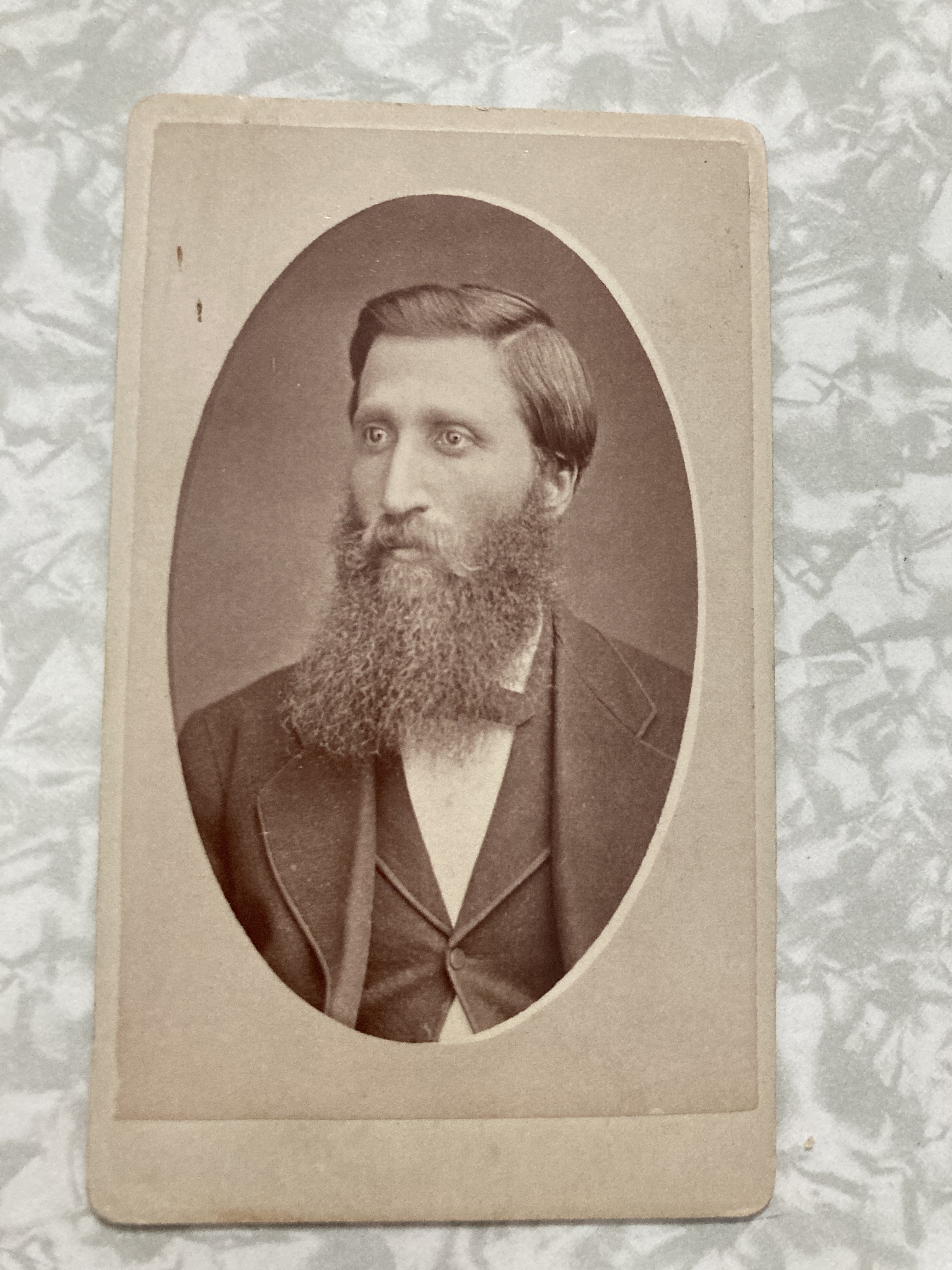
Knowing that these three photographs were taken during that era, Ava then focused on the three individual photographs on that first page that were taken by Keely. First, she looked at this one:

Based on her estimate of his age (50 years old) and the possible dating of the photograph between 1863 and 1864, Ava concluded that the man in the photograph was likely born around 1813-1814. John Nusbaum, my three-times great-grandfather was born on November 26, 1814, according to the family bible. Ava and I speculated that the man in the photograph could be John Nusbaum, given those dates and given the placement of the photograph on the first page.

I was excited by this analysis, but also realized that nothing could be certain. Without another photograph of John, we had no truly definitive way of being sure this was in fact John Nusbaum. That was an important first lesson I learned from Ava’s work on the album.

Another photo taken by Keely that appears on the first page of the album is this one:

Philadelphia c 1863, born about 25 years, could be Bernard or a Nusbaum son

I had hoped this was Bernard Seligman. But Ava was not convinced. She dated this photograph in that same 1863-1864 time frame and found that the man was 20-25 years old, meaning the man was born roughly between 1838 and 1844; Bernard was born in 1837 so within some reasonable margin of error of that estimate. But Bernard and Frances didn’t marry until 1865. Would they have had their photographs taken before they were married?

Possibly, but there was another obstacle. When I shared the photographs I do have of Bernard as a young man and as an older man as well as the blurry still from a video taken of his supposed portrait, I could see similarities, but Ava was certain that the man in the album was not Bernard.


Bernard Seligman

So who was he? Maybe one of John and Jeanette’s sons? Adolphus was born in 1842, Simon in 1843, and Julius in 1848. It could be any one of them, but I have no photographs of any of them. So who knows… It would make sense that John and Jeanette would have put one of their sons on the first page, but I can’t be certain.

What about the two women on that first page? Were they Jeanette Dreyfuss Nusbaum and Frances Nusbaum Seligman? That will be discussed in the next post.


  1. Ava Cohn, Analysis of Nusbaum Album #1, December 16, 2023 
  2. See note 1, supra. 

The Nusbaum Album: An Introduction

Some of you may recall that last fall I received a call from an antique dealer in Santa Fe who had in her shop a photograph album with the names John Nusbaum and Frances Nusbaum engraved on the front and rear covers, respectively. I immediately knew that this album had belonged to my three-times great-grandfather John Nusbaum and his daughter Frances, my great-great-grandmother. Frances had married my great-great-grandfather Bernard Seligman and moved from Philadelphia to Sante Fe, where they raised their children, as I told in my family history novel, Santa Fe Love Song.

I agreed to purchase the album and when it arrived, I marveled at the collection of almost two hundred photographs of people I hoped were my relatives—or at least I hoped that some of them would be. But except for a handful of those photographs, there were no labels or names to identify the people in them. Almost all, however, had a photographers’ stamp that indicated where they were taken.

The largest group of photographs (43) were taken in Philadelphia, where John Nusbaum had settled after immigrating from Schopfloch, Germany, in about 1840. He had initially been a peddler traveling throughout Pennsylvania, but eventually settled in Philadelphia and established a dry goods store there. He married Jeanette Dreyfuss, another German immigrant, and had six children, my great-grandmother Frances being the third child and oldest daughter. Thus, I assumed many of the Philadelphia photographs were of John and his family as well as of other family members and friends. But who was who? I had no idea.

Not surprisingly, the next largest group of photographs were taken in Germany, including some taken in Mainz and some in Bingen, the two larger cities closest to Gau-Algesheim where Bernard Seligman and his siblings were born and raised. There were also photographs taken in other German cities, such as Stuttgart, Berlin, and Wiesbaden.

There were eight photographs taken in Santa Fe, where Frances Nusbaum had moved with her husband Bernard and their three older children in about 1870. Their youngest child Arthur Seligman was born in Santa Fe, but my great-grandmother Eva Seligman was born in 1866 in Philadelphia.

Three photographs were taken in Harrisburg, Pennsylvania, and several were taken in Lewistown, Pennsylvania, two locations where John and Jeanette’s siblings lived in Pennsylvania, so I assumed that those photographs were likely of those Nusbaum/Dreyfuss cousins. The remaining photographs were taken in other places such as New York City; Montgomery, Alabama; Wheeling, West Virginia; Peoria, Illinois; and St. Louis, Missouri.

Each page in the album has four slots for photographs. On the first four pages of the album, there are two photos, back-to-back, in each slot so that you cannot see the reverse of the photos without pulling them out of the slots. Then starting on the fifth page in the album, there are only four photos on each page, and the reverse of those photos shows through on the back of the slot on the back of the page.

What it took me a long time to realize is that all the photos squeezed into the back of those on the first four pages are photographs from Germany. I think that these photographs from Germany may have been added once all the other slots were filled. They likely belonged to Bernard Seligman and were added after he married Frances. I will get to these photographs in a later post, but my reason for mentioning this here is to indicate that I think that aside from those German photos, the others were probably placed by John, Jeanette, or Frances Nusbaum.

The photographs appear to be somewhat grouped together by the location where the photographs were taken and by photographer. The photographs seem to follow roughly this geographical order: Pennsylvania, including many from Philadelphia, but also Harrisburg and Lewistown; then two pages from Peoria, Illinois; then three pages of Santa Fe photographs; then some from New York City and other places; and then photographs from Germany (plus the ones on the reverse of the first few pages). There are also some that appear in random places within the album, but overall this is how the album is arranged.

Since I only had names on a handful of photographs and since I had no idea when the photographs were taken, I decided to retain the expert services of Ava Cohn, aka Sherlock Cohn, the Photo Genealogist. Long time readers of my blog know that I have had great success hiring Ava in the past to help me identify people in old photographs.

With the financial support of my brother and my cousins Marcia and Terry, I asked Ava to help me with this new project. I also agreed to sell the album after Ava and I were done with it to my cousin Jhette for the price I paid to the antique dealer; that way I had more money to hire Ava. Although I was sad to think that I would not be able to keep the album, I knew that Jhette, another descendant of Bernard Seligman and Frances Nusbaum, would take good care of it.

Because of the large number of photographs and my limited resources, I had to limit the scope of Ava’s work. I asked her only to date the photographs and to estimate the ages of the people in them. I was not asking her to do any identification of the people. I was hoping that with those two bits of dating information, I’d be able to deduce who the people were in the photographs—or at least narrow down the possibilities—by studying my family tree.

I also had to limit her work to about 20-25 of the almost two hundred photographs in the album. I decided to focus on those taken in Philadelphia, Santa Fe, Mainz, and Bingen because I knew that those would most likely be of my direct ancestors. As noted above, I figured that the Harrisburg, Peoria, and Lewistown photographs were of Nusbaum/Dreyfuss cousins. I had no idea who in the family (if anyone) lived in Berlin, Stuttgart, or Wiesbaden, Germany, or for that matter in St. Louis, Wheeling, or Montgomery. I knew of one branch that lived in New York, but not direct ancestors.

But because there were so many photographs taken in Philadelphia, I had to find some way to narrow down Ava’s work so that she could have the best chance of identifying the people in the photographs I chose. Based on her suggestions, we started with the photographs on the first page, figuring that those would most likely be the closest relatives if not the owners of the album; three of those were taken by the same photographer in Philadelphia. The fourth and the very first photograph in the album was taken in Harrisburg. There were two men and two women. In my wildest dreams, I was hoping that they were of John and Jeanette and Frances and Bernard.

Here are those first four photographs:

In my next two posts I will share what I learned from Ava about these four photographs and how I decided to choose the remaining 15-20 photographs for her to analyze. This will be a multipart series of posts devoted to the Nusbaum album.


An Exciting New Project in the Works!

Before I move on to the next child of Moses Blumenfeld I, I have two other matters to write about. In my next post I will share some wonderful photographs that my cousin Robin shared with me. Robin, my fifth cousin, once removed, is descended from Abraham Blumenfeld and Geitel Katz through their son Moses I. More details to follow in the next post.

But today’s post is about some other amazing photographs. A couple of months ago I received an email out of the blue from an antiques dealer in Santa Fe named Peggy Gonzalez. Peggy had found me through my blog while looking for a descendant of John Nusbaum, my three times great-grandfather and my father’s namesake. Over thirty years ago at an estate sale, she had acquired a photograph album engraved with the name John Nusbaum on the front. She wanted to know whether I would be interested in buying the album.

At first I was skeptical. There are so many scams out there today. Anyone could have found my blog and made this up. But Peggy sounded honest, and she sent me these scans of the front and back of the album as well as a few representative photos. The back is engraved with “To F. Nusbaum.” My great-great-grandmother was John Nusbaum’s daughter Frances Nusbaum Seligman, and she had lived much of her adult life in Santa Fe with her husband Bernard, my great-great-grandfather. Peggy’s story seemed to be authentic.


I was extremely excited—as you might imagine. I’ve never seen a photograph of John Nusbaum or Frances, and here was a whole album of photos. Almost 200 photos. Thanks to the generosity of some of my Seligman/Nusbaum/Cohen relatives, I arranged to purchase the album. I also got extraordinary help from Mike Lord, our guide in Santa Fe from 2014 and a close friend of my cousin Pete. He acted as the middleman between Peggy and me, retrieving the album and giving Peggy my check and then sending me the album.

The album is now safely in my house, back in the hands of one of John Nusbaum’s descendants. I have retained the services of Ava Cohn, aka Sherlock Cohn, the Photogenealogist, and am now waiting in her queue for her to have time to devote to this project. I’ve scanned the front and back of all the photos. They are all studio photographs—cabinet photos, I think they are called. Small, but very clear. And they all have the names and addresses of the photographers on the reverse side. But only three have any identification of the people in the photograph.

There are photographs that were taken in several cities in Germany as well as all over the US: Philadelphia, New York, Santa Fe, Peoria, Lewistown (PA), and St. Louis. I am hoping that if Ava can provide dates for when they were taken and perhaps the ages of the people, I can then figure out who these people are.

I will wait to share the photos until after I have had the benefits of Ava’s help, but I wanted to share now my excitement about this. Stay tuned for more!


Irmgard Johanna (Joan) Lorch Staple (1923-2022): A Woman Ahead of Her Times

Last month my cousin Wink Lorch informed me that her aunt and my fourth cousin, once removed, Joan Lorch Staple had passed away on November 27, 2022, after living a remarkable life for more than 99 years. Joan was related to me through our mutual ancestors, Jacob Seligmann and Martha Mayer, she through their daughter Martha and me through their son Moritz, my three-times great-grandfather.

Joan was born in Offenbach, Germany, on June 13, 1923, escaped from Nazi Germany to England with her parents during the 1930s, and married Peter Staple in England in 1952. Together they had two sons and immigrated to the US, settling first in Alabama and later in Buffalo, New York. Joan also had a long and successful career while raising her family; she was truly a woman ahead of her times..

Joan had a remarkable career as a scientist and as a scholar and teacher, as described below in her obituary, and she wrote two memoirs about her life: Chance and Choice: My First Thirty Years (2007) and Change and Challenge: My Life After Thirty (2009). I have read them both, and they are fascinating. They tell not only the story of Joan and her family, but provide valuable historical insights into living in Germany before the Nazi era, the persecution of Jews during the Nazi era in Germany in the 1930s, life in England during World War II, and racism in Alabama before and during the Civil Rights movement, as well as the struggles of being a woman scientist in the years before, during, and after the Women’s Movement.

But the obituary written by Joan’s sons tells her story much better than I can. Thank you to my cousin Wink Lorch, Joan’s niece, for sharing it with me.  

Irmgard Joan Staple: Path-Breaking Canisius Scientist and Women’s Advocate Has Died

Joan Staple (known professionally as Dr. I.J. Lorch) passed away at the age of 99 on November 27, 2022, in her home at Canterbury Woods, Williamsville, New York.

A Professor of Biology at Canisius College for more than 30 years, Dr. Lorch also pioneered women’s studies programs at Canisius. Her ground-breaking research in the field of cell biology at the University of Buffalo was recognized by the New York Times and led to more than 30 publications in peer-reviewed scientific journals.

Early Life and Education

Dr. Lorch was born into a Jewish family in Offenbach am Main, Germany. Her father was a co-owner of Rowenta, the innovative electric appliance brand. Her family escaped the Nazis by fleeing to Birmingham, England in 1938. Lorch’s forced emigration from Germany is marked by a series of Stolpersteine — commemorative bronze plaques — set into the sidewalk outside her former home at 19 August Bebel Ring.

She attended public schools in Offenbach until 1935 when Jewish children were banned from secondary education. After emigrating, she continued her education at King Edwards High School for Girls and later graduated from Birmingham University. She went on to earn a PhD in histochemistry from the University of London in 1949.

Scientific Career

As one of the very few women working in the ‘hard sciences’ at that time, she continued her post-doctoral research on cellular aging at Kings College, London. Rosalind Franklin worked in the lab next door. The many challenges facing women in building scientific careers are well documented in the struggle to properly credit Franklin for her critical role in discovering the structure of DNA.

In 1952, Dr. Lorch married Dr. Peter H. Staple, research dentist and fellow post-doctoral student. For the next 10 years she became a homemaker raising two sons and over-seeing the family’s move to Birmingham, Alabama in 1959, and then to Buffalo in 1963.

Once in Buffalo, Dr. Lorch rejoined her King’s College mentor and colleague, James Danielli, who was then the Director of The Center for Theoretical Biology at the University of Buffalo. The team was funded by NASA and carried out pioneering work on how cells age and whether living cells can be created from cellular components. This work came to a spectacular conclusion from the controversy created by the Nov. 13, 1970 New York Times article declaring that University of Buffalo scientists had documented “the first artificial synthesis of a living and reproducing cells”. Hundreds of media outlets picked up on the story that UB scientists were creating living cells that might be shipped by NASA on spaceships to Mars.

These reports misrepresented the research and the ensuing publicity upended the  research agenda. In 1973, Dr. Lorch left the University of Buffalo accepting an offer from Canisius College. 

She shifted her professional focus from research to teaching becoming Professor and Chair of the Department of Biology. To address the discrimination against women in scientific fields, with the support of the Canisius College leadership, she spent over 20 years training and hiring women scientists and also broadening the scope for women’s participation in the management of the College. Dr. Lorch founded the women’s studies program at Canisius, now called Women and Gender Studies. She created a course for non-majors called the Biology of Women (sex ed for college kids) that soon attracted so many men that she had to limit enrollment.

In recognition of her devoted advocacy for women, in 1992 Canisius established the annual I. Joan Lorch Award to “honor a person who has made a significant contribution to women and who exemplifies the pursuit of liberation and justice regarding sex, gender, and sexuality.”

Following her retirement from Canisius in 2003, Dr. Lorch published a two-volume memoir: Chance and Choice (2007) and Change and Challenge (2009).

As recounted in her memoir, Dr. Lorch witnessed many of the 20th century’s historic events. She saw Hitler speak at the opening of an autobahn near Frankfurt in 1935, and Martin Luther King at Kleinhans Music Hall in Buffalo in 1967. She personally knew the discoverers of DNA (Watson, Crick and Franklin) and saw the fruits of her own research on amoeba used for cloning new organisms.

In 2019, Canisius College awarded Dr. Lorch the degree of Doctor of Humane Letters to celebrate “her exceptional achievements in scientific research, unwavering dedication as an educator and for being a steadfast advocate for women.”

Since learning to ski as child in Switzerland, Dr. Lorch was also an avid outdoors woman. She skied well into her eighth decade in Europe and North America and was also an active member of the Adirondack Mountain Club. In recent years, she loved playing Scrabble with her family and connecting on-line daily with other players of “Words with Friends”.

She was pre-deceased by her husband of almost 60 years, Dr. Peter Staple, Professor of Oral Biology at the University of Buffalo’s Dental School. She is survived by her sons Gregory (Siobhan) of Chevy Chase, Maryland, and Alan of Chestertown, Maryland; four grandchildren, Nicole, Nico, Justin and Camille; and one great grandchild, Naomi Joan.

A memorial service will be held at the Unitarian Universalist Church of Amherst in 2023. Donations, in lieu of flowers, should be made to Hospice & Palliative Care Buffalo. https://www.hospicebuffalo.com/give-get-involved/donate-now

A more abbreviated version of her obituary appeared here in The Buffalo News on December 4, 2022.

Joan’s life and career are an inspiration. She overcame leaving her homeland, adjusting to two different countries (and two different regions within the US), learning English, separating from her family, facing prejudice and discrimination, and nevertheless having a highly successful career balanced with a highly successful family life. Her two memoirs taught me so much about grace and strength and persistence.