Another Writer in the Family: Alan Baer Green

In many ways the life of my cousin Josephine Baer parallels that of her sister Amanda.  As I wrote here, Josephine Baer married Morris Alon Green in January, 1906.  Their son Alan Baer Green was born less than eleven months later.  They were living in Pittsburgh.  In 1918 Morris was an executive with the Crucible Steel Company in Pittsburgh.  In 1925, they were living in New York City, and Morris was working as a manager.  In 1930, they were still living in New York, and Morris listed his occupation as “financial.”  Their son Alan was working in advertising.

In 1931, Alan married Gladys Bun, and they had three sons in the late 1930s.  Although Alan continued to work in the advertising field, like his first cousin Justin Baer Herman, he also became a successful writer.  As reported in his obituary, Alan wrote “Love on the Run,” which became a movie starring Clark Gable and Joan Crawford in 1936.  It is a screwball comedy about two competing newspaper reporters covering the wedding of a socialite.

Love on the Run poster

He also wrote several other books during the 1930s, primarily mysteries, sometimes written under the pseudonym Roger Denbie (co-written with Julian Paul Brodie), sometimes as Glen Burne (co-written with his wife Gladys).

Alan’s parents are listed in the 1938 directory for Los Angeles, so I thought perhaps they had all moved out to Hollywood, but Alan himself is not listed in that directory.  And by 1940, all three were listed as living in New York City in the census.

Josephine Baer and Morris Green 1940 US census Year: 1940; Census Place: New York, New York, New York; Roll: T627_2655; Page: 13B; Enumeration District: 31-1349

Josephine Baer and Morris Green 1940 US census
Year: 1940; Census Place: New York, New York, New York; Roll: T627_2655; Page: 13B; Enumeration District: 31-1349

On the 1940 census, Morris and Josephine were living on East 77th Street, and Morris was retired.  Alan and Gladys and their three sons, ages 2, 1, and eleven months, were living on East 86th Street. They had two nurses living with them.  Alan listed his occupations as “author” and “advertising.”

Alan Baer Green and family 1940 US census Year: 1940; Census Place: New York, New York, New York; Roll: T627_2658; Page: 61B; Enumeration District: 31-1454

Alan Baer Green and family 1940 US census
Year: 1940; Census Place: New York, New York, New York; Roll: T627_2658; Page: 61B; Enumeration District: 31-1454

During World War II, Alan served on the War Writers Board, a privately established organization that worked with the government to create propaganda to promote the war effort.  The US Holocaust Museum had this information about the War Writers Board:

Two days after the Japanese attack on Pearl Harbor, Secretary of the Treasury Henry Morgenthau, Jr., proposed organizing the nation’s writers as civilians “under arms” to promote the war effort. A month later, a group of prominent American authors formed the Writers’ War Board, a private association partially supported by government subsidy. The board coordinated more than 2,000 writers in diverse activities including slogans, poster contests, syndicated articles, poems, radio plays, dramatic skits, government publications, books, advertisements, and war propaganda. In May 1942 and 1943, the board sponsored anniversary observances of the Nazi book burnings to keep alive the connection between the destruction of books and the consequences of intolerance.

Alan and Gladys had moved to Westport, Connecticut, by 1943, where they would live for more than thirty years.  After the war Alan was a founder of the Writers Board for World Government, an outgrowth of the War Writers Board formed to promote peace through a “world federation” of all nations.

In 1950, Alan won an Edgar Award from the Mystery Writers of America for his book, What A Body, which was selected as the best first mystery novel of that year. [1] It is a murder mystery involving a police officer who falls for the niece of the murder victim.

What a Body by Alan Baer Green

On December 9, 1954, Morris Green died at age 79 in Atlantic City, where he and Josephine were then living.  A year later Josephine established a scholarship in his name at the University of Pittsburgh; as reported in the Pittsburgh Post-Gazette, although Morris himself did not have much formal education, he “was always devoted to the higher ideals of higher education.”

Morris Green scholarship


At some point after Morris’ death, Josephine moved closer to her son Alan in Connecticut.  Alan continued to write.  One of his best known books, Mother of Her Country, was published in 1973. It was subtitled, “A Comic Novel about Pornography and Censorship.” Kirkus Review wrote the following about it:

A clean joke about porn which doesn’t run to more than one line but tells you something about publishing in general (Mr. Green was around in it for quite some time) and censorship and those not too fine distinctions to be made between words whether they appeared in the Oxford English Dictionary or Macbeth. Laura Conroy, a vestal virgin from the Midwest comes to New York to get a job in the book business which she does — with a small press — to the consternation of her mother who is the Carry Amelia Nation of something called the Americans for Clean Entertainment. There’s a court case and a tacked on coda re a rediscovered journal as to where George Washington might really have slept but the story’s not really much more than a stretcher to fill the space between brou and haha — however cheerful and sensible its reprimand.

Mother of Her Country by Alan Green

Two years later, Alan Baer Green died on March 10, 1975.  He was 68 years old.  He was survived not only by his wife and three sons, but also by his mother Josephine, who was almost 97 years old. Alan Baer Green obit NYTimes March 11 1975-page-001


Josephine died in August, 1975, less than six months after the death of her son.

So how did Josephine’s life parallel that of her sister Amanda? No, she didn’t marry her sister’s widower and raise two nephews.  But like Amanda, she raised a son who grew up to be a successful writer.  Like Amanda, she survived her husband by many years, 28 for Amanda, 21 for Josephine.  Like Amanda, she lived a long life.  Amanda was 89 when she died, Josephine was 97.


[1] I am not sure how he qualified for this as it seems he had already written and published several mystery novels by that time, but perhaps those didn’t count for some reason.

The Screenwriter and the Real Estate Mogul

This is the story of two boys who lost their mother before they were even four years old and who, despite that tragedy, grew up to be very successful.

As I wrote here, my cousin Hattie Baer died at age 33 in 1910.  Hattie and her husband Meyer Herman had had two sons, Justin Baer Herman and Richard B. Herman; Justin was three when his mother died, and Richard was just a few months old.  Five years later in 1915, Hattie’s sister Amanda married her brother-in-law Meyer when those boys were still only eight and five years old, respectively.

Meyer was in the clothing business.  In fact, according to one cemetery record, he worked for the Snellenburg Clothing Company, a clothing manufacturing company and a department store in Philadelphia.

Meyer Herman and Hattie and Amanda burial

Historical Society of Pennsylvania; Philadelphia, Pennsylvania; Collection Name: Historic Pennsylvania Church and Town Records

In one of those “small world moments,” I realized that Meyer Herman was working for a company that was owned by the family of another of my relatives: Carrie Snellenburg, who married my great-great-uncle Joseph Cohen, my great-grandfather Emanuel Cohen’s older brother.  The twisted family tree creaks one more time.

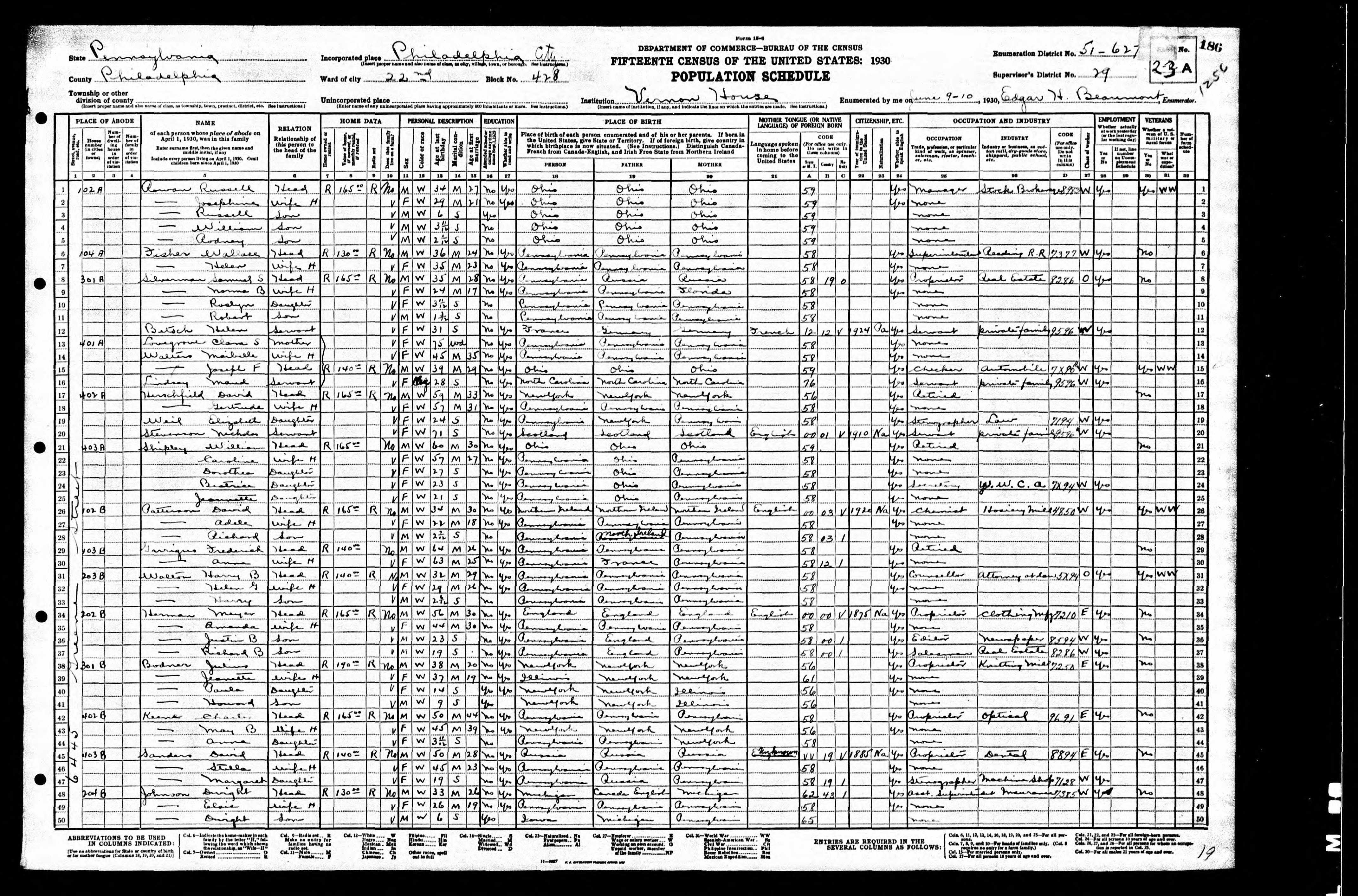
By 1930 both of the sons of Meyer Herman and Hattie Baer (nephews and stepsons of Amanda Baer) were working, Justin as a newspaper editor, Richard as a real estate salesman.  Meyer, Amanda, Justin, and Richard were all still living together in Philadelphia.  Justin was 23, Richard 19 at the time of the 1930 census.

Meyer and Amanda Herman and sons 1930 census Year: 1930; Census Place: Philadelphia, Philadelphia, Pennsylvania; Roll: 2104; Page: 23A; Enumeration District: 0627; Image: 902.0; FHL microfilm: 2341838

Meyer and Amanda Herman and sons 1930 census
Year: 1930; Census Place: Philadelphia, Philadelphia, Pennsylvania; Roll: 2104; Page: 23A; Enumeration District: 0627; Image: 902.0; FHL microfilm: 2341838

Ten years later Meyer and Amanda were still living in Philadelphia, and Meyer was still working as a clothing salesman.  He was 69 years old, Amanda was 58.  Justin and Richard were no longer living with them.  Both had already established themselves in their chosen careers.

After graduating from the Pennsylvania Academy of Fine Art, Justin had become a successful writer, cartoonist, and screenwriter. He wrote for The Philadelphia Record as a reporter and also established a magazine, The Town Crier, during the early 1930s.  He then moved to New York by 1935, where he was a contributor of poems, short stories, and cartoons to The New Yorker magazine.  During that decade he also starting writing screenplays for short films.  Between 1934 and 1940, he wrote nineteen screenplays for short films, working for Paramount Pictures.  “Justin B. Herman Dead at 76; Writer and Producer of Films,” The New York Times, December 10, 1983.    As of 1940, he was single and still living in New York City.

Pennsylvania Academy of the Fine Arts, 118-124...

Pennsylvania Academy of the Fine Arts, 118-124 North Broad Street, Philadelphia, PA 19102, built 1872-75, Frank Furness, architect, William A. Armstrong, builder, National Historic Landmark, 1975. Museum of the Pennsylvania Academy, the oldest art institution in the United States. (Photo credit: Wikipedia)

Meanwhile, his younger brother Richard was also doing quite well during the 1930s.  According to his obituary, Richard “got an early start in the business. He convinced his family and teachers that he was bright, and in elementary school, he was permitted to skip two grades. He entered high school when he was 12, and at 17 was working in real estate for the Lionel Friedman Co. In 1933, at age 23, he founded his own real estate firm. Concentrating on major properties, he built Richard B. Herman & Co. into one of the largest real estate firms in Philadelphia. His forte was real estate investment and management.”  “RICHARD B. HERMAN, 71, REAL ESTATE, CIVIC LEADER,” The Philadelphia Inquirer, June 27, 1982, GenealogyBank.com (http://www.genealogybank.com/doc/obituaries/obit/0FBAE8CA0B3A0215-0FBAE8CA0B3A0215 : accessed 5 July 2016).

As of the 1940 census, Richard had married Marion Cohn, and they were living in Philadelphia.  Their son was born later that year.

On August 25, 1941, Meyer Herman died from coronary thrombosis at age 70.  He had survived the loss of his first wife, Hattie Baer, at a very young age and raised two very young sons in the aftermath of her death before marrying Hattie’s sister Amanda five years later.  He must have been very proud of those two sons.

Meyer Herman death certificate Ancestry.com. Pennsylvania, Death Certificates, 1906-1963 [database on-line]. Provo, UT, USA: Ancestry.com Operations, Inc., 2014. Original data: Pennsylvania (State). Death certificates, 1906–1963. Series 11.90 (1,905 cartons). Records of the Pennsylvania Department of Health, Record Group 11. Pennsylvania Historical and Museum Commission, Harrisburg, Pennsylvania.

Meyer Herman death certificate
Ancestry.com. Pennsylvania, Death Certificates, 1906-1963 [database on-line]. Provo, UT, USA: Ancestry.com Operations, Inc., 2014.
Original data: Pennsylvania (State). Death certificates, 1906–1963. Series 11.90 (1,905 cartons). Records of the Pennsylvania Department of Health, Record Group 11. Pennsylvania Historical and Museum Commission, Harrisburg, Pennsylvania.

During the 1940s Justin Baer Herman married Alma Baer (as far as I can tell, the fact that her surname was Baer was coincidental; she does not appear to have been related to Jacob Baer’s family).  They would have two daughters.  Justin continued to be a successful screenwriter for Paramount.  Two of the films he wrote were nominated for Academy Awards in the category of Best Short Subject.  According to the Imdb database, he was credited as the writer on 61 films between 1934 and 1955 and as director on 49 of those films, producer on forty.  His obituary claimed even higher numbers: “Mr. Herman produced 118 short subjects in 35 years of film making. Three of them were nominated for Academy Awards – ”Life Line to Hong Kong,” ”Roller Derby” and ”Three Kisses.” “Justin B. Herman Dead at 76; Writer and Producer of Films,” The New York Times, December 10, 1983.

Richard also continued to have success in his career.  His obituary reports that:

One of the original developers of Penn Center, he played a major role in the revitalization of Center City. He helped build, and his firm operated, many of the buildings added to the city’s skyline since 1950. …  Working in Penn Center, he was responsible for much of its growth through such transactions as the sale for Penn Central of the 16th and Market Street sites on which stand such buildings as the Central Penn National Building.   He was also responsible for the sale of the Suburban Station Building to the late Matthew H. McCloskey Jr., and the construction of the IBM Building.  When major buildings were placed on the market, he usually was involved – he handled the sale of the Curtis Building, for example. [As of 1971, his company]  was responsible for the operation and leasing of more than 30 major office buildings containing 4.5 million square feet of space.

In fact, Richard’s real estate development firm was responsible for building the huge apartment building, The Philadelphian, where my aunt Eva Cohen lived for many years.

"Philadelphia to Have Largest Apartment, Camden Courier Post, Saturday, May 6, 1961, p. 2

“Philadelphia to Have Largest Apartment, Camden Courier Post, Saturday, May 6, 1961, p. 2

The Philadelphian

The Philadelphian

Unfortunately, Richard suffered a tragedy in his personal life.  On February 28, 1953, his nine year old daughter Barbara died from acute cardiac dilatation.

Barbara Herman death certificate Ancestry.com. Pennsylvania, Death Certificates, 1906-1963 [database on-line]. Provo, UT, USA: Ancestry.com Operations, Inc., 2014. Original data: Pennsylvania (State). Death certificates, 1906–1963. Series 11.90 (1,905 cartons). Records of the Pennsylvania Department of Health, Record Group 11. Pennsylvania Historical and Museum Commission, Harrisburg, Pennsylvania.

Barbara Herman death certificate
Ancestry.com. Pennsylvania, Death Certificates, 1906-1963 [database on-line]. Provo, UT, USA: Ancestry.com Operations, Inc., 2014.
Original data: Pennsylvania (State). Death certificates, 1906–1963. Series 11.90 (1,905 cartons). Records of the Pennsylvania Department of Health, Record Group 11. Pennsylvania Historical and Museum Commission, Harrisburg, Pennsylvania.

 UPDATE: Luanne, a fellow genealogy blogger, asked what I knew about Barbara’s cause of death, so I asked my brother/medical consultant.   He said, “something like viral myocarditis that resulted in cardiogenic shock…would be the most likely diagnosis in a 9 year old.  Acute cardiac dilatation isn’t really a diagnosis, it’s a finding or a descriptive term.[It means an acutely enlarged heart.] Rapid onset cardiogenic shock can also be caused by an MI, valve dysfunction, wall rupture and dysrhythmias, but these would be pretty unusual in a 9 year old. It is also possible she had septic shock which, in the end, caused her heart to dilate (enlarge) and fail.”  For those (like me) who need a definition of cardiogenic shock, MedlinePlus says, “Cardiogenic shock is when the heart has been damaged so much that it is unable to supply enough blood to the organs of the body.”

Justin and Richard’s aunt and stepmother Amanda Baer died on July 28, 1969; she was 89 years old.  She was buried in Mt Sinai cemetery in the same lot as her husband, Meyer Herman, and her sister, Hattie Baer, Meyer’s first wife. Meyer was buried between his two wives, the two Baer sisters.

Meyer Herman and Hattie and Amanda burial

Mt Sinai cemetery record of burials of Amanda Baer Herman, Meyer Herman, and Hattie Baer Herman

Like Meyer, Amanda must have been very proud of her two nephews, Justin and Richard, whom she had helped raise perhaps even before she had married their father in 1915.

Richard Herman died on June 25, 1982.  He was only 72 years old.  I have already quoted extensively from his Philadelphia Inquirer obituary, but want to add these additional insights into who he was beyond a highly successful real estate developer:

He was involved in a wide range of activities. … He was vice president and a member of the board of the Medical College of Pennsylvania, a member of the board of trustees of the Eastern Pennsylvania Psychiatric Institute, a former chairman of the Easter Seal drive, and served on the board of the Athenaeum of Philadelphia. 

Mr. Herman was a member of the prestigious Committee of 70, and a director of the Philadelphia Museum School of Art and the Franklin Institute. He was former chairman of the nonsectarian National Jewish Hospital in Denver and of divisions of United Fund and United Way drives.   He was active in the Rittenhouse Astronomical Society, the Pennsylvania Historical Society, and the Philadelphia Art Alliance.

Mr. Herman was the only man to head both the Society of American Magicians and the International Brotherhood of Magicians simultaneously.

He was a member of the Citizens Council on City Planning and the Germantown Historical Society.

He was a man with an endless curiosity and an I.Q. high enough to make him eligible for membership in Mensa, an organization for the very intelligent. He taught himself art, sculpture and music. He learned to play the organ on his own. He had his own observatory.

His art was displayed in his home and his office, accompanying his collections of such things as pipes. He also collected instruments related to astrology and medicine, children’s toys and signs.

Richard B. Herman ad

His brother Justin died just one year later on December 3, 1983.  He was 76 years old and died of emphysema.  “Justin B. Herman Dead at 76; Writer and Producer of Films,” The New York Times, December 10, 1983.

These two men who lost their mother before either was four years old certainly left their mark in their respective fields, one an Oscar nominated screenwriter, the other a highly successful real estate developer and civic leader.

The Jeweler and the Suffragette: Star-crossed Lovers?

What would have brought a 71 year old Massachusetts jewelry manufacturer together with a 68 year old suffragette from Birmingham, Alabama?

As I wrote last time, Attleboro Manufacturing, the jewelry company that ultimately supported four of the children of Amalia Hamberg and Jacob Baer, was founded by their oldest child, Maurice Jay Baer.  This post tells the story of the rest of Maurice’s life and his mysterious marriage to a woman named Bossie.

Maurice somehow eluded the census taker every decade after 1900, that is, every decade after he moved out of his parents’ home in Pittsburgh.  In fact, I am not even sure he was still in their home in 1900 since by then he and his future brother-in-law Samuel Stone had founded Attleboro Manufacturing in Attleboro.  And Maurice does not appear on the 1910, 1920, 1930, or 1940 census as best I can tell.

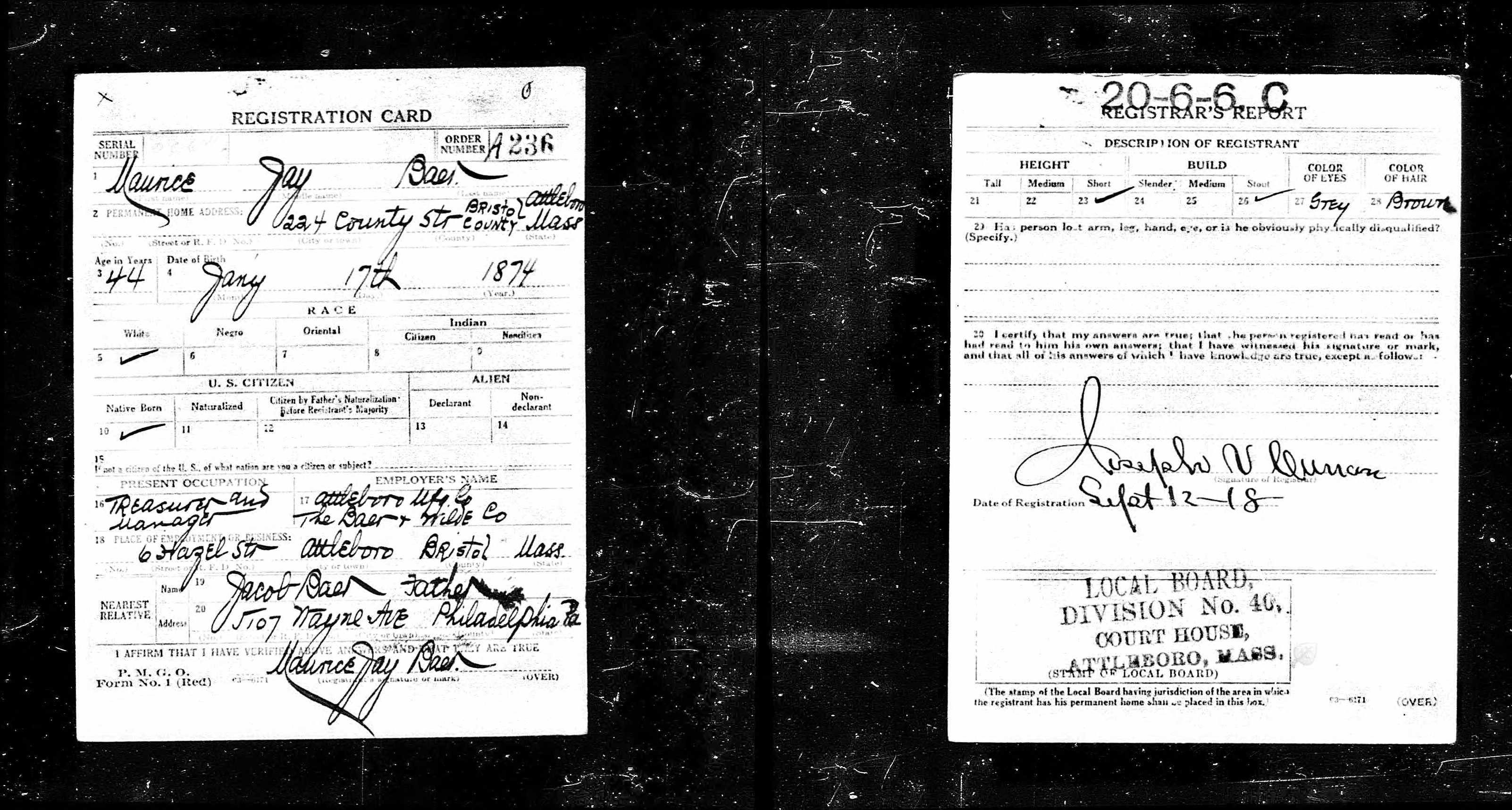
What makes this particularly strange is that he does appear in many directories for the city of Attleboro in the years ranging from 1907 through 1933, and for almost all of the years in which he appears, his residence is 224 County Street in Attleboro.  That is also the address he gave on his World War I draft registration form.
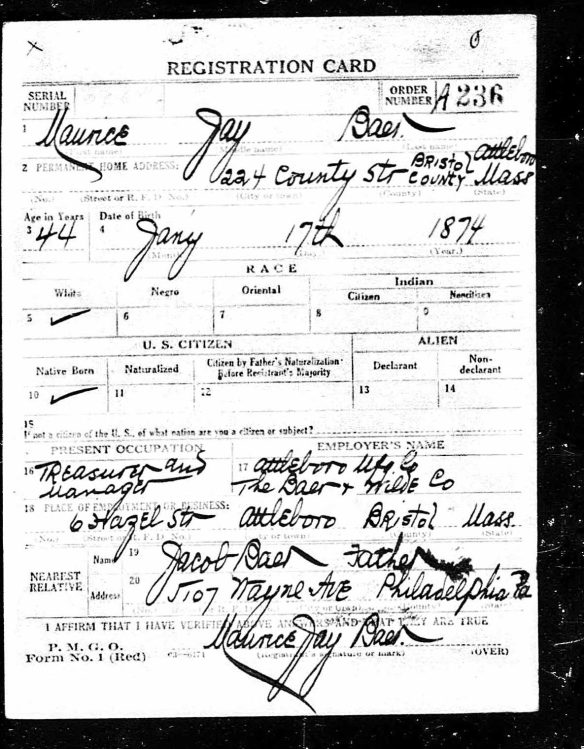
Maurice Jay Baer ww1 draft reg

Maurice Jay Baer, World War I draft registration Ancestry.com. U.S., World War I Draft Registration Cards, 1917-1918 [database on-line]. Provo, UT, USA: Ancestry.com Operations Inc, 2005. Original data: United States, Selective Service System. World War I Selective Service System Draft Registration Cards, 1917-1918. Washington, D.C.: National Archives and Records Administration. M1509, 4,582 rolls. Imaged from Family History Library microfilm.

Maurice’s sister Tilda Baer Stone and her husband Samuel Stone (ne Einstein) also were living at 224 County Street in Attleboro, according to the 1920, 1930, and 1940 census records.   If Maurice was living at that address with his sister and her family, why wasn’t he included in those census records?  Was he hiding from the census enumerator?

Tilda Baer and Samuel Einstein [Stone], 1920 census Year: 1920; Census Place: Attleboro Ward 2, Bristol, Massachusetts; Roll: T625_681; Page: 1A; Enumeration District: 9; Image: 794

Tilda Baer and Samuel Einstein [Stone], 1920 census
Year: 1920; Census Place: Attleboro Ward 2, Bristol, Massachusetts; Roll: T625_681; Page: 1A; Enumeration District: 9; Image: 794

Making it even stranger is the fact that there are numerous passenger manifests listing Maurice as a passenger on ships going back and forth to Europe during the 1920s and 1930s, and on a number of those manifests, Maurice gave a New York City address as his residence.  Perhaps he had a pied a terre in New York as well as a home in Attleboro, but he doesn’t appear on any census record in New York for those years either.
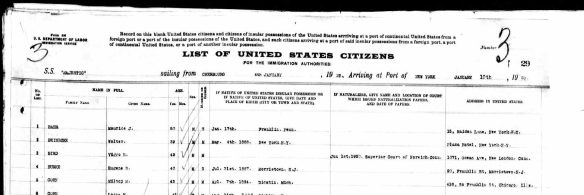
Maurice Jay Baer 1928 ship manifest with NYC residence Year: 1928; Arrival: New York, New York; Microfilm Serial: T715, 1897-1957; Microfilm Roll: Roll 4195; Line: 1; Page Number: 29

Maurice Jay Baer 1928 ship manifest with NYC residence
Year: 1928; Arrival: New York, New York; Microfilm Serial: T715, 1897-1957; Microfilm Roll: Roll 4195; Line: 1; Page Number: 29


Although his absence from census records made it hard to determine whether Maurice had married or had children, I assume that at least until 1945 he had not married. Then on June 19, 1945, Maurice married Julia Hendley in Tryon, Polk County, North Carolina.  I know this is the correct Maurice because of the marriage license application identifying the names of his parents:

Maurice Jay Baer and Julia Hendley marriage license, 1945 Ancestry.com. North Carolina, Marriage Records, 1741-2011 [database on-line]. Provo, UT, USA: Ancestry.com Operations, Inc., 2015. Original data: North Carolina County Registers of Deeds. Microfilm. Record Group 048. North Carolina State Archives, Raleigh, NC.

Maurice Jay Baer and Julia Hendley marriage license, 1945
Ancestry.com. North Carolina, Marriage Records, 1741-2011 [database on-line]. Provo, UT, USA: Ancestry.com Operations, Inc., 2015.
Original data: North Carolina County Registers of Deeds. Microfilm. Record Group 048. North Carolina State Archives, Raleigh, NC.

The marriage register for Polk County lists Maurice’s residence as New York City and Julia’s as Birmingham, Alabama.

Ancestry.com. North Carolina, Marriage Records, 1741-2011 [database on-line]. Provo, UT, USA: Ancestry.com Operations, Inc., 2015. Original data: North Carolina County Registers of Deeds. Microfilm. Record Group 048. North Carolina State Archives, Raleigh, NC.

Ancestry.com. North Carolina, Marriage Records, 1741-2011 [database on-line]. Provo, UT, USA: Ancestry.com Operations, Inc., 2015.
Original data: North Carolina County Registers of Deeds. Microfilm. Record Group 048. North Carolina State Archives, Raleigh, NC.

So who was Julia Hendley? And how did Maurice meet her and decide to get married, presumably for the first time, in 1945?

According to the marriage license application, Julia’s parents were Frank P. O’Bride and Indiana McBride, both deceased as of 1945.  But my research suggests that Julia’s father’s name was O’Brien, not O’Bride.  For one thing, it just seemed odd to me that the mother’s birth name was McBride and the father’s O’Bride.  Plus I could not find a Frank O’Bride in Birmingham, Alabama, but I did find a Frank P. O’Brian married to a Dannie O’Brien on the 1880 census in Birmingham, and Dannie seemed like a possible nickname for someone named Indiana.
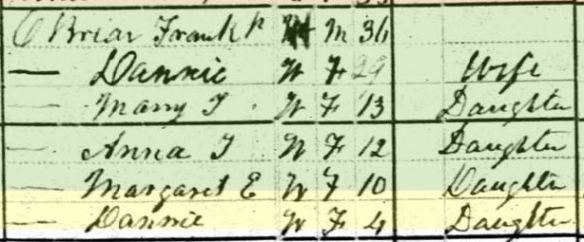
1880 census Year: 1880; Census Place: Birmingham, Jefferson, Alabama; Roll: 17; Family History Film: 1254017; Page: 490A; Enumeration District: 075; Image: 0290

1880 census
Year: 1880; Census Place: Birmingham, Jefferson, Alabama; Roll: 17; Family History Film: 1254017; Page: 490A; Enumeration District: 075; Image: 0290


That census lists four children of Frank and Dannie O’Brian: Mary, Anna, Margaret, and a fourth daughter named Dannie, born in 1876.  The only one who is close in age to “Julia” would be Dannie, as Julia claimed to be 68 when she married in June, 1945, so she would have been born in either late 1876 or early 1877.  Could the daughter Dannie be Julia?

I also found Indiana McBride (or McBryde) in other sources, and several trees on Ancestry report that she was married to Frank P. O’Brien (spelled with an E).  One tree included a three page biography of Frank O’Brien, saying that his wife was Julia Indiana McBride. Perhaps Dannie, the daughter, had her mother’s full name and also had a first name of Julia that she didn’t use except for legal documents?   I contacted the owner of the tree with that biography of Frank O’Brien to ask about the name, and apparently it was written by a now-deceased family member in 1969, and the tree owner did not have any other source for the name Julia for either Frank’s wife or daughter.

I did, however, find a great deal of information online about Frank P. O’Brien.  He was a Civil War hero (on the Confederate side) and a beloved mayor of Birmingham, Alabama.  The Alabama Pioneers website wrote this about O’Brien:

Frank P. O’Brien was one of the best known and most popular citizens of Birmingham. He born in the city of Dublin, Ireland,. February 29, 1844…. [His family immigrated to Pennsylvania when Frank was a young boy.]  Frank P. O’Brien attended school from the age of five until fourteen years of age, when he ran away from home, at which period he began to learn the trade of scenic and fresco painter, under the instructions of the celebrated artist, Peter Schmidt, who secured the second prize for merit at Washington for work in the Capitol buildings. Mr. O’Brien followed his trade until 1874, coming to Montgomery,Alabama, in 1859, with Mr. Schmidt, who had contracted to paint the scenic and fresco work of the Montgomery Theatre. …  Mr. O’Brien erected some of the most substantial buildings in the city.  …  Mr. O’Brien was one of the most enterprising and popular men of the city, and as a manager, through his determination to exclude all companies that did not furnish entertainments of an elevating nature, has established the reputation of Birmingham as one of the best theatrical cities in the South. …. O’Brien was Jefferson County Sheriff from 1896 to 1900. He ran unsuccessfully for mayor against incumbent George Ward in the 1907 mayoral election. He was elected in the 1909 Birmingham mayoral election and served most of one term as mayor, before his death in 1910….. – See more at: http://alabamapioneers.com/biography-frank-p-obrien/#sthash.9DEYGNLZ.dF0taqNz.dpuf

This photo of Frank P. O’Brien appears on the same site:
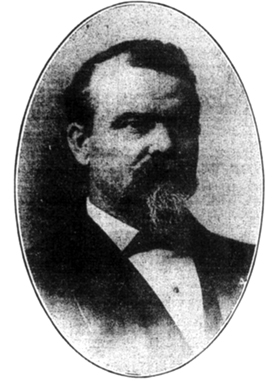
OBrien-Frank_OBrien1844-Montgomery-and-Jefferson

Frank P. O’Brien

There is more information about his life here.

But was this Frank P. O’Brien the father-in-law of Maurice Jay Baer, my cousin and co-founder of Attleboro Manufacturing? Was Julia Hendley, wife of Maurice Jay Baer, in fact the daughter of Frank P. O’Brien? Was she the daughter identified as Dannie on the 1880 census?

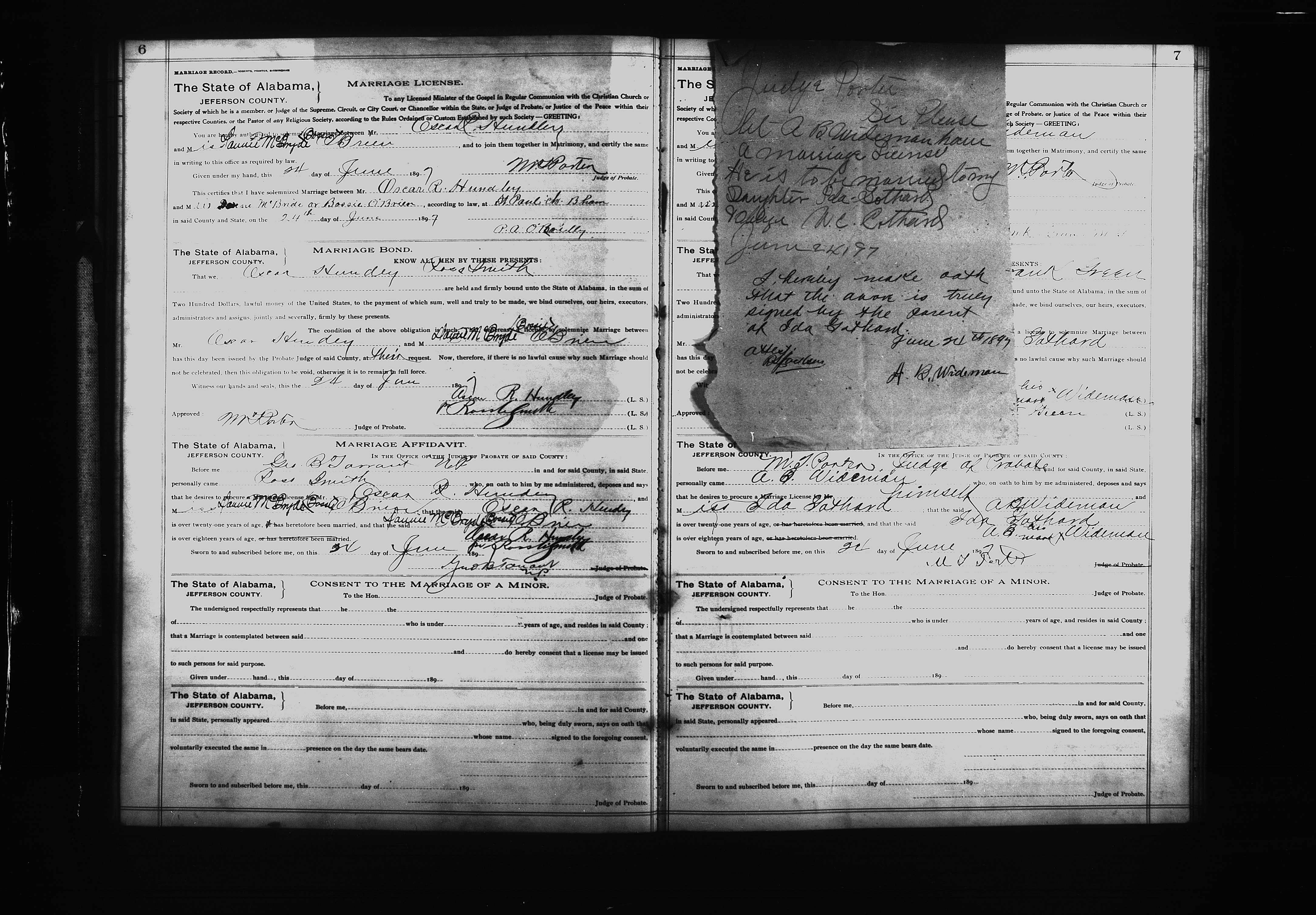
The next clue I found was a listing in the Alabama Select Marriages database on Ancestry for the marriage of Daniell McBryde O’Brien to Oscar R. Hundley on June 24, 1897, in Birmingham, Alabama.  It seemed likely that this was the same person as the daughter named Dannie on the 1880 census.  Her middle name was the same (albeit spelled with a Y, not an I) as her mother’s birth name on the marriage record to Maurice, and her surname matched her father’s surname.

When I then searched for the actual record on FamilySearch, I saw that the bride’s name was actually Dannie, not Daniell, and thus was convinced that this was in fact the daughter of Frank P. O’Brien and Indiana McBride/McBryde who later married Maurice Jay Baer.


Marriage record for Oscar R. Hundley and Dannie McBryde O'Neil

Marriage record for Oscar R. Hundley and Dannie McBryde O’Neil Alabama, County Marriages, 1809-1950,” database with images, FamilySearch (https://familysearch.org/pal:/MM9.3.1/TH-1942-34000-18845-98?cc=1743384 : 16 July 2015), 007251058 > image 33 of 649; county courthouses, Alabama

So why did Dannie O’Brien Hundley later marry Maurice Jay Baer using the name Julia Hendley? Since the marriage record for Maurice in 1945 had misspelled the bride’s father’s name as O’Bride instead of O’Brien and the mother’s as McBride instead of McBryde, certainly Hundley might have been misspelled as Hendley. It also recorded Maurice’s age as 65 when he was actually 71.  I still was baffled by the bride’s first name, but was now quite sure that the woman who married my cousin Maurice was the daughter of Frank P. O’Brien and Indiana McBryde and had once been married to Oscar R. Hundley.

On the 1900 census, however, Dannie O’Brien Hundley was using yet another first name: Bossie.  She and Oscar, a lawyer and for a short time a federal judge, were living in Huntsville, Alabama, with a servant.

Oscar and Bossie OBrien Hundley 1900 census Year: 1900; Census Place: Huntsville, Madison, Alabama; Roll: 28; Page: 5B; Enumeration District: 0100; FHL microfilm: 1240028

Oscar and Bossie OBrien Hundley 1900 census
Year: 1900; Census Place: Huntsville, Madison, Alabama; Roll: 28; Page: 5B; Enumeration District: 0100; FHL microfilm: 1240028

They would have a daughter Margaret in 1909, and on the 1910 and 1920 census records, Dannie is also named as Bossie (spelled as Bessie in 1920).
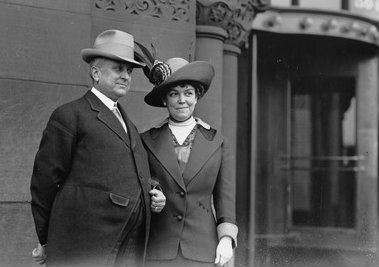
Oscar and Bossie O'Brien Hundley

Oscar and Bossie O’Brien Hundley

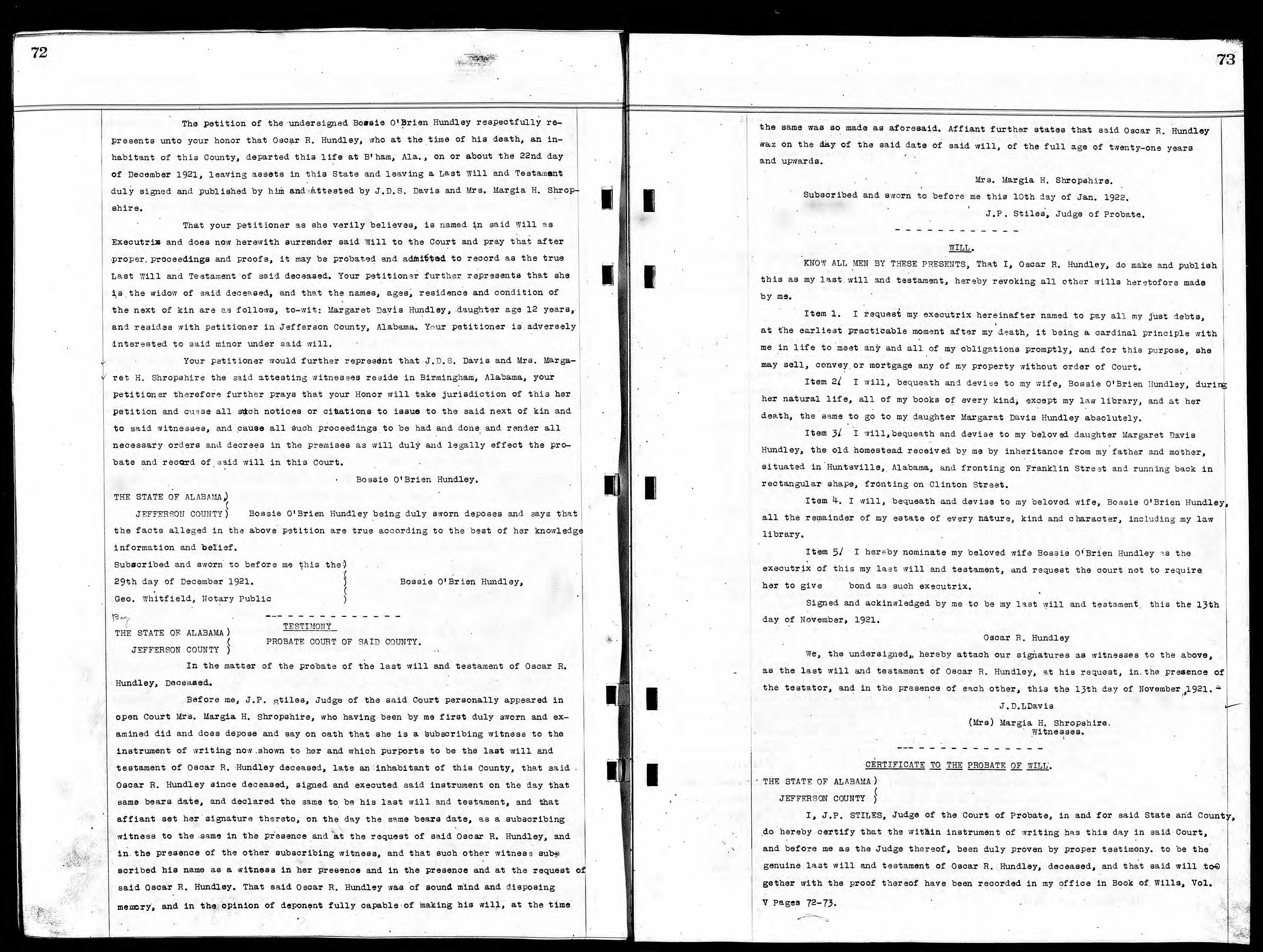
In addition, she is listed in several Birmingham city directories as Bossie O’Brien Hundley.  That this had become her legal name (or at least the name she used on all formal and informal documents) is further evidenced by the fact that when Oscar died in 1921, the petition for probate was filed by Bossie O’Brien Hundley.
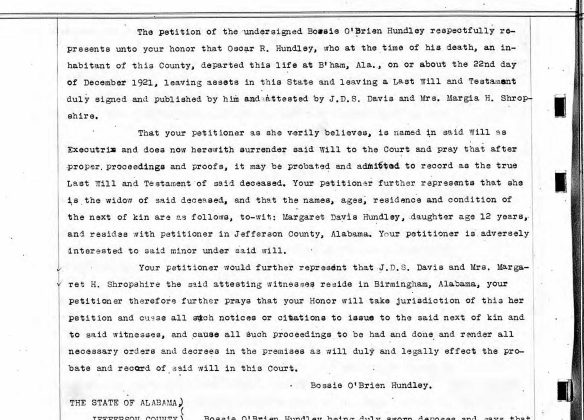
Probate petition for estate of Oscar Hundley

Petition to Probate Estate of Oscar Hundley Ancestry.com. Alabama, Wills and Probate Records, 1753-1999 [database on-line]. Provo, UT, USA: Ancestry.com Operations, Inc., 2015. Original data: Alabama County, District and Probate Courts.

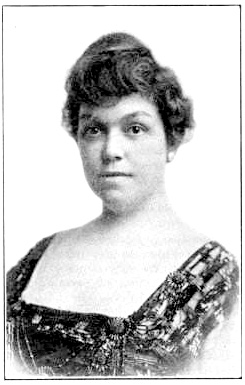
And Bossie O’Brien was not just the daughter of the mayor of Birmingham and the wife of a federal judge; she was a well-known person in her own right: a woman who fought for the right to vote in the Suffragist Movement in the 1910s.  As noted on the BHAM Wiki, a website about Birmingham, Alabama:

[Bossie O’Brien] Hundley joined the Birmingham Equal Suffrage Association soon after it was formed in 1911 and quickly rose to a position of leadership in the group. She became president of the Birmingham Chapter and then legislative chair of the statewide association. In 1914 she organized a petition drive which collected over 10,000 signatures calling for a referendum on women’s voting rights. She and fellow suffragist, Mrs A. J. Bowron, drove across the state on a publicity tour in her Hudson Six. She debated Congressman Tom Heflin in front of a crowd of thousands in Wetumpka. Despite her efforts, the legislature ignored the AESA’s demand for a referendum.


The story of her confrontation with Congressman Heflin was described in the Montgomery, Alabama Daily in 1915, and is reprinted here.

Wayne Flynt in his book, Alabama in the Twentieth Century (University of Alabama Press, 2004) p. 260, wrote this about Bossie:

Bossie O’Brien Hundley, daughter of Birmingham’s mayor from 1908 to 1910, was a Catholic graduate of a Kentucky convent school and the wife of a federal judge and a power in the state’s Democratic Party.  As chief strategist in the 1915 lobbying effort on behalf of enfranchising women, she sat in the gallery while one legislator after another quoted Scripture to justify denying women the vote.  Hundley finally offered a proof text of her own, Psalm 116:11:  “All men are liars.”

Bossie sure sounds like someone I would have liked to have known—a strong woman who didn’t back away from confrontation.

But how did she meet my cousin Maurice Jay Baer, a man from Massachusetts?

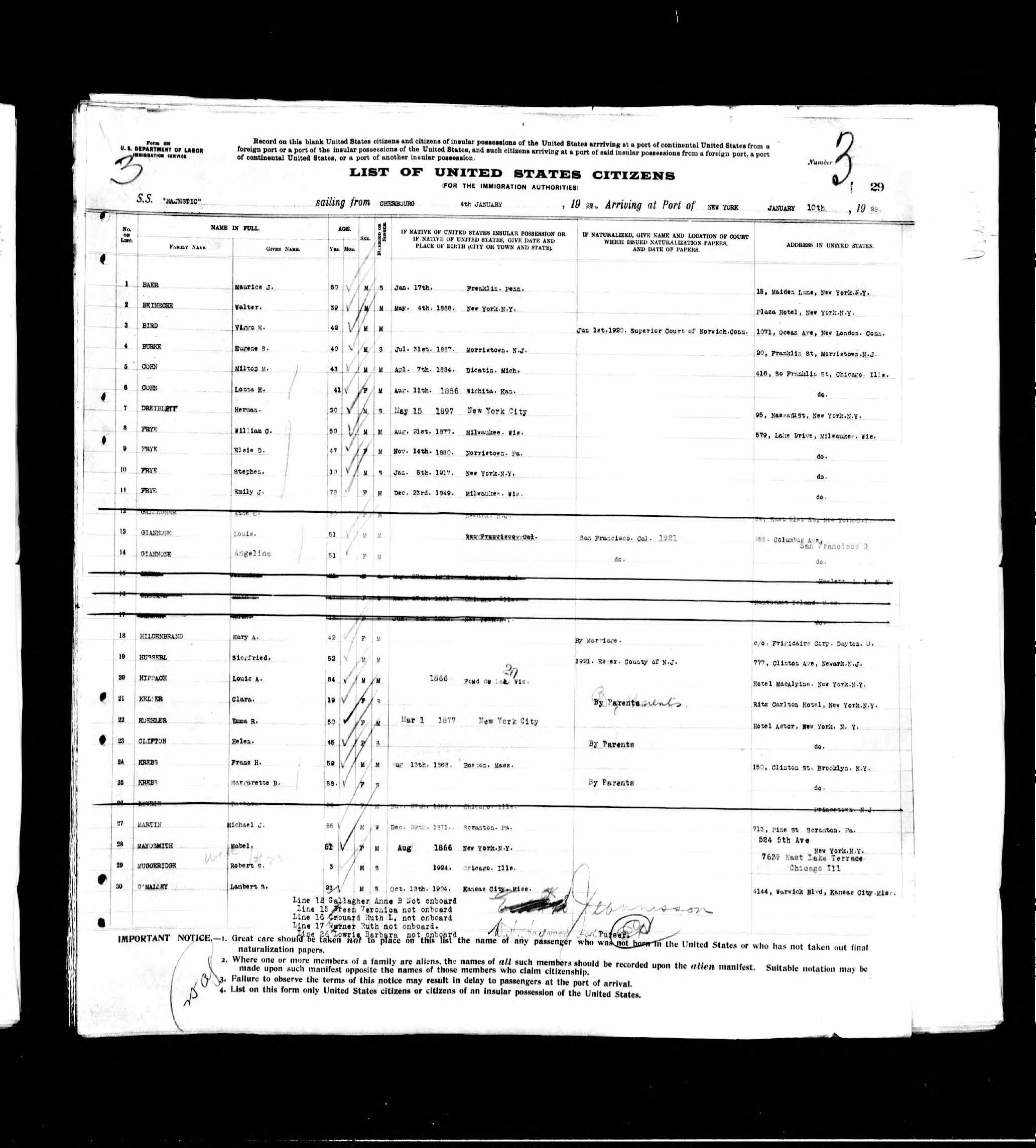
After her first husband died in 1921, Bossie took several trips to Europe in the 1920s and 1930s. Maurice, as noted above, also took numerous trips to Europe during those years.  In fact, both traveled to Europe in 1926, 1928, and 1929, although on different ships arriving home in different months. But in October 1930, they were on the same ship returning to New York, listed together on the ship manifest (the last two names on this page):
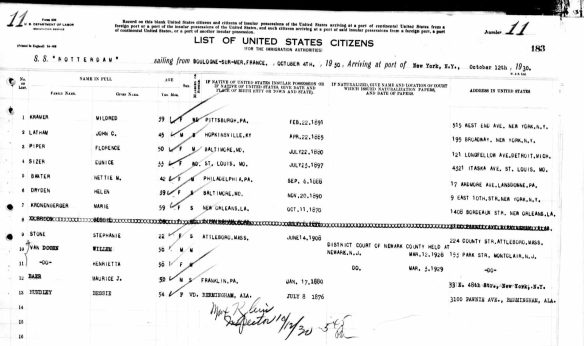
1930 ship manifest listing both Maurice Jay Baer and Bossie Hundley Year: 1930; Arrival: New York, New York; Microfilm Serial: T715, 1897-1957; Microfilm Roll: Roll 4849; Line: 1; Page Number: 183

1930 ship manifest listing both Maurice Jay Baer and Bossie Hundley
Year: 1930; Arrival: New York, New York; Microfilm Serial: T715, 1897-1957; Microfilm Roll: Roll 4849; Line: 1; Page Number: 183


Were they in fact traveling together? Or had they met on that ship and coincidentally ended up listed one after the other on the manifest? It certainly seems that they knew each other by at least October 1930.  But they didn’t marry for another fifteen years.

Bossie continued to live in Birmingham, but by 1940 she moved to Black Mountain, North Carolina, where she was living at the Monte Vista Hotel.  What would have prompted the move at that point in her life?  Was this a place where she and Maurice could be together?

She married Maurice five years later on June 19, 1945 in North Carolina.  Sadly, Maurice died less than a year later on April 25, 1946, in Asheville, North Carolina, from pyelonephritis, that is, a kidney infection.  He was 72 years old.

Maurice Jay Baer death certificate Ancestry.com. North Carolina, Death Certificates, 1909-1976 [database on-line]. Provo, UT, USA: Ancestry.com Operations Inc, 2007. Original data: North Carolina State Board of Health, Bureau of Vital Statistics. North Carolina Death Certificates. Microfilm S.123. Rolls 19-242, 280, 313-682, 1040-1297. North Carolina State Archives, Raleigh, North Carolina.

Maurice Jay Baer death certificate
Ancestry.com. North Carolina, Death Certificates, 1909-1976 [database on-line]. Provo, UT, USA: Ancestry.com Operations Inc, 2007.
Original data: North Carolina State Board of Health, Bureau of Vital Statistics. North Carolina Death Certificates. Microfilm S.123. Rolls 19-242, 280, 313-682, 1040-1297. North Carolina State Archives, Raleigh, North Carolina.

There are a number of strange things about this death certificate.  For one, it reports that Maurice was single, not married.  The informant was his brother-in-law, Jerome Grant.  Did he not know that Maurice was married? Also, it shows his residence as New York City.  Did he and Bossie live together in New York? North Carolina? Or did they live separately?

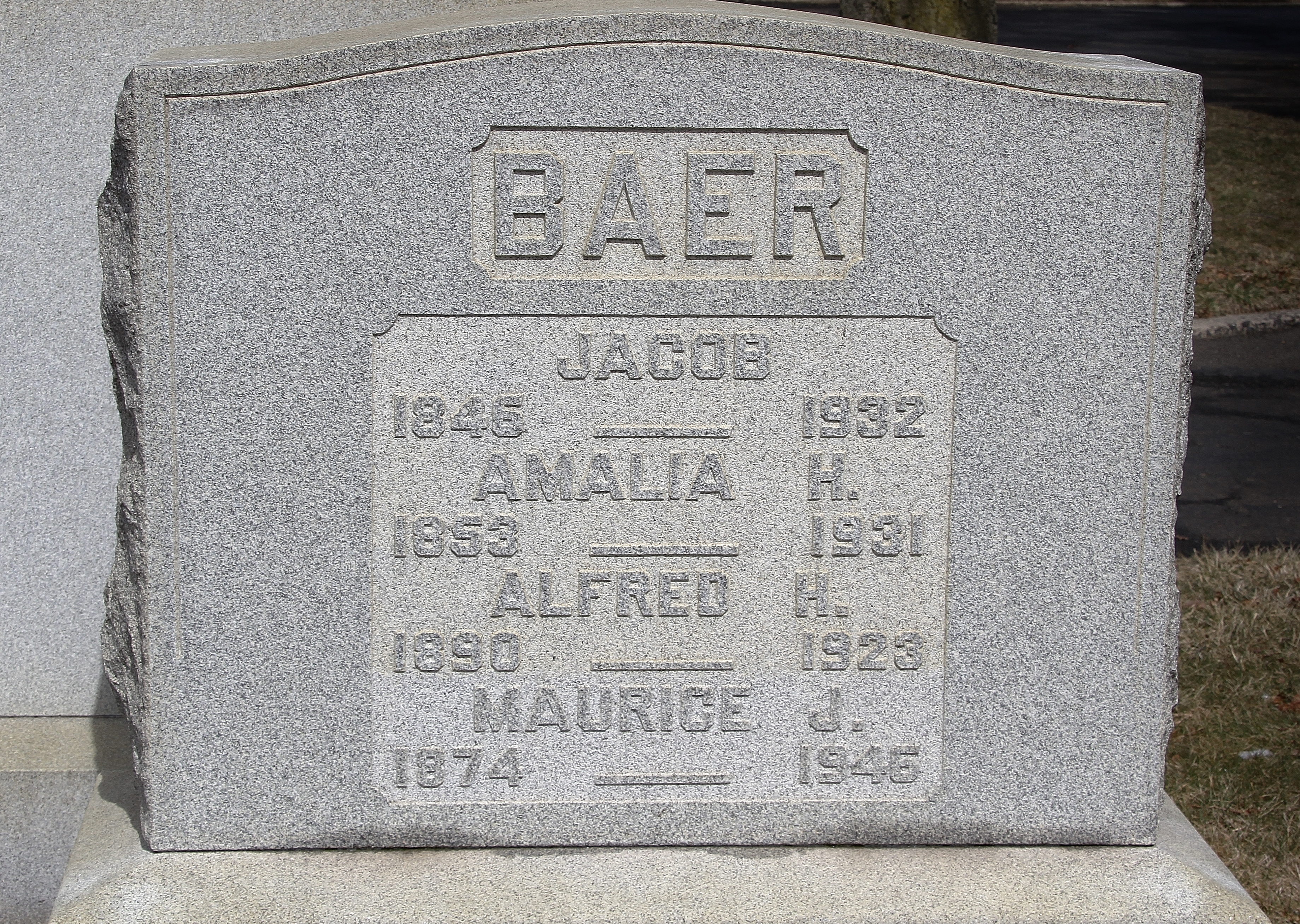
And Maurice was buried in Philadelphia at Mt. Sinai Cemetery with his parents and brother Alfred and sister Hattie.

His death notice in the New York Times did not even mention Bossie as one of his survivors, just his siblings.
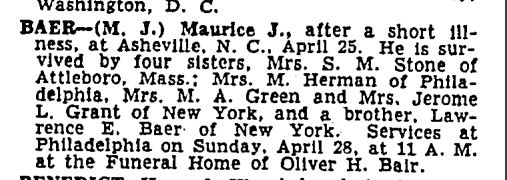
Maurice Jay Baer death notice New York Times, April 27, 1946

Maurice Jay Baer death notice
New York Times, April 27, 1946


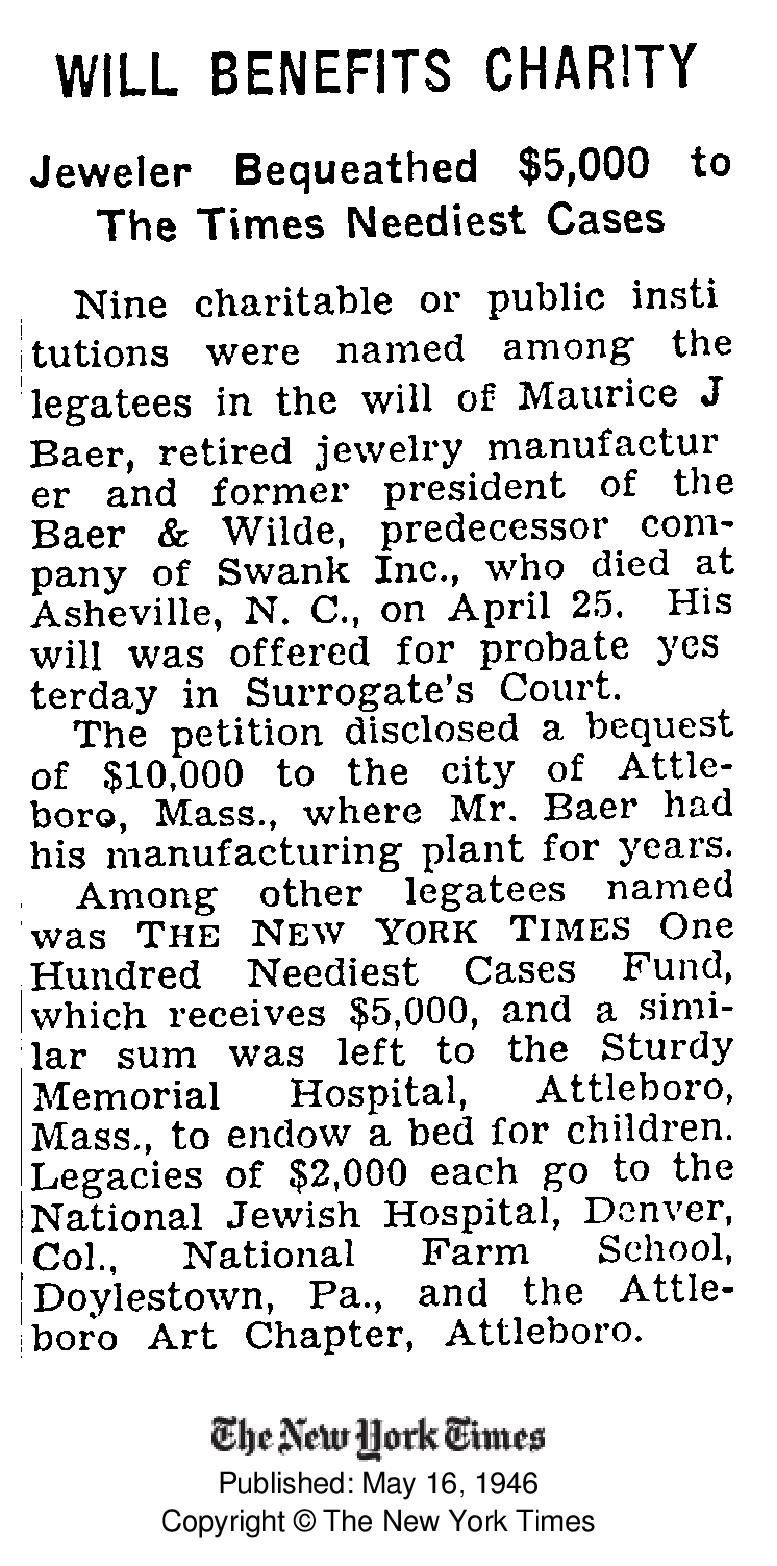
Maurice must have left a fairly substantial estate.  The New York Times reported on May 16, 1946. that a petition had been filed to probate the estate in New York County Surrogate Court and that Maurice had left money to a number of charitable causes and institutions:
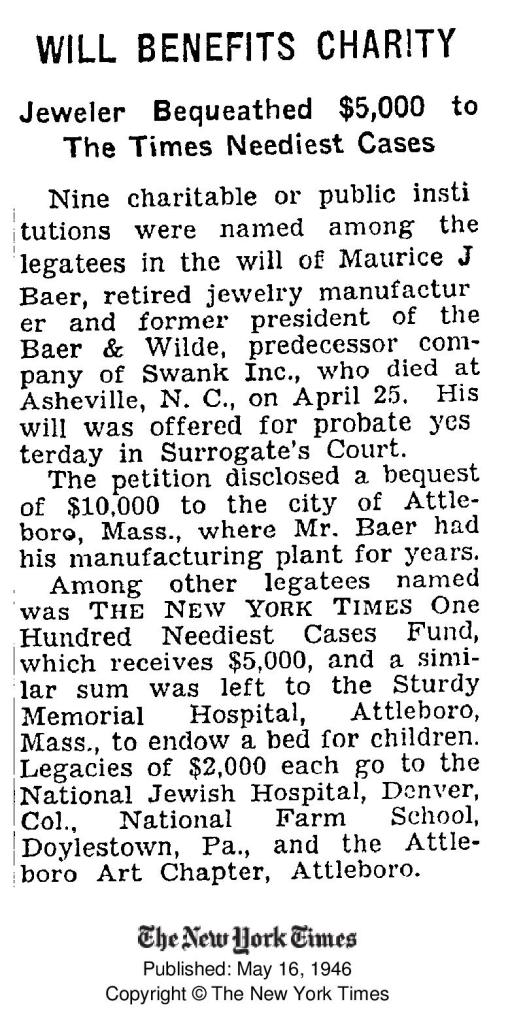
New York Times, May 16, 1946, p. 22

New York Times, May 16, 1946, p. 22

I was hoping to obtain a copy of the will, but it appears to be quite costly to do so ($90 just for the court to do a search and then $1.50 per page for photocopying the will if they find it).  If I can find a less costly way to obtain the will, I’d be very curious to see whether his will named Bossie as a beneficiary.

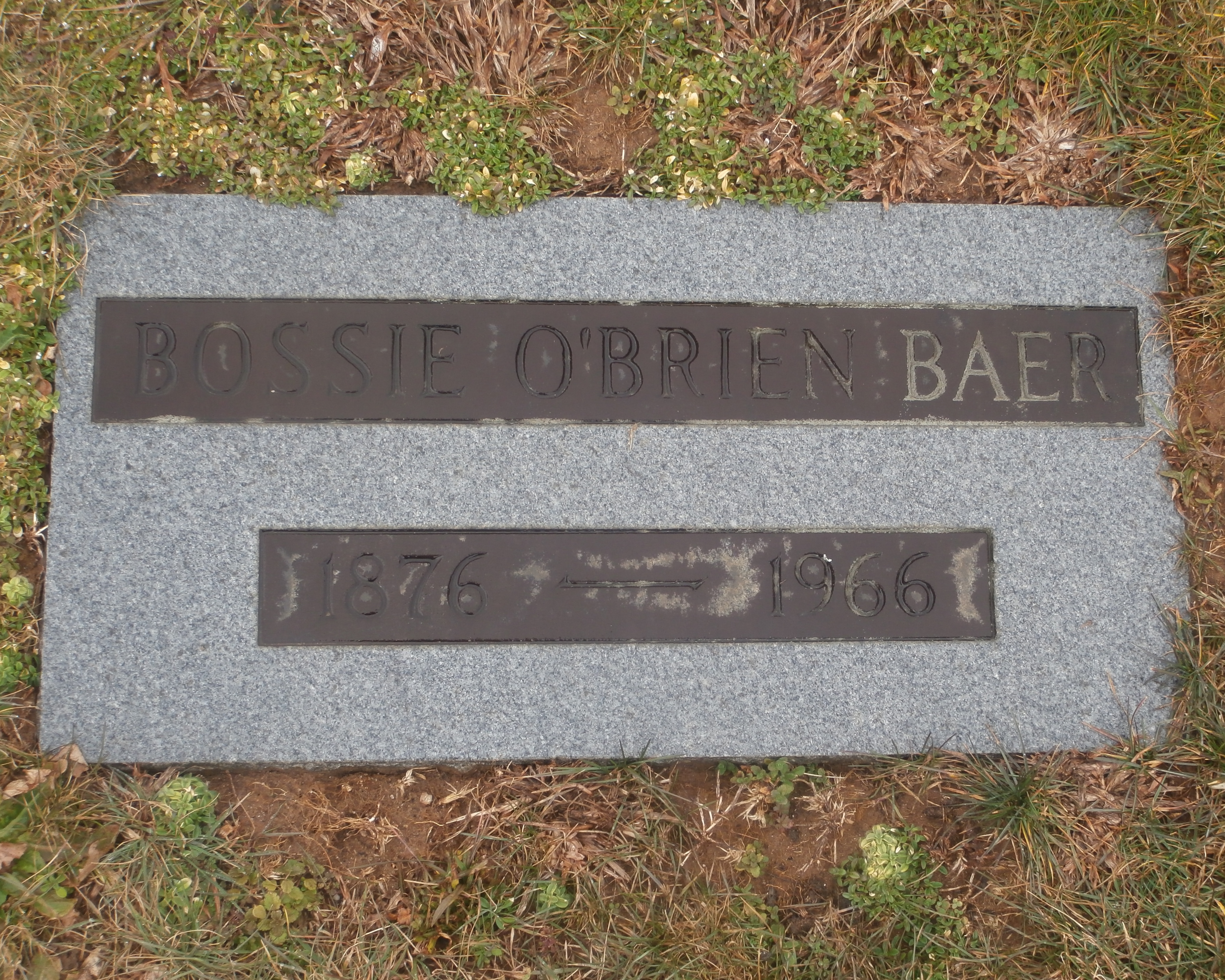
Records certainly suggest that Bossie and her family knew about and acknowledged her marriage to Maurice.  Bossie lived another twenty years, dying on November 15, 1966, at age ninety.  Her death certificate describes her as a widow, and it names Maurice Jay Baer as her husband.  She died in Asheville, North Carolina, and at the time of her death had been still residing in Black Mountain, North Carolina, where she and Maurice had married in 1945.

Bossie Baer death certificate Ancestry.com. North Carolina, Death Certificates, 1909-1976 [database on-line]. Provo, UT, USA: Ancestry.com Operations Inc, 2007. Original data: North Carolina State Board of Health, Bureau of Vital Statistics. North Carolina Death Certificates. Microfilm S.123. Rolls 19-242, 280, 313-682, 1040-1297. North Carolina State Archives, Raleigh, North Carolina.

Bossie Baer death certificate
Ancestry.com. North Carolina, Death Certificates, 1909-1976 [database on-line]. Provo, UT, USA: Ancestry.com Operations Inc, 2007.
Original data: North Carolina State Board of Health, Bureau of Vital Statistics. North Carolina Death Certificates. Microfilm S.123. Rolls 19-242, 280, 313-682, 1040-1297. North Carolina State Archives, Raleigh, North Carolina.

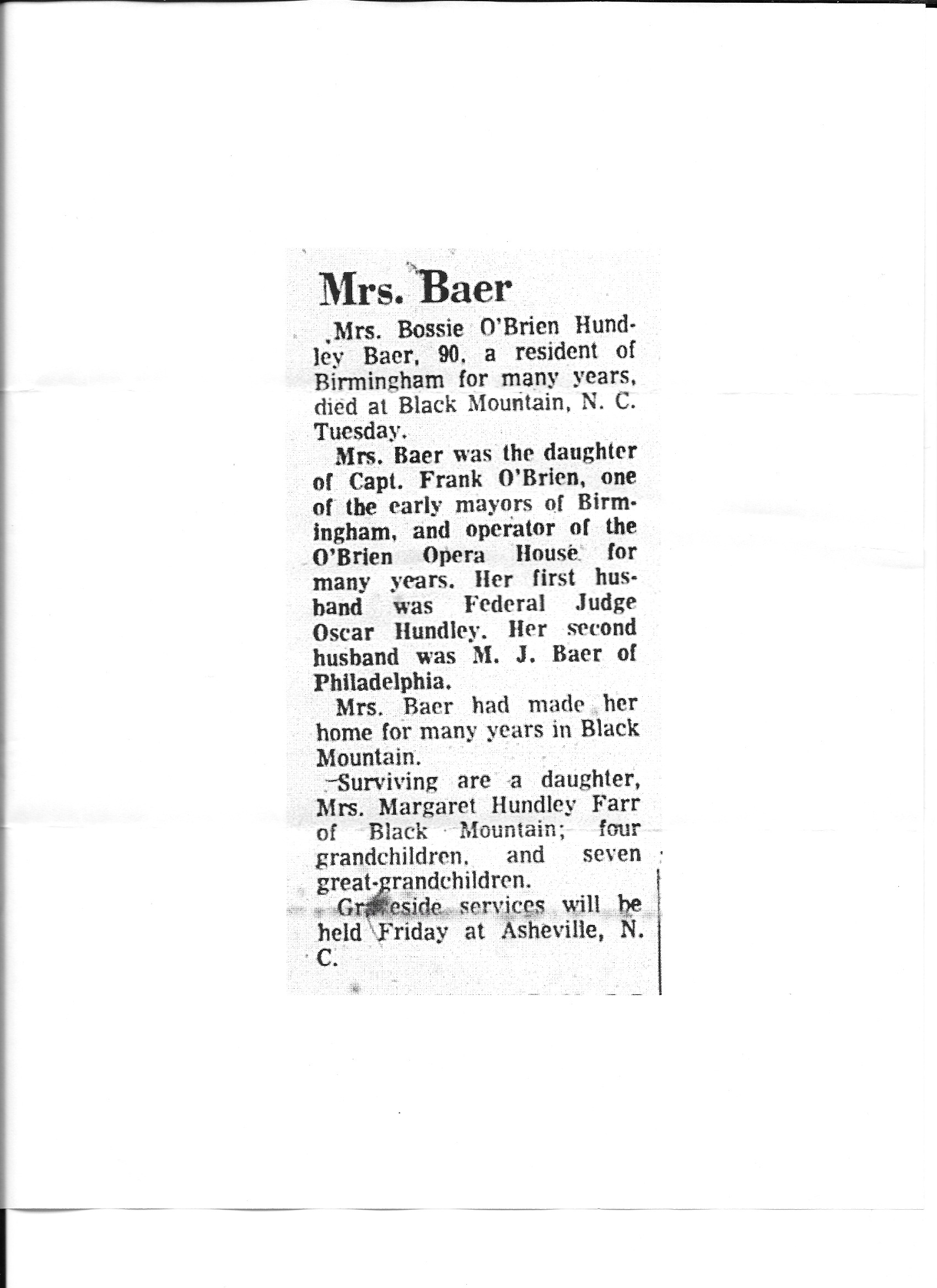
Her obituary describes her as the widow of Maurice Baer.
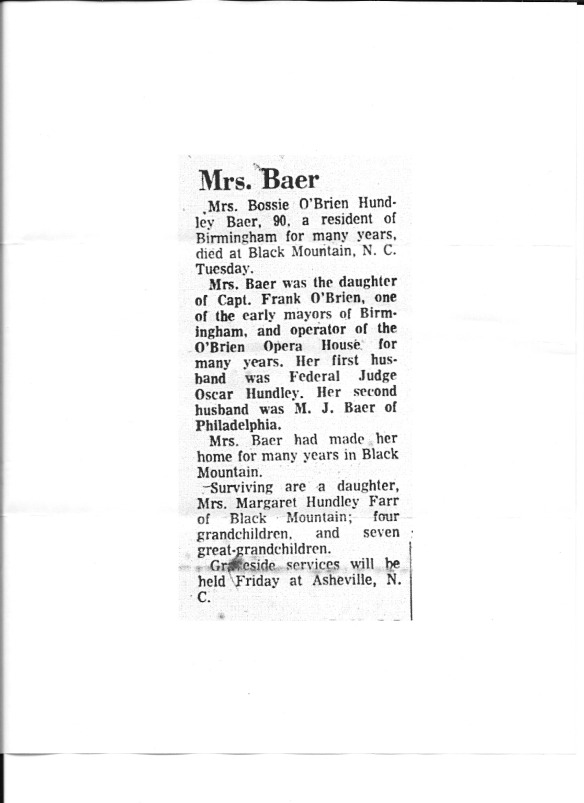
The Birmingham News, November 16, 1966, p. 26

The Birmingham News, November 16, 1966, p. 26


But she was not buried with her husband Maurice at Mt. Sinai nor with her first husband Oscar Hundley in Alabama.  She was buried in Black Mountain, North Carolina, where her daughter Margaret was also living.  Margaret was buried there as well when she died a month after her mother.

Something is quite odd about all this.  Had Maurice not told his family about his marriage? If not, why not? I don’t know. My best guess is that the religious differences were the issue: Maurice was Jewish, Bossie Catholic.  Her family certainly knew she had married him, so was he hiding it from his Jewish family because they might have objected to his marriage to a Catholic woman?

Maurice Jay Baer was an intriguing member of my Hamberg family, an oldest son who started a successful business, a man who appears on no census record after 1900, a man who seemed to have had homes both in New York CIty and Attleboro, Massachusetts, and a man who married late in life, just a year before he died, but whose family seems not have known or at least acknowledged his marriage to a Catholic woman from Alabama who had been an activist in the movement for women’s suffrage.

So many unanswered questions. How did Maurice and Bossie meet? What drew this lifelong bachelor to a woman from such a different background? Where did they live after marrying? Why didn’t his family know about the marriage?

I’m afraid these are questions that are not likely to be answered in official documents or even newspapers, but will remain unanswered.  Unless somebody out there either has the answers or some suggestions for where I might find them?



Attleboro Manufacturing Company: My Cousins, the Jewelers

As I mentioned in my last post, the oldest child of Amalia (Hamberg) and Jacob Baer, Maurice Jay Baer, founded a jewelry company in Attleboro, Massachusetts, in the late 1890s when he was in his twenties. The company was originally called Attleboro Manufacturing. The stories of four of Amalia and Jacob Baer’s children are integrally related to the history of Attleboro Manufacturing: two of their sons, Maurice and Lawrence, and two of their sons-in-law Samuel Stone, married to their daughter Tilda, and Jerome Grant, married to their daughter Elsie, were all involved in leadership roles in the company.

At one time, Attleboro, Massachusetts was known as the Jewelry Capital of the World due to the numerous jewelry manufacturers doing business there.  But like most of the manufacturing businesses in Massachusetts, jewelry businesses in Attleboro eventually moved elsewhere to save on labor and other costs.


http://www.gettyimages.com/detail/114525472


Attleboro Manufacturing was one of the businesses that eventually moved out of the region; later known as Swank and Company, the company was in business in Attleboro until the closing of its plant there in 2000. Though no longer in Atttleboro, Swank, Inc. is still in business today as a division of Randa Accessories, designing and manufacturing men’s jewelry, belts, personal leather accessories, and gifts. (“Jewelry legacy takes another hit with Swank closing, ” The Sun Chronicle, March 17, 2000.)

The company was founded by Maurice Baer and Samuel Stone.  Samuel Stone was born Samuel Einstein in Laupheim, Germany, on February 25, 1872, the son of Moritz Einstein.  He immigrated to the US in 1885, according to his 1920 passport application, and settled in Attleboro, Massachusetts.  He was only thirteen years old at the time and seems to have come by himself.  According to his 1920 and 1923 passport applications, his father was still residing in Germany at those times.  Other sources indicate that his parents both died in Germany.  This source also concluded that he came by himself to the US.

Samuel Einstein is listed as a jewelry manufacturer as early as 1890 and 1892 in the Attleboro city directories for those years, that is, several years before he and Maurice Baer founded Attleboro Manufacturing together.  How did Maurice, who lived in western Pennsylvania, end up doing business with a young man living in Attleboro? Was there a family connection? Not that I have yet found.  Perhaps they just met through business, Maurice traveling to New England or Samuel traveling to Pennsylvania.

According to this source:

By chance, Einstein had been doing business for a number of years (presumably wholesale jewellery) with a Pittsburg, PA salesman named Maurice Baer. It probably helped that Baer’s parents were German immigrants and both men were also of a similar age so an apparently close bond developed between the two.

That article and several other sources report that in 1897 Samuel and Maurice started Attleboro Manufacturing Company.  Their first year brought an unexpected challenge.

The beginnings of Swank, Inc. can be traced to the year 1897, when Samuel M. Stone [originally Samuel Einstein] and Maurice J. Baer founded the Attleboro Manufacturing Company to produce and sell jewelry for women. The two men took over a building in Attleboro, Massachusetts, that had been constructed decades earlier as a forge to turn precious metals into jewelry.

Unfortunately, less than a year after Stone and Baer began production, one of the largest fires in the town’s history claimed an entire block of buildings, destroying their small enterprise. Many of the company’s employees helped fight the fire and were able to salvage a portion of the machinery and finished jewelry. Therefore, the Attleboro Manufacturing Company was able to resume its operations with the remaining equipment and material in another building nearby, which came to be the center of production for the next century.

Mill_Street,_Attleboro,_MA

The local Attleboro newspaper, the Sun Register, also reported on this history in its March 17, 2000, issue (“Jewelry legacy takes another hit with Swank closing, ” The Sun Chronicle, March 17, 2000) :

The company, starting with 10 employees, was located in a factory at Mill and Union streets. The fire of 1898 leveled a good portion of Attleboro’s jewelry plants, including the Attleboro Mfg. Co. However, volunteers managed to save the equipment of Attleboro Mfg. and within a day, the company was back in operation in the basement of a building adjacent to the present plant on Hazel Street.

Although both of these sources report the almost immediate re-opening of the business after the fire, Maurice Baer may not have yet relocated permanently to Attleboro, as he is listed as residing in Pittsburgh in the 1899 Pittsburgh city directory and on the 1900 census.  But soon the company was doing quite well, and in 1908 Maurice and another man named Eben Wilde started a separate division to expand from women’s jewelry to men’s jewelry:

Within ten years, the Attleboro Manufacturing Company was enjoying a good deal of success in producing women’s jewelry and decided to begin expanding into new markets. In 1908, [Maurice] Baer formed a new division, called Baer and Wilde, to oversee the production of men’s jewelry, while Stone remained in charge of Attleboro Manufacturing.

Downtown, about 1909

Downtown Attleboro, about 1909 (Photo credit: Wikipedia)

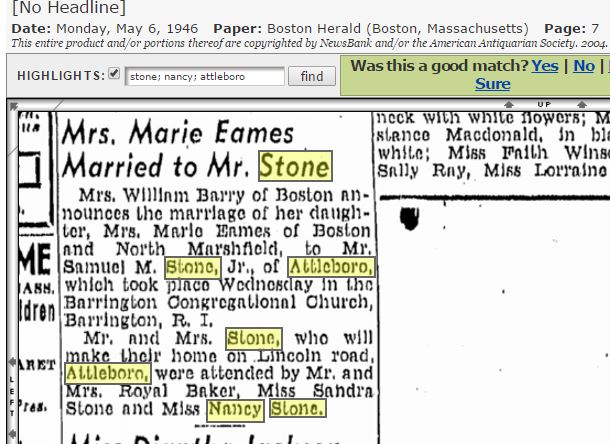
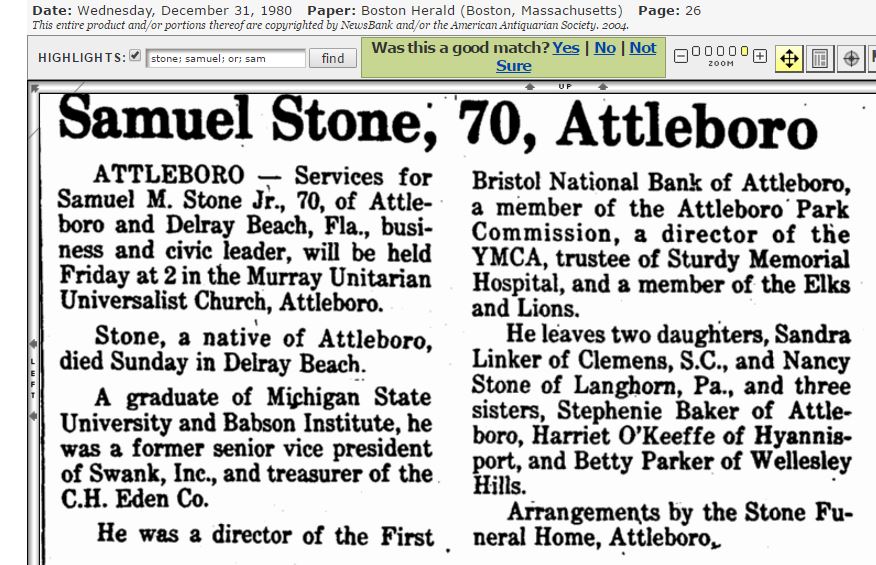
At some point, Maurice must have introduced his younger sister Tilda to his partner Samuel Einstein because by 1908 they were married and living in Attleboro where their first child Stephanie was born in June, 1908.  They would have three more children, Samuel, Jr. (1910), Harriet (1913), and Babette (or Betty, 1919).  In 1910, Samuel was still using the surname Einstein, as he was in 1920, so all four children were originally given the surname Einstein.

Samuel and Tilda Baer Einstein (Stone) 1920 US census Year: 1920; Census Place: Attleboro Ward 2, Bristol, Massachusetts; Roll: T625_681; Page: 1A; Enumeration District: 9; Image: 794

Samuel and Tilda Baer Einstein (Stone)
1920 US census
Year: 1920; Census Place: Attleboro Ward 2, Bristol, Massachusetts; Roll: T625_681; Page: 1A; Enumeration District: 9; Image: 794

The family was still using the name Einstein as late as 1923, as that is how Samuel is listed in the Attleboro directory for that year and also the name appearing on his 1923 passport application, but by 1927, they had switched to Stone, as can be seen in this ship manifest for a trip they all took to France that year.

Samuel and TIlda Baer Einstein/Stone and children from 1923 passport application National Archives and Records Administration (NARA); Washington D.C.; NARA Series: Passport Applications, January 2, 1906 - March 31, 1925; Roll #: 2295; Volume #: Roll 2295 - Certificates: 304850-305349, 08 Jun 1923-08 Jun 1923

Samuel and TIlda Baer Einstein/Stone and children from 1923 passport application
National Archives and Records Administration (NARA); Washington D.C.; NARA Series: Passport Applications, January 2, 1906 – March 31, 1925; Roll #: 2295; Volume #: Roll 2295 – Certificates: 304850-305349, 08 Jun 1923-08 Jun 1923

Stone family on 1927 passenger manifest Year: 1927; Arrival: New York, New York; Microfilm Serial: T715, 1897-1957; Microfilm Roll: Roll 4125; Line: 1; Page Number: 28

Stone family on 1927 passenger manifest
Year: 1927; Arrival: New York, New York; Microfilm Serial: T715, 1897-1957; Microfilm Roll: Roll 4125; Line: 1; Page Number: 28

The third Baer child whose family was to become involved in the Attleboro Manufacturing Company was Elsie, the seventh child and youngest daughter.  In 1910 she was still living with her parents in Pittsburgh, working as a kindergarten teacher.  She was 24 years old.  Three years later she married Jerome Louis Grant in Philadelphia.  Jerome was born in Cortland, New York, in 1888, and in 1910 he had been living with his parents in Philadelphia where he and his father, Theodore Grant, were both working in the fur business.

Two years after marrying, Jerome and Elsie were living in New York City where Jerome was working as a salesman.

Jerome and Elsie Baer Grant and family 1915 NYS census New York State Archives; Albany, New York; State Population Census Schedules, 1915; Election District: 49; Assembly District: 23; City: New York; County: New York; Page: 60

Jerome and Elsie Baer Grant and family
1915 NYS census
New York State Archives; Albany, New York; State Population Census Schedules, 1915; Election District: 49; Assembly District: 23; City: New York; County: New York; Page: 60

Jerome Grant’s draft registration for World War I revealed for whom he was working as a salesman: Baer & Wilde, the division of Attleboro Manufacturing Company started by his brother-in-law Maurice Baer.  He was a salesman as well as the manager of their New York office.  The registration revealed something else: Elsie was pregnant.

Jerome Grant World War I draft registration Registration State: New York; Registration County: New York; Roll: 1786805; Draft Board: 147

Jerome Grant World War I draft registration
Registration State: New York; Registration County: New York; Roll: 1786805; Draft Board: 147


Elsie and Jerome’s first child was born in 1919, a daughter named Marjorie.  Their second daughter was born two years later and named Elinor.

Although the 1920 census reported that Jerome was a contractor in the building industry, the 1930 census reports that he was still in the jewelry manufacturing business.  Moreover, both the 1920 and the 1925 New York City directories list Jerome as associated with Baer & Wilde, so I believe that the 1920 census is not correct in its reporting of Jerome’s occupation at that time.

Jerome and Elsie Baer Grant 1930 census Year: 1930; Census Place: Long Beach, Nassau, New York; Roll: 1461; Page: 3A; Enumeration District: 0137; Image: 104.0; FHL microfilm: 2341196

Jerome and Elsie Baer Grant 1930 census
Year: 1930; Census Place: Long Beach, Nassau, New York; Roll: 1461; Page: 3A; Enumeration District: 0137; Image: 104.0; FHL microfilm: 2341196

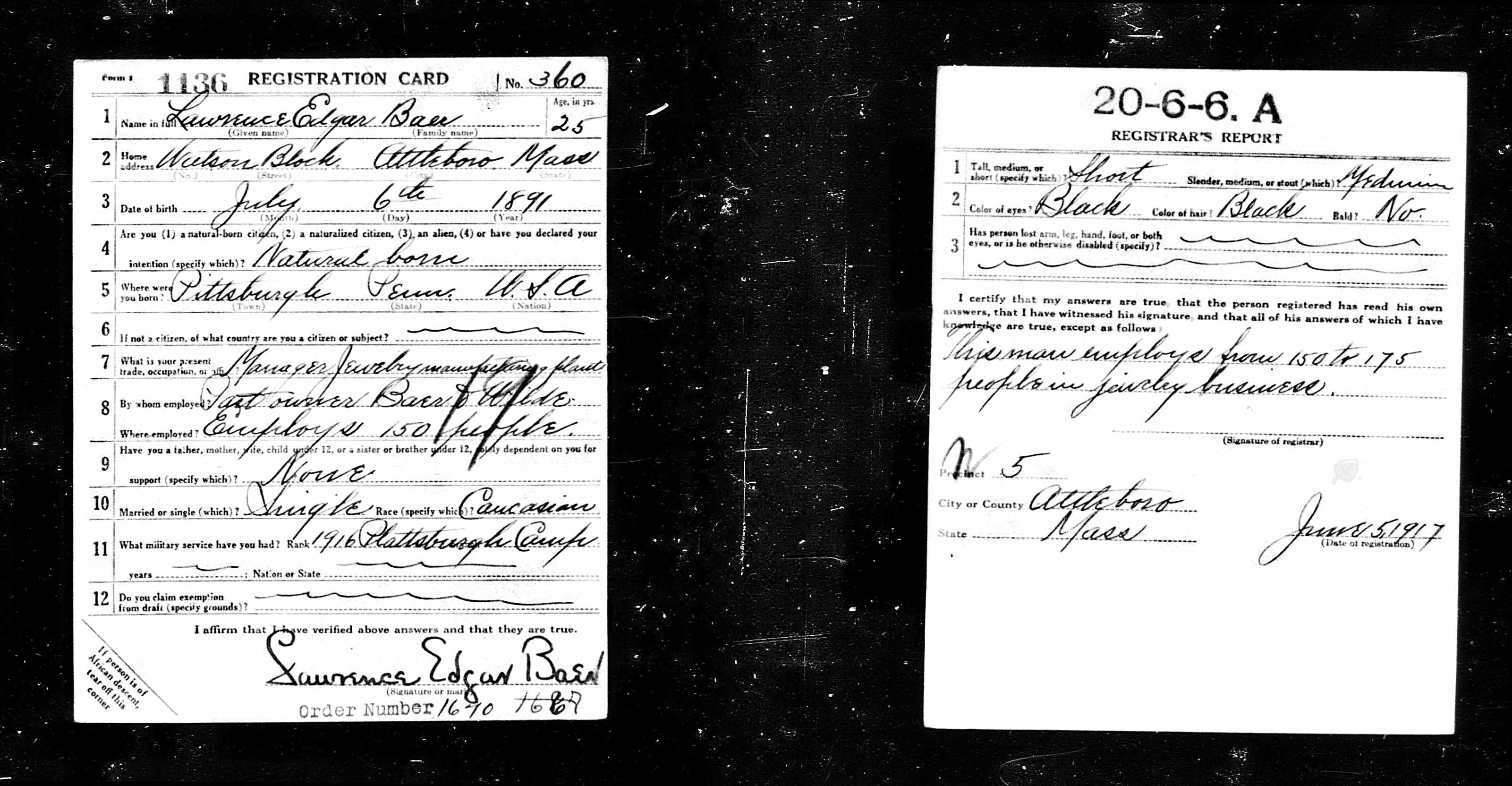
Finally, the other Baer sibling to get involved in the Attleboro business was the youngest child, Lawrence.  Even in 1910 when he was only 18, Lawrence was already involved in jewelry sales.  By 1917 when he registered for the draft for World War I, he was a part owner of Baer & Wilde and living in Attleboro, Massachusetts.  There was a notation on his draft registration saying, “This man employs from 150 to 175 people in jewelry business.”  Was this a basis for exempting him from the draft?

Lawrence Baer World War 1 draft registration Registration State: Massachusetts; Registration County: Bristol; Roll: 1684755; Draft Board: 40

Lawrence Baer World War 1 draft registration
Registration State: Massachusetts; Registration County: Bristol; Roll: 1684755; Draft Board: 40

The company did in fact participate in its own way in the war effort:

By the time the United States became involved in World War I, the Attleboro Manufacturing Company was large enough to handle the production of thousands of metal identification tags, better known as “dog tags,” for the military. While this was the company’s most notable contribution to the war effort, it also profited from the production of numerous other emblems for the U.S. government during those years.

But was that enough to keep a man exempt from the draft? Although it would certainly seem that Lawrence was not essential to the operations of the business, given the involvement of his brother Maurice as well as two of his brothers-in-law, he certainly had a major impact on the success of Baer & Wilde:

[Baer & Wilde} operated with marginal success until 1918, when [Maurice] Baer’s brother, Lawrence Baer, came to them with his newly invented Kum-A-Part “cuff button”. It was an immediate success, to the tune of some four million pairs per year. In 1923, with some improvements made to it by Wilde, the design was patented. Kum-A-Part items remained in production until 1931.

Kum-A-Part cufflinks

Kum-A-Part cufflinks

The tremendous success of the Kum-A-Part cufflinks had a major impact on the future of the company:

[After World War I, the demand for this cuff button was so great that the company stopped making women’s jewelry. By this time Baer & Wilde had absorbed the Attleboro Mfg. Co. facilities.

By the 1920s, Baer & Wilde was selling more than 4 million pairs of cuff buttons a year. The company started to grow with acquisitions and adding other lines such as belt and buckle.

Lawrence Baer’s invention thus changed the fortunes of the company founded by his brother Maurice and brother-in-law Samuel.

Lawrence married Donna Degen on October 20, 1919.  Donna was a Michigan native, and in 1910 she had been living with her parents and brother in Grand Rapids Michigan, where her father was a life insurance agent.

Engagement announcement of Lawrence Baer and Donna Degen, Pittsburgh Jewish Criterion, October 24, 1919

Marriage announcement of Lawrence Baer and Donna Degen,
Pittsburgh Jewish Criterion, October 24, 1919

After marrying, Lawrence and Donna were living in Attleboro in 1920; a year later their son John Degen Baer was born in Attleboro.  The family was still living in Attleboro in 1930, and Lawrence was listed as the owner of a jewelry manufacturing factory.

The 1920s were years of rapid growth for the family’s jewelry business:

After production of the women’s jewelry line was halted, the company focused solely on the manufacture and marketing of its men’s items. Although its men’s products were already in high demand, the company pushed even harder to gain more market share through the implementation of a new marketing plan and increased advertising. The new marketing plan was originated by [Samuel Einstein] Stone in the late 1920s and dictated that the Attleboro Manufacturing Company employ seven wholesale dealers in different major cities throughout the United States to handle the sale and distribution of the men’s jewelry line. This action helped the company more easily distribute its products nationwide and also increased its advertising range.

Thus, by 1930, there were three Baer siblings living in Attleboro and involved in the leadership of the very successful family jewelry business: Maurice, Tilda, and Lawrence.  Another sibling, Elsie, was living in New York, where her husband Jerome was also working for the family’s jewelry business.

As seen in the last post, their three other surviving siblings had no connection to the jewelry business. Josephine was living in New York with her husband Morris Green, who was in the financial industry at that time.  Two of the Baer daughters were in Philadelphia: Amanda, whose husband Meyer Herman was in the clothing manufacturing business, and Flora, whose husband Julius Adler was a successful engineer.  Two of the nine children had died young: Hattie in 1910 and Alfred in 1923.

By 1930, Jacob and Amalia had thirteen grandchildren: Hattie’s two children, Justin and Richard Herman (raised by her sister Amanda, who had married Hattie’s widowed husband Meyer Herman); Josephine’s son Alan Baer Green; Flora’s three children, Stanley, Jerrold, and Amy Adler; Tilda’s four children, Stephanie, Samuel, Harriet, and Babette Stone; Elsie’s two daughters Marjorie and Elinor Grant; and Lawrence’s son John Degen Baer.

In my next series of posts I will describe what happened after 1930 to the seven surviving children and thirteen grandchildren of Jacob and Amalia (Hamberg) Baer and to Attleboro Manufacturing Company.

The Family of Amalia Hamberg Baer, the Administratrix

Back in May, I wrote about the sad saga of Charles Hamberg and his son Samuel Hamberg.  Charles, my great-grandfather Isidore Schoenthal’s first cousin, had lost two wives—one was murdered, one died quite young.  He had then committed suicide, leaving his nine year old son Samuel an orphan.  Charles’ estate was administered by another cousin, Amalia Hamberg Baer, who at the time was living in western Pennsylvania where my great-grandfather and many other Hamberg relatives were then living.

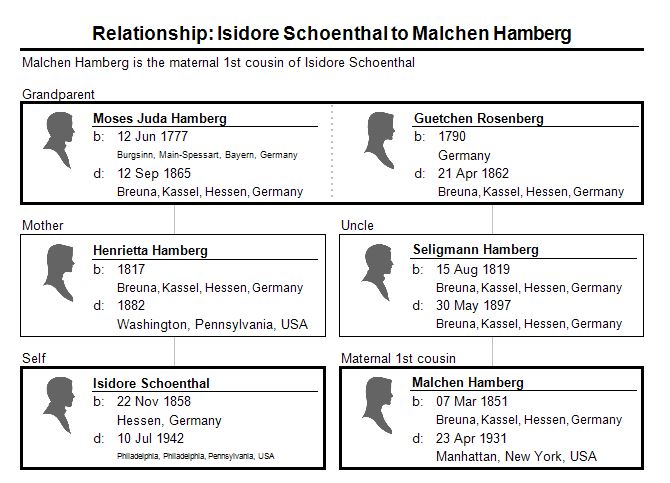
In fact, Amalia (born Malchen) was a first cousin to Isidore Schoenthal, my great-grandfather:

corrected relationship isidore schoenthal to malchen hamberg


She had come to the US from Breuna, Germany, in 1871, and had married Jacob Baer in 1873, according to the 1900 census. (For more on how I linked Amalia Hamberg to Jacob Baer, see my earlier post.)  Jacob was born in the Rhein Pfalz[1] region of Germany in about 1851 and had immigrated to the US in 1867, according to several census records.  From entries in the Pittsburgh city directories, he appears to have settled in the Pittsburgh area.

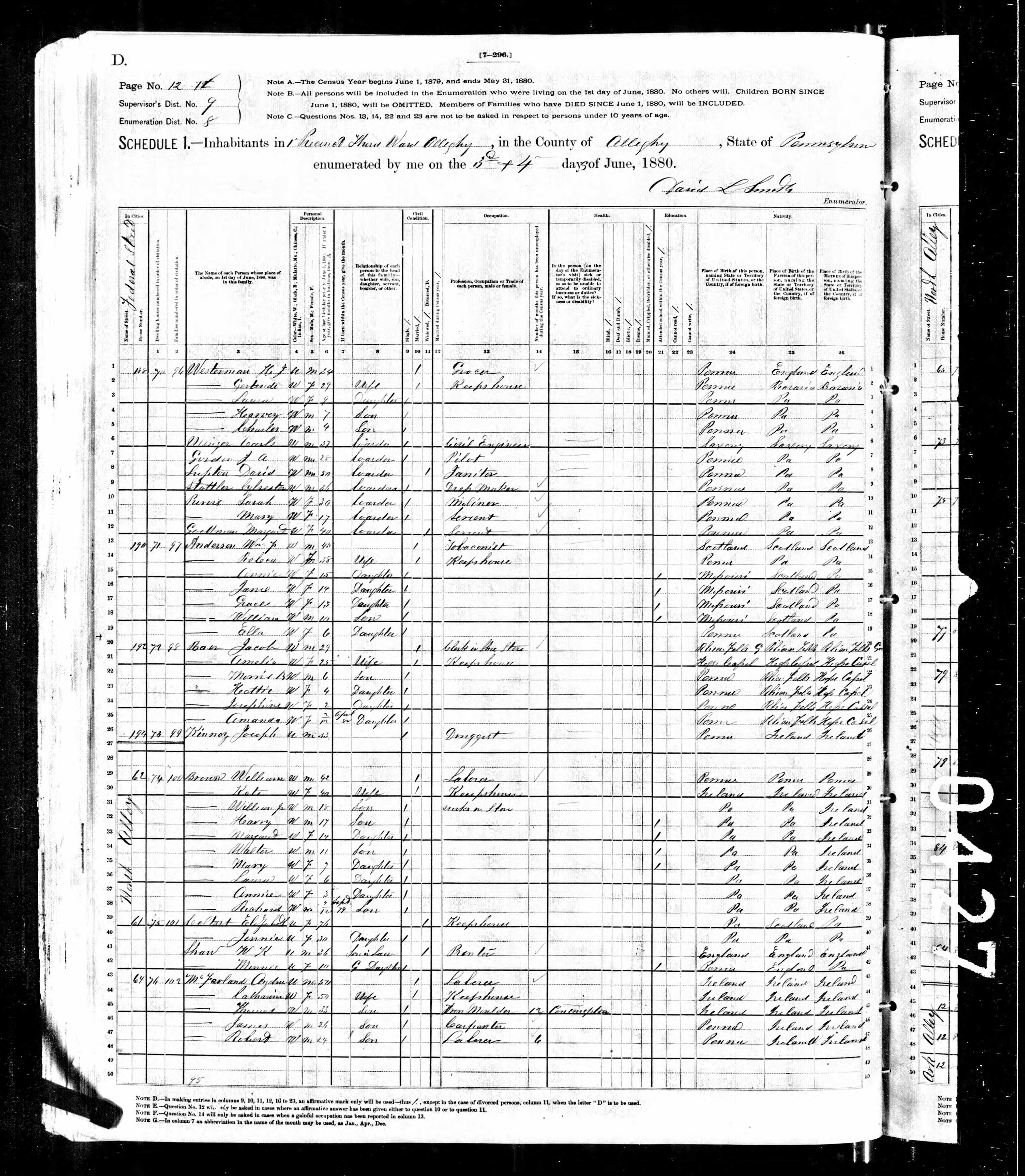
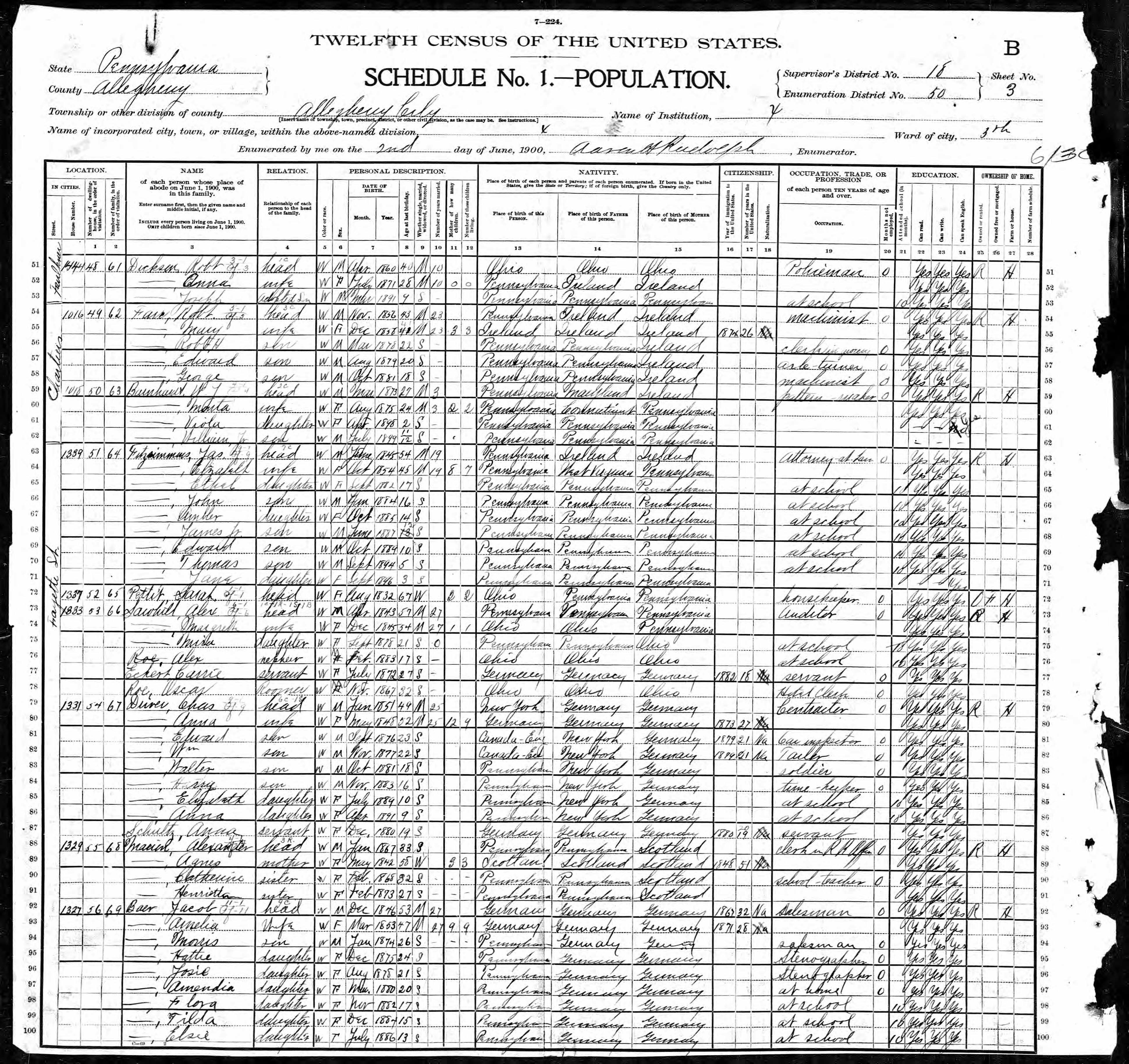
In 1880, Jacob and Amalia were living in Allegheny, Pennsylvania (now part of Pittsburgh), and Jacob was working as a clerk in a shoe store.  They already had four children: Maurice Jay (1874), Hattie (1876), Josephine (1878), Amanda (1880).

Jacob and Amalia Hamberg Baer 1880 US census Year: 1880; Census Place: Allegheny, Allegheny, Pennsylvania; Roll: 1086; Family History Film: 1255086; Page: 198D; Enumeration District: 008; Image: 0402

Jacob and Amalia Hamberg Baer 1880 US census
Year: 1880; Census Place: Allegheny, Allegheny, Pennsylvania; Roll: 1086; Family History Film: 1255086; Page: 198D; Enumeration District: 008; Image: 0402


Between 1880 and 1891, they would have five more children: Flora (1882), Tilda (1884), Elsie Victoria (1886), Alfred (1889), and Lawrence (1891). (The birth years for the daughters as reported in various records are all over the place as they kept making themselves younger as the years went on, so I am relying on the 1880 and 1900 census records when they were still probably young enough not to lie about their ages.)  During those years, Jacob was listed as a salesman in the Pittsburgh city directories.

In 1900, Jacob and Amalia were still living in Allegheny with all nine of their children.  Jacob continued to work as a salesman, as did their son Maurice (Morris here, now 26).  Hattie (24) and Josephine (Josie here, now 21) were working as stenographers.  The rest of the children were not employed.

Amalia Baer 1900 census p 1

Jacob and Amalia Hamberg Baer 1900 census Year: 1900; Census Place: Allegheny Ward 5, Allegheny, Pennsylvania; Roll: 1356; Enumeration District: 0050; FHL microfilm: 1241356

Jacob and Amalia Hamberg Baer 1900 census
Year: 1900; Census Place: Allegheny Ward 5, Allegheny, Pennsylvania; Roll: 1356; Enumeration District: 0050; FHL microfilm: 1241356


In the next decade many of the children began to move on to their own lives.  In fact, even before 1900, Maurice, the oldest child, had ventured quite far from Pittsburgh.  As I will write about in a post to follow this one, Maurice moved to Attleboro, Massachusetts,[2] and established a very successful jewelry business in which four of the siblings’ families would be involved, that is, Maurice, Tilda, Elsie, and Lawrence.  This post will focus on the other five siblings—Hattie, Josephine, Flora, Amanda, and Alfred—and their parents, Amalia and Jacob.

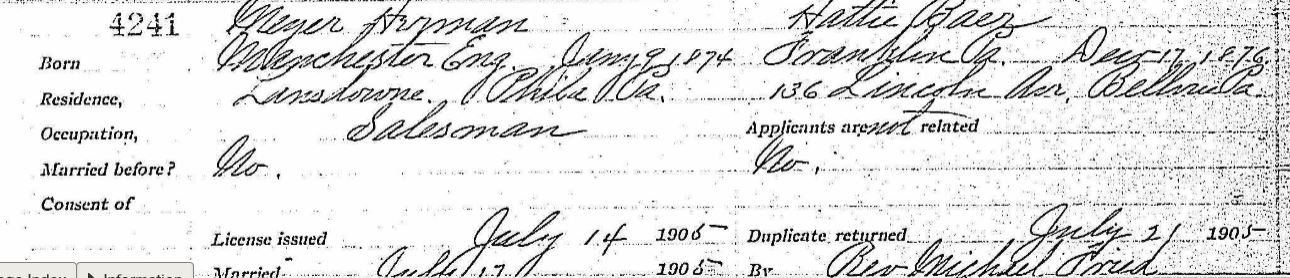
On July 17, 1905, Hattie Baer, the second child who was then 29, married Meyer Herman, a clothing salesman living in Philadelphia who was born in Manchester, England.

Marriage record of Hattie Baer and Meyer Herman Pennsylvania, County Marriages, 1885-1950," database with images, FamilySearch (https://familysearch.org/pal:/MM9.3.1/TH-1951-21130-27078-9?cc=1589502 : accessed 12 May 2016), 004264779 > image 383 of 454; county courthouses, Pennsylvania.

Marriage record of Hattie Baer and Meyer Herman
Pennsylvania, County Marriages, 1885-1950,” database with images, FamilySearch (https://familysearch.org/pal:/MM9.3.1/TH-1951-21130-27078-9?cc=1589502 : accessed 12 May 2016), 004264779 > image 383 of 454; county courthouses, Pennsylvania.

They settled in Philadelphia, where they had two sons, Justin Baer Herman, born in April, 1907, and Richard B. Herman, born in July, 1910.  Then tragically, Hattie died on October 15, 1910, of a perforated bowel and peritonitis.  She was only 33 years old when she died, and she left behind a three year old toddler and a two and a half month old infant son.

Hattie Baer Herman death certificate Ancestry.com. Pennsylvania, Death Certificates, 1906-1963 [database on-line]. Provo, UT, USA: Ancestry.com Operations, Inc., 2014. Original data: Pennsylvania (State). Death certificates, 1906–1963. Series 11.90 (1,905 cartons). Records of the Pennsylvania Department of Health, Record Group 11. Pennsylvania Historical and Museum Commission, Harrisburg, Pennsylvania.

Hattie Baer Herman death certificate
Ancestry.com. Pennsylvania, Death Certificates, 1906-1963 [database on-line]. Provo, UT, USA: Ancestry.com Operations, Inc., 2014.
Original data: Pennsylvania (State). Death certificates, 1906–1963. Series 11.90 (1,905 cartons). Records of the Pennsylvania Department of Health, Record Group 11. Pennsylvania Historical and Museum Commission, Harrisburg, Pennsylvania.

Five years later in 1915, Hattie’s younger sister Amanda married her brother-in-law Meyer Herman in Philadelphia and took on the responsibility for raising her two nephews, Justin and Richard, then just eight and five years old.  In 1920, Meyer was still a clothing salesman, and the family continued to live in Philadelphia.

Meyer and Amanda Baer Herman 1920 census Year: 1920; Census Place: Philadelphia Ward 22, Philadelphia, Pennsylvania; Roll: T625_1623; Page: 8A; Enumeration District: 591; Image: 961

Meyer and Amanda Baer Herman 1920 census
Year: 1920; Census Place: Philadelphia Ward 22, Philadelphia, Pennsylvania; Roll: T625_1623; Page: 8A; Enumeration District: 591; Image: 961

Ten years later in 1930, Meyer had moved from being a salesman to being the owner of a clothing manufacturing business.  The two sons were also working; Justin, now 23, was a newspaper editor, and Richard, now 19, was selling real estate.  Both were still living at home with Meyer and Amanda in Philadelphia.

Herman and Amanda Baer Herman 1930 census Year: 1930; Census Place: Philadelphia, Philadelphia, Pennsylvania; Roll: 2104; Page: 23A; Enumeration District: 0627; Image: 902.0; FHL microfilm: 2341838

Herman and Amanda Baer Herman 1930 census
Year: 1930; Census Place: Philadelphia, Philadelphia, Pennsylvania; Roll: 2104; Page: 23A; Enumeration District: 0627; Image: 902.0; FHL microfilm: 2341838

Meanwhile, the third child of Amalia and Jacob Baer, Josephine, had married Morris Alon Green on January 2, 1906.  Morris was a Pittsburgh native, born there on February 17, 1875, the son of Abraham Green, an immigrant from Holland, and Jeanette Bloomberg, born in Germany.  In 1900, Morris was living with his parents in Pittsburgh and working as a bookkeeper.

Marriage record of Morris Green and Josephine Baer Pennsylvania, County Marriages, 1885-1950," database with images, FamilySearch (https://familysearch.org/pal:/MM9.3.1/TH-1942-20622-18713-16?cc=1589502 : accessed 10 June 2016), 004811570 > image 334 of 449; county courthouses, Pennsylvania.

Marriage record of Morris Green and Josephine Baer
Pennsylvania, County Marriages, 1885-1950,” database with images, FamilySearch (https://familysearch.org/pal:/MM9.3.1/TH-1942-20622-18713-16?cc=1589502 : accessed 10 June 2016), 004811570 > image 334 of 449; county courthouses, Pennsylvania.

Josephine and Morris settled in Pittsburgh where their son Alan Baer Green was born on October 30, 1906.  In 1910, the Greens were living in Pittsburgh as boarders in the household of another family, and Morris was working as a claims agent.

Morris and Josephine Baer Green on 1910 census Year: 1910; Census Place: Pittsburgh Ward 8, Allegheny, Pennsylvania; Roll: T624_1301; Page: 2A; Enumeration District: 0379; FHL microfilm: 1375314

Morris and Josephine Baer Green on 1910 census
Year: 1910; Census Place: Pittsburgh Ward 8, Allegheny, Pennsylvania; Roll: T624_1301; Page: 2A; Enumeration District: 0379; FHL microfilm: 1375314

The next several years must have been successful ones for Morris because by 1918, he was the general agent and executive of the Crucible Steel Company and by 1920 he and Josephine and their son Alan were living in their own (rented) home with a nurse and servant residing with them.

Morris A Green, World War I draft registration Registration State: Pennsylvania; Registration County: Allegheny; Roll: 1909239; Draft Board: 11

Morris A Green, World War I draft registration
Registration State: Pennsylvania; Registration County: Allegheny; Roll: 1909239; Draft Board: 11

By 1925, Josephine and Morris had left western Pennsylvania for New York City, where they were living at the Hotel Alexander at 150 West 103rd Street.  Their son Alan is not listed as living with them; perhaps he was away at college as he would have been nineteen at that time.  In 1930, Alan was living with his parents in Manhattan, working in advertising.  His father Morris listed his occupation/industry as “financial.”

Morris and Josephine Baer Green and Alan Baer Green, 1930 census Year: 1930; Census Place: Manhattan, New York, New York; Roll: 1556; Page: 19A; Enumeration District: 0443; Image: 762.0; FHL microfilm: 2341291

Morris and Josephine Baer Green and Alan Baer Green, 1930 census
Year: 1930; Census Place: Manhattan, New York, New York; Roll: 1556; Page: 19A; Enumeration District: 0443; Image: 762.0; FHL microfilm: 2341291

The fifth child of Amalia and Jacob was Flora.  In 1907, she is listed in the Pittsburgh city directory as a teacher, residing in Bellevue, a town near Pittsburgh. In 1910, when she was 28 (although listed as 24 on the 1910 census), she was still single and living with her parents and not employed outside the home.

Jacob and Amalia Schoenthal Baer and family 1910 census Year: 1910; Census Place: Pittsburgh Ward 14, Allegheny, Pennsylvania; Roll: T624_1304; Page: 6B; Enumeration District: 0468; FHL microfilm: 1375317

Jacob and Amalia Schoenthal Baer and family 1910 census
Year: 1910; Census Place: Pittsburgh Ward 14, Allegheny, Pennsylvania; Roll: T624_1304; Page: 6B; Enumeration District: 0468; FHL microfilm: 1375317


In 1915, she married Julius Adler.  Julius was the son of Simon Adler, a German immigrant who in 1880 was living in Memphis, Tennessee, working in a shoe store.  Julius’ mother Elizabeth was a native of Missouri; she married Simon in 1881, and they had four children born in Memphis between 1882 and 1887, when their youngest son Julius was born.  By 1900, the family had relocated to Philadelphia.

According to his obituary, Julius graduated from the University of Pennsylvania with a degree in engineering in 1908.  In 1910, he was teaching at the University of Washington in Seattle.  But by 1915 he had returned to Philadelphia, where he married Flora Baer.  In 1917, they were living in Harrisburg, Pennsylvania, where Julius was working as a civil engineer for the state highway department.  They would have three children, Stanley, Jerrold, and Amy, born between 1917 and 1920.

Julius Adler, World War I draft registration Registration State: Pennsylvania; Registration County: Dauphin; Roll: 1893237; Draft Board: 3

Julius Adler, World War I draft registration
Registration State: Pennsylvania; Registration County: Dauphin; Roll: 1893237; Draft Board: 3

In 1920, the family had returned to Philadelphia, where Julius was now employed as a technical engineer for an oil company.  According to his obituary, during the 1920s, Julius was working as the deputy chief of the Philadelphia highway department and was involved in supervising the construction of the Benjamin Franklin Bridge, the bridge that spans the Delaware River connecting Philadelphia to Camden, New Jersey (originally called the Delaware River Bridge).  In 1930, Julius and Flora and their two sons continued to live in Philadelphia, Julius working as a civil engineer.

Benjamin Franklin Bridge linking Camden, NJ wi...

Benjamin Franklin Bridge linking Camden, NJ with Philadelphia, PA – Taken from the 22nd floor of Waterfront Square (Photo credit: Wikipedia)

Alfred, the second youngest child of Amalia and Jacob, was the only other child not involved with the Attleboro jewelry business.  In 1900, he was living with his family in Pittsburgh, but he is not listed with them in 1910, when he would have been 21 years old.  There is an Alfred H. Baer listed in the 1907 Pittsburgh directory, working as a clerk, but I am not sure that that is the same person.  According to his registration for the draft in World War I, Alfred was living in a sanitarium and “mentally incapacitated for work of any kind.”

Alfred Baer ww1 draft reg

Alfred Baer, World War I draft registration Registration State: Pennsylvania; Registration County: Philadelphia; Roll: 1907636; Draft Board: 17

Five years later, at age 34, Alfred died on December 13, 1923.  He was buried where his sister Hattie was buried and where later his parents, his sister Flora, and his brother Maurice would be buried at Mt. Sinai cemetery in Philadelphia. I was unable to locate a death certificate, so I do not know the cause of death.  According to his burial record, he was residing in Stamford, Connecticut, at the time of his death.

Thus, by 1930, Amalia (Hamberg) and Jacob Baer had lost two of their children, Hattie and Alfred. Their other children were doing quite well.  Amanda and Flora had moved to Philadelphia with their husbands and children, and Josephine was living in New York City with her husband and son.  The other four children were also living away from Pittsburgh, as we will see in the next post.

Even Jacob and Amalia had left Pittsburgh by that time.  In fact, sometime between 1918 and 1922, they had moved to Atlantic City.  In 1922, they were listed in the Atlantic City directory, living at The Amsterdam in Atlantic City.  The following year on March 27, 1923, their children honored their parents on the occasion of their 50th wedding anniversary with a dinner at the Esplanade Hotel in New York City.

Jacob and Amalia Baer anniversary party


In 1930 Jacob and Amalia, now 83 and 79 (although the 1930 census says 77), were living at 250 West 103rd Street in New York City, with Jacob listed as the head of household for what appears to be a small hotel; there are 28 guests listed as living with them.  Their daughter Josephine was living not too far away at 666 West End Avenue.

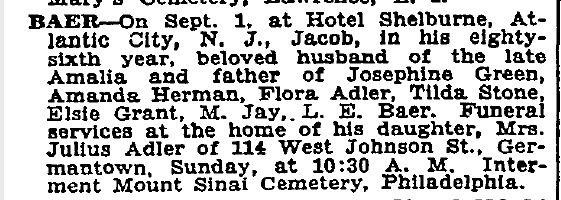
Amalia Baer, born Malchen Hamberg in Breuna, Germany, died on April 23, 1931, in New York City.  She was 80 years old.  She was buried in Mt. Sinai cemetery in Philadelphia where the two children who predeceased her, Hattie and Alfred, were buried.  A year later her husband Jacob died on September 1, 1932.  He was 85 years old, and he was buried with his wife and children in Mt. Sinai cemetery.  His death notice ran in the September 3, 1932 issue of The New York Times:

NY Times, September 3, 1932

NY Times, September 3, 1932

In my next post, I will write about the four children of Amalia and Jacob who were involved in the jewelry business in Attleboro, Massachusetts.  Then in a subsequent post I will report on what later happened to the children and the grandchildren of Jacob and Amalia (Hamberg) Baer.


[1] Thank you to Michael Palmer and Cathy Meder-Dempsey of the German Genealogy group on Facebook for helping me decipher Jacob’s birthplace.

[2] I am not sure why Maurice is listed as living in Pittsburgh on the 1900 census as several reports indicate he had established the business in Attleboro before then.  Perhaps he was still traveling back and forth between Pennsylvania and Massachusetts at that time.

Update: Baby Rose Schoenthal—Did She Ever Exist? Do I Stop Looking for Her?

I need your advice.  I’ve hit a brick wall, and this time, I am not sure I should try and go further.  Please let me know what you think.

Some of you may recall the mystery of Baby Rose Schoenthal, the daughter of Jacob Schoenthal and his wife Florence who appeared on the 1930 census in Atlantic City as their fifteen month old child, but then disappeared.  She was not on the 1940 census; there was no death record for her in Pennsylvania or New Jersey, and she was not buried with Jacob and Florence or with her grandparents.  She was not named as a survivor in Jacob’s will.

Atlantic City Press February 18, 1976 p 16

Atlantic City Press February 18, 1976 p 16

I was left concluding that either she had been adopted and thus had taken on a new name or had never even existed.  I haven’t yet tried searching for adoption records because it does not appear that I have legal standing to do that, given that I am not Rose, her child, her parents, or any other close relative. I also am not sure where I should search: New Jersey, Pennsylvania, or any of the other states in the country where a child might have been adopted. And even more to the point, petitions to unseal adoption records are intended to reveal the birth name of an adoptee.  I can’t find any way to search for records of a birth child who was adopted if I don’t know the adoptive name.

I did, however, request a search of New Jersey’s birth records for 1928 and 1929, hoping that a birth certificate for a Rose Schoenthal would appear.  I now have received the report back from New Jersey, and they had no birth certificate for a Rose Schoenthal born between January 1, 1928, and December 31, 1929.  What does that mean? Well, it means either Rose was never born and the census report is just wrong.  Or it means she was adopted and the birth certificate was changed to her adoptive name.

Which seems more likely? Since the census record is so specific—says she was 1 and 3/12, born in New Jersey, and gives her full name, Rose Maxine Schoenthal—I am inclined to think it was accurate (unless Jacob and Florence had an imaginary child a la Who’s Afraid of Virginia Woolf?).

Jacob Schoenthal and family 1930 US census Year: 1930; Census Place: Atlantic City, Atlantic, New Jersey; Roll: 1308; Page: 10B; Enumeration District: 0003; Image: 129.0; FHL microfilm: 2341043

Jacob Schoenthal and family 1930 US census
Year: 1930; Census Place: Atlantic City, Atlantic, New Jersey; Roll: 1308; Page: 10B; Enumeration District: 0003; Image: 129.0; FHL microfilm: 2341043

So that brings me back to the adoption possibility.  Now I need to figure out how to search for an adoption when you know the birth name but not the adoptive name.  I also have to consider whether I should try to find an adoption record. Rose could very well still be alive; she’d only be 86 or so.  It feels inappropriate for me to invade her privacy, if she is in fact alive.  I am inclined to let this one go.

What do you think? Should I leave well enough alone? Or should I pursue this further?

Are These My Great-Uncles?

As I wrote about here, while in Denver, I visited Temple Emanuel where the confirmation class photographs of my grandmother Eva Schoenthal and of her brothers Gerson and Harold were posted on the wall.  It was easy for me to find my grandmother in her class photograph as I knew her face well.  But it was more difficult to identify which boys in the other two class photographs were my great-uncles.

When I got home, I asked my father and also compared the one photograph I have of Gerson and several photographs I have of Harold to see if I could pick out Gerson and Harold in the confirmation class photographs.  Now I think I have, but I’d be interested in whether others agree with me.  My father said he really has no memory of Gerson, but agreed with me as to which boy was Harold.

This is Gerson’s class photograph.

Temple Emanuel 1908 confirmation class with Gerson Schoenthal

Temple Emanuel 1908 confirmation class with Gerson Schoenthal

And this is the only photograph I have of Gerson as an adult:

Dad Uncle Gerson Eva

Here are some closer shots of the faces of the boys in that class:

20160524_170000994_iOS

20160524_170007605_iOS 20160524_170011278_iOS

I think Gerson is the tall boy in the center of the top row (first boy on the left in the bottom photograph and the boy to the far right in the top photograph: same boy).  The one photograph I have of Gerson is of terrible quality, but there is something about the shape of the head and the ears that seems most similar to the boy in the middle.  Do you agree?

Here is Harold’s class photograph:

20160524_165822156_iOS

And here are closeups of the boys in that photo:

20160524_165837031_iOS 20160524_165844844_iOS

I think Harold is the first boy on the left in the top picture.  Here are some other photographs of Harold as a young man:

Hilda (Katzenstein) Schoenthal, Eva Schoenthal Cohen, Eva Hilda Cohen, and Harold Schoenthal

Hilda (Katzenstein) Schoenthal, Eva Schoenthal Cohen, Eva Hilda Cohen, and Harold Schoenthal

Harold Schoenthal

Harold Schoenthal


Again, the ears, the shape of the head, and the mouth seem most similar to the boy on the top left of the first photograph of closeups above.  Do you agree?

It would have been so much easier if they had listed the students in the order in which they were standing instead of alphabetically!


My Ancestral Town: Santa Fe, New Mexico

Sign for Santa Fe National Historic Trail.

Sign for Santa Fe National Historic Trail. (Photo credit: Wikipedia)

Over 160 years ago, three Jewish brothers from Gau-Algesheim, Germany, left their homeland as young men and somehow ended up on the frontier, traveling the Santa Fe Trail, bringing goods to the towns of the New Mexico territory just recently acquired by the US after the Mexican War, and eventually establishing a store on the plaza of Santa Fe: Seligman Brothers, a store that lasted over 70 years before closing in the 1920s.  One of those brothers was my great-great-grandfather, Bernard Seligman (born Bernhard Seligmann), father of my great-grandmother Evalyn (later Eval) as well as Arthur, who would become governor of New Mexico in 1930.

Santa Fe Trail around 1845 plus connecting tra...

Santa Fe Trail around 1845 plus connecting trading routes to commercial hubs and ports in the USA (Photo credit: Wikipedia)

I’ve written a great deal about my Seligmann ancestors—too many posts to try and provide links to here. (Just look in the Seligman category to see those posts.)  I’ve had great fortune in finding sources not only about the three Seligman brothers who came to Santa Fe, but also about their other siblings, their parents, their grandparents, their descendants, and many of their cousins.  And I’ve been especially blessed to find a number of current living descendants, including my cousin Pete Scott (grandson of Arthur Seligman), my cousin Wolfgang Seligmann, my cousin Angelika Oppenheimer, my cousin Steven Seligman, and so many others.    The Seligmann/Seligman line seems to have a strong interest in family history; perhaps this is where my own passion for genealogy comes from, my Seligman DNA.

So it should not be surprising that Santa Fe was a city I wanted to visit.  It’s a city where my family left a substantial mark and a city that left a substantial mark on them.  It’s a city with a long and rich history of its own, one of the oldest cities in the United States, and as I learned, one of the most beautiful.

My cousin Pete was born and raised in Santa Fe, and he has done a lot of research and writing about the history of the city including about our family’s history there.  He and his good friend Mike Lord have provided a wealth of information on their website Voces de Sante Fe, and Pete arranged for Mike to meet with us for one of the days that we would be spending in Santa Fe.

By the standards of most major US cities, Santa Fe is quite small.  We walked the whole plaza area many times, and most of the major sites in the city are in an area that is no bigger than about two miles square.  There are no skyscrapers, and the tallest building we saw in the central part of the city aside from the St. Francis Cathedral was our hotel, which is five stories high.

Below are various shots of the cathedral, which was built between 1869 and 1886:

St Francis Cathedral

St Francis Cathedral

20160526_152338365_iOS 20160529_030643043_iOS 20160529_030808930_iOS

The sky over Santa Fe feels wide open, and the uniformity of the color of the buildings gives the place an aesthetic unity that is both appealing and quite unreal.

20160527_164908171_iOS 20160527_164958541_iOS

20160526_152600649_iOS

When we met with Pete’s friend (and now our friend) Mike to learn about the history of Santa Fe, he likened Santa Fe to an adobe amusement park.  He pointed out that it was not until the 1950s that the uniform adobe look was mandated; historically there was a great deal more diversity to the architecture of the city, as you can see from this photo that Mike shared with us, dated in the 1890s.

Santa Fe 1890s

Santa Fe 1890s

For a city of this relatively small size, there is an incredible amount to see far beyond my genealogical interests.  We loved the Georgia O’Keefe Museum; not only did we get to see that her artistic style had evolved over the years and that that style had a much broader range than the works with which we were already familiar, we also learned about her fascinating life.  Having driven through the New Mexico landscape, we could understand what drew her and so many artists to this place.  Santa Fe has long been a place that has drawn artists to its light and its scenery and its independent spirit, and we enjoyed strolling through the galleries along Canyon Road and in the plaza area itself to see what today’s artists are creating.


http://www.gettyimages.com/detail/522010290

We also enjoyed seeing the miraculous staircase in the Loretto Chapel.  It was built in the late 1870s by a carpenter who claimed he could provide a way to reach the choir loft without taking up too much space in the church’s main level.  Somehow he built it without any central support.  It’s quite fascinating to see—almost like an optical illusion.

20160527_021305983_iOS

Loretto Chapel from our hotel room

20160526_154014010_iOS 20160526_154106183_iOS

Santa Fe’s long history was evidenced by what is claimed to be the oldest still-standing home in the US, the De Vargas Street house, as well as the first church in the US, the San Miguel Chapel.  Both date back to the early 1600s. The Spanish came to this area in the late 16th century, making it the earliest European settlement in the US west of the Mississippi River.

20160527_150758310_iOS 20160527_150829798_iOS 20160527_150854957_iOS 20160527_151008225_iOS

oldest house in the US

oldest house in the US

20160527_151220176_iOS 20160527_151245241_iOS

Among the earliest European settlers were what we now call Crypto Jews, that is, hidden Jews.  We went with Mike to see a very comprehensive exhibit about the Inquisition and the Crypto Jews at the New Mexico History Museum in the former Palace of Governors in Santa Fe.  When the Inquisition began in Spain in 1492, Jews were forced either to leave Spain, convert to Catholicism, or be punished, including by execution.   Some of the Jews left with Spanish colonists to go to Mexico, but because they were still within the realm of the Spanish empire, they still had to convert or face prosecution as infidels.

In the 1600s, some of those “conversos” who had gone to Mexico migrated to what would later become New Mexico, but even there they were still subject to the rules of the Inquisition.  Many, however, continued to follow Jewish laws and honor Jewish rituals, such as lighting candles on Friday nights, covering mirrors when someone died, abstaining from pork, and going to worship (at church) on Saturday instead of Sunday.

Thus, long before German Jewish merchants like my great-grandfather arrived in Santa Fe in the 19th century, there was a population of people with Jewish roots in Santa Fe and other places in New Mexico, even if they did not outwardly (or even internally) identify as Jews.

Of course, my principal historical interest was in those German Jewish merchants, the Seligmans as well as their fellow pioneers, the Spiegelbergs, the Staabs, and others.  What was Santa Fe like when they started arriving in the 1840s and 1850s?  It is hard to imagine what my great-great-grandfather and his brothers thought when they arrived in this place, having come from Germany where there were so many old and grand cities with towering cathedrals and castles.  And what did my great-great-grandmother Frances Nusbaum think when she moved from Philadelphia, itself already quite an established city, to be with her husband Bernard Seligman in Santa Fe?

English: "Arrival of the caravan at Santa...

English: “Arrival of the caravan at Santa Fe” — Copy of original lithograph ca. 1844 (Photo credit: Wikipedia)

Mike shared with us this photo of Santa Fe from 1855 that conveys just how primitive the town’s architecture was at the time that Bernard Seligman and his brothers arrived there.

Santa Fe 1855

Santa Fe 1855

And where did my ancestors live and work when they settled in this frontier town? When we were making our travel plans, I had asked Pete where we should stay in Santa Fe, whether there was a place with a connection to the Seligman history there.  He suggested La Fonda Hotel.  Although the current building was built in the 1920s, it sits on the site of the first hotel in Santa Fe, at one time called the Exchange Hotel.  The Exchange Hotel was the building on the other side of the Santa Fe Trail from Seligman Brothers on the plaza in Santa Fe.  Here is Pete’s post about La Fonda and the history of the hotels built on that site.

Old Fonda, courtesy of Pete Scott and Voces de Santa Fe

Old Fonda, courtesy of Pete Scott and Voces de Santa Fe

etching of santa fe

Etching of Santa Fe showing the Exchange Hotel and Seligman Brothers store on the Plaza

On this map dated 1912, you can see that the street to the right (east) of the Plaza running between San Francisco Street (where La Fonda and Seligman Brothers store are/were located) and Palace Avenue was then called Seligman Street.

Map of the City Plan, showing Street, Park and River Improvements Proposed to the City Planning Board.” N. L. King 1912 Thanks to Mike Lord for sending me this map.

Map of the City Plan, showing Street, Park and River Improvements Proposed to the City Planning Board.”
N. L. King
1912
Thanks to Mike Lord for sending me this map.

Thus, we decided to stay at La Fonda.  It was a wonderful hotel, and we are very grateful to Pete for his suggestion.  From the moment I walked into the lobby, I knew that I was in a very different part of the country.

La Fonda Hotel today

La Fonda Hotel today

20160527_020856388_iOS

View from the bar on the roof of the hotel

20160526_152600649_iOS 20160527_021136309_iOS

La Fonda lobby

La Fonda lobby

Below is the building located where Seligman Brothers’ store was once located, across the street from La Fonda:

location of Seligman's Store

location of Seligman’s Store as it looks today

I walked into the store that is currently located where Seligman Brothers’ store once stood, thinking about the fact that I was standing where my great-great-grandfather and his family had once sold dry goods to residents of the area.

20160529_013821140_iOS

Although census records indicate that the Seligmans at one point lived on Palace Avenue, there are no longer any visible signs in the city to show where Bernard Seligman and his family lived.

There is, however, a street that was named for his brother-in-law Simon Nusbaum, who had moved to Santa Fe around 1880 and lived with his sister Frances and her husband Bernard Seligman for some time before marrying and living in his own home, which sadly no longer exists.

20160526_171224269_iOS

In the New Mexico Statehouse, a quite grand and beautiful building built in 1966 and renovated in the 1990s, there is a gallery of portraits of all the governors of New Mexico from statehood in 1912 through today, and there on the wall was a portrait of my great-great-uncle, Arthur Seligman, governor from 1930 until his death in office in 1933.

20160527_154147244_iOS

Arthur Seligman portrait in State House

Arthur Seligman portrait in State House

Mike took us to see Arthur’s mud wagon in the New Mexico History Museum and drove us past the house where Arthur and his family had lived in Santa Fe.

Arthur Seligman's mud buggy

Arthur Seligman’s mud wagon

Arthur Seligman's home in Santa Fe

Arthur Seligman’s home in Santa Fe

Then he took us to Fairview Cemetery, where many of my Seligman and Nusbaum relatives are buried.

20160527_200612447_iOS

20160527_200600324_iOS

Otis Seligman, son of Arthur and Franc Seligman

20160527_202238871_iOS

William Seligman, son of Adolf Seligman, and his wife Mae Leeper

20160527_203355211_iOS

20160527_203411793_iOS

James Seligman, my great-grandmother’s brother and son of Bernard Seligman and Frances Nusbaum

20160527_203415395_iOS

Beatrice Seligman, daughter of James Seligman

20160527_203406822_iOS

Ruth V.B. Seligman, wife of James Seligman

20160527_202608521_iOS

Simon Nusbaum, son of John Nusbaum, my 3x-great-grandfather and brother of Frances Nusbaum Seligman

20160527_202550324_iOS

Dora Nusbaum, Simon’s wife; their son John Bernard Nusbaum and his wife Esther Maltby

20160527_202540385_iOS

Nelle Nusbaum Healy, daughter of Simon Nusbaum

20160527_202556079_iOS

Although there was nothing on any of these stones to indicate that these were the graves of Jewish people, I left a stone on many of them, as is Jewish custom when visiting a grave to mark that someone was there to remember them.

Thus, our days in Santa Fe were a wonderful blend of history, art, architecture, and family history.  They call New Mexico the Land of Enchantment, and Santa Fe is an enchanting place even if you have no family ties to the place.  But for me, it was more than that.  Although at times it was hard to imagine what is now very much a tourist-filled place as the old settlement of native Americans, Spanish and Mexican settlers, and then later Anglo settlers like my ancestor, when I could time-travel in my mind to the years when my great-great-grandparents and their children roamed those same streets around the plaza, it was quite magical, and yes, enchanting.


Denver and A New Portrait of My Grandmother

About 110 years ago, my great-grandparents Isidore and Hilda (Katzenstein) Schoenthal and their four children, Lester, Gerson, Harold, and my grandmother Eva, moved from Washington, Pennsylvania, to Denver, Colorado.  Gerson had allergies and asthma, and doctors had suggested that the air in Denver would be better for him.  My grandmother was only a few years old, her brother Harold only six, and the two older brothers were teenagers when they moved.  My grandmother spent her childhood in Denver, leaving when she was eighteen to marry my grandfather, John Nusbaum Cohen, of Philadelphia.

As I wrote about here, my great-grandfather had several jobs in Denver, but spent most of his years in Denver working for Carson Crockery, a major distributor of china and other related products.

isidore schoenthal mgr carsonsBy the early 1920s, the family members began to leave Denver. My great-uncle Harold left to go to Columbia University; my grandmother moved to Philadelphia after marrying my grandfather in 1922.  Lester, the oldest son, and his wife Juliet Grace Beck, moved between Indiana and Colorado and back again over the years.  And my great-grandparents moved back east by 1929, settling in Montclair, New Jersey, where their son Harold had moved after finishing college. Eventually Lester and his wife also settled in Montclair.  Only Gerson stayed behind in Denver after the 1920s; he remained there until shortly before his death in 1954 in California, where he and his wife Maude had moved just a month beforehand.

Thus, for about twenty years, Denver was home to my great-grandparents and their children.  So when my friends and I decided to have our reunion in Boulder, Colorado, this year, I knew I had to spend some time in Denver to see the city where my Schoenthal family had lived in the early years of the 20th century.

My husband and I didn’t have much time in Denver—just one afternoon and evening and the following morning.  Nevertheless, I think we got a fairly decent feel for the downtown section of the city.  We walked through the downtown area all the way from the Civic Center and State Capitol building to Union Station and the bridge over the river at the opposite end of Sixteenth Street.  Denver is quite obviously a city that has changed dramatically over the last couple of decades, as the mix of older and newer architecture reveals.  Everywhere you look you see new, shiny glass skyscrapers next to older buildings, some of which could date from the era when my great-grandparents lived in the city.  I tried to capture that contrast in these photos.

20160523_211910873_iOS 20160524_144443866_iOS 20160524_145832178_iOS

20160524_152548004_iOS 20160524_153332663_iOS 20160524_154639120_iOS 20160524_155017162_iOS

Although we arrived on a weekday, expecting the bustle of a big city, Denver felt strangely quiet even in the downtown area during a Monday workday, at least as compared to cities like New York or Boston.  Not that the streets were empty, but there was definitely a slower pace and fewer people on the streets than we would have expected.

When my great-grandparents were living in Denver, they belonged to Temple Emanuel, where my grandmother and two of her brothers were confirmed. Temple Emanuel was then located on 16th Avenue and Pearl Street, a location about a fifteen minute walk from our hotel.  The building is still there, and it is beautiful. Although the Pearl Street building is now a church, the original building’s exterior has been preserved. (We did not see the interior.) The Star of David still appears in several places on the building, as does the name Emanuel, as you can see from these pictures.

20160524_151155406_iOS 20160524_151205779_iOS 20160524_151306771_iOS 20160524_151313831_iOS 20160524_151343268_iOS

Apparently the years that my family lived in Denver were years of growth for Emanuel as a substantial addition was built in the 1920s.  But after the war, the congregation left this downtown location and built a new building further out.

Before arriving in Denver, I had contacted Steve Stark, the current executive director at Temple Emanuel, to ask whether they would have any records or photographs from the era when my great-grandparents had been members.  He wrote back and told me that the confirmation class photographs from that time period were on the walls of the current building and that I was more than welcome to come to the building to see them.  So we drove out to Temple Emanuel’s current building after leaving downtown that morning.

I was very excited when I was able to locate the photographs of the confirmation classes of three of Isidore and Hilda’s children: Gerson, class of 1908, Harold, class of 1916, and my grandmother Eva, class of 1919.  I was struck by how formal and how elegant they all look.  It’s hard to imagine a class of fifteen year olds looking like this today.

Temple Emanuel 1908 confirmation class with Gerson Schoenthal

Temple Emanuel 1908 confirmation class with Gerson Schoenthal

20160524_165822156_iOS

Temple Emanuel 1916 confirmation class with Harold Schoenthal


20160524_165743558_iOS

Temple Emanuel 1919 confirmation class with Eva Schoenthal

Although I was easily able to identify my grandmother in her class photograph, I will need to get my father’s help to pick out Harold and Gerson in their class pictures.

My grandmother Eva Schoenthal, second from left

My grandmother Eva Schoenthal, second from left

We then stopped by the Temple library to see if there were any other records from the early 20th century, but we learned that all records from that time period are archived in a separate storage facility.  However, Rita Dahlke, the assistant principal of the religious school and librarian at Emanuel, very generously gave me a copy of Temple Emanuel of Denver: A Centennial History by Marjorie Horbein (1971).  Although my family is not mentioned in the book, it does describe the years from 1900-1930 as years of significant growth for the congregation.

We also asked Rita about the history of their current building, which was built during the 1950s and officially opened in 1960.  I had seen a photograph of their sanctuary on their website and noted the similarity to the sanctuary of our synagogue, Temple Beth El in Springfield.  We were curious as to whether their building had also been designed by the noted synagogue architect, Percival Goodman, and Rita checked and confirmed that in fact their building was designed by Goodman.  She then took us into their sanctuary so that we could see it for ourselves.  The resemblance is striking.

Percival Goodman sanctuary, Temple Emanuel, Denver, Colorado

Percival Goodman sanctuary, Temple Emanuel, Denver, Colorado

Percival Goodman sanctuary, Temple Beth El, Springfield, Massachusetts

Percival Goodman sanctuary, Temple Beth El, Springfield, Massachusetts

It was a poignant moment for us as our current synagogue is considering changes to our sanctuary to accommodate today’s smaller crowds.  Temple Emanuel took a different path and built a separate smaller chapel in the late 1980s rather than compromise the beauty of Goodman’s design.

I also wanted to see if I could find any of the houses where my relatives had lived, but after checking, I realized that two no longer existed. The one closest to downtown must have been torn down when the Denver Performance Center was built, and the other address no longer has any structure on the site at all.

Then we found this lovely building at what I thought was 1550 Downing Street, the address listed as my great-grandparents’ residence in the 1908 Denver directory.  I got out of the car and took a lot of pictures of this building, thinking that this was my grandmother’s home in 1908. Here are two of them:

20160524_163424642_iOS 20160524_163441694_iOS

But I wasn’t sure when the building was built, so in writing this post, I googled 1550 Downing Street to see if I could find that information.  But Google kept showing me a very different house.  I was confused.  So I looked more closely at the house I’d photographed.  You can see that I took pictures of 1530, not 1550.  SIGH.

20160524_163442901_iOS

Here, however, courtesy of the internet, is a photo of 1550.  According to Zillow, it was built in 1888 and sold in March, 2016, for $798, 200.  It appears to have been totally gutted and renovated, and probably the only thing left from the time my grandmother lived there is the claw-footed tub.  You can see more pictures here.

1550 Downing Street better


Our visit to Denver was a touching one—to be able to see the building where my grandmother had been confirmed and acted in plays for the Jewish holidays, to see her photograph on the walls of the new building, to pass the addresses where she and her family once lived.  In my head I could envision my great-grandparents and their four children living in this place a century ago.

Below is an interactive map showing the places where my family lived in Denver and the location of their synagogue.  Click on the red balloons to see more about the location.

In a recent conversation with my father about his mother, he commented that I had presented only a partial representation of her in my writing about her.  In my limited times with her when I was child (she died when I was ten), she had seemed quiet and fragile and somewhat withdrawn.  But my father pointed out that in her youth, she had been very outgoing—someone who had performed in plays both at temple and at her high school.  He described her as very social—someone who had many boyfriends after my grandfather died; she also worked outside the home to support my father and my aunt once she was able to care for them again, working in the china business, making lampshades, and doing drafting for the military during the war.

Grandma Eva 1915 Denver Post photo

Eva Schoenthal, top left, 1915

Eva Schoenthal high school yearbook picture

Eva Schoenthal high school yearbook picture, 1922

John and Eva Cohen c. 1930

John and Eva (Schoenthal) Cohen

Hilda (Katzenstein) Schoenthal, Eva Schoenthal Cohen, Eva Hilda Cohen, and Harold Schoenthal

Hilda (Katzenstein) Schoenthal, Eva Schoenthal Cohen, Eva Hilda Cohen, and Harold Schoenthal

And although I had thought that her parents had moved to Philadelphia to help her care for my father and aunt, in fact the opposite was true.  They moved to Philadelphia so that she could care for them, as they both had become quite ill and needed help in their daily lives.  They moved next door so that she could cook and care for them.   My grandmother was not a timid or weak person, but a woman who had survived the tragic illness of her husband and her own troubles to come back to take care of others.

Fortunately, my father shared these thoughts with me before my trip out west, and so as I walked the streets of Denver, I imagined my grandmother not as I knew her in the later years of her life, but as a young, vibrant, beautiful and happy little girl and young woman, surrounded by her parents and three older brothers, performing on the stage, and actively participating in her school activities.  I am so glad that my father corrected my impressions of her and thus allowed me to envision her childhood in a more positive way.


How Descendants Bear the Scars of their Forebears: The Legacy of Charles Hamberg and His Son Samuel

As my last several posts have described, Samuel T. Hamberg lived an interesting and in many ways sad life.  His mother Lena Goodman Hamberg died when he was nine; his father Charles Baruch Hamberg killed himself when Samuel was eleven.  Samuel was adopted by his second cousin, Henry Schoenthal, and moved to Washington, Pennsylvania, from Columbia, South Carolina.  He even probably lived with my great-grandfather Isidore Schoenthal, also his second cousin, for some time.  I feel some emotional connection to this poor orphaned boy.

Then he moved to Philadelphia where he attended and graduated from the Philadelphia College of Pharmacy.  He started to work as a pharmacist, married Jennie Tracy, moved to Camden, New Jersey, and had three children, Charles, Frances, and Edwin, with his wife Jennie.  His life seemed to be remarkably successful and happy for someone who had suffered so much trauma as a young child.

But perhaps there was just an outward appearance of happiness and success.  By 1910, Samuel was no longer living with his wife and children.  Even after Jennie died at a young age in 1917 when her children were not yet grown, Samuel did not come back to live with his children.  Instead, they lived with their aunt, Jennie’s widowed sister, Clara Campbell.

Jennie Hamberg and children 1910 census Year: 1910; Census Place: Camden Ward 12, Camden, New Jersey; Roll: T624_874; Page: 13A; Enumeration District: 0080; FHL microfilm: 1374887

Jennie Hamberg and children 1910 census
Year: 1910; Census Place: Camden Ward 12, Camden, New Jersey; Roll: T624_874; Page: 13A; Enumeration District: 0080; FHL microfilm: 1374887

Samuel lived in Pittsburgh for some time, working as an investigator for the state, and then by 1930 was back in Philadelphia living with a woman from western Pennsylvania named Cecelia Link.  Cecelia died in 1934.  And I have absolutely no idea what happened to Samuel after 1930.

I can’t find him on the 1940 census anywhere; I can’t find him in any city directory.  I can’t find him in any newspaper articles.  And I can’t find him on any death record. I called the cemetery where Jennie was buried.  He’s not there.  I contacted the Philadelphia College of Pharmacy, but received no response.  I have run out of ideas.  A solid brick wall.  I am still searching and hoping to find out more about the rest of his life, but I worry that Samuel’s life ended poorly.

English: A brick wall (stretcher bond) Françai...

English: A brick wall (stretcher bond) Français : Un mur de briques (Appareil en paneresses). (Photo credit: Wikipedia)

As for his children, in 1920 they were still living at 126 Dudley Street in Camden, but with only their aunt Clara Campbell (Jennie’s sister, a widow) as the adult in the household.  Charles, now nineteen, was working as a bonds salesman.  Frances, now sixteen, was working as a clerk in an insurance company, and Edwin, thirteen, was not employed.

Samuel Hamberg's children 1920 census Year: 1920; Census Place: Camden Ward 12, Camden, New Jersey; Roll: T625_1024; Page: 5A; Enumeration District: 84; Image: 182

Samuel Hamberg’s children 1920 census
Year: 1920; Census Place: Camden Ward 12, Camden, New Jersey; Roll: T625_1024; Page: 5A; Enumeration District: 84; Image: 182


In 1924, Charles and his sister Frances were still living together, but at a new address—2931 Mickle Street in Camden.  They also appear to have changed the spelling of their surname from Hamberg to Hamburg. Were they disassociating from their father? Why would they change the E to a U?

Charles was working as a salesman, Frances as a clerk.  Edwin, who would have been only seventeen, was not listed in the directory.  In 1926, Charles and Frances were living at yet another address—2918 Carman Street—and still working at the same occupations. Their surname is once again spelled Hamburg.  Edwin is still not listed.

And then Charles and Frances disappear.  They are not listed in the 1927 or 1928 Camden directories nor is Edwin.  But in 1929 Edwin does appear in the directory—as Edwin F. Hampton, a salesman residing at 67 South 29th Street in Camden. The 1929 directory has him with the same name, residing at the same address and indicating that he was a salesman in Philadelphia.

Edwin had apparently changed his surname also–from Hamberg to Hampton.  I knew this was the correct Edwin because on the 1930 census Edwin Hampton was living in Camden, NJ, with his aunt Clara Campbell, the same aunt who had taken care of Edwin and his siblings after their mother died in 1917. Edwin was married, and his wife’s name was Edna.  Edwin was working as a weather-stripping contractor, Edna as a bookkeeper in a dairy. Both were 24 and were married at 23, so about a year before the 1930 census.

Edwin Hampton 1930 census Year: 1930; Census Place: Camden, Camden, New Jersey; Roll: 1322; Page: 16B; Enumeration District: 0057; Image: 137.0; FHL microfilm: 2341057

Edwin Hampton 1930 census
Year: 1930; Census Place: Camden, Camden, New Jersey; Roll: 1322; Page: 16B; Enumeration District: 0057; Image: 137.0; FHL microfilm: 2341057


I don’t know how long the marriage between Edwin and Edna lasted, but in 1939 Edwin married Ruth V. Peterson, and he is listed on the 1940 census with this second wife, Ruth. Edwin was now working as a driver for an oil company, and they had a two year old daughter.  I again knew this was the correct Edwin because also living with them was Edwin’s aunt, Clara Campbell.  Ruth and Edwin were still living in Camden in 1943, according to the city directory for that year.

Edwin Hampton 1940 census Year: 1940; Census Place: Pennsauken, Camden, New Jersey; Roll: T627_2323; Page: 11A; Enumeration District: 4-116

Edwin Hampton 1940 census
Year: 1940; Census Place: Pennsauken, Camden, New Jersey; Roll: T627_2323; Page: 11A; Enumeration District: 4-116

After that there were no other records I could find for Edwin.  I did, however, find his wife Ruth’s obituary from June 25, 1995, which revealed both where she was to be buried, Bethel Memorial Park in Pennsauken, New Jersey, and that she was a widow when she died.  Thus, I knew that Edwin had died prior to June 1995.  I called the Bethel Memorial Park cemetery and asked if they had any information about Edwin.  I learned that he was buried there on November 23, 1970.  Even with that information, I could not find an exact date of death.  Edwin isn’t even listed in the Social Security Death Index.

What about his siblings, Charles and Frances?

Knowing that Edwin had changed his surname to Hampton, I searched for Charles under that surname as well. There was a Charles T. Hampton in the 1930 census, listed as in the insurance business and residing at 2617 North 33rd Street in Philadelphia. He was married to a woman named Lula (and her mother Lula Wright was living with them), and the census indicated that they had been married about three years. I found a marriage record for Charles T. Hampton and Lula Wright in Philadelphia in 1927.  In 1930 at the time of the census, they had an eighteen month old son.

Charles Hampton 1930 census Year: 1930; Census Place: Philadelphia, Philadelphia, Pennsylvania; Roll: 2113; Page: 3B; Enumeration District: 0696; Image: 546.0; FHL microfilm: 2341847

Charles Hampton 1930 census
Year: 1930; Census Place: Philadelphia, Philadelphia, Pennsylvania; Roll: 2113; Page: 3B; Enumeration District: 0696; Image: 546.0; FHL microfilm: 2341847

At first I was not at all convinced that this was the right Charles.  He was 32, a few years older than my Charles T. Hamberg would have been in 1930.  The census said he was born in Pennsylvania, where Charles was in fact born, but the census also said that Charles Hampton’s father was born in Pennsylvania instead of South Carolina where Samuel Hamberg had been born.  That error and the age discrepancy gave me reason to doubt that this was Charles Hamberg.

That doubt increased substantially when I found another Charles T. Hampton on the 1900 census living in Aston, Pennsylvania, a seven month old baby who would have been close to the right age to match the Charles T. Hampton I’d found on the 1930 census.  That Charles was the son of Charles and Elsie Hampton.

Some of the doubt was erased, however, when I found those Hamptons on the 1910 and 1920 census and learned that the Charles Hampton born in October 1899 was in fact Charles August Hampton and that in 1930 Charles August Hampton was living in Chattanooga, Tennessee, married to a woman named Mary.

Although that eliminated that Charles Hampton, I still hadn’t confirmed that the Charles T. Hampton married to Lula Wright was in fact born Charles Hamberg, son of Samuel Hamberg and Jenny Tracey.  So I continued to look for more clues about Charles T. Hampton.

I found him with his family on the 1940 census.  He was still married to Lula, and they now had two children, an eleven year old son and a five year old daughter.  Lula’s mother was still living with them.  Charles was a life insurance salesman.  And this time his age was reported as 39, meaning he was born in 1900 or 1901, which is consistent with the birth year for Charles Hamberg.  I was now more convinced that this could be the right person.

Charles Hampton 1940 census Year: 1940; Census Place: Philadelphia, Philadelphia, Pennsylvania; Roll: T627_3714; Page: 3B; Enumeration District: 51-873

Charles Hampton 1940 census
Year: 1940; Census Place: Philadelphia, Philadelphia, Pennsylvania; Roll: T627_3714; Page: 3B; Enumeration District: 51-873

Could be, but was it?   Lula Wright Hampton died on October 4, 1955, from ovarian cancer.  Her husband Charles signed the death certificate as the informant, so I knew that Charles T. Hampton was still living as of October 4, 1955.  Lula was buried at Mt. Peace cemetery in Philadelphia.

Lula Wright Hampton death certificate Ancestry.com. Pennsylvania, Death Certificates, 1906-1963 [database on-line]. Provo, UT, USA: Ancestry.com Operations, Inc., 2014. Original data: Pennsylvania (State). Death certificates, 1906–1963. Series 11.90 (1,905 cartons). Records of the Pennsylvania Department of Health, Record Group 11. Pennsylvania Historical and Museum Commission, Harrisburg, Pennsylvania.

Lula Wright Hampton death certificate
Ancestry.com. Pennsylvania, Death Certificates, 1906-1963 [database on-line]. Provo, UT, USA: Ancestry.com Operations, Inc., 2014.
Original data: Pennsylvania (State). Death certificates, 1906–1963. Series 11.90 (1,905 cartons). Records of the Pennsylvania Department of Health, Record Group 11. Pennsylvania Historical and Museum Commission, Harrisburg, Pennsylvania.

And then I found an important clue: a June 10, 1968 bill submitted by the Oliver H. Bair funeral home for services rendered in connection with the funeral of Charles T. Hampton and his burial at Mt. Peace cemetery.  The same cemetery where Lula Hampton had been buried in 1955.  And the most revealing bit of information on that bill was that it had been submitted to Mr. Edwin F. Hampton.  That is, the brother of Charles T. Hampton.  For me, that was the one piece I needed to tie Charles T. Hampton, husband of Lula, to Charles T. Hamberg, son of Samuel: his funeral had been paid for by his brother, Edwin F. Hampton, born Edwin F. Hamberg.

Bill for funeral of Charles T. Hampton, June 1968 Ancestry.com. Pennsylvania, Oliver H. Bair Funeral Records Indexes, 1920-1980 [database on-line]. Provo, UT, USA: Ancestry.com Operations, Inc., 2012. Original data: Oliver H. Bair Funeral Records. Philadelphia, Pennsylvania: Historical Society of Pennsylvania.

Bill for funeral of Charles T. Hampton, June 1968
Ancestry.com. Pennsylvania, Oliver H. Bair Funeral Records Indexes, 1920-1980 [database on-line]. Provo, UT, USA: Ancestry.com Operations, Inc., 2012.
Original data: Oliver H. Bair Funeral Records. Philadelphia, Pennsylvania: Historical Society of Pennsylvania.

That left one more sibling to find: Frances D. Hamberg, born in 1903 or so, whom I’d last found in the 1926 Camden directory, living with her brother Charles and working as a clerk.  As is so often the case with women, she seemed to disappear.  I assumed she’d married, but I couldn’t find a marriage record.

Once again, one small clue broke down the wall.  Someone with a private tree on Ancestry had someone on their tree named Dorothy Whitman, wife of Frank E. Whitman, indicating that Dorothy Whitman was born Frances Dorothy Hamburg. [1]  I figured it was a clue worth pursuing.

And it indeed was.  I found a marriage record dated October 4, 1924 for Frank Eugene Whitman and Frances Dorothy Hamburg from the Holy Trinity Episcopal Church in Philadelphia.  And I knew this was the right Frances D. Hambe/urg because one of the witnesses at the wedding was her brother, Charles T. Hamburg (before he changed his surname to Hampton).  See the last entry on the document below:

Historical Society of Pennsylvania; Philadelphia, Pennsylvania; Collection Name: Historic Pennsylvania Church and Town Records; Reel: 1018 Description Organization Name : Holy Trinity Episcopal Church

Historical Society of Pennsylvania; Philadelphia, Pennsylvania; Collection Name: Historic Pennsylvania Church and Town Records; Reel: 1018
Description
Organization Name : Holy Trinity Episcopal Church


Frank E. Whitman had been previously married to Mildred Mendenhall, with whom he’d had a son in 1919 named Frank E. Whitman, Jr.  Mildred had died on January 31, 1920, from influenza during the epidemic that killed so many people.  Her infant son, like Samuel T. Hamberg and then like Samuel’s own three children, was left motherless.

There are some strange occurrences in the directory entries for Frank and for Frances in the years right after they married.  In 1925, Frank is listed in the Philadelphia directory as a salesman, living at 3450A Angora Street.  But in 1926, Frances is listed as Frances Hamburg in the Camden directory, living at the same address as her brother Charles, 2918 Carman Street. If she had married Frank in 1924, why was she still using Hamburg, and why was she living in Camden with her brother?

Finally, in 1927 Frank and Frances are listed together at 67 South 29th Street in Camden, the same address where Frances’ brother Edwin Hampton was living. Frank and Frances are listed again at the address two years later in the 1929 Camden directory.

But I cannot find Frank and Frances anywhere on the 1930 census—not in Camden, not in Philadelphia, not in any other place.  On the other hand, I did find Frank’s son from his first marriage living with his grandparents, Frank Sr.’s parents, in Philadelphia.  He was also living with them in 1940, so it appears that he was raised by his paternal grandparents, not his father and stepmother, just as his stepmother Frances had been raised by her aunt, not her father after her mother died.

So where were Frank and Frances in 1930? I don’t know.  They don’t reappear on any records until the 1940 census when they are listed as living at 215 Walnut Lane in Philadelphia, Apt. A202.  Frances is now using her middle name Dorothy as her first name.  Frank was working as a plant manager for a petroleum company.  They had been living at the same place in 1935, and they were still living there two years later when Frank registered for the World War II draft.

Frank and Dorothy Whitman 1940 census Year: 1940; Census Place: Philadelphia, Philadelphia, Pennsylvania; Roll: T627_3704; Page: 14A; Enumeration District: 51-553

Frank and Dorothy Whitman 1940 census
Year: 1940; Census Place: Philadelphia, Philadelphia, Pennsylvania; Roll: T627_3704; Page: 14A; Enumeration District: 51-553


Frank and Frances Dorothy (Hambe/urg) Whitman both died in Florida, Frank in 1981, Frances Dorothy in 1998. She was 95 years old.  As far as I can tell, they did not have children together, but without the 1930 census, I cannot be certain.  Her obituary had no personal information at all.

Thus ends the saga of Charles Hamberg, born Baruch Hamberg in Breuna, Germany.  As a young man, he immigrated in 1852 with his cousin Abraham, who died less than two years later.  Charles married Mary Hanchey in 1853, and she was murdered in Columbia, South Carolina, in 1866.  Charles remarried, and with his second wife Lena, he had one child, Samuel.  Then, as stated above, after Lena died and Charles took his own life, Samuel moved to western Pennsylvania where he grew up with his Schoenthal cousins.  As described above and in my prior post, Samuel’s own life was a rollercoaster—a tragic childhood, a promising young adulthood, and then a life that seemed to fray around the edges.

As Samuel must have borne the scars of his tragic childhood, so did his children.  They also lost their mother at a young age.  They also seemed to lose their father early in their lives, although not to death.  They all changed their surnames, perhaps to distance themselves from that father.  Charles Baruch Hamberg’s legacy appears to be a sad one, though without a few more answers, it is hard to know for sure.


[1] Although the tree was private, Ancestry will list names from a private tree; you just can’t see the details of the tree without permission of the owner.  .