From Orphan to Pharmacist and Then?

In two recent posts I shared the sad story of Charles Hamberg and his life in Columbia, South Carolina, which ended with his suicide in 1879.  His son Samuel was only eleven when his father died.  Samuel’s mother Lena had died two years earlier.  Charles’ cousin Amalia Hamberg administered his estate, and then somehow Charles’ son Samuel came to live in western Pennsylvania where he was adopted by his second cousin, my great-grandfather’s brother, Henry Schoenthal.
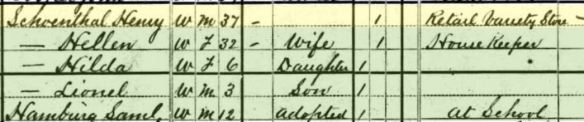
Henry Schoenthal and family 1880 census Year: 1880; Census Place: Washington, Washington, Pennsylvania; Roll: 1202; Family History Film: 1255202; Page: 596A; Enumeration District: 271

Henry Schoenthal and family 1880 census
Year: 1880; Census Place: Washington, Washington, Pennsylvania; Roll: 1202; Family History Film: 1255202; Page: 596A; Enumeration District: 271


In 1886 when Samuel was then eighteen years old, he was working as a clerk at 5 East Beau Street in Washington and living at the corner of Beau and Lincoln in that town, according to the 1886 directory for Washington, Pennsylvania.  According to that same source, my great-grandfather Isidore Schoenthal, who had arrived in Washington in 1881, was living at 203 East Beau Street that same year; looking at Google Maps, I see that 203 East Beau Street is located at the corner of Lincoln and Beau.

[Thanks to Lara of Lara’s Jewnealogy, I now know how to use Google Maps more effectively.  See her great post here.]

Thus, Samuel Hamberg was probably living with my great-grandfather.  I imagine that they lived and maybe even worked together, my great-grandfather watching over his younger second cousin.  Perhaps Samuel helped my great-grandfather learn English and adjust to American ways.

By 1889, Samuel, now 21 years old, had moved to Philadelphia.  He is listed in the directory for that year as Samuel T. Hamberg, a manager, residing at “134 E. Orthodox, FKD.”  FKD stands for Frankford, a neighborhood in northeast Philadelphia about six miles from the center of the city.  I wondered what had taken him there.

It took me a very long time to find out, but when I finally decided, after exhausting traditional genealogy sources, to Google “Samuel T. Hamberg” as a last ditch effort to learn more, I found these two entries in Google Books:

P.W. Bedford, Pharmaceutical Record and Weekly Market Review, Volume 10, April 21, 1890, p. 163, found here (list of graduates of the Philadelphia College of Pharmacy).

26th Annual Report of the Alumni Association of the Philadelphia College of Pharmacy (1890), found here.

Class of 1890, Philadelphia College of Pharmacy Alumni Association Report, p. 194

Class of 1890, Philadelphia College of Pharmacy
Alumni Association Report, p. 194

Samuel T. Hamberg, the boy who had lost both his parents before his twelfth birthday, had graduated from the four-year program at the Philadelphia College of Pharmacy in 1890 when he was 22 years old. The Philadelphia College of Pharmacy was the first pharmacy school in the United States and still exists today.

Not only had Samuel graduated from this prestigious institution, but a further search into both of the above sources revealed that his middle name was Tilden,[1] that he had written his thesis on nitroglycerin, that he had played the guitar to open the commencement exercises as part of a musical ensemble (perhaps his musical adoptive brother Lionel Schoenthal with whom he’d lived in Washington had given him music lessons), and that he had been selected to be the Class Poet.  The poem he read at the school’s commencement exercises in 1890 is filled with references to professors and specific memories of the school years, but this particular verse seemed a more personal statement:

Sorrows and losses may be borne,

Be baffled and dismayed,

Feel the sharp pang of many a thorn

By our own follies made.

But hope and effort may improve

And help us to thankful be,

It surely did in this case

It helped us—in a degree.

(Samuel Tilden Hamberg, 1890, as published in the Alumni Report, cited above, p.124.)

Samuel Tilden Hamberg certainly had suffered sorrows and losses, though not by his “own follies made.”  But it seems with the love of his family in Washington, Pennsylvania, he had in fact borne those sorrows and losses and succeeded in coming through them as a grateful and successful young man.

Philadelphia College of Pharmacy See page for author [CC BY 4.0 (http://creativecommons.org/licenses/by/4.0)], via Wikimedia Commons

Philadelphia College of Pharmacy
See page for author [CC BY 4.0 (http://creativecommons.org/licenses/by/4.0)%5D, via Wikimedia Commons

Samuel stayed on in Philadelphia after graduating. In the 1892 directory for Philadelphia, Samuel T. Hamberg is listed as a clerk, living now at 6933 Hagerman Avenue.  Two years later in 1894 he lists his occupation as druggist, living at 824 Somerset.  In 1895 and 1896 there are numerous advertisements listing Samuel T. Hamberg as a pharmacist in the Philadelphia Inquirer.

Samuel T. Hamberg married Jane E. Tracey on November 20, 1898, at the Zion Episcopal Church in Philadelphia.  At the time they married, Samuel had been residing in Camden, New Jersey, according to the marriage record.  His wife had been living in Philadelphia where she was born in December, 1869.  Jane, or Jennie as she was generally identified on most records, was the daughter of Edwin Tracey (often spelled Tracy) and Jane Irwin.  Edwin was a Philadelphia native and a shoemaker according to the 1880 census; his wife Jane was born in Ireland.  Jennie was the seventh of nine children.

Marriage record of Samuel Hamberg and Jane Tracey November 20, 1898, Zion Protestant Episcopal Church, Philadelphia Historical Society of Pennsylvania; Philadelphia, Pennsylvania; Collection Name: Historic Pennsylvania Church and Town Records; Reel: 978

Marriage record of Samuel Hamberg and Jane Tracey November 20, 1898, Zion Protestant Episcopal Church, Philadelphia
Historical Society of Pennsylvania; Philadelphia, Pennsylvania; Collection Name: Historic Pennsylvania Church and Town Records; Reel: 978


In 1900, Samuel and Jennie were living in Philadelphia in the household of Jennie’s brother Albert Tracy along with Jennie’s mother Jane and her three sisters.  Samuel was working as a hospital supplies salesman.  I know this is the correct Samuel Hamberg because his birth place is given as South Carolina, his father’s as Germany, his mother’s as South Carolina.  (I found it interesting that Samuel reported the birth places of his birth parents, Charles and Lena, not those of his adoptive parents.)

Samuel Hamberg 1900 census Year: 1900; Census Place: Philadelphia Ward 29, Philadelphia, Pennsylvania; Roll: 1472; Page: 12A; Enumeration District: 0748; FHL microfilm: 1241472

Samuel Hamberg 1900 census
Year: 1900; Census Place: Philadelphia Ward 29, Philadelphia, Pennsylvania; Roll: 1472; Page: 12A; Enumeration District: 0748; FHL microfilm: 1241472


On September 4, 1900, Samuel and Jennie had their first child, a son named Charles, presumably named for Samuel’s father Charles.

The family must have soon thereafter moved to Camden, New Jersey, for Samuel is listed as a salesman in the 1901 Camden directory.  Samuel and Jennie are also listed in the 1902 and 1903 Camden directories at 3010 Westfield Street; Samuel is still listed as a salesman.  A second child was born that year, Frances D. Hamberg, born in January, 1903, in New Jersey.  Samuel and Jennie were still living at the same address in 1904 and in 1905.

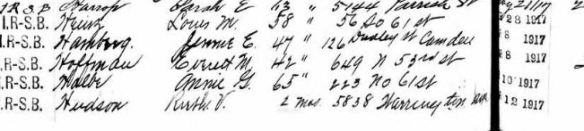
Then things start getting a little confusing.  In 1906 Samuel T. Hamberg is listed in the Philadelphia directory as a salesman residing at 27 North 60th Street in that city.  There is no listing for him in the Camden directory for that year.  But the following year Samuel is listed as a salesman in the Camden directory, residing at 126 Dudley Street.  Then in 1908, the listing is only in Jennie’s name—Jennie Hamberg at 126 Dudley Street.

Meanwhile in October 1907, a third child had been born to Samuel and Jennie—Edwin F. Hamberg.  Had Samuel and Jennie separated in 1906, reconciled and had a third child in 1907, and then separated again in 1908? Jennie is again listed alone at 126 Dudley in Camden in 1909, this time with an occupation, dressmaker.

But where was Samuel in 1908 and 1909? He is not listed in the Camden directory.  There are two Samuel Hambergs listed in Philadelphia in 1909, but they are father and son and listed as pawnbrokers, so neither of them seems to be the right Samuel.  There are no Samuel Hambergs listed in the directories for those years for Pittsburgh or Washington, Pennsylvania, or Baltimore.

In 1910, Samuel reappears on the 1910 census in Baltimore, Maryland, living as a boarder and working as a pharmacist in a drugstore.  I know this is my Samuel because he is Samuel T. Hamberg, born in South Carolina, father born in Germany, mother in South Carolina.  But why is he in Baltimore?  He is still listing himself as married, so maybe he went to Baltimore to find work.   Since he had been working as a salesman while living in Camden, maybe he wanted to return to being a regular pharmacist.
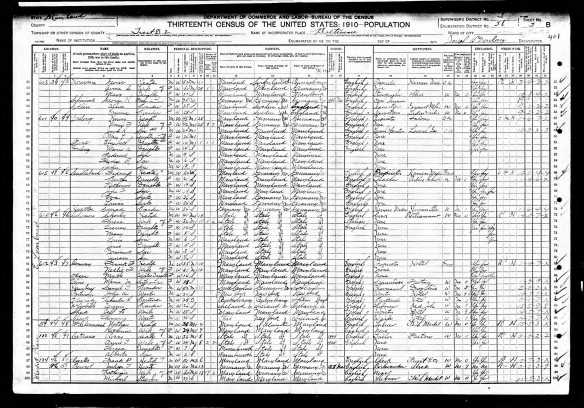
Samuel Hamberg 1910 census Year: 1910; Census Place: Baltimore Ward 4, Baltimore (Independent City), Maryland; Roll: T624_553; Page: 3B; Enumeration District: 0036; FHL microfilm: 1374566

Samuel Hamberg 1910 census Line 85
Year: 1910; Census Place: Baltimore Ward 4, Baltimore (Independent City), Maryland; Roll: T624_553; Page: 3B; Enumeration District: 0036; FHL microfilm: 1374566

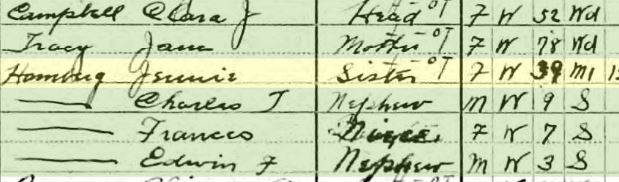
Jennie and the three children were still living at 126 Dudley in Camden in 1910.  According to the census, they were living with Jennie’s sister Clara Campbell and her mother Jane Tracy.  Like Samuel, Jennie still reported herself as married.  Although Jennie reported no occupation on the 1910 census, the 1910 and 1911 Camden directories list her as a dressmaker.
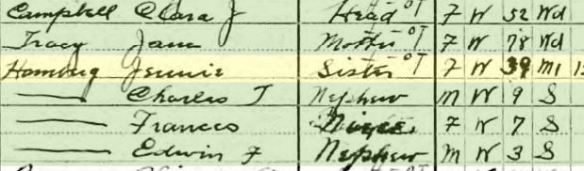
Jennie Hamberg and children 1910 census Year: 1910; Census Place: Camden Ward 12, Camden, New Jersey; Roll: T624_874; Page: 13A; Enumeration District: 0080; FHL microfilm: 1374887

Jennie Hamberg and children 1910 census
Year: 1910; Census Place: Camden Ward 12, Camden, New Jersey; Roll: T624_874; Page: 13A; Enumeration District: 0080; FHL microfilm: 1374887


Samuel is listed in the 1911 Baltimore directory, but then he again disappears.  I couldn’t find him in any newspaper article or any directory after 1911 during the decade of the 1910s.

Jennie, however, continued to be listed in the Camden directories from 1910 through 1916.  In 1915, she and her children are listed on the New Jersey census, once again living with her sister Clara and her mother Jane; Samuel is not part of their household.

Jennie Tracey Hamberg died from heart disease on March 4, 1917.  She was only 47 years old, and she left behind three children.  Charles was not yet sixteen, Frances not yet fourteen, and Edwin not yet ten years old.  Like their father Samuel, they lost their mother at a young age.
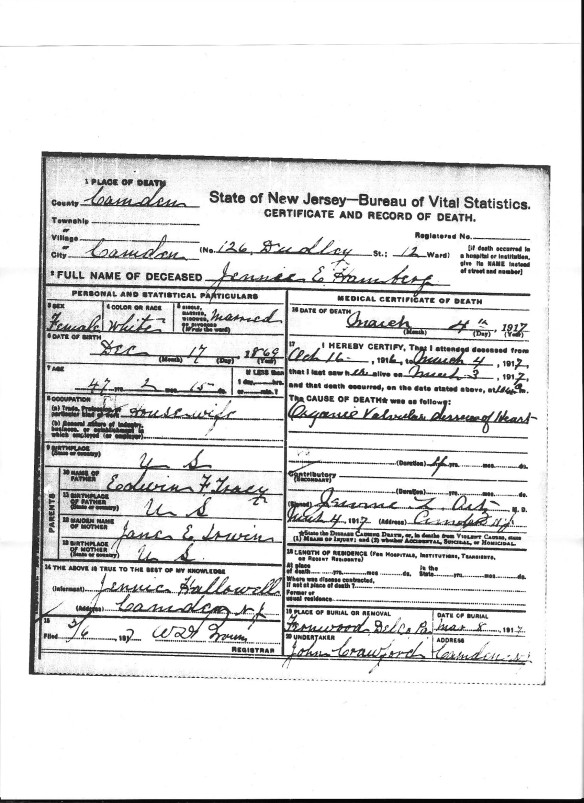
Jennie Tracey Hamberg death certificate

Jennie Hamberg burial record Fernwood Cemetery, Yeardon, PA Historical Society of Pennsylvania; Philadelphia, Pennsylvania; Collection Name: Historic Pennsylvania Church and Town Records

Jennie Hamberg burial record
Fernwood Cemetery, Yeardon, PA
Historical Society of Pennsylvania; Philadelphia, Pennsylvania; Collection Name: Historic Pennsylvania Church and Town Records

So where was their father? I could not find him on the 1920 census or anywhere during the 1920s until I searched for “Samuel T. Hamberg” in Google.  And along with the links noted above relating to his education as a pharmacist, I found several links indicating that in 1920 Samuel was in Pittsburgh working for the state of Pennsylvania as a temporary investigator doing fair price work.  Even knowing this additional information, I could not locate Samuel on the 1920 census or in any directory in the 1920s.
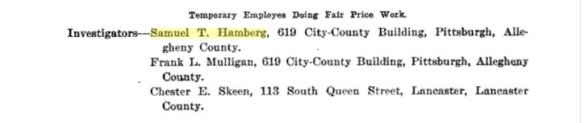
Samuel Hamberg investigator 1920

Herman P. Miller, Snull’s Legislative Handbook and Manual of the State of Pennsylvania, 1920, p. 144, found here.

But Samuel T. Hamberg does reappear on the 1930 census.  He is listed as Sam T. Hamberg, 62 years old (the correct age), married at age 30 (the correct age), widowed (Jennie was dead), born in South Carolina, father born in Germany, mother in South Carolina (all correct).  Clearly this is the right person.  He was now living in Philadelphia, working as a novelty salesman, and living with his “sister” Cecelia Link. What had happened to his pharmacy career? His work as a state investigator? And who was Cecelia Link?

Samuel Hamberg 1930 census Year: 1930; Census Place: Philadelphia, Philadelphia, Pennsylvania; Roll: 2125; Page: 14A; Enumeration District: 0777; Image: 969.0; FHL microfilm: 2341859

Samuel Hamberg 1930 census
Year: 1930; Census Place: Philadelphia, Philadelphia, Pennsylvania; Roll: 2125; Page: 14A; Enumeration District: 0777; Image: 969.0; FHL microfilm: 2341859

Samuel did not have any sisters except for his adoptive sister Hilda Schoenthal, the daughter of Henry Schoenthal.  Cecelia was twenty years younger than Samuel, according to the 1930 census, born in Pennsylvania, single, and working as a telephone operator.  Cecelia answered the enumerator’s questions as indicated by the H on the line where her name is. Who was she, and why was she living with Samuel?

I found a Celia Link living with her mother and two sisters (and a brother-in-law) in Pittsburgh on the 1920 census.  Celia was forty years old, single, and working as a telephone operator.  It seemed like an unlikely coincidence that there were two women with just about the same name, both born in Pennsylvania, and both working as telephone operators.  (Remember that Samuel was living in Pittsburgh in 1920.)

So I looked for more about this Celia Link.  The 1916 Pittsburgh directory had her listed as Cecelia Link working as a telephone operator, so now we had the exact same name.  The 1910 census has her again as Celia, living with her parents, working as a telephone operator, and 33 years old.  Going back yet another ten years, the 1900 census lists her as Cecilia, age 22, with a birth date of March 1878, and no occupation.

Then I found her death certificate.  Cecelia Link died of chronic myocarditis on May 6, 1934, at “abt age 48,” according to her sister, the informant.  Assuming that Cecelia was 22 in 1900, she would have been 56 in 1934.  Even in 1920, she reported to be 40, making her 54 in 1934.  She was therefore only about ten years younger than Samuel, not twenty.  Note also that she was born in Washington, Pennsylvania.

Cecilia Link death certificate Ancestry.com. Pennsylvania, Death Certificates, 1906-1963 [database on-line]. Provo, UT, USA: Ancestry.com Operations, Inc., 2014. Original data: Pennsylvania (State). Death certificates, 1906–1963. Series 11.90 (1,905 cartons). Records of the Pennsylvania Department of Health, Record Group 11. Pennsylvania Historical and Museum Commission, Harrisburg, Pennsylvania.

Cecilia Link death certificate
Ancestry.com. Pennsylvania, Death Certificates, 1906-1963 [database on-line]. Provo, UT, USA: Ancestry.com Operations, Inc., 2014.
Original data: Pennsylvania (State). Death certificates, 1906–1963. Series 11.90 (1,905 cartons). Records of the Pennsylvania Department of Health, Record Group 11. Pennsylvania Historical and Museum Commission, Harrisburg, Pennsylvania.

I assume that Samuel met Cecelia when he was working in Pittsburgh as an investigator. And that they were more than “brother and sister.”  I think Cecelia lied both about her age and her relationship to Charles.

But Cecelia died in 1934 back in Pittsburgh.  What happened to Samuel before and after her death? And where were his children?

More questions to answer.


[1] There is no earlier indication that Samuel’s middle name was Tilden.  Did he adopt this middle name himself? In 1868 when Samuel Hamberg was born in Columbia, South Carolina, Samuel Tilden was probably not a nationally known figure.  He was from New York State and a supporter of the Union during the Civil War.  After the war he was active in reforming the Democratic party.  Would Charles Hamberg have known of him and named his son for him? Unlikely.

But Samuel Tilden was the Democratic party’s nominee in the 1876 Presidential election; the results of the election were disputed when several states turned into multiple sets of return.  The Presidency was determined by a partisan commission established by Congress, and Tilden lost to Rutherford B. Hayes, even though he had won the popular vote.  I think it is more likely that Samuel Hamberg adopted Tilden’s name as his middle name sometime as a young adult after Tilden was more of a household name.  Tilden died in 1886, and the first use I’ve seen of the middle initial T by Samuel Hamberg was while he was in pharmacy school in the late 1880s.  For more on Samuel Tilden, see here and here and here.

The Mysterious Administratrix

As I wrote last week, Samuel Hamberg, my great-grandfather’s second cousin, was orphaned in 1879 in Columbia, South Carolina, when his father Charles committed suicide two years after Samuel’s mother Lena had died at age 28.  But how did Samuel end up in Pennsylvania? Looking for the answer to that question led to another mystery and, I think, more answers.

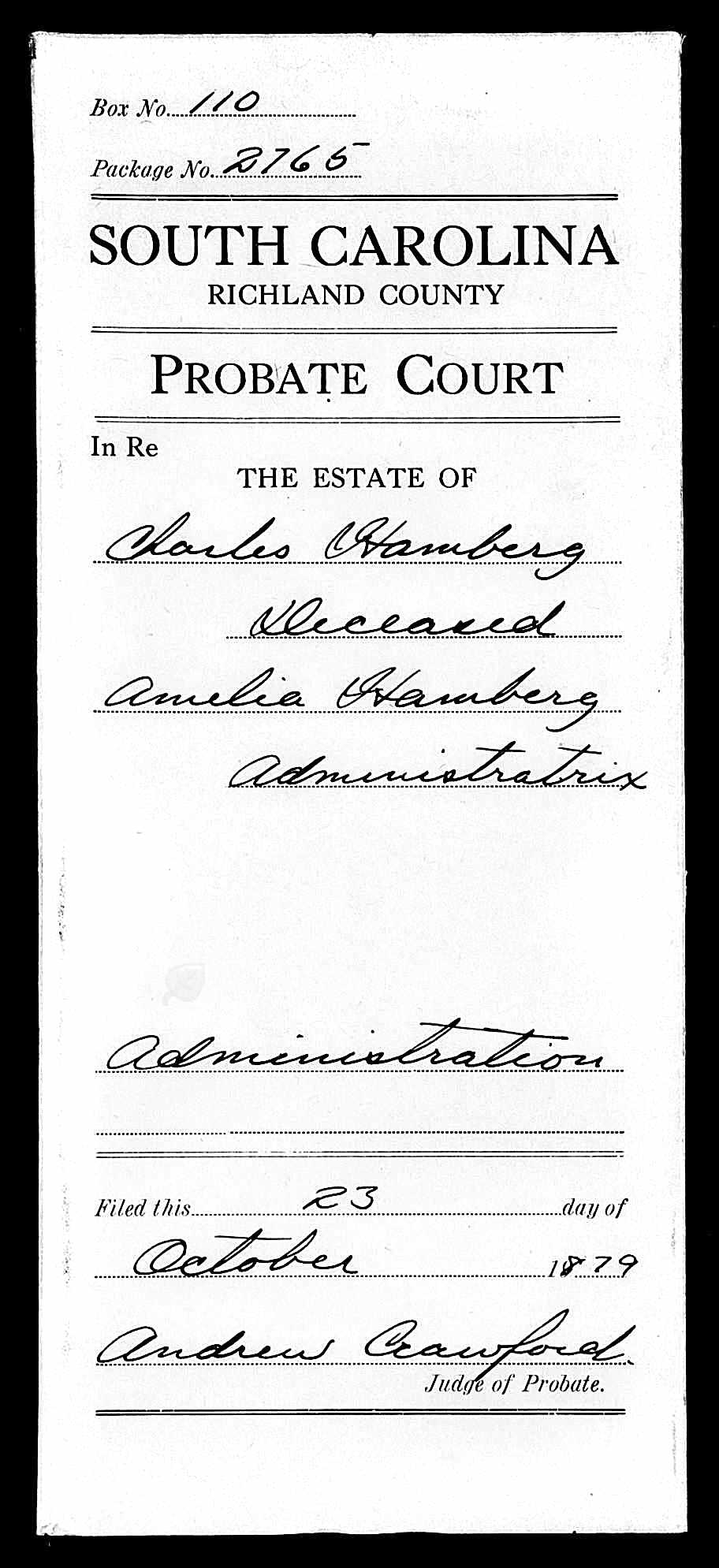
Charles Hamberg died without a will, leaving behind personal property consisting primarily of furniture and household items valued at that time at $487.71; today that would be equivalent to approximately $11,600.  The administratrix of his estate was someone named Amelia (or Amalia or Amalie[1] ) Hamberg.

Richland County, South Carolina Miscellaneous Estate Records, 1799-1955; Author: South Carolina. County Court (Richland County); Probate Place: Richland, South Carolina

Richland County, South Carolina Miscellaneous Estate Records, 1799-1955; Author: South Carolina. County Court (Richland County); Probate Place: Richland, South Carolina


Now who was she?  For a long time I assumed she was yet a third wife, someone Charles married after Mary, who’d been murdered, and Lena, mother of Samuel.  Lena had died in 1877, leaving Charles with their nine year old son.  I figured he had quickly married again, finding a mother for Samuel.  But I could not find one record for an Amalia or Amelia or Amalie Hamberg anywhere in South Carolina before or after Charles’ death. I couldn’t even find someone with just that first name who seemed a likely candidate.  I was working in circles, getting frustrated.

Then I searched for anyone named Amelia or Amalia or Amalie Hamberg anywhere in the US, and I found one Amalia Hamberg on a death record for her daughter Hattie Baer Herman, who had died in Philadelphia in 1910.  Hattie’s father was Jacob Baer.  Both parents were born in Germany, according to the death certificate.


Death certificate of Hattie Baer, daughter of Amalia Hamberg Ancestry.com. Pennsylvania, Death Certificates, 1906-1963 [database on-line]. Provo, UT, USA: Ancestry.com Operations, Inc., 2014. Original data: Pennsylvania (State). Death certificates, 1906–1963. Series 11.90 (1,905 cartons). Records of the Pennsylvania Department of Health, Record Group 11. Pennsylvania Historical and Museum Commission, Harrisburg, Pennsylvania.

Death certificate of Hattie Baer, daughter of Amalia Hamberg
Ancestry.com. Pennsylvania, Death Certificates, 1906-1963 [database on-line]. Provo, UT, USA: Ancestry.com Operations, Inc., 2014.
Original data: Pennsylvania (State). Death certificates, 1906–1963. Series 11.90 (1,905 cartons). Records of the Pennsylvania Department of Health, Record Group 11. Pennsylvania Historical and Museum Commission, Harrisburg, Pennsylvania.

Then it occurred to me: what if Amalia was not Charles Hamberg’s wife, but a sister or a cousin? If Charles died unmarried and intestate, some other family member might have been appointed to administer his estate.

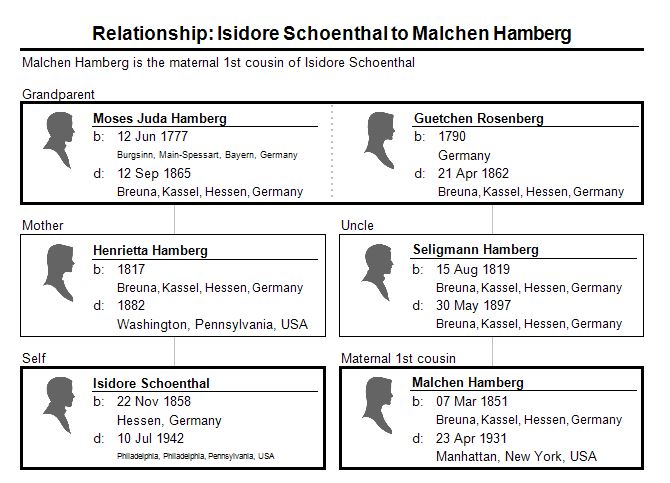
So I looked back at the Hamberg family tree, and I saw that there was a Malchen Hamberg on the tree.  Malchen was the daughter of Seligmann Hamberg and granddaughter of Moses Hamberg.  She was my great-grandfather’s first cousin.

corrected relationship isidore schoenthal to malchen hamberg


Malchen was born March 7, 1851, in Breuna, and according to the family report posted on the site maintained by Hans-Peter Klein, she had emigrated from Germany.  She certainly looked like a possible candidate for the Amalia Hamberg who had been appointed to administer Charles Hamberg’s estate.  She was, like my great-grandfather, a first cousin, once removed, of Charles Hamberg.

corrected chart charles hamberg to malchen hambeg


So I had found yet another Hamberg cousin who had immigrated to the US.  Further research revealed that Amalia had immigrated in 1871, arriving in Baltimore.

Amalie Hamberg passenger ship manifest for the USS Baltimore, arriving September 4, 1871, Baltimore, MD Maryland, Baltimore Passenger Lists, 1820-1948," database with images, FamilySearch (https://familysearch.org/ark:/61903/1:1:QK6L-H1ZK : accessed 2 May 2016), Amalie Hamberg, ; citing Immigration, Baltimore, Baltimore, Maryland, United States, NARA microfilm publications M255, M596, and T844 (Washington, D.C.: National Archives and Records Administration, n.d.); FHL film 417,401.

Amalie Hamberg passenger ship manifest for the USS Baltimore, arriving September 4, 1871, Baltimore, MD  Line 388
Maryland, Baltimore Passenger Lists, 1820-1948,” database with images, FamilySearch (https://familysearch.org/ark:/61903/1:1:QK6L-H1ZK : accessed 2 May 2016), Amalie Hamberg, ; citing Immigration, Baltimore, Baltimore, Maryland, United States, NARA microfilm publications M255, M596, and T844 (Washington, D.C.: National Archives and Records Administration, n.d.); FHL film 417,401.

According to the 1900 census, Amalia married Jacob Baer in 1873.  Reviewing the birth records of their children indicated that Amalia and Jacob lived in Pittsburgh for many years where they had nine children born between 1874 and 1891.  (More on Amalia and her family in a later post.)  The fact that Amalia ended up in Pittsburgh where her Schoenthal cousins were living further corroborated my assumption that she was in fact Malchen Hamberg of Breuna.

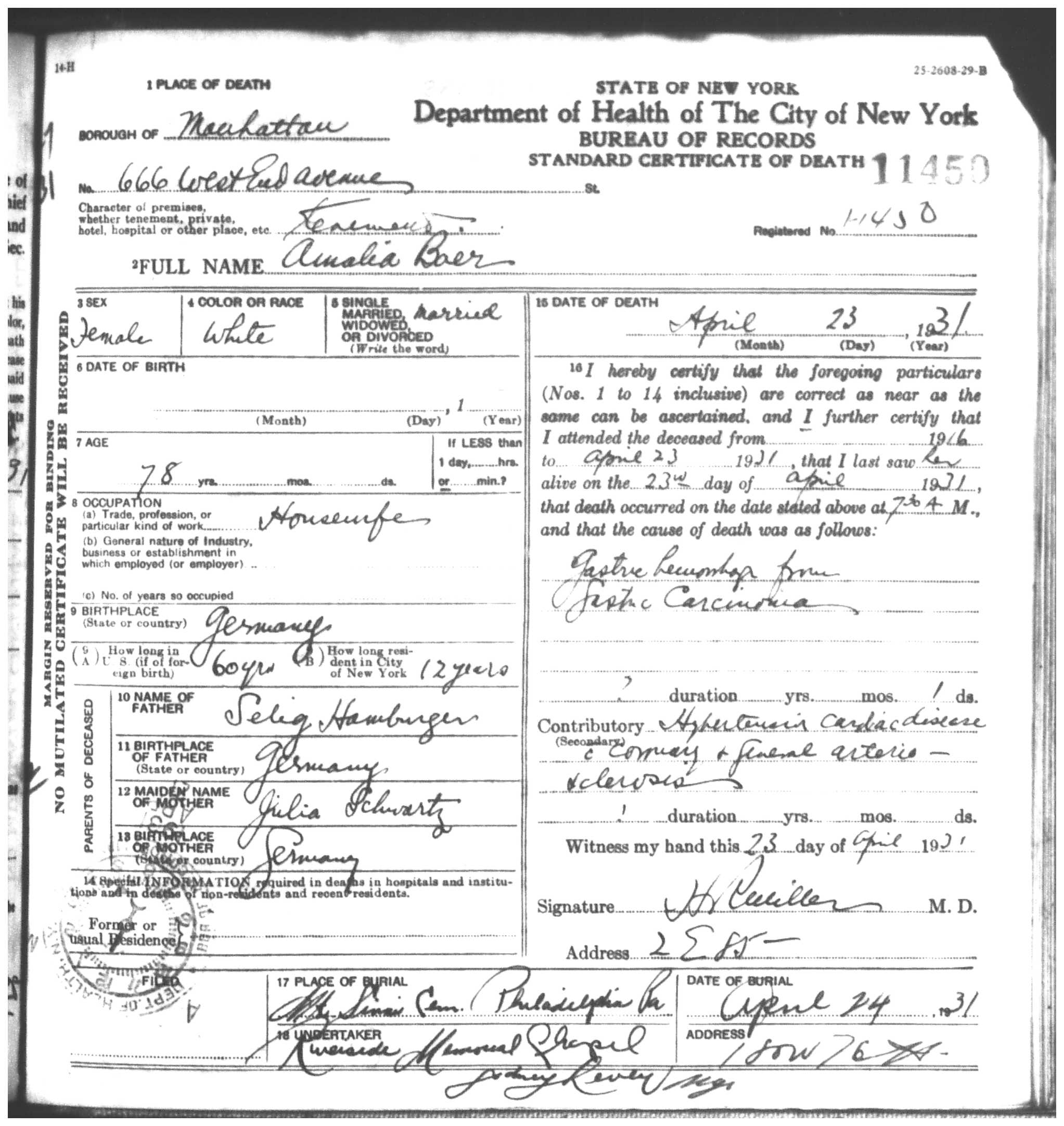
And then the icing on the cake: I received the death certificate for Amalia Baer.   Amalia Baer died on April 23, 1931, in New York City.  Her father’s name was Selig Hamburger.

Baer, Amalia death page 1

Baer, Amalia death page 2


Okay, it not precisely right.  Malchen’s father was Seligmann Hamberg.  So the informant cut off a syllable from the first name and added one to the surname.  I still think Amalia was Malchen.

The mother’s name was even further off—Julia Schwartz instead of Jette Gans.  But death certificates are often filled with mistakes, and it’s not surprising that the informant did not have completely accurate information about the parents of a 78 year old woman, parents that the informant had likely never met.

The certificate also stated that Amalia had been in the US for 60 years; Amalia Hamberg had arrived in 1871, sixty years before 1931, the year Amalia Baer died.

So I am 99% sure that Malchen Hamberg, granddaughter of my three-times great-grandfather Moses Hamberg, was Amalia Hamberg, wife of Jacob Baer, administratrix of Charles Hamberg’s estate.

Only one thing seemed strange.  If Amalia married Jacob Baer in 1873, why was she using the name Hamberg in 1879 when she was appointed to administer Charles’ estate? I don’t know.  Hence, that lingering one percent of doubt.

There are also other questions.  Why wasn’t Charles’ brother Moses made the administrator of his estate? He was the closest relative.  Why Amalia, his cousin and a woman, instead?

Well, I cannot find the Moses Hamberg from Breuna who immigrated in 1846 as a seventeen year old shoemaker on any subsequent record.  Having searched every census from 1850 forward using wild cards, misspellings, and several databases, I have hit that proverbial brick wall. I can find other men named Moses Hamberg, but none that fit the other criteria for being the correct person.  Either the age is off, the birth place is wrong, or the family members and structure are different.

Maybe Moses changed his name so drastically that it is undiscoverable.  Maybe he died and his death is not recorded anywhere I can find.  Maybe he returned to Germany or went to some third place.  I don’t know.  But I can’t find him.  That may explain why Amalia, not Moses, administered Charles Hamberg’s estate.

But there are other questions.  By 1879 Amalia had several young children of her own to care for.  Did she travel to South Carolina to deal with Samuel and with the estate?  Or was it all handled locally by Walter. S. Monteith, the Columbia attorney representing Amalia, according to the estate papers?

And how did Samuel get from Columbia, South Carolina, to Washington, Pennsylvania? Did Amalia go to get him? Or Henry? Or some other family member? Or did he take a train by himself? These are all questions for which I have no answers.

As for what happened to Samuel after he came to Pennsylvania—well, that’s a story for yet another post.


[1] The spelling varies according to the record; later records seem to consistently use Amalia so I will adopt that in this post.

The Tragic Story of Charles Hamberg: Gun Violence in South Carolina

Last week I wrote about Samuel Hamberg, the twelve year old boy who appeared in the household of my great-great-uncle Henry Schoenthal in 1880 as his adopted son.  As I described in that post, I had determined that Samuel was the son of Charles Hamberg of Columbia, South Carolina; he appeared on the 1870 census living in Charles Hamberg’s household along with a woman named Tenah Hamberg and a servant also with the first name Tenah.

Through my research, I concluded that Charles Hamberg was in fact born Baruch Hamberg, the son of the first Samuel Hamberg, my great-great-grandmother Henriette Hamberg Schoenthal’s uncle, her father’s younger brother.

Relationship of Henrietta Hamberg and Charles Hamberg

Baruch had left Breuna, Germany, in 1852, with his first cousin Abraham, who died in Savannah, George, in 1854.  Baruch, I postulated, became Charles and had married a woman named Mary E. Hanchey in New Hanover, North Carolina, in March, 1853.

Charles Hamberg and Mary Hanchey marriage record 1853 Ancestry.com. North Carolina, Marriage Records, 1741-2011 [database on-line]. Provo, UT, USA: Ancestry.com Operations, Inc., 2015. Original data: North Carolina County Registers of Deeds. Microfilm. Record Group 048. North Carolina State Archives, Raleigh, NC.

Charles Hamberg and Mary Hanchey marriage record 1853
Ancestry.com. North Carolina, Marriage Records, 1741-2011 [database on-line]. Provo, UT, USA: Ancestry.com Operations, Inc., 2015.
Original data: North Carolina County Registers of Deeds. Microfilm. Record Group 048. North Carolina State Archives, Raleigh, NC.

But why did Samuel end up with my great-great-uncle Henry in Washington, Pennsylvania, in 1880? What had happened to his father? His mother? And who was his mother? Was it Mary Hanchey, the woman Charles married in 1853 and with whom he was living in 1860? Or was it “Tenah,” the woman he was living with in 1870?

First, I focused on Mary, the first wife.  Searching on Ancestry, I found this entry:

Record of Deaths in Columbia South Carolina page 80 [p.80] Mrs. Mary A. Hamberg , wife of Charles Hamberg died in Col’a So. Ca. Novr 18, 1866, having been shot [page 166] by a man, Toland A. Bass, a few days previous.

Unfortunately, the database had no further information about this terrible incident, but I was determined to learn more about Mary’s death.  Was it accidental? A murder? What happened to Toland Bass?

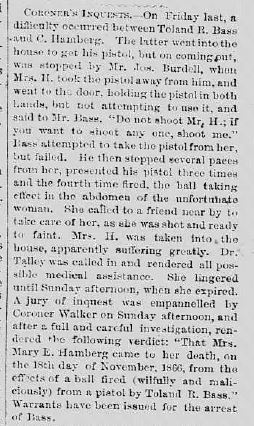
After much searching, I found this article from the November 20, 1866 issue of The Daily Phoenix, the Columbia, South Carolina, daily paper (p. 2):

Daily Phoenix article 11 20 1866 p 2


Coroner’s Inquests.—On Friday last, a difficulty occurred between Toland R. Bass and C. Hamberg.  The latter went into the house to get his pistol, but on coming out, was stopped by Mr. Jos. Burdell, when Mrs. H. took the pistol away from him and went to the door, holding the pistol in both hands, but not attempting to use it, and said to Mr. Bass, “Do not shoot Mr. H.; if you want to shoot any one, shoot me.”  Bass attempted to take the pistol from her, but failed.  He then stepped several paces from her, presented his pistol three times and the fourth time fired, the ball taking effect in the abdomen of the unfortunate woman. 

She called to a friend near by to take care of her, as she was shot and ready to faint.  Mrs. H. was taken into the house apparently suffering greatly.  Dr. Talley was called in and rendered all possible medical assistance.  She lingered until Sunday afternoon, when she expired.  A jury of inquest was empannelled by Coroner Walker on Sunday afternoon, and after a full and careful investigation, rendered the following verdict: “That Mrs. Mary E. Hamberg came to her death, on the 18th of November, 1866, from the effects of a ball fired (willfully and maliciously) from a pistol by Toland R. Bass.” Warrants have been issued for the arrest of Bass.

Who was Toland Bass, and why did he kill Mary Hanchey Hamberg? Why did Mary suggest that he should shoot her, not her husband?

The only thing I could find about Mr. Bass was that he served as a private in the Confederate Army during the Civil War in Company H of the South Carolina Cavalry Regiment.


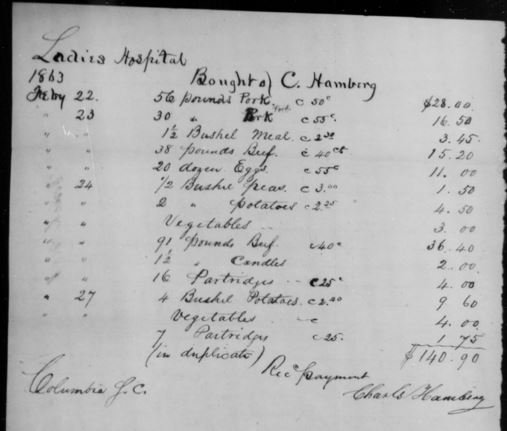
Charles Hamberg, on the other hand, appears to have been a private citizen in Columbia, South Carolina, during the Civil War, selling provisions to the Ladies Hospital.  Here is an example of an invoice he submitted:

Page 15 Confederate Citizens File - Fold3 https://www.fold3.com/image/31347220?xid=1945

Page 15 Confederate Citizens File – Fold3
https://www.fold3.com/image/31347220?xid=1945


I don’t know what might have precipitated this altercation between Bass and the Hambergs; all I can do is speculate.  Columbia, South Carolina, had suffered much damage during the Civil War.  The Union Army occupied the city during the last months of the war in 1865.  As described in Wikipedia:

On February 17, 1865, Columbia surrendered to Sherman, and Wade Hampton’s Confederate cavalry retreated from the city. Union forces were overwhelmed by throngs of liberated Federal prisoners and emancipated slaves. Many soldiers took advantage of ample supplies of liquor in the city and began to drink. Fires began in the city, and high winds spread the flames across a wide area. Most of the central city was destroyed, and municipal fire companies found it difficult to operate in conjunction with the invading army, many of whom were also fighting the fire. The burning of Columbia has engendered controversy ever since, with some claiming the fires were accidental, a deliberate act of vengeance, or perhaps set by retreating Confederate soldiers who lit cotton bales while leaving town. On that same day, the Confederates evacuated Charleston. On February 18, Sherman’s forces destroyed virtually anything of military value in Columbia, including railroad depots, warehouses, arsenals, and machine shops.

English: The Burning of Columbia, South Caroli...

English: The Burning of Columbia, South Carolina, February 17, 1865 (Photo credit: Wikipedia)

You can read more about the Columbia fires here and here.  In the aftermath of the war and during Reconstruction, places like Columbia struggled to rebuild their economy and their infrastructure.  There was widespread poverty.  Perhaps Toland Bass was an embittered Southern veteran; perhaps he resented Charles Hamberg as a merchant who not only didn’t serve in the war but made money during it.  Or maybe it is something much more personal that created the animosity that led to the gruesome murder of Mary Hanchey Hamberg. I don’t know.

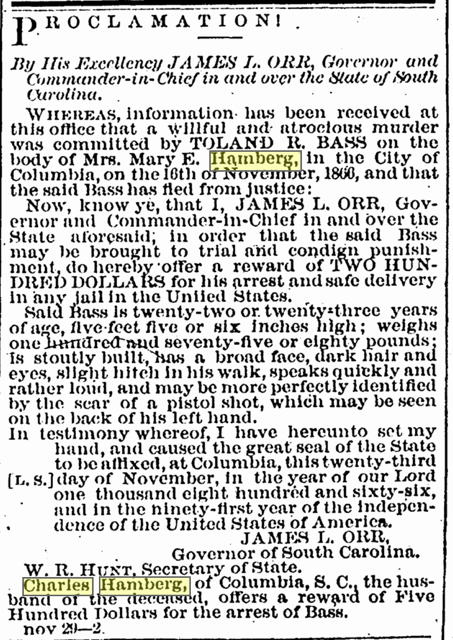
After the murder, Toland Bass ran off to avoid arrest, and the governor of South Carolina, James L. Orr, issued a proclamation offering an award of $200 for his arrest and delivery to South Carolina for trial. Charles Hamberg offered a separate award of $500 for his arrest. (Thank you to Ann Meddin Hellman of the Jewish Historical Society of South Carolina for helping me locate some of these articles

Proclamation about Mary Hamberg's murder

Thursday, November 29, 1866 Paper: (Charleston, South Carolina)


Bass eluded arrest for four months until he was finally found and arrested in New York in March, 1867.

Arrest of Toland Bass


I could not find any record of a trial or any other proceeding involving Bass, but I did find this news item announcing his death from cholera on July 15, 1867.

Death of Toland R Bass


Meanwhile, Charles Hamberg had moved on.  Thanks to my blogging friend Cathy Meder-Dempsey, I know that Charles married Lena Goodman on April 6, 1867, in Charleston, South Carolina.

I believe that Lena was incorrectly entered as “Tenah” on the 1870 census and that she was the mother of Samuel Hamberg, the boy later adopted by Henry Schoenthal.  Although I do not have an exact birthdate for Samuel, the 1900 census reported that he was born in February 1868, that is, about eleven months after the marriage of Charles Hamberg and Lena Goodman.

Even after remarrying, Charles seemed to have troubles in Columbia.  In September, 1869, he was involved in another rather unpleasant altercation:

Charles Hamberg assault

There was also a dispute at his store:

CHarles Hamberg unruly customer

Charles also charged a police officer with inappropriate conduct (public drunkenness) and engaged in a citizen’s arrest.  He seemed to have a tendency to get involved in conflicts.

In the 1870s, Charles advertised his wood and coal business regularly in the Columbia newspaper, The Daily Phoenix.

Charles Hamberg coal


He also participated in a Purim celebration in Columbia, dressing up as Jocko the Ape.  (Purim is a Jewish holiday where children and adults dress up in costumes and celebrate the triumph of the Jews over the evildoer Haman who sought to kill the Jews in ancient Persia.)

The Daily Phoenix, March 26, 1872, p. 2

The Daily Phoenix, March 26, 1872, p. 2


So whatever his troubles, Charles seemed to be living a somewhat ordinary life in Columbia.

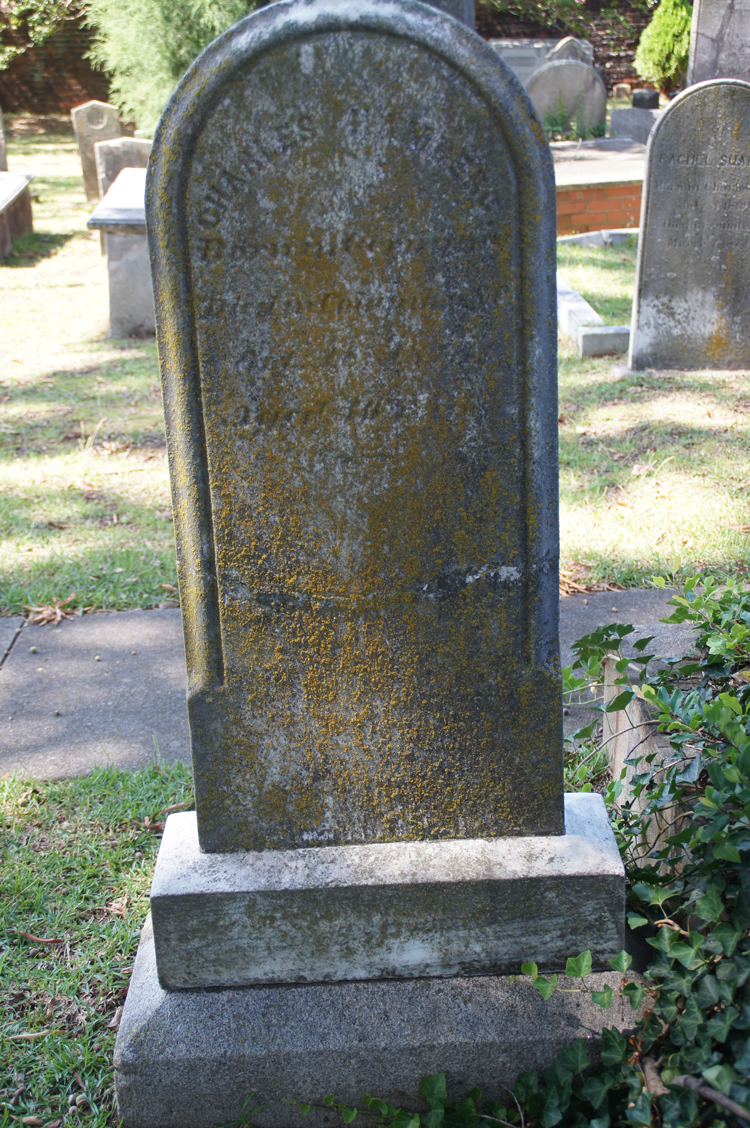
So what happened that caused little Samuel to be adopted by Henry Schoenthal? Tragically, both of Samuel’s parents died before 1880.  His mother Lena died in 1877 and is buried in the cemetery of the Columbia Hebrew Benevolent Society.  She was only 28 years old.  I’ve been unable to locate a death certificate or obituary yet, but will continue to look.  (I contacted the cemetery, but they did not have any further information.)

chbs1HambergLena

Headstone for Lena Hamberg at the Hebrew Benevolent Society cemetery in Columbia, SC http://jhssc.org/hebrew-benevolent-society-cemetery/


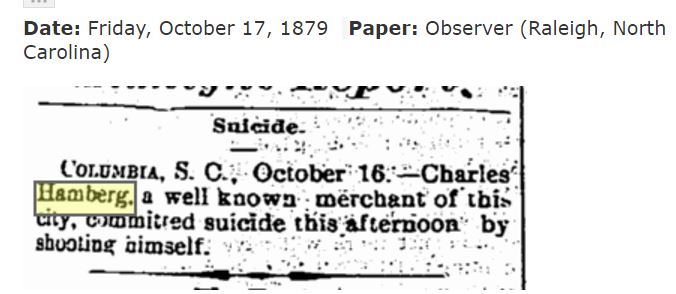
Two years later on October 16, 1879, Charles Hamberg ended his own life, apparently due to financial difficulties, although I would venture that having had one wife murdered and a second dying at a very young age might also have given him sufficient reason for some desperation.  His suicide made the papers even beyond Columbia.

Charles Hamberg suicide Charles Hamberg suicide 3 Charles Hamberg suicide 2


Can you imagine today identifying someone by their religious background for no apparently relevant reason?

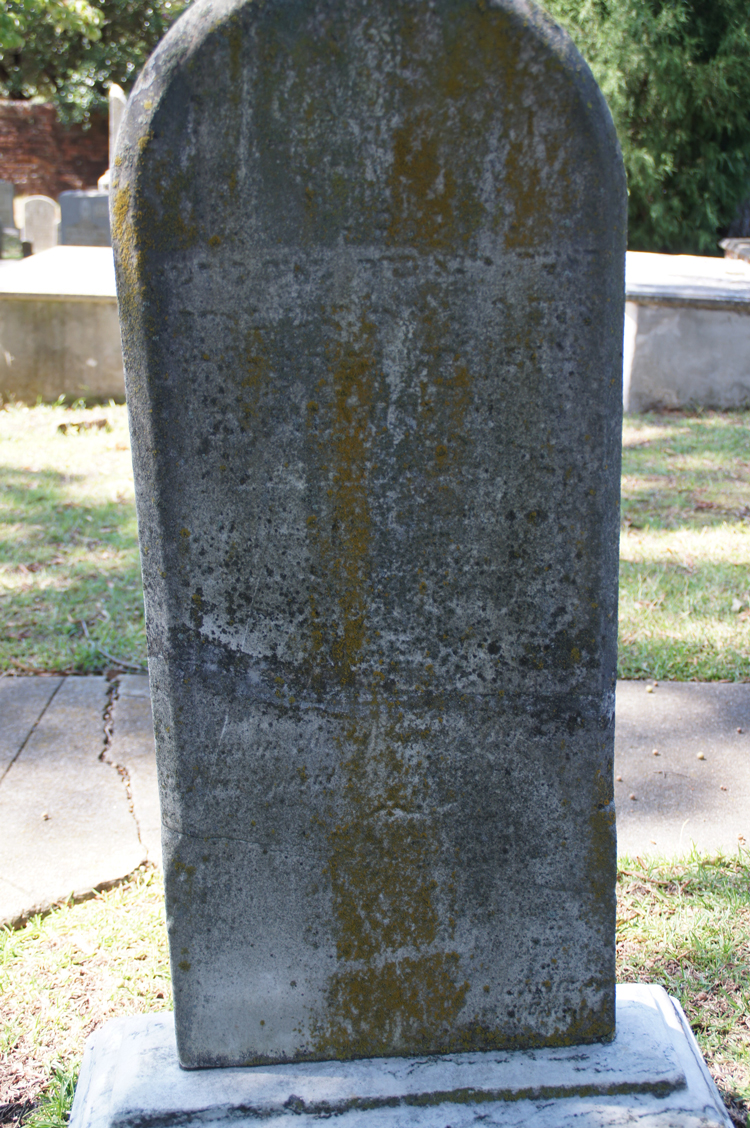
Charles is also buried in the Columbia Hebrew Benevolent Society cemetery, next to Lena.

Charles Hamberg headstone

Headstone of Charles Hamberg at Hebrew Benevolent Society cemetery in Columbia, SC http://jhssc.org/hebrew-benevolent-society-cemetery/

What a hard life Charles Hamberg had once coming to the US.  He lost his cousin Abraham in 1854, his wife Mary was murdered in 1866, his second wife Lena died in 1877, and he suffered financial problems and took his own life in 1879.   I imagine that that was not the life he dreamed of when he left Breuna, Germany, in 1852.  For him the American dream did not come to be.

His son Samuel was just eleven years old and had lost his mother and his father.   He ended up in Pennsylvania with Henry Schoenthal, his second cousin.  How did he end up there?  That leads to the next mystery.

The Adopted Son: Who Was He?

As I move closer to closure on the family of Levi Schoenthal and Henriette Hamberg, my great-great-grandparents[1], I want to ask for your help regarding a mystery involving a boy I believe was part of Henriette’s family, the Hambergs. I need to know if my thinking about him makes sense.

His name was Samuel Hamberg (spelled Hamburg here), and in 1880 he was twelve years old and living in Washington, Pennsylvania, as the adopted son of my great-great-uncle Henry Schoenthal and Helene Lilienfeld.

Henry Schoenthal and family 1880 census Year: 1880; Census Place: Washington, Washington, Pennsylvania; Roll: 1202; Family History Film: 1255202; Page: 596A; Enumeration District: 271

Henry Schoenthal and family 1880 census
Year: 1880; Census Place: Washington, Washington, Pennsylvania; Roll: 1202; Family History Film: 1255202; Page: 596A; Enumeration District: 271


Who was he? Was he part of my great-great-grandmother’s family?  According to the 1880 census, Samuel was born in 1868 in South Carolina.  Henry Schoenthal, the first of Henriette Hamberg’s children to emigrate from Germany, hadn’t arrived until 1866, two years before Samuel was born.  Henry settled in Pennsylvania.  How would a boy born in a state so far away two years after Henry arrived  in the US have ended up with Henry unless there was a family connection?  The surname Hamberg couldn’t just be a coincidence, could it?

His first name also seemed unlikely to be a coincidence.  Henriette’s father was Moses Hamberg, my three-times great-grandfather.  Moses had a younger brother named Samuel, my four-times great-uncle. Young Samuel could have been named for him.  The name similarities added to my hunch that this Samuel Hamberg was in some way related to my great-great-grandmother and the other Hambergs from Breuna.  I had to figure this one out.

I was able to locate a two year old boy named Samuel Hamberg on the 1870 census living in Columbia, South Carolina, in the household of a Charles Hamberg, age 46, and a Tenah Hamberg, age 21.  Given the birth place, name, and age of the boy, I felt it quite likely that this was the same boy who ten years later was living with Henry Schoenthal in Pennsylvania.  Unfortunately, the 1870 census did not include information describing the relationships among those in a household, but I assumed that Charles and Tenah were the father and mother of little Samuel.  If so, who were they?

Charles Hamberg household 1870 US census Year: 1870; Census Place: Columbia, Richland, South Carolina; Roll: M593_1507; Page: 140B; Image: 287; Family History Library Film: 553006

Charles Hamberg household 1870 US census
Year: 1870; Census Place: Columbia, Richland, South Carolina; Roll: M593_1507; Page: 140B; Image: 287; Family History Library Film: 553006

According to the 1870 census, Charles was born in Prussia 46 (or is it a 40?) years earlier or in 1824 or so. (Breuna was within the boundaries of Prussia from 1866 until the German Federation was created in 1871.)  Charles was working as a “ret gro” merchant, which I interpret to mean a retail grocery merchant. Tenah was born in South Carolina as was Samuel.

I was able to trace Charles back ten more years to the 1860 census, where he was also living in Columbia, South Carolina, but married not to Tenah but a woman named Mary.  According to the 1860 census, Charles was then 28, so born in 1832; according to this census, he was born in Germany and working as a merchant.  Mary was a North Carolina native and 27 years old.

Charles Hamberg and household 1860 US census Year: 1860; Census Place: Columbia, Richland, South Carolina; Roll: M653_1227; Page: 26; Image: 57; Family History Library Film: 805227

Charles Hamberg and household 1860 US census
Year: 1860; Census Place: Columbia, Richland, South Carolina; Roll: M653_1227; Page: 26; Image: 57; Family History Library Film: 805227

I then discovered a marriage record for Charles Hamberg and Mary Hanchey reporting their marriage in 1853 in New Hanover, North Carolina.

Charles Hamberg and Mary Hanchey marriage record 1853 Ancestry.com. North Carolina, Marriage Records, 1741-2011 [database on-line]. Provo, UT, USA: Ancestry.com Operations, Inc., 2015. Original data: North Carolina County Registers of Deeds. Microfilm. Record Group 048. North Carolina State Archives, Raleigh, NC.

Charles Hamberg and Mary Hanchey marriage record 1853
Ancestry.com. North Carolina, Marriage Records, 1741-2011 [database on-line]. Provo, UT, USA: Ancestry.com Operations, Inc., 2015.
Original data: North Carolina County Registers of Deeds. Microfilm. Record Group 048. North Carolina State Archives, Raleigh, NC.

But that was the earliest record I could find for Charles Hamberg.  And I still didn’t know whether he was related to the Hambergs of Breuna, my great-great-grandmother’s family.

Fortunately for me, others, including the noted genealogist Hans-Peter Klein, had already done extensive research of the Hamberg family tree. You can find it here.[2]  There was no Charles Hamberg listed in the records in Breuna.  But there were other men in the family with the surname Hamberg who would have been about the same age as Charles Hamberg.  I had to find out whether any of them came to the United States and perhaps changed his name to Charles.

Moses Hamberg, my 3x-great-grandfather, had five sons:

Juda, who died in Breuna in 1863;

Seligmann, who died in Breuna in 1897;

Salomon, who married and had several children in the 1850s in Breuna (no death record has been located;

Marcus, who died in Breuna in 1846;

And finally, Abraham, born in Breuna in 1828 and for whom there was no marriage or death record in Breuna.

Of Moses Hamberg’s five sons, the only one who might have emigrated by 1853 was Abraham.

As for the sons of Samuel Hamberg, brother of Moses, there were three sons:

another Juda, who died in Breuna in 1863;

Baruch, born in 1824 and for whom there was no marriage or death record;

And Moses, born in 1829 and for whom there was also no marriage or death record in Breuna.

So it was possible that Baruch and/or Moses had emigrated.

The three Hamberg men from Breuna who could have immigrated to the US by 1853 were thus Abraham, Baruch, and Moses: no one named Charles.  All three of those Hamberg men were close in age to the Charles Hamberg in Columbia, South Carolina.  All were born between 1824 and 1829.  But had any of them actually immigrated to the United States? I decided to search for them on ship manifests and other US records and found that all three did in fact leave Germany for the United States before 1853.

Moses Hamberg arrived in New York from Breuna in August, 1846, when he was seventeen, according to the ship manifest.  This is clearly Moses, the son of Samuel Hamberg, who was born in 1829 and thus would have been 17 in 1846.  Moses was a shoemaker, according to the manifest.

Year: 1846; Arrival: New York, New York; Microfilm Serial: M237, 1820-1897; Microfilm Roll: Roll 063; Line: 1; List Number: 680

Year: 1846; Arrival: New York, New York; Microfilm Serial: M237, 1820-1897; Microfilm Roll: Roll 063; Line: 1; List Number: 680

Baruch and his first cousin Abraham arrived in New York together in September 1852.  According to the ship manifest, they were coming from Breuna, and both were 24 years old, meaning they were born in about 1828.  My great-great-grandmother’s brother Abraham was born in 1828; according to Breuna records, Baruch was born in 1824.

Despite the disparity in the ages between the Baruch on the manifest and the Baruch born in Breuna, I believe that the two men on this manifest were in fact Abraham Hamberg, son of Moses Hamberg, and Baruch Hamberg, son of Samuel Hamberg.  The ship manifest reports that their destination in the US was “Sevanna,” which I assume meant Savannah, Georgia.

Year: 1852; Arrival: New York, New York; Microfilm Serial: M237, 1820-1897; Microfilm Roll: Roll 119; Line: 1; List Number: 1321

Year: 1852; Arrival: New York, New York; Microfilm Serial: M237, 1820-1897; Microfilm Roll: Roll 119; Line: 1; List Number: 1321


So did any of these three young men become Charles Hamberg of Columbia, South Carolina?  And if so, which one? Since Abraham and Baruch were headed to a city in the South whereas Moses indicated that New York was his intended destination, my inclination was to focus on Abraham and Baruch as the ones more likely to have become Charles Hamberg.[3]

Searching for further records for Abraham Hamberg led me to the sad discovery that he died not too long after arriving in the US.  He died in Savannah, Georgia, his intended destination, on August 26, 1854, of yellow fever and was buried in that city.  He was my great-great-grandmother Henriette’s younger brother.  He was only 26 years old.

Abraham Hamberg death record 1854 Ancestry.com. Savannah, Georgia, Select Board of Health and Health Department Records, 1824-1864, 1887-1896 [database on-line]. Provo, UT, USA: Ancestry.com Operations, Inc., 2014. This collection was indexed by Ancestry World Archives Project contributors. Original data: City of Savannah, Georgia. Savannah, Georgia, Select Board of Health and Health Department Records, 1822–1864, 1887–1896. Subseries 5600HE-050 and 5600HA-010. Microfilm, 27 reels. City of Savannah, Research Library & Municipal Archives, Savannah, Georgia

Abraham Hamberg death record 1854
Ancestry.com. Savannah, Georgia, Select Board of Health and Health Department Records, 1824-1864, 1887-1896 [database on-line]. Provo, UT, USA: Ancestry.com Operations, Inc., 2014. This collection was indexed by Ancestry World Archives Project contributors.
Original data: City of Savannah, Georgia. Savannah, Georgia, Select Board of Health and Health Department Records, 1822–1864, 1887–1896. Subseries 5600HE-050 and 5600HA-010. Microfilm, 27 reels. City of Savannah, Research Library & Municipal Archives, Savannah, Georgia

Abraham Hamberg burial record Ancestry.com. Savannah, Georgia, Cemetery and Burial Records, 1852-1939 [database on-line]. Provo, UT, USA: Ancestry.com Operations, Inc., 2012. Original data: Savannah Georgia Cemetery and Burial Records. Savannah, Georgia: Research Library & Municipal Archives City of Savannah, Georgia.

Abraham Hamberg burial record
Ancestry.com. Savannah, Georgia, Cemetery and Burial Records, 1852-1939 [database on-line]. Provo, UT, USA: Ancestry.com Operations, Inc., 2012.
Original data: Savannah Georgia Cemetery and Burial Records. Savannah, Georgia: Research Library & Municipal Archives City of Savannah, Georgia.

So what then happened to his cousin Baruch Hamberg? Had he made it to Savannah?

My guess is that somewhere along the way from New York to Savannah, Baruch and Abraham stopped in New Hanover, North Carolina, where Baruch met and married his first wife Mary Hanchey in 1853.  And by then, he had dropped the Hebrew name Baruch and adopted the much more American name Charles.  In fact, his full name was Charles B. Hamberg.  Perhaps that B was for Baruch.

What else supports this conclusion that Baruch Hamberg became Charles Hamberg? Recall that Baruch Hamberg was the son of Samuel Hamberg of Breuna.  And what did Charles Hamberg name his son born in 1868? Samuel.

If I am right, then Charles/Baruch Hamberg was Henriette Hamberg Schoenthal’s first cousin; their fathers Samuel and Moses were brothers.  Charles’ son Samuel was therefore a second cousin to Henriette’s son Henry Schoenthal, the man who had adopted him by 1880.

So does my analysis make sense?  Did Baruch Hamberg become Charles Hamberg?

And if so, why was his son Samuel living with and adopted by Henry Schoenthal in 1880? That question will be addressed in a later post.


[1] And while I wait to talk with my third cousin Betty, who is also their great-great-granddaughter.

[2] I wrote a little bit about the Hambergs of Breuna, Germany here when I described the remarkable story of how I learned that my fifth cousin Rob and I shared not only some DNA,  but had lived at one point just a few miles from each other, and, even more remarkably, were both close friends with the same couple.  We had a lovely dinner back in December hosted by Rob and his wife Ann where all of us—our mutual friends included—had a great evening.  I remain amazed by what a small world it is.   Rob and I are both the four-times great-grandchildren of Jeudah ben Moses, the father of Moses Hamberg and Samuel Hamberg.  Rob is descended from Samuel; I am descended from Moses.

[3] I will follow up on Moses Hamberg in a later post.

Passover 2016: The Exodus

In many ways Jewish history is about one exodus after another.  The Jewish story begins when God tells Abra(ha)m, “Lech Lecha,”  or “Go, Go out.”  He instructs him to leave his father’s land and go to a new land where his children would be as numerous as the stars.

There are many journeys throughout the Bible—Noah’s journey, Jacob’s journey, Joseph’s journey, and, of course, the exodus from Egypt led by Moses, which is recalled and re-enacted every year on Passover.

This Friday evening we will once again remember and re-enact that journey.  We will read the story of the Exodus.  We will drink wine, recline like free people, and eat matza to remember that our ancestors had no time to wait for the dough to rise before exiting from Egypt.  We will eat the bitter herbs to remember the bitterness of slavery, and we will eat the charoset—a mixture of apples, nuts, and wine—to embrace the sweetness of freedom from slavery.

English: Passover Seder Table, Jewish holidays...

English: Passover Seder Table, Jewish holidays עברית: שולחן הסדר, Original Image Name:סדר פסח, Location:חיפה (Photo credit: Wikipedia)


But that exodus was not the last journey our people took to freedom.  Over the centuries Jews kept moving from one land to another, either having been expelled or deciding on their own to seek freedom from oppression, violence, and hatred.  They moved to Babylonia, to Spain, to eastern Europe, to Germany, to places all over the globe, including eventually to the Americas.

I have spent much of the year since last Passover studying the journeys of my paternal relatives from Sielen, Germany—my father’s maternal grandfather’s family, the Schoenthals.  Although I still have a few more stories to share about my Schoenthal cousins, now that I have written about all the children of Levi Schoenthal and Henriette Hamberg, I want to spend this Passover looking back over the story of this particular family.

Levi and Henriette Schoenthal had ten children who survived to adulthood, all born in Sielen, Germany.  Of those ten, eight settled permanently in the US, and all but one of those eight started their lives in America in western Pennsylvania—either in Pittsburgh or the town thirty miles away, known as Little Washington.  Henry, the oldest son, arrived first in 1866, and by 1881, eight of the siblings were living in the US.  Henry over the years was a book seller and a china dealer, but underneath was a deeply religious and well-educated man.

His youngest brother was my great-grandfather Isidore, who arrived in 1881, also settled in Washington, and also worked as a china dealer.

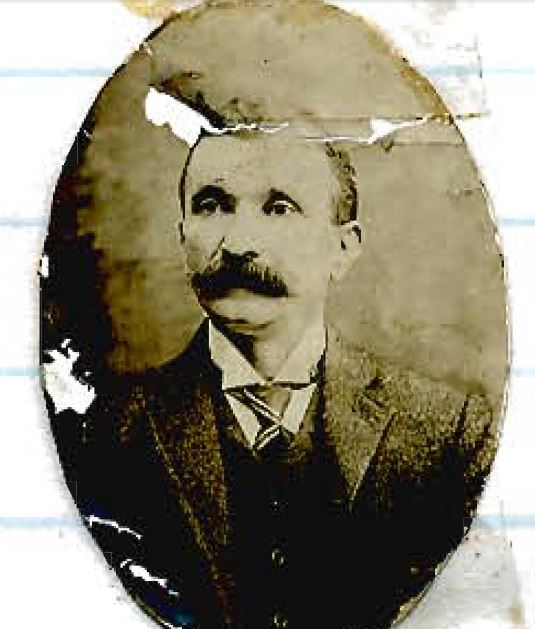
Isidore Schoenthal

Isidore Schoenthal

In between Henry and Isidore were four other brothers in the US plus two sisters.  Over the years almost all of them prospered.  Some moved away from western Pennsylvania.  Simon ended up in Atlantic City, where he and his wife raised nine children, many of whom ended up in the hotel business there; Felix and his wife and two daughters ended up in Boston, where he became successful in the typewriter repair business. Julius lived in Washington, DC, worked as a shoemaker and had four children.  Nathan lived in many different places.  And even Isidore and Henry eventually left Pennsylvania, Isidore for Colorado and Henry for New York.  The two sisters, Hannah and Amalie, stayed in Pittsburgh for most of their lives.  Both were married and had children.

Felix and Margaret Schoenthal from 1919 passport application, National Archives and Records Administration (NARA); Washington D.C.; NARA Series: Passport Applications, January 2, 1906 - March 31, 1925; Roll #: 728; Volume #: Roll 0728 - Certificates: 70500-70749, 19 Mar 1919-20 Mar 1919

Felix and Margaret Schoenthal from 1919 passport application,
National Archives and Records Administration (NARA); Washington D.C.; NARA Series: Passport Applications, January 2, 1906 – March 31, 1925; Roll #: 728; Volume #: Roll 0728 – Certificates: 70500-70749, 19 Mar 1919-20 Mar 1919


Simon Schoenthal, my great-great-uncle

Simon Schoenthal, my great-great-uncle


The next generations wandered even further afield, although many ended up not too far from where their parents had originally settled.  My grandmother, who was born in Washington, PA, and grew up in Denver, spent her whole adult life in Philadelphia and New Jersey.

My Grandma Eva

My Grandmother Eva Schoenthal Cohen

Martin Schoenthal, Gertrude Sch., Hettie Sch Blanche Walter

Walter Schoenthal, Gertrude Schoenthal, Hettie Schoenthal, Blanche Stein and Walter Stein in Arizona


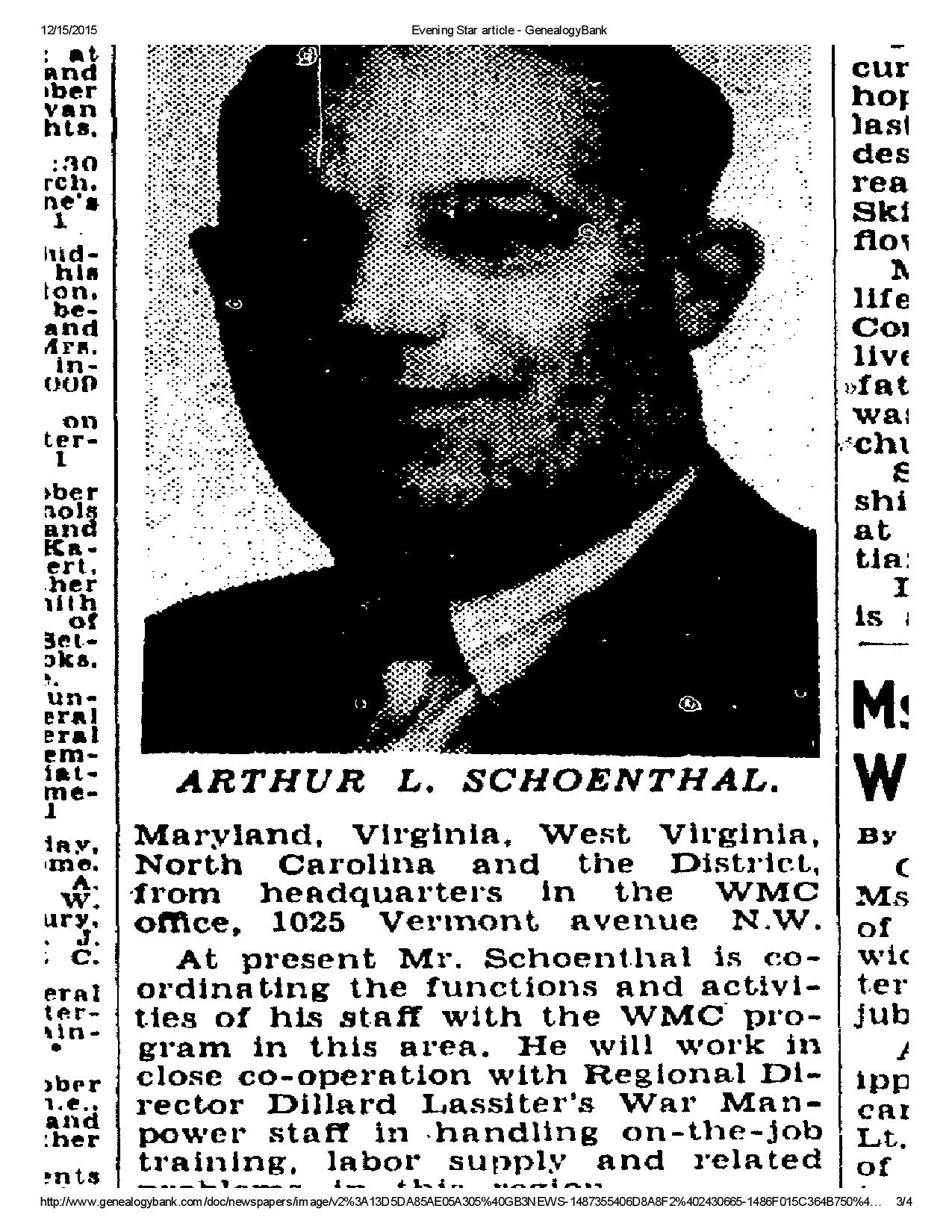
Arthur Schoenthal promoted 1942-page-003


Washington Evening Star, September 14, 1928, p. 9

Washington Evening Star, September 14, 1928, p. 9


Washington Star, December 2, 1928 p. 64

Washington Star, December 2, 1928 p. 64

Washington Evening Star, February 18, 1963, p. 24

Washington Evening Star, February 18, 1963, p. 24


Overall, the Schoenthals in the US prospered; most were successful business owners.  Most of these people appeared to have full and happy lives, although there were some who struggled.  Today there are numerous living descendants of those eight siblings, myself included.

On the other hand, the two siblings who stayed in Germany did not have as happy a legacy.  Jakob died young, and his daughter Henriette was killed in the Holocaust.  His four other children survived and, like their aunts and uncles, ended up in western Pennsylvania. Lee, Meyer, and Erna came before the war.  But Johanna was deported to a camp in Gurs, France, during the war and did not come until 1947.   From these five children, there were just two grandchildren: Helmut Levi, son of Henriette and Julius Levi, and Werner Haas, Erna’s son.  Both grandsons made it to the US before World War II.  Neither had children, however, so there are no living descendants of Jakob Schoenthal and his wife Charlotte Lilienthal.

Jewish Chronicle of Pittsburgh, June 14, 1984, p. 23 ewish+Chronicle+Vol.+23+No.+18 Formed+by+the+union+of:+Jewish+criterion+;++and:+American+Jewish+outlook. http://doi.library.cmu.edu/10.1184/pmc/CHR/CHR_1984_023_018_06141984

Jewish Chronicle of Pittsburgh, June 14, 1984, p. 23
ewish+Chronicle+Vol.+23+No.+18
Formed+by+the+union+of:+Jewish+criterion+;++and:+American+Jewish+outlook.
http://doi.library.cmu.edu/10.1184/pmc/CHR/CHR_1984_023_018_06141984


And finally Rosalie, the youngest child of Levi and Henriette, after living in the US for a few years made the fateful decision to return to Germany to marry Willy Heymann.  They had six children.  Four survived the Holocaust.  The three sons, Lionel, Max, and Walter, settled in Chicago before the war, where Lionel became a well-regarded photographer.   One daughter, Johanna, who was widowed at a young age, followed her stepdaughter Else Mosbach to Sao Paulo, Brazil, to escape the Nazis.

The other two daughters, Helene and Hilda, were murdered in the Holocaust as were Helene’s two daughters, Liesel and Grete.  From Rosalie’s six children, only one grandchild survived, the son of Max Heymann.  I am still hoping to find him.

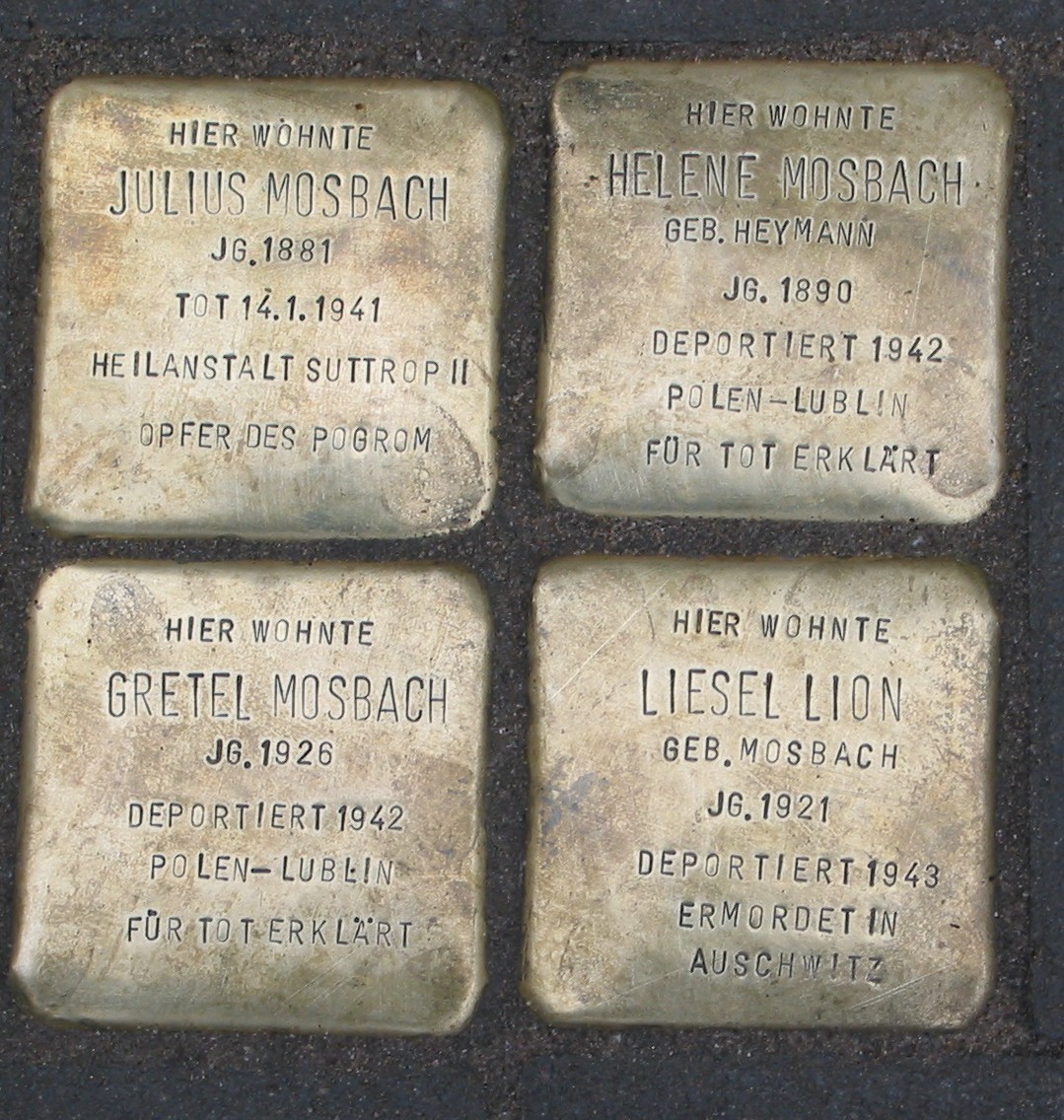
Stolperstein for Julius Mosbach and family

The Schoenthal story illustrates how one fateful decision can alter the future irrevocably. One decision to take a chance and leave what you know—to listen to the call of Lech Lecha, to venture out to a new land—can make all the difference.  By taking a chance that the sweet charoset of that new land would outweigh the bitterness of leaving a land they knew, my great-grandfather and seven of his siblings changed their own fates and those of their descendants.

What if Jakob and Rosalie had left Germany when their siblings did?

And what if the other eight siblings had never left at all?  This story would have a very different ending.

In fact, it never would have been written.


Blog Update: The Mystery of Baby Rose Schoenthal of Atlantic City

Before I move on from the Schoenthal family line, I have a few updates to write about, including some newly discovered cousins and some wonderful photos.  But first an update to one mystery.   Unfortunately an update but not a solution.

Remember the mystery of Baby Rose Schoenthal, the daughter of Jacob Schoenthal and Florence Truempy? She had appeared on the 1930 census as a fifteen month old child living with her parents in Atlantic City.

Jacob Schoenthal and family 1930 US census Year: 1930; Census Place: Atlantic City, Atlantic, New Jersey; Roll: 1308; Page: 10B; Enumeration District: 0003; Image: 129.0; FHL microfilm: 2341043

Jacob Schoenthal and family 1930 US census
Year: 1930; Census Place: Atlantic City, Atlantic, New Jersey; Roll: 1308; Page: 10B; Enumeration District: 0003; Image: 129.0; FHL microfilm: 2341043

Then she disappears.  She does not appear on the 1940 census with her parents or elsewhere as far as I can tell, and there is no death record for her in either New Jersey or Pennsylvania, no obituary for her, no news articles that mention her.  Nothing at all.

Jacob Schoenthal and family 1940 census Year: 1940; Census Place: Atlantic City, Atlantic, New Jersey; Roll: T627_2300; Page: 9A; Enumeration District: 1-9

Jacob Schoenthal and family 1940 census
Year: 1940; Census Place: Atlantic City, Atlantic, New Jersey; Roll: T627_2300; Page: 9A; Enumeration District: 1-9

And she wasn’t buried with her parents.  Nor was she buried with her grandparents.  She just seemed to disappear.

Many people gave me suggestions on where else to look.  Some people thought Rose had been given up for adoption or sent to live elsewhere or institutionalized.  Others thought she was just omitted from the 1940 census and that she might have married and changed her name sometime later.  But I haven’t found any records with her birth name or her parents’ names to link her to a different name, whether she was adopted, institutionalized, or married.

Someone suggested I see if Rose was mentioned in Florence or Jacob’s will or obituary.  I wrote to the Atlantic City public library and asked them to do an obituary search.  Neither obituary mentioned a child.

Atlantic CIty Press July 5, 1967 p 5

Atlantic CIty Press July 5, 1967 p 5


Atlantic City Press February 18, 1976 p 16

Atlantic City Press February 18, 1976 p 16


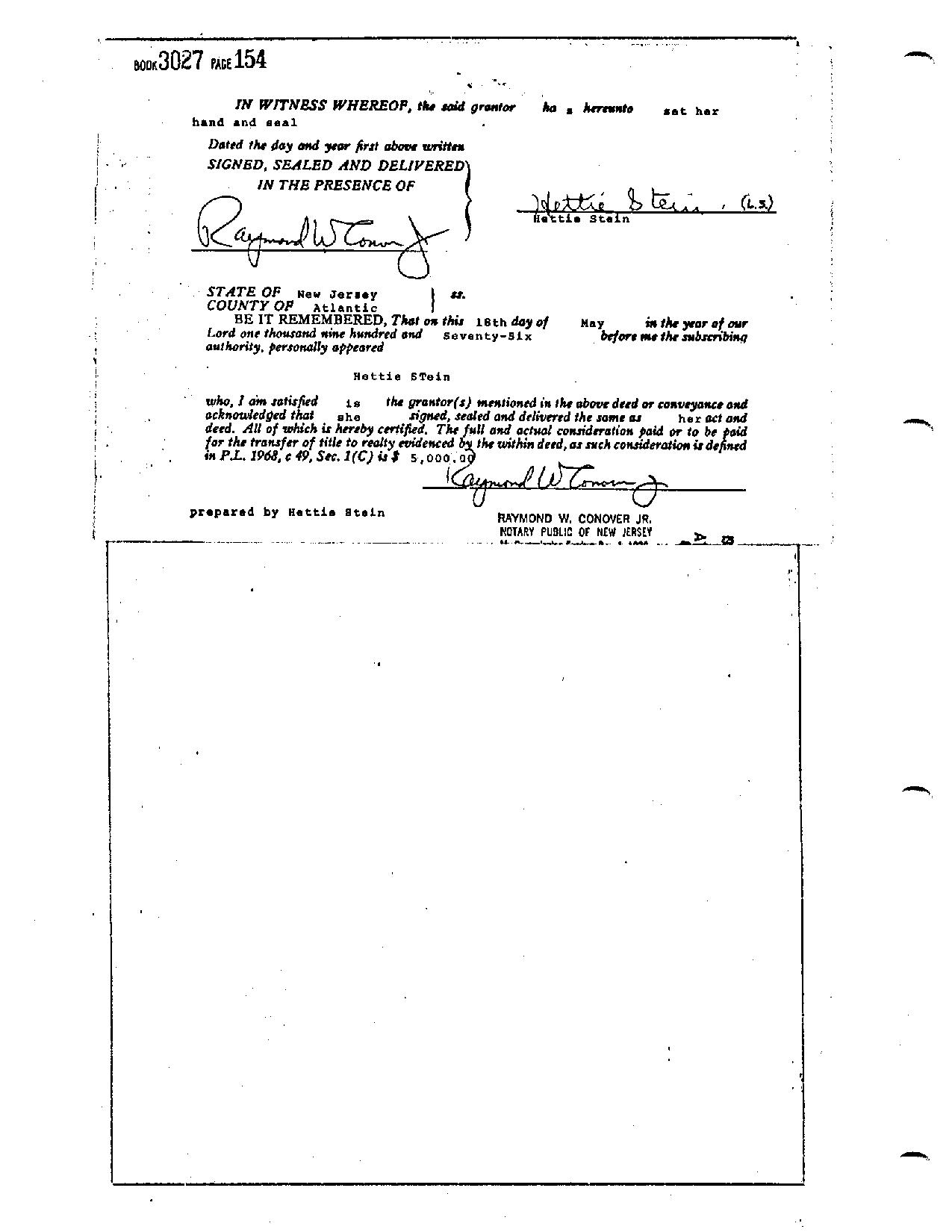
Then I searched the online land records for Atlantic County, and found a record for a May, 1976 transfer of land owned by Jacob Schoenthal.  The transfer had been handled by the executrix of Jacob’s estate, who was not his daughter Rose, but his sister, Hettie Schoenthal Stein.   That meant that Jacob had had a will.


Deed of Jacob Schoenthal s land in Atlantic City-page-001


Deed of Jacob Schoenthal s land in Atlantic City-page-002

Transfer of Deed of Land Belonging to Jacob Schoenthal


I decided to request a copy of his will from the Atlantic County Surrogate’s Court.  That will, seen below though not easily read as reproduced, named the following people as his heirs at law and next of kin: his sister Hettie Schoenthal Stein, his sister Estella Schoenthal Klein, and his brother Sidney Schoenthal.  According to the will, there were no other surviving heirs or next of kin.  There was no mention of Rose or any other child.  (All of Jacob’s other siblings and his wife Florence had already died as of the time of his death in February, 1976.)

Jacob Schoenthal will Jacob will p 2

jacob will p 3

jacob will 4


Thus, Jacob’s daughter Rose either was no longer alive at the time of his death or she had been given up for adoption and thus was no longer his legal kin.  Unfortunately, I don’t know which is the case.  Next step is to check for adoption records.  I’ve contacted the appropriate office and am waiting to see if I am even eligible to request such records.  I frankly think it’s a real long shot, and I think this will remain one of those unsolved mysteries.

But I remain open to other suggestions.


In Memory of Murray Leonard: May 4, 1922-March 27, 2016

Murray Leonard

Murray Leonard

My second cousin Richard Leonard contacted me to let me know that his father, Murray Leonard (born Murray Leonard Goldschlager) had passed away on March 27, 2016, in Tucson, Arizona.  Murray was my mother’s first cousin.  He was the son of David Goldschlager, my grandfather’s younger brother, and Rebecca Schwarz.  He was named for his grandfather, my great-grandfather Moritz Lieb Goldschlager, and shared the same Hebrew name with his first cousin, my uncle Maurice Goldschlager.

I never had the chance to meet Murray, but I know from Richard how well loved he was.  With Richard’s permission, I am quoting from Murray’s obituary and Richard’s own personal tribute:

Murray Leonard, 93, of Tucson, Arizona, passed away peacefully on March 27th 2016. He was born in Scranton, Pennsylvania on May 4th 1922.

Murray grew up in The Bronx, following all the NY Yankee greats.

David Rebecca Sidney and Murray at Brighton Beach

Murray, Sidney, Rebecca and David Goldschlager at Brighton Beach

David and Murray Goldschlager

David and Murray Leonard Goldschlager


When World War Two broke out he answered his country’s call to duty as a PFC in the US Army (83rd Reconnaissance Troup, 83rd Division), participating in the Battle of the Bulge, sustaining injuries and was awarded a Purple Heart.

Ancestry.com. U.S., WWII Jewish Servicemen Cards, 1942-1947 [database on-line]. Provo, UT, USA: Ancestry.com Operations, Inc. Original data: Alphabetical Master Cards, 1942–1947; Series VI, Card Files—Bureau of War Records, Master Index Cards, 1943–1947; National Jewish Welfare Board, Bureau of War Records, 1940–1969; I-52; boxes 273–362. New York, New York: American Jewish Historical Society, Center for Jewish History.

Ancestry.com. U.S., WWII Jewish Servicemen Cards, 1942-1947 [database on-line]. Provo, UT, USA: Ancestry.com Operations, Inc.
Original data: Alphabetical Master Cards, 1942–1947; Series VI, Card Files—Bureau of War Records, Master Index Cards, 1943–1947; National Jewish Welfare Board, Bureau of War Records, 1940–1969; I-52; boxes 273–362. New York, New York: American Jewish Historical Society, Center for Jewish History.

After getting married to the love of his life Edna in 1958, he moved to Tucson, Arizona to pursue a career in the mail-order and retail women’s clothing business with his wife at Old Pueblo Traders and the Vicki Wayne retail stores, retiring at the age of 78.   

He was a keen golfer and enjoyed playing with his buddies as part of the ‘Grumpy Old Men” golfing group, playing until he was 87. He also enjoyed playing the US stock market/investing mostly on his own, including reading the Wall Street Journal every day.

Murray_Leonard_Lacey_Busby_Hadwin_Layla_Hadwin_11_JAN_2014

Murray Leonard


He is survived by a son, Richard (Stephanie) and loving wife of 57 years, Edna Leonard. He was preceded in death by his brother Sidney Goldschlager (Nora) of Rumson, New Jersey and parents, David and Rebecca Goldschlager, who immigrated to the US [from] Iași, Romania. He is also lovingly remembered by all his nieces and nephews as fun-loving “Uncle Mursh”, who would do anything for a laugh.

Richard wrote:

He was a fantastic father, patriotic American and overall great guy. He heeded his country’s call to duty fighting in WWII, seeing combat action in the Battle of the Bulge (getting wounded and was awarded a Purple Heart). A successful businessman retiring at the age of 78, he also was a keen golfer, playing until he was 87. He will be certainly missed but the great memories will always remain! Time to toast him with a Tanqueray & Tonic, his favorite drink!

I will be sure to have that Tanqueray & Tonic in his memory and will think of my cousin Murray, the son of Romanian immigrants who grew up to live the life his parents must have dreamed for him: a long and happy marriage and a loving son, a successful business, and dedicated service to the country that his parents had adopted as their own when coming here as young adults in the early 20th century.

May his memory be for a blessing, and may his family be comforted by their memories.

Murray Leonard older


More Names to Remember and Never Forget

As I move towards closure on my Schoenthal family history, this post has been the hardest one to write.  It is a tragic chapter in that history.

As I’ve already written, four of the six children of my great-great-aunt Rosalie Schoenthal and her husband Willy Heymann left Germany before they could be killed by the Nazis. The three sons went to Chicago, and the oldest daughter Johanna went to Sao Paulo. They all survived.  The other two daughters were not so lucky.

The second oldest daughter, Helene, was born in Geldern in November 9, 1890, a year after Johanna.  She married Julius Mosbach, who was the younger brother of Johanna’s first husband, Hermann Mosbach.  After marrying, Julius and Helene were living in Iserlohn, a town about 80 miles east of Geldern.  According to an article written in 2000 by the archivist of Iserlohn, Gotz Bettge, Julius and Helene Mosbach owned a fruit and vegetable business in the town square in Iserlohn.  They had two daughters: Liesel, who was born March 8, 1921, and Gretel, born October 26, 1926.


Iserlohn By No machine-readable author provided. Asio otus assumed (based on copyright claims). [GFDL (http://www.gnu.org/copyleft/fdl.html), CC-BY-SA-3.0 (http://creativecommons.org/licenses/by-sa/3.0/) or CC BY-SA 2.5-2.0-1.0 (http://creativecommons.org/licenses/by-sa/2.5-2.0-1.0)], via Wikimedia Commons

Iserlohn
By No machine-readable author provided. Asio otus assumed (based on copyright claims). [GFDL (http://www.gnu.org/copyleft/fdl.html), CC-BY-SA-3.0 (http://creativecommons.org/licenses/by-sa/3.0/) or CC BY-SA 2.5-2.0-1.0 (http://creativecommons.org/licenses/by-sa/2.5-2.0-1.0)%5D, via Wikimedia Commons


On December 18, 1939, Liesel married Ernst Georg Lion. From the incredibly moving autobiography written by Ernst Lion entitled The Fountain at the Crossroads and available online here, I was able to learn a great deal about his life and also about the lives of Julius, Helene, and their daughters.  All the information and quotes below are from his book unless otherwise indicated.  (Special thanks to Dorothee Lottmann-Kaeseler for sending me some of the additional links and information.)

Ernst was born December 15, 1915, in Brambauer, the son of Leo Lion and Bertha Weinberg Lion.  When Ernst was a very young child, his father Leo was badly injured while serving in the German army during World War I.   Leo Lion considered himself a German patriot.

Ernst grew up as the only Jewish child in Brambauer during the hard years of the Weimar Republic, but his childhood was overall quite happy. Then Hitler came to power, and his life was forever changed.  The Nazis tried to impose a boycott on his father’s business by having a Gestapo member stand in the doorway and take photographs of those who patronized his store.  Ernst’s father insisted that the man leave, even threatening to beat him up.  He did not think the Nazis would be in power for very long.  But then when the Nuremberg laws were enacted in 1935, the family had to sell their home and their store for less than their value and move to Dortmund.

Many members of the extended Lion/Weinberg family left Germany around that time, but Ernst had difficulty getting the necessary visas and permits to go elsewhere even though he had an affidavit of support from a cousin in New York.  Then on November 9, 1938, Ernst was one of thousands of German Jews who were arrested and sent to Buchenwald in the aftermath of Kristallnacht.  In his autobiography he described in graphic detail his experiences there.  It’s horrifying.

Ernst was released a few weeks later and told to leave the country within three weeks.  All the Jewish businesses were now closed, and he was forced to work on street repairs while waiting to emigrate.


Buchenwald Watch Tower undesarchiv, Bild 183-1983-0825-303 / CC-BY-SA 3.0 [CC BY-SA 3.0 de (http://creativecommons.org/licenses/by-sa/3.0/de/deed.en)], via Wikimedia Commons

Buchenwald Watch Tower
undesarchiv, Bild 183-1983-0825-303 / CC-BY-SA 3.0 [CC BY-SA 3.0 de (http://creativecommons.org/licenses/by-sa/3.0/de/deed.en)%5D, via Wikimedia Commons


But then he met Liesel Mosbach in Iserlohn.  He was introduced by his Aunt Selma who lived there, and they immediately took a liking for each other.  At that time Liesel’s family was living in the apartment above their former business, which had been confiscated by the Nazis.  Julius Mosbach had suffered a nervous breakdown as a result of the harassment by the Nazis and the loss of his business, and he was doing very poorly.

Ernst moved to Iserlohn in 1939, where his aunt was able to help him get a job at a metal working company owned by a family that was unsympathetic to the Nazi government and its policies; the owners even provided Ernst with extra food to supplement the very restrictive allotments allowed to the Jews by the Nazis.

When the Nazis then imposed travel restrictions and required Jews to wear the yellow Star of David, Ernst was no longer able to get to Dortmund to visit his parents.  His mother died shortly thereafter, having given up on life, according to his father; Ernst was not even allowed to go to her funeral.

Yellow badge Star of David called "Judens...

Yellow badge Star of David called “Judenstern”. Part of the exhibition in the Jewish Museum Westphalia, Dorsten, Germany. The wording is the German word for Jew (Jude), written in mock-Hebrew script. (Photo credit: Wikipedia)


On December 18, 1939, Ernst and Liesel were married.  As Ernst wrote, although they had no idea what the future would bring, “The secret of maintaining one’s sanity under those conditions is to live as normal a life as one can.” (p. 18)   Unfortunately, that became more and more difficult to do.  Conditions for the Jews continued to worsen, and there was less food available.  People were beginning to hear about Jews being arrested and sent away.

In January, 1941, Julius Masbach was admitted to a mental hospital and died shortly thereafter.  Ernst wrote (p.15):

We soon discovered that we should have opposed the doctor’s decision [to hospitalize Julius], for the Nazis had decided that all institutionalized, so-called “insane” persons no longer had the right to live and had become a burden to society.  They were led into sheds equipped with gasoline engines, which were installed in reverse fashion: the exhaust escaped to the inside of the building.  After they were asphyxiated, the bodies were burned and the ashes delivered to the surviving families.  No one realized that this activity was the rehearsal for later mass destruction of humans.

On April 28, 1942, Helene Heymann Mosbach, my grandmother’s first cousin, and her daughter Gretel, just sixteen years old, were arrested and sent to Zamosc, near Lublin, Poland.  They were never heard from again.  Ernst’s father Leo Lion was also arrested around this time, and Ernst never heard from him again either.

To add to this heartbreaking account, Helene’s sister Hilda, the youngest of the six children of Rosalie Schoenthal and Willy Heymann, was also killed by the Nazis.  Although she is not mentioned in Ernst Lion’s autobiography or on the website memorializing the Mosbach family, according to Yad Vashem, Hilda also had been living in Iserlohn before being sent Zamosc where her sister Helene and niece Gretel had been deported.   I assume that Hilda had moved to Iserlohn to live with her sister Helene after both her mother Rosalie (1937) and her father Willy (1939) had died.

I had not heard of Zamosc before, and my friend Dorothee Lottmann-Kaeseler sent me this link that reveals the absolutely horrifying story of this place.  There are no records of what happened specifically to Helene, Gretel, and Hilda, but it is possible that they were killed in Zamosc itself or deported to the death camp at Majdanek or Belzec or Sobibor, where they were killed.


Crematoria at Majdanek death camp near Lublin, Poland Deutsche Fotothek‎ [CC BY-SA 3.0 de (http://creativecommons.org/licenses/by-sa/3.0/de/deed.en)], via Wikimedia Commons

Crematoria at Majdanek death camp near Lublin, Poland
Deutsche Fotothek‎ [CC BY-SA 3.0 de (http://creativecommons.org/licenses/by-sa/3.0/de/deed.en)%5D, via Wikimedia Commons

On February 26, 1943, Ernst and Liesel received orders to report to a school in Dortmund with just one suitcase each.  There were about a thousand people at the school that night, and everyone was forced to sleep on the floor. Ernst wrote, “They took our wedding bands and watches, telling us that we would not need them where we were going.” (p. 19)

The next morning they were put on a freight train (pp.19-20):

I found myself inside such a freight car among a hundred men, women and children.  The doors were locked; there were no windows to look through.  This precaution would keep us from recognizing our route or destination.  A few buckets for relief, no food or water.  This should be a short ride, I mused.

… Liesel was shoved on this train with me.  At least we were together.  Just twenty-three, she was a thin, wiry lady, strong and energetic.  Her dark eyes expressed the will to endure.  I was twenty-four.  Where was our future?

Although they were told they were being taken to a safe place for resettlement, Ernst was skeptical, as he had good reason to be.  They were being taken to Auschwitz-Birkenau.  When they arrived, they were told to leave their suitcases on the train; then they stepped onto the platform surrounded by SS guards and prisoners in striped uniforms who were helping with the unloading.

Then the men and women were separated.

Ernst wrote, “All the women were led away.  My wife looked at me for one last time before she disappeared.  It was dark now, and I saw her walk away like a shadow.”

He never saw her again.  Liesel Mosbach Lion, my father’s second cousin, was murdered at Auschwitz.


English: Aushwitz I crematoria memorial

English: Aushwitz I crematoria memorial (Photo credit: Wikipedia)


I consider the entire family to be victims of the Holocaust: Rosalie, Willy, Helene, Julius, Liesel, Gretel, and Hilda as well as Leo and Bertha Lion.


Stolperstein for Julius Mosbach and family


Ernst Lion, however, survived.  The story of how he survived is remarkable.  It’s a tale of incredible courage, strength, persistence, and luck. It’s also a horrifying, nightmarish account of how cruel human beings can be to one another.  You should all read it.  I cannot do it justice in a blog post.  You must read it.  Again, you can find it here.  Please read it.

I am so grateful that Ernst, Liesel’s husband, survived and recorded his story and their story for us all to read.  We must never forget.


My Cousin in Sao Paulo

In an earlier post I mentioned that I had been fortunate to have several German sources of information about Rosalie Schoenthal Heymann, her husband Willy, and their six children, three sons, Lionel, Walter, and Max, and three daughters, Johanna, Helene, and Hilda.  I’ve already posted about the lives of the three sons. This post and the next will tell about the lives of the three daughters.

The death notice for one of those sons, Lionel, mentioned a sister named Henny Mosbach Rothschild; his full obituary mentioned an unnamed sister living in Sao Paulo, Brazil.


Ancestry.com. Historical Newspapers, Birth, Marriage, & Death Announcements, 1851-2003 [database on-line].

Ancestry.com. Historical Newspapers, Birth, Marriage, & Death Announcements, 1851-2003 [database on-line].

Ancestry.com. Historical Newspapers, Birth, Marriage, & Death Announcements, 1851-2003 [database on-line].

Ancestry.com. Historical Newspapers, Birth, Marriage, & Death Announcements, 1851-2003 [database on-line].


From the Steinheim site, I knew that the second-born child of Rosalie (Schoenthal) and Willy Heymann was their daughter Johanna; that site reported that Johanna was born in 1889, married someone named Mosbach, and died in Brazil.  From the Juden in der Geschichte des Gelderlandes book, I learned that Johanna’s husband was Hermann Mosbach, a merchant in Ratingen, and that they had married on April 8, 1915.


page 370 for blog

Bernhard Keuck and Gerd Halmanns, eds., Juden in der Geschichte des Gelderlandes, p. 370

Thus, I assumed that the sister mentioned in the obituary and the one named in the death notice were one and the same: Johanna (“Henny”) Schoenthal, who had married a man named Hermann Mosbach and who had ended up in Brazil.  But I didn’t know anything about what had happened in between: Why had she gone to Brazil, not Chicago where her three brothers were living? When had she gotten there? What had happened to Hermann Mosbach? And who was the apparent second husband named Rothschild?

I did not find anything helpful on Ancestry, but on FamilySearch.org, I found two records from Brazil. The first was a record for a widow (“viuva”), Johanna Mosbach, born February 27, 1889, in Geldern, Germany, daughter of Willy Heymann and Rosalie Schoenthal.  She was being admitted to Brazil as a permanent resident.  The card was dated February 18, 1939, and indicated that she had arrived at the Porto de Santos on the ship Monte Sarmento.


Brasil, São Paulo, Cartões de Imigração, 1902-1980," database with images, FamilySearch (https://familysearch.org/ark:/61903/1:1:QKD5-RQ52 : accessed 31 March 2016), Joana Mosbach Rothschild, 1939; citing Immigration, São Paulo, São Paulo, Brazil, certificate 544986, registration 20634, Arquivo Público do Estado de São Paulo (São Paulo State Public Archives, São Paulo).

Brasil, São Paulo, Cartões de Imigração, 1902-1980,” database with images, FamilySearch (https://familysearch.org/ark:/61903/1:1:QKD5-RQ52 : accessed 31 March 2016), Joana Mosbach Rothschild, 1939; citing Immigration, São Paulo, São Paulo, Brazil, certificate 544986, registration 20634, Arquivo Público do Estado de São Paulo (São Paulo State Public Archives, São Paulo).


The second record I found for Johanna through FamilySearch’s Brazil database was not dated, but was presumably some years later.  Her name is now recorded as Joana Mosbach Rothschild, same birth date as above, and she is now “casada” or married.  She was apparently still an alien as this was a card issued by the public security secretary for registration of foreigners or “estrangeiros.”


Brasil, São Paulo, Cartões de Imigração, 1902-1980," database with images, FamilySearch (https://familysearch.org/ark:/61903/1:1:QKJG-XR67 : accessed 31 March 2016), Joana Mosbach, 1939; citing Immigration, São Paulo, São Paulo, Brazil, certificate 20634, registration 544986, Arquivo Público do Estado de São Paulo (São Paulo State Public Archives, São Paulo).

Brasil, São Paulo, Cartões de Imigração, 1902-1980,” database with images, FamilySearch (https://familysearch.org/ark:/61903/1:1:QKJG-XR67 : accessed 31 March 2016), Joana Mosbach, 1939; citing Immigration, São Paulo, São Paulo, Brazil, certificate 20634, registration 544986, Arquivo Público do Estado de São Paulo (São Paulo State Public Archives, São Paulo).


But that was as far as I could get without more assistance, so I sent an inquiry to a woman named Anita on the JewishGen Family Finder, who listed Mosbach as one of her family names.  I also wrote to three of the JewishGen listservs, including one for Latin America.  Once again, the genealogy village came through and provided me with helpful suggestions and ultimately many answers.

First, Anita from the JewishGen Family Finder sent me three links that provided more information about Johanna and her first husband Hermann Mosbach.  All pertained to the Jewish community in Ratingen, Germany, before World War II.  From these three sources, I learned that Johanna was Hermann Mosbach’s second wife and that he’d had a daughter named Else with his first wife.  Hermann was born on July 18, 1877, and died on October 30, 1931, in Ratingen, when he was 54 years old.  Here is a photograph of Hermann, standing far right.


(Caption under photograph says, “Hermann Mosbach, owner of the “Rheinische department store C. Schmidt & Co.”, was a member of the Catholic Mercantile Association (CISO). In the picture he is seen at an event of the club in the second row on the right. (1928).”

These sources also indicated that Hermann’s daughter Else had immigrated to Brazil in 1936 and that Johanna also had left Ratingen by 1936.  Three years later she arrived in Brazil, presumably to be with her stepdaughter Else.  That might explain why she did not go to Chicago to be with her brothers.

I was curious as to why Else and then Johanna would have selected Brazil as their new home.  Was there a Jewish community there? Why Sao Paulo?

According to the Jewish Virtual Library, Sao Paulo had a long history of being a city that welcomed immigrants, receiving over three millions immigrants from all over the world before 1940.  Jewish immigrants began to arrive in the late 19th century, but Jewish immigration really surged in the 1920s as immigration obstacles in the US and Canada made those less likely destinations for Jews leaving Europe.  Sao Paulo, however, welcomed these immigrants, and during the 1920s, synagogues, Jewish schools, cemeteries, and other institutions were created to serve the growing Jewish population.  After Hitler came to power in 1933, there was another large influx of Jewish immigrants to Sao Paulo.  Thus, it made sense that Else Mosbach and her stepmother, Johanna Heymann Mosbach, would have settled there.

English: aerial photograph of Sao Paulo Brazil...

English: aerial photograph of Sao Paulo Brazil 2010 (Photo credit: Wikipedia)


Neither Anita nor I could find any information about what happened to Johanna or her stepdaughter Else once they got to Brazil.

Fortunately, I then heard from Sandra through the LatinAmSig on JewishGen; she was born in Sao Paulo, Brazil; her family had also immigrated there to escape Nazi Germany.  Sandra was incredibly generous and had asked her mother to see if she could find any information about Johanna or Else; she then sent me three links to additional online sources, including links to two newspaper articles regarding Else Mosbach Simon’s successful application to become a citizen of Brazil in 1950.

From those articles, I learned that Else was born on February 8, 1905, to Hermann and Selma Mosbach.  Thus, Else had been only ten years old when Johanna married her father in 1915, further explaining why Johanna would have moved to Sao Paulo—to be closer to the child she had helped to raise.  Else had married someone with the surname Simon by 1950, but unfortunately, I’ve not yet found out more information about her.

Sandra also gave me a link to the Arquivo Historico Judaico Brasileiro and suggested I contact the synagogues and Jewish cemeteries in Sao Paulo.  She then translated into Portuguese an email I drafted and sent it to a person she knew at the synagogue when I had trouble trying to contact them directly through their website.  From these sources, I learned that Johanna had died on September 11, 1971, and was buried at the Buntantan cemetery in Sao Paulo.  She was 82 years old.


By Dornicke (Own work) [CC BY 3.0 (http://creativecommons.org/licenses/by/3.0) or GFDL (http://www.gnu.org/copyleft/fdl.html)], via Wikimedia Commons

Synagogue Beth El in Sao Paulo By Dornicke (Own work) [CC BY 3.0 (http://creativecommons.org/licenses/by/3.0) or GFDL (http://www.gnu.org/copyleft/fdl.html)%5D, via Wikimedia Commons

The pieces were starting to come together, except that I still had no information about Johanna’s presumed second husband named Rothschild.  Then someone sent me (I apologize for failing to note who that was) this marriage announcement in the September 29, 1957 issue of the O Estado de Sao Paulo (p. 12) for someone named Hans Joseph Schmitz, described as the son of Ferdinand Rothschild and Johanna Mosbach Rothschild:


Could this be my Johanna? Could she have remarried and had a son born sometime after 1939 who was now marrying—although he could be no more than 18 years old?  That seemed unlikely, but now at least I had a first name to use for her presumed second husband.

I found a tree on Ancestry that included Ferdinand Rothschild and contacted the tree’s owner, Rainer.  He informed me that Ferdinand Rothschild had married Johanna Heymann on April 9, 1955, when Johanna was already 66 years old and Ferdinand was 67.  Ferdinand had been previously married to Grete or Gretchen Schmitz, Rainer’s great-aunt, who had died in Brazil on April 29, 1939.  Hans was her son.  He died on April 5, 1970, according to these death notices from the April 7, 1970, issue of O Estado de Sao Paulo, p. 35:


Hans Schmitz death notice April 7, 1970 O Estado de Sao Paulo Hans schmitz second death notice same paper p 35 same as other april 1970 o estado


Rainer also sent me Ferdinand’s death record.  He had died on December 31, 1958, while on a visit to Germany  and was buried in Dusseldorf, Germany, not in Sao Paulo where Johanna was living.  At the bottom of that record you can see a reference to the marriage date for Ferdinand and Johanna.


Ferdinand Rothschild death certificate

Ferdinand Rothschild death certificate


Johanna and Ferdinand had been married only three years when he died; he was seventy years old.  Johanna would outlive her second husband by another thirteen years, dying, as noted above, on September 11, 1971, in Sao Paulo.  Like her brothers Lionel and Walter, Johanna left no descendants behind, except for her stepdaughter Else Mosbach Simon and her stepson Hans Joseph Schmitz.

Once again, I am very grateful to all those who helped me put together these pieces of my cousin Johanna Heymann Mosbach Rothschild’s life, including my new cousins-by-marriage, Rainer and Anita, and especially Sandra, without whom I’d never have been able to learn where and when Johanna died and was buried.

That leaves me with the two remaining daughters of Rosalie Schoenthal and Willy Heymann: Helene and Hilda.


Lionel Heymann: His Other Life

In my earlier post, I wrote about the three sons of my great-great-aunt Rosalie Schoenthal and her husband Willy Heymann:  Lionel, Walter, and Max.  All three had left Germany and settled in Chicago by 1939.

The oldest brother, Lionel, had arrived first in the 1920s and had consistently reported on passenger manifests and census records that he worked as a hotel waiter.  So I was quite surprised when I found this obituary written when Lionel died in November, 1966:


Ancestry.com. Historical Newspapers, Birth, Marriage, & Death Announcements, 1851-2003 [database on-line].

Chicago Tribune, December 2, 1966, Ancestry.com. Historical Newspapers, Birth, Marriage, & Death Announcements, 1851-2003 [database on-line].

According to the obituary, Lionel Heymann had had a long and distinguished career as a photographer.  The obituary states that he had retired in 1964 after 40 years as a photographer in Chicago, including 25 years as the photographer at the Blackstone Hotel.  That is, although Lionel consistently listed his occupation as a waiter on various government forms, if the obituary is for the same man, he had been working as a photographer since 1924—in other words, since his very earliest days in Chicago.

But was this in fact the same Lionel Heymann?  The name and age and residence in Chicago certainly made it seem so, but there were no named survivors in the obituary, just an unnamed sister living in Brazil.  Could this be my cousin?

I then found a death notice for Lionel Heymann on the same date in the same paper that contained further information about his surviving family:


Ancestry.com. Historical Newspapers, Birth, Marriage, & Death Announcements, 1851-2003 [database on-line].

Chicago Tribune, December 2, 1966, Ancestry.com. Historical Newspapers, Birth, Marriage, & Death Announcements, 1851-2003 [database on-line].

This obviously was my cousin, whose two sisters-in-law were named Frieda and Lucy (or Lucie).  He was in fact the photographer described in the first obituary.

And he was not just a hotel photographer taking snapshots of guests. When I Googled his name and “photographer,” a number of links popped up, listing Lionel as an artist whose works are still being  auctioned by various art houses, online and elsewhere.  Lionel also wrote articles about photography and lectured frequently about the art of portrait photography. His works include portraits, nudes, architectural works, and highly stylized artistic photographs.

Here are two examples of the work done by Lionel Heymann; see the links above for others:

"The Shell", photograph by Lionel Heymann, April 1932 Camera Craft Magazine, accessed at http://s3.amazonaws.com/everystockphoto/fspid30/72/22/91/5/vintage-photograph-cameracraft-7222915-o.jpg

“The Shell”, photograph by Lionel Heymann, April 1932 Camera Craft Magazine, accessed at http://s3.amazonaws.com/everystockphoto/fspid30/72/22/91/5/vintage-photograph-cameracraft-7222915-o.jpg


Photograph by Lionel Heymann of Robert Maynard Hutchins, University of Chicago president (1929-1945) and chancellor (1945-1951), with team members of the Manhattan Project, the program established by the United States government to build the atomic bomb. Standing, from left: Mr. Hutchins, Walter H. Zinn, and Sumner Pike; seated: Farrington Daniels, and Enrico Fermi. University of Chicago Photographic Archive, [apf digital item number, e.g., apf12345], Special Collections Research Center, University of Chicago Library. accessed at http://photoarchive.lib.uchicago.edu/db.xqy?one=apf1-05063.xml

Photograph by Lionel Heymann of Robert Maynard Hutchins, University of Chicago president (1929-1945) and chancellor (1945-1951), with team members of the Manhattan Project, the program established by the United States government to build the atomic bomb. Standing, from left: Mr. Hutchins, Walter H. Zinn, and Sumner Pike; seated: Farrington Daniels, and Enrico Fermi. University of Chicago Photographic Archive, [apf digital item number, e.g., apf12345], Special Collections Research Center, University of Chicago Library. accessed at http://photoarchive.lib.uchicago.edu/db.xqy?one=apf1-05063.xml


Why hadn’t Lionel claimed on the census records and World War II draft registration that he was a photographer? Why wouldn’t he have wanted to reveal that information?  Was it just an avocation, not his livelihood?  Did that change after the 1940s?

UPDATE:  In the course of looking for a print of one of Lionel’s photographs to purchase (which I’ve not yet been able to locate), I found this bit of information about Lionel online, quoting from the catalog of  the Sixteenth Detroit International Salon of Photography, Photographic Society of Detroit, Detroit Institute of Arts, 1947.

“Started photography as a hobby by joining Fort Dearborn Camera Club in Chicago in 1928. Started professionally January 1945, and conducts a portrait studio in Blackstone Hotel. Conducts a weekly photographic class on portrait and paper negative process. Associated professionally with a photographer in Detroit, 1937-38.”

This explains so much.  First, it explains what Lionel was doing in Detroit when his brother Walter arrived in 1938.  Second, it explains why Lionel did not list photography as his occupation on the 1930 or 1940 census or on his World War II draft registration.

The obituary and death notice not only revealed that Lionel was a well-known photographer, but also provided more clues about his family.   First, who was this sister in the death notice named Henny Mosbach Rothschild? And was she the one described as living in Brazil in the obituary? And second, who was the nephew named Robert Heyman?

Since only one of Lionel’s brothers had had a child, I assume that this had to be Klaus Heymann, the son of Lionel’s brother Max. Unfortunately, I’ve not been able to yet find out more about Klaus Heymann/Robert Heyman, but I have requested the military records of a Klaus Robert Heymann from the national archives and hope that those records will relate to my cousin.  If so, I will provide an update.

As for the sister named Henny Mosbach Rothschild, I will address her in my next post.