Where Did Baby Rose Go?

Although there are a number of unresolved matters in this post, the big question left is — what happened to little Rose Schoenthal, the daughter of Jacob Schoenthal and Florence Truempy?  Maybe you can help me.

Having now worked through the first five children of Simon Schoenthal and Rose Mansbach (Harry, Gertrude, Louis, Maurice, and Martin), it’s clear that Atlantic City had a strong hold on the family.  Although Simon had first settled in Pittsburgh and he and Rose had married there and had their first three children there, they had left for Philadelphia by 1880 and then around 1892 for Atlantic City.  Atlantic City is where they stayed.


Embed from Getty Images

Their oldest child Harry[1] lived there for most of his adult life after spending about ten years in Philadelphia between 1910 and 1920.  Gertrude and Martin also left and returned, Gertrude after about 20 years in Arizona, Martin after about ten years in Chicago.  Only Maurice and Louis of the siblings I’ve covered so far moved away from Atlantic City permanently.  Louis moved to California and never returned.  Maurice moved to the Midwest in about 1910 where he met and married his wife Blanche, a Missouri native.  Maurice and Blanche lived almost all of their married life in Chicago.

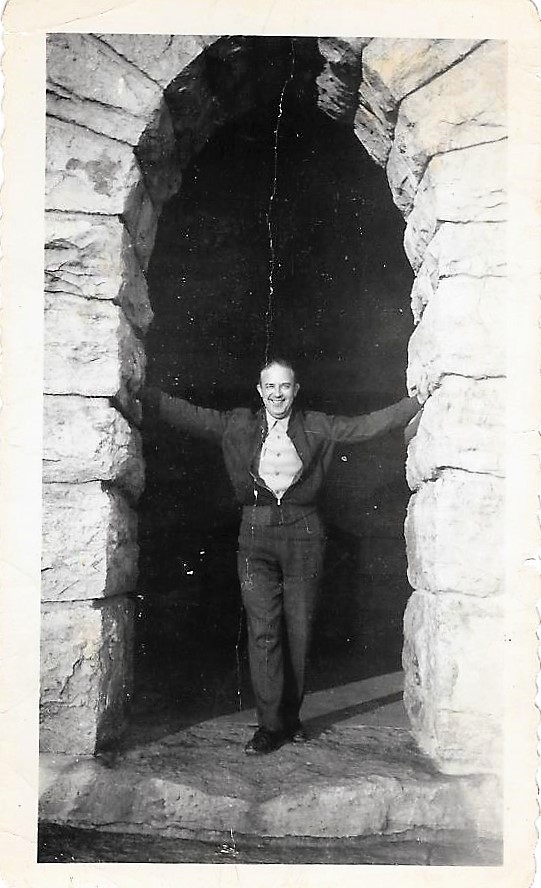
Of the four remaining children of Simon and Rose—Jacob, Hettie, Estelle, and Sidney—two were Atlantic City “lifers” —Jacob and Estelle.   Jacob was born in 1883 in Philadelphia; Estelle was born in Philadelphia in 1889. They were both children when the family moved to Atlantic City.  In 1900 when he was seventeen, Jacob was working in the laundry business with his brother Martin and living with his parents and siblings.

Jacob Schoenthal courtesy of the family of Hettie Schoenthal Stein

Jacob Schoenthal
courtesy of the family of Hettie Schoenthal Stein

Here is a photograph of Estelle, on the right, taken with her sister Hettie in 1906.

Hettie Schoenthal and Estelle Schoenthal, 1906 courtesy of the family of Hettie Schoenthal Stein

Hettie Schoenthal and Estelle Schoenthal, 1906
courtesy of the family of Hettie Schoenthal Stein


In 1910, Jacob and Estelle were both still living at home; their father had died in 1904, and they were living with their mother and their younger brother Sidney.  Jacob and Martin were still working in the family laundry business.  In 1911 Sidney joined them in that endeavor, called Incomparable Laundry.

Incomparable Laundry Schoenthals brothers 1911 Atlantic City directory Ancestry.com. U.S. City Directories, 1822-1995 [database on-line]. Provo, UT, USA: Ancestry.com Operations, Inc., 2011. Original data: Original sources vary according to directory.

Incomparable Laundry
Schoenthal brothers 1911 Atlantic City directory
Ancestry.com. U.S. City Directories, 1822-1995 [database on-line]. Provo, UT, USA: Ancestry.com Operations, Inc., 2011.
Original data: Original sources vary according to directory.

Their sister Hettie later wrote about the family laundry business:

When we moved to Atlantic City my father went into business. He had a stationery store. Next door was a cigar store and laundry office. The laundry was called the Incomparable Laundry. We had a branch of it. Two of my brothers had a big laundry wagon with big hampers to put the bundles. They’d pick it up on Monday and take it to Philadelphia, then deliver it on Friday. Some people brought their own bundles. Nobody had washing machines then. They had washboards and tin tubs for doing laundry at home.[2]

But in 1912 and in 1913, only Jacob was listed in the Atlantic City directories in connection with Incomparable Laundry.  Martin and Sidney had left Atlantic City, and the only Schoenthals listed in the directories for those two years were Jacob, Estelle, and Rose (their mother), all living at the same address, 25  Massachusetts Avenue.

Then in 1914, Jacob is the sole Schoenthal listed at all in the Atlantic City directory, still associated with Incomparable Laundry.  Where were his mother and his sister Estelle?
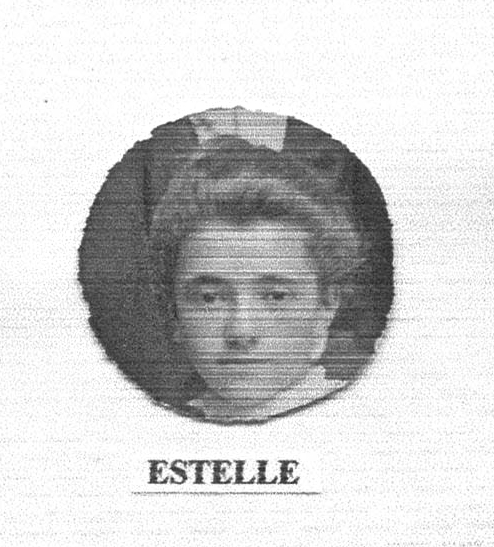
Estelle Schoenthal courtesy of the family of Hettie Schoenthal Stein

Estelle Schoenthal
courtesy of the family of Hettie Schoenthal Stein

I knew that Rose had been in Arizona with Gertrude in 1917 from my research of Martin Schoenthal, but was she also there in 1914? A search of the 1914 Tucson directory revealed that Estelle Schoenthal was living there that year at the same address as her sister Gertrude, 516 South 5th Avenue.  Perhaps Rose was there as well, just not included in the directory.  Estelle was working as a cashier at a business called Steinfeld’s.

Estelle Schoenthal 1914 Tucson, Arizona directory Ancestry.com. U.S. City Directories, 1822-1995 [database on-line]. Provo, UT, USA: Ancestry.com Operations, Inc., 2011. Original data: Original sources vary according to directory.

Estelle Schoenthal 1914 Tucson, Arizona directory
Ancestry.com. U.S. City Directories, 1822-1995 [database on-line]. Provo, UT, USA: Ancestry.com Operations, Inc., 2011.
Original data: Original sources vary according to directory.

And then between 1915 and 1918, there is not one Schoenthal listed in the Atlantic City directories. Harry was still in Philadelphia; Gertrude and presumably Rose and Estelle were in Arizona as was Hettie; Martin and Maurice were in Chicago; Louis and Sidney were in California.  Where was Jacob?

Jacob was still in Atlantic City in 1915, according to the New Jersey census of that year.  He was listed as single and working as a driver. (Thank you to Marilyn Silva for sending me a copy of that census record.)  In September 1918, when Jacob registered for the draft, he was still living in Atlantic City, married to a woman named Helen.  He was still working as a driver–for Abbott Dairy.

Jacob Schoenthal World War I draft registration Ancestry.com. U.S., World War I Draft Registration Cards, 1917-1918 [database on-line]. Provo, UT, USA: Ancestry.com Operations Inc, 2005. Original data: United States, Selective Service System. World War I Selective Service System Draft Registration Cards, 1917-1918. Washington, D.C.: National Archives and Records Administration. M1509, 4,582 rolls.

Jacob Schoenthal World War I draft registration
Ancestry.com. U.S., World War I Draft Registration Cards, 1917-1918 [database on-line]. Provo, UT, USA: Ancestry.com Operations Inc, 2005.
Original data: United States, Selective Service System. World War I Selective Service System Draft Registration Cards, 1917-1918. Washington, D.C.: National Archives and Records Administration. M1509, 4,582 rolls.

Thus, it appears that Jacob may have never left Atlantic City between 1915 and 1918 when the rest of his family had left to go west; he may be simply missing from the Atlantic City directories for those years.

By 1920 Jacob’s older brother Harry, his younger sister Estelle, and his mother Rose were back in Atlantic City.  Harry was married with two young children and working as a clerk in a hotel, and his mother and his younger sister Estelle were also living with him.

Jacob is listed in the 1920 Atlantic City directory still married to Helen and living at 421 Pacific Avenue and working in the real estate business.  But according to the 1920 census, Jacob was single and boarding with a family living on Atlantic Avenue.  The census record listed his occupation as an agent in the produce business.  Since the census is dated January 16, 1920, I thought that the directory for 1920, probably compiled in late 1919, predated the census and that thus Jacob’s marriage to Helen had ended by January 1920, and he had moved out and changed jobs.

But then in the 1921 Atlantic City directory, Jacob is still listed with Helen, living at 408 Murdock Terrace and working in the real estate business.

Jacob is not listed in the 1922 or the 1923 Atlantic City directories.  When he reappears in the 1924 directory, he is listed with a new wife named Florence.

Jacob and Florence Schoenthal 1924 Atlantic City directory Ancestry.com. U.S. City Directories, 1822-1995 [database on-line]. Provo, UT, USA: Ancestry.com Operations, Inc., 2011.

Jacob and Florence Schoenthal 1924 Atlantic City directory
Ancestry.com. U.S. City Directories, 1822-1995 [database on-line]. Provo, UT, USA: Ancestry.com Operations, Inc., 2011.

What happened to Helen? Where was Jacob in 1922 and 1923? And who was Florence?

All good questions, but so far I can only answer the last one.  I asked for help from the New Jersey Genealogy group on Facebook, and an incredibly generous member, Marilyn Silva, volunteered to look for marriage records for Jacob in the archives in Trenton, New Jersey.  Marilyn concluded after searching several different ways for all possible years that there were no New Jersey marriage records for Jacob Schoenthal either to a woman named Helen or to a woman named Florence.

Where else could Jacob have married Helen and Florence? Pennsylvania? Had he gone to Arizona or California or Illinois where his various siblings were living? I haven’t found one document that explains where and when Jacob married Helen or Florence or where he was living in those years. I don’t even know Helen’s birth name or where she was born or when.

But I do know something about Jacob’s second wife, Florence.  She was born Florence A. Truempy on December 30, 1892, in Pennsylvania (probably Philadelphia).  She was the daughter of Daniel Truempy and Annie Christina Lipps.  Daniel was born in Switzerland, Annie in Germany.  They had married in Philadelphia in 1883 and had had two sons before Florence was born in 1892.  Then when Florence was only three months old, her father died from inflammation of the lungs. He was only 27 years old and left behind three very young children.

Daniel Truempy death certificate Pennsylvania, Philadelphia City Death Certificates, 1803-1915," database with images, FamilySearch (https://familysearch.org/ark:/61903/1:1:J6MC-B24 : accessed 12 February 2016), Daniel Truempy, 19 Mar 1893; citing cn 20331, Philadelphia City Archives and Historical Society of Pennsylvania, Philadelphia; FHL microfilm 1,902,335.

Daniel Truempy death certificate
Pennsylvania, Philadelphia City Death Certificates, 1803-1915,” database with images, FamilySearch (https://familysearch.org/ark:/61903/1:1:J6MC-B24 : accessed 12 February 2016), Daniel Truempy, 19 Mar 1893; citing cn 20331, Philadelphia City Archives and Historical Society of Pennsylvania, Philadelphia; FHL microfilm 1,902,335.


Florence’s mother Annie remarried in 1894; her second husband was John Geary O’Connor, born in Ireland. In 1900 Florence was living with her mother, stepfather, and half-sister Mabel in Philadelphia.  Her stepfather John O’Connor was working as a police officer.  Florence is listed as “O’Connor” in the 1900 census, so I thought perhaps John had adopted her.  But on the 1910 census she and her two brothers are living in John O’Connor’s household and listed as his stepchildren, their surname as Truempy.  Florence was then seventeen years old. The family was at that time living in Camden, New Jersey, across the river and the state line from Philadelphia.  John had no occupation listed, but his wife Anna was working as a laborer for an oil cloth company. (I do wonder whether the enumerator placed John’s occupation on the line for Anna, but that’s just sexist speculation on my part.)

In the 1911 and 1912 directories for Camden, Florence is listed as working as a waitress and living at the same address as her two brothers. But in 1920 Florence is not listed with her mother, stepfather, and siblings on the census.  I don’t know where Florence went.  Like Jacob, she does not appear on any record I could find during those years until she re-appears in the 1924 directory for Atlantic City, married to Jacob.  Perhaps Florence had been married to someone else in that period, just as Jacob had been married to someone named Helen during the 1910s.  I don’t yet know.  But Jacob and Florence stayed married to each other for the rest of their lives.  Assuming they were married in about 1923, Jacob would have been 40 when they married, Florence 31.

English: Seascape with Distant Lighthouse, Atl...

English: Seascape with Distant Lighthouse, Atlantic City, New Jersey by William Trost Richards. Oil on canvas, 29.9 x 50.8 cm. Carmen Thyssen-Bornemisza Collection on loan to Museo Thyssen-Bornemisza, Madrid. (Photo credit: Wikipedia)

Meanwhile, Jacob’s sister Estelle also married sometime in the early 1920s.  Her husband Leon Klein was born in 1879 in Alsace-Lorraine, then under German control, and had immigrated to the US as a young child in 1881. After living in Philadelphia, the Klein family had relocated to Atlantic City.  In 1910, Leon and his brothers Abraham and Charles were the owners of a delicatessen in Atlantic City called Klein Brothers.  They were still listed that way in the 1916 Atlantic City directory.

But when he registered for the draft in September 1918, Leon was working as a grocer, living in Philadelphia.  In 1920, he was living with his brother Abraham and sister Rose in Philadelphia and still working as a grocer.  Then he returned to Atlantic City, where he is listed in the 1922 directory, married to Estelle, working as a grocer.  If he and Estelle married in 1921, they would have been 40 and 32 years old, respectively, when they married.

Thus, both Jacob and his sister Estelle married at “mature” ages for that generation.

Leon and Estelle had two sons in the 1920s, Morton and Robert.  By 1927, Leon had left the grocery business and was working in the hotel business like so many of his Schoenthal in-laws.  The 1928 and 1929 directories list his occupation as salesman; the 1930 census recorded his occupation simply as clerk, and the 1931 directory described him once again as a salesman.

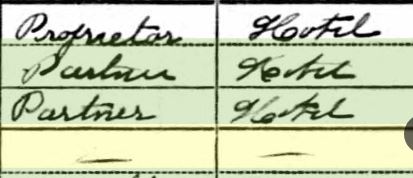
The 1935 Atlantic City directory listing for Leon Klein reads, “Klein, Leon (Estella; Klein Haven).”  Klein Haven was also listed separately as “Klein Haven (Leon Klein) furn rms.” Was Leon in the hotel business or a salesman? I was confused by the flip-flopping of his described occupations.  Then I saw the 1940 census and learned that Leon was selling typewriter supplies.  Interestingly, Estelle is listed on the 1940 census as the head of household and the proprietor of a hotel, the Klein Haven.  Imagine that! A woman as the head of household in 1940, owning a hotel in her own name.

Estelle Schoenthal Klein and family 1940 census Year: 1940; Census Place: Atlantic City, Atlantic, New Jersey; Roll: T627_2300; Page: 83A; Enumeration District: 1-2

Estelle Schoenthal Klein and family 1940 census
Year: 1940; Census Place: Atlantic City, Atlantic, New Jersey; Roll: T627_2300; Page: 83A; Enumeration District: 1-2


I found the text of an advertisement for the Klein-Haven in the August 1, 1930 issue of The Jewish Criterion:

KLEIN-HAVEN
Open  All  Year 103   States  Avenue Atlantic  City,  N. J.
UNEXCELLED  CUISINE All outside rooms with private bath or running- water.    
Bathing privilege.    Family rates. Phone 4-0994        EstelJe S. Klein


As for her brother Jacob, he was not in the hotel business.  By the mid-1920s, Jacob was working in the cigar business, a business he pursued from then and throughout the 1930s.  He and Florence had a daughter Rose born in early 1929 (she was fifteen months old as of the date of the 1930 census, April 10, 1930).  It is that daughter who later disappears.

By 1930, two of the other siblings, Gertrude Schoenthal Miller and Martin Schoenthal, had also returned to Atlantic City and were also involved with hotels like Harry and Estelle, but Jacob continued to sell cigars throughout the 1930s, as his father Simon had done many years before.


Embed from Getty Images

In 1940, the census reported a different occupation for Jacob; he was now working as a clerk in a private office.  His wife Florence was working as a stockroom “girl” in an auction house.  Her mother Anna Lipps Truempy O’Connor was also living with Jacob and Florence.

But where was their daughter Rose, who’d been only fifteen months old old on the 1930 census? She was not listed with her parents.  Where could an eleven year old girl be? I feared the worst.  Had she died?

Marilyn Silva volunteered to search for a death certificate for a Rose Schoenthal born around 1929 who died between April 10, 1930 (the date of the 1930 census record) and April 18, 1940.  But Marilyn found no reported deaths in the New Jersey archives for a child with that name in that time period.  I searched Pennsylvania and other states where I thought Rose might have lived or died.  I couldn’t find her alive, and I couldn’t find any record of her death.  I even contacted the cemetery where Jacob and Florence are buried, Beth Israel near Atlantic City, and Rose is not buried with her parents.

Any ideas? I am at a total loss.  I’ve searched the newspaper databases as well as Ancestry, FamilySearch, and, thanks to Marilyn Silva, the New Jersey state archives, and I cannot find out anything about what happened to Rose Schoenthal.  Perhaps she never existed and the enumerator received bad information? Maybe she was institutionalized somewhere and not recorded?

On his World War II draft registration Jacob reported that his employer was Superior Cleaners.  He and Florence were still living in Atlantic City, where they continued to live throughout the 1950s and where Jacob continued to work in the cleaning business, according to Atlantic City directories from that decade.  Florence died in July 1967 when she was 74 years old; Jacob died in February 1976; he was 92 years old.


Jacob Schoenthal World War II draft registration Ancestry.com. U.S., World War II Draft Registration Cards, 1942 [database on-line]. Provo, UT, USA: Ancestry.com Operations, Inc., 2010. Original data: United States, Selective Service System. Selective Service Registration Cards, World War II: Fourth Registration. Records of the Selective Service System, Record Group Number 147. National Archives and Records Administration. Full Source Citation.

Jacob Schoenthal World War II draft registration
Ancestry.com. U.S., World War II Draft Registration Cards, 1942 [database on-line]. Provo, UT, USA: Ancestry.com Operations, Inc., 2010.
Original data: United States, Selective Service System. Selective Service Registration Cards, World War II: Fourth Registration. Records of the Selective Service System, Record Group Number 147. National Archives and Records Administration. Full Source Citation.

Jacob’s sister Estelle also remained in Atlantic City for the rest of her life.  She and her husband Leon are listed in several Atlantic City directories during the 1950s, although without any occupation listed.  Leon died on November 4, 1957, when he was 78; Estelle died on November 26, 1978, when she was 89 years old.

Both Jacob and his sister Estelle lived long lives, married “late” but had long marriages, and spent almost their entire lives in Atlantic City. Jacob in particular seems never to have wandered too far from Atlantic City.  He, however, did not devote his career to the hotel business as so many of his siblings had.  He worked in the laundry business, produce, real estate, the cigar business, and the cleaning business over his long life in Atlantic City.  His sister Estelle spent some years in Arizona, but returned to Atlantic City where she met and married Leon Klein and had two children.  She worked in the hospitality business as did so many of her siblings, and remarkably she was the hotel owner while her husband worked as a salesman.

Although Estelle’s story is quite complete, there are many holes left in the story of her brother Jacob—when and where did he marry Helen, and what happened to that marriage? When and where did he marry Florence? And most importantly, what happened to his daughter Rose?


[1] Harry’s twin Ida had died when she was a young teenager.  There were nine surviving siblings.

[2]  Hettie Schoenthal Stein, “This is My Life.” Courtesy of her family.

[3] Hettie was actually older than Estelle, but for several reasons I decided to write about Jacob and Estelle together and will pick up on Hettie in a later post.

Two Brothers in Chicago: One Stayed, One Left

It’s been a while since I left off with my discussion of my Schoenthal relatives, in particular the ten children of my great-grandfather Isidore’s brother, Simon Schoenthal, and his wife Rose Mansbach.  Of their nine children who survived to adulthood, I have discussed Harry, who made his life in Atlantic City where his parents had moved in the 1890s and remained; Gertrude, who married Jacob J. Miller and settled for many years in Arizona; and Louis, who moved to Los Angeles and San Francisco and may have spent part of his career working as a showman in the carnival industry.  Now I will write about the next two sons: Maurice and Martin, both of whom ended up together for at least some years in the midwest---in Chicago.


Maurice Schoenthal

Maurice Schoenthal Courtesy of the family of Hettie Schoenthal Stein


Maurice Schoenthal, born in 1879, had been working with his brothers in 1904 in Atlantic City as a manager of their pool hall, but by 1910 he had relocated to Saint Louis, Missouri.  I’ve no idea what drew him to St. Louis, but he is listed as residing there on the 1910 census, lodging with the family of Ferdinand Bach.
Maurice Schoenthal 1910 US census Year: 1910; Census Place: St Louis Ward 25, Saint Louis City, Missouri; Roll: T624_822; Page: 6B; Enumeration District: 0393; FHL microfilm: 1374835

Maurice Schoenthal 1910 US census
Year: 1910; Census Place: St Louis Ward 25, Saint Louis City, Missouri; Roll: T624_822; Page: 6B; Enumeration District: 0393; FHL microfilm: 1374835

But there is something odd about the census entry.  It says that Maurice was a Missouri-born lawyer in private practice, which made me think this was not the right Maurice Schoenthal.  But the entry underneath is for a Louis Mayer, described as a Pennsylvania-born bookkeeper for an automobile store.  Could the two lines have been accidentally switched by the enumerator?  A search for Louis Mayer in the St. Louis directories confirmed my hunch.  Louis Mayer was a lawyer, my cousin Maurice must have been the Pennsylvania-born bookkeeper.

I don’t know when Maurice arrived in St. Louis nor, as I said, what brought him there, but I know what kept him in the midwest.  On September 8, 1910, he married Blanche Woolf, as seen in this news item:

Maurice Schoenthal marriage notice


Blanche was born in 1881 in St. Louis, the daughter of George Woolf, who was born in New York, and Leah Morris, who was born in England.  George Woolf had died in 1908, and in 1910 Blanche was living with her mother and siblings.  Her oldest sibling, Morris, was already married and the owner of a silk business, Morris Woolf Silk.  Although Maurice and Blanche were still living in St. Louis in 1913, by 1914 they were living in Chicago, where Maurice was working as a credit manager.  As reflected on his World War I draft registration, he was the credit manager for Morris Woolf Silk, his brother-in-law’s business.


Maurice Schoenthal World War I draft registration

Maurice Schoenthal World War I draft registration

Maurice and Blanche had two children born in 1913 and 1918.  In 1920 they were all still living in Chicago, and Maurice was still working as a credit manager for the silk company.  Morris Woolf Silk at one time must have been a very successful business; a search on newspapers.com brought up many ads from papers in many states: Texas, Kansas, Indiana, Ohio, and Illinois, for example.


Morris Woolf silk ad


In the spring of 1920, Maurice represented the company on a trip across the country with over forty other “prominent” or “notable” businessmen (yes, just men) from Chicago that included stops in several cities, including El Paso, Texas,  Los Angeles, San Francisco and San Bernardino, California, Portland Oregon, and Phoenix, Arizona. See, e.g.,  “Chicago Party to Visit Phoenix Next Wednesday,” The Arizona Republican, May 3, 1920, p. 8; “Chicagoans Are to See Valley This Morning,” San Bernardino Daily Sun, May 6, 1920, p. 7; “Chicago Business Men Guest of City,” Portland Oregonian, May 18, 1920, p. 11.

Martin Schoenthal

Martin Schoenthal courtesy of the family of Hettie Schoenthal Stein

During these years, Maurice’s younger brother Martin was also living in Chicago.  In 1910, Martin had been living with his mother and younger siblings, working in the family laundry business, but by 1914, he is listed as a salesman in the Chicago directory.  His World War I draft registration is more specific; Martin was working as a car salesman.


Martin Schoenthal World War I draft registration Registration State: Illinois; Registration County: Cook; Roll: 1439759; Draft Board: 13

Martin Schoenthal World War I draft registration
Registration State: Illinois; Registration County: Cook; Roll: 1439759; Draft Board: 13


(Interestingly, he listed as the person who would always know his address a Mrs. R. Schoenthal of Tucson, Arizona.  When I saw that, I assumed it was his mother, Rose Mansbach Schoenthal, who must have been living her with her daughter Gertrude Schoenthal Miller at that time, but who was back in Atlantic City by 1920. I checked the 1917 Tucson directory to confirm that Rose was in fact living at the same address in Tucson as Gertrude that year.)

In 1920, Martin was still living in Chicago, according to the 1920 census.  He was living as a lodger, and he reported his occupation as a manufacturer, Federal Bakery.  But after that I cannot find any document or other source that indicates that Martin was in Chicago after 1920.

Martin Schoenthal 1920 US census Year: 1920; Census Place: Chicago Ward 2, Cook (Chicago), Illinois; Roll: T625_306; Page: 8A; Enumeration District: 85; Image: 1134

Martin Schoenthal 1920 US census
Year: 1920; Census Place: Chicago Ward 2, Cook (Chicago), Illinois; Roll: T625_306; Page: 8A; Enumeration District: 85; Image: 1134

From what I can gather from various newspaper articles and advertisements as well as some court decisions, Federal System of Bakeries of America was a supplier of baking equipment to associated bakeries all over the United States.  This news article from 1920 described them as a $25,000,000 enterprise with over 600 stores all over the country.  “Missouri Fair Price Commission Asks Department of Justice to Investigate Why Price of Bread Was Raised,” Rockford (Illinois) Republic, February 27, 1920, p. 9.  This ad conveys something about the business model of the Federal System of Bakeries.

Federal System of Bakeries ad


Martin may have run into trouble with his own store because on July 23, 1920, the Chicago Daily Tribune ran a classified ad on p. 24:

Martin Schoenthal ad to sell bakery equipment


At any rate, I cannot find a listing for Martin in Chicago in the 1920s.   The directories that are available on Ancestry.com for Chicago during those years do not include alphabetical listings of residents, only directories by business category or address, so Martin might have been there, but I did not find him under Bakeries nor by the address I have for him from the 1920 census.

I was able to locate Maurice in the 1920s, however, because he and Blanche had moved to the Chicago suburb of Evanston, Illinois, by 1925.  He was still working in the silk business as a credit manager, according to these directories (1925, 1927) and according to the 1930 census.

Meanwhile, Martin had returned to Atlantic City by 1931.  I cannot find him at all on the 1930 census, but he is listed in the 1931 Atlantic City directory, working as a distributor and living at 141 St. James, the address of the Lockhart Hotel where many members of his family had lived in prior years.  In 1938 he was living at 161 St. Charles Place and working as a clerk.  According to the 1940 census, he was working as a hotel clerk and still residing at 161 St. Charles Place, where his sister Estelle and her family were living and running the Klein-Haven Hotel.

Estelle and Martin Schoenthal 1940 census

Martin Schoenthal in household of Estelle Schoenthal Klein 1940 US census Year: 1940; Census Place: Atlantic City, Atlantic, New Jersey; Roll: T627_2300; Page: 83A; Enumeration District: 1-2

In 1941 the directory lists him working as a clerk at the Cosmopolitan Hotel, located at 3850 Atlantic Avenue.  According to his World War II draft registration the following year, his employer at the Cosmopolitan Hotel was J.J. Miller, that is, Jacob J. Miller, his brother-in-law, married to his sister Gertrude. His residence was still 161 St. Charles Place.

Martin Schoenthal World War II draft registration The National Archives at St. Louis; St. Louis, Missouri; World War II Draft Cards (Fourth Registration) for the State of New Jersey; State Headquarters: New Jersey; Microfilm Series: M1986

Martin Schoenthal World War II draft registration
The National Archives at St. Louis; St. Louis, Missouri; World War II Draft Cards (Fourth Registration) for the State of New Jersey; State Headquarters: New Jersey; Microfilm Series: M1986


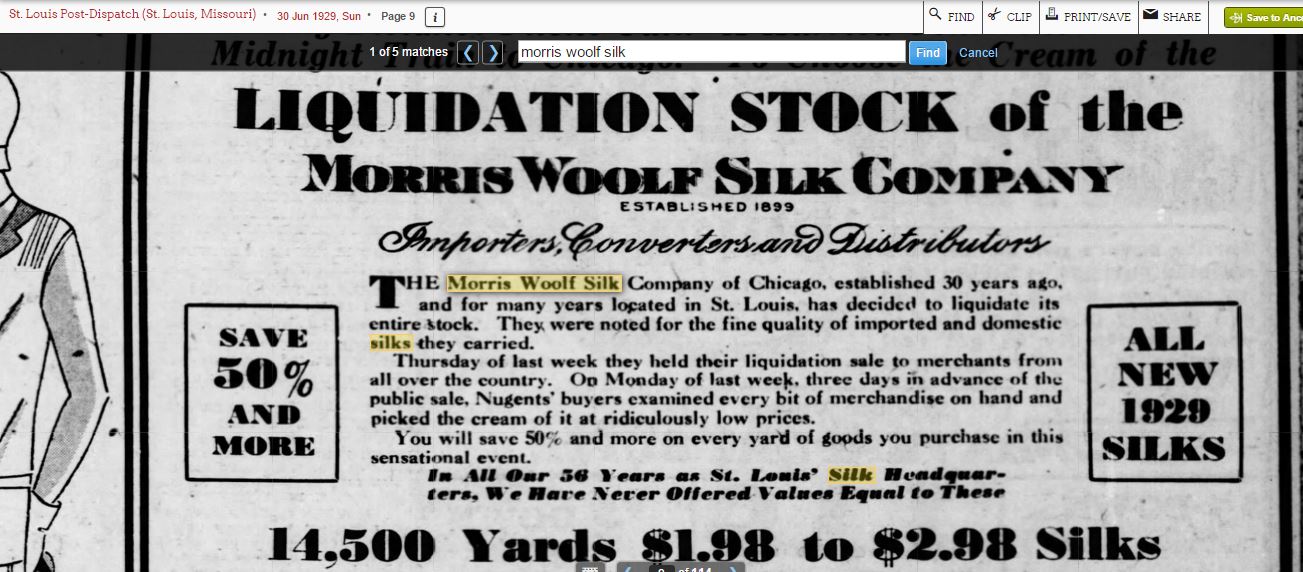
As for Maurice, according to the 1940 census, he had had a career change and was no longer working for Morris Woolf Silk; he was now working as a broker in the commercial real estate field. It appears that Morris Woolf Silk had liquidated its stock in the summer of 1929 (although Maurice had still listed his occupation as credit manager for a silk company on the 1930 census.)

Morris Woolf better liquidation ad 1929


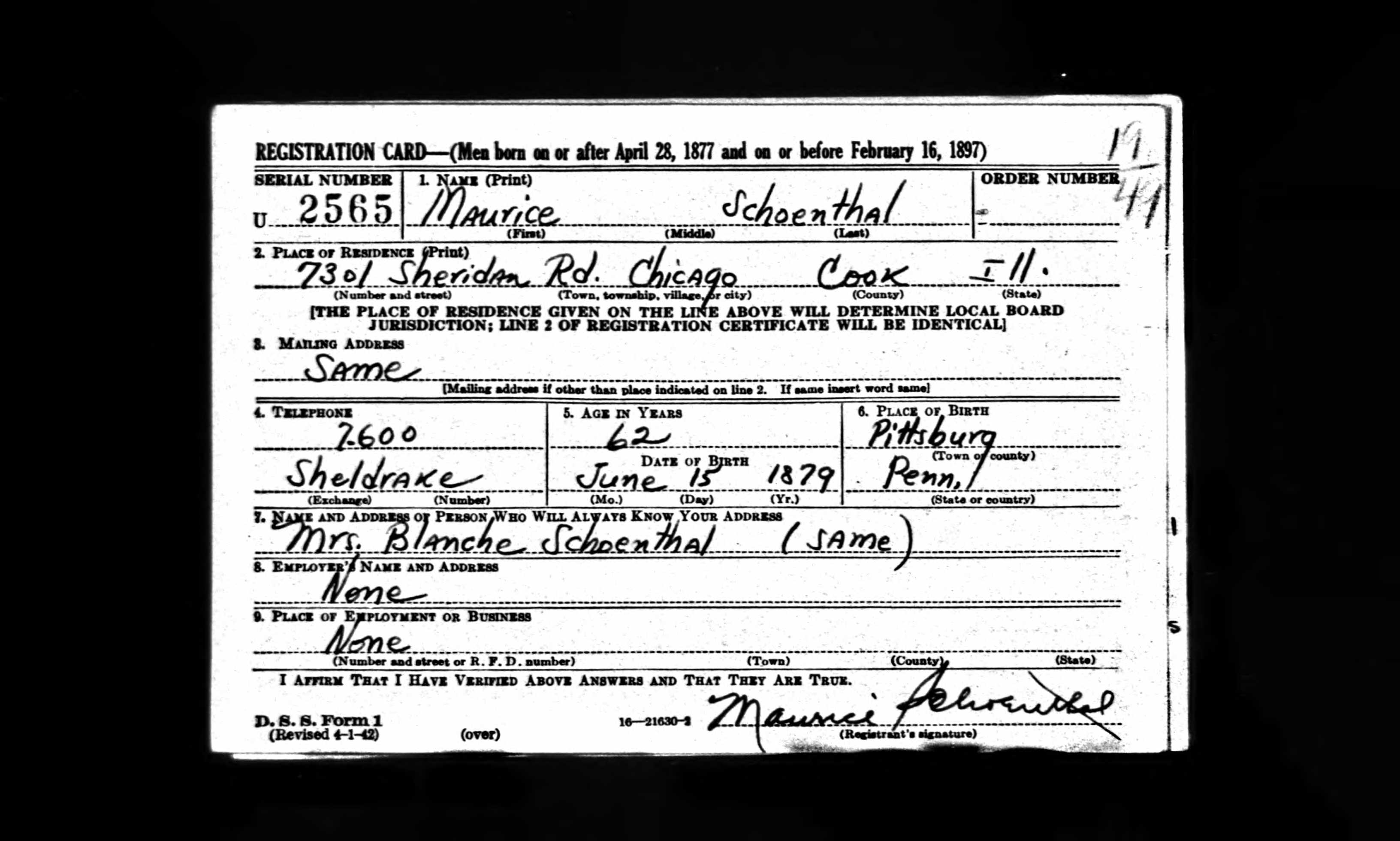
Maurice and Blanche and their son, now 21, were still living in Chicago in 1940, and their son was working as a messenger for the railroad.  Their daughter had married by then and was living with her husband in Chicago.  On his draft registration for World War II in 1942, Maurice reported no employment; he and Blanche were still living in Chicago.

Maurice Schoenthal World War 2 draft registration The National Archives at St. Louis; St. Louis, Missouri; World War II Draft Cards (Fourth Registration), for The State of Illinois; State Headquarters: Illinois; Microfilm Series: M2097; Microfilm Roll: 258

Maurice Schoenthal World War 2 draft registration
The National Archives at St. Louis; St. Louis, Missouri; World War II Draft Cards (Fourth Registration), for The State of Illinois; State Headquarters: Illinois; Microfilm Series: M2097; Microfilm Roll: 258


Martin Schoenthal died in Atlantic City on September 22, 1946.  He was 67 years old and was buried with his parents at Mt. Sinai cemetery in Philadelphia.  As far as I can tell, he had never married or had children.

His brother Maurice was living in St. Petersburg, Florida, in 1952, but that is the only year for which I can find a listing for him in that location, nor can I find him in any other directories or sources after 1942.  I cannot find a record for Maurice’s death, but I did find Blanche’s death certificate.  When she died on July 1, 1965, she was already a widow, so Maurice must have died sometime before that date.

Blanche Woolf Schoenthal death certificate

Blanche Woolf Schoenthal death certificate


Maurice and Martin Schoenthal: two brothers, two years apart in age, who had started their adult years in business together.  After Maurice married and settled in Chicago, his younger brother Martin followed him there and lived nearby for several years.  But whereas Maurice seemed to have both personal and business success in Chicago, Martin returned to his former home in Atlantic City to work, as so many in Simon Schoenthal’s family did, in the hotel business.


Part II: The Benefits of Teamwork

So who was Frederick Selinger, and how did he fit into the family? And who was Fanny Selinger’s mother?

In Part I, I described the research I had done first with Val Collinson in 2014 and then separately with Shirley Allen during the summer and fall of 2015 to try and find the connections between all our various Selinger relatives. Through that research we had established with a fair degree of certainty that Julius and Alfred Selinger, who married two of my Cohen cousins, sisters Augusta and Fanny, were themselves brothers, the sons of Seligmann Selinger and Breinle Hofstadter. We had also established that Helena Selinger Auerbach, who had been Val’s great-grandmother, was a first cousin to Julius and Alfred and the daughter of Abraham Selinger and Rosalia Wilhelmsdorfer.

Relationship_ Julius Selinger to Helena Selinger

We also had established that Fanny Selinger Rosenthal, Shirley’s grandmother, was also a daughter of Abraham Selinger, but Shirley and I had not found any document that revealed whether her grandmother Fanny was a full or half sister to Helena and the other children of Abraham Selinger; we had not found her mother’s name or where she was born.

And I still didn’t know how Frederick Selinger fit into the question.

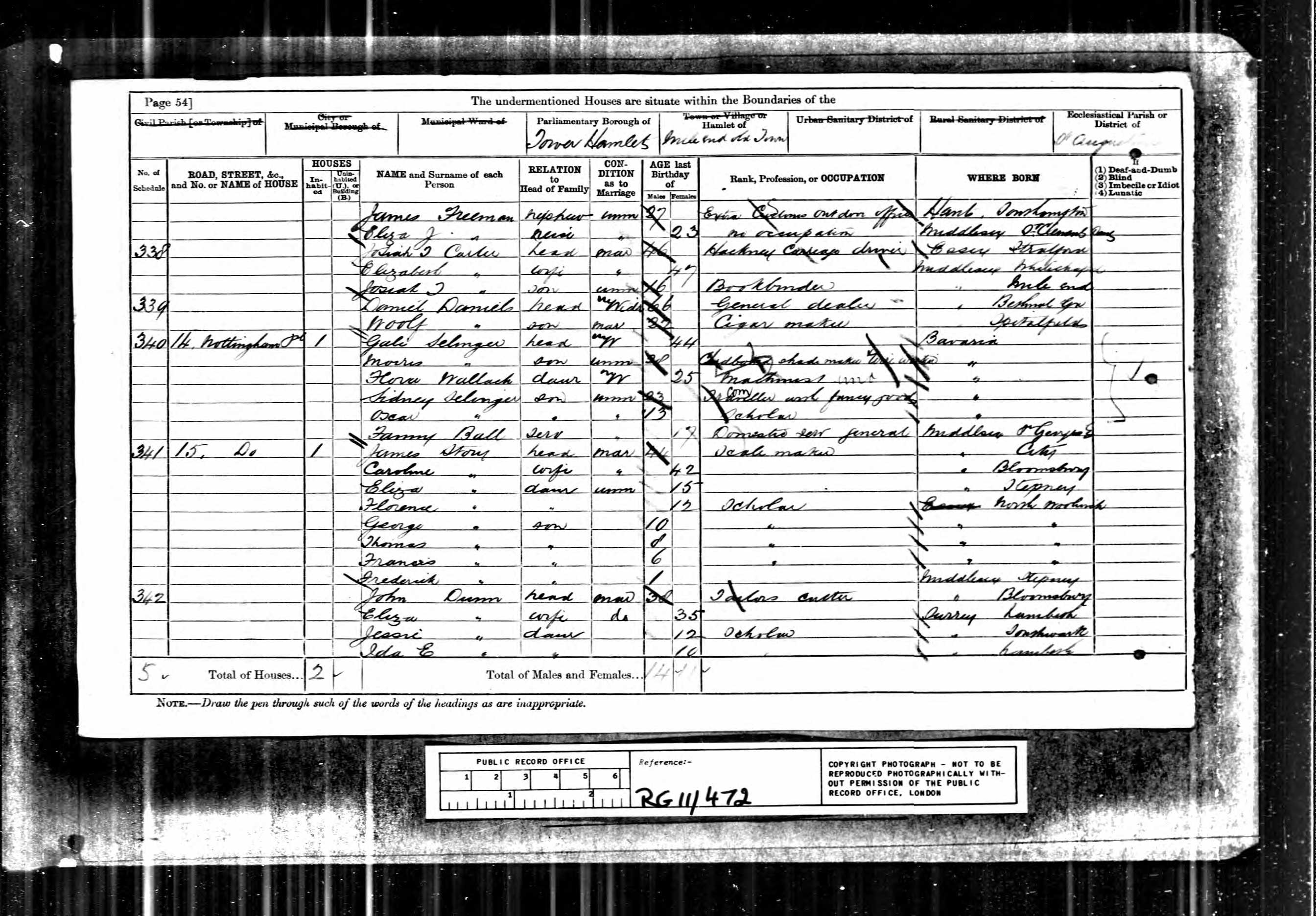
We also knew that Abraham Selinger had immigrated to England by 1871 because he appeared on the 1871 UK census with a second wife, Gali, along with several children: Sigfried, Helena, Cornelia, and Oscar.  By 1881, Abraham had died, and his widow Gali was living with some different children: Morris, Flora, and Sidney, plus Oscar.  Aside from Helena, who were all these children, and where were they born?  I had no birth records for Cornelia, Morris, Flora, Sidney, or Oscar.

So by late November, we had many answers, but many questions remained.

Fast forward again to January 13, when I again heard from Shirley.  She had received a copy of the marriage authorization for Fanny Selinger and Jacob Rosenthal from the Chief Rabbi in London.  It confirmed that Fanny was the daughter of Abraham and that she was born in Hurben, but did not reveal her mother’s name.  Although we did not have any new information, the new communication inspired us to try again to get answers to our primary questions: Who was Fanny Selinger’s mother?  And how did Frederick Selinger fit into the family, if at all?

Fanny Selinger Rosenthal and her husband Jacob Rosenthal and children Gladys, Daniel, and Alfred Courtesy of Shirley Allen

Fanny Selinger Rosenthal and her husband Jacob Rosenthal and children Gladys, Daniel, and Alfred
Courtesy of Shirley Allen

After reviewing everything we had, I decided to post on the German Genealogy group on Facebook for information about records in Ansbach , where Oskar Selinger had claimed to be born on his UK naturalization record.  Although I was unable to find Ansbach birth records for the appropriate years, my friend Matthias did find two websites with information about Abraham Selinger in Ansbach: one, a website listing past and present tobacco businesses in Germany; Abraham Selinger was listed as the manager of Equity and cigar-tobacco factory in Ansbach from 1862 until 1871. Thus, it made sense that Oscar Selinger was born in Ansbach.

The second website was even more revealing.  It was an Ansbach police report from 1870 reporting the arrest on May 31, 1870 of Abraham Selinger from Hurben, manager of a cigar factory,  for fraud.  Perhaps that is why 1871 was both the last date he had the cigar business in Ansbach as well as the first year he appeared on UK records.

But it also meant that the children I believed had been born to Abraham in the 1850s—Frederick, Fanny, Morris, Flora, and Sidney—were probably not born in Ansbach if Abraham’s business there didn’t start until 1862.  So where were they born?  Shirley continued to contact various offices in Germany, and I tried to think of new paths for research.

And then I had the best idea I’d had yet.  While doing all this work with Shirley in 2015, I had somehow forgotten about my correspondence with Val Collinson back in 2014.  Maybe Val had made some new discoveries or would have some new ideas.  I wrote to Val on January 22, 2016, and now we had three heads working on the mysterious Selingers.

Filament Productions

Filament Productions (Photo credit: Wikipedia)

The emails started flying back and forth among the three of us, and it became clear fairly quickly that Val and Shirley had some relatives in common, that is, relatives they both had met or at least had heard of.  I just sat back, enjoying the fact that I had brought these two cousins together.  They both were descendants of Abraham Selinger:  Shirley through his daughter Fanny, Val through his daughter Helena.  We weren’t yet sure whether Helena and Fanny were full or half-sisters, but in any event Shirley and Val, who’d never heard of each other before and who live about 60-100 miles apart in the UK, are third cousins.  I was thrilled that I’d brought these two wonderful family researchers and cousins together.

Shirley and Val both had lots of information about the marriages and descendants of some of the other Selinger siblings and also some wonderful photographs, but neither had any information about Frederick and neither was sure as to the identity of the mother or birthplaces of Fanny, Cornelia, Morris, Flora, or Sidney.

And then on January 29, 2016, the walls started tumbling down.  Val found this on Ancestry:

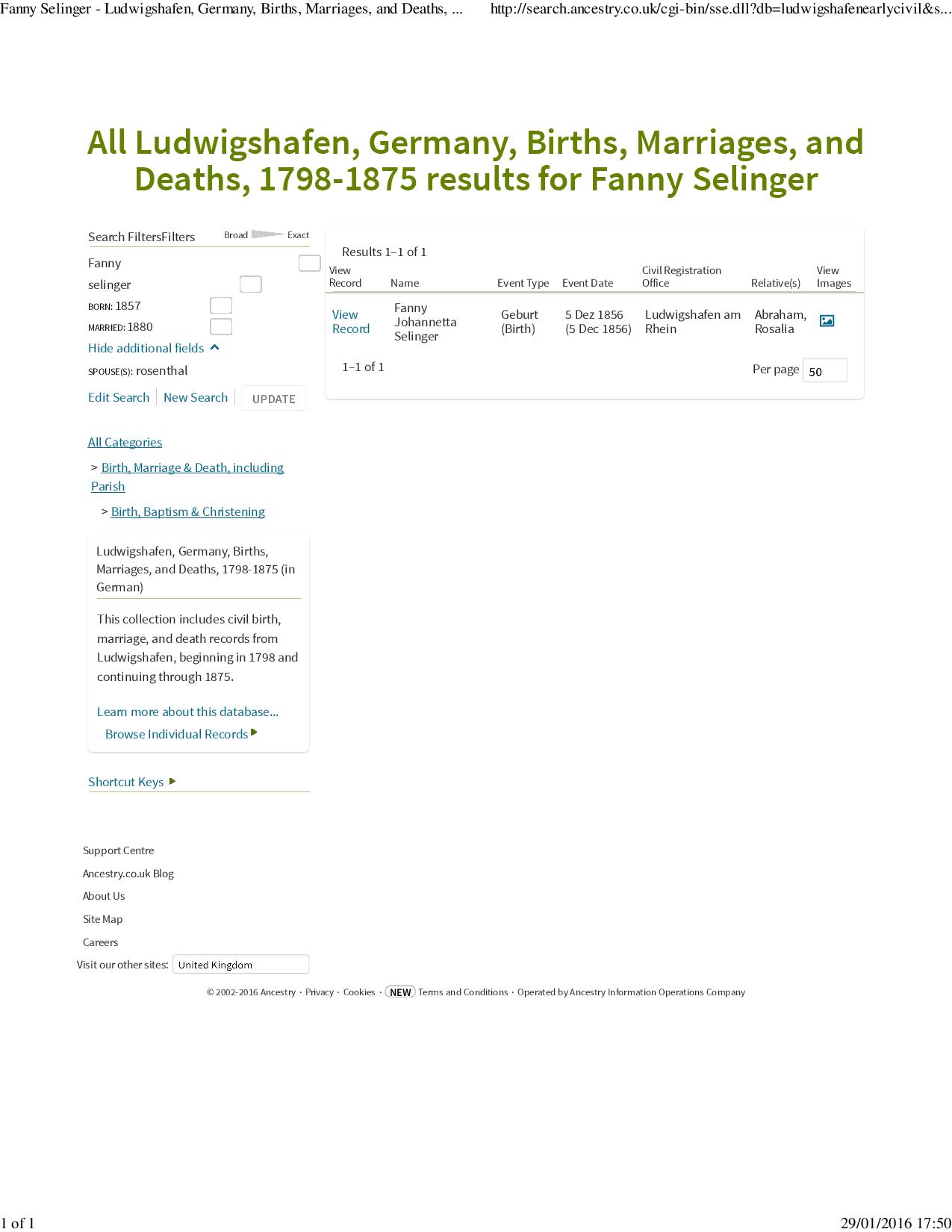
JPF Ludwigshafen page

Ludwigshafen?? Where was that? It’s a town very close to Mannheim.  Could be this OUR Fanny? Val asked me to follow up because I have the broadest Ancestry subscription (All Access), and I was able to pull up a scan of the actual record.  And not only did I find birth records for Fanny, I found them for three other children, all born to Abraham Selinger and Rosalia Wilhelmsdorfer, his first wife.

The four children born in Ludwigshafen were:  Babetta, born in 1853, died in 1854; Flora, born in 1855 (later Flora Wallach); Fanny, born December 5, 1856; and  Sigmund (later Sidney) born in 1858.  We finally had a birth record for Fanny, and we knew now that she was in fact a full sister to Helena as they were both the daughters of Abraham Selinger and Rosalia Wilhelmsdoerfer.  Val and Shirley were officially third cousins.


Fanny Selinger birth record from Ludwigshafen Ancestry.com. Ludwigshafen, Germany, Births, Marriages, and Deaths, 1798-1875 [database on-line]. Provo, UT, USA: Ancestry.com Operations, Inc., 2015. Original data: Ludwigshafen Zivilstandsregister, 1798-1875. Stadtarchiv Ludwigshafen, Ludwigshafen, Deutschland.

Fanny Selinger birth record from Ludwigshafen
Ancestry.com. Ludwigshafen, Germany, Births, Marriages, and Deaths, 1798-1875 [database on-line]. Provo, UT, USA: Ancestry.com Operations, Inc., 2015.
Original data: Ludwigshafen Zivilstandsregister, 1798-1875. Stadtarchiv Ludwigshafen, Ludwigshafen, Deutschland.

So that left three children whose birthplaces were still unknown: Morris, Cornelia, and, of course, Frederick.  Since Morris and Cornelia were both born before 1862 when the Selinger family arrived in Ansbach and after 1848 when the family had moved to Mannheim, I assumed that they were probably born in Mannheim.  The 1881 census recorded Cornelia’s age as 18, two years younger than Helena, whom they reported as twenty. But even English census records are unreliable.  Helena would have been turning 22 that year; maybe Cornelia was really 19 or 20 and thus born in 1850 or 1851.  The 1881 census said Morris was 28; he was probably born in 1852 since Babetta, the child who died in 1854, was born in 1853, in Ansbach.  Cornelia and Morris would also probably have been the children of Abraham and Rosalia since there were four children born to that couple even after Cornelia and Morris were born.

So I went back to the Mannheim records because my initial search had been only for the years between 1853 to 1859; now I searched the set of records before it, dating from 1842 to 1852.  And there they were, birth records for Cornelia (1850) and Morris (1852).  And Helena (1849).  All three were the children of Abraham Selinger and Rosalia Wilhelmdoerfer.

landesarchiv_baden-wuerttemberg_generallandesarchiv_karlsruhe_390_nr-_2862_bild_147_4-1229196-147 Birth record for Helena Selinger from Hurben

landesarchiv_baden-wuerttemberg_generallandesarchiv_karlsruhe_390_nr-_2862_bild_147_4-1229196-147
Birth record for Helena Selinger from Mannheim (center, left page)


So there are two birth records for Helena, one in Hurben, one in Mannheim.  Go figure.

Meanwhile, Val found yet another document:

Abraham Selinger - Ansbach, Germany JPG

(I cannot understand why neither the Ludwigshafen nor the Ansbach registers showed up for me when I searched.  Val has a magic touch with the search engine logic that I don’t have.)

I then retrieved the image of the actual document:

Abraham Selinger Lutheran register Ansbach


Abraham Selinger family in Ansbach Ancestry.com. Ansbach, Germany, Lutheran Parish Register Extracts, 1550-1920 [database on-line]. Provo, UT, USA: Ancestry.com Operations, Inc., 2015. Original data: Ansbach Lutheran Parish Register Extracts. Digital images Tobias Brenner Collection.

Abraham Selinger family in Ansbach
Ancestry.com. Ansbach, Germany, Lutheran Parish Register Extracts, 1550-1920 [database on-line]. Provo, UT, USA: Ancestry.com Operations, Inc., 2015.
Original data: Ansbach Lutheran Parish Register Extracts. Digital images Tobias Brenner Collection.

This document revealed two more things: that Gali’s birth name was Kohn and that she and Abraham had had another child before Oskar, Isidor, who died when he was an infant. So now I had a record confirming that Oscar was born in Ansbach and that his mother was Gali Kohn, not Rosalia Wilhelmsdoerfer.

Shirley, Val, and I had pretty much closed the circle on the children of Abraham Selinger.  But despite all our efforts, we still had not found one record for Frederick Selinger.  If he was born in 1856 as his passport application and his death certificate indicated, he should have been included with those children born in Ansbach.  He would have been born around the time of Flora or Fanny, maybe even a twin of one of them.  But he wasn’t there. And he wasn’t in the Mannheim records or the Hurben records.

So something did not make sense.  Frederick was not the child of Abraham Selinger with either of his wives.  I was convinced of it now.  So who was he? What was I missing?


P question

P question (Photo credit: Wikipedia)


This is the part of the story where I just want to kick myself.  I went back once again to the Hurben birth records and looked more closely at the children born to Seligman Selinger.  There were nineteen of them.  NINETEEN.  Nine were born to Seligman and his first wife between 1835 and 1844.  They all were born too early to be Frederick.  Ten children were born to Seligman Selinger and his second wife, Breinle Hofstadter, between 1849 and 1866.  There were five girls and five boys from that second marriage.  The five boys were Heinrich (1852), Julius (1853), Sigfried (1855), Hugo (1860), and Alfred (1866).  Julius and Alfred were the two who had married my Cohen cousins Augusta and Fanny.  That left Heinrich, Sigfried, and Hugo. Could any of them be Frederick?

Sigfried.  Hmm, I thought.  That could have become Frederick, maybe?? But he was born December 29, 1855, and Frederick was born in December 1856, according to his US death certificate and his US passport application.  So what, I thought? People lie! He made himself a year younger. The more I thought about it, the more I thought that Sigfried was Frederick.  The disparity in the dates in December for his birthday (the death certificate said December 27, the passport application December 21) didn’t bother me either.  Jews in Europe might not have known their birthday on a Gregorian calendar, only a Jewish calendar.  Frederick might have just known that his birthday was close to Hanukkah and nothing more precise than that.

I went back to Ancestry to look at the records I had for Frederick.  The earliest two—his 1880 marriage record and the 1880 census—list him as Fred, not Frederick.  Fred could be a shortened version of Sigfried, couldn’t it?  So I decided to search for Sigfried Selinger.

Marriage record for Frederick Selinger and Rachel Cohen 1880

Marriage record for Frederick Selinger and Rachel Cohen 1880

And I found this ship manifest from 1872:

Siegfried Selinger ship manifest 1872 to Baltimore The National Archives at Washington, D.C.; Washington, D.C.; Records of the US Customs Service, RG36; NAI Number: 2655153; Record Group Title: Records of the Immigration and Naturalization Service, 1787-2004; Record Group Number: 85

Siegfried Selinger ship manifest 1872 to Baltimore
The National Archives at Washington, D.C.; Washington, D.C.; Records of the US Customs Service, RG36; NAI Number: 2655153; Record Group Title: Records of the Immigration and Naturalization Service, 1787-2004; Record Group Number: 85

Siegfried Selinger, sixteen years old, arrived in Baltimore in June 1872, when Sigfried Selinger of Hurben would in fact have been still sixteen years old.  I thought that this could very well be the man who became Frederick Selinger.  Supporting this assumption was the fact that his marriage record states that he was from Baltimore and that he ended up marrying a woman from Washington, DC, so it would make sense that he would have entered the US through Baltimore, as his naturalization papers indicated.    (They also say he entered the country in June 1871.  People lie!  People forget!)

Frederick Selinger passport application National Archives and Records Administration (NARA); Washington D.C.; NARA Series: Passport Applications, 1795-1905; Roll #: 378; Volume #: Roll 378 - 14 Jul 1891-31 Jul 1891 Description Volume : Roll 378 - 14 Jul 1891-31 Jul 1891

Frederick Selinger passport application
National Archives and Records Administration (NARA); Washington D.C.; NARA Series: Passport Applications, 1795-1905; Roll #: 378; Volume #: Roll 378 – 14 Jul 1891-31 Jul 1891
Description
Volume : Roll 378 – 14 Jul 1891-31 Jul 1891

And when I searched for Fred Selinger in Baltimore, I found two listings in Baltimore directories, one in 1875, one in 1878.  I am quite certain I have found Frederick and now know that he was Sigfried Selinger,  the son of Selinger Seligmann and Breinle Hofstadter.  He was the middle brother to his brothers, Julius and Alfred, who followed him to the US in the following decade and married respectively the aunt (Augusta) and the sister (Fanny) of Frederick’s wife Rachel.

So why do I want to kick myself? Not only because I should have seen this much, much earlier, but because Ralph Bloch in fact told me he thought Sigfried could be Frederick way back in August, 2015.  I’d forgotten that until I reviewed all the old emails to write this blog post.  I probably saw his comment and forgot it or thought that I needed more proof.  And I got caught up in searching for Fanny and the other Selingers and for some reason assumed Frederick had to be the child of Abraham.  I could have so easily searched back then for Sigfried in the US and found what I found just this past week.

But actually I am so glad that I didn’t.  Because if I had done that in August, I might never have continued searching and working with Shirley and Val.  I might never have brought Shirley and Val together, third cousins who’d never known each other before.  I would have missed out on all the fun Val and Shirley and I have had as we worked together to solve this mystery.  That makes this all very worthwhile.

All this, you might say, for people who aren’t even my blood relatives? For people who happened to marry my distant cousins Rachel, Augusta, and Fanny?

It’s moments like this that I want to say, “We are all cousins.  Our families are all entangled.  And every person’s life, every person’s story is worth remembering and is worth memorializing.”


The Benefits of Teamwork: Part I

In my recent post, I mentioned that I had been working with two other researchers on the mystery of the three Selinger men who married my Cohen cousins.  Frederick Selinger had married my cousin Rachel Cohen in 1880 in Washington, DC.  Rachel was the daughter of Moses Cohen, my three times great-uncle (brother of my great-great-grandfather Jacob).  Julius Selinger had married Augusta Cohen in 1884 in Washington, DC; Augusta was the daughter of Moses Cohen, Jr. and niece of Rachel Cohen.  Finally, Alfred Selinger had married Fannie Cohen in Washington, DC, in 1893.  Fannie was also a daughter of Moses Cohen, Jr., also a niece of Rachel Cohen, and a sister of Augusta Cohen.

Julius and Augusta Cohen Selinger passport photos 1922

Julius and Augusta Cohen Selinger passport photos 1922


Way back on July 22, 2014, when I first posted about the three Selinger men, I had speculated that they all had to be related.  Both Julius and Frederick had documents indicating that they had been born in Hurben, Germany.  Alfred and Julius had lived together in DC before they’d married, and Alfred had traveled with Julius and Augusta to Europe before he married Augusta’s sister Fannie.  But I had nothing to support that speculation besides that circumstantial evidence.

Then a month later on August 5, 2014, I wrote about the marriage of Eleanor Selinger to Henry Abbot.  Eleanor was the daughter of Julius Selinger and Augusta Cohen; Henry was the son of Hyams Auerbach (Abbot) and Helena Selinger (some records say Ellen or Helen).  I was curious as to whether Helena Selinger was somehow related to Julius and the other Selinger men, Alfred and Frederick.  I thought that she might be since how else would an American woman have met an Englishman? And the shared name seemed too uncommon to be pure coincidence.


Eleanor Selinger Abbot and Abbot family-page-001

Eleanor Selinger Abbot (center) with the Abbot family Courtesy of Val Collinson


As I wrote then, I had contacted the owner of an Ancestry family tree who turned out to be Eleanor Selinger and Henry Abbot’s great-niece: Val Collinson.  Val and I exchanged a lot of information, but we could not at that time find any definitive evidence linking Helena Selinger, her great-grandmother, to Frederick or Julius or Alfred.  All were born in Germany, but it seemed from the records in different locations.  Helena’s marriage record indicated that her father’s name was Abraham Selinger, whereas Julius had indicated on his passport application that his father was Sigmund Selinger.  We were stumped.  And that was that.  Or so I thought.

Fast forward a full year to August, 2015, when I received a comment on my earlier blog post about Eleanor Selinger and Henry Abbot from someone named Shirley Allen, whose grandparents were Jacob Rosenthal and Fanny Selinger:

Fanny Selinger Rosenthal and her husband Jacob Rosenthal and children Gladys, Daniel, and Alfred Courtesy of Shirley Allen

Fanny Selinger Rosenthal and her husband Jacob Rosenthal and their children Gladys, Daniel, and Alfred
Courtesy of Shirley Allen

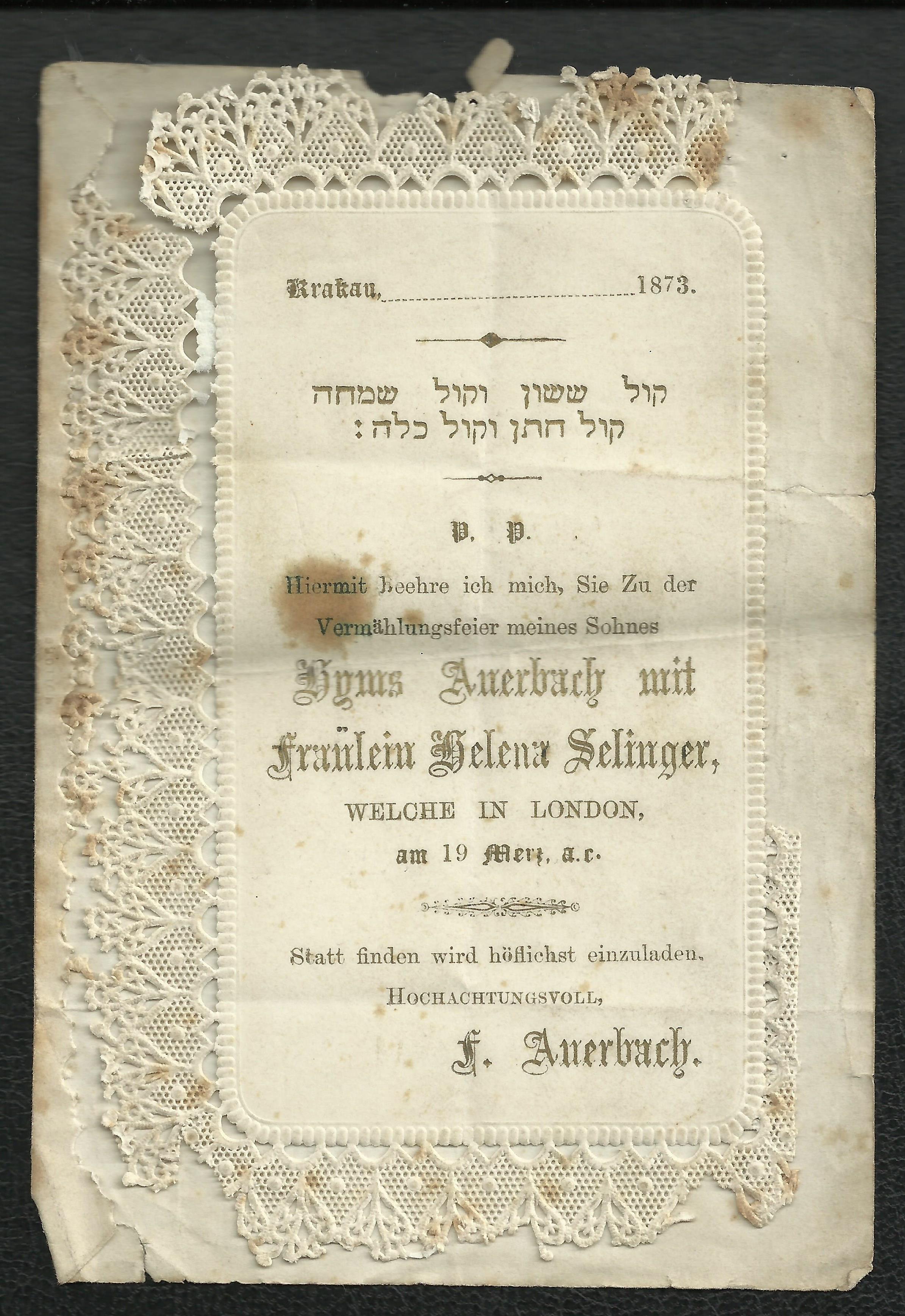
I’ve been delving into my paternal (Rosenthal) family history. I’ve found that my grandfather Jacob Rosenthal was married to Fanny Selinger. Unfortunately I haven’t found anything further about Fanny other than she was born in Germany, probably in 1857. However, I’ve recently come upon a wonderful paper lace invitation to the 1873 wedding of Hyams Auerbach and Helena Selinger that you referred to. What I don’t know is why Fanny would have been invited. Clearly she and Helena were related – but how ?

Needless to say, I was intrigued.  Maybe Fanny Selinger was related to Helena and/or maybe she was related to Julius, Frederick, and Alfred.  Shirley and I communicated by email, and we both started digging.

Invitation to the wedding of Helena Selinger and Hyms Auerbach Courtesy of Shirley Allen

Invitation to the wedding of Helena Selinger and Hyms Auerbach
Courtesy of Shirley Allen


I found a website called Jewish Genealogy of Bavarian Swabia (JGBS) that had records for Hurben and located 25 Selingers in their database, including those for Alfred and for Julius, who were the sons of Seligman Selinger and Breinle Hofstadter and thus were brothers, as I had suspected. Shirley and I both thought that Seligman Selinger had been Americanized to Sigmund by Julius on his passport application and that the birth records for Julius and Alfred confirmed that they were in fact brothers.

I also found a birth record for Helena Selinger, whose father was Abraham Selinger, not Seligman Selinger.  Abraham and his wife Rosalia Wilhelmsdoerfer had six children listed: Seligman (1842), Raphael (1843), Pauline (1845), Karolina (1847), Heinrich (1848), and Helena (1849). Pauline, Karolina, and Heinrich had all died as young children, leaving Seligman, Raphael, and Helena as the surviving children of Abraham.  Here is Helena’s birth record from Hurben in August 1849.

Helena Selinger birth record from Hurben http://jgbs.org/SuperSearch.php?Sp=3&Book=birth&Com=11

Helena Selinger birth record from Hurben (third from bottom)
http://jgbs.org/SuperSearch.php?Sp=3&Book=birth&Com=11


But what about Frederick?  And Fanny? And was there a connection between Helena’s father Abraham and the father of Julius and Alfred, Seligman Selinger?

A little more digging on the JGBS site revealed that both Abraham Selinger and Seligman Selinger were the sons of Joachim Selinger, thus confirming that they were brothers and thus that Helena was a first cousin to Julius and Alfred.

Marriage record from Hurben for Abraham Selinger, son of Joachim, and Rosalia Wilhelmsdoerfer http://jgbs.org/detail.php?book=marriage&id=%206671&mode=

Marriage record from Hurben for Abraham Selinger, son of Joachim, and Rosalia Wilhelmsdoerfer (second in page)
http://jgbs.org/detail.php?book=marriage&id=%206671&mode=


Seligmann Selinger, son of Joachim, marriage to Breinle Hoftsadter

Seligmann Selinger, son of Joachim, marriage to Breinle Hoftsadter (second from bottom) 1848 http://jgbs.org/detail.php?book=marriage&id=%206695&mode=


That meant that Eleanor Selinger, daughter of Julius Selinger, had married her second cousin, Henry Abbot, son of Helena Selinger.


But that still left us wondering about Frederick Selinger and Shirley’s great-grandmother Fanny Selinger.  How did they fit into this picture?

I contacted Ralph Bloch, the webmaster for the JGBS website, and he was extremely helpful.  More helpful than I realized at the time, but more on that later.  Ralph also could not find any evidence that Fanny was born in Hurben, and he reassured me that the birth records for Hurben were quite complete.  He even searched through the original pages to be sure that Fanny hadn’t somehow been missed when the records were indexed. (There was a Fany Selinger born in the 1830s, but that would have been far too early for Shirley’s ancestor.) Ralph also sent a photograph of Seligman Selinger’s headstone, which confirmed that his father’s name was Joachim or Chaim, his Hebrew name.

Seligman Selinger gravestone


So once again we hit the brick wall.  We still had not found either Frederick or Fanny.  Shirley said she would pursue it on her end, and I turned back to the other research I’d been doing when I received Shirley’s comment.

Not much happened again until late November when I heard again from Shirley, telling me that she had received a copy of Fanny Selinger’s marriage certificate, which revealed that Fanny was the daughter of Abraham Selinger.  Now we could link Fanny to Helena, also the daughter of Abraham, as well as to Julius and Alfred, Abraham’s nephews. But we didn’t know if Fanny and Helena were both the daughters of Rosalia Wilhelmsdoerfer.

Shirley’s research of UK records showed that by 1871 Abraham was married to a woman named Gali, and we assumed that Abraham had left Hurben at some point, that his first wife Rosalia had died, and that he had had several children with Gali.  That is what the UK census records from 1871 seemed to reflect. Abraham and Gali were living with Sigfried (28), Helena (20), Cornelia (18), and Oskar (4).  But there was neither a Fanny nor a Frederick.


Abraham Selinger and family 1881 UK census Class: RG10; Piece: 555; Folio: 86; Page: 3; GSU roll: 823397 Description Enumeration District : 10 Source Information Ancestry.com. 1871 England Census [database on-line]. Provo, UT, USA: Ancestry.com Operations Inc, 2004. Original data: Census Returns of England and Wales, 1871. Kew, Surrey, England: The National Archives of the UK (TNA): Public Record Office (PRO), 1871.

Abraham Selinger and family 1881 UK census
Class: RG10; Piece: 555; Folio: 86; Page: 3; GSU roll: 823397
Description
Enumeration District : 10
Source Information
Ancestry.com. 1871 England Census [database on-line]. Provo, UT, USA: Ancestry.com Operations Inc, 2004.
Original data: Census Returns of England and Wales, 1871. Kew, Surrey, England: The National Archives of the UK (TNA): Public Record Office (PRO), 1871.

Abraham died in 1880, and in 1881, Gali was living with four children, but aside from Oskar (13), they were all different from those on the 1871 census: Morris (28), Flora (surname Wallach) (25), and Sidney (23).  Now I was really confused.  Who were these people, and where had they been in 1871?  Flora was presumably married to someone named Wallach and now a widow, but Morris would have been eighteen in 1871 and Sidney only thirteen. Where were they living?  Who were they? None of those children were listed on the Hurben birth register on the JGBS site; in fact, there were no children listed for Abraham Selinger and any wife in Hurben after Helena’s birth in 1849.

Gali Selinger and family 1881 UK census Class: RG11; Piece: 472; Folio: 118; Page: 55; GSU roll: 1341103 Description Enumeration District : 9 Original data: Census Returns of England and Wales, 1881. Kew, Surrey, England: The National Archives of the UK (TNA): Public Record Office (PRO), 1881

Gali Selinger and family 1881 UK census
Class: RG11; Piece: 472; Folio: 118; Page: 55; GSU roll: 1341103
Description
Enumeration District : 9 Original data: Census Returns of England and Wales, 1881. Kew, Surrey, England: The National Archives of the UK (TNA): Public Record Office (PRO), 1881

I assumed that Morris, Flora, Sidney, and Oscar, all born after 1850, were born in a different place and perhaps to a different mother.  Certainly Oskar had to be Gali’s child since he was so much younger than all the rest and only four on the 1871 census.

Searching again on Ancestry, I found a new record:  an entry for Abraham, Rosalia, Seligman, and Raphael Selinger on the Mannheim, Germany, family register dated November 26, 1848.  What were they doing in Mannheim? By that time the three younger children, Pauline, Karolina, and Heinrich, had died.  Perhaps they needed a change of scenery.  But what about Helena? She was born in Hurben in 1849.

Then I found a second Mannheim family register that included Helena, the final entry on the page:


Abraham Selinger and family, Mannheim register Ancestry.com. Mannheim, Germany, Family Registers, 1760-1900 [database on-line]. Provo, UT, USA: Ancestry.com Operations, Inc., 2014. Original data: Polizeipräsidium Mannheim Familienbögen, 1800-1900. Digital images. Stadtarchiv Mannheim — Institut für Stadtgeschichte, Mannheim, Germany.

Abraham Selinger and family, Mannheim register
Ancestry.com. Mannheim, Germany, Family Registers, 1760-1900 [database on-line]. Provo, UT, USA: Ancestry.com Operations, Inc., 2014.
Original data: Polizeipräsidium Mannheim Familienbögen, 1800-1900. Digital images. Stadtarchiv Mannheim — Institut für Stadtgeschichte, Mannheim, Germany.

My friends in the German Genealogy group,  Heike Keohane, Matthias Steinke, and Bradley Hernlem, came to my rescue and translated it to read, “Helene, his daughter, here born the 22 August 1849.”  So Helena’s birth is entered on the Hurben birth records (on the same date) and on the Mannheim records.  I’ve no idea which is the correct birthplace; maybe Rosalia went home to Hurben to give birth and returned to Mannheim afterwards where the family was living.

But perhaps now I could find out where Frederick was born, not to mention Morris, Flora, Sidney, and Oscar. Maybe they were born in Mannheim.  I checked the Mannheim birth records from 1853 through 1866 and found not one person named Selinger.  I checked over and over, looking at each page until my eyes were blurry.  There were no Selingers born in Mannheim during that period that I could find.

Then I discovered that Oskar Selinger had listed Ansbach as his birth place on his UK naturalization papers and thought that perhaps the family had moved from Mannheim to Ansbach.

Oscar Selinger UK naturalization papers The National Archives; Kew, Surrey, England; Duplicate Certificates of Naturalisation, Declarations of British Nationality, and Declarations of Alienage; Class: HO 334; Piece: 54 Description Description : Piece 054: Certificate Numbers A20701 - A21000

Oscar Selinger UK naturalization papers
The National Archives; Kew, Surrey, England; Duplicate Certificates of Naturalisation, Declarations of British Nationality, and Declarations of Alienage; Class: HO 334; Piece: 54
Description
Description : Piece 054: Certificate Numbers A20701 – A21000

I had no luck locating Ansbach birth records for that period, and by then it was Thanksgiving, and other matters distracted me, and I put the Selinger mystery on the back burner.

To be continued…..

Two More Generations Back! The Amazing Seligmanns

Get ready for a real brain twister here.

As I mentioned in my last post, my cousin Wolfgang sent me several new documents relating to our mutual Seligmann ancestors.  Wolfgang and his mother received these from Beate Goetz, who had also sent me several important documents over a year ago.  I continue to be amazed by how much information is available about my Seligmann forebears.

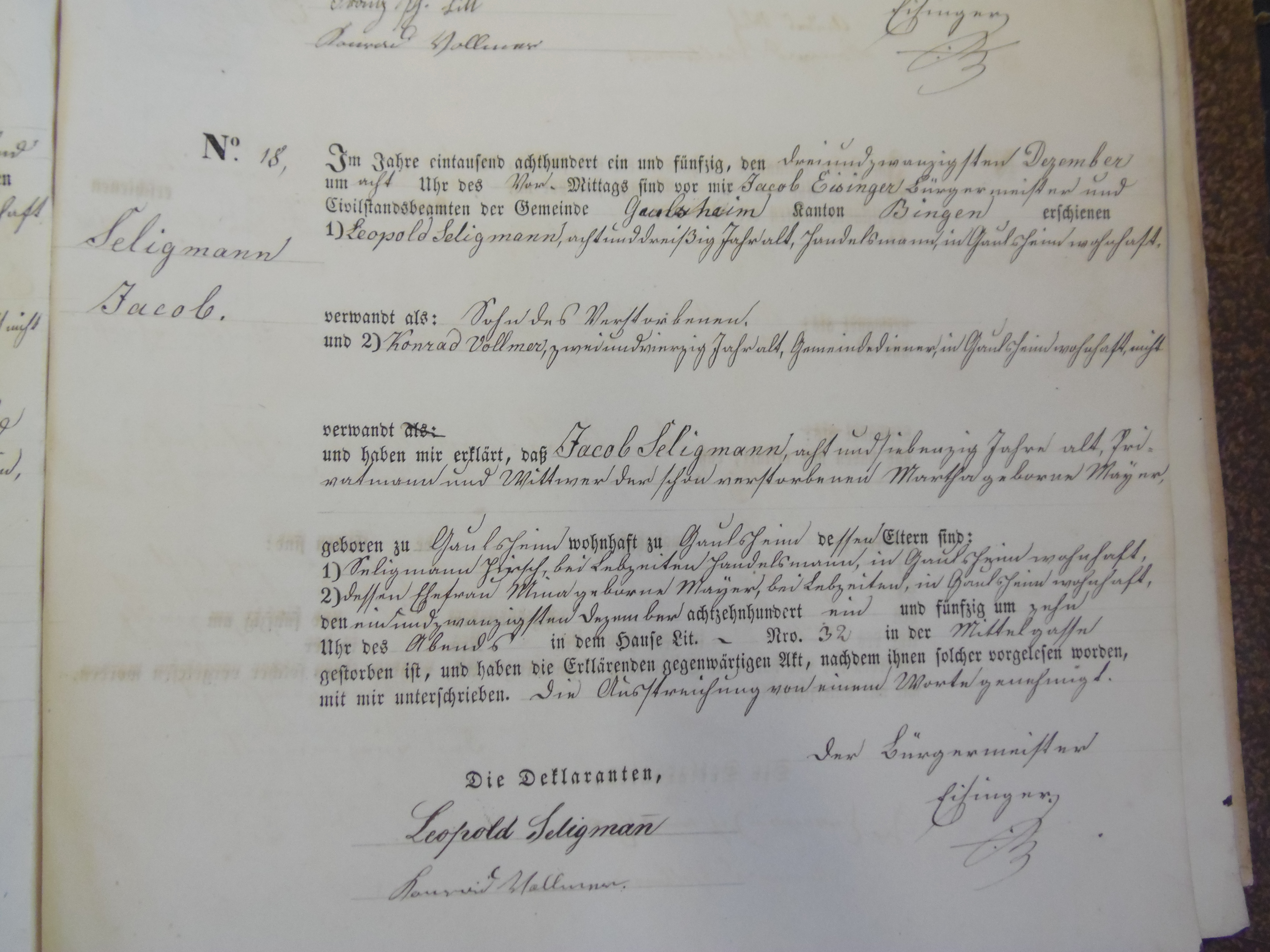
The first document is a death certificate for Jakob Seligmann, my four-times great-grandfather, father of Moritz Seligmann and grandfather of Bernard Seligman.  Until now Jakob was the earliest relative I had found in the Seligmann line; he was born in Gaulsheim, Germany in 1773 and died there in 1851.  His wife, my four-times great-grandmother, was Martha Mayer.

Jakob Seligmann death record

Jakob Seligmann death record


With help from Wolfgang, his mother, and my friend Matthias Steinke, I learned that this document says that Jakob Seligmann died on December 21, 1851, when he was 78 years old.  He was born in Gaulsheim, the son of Seligmann Hirsch, deceased, a merchant in Gaulsheim, and Mina nee Mayer.  The informants were his son Leopold Seligmann and Konrad Vollmer, not related.   What was most exciting about this document was that it revealed the names of Jakob’s parents: Seligmann Hirsch and Mina Mayer.

Seligmann Hirsch and Mina Mayer were thus my five-times great-grandparents.  I now had another generation back to add to my family tree.  And then something occurred to me.  When I saw that Mina’s birth name had been Mayer, I was puzzled.  Was she related to her daughter-in-law Martha Mayer? Of course, it could be.  But when I thought about it a bit more, I realized that when Mina was born in the mid-18th century, Jews were not using surnames.  Instead, they were using patronymics—Mina was probably the daughter of a man whose first name was Mayer, not whose surname was Mayer. She was Mina bat (daughter of) Mayer.

So if Jakob Seligmann’s father was Seligmann Hirsch, it meant that he was probably Seligmann ben (son of) Hirsch.  That meant that the Seligmann surname really came from Jakob’s father’s first name.  When Jakob had to adopt a surname in Napoleonic times, he must have taken his patronymic of Jakob ben (son of) Seligmann and compressed it into a first name and surname, creating Jakob Seligmann.  Seligmann ben Hirsch was thus the original source for the Seligmann surname that survives to this day in my family with Wolfgang himself.

And that meant that Seligmann ben Hirsch was the son of  a man named Hirsch, who was my six-times great-grandfather.

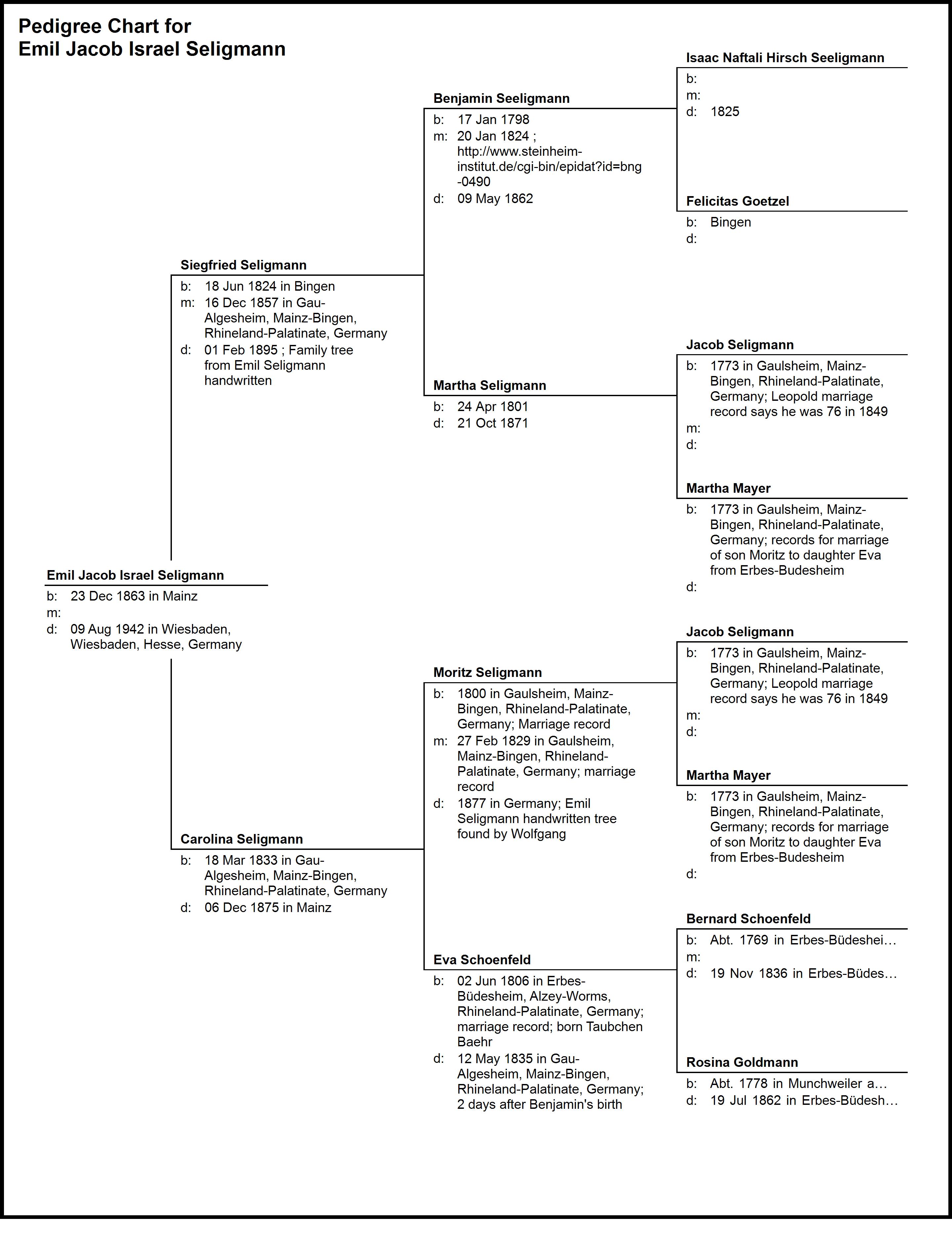
That hunch was corroborated by another bit of evidence that Wolfgang brought to my attention.  Back in July 2015, I posted about Moritz Seligmann’s sister, Martha Seligmann, who had married a man named Benjamin Seligmann, son of Isaac Seligmann and Felicitas Goetzel.  Martha and Benjamin’s son Siegfried had married Moritz and Eva Seligmann’s daughter Caroline.  Caroline and Siegfried were the parents of Emil Seligmann, who created that very long and detailed family tree I wrote about here.  That is, Emil was the grandson of both Moritz Seligmann AND his sister Martha Seligmann.  He was his own second cousin.

Here’s the chart I posted last time.  I know this is all confusing, but if I don’t write it down, I will never remember my own thought processes.

Pedigree Chart for Emil Seligmann

Pedigree Chart for Emil Seligmann


Or as I wrote then, “Emil’s father Siegfried was the son of Martha Seligmann; his mother Karoline was the daughter of Moritz Seligmann.  Moritz and Martha were siblings, so Siegfried and Karoline were first cousins.  Thus, Emil’s paternal grandmother Martha and his maternal grandfather Moritz were sister and brother.  Now if in fact Benjamin Seligmann, Martha’s husband, was also a cousin, there is truly a remarkable amount of inbreeding there.”

And I think that’s in fact the case: Benjamin and Martha were also first cousins.  Back in July I had thought that perhaps Benjamin Seligmann and his wife Martha Seligmann were cousins since both had the surname Seligmann.  I thought that their fathers, Isaac and Jakob, respectively, could have been brothers, but I had no way of proving it.  But now I know from Jakob’s death certificate that his father’s name was Seligmann ben Hirsch. Was that also the name of Isaac’s father?

A look at Isaac’s gravestone from the Steinheim Institute website revealed this, one of the most beautiful grave inscriptions I’ve ever seen:


האיש החשוב משכיל וטהור Here lies  the respected man wise and pure,
החבר ר’הירש בן כ”ה זעליגמאן the Torah Scholar Mr. Hirsch, son of the honored Mr. Seligmann of
גוילסהיים: למלאכתו מלאכת Gaulsheim. For his work was Heaven’s work.  As swift as 
שמים כצבי מהיר אור תורתו 5 a deer was the light of his Torah.  Like a sapphire. 
כספיר תאיר צדק קדמו פעמיו:  righteousness was before him.  A wholly righteous man, great in deeds, doing 
איש תמים ורב פעלי’ גומל חסדים many acts of lovingkindness  for the
רבים: לרעבים וצמאים hungry and thirsty.  
אורו נגנז יום וי”ו ך”ה ובא He died on six, 25 Iyar, and he came
למנוחתו כבוד יו’ א’ך”ו אייר 10 to his honored resting place Day 1, 27 Iyar.
לפרט יקר בעיני ד’המות’ לחסידי’ Especially dear in the eyes of the Lord is the death of the pious.
תנצב”ה May his soul be bound up in the bonds of eternal life.


(Thank you to Neil, Bracha, and Gerald from Tracing the Tribe on Facebook for help in translating the Hebrew; the original German translation on the Steinheim site did not translate well into English using Google Translate, so I decided it would be better to  get a translation of the Hebrew directly rather than getting a translation of the translation. If the lines of the translation do not line up exactly with the Hebrew text, that is my error, not that of my translators.)

And thank you to my friend Dorothee who told me about the link to the photograph of the headstone.

Hirsch "Isaac" ben Seligmann headstone Found at http://www.steinheim-institut.de/daten/picsbng/xl/0358_bng.jpg

Hirsch “Isaac” ben Seligmann headstone
Found at http://www.steinheim-institut.de/daten/picsbng/xl/0358_bng.jpg

“Isaac’s” Hebrew name was Hirsch, son of Seligmann. His father was thus named Seligmann, as was Jakob’s father.  Furthermore, Jewish naming patterns suggest that Isaac’s father could have been Seligmann son of Hirsch, the man who was also Jakob’s father. Hirsch/”Isaac” was older than Jakob; when Seligmann son of Hirsch had his first son, he named him for his own deceased father, Hirsch.  Jakob and Hirsch/“Isaac” were most likely brothers, both sons of Seligmann ben Hirsch.

Why then is Isaac referred to as Isaac, not Hirsch as his gravestone indicates? I don’t know.  The Steinheim Institute site notes that “Hirsch from Gaulsheim called Isaac Seligmann. He was a schoolteacher in Bingen,” without further explanation.  On the page for Hirsch/Isaac’s son Benjamin, the Steinheim site comments that “Benjamin Seligmann was in Gaulsheim (today district of Bingen), the son of school teacher Hirsch (later: Isaac) 1798 Seligmann and his wife Felicity born.” [Translation by Google Translate] Hirsch must have changed his name to Isaac.

So that means that Benjamin Seligmann, son of Hirsch/Isaac, and Martha Seligmann, daughter of Jakob, were first cousins.  Their son Siegfried was thus not only their son but also a first cousin removed from each of his parents.  Oy vey.  Siegfried then married his first cousin Caroline, daughter of his mother’s brother Moritz.  ENDOGAMY, anyone??  No wonder Emil’s tree was so convoluted!

Here is an updated pedigree chart for Emil Seligmann.  Notice that Seligmann ben Hirsch and Mina Mayer appear as his great-grandparents in three different places:

Extended Pedigree Chart for Emil Seligmann

Extended Pedigree Chart for Emil Seligmann


Where am I? Oh, right.  I now know that my six-times great-grandfather was named Hirsch and that he had a son named Seligmann, who had at least two children, Hirsch (who became Isaac) and Jakob.

But what about Jakob Seligmann’s wife Martha, daughter of Mayer, my four-times great-grandmother? The second document Wolfgang sent to me was her death certificate.  Martha died on December 17, 1849 in Gaulsheim when she was 76 years old.  She was born in Oberingelheim and was the daughter of Jakob Mayer, deceased, a merchant in Oberingelheim, and Odilia, nee Simon.  The informants were her husband, Jakob Seligmann, and Konrad Vollmer, who was not related to her.

Martha Seligmann nee Mayer death record

Martha Seligmann nee Mayer death record

Thus, I now know another set of five-times great-grandparents, Martha’s parents: Jakob Mayer (probably Jakob ben Mayer) and Odilia Simon (probably Odilia daughter of Simon).  And I know where to search for them: Oberlingelheim.  And if I am right about the patronymics, then I know two more of my sixth-great-grandfathers, Mayer, father of Jakob, and Simon, father of Odilia.

All that from two pieces of paper dating from the mid-nineteenth century.

Thank you, Beate Goetz, Wolfgang Seligmann and his mother Annlis, Matthias Steinke, and the members of Tracing the Tribe, for all your help.


Why I Love the Internet: The World Wide Web

Internet

Internet (Photo credit: Wikipedia)

The Internet continues to provide me with so much more than access to information.  Through my blog, Ancestry, Facebook, Google, and ordinary old email, I continue to find and be found by cousins all over the world.  In the last two weeks, I have seen my network of cousins expand and greatly enrich my knowledge and understanding of my family history.  So a few updates.

First, I heard from a relative of Margaret Swem, the wife of Felix Schoenthal, my Boston relative, and she filled me in on the background and family of Margaret.  Quite interesting information that I will add to the post about Felix and his family.  Once again, having a blog proved useful because Margaret’s relative found my blog by Googling Margaret Swem’s name.

Second, an Israeli second cousin, once removed, of my husband found me through my tree on Ancestry.  I haven’t even done very much yet on my husband’s family, but through this new cousin we’ve learned a great deal about the Shrage family in Zabarazh, a town once in Galicia but now part of Ukraine.  It’s been very exciting learning from our new Israeli cousin.

Third, I’ve heard from a descendant of Hettie Schoenthal, one of Simon Schoenthal’s younger children about whom I’ve yet to blog.  This new cousin has shared some of Hettie’s own remembrances of her life as well as other stories.  I am looking forward to incorporating some of those into the blog as well as some photographs.

Fourth, I’ve been in touch with two British relatives of the UK Selinger cousins, relatives of Julius, Alfred, and Frederick Selinger, all of whom married my Cohen relatives.  I then put the two of them in touch as they had not previously known each other despite being cousins.  That gave me great satisfaction, and now all three of us are hunting for answers about the connections among some of the Selingers.

Fifth, I am in touch with a Goldfarb cousin and hoping to learn more about this recently discovered branch of my Brotman family line.  I just received a huge package of information that I need to go through, enter into my tree, and research.

Sixth, another Hamberg cousin just contacted me this morning.

And last but definitely not least, my cousin Wolfgang in Germany sent me new information about our Seligmann family line.  He and his mother received four new documents about our ancestors.  The first reveals two more generations back in the line of Jacob Seligmann, my four-times great-grandfather from Gaulsheim, Germany.  I will be blogging separately about these documents and what they revealed in the next few days before I return again to the children of Simon Schoenthal.

English: internet Español: internet

English: internet Español: internet (Photo credit: Wikipedia)

Turning on my computer in the morning has become a real treat, waiting to see who has found me, who has responded to my inquiries, and which cousin has new information to share.  Sometimes I feel overwhelmed by my good fortune.  Sure, there are still many people who don’t reply to my emails or Facebook messages, but for every person I have found or who has found me, I am so deeply grateful.  The family tree keeps growing, and with it so does the world-wide web of fascinating and generous people whom  I can call my cousins.

Two New Leaves for the Brotman Family Tree

I love seeing the family trees grow with new babies, and Naomi Dombey Ratner, great-granddaughter of Max Brotman and my second cousin, once removed, was blessed with two new grandchildren over the last several months.

First, Ada Helene Ratner was born on July 8, 2015, to Naomi’s son Justin Ratner and his wife Tara Hawk.

Then, Elijah Eric Judy was born on December 8, 2015, to Naomi’s daughter Kara Ratner and Brian Judy.

Here is a photograph of the two new cousins taken in late December when Elijah was just a few weeks old and a more recent one of Elijah.

Elijah and Ada Courtesy of Naomi Ratner

Elijah and Ada
Courtesy of Naomi Ratner

Elijah Courtesy of Naomi Ratner

Elijah
Courtesy of Naomi Ratner

Ada and Elijah are the great-great-great-great-grandchildren of Joseph Brotman and his first wife Chaye Fortgang, the great-great-great-grandchildren of Max Brotman and Sophie Schmigrud, the great-great-grandchildren of Renee Brotman and Charles Haber, the great-grandchildren of Rosalind Haber and Daniel Dombey, and the grandchildren of Naomi Dombey and Eric Ratner.  Ada and Elijah are my second cousins, three times removed.

Mazel tov to Naomi and her children on the births of Ada and Elijah!  Welcome to the extended Brotman family!

Under the Boardwalk: My Cousins, the Atlantic City Hoteliers

I admit it. I have been avoiding Simon Schoenthal.  Not for any bad reason, but simply because he and his wife Rose Mansbach had ten children. Ten.  I just couldn’t get myself motivated to follow up on their ten children, each of whom was my first cousin, twice removed.  That is, those ten children were my grandmother Eva Schoenthal Cohen’s first cousins.  And once she married and moved to Philadelphia in 1923, she was living not far from most of these cousins.  Maybe she knew them well.  I should be more motivated, but I’ve been procrastinating simply because I was overwhelmed by the number of children to research.

The nine surviving children of Simon and Rose (Mansbach) Schoenthal Photo courtesy of the family of Hettie Schoenthal Stein

The nine surviving children of Simon and Rose (Mansbach) Schoenthal
Photo courtesy of the family of Hettie Schoenthal Stein

But it’s a new year, and the time is now, so here we go.  First, to recap what I’ve already written about Simon and Rose and their children.  Simon was the fifth child of Levi Schoenthal and Henriette Hamberg and was born on February 14, 1849.  He was nine years older than my great-grandfather, his brother Isidore.  Along with his sister Amalie, Simon arrived in Washington, Pennsylvania, in 1867, a year after their older brother Henry had settled there. Simon was a bookbinder and occupied in that trade for many years after he first came to the US.  In 1872, Simon married Rose Mansbach, and in the 1870s they had five children: Ida (1873), Harry (1873), Gertrude (1875), Louis (1877), and Maurice (1878).

By 1880, Simon, Rose and their children had moved to Philadelphia, where Simon continued to work as a bookbinder.  They had five more children in Philadelphia: Martin (1881), Jacob (1883), Hettie (1885), Estelle (1888), and Sidney (1891).  Their oldest daughter, Ida, twin of Harry, died in 1887 from heart disease, leaving nine living children.

Simon Schoenthal with twins Harry and Ida 1875 Courtesy of the family of Hettie Schoenthal Stein

Simon Schoenthal with twins Harry and Ida 1875
Courtesy of the family of Hettie Schoenthal Stein

In the 1890s, Simon left the bookbinding business and turned to other fields.  He sold cigars early in the decade, and then by 1898 he and his family had relocated to Atlantic City, where he had a “bric-a-brac” store.

What brought them to Atlantic City? In fact, what had led Simon and Rose to move from Philadelphia to Atlantic City in the first place? I’ve been to Atlantic City twice since its revitalization in the 1980s, and I’ve played Monopoly since I was a little girl and know many of the famous street names from that game—Pacific, Illinois, Indiana, Mediterranean, Park Place, and, of course, the Boardwalk.  But I didn’t know much about the history of the city or what it was like in the late 19th century and early decades of the 20th when Simon Schoenthal and his children were living and working there.


http://www.gettyimages.com/detail/114528288

The official website for Atlantic City provides a fairly detailed history of the city.  Up until the mid-19th century, the island upon which Atlantic City was built was a fairly unsettled place.  Originally settled by the Lenni-Lenape Indians, the first permanent settlement by non-native Americans was not established until 1785 when Jeremiah Leeds settled there.  As late as 1850, there were only seven permanent homes on the island, all belonging to Leeds and his descendants.  Then in 1854, the first railroad line was completed, connecting Atlantic City to Camden, New Jersey, and in 1870 the first official road was completed.


http://www.gettyimages.com/detail/121332673

At that point, Atlantic City was attracting visitors:

By 1878, one railroad couldn’t handle all the passengers wanting to go to the Shore, so the Narrow Gauge Line to Philadelphia was constructed. At this point massive hotels like the United States and the Surf House, as well as smaller rooming houses, had sprung up all over town. The first commercial hotel the Belloe House, located at Massachusetts and Atlantic Ave., was built in 1853, and operated till 1902. The United States Hotel took up a full city block between Atlantic, Pacific, Delaware, and Maryland (the current site of the Showboat Parking lot). These grand hotels were not only impressive in size, but featured the most updated amenities, and were considered quite luxurious for the time.

There were beautiful hotels, elegant restaurants, and convenient transportation, but the businessmen of Atlantic City had one big problem to contend with…SAND. It was everywhere, from the train cars to the hotel lobbies. In 1870, Alexander Boardman, a conductor on the Atlantic City-Camden Railroad, was asked to think up a way to keep the sand out of the hotels and rail cars. Boardman, along with a hotel owner Jacob Keim, presented an idea to City Council. In 1870, and costing half the town’s tax revenue that year, an eight foot wide wooden foot walk was built from the beach into town. This first Boardwalk, which was taken up during the winter, was replaced with another larger structure in 1880.

….

On Weds. June 16, 1880, Atlantic City was formally opened. With fanfare the likes few in the area had seen, a resort was born. By the census of 1900, there were over 27,000 residents in Atlantic City, up from a mere 250 just 45 years before.


The PBS website provided this description of Atlantic City in its early days:

The city boasted a prototype rollercoaster by the late 1880s. In the decades around the turn of the twentieth century, middle and working class Philadephians, and soon others from up and down the East Coast, would come to play by the seaside. Vendors hawked their wares. James’ Saltwater Taffy became “Famous the World Over.” Mechanical marvels took tourists on daring rides that made their stomachs turn. Children rode carousels, and families dined in seaside cafes. Concerts were held on the sand every evening and the many hotels up and down the shore held gala dances.

Atlantic City seemed to have developed two personalities. On the one hand, the resort was promoted as a restful and wholesome vacation spot, offering sun and surf. On the other hand, tourists reveled in the boisterous atmosphere spawned by a festival of midways, numerous amusement piers (such as the one H.J. Heinz purchased to popularize his 57 varieties of pickles), and a selection of rollicking rides.

English: Glossy postcard reads "A Mile St...

English: Glossy postcard reads “A Mile Straightaway Stretch of the World-famous Atlantic City Boardwalk.” Back is divided. Published by Chilton Company, Phila., Pa., U.S.A. 4 (Photo credit: Wikipedia)

Thus, my relatives arrived as the city was booming, and it must have seemed a place of great opportunities for them and their children. In 1900, the older children of Simon and Rose Schoenthal were young adults. Harry was a student at Juniata College in Huntingdon, Pennsylvania; Louis, Martin, and Jacob were still living at home with their parents, but working: Louis was selling cigars, and Martin and Jacob were working in the laundry business. Maurice was not listed in the 1900 census, as far as I can tell, but he also was living in Atlantic City in the early 1900s, according to the 1904 Atlantic City directory.  In fact, four of the brothers appeared to be working in a related business at that time.  All four brothers were living at 22 Delaware Avenue in Atlantic City.  It appears that Martin and Jacob were running a laundry called Incomparable Laundry at 1432-1434 Atlantic Avenue and that Louis was running a cigar, tobacco, stationery and sporting goods business at the same location.  Louis also listed a billiards and pool hall on “S Virginia av n Beach.”  Maurice is listed as a manager at “S Virginia av, Ocean end.” The three youngest children, Hettie, Sidney, and Estelle, were still young and living at home in 1900.

English: Postcard published by the Post Card D...

English: Postcard published by the Post Card Distributing Co., Atlantic City, New Jersey, USA. Back is divided. (Photo credit: Wikipedia)


The oldest daughter, Gertrude, had married Jacob Miller in 1898, and they were living in Pima, Arizona, where they would have three children: Juliette (1900), Harry (1902), and Sylvester (1905).  The last child, Sylvester, was likely named for Simon Schoenthal, who died on March 26, 1904, when he was only 55 years old.

So what happened to the nine surviving children of Simon Schoenthal after he died?  For one thing, most of them lived long lives, especially for that generation.  Martin lived to only 67, but Hettie lived to be 103 and Sidney lived to be 100.  All the rest at least lived into their 80s.[1]  Almost all of them were married and had children and then grandchildren.  That’s a lot of years and a lot of people. You can see why I was procrastinating.

So let me start with the oldest, Harry, who was born in 1873, and as of 1902, was working for the Atlantic Wine and Liquor Company and living at 931 Atlantic Avenue in Atlantic City.  (His brothers Jacob, Louis, and Martin were living at 1434 Atlantic Avenue.)

Harry Schoenthal Courtesy of the family of Hettie Schoenthal Stein

Harry Schoenthal
Courtesy of the family of Hettie Schoenthal Stein

Harry does not appear in the Atlantic City directories between 1903 and 1910, whereas his younger brothers are listed in those years.  Harry does appear, however, in the 1910 census, living in Philadelphia, where he was boarding with a family named Wirtschafter.  The head of the household, Joseph Wirtschafter, and his wife and three children had several other boarders living in their household in addition to Harry.  Harry’s occupation is listed as the owner of a retail saloon, and Joseph’s occupation was a laborer in a liquor establishment.  Perhaps Harry’s landlord was working for him.

This photograph, shared with me by the family of Harry’s sister Hettie, is labeled “Uncle Harry’s Beer Business ? Philadelphia,” so I assume it refers to the liquor business owned by Harry Schoenthal.

Uncle Harry's Beer Business Courtesy of the family of Hettie Schoenthal Stein

Uncle Harry’s Beer Business
Courtesy of the family of Hettie Schoenthal Stein

One of Joseph Wirtschafter’s children on the 1910 census was a 21 year old daughter named Esther.  Later that year, Harry, who was sixteen years older than Esther, married her.  In 1912, their first child, Sylvan Harry Schoenthal, was born (presumably named for Harry’s father Simon) and in 1914, their second son, Norman, was born.   In 1918, they were living in Philadelphia at 2153 North Howard Street, according to Harry’s draft registration for World War I.  Harry listed his occupation as “merchant” and was self-employed.

Registration State: Pennsylvania; Registration County: Philadelphia; Roll: 1907615; Draft Board: 12

Registration State: Pennsylvania; Registration County: Philadelphia; Roll: 1907615; Draft Board: 12

By 1920, however, Harry’s circumstances had changed. His in-laws, Joseph and Jennie Wirtschafter, had relocated to Atlantic City and were the proprietors of a hotel located at 139 St. James Place. According to the Atlantic City directory, the name of the hotel at that address was the St. James Hotel.  Harry and Esther and their two sons were also living at the same address in Atlantic City, where Harry was now employed as a clerk in the hotel. His mother Rose and his thirty year old sister Estelle (listed as Stella) were also living with them.  The 1922 Atlantic City directory lists Esther Schoenthal and her brother Charles Wirtschafter as the hotel proprietors at 139 St. James Place.

According to Wikipedia, this was a good time to be in the hospitality business in Atlantic City:

The 1920s, with tourism at its peak, are considered by many historians as Atlantic City’s golden age. During Prohibition, which was enacted nationally in 1919 and lasted until 1933, much liquor was consumed and gambling regularly took place in the back rooms of nightclubs and restaurants. It was during Prohibition that racketeer and political boss Enoch L. “Nucky” Johnson rose to power. Prohibition was largely unenforced in Atlantic City, and, because alcohol that had been smuggled into the city with the acquiescence of local officials could be readily obtained at restaurants and other establishments, the resort’s popularity grew further. The city then dubbed itself as “The World’s Playground”. [footnotes omitted]

The city’s website reports a similar view of the city’s popularity in this era:

Atlantic City became “the” place to go. Entertainers from vaudeville to Hollywood graced the stages of the piers. Glamorous Hotels like Haddon Hall, The Traymore, The Shelburne and The Marlborough-Blenheim drew guests from all over the world.

PBS had this to say about Atlantic City in the 1920s and 1930s:

By the 1920s, Atlantic City also had become a pre-Broadway show tryout town, a practice that continued until 1935. With the entrance of show business, the resort increasingly attracted celebrities who added a special element of glamour. Even as the city declined as a Broadway showcase, the celebrities continued to grace the city in the decades to come. Over the years people like Sophie Tucker, Jimmy Durante, Fanny Brice, Harry Houdini, Milton Berle, Martha Raye, Guy Lombardo, Irving Berlin, Frank Sinatra, Dean Martin, Jerry Lewis, Marilyn Monroe, and many more would be spotted around town.

Its tourism and light-hearted revelry made Atlantic City the perfect spot to hold the first Miss America Pageant on September 8th, 1921.

Though the economy hit hard times in the 1930s, people continued to flock to Atlantic City. It became even more well known when it became the city featured in the Depression-era hit game, Monopoly, where players handled large sums of money and strategized to buy the best property along the boardwalk.

Monopoly board on white bg

Monopoly board on white bg (Photo credit: Wikipedia)


According to a passenger manifest dated February 16, 1925, Harry and Esther were living at the Hotel Raleigh, located at 170 St. Charles Place in Atlantic City.  This is consistent with the 1930 census record for Harry and Esther, which has them living at 170 St. Charles Place in a hotel.  The census reports that they were the father-in-law and mother-in-law of the heads of household, which had me quite confused for a while.

Year: 1930; Census Place: Atlantic City, Atlantic, New Jersey; Roll: 1308; Page: 18A; Enumeration District: 0007; Image: 402.0; FHL microfilm: 2341043

Year: 1930; Census Place: Atlantic City, Atlantic, New Jersey; Roll: 1308; Page: 18A; Enumeration District: 0007; Image: 402.0; FHL microfilm: 2341043

Harry and Esther had sons who were eighteen and sixteen in 1930, so it made little sense.  Reading through the record of all those listed at 170 St. Charles Place, I found that the head of the household was Charles Wirtschafter, Esther’s brother.  Harry, now 56, was listed as retired, and Charles must have been running the hotel.  Esther and Charles’ father Joseph Wirtschafter, now a widower, was also living in the hotel.  So Harry and Esther were actually brother-in-law and sister of the head of household.

Raleigh Hotel, Atlantic City, found at http://www.monopolycity.com/ac_earlyhotels.html

Raleigh Hotel, Atlantic City, found at http://www.monopolycity.com/ac_earlyhotels.html

As for their two sons Sylvan and Norman, neither one was listed as living with their parents on the 1930 census.  In 1930-1931, Sylvan, then 18-19, was a freshman at Franklin and Marshall, according to the F&M 1931 yearbook. But where was he when the census was taken early in 1930? Norman was only sixteen in 1930—where could he have been? Boarding school? Living somewhere else? Just skipped by the enumerator?  I don’t know.  But neither appears on the 1930 census.

I found this family Jewish New Year’s greeting in the September 11, 1931 issue of the Jewish Chronicle of Newark, New Jersey (p. 28) in which Norman and Sylvan were included as well as their parents and the family of Charles Wirtschafter, all apparently still associated with the Hotel Raleigh:

1931 Rosh Hashanah greetings Harry Schoenthal and family


But then I also found this little social news item in the November 20, 1932 issue of the Washington (DC) Evening Star (p. 33):

Sylvan and Norman Schoenthal 1932 in DC paper

If Sylvan and Norman were going to Atlantic City for Thanksgiving, the implication is that neither son was living in Atlantic City at that point but rather presumably in Washington, DC, where the newspaper was published.  I did find Sylvan listed in both the 1933 and 1934 Washington, DC, city directory; in both years he was working at in the Shoreham Hotel and living at 2709 Woodley Road.  According to the 1940 census, Sylvan was still living in Washington, DC, in 1935.

As for Norman, he is not listed in the Washington, DC, city directories during the 1930s.   The earliest directory listing I have for him is the 1938 Atlantic City directory where both he and his brother Sylvan are listed as working at the Villa D’Este  hotel (located at 3100 Pacific Avenue) and living at 102 South Chelsea Street in that city.  Well, actually there is no separate listing for Sylvan, but rather one for a Mrs. Sylvan Schoenthal at that same address.  I believe that the directory editor mistakenly thought Sylvan was a woman and the wife of Norman Schoenthal.

Harry, Esther, Norman, and Sylvan Schoenthal 1938 Atlantic City directory Ancestry.com. U.S. City Directories, 1822-1995 [database on-line]. Provo, UT, USA: Ancestry.com Operations, Inc., 2011. Original data: Original sources vary according to directory.

Harry, Esther, Norman, and Sylvan Schoenthal 1938 Atlantic City directory
Ancestry.com. U.S. City Directories, 1822-1995 [database on-line]. Provo, UT, USA: Ancestry.com Operations, Inc., 2011.
Original data: Original sources vary according to directory.

In this same listing, you can see that Norman and Sylvan’s parents, Harry and Esther (Wirtschafter) Schoenthal, were also residing at 102 South Chelsea Street, but still working at the Hotel Raleigh.

In March 1938, there was a fire at the Villa D’Este hotel operated by Sylvan and Norman Schoenthal:

JPG Villa deste fire 1938 Sylvan and Norman Schoenthal-page-001

As the article indicates, the Villa D’Este hotel was not owned by the Schoenthal brothers, but managed by them.

In 1940, Harry, Esther, Sylvan and Norman were all still living together in Atlantic City, but no street address is indicated on the census record.  The record also has some of the relationships confused.  Sylvan is listed as the head of the household (and as single, making me doubt even more the 1938 directory listing for a “Mrs. Sylvan Schoenthal”); Norman is listed as the manager.  Their mother Esther is listed as the assistant manager, and their father Harry is listed as “Brother.”  How many think that Harry was the manager and Norman the brother? Or was Harry really the head of household and Sylvan the manager?  One thing is certain:  Harry was not Sylvan’s brother.

Year: 1940; Census Place: Atlantic City, Atlantic, New Jersey; Roll: T627_2301; Page: 82A; Enumeration District: 1-62

Year: 1940; Census Place: Atlantic City, Atlantic, New Jersey; Roll: T627_2301; Page: 82A; Enumeration District: 1-62

In addition, the census identified Sylvan as the hotel proprietor, Norman and Esther as partners, and has no occupation or title given for Harry.  I am not sure what to make of that, but my guess is that the line for “Harry” was really describing Norman and vice versa.  Also, the news article above indicated that Sylvan did not own the Hotel D’Este, so was this a different hotel? Or had he purchased it since 1938? Or is the census record inaccurate on this point as well?  I don’t know.

Year: 1940; Census Place: Atlantic City, Atlantic, New Jersey; Roll: T627_2301; Page: 82A; Enumeration District: 1-62

Year: 1940; Census Place: Atlantic City, Atlantic, New Jersey; Roll: T627_2301; Page: 82A; Enumeration District: 1-62


Sigh.  More errors and ambiguities in census records….

Although the 1940 census record for Harry and his family did not include a street address or hotel name, in 1941, all four family members are listing in the Atlantic City directory as residing still at 102 South Chelsea Street, and Sylvan and Harry have the notation “Villa D’Este” next to their names, as they did in the 1938 directory.  So the fire did not result in closing down the hotel.

Both Sylvan and Norman served in the military during World War II; Norman enlisted in the army on February 24, 1942, for the duration of the war, and his brother Sylvan enlisted on September 5, 1942, also for the duration of the war.  Norman’s record with the Jewish Welfare Board about his military service indicates that he was wounded during his time in the service, but I could not find any further details.

Ancestry.com. U.S., WWII Jewish Servicemen Cards, 1942-1947 [database on-line]. Provo, UT, USA: Ancestry.com Operations, Inc. Original data: Alphabetical Master Cards, 1942–1947; Series VI, Card Files—Bureau of War Records, Master Index Cards, 1943–1947; National Jewish Welfare Board, Bureau of War Records, 1940–1969; I-52; boxes 273–362. New York, New York: American Jewish Historical Society, Center for Jewish History.

Ancestry.com. U.S., WWII Jewish Servicemen Cards, 1942-1947 [database on-line]. Provo, UT, USA: Ancestry.com Operations, Inc.
Original data: Alphabetical Master Cards, 1942–1947; Series VI, Card Files—Bureau of War Records, Master Index Cards, 1943–1947; National Jewish Welfare Board, Bureau of War Records, 1940–1969; I-52; boxes 273–362. New York, New York: American Jewish Historical Society, Center for Jewish History.

After the war, both Sylvan and Norman returned to their parents’ home at 102 South Chelsea Street.  Sylvan was now married to a woman named Rose, according to the 1946 Atlantic City directory, and Norman was still associated with the Villa D’Este hotel.  But the 1950 directory only includes Sylvan and Rose, still at 102 South Chelsea and still associated with the Villa D’Este. In 1952, Sylvan continued to be the manager of the Villa D’Este hotel, as seen in this advertisement; note that he is described as the “owner-mgr,” so perhaps he had purchased the hotel after the 1938 fire and thus the 1940 census record could be correct in describing him as the proprietor of a hotel:

Sylvan Schoenthal ad villa deste 1952 Richmond VA paper


Harry, Esther, and Norman are not listed in the 1950 Atlantic City directory. It is not really too surprising that they had left Atlantic City by then.  As the city’s own website reports:

Atlantic City’s future seemed bright, until World War II. After the war, the public seemed to stop its love affair with The World’s Favorite Playground. Possibly because of the public’s access to national air travel, the shift of the population westward, the general deterioration of the city, or a shift in the public’s taste for more sophisticated entertainment, Atlantic City lost much of its shine; and most of its tourists.

It appears that Norman moved to West Palm Beach, Florida, sometime after 1946.  He is listed in the 1951 and 1953 directories for that city with a wife named Harriet.  In both directories, he is listed as the manager of Spanish Courts.  A search on newspapers.com brought up this article from the December 13, 1950, Palm Beach Post (p. 4):

Normal Schoenthal buys Spanish Courts Palm Beach Post article

Interestingly, it appears that Norman had been in Florida before the war, returned after the war to Atlantic City, and then again returned to Florida.  Norman became active in the local business association and was elected president of the Palm Beach County Chapter of the Florida State Motor Courts Association, according to the April 27, 1951, issue of the Palm Beach Post (p. 15).

Norman’s parents, Harry and Esther Schoenthal, must have also moved to Florida in the 1950s because Harry died in Palm Beach on September 23, 1954.  He was 81 years old.  According to the records at Mt. Sinai cemetery in Philadelphia where he was buried, he had been a resident of West Palm Beach, Florida, when he died.  He was buried near his parents, Simon and Rose (Mansbach) Schoenthal.

Historical Society of Pennsylvania; Philadelphia, Pennsylvania; Collection Name: Historic Pennsylvania Church and Town Records

Historical Society of Pennsylvania; Philadelphia, Pennsylvania; Collection Name: Historic Pennsylvania Church and Town Records

Norman and Harriet divorced in 1954, and she relocated to NYC, where she became a very well-known publicist in the furniture industry and was president of Harriet Schoenthal Inc., a New York advertising, marketing and public relations firm. As far as I can tell, Norman and Harriet had not had any children.  On October 26, 1954, the Palm Beach Post (p. 1) reported that Norman had sold the Spanish Courts motor court for $175,000.  (Later news articles reveal that in 2002 there were plans to tear down the Spanish Courts motel for a new development, but that must not have happened because as recently as 2013, the Palm Beach Post reported new plans to raze the site for redevelopment.)

Sadly, a year later Norman Schoenthal died on September 15, 1955; he was only 41 years old.   He also was buried at Mt. Sinai in Philadelphia where his father and his grandparents were buried.  According to the cemetery records, he was a resident of Atlantic City when he died and thus I assumed he must have returned there after his divorce and the sale of his business.

Historical Society of Pennsylvania; Philadelphia, Pennsylvania; Collection Name: Historic Pennsylvania Church and Town Records

Historical Society of Pennsylvania; Philadelphia, Pennsylvania; Collection Name: Historic Pennsylvania Church and Town Records

But he was only 41, and I wondered what had been the cause of his death.  I could not find an obituary or a death certificate online.  I thought he might have died in New Jersey, which does not have death records online, so I asked my New Jersey researcher to check the archives in Trenton, but she reported back that there was no death certificate for Norman Schoenthal in New Jersey.  I was stumped, so I turned to Tracing the Tribe, the Jewish genealogy group on Facebook, and as always received great assistance.   One group member there, Stacy, located Norman’s death certificate in the Delaware records:

Norman C. Schoenthal death certificate Delaware Death Records, 1855-1961," database with images, FamilySearch (https://familysearch.org/ark:/61903/1:1:KX3F-P3J : accessed 14 January 2016), Norman C Schoenthal, 15 Sep 1955; citing Wilmington, New Castle, Delaware, United States, Hall of Records, Dover; FHL microfilm

Norman C. Schoenthal death certificate
Delaware Death Records, 1855-1961,” database with images, FamilySearch (https://familysearch.org/ark:/61903/1:1:KX3F-P3J : accessed 14 January 2016), Norman C Schoenthal, 15 Sep 1955; citing Wilmington, New Castle, Delaware, United States, Hall of Records, Dover; FHL microfilm

There is a lot to digest here.  First, this is obviously the right person, given the parents’ names, occupation, informant’s name, burial place, and former wife’s name.  But what was he doing in Delaware? And why is his residence address in Washington, DC, not Atlantic City or Florida or Delaware?  Mt. Sinai’s records reported his residence as Atlantic City.  The address in Washington, 3801 Connecticut Avenue, is an apartment building.

The cause of death is very disturbing.  Norman was run over by a truck, resulting in a fractured skull and crushed chest.  The coroner originally typed “accident” on the death certificate, but then that was crossed out and “suicide” was handwritten above it.  What had happened that led the coroner to change his conclusion? The certificate states that the injuries occurred in Farnhurst, Delaware.  When I Googled Farnhurst, the first thing that popped up was “Farnhurst Delaware State Hospital,” once known as the Delaware State Hospital for the Insane at Farnhurst.  Had Norman been a patient there? I could not find a Fairview Avenue in Farnhurst on current maps, only one in Wilmington, which is about six miles from Farnhurst.  I am hoping to learn more and have contacted the Wilmington Public Library Reference Department to see if they can locate a news article about Norman’s terrible death.

As for his survivors, his mother Esther had returned to Atlantic City after living in Florida; she is listed in the 1957 Atlantic City directory.  As the informant on his brother Norman’s death certificate, Sylvan had given his address as the Hotel Mark in Atlantic City. Sylvan had married a woman named Rose by 1954, as they are listed together in that year’s Atlantic City directory as well as in the 1956 directory for that city.  But they are not listed in the 1957 Atlantic City directory.  It seems that Sylvan and Rose had moved to Florida.  In January 1960, Sylvan and Rose were divorced in Dade County, Florida. It must not have been an amicable divorce as there was some post-divorce litigation. See Schoenthal v. Schoenthal, 138 So.2d 802 (Fla. Dist. Ct. App. 1962).

Sylvan remained in Florida after his divorce.  There are two entries in the Florida Marriage Index and one in the Florida Divorce Index indicating that Sylvan was married and divorced again and then married one more time in 1971 to Doris Lippman, to whom he was married for 27 years until he died. (Although the Marriage Index indicates that her name was Dorothy Rosner, I am quite certain that it was in fact Doris Lippman; Doris’ stepfather was named Rosner, and Sylvan’s obituary indicates that he and Doris were married in the same year as the index entry for Sylvan’s marriage to “Dorothy Rosner.”)

Esther Wirtschafter Schoenthal died on October 21, 1969; she was 80 years old.  She was buried with her husband Harry and her son Norman in Mt. Sinai cemetery in Philadelphia.  Her burial record indicates that she was still residing in Atlantic City at the time of her death.

Historical Society of Pennsylvania; Philadelphia, Pennsylvania; Collection Name: Historic Pennsylvania Church and Town Records

Historical Society of Pennsylvania; Philadelphia, Pennsylvania; Collection Name: Historic Pennsylvania Church and Town Records

Sylvan Schoenthal, the only remaining member of his immediate family, continued to live in Miami, Florida, for the rest of his life.  He died on December 28, 1998, when he was 86 years old, according to his obituary in the December 31, 1998, issue of the Palm Beach Post (p. 95).  According to the obituary, Sylvan had moved to Miami in 1942, but that is not consistent with the directories and other sources I located.  He apparently was also in the hotel business in Florida.  In addition, he had three children, whom I am now trying to locate.  I have been in touch with his step-great-granddaughter, who reported that he was a kind man, well-loved by her great-grandmother’s family.  It would be interesting to hear any family stories about the Schoenthal family’s life in the hotel business in Atlantic City in its heyday.


[1] As we will see, I could not find anything about when Maurice died, so I don’t know how long he lived.

Photo Analysis: Why You Should Ask an Expert

Sometimes you need to hire an expert to help with hard questions.  With the help of the genealogy village—my fellow bloggers and the members of the various Facebook groups and JewishGen—I have been able to find and learn more than I ever imagined.  But when it came to some of those mystery photos that bewildered and frustrated me, I decided it was time to find an expert, and the expert who came highly recommended—for good reason—is Ava Cohn, a/k/a Sherlock Cohn, the Photo Genealogist.

I had originally sent Ava this photo of my grandfather Isadore Goldschlager because I was curious about identifying the other people in the photograph.

Isadore Goldschlager and unknown others

Isadore Goldschlager and unknown others

But Ava and I discussed it, and she concluded that without more information and more photographs, it would be impossible to make much progress identifying total strangers who lived over a hundred years ago. I really appreciated Ava’s honesty, and when she asked if I had any other photographs that might be more amenable to her analysis, I looked back to consider some other options.

I sent her this photograph from Fred Michel’s album, which I had discussed here and here and here, but about which I remained somewhat mystified.

Uncle Adolf and Grandmother Gau Algesheim

I had concluded tentatively from my own analysis and comparison to other photographs and the inscriptions on the photograph that the older woman was probably my three-times great-grandmother Babetta Schoenfeld Seligmann, and the two men labeled Onkel Adolf and Onkel Jakob were probably Babetta’s sons, Adolf and James, brothers of my great-great grandfather Bernard Seligman.  Adolf, like my great-great-grandfather Bernard, had left Germany and settled in Santa Fe, New Mexico, and James had moved to Great Britain.  I had learned that James was not a common name for boys in Germany in the 19th century so it was likely that he was born Jakob and adopted the name James after emigrating.  Also, my cousin Lotte, who had met James Seligman when she was a young girl, thought that “Onkel Jakob” resembled the man she remembered as James Seligman.

But I was not at all sure who the two younger women were, especially the woman to the left in the photograph.  I’d asked on the blog if anyone could read the inscription near her picture, but no one was certain what it said.  The woman in the center appeared to be labeled Anna Oppenheimer, but I couldn’t understand why she would be in the photo.  Anna Oppenheimer was the daughter of Pauline Seligmann and Maier Oppenheimer and the granddaughter of Babetta.  But why of all the grandchildren would only she be in this photograph, especially since her mother was not included, just two of her uncles?

Ava studied the photograph as well as my blog posts, my family tree for the Seligmann family, and other photographs of the Seligmann family, and then sent me a detailed and thorough analysis of her own conclusions, which I found well-founded, fascinating, and persuasive.  With her permission, I am sharing some of her report.

I thought Ava’s analysis of the overall relationships among those in the photograph based on traditional posing in studio photographs of families was quite interesting:

In the mystery photograph, the family is posed in a typical family grouping of five individuals seated and standing around a large library table upon which is a dog, perhaps the family pet. The photo has been taken in a photographer’s studio with an appropriate backdrop for the time period. The two individuals on the left hand side appear to be a married couple while the elderly woman seated on the right could be mother or grandmother to one or more of the individuals in the photo. The man on the right, probably a son and the young woman in the center holding the dog could be related but are not married to each other.

Ava concluded that the photograph was taken in 1896-1897.  Here is part of the reasoning for her conclusion:

To establish a year for the photograph, I looked at the clothing worn. Since what we know of the family’s comfortable economic status, it is logical that they are wearing up-to-date fashions, for the most part. The elderly woman, as is customary for many older women, is not as fashionable as the two younger women. Her dress, with multiple small buttons down the bodice, is a typical style of the 1880s as is her bonnet. The other two women are wearing clothing from the latter half of the1890s, post 1895. By this point in time the enormous leg-o-mutton sleeves of the 1893-1895 time period have become less full with the vestige of fullness above the elbow.  The man on the left is wearing a high Imperial collar, common in the 1890s.

Ava agreed that it was reasonable to conclude that the elderly woman labeled “Grossmutter Gau Algesheim” was Babetta Schoenfeld Seligmann and that the man on the right, labeled Onkel Adolf, was her son Adolf Seligman, brother of Bernard and a resident of Santa Fe in the 1890s.  At that time Adolf was in his fifties (born in 1843) and unmarried.  Ava thought that the man labeled Onkel Adolf in the photo appeared to be in his mid-fifties. Ava did not think the woman in the center was Adolf’s wife, Lucy, since Lucy would have been only about fourteen in the mid-1890s and did not marry Adolf until 1902.


Onkle Adolf

Rather, Ava opined that the woman in the center was in fact Anna Oppenheimer as labeled.  She would have been nineteen or twenty in 1896-1897:

It appears that she is wearing a wedding or engagement ring in the photograph. The writer of the inscription has used Anna’s maiden name, Oppenheimer, as opposed to her married name, Anna Kaufman, so, along with the absence of Max Kaufman in the photograph, I believe that this photo was taken before her marriage to Max. Again, having a marriage certificate for Anna and Max could confirm why the writer used Anna’s maiden name here instead of her married name.

Unfortunately, I do not have a marriage record for Anna, and there is no record of any children born to her and her husband Max Kaufman so it is impossible to determine when exactly they married.

Anna Oppenheimer maybe

That left the two remaining people in the photograph: Onkel Jakob and the woman sitting on the left side of the picture whose name I could not decipher in the inscription.  Ava agreed that “Onkel Jakob” was James Seligman. So who was the other woman?

Ava believes that she was James/Jakob Seligman’s wife, Henrietta Walker Templeton, who was born in England in 1866 and married James Seligman in London in October 1887.  Ava read the inscription next to the woman to be “Tante Heni:”

Tante Glori


Heni is a nickname for Henrietta and clearly shows the relationship with the writer of the inscription because of the informal use of a nickname. Tante (Aunt) could be one by marriage not necessarily by blood. In the mystery photo Heni appears to be about age 30-31.

In addition, Ava interpreted the posing as indicative of a marital relationship between Jakob and the woman seated in front of him, saying, “The manner in which he is posed with his arm around the back of Heni’s chair suggests their relationship.”

This made perfect sense to me.  Ava speculated that perhaps James and Henrietta had come to Gau-Algesheim to celebrate their tenth anniversary with the Seligmann family, which would have been in 1897.  I also recalled that Lotte had mentioned in an email dated July 6, 2015, that James and his English wife (whom Lotte referred to as Hedy) had visited “the continent” once.  Lotte was born in 1921, so would not remember a visit in the 1890s, but the fact that James and his wife visited during Lotte’s lifetime in Germany makes it even more likely that they had in fact visited on earlier occasions.  Lotte also said that James returned after Henrietta’s death in 1928.

Ava even analyzed the dog in the photo.

Given that the same dog appears in both the mystery photograph and the one of Bettina Arnfeld nee Seligmann (born 1875), I thought I’d include that here. It is clearly the same dog. I had considered that the dog may have belonged to the photographer but given how calm he/she appears in the photographs, I believe he was a family pet. The photo of Bettina was taken roughly 3 years after this one, circa 1900. The photo of Bettina may have been an engagement picture as she and Adolf Arnfeld married in 1900.

Bettina Arnfeld nee Seligmann

Bettina Arnfeld nee Seligmann

Anna Oppenheimer maybe

Bettina Seligmann Arnfeld was the daughter of Hyronimus Seligmann, Babetta’s son and brother of Bernard, Adolf, and James, among others.  She was Anna Oppenheimer’s first cousin.  So whose dog was it? Certainly not James or Adolf since neither lived in Germany.  Perhaps the dog belonged to Babetta? She is the only common link between the two young women pictured with the dog.  Babetta died 1899; if Ava is correct and the photograph of Bettina was taken in 1900, perhaps Bettina inherited the dog from her grandmother?

I was quite satisfied and persuaded by Ava’s analysis of the family photograph.  But she didn’t stop there.  I had also supplied her with additional photographs to help with her analysis of the family photograph.  For example, I sent her this one, which I believed was a photograph of Babetta as a young woman.

Uncertain see ava report

I had based that conclusion on the fact that another photograph that I paired with the one of the woman was labeled Grossvatter and thus presumably was my three-times great-grandfather Moritz Seligmann.

Courtesy of the Family of Fred and Ilse Michel

Courtesy of the Family of Fred and Ilse Michel

But Ava disagreed about the identity of the young woman:

I did a comparison of the older photograph of a young woman that you supplied. This photograph is roughly dated circa 1859-1861 based on clothing and hairstyle as well as the type of image, most probably a daguerreotype popular in the 1850s and very early 1860s. The young woman appears to be in her teens and no more than 20 years of age. This eliminates the possibility that this earlier likeness is Babetta who would have been 49-51 years old. But there is a possibility given the provenance of the photograph and the resemblance to Babetta that this is one of her daughters, Pauline or Mathilde. It is unlikely to be her niece/stepdaughter, Caroline. Given that the photo was obtained from the Michel descendants, Pauline is the most likely candidate. Further research, documentation and comparison photographs would be needed to make a positive identification. 

Although I was quite disappointed to think that this was not Babetta, the more I considered Ava’s analysis and the more I looked at the photograph of the young woman and the one of Moritz, the more I realized my error.  The frames on the two photographs are quite different as is the style and the posing.  I had just jumped to the conclusion that because Suzanne had sent these two photographs in the same email that they were of a couple.  That’s why sometimes you need to hire an expert!

Finally, Ava also did an analysis of the wonderful photograph that my cousin Davita had sent of a man she said was her grandfather, Adolf Seligman, and his favorite sister, Minnie, riding camels in Egypt:

gramdfather Adolph and great aunt Minnie_rev

I was quite surprised but also persuaded by what Ava had to say about the identity of the people in this photograph; she is quite certain that the woman is in fact Henrietta Walker Templeton, and the more I studied the photograph, the more I agreed.

The Egypt photo is roughly dated based on her suit and hat as being taken in 1910. That would make Heni 44 years old. Her face has aged from the earlier photo and she’s put on a bit of weight, not uncommon approaching middle age.  She is very stylish in the 1897 photo and likewise in the 1910 one. In both, she has chosen an up-to-date suit rather than a dress. Her dark hair is the same style. Notice the “dip” in her bangs on the right side of her forehead. It’s the same as the earlier photo.  Her eyebrows, nose and mouth are the same as is the overall attitude captured by the photographer.

Tante Heni

Tante Heni


Minnie Seligmann

After I read Ava’s comment, I checked the emails that Lotte had sent me and saw that she had described James’ wife as “big and pompous.”  The woman Ava concluded was Henrietta certainly does have a certain air of superiority in both of the photographs.

Also, I have absolutely no record of any kind supporting the existence of a Seligmann sister named Minnie, so already had had questions about Davita’s description. Thus, I was open to the idea that it was not Minnie, but someone else.  I hadn’t considered Henrietta since I believed that the man was Adolf, as Davita said.  Why would Henrietta from England be riding a camel in Egypt with her brother-in-law Adolf, who lived in Santa Fe?

But Ava raised a question as to whether this was in fact Adolf. If the photograph was taken in 1910, why would Adolf, who had married in 1902 and had three children by 1910, be traveling to Egypt? The more I looked at the earlier photographs of Adolf and Jakob/James, the more I became convinced that the man on the camel is in fact James, not Adolf.  Ava also agreed that it seems quite likely that it is James, not Adolf, in the photograph, but that without more information, we can’t be entirely sure, especially since Davita, the source of the Egypt photograph, believed that it was her grandfather Adolf. (Adolf died before Davita was born, so she had never met him in person and only had this one photograph that she had been told was of her grandfather.)

Adolph Seligman in Egypt

James or Adolf?

Onkel Jakob

James Seligman

Onkle Adolf

Adolf Seligman

Thus, although without more photographs and/or records we cannot be 100% certain, I am persuaded that Ava’s conclusions are correct about the likely identities of the people in the group photograph, the portrait of the young woman, and the Egypt photograph.

It was well worth the fee I paid to have the benefit of Ava’s expertise.  I highly recommend her to anyone who has questions about an old photograph.  If you are interested, you can email Ava at Sherlock.cohn@comcast.net or check out her website at http://sherlockcohn.com/  You will probably have to wait quite a while because her services are very much in demand and she devotes a great deal of time to each project, but it will be worth the wait.

[I was not paid or required by my contract with Ava to advertise her services; I am writing this blog post as a service to others who might be interested.]


.


Part III: My Grandmother and Her Brothers 1942-2004


As I wrote in my last post, my Schoenthal great-grandparents died in 1941 and 1942.  At that time, three of their children were living on the East Coast: Harold in Montclair, New Jersey, Lester in Upper Darby, Pennsylvania, and my grandmother Eva in Philadelphia.

Gerson/Gary, the son whose asthma had taken them to Denver in 1907, continued to live in Denver with his wife Maude for many years, but in May, 1954 they decided to move to Desert Hot Springs, California, due to Gerson’s continuing health problems. The Desert Sentinel of Desert Hot Springs reported on June 10, 1954, p. 4, that, “Mr. and Mrs. Gary Sheridan are the lovely couple renting the Herb Ecclestone cottage for the summer. They are enamored of the village and will build a home here.” Sadly, within a few months of moving there, Gerson’s asthma finally took its toll, and he died at age 62.  As this article from the July 1, 1954, Desert Sentinel reported, it appears he and Maude had quickly made friends in their new home.

Gerson Schoenthal death Desert Sentinel July 1, 1954 p 1 Desert Hot Springs CA

How very sad that a fluke in the weather contributed to his death from the asthma he had battled for so many years.

Lester died five years later in August 1959, when he was seventy years old and had retired to Florida with his wife Juliet Grace “Julia” Beck.  She lived another fourteen years, dying in 1983, dying in and buried in Livingston County, Michigan.

Neither Lester nor Gerson had ever had children and thus have no descendants living today.  I never met Gerson or Lester, although I was two when Gerson died and seven when Lester died.  I had known virtually nothing about their lives before I started doing this research.


Harold Schoenthal

Harold Schoenthal


I did meet my great-uncle Harold, however. He had lived with his parents until they moved to Philadelphia in 1941 and had remained single.  When he was in his late 40s, he married May Gunther, and they had one child, my second cousin June.  Harold was in many ways a role model and mentor for my father.  He encouraged my father to pursue architecture, and my father took his advice and following in his footsteps, going to Columbia to study architecture.  Harold was not only a designer; he wrote poetry and painted.  He lived to 103, dying in 2004, in Montclair, New Jersey, where he had lived for almost eighty years.  Although I only saw him a handful of times, I remember him as a very gentle and kind man with a good sense of humor and a positive outlook on life.  I wish that I had been interested then in family history because he would have been an amazing source of information.


My Aunt Eva, my father, May and Harold Schoenthal

My Aunt Eva, my father, May and Harold Schoenthal

Uncle Harold and Aunt Eva

Aunt Eva and Great-Uncle Harold

Uncle Harold older


As for my grandmother, I knew almost nothing about her childhood before I started my research.  When I found the pictures and news stories about her in the Denver papers and in her high school yearbook, it made me think that she might have had a happy childhood growing up in Denver.  But her life was filled with challenges once she left Denver.  She was only eighteen and just out of high school when she married a man she had known for only half a year and who was nine years older than she was; within a year she had had a child and before she was twenty-three, she had two children.  She was living halfway across the country, far from her parents and two oldest brothers.  Only Harold was nearby.

Eva Schoenthal Cohen

Eva Schoenthal Cohen

Then her husband became disabled, and she just was not strong enough to deal with it all.  When she finally started getting her life back together in the early 1940s, she lost both of her parents within a year of each other. Soon thereafter both of her children became adults and left home.  She remarried in the 1950s to a very nice man named Frank Crocker who cared for her until she died in 1963 when she was 58 years old.

It was when she was married to Frank that I knew her, and we would see her a few times a year when we would make day trips to Philadelphia to visit. My clearest memory involves Frank more than my grandmother; he and I watched a Dodgers-Phillies game together on television during one of those visits, and if I remember correctly, Sandy Koufax was pitching.   I thought of that day when I saw last week that Sandy Koufax had turned eighty years old.

My memory of my grandmother is of someone who was fragile and insecure with a reserved and genteel presence.  But to be honest, I really did not know her well at all.  Doing this research has given me a somewhat fuller picture, and although she remains largely a mystery to me, at least I now know more about her brothers and her parents and the lives they led as well as more about her and her life.

My father and my grandmother at his graduation from Columbia, 1952

My father and my grandmother at his graduation from Columbia, 1952