Introducing Chloe and Zoe—New Leaves on the Pet Family Tree

Chloe and Zoe 8 21 2015

As many of you know, we lost two pets in the last twelve months.  First, we unexpectedly lost our sweet cat Luna, who died without warning last September.  Then in June we had to put down our fifteen year old dog Cassie.   I knew we would eventually get a new cat, but I really wasn’t ready until after we lost Cassie as well.  So for my birthday, all I really wanted was a kitten.  Um, I mean kittens.

We were very lucky to find an amazing animal shelter in Provincetown called CASAS.  It’s a no-kill shelter where the cats have free run of a house, no cages.  It’s run by volunteers and supported by donations.  It’s the only shelter I’ve been to where I did not leave in tears, worrying about all the cats and dogs left behind.

We first saw our new kittens the first week in August and decided we would adopt one.  Then a few days later, we decided we should get two.  We had to wait until today for them to be ready to go home.  These poor kittens were orphaned at four weeks old when their mother was killed by a car and were bottle-fed by the shelter volunteers.  They are as sweet as they are pretty.

So without further ado…

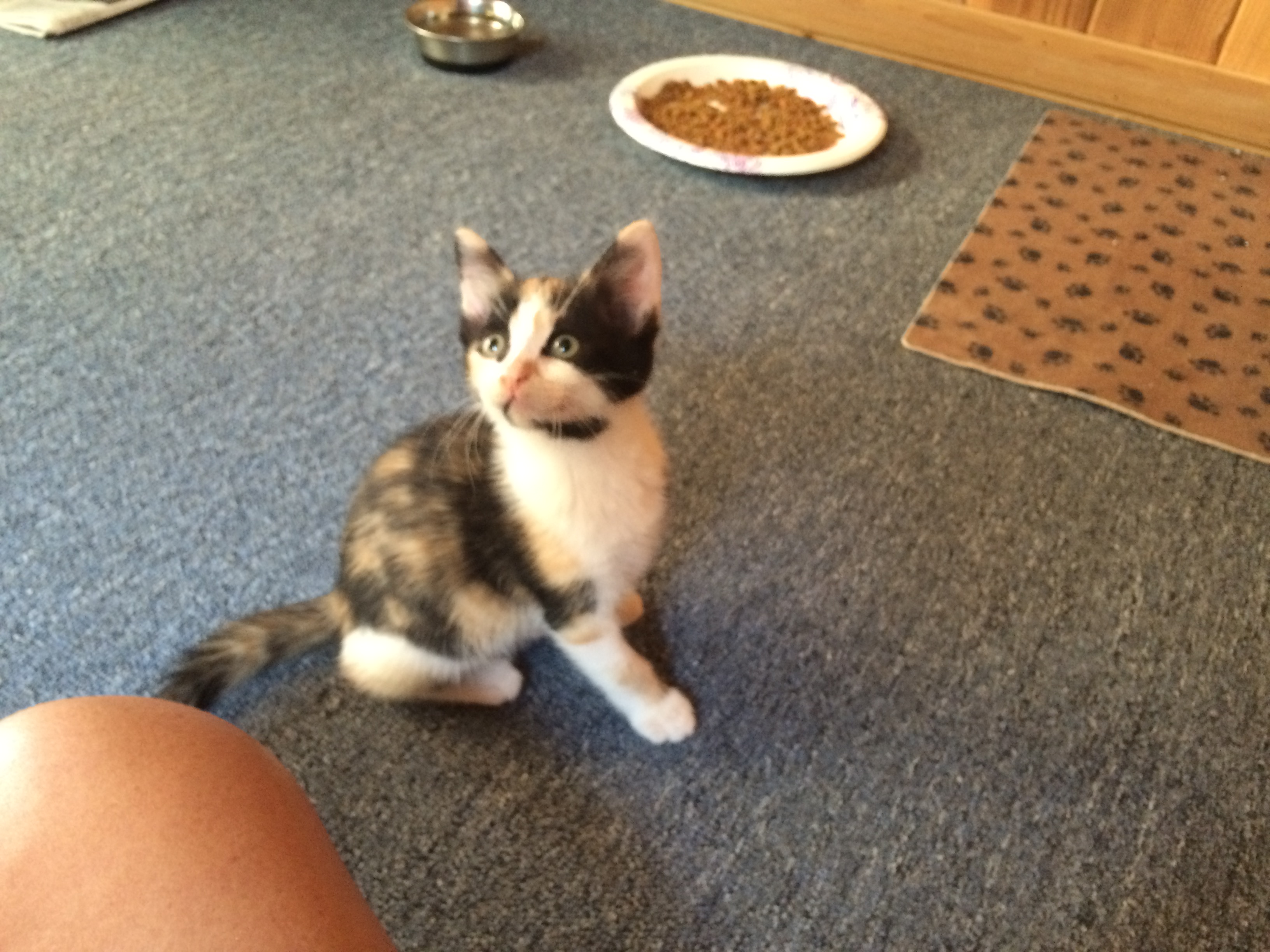
Here is Chloe.

Chloe in focus 8 21 2015

Here is Zoe.

Zoe 8 21 2015

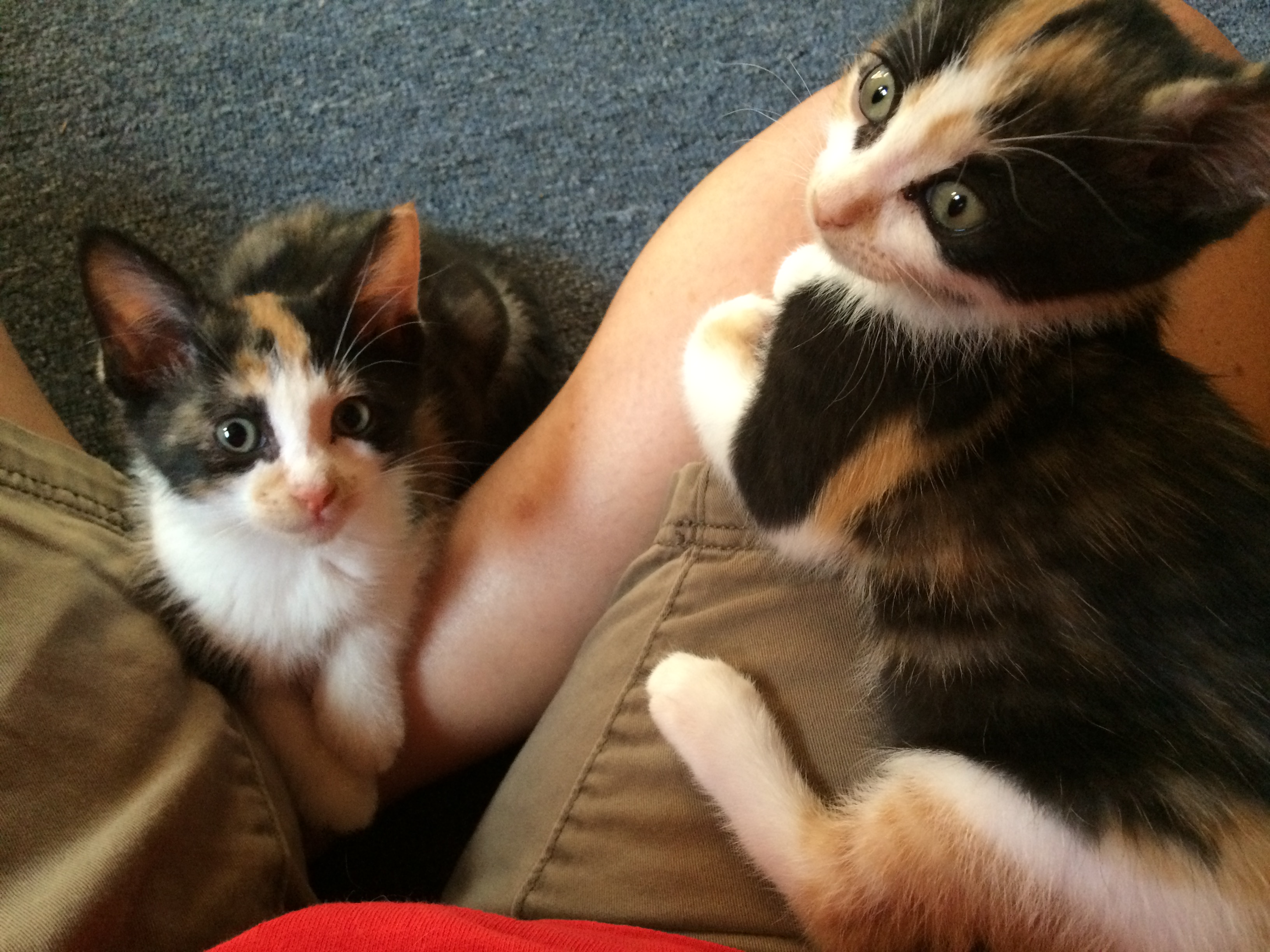
Here they are on my lap.

zoe chin up

And here’s big brother Smokey checking them out  while they slept.

smokey checking them out

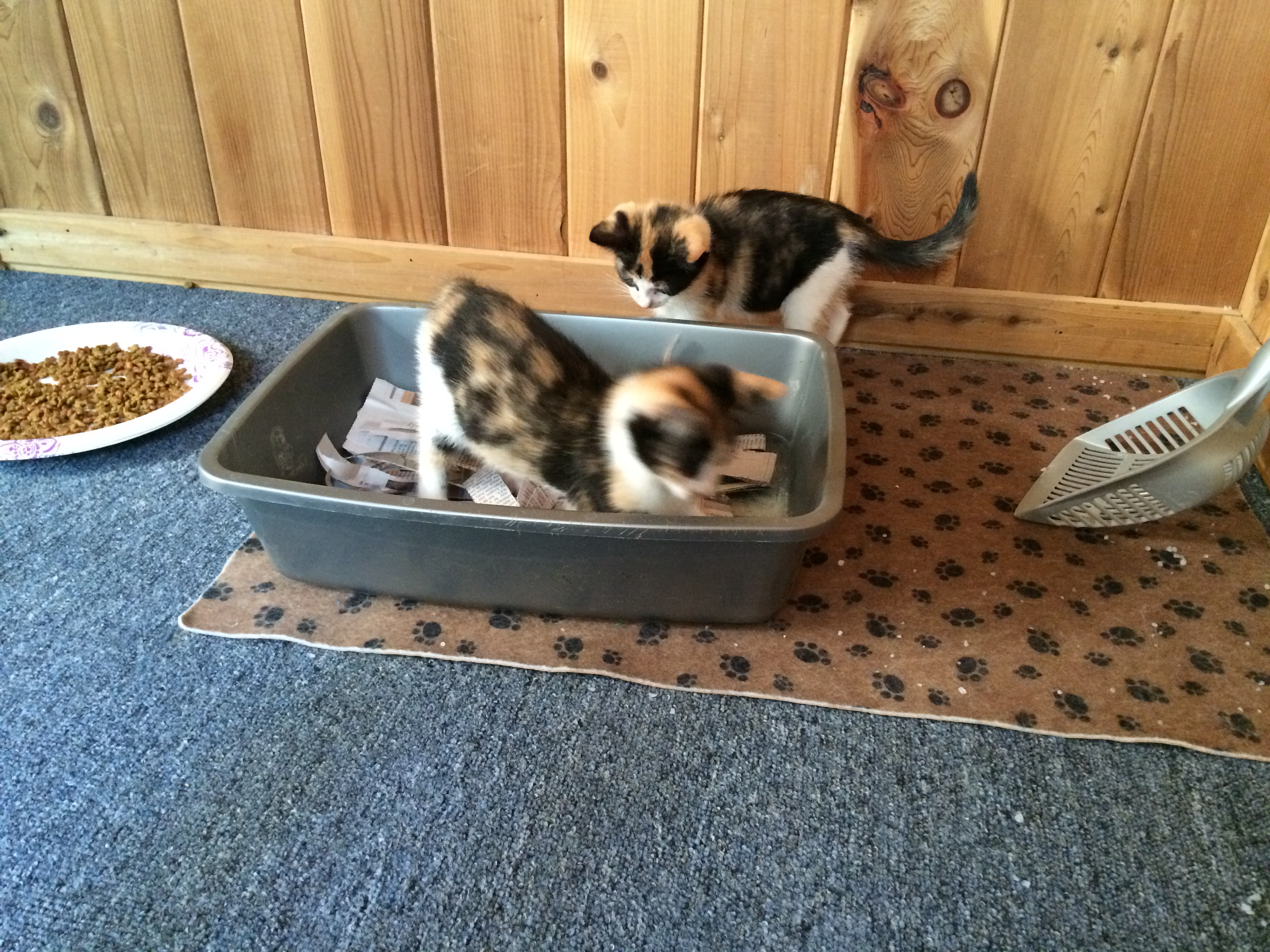
And here are a few more  as they check out their new surroundings.

After they both tried to eat the crystal-type kitty litter, we had to use newspaper until we could get some traditional litter.

After they both tried to eat the crystal-type kitty litter, we had to use newspaper until we could get some traditional litter.

Chloe says not bad testing the quality of the accommodations

We are so excited to have our new babies join our family!


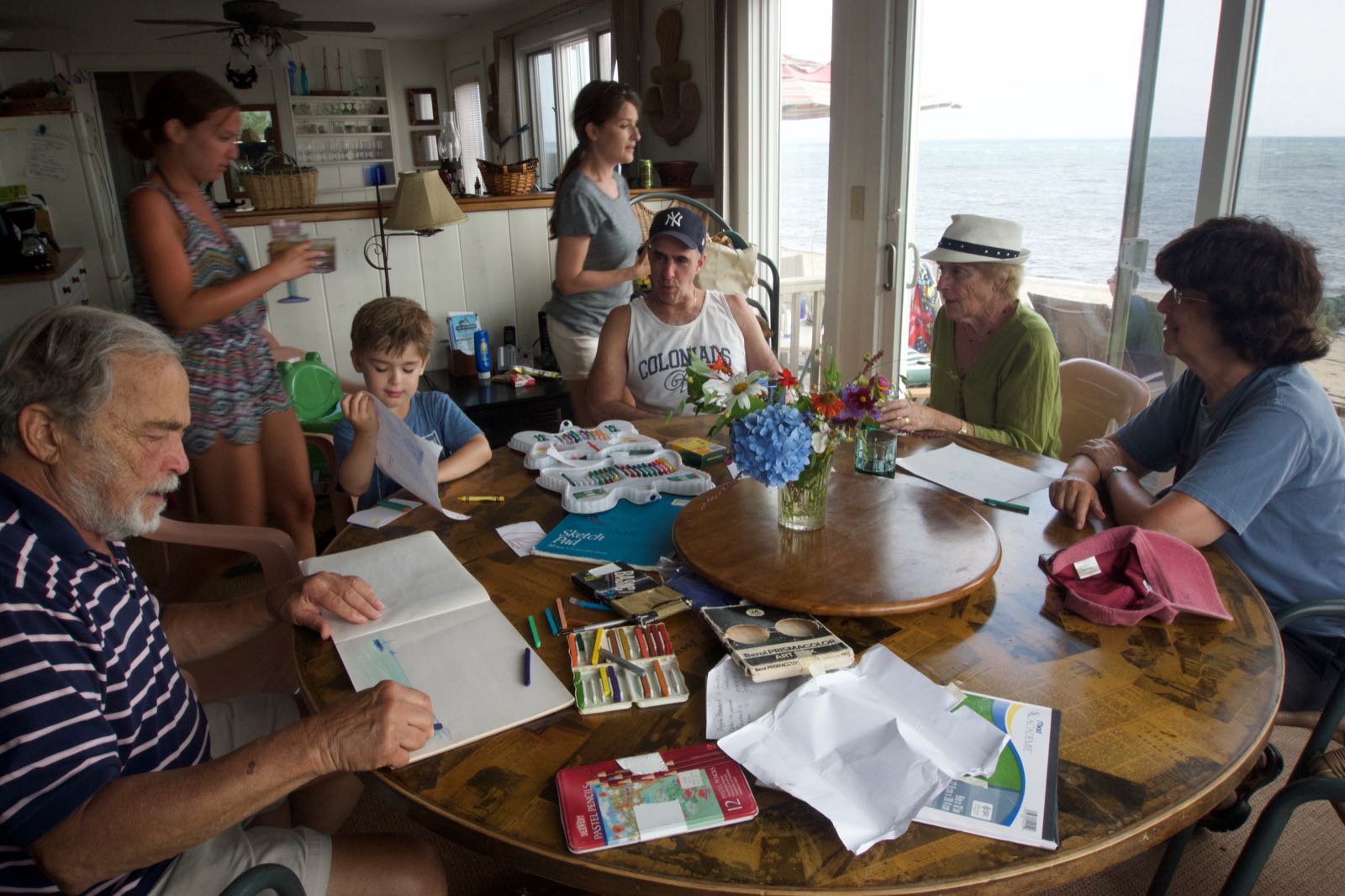
Four Generations 2015


I’ve spent much time these last several years absorbed in past generations of my family, but frankly nothing is as rewarding as spending time with the four present generations of my family—from my parents to my grandsons.  Having all four generations together for a week—eating, playing, laughing, and even arguing with each other—was wonderful.  Here are a few photographs, almost all courtesy of my son-in-law Brian and my cousin Jody.

Four generations

Four generations

SONY DSC

IMG_3085 IMG_3089 IMG_3095 IMG_5297-ANIMATION shooting rockets

SONY DSC

SONY DSC


SONY DSC


Remy Harvey me

Nate and I gardening

SONY DSC

SONY DSC


SONY DSC

SONY DSC

SONY DSC


Maddy Harvey Mom

SONY DSC


Four generations again

Ira and Remy Mom bird watching

SONY DSC


Now I am energized to dive back once again into the past so that I can preserve the family’s history for the next four generations.

Stopping the Tide


I will be taking a break from the blog for the next week or so as I will be spending time with my family.   I have a number of projects on hold—more from the Seligmann handwritten family tree, more from my newly found cousin Lotte, more about the Schoenfelds.  But right now other members of my family—especially my two grandsons—will be the focus of my attention.

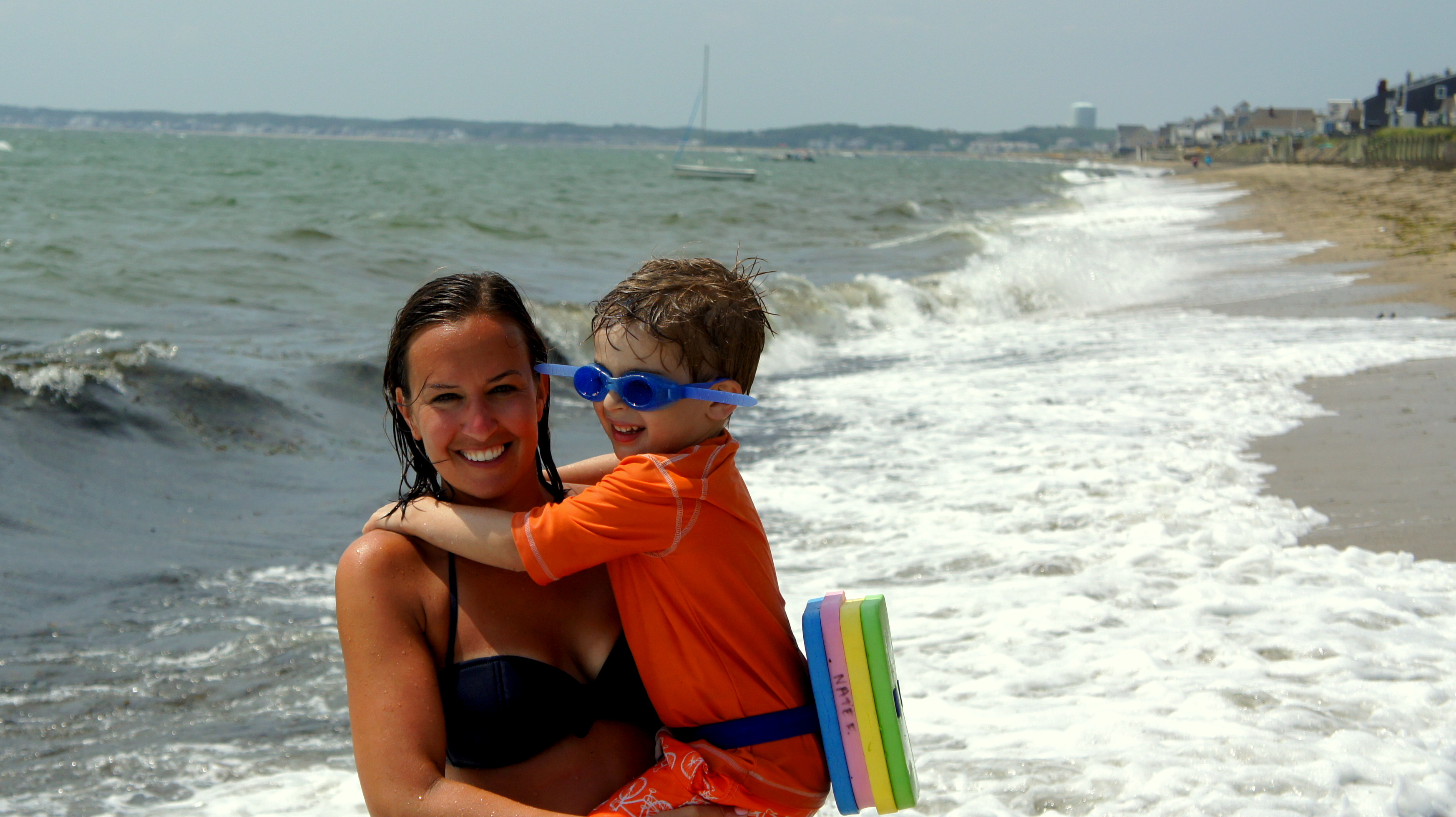
For the past several days we have been taking care of our older grandson; we brought him to the beach where he swam and walked through the water until I was exhausted (he wasn’t), dug holes, and did other beach activities.  But the activity that charmed me the most was when he tried to stop the tide from advancing.  Oh, to be five and to think that you can stop the tides— and time—-from advancing.

Nate at Indian Nec

Stopping the tide

Stopping the tide

Gifts from My Cousin Steve

How very lucky I have been in finding my Seligman cousins.  Starting with my cousin Pete from Santa Fe, then my cousin Wolfgang in Germany, then my cousin Suzanne from Scranton, and now two more cousins: Lotte, a descendant of Hieronymous Seligmann, brother of my great-great-grandfather Bernard, and Steve, a descendant of Marx Seligman, brother of my three-times-great-grandfather Moritz.  I will talk about Lotte in subsequent posts, but for now I will continue the story of Marx Seligman and his descendants.

Steve is a grandson of Sigmund Seligman, the oldest child of Marx and Sarah Seligman, and as I mentioned last time, he has generously shared with me many photographs of his family as well as personal anecdotes about them.  All the photographs in this post are courtesy of Steve.  I am filled with gratitude to him for bringing to life his father Leo, his aunt Mary, and his uncles Max and Albert.

In my earlier post about Marx and his descendants, I wrote that “Sigmund and Charlotte had five children between 1883 and 1896: Mary (1883), Max (1884), Leo (1891), Theresa (1894), and Albert (1896).  Sigmund was employed in the insurance industry.  In 1900, they were living at 304 East 117th Street.”  As posted last time, here is a family photograph of Sigmund and Charlotte and their children from about that time, estimated to be taken in 1901.

Sigmund Seligman and family about 1901. Standing rear: Mary, Max.  Sitting middle row: Sigmund, Albert, Leo, and Charlotte.  In front: Theresa Photo courtesy of Steve Seligman

Sigmund Seligman and family about 1901. Standing rear: Mary, Max. Sitting middle row: Sigmund, Albert, Leo, and Charlotte. In front: Theresa
Photo courtesy of Steve Seligman

Tragedy struck this happy family on September 27, 1902, when eight year old Theresa, the little girl seated in front, died from tubercular meningitis.
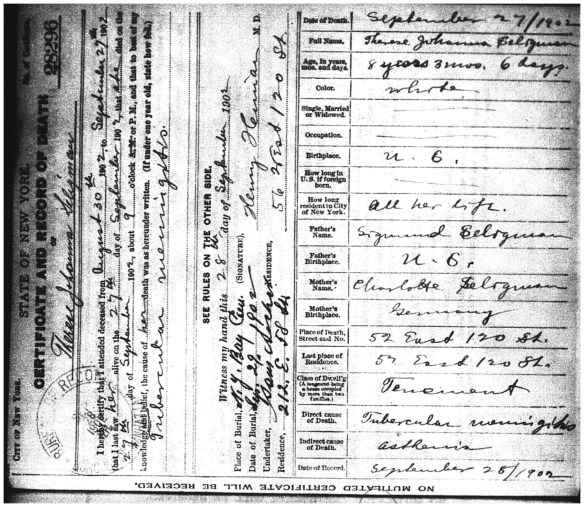
Theresa Seligman death certificate

Theresa Seligman death certificate


In 1905, the remaining children were all still living with their parents at 89 East 121st Street; Sigmund was a supervisor in an insurance company, Max was working as a bookkeeper, and the other boys were in school.  Mary was home.

As noted last time, Mary married Joseph Brandenburg (later Brandt) in 1907.  By 1910, her parents and brothers had moved to 275 East 123rd Street.  Sigmund was still working as a supervisor in the insurance company, now identified as Metropolitan Life.  Both Max and Leo were working as clerks for American Pencil Company, and Albert was only fourteen and presumably in school.

In 1915, the family had relocated again to 60 West 129th Street; Sigmund was still in the insurance business.  The census does not report what businesses they were working in, but Max was working as an assistant manager, Leo as a salesman, and Albert as a stock clerk.

Sigmund Seligman and family 1915 NY census New York State Archives; Albany, New York; State Population Census Schedules, 1915; Election District: 09; Assembly District: 21; City: New York; County: New York; Page: 35

Sigmund Seligman and family 1915 NY census New York State Archives; Albany, New York; State Population Census Schedules, 1915; Election District: 09; Assembly District: 21; City: New York; County: New York; Page: 35

Sigmund and Charlotte’s first grandchild, Jerrold Thurston Brandt, son of Joseph and Mary (Seligman) Brandt, was born on June 15, 1913.

On October 12, 1915, Max married Pauline Hirsch. Pauline’s father Samuel was a German immigrant working as a watchman; her mother had died in 1901. Pauline had been working as a bookkeeper for a clothing company in 1910.  Pauline and Max had a daughter Theresa born August 15, 1916, presumably named for Max’s little sister Theresa, who had died in 1902.

Both Leo and Albert served in World War I.  Leo served stateside near Jacksonville, Florida; Albert was sent overseas where he was gassed on the battlefields of France.  According to his nephew Steve, Albert never fully regained his health, suffering from heart problems and pneumonia all his life.

Leo Seligman World War I courtesy of Steve Seligman

Leo Seligman World War I courtesy of Steve Seligman

Albert Seligman ww1

Albert Seligman World War I photo courtesy of Steve Seligman

By 1920 Sigmund had retired.  He and Charlotte were still living with two of their sons, Leo and Albert, as well as a boarder. Home from the war, Leo was a salesman for a cloak company, and Albert was a merchant in ladies’ clothing.

On April 18, 1920, Leo married Jeanette Freundlich, the daughter of Morris and Martha Freundlich.  Morris was an immigrant from the Austria-Hungary Empire, and according to his passport application, he was born in Krakow.  Morris was a furrier and had his own business.  According to the 1920 census, Jeanette and her brothers Julian and Edwin were all helping their father in his business.  Jeanette and Leo had three children in the 1920s, Joan, my newly-found cousin Steven, and Edward.
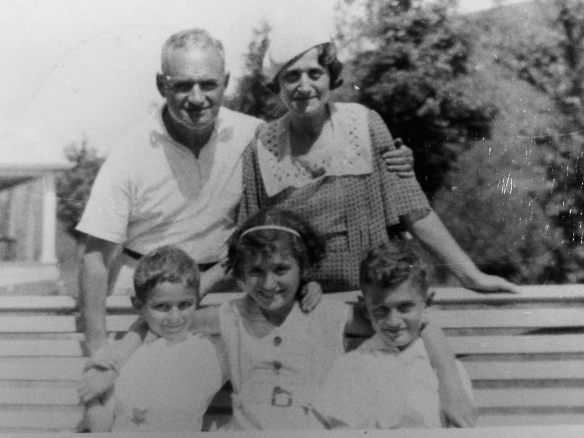
Leo Seligman and his family
Leo Seligman and his family

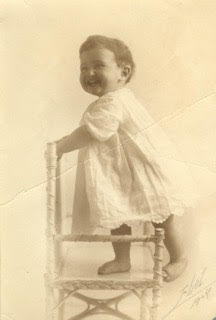
Joan Seligman
Joan Seligman

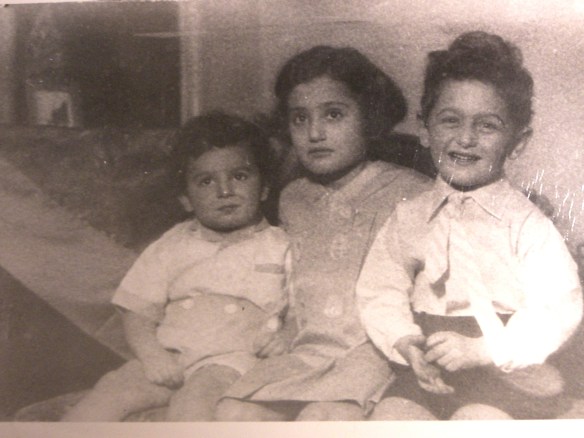
Edward, Joan and Steven Seligman

Edward, Joan and Steven Seligman

EDDIE & STEVE ABOUT 1938 001

Edward and Steven Seligman about 1938

Joan Seligman, age 13

Joan Seligman, age 13

In 1920 Max was working as the assistant manager in the pencil company, and he and his family were living at 424 East 51st Street.

Albert Seligman married Bella Heftler on November 20, 1921. Bella was the youngest of ten children of Max and Sarah Heftler, who were Hungarian immigrants.  Max Heflter was supporting that large family as a tailor, with his two oldest daughters working in a shirt factory in 1900. By 1920, Max had died, and Bella was working as a bookkeeper, still living with her mother and five of her siblings.  In 1923, Bella and Albert Seligman had a son Maxwell, named presumably for Bella’s father.

Albert Seligman courtesy of Steve Seligman

Albert Seligman courtesy of Steve Seligman

Bella Heftler Seligman

Bella Heftler Seligman courtesy of Steve Seligman
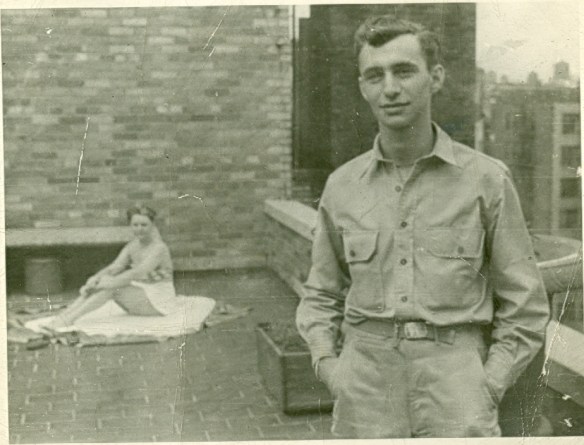
Maxwell Seligman courtesy of Steve Seligman

Maxwell Seligman courtesy of Steve Seligman

Sigmund Seligman died on June 15, 1924.  He was 74 years old.  His wife Charlotte survived him by ten years, dying on July 18, 1934.  She was 75 years old.

Sigmund Seligman and Charlotte Koppel Seligman

Sigmund Seligman and Charlotte Koppel Seligman

As for their children, in 1930 Max was working as the manager of a movie theater and living with his family on West 97th Street.  Leo was living with his family on Cathedral Parkway (110th Street) and working in coat manufacturing.  Albert and his family were living on Jesup Avenue in the Bronx, and Albert was a salesman in the film industry.  Mary and Joe Brandt were living with their son Jerrold at 23 West 73rd Street, and Joe was one of the owners of what was now called Columbia Pictures.

By 1940, all three brothers were somehow connected to the film industry.  Joe Brandt had left Columbia Pictures in 1932 and had died in 1939, but he somehow must have connected his three brothers-in-law to the movie industry.  According to the 1940 census, Max Seligman was working as a purchasing agent for Columbia Pictures.  His draft registration for World War II says that Columbia Pictures was his employer.  Leo reported that he had his own office as a film distributor on the 1940 census, and on his World War II draft registration he said his employer was Max Seligman.  According to Steve, his father distributed foreign films as well as children’s cartoons for a local movie theater.  As for Albert, the 1940 census reports his occupation as a movie theater manager, but on his World War II draft registration he listed his employer as Columbia Pictures.  Steve said that Albert was in the publicity department.  Thus, by 1942 all three brothers appear to have been working in the film business.

Max (front left), Leo (rear on right), and Mary (front right) and two friends playing cards  Courtesy of Steve Seligman

Max (front left), Leo (rear on right), and Mary (front right) and two friends playing cards
Courtesy of Steve Seligman

Mary had also moved back from Hollywood to New York at some point after Joe died, and her nephew Steve remembers that she would often take him and his siblings to the movies.  Steve wrote, “Aunt Mary would march up to the box office and demand to see the manager.  When he came out she would come up with the same pitch.  ‘My husband was President and co-founder of Columbia Pictures and this child and I would like to see this picture.’ I never remember being turned away.”
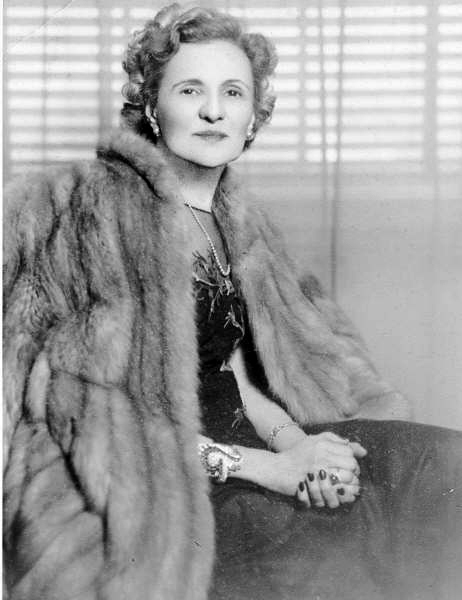
Mary Seligman Brandt Photo courtesy of Steve Seligman

Mary Seligman Brandt
Photo courtesy of Steve Seligman

About his Uncle Max, Steve wrote, “Uncle Max had a habit of saying almost everything twice.  When I would go and visit him and my Aunt Pauline, Uncle Max would invariably open the door and say, ‘Hello my boy, hello my boy, how are you, how are you.’  Even during conversations it would happen.  I don’t know whether he thought we were hard of hearing or if he just wanted to emphasize what he said.    Not everything was repeated, of course, but enough times for my brother Eddie and my cousin Maxwell to refer to him as Uncle Max, Uncle Max.”

Steve also wrote this loving tribute to his father, Leo Seligman, the middle brother:

One thing you could say about my father was that he was a lousy ballplayer.  He couldn’t throw, he couldn’t catch, he didn’t even follow the baseball teams. When my brother Eddie and I would be in our room listening to a replay of the day’s games, my father would be in the living room reading the paper and surely not the sports page. But in other ways he managed to spend quality time with us. In the summer almost every Sunday we would go up to the roof of our apartment building with bridge chairs and hang out for a couple of hours. He would have contests between Eddie and me testing our spelling, math and memory skills. Eddie would always win the math contest but I managed to hold my own in the other games. I think whoever won would get a nickel, nothing to get crazy over but enough to tide us over in the candy store.  In my early teens on Sundays in the spring he and I would rent bikes and go bike riding in Central Park. It’s amazing but I still remember the store. The owners name was Aug, it was on 81st St. and he charged a quarter an hour. That was fun. What my father lacked in ball playing he made up on a bike. One other thing; he never spanked us. When I misbehaved he would “flick” my ear, hard.  It’s hard to describe what “flicking” an ear is but if you put your forefinger against your thumb and release it strongly, that’s flicking. It really didn’t hurt much but it didn’t matter, we knew we were being punished.
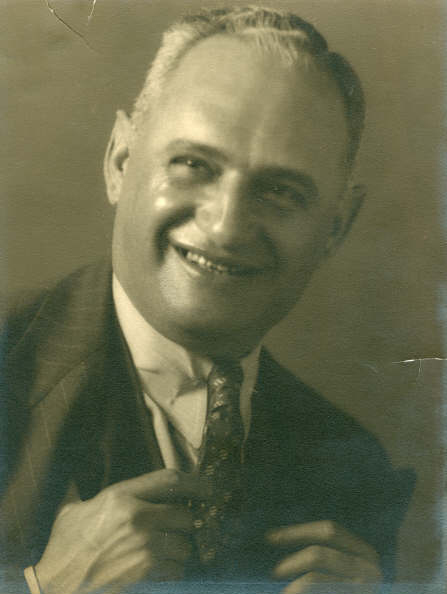
Leo Seligman

Leo Seligman

Leo and Jeanette (Freundlich) Seligman

Leo and Jeanette (Freundlich) Seligman

All three brothers died within five years of each other.  Albert, the youngest, died first on October 6, 1948.  He was only 52 years old and had been plagued with poor health since his service during World War I.  Leo died on January 1, 1952; he was just sixty years old.  Max, the oldest of the three, died the following year on March 9, 1953; he was 68.


Max Seligman NYT Obit

Mary Seligman Brandt, the oldest of the children of Sigmund and Charlotte Koppel Seligman, lived the longest.  She died in February, 1977, at the age of 94.

Thank you once again to my cousin Steve Seligman for sharing his photographs and his stories with me.  I am so pleased that we have found each other.  These new contacts and the pleasure they bring me continue to be the most meaningful benefits I get from doing genealogy and writing this blog.  Here are some additional photographs of Steve’s family:
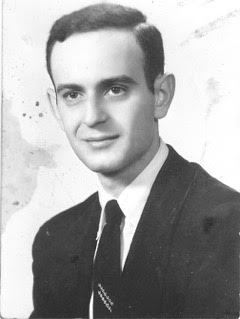
Steve's brother Eddie Seligman

Steve’s brother Eddie Seligman

Steve's wife Arline

Steve’s wife Arline

Joan Seligman's husband Bennett Pollard

Joan Seligman’s husband Bennett Pollard

Steve and Arline Seligman

Steve and Arline Seligman

Nancy (nee Seligman) and Barry Buzzuro
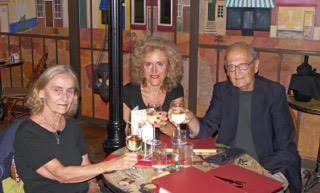
Nancy (nee Seligman) and Barry Buzzuro

Steve and Arline Seligman and daughter Nancy

Steve and Arline Seligman and daughter Nancy

Jane Brenwasser Jacobs, great-granddaughter of Sigmund Seligman

Jane Brenwasser Jacobs, great-granddaughter of Sigmund Seligman


Mystery Photo: One More Try

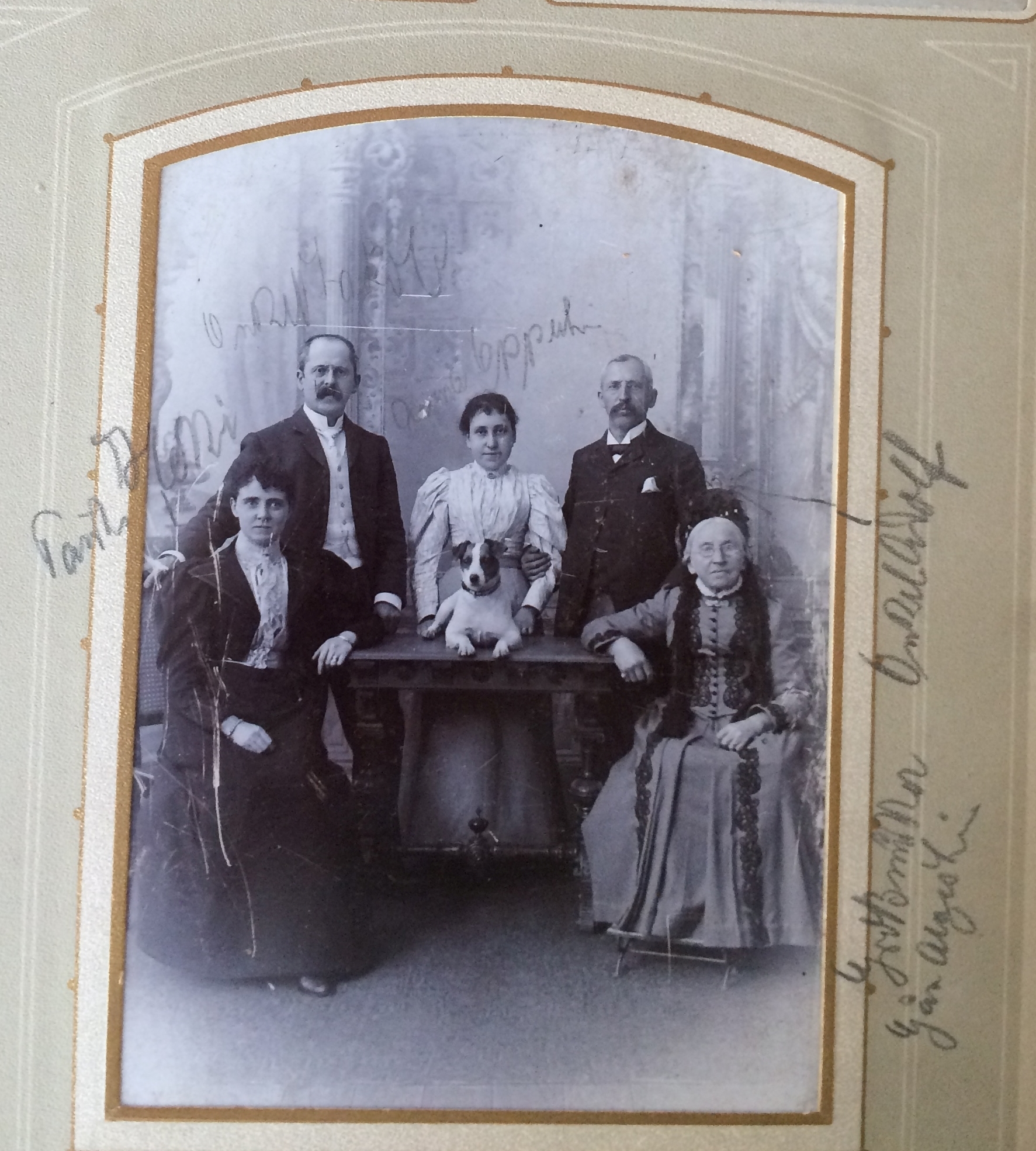
Although my stats show a lot of visitors, I’ve gotten very little feedback on my last two posts (and I am very grateful for the feedback I did receive), so perhaps I am just asking questions that can’t be answered—or that need to be answered by an expert.  But here is one last attempt to figure out who these people are in this photograph.  Please let me know what you think.  On the advice of my cousin Pete, I consulted a few web sites providing fashion information for the purpose of dating photographs, and it seems very likely that this photograph was taken sometime between 1890 and 1905.  I can’t narrow it down much more than that based on the clothing.

Who are these people?

Who are these people? When was this taken?


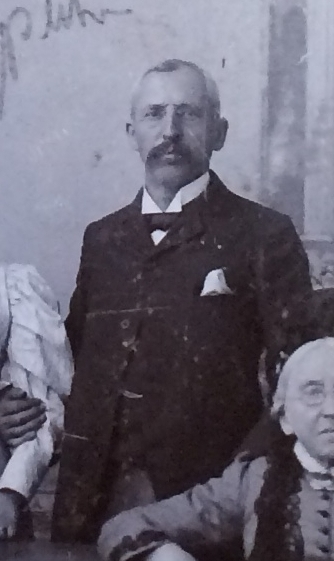
Today I am focused primarily on the man on the right, who is labeled Onkel Adolf.

Onkle Adolf


I have only found two Adolfs in the extended Seligmann family.  One is Adolf Arnfeld, Bettina Seligmann‘s husband, but this is Bettina, and she is not in the group photo, so that makes no sense.

Bettina Arnfeld nee Seligmann

Bettina Arnfeld nee Seligmann


The second Adolf was Adolf Seligman, my three-times-great-uncle who immigrated to Santa Fe and settled there.  He did make a trip to Germany in 1900, so this photo might have been taken then.  Adolf was born in 1843, so if the photo was taken in 1900, he would have been 57.  Certainly the man in the photograph looks about that age.

adolf 1894 europe trip

Date: Saturday, November 10, 1900 Paper: New Mexican (Santa Fe, NM) Volume: 37 Issue: 226 Page: 4

Fortunately, Adolf’s granddaughter Davita recently contacted me after finding the blog, and she sent me this photograph of her grandfather on a trip to Egypt.  Adolf died in 1920 when he was 77, and I would guess he was between 65 and 70 when this photograph was taken.  Is this the same man as Onkel Adolf in the group photo above?

Adolph Seligman in Egypt

Onkle Adolf

To me there is similarity in the eyes, mouth and ears, but the older man has a fuller face (just as the older “Babetta” has a fuller face than the younger one).  What do you think?

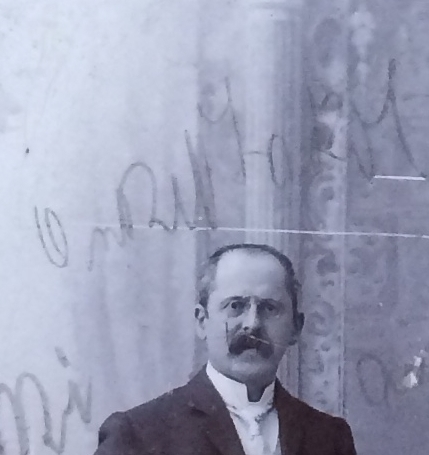
The other man in the group photograph is labeled Onkel Jakob.  Since I can’t find a Jakob Seligmann who would fit into this photograph, I am wondering whether it could be James Seligman, the brother who immigrated to England and whose estate was the reason for all those Westminster Bank family trees.  Perhaps James was born Jacob and Anglicized his name when he immigrated?  Since I have no birth record for James, I do not know.

(UPDATE:  I checked with some people from the German Genealogy Group, and several people confirmed that James was not a name used for boys in Germany in the 19th century; the German equivalent was Jakob.  James was an English name.  Thus, I am now persuaded that this was in fact James/Jakob Seligmann.)

Onkel Jakob


If the two men are Babetta’s sons Adolf and James, it would make sense that the two women are either their wives or their sisters. Adolf married Lucille Gorman in 1902 when she was nineteen and he was sixty.  The woman standing next to Adolf does not look that young nor is she labeled with any name that looks like Lucille or Lucy.  James Seligman’s wife’s name was Henrietta, and the name above the woman next to him does not look at all like Henrietta.

So could they be sisters of Adolf and James? Could the two women be two daughters of Moritz and Babetta whom I just had not yet found?  After all, I had no birth record for James, but only learned of him because of the settlement of his estate.  Perhaps there were other children born to Moritz and Babetta.  There is a six year gap between Pauline’s birth in 1847 and James in 1853, time enough for two more daughters.

One other reason I think this is possible is that Davita told me that her grandfather Adolf’s favorite sister was Minnie, depicted with him in the photograph in Egypt.

gramdfather Adolph and great aunt Minnie_rev


But I have no record of a sister named Minnie.  Both Bernard and Adolf named a daughter Minnie, so this does seem to suggest there was a Minnie in the family.  But….neither of the women in the group photo is labeled Minnie.

Here is a closeup of Minnie from the Egypt photo and a closeup of the woman on the left in the group photo.

Minnie Seligmann


Is this Martha Oppenhimer?

Same person? The nose and mouth are similar, as is the hair.  Again, the woman in the Egypt photo has a fuller face, and it’s hard to compare the eyes since she is squinting into the sun, but it could be the same person, couldn’t it?

But that name above her head doesn’t look like Minnie to me.

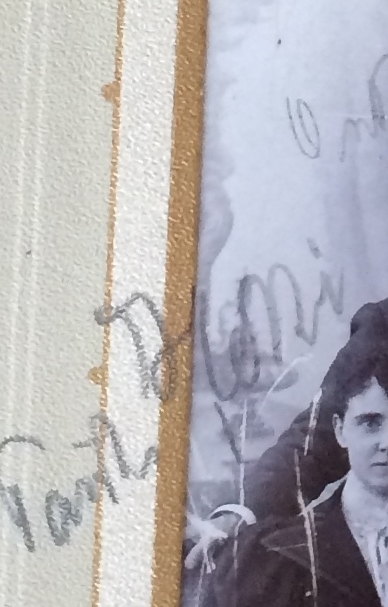
Tante Glori

So who are these people? I am as confused now as I was when I started.  Please let me know what you think!

Mystery Photos II: Oppenheimers

I learned something important from my first Mystery Photo post.  Keep it simple.  Too many photos makes it too confusing for people (and for me).  Although a lot of people read the post, almost no one commented.  I did go to Facebook and got some feedback about whether or not these two photos are both Babetta Schoenfeld Seligmann.  Most people said yes, some said no.

old babetta closeup

Courtesy of the Family of Fred and Ilse Michel

Courtesy of the Family of Fred and Ilse Michel

For my second post involving the mystery photos from the Michel album, I want to start with some photographs that are clearly labeled as members of the Oppenheimer family and that present no mystery.  The Oppenheimers were the children of Pauline Seligmann, sister of my great- great-grandfather Bernard.  She and her husband Maier Oppenheimer had five children: Joseph, Martha, Anna, Ella, and Moritz, according to the Westminster Bank‘s family tree for Pauline.

Pauline Seligmann Oppenheimer Family Tree by Westminster Bank

Pauline Seligmann Oppenheimer Family Tree by Westminster Bank

The Michel album included clearly marked photographs of the two sons, Joseph and Moritz, and one of the daughters, Ella.

Joseph Oppenheimer

Joseph Oppenheimer

Oppenheimer2

Joseph Oppenheimer from Butzbach, son of Tante Pauline

Joseph was born in 1875 and died at Dachau Concentration Camp in October, 1940.

Moritz Oppenheimer

Moritz Oppenheimer

I wrote about Moritz Oppenheimer in detail here.  He was the wealthy industrialist who owned the horse breeding farm and who died in May 1941, under suspicious circumstances after being “questioned” by the Gestapo.  Moritz was born in 1879.

How old do Joseph and Moritz appear to be in these photos?  I am guessing between 25 and 35, meaning the photographs were taken between 1900-1910.  Does that seem right?

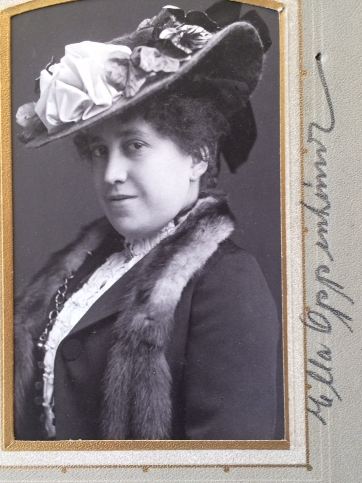
The third clearly labeled Oppenheimer photograph is this one:

Milla Oppenheimer

To Wolfgang and me, this seemed to say Milla Oppenheimer.  But neither Joseph nor Moritz Oppenheimer married a woman named Milla and there was no sister named Milla.  I posted the photograph on Facebook for some feedback, and one member of Tracing the Tribe pointed out that the M could really be an E, except for the dot over what seems to be an I.  Then another member pointed that the “dot” was really part of the framing around the photograph, not part of the name written on the side.  So I believe that in fact this is Ella Oppenheimer.

According to the family tree for Pauline Seligmann Oppenheimer prepared by the Westminster Bank, Ella never married or had children and died during the Holocaust, although I cannot find her in the Yad Vashem database.  I did find in the JewishGen database entitled “German Towns Project”  an entry for Ella Oppenheimer from Butzbach,  who had been born there June 21, 1878 and had moved to Frankfort in 1939,    (That database was created by asking officials in numerous Jewish towns to list their former Jewish residents and their fate, if known.)  But that database had no information about how or where she died.

So these three photographs are pretty clear to me.  The next possible photograph of one of the five Oppenheimer children is the woman at the center of the photograph I posted last time.

Who are these people?

Who are these people?


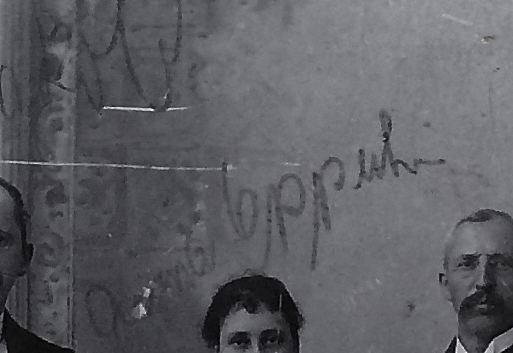
Here is a closeup of her face.

Anna Oppenheimer maybe

It certainly looks like it says Anna Oppenheimer over her head, doesn’t it?

label for Anna maybe

Anna, another sister of Joseph, Moritz, and Ella, was born in 1877, and she died in 1908.  In my earlier post, I assumed that the older woman in this photo was Babetta Seligmann, meaning the photo would have been taken in about 1890 or so since Babetta was born in 1810.  But Anna certainly does not look thirteen in this photograph.  How old does she look?

If I guess that she is 30, that would mean the photo was taken in 1907.  That would make Babetta almost a hundred years old.  Or maybe it’s not Babetta.  Maybe the older woman is Pauline Seligmann Oppenheimer, who was also born in Gau Algesheim.   Paulina was born in 1847, so she would have been sixty in 1907.  That woman could be sixty (not that sixty-year old women look like that today).   But then why is she labeled Grandmother?  Pauline was not Franziszka Seligmann’s grandmother; she was her aunt. In the photo of Joseph Oppenheimer, she is referred to as Tante Pauline.

Franziska’s grandmother from Gau-Algesheim was Babetta.  Fred Michel’s maternal grandmother was Rosa Bergmann Seligmann; she did live in Gau-Algesheim.  She was born in 1853 and died in Gau-Algesheim in 1899.  But that woman does not look 45, does she?  I still think the elderly woman is Babetta.

But then how could that be Anna Oppenheimer?  Am I misreading the name above her head?

So my only question for today: could that be Anna Oppenheimer?

That’s it for this post.  I will return to the other people in this photo in a later post once I have some feedback.  I am trying to narrow down the date so I can piece together the other parts of this puzzle.


Mystery Photos: Part I

In Fred Michel’s album there are a number of photographs that are either unlabeled or labeled with names that we (Wolfgang, Suzanne, and I) cannot match to a person.  I am hoping to get some input from all of you to help us in this endeavor.  Please leave your thoughts in the comments so others can respond.

First, this photo of two women appears to be labeled either Anna or Minna (on the left) and Franziska on the right.  I cropped and enlarged the face of Franziska.   First: Is it Anna or Minna? Anna makes more sense since there is no Minna in the family as far as I can tell.

And is the woman on the right the same woman as the woman in the two photographs below it? That woman is Franziska Seligmann Michel, Fred Michel’s mother.

Anna and Franziska


Franziska who

Fred Michel and Franziska Seligmann Michel  Courtesy of the Family of Fred and Ilse Michel

Fred Michel and Franziska Seligmann Michel
Courtesy of the Family of Fred and Ilse Michel

Franziska Seligmann Michel

Franziska Seligmann Michel

If it is Anna and Franziska, then the Anna could be Franziska’s sister Anna, who married Hugo Goldmann, and whose family including their three children were all killed in the Holocaust.  Perhaps the little girl in the photo is their oldest child Grete, who was born in 1913.

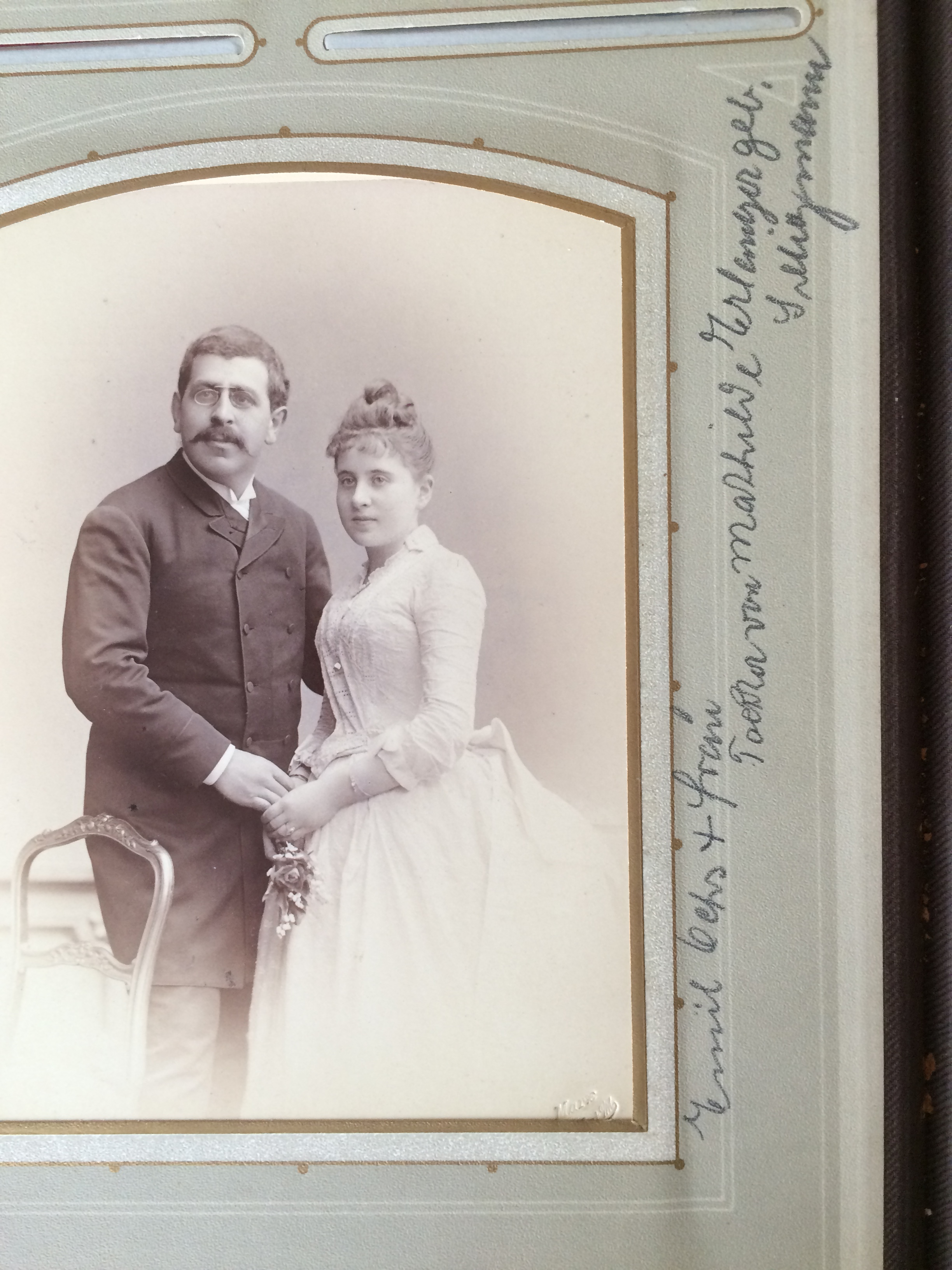
Next mystery set.  The first photograph is of Emil Ochs and his wife Bettina Erlanger Ochs, discussed in my last post; I then cropped just to Bettina’s face.  Is the woman in the photo below, which is unlabeled, the same woman?

Emil Ochs and wife, daughter of Mathilde Erlanger geb Seligmann

Emil Ochs and wife, daughter of Mathilde Erlanger geb Seligmann

Bettina Erlanger Ochs

Bettina Erlanger Ochs

Unknown---is it Bettina Erlanger Ochs?

Unknown—is it Bettina Erlanger Ochs?

The men do not appear to be the same man, do they? If it’s not the same woman, there certainly is a strong family resemblance, but Bettina did not have a sister, as far as I’ve found.

Finally (for now), there are these two photographs.  The first is definitely Bettina Seligmann Arnfeld, the daughter of Hieronymous Seligmann:

Bettina Arnfeld nee Seligmann

Bettina Arnfeld nee Seligmann

The same dog appears to be in this photograph.  But is it?

Uncle Adolf and Grandmother Gau Algesheim

Uncle Adolf and Grandmother Gau Algesheim

Who are these people?

According to Wolfgang, the label on the bottom right says Grandmother Gau Algesheim, so perhaps this is Babetta Schoenfeld Seligmann.  Here is Babetta in an earlier photograph:

Courtesy of the Family of Fred and Ilse Michel

Courtesy of the Family of Fred and Ilse Michel

Could these both be the same person?

old babetta closeup


I think they could both be the same person.  Do you?  I don’t know when Babetta died, but she was born in 1810.  Even if she is 80 years old in the later photograph, the photograph would have been taken by 1890.

If so, who are all those other people? The man above Babetta is labeled Uncle Adolf, I think.  The only Adolf I’ve found in the family is Adolf Arnfeld, the husband of Bettina.  That might have made sense, given the dog appearing in both the family picture and the portrait of Bettina.  But Bettina was born in 1875, and she didn’t even marry Adolf until 1900.  And the woman next to Adolf does not look like Bettina.  And the name over her head appears to be Anna Oppenheimer.

And I don’t think the woman on the left is Bettina either.  Here’s a close up of that woman.

Is this Bettina Arnfeld?

Is this Bettina Arnfeld?

Finally, the names in the left hand margin.  The man appears to be labeled Uncle Jakob, and I can’t read at all the name for the woman sitting below him—-Tante (aunt) something?  Ends with an I?  Not a clue.  I can’t find an Uncle Jacob or anyone to match the Aunt he is paired with.  More on this photo in the next post.

As for the dog, if Bettina Arnfeld was a young woman when holding that dog, what year would this be?  Bettina was born in 1875, so if she is twenty in that photo, this could be around the same time as the large group photo with what appears to be the same dog.  I am confused!

So…please do share your thoughts with me.  It often takes a fresh set of eyes to see what I may be missing.


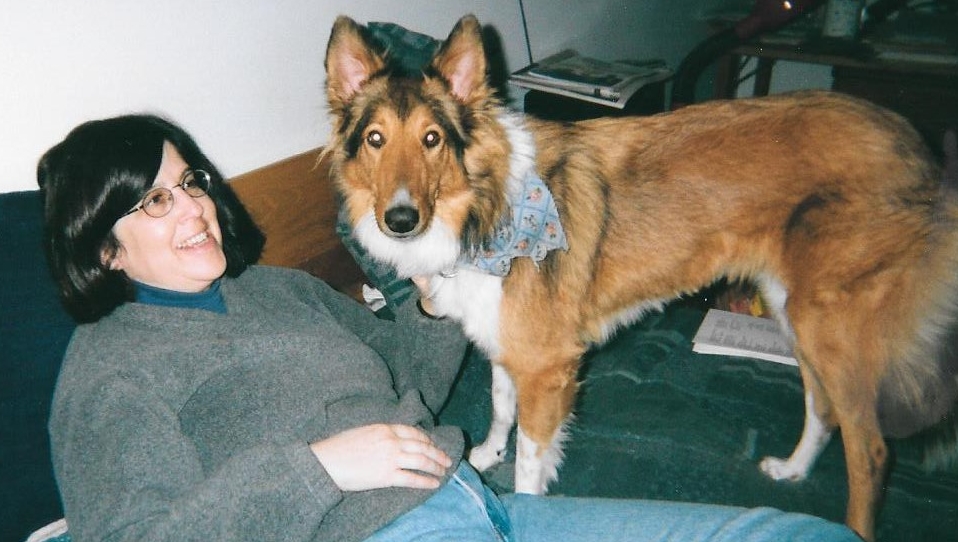
Cassie  July 2000-June 2015


Cassie

Cassie

We said goodbye to our wonderful dog Cassie this week.  It was a terribly hard and upsetting decision, but she was failing, and her quality of life had deteriorated to the point where we knew we had to make the right decision for her.  We are at peace. She lived a good and  long life for a dog.  But we are also incredibly sad.

Cassie was a pound puppy.  We got her at the Thomas J. O’Connor animal shelter in Springfield, Massachusetts, in the summer of 2001.  The police had picked her up after finding her tied to a tree in a trailer park in Chicopee, and no one would claim her as theirs.  She had been in the pound for only a few days when I saw her on Petfinders.com and suggested we go take a look.

She was skinny, dirty, and overly excited.  Harvey and Maddy were skeptical, but I was in love, and I knew right away that she was sweet and gentle and loving.  And I was right.  Cassie never once growled at a person or a cat, and she only growled at dogs if they invaded her space, which wasn’t very often.  She never, ever hurt anyone.  She loved everyone.  When we told family and close friends that she was gone this week, everyone described her as loving and sweet and gentle.

August 2001

August 2001

Our vet estimated that she was about a year old when we adopted her at the end of July, 2001, so we assigned her a birth date of July 31, 2000.  She took almost no time to adapt to living with us.  She was clean and playful and smart.  She could run like the most graceful of animals.  The first time we took her to the beach, she ran all the way up a high dune.  We raced after her, fearful we’d never see her again, but there she was waiting for us at the top.  It took a long time before she was ever let off the leash again.

Cassie was with us during that dreadful fall of 2001 in the aftermath of 9/11.  She was such a positive distraction.  When my family, all shaken still by the events of that September, gathered for Thanksgiving, it was Cassie who made us laugh.  She was still new and puppy-like, and she’d run from one member of the family to another, excited and happy.

My dog and me November 2001

My dog and me November 2001

November 2001

November 2001

Once she settled in, she became calm and unflappable.  No matter where we took her—to the Cape, to a new house, to a temporary apartment before our new house was ready, to our cottage—she adapted almost instantly.  We even once dragged her all the way to Geneva, New York, so she could visit Maddy at college.  She was great in the car, great with children, and great with us.  I often felt badly that she was growing up in a home with no small children since she would get so excited any time she saw a young child.  And children loved her.  She would kiss them, and they would hug her.

So gentle with Nate as a five month old

So gentle with Nate when he was a five month old

SONY DSC

And with Nate when he was three

About the only thing she didn’t like were elevators.  Can’t say that I blame her.  She liked going to the groomer, she liked going to the vet.  She liked strangers, she liked anyone.  She didn’t bark at people at the door or those who entered our home. She never jumped on people or pushed them around, despite the collie herding instinct.  She was definitely not a watchdog.  She was a love dog.

Cassie and Maddy

100_0336

And our cats Smokey and Luna adored her.  From when they were little kittens, they would curl up on her, and to the very end of her long life, Smokey still treated her like his mother, kneading his (clawless) front paws into her belly and nuzzling his nose into her fur.  The only thing that seemed to light up Cassie’s eyes as she declined was Smokey.  She would even chase after him a bit to play.

100_1054

Look how gently she handled Smokey as a kitten

100_1053

IMG_0579


100_1111


Cassie and Smokey


Cassie was an incredible companion—on long walks in the neighborhood or the woods or the beach (even though she didn’t love the beach much) and just being with us in our home.  She was always right there with us wherever we went.  I can’t tell you how much we will miss her and how much we agonized over her decline and our final decision to give her peace.  But she had been there for us, and we had to be there for her.

So we are at peace.  She is no longer distressed and confused, and we can look back with deep love and gratitude for the fourteen years we had her with us.  Goodbye, Cassie.  You will always be our dog, and we will always keep you in our hearts.

100_1326

Happy Fathers Day!

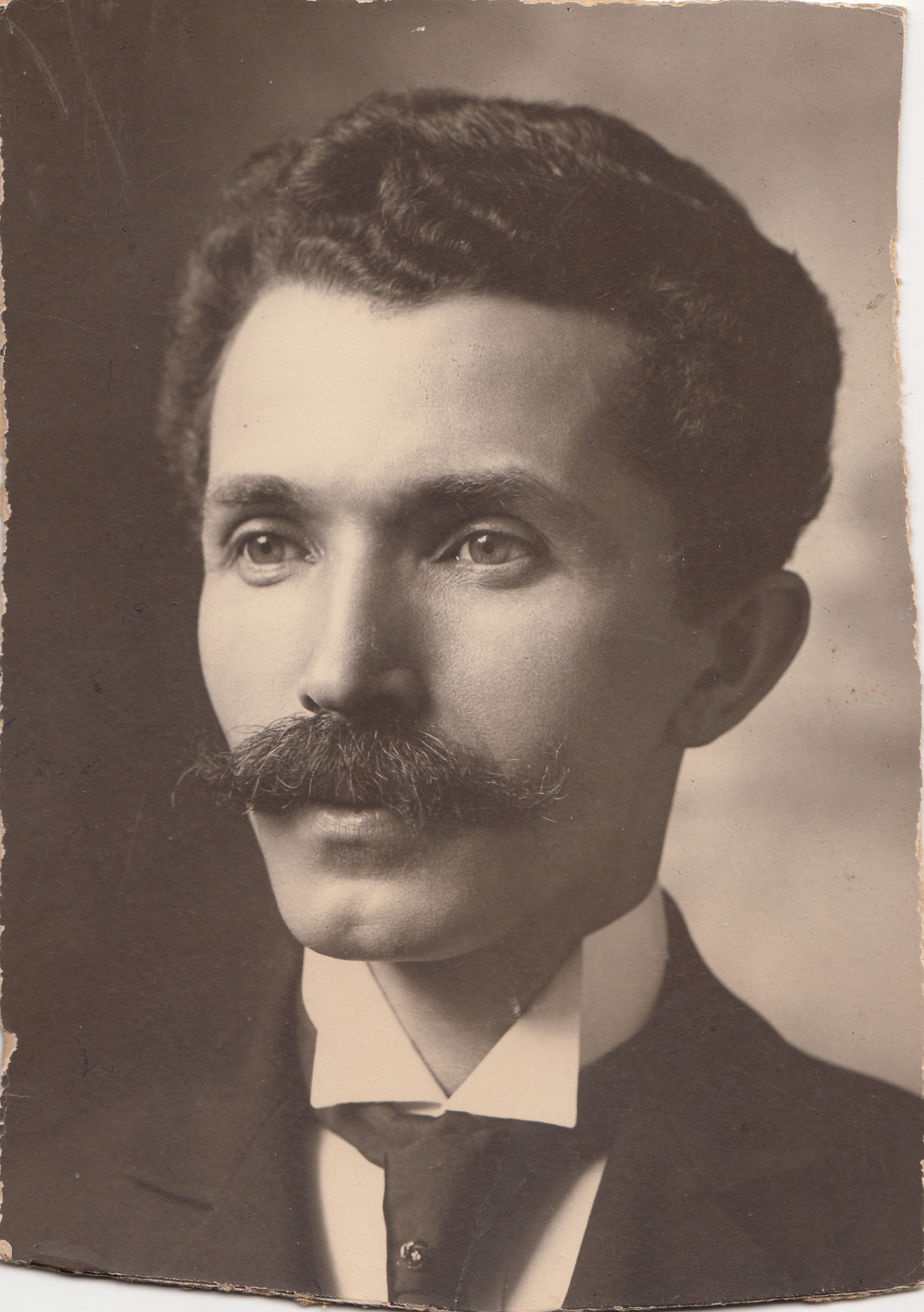
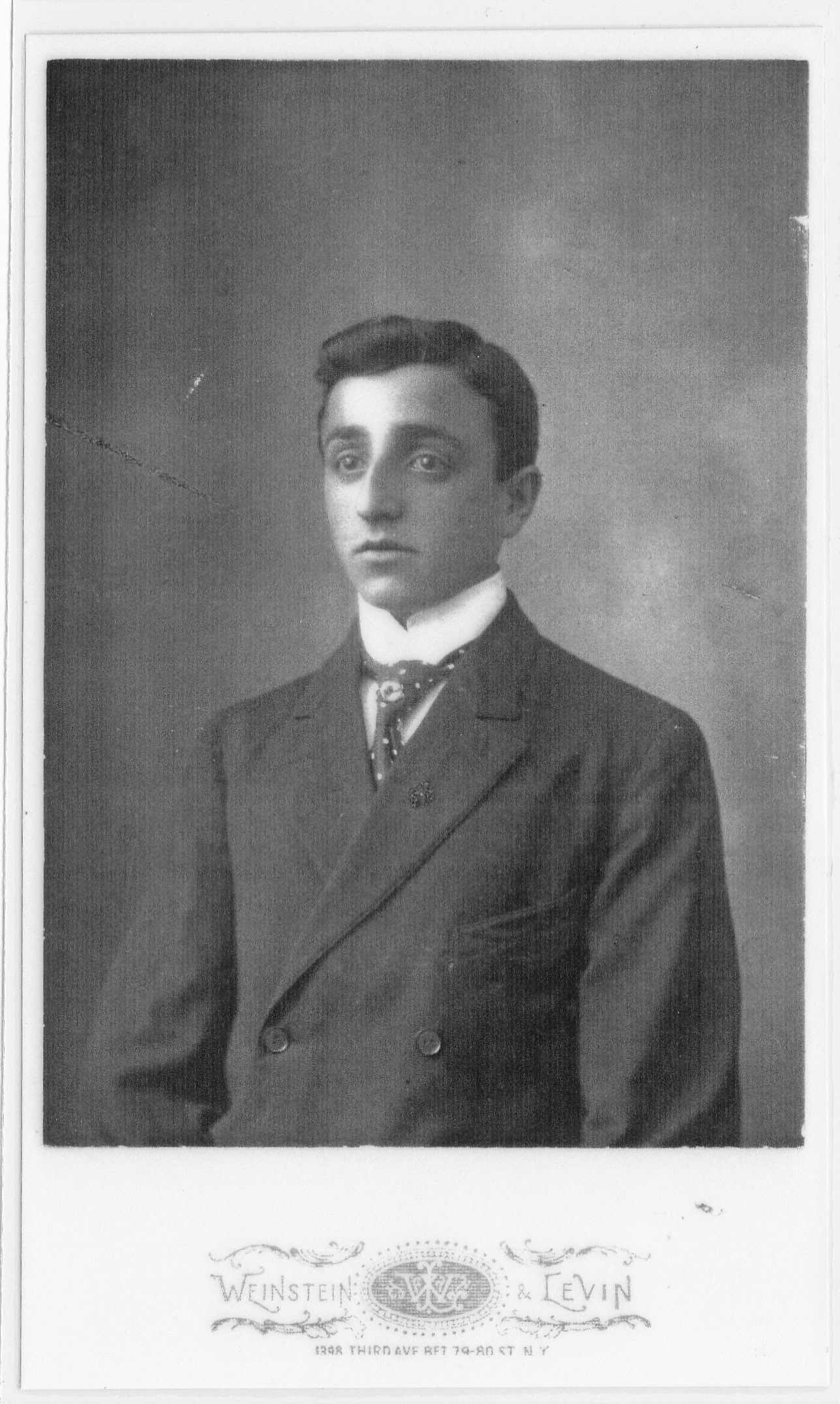
Today I want to pay tribute to all the fathers in my family tree, in particular my own father, who is always a source of inspiration for me.  He is passionate about many things—most of all his family, but also art, music, politics and human rights, the environment, cats and dogs, food and drink, and, of course, architecture.  His passion for all of these things is matched by his knowledge about them and his continuing curiosity about everything, except maybe computers.

Happy Fathers Day also to my husband, Harvey, with whom I also celebrated our 39th anniversary this weekend.  I could not have asked for a better father for my own children.  He’s been my parenting partner from the beginning—a totally engaged, loving, caring, and attentive father.  My daughters are sweet and kind and compassionate because they have him as their father.

Happy Fathers Day also to my son-in-law Brian.  He is a wonderfully devoted father whose face lights up with joy whenever he is with his sons.

And Happy Fathers Day to all the other fathers out there as well.

What follows are photographs of all the fathers in my direct lines for whom I have a photograph or at least a photograph of their headstone.

amy and john 1954 abt

My father and me

Eva Schoenthal and John Cohen, Jr. 1923

Eva Schoenthal and John Cohen, Sr. 1923  My paternal grandparents

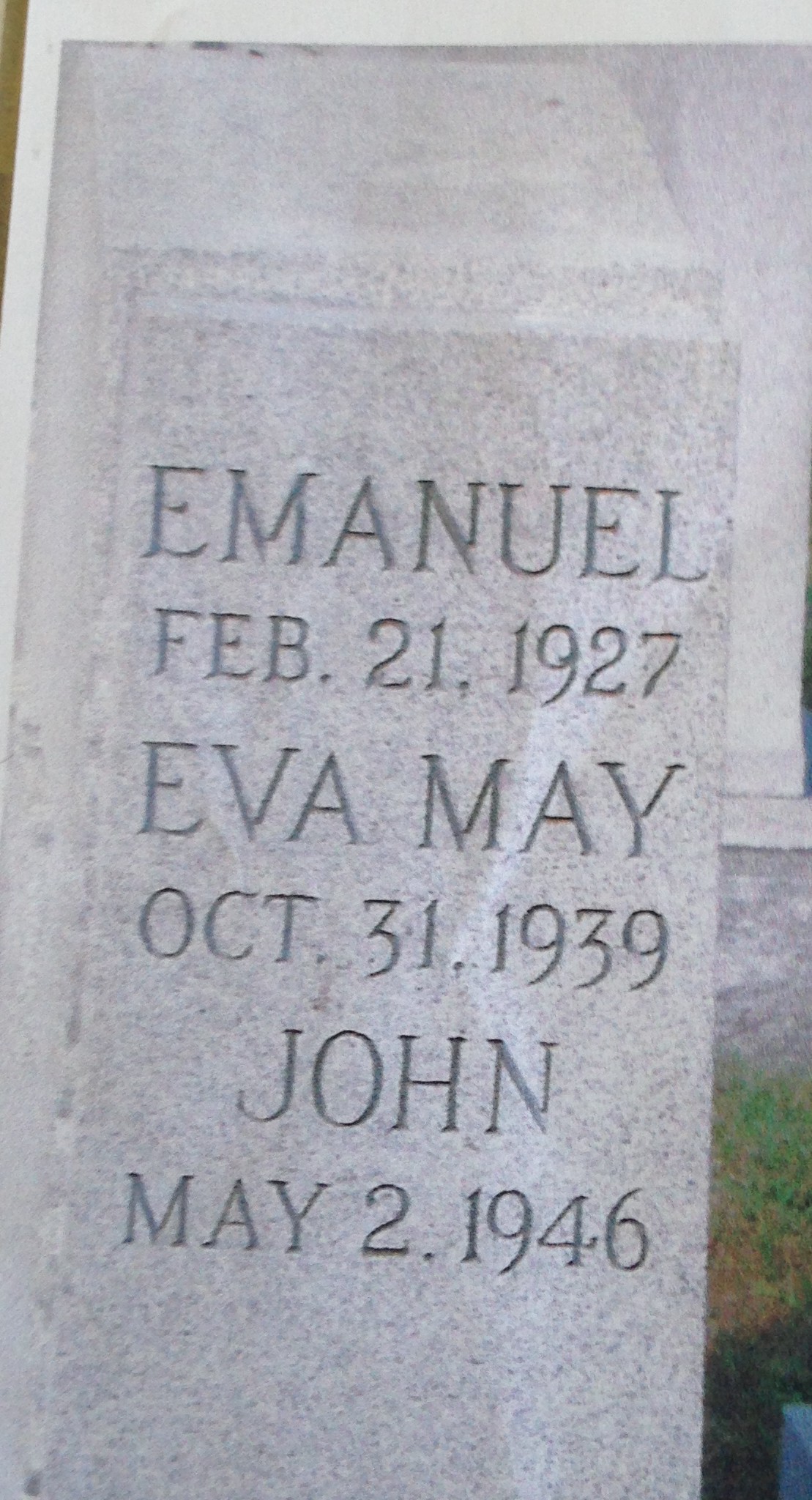
headstone for emanuel, eva and john n cohen

My great-grandfather Emanuel Cohen’s headstone, as well as that of my great-grandmother Eva Seligmann Cohen and their son, my grandfather, John.

Jacob Cohen headstone by Todd

Jacob Cohen, my great-great-grandfather

Bernard Seligman

Bernard Seligman, my great-great-grandfather

Courtesy of the Family of Fred and Ilse Michel

Moritz Seligmann, my 3x great-grandfather

Isadore Schoenthal, my great-grandfather

Isadore Schoenthal, my great-grandfather

Isadore Goldschlager

Isadore Goldschlager, my grandfather

Moritz Goldschlager

Moritz Goldschlager, my great-grandfather

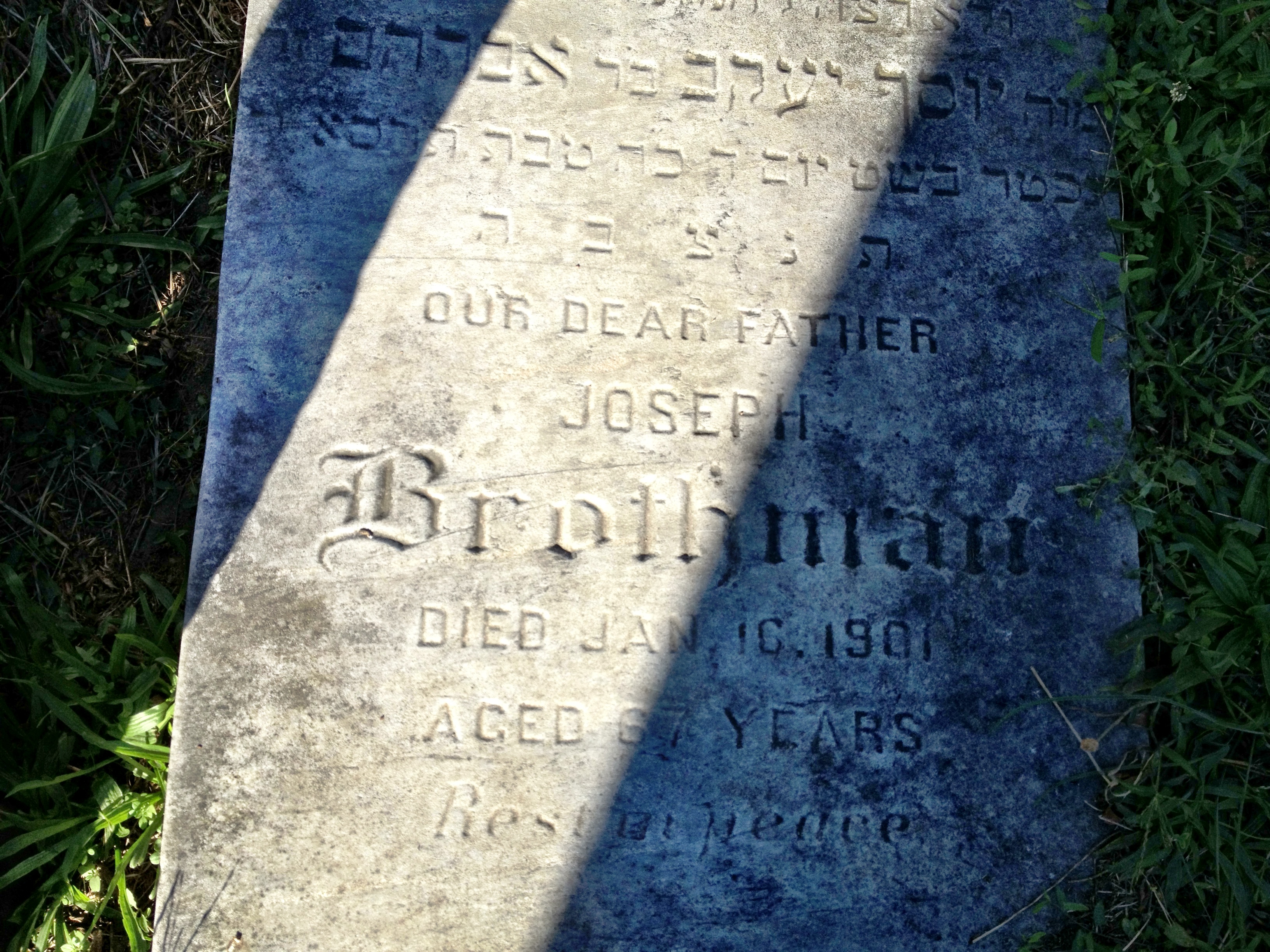
Joseph headstone ABC

Joseph Brotman, my great-grandfather


Impressions of Vienna and Some Concluding Thoughts on our Trip

To be honest, Vienna was not originally on our itinerary.  We wanted to go to Prague and Budapest and, of course, Poland, and we felt that given the number of days we could travel that that was already an ambitious itinerary.  But we could not find non-stop flights even out of NYC to any of those places, and we hate layovers, so we decided to fly in and out of Vienna.  It may not make sense to those of you who are regular jetsetters, but getting me on a plane is a big enough accomplishment; making me change planes might send me…flying?

Anyway, we were going to fly in and out of Vienna so we added a day to our trip.  It seemed crazy not to spend at least 24 hours in one of the world’s great cities, even though we knew that 24 hours would not be enough to scratch the surface of what there is to see there.  It would take some intense prioritizing and great organization to pack even a few top sights into our day.

We actually ended up with a day and a half, as our train from Budapest to Vienna arrived around 2:15 pm, and we were able to check into our hotel (Radisson Blu) quickly and be on our way.  The hotel was extremely well-situated for us to see many of the important sites just a short walking distance away.  It’s not the Boscolo, but it is a very clean, contemporary, and small boutique hotel.

Just two blocks down the street was the Hofburg Palace where the Habsurgs lived in Vienna.  An outdoor music festival was going on that day, and there were crowds gathered to listen to the music—young choral groups performing primarily American music.  A bit incongruous—standing in front of an Austrian royal palace, listening to a group singing, “When the Saints Go Marching In.”  Our global world at work.

Hofburg Palace

Hofburg Palace

We wandered through the streets, passing many chic stores on Kohlmarket, and reached Graben, where there is a huge square lined with cafes and more fancy shops.  We stopped to see St. Stephen’s Cathedral and the all glass Haus Haus across the street.  Unlike the Hilton in Buda, this modern structure somehow blended in with the older buildings surrounding it.

IMG_2895 IMG_2896 IMG_2897 IMG_2898

We just had to stop and have some Viennese pastry, right?  It’s mandatory, I think. If one must drink beer in Prague, one must eat pastry in Vienna.  It was very much worth the unnecessary calories.  Vienna’s streets were packed with tourists, and there was lots of good people-watching to do from the café.

But we had miles to go in order to see at least some of the city, so off we marched towards the Opera House.  Like the Opera House in Budapest, it was a stately and beautiful building.  We opted not to do the tour inside this time, preferring to use our time to visit one of the art museums.

IMG_2907

It was already late in the afternoon, and we realized that we only had an hour until closing time, so we opted for the smaller Leopold Museum rather than the tremendous Kunsthistorische museum.  We were very glad that we did.  The museum focuses on the works of Gustav Klimt and Oskar Kokoschka as well as that of some of their less well-known contemporaries, and it does a masterful job of teaching about their art, their lives, and the politics and psychology that lie behind their art.  The room dedicated to the influence of Sigmund Freud was particularly well-done; a plaque with a quote from Freud hung near each painting, leaving it to the viewer to see the connection between the words and the art.

IMG_2909

We stayed until the museum closed and then wandered back to our hotel, not even realizing how close it was.  (We had basically walked a full circle from one side of the center of the city to the other and back without realizing it and were essentially behind the Hofburg Palace when we exited the museum quarter.)  We were amazed by how much we had seen in the few short hours since we’d arrived in Vienna.

The next day was jam-packed on my itinerary, but I quickly realized that there was no way we would get to the Schonbrunn Palace, even though I had pre-purchased tickets to go there.  It’s about 20 minutes outside of the city center, and since we were seeing the Hofburg Palace that morning, we decided that if you’ve seen one palace, you’ve seen them all. (Where is Spiro Agnew when you need him?)  Eliminating the Schonbrunn from the agenda loosened up our day considerably.

The Hofburg Palace was worth seeing; it tells the story of Emperor Franz Joseph and his wife Empress Elizabeth, commonly known as Sisi.  In particular, it tells the story of Sisi, who grew up as a young and independent child and married the emperor somewhat reluctantly, knowing that she would lose her freedom by doing so.  Eventually she became very unhappy living such a restricted life, and after one of her children died, she became severely depressed.  Although she contemplated suicide, in the end she was assassinated in Geneva by an Italian anarchist.  Her life story is well-told in the first several rooms in the palace.  After that, you then can see many of the lavish rooms where the emperor and empress lived and entertained in the palace.

After the palace tour, we went to see the performance of the Lipizzaner stallions at the Spanish Riding School.  This was another event that, like the baths in Budapest, several people said we could not miss.  We had standing room tickets, and the place was packed.  Within five minutes of the show starting, I almost left.  The first “act” involved some newer horses, and it was clear that at least one of them was not at all happy performing.  I couldn’t watch as the horse bucked and resisted his trainer’s attempts to control him.  We did stay for the next hour, and although the rest of the show involved more experienced horses, I just couldn’t shake the idea that these animals were being forced to do something they were not intended to do.  The horses are gorgeous, and if you love horses, you will either love this event or you will hate it.  I still am not sure how I feel about it. (We were not allowed to take photos, so I’ve inserted one from the internet.)


Embed from Getty Images

After lunch, I went to see the jewels at the Imperial Treasury while Harvey went to finalize our boarding passes for our flight the next morning.  The jewels were amazing.  I will let the pictures reveal what I saw.

IMG_2917

This opal was the size of a large pear. My Aunt Elaine would have loved it.

IMG_2920 IMG_2922 IMG_2927

The last thing we wanted to do before leaving Vienna was see some evidence of the Jewish world that once existed there.  Vienna had a large and thriving Jewish population before the Holocaust, including many famous artists, writers, musicians, and, of course, Freud.  Yet unlike Prague or Krakow or Budapest, there is almost nothing left in what was once the oldest Jewish section of the city to let you know that there once was a vibrant Jewish community there.  In that place, called Judenplatz, there are two reminders of the Jewish community: a museum which contains the remains of a medieval synagogue and a Holocaust memorial sculpture.  The museum’s exhibit is fascinating.  You can actually walk through the remains and see where the bima was, where the ark was, where the men sat to pray.

As for the Holocaust sculpture, it stands in the center of the square, and it is a large cube placed in the center of a larger platform.  On the sides of the cube are engraved the names of all the concentration and death camps.  I think it is supposed to evoke the sense of being locked inside, given the locked door on the exterior.  What was very disturbing about the memorial was the fact that there were many people sitting on the platform, idly eating ice cream and chatting, seemingly oblivious to the purpose of the sculpture.


The memorial to the 65,000 murdered Austrian J...

The memorial to the 65,000 murdered Austrian Jews in the Holocaust at Judenplatz in Vienna. (Photo credit: Wikipedia)

That perhaps is itself a metaphor for the Austrian attitude towards the Holocaust for many years after the war: denial.  As we learned at the main building of Jewish museum, it was not until fifty years after the war that Austrian officials apologized for their country’s role in the Holocaust.  They refused to acknowledge their complicity with the Nazis in the persecution and eventual murders of their Jewish citizens.  What had been a large and wealthy and intellectual community had been almost entirely wiped out.  Today there is some revival of Jewish life in Vienna, mostly made up of immigrants from the former Soviet Union.

We ended our trip going to the Musikverein, a great music hall in Vienna, where we heard Haydn, Poulenc, and Sibelius.  The sounds were as clear as could be, and the music was just wonderful.

IMG_2935

Musikverein Concert Hall

Although we saw so much of great beauty in Vienna—the buildings, the pastries, the jewels, the art, and the music, our visit to Judenplatz and to the Jewish museums put an overall damper on my feelings for Vienna.  Perhaps I am not being fair; we were there for such a short time, and perhaps a longer visit would have provided me with more perspective.  We had no guides in Vienna, just our handy Rick Steve’s guidebook and TripAdviser. I understand that there are a number of stolpersteins in the Second District where the Jewish community was located right before World War II.  We did not get there nor did we see where the current synagogues are located or talk to anyone familiar with the city and its history as we had in the other cities.  I am sure there is more than what we saw in such a short time—an important lesson to keep in mind in visiting any place.  You can’t see it all in a short visit as a tourist.

****

Thus ends my travelogue of our trip to Central Europe.  Some concluding thoughts:

  1. The best way to learn about the history, values, and people of another country is to go there and walk where they walk. If you do, be sure to find a way to talk to someone who lives in that place.  Guidebooks are great, group tours may be fine—but nothing beats developing a personal relationship with someone who knows that city like you know your home town and your history. Talk to them about their families, their personal history, and you will learn so much more than you ever could from a book or recorded tour.
  2. Take notes, take pictures. Memories vanish very quickly.  In writing this, I had to go back to my books, notes, photographs, and, yes, the internet, to be sure I had the right name for the right place and the right numbers and dates.
  3. Travel the way you want to travel.  I know many people prefer to travel on organized tours or at least with a group of friends.  Call us anti-social, but we have learned that traveling with others means compromising our own priorities.  We don’t get to travel as often as we’d like, and when we do, we want to go where we want to go, eat when and where we want to eat, and see and hear what we want to see and hear.  It’s really not that hard to research and plan your own trip.  Just my opinion, of course.  I fully understand that for other people, traveling with others is more comfortable and more fun.  Like I said, travel the way you want to travel.
  4. There is both incredible beauty in the world and incredible evil. Human beings have created incredibly awe-inspiring buildings, music, and art.  Each place we visited was a testament to man’s ability to create beauty.  Sadly, each place was also a testament to man’s ability to do incredible evil.  We tried always to let the beauty remind us that for the most part, human beings are good.

  5. If you know where your ancestors lived, go there, even if it’s a small town in the middle of nowhere where no traces are left of your ancestors or their community. I understand that some people have too many feelings of anger about the past to do this, but if you don’t feel that way and can go, go there.  You will be forever changed.

Thank you to all who have followed me through this telling of our trip.  I will now return to a focus on genealogy, but I felt a real need to write about this trip for so many reasons, not the least of which is to keep a record for me about what I saw and what I felt.  It is not an experience I ever want to forget.