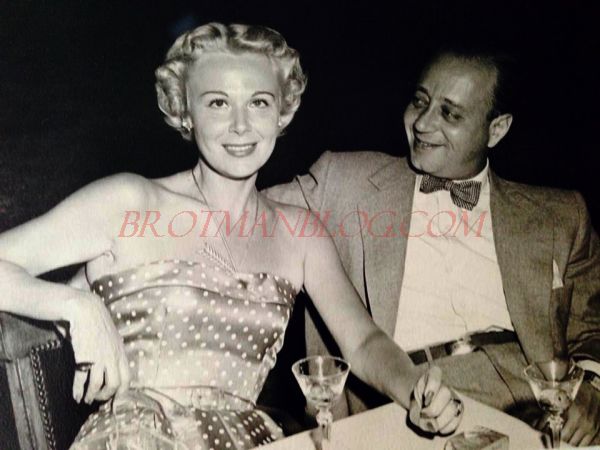
The Langer Brothers: Lives Devoted to Photography

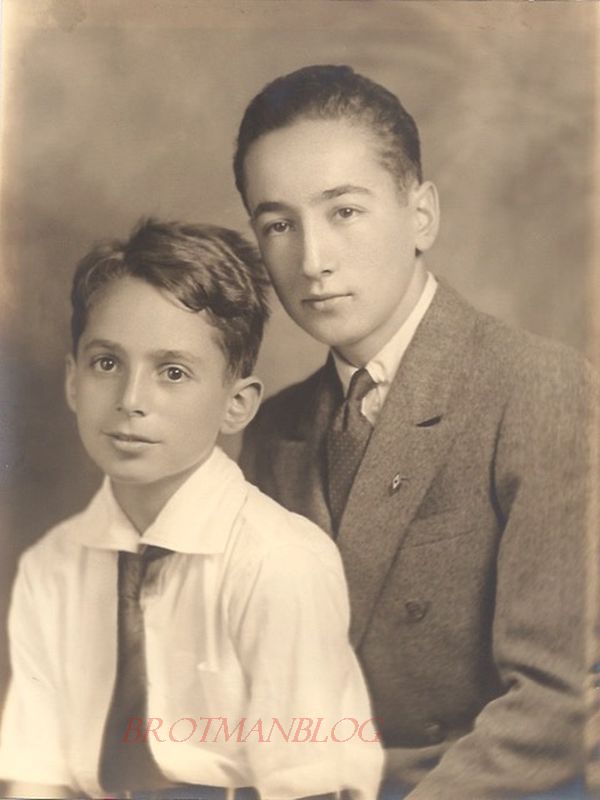
Amelia Mansbach and her husband Henry Langer died in the 1920s and were survived by their two sons, my grandmother’s second cousins Joseph and Lester, both of whom were career photographers, Joseph for The Denver Post and Lester as a dark room technician. We saw that in 1930, Joseph was still living in Denver,1 but Lester was living in Kansas City.2 Neither brother was married at that time. Lester was a lodger in what appears to have been a large boarding house in Kansas City, and Joseph was living in a hotel in Denver. This post will look at their lives in more depth.

It was a challenge to learn much more about Lester, the younger of the two brothers. In 1940 he was still living in Kansas City, working as a photographer, and living at the Washington Hotel. According to the census record, he was married, but I found no other indication of a marriage, and he is not listed with another woman named Langer at the Washington Hotel.3 I believe this was an enumerator mistake, or Lester was lying. After all, he had listed his mother as his wife on his World War I draft registration. Lester was still living at the Washington Hotel two years later when he registered for the World War II draft (he was then 58 years old). And he was still working as a photographer—for Guy E. Smith.
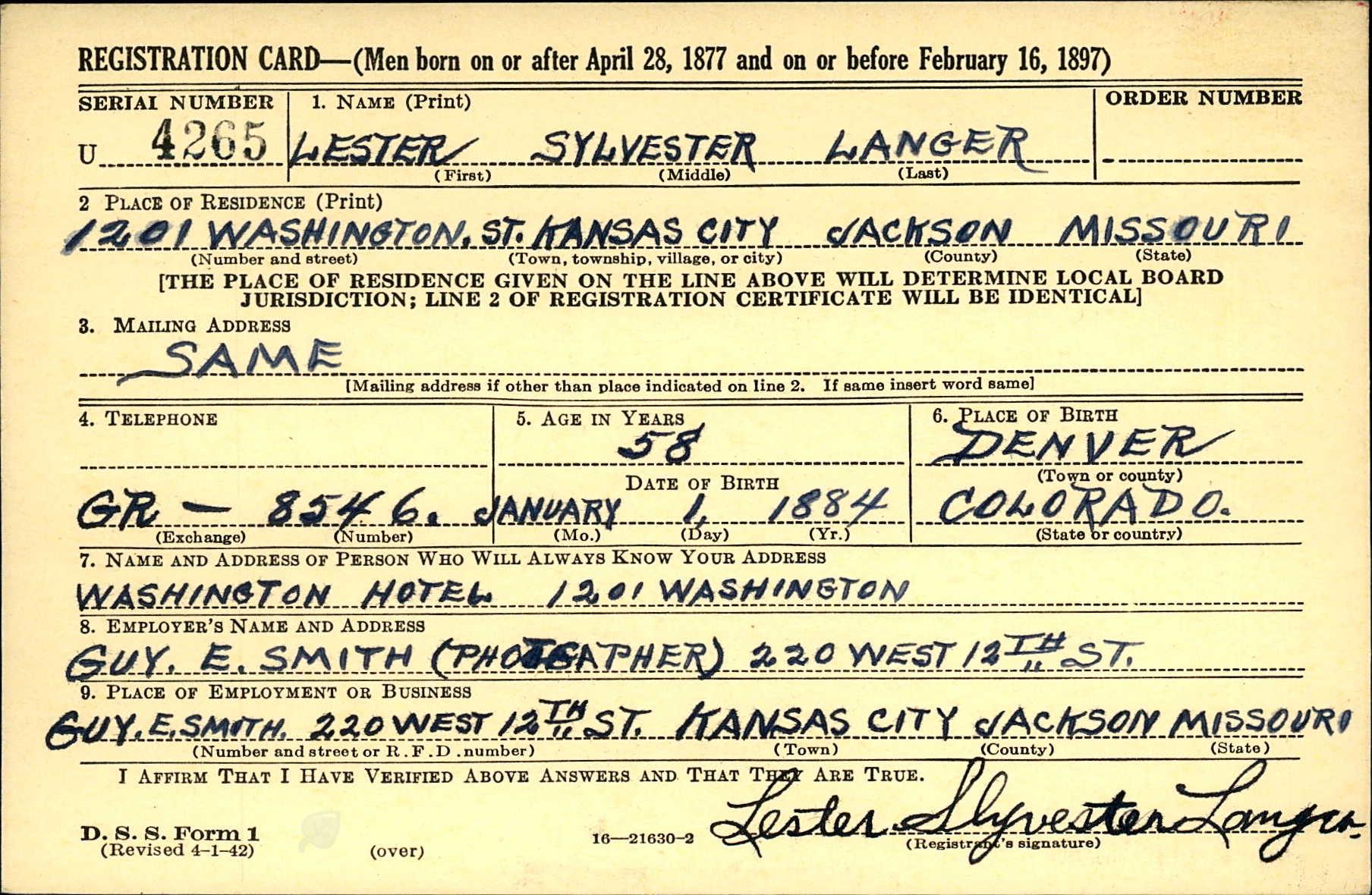
Lester Langer, World War II draft registration, The National Archives at St. Louis; St. Louis, Missouri; World War II Draft Cards (Fourth Registration) for the State of Missouri; Record Group Title: Records of the Selective Service System, 1926-1975; Record Group Number: 147; Box or Roll Number: 966.  Ancestry.com. U.S., World War II Draft Registration Cards, 1942

I could find no other information about Lester in his years in Kansas City except for this news story about him being the victim of a robbery in 1930:

“Loot Is His By Priority,” Kansas City Star, March 11, 1930, p. 22

The only other reference I could initially find for Lester was an entry on FindAGrave indicating that he died on March 19, 1960, and was buried at Temple Israel Cemetery in Memphis, Tennessee.4 I contacted the synagogue affiliated with the cemetery where Lester was buried, and the archivist there told me that there are no other Langers buried there and that Lester was not a member of the congregation. I was not sure where else to look to learn more about Lester and how he ended up being buried in Memphis.

So I  joined the Tennessee Genealogy group on Facebook, and a very helpful member named Shannon located Lester’s death certificate, which opened the doors to the rest of his story.

Lester Langer death certificate, “Tennessee Deaths, 1914-1966,” database with images, FamilySearch (https://familysearch.org/ark:/61903/3:1:3QS7-L9DL-CF56?cc=1417505&wc=34DM-BZS%3A1580614801 : 15 October 2018), 007552516 > image 33 of 2310; Tennessee State Library and Archives, Nashville.

Lester had died in the Baptist Hospital in Memphis, but was residing at the time of his death in the tiny village of Ridgely, Tennessee, located about 100 miles north of Memphis. Ridgely’s population in 1960 was 1,464. Why was Lester living there? His death certificate indicated that he was still a photographer working as a darkroom technician.

I contacted the local newspaper for Ridgely, The Lake County Banner, and they kindly sent me a copy of Lester’s obituary:

Lake County Banner, March 24, 1960, p. 5

From the obituary I learned that Lester had moved to Ridgely, Tennessee in 1954, just six years before he died, to work with W.L. Glover, a “nationally known livestock photographer,” who had purchased the photography business of Lester’s Kansas City employer, Guy E. Smith (the name mentioned on Lester’s World War II draft registration card) in 1952. The obituary said that Lester had worked for Smith for twenty years, so dating back to 1930 or so, when he was living in Kansas City.

Then I contacted one of W.L. Glover’s sons, Jere, who remembered Lester well and told me that Lester had also spent time in Hollywood where he did photography developing and printing for movie studios. From what I already knew about Lester’s career, I assume that he must have been in Hollywood sometime after 1920, when he was still in Denver, and before 1930, when he was already in Kansas City. Those must have been exciting days in the early years of the movie business. Unfortunately Jere did not have more details as he said that Lester had not talked very much about his Hollywood days.

Jere also told me that Lester “was well liked by everyone in the town. He had a good sense of humor and was a truly nice person.” He thought that Lester was probably the only Jew in the area.  Nevertheless, Lester had held on to his Jewish identity. His funeral was officiated by a rabbi, and he was buried in a Jewish cemetery. I found it particularly touching that a small number of residents of Ridgely, including the Glovers, traveled all the way to Memphis to attend the funeral, as noted in the obituary.

So from knowing almost nothing about Lester, I now have a fairly complete picture of Lester Langer’s life, thanks to the generosity of Shannon from the Tennessee Genealogy group, the Lake County Banner, Temple Israel synagogue in Memphis, and Jere Glover.

Fortunately, it was easier to find information about Lester’s older brother Joseph—largely because Joseph worked for a newspaper. In fact, I was able to find news coverage about Joseph dating back as early as 1899 when he was just twenty years old and won an amateur photography contest with a photograph of the then-governor of Colorado laying the corner stone for a hospital in Denver:
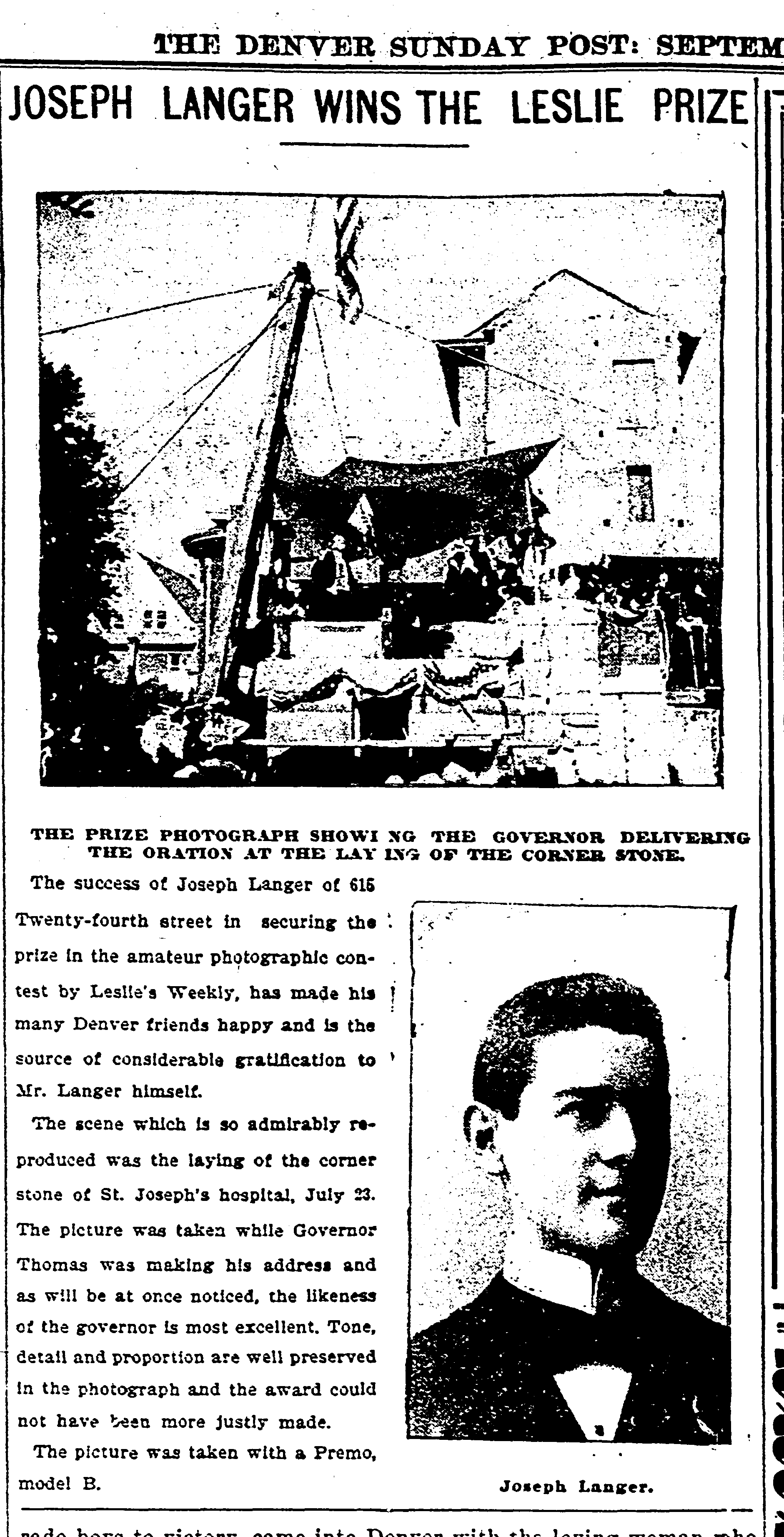
“Joseph Langer Wins The Leslie Prize,” The Denver Post, September 3, 1899, p. 5

Not long after that, Joseph became a staff photographer for The Denver Post. In 1904 he took this photograph:
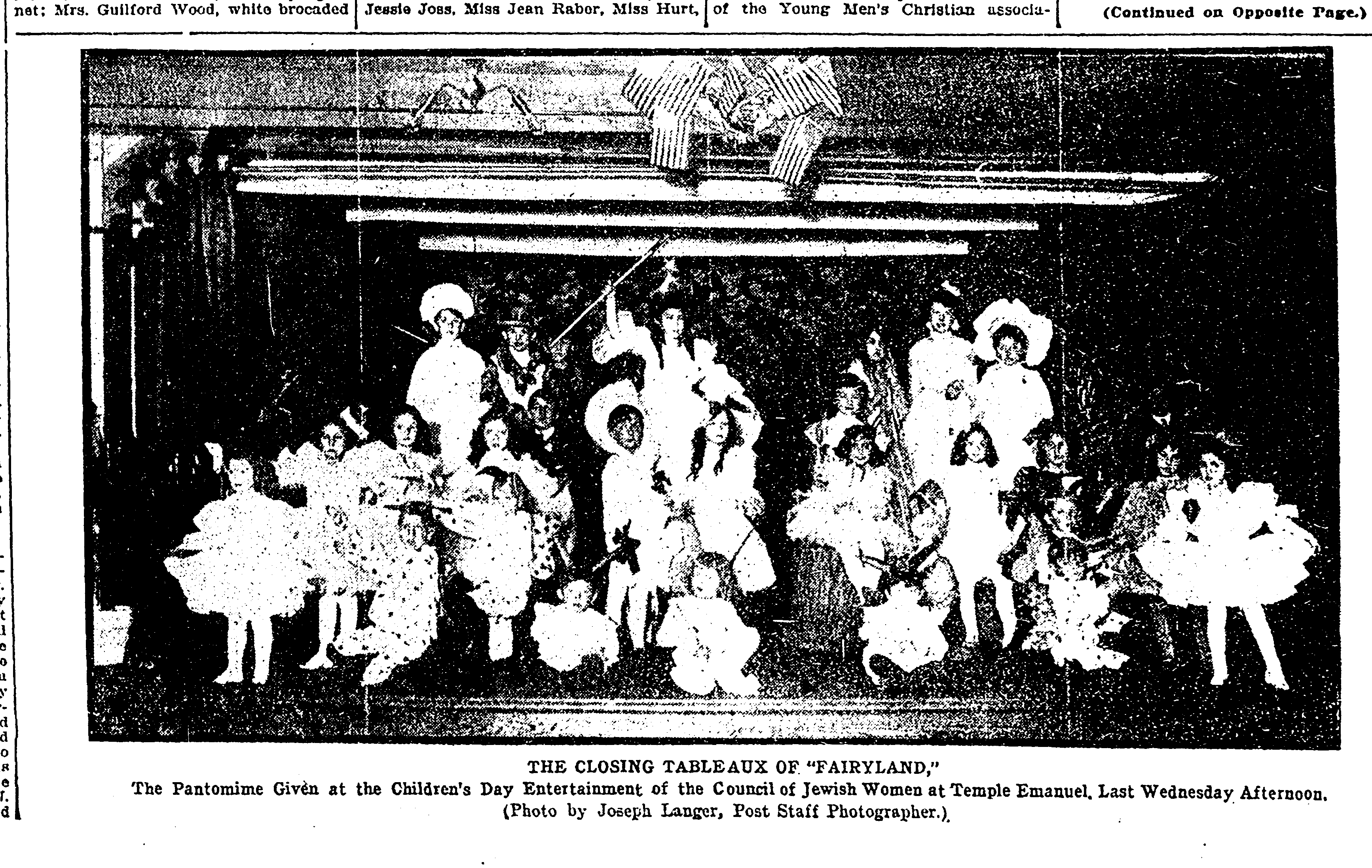
The Denver Post, January 2, 1904, p. 14

And in 1908 Joseph did this full page layout of photographs of the mayor of Denver, Robert Speer:

The Denver Post, January 19, 1908, p. 46

He also took this photograph of the Denver Post editorial board:

And here is a street photograph he took of a couple hoping to marry:
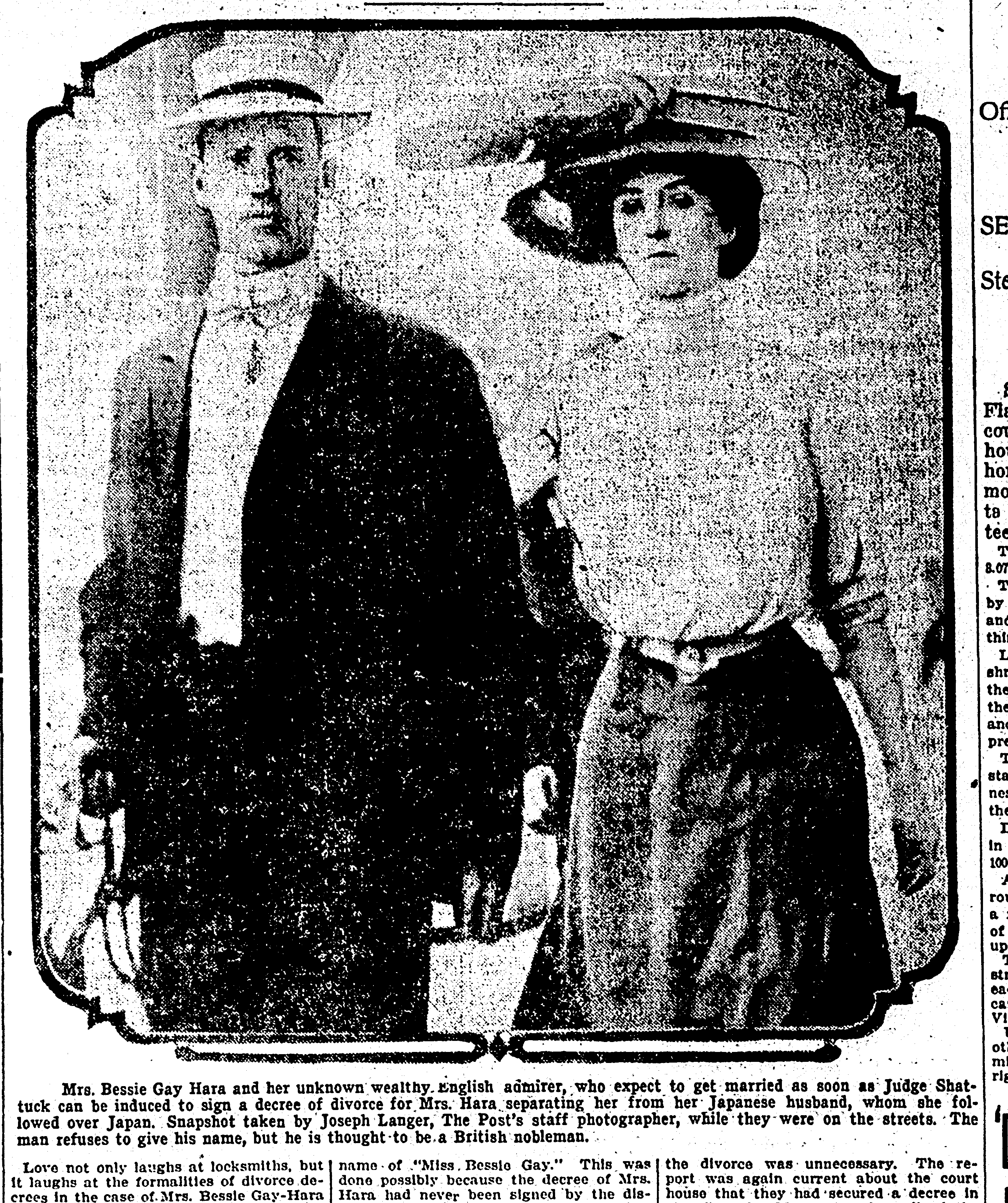
The Denver Post, July 10, 1909, p. 3

Obviously, these are not very good quality reproductions of the photographs as they are scans of photographs published in old newspapers, but they give a sense of the variety and volume of Joseph’s contribution to the newspaper.

Sometimes Joe Langer was himself the subject of articles, as in this 1911 article written when he broke his leg after slipping on ice. The newspaper wrote of the irony of him injuring himself this way in light of the risks he had taken for his job:
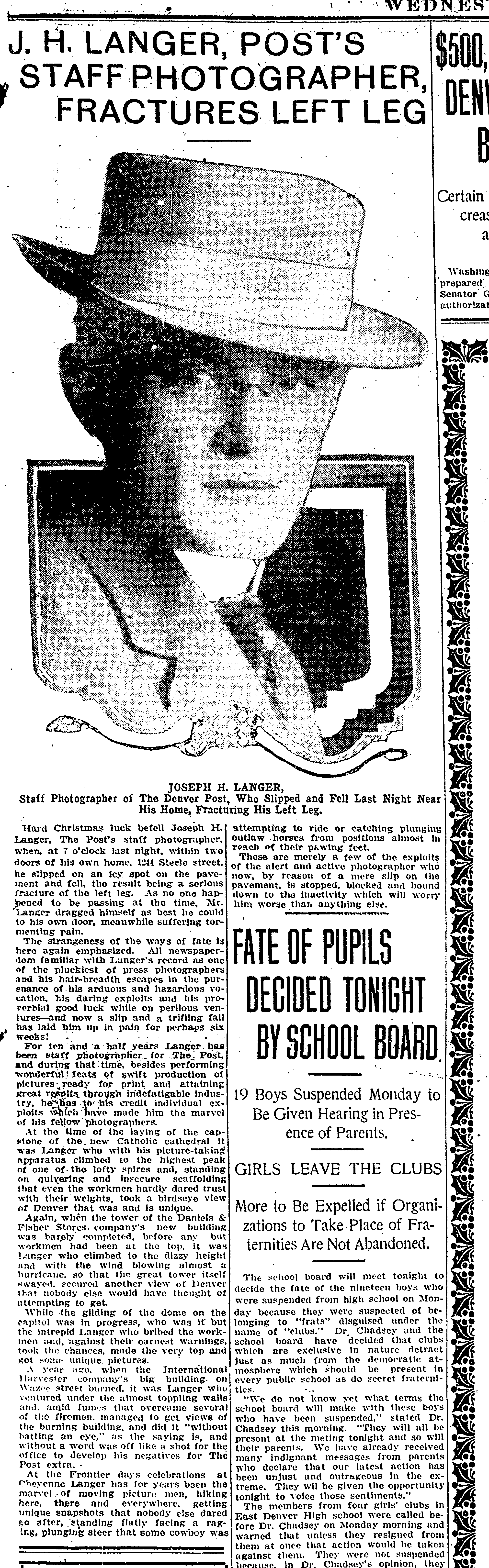
Denver Post, December 20, 1911, p. 7

The strangeness of the ways of fate is here again emphasized.  All newspaperdom familiar with Langer’s record as one of the pluckiest of press photographers and his hair-breadth escapes in the pursuance of his arduous and hazardous vocation, his daring exploits and his proverbial good luck while on perilous ventures—and now a slip and a trifling fall has laid him up in pain for perhaps six weeks!

The article then described some of his feats, including climbing up on the scaffolding on the spire of the new cathedral to get a birds-eye view of Denver and another time climbing up on the tower of a newly completed building, standing in the wind as it swayed, to get another shot of the city.

As noted in an earlier post, Joe served in the armed services intelligence division during World War I. In 1924 the Post published a whole article about Joe, celebrating his 22nd anniversary with the Denver Post:

Denver Post, March 3, 1924, p. 6

This article also heaped high praise on Joe for his work:

“Joe” has been struck by lightning, burned by flashlight powder, his camera has been smashed, he’s been cursed and lauded, rebuffed and welcomed, but he’s never lost his enthusiasm for the press photography fame, and if there is a better newscamera man in the world. The Post hasn’t been able to find him.

… In his twenty two years as The Post’s news photographer, Langer has exposed approximately 90,000 negatives.  If those negatives were placed end to end they would make a glass strip all the way from Denver to Arvada.

The news of Denver, as Langer has seen it thru his cameras, would fill a library. And the most interesting stories, because they are the inside and the most intimate stories of the big happenings of those one score and two years, would far surpass what has been printed.

The article also described some of Joe’s many challenging experiences over the years.

After his mother Amelia died in 1926, Joe retired and began to travel the world.5 In 1930 Joe Langer was one of a number of journalists sailing on the SS Resolute, when this photograph was taken:

Embed from Getty Images

I found one manifest for Joe on the SS Resolute in 1929,6 and Joe also traveled to South America in February 1930 on the SS Samaria,7 and in August he traveled on the SS St. Louis to Hamburg Germany.8 It is thus not surprising that I could not find Joe on the 1930 US census.

While searching on Google for more information about Joseph Langer and for more examples of his photographs, I ran across this image:

Embed from Getty Images

According to the caption with the photograph on the Getty Images website, “JAN 20 1933; Honeymooners are Mr. and Mrs. Joseph Langer of Denver, shown here as they reached New York recently after an eighteen-day cruise of the West Indies. For many years Langer was a photographer on The Denver Post staff. His bride was Miss Bertha Courlander of Denver. Following their wedding here they sailed from New York Dec. 17 on the S.S. Reliance of the Hamburg-American line and spent the holidays sailing the Caribbean sea. (Photo By The Denver Post via Getty Images)”

Unfortunately, I have not been able to locate an actual marriage record for Joseph and Bertha or even a newspaper article, despite a search done by the Denver Public Library of issues of the Denver Post for that time period. From the caption, it appears that they were married in Denver shortly before departing on December 17, 1932, for their honeymoon cruise to the West Indies. It also appears that Joe was no longer working for the Denver Post, as the caption described him as someone who “[f]or many years… was a photographer” for the Post. (Emphasis added.)

Joe was 53 in December, 1932, when he married Bertha. She was 36. Bertha was born in Chicago on August 11, 1896, to David Courlander and Tillie Oppenheim. Her father was a dry goods jobber in 1900.9 In 1910, Bertha and her parents and siblings were living in Indianapolis where her father was now a woolens merchant.10 Then in 1920 Bertha was a patient in the National Jewish Hospital for Consumptives in Denver. She was 24 and listed her occupation as a stenographer for a lawyer. Bertha was also, however, included in the enumeration of her parents’ household in Detroit in 1920, where she was listed without an occupation. Since both enumerations are dated in January 1920, I am not sure how to reconcile this, but my guess is that her parents included her because they still considered her residence to be with them even if she was a hospital patient elsewhere.11

But Bertha Courlander stayed in Denver. She is listed in the 1922 Denver directory as residing at 1356 Pearl Street, in 1924 at 1440 Washington Street, and in 1928, 1929, and 1930, at the Hotel Cosmopolitan, the same hotel where Joe Langer resided.12 It was probably there that Joe and Bertha met. In 1933 they are listed together in the Denver directory as living at 2737 East 13th Avenue in Denver, and Joe was working as an agent for a steamship company. They later moved to 3535 East 17th Avenue in Denver.13

Sadly, their marriage did not last very long because Joe’s life was cut short on August 29, 1934, when he died from complications after a minor operation. He was 54 years old. The obituary published by his former employer, The Denver Post, filled in some of the remaining gaps in the story of Joseph Langer:

“Death Takes Former Post Photographer,” The Denver Post, August 30, 1934, p. 9

Announcement that “Joe” Langer is dead will be received with sincere regret and sorrow by thousands who knew him during his activities as a newspaper photographer. Until he retired to become a world traveler some eight years ago [1926] he was always at the front with his camera in every important story calling for picturization. No day was too long, no task too difficult to curb his enthusiasm or turn his ambition to be the “unscooped photographer.” The great and humble and all in between were to him “interesting subjects: and his files were a clear pictorial history of the times. ….After the death of his mother in 1926 he decided to see something of the world.
He took a world cruise, carrying the faithful camera along, and on his return headlined many club programs with moving pictures and oral descriptions of places he had visited in far lands.

Joe Langer certainly left his mark on the paper and the city of Denver.

Neither Joseph nor Lester Langer had any children, and thus there are no descendants for them or for their parents, Amelia Mansbach and Henry Langer. The two brothers both had such full and interesting careers in photography, one living in Denver all his life, the other living at times in Hollywood, Kansas City, and finally the small town of Ridgely, Tennessee. I am so glad I was able to learn so much about them and keep the facts of their lives from disappearing into oblivion.


  1. Publication Title: Denver, Colorado, City Directory, 1931, Ancestry.com. U.S. City Directories, 1822-1995. 
  2. Lester Langer, 1930 US census, Census Place: Kansas City, Jackson, Missouri; Page: 10B; Enumeration District: 0018; FHL microfilm: 2340928. Ancestry.com. 1930 United States Federal Census. 
  3. Lester Langer, 1940 US census, Census Place: Kansas City, Jackson, Missouri; Roll: m-t0627-02165; Page: 81A; Enumeration District: 116-13, Ancestry.com. 1940 United States Federal Census. 
  4. MEMORIAL ID 149610799, Ancestry.com. U.S., Find A Grave Index, 1600s-Current. 
  5.  “Death Takes Former Post Photographer,” The Denver Post, August 30, 1934, p. 9 
  6.  The National Archives at Washington, D.C.; Washington, D.C.; Passenger Lists of Vessels Arriving at San Pedro/Wilmington/Los Angeles, California;NAI Number: 4486355; Record Group Title: Records of the Immigration and Naturalization Service, 1787-2004; Record Group Number: 85. NARA Roll Number: 021, Ancestry.com. California, Passenger and Crew Lists, 1882-1959 
  7. Year: 1930; Arrival: New York, New York; Microfilm Serial: T715, 1897-1957; Microfilm Roll: Roll 4706; Line: 1; Page Number: 193. Ship or Roll Number: Roll 4706,
    Ancestry.com. New York, Passenger and Crew Lists 
  8. Year: 1930; Arrival: New York, New York; Microfilm Serial: T715, 1897-1957; Microfilm Roll: Roll 4805; Line: 19; Page Number: 14. Ancestry.com. New York, Passenger and Crew Lists (including Castle Garden and Ellis Island), 1820-1957 
  9. Ancestry.com. U.S., Social Security Applications and Claims Index, 1936-2007, SSN: 573669492. Courlander household, 1900 census, Census Place: Chicago Ward 9, Cook, Illinois; Page: 10; Enumeration District: 0221; FHL microfilm: 1240253,
    Ancestry.com. 1900 United States Federal Census 
  10. Courlander household, 1910 US census, Census Place: Indianapolis Ward 3, Marion, Indiana; Roll: T624_367; Page: 6A; Enumeration District: 0062; FHL microfilm: 1374380, Ancestry.com. 1910 United States Federal Census 
  11. Bertha Courlander 1920 US census, Census Place: Denver, Denver, Colorado; Roll: T625_162; Page: 7A; Enumeration District: 244, Ancestry.com. 1920 United States Federal Census. Courlander household, 1920 US census, Census Place: Detroit Ward 14, Wayne, Michigan; Roll: T625_813; Page: 8A; Enumeration District: 428, Ancestry.com. 1920 United States Federal Census 
  12. Denver City Directories, 1922, 1924, 1928, 1929, 1930, Ancestry.com. U.S. City Directories, 1822-1995 
  13. Denver City Directories, 1933, 1934, Ancestry.com. U.S. City Directories, 1822-1995 

How Did I Lose Track of These Photographs?

I was cleaning up some files on my crowded hard drive, and I “discovered” a whole folder of photographs of the Goldschmidt family that had been sent to me by David Baron and Roger Cibella back in December, 2017.  How had I forgotten these? Some of these photographs are of members of the Goldschmidt family I’ve yet to write about and will be posted when I get to those branches (if I don’t forget about them again).

But those below are of the family of Abraham Goldsmith, about whom I’ve written extensively. Julian Reinheimer, my third cousin, once removed, and a direct descendant of Abraham through his daughter Cecelia, also sent me some photographs of Abraham and Cecelia and of some of the family graves in Philadelphia.  I am going to go back and insert these in the original posts about Abraham and his family, but I want to share them in this new post as well.  Thank you to Julian Reinheimer, David Baron, and Roger Cibella for sharing these wonderful photographs with me.

First, two of Abraham himself.

Abraham Goldsmith

Abraham Goldsmith

Then one of his first wife Cecelia Adler, who died in 1874 at age 38:

Cecelia Adler, Abraham Goldsmith’s first wife

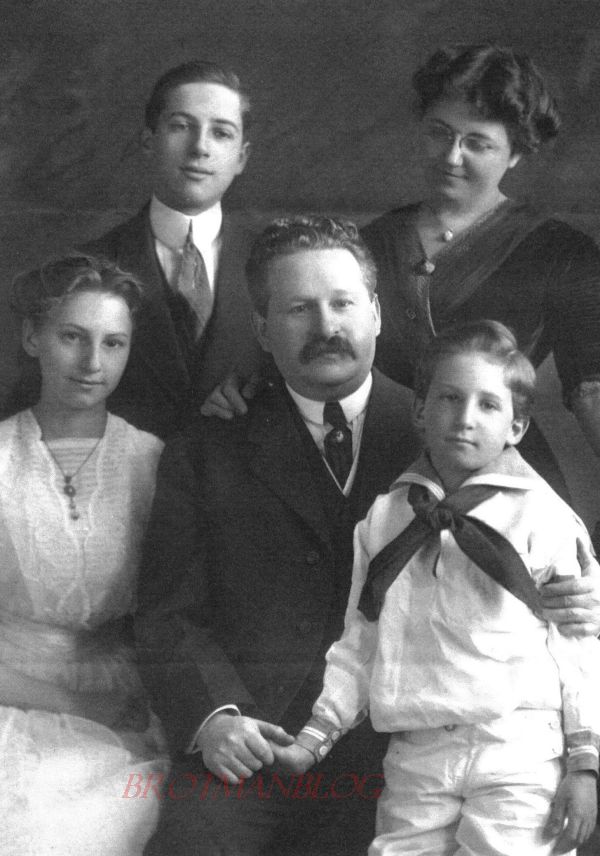
This is Abraham’s son Edwin, the inventor, and his family: his wife Jennie Friedberger, older son Henry, daughter Cecile (named for her grandmother, pictured above), and younger son Edwin, Jr. From the ages of the children, I would guess this was taken in about 1910.

Edwin Goldsmith and family

And this is a photograph of Emily Goldsmith Gerson, Abraham and Cecelia’s daughter, who was an author, and who, like her mother, died too young. She was 49 when she died.

Emily Goldsmith Gerson

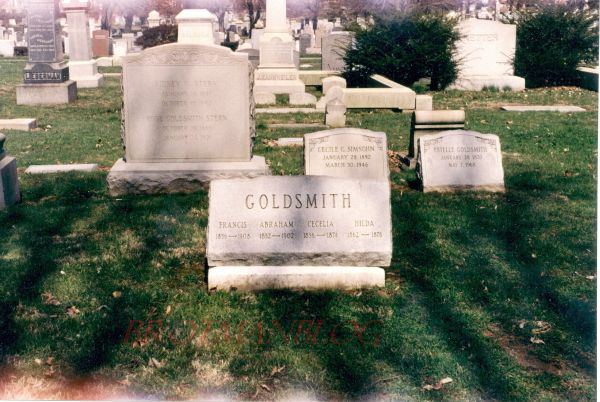
Finally, photographs of the gravestone for Abraham Goldsmith and those of his two wives, Frances Spanier on the left and Cecelia Adler on the right, as well as their daughter Hilda to the far right.  Behind their shared gravestone you can see the graves of their other children and grandchildren: Rose Goldsmith Stern and her husband Sidney Stern, Cecile Goldsmith Simsohn, and Estelle Goldsmith.

Now I need to go back and add these to my earlier posts.

Finding Buddy and Junior and a New Second Cousin!

I’ve been on a long break from blogging since July 13, and it was wonderful to be with the extended family on our long-loved beach. And although I was not doing much research during this time, a family research discovery fell in my lap.  I made an amazing connection with a second cousin—yes, a SECOND cousin! Someone I had never known about and not found despite years of research.

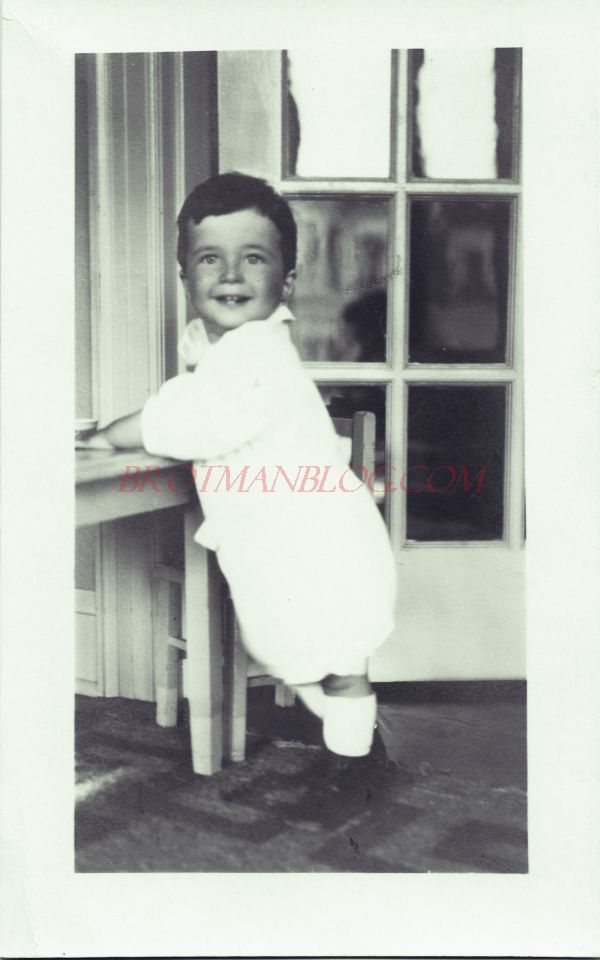
Actually, my newly discovered second cousin found me—through the blog, of course. Over three and a half years ago I posted this question: Who Is The Little Boy? with the following photographs:

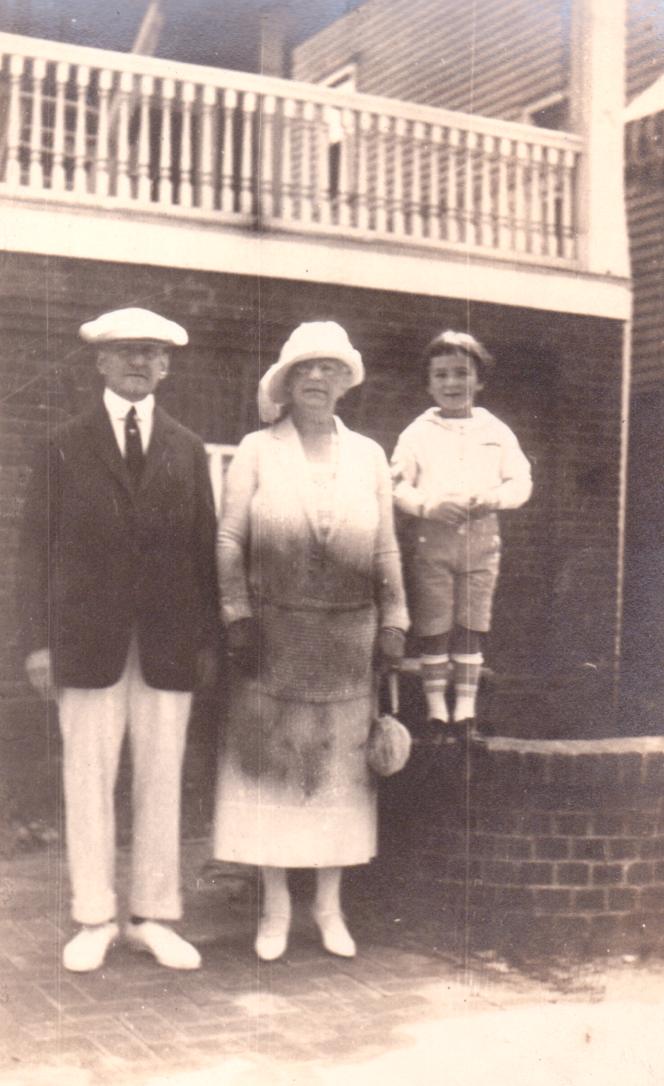
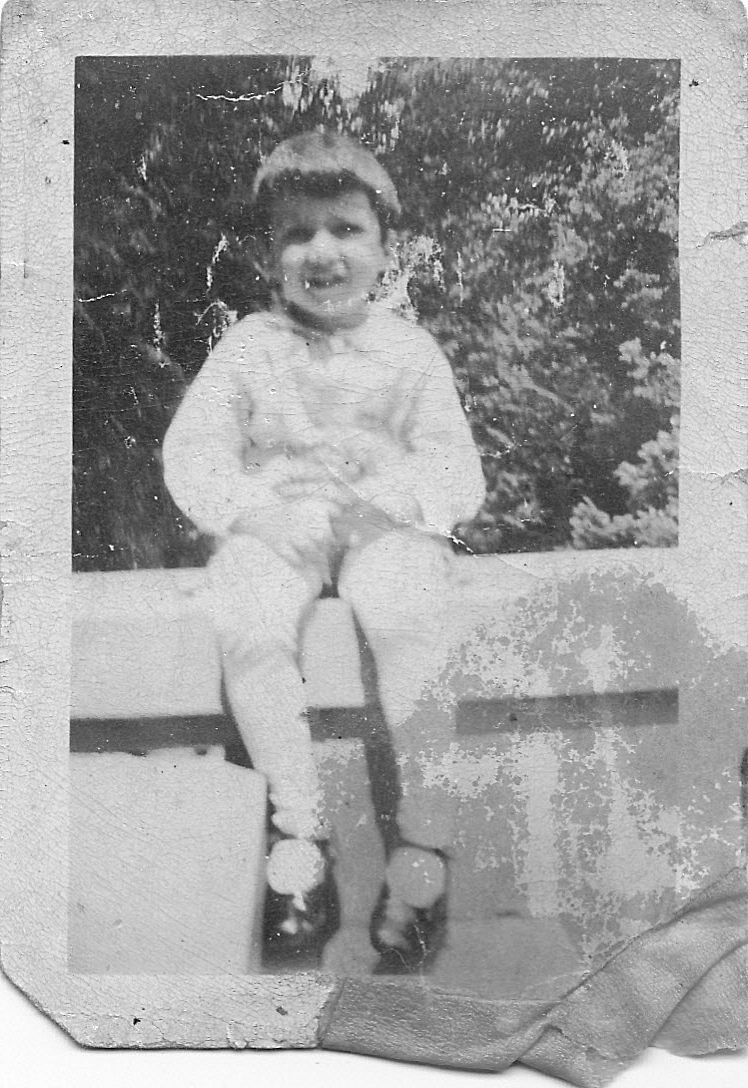
The man on the left is my great-grandfather Emanuel Cohen, and the woman next to him is my great-grandmother Eva Seligman Cohen. But I had no idea until last week who that little boy was. He resembled my father as a little boy, but he is not my father.  Here’s a photograph of my father at a similar age:

Doesn’t my dad resemble that little boy?

The little boy appeared in this photograph as well. I thought the man on the right was Stanley Cohen, my father’s uncle, my grandfather’s brother. But who was the man on the left? And who was the little boy?

And here he is again—same little boy with a man I believed might have been my grandfather or my great-uncle Maurice, but I was not sure.

So who was the little boy? The question had been left unanswered for three and a half years. Until last week.

My new cousin responded all these years later by telling me that the little boy was in fact her father—Maurice L. Cohen, Junior.  Maurice, who my father knew as Junior, was my father’s first cousin. He was born in 1917, making him nine years older than my father. Junior had a younger brother Buddy, born in 1922. They had both gone to camp with my father when he was a boy growing up in Philadelphia.  Junior and Buddy and their mother moved to California in around 1938 after their father Maurice L. Cohen Sr.’s death in 1931. My father never saw or heard from his cousins again.

In researching my Cohen family, I had not found anything more about Maurice, Jr., and my father thought he’d never married or had children. Well, it turned out that “Junior” had married and had a daughter, Marcy, who is my second cousin. And Marcy generously shared with me photographs and stories about her father, her uncle Bud, and even a photograph of her grandfather, who died long before she was born.

For one thing, I learned what drew the family to California. Junior had been attending the Wharton School at the University of Pennsylvania when he received a full scholarship to attend the College of the Pacific in Stockton, California. He decided to take advantage of the scholarship and moved to California to finish his education.  His mother Edna and younger brother Bud followed him to the West Coast (Bud was still in high school at the time), and none of them ever returned to live in Philadelphia again. Edna and Bud settled in Beverly Hills, and Bud eventually attended UCLA and later married. He and his wife Helga lived in Santa Monica and did not have children.

While at the College of the Pacific, Maurice, Jr., met his wife, Laverne “Nicky” Nicolas, who was from San Francisco. After completing college, Maurice served in World War II and then returned to California where he and Nicky settled in Sacramento. Their first child, Ronald Maurice Cohen, was born on June 2, 1943, and died just two and half months later on August 14, 1943. Marcy was born several years later. Maurice, Jr., was a budget analyst for the State of California until his retirement at age 65; he is reputed to have known more about California finances than anyone. He died on March 30, 1988, and his wife Nicky died five years later on May 1, 1993.

Here are some of the wonderful photographs that Marcy shared with me, bringing to life my father’s first cousins and their father Maurice, Sr., my great-uncle. Fortunately my father was with me when I received these photographs last week, and I had the great pleasure of sharing them with him and seeing his face light up with recognition when he saw the faces of Junior and Buddy, faces he had not seen in over 80 years.

Emanuel Philip “Buddy” Cohen, Maurice Cohen, Sr., and Maurice Cohen “Junior.”

My great-uncle Maurice Cohen, Sr.

Buddy and Junior Cohen, c. 1932, my first cousins, once removed.

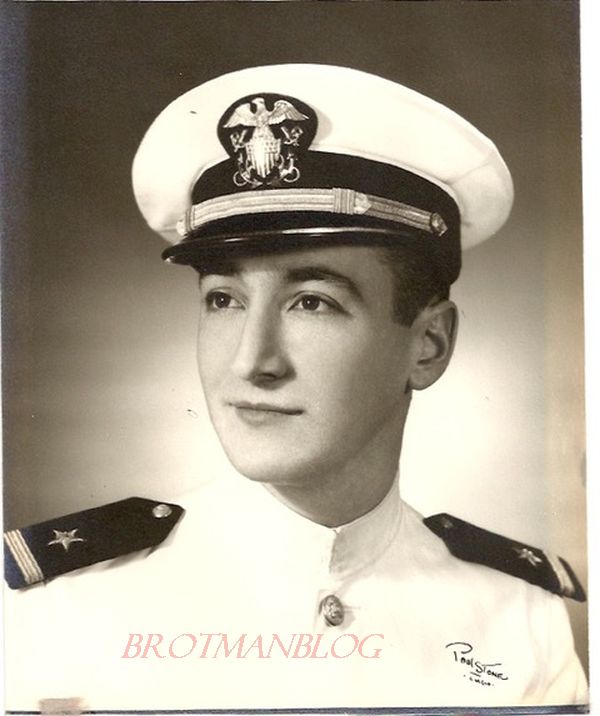
Maurice L. Cohen, Jr., during World War II, US Navy

Emanuel Philip “Bud” Cohen

Maurice L Cohen, Jr.

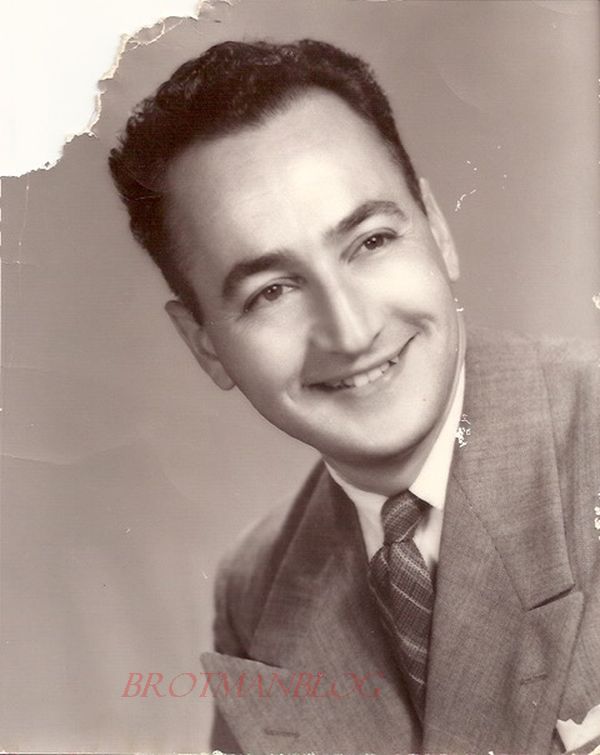
Now that I know what Maurice, Sr., looked like, it’s clear to me that he is the man in the third photo above, standing with his son and namesake, Maurice, Jr.  I often express envy of those who have so many photographs of their ancestors and other relatives. And those people often tell me not to give up hope. This experience renewed my hope.

And I cannot tell you how happy I am to have connected with a second cousin after all these years. Thank you, Marcy, for finding me and for telling me who that little boy was!

Break Time

For the next two weeks I will be busy with family—not the ones I research, but the ones who are still here, eating, breathing, and sleeping. Four generations together.

I will be back by August 1, but in the meantime, I will try and keep up with all the other blogs if I get the chance.  It’s hard to find a quiet moment with this crew around!

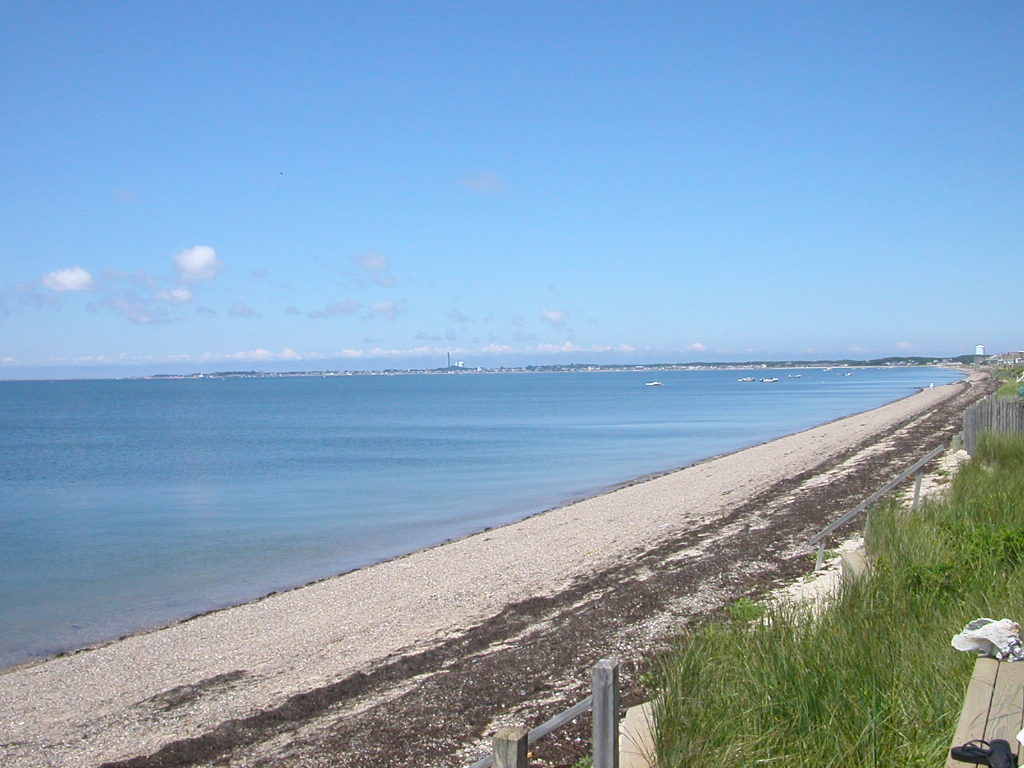
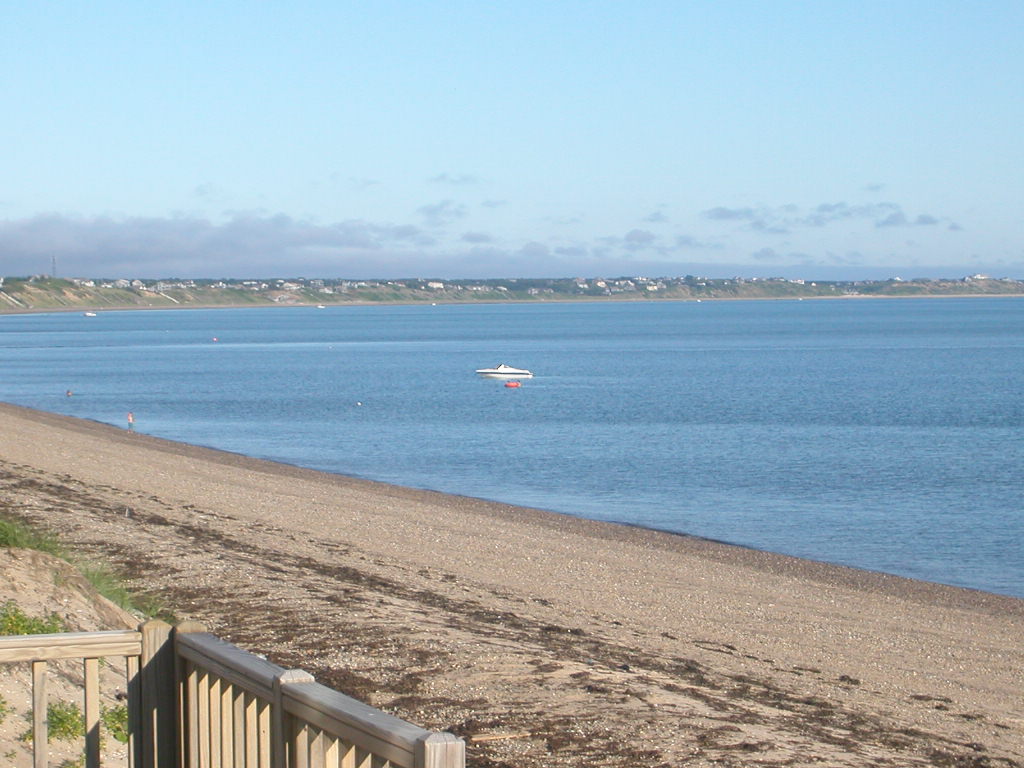
I hope all of you are having a wonderful summer.  Here are some photos of my favorite beach. No ancestors lived here, but since 1962, I have spent at least a few days each summer somewhere on this beach. I’ve walked many times along the beach, finding sea glass and shells and heart-shaped stones; I’ve sat on this beach many, many hours with my family—first, as a child, then as a mother, and now as a grandmother. I’ve spent hot days in the warm bay waters, tossed in the waves. I’ve watched storms come in across the horizon, turn the water a dark green, and bring the waves crashing against the sea wall. I’ve watched the tide go in and go out, twice a day, every day. I’ve walked two dogs up and down this beach.  I’ve held my husband’s hand on this beach, my children’s hands, my grandsons’ hands.  I may have more happy family memories from times spent here than I have of any other place on earth.

Through the years….(sadly, I seem to have no pictures on the beach itself before my kids were born).

1983

1985

1987

1988

2010

2016

2016

2016

See you in August!

Earliest Memories

Before I return to the other children of my three-times great-uncle Abraham Goldsmith, one more post inspired indirectly by his son Milton.

My final post about Milton referred to the comment in his 1957 obituary in the Philadelphia Jewish Exponent that Milton remembered when Abraham Lincoln was assassinated in 1865. I noted that Milton was only four years old at that time. One of my readers commented that he also could remember a traumatic event from when he was four, and another reader shared her first memory from when she was two and a half. That made me think about the first specific event that I can remember in my own life. I have earlier vague memories, but this is the first clear memory of an event.

I was almost three years old at the time, and my family was spending the summer near Mahopac, New York, on a pond called Long Pond. My aunt and uncle were also there, as were my grandparents. We went to Long Pond for three summers when I was very young. My father and my uncle would return to New York City during the week for work and then come back to Long Pond on weekends. I learned to swim at Long Pond, and I mostly have very vague sense-memories of the place, reinforced by photographs and my uncle’s old home movies.

My mother, me and and my aunt summer 1953 at Long Pond

My cousin Jeff, my father, and me, Long Pond 1954

summer 1955 at Long Pond


But the one specific event that I remember very clearly from that third summer at Long Pond was the evening I followed my cousin Jeffrey into the woods. Jeff, who was nine that summer, was my childhood idol. He was six years older than I was and the oldest of the first cousins, all of whom adored him. I have written about Jeff before, here and here, for example. He was smart and funny and lovable; he could always make us all laugh.  My entire family was heartbroken when Jeff died from cancer fourteen years ago.

Jeff and me, 1955

That summer at Long Pond, Jeff was friendly with another boy his age whose family was also staying at Long Pond. I can’t remember that boy’s name, but for simplicity’s sake, let’s call him Joe. Joe had a younger brother who was about six. Let’s call him Sam. One evening after dinner, Jeff and Joe decided to take a walk in the woods near our cabins. I wanted to go with them. I remember Jeff very pointedly telling me that I was too little and that I could not come with them. I was hurt and sad and probably made a stink, but Jeff and Joe wandered off, leaving me behind with Sam, Joe’s six year old little brother.

Then Sam said that we could follow Jeff and Joe, and so off I went, just three years old, following a six year old after two nine year olds. (This was in the days before helicopter parenting.) Before too long, I tripped over a log and fell on a sharp piece of glass, cutting my wrist very close to the vein.

I have no real memory of what happened next. Did Jeff coming running back and rescue me? Did my parents hear my screams and coming running to see what happened? All I know is that someone took me to a doctor nearby, who put butterfly clamps on my wound. To this day, I still have a very nasty two-inch scar on my right wrist.

I was never really bothered by the scar, In fact, at times when I was growing up, it helped me differentiate right from left. My mother used to tell me that someday my husband would buy me a wide gold bracelet to cover the scar. But I almost never thought about it as a child, and now I rarely notice it; nor does anyone else.

When I do look at it these days, I feel very fortunate that I avoided what could have been a much more serious injury. But mostly I look at it and remember with love my cousin Jeff. He may only have been nine at the time, but he was right. I was too little to go walking in the woods in the dusky light of summer that evening.

Jeff and me


What is your earliest memory? How old were you?


Two Photos to Identify—Can You Help?

I am back…sort of! Still working on my first Goldschmidt posts, but before I dive into that matter, I have two wonderful new photographs to share, thanks to my cousin by marriage, Ulrike Michel.

Ulrike is married to my fourth cousin, once removed, Torsten Michel. Torsten and I are both descended from Bernard Schoenfeld and Rosina Goldmann, my fourth great-grandparents; Torsten’s great-great-grandmother Ziborah Schoenfeld was the sister of my three-times great-grandmother Babetta Schoenfeld, wife of Moritz Seligmann, my three-times great-grandfather.


I’ve not met Torsten, but when we were in Germany, we spent a day with Ulrike in Heidelberg, as I wrote about here. Ulrike is the family historian in their family, and she and I have been in touch for several years now.

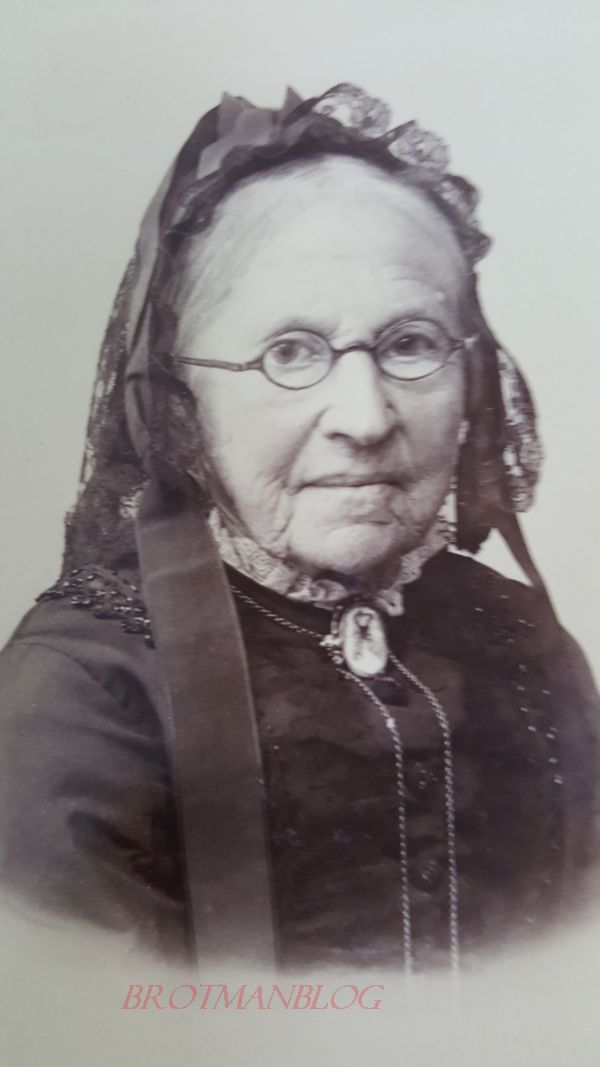
Recently Ulrike found and shared with me two photographs. I am particularly excited by this one that Ulrike believes is Babetta Schoenfeld Seligmann:


Here is the only confirmed photograph I had of Babetta, and I do see a definite resemblance.  But is it the same woman? Or is it perhaps her sister Ziborah, Torsten’s direct ancestor? What do you think?

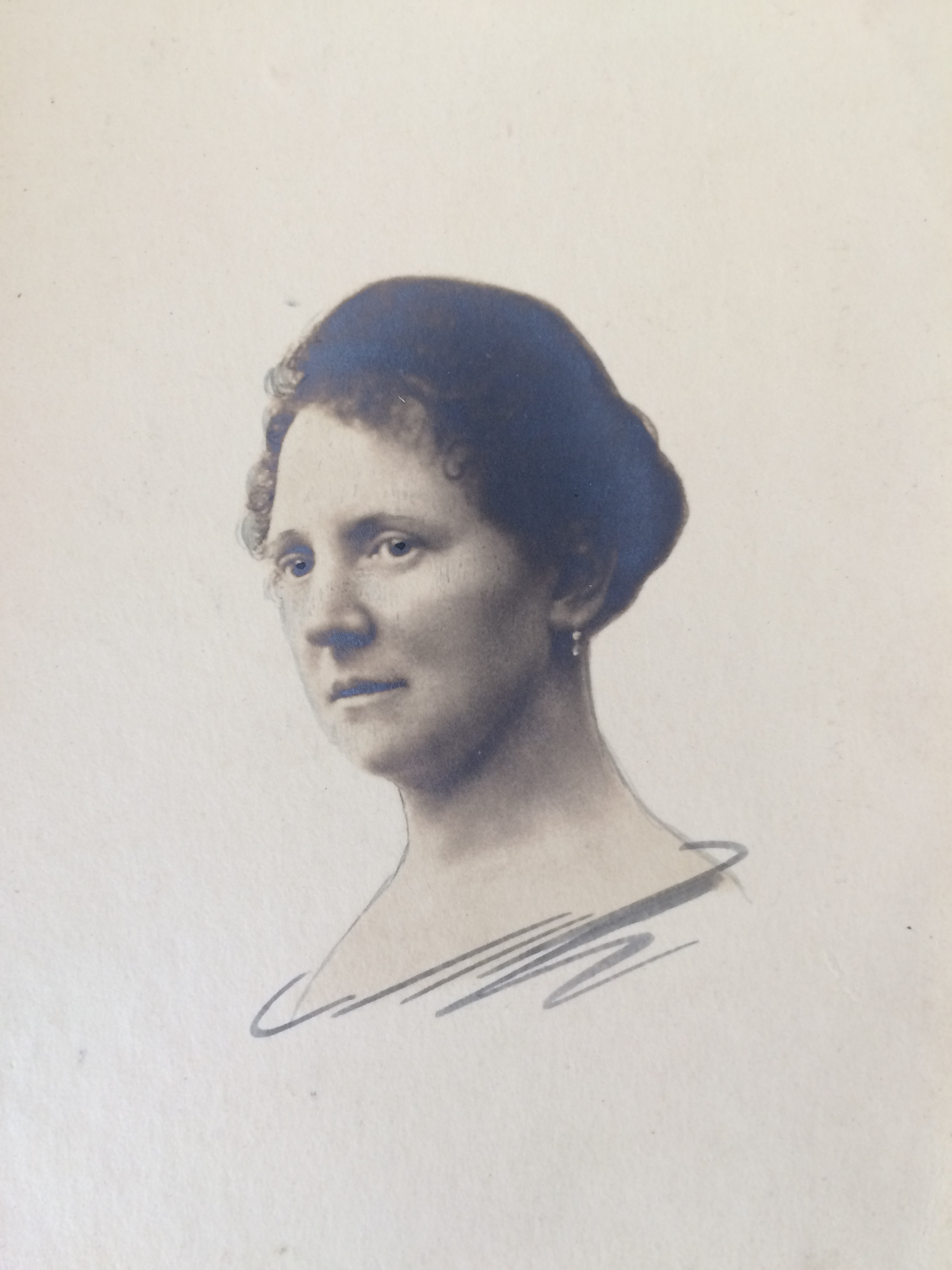
The second photo Ulrike sent me is this one.  She believes this could be Franziska Seligmann, granddaughter of Moritz Seligmann and Babetta Schoenfeld and my first cousin, three times removed:


Here are the photographs I’d previously found of Franziska:

Franziska Seligmann Michel


Fred Michel and Franziska Seligmann Michel
Courtesy of the Family of Fred and Ilse Michel

Again, there is a definite resemblance, but is it the same woman? What do you think?

One of the mysteries raised by this photograph is why the Michel family would have had a photograph of Babetta’s granddaughter, who lived from 1875-1933.  Was it simply because she was Ziborah Schoenfeld’s great-niece?

Or was there a second connection to the Michel family? Franziska married Adolf Michel, and I have no information about his background. But Ulrike is now researching to see if Adolf Michel was related to her husband’s Michel relatives. She and Wolfgang are meeting in a few weeks to compare notes and see whether there is an additional overlap between the Seligmanns, Schoenfelds, and Michels.

I’d love your feedback on the photographs. Let me know what you think.

Cousin Jane’s Parents

In my last post I shared the photograph of my second cousin, once removed, Jane Schlesinger Bruner—the woman my father called the most beautiful woman he’d ever seen when he met her the first time when he was a young boy.

Today I received this photograph of Jane’s parents—Sidney and Nan (Levis) Schlesinger.

Sidney and Nan (Levis) Schlesinger

Sidney and Nan (Levis) Schlesinger

I have already written about Sidney and Nan in my earlier posts, but just to recap here. Sidney was the fourth child and third son of Jacob Schlesinger and Brendina Katzenstein, my great-grandmother’s older sister.  He was born in Philadelphia in 1880 and lived his whole life there.  He was a successful furniture salesman.

In 1911, Sidney married Anna Levis, who was known as Nan. Nan was born in Philadelphia in 1886 to William Levis and Caroline Bopp; her father died when she was eleven years old. She had been working as a stenographer in a bolt factory before marrying Sidney.  Sidney and Nan’s daughter Jane was born in 1913.  She was their only child and the only grandchild of Jacob and Brendina Schlesinger.

Sidney died in 1935 when he was 54.  Nan survived him by forty years, dying at age 89 in 1975.  As I wrote earlier, she was the first member of my father’s family to meet my mother after my parents were engaged.

I am once again so grateful to Jane’s granddaughter for sharing this photograph and allowing me to see the faces behind the stories.


My Father Wasn’t Wrong

In a prior post, I told the story of my father’s first impression of his second cousin Jane Schlesinger whom he met her for the first time when he was a young boy.  He thought Jane was the most beautiful woman he’d ever seen and told her so.  Jane, who was thirteen years older than my father, must have been quite charmed by this little boy, who was quite adorable himself.

John Nusbaum Cohen, Jr.

John Nusbaum Cohen, Jr.

When I heard the story and wrote the post, I wished that I had a photograph of my cousin Jane.  Now, like manna from heaven, I do.  I’ve been in touch with one of Jane’s grandchildren, and she sent me these two photographs of Jane and her husband Marvin.

Jane Schlesinger and her husband Marvin Bruner

Jane Schlesinger and her husband Marvin Bruner

jane-schlesinger-and-martin-bruner-2-edit

Jane (Schlesinger) and Marvin Bruner

My father was not wrong.  She was indeed a stunning woman.


Are These Two Photographs of the Same Woman?

Sharon, one of my readers and a fellow genealogy blogger, asked in response to my last post whether I thought the woman in this photograph of Lawrence Baer and his son John Degen Baer could be John’s grandmother. Certainly the way his hand rests on her shoulder suggests that she was someone he knew well and felt comfortable with:

Lawrence Baer, John Degen Baer, unknown person, 1924

Lawrence Baer, John Degen Baer, unknown person, 1924

John’s paternal grandmother was Amalia Hamberg, the woman in the photo I’d posted in an earlier post. People thought that photo was taken in the 1880s or about 40 years before the one above:

amalia-hamberg-and-jacob-baer-from-celena-adler-watermarked

Amalia Hamberg and Jacob Baer


Could the woman in the top photo also be Amalia? In 1924, Amalia would have been 73 years old. Her face is obviously much thinner in the later photograph, but are the mouth, nose, and eyes similar? Do you think this is the same woman in both photographs?

And if any of Amalia’s descendants can help, please let me know.

(I tried to use the pictriev tool that Cathy Meder-Dempsey blogged about, but the photo of Amalia and Jacob was too small for pictriev to detect the faces.)

More Gifts of Photographs

In my last post, I shared the wonderful photograph I received of Amalia Hamberg and Jacob Baer from one of their descendants.  Before posting it here, I shared it with other descendants of Amalia and Jacob, and that prompted some of those descendants to share some other photographs. Thank you to the extended Baer family for allowing me to publish these photos.

First is a photograph of Lawrence Baer, Amalia and Jacob’s youngest child, born in 1891 in PIttsburgh.  Lawrence became one of the principal innovators and executives at the family-owned jewelry business, Attleboro Manufacturing.  This photograph was taken in 1924.  The little boy in the center is John Degen Baer, Lawrence’s son.  He would have been three years old in this photograph. The individual on the right is not known.

Lawrence Baer, John Degen Baer, unknown person, 1924

Lawrence Baer, John Degen Baer, unknown person, 1924

Here is a photograph of Lawrence Baer’s first wife and John Degen Baer’s mother, Donna Degen.  This photograph was not dated, but it looks like the 1920s to me.

Donna Degen

Donna Degen

This is another picture of their son John, dated 1924:

John Baer, summer of 1924

John Baer, summer of 1924

How adorable is he!

Finally, here is a photograph of Olivia Ganong Baer, Lawrence Baer’s second wife, and Minette Brigham Baer, John Degen Baer’s first wife, with Lawrence in the background.

Olivia Ganong Baer, Minette Brigham Baer, and Lawrence Baer

Olivia Ganong Baer, Minette Brigham Baer, and Lawrence Baer

John Degen Baer grew up to be a very accomplished business leader like his father.  He died just a little over a year ago on November 3, 2015.

According to his obituary,

Baer attended both Yale and Brown Universities, graduating from the latter in 1943. He served in the U.S. Marine Corps during World War II, having been attached to the Second Marine Division in the Pacific theater and int he Occupation of Japan. He resigned his commission in 1950. He was the owner and C.E.O. of the Bishop Company, an Ophthalmic Manufacturing Company, which he merged with the Univis Lens Company of Dayton, Ohio in 1960. The merged company, Univis, Inc., was headquartered in Ft. Lauderdale, Florida, with branch manufacturing plants in Puerto Rico, Tennessee, New York and Massachusetts. Univis was sold to Itek, Inc. in 1970. Mr. Baer established a consulting company in Atlanta, Georgia, and in 1970 joined the Edwards Baking Company as Executive Vice President. He retired from Edwards in 1978. While residing on Sea Island, Georgia, he participated in the construction and management of the Island Retreat and the Island Square apartments.

Baer and his family moved to Blairsville in 1985 where he and his wife founded and managed the Truck & Gas Market. The business closed in March 1992. Baer then retired from all activity. While residing in Massachusetts, Baer served as a member of the Attleboro Zoning Board of Appeal for 12 years. He was also a Director of a local Bank and the Chamber of Commerce. For several years he served as a director of the Optical Manufacturers Association, located in New York City. While living in Oxford, Georgia, Baer was elected and served on the town Council.

Thank you again to his children for sharing these photos and allowing me to see the faces behind the names of these cousins of mine. Here’s a chart showing how we are related.

relationship-john-baer-to-me