Leonora Goldsmith Jaffa and Her Family: Too Many Lives Cut Short

The second decade of the 20th century saw the oldest of Jacob Goldsmith’s children entering their sixties while his youngest children were entering their forties. In 1910, twelve of Jacob’s fourteen children were still living; Emma and George had already passed away. By the end of 1920, only seven of the remaining children were still living.  Five of the siblings died between 1911 and 1920. We have already seen that one of them was Jacob’s oldest son Felix, who died in 1919. We also saw that Rachel Goldsmith died in 1915. But two other siblings predeceased them in that decade, and one died in 1920.

The first was Leonora Goldsmith Jaffa. She died on February 22, 1911, at the age of fifty-two.1  According to her obituary, she had been ill for two years:
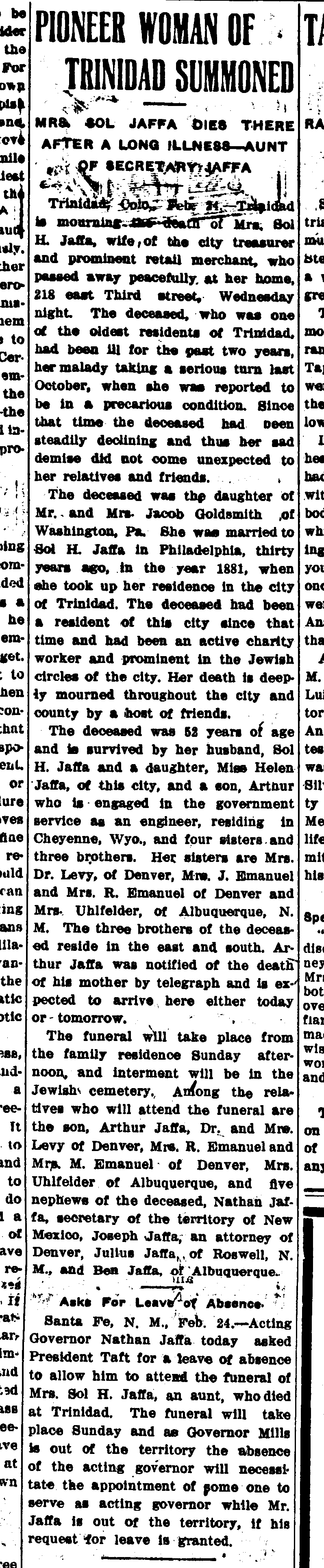
“Pioneer Woman of Trinidad Summoned,” The Las Vegas (NM) Daily Optic, February 24, 1911, p. 5

Mrs. Sol Jaffa Dies There After A Long Illness—Aunt of Secretary Jaffa

Trinidad is mourning the death of Mrs. Sol H. Jaffa, wife of the city treasurer and prominent retail merchant, who passed away peacefully at her home, 218 east Third Street, Wednesday night. The deceased, who was one of the oldest residents of Trinidad, had been ill for the past two years, her malady taking a serious turn last October, when she was reported to be in a precarious condition. Since that time the deceased had been steadily declining and thus her sad demise did not come unexpected to her relatives and friends.

The deceased was the daughter of Mr. and Mrs. Jacob Goldsmith of Washington, Pa. She was married to Sol H. Jaffa in Philadelphia, thirty years ago, in the year 1881, when she took up her residence in the city of Trinidad. The deceased had been a resident of this city since that time and had been an active charity worker and prominent in the Jewish circles of the city. Her death is deeply mourned throughout the city and county by a host of friends.

The deceased was 52 years of age and is survived by her husband, Sol H. Jaffa and a daughter, Miss Helen Jaffa, of this city, and a son, Arthur who is engaged in the government service as an engineer, residing in Cheyenne, Wyo., and four sisters and three brothers. Her sisters are Mrs. Dr. Levy of Denver, Mrs. J. Emanuel and Mrs. R. Emanuel of Denver and Mrs. Uhlfelder of Albuquerque, N.M. The three brothers of the deceased reside in the east and south. Arthur Jaffa was notified of the death of his mother by telegraph and is expected to arrive her either today or tomorrow.

The funeral will take place from the family residence Sunday afternoon, and interment will be in the Jewish cemetery. Among the relatives who will attend the funeral are the son, Arthur Jaffa, Dr. and Mrs. Levy of Denver, Mrs. R. Emanuel and Mrs. M. Emanuel of Denver, Mrs. Uhlfelder of Albuquerque, and give nephews of the deceased, Nathan Jaffa, secretary of the territory of New Mexico, Joseph Jaffa, an attorney of Denver, Julius Jaffa of Roswell, N.M., and Ben Jaffa of Albuquerque.

[A final paragraph discusses how Nathan Jaffa, who was acting governor of New Mexico, asked President Roosevelt for a leave of absence to attend Leonora’s funeral.]

There are some strange omissions from this obituary. The only sisters named as survivors are Rebecca, Gertrude, Florence, and Eva, but in 1911 Leonora had four other living sisters—Annie in San Francisco, Rachel and Celia in Denver, and Ellena in Philadelphia. Why weren’t they mentioned? I first thought that this was an oversight as Rachel and Celia were living with Rebecca in Denver in 1910, but a second obituary from the Denver Rocky Mountain News also mentioned only the same four sisters as survivors.

“Mrs. Sol H. Jaffa Is Dead,” Denver Rocky Mountain News, February 24, 1911, p. 4

Had their been a falling out between Leonora and the other sisters?

Two years later, Leonora’s daughter Helen F. Jaffa married Abram Harold Minton on June 8, 1913, in Trinidad.

Ancestry.com. Colorado, County Marriage Records and State Index, 1862-2006

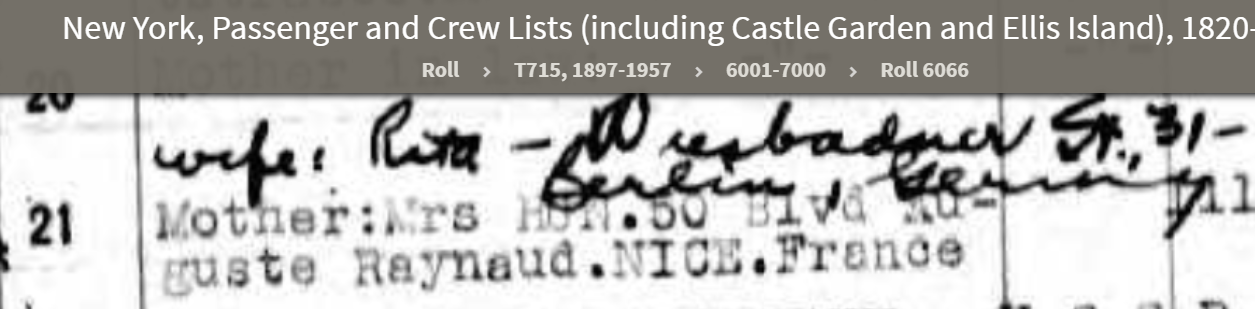
It was a challenge tracking down Abram’s history before he married Helen. According to his World War I draft registration, Abram was born on August 6, 1879;2 in 1900, he is listed as Abram Minsky, living with his mother Rose Minsky and sister Ada in New York City; that census reports his birth place as Russia Poland and states that he and his mother and sister had immigrated to the US in 1887. Abram, then twenty, was in school and his sister was a school teacher.3 I was able to locate seven year old Abraham Minske on a passenger manifest arriving in the US on May 31, 1887, with a thirty year old male (first name not legible), presumably his father, who must have died before the 1900 census was taken.4

On August 25, 1910, Abram H. Minton married Julia Cohen, in New York City. His parents were listed on the index as Aaron Minton and Rose Feltstein; Abram’s birth year was estimated as 1879 since his age was 31. Given the match to his age, name, and mother’s first name, I assume this was the same Abram Minton who later married Helen Jaffa, but this record says Abram was born in New York. His first wife Julia was the daughter of Israel and Esther Cohen and was according to the index on FamilySearch also born in New York.5 Julia died less than a year after the marriage on June 5, 1911, in New York. I do not know the cause of death; she was only 28 years old.6

But if Abram was married to Julia in August 1910 in New York and she died there a year later, I cannot understand why Abram is listed (as Abraham H. Minton) on the 1910 US census as living already in Trinidad, Colorado, 29 years old, single, boarding with a family, and working as a school teacher. This census lists his birthplace as New York and his parents as born in the US, both of which were not accurate, but nevertheless I still think this refers to the same Abram H. Minton who married Helen Jaffa in 1913.7 That Abram did become a school teacher, and the name and age match closely. In addition, the 1910 and 1912 Trinidad directories list an Arthur H. Minton as a school teacher residing in Trinidad, as does the 1915, although now as Abram H. Minton. My best guess is that Abram returned to New York in August 1910, married Julia, perhaps stayed in New York until she died, and then returned to Trinidad where he met and married Helen Jaffa in 1913.

But Abram’s bad fortune continued as Helen Jaffa Minton died on May 1, 1915, less than two years after their wedding. She had just given birth on April 26, 1915, to their son Arnold Jaffa Minton, in Trinidad,8 and I assume her death was related to some complication from childbirth. So Abram was once again a widower, now with a newborn son to care for.

http://data.jewishgen.org/imagedata/jowbr/USA-01836/TAT128.jpg; JewishGen, comp. JewishGen Online Worldwide Burial Registry (JOWBR)

Abram Minton and his son Arnold left Trinidad, and in 1920 were living in New York City with Abram’s family. Abram continued to work as a school teacher.9 In 1925 they were living in Brooklyn with Abram’s sister Ada, and Abram continued to teach. He had not married again.10

Then, tragically, Abram died on August 24, 1927, at age 48, leaving his twelve-year-old son Arnold an orphan.11 Arnold continued to live with his father’s relatives in 1930 and in 1940, when he was working as a merchant in New York.12 He married Alma Cohen in 1947 and lived the rest of his life in New York, dying on September 14, 1998.13 I wonder whether he ever had contact with his mother’s family again once they left Trinidad after her untimely death.

Solomon Jaffa and his son Arthur had thus suffered two devastating losses in the space of four years, first the death of Leonora and then the death of Helen—as well as the relocation of little Arnold, their grandson and nephew, respectively.

There had been some happier news for them in those years, however. On June 8, 1914, Arthur married Eleanor J. Jaffa, who was his first cousin, once removed. Eleanor was the great-granddaughter of Aron Jaffa, Arthur his grandson. Eleanor’s grandfather Benjamin Jaffa was the brother of Solomon Jaffa, Arthur’s father. Eleanor was born on October 4, 1893, in Roswell, New Mexico, where she and Arthur married. Eleanor’s father Nathan Jaffa had been the Secretary of State in New Mexico, and acting governor, as mentioned above. Eleanor was the granddaughter of Aron Jaffa, the father of Sarah Jaffa Goldsmith (Henry’s wife) and Sol Jaffa (Leonora Goldsmith’s husband and Eleanor’s father-in-law).14

“Another Jaffa Wedding,” Albuquerque Journal, 31 May 1914, Sun, Page 10

Arthur and Eleanor settled in Roswell, New Mexico, where in 1918 Arthur was the city manager, according to his World War I draft registration. They would have two sons. In 1920, Arthur was still the Roswell City Manager, but by 1930 Arthur and his family had moved to Las Vegas, New Mexico, where he was working as an accountant for a wholesale merchandise business. His father Solomon was also living with them at that time. 15 Ten years later in 1940, they were all still living together in Las Vegas and Arthur was now listed as a bookkeeper for a wholesale merchandise business.16
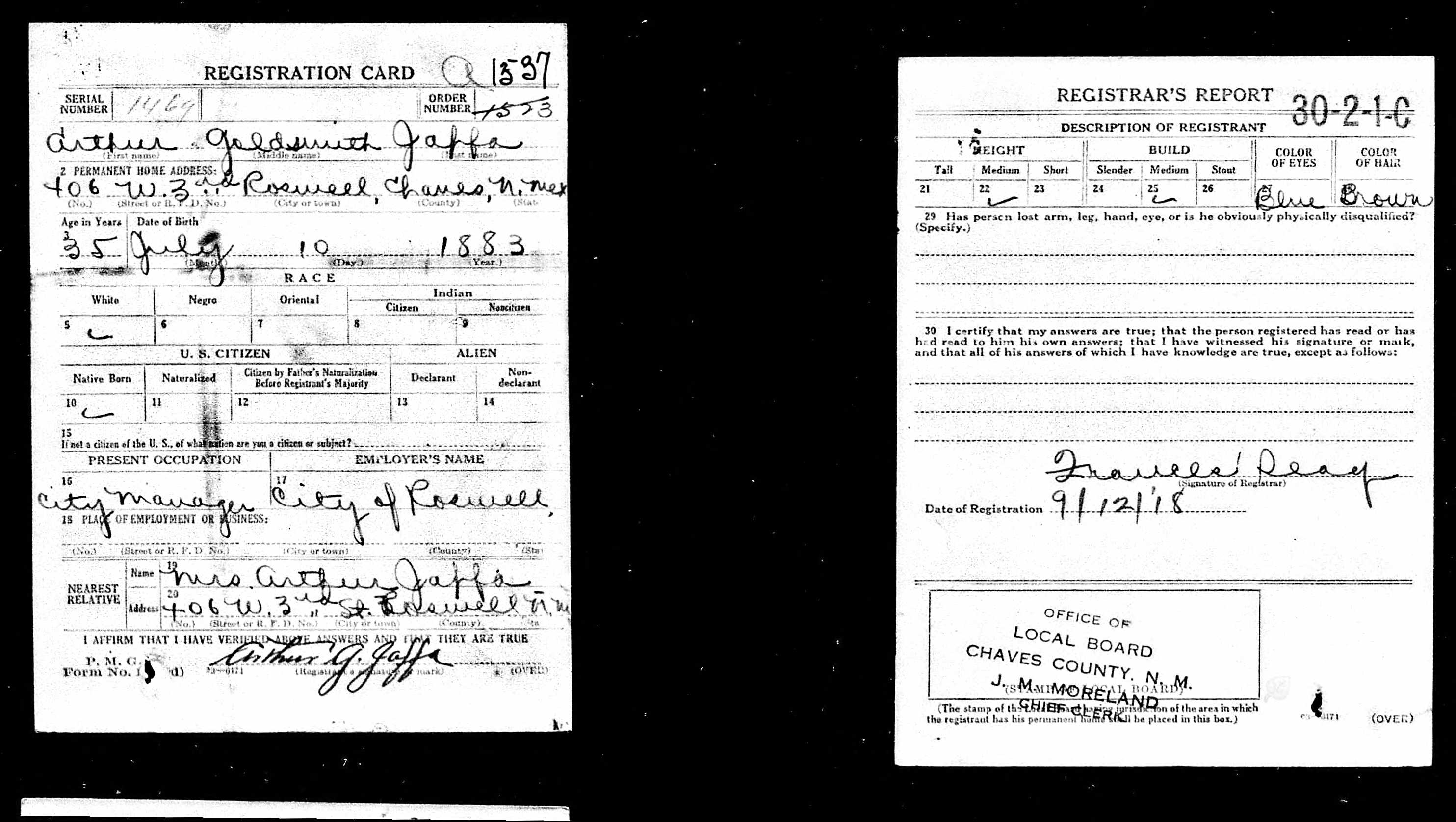
Arthur Jaffa World War I draft registration, Registration State: New Mexico; Registration County: Chaves; Roll: 1711858
Source Information
Ancestry.com. U.S., World War I Draft Registration Cards, 1917-1918

Solomon Jaffa died the following year at the age of 92. He was buried back in Trinidad where his wife Leonora and daughter Helen were buried. 17 The Intermountain Jewish News published this wonderful obituary on its front page on December 5, 1941:
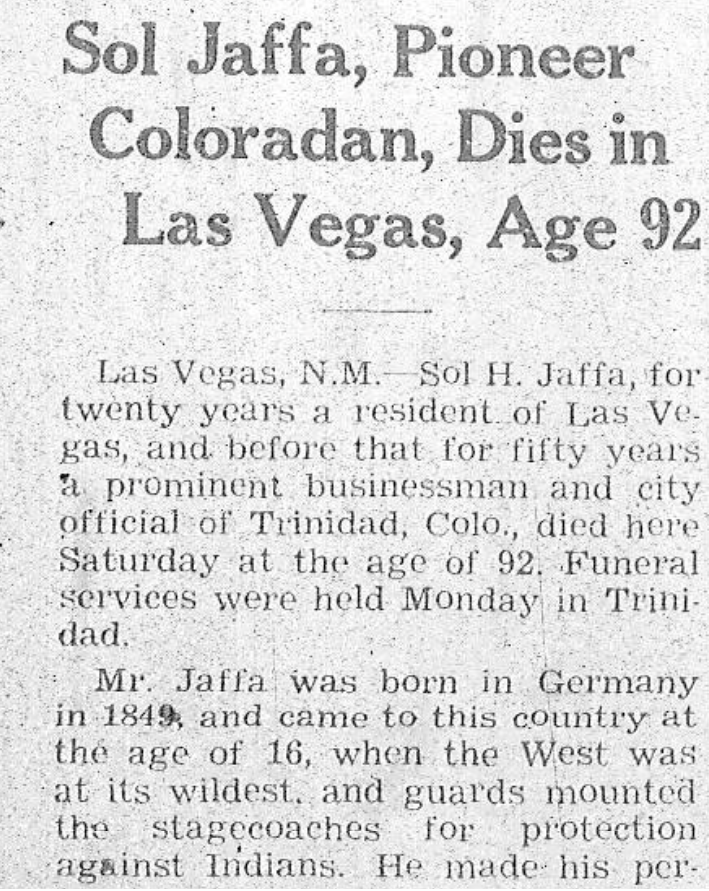
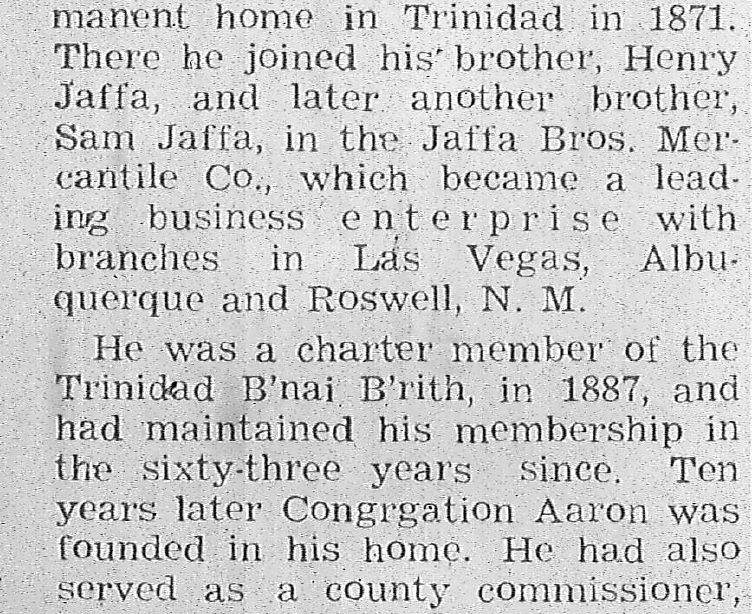
Arthur Jaffa did not inherit his father’s longevity; like his mother, he died before his seventieth birthday in 1952.18  He and his wife Eleanor, who died in 1970, were buried in Las Vegas, New Mexico. They are survived by their sons and grandchildren.


  1. Trinidad, Colorado, City Directory, 1912, Ancestry.com. U.S. City Directories, 1822-1995 
  2. Abram Minton, World War I draft registration, Registration State: Colorado; Registration County: Las Animas; Roll: 1561836, Ancestry.com. U.S., World War I Draft Registration Cards, 1917-1918 
  3. Abram Minsky, 1900 US census, Census Place: Manhattan, New York, New York; Page: 1; Enumeration District: 0843; FHL microfilm: 1241119, Ancestry.com. 1900 United States Federal Census 
  4. Abraham Minske, passenger manifest, Year: 1887; Arrival: New York, New York; Microfilm Serial: M237, 1820-1897; Microfilm Roll: Roll 507; Line: 41; List Number: 657,
    Ancestry.com. New York, Passenger and Crew Lists (including Castle Garden and Ellis Island), 1820-1957 
  5. New York, New York City Marriage Records, 1829-1940,” database, FamilySearch (https://familysearch.org/ark:/61903/1:1:24ZH-SNJ : 10 February 2018), Abram H. Minton and Julie Cohen, 25 Aug 1910; citing Marriage, Manhattan, New York, New York, United States, New York City Municipal Archives, New York; FHL microfilm 1,503,752. 
  6. New York, New York City Municipal Deaths, 1795-1949,” database, FamilySearch (https://familysearch.org/ark:/61903/1:1:2WMM-4D3 : 10 February 2018), Julia Minton, 05 Jun 1911; citing Death, Manhattan, New York, New York, United States, New York Municipal Archives, New York; FHL microfilm 1,323,280. 
  7. Abraham H, Minton, 1910 US census, Census Place: Trinidad Ward 1, Las Animas, Colorado; Roll: T624_122; Page: 2B; Enumeration District: 0113; FHL microfilm: 1374135, Ancestry.com. 1910 United States Federal Census 
  8. SSN 125-10-8177, Ancestry.com. U.S., Social Security Applications and Claims Index, 1936-2007 
  9. Abram Minton, 1920 US census, Census Place: Manhattan Assembly District 9, New York, New York; Roll: T625_1202; Page: 5A; Enumeration District: 693,
    Ancestry.com. 1920 United States Federal Census 
  10. Abram Minton, 1925 NYS census, New York State Archives; Albany, New York; State Population Census Schedules, 1925; Election District: 45; Assembly District: 21; City: Brooklyn; County: Kings; Page: 2, Ancestry.com. New York, State Census, 1925 
  11.  Certificate Number: 4568, Ancestry.com. New York, New York, Extracted Death Index, 1862-1948 
  12. Arnold J. Minton, 1930 US census, Census Place: Manhattan, New York, New York; Page: 16B; Enumeration District: 0463; FHL microfilm: 2341292, Ancestry.com. 1930 United States Federal Census; 1940 US census, Census Place: New York, New York, New York; Roll: m-t0627-02641; Page: 8A; Enumeration District: 31-736,
    Ancestry.com. 1940 United States Federal Census 
  13. Marriage record, License Number: 7751, New York City Municipal Archives; New York, New York; Borough: Manhattan; Volume Number: 12, Ancestry.com. New York, New York, Marriage License Indexes, 1907-2018. Number: 125-10-8177; Issue State: New York; Issue Date: Before 1951, Ancestry.com. U.S., Social Security Death Index, 1935-2014. https://www.nytimes.com/1998/09/15/classified/paid-notice-deaths-minton-arnold-jaffa.html 
  14. SSN: 525322497, Ancestry.com. U.S., Social Security Applications and Claims Index, 1936-2007; 
  15. Arthur Jaffa and family, 1920 US census, Census Place: Roswell Ward 5, Chaves, New Mexico; Roll: T625_1074; Page: 11B; Enumeration District: 7, Ancestry.com. 1920 United States Federal Census; 1930 US census, Census Place: Las Vegas, San Miguel, New Mexico; Enumeration District: 0032; FHL microfilm: 2341134, Ancestry.com. 1930 United States Federal Census. 
  16. Arthur Jaffa and family, 1940 US census, Census Place: Las Vegas, San Miguel, New Mexico; Roll: m-t0627-02451; Page: 26A; Enumeration District: 24-34, Ancestry.com. 1940 United States Federal Census 
  17. “Solomon Jaffa Dies In Las Vegas,” Albuquerque Journal, 01 Dec 1941, Mon, Page 1. JewishGen, comp. JewishGen Online Worldwide Burial Registry (JOWBR) 
  18. “Arthur Jaffa,”  Las Vegas Daily Optic, 22 Nov 1952, Sat, Page 6. JewishGen, comp. JewishGen Online Worldwide Burial Registry (JOWBR). 

Jacob Goldsmith’s Children and Grandchildren: 1901-1910, Celebrations and Mourning

In the first decade after Jacob Goldsmith died in 1901, there were occasions for celebration as well as times of mourning and loss.

As we saw in the last post, three of Jacob Goldsmith’s daughters married in the first decade of the 20th century: Eva, Gertrude, and Florence. Eva had a son Sidney, born in 1906.1 Sadly, another daughter died in that decade; Emma died on January 6, 1902. She was 48 and died of double croupous pneumonia:

Pennsylvania, Philadelphia City Death Certificates, 1803-1915,” database with images, FamilySearch (https://familysearch.org/ark:/61903/3:1:S3HT-665P-M?cc=1320976&wc=9FR3-YWL%3A1073330701 : 16 May 2014), 004056150 > image 1230 of 1777; Philadelphia City Archives and Historical Society of Pennsylvania, Philadelphia.

What about Jacob’s other ten children and their families?

First, one of Jacob’s grandchildren married and had children of her own in this decade. Ellena Goldsmith Feldstein’s daughter Fannie married Isadore Neufeld on September 21, 1904, in Philadelphia.2 Isadore was also a Philadelphia native, born on July 5, 1881.3 His parents Gustav Neufeld and Ida Hauff were German immigrants. Isadore was employed as an apprentice shirt cutter and living with his parents in 1900.4 Fannie and Isadore’s first child Hortense was born on August 25, 1905.5 A second child Sylvia Wilma Neufeld was born three years later on August 7, 1908. Both were born in Philadelphia.

Pennsylvania Historical and Museum Commission; Harrisburg, Pennsylvania; Box Number: 178; Certificate Number: 131357, Ancestry.com. Pennsylvania, Birth Certificates, 1906-1910

Some of Jacob’s children relocated in the first ten years of the 20th century. By 1907, Edward Harrison Goldsmith and his wife Hannah had moved to Greensboro, Alabama, where their daughter and only child Miriam Frances Goldsmith was born on December 15, 1907.6 Frank Goldsmith and his wife Barbara relocated from Philadelphia to Harrisburg by 1907. 7

1908 was a very hard year for some members of the extended family of Jacob Goldsmith. William Feldstein, the 31-year-old son of Ellena Goldsmith and Samuel Feldstein, died in Denver on February 8, 1908, from tuberculosis; his body was returned to Philadelphia for burial.

Pennsylvania, Philadelphia City Death Certificates, 1803-1915,” database with images, FamilySearch (https://familysearch.org/ark:/61903/1:1:JJ94-FFV : 8 March 2018), William Feldstein, 03 Feb 1908; citing cn 4003, Philadelphia City Archives and Historical Society of Pennsylvania, Philadelphia; FHL microfilm 1,402,930.

Less than four months later, William’s father Samuel died in Philadelphia on May 29, 1908, from cerebral apoplexy, or a stroke. He was 61. Ellena had lost a son and husband in the space of just a few months.

Pennsylvania Historic and Museum Commission; Pennsylvania, USA; Pennsylvania, Death Certificates, 1906-1965; Certificate Number Range: 052001-055800
Ancestry.com. Pennsylvania, Death Certificates

In 1910, after William and Samuel died, Ellena was living in Philadelphia with her daughter Fanny and son-in-law Isadore Neufeld; living with them in addition to the Neufeld’s two young children Hortense and Sylvia were two of Ellena’s other adult children, Sylvester and Gertrude. Isadore continued to work in a factory as a shirt cutter. Sylvester was a cigar maker, and Gertrude a stenographer. Ellena’s other son Leopold,  listed as Lee on the 1910 census, was living in Atlantic City, working like his brother Sylvester as a cigar maker.8

Neufeld and Feldsteins, 1910 US census, Census Place: Philadelphia Ward 29, Philadelphia, Pennsylvania; Roll: T624_1399; Page: 1A; Enumeration District: 0692; FHL microfilm: 1375412
Ancestry.com. 1910 United States Federal Census

The struggles of Felix Goldsmith in this decade will be discussed in a separate post to follow.

Annie Goldsmith Frank was still living in San Francisco in 1910 with her three children. Josephine continued to work as a teacher, and Harry was a traveling salesman for a liquor house. Annie’s third child, Fanny, was not employed outside the home. According to the 1910 census, Harry had married a year before. Unfortunately, I could not find any information about Harry’s wife except what was on the 1910 census: that her name was Mildred, that she was born in about 1889 in California, that her father was also born in California and her mother in New York. Since, as we will see, Harry was remarried by the next census, finding more information about Mildred was extremely difficult.

[There are several errors on this census report. First, Annie’s name is Annie, not Fannie. Second, Mildred was her daughter-in-law, not her daughter, and, third, Fannie was her daughter, not her daughter-in-law. Note that Mildred is recorded as married, Fannie is not.]

Annie Frank and family, 1910 US census, Census Place: San Francisco Assembly District 41, San Francisco, California; Roll: T624_101; Page: 8B; Enumeration District: 0268; FHL microfilm: 1374114, Ancestry.com. 1910 United States Federal Census

Leonora Goldsmith Jaffa and her husband Solomon and their children were all living together in Trinidad, Colorado, in 1910. Solomon was a grocery store merchant, and their son Arthur was a civil engineer.  Their daughter Helen was not employed outside the home.9

Sara Rohrheimer Goldsmith, George Goldsmith’s widow, was living with her mother Mary Rohrheimer in Philadelphia in 1910; Sara’s two children Fanny and Lester were both at home. No one was working outside the home; Sara’s mother was living on “income.”10

Frank Goldsmith and his wife Barbara were living in Harrisburg, Pennsylvania, in 1910, where Frank was working as a department store manager. Frank and Barbara did not have any children.11 Frank’s younger brother Edward was living in Greensboro, Alabama, with his wife Hannah and daughter Miriam (Marion here); Edward was working as a bookkeeper in a dry goods store.12

Eva Goldsmith Uhfelder and her husband Sigmund and son Sidney were living in Albuquerque in 1910. Sigmund was a bookkeeper in a dry goods store.13

Jacob’s other daughters were all living in Denver in 1910. Rebecca and her husband Robert Levy, the doctor, were providing a home not only for their two young daughters Leona and Marion but also for Rebecca’s two remaining unmarried sisters, Rachel and Celia.

Robert Levy household, 1910 US census, Census Place: Denver Ward 9, Denver, Colorado; Roll: T624_116; Page: 6B; Enumeration District: 0113; FHL microfilm: 1374129
Ancestry.com. 1910 United States Federal Census

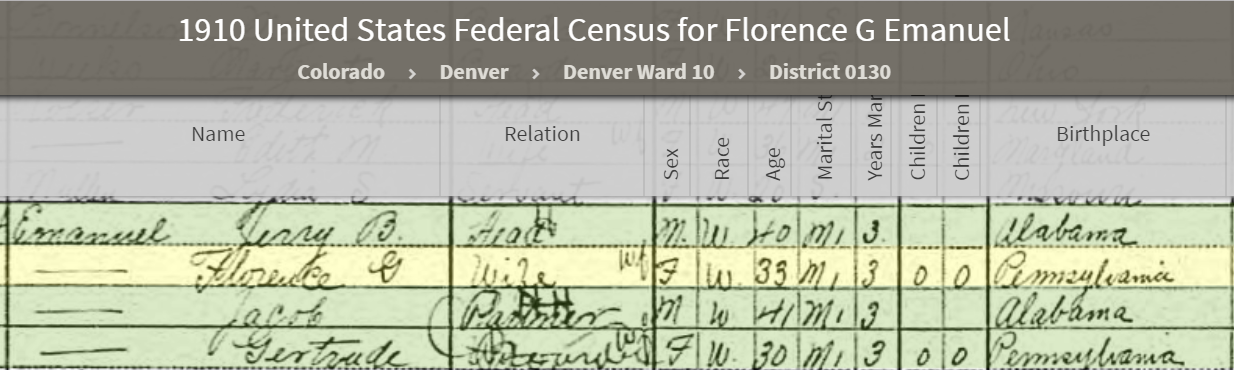
Gertrude and Florence, who were married to the Emanuel brothers, Jacob and Jerry, in 1906, were all living in the same household in Denver; Jacob and Jerry were clothing merchants.

The Emanuel-Goldsmith couples, 1910 US census, Census Place: Denver Ward 10, Denver, Colorado; Roll: T624_116; Page: 8B; Enumeration District: 0130; FHL microfilm: 1374129
Ancestry.com. 1910 United States Federal Census

Thus, the extended family of Jacob Goldsmith experienced some losses in the first decade of the 20th century. It started with Jacob’s death in 1901 and his daughter Emma’s death the following year. Ellena lost a son and her husband in 1908. But on the positive side, three of Jacob’s daughters married in this decade as did two of his grandchildren, and several babies—Jacob’s grandchildren and great-grandchildren—were born.


  1. Sidney Uhfelder, World War II draft registration, The National Archives in St. Louis, Missouri; St. Louis, Missouri; Record Group: Records of the Selective Service System, 147; Box: 126, Ancestry.com. U.S. WWII Draft Cards Young Men, 1940-1947 
  2.  Marriage License Number: 177918, Ancestry.com. Philadelphia, Pennsylvania, Marriage Index, 1885-1951 
  3. Isadore Neufeld, death certificate, Pennsylvania Historic and Museum Commission; Pennsylvania, USA; Pennsylvania, Death Certificates, 1906-1965; Certificate Number Range: 005401-008100, Ancestry.com. Pennsylvania, Death Certificates, 1906-1966 
  4. Gustav Neufeld and family, 1900 US census, Census Place: Philadelphia Ward 29, Philadelphia, Pennsylvania; Page: 10; Enumeration District: 0737; FHL microfilm: 1241471, Ancestry.com. 1900 United States Federal Census; death certificate of Frida Neufeld Steel, Pennsylvania Historic and Museum Commission; Pennsylvania, USA; Pennsylvania, Death Certificates, 1906-1965; Certificate Number Range: 027601-030150, Ancestry.com. Pennsylvania, Death Certificates, 1906-1966 
  5.  Number: 182-30-5349; Issue State: Pennsylvania; Issue Date: 1954-1955, Ancestry.com. U.S., Social Security Death Index, 1935-2014 
  6. Edward Goldsmith and family, 1910 US census, Census Place: Greensboro, Hale, Alabama; Roll: T624_15; Page: 2B; Enumeration District: 0042; FHL microfilm: 1374028, Ancestry.com. 1910 United States Federal Census; Number: 228-46-8303; Issue State: Virginia; Issue Date: 1953-1954, Ancestry.com. U.S., Social Security Death Index, 1935-2014 
  7. Harrisburg, Pennsylvania, City Directory, 1907, Ancestry.com. U.S. City Directories, 1822-1995 
  8. Lee Feldstein, 1910 US census, Census Place: Atlantic City Ward 3, Atlantic, New Jersey; Roll: T624_867; Page: 13A; Enumeration District: 0018; FHL microfilm: 1374880, Ancestry.com. 1910 United States Federal Census 
  9. Solomon Jaffa and family, 1910 US census, Census Place: Trinidad Ward 2, Las Animas, Colorado; Roll: T624_122; Page: 3B; Enumeration District: 0115; FHL microfilm: 1374135, Ancestry.com. 1910 United States Federal Census 
  10. Mary Rohrheimer and family, 1910 US census, Census Place: Philadelphia Ward 32, Philadelphia, Pennsylvania; Roll: T624_1403; Page: 8A; Enumeration District: 0750; FHL microfilm: 1375416, Ancestry.com. 1910 United States Federal Census 
  11. Frank Goldsmith, 1910 US census, Census Place: Harrisburg Ward 4, Dauphin, Pennsylvania; Roll: T624_1336; Page: 12A; Enumeration District: 0061; FHL microfilm: 1375349, Ancestry.com. 1910 United States Federal Census 
  12. Edward Goldsmith, 1910 US census, Census Place: Greensboro, Hale, Alabama; Roll: T624_15; Page: 2B; Enumeration District: 0042; FHL microfilm: 1374028, Ancestry.com. 1910 United States Federal Census 
  13. Uhlfelder family, 1910 US census, Census Place: Albuquerque Ward 4, Bernalillo, New Mexico; Roll: T624_913; Page: 1B; Enumeration District: 0015; FHL microfilm: 1374926, Ancestry.com. 1910 United States Federal Census 

Jacob Goldsmith’s Will and His Legacy

The 20th century did not start well for the family of Jacob Goldsmith. As the new century dawned, the family lost its patriarch; Jacob Goldsmith died in Denver on January 31, 1901, at the age of 76. His body was returned to Philadelphia where he was buried alongside his wife Fannie at Mt. Sinai cemetery:

“Pennsylvania, Philadelphia City Death Certificates, 1803-1915,” database with images, FamilySearch (https://familysearch.org/ark:/61903/3:1:S3HT-676K-YG?cc=1320976&wc=9F51-VZ9%3A1073329301 : 16 May 2014), 004050474 > image 633 of 1820; Philadelphia City Archives and Historical Society of Pennsylvania, Philadelphia.

Like his father Simon, Jacob Goldsmith had lived a rich and interesting life. He was born in Oberlistingen, Germany, and after his mother died in 1840 when he was just a teenager, he immigrated all alone to the United States. He was the first of the Goldschmidt clan to come to America. He settled in Washington, Pennsylvania and established himself as a clothing merchant there. He and his wife Fannie started their large family there in 1853.

After his stepmother Fradchen passed away, Jacob opened his home to his father Simon and his two half-siblings Henry and Hannah. Then in the 1860s, Jacob and Fannie and their many children moved to Philadelphia where Jacob was again a clothing merchant; he lived there until Fannie died in 1881. After her death Jacob joined his half-brother Henry back in western Pennsylvania where he established yet another clothing store in Connellsville. Jacob’s final move was to Denver, Colorado, when he was already in his sixties.

Jacob Goldsmith was survived by thirteen of his fourteen children and seventeen grandchildren, plus three more who were born after he died.  His love and care for them all was revealed in his will. Six of his daughters—Emma (47), Rachel (44), Celia (40), Florence (31), Gertrude (29), and Eva (29)—were unmarried when Jacob died, and they were the primary focus of his will.

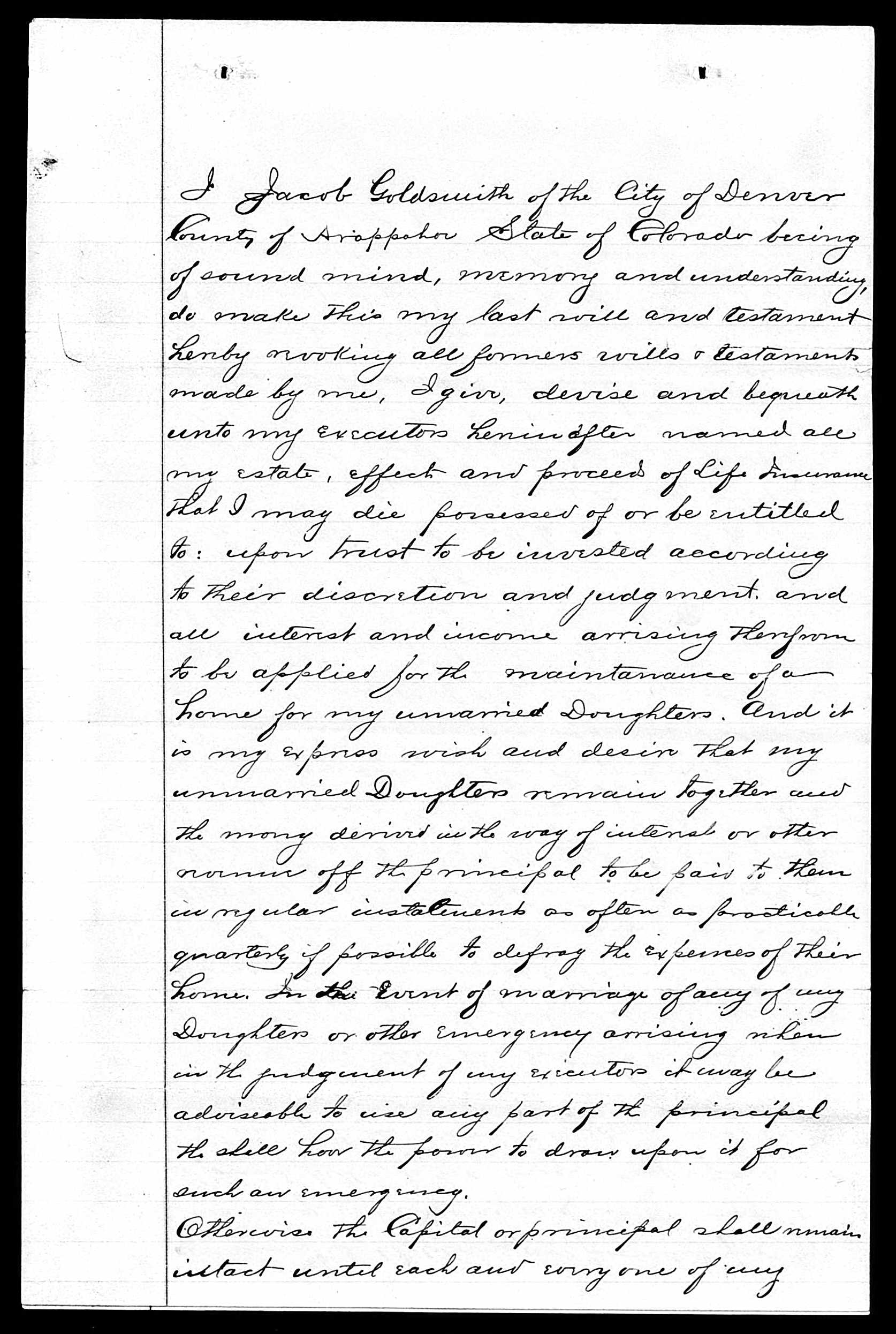
Jacob had executed the will on March 2, 1899, in Denver:


Jacob Goldsmith will, Probate Records, 1900-1946; Author: Denver County (Colorado). Clerk of the County Court; Probate Place: Denver, Colorado
Ancestry.com. Colorado, Wills and Probate Records, 1875-1974, Case Number: 6521

I Jacob Goldsmith of the City of Denver County of Arapahoe State of Colorado being of sound mind, memory and understanding, do make this my last will and testament hereby revoking all former wills and testaments made by me. I give, devise and bequeath unto my executors hereinafter named all my estate, effects and proceeds of Life Insurance that I may die possessed of or be entitled to: upon trust to be invested according to their discretion and judgment and all interest and income arising therefrom to be applied for the maintenance of a home for my unmarried Daughters. And it is my express wish and desire that my unmarried Daughters remain together and the money derived in the way of interest or other [?] off the principal to be paid to them in regular installments as often as practicable quarterly if possible to defray the expenses of their home. In the event of marriage of any of my Daughters or other emergency arising when in the judgment of my executors it may be advisable to use any part of the principal he shall have the power to draw upon it for such an emergency.

Otherwise the Capital or principal shall remain intact until each and everyone of my unmarried children are provided for by marriage or otherwise and in the event it is found better to no longer keep up a home and any of the unmarried children may live with their Relations or otherwise provide themselves with a home then the Interest or income derived off the principal shall be divided between the unmarried children as long as any of them live and remain unmarried. After all of them have by marriage, death or otherwise so provided for that they do not any longer require that the income for their maintenance as herein provided for then the principal or Capital shall be divided share and share alike between all of my children or their heirs. I nominate and appoint my son at laws Robert Levy of Denver Colo and Sol Jaffa of Trinidad Colo as executors of this my will, and they shall not be required to give any bond or surety for the execution of this trust. In case of the death of either of them, the children shall chose [sic] another to act in his place and in case of the deaths of both, two others shall be chosen by the surviving children.

I the said Jacob Goldsmith to this which I declare to be my last will and testament set my hand and seal this the Second day of March 1899.

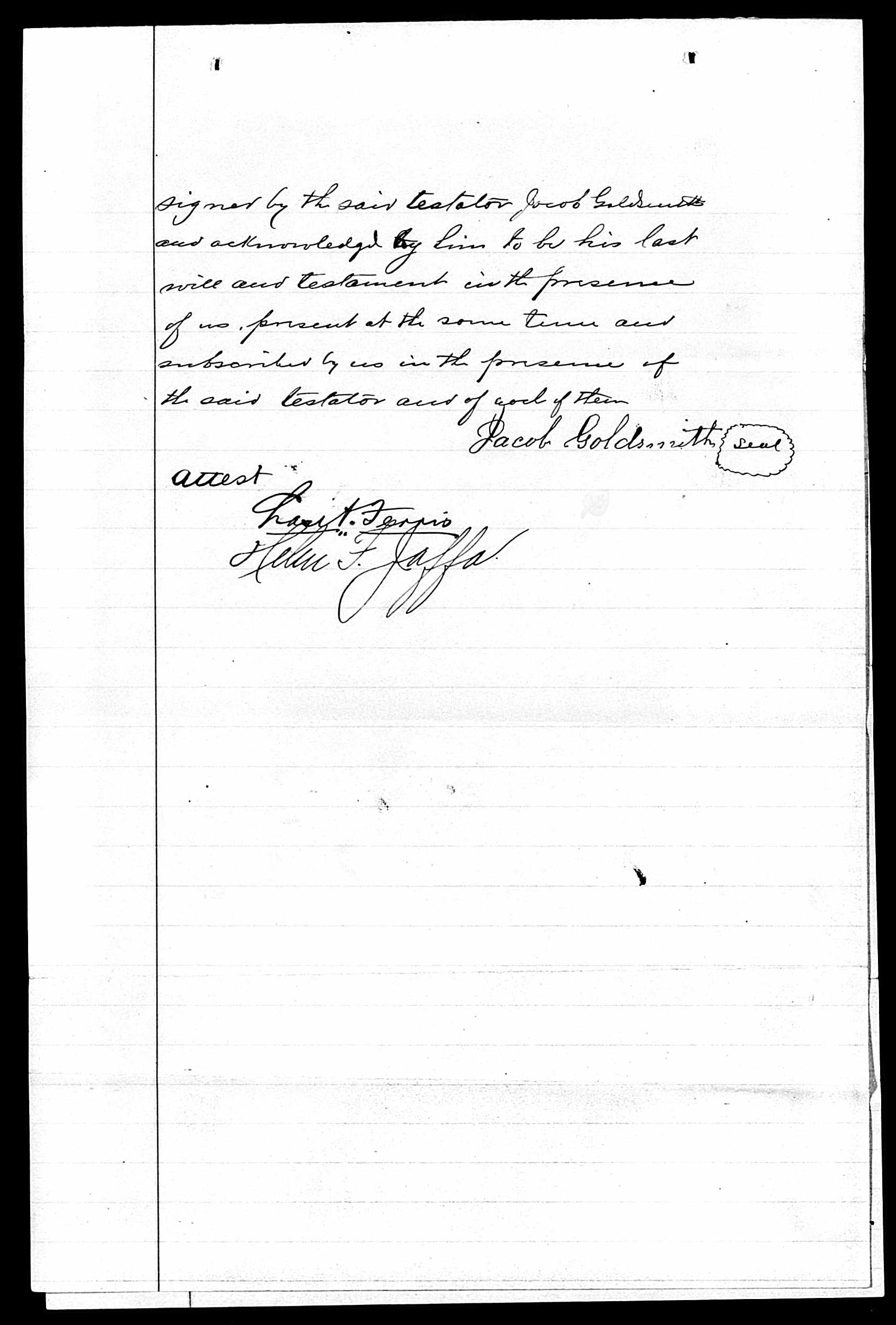
Signed by the said testator Jacob Goldsmith and acknowledged by him to be his last will and testament in the presence of us, present at the same time and subscribed to us in the presence of the said testator and of each of them.

                                             Jacob Goldsmith [seal]

Attest

Chas A Ferris

Helen F Jaffa

The will certainly reflects its times. The assumption was that a woman would have no means of support unless and until she married, and thus, Jacob’s will provided that the interest and income from the estate would be distributed to his unmarried daughters unless and until they married or died or found some other means of support. I also found it interesting that the will expressed his desire that these daughters would share a home together.  Finally, the will stipulated that once all his daughters were married or deceased or otherwise supported, then the principal of the estate would be distributed to all his children.

One thing that struck me as odd about this was that Jacob made no special provision for his widowed daughter Annie Goldsmith Frank or for the widow of his son George Goldsmith. Both had children, Jacob’s grandchildren, and no longer had a husband to support them. I would have thought that Jacob would have included them with his unmarried daughters in providing for distributions of the estate’s income.

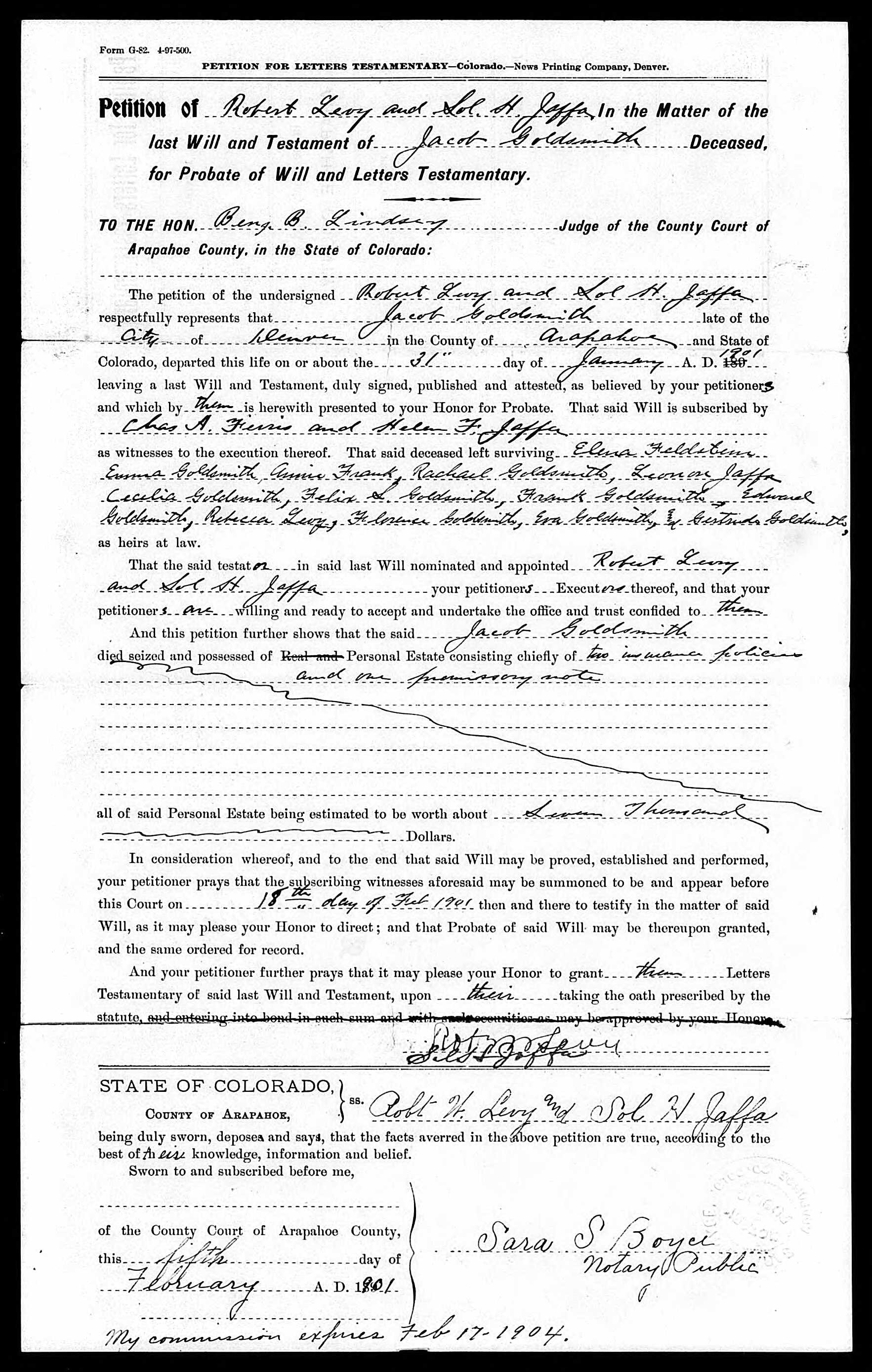
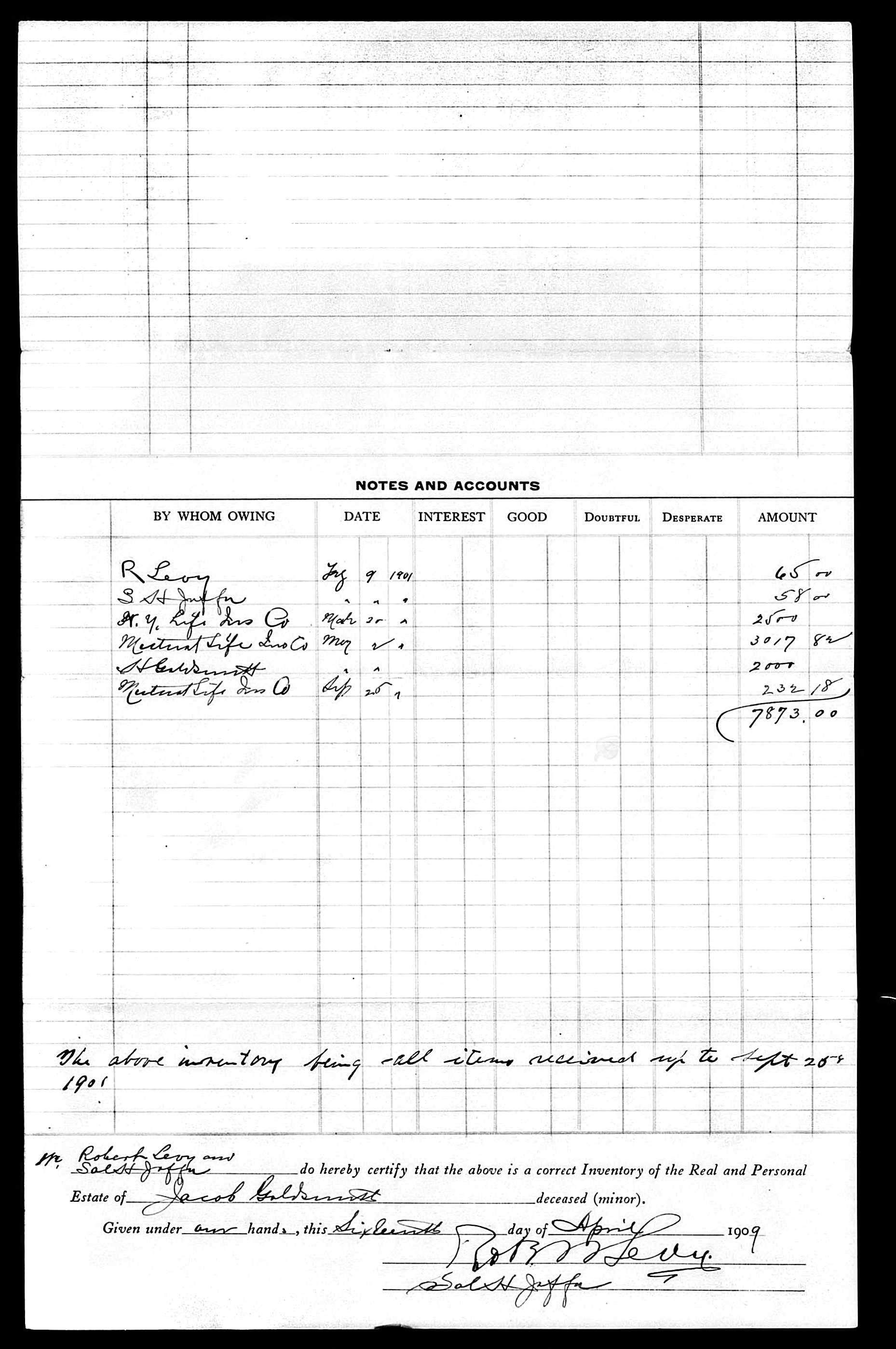
The will was presented for probate on February 2, 1901, by the two executors Jacob had named in the will: his sons-in-law Robert Levy (Rebecca’s husband) and Solomon Jaffa (Leonora’s husband). At that time they reported that the estate was worth $7000.  According to an inflation calculator, $7000 in 1901 would be worth about $207,000 in 2018 dollars. In their probate petition, they also named Jacob’s thirteen living children as the heirs:

The executors later filed a request to amend the petition to include two heirs who had been omitted from the original petition, the children of Jacob’s deceased son George:

Notice, however, that the executors identified George’s children as Fanny and Esther, when in fact George’s children were Fanny and Lester. How could they have made that error? Had someone said “Lester” and Solomon Jaffa and Robert Levy heard “Esther”? I wonder whether that error resulted in any problems if and when the principal of the estate was distributed years later. And it was many years later before all of Jacob’s daughters were either married or deceased.

Sadly, however, it was not long after Jacob’s death that one of those daughters died. Emma Goldsmith died of “double croupous pneumonia” on January 8, 1902, in Philadelphia, where she was buried. She was only 48 years old.

“Pennsylvania, Philadelphia City Death Certificates, 1803-1915,” database with images, FamilySearch (https://familysearch.org/ark:/61903/3:1:S3HT-665P-M?cc=1320976&wc=9FR3-YWL%3A1073330701 : 16 May 2014), 004056150 > image 1230 of 1777; Philadelphia City Archives and Historical Society of Pennsylvania, Philadelphia.

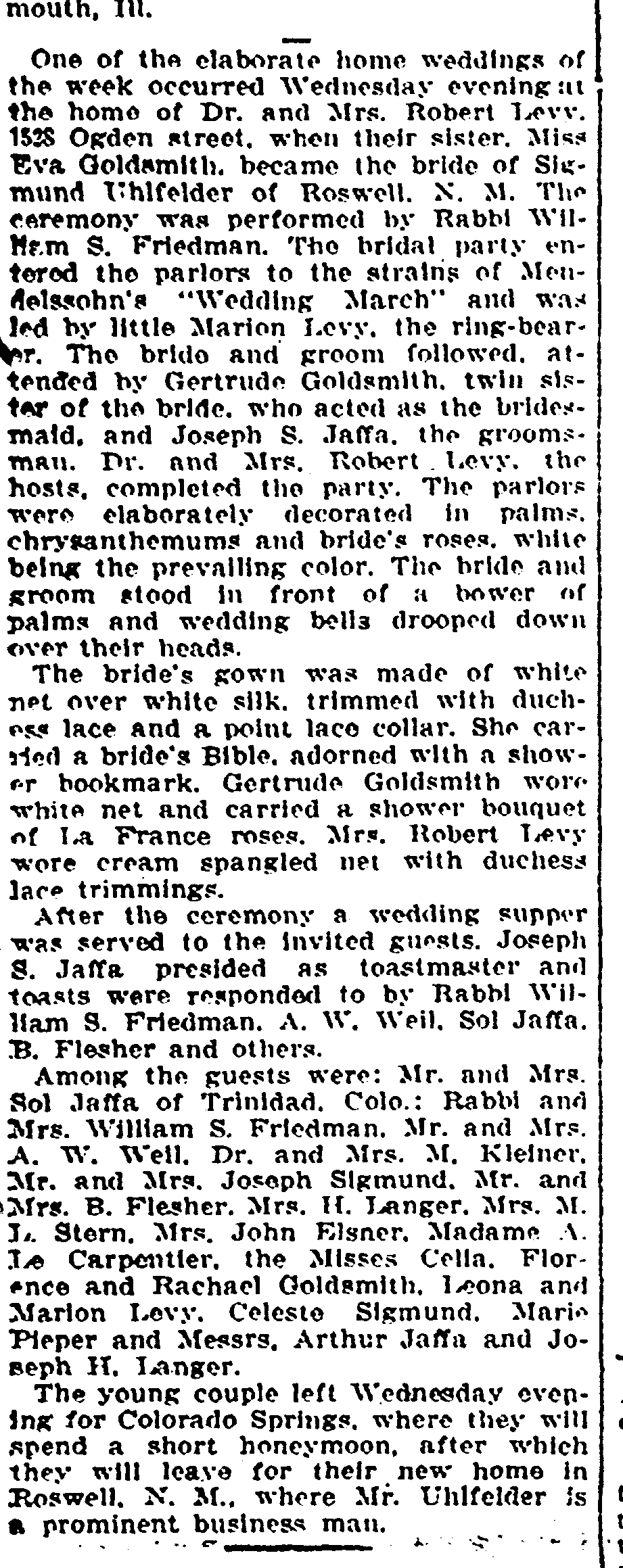
Of the five remaining unmarried daughters, three married within the next few years. Eva Goldsmith married Sigmund Uhlfelder on October 25, 1905; she was 34, he 35.1 Sigmund was a recent German immigrant, born in 1870, and in 1900 he was living in Roswell, New Mexico and working as a cigar salesman.2 Eva’s sister Rebecca and her husband Robert Levy hosted the elaborate wedding:

Denver Post, October 29, 1905, p. 9

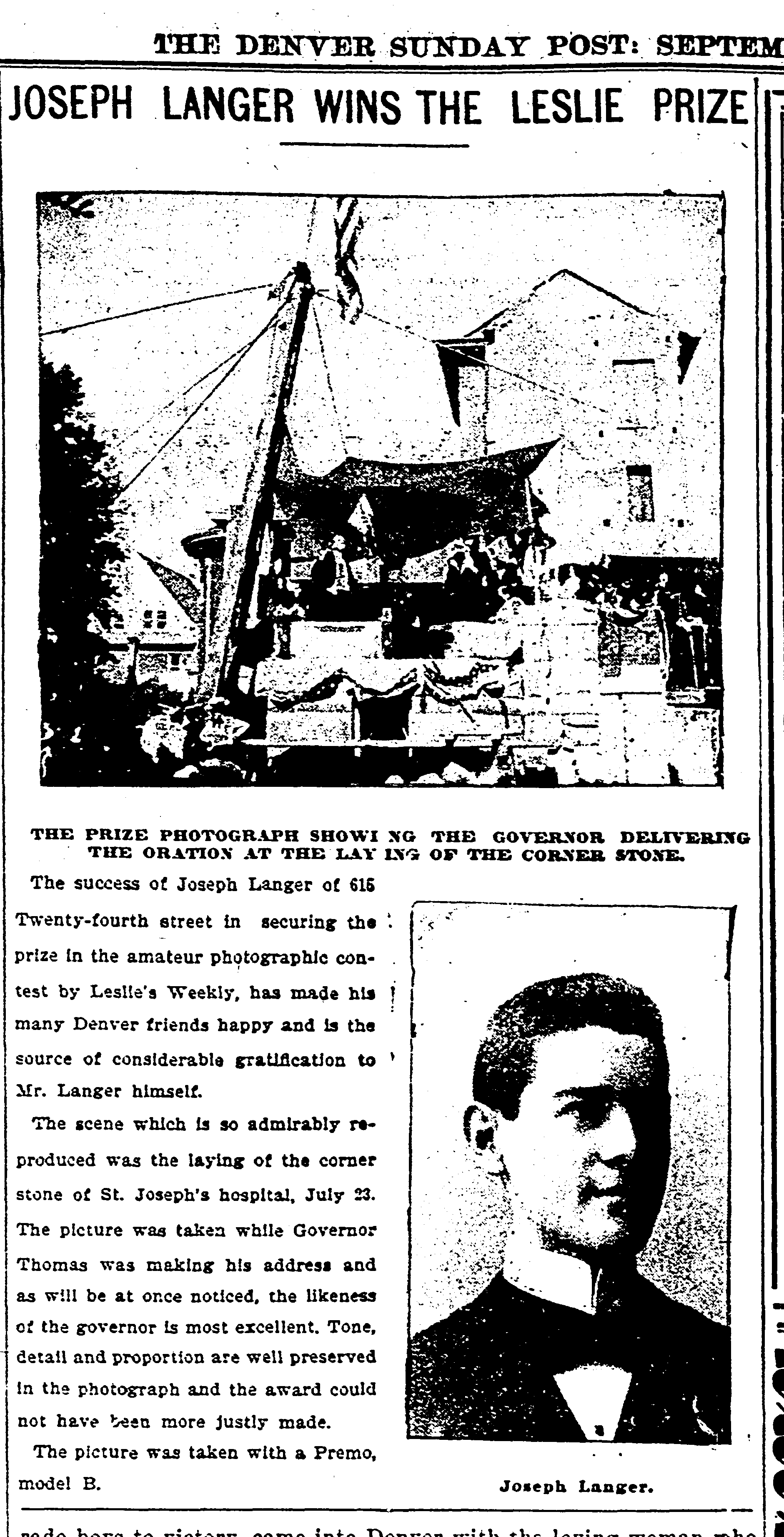
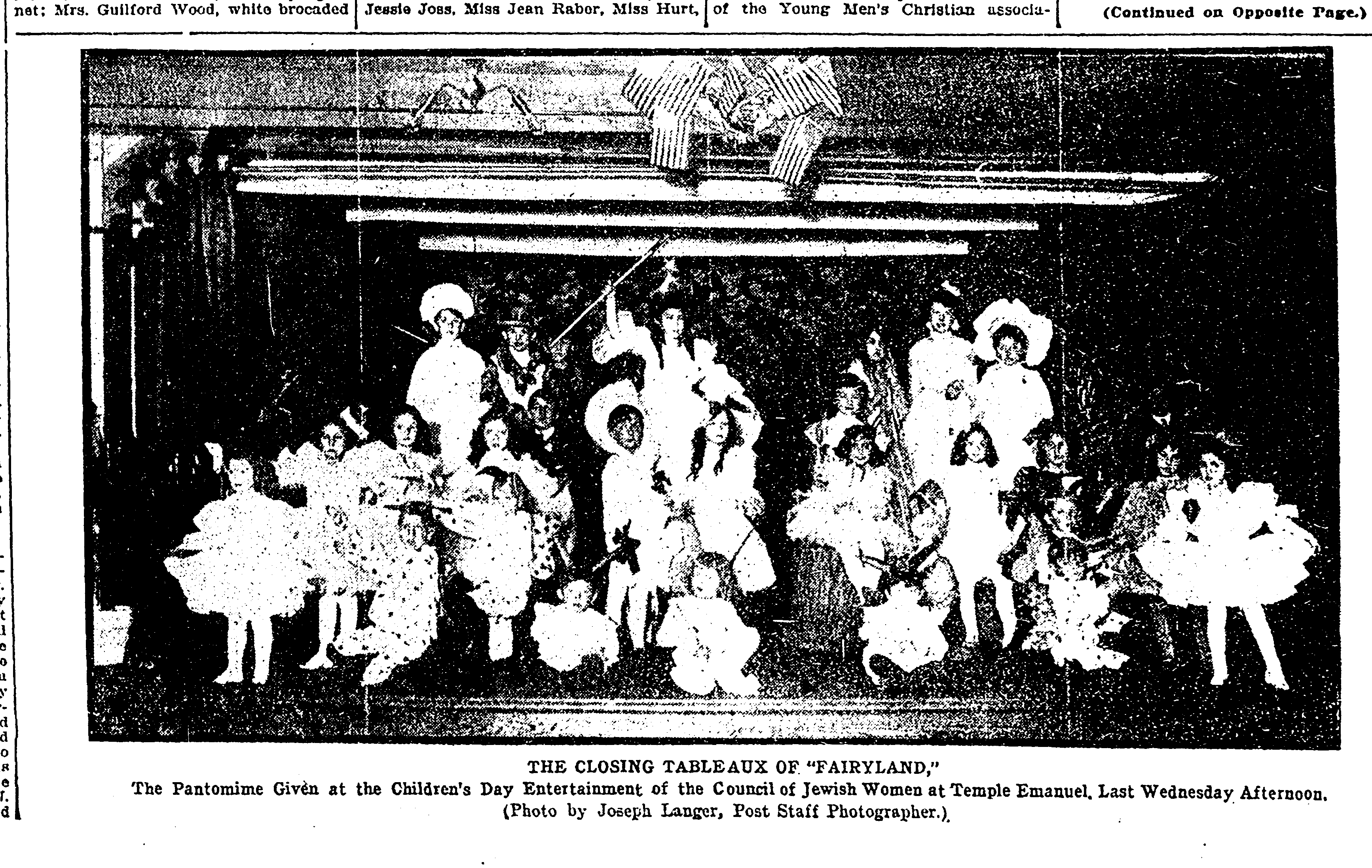
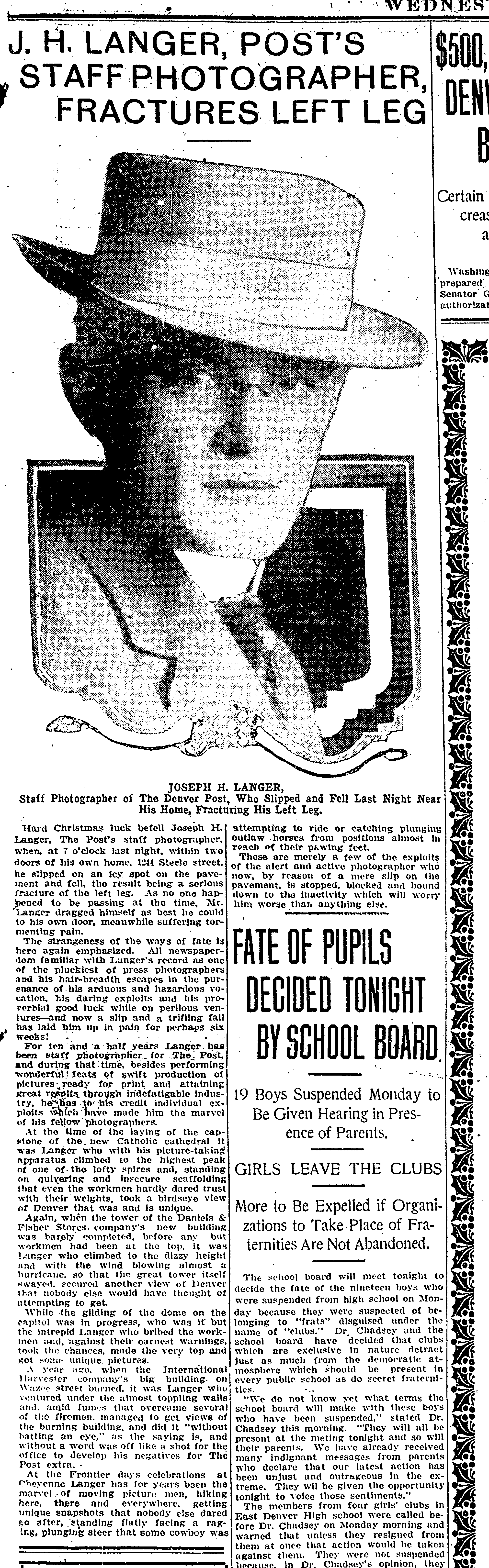
I also noticed that Joseph Langer was one of the invited guests. Joseph, the Denver Post photographer I wrote about here, was the grandson of Sarah Goldschmidt Mansbach, Jacob Goldsmith’s first cousin, Eva’Goldsmith Uhlfelder’s first cousin, once removed.

Eva and Sigmund had one child, a son named Sidney born on August 27, 1906, in Roswell.3

A year after Eva married Sigmund Uhfelder, two more of Jacob Goldsmith’s daughters married, and their husbands were brothers. They were married in a double wedding. On October 10, 1906, in Denver, Florence Goldsmith, then 37, married Jerry B. Emanuel, and her sister Gertrude, 35, married Jacob E. Emanuel.

Ancestry.com. Colorado, County Marriage Records and State Index, 1862-2006

Ancestry.com. Colorado, County Marriage Records and State Index, 1862-2006

Jacob and Jerry were the sons of Moses Emanuel and Dora Tannenbaum, both of whom were born in Hesse, Germany. Jacob and Jerry were born in Mobile, Alabama, in 1867 and 1869, respectively. Their father was a merchant in Mobile in 1870, but by 1880, the family had relocated to Denver.4 In 1900 Jacob was living with his mother and siblings and working as a salesman of men’s furnishings; Jerry, on the other hand was living in Omaha, Nebraska, in 1900, working as a shoe salesman.5

This double wedding was also written up in the paper and hosted by Rebecca and Robert Levy:

Denver Post, October 14, 1906, p. 32

Thus, as of October 10, 1906, only two of Jacob’s daughters remained unmarried: Rachel and Celia. They were now the only ones entitled to a distribution of the interest earned on Jacob’s estate.

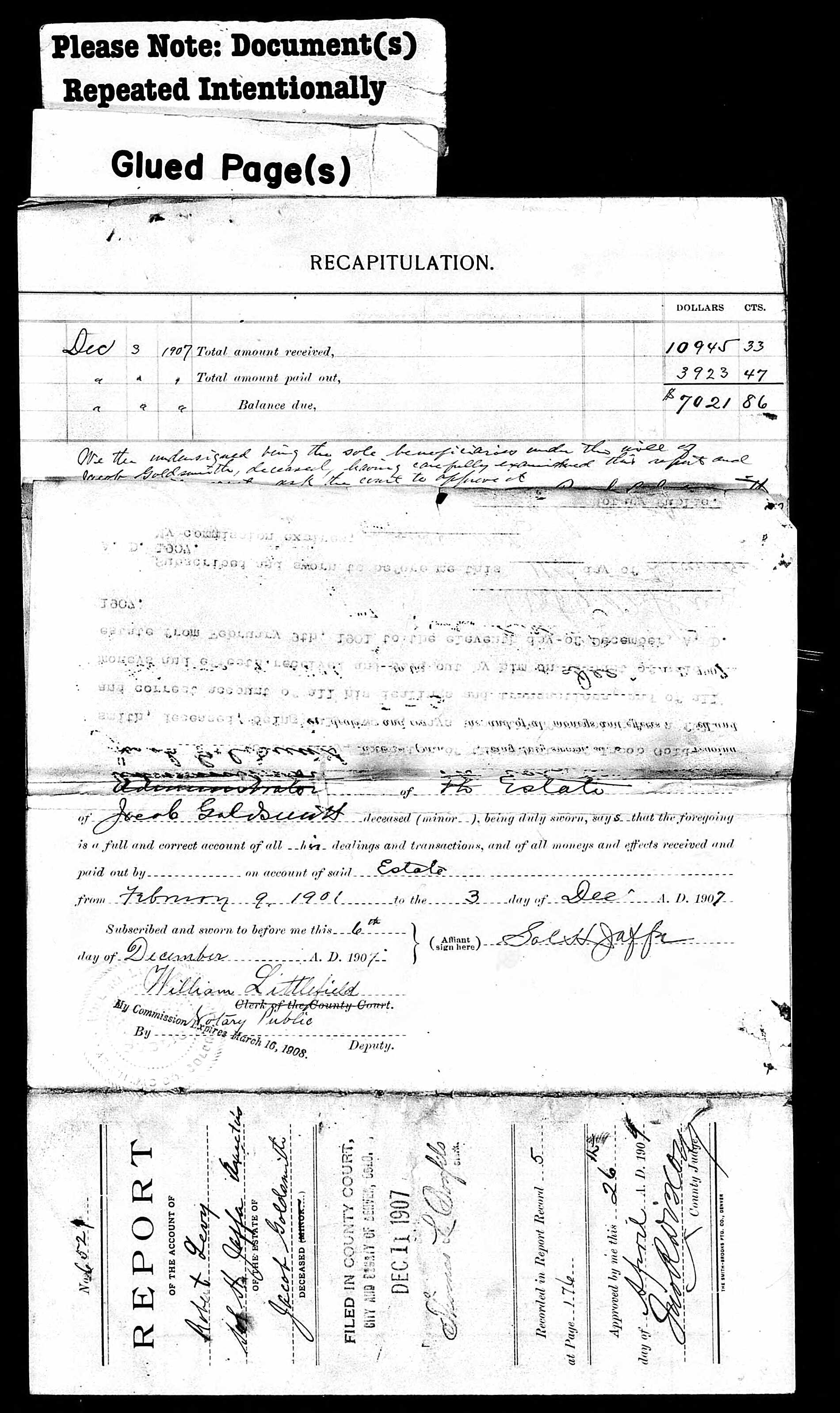
In December 1907, Solomon Jaffa and Robert Levy filed this report of the assets of and distributions from Jacob’s account, covering the period from July 30, 1902, through December 3, 1907:

I am not sure what to make of the inconsistencies in the distributions. While Rachel had only received $33, Eva had received $1031. Emma, who had died in 1902, received more than Celia, who was still alive. My hunch is that Florence, Gertrude, and Eva received a bit more to help pay for their weddings, but that can’t be the only explanation. Jacob did leave it to the discretion of the executors to determine what each daughter would receive, to be determined based on their needs. Maybe the executors responded to requests made by the individual sisters.

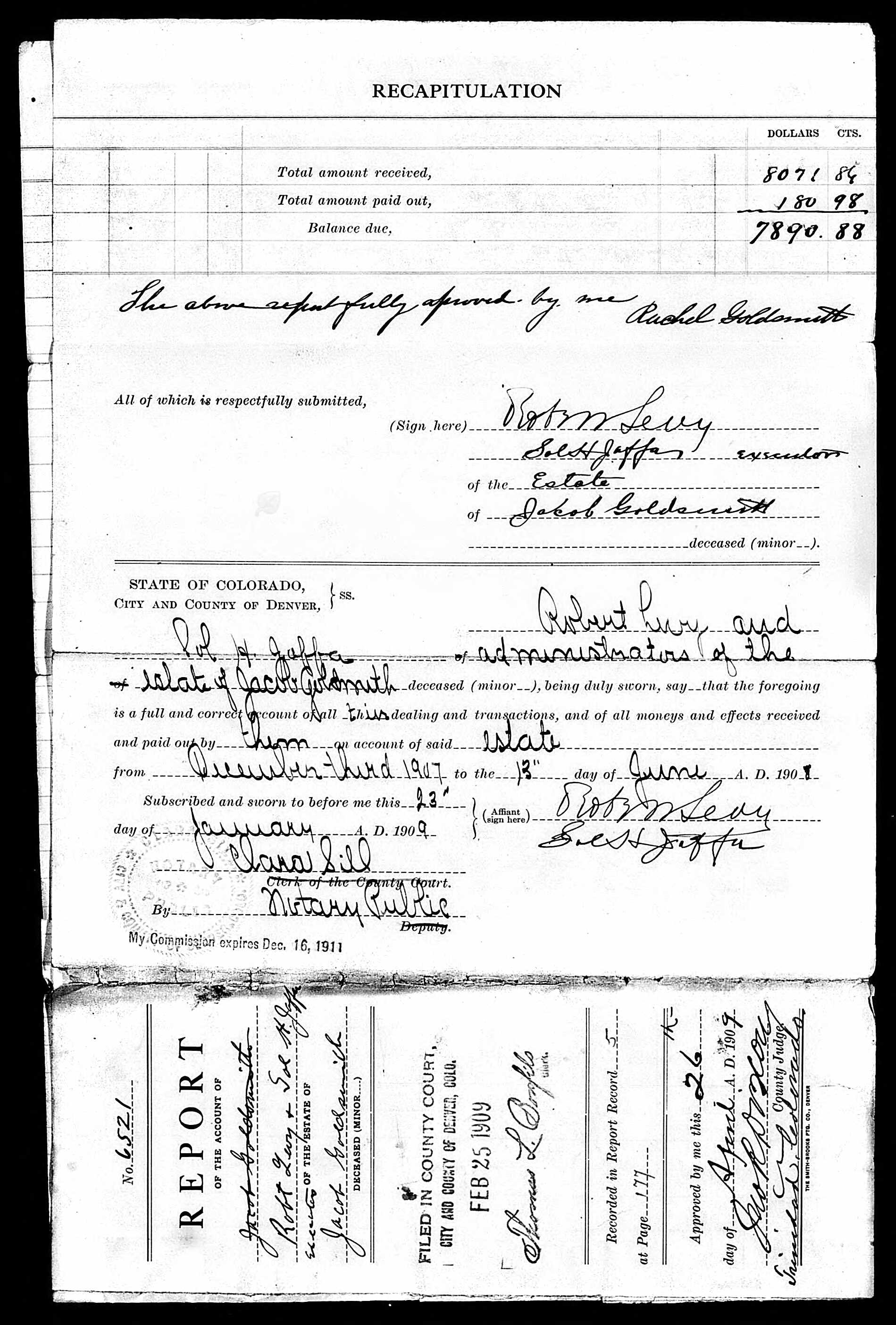
The report for the following year—December 1907 through December 1908—showed distributions only to Celia. Although Rachel was also still unmarried, she was not included in the distributions. A note at the bottom of the last page of this report explained that Rachel preferred to leave the money in the hands of the executors for investment.

The last report included in Jacob’s probate file on Ancestry.com covered the period of 1909-1914. It shows that as of 1914, there was $10,789.09 in the estate. During this period, Rachel (Ray) had received $921.96 and Celia $1171.79.

But that was to be the last distribution to Rachel. A year later on October 7, 1915, Rachel Goldsmith died in Denver at the age of 58.6

Philadlephia Jewish Exponent, October 15, 1915

Celia was now the only remaining unmarried daughter of Jacob Goldsmith, and as we will see, she lived until 1933 and never married, meaning that the principal of Jacob’s estate could not be distributed until 1933. By then most of Jacob’s children had passed away, but some were still living, and there were many grandchildren living to inherit their parent’s share. Unfortunately, there are no later documents in the probate file, and I don’t know what was left in the estate at that point or how it was distributed.


  1. Ancestry.com. Colorado, County Marriage Records and State Index, 1862-2006 
  2. Sigmund Uhlfelder, 1900 US census, Census Place: Roswell, Chaves, New Mexico; Page: 32; Enumeration District: 0030; FHL microfilm: 1240999, Ancestry.com. 1900 United States Federal Census 
  3. Number: 525-01-6662; Issue State: New Mexico; Issue Date: Before 1951, Ancestry.com. U.S., Social Security Death Index, 1935-2014 
  4. Ancestry.com. U.S., Social Security Applications and Claims Index, 1936-2007 (Jerry Emanuel); Emanuel family, 1870 US census, Census Place: Township 19 Range 1 2 3 and 4, Sumter, Alabama; Roll: M593_40; Page: 220A; Family History Library Film: 545539, Ancestry.com. 1870 United States Federal Census; Emanuel family, 1880 US census, Census Place: Denver, Arapahoe, Colorado; Roll: 88; Page: 137D; Enumeration District: 006, Ancestry.com and The Church of Jesus Christ of Latter-day Saints. 1880 United States Federal Census 
  5. Jacob Emanuel, 1900 US census, Census Place: Denver, Arapahoe, Colorado; Page: 3; Enumeration District: 0034; FHL microfilm: 1240117, Ancestry.com. 1900 United States Federal Census. Jerry Emanuel, 1900 US census, Census Place: Omaha Ward 4, Douglas, Nebraska; Page: 5; Enumeration District: 0040; FHL microfilm: 1240924, Ancestry.com. 1900 United States Federal Census 
  6. Historical Society of Pennsylvania; Philadelphia, Pennsylvania; Historic Pennsylvania Church and Town Records, Ancestry.com. Pennsylvania and New Jersey, Church and Town Records, 1669-2013. FindAGrave, https://www.findagrave.com/memorial/142381902 

Jacob Goldsmith and His Family, 1881-1900: Years of Growth, Loss, and Change

When he died in 1883, my four-times great-uncle Simon Goldsmith was survived by four children: Jacob and Henry in Connellsville, Pennsylvania, Lena in Columbus, Ohio, and Hannah in Pittsburgh. They all had children and some even had grandchildren by then. The family had gotten so large by 1883 that it is no longer feasible for me to address them all in one post so I will divide the story into separate multiple post segments for each of Simon’s children. This segment will address his son Jacob and his fourteen children and the families of those children; this post tells their story during the last twenty years of the 19th century.

As seen in this earlier post, Jacob’s wife Fannie passed away on March 4, 1881. By August 12, 1881, Jacob had moved to Connellsville, Pennsylvania, as demonstrated by this ad:

The (Connellsville, PA) Weekly Courier, August 12, 1881, p. 3

It made sense that Jacob would have moved to Connellsville after Fannie died for that is where his younger brother Henry was living. Jacob’s three youngest daughters, Florence, Gertrude, and Eva, were quite young when their mother died in 1881 (Florence was twelve, the twins only ten).  Henry, who was more than twenty years younger than his half-brother Jacob, had a young wife and young children, and they would likely have been a source of support to Jacob and his children.

As we saw in earlier posts, three of Jacob’s daughters were already married with children of their own by the time Jacob moved to Connellsville in 1881.  Ellena was married to Samuel Feldstein and was living in Philadelphia with their three young children, Sylvester, Leon, and William. Their fourth child, Fanny, was born in 1883, and a fifth child, Gertrude, was born on May 31, 1889.1 In 1881, Jacob’s daughter Annie was married to Augustus Frank and living in San Francisco with their three children, Josephine, Harry, and Fanny. Jacob’s daughter Leonora and her husband Solomon Jaffa were living in Trinidad with their daughter Helen in 1881, and their son Arthur was born in 1883. Also, Jacob’s son Felix was not married, but had moved to Santa Fe, New Mexico, in 1881. But Jacob still had ten children living with him in 1881.

By 1885, Felix had moved from Santa Fe to Denver, where he was working as a bookkeeper; he married Fanny Rosenthal in Hamilton County, Ohio, on January 26, 1887. Fanny was the daughter of Herman and Theresa Rosenthal, German immigrants, and she was born in West Virginia in 1862.2  In 1870, she’d been living with her parents and siblings in Cincinnati where her father was a merchant.3

Ancestry.com. Ohio, County Marriage Records, 1774-1993

Jacob made the trip to Cincinnati for their wedding, as reported in the Connellsville newspaper, The Weekly Courier, on its front page on January 28, 1887:

Felix and Fanny had their first child, a son Clarence, on July 13, 1889 in Denver.4

Jacob’s son George moved to Pottsville, Pennsylvania in 1885; he was working as a cutter.5  By 1889, he had married Sarah Rohrheimer, also a daughter of German immigrants, Morris Rohrheimer and Mary Schloss. Sarah was born on July 13, 1866, in Pennsylvania, and in 1880, she was with her parents in Pottsville where her father was a clothing merchant.6 George was working for her father when they met.7 Their first child, Fanny, was born October 1, 1889, in Pennsylvania.8 Thus, Jacob had two more grandchildren born in 1889.

Not only were two more children born into Jacob’s extended family in 1889, there were also two more weddings. Jacob’s son Frank Goldsmith married Barbara Shanor on July 7 of that year.

Marriage record of Frank Goldsmith and Barbara Shanor, Ancestry.com. Ohio, County Marriage Records, 1774-1993

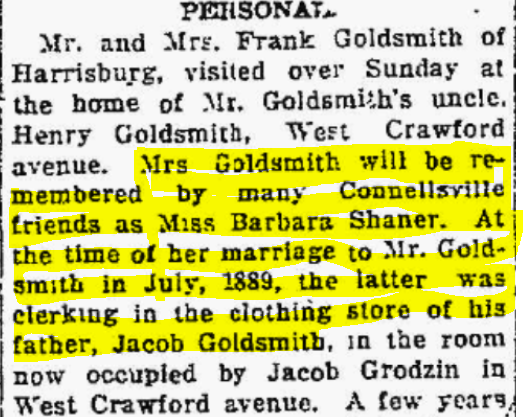
According to this news article, Barbara was a native of Connellsville and Frank was working there in his father’s store in Connellsville when they married. They married, however, in Hamilton County, Ohio, as had Frank’s brother George two years earlier.

The (Connellsville, PA) Daily Courier, August 11, 1919

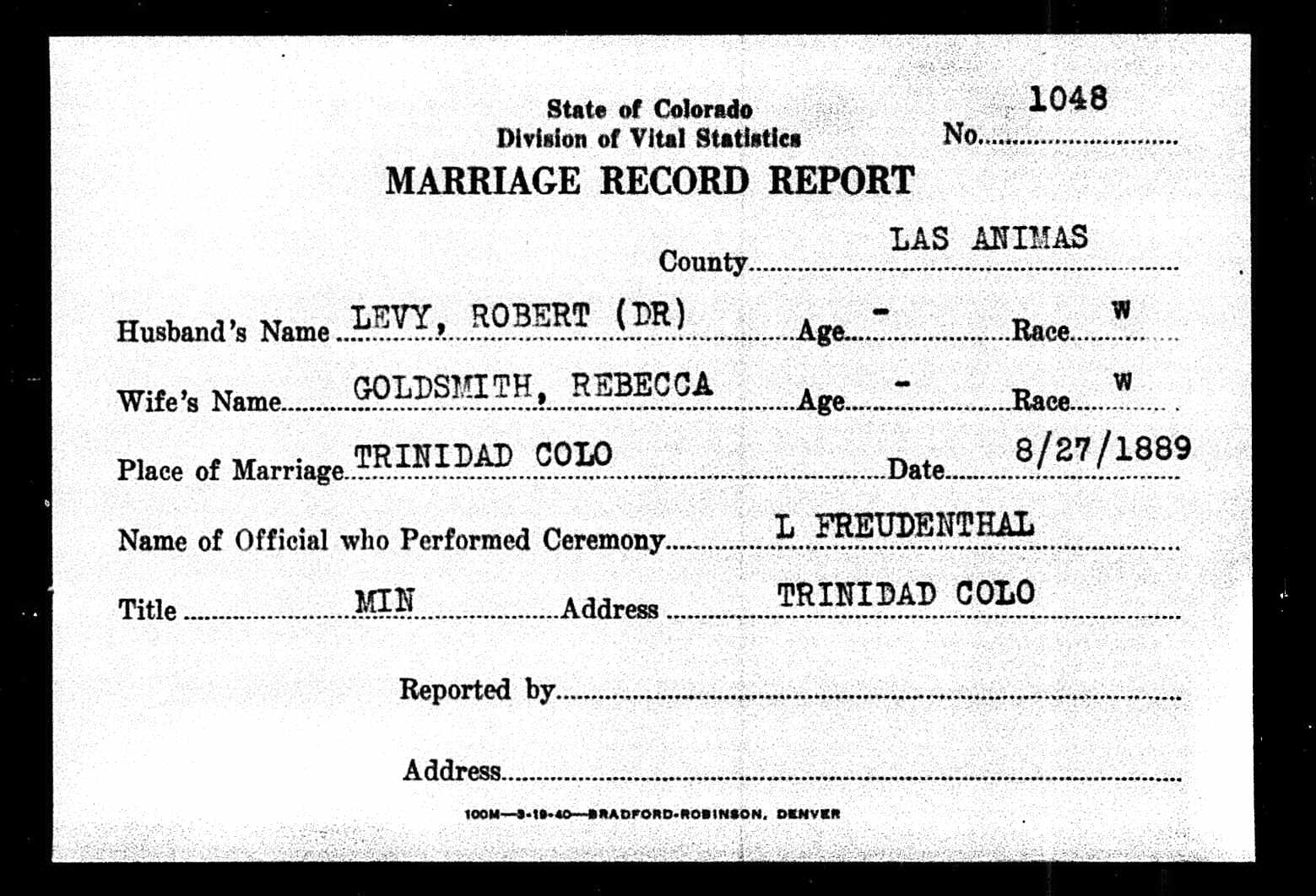
The second wedding to take place in 1889 was that of Jacob’s daughter Rebecca to Robert Levy; they were married in Trinidad, Colorado, on August 27, 1989. Trinidad was, as noted in earlier posts, the home of the Jaffa brothers, Henry Goldsmith’s brothers-in-law, so perhaps Rebecca met her husband through the connection with her aunt Sarah Jaffa Goldsmith, Henry’s wife. Robert Levy was born in Ontario, Canada, on May 30, 1864, to Mandel and Rebecca Levy, who were German immigrants. The family was living in Milwaukee by 1870,9 and in 1885 Robert was living in Denver where he was practicing medicine.10

Rebecca Goldsmith and Robert Levy, marriage record, Ancestry.com. Colorado, County Marriage Records and State Index, 1862-2006

Once again, the Connellsville paper reported that Jacob as well as his brother Henry and sister-in-law Sarah (Jafffa) Goldsmith were traveling to attend a family wedding:

The Connellsville, PA, Weekly Courier, August 23, 1889, p. 5

As of 1888, Jacob’s youngest son Edward Goldsmith was living in Philadelphia and working as a salesman.11

Eight of Jacob’s fourteen children were now on their own, but in 1890, Jacob still had six daughters at home in Connellsville: Emma, Rachel, Celia, Florence, Gertrude, and Eva, ranging in age from 36 to nineteen.

In the early 1890s, Jacob was blessed with three more grandchildren: Rebecca’s daughter Leona in 1891,12 George’s son Lester in 1893,13 and Felix’s daughter Ethel in 1895.14

Then on March 29, 1897, there was another wedding. Edward Goldsmith married Hannah Wallenstein in Hamilton County, Ohio, making that the third time one of Jacob’s children had a wedding in that location. Hannah was born in Cincinnati on September 30, 1872, to Solomon Wallenstein, a German immigrant, and Sarah Cohen, also a Cincinnati native. Hannah’s father was a sewing machine agent in 1880.15

Marriage of Edward Goldsmith and Hannah Wallenstein, Ancestry.com. Ohio, County Marriage Records, 1774-1993

Just over a month after Edward’s wedding, Annie’s husband Augustus Frank died on November 13, 1897, in San Francisco. He was only fifty years old and left behind three children as well as Annie, who was only 42 when Augustus died.16

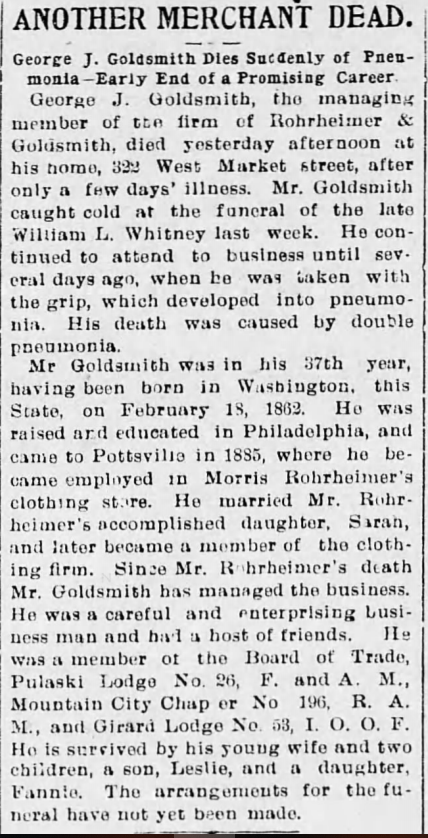
Then just a little over a year after losing Augustus, the family suffered another tragic loss when Jacob’s son George died suddenly from pneumonia on January 13, 1899, in Pottsville, Pennsylvania.17  George was only 36, and his two children Fanny and Lester (incorrectly named as Leslie in George’s obituary) were only nine and three when they lost their father. George’s widow Sarah was only 32.

The Pottsville newspaper, The Miners Journal, published this obituary on its front page on January 14, 1899:


“Another Merchant Dead,” Pottsville, PA Miners Journal, January 14, 1899, p. 1

How terrible this must have been for Sarah and the children. My favorite line in the obituary is the one saying that George was “a careful and enterprising business man and had a host of friends.”

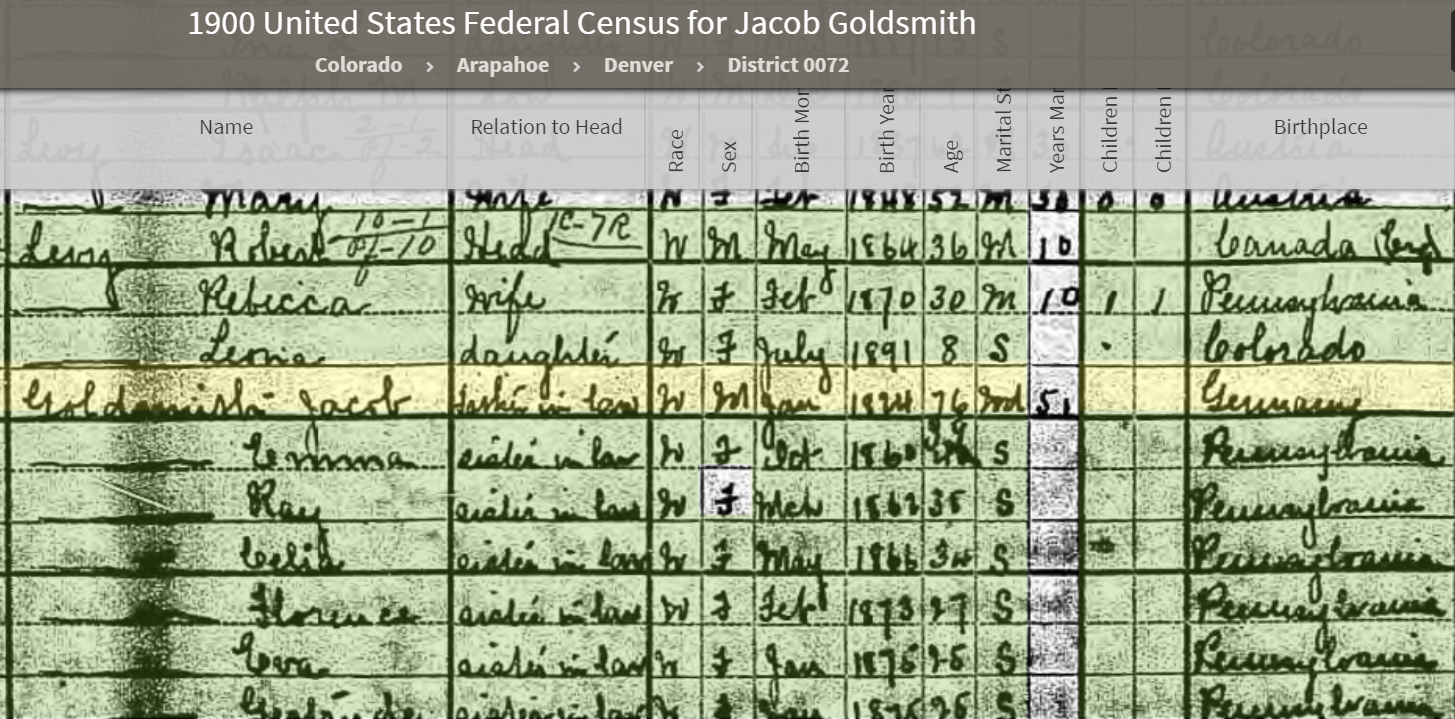
By 1900 there was a big geographic shift in the family. Jacob and his six unmarried daughters—Emma, Rachel, Celia, Florence, Gertrude, and Eva—left Pennsylvania and moved to Denver where in 1900 they were all living with Jacob’s daughter Rebecca and her husband Robert Levy and their daughter Leona. Robert was practicing medicine, Rachel (Ray here) was working as a clerk, and Florence was working as a stenographer. The others did not have any occupation listed on the 1900 census. Jacob was 75 years old and had experienced another major relocation—-from Oberlistingen, Germany, to Washington, Pennsylvania, to Philadelphia, to Connellsville, Pennsylvania, and now to Denver. Rebecca Goldsmith Levy gave birth to a second daughter on June 19, 1900, in Denver, named Marion.18

Household of Robert Levy, 1900 US census, Census Place: Denver, Arapahoe, Colorado; Page: 8; Enumeration District: 0072; FHL microfilm: 1240119
Ancestry.com. 1900 United States Federal Census

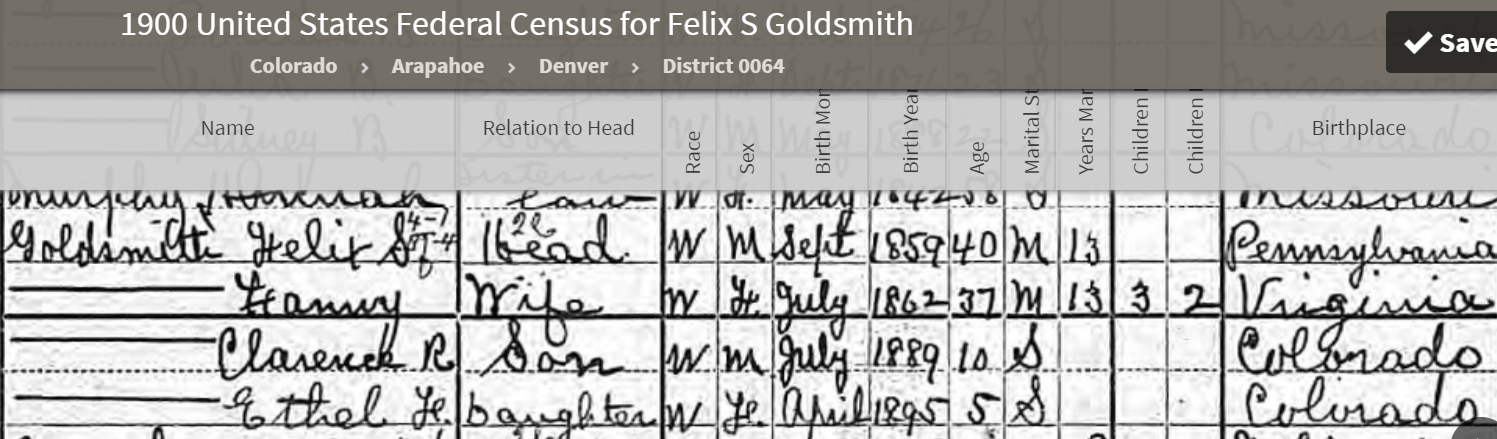
Felix Goldsmith and his family were also living in Denver in 1900, and Felix was working as a mine superintendent.

Felix Goldsmith and family, 1900 US census, Census Place: Denver, Arapahoe, Colorado; Page: 3; Enumeration District: 0064; FHL microfilm: 1240118
Ancestry.com. 1900 United States Federal Census

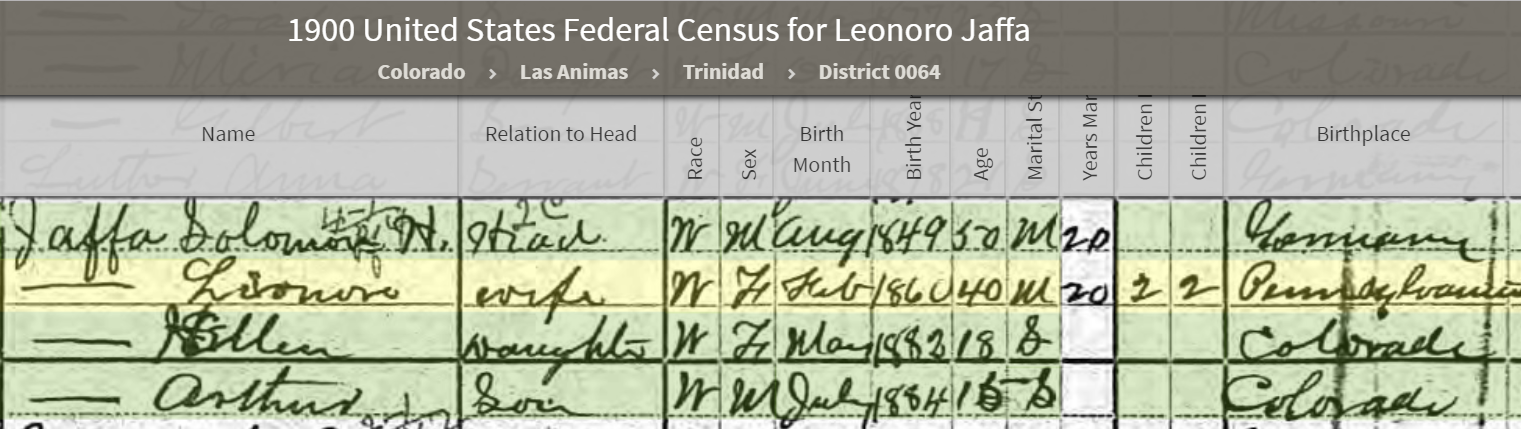
About two hundred miles south of Denver, Leonora Goldsmith Jaffa was still living in Trinidad, Colorado with her husband Solomon Jaffa and their two children Helen (18) and Arthur (16), and Solomon continued to be a merchant.

Solomon Jaffa and family, 1900 US census, Census Place: Trinidad, Las Animas, Colorado; Page: 14; Enumeration District: 0064; FHL microfilm: 1240126
Ancestry.com. 1900 United States Federal Census

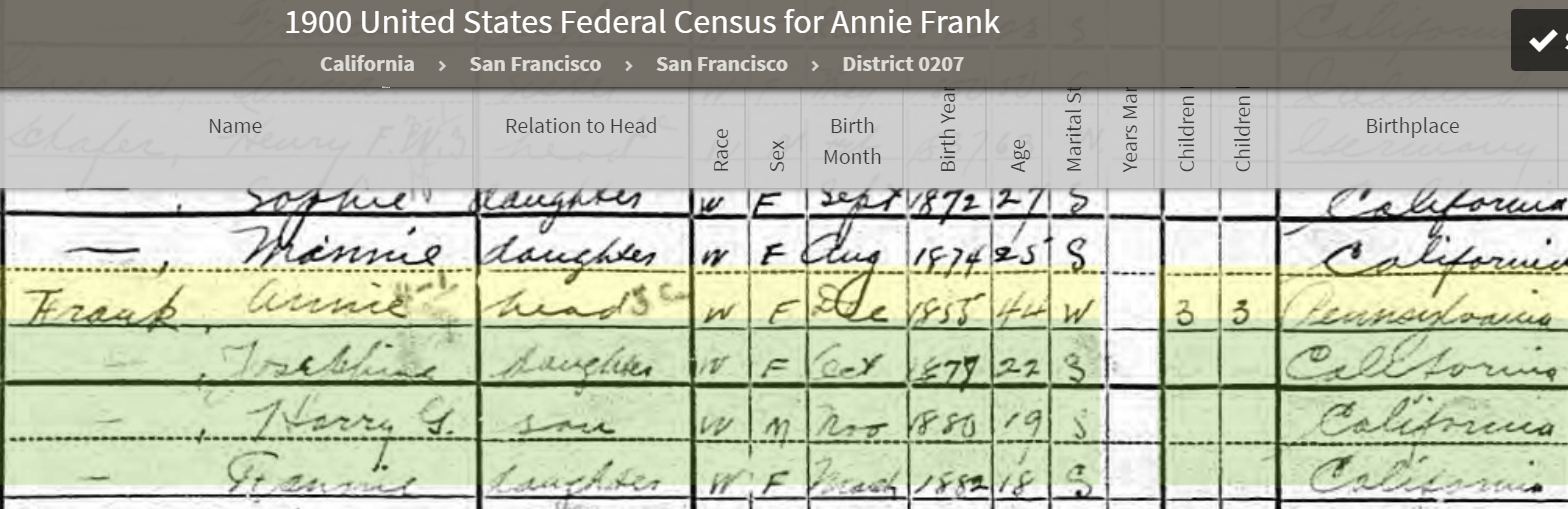
Annie Goldsmith Frank, who had been widowed three years earlier, was living with her three children in San Francisco in 1900. Her daughter Josephine, now 22, was a school teacher, and her son Harry, 19, was a shipping clerk.

Annie Frank, 1900 US census,Census Place: San Francisco, San Francisco, California; Page: 6; Enumeration District: 0207; FHL microfilm: 1240105
Ancestry.com. 1900 United States Federal Census

Back east, George Goldsmith’s widow Sarah and two children Fanny and Lester were living in Pottsville, Pennsylvania, with Sarah’s mother Mary Rohrheimer. Both Mary and Sarah listed their occupation on the 1900 census as “capitalists.” I wonder what that meant!

Sarah Rohrheimer Goldsmith and family, Census Place: Pottsville, Schuylkill, Pennsylvania; Page: 10; Enumeration District: 0187; FHL microfilm: 1241485
Ancestry.com. 1900 United States Federal Census

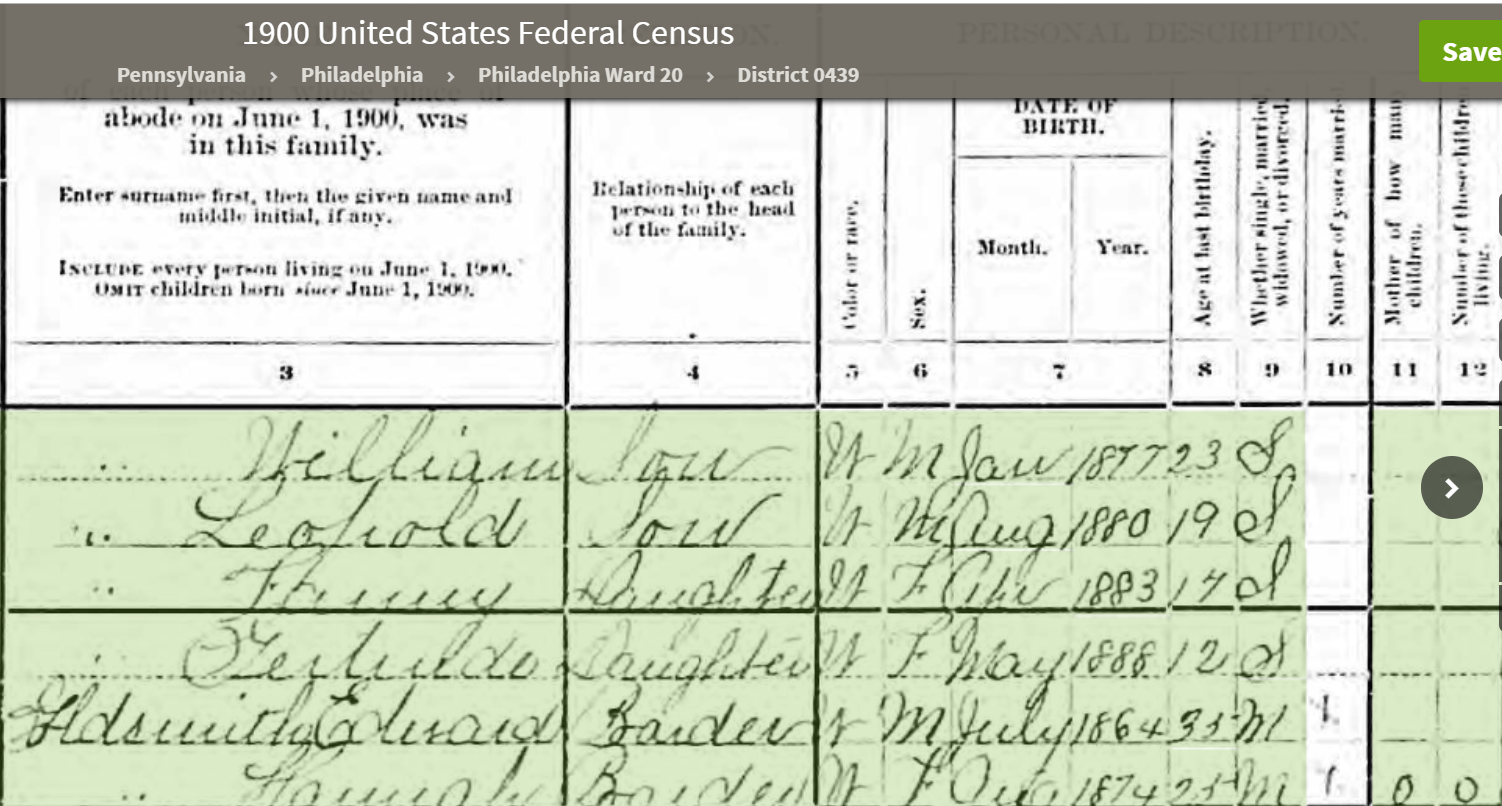
Jacob’s other three surviving children were all in Philadelphia in 1900. Frank Goldsmith was living with his wife Barbara and working as a clerk in the clothing business.19 Edward Goldsmith and his wife Hannah were living with Edward’s older sister Ellena and her husband Samuel Feldstein and their five children. Edward had no occupation listed, but in the 1901 Philadelphia directory, he is identified as a salesman. Samuel Feldstein’s occupation was reported as “manufacturer” on the 1900 census. Samuel and Ellena’s three oldest sons were working: Sylvester, 25, as an artist, William, 23, as a bookkeeper, and Leopold, 19, as a cigar maker. The other two children—Fanny, 17, and Gertrude, 12, did not have occupations listed.

Feldstein household, 1900 US census, Census Place: Philadelphia Ward 20, Philadelphia, Pennsylvania; Page: 5; Enumeration District: 0439; FHL microfilm: 1241462
Ancestry.com. 1900 United States Federal Census

Thus, as of 1900, Jacob’s family was spread between Pennsylvania, Colorado, and California. What would the new century bring for him and his very large extended family?


  1. Fannie Neufeld death certificate, Pennsylvania Historic and Museum Commission; Pennsylvania, USA; Pennsylvania, Death Certificates, 1906-1965; Certificate Number Range: 019051-021750, Ancestry.com. Pennsylvania, Death Certificates, 1906-1966; Gertrude Lewin death certificate, Pennsylvania Historic and Museum Commission; Pennsylvania, USA; Pennsylvania, Death Certificates, 1906-1965; Certificate Number Range: 094201-096650, Ancestry.com. Pennsylvania, Death Certificates, 1906-1966 
  2. “Ohio Deaths, 1908-1953,” database with images, FamilySearch (https://familysearch.org/ark:/61903/3:1:33SQ-GP2P-9VMD?cc=1307272&wc=MD9X-FNL%3A287599101%2C294427301 : 21 May 2014), 1937 > 29701-32800 > image 2781 of 3325. 
  3. Rosenthal family, 1870 US census, Census Place: Cincinnati Ward 15, Hamilton, Ohio; Roll: M593_1214; Page: 468B; Family History Library Film: 552713, Ancestry.com. 1870 United States Federal Census 
  4. “Ohio Deaths, 1908-1953,” database with images, FamilySearch (https://familysearch.org/ark:/61903/3:1:S3HY-XCRQ-4PD?cc=1307272&wc=MD96-FWP%3A287602801%2C289221002 : 21 May 2014), 1946 > 03001-06100 > image 558 of 3479. 
  5. “Another Merchant Dead,” Pottsvile, Pennsylvania Miners Journal, January 14, 1899, p. 1; Pottsville, Pennsylvania, City Directory, 1887, Ancestry.com. U.S. City Directories, 1822-1995 
  6. Sarah Rohrheimer Goldsmith death certificate, Pennsylvania Historic and Museum Commission; Pennsylvania, USA; Pennsylvania, Death Certificates, 1906-1965; Certificate Number Range: 020001-023000, Ancestry.com. Pennsylvania, Death Certificates, 1906-1966. Rohrheimer family, 1880 US census, Census Place: Pottsville, Schuylkill, Pennsylvania; Roll: 1193; Page: 373A; Enumeration District: 221,  Ancestry.com and The Church of Jesus Christ of Latter-day Saints. 1880 United States Federal Census 
  7. “Another Merchant Dead,” Pottsvile, Pennsylvania Miners Journal, January 14, 1899, p. 1; Pottsville, Pennsylvania, City Directory, 1887, Ancestry.com. U.S. City Directories, 1822-1995 
  8. Number: 188-36-5720; Issue State: Pennsylvania; Issue Date: 1962,
    Ancestry.com. U.S., Social Security Death Index, 1935-2014 
  9. Robert Levy, 1908 passport application, National Archives and Records Administration (NARA); Washington D.C.; Roll #: 54; Volume #: Roll 0054 – Certificates: 46257-47289, 21 Feb 1908-10 Mar 1908, Ancestry.com. U.S. Passport Applications, 1795-1925. Levy family, 1870 US census, Census Place: Milwaukee Ward 5, Milwaukee, Wisconsin; Roll: M593_1727; Page: 557A; Family History Library Film: 553226,  Ancestry.com. 1870 United States Federal Census 
  10. Denver, Colorado, City Directory, 1885, Ancestry.com. U.S. City Directories, 1822-1995 
  11. Philadelphia, Pennsylvania, City Directory, 1888, Ancestry.com. U.S. City Directories, 1822-1995 
  12. Ancestry.com. U.S., Social Security Applications and Claims Index, 1936-2007, SSN: 524606840 
  13. Lester Goldsmith, World War II draft registration, The National Archives at St. Louis; St. Louis, Missouri; World War II draft cards (Fourth Registration) for the State of Pennsylvania; Record Group Title: Records of the Selective Service System, 1926-1975; Record Group Number: 147; Series Number: M1951, Ancestry.com. U.S., World War II Draft Registration Cards, 1942 
  14. Felix Goldsmith and family, 1900 US census, Census Place: Denver, Arapahoe, Colorado; Page: 3; Enumeration District: 0064; FHL microfilm: 1240118, Ancestry.com. 1900 United States Federal Census 
  15. Ancestry.com. U.S., Social Security Applications and Claims Index, 1936-2007, SSN: 225644424. Wallenstein family, 1880 US census, Census Place: Cincinnati, Hamilton, Ohio; Roll: 1026; Page: 447A; Enumeration District: 144, Ancestry.com and The Church of Jesus Christ of Latter-day Saints. 1880 United States Federal Census 
  16. https://www.findagrave.com/memorial/100371594 
  17.  Ancestry.com. Philadelphia, Pennsylvania, Death Certificates Index, 1803-1915 
  18.  SSN: 524607495, Ancestry.com. U.S., Social Security Applications and Claims Index, 1936-2007 
  19. Frank and Barbara Goldsmith, 1900 US census, Census Place: Philadelphia Ward 32, Philadelphia, Pennsylvania; Page: 3; Enumeration District: 0830; FHL microfilm: 1241474, Ancestry.com. 1900 United States Federal Census 

Jacob Goldsmith’s Family, 1872-1881: Reaching from Coast to Coast

1867 Map of the United States and territories, United States. General Land Office.
Gorlinski, Joseph. Library of Congress, http://www.loc.gov/

As of the end of 1871, Simon Goldsmith and his four surviving children—Jacob Goldsmith, Lena Basch, Henry Goldsmith, and Hannah Benedict—were all living in Pennsylvania, Jacob and his family in Philadelphia, Lena and Hannah and their families in Pittsburgh, and Henry in Connellsville. Simon was living with Hannah in Pittsburgh as well. All four children were married, and Simon had 24 grandchildren ranging in age from newborn Jacob W. Goldsmith, Henry’s son, to eighteen-year-old Ellena Goldsmith, Jacob’s daughter. Ten years later the family was no longer all living in Pennsylvania.

That movement out of Pennsylvania is best illustrated by the children of Simon’s oldest child, Jacob. Although Jacob and his wife Fannie remained in Philadelphia in the 1870s where Jacob continued to work as a clothing merchant, three of their children moved far away.

Their oldest daughter Ellena did not leave Philadelphia, but she did move out of the family home. Ellena married Samuel Feldstein on November 6, 1872, in Philadelphia.1 She was nineteen, and he was 25. Samuel was born in Prague in what was then Bohemia, now the Czech Republic, on January 12, 1847.2 By 1868 he was living in Philadelphia and was a naturalized citizen.3 In 1870 he was living with his parents and twin brother.4 In 1873 he is listed as being in the cigar business in Philadelphia.5

Ellena and Samuel Feldstein had three children in the 1870s, Simon’s first great-grandchildren: Arthur (1873),6 Sylvester (1875),7 and William (1877).8 Arthur, their first born, died on January 9, 1874, when he was just five months old. The death certificate stated that the cause of death was catarrh, which according to this website listing 19th century causes of death, is “An inflammatory affection of any mucous membrane, in which there are congestion, swelling, and an alteration in the quantity and quality of mucous secreted. In America, especially, a chronic inflammation of, and hypersecretion from the membranes of nose or air passages.”

Pennsylvania, Philadelphia City Death Certificates, 1803-1915,” database with images, FamilySearch (https://familysearch.org/ark:/61903/1:1:JK32-B35 : 9 March 2018), Arthur Feldstein, 09 Jan 1874; citing , Philadelphia City Archives and Historical Society of Pennsylvania, Philadelphia; FHL microfilm 2,022,093.

In 1880 Samuel Feldstein was still in the cigar business, and the family was living in Philadelphia. A fourth child, Leopold Feldstein, was born in Philadelphia on August 26, 1880.9

Feldstein family, 1880 US census, Year: 1880; Census Place: Philadelphia, Philadelphia, Pennsylvania; Roll: 1176; Page: 137C; Enumeration District: 300
Ancestry.com and The Church of Jesus Christ of Latter-day Saints. 1880 United States Federal Census

Ellena’s younger sister Annie was the first of Simon Goldsmith’s descendants to move out of Pennsylvania. She married Augustus Frank sometime in or before 1877 and moved all the way to San Francisco.10 Her husband Augustus was born on November 4, 1847, in New York; his parents were immigrants from Germany.11 But Augustus’ older brother Jacob Jesse Frank had moved to San Francisco by 1867,12 and Augustus must have joined him out there. Annie and Augustus’ first child Josephine was born on October 4, 1877, in California.13 In 1880, Annie and Augustus and their daughter Josephine were living in San Francisco with Augustus’ brother Jacob and his family. Augustus’ occupation was reported as “money broker” on the 1880 census. Annie and Augustus had a second child, Harry, on November 28, 1880, and a third, Fanny, on March 24, 1881, both born in California.14

Augustus Frank and family, 1880 US census, Census Place: San Francisco, San Francisco, California; Roll: 79; Page: 138D; Enumeration District: 206
Ancestry.com and The Church of Jesus Christ of Latter-day Saints. 1880 United States Federal Census

The third daughter of Jacob Goldsmith and Fannie Silverman to marry in this time period was Leonora. In 1880 she married Solomon Jaffa, the older brother of Sarah Jaffa, who had married Leonora’s uncle Henry Goldsmith, making this the second marriage between a Goldschmidt and a Jaffa.15 Solomon was born in Heinebach, Germany, on August 6, 1840, and had immigrated to the US as a teenager.16 In 1870, he’d been living on his own in Mora, New Mexico, and working as a farmer.17

After marrying, Leonora and Solomon were living in Trinidad, Colorado, with Solomon’s brother Sam and his wife Amelia and their children, including their daughter Ida, who would later marry Meyer Mansbach, another Goldschmidt cousin. Sam and Solomon were both working as merchants in 1880. Leonora and Solomon had their first child Helen on April 4, 1881,18 and then a son Arthur Goldsmith Jaffa on July 10, 1883, both born in Colorado.19

Jaffa families, 1880 US census, Census Place: Trinidad, Las Animas, Colorado; Roll: 92; Page: 66A; Enumeration District: 066
Ancestry.com and The Church of Jesus Christ of Latter-day Saints. 1880 United States Federal Census

The fourth of Jacob and Fannie’s children to leave home was their oldest son Felix. In 1880 he was living in Las Vegas, New Mexico, working as a bookkeeper in a dry goods store.20 This article from the October 16, 1881, issue of the Las Vegas (New Mexico) Gazette revealed more information about Felix’s whereabouts:

Las Vegas (NM) Gazette, October 16, 1881, p. 4

From this article it appears that Felix was then in Trinidad, Colorado, working for his brother-in-law’s company, Jaffa Brothers, but was moving in 1881 to Santa Fe to work for another merchant there.

Thus, by 1881, four of Jacob and Fannie’s children had spread their wings and moved out of the nest.

Meanwhile, back in Philadelphia, Jacob was still working as a clothing merchant and still had ten children at home plus his niece Ella Bohm, the daughter of his deceased sister Eva. Seven daughters were still home: Emma, Rachel, Celia, Rebecca, Florence, Eva, and Gertrude. None were employed, and the youngest four were still in school. Three sons were also still living at home: George, Frank, and Edward. George was working as a clerk in a clothing store and Frank as a clerk in a stationery store. Edward was still in school.

Jacob Goldsmith and family, 1880 US census, Census Place: Philadelphia, Philadelphia, Pennsylvania; Roll: 1173; Page: 158D; Enumeration District: 210
Ancestry.com and The Church of Jesus Christ of Latter-day Saints. 1880 United States Federal Census

On March 4, 1881, Jacob’s wife Fannie Silverman Goldsmith, who had given birth to fourteen children between 1853 and 1871, died at age 53 from tuberculosis. She was survived by her husband Jacob, her fourteen children, and numerous grandchildren, some of whom were born after she passed away.

Fannie Silverman Goldsmith death certificate,”Pennsylvania, Philadelphia City Death Certificates, 1803-1915,” database with images, FamilySearch (https://familysearch.org/ark:/61903/3:1:S3HT-66Y7-VGR?cc=1320976&wc=9FRQ-ZNL%3A1073342601 : 16 May 2014), 004058654 > image 1071 of 1222; Philadelphia City Archives and Historical Society of Pennsylvania, Philadelphia.

In fact, Annie’s daughter Fanny Frank, who was born just a few weeks after Fannie’s death,21 was undoubtedly named for her grandmother Fannie as was Ellena’s daughter Fanny Feldstein, born April 17, 1883.22 I also think that the middle initial of Leonora’s daughter, Helen F. Jaffa, who was born a month to the day after her grandmother’s death, was in honor of Fannie Silverman Goldsmith.23

Fannie certainly deserved these honors, having given birth to and raised fourteen children.


  1. Pennsylvania Marriages, 1709-1940,” database, FamilySearch (https://familysearch.org/ark:/61903/1:1:V26R-2YL : 11 February 2018), Samuel Feldstein and Ellina Goldsmith, 06 Nov 1872; citing Philadelphia, Philadelphia, Pennsylvania; FHL microfilm 1,765,164. 
  2. Samuel Feldstein death certificate, Pennsylvania Historic and Museum Commission; Pennsylvania, USA; Pennsylvania, Death Certificates, 1906-1965; Certificate Number Range: 052001-055800, Ancestry.com. Pennsylvania, Death Certificates, 1906-1966 
  3. Pennsylvania Historical & Museum Commission; Supreme Court Naturalization Papers 1794-1868; Archive Roll: RG-33:813, Ancestry.com. Pennsylvania, Naturalization Records from Supreme and District Courts, 1794-1908, Naturalization papers, 1867-1868, petition nos. 9238-9768 
  4. Samuel Feldstein, 1870 US census, Census Place: Philadelphia Ward 12 Dist 36 (2nd Enum), Philadelphia, Pennsylvania; Roll: M593_1424; Page: 554A; Family History Library Film: 552923, Ancestry.com. 1870 United States Federal Census 
  5. Philadelphia, Pennsylvania, City Directory, 1873, Ancestry.com. U.S. City Directories, 1822-1995 
  6. Pennsylvania, Philadelphia City Births, 1860-1906,” database with images, FamilySearch (https://familysearch.org/ark:/61903/1:1:VBT8-63R : 10 March 2018), Arthur Feldstine, 15 Aug 1873; citing Birth, Philadelphia, Philadelphia, Pennsylvania, United States, City of Philadelphia, Department of Records, Pennsylvania. 
  7. William Feldstein death certificate, Pennsylvania, Philadelphia City Death Certificates, 1803-1915,” database with images, FamilySearch (https://familysearch.org/ark:/61903/1:1:JJ94-FFV : 8 March 2018), William Feldstein, 03 Feb 1908; citing cn 4003, Philadelphia City Archives and Historical Society of Pennsylvania, Philadelphia; FHL microfilm 1,402,930. 
  8. Sylvester Feldstein, Registration State: New Jersey; Registration County: Atlantic; Roll: 1711901; Draft Board: 2, Ancestry.com. U.S., World War I Draft Registration Cards, 1917-1918 
  9. Pennsylvania, Philadelphia City Births, 1860-1906,” database with images, FamilySearch (https://familysearch.org/ark:/61903/1:1:VBBB-GKM : 9 March 2018), Leopold Feldstein, 26 Aug 1880; citing Birth, Philadelphia, Philadelphia, Pennsylvania, United States, City of Philadelphia, Department of Records, Pennsylvania. 
  10. I am inferring this from their daughter Josephine’s birth in October 1877. See below. 
  11. Headstone inscription at https://www.findagrave.com/memorial/100371594 
  12. California State Library, California History Section; Great Registers, 1866-1898; Collection Number: 4 – 2A; CSL Roll Number: 41; FHL Roll Number: 977097, Ancestry.com. California, Voter Registers, 1866-1898 
  13. The National Archives at Washington, D.C.; Washington, D.C.; Manifests of Passengers Arriving at St. Albans, VT, District through Canadian Pacific and Atlantic Ports, 1895-1954; Record Group Title: Records of the Immigration and Naturalization Service, 1787 – 2004; Record Group Number: 85; Series Number: M1464; Roll Number: 556, Ancestry.com. U.S., Border Crossings from Canada to U.S., 1895-1960 
  14. Harry Garfield Frank, World War I draft registration, Registration State: California; Registration County: San Francisco; Roll: 1544262; Draft Board: 12, Ancestry.com. U.S., World War I Draft Registration Cards, 1917-1918; Fannie Frank, Ancestry.com. California, San Francisco Area Funeral Home Records, 1895-1985 
  15. Leonora and Sol Jaffa, 1900 US census, Census Place: Trinidad, Las Animas, Colorado; Page: 14; Enumeration District: 0064; FHL microfilm: 1240126, Ancestry.com. 1900 United States Federal Census 
  16. Solomon Jaffa, Passport application, National Archives and Records Administration (NARA); Washington D.C.; Roll #: 1312; Volume #: Roll 1312 – Certificates: 73250-73625, 29 Jul 1920-29 Jul 1920, Ancestry.com. U.S. Passport Applications, 1795-1925 
  17. Solomon Jaffa, 1870 US census, Census Place: Mora, Mora, New Mexico Territory; Roll: M593_894; Page: 313A; Family History Library Film: 552393,
    Ancestry.com. 1870 United States Federal Census 
  18. JewishGen, comp. JewishGen Online Worldwide Burial Registry (JOWBR) 
  19. Arthur Jaffa, World War I draft registration, Registration State: New Mexico; Registration County: Chaves; Roll: 1711858, Ancestry.com. U.S., World War I Draft Registration Cards, 1917-1918 
  20. Felix Goldsmith, 1880 US census, Census Place: Las Vegas, San Miguel, New Mexico; Roll: 803; Page: 289B; Enumeration District: 032, Ancestry.com and The Church of Jesus Christ of Latter-day Saints. 1880 United States Federal Census 
  21. Ancestry.com. California, San Francisco Area Funeral Home Records, 1895-1985. 
  22. Fannie Feldstein Neufeld death certificate,  Pennsylvania Historic and Museum Commission; Pennsylvania, USA; Pennsylvania, Death Certificates, 1906-1965; Certificate Number Range: 019051-021750, Ancestry.com. Pennsylvania, Death Certificates, 1906-1966 
  23. JewishGen, comp. JewishGen Online Worldwide Burial Registry (JOWBR) 

The Life of Frieda Bensew Loewenherz, Part I: 1885-1912

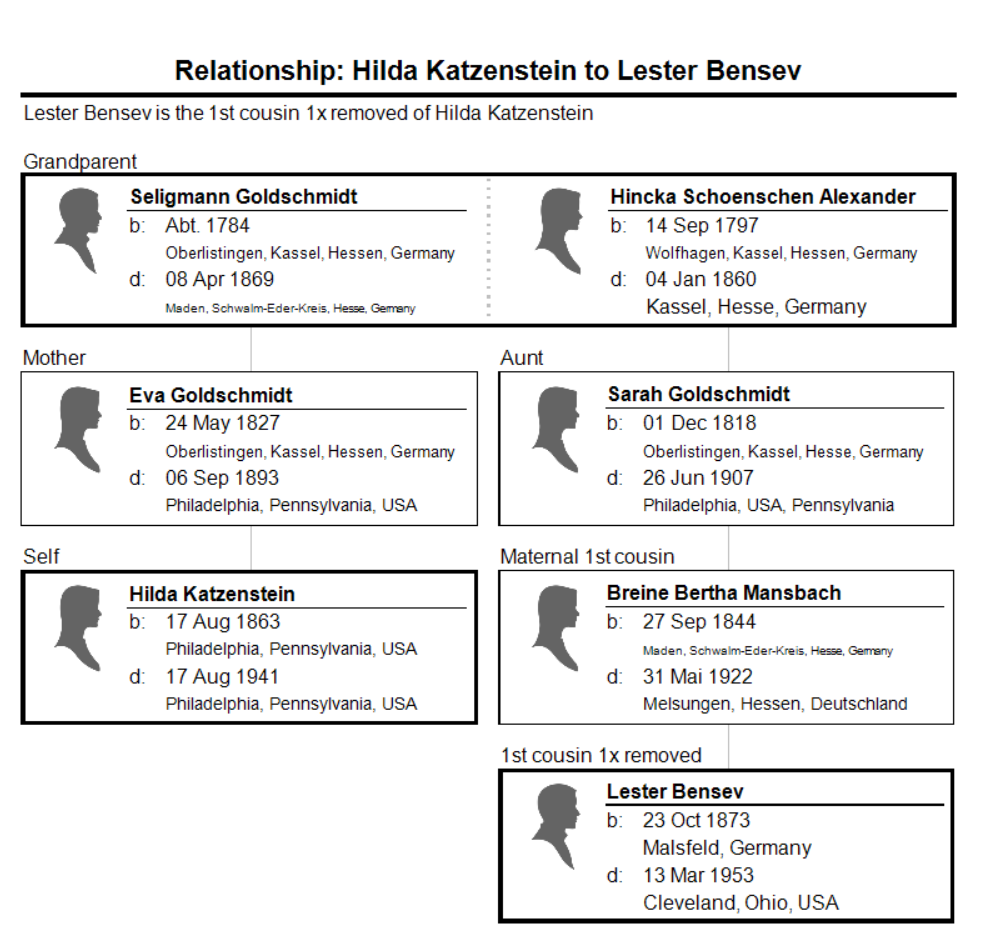
In the last post I published before Thanksgiving, I wrote about the two daughters of Breine Mansbach and Jacob Bensew, Roschen and Frieda. They were my grandmother’s second cousins, my second cousins, twice removed. They were the great-granddaughters of Seligmann Goldschmidt and Hinka Alexander, my three-times great-grandparents.

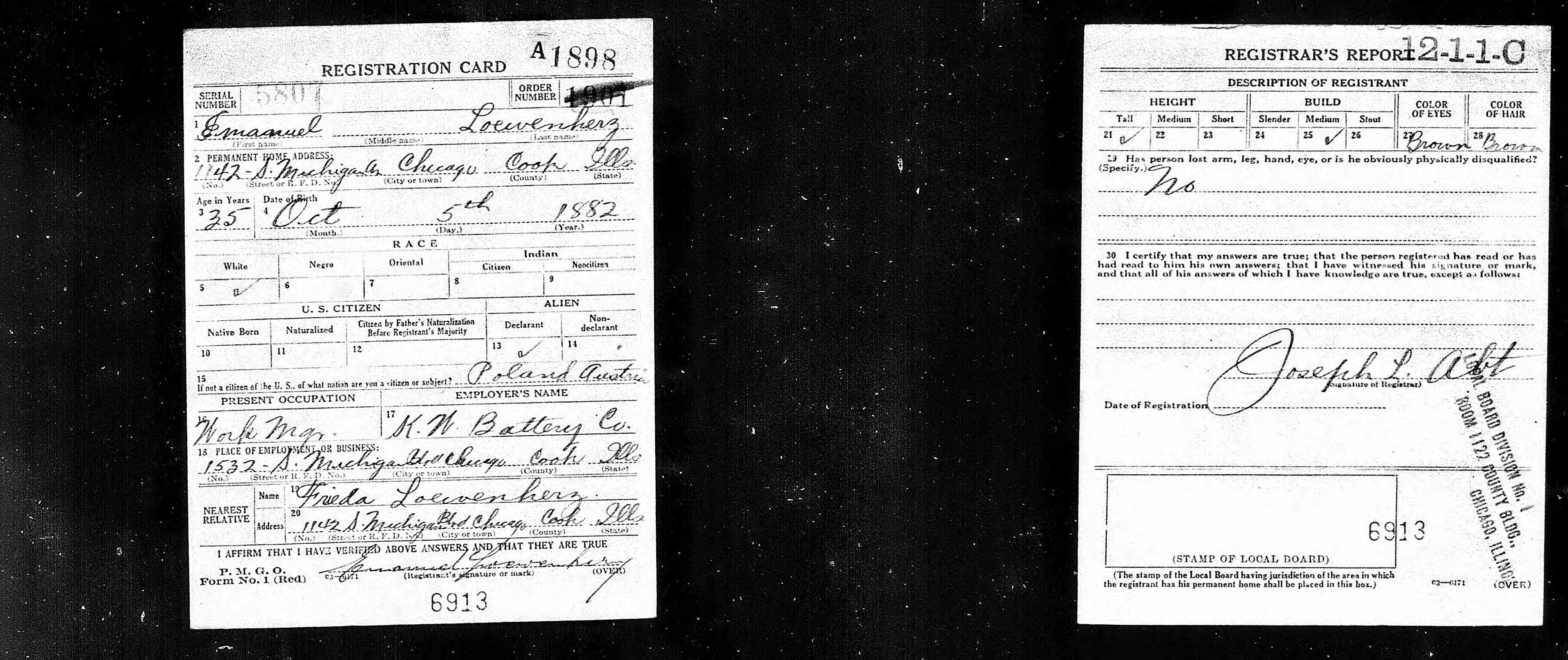
After publishing that post on November 16, I received a wonderful treasure trove of pictures and documents and information from Frieda Bensew’s great-grandson, Franz Loewenherz, my fourth cousin, once removed. Among those shared items was an almost 60 page memoir written by Frieda in 1970 when she was in her eighties (with an addendum written in 1972).

Reading that memoir moved me to tears—not because Frieda had a hard or sad life. To the contrary. She wrote about a life filled primarily with love and happiness—parents who adored her, a marriage filled with deep love, an adoring son and his family, and an extended family that she cared for and about and who cared for and about her. Of course, there were heartbreaking losses and difficult challenges, but throughout her memoir, Frieda’s love of live and her gratitude for all she was given came shining through.

With the permission of her great-grandson Franz, I want to share some of this memoir and also photographs of Frieda, her husband Emanuel Loewenherz, and their son Walter.  Not only is this a touching life story, it has value not only for what it reveals of family history but for its insights into the times in which Frieda lived.

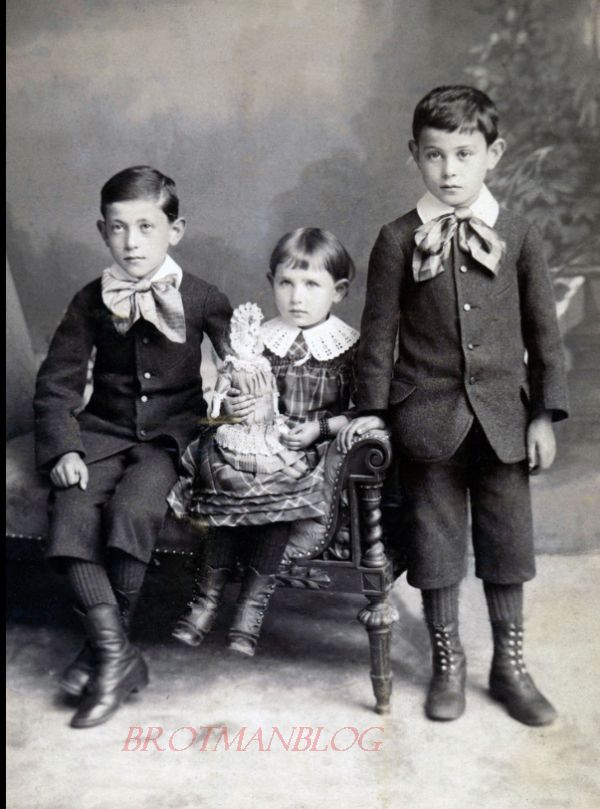
As noted in my earlier post, Frieda was the youngest child of Breine Mansbach and Jacob Bensew, born February 21, 1886, in Melsungen, Germany.1 Here are two photographs of Frieda as a young child, one with her brothers Max and Heine and one alone:

Heine, Frieda, and Max Bensew, c. 1890. Courtesy of Franz Loewenherz

Frieda Bensew c. 1890. Courtesy of Franz Loewenherz

Her memoir gives a sense of her happy childhood in Melsungen:

[Melsungen] was situated in a valley on the river Fulda, surrounded by beautiful woods. A climb of 15 minutes from my home would take me into the thick of them. Oak, Linden and Pine exuded that spicy fragrance remembered for all time. Of course in the summer when school was out this was my favorite outing. But I had also some duties to perform, not just picnic, and that was berry picking! With my friends I would start out in the morning, provided with sandwiches and a pail. It was blueberry time and our ambition was to come home with a full pail. Sitting under trees in a blueberry patch, with the sun filtering down, bees humming around us, we often had a very extended lunch hour! Our dessert were berries eaten right from the bushes. We had to hurry to finish our work as we had to be home before sundown, picking wild flowers on the way. My mother would be pleased with the crop to be used for cake, preserves and jelly. She was not so pleased with the condition of my white undies, full of squashed blueberry stains!!

Winter’s great recreation was ice skating on the river. The ice was so clear, it looked green and one could see the plant life beneath it, moving according to the current. The surface was like glass and I took many tumbles! In those days there were no snow or skating outfits. I wore woolen petticoats, long knitted black wool stockings, flannel pants. When I got home my petticoats and dress usually would stand out like a ballerina’s lampshade – frozen stiff! My mother would receive me with a warm drink and a piece of black bread after getting into dry clothes and warming myself at the stove. There were many simple pleasures, another sledding down a hill or when my father would take me along in the sleigh drawn by our horse, with hot bricks at our feet. The floor of the sleigh covered thick with straw. When we stopped at a village inn, my father would let me take a sip of his grag!

Frieda Bensew c. 1898
Courtesy of Franz Loewenherz

Frieda seemed to have a special relationship with her uncle, Julius Mansbach, her mother Breine’s brother who had, like all of Breine’s siblings, immigrated to the United States. But Julius returned to Germany and visited Frieda when she was fourteen years old or in about 1900.

My happiest recollections are, from the time I was 14 when my Uncle Julius, my mother’s youngest brother, came to visit us from America. He took me along on so many day trips to historical places, one of them the famous Wartburg, where Martin Luther was imprisoned and where he translated the Bible. And, of course, it is the setting of Wagner’s opera “Tannhaeuser.” I learned history on authentic grounds. With my uncle I saw my first American circus! Barnum and Bailey, with Buffalo Bill and his wild-west show were touring Germany then and we saw the performance in Kassel. The clowns told their jokes in English, naturally, and my uncle would translate them to me. The three ring performances left me breathless, as did the riding skill of the Indians. This was an unforgettable summer. I was so grateful to my uncle, not alone for providing so many pleasures of various kinds for me but he also was the one who taught me quite a few English expressions and the first rudiments of the language.

Frieda’s ongoing relationship with Julius as well as her uncle Louis Mansbach and grandmother Sarah Goldschmidt Mansbach as well as her use of English can be seen in the postcard she sent on September 21, 1902. The photograph is of Frieda and, I believe, her uncle Julius, probably taken while he was visiting the family in Melsungen.

Courtesy of Franz Loewenherz

Some wonderful people in the Jekkes Engaged Worldwide in Social Networking group on Facebook helped me transcribe and translate the German parts of the card:

On the right side: Dated 21-9-02 (September 21, 1902) from Melsungen:

Dearest Grandmama [Sarah Goldschmidt Mansbach] and Uncle Julius [Mansbach],

Unsere Karte von Cassel aus habt Ihr bei dieser Zeit hoffentlich erhalten, morgen ist es wieder ein heisser+ nasser Tag, wo Willi + Heine uns verlassen. Was denkt Ihr vom nebenstehendem Bild? Ist es nicht beautiful? Ende dieser Woche erwarte ich sicher einen grossen Brief von dir, sowie die Ansichtskarte.

(Translated: I hope you have received our card from Cassel by this time. Tomorrow will again be a hot and wet day when Willi + Heine leave us. What do you think of the picture on the other side? Isn’t it beautiful? At the end of the week I expect a long letter from you as well as the picture postcard.)

With best love and kisses, your Fritz

I believe Fritz was Frieda’s nickname.

Underneath Frieda’s message in a different handwriting is this note from her brothers Willi and Heine:

Meine Lieben haltet den Jontef Cholent warm.

Translation: My dears, keep the holiday Cholent warm.

Willi & Heine

I believe that Willi and Heine were sailing to the US, Willi to return having lived in the US since 1885 and Heine coming for the first time: his naturalization card states that he arrived on September 30, 1902.2;I had to smile when I checked and saw that Rosh Hashanah that year started on the next night, October 1. So Willi and Heine must have spent the holidays with the family in Philadelphia. (For those who do not know, cholent is traditional Jewish dish—a stew that usually has meat and vegetables. Here is a typical recipe.)

Along the margin of the right side of the card, Frieda wrote:

Hast du die K. abgeliefert? Wenn nicht, bekommst du keine wieder von mir.

Translation: Did you deliver the K? [card, I assume] If not, you won’t get another from me.

The left side is mostly in English; at the top it says “Best regards to Uncle Louis, Aunt Cora, and Rebecca.” This would be referring to her mother’s brother Louis Mansbach and his family.

Under the picture it says: “Im “Fidelio” war es grossartig [“Fidelio was fabulous]. If you, dear uncle, come again, I will sing the “Arien” [arias] for you. Don’t stay long! Otherwise you are well.” I assume this was directed to her dear uncle Julius Mansbach.

Frieda received a good education at a school in Kassel and had a passion for music and art. And, as she wrote, she wanted to see the world, in particular, America. By the time she was 21 in 1907, all her brothers had immigrated to America, and she also decided to move across the world from her birth place:

It was only natural that I wanted to go to America. Most of our family lived here, from three generations back. My grandparents [Sarah Goldschmidt and Abraham Mansbach] had come to Philadelphia where most of their children lived and some in the west, in Colorado. My mother [Breine] was the only one who remained in Germany as she had a family and my father refused to leave. When the time came for me to investigate, I did so with the promise of my parents that they would follow after I had familiarized myself with my new surroundings. My disappointment was great when my father declared he changed his mind. They did not wish me to return, however, insisting that I had a right to my own life. That is how loving and understanding and unselfish they were.

This paragraph touched me deeply— thinking of Frieda’s courage and determination and her parents’ respect for it. And yet I also could feel how torn both she and they must have been about this separation.

And so, as I wrote before, Frieda left home in 1907 when she was 21 and joined her brothers and other family in the US. First, she settled in Denver where some of her brothers as well other Mansbach cousins were living, and once again she demonstrated her determination and independence:

After a few months of visits with my family in Denver I had acquired quite a vocabulary and felt able to enter an American School of business. There I studied besides English, correspondence, shorthand and light bookkeeping and typing. I knew German shorthand, and the switch was not easy. It required extreme concentration as, in addition, I did not know business language and form either. Well, I made it and kept step with my class, all American born. I finished even ahead of time and got my first job shortly after. And what was the requirement? German shorthand! The irony of it all! 90% of the dictation was in German and 10% in English.

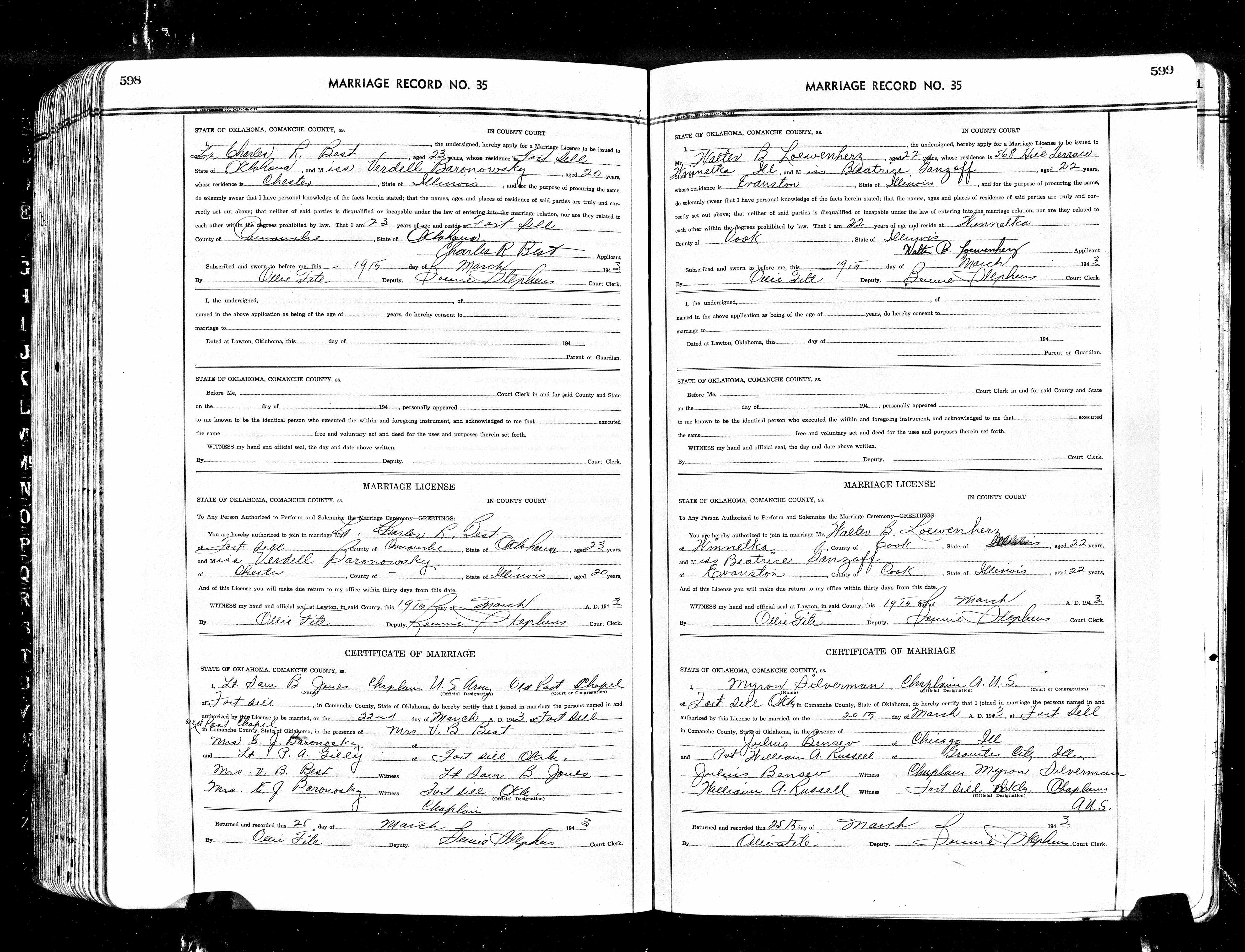
From what I gathered in the memoir and from what I know from the 1910 census, this job was in Chicago, and as we saw, in 1910, Frieda’s brothers Julius, Max, and Heine were also living in Chicago. Frieda wrote about these days as a single young woman in Chicago with great joy—describing activities and trips she took with her friends and also a trip to Philadelphia to see her relatives. This trip probably took place in 1912 because Frieda notes that her cousin Reta Dannenberg was engaged, and Reta was married in December 1912:3

My Aunt Hannah [Mansbach Dannenberg] and Uncle and their three children made our visit of a few days most enjoyable, Rita the oldest was engaged, Arthur a medical student at the U. of Penn. And Katrinka, the youngest, showed us the sights. We had a lot of fun! Then on to New York. My uncle Julius-who was in this country on business from Germany (he had returned there a few years before with his wife, my cousin Frieda on account of her parents’ wishes) entertained us royally.

In this one paragraph I learned three things. First, that Frieda and presumably the other Bensews were very much in touch with their mother’s Mansbach relatives in the US. Secondly, that the Frieda Bensew who married Julius Mansbach was in fact related to this Frieda Bensew and her family (though I still don’t know how). And thirdly, I learned why Julius Mansbach had returned to live in Germany—to satisfy the wishes of his in-laws.

Frieda Bensew as a young woman. Date unknown. Courtesy of Franz Loewenherz

From New York, Frieda and a friend named Rose sailed to Germany where they spent the summer of 1912. Frieda was delighted to be with her parents and sister Roschen, but the separation at the end of that visit was difficult. Frieda wrote:

And then came the time to say good bye again. It was not easy – My parents were so kind and understanding.They realized that I had outgrown my old environment and that my opportunities for a fuller life were so much better in America, the land which I loved and do to this day. Perhaps, being foreign born, gave me even a deeper appreciation of the freedom and privileges so many seem to take for granted. My parents and I were grateful for the time we spent together and kept up a brave front at parting.

She stopped in Philadelphia on her way home and was invited to stay for her cousin Reta’s wedding that coming December. She had a wonderful long visit there, and then after the wedding she received a letter from her brother Julius about a new job opportunity in Chicago, so she left to start her new job. That decision was life-changing, as we will see in the next post.


All excerpts from Frieda Loewenherz’s memoir and all the photographs in this post are published with the permission of Franz Loewenherz, her great-grandson. My deep gratitude to Franz for his generosity.


  1.  Hessisches Hauptstaatsarchiv; Wiesbaden, Deutschland; Bestand: 920; Laufende Nummer: 4574, Ancestry.com. Hesse, Germany, Births, 1851-1901 
  2.  “Illinois, Northern District Naturalization Index, 1840-1950,” database with images, FamilySearch (https://familysearch.org/ark:/61903/3:1:939N-FGS7-2?cc=1838804&wc=M6TM-Q6X%3A165129401 : 20 May 2014), B-524 to B-550 Gustov Joseph > image 983 of 6652; citing NARA microfilm publication M1285 (Washington, D.C.: National Archives and Records Administration, n.d.). 
  3. Ancestry.com. Philadelphia, Pennsylvania, Marriage Index, 1885-1951, Marriage Year: 1912, Marriage License Number: 289763 

The Bensew Daughters, Roschen and Frieda: Who Was Mrs. Hon?

My last post covered the lives of the five sons of Breine Mansbach and Jakob Bensew: William, Lester, Julius, Heine, and Max. Breine and Jakob Bensew also had two daughters, Roschen, their first child, who was born in 1870, and Frieda, their last child, who was born in 1886. This post is about them and their families.

As we have seen, Roschen may have come to the US in 1890 with two of her brothers, but if she did, she returned to Germany where she married Josef Stern in 1899 and had at least two children born in Kassel, Alfred, born in 1900, and Edwin, born in 1905. According to some researchers, Roschen and Josef had three other children, but so far I have not found any evidence of those children in either German or US records. And although I was able to find a death record for Josef, who died in Kassel, Germany on February 2, 1927,1 I’ve been unable to find a record of Roschen’s death.

What I know about their sons Alfred and Edwin is that both immigrated to the US in 1937 to escape Nazi Germany. Edwin, the younger brother, was the first to leave Germany. He arrived in New York on January 6, 1937, listing his age as 31, his marital status as single, his occupation as merchant, and birthplace as Kassel, Germany. He reported that he was leaving behind his brother, “A. Stern,” of Berlin, Germany, and going to his uncle, “W. Bensev,” i.e., William Bensev, of Denver, Colorado. William was his mother Roschen’s brother.

Edwin Stern, passenger manifest, Year: 1937; Arrival: New York, New York; Microfilm Serial: T715, 1897-1957; Microfilm Roll: Roll 5923; Line: 1; Page Number: 108
Ancestry.com. New York, Passenger and Crew Lists (including Castle Garden and Ellis Island), 1820-1957

Edwin’s brother Alfred followed ten months later. He arrived on October, 1937, listing his age as 37, occupation as bank clerk, and birthplace as Kassel. The manifest indicates that Alfred was married and resided in Berlin, and he reported on the manifest that the person he was going to was his uncle, “J. Loewenherz” of Winnetka, Illinois. I believe this was really Emanuel Loewenherz, who was married to Alfred’s aunt Frieda Bensev, his mother Roschen’s little sister.

Alfred Stern, passenger manifest, p. 1, Year: 1937; Arrival: New York, New York; Microfilm Serial: T715, 1897-1957; Microfilm Roll: Roll 6066; Line: 1; Page Number: 23
Ancestry.com. New York, Passenger and Crew Lists (including Castle Garden and Ellis Island), 1820-1957

Alfred also indicated that the person he was leaving behind was his wife Rita of the same address in Berlin. But there was also a second name listed in the column for those the person left behind, a Mrs. Hon of Nice, France, identified as his mother.

The form asks the person to provide the name of “the nearest relative or friend in country whence alien came or, if none there, then in country of which a citizen or subject.” Since Alfred came from Germany and was a citizen or subject of only Germany, supplying the name of someone in France would not have been correct. Is that why his wife’s name is written in instead? Was the Mrs. Hon in Nice, France, actually Alfred’s mother Roschen Bensew Stern? If so, I cannot find her. If anyone has any suggestions, please help!

I was a little worried that Alfred had left his wife behind, so was relieved to see on the 1940 census that Alfred, Rita, and their three-year-old daughter Renate (later Renee) were safely living in New York City where Alfred was working as a clerk for the telegraph company. Rita’s mother Elizabeth Garde and sister Charlotte Garde were also living with them.

Alfred Stern household, 1940 US census, Year: 1940; Census Place: New York, New York, New York; Roll: m-t0627-02673; Page: 18B; Enumeration District: 31-2013
Ancestry.com. 1940 United States Federal Census

Alfred’s brother Edwin Stern had gone to Denver to live with his uncle William Bensev. On the 1940 census, William not only had his wife Jessie, daughter Theodora, and three brothers—Heine, Max, and Julius—living with him.  He also had taken in his nephew Edwin, who was working as a salesman in a department store:

William Bensev household 1940 US census, Census Place: Denver, Denver, Colorado; Roll: m-t0627-00488; Page: 14B; Enumeration District: 16-149
Ancestry.com. 1940 United States Federal Census

In 1942 when he registered for the draft, Edwin was still living with his uncle William and working for the May Company, the department store. Edwin served in the US military from May 1, 1942, until March 13, 1945.2 I unfortunately was not able to find out any information about Edwin during or after his service in World War II. He died on May 6, 1980, in San Francisco, California; he was 75.3 I do not know if he ever married or had children.

Edwin Stern, World War II draft registration, The National Archives in St. Louis, Missouri; St. Louis, Missouri; Record Group: Records of the Selective Service System, 147; Box: 232
Source Information
Ancestry.com. U.S. WWII Draft Cards Young Men, 1940-1947

Alfred Stern seems to have stayed in the New York City area for the rest of his life. As with Edwin Stern, the fact that his name is so common made it impossible to determine much else about his life. He died on August 7, 1991; he was 91 years old.4

Breine and Jakob Bensew’s other daughter Frieda had been in the US since 1907 and in 1910 was living in Chicago and working as a stenographer, as discussed here. Sometime in 1918, Frieda married Emanuel Loewenherz. I have no marriage record, but Emanuel did not arrive in the US until January 30, 1913.5 On his naturalization papers signed on April 22, 1918, he wrote that he was not married.6 But when he registered for the World War II draft, he was married to Frieda; unfortunately, there is no date on his registration card:

Emanuel Loewenherz, World War I draft registration, Registration State: Illinois; Registration County: Cook; Roll: 1452380; Draft Board: 01
Ancestry.com. U.S., World War I Draft Registration Cards, 1917-1918

Emanuel was born in “Piwowsczyrna, Austria,” on October 5, 1882, according to his naturalization papers; the closest match I could find on a current map is Piwniczna-Zdrój, Poland.7 When he registered for the draft, he and Frieda were living in Chicago, and he was working as a work manager for the K.W. Battery Company. On the 1920 census, they were still living in Chicago, and Emanuel now reported his occupation as a machine engineer for a manufacturing company. Their son Walter was born later that year on August 6, 1920, in Chicago.8

Emanuel Loewenherz household, 1920 US census, Year: 1920; Census Place: Chicago Ward 1, Cook (Chicago), Illinois; Roll: T625_305; Page: 7B; Enumeration District: 10
Ancestry.com. 1920 United States Federal Census

In 1927 Emanuel, Frieda, and young Walter traveled together on the SS Deutschland to Hamburg, Germany. In 1930 they again made a trip to Hamburg.9 In 1930 the family was living in New Trier, Illinois, a town about 20 miles north of Chicago. Emanuel owned a home worth $20,000—or equivalent to about $300,000 in today’s dollars. Emanuel had gone from being a work manager and then a machine engineer to being the president of the battery company. Also living with Emanuel, Frieda and Walter was Alfred Mansbach, Frieda’s cousin and the son of Julius Mansbach and the other Frieda Bensew. The family was at the same address in 1940; Alfred Mansbach was no longer living with them, but a nephew named Micha Loewenherz was. Emanuel was still the president of the battery company.10

Loewenherz household, 1930 US census, Year: 1930; Census Place: New Trier, Cook, Illinois; Page: 3B; Enumeration District: 2223; FHL microfilm: 2340238
Ancestry.com. 1930 United States Federal Census

Walter Loewenherz enlisted in the military on October 6, 1942.11 On March 20, 1943, he married Beatrice Ganzoff in Comanche, Oklahoma. Since Beatrice, like Walter, was a Chicago native and resident, I assume they married in Oklahoma because Walter was stationed there.

Ancestry.com. Oklahoma, County Marriage Records, 1890-1995

Emanuel Loewenherz died in December 1963 in Chicago; he was 81.12 His wife, my cousin Frieda Bensew Loewenherz, died on December 17, 1975, in Fort Lauderdale, Florida, when she was 89.13

According to his obituary,14 Walter Loewenherz became president of the K.W. Battery Company, succeeding his father. He eventually moved to Fort Lauderdale, Florida. He was an active member of several civic and charitable organizations in both Chicago and Fort Lauderdale. He died when he was only 65 years old on November 16, 1985, in Fort Lauderdale. His wife Beatrice died on June 30, 2005, also in Fort Lauderdale; she was 84.15  Beatrice was quite an accomplished woman.  According to her obituary, she was Phi Beta Kappa from Northwestern University and a Fulbright Scholar. She taught at  Sunset Ridge School in Northfield, Illinois, and Nova Southeastern in Florida and was active in many civic organizations. After retiring, Beatrice and Walter had lived in a sailboat off of St. Bart’s before settling in Fort Lauderdale, Florida.16They were survived by their four children.

With this post, I have written about all the children of my three-times great-aunt, Sarah Goldschmidt Mansbach. Moreover, I have now written about all the children of my three-times great-grandparents Seligmann Goldschmidt and Hincka Alexander except for the one child who never left Germany: Biele or Betty Goldschmidt. Her story comes next.


  1.  Personenstandsregister Sterberegister; Bestand: 910; Signatur: 5608, Ancestry.com. Hesse, Germany, Deaths, 1851-1958 
  2.  Ancestry.com. U.S., Department of Veterans Affairs BIRLS Death File, 1850-2010 
  3.  Ancestry.com. California, Death Index, 1940-1997, Social Security #: 524052638. 
  4.  Ancestry.com. U.S., Social Security Applications and Claims Index, 1936-2007, SSN: 059125292. 
  5. Emanuel Loewenherz, passenger manifest, Staatsarchiv Hamburg; Hamburg, Deutschland; Hamburger Passagierlisten; Microfilm No.: K_1827, Staatsarchiv Hamburg. Hamburg Passenger Lists, 1850-1934. 
  6. Emanuel Loewenherz, naturalization records, National Archives at Chicago; Chicago, Illinois; ARC Title: Petitions for Naturalization, 1906 – 1991; NAI Number: 6756404; Record Group Title: Records of District Courts of the United States, 1685-2009; Record Group Number: RG 21,  Petitions, v 64-68, no 6270-6700, 1918,
    Ancestry.com. Illinois, Federal Naturalization Records, 1856-1991. 
  7. Ibid. 
  8. Ancestry.com. U.S., Department of Veterans Affairs BIRLS Death File, 1850-2010, SSN: 329163469. 
  9. Loewenherz family on passenger manifests, Year: 1927; Arrival: New York, New York; Microfilm Serial: T715, 1897-1957; Microfilm Roll: Roll 3997; Line: 8; Page Number: 163, Ancestry.com. New York, Passenger and Crew Lists. Year: 1930; Arrival: New York, New York; Microfilm Serial: T715, 1897-1957; Microfilm Roll: Roll 4885; Line: 3; Page Number: 90, Ancestry.com. New York, Passenger and Crew Lists (including Castle Garden and Ellis Island), 1820-1957 
  10. Loewenherz household, 1940 US census, Census Place: New Trier, Cook, Illinois; Roll: m-t0627-00783; Page: 16A; Enumeration District: 16-322, Ancestry.com. 1940 United States Federal Census 
  11. Ancestry.com. U.S., World War II Army Enlistment Records, 1938-1946. 
  12. Number: 340-07-2609; Issue State: Illinois; Issue Date: Before 1951, Ancestry.com. U.S., Social Security Death Index, 1935-2014 
  13. Number: 356-38-3307; Issue State: Illinois; Issue Date: 1963,
    Ancestry.com. U.S., Social Security Death Index, 1935-2014 
  14.  Fort Lauderdale News, 16 Nov 1985, Page 15 
  15. Ancestry.com. U.S., Social Security Applications and Claims Index, 1936-2007, SSN: 329019705. 
  16.  Evanston Review, obit for Dr. Beatrice Loewenherz, GenealogyBank.com (https://www.genealogybank.com/doc/obituaries/obit/111A841C55ED24D8-111A841C55ED24D8 : accessed 28 September 2018); South Florida Sun-Sentinel () , obit for Loewenherz, Beatrice, GenealogyBank.com (https://www.genealogybank.com/doc/obituaries/obit/10B49B19E169FC50-10B49B19E169FC50 : accessed 28 September 2018) 

Why I Love Marriage Announcements: Guest Lists!

On August 29, 1911, my second cousin, twice removed, Lester Bensev married Jennie Winheim:

Ancestry.com. Colorado, County Marriage Records and State Index, 1862-2006

Lester was almost 38 years old when he married Jennie. Jennie was also born in Germany; she was born in about 1880, making her seven years younger than Lester, and according to the 1920 US census, she immigrated to the US in 1900. I was unable to find any other information about her background until I found this newspaper article about her wedding to Lester, proving once again how valuable newspapers are as a genealogy resource:

Denver Post, September 3, 1911, p. 17

From this article I knew that Jennie Winheim was the niece of a Mrs. A. Schlesinger, and I was able to find Jennie and her brother Sam living with the family of Abraham and Sarah Schlesinger and their children in Denver in 1910.1 Sarah was born in Ohio and Abraham in Miltonberg, Germany on August 10, 1851.2 According to his obituary,3 Abraham came to the US in about 1864 with an older brother and settled first in Indiana, then Kansas, and finally in Denver in the 1890s. Abraham died on April 10, 1910, and in his will he named Jennie as his niece and left her $1000.4

Thus, it appears to me that Jennie Winheim, who according to the 1910 census came to the US in 1895, must have been the daughter of a sister of Abraham Schlesinger. Her uncle had died a year before her wedding, but his widow hosted her wedding at their home.

But what made this wedding article particularly exciting to me were the names on the guest list because included on that list were my great-grandparents—Mr. and Mrs. I. Schoenthal—that is, Isidore Schoenthal and Hilda Katzenstein. Why would they have been attending this wedding?  Well, follow the bouncing ball.

Hilda Katzenstein was the daughter of Eva Goldschmidt Katzenstein. Eva was the sister of Sarah Goldschmidt Mansbach. Sarah was the mother of Breine Mansbach Bensew. Breine was the mother of Lester Bensev, the groom who married Jennie Winheim. In other words, Hilda Katzenstein Schoenthal was Lester’s first cousin, once removed—his mother Breine’s first cousin.

Isidore and Hilda had only recently moved to Denver in 1907 after their son Gerson was diagnosed with asthma. Imagine how happy Hilda must have been to find some cousins in Denver when she got there. When she married Isidore, she had relocated from Philadelphia where she was raised to the small town of Washington, Pennsylvania, and now she was moving 1300 miles further west. I had always thought that she and Isidore knew no one out in Denver, so I was quite excited to learn that she had family there and that she and Isidore were included in this wedding. In fact, now I know that not only did she have her cousin Lester Bensev living in Denver, her first cousin Amelia Mansbach Langer and her family were also living there.

However, it’s not very likely that Hilda knew these cousins well and possible she had never met them before moving to Denver since when they immigrated and settled in Colorado, she was married and living in Washington, Pennsylvania. She grew up in Philadelphia, they grew up in Germany. But family is family, and the fact that Hilda and Isidore were invited to this wedding demonstrates that these cousins were in fact in touch when Hilda and Isidore moved to Denver.

But Lester and Jennie Bensev did not stay in Denver for very long. By 1913 they had relocated to Cleveland, Ohio.5 Their daughter Hortense was born there on February 25, 1915.6 According to his World War I draft registration, Lester was employed as the store manager for Consumers Cigar Company in Cleveland in 1918. The 1920 census reported the same occupation. In 1930, Lester was working as an information clerk for a bank in Cleveland, but in 1940 he had returned to the cigar business.7

Lester Bensev, World War I draft registration, Registration State: Ohio; Registration County: Cuyahoga; Roll: 1831765; Draft Board: 07
Ancestry.com. U.S., World War I Draft Registration Cards, 1917-1918

On October 20, 1940, Lester and Jessie’s daughter Hortense married Robert W. Kabb in Cleveland. Robert was a Cleveland native, son of Samuel Kabatchnik and Lillian Fisher, born on March 1, 1913.8 In 1940 he was working as a furniture salesman.9

Marriage record for Hortense Bensev and Robert Kabb , Cuyahoga County Archive; Cleveland, Ohio; Cuyahoga County, Ohio, Marriage Records, 1810-1973; Volume: Vol 193-194; Page: 386; Year Range: 1940 Aug – 1941 Mar
Ancestry.com. Cuyahoga County, Ohio, Marriage Records and Indexes, 1810-1973

Lester died on March 13, 1953, in Cleveland, and his wife Jessie died three years later on August 16, 1956.10 He was 79 when he died, she was seventy. They were survived by their daughter Hortense and her family.

Ohio Deaths, 1908-1953,” database with images, FamilySearch (https://familysearch.org/ark:/61903/3:1:S3HY-68JS-P5T?cc=1307272&wc=MD96-BP8%3A287602201%2C293606502 : 21 May 2014), 1953 > 13601-16300 > image 2835 of 3155.

Cleveland Plain Dealer, March 15, 1953, p. 59

Lester’s older brother William was still in Denver during the years my great-grandparents and my grandmother were living there and thereafter. By 1918, perhaps to help William after Lester left the area, their brother Heine Bensev moved to Denver from Chicago.  According to his World War I draft registration, Heine was working for his brother William as the manager of a cigar stand. In 1920, Heine was living with William and Jessie and their daughter Theodora:

Bensev household, 1920 US census, Census Place: Denver, Denver, Colorado; Roll: T625_162; Page: 3B; Enumeration District: 267, Ancestry.com. 1920 United States Federal Census

But notice that here Heine is listed under the name Jack. At first I was thrown—was this yet another Bensev brother? According to the 1920 census, Jack Bensev was 39 years old so born in about 1879-1880. Heinemann Bensew was born in Malsfeld, Germany on March 14, 1879.

Heinemann Bensev birth record, Standesamt Malsfeld Geburtsnebenregister 1879 (HStAMR Best. 920 Nr. 4410)AutorHessisches Staatsarchiv MarburgErscheinungsortMalsfeld, p. 14

Heine’s draft registration reports his birth date as March 22, 1879, not the exact date, but still obviously the same person:

Heine Bensev, World War I draft registration, “United States World War I Draft Registration Cards, 1917-1918,” database with images, FamilySearch (https://familysearch.org/ark:/61903/3:1:33S7-817R-9STQ?cc=1968530&wc=9FHB-BZS%3A928310401%2C928571801 : 14 May 2014), Colorado > Denver City no 5; A-Talom, William M. > image 229 of 3469; citing NARA microfilm publication M1509 (Washington, D.C.: National Archives and Records Administration, n.d.).

The 1920 census also reported that both William and “Jack” immigrated in 1881 and were naturalized in 1885. This is plainly wrong. Even based on the facts in the same census, Jack would have been only toddler in 1881 and a kindergartner in 1885.

But what really threw me was that the 1920 Denver directory has a listing for both Jack Bensev and Heine Bensev, living at the same address as each other and William Bensev, both working as clerks, Jack for William Bensev. The 1925 and the 1940 Denver directories also have listings for both Jack and Heine, but other directories only list Jack.11

Title: Denver, Colorado, City Directory, 1920
Ancestry.com. U.S. City Directories, 1822-1995

In the end I concluded that Heine and Jack were in fact the same man and that the family called him Heine, but the outside world called him Jack—probably to appear more American. On the 1930 census, he was listed as Heine Bensev and was living with his brother William and his family. William was the proprietor of a cigar store, and Heine was a cigar salesman. Now he listed his immigration date as 1902, which is consistent with the date on Heine’s naturalization record.

William Bensev household, 1930 US census, Census Place: Denver, Denver, Colorado; Page: 24A; Enumeration District: 0108; FHL microfilm: 2339972
Ancestry.com. 1930 United States Federal Census

Roll Description: B-524 through B-550 Gustov Joseph
Ancestry.com. U.S. Naturalization Record Indexes, 1791-1992 (Indexed in World Archives Project)

Meanwhile, the other two Bensev brothers also eventually moved to Denver. Like Heine, Max was naturalized in Chicago in 191512 and was the only brother still in Chicago in 1920.13 He was then rooming with a family and working as a salesman for a clothing store. Julius had moved to Gary, Indiana by 1920 where he was rooming with a family and working as a manager for an oil company, perhaps Standard Oil where he, Max, and Heine had been working in 1910 when they were all living together in Chicago.14

But in 1923 Max and Julius sailed together on the SS Rotterdam from Rotterdam to New York, and both gave their address as 825 17th Street in Denver. If they were living in Denver for any extended period, it is strange that Julius is not listed in the Denver directories for any year. Max does appear once, in 1933, but that is also the only year he appears in the Denver directory.

Year: 1923; Arrival: New York, New York; Microfilm Serial: T715, 1897-1957; Microfilm Roll: Roll 3247; Line: 1; Page Number: 34, Ancestry.com. New York, Passenger and Crew Lists (including Castle Garden and Ellis Island), 1820-1957

However, on the 1940 census, the listing for the William Bensev household in Denver included William Bensev, his wife Jessie, daughter Theodora, nephew Edwin Stern, brother Heine and his brothers Julius and Max. Julius and Max are listed on a separate page in the census report , but at the same address and clearly in the same household. Julius and Max were now working as traveling salesman selling wholesale luggage. Heine and William were both still working in the cigar business.

William Bensev household 1940 US census, Census Place: Denver, Denver, Colorado; Roll: m-t0627-00488; Page: 14B; Enumeration District: 16-149
Ancestry.com. 1940 United States Federal Census

Julius and Max Bensev, 1940 US census, Census Place: Denver, Denver, Colorado; Roll: m-t0627-00488; Page: 61A; Enumeration District: 16-149
Ancestry.com. 1940 United States Federal Census

Thus, William had three of his brothers living in his household as well as a nephew, Edwin Stern, son of his sister Roschen, plus, of course, his wife Jessie and daughter Theodora.  And a maid.

UPDATE: An email written in 2009 to Franz Loewenherz by a relative who lived with Frieda and Emanuel Loewenherz in the 1940s included this additional information about the Bensev brothers: “[Julius and Max] were confirmed bachelors. Both were sales reps for Shwayder Bros, the originators of Samsonite luggage. They operated out of Denver. Max had a territory in North and South Dakota, Wyoming, Mantana and some other northern states. Julius had the lucrative Texas, Arizona, Colorado, Utah and California territory. Both spent several weeks in Winnetka during the winter when they wouldn’t travel. Julius was a very colorful character. He had spent several years in South Africa. He had a wagon drawn by two oxen and peddled “stu’ff” to the Boer farmers and some of the tribes in the area. He spoke Swahili fluently. He was also a good skater and loved it. One winter in Winnetka he and I went to the local skating rink and he took off skating some beautiful figure skating. Mind you he was 80 years old then.”

The younger Bensev siblings lost three family members in the next few years, first their oldest brother William, who had provided a home for so many of them. William died on January 13, 1944, at age 68.15 William’s wife Jessie died less than a year later on September 13, 1944, when she was 60.16 And then sadly William and Jessie’s daughter Theodora died October 5, 1946 when she was only forty.17 Theodora had not married or had children, so there are no descendants for William and Jessie Bensev or their daughter Theodora.

After William’s death, Julius, Heine, and Max all moved to San Diego. They are all listed at the same address in the 1947, 1948 and 1950 San Diego directories:18

Title: San Diego, California, City Directory, 1947
Ancestry.com. U.S. City Directories, 1822-1995

Max and Julius traveled together to Europe and other places many times in the 1950s. For example, in 1951, Julius and Max traveled to Israel for a three month stay:

The National Archives at Washington, D.C.; Washington, D.C.; Series Title: Passenger and Crew Lists of Vessels and Airplanes Departing from New York, New York, 07/01/1948-12/31/1956; NAI Number: 3335533; Record Group Title: Records of the Immigration and Naturalization Service, 1787-2004; Record Group Number: 85; Series Number: A4169; NARA Roll Number: 115
Ancestry.com. U.S., Departing Passenger and Crew Lists, 1914-1966 , lines 7 and 8.

They also traveled to Oslo and on the SS Queen Elizabeth to Cherbourg, France. Their brother Heine never joined them on these trips, and I wonder whether that was due to lack of interest or poor health.19

In September 1954, Julius and Max again traveled together, this time on a transatlantic cruise from New York to LeHavre, France.20 Sadly, their brother Heine “Jack” died on September 22, 1954, in San Diego, shortly after his brothers’ return. He was 75 years old. 21 (NOTE: he is listed twice—once as Heine and also as Jack on the California death index.)

Search results for “Bensev” on the California Death Index database on Ancestry.com

I cannot find a death record for Julius Bensev, but I believe he died sometime between September 1954 and April 1956 because (1) only Max is listed in the 1956 San Diego directory and (2) Max traveled alone on April 25, 1956, for a five to six month visit to Germany.22 Max died on November 14, 1959, in San Diego.23 He was 77 years old. Julius must have predeceased him because Max’s death notice named only his sister Frieda and cousin Alfred as survivors. Julius must have died outside California as, unlike Max and Heine, he is not listed in the California Death Index.

San Diego Union, November 19, 1959, p. 11

Julius, Heine, and Max never married or had children, and thus, like their brother William, they have no living descendants. Of the five Bensev brothers, only Lester has living descendants.

What about the two sisters, Frieda Bensew Loewenherz and Roschen Bensew Stern? What happened to them in the 20th century? Stay tuned for the next post.


  1. Abraham Schlesinger household, 1910 US census, Census Place: Denver Ward 10, Denver, Colorado; Roll: T624_116; Page: 6B; Enumeration District: 0122; FHL microfilm: 1374129, Ancestry.com. 1910 United States Federal Census 
  2.  JewishGen, comp. JewishGen Online Worldwide Burial Registry  
  3. “Death Removes One of Denver’s Best Merchants,” The Denver Post, April 23, 1910, p. 11 
  4.  Probate Records, 1900-1946; Author: Denver County (Colorado). Clerk of the County Court; Probate Place: Denver, Colorado, Ancestry.com. Colorado, Wills and Probate Records, 1875-1974, Case Number: 13356. 
  5. Cleveland, Ohio, City Directory, 1913, Ancestry.com. U.S. City Directories, 1822-1995 
  6. Ancestry.com. Ohio, Birth Index, 1908-1964, State File Number: 1915015448. 
  7. Lester Bensev, 1920 US census, Census Place: Cleveland Ward 22, Cuyahoga, Ohio; Roll: T625_1371; Page: 12B; Enumeration District: 431, Ancestry.com. 1920 United States Federal Census. Lester Bensev, 1930 US census, Census Place: Cleveland, Cuyahoga, Ohio; Page: 11B; Enumeration District: 0456; FHL microfilm: 2341510, Ancestry.com. 1930 United States Federal Census. Lester Bensev, 1940 US census, Census Place: Cleveland, Cuyahoga, Ohio; Roll: m-t0627-03228; Page: 4B; Enumeration District: 92-630, Ancestry.com. 1940 United States Federal Census. 
  8. Ancestry.com. U.S., Department of Veterans Affairs BIRLS Death File, 1850-2010 
  9. Kabb household, 1940 US census, Census Place: Cleveland, Cuyahoga, Ohio; Roll: m-t0627-03228; Page: 9B; Enumeration District: 92-618, Ancestry.com. 1940 United States Federal Census. 
  10. Ancestry.com and Ohio Department of Health. Ohio, Death Records, 1908-1932, 1938-2007 
  11.  Denver, Colorado, City Directory, 1925, 1940, Ancestry.com. U.S. City Directories, 1822-1995 
  12. Max Bensev, Year: 1923; Arrival: New York, New York; Microfilm Serial: T715, 1897-1957; Microfilm Roll: Roll 3247; Line: 1; Page Number: 34, Ancestry.com. New York, Passenger and Crew Lists (including Castle Garden and Ellis Island), 1820-1957 
  13. Max Bensev, 1920 US census, Census Place: Chicago Ward 12, Cook (Chicago), Illinois; Roll: T625_320; Page: 10B; Enumeration District: 685, Ancestry.com. 1920 United States Federal Census 
  14. Julius Bensev, 1920 US census, Census Place: Gary Ward 1, Lake, Indiana; Roll: T625_446; Page: 5B; Enumeration District: 239, Ancestry.com. 1920 United States Federal Census 
  15.  JewishGen, comp. JewishGen Online Worldwide Burial Registry (JOWBR). 
  16. JewishGen, comp. JewishGen Online Worldwide Burial Registry (JOWBR) 
  17. JewishGen, comp. JewishGen Online Worldwide Burial Registry (JOWBR) 
  18.  San Diego, California, City Directory, 1947, 1948, 1950, Ancestry.com. U.S. City Directories, 1822-1995 
  19. Passenger manifests, The National Archives at Washington, D.C.; Washington, D.C.; Series Title: Passenger and Crew Lists of Vessels and Airplanes Departing from New York, New York, 07/01/1948-12/31/1956; NAI Number: 3335533; Record Group Title: Records of the Immigration and Naturalization Service, 1787-2004; Record Group Number: 85; Series Number: A4169; NARA Roll Number: 73, Ancestry.com. U.S., Departing Passenger and Crew Lists, 1914-1966. Year: 1951; Arrival: New York, New York; Microfilm Serial: T715, 1897-1957; Microfilm Roll: Roll 8016; Line: 7; Page Number: 24, Ancestry.com. New York, Passenger and Crew Lists 
  20.   Passenger manifest, Year: 1954; Arrival: New York, New York;Microfilm Serial: T715, 1897-1957;Microfilm Roll: Roll 8504; Line: 1; Page Number: 270, Ancestry.com. New York, Passenger and Crew Lists (including Castle Garden and Ellis Island), 1820-1957. 
  21. Ancestry.com. California, Death Index, 1940-1997. 
  22. San Diego city directory, 1956, Ancestry.com. U.S. City Directories, 1822-1995. Passenger manifest, Year: 1956; Arrival: New York, New York; Microfilm Serial: T715, 1897-1957; Microfilm Roll: Roll 8792; Line: 4; Page Number: 21, Ancestry.com. New York, Passenger and Crew Lists (including Castle Garden and Ellis Island), 1820-1957 
  23. Ancestry.com. California, Death Index, 1940-1997 (listed as Max Bensey on Ancestry) 

My Bensew Cousins Come to the US: The Children of Breine Mansbach Bensew

Breine Mansbach, my great-grandmother’s first cousin, was the oldest child of Sarah Goldschmidt and Abraham Mansbach and the only one who did not immigrate to the United States with her siblings and her parents. But all but one of her children did immigrate, and this post and the two that follow will tell their story.

As I wrote back on January 19, 2018, Breine was born on September 27, 1844 in Maden, Germany. She married Jakob Bensew on February 3, 1870, in Maden, and then moved with him to Melsungen. When I first wrote about Breine, I thought that she and her husband Jakob had had six children—five sons and one daughter: William (1872), Julius (1875), Siegmund (1877), Heinemann (1879), Max (1882), and Frieda (1886). Since then I have discovered two more children whom I had not located back in January, Lester (1873) and Roschen (1870).1

Siegmund was born on July 20, 1877, and died before his fifth birthday on January 24, 1882 in Malsfeld, Germany, where the family was then living.

Siegmund Bensew birth, Hessisches Hauptstaatsarchiv; Wiesbaden, Deutschland; Bestand: 920; Laufende Nummer: 4408, 1877. Ancestry.com. Hesse, Germany, Births, 1851-1901

Siegmund Bensew death record, Personenstandsregister Sterberegister; Bestand: 920; Laufende Nummer: 4484. Year Range: 1882. Ancestry.com. Hesse, Germany, Deaths, 1851-1958

The other seven children all survived to adulthood and all but Roschen immigrated to and settled in the US, though Roschen also may have traveled to the US before marrying and having a family back in Germany, as we will see below.

The first Bensew sibling to arrive was William, the oldest son, traveling as Willi Bensew on the SS EMS from Bremen and arriving in New York on August 15, 1885. On the manifest his age is fourteen, but if his US records are accurate, he was born in either February or November 1872 so would have been around thirteen in August 1885. (Birth records for 1872 for Melsungen, Germany were not available online.)1

Roschen, Lester, and Julius seem to have traveled together to the US with a departure from Hamburg on May 15, 1890.

Bensew siblings, ship manifest, Staatsarchiv Hamburg; Hamburg, Deutschland; Hamburger Passagierlisten; Microfilm No.: K_1741 Month: Direkt Band 067 (2 Apr 1890 – 28 Jun 1890) Staatsarchiv Hamburg. Hamburg Passenger Lists, 1850-1934

The manifest lists three Bensews traveling together, all from Melsungen, Germany, a 20-year old woman named Rosa, a 16 year old boy named Lasser, and a 14 year old girl named “Juls.” Both Lasser and Juls are identified as “Kaufmann” or merchant. I would think that Lasser was Lester, as Lester was born October 23, 18732 and would have been 16 in May 1890. And I also think that “Juls” was Julius, who would have been 14 in May 1890 as he was born on September 13, 1875;3 since Juls is identified as a Kaufmann—a male noun—I think the gender identification as weiblich (female) was a scrivener’s error. As for Rosa, Roschen was born on January 20, 1870,4 so would have been twenty in May 1890, the age given for Rosa on the manifest. So perhaps that was their big sister Roschen bringing them to America, but I have no later records for her in the US. And Roschen definitely married and raised her children in Germany, as we will see.

Thus, the three oldest Bensew brothers, William, Lester, and Julius, all left home as young teenagers. In America they changed the spelling of their name to Bensev—presumably to preserve the German pronunciation of their name. Otherwise, they would have been called Ben-SOO.

In 1890, William was already living in Denver.5 By 1894, he was joined by his younger brother Julius, and both were clerks for the M. Hyman Cigar Company,6 as they were in 1898 as well. They were living at 615 24th Street with their aunt Amelia Mansbach and her husband Henry Langer.

Denver, Colorado, City Directory, 1898
Ancestry.com. U.S. City Directories, 1822-1995

Denver, Colorado, City Directory, 1898
Ancestry.com. U.S. City Directories, 1822-1995

In 1900, William was still in Denver, living with the Langers and working as a cigar salesman.

Henry Langer family, 1900 US census, Census Place: Denver, Arapahoe, Colorado; Page: 2; Enumeration District: 0031; FHL microfilm: 1240117
Ancestry.com. 1900 United States Federal Census

But Julius had left Denver and was living in Reading, Pennsylvania, working as a salesman.7

As for Lester, he was living in Philadelphia in 1896,8 working as a salesman. But after Julius left Denver for Pennsylvania, Lester left Pennsylvania for Denver. He came for a visit in 1899, and in 1902 he was living with his brother William and the Langer family and working as a manager for M. Hyman Cigar Company with his brother William, who was the secretary of the company.

Denver Rocky Mountain News, January 1, 1899, p. 6

It was also around this time that two more of the Bensew brothers arrived in the United States.  I could not find a ship manifest for Heinemann Bensew, who was born March 14, 1879, in Malsfeld,9 but according to his naturalization records, he arrived on September 30, 1902.10  The youngest brother Max, who was born on May 24, 1882,11 arrived on May 13, 1903. He was headed for Philadelphia to his uncle, J. Mansbach, i.e. Julius Mansbach, at 915 North 6th Street in Philadelphia:

Max Bensew, ship manifest, line 21, Year: 1903; Arrival: New York, New York; Microfilm Serial: T715, 1897-1957; Microfilm Roll: Roll 0355; Line: 1; Page Number: 85
Ancestry.com. New York, Passenger and Crew Lists (including Castle Garden and Ellis Island), 1820-1957

Frieda Bensew, who was born February 21, 1886, in Melsungen,12 followed her older brothers to America four years later; she arrived on November 25, 1907.  On the manifest she listed that she, like Max, was going to her uncle, Julius Mansbach, in Philadelphia.13 In January, 1908, she visited her brother William in Denver.

Denver Post, January 7, 1908, p. 5

But in 1910, she was living in Chicago, where three of her five brothers were also living. Julius, Heinemann (listed as Hein here) and Max were living together in a boarding house in Chicago, and all three were working as clerks for Standard Oil:

Julius, Max and Heine Bensev 1910 US census,Census Place: Chicago Ward 23, Cook, Illinois; Roll: T624_266; Page: 2A;Enumeration District: 0982; FHL microfilm: 1374279
Ancestry.com. 1910 United States Federal Census

Frieda was working as a stenographer for a publishing house and living a mile and half north of her brothers as a roomer with a widow, Sophie Rosenthal, and her adult daughter in 1910.12

Their oldest brother William was still in Denver in 1910. He had married Jessie Fannie Holzman on June 28, 1904, in Denver, in “one of the most elaborate of the numerous June wedding[s]” in Denver that year, as detailed in this wonderful article:

Denver Post July 2, 1905, p. 15

As noted in the article, prior to the wedding, Jessie had been living with David Kline and his wife Frances (Sands) Kline and is listed as their niece on the 1900 census.13 According to the article, Jessie’s father was Joseph Holzman; Joseph Holzman was a German immigrant who married Theresa Sands in Denver in 1877. Jessie was born in Denver on November 6, 1883, and her mother Theresa died when Jessie was eight years old in 1891. I assume that Frances Sands Kline must have been Theresa Sands Holzman’s sister since Jessie was Frances’ niece.14

William and Jessie had a daughter, Theodora, born on December 10, 1905,15 in Colorado. When M. Hyman retired in 1907, he transferred his cigar business to William and a partner, B. F. Meyer. In 1910, William and his family were living in Denver, and William continued to work as a cigar salesman.16

Denver Post, March 10, 1907, p. 2

Lester Bensev was also still in Colorado in 1910, but he had moved from Denver to Colorado Springs where he was the proprietor of a cigar store.17

Thus, by 1910, six of the seven children of Breine Mansbach and Jakob Bensew were living in the United States, four in Chicago and two in Colorado. Their parents were still living in Germany, as was their sister Roschen. Roschen married Joseph Stern, son of Jacob Stern and Esther Koppel, on April 10, 1899, in Kassel, Germany:

Marriage record of Roschen Bensew and Jozef Stern, Hessisches Hauptstaatsarchiv; Wiesbaden, Deutschland; Bestand: 920; Laufende Nummer: 4611, 1899, Ancestry.com. Hesse, Germany, Marriages, 1849-1930

On May 8, 1900, Roschen gave birth to her first child, Alfred Stern, in Kassel. 18 According to US records, Roschen and Joseph had a second son Edwin on January 6, 1905.19 Some family trees have three other children born to Roschen and Joseph Stern, but I have not yet been able to verify that information. The names Alice Stern, Frieda Stern, and Herbert Stern are too common for me to be able to know with certainty whether I am looking at the right person unless I can link them to Roschen and Joseph or some other member of the family, and so far I have not be able to do so. Thus, I will only write about Alfred and Edwin, both of whom ended up in the US, but not until after Hitler came to power.


  1. Willi Bensew, ship manifest, Year: 1885; Arrival: New York, New York; Microfilm Serial: M237, 1820-1897; Microfilm Roll: Roll 489; Line: 1; List Number: 1017.
    Ancestry.com. New York, Passenger and Crew Lists (including Castle Garden and Ellis Island), 1820-1957. William Bensev, 1900 US census, Census Place: Denver, Arapahoe, Colorado; Page: 2; Enumeration District: 0031; FHL microfilm: 1240117, Ancestry.com. 1900 United States Federal Census. JewishGen, comp. JewishGen Online Worldwide Burial Registry (JOWBR). 
  2. Lester Bensev, passport application, National Archives and Records Administration (NARA); Washington D.C.; Roll #: 68; Volume #: Roll 0068 – Certificates: 59167-60066, 09 Jul 1908-24 Jul 1908. Ancestry.com. U.S. Passport Applications, 1795-1925 
  3.  Ancestry.com. U.S., Social Security Applications and Claims Index, 1936-2007. SSN: 521019057. 
  4. Roschen Bensew marriage record, Hessisches Hauptstaatsarchiv; Wiesbaden, Deutschland; Bestand: 920; Laufende Nummer: 4611. 1899. Ancestry.com. Hesse, Germany, Marriages, 1849-1930 
  5. Ancestry.com. Denver, Colorado City Directory, 1890. 
  6.  Denver, Colorado, City Directory, 1894, Ancestry.com. U.S. City Directories, 1822-1995 
  7. Julius Bensev, 1900 US census, Census Place: Reading Ward 3, Berks, Pennsylvania; Page: 8; Enumeration District: 0053; FHL microfilm: 1241378,
    Ancestry.com. 1900 United States Federal Census 
  8. Philadelphia, Pennsylvania, City Directory, 1896, Ancestry.com. U.S. City Directories, 1822-1995 
  9. Heinemann Bensew birth record, Hessisches Hauptstaatsarchiv; Wiesbaden, Deutschland; Bestand: 920; Laufende Nummer: 4410. Ancestry.com. Hesse, Germany, Births, 1851-1901 
  10. Illinois, Northern District Naturalization Index, 1840-1950,” database with images, FamilySearch (https://familysearch.org/ark:/61903/3:1:939N-FGS7-2?cc=1838804&wc=M6TM-Q6X%3A165129401 : 20 May 2014), B-524 to B-550 Gustov Joseph > image 983 of 6652; citing NARA microfilm publication M1285 (Washington, D.C.: National Archives and Records Administration, n.d.). The birth date on the naturalization record is March 22, 1879, whereas the German birth record says March 14, 1879. 
  11. Max Bensew birth record, Hessisches Hauptstaatsarchiv; Wiesbaden, Deutschland; Bestand: 920; Laufende Nummer: 4413. Ancestry.com. Hesse, Germany, Births, 1851-1901 
  12. Frieda Bensev, 1910 US census, Census Place: Chicago Ward 25, Cook, Illinois; Roll: T624_269; Page: 2B;Enumeration District: 1094; FHL microfilm: 1374282, Ancestry.com. 1910 United States Federal Census 
  13. Kline household, 1900 US census, Census Place: Denver, Arapahoe, Colorado; Page: 5; Enumeration District: 0030; FHL microfilm: 1240117, Ancestry.com. 1900 United States Federal Census 
  14. Joseph Holzman and Theresa Sands marriage record, and David Kline and Frances Sands marriage record, Ancestry.com. Colorado, County Marriage Records and State Index, 1862-2006. JewishGen, comp. JewishGen Online Worldwide Burial Registry (JOWBR). “Colorado State Census, 1885,” database with images, FamilySearch (https://familysearch.org/ark:/61903/3:1:939N-8TC6-W?cc=1807096&wc=M83M-BMS%3A149195601%2C149208301%2C149200101 : 1 April 2016), Arapahoe > Denver > Population > image 184 of 598; citing NARA microfilm publication M158 (Washington D.C.: National Archives and Records Administration, n.d.). Sands family, 1870 US census, Year: 1870; Census Place: Helena, Lewis and Clark, Montana Territory; Roll: M593_827; Page: 186B; Family History Library Film: 552326, Ancestry.com. 1870 United States Federal Census. Ancestry.com. Web: Gallatin County, Montana, Death Index, 1856-2014.  
  15. JewishGen, comp. JewishGen Online Worldwide Burial Registry (JOWBR) 
  16. William Bensev household, 1910 US census, Census Place: Denver Ward 8, Denver, Colorado; Roll: T624_115; Page: 4B; Enumeration District: 0104; FHL microfilm: 1374128, Ancestry.com. 1910 United States Federal Census 
  17. Lester Bensev, 1910 US census, Census Place: Colorado Springs Ward 2, El Paso, Colorado; Roll: T624_118; Page: 3A; Enumeration District: 0037; FHL microfilm: 1374131, Enumeration District: 0037, Ancestry.com. 1910 United States Federal Census 
  18. Alfred Stern birth record, Hessisches Hauptstaatsarchiv; Wiesbaden, Deutschland; Bestand: 910; Signatur: 910_5143, Ancestry.com. Hesse, Germany, Births, 1851-1901 
  19. Edwin Stern, naturalization record, The National Archives, Washington, D.C.; Washington, DC; Naturalization Records, Colorado, 1876-1990; ARC Title: Naturalization Records Created by the U.S. District Court in Colorado, 1877-1952; NAI Number: M1192; Record Group Title: Records of District Courts of the United States, 1685-2009; Record Group Number: 21, Ancestry.com. Colorado, State and Federal Naturalization Records, 1868-1990. Edwin Stern, World War II draft registration, The National Archives in St. Louis, Missouri; St. Louis, Missouri; Record Group: Records of the Selective Service System, 147; Box: 232, Ancestry.com. U.S. WWII Draft Cards Young Men, 1940-1947 

The Langer Brothers: Lives Devoted to Photography

Amelia Mansbach and her husband Henry Langer died in the 1920s and were survived by their two sons, my grandmother’s second cousins Joseph and Lester, both of whom were career photographers, Joseph for The Denver Post and Lester as a dark room technician. We saw that in 1930, Joseph was still living in Denver,1 but Lester was living in Kansas City.2 Neither brother was married at that time. Lester was a lodger in what appears to have been a large boarding house in Kansas City, and Joseph was living in a hotel in Denver. This post will look at their lives in more depth.

It was a challenge to learn much more about Lester, the younger of the two brothers. In 1940 he was still living in Kansas City, working as a photographer, and living at the Washington Hotel. According to the census record, he was married, but I found no other indication of a marriage, and he is not listed with another woman named Langer at the Washington Hotel.3 I believe this was an enumerator mistake, or Lester was lying. After all, he had listed his mother as his wife on his World War I draft registration. Lester was still living at the Washington Hotel two years later when he registered for the World War II draft (he was then 58 years old). And he was still working as a photographer—for Guy E. Smith.

Lester Langer, World War II draft registration, The National Archives at St. Louis; St. Louis, Missouri; World War II Draft Cards (Fourth Registration) for the State of Missouri; Record Group Title: Records of the Selective Service System, 1926-1975; Record Group Number: 147; Box or Roll Number: 966.  Ancestry.com. U.S., World War II Draft Registration Cards, 1942

I could find no other information about Lester in his years in Kansas City except for this news story about him being the victim of a robbery in 1930:

“Loot Is His By Priority,” Kansas City Star, March 11, 1930, p. 22

The only other reference I could initially find for Lester was an entry on FindAGrave indicating that he died on March 19, 1960, and was buried at Temple Israel Cemetery in Memphis, Tennessee.4 I contacted the synagogue affiliated with the cemetery where Lester was buried, and the archivist there told me that there are no other Langers buried there and that Lester was not a member of the congregation. I was not sure where else to look to learn more about Lester and how he ended up being buried in Memphis.

So I  joined the Tennessee Genealogy group on Facebook, and a very helpful member named Shannon located Lester’s death certificate, which opened the doors to the rest of his story.

Lester Langer death certificate, “Tennessee Deaths, 1914-1966,” database with images, FamilySearch (https://familysearch.org/ark:/61903/3:1:3QS7-L9DL-CF56?cc=1417505&wc=34DM-BZS%3A1580614801 : 15 October 2018), 007552516 > image 33 of 2310; Tennessee State Library and Archives, Nashville.

Lester had died in the Baptist Hospital in Memphis, but was residing at the time of his death in the tiny village of Ridgely, Tennessee, located about 100 miles north of Memphis. Ridgely’s population in 1960 was 1,464. Why was Lester living there? His death certificate indicated that he was still a photographer working as a darkroom technician.

I contacted the local newspaper for Ridgely, The Lake County Banner, and they kindly sent me a copy of Lester’s obituary:

Lake County Banner, March 24, 1960, p. 5

From the obituary I learned that Lester had moved to Ridgely, Tennessee in 1954, just six years before he died, to work with W.L. Glover, a “nationally known livestock photographer,” who had purchased the photography business of Lester’s Kansas City employer, Guy E. Smith (the name mentioned on Lester’s World War II draft registration card) in 1952. The obituary said that Lester had worked for Smith for twenty years, so dating back to 1930 or so, when he was living in Kansas City.

Then I contacted one of W.L. Glover’s sons, Jere, who remembered Lester well and told me that Lester had also spent time in Hollywood where he did photography developing and printing for movie studios. From what I already knew about Lester’s career, I assume that he must have been in Hollywood sometime after 1920, when he was still in Denver, and before 1930, when he was already in Kansas City. Those must have been exciting days in the early years of the movie business. Unfortunately Jere did not have more details as he said that Lester had not talked very much about his Hollywood days.

Jere also told me that Lester “was well liked by everyone in the town. He had a good sense of humor and was a truly nice person.” He thought that Lester was probably the only Jew in the area.  Nevertheless, Lester had held on to his Jewish identity. His funeral was officiated by a rabbi, and he was buried in a Jewish cemetery. I found it particularly touching that a small number of residents of Ridgely, including the Glovers, traveled all the way to Memphis to attend the funeral, as noted in the obituary.

So from knowing almost nothing about Lester, I now have a fairly complete picture of Lester Langer’s life, thanks to the generosity of Shannon from the Tennessee Genealogy group, the Lake County Banner, Temple Israel synagogue in Memphis, and Jere Glover.

Fortunately, it was easier to find information about Lester’s older brother Joseph—largely because Joseph worked for a newspaper. In fact, I was able to find news coverage about Joseph dating back as early as 1899 when he was just twenty years old and won an amateur photography contest with a photograph of the then-governor of Colorado laying the corner stone for a hospital in Denver:

“Joseph Langer Wins The Leslie Prize,” The Denver Post, September 3, 1899, p. 5

Not long after that, Joseph became a staff photographer for The Denver Post. In 1904 he took this photograph:

The Denver Post, January 2, 1904, p. 14

And in 1908 Joseph did this full page layout of photographs of the mayor of Denver, Robert Speer:

The Denver Post, January 19, 1908, p. 46

He also took this photograph of the Denver Post editorial board:

And here is a street photograph he took of a couple hoping to marry:

The Denver Post, July 10, 1909, p. 3

Obviously, these are not very good quality reproductions of the photographs as they are scans of photographs published in old newspapers, but they give a sense of the variety and volume of Joseph’s contribution to the newspaper.

Sometimes Joe Langer was himself the subject of articles, as in this 1911 article written when he broke his leg after slipping on ice. The newspaper wrote of the irony of him injuring himself this way in light of the risks he had taken for his job:

Denver Post, December 20, 1911, p. 7

The strangeness of the ways of fate is here again emphasized.  All newspaperdom familiar with Langer’s record as one of the pluckiest of press photographers and his hair-breadth escapes in the pursuance of his arduous and hazardous vocation, his daring exploits and his proverbial good luck while on perilous ventures—and now a slip and a trifling fall has laid him up in pain for perhaps six weeks!

The article then described some of his feats, including climbing up on the scaffolding on the spire of the new cathedral to get a birds-eye view of Denver and another time climbing up on the tower of a newly completed building, standing in the wind as it swayed, to get another shot of the city.

As noted in an earlier post, Joe served in the armed services intelligence division during World War I. In 1924 the Post published a whole article about Joe, celebrating his 22nd anniversary with the Denver Post:

Denver Post, March 3, 1924, p. 6

This article also heaped high praise on Joe for his work:

“Joe” has been struck by lightning, burned by flashlight powder, his camera has been smashed, he’s been cursed and lauded, rebuffed and welcomed, but he’s never lost his enthusiasm for the press photography fame, and if there is a better newscamera man in the world. The Post hasn’t been able to find him.

… In his twenty two years as The Post’s news photographer, Langer has exposed approximately 90,000 negatives.  If those negatives were placed end to end they would make a glass strip all the way from Denver to Arvada.

The news of Denver, as Langer has seen it thru his cameras, would fill a library. And the most interesting stories, because they are the inside and the most intimate stories of the big happenings of those one score and two years, would far surpass what has been printed.

The article also described some of Joe’s many challenging experiences over the years.

After his mother Amelia died in 1926, Joe retired and began to travel the world.5 In 1930 Joe Langer was one of a number of journalists sailing on the SS Resolute, when this photograph was taken:

Embed from Getty Images

I found one manifest for Joe on the SS Resolute in 1929,6 and Joe also traveled to South America in February 1930 on the SS Samaria,7 and in August he traveled on the SS St. Louis to Hamburg Germany.8 It is thus not surprising that I could not find Joe on the 1930 US census.

While searching on Google for more information about Joseph Langer and for more examples of his photographs, I ran across this image:

Embed from Getty Images

According to the caption with the photograph on the Getty Images website, “JAN 20 1933; Honeymooners are Mr. and Mrs. Joseph Langer of Denver, shown here as they reached New York recently after an eighteen-day cruise of the West Indies. For many years Langer was a photographer on The Denver Post staff. His bride was Miss Bertha Courlander of Denver. Following their wedding here they sailed from New York Dec. 17 on the S.S. Reliance of the Hamburg-American line and spent the holidays sailing the Caribbean sea. (Photo By The Denver Post via Getty Images)”

Unfortunately, I have not been able to locate an actual marriage record for Joseph and Bertha or even a newspaper article, despite a search done by the Denver Public Library of issues of the Denver Post for that time period. From the caption, it appears that they were married in Denver shortly before departing on December 17, 1932, for their honeymoon cruise to the West Indies. It also appears that Joe was no longer working for the Denver Post, as the caption described him as someone who “[f]or many years… was a photographer” for the Post. (Emphasis added.)

Joe was 53 in December, 1932, when he married Bertha. She was 36. Bertha was born in Chicago on August 11, 1896, to David Courlander and Tillie Oppenheim. Her father was a dry goods jobber in 1900.9 In 1910, Bertha and her parents and siblings were living in Indianapolis where her father was now a woolens merchant.10 Then in 1920 Bertha was a patient in the National Jewish Hospital for Consumptives in Denver. She was 24 and listed her occupation as a stenographer for a lawyer. Bertha was also, however, included in the enumeration of her parents’ household in Detroit in 1920, where she was listed without an occupation. Since both enumerations are dated in January 1920, I am not sure how to reconcile this, but my guess is that her parents included her because they still considered her residence to be with them even if she was a hospital patient elsewhere.11

But Bertha Courlander stayed in Denver. She is listed in the 1922 Denver directory as residing at 1356 Pearl Street, in 1924 at 1440 Washington Street, and in 1928, 1929, and 1930, at the Hotel Cosmopolitan, the same hotel where Joe Langer resided.12 It was probably there that Joe and Bertha met. In 1933 they are listed together in the Denver directory as living at 2737 East 13th Avenue in Denver, and Joe was working as an agent for a steamship company. They later moved to 3535 East 17th Avenue in Denver.13

Sadly, their marriage did not last very long because Joe’s life was cut short on August 29, 1934, when he died from complications after a minor operation. He was 54 years old. The obituary published by his former employer, The Denver Post, filled in some of the remaining gaps in the story of Joseph Langer:

“Death Takes Former Post Photographer,” The Denver Post, August 30, 1934, p. 9

Announcement that “Joe” Langer is dead will be received with sincere regret and sorrow by thousands who knew him during his activities as a newspaper photographer. Until he retired to become a world traveler some eight years ago [1926] he was always at the front with his camera in every important story calling for picturization. No day was too long, no task too difficult to curb his enthusiasm or turn his ambition to be the “unscooped photographer.” The great and humble and all in between were to him “interesting subjects: and his files were a clear pictorial history of the times. ….After the death of his mother in 1926 he decided to see something of the world.
He took a world cruise, carrying the faithful camera along, and on his return headlined many club programs with moving pictures and oral descriptions of places he had visited in far lands.

Joe Langer certainly left his mark on the paper and the city of Denver.

Neither Joseph nor Lester Langer had any children, and thus there are no descendants for them or for their parents, Amelia Mansbach and Henry Langer. The two brothers both had such full and interesting careers in photography, one living in Denver all his life, the other living at times in Hollywood, Kansas City, and finally the small town of Ridgely, Tennessee. I am so glad I was able to learn so much about them and keep the facts of their lives from disappearing into oblivion.


  1. Publication Title: Denver, Colorado, City Directory, 1931, Ancestry.com. U.S. City Directories, 1822-1995. 
  2. Lester Langer, 1930 US census, Census Place: Kansas City, Jackson, Missouri; Page: 10B; Enumeration District: 0018; FHL microfilm: 2340928. Ancestry.com. 1930 United States Federal Census. 
  3. Lester Langer, 1940 US census, Census Place: Kansas City, Jackson, Missouri; Roll: m-t0627-02165; Page: 81A; Enumeration District: 116-13, Ancestry.com. 1940 United States Federal Census. 
  4. MEMORIAL ID 149610799, Ancestry.com. U.S., Find A Grave Index, 1600s-Current. 
  5.  “Death Takes Former Post Photographer,” The Denver Post, August 30, 1934, p. 9 
  6.  The National Archives at Washington, D.C.; Washington, D.C.; Passenger Lists of Vessels Arriving at San Pedro/Wilmington/Los Angeles, California;NAI Number: 4486355; Record Group Title: Records of the Immigration and Naturalization Service, 1787-2004; Record Group Number: 85. NARA Roll Number: 021, Ancestry.com. California, Passenger and Crew Lists, 1882-1959 
  7. Year: 1930; Arrival: New York, New York; Microfilm Serial: T715, 1897-1957; Microfilm Roll: Roll 4706; Line: 1; Page Number: 193. Ship or Roll Number: Roll 4706,
    Ancestry.com. New York, Passenger and Crew Lists 
  8. Year: 1930; Arrival: New York, New York; Microfilm Serial: T715, 1897-1957; Microfilm Roll: Roll 4805; Line: 19; Page Number: 14. Ancestry.com. New York, Passenger and Crew Lists (including Castle Garden and Ellis Island), 1820-1957 
  9. Ancestry.com. U.S., Social Security Applications and Claims Index, 1936-2007, SSN: 573669492. Courlander household, 1900 census, Census Place: Chicago Ward 9, Cook, Illinois; Page: 10; Enumeration District: 0221; FHL microfilm: 1240253,
    Ancestry.com. 1900 United States Federal Census 
  10. Courlander household, 1910 US census, Census Place: Indianapolis Ward 3, Marion, Indiana; Roll: T624_367; Page: 6A; Enumeration District: 0062; FHL microfilm: 1374380, Ancestry.com. 1910 United States Federal Census 
  11. Bertha Courlander 1920 US census, Census Place: Denver, Denver, Colorado; Roll: T625_162; Page: 7A; Enumeration District: 244, Ancestry.com. 1920 United States Federal Census. Courlander household, 1920 US census, Census Place: Detroit Ward 14, Wayne, Michigan; Roll: T625_813; Page: 8A; Enumeration District: 428, Ancestry.com. 1920 United States Federal Census 
  12. Denver City Directories, 1922, 1924, 1928, 1929, 1930, Ancestry.com. U.S. City Directories, 1822-1995 
  13. Denver City Directories, 1933, 1934, Ancestry.com. U.S. City Directories, 1822-1995