The Family of Regina Katz and Nathan Goldenberg—Escaping the Nazis

When Hitler came to power in 1933, three of the five children of Meier Katz and Sprinzchen Jungheim were still living in Germany: Aron, Regina, and Karl.  Through the moving memoir of Fred Katz  and the oral history of Walter Katz, we’ve seen how Karl Katz and his family were finally able to leave Jesberg by December, 1938. His sons Walter and Max had left earlier, and Karl, his wife Jettchen, and youngest son Fred left soon after Kristallnacht. All had settled in Stillwater, Oklahoma, with the help of Karl’s oldest brother, Jake.

Jake wasn’t only helpful to Karl’s family. Karl and his family had been preceded by his sister Regina and her family—her husband Nathan Goldenberg and their three children, Bernice, Theo and Albert.

Theo, Bernice, and Albert Goldenberg
Courtesy of the Goldenberg family

Theo was the first of Regina and Nathan’s family to leave Germany, arriving in New York on August 17, 1934, when he was twenty years old. Thanks to Theo’s granddaughter Abbi, I have some documents that reflect Theo’s work history and reputation before he left Germany. Special thanks to Doris Strohmenger and Heike Keohane of the German Genealogy group on Facebook for translating these documents for me.

This first letter, written November 14, 1932, when Theo was eighteen, is from his employer, A. Bachenheimer, a clothing manufacturing company, where Theo had been first an apprentice and then a salesman; he’d started when he was fourteen years old. The letter describes him as an honest, efficient and diligent salesman.

The second letter is from the next employer, Josef Volk, another clothing manufacturer, where Theo worked from December, 1932, until July 1933; this letter also describes him as willing, honest, and industrious. I am not sure where Theo went next or why he left this company, but given that Hitler had been elected by then and the boycott of Jewish businesses had been declared in April 1933, I assume there was some connection.

Theo left Germany a little over a year later. He filed a certificate of deregistration with the community of Kestrich on August 6, 1934, indicating that he was leaving the community.

He sailed on the SS New York with his cousin, Helma Goldenberg, who was 22 and a nurse. Theo listed his occupation as “clerk” and his final destination as Stillwater, Oklahoma, where he was going to his uncle Jake Katz. (Helma was going to Georg Goldenberg, her uncle, who was in New York City.) As my cousin Marsha learned when she interviewed Theo in 1993, Jake met Theo at the boat in New York when he arrived and provided him with land to farm when they returned to Oklahoma.  Theo told Marsha he “owed it all to Jake.”

Theo Goldenberg ship manifest, line 19, Year: 1934; Arrival: New York, New York; Microfilm Serial: T715, 1897-1957; Microfilm Roll: Roll 5531; Line: 1; Page Number: 39
Ancestry.com. New York, Passenger Lists, 1820-1957

Theo’s sister Bernice and her family were the next to arrive in the US.  Bernice was married to Julius Katz, who was born in Steinbach, Germany. They had a son Henry.  I knew that the family had arrived by 1940 because they are listed as living in Brooklyn on the 1940 census. Julius was working as a wholesale butcher, and Bernice as a dressmaker. But I could not find a passenger manifest for them.  When I look back on it, I am not sure why it was so hard to locate. But I thought it might be worthwhile sharing what I did and how I finally found them.

Because all I had was the 1940 census, I used the names and ages on that census to search for a manifest. I searched for Bernice Katz, Julius Katz, Henry Katz, and Julius’ mother and sister, Violet and Bette Katz. I searched for any ship arriving between 1935 and 1940 because I knew from the census that they were still in Germany in 1935. But nothing came up that seemed right.

Bernice Goldenberg and Julius Katz and family, 1940 census, Year: 1940; Census Place: New York, Kings, New York; Roll: T627_2611; Page: 8A; Enumeration District: 24-2457

Then I searched to see if I could find more specific information about Julius and his mother and sister—when and where were they born? Nothing came up. Finally, I searched for obituaries, and although I found a SSDI record showing that Bernice had died in Fairfield, Connecticut in 1985, I could not find any obituaries. I was stumped.

So I decided to ask the family for help.  I sent Theo’s son Nate a message on Facebook, asking whether he knew when Bernice had arrived and whether her son Henry was still alive. Nate knew that Henry had died within the last few years so I narrowed my obituary search to the last few years, and Henry’s obituary immediately appeared.  It revealed, among other things, that Henry and his family had arrived in 1936. It also revealed that Henry was born in 1931, not 1933, as the 1940 census had indicated. (Hartford Courant, January 17, 2015)

That led me to a specific search for any Katz arriving in 1936 in New York City—with no limits on ages or names.  And this time the search immediately produced the right result: a ship manifest for Julius Katz, Berni Katz, Heinz [Henry] Katz, Veilchen [Violet] Katz, and Betty Katz arriving in New York on April 10, 1936.  Julius Katz listed his occupation as an animal dealer, and they were all heading to New York City where Julius’ brother Leopold Katz was living.

Bernice Goldenberg Katz and family on ship manifest, lines 9-13, Year: 1936; Arrival: New York, New York; Microfilm Serial: T715, 1897-1957; Microfilm Roll: Roll 5787; Line: 1; Page Number: 176
Ancestry.com. New York, Passenger Lists, 1820-1957

How had I missed this before? I am not sure.  Yes, all the ages were off.  Julius is listed as 37 on the 1936 manifest, but is listed as 48 four years later on the 1940 census; Bernice, who is listed as 29 on the manifest, is lasted as 37 on the 1940 census. Henry, as noted, was two years younger on the census than he was on the ship manifest. Had I searched too narrowly by those birth years? I don’t know.  All I know is that I was very grateful to my cousin Nate for providing me with enough information to narrow my search and find the passenger manifest for his aunt Bernice and her family.

On July 2, 1936, less than three months after Bernice and her family arrived, Nathan and Regina (Katz) Goldenberg and their son Albert arrived from Germany. (Regina is listed as Rosa here.) Nathan’s occupation was a cattle dealer, and Albert, who was sixteen, was an apprentice.  Here is Nathan’s business identification card from Germany:

They were headed to Stillwater, Oklahoma, going to Jake Katz and also joining their son Theo.

Nathan Goldenberg and family, ship manifest, lines 1-3, Year: 1936; Arrival: New York, New York; Microfilm Serial: T715, 1897-1957; Microfilm Roll: Roll 5825; Line: 1; Page Number: 20
Description
Ship or Roll Number : Roll 5825
Source Information
Ancestry.com. New York, Passenger Lists, 1820-1957

Here are their German passports:

Nathan Goldenberg passport

Regina Katz Goldenberg passport


Albert Goldenberg passport

In 1940, Nathan, Regina, Theo, and Albert were all living together in Stillwater where Nathan and Albert were farming, and Theo was a salesman in a clothing store—Katz Department Store in Stillwater.

Nathan Goldenberg and family, 1940 census, Year: 1940; Census Place: Stillwater, Payne, Oklahoma; Roll: T627_3323; Page: 19A; Enumeration District: 60-33
Description

Thus, the entire family of Nathan and Regina (Katz) Goldenberg had safely left Germany before 1940.. Theo filed a Declaration of Intent to become a US citizen on February 7, 1936, his brother filed on February 10, 1938, his father Nathan filed one on December 29, 1938, and his mother Regina had done the same on August 18, 1941.  All must have been very relieved to be safely living in Stillwater and anxious to become American citizens.

Theo Goldenberg Declaration of Intent
National Archives and Records Administration; Washington, D.C.; ARC Title: Petitions 1932 – 1991; ARC Number: 731222; Record Group Title: Records of District Courts of the United States; Record Group Number: 21
Oklahoma City Petitions, 1954-1957 (Box 6; Volume 14-17)
Ancestry.com. Oklahoma, Naturalization Records, 1889-1991

Albert Goldenberg Declaration of Intent
National Archives and Records Administration; Washington, D.C.; ARC Title: Declarations of Intention for Citizenship , compiled 1908 – 1932; ARC Number: 731206; Record Group Title: Records of District Courts of the United States; Record Group Number: 21
Oklahoma City Declarations of Intention, 1932-1974 (Box 1)
Ancestry.com. Oklahoma, Naturalization Records, 1889-1991

Nathan Goldenberg Declaration of Intention
National Archives and Records Administration; Washington, D.C.; ARC Title: Declarations of Intention for Citizenship , compiled 1908 – 1932; ARC Number: 731206; Record Group Title: Records of District Courts of the United States; Record Group Number: 21
Oklahoma City Declarations of Intention, 1932-1974 (Box 2)
Ancestry.com. Oklahoma, Naturalization Records, 1889-1991

Regina Katz Goldenberg Declaration of Intent
National Archives and Records Administration; Washington, D.C.; ARC Title: Declarations of Intention for Citizenship , compiled 1908 – 1932; ARC Number: 731206; Record Group Title: Records of District Courts of the United States; Record Group Number: 21
Oklahoma City Declarations of Intention, 1932-1974 (Box 2)
Ancestry.com. Oklahoma, Naturalization Records, 1889-1991

Albert and Theo both registered for the draft, Theo on October 16, 1940, and  Albert on July 1, 1941. Both were working at Katz Department Store in Stillwater at the time of their registrations.

Theo Goldenberg draft registration
Page 1 – Selective Service Registration Cards, World War II: Multiple Registrations 1940
Web Address
http://www.fold3.com/image/612584757?xid=1945

Albert Goldenberg draft card
Page 1 – Selective Service Registration Cards, World War II: Multiple Registrations 1941
Web Address
http://www.fold3.com/image/612584753?xid=1945

Tragically, the family was to suffer two terrible losses not that long after settling in the United States. First, on March 17, 1944, Nathan Goldenberg died. He was only 67 years old. According to his obituary, he had been ill for some time. His two sons were in the military at the time of his death; Theo was a corporal in the US Army stationed in Garden City, Kansas, and Albert was a private, first class, stationed in the Pacific Theater. “Goldenberg Rites Sunday,” Stillwater Newspress, March 17, 1944, p.3.

Just three months later on July 12, 1944, Albert was killed in action serving his adopted country. According to his obituary, he had been inducted into the army on December 1, 1941, just six days before Pearl Harbor.  He had trained at Camp Barkley in Texas and was serving with the medical corps attached to the 105th Infantry in Saipan when he was killed. He was only 24 years old at the time of his death. “Services Set for Goldenberg, Stillwater Newspress, June 16, 1948, p. 8.

Albert Goldenberg,  courtesy of the Goldenberg family

According to Theo’s son, after receiving training to join the intelligence service, Theo was en route to France when he received word that his brother had been killed; he was called back and discharged from the service as the sole surviving son. In the space of three months, Regina Katz Goldenberg had lost her husband and her youngest child, and her two remaining children, Theo and Bernice, had lost their father and younger brother.  How heartbreaking it must have been to have escaped the Nazis only to lose two family members so soon afterwards, one of whom was killed serving his new country.

After returning home to Stillwater, Theo returned to work at Katz Department Store with his uncle Jake, where he worked for over fifty years, and also operated a small dairy business for over forty years. He milked cows by hand and sold raw milk; he was the last dairyman to be able to sell raw milk in Payne County.

On October 15, 1950, Theo married Anne Marie Kunstler, who was born in Nuremburg, Germany. They were married in Stillwater.

Marriage License of Theo Goldenberg and Anne Marie Kunstler
Ancestry.com. Oklahoma, County Marriages, 1890-1995 [database on-line].
Original data: Marriage Records. Oklahoma Marriages. FamilySearch, Salt Lake City, UT.

According to family lore, Theo and Anne Marie met in New York City, and six days later Theo proposed to her. She told him she wouldn’t marry him without seeing Oklahoma first, and he told her he would buy her a one way ticket, and if she didn’t want to stay, she’d have to pay for her own ticket back home.

Apparently Oklahoma met her standards, and she and Theo were married for almost fifty years. Theo died on January 11, 2000. He was 86 years old. Anne Marie is still living.

As for Theo’s sister Bernice, she and her husband Julius and their son Henry lived in Brooklyn for many years, where Julius worked in the meat industry (a kosher hot dog company) and Bernice in the garment district. She would take her sewing machine back and forth from work so that she could work at home in the evenings. Bernice and Julius moved to Fairfield, Connecticut, in 1975, after Julius was mugged several times in Brooklyn.

Julius Katz died on November 26, 1977, in Fairfield. Bernice Goldenberg Katz, died at age 79 in Fairfield, Connecticut, on May 2, 1985. Their son Henry died on January 15, 2015, in West Hartford, Connecticut. He was a veteran of the Korean War and was a structural designer, having studied at Pratt Institute and New York City Community College. He worked for over thirty years at Dorr Oliver, a chemical engineering company in Stamford, Connecticut. (Obituary, Henry Herman “Hank” Katz, The Hartford Courant, January 17, 2015.)

Thus, another branch in the family of Meier Katz and Sprinzchen Jungheim survived the Holocaust and prospered in America.  But for the tragic death during World War II of young Albert Goldenberg, this would have been another happy story about Meier and Sprinzchen’s descendants.


Walter and Max Katz: Two Outstanding Americans

When I spoke with Fred Katz, I had many questions about what it was like to come to the US in 1938, a nine year old boy leaving the small town of Jesberg, arriving in New York City, and then settling in Oklahoma. Fred made it seem as though this was not a very difficult adjustment for him, although he said it was harder for his parents. I asked how he felt about leaving Germany, and he said that he had been very excited to come to the US although sad to leave the family’s horse behind.  He said he learned English quickly and adjusted easily to school in Oklahoma, and he said the family felt comfortable in Oklahoma, having so many other family members around, most of whom had been either born in or living in the US for quite some time.

So what happened to the rest of the family of Karl and Jettchen Katz after immigrating to America in the late 1930s? What happened to Fred’s two older brothers, Walter and Max?

On September 24, 2000, two graduate students at Wichita State University, Janice Rich and Paul Williams, conducted an oral history interview of Walter Katz. That interview, which remains unpublished, is the source of much of the information in this post.

In the interview Walter spoke about the family’s decision to leave Germany after 1933. He told the interviewers that boys who had been his friends before Hitler came to power ganged up on him and threw dirt clods at him, giving him a black eye; after 1935, his father and uncle were not legally allowed to engage in their cattle trading business, but they persisted illegally at great risk. He also shared the story that Fred had told of the difficulties the family had getting visas from the American consulate and of Fred’s rescue of the Torah scroll after Kristallnacht.

Walter also noted that his uncle Jake in Oklahoma had facilitated Max and Walter’s departure from Germany by submitting affidavits to support their applications for exit visas. When Walter left Germany, he sailed to New York, stayed with relatives there for a few days, and then took a train to St. Louis where he was met by his uncle Jake. Obviously Jake was very instrumental in saving Karl’s family from the Nazis.

Walter Katz on passenger manifest, line 29, Year: 1937; Arrival: New York, New York; Microfilm Serial: T715, 1897-1957; Microfilm Roll: Roll 6055; Line: 1; Page Number: 50
Description
Ship or Roll Number : Roll 6055
Source Information
Ancestry.com. New York, Passenger Lists, 1820-1957

Jake brought him back to Stillwater where he was enrolled in school and was quickly put on the football team (he was seventeen, but because he did not yet know English, he was placed in junior high school).

Walter’s younger brother Max arrived in New York on July 21, 1938, and also listed that he was going to his uncle in Stillwater, Oklahoma:

Max Katz passenger manifest
Year: 1938; Arrival: New York, New York; Microfilm Serial: T715, 1897-1957; Microfilm Roll: Roll 6188; Line: 1; Page Number: 101
Description
Ship or Roll Number : Roll 6188
Source Information
Ancestry.com. New York, Passenger Lists, 1820-1957

Finally, Max and Walter’s parents and brother Fred arrived on November 30, 1938:

Karl Katz passenger manifest, Year: 1938; Arrival: New York, New York;Microfilm Serial: T715, 1897-1957;Microfilm Roll: Roll 6258; Line: 1; Page Number: 16
Ancestry.com. New York, Passenger Lists, 1820-1957 [database on-line]. Provo, UT, USA: Ancestry.com Operations, Inc., 2010.

The family of Karl Katz and Jettchen Oppenheimer was finally reunited in Stillwater, Oklahoma.

The Family of Karl Katz reunited in Stillwater: Max, Jettchen, Karl, Fred, and Walter

In 1939, Walter moved to Wichita, Kansas, where he worked at a men’s clothing store owned by two of his Youngheim cousins.  In 1942, he was drafted and inducted into the army at Fort Leavenworth in Kansas. He was then transferred to Camp Cook in California (now Vantenberg Air Force Base) and was soon naturalized as a United States citizen, as he described in the oral history interview.

Walter Katz in the US Army during World War II, courtesy of his family

Walter was assigned first to the 5th Armored Division and worked in company supply because of his retail experience.  He trained in Tennessee and in New York and was then transferred to intelligence school at Camp Ritchie in Maryland where he received two months of intensive training to prepare him to interrogate POWs.  He and 300 other servicemen from his base were then sent to the UK for seven months more of training. After that he was stationed in France, Belgium, and Germany. In France Walter became entangled in the Battle of the Bulge in December 1944; while en route to Paris to pick up jeeps, he learned that the Germans had broken through Allied lines, and his unit, which had been stationed in Reims, France, was relocated to Belgium.

In Germany Walter was part of the Counter Intelligence Corps (CIC) where his job after the war was to interview and arrest civilian officials who had been Nazis and to see that they were replaced with those who had not been affiliated with the Nazis.  Walter told his interviewers that the people he interviewed all denied being Nazis and claimed they had no choice but to follow orders.

While in Germany, Walter met up with his cousin Jack Katz, Aron’s son, who was stationed in Wiesbaden. The two cousins attended high holiday services in 1945 at a restored synagogue in Bad Nauheim. In one of those eerie small world stories, a teenage boy who participated in the service later married one of Walter’s cousins.  Walter did not know of this coincidence until visiting that cousin in New York years later.

Walter and Jack also visited Jesberg while they were stationed in Germany. Walter was distressed by the state of the cemetery, which had been vandalized during the war, and he demanded that the mayor restore the stones that had been toppled and clean up the damage, which was done by the next time he visited. Walter and Jack also met a young Jewish woman they’d known in Jesberg who had been in one of the camps and wanted to live in Jesberg again.  She had no money, so Walter went to the man who had been the local Nazi official responsible for the damage to the synagogues and Jewish homes and businesses and demanded that this woman be provided with everything she needed.

Walter and Jack visiting the former Jesberg synagogue after World War II, courtesy of the Katz family

Walter Katz and Jack Katz in Jesberg after World War II
Courtesy of the Katz family

Although Walter had an opportunity to stay in Germany and work for the State Department, he wanted to return to the US.  He returned to Wichita and to his work in his cousin’s men’s clothing store, The Hub, which he eventually purchased.  He married his wife Barbara Matassarin in Denver on July 7, 1950.  Barbara had been a nurse training in Wichita when she met Walter and had enlisted in the US Army as a second lieutenant in early 1950. When she was assigned to a hospital in Denver, they decided to get married. Walter and Barbara lived, however, in Wichita with their daughter for most of the rest of their lives, and Walter remained in the men’s clothing business until he retired.

Walter Katz at his store in Wichita, 1950s.
Courtesy of the Katz family

Walter’s brother Max also served in the US army during World War II.  He served in the Army Air Corps from 1942 until 1945, according to his obituary. Like Walter, he became a US citizen while serving in the armed forces.  According to his brother Fred, Max was stationed stateside during the war and did not fight overseas.

Max Katz in the US Army during World War II

After the war, Max returned to Oklahoma and attended Oklahoma A&M for two years, receiving a certificate in business.  He worked in the meat packing industry for several years before starting his own cattle trading business in 1953.

Military discharge papers for Max Katz

According to his obituary, “in 1973, Max began buying pasture land throughout Payne County and feeding his own cattle, in addition to commission buying. At any given time, Max usually had about 3,000 head of cattle either on pasture or in feed lots. Max retired from the cattle business in 2009.” Tulsa World, January 1, 2011.

Walter, Max, and Fred Katz lost their father Karl in 1966 and their mother Jettchen in 1979. Both had remained in Stillwater, where they are buried.

Katz family members buried at the Stillwater cemetery

Walter Katz died in Israel on November 5, 2007; his wife Barbara had predeceased him on July 1, 2000. They are buried in Israel. Max Katz died in Tulsa, Oklahoma, on December 30, 2010; he is buried in Stillwater.

According to his obituary, Max Katz “was known far and wide as a superior cattle buyer and rancher who created a successful 56-year career in the cattle business by relying on a keen eye, a razor-sharp business sense, honest dealings, and above all, pure hard work. His generosity and willingness to help others in need became his hallmark and reputation.” Tulsa World, January 1, 2011.

Walter Katz, when asked in 2000 by his interviewers what he would say to the youth of America, said “First, you are lucky to be born in the United States. Second of all, you can do anything here that you want to do if you put your mind to it. The opportunity for anything you want to do is here if you want to do it. Work hard and stay with it and be good and honest. Live a good honest life and you will make it!”

Although those words do not necessarily reflect the experiences of everyone in this country, they do reflect the experiences and the values of Walter Katz and of his brother Max. Both Walter and Max had escaped from Germany as teenagers and traveled by themselves to the United States; they both had contributed greatly to their adopted country. They served in its military during a war against their country of birth, and they worked hard to become successful businessmen.

And yet these were two men who almost did not get into this country because of some bureaucrats dealing with immigration in the 1930s.  How many more could have been saved? How many more were turned away because of ignorance, fear, and prejudice? Will we ever learn?

Fred’s Story: A Boyhood in Jesberg in the 1930s

As I wrote in my last post, many of the descendants of Rahel Katzenstein and Jacob Katz were still living in Germany when Hitler came to power. One of those was Manfred Katz, son of Karl Katz, grandson of Meier Katz, and great-grandson of Rahel and Jacob.  Fred, as he is known, is my third cousin, once removed, and he was a young boy in the 1930s.

Relationship of Fred Katz to Amy Cohen

Before I left for Germany, I had a long conversation with Fred.  Years ago he had written a memoir about his years in Jesberg and his family’s experience after the Nazis came to power.  I asked Fred if I could reprint his memoir on my blog. Fred graciously granted me permission to post his story.  In addition, he and his family have provided me with some wonderful photographs, some of which are included in this post, and others will be added to those to come.

The family of Karl Katz and Jettchen Oppenheimer, from left to right: Fred, Karl, Walter, Max, Jettchen, c. 1933
Courtesy of the family of Fred Katz

Fred’s story is very moving, and having now been to Jesberg, I can visualize this young boy growing up in the small village with a beautiful brook running through it, surrounded by his brothers and cousins, his parents, and his aunt and uncle.  It should have been an idyllic boyhood, but as you will see, it was not.

Please read this and remember what happened to innocent children like Fred:

My Childhood in Germany[1]

By Fred Katz

I was born [in] 1929, in Giesen, Germany.  My parents actually lived in Jesberg, a small village in the state of Hessen, with a population of about 1000, of which about 70 were Jews.  ….  Since there was no hospital in Jesberg and my mother was 40 years old, she opted to go to Giesen, where she lived with her sister until it was time for her to go to the hospital to deliver me.  She took me to Jesberg when I was a week old to meet my two older brothers, 9 year old Walter and 8 year old Max. 

We lived in a large two story house with an attached barn.  We lived downstairs and my uncle, aunt and son lived upstairs.  My dad and uncle were partners in a very successful cattle business. 

The Katz home, 1930s
Courtesy of the family of Fred Katz

I was told that the winter of 1929 was one of the coldest and longest on record.  My brothers always told me that they had to go every morning to a small stream, the Gilsa, in back of our house, to break the ice with an axe and bring buckets of water for use in the house and livestock in the barn since all the water pipes in the house were broken. 

The stream behind the Katz house in Jesberg

I actually have very pleasant memories of my childhood until I started the 3rd grade of public school.  My playmates up to that time included non-Jewish and Jewish.  I enjoyed being with my older brothers when they did chores, and especially harvesting potatoes and making hay.  It was great riding home on top of a load of hay being pulled by a team of horses.

Riding the family horse, Ella, c. 1933: Walter to the left, Julius to the right, Fred and Max on the horse.

Fred Katz, c. 1936
Courtesy of the family of Fred Katz

 I fondly remember all the festivities associated with my brothers’ Bar Mitzvahs.  We had a small synagogue with about 20 families in 1934.  I always went with my father and brothers to Friday evening and Saturday morning and afternoon services, as well as all holidays.  We had a religious school that must have been rather informal because I can remember tagging along with my brothers when I was surely no more than 3 years old.  My exposure to religious school ended when I was 8 years old, but by that time, I knew most of the Bible stories and could read prayer book Hebrew. 

Starting in 1934, the number of Jewish families in Jesberg slowly decreased as they emigrated due to the ever more severe restrictions being imposed by the Nazis.  I started first grade in 1935.  There were 3 teachers in the Volkschule [public school].  One for the first 2 grades and one each for grade 3 through 5 and 6 through 8.  My first teacher was not a Nazi and I had no problems in his classroom or in the playground. 

However, the 3rd through 5th grade teacher was a real Nazi who instructed the students in Nazi doctrine while 3 of us Jewish students had to stand outside of the classroom as long as 2 hours, while they were supposedly discussing Christianity.  There were only 3 of us left in 1937 because others had already emigrated with their families or had been sent to Jewish schools in large cities.  My memories of the 3rd grade and part of the 4th that I attended until the 9th of November 1938 are not very pleasant.  I don’t know what hurt more, the taunts being thrown at me or the stones. 

We, my parents and two brothers, tried to immigrate to the United States already in the fall of 1935.  We traveled by train to the American consulate in Stuttgart, but they refused to give us a visa.  We tried again a year later, and this time they were willing to give my parents and myself a visa, but not to my brothers, who they claimed had tuberculosis.  My parents did not want to leave without my brothers so they declined the visa. On the return from Stuttgart, we stopped in Frankfurt so my brothers could be examined by a specialist, who found no trace of TB. 

Shortly after that, my father had a severe cerebral hemorrhage.  His entire right side was paralyzed, and he could not speak.  He slowly regained some ability to speak and move his limbs while under a doctor’s care in our home in Jesberg.  About 6 weeks after he had the stroke, it was recommended that he be moved to a Jewish rehab hospital in Frankfurt.  He made good progress there so that when he came home about 6 weeks later he was able to speak clearly and walk with the use of a cane. 

After my father had the stroke, mother decided to get separate visas for Walter and Max.  Walter went by himself to the American consulate, and they issued him a visa.  He left by himself in the fall of 1937 for Stillwater, Oklahoma.  Then Max went to the American consulate, and they granted him a visa.  He left for Stillwater in the spring of 1938.  [Stillwater was the home of Jake Katz, brother of Fred’s father Karl and by that time a very successful business owner in Oklahoma, as discussed in earlier blog posts.]

By then, our father was able to get around fairly well with a cane but was not able to do any physical work.  Uncle Jake knew one of Oklahoma’s senators, Elmer Thomas, quite well, and they were able to pull some strings at the State Department so that when my parents and I went back to the American consulate for the third time in early fall of 1938, we were granted a visa.  Preparations were then made for us to leave Germany in the middle of December. 

Alas, November comes before December, so I therefore experienced the Kristallnacht of November 9, 1938.  Not every German was a Nazi and an anti-Semite.  The son of a neighbor who had the only car in the village and who drove some of the Nazis heard of the plan and told my parents.  By this time, there were only 4 other Jewish families left in Jesberg, and my parents told them.  All left their homes that night to hide in the fields except us.

My father still had difficulty walking in fields so we went to the house of a Jewish family who had recently sold it for use as a municipal building.   We thought that we would be safe there, and this turned out to be the case.  We heard the mob hooting and hollering as they ransacked our little synagogue, destroying the one remaining Jewish store, and then went on to our house. 

Katz home in Jesberg today

The devastation we found on returning to our house in the morning was indeed sad.  Furniture had been severely damaged, glasses and dishes broken, beds soiled with urine, and they also left behind a cat of 9 tails, which really scared me.  However, I was also angry and decided to go by myself to the synagogue to find my wimpel, which I wanted to take with us when we left for America. 

I am sure that most of you never heard of a wimpel since it is strictly a German Jewish tradition.  A wimpel is about a 10 foot long linen sash made from the cloth from swaddling a boy at his Brit and is used to bind the two scrolls of the Torah together.  It is made by cutting the washed swaddling clothes into strips about 7 inches wide and sewing them together.  The child’s Hebrew name and date of birth are painted or embroidered into the cloth, along with a traditional blessing in Hebrew and, “May God raise him up to a life of Torah, a successful marriage, and good deeds, Amen.”  Additional color images of animals, bride and groom under the Chuppa etc are also added. 

Wimpel, By Center for Jewish History, NYC [No restrictions], via Wikimedia Commons

The synagogue was in terrible condition.  Prayer books, prayer shawls, wimpels, Torah scrolls and mantels had all been thrown into a large pike and then set on fire.  However, the fire only scorched some of the items before it went out.  Searching through the rubble, I did not find my wimpel but found a Torah which had been torn apart at the seam, but was otherwise undamaged.  I went home to ask my parents if I could bring this Torah home.

Not Jesberg, but an example of the destruction of a small synagogue on Kristallnacht, this one in Hechingen.
http://www.holocaustandhumanity.org/kristallnacht/kristallnacht-november-9-10/

When I got home, there was an Army truck with a canvas cover along with about half a dozen SA troopers, the ones wearing the light brown uniforms, in front of our house. The doctor from our village was also there, and he told the SA leader that my father was in no condition to go with him since my father was still recovering from his stroke and that my uncle could not be taken because of his heart condition.  We found out later that the men picked up in Hessen were taken to the Buchenwald concentration camp.  They were all released over the next 2 to 6 weeks.  None were intentionally killed or severely hurt.  The idea was to scare the remaining Jews to leave Germany. 

My uncle [Aron], who had been a soldier in the German army in World War I, had no intention of leaving, but changed his mind after Kristallnacht.  He was fortunate that he and his wife got a visa and arrived in Stillwater, Oklahoma in September 1939. 

The family of Aron Katz and Sara Leiser: rear, Julius, Aron, Jack; front, Sara. 1933
Courtesy of the family of Fred Katz

My mother gave her ok for me to take our hand wagon to pick up the two scrolls of the Torah.  About a month later, the scrolls were packed with our household belongings into a large wooden box called a Lift and shipped to Stillwater. 

So it was with this background that we left Germany for Hamburg on an American ship, the SS Washington, the middle of December, 1938.  We came into NY harbor standing at the rail, looking at the Statue of Liberty.  After a week in NY city, visiting with relatives, we left by train for our new home and life in Stillwater, Oklahoma.

SS Washington in NY harbor

The Torah [scroll I had rescued] could not be used, being torn apart at the seam, so [it] remained unused until 1956, when my brother Walter brought it to his synagogue in Wichita, Kansas.  There, it was repaired to make it kosher and useable.  My niece, Ellen, Walter’s daughter, read from it at her Bat Mitzvah.  Our son Harold brought the Torah to Tulsa, Oklahoma for each of our three grandsons’ Bar Mitzvahs, so they could read from it.  Ethan, the oldest, … and I shared the same Torah portion, Terumah.  The rabbi asked if I would like to read the first section, which I had read at my Bar Mitzvah, followed by Ethan reading the next sections.  As you can imagine, this was quite an emotional moment for me.

Tulsa World, February 24, 1996

I can’t even begin to imagine what that must have felt like, linking the generations, the traditions, and the places he loved.

Looking at those old family photographs and reading Fred’s story made it very clear to me how much was lost because of the Nazis. Here was a family, living a comfortable and happy life in a small town in Germany—a family where children grew up feeling safe and loved. All of that was stolen from them.  Although they were among the very fortunate ones who were able to escape, it remains remarkable to me that they were able to rebuild their lives, continue their traditions, and create a place for themselves in a new country that they could call home.

More on that in posts to come. First, a look at what happened to the other Katz/Katzenstein family members who were still in Germany in the 1930s.


[1] I have done only a small bit of editing here, deleting some background on Jesberg already discussed in the blog and some personal information about birth dates of those who are still living. I’ve also added a few editorial explanations. I otherwise did not want to alter in any way Fred’s voice or the content of his story.

The Children of Meier Katz and Sprinzchen Jungheim in Germany Before the Nazi Era

As I wrote in my last post, most of the family of Moses Katz, son of Rahel Katzenstein and Jacob Katz, were still in Germany in 1930. That was also true for most of the children of Moses’ brother Meier and his wife Sprinzchen. Their sons Jake and Ike were in Oklahoma, but Aron, Regina, and Karl were in Germany. Meier Katz died on October 29, 1925; his wife Sprinzchen had predeceased him.  She died on June 14, 1917.  As I wrote about here, they are buried in the cemetery that overlooks Jesberg.

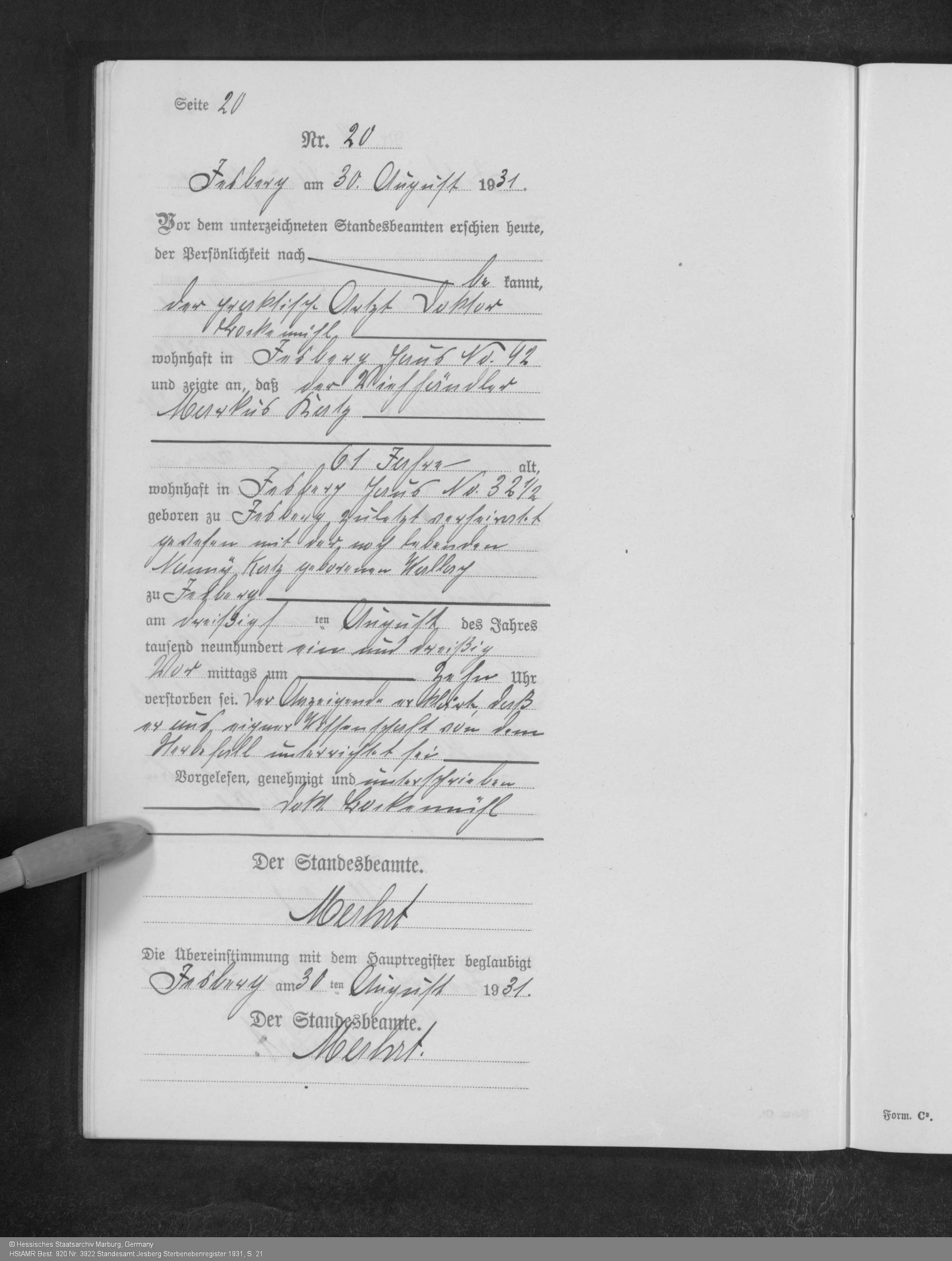
Meier Katz death record
Hessisches Hauptstaatsarchiv; Wiesbaden, Deutschland; Bestand: 920; Laufendenummer: 3916
Description
Year Range : 1925
Source Information
Ancestry.com. Hesse, Germany, Deaths, 1851-1955 [database on-line]. Provo, UT, USA: Ancestry.com Operations, Inc., 2016.
Original data: Sterberegister und Namensverzeichnisse. Hessisches Hauptstaatsarchiv, Wiesbaden, Deutschland.

Death record of Sprinz Jungheim Katz 1917
Hessisches Hauptstaatsarchiv; Wiesbaden, Deutschland; Bestand: 920; Laufendenummer: 3915

Their son Aron had married Sarah Leiser on June 2, 1907.  Sarah was born on September 2, 1878, in Niederurff, Germany, a town less than ten kilometers from Jesberg.  Aron was four years older than Sarah, born on November 28, 1874, in Jesberg. Aron and Sarah had two sons, Jakob, named for Aron’s grandfather, born on October 15, 1909, and Julius, born March 30, 1913.

In August, 1926, when he was not yet seventeen, Aron and Sarah’s son Jakob left Germany and joined his uncle Jake in Oklahoma. He settled in Stillwater and worked for his uncle there.  In the US, this younger Jakob became Jack, presumably to distinguish himself from his uncle Jake.  Jack was the only other member of Meier Katz’s family to come to the US before Hitler came to power besides Jake and Ike.

Passenger manifest for arrival of Jakob “Jack” Katz, 1926. Year: 1926; Arrival: New York, New York; Microfilm Serial: T715, 1897-1957; Microfilm Roll: Roll 3907; Line: 1; Page Number: 145
Description
Ship or Roll Number : Roll 3907
Source Information
Ancestry.com. New York, Passenger Lists, 1820-1957

Jacob “Jack” Katz naturalization petition, National Archives and Records Administration; Washington, D.C.; ARC Title: Correspondence Relating to Naturalization, compiled 1909 – 1960; ARC Number: 731194; Record Group Title: Records of District Courts of the United States; Record Group Number: 21
Description
Description : Oklahoma City Correspondence Relating to Naturalization, 1909-1925 (Box 1)
Source Information

Aron’s younger sister Regina, who was born February 6, 1882, married Nathan Goldenberg on March 10, 1905.  Nathan was born in Kestrich, Germany, on June 4, 1876, and he and Regina settled there after marrying.  Kestrich is about 50 kilometers from Jesberg. Regina and Nathan had three children: Bernice, born March 16, 1906; Theo, born April 27, 1914; and Albert, born November 15, 1919.

Marriage record of Regina Katz and Nathan Goldenberg, Ancestry.com. Hesse, Germany, Marriages, 1849-1930 [database on-line]. Lehi, UT, USA: Ancestry.com Operations, Inc., 2016.
Original data: Eheregister und Namensverzeichnisse. Hessisches Hauptstaatsarchiv, Wiesbaden, Deutschland.

Finally, the youngest child of Meier and Sprinzchen to survive to adulthood was Karl Katz, born in Jesberg on May 18, 1885.  Karl married Jettchen Oppenheimer on May 18, 1919, in Frankenau, where Jettchen was born on January 10, 1889.  Frankenau is about 30 kilometers from Jesberg. Karl and Jettchen had three sons, Walter (1920), Max (1921), and Manfred (1929).  Karl and his siblings Aron and Regina were all still living in Germany in 1930.

Hessisches Staatsarchiv Marburg: Standesamt Jesberg Geburtsnebenregister 1885 (HStAMR Best. 920 Nr. 3816) Jesberg 1885, p. 39

Thus, a fair number of my cousins, the descendants of my 3x-great-aunt Rahel Katzenstein, were still living in Germany when Hitler came to power in 1933. What happened to them once the Nazis were in power?

As I started to research that question, I prepared myself for the worst, knowing that some had in fact survived the Holocaust, but not knowing if any had not.  I knew from prior research that I should be prepared for that wincing pain I have experienced every time I learn that another of my relatives was among the six million killed.

Back in Jesberg: The Family of Moses Katz Before the Nazi Era

While Jake and Ike Katz, grandsons of Rahel Katzenstein and Jacob Katz, were establishing their dry goods business in Oklahoma along with their uncle Abraham Katz and his children, other members of the family of Rahel Katzenstein and Jacob Katz were still back in Jesberg, Germany.  Rahel and Jacob had three children who were still living in Germany in the late 19th century: Blumchen, Moses, and Meier. This post will describe the status of the families of Blumchen and Moses up to 1930.

Jacob and Rahel’s oldest child, Blumchen, died March 15, 1909, in Meimbressen, Germany, where she had lived after marrying Heskel Grunenklee of that town. As far as I’ve been able to find, Blumchen and Heskel did not have any children.  Heskel died in 1920.

Transcription of Blumchen Katz Grunenklee’s gravestone on LAGIS,
Gräberverzeichnis des jüdischen Friedhofs in Meimbressen (Calden), aufgenommen im Juli 1937 durch Baruch Wormser von Grebenstein 1700-1936 (1937) (HHStAW Abt. 365 Nr. 590) AutorHessisches Hauptstaatsarchiv, Wiesbaden, p. 12

Moses Katz, the second oldest child of Jacob and Rahel, had married Malchen Wetterhahn on July 3, 1869. She was from Rhina, Germany.  Moses and Malchen had six children: Rickchen, born June 28, 1869; Markus, born August 30, 1870; Lina, born September 5, 1872; Bertha, born June 22, 1878; Jacob M., born May 27, 1880; and Julia, born December 13, 1883. Moses died in 1898, and Malchen followed him four years later in 1902.

Death record of Moses Katz, Standesamt Jesberg Sterbenebenregister 1898 (HStAMR Best. 920 Nr. 3896)AutorHessisches Staatsarchiv MarburgErscheinungsverlauf1898ErscheinungsortJesberg, p.32

Death record of Malchen Wetterhahn Katz, Hessisches Hauptstaatsarchiv; Wiesbaden, Deutschland; Standesamt Jesberg Sterbenebenregister 1902; Bestand: 920; Laufendenummer: 3900

Children (and Grandchildren) of Moses and Malchen (Wetterhahn) Katz

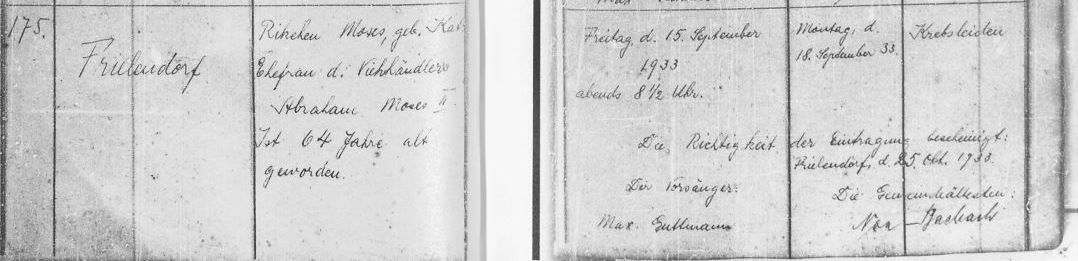
Rickchen had married Abraham Moses on August 12, 1895; Abraham Moses was from Grossropperhausen, Germany, and had been previously married and widowed. Abraham and Rickchen had three daughters: Rosa (1896 in Grossropperhausen), Amalie (1904), and Recha (1904). Amalie and Recha were twins, Amalie born before midnight on February 10 and Recha born after midnight on February 11.  They were born in Frielendorf. Rosa married Julius Katz (perhaps from the Jesberg Katz family); they had a son Guenther born on August 30, 1929, in Frielendorf, Germany.

Rickchen died on September 15, 1933, in Frielendorf.

Death record of Rickchen Katz Moses, HHStAW Fonds 365 No 166,p. 54

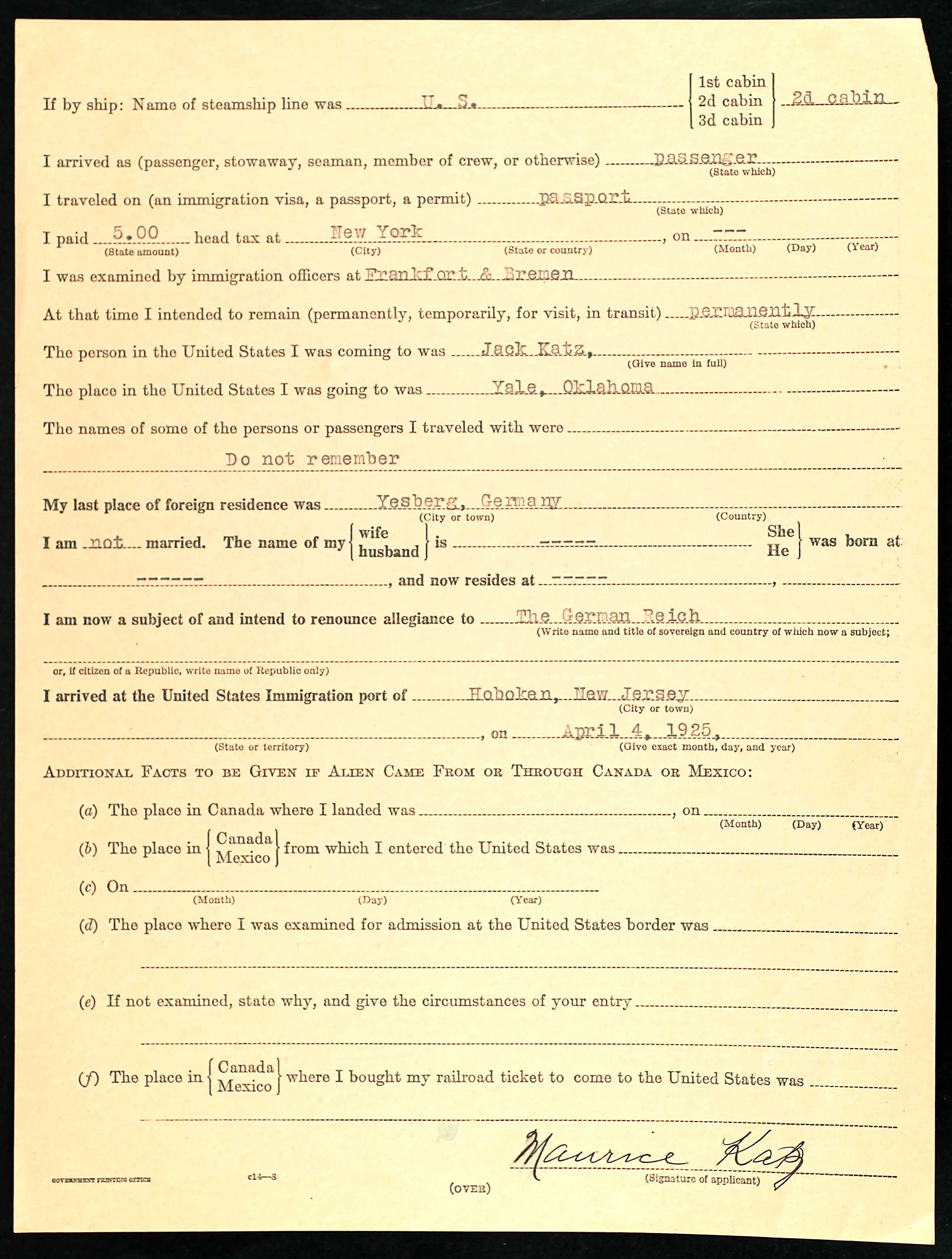
Markus Katz, the second oldest child of Moses and Malchen, married Minna Wallach on September 7, 1902 in Oberaula, Germany, where Minna was born in 1880.  Markus and Minna had three children: Maurice (also known as Moritz or Moses) (born in 1903, named for his grandfather), Mali (1904), and Senta (1906). They were all born in Jesberg.

Maurice came to the United States as a young man on April 4, 1925. According to his naturalization papers, he was going to his “cousin” Jack Katz in Yale, Oklahoma; this might have referred to Jacob M. Katz, his brother, who was living in Yale, Oklahoma in 1925. Maurice’s passenger manifest, however, said he was going to his “uncle,” Jake Katz, in Stillwater. (Jake, son of Maurice’s uncle Meier, was really his cousin, not his uncle.) In 1930, Maurice was living as a lodger in Oklahoma City, where he was working as a salesman in a clothing store.

Maurice (Moritz) Katz naturalization petition,
National Archives and Records Administration; Washington, D.C.; ARC Title: Correspondence Relating to Naturalization, compiled 1909 – 1960; ARC Number: 731194; Record Group Title: Records of District Courts of the United States; Record Group Number: 21
Description
Description : Oklahoma City Correspondence Relating to Naturalization, 1909-1925 (Box 1)
Source Information
Ancestry.com. Oklahoma, Naturalization Records, 1889-1991


Maurice (Moritz) Katz passenger manifest, Year: 1925; Arrival: New York, New York; Microfilm Serial: T715, 1897-1957; Microfilm Roll: Roll 3630; Line: 1; Page Number: 72
Description
Ship or Roll Number : Roll 3630
Source Information
Ancestry.com. New York, Passenger Lists, 1820-1957

As for Maurice’s two younger sisters, Mali married Siegfried Baumann on April 17, 1930, in Jesberg.  Siegfried was born in Lauterbach, Germany, in 1893. The youngest child of Markus and Minna, Senta, married Julius Abraham of Niederurff, Germany, by 1932 when their first child was born in Niederurff.

Lina Katz was the third child of Moses and Malchen Katz; she married Hermann Katz on April 15, 1901. He was from Schweinsberg, Germany.  Hermann and Lina had three children born in Schweinsberg: Bertha (1902), Moritz (1903), and Amalie (1905). Hermann died on November 2, 1929, in Marburg, Germany.

Lina’s daughter Bertha married Siegmund Sieferheld on January 14, 1927; they would have three children. The younger daughter Amalie married Max Blum, who was also a Schweinsberg native.  Lina and all three of her children were still living in Germany as of 1930.

Marriage record of Lina Katz and Hermann Katz, Ancestry.com. Hesse, Germany, Marriages, 1849-1930 [database on-line]. Lehi, UT, USA: Ancestry.com Operations, Inc., 2016.
Original data: Eheregister und Namensverzeichnisse. Hessisches Hauptstaatsarchiv, Wiesbaden, Deutschland.

The fourth child of Moses and Malchen was Bertha, born in 1878. Unfortunately the only record I have for Bertha is her birth record.  I don’t know whether she died young or married or just disappeared. According to family lore, Moses and Malchen Katz had a daughter who died by drowning in the Seine River, and I did find a death record for a female named Katz who died in France in 1901, but again, I have no idea whether that is Bertha Katz. I thought that the fact that Lina and Hermann named their first daughter Bertha in 1902 supported this theory, but then I realized that Hermann’s mother was also named Bertha and their daughter was likely named for her.

Bertha Katz birth record,
Hessisches Hauptstaatsarchiv; Wiesbaden, Deutschland; Collection: Personenstandsregister Geburtsregister; Bestand: 920; Laufende Nummer: 3809
Description
Year Range : 1878
Source Information
Ancestry.com. Hesse, Germany, Births, 1851-1901 [database on-line]. Lehi, UT, USA: Ancestry.com Operations, Inc., 2016.
Original data: Geburtenregister und Namensverzeichnisse. Hessisches Hauptstaatsarchiv, Wiesbaden, Deutschland.

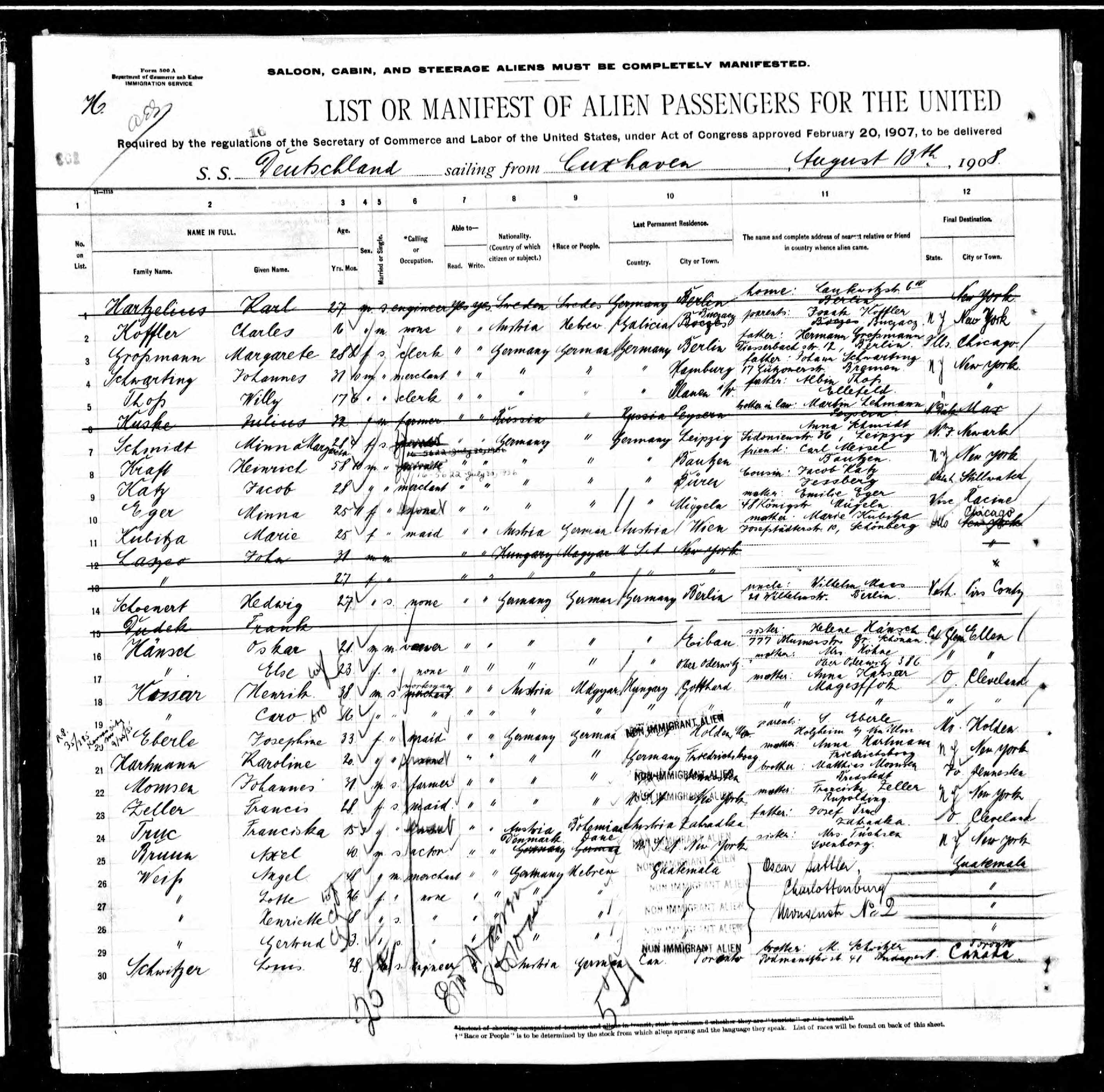
Jacob M. Katz, Moses and Malchen’s youngest son, left Germany in 1908, immigrating to the United States.  Although he put Stillwater, Oklahoma, as his final destination, he listed his uncle Abraham Katz of Louisville, Kentucky, as the person to whom he was going in the United States. By 1910, he was living in Yale, Oklahoma, working as a department store manager.  By 1920 he was married to Julia Meyer, had a son, and was working as a dry goods merchant in Yale. In 1930, Jacob and his family were living in Wolf, Oklahoma, where he continued to work as a dry goods merchant.

Jacob M Katz passenger manifest, Year: 1908; Arrival: New York, New York; Microfilm Serial: T715, 1897-1957; Microfilm Roll: Roll 1132; Line: 1; Page Number: 104
Description
Ship or Roll Number : Roll 1132
Source Information
Ancestry.com. New York, Passenger Lists, 1820-1957

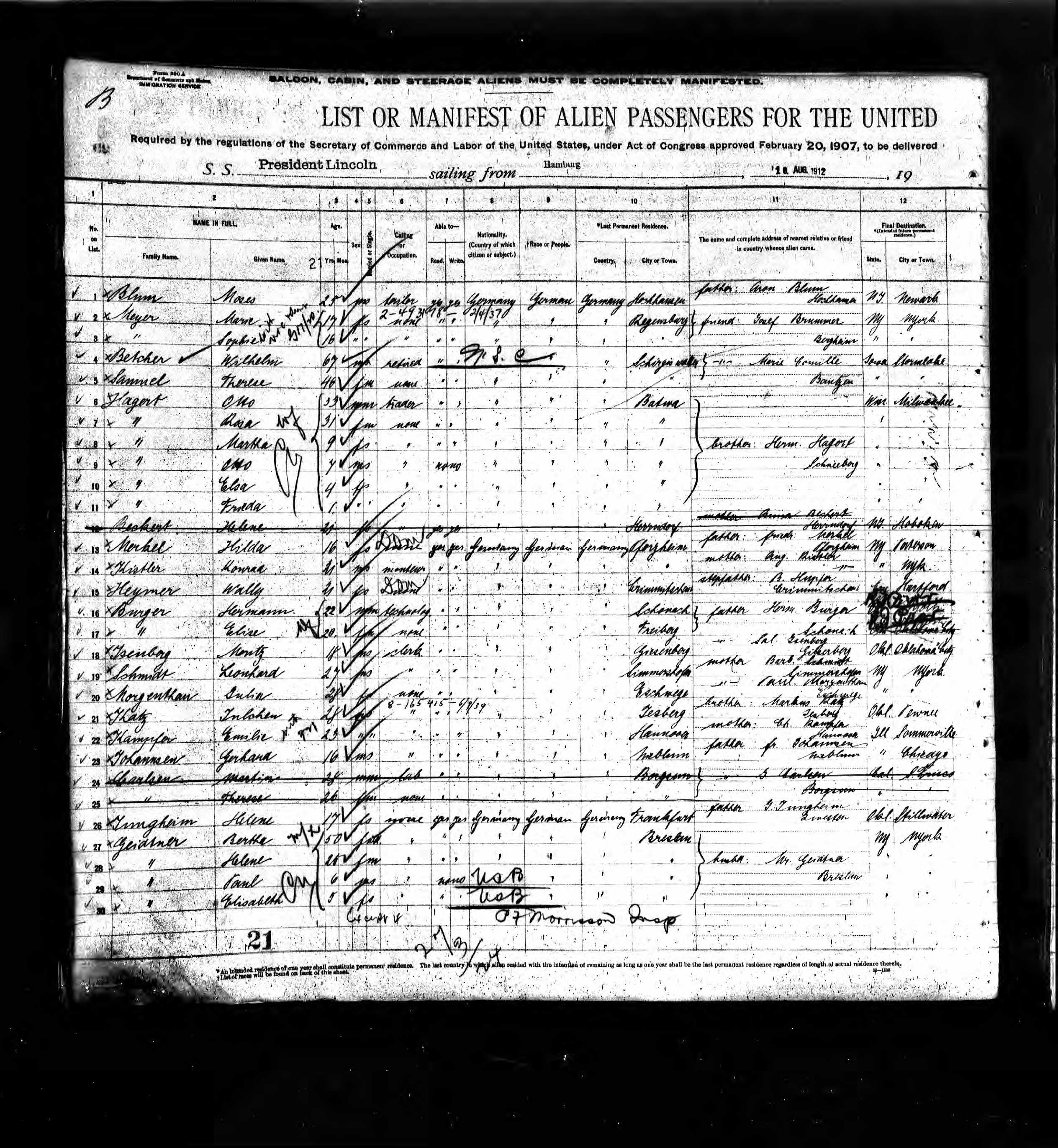
Finally, Moses and Malchen’s youngest child was Julia Katz.  She followed her brother Jacob to Oklahoma, arriving in August 1912 when she was 29 years old. Finding her manifest was quite a challenge as Ancestry had her indexed as Inlchen Thatz when she in fact sailed as Junchen Katz.  But as you can see, this is the right woman as she was going to her uncle Isaac Katz in Oklahoma.

Julia (Julchen) Katz passenger manifest, Year: 1912; Arrival: New York, New York; Microfilm Serial: T715, 1897-1957; Microfilm Roll: Roll 1918; Line: 1; Page Number: 30
Description
Ship or Roll Number : Roll 1918
Source Information
Ancestry.com. New York, Passenger Lists, 1820-1957

Seven years after arriving in the US, Julia (as she was known in the US) married Maurice Mink, a Russian immigrant who was a dry goods merchant in Cleveland, Oklahoma.  The marriage was written about in the Pawnee newspaper:

Miss Julia KATZ, one of the most popular clerks of the Katz Department Store and niece of Mr. Ike KATZ, became the bride of Mr. Maurice MINK, of Cleveland, Oklahoma, Sunday. the ceremony took place at Tulsa and following the wedding a six o’clock dinner was served at the Cutcham Hotel. The happy couple left for a two week honeymoon, after which time they will be at home to their friends at Cleveland, Oklahoma, where Mr. MINK is one of the leading business men and has a splendid home for his bride. Pawnee regrets to lose Miss Julia, but wishes her much happiness as Mrs. MINK. (Pawnee Courier-Dispatch and Times-Democrat, June 19, 1919)

In 1920 Julia and Maurice were living in Cleveland, Oklahoma, with Maurice’s two children from an earlier marriage. Their own daughter Marguerite was born that same year.  In 1930, Julia and Marguerite were living in Cleveland, and although Julia reported that she was married, Maurice is not listed as living in the household with Julia and their daughter. He is rather listed in a separate household in Cleveland, living with his two older children from the first marriage.

Thus, as of 1930, two of the children of Moses Katz and Malchen Wetterhahn (Jacob M and Julia) were in the US and one of their grandsons (Maurice) had emigrated from Germany as well.  But all the other descendants of Moses and Malchen were still in Germany.

Similarly, three of the children of Meier Katz and Sprinzchen Jungenheim were still in Jesberg, as I will describe in my next post.


Jake Katz: Pioneer and Entrepreneur

Now it is time to return to the story of the descendants of Rahel Katzenstein, sister of my great-great-grandfather Gerson Katzenstein. Rahel had married Jacob Katz, and they had had six children: Blumchen, Moses, Meier, Abraham, Sanchen, and Samuel. Thus far I have focused on the stories of Abraham and Samuel, both of whom came to the US as young men after the Civil War. Now I will turn to Meier Katz and his family.

As I wrote in my last post before we left for Germany, Meier Katz and Sprinzchen Jungheim had six children, five of whom survived to adulthood: Jacob, Aron, Seligmann, Regina, and Karl.  Two of those children—Jacob (“Jake”) and Seligmann (known as  “Isaac” or “Ike” in the US) came to the US as young men about twenty years after their uncles Abraham and Samuel; the other three siblings did not arrive until the 1930s after Hitler came to power.

Karl, Sprinzhchen, Regina, Jacob, Aron, Meier, and Isaac Katz

Jake, the oldest son, has taken on a legendary status in the family’s history.

Jake Katz
Photo found in Stanley Tucker Whitney Houston, Stillwater (Arcadia Publishing 2014), p. 38

According to his 1923 passport application, Jake Katz was born on September 13, 1873, in Jesberg, Germany, and arrived in the United States in August, 1887, when he was not quite fourteen years old.

Jake Katz passport application 1923
National Archives and Records Administration (NARA); Washington D.C.; NARA Series: Passport Applications, January 2, 1906 – March 31, 1925; Roll #: 2232; Volume #: Roll 2232 – Certificates: 273350-273849, 23 Apr 1923-24 Apr 1923

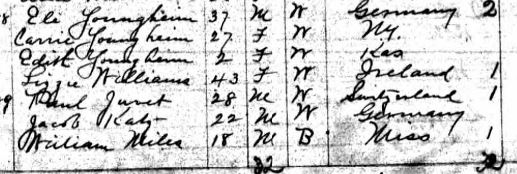
Family lore is that he came to work as a clerk in a dry goods store in Winfield, Kansas, owned by his mother’s brother, Eli Jungheim (spelled Youngheim in the US). Jake is listed in the household of Eli Youngheim in the 1895 Kansas state census:

Jake Katz, 1895 Kansas census
Kansas State Historical Society; Topeka, Kansas; 1895 Kansas Territory Census; Roll: v115_31; Line: 1
Description
Township or Location : Winfield
Source Information
Ancestry.com. Kansas State Census Collection, 1855-1925 [database on-line]. Provo, UT, USA: Ancestry.com Operations, Inc., 2009.

According to the Encyclopedia of Southern Jewish Life, Eli Youngheim opened up a dry goods store in Stillwater, Oklahoma, in 1894, and hired Jake to run the store.  The family story is that there was a falling out between Jake and his uncle Eli and that Jake turned to his father’s brother, Samuel Katz, who was then in Omaha, and obtained from him financial backing to start his own store in Stillwater in 1896.

The Encyclopedia of Southern Jewish Life provides an overview of the early history of Stillwater:

Settlement in Stillwater, Oklahoma began during the 1889 land run. The first settlers lived in tents pitched next to the creek that gave the town its name and survived on hunted wild game. From these rustic beginnings, Stillwater quickly developed after it was named the seat of Payne County and the site of Oklahoma’s land grant college in 1890. Cotton was the main economic engine of the area, and Stillwater became a commercial and processing center for the cash crop. By the time Eli Youngheim opened a clothing store there in 1894, Stillwater had a water system, public schools, and a downtown filled with commercial buildings. Stillwater never had a formal Jewish congregation, but a small number of Jews have lived in Stillwater since the late 19th century. 

By 1899, Jake was well settled in Stillwater; he became a naturalized citizen there on May 12, 1899.

The Encyclopedia of Southern Jewish Life states that Jake’s younger brother Ike joined him in 1898 and helped him run the Stillwater store, which they named Katz Brothers. Ike, who was born Seligmann Katz in 1877, seems to have become Isaac or Ike in the US, arrived in the US on September 8, 1892. Here is his birth record from Jesberg as Seligmann:

Birth record of Seligmann “Ike” Katz
Hessisches Staatsarchiv Marburg: Standesamt Jesberg Geburtsnebenregister 1877 (HStAMR Best. 920 Nr. 3808) Jesberg 1877, p. 71

He was still using Seligmann when he immigrated:

Ship manifest for Seligmann Katz, 1892
Year: 1892; Arrival: New York, New York; Microfilm Serial: M237, 1820-1897; Microfilm Roll: Roll 597; Line: 1; Page Number: 10
Description
Ship or Roll Number : Roll 597
Source Information
Ancestry.com. New York, Passenger Lists, 1820-1957 [database on-line]. Provo, UT, USA: Ancestry.com Operations, Inc., 2010.

My hunch is that Seligmann was his secular name in Germany, but that his Hebrew name was Isaac.  He seems to have adopted Isaac/Ike as his first name once in the US. According to a ship manifest for a voyage Ike took in August, 1912, he was naturalized in October 9, 1899, in Oklahoma.

Jake was still single as of the time of the 1900 census, but according to the family he married Sophia Salzenstein in 1901. Sophia was the older sister of Mayme Salzenstein, who would later marry Jake’s first cousin Lester Katz, son of Abraham Katz. As I wrote in an earlier post, Wolf Salzenstein, father of Sophia and Mayme, was a German immigrant living in Athens, Illinois, working as a livestock dealer.  His wife Caroline was born in Illinois, as were both Sophia and Mayme.

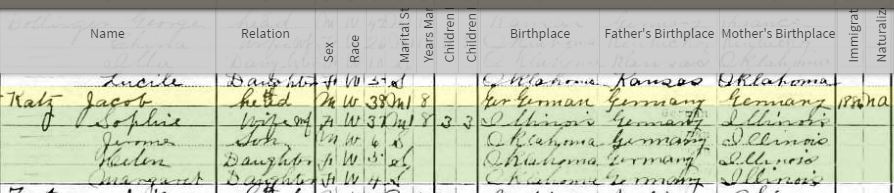
Jake and Sophia would have three children: Albert Jerome (1903), Helen (1904), and Margaret (1906). In 1910, they were living in Stillwater.

Jake Katz and family 1910 census
Year: 1910; Census Place: Stillwater Ward 2, Payne, Oklahoma; Roll: T624_1269; Page: 17A; Enumeration District: 0199; FHL microfilm: 1375282
Description
Enumeration District : 0199
Source Information
Ancestry.com. 1910 United States Federal Census [database on-line].

By 1910, Ike Katz also was married.  On May 26, 1909, he married Sophia Weil in New York City.  Sophia was also a German immigrant, born in Freiberg, Germany, which is not far from Jesberg.  According to the family, this was an arranged marriage. In 1910, Ike and Sophia were living in Pawnee, Oklahoma, where Ike had established a second Katz Brothers store.

Ike Katz and family 1910 census
Source Citation
Year: 1910; Census Place: Pawnee Ward 3, Pawnee, Oklahoma; Roll: T624_1268; Page: 22B; Enumeration District: 0181; FHL microfilm: 1375281
Description
Enumeration District : 0181
Source Information
Ancestry.com. 1910 United States Federal Census [database on-line]. Provo, UT, USA:

It was around this time that Jake contacted his uncle Abraham, who was still living in Kentucky, and asked him to move to Oklahoma to establish another Katz dry goods store.  As I described in an earlier post, Abraham sent his oldest son, Lester, to Stillwater to work with Jake and explore the prospects of a store in another town in Oklahoma. In 1910, Abraham Katz and his family moved to Sapulpa, Oklahoma, and established another Katz store.

According to the family, in 1917, Ike decided to open a new Katz store in Oilton, Oklahoma.  He asked his cousin Sidney Katz to run it for him. Sidney, who had recently married his wife Eulalia, had been operating a shoe store in Fort Scott, Kansas, in partnership with his brother-in-law Morris Kohlmann, but the business had not been profitable enough, so Sidney decided to accept Ike’s invitation to run a store in Oilton.  Ike remained in Pawnee where on September 12, 1918, he registered for the World War I draft.

Isaac Katz World War I draft registration
Registration State: Oklahoma; Registration County: Pawnee; Roll: 1852068
Description
Draft Card : K
Source Information
Ancestry.com. U.S., World War I Draft Registration Cards, 1917-1918 [database on-line]. Provo, UT, USA

The family business was thus thriving in the first two decades of the 20th century, but then Jake and Sophia Katz suffered a terrible loss on October 6, 1919, when Albert Jerome Katz, their son and oldest child, died four days short of his sixteenth birthday.

To be continued…


Our Last Two Days in Germany—Worms and Heidelberg—and Some Final Thoughts on the Trip

Why did we go to Worms? Not for any genealogy reason, but for its significance to Jewish history generally and to German Jewish history more particularly. It is one of the so-called ShUM cities, the three cities (Speyer (Sh), Worms (U), and Mainz (M) where Jewish scholars and rabbis in the Middle Ages had a widespread impact on Jewish religious and cultural practices.  Some of the greatest medieval Jewish scholars studied and taught in the ShUM cities, including Rashi, who is considered one of the greatest Talmudic scholars of all time. Many of the melodies used even today in Jewish religious services were developed in the ShUM cities. It seemed that it would be wrong to go all the way to Germany and not see Worms.  (Speyer, unfortunately, we could not fit into our itinerary, and we had seen Mainz.)

Worms is a short train ride from Heidelberg, so it made sense to go there during one of our three days in Heidelberg.  On May 13, we took a morning train to Worms to meet our tour guide. [For various reasons we were not very pleased with this guide, so I’ve decided not to use her name in this post. If anyone wants to know why, I will be glad to share privately but not on the blog.]

The guide met us at the train station and showed us the reliefs sculpted over the doorways to the train station, one showing different modes of transportation and the other, the doorway used by the wealthy, showing kings and nobles.  The station was built in the early 1900s and, as the guide said, was considered a sign of modernity and of the status of Worms as an important city.

From the station we walked a few blocks to the Jewish cemetery, which has existed since the eleventh century and is considered the oldest Jewish cemetery in Europe.  We could not enter as it was Shabbat (Saturday), and the cemetery was closed.  But we could see the old stones and the very well-maintained grounds. The guide told us about some of the important scholars buried at the cemetery and how the cemetery is a pilgrimage site for Jews from all over the world.

From the cemetery we walked through a park where there was a statue of Martin Luther, for whom Worms was also an important city because, according to the guide, it was in Worms that his movement for Reformation became a movement adopted by the people, not just a theoretical idea. The guide also pointed out to us that the park we were walking through was where the moat had been located when Worms was a walled city in medieval times.  Once the wall was taken down and the moat filled, it became a ring of green space surrounding the city.

Martin Luther statute

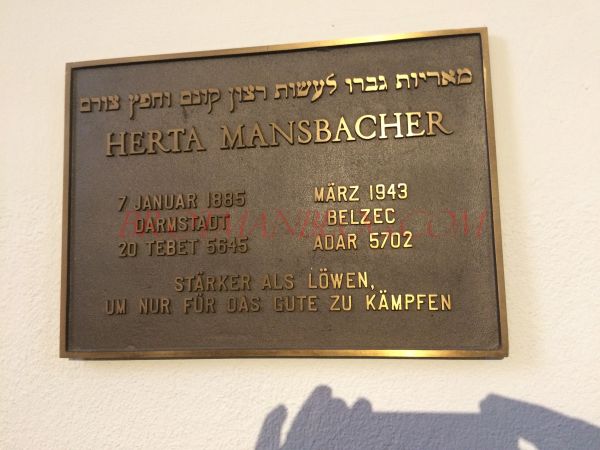
We continued to follow the former moat towards the old Jewish quarter in Worms. Along the way we passed several stolpersteine, including one for Herta Mansbacher, who is considered an important heroine in the story of the Jews of Worms.  She was a teacher in a non-Jewish school until 1933 when she lost her job and took a teaching job in a Jewish school.  She then stayed in Worms to help the children and to encourage families to emigrate from Germany.  After the Worms synagogue was burned during Kristallnacht, Herta Mansbacher ran to rescue what she could and to try and put out the fire.  In 1942, she was deported and murdered by the Nazis.

Stolpersteine for Herta Mansbacher and others

Former home of Herta Mansbacher

A short distance past the home of Herta Mansbacher we reached the former Jewish quarter of Worms. Turning left on Judengasse it felt like we had entered not only a difference place but a different time. You could visualize what the quarter was like a hundred years earlier.

Judengasse in Worms

The Jewish quarter in Worms

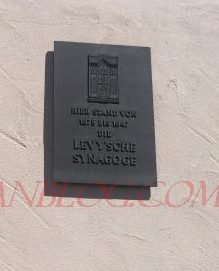
There are two synagogue buildings in the Jewish quarter.  They are located at opposite ends of a small plaza in the center of the quarter. The Levy’sche synagogue is now a residential building.


Across from it was the other synagogue, the Old Synagogue—where there is a sculpture commemorating Rashi; Rashi studied at the yeshiva attached to this synagogue.  The building dates from the 12th century and is claimed to be the oldest synagogue in existence north of the Alps.   The building is today used for religious purposes and also for cultural events. There is a separate building where the yeshiva was located and also a mikveh on the grounds.   Behind the synagogue is a Jewish museum displaying Judaica and historical documents from the region; the most moving display was of the Torah scrolls and wimpels that were burned during Kristallnacht.  Perhaps these were the ones rescued by Herta Mansbacher, for whom there is a memorial plaque in the synagogue.

Old synagogue in Worms

Statue honoring Rashi

Interior of Old Synagogue

The synagogue was rebuilt after the war, but some of the original structure still was standing and is part of the building today.  Seeing the Jewish quarter allowed me to imagine in a concrete way how the Jews once lived in this section of the city.

After leaving the Jewish quarter, we stopped for lunch, and then the guide showed us Trinity Church, a very large Lutheran church built in the 18th century.  It was destroyed by Allied bombing in World War II and rebuilt in the 1950s.

Trinity Church

Interior of Trinity Church

Our last stop in Worms was at St. Peter’s Cathedral, which was built in the 12th century.  It is an impressive structure, and the altar is quite elaborate and beautiful.

St Peter’s Cathedral, Worms

Altar in St Peter’s Cathedral

We then walked back to the train station and returned to Heidelberg.

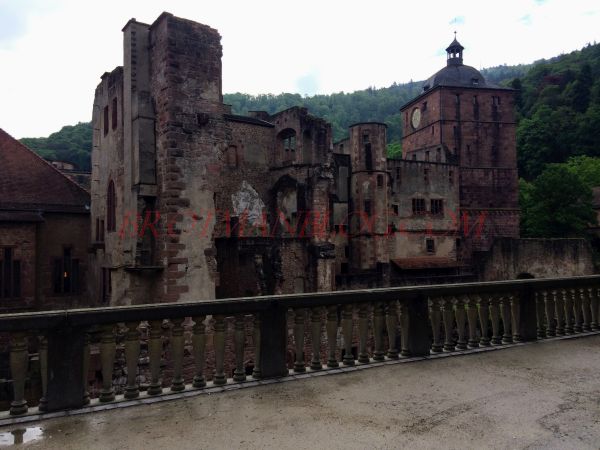
The next day, our last day in Germany, we were back on our own.  We took the funicular up to the castle that hovers over the city and can be seen quite dramatically from across the river.

We strolled around the grounds where the views of the river and the city of Heidelberg are stunning. Because you cannot get into the castle without a guided tour, we waited for the guided tour at 10 am.  Fortunately there were only three of us on the tour, plus the guide.  (There were hundreds of people wandering around the grounds being led by Viking Cruise guides, all with earplugs in their ears to listen to their guides, but they did not enter the buildings.)

The guide was delightful with a very dry and sarcastic sense of humor, and we all got a big kick out of him.  He entertained us with stories of political intrigue, romance, and wars to give us the colorful history of the complex of buildings that make up the castle.  The castle predated the city; it was originally built for strategic purposes with its towers and walls overlooking the valley below. Then, as medieval times moved into the Renaissance era, it became more a home for the local noble to impress his wife and entertain their guests.  Even Hitler used the castle at some point as a place to house soldiers.  I wish I could remember all the details of the guide’s stories, but suffice it to say he kept us interested, and he not only was amusing but very well-informed about the history of the region.

After returning to the city below, we spent our last afternoon in Germany wandering through the beautiful city of Heidelberg.  Unlike every other city we’d visited—Mainz, Bingen, Cologne, Wurzburg, and Worms—Heidelberg did not sustain any significant damage from Allied bombing during World War II, so it retains its architectural heritage as originally built.

The city has so much to offer—a world-renowned university, a scenic location on the Neckar River, a fascinating castle with gorgeous views, and churches and buildings that are rich in architectural detail.  The winding narrow streets and wide plazas, the youthful population, and the multitude of restaurants, bars, and stores make it an interesting and exciting place to visit. It made it all that much harder to pack our bags and head to the airport where we would stay our last night in order to catch our flight the following morning.

And so we said Auf Wiedersehen to Germany, land of my paternal ancestors, a country I had truly learned to appreciate during our stay, a place where the beer, the bread, the cities, the villages, the landscapes, and especially the people are just wonderful.  I was sad to leave, but ready to come home and have a chance to digest and remember it all.

Looking back on the trip now that we have been home for well over a month, it almost seems like a dream.  Was I really there? Did I really walk in the footsteps of my ancestors, see their gravestones, and meet my cousins, their descendants? Writing these blog posts has helped me remember and process everything we saw and experienced.  Looking at the photographs reminds me of all the people we met and all the beauty we saw as well as all the reminders of what happened during Hitler’s reign.

Much of what we experienced was bittersweet—bitter because of all the awful killings and destruction, sweet because of the kindness of the people we met and the hope they gave us for a future where people are tolerant and understanding and loving of each other despite their differences.  As I now return to the task of learning about and writing about my family’s history, I can better visualize where they lived and what their lives were like.  It will make what has already been a fascinating and rewarding journey that much more meaningful and satisfying.

Thank you for following me on this journey.


Adventures in Germany: A Car Accident and A Rainstorm

So, as I was saying in my last post, we left Schopfloch on May 11 looking forward to our last three days in Germany.  We were heading to Heidelberg with a very limited agenda.  We had only two commitments over the three days: lunch the following day with Ulrike Michel, the wife of my 4th cousin, once removed, Torsten Michel, and a walking tour of Worms on May 13. The rest of our time was open.  We were just going to explore the city of Heidelberg on our own, drink beer, eat good German bread, enjoy the river and the sights, and relax.  We had about a two hour drive to Heidelberg where we planned to return our rental car to Hertz by 6 pm and take a cab to our hotel in the old part of the city.

As we drove out of Schopfloch, we were quite relaxed, and our British GPS lady was in charge of directions.  We reached the end of the slow road that brought us out of Schopfloch and stopped to make a left onto a busier road, Bundestrasse 25.  Harvey looked both ways, saw no cars coming, and pulled onto the road, turning left.  We had already made the turn and were proceeding straight on the road when we were hit from behind.

We were, of course, stunned.  How could we get hit from behind after completing the turn onto the road? Fortunately we were not hurt, and once we got out of the car, we knew that no one in the car that hit us was hurt either.  The other driver, a German man perhaps our age or a little older, spoke a little English and was very nice and calm and said we had to call the police.  We waited at least twenty minutes for the police to arrive.


Site of the accident

Two policemen arrived—young men who spoke English fluently and who were extremely friendly and pleasant.  They spent several minutes first talking to the other driver—in German, so we had no idea what was said.  Then they approached Harvey and told him, without asking him what happened, that he had failed to yield and had violated the traffic law, and there was a penalty of 150 Euros.

We were flabbergasted.  How could we be at fault when we were hit from behind? And we had definitely not only yielded at the intersection—-we had made a full stop because we wanted to be sure we knew where we were going.  But it was clear that there was no point in arguing with the policemen and the other driver.

The police told us to follow them back to the station in Dinkelsbuhl (about eight miles out of our way), where Harvey signed papers in German that were not explained to him and paid the fine.  Meanwhile, I was trying to get Hertz on the phone to find out what we needed to do to be sure our insurance contract covered the damage. We had taken out full insurance as part of the rental agreement, so we weren’t worried about the damage to the car, but we did want to be sure that we followed the right protocol.

But no one answered the phone at the Heidelberg office; no one answered the phone on the Hertz emergency line.  We called Hertz in the US, and they had no answers.  So we were both now exasperated, annoyed, and frustrated.  So much for being relaxed!

Fortunately, the rest of our trip to Heidelberg went smoothly.  We arrived in Heidelberg probably around 6:30, 6:45.  The Hertz office was closed, so we left the car, the police report, and the keys, hoping that we had done all we needed to do.  And we put it all behind us, determined to enjoy those last three days.[1]

And we did.  Our taxi dropped us off at the Hotel Villa Marstall, a small European-style hotel right on the Neckar River.  Our room was beautiful with a lovely view looking over the river.  The receptionist downstairs suggested a sushi place for dinner, and it was just perfect.  Casual, good Japanese beer, great sushi.  We were able to move beyond the stress of the accident.

Views from our room at the Hotel Villa Marstall

As we walked back to our hotel after dinner, I noticed a few people standing on an open plaza right in front of the door to our hotel.  There was a stone block that they were reading at the end of the plaza, and as I looked at it from a distance, I noticed that there was Hebrew lettering.  I walked over and read that the plaza marked the location of the former Heidelberg synagogue, which was, like so many hundreds of others in Germany, destroyed on Kristallnacht.  The next morning when we left the hotel, we saw that the perimeter of the former synagogue had been outlined in white marble stones placed into the plaza.

Marker for former Heidelberg cemetery

As you can see from the two images below (plaques at the site of the former synagogue), Jews had a long history in Heidelberg:

As in every place we visited in Germany, there are markers to remind everyone that there was once a Jewish community here and that it had been destroyed.  We had picked the hotel without knowing anything about the location of the former synagogue.  It felt rather eerie and yet comforting that we were staying right next to it.  It was also comforting to know that there is now a new synagogue in Heidelberg.

We spent our first morning in this gorgeous city doing a self-guided walking tour of the Altstadt, the old city.  First we walked through Universitatplatz, the part of the old city where there are many buildings of the University of Heidelberg.  The university was founded in 1386, making it the oldest university in Germany; today there are 30,000 students studying at the university.  As in Wurzburg, the student population gives the city a young and vibrant feel.

Reading the map


The university’s church is Peterskirche (St. Peter’s); it is even older than the university as it was built in the late 12th century and expanded in the 14th century.  It has been the university church since 1896.

Peterskirche in the distance


Peterskirche in Heidelberg

Perhaps the most impressive and eye-catching university building we saw was the library; it is truly magnificent.  It was built between 1901 and 1905.

University library

Across from the library was the Jesuit Church with its striking white interior.   It was built in the 18th century, with a tower added in the 19th.

Jesuit Church interior

Jesuit Church exterior

We then walked through the old city, passing other university buildings and along narrow winding streets to the main market square in Heidelberg. The Church of the Holy Spirit, which was started in the 14th century but took 150 years to complete, dominates the square. The market square itself is framed by the former homes of wealthy merchants, whose wealth is quite apparent from the large and elaborate homes.  Today these are mostly hotels, restaurants, and stores.

Church of the Holy Spirit

Former merchant’s home

Another former merchant’s home

Market square

And as in almost every place we visited, there were stolpersteine:

We strolled further through the old city and then headed back to our hotel to meet Ulrike for lunch. As I noted above, Ulrike’s husband Torsten is my fourth cousin, once removed.  His great-great-grandmother was Ziborah Schoenfeld, sister of Babetta Schoenfeld, my three-times great-grandmother.  Babetta married Moritz Seligmann of Gau-Algesheim, my three-times great-grandfather.  Babetta and Ziborah were daughters of Bernard Schoenfeld and Rosina Goldmann, my four-times great-grandparents.  They grew up in Erbes-Budesheim, a small town just 40 kilometers from Gau-Algesheim.  (One of my few regrets about the trip was not getting to Erbes-Budesheim, but time just ran out.)

Ulrike was the genealogist in the Michel family, and she and I had been in touch several years ago, but had then fallen out of touch.  I had emailed her right before the trip, and she was excited to meet me and drove to Heidelberg to have lunch with us.  We had a lovely lunch together, and Ulrike shared with us her recent discovery of her husband’s cousins on the Michel side (not my side) in Israel.  She was very excited about meeting these people, and it was a wonderful genealogy success story.

After lunch we invited Ulrike to join us for a walk up Philosopher’s Way on the other side of the river. Philosopher’s Way is a path (actually a paved road in large part) that winds up the hills where it is said faculty and students from the University of Heidelberg would stroll while contemplating scholarly matters.  There is a snake path that is usually open to climb to (or from) the path, but it was closed for safety reasons while we were there.

So instead Ulrike, Harvey and I walked along the river, crossed over at a bridge, and then found the entrance to Philosopher’s Way and started climbing.  And it was steep and long.  Longer and steeper than we had expected.  But we were determined to get to the top.  And when we did, we were rewarded with spectacular views of Heidelberg across the river.

Walking up Philosopher’s Way with Ulrike

At the top of Philosopher’s Way

View of Heidelberg from the top of Philosopher’s Way

Soon after we reached the top, it started raining.  It had been sunny and beautiful, and none of us was prepared for rain.  We stood under a tree for a bit, but then decided we had to keep moving despite the rain.  But we weren’t sure which way to go—retrace our steps or go forward and find another way down? We (well, Ulrike) asked several people who kept telling us that if we went further, there was a way down that would bring us closer to the location of our hotel across the river. So we went ahead.

But the “other way down” never appeared, and finally Harvey said we should just turn back.  Ulrike was determined to find the other route down, but we were growing increasingly skeptical of its existence.  So we divided up—Ulrike moving on, Harvey and I turning back from where we’d come.

A few minutes after dividing up, the rain intensified.  Harvey and I stopped at a little covered pavilion on the side of the path to wait for the rain to let up.  Within another few minutes, my cell phone rang. It was Ulrike—she had decided to turn around after learning that the “other way down” would bring her even further from the bridge across the river.

We waited for her, all having a good laugh at our misadventures on the so-called Philosophers Way.  I don’t think any of us had one serious intellectual thought throughout our entire walk! But it was worth the climb, and the extra time we got to spend with Ulrike was wonderful.

Going back down


Once back near our hotel, we said goodbye to our new friend and cousin.  It had been a full and interesting and fun day.  Heidelberg was exceeding our expectations as a good final stop on our journey through Germany.  We had two days left—one in Worms and then a final day in Heidelberg.


[1][1] As it turns out, we are still dealing with Hertz on this matter.  VERY annoying…

Schopfloch: A Lesson in Gravestone Symbols

The last ancestral town we visited on our trip was Schopfloch in Bavaria where my three-times great-grandfather John (born Josua) Nussbaum was born in 1814.  I wrote a long post about Schopfloch when I was doing my research of my Nussbaum relatives.  The town dates back to the 13th century, and there was a Jewish community there in the 14th century.  As early as the 17th century, there was a synagogue, a mikveh, and a school in Schopfloch. In 1867, there were almost 400 Jews in the town out of almost 2000 residents. Today Schopfloch is a small town of about 3000 people, about half the size of Gau-Algesheim and slightly larger than Jesberg, but four times the size of Sielen.  There is no Jewish community there now.

My 4x-great-grandparents, Amson Nussbaum and Voegele Welsch, died in 1836 and 1842, respectively, and I thought they were likely the last family members to have died in Schopfloch. Six of their eight children immigrated to the United States before 1860; there were two additional daughters for whom I had birth information, but no information as to whether they had married or had children or where or when they had died. I am still searching for the documents Angelika Brosig used to document this Nussbaum family.  But, as far as I knew, there was no one left in Schopfloch from my Nussbaum family after 1860.  Would I find anything relating to my ancestors in this town?

I had arranged for Jutta Breittinger, who works at the Schopfloch town hall, to be our guide; since Frau Breittinger said she did not speak English well, she had recommended that we also hire a translator. When we met Frau Breittinger, we were soon joined by the translator and his wife, whose names I never quite caught. They were all very helpful and very earnest in their desire to help us and inform us about the Jewish history of Schopfloch.

Our three guides told us the same thing we had heard in the other small towns we’d visited: before the Nazi era, Jews and Christians had worked and lived together without any problems. As described by our translator, Lachoudisch, the secret language developed in Schopfloch, is evidence of this co-operative relationship.  Most Jews in Schopfloch were involved in horse and cattle trading, and market day was on Saturdays, the Jewish Sabbath. The Jewish traders relied on their Christian neighbors to assist with business on Saturdays, using their “secret language” as a way of communicating with them in confidence.

Frau Breittinger told us that she and a number of other Schopfloch residents were now studying Lachoudisch to keep the language alive.  At the end of our visit, we purchased Lachoudisch Sprechen by Hans-Rainer Hofmann, a small book about the language which includes a list of Lachoudisch words and their German equivalents.  It was very interesting to see some of the Lachoudisch words—-some derived from Hebrew like yes (“kenn”) and no (“lou”) and night (“Laila”) and please (“bewackasha”), some from sources I can’t determine like “kiss” for the word “kiss,” which is neither German nor Hebrew for the word we use for kiss in English.  It’s all rather fascinating and also amazing that people in Schopfloch are trying to keep this language alive.

We walked around the corner from the Rathaus to what is now called Bahnhofstrasse but was once called Judengasse.  It was here that the synagogue once stood.  Here is an old photograph of Judengasse with the synagogue on the far right. Below is a photograph of a model of the way the synagogue once looked:

Judengasse before the Holocaust

Model of old synagogue

There is no building now where the synagogue once stood; it is essentially an empty lot between two other buildings.  A plaque marks where it once stood. As I wrote in my earlier post, this synagogue, like so many throughout Germany, was destroyed on Kristallnacht in November, 1938, and by then all the Jews had left the town.  The town, which once had almost 400 Jewish residents, had become “Judenfrei.”

Plaque marking the location of the former synagogue

Empty lot where synagogue once stood

Judengasse today (now called Bahnhofstrasse)

Across the street from the location of the former synagogue was the building which was once the Jewish school.

Former Jewish school

We then walked through the town and up the hill to get to the Jewish cemetery.  I was very surprised to see how large the cemetery was, given how small the town was (and still is).  There are almost 1200 stones there, making it larger than any of the synagogues we had seen in the Hessen region, but it served not just Schopfloch but also several other towns nearby.  The cemetery is actually quite beautiful.  There is a stone wall that surrounds the entire cemetery.

But sadly many of the stones, especially the older ones, are not at all legible.  Some are sinking into the soft ground or already have disappeared.  And the further back we went in the cemetery to reach the oldest stones, the harder it was to find stones that were legible.  The oldest legible stones I could find were from the 1880s, and thus I knew I was not going to find the stones for my 4x-great-grandparents who died before 1850.

Once I came to that realization, I decided instead to focus on the stones I could read, and there were some very interesting ones there. Several people had asked about the hand symbols in one of my earlier posts:

Scholem Katzenstein, my 3x great-grandfather, Haarhausen cemetery

As I explained, those are the symbols indicating that the person buried there descended from the tribe of the high priests, the Cohanim.  But there were other symbols in the Schopfloch cemetery that I’d not seen before.

For example this one shaped like a tree trunk, which symbolizes a premature death—someone whose life was cut short.

Or this one with a palm tree. I was unfamiliar with this as a Jewish gravestone symbol, so I asked the members of the Tracing the Tribe group on Facebook.  I got wonderfully helpful responses, including a translation of the text.  What we deduced from the text and from Psalm 92 (“the righteous shall flourish like a palm tree”)  is that the date palm is a symbol of righteousness; the man buried here was probably a rabbi, and the text refers to his philanthropy and his scholarliness.  He’s not my relative, but I am glad I looked into the meaning of his stone.  His name was David Ballenberger 1815-1881.

This one interested me because of the unusual way the Hebrew letters were carved. Notice also the two completely eroded stones behind it. Could those be the stones for my Nussbaum 4x-great-grandparents? I don’t know.

Finally, I found this one very interesting:

It has three symbols on it: a butcher’s knife, a shofar (the horn blown on Rosh Hashanah and Yom Kippur), and a knife used for circumcision. I asked my friend Brett Levi to translate this for me, and he confirmed that the text indicated that the man buried there had been a shochet (kosher butcher), a shofar blower, and a mohel (person trained to do ritual circumcisions).

After visiting the cemetery, we walked back to town hall, where we saw the model of the former synagogue depicted above. After purchasing the Lachoudisch book, we said goodbye to our guides and headed out of Schopfloch.

We were excited to be going to our last stop, Heidelberg.  I have no genealogical connection to the city, and these last three days of our trip were going to be days to relax, enjoy a beautiful city, and look back on everything we’d seen. I had scheduled a walking tour of Worms for part of one of the days, but otherwise, we were going to be on our own.

So we took a deep breath, got back into our Nissan Juke, and set the GPS to take us to Heidelberg. We were ready for the last leg of our trip and had plenty of time to get to Heidelberg and return our rental car before 6 pm when the Hertz office closed.

But it was not to be.

Before You Visit A Cemetery, Read This Post

There’s a lesson in here for anyone planning to visit a cemetery to find where their ancestors are buried.  I wish I’d had this lesson before traveling to Germany.

May 10 was our last day in the Kassel region, and we were going to see the village of Jesberg, home of the Katz and Katzenstein families.  As the Katzenstein/Katz family has been the one I have been researching most recently, these names and stories were freshest in my mind, and I was very interested in seeing what we could find and learn. Hans-Peter Klein was again going to be our guide along with Mrs. Ochs, who lives in Jesberg. We followed Hans-Peter from Kassel to Borken, where he picked up the key to the cemetery in Haarhausen where the Katzenstein and Katz family members from Jesberg were buried before the Jesberg cemetery itself was established.

As with the Obervonschutzen cemetery near Gudensberg the night before, I had no idea what to expect in Haarhausen.  I did like the horses who were grazing nearby.

This was another very big cemetery with close to 400 stones dating back to 1705. Once again, Hans-Peter came equipped with a map and pages from the LAGIS website showing the headstones and information about many members of the Katz and Katzenstein families who were buried at this cemetery.  So we were off on another treasure hunt—but with better lighting and more rested eyes than the evening before.

Haarhausen cemetery

And what treasure we found.  I have to admit that I should have been better prepared for this visit.  I should have searched the LAGIS website myself before leaving home and written down all the Katzensteins who were buried there, where they were buried, and how they were related to me.  But I failed to do that.  I am not sure I even knew about that part of the LAGIS website, or I’d forgotten about it.  It would have made my search both easier and more meaningful if I’d been better prepared.

For example, these two headstones:

I thought that these were the headstones of my three-times great-grandparents Scholum Katzenstein and Breine Blumenfeld because, looking quickly, they matched the pages for a Schalum and a Brendelchen.  I placed stones and even took a picture with both stones, believing these were the parents of my great-great-grandfather Gerson Katzenstein.

But I was wrong.

In fact, having now had the chance to sit and check my tree and the LAGIS pages and the photos, I know that these were the stones of my FIVE-times great-grandparents, Schalum, son of Pinchas ha-Cohen, and his wife Brendelchen (father’s name unknown) who died in 1774 and 1776, respectively.  They were the grandparents of Scholum Katzenstein, great-grandparents of Gerson. Wow. Do I wish I had known? Yes. Does it really matter? Probably not.  I paid tribute, I visited. I just thought they were different people.

I am, however, really sorry I could not find the stone for Meir, the son of Schalum ha Cohen and Brendelchen, who is buried at Haarhausen.  He was my four-times great-grandfather, the father of Scholum Katzenstein.  There were many stones that were similar to this one depicted on the LAGIS website.  But I could not find Meir’s stone.

I did, however, find the stone for his wife, Henchen, who was my four-times great-grandmother.  But I did not realize this was who she was at the time, only when I got home and checked my resources.

Henchen, wife of Meier Katz. My 4th great-grandmother

I assume that Meir’s stone was nearby.  Henchen died in 1793, Meir in 1803.

And this stone, which I photographed but could not read clearly at the site, is in fact the stone for my three-times great-grandfather, Scholum Katzenstein.  It is labeled on the LAGIS website as the stone for Abraham Schalum, son of Meir ha-Kohen, so I didn’t realize it at the time, but again, after checking with my resources at home, I now know that that was the Hebrew name used by Scholum Katzenstein and that that was in fact his stone. Perhaps the stone for his wife was nearby, but  Hans-Peter had no sheet for a Breine Blumenfeld Katzenstein, and I couldn’t find one either at the LAGIS site.

Scholem Katzenstein, my 3x great-grandfather

I did find the stone for Schalum Abraham Katzenstein, son of Jacob Katzenstein, grandson of Scholum Katzenstein.  He was my first-cousin, three times removed.  His brother Meier is also buried at Haarhausen, but we did not find his stone. (You can see why I was overwhelmed with all the similar names!)

Jacob Katzenstein’s son, Schalum Katzenstein

So I learned an important lesson: be really well prepared for cemetery visits.  I feel extremely fortunate that I found the stones of my 5x great-grandparents, my 4x-great-grandmother, and my three-times great-grandfather. But I sure wish I’d known more about who was buried at Haarhausen and where they were buried before I even got to the cemetery.  Am I kicking myself? Yes. I missed some important stones because I had not done a careful enough job of preparation. It’s too late now, and I am annoyed with myself, but I also learned a very important lesson.  Do the hard work of preparation ahead of time because cemeteries are overwhelming, stones are hard to read, and time is limited.

We left the cemetery and proceeded on to Jesberg, where the Katz and Katzenstein families lived from at least the early 19th century. Today there are about 2500 people living in Jesberg, making it about four times the size of Sielen but smaller than Breuna. A castle was built in Jesberg in the 13th century, and there was a Jewish community dating from the 17th century. In 1905, the Jewish community of about 90 people made up over ten percent of the overall population of Jesberg; during the 19th century when my great-great-grandfather was born and raised, the Jewish population ranged from 55 people to 73 people, according to Alemannia-Judaica.  A synagogue was built in 1832, and there was a mikveh, a Jewish school, and eventually a cemetery.

Jesberg synagogue before World War I

In 1933 when many members of my Katz family were still living there, there were still more than fifty Jews in Jesberg.  Today there are no Jews in Jesberg.

Helping us in touring Jesberg along with Hans-Peter was Mrs. Ochs, who is another volunteer in the research of the Jewish history of the area and who works with Barbara Greve, who was out of town. Mrs. Ochs lives in Jesberg and was, like all the others, very warm, friendly, and helpful. We first drove out to the Jesberg cemetery, which did not open until about 1900 and which only has about twenty stones.

View of Jesberg from the cemetery

Jesberg cemetery

These are all the stones at the Jesberg cemetery

I knew that Meir Katz and his wife Sprinzchen Jungenheim were buried there, the parents of Jake, Aron, Ike, Regina, and Karl Katz, all of whom came to the US and settled in Oklahoma, some in the 19th century, others in the 1930s to escape the Nazis. I had spoken to Karl Katz’s son Fred before we left for Germany, and he had asked me to look for his grandparents’ graves and told me how to find them in the cemetery.

Back of the stones for Sprinzchen and Meier Katz in German

Front of stones for Sprinzchen and Meier Katz in Hebrew

There were three children of Jacob Katzenstein, brother of my great-great-grandfather Gerson Katzenstein, buried in the cemetery.  These were my great-grandmother Hilda’s first cousins:

Levi Katzenstein, son of Jacob Katzenstein, and his wife Jeanette

Levi  Katzenstein, son of Jacob Katzenstein, and his wife Jeanette

Pauline Katzenstein, daughter of Jacob Katzenstein:

Pauline Katzenstein, daughter of Jacob Katzenstein

Baruch Katzenstein, son of Jacob Katzenstein:

Baruch Katzenstein, son of Jacob Katzenstein

There were also a few stones where half of the stone was left blank, obviously reserved for a spouse.  What had happened to their spouses? Had they left Germany and escaped safely or had they been killed in the Holocaust? I decided I would check.

Markus Katz: He was the son of Moses Katz, as I wrote about here.  His grandmother Rahel Katzenstein was the sister of my great-great-grandfather Gerson Katzenstein.

Markus Katz, son of Moses Katz, grandson of Rahel Katzenstein

Markus was married to Minna Wallach, also known as Nanny according to other records.  As I had feared, she was murdered in the Holocaust, explaining the blank side of this headstone.

Another stone with a blank half was for Josef Katz.  He was quite distantly related to me, a third cousin, three times removed.  According to David Baron’s research, Josef was married to Bertha Lowenstein, daughter of Simon Lowenstein and Esther Stern, and she was born in Fronhausen, Germany in 1870.  I have not yet found any information about Bertha’s death so cannot say why the other half of Josef’s gravestone is blank. Perhaps she escaped the Holocaust, though her son Siegfried did not survive, so I doubt she did either. I will keep looking.

Josef Katz, third cousin, three times removed

The third stone with a blank half was for someone named Moses Schloss.  As far as I know, he was not a relative of mine, but I still wanted to know what had happened to his wife.  According to Yad Vashem, his wife was Lisette Gans Schloss, and she died at Theriesenstadt on October 14, 1942. So it appears my hunch was right.  At least two of the three blank stones were for victims of the Holocaust.

After visiting the cemetery, we returned to Jesberg, where Mrs. Ochs showed us the former synagogue and pointed out the brook that ran behind it, feeding what was probably once a mikveh.

Former synagogue in Jesberg

Brook running behind the synagogue

Back of former synagogue

I could imagine the carefree life that my great-great-grandfather Gerson Katzenstein and his many cousins had in Jesberg, running through the quiet streets and playing in the brook.  The town is probably not that much different today in appearances, other than the cars and paved roads.

We also walked down Bahnhofstrasse, the street where Fred Katz had lived as a young boy before escaping with his parents to Oklahoma in December 1938.  Fred had told me the house number, so I was able to find the house where he had lived with his parents, Karl Katz and Jettchen Oppenheimer, his brothers Walter and Max, his uncle Aron and his wife Sarah, and their sons Jack and Julius.  More on Fred and his life in Jesberg in a later post.
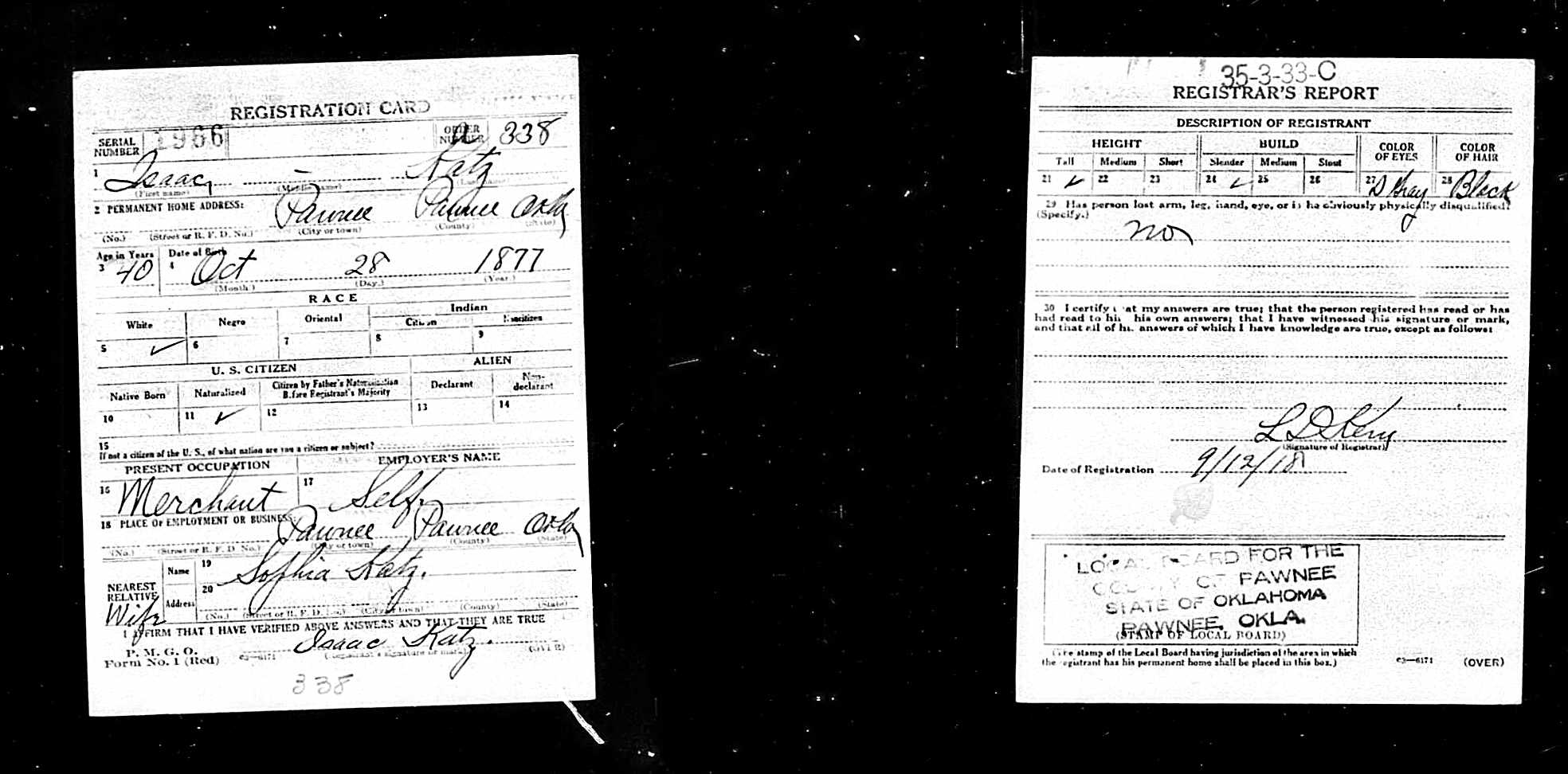
Marktplatz and church in Jesberg

Bahnhofstrasse in Jesberg

House where the Katz family lived in Jesberg in the 1930s

The brook that runs through Jesberg

We then all went to lunch in a nearby town (there was no place to eat—not even a bakery—in Jesberg), and then Harvey and I said another difficult goodbye to Hans-Peter and Mrs. Ochs and to the Kassel region.

Our days in the Kassel region far exceeded my expectations.  The friends we made and the places we saw will stay with me forever.  Yes, I wish I had better prepared for the cemetery visits, but overall I have no regrets and am so thankful that I got to visit the homes of my Hamberg, Goldschmidt, Schoenthal, and Katzenstein ancestors.  I am particularly thankful to Ernst Klein, Julia Drinnenberg, Hans-Peter Klein, Barbara Greve, and Mrs. Ochs for all their hard work and dedication, and, of course, especially to Harvey for being a willing and helpful participant in the hunt for stones in so many cemeteries.

Now we were heading south to Wurzburg and then to Schopfloch, the home of the Nussbaums