
Family stories can often lead you astray, but perhaps more often they can give you clues or corroborate evidence you’ve already uncovered. In the case of the descendants of Rahel Katzenstein and Jacob Katz, there has been a little of all three.
What I know from the research done by Barbara Greve and David Baron is that Rahel and Jacob had six children: Blumchen, Moses, Meier, Abraham, Sanchen, and Samuel. Abraham and Samuel came to the United States in the years following the Civil War, as I’ve written. But what about the other four siblings? What could I learn about them?

Fortunately, my cousin Marsha interviewed our mutual cousin Theo Goldenberg in January, 1993, about the family history. Theo Goldenberg was born and raised in Jesberg; he was the grandson of Meier Katz and came to the US in the 1930s as a young man escaping Nazi Germany. Having grown up in Jesberg with his Katz and Katzenstein relatives, Theo had first-hand knowledge of the family stories and may have been one of the the best people to ask about the siblings of his grandfather Meier.

In his interview with Marsha, Theo named five of the children of Rahel and Jacob: Blumchen, Moses, Meier, Abraham, and Samuel. He also told Marsha that there had been another daughter who drowned as a small child—presumably that would have been Sanchen, the only other daughter found by Barbara Greve or David Baron. Thus, Theo’s recollection is quite consistent with the list of names I had learned from Barbara Greve and David Baron.
Family lore, however, is that there was another son who came to the United States before Abraham and Samuel and who fought in the Civil War. The family story is that when Abraham came to the US, he went to New Orleans to look for this brother, but never found him. He was presumed to have been killed in the Civil War.
Theo Goldenberg told Marsha that he was not aware of any other son, and although I have spent a fair amount of time searching, I have found no records that support the existence of this fifth brother (nor did Barbara Greve or David Baron, both of whom have done extensive research on the family).
At first I thought perhaps Moses was this missing brother because I found a Moses Katz who came from the Hesse region and who fought in the Civil War. He survived the war and settled in Baltimore. But I could find no tie to the family of Rahel Katzenstein and Jacob Katz, and Marsha’s father Henry pointed out persuasively that if Moses had been in Baltimore, Abraham would have known and easily found him without traveling to New Orleans, especially since Abraham lived in Baltimore when he first came to the US.
Theo Goldenberg, moreover, told Marsha that Moses never left Germany. Although Marsha commented in her notes that this part of her interview with Theo was somewhat confusing, it appears that Theo told her that Moses had died as a young man after being kicked by a cow in the stomach. He had, however, been married and had had several children.
David Baron also had information about Moses Katz that indicated that Moses had married Amalia Malchen Wetterhahn in Jesberg, Germany on July 3, 1869, and had had six children born in Jesberg. I owe David a huge thank you for sending me many of the Katz records from Jesberg and also for teaching me how to find others myself. Here is one he shared with me, a death record for Moses Katz:
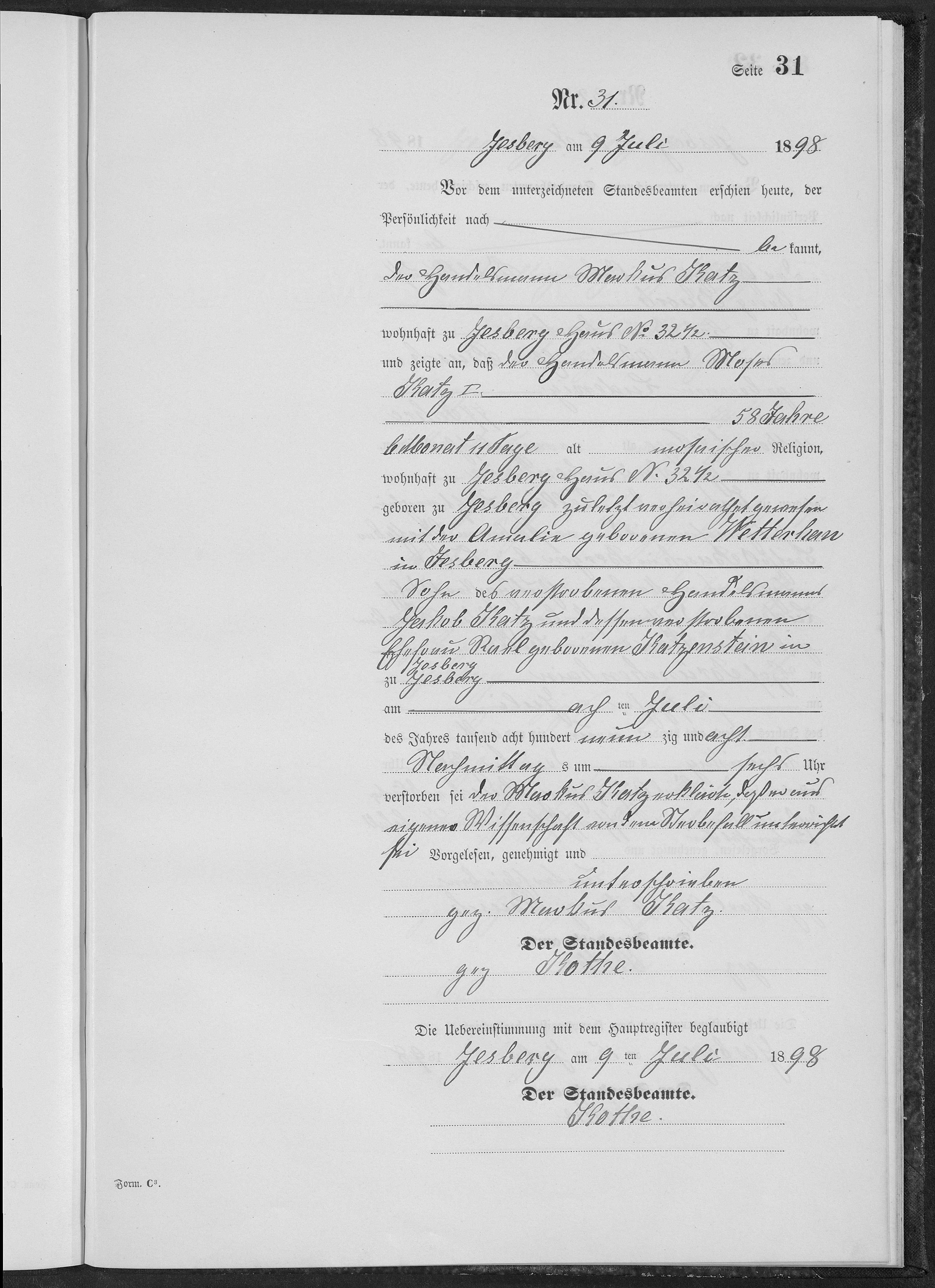
Moses Katz death record, Jesberg Hessisches Staatsarchiv Marburg: Standesamt Jesberg Sterbenebenregister 1898 (HStAMR Best. 920 Nr. 3896) Jesberg 1898, p.32
My FB friend Matthias Steinke once again helped me out and translated the document, and it says nothing about the cause of death, so the “kicked in the stomach” story will have to remain family lore. Also, Moses Katz died when he was almost sixty—so hardly a “young man.” Maybe Theo was referring to someone else in the family.
Jesberg, the 9th July 1898
To the below signing registrar came the personally known merchant Markus Katz, residing in Jesberg, house-nr 32/2, and reported, that the merchant Moses Katz, 58 years, 6 month, 11 days, mosaic religion, residing in Jesberg, housenr. 32/2, born in Jesberg, been married to Amalie nee Wetterhan of Jesberg, son of the deceased merchant Jakob Katz and his deceased wife Rael nee Katzenstein of Jesberg, in Jesberg at the 8th July 1898 past midday at 6 o’clock is deceased. The Markus Katz declared, that he knows about the death by his own knowledge. Readed, confirmed and signed Markus Katz – the registrar (signature)
I suppose it’s possible that Moses went to the US, fought in the Civil War, returned to Jesberg after the war and married Amalia in 1869. But that seems unlikely, and wouldn’t Abraham have known that his brother had returned to Jesberg?
Perhaps it was not a brother but a cousin who fought and died in the Civil War? I don’t know. But at this point I think the evidence does not support the story of this missing brother. However, the story has been passed down through the generations, and I’ve learned that in every family story there is usually some kernel of truth. I just haven’t found it yet in this story.
Nor can I verify the story about Sanchen’s drowning. If Sanchen died as a young girl, that would have been more than fifty years before Theo’s birth and so perhaps not reliable as a piece of family history (and unfortunately before the earliest Jesberg records that are kept online.) Yet such a traumatic event might very well have been reliably reported from generation to generation.
As for Blumchen, Theo told Marsha that she had stayed in Germany, married, and had not had any children. According to David Baron, Blumchen married Heskel Grunenklee of Meimbressen, Germany, and she died on March 9, 1909. Theo’s story is thus consistent with the research done by David Baron.
Theo had, not surprisingly, the most information about the children of Meier Katz, his grandfather, who died on October 29, 1925, when Theo was eleven. Unfortunately, there were no insights about Meier in the interview notes.

Meier Katz death record
Hessisches Hauptstaatsarchiv; Wiesbaden, Deutschland; Bestand: 920; Laufendenummer: 3916
Description
Year Range : 1925
Source Information
Ancestry.com. Hesse, Germany, Deaths, 1851-1955 [database on-line]. Provo, UT, USA: Ancestry.com Operations, Inc., 2016.
Original data: Sterberegister und Namensverzeichnisse. Hessisches Hauptstaatsarchiv, Wiesbaden, Deutschland.

Death record of Sprinz Jungheim Katz 1917
Hessisches Hauptstaatsarchiv; Wiesbaden, Deutschland; Bestand: 920; Laufendenummer: 3915
Meier and Sprinzchen had six children: Jacob, Aron, Seligmann, Regina, Karl, and Sol, according to Theo. I have not seen Sol listed anywhere else, and Theo had nothing more to say about him besides his name. However, there was a Salli Katz born to Meier and Sprinzchen on June 14, 1888, who died on January 10, 1892, so I assume that this is the “Sol” referred to by Theo Goldenberg.

Salli Katz birth record
Hessisches Hauptstaatsarchiv; Wiesbaden, Deutschland; Collection: Personenstandsregister Geburtsregister; Bestand: 920; Laufende Nummer: 3819
Description
Year Range : 1888
Source Information
Ancestry.com. Hesse, Germany, Births, 1851-1901 [database on-line]. Lehi, UT, USA: Ancestry.com Operations, Inc., 2016.
Original data: Geburtenregister und Namensverzeichnisse. Hessisches Hauptstaatsarchiv, Wiesbaden, Deutschland.
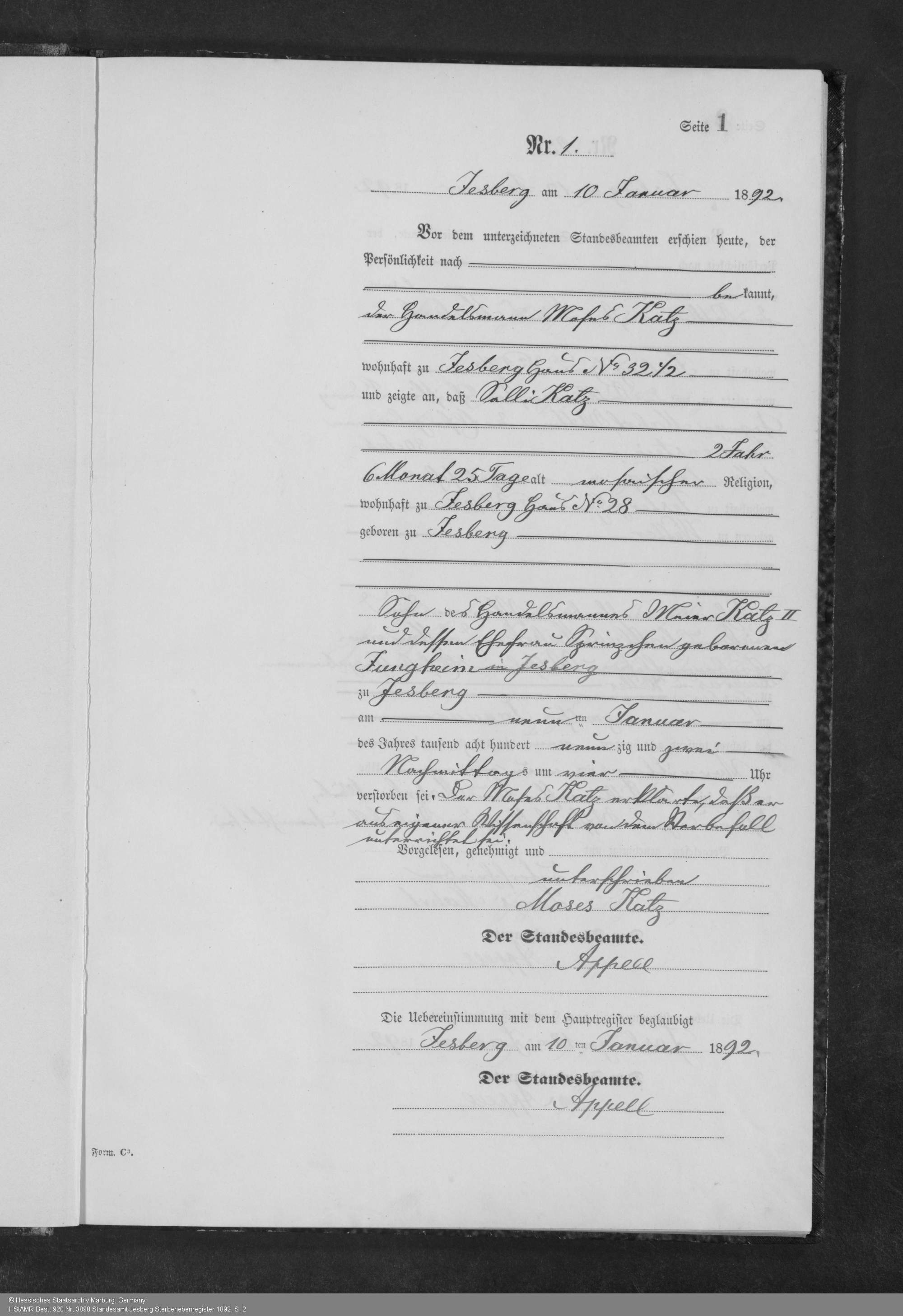
Salli Katz death record, Standesamt Jesberg Sterbenebenregister 1892 (HStAMR Best. 920 Nr. 3890)
Jesberg 1892, p.2
As translated by Matthias Steinke:
Jesberg at the 10th January 1892 – To the below signing registrar came today the personally known merchant Moses Katz, residing in Jesberg, House nr. 32 1/2 and reported, that Salli Katz, 2 years 6 month 25 days old, mosaic religion, residing in Jesberg, house nr. 28, born in Jesberg, son of the merchant Meier Katz II and his wife Sprinzchen nee Jungheim of Jesberg, in Jesberg at the ninth January of the year 1892, past midday at four o’clock is deceased. The Moses Katz declared, to know about the death by his own knowledge. Readed, confirmed and signed Moses Katz The registrar Appell
[The death record reports that Salli was two and a half years old, but based on the birth record, he was really three and a half years old.]
The other five children of Meier and Sprinzchen—Jacob, Aron, Isaac, Regina, and Karl—all survived to adulthood and all came to the United States, some as early as the 1880s, others as late as the 1930s. But fortunately they all survived. More on that in the posts to come. For now, here is a photograph of Meier and Sprinzchen and those five children:

Meier and Sprinzchen (Jungheim) Katz and children
What I learned from all this is that we all should be doing what Marsha did back in 1993; we should be interviewing the older generations in our family, asking questions and taking notes. Even if some of the information leads us on a few wild goose chases, the stories we will hear will disappear if they are not recorded. I am so grateful that Marsha had the wisdom to meet with her cousin Theo and ask him to answer her questions about the family back in 1993. If only I had done the same with my own older relatives 24 years ago…










 Brotmanblog: A Family Journey