Season’s Greetings and Thank You

The winter solstice has passed, and so every day will bring more light.  We sure do need it this time of year.  The lights added by Hanukkah and Christmas—the candles and the trees—help us all to see beyond the darkness and the cold.  And so I wish for all of you a season of lights and a time to find joy and hope and happiness.


Embed from Getty Images

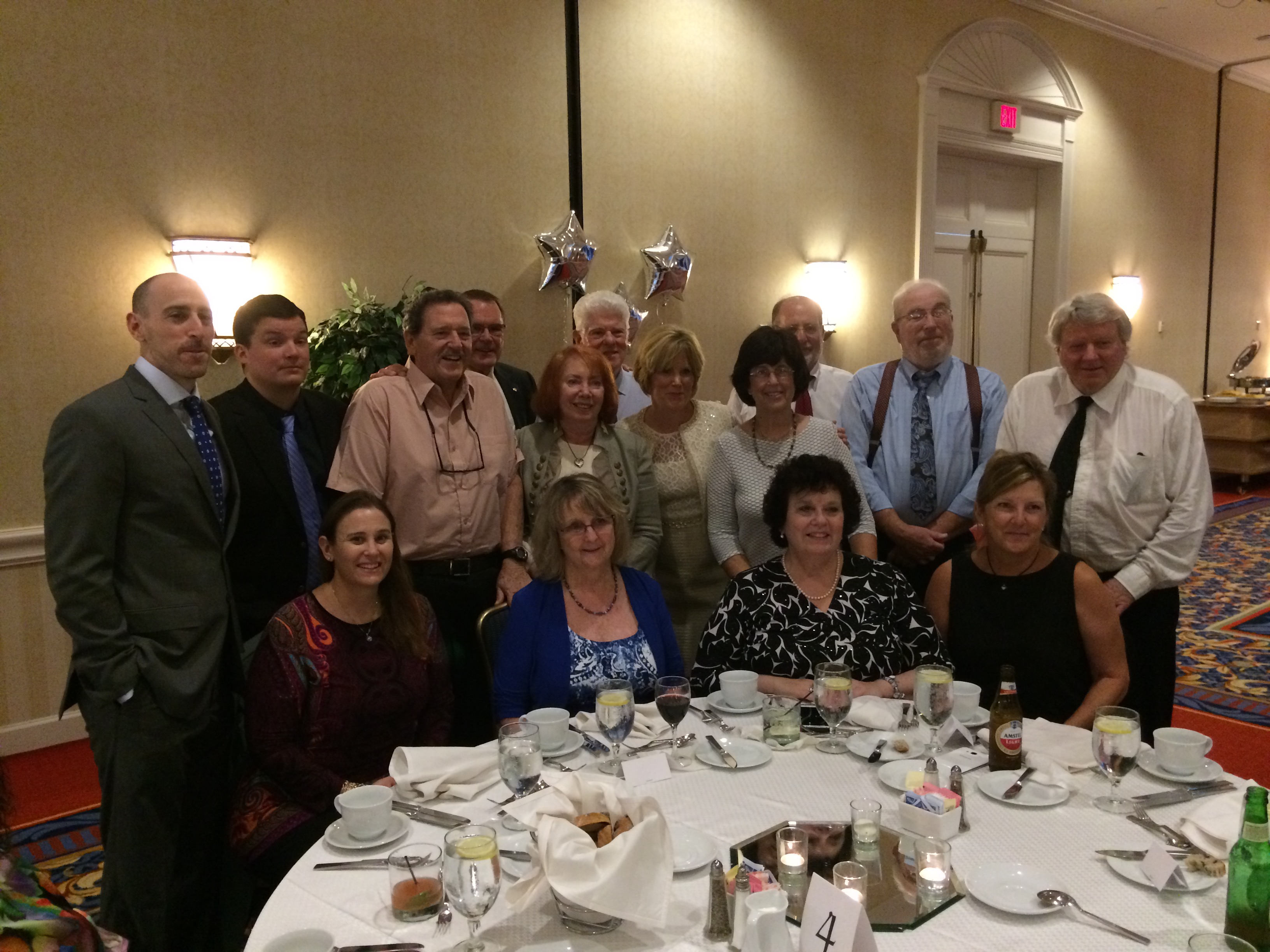
I also want to express my gratitude for all the help I’ve received this past year. I cannot express adequately how grateful I am to those cousins who shared family photographs and letters and writings so that I could see the faces behind the names I’d researched, read their own words, and get a real feel for the personality of the individuals whose lives I described.  Thank you to Ron, Steve, Sue, Lisa, Celena, Gordon, Ashley, Tracy, Ginger, Sharon and Ezra, Trisha, Maxine, and all the others who shared photographs, stories, letters, and memories of their family members.  I hope we all get to meet in person someday soon.

Empire State Building exhibiting decorative li...

Empire State Building exhibiting decorative lights for both Chanukah and Christmas. (Photo credit: Wikipedia)

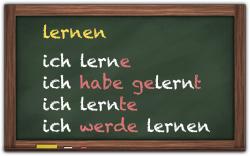
My cousin Wolfgang continued to discover and share with me information about my Seligmann ancestors and their families, which led me to the memoirs of Mathilde Gross Mayer, which inspired me to start learning German.  I am so looking forward to going to Germany and meeting Wolfgang and his family and testing my German.

I also am deeply appreciative for all the help I’ve gotten from the members of numerous genealogy Facebook groups and from my fellow genealogy bloggers.  Whether it’s helping with research or translation or reading and commenting (and finding errors) on my blog, the genealogy village continues to amaze me with its generosity and dedication.

Looking ahead to 2017, we must continue to do what we can to protect those who are most vulnerable in this country and across the world.  Looking backwards as much as I do, I’ve seen what small-mindedness, prejudice, selfishness, and greed can do to a person, a family, a society.  As we anticipate 2017, we still need to learn from the past so that we can ensure the best future for everyone and for our world.


Embed from Getty Images

On that note, I wish you all a joyous holiday season—whatever holiday you may be celebrating.  I find it particularly sweet that this year the first night of Hanukkah and Christmas Eve coincide as if the universe is telling us we all came from one source and whatever rituals or traditions or beliefs we have, in the end all that matters is that we honor and respect and love each other despite those differences.  May 2017 be a peaceful and healthy and happy year for everyone!


Embed from Getty Images


No Genealogy Today

I can’t bear to talk about the past today because I am too filled with despair about the future.  I have spent the day mourning the election results and reaching out to others who shared my desolation.  I have found myself again and again in tears, sometimes tears of grief for what has happened to our country, sometimes tears of relief when someone has touched me with words of comfort or hope.

In the aftermath of the election results, my daughter shared this photograph of my grandsons.  It made me smile and cry.  It represents all my hopes and all my fears.

nate-and-remy-november-2016

I have gone through at least the first few stages of grief—shock and denial, anger, and now depression.  (I skipped over bargaining, although I did find myself last night saying I’d accept a tie in the Electoral College).

Here’s what I posted on Facebook early Wednesday morning:

I am devastated. Don’t tell me it will all be okay. Don’t tell me to unite behind Trump. It won’t, and I won’t.

I am devastated for my daughters and all the women who believed that America would elect a highly qualified woman over an inexperienced and ignorant man.

I am devastated for all in the LGBTQ community who must see the progress of recent years hanging by a thread.

I am devastated for all people of color, all immigrants, all Muslims, who must feel even more frightened than I do.

I am devastated for those who will see their health insurance disappear.

I am devastated for our planet, which will now see nothing done about climate change.

I am devastated that nothing will be done about gun violence.

I could go on. But mostly I am devastated that my grandsons live in a country filled with so much hate and ignorance.

They say the next stage of grief is acceptance.  I won’t get to that one.  What I hope I can get to is action to fight acceptance.  We need people to unite against these forces of darkness, to work together to protect the rights of those who are most vulnerable, to preserve our rights to choice and to healthcare, to work to protect our planet and the values of free speech, freedom of religion, and freedom from discrimination.  I fear we will instead drift into acceptance.

I admit that I have no idea how we start this movement.  I am hoping that someone with more skills and experience than I have will get us mobilized. Perhaps it will be some of those who felt the Bern, perhaps some of those who fought so hard for Hillary.  Or perhaps it will be someone entirely new.

I want to be a part of whatever it takes to make this country a place where those two little boys pictured above and all those who come after them can grow up without fear and filled with love and hope and acceptance of all people. Where everyone can, regardless of race, religion, sexual orientation, gender, nationality, age, or disability.

As my husband said, our ancestors didn’t come here so that we could give up on our dreams.  We need to mourn first and then pick ourselves up and fight for what we believe.


The Work is Never Done

It’s time to move on to the next family line, although there is still so much to do on those I’ve started.  As my most recent discoveries about the Brotman line reveal, there is always more to learn, more to find. I still have collateral lines to complete in the Schoenthal family—the families of my great-great-great-aunts, Mina Schoenthal Rosenberg and Fradchen (Fanny) Schoenthal Goldschmidt. In fact, however, Fanny’s family is intertwined with the next family’s story as well.

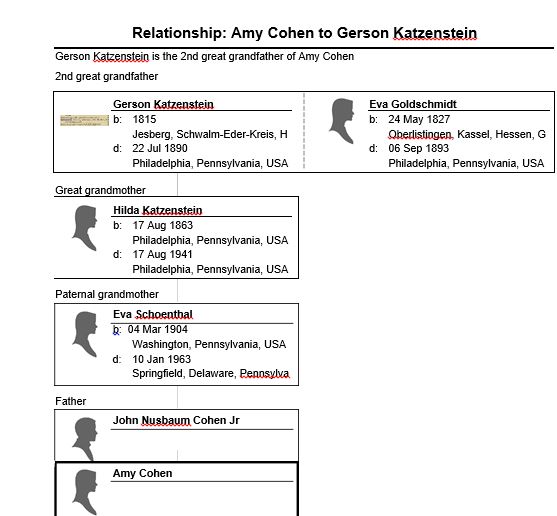
Because now it is time to turn to my remaining great-grandparent—my father’s maternal grandmother, Hilda Katzenstein Schoenthal, wife of Isidor Schoenthal and mother of my grandmother, Eva Schoenthal.  Hilda was the daughter of Gerson Katzenstein of Jesberg, Germany, and Eva Goldschmidt of Oberlistingen, Germany.  My grandmother Eva was presumably named for her grandmother, Eva Goldschmidt.

Hilda Katzenstein Schoenthal

Hilda Katzenstein Schoenthal

Just over a year ago, I wrote about the crazy twist in my family tree involving Eva Goldschmidt, my great-great-grandmother.  She was the daughter of Seligmann Goldschmidt, a brother of Simon Goldschmidt, who married Fanny Schoenthal, my great-great-grandfather’s brother.


Marriage of Simon Goldschmidt and Fradchen Schoenthal HHStAW Abt. 365 Nr. 669, S. 11

Marriage of Simon Goldschmidt and Fradchen Schoenthal
HHStAW Abt. 365 Nr. 669, S. 11

In other words, my great-grandmother Hilda was a Goldschmidt, and her husband, my great-grandfather Isidore Schoenthal, was the nephew of Fanny Schoenthal Goldschmidt and thus had cousins named Goldschmidt.  In fact, one of those cousins, Simon’s son Jacob Goldschmidt from his first marriage, was likely the first member of the extended family to settle in Washington, Pennsylvania, where my grandmother was born in 1904.   More on the Goldschmidt family tree twist here. And more on the Goldschmidt family to come.

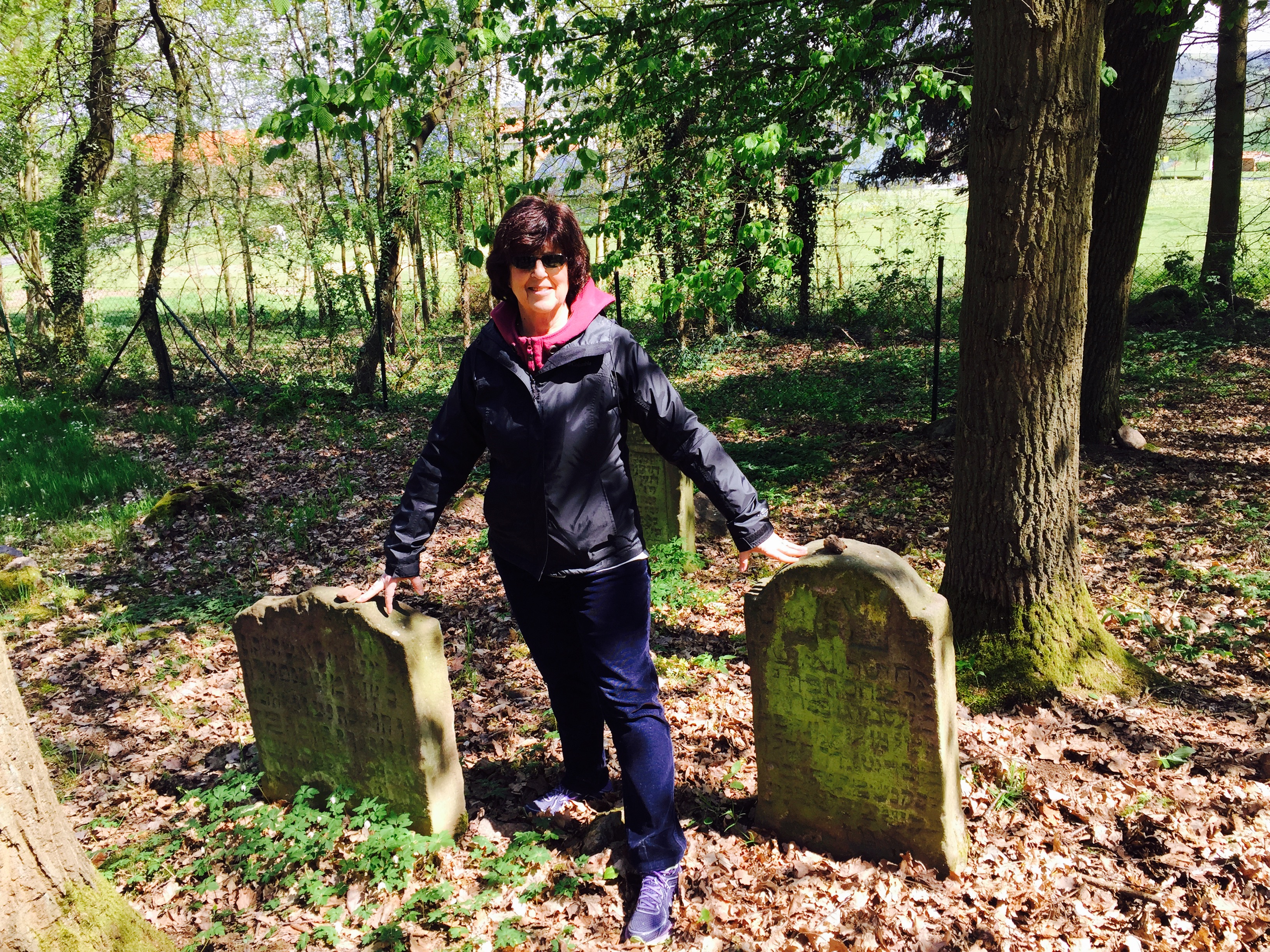
But for now I am going to focus on the Katzenstein side of my great-grandmother Hilda’s family. As I’ve indicated before, when I first started looking into my family’s history, this was the one line that had already been extensively researched by others.  Long before I started my own research, David Baron and Roger Cibella had posted their research on an old Geocities page.  And who even remembers Geocities!? Roger is my third cousin, once removed. I had contacted David and Roger years ago when I somehow fell upon their website (I don’t remember how), and was amazed that they were able to trace my family back to Gerson Katzenstein, my great-great-grandfather.gerson-to-me


And although I was fascinated by their research, I didn’t pursue it further. I hadn’t yet been bitten by the genealogy bug.

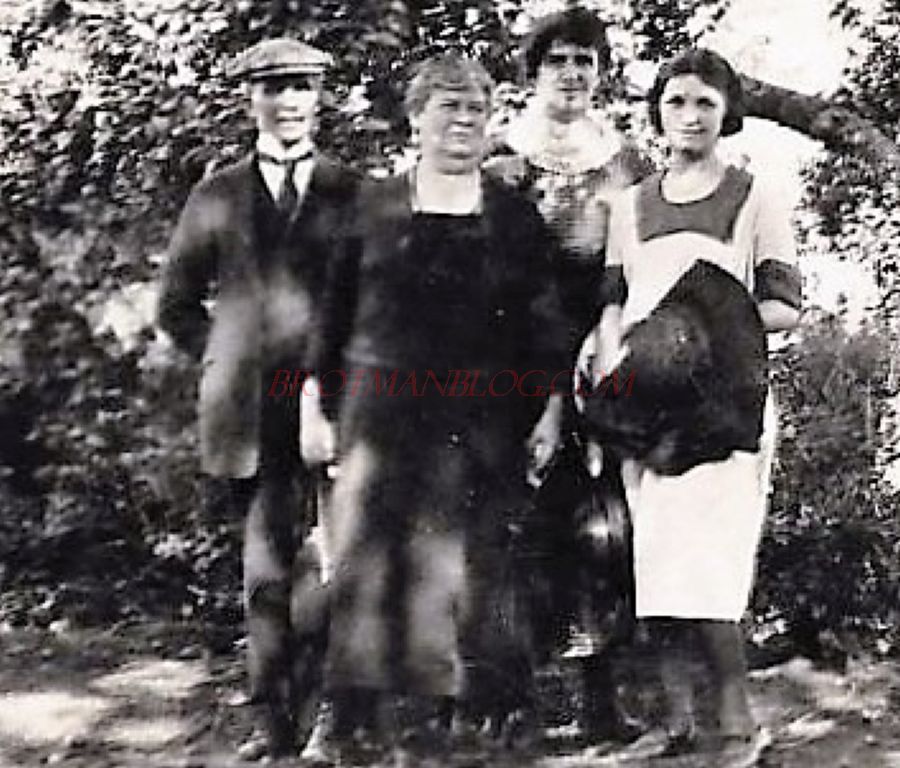
Isidore, Hilda (Katzenstein), and Eva Schoenthal

Isidore, Hilda (Katzenstein), and Eva Schoenthal

Then when I was first bitten in 2012 and started to explore genealogy on my own, I found a family tree on Ancestry that included some of my Katzenstein relatives, and I contacted the tree owner, a woman named Jennifer with whom I’ve been in contact ever since as we continue to find ways that our families overlap.  Back in June 2012, Jennifer put me in touch with an entire group of people with ties to the Katzenstein family, and from that group I also received a copy of the extensive report on the Jesberg Katzenstein family that had been done by a researcher named Barbara Greve.

Barbara Greve was born in Berlin, Germany after World War II.  As an adult, she developed an interest in the history of the Jewish communities that had once lived in the Hesse region where she now lived and taught school. She began to research those communities and what had happened to the people who had lived in them, compiling extensive information and genealogies for those Jewish families, including the Katzensteins of Jesberg. In 2010, Greve received the esteemed Obermayer German Jewish History award.  You can read more about her here.

I was both awestruck and overwhelmed by Barbara Greve’s research.  At that point in time I was a total newbie and knew nothing about genealogy research or about my family’s history.  All I had done at that point was the fourteen day free trial on Ancestry, where I had randomly searched for any name I knew from my family’s history. She had traced the Katzenstein line back another whole generation before Gerson Katzenstein to Scholum Katzenstein, my three-times great-grandfather, and included not only Gerson and his descendants, but Gerson’s four siblings and many of their descendants.  Now I could trace the family back as early as 1769 when Scholum was born in Jesberg, Germany.

family-sheet-for-scholem-meier-katzenstein

I had no idea that there were ancient records still in existence in places like Germany.  Seeing all those names and dates going back over 200 years was amazing to me.

My reaction to the Katzenstein research at that time in 2012 was—well, I guess it’s all done.  Nothing much left for me to do.  This was over a year before I started blogging.  I thought just collecting the names and dates was all I needed to do, and someone else had done it.  So I moved away from the Katzensteins and returned to the other lines where the research was not as complete.

And along the way I learned that genealogy is not just about collecting names and dates, although that is a big part of the work.  It’s also about trying to learn the stories of the lives of all those people behind the names and dates.  It’s about putting yourselves in their shoes and recognizing the legacy that we have all inherited from our ancestors.

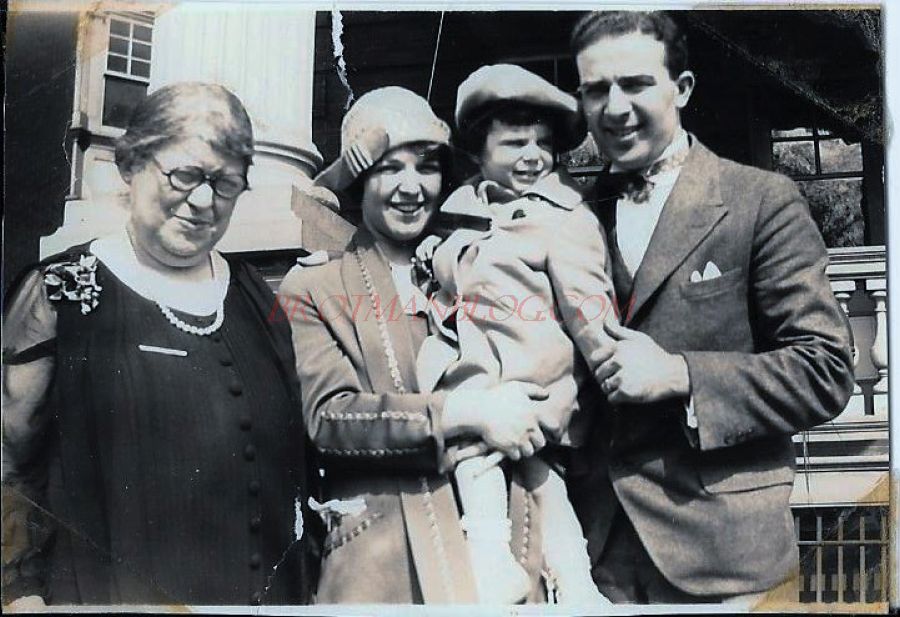
HIlda (Katzenstein) Schoenthal, Eva (Schoenthal) Cohen, Eva HIlda Cohen, and Harold Schoenthal

HIlda (Katzenstein) Schoenthal, Eva (Schoenthal) Cohen, Eva HIlda Cohen, and Harold Schoenthal

Thus, I now return to the Katzensteins knowing that there is still work to be done.  There are stories to tell about these people, questions to ask, memories to honor. The work is never done.


Mark Twain on Learning German

I am continuing to try and learn German, studying about thirty minutes a day on Duolingo, and at times I feel like I have reached a plateau.  The more words I learn, the more I forget the ones I learned just a month ago.  All those words that end in –ung and/or start with ver- are getting too hard to keep straight.  And why are there at least two words for so many things?  Sure, I know that’s true in English also, but it was a lot easier learning English when my brain was young and flexible and everyone around me spoke it all the time.  Learning German at my age without some immersion is, to the say least, a challenge.

So I took great comfort in Mark Twain’s 1880 essay, “The Awful German Language.” Vera Meyer of the Facebook group “JEWS—Jekkes Engaged Worldwide” (“Jekke” or “yekke” has various specific meanings, but most broadly refers to a person of German-Jewish background) sent me a link to Twain’s essay the other day, and it made me laugh out loud several times over.

By Mathew Brady [Public domain], via Wikimedia Commons

Mark Twain (Samuel Clemens) By Matthew Brady [Public domain], via Wikimedia Commons https://commons.wikimedia.org/wiki/File%3AMark_Twain%2C_Brady-Handy_photo_portrait%2C_Feb_7%2C_1871%2C_cropped.jpg

Twain is one of my favorite authors, but I’d never before read this essay, and if I had, I would not have appreciated it before my own struggles with German.  You can find the entire essay here and I recommend it highly, but I want to quote just a few of my favorite passages.  Favorite because I relate so well to what Twain is saying.

This complaint is one that also gives me great frustration:

Personal pronouns and adjectives are a fruitful nuisance in this language, and should have been left out. For instance, the same sound, sie, means you, and it means she, and it means her, and it means it, and it means they, and it means them. Think of the ragged poverty of a language which has to make one word do the work of six — and a poor little weak thing of only three letters at that. But mainly, think of the exasperation of never knowing which of these meanings the speaker is trying to convey. This explains why, whenever a person says sie to me, I generally try to kill him, if a stranger.

And then there is the endless battle to figure out what is the gender of a particular noun so that you know what articles, pronouns, and adjectives to use:

Every noun has a gender, and there is no sense or system in the distribution; so the gender of each must be learned separately and by heart. There is no other way. To do this one has to have a memory like a memorandum-book. In German, a young lady has no sex, while a turnip has. Think what overwrought reverence that shows for the turnip, and what callous disrespect for the girl. ….

To continue with the German genders: a tree is male, its buds are female, its leaves are neuter; horses are sexless, dogs are male, cats are female — tomcats included, of course; a person’s mouth, neck, bosom, elbows, fingers, nails, feet, and body are of the male sex, and his head is male or neuter according to the word selected to signify it, and not according to the sex of the individual who wears it — for in Germany all the women either male heads or sexless ones; a person’s nose, lips, shoulders, breast, hands, and toes are of the female sex; and his hair, ears, eyes, chin, legs, knees, heart, and conscience haven’t any sex at all. The inventor of the language probably got what he knew about a conscience from hearsay.

And then finally, Twain’s overall lament about learning German:

My philological studies have satisfied me that a gifted person ought to learn English (barring spelling and pronouncing) in thirty hours, French in thirty days, and German in thirty years. It seems manifest, then, that the latter tongue ought to be trimmed down and repaired. If it is to remain as it is, it ought to be gently and reverently set aside among the dead languages, for only the dead have time to learn it.

Alas, at my age, if it really takes thirty years, it will take the rest of my life (if I am very lucky) to learn German.

But like Mark Twain, I will continue to muddle along, at least knowing that I am in good company in my struggles.

Sliding Doors

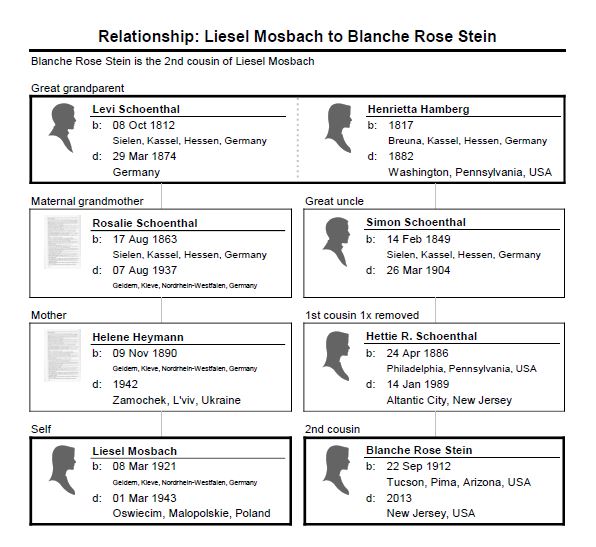
Back in April, I wrote about the family of Rosalie Schoenthal, my great-grandfather’s sister, the one who stayed in Germany to marry Willy Heymann.  Most of what I knew of their fate I learned from the memoir written by Ernest Lion, the man who married Rosalie and Willy’s granddaughter, Liesel Mosbach.  Liesel, her sister, her parents, and her aunt, were all victims of the Holocaust. Ernest Lion memorialized them all in his heartbreaking memoir, The Fountain at the Crossroad.

As I mentioned in a subsequent post written for Yom Hashoah in May, I was so moved by Ernest’s story that I tracked down his son Tom to ask about getting it published so that it could be more widely read.  Since then, I have been working with Tom to edit and format the memoir for publication.  (We’ve run into a few obstacles, but that’s a story for another day.)  I am hoping that sometime soon the book will be available for distribution. When it is, I will post the relevant information on the blog.

But none of this would be possible without the help of another of my cousins by marriage, Sharon.  Sharon is married to the great-grandson of Simon Schoenthal, who was also my great-grandfather’s brother as well as Rosalie Schoenthal Heymann’s brother.  And Sharon, who writes the blog The Heart and Craft of Life Writing, has a great deal of knowledge not only about writing, but also about getting your writing published.  Sharon and her husband were the ones who shared with me the remarkable memoir written by Hettie Schoenthal Stein.  So when I decided to try and get Ernest Lion’s book into a publishable format, I turned to Sharon for help.

Sharon spent hours through email and Skype instructing me on how to turn a typed manuscript into a format that is not only more readable, but also professional looking.  She has been incredibly patient with me, as all this was new to me, and the old brain isn’t quite as flexible as it once was.  I cannot possibly express how grateful I am to her for her help.

One of the last things we worked on was inserting photographs into the memoir, and as she was doing this, Sharon was struck by the resemblance she saw between Liesel Mosbach Lion, Ernest’s first wife and our mutual cousin, and Sharon’s mother-in-law, Blanche Stein Lippincott.  She sent me a photograph of Blanche and her family that I had not previously seen.

ezzie-blanche-parvin-1940

Blanche Stein Lippincott and her family 1940 Courtesy of the Lippincott family

And here is a photograph of Liesel Mosbach and Ernest Lion that I obtained from Ernest’s son to put into his book:

wedding-ernest-liesel-dec-18-1940-600-dpi

Liesel Mosbach and Ernest Lion Courtesy of the Lion Family


The resemblance is striking.  Blanche and Liesel were second cousins, but from these two photographs, they could have been sisters.

jpg-blanche-to-liesel


But what different lives and fates they had, and the expressions on their faces in these two photographs reflect those differences. While Blanche looks healthy and happy, Liesel looks drawn and sad, even on her wedding day.

Blanche was born in 1912 in Tucson, Arizona, and grew up living on the American frontier in the 1910s and 1920s.  Her mother Hattie and her aunt Gertrude had ventured out west after growing up in Philadelphia and Atlantic City.  They did later return to the East, as I’ve written, and Blanche spent the rest of her life living in New Jersey.  She married in 1937 and raised two children with her husband Ezra.  Blanche lived a long and happy life, making it to almost 101 years old before dying in 2013.  Her mother Hettie had made it to 103.

Blanche Stein Lippincott with her great-granddaughter 1996

Blanche Stein Lippincott with her great-granddaughter 1996

In contrast, Liesel lived a short and tragic life.  She was born in 1921 in Germany, where her father Julius Mosbach owned a fruit and vegetable stand. The family was probably living a comfortable enough life until Hitler came to power.  When Liesel married Ernest Lion on December 18, 1939, conditions for Jews were terrible in Germany, and the young couple had no idea what the future would bring.

There would, in fact, be no future. As a result of the Nazi oppression and the loss of his business, Julius Mosbach suffered a nervous breakdown; in 1941, he was sent to an institution where instead of being treated, he was murdered by the Nazis. In 1942, Liesel’s mother, sister, and aunt, and Ernest’s father were all deported and eventually killed in a Nazi concentration camp.  In 1943, Liesel and Ernest were deported to Auschwitz, where Liesel was killed.  Ernest survived and eventually escaped; he became the voice for the whole family.

Thus, Blanche and Liesel, second cousins who looked like sisters, had far different lives and fates.  I can’t help but think, what if Rosalie and Willie had come to the US like almost all of Rosalie’s siblings? What if Liesel and her sister Grete had grown up in Pennsylvania or anywhere else in the United States?

As the president of our synagogue reminded us on Rosh Hashanah, we cannot control where we are born, when we are born, or to whom we are born.  Some of us are blessed with good luck in all of those things while others are not.  We should never take that for granted.

Shana tova—A Good Year

By slgckgc (Shofar and Candlesticks) [CC BY 2.0 (http://creativecommons.org/licenses/by/2.0)], via Wikimedia Commons

By slgckgc (Shofar and Candlesticks) [CC BY 2.0 (http://creativecommons.org/licenses/by/2.0)%5D, via Wikimedia Commons

Once again the Jewish calendar is about to end one year and begin another.  I will be observing the holiday with my children and grandchildren and will not be posting again until after the holiday when I will continue the amazing story of my discovery of the Goldfarbs and the Hechts.

So before I take this time to be with my children and grandchildren and celebrate the holiday, I wanted to look back and think about what I’ve learned about my extended family during this year.  For the most part this has been the year of the Schoenthals, and what a journey it has been.  I had known very little about my paternal grandmother’s paternal family before I started researching, and they have inspired me in many ways and in some ways saddened me.

My great-grandfather Isidor Schoenthal and his many siblings were all born in Sielen, Germany, and all but two came to the United States in the second half of the 19th century and, for at least some time, lived in western Pennsylvania.  They were a large and interconnected family, and so many of them did interesting things.  Henry, the oldest brother, was a scholar and a community leader as well as his family’s leader.

Julius served in the US Army and lived in Washington, DC.  Felix was a successful businessman in the typewriter repair business; he moved to Boston.  Simon had a very large family, and his children not only ran hotels in Atlantic City; some of them settled in the wild west of Arizona, as my cousin Hettie Schoenthal Stein so beautifully described in her memoirs.

Martin Schoenthal, Gertrude Sch., Hettie Sch Blanche Walter

Martin Schoenthal, Gertrude Schoenthal, Hettie Schoenthal Stein, Blanche and Walter Stein

Amalie Schoenthal married Elias Wolfe, a cattle drover, and they raised a large family.  Amalie moved to Ohio after her husband died. Hannah Schoenthal Stern survived being widowed at a young age and came to Pennsylvania with her young children and raised them on her own in a new country.

Jennie Stern Arnold, center, and perhaps Sarah Stern Ostreicher on the right and Edith Stern Good on the right

Jennie Stern Arnold, center, and Sarah Stern Ostreicher on the left and Edith Stern Good on the right

And my great-grandfather himself was a pioneer—first moving to Pennsylvania, and then moving his family from the small town of Washington, Pennsylvania, to Denver, Colorado so that his asthmatic son would have a better place to live.

Isidore Schoenthal

Isidor Schoenthal

These were adventurous and interesting people who were willing to take risks in order to secure better lives for them and their family.  I’ve had the pleasure of connecting with a number of their descendants—my cousins Steve, Ron, Jacquie, Maxine, Elaine, Linda, Sharon and Ezra, and Betty, who passed away just this summer.

But not all the Schoenthal siblings left Germany, and the fate of the children of Jakob Schoenthal and of Rosalie Schoenthal Heymann broke my heart.  One of my most meaningful new projects is the work I am doing with Tom Lion (with the invaluable help of my cousin Sharon, also a Schoenthal cousin) to ensure that the memoir of Tom’s father Ernest Lion is preserved and made as publicly accessible as possible.  Ernest’s first wife, Liesel Mosbach, Rosalie’s granddaughter, was killed during the Holocaust as were her parents, her aunt, and his sister; Jakob Schoenthal’s daughter Henriette Schoenthal Levi and her husband were also murdered by the Nazis.  Other family members were forced to uproot themselves, lost everything, but somehow survived and started over in a new country.  They were all my cousins.

Liesel Mosbach Lion alone and in wedding picture with Ernst

Liesel Mobach and Ernest Lion

I also learned about more of my Seligmann relatives—Mathilde Gross Mayer, her parents, her siblings, and all of their children.  They also endured the Holocaust, some of them escaping in time, others being murdered by the Nazis.  Mathilde’s book motivated me to start learning German so that I could better understand her life and her experiences.  And along the way I also found another living descendant, my cousin Susan.

Mathilde Gross from Judische Bingen site

Mathilde Gross Mayer

But most of my experiences this year have been uplifting. I had the pleasure of connecting with and meeting my cousin Rob, a Hamberg descendant.  I still haven’t told the whole story of the Hamberg family, but my great-great-grandmother Henriette Hamberg Schoenthal had a large family, most of whom unfortunately stayed in Germany.  Their story is yet to come.  But I was able to explore the story of Amalia Hamberg Baer, whose children founded the Attleboro jewelry company today known as Swank.  And I have been fortunate to connect with two of the descendants of Amalia Hamberg and Jacob Baer.

Wedding photograph of Flora Baer and Julius Adler, March 15, 1915 Courtesy of the Adler family

Wedding photograph of Flora Baer and Julius Adler, March 15, 1915
Courtesy of the Adler family

And now in the past week or so I have returned to the Brotman story as I’ve discovered new connections and new members of my maternal grandmother’s extended family, the Goldfarbs and the Hechts.  More on that to come after the holiday.  That work also has given me the blessings of new cousins like Sue, Lisa, Debrah, and Jan.

So when I look back on the year, I don’t just see all those people from the past.  I see all the people who are my cousins, many of whom I never knew before.  Some of us are as distant as fifth cousins, some as close as a second cousin, once removed.  But without exception these new cousins have added joy and a sense of fulfillment to the work I am doing to tell the story of my family—their family—our family. There is nothing that makes me feel better about doing this than when one of these newly found cousins thanks me for finding the story of their ancestor’s lives.  I never really think that I am doing this for others since I personally get so much out of doing it, but the excitement that others have expressed to me about my work makes it ever so much more worthwhile.

What lies ahead in my research? In this coming year I hope to be able to learn about the last of my great-grandparents.  I have researched seven out of the eight so far, and although I still have more to learn about the families of Joseph Brotman and Bessie Brod, Moritz Goldschlager and Ghitla Rosenzweig, Emanuel Cohen and Eva Seligmann, and Isidore Schoenthal, I’ve not even started to tell the story of my remaining great-grandparent, my father’s maternal grandmother Hilda Katzenstein.  She was the daughter of Gerson Katzenstein and Eva Goldschmidt, and their stories will likely be the next major research project on my list.

Hilda Katzenstein Schoenthal

Hilda Katzenstein Schoenthal

May all of my cousins, newly found and otherwise, and all of my family and friends and fellow genealogy researchers and bloggers be blessed with a sweet, healthy, and happy New Year.  And may all those who came before us be remembered with honor and gratitude. Shana tova! A good year for all!

By Gilabrand (Own work) [CC BY-SA 3.0 (http://creativecommons.org/licenses/by-sa/3.0)], via Wikimedia Commons

By Gilabrand (Own work) [CC BY-SA 3.0 (http://creativecommons.org/licenses/by-sa/3.0)%5D, via Wikimedia Commons


Imprisoned on the Isle of Man

Some of my readers were disturbed, as was I, to learn that England imprisoned Jewish refugees in internment camps on the Isle of Man during World War II; one of those imprisoned was my cousin Ilse Gross, daughter of Karl Gross, as I wrote about here.

By one of those strange incidences of serendipity, someone on the JewishGen listserv and on one of my Facebook groups today posted a link to a recent story on the B’nai Brith International website about these camps.  It gives a much fuller picture of the history of the camps, what conditions were like, and why England did this.  It demonstrates how fear can lead us to do things that are fundamentally unfair and discriminatory, judging people by their race, religion, or national origin.

Here is one excerpt from the article.  You can find the rest here:

On May 27, 1940, Isle of Man residents gathered behind barricades at the docks, witnessing the arrival of the first 823 prisoners. Leaving the boat under armed guard, they included German Nazi sympathizers, mixed in with Jewish men in their 20s and 30s, as well as a few school boys, conspicuous in short pants. They would set the pattern for those coming in the next weeks and months, assigned to camps located in Ramsey, Douglas, Onchan and other seaside spots. Cleared of tourists, ordered to leave behind their sports equipment for the inmates, quaint Victorian rooming houses and private hotels were grouped together and ringed with barbed wire to form compounds. In some, Jews and Nazis shared the same spaces.

Additional information can be found at the following links:

https://en.wikipedia.org/wiki/Hutchinson_Internment_Camp

http://timewitnesses.org/english/IsleOfMan.html

My Cousin Ben’s Bar Mitzvah

I was privileged last weekend to experience something I never would have been able to share if I hadn’t started on this genealogy journey over four years ago.  If you’ve been reading this blog for a while (or even just know its title), then you know that the first family I researched was that of my maternal grandmother, Gussie Brotman.  From my mother and my aunt, I knew some of the names of my grandmother’s siblings—Hymie, Tillie, Frieda, and Sam. And eventually I found three of her half-siblings as well—Abraham, David, and Max.

Gussie Brotman

Gussie Brotman, my grandmother

But my mother had long ago lost touch with her cousins, the children of her mother’s siblings, and had no idea in many cases of their names, let alone their whereabouts.  So I set out to find them, and as I’ve described elsewhere, the first two long lost cousins I located just about four years ago were my second cousin Judy, granddaughter of Max Brotman, and my second cousin Bruce, grandson of Hymie (Herman) Brotman. From Judy and Bruce, I learned so much about the family and also was able to find all my other Brotman second cousins.

Max Brotman

Max Brotman, my great-uncle

Hyman Brotman

Hyman Brotman, my great-uncle

A little over three years ago, some of the grandchildren of Hyman Brotman and some of my grandmother’s grandchildren met in New York City and had a wonderful reunion—or more accurately for some of us—a first meeting.  It remains one of the most rewarding and exciting experiences I’ve had since starting to research my family history.  And thanks to the miracle of email and Facebook, I’ve managed to stay in touch as best I can with many of these new second cousins.

Celebrating Ben's bar mitzvah---the Brotman cousins, all descendants of Joseph Brotman and Bessie Brod

Celebrating Ben’s bar mitzvah—some of the Brotman cousins, all descendants of Joseph Brotman and Bessie Brod, and their spouses

So I was thrilled and honored to be invited to the bar mitzvah of my cousin Benjamin—my second cousin, once removed.  As I sat in the sanctuary of his family’s friendly congregation, I marveled at the fact that I was sitting in this place with many of my second cousins, sharing in a Jewish tradition that dates back long before the time when our great-grandparents lived in Galicia.  What would our great-grandparents Joseph Brotman and Bessie Brod have thought about this whole thing?

Bessie Brotman

Bessie Brotman, Ben’s great-great-grandmother

As Ben led us through the prayer that includes the phrase L’dor v’dor, from one generation to another, I got goosebumps. I realized that our great-grandparents could have sat in that sanctuary and felt very comfortable, hearing prayers that would have been just as familiar to them as they are to me and as they are now to Ben.  Would our great-grandparents have ever expected that over 120 years after they came to the United States their great-great-grandchildren would still be learning these ancient prayers, reading from the Torah, and chanting the Haftorah?

Surely they would have been amazed to see that sharing in this experience in the synagogue that morning were not just other Jewish people, but people of all different  faiths and backgrounds, all learning from the wonderful rabbi about Jewish practices and values. Everyone was welcome, and everyone there wanted to be there.

Joseph and Bessie would likely smile to think that they had made the right decision coming to the US, despite all their travails, because today in 2016 not only do their ancient traditions survive, they also can be practiced openly in creative, inclusive ways without fear of persecution.

L’dor v’dor.  The family and the traditions continue.  Mazel tov, Ben!

(I just realized this is my 500th post on Brotmanblog—how appropriate!)


Fallen Leaves

I admit that I have been putting off this blog post.  Because it makes me sad.  One of the great gifts I’ve experienced in doing genealogy is learning about and sometimes having conversations with older people whose memories and lives can teach us so much.  The downside of that is that I am catching them in the final chapter in the lives.

In the past year or so, four of my parents’ first cousins have passed away.  I already wrote about my mother’s first cousin, Murray Leonard, born Goldschlager, son of my grandfather’s brother David Goldschlager.  You can see my tribute to Murray here, in case you missed it.

Murray Leonard older

Murray Leonard

Murray Leonard

David and Murray Goldschlager

David and Murray Goldschlager

Two of my mother’s other Goldschlager-side first cousins also died in the last year: Frieda Feuerstein Albert and Estelle Feuerstein Kenner, who were sisters and the daughters of Betty Goldschlager, my grandfather’s sister, and her husband Isidor Feuerstein.

Frieda died on July 30, 2015; she was 93. Frieda was born in New York on April 21, 1922. She married Abram Albert in 1943, and in 1957, they moved with their children to Arizona, where Abram opened a bedspread and drapery store in Phoenix. He died in 1991, and Frieda continued to live in Phoenix until her death last summer.

Frieda and Abe

Frieda and Abe

Frieda and Abe Albert at their wedding in 1943

Frieda and Abe Albert at their wedding in 1943


Her younger sister Estelle died almost three months ago on May 16, 2016.  She was 86 years old and had been living in Florida for many years.  She was born May 15, 1929.


courtesy of Barry Kenner

courtesy of Barry Kenner

Estelle

Estelle

Estelle Feuerstein, Betty's daughter

Estelle Feuerstein, Betty’s daughter

Estelle and Frieda each had three children who survive them—six second cousins I’d never known about until I started doing genealogy research.

I never had a chance to speak to either Frieda or Estelle, but have been in touch with some of their children.  My mother recalls Frieda and Estelle very well, although she had not seen them for many, many years.  She remembers them as beautiful young girls coming to visit her family in Brooklyn when they were living out on Long Island.

The other cousin who died in the past year was my father’s first cousin, Marjorie Cohen.  I wrote about my wonderful conversations with Marjorie here.  She died on July 6, 2015, but I did not learn about it until quite recently.  She was just a few months shy of 90 when she died, and she was living in Ventnor, New Jersey, near Atlantic City, where she had lived for almost all of her adult life after growing up in Philadelphia.  She was born on October 15, 1925, the daughter of Bessie Craig and Stanley Cohen, my grandfather’s brother.

Arthur Seligman, Marjorie, and Eva May Cohen, 1932 Atlantic City

Arthur Seligman, Marjorie, and Eva May Cohen, 1932 Atlantic City

Marjorie Cohen with Pete-page-001 Marjorie model 2-page-001

According to her obituary,

She was a graduate of the Sacred Heart School in Philadelphia and Trinity College in Washington, DC. For 33 years she served as the Director of the AAA Mid-Atlantic Travel Agency in Northfield. During her time with AAA she escorted both cruises and tours throughout the world. In 1978, she was the recipient of the Contemporary Woman of the Year Award for outstanding community involvement by McDonald’s Restaurant and radio station WAYV. Upon retirement she became actively involved in volunteer work with the Atlantic City Medical Center, RNS Cancer and Heart Organization, the LPGA Annual Golf Tournament and served as a Hostess with the Miss America Pageant for a number of years. Throughout her life, she had a deep and abiding love for all animals and was a generous supporter of the Humane Society.  (Press of Atlantic City, July 9, 2015.)

I am so grateful that I had the chance to talk to Marjorie, and I am filled with regret that I never was able to get to Atlantic City to meet with her as I had hoped.

These losses remind me once again how important it is to find my extended family members, especially those whose memories run back the longest.  I wish I had had the chance to meet all of these cousins, and now it is too late.


The Rest of the Trip: Thoughts on My Country

This post was originally written before the horrific event in Orlando, Florida, last weekend.  I’ve rewritten it in part as I reflect on what is happening in the US these days and how the opportunity to see another part of the country affected my views.

The Road to Taos, Taos, and the Road Back to Denver

Because we had taken the “low road” or “river road” from Taos south to Santa Fe when we arrived, we decided to take the “high road” back to Taos when we left Santa Fe.  Although some commenters on TripAdvisor had made it seem as if this was going to be a very scary ride, it wasn’t at all.  It was, however, incredibly scenic.

20160529_155217874_iOS 20160529_155224179_iOS


We stopped at the Santuario de Chimayo on our way.  It is an important Catholic pilgrimage site and a pretty adobe church on lovely grounds.  I was particularly taken by this painting, which reminded me of Da Vinci’s Last Supper; the people surrounding Jesus are quite obviously Native American and Spanish in their ethnicity.

20160529_155639759_iOS 20160529_155900091_iOS 20160529_160352596_iOS

We continued north, and the scenery just got better and better.

20160529_162335775_iOS 20160529_162400407_iOS 20160529_162405596_iOS 20160529_164016050_iOS 20160529_171800829_iOS 20160529_171803732_iOS 20160529_171856537_iOS 20160529_171901440_iOS

Finally, we arrived in Taos.  As you can see, there was some kind of motorcycle event going on that weekend, and everywhere we turned, we saw and heard motorcycles.

20160529_192103172_iOS 20160529_195841501_iOS 20160529_200641449_iOS 20160529_200649572_iOS 20160529_200758531_iOS


Taos is actually quite a small town, and we realized pretty quickly that we had seen a good part of the town when we’d stopped to stretch our legs on our way south to Santa Fe four days before.  In fact, Taos seems like a down-sized version of Santa Fe.  There is a plaza and even a hotel called La Fonda on the plaza.  There is an old street called Ledoux Street that has some galleries and historic homes, like a much smaller version of Canyon Road in Santa Fe.

20160529_201206084_iOS 20160529_201314077_iOS 20160529_201405292_iOS


On the outskirts of Taos, a few miles south of the town, there is a church named for St. Francis, just as in Santa Fe.  This one, however, is an adobe church, and it has been painted by Georgia O’Keefe and photographed by Ansel Adams.  You can see why even in my photographs.  The way the light hits the various planes of the church’s exterior gives it a sculptural feel that goes beyond its architectural and religious aspects.

20160530_151004562_iOS

20160530_150420390_iOS 20160530_150519660_iOS 20160530_150611622_iOS 20160530_150756429_iOS 20160530_151039002_iOS

The scenery around Taos also makes you stop and appreciate where you are:

20160530_155656274_iOS 20160530_160844320_iOS 20160530_161007594_iOS 20160530_161017502_iOS 20160530_161029211_iOS

Despite its small size, Taos has four museums that we found well worth visiting.  Two reflected the importance of Taos as an art center.  First, on Ledoux Street, we visited what was once the home of the artist Ernest Blumenschein[1] and is now a museum of his works and those of his wife Mary Shepherd Greene Blumenschein and his daughter Helen Greene Blumenschein. Ernest Blumenschein was one of the founders of the Taos Society of Artists in 1915 and is considered one of those who drew other artists to Taos, making it an important art center.  Blumenschein himself was considered one of the leading artists in the Taos art community.

English: Ernest and Mary Blumenschein, New Yor...

English: Ernest and Mary Blumenschein, New York, 1910. (Photo credit: Wikipedia)

I’d never heard of any of the Blumenscheins before, and although their art was worth seeing, what was more interesting to me was the house itself.  It was created from what had once been a fortress surrounding the town made up of interconnecting rooms.  Over time the Blumenscheins acquired a fair number of these rooms for their home.   The rooms are all connected end to end (with a few exceptions), and it was interesting to see how the family had decorated them and turned what had been a fort into a home.

20160529_201442719_iOS

The second museum we visited was also on Ledoux Street, the Harwood Museum of Art, where we saw a really fascinating exhibit about Mabel Dodge Luhan, another person whose name was unfamiliar to me, but whose life was quite remarkable.   As described on the brochure for the exhibit, Mable Dodge Luhan (1879-1962) “brought modern art to Taos, New Mexico, putting it on the national and international maps of the avant-garde and creating a ‘Paris West’ in the American Southwest.”  Among those whom she invited to Taos were Georgia O’Keefe, D.H. Lawrence, Edward Weston, Martha Graham, and Ansel Adams.


Carl Van Vechten, Portrait of Mabel Dodge Luha...

Carl Van Vechten, Portrait of Mabel Dodge Luhan (1879-1962), 1934 (Photo credit: Wikipedia)

Mabel was born in Buffalo, New York, and lived in Paris, where she met her first husband, Edward Dodge, and then in Florence, where she and her husband established a salon attended by Gertrude Stein and many other artists and writers of the early 20th century.   When she and her husband returned to New York City, they established another salon and became instrumental in introducing modern art to the United States in the 1910s.  Mabel left her first husband for John Reed (subject of the movie Reds) in 1913, and in 1915 she established the Elizabeth Duncan [sister of Isadora] School of Dance in Croton-on-Hudson, New York (where 50 years later I would go to a music and arts camp).

English: John Reed, American journalist and ra...

English: John Reed, American journalist and radical political activist, c. 1917. Portrait published in USA prior to 1923, public domain. (Photo credit: Wikipedia)

Mabel then met her second husband, Maurice Sterne, and spent the summer of 1915 with him in Provincetown (a town I know well, having visited there every year since I was ten years old).  She and Sterne married in 1917 in Peekskill, New York (where my husband and I were married just about 60 years later and almost 40 years ago).  Shortly after, Mabel and Maurice moved to Taos, where she lived for most of the rest of her life.  She married her third husband, Tony Luhan, in 1923, and that relationship seemed to endure for the remainder of her life.  She died in 1962 and is buried in Taos.

I was tickled by the number of geographic parallels Mabel and I shared (Croton, Provincetown, Peekskill), and the exhibit was very effectively organized to show the impact she had on Taos by displaying works of the artists she drew to Taos and various quotations and other writings by or about Mabel and her role in the Taos art community.

In the other two museums we visited we learned more about the general history and culture of the region.  First, at the Kit Carson Home & Museum, we learned something about the real man behind the myth of Kit Carson (1809-1868).  Although he is best known for his role as a trapper and scout who helped with the exploration of the American West, he was also a family man.  He was married three times, each time to a Native American woman.  His first wife, with whom he had two daughters, died; his second marriage did not last; his third marriage to Josefa in Taos lasted until his death.  With Josefa he had eight children; Josefa died in 1868 giving birth to the eighth, and Kit died just a month later.

Christopher 'Kit' Carson (1809-1868), American...

Christopher ‘Kit’ Carson (1809-1868), American explorer (Photo credit: Wikipedia)

Although Kit Carson is known as someone who fought in many battles against the Indians, he also served as an agent for the Native Americans in the Taos area. However, he is known for leading the relocation of the Navajo people from Arizona to New Mexico at Bosque Redondo.  I found this description of that event and Carson’s role in it quite disturbing:

Although his orders were to capture women and children and kill all men, Carson chose to disregard the orders.  He ultimately gained the submission of the Navajo people by destroying their food sources at Canyon de Chilly.

Escorted by U.S. troops, over 9,500 men, women and children were led on foot to Bosque Redondo, a reservation in New Mexico 400 miles from their homes.  The march was brutal and many Navajo died on The Long Walk.

Realizing the utter failure of the Bosque Redondo reservation, Carson was influential in urging Congress to grant permission to the Navajo peoples to return to their homeland in 1868.  Today there is a memorial to the Navajo people at Bosque Redondo.

[From the guide to the Kit Carson Home & Museum]

20160530_161624617_iOS 20160530_161752548_iOS

Thus, Carson had conflicting roles and relationships with the Native American people. He married three Native American women, but he also fought to take the land from Native American people.  He led a forced relocation of the Navajo people, but then acted as their agent and argued to obtain permission for them to return to their original land.

Finally, we visited the Millicent Rogers Museum.  Millicent Rogers (1902-1953) was another name that I’d not heard before.  Her grandfather Henry Rogers founded Standard Oil with John D. Rockefeller; she herself was an artist and a collector, and she moved to Taos in 1947 in the aftermath of a relationship with Clark Gable.  She designed jewelry, and she supported the artistic careers of many Native American and Hispanic artists.  The museum not only displays her own work, but also (and primarily) the work of those local artists.  I found an exhibit comparing Native American weavings with Hispanic weavings quite interesting as it showed how the two styles influenced each other over time.  An exhibit of baskets revealed how different tribes used different basket making techniques and styles.

Decorated bowl from the ruins of the former Ho...

Decorated bowl from the ruins of the former Hopi village of , circa 1400-1625 AD; now located at the Millicent Rogers museum in Taos, New Mexico (Photo credit: Wikipedia)

The following photos were taken on our way to the Millicent Rogers Museum, as we started our drive north from Taos towards Colorado.

20160530_183637143_iOS 20160530_183640812_iOS 20160530_184106519_iOS 20160530_184157236_iOS


From these four museums, I developed a perspective not only on Taos, but on art, culture, and history.  All four museums focused on how individuals can influence history and culture and effect changes in both: Carson, through his explorations and through his role in the mistreatment of Native American peoples; Blumenschein, Luhan, and Rogers through their efforts to support and encourage the creation of artistic works.  Rogers helped to preserve the local culture of the Native American and Hispanic communities in and near Taos.

I also was struck by the painful disparities that exist in this country: people who have incredible wealth and power or perhaps just one or the other, like Carson, Blumenschein, Lujan, and Rogers, and people who are poverty stricken and powerless.  People who abuse their power and people who use their power for good cause.  People who respect the diversity and cultures of others and people who believe that only they know what is right and good.

Traveling back from Taos to Denver, we again marveled at the open spaces, the gorgeous vistas, the limitless sky.  The views from the Rio Grande Bridge north of Taos are breathtaking.  Crossing through the mountains east of Fort Garland was incredibly uplifting.

20160530_194224062_iOS 20160530_194308508_iOS 20160530_194418843_iOS 20160530_215505394_iOS 20160530_215508430_iOS 20160530_215535790_iOS 20160530_215722186_iOS 20160530_220330167_iOS

Looking back on this trip and all that we saw, especially in light of what is happening across this country, I am struck by the contrasts and incongruities that riddle our nation. This is such a beautiful country.  Everywhere you look, there are sights to inspire you and make you realize how small we are and how majestic nature is.  Everywhere you go, there are signs that we human beings recognize that beauty, that majesty, especially in the art we are inspired to create and to appreciate.

But there is also much ugliness in us, so much hate and disrespect and intolerance. There is not enough understanding of diversity; there is not enough empathy for those who live in poverty and feel powerless.  There is too much ignorance and prejudice.

In light of this weekend’s hate-filled massacre in Orlando, in light of the electoral process which has produced a candidate who promotes hate and intolerance, in light of the continuing paralysis in our government over issues like gun control and climate control and so many other critical issues, it is hard not to feel hopeless and disgusted and despair about our country.

But then I look back on my photographs and remember all that we saw and felt and learned, and I remember that people can appreciate each other and can be sensitive and tolerant.  People can be filled with awe and inspiration and love and respect.  Yes, we have much to be ashamed of in our history, but we also have much that should give us pride. We have moved forward in many ways. In my own lifetime, I’ve seen much social progress; the civil rights movement, the women’s movement, the LGBT movement, and the environmental movement have all had major impacts on our society, making this a better place for all of us to live.

We can make the right decisions. Yes, too often we have chosen the wrong path. But I want to believe that we can more often do what is right—that we can live in peace, that we can love and respect one another, and that we can appreciate the beauty that surrounds us all, inside and outside.


[1] Blumenschein was born in Pittsburgh in 1874, and his father was a German immigrant.  I wondered whether his family had any Jewish roots or whether he might have crossed paths with my Schoenthal relatives in Pittsburgh, but I’ve found nothing to support either notion.