The Legacy of Thekla Blumenfeld Gruenbaum: Family Photos

I mentioned in my last blog post that I have recently connected with another cousin, Robin Kravets, the great-granddaughter of Thekla Blumenfeld Gruenbaum. Robin is my fifth cousin, once removed. We are both descendants of Abraham Blumenfeld and Geitel Katz, Robin through their son Moses and me through their daughter Breine.

Robin has generously shared with me a collection of photographs of her family, and I am delighted to be able to share them with you. All the photos in this post are courtesy of my cousin Robin. I am providing a summary of what I posted two years ago about Robin’s direct ancestors to provide context to the photos and to add some additional insights Robin shared with me. The blog posts from 2021 contain more details and my sources.

Salomon Blumenfeld, Robin’s great-great-grandfather, first married Caecilie Erlanger, but she died when she was only 24 years old, leaving behind two very young children: Thekla (Robin’s great-grandmother), not yet two, and Felix, just seven months old. Two years after his first wife Caecilie died, Salomon married Emma Bendheim and had a third child, Moritz, in 1877. And then sometime within the next five or six years, Salomon left Germany for Spain with Emma and Moritz, leaving his first two children, Thekla and Felix, behind. As best I can tell, Thekla and Felix, still both young children, must have been raised by their mother’s family, the Erlangers, in Marburg.

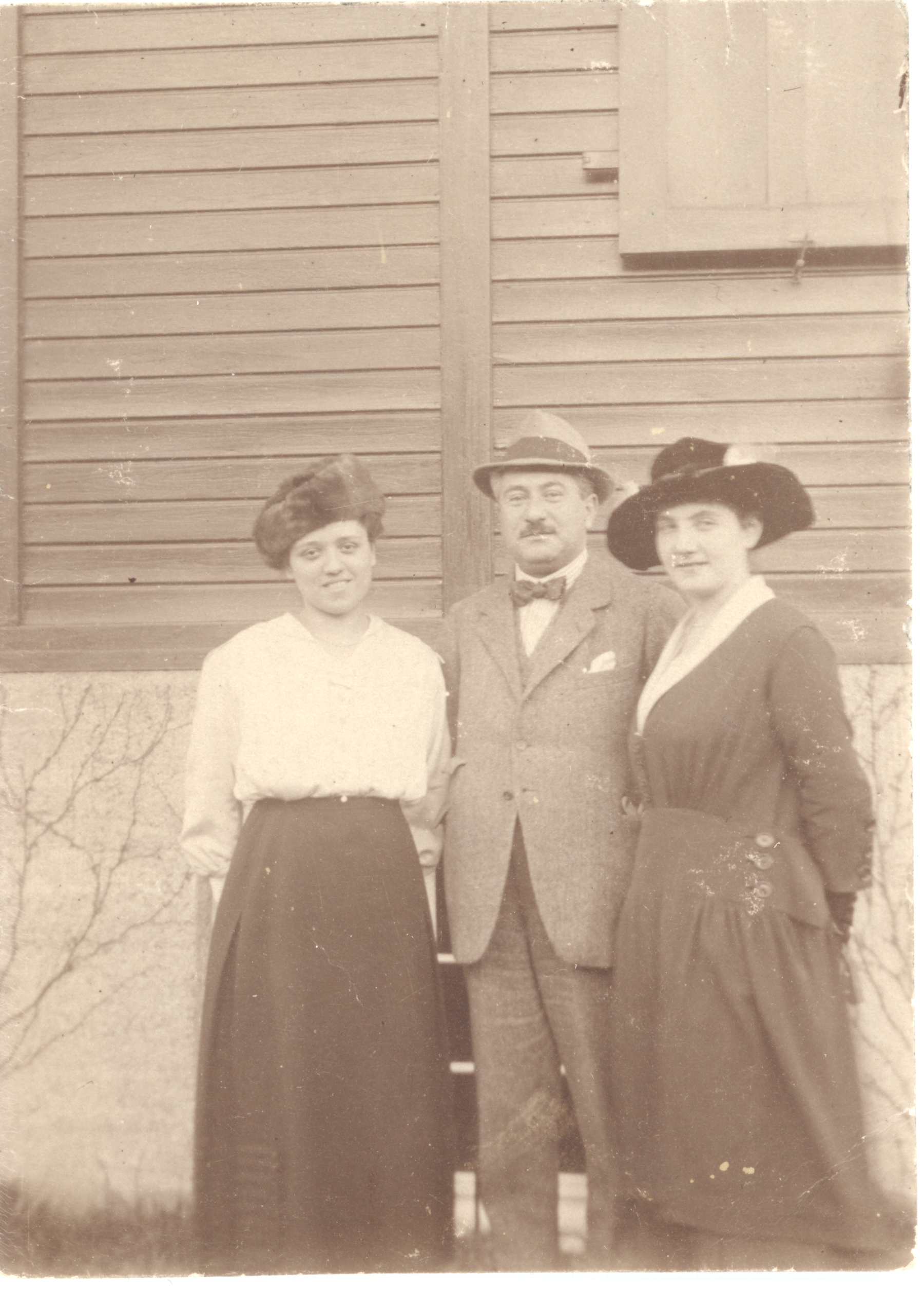
I had wondered whether Salomon or his son from his second marriage, Moritz, had remained in touch with Thekla and Felix. Robin provided this photograph of Moritz with his half-niece Cecilie, Thekla’s daughter, and another unidentified woman, so there is some evidence that at least Moritz had some contact with his half-sister Thekla and her family.

Moritz Blumenfeld and Cecilie Gruenbaum (with unknown woman on the left)
Courtesy of Robin H Kravets

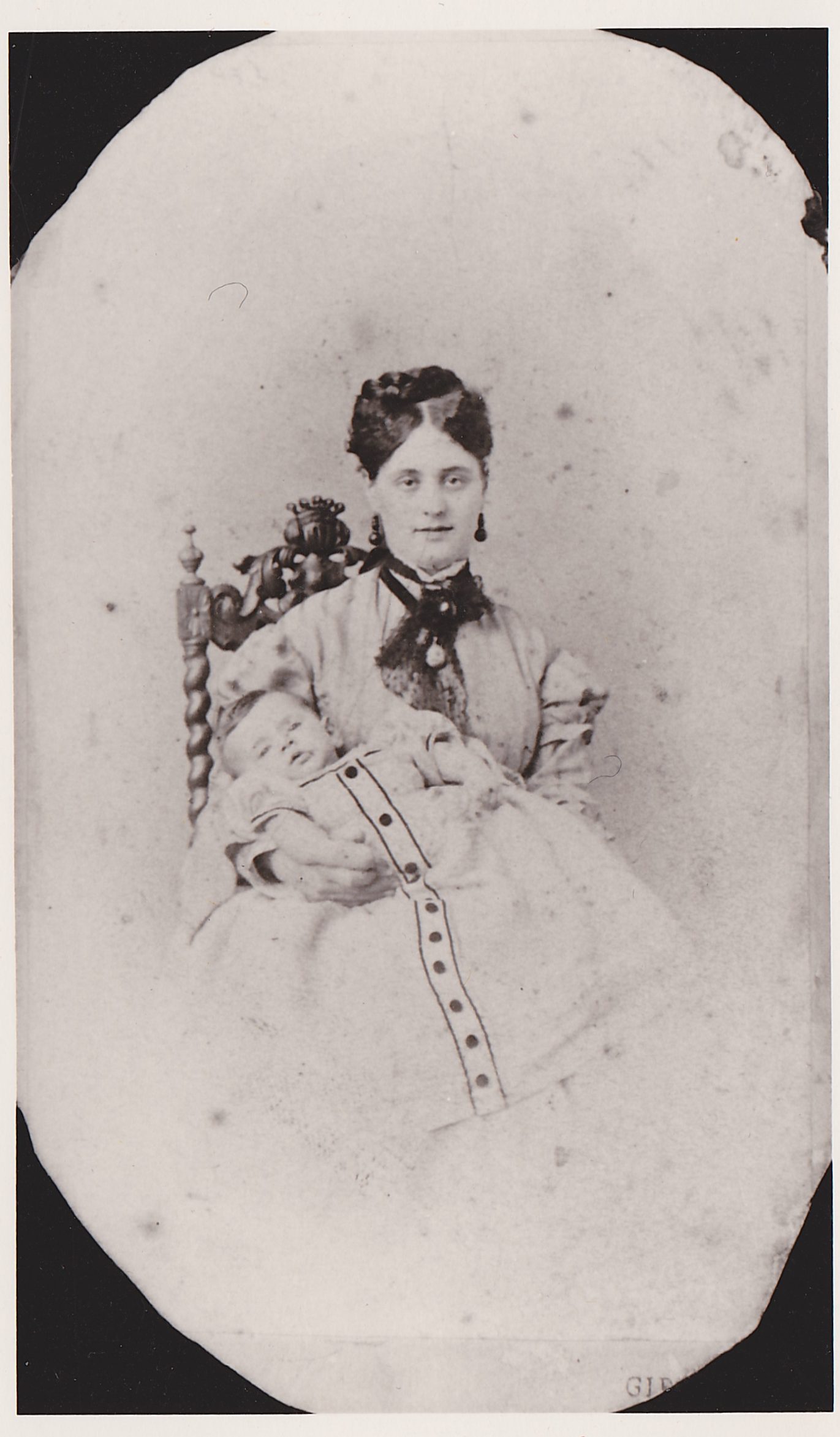
This is the oldest photograph in Robin’s collection. It shows Thekla as an infant with her mother, Caecilie Erlanger Blumenfeld and must have been taken in about 1872 when Thekla was born. Thank you to Ava Cohn, aka Sherlock Cohn, The Photogenealogist, for pointing out the correct dating of this photograph.

Caecilie Erlanger Blumenfeld with Thekla Blumenfeld, c. 1872 Courtesy of Robin H Kravets

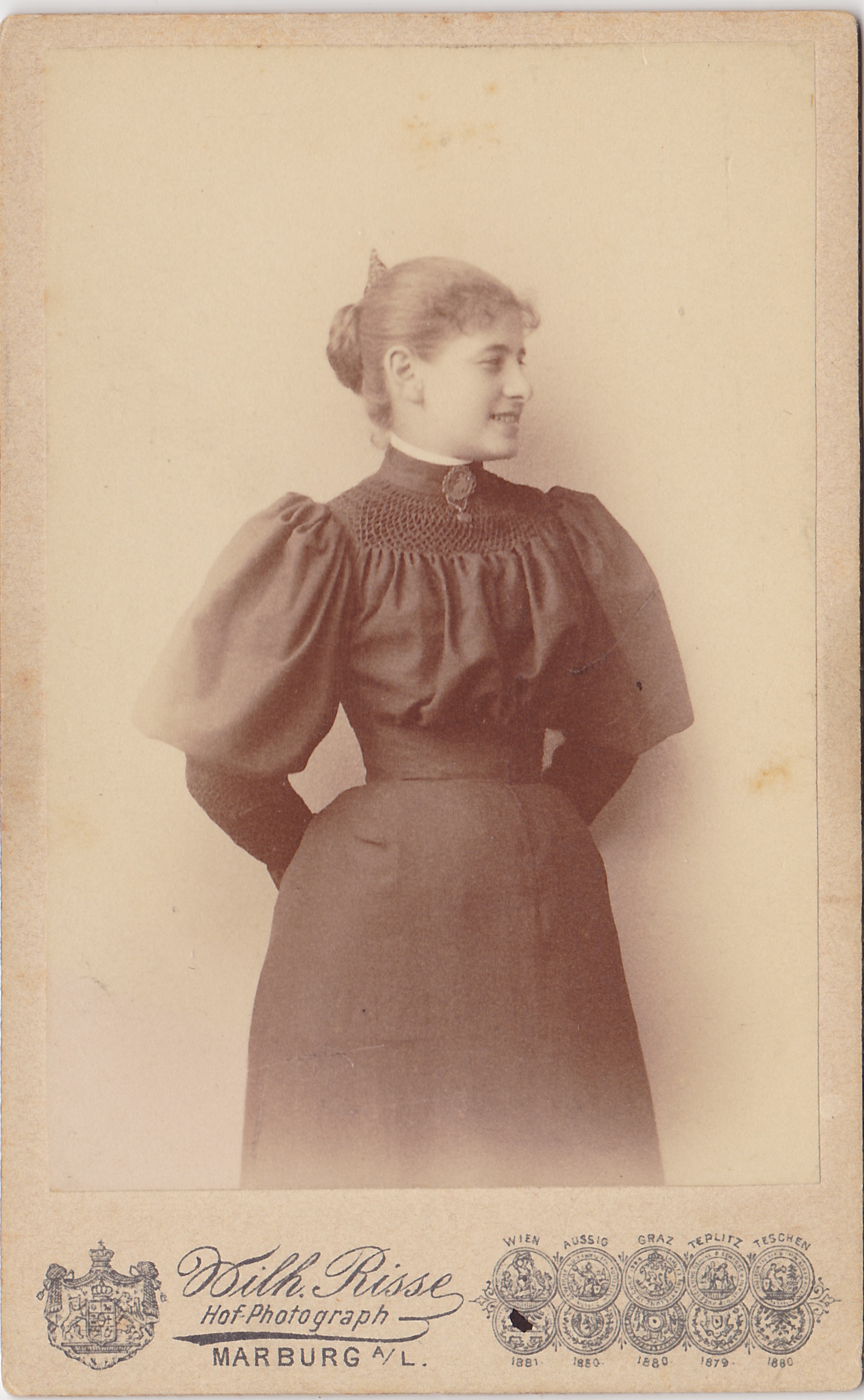
Here are two beautiful photographs of Thekla as a young woman.

Thekla Blumenfeld, courtesy of Robin H Kravets

Thekla Blumenfeld, courtesy of Robin H Kravets

Thekla married Max Gruenbaum in 1894. Here is a photograph of them taken in 1895.

Thekla Blumenfeld and Max Gruenbaum 1895
Courtesy of Robin H Kravets

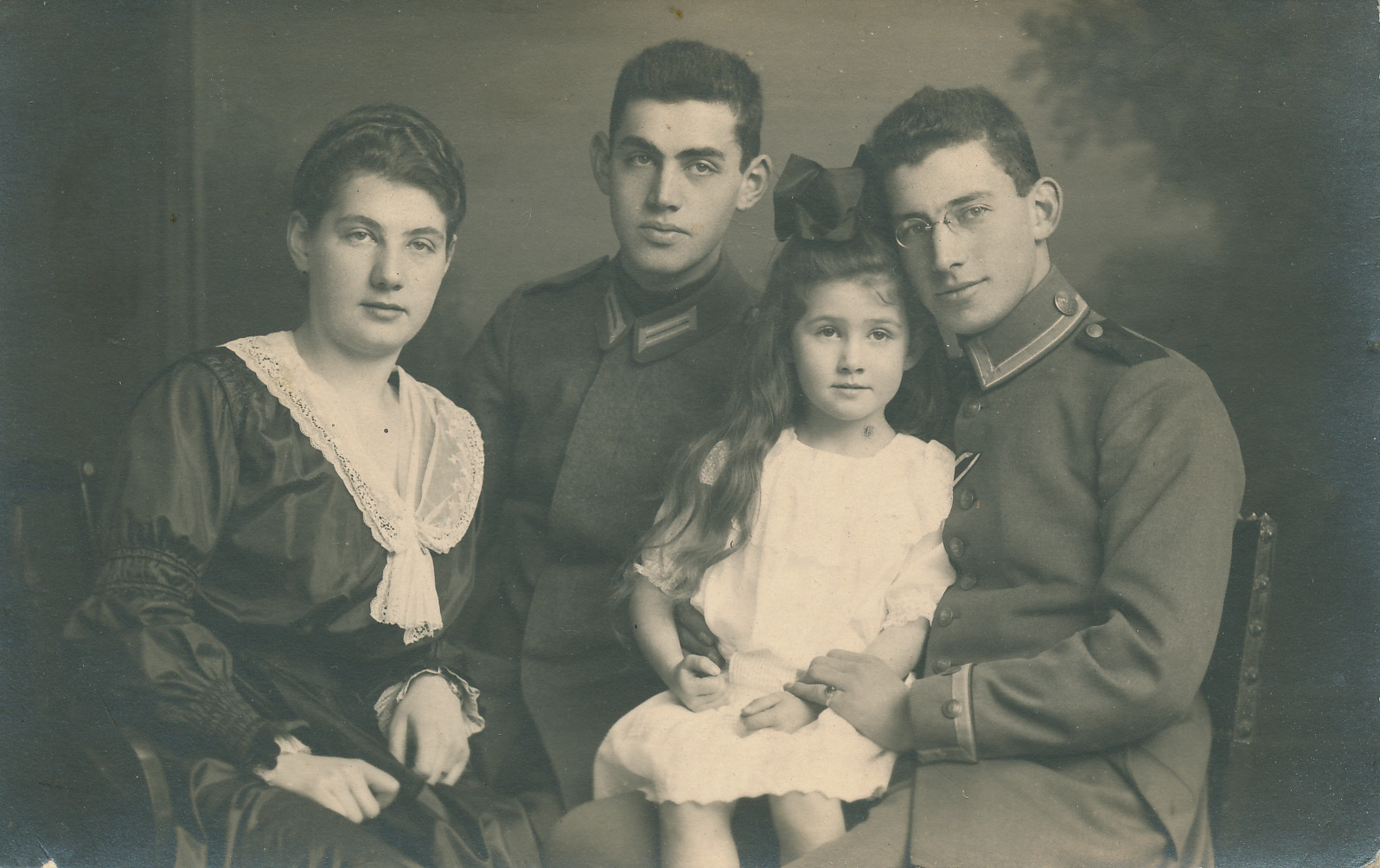
Thekla and Max had four children: Cecilie (1895), Curt (1897), Franz (1899), and Rosemarie, Robin’s grandmother (1912).

Cecilie, Curt, and Franz Gruenbaum c. 1908 Courtesy of Robin H Kravets

Courtesy of Robin H Kravets

Cecilie, Franz, Rosemarie and Curt Gruenbaum, 1918  Courtesy of Robin H Kravets

Thekla’s brother Felix married Thekla Wertheim in 1902, and they had two sons, Edgar (1903) and Gerhard (1906). Robin had just a few photos of Felix; he appears to be in uniform during World War I in these first two. The caption on the first translates as “to commemorate the first nailing of the Zaitenstock.” I am not sure what that means, but Wikipedia explains (as translated by Google) that zaitenstocke were part of the pipe systems used to carry water into the cities.

Felix Blumenfeld, 1915 Courtesy of Robin H Kravets

detail from photo above

Felix Blumenfeld, 1916
Courtesy of Robin H Kravets

detail from photo above

As I wrote in my earlier posts, both Felix and his sister Thekla lost their spouses at relatively young ages. Thekla’s husband Max Gruenbaum died in 1917, and Felix’s wife Thekla died in 1923.

But even more tragically, both Felix and Thekla were among the six million who were killed in the Holocaust, Felix by suicide in 1942, as detailed here, when he was in despair and had no hope in surviving, and Thekla at Treblinka in 1943.

Felix Blumenfeld
Courtesy of Robin H Kravets

Thekla had refused to leave Germany, and her daughter Cecilie would not leave her mother behind. Robin wrote that “[Cecilie] was very smart and saw the writing on the wall but her mother would not leave.  I remember my family talking about them having tickets on a boat somewhere. But the boat was cancelled.”1 Fortunately, Cecilie’s children were safely in England.

But Cecilie and her husband Walter Herzog were sent to the concentration camp in Riga in 1941. Walter did not survive, but against all odds, Cecilie did even after being sent to Stutthof, a camp where the conditions were truly horrible, as I wrote about here. When I asked Robin whether she had any information as to how Cecilie had survived, she wrote that “since she was trained as a nurse during WWI, she used her skills to help people in the camps. I have always believed it gave her a purpose to survive. The story I heard as a child was that when the Allies liberated the camp, she knew she had to get west. She collected a group of people and helped them make their way west. As a nurse, she knew that they needed to be very careful about overeating after being in the camps and made sure they did not die from bloating.”2 As was not uncommon with Holocaust survivors, Cecilie never wanted to talk about her experiences.

Cecilie Gruenbaum Herzog Courtesy of Robin H Kravets

The other children of Thekla Blumenfeld Gruenbaum and Felix Blumenfeld had all managed to escape Germany before it was too late, as I wrote about here. Robin’s grandmother Rosemarie, the youngest of Thekla’s children, had married while still in Germany. In fact, as Robin explained, she had married her husband Ernest Heymann in absentia as Ernest was in England at the time, having gone there on business and then realizing it was not safe to return. I’d never heard of being married in absentia, but apparently Rosemarie’s nephew stood in as a surrogate groom.3

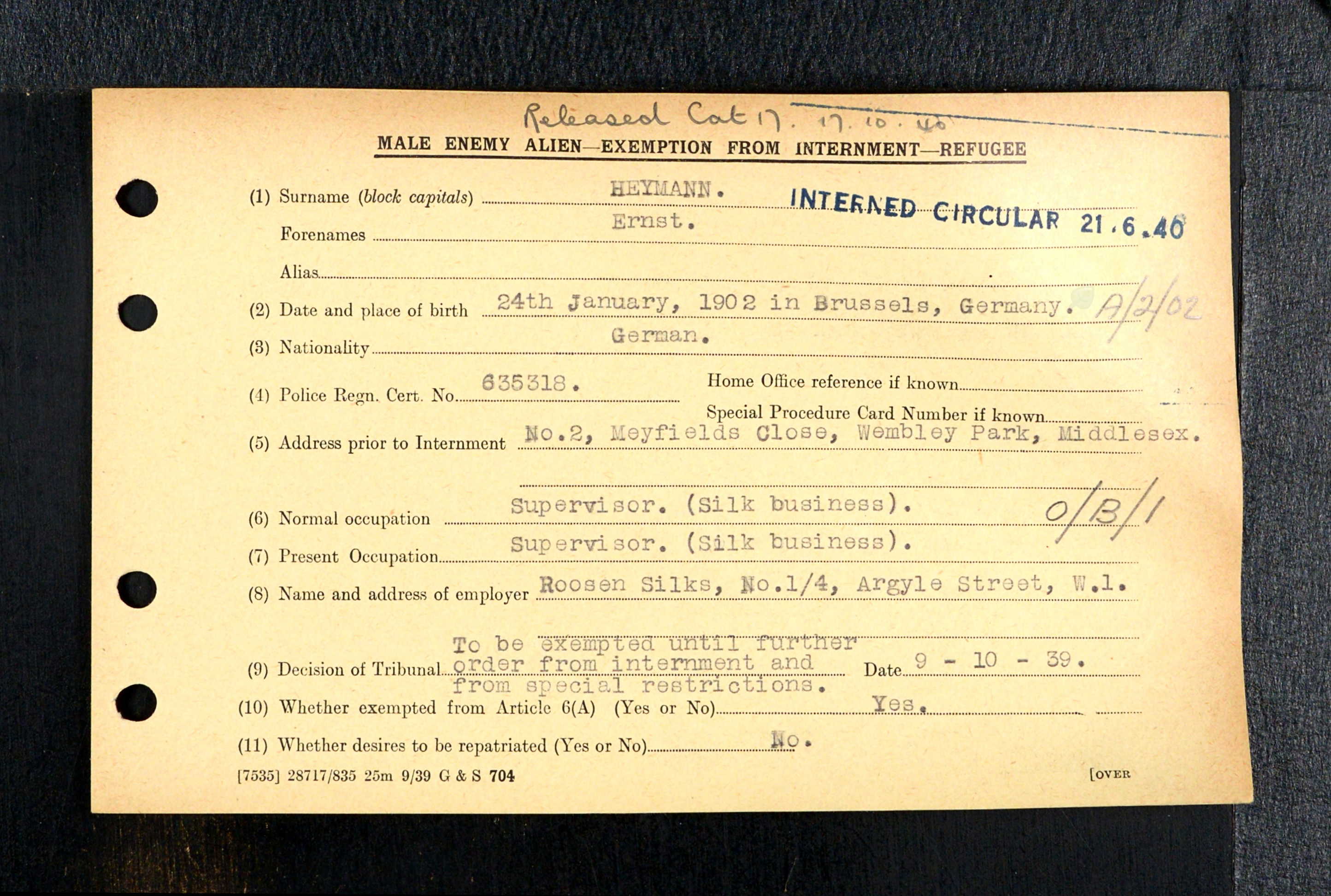
Rosemarie was able to get out of Germany and join Ernest in London where their first child, Robin’s mother, was born. After the war started, Ernest was one of the many Jewish refugees who was sent to an internment camp as a “enemy alien.” He was interned from June 21, 1940, until October 17, 1940.

Ernst Heymann, he National Archives; Kew, London, England; HO 396 WW2 Internees (Aliens) Index Cards 1939-1947; Reference Number: Ho 396/178
Piece Number Description: 178: German Internees Released in Uk 1939-1942: Hertzke-Hoj
Ancestry.com. UK, World War II Alien Internees, 1939-1945

After he was released, he and Rosemarie and their daughter immigrated to the US and settled in New York. They had another child in New York after the war.

Rosemarie’s sister Cecilie made it to the US in 1946 and went to live with Rosemarie and her family in New York. The two sisters lived together for the rest of their lives and remained close to their brothers Curt and Franz (later known as Frank), who visited them often from Massachusetts.  Cecilie lived to 95, dying in 1990, and Rosemarie to 91, dying in 2004.3

The story of Thekla Blumenfeld Gruenbaum is tragic: motherless as toddler, left behind by her father, widowed at a young age, and then killed by the Nazis. The fact that Thekla’s two daughters Cecilie and Rosemarie lived together and survived into their 90s is quite a tribute to the strength their mother must have had and that they both had.

Thekla with her daughter Rosemarie Courtesy of Robin H Kravets

Thekla Blumenfeld Gruenbaum  Courtesy of Robin H Kravets

Thekla Blumenfeld Gruenbaum  Courtesy of Robin H Kravets


  1. Email from Robin H. Kravets, September 10, 2023. 
  2. Ibid. 
  3. Emails from Robin H. Kravets, September 10, 2023, and October 27, 2023. 

An Exciting New Project in the Works!

Before I move on to the next child of Moses Blumenfeld I, I have two other matters to write about. In my next post I will share some wonderful photographs that my cousin Robin shared with me. Robin, my fifth cousin, once removed, is descended from Abraham Blumenfeld and Geitel Katz through their son Moses I. More details to follow in the next post.

But today’s post is about some other amazing photographs. A couple of months ago I received an email out of the blue from an antiques dealer in Santa Fe named Peggy Gonzalez. Peggy had found me through my blog while looking for a descendant of John Nusbaum, my three times great-grandfather and my father’s namesake. Over thirty years ago at an estate sale, she had acquired a photograph album engraved with the name John Nusbaum on the front. She wanted to know whether I would be interested in buying the album.

At first I was skeptical. There are so many scams out there today. Anyone could have found my blog and made this up. But Peggy sounded honest, and she sent me these scans of the front and back of the album as well as a few representative photos. The back is engraved with “To F. Nusbaum.” My great-great-grandmother was John Nusbaum’s daughter Frances Nusbaum Seligman, and she had lived much of her adult life in Santa Fe with her husband Bernard, my great-great-grandfather. Peggy’s story seemed to be authentic.


I was extremely excited—as you might imagine. I’ve never seen a photograph of John Nusbaum or Frances, and here was a whole album of photos. Almost 200 photos. Thanks to the generosity of some of my Seligman/Nusbaum/Cohen relatives, I arranged to purchase the album. I also got extraordinary help from Mike Lord, our guide in Santa Fe from 2014 and a close friend of my cousin Pete. He acted as the middleman between Peggy and me, retrieving the album and giving Peggy my check and then sending me the album.

The album is now safely in my house, back in the hands of one of John Nusbaum’s descendants. I have retained the services of Ava Cohn, aka Sherlock Cohn, the Photogenealogist, and am now waiting in her queue for her to have time to devote to this project. I’ve scanned the front and back of all the photos. They are all studio photographs—cabinet photos, I think they are called. Small, but very clear. And they all have the names and addresses of the photographers on the reverse side. But only three have any identification of the people in the photograph.

There are photographs that were taken in several cities in Germany as well as all over the US: Philadelphia, New York, Santa Fe, Peoria, Lewistown (PA), and St. Louis. I am hoping that if Ava can provide dates for when they were taken and perhaps the ages of the people, I can then figure out who these people are.

I will wait to share the photos until after I have had the benefits of Ava’s help, but I wanted to share now my excitement about this. Stay tuned for more!


Friederike Blumenfeld Schoen, Part V: Her Family in America After the War

By 1950, the three surviving children of Friederike Blumenfeld and Mannes Schoen, Auguste, Moritz, and Isaak, were all living in the United States. But none of the three lived past the age of 66.

Auguste died in 1951 at the age of 65. Although I don’t have an official death record, I do have a photo of her gravestone from FindAGrave. Also, there is an “Augusta Speyer” listed in the New York, New York Death Index, who died at age 64 on March 24, 1951; this could be Auguste, given that the age and year of death almost match, even if the name is misspelled.1

Find a Grave, database and images (https://www.findagrave.com/memorial/236656909/auguste-speier: accessed 9 September 2023), memorial page for Auguste Schoen Speier (1886–1951), Find a Grave Memorial ID 236656909, citing Cedar Park Cemetery, Paramus, Bergen County, New Jersey, USA; Maintained by dalya d (contributor 46972551).

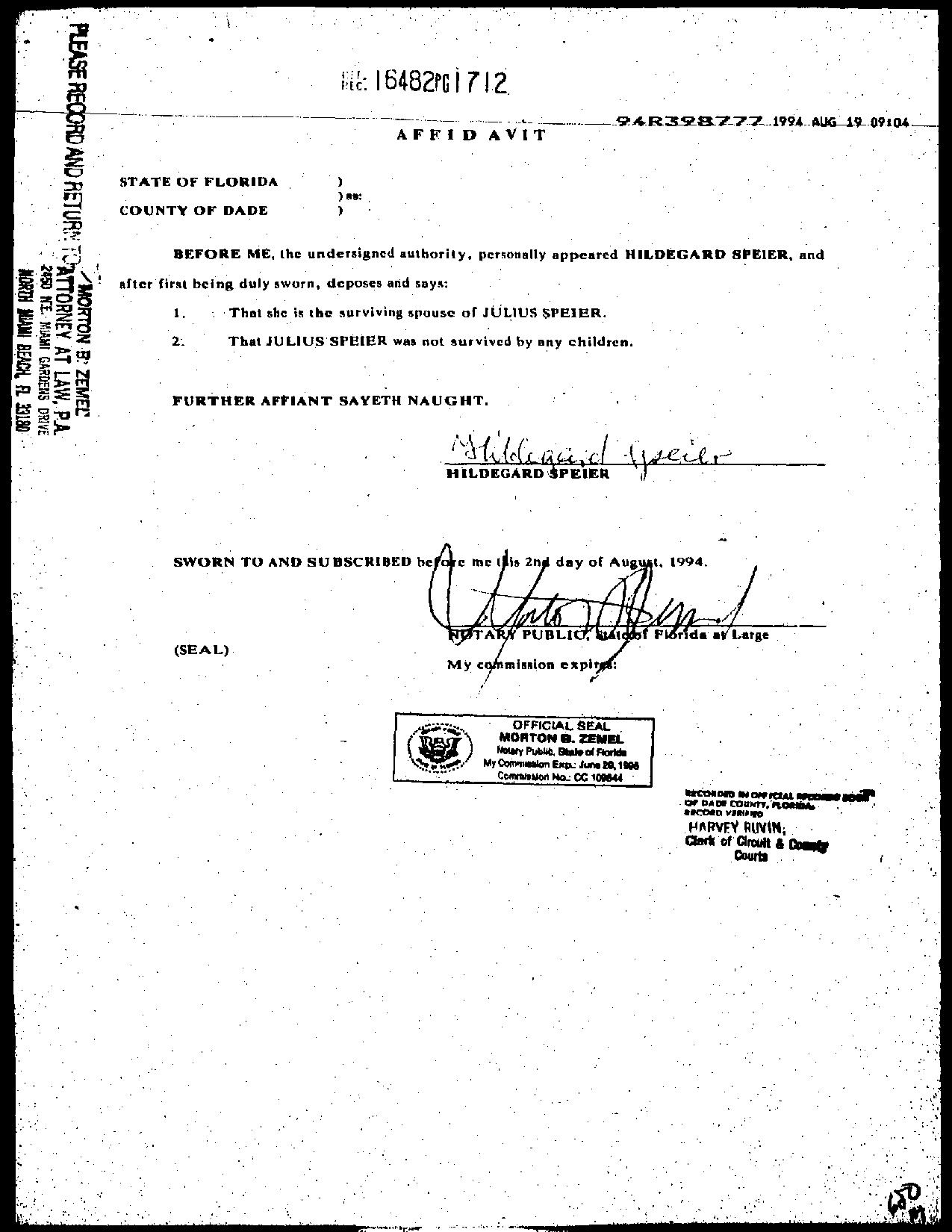
Auguste was survived by her husband Willi Speier, who died in New York City on January 1, 1964, at the age of seventy,2 and by her son Julius and his wife Hildegard. I was unable to find any further information about Julius and Hildegard’s lives once they got to the US. I do not even know whether they had children. All I know is that Julius died in Florida on November 22, 1992,3 when he was seventy, and Hildegard died two years later in Florida in August 1994.4 Aside from a brief death notice for Hildegard in the Miami Herald on August 13, 1994,5 there are no obituaries to provide more information about their lives.

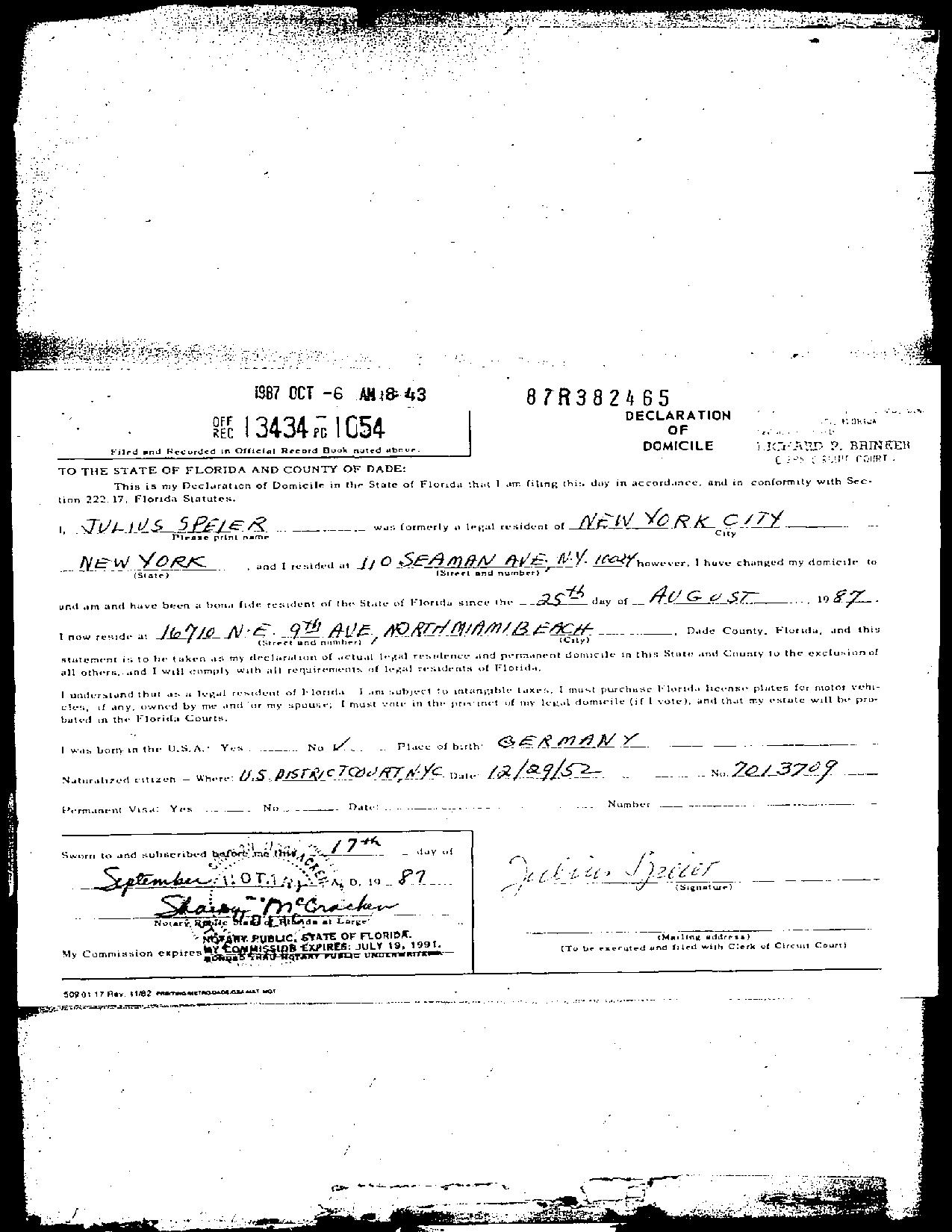
UPDATE: Thank you to the amazing researcher, Barbara Zimmer, on Tracing the Tribe, I now have a bit more information about Julius and Hildegarde. Barbara found documents online in Florida that show that Julius and Hildegard moved from New York City to Miami in 1987 and that they had no children. See the search engine here.  Also, Michael Rosenberg, whose father Walter was a second cousin to Julius, recalled a couple by that name being friends of his family in New York.

As for Auguste’s brother Moritz and his family, I again have relatively little information about their post-war years in the US. As I mentioned in my earlier post, his daughter Alice married Albert Schwarz in 1943, and they had three children and were living in New York City. Alice’s brother Manfred Schoen married in 1951; as his wife is still living, I will not disclose her name or details, and I do not know whether they had children.6 Kurt, the youngest sibling, married Berta Cooper in 1955. They had three children, according to his interview with the US Holocaust Memorial and Museum.7

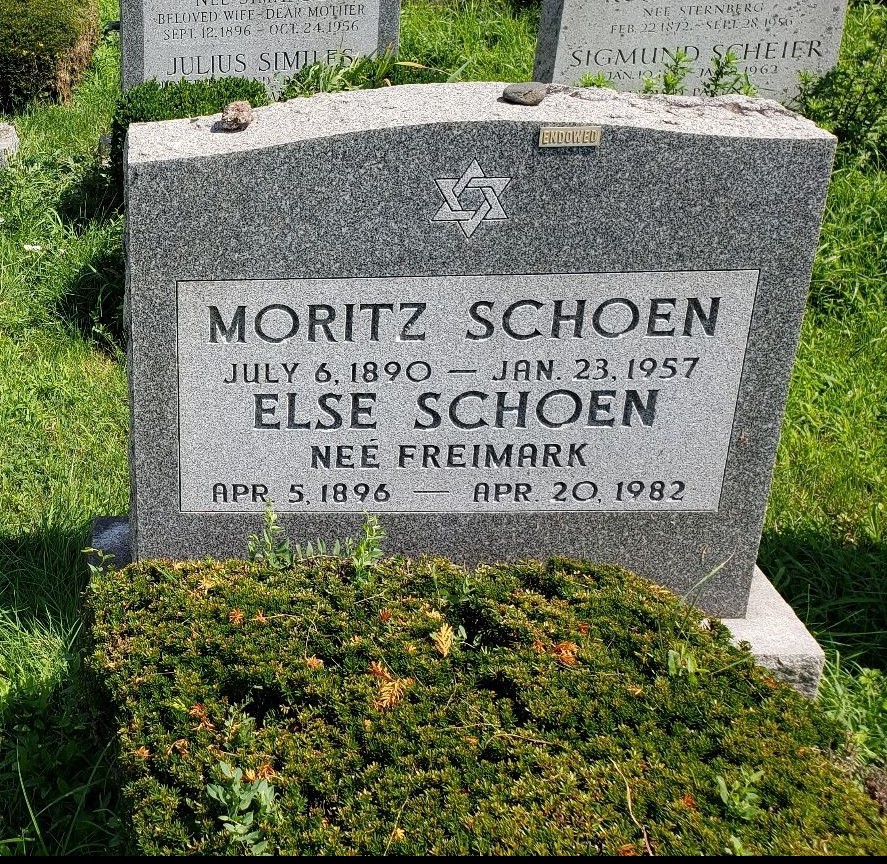
Moritz Schoen died in New York City on January 23, 1957. He was 66 years old.8 He was survived by his wife Else Freimark Schoen, who died April 20, 1982, twenty-five years after her husband.9 She was 86. They were both survived by their three children, Alice, Manfred, and Kurt, and their grandchildren.

Find a Grave, database and images (https://www.findagrave.com/memorial/230090815/else-schoen: accessed 9 September 2023), memorial page for Else Freimark Schoen (1896–1982), Find a Grave Memorial ID 230090815, citing Cedar Park Cemetery, Paramus, Bergen County, New Jersey, USA; Maintained by dalya d (contributor 46972551).

Isaak Schoen, the youngest of the children of Friederike Blumenfeld and Mannes Schoen, also died before he turned 70. He died when he was 66, just like his brother Moritz, on May 21, 1960, in New York City.10 Isaak had never married or had children and was survived by his niece and nephews and their children.

Find a Grave, database and images (https://www.findagrave.com/memorial/247906520/isaac-schoen: accessed 9 September 2023), memorial page for Isaac Schoen (1893–1960), Find a Grave Memorial ID 247906520, citing Beth-El Cemetery, Paramus, Bergen County, New Jersey, USA; Maintained by dalya d (contributor 46972551).

Moritz’s three children lived longer lives than their father or their aunt and uncle. Manfred was seventy-seven when he died in Florida on January 20, 2004.11 Alice lived to 91; she died on June 9, 2015.12 Her husband Albert Schwarz predeceased her; he died on August 5, 2010.13 They were survived by their three children. And Kurt Schoen died just last year on February 24, 2022, at the age of 94. His children survive him as well as his grandchildren. His wife Berta predeceased him on May 26, 2016.14

Thus ends the story of the family of Friederike Blumenfeld and Mannes Schoen. Sadly, their sons Jakob and Isaak have no living descendants, nor does their son Willi, who died as a boy. I don’t know whether their daughter Auguste has any descendants. But I do know that their son Moritz had six grandchildren and that this line continues at least through those grandchildren and their descendants.

And not only does this bring me to the end of Friederike’s story; it also brings me to the end of the long saga of her father Isaak Blumenfeld I, the second child of Moses Blumenfeld I. I started Isaak’s story and those of his ten children on January 25, 2022, over a year and a half ago.

I can now turn to the story of his younger sister Gelle Blumenfeld Rothschild. Like her brother Isaak, she had ten children. I may still be telling her story a year and a half from now. Imagine April 2025—what will the world be like then? I just hope it’s still here and that Jews and Israel are still here also.

In the meantime, I hope everyone has a good Thanksgiving. I am going to try to focus on the many things for which I am grateful and on all the good I see in most people. It will be a challenge, but surrounded by my family, it will be very doable.

See you the week after Thanksgiving!


  1. Augusta Speyer, Age 64, Birth Date abt 1887, Death Date 24 Mar 1951, Death Place Manhattan, New York, New York, USA, Certificate Number 6867, Ancestry.com. New York, New York, U.S., Death Index, 1949-1965. 
  2. Willi Speier, Age 70, Birth Date abt 1894, Death Date 1 Jan 1964, Death Place Manhattan, New York, New York, USA, Certificate Number 12, Ancestry.com. New York, New York, U.S., Death Index, 1949-1965 
  3. Julius Speier, Gender Male, Race White, Birth Date 10 Aug 1922, Birth Place Niederurff K, Federal Republic of Germany, Death Date 22 Nov 1992, Father Willi Speier, Mother Auguste Schoen, SSN 079242442, Ancestry.com. U.S., Social Security Applications and Claims Index, 1936-2007 
  4. Hildegard Speier, [Hildegard Gabriel], Gender Female, Race White, Birth Date 8 Sep 1919, Birth Place Bromberg Pos, Federal Republic of Germany, Death Date Aug 1994, Father Julius Gabriel, Mother Berta Gross, SSN 079242443, Ancestry.com. U.S., Social Security Applications and Claims Index, 1936-2007 
  5. The Miami Herald, Miami, Florida, Sat, Aug 13, 1994, Page 34 
  6. Name Manfred Schoen, Gender Male, Marriage License Date 1951, Marriage License Place Queens, New York City, New York, USA, License Number 5534, New York City Municipal Archives; New York, New York; Borough: Queens, Ancestry.com. New York, New York, U.S., Marriage License Indexes, 1907-2018 
  7. Oral history interview with Kurt L. Schoen, Oral History | Accession Number: 1997.A.0441.512 | RG Number: RG-50.462.0512, United States Holocaust Memorial Museum Collection, Gift of the Gratz College Holocaust Oral History Archive, found at https://collections.ushmm.org/search/catalog/irn566135 
  8. Moritz Schoen, Birth Date 6 Jul 1890, Death Date 23 Jan 1957, Claim Date 26 Jan 1957, SSN 111288575, Ancestry.com. U.S., Social Security Applications and Claims Index, 1936-2007 
  9. Else Schoen, Social Security Number 094-20-5551, Birth Date 5 Apr 1896, Issue year Before 1951, Issue State New York, Last Residence 11372, Flushing, Queens, New York, USA, Death Date Apr 1982, Social Security Administration; Washington D.C., USA; Social Security Death Index, Master File, Ancestry.com. U.S., Social Security Death Index, 1935-2014 
  10. Isaac Schoen, Age 66, Birth Date abt 1894, Death Date 21 May 1960, Death Place Manhattan, New York, New York, USA, Certificate Number 11253, Ancestry.com. New York, New York, U.S., Death Index, 1949-1965 
  11. Manfred Schoen, Social Security Number 118-14-1280, Birth Date 13 Sep 1926
    Issue year Before 1951, Issue State New York, Last Residence 33180, Miami, Miami-Dade, Florida, USA, Death Date 20 Jan 2004, Social Security Administration; Washington D.C., USA; Social Security Death Index, Master File, Ancestry.com. U.S., Social Security Death Index, 1935-2014 
  12. Schwarz Family Tree, Arbeitskreis Judentum im Wasgau, Elisabeth & Otmar Weber, Schillerstraße 10b, 66994 Dahn 
  13.   Albert B. Schwarz, Social Security Number 057-16-8097, Birth Date 22 Oct 1922
    Issue year Before 1951, Issue State New York, Last Residence 11372, Flushing, Queens, New York, Death Date 5 Aug 2010, Social Security Administration; Washington D.C., USA; Social Security Death Index, Master File, Ancestry.com. U.S., Social Security Death Index, 1935-2014 
  14. “Holocaust Survivor Kurt Schoen Dies at 94,” Philadelphia Jewish Exponent, March 10, 2022, found at https://www.jewishexponent.com/holocaust-survivor-kurt-schoen-dies-at-94/  Berta Schoen, obituary, found at https://www.legacy.com/us/obituaries/inquirer/name/berta-schoen-obituary?id=9451473 

Friederike Blumenfeld Schoen, Part IV: Her Children in Shanghai

As we saw, Friederike Blumenfeld Schoen had five children. They all had their lives and destinies changed by the Holocaust. Her oldest child Jakob died in 1937, and his widow and daughter were killed in the Holocaust. Friederike’s second oldest son, Moritz, immigrated with his family to the US in the late 1930s to escape the Nazis.

The other two surviving children of Friederike Blumenfeld Schoen, Auguste and Isaak, ended up in Shanghai, China, during the war. I don’t have any details about how they got to Shanghai or what their lives were like there, but there have been many books1, articles2, and memoirs3 written about the experience of Jewish refugees in Shanghai, and there was even an exhibit about Jewish refugee life in Shanghai in August 2023 in New York City.

I have read some of the articles, but not the books, so I can only briefly touch on the outline of this period in history to give context to what happened to Auguste, her husband Willi, their son Julius, and her brother Isaak, but in the footnotes I have listed sources for those who may want to learn more about the Shanghai Jewish community during the Nazi era.

When I first heard many years ago that Shanghai had been a place that many Jews sought refuge during the Nazi era, I was surprised. I’ve since learned that there was in fact a small Jewish community in Shanghai even before the 1930s, most of whom had fled from Russia after the Russian Revolution in 1917. But it was not until the 1930s that the Jewish population in Shanghai grew to about 20,000 refugees. Why Shanghai? One reason was that unlike most other places in the world including the United States, no visas were required to enter Shanghai until August 1939.4

In 1937, after a fierce battle with the Chinese, the Japanese took control of large sections of Shanghai and created a ghetto in a section called Hongkew, where Jewish refugees lived in poverty-stricken conditions. They were not allowed to leave or enter the ghetto without passes and were often mistreated by the Japanese officials who oversaw the ghetto. The Chinese residents of Shanghai also were persecuted and suffered greatly during this occupation, which lasted until the end of World War II when Japan was defeated and required to leave China.5

Jewish Ghetto Memorial in Shanghai, gruntzooki, CC BY-SA 2.0 <https://creativecommons.org/licenses/by-sa/2.0&gt;, via Wikimedia Commons

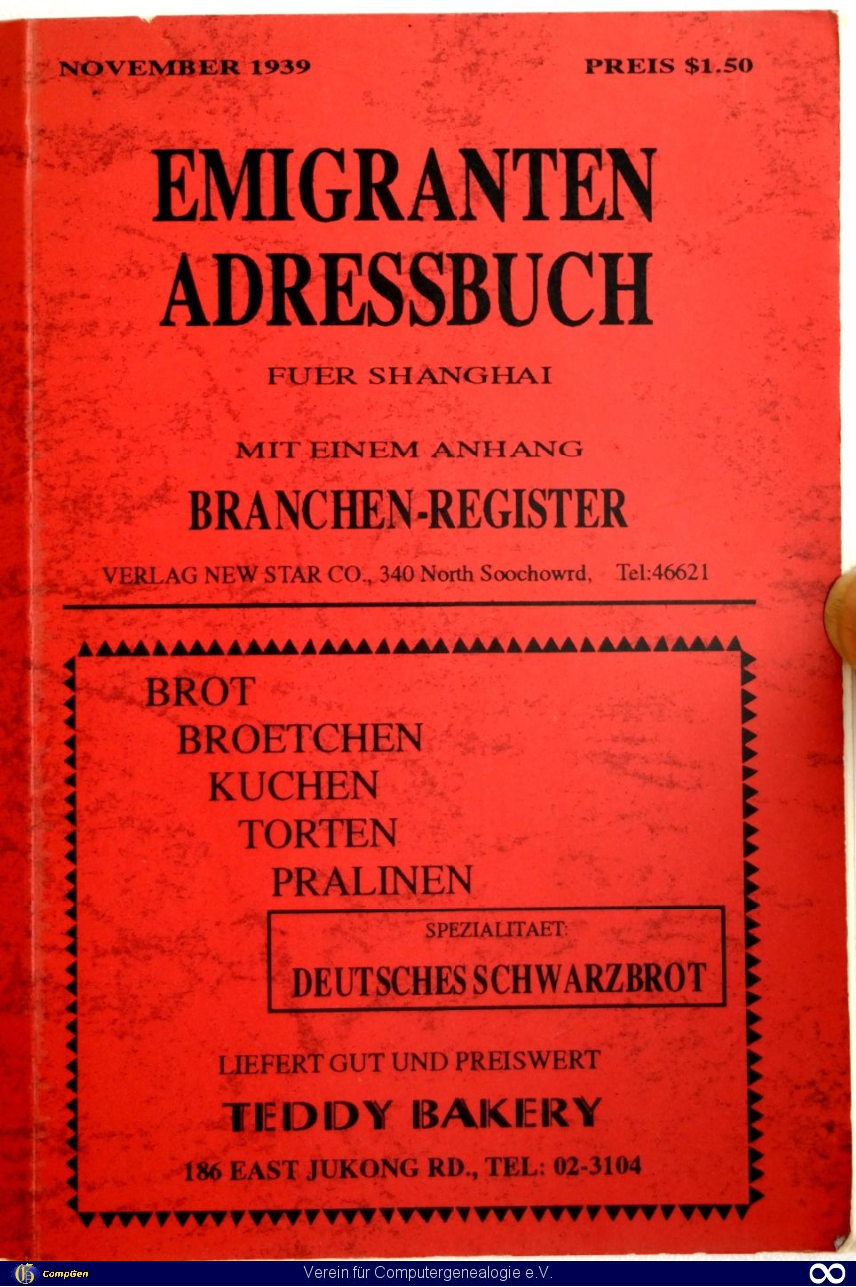
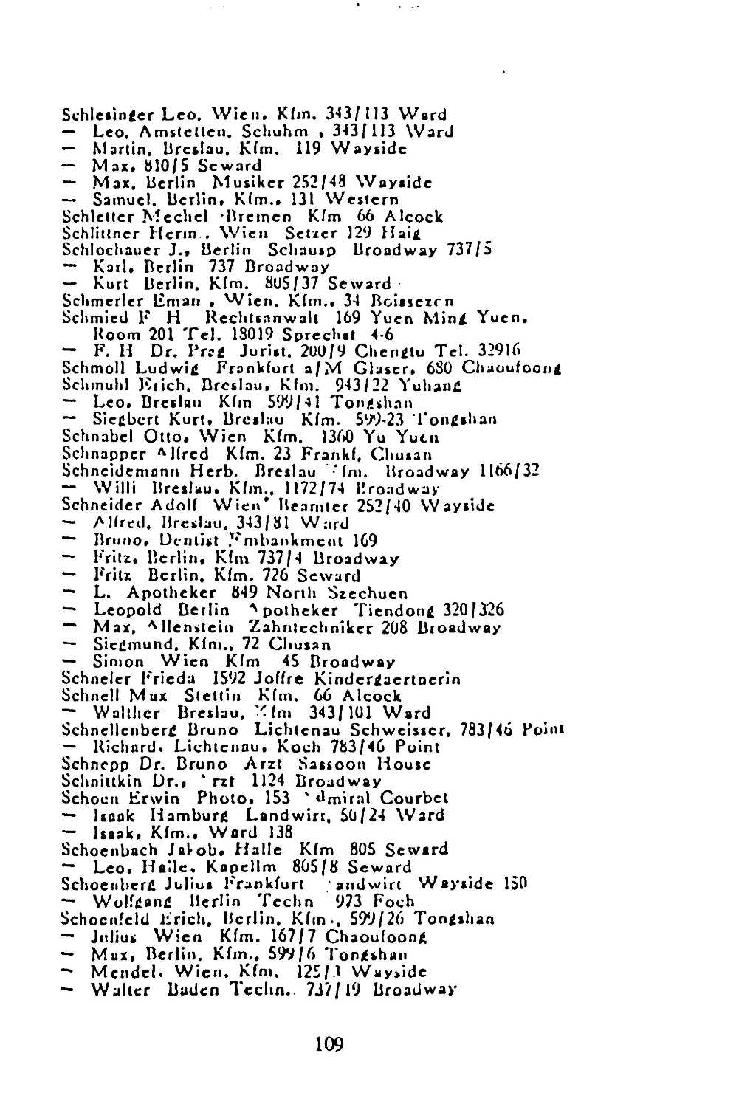
I wish I knew more about the experiences of my relatives Auguste Schoen Speier and her family and her brother Isaak Schoen in Shanghai, but aside from finding their names on various lists and in a 1939 directory for Shanghai located by Richard Bloomfield, I know no details other than that at some point they arrived there from Germany and lived there until after the war.

Auguste, Willi, and Julius Speier and Isaak Schoen are all listed on a 1950 list of Jewish refugees in Shanghai who were helped by the American Jewish Joint Distribution Committee, an organization that continues to exist today for those in need.

I also found them all here in a collection of records of Shanghai refugees made in 1944.

Richard located them in this November 1939 directory of emigrants in Shanghai, so obviously they had immigrated there by November 1939:

But I could not locate them on this list of refugees who had arrived in Shanghai between 1937 and 1944, so perhaps they had arrived before 1937.

In his interview with the US Holocaust Memorial and Museum, Kurt Schoen, Moritz’s son, mentioned that one of his cousins had died from typhoid while living in Shanghai, but I have no record or even a name of that cousin. He or she does not appear on any of the lists cited above. Maybe that cousin had passed away before these lists were compiled. Or maybe Kurt was confused.6

In any event, it is clear that Auguste, Willi, Julius and Isaak all ended up in Shanghai, and then after the war, they all immigrated to the US.

Auguste’s son Julius was the first to make it to the US. He arrived in San Francisco on March 19, 1947, with his wife Hildegarde Gabriel. They had married in Shanghai on December 9, 1945.7 Hildegarde was the daughter of Julius Gabriel and Berta Gross and was born on September 8, 1919, in Bromberg in what was then part of Prussia but is now in Poland.8

On the ship manifest, Julius listed his father Willi as the person he was leaving behind, Hildegarde listed her father Julius. They both listed Moritz Schoen, Auguste’s brother, as the person they were going to in the US and listed their destination as New York City. Julius listed his occupation as a shoemaker, and Hildegarde listed hers as a nurse.

Julius and Hildegarde Speier ship manifest, he National Archives at Washington, D.C.; Washington, D.C.; Passenger Lists of Vessels Arriving At San Francisco, California; NAI Number: 4498993; Record Group Title: Records of the Immigration and Naturalization Service, 1787-2004; Record Group Number: 85, NARA Roll Number: 388, Ancestry.com. California, U.S., Arriving Passenger and Crew Lists, 1882-1959

Julius’ parents Auguste (Schoen) and Willi Speier arrived in San Francisco six months later on September 24, 1947. The ship manifest indicates that they were headed to New York City where their son Julius was residing. Like his son Julius, Willi was a shoemaker or “cobbler,” as listed on the manifest. The person they were leaving behind in Shanghai was Auguste’s brother Isaak.9

Isaak himself arrived just a few months later on December 17, 1947. He also entered the US in San Francisco, indicating that he also was heading to New York City where his brother Moritz was living. He listed his occupation as a salesman.10

Auguste and Willi did end up in New York City, where in 1950 Willi was working as a “platform spotter” in a shoe factory. I don’t know what that means, but I would guess that it means he watched shoes on an assembly line. If anyone has any other ideas, please let me know.11 I’ve been unable to locate their son Julius and his wife Hildegarde on the 1950 census nor can I locate Isaak Schoen on that census.

Thus, three of Friederike Blumenfeld and Mannes Schoen’s children and four of their grandchildren had escaped Nazi Germany and survived World War II. Their lives after 1950 will be discussed in my next post.


  1. See, e.g., Alex Ross, Escape to Shanghai: A Jewish Community in China (1993, Free Press); Gao Bei, Shanghai Sanctuary: Chinese and Japanese Policy Toward European Jewish Refugees During World War II (2016, Oxford University Press); Irene Eber, Wartime Shanghai and the Jewish Refugees From Central Europe: Survival, Co-Existence, and Identity in a Multi-Ethnic City (2012, DeGruyter). 
  2. See, e.g., the articles at the following links:  https://www.smithsonianmag.com/smart-news/how-holocaust-survivors-found-refuge-shanghai-told-through-stories-and-photos-180978235/  and https://www.nbcnews.com/news/asian-america/jewish-wwii-refugees-found-safety-shanghai-are-focus-new-exhibit-rcna96478 and https://encyclopedia.ushmm.org/content/en/article/german-and-austrian-jewish-refugees-in-shanghai and https://www.npr.org/2023/08/06/1192118339/jewish-refugees-shanghai-world-war-ii&#160;
  3. E.g., Ernest Heppner, Shanghai Refuge: A Memoir of the World War II Jewish Ghetto (1995, University of Nebraska Press); Berl Falbaum, ed., Shanghai Remembered…: Stories Of Jews Who Escaped To Shanghai From Nazi Europe (2005, Momentum Books, LLC.); Sigmund Tobias, Strange Haven: A Jew­ish Child­hood in Wartime Shanghai (2009, University of Illinois Press). 
  4. See Note 2, above. 
  5. See Note 2, above. 
  6. Kurt L. Schoen, July 24, 2004 interview,  Accession Number: 1997.A.0441.512 | RG Number: RG-50.462.0512, United States Holocaust Memorial Museum Collection, Gift of the Gratz College Holocaust Oral History Archive, found at https://collections.ushmm.org/search/catalog/irn566135. There was another puzzling thing about Kurt’s interview. He mentioned that his father had one sister (Auguste) and one unmarried brother (Isaak), but did not mention Jakob, his father’s older brother.  Jakob, as we saw, had died in 1937 when Kurt was ten, and his wife and daughter were killed in the Holocaust. Had Kurt never known his uncle Jakob and his family? Had Moritz never mentioned them? Or was it just too painful for Kurt to talk about what had happened to his uncle, aunt, and cousin? 
  7. Marriage notice for Julius Speier and Hildegarde Gabriel, The Jewish Voice in Jüdisches Nachrichtenblatt, 23. November 1945, p. 8 
  8. Hildegard Speier, Gender Female, Race White, Birth Date 8 Sep 1919, Birth Place Bromberg Pos, Federal Republic of Germany, Death Date Aug 1994, Father Julius Gabriel, Mother Berta Gross, SSN 079242443, Ancestry.com. U.S., Social Security Applications and Claims Index, 1936-2007 
  9. Willi and Auguste Speier, ship manifest, The National Archives at Washington, D.C.; Washington, D.C.; Passenger Lists of Vessels Arriving At San Francisco, California; NAI Number: 4498993; Record Group Title: Records of the Immigration and Naturalization Service, 1787-2004; Record Group Number: 85, NARA Roll Number: 392, Ancestry.com. California, U.S., Arriving Passenger and Crew Lists, 1882-1959 
  10. Isaak Schoen ship manifest, The National Archives at Washington, D.C.; Washington, D.C.; Passenger Lists of Vessels Arriving At San Francisco, California; NAI Number: 4498993; Record Group Title: Records of the Immigration and Naturalization Service, 1787-2004; Record Group Number: 85, Ancestry.com. California, U.S., Arriving Passenger and Crew Lists, 1882-1959 
  11.  National Archives at Washington, DC; Washington, D.C.; Seventeenth Census of the United States, 1950; Year: 1950; Census Place: New York, New York, New York; Roll: 4546; Page: 18; Enumeration District: 31-1702, Ancestry.com. 1950 United States Federal Census 

Friederike Blumenfeld Schoen, Part III: Her Son Moses Escapes to America

I have been unable to do any new research in these last few weeks since the horrendous massacre in Israel by Hamas on October 7. I just can’t seem to focus on research right now. Fortunately I had several blog posts ready in my queue and will publish those, including this one. Perhaps the best way I can support Israel right now is to educate and remind people about the long history of persecution of Jews and antisemitism so that they best understand why Israel exists and why it must survive.


Although Friederike’s oldest child Jakob died in 1937 and his widow and daughter were killed by the Nazis, her other three surviving children all managed to escape the Nazis.

Friederike’s son Moses, more commonly known as Moritz, wanted to leave Germany quite early. As described by his son Kurt Leopold Schoen in the oral history interview he did with the US Holocaust Memorial and Museum, Moritz had had a successful wholesale and retail shoe business in Kassel, but once the Nazis came to power the business suffered. Non-Jews boycotted the store, and Moritz had to close the business and work as a shoemaker.1

But leaving Germany was difficult. The family needed affidavits from someone in the US to get a visa to enter the country, and the relatives in the US were reluctant to sponsor a family with three young children. Fortunately, Moritz and Else’s fourteen-year-old daughter Alice was given an opportunity to leave when the National Council of the Jewish Women in the US organized a rescue mission that brought many children out of Germany.2 Alice came to the US on May 13, 1938, and was sent to live with a Jewish family in San Antonio, Texas, the Rosenbergs, as seen on the 1940 US census.3

Alice Schoen passenger manifest, The National Archives and Records Administration; Washington, D.C.; Passenger and Crew Lists of Vessels Arriving at and Departing from Ogdensburg, New York, 5/27/1948 – 11/28/1972; Microfilm Serial or NAID: T715, 1897-1957
Ancestry.com. New York, U.S., Arriving Passenger and Crew Lists (including Castle Garden and Ellis Island), 1820-1957

The website for the Holocaust Memorial Museum of San Antonio reported that Abe and Bella Rosenberg “took [Alice] into their lives as if she were a long lost relative. The Rosenberg children, Miriam and Stanley, and a host of aunts, uncles, and cousins who treated her with affection and kindness made her adjustment to a new life easier.” In his oral history interview, Alice’s brother Kurt mentioned that the Rosenbergs were a very nice family, but nevertheless Alice was naturally very homesick.  She did not see her family again until 1940.4

But Alice was able to get help from the Rosenberg family to bring her father Moritz to the US from Germany. As reported on the website for the Holocaust Memorial Museum of San Antonio, they signed affidavits pledging financial support for him.

Once he had an affidavit from the Rosenbergs, Moritz was able to go to the US consulate in Germany and receive a visa. But before he could leave, he was arrested during the Kristallnacht riots in November, 1938. According to his son Kurt, Moritz was not sent to Buchenwald like so many other Jewish men were after Kristallnacht because he already had a visa to leave Germany. He was released within a day or two from police custody in Kassel and prepared to leave for the US.5

Moritz arrived on December 3, 1938, seven months after Alice’s arrival, and settled in New York City. His ship manifest lists his wife Else as the person he was leaving behind in Kassel, Germany, and his sister-in-law Betty Lutz (born Babette Freimark) as the person he was going to in the US. He listed his occupation as a shoemaker.6

Meanwhile, back in Germany, Else and her two young sons Manfred and Kurt moved to Frankfurt; the boys were sent to a Jewish orphanage and Else moved in with one of her sisters. Kurt described the orphanage as a place where he and his brother were well treated. They went to school and learned English. Finally in April 1939, they were released and reunited with their mother and allowed to leave Germany for the US. Kurt, who was eleven at the time, recalled that the Nazis tore through their luggage and stole everything Else had packed except one small teapot.7

Else arrived in New York with Manfred and Kurt (listed as Kurt Leopold Israel on the manifest) on May 19, 1939.

Else Schoen and children, passenger manifest, The National Archives and Records Administration; Washington, D.C.; Passenger and Crew Lists of Vessels Arriving at and Departing from Ogdensburg, New York, 5/27/1948 – 11/28/1972; Microfilm Serial or NAID: T715, 1897-1957
Ship or Roll Number: Deutschland, Ancestry.com. New York, U.S., Arriving Passenger and Crew Lists (including Castle Garden and Ellis Island), 1820-1957

The family moved into a small apartment riddled with bed bugs; Moritz worked doing shoe repairs and barely made a living. But as Kurt said, they were happy to be out of Germany and safely living in New York. They moved frequently from one apartment to another in order to get the benefit of one or two free months of rent being offered by landlords. Manfred and Kurt started school where they quickly learned English and rose from the lower levels of their grade to the highest within a year.8

Alice was reunited with her parents and brothers sometime in 1940 when the Rosenberg family brought her to New York after taking a trip to Canada to see the Dionne Quintuplets. She married just three years later when she was nineteen, according to her brother Kurt.9 Her husband, Albert Bernhard Schwarz, was born on October 22, 1922, in Busenberg, Germany, to Alfred Lazarus Schwarz and Berta Levy. Like Alice, he was refugee from Germany; he had arrived on August 13, 1938.10 He was the only member of his family to survive. His parents and all his siblings were killed by the Nazis.11

Albert entered the US Army on March 26, 1943, listing his marital status as single.12 He and Alice must have married later that year. According to one biography of Albert, he was assigned to Camp Ritchie in Maryland and trained for military intelligence. As a Ritchie Boy, as they were known, Albert was trained to interrogate German prisoners of war. Starting in October 1944 he was with the 7th Armored Division of the II English Army in France and the northern part of Belgium. On November 5-6, 1944, during the Battle of the Bulge, Albert’s jeep hit a German mine near a bridge over the Meuse River. Albert suffered severe head injuries from which he suffered the rest of his life. He was in a coma for over a month in a English military hospital and remained there until February, 1945. He returned to the US in the spring of 1945, but was hospitalized until July. On Aug. 02, 1945, he was discharged from military service at Camp Edward, Massachusetts.13

Alice and Albert had three children born after the war. In 1950 they were living in New York City, and Albert was working as a butcher.14 Alice’s parents Moritz and Else Schoen and her brothers Manfred and Kurt (listed as Leo here) were also living in New York City. Moritz now owned his own shoemaking business. Manfred was an industrial engineer, and Leo/Kurt was a chemist in a cosmetics company.

Morris Schoen and family, 1950 US census, National Archives at Washington, DC; Washington, D.C.; Seventeenth Census of the United States, 1950; Year: 1950; Census Place: New York, New York, New York; Roll: 3572; Page: 9; Enumeration District: 31-2294, Ancestry.com. 1950 United States Federal Census

Meanwhile, Moritz’s two remaining siblings had survived the war in Shanghai, China. More on that in my next post.


  1. Many of the personal details in this post came from Kurt Leopold Schoen’s interview with the USHMM. Kurt L. Schoen, July 24, 2004 interview, Accession Number: 1997.A.0441.512 | RG Number: RG-50.462.0512, United States Holocaust Memorial Museum Collection, Gift of the Gratz College Holocaust Oral History Archive, found at https://collections.ushmm.org/search/catalog/irn566135.  Although Kurt is listed as Leopold or Leo on many US records, he used the name Kurt for most of his adult life in the US and will be referred to here as Kurt for that reason. 
  2. See Note 1, supra. 
  3. Alice Schoen, 1940 US Census, Year: 1940; Census Place: San Antonio, Bexar, Texas; Roll: m-t0627-04201; Page: 61A; Enumeration District: 259-6, Ancestry.com. 1940 United States Federal Census 
  4. See Note 1, supra. 
  5. See Note 1, supra. 
  6. Moses Schoen, passenger manifest, The National Archives and Records Administration; Washington, D.C.; Passenger and Crew Lists of Vessels Arriving at and Departing from Ogdensburg, New York, 5/27/1948 – 11/28/1972; Microfilm Serial or NAID: T715, 1897-1957, Ship or Roll Number: Hamburg, Ancestry.com. New York, U.S., Arriving Passenger and Crew Lists (including Castle Garden and Ellis Island), 1820-1957 
  7. See Note 1, supra. 
  8. See Note 1, supra. 
  9. See Note 1, supra. 
  10. Albert Schwarz, Declaration of Intention, The National Archives at Philadelphia; Philadelphia, PA; NAI Title: Declarations of Intention For Citizenship, 1/19/1842 – 10/29/1959; NAI Number: 4713410; Record Group Title: Records of District Courts of the United States, 1685-2009; Record Group Number: 21, Description
    Description: (Roll 610) Declarations of Intention For Citizenship, 1842-1959 (No 481301-482200), Ancestry.com. New York, U.S., State and Federal Naturalization Records, 1794-1943 
  11. Family history of Schwarz family, Arbeitskreis Judentum im Wasgau, Elisabeth & Otmar Weber, Schillerstraße 10b, 66994, found at /https://judentum-im-wasgau.de/images/geschichte/jugemeinden/jufbusenberg/02_schwarz_jakob_hauptstr_49_bu.pdf 
  12. Albert B Schwarz, Race White, Marital Status Single, without dependents (Single)
    Rank Private, Birth Year 1922, Nativity State or Country Danzig or Germany, Citizenship Not Yet a Citizen, Residence New York, New York, Education 2 years of high school
    Civil Occupation Stock clerks, Enlistment Date 26 Mar 1943, Enlistment Place New York City, New York, Service Number 32874464, Branch No branch assignment, Component Selectees (Enlisted Men), National Archives at College Park; College Park, Maryland, USA; Electronic Army Serial Number Merged File, 1938-1946; NAID: 1263923; Record Group Title: Records of the National Archives and Records Administration, 1789-ca. 2007; Record Group: 64; Box Number: 05772; Reel: 241, Ancestry.com. U.S., World War II Army Enlistment Records, 1938-1946 
  13. See Note 11, supra. 
  14. Albert Schwarz and family, 1940 US census, National Archives at Washington, DC; Washington, D.C.; Seventeenth Census of the United States, 1950; Year: 1950; Census Place: New York, New York, New York; Roll: 6203; Page: 6; Enumeration District: 31-1913, Ancestry.com. 1950 United States Federal Census 

For My Cousins in Israel

For all my cousins in Israel and their children and their families and their friends, my heart is with you. I am so blessed to have found you, and I will continue to stay in touch and hope for your safety and for peace. Please know that you are all in my thoughts—Omri, Ravid, Rafi, Joyce, Ester, Ariela, and Miki. And all your families and friends.

I wrote a short essay about Israel three days ago intending to post it here on my blog. But I was hurting too much, and since the blog is public, not private, I decided not to post. I did not want to invite anti-Israel, antisemitic posts by members of the public. Instead I posted on Facebook, limiting my audience to my Facebook friends. Fortunately, the responses I received were all sensitive and supportive from both my Jewish and non-Jewish friends.

I am still hurting too much. But I’ve decided to share this more publicly now. Because it’s important to speak up. Because now that Israel is fighting back, I know that the tide of public opinion will start to shift for many. I am not indifferent to the suffering of the people in Gaza. I understand that many of them are not terrorists. Many are children. But I also know that Israel has over and over again been convinced to walk away and agree to ceasefires only to once again have Hamas fire rockets and engage in terrorism to kill innocent people in Israel.

There is a lot of history here. It didn’t start in 1948 or 1967 or 1973. And it certainly didn’t start with Israel’s current response to the October 7 massacres. I can’t begin to summarize all the times that Israel has tried to find peace with the Palestinians only to find that violence and hatred are all they get in response. Of course, it’s not all Palestinians. It’s the leadership and the extremists who refuse to accept Israel’s right to exist. But it’s the leadership and the extremists who control whether or not there will be peace, and they refuse to take the steps that will bring peace, thus endangering the lives of not only Israelis but also their own people.

I am not a historian, but in the last week I’ve read many different articles outlining that history. For now I will only recommend two articles, one written in 2021 by Michael Oren that details the long history of Gaza and one published this week by David Brooks about more recent attempts to find peace between Israel and the Palestinians.

In that context, here are the words I posted on Facebook earlier this past week.


I can’t get the beautiful faces of the Israeli teens out of my head. My Facebook newsfeed contains one photo after another—of a teen taken hostage by Hamas or worse killed by Hamas. Or of the mother with her two young children. Or the elderly great-grandmother holding her great-grandchild. I can’t stop thinking about them all. And I can’t help but associate those faces with the names and faces of the many relatives I’ve researched who were killed by the Nazis. It’s all mixed up in my head.

I am not one who has been blind to Israel’s faults. I have often criticized the way Palestinians have been treated by Israel; I do not defend the oppression of others. I have been disappointed and angered by the way Netanyahu and the right-wing coalition he panders to have undermined liberal democracy and liberal Judaism in Israel. But those criticisms of Israel don’t mean that I don’t care about the people in and future of Israel just as it doesn’t mean I don’t care about America’s people and America’s future when I criticize it for its racism, the pandering to the white supremacists and the MAGA cult by Republicans, the failure to address poverty, the corporate greed, the gun violence, and so on. You can criticize without hating or being indifferent. You can love without being blind to the faults of those you love.

So right now my heart is with Israel and with its people. We can wonder later about how security failed or why or how this all happened. But no matter whatever criticisms anyone has of Israel, the terrorism of Hamas cannot be considered acceptable or understandable or justifiable. We need to stand together—and by “we” I don’t mean just Jews. I mean everyone. If you are silent or indifferent, you are part of the problem. If you can just scroll past all those beautiful faces and not feel anything, you are part of the problem.

When hatred starts to spread its poison and people remain silent, then we are all responsible for what happens next. Remember the six million. Please do not let it happen again.


Friederike Blumenfeld Schoen’s Son Jakob: Another Family Lost in the Holocaust

Friederike Blumenfeld Schoen died in 1927, as we saw, leaving behind her four surviving children, Jakob, Auguste, Moses, and Isaac, and her grandchildren. Thus, she was spared from experiencing the Holocaust and seeing what would happen to her children and their families.

Her oldest child, Jakob, was living a good life with his wife Hannah Freimark (sometimes known as Johanna, sometimes as Maria Anna.) Their daughter Ruth was born on New Year’s Day in 1924, as seen in this birth announcement published in Der Israelit newspaper in Frankfurt on January 3, 1924.

Der Israelit, 3 January 1924, page 7

Thank you once again to my cousin Richard Bloomfield who located this notice and the others in this post and translated them for me. The birth announcement says, “Jakob Schön and wife Hanna, née Freimark are delighted to announce the healthy [lit. happy, successful] birth of a daughter. Frankfurt am Main, Baumweg 22, 1 January 1924 / 24. Tebet 5684.”

Jakob was working as a successful butcher in Frankfurt. The ad below says, “Wanted for my store, closed on Shabbat and holidays, a young journeyman. Meat Market Jakob Schön, Frankfurt am Main, Uhlandstrasse 50.”

1925-08-27 Der Israelit, page 7

And then his life was cut short when he died on June 22, 1937, at the age of 52. His daughter Ruth was only 13 years old.

Jakob Schoen death record, Hessisches Hauptstaatsarchiv; Wiesbaden, Deutschland; Personenstandsregister Sterberegister; Signatur: 11071; Laufende Nummer: 903
Year Range: 1937, Ancestry.com. Hesse, Germany, Deaths, 1851-1958

Jakob’s obituary reflects how well loved he was by his family and his  community. Richard Bloomfield, who located this obituary as well as the ads and notices above, graciously translated the obituary for me as follows:

Der Israelit, July 1, 1937, p. 11

Suddenly and without warning Jakob Schön’s successful and industrious life came to an end. Together with his wife and daughter a large circle of friends mourns this dutiful man known for his unbending character and his scrupulous business practices. With hard work and great zeal Jakob Schön and his like-minded wife built up his meat market from its small beginnings into a remarkably prospering business which brought him the complete trust of the rabbinate and the supervisory board of the IRG, as well as the respect and friendship of his customers. The Reichsbund Jüdischer Frontsoldaten [National Association of Frontline Soldiers] loses with Jakob Schön an active and faithful member. In earlier years the deceased was a valuable member of the Synagogue Choir of the Jewish Community who gladly gave of his time and energy for the enriching of the worship services. May the family’s intense grief be alleviated by knowing that his memory will last and his S’chus [merit] will live on forever.

It appears that Jakob died suddenly, perhaps of a heart attack or stroke. Although there is nothing in the obituary discussing this, I wonder what effect Nazi oppression and the Nuremburg Laws had on his business and on him personally. Did the stress of dealing with persecution contribute to his sudden death? Was Jakob an uncounted victim of the Holocaust?

In any event, at least he was spared knowing what would happen to his wife and daughter in the years to come. They did not leave Germany in time, and both were murdered by the Nazis. They were deported from Frankfurt to Theriesenstadt on September 15, 1942, and then to Auschwitz, where they were murdered on October 12, 1944. Hannah was 56, and Ruth only twenty years old.

Johanna Freimark Schoen Page of Testimony, found at https://yvng.yadvashem.org/nameDetails.html?language=en&itemId=1414651&ind=1

May their lives be remembered. May we never forget.


Friederike Blumenfeld Schoen, Part I: Her Life and Her Children

In my telling of the Blumenfeld saga, I am now up to Friederike Blumenfeld, the eighth child of Isaac Blumenfeld I and his second wife Gelle Strauss. Friederike was born November 2, 1858, in Momberg. Since Isaac and Gelle’s ninth child, Sara, died as a young child, Friederike was the youngest of their children to survive to adulthood, and her story is the final chapter in the story of the family of Isaac Blumenfeld I.

Friederike Blumenfeld birth record, Geburtsregister der Juden von Momberg (Neustadt) 1850-1874 (HHStAW Abt. 365 Nr. 608)AutorHessisches Hauptstaatsarchiv, WiesbadenErscheinungsjahr1850-1874, p. 5

Friederike married Mannes Schoen on January 28, 1884, in Niederurff, Germany. Mannes, the son of Wolf Schoen and Sarah Wallach, was born in Bischhausen, Germany, on May 14, 1852. Mannes was living in Niederurff at the time of their marriage.

Marriage of Friederike Blumenfeld and Mannes Schoen, Hessisches Hauptstaatsarchiv; Wiesbaden, Deutschland; Bestand: 920; Laufende Nummer: 6193, Year Range: 1884
Ancestry.com. Hesse, Germany, Marriages, 1849-1930

Friederike and Mannes had five children, four sons and one daughter.

First born was Jakob, born on January 22, 1885, in Niederurff.

Jakob Schoen birth record, Hessisches Hauptstaatsarchiv; Wiesbaden, Deutschland; Bestand: 920; Laufende Nummer: 6170, Year Range: 1885, Ancestry.com. Hesse, Germany, Births, 1851-1901

The only daughter, Auguste, was born in Niederurff on August 29, 1886.

Auguste Schoen birth record, Hessisches Hauptstaatsarchiv; Wiesbaden, Deutschland; Bestand: 920; Laufende Nummer: 6171, Year Range: 1886, Ancestry.com. Hesse, Germany, Births, 1851-1901

Friederike and Mannes’ third child Willy was born April 10, 1888, in Niederurff. Sadly, he died on July 16, 1895, when he was only seven years old.

Willy Schoen birth record, Hessisches Hauptstaatsarchiv; Wiesbaden, Deutschland; Bestand: 920; Laufende Nummer: 6173, Year Range: 1888, Ancestry.com. Hesse, Germany, Births, 1851-1901

Willy Schoen, death record, Hessisches Hauptstaatsarchiv; Wiesbaden, Deutschland; Personenstandsregister Sterberegister; Bestand: 6246; Laufende Nummer: 920, Year Range: 1895, Ancestry.com. Hesse, Germany, Deaths, 1851-1958

Moses, the fourth child, was born in Niederurff on July 6, 1890.

Moses Schoen birth record, Hessisches Hauptstaatsarchiv; Wiesbaden, Deutschland; Bestand: 920; Laufende Nummer: 6175, Year Range: 1890, Ancestry.com. Hesse, Germany, Births, 1851-1901

And finally, the last child was Isaak, born June 25, 1893, also in Niederurff.

Isaak Schoen birth record, Hessisches Hauptstaatsarchiv; Wiesbaden, Deutschland; Bestand: 920; Laufende Nummer: 6178, Year Range: 1893, Ancestry.com. Hesse, Germany, Births, 1851-1901

Their father Mannes died on July 7, 1913, in Niederurff. He was 61 years old.

Mannes Schoen death record, Standesamt Niederurff Sterbenebenregister 1913 (HStAMR Best. 920 Nr. 6264)AutorHessisches Staatsarchiv MarburgErscheinungsortNiederurff, p 7

World War I started the following year when Jakob would have been 29, Moses 24, and Isaak 21. Although I have no military records to establish that the sons served in the war for Germany, Moses Schoen’s son Kurt stated in an interview with the United States Holocaust Memorial and Museum that his father had served in World War I and was awarded an Iron Cross.1 In addition, Richard Bloomfield located an obituary for Jakob Schoen that mentioned his membership in the Reichsbund Jüdischer
Frontsoldaten [National Association of Jewish Frontline Soldiers], indicating that he also served for Germany in World War I.2  Perhaps their brother Isaak also served, but I’ve yet to locate any evidence of his service.

None of the children married until after the war ended. Jakob was the first to marry. He married Maria Anna (later identified as Johanna or Hannah) Freimark on June 10, 1919, in Frankfurt. Maria Anna was born in Homburg am Main on October 3, 1888, to Leopold Freimark and Frieda Lustig.

Marriage record of Jakob Schoen and Maria Anna Freimark, Hessisches Hauptstaatsarchiv; Wiesbaden, Deutschland; Bestand: 903, Year Range: 1919, Ancestry.com. Hesse, Germany, Marriages, 1849-1930

Jakob and Maria Anna had one child, a daughter Ruth, born in Frankfurt on January 1, 1924.3 If there were other children, I’ve yet to locate records for them.

Jakob’s sister Auguste married Willi Speier on November 26, 1920, in Niederurff. Willi, son of Julius Speier and Jettchen Rosenbach, was born September 24, 1893, in Kassel, Germany.

Marriage record of Auguste Schoen and Willi Speier, Hessisches Hauptstaatsarchiv; Wiesbaden, Deutschland; Bestand: 920; Laufende Nummer: 6226, Year Range: 1917-1924, Ancestry.com. Hesse, Germany, Marriages, 1849-1930

Auguste and Willi had one child, a son Julius, born August 10, 1922, in Niederurff.4 As with Jakob, if there were other children born to Auguste and Willi, I’ve yet to locate records for them.

Moses (also known as Moritz) Schoen married Else Freimark on February 13, 1923, in Kassel, Germany. Moses and Else had three children. Alice was born on January 14, 1924, in Kassel. Manfred was born on September 13, 1926, in Kassel. And Leopold (later known as Kurt Leopold) was born on December 14, 1927, in Kassel.5

Trees on Ancestry and Geni and a genealogy that Richard Bloomfield located done by a local Homburg historian named Dr. Leonhard Scherg have Else listed with the same parents as Jakob’s wife Maria Anna Freimark, Leopold Freimark and Frieda Lustig, meaning Moses married his brother Jakob’s sister-in-law. But Richard and I have not yet found any primary sources to corroborate that with absolute certainty.

However, Richard and I feel confident that Else was in fact Maria Anna’s younger sister and the child of Leopold Freimark and Frieda Lustig based on a few inferences. First, Leopold Freimark died on October 18, 1926. In the oral history interview Else’s son Kurt did for the USHMM,6 he mentioned that his maternal grandfather died shortly before he was born. As noted above, Kurt was born December 14, 1927.

In addition, Else and Moses’ third child was named Kurt Leopold, and given that in accordance with Ashkenazi Jewish tradition a child should be named for a close relative who has died, it would make sense that Else would have wanted her new son named for her recently deceased father. Also, Else’s daughter Alice later named one of her children Frances, perhaps for her grandmother Frieda Lustig.

And finally, on Else’s petition for naturalization, one of her supporting witnesses was Betty Kutz.7 In addition, on his 1938 ship manifest Moses Schoen listed his sister-in-law Betty Kutz as the person he was going to in the US. Betty Kutz was born Babette Freimark and was a daughter of Leopold Freimark and Frieda Lustig; thus, Betty would have been Else’s older sister.8

Thus, there seems to be several good reasons to believe that Else Freimark, wife of Moses Schoen, and Maria Anna Freimark, wife of Jakob Schoen, were also sisters. An actual record would be wonderful, but for now I am comfortable with that assumption.

The youngest child of Friederike and Mannes, Isaak, did not marry as far as I’ve been able to discover.

Friederike Blumenfeld Schoen died on May 25, 1927. Richard not only located her death record, but also a page describing her gravestone.

Friedericke Blumenfeld Schoen death record, LAGIS Hessian Vital Records,Standesamt Treysa Sterbenebenregister 1927 (HStAMR Best. 920 Nr. 8076)AutorHessisches Staatsarchiv MarburgErscheinungsortTreysaErscheinungsjahr1927, p. 44

The German inscription on her gravestone says:

Hier ruht:

Franziska Schön

geb. Blumenfeld,

geb. 2. 11. 1856,

gest. 25. 5. 1927.

This translates to

Franziska Schön

born Blumenfeld,

born November 2, 1856

died May 25, 1927.

(The birth date is incorrect as she was born on November 2, 1858, and that error is noted in the commentary on the page.)

The Hebrew inscription translates as follows:

a dear and pure woman,

perfect all their days:

Freidche, daughter of Yitzchak ha-Kohen.

She went into her eternity (on) 23.

Ijjar 687 ndk Z. (=25.05.1927).

Your soul is bound in the bond of life.

Friederike was 68 years old when she died; her death record states that she died in the Hephata Hospital in Treysa.  She was survived by her four surviving children, Jakob, Auguste, Moses, and Isaak, their spouses, and at least five grandchildren. They all  had to face the rise of the Nazis in the following decade, as we will see.

TO BE CONTINUED


  1. Oral History interview with Kurt L. Schoen, July 24, 2002, Accession Number: 1997.A.0441.512 | RG Number: RG-50.462.0512, United States Holocaust Memorial Museum Collection, Gift of the Gratz College Holocaust Oral History Archive, found at https://collections.ushmm.org/search/catalog/irn566135 (hereinafter referred to as Kurt Schoen Oral History Interview). 
  2. Der Israelit, July 1, 1937, p. 11 
  3. Entry at Yad Vashem, found at https://yvng.yadvashem.org/nameDetails.html?language=en&itemId=11628404&ind=1 
  4. Julius Speier, Social Security Number 079-24-2442, Birth Date 10 Aug 1922, Issue year Before 1951, Issue State New York, Last Residence 33162, Miami, Miami-Dade, Florida, USA, Death Date 22 Nov 1992, Social Security Administration; Washington D.C., USA; Social Security Death Index, Master File, Ancestry.com. U.S., Social Security Death Index, 1935-2014 
  5. Moses Schon, Declaration of Intention, The National Archives at Philadelphia; Philadelphia, PA; NAI Title: Declarations of Intention For Citizenship, 1/19/1842 – 10/29/1959; NAI Number: 4713410; Record Group Title: Records of District Courts of the United States, 1685-2009; Record Group Number: 21, Description
    Description: (Roll 555) Declarations of Intention For Citizenship, 1842-1959 (No 433201-434100), Ancestry.com. New York, U.S., State and Federal Naturalization Records, 1794-1943 
  6. See Note 1, supra. 
  7. Else Schoen, Petition for Naturalization,  “New York, U.S. District Court Naturalization Records, 1824-1991”, database with images, FamilySearch (https://www.familysearch.org/ark:/61903/1:1:QP76-DQ6K : 8 March 2021), Else Schoen or Freimark, 1940. 
  8. Moses Schoen, passenger manifest, The National Archives and Records Administration; Washington, D.C.; Passenger and Crew Lists of Vessels Arriving at and Departing from Ogdensburg, New York, 5/27/1948 – 11/28/1972; Microfilm Serial or NAID: T715, 1897-1957, Ancestry.com. New York, U.S., Arriving Passenger and Crew Lists (including Castle Garden and Ellis Island), 1820-1957. See also marriage record for Betty Freimark and Bernhard Kutz, “New York, New York City Marriage Records, 1829-1938”, database, FamilySearch (https://www.familysearch.org/ark:/61903/1:1:243L-8BP : 20 June 2023), Bernhardt Kutz and Betty Freimark, 1912.

Shana tova! Happy New Year!

Wishing all my readers, family, and friends a sweet, happy and healthy new year!

Shana tova!

By Gilabrand (Own work) [CC BY-SA 3.0 (http://creativecommons.org/licenses/by-sa/3.0)%5D, via Wikimedia Commons

Guest Post: My Cousin Miki Katzenstein’s Trip to Jesberg and Munich—Retrieving History and Honoring the Past

A few months ago I wrote about how I had connected with my cousin Miki Katzenstein Dror from Israel. Miki is a daughter of Aryeh Katzenstein, who was murdered in a terrorist attack in Munich, Germany, in 1970, when he was just 32 and Miki was a young child. Aryeh gave his life to save the lives of others, including the life of his father, Heinz Katzenstein. The city of Munich is now planning to install a memorial to Aryeh on the grounds where the attack occurred in collaboration with a corporation called BrainLab, which now owns the land where Aryeh was killed.

In preparation for this memorial, Miki and her brother Ofer and their spouses recently traveled to Germany to meet with the people there who are working on the memorial. In addition, Miki made a trip to Jesberg, the small village where our mutual Katzenstein ancestors once lived and where Miki’s grandfather Heinz Katzenstein lived until he left for Palestine in the 1930s. I asked Miki if she would share her thoughts on her visit to her grandfather’s childhood home in Jesberg and also on her trip to Munich, and she has graciously done so. All photos are also courtesy of Miki.

Miki wrote:

For many years I dreamed of traveling to Germany with my grandfather, Heinz Katzenstein, to see the districts of his childhood. I hadn’t heard much about his childhood in Germany, except for the simple facts he told me; he said that he was born in Kassel, immigrated to Palestine in 1933, and had managed to return to Germany in 1936 to take his parents and siblings to his new home. My grandfather often returned to Germany to go to Baden-Baden, but always refused to travel with me to the region where he grew up. I thought it was because it would have been hard for him to see again the home he ran away from so many years ago.

After my grandfather passed away, it became clear to me that although he always talked about Kassel, he actually was born and raised in the village of Jesberg, a really small village about a 40-minute drive from Kassel. Maybe it was easier for him to talk about a more well-known city. I became even more curious, and when the municipality of Munich invited us in June 2023 to preparatory meetings for the establishment of the memorial site for my late father, Aryeh Katzenstein, I decided to combine a roots trip to Jesberg with the meetings in Munich.

I started the preparations with the help of my cousin Amy Cohen, whose blog I found when I was looking for information about Jesberg online. Thanks to her, I met a lovely man named Heinz Hildebrandt, who volunteered to guide me in the village along with his wife Erika. I told him a little about our family, and he told me not to worry – he would already know what to show me. We set a date, and I waited anxiously. In the meantime, I had a lot of preparatory work for the meetings in Munich, and time was running out.

On June 16th my husband and I took off to Frankfurt; from there we went to Kassel and walked around the city for two days. On June 18, we met with the Hildebrandt family in Jesberg at 9 am, as prearranged. I will never forget the Jesberg welcome. Heinz and his wife Erica, Mrs. Regina Ochs, Herald England, Mayor Heiko Mans, and Pastor Reinhard Keller all accompanied us for the visit, and we ended up staying with them until six in the evening. Hans-Peter Klein and his friend Irina also came especially to meet us. It was one of the most exciting days of my life.

Miki and her husband with the mayor of Jesberg

Amy, my cousin, had given me a piece of advice: imagine the life your grandfather lived in the village while visiting there. This is what I did: we saw the tower overlooking the village and the surrounding agricultural area, we saw the well-kept village and all the Jewish houses that remained mostly in their original form, including the ancient synagogue that is now used as a residence. 

Overlooking Jesberg with Miki, her husband, and their guide Heinz Hildebrandt

We even managed to enter the house where my grandfather was born and raised, thanks to the current owner, Michael Jung. It was very emotional for me; the house is in need of repairs and is about to be completely renovated. But I could easily see its beauty, size, and even glory. The ceiling is spectacular. In some ways the house reminded me of my grandfather’s home in Haifa, with all the wooden hand-crafted furniture.

Miki standing in front of the house where her grandfather lived in Jesberg

We said Kaddish at the well-preserved grave of Levi Katzenstein and Jeanette Bendheim, my grandfather’s grandparents, and we saw a gravestone for the victims of the First World War from which the name of our relative Max Katzenstein had been erased during the Nazi era; his name was returned to that memorial a few decades ago. A fascinating presentation was prepared for us that dealt with the history of the Jewish families in the village and in the region, especially the story of our Katzenstein family. It amazes me to think that if my grandfather could have remained in Jesberg undisturbed, my children would have been the 11th generation in the village.

The grave of Levy Katzenstein, Miki’s great-great-grandfather

World War I memorial in Jesberg where you can see that Max Katzenstein’s name was removed and then later restored

My grandfather loved Germany all his life and missed it endlessly. There wasn’t a year he didn’t go there. It also became clear to me from records Mrs. Ochs shared that a year before his death he even came to Jesberg, but without me.

The second part of this busy week was no less emotionally difficult. We went to Munich for three days where we met my brother and sister-in-law who came from Israel and were hosted by the people of the municipality, whom we were very happy to meet after about three years of seeing them only on the small screens of Zoom in our conference calls. The program was very busy, and the terrible heat and the fact that there was no air conditioning made it very difficult. The truth is that even there we were shocked by the welcome we received.

The project to commemorate my father, which started from a humble initiative of family friends, Michael Weidenhiller and Werner Haberkorn, has developed into a huge project that combines our family, the municipality of Munich, and the high-tech company BrainLab. We were invited to lunch with the mayor of Munich, with the head of the Jewish community in Munich, and with the Israeli consulate there. We visited BrainLab’s amazing offices and met with the CEO, Stefan Fieldsmeier, his employees, and the artist chosen to create the artwork that will be erected on the site. We participated in a press conference where the launch of the project was announced, and millions of German residents were exposed to it.

Miki at the press conference in Munich

The site where the memorial to Aryeh Katzenstein will be installed

The highlight for me and my brother was the visit that was organized for us at the municipal archives, where we were exposed for the first time to four huge files of evidence that were prepared for the trial of the three terrorists who murdered my late father. Those files were never used because the terrorists were released without a trial three months later when a Pan Am jet was hijacked and the German government agreed to release those three terrorists in exchange for the safe release of the three hundred passengers on that plane.

The files from the Munich Archives about the 1970 terrorist attack

[For more on this exchange and its historical significance, here is one writer’s views.]

Our faithful translator translated for us from German into Hebrew the testimonies of my grandfather, who was interrogated right after the terrorist incident while he was injured in the hospital, of Hana Maron, the Israeli actress who was seriously injured in the attack, of Uri Cohen, the heroic captain who fought the terrorists with his bare hands, and the bus driver who drove the passengers from the terminal to the plane.

The pictures were very difficult to see but important. We saw drawings of the terminal and timeline of the chain of events. We read what they found with my father after his death: coins, a horseshoe-shaped gold necklace that I really remember as a child, a list my mother sent with him of things to buy in Germany including Pantene diaper cream and decorations for a Purim party they were planning to throw for their friends, and a picture of us – his three children.

We left with tears in our eyes and a heavy heart. On the other hand, we now know much more than we knew before the visit, we met lovely people who tried to help with infinite sensitivity, and we are waiting for the launch of the memorial website, which will be in 2024.


Thank you, Miki, for sharing this with me and my readers. We will always remember the story of your father and the lessons we all must learn about the destructive consequences of hatred in all forms.