Where Am I? At A Crossroads

I am once again at a crossroads in my genealogy research.  I have, for now, found as much as I can find about the children of Levi Schoenthal and Henriette Hamberg.  And I have also exhausted, for now, the resources available for learning about the family of Amalia Hamberg.  There are more Hambergs and Schoenthals to research, however.  Levi Schoenthal had (at least) two sisters—Mina who married Marcus Rosenberg and Fradchen (Fanny), who married Simon Goldschmidt.  Both sisters immigrated to the US and settled at least for some time in western Pennsylvania.  I have written about them some, but there is much more to do.

There is also a lot more to do with the family of Henriette Hamberg, my great-great-grandmother.  Although I have written about some of the other Hambergs—Amalia, Charles/Baruch, Abraham, and Moses—who came to the US in the 19th century, there were many more who stayed in Germany, and their family story is one I need to research more deeply and write about.  It won’t be an easy one to research or to share.

And then there is also some additional information about my Seligmann relatives that has more recently come to light.

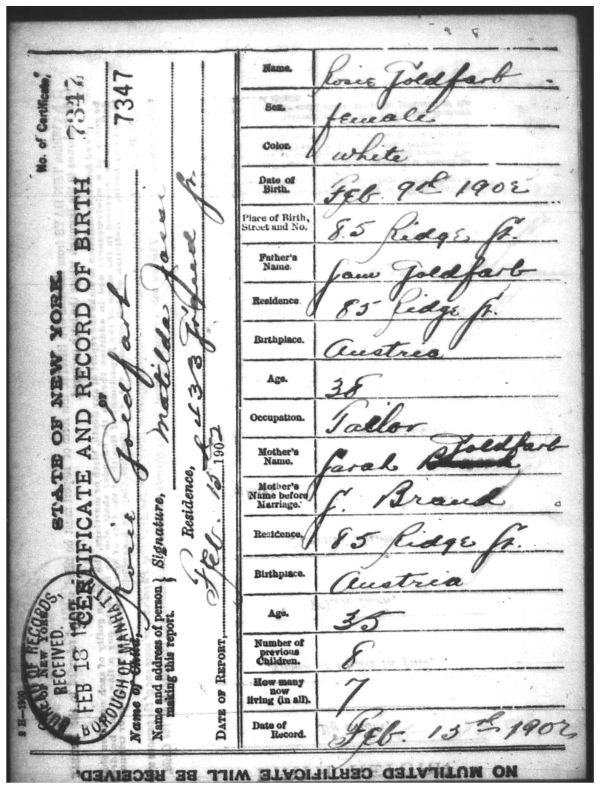
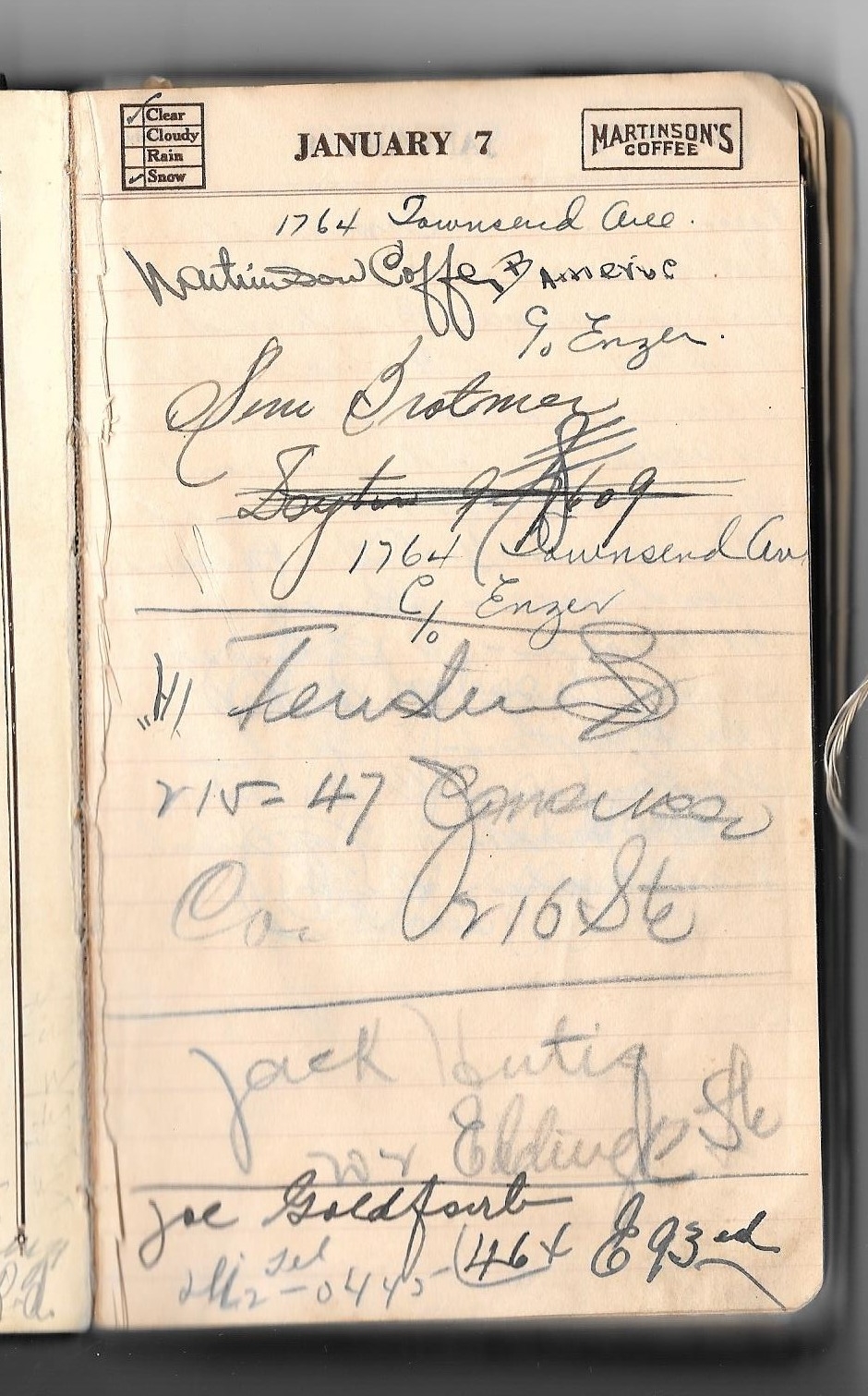
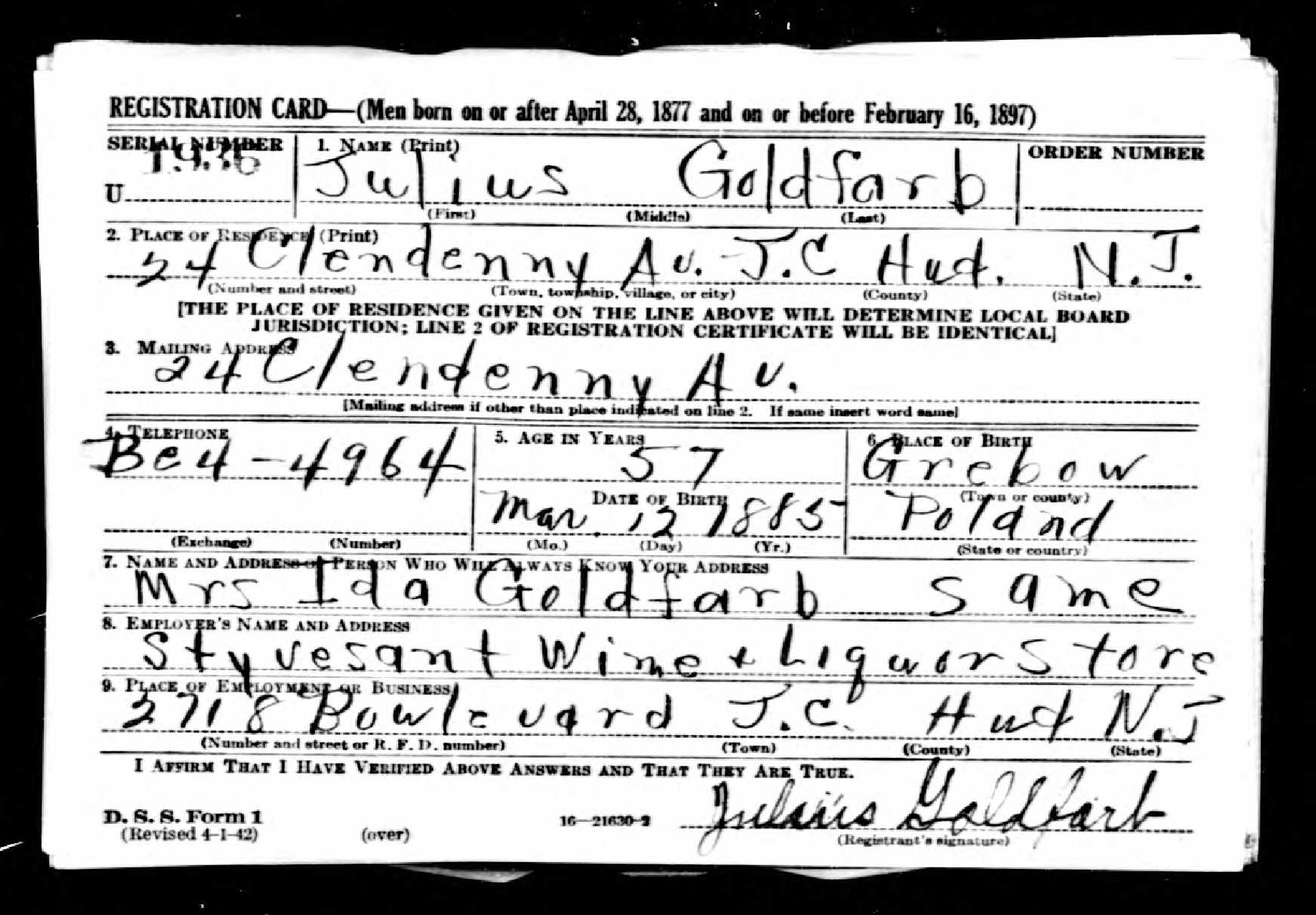
On my mother’s side, I have done a fair amount of work on the Goldfarb family, but have yet had a chance to write about them.  They were the cousins I discovered when my cousin shared with me my aunt’s baby book and my grandfather’s notebook.  I have been hoping to get to their story for quite a while, but wanted some closure on the Schoenthal family first.

And then there are my remaining two great-great-grandparents on my father’s side—Gerson Katzenstein and Eva Goldschmidt, parents of my great-grandmother Hilda Katzenstein, who married Isidore Schoenthal.

First, I have a few sad notices to post about recent losses in the family.  And then? Where do I go next?

crossroads-303896_1280

Do I finish the Schoenthals by focusing on Fanny and Mina? Do I complete the Hamberg line?

Do I turn back temporarily to the Seligmanns and fill in a few gaps?

Or should I move on to my next two paternal lines, the Katzensteins and Goldschmidts?

Or do I turn to something on my mother’s side—-the Goldfarbs?

This is why people say you are never finished with your family history.  As for where I turn next, I am going to give it some thought and see where I land.  The compulsive side of me says stick with the Schoenthals until I am done.  The less compulsive side (there is no non-compulsive side) says break free, don’t be so logical, jump to something else.  Let’s see which side wins.


The Last Chapter of the Story of Amalia Hamberg

Finally, I come to the two youngest children of Amalia Hamberg and Jacob Baer to survive to adulthood[1]: Elsie Baer Grant and Lawrence Baer.   With this post, I close the chapter on Amalia Hamberg, first cousin of my great-grandfather Isidore Schoenthal, or my first cousin, three times removed.  Her children were my second cousins, twice removed (or my grandmother Eva Schoenthal’s second cousins).

corrected relationship isidore schoenthal to malchen hamberg

Elsie Baer was born in Pittsburgh in 1886 and married Jerome Grant in 1913.  For almost their entire married lives they lived in New York City, where Jerome worked for Baer & Wilde, one of the family jewelry businesses based in Attleboro, Massachusetts.  Elsie and Jerome had two daughters, Marjorie and Elinor.  As of 1930, they were still living in New York City, and Jerome was still working for the family jewelry business.  The same was true in 1940; both daughters were still at home.

In the next decade both daughters married. Marjorie married Richard E. Weinreich, whose family was also in the jewelry business.  Richard’s father, Sol Weinreich, had founded Marvella Pearls, a jewelry wholesale business with his brother in Philadelphia, where Richard was born in 1915.  By 1930, the family and the business had relocated to New York, and by 1940, both Richard and his father were working in the business.

Marvella pearls

I assume that Richard and Marjorie met as a result of the fact that both families were in the jewelry business in New York.  Richard and Marjorie would have one child.  Richard eventually became president of Marvella.  According to this antiques website, “Marvella was purchased by Trifari in the early 1980s and eventually became part of the Liz Claiborne group. As of 2010, jewelry is still being distributed in department stores and other retail outlets on cards bearing the Marvella name.”

Marjorie’s sister Elinor served for over a year with the Red Cross in India in the early 1940s. On December 19, 1946, she married Alan Fredrick Kline of Chicago.

Elinor Grant wedding to Alan Kline 1946 NYTimes-page-001

Alan was a graduate of Dartmouth College and had served in the US Naval Reserves during World War II.  His father Jacob was one of the founders of Kline Brothers, a department store chain that started in Lorain, Ohio, and eventually had a large number of stores in the Midwest.

Suburbanite_Economist_Sun__Oct_28__1973_ article about Kline Bros

Elinor and Alan had two children before Alan died at only 37 years old on October 1, 1950, leaving Elinor with two very young sons.  Elinor would eventually remarry.

Elsie Baer’s husband Jerome Grant died on July 29, 1964; he was 75.  According to the death notices in The New York Times, he was a Mason, a member of The Golden Circle, and a member of the Maiden Lane Outing Club.

Like her sisters Josephine, Tilda, and Amanda, Elsie Baer Grant lived a long life, dying many years after her husband in May 1983 at age 96.

Unfortunately, the daughters of Elsie and Jerome were not blessed with their mother’s longevity.  Marjorie predeceased her mother, dying in May, 1978; she was only 59.  Her sister Elinor died at age 72 on November 2, 1993.

As for Elsie’s younger brother Lawrence, the youngest of the children of Amalia Hamberg and Jacob Baer, he played, as I’ve written here, a critical part in the success of the family jewelry business in Attleboro.  He not only invented the Kum-A-Part cufflinks that made the company highly successful in the 1920s; he also invented and received patents for several other jewelry products.  For example, in 1922, Lawrence received a patent (No.  US 1420232 A) for a jewelry contained, described as “a container which can be carried in the pocket or in a traveling bag or the like or placed in an article of furniture in the home, for holding buckles, brooches, buttons, and any article of jewelry.”  He also received during the 1920s and 1930s patents for a number of other inventions: necktie holders, a belt fastener, a bill holder, a shirt holder, and a display device.

Jewelry holder invented by Lawrence Baer


As noted in my earlier post, Lawrence had married Donna Degen in 1919, and they had one child, a son named John Degen Baer, born in 1921.  As of 1942 when Lawrence registered for the draft, they were still living in Attleboro and Lawrence was still working for the family jewelry business, now known as Swank, Inc.  But by 1946, Lawrence was listed with his second wife, Olivia Ganong, in the West Palm Beach, Florida, city directory.  He and Olivia lived in Florida for the rest of his life.  Lawrence died in May, 1969, in Lake Worth, Florida. He was 77 years old.

His son John remained in Attleboro even after Lawrence remarried and moved to Florida. According to his obituary, John attended Yale and Brown, graduating from Brown in 1943. During World War II, he served in the United States Marine Corps in the Pacific theater and in the occupation of Japan. He married Minette Eleanor Brigham on July 22. 1944.1 John and Minette had two children.

In 1946, the Attleboro city directory lists John as serving in the United States Marine Corps. In 1953, he was the executive vice-president of The Bishop Company in Attleboro.  According to his obituary, John “was the owner and C.E.O. of the Bishop Company, an Ophthalmic Manufacturing Company, which he merged with the Univis Lens Company of Dayton, Ohio in 1960. The merged company, Univis, Inc., was headquartered in Ft. Lauderdale, Florida, with branch manufacturing plants in Puerto Rico, Tennessee, New York and Massachusetts. Univis was sold to Itek, Inc. in 1970.”

In 1963, John was still listed in the Attleboro directory, but that is the last listing I can find for him there. His wife Minette died on February 9, 1966; she was only 44. John then married his second wife Linda Corinne Hill, with whom he had four more children.

After he sold Univis in 1970, John moved to Atlanta, Georgia, where he was executive vice-president of Edwards Baking Company until 1978. His second wife Linda died on April 16, 1978.2 Sometime thereafter John married his third wife, Jane Rollins.

In 1985, he relocated yet again, moving to Blairsville, Georgia, where he started and managed the Truck and Gas Market until 1992, when he retired. John Baer died on November 3, 2015.  He was 94 years old. (Much of this information comes from his obituary, which also includes a number of photographs of John.)


Thus ends the recounting of the lives of all of the children (and the children of the children) of Amalia Hamberg and Jacob Baer: Maurice, Hattie, Josephine, Amanda, Flora, Tilda, Elsie, Alfred, and Lawrence.  I am once again amazed by the fact that two immigrants who came to the United States in the 19th century raised children who achieved such remarkable success both in business and in the arts.

Perhaps it is a lesson to us all about the contributions that immigrants have made and will continue to make this country.  We should be very wary of anyone who seeks to exclude immigrants from this country.  After all, most of us living in the US today are descended from immigrants.


[1] Alfred Baer, the second youngest child, had died years before.


  1. Minette Eleanor Brigham, Gender Female, Age 22, Birth Date abt 1922
    Marriage Date 22 Jul 1944, Marriage Place District of Columbia, USA, Spouse
    John Degen Baer, FHL Roll 002319543, Ancestry.com. District of Columbia, U.S., Marriage Records, 1810-1953 
  2. Linda Baer, Gender Female, Race White, Age 36, Birth Date abt 1942, Residence Place Fulton, Georgia, USA, Death Date 16 Apr 1978, Death Place Fulton, Georgia, USA, Certificate Number 017489, Georgia Health Department, Office of Vital Records; Georgia, USA; Indexes of Vital Records for Georgia: Deaths, 1919-1998; Certificate Number: 017489, Ancestry.com. Georgia, U.S., Death Index, 1919-1998  

The Legacy of Flora Baer Adler

I am back after two weeks with family members—first, a wonderful week with our grandson Nate and then a week with the extended family.  We had gorgeous weather, lots of laughs, and too much good food.  But now things are quiet, and I am returning to finish the story of the children of Amalia Hamberg.

It’s been a long break since I last posted, so I thought it would be helpful to clarify where I was when I left off. I had been discussing the many children of Amalia/Mlalchen Hamberg, who was a first cousin of my great-grandfather Isidore Schoenthal through his mother Henriette Hamberg.

corrected relationship isidore schoenthal to malchen hamberg

I have already discussed six of Amalia’s nine children, including Maurice, Hattie, Josephine, Amanda, Alfred and Tilda.  That leaves three more: Elsie, Lawrence, and the subject of this post, Flora.

Although Hattie Baer died at a young age as did her brother Alfred, most of the other siblings lived long lives.  As we saw in the earlier posts, Amanda lived late into her 90th year, and Josephine lived to 97. Their sister Elsie also lived to 97, and Tilda was within a few months of her 90th birthday.

Unfortunately, their sister Flora did not live as long a life.  As I wrote here, Flora  married Julius Adler, an engineer who had worked for the Philadelphia highway department, supervising the construction of the Benjamin Franklin Bridge.  They had three children between 1917 and 1920, Stanley, Jerrold, and Amy.  Thanks to one of the grandchildren of Flora and Julius, I now have some photographs of the family.

Wedding photograph of Flora Baer and Julius Adler, March 15, 1915 Courtesy of the Adler family

Wedding photograph of Flora Baer and Julius Adler, March 15, 1915
Courtesy of the Adler family

Flora Baer Adler and one of her children

Flora Baer Adler and one of her children


In 1940, all three children were still living at home with their parents in Philadelphia.  Julius listed his occupation as an independent civil engineer.  Their son Stanley was working as a chemical engineer for a chemical company, and their daughter Amy was a social services worker at a hospital.  Jerrold had no occupation listed; perhaps he was still in school.

Flora Baer Adler 1943

Flora Baer Adler 1943, courtesy of the Adler family


Jerrold Adler, Flora Baer Adler, and Julius Adler 1943 Courtesy of the Adler family

Jerrold Adler, Flora Baer Adler, and Julius Adler
1943
Courtesy of the Adler family

Then tragedy struck.  On August 27, 1945, my cousin Flora died from fluoride poisoning; her death was ruled a suicide by the coroner.

FLora Baer death certificate preliminary

FLora Baer death certificate with coroner result

Ancestry.com. Pennsylvania, Death Certificates, 1906-1963 [database on-line]. Provo, UT, USA: Ancestry.com Operations, Inc., 2014. Original data: Pennsylvania (State). Death certificates, 1906–1963. Series 11.90 (1,905 cartons). Records of the Pennsylvania Department of Health, Record Group 11. Pennsylvania Historical and Museum Commission, Harrisburg, Pennsylvania.

Julius and the three children somehow recovered from this tragedy.  Julius married his second wife Katinka Dannenburg Olsho in 1971 when he was 84 years old.

Julius Adler, 1977 Courtesy of the Adler family

Julius Adler, 1977
Courtesy of the Adler family

When he died in 1993 at the age of 106, the Philadelphia Inquirer published a wonderful tribute to him:

… [Julius Adler] was an erudite man who could quote long passages from Kipling, recite Latin and Greek verse, and speak authoritatively on any of his varied interests, which included growing roses and playing bridge, according to his family.

“This man was unique, just an extraordinary human being,” said Mr. Adler’s son-in-law, Leonard Malamut. “In everything he did, he was top-notch. And he was a man of great dignity. He grew up at a time when decency and ethics and morality were the guiding principles of how one lived.”

Mr. Adler was born in Memphis, Tenn., and moved to Philadelphia as a child. He was a graduate of Central High School’s 109th class in 1904 and a 1908 graduate of the School of Engineering at the University of Pennsylvania, which he attended on an academic scholarship. His family believes he was the oldest living graduate from Central and Penn.

Mr. Adler’s supervision of the Ben Franklin Bridge paving took place when he was deputy chief of the city’s highway department, his son-in-law said. The bridge, when it was built, was called the Delaware River Bridge.  He also supervised the repaving of Broad Street after the construction of the Broad Street Subway.

Mr. Adler taught at the University of Pennsylvania and the University of Washington. He was a member of the Engineers Club of Philadelphia, the American Society of Civil Engineering and the American Society for Testing Materials.

For 70 years, he was a member of Congregation Rodeph Shalom.

Mr. Adler was, as well, a devoted fan of the Phillies. “He could tell you players’ ERAs and batting averages with great accuracy until he was 100,” Malamut said. “I regret that he died in the season the Phillies are having such a great season – that he had to die before the season was over.”

Stanley, Amy, Julius, and Jerrold Adler 1960 Courtesy of the Adler family

Stanley, Amy, Julius, and Jerrold Adler 1960
Courtesy of the Adler family

Julius and Flora’s three children also all lived productive lives.  Their daughter Amy died in 2003 of a heart attack; she was 83.  According to her obituary:

She served as a hospital volunteer when she was a teenager and later studied X-ray technology and electrocardiography.  In 1942, she met Dr. Leonard Malamut when she was working at Jewish Hospital, now Albert Einstein Medical Center. The couple married in 1944.

Dr. Malamut opened a practice near Albert Einstein Medical Center in Olney after serving several years in the Army during World War II. Mrs. Malamut joined him in the office. She managed the practice, keeping the books and helping with electrocardiograms, blood work and other tests.  She enjoyed attending concerts and the theater with Dr. Malamut.

Amy’s older brother Stanley died on April 21, 2006; he was 89 years old.  According to his obituary, like his father, he was an engineer who had graduated from the University of Pennsylvania.  The obituary reported:

During World War II, Stan was an aircraft inspector for the United States Navy. …. He was active in Reform Judaism, scouting, and the American Institute of Chemical Engineers. He wrote many technical papers. His interests included amateur radio, bridge, calculus, gardening, classical music, and a more cooperative world.

Stanley Baer Adler Fold3_Page_1_Selective_Service_Registration_Cards_World_War_II_Multiple_Registrations

Stanley Baer Adler
Fold3_Page_1_Selective_Service_Registration_Cards_World_War_II_Multiple_Registrations

The last surviving child of Flora Baer and Julius Adler was Jerrold, who died on March 5, 2008, when he was, like his brother Stanley, 89 years old.   He had attended the University of Pennsylvania and had served in the army during World War II.

Jerrold Adler draft registration Fold3_Page_1_Selective_Service_Registration_Cards_World_War_II_Multiple_Registrations

Jerrold Adler draft registration
Fold3_Page_1_Selective_Service_Registration_Cards_World_War_II_Multiple_Registrations

Jerrold Adler, courtesy of the Adler family

Jerrold Adler, courtesy of the Adler family

He had married Doris Elaine Getz on October 6, 1946.

Wedding of Jerrold Adler and Doris Getz, October 6, 1946

Wedding of Jerrold Adler and Doris Getz, October 6, 1946

Although Flora’s life ended tragically, she left behind the legacy of three successful children.  Their lives enriched the country that Flora’s mother Amalia had moved to as a young woman back in the 19th century.  They served in our armed forces during World War II and contributed to society through their chosen careers.  Like so many of us, the grandchildren of immigrants, they justified the risks their grandparents took when immigrating to the United States.


Family Time

Of course, doing genealogy means every day is a day of family time.  But this week and next will be time with the current members of the family—starting this week with my dear grandson Nate.

20160720_153353765_iOS

He’s been with us all week, and it’s been such a pleasure to be with this wonderful boy. He was my initial inspiration for researching my family’s history. When he was born six years ago, it made me think about the links back in a long chain that didn’t start with his parents, his grandparents, or his great-grandparents.  It started long before that, but I knew nothing, or almost nothing, about those earlier generations.  I wanted to be able to share their stories with him, but first I had to learn those stories myself.

So here I am, six years later, still working at it and planning to do so until I am done.  And as genealogists often say, we are never done.  Maybe my grandchildren won’t care about any of this—at least until they have grandchildren.  But just in case, I am sticking to it.

The blog may be relatively quiet in the next week or so, though I do have a few things that I am almost ready to post. (And I may also fall behind in reading other blogs, but I will catch up.)  My mission is far from complete, so for all those generations to come, I will return to tell the stories of the generations who came before them.


Ray, Arizona: Home of Gertrude and Hettie Schoenthal

Some of you may remember that about six months ago I wrote about Gertrude and Hettie Schoenthal, two of the daughters of Simon Schoenthal, brother of my great-grandfather Isidore.  Gertrude had married Jacob Miller in 1898 and moved to Arizona. Jacob and his brothers were merchants in the Tucson area. Gertrude’s younger sister Hettie followed her out there around 1906, where she met her husband Henry Stein and eventually settled as well.

Eventually both the Millers and the Steins moved to the small mining town of Ray, Arizona, where they lived for several years before returning to Atlantic City, where most of the members Schoenthal family were still living.   Hettie and her son Walter Stein wrote wonderfully descriptive memoirs of their rough and tumble pioneer life in Ray, Arizona.  I quoted extensively from their writings in this blog post.

A week ago I was Skyping with Sharon Lippincott, who is married to Ezra Lippincott, grandson of Hettie Schoenthal, and Sharon and Ezra were excited to share with me a photograph that their daughter-in-law had found somewhere on the internet.  It is a panoramic view of Ray, Arizona, taken in the time that Hettie and her sister Gertrude were living there.  In fact, you can see the Miller Brothers store in the photo if you zoom in to the right side of the picture.  Just click, and then click again to zoom in to the photograph to see it more clearly.

Ray Arizona Panarama from Internet

Here’s a closeup of the section showing the Miller store:

Ray Arizona Panarama from Internet (2)

Both Hettie and Walter described their first house in Ray.  Walter wrote:

Our first house was placed on the side of a hill with one door. The back of the house was against the hill. To reach the house you walked up steps that also took care of other householders on the hill. I cannot remember the location of the outhouse. I do remember to bathe, water was heated on the stove and then poured into a galvanized tub that had been placed on the floor.

Hettie’s description is similar:

I will tell you a little about the house. It was up on a hill, just four rooms no bath or toilet. It was terrible. I did not think I could live there, but we did. Your grandfather and a helper built a room and we bought a tub. The pipes had to be on top of the ground. Well, the sun was so hot we had to draw the water and let it stand for hours before bathing.

Can you locate the house in the photograph above?  The houses are all to the far right in the panoramic photograph, and I have a guess as to which one was the home of Hettie Schoenthal and Henry Stein and their children.  Which one do you think it was?  (Look first before looking at my guess at the bottom of this post.)


In my head I am humming the Final Jeopardy theme song.


Here’s my guess:

Ray Arizona Panarama from Internet (3)

See the house in the left foreground with the huge cactus in front?  I think that’s it.  It’s built into the hill, and there is a staircase behind that leads to the other houses.  It looks like the outhouse was right in front of the house.

What do you think?

My thanks to Ezra and Sharon Lippincott and their daughter-in-law Carrie for sharing the photograph with me.

Tilda Baer Stone and Her Children: Massachusetts Cousins

Like Amanda and Josephine, her two older sisters, Tilda Baer lived a long life (a few months shy of ninety) and outlived her husband by close to twenty years.  But she didn’t live in a big city like Philadelphia or New York; she spent her entire adult life in Attleboro, Massachusetts, where she raised her four children.

As written about here, Tilda married Samuel Einstein in about 1907, according to the 1910 census, and their first child, Stephanie, was born in June 1908 in Attleboro.  They had three additional children, Samuel, Jr. (1910), Harriet (1913), and Babette (known as Betty, 1919).  By 1927, the family name had been changed to Stone, which was the name used by all family members thereafter (until the daughters married and adopted their husbands’ surnames, that is).  Samuel was by 1930 the President of Attleboro Manufacturing, and he and Tilda remained in Attleboro for the rest of the lives, living almost all those years at 224 County Street in that town.

Samuel and TIlda Baer Einstein/Stone and children from 1923 passport application National Archives and Records Administration (NARA); Washington D.C.; NARA Series: Passport Applications, January 2, 1906 - March 31, 1925; Roll #: 2295; Volume #: Roll 2295 - Certificates: 304850-305349, 08 Jun 1923-08 Jun 1923

Samuel and TIlda Baer Einstein/Stone and children from 1923 passport application
National Archives and Records Administration (NARA); Washington D.C.; NARA Series: Passport Applications, January 2, 1906 – March 31, 1925; Roll #: 2295; Volume #: Roll 2295 – Certificates: 304850-305349, 08 Jun 1923-08 Jun 1923

Their daughter Stephanie graduated from the National Park Seminary in Washington and the Garland School of Homemaking.  She married “the boy next door” on November 14, 1936—or at least the boy down the street. Her husband was Royal Packer Baker, who was a native of Attleboro like Stephanie and whose family also had lived on County Street (#148) as of 1920.  Royal was four years older than Stephanie, and he came from a family with a long history in Massachusetts and Rhode Island.

Boston Herald, November 15, 1936. p. 61

Boston Herald, November 15, 1936. p. 61


Royal’s father, Harold Baker, was the owner and co-founder of Attleboro Refining Company, a gold, silver, and copper refining business.  According to the website for the Attleboro Area Industrial Museum, which is housed in what was once the Attleboro Refinery Company building:

In 1899, Harold D. Baker and his brother George W. Baker, both of Providence, Rhode Island, formed a partnership to establish the Attleboro Refining Company in Attleboro, Massachusetts. It specialized in the refining of gold, silver and copper byproducts. The refinery followed established refining methods used at that time known as a stripping process. The process dated back to the late 18th Century. Base metals such as copper and zinc were eaten by a compound-acid solution. The precious metals underwent succeeding operations where they were reduced to a certain degree of fineness.

By 1907, however, the Bakers were convinced that better methods were available that would involve lower costs. They experimented with the then-existent electrochemical equipment available and finally succeeded in adapting the ELECTROLYTIC process to jewelers’ scrap. Theirs was the first refinery in New England to do so. The process underwent continuous improvement and development where gold was finally purified to .9991/2 fine and every trace of silver or other precious metal was re-claimed in the chlorination and succeeding copperas processes.[1]

Although his older brother Harold Jr. worked at the family business from the start of his career, Royal started his career taking a different path.  He was a graduate of Dartmouth as well as the University of Virginia, according to the wedding announcement.   By 1935 he was a lawyer practicing in Attleboro.

According to the 1940 census and their wedding announcement above, like their parents Stephanie and Royal also lived on County Street in Attleboro (#170), and Royal was working as an attorney in private practice.  In 1941, their son was born.  In 1946, Royal was listed along with his father and older brother Harold Jr. as an owner of Attleboro Refining, but was still practicing law.  By 1949, however, he was the treasurer of Attleboro Refining and no longer listed himself as a lawyer in the Attleboro directory. (His brother was now the president of the company; their father had died in 1947.)

Former building of Attleboro Refining Company https://c2.staticflickr.com/4/3500/4561405595_a2f6c67d9f_b.jpg

Stephanie’s younger brother Samuel Stone, Jr., graduated from Michigan State University and Babson Institute. In the 1935 Attleboro directory, he is listed as married to “Ruth M” and working as the treasurer of Quaker Silver Company, a company in North Attleboro that manufactured silver products such as flatware, bowls, and salt and pepper shakers.

Ruth M was Ruth Mills, born in Massachusetts on February 5, 1913.  Samuel, Jr. and Ruth had two daughters born in the 1930s, according to the 1940 census, which lists Samuel’s occupation as a jewelry manufacturer.  On the 1939 Attleboro directory, he is listed as the president of C H Eden Co., another jewelry company originally created by his father in 1901 that was acquired in substantial part by Charles Eden in 1903.  (Apparently, Samuel Stone, Sr. and Maurice Baer established a number of separate companies in Attleboro, all engaged in some aspect of jewelry manufacturing.)

By 1946, however, Samuel Jr’s marriage to Ruth had ended as he married his second wife, Marie Eames, on May 1, 1946.  Unfortunately, that marriage did not last either as they were divorced in 1952.

Samuel Stone Jr wedding to Marie Eames

By 1956, Samuel, Jr was listed in the Attleboro directory as the president of Swank, Inc., the successor to Attleboro Manufacturing Company, the company his father first founded with his uncle Maurice Jay Baer back in the late 1890s.

As for the two younger daughters of Tilda Baer and Samuel Stone, Sr., Harriet attended the Northampton School for Girls, then Wheaton College, and received a degree from Simmons College. (Cape Cod Times, September 6, 2002, GenealogyBank.com (http://www.genealogybank.com/doc/obituaries/obit/100B3AE9F09E0868-100B3AE9F09E0868 : accessed 13 July 2016))

In 1941 she married Lionel O’Keeffe.  He was the youngest son of Irish immigrants and was born and raised in Boston.  His father had worked in the grocery business, and in 1930 two of his brothers had been working as purchasing agents for First National Stores, a supermarket chain (later known as Finast).  Lionel was a graduate of Boston Latin High School and Dartmouth College. (Boston Herald, December 22, 1987, p. 53.)

On the 1940 census, he was living as the head of household in the house at 61 Pond Street in Jamaica Plain, the same house where he and his family had lived when he was a child.  But in 1940 he was living there without any other family members, but with a maid.  He listed his occupation as an executive of a chain store, which according to his obituary, was First National Stores.  The following year he married Harriet.

Lionel enlisted in the military on May 8, 1942, and he and Harriet had their first child five months later in September, 1942.  Lionel was discharged from the military on January 3, 1946, having served for the duration of World War II.  He and Harriet would have two more children during the 1940s.  In 1948 they were still living at 61 Pond Road in the Jamaica Pond section of Boston, the same house where Lionel’s family had lived, and Lionel was working as a buyer, according to the Boston directory for that year.  He continued to work for First National Stores for the rest of his career.

The youngest child of Tilda Baer and Samuel Stone was their daughter Babette, also known as Betty.  She graduated from the Northampton School for Girls in 1937 and then graduated from Smith College, later getting a Masters in Social Work from Simmons College.  In 1944, she married John Saunders Parker, known as Jack.  He became a doctor.  They would have two children. (Boston Globe, February 21, 2013.)

Samuel Stone, Sr., the father of Stephanie, Samuel, Harriet, and Babette, died on February 4, 1957, when he was 84 years old.

Samuel Stone Sr obit February 5, 1957 Boston Traveler p 58-page-001

Boston Traveler, February 5, 1957, p. 58

samuel stone obit His wife, my cousin Tilda Baer Stone, daughter of Amalia Hamberg and Jacob Baer, died on August 2, 1974.  She and her husband Samuel are both buried at Woodlawn Cemetery in Attleboro, Massachusetts, the place they called home for their entire married life and where they raised their four children, two of whom also spent almost all of  their lives in Attleboro.

As for the children of Tilda and Samuel, Stephanie’s husband Royal Baker continued to work as the treasurer of Attleboro Refining for the rest of his career.  Then on April 3, 1967, Royal died suddenly at age 62.  A year later Attleboro Refining was sold to another company.  According to the Attleboro Area Industrial Museum website, “on June 26, 1968, Handy & Harman Refining Group, Inc. purchased the Attleboro Refining Company. In November 1973, Handy & Harman left 42 Union Street for a new facility located on Townsend Road in the “new” Attleboro Industrial Park.”   Handy & Harman is still in business today engaged in the recycling of metals.

Royal P Baker death notice April 1967

Stephanie Stone Baker died on March 1, 1993; she was 84.

Her brother Samuel Stone, Jr., died at age 70 on December 28, 1980.

Samuel Stone Jr obit 12 31 1980

The third child, Harriet Stone O’Keeffe, lost her husband Lionel on December 20, 1987.  He was 76 years old.  She lived another fifteen years, dying on September 5, 2002, when she was 88.  According to her obituary, “Mrs. O’Keeffe lived in Brookline for many years and was active in volunteer work. She spent summers in Hyannisport and moved there year-round in 1973. She enjoyed gardening and bridge. She was a member of the Hyannisport Club, the Oyster Harbors Club and the Mid Ocean Club in Bermuda.” (Cape Cod Times, September 6, 2002, GenealogyBank.com (http://www.genealogybank.com/doc/obituaries/obit/100B3AE9F09E0868-100B3AE9F09E0868 : accessed 13 July 2016))

The youngest sibling, Babette, died just three years ago on February 19, 2013, at age 93.  Her obituary reported that:

She loved people and was a frequent volunteer in the activities of her children and an outgoing devoted friend to so many. She was an active volunteer in the Wellesley Community including the Service League of Wellesley, the Garden Club of Wellesley and was a past president of the Smith Club of Wellesley. She devoted many hours to the support of the Boston Symphony Orchestra and loved her Investment Club and Bridge Club, as well as her activities at the Wellesley Country Club, Wianno Club, The Country Club and The Moorings and Riomar Clubs of Vero Beach, Florida. She cherished all the interactions with the people that were brought into her life by these varied interests.  (Boston Globe, February 21, 2013, located at http://www.legacy.com/obituaries/bostonglobe/obituary.aspx?pid=163199572)

I’ve not yet connected with any of the descendants of Tilda Baer and Samuel Stone, but hope to be able to connect with these cousins whose roots are here in Massachusetts where I now live.  They are descendants of two people who seemed to have achieved the American dream—Samuel, a German Jewish immigrant who came to the US as a young teenager and became a highly successful jewelry manufacturer, and my cousin Tilda, the daughter of two German Jewish [2] immigrants who grew up in Pennsylvania; she raised four children, all of whom received a higher education and lived their lives in Massachusetts.


[1] There was a bitter dispute between the Baker brothers in 1918, which apparently ended in with Harold as the sole owner of the company. See “Attleboro Receivership Granted for Attleboro Refining Co. Decree Handed down by Superior Court, Wednesday,” Pawtucket Times, April 11, 1918, p. 12.

[2] It seems that at some point Tilda and Samuel and their children became members of the Universalist Church and no longer identified as Jewish.


Another Writer in the Family: Alan Baer Green

In many ways the life of my cousin Josephine Baer parallels that of her sister Amanda.  As I wrote here, Josephine Baer married Morris Alon Green in January, 1906.  Their son Alan Baer Green was born less than eleven months later.  They were living in Pittsburgh.  In 1918 Morris was an executive with the Crucible Steel Company in Pittsburgh.  In 1925, they were living in New York City, and Morris was working as a manager.  In 1930, they were still living in New York, and Morris listed his occupation as “financial.”  Their son Alan was working in advertising.

In 1931, Alan married Gladys Bun, and they had three sons in the late 1930s.  Although Alan continued to work in the advertising field, like his first cousin Justin Baer Herman, he also became a successful writer.  As reported in his obituary, Alan wrote “Love on the Run,” which became a movie starring Clark Gable and Joan Crawford in 1936.  It is a screwball comedy about two competing newspaper reporters covering the wedding of a socialite.

Love on the Run poster

He also wrote several other books during the 1930s, primarily mysteries, sometimes written under the pseudonym Roger Denbie (co-written with Julian Paul Brodie), sometimes as Glen Burne (co-written with his wife Gladys).

Alan’s parents are listed in the 1938 directory for Los Angeles, so I thought perhaps they had all moved out to Hollywood, but Alan himself is not listed in that directory.  And by 1940, all three were listed as living in New York City in the census.

Josephine Baer and Morris Green 1940 US census Year: 1940; Census Place: New York, New York, New York; Roll: T627_2655; Page: 13B; Enumeration District: 31-1349

Josephine Baer and Morris Green 1940 US census
Year: 1940; Census Place: New York, New York, New York; Roll: T627_2655; Page: 13B; Enumeration District: 31-1349

On the 1940 census, Morris and Josephine were living on East 77th Street, and Morris was retired.  Alan and Gladys and their three sons, ages 2, 1, and eleven months, were living on East 86th Street. They had two nurses living with them.  Alan listed his occupations as “author” and “advertising.”

Alan Baer Green and family 1940 US census Year: 1940; Census Place: New York, New York, New York; Roll: T627_2658; Page: 61B; Enumeration District: 31-1454

Alan Baer Green and family 1940 US census
Year: 1940; Census Place: New York, New York, New York; Roll: T627_2658; Page: 61B; Enumeration District: 31-1454

During World War II, Alan served on the War Writers Board, a privately established organization that worked with the government to create propaganda to promote the war effort.  The US Holocaust Museum had this information about the War Writers Board:

Two days after the Japanese attack on Pearl Harbor, Secretary of the Treasury Henry Morgenthau, Jr., proposed organizing the nation’s writers as civilians “under arms” to promote the war effort. A month later, a group of prominent American authors formed the Writers’ War Board, a private association partially supported by government subsidy. The board coordinated more than 2,000 writers in diverse activities including slogans, poster contests, syndicated articles, poems, radio plays, dramatic skits, government publications, books, advertisements, and war propaganda. In May 1942 and 1943, the board sponsored anniversary observances of the Nazi book burnings to keep alive the connection between the destruction of books and the consequences of intolerance.

Alan and Gladys had moved to Westport, Connecticut, by 1943, where they would live for more than thirty years.  After the war Alan was a founder of the Writers Board for World Government, an outgrowth of the War Writers Board formed to promote peace through a “world federation” of all nations.

In 1950, Alan won an Edgar Award from the Mystery Writers of America for his book, What A Body, which was selected as the best first mystery novel of that year. [1] It is a murder mystery involving a police officer who falls for the niece of the murder victim.

What a Body by Alan Baer Green

On December 9, 1954, Morris Green died at age 79 in Atlantic City, where he and Josephine were then living.  A year later Josephine established a scholarship in his name at the University of Pittsburgh; as reported in the Pittsburgh Post-Gazette, although Morris himself did not have much formal education, he “was always devoted to the higher ideals of higher education.”

Morris Green scholarship


At some point after Morris’ death, Josephine moved closer to her son Alan in Connecticut.  Alan continued to write.  One of his best known books, Mother of Her Country, was published in 1973. It was subtitled, “A Comic Novel about Pornography and Censorship.” Kirkus Review wrote the following about it:

A clean joke about porn which doesn’t run to more than one line but tells you something about publishing in general (Mr. Green was around in it for quite some time) and censorship and those not too fine distinctions to be made between words whether they appeared in the Oxford English Dictionary or Macbeth. Laura Conroy, a vestal virgin from the Midwest comes to New York to get a job in the book business which she does — with a small press — to the consternation of her mother who is the Carry Amelia Nation of something called the Americans for Clean Entertainment. There’s a court case and a tacked on coda re a rediscovered journal as to where George Washington might really have slept but the story’s not really much more than a stretcher to fill the space between brou and haha — however cheerful and sensible its reprimand.

Mother of Her Country by Alan Green

Two years later, Alan Baer Green died on March 10, 1975.  He was 68 years old.  He was survived not only by his wife and three sons, but also by his mother Josephine, who was almost 97 years old. Alan Baer Green obit NYTimes March 11 1975-page-001


Josephine died in August, 1975, less than six months after the death of her son.

So how did Josephine’s life parallel that of her sister Amanda? No, she didn’t marry her sister’s widower and raise two nephews.  But like Amanda, she raised a son who grew up to be a successful writer.  Like Amanda, she survived her husband by many years, 28 for Amanda, 21 for Josephine.  Like Amanda, she lived a long life.  Amanda was 89 when she died, Josephine was 97.


[1] I am not sure how he qualified for this as it seems he had already written and published several mystery novels by that time, but perhaps those didn’t count for some reason.

The Screenwriter and the Real Estate Mogul

This is the story of two boys who lost their mother before they were even four years old and who, despite that tragedy, grew up to be very successful.

As I wrote here, my cousin Hattie Baer died at age 33 in 1910.  Hattie and her husband Meyer Herman had had two sons, Justin Baer Herman and Richard B. Herman; Justin was three when his mother died, and Richard was just a few months old.  Five years later in 1915, Hattie’s sister Amanda married her brother-in-law Meyer when those boys were still only eight and five years old, respectively.

Meyer was in the clothing business.  In fact, according to one cemetery record, he worked for the Snellenburg Clothing Company, a clothing manufacturing company and a department store in Philadelphia.

Meyer Herman and Hattie and Amanda burial

Historical Society of Pennsylvania; Philadelphia, Pennsylvania; Collection Name: Historic Pennsylvania Church and Town Records

In one of those “small world moments,” I realized that Meyer Herman was working for a company that was owned by the family of another of my relatives: Carrie Snellenburg, who married my great-great-uncle Joseph Cohen, my great-grandfather Emanuel Cohen’s older brother.  The twisted family tree creaks one more time.

By 1930 both of the sons of Meyer Herman and Hattie Baer (nephews and stepsons of Amanda Baer) were working, Justin as a newspaper editor, Richard as a real estate salesman.  Meyer, Amanda, Justin, and Richard were all still living together in Philadelphia.  Justin was 23, Richard 19 at the time of the 1930 census.

Meyer and Amanda Herman and sons 1930 census Year: 1930; Census Place: Philadelphia, Philadelphia, Pennsylvania; Roll: 2104; Page: 23A; Enumeration District: 0627; Image: 902.0; FHL microfilm: 2341838

Meyer and Amanda Herman and sons 1930 census
Year: 1930; Census Place: Philadelphia, Philadelphia, Pennsylvania; Roll: 2104; Page: 23A; Enumeration District: 0627; Image: 902.0; FHL microfilm: 2341838

Ten years later Meyer and Amanda were still living in Philadelphia, and Meyer was still working as a clothing salesman.  He was 69 years old, Amanda was 58.  Justin and Richard were no longer living with them.  Both had already established themselves in their chosen careers.

After graduating from the Pennsylvania Academy of Fine Art, Justin had become a successful writer, cartoonist, and screenwriter. He wrote for The Philadelphia Record as a reporter and also established a magazine, The Town Crier, during the early 1930s.  He then moved to New York by 1935, where he was a contributor of poems, short stories, and cartoons to The New Yorker magazine.  During that decade he also starting writing screenplays for short films.  Between 1934 and 1940, he wrote nineteen screenplays for short films, working for Paramount Pictures.  “Justin B. Herman Dead at 76; Writer and Producer of Films,” The New York Times, December 10, 1983.    As of 1940, he was single and still living in New York City.

Pennsylvania Academy of the Fine Arts, 118-124...

Pennsylvania Academy of the Fine Arts, 118-124 North Broad Street, Philadelphia, PA 19102, built 1872-75, Frank Furness, architect, William A. Armstrong, builder, National Historic Landmark, 1975. Museum of the Pennsylvania Academy, the oldest art institution in the United States. (Photo credit: Wikipedia)

Meanwhile, his younger brother Richard was also doing quite well during the 1930s.  According to his obituary, Richard “got an early start in the business. He convinced his family and teachers that he was bright, and in elementary school, he was permitted to skip two grades. He entered high school when he was 12, and at 17 was working in real estate for the Lionel Friedman Co. In 1933, at age 23, he founded his own real estate firm. Concentrating on major properties, he built Richard B. Herman & Co. into one of the largest real estate firms in Philadelphia. His forte was real estate investment and management.”  “RICHARD B. HERMAN, 71, REAL ESTATE, CIVIC LEADER,” The Philadelphia Inquirer, June 27, 1982, GenealogyBank.com (http://www.genealogybank.com/doc/obituaries/obit/0FBAE8CA0B3A0215-0FBAE8CA0B3A0215 : accessed 5 July 2016).

As of the 1940 census, Richard had married Marion Cohn, and they were living in Philadelphia.  Their son was born later that year.

On August 25, 1941, Meyer Herman died from coronary thrombosis at age 70.  He had survived the loss of his first wife, Hattie Baer, at a very young age and raised two very young sons in the aftermath of her death before marrying Hattie’s sister Amanda five years later.  He must have been very proud of those two sons.

Meyer Herman death certificate Ancestry.com. Pennsylvania, Death Certificates, 1906-1963 [database on-line]. Provo, UT, USA: Ancestry.com Operations, Inc., 2014. Original data: Pennsylvania (State). Death certificates, 1906–1963. Series 11.90 (1,905 cartons). Records of the Pennsylvania Department of Health, Record Group 11. Pennsylvania Historical and Museum Commission, Harrisburg, Pennsylvania.

Meyer Herman death certificate
Ancestry.com. Pennsylvania, Death Certificates, 1906-1963 [database on-line]. Provo, UT, USA: Ancestry.com Operations, Inc., 2014.
Original data: Pennsylvania (State). Death certificates, 1906–1963. Series 11.90 (1,905 cartons). Records of the Pennsylvania Department of Health, Record Group 11. Pennsylvania Historical and Museum Commission, Harrisburg, Pennsylvania.

During the 1940s Justin Baer Herman married Alma Baer (as far as I can tell, the fact that her surname was Baer was coincidental; she does not appear to have been related to Jacob Baer’s family).  They would have two daughters.  Justin continued to be a successful screenwriter for Paramount.  Two of the films he wrote were nominated for Academy Awards in the category of Best Short Subject.  According to the Imdb database, he was credited as the writer on 61 films between 1934 and 1955 and as director on 49 of those films, producer on forty.  His obituary claimed even higher numbers: “Mr. Herman produced 118 short subjects in 35 years of film making. Three of them were nominated for Academy Awards – ”Life Line to Hong Kong,” ”Roller Derby” and ”Three Kisses.” “Justin B. Herman Dead at 76; Writer and Producer of Films,” The New York Times, December 10, 1983.

Richard also continued to have success in his career.  His obituary reports that:

One of the original developers of Penn Center, he played a major role in the revitalization of Center City. He helped build, and his firm operated, many of the buildings added to the city’s skyline since 1950. …  Working in Penn Center, he was responsible for much of its growth through such transactions as the sale for Penn Central of the 16th and Market Street sites on which stand such buildings as the Central Penn National Building.   He was also responsible for the sale of the Suburban Station Building to the late Matthew H. McCloskey Jr., and the construction of the IBM Building.  When major buildings were placed on the market, he usually was involved – he handled the sale of the Curtis Building, for example. [As of 1971, his company]  was responsible for the operation and leasing of more than 30 major office buildings containing 4.5 million square feet of space.

In fact, Richard’s real estate development firm was responsible for building the huge apartment building, The Philadelphian, where my aunt Eva Cohen lived for many years.

"Philadelphia to Have Largest Apartment, Camden Courier Post, Saturday, May 6, 1961, p. 2

“Philadelphia to Have Largest Apartment, Camden Courier Post, Saturday, May 6, 1961, p. 2

The Philadelphian

The Philadelphian

Unfortunately, Richard suffered a tragedy in his personal life.  On February 28, 1953, his nine year old daughter Barbara died from acute cardiac dilatation.

Barbara Herman death certificate Ancestry.com. Pennsylvania, Death Certificates, 1906-1963 [database on-line]. Provo, UT, USA: Ancestry.com Operations, Inc., 2014. Original data: Pennsylvania (State). Death certificates, 1906–1963. Series 11.90 (1,905 cartons). Records of the Pennsylvania Department of Health, Record Group 11. Pennsylvania Historical and Museum Commission, Harrisburg, Pennsylvania.

Barbara Herman death certificate
Ancestry.com. Pennsylvania, Death Certificates, 1906-1963 [database on-line]. Provo, UT, USA: Ancestry.com Operations, Inc., 2014.
Original data: Pennsylvania (State). Death certificates, 1906–1963. Series 11.90 (1,905 cartons). Records of the Pennsylvania Department of Health, Record Group 11. Pennsylvania Historical and Museum Commission, Harrisburg, Pennsylvania.

 UPDATE: Luanne, a fellow genealogy blogger, asked what I knew about Barbara’s cause of death, so I asked my brother/medical consultant.   He said, “something like viral myocarditis that resulted in cardiogenic shock…would be the most likely diagnosis in a 9 year old.  Acute cardiac dilatation isn’t really a diagnosis, it’s a finding or a descriptive term.[It means an acutely enlarged heart.] Rapid onset cardiogenic shock can also be caused by an MI, valve dysfunction, wall rupture and dysrhythmias, but these would be pretty unusual in a 9 year old. It is also possible she had septic shock which, in the end, caused her heart to dilate (enlarge) and fail.”  For those (like me) who need a definition of cardiogenic shock, MedlinePlus says, “Cardiogenic shock is when the heart has been damaged so much that it is unable to supply enough blood to the organs of the body.”

Justin and Richard’s aunt and stepmother Amanda Baer died on July 28, 1969; she was 89 years old.  She was buried in Mt Sinai cemetery in the same lot as her husband, Meyer Herman, and her sister, Hattie Baer, Meyer’s first wife. Meyer was buried between his two wives, the two Baer sisters.

Meyer Herman and Hattie and Amanda burial

Mt Sinai cemetery record of burials of Amanda Baer Herman, Meyer Herman, and Hattie Baer Herman

Like Meyer, Amanda must have been very proud of her two nephews, Justin and Richard, whom she had helped raise perhaps even before she had married their father in 1915.

Richard Herman died on June 25, 1982.  He was only 72 years old.  I have already quoted extensively from his Philadelphia Inquirer obituary, but want to add these additional insights into who he was beyond a highly successful real estate developer:

He was involved in a wide range of activities. … He was vice president and a member of the board of the Medical College of Pennsylvania, a member of the board of trustees of the Eastern Pennsylvania Psychiatric Institute, a former chairman of the Easter Seal drive, and served on the board of the Athenaeum of Philadelphia. 

Mr. Herman was a member of the prestigious Committee of 70, and a director of the Philadelphia Museum School of Art and the Franklin Institute. He was former chairman of the nonsectarian National Jewish Hospital in Denver and of divisions of United Fund and United Way drives.   He was active in the Rittenhouse Astronomical Society, the Pennsylvania Historical Society, and the Philadelphia Art Alliance.

Mr. Herman was the only man to head both the Society of American Magicians and the International Brotherhood of Magicians simultaneously.

He was a member of the Citizens Council on City Planning and the Germantown Historical Society.

He was a man with an endless curiosity and an I.Q. high enough to make him eligible for membership in Mensa, an organization for the very intelligent. He taught himself art, sculpture and music. He learned to play the organ on his own. He had his own observatory.

His art was displayed in his home and his office, accompanying his collections of such things as pipes. He also collected instruments related to astrology and medicine, children’s toys and signs.

Richard B. Herman ad

His brother Justin died just one year later on December 3, 1983.  He was 76 years old and died of emphysema.  “Justin B. Herman Dead at 76; Writer and Producer of Films,” The New York Times, December 10, 1983.

These two men who lost their mother before either was four years old certainly left their mark in their respective fields, one an Oscar nominated screenwriter, the other a highly successful real estate developer and civic leader.

The Jeweler and the Suffragette: Star-crossed Lovers?

What would have brought a 71 year old Massachusetts jewelry manufacturer together with a 68 year old suffragette from Birmingham, Alabama?

As I wrote last time, Attleboro Manufacturing, the jewelry company that ultimately supported four of the children of Amalia Hamberg and Jacob Baer, was founded by their oldest child, Maurice Jay Baer.  This post tells the story of the rest of Maurice’s life and his mysterious marriage to a woman named Bossie.

Maurice somehow eluded the census taker every decade after 1900, that is, every decade after he moved out of his parents’ home in Pittsburgh.  In fact, I am not even sure he was still in their home in 1900 since by then he and his future brother-in-law Samuel Stone had founded Attleboro Manufacturing in Attleboro.  And Maurice does not appear on the 1910, 1920, 1930, or 1940 census as best I can tell.

What makes this particularly strange is that he does appear in many directories for the city of Attleboro in the years ranging from 1907 through 1933, and for almost all of the years in which he appears, his residence is 224 County Street in Attleboro.  That is also the address he gave on his World War I draft registration form.

Maurice Jay Baer ww1 draft reg

Maurice Jay Baer, World War I draft registration Ancestry.com. U.S., World War I Draft Registration Cards, 1917-1918 [database on-line]. Provo, UT, USA: Ancestry.com Operations Inc, 2005. Original data: United States, Selective Service System. World War I Selective Service System Draft Registration Cards, 1917-1918. Washington, D.C.: National Archives and Records Administration. M1509, 4,582 rolls. Imaged from Family History Library microfilm.

Maurice’s sister Tilda Baer Stone and her husband Samuel Stone (ne Einstein) also were living at 224 County Street in Attleboro, according to the 1920, 1930, and 1940 census records.   If Maurice was living at that address with his sister and her family, why wasn’t he included in those census records?  Was he hiding from the census enumerator?

Tilda Baer and Samuel Einstein [Stone], 1920 census Year: 1920; Census Place: Attleboro Ward 2, Bristol, Massachusetts; Roll: T625_681; Page: 1A; Enumeration District: 9; Image: 794

Tilda Baer and Samuel Einstein [Stone], 1920 census
Year: 1920; Census Place: Attleboro Ward 2, Bristol, Massachusetts; Roll: T625_681; Page: 1A; Enumeration District: 9; Image: 794

Making it even stranger is the fact that there are numerous passenger manifests listing Maurice as a passenger on ships going back and forth to Europe during the 1920s and 1930s, and on a number of those manifests, Maurice gave a New York City address as his residence.  Perhaps he had a pied a terre in New York as well as a home in Attleboro, but he doesn’t appear on any census record in New York for those years either.

Maurice Jay Baer 1928 ship manifest with NYC residence Year: 1928; Arrival: New York, New York; Microfilm Serial: T715, 1897-1957; Microfilm Roll: Roll 4195; Line: 1; Page Number: 29

Maurice Jay Baer 1928 ship manifest with NYC residence
Year: 1928; Arrival: New York, New York; Microfilm Serial: T715, 1897-1957; Microfilm Roll: Roll 4195; Line: 1; Page Number: 29


Although his absence from census records made it hard to determine whether Maurice had married or had children, I assume that at least until 1945 he had not married. Then on June 19, 1945, Maurice married Julia Hendley in Tryon, Polk County, North Carolina.  I know this is the correct Maurice because of the marriage license application identifying the names of his parents:

Maurice Jay Baer and Julia Hendley marriage license, 1945 Ancestry.com. North Carolina, Marriage Records, 1741-2011 [database on-line]. Provo, UT, USA: Ancestry.com Operations, Inc., 2015. Original data: North Carolina County Registers of Deeds. Microfilm. Record Group 048. North Carolina State Archives, Raleigh, NC.

Maurice Jay Baer and Julia Hendley marriage license, 1945
Ancestry.com. North Carolina, Marriage Records, 1741-2011 [database on-line]. Provo, UT, USA: Ancestry.com Operations, Inc., 2015.
Original data: North Carolina County Registers of Deeds. Microfilm. Record Group 048. North Carolina State Archives, Raleigh, NC.

The marriage register for Polk County lists Maurice’s residence as New York City and Julia’s as Birmingham, Alabama.

Ancestry.com. North Carolina, Marriage Records, 1741-2011 [database on-line]. Provo, UT, USA: Ancestry.com Operations, Inc., 2015. Original data: North Carolina County Registers of Deeds. Microfilm. Record Group 048. North Carolina State Archives, Raleigh, NC.

Ancestry.com. North Carolina, Marriage Records, 1741-2011 [database on-line]. Provo, UT, USA: Ancestry.com Operations, Inc., 2015.
Original data: North Carolina County Registers of Deeds. Microfilm. Record Group 048. North Carolina State Archives, Raleigh, NC.

So who was Julia Hendley? And how did Maurice meet her and decide to get married, presumably for the first time, in 1945?

According to the marriage license application, Julia’s parents were Frank P. O’Bride and Indiana McBride, both deceased as of 1945.  But my research suggests that Julia’s father’s name was O’Brien, not O’Bride.  For one thing, it just seemed odd to me that the mother’s birth name was McBride and the father’s O’Bride.  Plus I could not find a Frank O’Bride in Birmingham, Alabama, but I did find a Frank P. O’Brian married to a Dannie O’Brien on the 1880 census in Birmingham, and Dannie seemed like a possible nickname for someone named Indiana.

1880 census Year: 1880; Census Place: Birmingham, Jefferson, Alabama; Roll: 17; Family History Film: 1254017; Page: 490A; Enumeration District: 075; Image: 0290

1880 census
Year: 1880; Census Place: Birmingham, Jefferson, Alabama; Roll: 17; Family History Film: 1254017; Page: 490A; Enumeration District: 075; Image: 0290


That census lists four children of Frank and Dannie O’Brian: Mary, Anna, Margaret, and a fourth daughter named Dannie, born in 1876.  The only one who is close in age to “Julia” would be Dannie, as Julia claimed to be 68 when she married in June, 1945, so she would have been born in either late 1876 or early 1877.  Could the daughter Dannie be Julia?

I also found Indiana McBride (or McBryde) in other sources, and several trees on Ancestry report that she was married to Frank P. O’Brien (spelled with an E).  One tree included a three page biography of Frank O’Brien, saying that his wife was Julia Indiana McBride. Perhaps Dannie, the daughter, had her mother’s full name and also had a first name of Julia that she didn’t use except for legal documents?   I contacted the owner of the tree with that biography of Frank O’Brien to ask about the name, and apparently it was written by a now-deceased family member in 1969, and the tree owner did not have any other source for the name Julia for either Frank’s wife or daughter.

I did, however, find a great deal of information online about Frank P. O’Brien.  He was a Civil War hero (on the Confederate side) and a beloved mayor of Birmingham, Alabama.  The Alabama Pioneers website wrote this about O’Brien:

Frank P. O’Brien was one of the best known and most popular citizens of Birmingham. He born in the city of Dublin, Ireland,. February 29, 1844…. [His family immigrated to Pennsylvania when Frank was a young boy.]  Frank P. O’Brien attended school from the age of five until fourteen years of age, when he ran away from home, at which period he began to learn the trade of scenic and fresco painter, under the instructions of the celebrated artist, Peter Schmidt, who secured the second prize for merit at Washington for work in the Capitol buildings. Mr. O’Brien followed his trade until 1874, coming to Montgomery,Alabama, in 1859, with Mr. Schmidt, who had contracted to paint the scenic and fresco work of the Montgomery Theatre. …  Mr. O’Brien erected some of the most substantial buildings in the city.  …  Mr. O’Brien was one of the most enterprising and popular men of the city, and as a manager, through his determination to exclude all companies that did not furnish entertainments of an elevating nature, has established the reputation of Birmingham as one of the best theatrical cities in the South. …. O’Brien was Jefferson County Sheriff from 1896 to 1900. He ran unsuccessfully for mayor against incumbent George Ward in the 1907 mayoral election. He was elected in the 1909 Birmingham mayoral election and served most of one term as mayor, before his death in 1910….. – See more at: http://alabamapioneers.com/biography-frank-p-obrien/#sthash.9DEYGNLZ.dF0taqNz.dpuf

This photo of Frank P. O’Brien appears on the same site:

OBrien-Frank_OBrien1844-Montgomery-and-Jefferson

Frank P. O’Brien

There is more information about his life here.

But was this Frank P. O’Brien the father-in-law of Maurice Jay Baer, my cousin and co-founder of Attleboro Manufacturing? Was Julia Hendley, wife of Maurice Jay Baer, in fact the daughter of Frank P. O’Brien? Was she the daughter identified as Dannie on the 1880 census?

The next clue I found was a listing in the Alabama Select Marriages database on Ancestry for the marriage of Daniell McBryde O’Brien to Oscar R. Hundley on June 24, 1897, in Birmingham, Alabama.  It seemed likely that this was the same person as the daughter named Dannie on the 1880 census.  Her middle name was the same (albeit spelled with a Y, not an I) as her mother’s birth name on the marriage record to Maurice, and her surname matched her father’s surname.

When I then searched for the actual record on FamilySearch, I saw that the bride’s name was actually Dannie, not Daniell, and thus was convinced that this was in fact the daughter of Frank P. O’Brien and Indiana McBride/McBryde who later married Maurice Jay Baer.


Marriage record for Oscar R. Hundley and Dannie McBryde O'Neil

Marriage record for Oscar R. Hundley and Dannie McBryde O’Neil Alabama, County Marriages, 1809-1950,” database with images, FamilySearch (https://familysearch.org/pal:/MM9.3.1/TH-1942-34000-18845-98?cc=1743384 : 16 July 2015), 007251058 > image 33 of 649; county courthouses, Alabama

So why did Dannie O’Brien Hundley later marry Maurice Jay Baer using the name Julia Hendley? Since the marriage record for Maurice in 1945 had misspelled the bride’s father’s name as O’Bride instead of O’Brien and the mother’s as McBride instead of McBryde, certainly Hundley might have been misspelled as Hendley. It also recorded Maurice’s age as 65 when he was actually 71.  I still was baffled by the bride’s first name, but was now quite sure that the woman who married my cousin Maurice was the daughter of Frank P. O’Brien and Indiana McBryde and had once been married to Oscar R. Hundley.

On the 1900 census, however, Dannie O’Brien Hundley was using yet another first name: Bossie.  She and Oscar, a lawyer and for a short time a federal judge, were living in Huntsville, Alabama, with a servant.

Oscar and Bossie OBrien Hundley 1900 census Year: 1900; Census Place: Huntsville, Madison, Alabama; Roll: 28; Page: 5B; Enumeration District: 0100; FHL microfilm: 1240028

Oscar and Bossie OBrien Hundley 1900 census
Year: 1900; Census Place: Huntsville, Madison, Alabama; Roll: 28; Page: 5B; Enumeration District: 0100; FHL microfilm: 1240028

They would have a daughter Margaret in 1909, and on the 1910 and 1920 census records, Dannie is also named as Bossie (spelled as Bessie in 1920).

Oscar and Bossie O'Brien Hundley

Oscar and Bossie O’Brien Hundley

In addition, she is listed in several Birmingham city directories as Bossie O’Brien Hundley.  That this had become her legal name (or at least the name she used on all formal and informal documents) is further evidenced by the fact that when Oscar died in 1921, the petition for probate was filed by Bossie O’Brien Hundley.

Probate petition for estate of Oscar Hundley

Petition to Probate Estate of Oscar Hundley Ancestry.com. Alabama, Wills and Probate Records, 1753-1999 [database on-line]. Provo, UT, USA: Ancestry.com Operations, Inc., 2015. Original data: Alabama County, District and Probate Courts.

And Bossie O’Brien was not just the daughter of the mayor of Birmingham and the wife of a federal judge; she was a well-known person in her own right: a woman who fought for the right to vote in the Suffragist Movement in the 1910s.  As noted on the BHAM Wiki, a website about Birmingham, Alabama:

[Bossie O’Brien] Hundley joined the Birmingham Equal Suffrage Association soon after it was formed in 1911 and quickly rose to a position of leadership in the group. She became president of the Birmingham Chapter and then legislative chair of the statewide association. In 1914 she organized a petition drive which collected over 10,000 signatures calling for a referendum on women’s voting rights. She and fellow suffragist, Mrs A. J. Bowron, drove across the state on a publicity tour in her Hudson Six. She debated Congressman Tom Heflin in front of a crowd of thousands in Wetumpka. Despite her efforts, the legislature ignored the AESA’s demand for a referendum.


The story of her confrontation with Congressman Heflin was described in the Montgomery, Alabama Daily in 1915, and is reprinted here.

Wayne Flynt in his book, Alabama in the Twentieth Century (University of Alabama Press, 2004) p. 260, wrote this about Bossie:

Bossie O’Brien Hundley, daughter of Birmingham’s mayor from 1908 to 1910, was a Catholic graduate of a Kentucky convent school and the wife of a federal judge and a power in the state’s Democratic Party.  As chief strategist in the 1915 lobbying effort on behalf of enfranchising women, she sat in the gallery while one legislator after another quoted Scripture to justify denying women the vote.  Hundley finally offered a proof text of her own, Psalm 116:11:  “All men are liars.”

Bossie sure sounds like someone I would have liked to have known—a strong woman who didn’t back away from confrontation.

But how did she meet my cousin Maurice Jay Baer, a man from Massachusetts?

After her first husband died in 1921, Bossie took several trips to Europe in the 1920s and 1930s. Maurice, as noted above, also took numerous trips to Europe during those years.  In fact, both traveled to Europe in 1926, 1928, and 1929, although on different ships arriving home in different months. But in October 1930, they were on the same ship returning to New York, listed together on the ship manifest (the last two names on this page):

1930 ship manifest listing both Maurice Jay Baer and Bossie Hundley Year: 1930; Arrival: New York, New York; Microfilm Serial: T715, 1897-1957; Microfilm Roll: Roll 4849; Line: 1; Page Number: 183

1930 ship manifest listing both Maurice Jay Baer and Bossie Hundley
Year: 1930; Arrival: New York, New York; Microfilm Serial: T715, 1897-1957; Microfilm Roll: Roll 4849; Line: 1; Page Number: 183


Were they in fact traveling together? Or had they met on that ship and coincidentally ended up listed one after the other on the manifest? It certainly seems that they knew each other by at least October 1930.  But they didn’t marry for another fifteen years.

Bossie continued to live in Birmingham, but by 1940 she moved to Black Mountain, North Carolina, where she was living at the Monte Vista Hotel.  What would have prompted the move at that point in her life?  Was this a place where she and Maurice could be together?

She married Maurice five years later on June 19, 1945 in North Carolina.  Sadly, Maurice died less than a year later on April 25, 1946, in Asheville, North Carolina, from pyelonephritis, that is, a kidney infection.  He was 72 years old.

Maurice Jay Baer death certificate Ancestry.com. North Carolina, Death Certificates, 1909-1976 [database on-line]. Provo, UT, USA: Ancestry.com Operations Inc, 2007. Original data: North Carolina State Board of Health, Bureau of Vital Statistics. North Carolina Death Certificates. Microfilm S.123. Rolls 19-242, 280, 313-682, 1040-1297. North Carolina State Archives, Raleigh, North Carolina.

Maurice Jay Baer death certificate
Ancestry.com. North Carolina, Death Certificates, 1909-1976 [database on-line]. Provo, UT, USA: Ancestry.com Operations Inc, 2007.
Original data: North Carolina State Board of Health, Bureau of Vital Statistics. North Carolina Death Certificates. Microfilm S.123. Rolls 19-242, 280, 313-682, 1040-1297. North Carolina State Archives, Raleigh, North Carolina.

There are a number of strange things about this death certificate.  For one, it reports that Maurice was single, not married.  The informant was his brother-in-law, Jerome Grant.  Did he not know that Maurice was married? Also, it shows his residence as New York City.  Did he and Bossie live together in New York? North Carolina? Or did they live separately?

And Maurice was buried in Philadelphia at Mt. Sinai Cemetery with his parents and brother Alfred and sister Hattie.

His death notice in the New York Times did not even mention Bossie as one of his survivors, just his siblings.

Maurice Jay Baer death notice New York Times, April 27, 1946

Maurice Jay Baer death notice
New York Times, April 27, 1946


Maurice must have left a fairly substantial estate.  The New York Times reported on May 16, 1946. that a petition had been filed to probate the estate in New York County Surrogate Court and that Maurice had left money to a number of charitable causes and institutions:

New York Times, May 16, 1946, p. 22

New York Times, May 16, 1946, p. 22

I was hoping to obtain a copy of the will, but it appears to be quite costly to do so ($90 just for the court to do a search and then $1.50 per page for photocopying the will if they find it).  If I can find a less costly way to obtain the will, I’d be very curious to see whether his will named Bossie as a beneficiary.

Records certainly suggest that Bossie and her family knew about and acknowledged her marriage to Maurice.  Bossie lived another twenty years, dying on November 15, 1966, at age ninety.  Her death certificate describes her as a widow, and it names Maurice Jay Baer as her husband.  She died in Asheville, North Carolina, and at the time of her death had been still residing in Black Mountain, North Carolina, where she and Maurice had married in 1945.

Bossie Baer death certificate Ancestry.com. North Carolina, Death Certificates, 1909-1976 [database on-line]. Provo, UT, USA: Ancestry.com Operations Inc, 2007. Original data: North Carolina State Board of Health, Bureau of Vital Statistics. North Carolina Death Certificates. Microfilm S.123. Rolls 19-242, 280, 313-682, 1040-1297. North Carolina State Archives, Raleigh, North Carolina.

Bossie Baer death certificate
Ancestry.com. North Carolina, Death Certificates, 1909-1976 [database on-line]. Provo, UT, USA: Ancestry.com Operations Inc, 2007.
Original data: North Carolina State Board of Health, Bureau of Vital Statistics. North Carolina Death Certificates. Microfilm S.123. Rolls 19-242, 280, 313-682, 1040-1297. North Carolina State Archives, Raleigh, North Carolina.

Her obituary describes her as the widow of Maurice Baer.

The Birmingham News, November 16, 1966, p. 26

The Birmingham News, November 16, 1966, p. 26


But she was not buried with her husband Maurice at Mt. Sinai nor with her first husband Oscar Hundley in Alabama.  She was buried in Black Mountain, North Carolina, where her daughter Margaret was also living.  Margaret was buried there as well when she died a month after her mother.

Something is quite odd about all this.  Had Maurice not told his family about his marriage? If not, why not? I don’t know. My best guess is that the religious differences were the issue: Maurice was Jewish, Bossie Catholic.  Her family certainly knew she had married him, so was he hiding it from his Jewish family because they might have objected to his marriage to a Catholic woman?

Maurice Jay Baer was an intriguing member of my Hamberg family, an oldest son who started a successful business, a man who appears on no census record after 1900, a man who seemed to have had homes both in New York CIty and Attleboro, Massachusetts, and a man who married late in life, just a year before he died, but whose family seems not have known or at least acknowledged his marriage to a Catholic woman from Alabama who had been an activist in the movement for women’s suffrage.

So many unanswered questions. How did Maurice and Bossie meet? What drew this lifelong bachelor to a woman from such a different background? Where did they live after marrying? Why didn’t his family know about the marriage?

I’m afraid these are questions that are not likely to be answered in official documents or even newspapers, but will remain unanswered.  Unless somebody out there either has the answers or some suggestions for where I might find them?


Attleboro Manufacturing Company: My Cousins, the Jewelers

As I mentioned in my last post, the oldest child of Amalia (Hamberg) and Jacob Baer, Maurice Jay Baer, founded a jewelry company in Attleboro, Massachusetts, in the late 1890s when he was in his twenties. The company was originally called Attleboro Manufacturing. The stories of four of Amalia and Jacob Baer’s children are integrally related to the history of Attleboro Manufacturing: two of their sons, Maurice and Lawrence, and two of their sons-in-law Samuel Stone, married to their daughter Tilda, and Jerome Grant, married to their daughter Elsie, were all involved in leadership roles in the company.

At one time, Attleboro, Massachusetts was known as the Jewelry Capital of the World due to the numerous jewelry manufacturers doing business there.  But like most of the manufacturing businesses in Massachusetts, jewelry businesses in Attleboro eventually moved elsewhere to save on labor and other costs.


http://www.gettyimages.com/detail/114525472


Attleboro Manufacturing was one of the businesses that eventually moved out of the region; later known as Swank and Company, the company was in business in Attleboro until the closing of its plant there in 2000. Though no longer in Atttleboro, Swank, Inc. is still in business today as a division of Randa Accessories, designing and manufacturing men’s jewelry, belts, personal leather accessories, and gifts. (“Jewelry legacy takes another hit with Swank closing, ” The Sun Chronicle, March 17, 2000.)

The company was founded by Maurice Baer and Samuel Stone.  Samuel Stone was born Samuel Einstein in Laupheim, Germany, on February 25, 1872, the son of Moritz Einstein.  He immigrated to the US in 1885, according to his 1920 passport application, and settled in Attleboro, Massachusetts.  He was only thirteen years old at the time and seems to have come by himself.  According to his 1920 and 1923 passport applications, his father was still residing in Germany at those times.  Other sources indicate that his parents both died in Germany.  This source also concluded that he came by himself to the US.

Samuel Einstein is listed as a jewelry manufacturer as early as 1890 and 1892 in the Attleboro city directories for those years, that is, several years before he and Maurice Baer founded Attleboro Manufacturing together.  How did Maurice, who lived in western Pennsylvania, end up doing business with a young man living in Attleboro? Was there a family connection? Not that I have yet found.  Perhaps they just met through business, Maurice traveling to New England or Samuel traveling to Pennsylvania.

According to this source:

By chance, Einstein had been doing business for a number of years (presumably wholesale jewellery) with a Pittsburg, PA salesman named Maurice Baer. It probably helped that Baer’s parents were German immigrants and both men were also of a similar age so an apparently close bond developed between the two.

That article and several other sources report that in 1897 Samuel and Maurice started Attleboro Manufacturing Company.  Their first year brought an unexpected challenge.

The beginnings of Swank, Inc. can be traced to the year 1897, when Samuel M. Stone [originally Samuel Einstein] and Maurice J. Baer founded the Attleboro Manufacturing Company to produce and sell jewelry for women. The two men took over a building in Attleboro, Massachusetts, that had been constructed decades earlier as a forge to turn precious metals into jewelry.

Unfortunately, less than a year after Stone and Baer began production, one of the largest fires in the town’s history claimed an entire block of buildings, destroying their small enterprise. Many of the company’s employees helped fight the fire and were able to salvage a portion of the machinery and finished jewelry. Therefore, the Attleboro Manufacturing Company was able to resume its operations with the remaining equipment and material in another building nearby, which came to be the center of production for the next century.

Mill_Street,_Attleboro,_MA

The local Attleboro newspaper, the Sun Register, also reported on this history in its March 17, 2000, issue (“Jewelry legacy takes another hit with Swank closing, ” The Sun Chronicle, March 17, 2000) :

The company, starting with 10 employees, was located in a factory at Mill and Union streets. The fire of 1898 leveled a good portion of Attleboro’s jewelry plants, including the Attleboro Mfg. Co. However, volunteers managed to save the equipment of Attleboro Mfg. and within a day, the company was back in operation in the basement of a building adjacent to the present plant on Hazel Street.

Although both of these sources report the almost immediate re-opening of the business after the fire, Maurice Baer may not have yet relocated permanently to Attleboro, as he is listed as residing in Pittsburgh in the 1899 Pittsburgh city directory and on the 1900 census.  But soon the company was doing quite well, and in 1908 Maurice and another man named Eben Wilde started a separate division to expand from women’s jewelry to men’s jewelry:

Within ten years, the Attleboro Manufacturing Company was enjoying a good deal of success in producing women’s jewelry and decided to begin expanding into new markets. In 1908, [Maurice] Baer formed a new division, called Baer and Wilde, to oversee the production of men’s jewelry, while Stone remained in charge of Attleboro Manufacturing.

Downtown, about 1909

Downtown Attleboro, about 1909 (Photo credit: Wikipedia)

At some point, Maurice must have introduced his younger sister Tilda to his partner Samuel Einstein because by 1908 they were married and living in Attleboro where their first child Stephanie was born in June, 1908.  They would have three more children, Samuel, Jr. (1910), Harriet (1913), and Babette (or Betty, 1919).  In 1910, Samuel was still using the surname Einstein, as he was in 1920, so all four children were originally given the surname Einstein.

Samuel and Tilda Baer Einstein (Stone) 1920 US census Year: 1920; Census Place: Attleboro Ward 2, Bristol, Massachusetts; Roll: T625_681; Page: 1A; Enumeration District: 9; Image: 794

Samuel and Tilda Baer Einstein (Stone)
1920 US census
Year: 1920; Census Place: Attleboro Ward 2, Bristol, Massachusetts; Roll: T625_681; Page: 1A; Enumeration District: 9; Image: 794

The family was still using the name Einstein as late as 1923, as that is how Samuel is listed in the Attleboro directory for that year and also the name appearing on his 1923 passport application, but by 1927, they had switched to Stone, as can be seen in this ship manifest for a trip they all took to France that year.

Samuel and TIlda Baer Einstein/Stone and children from 1923 passport application National Archives and Records Administration (NARA); Washington D.C.; NARA Series: Passport Applications, January 2, 1906 - March 31, 1925; Roll #: 2295; Volume #: Roll 2295 - Certificates: 304850-305349, 08 Jun 1923-08 Jun 1923

Samuel and TIlda Baer Einstein/Stone and children from 1923 passport application
National Archives and Records Administration (NARA); Washington D.C.; NARA Series: Passport Applications, January 2, 1906 – March 31, 1925; Roll #: 2295; Volume #: Roll 2295 – Certificates: 304850-305349, 08 Jun 1923-08 Jun 1923

Stone family on 1927 passenger manifest Year: 1927; Arrival: New York, New York; Microfilm Serial: T715, 1897-1957; Microfilm Roll: Roll 4125; Line: 1; Page Number: 28

Stone family on 1927 passenger manifest
Year: 1927; Arrival: New York, New York; Microfilm Serial: T715, 1897-1957; Microfilm Roll: Roll 4125; Line: 1; Page Number: 28

The third Baer child whose family was to become involved in the Attleboro Manufacturing Company was Elsie, the seventh child and youngest daughter.  In 1910 she was still living with her parents in Pittsburgh, working as a kindergarten teacher.  She was 24 years old.  Three years later she married Jerome Louis Grant in Philadelphia.  Jerome was born in Cortland, New York, in 1888, and in 1910 he had been living with his parents in Philadelphia where he and his father, Theodore Grant, were both working in the fur business.

Two years after marrying, Jerome and Elsie were living in New York City where Jerome was working as a salesman.

Jerome and Elsie Baer Grant and family 1915 NYS census New York State Archives; Albany, New York; State Population Census Schedules, 1915; Election District: 49; Assembly District: 23; City: New York; County: New York; Page: 60

Jerome and Elsie Baer Grant and family
1915 NYS census
New York State Archives; Albany, New York; State Population Census Schedules, 1915; Election District: 49; Assembly District: 23; City: New York; County: New York; Page: 60

Jerome Grant’s draft registration for World War I revealed for whom he was working as a salesman: Baer & Wilde, the division of Attleboro Manufacturing Company started by his brother-in-law Maurice Baer.  He was a salesman as well as the manager of their New York office.  The registration revealed something else: Elsie was pregnant.

Jerome Grant World War I draft registration Registration State: New York; Registration County: New York; Roll: 1786805; Draft Board: 147

Jerome Grant World War I draft registration
Registration State: New York; Registration County: New York; Roll: 1786805; Draft Board: 147


Elsie and Jerome’s first child was born in 1919, a daughter named Marjorie.  Their second daughter was born two years later and named Elinor.

Although the 1920 census reported that Jerome was a contractor in the building industry, the 1930 census reports that he was still in the jewelry manufacturing business.  Moreover, both the 1920 and the 1925 New York City directories list Jerome as associated with Baer & Wilde, so I believe that the 1920 census is not correct in its reporting of Jerome’s occupation at that time.

Jerome and Elsie Baer Grant 1930 census Year: 1930; Census Place: Long Beach, Nassau, New York; Roll: 1461; Page: 3A; Enumeration District: 0137; Image: 104.0; FHL microfilm: 2341196

Jerome and Elsie Baer Grant 1930 census
Year: 1930; Census Place: Long Beach, Nassau, New York; Roll: 1461; Page: 3A; Enumeration District: 0137; Image: 104.0; FHL microfilm: 2341196

Finally, the other Baer sibling to get involved in the Attleboro business was the youngest child, Lawrence.  Even in 1910 when he was only 18, Lawrence was already involved in jewelry sales.  By 1917 when he registered for the draft for World War I, he was a part owner of Baer & Wilde and living in Attleboro, Massachusetts.  There was a notation on his draft registration saying, “This man employs from 150 to 175 people in jewelry business.”  Was this a basis for exempting him from the draft?

Lawrence Baer World War 1 draft registration Registration State: Massachusetts; Registration County: Bristol; Roll: 1684755; Draft Board: 40

Lawrence Baer World War 1 draft registration
Registration State: Massachusetts; Registration County: Bristol; Roll: 1684755; Draft Board: 40

The company did in fact participate in its own way in the war effort:

By the time the United States became involved in World War I, the Attleboro Manufacturing Company was large enough to handle the production of thousands of metal identification tags, better known as “dog tags,” for the military. While this was the company’s most notable contribution to the war effort, it also profited from the production of numerous other emblems for the U.S. government during those years.

But was that enough to keep a man exempt from the draft? Although it would certainly seem that Lawrence was not essential to the operations of the business, given the involvement of his brother Maurice as well as two of his brothers-in-law, he certainly had a major impact on the success of Baer & Wilde:

[Baer & Wilde} operated with marginal success until 1918, when [Maurice] Baer’s brother, Lawrence Baer, came to them with his newly invented Kum-A-Part “cuff button”. It was an immediate success, to the tune of some four million pairs per year. In 1923, with some improvements made to it by Wilde, the design was patented. Kum-A-Part items remained in production until 1931.

Kum-A-Part cufflinks

Kum-A-Part cufflinks

The tremendous success of the Kum-A-Part cufflinks had a major impact on the future of the company:

[After World War I, the demand for this cuff button was so great that the company stopped making women’s jewelry. By this time Baer & Wilde had absorbed the Attleboro Mfg. Co. facilities.

By the 1920s, Baer & Wilde was selling more than 4 million pairs of cuff buttons a year. The company started to grow with acquisitions and adding other lines such as belt and buckle.

Lawrence Baer’s invention thus changed the fortunes of the company founded by his brother Maurice and brother-in-law Samuel.

Lawrence married Donna Degen on October 20, 1919.  Donna was a Michigan native, and in 1910 she had been living with her parents and brother in Grand Rapids Michigan, where her father was a life insurance agent.

Engagement announcement of Lawrence Baer and Donna Degen, Pittsburgh Jewish Criterion, October 24, 1919

Marriage announcement of Lawrence Baer and Donna Degen,
Pittsburgh Jewish Criterion, October 24, 1919

After marrying, Lawrence and Donna were living in Attleboro in 1920; a year later their son John Degen Baer was born in Attleboro.  The family was still living in Attleboro in 1930, and Lawrence was listed as the owner of a jewelry manufacturing factory.

The 1920s were years of rapid growth for the family’s jewelry business:

After production of the women’s jewelry line was halted, the company focused solely on the manufacture and marketing of its men’s items. Although its men’s products were already in high demand, the company pushed even harder to gain more market share through the implementation of a new marketing plan and increased advertising. The new marketing plan was originated by [Samuel Einstein] Stone in the late 1920s and dictated that the Attleboro Manufacturing Company employ seven wholesale dealers in different major cities throughout the United States to handle the sale and distribution of the men’s jewelry line. This action helped the company more easily distribute its products nationwide and also increased its advertising range.

Thus, by 1930, there were three Baer siblings living in Attleboro and involved in the leadership of the very successful family jewelry business: Maurice, Tilda, and Lawrence.  Another sibling, Elsie, was living in New York, where her husband Jerome was also working for the family’s jewelry business.

As seen in the last post, their three other surviving siblings had no connection to the jewelry business. Josephine was living in New York with her husband Morris Green, who was in the financial industry at that time.  Two of the Baer daughters were in Philadelphia: Amanda, whose husband Meyer Herman was in the clothing manufacturing business, and Flora, whose husband Julius Adler was a successful engineer.  Two of the nine children had died young: Hattie in 1910 and Alfred in 1923.

By 1930, Jacob and Amalia had thirteen grandchildren: Hattie’s two children, Justin and Richard Herman (raised by her sister Amanda, who had married Hattie’s widowed husband Meyer Herman); Josephine’s son Alan Baer Green; Flora’s three children, Stanley, Jerrold, and Amy Adler; Tilda’s four children, Stephanie, Samuel, Harriet, and Babette Stone; Elsie’s two daughters Marjorie and Elinor Grant; and Lawrence’s son John Degen Baer.

In my next series of posts I will describe what happened after 1930 to the seven surviving children and thirteen grandchildren of Jacob and Amalia (Hamberg) Baer and to Attleboro Manufacturing Company.