A Family Uprooted by the Nazis: Mathilde Gross Mayer and Her Family

My last post ended with the tragic deaths in November 1901 of my cousin Bertha Seligmann and her husband Bernhard Gross; they had died from carbon monoxide poisoning while in their own home in Bingen, Germany.  Bertha was the first cousin of my great-great-grandfather, Bernard Seligmann.  We are both descendants of my 4x-great-grandfather, Jacob Seligmann.

Much of what I have learned about the life of Bertha and Bernhard came from the memoir written by their daughter Mathilde, Die Alte und Die Neue Welt (1951). As I mentioned in the last two posts, Mathilde lived a hundred years, from 1869 until 1969, and resided on two continents during her remarkable life, first in Germany, then in the United States.  This post will focus on Mathilde and her family and descendants and their lives after 1901.

Mathilde was the oldest of Bertha and Bernhard’s five children. [1]  As stated above, she was born in 1869, and she married Marx Mayer in 1888. They had three children: Wilhelm (known as Willy) Mayer-Gross (1889), Ernst (1893), and Alice (1896).  All three would live interesting lives.

jpf-family-sheet-for-mathilde-gross-mayer

Although Alice Mayer was the youngest of the children of Mathilde Gross and Marx Mayer, I am going to write about her first because it is her daughter, Ellen Kann Pine, whose book One Life in Two Worlds (self-published, 2009) provided me with insights into the life of the Mayer family in the 1920s and 1930s.  All the facts related in this post came from Ellen Kann Pine’s memoir, except where noted.

20160810_174631600_iOS

According to Ellen’s memoir, her mother Alice Mayer married Arthur Kann, whose father was in the wholesale grain business in the Bingen area.  Their twin daughters Ellen and Hannelore were born in 1921 in Bingen.  Ellen’s description of her childhood growing up in Bingen sounds quite idyllic.  She describes Bingen in those days as the largest town in the area with about 10,000 residents.

Her family shared a house with her father’s brother Julius Kann and his wife.  The house was on the edge of town and was located across the street from Ellen’s grandparents, Mathilde (Gross) and Marx Mayer.  She saw her grandparents every day.  Ellen wrote:

No day passed without a visit from one or both of them.  Our Grandfather (Opapa) was usually the first to come.  He always brought each of us a piece of chocolate wrapped in foil in the shape of a coin. …Our Grandmother (Omama) usually visited in the afternoon and she was always interested in what we had been doing and asked us to tell her.

Pine, p. 7.

Their grandmother Mathilde would take them for walks in the neighborhood every day.  In addition, numerous aunts, uncles, and cousins lived nearby.  The town was small enough that most people knew each other, and the Kann home had a big enough yard for the children to play.

In 1927, the twins started school at the local Volksschule where both Jewish and Christian children attended. At that time, they became more aware of their Jewish background.  As Ellen described, “[i]n Germany, religious instruction was part of the overall curriculum and was taught during regular school hours by clergy of each denomination.”  Pine, p. 20.  Ellen and Hannelore were taught by their cantor and received instruction in Hebrew and Bible stories.

The family had Shabbat dinners with their Mayer grandparents and celebrated the Jewish holidays together.  The Kann family also liked to travel, and Ellen recalled family trips to the Netherlands, Yugoslavia, Switzerland, and Austria during her childhood.

Ellen’s uncles Wilhelm and Ernst, the sons of Mathilde Gross and Marx Mayer, were also living comfortable lives in Germany in the years before Hitler came to power. Wilhelm became a renowned psychiatrist.  According to Edward Shorter’s A Historical Dictionary of Psychiatry (Oxford University Press, Feb 17, 2005), Wilhelm studied medicine at the University of Heidelberg and then further specialized in psychiatry at Heidelberg.  His doctoral thesis was on “the phenomenology of abnormal feelings of happiness,” and by 1929, he was an assistant professor of psychiatry in Heidelberg.

On the personal side, according to Shorter’s book, Wilhelm had married in 1919; his wife was Carola Meyer, and they had one child.  Around the time of his marriage, Wilhelm adopted the surname Mayer-Gross, hyphenating his mother’s maiden name with his father’s surname.

Wilhelm’s younger brother Ernst served in the German military during World War I. Once again Matthias Steinke helped me out and translated the documents reporting Ernst’s military record.  According to Matt’s translation, Ernst served in the military first from October 1907 until September 1909 as a private in the 9th Infantry Regiment in Zabern.  Then when World War I started, he was on active duty from August 1914 until September 1918, again serving in the infantry.  He was a bona fide war hero for Germany.

He fought in over twenty battles all over Europe: in France, in Italy, in Bukovina and Slovenia, and at the border of Greece.  On the 5th of October he was shot in the back during a battle near Lille, France, but returned to the front by June, 1915, where he fought in a battle near Tirol. Beginning in December, 1914, he served as a ski trooper for some of his time in the army. His service ended when he was sent to the hospital in September, 1918, with influenza.  His rank at the end of his service was a reserve lieutenant.  He received several commendations for his service including the Prussian Iron Cross, the Edelweiss medal, and two Hessian orders.

Bavaria, Germany, World War I, Personnel Rosters, 1914-1918, for Ernst Mayer Bayerisches Hauptstaatsarchiv; Mnchen; Abteilung IV Kriegsarchiv. Kriegstammrollen, 1914-1918; Volume: 11697. Kriegsstammrolle: Bd.1

Bavaria, Germany, World War I, Personnel Rosters, 1914-1918, for Ernst Mayer
Bayerisches Hauptstaatsarchiv; Mnchen; Abteilung IV Kriegsarchiv. Kriegstammrollen, 1914-1918; Volume: 11697. Kriegsstammrolle: Bd.1

Ernst Mayer WW1 military register 6

Bavaria, Germany, World War I, Personnel Rosters, 1914-1918, for Ernst Mayer Bayerisches Hauptstaatsarchiv; Mnchen; Abteilung IV Kriegsarchiv. Kriegstammrollen, 1914-1918; Volume: 11697. Kriegsstammrolle: Bd.1

After the war, Ernst became the owner of a successful publishing house in Berlin, Mauritius Verlag.  He married Helene Hirschberg, and they had two daughters and were living in Berlin.

Thus, as of 1933, Mathilde (Gross) and Marx Mayer and their three children were successful citizens of Germany.  The world and lives of all these members of the family changed drastically with the election of Hitler as chancellor in 1933.

Ellen Kann Pine was then twelve years old and remembers well how things changed in Bingen.  She wrote:

As soon as Hitler became chancellor, fierce looking men wearing different colored uniforms appeared everywhere. … Part of the uniform was a red armband with a large black swastika on a white background.  Almost all teenagers of both sexes belonged to the Hitler Youth and wore similar brown uniforms and red armbands.  They all were disturbing and frightening as they marched in the streets day and night carrying Nazi flags and singing Horst-Wessel Lied and other vicious anti-Semitic songs. Swastikas were painted everywhere: on walls, on buildings, on flags, and on women’s brown blouses. …. 

It was soon obvious that the anti-Semitic propaganda and lies that abounded in the streets had their desired effect.  It helped turn our previously friendly and courteous Christian neighbors and their children into hostile anti-Semites.  Now we rarely went for walks, and when we did, we kept strictly to ourselves.  We could not go shopping, or to the movies, or a theater, since most of these activities were out of bounds for Jews.

Pine, pp. 35-36.

Things changed for Ellen and her sister at school as well because they were Jewish. Friends ignored them, as did their teachers.

Adding to the family’s stress and sorrow was the heartbreaking death of Mathilde’s husband and the family patriarch, Marx Mayer. Ellen wrote:

Our beloved Opapa died in 1934.  It was the first family death we experienced and it was wrenching.  I cannot forget the look on our Omama’s face when we came to visit her.  Sitting on the sofa, she looked utterly lonely and sad with grief.

Pine, p. 29

After September, 1935, with the passage of the Nuremberg Laws, Ellen and her siblings could no longer attend school at all. Their father also lost his job as director of a synthetic fertilizer company.  The family made the important but painful decision to send the twins and their younger brother to boarding school in England.  For two years from 1936 until 1938, the children lived away from their parents.  Ellen wrote movingly about the experience and the issues the children had adjusting to life away from home.

Fortunately their uncle, Willy Mayer-Gross, was in England and was a source of comfort and support for the children while they lived there. The Nazi laws prohibiting Jewish doctors from practicing medicine on non-Jewish patients and other restrictions had led Willy to emigrate in 1933.  He was able to obtain funding through a Rockefeller Foundation grant to go to England to work and live.  His niece Ellen Kann Pine wrote this about her uncle Willy:

Learning a new language, a new culture, new ways of treating patients, and having to retake his medica exams made his first years there very difficult.  Although Uncle W. was in his forties he persevered, brought his family to England and was able to continue his research.  … He was our guardian and his support was invaluable when my sister and I entered boarding school in England in 1936.

Pine, p. 32

Willy did in fact have a remarkable career in England; Edward Shorter described him as the “Importer of German scientific rigor and psychopathological thinking to English psychiatry.” A Historical Dictionary of Psychiatry (Oxford University Press, Feb 17, 2005).

According to the Whonamedit website:

In the 1933 Mayer-Gross came to the Bethlem Royal Hospital, London, to work with Edward Mapother, who provided fellowships for German academics who were fleeing Hitler, such as Guttmann and Mayer-Gross. He worked at the hospital from 1933 to 1939, when he became a licentiate of the Royal College pf Physicians and the Royal College of Surgeons. He subsequently became senior fellow with the department of experimental psychiatry, Birmingham Medical School 1958; Director of Research, Uffcalme Clinic. He was a fellow of the British Eugenics Society 1946, 1957. It was Mayer-Gross who first suggested, in about 1955, that tranquilizers converted one psychosis into another. Wilhelm Mayer-Gross was the winner of the Administrative Psychiatry Award for 1958.

Willy’s younger brother Ernst also suffered due to the Nazi persecution of Jews.  Despite his distinguished service to Germany during World War I, like other Jewish business owners he was forced to sell his publishing business in accordance with the Nazi policies requiring “Aryanization” of all businesses.  Like his brother Willy, Ernst decided to leave Germany once he’d lost his business.

He arrived in New York on June 8, 1935, leaving his family behind until he could bring them over as well.

Ernst Mayer passenger manifest 1935

Ernst Mayer passenger manifest 1935 page 2

Ernst Mayer passenger manifest, June 8, 1935, line 8 Ancestry.com. New York, Passenger Lists, 1820-1957 [database on-line]. Provo, UT, USA: Ancestry.com Operations, Inc., 2010. Original data: Passenger Lists of Vessels Arriving at New York, New York, 1820-1897. Microfilm Publication M237, 675 rolls. NAI: 6256867.

Soon after arriving in New York, he and two other German Jewish refugees, Kurt Safranski (whom Ernst had listed as his contact in NY on the manifest) and Kurt Kornfeld, formed Black Star Publishing Company.  Marvin Hefferman wrote in the New York Times blog “Lens” on July 15, 2013, that Ernst Mayer and his partners were “innovators in Germany’s picture press and publishing world and fled from the Nazis.  Their New York-based company commissioned and brokered the use of photographs that documented important events, the comings and goings of notables, and human interest stories.” Marvin Hefferman, “Black Star Shines Anew,” The New York Times (July 15, 2013), available here.

Among their early clients were the magazines Life, Look, The Saturday Evening Post, and Collier’s, which retained their services for the procurement of photographs. The Black Star company’s website describes Ernst’s important role in the success of Black Star:

It was Mayer who made the decisive step uptown into the Rockefeller Center to Time Inc. He brought with him an enormous pile of essays from photographers including Fritz Goro and Paul Wolff, whom he had brought safely from Berlin to New York.  Soon after, the chief editors of Life Magazine had chosen Black Star as one of their main suppliers of pictures. Emigre photojournalists viewed the agency as their best means of gaining access to the magazine. For the mostly Jewish photographers, Black Star was a piece of Europe in the middle of New York.… According to photo historian Marianne Fulton, Life brought Black Star 30 to 40 per cent of its business. Black Star, in turn, contributed to Life becoming the most popular magazine in America for nearly three decades, with tens of millions of readers.

A little over a year after arriving himself, Ernst was able to bring his wife and daughter to the United States on August 11, 1936.[2]

Ernst Mayer and family August 1936 manifest

Ernst Mayer and family passenger manifest August 11, 1936 Ancestry.com. New York, Passenger Lists, 1820-1957 [database on-line]. Provo, UT, USA: Ancestry.com Operations, Inc., 2010. Original data: Passenger Lists of Vessels Arriving at New York, New York, 1820-1897. Microfilm Publication M237, 675 rolls. NAI: 6256867.

Ernst Mayer and family passenger manifest August 11, 1936
Ancestry.com. New York, Passenger Lists, 1820-1957 [database on-line]. Provo, UT, USA: Ancestry.com Operations, Inc., 2010.
Original data: Passenger Lists of Vessels Arriving at New York, New York, 1820-1897. Microfilm Publication M237, 675 rolls. NAI: 6256867.

One year after that, on October 11, 1937, he returned once more to Germany to bring his mother Mathilde back to the US.[3]  As you can see, the manifest shows they left from England, not Germany.  Ellen Kann Pine wrote that her grandmother Mathilde came to see her and her sister at boarding school in England before leaving for the US.

Mathilde Mayer passenger manifest October 1 1937

Mathilde Mayer passenger manifest October 1 1937 page 2

Mathilde Mayer and Ernst Mayer on passenger manifest, October 11, 1937 Ancestry.com. New York, Passenger Lists, 1820-1957 [database on-line]. Provo, UT, USA: Ancestry.com Operations, Inc., 2010. Original data: Passenger Lists of Vessels Arriving at New York, New York, 1820-1897. Microfilm Publication M237, 675 rolls. NAI: 6256867.

Ernst and his family and his mother were all living in New Rochelle, New York, at that time.

In August, 1938, the daughters of Alice Mayer Kann, Ellen and Hannelore, left England to come to the US.  Their parents and brother followed a month later, and the Kann family also settled in New Rochelle, New York.  Thus, by the fall of 1938, just a few months before Kristallnacht and the increased violence against Jews in Europe that followed, all of Mathilde’s children and grandchildren were safely out of Germany, as was she.

I will leave for another day what Mathilde’s life was like once she got to America—that is, until I can read the rest of her memoir.  As for her granddaughter Ellen Kann Pine, like her two uncles Willy and Ernst, she not only survived, she thrived—she worked hard, ultimately obtained a Ph.D. in biochemistry, and became a successful research scientist.  I highly recommend her memoir as another lesson in the resilience of people and their ability to start life over in a new place and find not only security but happiness.  Her book is available on Amazon here.

Sadly, Ernst Mayer’s wife Helene Hirschberg died on July 19, 1945, at age fifty.  Willy Mayer-Gross died in 1961; he was 72.  Mathilda outlived her oldest child, dying at 100 in 1969.  Her other two children also lived long lives.  Ernst died at ninety in 1983, and Alice died in 1993 when she was 97. Her husband Arthur Kann had died many years before in 1966 when he was 83.

My cousin Mathilde had suffered greatly during her life: she had lost her parents in a terrible tragedy, her husband had died too soon, and she had been forced to leave her homeland and the place where her family had lived for hundreds of years.  But she and her three children and all of her grandchildren escaped Nazi Germany in time and survived.  Although all of them suffered from the Nazi treatment of Jews, they all found success. It’s hard to say they were lucky, given what they’d endured, but they at least survived.

Other members of their extended family were not as fortunate.


[1] Later posts will relate what happened to Mathilde’s siblings and their families.


[2] Ernst and Helene Mayer had another daughter Dorothea, who had died before the family left Germany.

[3] It appears that Mathilde was listed on an earlier ship manifest to leave Germany in February, 1937. There is a notation “Ext. 9/17/37,” which I assume meant she extended her ticket for an additional seven months. Perhaps she did not want to sail alone, and it was only when Ernst returned to bring her back in October that she came to the US.  Or maybe she did come in February and returned because there is another notation that says “RT.”  Return trip? I am not sure.

Mathilde Mayer-Gross on passenger manifest February 1937

Mathilde Mayer-Gross on passenger manifest Feb 1937 page 2

Mathilde Mayer-Gross listed on February 1937 manifest Ancestry.com. New York, Passenger Lists, 1820-1957 [database on-line]. Provo, UT, USA: Ancestry.com Operations, Inc., 2010. Original data: Passenger Lists of Vessels Arriving at New York, New York, 1820-1897. Microfilm Publication M237, 675 rolls. NAI: 6256867.

Life in Bingen, Germany 1850-1901: The Family of Martha and Benjamin Seligmann

As I wrote last time, Mathilde Gross Mayer (known sometimes as Mathilde Mayer-Gross) lived a long life—a hundred years that spanned two centuries (1869-1969) and two countries—Germany until she was 68 and then the United States for the last 32 years of her life. Her autobiography, Die Alte and Die Neu Welt, records the story of her remarkable life.  I have read the small portion of her autobiography that I had translated by Ute Brandenburg.[1]  I hope to read the book in its entirety once I know enough German to make that possible.

Mathilde Mayer book cover

But from the excerpt I’ve read in translation along with information I obtained from other sources, I have learned quite a bit about Mathilde’s family and her early life in Germany.

First, a little background. As I wrote last time, Mathilde was my second cousin, three times removed. Her great-grandparents were my four-times great-grandparents, Jacob Seligmann and Martha Mayer.  Jacob and Martha had ten children, including Moritz Seligmann, my three-times great-grandfather, and Martha Seligmann, Mathilde’s grandmother.Relationship_ Amy Cohen to Mathilde Gross part 1

Relationship_ Amy Cohen to Mathilde Gross part 2


I have written about Moritz and his family in several places.  His son Bernhard (later Bernard), my great-great-grandfather, was one of the Seligmann brothers who came to the United States and settled in Santa Fe where they established the important trading business known as Seligman Brothers.

Courtesy of the Family of Fred and Ilse Michel

Moritz Seligmann, Courtesy of the Family of Fred and Ilse Michel

Bernard Seligman

Bernard Seligman

I have also written about Martha and how I discovered, thanks to the family tree discovered by my cousin Wolfgang, that in 1824 she married her first cousin (and also my cousin) Benjamin Seligmann, son of Hirsch Seligmann, who was Jacob Seligmann’s brother.  Martha and Benjamin lived in Bingen, Germany, where they had seven children: Siegfried (1824), Emilia (1826), Hermann (1828), Karolina (1831), Ferdinand (1836), Lambert (1838), and Bertha (1841).

tree 2 pages 2 and 3

Emil Seligmann’s handwritten tree courtesy of Wolfgang Seligmann

The facts below are all based on Mathilde’s book, except where noted.  All quotations are from the translation by Ute Brandeburg of Chapter 2 of Mathilde’s book.

Benjamin Seligmann was initially in the scrap metal business and then later in the money changing business, but according to his grandson Isidor Gross (who contributed to his sister Mathilde’s book), Benjamin was actually more academically inclined by nature.  It was his wife Martha and their sons Lambert and Ferdinand who really ran the business. Benjamin and two of his sons, Lambert and Hermann, also served as accountants for the Jewish congregation in Bingen.

Isidor wrote about his uncle Ferdinand that he had traveled to Paris and when he returned, he brought home a top hat.  “He would promenade around Bingen, wearing this hat and using a skinny walking stick, just as he had in Paris.” (DADNW, p. 10).  As a result, he earned the nickname “Hat,” and Isidor and Mathilde referred to Ferdinand as “Uncle Hat.”

After their father Benjamin died in 1862, his sons Ferdinand and Lambert took over the business, which was eventually renamed “Ferdinand Seligmann.”  Neither Ferdinand nor Lambert ever married, and they lived together in Bingen and were known as Die Herren, or The Gentlemen.  A third brother, Hermann, also never married; he was for a time involved in the business, but ran into some financial troubles and was bought out by Ferdinand.

The oldest child of Martha and Benjamin, Siegfried, married his first cousin, Carolina, who was a daughter of Moritz Seligmann, my three-times great-grandfather.  Siegfried and Carolina had seven children together, including Emil, the one presumed to have recorded the family tree I discussed here.  Emilia, the second child of Benjamin and Martha Seligmann, married Salomon Lorch and had four children. Karolina Seligmann (Benjamin and Martha’s daughter, not the one who married Siegfried) married Sigmund Marx; I don’t have any record of children born to that couple.

Bertha Seligmann, the youngest child of Benjamin and Martha and the mother of Mathilde and Isidor, married Bernhard Gross on June 30, 1868.  Bernhard was the son of Wolfgang Gross and Fanny Nathan, who lived in Gau-Bickelheim where Wolfgang was in the wine business, working with his sons Bernhard, Moses, and Julius.

The marriage contract between Bertha Seligmann and Bernhard Gross is included in Mathilde’s book and reveals the contributions that each side made to the marriage. It is quite apparent that this couple came from families of some means.

Bertha brought clothing and personal items worth 850 gulden and house furnishings worth 350 gulden to the marriage as well as 2000 gulden in cash.  Her mother also made a gift of 3500 gulden to the couple (to be deducted from Bertha’s inheritance). Bertha’s brother Siegfried promised to pay the rent on the couple’s home in Bingen for two years, or a total of 260 gulden.

Bernhard also contributed to the marriage.  He brought 300 guldens’ worth of personal items and clothing and 418 gulden’s worth of home furnishings.  His parents provided a gift of 2000 gulden to the couple (also to be deducted from their son’s inheritance).

Thus, Bertha’s contribution amounted to 6,960 gulden, and Bernhard’s was 2,718 gulden.  As converted by Isidor Gross in 1938 as described in his sister’s book, that combined amount would have been equivalent to about 16,000 goldmarks in 1938.  According to one source, in 1938 there were 2.49 marks to a dollar, so that would mean that 16,000 marks was equivalent to $6425 in 1938.  Using an inflation calculator, I calculated that $6425 in 1938 would be worth about $108,000 today.  Not a bad start for a young couple.

When they married, Bertha and Bernhard moved to an apartment in Bingen where less than a year later their first child, Mathilde, was born on April 14, 1869.  She was followed by her sister Anna a year later, her brother Wilhelm in 1872, and then her brother Isidor in 1873.  By the time Isidor was born, the family had moved to a house of their own.  The prior owner, a baker, continued to occupy the first floor, which he used for his business, and a police officer lived on the third floor.  Isidor described the house as “a large building with a passageway to Eselgasse, where the driveway was located.  The courtyard and back buildings offered us children much space to play.” DADNW, p. 16  A sixth child was born to Bertha and Bernhard in March 1876, a son Karl.

Mathilde described her father Bernhard as “a highly respected citizen who had no enemies, did much for the common good, and helped however and wherever he could.  He supported the congregation in word and deed, and whenever possible he went to Saturday services.” DADNW, p.18  She continued:

Father was a hardworking, ambitious businessman.  He was well liked with the customers.  Nearly every morning, he would head out early to the train station, his bags heavy with wine samples.  But he never left the house without first bringing a little sample of his breakfast, bread rolls with egg, a “morsel.” As he called it, to the children’s bed….. Although he was often serious and judicious, he did have a cheerful disposition and was always in a good and light-hearted mood when attending social and family events….Despite his occupation, which had him taste alcohol on a daily basis, he always sought moderation in drinking.  He could not tolerate more than two or three glasses of good wine; then he would become exceedingly merry, climb onto chairs and tables, stretch out his arms, and exclaim: “My dear friends, this is the world!”

DADNW, p. 18

Mathilde’s portrait of her mother Bertha Seligmann Gross, is quite different:

She was serious and strict, with herself as well as others.  She rarely participated in fun and laughter. … Mother strove to manage the household with as much frugality as possible.  The boys often came home with holes in the bottoms of their pants and the knees of their socks.  [Heels?] Sometimes there would be a pat on the backside.  Then [I] would have to spend [my] Saturday evenings and Sundays mending the work day clothes and darning the socks instead of reading or going to visit [my] girlfriends. ….  There would many weeks where I had to polish the metal stove pipes with scouring paper until they shone before I could return to school at 2 o’clock.  Mother was a heavy-handed person who did not know how to make life easier for herself and others.

DADNW, pp.19-20

Mathilde also wrote about her brothers that they were “wild and spunky.  They were always up for pranks, didn’t spend much time in the books, and went outside the moment Mother looked the other way.”  DADNW, p. 18.

Obviously as the oldest child and daughter, Mathilde had a lot of responsibilities, but she did have some happy childhood memories.  She enjoyed ballroom dancing lessons, and she and her sister Anna spent school holidays with her mother’s brother Siegfried Seligmann and his family in nearby Mainz.  She also spent some time in 1885 when she was sixteen living with her Uncle Hat (Ferdinand) in Nancy in Alsace, but was not happy going to school there and returned to her family in Bingen.

The family of Bertha and Bernhard Gross moved a few times in Bingen to accommodate their growing family.  The second home was bigger, but needed work. Isidor wrote, “There was no gas, no plumbing, no electric light, and the toilets were very primitive.  They were outside the apartment, which was quite unpleasant in the winter and in bad weather.” DADNW, p. 17  Mathilde also described the house’s shortcomings: “only kerosene lamps that needed to be cleaned every morning, no warm water, and only much later running water—before that one had to fetch water in pails from the pump in the courtyard.  It was a lot of work to keep three or four stoves going in the wintertime.” DADNW, p. 20


On April 11, 1888, Mathilde married Marx Mayer, a man one of her aunts had introduced to her.  On the Judische-Bingen site I found Mathilde’s description of her husband:

My husband Marx was a cheerful person, a life-affirming character, who knew how to make friends everywhere.  He was a good dancer, loved to dance, and we seldom missed seeing the New Year begin at the New Year’s ball in Caecilienverein. 

Mathilde went on to describe the yearly three-day carnival celebration in Bingen, which Marx enjoyed greatly, often staying out until four in the morning.[2]

Mathilde and Marx had three children between 1889 and 1896: Wilhelm, Ernst, and Anna. Mathilde’s siblings also married in these years.  Her sister Anna married Willhelm Lichter; her brother Wilhelm married Sophie Hirsch.  Isidor married Clara Emmerich, and Karl married Agnes Neuberger.  They all would have at least one child.

With their children all grown, Bertha and Bernhard decided to purchase another home at Mainzer Strasse 16 in Bingen, though it needed substantial renovations.  Bertha and Bernard moved into the house in late 1898.  Sadly, they only lived in the house for a few years because on November 1, 1901, both Bernhard and Bertha were killed by carbon monoxide poisoning that had resulted from some faulty renovations being made on the house.  Bernhard was only 61, Bertha just 60 when they died.

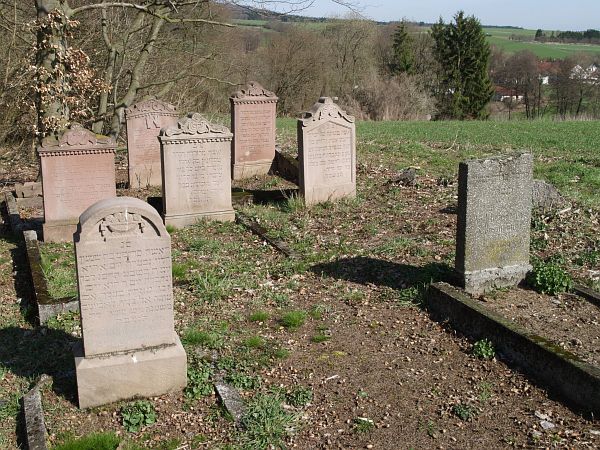
Headstones for Bertha Seligmann Gross and Bernhard Gross in the Jewish cemetery in Bingen http://www.juedisches-bingen.de/43.0.html

Headstones for Bertha Seligmann Gross and Bernhard Gross in the Jewish cemetery in Bingen
http://www.juedisches-bingen.de/43.0.html

Mathilde wrote of how she learned the news of her parents’ awful death:

On that fateful Thursday morning when Emil Seligmann [son of Siegfried and Caroline Seligmann and Mathilde’s first cousin] came to get me and then told me, as we were walking, of the accident, he lead me over Schlossberg rather than through town where people already knew and would have stared at me.  I could not immediately comprehend the scale of the tragedy that had befallen us.  DADNW, p. 19.

Understandably, Mathilde was devastated.  She wrote that her father’s death “was a heavy blow that left a big void.”  DADNW, p. 19.

Thus, the new century did not begin well for the family of Bertha Seligmann and Bernhard Gross.  In fact, it was a century marked by a great deal of tragedy for the family.  Although I cannot yet read enough of Mathilde’s book to provide a reliable translation of her own words for the years that followed her parents’ deaths, I have been able to learn more about the fate of her family from other sources and will reveal what happened to them all in posts to follow.

Family View Report for Bertha Seligmann-page-001


[1] Ute Brandenburg provides professional translation services for German texts, including texts written in the old German script.  You can see her website at  https://germanscriptexperts.com/   References to translated quotes from the German version of Mathilde’s book are indicated by “DADNW” and the appropriate page numbers.  All translations of the book were done by Ute Brandenburg.

[2] Unfortunately, Google Translate’s translation of these pages is quite awful, so I am hoping to obtain a better translation.

Why I Am Studying German

Along with researching, blogging, working on my novel, and doing other ordinary things with my days, I have started studying German.  I took French in high school and college, and I learned some Italian from a travel experience I had after college, but I knew no German.  Well, other than a word here and there like Danke and Gesundheit.

So why, you might ask, did I decide to learn German? It certainly is a challenge.  Although I’ve been delighted to see how many words are similar to English (like wein/wine and bier/beer) or Yiddish (like schön/shayne and schmutzig/schmutzy), German grammar is tough.  The sentence structure is hard.  The various cases are confusing; the articles and pronouns are a constant source of bewilderment.  But I am enjoying the challenge.

But that doesn’t address the question of why German.  Sure, I have many ancestors with German roots, and yes, it would be helpful to read the birth, marriage, and death records without depending on the generosity of people like Matthias Steinke, Ute Brandenburg, Ralph Baer, Dorothee Lottmann-Kaeseler. and others.  But I had already figured out the words for birth, death, marriage, mother, father, and even the months of the year.  So why struggle to learn ordinary vocabulary and grammar?

Yes, I am planning a trip to Germany for next year, and I do want to be able to get by as much as possible without expecting people to know English.  But I also know that I won’t be fluent enough really to do that, and I know that most people in Germany involved in the tourist industry will speak English, just as they did in Prague, Budapest, Vienna, and Krakow.

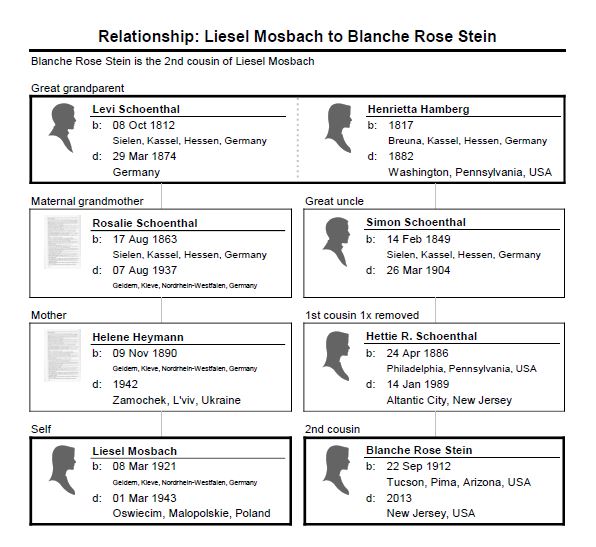
So why bother trying to learn German? It all started with Mathilde Mayer-Gross.  Who was she? She was my second cousin, three times removed:

Relationship_ Amy Cohen to Mathilde Gross part 1

Relationship_ Amy Cohen to Mathilde Gross part 2


That is, Mathilde’s grandmother Martha Seligmann and my three-time great-grandfather Moritz Seligmann were sister and brother.  We are both direct descendants of Jacob Seligmann

Mathilde is also related to me through her grandfather Benjamin Seligmann since he was his wife Martha’s first cousin; Martha’s grandfather Jacob Seligmann and Benjamin’s grandfather Hirsch Seligmann were brothers.

But I digress.


Mathilde was born in Bingen, Germany, in April 1869. She left in 1937 to escape from Nazi persecution when she was almost 68 years old and a grandmother; she lived over thirty years in the United States, dying in September, 1969, when she was a hundred years old.  She wrote a book about her remarkable life called Die Alte und Die Neu Welt.  [The Old and The New World] (1951).

Mathilde Mayer book cover

And I want to read her book.  But I can only find it in German. Ute Brandenburg did a wonderful job of translating one of the chapters, but I can’t afford to pay what it would cost to translate the rest of the book.

I used Google Translate to read some other excerpts from Mathilde’s book that appear on the Arbeitskreis Judische- Bingen website. I also read the memoir written by Mathilde’s granddaughter Ellen Kann Pine, One Life in Two Worlds (2009). But I still want to read Mathilde’s book itself.

20160810_174631600_iOS

So I decided to learn German.  After about four months of using the Duolingo program online, I can write a simple sentence or two to my cousin Wolfgang and his young daughter Milena, and I can understand enough to read simple sentences.  The Duolingo program is wonderful; I study every day about 30 minutes a day, and I am having a lot of fun. But so far my ten year old fourth cousin Milena knows a lot more English than I know German.

duolingo icon

Will I ever be able to read Mathilde’s book? I don’t know.  I may never be fluent enough to read it without a dictionary in hand (and Google Translate), but perhaps I will be able to read and understand enough to satisfy my curiosity about her life.

In the meantime, in my next few posts, I will take a break from the Schoenthal clan, and I will share some of what I learned about Mathilde and her family from the other sources I mentioned, including Arbeitskreis Judische-Bingen, Ellen Kann Pine’s book, and Chapter 2 of Mathilde’s own book as translated by Ute Brandenburg.  Maybe someday I will be able to fill in the rest of the stories of her life.


Letters from Frank: A Soldier in World War I

In my last post I posted and transcribed three letters written to Francis Oestreicher aka Frank Striker by various relatives between 1907 and 1939.  In this post I want to share the letters that Frank wrote home while he was serving in World War I.  These letters were all written in the fall of 1918, beginning before Frank was sent overseas and ending with one in December, 1918, a month or so after the war had ended.

Frank Striker WW1

Francis Oestreicher in World War I

As with the last post, I have tried to keep the transcriptions true to the text of the letters, only making some punctuation changes and some spelling changes and adding paragraphing to make them more easily read.

The first letter was written from Camp Meritt, New Jersey, on September 20, 1918.

IMG_1847 IMG_1848


Camp Meritt, NJ September 20, 1918

Dear Mother, Father & Sister,

As you can see by the heading, I am now located at Camp Merrit. This accounts for my not having written yesterday. We left Camp Holabird yesterday morning and arrived here to[o] late last night to write.  We are located about 15 miles from New York and the camp is more like a park than anything else. It is layed out beautifully and is made to accomidate 70,000 men, all of whom sleep in barracks. There are no tents here.

Am going to try to get a pass to go to New York Sunday, but I doubt it if they will give me one, as they are very anxious to keep us together.

I suppose it will not come as a surprise when I tell you that we are prepairing to go across, we do not know just what day, but it may be to-morrow and it may not be for 2 weeks or more, so please do not worry if you do not hear from me for 3 or 4 weeks.  It often takes this long or longer for mail to come across. Our trucks are already in France.

Please do not let this worry you as I know I will be safe. It is not worrying me in the least and I am feeling fine and getting along nicely.

We will go through a good bit of schooling when we get to the other side so that we will not be assigned to our regular duty for 2 months or more. We will have to learn to understand French road signs and a great many other things.

Will close now as I want this letter to go out in the next mail.

I remain, with love to you all,

Your son & brother,

Francis

I love the tone of this letter—a young man trying to reassure his parents that he is and will be fine.  How can he possibly say he knows he will be safe? I had to laugh at the idea that his parents would not worry when their child was going off to fight in a war that had already seen a tremendous number of fatalities. But so far Frank hadn’t seen anything but American army camps.

The second letter was written while Frank was sailing to Europe with the army:

IMG_1821


Aboard ship October 6, 1918

Dear Mother, Father, & Sister,

We expect to land in [place name torn off] tomorrow so I am writing aboard ship in order that my mail will lose no time.  I trust that you have received the postal mailed from New York advising you of my safe arrival.

Our trip has been delightful in every respect and although some of our company suffered some from sea-sickness, I came through feeling fine all the way. We saw no submarines and everything went along nicely.  Of course we were protected, but the censor would not permit my writing anything on this subject.  The trip took us considerably longer than they do in peace times, but since we had plenty of entertainment the time passed quickly and pleasantly.  You know I’ve traveled considerably around the U.S.A. but this has it beat, we are in sight of shore.

[Letter ends there; not sure if there was more as there is no signature.]

Once again, Frank is being reassuring.  He writes as if he’s on a cruise, traveling to Europe, except for the hints about censorship and submarines.  Was he really feeling as calm as his letter claims?

There are no letters between this one and the end of the war on November 11, 1918.  I don’t know whether that means Frank didn’t write any letters during that time or just that they have not been preserved or located.

The next letter was written two days after the armistice:

Frank November 13 letter 1

Frank November 13 1918 letter 2


France  November 13, 1918

Dear Mother, Father & Sister,

The official notice of an armistice came to-day and of course I was more than happy to hear the good news.  We had been expecting it for sometime as the Allies have been having things their own way for some time. Now that the firing is over and there is no more need of your worring, I might as well tell you that I have been to the front a number of times and that our position here has been shelled every night since we came, with the exception of the last 4 nights.  The Germans are now retreating and not a single shot is being fired.

The only subject the boys talk about now is coming home and I do hope that it will not be long until we are homeward bound.

We are using some English trucks and our routine is the same every day.  I believe I have the softest snap on this side of the pond. The hardest job I have is to entertain myself.  I believe I told you in my last letter that I was in charge of the detail located here and I live a gentleman’s life.

Trusting you are all enjoying the best of health, I am

Lovingly

Your son and brother

Francis

PS I am going to send you a camouflaged German helmet as a souvenir.

The tone of this letter is markedly different from the first two.  One would expect a soldier to be excited and upbeat that the war had ended.  But this letter seems more somber.  Although Frank says he now living a gentleman’s life and just waiting to come home, his brief allusions to the war—being shelled every night—make it clear that he has seen more than he is mentioning.  Somehow he seems to have changed from that young man excited to be traveling overseas to a young man eager to get home and away from the war.

The next letter came four days later.

Frank November 13 1918 letter 1 Frank November 18 letter 2

November 17, 1918

Dear Mother, Father, and Sister,

Was very much surprised to-day to receive a letter addressed to Camp Lee and dated July 28th.  Although a bit stale I was very glad to receive it.

There is not much new to write.  Our duties are the same as they have been and we are getting along nicely.  Instead of war talk now the principal discussion these days are when are we going home.  There are many rumors as to what our company will do.  Some say we are to go to Germany, others say we will soon be homeward bound, but the truth is yet to be learned.

The cold weather is beginning to set in, but you never need worry as I have clothing gelore.  I have a heavy overcoat, sweater and gum boots that I have never worn also heavy wollen socks.

Yesterday I saw the first lot of prisoners to be returned from Germany.  They were a lot of Italians who had been in Germany 2 years.  Believe me they were glad to have there freedom

I can imagine the celebrations that took place in the states when peace was signed, but at the front all was silent.  In the night some bright lights flashed.

I trust that it will not be long now until I will be siting around the table with you as we used too.

Please give my love to dear Aunt Jennie and family, Uncle Morris, and Mr Lebenwalter.

Must close now with love to you all,

I remain

Lovingly

Francis B. Oestreicher

Frank obviously was longing to be home.  And again the tone is more somber.  His line contrasting what he expects the celebrations were like back home to the silence at the front is telling.  There was no celebrating by those who had fought in the war.  They just wanted to go home.

Eleven days later he wrote this letter:

Frank November 28 1918 letter 1

Frank November 28 letter 1918 2

Frank November 28 1918 letter 3


France, November 28, 1918

Dear Mother, Father & Sister,

These last few days we have not had a thing to do so I spent most of my time roaming around the country.  The YMCA gave me several hundred Christmas cards and I distributed some of them among the members of our Co. and I sent more than 50 to my customers.

Last week I was called back and joined the rest of my company.  I believe I wrote to you shortly after my arrival in France that was away from the Co. on detached service.

The part of France which I am in was full of soldiers and the roads were jammed with traffic a few weeks ago, but now there are very few soldiers around here and the only trucks we see are our own water tanks.  A few civilians are now coming back.  I was speaking to an old Frenchman this morning.  He is about 60 years old.  He pointed to a few standing walls and said it was his home.  His fields are turn [torn?] up with shell holes and trenches.

There are some German prisoners around here. One of them told me they have not had soap in Germany for 2 years and that they could not even buy a handkerchief without a note from a city official.

The censorship regulations are the same as they have been, but I think that within a short time the censorship will be lifted and I will be able to tell you where I am located.  At present I can only state that I am in the most notable line of defence the Germans ever built. Am also within 20 miles of the strongest fortified city in France, a city which the Germans have tried to take since the beginning of the war but never succeeded.

We are living in barracks which the Germans built and our meals are very good.  There is a YMCA located a very short distance from here and we can buy candy and chocolate.  We can also get newspapers and writing paper.

So far the weather has been fine.  It has been warm and fairly dry.

Have not received mail from you since I wrote to you last, but the mail comes in bunches, and I am expecting mail from you within a few days.

Knowing of nothing else that would interest you, will close, hoping you are all enjoying the best of health, I remain,

Lovingly

Your son and brother

Francis

Two images stand out for me here: the Frenchman surveying his destroyed home and fields and the German soldier revealing the desperate economic situation in Germany. How interesting that Frank conversed with someone who just weeks before had been the enemy.  And he sounds somewhat sympathetic to the conditions endured by that enemy.

It’s also interesting that Frank was now allowed to reveal more details about his location. That location was made much more clear in the letter that follows.

Frank December 8 1918 letter 1 Frank December 8 1918 letter 2 Frank December 8 1918 letter 3


France December 8, 1918

Dear Mother, Father, & Sister,

The censor is partly lifted now and I am able to write things that would not have passed a week ago.  We are now permitted to relate our experiences and to mention the names of the towns and cities.   We arrived in Liverpool, England on October 8th and traveled through England by rail to South-hampton.  From there we took a boat to Cherbourg, France, where we arrived on October 11th.  On October 13th we boarded a train on which we remained 4 days and finally we landed at Clermont which is located about 15 miles west of Verdun. At the time of our arrival here the front was 15 miles north.  On October 25 was sent on detatched service with some others in our Co. and we located at Montfucon which is about 22 miles north of Clairmont.  At the time of our arrival at Montfucon the trenches were a very short distance and we were able to get a fair idea of what modern war really is.

The day before yesterday we came back to Clairmont where the battalion headquarters are located and from all appearances I will remain with the Co. until we land in America.

Have not received any mail from you for about 2 weeks, but I know it is because of poor mail service.  I am not worried about you and you need not worry about me.  I also will ask you not to send me anything, either money, eatables or clothes, as I have everything I need.

Our chief thought these days is the thought of going home, but we receive very little information on this subject.  We are not doing any work and we have a good chance of being in the U.S.A. in Feb or possibly even in January.  However I cannot kick as we have it very good here.  There is an excellent band occupying an adjurning building so we have lots of music.  We also can buy candy and cakes at the Salvation Army.

Regarding the weather must say it is just like spring. We have not had one cold day yet.

Trusting you are all enjoying the best of health and wishing you dear father a very prosperous Chrismas business, I remain

Lovingly

Your son and brother,

Francis

PS Dear Mother, It seems a bit early to congratulate you for your birthday, but considering the slowness of the mail this letter may reach you after your birthday.  I wish to extend my heartiest wishes for a very happy birthday and trust that you will enjoy many more birthdays in good health and happiness. [Sarah’s birthday was January 8.]

Francis

I looked on a map to try and determine where Frank was located based on this letter.  I knew he had been involved in the Meuse Argonne offensive, so that also helped.  I believe “Clairmont” is Clermont-en-Argonne and “Montfuscon” is Montfaucon-d’Argonne.  On this map you can see Verdun, the “most fortified city in France,” as Frank described it in his earlier letter, and the cemetery at Meuse-Argonne where those killed in that offensive are buried.


Even though the censorship was reduced and Frank could reveal where he had been, he still does not discuss what he saw during the fighting or how he felt.  He makes reference to “getting a fair idea of what modern war is,” but he doesn’t share what that was like.  I wonder if he ever did. But it is clear that he is anxious to get home and hopes to be there by January or February, at the latest.

Frank’s military dates as revealed on this postcard, however, indicate that he did not in fact get back to the US until July.  I wonder what they had him doing for the next six months.

Frank postcard with military service dates

That is the last of the letters written by Frank that I received from Steve. I don’t know whether Frank wrote more.  I imagine he did.   Perhaps more letters will show up.  But even these six letters written over a short period of time reveal in subtle ways the experiences Frank lived through between September 20, 1918, and December 8, 1918.

Frank Striker WW1 medal


Letters to Frank: A Close Family Revealed

As I mentioned here, included with all the photographs that my cousin Steve scanned and sent to me were a number of letters.  I posted the letter written by Gerald Oestreicher to his family during World War II, and I mentioned that there were also letters written by Gerald’s uncle, Francis Oestreicher, when he was serving during World War I.  Frank was my father’s second cousin, both being the great-grandchildren of Levi Schoenthal and Henriette Hamberg. Thus, he was my second cousin, once removed:

Frank Striker to me relationship chart


There were also some letters written to Frank, as he was known after the war.  In this post I will share the letters written to Frank. The next post will contain the letters written by Frank during World War I.  I’ve transcribed all the letters as close to their original spelling and punctuation as I could, but made some changes just for purposes of readability.  No words were deleted or changed; nothing was added, except where I’ve put my own comments in brackets.

What struck me as meaningful about these letters is what they reveal about the close connections among the Schoenthal siblings—the ten children of my great-great-grandparents Levi Schoenthal and Henriette Hamberg.  These three letters date from 1907 to 1939, and each one shows that this large and extended family knew and cared about each other.

The oldest letter was a letter written by Frank’s great-aunt Helen Lilienfeld Schoenthal, the wife of my great-great-uncle, Henry Schoenthal.  Helen wrote this letter from Washington, Pennsylvania in 1907, to Frank, grandson of her sister-in-law Hannah Schoenthal.

Letter from Helen Lilienfeld Schoenthal dated December 12, 1907 from Washington, PA

IMG_1830

My dear Francis,

Years roll by, and children grow up to man and womenhood before we know it. And so it is with you my dear boy.  I can hardly realize that you have reached your 14th birthday, and it seems to me only a little while that dear Hilda was our representative at your Bris mihle.  With a hearty birthday kiss accompanied by the best wishes I send you many congratulations.  May our heavenly Father always protect and bless you, so that with every birthday your young life may be brighter and happier.  May the best of health and a long life free of care and worry be yours that your dear parents will have a great deal of pleasure on you.  Again I send you a little gift which help a little to swell your Bank account and which I hope will bring you the best luck in business.

Wishing you a very happy birthday with lots of fun.  I am

Lovingly

Your affectionate Aunt Helen

Uncle Henry, Hilda and Therese send their congratulations and love to everybody.

There is also a message written by Helen in German along the margin that I could not read, but with the help of my friend Matthias Steinke in transcribing and translating the old German script, I now know what it says:

My dear all! I am sending you this time only the heartiest greetings and kisses because my eyes close already automatically, because this evening I wrote already a couple of letters. In Love, your aunt, Helen 

Isn’t it interesting that in 1907 after being in the US for 35 years and clearly fluent in English,  Helen reverted to German (and German script) to write to Frank’s parents, Gustav and Sarah Stern Oestreicher? Both Sarah and Gustav were native German speakers, but both also had been in the US for a very long time. I wonder if Frank could read German or was as puzzled as I was by the German script scrawled on the margin of his birthday letter.

Aunt Helen--maybe Lilienfeld Schoenthal

The second letter was written a little over ten years later in July, 1918 when Frank had joined the army, but before he was shipped overseas.  It is also from his great-aunt Helen, with a short addendum by his great-uncle Henry Schoenthal.

Once again, it is evident that Helen and Henry were closely connected to Frank, a child of their niece Sarah Stern, grandson of Henry’s sister Hannah.  I was touched by how much affection there was for this young man, their great-grandnephew.  The letter is also interesting because it talks about Henry and Helen’s own children, their daughter Hilda, their son Lee (born Lionel) and his wife Irma, and Henry and Helen’s granddaughter Florence, who was only thirteen when this letter was written.  Helen did not use any paragraph breaks, but I’ve added some to make the text more easily read.

Letter from Helen Lilienfeld Schoenthal and Henry Schoenthal dated July 30 1918 written from NYC

IMG_1816 IMG_1817 IMG_1818 IMG_1819

IMG_1820


My dear Francis,

I was just thinking to write to your dear parents and ask for your address, when we were agreeably surprised on last Sunday, when your dear brother Sidney came to see us, stayed for supper and until late in the evening.  And so we are able to write to you, as Sidney was glad to give us your ad: for every soldier likes to get letters from some one, and if it is not from a sweetheart, this letter comes from your old Uncle and Aunt, who always loved you. 

I suppose your ears were ringing last Sunday, for Sidney and we talked about you a great deal, and we were glad to hear that you liked soldiers life and also the camp.  Are any boys with you from Pittsburg who you know? And how is the weather in your section?

We have terrible hot spell here since over a week, and I feel the heat very much.  But I am so thankful that we live on such nice open place near the Hudson and get all the fresh air that is going.  There is a good deal of suffering on the East side I know. 

Uncle and I are alone since the 19th of July. Irma & Lee went to the Adirondex Mountains to stay two weeks, as Lee had not been feeling well and needed a rest badly.  They choose this place so that they could be near Florence who is at a girls camp named camp Woodmere.  It is owned by Misses Goldsmith and Kuhn from Philadelphia.  They have 54 girls there and it an ideal place.  Florence is crazy about and Irma & Lee are also very much taken with the place and how beautiful it is managed.  They have all sorts of sports there.  Florence is a good swimmer and also can now [?] and take long hikes. 

We expect Irma and Lee back next Saturday and the following Saturday Hilda will arrive here and spend her vacation with us. I am looking forward to her coming with great joy, and we will try and make her stay very pleasant.  She can take many nice boat trips which she likes so much.  Sidney will come up again next week when Irma & Lee is here. 

I am making a nice lunch cloth for Helen’s engagement present, but I am taking my time making it as I have to be very careful with my eyes. [I assume Helen was Frank’s sister Helen, who married in 1920.] We also had a long letter from dear Meyer [their younger son] last week. 

Now dear Francis, be bright and cheerful and take good care of yourself.  Our good God will be with you wherever you are, and He will bring peace to every heart and all the countrys before long. 

With loads of love and a hearty and write soon to your affectionate Aunt Helen.

 My dear Francis

Your aunt has left me a little space and I gladly add a few words to tell you that we often think and speak of you.  I have no doubt that you like the life in the camp, as most of the boys do and that you will make such a fine soldier that all your friends will be proud of you.  Should the time come when you have to be on your way for “Over There” we may have a chance to bid you God’s speed in person. God be with you and bless you.

Affectionately yours,

Uncle Henry

I read this letter as an attempt by his aunt and uncle to give him their blessing before he went off to war without making him too nervous about what he was about to face.  Frank’s own letters, as we will see, reflect a similar impulse, only he is reassuring those at home that he is and will be okay.

The last letter for this post was written many years later by Frank’s father, Gustav Oestreicher.  It was written in 1939 after Gustav and Sarah had moved to California, as had their daughter Helen.  I am not certain whether Frank was living in Minneapolis or just visiting; the letter is addressed to him at a hotel, and from the content of the letter, I can infer that Frank had recently been to Chicago. I assume he was on the road in his capacity as a traveling salesman.

A little background to help identify the people named in the letter:  First, Gustav mentions the Good family.  He must be referring to Edith Stern and Leo Good and their son Bernard; Edith was Sarah Stern Oestreicher’s younger sister, thus Gustav’s sister-in-law.  In 1939, the Good family was living in Chicago.

Gustav then mentions a Lionel and his brothers and sister and another sister Hilda. At first I thought this referred to the children of Henry and Helen Schoenthal, as they had a son named Lionel, a son Meyer, and a daughter Hilda. But after reading through the letter more carefully, I realized that he was referring to Lionel Heymann, the oldest child of Rosalie Schoenthal and Willy Heymann, about whom I wrote here.  Rosalie was the youngest Schoenthal sibling, sister of Hannah Schoenthal, who was Gustave’s mother-in-law. So Rosalie was Sarah Stern’s aunt.

Here’s why I think Gustav is talking about Lionel Heymann, not Lionel Schoenthal. For one thing, Henry and Helen Schoenthal’s son Lionel was called Lee at this point, not Lionel.  And at the time this letter was written, Lionel Heymann (the photographer) was living in Chicago as were his brothers Walter and Max, so if Frank had seen the Good family, he must have been in Chicago. (I am not sure why Gustav writes that he hoped Frank might see Lionel’s “bros.& sister” since there was no sister at that time living in the US, but perhaps he was referring to Max’s wife Frieda.)

Also, Gustav mentions a sister Hilda who was still in Germany. Henry Schoenthal’s daughter Hilda was not living in Germany, but in Washington, DC, in 1939.  But Lionel Heymann had a sister Hilda who was still in Germany in 1939.  I have written about what happened to Hilda Heymann as well as her sister Helene, who married Julius Mosbach and had two daughters, Liesel and Gretel.  All were killed in the Holocaust.  That fact makes Gustav’s comment even more chilling.  I put those comments in bold below.

I do not know who the Fannie mentioned towards the end of the letter could be.

Letter from Gustav Oestreicher to his son Frank [edited for readability only]

IMG_1990 IMG_1992 IMG_1993

September 16, 1939 from Los Angeles

My dear Francis,

Although late, [I] will begin my letter extending to you my best wishes for a healthy, happy and prosperous new year. [Obviously a reference to Rosh Hashanah, given the September date.] You ought to know you enjoy our good wishes at all times so hope you will pardon the expression of it at a rather late date. As usual we were happy to learn the contents of your recent letter.  It pleased us to learn you enjoyed your visit with the Good family as well as that all of them are getting along nicely.  You evidently misinformed them about our anniversary as we rec’d a very nice letter from them congratulating us for our golden wedding anniversary which will not be until next year. [Gustav and Sara were married in 1940.]

We regretted very much you could not see Lionel and his Bros. & Sister again. [You] May be aware dear Mother is very much interested in his family that are still in Germany particular so his Sister Hilda. [We]  presume the anti-semitism in Germany has somewhat diminished since the war as I noticed in the papers they are eager to get the Jewish Doctors, Engineers and other Professional Man back even promising to restore their property.  Conditions regrett to note are not very encouraging for England and France particular so since the uncertain attitude of Russia but let us hope for the best.

You need not fear about me getting into the market further. Am fairly well satisfied with my holdings. Have absolutely no intention to buy anything nor feel inclined at this time to sell any of my stocks with possible exception of Congoleum-Narin and even should I sell that, may apply it to my loan or in other words will not increase my loan if I do not reduce still more.  Have not decided whether or not I will sell same. 

Fannie is at least a weekly visitor by us.  She still has not secured a position but is hopefull some thing will be available before long.  As for ourselves have nothing of interest to offer so will leave it to dear Mother to inform you pertaining herself so will conclude for to day with love and best wishes. 

Your loving Father

As with the earlier letters from Helen Lilienfeld Schoenthal, this letter reveals the close connections among the many Schoenthal siblings and their children.  I’ve often wondered what the family knew about the two siblings who had stayed in Germany: Jakob Schoenthal and Rosalie Schoenthal.  From Gustav’s letter it is apparent that the family was in touch at least to some extent with those family members who had not immigrated.  They knew that the three Heymann brothers were in Chicago, and they knew that some family members were still in Germany.

Gustav’s hope that anti-Semitism was diminishing in Germany once the war started is so terribly painful to read, knowing what was going to happen not only to Hilda, her sister, and her nieces, but to six million other Jews living in Europe.

Realizing how connected the family was to each other as late as 1939 makes me wonder what happened.  Why didn’t my father even know about all his Schoenthal second cousins like Frank and his siblings? Did my grandmother Eva Schoenthal know any of these people? My guess is that because my great-grandparents moved from western Pennsylvania to Denver when my grandmother was just a small child, not even four years old, she did not grow up with the benefit of knowing all those cousins in western Pennsylvania.  Perhaps if she had, I would not have had to search to find my Oestreicher cousins.  Perhaps we would have always known about each other.

More Manna: The Family of Sidney Oestreicher and Esther Siff

In my last post I shared some of the wonderful photographs I received from my cousin Steve of Sarah Stern and Gustav Oestreicher and their three children, Sidney, Frank, and Helen.  This post will focus on the children of Sidney Oestreicher and Esther Siff, Steve’s grandparents.

Their first child Gerald was born in 1916, in Chicago, where Sidney and Esther lived in the early years of their marriage. Their daughter Betty was born three years later in 1919. Sidney was working as a traveling salesman during those years.

Gerald Oestreicher

Gerald Oestreicher, c. 1917

Gerald and Betty Oestreicher, c. 1922

Gerald and Betty Oestreicher, c. 1923

Betty and Gerald Oestreicher

Betty and Gerald Oestreicher, c. 1930

By 1930 Sidney’s father Gustav had retired and moved with Sarah to Atlantic City, and Sidney returned with Esther, Gerald, and Betty to Pittsburgh to help run the family store, The People’s Store.  Sidney and Esther had their third child Elaine in Pittsburgh in 1931.

Elaine Oestreicher

Elaine Oestreicher

This photograph below, probably taken in Pittsburgh in the late 1930s, includes the whole family–from left to right, Betty, Sidney, Elaine, Esther, and Gerald.

Betty, Sidney, Elaine, Esther, and Gerald

Betty, Sidney, Elaine, Esther, and Gerald

After The People’s Store went bankrupt during the Depression, Sidney had a hard time finding work.  Steve told me that Gerald would sell apples on the street after school to earn money.  Steve also shared this story about his grandmother Esther:

Grandma, Esther Oestreicher, was a homemaker to her three children, but also a very good pinochle player.  Twice a week she would sit down at night with friends and earn a living. 

Once a week or month, there was a raffle at the local theater after the matinee movie.  On one occasion as Gerald and Esther were walking to the theater, she repeatedly announced to neighbors sitting on their stoups, “My son and I are going to the movie where I will win the raffle today.”  This terribly embarrassed my Dad, who said he wanted to tuck his head under his shirt.  Sure enough after the movie ended, Esther won the raffle.  On the way home passing many of those same neighbors on their stoup, she waved the money at them joyfully yelling, ” I told you I would win the raffle.”

Elaine, Gerald, and Esther Oestreicher

Elaine, Gerald, and Esther Oestreicher

Gerald played saxophone in high school.  In 1937 and 1938, Gerald was a student at Northeastern University in Boston, where he continued to play the saxophone in the university band.

Gerald Oestreicher playing saxophone

Gerald Oestreicher playing saxophone

IMG_1966

On October 1, 1941, Gerald enlisted in the US Army Air Corps. Here is his draft registration card and his Army identification card. (Note that his name change to Striker is dated December 5, 1945, while he was in the service.)

Gerald Oestreicher draft registration for World Wa II

Gerald Oestreicher draft registration for World Wa II

IMG_6973

Steve shared with me the following story about his father’s decision to enlist.  Gerald could see that war was coming, and without consulting with his parents, he decided to enlist in the Army Air Corps.  He had hammerhead toes so his choice of which service to join was limited.  As told by Steve, Gerald had to break the news to his parents the night before he had to report for duty:

The Oestreicher family dinner that night started with nothing out of the ordinary.  Sidney at the head of the table, Esther next to him, Jerry next to his mother on one side, and sister Elaine on the other.  Sister Betty on the other side of her father.  A roast and potatoes in the middle.

Towards the middle of the meal the war was brought up.  There had been little talk from Jerry about it.  My Dad told me his mother at one time looked up,and then straight at him, and dropped her fork on her plate.  “My God, you’ve enlisted.” Jerry responded.  Esther’s eyes teared.  Sidney said,  “When do you leave?”  Jerry announced early tomorrow morning.Sidney became very angry.  Jerry announced he needed to pack and get some sleep.  Sidney offered to take him to the train station, but Jerry insisted no, “I want to say our goodbyes here”. There was a lot of crying by everyone but Sidney.  Jerry announced they should say their goodbye’s that night.  Shortly later Jerry then went to bed.  He left without saying goodbye in the morning.

The next morning Jerry arrived alone at the train station around 6am.  Waiting for him was Sidney, with a sack of food, and advise “stay alive for your mother”.

They waved to each other as the train departed

As you can see from his service record posted below, he had a distinguished record of service during the war.  He attended Officer Candidate School in Aberdeen, Maryland, and a Naval Mine Warfare training center in Yorktown, Virginia.

Gerald Striker service record during World War II

Gerald Striker service record during World War II

In February, 1944, he shipped out, arriving in North Africa by March 10, 1944, when he wrote the following note to his father Sidney:

Gerald Oestreicher note to Sidney Oestreicher, March 10, 1944

Gerald Oestreicher note to Sidney Oestreicher, March 10, 1944

What a sweet and reassuring note! Can you imagine thinking that fighting in a war could be an experience one could “thoroughly enjoy”? I certainly can’t.

After some time in North Africa, Gerald was shipped out again, this time to Asia.  While at sea, he wrote the following undated long letter to his family. Please read it, especially the last two pages.  It is truly a look into the heart and mind of a young man about to face combat.

Gerald Striker letter home from WW2 p 1

“Somewhere at Sea”

Dear Folks,

It has been sometime since I last wrote a letter of any length to you, and will attempt to do justice to this one.

While I was in Africa I had my first taste of what will be in store for me during the duration.  I can honestly say that it is not too bad.  Militarily there is nothing I may write, however I can tell you that living conditions were most primitive. We slept on the ground and lived out of cans.  And speaking of cans—even the toilet paper was rationed out to us.  We get plenty of cigarettes, but candy is very scarce.

I had the opportunity to visit Oran, North Africa, and found the living conditions most interesting.  I was surprised how much of my high school French held me in good stead.  I also picked up a little Arabic.  My knowledge of the foreign rate of currency exchange

Gerald Striker letter home p2

has been added to my general knowledge.  Among the strange things that I saw were rest stations located in the middle of streets, natives without shoes, and automobiles drawn by horses, and I saw the Kasbah which was built in 1501.  I drank champagne at $2.00 per bottle until it poured out of my ears—cognac at dinner time—and ice cream in the afternoon!

Since I left the states I have been to Italy which I found not as beautiful as the travel booklets make one believe—perhaps that is due to friendly and enemy bombings.  The natives fight for American products.  I could have bought a horse for 2 cases of soap! Of course I had no need of a horse, but it does give you an idea as to what the natives are like in this part of the world.

While on ship I gained back the weight

Gerald Striker letter home p3

I lost while in Africa,  I have felt very well at all times and can not complain of anything.  I had my head shaved and after 5 weeks time I finally have grown about 3/4 of an inch back.  I did notice that on top it is getting “a la Sidny.” Also, it is getting slightly gray.

I suppose by the time I get to my destination there will be plenty of mail for me.  If there is—I’m going to ration myself several letters every day.

I think I did tell you that I got my promotion to “first”while in Africa.

I have an insurance premium due in May or June, so just draw the amount out of my account.  I could use some Bond Street tobacco—so you can send me some when you again see Harold Powell.  We can’t get that kind, and I’d rather not smoke a piple than smoke the stuff they sell us here.

Gerald Striker p4

There is so much more I would like to say—but somehow I do not wish to reveal everything.

No, you did not raise your boy to be a soldier nor did he wish to be a soldier.  But we can not control all factors.

I am not a soldier.  I am merely a chap who is doing as directed, and to some extent doing what I believe in.  The German boys too are doing what they believe in.  It is a game of life—death really has no part. The dead can not play.

Yes, I am going in there fighting—I’m fighting for you and folks like you, I’m fighting for myself, my friends—and I’m fighting for what I know is right!

Thanks to you my life has been almost complete.  I can face the worst of it and still smile for I know there is happiness ahead.

And so I’m saying “I’ll be seeing you”—and it won’t be long.

Just remember—if I can feel that you are all good soldiers at home, I can be the best one abroad.  Well I guess

Gerald Striker p5

there is little else I can think of to write at this time.

I hope you are all well and brave.  Also, if at any time you do not hear from me for even a months time do not get alarmed as the mails may be late or I am in such a position that writing is impossible or of little value.

My love to all,

Jerry

You can see in this letter that Gerald was still struggling with his parents’ reaction to his enlistment, and despite his brave words, his statement that his “life has been almost complete” seems to suggest that he did worry about being killed in the war.

As his service record indicates, after leaving Africa Gerald served as an ordnance officer in the China Burma India theater of the war and received several commendations for his service.  Here are a few photographs of Gerald while serving in World War II.  Steve told me that his father considered his time in the service the best and most exciting time of his life.

IMG_6974 IMG_6978 IMG_6981

Steve also shared this story of his father’s return home from the war:

Four plus years after leaving the U.S, Jerry sailed into New York.  He did not tell anyone when  he would return.  He got to his parents’ apartment and entered a phone booth to call his mother Esther with the intention of announcing he would be home “shortly”. But his little sister Elaine arbitrarily came bounding down the stairs.  But he said she was not his little sister, but a grown young woman.  Then Elaine also spotted him.  Yelling Jerry! Jerry!  she leaped at him.  They both went upstairs to see their mother.

Shortly after the war, Gerald was invited by his Uncle Frank to the Scaroon Manor resort in upstate New York.  There he met a woman who was singing at the resort, Faye Karol, whose real name was Faye Krakower. Her career as a singer was described in my earlier post.  According to Steve, his father Gerald proposed to Faye six days later, and they were married in November, 1946.

Here are some pictures of Faye.

Faye Krakower and her mother Freida

Faye Krakower and her mother Freida

Faye Striker

Gerald and Faye (Krakower) Striker

Gerald and Faye (Krakower) Striker

Gerald and Faye and their son moved to California in 1948 where Gerald worked as a salesman for a number of different clothing lines and other businesses.

Meanwhile, Gerald’s younger sister Betty had married Julius Jacob in 1942.  I wrote about Betty and Julius here.

Betty Oestreicher and Julius Jacob

Betty Oestreicher and Julius Jacob

Betty Oestreicher Jacob

Betty Oestreicher Jacob

This is Betty and Gerald’s little sister, Elaine, the one who stayed and lived with Maxine Schulherr Stein in PIttsburgh and started me on the journey that led to all these amazing photographs.

Elaine Oestreicher

Elaine Oestreicher

Although Steve shared many more photos of the family, I will end with this one of my cousin Sidney Oestreicher, later in life, with his three adult children, my cousins Gerald, Betty, and Elaine.

Standing: Betty, Gerald, and Elaine Seated: Sidney Oestreicher Striker

Standing: Betty, Gerald, and Elaine
Seated: Sidney Oestreicher Striker

There are a few more posts to come based on the materials Steve shared with me including the letters written by his uncle Frank Striker during his service in World War I and some letters that were written to Frank by various family members.


Like Manna from Heaven

Last Monday I posted about my third cousin, Betty Oestreicher Jacob, who passed away on July 19, 2016.  Betty and I were related through our mutual great-great-grandparents, Levi Schoenthal and Henriette Hamberg.  Her great-grandmother Hannah Schoenthal and my great-grandfather Isidore Schoenthal were sister and brother.  Betty’s grandparents were Sarah Stern, Hannah’s daughter, and Gustav Oestreicher.  Her parents were Sidney (Oestreicher) Striker and Esther Siff

At the time I posted about Betty’s passing, I had only one photograph of Betty and none of her grandparents, parents, or siblings.  But within hours of publishing my post, I received a comment on the blog and then emails from Betty’s nephew, Steve, the son of her brother Gerald.  And Steve generously shared with me numerous photos of all those people and then some. Now I can place faces to the names of the people I have researched and written about.  And what gorgeous photos these are.

In this post, I will share some photographs of Sarah Stern and Gustav Oestreicher and their three children, Sidney, Frank, and Helen.  In a later post, I will share the photos of Sidney’s children, Gerald, Betty, and Elaine.  All are courtesy of Steve Striker, who so generously spent his time scanning and emailing these to me and answering my many questions.

First, here are some photographs of Sarah Stern Oestreicher, my grandmother Eva Schoenthal’s first cousin.  I’ve written about Sarah’s life here.

Sarah Stern as a child edited

Sarah Stern as a young child in Germany, probably before her mother married Solomon Stern in 1874. Sarah was born in 1865, so this picture was probably taken between 1870 and 1872.

The photograph below of Sarah was taken in Pittsburgh.  She emigrated to the US by herself around 1884 when she was nineteen years old.

Sarah Stern

Sarah Stern

I assume the photograph below was taken sometime later than the one above, but I am not sure. Does Sarah look older or younger in this photograph? The hairstyle in the one above seems more “contemporary,” but Sarah’s face seems softer and somewhat younger than in the one immediately below.

Sarah Stern Oestreicher

Sarah Stern Oestreicher


A while back I had posted the next photograph, which I’d received from my cousin Maxine Stein, and she and I had wondered whether the woman on the left was Sarah Stern, her grandmother’s sister.  Now I am quite certain that it is in fact Sarah.  What do you think? Is the woman on the far left of the photograph the same woman as the one in the photo directly above?


Jennie Stern Arnold, center, and perhaps Sarah Stern Ostreicher on the right and Edith Stern Good on the right

Jennie Stern Arnold, center, and perhaps Sarah Stern Ostreicher on the left and Edith Stern Good on the right

Sarah married Gustav Oestreicher, the man she met while he was staying at her mother’s boarding house in Pittsburgh in about 1890. Gustav, an immigrant from Austria, was working as an artist and photographer in 1900.

Gustav Oestreicher

Gustav Oestreicher

What a dashing man he was!

Here are Sarah and Gustav’s three children, Sidney (1891), Francis (Frank) (1893), and Helen (1895).  You can see that the children inherited their father’s piercing light-colored eyes.  I would guess that these were taken in the late 1890s, perhaps 1898 or 1899, from the ages of the children.  They were also probably taken at the same time as the photos above of Gustav and Sarah, as all five photos were mounted together in a frame.  Perhaps Gustav himself took these photos.

Sidney Oestreicher

Sidney Oestreicher

Frank Oestreicher as a boy

Helen Oestreicher

This photo of Gustav and Sarah was taken in 1915, when their children were already grown.  By this time Gustav was no longer working as an artist, but was a merchant in Pittsburgh.
Gustav and Sarah Stern Oestreicher

Here is a photograph of the Oestreicher store in Pittsburgh:

Oestreicher store

Here’s a photo of Gustav and Sarah and their three children in about 1910, I’d guess, given the ages of the children. Unfortunately, Sidney’s head was cut off either in the photo itself or in the scan.

Rear: Frank, Helen, Gerald (with head cut off) Front: Gustav and Sarah Oestreicher

Rear: Frank, Helen, Sidney (with head cut off)
Front: Gustav and Sarah Oestreicher

Sidney Oestreicher (later Striker) married Esther Siff on November 16, 1915, in Chicago. Sidney was working as a traveling salesman, and as his daughter Betty told me, he met Esther at a dance in Chicago while there on business.  Esther’s father was also a traveling salesman. (I have more pictures of Sidney and Esther, but will share them in my next post.)

Sidney and Esther 1915

The second son, Francis, better known as Frank, served his country in World War I. (Sidney was exempt as he had a wife and young child.)  The postcard below shows Frank’s dates of service:

Frank postcard with military service dates

He was gone for just over a year—from June 25, 1918, when he left for camp, until July 17, 1919, when he arrived home.  He had gone overseas on September 24, 1918.  As I wrote about here, Frank served in the Meuse Argonne Offensive, one of the most important if not the most important battle in World War I. He was a member of Company C of the 301 Water Tank Train in the American Expeditionary Forces.

According to Richard Rubin’s book, The Last of the Doughboys:The Forgotten Generation and Their Forgotten World War (Houghton Mifflin Harcourt, 2013), p.220, a water tank train was actually a caravan of white trucks used to carry water to the front.  According to his honorable discharge papers, Frank served as a private, which Rubin’s book suggests meant he was likely an assistant driver of one of the trucks.

I found this photograph online depicting Company C of the 301 Water Tank Train.  I wonder if Frank is in the photograph:

Company C, 301 Water Tank Train, H. E. Edwards, Capt. M. J. C. U. S. A., Arthur Armstrong Paler papers, Box 1, World War I Photographs http://bentley.umich.edu/legacy-support/ww1/military-life.php

Company C, 301 Water Tank Train,
H. E. Edwards, Capt. M. J. C. U. S. A., Arthur
Armstrong Paler papers, Box 1, World War I
Photographs
http://bentley.umich.edu/legacy-support/ww1/military-life.php

Francis Oestreicher (Frank Striker) discharge papers

Francis Oestreicher (Frank Striker) discharge papers

As you can see below, he was awarded a Victory medal for his service. (Steve has also sent me some of the letters Frank wrote home during World War I; I will post those separately once I have a chance to review and transcribe them.)

Frank Striker WW1

Francis Oestreicher, later known as Frank Striker

Frank Striker WW1 medal

Frank Striker’s Victory Medal for service in World War I

Gustav and Sarah’s third child was their daughter Helen. Here she is in 1917 when she was 22 years old.

Helen Oestreicher 1917

Helen Oestreicher 1917

As I wrote earlier, Helen married Robert Steel Kann in 1920, but he died a year later at age 26.  Sometime before 1929, she married Aaron Mitchell Siegel, known as Mickie, and they had a daughter Betty.

Helen Oestreicher Kann Siegel and her family

Helen Oestreicher Kann Siegel and her family

I was tickled to see this item in Steve’s collection:

invitation to Henry Schoenthal 50th anniv party

As you can see, it is an invitation to the 50th wedding anniversary celebration in 1922 for Henry Schoenthal and Helen Lilienfeld, about whom I’ve written extensively.  Henry Schoenthal, my great-great-uncle, was Sarah Stern Oestreicher’s uncle, brother of her mother Hannah Schoenthal Stern.

Steve sent me this photo labeled Aunt Helen by his uncle Frank, and I wonder whether this is Helen Lilienfeld Schoenthal, who would have been Frank’s great-aunt.  Frank received a long letter from his great-aunt Helen and great-uncle Henry while he was serving in Europe; the tone and content of that letter suggest that Helen and Henry Schoenthal had a very close relationship with the Oestreicher family. (I will post the letter in a separate post.)

Aunt Helen--maybe Lilienfeld Schoenthal

Frank returned to Pittsburgh after the war and worked as a salesman in the family dry goods store. After the family store went bankrupt in 1933, the Oestreicher family began its migration west to California. Although neither Steve nor his cousin Ron was sure of who first went to California or why, the 1940 census indicates that by 1935 at least Helen and her family and Gustav and Sarah had settled there.  I was not able to locate Frank on the 1930 or the 1940 census,nor do I have any address for him between 1920 and 1942, but his World War II draft registration indicates that by then he was definitely living in California along with his parents and his sister Helen.  Sidney and his family did not move west until the 1940s.

Here is a photograph of the Oestreicher family in Los Angeles in 1936.

Oestreicher family edited 1936

I found this letter written by Sarah Stern Oestreicher to her son Frank in 1933 to be very touching in its religious tone and its affection for her son.  Perhaps it was written around the time that family members were planning to move to California.  From the text of the letter, it appears that Frank had just visited, perhaps before he was leaving to move out west or his parents were.

IMG_9375

IMG_9376

Letter from Sarah Stern Oestreicher to her son Frank, dated January 11, 1933

My dear Francis!

Always remember that The present is under God’s guidance, the future in His keeping. God is guiding, directing, controlling and suplying His children with all good.  His Love and [?] is with you always. Thanking you for all your kindness and the pleasure of having you with us will be the the most pleasant memmories to us.

With my love I remain your devoted Mother. January 11—1933

Here is a photo of Frank in 1940.

Frank Striker 3

One of Steve’s favorite stories about Frank is that he offered to take photographs at Steve’s bar mitzvah, only to discover there was no film left in the camera.  There is only this one photo taken by Frank that day.

IMG_1979

Although Steve has many photographs with Frank with women throughout the years, Frank never married. He died in Los Angeles on April 23, 1990, at the age of 96.  His sister Helen died in 1989 when she was 94.

I am so grateful to my cousin Steve for sharing these amazing photographs with me and allowing me to post them on my blog. There is just nothing better than a photograph to help bring to life the people whose lives I’ve researched.

More photos and stories about the Oestreicher family in my next post.


My Cousin Ben’s Bar Mitzvah

I was privileged last weekend to experience something I never would have been able to share if I hadn’t started on this genealogy journey over four years ago.  If you’ve been reading this blog for a while (or even just know its title), then you know that the first family I researched was that of my maternal grandmother, Gussie Brotman.  From my mother and my aunt, I knew some of the names of my grandmother’s siblings—Hymie, Tillie, Frieda, and Sam. And eventually I found three of her half-siblings as well—Abraham, David, and Max.

Gussie Brotman

Gussie Brotman, my grandmother

But my mother had long ago lost touch with her cousins, the children of her mother’s siblings, and had no idea in many cases of their names, let alone their whereabouts.  So I set out to find them, and as I’ve described elsewhere, the first two long lost cousins I located just about four years ago were my second cousin Judy, granddaughter of Max Brotman, and my second cousin Bruce, grandson of Hymie (Herman) Brotman. From Judy and Bruce, I learned so much about the family and also was able to find all my other Brotman second cousins.

Max Brotman

Max Brotman, my great-uncle

Hyman Brotman

Hyman Brotman, my great-uncle

A little over three years ago, some of the grandchildren of Hyman Brotman and some of my grandmother’s grandchildren met in New York City and had a wonderful reunion—or more accurately for some of us—a first meeting.  It remains one of the most rewarding and exciting experiences I’ve had since starting to research my family history.  And thanks to the miracle of email and Facebook, I’ve managed to stay in touch as best I can with many of these new second cousins.

Celebrating Ben's bar mitzvah---the Brotman cousins, all descendants of Joseph Brotman and Bessie Brod

Celebrating Ben’s bar mitzvah—some of the Brotman cousins, all descendants of Joseph Brotman and Bessie Brod, and their spouses

So I was thrilled and honored to be invited to the bar mitzvah of my cousin Benjamin—my second cousin, once removed.  As I sat in the sanctuary of his family’s friendly congregation, I marveled at the fact that I was sitting in this place with many of my second cousins, sharing in a Jewish tradition that dates back long before the time when our great-grandparents lived in Galicia.  What would our great-grandparents Joseph Brotman and Bessie Brod have thought about this whole thing?

Bessie Brotman

Bessie Brotman, Ben’s great-great-grandmother

As Ben led us through the prayer that includes the phrase L’dor v’dor, from one generation to another, I got goosebumps. I realized that our great-grandparents could have sat in that sanctuary and felt very comfortable, hearing prayers that would have been just as familiar to them as they are to me and as they are now to Ben.  Would our great-grandparents have ever expected that over 120 years after they came to the United States their great-great-grandchildren would still be learning these ancient prayers, reading from the Torah, and chanting the Haftorah?

Surely they would have been amazed to see that sharing in this experience in the synagogue that morning were not just other Jewish people, but people of all different  faiths and backgrounds, all learning from the wonderful rabbi about Jewish practices and values. Everyone was welcome, and everyone there wanted to be there.

Joseph and Bessie would likely smile to think that they had made the right decision coming to the US, despite all their travails, because today in 2016 not only do their ancient traditions survive, they also can be practiced openly in creative, inclusive ways without fear of persecution.

L’dor v’dor.  The family and the traditions continue.  Mazel tov, Ben!

(I just realized this is my 500th post on Brotmanblog—how appropriate!)


Don’t Wait to Make Those Calls: My Cousin Betty

This is a post I started back in May before my trip to Colorado and Santa Fe.  I had planned to finish it when I got back, but was distracted and put it aside.  Now I must finish it.  Unfortunately, it no longer has the happy ending it originally had.

As I wrote a few months ago, my newly found third cousin Maxine Schulherr Stein, the great-granddaughter of Hannah Schoenthal Stern (my great-grandfather Isidor Schoenthal’s sister), had lost touch with her second cousins Betty and Elaine, also great-granddaughters of Hannah Schoenthal Stern.

relationship of Maxine Schulherr to Betty Oestreicher

Betty and Elaine’s grandmother Sarah Stern and her husband Gustav Oestreicher had had three children: Sidney, born in 1891; Francis (known as Frank), born in 1893; and Helen, born in 1895.  They’d all lived in the Pittsburgh area at first, but as Sarah and Gustav’s children became adults, they’d eventually left the Pittsburgh area.

Helen had moved to California by 1935 where she and her husband Aaron Siegel and their daughter Betty lived in Los Angeles.  Frank also was living in Los Angeles by 1942.  It was Sidney Oestreicher and his family whom Maxine knew best. She knew that Sidney was married to Esther Siff, and they had had three children: Gerald, Florence Betty (known as Betty), and Elaine.

But Sidney Oestreicher also had left the Pittsburgh area when he moved to New York in the 1940s.  The family had left their youngest child Elaine behind with Maxine’s family so that she could finish the school year in Pittsburgh, according to Maxine.

By the 1950s, all of the members of Sidney Oestreicher’s family had moved to California to be closer to the other members of the family.  Given the distance and the limited modes of communication back then, the family members back in Pittsburgh eventually lost touch with the California branch of the family.   When I spoke with Maxine, she asked me to help her locate the cousins she’d known as a child.

Hattie Martin Maxine Alan Henrietta Stein Alan's mother

Hattie Arnold Schulherr, Martin Schulherr, Maxine Schulherr Stein, Alan Stein, Henrietta Stein

I knew from my own research that Gerald Oestreicher (who, like his father Sidney and his uncle Frank, changed his surname to Striker) had married Faye Krakower and had had two children.  Gerald died in 2014 and Faye in 2015.   But finding Gerald’s sisters Betty and Elaine had proven to be more difficult, as is generally the case with women.

Fortunately, I found one very important clue that helped me find both Betty and Elaine for Maxine (and for me).

Betty Oestreicher engagement announcement

I thus knew that Betty had married a man named Julius H. Jacob.  And from various other records for Julius, I knew that they had lived in the NYC area for some time and that they, like the other Oestreichers/Strikers, had eventually moved to California.  But I had not been able to find their current residence.

Newly motivated by Maxine’s request, I looked again at the engagement announcement and saw that Julius was described as the brother of Mr. and Mrs. Jacob Spear.  Who was that? I inferred that Julius was the brother of Mrs. Spear, not Mr. Spear, given the different surnames, and decided to see what I could find about the Spears.  I found Jacob Spear and his wife Else (presumably born with the surname Jacob) on the 1940 census, but more importantly, I found them both on several family trees on Ancestry.

Although I am generally skeptical of Ancestry trees, one of those trees belonged to a genealogy researcher whose work I trust: Jennifer Spier-Stern.  I contacted Jennifer, and after we exchanged more information and verified the connection between Julius Jacob and Elsie Jacob, Jennifer was able to put me in touch with the son of Jacob Spear and Else Jacob, John.  John is the nephew therefore of Julius Jacob, husband of my cousin Betty Oestreicher.  Not only did John know the whereabouts of his aunt Betty—he had contact information for her son Ron.  And he pointed out that the upcoming weekend would be her 97th birthday.  Now that gave me the chills!

I emailed Ron, and we exchanged several emails.  And Ron gave me the phone numbers for both his mother Betty and his aunt Elaine, who is also still living in California.  In May I had the great pleasure of speaking to two more of my third cousins, Betty Oestreicher Jacob and Elaine Oestreicher Wallace. The following information came from a combination of my conversations with Betty and Elaine and the emails and conversations I had with my cousin Ron.

Betty was remarkably lucid for a 97 year old woman, and she was delighted to answer my questions and reminisce about her family and her life.  Elaine also was warm and excited to share her stories with me.  I had hoped that one of them would have stories about their grandmother, Sarah Stern, who was the first child of Hannah Schoenthal and who had come without her family to the US when she was nineteen years old.  Unfortunately, as was so often the case, both Betty and Elaine said that their grandmother Sarah did not speak about her childhood or about the move to the United States.

I did learn, however, from Betty that Sarah met her future husband, Gustav Oestreicher, when he was staying at the boarding house in Pittsburgh run by her mother, Hannah Schoenthal, my great-grandfather’s oldest sibling.

Betty also told me that her grandmother Sarah suffered from migraines, and after they married, Gustav and she moved to Atlantic City because he thought it would be better for her health.  Sarah also converted to Christian Science, and although Betty and her family remained Jewish, Betty would often accompany her grandmother Sarah to church when she visited her in Atlantic City.

Ron shared with me a particular memory his mother Betty shared with him:

“Once, Sarah and Gustav purchased 300 ice cream cones for children at an orphanage/home for crippled children, and my mother and uncle (Jerry) got to ride along in the truck to deliver them.  Apparently, my mother was the apple of Gustav’s eye.”

I also asked Betty how her father Sidney met her mother Esther Siff, who lived in Chicago.  Betty explained that her father was a traveling salesman, working for a ladies’ lingerie company called Adelson’s.  While traveling to Chicago for work, he attended a dance where he met Esther Siff.  Sidney and Esther lived in Chicago for the early years of their marriage, and their first two children, Gerald and Betty, were born there.  By 1930, however, the family had moved back to Pittsburgh, where their youngest child Elaine was born.

betty-oestreicher-jacob-1940s-ft-devens

Betty Oestreicher Jacob. 1940s Courtesy of Ron Jacob

Betty said that her immediate family moved to New York in the 1940s for her father’s job.  She had married Julius Jacob by that time, and after spending some time in Massachusetts where Julius was stationed at Fort Devens during the war, they ended up moving to New York where Julius worked for Spear & Company.  In 1954 or so, they returned to Pittsburgh, where Julius continued to work for Spear & Company, but the company was not doing well at that point.

In 1956, the family moved to Los Angeles where Julius took a job with Broadway Department Stores.  Betty’s brother Gerald was already living there at that time as was her aunt Helen and uncle Frank.  Sidney and Esther soon followed their children to Los Angeles. Elaine arrived a few years later after her divorce from her first husband, Jerry Kruger. Sadly, Esther Siff Oestreicher/Striker died on her 68th birthday, March 11, 1961.

Thus, by the 1960s, all the members of the Oestreicher family were living in the Los Angeles area: the three children of Sarah Stern and Gustav Oestreicher, Sidney, Frank, and Helen, and all of their children, including Sidney’s three children, Gerald, Betty, and Elaine.

Ron shared with me his memories of his great-uncle Frank and his grandfather Sidney:

“My Uncle Frank, who I adored, was a lifelong bachelor.  He was also quite the world traveler and I was always fascinated to hear of the places he had been.  Spending a fair amount of time traveling by ship, he became quite an accomplished dancer and tennis table player.  (I believe he had trophies for both.)  When we got a ping pong table, he had fun annihilating me.  To be fair, my grandfather, Sidney, taught me how to play gin rummy (for points) and he also had the grandest smile every time he beat me.  Both men were true gentlemen, and they were loving, caring men and enjoyed spending time with us kids.  My grandfather died when he was 94 and my uncle died when he was 96.” 

Ron also sent me this picture of Faye Krakower Striker, his uncle Gerald’s wife:

faye-krakower-striker-professional-photo


Faye had quite an interesting life as a singer before marrying Gerald in 1946.  The following is an excerpt from the eulogy given at her funeral in 2015.

JPG Eulogy of Faye Striker

Even with all this information, I realized when I got off the phone with Betty that I still had more questions about her childhood and adolescence in Pittsburgh.  Did she know the other Schoenthal cousins? What was life like? Were they active in the Jewish community? There were many more things I wanted to discuss with her.

I had planned to call Betty and Elaine again after those initial conversations. But then I left for our trip to Colorado and New Mexico, and when I returned, I was distracted by a number of other matters, and I failed to follow up.

I recently learned that Betty’s health deteriorated while I was away, and sadly she passed away on July 19, 2016.  She had had a good long life with very few health issues, according to her son Ron.  And although I know that anyone who lives 97 years has had a remarkable journey, I am kicking myself for not making that second call.  Betty had been so excited to share her memories with me, and there were so many more questions to ask and stories to hear.

Life is unpredictable, and we can’t assume anything or take anything for granted.

May my cousin Betty rest in peace, and may her family find comfort in all their memories.


Fallen Leaves

I admit that I have been putting off this blog post.  Because it makes me sad.  One of the great gifts I’ve experienced in doing genealogy is learning about and sometimes having conversations with older people whose memories and lives can teach us so much.  The downside of that is that I am catching them in the final chapter in the lives.

In the past year or so, four of my parents’ first cousins have passed away.  I already wrote about my mother’s first cousin, Murray Leonard, born Goldschlager, son of my grandfather’s brother David Goldschlager.  You can see my tribute to Murray here, in case you missed it.

Murray Leonard older

Murray Leonard

Murray Leonard

David and Murray Goldschlager

David and Murray Goldschlager

Two of my mother’s other Goldschlager-side first cousins also died in the last year: Frieda Feuerstein Albert and Estelle Feuerstein Kenner, who were sisters and the daughters of Betty Goldschlager, my grandfather’s sister, and her husband Isidor Feuerstein.

Frieda died on July 30, 2015; she was 93. Frieda was born in New York on April 21, 1922. She married Abram Albert in 1943, and in 1957, they moved with their children to Arizona, where Abram opened a bedspread and drapery store in Phoenix. He died in 1991, and Frieda continued to live in Phoenix until her death last summer.

Frieda and Abe

Frieda and Abe

Frieda and Abe Albert at their wedding in 1943

Frieda and Abe Albert at their wedding in 1943


Her younger sister Estelle died almost three months ago on May 16, 2016.  She was 86 years old and had been living in Florida for many years.  She was born May 15, 1929.


courtesy of Barry Kenner

courtesy of Barry Kenner

Estelle

Estelle

Estelle Feuerstein, Betty's daughter

Estelle Feuerstein, Betty’s daughter

Estelle and Frieda each had three children who survive them—six second cousins I’d never known about until I started doing genealogy research.

I never had a chance to speak to either Frieda or Estelle, but have been in touch with some of their children.  My mother recalls Frieda and Estelle very well, although she had not seen them for many, many years.  She remembers them as beautiful young girls coming to visit her family in Brooklyn when they were living out on Long Island.

The other cousin who died in the past year was my father’s first cousin, Marjorie Cohen.  I wrote about my wonderful conversations with Marjorie here.  She died on July 6, 2015, but I did not learn about it until quite recently.  She was just a few months shy of 90 when she died, and she was living in Ventnor, New Jersey, near Atlantic City, where she had lived for almost all of her adult life after growing up in Philadelphia.  She was born on October 15, 1925, the daughter of Bessie Craig and Stanley Cohen, my grandfather’s brother.

Arthur Seligman, Marjorie, and Eva May Cohen, 1932 Atlantic City

Arthur Seligman, Marjorie, and Eva May Cohen, 1932 Atlantic City

Marjorie Cohen with Pete-page-001 Marjorie model 2-page-001

According to her obituary,

She was a graduate of the Sacred Heart School in Philadelphia and Trinity College in Washington, DC. For 33 years she served as the Director of the AAA Mid-Atlantic Travel Agency in Northfield. During her time with AAA she escorted both cruises and tours throughout the world. In 1978, she was the recipient of the Contemporary Woman of the Year Award for outstanding community involvement by McDonald’s Restaurant and radio station WAYV. Upon retirement she became actively involved in volunteer work with the Atlantic City Medical Center, RNS Cancer and Heart Organization, the LPGA Annual Golf Tournament and served as a Hostess with the Miss America Pageant for a number of years. Throughout her life, she had a deep and abiding love for all animals and was a generous supporter of the Humane Society.  (Press of Atlantic City, July 9, 2015.)

I am so grateful that I had the chance to talk to Marjorie, and I am filled with regret that I never was able to get to Atlantic City to meet with her as I had hoped.

These losses remind me once again how important it is to find my extended family members, especially those whose memories run back the longest.  I wish I had had the chance to meet all of these cousins, and now it is too late.