Prague, Part III: Italian Music and Italian Food in the Czech Republic?

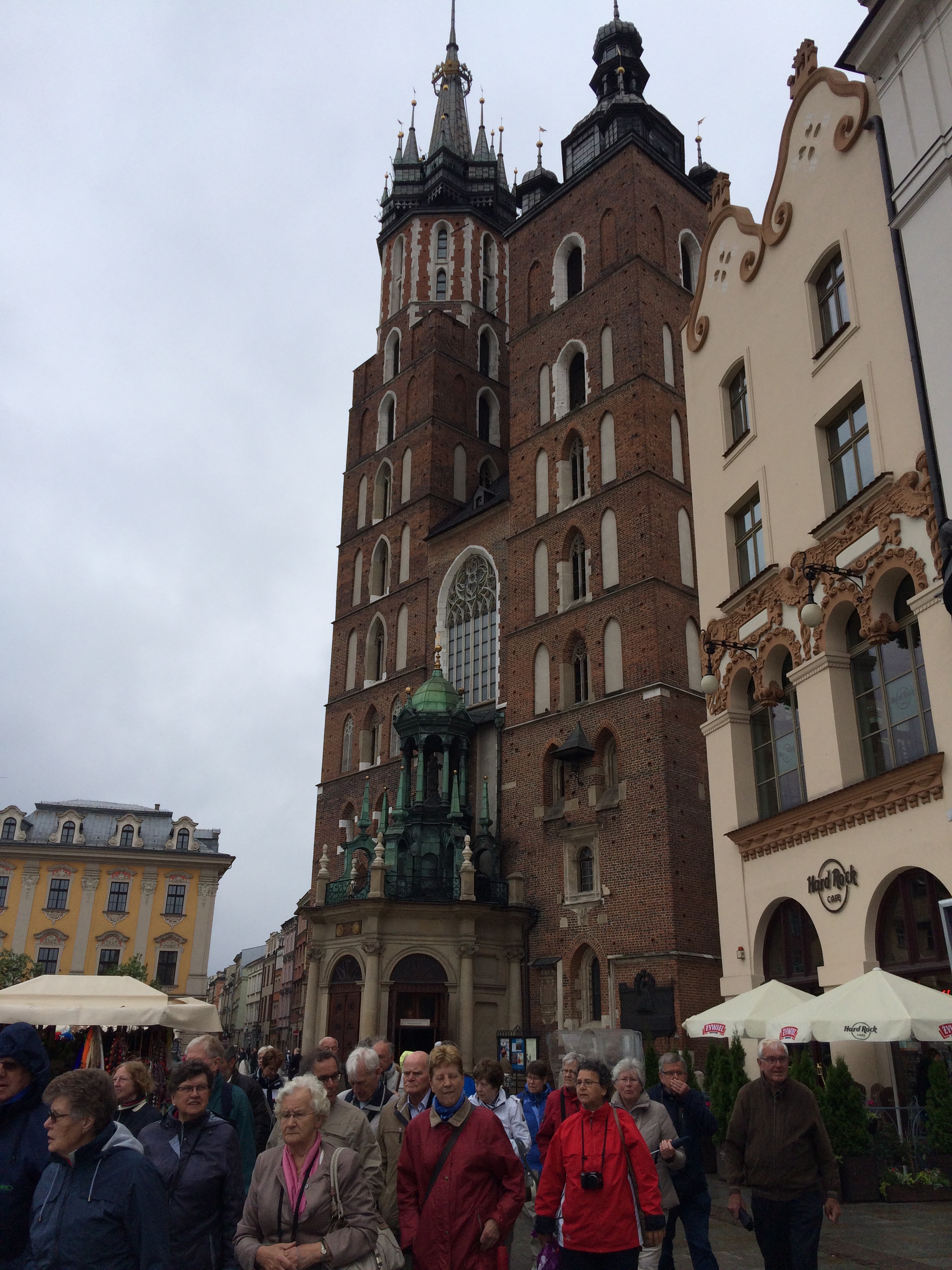
Our last day in Prague we were on our own and revisited Old Town and the Charles Bridge and then meandered around Lesser Town, the district below the Castle. It was a day to recover from the experiences we’d had the day before and to absorb all we had seen in Prague.

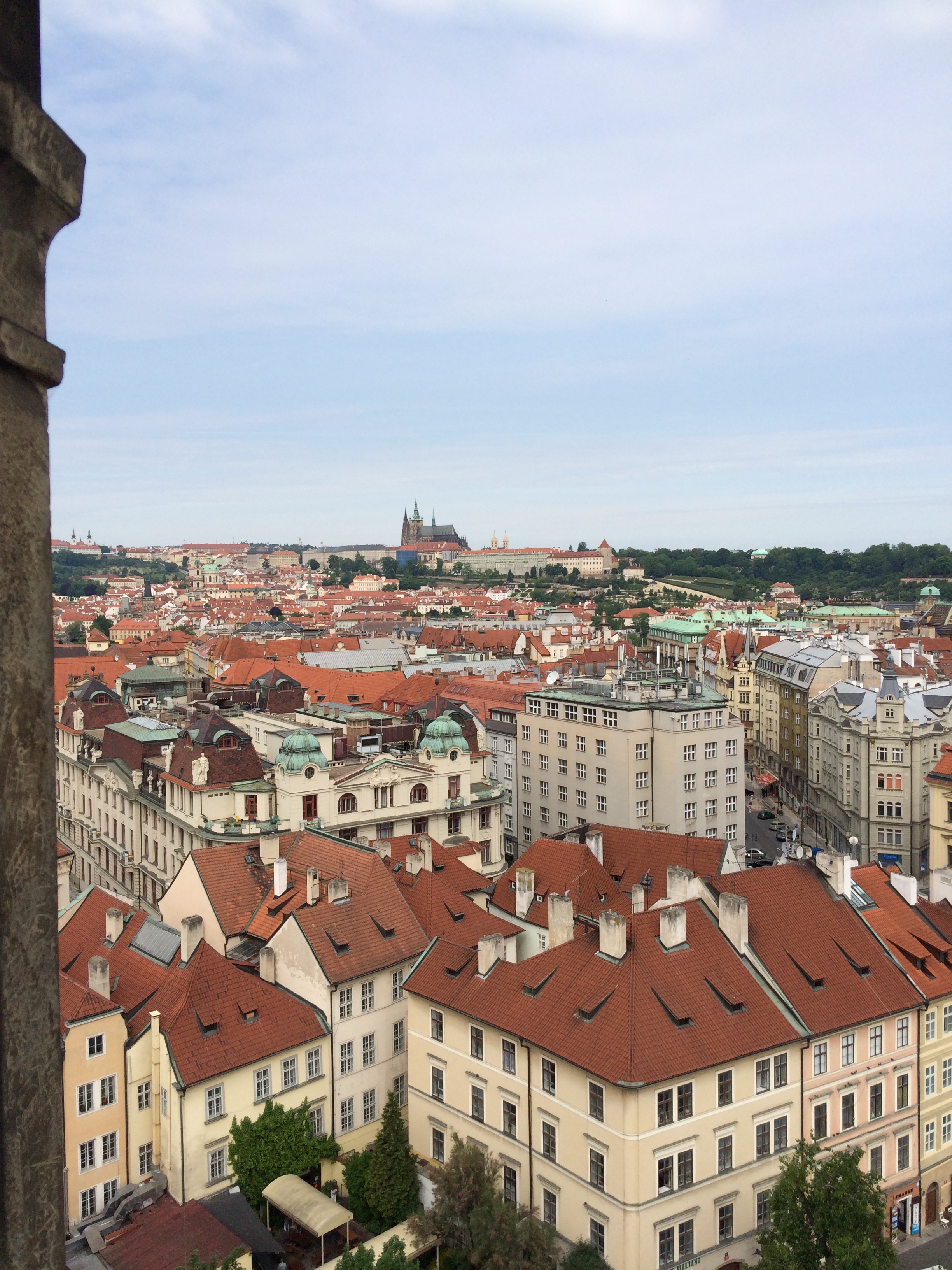
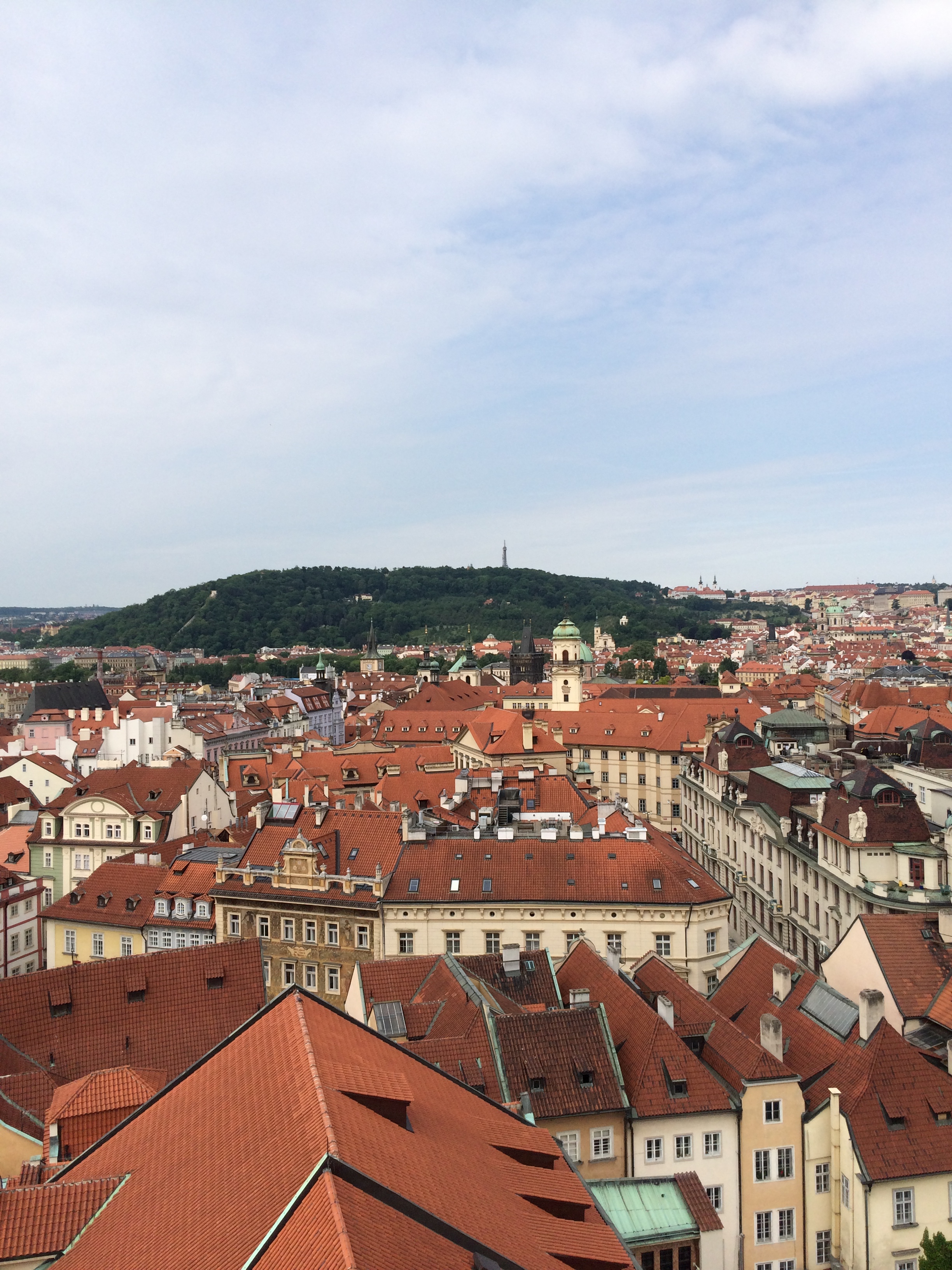
We climbed (yes, we actually climbed) the clock tower in Old Town where we had views of Prague in every direction.

IMG_2576 tower view IMG_2577 Tyn church IMG_2581 panorama 2 IMG_2589 IMG_2591

IMG_2586 us in the tower

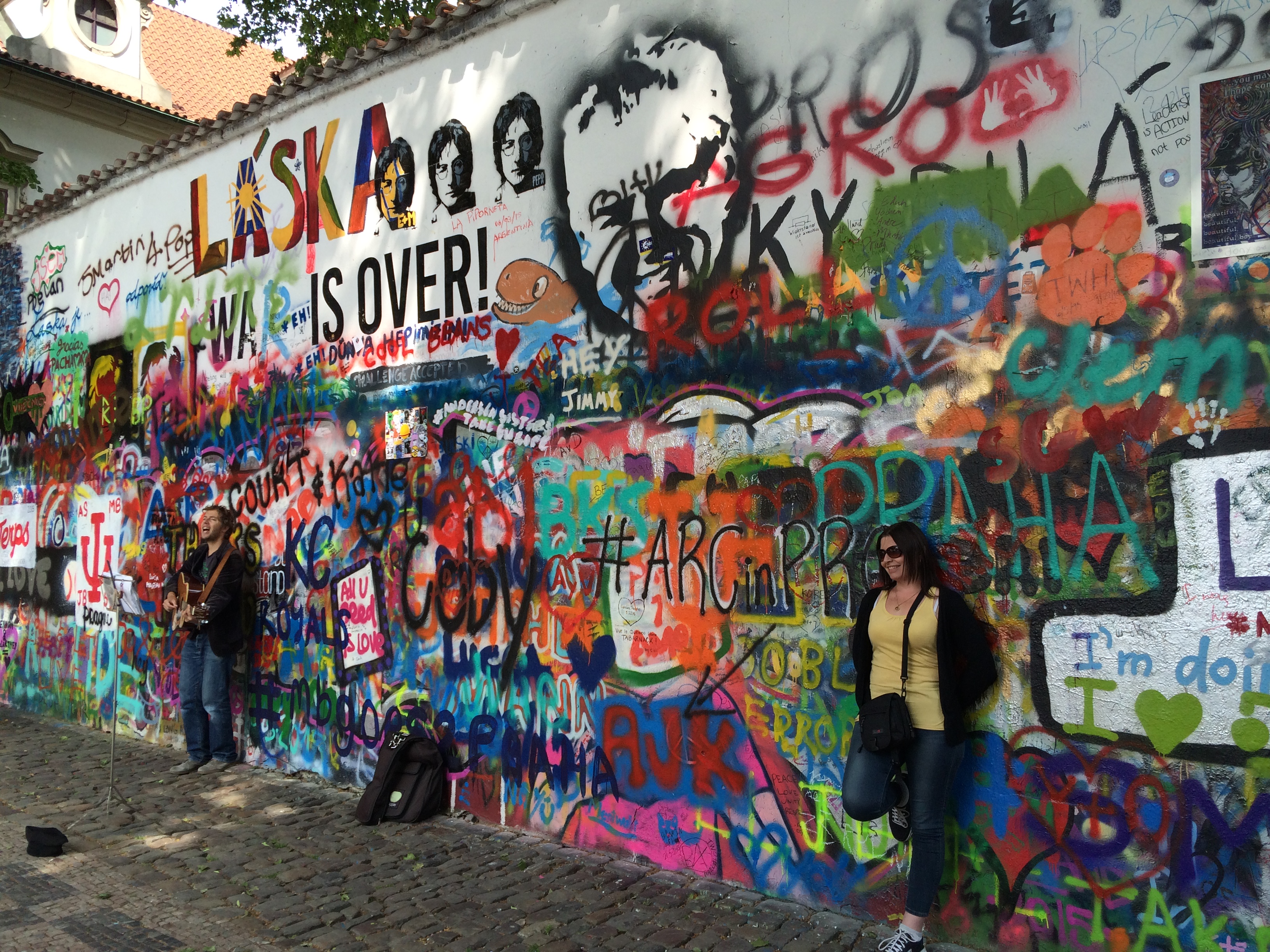
We crossed the river and saw the wall covered with graffiti dedicated to John Lennon and the ornate St. Nicholas Church in Lesser Town.

IMG_2594 Vlatava RIver Prague

Vtlava River

IMG_2595 Wall for John Lennon

John Lennon wall

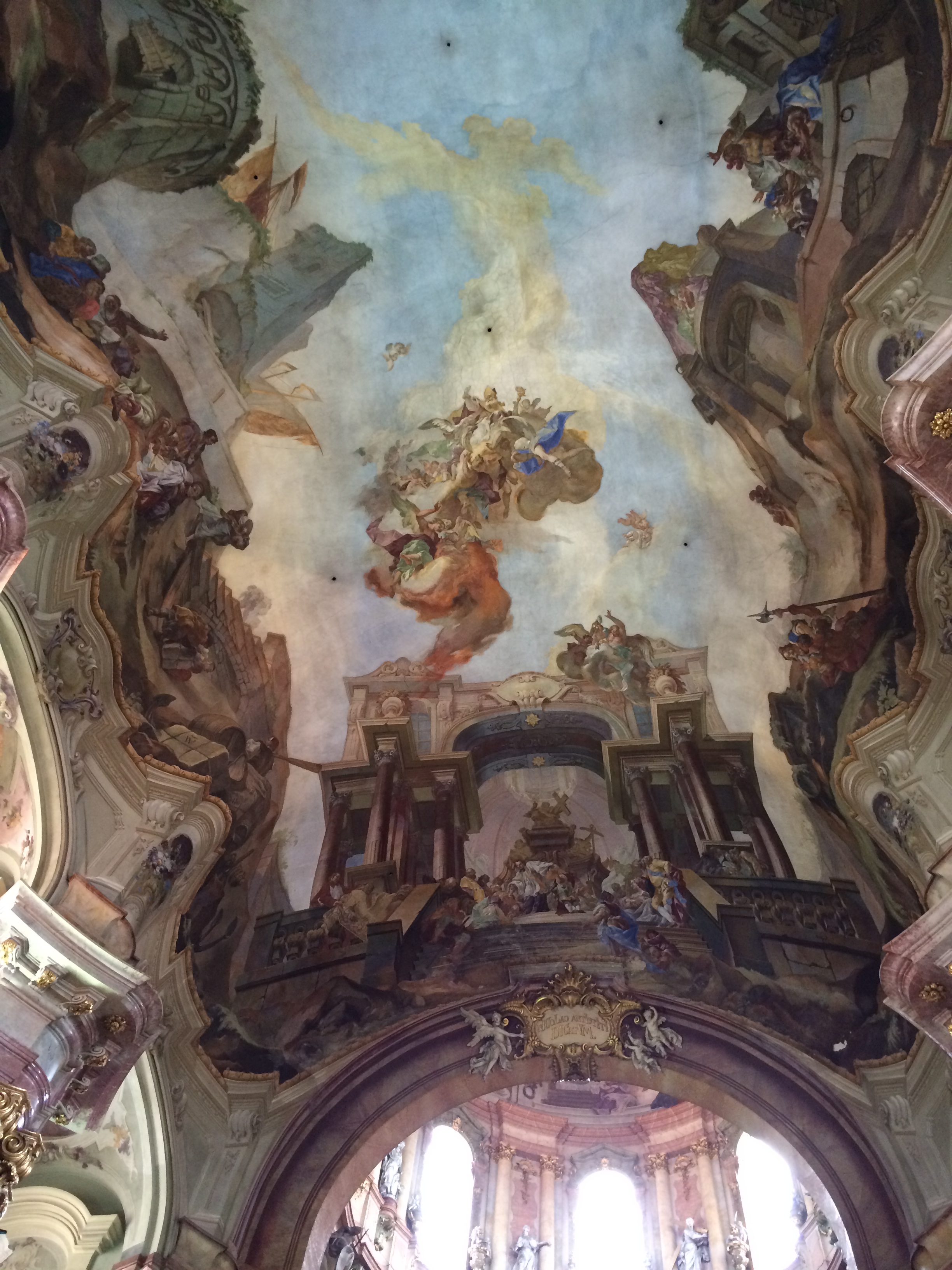
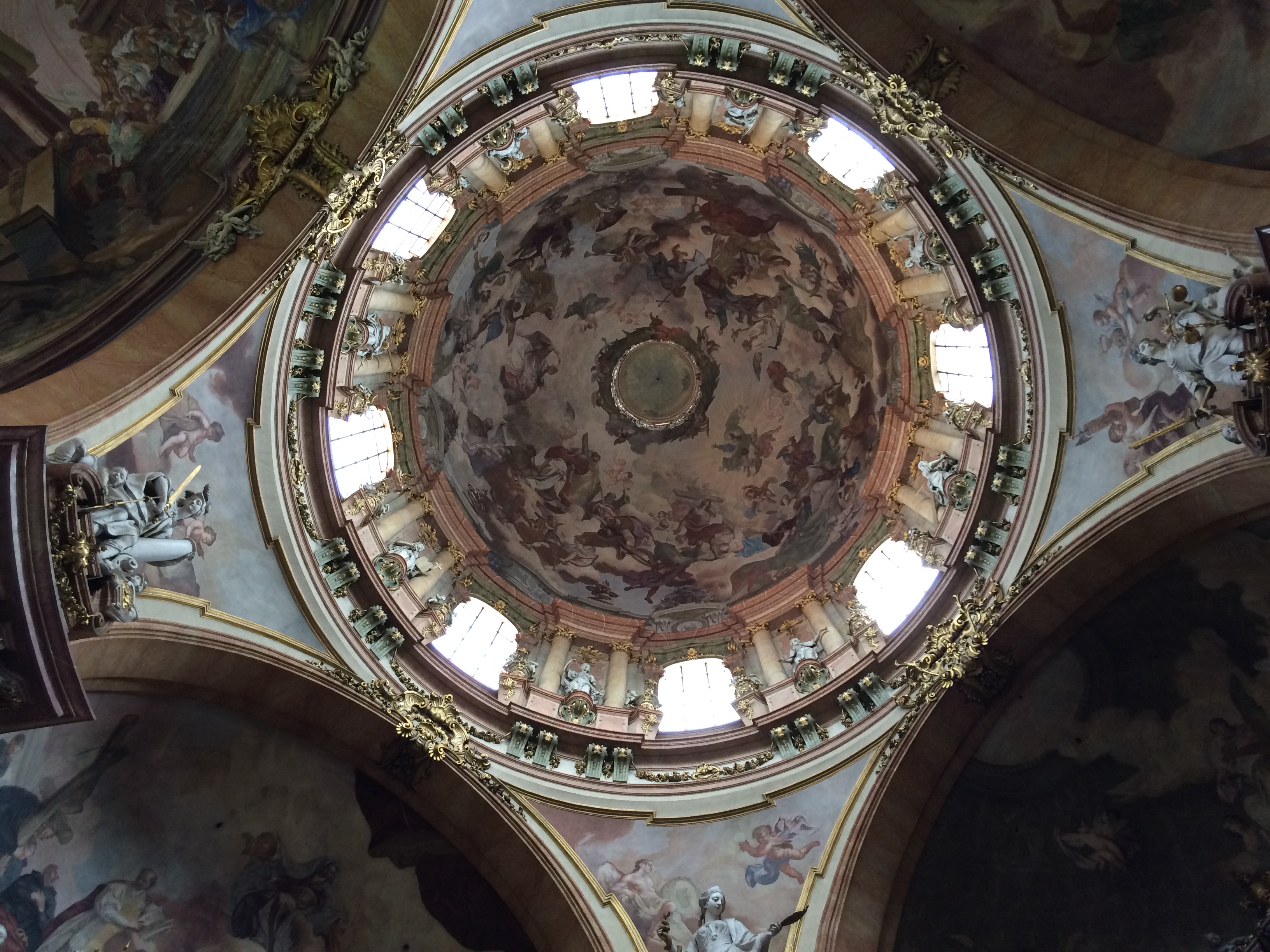
IMG_2598 St Nicholas Church in Lesser Town 5 23

Inside St. Nicholas Church, Lesser Town

IMG_2600 IMG_2603 dome in St NIcholas Church Prague Lesser TOwn

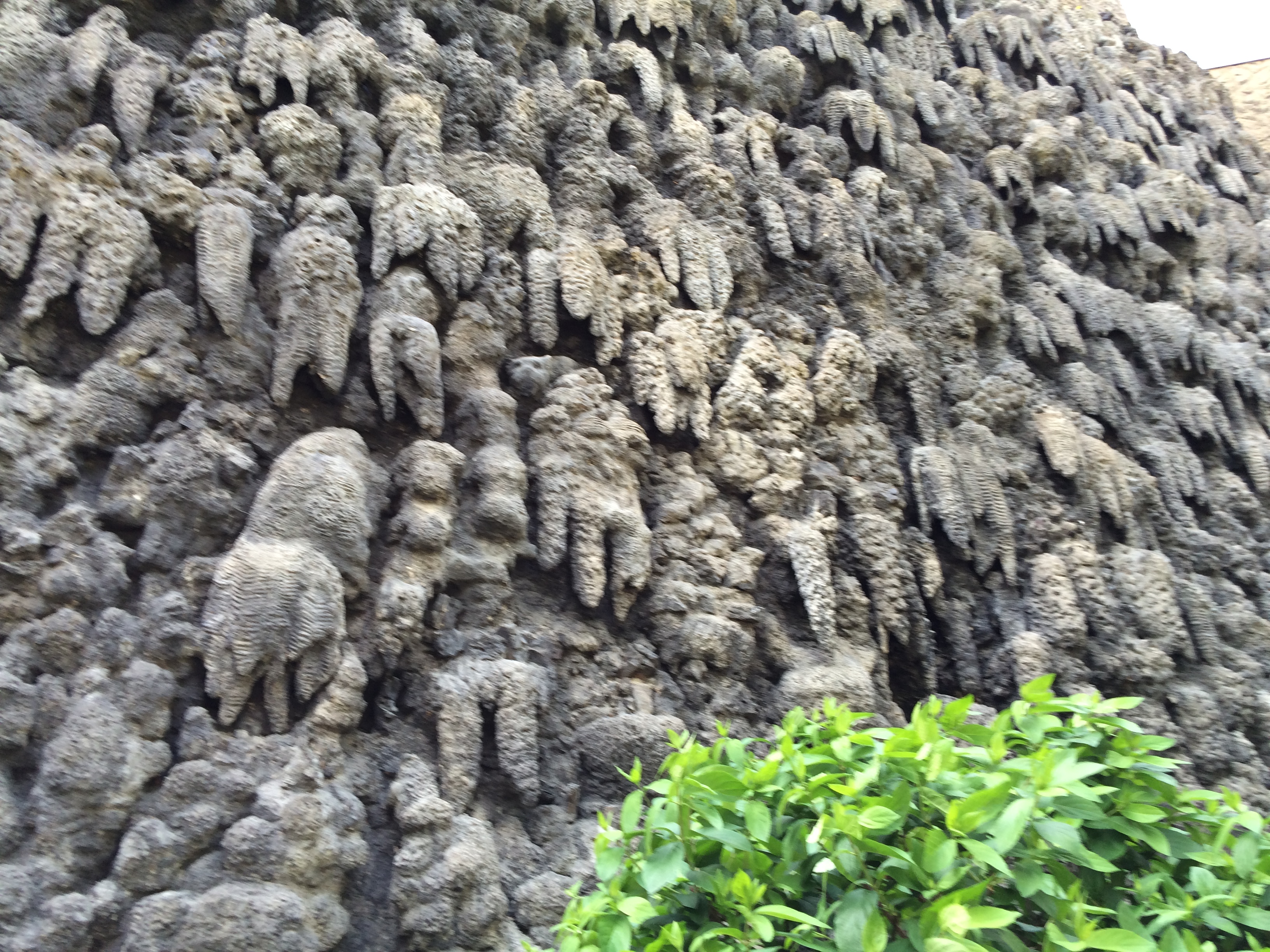
We wandered through the Wallenstein gardens, where we saw peacocks and a very weird grotto wall with sculptures of animals hidden throughout.

IMG_2608

In the Wallenstein Gardens


IMG_2614 IMG_2615 IMG_2616 IMG_2620


We had lunch at a restaurant on the river; the walkway from the street to the restaurant was so narrow that they had a “traffic light” at either end so that two people wouldn’t get stuck in the middle, neither being able to pass.  Of course, we didn’t notice that on our way down.  Fortunately, the man coming up was only a few steps up and graciously went back down.

Walkway to Cafe Certenova

Walkway from Cafe Certenova

We also experienced the way that music permeates everything in Prague.  We had been to a concert our second night at the Municipal House’s Smetana Hall, hearing the Prague Symphony Orchestra play Gustav Mahler’s 5th Symphony, a moving and emotional piece of music that I’d never really heard before in its entirety.  For our last night we decided we would try and get to another concert.  Walking through Prague we discovered that wherever we went, people were handing out flyers for concerts at churches and other venues.  What was a bit bizarre though was that in many of these venues the program included Vivaldi’s Four Seasons.  We were baffled—was it Vivaldi’s birthday?  He was Italian, not Czech.  Why would all these places be playing the same piece of music?  My best guess is that it’s a piece that is well-known and well-loved and thus a good selection to attract an audience.  We returned to Smetana Hall that night, and yes, we heard the Four Seasons.  It was lovely.
Street performers---can anyone tell me how they do this??

Street performers—can anyone tell me how they do this??

We were also surprised by how good the food was in each of the other places we ate while in Prague—-Giovanni’s Trattoria, RYBI (great fish), and Pasta Fresca (yeah, we like Italian food, as apparently does most of the world since every city we visited seemed to have more Italian restaurants than anything else, other than their own local cuisine).

Overall, our time in Prague was fascinating—fun, uplifting, educational, upsetting, insightful, entertaining, and stimulating. It was good to end the trip seeing all the beauty and good that human beings can create and appreciate instead of the evil and horrors we’d witnessed the day before.  Prague is a wonderful city, and we definitely could have spent more time there.  But it was time to move on to our next stop.

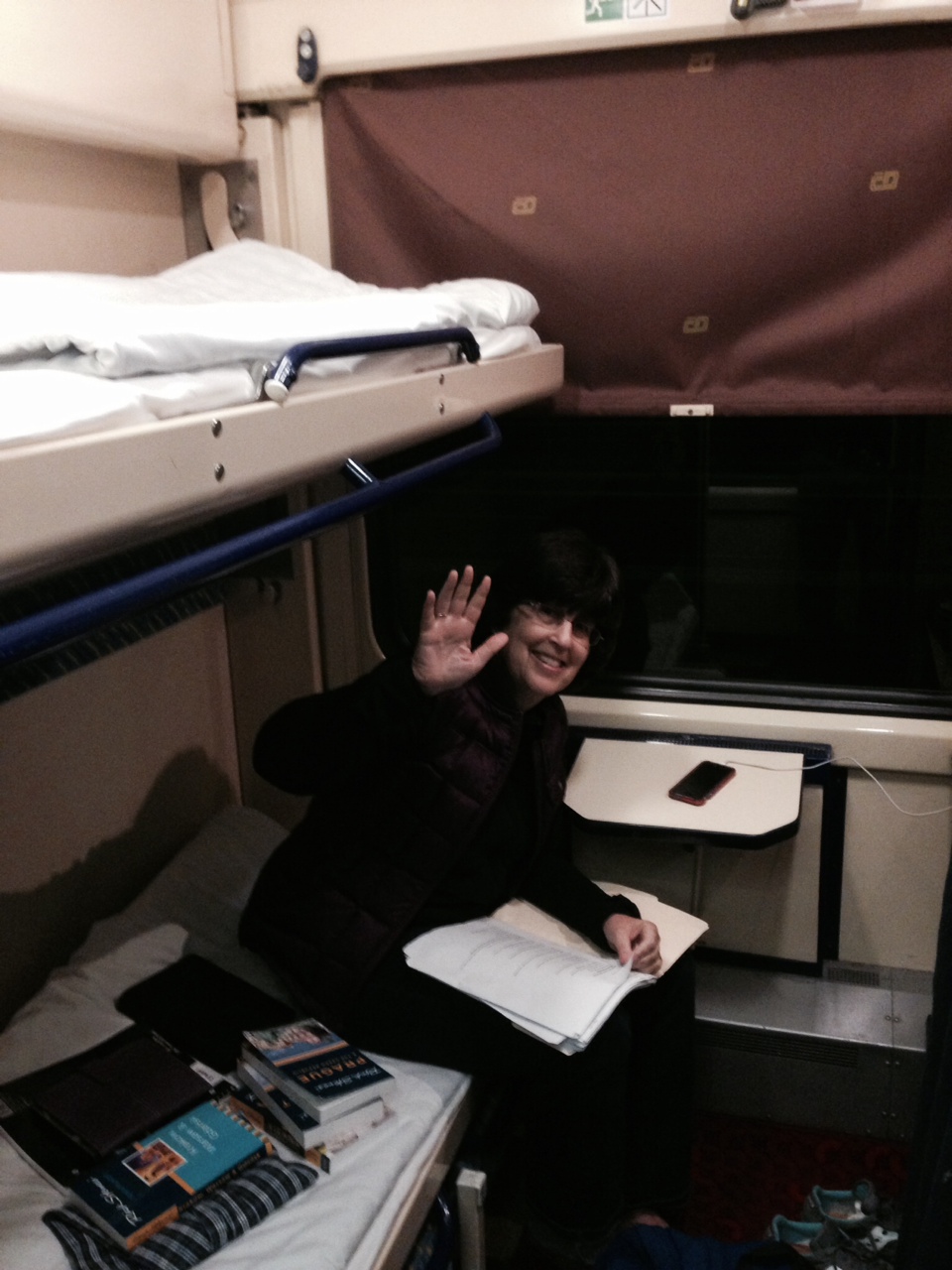
We boarded an overnight train to Krakow.  It wasn’t the most comfortable sleeping accommodation on the trip, but when we woke up, we were in what was once Galicia, the homeland of my Brotman ancestors.

Prague and Terezin

If our first day or so in Prague felt like a bit of a fairy tale, our second day had nothing magical about, just a lot of ghosts wherever we turned.  We had a new guide that day, Helena from Wittman Tours, a company that specializes in Jewish heritage tours of Prague and the surrounding area, including the concentration camp in Terezin.  We had heard good things about the company from friends at home, so chose to use one of their guides for our second full day in Prague.  Helena was another excellent guide, and she was able to provide us with another person’s perspective on Prague.

Helena, like Andrea, was a Czech native and had lived in Prague for many years.  When she told us that she was Jewish, I asked her about her family’s experience during the Holocaust.  Helena said that although her parents had never discussed the matter in any detail with her, she knew that somehow they had been able to obtain falsified papers giving them a Christian identity.  Like so many survivors, her parents preferred not to discuss those years, and thus Helena knew only those bare facts.

According to Helena, Prague had a Jewish community very early in its history, though many settlers came and left, depending on the economic and political situation.  There was a Jewish community as early as the tenth century, living near the Castle and the marketplace there.  Although that community was wiped out during the Crusades in the 12th century, there was then a new community growing on the other side of the river near what is now called Old Town, where in the 13th century the oldest still-existing synagogue was built, referred to as the Old-New Synagogue.  That synagogue is still providing religious services to this day.  It is claimed to be the oldest surviving synagogue in Europe.

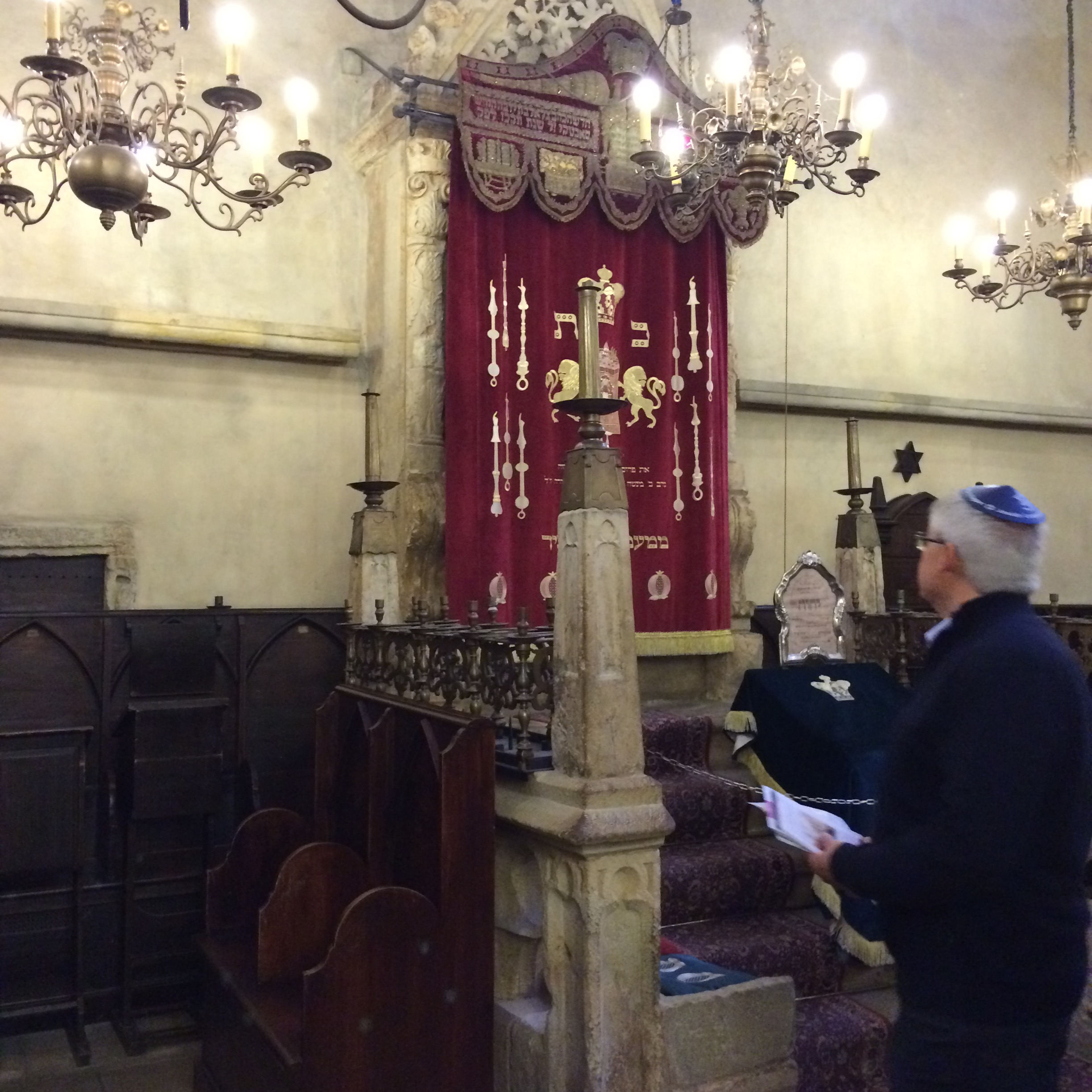
Entrance to prayer hall in Old New Synagogue

Entrance to prayer hall in Old New Synagogue

It was humbling to be in this synagogue, thinking of its long history.  Although it lacked the awesome size and height of the St. Vitus Cathedral and of some of the other synagogues we saw in the Jewish Quarter of Prague, it was moving to think about Jewish men (women prayed behind a thick stone wall with only a small hole to see into the main sanctuary) almost 800 years ago praying in this space.  Jews then lived in a ghetto, separated from the rest of the city by walls, and they faced anti-Semitism and periods of expulsion and then return, but were generally successful merchants and bankers and important contributors to the economy of the city.

At services women sit behind the wall where the opening is shown here

At services women sit behind the wall where the opening is shown here (not where this woman is seated)


The second oldest of the synagogues we saw in Prague was the Pinkas Synagogue, built in the early part of the 16th century.  Today it operates as a museum to educate people about the Jewish religion, its holidays and rituals, and does not operate as a place of religious services.

Pinkas Synagogue, Prague

Pinkas Synagogue, Prague

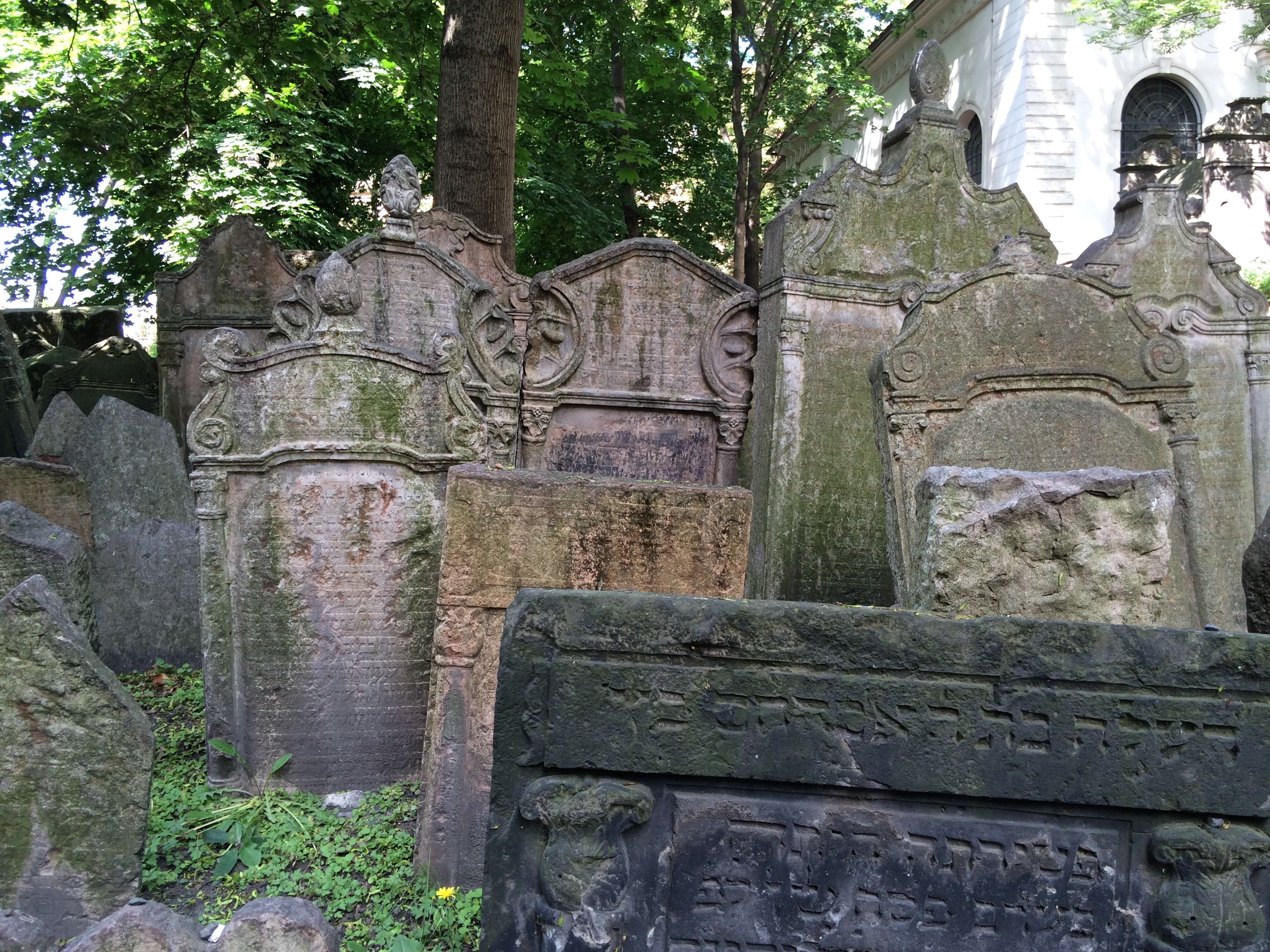
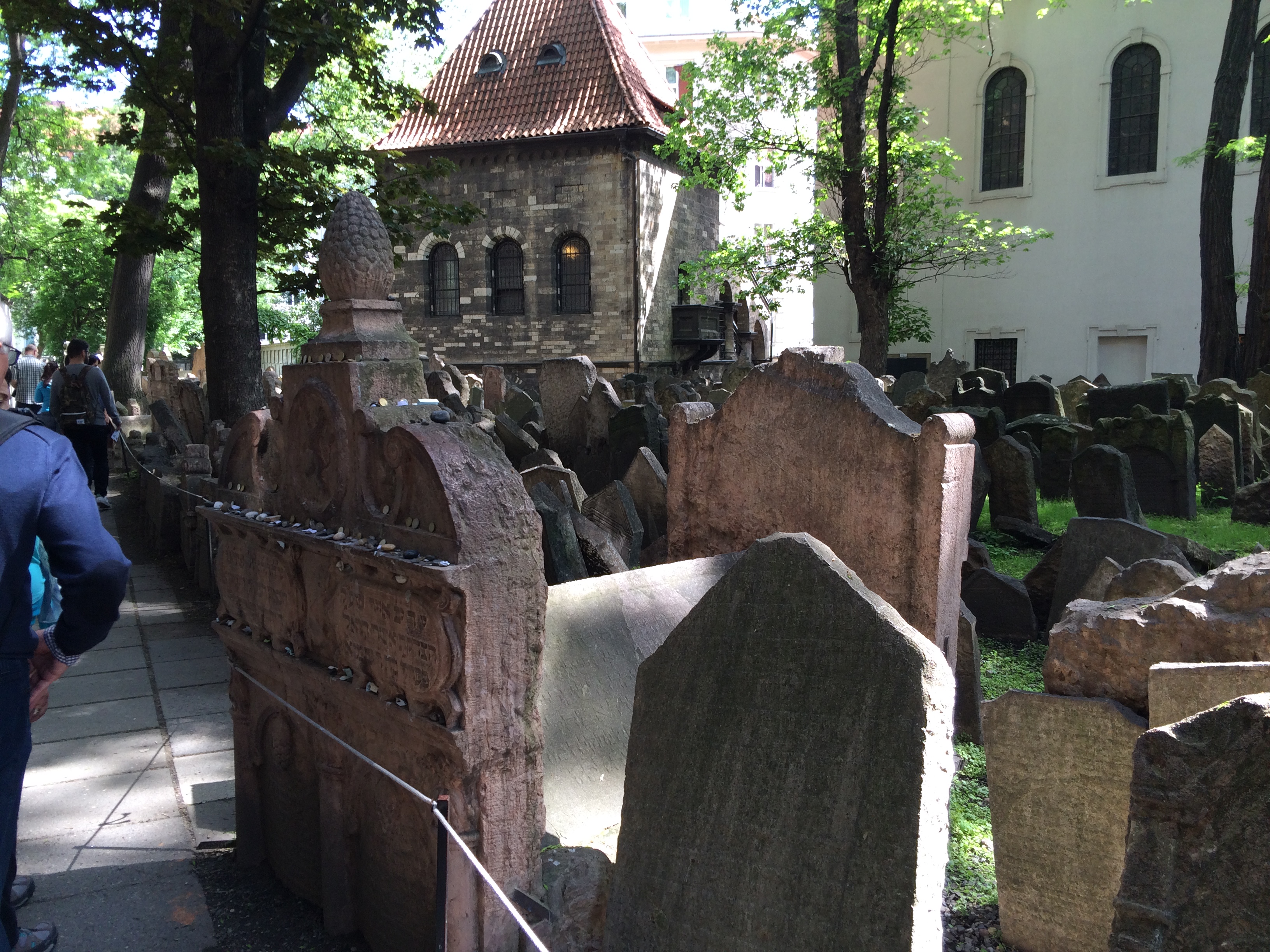
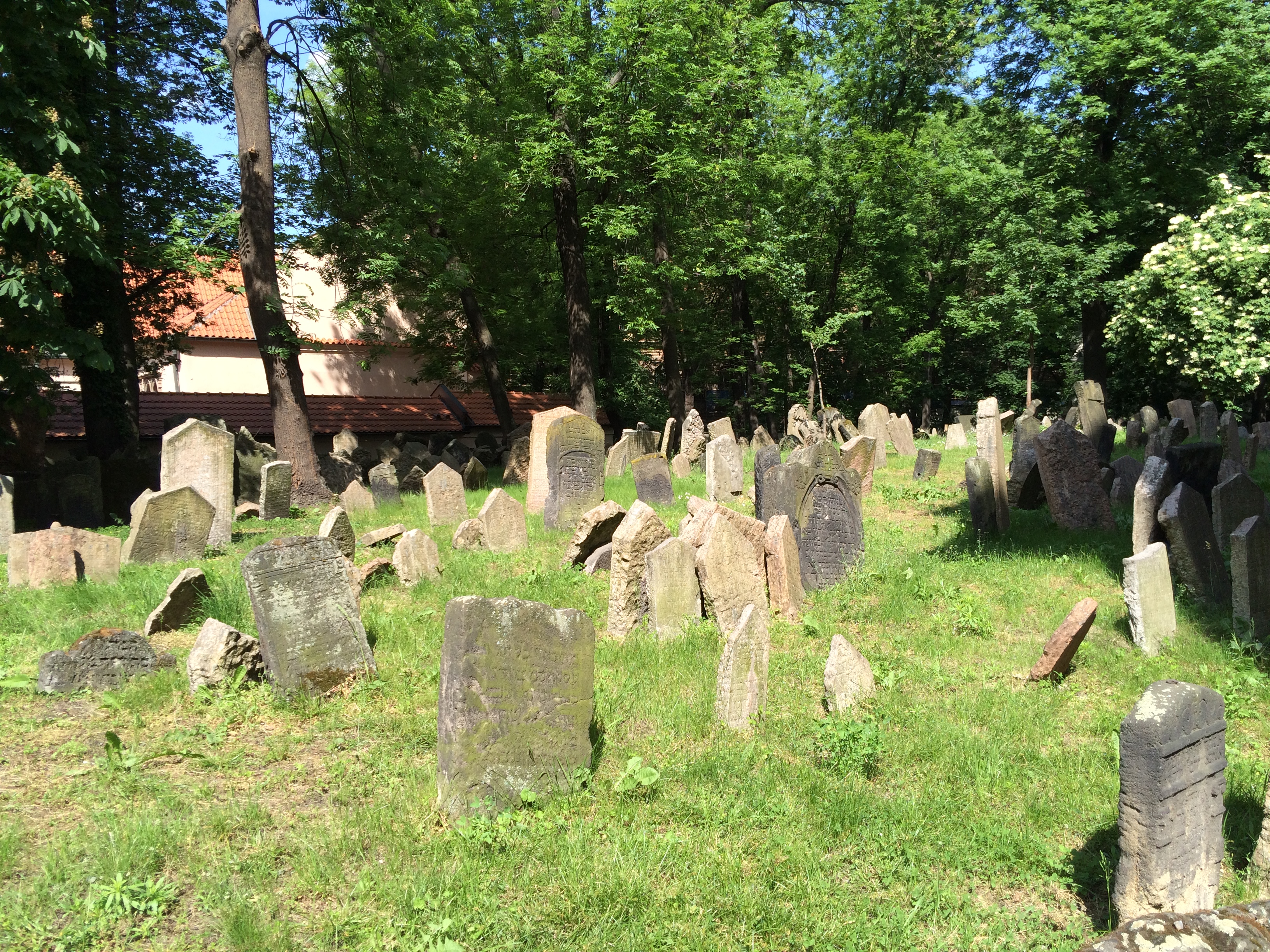
Immediately outside the synagogue is the oldest Jewish cemetery in Prague, so crowded with the remains of about 200,000 Jewish residents that the headstones are tumbled together and, according to Helena, are buried as many as twelve deep, one on top of the other.

IMG_2549 buried 12 deep IMG_2550 cemetery


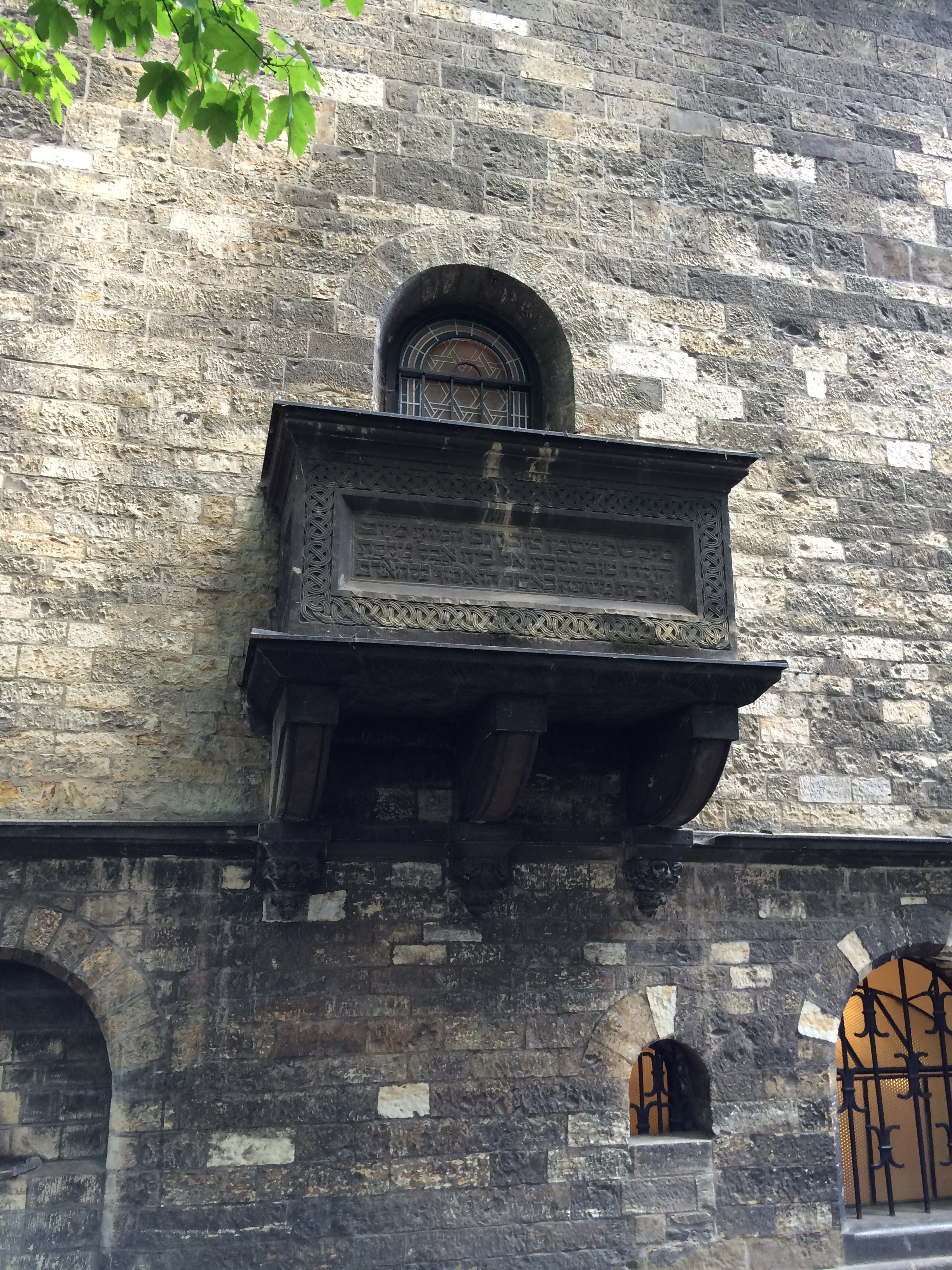
There is also a building for the chevra kadisha (burial society) on the cemetery grounds, including a balcony where the Cohanim stood since they were not allowed to enter the cemetery.  (According to Jewish law, the Cohanim, the priestly tribe descended from Aaron, are not to defile themselves by touching or going close to a dead body.)

chevra kadisha building

chevra kadisha building

IMG_2558 cohen symbol

Cohanim symbol

Cohanim balcony

Cohanim balcony

These ancient stones and their placement and inscriptions are evidence of what once was a crowded Jewish neighborhood within the ghetto walls, a community that was observant of Jewish laws and forced to live separately from their Christian neighbors.

In the 1500s Prague had one of the largest Jewish populations in Europe. Other synagogues were built, including a synagogue built by one of the wealthiest residents of Prague, Mordecai Maisel, as his own private synagogue.  According to Helena, Maisel was friendly with the reigning king, Rudolf II, and was an important merchant and property owner in Prague.  Maisel was also very friendly with Rabbi Judah Loew, a leading rabbi as well as a writer, best known for his rendition of the Golem legend.  Both Maisel and Rabbi Loew are buried in the Old Cemetery, their graves marked by large tent-like structures instead of plain headstones.  We were not able to get inside the Maisel synagogue as it is closed for renovations, but we were able to take some photographs of the exterior.

Maisel Synagogue, Prague

Maisel Synagogue, Prague

IMG_2544 Maisel synagogue 2

Maisel's tombstone

Maisel’s tombstone

IMG_2555 Rabbi Loew tombstone

Rabbi Loew’s tombstone

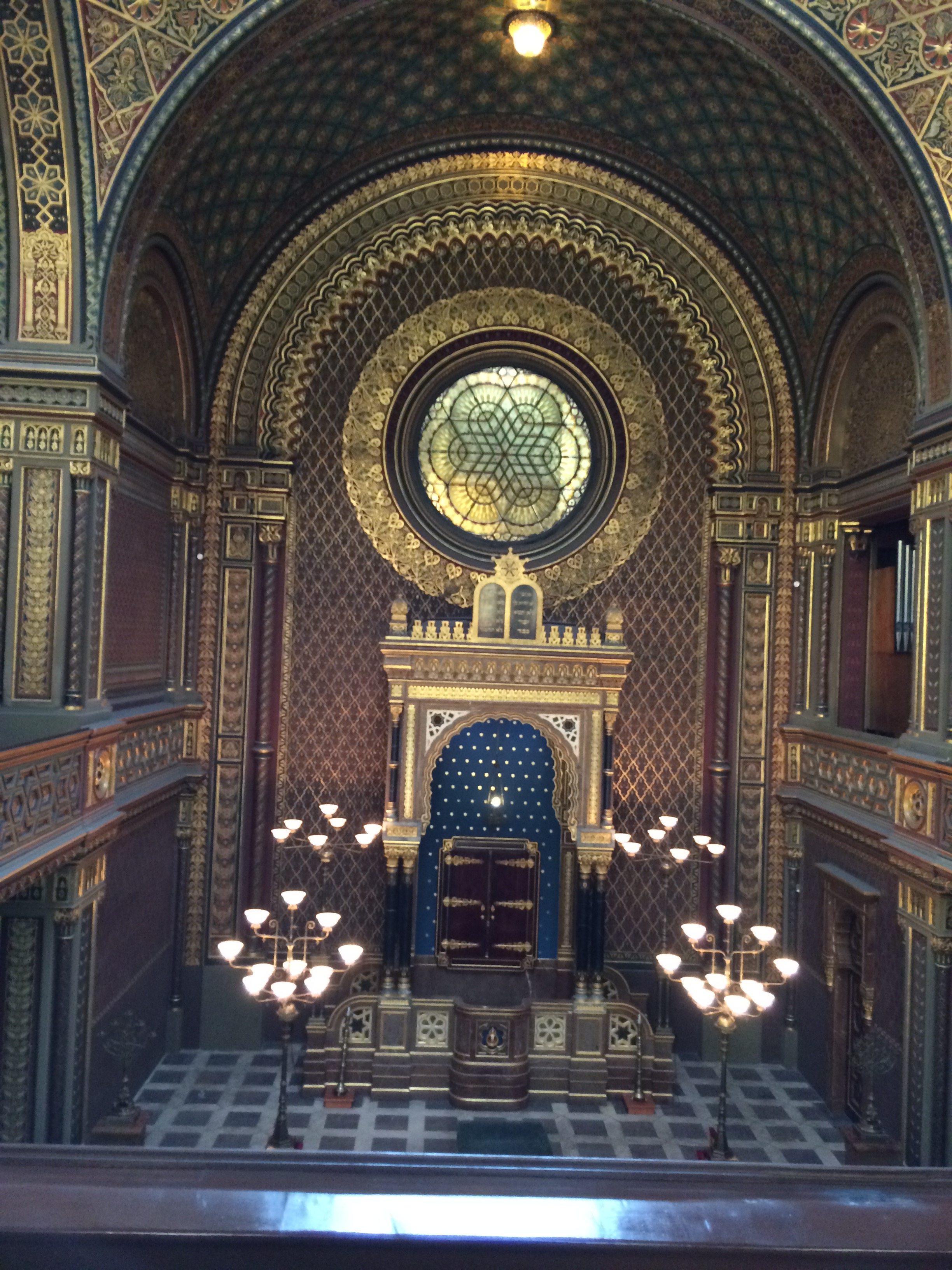
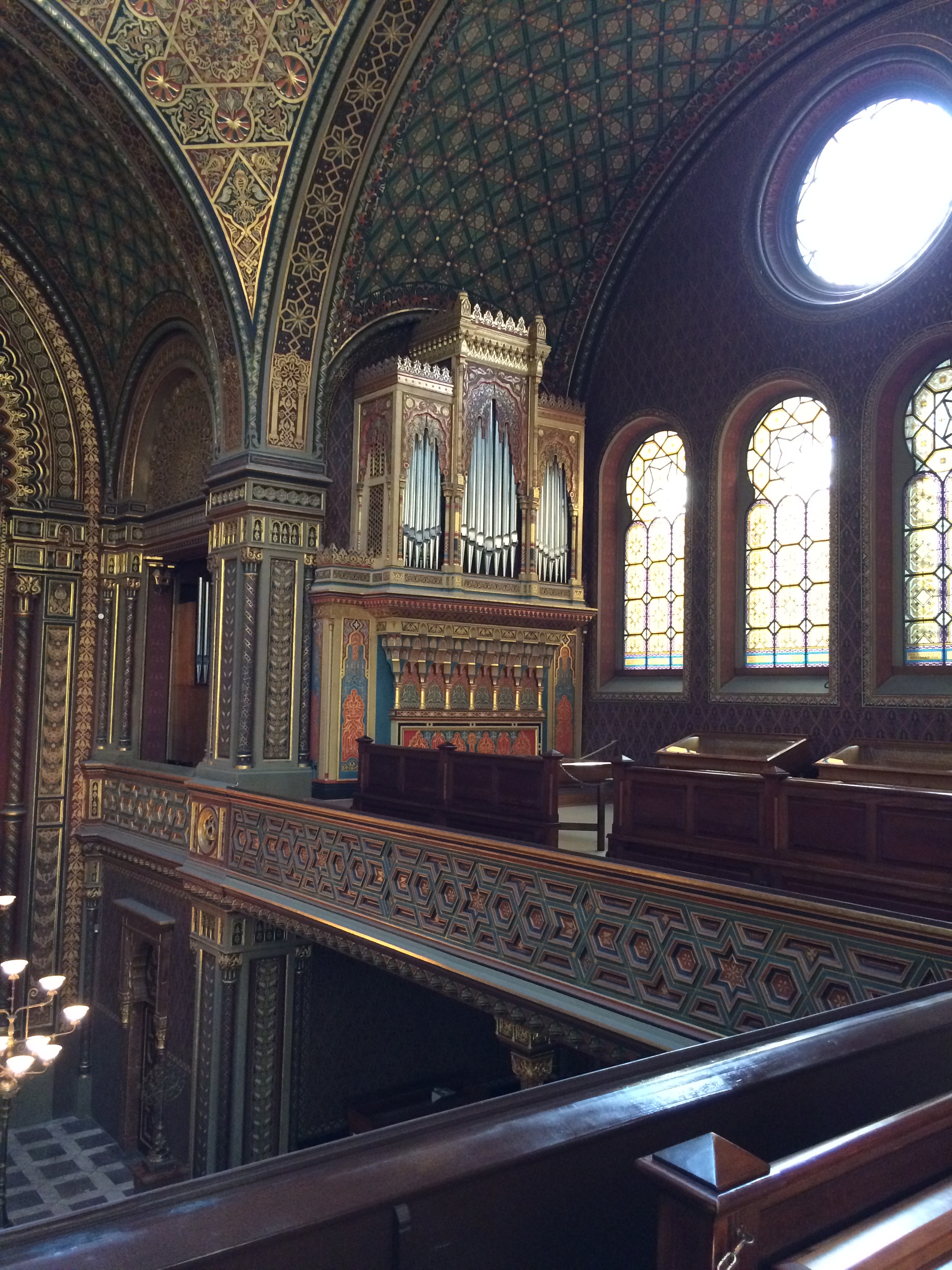
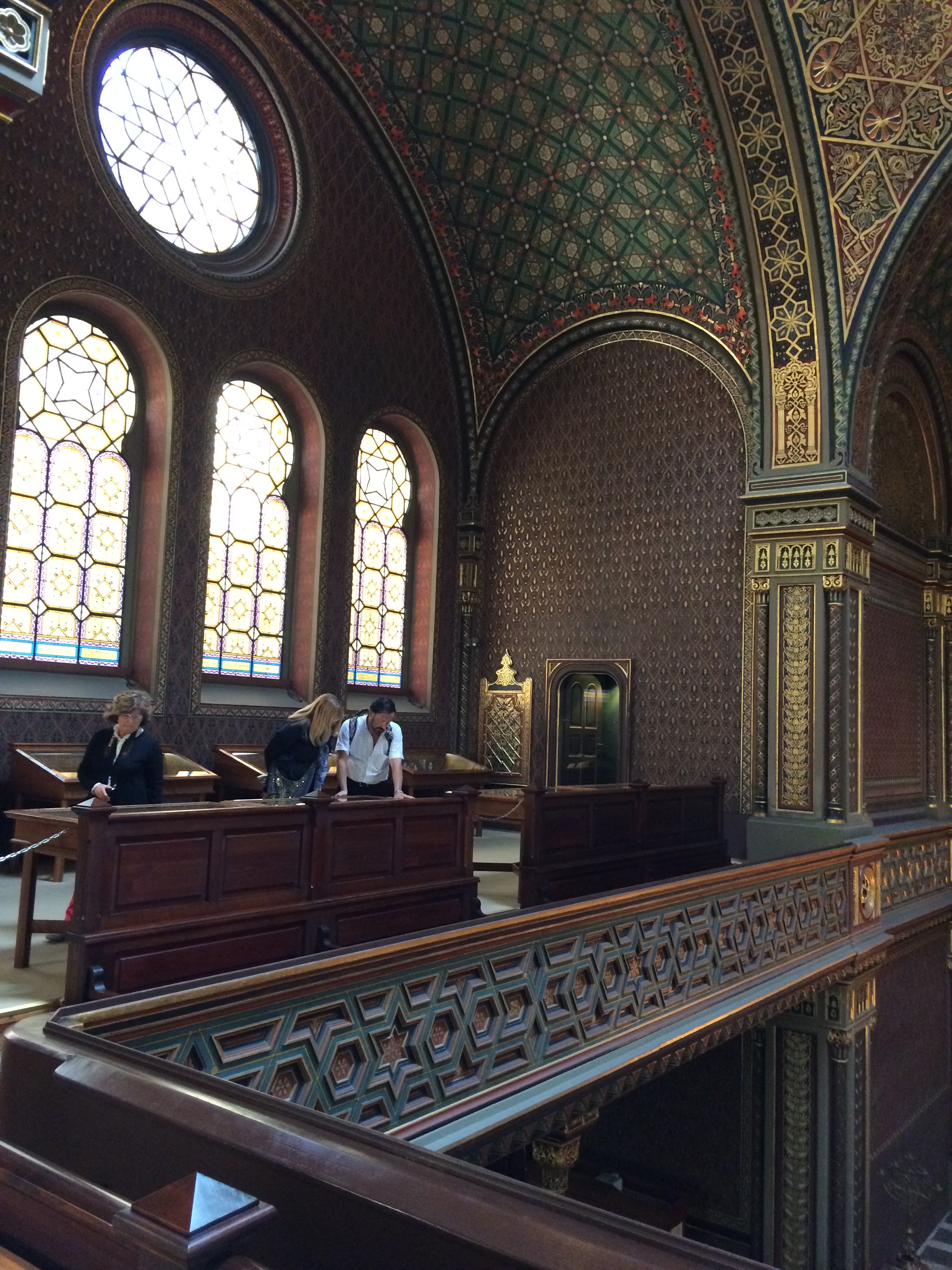
The newest synagogue we saw in the Jewish Quarter was the magnificent Spanish Synagogue.  Despite its name, the synagogue had nothing to do with Spain nor were its congregants Sephardic.  Rather the name refers to the Moorish designs that decorate both the exterior and the interior of the synagogue.  This synagogue was built in the second half of the 19th century and still offers services on Friday nights, attracting many tourists.

Spanish Synagogue, Prague

Spanish Synagogue, Prague

IMG_2535 interior of Spanish synagogue IMG_2536 organ in Spanish synagogue IMG_2537 Spanish synagogue interior IMG_2538 Spanish synagogue from above IMG_2539 women's section Spanish synagogue

Seeing this synagogue made me realize just how prosperous the Jewish community must have been in the 19th century.  The lavish and ornate wall coverings are indicative of the resources available to the Jewish residents.  In fact, Jews were granted equal rights around this time, and the ghetto walls came down, allowing Jews to move out of the Jewish Quarter.

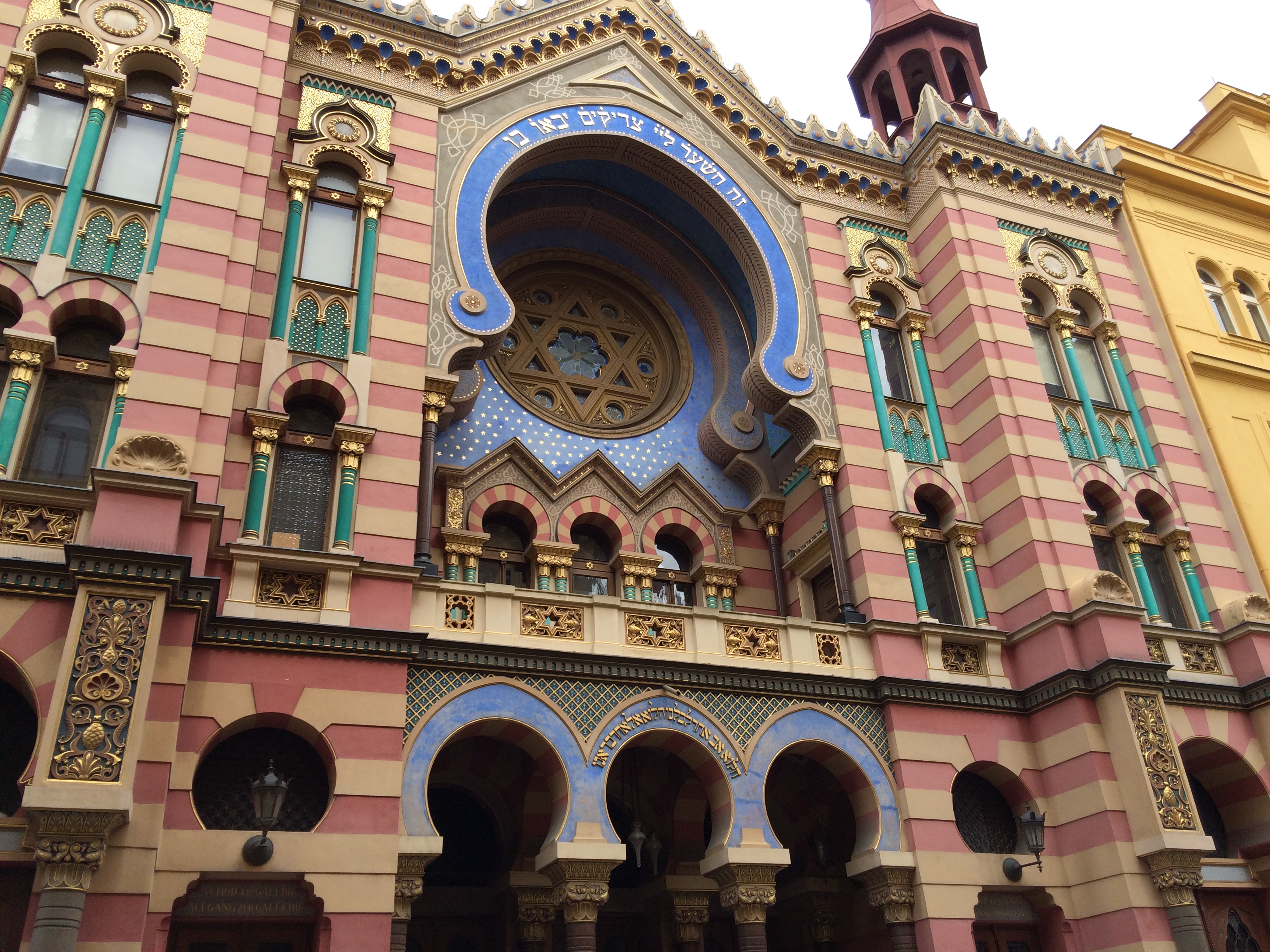
Many moved to the New Town area, where yet another impressive synagogue was built in the early 20th century, the Jerusalem Synagogue.  We later visited this synagogue on our own, and although we did not get inside, we were once again dazzled by the colorful and elaborately designed exterior, which also reflects Moorish influence.

Jerusalem Synagogue, Prague

Jerusalem Synagogue, Prague

IMG_2622 Jerusalem Synagogue Prague

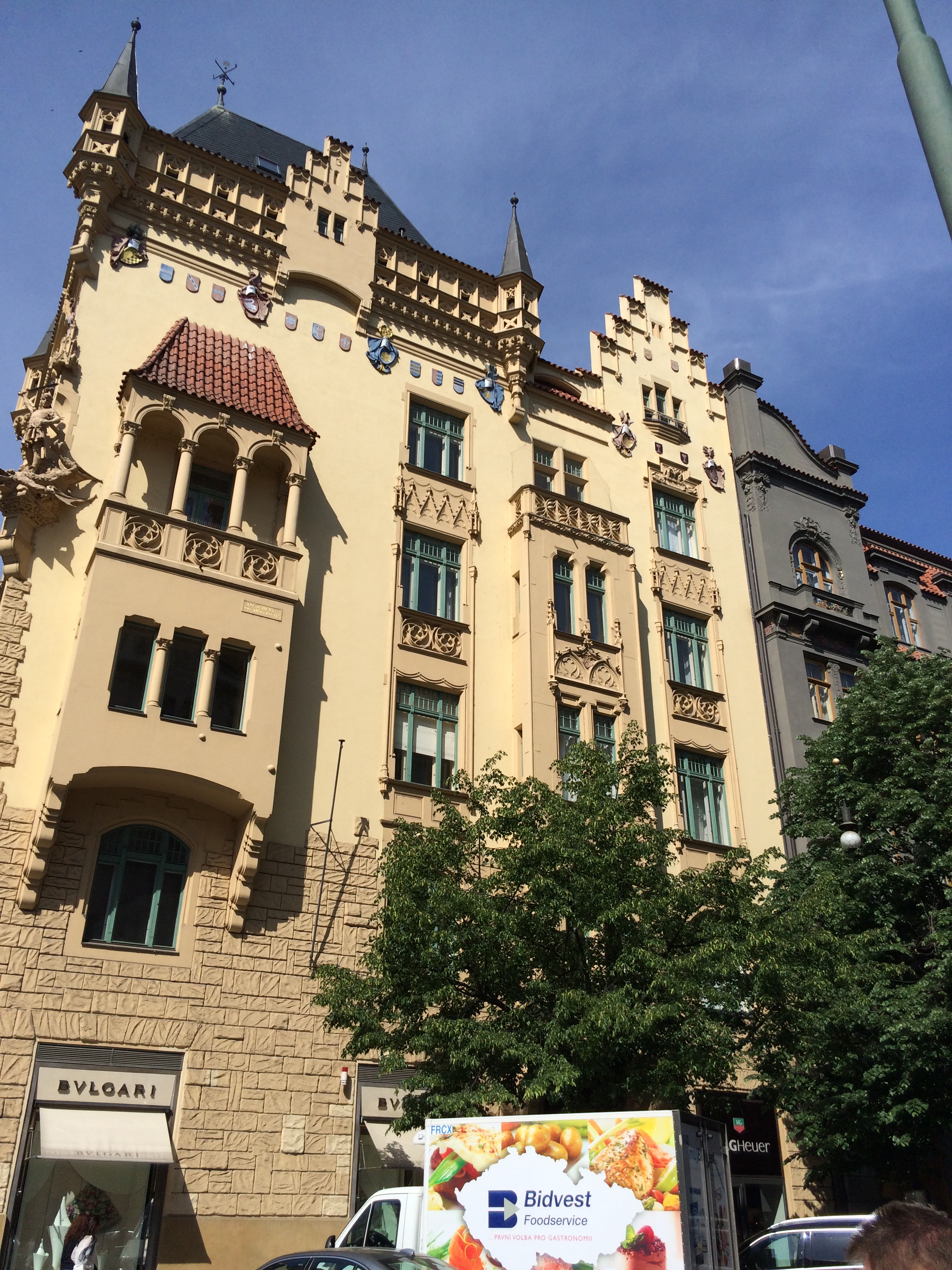
Helena told us that once the Jews were allowed to move out of the ghetto, most left if they could afford to do so, leaving behind only those too poor to move.  Poor Christians then moved into the area where the ghetto had existed, and because of the poverty, conditions deteriorated, leading to severe sanitary and health problems.  Eventually the city tore down the old buildings in an early form of urban renewal, replacing the older homes with the fancy Art Nouveau buildings that line the streets today.  The streets were widened, and the whole character of the former ghetto disappeared.  For the most part, only the synagogues survived.

Newer buildings in what was once the ghetto

Newer buildings in what was once the ghetto

IMG_2568 Prague street 5 22

Wider streets in what was once the ghetto


Then the Nazis arrived in the late 1930s and 1940s, and what had been a large and thriving Jewish community of over 90,000 people, amounting to about 20% of the city’s overall population, was destroyed.  The synagogue buildings survived only because the Nazis found them useful for storing their supplies and horses.  Most of the Jews who had lived in Prague were killed.  Today there are fewer than 2000 Jews living in Prague.

Seeing the Jewish Quarter and learning about its history helped place into context what we saw in the afternoon when we went to Terezin.  As we drove to Terezin, Helena told us about the assassination of Reinhard Heydrich, the SS officer who is considered to have been one of the principal planners of the Final Solution, the Nazi plan for exterminating the world’s Jewish population. He also was appointed as the SS officer responsible for overseeing the occupation of Czechoslovakia during the war and the creation of the Terezin concentration camp.  In May, 1942, two Czech resistance members attacked Heydrich’s car and assassinated him.  As revenge, the Nazis selected the town of Lidice, claiming it was the home of the assassins, and completed erased it from the face of the earth, killing all the men, deporting all the women and children, and razing all the buildings.  As Helena said, when people learned what had happened, they thought it could not get any worse.  But as we now know, it got much worse.

I am not sure how to write about Terezin.  I wanted to go there to pay my respects to the numerous Seligmann cousins who had died there as well as all the other thousands who had died there.  But part of the time I felt very uncomfortable, like I was visiting a museum, not a place where people were tortured, starved, and killed.  I took a few photographs at first and then stopped because I felt it to be disrespectful and trivializing to take pictures as if I were visiting an ordinary tourist attraction.

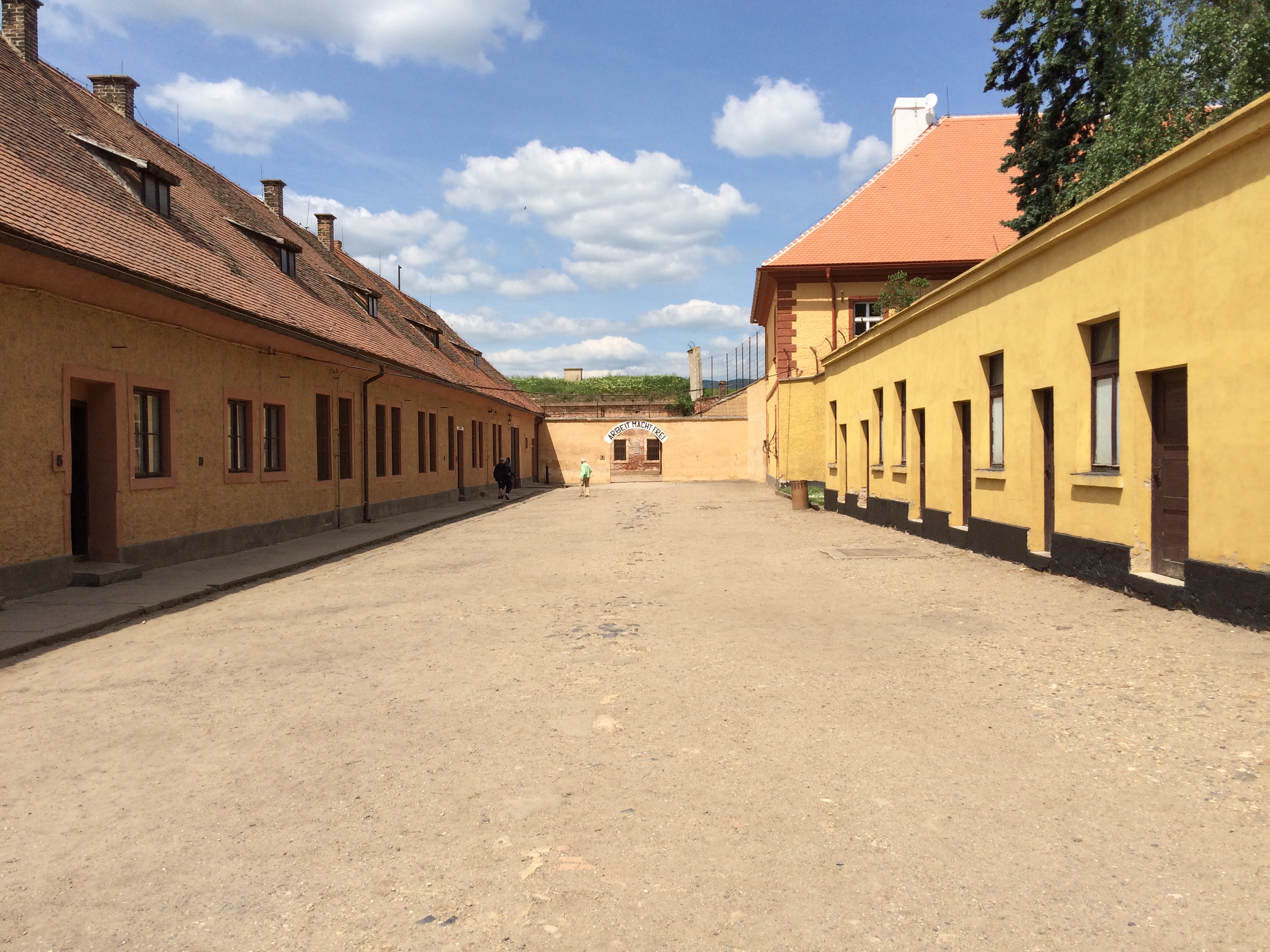
The last photo I took was one of a cell in the Small Fortress, the part of Terezin where dissidents and “criminals” were sent to be punished as opposed to the Large Fortress where the Jews were sent to await their deaths.  Of course, many Jews were also classified as  dissidents and “criminals” and ended up at the Small Fortress, and the room I photographed was one where such Jewish prisoners were sent, getting no meat and just water and a piece of bread twice a day and sleeping like animals on platforms squeezed into a tiny space where they were crowded on top of each other.  The solitary confinement cells, the yard where guards shot Jews for target practice, the sinks where no water ran but were there merely to fool the International Red Cross.  My brain had a hard time absorbing that these were real places where these horrendous things actually happened.

Jewish prisoners' cell, Terezin

Jewish prisoners’ cell, Terezin


My initial impression of the so-called Large Fortress or ghetto was that, by contrast to the Small Fortress, it was not that bad.  This was the camp that Hitler used as a “model camp” to convince the International Red Cross that Jews were being well-treated.   Children put on performances and created drawings and played soccer, all to impress the visitors.  Food was served for the visit that was never served again.  Children were required to lie to the visitors to create the impression that they were happy.

Some of the children’s drawings are on display at Terezin, and they are just heart-breaking.  The childlike depictions of their happy lives before the war and of their impressions of what was happening around them are so powerful.  I can’t possibly convey in words what these drawings convey.

Although Terezin was not a death camp, many thousands of people died at Terezin either from malnutrition, disease, or murder. When we saw the barracks where people lived and the living conditions they endured, my initial impressions were corrected, and I realized how horrible life must have been for those forced to live there while awaiting death, either at Terezin or later when shipped to Auschwitz.

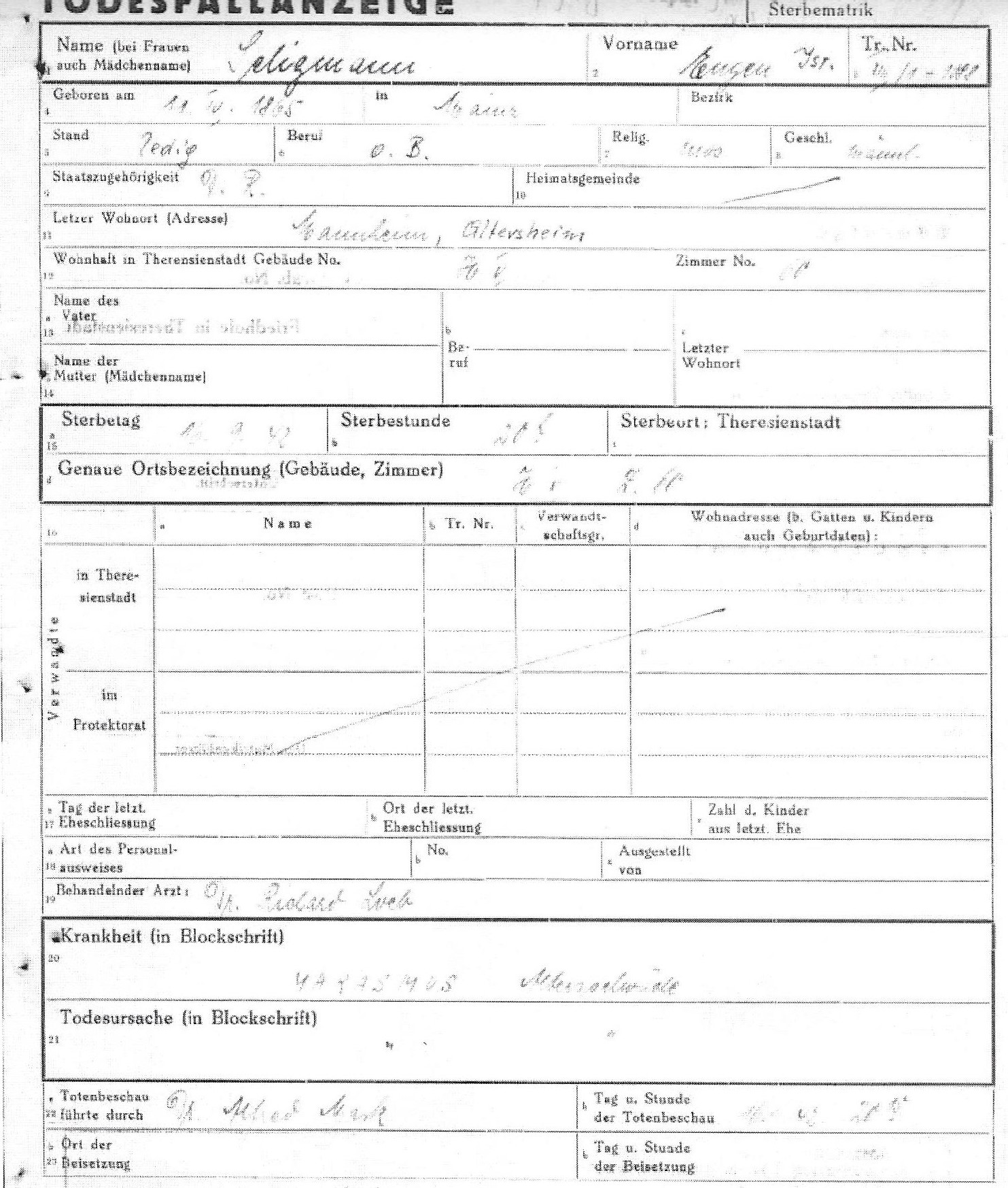
As I noted above, according to records at Yad Vashem several of my Seligmann cousins died at Terezin, including Moritz Seligmann, Laura Seligmann Winter, Bettina Seligmann Arnfeld, Anna Seligmann Goldmann and her husband Hugo and their three children Ruth, Heinz, and Gretel, and Eugen Seligmann.  Helena was able to catch a researcher at Terezin right before he was leaving for the day, and in a few minutes he was able to provide me with information about one of these relatives, Eugen Seligmann.  He gave me these documents.

Record for Eugen Seligmann at Terezin

Record for Eugen Seligmann at Terezin

Scan0003

Death certificate for Eugen Seligmann at Terezin

Death certificate for Eugen Seligmann at Terezin

From these documents we were able to learn the day Eugen died and from that we were able to identify where in the burial grounds at Terezin Eugen had been buried.  You see, the bodies were buried in mass graves that were identifiable only by date.  Eugen died on September 16, 1942, and thus the archivist at Terezin could determine that he had been buried in a mass grave located at marker 59.

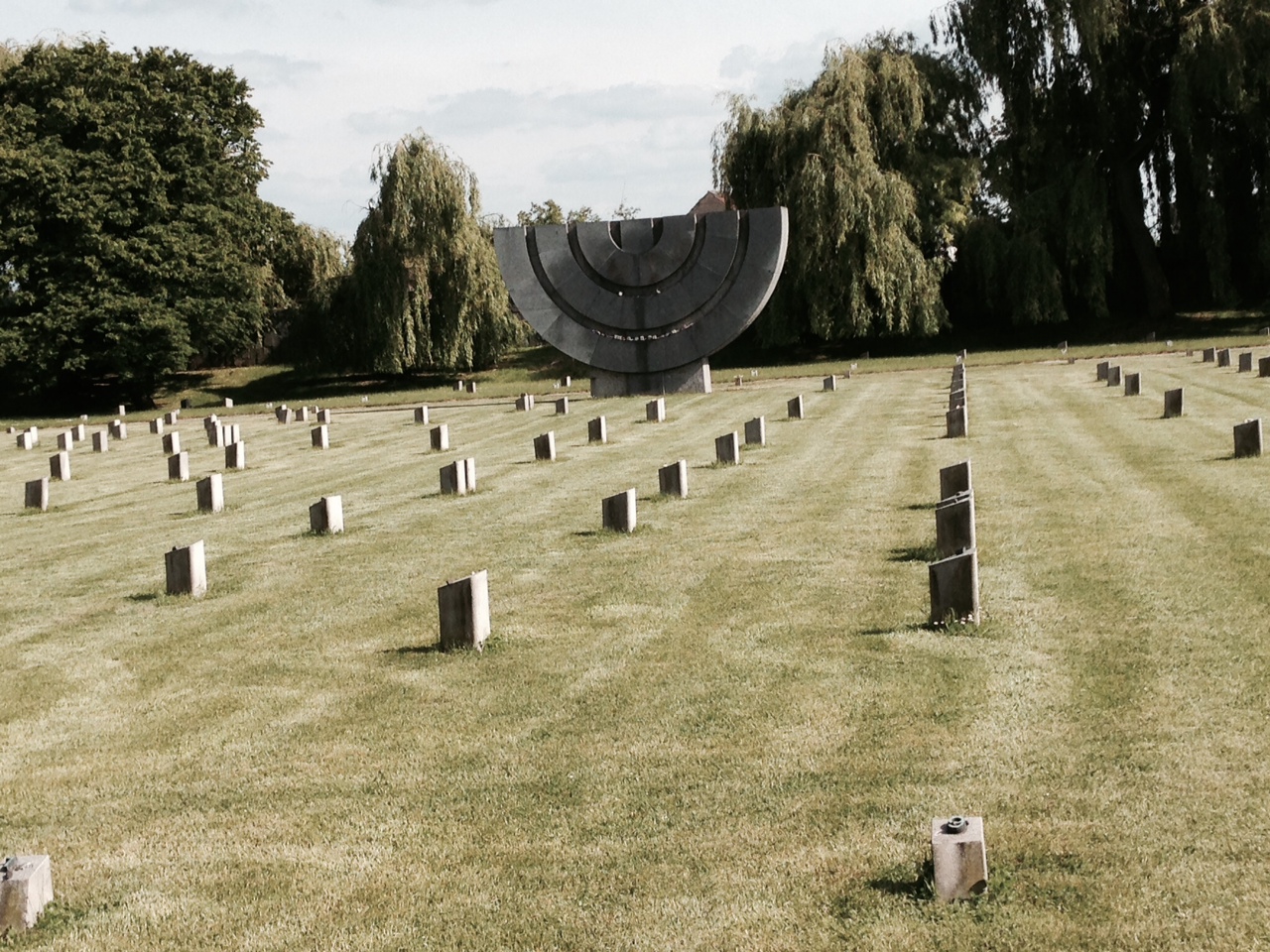
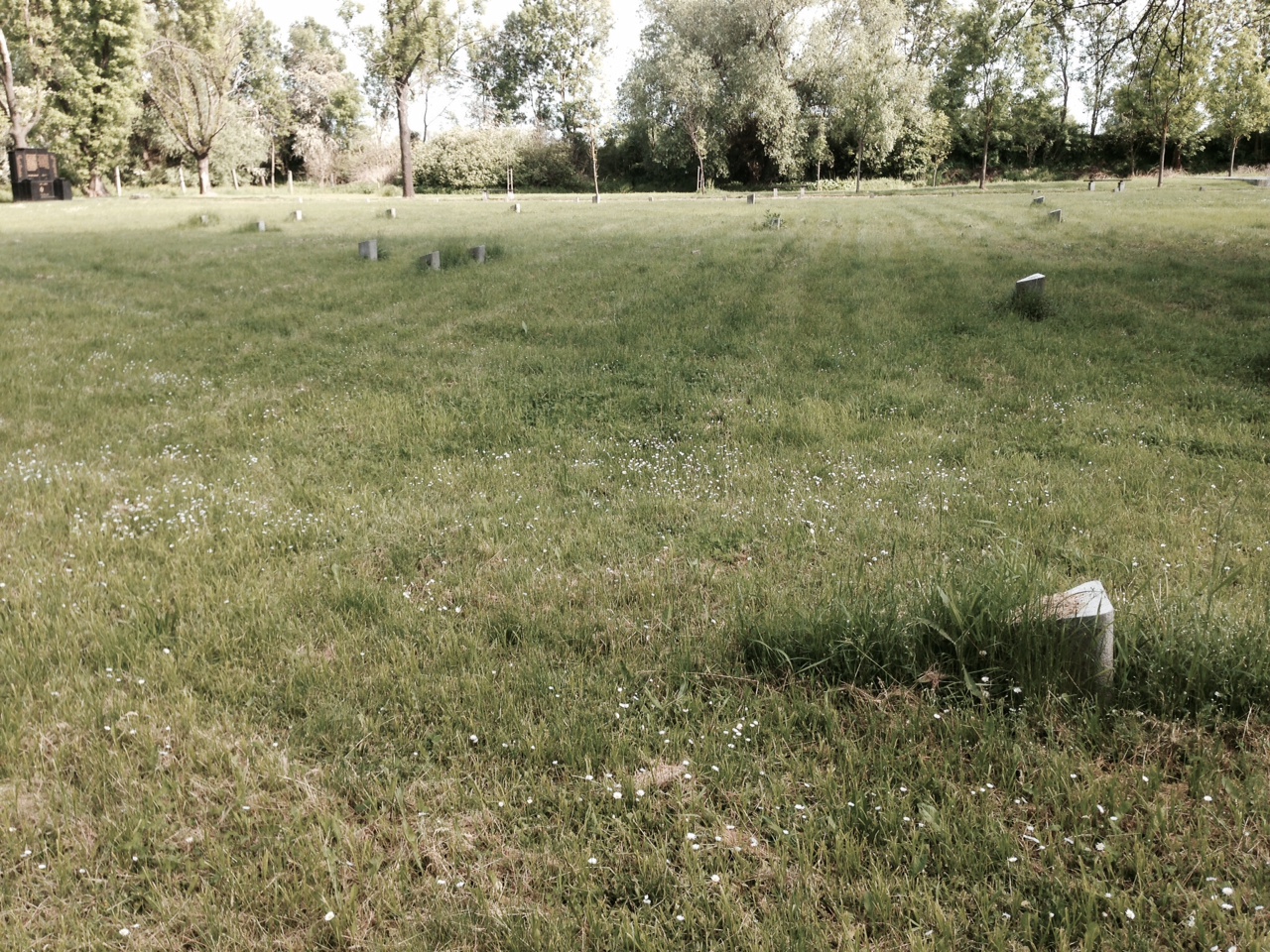
Helena led us to the cemetery where the markers are posted, and after some searching (many markers had numbers missing for reasons that were not clear) we found marker 59.  I placed a stone on the marker and stood in silence, thinking about this cousin I’d never known and what his life and his death at Terezin must have been like.

cemetery at Terezin

cemetery at Terezin

Marker 59

Marker 59

location of mass grave where Eugen Seligmann is buried

location of mass grave where Eugen Seligmann is buried

According to the death certificate, Eugen died from marasmus, or severe malnutrition.  In other words, this 87 year old man starved to death.  It is just horrifying to look at this document and translate the German words; the document records his birth date, his home town, his date, day, and time of death, his parents’ names and whether he was married and had children (none recorded here), the name of the attending physician, and other information—the level of detail is in direct conflict with the dehumanization the Nazis inflicted on these people.  Why create a record that creates an impression that someone cared who this man was and then toss his body into a mass grave?

Eugen, the son of Carolina and Siegfried Seligmann and a nephew of my great-great-grandfather Bernard Seligman, was a member of a successful Jewish German family. He was in his late 80s when he was taken to Terezin.  How can anyone possibly grasp what it must have been like for him to have been torn from his home and transported to this camp in Czechoslovakia, deprived of all his rights and property, forced to live in squalor and without any privacy or essentials? How can we grasp what it must have been like for this elderly man to starve to death in such a place? How can anyone understand how human beings can do this to other human beings?

I never knew Eugen or any of the other cousins who died at Terezin.  In fact, a year ago I didn’t know I had any cousins who died in the Holocaust.  Although going to Terezin was a very painful and nightmarish experience, I am glad that I was able to honor their memories by visiting the place where they are buried, the place where they were killed for no reason at all.  Even now I cannot really fathom what happened there.  It just is incomprehensible.


Prague, Part I—A Fairy Tale Setting

We arrived in Prague after an overnight flight and a four plus hour train ride from Vienna, where we had landed.  Although we slept a bit on the flight and on and off on the train, we were nevertheless a bit groggy when we arrived and were greeted by a cab driver who mercilessly ripped us off by charging 699 Czech crowns (about $30) for a ten minute ride to our hotel, the Prague Marriott (it should have been about a third of that).  It was gray and cool, and my first views of Prague were about the same.  The Marriott is a large and very American seeming hotel, so at first, we could have been anywhere.  A generic room in a generic hotel, a crooked cab.  I was not initially sure why so many people had loved Prague.

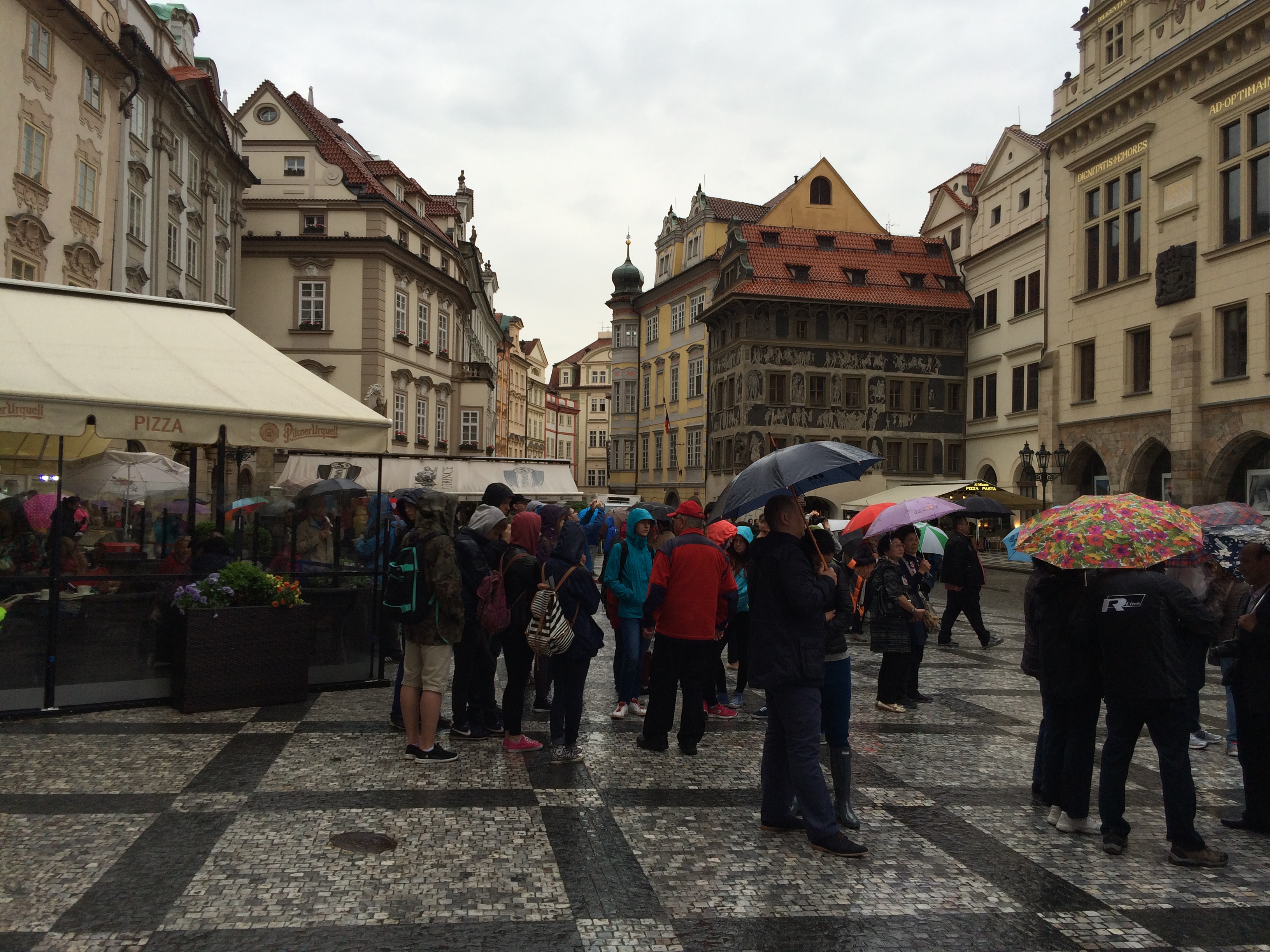
But then our guide Andrea Reznickova arrived at 5:30, and everything changed.  Like a good fairy godmother, she waved her magic wand and suggested we walk to Old Town Square to see the famous Prague clock strike the hour at 6 o’clock.  By this time it was raining fairly heavily, so I was skeptical.  The cobblestones along the way were slippery, and I was mostly watching my feet, not the surroundings.  Once we walked through the gate at the Powder Tower at the entrance to Old Town, however, I knew we were no longer in Kansas, as Dorothy said to Toto.  We were in a place that seemed almost as fantastical as Munchkinland seemed to Dorothy.

Old Town

Old Town

IMG_2458 rain in Old Town Square

The buildings of Old Town do look like something out of a medieval fairytale—ornate and colorful and built at unpredictable angles that make it seem as if they were created as part of a dream, not a result of any city planning.  The medieval clock with its many faces only adds to the aura of fantasy.  Despite the rain and the many umbrellas raised by the numerous tourists crowding the square, it was enchanting to watch the skeleton start to nod his head and the other three figures—humans defying death—move as the clock began to strike six.  Unlike the clock in Cinderella which ended her magical time, this clock began our magical time in Prague.

Clock Tower, Old Town Square, Prague

Clock Tower, Old Town Square, Prague

Andrea then took us to a non-touristy pub in New Town for some beer and fresh bread while she gave us an overall orientation to her home town and laid out the plan for the following day.  Then she left us on our own, where we wandered back to Old Town, now feeling somewhat grounded, and walked along the street called Paris Street (as translated from Czech, which I can’t even pretend to try and spell or pronounce), passing all the fancy designer stories on our way to dinner in the Jewish Quarter.  We had reservations at Dinitz, a kosher restaurant, and although it was nothing fancy at all, it was a good way to start the trip.  We were still jetlagged, and some bowtie noodles with chicken was just the right comfort food for a quick and quiet meal.

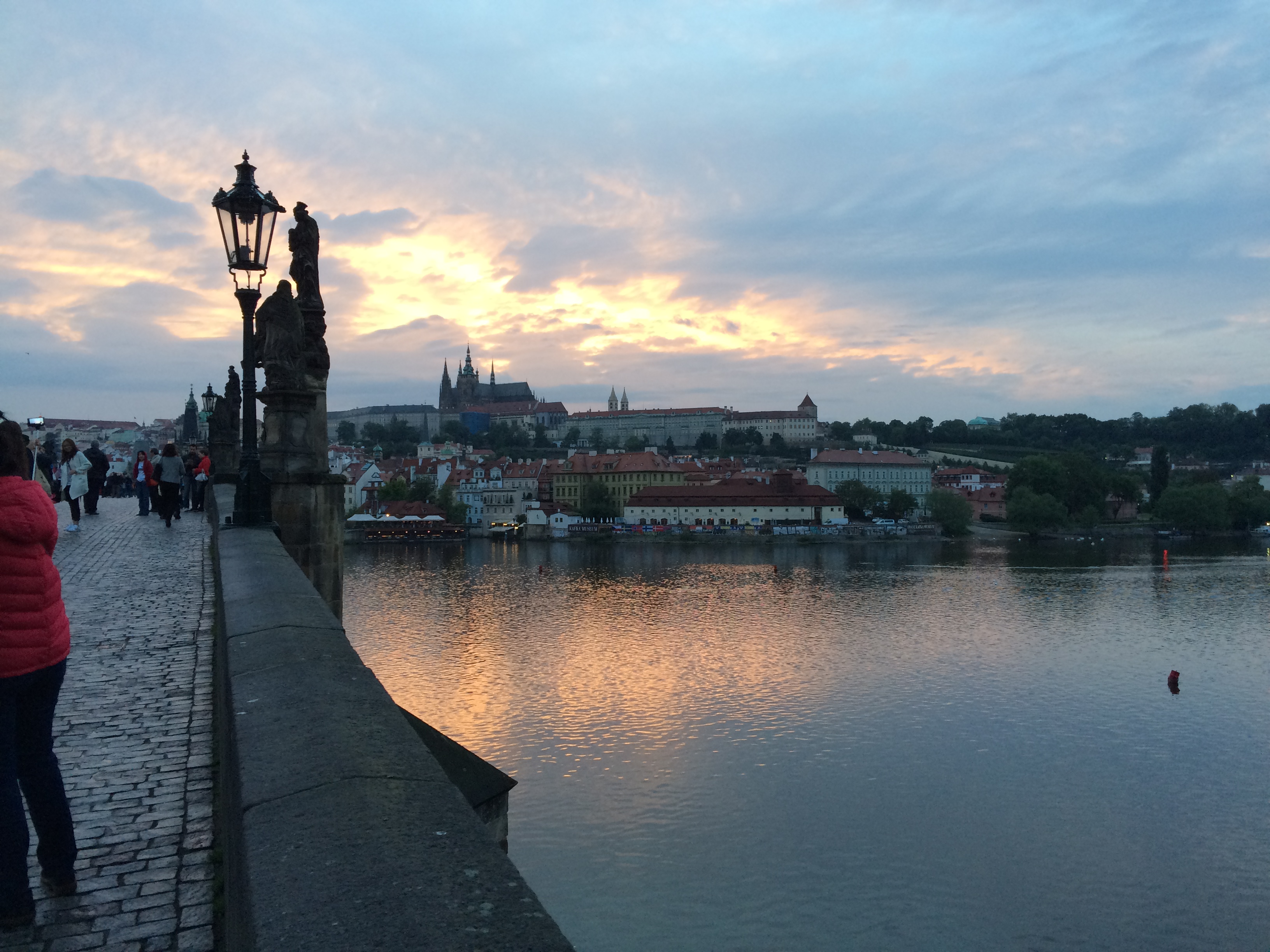
In fact, it gave us some new energy, and we decided to walk a bit more through Old Town, following the winding streets without consulting a map, just following the crowd until we ended up at the Vtlava River and the Charles Bridge.  It was about sunset (around 8:45), and it was gorgeous.  The entire scene—the river, the bridge itself, the views of the Castle across the river, and those fairy-tale building around us.  We crossed the bridge and then turned back, finally ready to head back for the night.

Sunset at the Charles Bridge, Prague

Sunset at the Charles Bridge, Prague

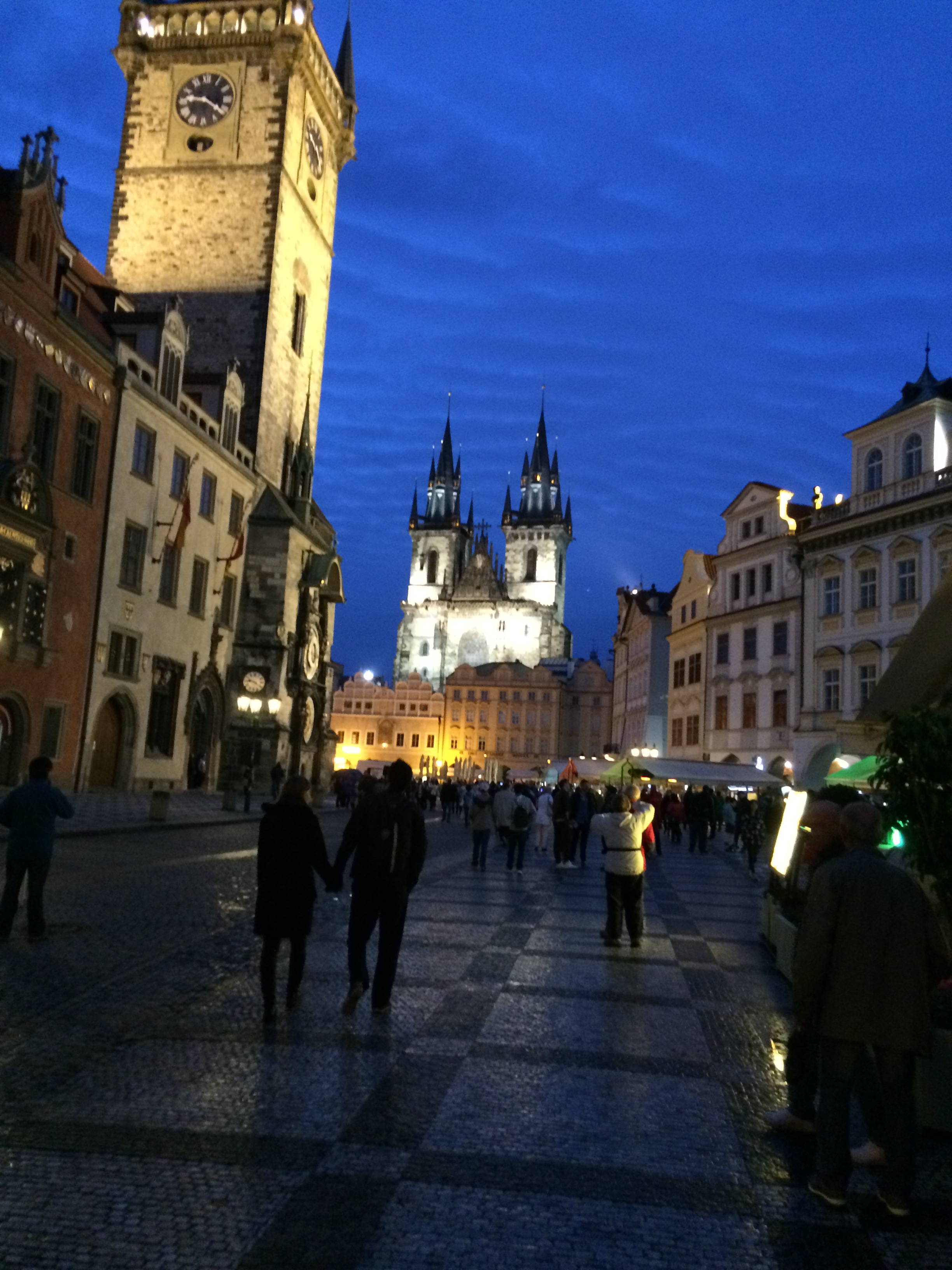
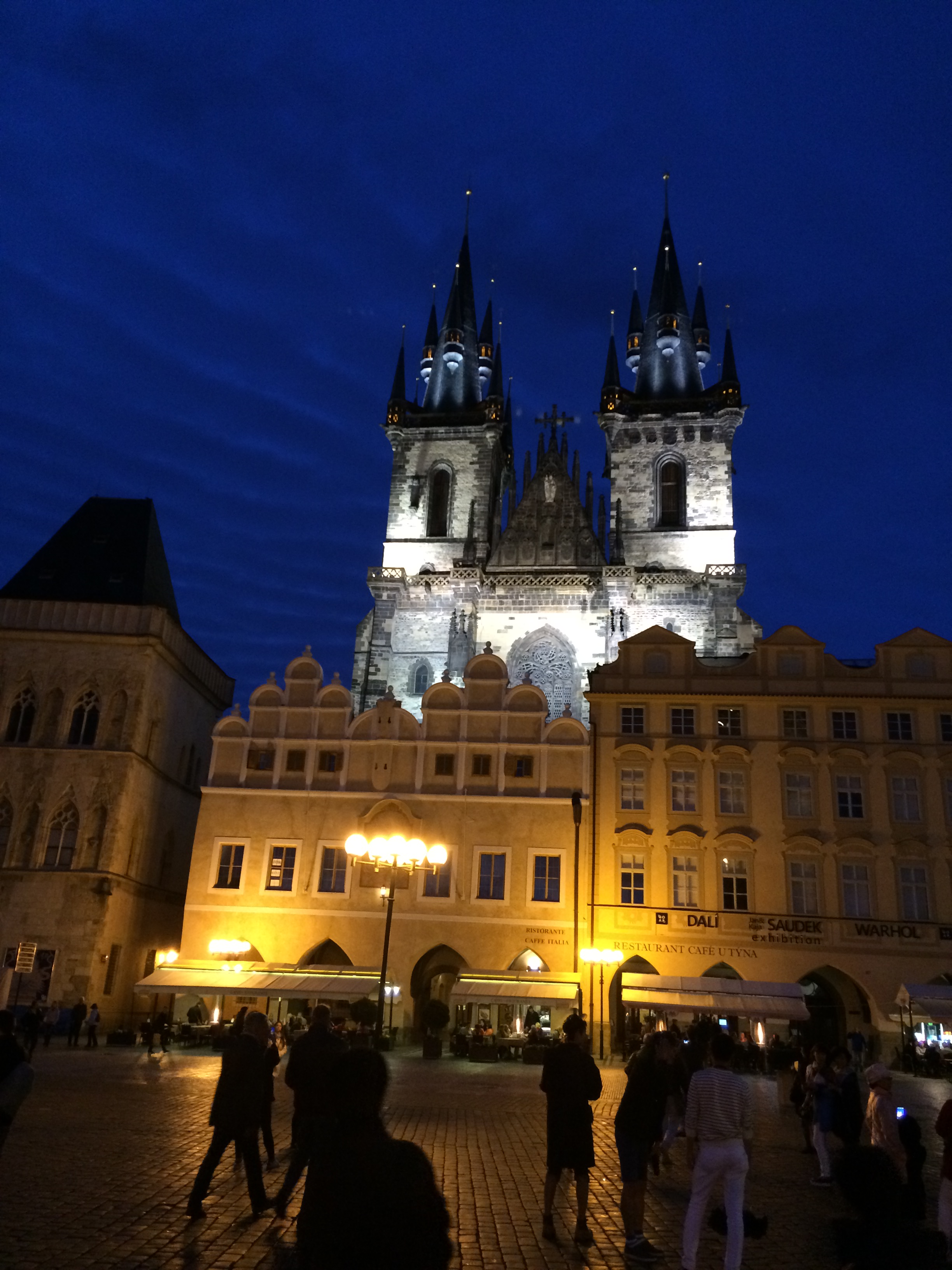
Of course, like Hansel and Gretel, we got lost once we had no tourist breadcrumbs to follow on the way back, but eventually we somehow ended up at the Old Town Square where the lights on the Tyn Church and on the Clock Tower added to my sense that we were living in a place of fairy tales.  We then easily found our way back to the Marriott.

IMG_2466 Prague Old Town Square at night

Clock Tower and Tyn Church, Old Town Square

IMG_2468 Clock in Old Town at night Prague

Clock in Old Town at night Prague

IMG_2471 Old Town Square at night

Old Town Square at night

IMG_2470 Night view of Prague Old Town Square

Tyn Church (some say it was the inspiration for Cinderella’s Castle in Disneyland)

IMG_2469 Old Town Square at night

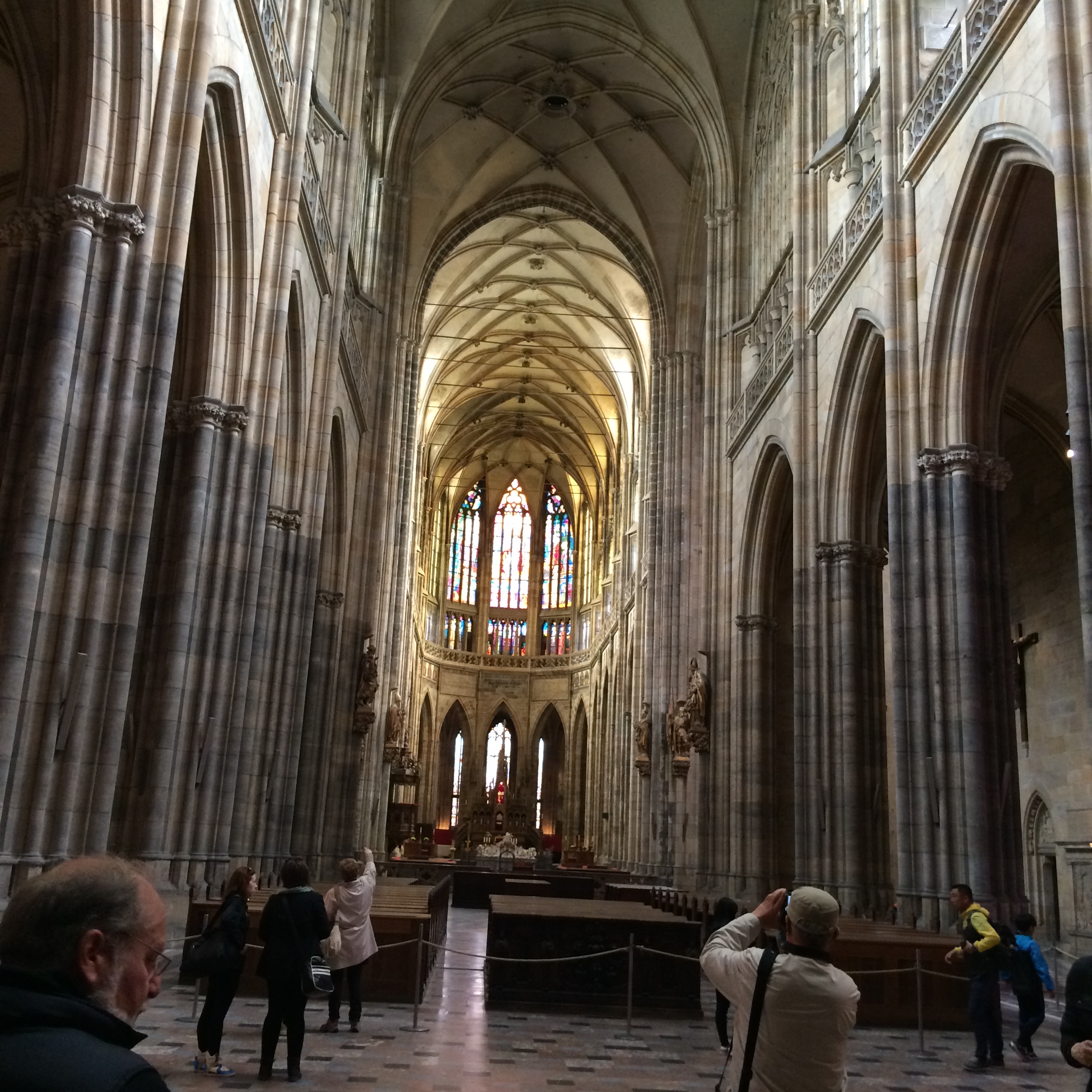
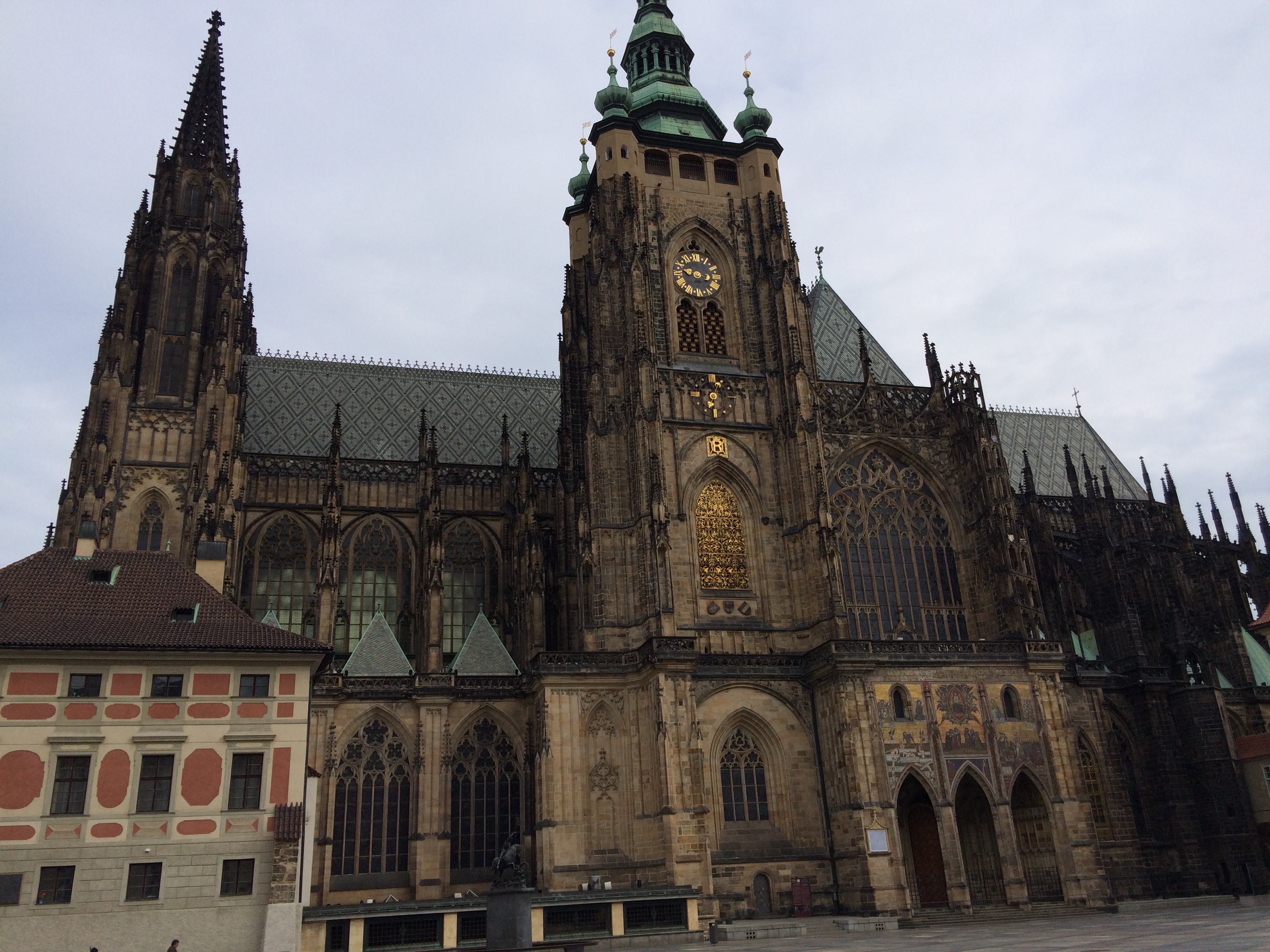
The next morning we met up again with Andrea and took the tram across the river to the Castle District, where along with numerous large touring groups, we entered the Castle area and then beat the crowd to the St. Vitus Cathedral, a huge awe-inspiring Gothic structure that was first built in medieval times and then expanded in the early 20th century, although done so seamlessly that you would never know.

IMG_2476 main square inside castle 5 21

Main Square in Castle District

IMG_2481 Interior of St VItus Cathedral

Interior of St VItus Cathedral


IMG_2484 exterior St Vitus

exterior St Vitus

IMG_2486 at Prague Castle IMG_2489 final judgment closer

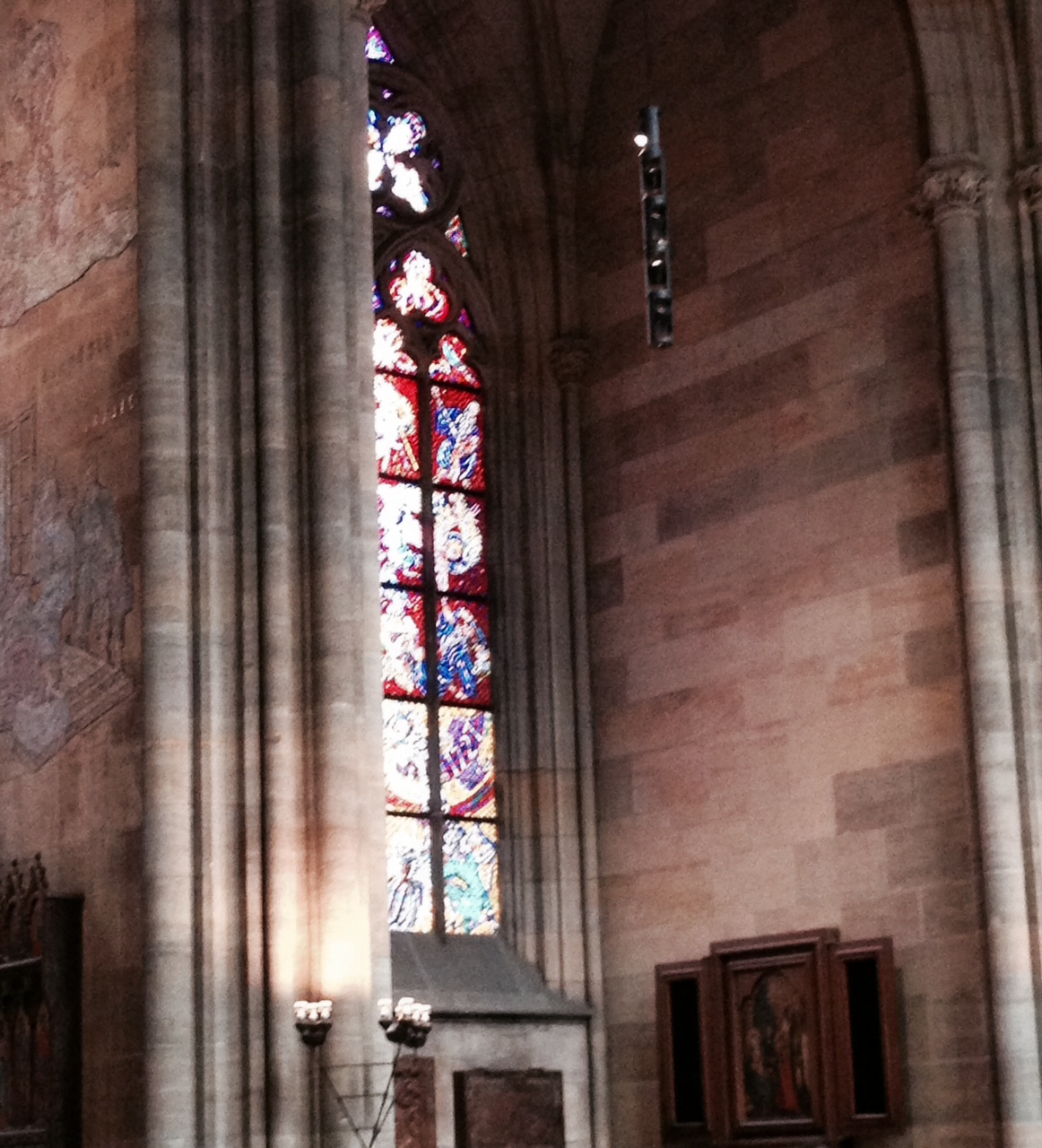
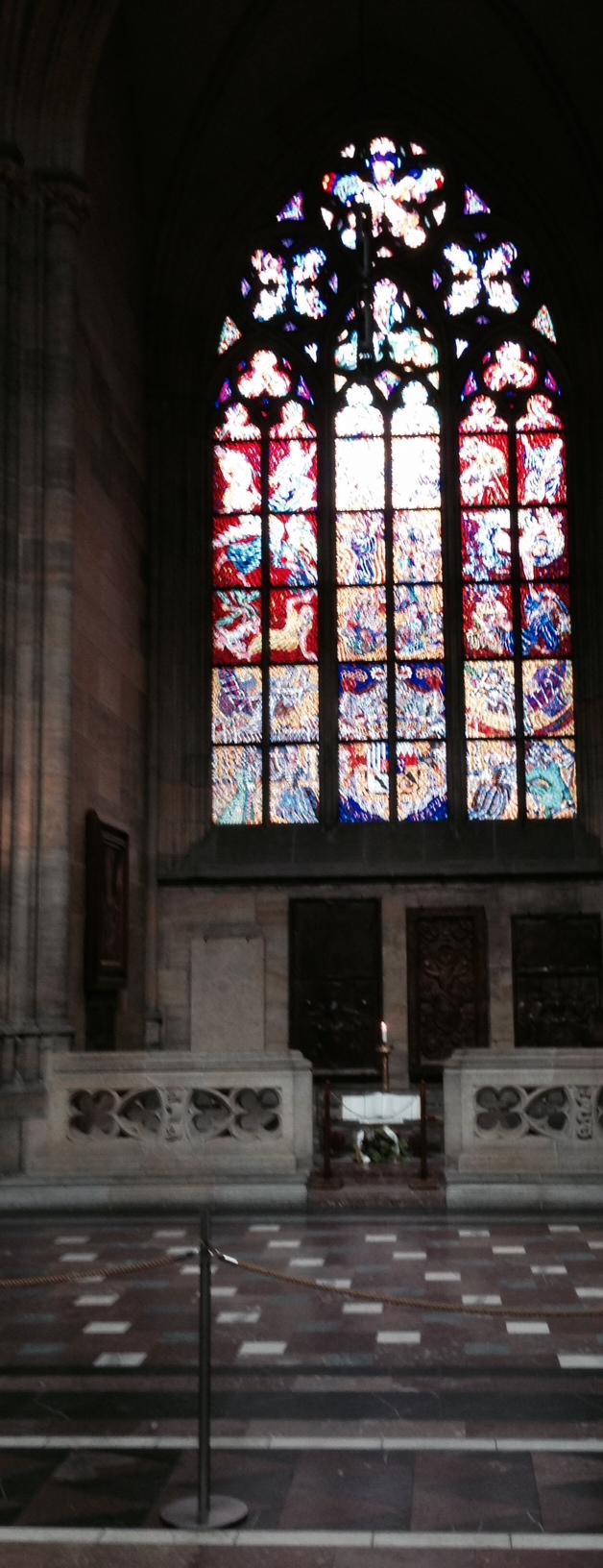
The only clue that part of the building was built in the 20th century was the stained glass window by Alfons Mucha that seemed far too contemporary for a Gothic cathedral.  We had never heard of Mucha before, but would later that day visit the Mucha Museum, a small museum dedicated to the life and work of this Czech artist.  Mucha lived from 1860-1939 and may be best known for his posters of Sarah Bernhardt, but it was his posters promoting Czech pride that moved me the most.

stainglass in St Vitus

Mucha Stained Glass Window in St Vitus

Stainglass St Vitus

Anyway, back to the Castle district—we wandered through the many squares and streets as Andrea told us about Czech history and politics, both before and after the Communist era.   The Castle was built for the king in medieval times, but is today the residence of the President of the Czech Republic.  When I asked about the presence of the Cathedral in the midst of what was otherwise a government building, Andrea talked about the controversy that arose after the Velvet Revolution and the end of Soviet domination concerning whether the Cathedral would return to the control of the Catholic Church.  In the end it did, so there is a Church-owned property in the middle of the property where the President works and lives.  According to Andrea, religion plays a very minor role in the lives of the Czech people; given the number of beautiful churches we saw throughout the city, that does seem a bit strange.  Perhaps that is one legacy of Communist times—a decline in interest in religion.

IMG_2505 Prague and us

Overlooking Lesser Town from the Castle

IMG_2491 basilica at Castle Prague 5 21 IMG_2494 in the Castle District

This topic brought us to the whole question of life in Prague during the forty-plus years of Communist control, and over coffee as we exited the Castle area, Andrea suggested we take the tram back to New Town and talk about the 20th century and the Communist era in Prague. At that point the fairy tale aura seemed to dissipate, and the reality of the history of the Czech people became more clear.  As Andrea described Czech history, the Czech people were historically more progressive than those in many other places in Europe.  According to Andrea, it was a Czech, Jan Hus, who really started the Reformation, about a century before Martin Luther.  The Czech people were historically more tolerant of other religions than in many other places, she said. But Andrea said that throughout Czech history different countries grabbed control over their land—including when the Nazis seized Sudetenland in 1938.  Andrea described the failure of the Czechs to fight against that taking as the biggest “black mark” in Czech history.  The Nazi control followed by the Soviet control was demoralizing to the people, but they also were less willing to accept Communism than some of the other countries behind the Iron Curtain.  (I heard similar assertions in Budapest and in Poland, so I take them all with a grain of salt, but it’s not for me to debate the perspectives of the people who live in these countries.)

As we sat in Wenceslas Square in New Town, Andrea then talked about the 1968 Prague Spring, the movement to lift some of the Communist restrictions on life in Czechoslovakia, and the Soviet invasion that followed and brought greater repression; twenty years after that came the Velvet Revolution in 1989, led by students marching into Wenceslas Square, the crowd eventually growing to half a million people.  Although Andrea was just a small child when this occurred, it was clear to us that these events had left their mark on her and that she was very grateful to live in Prague today where there is more freedom to live and work and express oneself as one wishes.

Prague, Wenceslas Square during the Velvet Rev...

Prague, Wenceslas Square during the Velvet Revolution. (Photo credit: Wikipedia)

Wenceslas Monument in November 1989

Wenceslas Monument in November 1989 (Photo credit: Wikipedia)

At her suggestion as she left us on our own, we then visited first the Mucha Museum, mentioned above, and then the Museum of Communism, which is situated on the main street in New Town between a McDonald’s and a casino.  It’s a small museum consisting mostly of reading materials with some visual displays, but it effectively evokes the persecution and repression exercised by the Communists during their long reign over the Czech people.  Visiting the museum made us better appreciate just how courageous those protesters had been in their attempts to improve their lives and the lives of their fellow Czechs.

English: museum of communism in Prague Deutsch...

English: museum of communism in Prague Deutsch: “museum of communism” in Prag (Photo credit: Wikipedia)

Looking up and down the street in New Town after leaving the museum, we could clearly see that capitalism had arrived.  There were chain stores all over—McDonalds, BurgerKing, KFC, H&M, and so on.  Although Andrea said that the locals all spent their free time in New Town, not Old Town, for me New Town was nothing special.  It could have been almost any commercial street in any American city, except for the foreign language, the statue of King Wenceslas, and the older buildings.  But that’s my American point of view.  What is boring and mundane to me may still be new and exciting to the citizens of Prague.  What intrigued me as a tourist—Old Town and the Castle—may just seem touristy and old-fashioned to those who live in Prague.

Wenceslas Square By Peter Stehlik - PS-2507 (Own work) [GFDL (http://www.gnu.org/copyleft/fdl.html) or CC BY 3.0 (http://creativecommons.org/licenses/by/3.0)], via Wikimedia Commons

Wenceslas Square
By Peter Stehlik – PS-2507 (Own work) [GFDL (http://www.gnu.org/copyleft/fdl.html) or CC BY 3.0 (http://creativecommons.org/licenses/by/3.0)%5D, via Wikimedia Commons

It’s all just a matter of perspective.  And perspective is what makes traveling so valuable; you get to see the world through the eyes of those who have lived in a different place with a different culture and a different history. My fairy tale setting is their ordinary setting; my ordinary setting is their fairy tale come true.

***************

Next—our visit to the Jewish Quarter in Prague.


Home Sweet Home

We are back from our trip, and I have so much to say that I don’t even know where or how to start.  Traveling to a different place can change your whole view of the world, of your place in the world, and of yourself.  This trip did that in so many different ways.  I have hundreds of photographs to sort and label, a lot of notes to transcribe and ponder, and so many thoughts and memories floating through my head that I need to write them all down before I forget them.  So I can’t just start blogging in detail about the trip right away.  I will certainly report about the parts of the trip that related directly to my own family—the trip to Poland in particular—once I have it all digested.

For now I have these overall thoughts and a few photographs to share.  First, standing in the former Jewish quarters in Prague, Krakow, Budapest, and Vienna, some of which still have several synagogues (a few even still in operation), is a chilling and horrifying experience.  For me, these places that once bustled with Jewish grandparents, mothers, fathers, and children, going to work and going to school and going to shul, were a graphic and vivid reminder of what the world lost in the Holocaust.  Had it not been for the Nazis, these Jewish communities could and likely would still exist, adding to the culture and economy of these places and of the world just as they did for hundreds of years before their Jewish citizens were murdered.

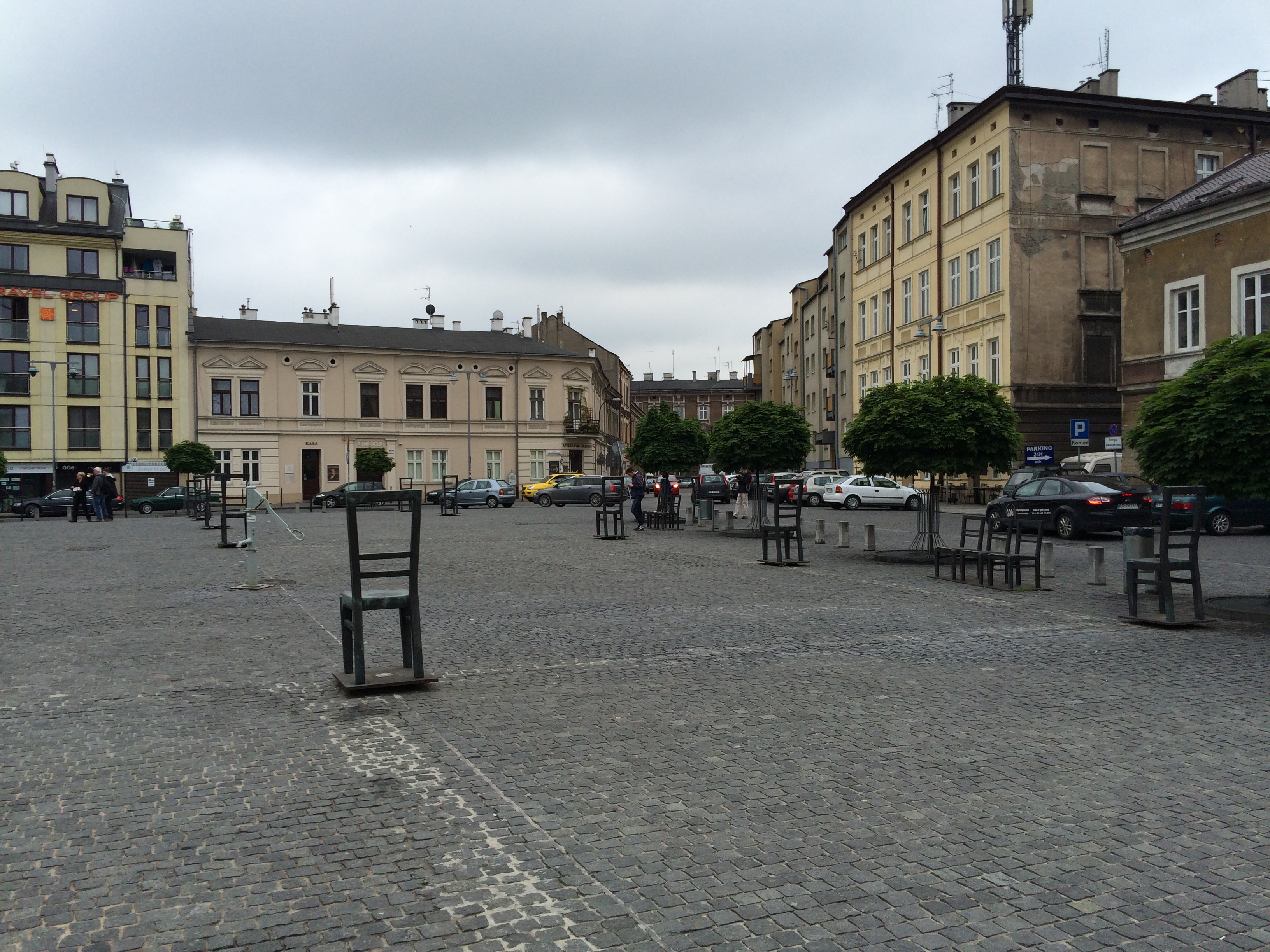
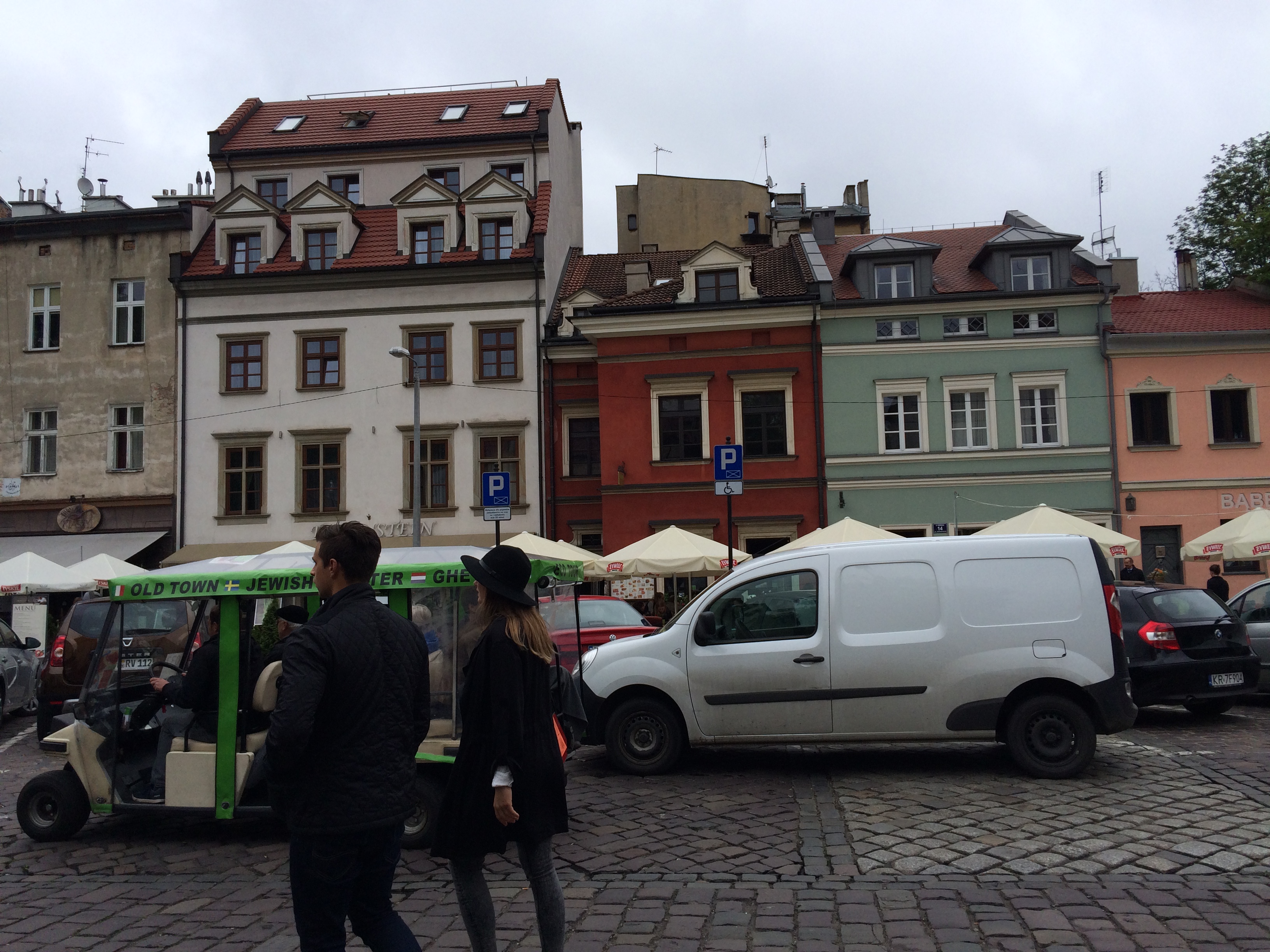
A street in the former Jewish Quarter of Krakow

A street in the former Jewish Quarter of Krakow

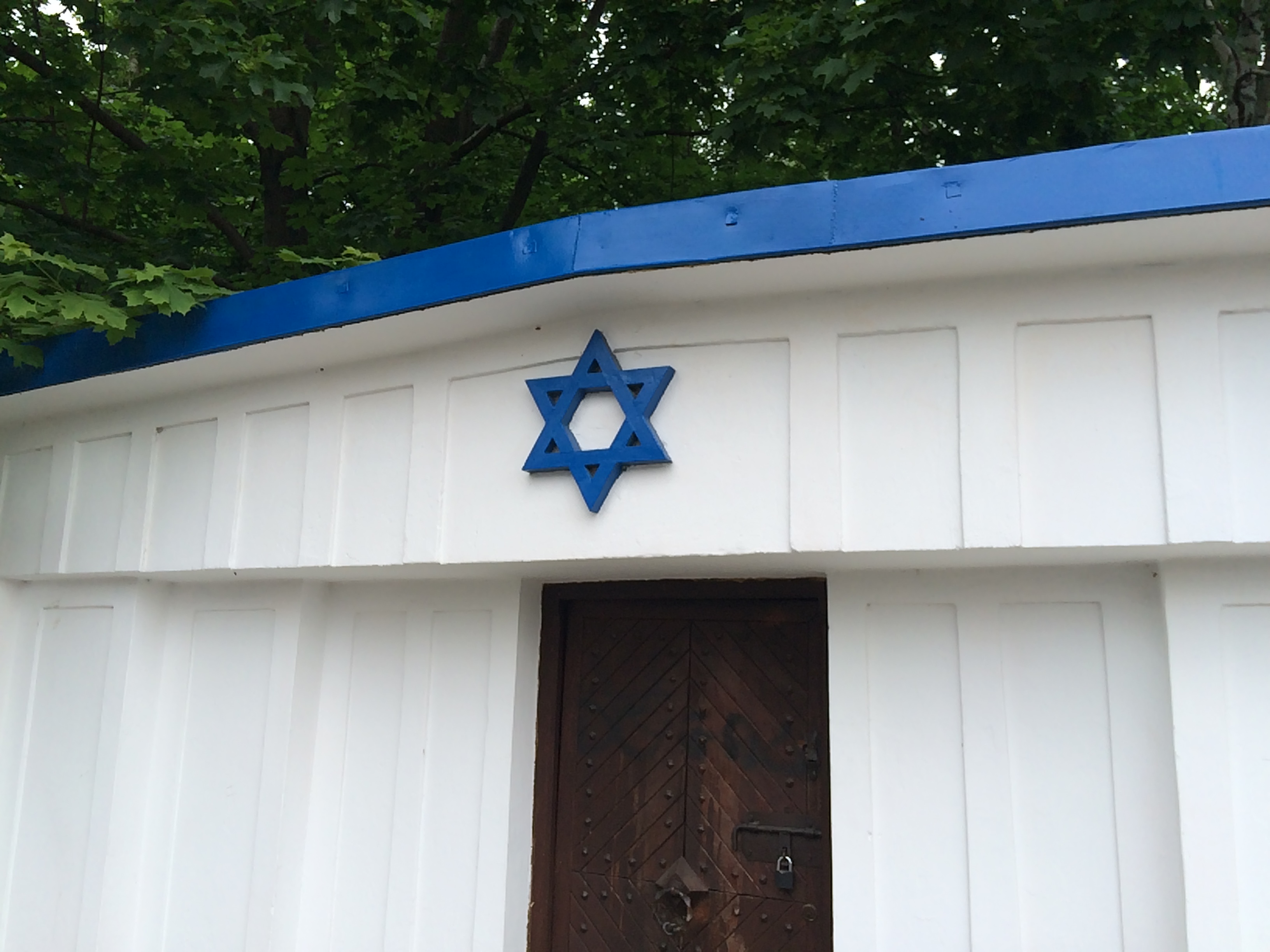
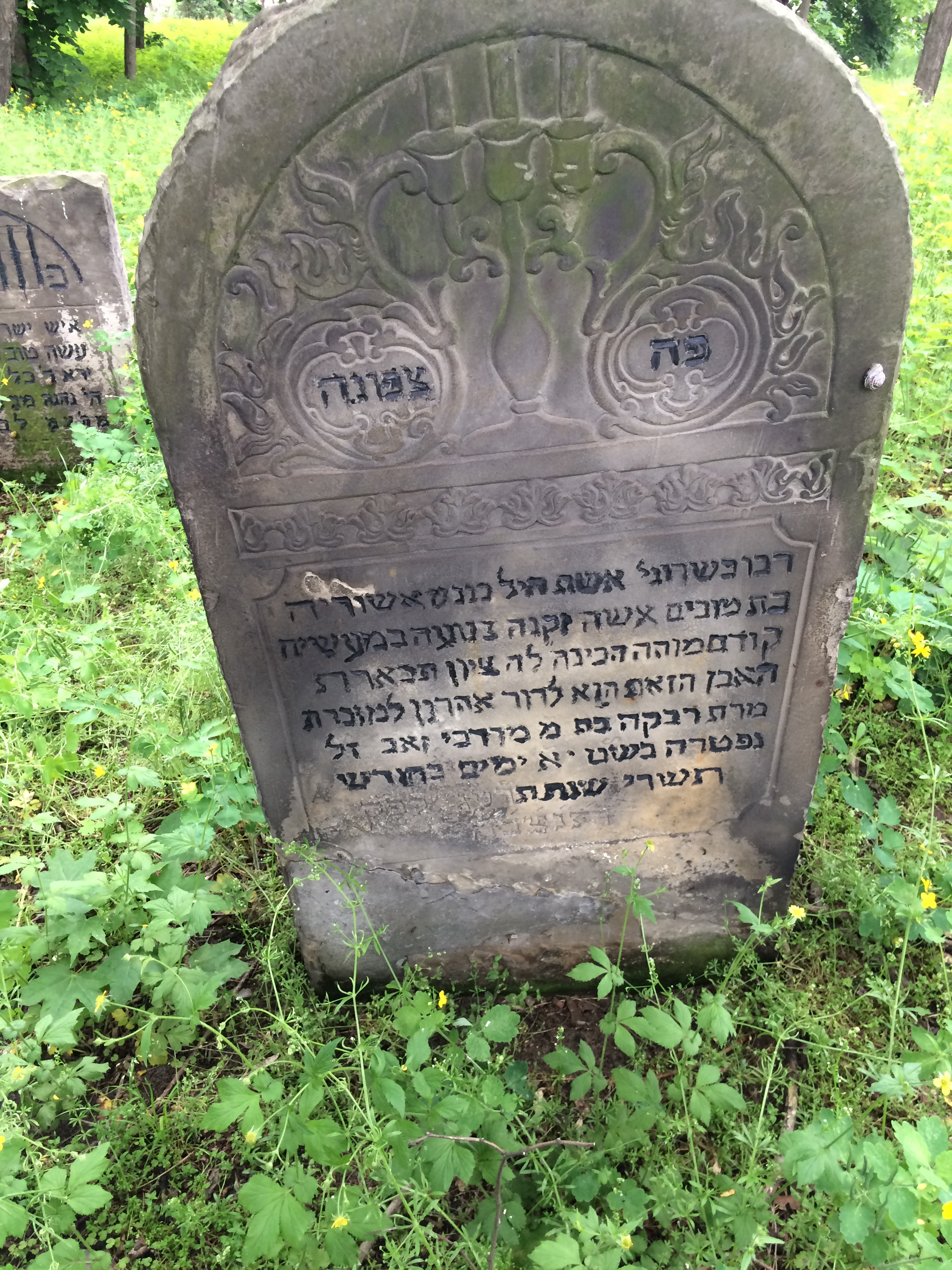
Nothing made this more painfully vivid for me than standing in Tarnobrzeg, the town where my Brotman great-grandparents lived, a town that was once 75% Jewish and where not one Jew lives today.  The only signs that there were once Jews there were a small plaque on the library, a building that had once been the synagogue, and a Star of David near the gate to the neglected Jewish cemetery, where only a handful of headstones remain.

gravestone on the ground in the Jewish cemetery in Tarnobrzeg

gravestone on the ground in the Jewish cemetery in Tarnobrzeg

Second, every person, Jewish or not, should visit Terezin and Auschwitz.  I cannot say more.  The places say it all.  You cannot go to these places and not be changed.  No matter what you may have read or seen or heard about the Holocaust, you cannot be prepared for what you experience walking in those places of terror and death.  I have only two photographs of Terezin and no photographs of Auschwitz.  I could not bear to think about taking a photograph while standing where so many were slaughtered.

Terezin

Terezin

Third, I had little idea what life was like under Soviet domination in the Czech Republic, Poland, and Hungary until we met several people who had lived during that era.  We were lucky to have guides in Prague, Poland, and Budapest who had witnessed the changes and were able to describe to us how different life was before and after the Soviets left in the late 1980s, early 1990s.  Today all these places are clearly capitalist, for better in many ways, for worse in others.  Seeing Starbucks and McDonalds and KFC everywhere amidst the old buildings in these gorgeous cities is jolting, but much better than seeing empty store windows and children forced to march at rallies to support the “state.”

Despite all the sadness that we felt as we learned about the past in these places, overall we experienced these cities as places of joyfulness, liveliness, and overall comfort.  Yes, there were beggars and homeless people, especially in Budapest, and I am sure that outside the areas where tourists congregate there is plenty of poverty and misery.  But each of the cities we visited were beautiful places filled with incredible and fascinating architecture, a huge number of cafes and restaurants and bars, museums teeming with people, cobblestone streets crowded with tourists and tour groups, and the sounds of happy, excited people.  There was music everywhere—in the streets, in the churches, and in the concert halls.

Dohany Synagogue in Budapest

Dohany Synagogue in Budapest

We had an incredible time.  Our tears and sadness were well-balanced with times of pure joy—climbing the tower to see all of Prague, clapping to Klezmer music in Krakow, walking along the river in Budapest, and eating unbelievable pastries in Vienna.  We heard music in every city, we stood in awe in Gothic cathedrals, we watched people laughing and drinking and eating in the cafes, and we walked and walked and walked until our feet were numb.  We had an incredible time.

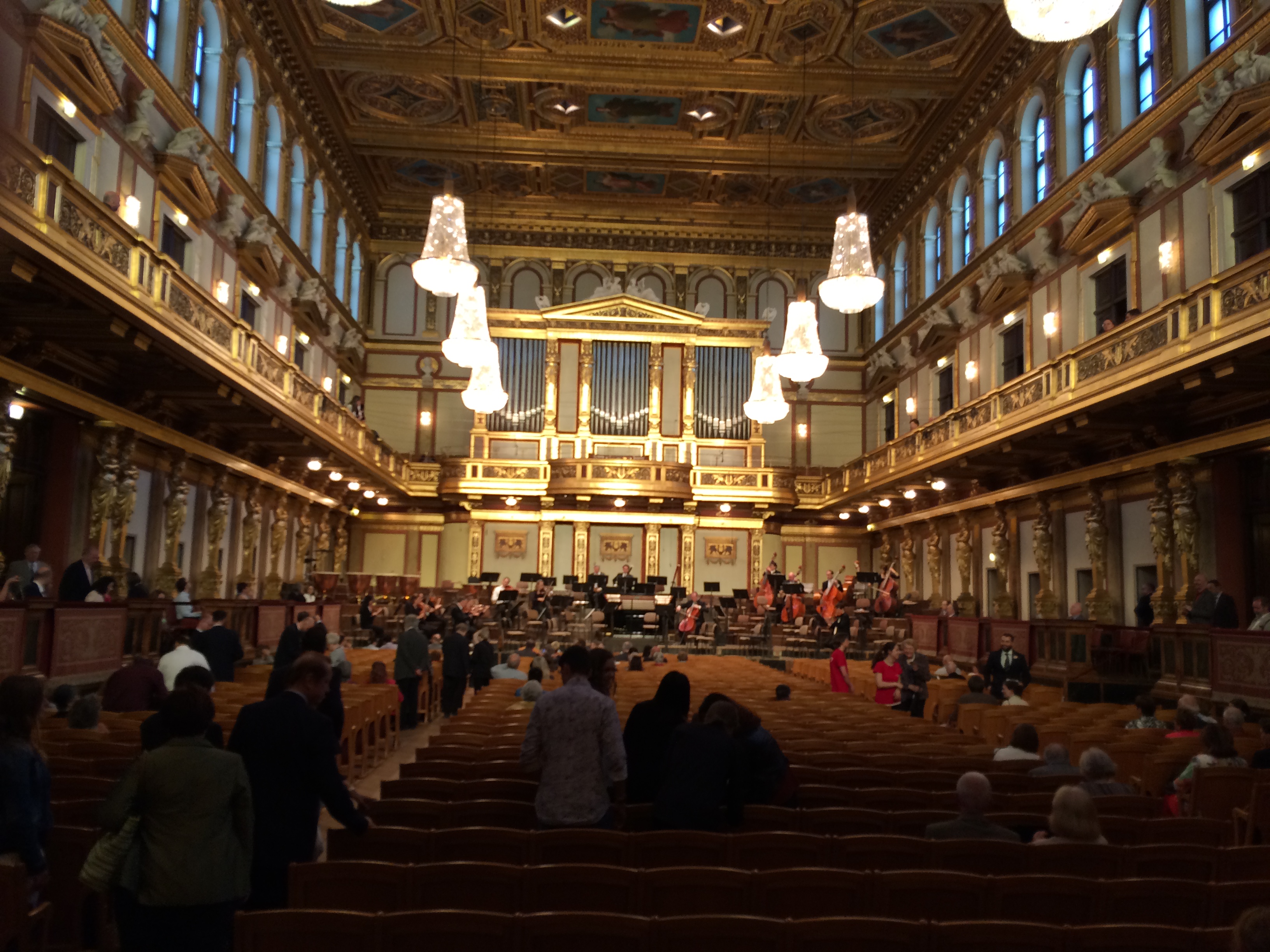
Musikverein in Vienna

Musikverein in Vienna


One for the Road: How I Found Another Brotman

This will be my last post before we leave on our trip.  I wanted to leave on a high note with a new discovery—a Brotman line I’d not discovered until the last week or so.  Perhaps this is a good omen for what I might find when in Poland.  I might post a bit while away—depends on internet access, time, and energy.  But I will report on the trip either as it unfolds or after I return, so stay tuned.

*********

In my last post I reported on the conflicting results of my search through the records of the families of Moses and Abraham Brotman of Brotmanville, New Jersey.  I was looking for any shred of evidence that might reveal where they, and thus perhaps my great-grandparents, had lived in Europe.  What I found was that some records said Moses was born in Austria, some said Russia.  Same for Abraham.  And not one record named a town or city.  Thus, I had not gotten any closer to any answers.

But while reviewing the documents I had and checking and double-checking my tree, I did find something somewhat anomalous.  In doing my initial research of Moses’ family, I had not been able to find them on the 1920 census, as I mentioned in my last post.  In trying to find the family, I had searched for each of the children separately, and I had found a Joseph Brotman living in Davenport, Iowa, according to the 1915 Iowa state census.  I admit that I had not looked very carefully (BIG mistake) and had jumped to the conclusion that Moses’ son Joseph had been shipped out to Iowa to live with another family since I couldn’t find Moses or Ida or any of the siblings listed on that census.  (This is one reason I keep my tree private on Ancestry—I’d hate to mislead someone else while I am doing preliminary research.)

But in now reviewing my original preliminary research, this just struck me as strange.  So I went back to look more carefully.  First, I pulled up the census record for Joseph.  Instead of being a list or register as with other census reports, Iowa had separate cards for each resident.  Here is the one for Joseph Brotman:

Joseph Brotman 1915 Iowa census  Ancestry.com. Iowa, State Census Collection, 1836-1925 [database on-line]. Provo, UT, USA: Ancestry.com Operations Inc, 2007. Original data: Microfilm of Iowa State Censuses, 1856, 1885, 1895, 1905, 1915, 1925 as well various special censuses from 1836-1897 obtained from the State Historical Society of Iowa via Heritage Quest

Joseph Brotman 1915 Iowa census
Ancestry.com. Iowa, State Census Collection, 1836-1925 [database on-line]. Provo, UT, USA: Ancestry.com Operations Inc, 2007.
Original data: Microfilm of Iowa State Censuses, 1856, 1885, 1895, 1905, 1915, 1925 as well various special censuses from 1836-1897 obtained from the State Historical Society of Iowa via Heritage Quest

You can see why I made that initial mistake.  He was born the right year (1902) and the right place (New Jersey).  He was Jewish, his father was born in Austria, mother in Russia.  All those facts certainly seemed to suggest that he was the son of Moses and Ida Brotman.  So I had entered this record for Joseph on to my tree in Ancestry.

But this time I took the next step—were there other Brotmans in Davenport on that census? First I saw a Lillian Brotman.  I thought, “Hmmm, maybe two siblings were sent to Iowa?” Remember—Moses had a daughter named Lillian, as did Abraham.  So I looked at Lillian’s entry in the 1915 census.

Lillian Brotman 1915 Iowa census  Ancestry.com. Iowa, State Census Collection, 1836-1925 [database on-line]. Provo, UT, USA: Ancestry.com Operations Inc, 2007. Original data: Microfilm of Iowa State Censuses, 1856, 1885, 1895, 1905, 1915, 1925 as well various special censuses from 1836-1897 obtained from the State Historical Society of Iowa via Heritage Quest.

Lillian Brotman 1915 Iowa census
Ancestry.com. Iowa, State Census Collection, 1836-1925 [database on-line]. Provo, UT, USA: Ancestry.com Operations Inc, 2007.
Original data: Microfilm of Iowa State Censuses, 1856, 1885, 1895, 1905, 1915, 1925 as well various special censuses from 1836-1897 obtained from the State Historical Society of Iowa via Heritage Quest.

She was living at the same address as Joseph, was also born in New Jersey, and had a father born in Austria, a mother in Russia.  Like Joseph, she had been in Iowa for three years.  So I thought that this had to be Joseph’s sister.  But this Lillian was 16 years old, and Moses’ daughter Lillian was born in 1892, so she would have been 23 in 1915. Could it be Abraham’s daughter Lillian? She was the right age, but somehow that just didn’t make much sense.

I decided to go through the cards in the census by flipping backwards from Joseph’s card and then found several other Brotmans at the same address: Albert (2), Eva (37), and May (10).  May also had been born in New Jersey, Albert in Iowa, and Eva in Russia. Who were these people? Were they related to MY Brotmans in some way? I assumed Eva was the mother of these four children, but who was the father? And where was he?

So I searched for the family by using Eva’s names and the names of the children, and I found them on the 1910 census living in Philadelphia.  The husband’s name was Bennie, wife Eva (32), and four children: Lily (11), Florence (10), Joe (8), and May (6).  These ages lined up with the ages of the children on the Iowa census five years later, but the census record said these children were born in Pennsylvania, not New Jersey. The father, Bennie, was 33, born in Austria with parents born in Russia, and had immigrated in 1894, according to the census.  He was a cutter in a clothing business.  He and his wife had been married for 12 years or since 1898.

Bennie Brotman 1910 census

Bennie Brotman 1910 census Source Citation Year: 1910; Census Place: Philadelphia Ward 1, Philadelphia, Pennsylvania; Roll: T624_1386; Page: 11B; Enumeration District: 0019; FHL microfilm: 1375399

Bennie Brotman 1910 census
Source Citation
Year: 1910; Census Place: Philadelphia Ward 1, Philadelphia, Pennsylvania; Roll: T624_1386; Page: 11B; Enumeration District: 0019; FHL microfilm: 1375399

What had happened to their daughter Florence? And where had they been in 1900? Were they related to my Brotmans? I first searched for their missing daughter, and I found an entry in the Iowa, Select Deaths and Burials 1850-1990 database:

Name: Flora Brotman
Gender: Female
Marital Status: Single
Age: 13
Birth Date: 1900
Birth Place: Philadelphia
Death Date: 23 Aug 1913
Death Place: Davenport, Iowa
Burial Date: 24 Aug 1913
Father: Ben Brotman
Mother: Eva Siegel
FHL Film Number: 1480948
Reference ID: p186 r59


This document provided me with Eva’s birth name and Flora’s birthplace.  I thought that the family must have been living in Philadelphia in 1900 if that is where Flora was born, but I could not find them on the 1900 census living in Philadelphia.  I searched again for Flora, and this time found a birth record—not in Philadelphia or even in Pennsylvania, as the death record and 1910 census had reported.  Rather, she was born in, of all places, Pittsgrove, Salem County, New Jersey, on July 19, 1900, to Benj. Brotman (born in Austria) and Eva Sigel (born in Russia).  Once I saw Pittsgrove, my heart beat a little faster.  This more and more seemed like a member of the Brotmanville Brotman family—someone I had not ever located or researched before.  Who was he? How was he related, if at all, to Moses and Abraham?

Name: Flora Brotman
Gender: Female
Birth Date: 19 Jul 1900
Birth Place: PIT, Salem County, New Jersey
Father’s name: Benj Brotman
Father’s Age: 24
Father’s Birth Place: Aug.
Mother’s name: Eve Sigel
Mother’s Age: 22
Mother’s Birth Place: Russia
FHL Film Number: 494247


I searched for them on the 1900 census again, but this time in Pittsgrove, New Jersey.  It took some doing, but finally found Benjamin listed as Bengeman Brotman, listed at the very bottom of the same page as Moses Brotman, just a few households away.  The census reported that he was 24, a cutter, and married for one year.  It stated that he and his parents were born in Austria, that he had immigrated in 1888, and that he was a naturalized citizen.  At the top of the next page were the listings for his wife Eva and daughter Lilly, just a year old.  The other children had not yet been born.

Bengeman Brotman 1900 US census

Bengeman Brotman 1900 US census

Ben Brotman's family 1900 census Year: 1900; Census Place: Pittsgrove, Salem, New Jersey; Roll: 993; Page: 18B; Enumeration District: 0179; FHL microfilm: 1240993

Ben Brotman’s family 1900 census
Year: 1900; Census Place: Pittsgrove, Salem, New Jersey; Roll: 993; Page: 18B; Enumeration District: 0179; FHL microfilm: 1240993


From this census, I knew that Benjamin Brotman had lived in Pittsgrove right near Moses Brotman, had married Eva Siegel and had had at least two children in Pittsgrove before moving to Philadelphia, where they were living in 1910.  By 1913, the family was living in Davenport, Iowa, where their daughter Flora died.  But where was Benjamin in 1915 when the Iowa census was taken? And was he related to Moses Brotman?

Looking one more time, I found him listed in the 1914 Davenport, Iowa, directory as a peddler, living with his wife Eva at the same address where she and the children were listed in the 1915 Iowa census. I also found him in the 1915 directory at that address, but with no occupation listed, and in the 1918 directory at a new address, 1323 Ripley, the same address given for his son Joseph, listed as a chauffeur, and his daughter Lillian, listed as a bookkeeper. A very similar series of entries appears in the 1919 directory. In both Benjamin still had no occupation listed.  If he was living in Davenport in 1914, 1915, 1918 and 1919, why wasn’t he in the Iowa census?

One more search of the I0wa 1915 census produced this result:

Benjamin Brotman 1915 Iowa census Ancestry.com. Iowa, State Census Collection, 1836-1925 [database on-line]. Provo, UT, USA: Ancestry.com Operations Inc, 2007. Original data: Microfilm of Iowa State Censuses, 1856, 1885, 1895, 1905, 1915, 1925 as well various special censuses from 1836-1897 obtained from the State Historical Society of Iowa via Heritage Quest.

Benjamin Brotman 1915 Iowa census
Ancestry.com. Iowa, State Census Collection, 1836-1925 [database on-line]. Provo, UT, USA: Ancestry.com Operations Inc, 2007.
Original data: Microfilm of Iowa State Censuses, 1856, 1885, 1895, 1905, 1915, 1925 as well various special censuses from 1836-1897 obtained from the State Historical Society of Iowa via Heritage Quest.

At first, I didn’t know why this card was separated from the family’s cards.  Looking at this card, however, revealed the reason: Benjamin is described as an invalid, and under “Remarks” it says, “Tuberculosis Hospital.”  He was not living with his family. Benjamin was sick with the dreadful disease that caused suffering for so many and their families.  Perhaps that is also what killed his daughter Flora.  Of note on this card is that his birthplace was Austria and that he had been in the US for 27 years, that is, since 1888, consistent with the 1900 census though not the 1910 census.  Also, as with the other members of the family, Ben had been in Iowa for three years or since about 1912.

But what happened to Ben after 1915? Did he recover? Is that why he appears in the 1918 and 1919 directories? On the 1920 census Ben is listed with Eva and three of their surviving children, Lillian, Joseph, and Albert, and a new son Merle, only four years old.  It would seem that Ben had not only recovered, but had returned home and fathered another child.

Benjamin Brotman 1920 census Year: 1920; Census Place: Rock Island Precinct 4, Rock Island, Illinois; Roll: T625_402; Page: 16A; Enumeration District: 128; Image: 1078

Benjamin Brotman 1920 census
Year: 1920; Census Place: Rock Island Precinct 4, Rock Island, Illinois; Roll: T625_402; Page: 16A; Enumeration District: 128; Image: 1078

The family was living in Rock Island, Illinois, right across the Mississippi River from Davenport, Iowa.  Ben was not employed, but Lillian was a bookkeeper and Joseph a salesman at a general store.  Their daughter May was listed on the 1920 census as an inmate at the Institution for Feeble-Minded Children in Glenwood, Iowa, over 300 miles away from Rock Island.  She was still there ten years later according to the 1930 census.

English: Downtown Davenport, Iowa looking acro...

English: Downtown Davenport, Iowa looking across the Mississippi River from Rock Island, Illinois (Photo credit: Wikipedia)

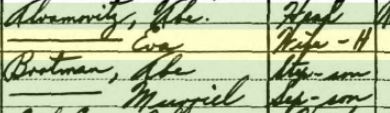
As I followed the family forward into the 1920s, Benjamin seemed to have died or disappeared.  In the 1921 Rock Island directory, Eva Brotman is listed as a widow. And in the Illinois, County Marriages 1810-1934 database on FamilySearch, I found a marriage listing for Eva Brotman and Abe Abramovitz on July 26, 1923, in Rock Island.  In 1930, Eva was living with her second husband Abe and her two youngest sons, Albert (listed incorrectly as Abe) and Merle (listed incorrectly as Muriel), who were then 18 and 15, respectively.  They were all still living together ten years later, according to the 1940 census.

Eva Siegel Brotman Abromovitz and sons 1930 census Year: 1930; Census Place: Rock Island, Rock Island, Illinois; Roll: 553; Page: 5B; Enumeration District: 0084; Image: 716.0; FHL microfilm: 2340288

Eva Siegel Brotman Abromovitz and sons 1930 census
Year: 1930; Census Place: Rock Island, Rock Island, Illinois; Roll: 553; Page: 5B; Enumeration District: 0084; Image: 716.0; FHL microfilm: 2340288

It seemed I had reached the end of the line for Benjamin Brotman, but I had no death record, and I still had no idea whether he was related to me or to the Brotmanville Brotmans.  I kept searching for a death record, and instead I found this:

Ben Brotman World War I draft registration Registration State: Colorado; Registration County: Denver; Roll: 1544482; Draft Board: 1

Ben Brotman World War I draft registration
Registration State: Colorado; Registration County: Denver; Roll: 1544482; Draft Board: 1

A World War I registration for a Ben Brotman born in 1876, no birthplace listed, living in Denver, Colorado.  I might not have given it much thought but for the name given as his nearest relative: Moses Brotman of Alliance, New Jersey, his father.  Moses Brotman of Alliance is the Brotmanville Moses Brotman (Alliance was the name of the community where the Brotmans settled, part of Pittsgrove, now called Brotmanville.).  This Ben Brotman was his son. The age fit exactly—the Ben Brotman living in Pittsgrove in 1900 was 24, thus born in 1876, just like the Ben Brotman living in Colorado in 1918, son of Moses. I had no child listed for Moses named Benjamin, and if this was in fact his son, he was born before Moses married Chaya/Ida/Clara Rice.  That is, this could be Abraham’s full brother from Moses’ first wife, whose name I did not know.

But could I be sure that this was the Ben Brotman who had lived in Pittsgrove, then Philadelphia, then Davenport, Iowa? And if so, what was he doing in Colorado in 1918 when this draft registration was filed? After all, Ben Brotman, Eva’s husband, had been listed in the 1918 and 1919 Davenport directories.

The draft registration listed the Colorado Ben Brotman as a porter at Oakes Home in Denver.  I googled that name and found that Oakes Home in Denver was an institution for patients suffering from tuberculosis.   Was Ben really an employee there or was he a patient?  There is no indication on his draft registration that he was in poor health and not able to serve in the military.  Had he gone there as a patient and recovered sufficiently to be employed but not yet enough to return to Iowa?

As you might imagine, I was now more than a bit confused.  If this was the same Ben, had he then returned to Iowa at some point in 1918, been there in 1919 and 1920, and then died by 1921, as Eva’s listing in the 1921 Rock Island directory suggested? I needed to find his death certificate, and I had no luck searching online in Iowa, Illinois, or Colorado.  As I’ve done before, I turned to the genealogy village for assistance.

I went to the Tracing the Tribe group on Facebook and found a number of people who volunteered to help me.  One person found an entry on Ancestry from the JewishGen Online World Burial Registry for a Bera Brotman who died on January 4, 1922, who was born about 1877, and who was buried at the Golden Hills Cemetery in Lakewood, Colorado.  It seemed like a long shot.  Was Bera even a man? The birth year was close enough, but if Eva was a widow in 1921, the death date was too late.  There was a phone number for a contact person at the cemetery listed on the entry, so I called him.

Name: Bera Brotman
Birth Date: abt 1877
Death Date: 4 Jan 1922
Age at Death: 45
Burial Plot: 10-097
Burial Place: Lakewood, Colorado, United States
Comments: No gravestone
Cemetery: Golden Hill Cemetery
Cemetery Address: 12000 W. Colfax
Cemetery Burials: 3839
Cemetery Comments: Contact: Neal Price (303) 836-2312

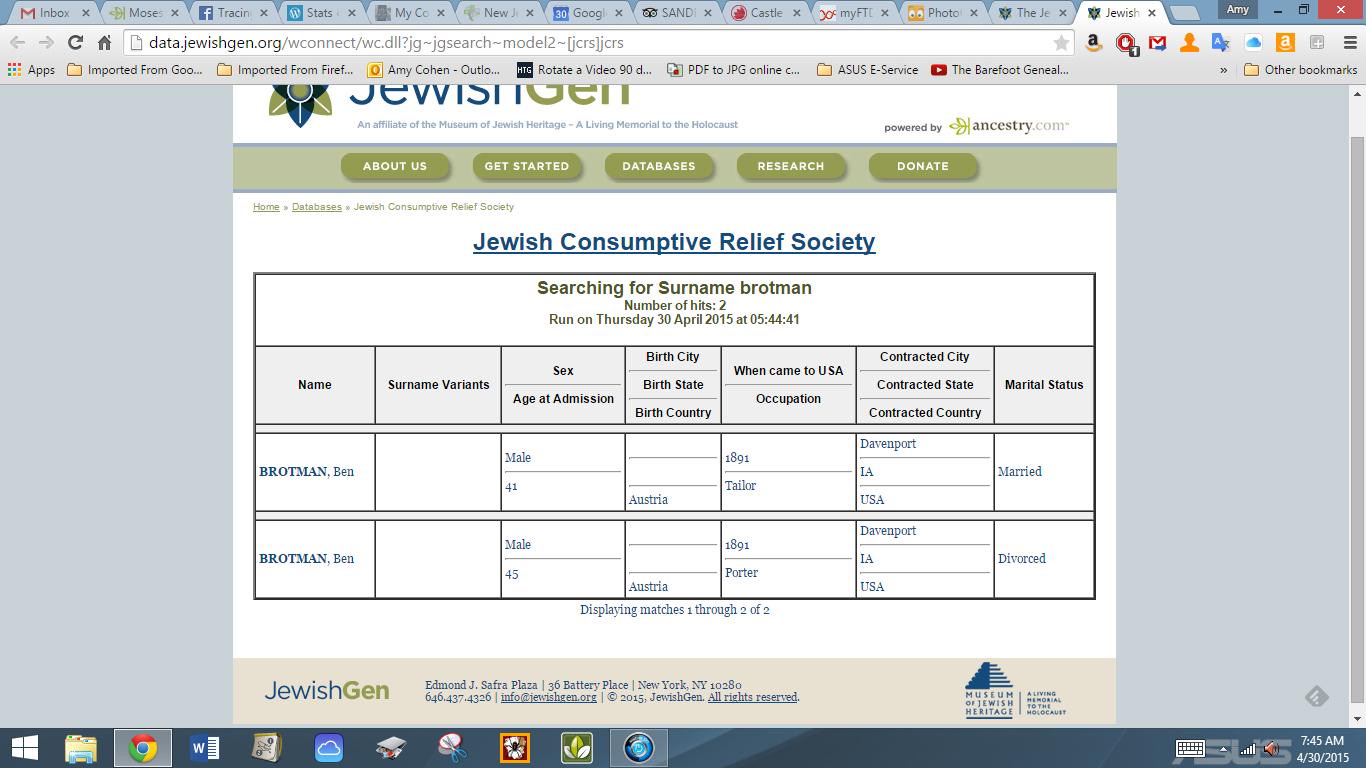
The contact person checked the cemetery records and confirmed the information listed on JOWBR, but gave me one more bit of critical information: Bera’s last residence was the Jewish Consumptive Relief Society in Denver.  By googling the JCRS, I found that JewishGen had a database of records from there, and when I searched for Ben Brotman on the JCRS database, I found this record:

JCRS record for Ben Brotman from JewiishGen

JCRS record for Ben Brotman from JewiishGen

This Ben Brotman had to be the one who had been at one time living in Pittsgrove, New Jersey, and then had moved to Davenport, Iowa.  This was the Ben who had married Eva and had six children.  He had twice been a patient at the JCRS.  First, he’d been admitted when he was 41 or in 1917, when he listed his status as married, and then he’d been admitted again when he was 45 or in 1921, when he listed his status as divorced.  The pieces were starting to come together.  Perhaps Ben had in fact been in Denver in 1917, recovered enough to register for the draft there in 1918, then returned to his family in Davenport sometime in 1918 through 1920.  He then had to return to the JCRS in Denver in 1921, where he died in January, 1922.  By 1921 he and Eva had divorced, and Eva had listed herself as a widow in the directory, as many divorced women did in those days when divorce was stigmatizing.

I emailed the cemetery contact person and explained that I thought Bera was really Ben, and he agreed to change the records.  But I still had some nagging doubts.  Was the Ben Brotman who had died in Colorado in January, 1922, and who had lived in Davenport also the one who was the son of Moses Brotman, as indicated on the draft registration?  I needed the death certificate to be sure, and perhaps it would also tell me where Ben was born, helping to answer the question that had started me down this path in the first place.

I ordered the death certificate, and it finally arrived just the other day.

Benjamin Brotman death certificate

Benjamin Brotman death certificate

Ben Brotman died on January 4, 1922, of pulmonary tuberculosis at the J.C.R.S Sanitorium.  He was 45 years old and born in 1876, and he had been a tailor.  He had contracted TB in Davenport, Iowa, and had had it for ten years, or since 1912, which would mean around the time the family had moved to Iowa.  (That makes me wonder even more whether his daughter Flora had also died of TB, since she died in 1913.)  The doctor at JCRS who signed the death certificate said that he had attended Ben since September 7, 1921, which must have been when he was admitted the second time.  The certificate stated that Ben had been a Denver resident for three months and 28 days, indicating that he had been elsewhere before returning in September.  It also reported his marital status as divorced.  Finally, his place of birth was given as Austria, and his parents were also reported to have been born in Austria.

And then the answer I’d been seeking: his father’s name was Moses.  This was then most definitely the same Benjamin Brotman I had traced from Pittsgrove to Philadelphia to Davenport to Denver to Rock Island and back to Denver.  This was the son of Moses Brotman, my great-grandfather’s brother.

And then the (hopefully accurate) big revelation:  his mother’s name was Lena.  For the first time I had a record of the name of Moses’ wife prior to Ida/Chaya/Clara Rice.  Lena.  She very well might have been the mother of Abraham Brotman.  I don’t know.  There is a big gap between Abraham’s presumed birth year of 1863 and Benjamin’s birth year of 1876.  There must have been other children in between, I’d think.  Or perhaps Lena was Benjamin’s mother, and Abraham’s mother was an even earlier wife of Moses. But since both Abraham and Benjamin named their first daughters Lillian and at around the same time, I think that both of these girls were named for their grandmother Lena, who must have died before 1884 when Moses married his second wife Chaya.

I made one more look back at the records I had for Moses and for Abraham and realized that I had not re-checked the 1895 New Jersey census.  Since it only listed names, not ages or birthplaces, I had not thought it important in my search for where they’d lived in Europe.  Moses and his family are listed on the page before Abraham and his family on that census.   Abraham is listed with Minnie and their first three children, Joseph, Samuel, and Kittella (presumably Gilbert).

Abraham Brotman 1895 NJ census Ancestry.com. New Jersey, State Census, 1895 [database on-line]. Provo, UT, USA: Ancestry.com Operations Inc, 2007. Original data: New Jersey Department of State. 1895 State Census of New Jersey. Trenton, NJ, USA: New Jersey State Archives. 54 reels.

Abraham Brotman 1895 NJ census
Ancestry.com. New Jersey, State Census, 1895 [database on-line]. Provo, UT, USA: Ancestry.com Operations Inc, 2007.
Original data: New Jersey Department of State. 1895 State Census of New Jersey. Trenton, NJ, USA: New Jersey State Archives. 54 reels.

Moses is listed with Clara and the five children they had had by 1895: Sadie, Katie, Lillie, Samuel, and “Abraham.”[1] But also listed with Moses is a name I had overlooked during my preliminary research: Bennie.  He was listed in the 5-20 year old category, and if this was the Ben Brotman of Iowa and Denver, he would have been 19 years old in 1895.  There he was—Benjamin Brotman, the son I had overlooked and who very well could have been the full brother of Abraham Brotman.

Moses Brotman 1895 NJ census Ancestry.com. New Jersey, State Census, 1895 [database on-line]. Provo, UT, USA: Ancestry.com Operations Inc, 2007. Original data: New Jersey Department of State. 1895 State Census of New Jersey. Trenton, NJ, USA: New Jersey State Archives. 54 reels.

Moses Brotman 1895 NJ census
Ancestry.com. New Jersey, State Census, 1895 [database on-line]. Provo, UT, USA: Ancestry.com Operations Inc, 2007.
Original data: New Jersey Department of State. 1895 State Census of New Jersey. Trenton, NJ, USA: New Jersey State Archives. 54 reels.

What I don’t know and will likely never know is why Ben and Eva left New Jersey. Why did he go to Davenport, Iowa?[2]  The whole story is rather sad. He doesn’t even have a headstone at the Golden Hills cemetery.  I have identified some of his descendants, and perhaps when I return, I will try and contact them.

Although I was very excited to find this lost Brotman, unfortunately I still don’t have any record identifying a specific town or city where the Brotmanville Brotmans lived in Europe.  But soon I will head off to Tarnobrzeg, Poland, the town I still think is the most likely ancestral home of my great-grandparents Joseph and Bessie Brotman.


[1] I found this very strange—did Moses really have another son named Abraham? The Abraham listed on the 1895 New Jersey census was five years old or younger, meaning he was born in 1890 or later.  Samuel was born in 1889, but must not yet have turned five; Lily was born in 1892.  The only other child born between 1890 and 1894 was Isaac (who became Irving), not Abraham, so I assume this entry on the 1895 census was a mistake and that “Abraham” was really Isaac.

[2] In doing this research I kept tripping over another Brotman family—a family living in Rock Island that owned the theaters in town.  However, they do not appear to be related.  The patriarch of that family, Jacob Brotman, was born in 1848 in Minsk, Russia, and had lived in London before emigrating to the US sometime after 1901.   Since Joseph and Moses were born around the same time but somewhere in Galicia, it seems unlikely that Jacob was a close relative.  But anything is possible.

My Brotmanville Cousins: Searching for Answers

One thing I have been trying to do as part of my preparations for our visit to Tarnobrzeg and the surrounding towns is a last ditch effort to find some other clues as to where my Brotman ancestors lived.  I have gone back through the research I’ve done on my great-grandparents and their Galician born children, Abraham, Max, David, Hyman, and Tillie, and have found no new clues.  Then I realized that now that I have some DNA confirmation that my great-grandfather Joseph was the brother of Moses Brotman of Brotmanville, I needed to go through their records as well to see if I could find some new clues.  I had done an initial search a few years ago, but had not yet gone back and checked it more thoroughly.

Moses Brotman

Moses Brotman courtesy of his granddaughter Elaine

What I already knew was that Moses Brotman had had many children, some born in Europe, some born in the US.  His oldest (known) child was his son Abraham, who was born in Europe.  Abraham Brotman had originally settled in New York City and established a cloak factory there, but was invited by those who created the Alliance Colony in Pittsgrove Township, New Jersey, to start a factory there to employ the residents when the farming season ended.  Eventually, a section of Pittsgrove was named Brotmanville in his honor.[1]

At this point I will not tell the full story of the Brotmanville family in America; that will have to wait. My immediate objective in reviewing my research of the Brotmanville Brotmans was to see if I could find any records that revealed where Moses and his family had lived before arriving in the US.  So I had to focus first on those who had been born in Europe, not those who were born in the US, although that meant also looking for records for the children born here to see if those records revealed the birthplaces of their European born parents

What I knew from the descendants and from my earlier research was that Moses had been married twice and Abraham had been the child of his first marriage.  Although the census records for Abraham are in conflict about his birthdate, the earliest to include his age, the 1900 census, reported his birthdate to be November 1863, long before Moses married Ida, the woman with whom he immigrated to America.

1900 US Census for Abraham Brotman

1900 US Census for Abraham Brotman Year: 1900; Census Place: Pittsgrove, Salem, New Jersey; Roll: 993; Page: 17A; Enumeration District: 0179; FHL microfilm: 1240993

Looking at the 1900 census report for Abraham, by 1900 he and his wife, Minnie Hollender, had been married for 13 years and had had six children, five of whom were still alive.  All six children were born in the US.  Abraham reported that he had arrived in the US in 1884, three years before marrying Minnie.  Their children as of 1900 were Joseph (10), Samuel (7), Gilbert (6), Nephtaly (later Herman) (4), and Leah (2).  They were living in Pittsgrove, New Jersey, and Abraham was working as a manufacturer.[2]

The 1910 census for Abraham and his family is only somewhat consistent with that of the 1900:  his age is 47, still giving him a birth year of 1863, but now his birthplace is reported as Russia. He and Minnie now reported that they had had eleven children, nine of whom were still alive.  In addition to the five listed above, there were three more daughters and one more son.

Abraham Brotman 1910 US census

Abraham Brotman 1910 US census Year: 1910; Census Place: Pittsgrove, Salem, New Jersey; Roll: T624_908; Page: 15B; Enumeration District: 0154; FHL microfilm: 1374921

The 1920 census reported one more child and once again had Abraham’s birthplace as Austria.  However, he now claimed to be 48, thus born in 1872, not 1863 as previously reported.  Later records also made him ten years younger than had been reported on the 1900 and 1910 census reports.  Genealogists generally assume that the records closest in time are more likely to be accurate than those later in time (and people are more likely to make themselves younger as they get older), so I am inclined to assume that Abraham was born in 1863.  It also makes more sense that he was 21 when he immigrated, not 11.  But where was he born? Austria? Russia? And in what city or town?

Since both the 1930 and the 1940 census reported his birthplace as Austria, I am inclined to discount the 1910 and assume that the 1900, 1920, 1930 and 1940 census reports indicating his birthplace as Austria are more accurate.  And, of course, “Austria” meant within the Austria-Hungary Empire, just as it did for my great-grandparents and many other immigrants from that region, including Galicia.

But then where more specifically was he born? Unfortunately, I’ve not been able to find a death record for Abraham, and the death records I have for his children are no more specific.  For example, the death certificate for his oldest child, Joseph, only reports that his father’s birthplace was Austria.

Joseph Brotman death certificate Ancestry.com. Pennsylvania, Death Certificates, 1906-1963 [database on-line]. Provo, UT, USA: Ancestry.com Operations, Inc., 2014. Original data: Pennsylvania (State). Death certificates, 1906–1963. Series 11.90 (1,905 cartons). Records of the Pennsylvania Department of Health, Record Group 11. Pennsylvania Historical and Museum Commission, Harrisburg, Pennsylvania.

Joseph Brotman death certificate
Ancestry.com. Pennsylvania, Death Certificates, 1906-1963 [database on-line]. Provo, UT, USA: Ancestry.com Operations, Inc., 2014.
Original data: Pennsylvania (State). Death certificates, 1906–1963. Series 11.90 (1,905 cartons). Records of the Pennsylvania Department of Health, Record Group 11. Pennsylvania Historical and Museum Commission, Harrisburg, Pennsylvania.

Samuel’s death certificate says that his father’s birthplace was Russia.

Samuel Brotman death certificate Ancestry.com. Pennsylvania, Death Certificates, 1906-1963 [database on-line]. Provo, UT, USA: Ancestry.com Operations, Inc., 2014. Original data: Pennsylvania (State). Death certificates, 1906–1963. Series 11.90 (1,905 cartons). Records of the Pennsylvania Department of Health, Record Group 11. Pennsylvania Historical and Museum Commission, Harrisburg, Pennsylvania.

Samuel Brotman death certificate
Ancestry.com. Pennsylvania, Death Certificates, 1906-1963 [database on-line]. Provo, UT, USA: Ancestry.com Operations, Inc., 2014.
Original data: Pennsylvania (State). Death certificates, 1906–1963. Series 11.90 (1,905 cartons). Records of the Pennsylvania Department of Health, Record Group 11. Pennsylvania Historical and Museum Commission, Harrisburg, Pennsylvania.

Abraham’s youngest child, Aaron, who was born in 1911, died as a young man in 1939 from heart disease.  His death certificate indicates that his father was born in Austria.

Aaron Brotman death certificate Ancestry.com. Pennsylvania, Death Certificates, 1906-1963 [database on-line]. Provo, UT, USA: Ancestry.com Operations, Inc., 2014. Original data: Pennsylvania (State). Death certificates, 1906–1963. Series 11.90 (1,905 cartons). Records of the Pennsylvania Department of Health, Record Group 11. Pennsylvania Historical and Museum Commission, Harrisburg, Pennsylvania.

Aaron Brotman death certificate
Ancestry.com. Pennsylvania, Death Certificates, 1906-1963 [database on-line]. Provo, UT, USA: Ancestry.com Operations, Inc., 2014.
Original data: Pennsylvania (State). Death certificates, 1906–1963. Series 11.90 (1,905 cartons). Records of the Pennsylvania Department of Health, Record Group 11. Pennsylvania Historical and Museum Commission, Harrisburg, Pennsylvania.

Those were the only sources I have located so far that reflect anything about where Abraham was born.  I also had no records of what his mother’s name was nor did I have any indication of full siblings for Abraham, only the half-siblings born through his father’s second marriage.  So I then turned to Abraham’s father Moses and his children to see if there was more to learn through their records.

The earliest record I had found for Moses was his petition for naturalization, filed in 1894.  It had his birthplace as Russia.  It also said that he had arrived in the US in 1885.

Moses Brotman petition for Naturalization

Moses Brotman Petition for Naturalization “New Jersey, County Naturalization Records, 1749-1986,” images, FamilySearch (https://familysearch.org/pal:/MM9.3.1/TH-1971-29863-26750-98?cc=2057433&wc=M73R-4NL:351145001,351187001 : accessed 14 May 2015), Salem > Petitions for naturalization 1888-1895 > image 95 of 96; county courthouses, New Jersey.

The 1900 US census reported his birthplace and date as Austria in November 1844.  It also reported that he had immigrated in 1886 and that he was a farmer.  Like his son Abraham, he was living in Pittsgrove, New Jersey with his wife “Chay”  (probably Chaya), to whom he’d been married for sixteen years.  (Abraham was already 37 in 1900, indicating that Abraham was not Chaya’s son.) Moses and Chaya had had eight children, seven of whom were alive, according to the 1900 census.  The seven were Sadie (16), Katie (13), Samuel (10), Lilly (7), Isaac (5), Bessy (2), and Lewis (three months)[It is spelled “Lewis” on the census, but according to his grandson, his name was actually spelled “Louis.”]  The youngest four were born in New Jersey, Katie in New York, and Sadie and Samuel reportedly in Austria.  Of course, that made no sense to me—if Katie was older than Samuel, how could he have been born in Austria if she was born in New York? Had Moses and Chaya returned to Europe at the time Katie was born? Or was the census just in error?  If they really had immigrated in 1886 and if Samuel was 10 in 1900, he must have been born in the US.

Moses Brotman 1900 census

Moses Brotman 1900 census Year: 1900; Census Place: Pittsgrove, Salem, New Jersey; Roll: 993; Page: 18A; Enumeration District: 0179; FHL microfilm: 1240993

The other thing that struck me as very strange about this report was the fact that Moses had a son named Samuel as did his son Abraham.  In 1900 Moses’ Samuel was ten; Abraham’s was seven.  So Abraham’s son Samuel had an uncle three years older with the same name.  When I turned to the 1910 census report for Moses and his family, that became even stranger, as now Moses had had another child, a son named Joseph, who was seven as of 1910.  Abraham also had a son named Joseph, who was seventeen in 1910. So Abraham’s son Joseph had an uncle Joseph who was ten years younger than he was.  In addition, both Moses and Abraham had daughters named Lilly or Lillian; Moses’ daughter was born in February 1892; Abraham’s daughter was born September 5, 1898. Why would Moses and Abraham have given their children the same names? Perhaps they were named for the same ancestors, but it must have been awfully confusing in Pittsgrove to have two Samuel Brotmans., two Joseph Brotmans, and two Lilly Brotmans running around that small community.  It sure doesn’t help genealogists either.

The 1910 census report for Moses now had his wife’s name as Ida, which was a common Americanization of Chaya.  Moses was now working as a presser in a clothing factory, presumably the one owned by his son Abraham.  As with the 1900 census for Abraham, Moses’ birthplace is now given as Russia, not Austria.  He and Ida had six of their children living with them: Samuel (20), Lilly (15), Isaac (14), Bessie (12), Lewis/Louis (10), and the above-mentioned Joseph (7).  The birthplace for all the children was New Jersey, except for Samuel, whose birthplace was reported as Russia, same as his parents. Sadie and Katie were no longer living with their parents. Unfortunately, I have not yet found any records for what happened to Sadie or Katie, although their father’s obituary revealed their married names and their residence as of 1935 in Philadelphia.

Moses Brotman 1910 census

Moses Brotman 1910 census Year: 1910; Census Place: Pittsgrove, Salem, New Jersey; Roll: T624_908; Page: 15A; Enumeration District: 0154; FHL microfilm: 1374921

It took me forever to track down Moses Brotman and his family on the 1920 census, and although I am not 100% certain this is the right family, I am fairly certain that it is.  The head of household is Morris Brotman, wife Clara—another common Americanization of Chaya.  Morris was reported to be 70 years old, so born around 1850, not far off from his birthdate on the 1900 census.  Birthplace is given as Russia for Morris, Austria for Clara, and it reported that immigrated in 1887, close to the 1886 reported in 1900.  The most convincing support for this being the right family are the names and ages of the children: Lillian (21), Louis (20), Bessie (19), and Joseph (17).  Although Lilly would have been 25 and Bessie 22, the sons’ ages are accurate; maybe they lied about the daughters’ ages to make them appear more “marriageable.”  The family was now living in Philadelphia, not New Jersey, which at first I found odd.

Moses Brotman 1920 US census Year: 1920; Census Place: Philadelphia Ward 32, Philadelphia, Pennsylvania; Roll: T625_1634; Page: 12B; Enumeration District: 1095; Image: 530

Moses Brotman 1920 US census
Year: 1920; Census Place: Philadelphia Ward 32, Philadelphia, Pennsylvania; Roll: T625_1634; Page: 12B; Enumeration District: 1095; Image: 530

But then I checked for the older sons, Samuel and Isaac (now Irving) and found that both had married between 1910 and 1920 and were living in Philadelphia.  Although I still have not located the two older daughters Sadie and Katie, perhaps they also had married by then and moved to Philadelphia.  Maybe Moses and Ida/Clara/Chaya also moved there to be closer to all their children.

Thus, I now had conflicting birthplaces for Moses—one census said Austria, two said Russia.  I looked at the 1930 census, and once again there was a conflict.  Now Moses’ birthplace was reported as Austria-Hungary, then crossed out with “Europe” written above it. His parents’ birthplace, however, was given as Austria-Hungary.  Moses was now 80 years old, and he and his wife (now Ida again) and their youngest son Joseph (28) were living in Vineland, New Jersey, near Pittsgrove. So as with Abraham, the birthplace for Moses fluctuated back and forth between Russia and Austria with no specific town or city mentioned. Perhaps Moses really did not know where in Europe he was actually born.

Moses Brotman 1930 US census

Moses Brotman 1930 US census Year: 1930; Census Place: Vineland, Cumberland, New Jersey; Roll: 1327; Page: 13A; Enumeration District: 0060; Image: 434.0; FHL microfilm: 2341062

Moses died on September 23, 1935.  His death certificate said he was born in Austria in 1847 and that his parents were named Abraham Brotman and Sadie Berstein, also born in Austria.  His grandson Aaron Brotman was the informant, Abraham’s youngest son who would die himself just a few years later.  Moses’ wife’s name was given as Rachel Rice.  This has caused considerable confusion for the family.  Was this a third wife? A mistake?

Moses Brotman death certificate_0001_NEW

In the obituary for Moses, it says he was survived by his widow, but did not name her.  It did, however, name all his children (including the married names for Sadie and Katie, as indicated above) and their residences.

Moses Brotman obituary

Moses Brotman obituary Courtesy of his granddaughter Elaine, source unknown

I found the death certificate for his youngest child, Joseph, who died less than a year after his father on July 26, 1936, from bacterial endocarditis.  He was only 34 years old.  On his death certificate, Moses’ birthplace is once again given as Russia, and Joseph’s mother’s name is reported to be Rachael Rice. The informant was Joseph’s half-brother, Abraham Brotman.

Joseph Brotman (Moses' son) death certificate Ancestry.com. Pennsylvania, Death Certificates, 1906-1963 [database on-line]. Provo, UT, USA: Ancestry.com Operations, Inc., 2014. Original data: Pennsylvania (State). Death certificates, 1906–1963. Series 11.90 (1,905 cartons). Records of the Pennsylvania Department of Health, Record Group 11. Pennsylvania Historical and Museum Commission, Harrisburg, Pennsylvania.

Joseph Brotman (Moses’ son) death certificate
Ancestry.com. Pennsylvania, Death Certificates, 1906-1963 [database on-line]. Provo, UT, USA: Ancestry.com Operations, Inc., 2014.
Original data: Pennsylvania (State). Death certificates, 1906–1963. Series 11.90 (1,905 cartons). Records of the Pennsylvania Department of Health, Record Group 11. Pennsylvania Historical and Museum Commission, Harrisburg, Pennsylvania.

Since Moses’ wife on the 1910 census was Ida and since Joseph was born in 1902, it would seem likely that Ida was Joseph’s mother.  Or could Chaya have been Rachel Rice and then died after Joseph was born? Was Ida a third wife? And was she the same woman as Clara, the wife listed on the 1920 census, or was that a fourth wife? My own personal hunch was that Rachel, Chaya, Ida and Clara are all one and the same person.

Although I was able to find the death certificate for Irving Brotman, it had no information for the name of his mother, had his father’s name as Morris, and had no information for their birthplaces.  I was, however, able to find the following entries in the New Jersey, Births and Christening Index on Ancestry.com for two of Moses’ children:

Name: Liza Brotman
Gender: Female
Birth Date: 2 Feb 1892
Birth Place: Pit, Salem, New Jersey
Father’s name: Moritz Brotman
Mother’s name: Chai Reis
FHL Film Number: 494224
Name: Brotman
Gender: Female
Birth Date: 12 May 1897
Birth Place: Pit , Salem, New Jersey
Father’s name: Moses Brotman
Father’s Age: 45
Father’s Birth Place: Austria
Mother’s name: Clara Rice
Mother’s Age: 30
Mother’s Birth Place: Austria
FHL Film Number: 494236

Notice that the mother’s name was Chai Reis on the first, then the more Americanized Clara Rice on the later one.  These were both created before the 1900 census listing of Moses’ wife as Chaya, the 1910 listing as Ida, the 1920 listing as Clara, or the 1930 listing again as Ida.  Notice that the surname is Reis/Rice, the same surname given for Moses’ wife on his death certificate in 1935 and that of his son Joseph in 1936.  I find this last bit of evidence enough to conclude that Rachel Rice was the same woman who married Moses in 1884 or so, immigrated with him and their first two children, and gave birth to and raised nine children from Sadie, born in 1884, through Joseph, born in 1902.  In 1940 after Moses had died, Ida (aka Chaya-Clara-Rachel) was living with her son Lewis/Louis and his wife Jean and their daughter Elaine in Vineland, New Jersey.  According to Elaine, Ida died about three years later.  Unfortunately I have not yet located a death record or obituary for Ida.

Lewis Brotman 1940 US census Year: 1940; Census Place: Vineland, Cumberland, New Jersey; Roll: T627_2327; Page: 10B; Enumeration District: 6-76

Lewis/Louis Brotman 1940 US census
Year: 1940; Census Place: Vineland, Cumberland, New Jersey; Roll: T627_2327; Page: 10B; Enumeration District: 6-76

Thus, reviewing all the records I had found had not brought me any closer to learning exactly where Moses Brotman or Abraham Brotman had been born or where they had lived in Europe.  But while searching, I stumbled upon something else.  I will report on that as my last post before I leave for my trip.

[1] Relatives of the Brotmanville Brotmans say family lore is that the family was from Preszyml, a town about 90 miles from Tarnobrzeg, Grebow, and Radomysl nad Sanem, the other ancestral towns where possible family members lived. But I have not found any record supporting that family lore.

[2] A few geographical facts are necessary to understand the locations discussed in this post.  Brotmanville is an unincorporated community within the township of Pittsgrove so Pittsgrove is listed on the census records, not Brotmanville.  The colony where Baron de Hirsch and others created the farming settlement for poor Jewish immigrants was called the Alliance Colony. Vineland is a neighboring community where many of the Brotmans lived over the years.

What Did They Know, and When Did They Know It?

As I’ve learned about the numerous members of my Seligmann family who were killed during the Holocaust, one of the questions that has bothered me was whether or not their American relatives were aware of what was going on in Germany.  This, of course, is part of the larger question of what Americans, Jewish or not, knew about Hitler and his plans to murder the world’s entire Jewish population. Certainly people were aware of the anti-Semitic laws and practices, of Kristallnacht, of some violence against Jews, but to what extent were they aware of the seriousness, the severity of the situation, of the plans for genocide?  We all know stories of immigrants who were denied entry, including full ships turned away from American ports.  Historians have written about the failure of the Roosevelt Administration to respond to pleas for help from those who were very much aware of what was happening in Germany and elsewhere in Europe.

But what did my own family know? Did my Seligman relatives here in the US know what was happening to their cousins in Germany?  In 1935 when the Nuremberg Laws were enacted in Germany, depriving Jews of their citizenship and imposing many other restrictions on their lives and livelihoods, both my great-grandmother Eva Seligman Cohen and her younger brother James Seligman, my great-great-uncle, were still alive (their youngest brother Arthur had died in 1933).  Did they even know they had cousins living in Germany? Were they in touch with them? Did they know what was going on there?

To some extent those questions now have some answers, thanks to a series of letters from and to Fred Michel sent to me by his children.  Fred Michel’s grandfather August Seligmann was the younger brother of Bernard Seligman, the father of Eva and James and my great-great-grandfather. Fred was thus the first cousin once removed of my great-grandmother and her brother.  I wrote previously that in Fred Michel’s citizenship application he had identified James Seligman of Santa Fe as his sponsor for immigrating to the United States in 1937.  Fred’s children have some letters written by James Seligman regarding the immigration of his German cousin that shed some light on my questions.

The earliest letter in this particular collection is one from James Seligman to George G. Harburger of Metropolitan Life Insurance in New York City, dated December 22, 1936.  In this letter, James was writing in response to a letter from Mr. Harburger regarding a letter that had been sent from Frankfort, Germany, to Bernard and August Seligman, which an Ernest Rubel had delivered to Harburger.  Ernest Rubel was the person whom Fred Michel later listed on his naturalization application as the person to whom he had been coming when he arrived in the US.

James requested that the letter be sent to him, as he was the son of Bernard Seligman. There follows a German translation of the same letter.  I wonder whether James knew German or whether he had someone else do this translation for him.

Courtesy of the Family of Fred and Ilse Michel

Courtesy of the Family of Fred and Ilse Michel

courtesy of the family of Fred and Ilse Michel

courtesy of the family of Fred and Ilse Michel

The next letter in the file is from James Seligman to Fred Michel.  (Note that James addresses the letter to Fritz, which was Fred’s real name before he changed it after immigrating.)  The letter is dated January 25, 1937, and in it James first described the American Seligmans—his father Bernard, his two uncles, Sigmund and Adolf, and his brother Arthur, all of whom had passed away by 1937, and then mentioned that only he and his sister were still living.  His sister, of course, was my great-grandmother Eva.

Courtesy of the Family of Fred and Ilse Michel

Courtesy of the Family of Fred and Ilse Michel

James then addressed the purpose of Fred’s letter to him: his desire to immigrate to the United States.  James warned Fred about the unemployment situation in the US, although recognized that Fred had a friend in the US who could help him.  Fred must have inquired about a possible job in Santa Fe with James, to which James replied, “As regards a job in this city, this would be out of the question as I only have a very small business myself with only one employee and which is all it will stand.”  By 1930, James Seligman was no longer affiliated with Seligman Brothers and had formed his own business, the Old Santa Fe Trading Post, which must have been the business to which he was referring in his letter to Fred Michel.  Fred might very well have been taken aback by this flat-out refusal to help him find a job in Santa Fe.  But James agreed to help Fred by sending an affidavit in support of his immigration and closed by wishing him the best and expressing hopes to meet him some day.

On February 11, 1937, George Harburger wrote to James Seligman to persuade him to help.  It appears from the letter that Ernest Rubel, Fred’s personal friend, had contacted Harburger to ask him to contact James for help.   I am not sure of the various connections there, but George described Fred as someone who had supported his mother all his life and as an intelligent and self-made man who would “never be a burden” to James and then instructed him how to submit an affidavit in support of Fred’s immigration.

James Seligman to Fred Michel first letter and supporting docs-page-005

Courtesy of the Michel Family

James Seligman to Fred Michel first letter and supporting docs-page-004

James then wrote to Fred again on May 10, 1937, advising Fred that the American Consulate had received James’ affidavit and that all was in order, but that they had not yet received an application from Fred himself.  James advised him to do so “as soon as possible.”

James Seligman to Fred Michel first letter and supporting docs-page-008

Courtesy of the Michel Family

Then there was a letter in German which I could not translate, but which the kind people in the Germany Genealogy group on Facebook helped me with:

James Seligman to Fred Michel first letter and supporting docs-page-009

Here is the translation of this letter from Fred Michel to the US Consulate on May 1, 1937:

Subject: Pledge from Mr James Seligman,321 Hilside Ave., Santa Fe,

for Fritz Michel, Leerbachstreet 112/o at Moritz (means in the apartment of Moritz), Frankfurt/Main

To the consulate general of the USA

Dear Mr Consul General!

Attached I’m sending you the missing papers for your examination.

Obtaining the papers I had to learn that my landlord didn’t register me for 3 month (from March until May 1933). Please find the reason for that in the authentication attached. Also you can find in attached transcript of my certificate where I was working during that time. If you wish I can bring the original paper with me. The County Department of Bingen /Rh. ( at the Rhine), where I complained about my certificate of good conduct four times, just sent me the information that the required paper was given to post it to Stuttgart on May 3 to your address.

I own a proper passport.

If I won’t hear from you, I’ll assume that my papers are in order.

Yours respectfully 

Attachments:

4 passport pictures, 2 birth certificates

4 certificates of good conduct

1 transcript of certificate

Reading this letter after I’d had it translated made me angry; it so clearly reflects how difficult some in Germany were making it for Fred to be able to leave, but also how difficult the US was making it for him to arrive.

From other documents we know that Fred Michel was finally allowed to immigrate and arrived in the US on September 24, 1937.  On October 10, 1937, his cousin James wrote to him again, welcoming him to the United States.  Fred must have enclosed a photograph in his letter to James telling him of his arrival because James referred to it as indicating the Fred must have encountered bad weather while crossing the ocean to America.  Fred also must have told James that he had landed a job and was living with friends.

I found the next paragraph of this letter very telling.  James warned Fred that it might take some time to adjust to his new country and then said, “How anyone can live in Germany under that man Hitler I cannot understand but suppose they cannot get away from it all.”  What did he know about Hitler as of September 1937? Were his feelings shared by Americans in general? And isn’t it also revealing that James, the son of a man who had left Germany behind about 80 years earlier, could not imagine why others were not also leaving Germany as his father and Fred Michel had done?  Would James have found it so easy to leave his homeland if the shoes were on the other feet?

James then thanked Fred for a gift he had sent him—a writing set—but says Fred should have saved his money until he “could afford it better.”  Was this insulting to Fred as patronizing? Or did he see it as an older cousin’s concern? James closed by saying, “Let me hear from you from time to time and let me know how you are getting along and what kind of work you are doing as I will always want to know.”  Although I read this as genuine interest and concern, it is not at all clear to me that Fred and James maintained much or any future contact.  Fred’s children seemed to believe that they did not.

courtesy of the Michel family

courtesy of the Michel family

In any case, James died on December 15, 1940, just three years after Fred’s arrival in the US.  Among Fred’s papers was an obituary for his cousin James that he must have saved for many years.  I had not seen this obituary before, and I do not know in what paper it was published or the date and page.  I will not transcribe its content here, but will add it to the post I wrote quite a while back about James Seligman.

james seligman obit edit

James Seligman obit p 2 edit

The next letter in this file was written many years later.  On October 9, 1975, Fred wrote the following letter to Mrs. Randolph Seligman of Albuquerque, New Mexico, thinking she might perhaps be a relative, and identifying his own background and his connection to James Seligman of Santa Fe.

Courtesy of Michel Family

Courtesy of Michel Family

Of greatest interest to me in this letter is this short reference to my great-grandmother: “Once I met Eva Seligman in Philly.”  My great-grandmother died in October 1939, just two years after Fred arrived.  My father was living with her at the time that she likely met Fred Michel.  He doesn’t remember him, though he said the name was familiar, but probably from reading it on the blog.  From what I have learned about my great-grandmother, she was a warm and welcoming person who had several times taken in relatives in need.  I wish I knew more about her meeting with her German-born cousin Fred Michel.

Mrs. Randolph Seligman responded shortly thereafter that although she was not a relative of the Santa Fe Seligmans, the Santa Fe phone directory listed a William Seligman and a Jake Seligman living in Santa Fe. [These were the sons of Adolph Seligman, about whom I wrote here.]  She said they had once met William, known as Willie, years before in his clothing store in Sante Fe.  In November 1975, she wrote again, commenting that it was strange that the two New Mexico families did not know each other, but attributed that to the fact that “they married non-Jews and became affiliated with the Episcopal Church.”  Near the end of her letters she spoke of plans to visit with Willie Seligman in Santa Fe and identified him as a relative of Arthur and James Seligman.  Fred responded to her on January 5, 1976, expressing his delight that she had written to him again and filling her in on his family.

But within what is otherwise a newsy and cheery letter are two sad passages.  After referring to some relatives he remembered from Germany, Fred wrote, “As I write these notes I am amazed how much I know about my family when one considered I left “home” when I was 18, never to return. Finally, in 1972 while in Europe I contacted some survivors. It was an emotional experience we never forget. Some I haven’t seen since Hitler came to power.”[1]  For me, this is a powerful statement in its own understated way.  Here was a man who had left everything behind yet even he is surprised by how much he still remembered of his family and his past.

The other disturbing passage in this letter is in the following paragraph where Fred wrote about the travel plans he and Ilse had made in 1974, including to Santa Fe, where Fred had relatives, and to Georgia, where Ilse had relatives.  Fred wrote that they had discarded those plans “as Ilse reasoned that in spite of her writing after arriving here, she never received an answer and the same goes for my relatives in S.F. [Santa Fe].”  How sad that so many years later Fred and Ilse both still felt hurt by the fact that their American relatives had not stayed in touch with them.

I don’t know how to reconcile that with the welcoming letters that Fred received from James, but obviously there were some hard feelings there, whether justified or not.  I just find it very sad that two people who had lost so much felt so abandoned by their American relatives.

So what did those American Seligman relatives know by 1937 when Fred was trying to escape from Germany?  They knew that they had German relatives, they knew that things were bad for Jews with Hitler in power, and they knew that there were at least some family members who wanted to leave Germany and come to the United States.  Did they do enough? Of course, in retrospect nothing anyone did was enough, given the outcome of the Holocaust.  And it is hard to know sitting here today what more any one individual could or should have done.  Certainly James did what he was asked to do and helped Fred immigrate.  Could he have given him a job? Could he or any of the Seligmans have reached out to these newly arrived cousins in a more committed way? I don’t know, and I can’t judge.  But I do judge our government which closed its eyes and its ears for political and other reasons while thousands and eventually millions were killed.


[1] I don’t know why Fred wrote that he was 18 when he left home.  The US records all give his birth year as 1906, and he came to the US in 1937 when he was 31, not 18.  Perhaps he is referring to leaving home in a more specific way, not leaving Germany.

Happy Mothers Day

Happy Mothers Day to all the mothers out there, most especially to my mother, who has always been my role model, and to my daughters, who gave me the best job in the world.  Nothing gives me more joy than being their mother.

Here are  the women in my direct maternal lines for whom I am fortunate enough to have photographs.  Perhaps eventually I will be able to locate pictures of some of the others as well.

My mother and me

My mother and me

My grandmother with her two daughters, my Aunt Elaine and my mother 1933

My grandmother with her two daughters, my Aunt Elaine and my mother

My great-grandmother Bessie Brotman

My great-grandmother Bessie Brotman

Ghitla Rosenzweig Goldschlager

Ghitla Rosenzweig Goldschlager my great-grandmother

Eva and Eva Hilda

My grandmother Eva Schoenthal Cohen and her daughter, my Aunt Eva

My great-grandmother Hilda Katzenstein Schoenthal with her daughter Eva and her granddaughter Eva

My great-grandmother Hilda Katzenstein Schoenthal with her daughter Eva and her granddaughter Eva

Arthur Seligman, Marjorie, and Eva May Cohen, 1932 Atlantic City

Arthur Seligman, Marjorie, and my great-grandmother Eva May Seligman Cohen, 1932 Atlantic City

Frances Nusbaum Seligman, my great-great-grandmother

Frances Nusbaum Seligman, my great-great-grandmother

Courtesy of the Family of Fred and Ilse Michel

My great-great-great-grandmother Babetta Schonfeld Seligmann


A Difficult Life: Julius Seligmann


http://www.gettyimages.com/detail/158503169

Julius Seligmann, son of August and grandfather of Wolfgang, lived a life filled with conflict.  As I’ve written previously, he was shunned by his family for converting to Catholicism and marrying Magdalena Kleisinger, a Catholic woman. Since their first child Walter was born in February, 1925, I assume that Julius and Magdalena must have married by 1924.  According to family lore, he had to pay his family a substantial sum of money, causing him great financial distress.

Since writing previously about the challenges Julius faced, I’ve learned a bit more, thanks to Wolfgang and some documents he was able to find.  One thing that Julius tried to do to address his financial condition was to secure some money from the estate of his uncle, the James Seligman who moved to England and died in 1930.  Although we now know that James’ widow had control over the estate for the duration of her life and the principal was not to be distributed for over another fifty years, Julius was obviously in great need of money and hoped to be able to get some of what must have been a substantial amount of money.

In April, 1931, he wrote the following letter to the lawyers handling the estate of his uncle James:

Lawyers-page-001


As translated by Wolfgang, in this letter Julius was asking the bank how to contact James’ widow in order to ask her for some money.  He wrote that he was having a lot of financial problems after the bank closed down and that he had had to apply for a “Vergleichsverfahren,” which is apparently a method used by debtors that is somewhat like a bankruptcy proceeding.  Julius told the lawyers he was looking for a thousand Reichsmarks in order to take care of his most urgent debts.

In June, 1932, Julius received the following letter from his cousin Moritz Oppenheimer.  Moritz, who I wrote about here, was both a successful businessman and a horse breeder with a large stud farm.

Oppenheimer-page-001

From this letter, as translated by Wolfgang, it would appear that Julius had asked Moritz to go to England to see if they could resolve their claims against the estate of James Seligman.  Moritz had responded that he thought such a trip might be successful and that it was only necessary for one person to go.  (It’s not clear who he thought should go.) But Moritz also wrote that he was traveling and not at home and that Julius should contact him and he would be glad to help.   He also wrote that he was not available on Sundays as he was at the races—horse races, I’d assume.[1]

In September, 1932, Julius wrote the following letter to the German embassy in London, seeking a lawyer there to help him with his claim against the estate of his uncle.

julius letter front-page-001

julius letter front-page-002

According to Wolfgang, Julius wrote in this letter that he had been notified that since his uncle had not had any children, he and other relatives were to inherit 150 to 300 pounds as their inheritance.  He asserted that the widow had promised to pay this money, but had never done so, and that now neither she nor her attorneys were responding to his requests for payment.  He commented that his economic situation was not good and that they needed to do something quickly.

I do not think anything came from any of these attempts to get money from the estate back in 1932 as we know that Julius eventually was forced to close his store in Gau-Algesheim in 1935 and move to Bingen in 1939.

Both the Hellriegel book about Gau-Algesheim and Wolfgang suggested that the chief of police in Bingen had extended protection to Julius and his family despite knowing that Julius had Jewish roots.  Wolfgang recently spoke with someone who knew his father Walter during the war; he told Wolfgang that everyone in the community knew that Julius had come from a Jewish family, but that no one cared.  This man’s father, like the prior in the Rochus chapel I wrote about last time, spoke out against Hitler and the Nazis.  It would appear that there were a good number of people in Bingen who were opposed to the Nazis and did what they could to protect the Jewish citizens. Sadly, however, it was not enough.

Deutsch: Rochus-Kapelle in Bingen am Rhein/Deu...

Deutsch: Rochus-Kapelle in Bingen am Rhein/Deutschland (Photo credit: Wikipedia)


****


[1] Wolfgang also found some discussion of Moritz Oppenheimer on a German internet horse-racing enthusiast’s forum back in 2010.  The participants were discussing the history of the stud farm once owned by Oppenheimer and how he had been driven to bankruptcy by the Nazis, forced to sell the stud farm for a price far below its value, and then died either by his own hand or executed by the Nazis.  http://www.galopper-forum.de/viewtopic.php?f=50&t=2473

The Faces of My Past: The Magic of Photography

I received some remarkable photographs from my cousin Suzanne, the daughter of Fred and Ilse Michel.  Fred, as I wrote about here, was the grandson of August Seligmann, who was my great-great-grandfather Bernard Seligman’s brother.  Fred would have been my grandfather John Nusbaum Cohen’s second cousin, making him my second cousin, twice removed.  Suzanne is thus my third cousin, once removed.

Suzanne sent me a number of photographs, including some taken of prints that had hung in her childhood home in Scranton, Pennsylvania.  For example, here are two prints of Bingen, Germany, the town where Fred Michel lived and also where our mutual ancestor Moritz Seligmann lived (in Gaulsheim, now part of Bingen) before moving to Gau-Algesheim.  It is also close to where my cousin Wolfgang now lives, and he identified the location and some of the structures depicted therein.

Courtesy of the Family of Fred and Ilse Michel

Courtesy of the Family of Fred and Ilse Michel

Courtesy of the Family of Fred and Ilse Michel

Courtesy of the Family of Fred and Ilse Michel

Bingen 3

Courtesy of the Family of Fred and Ilse Michel

These prints show the city of Bingen’s location at the intersection of the Rhine River and the Nahe River.  According to Wolfgang, the tower in the river is called the Mäuseturm or “tower of mice,” and the church on the hill in the top print is the Rochuskapelle or the chapel on Rochus Hill.  Wolfgang said that his grandfather Julius and his family survived the last part of World War II in the Rochus chapel. Wolfgang told me that much of the city of Bingen was destroyed by British bombers in November, 1944.  The bombs destroyed the apartment whereJulius Seligmann and his wife and sons lived, so they moved to the Rochuskappelle, which the monks had opened for those who had lost their homes and their possessions.

On the reverse of the top print is written, “So that you always think of Bingen and your friends: ???-Kathi-Rainer und Christa Güttler. Bingen, Nov,11, 1974.”  The reverse of the second print says, “The loving Ize and his wife to remember Bingen from Gret and Kath Scharer.”   Based on the captions on these photographs from an album that belonged to Fred Michel, these were close friends.

Courtesy of the family of Fred and Ilse Michel

Courtesy of the family of Fred and Ilse Michel

scharers in album

These prints of Bingen before the war and the photographs of Fred’s friends made me think about what was lost during the war.  Not just all the millions of people who died, but also the landscape, the history, and, for the many who were lucky enough to emigrate, their homeland.  Perhaps these old prints and the pictures of his friends helped keep some of those happier memories alive for Fred Michel.

Here is a photograph of Fred Michel and his mother Franziska Seligmann Michel taken when Fred was a young boy, when he likely could never foresee leaving Germany and moving to a place called Scranton:

Fred Michel and Franziska Seligmann Michel  Courtesy of the Family of Fred and Ilse Michel

Fred Michel and Franziska Seligmann Michel
Courtesy of the Family of Fred and Ilse Michel

Here is a photograph of Franziska’s headstone.  She died four years before Fred left for America.

Courtesy of the Family of Fred and Ilse Michel

Courtesy of the Family of Fred and Ilse Michel

I believe these are photographs of Fred as a young man, taken in Munich in 1928, according to the caption:

Courtesy of the Family of Fred and Ilse Michel

Courtesy of the Family of Fred and Ilse Michel

Although he is not identified in the photographs above, here is a photograph of Fred with Ilse and his children sometime around 1960, and it appears to be the same man many years later:

Courtesy of the Family of Fred and Ilse Michel

Courtesy of the Family of Fred and Ilse Michel

I was quite excited about these two portraits. I know who is in these photographs because of the inscriptions on the reverse:

August Seligmann

August Seligmann Courtesy of the Family of Fred and Ilse Michel

Rosa Goldmann Seligmann

Rosa Bergmann Seligmann Courtesy of the Family of Fred and Ilse Michel

Courtesy of the Family of Fred and Ilse Michel

Courtesy of the Family of Fred and Ilse Michel

August was my great-great-granduncle, the brother of Bernard Seligman.  Here is a picture of Bernard, my great-great-grandfather.  Can you see any resemblance between the two brothers?

Bernard Seligman

Bernard Seligman

Rosa’s headstone is the one that was terribly defaced in the Gau-Algesheim cemetery.

closeup of Rosa Seligmann headstone

And here are the portraits that intrigue me the most.

Courtesy of the Family of Fred and Ilse Michel

Courtesy of the Family of Fred and Ilse Michel

Courtesy of the Family of Fred and Ilse Michel

Courtesy of the Family of Fred and Ilse Michel

Who are these people?

On the reverse of one of these is the following:

Courtesy of the Family of Fred and Ilse Michel

Courtesy of the Family of Fred and Ilse Michel

By editing and zooming and enlarging the script below the photographer’s information, I was able to see more clearly what was written there:

enhanced snip photo 2

I could decipher Seligmann there as well as von Gau-Algesheim to the right, but I was not able to read the word underneath Seligmann.  I posted the snip of this to the German Genealogy group on Facebook, and two people there confirmed that the word was the German word for “grandfather.”  One of the two also insisted that the name was Schafmann, not Seligmann, but I still am sure that it says Seligmann, and not only because I know that was the family’s name.  What do you think?

So if this man was a Seligmann and a grandfather, who was he?  Since the portrait belonged to Fred Michel, I would have assumed that it was his grandfather, that is, August Seligmann.  But the man in this portrait does not appear to be the same person as the man in the portrait above, which was clearly labeled August Seligmann.  So my thought/hope was that this was the grandfather of Fred’s mother Franzeska, who must have given these old pictures to her only child.  If that is the case, then these two portraits depict my great-great-great-grandparents, Moritz Seligmann and Babetta nee Schonfeld.

But Moritz was born in 1800 and Babetta in 1810.  I wondered whether there would even have been photography portraits like these in their lifetime.  I looked again at the label on the back of the photograph of Moritz and saw that the photographer was Hermann Emden of Frankfort.  I took a chance and googled the name, not expecting anything.  I was quite surprised and happy to get numerous hits for Hermann Emden.  His full name was Hermann Seligmann Emden, and he was a very well-known and successful Jewish photographer and artist.  Here is the entry from the Jewish Encyclopedia for Hermann Seligmann Emden:

German engraver and photographer; born at Frankfort-on-the-Main Oct. 18, 1815; died there Sept. 6, 1875. Early evincing a love for art and unable to afford an academic education, he entered an engraving and lithographic establishment as an apprentice, endeavoring especially to perfect himself in the artistic side of his work. In 1833 he left Frankfort and went to Hersfeld, Darmstadt, and Bonn. His portrait-engraving of Pope Pius IX. and his views of Caub, Bornhofen, and the Maxburg belong to this period. He also turned his attention to photography, then in its infancy, and was one of the first to establish a studio at Frankfort-on-the-Main. He made his reputation as photographer by the work “Der Dom zu Mainz und Seine Denkmäler in 36 Originalphoto-graphien,” to which Lübke refers several times in his “History of Art.” Emden was the first to compose artistic photographic groups (“Die Rastatter Dragoner,” “Die Saarbrücker Ulanen,” etc.), and was also among the first to utilize photography for the study of natural science.

You can see some of his more famous works here.

Once I saw that Emden died in 1875, I was even more certain that these were portraits of Moritz and Babetta Seligmann.  August would have only been 34 when Emden died, and the man in that portrait is quite clearly older than 34.  It has to be his father Moritz. Moritz and Babetta had to be quite comfortable, I would think, having their photographs taken by such a successful photographer.  I also wonder whether Emden was a relative.  Seligmann was a fairly common name, and it was often used as a first name as well as a surname.  But perhaps further research will reveal some familial connection.

But for me what is most important is that I am looking at the faces of my three-times great-grandparents.  I never ever thought that would be possible.