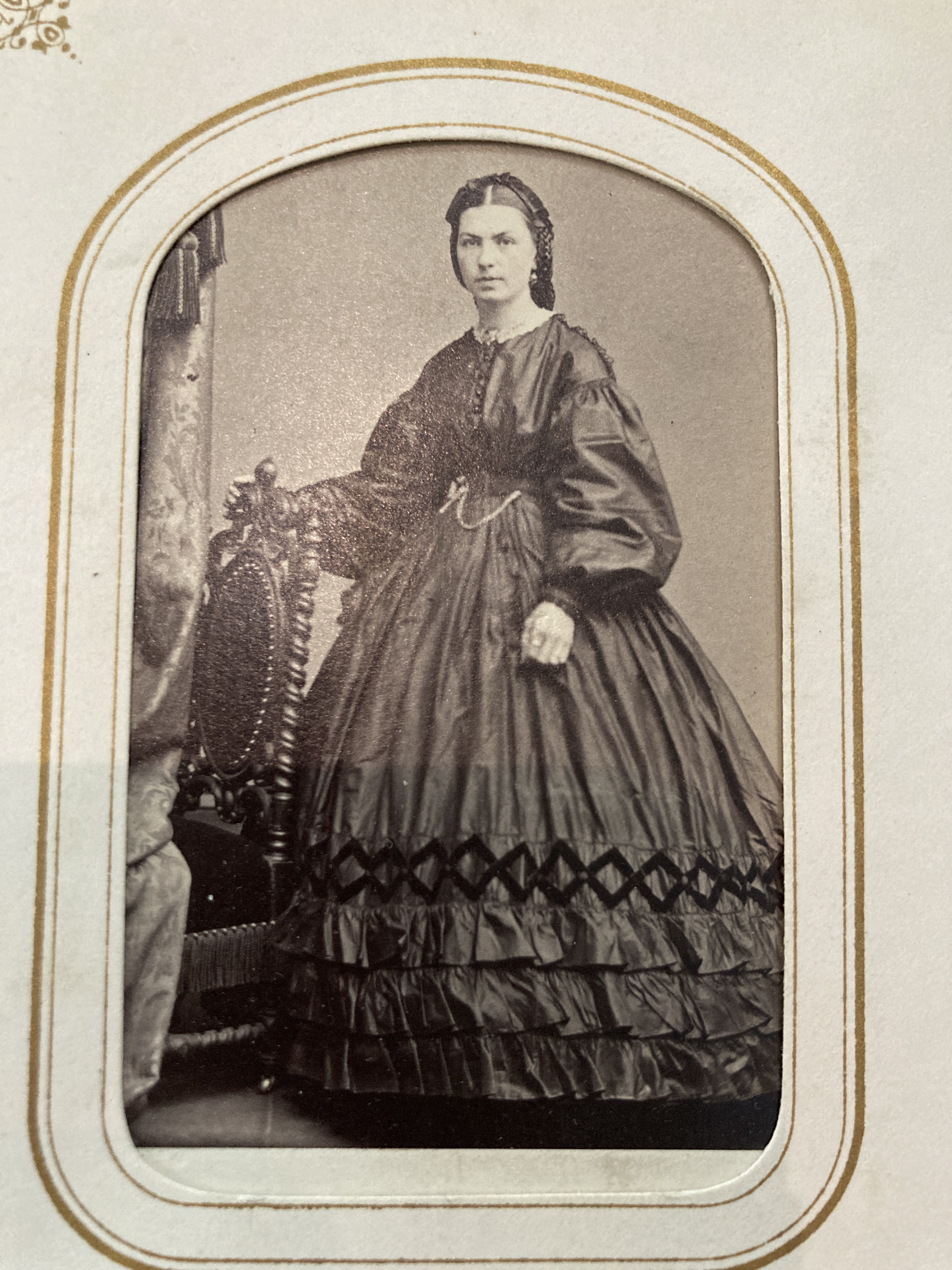
Mathilde Rosenbaum Rothschild: Why Didn’t She Leave Germany?

Several readers asked me whether I could learn more about why Mathilde Rosenbaum Rothschild did not go with her husband Hirsch Rothschild and their children to the United States in the 1930s, but stayed in Germany. Tragically Mathilde was eventually killed by the Nazis whereas her husband and children all survived.

I decided to dig a little deeper into Mathilde’s family to see if perhaps she’d stayed to care for elderly parents, but both of her parents died long before the Nazi era.1  Mathilde also had numerous siblings, including one who was killed at Auschwitz, but others escaped—to Israel, to the US, and to South Africa. In fact, this review of my research allowed me to realize something I had not noticed before. Mathilde’s sister Fanni Rosenbaum had married Hirsch Rothschild’s older brother Sigmund. They had escaped to South Africa.

I couldn’t trace all of her siblings, but given that her family was from Schluechtern and that Schluechtern is over 250 miles from Bremen, the city Hirsch listed as his wife’s residence on the passenger manifest, I don’t think that Mathilde was in Bremen to help with a family member.

I looked more closely at the address that had been added to Hirsch’s passenger manifest—Bahnhofsplatz 16, in Bremen, thinking that perhaps it was the address of a hospital where Mathilde might have been getting treatment.

Hirsch Rothschild, passenger manifest, p. 2, The National Archives At Washington, D.c.; Washington, D.c.; Series Title: Passenger Lists of Vessels Arriving At Miami, Florida; NAI Number: 2788508; Record Group Title: Records of the Immigration and Naturalization Service, 1787 – 2004; Record Group Number: 85 Description Roll Number: 086 Source Information Ancestry.com. Florida, U.S., Arriving and Departing Passenger and Crew Lists, 1898-1963

But “Bahnhofsplatz” means a plaza or square where the train station is located, and as best I can tell, in the late 1930s there was no hospital located near there. Rather, it was a place where there were hotels for those traveling to Bremen, an indoor swimming pool facility, and other public and private buildings. Although I can’t be certain, Banhofsplatz 16 may have been the address for a hotel in the 1930s.

Bahnhofsplatz-1928 Bremen Germany

Why would Mathilde be living in a hotel in Bremen? When Hirsch left Germany in the late 1930s, he listed his last permanent residence as Delmenhorst, a village about ten miles from Bremen.  It’s possible that Hirsch and Mathilde had been forced out of their home in Delmenhorst by then either by force or for better opportunities and had moved into a hotel in Bremen. As a  Jewish doctor, by 1938-1939, Hirsch would only have been allowed to treat Jewish patients, and Bremen had a larger Jewish population than Delmenhorst.  Although the passenger manifest indicates that Hirsch’s last permanent residence was Delmenhorst, not Bremen, I would think that staying in a hotel near the train station would not be considered a “permanent” residence so Delmenhorst would still have been more accurate.

I still don’t know why Hirsch left without Mathilde. Maybe he thought he’d go first and settle in and then send for her. I also don’t know when Hirsch left Germany because the ship manifest listing his arrival in Florida on December 18, 1939, was for a ship arriving from Havana, Cuba. I searched the Bremen passenger manifests and found two of his children on them—Edith and Edmund—but not Hirsch. And I don’t know how long Hirsch was in Cuba before being allowed to sail to the US. So…anything I write is total speculation on my part.

The only way I’ll be able to find an answer to these questions would be to ask one of Mathilde’s grandchildren. I have located a few of them but have not yet contacted them. Somehow it just feels intrusive to ask them why their grandmother was left behind. For now I am letting this sit as an unanswered question.


  1. Her mother died in 1913. Jeanette Rosenbaum, Maiden Name Sondheimer, Gender weiblich (Female), Death Age 72, Birth Date abt 1841, Death Date 23 Okt 1913 (23 Oct 1913), Death Place Schluechtern (Schlüchtern), Hessen (Hesse), Deutschland (Germany), Civil Registration Office Schluechtern, Father Moses Sondheimer, Mother
    Marianne Sondheimer, Spouse Salomon Rosenbaum, Certificate Number 47, Hessisches Hauptstaatsarchiv; Wiesbaden, Deutschland; Personenstandsregister Sterberegister; Signatur: 5999, Ancestry.com. Hesse, Germany, Deaths, 1851-1958. Her father died in 1925. Salomon Rosenbaum, Gender männlich (Male), Death Age 83
    Birth Date abt 1842, Death Date 14 Juli 1925, Death Place Schluechtern (Schlüchtern), Hessen (Hesse), Deutschland (Germany), Civil Registration Office Schluechtern, Spouse Johannatta Certificate Number 40, Hessisches Hauptstaatsarchiv; Wiesbaden, Deutschland; Personenstandsregister Sterberegister; Signatur: 6011, Ancestry.com. Hesse, Germany, Deaths, 1851-1958 

Levi Rothschild’s son Hirsch: Leaving Germany with a Heavy Heart

Levi Rothschild’s fourth child, Hirsch (also known as Harry) and his three children Gertrude, Edith, and Edmund all managed to leave Germany in time to survive the Holocaust. His wife and their mother Mathilde Rosenbaum, however, did not.

Gertrude, Hirsch’s oldest child, was the first member of the family to come to the US although her husband preceded her. She had married Gustav Rosbasch sometime before 1933, the year their first child was born. Gustav was born in Kremenchug, Russia (maybe now Ukraine?) on August 12, 1901. Gustav, a surgeon, came to the US on October 10, 1934, listing his last residence as Delmenhorst, Germany, a town in the Saxony state of Germany.  He reported his wife Gertrude as the person he had left behind in Delmenhorst, and his uncle Phillip Rosbasch of Rochester, New York, as the person he was going to in the US. 1

Gertrude arrived almost a year later with their two-year-old daughter. They arrived on September 8, 1935, listing their prior residence as Delmenhorst and listing “G. Rosbasch” in Rochester as the person they were going to; “H. Rothschild,” Gertrud’s father, was listed as the person they had left behind in Delmenhorst.2 Gustav and Gertrude had a second child in Rochester a few years after Gertrude’s arrival.

The next member of the family to escape to the US was Edith, Gertrude’s younger sister. She arrived in New York on May 28, 1937, listing her destination as Rochester, New York, where her sister Gertrude was living, and listing her father, “Dr. Rothschild” as the person she’d left behind in Delmenhorst, her prior residence.3

Edith and Gertrud’s brother Edmund arrived a year after Edith on June 24, 1938, in New York with his destination being New York City where his uncle Karl Rosenbaum, his mother’s brother, was living. Edmund identified his occupation as a physician, like his father and his brother-in-law Gustav, and listed his father “Dr. Harry Rothschild” of Delmenhorst as the person he left behind, but Edmund gave his last residence as Basel, Switzerland, not Delmenhorst.4

Thus, the three children of Hirsch and Mathilde Rothschild had all arrived before Kristallnacht in November 1938. Their father Hirsch did not arrive for over another year. His ship sailed from Havana, Cuba, and arrived in Miami on December 17, 1939, three months after World War II had begun. Hirsch listed his occupation as a physician and the person he was going to as his son “Edw. Rothschild” in Rochester, New York. He also listed his last residence as Delmenhorst.

Hirsch Rothschild passenger manifest, The National Archives At Washington, D.c.; Washington, D.c.; Series Title: Passenger Lists of Vessels Arriving At Miami, Florida; NAI Number: 2788508; Record Group Title: Records of the Immigration and Naturalization Service, 1787 – 2004; Record Group Number: 85, Roll Number: 086, Ancestry.com. Florida, U.S., Arriving and Departing Passenger and Crew Lists, 1898-1963

There is a notation on Hirsch’s line on the passenger manifest that reads, “Admitted on appeal 1-3-40.”  Also for the section listing the person left behind in the prior country, where the word None had been typed, someone added in handwriting, “Wife Mathilde Rothschild” living in Bremen, Germany. Another handwritten change indicates that his son had paid his passage; “self” was crossed out.

Were these additions of Mathilde’s name and the fact that his son was paying his way what helped Hirsch win his appeal? Why wouldn’t he have listed Mathilde before? Why was she living in Bremen, not Delmenhorst? When did Hirsch actually leave for Germany? How long had he been in Cuba before sailing from Havana to Miami in December 1939?

These are questions for which I currently do not have answers, just some speculation. Was Mathilde ill and hospitalized in Bremen? Is that why she hadn’t come with Hirsch to the US?

I don’t know, but we do know that by early 1940, Hirsch and his three children and his son-in-law and granddaughter were all safely in the US. Gustav and Gertrude and their two children were living in Rochester, New York, where Gustav was a doctor.5 Edith was also in Rochester, working as a housekeeper for another family.6 Edmund was working as a doctor at the Monroe County (New York) Infirmary and Home for the Aged in Brighton, New York, only four miles from Rochester.7 I could not locate Hirsch/Harry on the 1940 US census, but on April 25, 1942, when he registered for the World War II draft, he was at that time living in Rochester with Gertrude and Gustav and unemployed.

Harry Hirsch Rothschild, World War II draft registraiton, The National Archives At St. Louis; St. Louis, Missouri; World War Ii Draft Cards (Fourth Registration) For the State of New York; Record Group Title: Records of the Selective Service System; Record Group Number: 147; Box or Roll Number: 522, Name Range: Rosser, Roscoe – Rought, Walter, Ancestry.com. U.S., World War II Draft Registration Cards, 1942

But not long after that Hirsch/Harry must have moved to New Rochelle, New York, 350 miles from his children in Rochester, where he found work as the house physician for the Jewish Home for the Aged in New Rochelle. Harry died on April 18, 1945, in New Rochelle; he was 64. Heartbreakingly, his obituary revealed that as of that date with Germany’s surrender just a few weeks away, Harry and his children did not yet know what had happened to Mathilde, their wife and mother. The obituary states that Harry’s wife Mathilde “remained in Germany when Dr. Rothschild left the country. Relatives here have been trying through the Red Cross to learn her fate.”

“Death Claims Ex-Physician to Aged Jews,” Rochester Democrat and Chronicle, April 14, 1945, p. 17

Yad Vashem, however, reveals what had happened to Mathilde. On November 18, 1941, she had been deported to the Minsk ghetto in Belarus where she was murdered on July 28, 1942. She was 57 years old. It must have been devastating for the family to learn this.8

But Mathilde and Harry were survived by all three of their children and by their grandchildren. Their daughter Gertrude and her husband Gustav remained in Rochester, New York, for the rest of their lives, where Gustav continued to practice medicine. He died on January 7, 1992, at the age of 90.9 Gertrude outlived him by five and a half years; she died on July 4, 1997; she was 86 years old.10 They were survived by their children and grandchildren.

Gertrud’s sister Edith married Abram Solomon (Jalomek) in 1943.11 As far as I can tell, they did not have children as none are listed in either of their obituaries. Edith died July 28, 2003, in Rochester, at the age of 92;12 her husband Abram died many years before on June 9, 1971, in Rochester.13

Edmund Rothschild, the youngest child of Hirsch and Mathilde, had registered for the draft on October 16, 1940.

Edmund Rothschild, World War II draft registration, National Archives at St. Louis; St. Louis, Missouri; Wwii Draft Registration Cards For New York State, 10/16/1940 – 03/31/1947; Record Group: Records of the Selective Service System, 147, Name Range: Roth, Cletus-Rotonde, Nicholas
Ancestry.com. U.S., World War II Draft Cards Young Men, 1940-1947

He married Helene Lois Brown on August 17, 1941, in Buffalo, New York.  She was the daughter of David Brown and Lucile Manheim.14 Edmund and Helene would have two children. Edmund served in the US Army during World War II from August 27, 1943, until March 11, 1946.15 Edmund and his family then settled in Springville, New York, where he continued to practice medicine.16

Later Edmund and Helene retired to Fort Myers, Florida, where Helene died at age 71 on April 24, 1993.17 Edmund died in Cleveland, Ohio, almost exactly a year later on April 21, 1994; he was 81.18 According to his obituary in the Springville Journal, Edmund “was an old-fashioned family physician [who] cared not only for his patients but also for their families and their community. His home was always equipped to see patients after hours and house calls were made often.” The obituary also noted that he was a gifted artist. Edmund and Helene are survived by their children and grandchildren.19

The story of the family of Hirsch Rothschild and his family reminds me of how much the US gained when Germany’s persecution of the Jews forced so many to come here. Hirsch, his son Edmund, and his son-in-law Gustav were all doctors educated and trained in Europe. They came to this country as refugees, and Americans benefited from those skills and that education and dedication. But Mathilde Rosenbaum Rothschild’s death at the hands of the Nazis must remind us that the gifts we Americans may have received from those refugees were not given by them without enduring terrible heartbreak and loss on their part.


  1. Gustav Rosbasch, World War II draft registration, National Archives at St. Louis; St. Louis, Missouri; Wwii Draft Registration Cards For New York State, 10/16/1940 – 03/31/1947; Record Group: Records of the Selective Service System, 147, Ancestry.com. U.S., World War II Draft Cards Young Men, 1940-1947; Gustav Rosbasch, passenger manifest, The National Archives in Washington, DC; Washington, DC, USA; Passenger and Crew Lists of Vessels Arriving at New York, New York, 1897-1957; Microfilm Serial or NAID: T715; RG Title: Records of the Immigration and Naturalization Service, 1787-2004; RG: 85, Ship or Roll Number: Scythia, Ancestry.com. New York, U.S., Arriving Passenger and Crew Lists (including Castle Garden and Ellis Island), 1820-1957 
  2. Gertrude Rosbasch, passenger manifest, The National Archives in Washington, DC; Washington, DC, USA; Passenger and Crew Lists of Vessels Arriving at New York, New York, 1897-1957; Microfilm Serial or NAID: T715; RG Title: Records of the Immigration and Naturalization Service, 1787-2004; RG: 85, Ancestry.com. New York, U.S., Arriving Passenger and Crew Lists (including Castle Garden and Ellis Island), 1820-1957 
  3. Edith Rothschild, passenger manifest, The National Archives in Washington, DC; Washington, DC, USA; Passenger and Crew Lists of Vessels Arriving at New York, New York, 1897-1957; Microfilm Serial or NAID: T715; RG Title: Records of the Immigration and Naturalization Service, 1787-2004; RG: 85, Ship or Roll Number: New York, Ancestry.com. New York, U.S., Arriving Passenger and Crew Lists (including Castle Garden and Ellis Island), 1820-1957 
  4. Edmund Rothschild, passenger manifest, The National Archives in Washington, DC; Washington, DC, USA; Passenger and Crew Lists of Vessels Arriving at New York, New York, 1897-1957; Microfilm Serial or NAID: T715; RG Title: Records of the Immigration and Naturalization Service, 1787-2004; RG: 85, Ship or Roll Number: New York, Ancestry.com. New York, U.S., Arriving Passenger and Crew Lists (including Castle Garden and Ellis Island), 1820-1957 
  5. Gustav Rosbasch and family, 1940 US census, Year: 1940; Census Place: Rochester, Monroe, New York; Roll: m-t0627-02848; Page: 4B; Enumeration District: 65-232, Ancestry.com. 1940 United States Federal Census 
  6. Edith Rothschild, 1940 US census, Year: 1940; Census Place: Rochester, Monroe, New York; Roll: m-t0627-02842; Page: 6B; Enumeration District: 65-22, Ancestry.com. 1940 United States Federal Census 
  7. Edmund Rothschild, 1940 US census, Year: 1940; Census Place: Brighton, Monroe, New York; Roll: m-t0627-02678; Page: 14A; Enumeration District: 28-9, Ancestry.com. 1940 United States Federal Census 
  8. Yad Vashem entry found at https://collections.yadvashem.org/en/names/11619667 
  9. Gustav Rosbasch, Social Security Administration; Washington D.C., USA; Social Security Death Index, Master File, Ancestry.com. U.S., Social Security Death Index, 1935-2014 
  10. Gertrude Rosbasch, [Gertrude Rothschild], Gender Female, Birth Date 3 Sep 1910, Birth Place Gudensberg, Death Date 4 Jul 1997, Claim Date 17 May 1973
    Father Harry Rothschild, Mother Mathilde Rosenbaum, Ancestry.com. U.S., Social Security Applications and Claims Index, 1936-2007 
  11. “Marriage Licenses,” Rochester Democrat and Chronicle, October 26, 1943, p. 12 
  12. Edith Miriam Solomon, [Edith Miriam Rothschild], Gender Female, Race White, Birth Date 4 Jul 1911, Birth Place Gudensberg, Federal Republic of Germany, Death Date 28 Jul 2003, Claim Date 19 Jan 1976, Father Harry Rothschild, Mother Mathilde Rosenbaum, Ancestry.com. U.S., Social Security Applications and Claims Index, 1936-2007. 
  13. Abram Solomon, Social Security Number 128-09-6834, Birth Date 18 Nov 1899,
    Issue year Before 1951, Issue State New York, Last Residence 14617, Rochester, Monroe, New York, USA, Death Date Jun 1971, Social Security Administration; Washington D.C., USA; Social Security Death Index, Master File,  Ancestry.com. U.S., Social Security Death Index, 1935-2014 
  14. “Dr. Edward [sic] Rothschild to be Married Soon,” Bradford Evening Star and The Bradford Daily Record, Bradford, Pennsylvania · Friday, August 01, 1941, p. 5; Helene Brown Rothschild, Gender Female, Birth Date 30 Jul 1921, Birth Place Minneapolis, Minnesota, Death Date 24 Apr 1993, Father David Brown, Mother Lucile S Manheim,
    SSN 057382510, Ancestry.com. U.S., Social Security Applications and Claims Index, 1936-2007. 
  15. Edmund S Rothschild, Birth Date 30 Jul 1912, Death Date 21 Apr 1994, Cause of Death Natural, SSN 114342498, Enlistment Branch ARMY, Enlistment Date 27 Aug 1943, Discharge Date 11 Mar 1946, Page number 1, Ancestry.com. U.S., Department of Veterans Affairs BIRLS Death File, 1850-2010. 
  16. “Founder of Medical Group Dies,” Springville Journal, Springville, New York · Thursday, May 05, 1994, p. 6. 
  17. “Helene L. Brown Rothschild,” News-Press, Fort Myers, Florida · Tuesday, April 27, 1993, p. 19; Helene Brown Rothschild, Gender Female, Birth Date 30 Jul 1921, Birth Place Minneapolis, Minnesota, Death Date 24 Apr 1993, Father David Brown, Mother Lucile S Manheim, SSN 057382510, Ancestry.com. U.S., Social Security Applications and Claims Index, 1936-2007. 
  18. See Notes 15 and 16, supra. 
  19. See Note 16, supra. 

Levi Rothschild’s Children Part III: Escaping The Holocaust to South Africa, New York, and Palestine/Israel

Of the six children of Levi Rothschild and Clara Jacob who lived to adulthood in Germany, amazingly all but one escaped from Germany in time to avoid being killed by the Nazis. Only the youngest sibling Frieda was not as fortunate. But that doesn’t mean that there wasn’t suffering and loss endured by the other five. This post will focus on the three oldest children: Sigmund, Betti, and Moses.

Sigmund Rothschild and his wife Fanny Rosenbaum escaped to South Africa. I don’t know when or how they immigrated there, but Fanny died there on August 20, 1942, in Capetown at the age of  62.

Fanny Rosenbaum Rothschild death record, Municipality or Municipality Range: Cape Town
Ancestry.com. Cape Province, South Africa, Civil Deaths, 1895-1972

Her husband Sigmund died in Capetown three years later on December 23, 1945; he was 71.

Sigmund Rothschild death record, Municipality or Municipality Range: Cape Town
Ancestry.com. Cape Province, South Africa, Civil Deaths, 1895-1972

As for Sigmund and Fanny’s son Kurt, I have very little information. An entry in the England & Wales Civil Registration Death Index on Ancestry shows that he died in Lancaster, England, and that the death was registered in September 1997.1 A FindAGrave entry shows his gravestone with the date of death as August 30, 1997.

Find a Grave, database and images (https://www.findagrave.com/memorial/81923216/kurt-rothschild: accessed April 19, 2024), memorial page for Kurt Rothschild (1910–3 Sep 1997), Find a Grave Memorial ID 81923216, citing Lytham Park Cemetery and Crematorium, Lytham Saint Annes, Fylde Borough, Lancashire, England; Maintained by ProgBase (contributor 47278889).

The Ancestry tree that appears to have been created by Kurt’s daughter-in-law shows that Kurt married Erna Erdmann and had one child, who is the home person on that tree. I have not been able to find a marriage record for Kurt and Erna Erdmann or a birth record for their child, so I am hoping that the owner of that tree will respond to the message I sent to help me find out what happened to Kurt Rothschild and his family. But since it’s been well over two months at this point, I am not optimistic that I will hear from her anytime soon.

The second child of Levi and Klara, their daughter Betti, lost her husband Emanuel Hirschmann on November 4, 1932. He died in Fulda, Germany, and was 64.

Emanuel Hirschmann death record, Hessisches Hauptstaatsarchiv; Wiesbaden, Deutschland; Personenstandsregister Sterberegister; Signatur: 2470, Year Range: 1932, Ancestry.com. Hesse, Germany, Deaths, 1851-1958

Their son Walter had married Gertrud Hirschmann on August 6, 1924, in Hanau, Germany. Gertrud was born in Hanau on March 28, 1904, according to their marriage record, but that record does not include her parents’ names. It would appear that Gertrud was likely a relative given the surname and her birth place, but so far I’ve not found any way to connect her to Walter’s Hirschmann relatives.

Walter Hirschmann and Gertrude Hirschmann marriage record, LAGIS Hessen Archives, Standesamt Hanau Heiratsnebenregister 1924 (HStAMR Best. 913 Nr. 1894)AutorHessisches Staatsarchiv MarburgErscheinungsortHanauErscheinungsjahr1924, p. 328

Walter Hirschmann and Gertrude Hirschmann marriage record, p. 2

Walter and Gertrud and their twelve year old daughter immigrated to the US on a December 15, 1938. Walter listed his occupation as a banker and their last residence as Frankfurt, Germany, where his mother “B. Hirschmann” was still residing. They were heading to a friend, L. Schwarzchild, in New York.2

Walter’s mother Betti Rothschild Hirschmann immigrated to the US on March 25, 1939, with a cousin of her husband, Emil Hirschmann, and his wife Paula.

Betti Rothschild passenger manifest, The National Archives in Washington, DC; Washington, DC, USA; Passenger and Crew Lists of Vessels Arriving at New York, New York, 1897-1957; Microfilm Serial or NAID: T715; RG Title: Records of the Immigration and Naturalization Service, 1787-2004; RG: 85, Ship or Roll Number: Veendam, Ancestry.com. New York, U.S., Arriving Passenger and Crew Lists (including Castle Garden and Ellis Island), 1820-1957

On the 1940 census, Betti was living as a lodger in the household of Helena Pessel in New York City, but in the same building as her son Walter and his family at 670 Riverside Drive in New York City. Walter was employed as a salesman.3

On his World War II draft registration, Walter identified his employer as Herbert E. Stern & Company. From his obituary I learned that Herbert E. Stern was also a refugee from Nazi Germany and an investment banker.4

Walter Hirschmann World War II draft registration, National Archives at St. Louis; St. Louis, Missouri; Wwii Draft Registration Cards For New York City, 10/16/1940 – 03/31/1947; Record Group: Records of the Selective Service System, 147, Name Range: Hirsch, Walfgang-Hobbs, Robert, Ancestry.com. U.S., World War II Draft Cards Young Men, 1940-1947

In 1950 Betti was still living in the same building as her son Walter and his family. Walter was still working as a broker and banker. I am very grateful to Eric Ald of Tracing the Tribe who found the 1950 census record for Betti and also a listing on Ancestry in the New York, New York Death Index for a Betty Hirschmann who died on February 15, 1956.5

Walter Hirschmann and Betty Hirschmann, 1950 US census, National Archives at Washington, DC; Washington, D.C.; Seventeenth Census of the United States, 1950; Year: 1950; Census Place: New York, New York, New York; Roll: 6203; Page: 75; Enumeration District: 31-1900, Ancestry.com. 1950 United States Federal Census

Her son Walter Hirschmann died on June 24, 1977, at the age of 77.6 He had been predeceased by his wife Gertrud, who died in December 1966 7 and was survived by their daughter and grandchildren.

Sigmund and Betti’s brother Moses/Moritz Rothschild and his wife Margarete David ended up in Israel/Palestine in the 1930s along with their two children, Ruth, born October 8, 1914, in Magdeburg, Germany, and Herbert (later Yehuda), born December 10, 1921, in Magdeburg. The documents below are immigration documents showing that Moritz and Margarete were in Jerusalem by June 30, 1939; these and the others that follow were found at the Israel Genealogy Research Association website.

Registration form for Margarete David Rothschild reporting to the German Embassy Legation at the German Consulate General Consulate Bizekonsult in Jerusalem, A-B (טפסי הרשמה: A-B), part of the Residents 1938-1939 (תושבים 1938-1939) database, system number פ-500/5, IGRA number 1459. The original records are from Israel State Archives (ארכיון המדינה), and found at the IGRA website.

Registration form for Margarete David Rothschild reporting to the German Embassy Legation at the German Consulate General Consulate Bizekonsult in Jerusalem, A-B (טפסי הרשמה: A-B), part of the Residents 1938-1939 (תושבים 1938-1939) database, system number פ-500/5, IGRA number 1459. The original records are from Israel State Archives (ארכיון המדינה), and found at the IGRA website.

Registration form for Moses Moritz Rothschild, This record comes from the Meldeblaetter: A-B (טפסי הרשמה: A-B), part of the Residents 1938-1939 (תושבים 1938-1939) database, system number פ-500/5, IGRA number 1462. The original records are from Israel State Archives (ארכיון המדינה), and found at the IGRA website.

Registration form for Moses Moritz Rothschild, This record comes from the Meldeblaetter: A-B (טפסי הרשמה: A-B), part of the Residents 1938-1939 (תושבים 1938-1939) database, system number פ-500/5, IGRA number 1462. The original records are from Israel State Archives (ארכיון המדינה), and found at the IGRA website.

Their daughter Ruth had arrived by September 29, 1938.

Registration form for Ruth Rothschild reporting to the German Embassy Legation at the German Consulate General Consulate Bizekonsult in Jerusalem, A-B (טפסי הרשמה: A-B), part of the Residents 1938-1939 (תושבים 1938-1939) database, system number פ-500/5, IGRA number 1465. The original records are from Israel State Archives (ארכיון המדינה), as found at the IGRA website.

Registration form for Ruth Rothschild reporting to the German Embassy Legation at the German Consulate General Consulate Bizekonsult in Jerusalem, A-B (טפסי הרשמה: A-B), part of the Residents 1938-1939 (תושבים 1938-1939) database, system number פ-500/5, IGRA number 1465. The original records are from Israel State Archives (ארכיון המדינה), as found at the IGRA website.

Although I was unable to find a comparable record for Herbert/Yehuda, I found a record showing that he and his father Moritz were on the voter registration list and living at Kfar Yedidya in 1942:

Moritz and Yehuda Rothschild on 1942 Knesset register, This record comes from the Voters List Knesset Israel 1942 (פנקס הבוגרים של כנסת ישראל תש”ב), part of the Voters Knesset Israel 1942 (בוגרים של כנסת ישראל 1942) database, system number 001mush, document number 119, line 59, IGRA number 1107. The original records are from Israel State Archives (ארכיון המדינה), and was found at the IGRA website.

Yehuda married Ruth Hesin, daughter of Avraham and Hava, on April 17, 1949, in Haifa, Israel. She was 22 years old, he was 27.

Yehuda Rothschild marriage record, Marriage/Divorce Certificates (תעודות נישואין / גירושין), part of the Marriages and Divorces 1921-1948 Palestine British (נישואין וגירושין 1948-1921 ארץ ישראל) database, document number 91714, IGRA number 507. The original records are from Israel State Archives (ארכיון המדינה), and was found at the IGRA website.

At this time I have no further records for this family, but we know that at least they escaped from Germany in time to survive the Holocaust.

Thus, the first three children of Levi Rothschild and Clara Jacob all escaped from Nazi Germany in time, but look at what they lost. They were all spread across the globe: Sigmund in South Africa, Betti in the United States, and Moses in Palestine/Israel.

The fourth child of Levi and Klara, their son Hirsch Rothschild, also escaped. He and his wife Mathilde Rosenbaum and their three children Gertrude, Edith, and Edmund ended up, like Betti, in the US. I will write about Hirsch and his family in my next post.


  1. Kurt Rothschild, Death Age 87, Birth Date 30 Mar 1910, Registration Date Sep 1997, Registration district Lancaster, Inferred County Lancashire, Register Number A58B, District and Subdistrict 5871A, Entry Number 166, General Register Office; United Kingdom, Ancestry.com. England & Wales, Civil Registration Death Index, 1916-2007 
  2. Walter Hirschmann and family, passenger manifest, The National Archives in Washington, DC; Washington, DC, USA; Passenger and Crew Lists of Vessels Arriving at New York, New York, 1897-1957; Microfilm Serial or NAID: T715; RG Title: Records of the Immigration and Naturalization Service, 1787-2004; RG: 85, Ancestry.com. New York, U.S., Arriving Passenger and Crew Lists (including Castle Garden and Ellis Island), 1820-1957 
  3. Betti Hirschmann, 1940 US census, Year: 1940; Census Place: New York, New York, New York; Roll: m-t0627-02671; Page: 7B; Enumeration District: 31-1929, Ancestry.com. 1940 United States Federal Census. Walter Hirschmann and family, 1940 US census, Year: 1940; Census Place: New York, New York, New York; Roll: m-t0627-02671; Page: 7A; Enumeration District: 31-1929, Ancestry.com. 1940 United States Federal Census 
  4. “Herbert E. Stern Dead, An Investment Banker,” The New York Times, August 6, 1973, p. 32. 
  5. Betty Hirschmann, Age 75, Birth Date abt 1881, Death Date 15 Feb 1956, Death Place Manhattan, New York, New York, USA, Certificate Number 3638, Ancestry.com. New York, New York, U.S., Death Index, 1949-1965. Although there is a listing for Betti on the SSCAI with her Social Security Number, there is no listing on the SSDI for her under that number or under that date or under her name. Betty Sara Hirschmann, [Betty Sara Rohserild], Gender Female, Race White, Birth Date 14 Sep 1876, Birth Place Borken Hesse, Federal Republic of Germany, Father Levi Rohserild
    Mother, Clara Jacob, SSN 057200860, Notes Feb 1943: Name listed as BETTY SARA HIRSCHMANN, Ancestry.com. U.S., Social Security Applications and Claims Index, 1936-2007. 
  6. Walter Hirschmann death notice, The New York Times, June 27, 1977, p, 30. Walter Hirschmann, Social Security Number 092-14-5701, Birth Date 30 Dec 1899
    Issue year Before 1951, Issue State New York, Last Residence 10023, New York, New York, New York, USA, Death Date Jun 1977 Social Security Administration; Washington D.C., USA; Social Security Death Index, Master File,  Ancestry.com. U.S., Social Security Death Index, 1935-2014 
  7. Gertrud Hirschmann death notice, The New York Times, December 16, 1966, p. 47. 

Levi Rothschild, Part II: His Children Marry and Have Children

Levi Rothschild’s wife Clara Jacob had given birth to nine babies, but only six of those children survived to adulthood: Sigmund, Betty, Moses, Hirsch, Thekla, and Frieda. All six of them married and had children.

Sigmund Rothschild, their oldest child, married Fanni Rosenbaum on May 28, 1906, in Schluechtern, Germany. She was born on December 21, 1879, in Schluechtern to Salomon Rosenbaum and Jeannette Sondheimer.1

Sigmund Rothschild and Fanni Rosenbaum marriage record, Arcinsys Archives of Hessen, HHStAW Fonds 365 No 766, p. 101

According to an Ancestry tree that appears to belong to their granddaughter-in-law, Sigmund and Fanny had at least one child, a son Kurt Rothschild, and although I have no birth record for him because the Borken birth records online do not go up to 1910, that tree reports that he was born on March 30, 1910, in Borken. I have reached out to the tree owner and hope to get more information if she gets back to me. So far after two months I’ve gotten no response. I am not optimistic, but people have found my messages even years after I’ve sent them through Ancestry, so you never know.

Sigmund’s sister Betti Rothschild married Emanuel Hirschmann on December 21, 1898, in Borken. He was born to Loeb Hirschmann and Malchen Strauss on April 12, 1868, in Gross Krotzenburg, Germany.

Betti Rothschild and Emanuel Hirschmann marriage record, Hessisches Hauptstaatsarchiv; Wiesbaden, Deutschland; Bestand: 920; Laufende Nummer: 834, Year Range: 1898, Ancestry.com. Hesse, Germany, Marriages, 1849-1930

For many weeks I could not find records of any children born to Betti and Emanuel. And then I found the name “Walter Hirschman” as a sponsor on an immigration record for one of Betti’s siblings, Thekla, and I thought, “Maybe Walter Hirschman was related to Betti Rothschild and Emanuel Hirschmann?”

Ancestry.com. Munich, Vienna and Barcelona Jewish Displaced Persons and Refugee Cards, 1943-1959 (JDC)

Several clicks through the Hesse files and thirty minutes later I found this birth record for Walter, son of Emanuel and Betti, born in Hanau, Germany, on December 30, 1899.

Walter Hirschmann birth record, LAGIS Hessen Archives, Standesamt Hanau Geburtsnebenregister 1899 (HStAMR Best. 913 Nr. 1780)AutorHessisches Staatsarchiv MarburgErscheinungsortHanauErscheinungsjahr1899, p.323

That made me wonder whether Betti and Emanuel had had other children. Unfortunately, the Hanau birth records online only go up through 1900, and I did not find any other birth records for that couple in that year. If there were children born after 1900, I have not found any other evidence of such children.

The third child of Levi and Clara, Moses or Moritz Rothschild, married Margarete David. I don’t have a marriage record for Moritz and Margarete nor do I have birth records for their children from Germany, but I was able to track down records on the Israel Genealogical Research Association website that helped to fill in those gaps. Margarete was born in Hagen, Germany, on May 27, 1889, to Louis David and  Alwine Harff David.2 Moritz and Margarete had two children, Ruth, born October 8, 1914,3 and Herbert (later Yehuda), born December 10, 1921, in Magdeburg, Germany.4

Hirsch (also known as Harry) Rothschild, the fourth child of Levi Rothschild and Clara Jakob, married Malli (also known as Mathilda) Rosenbaum on November 29, 1909, in Schluechtern, Germany. She was the daughter of Salomon Rosenbaum and Jeanette Sondheimer and was born in Schluechtern on July 20, 1885.5

Hirsch Rothschild and Malli Rosenbaum marriage record, Arcinsys Archives of Hessen, HHStAW Fonds 365 No 766, p. 104

Harry Hirsch Rothschild and Malli Rosenbaum had three children. Gertrude was born September 3, 1910, in Gudensberg, Germany.6 Her sister Edith was born there on July 4, 1911,7 and their brother Edmund Siegfried was born one year later on July 30, 1912.8

The fifth child of Levi and Clara, their daughter Thekla, married Manuel Edward Weinberg on August 19, 1907, in Borken. Manuel was born in Lichenroth, Germany, to Lazarus Weinberg and Karoline Oppenheimer on October 11, 1880.

Thekla Rothschild and Manuel Weinberg marriage record, Hessisches Hauptstaatsarchiv; Wiesbaden, Deutschland; Bestand: 920; Laufende Nummer: 843, Year Range: 1907, Ancestry.com. Hesse, Germany, Marriages, 1849-1930

Thekla and Manuel had a son Hans Herbert Weinberg born in Frankfurt, Germany, on November 2, 1908.9

Finally, the last born of Levi and Clara’s children, their daughter Frieda, married Leopold Marxsohn on November 25, 1920, in Frankfurt. He was born on June 21, 1883, in Koenigstadten, Germany, to Abraham Marxsohn and Emilie Stern.

Frieda Rothschild Leopold Marxsohn marriage record, Hessisches Hauptstaatsarchiv; Wiesbaden, Deutschland; Bestand: 903, Year Range: 1920, Ancestry.com. Hesse, Germany, Marriages, 1849-1930

It appears that Leopold died before November 25, 1925, because on that date Frieda married Paul Phillipsohn in Frankfurt, and she is identified as a widow on their marriage record. I cannot find any death record for Leopold, however, and none of the other trees or other secondary sources have a date for his death. There is a FindAGrave entry for a Leopold Marxsohn who died in 1919 and is buried in Frankfurt,10 but that can’t be the same man unless the date on FindAGrave is incorrect. And there is a Leopold Marxsohn listed in the 1925 Frankfurt directory,11 but that also could be a different man. More exploration is necessary.

In any event, Frieda remarried as noted on November 25, 1925, and her second husband was Paul Phillipsohn. Paul was born on October 15, 1885, in Gandersheim, Germany. I have not yet found the names of his parents.

Frieda Rothschild Marxsohn and Paul Phillipsohn marriage record, Hessisches Hauptstaatsarchiv; Wiesbaden, Deutschland; Bestand: 903, Year Range: 1925, Ancestry.com. Hesse, Germany, Marriages, 1849-1930

Frieda and Paul had one child, a daughter Hannelore, born in Frankfurt on November 3, 1926.12

Thus, by late 1926, when Hannelore Phillipsohn was born, there were eight living grandchildren of Levi Rothschild and Clara Jacob. Sadly, Levi did not live to see all of them born as he had died on October 15, 1913, in Borken at the age of 67.

Levi Rothschild death record, Hessisches Hauptstaatsarchiv; Wiesbaden, Deutschland; Personenstandsregister Sterberegister; Bestand: 902; Laufende Nummer: 920, Year Range: 1913
Ancestry.com. Hesse, Germany, Deaths, 1851-1958

His wife Clara Jacob, however, lived to see all eight of those grandchildren born. She died on November 24, 1929, in Borken when she was 78 years old.

Clara Jacob Rothschild death record, Hessisches Hauptstaatsarchiv; Wiesbaden, Deutschland; Personenstandsregister Sterberegister; Bestand: 913; Laufende Nummer: 920, Year Range: 1929, Ancestry.com. Hesse, Germany, Deaths, 1851-1958

That brings us to the decade of the 1930s, and as you may expect, the lives of all six of Levi and Clara’s children, their spouses, and their children were drastically changed during that decade and the one that followed.


  1. Fanni Rosenbaum birth record, Hessisches Hauptstaatsarchiv; Wiesbaden, Deutschland; Bestand: 913; Signatur: 5881, Ancestry.com. Hesse, Germany, Births, 1851-1901 
  2. Margarete Sara Rothschild, [Margarete Sara David], Birth Date 27 Mai 1889 (27 May 1889), Birth Place Hagen, Last Residence Magdeburg, National Archives and Records Administration (NARA); Washington, DC; Name Index of Jews Whose German Nationality Was Annulled by the Nazi Regime (Berlin Documents Center); Record Group: 242, National Archives Collection of Foreign Records Seized, 1675 – 1958; Record Group ARC ID: 569; Publication Number: T355; Roll: 7, Mosbacher, Eduard – Schafranek, Bruno, Ancestry.com. Germany, Index of Jews Whose German Nationality was Annulled by Nazi Regime, 1935-1944. Also, Registration form for Margarete David Rothschild reporting to the German Embassy Legation at the German Consulate General Consulate Bizekonsult in Jerusalem, A-B (טפסי הרשמה: A-B), part of the Residents 1938-1939 (תושבים 1938-1939) database, system number פ-500/5, IGRA number 1459. The original records are from Israel State Archives (ארכיון המדינה), and found at the IGRA website. See also this Wikipedia article about Margarete’s brother Ferdinand and his life. 
  3. Registration form for Ruth Rothschild reporting to the German Embassy Legation at the German Consulate General Consulate Bizekonsult in Jerusalem, A-B (טפסי הרשמה: A-B), part of the Residents 1938-1939 (תושבים 1938-1939) database, system number פ-500/5, IGRA number 1465. The original records are from Israel State Archives (ארכיון המדינה), as found at the IGRA website
  4.  Yehuda Rothschild marriage record, Marriage/Divorce Certificates (תעודות נישואין / גירושין), part of the Marriages and Divorces 1921-1948 Palestine British (נישואין וגירושין 1948-1921 ארץ ישראל) database, document number 91714, IGRA number 507. The original records are from Israel State Archives (ארכיון המדינה), as found at the IGRA website. 
  5. Malli Rosenbaum birth record, Hessisches Hauptstaatsarchiv; Wiesbaden, Deutschland; Bestand: 913; Signatur: 5887, Ancestry.com. Hesse, Germany, Births, 1851-1901 
  6. Gertrude Rosbasch, [Gertrude Rothschild], Gender Female, Birth Date 3 Sep 1910, Birth Place Gudensberg, Death Date 4 Jul 1997, Claim Date 17 May 1973, Father
    Harry Rothschild, Mother Mathilde Rosenbaum, SSN 054385223, Ancestry.com. U.S., Social Security Applications and Claims Index, 1936-2007. 
  7. Edith Miriam Solomon, [Edith Miriam Rothschild], Gender Female, Race White, Birth Date 4 Jul 1911, Birth Place Gudensberg, Federal Republic of Germany, Death Date 28 Jul 2003, Claim Date 19 Jan 1976, Father Harry Rothschild, Mother Mathilde Rosenbaum, SSN 071180622, Ancestry.com. U.S., Social Security Applications and Claims Index, 1936-2007. 
  8. Edmund Siegfried Rothschild, Gender Male, Race White, Birth Date 30 Jul 1912
    Birth Place Gudensberg, Federal Republic of Germany, Death Date 21 Apr 1994
    Father Harry Rothschild, Mother Mathilda Rosenbaum, SSN 114342498, Ancestry.com. U.S., Social Security Applications and Claims Index, 1936-2007. 
  9. Hans Herbert Weinberg, Gender männlich (Male), Record Type Inventory, Birth Date 02 Nov 1908 (2 Nov 1908), Birth Place Frankfurt am Main, Last Residence Frankfurt am Main, Residence Place Frankfurt am Main, Father Edmund Weinberg
    Mother Thekla Weinberg, Spouse Edith Seckbach, Arolsen Archives, Digital Archive; Bad Arolsen, Germany; Lists of Persecutees 2.1.1.1, Ancestry.com. Free Access: Europe, Registration of Foreigners and German Persecutees, 1939-1947 
  10. Find a Grave, database and images (https://www.findagrave.com/memorial/130472657/leopold-marxsohn: accessed April 8, 2024), memorial page for Leopold Marxsohn (unknown–1919), Find a Grave Memorial ID 130472657, citing Alter Jüdischer Friedhof, Frankfurt am Main, Stadtkreis Frankfurt, Hessen, Germany; Maintained by Athanatos (contributor 46907585). 
  11.  Deutsche National Bibliothek; Leipzig, Deutschland; Publisher: Scherl; Signatur: ZC 811; Laufende Nummer: 1, Ancestry.com. Germany and Surrounding Areas, Address Books, 1815-1974 
  12.  Arolsen Archives, Digital Archive; Bad Arolsen, Germany; Lists of Persecutees 2.1.1.1, Reference Code: 02010101 oS, Ancestry.com. Free Access: Europe, Registration of Foreigners and German Persecutees, 1939-1947; Find a Grave, database and images (https://www.findagrave.com/memorial/109408821/hannelore-philippsohn: accessed April 8, 2024), memorial page for Hannelore Philippsohn (3 Nov 1926–unknown), Find a Grave Memorial ID 109408821; Burial Details Unknown; Maintained by IWPP Custodial Account (contributor 48586138). 

Passover 2024: Our Seder

Why was this seder different from all other seders?

There were so many reasons, starting with the fact that it took place at our daughter and son-in-law’s home in Brooklyn. And it was a much smaller crowd than we usually have. It was just the seven of us—our older daughter and her husband and their two children, our younger daughter, my husband, and myself. The other relatives and friends who usually attend were not able to join us this year.

It was a beautiful seder. My daughter took special care to create a festive seder table. My son-in-law made delicious and allergen-safe charoset. We brought in food from our favorite kosher restaurant. We all felt at home and comfortable, and there were lots of laughs and stories and good food and wine and even some tears. We used our usual Haggadahs and the silly stuffed toys to represent the plagues, and, of course, there were wine and grape juice spills on the white tablecloth, afikomen hidden and found, and macaroons and candy fruit slices to end the meal.

Because we were in a new place with a smaller group, we had a chance to have a different experience and a new perspective on the holiday. The fact that I wasn’t hosting meant more opportunities for me to reflect and observe than I usually have when I am worried about getting everything ready and coordinating when to heat and cook all the food. And I think all of us were reminded that the holiday carries its beauty and its meaning wherever you are and with all who are there—be it seven or seventy.

Of course, the events in the Middle East and here in America also put the holiday in a very different context this year, and there were times that the words in the Haggadah resonated in new ways and with greater power. What struck me most powerfully was how the Haggadah is both universal and particularistic in its messages. The central message is certainly specific to Jews in most ways—the story of our liberation from slavery and oppression to freedom. But within that message is also the more universalistic message that all people deserve to be free from slavery and oppression. We are told not to oppress the stranger because we know what it is like to be a stranger. We are told to welcome all who are hungry to our table—not just Jews, but anyone who is hungry.

The part of the seder this year that moved me the most, however, was the story of the ten plagues. We read this section every single year, but I had never actually focused on what it says. It’s not just to remember that God sent ten plagues to convince Pharoah to free the Jewish slaves—blood, frogs, lice, flies, murrain, boils, locusts, darkness, and the slaying of the first born. The Haggadah instructs us to diminish the wine in our cups as we recite each of these plagues so that we diminish our own joy as we remember the pain inflicted upon the Egyptians.

Lawrence Alma-Tadema, CC BY-SA 2.5 <https://creativecommons.org/licenses/by-sa/2.5&gt;, via Wikimedia Commons

In other words, we are supposed to empathize with the Egyptians. I cannot help but see the parallels to what is happening now in Gaza. As Jews we are reminded that even those who oppress us deserve our sympathy when they suffer pain. To be a good Jew, a good person, means to feel not just our own pain but also the pain of others.

Our seder table this year in Brooklyn also reflected these particularistic and universal lessons of the Haggadah. We had all the traditional symbols—the shankbone, the egg, the charoset, the moror, the parsley for dipping in salt water, the matzah, Elijah’s Cup—the symbols of suffering and of liberation. But we also had some non-traditional symbols.

Two we have incorporated for years now to reflect the central role that women have played and continue to play in Jewish history and life: Miriam’s Cup and an orange. Miriam’s Cup reminds us that women played a role in our liberation from Egypt. And the orange comes from a story about something that was said when the liberal Jewish movements were considering changes that would give women the same rights as men to stand on the bimah and read Torah. Apparently, one opponent of those changes stated, “A woman belongs on the bimah like an orange belongs on the seder plate.” So now we have an orange on our seder plate every year because, yes, women belong on the bimah and in all aspects of Jewish practice.

But this year we added two new symbols to the seder table: olives, at the suggestion of our children’s rabbi in Brooklyn, to express our desire for peace with the Palestinians, and, at the suggestion of my younger grandchild, soy sauce to reflect that there are other cultures in the world in addition to ours.

Our seder might not fit with everyone’s traditions or values, but it most certainly reflected ours. It was beautiful, powerful, moving, and memorable.


Levi Rothschild and His Family: Only Six of Nine Children Survived Childhood

Because I have no records other than those already mentioned for the two other sons of Seligmann Rothschild (Leopold and Hugo), I am moving on to the next child of Gelle Blumenfeld and Simon Rothschild, their son Levi.

Levi was born on August 23, 1846, in Walterbrueck, Germany.

Levi Rothschild birth record, Arcinsys Archives of Hesse, HHStAW Fonds 365 No 893, p. 18

Although I cannot find a marriage record, I can infer from various records related to his children and his wife that he married Clara (sometimes spelled Klara) Jacob. Clara was born on December 1, 1850, in Breitbarten, Germany, to Meir Jacob and Frommet Handel.

Clara Jacob birth record, Arcinsys Archives of Hessen, Geburtsregister der Juden von Breitenbach am Herzberg 1838-1906 (HHStAW Abt. 365 Nr. 85)AutorHessisches Hauptstaatsarchiv, WiesbadenErscheinungsjahr1838-1906

Levi and Clara must have married by early 1874 because their first child Sigmund Rothschild was born on December 19, 1874, in Borken, Germany. Although I do not have a birth record for Sigmund, his birthdate appears on his marriage record.1

For Levi and Clara’s second child, Betti, I was able to locate a birth record. She was born in Borken on September 14, 1876.

Betti Rothschild birth record, Hessisches Hauptstaatsarchiv; Wiesbaden, Deutschland; Bestand: 920; Laufende Nummer: 788, Year Range: 1876, Ancestry.com. Hesse, Germany, Births, 1851-1901

Their third child Moses (or Moritz) was born on February 12, 1879, in Borken.

Moses Moritz Rothschild birth record, LAGIS Hessen Archives, Standesamt Borken (Hessen) Geburtsnebenregister 1879 (HStAMR Best. 920 Nr. 791)AputorHessisches Staatsarchiv MarburgErscheinungsortBorken (Hessen)Erscheinungsjahr1879, p. 13

Hirsch, their fourth child, was born on April 9, 1881, in Borken.

Hirsch Rothschild birth record, Hessisches Hauptstaatsarchiv; Wiesbaden, Deutschland; Bestand: 920; Laufende Nummer: 793, Year Range: 1881, Ancestry.com. Hesse, Germany, Births, 1851-1901

Their fifth child and second daughter Thekla was born on January 29, 1886, in Borken.

Thekla Rothschild birth record, Hessisches Hauptstaatsarchiv; Wiesbaden, Deutschland; Bestand: 920; Laufende Nummer: 798, Year Range: 1886, Ancestry.com. Hesse, Germany, Births, 1851-1901

She was followed by another daughter, Genni, born May 11, 1888, in Borken. Unfortunately, Genni died before her first birthday on January 28, 1889, in Borken.

Genni Rothschild birth record, Hessisches Hauptstaatsarchiv; Wiesbaden, Deutschland; Bestand: 920; Laufende Nummer: 800, Year Range: 1888, Ancestry.com. Hesse, Germany, Births, 1851-1901

Genni Rothschild death record, Hessisches Hauptstaatsarchiv; Wiesbaden, Deutschland; Personenstandsregister Sterberegister; Bestand: 878; Laufende Nummer: 920, Year Range: 1889, 
Ancestry.com. Hesse, Germany, Deaths, 1851-1958

A seventh child was born on December 12, 1889, in Borken. Thank you to Cathy Meder-Dempsey for translating the side note for me; it states that “on the 12th of December of this year, a female child was born at 1 o’clock in the afternoon and that this child was lost at birth.” I am not sure whether this means the baby was stillborn or died shortly after birth.

unnamed female child of Levi and Clara Rothschild, Hessisches Hauptstaatsarchiv; Wiesbaden, Deutschland; Personenstandsregister Sterberegister; Bestand: 878; Laufende Nummer: 920
Year Range: 1889, Ancestry.com. Hesse, Germany, Deaths, 1851-1958

Julius, their eighth child, was born in Borken on October 29, 1890, but did not make it to his second birthday. He died March 5, 1892, in Borken.

Julius Rothschild birth record, Hessisches Hauptstaatsarchiv; Wiesbaden, Deutschland; Bestand: 920; Laufende Nummer: 802, Year Range: 1890, Ancestry.com. Hesse, Germany, Births, 1851-1901

Julius Rothschild death record, Hessisches Hauptstaatsarchiv; Wiesbaden, Deutschland; Personenstandsregister Sterberegister; Bestand: 881; Laufende Nummer: 920, Year Range: 1892
Ancestry.com. Hesse, Germany, Deaths, 1851-1958

And finally, Levi and Klara’s last child Frieda was born on May 31, 1893, in Borken.

Frieda Rothschild birth record, Hessisches Hauptstaatsarchiv; Wiesbaden, Deutschland; Bestand: 920; Laufende Nummer: 805, Year Range: 1893, Ancestry.com. Hesse, Germany, Births, 1851-1901

Thus, of the nine children to whom Clara gave birth, only six survived past childhood. And given the five-year gap between Hirsch and Thekla, I wonder whether there were other pregnancies that did not result in a live birth.

The stories of the six who survived will continue in my next post.


  1. See marriage record for Sigmund Rothschild at Arcinsys Archives of Hessen, HHStAW Fonds 365 No 766, p. 101. 

Irma and Hilde: The Power of Love

In my last post, I shared the story of my cousin Erwin Rothschild and his wife Irma Simon. As we saw, Erwin died from typhoid fever at Bergen-Belsen, but Irma survived. Erwin had done everything he could to keep Irma, her sister Hilde, and Hilde’s husband Simon Eisenmann alive, but in the end only Hilde and Irma survived. They were two young widows in their thirties as the war drew to a close in Europe.

As recounted by Irma in her moving testimony for the Shoah Foundation,1 in the spring of 1945 Irma and Hilde and about 2200 other prisoners at Bergen-Belsen were put on cattle trains by the Nazis with nothing to eat but one turnip each and taken on a long and twisting trip through Germany. When they saw the planes of the Allies flying overhead, they hung white shirts out the window, trying to save themselves from being bombed. As the train neared Frankfurt an der Oder near the Polish border, the Nazi guards abandoned the train, and the Russians came to liberate the people on the train on April 23, 1945. The Russians told the prisoners that they should go to a nearby village called Trobitz, which had been emptied of its residents and would be safe for the survivors.2

They had to walk to the village, but Hilde, who weighed only 70 pounds, was too weak to walk. So Irma and another woman found a wheelbarrow and pushed Hilde to the village. They settled into the village where there was shelter and food. One man died from eating too much food too quickly. Many others—about 600 people—died while living in Trobitz. But Irma and Hilde survived.

Memorial listing the names of those from the Lost Train who died in Trobitz, LutzBruno, Public domain, via Wikimedia Commons

The people living in Trobitz were taken later by the Allies to Leipzig for a week and then they were allowed to go “home.” Irma and Hilde went back to the southern part of the Netherlands, where Hilde, a Dutch citizen by marriage, lived in a cloister and Irma was interned in a school. They could not return to Amsterdam because northern Holland had not yet been liberated. Once the war ended, the sisters moved to Amsterdam and then immigrated to the US in 1947 with the help of their brother Julius, who lived in Philadelphia. They traveled on the Queen Elizabeth and were able to get kosher food on the ship. Irma and Hilde settled in Washington Heights in New York, and Irma continued her career as a kindergarten teacher.

Both Irma and Hilde remarried in the 1950s, Irma to Nathan Haas, and Hilde to Nathan Meyer, both also German Jewish survivors of the Holocaust. Neither had children. They lived in adjoining apartments in Washington Heights. In 1967 the two couples moved to one house together in Englewood, New Jersey. They all became active in the Orthodox Jewish community there. Their second husbands both died in the 1970s, but Irma and Hilde continued to live together for the rest of their lives.

As reported by Joseph Berger in The New York Times on December 29, 2004,3 Irma and Hilde decided when they were 97 and 94, respectively, that they wanted to live the rest of their lives in Israel in a home for senior citizens in Jerusalem called Beit Barth. Berger described their special relationship and recounted their long lives together during and after the Holocaust:

The two sisters were inseparable….[He then described much of what I’ve reported earlier about their lives during the Holocaust.]

They came to the United States together and lived with their second husbands in adjoining apartment buildings in Washington Heights. … As if that were not close enough, they moved in 1967 into a single suburban ranch house in Englewood, N.J., which they continued to share after their husbands died.

Until yesterday. That was when Irma Haas, 97, and Hilde Meyer, 94, set off from Kennedy International Airport for Israel to spend the remainder of their lives in the same residence for the elderly in Jerusalem.

… With canes across their laps, they sat next to each other in wheelchairs as El Al security hurriedly examined their passports and put them through the requisite grilling about who had packed their bags and whether they had received any gifts. Much of the time, Hilde, looking frightened, clutched Irma’s left arm with her right hand.

“She cannot let go of me,” Irma said, mentioning their wartime terror. “She is afraid she would be brought somewhere and I would not come.”

…Both sisters are slight of build and wear gray shaytls, or wigs. Irma is hardier, Hilde more easily rattled. They were born in Londorf, a town in Hessen, a German state where their family’s roots stretch back hundreds of years. …Irma promised her mother that she would always take care of the more delicate Hilde….

Judy Marcus, their second cousin, who accompanied them on the flight, said the two sisters seemed to have eluded the arrows of sibling rivalry. “They were never jealous of each other,” she said. “They were always happy whatever the other one had.”

About two years ago, Hilde was briefly hospitalized and pleaded that Irma remain at her side. Mrs. Marcus said she told a hospital official: “They are Holocaust survivors. They can’t be separated.”

“They made a special dispensation to allow Irma to sleep in Hilde’s room,” Mrs. Marcus recalled. “But Irma would not have left anyway, even if it meant sitting up in a chair all night.”

Only death separated these two amazing sisters. Hilde died first on May 8, 2005;4 she was 94 and had been in Israel for only five months. Irma Simon Rothschild Haas, who had done so much to care for her younger sister and whose strength got them through the camps, liberation, and immigration to the US, died on April 17, 2009, just six months before she would have turned 102.5 She had outlived her parents, all her siblings, and two husbands. Neither Irma nor Hilde had had children, so there are no direct descendants to remember these two remarkable women. But I will forever, and I hope that you will also.

I wish I had some photos of Irma and Hilde I could share. All I found is this one small photo from the New York Times in 2004 when they moved to Israel. But If you haven’t already, please watch Irma’s Shoah Foundation testimony—if for no other reason than to see Irma with Hilde together near the end of that testimony. I guarantee it will both bring you to tears and lift you up with joy. The power of their love was immeasurable.


  1. Haas, Irma. Interview 32295. Interview by Miriam Horowitz. Visual History Archive, USC Shoah Foundation, 04 August 1997. https://vha.usc.edu/testimony/32295. Accessed 18 Jan 2024. Almost all of the information in this post came from Irma’s testimony, except where noted. 
  2. You can read more about the “lost train” from Bergen-Belsen to Trobitz here, here, and here. 
  3. Joseph Berger, “A Bond the Holocaust and Time Couldn’t Break,” The New York Times, December 29, 2004, page B1. See also “Holocaust Survivors from Englewood Begin Their New Lives in Jerusalem,” The Hackensack Record, December 31, 2004, p. A5. 
  4. Hilde Meyer, Gender Female, Birth Date 30 Sep 1910, Death Date 8 May 2005,
    Claim Date 13 Jul 1972, SSN 081242610, Ancestry.com. U.S., Social Security Applications and Claims Index, 1936-2007 
  5. Find a Grave, database and images (https://www.findagrave.com/memorial/254917717/irma-haas: accessed 18 January 2024), memorial page for Irma Simon Haas (9 Oct 1907–17 Apr 2009), Find a Grave Memorial ID 254917717, citing Har HaMenuchot Cemetery, Jerusalem, Jerusalem District, Israel; Maintained by DTWer (contributor 47953179). 

Erwin Rothschild As Remembered By His Wife Irma

Although two daughters of Moses Max Rothschild appear to have survived the Holocaust, his son Erwin was not as fortunate. The only official records I have for Erwin Rothschild are two that relate to his death, but they also include his birth date and his parents’ names. He was born on December 5, 1904, in Nordeck, Germany, and he died of typhus on March 28, 1945, in the Bergen-Belsen concentration camp. These two records also both provide evidence that Erwin was a dentist and that he was married to Irma Simon. But not much else can be discerned about Erwin’s life from these two documents.

Erwin Rothschild death record from the Bergen Belsen Concentration Camp, The National Archives at College Park; College Park, Maryland; Microfilm: A3355; ARC: 596972; Title: Lists and Registers of German Concentration Camp Inmates, 1946 – 1958; Record Group: 242; Record Group Title: National Archives Collection of Foreign Records Seized, 1675 – 1958
Source Information
Ancestry.com. Germany, Concentration Camp Records, 1937-1945

Erwin Rothschild death certificate, Hessisches Hauptstaatsarchiv; Wiesbaden, Deutschland; Personenstandsregister Sterberegister; Signatur: 135; Laufende Nummer: 926
Year Range: 1951, Ancestry.com. Hesse, Germany, Deaths, 1851-1958

Fortunately, Erwin’s widow Irma Simon Rothschild Haas gave testimony to the Shoah Foundation and filled in the details of Erwin’s life as well has her own quite moving and amazing life story. I am so grateful to the Shoah Foundation for recording and preserving these stories.

Irma was 89 years old when she was interviewed on August 4, 1997. But you would never know it from the sharpness of her mind, the depth and precision of her memories, and her ability to answer probing and difficult questions. She was an incredible storyteller, and I felt like I was with her during those awful years of the Holocaust. I started out wanting to learn more about Erwin, but by the end of Irma’s testimony I was moved to tears by not only what I’d learned about Erwin, but by what I’d learned from Irma about the best side of human nature. Find two hours in your busy lives and listen to what Irma has to say. You also will never forget her. 1

Although I cannot do justice to Irma’s testimony in a brief paraphrasing of its content, I want to tell the story of Erwin and Irma as best I can. Irma Simon was born on October 9, 1907, in the small town of Londorf, Germany. Irma had two older brothers, Siegfried and Julius, and a younger sister Hilde.

Irma went to school to become a kindergarten teacher and worked in Cologne, Frankfurt, and Berlin before the Nazi era. She was working in a children’s home for 150 children in 1935 outside of Berlin when the Nuremberg Laws were enacted and the home was no longer able to obtain kosher meat. Irma left the home and found a new job teaching in Berlin. She lived with an unnamed cousin of Erwin Rothschild, and I assume that that is how she met Erwin. He was practicing dentistry in Berlin at that time.

After Kristallnacht in November 1938, the school where Irma had been working closed, and Erwin and Irma and her parents tried to get out of Germany . One of her brothers, Julius, was already in the US, her sister Hilde was married to Simon Eisenmann and living in Amsterdam, and her other brother Siegfried had been arrested after Kristallnacht and sent to Sachsenhausen. With Irma’s help and a visa obtained by her sister Hilde in Holland, Siegfried was released and left for South America. Later, Hilde was also able to get a visa for their parents and for her sister Irma to come to Holland.

Meanwhile, Erwin Rothschild, who was now engaged to Irma Simon, had gotten a ticket to leave Germany on the ill-fated ship, the St. Louis in the spring of 1939. I’ve previously told the story of the St. Louis, the ship that was turned away from Cuba and from the US and had to sail back to Europe in June, 1939, returning its passengers to a likely death in the Holocaust. Erwin ended up in Holland where Irma and her family were living.

Jewish refugees aboard the SS St. Louis attempt to communicate with friends and relatives in Cuba, who were permitted to approach the docked vessel in small boats. |Source=USHMM, courtesy of National Archives and Records Adminis (public domain)

But Erwin was not able to live in Amsterdam where Irma was living; as a refugee from the St Louis, he was required by the Dutch to live in the internment camp in Westerbork. But he was free to work as a dentist in Amsterdam and to see Irma, who was working at a children’s home in Amsterdam.

However, when the Nazis invaded Holland in May, 1940, the school was forced to close and the children were evicted. Irma helped find homes for 130 of those children with families in Amsterdam. The Nazis also took over the camp at Westerbork where Erwin was living.

Nazi troops and supporters in front of De Bijenkorf, Dam Square, Amsterdam, The Netherlands, 1941 (crop of original 1941 public domain photo). 47thPennVols, CC0, via Wikimedia Commons

In 1942 Erwin and Irma married, but Irma stayed with her parents in Amsterdam because they all believed she would be safer there. But by the end of that year her parents were taken to Westerbork. To avoid being taken to a concentration camp at Vught where conditions were worse, Irma voluntarily moved to Westerbork to be with her husband Erwin as well as her parents and her sister Hilde and brother-in-law Simon. Conditions at Westerbork were at that time not bad at all, and Irma became a dental assistant working with Erwin.

In September 1943, Irma’s parents were put on a transport to Bergen-Belsen, where conditions were much worse. Then Irma’s sister Hilde and her husband Simon Eisenmann were put on a list for transport despite having certificates to go to Palestine, which were supposed to keep them (and Erwin and Irma) off the transport lists. Erwin figured out that there was confusion regarding a different man named Eisenmann and got Hilde and Simon off the list.

In December 1943, they were told that the Westerbork camp was to be dissolved and all those with Palestine certificates would go to a Red Cross camp, but in fact  Erwin, Irma, Hilde, and Simon and the others were all sent to Bergen-Belsen, arriving there on February 1, 1944, just a day after Irma’s parents had been transferred from Bergen-Belsen to Theresienstadt. Irma was heartbroken not to have had a chance to see her parents. She never saw them again. They died at Theresienstadt.

The conditions at Bergen-Belsen were terrible. Irma, Erwin, Hilde, and Simon all worked in a quarry, where Erwin feared his hands would be so damaged from smashing rocks that he would never practice dentistry again. But then one of the older camp dentists died, and Erwin was drafted into being a camp dentist. That meant he could live in the hospital with the doctors with better living conditions than being in the barracks.

Women and Children at Bergen Belsen Concentration Camp, 1945, No 5 Army Film & Photographic Unit, Morris (Sgt), Public domain, via Wikimedia Commons

When a young SS officer who was also a dentist needed dental care one day, he asked Erwin to help him. At first Erwin refused, saying he was not allowed to treat Aryans. But the officer insisted, saying the other (non-Jewish) dentist was not as good. So Erwin treated him, and the officer arranged to have Irma become his assistant and to live in the hospital with the nurses.

But Hilde and her husband Simon were still in the barracks, and in November 1944, Simon died from typhoid fever. Hilde was bereft, and Erwin and Irma did everything they could to give her support. But she became very sick, and Erwin, without permission, had her brought to the camp hospital. Although he was caught and punished for doing that, he saved Hilde’s life.

But unfortunately, Erwin could not save his own life. In early 1945, a camp was set up near Bergen-Belsen for women who had been transferred from Auschwitz. Erwin was sent there to provide dental care for these women and contracted typhoid fever from them. He died from the disease on March 28, 1945,2 leaving Irma, like her sister Hilde, a young widow still imprisoned at Bergen-Belsen.

I will tell the rest of Irma and Hilde’s story in my next post. But this post is to honor the memory of my cousin Erwin Rothschild, a man who not only cared for those at Westerbork and Bergen-Belsen, but who managed to keep his wife Irma and her sister Hilde safe. From the way Irma spoke about him more than 50 years after he died, I could tell that theirs was a true love story and that Erwin was a good, decent, courageous, and compassionate man. How tragic that he died caring for others just a few weeks before the war ended in Europe.


  1. Haas, Irma. Interview 32295. Interview by Miriam Horowitz. Visual History Archive, USC Shoah Foundation, 04 August 1997. https://vha.usc.edu/testimony/32295. Accessed 14 Jan 2024.  You do not need to download Irma’s testimony; it is available online at the citation above. All the information in this post came from Irma’s testimony. 
  2. In her testimony Irma said that Erwin died on March 27, 1945, but the death records above both indicate that he died on March 28. I don’t know which is more accurate, but I am using the recorded date. 

Moses Max Rothschild and His Family: One Daughter Escaped to America

Returning now to the family of Gelle Blumenfeld, what do I know for certain about the life of her grandson Moses Max Rothschild after his marriage in 1897 and the births of his children in the years that followed? As you may recall, the records for this family were quite limited and trees provided few or no sources. So I know very little for sure about Moses Max Rothschild, but more about two of his children.

I know that his wife Helene Hoechster died on December 26, 1921, at the age of 51, and that she is buried in the Alsfeld Jewish cemetery.

Helene Hoechster Rothschild death record, Hessisches Hauptstaatsarchiv; Wiesbaden, Deutschland; Personenstandsregister Sterberegister; Bestand: 34; Laufende Nummer: 921
Year Range: 1921-1925, Ancestry.com. Hesse, Germany, Deaths, 1851-1958

Find a Grave, database and images (https://www.findagrave.com/memorial/172987583/helene-rothschild: accessed 11 January 2024), memorial page for Helene Höchster Rothschild (3 Sep 1870–26 Dec 1921), Find a Grave Memorial ID 172987583, citing Alsfeld Jewish Cemetery, Alsfeld, Vogelsbergkreis, Hessen, Germany; Maintained by Looking For Loved Ones (contributor 50883347).

Geneanet says that Moses died in 1938, but I have no source for that despite searching in the online records for both Alsfeld and Nordeck. There is no entry for Moses on FindAGrave at the Alsfeld Jewish cemetery, but that doesn’t mean he isn’t buried there, just that no one has added a listing for his gravesite on FindAGrave.

As for the children of Moses and Helene, as noted in my prior post, although some trees show five children, I only have records for three of them that tie them to Moses and Helene: Gertrude, Erna, and Erwin. According to Geneanet, Gertrude married Eric Voos and ended up in Israel where she died in about 1980. But I found no records for them at the Israel Genealogy Research Association website, and sadly the Israel State Archives was the subject of a cyberattack and their records are not online at this time. So I have no sources for Gertrude after her birth record.

For her sister Erna, however, I have had better success. On February 25, 1930, in Berlin, she married Rabbi Moritz Winter. He was born on November 9, 1886, in Magdeburg, Germany, to Salomon Winter and Hulda Abraham.1

Erna Rothschild and Moritz Winter marriage record, Landesarchiv Berlin; Berlin, Deutschland; Personenstandsregister Heiratsregister, Register Year or Type: 1930 (Erstregister), Ancestry.com. Berlin, Germany, Marriages, 1874-1936

Moritz Winter had been previously married to Ernestine Abraham, who died on November 8, 1929, in Berlin.2 Four months later he married Erna Rothschild. Moritz had a son Salomon Fritz Winter with his first wife; he was born on December 11, 1914, in Konigsberg, Germany.3 Moritz and Erna then had their own child, Walter Theodor Winter, born on April 3, 1931, in Berlin.4

Fortunately, Erna, Moritz, and Walter all left Germany early enough to survive the Holocaust. According to one article, they left after Kristallnacht when Moritz’s synagogue was burned. They first escaped to Shanghai, China, but then immigrated to the US, arriving in San Francisco on October 27, 1939.5

Moritz Winter and family ship manifest, The National Archives at Washington, D.C.; Washington, D.C.; Passenger Lists of Vessels Arriving At San Francisco, California; NAI Number: 4498993; Record Group Title: Records of the Immigration and Naturalization Service, 1787-2004; Record Group Number: 85, NARA Roll Number: 358, Ancestry.com. California, U.S., Arriving Passenger and Crew Lists, 1882-1959

Meanwhile, Erna’s stepson Salomon Fritz Winter immigrated to Uruguay where he was, like his father, a rabbi. He was interviewed by the Shoah Foundation, but his interview is in Spanish, so I need to find someone who can translate it for me.6

Erna, Moritz, and Walter settled in San Francisco, where they are listed on the 1940 US census, Moritz’s occupation being described as a rabbi at a “Jewish church.” 7 On April 26, 1942, Moritz registered for the World War II draft and listed his address in Santa Cruz, California, and his employer as the Jewish Community Center there.

Moritz Winter, World War II draft registration, The National Archives At St. Louis; St. Louis, Missouri; World War Ii Draft Cards (4th Registration) For the State of California; Record Group Title: Records of the Selective Service System; Record Group Number: 147, Name Range: Franceschini, Francesco – Woehl, Charles, Ancestry.com. U.S., World War II Draft Registration Cards, 1942

By 1947, Moritz was working at the Oakland, California, Jewish Community Center, where he was an instructor in Hebrew studies, customs, and rituals. In 1950 the family was living in Oakland, and Moritz was a Hebrew teacher and librarian at the Jewish Community Center.8

Their son Walter went to the local Oakland schools and then to the City College of San Francisco and Golden Gate University School of Law; he passed the California bar exam in 1957. Walter became a highly successful divorce lawyer, litigating thousands of cases. If you Google “Walter T Winter,” you will see many cases where he is listed as one of the lawyers. Walter also wrote three books on divorce law. He also served in the US Marines.9

His mother Erna Rothschild Winter died on June 29, 1969, in Oakland. She was 69 years old.10 Her husband Rabbi Moritz Winter died in Oakland two years later on July 14, 1971; he was 84.11 They are buried next to each other at the Home of Peace cemetery in Oakland.

Find a Grave, database and images (https://www.findagrave.com/memorial/159031124/moritz-winter: accessed 11 January 2024), memorial page for Dr Moritz Winter (9 Nov 1886–14 Jul 1971), Find a Grave Memorial ID 159031124, citing Home of Peace Cemetery, Oakland, Alameda County, California, USA; Maintained by Stephen C. Miller (contributor 47963213).

Their son Walter did not live a long life. He died on April 15, 1985, when he was only 54.12 He was survived by his two children and his half-brother Rabbi Salomon Fritz Winter in Uruguay.

The third child of Moses Max Rothschild and Helene Hoechster for whom I have records was their son Erwin, and I do have information on Erwin’s life and death. I will tell his story in my next post.


  1. Moritz Winter birth record, Ancestry.com. Magdeburg, Germany, Births, 1874-1903 
  2. Ernestine Abraham Winter death record, Landesarchiv Berlin; Berlin, Deutschland; Personenstandsregister Sterberegister, Registration Year or Type: 1929 (Erstregister), Ancestry.com. Berlin, Germany, Deaths, 1874-1955 
  3. Salomon Fritz Winter, Gender Male, Marital Status Married,Birth Date 11 de dez de 1914 (11 Dec 1914), Birth Place Konigsberg, Arrival Date 1961, Arrival Place Rio de Janeiro, Rio de Janeiro, Brazil, Father Moritz Winter, Mother Ernestine Abraham, Traveling With Children No, FHL Film Number 004920148, Ancestry.com. Rio de Janeiro, Brazil, Immigration Cards, 1900-1965 
  4. Walter Winter, Gender Male, Race White, Birth Date 3 Apr 1931, Birth Place Berlin, Federal Republic of Germany, Death Date Apr 1985, Father Moritz Winter, Mother Erna Rothschild, SSN 550383707, Ancestry.com. U.S., Social Security Applications and Claims Index, 1936-2007 
  5. “Rites Held for Erna Winter, 69,” Oakland (CA) Tribune, July 2, 1969, p. 22. 
  6. Rabbi Fritz Salomon Winter, [Rabbi Rav ben Moshe Winter], [Rabbi Shlomo Winter], Gender Male, Birth Date 11 Dec 1914, Birth Place Königsberg, Germany
    Interview Date 9 Jun 1997, Interview Place Montevideo, Montevideo, Uruguay
    Relationship Self (Head), Role Interviewee, USC Shoah Foundation; Los Angeles, California; Visual History Archive: The Holocaust, Free Access: USC Shoah Foundation, Holocaust – Jewish Survivor Interviews 
  7. Moritz Winter and family, 1940 US census, Year: 1940; Census Place: San Francisco, San Francisco, California; Roll: m-t0627-00319; Page: 7B; Enumeration District: 38-522, Ancestry.com. 1940 United States Federal Census 
  8. “Summer Program of ‘Fun’ Camp to be Previewed,” Oakland (CA) Tribune, 26 Jun 1947, Thu ·Page 7. 
  9. “Walter Winter,” The San Francisco Examiner, San Francisco, California , Fri, Apr 19, 1985, Page 27 
  10. Erna Winter, Social Security # 567300066, Gender Female, Birth Date 25 Nov 1899, Death Date 29 Jun 1969, Death Place Alameda, Mother’s Maiden Name Hoechster, Place: Alameda; Date: 29 Jun 1969; Social Security: 567300066, Ancestry.com. California, U.S., Death Index, 1940-1997 
  11. Moritz Winter, Gender Male, Birth Date 9 Nov 1886, Death Date 14 Jul 1971, Death Place Alameda, Place: Alameda; Date: 14 Jul 1971, Ancestry.com. California, U.S., Death Index, 1940-1997 
  12. Walter Theodor Winter, Gender Male, Birth Date 3 Apr 1931, Birth Place Other Country, Death Date 15 Apr 1985, Death Place Marin, Mother’s Maiden Name Rothschild, Place: Marin; Date: 15 Apr 1985, Ancestry.com. California, U.S., Death Index, 1940-1997. See also Note 9, supra. 

The Children of Katincka Blumenfeld Heymann: Lost and Found and Lost Again

Thanks once again to a new reader of my blog and a newly found cousin, I have updates to two of my earlier posts. I am so grateful to my new cousin Ofra for telling me about additional relatives I’d not been able to find and for giving me the records to verify that these were in fact our mutual cousins.

This new information all relates to the descendants of Abraham Blumenfeld III and his wife Fredericke Rothschild. I wrote back on February 8, 2022, over two years ago, that their daughter Katincka Blumenfeld and her husband Samuel Heymann “immigrated to Brazil in the summer of 1939 just before World War II started. I have no further information about their lives, but they had no children after their daughter Frieda died in 1911 at ten months of age. There are no descendants of Katincka and Samuel.” But I was wrong. Although they had no children after Frieda died, they had had other children before she was born.

As Ofra pointed out, Katincka and Samuel had at least three other children born before their daughter Frieda, all born in Biskirchen, Germany: Isidor, born June 9, 1905, Hedwig, born December 2, 1906, and Jakob, born May 24, 1909.1 Tragically, all three were killed in the Holocaust. Although I was able to find records for all three of these individuals on Yad Vashem, none of those records mentioned the names of their parents. And the birth records for Biskirchen start in 1910, so there are no birth records for these children online. I asked Ofra if she had any records that identified these three people as the children of Katincka and Samuel Heymann. And she did.2

Here are two Arolsen Archives documents that show that Isidor and Jakob Heymann were the sons of Samuel Heymann. Notice also that they were both living at the same address.

Arolsen Archives, DocID: 6096427 (ISIDOR HEYMANN) DeepLink: https://collections.arolsen-archives.org/en/document/6096427

Arolsen Archives, DocID: 6096431 (JAKOB HEYMANN)
DeepLink: https://collections.arolsen-archives.org/en/document/6096431

Although Ofra did not have a similar document tying Hedwig to Katincka and Samuel Heymann, she did provide me with links to pages showing the Stolpersteine established for Hedwig and other members of her family in Biskirchen, Germany. From one of those pages I learned the following:

Henriette Neter (*1906) was married to Isidor Heymann (*1905). The couple was deported from Gildehaus (Bielefelder Transport). Henriette was murdered in Stutthof in 1943, her husband on October 24, 1944 in the Landsberg/Lech camp.…

Erich Neter (*1913) married Isidor Heymann’s sister, Hedwig Heymann (*1906), in his first marriage. They had two children. Zilla Neter – 4 years old – and Semi Neter – 1½ years old – were shot together with their mother in December 1943 near Riga.

Erich Neter survived and later remarried and had two more children.3

Although this is not an official record, it is sufficient in my mind to establish that Hedwig was Isidor Heymann’s sister and thus also the child of Katincka Blumenfeld and Samuel Heymann.

But what a terrible, heartbreaking story to have to add to my family history. Isidor and his wife and his sister Hedwig and her two young children were murdered by the Nazis. The Nazis also killed Jakob Heymann. All of those newly found cousins were killed in the Holocaust. Here are the Stolpersteine placed in their memory in Biskirchen.

Meikel1965, CC BY-SA 4.0 <https://creativecommons.org/licenses/by-sa/4.0&gt;, via Wikimedia Commons

Meikel1965, CC BY-SA 4.0 <https://creativecommons.org/licenses/by-sa/4.0&gt;, via Wikimedia Commons

Meikel1965, CC BY-SA 4.0 <https://creativecommons.org/licenses/by-sa/4.0&gt;, via Wikimedia Commons

Meikel1965, CC BY-SA 4.0 <https://creativecommons.org/licenses/by-sa/4.0&gt;, via Wikimedia Commons

Meikel1965, CC BY-SA 4.0 <https://creativecommons.org/licenses/by-sa/4.0&gt;, via Wikimedia Commons

In addition to helping me document and add these additional children of Katincka and Samuel to my tree, Ofra also had information about another descendant of Abraham Blumenfeld III and Fredericke Rothschild—their grandson Julius Blumenfeld, the son of Hugo Blumenfeld and Blanka Rosenberg. I had written that Julius had emigrated to Palestine/Israel on August 23, 1934, and married Ettel Helfgott on March 26, 1940, in Haifa, but I had no further information about him. Ofra sent me a link to an obituary of Julius that reported that Julius had died of illness while serving in the IDF on May 31, 1954. He was only 46 years old and left behind his wife and two children, whose names were not given in the obituary.

Once again, I want to thank Ofra for all her help in allowing me to update this blog as well as my family tree. Although all these lives ended far too soon, I am glad that I can honor all of their memories.


  1. Although Yad Vashem has Jakob’s birthdate as April 24, 1909, the Arolsen Archive document reproduced below says his birthdate was May 24, 1909. Since Jakob signed that document, I assume it is more accurate. 
  2. Ofra also named a fifth child of Katincka and Samuel, a son named Max Heymann who was born January 12, 1908, and who emigrated to the United States and/or Brazil. I am still trying to locate information for Max. 
  3. Yad Vashem has different information about the death of Isidor Heymann. It says he was killed at Dachau on November 6, 1944, as does the Stolpersteine shown above.