The Devastating Effects of Terrorism

Today I am honored and moved to share an essay written by my fourth cousin, once removed, Miki Katzenstein Dror. Miki is the daughter of Arie Katzenstein1, an Israeli who was killed by terrorists on February 10, 1970, at the Munich airport while he was traveling with his father Heinz on business.

As I wrote here and here, Arie sacrificed his own life by throwing his body on a grenade, thus saving the lives of many others, including his father, who had fled to Israel from Nazi Germany in the 1930s. Miki and her two siblings were just young children at the time. Because of this horrible act of terror, they grew up without their beloved and courageous father.

Arye Katzenstein Courtesy of his family

As Miki wrote almost a year a half ago, the city of Munich decided to create a memorial to honor the memory of her father Arie and the others who were injured and terrorized on that day in 1970. On February 10, 2025, Miki and her siblings and other family members traveled to Munich to participate in the dedication of that memorial.

This video, in Hebrew but with English subtitles, includes interviews with Miki and her siblings and more information about Arie Katzenstein’s tragic murder. This video in German shows what the memorial looks like and also some images from the ceremony itself, including images of Miki and her brother and sister speaking at the ceremony. It also has some historic footage from coverage of the attack in 1970. Richard Bloomfield has provided me with this translation of the text of the second video.

55 years ago, members of a Palestinian terrorist organization tried to hijack an El Al Israeli airline plane. The victims and the heroes of the attack were commemorated today at the former tower.

Three golden clocks symbolize the times of the three detonations on February 10, 1970. They are located in front of the tower of the former airport in Munich-Riem. The artist Alicja Kwade created the work of art. At today’s inauguration of the memorial, Arie Katzenstein’s three children commemorated their father, who, through his courage, saved the lives of others exactly 55 years ago by throwing himself on a hand grenade. Palestinian terrorists had attacked the passengers during a stopover in Munich, killing the German-Israeli Katzenstein and injuring others. The captain of the aircraft also put up a courageous fight. The extent of the terrorist act had been clearly underestimated, said the mayor of Munich.

[The mayor] “However, I also find it shameful that it has taken half a century for us to finally publicly commemorate the terrible attack here in Munich on February 10, 1970. For this, I apologize. I am glad that we have finally found a worthy way to commemorate it.”

Brainlab, which is now located at the former tower, the city and the family worked closely together.

[Arie’s son] “It will remind people who come here of what happened. And it will make them think.”

A memorial plaque and a website [https://munich1970.de/en/] provide information about the attack. This is to keep the memory of the victims and heroes of Munich-Riem alive.

Here’s a photograph of the memorial:

I asked Miki if she would share with me and my readers her thoughts and feelings about the dedication and the memorial itself. This is what she wrote:

Finally, after fifty-five years, our heroic father was commemorated at the site of his murder in Munich, Germany.

On the afternoon of February 10, 1970, EL AL Flight 435 landed in Munich on its way to London. While waiting for the connecting flight, a squad of three terrorists attacked the passengers by firing pistols and throwing hand grenades.

Our father, the late Arie Katzenstein, who flew with his late father Heinz, for business, threw himself at one of the hand grenades that were thrown at the passengers, thus saving many others, but was killed on the spot.

At his death, he left behind a young widow and three small children between the ages of three months and six years: Miki Dror, Tami Meirovich and Ofer Katzenstein.

About a decade after his death, our mother received a letter from the President of Israel at the time, the late Yitzhak Navon, in which he wrote, among other things, that the State of Israel would cherish the memory of our father among its other heroes. Unfortunately, this promise was never kept, despite our many inquiries on the subject.

On the other hand, about five years ago, representatives of the Munich municipality contacted us, following a request from our German friends. They announced that the municipality intended to commemorate our father at the site of the attack – the old airport in Munich–Riem. As the Germans are using a newer airport these days, the old one is used as a big convention center and a high-tech park. From that moment on, a long process of conversations, meetings and discussions began between us and the Munich municipality regarding the manner of commemoration. At an early point, the high-tech company Brainlab joined the effort. Its offices are currently located in the area where the attack took place.

The company expressed its most generous consent to the existence of the memorial site on its premises and funded a work of art by the famous internationally acclaimed artist Alicja Kwade, to be displayed there.

On February 10, 2025, exactly fifty-five years after the murder of our father, the inauguration ceremony was held in the presence of the President of the Bavarian Parliament, Mrs. Ilse Aigner, the Mayor of Munich, Mr. Dieter Reiter, Founder of Brainlab, Mr. Stefan Viltsmeier, the Consul General of Israel in Munich, Ms. Talia Lador, the artist Alicja Kwade, family members of our Germans friends, other families of the victims and many, many more.

From left to right: Ms. Talia Lador, Consul of Israel to Munich; Mrs. Ilse Aigner, President of Bavarian Parliament; Ofer Katzenstein; Tami Katzenstein; Mr. Dieter Reiter, Mayor of Munich; Miki Katzenstein Dror;  and Mr. Stefan Viltsmeier, founder of Brainlab

During the ceremony, the German dignitaries gave moving speeches, and we, his three children, spoke about our father, his absence, and the long journey that had brought us to this day. In addition, we thanked the German government and their ambassador in Israel for their support in the struggle for the release of the Israeli hostages from Gaza and asked that they not give up until the last of the abductees was brought home.

The Katzenstein family attending the memorial dedication in Munich, February 10, 2025

The singing of opera singers Hagar Sharvit and Noa Beinart and pianist Amiel Bushkevich did not leave a dry eye.

We arrived to the ceremony with a full family lineup, including all of our father’s grandchildren, but unfortunately our mother Bilha, who passed away not long ago, did not get to attend this exciting event. At the end of the ceremony, we read Kaddish, and laid flowers, an Israeli flag, and a scarf of the Hapoel Haifa soccer team – which our father loved so much.

Ofer Katzenstein saying Kaddish at the memorial site for his father Arie Katzenstein

For us, this is a moment of partial closure and unparalleled excitement. After so many years of action, our father’s sacrifice is finally officially recognized.

Now, we have a place where we can come to with our families, relate to, and remember. We couldn’t have asked for more.

We would like to take this opportunity to thank everyone who has helped us over the past few years to get to know our father better, to speak about him and to spread his heroic deeds.

And finally, I’m writing this post on the day that Hamas, the terror organization, released the bodies of Kfir and Ariel Bibas, two babies who were taken to Gaza as hostages more than a year ago. So sad that after 55 years it seems as if nothing has changed, and terror still strike Jews, in Israel and in the world.

When I received the email from Miki sharing this essay, I also was struck by the fact, as Miki observed, that this was the same day that the bodies of the two Bibas children were returned to Israel—two beautiful, innocent babies who were murdered by Hamas after they and their parents were kidnapped by Hamas on October 7, 2023. After first sending the wrong remains, Hamas later released the actual remains of their mother, Shiri Bibas. Their father Yarden Bibas survived his capture and confinement and was released back to Israel, but without his wife and children. Like the children of Arie Katzenstein and so many others, Yarden Bibas has had his family destroyed by terrorism.

Terrorism against Jews began centuries ago with the pogroms that chased some of my ancestors out of Europe, continued with the murder of six million Jews, including many of my relatives, during the Holocaust, and tragically continues to this very day with the nightmare of October 7, 2023, and its aftermath.

And it isn’t only Jews who have suffered because of the hatred, violence, and terror inflicted on one group by another. We still are seeing across the globe the bloodshed and tragedy that hatred produces.

How many more children will grow up without a parent? How many more parents will have to mourn their children? Will we ever learn?

May the memory of Arie Katzenstein be for a blessing, as well as the memories of Kfir, Ariel, and Shiri Bibas, and all the other victims of October 7. And may we someday finally learn, to paraphrase Martin Luther King, that only love can drive out hatred, only light can drive out darkness.


  1. Sometimes transliterated from Hebrew as Aryeh or Arye. 

A Brick Wall Tumbles: The Fates of August Felix Katzenstein and Julius Katzenstein, Orphaned Sons of Meier Katzenstein, Part II

Thanks to some new sources and documents and the help of my cousin Richard Bloomfield, I was able to fill in many of the holes in my earlier research about my cousin August Felix Katzenstein, as we saw in my prior post. August was one of the two surviving sons of Meier Katzenstein; his little half-brother Julius was the other surviving child. Both were orphaned after losing their mothers and then their father Meier.

Despite being orphaned at age eight, August had been raised by his relatives, the Bachenheimers, and had married their daughter Rosa when he was twenty-four. They had had two children, Margarete and Hans Jacob, and two grandchildren, and August had had a brilliant career as a teacher in a Jewish school until his retirement in 1936.

But then the entire family was wiped out by the Nazis—August, his wife Rosa, their two children, and their two grandchildren.

But what about August’s younger half-brother Julius Katzenstein, who was only five when he was orphaned? Had he survived? Did he also get killed by the Nazis? Who took care of him? After my cousin Miki Katzenstein Dror learned of a family in Israel descended from a man named Julius Katzenstein, she asked me if this could possibly be the same Julius Katzenstein. I knew the name was not uncommon, but I figured it was worth searching again for information about little Julius.

I turned to my friend Aaron Knappstein for some help, and after a long wait, Aaron somehow was able to locate records in the archives in Jesberg that revealed more about the life of my cousin Julius Katzenstein. The papers were part of a “certificate of inheritance” file that included the death record for Julius Katzenstein. Julius died on February 3, 1894. He was not yet fifteen years old.

Aaron kindly translated the document below. It reads as follows:

No. 6 – 04.02.1894

The death is announced by Selig Katzenstein, address: Uslar No. 15

Person who died:

Julius Katzenstein, merchant apprentice, 14 years, 11 months and 13 days old, Jewish, address: Uslar 15, born in Jesberg, son of the merchant Meyer Katzenstein and Bertha née Speyer, both dead.

Julius died the 3rd of February 1894 in Uslar No. 15, 10 PM

The second page of the document contains the following information, as translated by Aaron:

  • First wife of Meyer Katzenstein was Auguste née Wolff – she died the 19th of September 1876 – with her he had a son: August Katzenstein, born the 13th of September 1876
  • Second wife was Bertha née Speyer, she died the 8th of April 1881 and with her he had two children: Julius Katzenstein, born the 18th of March 1879 and Ida Katzenstein, born the 2nd of July 1880 – she died the 1st of April 1881.

Sadly, these documents proved that little Julius Katzenstein, the son of Meier Katzenstein and Bertha Speyer, had not lived to adulthood, but had died as a teenager.

What was most puzzling about this information, however, was where Julius had been living and with whom. Julius had lived in the town of Uslar, a town that was more than sixty miles from Jesberg and in a different state, Saxony, not Hesse. And he had been living with a man named Selig Katzenstein—-who was he? Was he a relative? He wasn’t on my family tree, and I had no clue whether he was related to my Katzenstein family. I searched for some familial connection, but could not find one.

I checked with David Baron, who is married to my cousin Roger Cibella and whose Katzenstein research I’ve often relied upon. I asked him if he knew of any connection between “our” Katzenstein family from Jesberg and Selig Katzenstein of Uslar.  He wrote that he had not been able to find any familial connection between our Katzenstein family and the Uslar Katzenstein family except through marriage.

This is what David had found: Selig Katzenstein of Uslar was the grandson of Joseph Katzenstein of Grebenstein. Joseph Katzenstein’s sister Lea Katzenstein of Grebenstein had married Meyer Goldschmidt of Oberlistingen. Are you still with me?

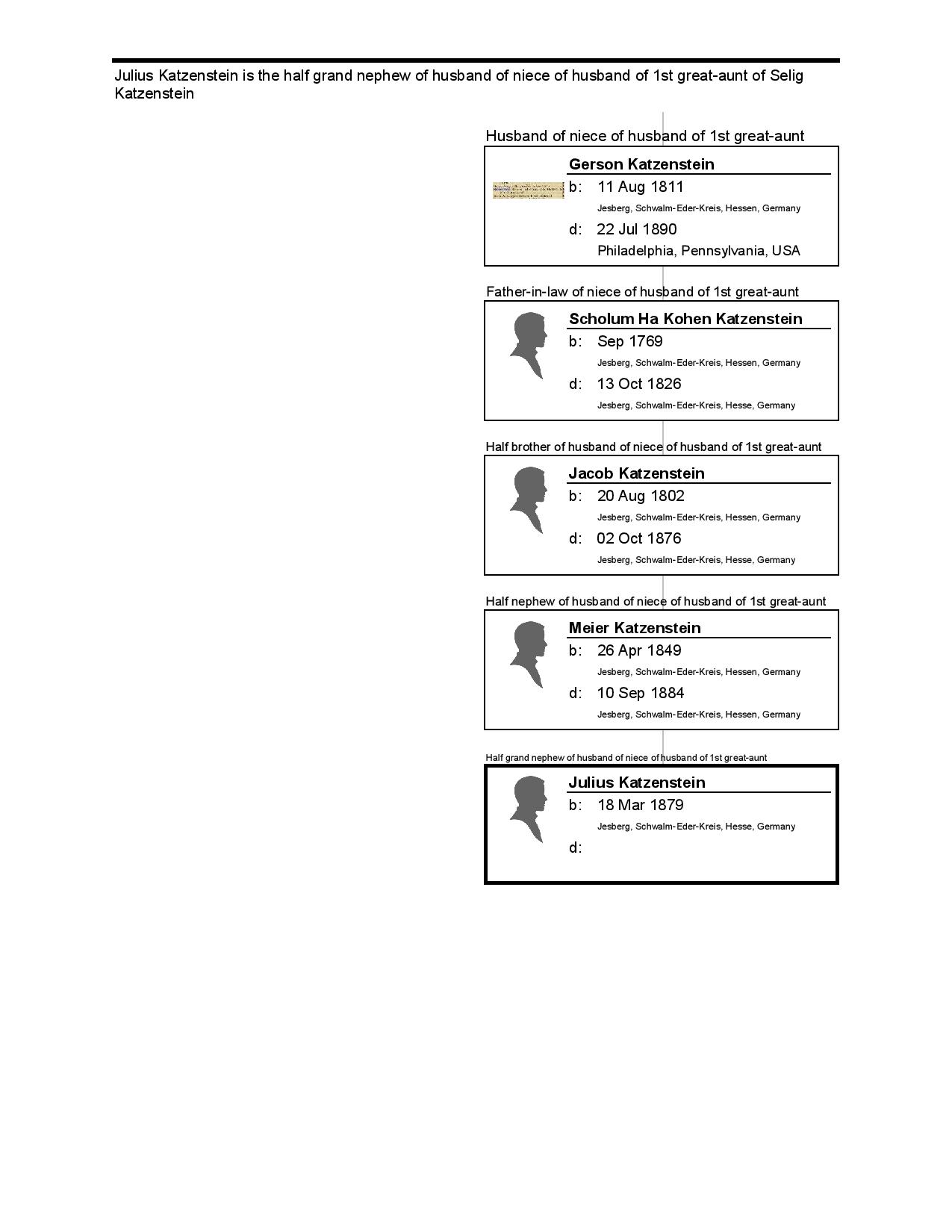
Meyer Goldschmidt was the brother of my three-times great-grandfather Seligmann Goldschmidt, whose daughter Eva Goldschmidt (my great-great-grandmother) married Gerson Katzenstein (my great-great-grandfather) of Jesberg. Gerson Katzenstein was the half-brother of Jacob Katzenstein, who was the grandfather of little Julius Katzenstein.

Now that is one crazy, twisted path from Julius to Selig Katzenstein, but given how small all these little towns were and the relatively small number of Jews living in each of those towns, maybe that was enough of a connection for Julius to end up living in Uslar with Selig. Maybe there is a slightly more direct path, but for now, that’s the best I can do.

Although I am glad I can now complete the story of Meier Katzenstein and his family, it has left me with a terribly empty feeling. They died so young: Meier, his two wives Auguste and Bertha, and two of his three children, Ida and Julius. The only child who managed to survive to adulthood was August, and he and his wife Rosa and their two children Margarete and Hans Jacob and their two grandchildren Klaus and Klara were all murdered by the Nazis.

There are thus no living descendants of Meier Katzenstein. I am glad to have knocked down this brick wall with the invaluable help of Aaron Knappstein and Richard Bloomfield, but I sure wish I had been able to find that somehow someone in this family line had survived.


A Brick Wall Tumbles: The Fates of August Felix Katzenstein and Julius Katzenstein, Orphaned Sons of Meier Katzenstein, Part I

Thanks to my friend Aaron Knappstein and my cousin Richard Bloomfield, an old brick wall has recently come down. Over seven years ago I wrote about the tragic story of Meier Katzenstein and his family. You can find all the sources, citations, and details here. But I will briefly outline their story.

Meier, my great-grandmother Hilda Katzenstein Schoenthal’s first cousin, lost his first wife Auguste Wolf in 1876, shortly after she gave birth to their son August Felix Katzenstein. Meier remarried and had two more children with his second wife Bertha Speier:  Julius Katzenstein, born in 1879, and Ida Katzenstein, born in 1880. Both Ida and her mother Bertha died in April 1881, less than a year after Ida’s birth. Meier was left with two young sons, August, who was five years old, and Julius, who was two.

And then Meier himself died three years later in 1884, leaving August and Julius orphaned at eight and five, respectively. I couldn’t imagine what had happened to those two little boys. Who took care of them? What happened to them? This post will follow up on August, and the one to follow will be about his half-brother Julius.

I had been able to find out some of what happened to August as an adult when I initially wrote about him over seven years. He had married his first cousin, once removed, Rosa Bachenheimer in Kirchain, Germany, in 1900 when he was twenty-four years old. August and Rosa had two children, Margarete and Hans-Peter. All four of them were killed by the Nazis during the Holocaust. I knew that much, but there were still some gaping holes in my research. Where had August lived after his father died? Did he have any grandchildren? If so, did they survive the Holocaust?

So I went back now to to double-check my research and see if I could find anything more about August Felix Katzenstein and his family. I am so glad I did.

First, I learned at Yad Vashem that August and Rosa’s daughter Margarete had married Rudolf Loewenstein and had had two children with him: Klaus, born March 16, 1930, in Soest, Germany, and Klara, born June 9, 1932, in Soest, Germany. Unfortunately, Rudolf, Margarete and their two young children were also killed along with their grandparents and uncle during the Holocaust.

Then I found this Stolpersteine biography of August Katzenstein on a website about the history of the community of Essen, revised in 2024 by Mr. and Mrs. Hülskemper-Niemannn. It provides in part, as translated by Google Translate:

August Katzenstein was orphaned at a very early age. He then lived for a long time in the household of the parents of his future wife Rosa Bachenheimer from Kirchhain, whom he married around the turn of the century. The couple had two children: Margarethe (1901, later Loewenstein) and Hans (1905). August Katzenstein moved with his family to Steele in 1908 and took up a position as a teacher in the one-class Jewish elementary school at Isinger Tor.

After 1933, the Katzensteins’ lives changed radically. In 1937, the Gestapo arrested the couple because they were allegedly managing the assets of a dissolved Jewish organization. After a search of their apartment and rigorous interrogation and warnings, the couple were released. Even worse happened to August Katzenstein, who taught at the Jewish elementary school in Essen on Sachsenstrasse after the Jewish elementary school in Steele was closed, during and after the November pogrom. The apartment on Grendtor (then Ruhrstrasse) was destroyed and looted, and he and his disabled son Hans were arrested. While the 62-year-old father was released from police prison after 11 days, Hans was taken to Dachau despite written requests from his parents, from where he was only released after four weeks.

In the autumn of 1941, the deportation of Jews began across the Reich, including in Essen. … Half a year later, Katzenstein and his entire family were deported to Izbica. 

So now I know who had taken care of August after his father died: Rosa’s parents Sussman Bachenheimer and his wife Esther Ruelf, my second cousin, twice removed. I wrote about them here. I also now know that August had become a teacher and lived in Steele, Germany, a suburb of Essen, Germany.

I found additional information about August and his family at Yad Vashem. The website has been updated since I had last researched August Katzenstein, and I found these documents I had not seen before from the Yizkor Book for the Jews of the Essen community who had been killed during the Holocaust. I asked my cousin Richard Bloomfield to translate these pages, and he graciously (and quickly!) agreed to do so.
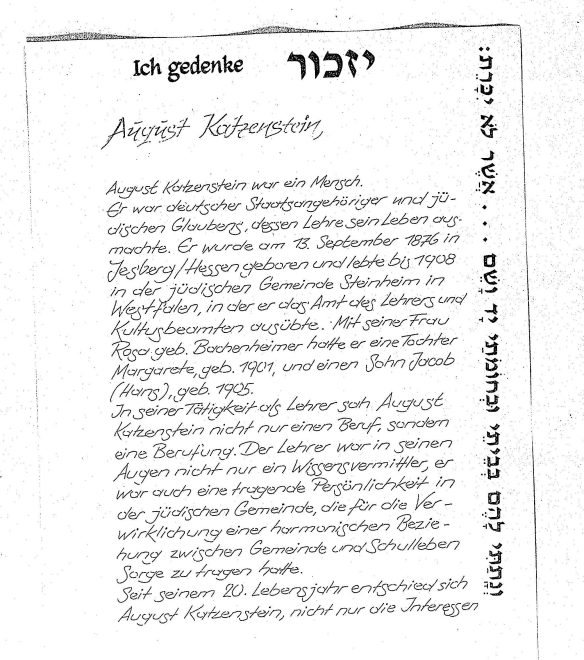
Richard’s translation provides:

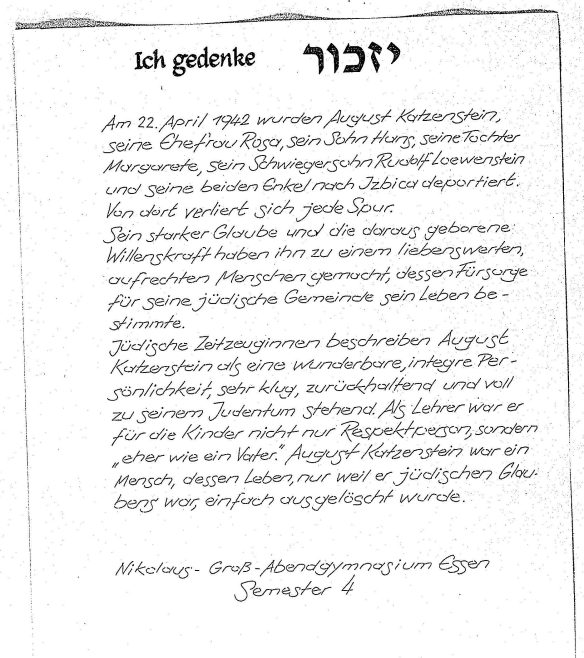
August Katzenstein was a Mensch.

He was a German citizen and of the Jewish faith, whose teachings shaped his life. He was born on September 13, 1876, in Jesberg/Hesse and lived in the Jewish community of Steinheim in Westphalia until 1908, where he held the office of teacher and religious official. With his wife Rosa, née Bachenheimer, he had a daughter Margarete, born in 1901, and a son Jacob (Hans), born in 1905.

August Katzenstein saw his work as a teacher not just as a profession, but as a vocation. In his eyes, the teacher was not only an imparter of knowledge, he was also a leading figure in the Jewish community who had to ensure a harmonious relationship between the community and school life.

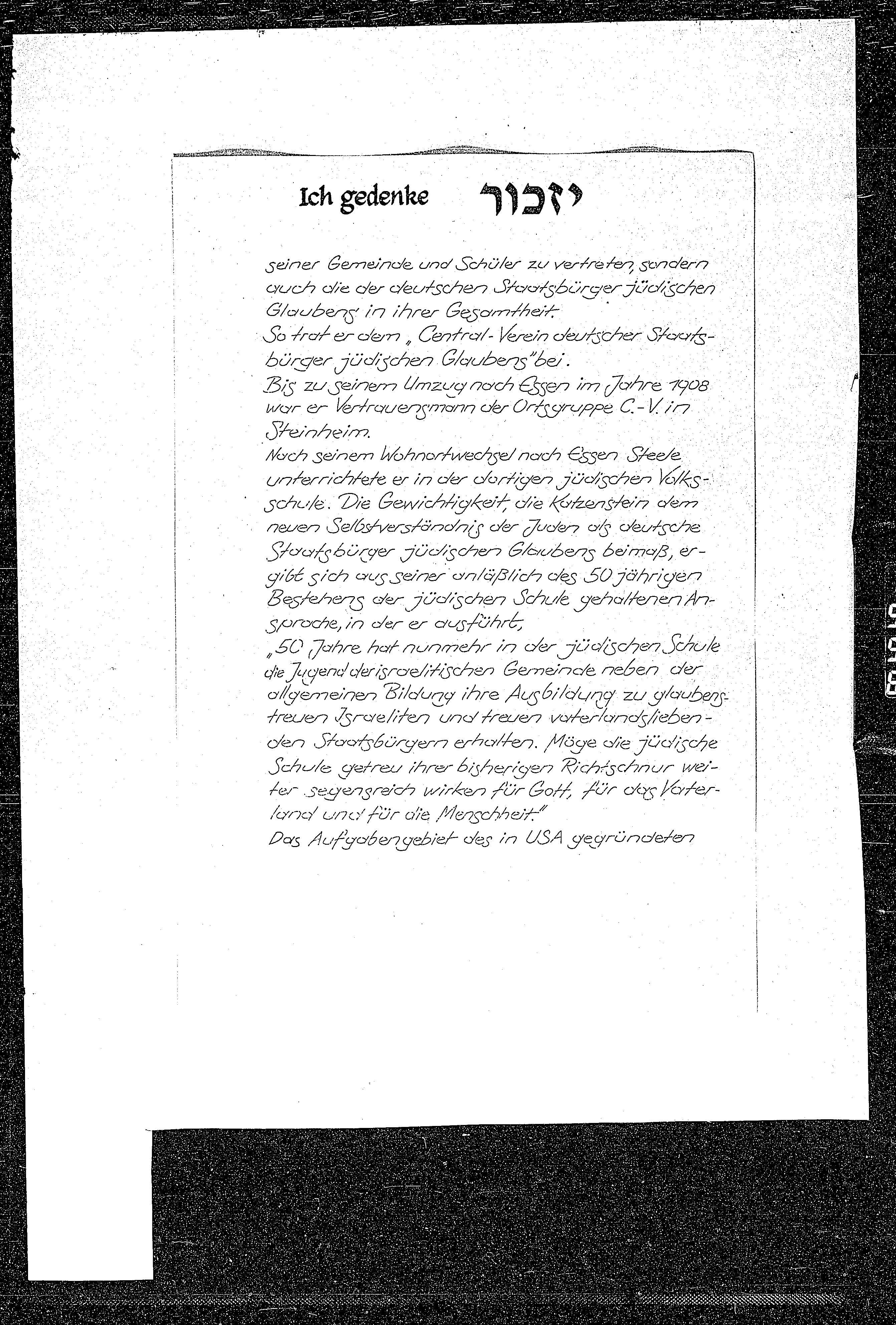
Beginning at the age of 20, August Katzenstein decided to represent not only the interests of his community and pupils, but also those of German citizens of the Jewish faith as a whole.

He joined the “Central Association of German Citizens of the Jewish Faith” “Central-Verein deutscher Staatsbürger jüdischen Glaubens”.

Until he moved to Essen in 1908, he was a representative of the C.-V. local group in Steinheim.

After moving to Essen Steele, he taught at the Jewish elementary school there. The importance that Katzenstein attached to the new self-image of Jews as German citizens of the Jewish faith can be seen in his speech on the occasion of the 50th anniversary of the Jewish school, in which he states,

“For 50 years now, the youth of the Jewish community has received their education in the Jewish school to become faithful Israelites and loyal citizens who love their fatherland, in addition to their general education. May the Jewish school continue to work beneficially for God, for the fatherland and for humanity, true to its guiding principles.”

The mission of the independent order “Bnai Brith” founded in the USA, spiritual self-education, the promotion of science and art, help for the persecuted and needy and the defense of Jewish citizens in the event of anti-Semitic attacks led August Katzenstein to join the Glück-Auf-Lodge of “Bnai Brith” in Essen in 1911 and of which he was president until April 1935.

Until his retirement in 1937, he also headed the Jewish relief organization in Essen-Steele. But despite his retirement, he did not neglect the members of the community whose employ he had left.

The ban and immediate dissolution of the “Bnai Brith” order by Himmler’s decree of April 10, 1937, resulted in August Katzenstein’s arrest on April 19, 1937, after his apartment and all the rooms of the Glück-Auf-Loge had already been searched two days earlier.

August Katzenstein then had to endure hours of interrogation under threat of state police measures. He was forced to sign a declaration that he had no further property belonging to the Glück-Auf-Lodge at his disposal and that he was not aware of where further material might be hidden, as documented in the Gestapo protocol of the same day.

During the so-called Reichskristallnacht on November 9, 1938, the Katzenstein family’s home at Ruhrstrasse 24 was also severely damaged. One day later, August Katzenstein and his disabled son were arrested again. They were held in the police prison in Essen until November 19, 1938. After his release, August Katzenstein wrote a letter to the Gestapo asking them to release his son, who had been sent to Dachau concentration camp. His son Jacob (Hans) then returned on December 21, 1938.

However, not only the care of his family, but also the suffering of the community entrusted to him had become his life’s purpose. Even the destruction of the school and synagogue as the center of the community during the November pogrom could not break August Katzenstein’s will to live in the Jewish faith.

In January 1939, August Katzenstein carried out his last community-related activity, officiating at the wedding of a young couple in the wife’s parental home.

On April 22, 1942, August Katzenstein, his wife Rosa, his son Hans, his daughter Margarete, his son-in-law Rudolf Loewenstein and his two grandchildren were deported to Izbica. No trace of them remains.

His strong faith and the willpower born of it made him a lovable, upright person whose care for his Jewish community defined his life.

Contemporary Jewish witnesses describe August Katzenstein as a wonderful person of integrity, very wise, reserved and fully committed to his Judaism. As a teacher, he was not only a person of respect for the children, but “more like a father.” August Katzenstein was a man whose life was simply snuffed out because he was Jewish.

Nikolaus-Gross, Abendgymnasium Essen, Semester 4

I wondered whether August’s “retirement” from teaching was voluntary or forced upon him by the Nazis, and although it’s still not clear, Richard also found this article about August’s retirement published on November 1, 1936, in the Jüdische Schulzeitung [Monthly journal for education, instruction and school policy; official publication of the Reich Association of Jewish Teachers’ Associations], (p.6):
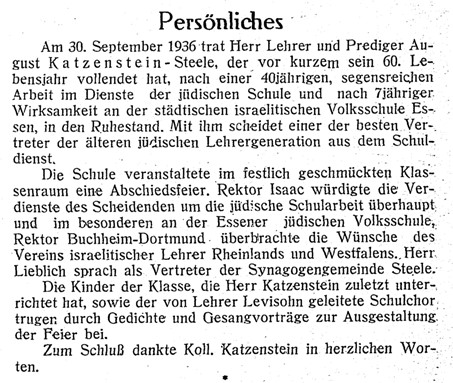
Richard translated the article for me:

On September 30, 1936, after 40 years of beneficial work in the service of Jewish schools and 7 years of work at the local Jewish elementary school in Essen, teacher and preacher August Katzenstein of Essen-Steele, who recently turned 60, retired. With him, one of the best representatives of the older Jewish generation of teachers leaves the teaching profession.

The school held a farewell party in the festively decorated classroom. Principal Isaac paid tribute to the departing teacher’s services to Jewish schools in general and to the Jewish Elementary School in Essen in particular. Principal Buchheim of Dortmund conveyed the wishes of the Association of Israelite Teachers of the Rhineland and Westphalia. Mr. Lieblich spoke as a representative of the Steele Synagogue community.

The children of the class that Mr. Katzenstein taught last, as well as the school choir led by teacher Levisohn, contributed to the ceremony with poems and songs.

Finally, colleague Katzenstein gave a heartfelt thank you.

Obviously, August was a well-loved, well-respected teacher and community leader. His early childhood was quite miserable—losing his mother, then his stepmother and half-sister, then his father—all before he was nine years old. But despite that tragic beginning, he lived a full and productive life, filled with meaning, faith, family, and love. How someone recovers from so much tragedy is amazing to me.

But then the Nazis came to power and destroyed August’s life and his family. I am so glad I went back to see if I could learn more about his life, and I am so grateful to Richard for his translation of the documents from the Essen Yizkor Book and for finding the article about August’s retirement. I found comfort in knowing that despite his tragic beginning and ending, August found fulfillment and meaning in his life.

But what about his younger brother Julius? I had known even less about him when I first researched this family. I couldn’t find anything that revealed what happened to him after his parents died. I couldn’t find a marriage record, a death record, a birth record for any children—-not one thing. Fortunately, he was not listed at Yad Vashem, so presumably had not shared the fate of his brother August. But where had he gone? Who had taken care of this little orphaned boy?

I will report on what I’ve learned about Julius in my next post.



Guest Post: My Cousin Miki Katzenstein’s Trip to Jesberg and Munich—Retrieving History and Honoring the Past

A few months ago I wrote about how I had connected with my cousin Miki Katzenstein Dror from Israel. Miki is a daughter of Aryeh Katzenstein, who was murdered in a terrorist attack in Munich, Germany, in 1970, when he was just 32 and Miki was a young child. Aryeh gave his life to save the lives of others, including the life of his father, Heinz Katzenstein. The city of Munich is now planning to install a memorial to Aryeh on the grounds where the attack occurred in collaboration with a corporation called BrainLab, which now owns the land where Aryeh was killed.

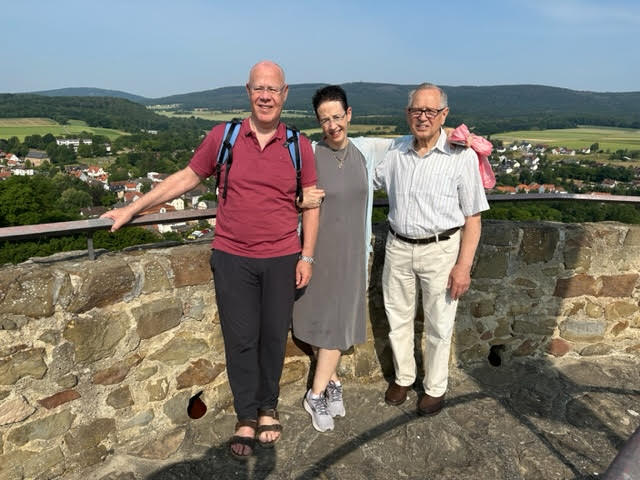
In preparation for this memorial, Miki and her brother Ofer and their spouses recently traveled to Germany to meet with the people there who are working on the memorial. In addition, Miki made a trip to Jesberg, the small village where our mutual Katzenstein ancestors once lived and where Miki’s grandfather Heinz Katzenstein lived until he left for Palestine in the 1930s. I asked Miki if she would share her thoughts on her visit to her grandfather’s childhood home in Jesberg and also on her trip to Munich, and she has graciously done so. All photos are also courtesy of Miki.

Miki wrote:

For many years I dreamed of traveling to Germany with my grandfather, Heinz Katzenstein, to see the districts of his childhood. I hadn’t heard much about his childhood in Germany, except for the simple facts he told me; he said that he was born in Kassel, immigrated to Palestine in 1933, and had managed to return to Germany in 1936 to take his parents and siblings to his new home. My grandfather often returned to Germany to go to Baden-Baden, but always refused to travel with me to the region where he grew up. I thought it was because it would have been hard for him to see again the home he ran away from so many years ago.

After my grandfather passed away, it became clear to me that although he always talked about Kassel, he actually was born and raised in the village of Jesberg, a really small village about a 40-minute drive from Kassel. Maybe it was easier for him to talk about a more well-known city. I became even more curious, and when the municipality of Munich invited us in June 2023 to preparatory meetings for the establishment of the memorial site for my late father, Aryeh Katzenstein, I decided to combine a roots trip to Jesberg with the meetings in Munich.

I started the preparations with the help of my cousin Amy Cohen, whose blog I found when I was looking for information about Jesberg online. Thanks to her, I met a lovely man named Heinz Hildebrandt, who volunteered to guide me in the village along with his wife Erika. I told him a little about our family, and he told me not to worry – he would already know what to show me. We set a date, and I waited anxiously. In the meantime, I had a lot of preparatory work for the meetings in Munich, and time was running out.

On June 16th my husband and I took off to Frankfurt; from there we went to Kassel and walked around the city for two days. On June 18, we met with the Hildebrandt family in Jesberg at 9 am, as prearranged. I will never forget the Jesberg welcome. Heinz and his wife Erica, Mrs. Regina Ochs, Herald England, Mayor Heiko Mans, and Pastor Reinhard Keller all accompanied us for the visit, and we ended up staying with them until six in the evening. Hans-Peter Klein and his friend Irina also came especially to meet us. It was one of the most exciting days of my life.

Miki and her husband with the mayor of Jesberg

Amy, my cousin, had given me a piece of advice: imagine the life your grandfather lived in the village while visiting there. This is what I did: we saw the tower overlooking the village and the surrounding agricultural area, we saw the well-kept village and all the Jewish houses that remained mostly in their original form, including the ancient synagogue that is now used as a residence. 

Overlooking Jesberg with Miki, her husband, and their guide Heinz Hildebrandt

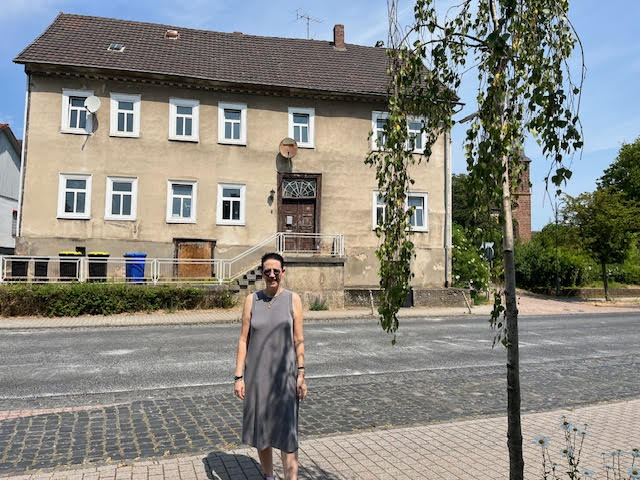
We even managed to enter the house where my grandfather was born and raised, thanks to the current owner, Michael Jung. It was very emotional for me; the house is in need of repairs and is about to be completely renovated. But I could easily see its beauty, size, and even glory. The ceiling is spectacular. In some ways the house reminded me of my grandfather’s home in Haifa, with all the wooden hand-crafted furniture.

Miki standing in front of the house where her grandfather lived in Jesberg

We said Kaddish at the well-preserved grave of Levi Katzenstein and Jeanette Bendheim, my grandfather’s grandparents, and we saw a gravestone for the victims of the First World War from which the name of our relative Max Katzenstein had been erased during the Nazi era; his name was returned to that memorial a few decades ago. A fascinating presentation was prepared for us that dealt with the history of the Jewish families in the village and in the region, especially the story of our Katzenstein family. It amazes me to think that if my grandfather could have remained in Jesberg undisturbed, my children would have been the 11th generation in the village.

The grave of Levy Katzenstein, Miki’s great-great-grandfather

World War I memorial in Jesberg where you can see that Max Katzenstein’s name was removed and then later restored

My grandfather loved Germany all his life and missed it endlessly. There wasn’t a year he didn’t go there. It also became clear to me from records Mrs. Ochs shared that a year before his death he even came to Jesberg, but without me.

The second part of this busy week was no less emotionally difficult. We went to Munich for three days where we met my brother and sister-in-law who came from Israel and were hosted by the people of the municipality, whom we were very happy to meet after about three years of seeing them only on the small screens of Zoom in our conference calls. The program was very busy, and the terrible heat and the fact that there was no air conditioning made it very difficult. The truth is that even there we were shocked by the welcome we received.

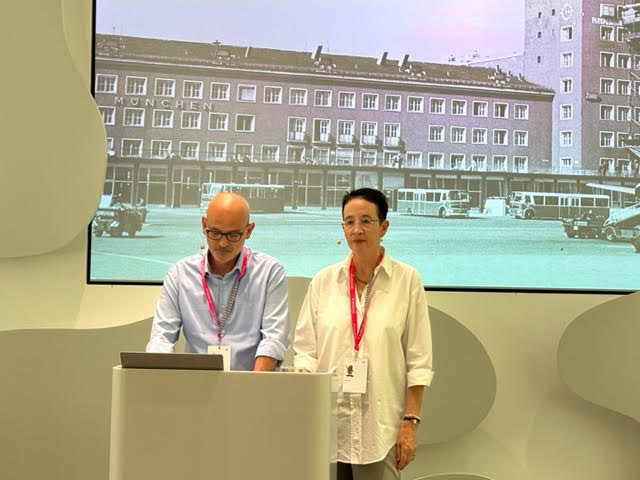
The project to commemorate my father, which started from a humble initiative of family friends, Michael Weidenhiller and Werner Haberkorn, has developed into a huge project that combines our family, the municipality of Munich, and the high-tech company BrainLab. We were invited to lunch with the mayor of Munich, with the head of the Jewish community in Munich, and with the Israeli consulate there. We visited BrainLab’s amazing offices and met with the CEO, Stefan Fieldsmeier, his employees, and the artist chosen to create the artwork that will be erected on the site. We participated in a press conference where the launch of the project was announced, and millions of German residents were exposed to it.

Miki at the press conference in Munich

The site where the memorial to Aryeh Katzenstein will be installed

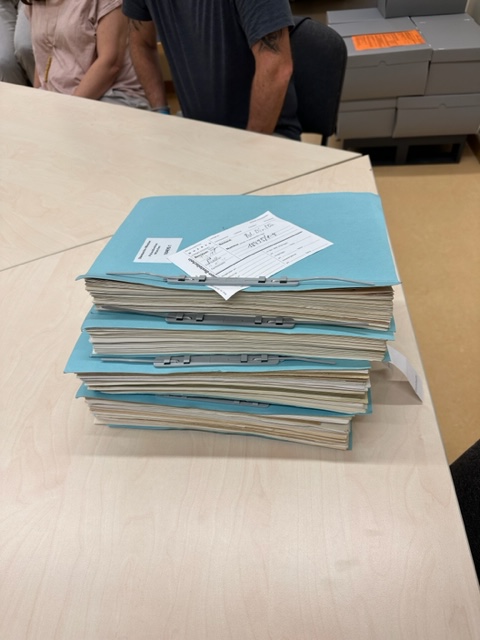
The highlight for me and my brother was the visit that was organized for us at the municipal archives, where we were exposed for the first time to four huge files of evidence that were prepared for the trial of the three terrorists who murdered my late father. Those files were never used because the terrorists were released without a trial three months later when a Pan Am jet was hijacked and the German government agreed to release those three terrorists in exchange for the safe release of the three hundred passengers on that plane.

The files from the Munich Archives about the 1970 terrorist attack

[For more on this exchange and its historical significance, here is one writer’s views.]

Our faithful translator translated for us from German into Hebrew the testimonies of my grandfather, who was interrogated right after the terrorist incident while he was injured in the hospital, of Hana Maron, the Israeli actress who was seriously injured in the attack, of Uri Cohen, the heroic captain who fought the terrorists with his bare hands, and the bus driver who drove the passengers from the terminal to the plane.

The pictures were very difficult to see but important. We saw drawings of the terminal and timeline of the chain of events. We read what they found with my father after his death: coins, a horseshoe-shaped gold necklace that I really remember as a child, a list my mother sent with him of things to buy in Germany including Pantene diaper cream and decorations for a Purim party they were planning to throw for their friends, and a picture of us – his three children.

We left with tears in our eyes and a heavy heart. On the other hand, we now know much more than we knew before the visit, we met lovely people who tried to help with infinite sensitivity, and we are waiting for the launch of the memorial website, which will be in 2024.


Thank you, Miki, for sharing this with me and my readers. We will always remember the story of your father and the lessons we all must learn about the destructive consequences of hatred in all forms.


Arye Katzenstein

I have researched and written about hundreds of relatives (maybe thousands?) over the almost ten years that I’ve been writing this blog. And aside from my own direct ancestors, of those many, many cousins and great-aunts and great-uncles going back over two hundred years, there are only a small number whose stories are so compelling and unforgettable that when I see their name, I immediately remember the details of their lives.

One of those cousins is my fourth cousin Arye Katzenstein, whose heroic story I wrote about here. During a terrorist attack at the Munich Airport on February 10, 1970, Arye threw himself on a grenade released by the Palestinian terrorists and sacrificed his own life so that he could save the life of his father, Heinz Katzenstein, and the lives of all the other travelers. He was only 32 years old.

So when I received a comment on my blog from a woman named Miki saying her father was Arye Katzenstein, I gasped. I’d had no idea that Arye had had children when he was killed. I immediately wrote to Miki and learned that after more than fifty years, the city of Munich is finally providing a memorial for Arye on the grounds where the attack occurred. The land is now owned by a private company, BrainLab, and together with that company, the city, and the family of Arye Katzenstein, a proper memorial is being established. BrainLab has commissioned an art work by Alicia Kwade, an internationally known artist, and the family is creating a website and informational materials for the site, which will be dedicated sometime in 2024.

From Miki, I learned a great deal more about her father and his family and his life. As I already knew, Arye was born in Haifa (then Palestine, now Israel) on November 23, 1937, after his parents fled from Nazi Germany. But I learned from Miki that he had spent time in Germany as a student. In 1959 he came to Munich to study veterinary medicine, but later returned to study engineering. He had married his wife Bilha on October 22, 1961, and their first child, my cousin Miki, was born in Munich a few years later. The family returned to Israel before the 1967 war and had two more children there, a son and another daughter.

Thus, Arye left behind not only his parents and siblings, but also his wife and three very young children. It’s hard to imagine the pain and suffering that his death must have caused his loved ones. But his legacy is one of heroism and courage.

Miki shared with me several photographs of her family. First is a photograph of her father Arye as a young man traveling in Europe.

Arye Katzenstein Courtesy of his family

This is a photograph taken at Arye and Bilha’s wedding. Bilha is third from our left, then Arye next to her. Next to Arye are his parents Mania (Miriam) Dorf and Heinz Katzenstein.

Wedding of Arye Katzenstein Courtesy of the family

This chilling photograph is of Arye’s notebook taken after the terrorist attack that killed him. It was returned to the family by El Al after Arye’s death.

Arye Katzenstein notebook returned to family by El Al Courtesy of the family

This photograph was taken on the 53rd yahrzeit (anniversary) of Arye’s death in 2023, just a month ago. Arye’s gravestone reads: “Here lies our dear, noble spirited Arye Katzenstein, son of Miriam and Jacob Hacohen, who sacrificed his live during the attack on El Al passengers.”

Gravestone of Arye Katzenstein Courtesy of the family

The stones for Miki’s grandparents appear below:

Gravestones of Heinz and Miriam Katzenstein Courtesy of the family

Finally, Miki shared with me this photograph of her family—her husband, her children, and herself. I don’t usually include photographs of living people, but in this case I do so to honor the memory of Arye Katzenstein and to recognize the resilience of his family and the hope for a better future where all of us can live in peace and without fear of terrorism.

Miki Katzenstein Dror and family Courtesy of the family


Who Was That Baby? A Question Answered!

You never know when you publish a blog post asking a question when, if ever, that question will be answered. And I’ve learned never to give up hope. Just recently I learned the answer to a question I posed over four years ago on this post about Jake Katz, the Oklahoma cousin who started the Katz Department Stores in Stillwater, Oklahoma, and who eventually helped to rescue several of his cousins who were still living in Germany during the Nazi era.

Included in that post was a photograph of the three children Jake had with his wife Sophia Salzenstein: Albert Jerome, Margaret, and Helen.

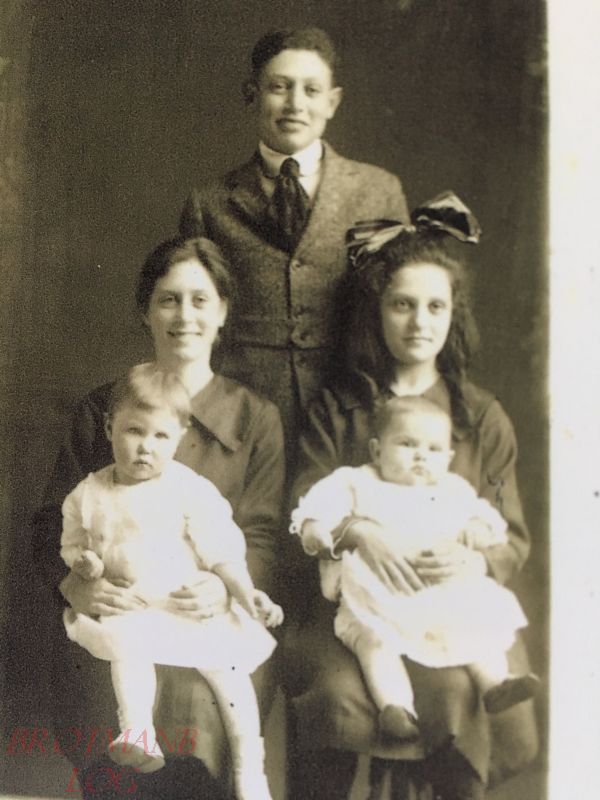
Albert Jerome Katz in rear, Helen Katz and Margaret “Babe” Katz seated with unknown cousin on laps
Courtesy of the Goldman family

Under that photograph I posed this question:

Perhaps some Katz family member can identify the two unknown little cousins? Since we know Albert Jerome died in 1919, I am assuming this photo was taken in about 1918, meaning the two young children were likely born in 1916-1917. I am thinking one might be the daughter of Lester Katz and Mayme Salzenstein, Mildred “Bobbie,” since she was born in January 1916 and was related to Jake and Sophia on both sides, Lester being Jake’s cousin and Mayme being Sophia’s sister.

I didn’t get any answers when I published this post, but on September 19, 2021, I received this comment on that blog post from a reader named Jerry Richards:

Hi Amy, I have the same picture you do of Helen, Margaret and Jerome Katz. The two babies are, as you guessed, on the left Mildred Henderson nee Katz, born 1916, two years old. The baby on the right is Peggy (Mary Carolyn) Richards nee Salzenstein, born 8/6/1917. She is my mother.

I emailed Jerry and learned that his grandfather Solomon Wolf Salzenstein was the brother of Sophia Salzenstein, Jake Katz’s wife. Thus, Jerry is the grandnephew of Sophia and grandnephew-in-law of Jake.

And now I can correct the caption under the photograph:

Albert Jerome Katz in rear, Helen Katz and Margaret “Babe” Katz seated, left to right. Mildred Katz Henderson and Peggy (Mary Carolyn) Salzenstein Richards sitting on their cousins’ laps, left to right.
Courtesy of the Goldman family

Another reminder that you never know when a question you never thought would be answered will in fact be answered! Thank you, Jerry!

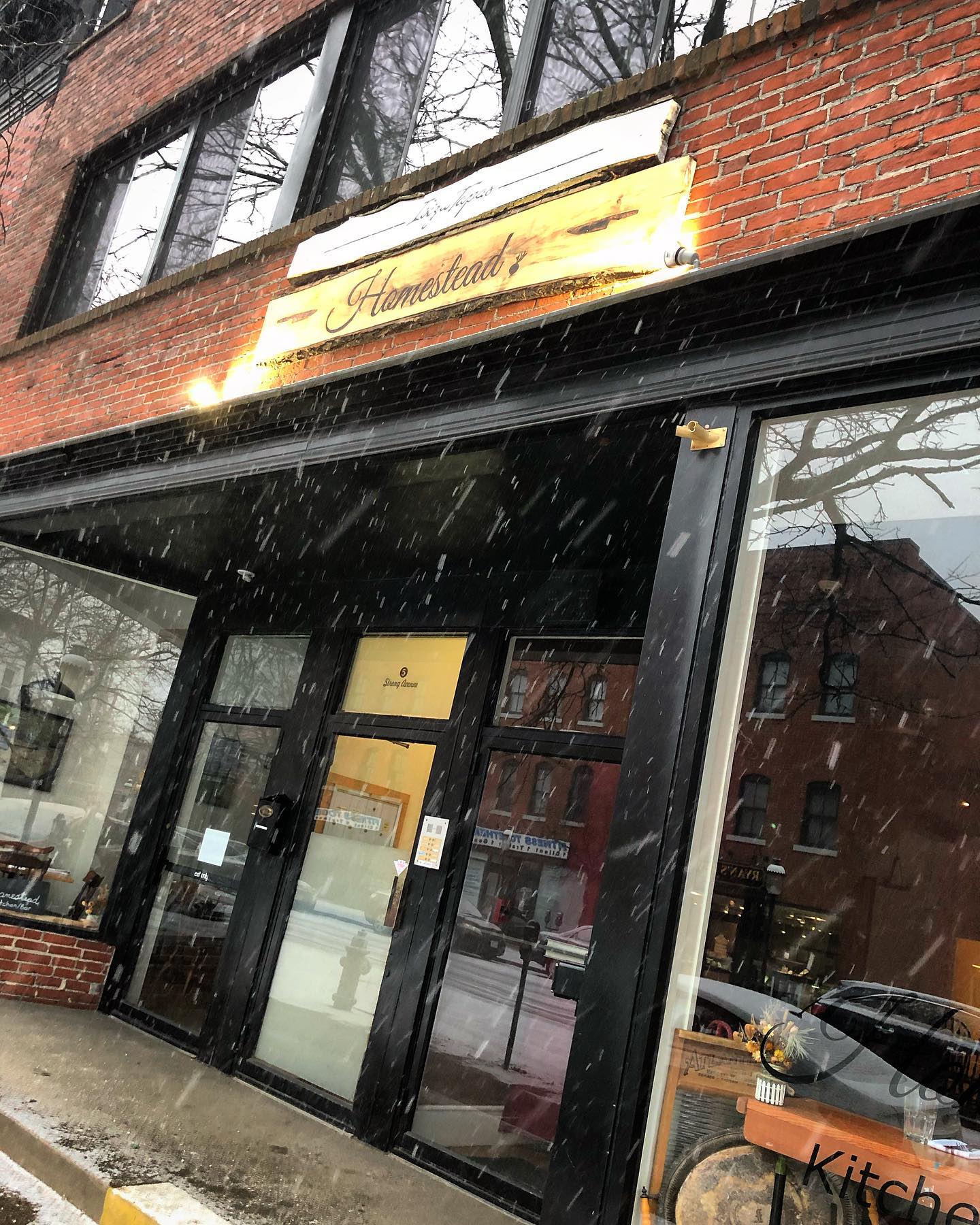
The Homestead Restaurant in Northampton: Another Small World Story

Once again the genealogy gods are playing with my mind and convincing me that I must somehow be related to everyone I know.

This past weekend I was texting my friend Marlene to make plans to get together for dinner. We were going back and forth, trying to find a restaurant that has outdoor seating and that will take a reservation. Then Marlene texted, “I have a cousin who owns a restaurant in Northampton. I’ve never been there though.”

I texted back, “That’s funny. I have a cousin who owns a restaurant in Northampton, but I’ve never been there or met him.” I couldn’t remember his name or the name of his restaurant at that moment, so I went to my Ancestry app, knowing that he was a nephew of my cousin Roger. Roger and his husband David have been tremendously helpful to me in my genealogy research, as readers of my blog know. Roger is my third cousin, once removed, on my Katzenstein-Goldschmidt line. We are both descended from Gerson Katzenstein and Eva Goldschmidt.

After checking my tree and finding the right name and the name of his restaurant, I texted Marlene, “My cousin is Jeremy Werther. He owns the Homestead restaurant.”

Much to my amazement, she responded, “He’s my cousin also!”

It seems Jeremy is Marlene’s second cousin, once removed, on his father’s side, and he is my third cousin, twice removed, on his mother’s side. We were just blown away. I’ve known Marlene and her husband Jim since 1982, and certainly as far as we knew, we had no relatives in common. How could it be that after almost forty years we had just discovered that she was the second cousin of the father of my third cousin, twice removed? We both just had to laugh and marvel at what a small world it is.

And, of course, that sealed the deal—we were going to Jeremy’s restaurant for dinner. We made a reservation at The Homestead, and I prepared various family tree charts to share with Marlene and with Jeremy.

It was a fabulous meal. Everything was so fresh and beautifully prepared and presented. We had two different salads, a roasted carrot dish, a bluefish dish, and two pasta dishes among the four of us. We shared most of the dishes as they are served as small plates to be shared, and it made for a very relaxed and enjoyable meal—each dish better than the last. And the service was stellar—friendly, efficient, and attentive without being intrusive.

Although I forgot to take photos of our meal, Jeremy gave me permission to include a few photos from their Facebook page. This is just a small sample of Jeremy’s artistry.

No photo description available.

But the best part was meeting Jeremy, who seemed amazed by the fact that two of his cousins had shown up at his restaurant without any warning—two women he’d never met before.  He sat with us as we explained all the connections and shared the charts with him.  He was as gracious as one could imagine—all of us sharing in the crazy joy that comes with discovering the magic of family history.

Restaurant —Homestead

My cousin Jeremy, chef and owner of the Homestead

Outside dining at the Homestead

If you live in the Pioneer Valley, or even if you don’t, be sure to visit The Homestead at 7 Strong Avenue in Northampton, Massachusetts. You won’t be disappointed.


Meier Katzenstein: The One Who Left Home

Having discussed the three daughters of Amalie Goldschmidt and Juda Katzenstein—Helene, Fredericke, and Henriette—and their families, we now finally reach their last child and only son, Meier Katzenstein.1  And his story is far different from that of his sisters, all of whom lived almost all their lives in Germany, not far from where they were born in Eschwege, and whose descendants either were killed by or escaped from the Nazis.

Meier was born on August 6, 1860, in Eschwege, as we have seen, but in 1888 he immigrated to the United States, changing the path of his life as well as that of his descendants. According to his passport application (depicted below), he arrived in New York on October 10, 1888, and settled there.

Meier Katzenstein, 1903 passport application, National Archives and Records Administration (NARA); Washington D.C.; Roll #: 623; Volume #: Roll 623 – 13 May 1903-18 May 1903
Ancestry.com. U.S. Passport Applications, 1795-1925

I love the physical description of Meier on his application: five foot seven inches tall, high forehead, light blue eyes, straight nose, small mouth, round chin, blond hair, florid complexion, and a round face. He sounds quite adorable.

Meier married Emma Bacharach in New York on October 27, 1891.2 Emma, the daughter of Jakob Bacharach and Sophia Pfann, was also a recent immigrant. She was born in Mainz, Germany, on July 5, 1869,3 and came to the US on November 5, 1889, accompanied by someone named Isaac Bachrach who was 48 years old. I’ve not been able to identify Isaac’s connection to Emma, but presumably he was an uncle or cousin.4
Emma and Meier had one child, a daughter Sophia (presumably named for Emma’s mother Sophia Pfann), born on August 19, 1892, in New York.5 Emma must have taken little Sophia back to Germany during her first year to meet her family because I found a ship manifest showing them sailing together from Hamburg to New York in the summer of 1893.

Sophia and Emma Katzenstein, ship manifest, Staatsarchiv Hamburg; Hamburg, Deutschland; Hamburger Passagierlisten; Volume: 373-7 I, VIII A 1 Band 085; Page: 958; Microfilm No.: K_1750, Month: Direkt Band 085 (1 Jul 1893 – 31 Aug 1893), Staatsarchiv Hamburg. Hamburg Passenger Lists, 1850-1934

Meier became a naturalized citizen of the United States on May 4, 1894.

“New York Naturalization Index (Soundex), 1792-1906,” database with images, FamilySearch (https://familysearch.org/ark:/61903/3:1:3QSQ-G937-NSGK-M?cc=2043782&wc=SFCB-HZ9%3A1399296801 : 4 February 2015), Roll 128, K324-K400 (Kutzelmann, Adam J-Klee, Johannes) > image 348 of 5224; citing NARA microfilm publication M1674 (Washington, D.C.: National Archives and Records Administration, n.d.).

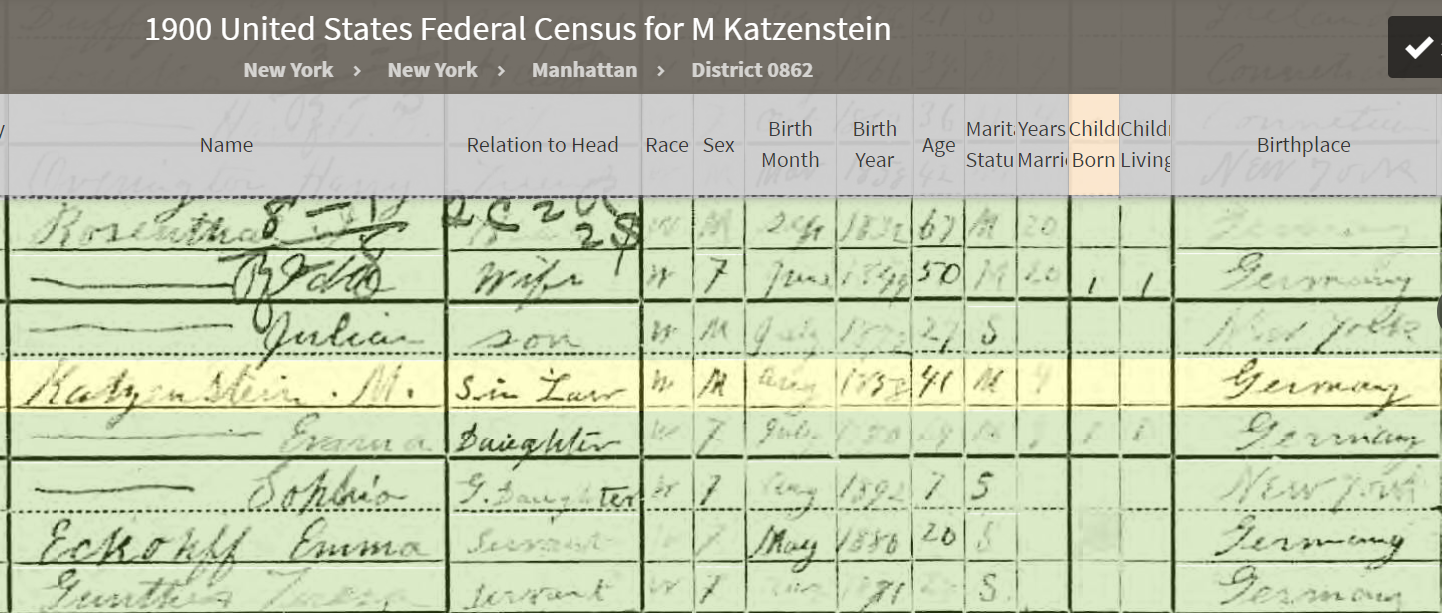
In 1900, Meier, Emma, and Sophia were living in New York City with another family. The head of household was Rosenthal (first name not legible); living with him was his wife Ida Rosenthal and their son Julian Rosenthal, two servants, and Meier, Emma, and Sophia.

Meier Katzenstein, 1900 US census, Year: 1900; Census Place: Manhattan, New York, New York; Page: 7; Enumeration District: 0862; FHL microfilm: 1241119, Enumeration District: 0862; Description: City of New York, 31st Assembly Dist; 22nd Election District (pt) bounded by E 129th, Park Ave, E 126th, Madison Ave, Ancestry.com. 1900 United States Federal Census

I was thrown off by this census record because it identifies Emma as the daughter, Sophia as the granddaughter, and Meier as the son-in-law of the head of household.  If Emma’s birth name was Bacharach and her parents were Jakob and Sophia, how could she be the daughter of Ida Rosenthal and her husband? It took a couple of hours to sort out that Ida Rosenthal was born Ida Pfann and was the sister of Sophia Pfann, Emma’s mother. Thus, Emma was Ida Rosenthal’s niece, not her daughter.

Meier’s occupation on the 1900 census is extremely hard to read as it is very faint, but I think I can discern the word “Sales” and perhaps “Linens,” the same occupation listed above for Emma’s cousin Julian Rosenthal. His passport application in 1903, depicted above, is more specific. He listed his occupation there as “manufacturer and importer of embroideries.”

By 1910, Meier and his wife and daughter had their own home in Manhattan, and Meier’s occupation this time is easily read as Manager, Fancy Linens. They also had a servant living with them.

Meier Katzenstein, 1910 US census, Year: 1910; Census Place: Manhattan Ward 12, New York, New York; Roll: T624_1024; Page: 3A; Enumeration District: 0622; FHL microfilm: 1375037
Ancestry.com. 1910 United States Federal Census

The family did some traveling in 1911—to Hong Kong and to Hawaii. Meier must have been doing well in his business, having a servant and traveling to exotic locations.6

His daughter and only child Sophia Katzenstein married Elias Lustig on February 19, 1914, in New York.7 Like Sophia, Elias was a native of New York City, born there on May 31, 1890, and the son of David and Rachel Lustig.8 Elias and Sophia’s first child David Miles Lustig was born on August 22, 1916, in New York.9

Unfortunately, Meier Katzenstein did not live to see the birth of his grandson; on February 20, 1916, at the age of 55, he died in New York City, just six months before his grandson’s birth. My guess is that his grandson’s middle name Miles was in Meier’s memory.10

In his will, Meier left everything to his wife Emma and then to his daughter Sophia in the event Emma did not survive him. Interestingly, he provided that in the event that Emma predeceased him and Sophia was still a minor, his “brother-in-law Max Werner of Eschwege” was to be her guardian. Max was married to Meier’s older sister Helene Katzenstein Werner. But why would Meier have appointed someone living in Germany to be the guardian of his daughter in New York? Imagine how Sophia’s life would have been different if in fact her parents had both died before she reached adulthood and she had moved to Germany?

Meier Katzenstein’s will, Record of Wills, 1665-1916; Index to Wills, 1662-1923 (New York County); Author: New York. Surrogate’s Court (New York County); Probate Place: New York, New York, Notes: Wills, 1021-1023, 1915-1916, Ancestry.com. New York, Wills and Probate Records, 1659-1999

Of course, it all was irrelevant since Emma did not predecease Meier, and Sophia was already an adult when Meier died. In 1920, Emma was living with Sophia and Elias and their son David Miles (listed here as Miles) in New York City. Elias was working as a merchant. 11 In 1921, Sophia and Elias had a second child.

I could not find Emma on the 1930 or 1940 census, but in 1930 Sophia and Elias were living in Queens in 1930 with their children, and Elias was the owner of a hat factory.12 Sometime thereafter, the marriage between Sophia and Elias ended, and in 1936 she married Saul Baron, with whom she and her children were living in New York in 1940. Saul was an attorney in private practice.13

Emma Bacharach Katzenstein died on February 18, 1941, in New York; she was 71.14

Meier Katzenstein’s choice to leave Germany for the United States back in 1888 spared his family the tragedies endured by so many of his relatives back in Europe during the Holocaust, but in one way the actions of Hitler still indirectly inflicted tragedy on his descendants. His grandson David Miles Lustig, named in his memory, was killed during World War II. While returning from a mission over China in early 1945, his plane was shot down, and David drowned in a small river after bailing out of the plane. He was 28 years old and a graduate of Princeton University.15

His mother Sophia Katzenstein Lustig Baron died just nine years later at the age of 58 on November 9, 1950.16  She was survived by her husband Saul Baron, her daughter and grandchild.


Having now covered all the children of Amalie Goldschmidt Katzenstein, I have a few updates to other relatives to write about before turning to Amalie’s younger brothers, Selig and Falk Goldschmidt, the last two children of my 4x-great-uncle, Meyer Goldschmidt.


  1. The spellings of his name vary on different documents between Meyer and Meier,  but I’ve opted to use Meier. 
  2. “New York, New York City Marriage Records, 1829-1940,” database, FamilySearch (https://familysearch.org/ark:/61903/1:1:24HL-R32 : 10 February 2018), Meier Katzenstein and Emma Bacharach, 27 Oct 1891; citing Marriage, Manhattan, New York, New York, United States, New York City Municipal Archives, New York; FHL microfilm 1,452,198. 
  3. Emma Bacharach birth record, Stadtarchiv Mainz; Mainz, Deutschland; Zivilstandsregister, 1798-1875; Signatur: 50 / 72, Year Range: 1869, Ancestry.com. Mainz, Germany, Births, Marriages and Deaths, 1798-1875 
  4. Emma Bacharach, passenger manifest, Year: 1889; Arrival: New York, New York, USA; Microfilm Serial: M237, 1820-1897; Line: 15; List Number: 1524, Ancestry.com. New York, Passenger and Crew Lists (including Castle Garden and Ellis Island), 1820-1957 
  5. New York, New York City Births, 1846-1909,” database, FamilySearch (https://familysearch.org/ark:/61903/1:1:2W9D-B77 : 11 February 2018), Sophia Katzenstein, 19 Aug 1892; citing Manhattan, New York, New York, United States, reference cn 32010 New York Municipal Archives, New York; FHL microfilm 1,322,266. 
  6.  National Archives and Records Administration (NARA); Washington, D.C.; Passenger Lists of Vessels Arriving at Honolulu, Hawaii, compiled 02/13/1900 – 12/30/1953; National Archives Microfilm Publication: A3422; Roll: 031; Record Group Title: Records of the Immigration and Naturalization Service, 1787 – 2004; Record Group Number: RG 85, Ancestry.com. Honolulu, Hawaii, Passenger and Crew Lists, 1900-1959. 
  7.  Sophie Katzenstein, Gender: Female, Marriage License Date: 9 Feb 1914, Marriage License Place: Manhattan, New York City, New York, USA, Spouse: Elias Lustig, License Number: 4135, New York City Municipal Archives; New York, New York; Borough: Manhattan, Ancestry.com. New York, New York, Marriage License Indexes, 1907-2018; Sophie Katzenstein, Gender: Female, Marriage Date: 19 Feb 1914, Marriage Place: Manhattan, New York, USA, Spouse: Elias S Lustig, Certificate Number: 5033, Ancestry.com. New York, New York, Extracted Marriage Index, 1866-1937 
  8.  Elias Lustig, Marital status: Married, Birth Date: 31 May 1890, Birth Place: New York, USA, Street Address: 601 W 162, Residence Place: Manhattan, New York, New York, USA, Registration State: New York; Registration County: New York; Roll: 1786806; Draft Board: 147, Ancestry.com. U.S., World War I Draft Registration Cards, 1917-1918 
  9. David Miles Lustig, Birth Date: 22 Aug 1916, Birth Place: New York City, New York
    Registration Date: 16 Oct 1940, Registration Place: New York City, New York, New York
    Next of Kin: Elias Lustig, Ancestry.com. U.S., World War II Draft Cards Young Men, 1940-1947 
  10. Meier Katzenstein, Age: 57, Birth Year: abt 1859, Death Date: 20 Feb 1916
    Death Place: Manhattan, New York, USA, Certificate Number: 5960, Ancestry.com. New York, New York, Extracted Death Index, 1862-1948 
  11. Elias Lustig and family, 1920 US census, Year: 1920; Census Place: Manhattan Assembly District 23, New York, New York; Roll: T625_1226; Page: 41B; Enumeration District: 1489, Enumeration District: 1489; Ancestry.com. 1920 United States Federal Census 
  12. Elias Lustig and family, 1930 US census, Year: 1930; Census Place: Queens, Queens, New York; Page: 5B; Enumeration District: 0296; FHL microfilm: 2341330,
    Ancestry.com. 1930 United States Federal Census 
  13.  Sophie K Lustig, Gender: Female, Marriage License Date: 22 May 1936, Marriage License Place: Manhattan, New York City, New York, USA, Spouse: Saul J Baron
    License Number: 10611, New York City Municipal Archives; New York, New York; Borough: Manhattan; Volume Number: 5, Ancestry.com. New York, New York, Marriage License Indexes, 1907-2018. Saul Baron and family, 1940 US census, Year: 1940; Census Place: New York, New York, New York; Roll: m-t0627-02656; Page: 5B; Enumeration District: 31-1351, Ancestry.com. 1940 United States Federal Census 
  14.  New York City Department of Records & Information Services; New York City, New York; New York City Death Certificates; Borough: Manhattan; Year: 1941, Ancestry.com. New York, New York, Index to Death Certificates, 1862-1948 
  15. David Miles Lustig obituary, Daily News, New York, New York
    07 Mar 1945, Wed • Page 352 
  16. Sophie Baron, Age: 58, Birth Date: abt 1892, Death Date: 9 Nov 1950
    Death Place: Manhattan, New York, New York, USA, Certificate Number: 23658
    Ancestry.com. New York, New York, Death Index, 1949-1965 

Henriette Katzenstein Schnadig, Part I: Two Dutch Sons-in-Law

The third surviving daughter of Amalie Goldschmidt and Juda Katzenstein was Henriette. As we saw, she was born on February 13, 1858, in Eschwege, and married Simon Schnadig on August 20, 1877, in Eschwege. Henriette and Simon had four children—Julius, Helene, Betty, and Elsa—-but only three survived to adulthood.

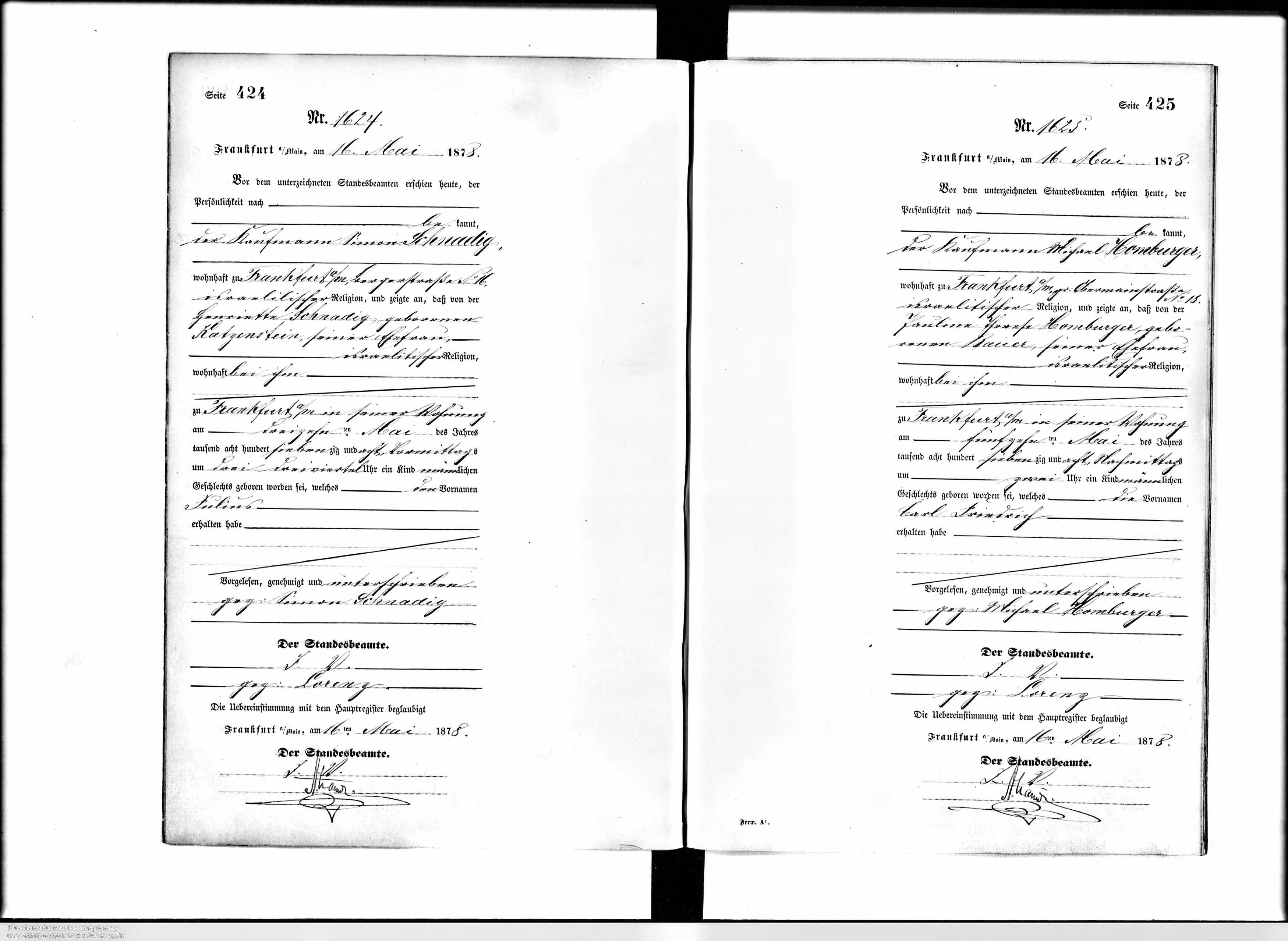
Their son Julius only lived two years. He was born on May 13, 1878, in Frankfurt, where Henriette and Simon were then living, and died in Frankfurt on August 13, 1880.

Julius Schnadig birth record, Hessisches Hauptstaatsarchiv; Wiesbaden, Deutschland; Bestand: 903; Signatur: 903_8917, Year Range: 1878, Ancestry.com. Hesse, Germany, Births, 1851-1901

Julius Schnadig death record, Certificate Number: 1961
Personenstandsregister Sterberegister; Bestand: 903; Signatur: 10336
Ancestry.com. Hesse, Germany, Deaths, 1851-1958

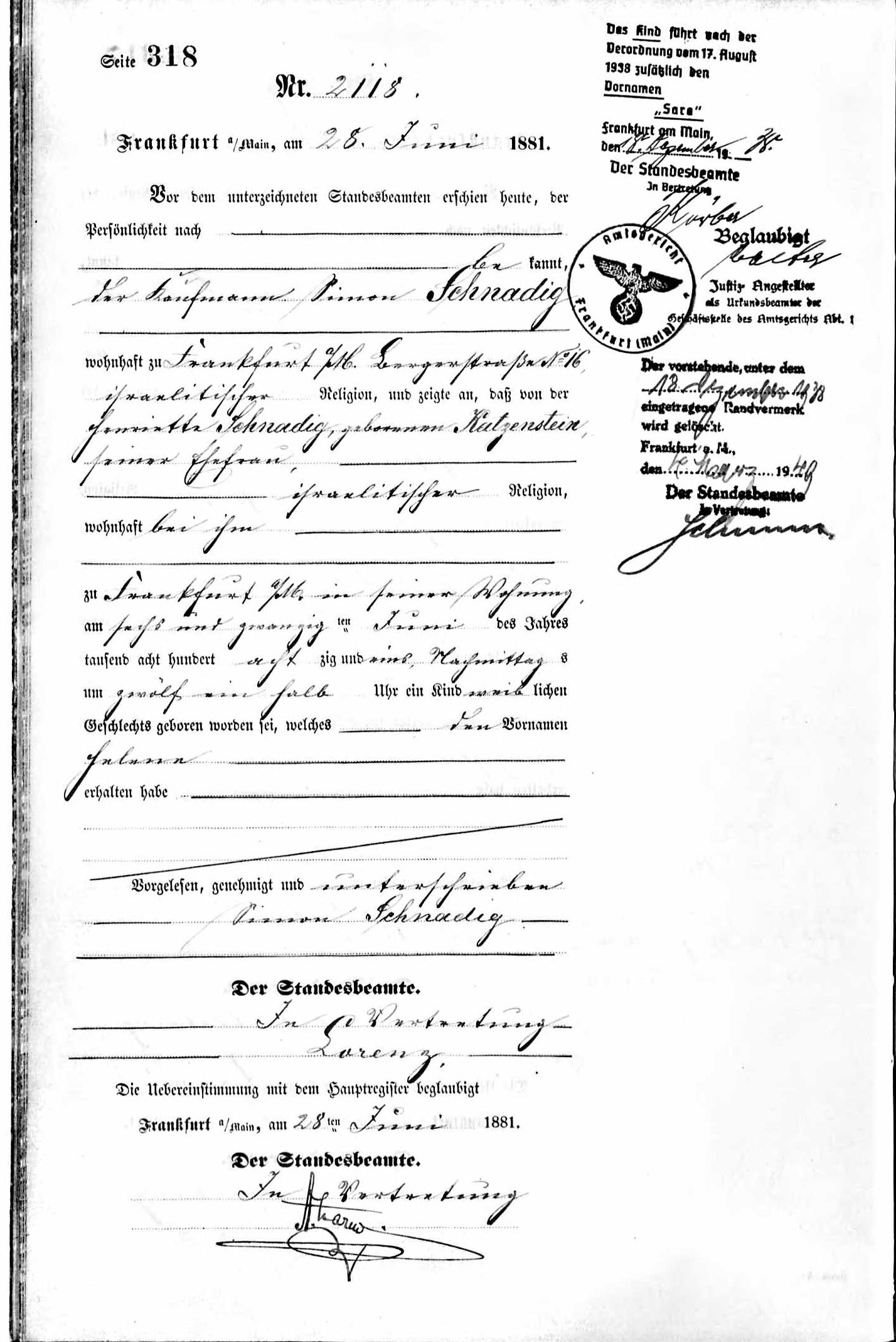
Ten months later Henriette gave birth to their second child, Helene, born in Frankfurt on June 26, 1881.

Helene Schnadig birth record, Hessisches Hauptstaatsarchiv; Wiesbaden, Deutschland; Bestand: 903; Signatur: 903_8956, Year Range: 1881, Ancestry.com. Hesse, Germany, Births, 1851-1901

I found it odd that Henriette named her daughter Helene since that was the name of her older sister, who was definitely still living in 1881, and I cannot find any other close relative of Henriette or Simon with that first name. Perhaps the Hebrew names were different.

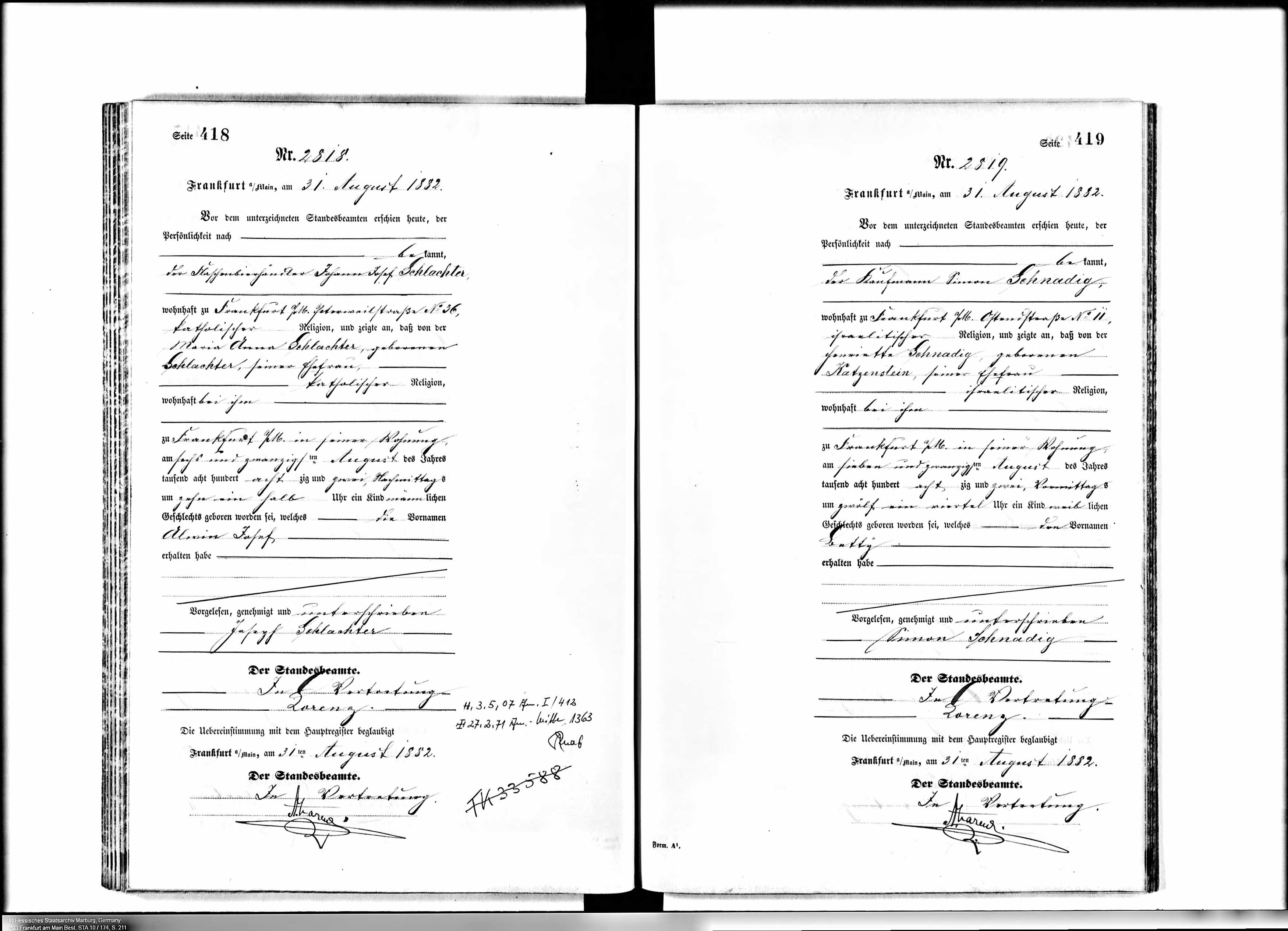
Betty Schnadig, the second daughter, was born August 27, 1882, in Frankfurt.

Betty Schnadig birth record, Hessisches Hauptstaatsarchiv; Wiesbaden, Deutschland; Bestand: 903; Signatur: 903_8970, Year Range: 1882, Ancestry.com. Hesse, Germany, Births, 1851-1901

Henriette and Simon’s third daughter Elsa was born in Frankfurt on January 14, 1890, seven and a half years after Betty, making me wonder whether Henriette and Simon had other babies or pregnancies that did not survive.

Elsa Schnadig birth record, Hessisches Hauptstaatsarchiv; Wiesbaden, Deutschland; Bestand: 903; Signatur: 903_9071, Year Range: 1890, Ancestry.com. Hesse, Germany, Births, 1851-1901

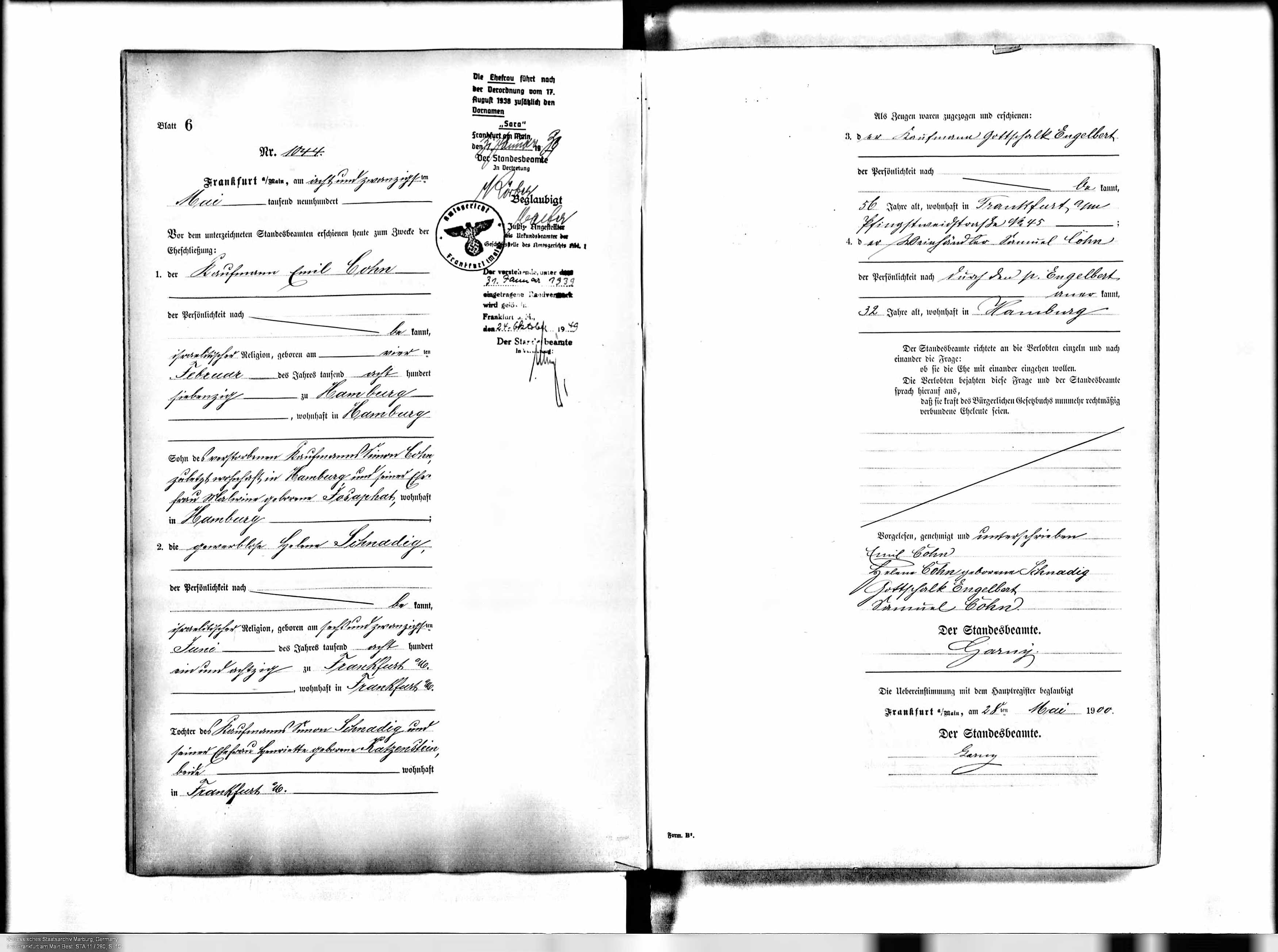
The oldest daughter Helene Schnadig married Emil Cohn on May 28, 1900, in Frankfurt. She was only eighteen, and Emil was thirty. He was born in Hamburg on February 4, 1870, to Simon Cohn and Malvine Josaphat.

Helene Schnadig and Emil Cohn marriage record, Hessisches Hauptstaatsarchiv; Wiesbaden, Deutschland; Bestand: 903, Year Range: 1900, Ancestry.com. Hesse, Germany, Marriages, 1849-1930

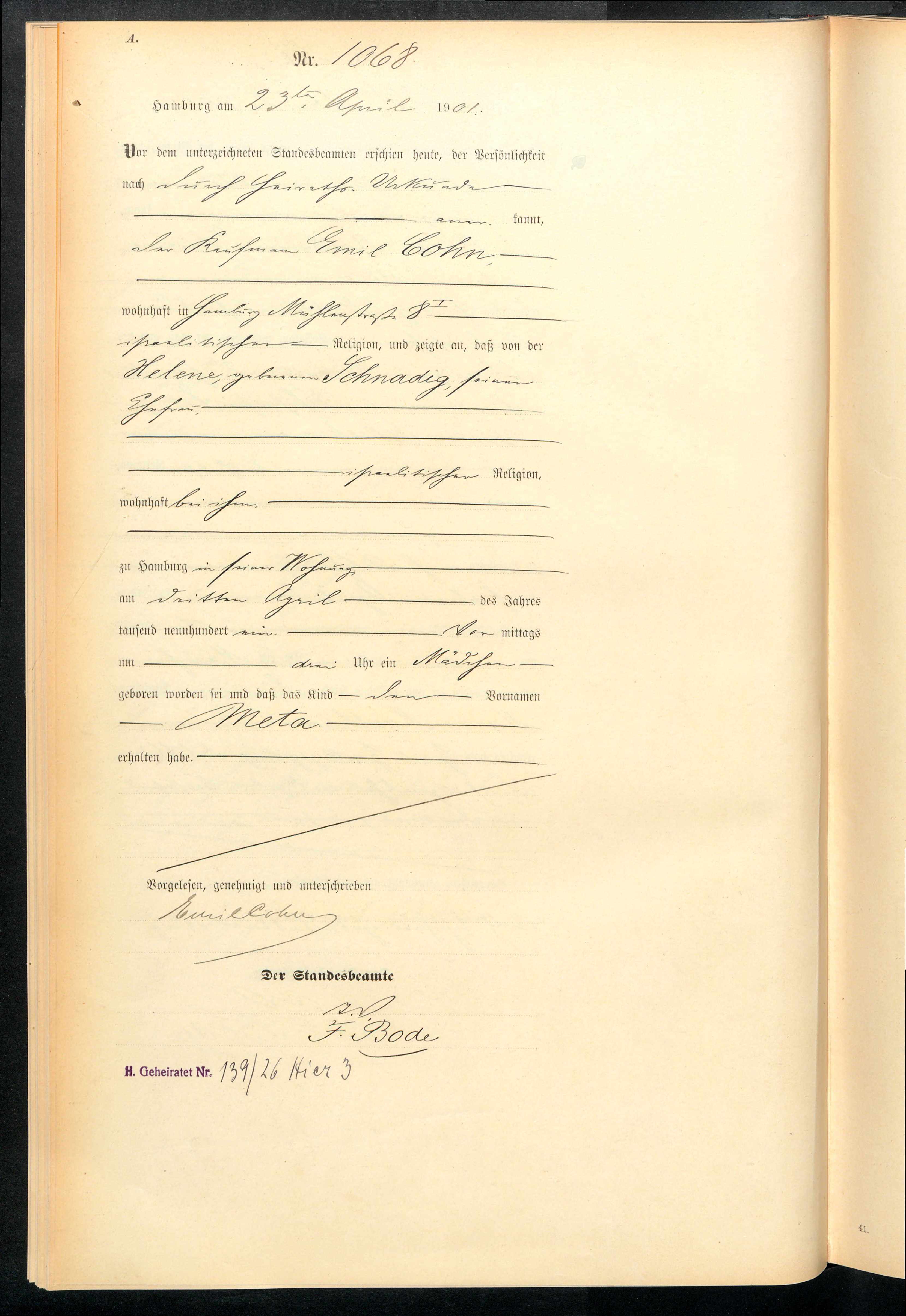
Helene and Emil had four children, all born in Hamburg. Meta was born on April 3, 1901.

Meta Cohn birth record, Year Range and Volume: 1901 Band 03
Ancestry.com. Hamburg, Germany, Births, 1874-1901. Original data:Best. 332-5 Standesämter, Personenstandsregister, Sterberegister, 1876-1950, Staatsarchiv Hamburg, Hamburg, Deutschland.

Siegbert was born April 23, 1905;1 Hertha Johanna was born September 1, 1906;2 and Lissy Sitta was born July 21, 1910.3

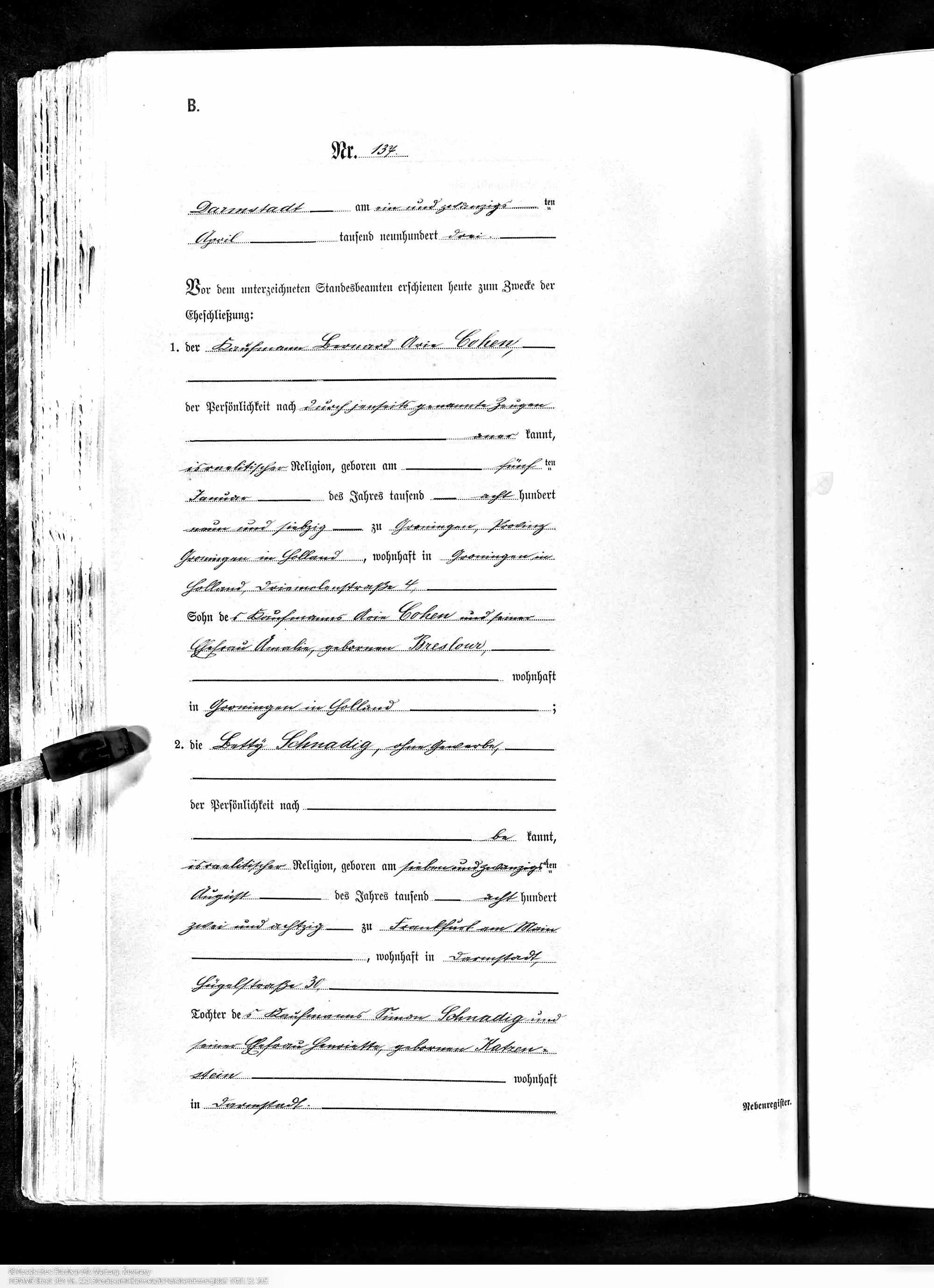
Betty Schnadig, the middle sister, married Bernard Arie Cohen on April 21, 1903, in Darmstadt, where Betty’s parents Henriette and Simon Schnadig were living at that time. He was born January 5, 1879, in Groningen, Holland, and was the son of Arie Cohen and Amalia Breslour. Since Groningen, located in the very northernmost part of the Netherlands, is over 300 miles from Darmstadt and in an entirely different country, I wonder how Betty and Bernard connected.

Betty Schnadig and Bernard Arie Cohen marriage record, Hessisches Hauptstaatsarchiv; Wiesbaden, Deutschland; Bestand: 901; Laufende Nummer: 223, Year Range: 1903
Ancestry.com. Hesse, Germany, Marriages, 1849-1930

Betty and Bernard had four children. Arnold was born February 2, 1904, in Groningen, Holland, where Betty and Bernard had settled and where all their children were born.4 Anita was born on November 25, 1907;5 the third child Simona Hedda was born January 16, 1912,6 and the youngest child Adolf was born July 17, 1916.7

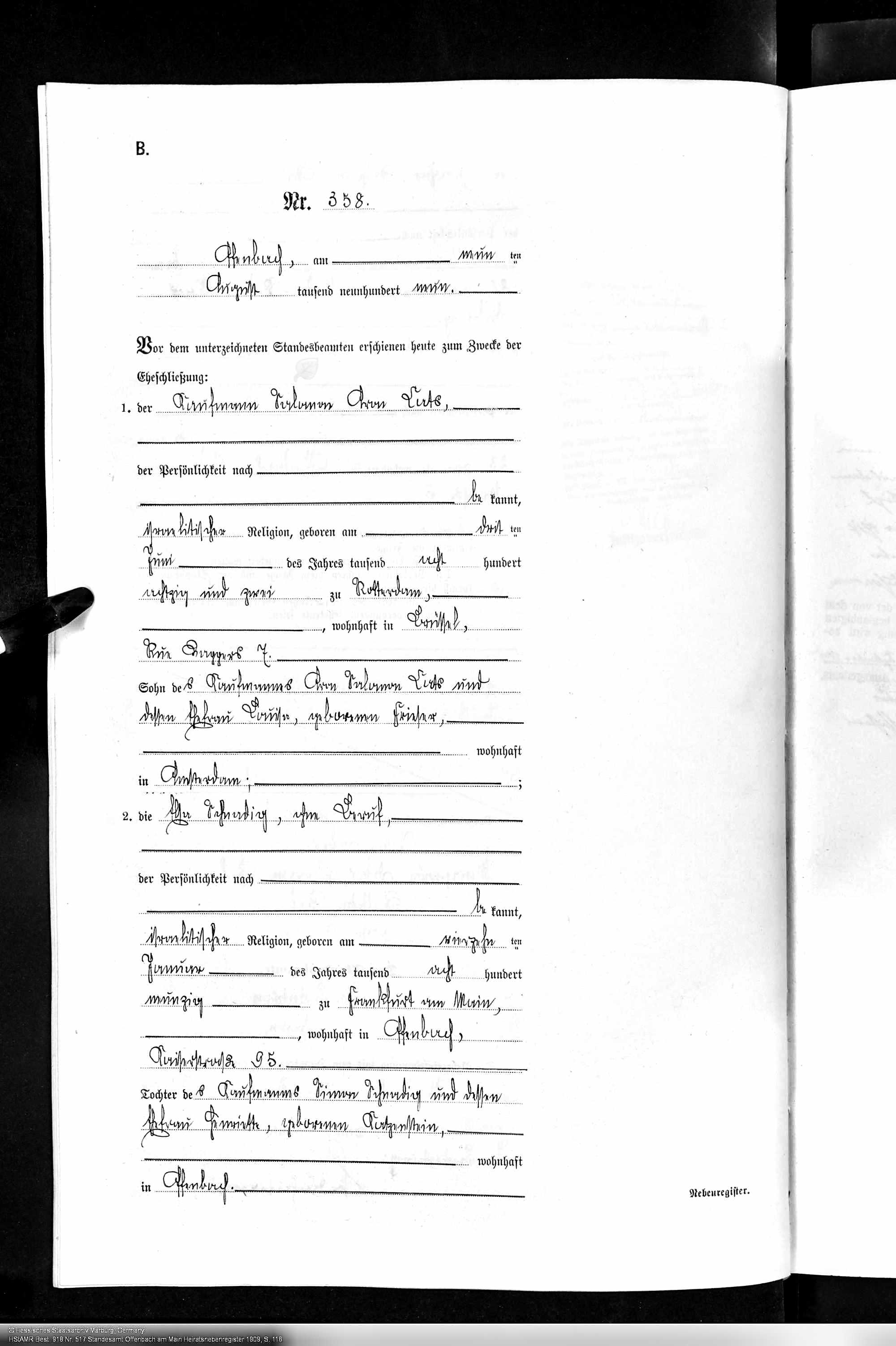
Elsa Schnadig, the youngest child of Henriette Katzenstein and Simon Schnadig, also married a Dutch man. She married Salomon Aron Cats, the son of Aron Salomon Cats and Louisa Frieser; he was born on June 3, 1882, in Rotterdam, in the Netherlands. Elsa and Salomon were married on August 9, 1909, in Offenbach am Main, where her parents were then living.

Elsa Schnadig and Salomon Cats marriage record, Hessisches Hauptstaatsarchiv; Wiesbaden, Deutschland; Bestand: 918; Laufende Nummer: 517, Year Range: 1909, Ancestry.com. Hesse, Germany, Marriages, 1849-1930

So between 1900 when their oldest daughter Helene was married in Frankfurt and 1909 when Elsa was married, Simon and Helene had moved from Frankfurt to Darmstadt to Offenbach. I wonder why since in those days people seemed to stay in one place for many years if not their entire lives.

Elsa and Salomon had two sons. Marcel was born on February 25, 1916, in Schaerbeek, Belgium, and Harry was born August 20, 1919, in Amsterdam, where the family was then living as seen on this family register from the Amsterdam archives.

Family register of Salomon Cats and Elsa Schnadig, Archive cards , archive number 30238 , inventory number 152 Municipality : Amsterdam Period : 1939-1960, Other information
Resident registration card, Web Address https://archief.amsterdam/indexen/persons?ss=%7B%22q%22:%22marcel%20cats%22%7D, Amsterdam Archives Gemeente Amsterdam Stadsarchiev

I want to express my deep gratitude to Bert de Jong of the Tracing the Tribe group on Facebook for his generous efforts in finding this Dutch record and many other Dutch records for the family of Salomon Cats and Elsa Schnadig. I would never have known of these records without his help.

If you look closely at the above record (click to zoom in), you will see that Elsa’s mother Henriette was also living with Elsa and her family in Amsterdam for some time. The record depicted below is from a registry of foreign residents and shows more specifically when Henriette spent time in Amsterdam. It appears that she was there for a period in 1917-1919 and then returned to Germany in June 1919. There is no mention of Simon so it appears he was not with her while she was living in Amsterdam.

Source reference Reproduction parts , archive number 5416 , inventory number 213 Municipality : Amsterdam Period : 1930 Web Address https://archief.amsterdam/indexen/persons?ss=%7B%22q%22:%22schnadig%22%7D  Amstserdam Archives Gemeente Amsterdam Stadsarchiev

Thus, two of Simon and Henriette’s children, Betty and Elsa, married Dutch men and relocated from Germany to the Netherlands long before the Nazi era.

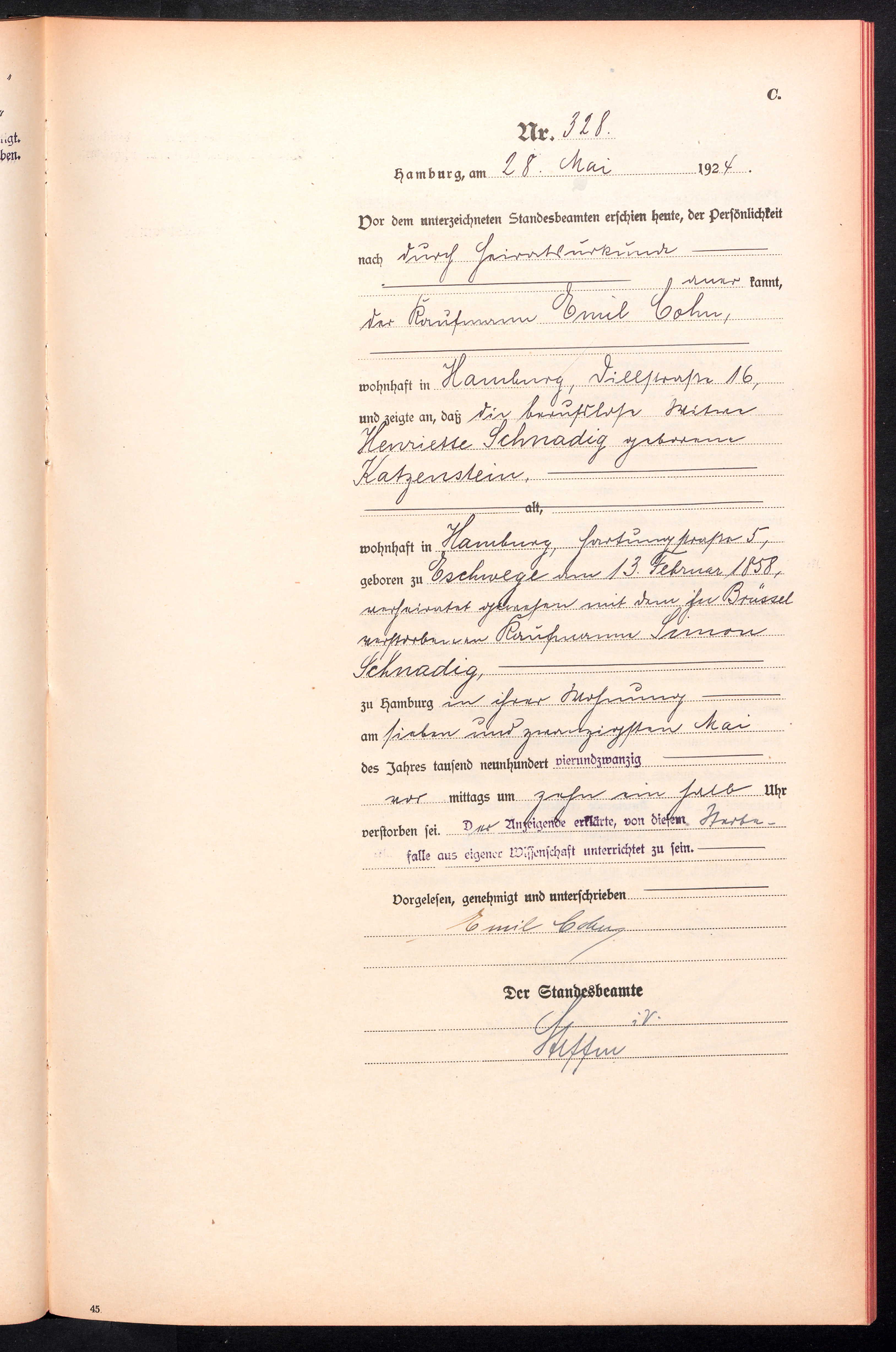
Simon Schnadig died on May 7, 1920, at the age of seventy in Brussels, Belgium.8 I don’t know whether Simon and Henriette had moved once again, this time to Brussels, or whether he just happened to die there while traveling either to visit one of his daughters in Holland or on business. If Simon had relocated to Brussels, Henriette must have moved back to Hamburg either before or after Simon died because she was living in Hamburg when she died on May 27, 1924, at the age of 66. Her son-in-law Emil Cohn was the informant on her death record.

Henriette Katzenstein Schnadig, death record, Year Range and Volume: 1924 Band 01
Ancestry.com. Hamburg, Germany, Deaths, 1874-1950

Simon Schnadig and Henriette Katzenstein were survived by their three daughters and ten grandchildren. Unfortunately, those descendants faced tragic times ahead during the Nazi era, as we will see in the posts to follow.


  1. Siegbert Armin Israel Cohn, Gender: Male, Marital status: Married, Birth Date: 23 abr 1905 (23 Apr 1905), Birth Place: Hamburgo, Arrival Date: 1939, Arrival Place: Rio de Janeiro, Rio de Janeiro, Brazil, Father: Emil Cohn, Mother: Helene Cohn, Traveling With Children: Yes, FHL Film Number: 004542471, Ancestry.com. Rio de Janeiro, Brazil, Immigration Cards, 1900-1965 
  2. Hertha Johanna Cohn, Amsterdam Archives Gemeente Amsterdam Stadsarchiev, Source reference Archive cards , archive number 30238 , inventory number 159 Municipality : Amsterdam Period : 1939-1960, Web Address
    https://archief.amsterdam/indexen/persons?ss=%7B%22q%22:%22hertha%20cohn%22%7D 
  3. Lissy Sitty Cohn, The National Archives; Kew, London, England; HO 396 WW2 Internees (Aliens) Index Cards 1939-1947; Reference Number: HO 396/14, Piece Number Description: 014: Internees at Liberty in UK 1939-1942: Cohn-Cz, Ancestry.com. UK, World War II Alien Internees, 1939-1945 
  4.  Arnold Cohen, Birth Date: 2 feb 1904, Birth Place: Groningen, Father: Bernard Arie Cohen, Mother: Bettij Schnadig, AlleGroningers; Den Haag, Nederland; BS Birth, Ancestry.com. Netherlands, Birth Index, 1784-1917 
  5.  Anita Cohen, Birth Date: 25 nov 1907, Birth Place: Groningen, Residence Year: 1907, Father: Bernard Arie Cohen, Mother: Betty Schnadig, AlleGroningers; Den Haag, Nederland; BS Birth, Ancestry.com. Netherlands, Birth Index, 1784-1917 
  6.  Simona Hedda Cohen, Residence Age: 0, Birth Date: 16 jan 1912, Birth Place: Groningen, Residence Year: 1912, Father: Bernard Arie Cohen, Mother: Bettij Schnadig, AlleGroningers; Den Haag, Nederland; BS Birth, Ancestry.com. Netherlands, Birth Index, 1784-1917 
  7.  Adolf Cohen, Birth Date: 17 jul 1916, Birth Place: Groningen, Father: Bernard Arie Cohen, Mother: Betty Schnadig, AlleGroningers; Den Haag, Nederland; BS Birth,
    Ancestry.com. Netherlands, Birth Index, 1784-1917 
  8. https://www.genealogieonline.nl/stamboom-bouweriks-neervoort-frenk/I29524.php 

Fredericke Katzenstein Goldmann, Part I: Her Daughters and Granddaughters

Having told as much as I’ve learned about Helene Katzenstein Werner and her descendants, I will now move on to Amalie Goldschmidt and Juda Katzenstein’s second child Fredericke, born July 13, 1855, in Eschwege. As we saw, she married Leopold Goldmann, also a native of Eschwege, in Eschwege on November 16, 1875.  They settled in Eschwege, where their three children Clementine, Karl, and Meta were born.

Clementine was born on November 9, 1876, just a week short of Fredericke and Leopold’s first anniversary.

Clementine Goldmann, birth record, Hessisches Hauptstaatsarchiv; Wiesbaden, Deutschland; Bestand: 923; Laufende Nummer: 1829, Year Range: 1876, Ancestry.com. Hesse, Germany, Births, 1851-1901

Karl was born July 24, 1878.

Karl Goldmann, birth record, Hessisches Hauptstaatsarchiv; Wiesbaden, Deutschland; Bestand: 923; Laufende Nummer: 1832, Year Range: 1878, Ancestry.com. Hesse, Germany, Births, 1851-1901

And Meta was born September 9, 1884.

Meta Goldmann, birth record, Hessisches Hauptstaatsarchiv; Wiesbaden, Deutschland; Bestand: 923; Laufende Nummer: 1838, Year Range: 1884, Ancestry.com. Hesse, Germany, Births, 1851-1901

(For those who get confused by all the names, here is a family tree chart you can click on to see the relationships.)

Clementine married Alexander Joel in Eschwege on November 8, 1898, the day before her twenty-second birthday. He was born on July 20, 1871, in Hamburg, to Aron Ephraim Joel and Rika Koch.

Marriage record of Clementine Goldmann and Alexander Joel, Hessisches Hauptstaatsarchiv; Wiesbaden, Deutschland; Bestand: 923; Laufende Nummer: 1883, Year Range: 1898, Ancestry.com. Hesse, Germany, Marriages, 1849-1930

Then, just two months after Clementine’s wedding, her father Leopold died on January 12, 1899, in Eschwege. He was fifty years old and left behind his wife Fredericke, who was 43, and their three children Clementine, Karl, and Meta.

Leopold Goldmann, death record, Personenstandsregister Sterberegister; Bestand: 923; Laufende Nummer: 1944, Year Range: 1899, Ancestry.com. Hesse, Germany, Deaths, 1851-1958

Clementine and Alexander Joel had three daughters. Esther Edda Joel (known as Edda and hereinafter referred to by that name) was born in Hamburg on May 27, 1901.

Esther Edda Joel, birth record, Year Range and Volume: 1901 Band 03
Ancestry.com. Hamburg, Germany, Births, 1874-1901. Original data:Best. 332-5 Standesämter, Personenstandsregister, Sterberegister, 1876-1950, Staatsarchiv Hamburg, Hamburg, Deutschland.

Lizzie Joel was born August 22, 1902, in Hamburg.1 And Ille Joel was born in 1904, also in Hamburg.2

Clementine’s younger sister Meta married Adolf Hammerschlag on November 13, 1908, in Eschwege. Adolf was born June 23, 1877, in Minden, Germany, near Hannover. His parents were Simon Hammerschlag and Sarchen Katz.

Marriage record of Meta Goldmann and Adolf Hammerschlag, Hessisches Hauptstaatsarchiv; Wiesbaden, Deutschland; Bestand: 923, Year Range: 1908, Ancestry.com. Hesse, Germany, Marriages, 1849-1930

Meta and Adolf had two daughters, Lieselotte, born August 10, 1910, in Gottingen, Germany,3 and Irmgard, born March 4, 1915, in Gottingen.4

Clementine and Meta’s brother Karl did not marry and died when he was only 36 on January 30, 1914, in Eschwege. I wish I knew why he died so young.

Karl Goldmann death record, Personenstandsregister Sterberegister; Bestand: 923; Laufende Nummer: 1960, Year Range: 1915, Ancestry.com. Hesse, Germany, Deaths, 1851-1958

In the 1920s, the daughters of Clementine Goldmann and Alexander Joel began to marry. Although I don’t have marriage records, I assume that Clementine’s daughter Edda Joel married Hermann Wolf in the early 1920s because they reportedly had two sons born before 1925, Fernand Moshe Werner and Pierre Kurt, at least one of whom was born in Saarbrucken, a city at the border between France and Germany.5 According to his death record, Hermann was the son of “Mauricio” Wolf and Clare Tannenberg, but since, as we will see, he died in Mexico, I assume that his father’s name was more likely Moritz than Mauricio. Hermann was born in Hannover in 1897.6

Edda Joel’s sister Lizzie also must have married in the 1920s as she also had two children born in that decade, Vera in 1925 and Ruth in 1928.7 Lizzie married Siegfried Haas, who was born in Mardorf, Germany, on February 6, 1896, to Adolf Haas and Fredericke Marx.8

The youngest Joel sister, Ille, also married in the 1920s, I assume, as she had two children in the 1920s. Her husband was Walter Cunow, and unfortunately I have no primary sources for either Ille or Walter, only profiles on My Heritage and Geni that do not provide sources. However, one of the profile managers for their profiles and for those of Ille’s sisters may be a relatively close relative, whom I have contacted but not yet heard back from. At any rate, according to My Heritage, Walter Cunow was born on February 2, 1899, in Berlin to Martin Cunow and Helene Friedenberg.9

Fredericke lived to see at least some of her granddaughters marry and the birth of her first great-grandchild. She was 68 when she died on February 4, 1924.

Fredericke Katzenstein Goldmann death record, Year Range and Volume: 1924 Band 01
Ancestry.com. Hamburg, Germany, Deaths, 1874-1950. Original data:Best. 332-5 Standesämter, Personenstandsregister, Sterberegister, 1876-1950, Staatsarchiv Hamburg, Hamburg, Deutschland.

Fredericke Katzenstein Goldmann had outlived her husband Leopold by 25 years and her son Karl by ten years. She was survived by her two daughters, Clementine and Meta, her five granddaughters, and that first great-grandchild with the others born after her death. As we will see, she was blessed in some ways to have died before the Nazis took control of Germany in the 1930s.


  1.  Lizzie Haas, [Lizzie Joel] , Gender: Female, Age: 55, Marital status: Married, Birth Date: 22 Aug 1902, Birth Place: Hamburg, Germany, Death Date: 6 Feb 1958, Death Place: Indianapolis, Marion, Indiana, USA, Father: Alexander Joel, Mother: Blementine Joel, Indiana Archives and Records Administration; Indianapolis, IN, USA; Death Certificates; Year: 1958; Roll: 03, Ancestry.com. Indiana, Death Certificates, 1899-2011 
  2. Profile on My Heritage found at https://www.myheritage.com/research/record-1-400415261-19-501023/sprinze-philippine-ilse-cunow-nee-joel-in-myheritage-family-trees 
  3. Yad Vashem entry, found at https://yvng.yadvashem.org/nameDetails.html?language=en&itemId=11476670&ind=1 
  4. Stolpersteine family biography, found at https://www.stolpersteine-hamburg.de/en.php?MAIN_ID=7&BIO_ID=90 
  5. My Heritage profile, found at https://www.myheritage.com/person-19501021_400415261_400415261/edda-esther-joel-wolf; Pierre Kurt Wolf
    Birth Date: 30 Sep 1924, Birth Place: Saarbrucken, Federal Republic of Germany
    Death Date: Jun 1979, Father: Hermann W Tannenberg, Mother: Edda E Joel
    SSN: 262757686, Ancestry.com. U.S., Social Security Applications and Claims Index, 1936-2007 
  6. Hermann Wolf Tannenberg death record, Archivo de Registro Civil de Distrito Federal (Civil Registry Archives); Federal District, Mexico, Ancestry.com. Federal District, Mexico, Civil Registration Deaths, 1861-1987 
  7. See Vera Haas, Birth Date: 4 Feb 1925, Birth Place: Hamburg, Federal Republic of Germany, Death Date: 29 Apr 2007, Father: Fred Haas, Mother: Lizzie Joel
    SSN: 311221178, Ancestry.com. U.S., Social Security Applications and Claims Index, 1936-200; Ruth Friedericke Haas, Birth Date: 21 Sep 1928, Birth Place: Hamburg, Federal Republic of Germany, Death Date: 8 May 1998, Father: Fred Haas, Mother: Lizzie Joel, SSN: 307322906, Ancestry.com. U.S., Social Security Applications and Claims Index, 1936-2007 
  8.  Hessisches Hauptstaatsarchiv; Wiesbaden, Deutschland; Bestand: 915; Laufende Nummer: 5891, Year Range: 1896, Ancestry.com. Hesse, Germany, Births, 1851-1901 
  9. My Heritage profile, found at https://www.myheritage.com/research/record-1-400415261-19-501023/sprinze-philippine-ilse-cunow-nee-joel-in-myheritage-family-trees